Daily Herald the Brown
vol. cxlv, no. 45 | Friday, April 9, 2010 | Serving the community daily since 1891
Relay for Life breaks participation records By Sydney Ember News Editor
Friday’s Relay for Life is slated to become the most successful student charity event at the University in the six years since it first hosted the 12-hour volunteer activity in 2004, according to its co-chairs. There is already a record-breaking number of registered participants competing on 84 teams during this year’s relay, said Jasmina Stritof ’11, one of the event’s co-chairs. The event, which will take place in the Olney-Margolies Athletic Center, had also already received more than $83,000 through its Web site as of Thursday night — a total which does not include an additional $11,000 in registration fees, other donations and between $7,000 and $8,000 that Stritof said she anticipates raising at the event itself. She said she hopes the relay event will raise more than $100,000, which would break the previous fundraising record of $98,646 set in 2006.
awesome blossoms
“This will be the biggest charity event Brown has seen in seven years,” Stritof said. In Brown’s inaugural relay in 2004, 750 people participated in the event, which was the highest turnout before this year’s registration — 763 as of late Thursday night — broke the previous record, she said. Last year, there were 497 participants and 60 registered teams, which raised $60,000. This year’s surge in participants is due in large part to increased publicity efforts, Stritof said, adding that this year’s organizing committee — which has 50 members compared to last year’s 15 — has been instrumental in generating awareness for the event. “Our committee is extremely enthusiastic and dedicated,” Stritof said. “We just have the manpower.” The committee has been aggressively promoting the event, which she said has sparked unprecedented community support. “I’ve been involved in Relay For Life since freshman year,” said Kenji
By Alicia Chen Senior Staff Writer
taining these policies and continuing public announcements of the new measures has likely helped to alleviate the concerns of many students, said Director of Financial Aid Jim Tilton. But some students still have concerns about the level of aid available for students who only partially qualify for aid. “Changing financial aid to give some students a full ride is great and necessary,” said Alicia Maule ’11, a Minority Peer Coun-
The venue for this year’s Gala will be changed from the Westin Hotel to an on-campus location, according to an e-mail sent to students Thursday afternoon. Ticket sales were put on hold Thursday for a “few days” while organizers wait to determine the new venue and its capacity, according to the e-mail. The venue change comes after several days of discussion and negotiation between the event’s organizers — the Key Society and the 2010 and 2011 Class Boards — and the Student Labor Alliance, Westin workers and management, University administrators and legal counsel. The groups involved began searching for a new location for the event following concerns raised by the SLA about the labor dispute between workers and hotel management. “Our goal is to have it next Saturday, but we’re going to make an announcement as soon as we have more information,” said Neil Parikh ’11, the 2011 Class Board president and one of the event’s main organizers. The new location has not been officially determined yet, he said. Event organizers are considering holding the event in Andrews Dining Hall, which has a limited capacity of between 400 and 500 people, said Key Society secretary Mayra Reyes ’10. Last year’s event took place in a tent with a capacity of 1,000, Parikh said. Originally, organizers did not think it would be possible to pull out of the contract with the Westin, Parikh said, adding that the
continued on page 2
continued on page 9
Nick Sinnott-Armstrong / Herald
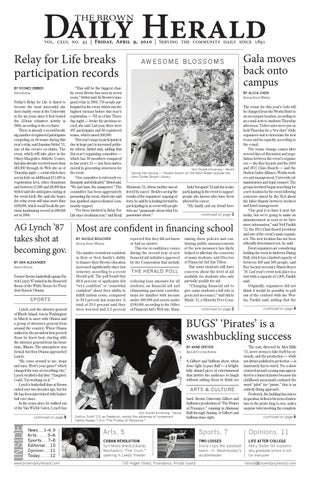
Spring has sprung — flowers bloom on the Main Green outside the John Carter Brown Library.
Morimoto ’11, whose mother was affected by cancer. Besides seeing the results of the organizers’ ongoing efforts, he said he is looking forward to participating in an event with people who are “passionate about what I’m passionate about.”
Indu Voruganti ’12 said she is also participating in the event to support people she knows who have been affected by cancer. “My family and my friend have continued on page 3
AG Lynch ’87 Most are confident in financing school takes shot at becoming gov. By Nicole Boucher Senior Staf f Writer
By Dan Alexander Sports Editor
Former Brown basketball captain Patrick Lynch ’87 waited in the Roosevelt Room of the White House for President Barack Obama.
SPORTS Lynch, now the attorney general of Rhode Island, was in Washington in March to meet with Obama and a group of attorneys general from around the country. When Obama walked in, the president first greeted those he knew best, starting with the attorney general from his home state, Illinois. The atmosphere was formal, but then Obama approached Lynch. “He came around to me, stops and says, ‘How’s your game?’ which changed the tone of everything else,” Lynch recalled a day later. “I laughed. I said, ‘I’m working on it.’ ” Lynch’s basketball days at Brown ended over two decades ago, but his life has been intertwined with basketball ever since. In the years since he walked out of the Van Wickle Gates, Lynch has
The number of students confident in their or their family’s ability to finance their Brown education increased significantly since last semester, according to a recent Herald poll. The poll found that 68.8 percent of applicants felt “ver y confident” or “somewhat confident” about their ability to fulfill tuition costs, compared to 59.4 percent last semester. A total of 29.0 percent said they were worried and 2.2 percent
reported that they did not know or had no answer. This rise in confidence comes during the second year of new financial aid initiatives approved by the Corporation that include
THE HERALD POLL reducing loan amounts for all students on financial aid and eliminating parental contributions for families with income under $60,000 and assets under $100,000, according to the Office of Financial Aid’s Web site. Main-
BUGS’ ‘Pirates’ is a swashbuckling success By Anne Speyer Arts & Culture Editor
A Gilbert and Sullivan show, when done right, is pure fluff — a delightfully absurd piece of entertainment that invites the audience to laugh without asking them to think too
ARTS & CULTURE
Nick Sinnott-Armstrong / Herald
inside
continued on page 8
News.....1–4, 9 Arts........5–6 Sports.....7–8 Editorial....10 Opinion.....11 Today........12
www.browndailyherald.com
Gala moves back onto campus
Kaitlyn Scott ’10, as Frederick, resists the advances of nursemaid Kenna Hawes ’13 in “The Pirates of Penzance.”
hard. Brown University Gilbert and Sullivan’s production of “The Pirates of Penzance,” running in Alumnae Hall through Sunday, is Gilbert and Sullivan done right.
The cast, directed by Alex Hills ’11, never seems to take itself too seriously, and the production — while not always polished to perfection — is immensely fun to watch. For a show centered around a young man apprenticed to a band of pirates because his childhood nursemaid confused the word “pilot” for “pirate,” this is an entirely fitting approach. Frederick, the budding buccaneer in question, believes his term of indenture to the pirate king is over, until a surprise twist involving the complexicontinued on page 6
Arts, 5
Sports, 7
Opinions, 11
Cuban Revolution Kym Moore directs Eduardo Machado’s “The Cook,” opening in Leeds Theater
two losses Siena clips the baseball team in Wednesday’s doubleheader
Life after college Mary Bates GS explains why graduate school is not for everyone
195 Angell Street, Providence, Rhode Island
herald@browndailyherald.com
Page 2
THE BROWN DAILY HERALD
C ampus N EWS
Debate league looks for financial independence By Thomas Jarus Staff Writer
After more than a decade of funding from the Swearer Center for Public Service, the Rhode Island Urban Debate League — an educational program designed for local high school students — is seeking financial independence, said Matt Grimes ’10, one of the league’s student coordinators. The program will still be associated with Brown, but an outside organization will provide financial backing once the program identifies a sponsor. The league operates in 15 schools throughout Rhode Island, with about 100 participants from these schools competing at any given time, Grimes said. Though the Rhode Island chapter is part of a national network of urban debate leagues, Grimes said, “the league here is unique in that it’s run through a university.” The Swearer Center founded the chapter in 1999 and has operated it since, but the new organizational structure will more closely match that of other urban debate leagues, said Roger Nozaki MAT’89, director of the Swearer Center and associate dean of the College for community and global engagement. Given the fact that other urban leagues around the country are either affiliated with other organizations or operate alone, Nozaki said, Rhode Island’s league “can be stronger on its own.” “This is a conversation that has
been going on for many years — looking at what is the right structure for the league,” he said. While the league intends to find new sponsors quickly, “It remains an open question whether or not this is going to work,” Grimes said. “The Swearer Center isn’t going to let us die.” Nozaki said the debate league is “a very important program.” With the group’s new independence, he said his office is “committed to making it a successful transition.” Though the league will not receive financial backing from the Swearer Center after it finds an external sponsor, “Brown student interest is a key driving force in the league,” said Grimes. Because of the league’s affiliation with the University, many Brown students participate in the program, Grimes said. He added that volunteers from Brown “provide thousands of hours of free labor every year” through coaching students, judging rounds and running tournaments. Tara Sennick, a senior at Woonsocket High School who competes in the league, said she has benefited from her interactions with volunteers from Brown. She said there is a big difference between being coached by college students and being coached by hired staff. The students from Brown “seem to genuinely care about we’re learning,” she said. “They can talk to us on a better level because they’re only a few years older than us.”
sudoku
Daily Herald the Brown
Editorial Phone: 401.351.3372 | Business Phone: 401.351.3260 George Miller, President Claire Kiely, Vice President
Katie Koh, Treasurer Chaz Kelsh, Secretary
The Brown Daily Herald (USPS 067.740) is an independent newspaper serving the Brown University community daily since 1891. It is published Monday through Friday during the academic year, excluding vacations, once during Commencement, once during Orientation and once in July by The Brown Daily Herald, Inc. Single copy free for each member of the community. POSTMASTER please send corrections to P.O. Box 2538, Providence, RI 02906. Periodicals postage paid at Providence, R.I. Offices are located at 195 Angell St., Providence, R.I. E-mail herald@browndailyherald.com. World Wide Web: http://www.browndailyherald.com. Subscription prices: $319 one year daily, $139 one semester daily. Copyright 2010 by The Brown Daily Herald, Inc. All rights reserved.
Friday, April 9, 2010
“Tuition at Brown should not continue to climb.” — Chris Norris-Leblanc ’13
Watson kicks off international forum
By Brielle Friedman Contributing Writer
More than 35 professors, writers and researchers gathered Wednesday in the Watson Institute for International Studies’ Joukowsky Forum for the first session of the Fifth International Conference on Transatlantic Studies. Despite several technical difficulties and an unbearably warm temperature, Cristina Iglesias, a Spanish artist, spoke to an enthusiastic audience about her work. Later in the afternoon, President Ruth Simmons introduced the keynote speaker, Brad Epps PhD’89, professor of romance languages and literatures at Har vard. The event was conducted entirely in Spanish. In the keynote session, Epps addressed the lack of attention given
to Africa in transatlantic studies. Focusing on Morocco, Equatorial Guinea and the Western Sahara, Epps called for increased attention to the Spanish presence in Africa, as well as the African presence in Spain and the Caribbean in discussion of the transatlantic. According to Professor of Hispanic Studies Julio Ortega, the biannual conference, which is set to run through the weekend, will host 140 participants from 15 countries and 85 universities over the next three days. This year the conference will focus on the future — its official title is “Futuros” — with special attention to Cuba and Peru. Ortega said Peru was chosen as an area of focus because it is currently undergoing a difficult and conflicting modernization process. The conference is dedicated to
Nicaraguan writer Sergio Ramirez and Cuban poet Reina Maria Rodriguez. Both writers will speak on their work later in the week. In addition, Ortega said at least 15 younger writers from Spain, Mexico and Peru will also participate in the conference. Elide Pittarello, a participant from the Universita Ca’Foscari Venezia in Italy, said that even though she studies Spanish literature she said she felt it was important to attend the conference. “It is so important to be up to date and involved with what is going on in the world,” she said. Lucero de Vivanco, from the Universidad Alberto Hurtado in Chile, shared a similar sentiment. She said she studies Peruvian literature and is attending the conference because the topics are close to her area of research.
Most students confident in financing tuition continued from page 1 selor coordinator, “but there are still people who are middle-class” who need more help. Because the recession has increased concerns over affording an education, she said many accepted students choose to attend colleges that offer merit-based scholarships, which Ivy League schools do not award. Tilton said increased counseling can help families who do not qualify for more aid recognize the options they have outside of direct financial assistance from Brown. “We have made these changes, and it does give families more options,” said Tilton. He added that making counseling a priority has been vital in ensuring that families understand the additional resources available to them. Tilton said this recent increase in confidence may also derive from decisions made “external to Brown.” Within the student loan market, the federal government has helped students and families manage loan payment by allowing families to choose various methods for paying the expenses, he said. Tilton also said families “are cautiously optimistic” after recent indications that the economy is heading in the right direction, further spurring a potential increase in confidence. “Some of the initial hysteria has worn off in terms of the economy,” said Brian Schilder ’11, who said his education is financed primarily by parents in “recession-proof jobs.” He added that many students may perceive that the economy is getting better, thus raising their confidence. Christopher Baker ’12 said the economy has shown potential for improvement since last semester, and he said he believes that plays a large role in improving student comfort levels about future aid. Others were not convinced the economy’s change can be seen yet. Claire Huang ’13, who relies on a combination of financial aid and parental contribution, said that despite general trends that suggest
How confident or worried are you about you or your family’s ability to finance your Brown education?
Julien Ouellet / Herald
improvement, she still has concerns about the recession’s effect on financing her education after her father recently lost his job. In addition to these already implemented financial aid initiatives, the Corporation announced during its Feb. 27 meeting that there will be a 6.5 percent increase in the undergraduate financial aid budget for the 2010-11 academic year. This will coincide with a 4.5 percent increase in tuition and fees , as reported by the Herald on Mar. 1. Chris Norris-Leblanc ’13, a member of Students for a Democratic Society who is currently on leave, expressed concerns over the prospect of the tuition increase and its effect on an affordable Brown education. In the past, SDS has strongly opposed tuition increases, arguing for a tuition freeze, according to Norris-Leblanc.
“Tuition at Brown should not continue to climb,” Norris-Leblanc said. “Brown is trying to become a huge research university, and this is coming at a high cost to undergraduate education.” He added that if even one student has to leave because of Brown’s choice to expend budgetar y money on growth, the projects would not be worth it. Norris-Leblanc said increasing the financial aid budget while increasing tuition “raises student confidence without really giving more people more money.” The Herald poll was conducted on March 22 and 23 and has a 3.5 percent margin of error with 95 percent confidence. A total of 714 Brown undergraduates completed the poll, which The Herald administered as a written questionnaire to students in the lobby of J. Walter Wilson during the day and in the Sciences Library at night.
Friday, April 9, 2010
THE BROWN DAILY HERALD
C ampus N EWS
Page 3
“I have found that it was really addictive to make chain mail.” — Nathan Partlan ’12
Bagpipes, moon bounce in store at relay Liasson ’77 speaks on continued from page 1
been touched by cancer in so many ways,” she said. “I think it’ll just be a great way for all of us to come together.” Brown held its first Relay for Life event in 2004 to raise funds for the American Cancer Society and increase awareness for those affected by cancer. During the event, teams of between eight and 15 members walk from 6 p.m. to 6 a.m. around the track in the OMAC. In addition to the traditional celebratory first lap, this year’s event will feature themed laps, including a three-legged race and a lap during which participants will walk blindfolded, Stritof said.
The walk-a-thon will also feature a plethora of entertainment options to keep participants occupied, said Sam Karshenboym ’12, the event’s other co-chair. There will be a lion dance, eating contests, bagpipes — “to get some great energy in the room,” he said — and performances by a cappella and dance groups throughout the night’s marathon celebration. “We’re going to have a carnivalesque kind of feel to it,” Karshenboym said. “That’s what we’re going for.” In addition to catering by Taste of India, free pizza from Nice Slice, a popcorn machine and a raffle offering prizes including a flat-screen television and a Wii, there will be a moon bounce, which Karshenboym said he managed
to acquire for the event despite facing “a number of obstacles.” There will also be four workshops, including a Zumba session and instruction from a variety of dance groups. The only requirement during the event is that “one member of each team is always on the track to show that cancer never sleeps,” Karshenboym said. “This is not a race. There is no running.” The event is not limited to those who pre-registered, he said, adding that anyone can participate in the celebration by paying a $20 fee at the door. “This is, after all, a community event,” he said. “We’ve been looking forward to this event since September, and it’s finally here.”
Nick Sinnott-Armstrong / Herald
Tech House residents and members of the Knitting Circle demonstrate their skills. The chain mail shirts are entirely made by hand.
Students redefine knitting with chain mail By Liz Kelley Contributing Writer
Forget the sweaters, scar ves and socks that most knitting circles take on. A group of students in Technology House have taken on a much harder project: making chain mail.
FEATURE Last semester, Benedict Landgren Mills ’10, along with John Hawley ’12 and Nathan Partlan ’12, began the Knitting Circle, a group inside the house where members create chain mail armor by linking together thousands of metal rings. The group, composed of Mills, Hawley, Partlan and two other members of Tech House, “got to talking one day and all expressed an interest in the medieval armor,” said Mills. Hawley participates in live-action role-playing — “LARPing” — in which competitors assume opposing roles and battle with padded weaponr y. Costumes are an important component of the activity. “I played a character who required chain mail as part of the costume,” Hawley said. “At the same time and completely unrelatedly, Benedict was like ‘Hey, guys, we should make chain mail.’ I was like, ‘Wow, that’s really perfect timing,’ and so things took off.” Mills took the initiative to look online and research chain mail creation. “Each ring is made by wind-
ing steel wire around wood,” Mills explained. “Then, you bend the rings open and closed using pliers.” Mills, who came to his Herald interview weighed down by his latest creation, said that “each ring goes through four other rings — two from the row above and two from the row below.” Mills’ shir t, which currently weighs 22 pounds and is made of 8,800 rings, has taken him 110 hours to make — so far. “I was wearing this more often when it was smaller, but now that it weighs so much, it gets tiring. I now wear it two to three times per week.” Hawley said. “Oftentimes the three of us with completed shirts will wear them” to meals “to hook people and get them interested.” Their attire has been turning heads across campus. “I have found that it was really addictive to make chain mail and also that the responses you receive are also very gratifying,” Partlan said. “People tend to enjoy the chain mail and express interest in it.” The next shipment of rings, which arrived at Tech House last week, will set off a chain of activities for the group. Mills said the group’s future plans include creating a shirt with the Tech House symbol on the front in copper to stand out from the silver rings. Some members of Tech House are also interested in purchasing metal scales to start scale mail — made from overlapping metal scales.
“Then, plate mail and shields are potential projects,” Mills said. “Tech House has a budget for projects, which comes from members’ dues from each semester,” Partlan said. Currently the group creates shared House mail, and in the future, individuals may fund personal projects, he said. Moving forward, “I kind of doubt it will become an official University club,” Partlan said. But the group is happy to stand out with their creations.
Obama, health care By Casey BLEHO Contributing Writer
To commemorate Casey Shearer ’00 on the 10-year anniversary of his death, Salomon 101 was filled Thursday evening for a keynote speech by political commentator Mara Liasson ’77 and the announcement of the winners of the 10th annual Casey Shearer Memorial Award for Excellence in Creative Nonfiction. Introduced by Ted Widmer, director of the John Car ter Brown Librar y, as “quite possibly the only Brown graduate who has ever been on Fox News,” Liasson spoke on the political atmosphere of Washington, D.C., as national political correspondent for National Public Radio and commentator for Fox News. Liasson, who covers D.C. politics and policies spoke on a wide range of topics surrounding both the political arena and the Obama administration. Liasson opened with a discussion of the recently passed health care bill and its impact and repercussions for the administration. “It was big for the president,” she said. “He delivered on his promise not to play ‘small ball.’ He wanted to do something big and he did it.” The issue now, she said, is what the Democrats will do next as they “embark on the next big chapter of the health care debate.” “I think you can make the argument, like many have, that the bill wasn’t radical enough. It preser ves the employer-provided health-benefit system that many think needs to be torn up by its roots. He designed a health care plan that he thought could pass,” Liasson said. And this, she believes, could have serious repercussions in the upcoming November midterm elections. The fact that Obama followed the conventional political
process despite his campaign message of transparency and massive reform disappointed the Democratic base, she said. “He was going to change the way Washington worked — and I think he’s rethought this — but he’s certainly trying to fulfill the promises he made,” she continued. Now that the health-care bill has become law, Liasson considered the next big challenges she believes Obama will face — the national debt and deficit, immigration reform and energy conservation. But “none of these issues are going to loom as much as health care and the economy in November,” she concluded. Shearer, who died when an undetected virus unexpectedly stopped his heart days before his graduation, became known on campus as the play-by-play sports announcer for WBRU and as sportswriter for the College Hill Independent. Shearer’s appreciation and passion for journalism inspired his parents to initiate the award to commemorate their son. “We tr y to have a special event that crosses boundaries in various ways. Our son Casey was a ver y special young man that managed to cross many boundaries and bring people together,” she said. “The people that have written these essays have done the same thing today. Ever yone has dealt with crossing boundaries, and the way you can communicate with people.” Elizabeth Taylor, senior lecturer in English and director of the Nonfiction Writing Program, presented the awards prior to the lecture. First place was awarded to Sarah Gibson ’10.5. Second place was awarded to Sara Mann ’10 and honorable mentions were given to Emily Segal ’10.5 and Laura BrownLavoie ’10.5.
Page 4
THE BROWN DAILY HERALD
C ampus N EWS Walking barefoot to support a global cause
By Luisa Robledo Staff Writer
Before walking into a restaurant Thursday night, Sarah Grimm ’12 put her shoes back on after spending 12 hours barefoot. Like thousands of people across the country, Grimm joined Toms Shoes’ invitation to walk barefoot in an effort to show the world the inescapable reality that more than 300 million children experience. “I realized how lucky I am to have the opportunity to put on a pair of shoes,” Grimm said. “This is really good for putting things into perspective.” Kevin Cervantes ’10, the campus representative for Toms, said “it’s not about putting yourself in their shoes. It’s about putting yourself in their lack of shoes.” According to Cervantes, it doesn’t matter if people take their shoes off for a few minutes or for the entire day. The point is that people get to experience what it’s like to cross a street, go to the bathroom, or walk across the main green without shoes. Emily Koo ’13, who organized the Facebook event for the Brown community, explained that when people think about necessities, they always mention water, shelter and health care. “They always forget about shoes,” she
said. “It’s so poignant — walking around watching where you step,” Koo said. Although Koo’s Facebook event received a supportive response with more than 250 confirmed guests, others posted comments about potential injuries and infections. Others were simply concerned about going into “gross places” without their shoes on, Koo said. “I live in Keeney,” Grimm said. “So it was weird to wake up and not put my flip flops on to go take a shower.” Jonathan Leibowic ’12 walked into Starbucks barefoot Thursday morning thinking he was going to get reprimanded for breaking a hygiene code. “Fortunately, no one from behind the counter can see your feet,” he said. To Leibowic, who said he likes walking barefoot in the springtime, participating in this event seemed like the least he could do to work for a cause that can help so many. According to various Facebook events, universities in states including Alabama, Kentucky, California, Texas and Illinois spread the word about spending a day without shoes. “It’s a really eye-opening, to be cliche, experience,” Grimm said. “It’s interesting being barefoot — it’s all I’ve been thinking about today.”
Friday, April 9, 2010
“It’s about putting yourself in their lack of shoes.” — Kevin Cervantes ’10, campus representative for Toms Shoes
Med Ed building forces office relocations By Warren Jin Staf f Writer
In order to make room for the new Medical Education Building in the Jewelry District, offices at 222 Richmond St. have been relocating for the past year — most recently, the Education Alliance, a department that works for education equity, on March 22. Almost all of the organizations with offices formerly in the Richmond Street building, including the Education Alliance and the University Investment Office, are in the process of moving, or have already relocated to other locations, said Richard Spies, executive vice president for planning and senior adviser to President Ruth Simmons. Many of the organizations that have been moved out of the building, including Big East Conference Athletics, were in fact outside organizations renting the space from Brown, Spies said. The Med Ed building is a part of a long-term development project at Brown that also includes expanding infrastructure on the main campus and in the Jewelry District, he said. The original $80 million project was intended to build an entirely new building dedicated to the Alpert Medical School, but following the economic downturn
in fall 2008 and losses in the University’s endowment, plans were revised to instead renovate the Richmond Street building, reducing the cost of the project to $45 million, Spies said. Planning for these expansions began seven to eight years ago, corresponding to concurrent plans of increasing Brown’s faculty by another 200 members, Spies said. Since expansion of Brown’s main campus was limited by the surrounding neighborhoods, the University began to look elsewhere. “The possibilities for growing the campus horizontally weren’t very good,” Spies said. “That led us to think of possibilities downtown.” Currently, besides the 222 Richmond St. property, the University owns other buildings in the Jewelr y District, including a former factor y at 70 Ship St., converted into the Med School’s Laboratories for Molecular Medicine. The Jewelr y District also recently became home to various biotech companies including Isis Biopolymer and NABsys, a gene-sequencing company that has licensed intellectual property developed by Brown researchers, Spies said. In spite of recent development in the Jewelry District, the area is still a relatively underdeveloped
part of downtown, Spies said. “It has a long way to go before it will be well-developed,” Spies said. Nonetheless, he said he is optimistic about its prospects. Due to the Jewelry District’s proximity to College Hill, the goal is to “make everyone feel that it’s just another part of campus,” Spies said. The Education Alliance, which will move east, works with governments and public schools across the nation with the goal of “addressing the needs of historically underper forming populations” said Adeline Becker, its executive director. The move from the Jewelr y District to Richmond Square, though stressful, went smoothly, Becker said. “It was a complicated process, but it was very smooth,” Becker said. “We didn’t have much dead time at all.” The Education Alliance is one of the oldest tenants in the 222 Richmond St. building, Spies said. Even though the Jewelry District is supposed to become the center of development, the decision to move the Education Alliance out of the Jewelr y District entirely was “purely practical,” Spies said. “There just wasn’t enough space.” “There was no particular advantage to us to remain there,” Becker said.
Intervention starts to infect nation By Julia Longoria Contributing Writer
Project START — an HIV, sexually transmitted infection and hepatitis risk-prevention program for people returning to the community from incarceration — has become a national model for community-based providers. The principal investigators for the project’s Rhode Island branch were two faculty members affiliated with Miriam Hospital — Timothy Flanigan, professor of medicine, and Kathleen Morrow, associate professor of psychiatr y and human behavior. Project STAR T began in 1997 as a research project in four states funded by a grant from the Centers for Disease Control. In the original research project, 522 young men ages 18–29 leaving prison were the subjects, as STI rates among men entering jail are as high as 35 percent, according to a CDC report. The research found that an enhanced six-session inter vention program significantly reduced sexual risk behavior among these men, compared to a standard singlesession program, according to a 2006 paper.
“Our theoretical orientation was that we work with these guys to be part of their transition from the incarcerated setting to their community,” Morrow said. “It wasn’t just about using a condom when you have sex, it was about helping them to meet their other life needs.” Morrow said the researchers took on a client-centered approach in the inter vention, helping the men meet other basic life needs, such as education or job searching, so they would then be able to “think about their health.” In Project STAR T’s enhanced sixsession program, two intervention sessions were held for the men while in prison and four sessions were held one, three, six and 12 weeks after release. “It took many years, but we got positive outcomes,” said Barr y Zack, a co-principal investigator for the Project START research in California. “The inter vention worked. Then the CDC came to us and said, ‘Can you package this; can you translate it for national rollout?’ So then we took the research protocols and we translated them.” The Bridging Group, a con-
sulting group in Oakland, Calif., translated Project STAR T with the help of the original researchers to apply to all people leaving any incarcerated setting, not just young men leaving prison, said Zack, who now works as principal consultant for the Bridging Group. Zack said Morrow represented Brown in the translation, and the translated Project START was then piloted in communitybased organizations. Groups around the nation have already implemented Project START, but based on the pilot’s success, starting July 1, the program will be implemented around the country with CDC funding for the next five years, Zack said. “The week of (April) 19 we’re training trainers so they can train people around the countr y about how to do it,” Zack said. Project STAR T has already been implemented to var ying degrees internationally in Kazakhstan, Russia, Ukraine, Taiwan, Vietnam and Thailand, Zack said. “Even though this was a U.S. study, dare I say, people around the world are not waiting as long as the U.S. did,” Zack said.
Thanks for reading!
Arts & Culture The Brown Daily Herald
‘The Cook’ recalls the Cuban revolution
Friday, April 9, 2010 | Page 5
By Kristina Fazzalaro Senior Staff Writer
New Year’s Eve, 1958. Cuba is on the brink of a communist revolution led by Fidel Castro. This knowledge hangs over the Santana household in La Havana like a thundercloud waiting to burst. Gladys (Lynsey Ford ’10), the family’s cook, is busy preparing Baked Alaska for a room full of Batista-loving aristocrats. There is a serene quality to her work as she tastes, chops and simmers, but it will soon be out of the frying pan and into the fire for Gladys’ family in Sock and Buskin’s latest production, “The Cook,” which opened Thursday night in Leeds Theater. Gladys takes the Baked Alaska out of the oven and looks around the room. “I am a great cook. That’s who I am,” she says proudly. Enter Carlos (Rafael Cebrian ’11) — her husband and the family’s chauffeur. There is a swagger in his walk and a grin on his face. When the revolution happens — and it will happen — he will be waiting to take his place in the new regime. In a tender moment amid guests ringing for more hors d’oeuvres, Adria Santana (Gillian Chu ’13) cursing Fidel and other servants scampering through the kitchen, Carlos takes Gladys in his arms and says, “I know that you’re nervous, but remember, I love you.” They will need that love more than they can imagine in the coming years. The naturalistic play, written by Cuban playwright Eduardo Machado, spans 40 years of the Cuban Revolution as it unfolds within the four walls of Gladys’ kitchen. “For me, the story is really about how the revolution in Cuba affected people on a personal level,” said director Kym Moore, visiting assistant professor of theatre arts and performance studies. “It’s ultimately a love story,” said assistant director Zack Bleckner ’12. “The revolution is clouded by political and socioeconomic circumstances. The only thing that survives all this s— is love and family. It’s powerful.” “It’s really Eduardo’s love song to his homeland,” Moore added. At the close of the first act, Adria clasps Gladys’ hands and makes her swear one thing — to protect the house from Castro’s people. Gladys agrees without a second thought. She loves Adria and considers her a friend — family, even. “That loyalty has destroyed her whole family,” Moore said. “The play is about blind loyalty.” The theme of devotion resonates on several levels: Gladys’ never-ending fidelity to Adria causes her to pull away from her family while Carlos’ faith in Castro represents the way many Cubans felt about the future dictator, until they later encountered the bitter sting of disappointment. “The play asks, at what cost this revolution?” Moore said. In the second act, Gladys is faced with a choice. Her cousin Julio (Gabe Gonzalez ’12) is being watched by the secret police. He has been having an illicit affair with an 18-year-old
Nick Sinnott-Armstrong / Herald
Gabe Gonzalez ’12 and Lynsey Ford ’10 star as Julio and Gladys.
white boy, punishable by detainment at a work camp — death is the usual result. Carlos has worked his way into the new regime and is now the minister of transportation. He can — and will— save Julio out of love for Gladys, but his relationship with her has deteriorated over the past 12 years and he wants something in return. His girlfriend is pregnant and he wants to move her into the house. But it is Adria’s house and Gladys vehemently refuses. Not only is she angry with Carlos, but her promise to Adria prevents her from letting anyone in the house — even if it would mean saving her cousin’s life. Julio is devastated. “I thought the revolution was going to include me,” he says. The play reveals many nuances of the revolution that are often overlooked in representations of Cuba. As Moore said, people “see the picturesque buildings and 1950s cars. Then they think of the food. They forget about the people, the complexities of the society.” In order to prepare for the production, Moore visited Cuba in December and got a firsthand look at what life in the country is really like. “We did an incredible amount of research,” she said. According to Gonzalez, Moore brought in photos, videos and other materials for the cast to study. “Kym made great efforts to familiarize us with the culture and history of Cuba. It made a world’s difference in understanding who we are in this play and the humanity of our characters,” he said. Moore, who is of Panamanian descent, said she wanted to direct “The Cook” for several reasons, “particularly because it was centered on Afro-Caribbean women. It reminded me of all the women in my family.” The play also offered her the opportunity to put on a realistic play with a small cast, she said. There are only six actors involved in the production. “It’s very intimate because it is such a small cast,” Gonzalez said. For a group of its size, the cast is very international, featuring individuals of Spanish, Portuguese, Jamaican and Sri Lankan heritage, Gonzalez said. “I wanted a diverse cast,” Moore explained. “A lot of people said, I can’t try out for that because I’m not Cuban, but you’re not Elizabethan
either.” The Caribbean itself is very diverse, and Moore said she wanted to bring this to life on the stage. Bleckner said the play also featured several aspects that are characteristic of Cuba — such as the “Cuban phenomenon” of double-speak. “Every line has a double meaning,” Bleckner explained. The production was also very performative — incorporating the dance, music and culture of Cuba into the play. “It’s the opening up of the hips and the body,” Bleckner said. The cast took on the challenge of such a performative piece and delivered. Ford’s Gladys is a brilliant combination of warmth, strength and naivete. Cebrian’s Carlos never loses
Nick Sinnott-Armstrong / Herald
Ford, as Gladys, swears her loyalty to Adria Santana, played by Gillian Chu ‘13 in Eduardo Machado’s “The Cook.”
his swagger, even when the family falls on hard times. Complete with running water, the set provides the perfect backdrop to Gladys’ work. You can smell the onions Carlos chops and the cigarillos Gladys and Julio smoke on New Year’s. The attention to detail is impressive, transporting audiences to the Santanas’ bright kitchen as soon as they step into the theater.
The result is a wonderful combination of strong performances, charming set design and authentic Cuban flavor that brings to life a situation often forgotten by history books. “The Cook” runs April 8-11 and 15-18 in Leeds Theater with performances at 8 p.m. Thursday through Saturday and Sunday at 2:00 p.m. Tickets are $7 for Brown students.
Page 6
THE BROWN DAILY HERALD
A rts &C ulture
Friday, April 9, 2010
“If I tell them a general thing I want they will run with it and by run, I mean fly.” — Alex Hills ‘11
‘Pirates of Penzance’ is a swashbuckling musical sensation continued from page 1 ties of being born on Feb. 29 — in a leap year — binds him once more to the life of the pirate. Frederick then finds himself torn between his “sense of duty” to the pirates, his moral objections to piracy and his growing love for a young maiden named Mabel. The role of Frederick is played by Kaitlyn Scott ’10, a casting decision that assistant director Eva Kurtz-Nelson ’11 said reflects a lack of strong male tenors on campus. But Scott proves she can swashbuckle with the most masculine pirates, striding about the stage with her sword in hand. “She’s done a really good job getting into manly character,” KurtzNelson said. Scott’s voice is both expressive and powerful, and she is strongest in the smaller, two-person scenes when her presence truly fills the stage. Many of these moments are shared with Gabriel Trilling ’10 in the role of Mabel, a part that showcases Trilling’s impressive range and vocal control. But Trilling’s lovely voice is sometimes unfortunately lost beneath the music from the orchestra. Under the direction of Zach Wilson ’12, the 20-person group sounds very professional, but at times overpowers the singers. Trilling and Scott as Mabel and Frederick are caught between the feuding of three hilarious ensembles:
Mabel’s eight innocent sisters, the band of pirates and an easily frightened troop of policemen. The sisters, in pastel dresses with bustles and pinafores, titter and trill their way through the play, a perfect picture of affected naivete. Matthew Jaroszewicz ’12 leads his adorable band of bumbling, bashful policemen through several clever dance numbers that featuring night sticks and Oompa-Loompa-inspired bobbing. But the singing and dancing pirates, in true pirate form, steal the show with nearly every song. Nate Stetson ’11, sporting an impressive beard grown for the part, plays the pirate king. Stetson’s king is an endearing blend of savage and sweet, a fearsome pirate who will always spare an orphan and still kneels at Queen Victoria’s name. Hills said Stetson, who has experience as a fencer, also choreographed many of the show’s thrilling swordfights. Before the show’s conclusion, a battle breaks out between sisters, policemen and pirates that has the young ladies fending off the pirates’ swords with their parasols. “The Pirates of Penzance” is not the type of show to provoke a lot of heavy reflection or debate. In the hands of Brown University Gilbert and Sullivan, the operetta is light and charming, a pleasant two-hour distraction. But no matter how co-
Nick Sinnott-Armstrong / Herald
Major General Ken Mcpherson pleads for his life with Pirate King Nate Stetson ’11.
medic and creative the production is, the audience may never enjoy it as much as the cast members, who all seem to be having a ball hamming it up together. “These guys are the best cast I’ve ever worked with,” Hills said. “If I tell them a general thing I want, they will run with it — and by run, I mean fly.” “Pirates of Penzance” runs this weekend in Alumnae Hall with performances tonight at 8 p.m., tomorrow at 2 p.m. and 8 p.m. and Sunday at 3 p.m. Admission is free.
NIck Sinnott-Armstrong / Herald Pirate King Stetson gets some pirate booty in Brown University Gilbert and Sullivan’s “The PIrates of Penzance.”
SportsFriday The Brown Daily Herald
Friday, April 9, 2010 | Page 7
baseball
Bears fall in doubleheader By Tony Bakshi Spor ts Staf f Writer
Ryan Zrenda ’11 had a massive day at the plate Wednesday, hitting three home runs and notching five RBI. But the Brown pitching staff could not take advantage of their teammate’s big day at the plate, and the Bears (5-17) dropped both ends of their doubleheader against the Siena Saints (12-15). Brown lost a close opener at Murray Stadium, losing 9-8 after blowing a 6-1 lead. The Saints’ bats stayed strong in the second game, as four home runs helped them to an 11-7 victor y. Siena 9, Brown 8 The Bears’ bats were working early in the opening game of the doubleheader, as they got on the scoreboard in the third inning. Matt Colantonio ’11, Brown’s leading hitter, led off the inning with a triple, and Zrenda drove him home with the first of his three home runs on the afternoon. But Siena responded immediately, and continued to do so throughout the game. The Saints’ Dan Paolini hit a solo shot to left field off Brad Kottman ’13, slicing the Bears’ lead in half, 2-1. In the bottom of the four th, Siena’s left-hander Craig Marcellus lost his command, and Brown took advantage. After Marcellus walked two consecutive batters with two outs, Colantonio knocked a base hit up the middle for an RBI. The next batter, Pete Greskoff ’11, cracked a three-run shot over the fence to grab a commanding 6-1 lead. Siena came all the way back in the top of the sixth inning. Kyle Hudson’s slow dribbler to third would have made the score 6-2, but a throwing error on the play by Greskoff brought in one more baserunner, pulling the Saints within three runs. The next bat-
ter, Anthony Giansanti, hit a threerun home run to left field off Rob Wilcox ’10, and the game was suddenly tied. But in the bottom of the sixth, Zrenda again gave the Bears a tworun lead. His second home run of the day made it 8-6 in Brown’s favor. “Ryan had a good day,” said Head Coach Marek Drabinski. “He’s a guy who has had a ver y good year thus far. He’s one of our more consistent hitters. We count on him.” But Andrew Backowski ’11 could not hold the lead in the final frame. Siena first baseman Kevin Quaranto hit a sharp double over first base, and an infield single later in the inning brought him in to cut the lead to 8-7. But when Brown was within one out of a victory, Saints’ catcher Kyle Barbato hit a clutch two-run single, giving the Saints the lead for good, 9-8. “I was searching for answers,” Drabinski said. “We know we can pitch a lot better than we pitched today.” Siena 11, Brown 7 The Saints came out swinging again in the second game. The first two Siena hitters took Cooper Smith ’13 yard for back-to-back home runs, giving Siena a quick 2-0 lead. The next inning, facing a 4-1 deficit, the Bears got back in the game. Josh Feit ’11 doubled off the base of the wall and Nick Punal ‘10 had an opposite field base hit to bring Bruno within one run, 4-3. But the Bears pitching staff disappointed again in the third inning. Siena catcher Gary DerHagopian extended the Siena lead to 6-3 with a base hit up the middle, and another single by Mike Fish brought in two more runs. Despite the five-run deficit, Bru-
Jonathan Bateman / Herald
Third baseman Pete Greskoff ’11 fires across the diamond in a loss Wednesday against Siena.
no had a golden opportunity to get back in the game in the bottom of the fourth. Both Mike DiBiase ’12 and Colantonio worked the count to draw bases-loaded walks to cut the lead to three, 8-5. But Greskoff struck out and Zrenda popped up, and the Saints ran off the field relatively unscathed. “We swung the bats well,” Drabinski said. “But I still thought we left some opportunities out there. We had the bases loaded a few times, and didn’t get any guys in.” Meanwhile, the Saints continued showing off their hot bats with another pair of consecutive home runs in the fifth inning. Giansanti first hit a two-run home run off Walter Albee ’13, and Mike Allen followed him with a towering shot over the left field fence. That pushed the lead to 11-5. But while the Bears hit back-toback home runs of their own in the bottom of the seventh, courtesy of Zrenda and Joe Mellano ’10, Brown could not come all the way back from the six-run deficit. The Bears must now prepare for four key Ivy League games, as they host both Princeton and Cornell in doubleheaders over the
Jonathan Bateman / Herald
The Bears’ baseball team (5-7) dropped both parts of a doubleheader on Wednesday. The team will host doubleheaders this weekend against Princeton and Cornell.
weekend. “We got a challenge ahead of us,” Drabinski said, referring to his
team’s pitching for the upcoming weekend. “Hopefully, we can meet the challenge.”
Page 8
THE BROWN DAILY HERALD
S ports F riday
Friday, April 9, 2010
“I saw in him, maybe an athlete, but more so, just a real person.” — Patrick Lynch ’87 on Obama
Lynch’s ’87 skills on the basketball court translate to other arenas continued from page 1
volunteered in an effort to mend the Catholic-Protestant struggle in Northern Ireland, practiced law in the private sector, prosecuted the mafia and run for office — first for attorney general, and now for governor. But through all of the twists and turns, Lynch never stopped being a basketball player, either in practice or in mindset. Ending a centuries-old divide After finishing second in the Ivy League in scoring his senior season, the 6-foot-5-inch Lynch — whom former Brown Head Coach Mike Cingiser ’62 P’85 P’89 said was “probably the best shooter I ever coached” — headed to Northern Ireland to play professional basketball for two years. But while earning his paycheck playing basketball, Lynch began his lifelong balance between the game and service. He became the first volunteer in a program called Sports Corps, designed after the Peace Corps. At the time, every aspect of Northern Irish society was divided between Protestants and Catholics, Lynch said. Protestants lived in certain neighborhoods, and Catholics lived in others. Protestants played rugby, and Catholics played soccer. “The communities are literally divided by corrugated steel fences that are wall-high, 15 feet high,” L ynch said. “You would go into some of those neighborhoods, you would see kids, and they would be taking rocks and bottles and they would be saying bad things about the people on the other side. And they can’t even see them. It’s just perpetuated generationally because they’re supposed to hate the other side. And so our concept was to cut through that.”
How? Basketball. Since the sport had only become popular in Northern Ireland in the 1980s, the deep-rooted divisions between Protestants and Catholics that divided other sports had not yet laid claim to basketball. So Lynch took kids from Protestant neighborhoods and kids from Catholic neighborhoods and put them on the same basketball teams. “I tried to bring them together to get them to play with each other, intermingling on teams to create some conversations to help illustrate to them that you’re not that different from these kids and decrease the hate,” Lynch said. While in Northern Ireland, Lynch never lost his focus on his career after basketball. He said he knew he wanted to be a lawyer, so he studied law at Queen’s University of Belfast, in addition to playing pro basketball and working with the Sports Corps. He eventually graduated from Suffolk University Law School in 1992 after he returned to the U.S. Following a yearlong second stint playing professionally in Ireland, Lynch turned pro in law. From court to courtroom L ynch took the competitive spirit he developed on the court with him into the next focus of his life, law. He said his competitiveness made a career in prosecution tempting. He longed for moments like when he stepped up to the free-throw line at Penn’s arena, the Palestra, in one of the biggest games of his junior year. The stands were packed with Quakers fans — all yelling at him. He had to maintain focus, step up in the clutch and hit the free throws. A picture still hangs in his office of him holding his follow-through after that shot, the ball swishing through the net. As a criminal prosecutor in the Rhode Island Department of the Attorney General, Lynch faced opponents far more intimidating than the Ivy Leaguers he used to go up
against. He faced drug dealers, murderers and mafia members before being elected head of the office in 2002. Just 40 days into his first term, the Station nightclub in West Warwick burned to the ground, killing 100 people and leaving Lynch in charge of prosecuting those at fault in the fourth-deadliest fire in American history. During the press conference immediately after the tragedy, Lynch stepped up to the podium. His office was packed with national reporters — all yelling questions at him. He had to maintain focus, step up in the clutch and answer the questions. “It was the same thing as standing at the free-throw line at the Palestra,” Lynch said. “It’s like, ‘What is my role here? What is the game plan?’ The plan is to not say something that would injure a defendant’s rights but give enough information to try to give some comfort to the victims.” Hoops friends on College Hill and another in the White House The parallels between leading an attorney general’s office and leading a basketball team go beyond that one press conference. Lynch said he sees similarities between the two on a daily basis and often uses what he learned from basketball in his new role. But looking back on his days at Brown, it’s not the game memories that he cherishes most, he said. “The friendships that you develop in sports are probably what I reflect on more, now that so many years have passed,” Lynch said. They were friendships forged in one improbable Ivy League championship season in 1986 and friendships that have lasted decades. Lynch said he recently saw three of his old teammates — who still tease him for not having passed to them enough — when they threw him a fundraiser in New York City for his gubernatorial campaign. “When you’re playing in college and you’re 20 years old, you don’t necessarily say, ‘Wow, this guy could be the attorney general or the next governor in the state of Rhode Island,’ ” said Jim Turner ’86, Lynch’s former teammate. “But if you asked us, we
R.I. Attorney General Patrick Lynch ’87 was a force for Brown’s basketball team during the 1985-86 season.
certainly would have said, ‘Yeah, we could see it because of what he brings to the table on the basketball court. You put that into the court of law, put it into the political arena. Why wouldn’t he have the same success in those fields as he has on the basketball court?’ ” Basketball has also allowed Lynch to forge relationships with others, besides just teammates. He befriended Craig Robinson — now the Oregon State men’s basketball coach — when Robinson was coaching at Brown from 2006 to 2008. Robinson introduced Lynch to his brother-in-law, then a young, basketball-playing senator from Illinois named Barack Obama. Lynch later became one of the first politicians in Rhode Island to endorse Obama. “I saw in him, maybe an athlete, but more so, just a real person that I got to meet through a person I ad-
mired,” Lynch said. The relationship has continued, and after the attorneys general met with Obama, one of the president’s aides approached Lynch and told him he should come down to Washington more. Lynch said he did not want to bother the president, but when pressed by the aide, he said there were two things he would really love: to have a full tour of the White House with his kids and to play basketball with the president. When asked if he would have to change his game if he played with Obama, Lynch said he wouldn’t be able to change too much. “My real struggle — if anyone knows anything about my game — is that, if we were on the same team, I don’t know if I would pass to him.” Lynch has always been a basketball player, and even politics can’t change that.
Friday, April 9, 2010
THE BROWN DAILY HERALD
C ampus N EWS Next week’s Gala location still to be determined continued from page 1 contract required a $5,000 deposit and a $20,000 minimum cost for the event at the Westin. If the organizers were locked into the Westin contract, then they would have to pay for both the new venue and the Westin, he said. The event has been given a $26,000 loan from the Undergraduate Finance Board, Parikh said Wednesday night. If the organizers cannot repay the loan, UFB will freeze the accounts of the Class Boards and Key Society, a risk Parikh was not willing to take, he said. Following the announcement Thursday, Parikh said he could not comment on the Westin contract. But he said that “some new news that we had gotten today changed matters.” “We as a community have decided to do something harder because it’s the right thing to do,” Sam Adler-Bell ’12, a member of SLA, said. “We’re really thankful and appreciate that the class board and the Key Society have decided to do the right thing.” The Westin workers called for a boycott of the hotel last Thursday following unsatisfactory contract renegotiations developments, according to the Providence Journal. The SLA had been working to support the Westin workers and wanted to honor the workers’ call for a boycott, Adler-Bell said. “Many of the students really wanted to go to the Gala, but they didn’t want it to be tarnished because it was taking place at the Westin,” Adler-Bell said. Julian Park ’12, another member of the SLA, credited the venue
change to the collaboration among all involved. Park said his understanding after a meeting Thursday afternoon was that the University is “going to try (its) hardest to get as much of the contract released as possible.” “We’re counting on the support of the administration and student groups,” Parikh said. The decision to move the location of the Gala on-campus came after other alternatives — including the Biltmore — were ruled out based on their cost and capacity. Last year’s Gala was held on campus in a tent, which proved problematic due to problems caused by severe rain. The tent alone cost around $30,000, Parikh said. “Our goal is not to have it completely outside based on last year’s situation in the rain,” said Parikh. This year’s event should not cost more than originally estimated, he said. “A lot of costs that do not affect the quality of the event have gone down a bit.” Now that the event is not being held at the Westin, members of the SLA said they want to help make it a success. “We really want this event to happen. Gala is a thing that’s important to a lot of people on campus, and I think it’s unfortunate that people have gotten the impression that we want to wreck the event because that’s absolutely the last thing that we want to happen,” Park said. “We think we’re going to be very happy with what we have,” Parikh said. — With additional reporting by Alex Bell
B uon appetito
Nick Sinnott-Armstrong / Herald
The dining halls served fine Italian food from Federal Hill’s Siena restaurant Thursday evening.
Page 9
“We think we’re going to be very happy with what we have.”— Neil Parikh, 2011 class board president
‘ T he bor d er crosse d us ’
Nick Sinnott-Armstrong / Herald
Student groups observed Border Commemoration Day by constructing a wall on the Main Green Thursday.
Editorial & Letters The Brown Daily Herald
Page 10 | Friday, April 9, 2010
julia streuli
corrections
e d i to r i a l
An article in Thursday’s Herald (“Facilities to subcontract, libraries to lay off staff”, April 8) omitted pertinent information about the fate of the 14 union library workers who will lose their jobs in July. Some may be able to take other jobs within the library union vacated by workers who will retire then. An article in the March 4 Herald (“New Banner scheduler apes Mocha features”) misidentified Daniel Leventhal ’07 as David Leventhal. Due to an editing error, an article in Wednesday’s Herald (“Bruno leaves California with six wins, six losses,” April 7) incorrectly identified players’ honors. Sarah Glick ’10 and Lauren Presant ’10 were named Co-Players of the Week and Brittany Westerman ’13 was the Rookie of the Week. The Herald regrets the errors.
t h e b r o w n d a i ly h e r a l d Editor-in-Chief
Managing Editor Chaz Kelsh
George Miller
Deputy Managing Editors Sophia Li Emmy Liss
editorial Anne Speyer Suzannah Weiss Brian Mastroianni Hannah Moser Brigitta Greene Ben Schreckinger Sydney Ember Nicole Friedman Dan Alexander Zack Bahr Andrew Braca Han Cui
Arts & Culture Editor Arts & Culture Editor Features Editor Features Editor Metro Editor Metro Editor News Editor News Editor Sports Editor Asst. Sports Editor Asst. Sports Editor Asst. Sports Editor
Graphics & Photos Graphics Editor Stephen Lichenstein Graphics Editor Alex Yuly Photo Editor Nick Sinnott-Armstrong Asst. Photo Editor Max Monn Sports Photo Editor Jonathan Bateman Production Copy Desk Chief Kelly Mallahan Design Editor Marlee Bruning Asst. Design Editor Anna Migliaccio Asst. Design Editor Julien Ouellet Web Editor Neal Poole Post- magazine Editor-in-Chief Marshall Katheder
Senior Editors Ellen Cushing Seth Motel Joanna Wohlmuth
Business General Managers Office Manager Shawn Reilly Claire Kiely Katie Koh Directors Sales Kelly Wess Finance Matthew Burrows Client Relations Margaret Watson Alumni Relations Christiana Stephenson Managers Local Sales Arjun Vaidya National Sales Marco deLeon University Sales Aditi Bhatia University Sales Jared Davis Recruiter Sales Trenten Nelson-Rivers Maximilian Barrows Business Operations Business Analytics Jilyn Chao Credit and Collections Danielle Marshak Special Projects Alexander Carrere Staff Kathy Bui Opinions Opinions Editor Michael Fitzpatrick Opinions Editor Alyssa Ratledge Editorial Page Board Matt Aks Editorial Page Editor William Martin Board member Melissa Shube Board member Gaurie Tilak Board member Jonathan Topaz Board member
Out of house and home Three banks are taking the City of Providence to court in an attempt to ensure that they can quickly and efficiently foreclose on local homeowners. At issue is an ordinance that took effect last September. It requires any lender that plans to foreclose on a house in the city to make a good-faith effort to work with an independent mediator and to tr y to reach a settlement allowing the residents to stay. Any attempt to skirt this process could earn the lender a $2,000 fine. The Providence Journal reported March 28 that lawyers for Deutsche Bank, Wells Fargo and Bank of New York Mellon are claiming that the measure is at odds with state law. Still, the city’s case appears to have a decent chance in court. As a matter of policy, the law is on stronger footing — at least, for the time being. It’s an important defense against the threat of blight in a vibrant but troubled city, though once the area gets through the current slump, it may become a barrier to progress and development. Mayor David Cicilline and his allies on the city council were right to create the law and they are right to fight for it. But if it sur vives its day in court they should consider taking it off the books when the city is in better shape. The banks’ legal case rests primarily on a state law that imposes a less stringent set of requirements. If the city’s ordinance directly contradicted this legislation, it would be ver y difficult to defend in court. Instead, it mandates an additional process that still allows for execution of state requirements. For this reason, it may well sur vive the banks’ challenge. The law seems to have done some good already, and it could do much more if it remains in effect as Providence weathers the current economic storm. Banks are often powerful forces for economic recovery and development. And foreclosure, despite
the hardship it entails, can be an important part of a broader rejuvenation, bringing in new homeowners with a better ability to pay their mortgages and prompting the previous residents to find an area better suited to their needs. But a high concentration of foreclosed, uninhabited houses sends property values plummeting and triggers a cycle of neglect and degradation that can hold an entire city back. According to a March 26 story in the Providence Journal, some lenders may be all too ready to take that risk. City Councilman Kevin Jackson, one of the law’s sponsors, claims that Deutsche Bank’s strategy is essentially harmful speculation — accumulating foreclosed or underwater properties while making few long-term investments in Providence’s well-being. While the slump drags on, the ordinance can help keep this problem in check without seriously impeding business. Mayor Cicilline has said that 22 of the 27 Providence residents who went through mediation in the law’s first three months were able to adjust their mortgages and stay in their homes, according to the Journal. But one of the unavoidable problems with the ordinance is that it can mire legitimate ownership transfers in paper work and enable frivolous lawsuits disputing whether banks really acted in good faith; this in turn could decrease productive investment in Providence. During dire economic times such as these, urban blight is a far greater threat. But as the city and the state recover, the legislation could become an appreciable barrier to prosperity. For the sake of this city, we hope to see the foreclosure law sur vive — but not too long.
Editorials are written by The Herald’s editorial page board. Send comments to editorials@browndailyherald.com.
Rebecca Ballhaus, Julien Ouellet, Designers Aida Haile-Mariam, Mrinal Kapoor, Joe Milner, Copy Editors Alicia Chen, Ashley Aydin, Kristina Fazzalaro, Brian Mastroianni, Anne Speyer, Night Editors Senior Staff Writers Ana Alvarez, Ashley Aydin, Alexander Bell, Nicole Boucher, Alicia Chen, Kristina Fazzalaro, Sarah Forman, Talia Kagan, Sara Luxenberg, Sarah Mancone, Heeyoung Min, Claire Peracchio, Goda Thangada, Caitlin Trujillo Staff Writers Anna Andreeva, Shara Azad, Rebecca Ballhaus, Fei Cai, Brielle Friedman, Miriam Furst, Max Godnick, Anish Gonchigar, Thomas Jarus, Sarah Julian, Julia Kim, Anita Mathews, Ben Noble, Lindor Qunaj, Mark Raymond, Luisa Robledo, Emily Rosen, Bradley Silverman, Anne Simons, Qian Yin Senior Sales Executives Katie Galvin, Liana Nisimova, Isha Gulati, Samantha Wong Sales Associates Roshni Assomull, Anthony Calcagni, Brady Caspar, Anna Cook, Siena deLisser, Begum Ersan, Tommy Fink, Ryan Fleming, Evan Gill, Rajiv Iyengar, Debbie Lai, Jason Lee, Katie Lynch, Sean Maroongroge, Zahra Merchant, Edjola Ruci, Webber Xu Senior Finance Associates Jason Beckman, Lauren Bosso, Mae Cadao, Margot Grinberg, Sajjad Hasan, Adam Fern Finance Associates Lisa Berlin, Mahima Chawla, Mark Hu, Jason Lee, Nicholas Robbins, Daniel Slutsky, Emily Zheng Design Staff Rebecca Ballhaus, Caleigh Forbes, Jessica Kirschner, Gili Kliger, Leor Shtull-Leber, Katie Wilson Web Staff Andrew Chen, Warren Jin, Claire Kwong, Michael Marttila, Ethan Richman, Adam Zethraeus Photo Staff Qidong Chen, Janine Cheng, Alex DePaoli, Frederic Lu, Quinn Savit Copy Editors Nicole Boucher, Zoe Chaves, Greg Conyers, Sarah Forman, Claire Gianotti, Aida Haile-Mariam, Victoria Hartman, Tiffany Hsu, Christine Joyce, Mrinal Kapoor, Abby Kerson, Matthew Lim, Sara Luxenberg, Alexandra McFarlane, Joe Milner, Rajan Mittal, Lindor Qunaj, Kate-Lyn Scott, Carmen Shulman, Rebecca Specking, Dan Towne, Carolina Veltri
C O R R E C T I O N S P olicy The Brown Daily Herald is committed to providing the Brown University community with the most accurate information possible. Corrections may be submitted up to seven calendar days after publication. C ommentary P O L I C Y The editorial is the majority opinion of the editorial page board of The Brown Daily Herald. The editorial viewpoint does not necessarily reflect the views of The Brown Daily Herald, Inc. Columns, letters and comics reflect the opinions of their authors only. L etters to the E ditor P olicy Send letters to letters@browndailyherald.com. Include a telephone number with all letters. The Herald reserves the right to edit all letters for length and clarity and cannot assure the publication of any letter. Please limit letters to 250 words. Under special circumstances writers may request anonymity, but no letter will be printed if the author’s identity is unknown to the editors. Announcements of events will not be printed. advertising P olicy The Brown Daily Herald, Inc. reserves the right to accept or decline any advertisement at its discretion.
Opinions The Brown Daily Herald
Friday, April 9, 2010 | Page 11
Blood money SIMON LIEBLING Opinions Columnist I was digging through the community organizing archives at the John Hay Library recently, reading up on the illustrious history of activism at Brown, when I came across a few yellowed Vietnam War-era Herald clippings reporting on the student campaign to compel Brown to divest from the Dow Chemical Company, a manufacturer of napalm and Agent Orange for the American military. The students were hardly alone in their distaste for the fact that their government was waging chemical warfare in Southeast Asia, but the particular salience of the issue for them came only when they discovered that Brown was invested in Dow to the tune of a few million dollars. Immediately, the University’s Dow investments transformed the Vietnam War, in students’ eyes, from a question of sympathetic political anger to one of personal complicity. What had been merely an immoral travesty became an immoral travesty that Brown and, by corollary, all tuition-paying students here, were actively sustaining. The Dow articles jumped out at me for the fact that they foreshadow students’ recognition today — both at Brown and at schools across the country — that university investments are how global problems become campus problems. When we think of university politics and student interests, we
naturally think first of the obvious, quintessentially collegiate issues — tuition, financial aid, layoffs, curricula. But investments have a nasty way of bringing it all back home. Especially at wealthy institutions like Brown, they are how we as students and the colleges we attend become directly tied up in the things that at first glance do not seem relevant to university life — the kinds of things that turn your stomach when they show up on the front page of the New York Times. Brown’s investments are why issues like
outrages. Just as the students behind the Dow campaign sought not only to end chemical warfare but to disentangle themselves from it personally, today’s divestment campaigns are concerned not purely with labor rights abuses or the Israeli occupation but with ending our own role in supporting them. At stake in the University’s investment policies, then, is Brown’s moral standing and our own personal accountability for political issues that play out at the national and global level.
University investments are how global problems become campus problems.
Israel’s occupation of Palestinian territories or the genocide in Darfur are not just questions of global politics taken up for our intellectual or moral indulgence. Instead, they are just as much matters for student concern as next year’s tuition hike. Every divestment campaign that students here have waged — Dow, South Africa, tobacco, Darfur, the occupation of Palestine, HEI — is a proclamation that we are not simply concerned because we are angry but because we are personally implicated as long as Brown remains invested in companies that prop up global
The University administration’s refusal to adopt needed investment transparency reforms is problem enough in this regard, because it precludes the Brown community from seeing how the administration spends our money in our name. We have no way of knowing what we are tied up in, and we are reduced, as in the case of HEI, to waiting for a problematic company to brag publicly about where it gets its money. Worse, though, the bureaucratic organization that Brown entrusts with divestment power, the Advisory Committee on Corpo-
rate Responsibility in Investment Policies, has no more access to the University’s investment portfolio than anyone else. The very body responsible for investment oversight works blindly. (It also violates its own charter by meeting in secret, but that’s a story for another column.) Without investment transparency for ACCRIP or the community at large, students who are rightfully worried about where their dollars are going are reduced to taking shots in the dark, forced to name every objectionable company that Brown might be invested in and getting ACCRIP to pass a divestment resolution for each and every one — at which point the administration and Corporation can simply reject the call. It is, after all, only an advisory committee. To say that this would be a Sisyphean moral undertaking is an understatement, and the sheer comedy of the present bureaucracy makes meaningful endowment reform all the more urgent. Until the University community can see how its own money is being invested, and until the community has the power to democratically pass binding divestment resolutions, we will remain personally complicit — each and every one of us — in whatever global disgraces are being perpetrated by whichever irresponsible companies our profit-seeking investment office has decided we should support.
Simon Liebling ’12 is from New Jersey. He can be reached at simon.liebling@gmail.com.
The top four worst reasons to go to graduate school BY MARY BATES Opinions Columnist As the academic year draws to a close, undergraduates everywhere are forced to ponder what life after college holds for them. The options can be overwhelming — a job, travel, public service, another degree. How do you decide what’s right for you? I can’t tell you if graduate school is the right decision. However, I can share some of the worst reasons for going to grad school that I have ever heard. If you have been contemplating applying to grad school for any of the following reasons, please, reconsider. The commitment that grad school requires, and the disruption to a normal life that it causes, are not to be taken lightly. 1. You had such a great time in college that you want to extend it for a couple more years. Yes, college can be the best years of your life. But the lifestyle of a graduate student is extremely different from that of an undergrad. You will spend hours in a laboratory or library, mostly by yourself. It goes without saying that you will not have much of a social life at all, much less the bacchanalian weekends to which you were accustomed. And the responsibility
to meet your deadlines and complete your requirements on the way to your degree is yours and yours alone. Graduate school can be a rewarding experience, but it is definitely not a way to relive your senior year. 2. You think it will translate into a better salary. It could. But are you in it just for the money? Dreaming of dollar bills for your entire stint in grad school will likely make for a pretty miserable time, given the long hours
the Benjamins for you, there are less painful and more efficient routes to wealth than graduate school. 3. The job market is bad, so you’ll wait it out while getting a graduate degree. There’s some flawed logic. What if you graduate only to find the market hasn’t recovered, plus you’re now also saddled with more debt? Will getting an advanced degree really help you find the type of job you’re after?
The commitment that grad school requires, and the disruption to a normal life that it causes, are not to be taken lightly.
and low salar y that you’ll have to endure. People who succeed in and actually enjoy grad school (they do exist) are the ones who are invested in their work and genuinely interested in their chosen fields. And if you plan on staying in academia, it may be quite a while before you work your way up to a professor-style salary. If it really is all about
My major problem with this rationale, though, is the way it depicts grad school as a place to while away the hours until something better comes along. Unless going to grad school was part of your long-term plan anyway, applying to school instead of entering a tough job market just doesn’t make sense. 4. You don’t know what to do with your life
and are hoping to “find yourself” in graduate school. Graduate school is not the place to figure out what you want. It is not a place to bide your time until you start your “real life.” It is a commitment and a responsibility that probably isn’t worth it unless it’s really what you want to do. There are easier and less laborious ways of deciding who you are and what you want out of life. Why make such a big commitment if you aren’t sure about it? Grad school is a lot of work. It can be monotonous and frustrating, and the rewards can seem few and far between. If your motives for going in the first place are weak, it can be a pretty dismal experience. I’m enjoying my time as a grad student, but I feel like I went into the experience with realistic expectations. I don’t want to scare anyone away from grad school — it can definitely be a worthwhile experience, a challenge and opportunity for growth, and a step forward for many careers. I do, however, want you to know what you’re getting into when you send out those applications.
Mary Bates GS is a doctoral candidate in the psychology department. She can be reached at mary_bates@brown.edu.
Got something to say? Leave a comment online! Visit www.browndailyherald.com to comment on opinion and editorial content.
Today The Brown Daily Herald
3
Hottest U. fashion trend: chain mail
Students go barefoot on the hill
c a l e n da r Today, April 9
tomorrow, April 10
7 p.m. — Sak Pase?! We are Haiti, Salomon 101
3 P.M. — 200th Birthday Recital, Grant Recital Hall
8 p.m. — The Cook, Leeds Theatre, Lyman Hall
4 p.m. — The Spring Princess Tea Party, Machado House
Verney-Woolley Dining Hall
Lunch — Chicken with Raisins and Olives, Onion Rings, BLT Sandwich, Spicy Black Bean Veggie Patties
Lunch — Chicken Fingers, Baked Vegan Nuggets, Enchilada Bar, S’mores Bars
Dinner — Chicken Tikka, Vegetable Stuffed Peppers, Basmati Rice Pilaf
Dinner — Chopped Sirloin Patty with Onion Sauce, Cheese Raviolis with Vodka Sauce
58 / 40
57 / 43 Page 12
d i a m o n d s a n d c oa l A diamond to the potential member of the class of 2014 who said, “I think I could see myself more in the Brown student body.” We hope you see yourself in a lot of student bodies.
A diamond to the Providence arts festival, which aimed to “get people into different things.” If we knew it was that kind of “arts” festival, we would have experimented.
Coal to the Rock security guard for underestimating the foresight and planning of Brown students. Of course we don’t come into the library smelling like marijuana — you won’t let us bring a snack in for later.
Coal to RISD for potentially giving arresting power to their police. Better watch out for people packing paintbrushes.
8,800 diamonds — one for each chain mail ring — to the Tech House Knitting Circle member who spent 110 hours on his latest creation. We hope it gets you far with the chain females. Coal to the bill that would raise the tobacco age in Rhode Island to 21, though it will likely be a major boon to the barter economy on the recently re-opened Faunce House steps.
menu Sharpe Refectory
to m o r r o w
Friday, April 9, 2010
t h e n e w s i n i m ag e s
5
4
to day
Cubic zirconium to the 2011 Class Board for having a rough time finding an off-campus location for the Gala. Have you looked at Cancun yet? Coal to the College Hill ’Dependent. You’ll need it to match the heat we’re bringing. See you on the kickball field. Want more D&C? Check out a retro-diamond from 1997 at blogdailyherald.com, and write your own at diamondsandcoal.com.
comics Dot Comic | Eshan Mitra and Brendan Hainline
crossword Excelsior | Kevin Grubb
Fruitopia | Andy Kim
Hippomaniac |Mat Becker