Daily Herald the Brown
vol. cxlv, no. 23 | Tuesday, March 2, 2010 | Serving the community daily since 1891
PPD officer charged with assault
‘ H e y ho , homophobia’ s got to go ’
By Talia Kagan Senior Staff Writer
By Thomas Jarus Contributing Writer
Dorm sweet dorm Kim Arredondo ’11 began “Dorm Dwellings” as a final project idea for her studio art class last December. “My friend Christian Martell (’10) was also interested in interior design,” Arredondo said. “We started the blog to provide reasonably inexpensive solutions to making dorm life more like home life.” Posts on Arredondo’s blog contain interior design ideas as well as virtual dorm tours in the style of a popular blog, “Apartment Therapy,” she said. Arredondo said that these dorm tours — which often feature the rooms of her friends — have been very popular with the blog’s visitors. “My freshman roommate, Betty Wu (’11), posted pictures of our room from our freshman year, and people like them quite a lot,”
The IE Brown Executive M.B.A. Program, an experimental business master’s program resulting from a partnership between the University and the Instituto Empresa Business School, will begin next spring, Provost David Kertzer ’69 P’95 P’98 announced Monday. Instituto Empresa is a top-tier international business school located in Madrid and Segovia, Spain. The partnership will bring greater international recognition to the University and encourage interdisciplinary collaboration among faculty, Kertzer said. The master’s program, intended for participants with over 10 years of work experience, will combine online and in-classroom interdisciplinary study with the core of a traditional master’s of business administration program, according to David Bach, the program’s academic director, dean of programs and professor of strategic management at IE. For the 25 to 30 students who will make up next year’s class, the program will “bend the M.B.A. without breaking it,” he said. “It’s like nothing we have here,” said Dean of Continuing Education Karen Sibley MAT’81 P’07 P’12, adding that the closest program Brown currently has to a business degree is the Engineering Department’s Program in Innovation Management and Entrepreneurship. The program will begin next spring, according to Professor of Engineering Angus Kingon, a member of the faculty team developing the new program’s curriculum. Participants will be “typically middle managers making a transition into senior management,” he said. Most will be full-time corporate employees, though some may come from nonprofit organizations, he said. The 15-month M.B.A. program will consist of a total of five face-toface sessions adding up to a total of eight weeks, according to Bach. The five sessions will take place on the Brown and IE Madrid campuses, though it is possible that another international site will be added, he said. Online learning will also be a key component of the program, he said, noting that the Economist recently ranked the IE International Executive M.B.A. Program the number-one Distance Learning M.B.A. program in the world. IE runs several other collabora-
continued on page 3
continued on page 2
Detective Robert DeCarlo, a 16year veteran of the Providence Police Department, was arraigned Wednesday at the Rhode Island Superior Court in Providence on two counts of assault. The charges stemmed from an incident last Oc-
METRO tober in which DeCarlo took part in the arrest of a trespassing suspect at the Rhode Island School of Design. Though a surveillance video allegedly shows DeCarlo beating the suspect in custody, he pled not guilty to both assault counts. In October, DeCarlo, along with other members of the Providence Police, responded to a call for assistance from RISD public safety officers. Luis Mendonca, a young Rhode Island resident, was arrested for trespassing in RISD dormitories. But, in making the arrest, DeCarlo allegedly beat the handcuffed suspect with his flashlight. Though Mendonca was found continued on page 4
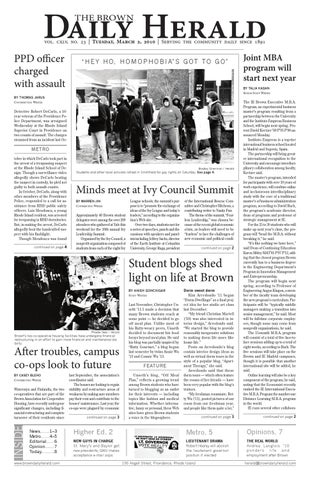
Bradley Silverman / Herald
Students and other local activists rallied in Smithfield for gay rights on Saturday. See page 4.
Minds meet at Ivy Council Summit By Warren Jin Contributing Writer
Approximately 40 Brown student delegates were among the over 200 attendees who gathered at Yale this weekend for the 10th annual Ivy Leadership Summit. Organized by the Ivy Council, a nonprofit organization composed of students from each of the eight Ivy
League schools, the summit’s purpose is to “promote the exchange of ideas of the Ivy League and today’s leaders,” according to the organization’s Web site. Over two days, students met for a series of speeches, panels and discussions with speakers and panelists including Jeffrey Sachs, director of the Earth Institute at Columbia University, George Rupp, president
of the International Rescue Committee and Christopher Hitchens, a contributing writer to Vanity Fair. The theme of the summit, “Fearless Leadership,” was chosen because of the recent global economic crisis, as leaders will need to be “fearless” to face the challenges of new economic and political condicontinued on page 2
Student blogs shed light on life at Brown By Anish Gonchigar Staf f Writer
Phoebe Neel / Herald
Brown’s two co-operative housing facilities have undergone financial restructuring in an effort to gain more financial and maintenance stability.
After troubles, campus co-ops look to future By Casey Bleho Contributing Writer
inside
Watermyn and Finlandia, the two co-operatives that are part of the Brown Association for Cooperative Housing, have recently undergone significant changes, including financial restructuring and complete turnover of their residents since
News.......1–3 Metro.......4–5 Editorial......6 Opinion.......7 Today.........8
www.browndailyherald.com
Joint MBA program will start next year
last September, the association’s coordinator said. The houses are looking to regain stability and restructure areas of weakness by making sure members pay their rent and contribute to the houses’ maintenance. Last year, the co-ops were plagued by economic continued on page 3
Last November, Christopher Unseth ’11.5 made a decision that many Brown students reach at some point — he decided to go of f meal plan. Unlike most of his Ratty-wear y peers, Unseth decided to document his food forays beyond meal plan. He said his blog was partially inspired by “Ratty Gourmet,” a blog begun last semester by twins Annie Wu ’13 and Connie Wu ’13.
FEATURE Unseth’s blog, “Of f Meal Plan,” reflects a growing trend among Brown students who have turned to blogging as an outlet for their interests — including topics like fashion and medical information. Whether informative, funny or personal, these Web sites have given Brown students a voice in the blogosphere.
Higher Ed, 2
Metro, 5
Opinions, 7
NEW GUYS IN CHARGE St. Mary’s and Baylor get new presidents, GWU makes acceptance e-mail oops
Lieutenant drama Robert Healey will abolish the lieutenant governor position if elected
The Real World Andrea Langlois ’10 ponders life and employment after Brown
195 Angell Street, Providence, Rhode Island
herald@browndailyherald.com
Page 2
THE BROWN DAILY HERALD
C ampus N EWS
“We’re starting from scratch in a way.” — David Bach, director of Brown’s new M.B.A. program
Joint M.B.A. program incorporates liberal arts continued from page 1 tive programs with U.S. institutions, including Dartmouth and the University of Chicago, who both have existing graduate business programs. What will make this particular partnership so innovative is its liberal arts approach to business and interdisciplinary focus, Kingon said. Before coming to Brown, Kingon taught in an M.B.A. program. “There is a lot of discussion about the inefficiencies of the M.B.A. right now,” he said, citing many modern business schools’ simplified, unrealistic approach to the complexities of realworld management. This program’s liberal arts perspective, a combination of psychology, sociology, philosophy and other disciplines, is much more nuanced, he said. It is a collaboration that made sense because of Brown’s strong tradition in the liberal arts, Bach said. He added that Brown is also one of the only two Ivy League schools without an M.B.A. program, making
it easier to found an experimental business program. “We’re starting from scratch in a way,” he said. Unlike traditional courses, the curriculum will be organized into modules, Kingon said. A module, such as the decision-making module he is personally developing, is flexible in structure and could be composed of five classes or even 30 classes, Kingon said. Brown faculty from diverse fields such as visual arts, religious studies and Africana studies will work together to help develop the curriculum, according to Bach, who has a background in political science. He added that the program will also contain “conventional elements” such as finance and accounting. The program grew out of a relationship between Brown and IE, both of which signed a “memorandum of understanding” last February in which they pledged to consider future academic collaboration. Planning for the program began in the summer, Bach said.
Though the program is a collaboration between the two universities, IE will be responsible for admitting prospective students, Sibley said. “It’s their degree,” she added. “Our partnership is to contribute the liberal arts component.” The collaboration grew out of Brown’s internationalization efforts, Kertzer said. “This will be just one of a number of agreements with institutions around the world,” he said. “As we think about expanding professional graduate training programs, we are always thinking about how they might enrich opportunities for undergrads,” he added, citing the benefits resulting from interdisciplinary work between faculty. According to Kertzer, Brown does not have plans to found a business school. Another result of the partnership with IE is a summer program in Segovia for high school students run by the Office of Continuing Education, Sibley said. They will learn about subjects such as Spanish culture and European finance, she said.
Ivy Council unites future leaders continued from page 1
tions, Yale student Ran Tao, event organizer and vice president for external affairs for Ivy Council, said. “We need to raise a new generation of fearless leaders,” said David Chan, event organizer and co-head of the Yale Ivy Council delegation. “We need to overcome our fears if we want to be leaders as well.” The conference included panels on several topics including foreign policy, business, finance and global health. In a panel on social entrepreneurship, panelists split into groups for 30 min-
utes to tackle a social challenge of their own choosing. One of the groups came up with an idea for an organization and a Facebook group, called “Sleep in Their Shoes,” dedicated to “raising money and awareness for homelessness around each of the Ivy League campuses,” Tao said. Participants would shadow the homeless and document their experiences. Organizers had to deal with a snowstorm that prevented delegates from a few schools, as well as some panelists and speakers, from attending the conference. Two panelists were
sudoku
Tuesday, March 2, 2010
able to use Skype in order to hold question and answer sessions, said Harris Li ’11, president of the Brown Ivy Council delegation. “It was a prime example in fearless leadership for us,” Tao said. Attendees and organizers praised the summit for bringing students from different schools together and for inspiring them with the successes of others. “The most important part is interacting with other students. It gives you a completely different idea of how things work,” Li said. “They bring a lot to the table.” “All of us left with a sense we could do so much more with this education we’ve been so privileged with,” Chan said. Next year’s summit is expected to be held at Princeton, according to Derrick Tsang ’12, head delegate of the Brown Ivy Council delegation. Potential keynote speakers include Michael Bloomberg, Ben Bernanke and Hillary Clinton.
higher ed roundup by sara luxenberg staff writer
Alum to be next president of St. Mary’s College of Maryland The Board of Trustees of St. Mary’s College of Maryland selected Joseph Urgo MA’82 PhD’86 to serve as the next president of the college, Southern Maryland Online reported on Feb. 22. Urgo is currently the vice president for academic affairs and dean of the faculty at Hamilton College. He is also a professor of English, and chaired the English Department at the University of Mississippi before coming to Hamilton, according to the article. “There was a palpable sense of excitement and celebration as we unanimously elected Dr. Urgo,” Molly Mahoney, a trustee and the search committee’s chair, told Southern Maryland Online. “We believe he will actively cultivate the intellectual life and vitality of the college.” Urgo will take office on July 1, according to the article.
GWU makes rejection e-mail foul-up Last month, George Washington University erroneously sent 200 acceptance e-mails to early decision applicants, the Washington Post reported on Feb. 18. While the university had already released the correct decisions online on Feb. 4, the admission office decided to send out another e-mail to those admitted when snowstorms “really slowed up the delivery of the acceptance packets,” Senior Vice President for Student and Academic Services Robert Chernak told the GW Hatchet in a Feb. 16 article. This second round of e-mails, sent on Feb. 10, incorrectly informed as many as 200 second-round early-decision students that they had been accepted. When admission officers realized the mistake, they sent out an apology e-mail to the falsely notified students, the Hatchet reported. The university did not correct its “clerical error” for several hours, according to the Washington Post.
Alum will serve as Baylor’s next prez Last month, Baylor University’s Board of Regents unanimously chose Kenneth Starr MA’69 to become the university’s 14th president, the Lariat reported on Feb. 15. He will replace Interim President David Garland, who was appointed in 2008 after former President John Lilley was fired, according to the article. Starr currently serves as a professor and dean of the Pepperdine University School of Law. As solicitor general of the United States, Starr argued 25 cases before the Supreme Court between 1989 and 1993, the Lariat reported. As an independent counsel, Starr authored the Starr Report, which investigated the Monica Lewinsky scandal and presented evidence for former President Bill Clinton’s impeachment, the Lariat reported. According to the press release, Starr will take office on June 1.
A c tivism in the air
Daily Herald the Brown
Editorial Phone: 401.351.3372 | Business Phone: 401.351.3260 George Miller, President Claire Kiely, Vice President
Katie Koh, Treasurer Chaz Kelsh, Secretary
The Brown Daily Herald (USPS 067.740) is an independent newspaper serving the Brown University community daily since 1891. It is published Monday through Friday during the academic year, excluding vacations, once during Commencement, once during Orientation and once in July by The Brown Daily Herald, Inc. Single copy free for each member of the community. POSTMASTER please send corrections to P.O. Box 2538, Providence, RI 02906. Periodicals postage paid at Providence, R.I. Offices are located at 195 Angell St., Providence, R.I. E-mail herald@browndailyherald.com. World Wide Web: http://www.browndailyherald.com. Subscription prices: $319 one year daily, $139 one semester daily. Copyright 2010 by The Brown Daily Herald, Inc. All rights reserved.
Nick Sinnott-Armstrong / Herald
Brown Students for Justice in Palestine tabled on the Main Green to petition for divestment.
Tuesday, March 2, 2010
THE BROWN DAILY HERALD
C ampus N EWS
“Our physical hunger is a metaphor for spiritual hunger.”
Students blog about dorms, dining and more continued from page 1 Arredondo said. When entering their room freshman year, many of Arredondo’s friends compared it to “going to Pier 1,” she said. Arredondo said she promoted the blog through Facebook and was inspired to include rooms at other universities after attending a conference at Har vard and viewing some of the creative dorm designs of its students. A bigger, better blog David Gurevich ’11 also knows a thing or two about making a blog big — his “Health and Life” blog has had over 100,000 visitors since he started it during spring of 2009. “I was in a fairly advanced biomaterials class,” Gurevich said, and the professor “recommended that students start blogs as a study technique.” Gurevich then did an independent study with Professor Emeritus of Engineering Barrett Hazeltine in fall 2009 and was able to make the blog more professional and increase its traffic. Realizing the inaccessibility of many medical information Web sites, Gurevich decided to use his blog to present health-related topics in an understandable way. Gurevich, who updates the blog two or three times a week, said he reads a great deal of information about a particular health care issue before posting. The blog’s traf fic soon exploded, and the reception since has been over whelmingly positive, Gurevich said. The blog gets about one comment per day — usually ver y appreciative of the information Gurevich provides. “It’s really a wonderful feeling,” he said. Gurevich is ver y stringent about what he posts on the blog. “How can I publish something saying one thing while there may be contrar y opinions, especially with new medicines?” Gurevich
said. To emphasize this, Gurevich added a policy to his Web site offering several dollars to a visitor if they find something factually incorrect. With the phenomenal success of “Health and Life,” Gurevich said he has been taking in a steady income from advertising revenue and plans to hire other Brown students and an intern to help update the blog. Gurevich said the blog has added a lot of meaning to his ever yday interactions. “I’ll be at the dentist, and I’ll be able to know what’s going on with a drug like Fosamax,” he said. Chasing a future in fashion Like Gurevich, Kibwe ChaseMarshall ’11 has found his blog to be an intersection of personal and professional interests. Prior to attending Brown, Chase-Marshall spent 10 years working in New York City designing apparel and accessories and plans on pursuing a career in the Parisian fashion industr y. With his blog “Thrills of the Chase,” Chase-Marshall wanted to catalogue his own style interests while working toward his professional goals. “It bridges the gap between my friends here at school and my friends from the professional environment,” he said. Chase-Marshall said there is no “typical” post on his blog — a post may offer style insight to friends, feature pictures of new ways Chase-Marshall is wearing his clothing, link to massmarket products or show music videos that he finds stylistically dynamic. In addition, Chase-Marshall reviews designer-level fashion collections, though he said he chooses not to be negative in his critiques. Chase-Marshall’s blog ser ves as a reflection of himself. “I’ve found a new medium in which to be expressive,” he said.
Page 3
Food for thought Though Unseth began “Of f Meal Plan” as a way to calm Brown students’ fears of going of f meal plan, the direction of the blog soon changed. As he began reading more well-known food blogs, Unseth noticed that they were a taste of the bloggers’ personalities in addition to their food. “You star t to see how they weren’t just putting recipes online. They were connecting them to their lives,” Unseth said. A religious studies concentrator, Unseth decided to make his blog a reflection of his own spiritual journey. Unseth said he usually updates the blog about ever y week and a half with either recipes or personal spiritual reflections. Many of the recipes that Unseth uploads are his own or picked up from family members, though he also finds and modifies new recipes from other sources. “I was cooking stuff I’ve never cooked before in my life,” Unseth said, noting that his French silk pie recipe was particularly good. For Unseth, “Off Meal Plan” is more than just a blog — it is a way to chronicle his relationship with God. “Our physical hunger is a metaphor for spiritual hunger.”
— Christopher Unseth ’11.5
Revamping and restructuring co-ops continued from page 1 difficulties and internal tensions that resulted in their gradual deterioration — and a number of appearances in housing court resulting from disorderly appearances, according to a press release from the association. “Basically, this house was just run down,” said Madeline Ray ’10, the association’s coordinator. “It became a scene for people who weren’t community-oriented,” she said, adding that this resulted in a lot of unpaid rent and vacancy. “There was a group of people living in Watermyn that evolved into a group less committed to co-operative housing,” said Watermyn Housing Coordinator Max Kennedy ’11. “As a result, finances got mismanaged, and there were clashes with the neighborhood.” Kennedy said the resident turnover fixed much of this by returning some of the stability of this community feel. “The biggest change now is that we have a house full of committed people and responsible people in positions of responsibility,” he said. The Brown co-ops are part of a non-profit organization founded in the early 1970s by a group of students who wanted to create affordable, community-oriented, off-campus
housing for members of the Providence community, specifically Brown students, Kennedy said. In addition to the turnover, there are other changes underway. When the houses fell into turmoil last year, they recruited the help of Jim Jones, senior director of development and property services for the North American Students of Cooperation, of which BACH is a member. “There were a lot of different problems that sort of reinforced each other,” said Jones. “And they have dealt with many of these things.” The problem now has to do with refinancing, implementing policies to ensure rent payment and raising the money necessary to complete a physical rehabilitation of the property, he said. The houses now find themselves more in the position to think about the future and continue constructive change, Jones said. “The challenge now,” he said, “is to prove to everyone else that they have made those changes successfully.” Reactions so far have been “tentative but generally positive,” said Ray, who said she looks to make the system more sustainable by raising awareness about the internal workings of the co-op among its residents.
Metro The Brown Daily Herald
“I’m here for civil rights.” — Stephanie Ewart-Conden, who attended Saturday’s protest Tuesday, March 2, 2010 | Page 4
Protesters support same-sex marriage Alleged assault victim By Bradley Silverman Staff Writer
“Hey hey! Ho ho! Homophobia’s got to go!” Waving signs at passing cars and chanting slogans, advocates for lesbian, gay, bisexual and transgender rights gathered outside the Ocean State Baptist Church in Smithfield Saturday. They were there to protest a conference of groups opposed to same-sex marriage. Calling for legal equality for gay and lesbian Americans, activists from Queer Action of Rhode Island joined Brown students Saturday to demonstrate against the conference, called the “New England Family, Life & Marriage Summit” and organized by the Family Research Council, a national organization that promotes socially conservative policies. The summit, an annual gathering of regional conservative groups, included representatives from the National Organization for Marriage, the Massachusetts Family Institute and the Family Institute of Connecticut, among others. Around 30 to 40 protesters attended the rally, according to Queer Action of Rhode Island Communications Coordinator Susan Heroux. Six Brown students protested, according to attendee Jonathan Qua ’12.
The purpose of the protest was to speak up against discrimination and intolerance, Heroux said. “This is a strategy summit to increase discrimination against gays and women,” she said. “We want them to know that there is always opposition.” Standing outside the church entrance, protesters hoped to be visible to conference attendees as they exited, Heroux said. Queer Action learned of the summit a week and a half beforehand, Heroux said. Word of the protest spread largely over the Internet, through Web sites such as Facebook and RIfuture.org, she said. Earlier in the day, the Providence Equality Action Committee held a separate protest independent of Queer Action’s event, Heroux said. Stephanie Ewart-Conden, a florist, said she heard about the event from a friend and came to express her opposition to prejudice. “I’m here for civil rights,” she said. Conference attendees denied accusations of bigotry, saying that they do not oppose homosexuality, just same-sex marriage. “We don’t think we should change the definition of marriage,” said Christopher Plante, executive director of the Rhode Island chap-
ter of the National Organization for Marriage. Plante also said that neither he nor his organization opposed same-sex civil unions. “It’s a moot point, though, because (civil unions are) unacceptable to them,” he said, referring to LGBT groups such as Queer Action. As the afternoon wore on, the activists intermittently chanted slogans, such as “Two, four, six, eight! How do you know your kid is straight?” Protesters also waved homemade signs at passing vehicles, breaking out in cheers whenever motorists honked their horns in response. Plante said the protesters’ attitude contradicted their message of acceptance. “I was not impressed with their tone,” he said. “Their language was hateful.” Smithfield police officer Kevin Proulx, who was on duty at the church, said the protesters stayed off church property and did not disrupt the summit. Queer Action members Gabe Schwartz ’13 and Jessica Mitter ’13 helped organize participation in the protest among Brown students. They created a Facebook event for the rally and tackled logistics such as planning student travel to and from the event.
faces deportation continued from page 1
guilty in December of assaulting the public safety officers, he filed an official complaint after the release of a sur veillance video that captured the alleged assault by DeCarlo. Though DeCarlo’s attorney, Peter DiBiase, declined to comment to The Herald on the case, he told the Providence Journal after last week’s arraignment that the video does not fully represent events. He said his client was responding to a dangerous situation in which he could not, due to darkness, see whether the suspect was restrained. Last Monday, DeCarlo was suspended without pay, pending the outcome of the case. If convicted, he could face a combined sentence of 21 years in prison. Alberto Cardona, Mendonca’s lawyer, told the Providence Journal his client sustained serious injuries in his altercation with the police. He added that Mendonca was taken to Rhode Island Hospital for treatment, where he was in a coma for two days and doctors needed 12 staples to close a wound in his head. Though Mendonca received a sentence of 90 days in Cranston’s Adult Correctional Institute after his arrest, Immigrations and Customs Enforcement, the federal authority on immigration, recently
took him into custody. Because the government often deports foreign nationals who have been convicted of crimes, Mendonca faces deportation to his native Cape Verde even though he legally resides in the United States. But ICE has been facing opposition on this matter. In Januar y, Providence Mayor David Cicilline ’83 wrote a letter to the agency expressing his hope that Mendonca would be allowed to remain in the countr y until DeCarlo’s case is resolved. Cardona told The Herald the mayor’s office refused to give him a copy of Cicilline’s letter and said he suspected the mayor was “not on our team.” Mendonca’s case comes before immigration court today where he will be represented by another attorney, Cardona said. As of now, with DeCarlo’s case still in progress, Mendonca is “still here,” Cardona said. “He’s still in the country. He’s a legal resident. We don’t believe there’s a basis to hold him.” He said “immigration was informed — or misinformed — in an effort to cover this case up,” but added that he’s hopeful about Mendonca’s trial in immigration court. “We have one of the best immigration attorneys in the state,” he said.
www.blogdailyherald.com
Page 5
M etro
THE BROWN DAILY HERALD
Tuesday, March 2, 2010
“What they really need is an explosion, and I’m happy to provide it.” — Robert Healey, candidate for lieutenant governor
Lt. gov. candidate will abolish office if elected By Caitlin Trujillo Senior Staf f Writer
or the politics that’s holding me back.”
Robert Healey thumbed through papers that detail the duties and obligations of the lieutenant governor of Rhode Island — largely consisting of appointments and commission memberships. “One appointment to the Plastic Recycling and Litter Commission. That’s a big appointment,” Healey said with obvious sarcasm. He continued to read off commissions, councils and boards he deems superfluous, at least with regard to the lieutenant governor’s role on them. “It’s an office of talk and $1 million a year,” he said. And it is an office Healey hopes to attain this November, if only so he can tear it down. He has run for lieutenant governor three times, in the 2002, 2004 and 2006 races, on one major campaign promise — if elected, he will effectively abolish his own office.
All in a name His interest in politics was renewed in 1990 with the advent of the Rhode Island banking crisis, and he thought he had ideas to pitch that would solve the problem. “I had a method at the time which would’ve tried to avoid the current fiscal crisis Rhode Island is currently in,” he said, though in retrospect he called his enthusiasm “naive.” “I was ver y unaware of how statewide politics actually works,” Healey said. But he campaigned nonetheless. In the 1994 gubernatorial race, Healey garnered the largest share of votes an independent candidate had ever had in the state. He also managed to win the town of Warren, which left Healey “very, very humbled,” he said. He did not see the same success in the 1998 race, partly because his campaign was disrupted by the death of his mother, he said. In 2002, Healey decided that running for governor as a third-party candidate was costing him too much money since he pays for everything out of his own pocket. He is also a business owner and a lawyer who can afford to do largely pro bono and reduced fee work — but he said he has come to believe that money and politics should mix as little as possible, ideally not at all. So he made his first bid for lieutenant governor and won 61,244 votes. “In a period of prosperity, the idea of small government sold, but it didn’t sell as well as it would now,”
As ‘serious as a heart attack’ It may sound like a joke, but Healey said he and his campaign crew, which consists mostly of close friends and volunteers, are “as serious as a heart attack.” In his opinion, the office of lieutenant governor is a waste of the $1 million a year that funnels into the position because the role no longer holds any political authority. Other than commission and board obligations, Healey said, the sole duty of the Rhode Island lieutenant governor is to fulfill the governor’s duties should he or she die or become incapacitated in any way. The lieutenant governor was once tasked with taking over the governor’s responsibilities if the latter left the state and with casting the tie-breaking vote in the state Senate, but constitutional amendments have given these obligations to other offices, Healey said. The fiscally conser vative but socially liberal candidate said he saw no point to the state’s continued funding of an obsolete position. Healey pointed out that the office does not exist in Maine or New Hampshire, suggesting that Rhode Island simply remove it from the line of succession. If elected, Healey said he would become lieutenant governor and, while pushing for an amendment to abolish his own position, he would refuse to accept a salary or hire a staff. The office could be retooled to be more efficient, Healey said, but because the necessary functions can be performed by other offices, he feels the best thing to do is to abolish the position altogether. But Healey has not yet been elected to a state office, though he also ran for governor in 1986, 1994 and 1998. He was elected chairman of the Warren School Committee in 1982 and served for four years. With his unconventional platform, long beard and flowing hair, Healey said “it must be the looks
Max Monn / Herald
Robert Healey is running for R.I. lieutenant governor with a pledge that he will abolish the office if elected.
Healey said. For years he has run under the Cool Moose Party, a political party he founded himself. The name comes from two sources — pictures of him wearing moose antlers sparked by the Providence Journal offering a cash reward to anyone who took pictures of a moose that had entered the state in the 1980s and one of his slogans from his race for Warren School Committee chairman, “Make School Cool.” And, of course, it brings to mind Theodore Roosevelt’s Bull Moose Party and the cool, calm but potentially violent animal that is the moose, he said. “It all just kind of came together,” Healey said. “It was destiny.” A grassroots campaign This year, however, he is keeping his party open. He has long favored third parties as alternatives to the “Republican-Democrat dichotomy,” but he has reached out to the Republican and Moderate parties to consider running him as their candidate. The Moderates have already announced Jean Ann Guliano’s candidacy for lieutenant governor, but Healey said he is still waiting on
the Republicans. They have long favored small government, he said, and now have the chance to practice what they preach. In the meantime, Healey continues to campaign on his own terms. He refuses to take donations. In addition to viewing money as “the root of all evil in politics,” he said he does not see the point in taking money while he runs for an office that will not result in any jobs. To accept donations would be as false, he said, as him shaving or cutting his hair. Instead, he asks supporters and volunteers to create their own posters and utilize social media Web sites like Facebook to show their support. His official staff consists of longtime supporters and friends Claire Boyes and Rhode Island School of Design Critic Bryan Rodrigues. Rodrigues, who met Healey when he did a report on the politician in high school and has worked with him since, does much of the graphic design for Healey, including tooling the look of Healey’s campaign Web site for the upcoming campaign. Rodrigues said the site is “sort of slapped together” for now but will be updated in March or April to fully
promote the campaign. “I don’t want to shoot all of our arsenal too soon,” Rodrigues said. For now, Rodrigues is focusing on helping to maintain Healey’s Twitter and Facebook pages, the latter of which has acquired over 400 fans in its first weeks of existence. In past races, as well as the current one, Healey has paid out of pocket to make bumper stickers, yard signs, coupons, wooden coins and even condoms with his campaign slogans, including “Lt. governor? Lt. governor? We don’t need no stinkin’ lt. governor” for the bumper stickers and “Feels as though it’s not even there” for the condoms. Healey’s mission is serious, “but it doesn’t stop us from having a sense of humor,” he said. He remains optimistic about both his chances in the race and about his philosophy, having garnered over 61,000 votes with an official campaign staff of three people. He acknowledges that he cannot make people vote for him. But he says he aims to give voters the opportunity to choose something different. “What they really need is an explosion,” Healey said, “and I’m happy to provide it.”
Editorial & Letters The Brown Daily Herald
Page 6 | Tuesday, March 2, 2010
This is a haiku. We hope you like reading it. Please send us letters. letters@browndailyherald.com
E R I K S T AY T O N A N D E VA N D O N A H U E
e d i to r i a l
Feeling stimulated correction An article in Monday’s Herald (“Student coalition rallies for budget transparency,” March 1) incorrectly stated that Wesleyan, Cornell, and Columbia universities all provide students and faculty access to their respective investment portfolios through password-protected Web sites. In fact, only Wesleyan uses this approach. Cornell and Columbia make their investments available at their individual investment offices. The Herald regrets the error.
t h e b r o w n d a i ly h e r a l d Editor-in-Chief George Miller
Managing Editor Chaz Kelsh
Deputy Managing Editors Sophia Li Emmy Liss
editorial Arts & Culture Editor Anne Speyer Suzannah Weiss Arts & Culture Editor Features Editor Brian Mastroianni Features Editor Hannah Moser Metro Editor Brigitta Greene Metro Editor Ben Schreckinger News Editor Sydney Ember News Editor Nicole Friedman Sports Editor Dan Alexander Asst. Sports Editor Andrew Braca Asst. Sports Editor Han Cui Graphics & Photos Graphics Editor Stephen Lichenstein Alex Yuly Graphics Editor Nick Sinnott-Armstrong Photo Editor Max Monn Asst. Photo Editor Jonathan Bateman Sports Photo Editor production Copy Desk Chief Kelly Mallahan Jordan Mainzer Asst. Copy Desk Chief Marlee Bruning Design Editor Anna Migliaccio Asst. Design Editor Julien Ouellet Asst. Design Editor Neal Poole Web Editor Post- magazine Editor-in-Chief Marshall Katheder
Senior Editors Ellen Cushing Seth Motel Joanna Wohlmuth
Business General Managers Office Manager Shawn Reilly Claire Kiely Katie Koh Directors Sales Kelly Wess Finance Matthew Burrows Client Relations Margaret Watson Alumni Relations Christiana Stephenson Managers Arjun Vaidya Marco deLeon Aditi Bhatia Jared Davis Trenten Nelson-Rivers Alexander Carrere Kathy Bui
Local Sales National Sales University Sales University Sales Recruiter Sales Special Projects Staff
Opinions Opinions Editor Michael Fitzpatrick Opinions Editor Alyssa Ratledge Editorial Page Board Matt Aks Editorial Page Editor Debbie Lehmann Board member William Martin Board member Melissa Shube Board member Gaurie Tilak Board member Jonathan Topaz Board member
February 17 marked the first anniversary of the enactment of the American Recovery and Reinvestment Act — better known as the economic stimulus package. The University noted the occasion by putting out a press release listing the research at Brown that has benefited from stimulus funding. In the first year of ARRA, 47 projects at Brown received an additional total of $33 million on top of regular government and private support, which usually averages about $135 million annually. The press release, available on the Public Affairs and University Relations website, is worthwhile reading for anyone curious about the range of fascinating research that takes place at Brown or the local impact of one of President Obama’s signature initiatives. Brown prides itself on being a place where undergraduates are exposed to cutting-edge research, and we are pleased to note that money from ARRA has preserved and expanded such opportunities for students. The editorial page board surveyed several professors who received stimulus money and found that undergraduate students were involved with many research projects. Assistant Professor of Biology Erika Edwards is researching plant evolution, and her results may help predict how plants respond to rapid climate change. Money from ARRA will allow her to support two additional undergraduate researchers working in her lab during the summers of 2010 and 2011. Professor of Computer Science David Laidlaw is developing a new virtual reality display system that aims to be of use to scientists of all sorts — from planetar y geologists to molecular biologists. He recently hired an additional undergraduate research assistant using stimulus funds. As Vice President for Research Clyde Briant said in an e-mail to the editorial page board, “In general, the ARRA funds have provided more op-
portunities for research for our faculty and that, in turn, will lead to more opportunities for graduate and undergraduate students.” The positive impact of the stimulus package here at Brown is undeniable. Moreover, there is a growing consensus among economists that the additional government spending had a significant impact nationally, saving and creating jobs and preventing an even worse recession. According to a recent article in the New York Times, three of the leading economic research firms all estimated that the stimulus act added 1.6 to 1.8 million jobs through February. Still, some critics continue to attack the administration’s stimulus efforts. Consider a Feb. 20 op-ed in the New York Times by Lincoln Chafee ’75, the former Rhode Island Senator and current gubernatorial candidate who was also previously a visiting fellow at Brown’s Watson Institute for International Studies. Chafee attributed Obama’s “difficult first year in office” in part to “his failure to devise a stimulus bill that could win a single Republican vote in the House.” We are disappointed that Chafee did not include equally critical words for the uncompromising opposition to the stimulus act, which threatened to undercut the national recovery and the additional support for research in Rhode Island here at Brown. More politicking over the merit of the stimulus will undoubtedly occur as the midterm elections approach. Where the national debate is strident and partisan, we only point out that at the local level, the positive impact of the stimulus has been clearly observed.
Editorials are written by The Herald’s editorial page board. Send comments to editorials@browndailyherald.com.
Anna Migliaccio, Designer Claire Gianotti, Abigail Kersen, Alexandra Macfarlane, Carolina Veltri, Copy Editors Max Godnick, Ben Schreckinger, Caitlin Trujillo, Night Editors Senior Staff Writers Ana Alvarez, Alexander Bell, Alicia Chen, Max Godnick, Talia Kagan, Sarah Mancone, Heeyoung Min, Kate Monks, Claire Peracchio, Goda Thangada, Caitlin Trujillo Staff Writers Ashley Aydin, Shara Azad, Nicole Boucher, Fei Cai, Kristina Fazzalaro, Miriam Furst, Anish Gonchigar, Sarah Julian, Matthew Klebanoff, Sara Luxenberg, Anita Mathews, Luisa Robledo, Emily Rosen, Bradley Silverman, Anne Simons, Sara Sunshine Senior Sales Staff Katie Galvin, Liana Nisimova, Isha Gulati, Alex Neff, Michael Ejike, Samantha Wong Design Staff Caleigh Forbes, Jessica Kirschner, Gili Kliger, Leor Shtull-Leber, Katie Wilson Web Staff Andrew Chen, Warren Jin, Claire Kwong, Michael Marttila, Ethan Richman Photo Staff Qidong Chen, Janine Cheng, Alex DePaoli, Frederic Lu, Quinn Savit Copy Editors Nicole Boucher, Sarah Forman, Claire Gianotti, Christine Joyce, Sara Luxenberg, Abigail Kersen, Alexandra Macfarlane, Joe Milner, Lindor Qunaj, Carmen Shulman, Carolina Veltri
C O R R E C T I O N S P olicy The Brown Daily Herald is committed to providing the Brown University community with the most accurate information possible. Corrections may be submitted up to seven calendar days after publication. C ommentary P O L I C Y The editorial is the majority opinion of the editorial page board of The Brown Daily Herald. The editorial viewpoint does not necessarily reflect the views of The Brown Daily Herald, Inc. Columns, letters and comics reflect the opinions of their authors only. L etters to the E ditor P olicy Send letters to letters@browndailyherald.com. Include a telephone number with all letters. The Herald reserves the right to edit all letters for length and clarity and cannot assure the publication of any letter. Please limit letters to 250 words. Under special circumstances writers may request anonymity, but no letter will be printed if the author’s identity is unknown to the editors. Announcements of events will not be printed. advertising P olicy The Brown Daily Herald, Inc. reserves the right to accept or decline any advertisement at its discretion.
Opinions The Brown Daily Herald
Tuesday, March 2, 2010 | Page 7
Life after Brown ADRIENNE LANGLOIS Opinions Columnist It’s about that time of year again. As the days until June fly off the calendar, students are rushing to find summer internships and postgraduation jobs in a still relatively weak economy. With so many possibilities and so little time, finding something to do when classes end can be a daunting, stressful and difficult task. Unsurprisingly, most students turn to the Career Development Center for guidance. After all, that’s what it’s there for, right? In theory, yes, but in my time at Brown, the Career Development Center’s resources have sometimes fallen short. I recall a time in the not-so-distant past when the center released announcement after announcement clearly targeted only at economics and computer science concentrators. Recently, however, the CDC has taken student critiques to heart and made serious changes to broaden the proportion of students their workshops and information can serve. The recent Career Fair Plus, which featured an expanded roster of employers from a variety of fields, was just one example of the ways in which Brown’s CDC has made considerable steps towards broadening the resources and support they provide to all students, regardless of concentration. CDC has also launched “The Scoop,” a series of blogs providing links to information about jobs and internships in different industries. All of these developments are likely to be a huge asset to students searching for summer and post-graduation employment. But
there are still ways in which Brown’s largest career resource can improve its service to its students. Brown’s Open Curriculum is a doubleedged sword. On one hand, freedom from core requirements allows students to pursue a range of interests that they might not have been able to otherwise, or, alternately, specialize in one or two specific areas of interest. On the other, the ability to explore topics one has never considered before has the potential to turn a student’s prior life plans upside-down and leave him or her confused as to what course to take after passing through
ing advantage of the CDC’s new resources, I’ve noticed that an overwhelming number of my best leads on jobs and internships have come from other undergraduates as well as recently graduated friends. It’s no surprise; with students from such diverse backgrounds and with such varied work experiences and interests, it’s only natural that students amass significant knowledge about their respective industries. So why not tap into that potential? The CDC already offers a Summer Experience Database, which provides a searchable platform of detailed records on students’ prior internship experiences. It also offers the abil-
Brown provides its undergraduates with a diverse and flexible college experience. It only makes sense that the University’s career resources should address the job search needs of its unique student body with a comprehensive and varied support network. the Van Wickle Gates for the second time. Brown provides its undergraduates with a diverse and flexible college experience. It only makes sense that the University’s career resources should address the job search needs of its unique student body with a comprehensive and varied support network. To improve its now rapidly growing resources, the CDC can and should work to provide information that both works with and caters to its constituency’s diverse backgrounds and interests. One example: the CDC can make better use of the existing knowledge within the student body and alums. While I’ve certainly been tak-
ity to network with recent alums via BRUnet. But giving students an even simpler option to share known job prospects, job boards and other information could increase the CDC’s usefulness even more. An official “tips” email account where students and recent alums could send links to organizations and job boards not already on the CDC’s site would give career counselors more proven resources to share with students searching for jobs or internships. Having a variety of information is certainly useful, but even more important to increasing the CDC’s usefulness is presenting informa-
tion in a way that makes it accessible to all students. Currently, the CDC Web site boasts pages of resources on job databases for various industries and offers tests and consultations to help students pinpoint potential industries of interest. Overall, however, the Center lacks resources targeted towards concentrators who may not know what exactly they want to do with their newfound passions after senior year. Brown Degree Days, which brings alums from various fields together to discuss how their concentrations at Brown led them into their respective career paths, is one recently developed program that helps students find connections between their academic experiences and the job market. Providing more such programs, as well as targeting pages of job and internship search resources to students with specific concentrations, could provide uncertain students with ideas for jobs and industries that they might never have considered. These are just a few of the ways in which the CDC can improve its already greatly expanded resources. I certainly don’t expect the CDC to drop a job or internship into my (or my fellow classmates’) lap. As I’ve noted above, job hunting is difficult, and I’m grateful for the resources that Brown already provides. But a few changes could make the Center’s information even more relevant and useful to Brown’s diverse student body.
Adrienne Langlois ’10 is proud to be a history and Latin American studies concentrator, even if job options are less readily available for her.
The creeping nihilism of Stanley Fish BRIAN JUDGE Opinions Columnist
A few days ago, Providence native and New York Times opinionator Stanley Fish penned the most mind-bogglingly stupid opinion column I have ever read (“Are There Secular Reasons?”, Feb. 22). In fact, this column was so stupid that Professor Fish managed to edge out Miss Teen South Carolina for “stupidest thing I have ever heard,” even though he uses complete sentences and references 17th century philosophers. Professor Fish attempts to argue that the answer to his titular question is no: secular reasoning can’t answer any normative questions — questions that ask what qualities the world should have, rather than what qualities the world actually does have. Fish regurgitates the argument found in “The Disenchantment of Secular Discourse”, a book whose thesis is that “there are no secular reasons, at least not reasons of the kind that could justify a decision to take one course of action rather than another.” What exactly Professor Fish means by “secular reasons” is never spelled out explicitly, but I take it to mean something along the lines of the impossibility of secular political discourse to divorce itself from the normative religious beliefs of its participants. The only reason that this is worth mentioning is that this answer is the harbinger of
the end of reasonable political discourse and seems to be in vogue among some people here. In effect, Professor Fish is arguing that there isn’t a single, universal, comprehensive way of valuing courses of action. Since we all have our own religious beliefs, it is foolish to try to legislate on the basis of “secular reasons” which necessarily lack substance: “how can one squeeze moral values or judgments about justice (…) out of brute empirical facts?” In other words, it’s not possible to
Nihilism is the emptying of purpose, truth, essential value and meaning from human life. You can spot a nihilist by his insistence that “it’s all relative” or “all beliefs are created equally.” Stanley Fish is a nihilist. People who deny the existence of a universal means to evaluate universal ends are nihilists. It is in fact not “all relative” because of the common biology that we all share. In other words, you don’t need to enter the domain of “prior metaphysical commitments” in order to discover
In other words, he’s saying that it’s not possible to answer normative questions on the basis of reason and universally accepted facts. This is the unholy broth out of which Professor Fish and postmodernism emerged. answer normative questions on the basis of reason and universally accepted facts. This is the unholy broth out of which Professor Fish and postmodernism emerged. What happens when you deny the possibility of speaking in a common language towards common goals? People splinter off into groups that are based on an intuitive appeal that is immune from criticism precisely because they plug their ears and deny the possibility of being criticized.
answers. Our prior biological commitments take us far enough. We all need to eat. There are limited resources. Thus, we are going to prefer courses of action that put food on our tables. This is a normative framework. It begins to answer the question “how we should live” in a universally accessible way. Living in a globalized world where everyone is connected requires that we be able to address normative questions like “how should we live?” in a universally accessible
manner. Such is the domain of “secular reason.” It’s not “secular” because it denies the importance or relevance of people’s metaphysical beliefs. Rather, it is secular because it doesn’t demand that one come to the table with anything other than a willingness to accept empirical facts. Universal values exist (e.g. that the earth should continue to be habitable) so there needs to be a way to talk about them universally. The very fact that I can disagree with Professor Fish and think that he is wrong suggests a common basis on which to disagree. I find it baffling that the stereotypical Brown student somehow emerges from a reconciliation of an affinity towards postmodernism and an affinity towards social justice. If you are one of the self-proclaimed postmodernists at Brown, take a good look at the LaRouchians who hand out pamphlets on Thayer Street and really consider whether or not they are a legitimate political faction. If you blow past them in an indignant huff, then you aren’t a postmodernist. If you think that political activism, social justice or environmental sustainability are important, then you aren’t a postmodernist. If someone tries to hand you a copy of Lyotard’s “The Postmodern Condition” on Thayer Street, tell him or her to do something useful.
Brian Judge’s ’11 thoughts be bloody or be nothing worth.
Today The Brown Daily Herald
2
GWU mixes up acceptance letters
5
comics
4 tomorrow, march 3
all day — “Fusion of Horizons: Recent Paintings by Elise Ansel,” List Main Lobby
5:00 P.M. — “Power Session: Networking, Interviewing, Resumes and Cover Letters,” Career Development Center Library
7:00 p.m. — “Archiving Against the Gain: The Feminist Theory Papers,” Salomon 203
Dot Comic | Eshan Mitra and Brendan Hainline
8:30 P.M. — “I Love Female Orgasm,” Salomon 101
Fruitopia | Andy Kim
menu Sharpe Refectory
Verney-Woolley Dining Hall
Lunch — Tortilla Casserole, Vegan Stuffed Acorn Squash, Chocolate Chip Cookies
Lunch — Hot Turkey Sandwich, Stuffed Shells with Sauce, Fudge Bars
Dinner — Curry Chicken with Coconut, Vegan Chana Masala, Chocolate Pudding
Dinner — Beef Pot Pie, Chicken Broccoli Pasta Alfredo, NY Style Cheesecake
crossword
43 / 32
37 / 30
Tuesday, March 2, 2010
Cabernet Voltaire | Abe Pressman
Today, March 2
to m o r r o w
New approach to R.I. politics
t h e n e w s i n i m ag e s
c a l e n da r
to day
Hippomaniac | Mat Becker
Island Republic | Kevin Grubb
STW | Jintao Huang
Page 8