3 minute read

DR. ASHLEY GRIFFIN GILCHRIST

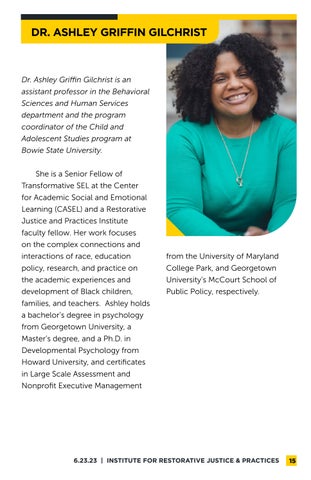
Dr. Ashley Griffin Gilchrist is an assistant professor in the Behavioral Sciences and Human Services department and the program coordinator of the Child and Adolescent Studies program at Bowie State University.

Advertisement

She is a Senior Fellow of Transformative SEL at the Center for Academic Social and Emotional Learning (CASEL) and a Restorative Justice and Practices Institute faculty fellow. Her work focuses on the complex connections and interactions of race, education policy, research, and practice on the academic experiences and development of Black children, families, and teachers. Ashley holds a bachelor’s degree in psychology from Georgetown University, a Master’s degree, and a Ph.D. in Developmental Psychology from Howard University, and certificates in Large Scale Assessment and Nonprofit Executive Management from the University of Maryland College Park, and Georgetown University’s McCourt School of Public Policy, respectively.

Dr. Ometha Lewis-Jack is currently a tenured Associate Professor in the Department of Psychology at Bowie State University and current Chair since Fall, 2021. She received her Bachelor of Arts degree in Psychology, Master of Science and Doctorate in Clinical Psychology from Howard University where she specialized in Clinical Neuropsychology. She also served as director of the Graduate Clinical Psychology Program at Howard University from 1999 – 2005, and was member of the medical faculty with hospital admission privileges. She specializes in the Neuropsychological Assessment of African Americans with brain/ spinal cord injury and subsequent treatment as a result of this injury.

She is a licensed psychologist in the District of Columbia and consults with mental health agencies to ensure proper diagnosis and treatment of clients with severe mental disorders. She also provides workshops to mental healthcare providers regarding intervention strategies and specialized treatments to dual-diagnosed clients. Her research interests vary between neuropsychology, learning styles and disabilities.

Currently, she is conducting research on the effects of stress, depression, anxiety, substance abuse, and coping skills on mental health outcomes in college students. Her current focus is on matching psychological symptoms of stress, depression and anxiety disorders with physical outcomes using bio-feedback and other psychophysiological measures.

Lennard Jack, Jr. is a steel pannist born in the twin-island Republic of Trinidad and Tobago.

He has been playing the steel pans for over 40 years and has played for numerous events, parties and concerts throughout the East Coast of the United States and in Trinidad and Tobago. He is the leader of the Caribbean Jazz band “FUSION” and has released his debut CD, entitled “Give Thanks*. Lennard first began playing the steelpan under the tutelage of one of the greatest pan tuners ever, Bertand “Birch” Kellman with his band Travatos, then went on to play with the Fonclaire Steel Orchestra based in San- Fernando, Trinidad. He is also one of the foundation members and musical arrangers of the Panmasters Steel Orchestra based in Maryland USA. Lennard plays an eclectic blend of Caribbean Jazz, Calypso, Reggae and other genres of music of the African Diaspora, and has played with Robert Greenidge, Len”

Boogsie” Sharpe, Ken Professor”

Philmore, David Boothman and the

DC jazz veteran Robert Northern, aka. Brother Ah. He has also recorded on Raf Robertson’s album entitled, UNIVERSAL sweetpan.lennard@gmail.com

Phone: 301-642-1433

Dr. Anthony J. Jackson is a scholaractivist, a movement educator, and revolutionary with a heart for liberation.

Dr. Jackson is an Assistant Professor of Sociology in the Department of Behavioral Sciences and Human Services at Bowie State University and a former Lecturer at Howard University in the Department of Sociology and Criminology. Dr. Jackson also serves as the Program Coordinator for the Sociology Program at Bowie State University as well as the CoDirector of the Prison Education Program -- a partnership between Jessup Correctional Institution and Bowie State University to offer Bachelor of Science degrees in Sociology to incarcerated individuals. Dr. Jackson’s work in the community as well as the academy serves as a transformative praxis to bridge the gap between these two areas of social life which are fundamentally interrelated. Trained in the philosophical, theoretical, and methodological principles of emancipatory sociology, Dr. Jackson’s pedagogy and praxis recognizes the value in movement education, community building, and critical consciousness development—an active process that happens in both the classrooms and within our communities. Dr. Jackson’s academic research challenges systems and structures that benefit from the exploitation and oppression of working class people in general and Black people in particular; this transformative sociological approach is not only an act of resistance, but also the basis of Dr. Jackson’s scholarship and activism.

Dr. Shannell C. Thomas is an Assistant Professor in the Criminal Justice Department at Bowie State University. She earned her PhD in Sociology (with concentrations in Criminology and Social Inequality) from Howard University and holds an M.Ed. in Curriculum & Instruction from the University of South Florida and an M.A. in Humanities & Social Thought from New York University. Her research interests are currently centered around the political impacts of incarceration and the societal barriers for returning citizens.

Having first been trained in Restorative Practices at UC, Berkeley in 2011, Dr. Thomas has since used restorative approaches to respond to violations of Student Codes of Conduct (on various college and university campuses) and to resolve inter-personal and conflicts (in local communities and in formal organizations). As a ‘restorative’ practitioner, Dr. Thomas has conducted numerous needs assessments; facilitated focus groups; evaluated countless programs and services; coordinated many trainings; planned and implemented largescale events; and been involved in the coordination and instruction of credit bearing courses.

Dr. Thomas is particularly interested in foregrounding the indigenous origins of restorative justice during conversations, trainings, and curricula that focus on its practices and approaches. She believes, and is committed to advancing the notion, that restorative justice can and should become the prevailing form of ‘justice’ within and between communities of color.

This article is from: