Special Collections Newsletter Fall/Winter 2026
In This Issue 3
Message from the Archivist
3
Oral History Projects Collect Local Stories
4
Westside Gazette Partnership Wins FLA Award
4
Shaara Collection Items Used in Gettysburg Documentary
5
New donation of materials to the Alcee Hastings Collection
7
From the Vault to the Gallery: AARLCC and the Long Arc of the Vote
9
Broward County Library Digital Archives Reaches New Milestones
The Broward County Library Special Collections Newsletter is published by the Broward County Library on a biannual basis in the Fall/Winter and Spring/Summer.
Contributors Frederic Santerre Erin Purdy Dr. Tameka Bradley Ben “Bazle” Smith Rochelle T. Pienn
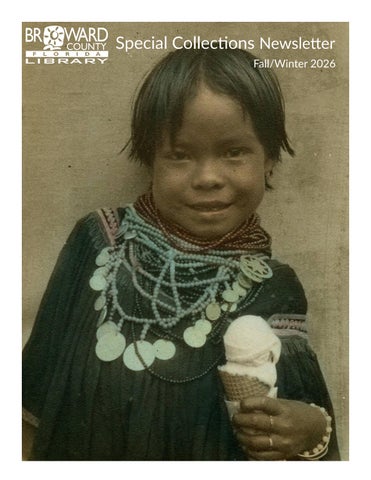
On the Cover
10 Helen Ferris: Democracy in Action at Port Everglades
11 Staff Updates 12 Bienes Museum of the Modern Book Turns 30 20 Ask the Curator: All the Pretty Houses exhibit 22 2026 May Day Workshop 23 Digitizing Immovable Objects for a Global Audience
24 A Sea Story: The Vreeland Legacy in Fort Lauderdale
Seminole girl enjoying an ice cream cone, 1930. Source: Anthony Kozla Collection, Broward County Historical Archives, Broward County Library
Fall/Winter 2026
2
Message from the Archivist By Erin Purdy This year has been an exciting one so far for the Broward County Library Special Collections department, and not even half of what we have accomplished is able to be described in this newsletter. It’s never a dull day in the archives, and our team is always busy working on a wide variety of projects. I hope you enjoy reading about just a few of the highlights. You will hear about new donations to our collections and about long-hidden treasures being brought to light. There are also important milestones being reached this year: the 30th anniversary of the Bienes Museum of the Modern Book, and by the end of the year the BCL Digital Archives will surpass a quarter million items.
We have also had exciting exhibits and programming designed around our collections that allow us to connect to the public, both in our libraries and around the world. The most joyful part of working here is giving people access to the amazing resources that we have available for free through Broward County Library. Whether you are conducting research, designing lesson plans, or want to join us for an entertaining program, it is our hope that this newsletter will inspire you to dive deeper into the archives. So welcome to the new BCL Special Collections Newsletter!
Oral History Projects Collect Local Stories Oral history projects document people’s memories and stories for research purposes and for future generations. The BCL Special Collections department actively collects oral histories through multiple oral history projects. The Black Broward Oral History Project started in 2022. At first the project focused on the history of the African American Research Library and Cultural Center, and in conjunction with the Sistrunk: Then and Now exhibit now on display we are seeking people who have stories to share about the historic Sistrunk neighborhood in Fort Lauderdale.
So far in 2026 we have added 9 new oral history interviews to the BCL Digital Archives. These interviews are available for free to the public to view in the May Day Oral History Collection and the Black Broward Oral History Project Collection. We also accept donations of oral history interviews from researchers and historians. Some of our most-used donated interviews include ones in the Kitty Oliver Collection and the Emmanuel George Collection.
Do you have a story to share?
The May Day Oral History Project collects stories from people who have celebrated and carry on the tradition of Florida’s Emancipation Day.
Participating in an oral history interview is an opportunity to bring your memories, experiences, and knowledge of local history to light.
The Broward County Oral History Project began in 1975, and has collected more than 200 interviews from local residents who helped to shape the communities where we live, work and play.
Your contribution will allow the archives to share your story with present researchers and future generations.
The Special Collections department also assists the public with recording Veterans History Project interviews for the Library of Congress’ Veterans History Project oral history collection.
3
BCL Special Collections Newsletter
If you are interested in participating in an oral history interview, or know someone who would, please contact the BCL Special Collections department or submit the Pre-Interview form .
Westside Gazette Partnership Wins FLA Award Our team was thrilled to learn that the Westside Gazette received the 2026 Media Partner Award from the Florida Library Association. Broward County Library’s ongoing partnership with the Westside Gazette newspaper and its owner, Bobby Henry, has resulted in the digitization and upload of hundreds of issues of this historical record of our local communities dating back to the 1970s to the BCL Digital Archives. The paper is available to a global audience for free on the BCL Digital Archives. The articles and captions are fully textsearchable and will serve as a powerful tool for researchers. In addition to digitizing the newspaper, BCL has also created a video, “History & Digitization of the Westside Gazette” which features an interview with Bobby Henry and details the many steps that go into preserving and digitizing the newspaper.
Bobby Henry at the Westside Gazette office.
Shaara Collection Items Used in Gettysburg Documentary The Broward County Library Special Collections department recently provided materials and research for an upcoming PBS documentary, The Gettysburg Book: A Father, Son & The Killer Angels. The documentary explores Michael Shaara’s creation of the Pulitzer Prize-winning novel, The Killer Angels. The documentary drew on materials from the Michael Shaara Collection preserved in the Bienes Museum of the Modern Book. Helen Shaara donated the Michael Shaara Collection to the Bienes Museum of the Modern Book in 1998. The collection was recently processed, and in 2025 a large portion of the collection was digitized and published on the Broward County Library Digital Archives.
Michael Shaara author’s photograph. Source: Michael Shaara Collection, Bienes Museum of the Modern Book, Broward County Library.
The Gettysburg Book documentary premiered at a screening in Gettysburg, Pennsylvania on July 3, 2026. It is set to premiere nationwide on PBS stations in November 2026. Previous documentaries to feature BCL Special Collections materials include The Swamp (2019) from the PBS American Experience series.
Fall/Winter 2026
4
New donation of materials to the Alcee Hastings Collection became the first Black federal judge in Florida history, a position he held for 10 years. In the 1990s Hastings was part of the first wave of Black elected officials to serve in the US Congress after the 118-year gap following Reconstruction. He won reelection 14 times and became the longest-serving congressman representing Florida. He served Florida District 23 from 1993 to 2013 and Florida District 20 from 2013 to 2021. He was an outspoken advocate for Floridians and devoted to fighting for the rights of minorities, immigrants, children, and senior citizens. His congressional career was also marked by his deep involvement in international affairs.
Representative Alcee Hastings in Congress with his signature smile and arms-outstretched pose. Source: Alcee Hastings Collection, African American Research Library and Cultural Center Special Collections, Broward County Library.
The Broward County Library is pleased to announce a generous new donation of materials to the Alcee Hastings Collection at the African American Research Library and Cultural Center. The late Alcee Hasting’s son, Jodi Hastings, donated 38 boxes of materials from Hastings’s congressional office in 2025. The opening of the collection for public research was announced at a formal reception on April 30, 2026 in conjunction with an exhibit of photographs from the collection. The exhibit is titled “Alcee Hastings: A Legacy of Service in Florida and Beyond”. At the reception, speakers included Jodi Hastings, Commissioner Nan H. Rich, Commissioner Beam Furr, Commissioner Alexandra P. Davis, Evan Goldman, BCL Director Allison Grubbs, Dr. Tameka Bradley, and Erin Purdy. Alcee Hastings (b. 1936, d. 2021), was one of the most significant political figures from South Florida during the late 20th and early 21st centuries. He was an alumnus of Florida A&M University College of Law (1963) where he was a member of Kappa Alpha Psi Fraternity Incorporated. While working as a lawyer, he also was a fierce activist in the Civil Rights movement. In 1977, he
5
BCL Special Collections Newsletter
Processing Congressman Hastings’ archive required a team effort – the Building Services team delivered the huge quantity of materials from the storage unit to AARLCC, a volunteer processed the collection, the Digital Librarian created an inventory of the trophies and plaques, Digitization Technicians scanned the photographs, the Metadata Technician attached metadata to the scans, and the Digital Archivist reviewed and published the materials on the BCL Digital Archives. Dr. Tameka Bradley coordinated efforts to publicize the collection through exhibits and the reception. Additionally, the BCL Marketing team created a video highlighting the collection and its importance.
Attendees at the Hastings Reception at the African American Research Library and Cultural Center.
The archival materials in the collection speak for themselves in showing that Alcee Hastings had a deep commitment to understanding and respecting others and that he worked tirelessly to better the lives of everyone on local, national, and international levels. The African American Research Library and Cultural Center Special Collections is honored to preserve his legacy for future generations and to share it with the public. This meaningful donation represents a significant contribution to our archives and offers new opportunities for research, learning, and public engagement.
Assistant Director James B. Jones and Adam Anderson, the Special Collections volunteer who processed the Hastings Collection and curated the exhibit.
Jodi Hastings and Dr. Tameka Bradley.
Broward County Commissioners Alexandra P. Davis, Beam Furr, Nan H. Rich, and Hazelle P. Rogers.
Visitors enjoy the Alcee Hastings: A Legacy of Service in Florida and Beyond exhibit at the African American Research Library and Cultural Center.
Fall/Winter 2026
6
From the Vault to the Gallery: AARLCC and the Long Arc of the Vote By Tameka Bradley, Ph.D.
Most visitors to the African American Research Library and Cultural Center (AARLCC) never see the work that makes our exhibitions possible: the acquisition, cataloging, and preservation of primary source material that happens long before a photograph or document ever reaches a gallery wall. That work is largely invisible by design, but it is the foundation of everything we do. Over the past several months, leading tour groups through our current exhibition has confirmed for me how essential it is to make that hidden labor visible, and how much visitors of every age still need the fuller history it protects. The exhibition, “Selma Is Now,” presented in partnership with the Broward Cultural Division, centers on photographs taken by James “Spider” Martin, who was on assignment for the Birmingham News on March 7, 1965, when marchers led by John Lewis and Hosea Williams attempted to cross the Edmund Pettus Bridge on their way to Montgomery. Alabama State Troopers beat the marchers with billy clubs, trampled them with horses, and released tear gas; John Lewis suffered a concussion, and Amelia Boynton, co-founder of the Dallas County Voters League, was beaten unconscious. Martin's images of that day, now known as “Bloody Sunday,” shocked the nation and the world. The brutality itself followed a week after Alabama state troopers attacked voter-registration demonstrators in nearby Marion, where a trooper shot Jimmie Lee Jackson as he tried to protect his mother and grandfather; Jackson later died of his wounds, and his death helped propel the march forward. Erin Purdy, Senior Archivist for Broward County Library, complemented Martin's photographs with images drawn from the library's own holdings documenting the 1961 campaign to integrate Fort Lauderdale's segregated beaches, led by Eula Johnson, then president of the local NAACP branch. The images show Johnson, in her white beach hat, leading teenaged swimmers past a hostile
7
BCL Special Collections Newsletter
Eula Johnson confronting the police, 1961. Source: Black Beaches Collection, Broward County Historical Archives, Broward County Library.
crowd of white onlookers, and later being escorted to a police wagon. Placed alongside the Selma photographs, this material does more than supplement the exhibition; it demonstrates why a regional archive matters. Without Broward County Library's sustained commitment to collecting and preserving local civil rights history, this chapter of Fort Lauderdale's own past might have gone undocumented. High school students touring the gallery are consistently stunned by these images, in part because they had no idea a beach in their own city had once been a battleground. In an adjoining gallery, AARLCC's holdings speak for themselves: the Congressman Alcee Hastings Collection, housed permanently at our institution, traces the arc from that struggle to its legislative consequence. When the Voting Rights Act was signed into law on August 6, 1965, it eventually made possible the majority-minority congressional district from which Hastings was elected in 1992 — the first Black representative Florida had sent to Washington in 117 years, since Josiah T. Walls left office in 1876. That the Hastings papers reside at AARLCC, steps from the Selma exhibition, is not incidental; it
Rep. Alcee Hastings speaking at the Grand Opening of the African American Research Library in 2002. Source: AARLCC History Collection, AARLCC Special Collections, Broward County Library.
Police and a lifeguard disrupting a conflict between white and Black teenage beachgoers, 1961. Source: Black Beaches Collection, Broward County Historical Archives, Broward County Library.
reflects our institutional mission to be a permanent repository for African American history in South Florida, not merely a temporary host for traveling material. That mission has taken on new urgency. On April 29, 2026, the U.S. Supreme Court decided Louisiana v. Callais, narrowing Section 2 of the Voting Rights Act, and the Florida legislature advanced further redistricting reducing majority-minority representation, building on changes made in 2022. Visitors touring the gallery in the weeks since have responded with visible grief, describing a sense that the sacrifices documented on our walls were at risk of being undone sixty-one years later.
Students attending a guided exhibition tour at AARLCC.
This is the case for institutions like AARLCC. Archives preserve what would otherwise be lost; exhibitions translate that preserved record into something the public can encounter directly. Together, they allow visitors to trace a continuous line from a Selma bridge to a Fort Lauderdale beach to a congressional seat — and to recognize how quickly that history can become urgent again. Selma, as our exhibition's title insists, is now.
Tameka Bradley, Ph.D., is Regional Manager for Broward County Library’s African American Research Library and Cultural Center. She is a historian, author, and president of the South Florida Branch of the Association for the Study of African American Life and History.
The march from Selma to Montgomery, March 1965. Photograph by Spider Martin.
Fall/Winter 2026
8
BCL Digital Archives Reaches New Milestones Recently Digitized
The Broward County Library Digital Archives is growing fast every year, bringing a global audience free online access to the archival materials preserved in the BCL Special Collections repositories. Currently there are more than 240,000 unique and rare items available on the BCL Digital Archives, including everything from photographs and slides to oral history interviews. In January 2026 the BCL Digital Archives surpassed 57,000 monthly views for the first time. Leading the pack that month in popularity were longstanding favorites like the Vojtech Kubasta Collection, alongside newly-added collections like the Westside Gazette Collection and the Alex Haley Collection. In July 2026, the BCL Digital Archives surpassed 61,200 views, amongst the most popular collections being the Anthony Kozla Collection, the Westside Gazette, and the WPA and CCC Collections.
The Pampered Bull hamburger restaurant in 1972 with a sign reading “Lousy Food, Warm Beer.” Source: Floyd Pyles Collection, Broward County Historical Archives, Broward County Library.
O.G. Glass on 5th Avenue in the 1950s. Source: Black Fort Lauderdale Collection, AARLCC Special Collections, Broward County Library.
9
BCL Special Collections Newsletter
The BCL digitization team has been hard at work. Since January they have added more than 32 new collections to the Digital Archives, and more than 36,000 individual items. These items include artworks from the Shona Sculpture Collection and Elgo Lewis Collection at the African American Research Library and Special Collections, letters written by Dr. Von D. Mizell from the Broward County Historical Archives, and photographs from the Broward County Library History Collection at the Bienes Museum of the Modern Book.
Animal trainer with tigers at Clyde Beatty’s Zoo in the 1930s. Source: Kozla Collection, Broward County Historical Archives, Broward County Library.
Helen Ferris: Democracy in Action at Port Everglades By Frederic Santerre Florida Governor’s Office and the White House illustrates how effectively Helen Ferris navigated democratic processes at every level of government when defending taxpayers’ interests and environmental concerns. As Buddy Nevens, a South Florida reporter, once said in 2001: Helen Ferris is the Grande Dame of Broward government activists, this senior from Fort Lauderdale keeps government honest… Her dedication to decent government makes Broward a better place. Helen Ferris was straightforward in her advocacy for good government. She often published her opinions in local newspapers, using punchy titles and her characteristic humor. In 1988, for instance, she offered a colorful assessment of Port Everglades meeting under the headline “Port Commission Belongs in Television Soap Opera”: Port Everglades does not need to go on the tax rolls. There is an alternative. The Port Commission should patent itself and sell the rights to television. It is more shocking and diversified than any soap opera being beamed over the airwaves today. The commission would truly get the brass ring for a five-star performance. Newspaper clipping from the Helen Ferris Collection featuring a photograph of the “Port Gadfly” herself.
Back in the 1980s and 1990s, citizens, elected officials, and port commissioners in Broward County were no strangers to the name Helen Ferris (1919–2012), the unofficial watchdog of the Port Everglades Authority (PEA). As provocative as she was, it was not surprising she had a license plate on her car inscribed “Port Gadfly.” Her interventions at PEA meetings—before Broward County assumed control of the Authority in 1994— attracted media attention and helped to mobilize local citizens against decisions made by the PEA and allegations of corruption. Correspondence from the
Ferris was a civil, political and environmental activist who grew up in Quincy, Massachusetts. During WWII, while working for Bethlehem Steel, she helped organize a union and became the company’s first female shop steward. At the Fall River Shipyard, she advocated for equal pay for women and for improved working conditions. In 1954, Ferris and her husband, George, moved to Fort Lauderdale. Their home on South Miami Road—just minutes from Port Everglades—gave Ferris the opportunity to become familiar with local nature and the port. She developed a passion for marine animals such as manatees and sea turtles and began collecting seashells, which soon grew into a new hobby: creating flowers and other artworks made from Florida and Caribbean shells.
Fall/Winter 2026
10
Her love for nature led to her interest in the environmental impacts of Port Everglades. Drawing on her previous experience as an activist, she began working to ensure that port activities complied with environmental regulations. Soon, she uncovered evidence of widespread corruption within the Port Everglades Authority, famously finding evidence that the board members used public money to buy themselves gold and diamond rings. In large part thanks to her reports, Broward County took over operations of the port from the PEA in 1994. Helen Ferris’ success was underpinned by her careful documentation of PEA activities. In 1997, the Broward County Historical Commission (whose collection is now part of the Broward County Historical Archives at the Broward County Library) became the recipient of the donation of her collection of records. The collection includes 36 boxes of correspondence, news clippings, meeting minutes, reports, magazines, newsletters, and books related to port activities in Florida. The collection even includes one of her own creations, a necklace made of shells. Her donation occurred just a few years after she was inducted into Broward County’s Women’s Hall of Fame in 1995 in recognition of her significant contributions to society and to the advancement of women’s rights. It is not uncommon for archival collections to receive treatment many years after their arrival. After its acquisition by the former Historical Commission, the
Helen Ferris Port Everglades Collection rested quietly on the archives’ shelves until the winter of 2026, when it received preservation, organization, and description by the archival staff at the Library. The recent processing of this collection demonstrates Broward County Library’s commitment to providing access to research materials that reflect our community’s civic engagement. The archives give voice to everyday people who aspire—and work tirelessly—to build a better world. For researchers, the collection offers a detailed record of the history of Port Everglades up to mid-1990s. It is worth noting that Port Everglades will celebrate its 100th anniversary in 2028. It also provides a detailed look at the work of a local grassroots activist movement led by a woman. The Helen Ferris Collection serves as a reminder never to underestimate the power of the people when they mobilize around corruption, ethics violations, governance or environmental issues. The Helen Ferris Port Everglades Collection is now available for exploration, with many materials—such as correspondence, meeting minutes, and news clippings— now digitized by our team. In time, the Broward County Library hopes to hear from community members or elected officials who knew Helen Ferris personally and can share insights not captured in the existing materials. Their memories would enrich the collection and deepen our understanding of her legacy. If you would like to participate in an oral history interview, please contact the Special Collections department.
Staff Updates We have gained a new team member, Frederic Santerre, who has already processed dozens of linear feet of archival material. Frederic is the new Digital Initiatives Librarian working in the Digitization section. In addition to processing, he supervises the Digitization Technicians and assists in digitizing materials and uploading them to the Digital Archives. He has brought with him care and expertise, along with new ideas – including the creation of this newsletter.
11
BCL Special Collections Newsletter
We were also pleased to welcome Stephanie Croney as the first Scholar In Residence at the African American Research Library and Cultural Center in over a decade. Last year she joined us as a Graduate Fellow and worked in the Niara Sudarkasa Collection, and this year as our Scholar she has continued her work processing the collection and elevating its profile so that more people are aware of Dr. Sudarkasa’s incredible legacy.
Bienes Museum of the Modern Book Turns 30 By Erin Purdy
The Ceremonial Room at the Bienes Museum serves as an event space and exhibit display area.
The Bienes Museum of the Modern Book will celebrate its 30th anniversary on December 4, 2026. For three decades, this facility has served as Broward County’s premier destination for rare books and the literary arts. Located on the 6th floor of the Broward County Main Library in downtown Fort Lauderdale, the space originally opened in 1996 as the Bienes Center for the Literary Arts before being renamed in 2006. Like many archival repositories, the Bienes’ success grew out of the passion and hard work of many individuals. Long before the Bienes Museum existed, rare books were scattered across the systems’ branches. During the
construction of the flagship Main Library, a push began to bring these books together and to establish a specialized Rare Book Department. In 1979, Broward County Library Director Cecil Beach walked past a closing bookshop in New York City and bought the store's entire inventory. This bookshop belonged to longtime rare book dealer Jack Tannen (1907-1991). Approximately 1,000 of his books formed the core of the Main Library’s Rare Book Department (along with 59,000 additional discounted volumes destined for the circulation stacks).
Fall/Winter 2026
12
As the Main Library was being built, Tannen moved to Hollywood and became the library’s rare book consultant. Tannen worked with Margaret “Peggy” Bing, future Curator of the Rare Book Department, appraising books and creating a variety of public programs and small publications to help educate the public about rare books. He also encouraged people to donate their books to the library’s collection. The Rare Book Department opened to the public officially in October 1984, about five months after the Main Library itself. Tannen’s rare book programs were incredibly popular and his work resulted in many donations to the library. Among these were first-edition copies of Mark Twain and William Faulkner novels. “Those are some pretty valuable books,” said BCL Director Cecil Beach “we hope this sort of thing continues as we go along with the construction of our library. Jack has a very unusual expertise and we’re very lucky to have him around.”
This first edition copy of Mark Twain’s Adventures of Huckleberry Finn was donated to the library by the Sciortino family thanks to the efforts of Jack Tannen.
13
BCL Special Collections Newsletter
Notably, in 1986 Jean Fitzgerald donated an incredible collection of Works Progress Administration (WPA) and Federal Writers' Project (FWP) materials. This sparked a Symposium where former WPA Federal Writers Charles Van Ravensway, David Ignatow, Montana Lisle Reese, and Stetson Kennedy spoke. Also in 1986, Duane Siers donated nearly 500 Big Little Books to the Rare Book Department. Another achievement that advanced community interest in rare books was the establishment of the Florida Center for the Book in 1984, whose mission was to promote an appreciation for the role of books in society, and to connect readers to writers. Founded by Jean Trebbi, it was the first affiliate of the Library of Congress’ Center for the Book and a model for the creation of many affiliates in the rest of the nation. One of the Center’s earliest programs was a discussion of the donated Mark Twain first editions during Banned Books Week. The Library hosted many successful programs through the Florida Center for the Book and the Rare Book Department such as the annual Ft. Lauderdale Antiquarian Book Fair, authors’ programs, writing workshops, rare book appraisals, and workshops.
Jean Trebbi (1936-2023), one of the first employees of the Broward County Library System when it was established 1974, founder of the Florida Center for the Book, and an advocate for the creation of the Bienes Museum. In 2010 Trebbi donated her personal collection of over 340 rare alphabet books to the Bienes Museum.
As the collections grew, committed staff like Peggy Bing, Jean D. Trebbi, and BCL Director Sam Morrison, recognized the need to give these treasures and the programs associated with them a better home. They envisioned a state-of-the-art environment to provide a home for the library’s treasures where they could be preserved for future generations. Furthermore, they saw the immediate community value of these materials and how they attracted people and organizations like the Fontaneda Society, classes of students, and a rapidly-growing Book Group at the Center for the Book. This vision began taking shape in 1993. The library submitted a grant application to create what was originally envisioned as the “Florida Center for the Book Cultural Resource Center.” The Center was planned to “develop an area dedicated to the celebration of the art of the book, the technology of the book, and the history of the book.” Community leaders and people from around the country rallied behind the plan. Letters of support poured in from cultural sites around South Florida, from the Library of Congress, from state senators and from county commissioners. On July 1st, 1994 Director Sam Morrison exciting news. The Florida Division of Cultural Affairs and the Florida Arts Council awarded the library a $500,000 grant. The Broward Public Library Foundation pledged to match these funds. With funding secured, the library hired renowned architect Donald Singer. He designed a rare book and special collections facility that would encompass appropriate storage for the valuable materials, dedicated staff and research spaces, and meeting rooms for programming, events, and exhibits. His work later won the 2001 Honor Award for Excellence in Design from the Florida Association of the American Institute of Architects for his design of the Bienes Museum. A grander vision for the Center was made possible through the support of philanthropists Dianne and Michael Bienes, whose donation of an additional $1 million was announced in January 1995. At the time, the Bienes’ gift was the largest private donation ever given to the library. “This wonderful gift allows us to realize the vision that we had for the Main Library from the beginning; it provides a premium facility from which to launch our exciting literary arts programs,” said Director Morrison. In honor of the
1994 concept sketches by Moira Brown.
Bienes’ significant support, the library officially renamed the planned facility the Bienes Center. On October 25, 1995 the library hosted a celebratory Wrecking Party on the 6th floor of the Main Library . Dianne and Michael Bienes were given sledgehammers, and placed the first blows on the walls to be torn down to make way for the new center. Designs of the center by architect Donald Singer were displayed along with books from the Bienes Collection. Remarks were given by Joyce T. Gardner, chairman of the BPLF’s Special Collections and Rare Books Committee and Nora Quinlan, president of the Fontaneda Society. The construction project would be completed in less than 10 months. In 1996 the library staff completed the massive task of moving over 5,000 rare books and artifacts to the newly-
Fall/Winter 2026
14
constructed Bienes vault. The vault still serves as a secure facility, featuring specialized environmental controls and fire detection designed to ensure the preservation of the materials. The Bienes Center officially opened on December 4, 1996, and was so anticipated that the library had to narrow down an invitation list for the grand opening celebration. A week later on December 11 the public grand opening program featured U.S. Poet Laureate Robert Haas and the first Director of the Library of Congress Center for the Book, John Cole, and was attended by over 200 people. After its opening, the Bienes Museum went on to thrive. Curator Jim Findlay (1943-2010) was passionate about book arts and carefully developed the collections. Findlay facilitated education programming and published five bibliographies. He curated 39 exhibitions and authored many award-winning exhibit catalogs. He also established the Florida Artists’ Book Prize competition, an annual award for artists’ books that was accompanied by exhibits of the competition entries. His dedication solidified the museum’s role as a vital cultural institution in Broward County.
Jim Findlay and John Cole at the opening program on December 11, 1996.
An exciting early development for the Bienes Museum was the introduction of a digitization program in 2001 initiated by the award of an IMLS grant to digitize materials from the Museum Extension Project collection and create an online exhibit. This resulted in the Broward County Library Digital Archives. Today, the BCL Digital Archives hosts nearly a quarter million items and is used by thousands of people weekly. The Bienes Museum also played a critical role in the creation of the African American Research Library and Cultural Center Special Collections. During AARLCC’s planning and construction (which lasted from 1995-2002), the Bienes provided a temporary home for many of the rare objects destined for AARLCC ,and the Bienes staff provided their expertise to the development of the new library’s archive and rare book collection. To build excitement for the new library, the Bienes hosted an exhibit of the Dorothy Porter Wesley Collection in 2001. This exhibit helped to cement AARLCC as the destination for Porter’s personal library of nearly 4,000 volumes. After Findlay’s retirement, Librarian Lillian Perricone continued the Museum’s mission, curating 12 exhibits with a sharp commitment to detailed research and an eye for beautiful prints. Perricone also worked with former Broward
15
BCL Special Collections Newsletter
Poster from the WPA Museum Extension Project Collection.
The Reading Room in the Bienes Museum provides a place for researchers to view the materials in the collection, allowing the Bienes Museum to fulfill the heart of its mission to provide access to rare books and manuscripts. Appointments are available to all members of the public.
County Historical Commission staff, ensuring that the Broward County Historical Archives (BCHA) arrived safely at the Main Library. She also collaborated on exhibits to promote the BCHA’s local history materials. In 2019 the Bienes Museum became part of the BCL Special Collections Department, a new department that merged the activities of the Bienes Museum, the Broward County Historical Archives, and the African American Research Library Special Collections. Since the merger, staff have worked to organize and preserve the Bienes’ precious manuscript collections according to modern standards. Perhaps more importantly, they have increased the discoverability of the collections. In 2020 the Special Collections Department acquired ArchivesSpace – an innovative collection management platform. ArchivesSpace hosts detailed, descriptive finding
aids that allow researchers to discover the museum’s collections online. Just a few of the newly-processed manuscript collections include: -the Michael Shaara Collection, containing the papers and drafts of the Pulitzer-Prize winning author of The Killer Angels; - the Olivia Goldsmith Collection, with manuscripts of Goldsmith’s novel The First Wives’ Club which was adapted into a movie starring Diane Keaton, Bette Midler, and Goldie Hawn; - the Edward Villella Collection, which contains the manuscript of Villella’s autobiography about his celebrated ballet career; - the Connie May Fowler Collection, which documents the career of a popular Florida writer.
Fall/Winter 2026
16
The library’s new digitization section is bringing the Bienes Museums’ materials and exhibits online faster than ever. The digitization team launched an innovative project after winning the 2023-24 SEFLIN Breakthrough Award grant from Florida's LSTA program. Through this grant, the digitization team obtained equipment to create 3D images of Museum Extension Project objects from the WPA Collection, which are now publicly available online. In 2024 and 2025 the Special Collections Department completed a project to make the 11 provenance book collections in the Bienes Museum more accessible to the public. First, detailed finding aids were created that describe the scope, contents, and historical background of each unique collection. Secondly, direct links to the catalog records were added to the finding aids that enable the public to easily find all of the books in a specific collection with a single click. Since its opening in 1996, the Bienes Museum staff have curated more than 77 major exhibits. They bring history to life through public programs and interactive field trips. Every day, the team helps local readers and global researchers uncover the stories inside the Museum’s rare materials. Over the years, the Museum has grown through the donations of generous members of the public and active acquisitions. Today, the vault houses a collection totaling more than 15,000 items documenting 500 years of literary arts history. Far beyond simply preserving these materials, the Special Collections team connects the public to the Museum’s physical objects in meaningful ways. Casual visitors get rare chances to view these precious books, responding with awe and a renewed understanding for the importance of these objects. Visiting students see firsthand how creators poured huge amounts of effort into painstakingly crafting objects that will endure for future generations. Specialized researchers utilize the Bienes’ primary sources to conduct in-depth research on graphic design, typography, the evolution of books over time, author’s biographies, and a host of other topics. Recently, a team of scholars from Indiana University used the WPA collection to gain insights into the history of Black writers during the early 20th century.
17
BCL Special Collections Newsletter
Emmalynn Myles volunteered at the Bienes Museum in 2017 and 2018. Today she is a librarian at the Century Plaza Branch Library.
Another vital component of the Bienes Museum’s activities is hosting student volunteers and interns, helping to prepare them for future careers in libraries and archives. Many of these students have gone on to pursue and gain employment in the field. Reviewing not only our history but our present, it is evident that in the future the Bienes Museum will continue to serve as crucial regional archive for modern print culture, book arts, and Florida literary heritage. As the Bienes marks its 30th anniversary, we are reminded that its story mirrors the larger history of the Broward County Library system, one shaped by evolving technology, a commitment to creating public access to information, and the dedication of staff who recognize the importance of preserving the past and promoting the arts.
And – to answer one of our most-asked questions – the oldest book in the collection is a 1548 printing of the poetry of Ovid.
Donate to the Bienes Museum Donating to the Bienes Fund at the Broward Public Library Foundation directly supports our ongoing preservation work and outreach programs. To discuss donating rare books or manuscript collections to the Bienes Museum, contact Senior Archivist Erin Purdy at epurdy@broward.org.
A charming scene from the Bienes Museum’s popup book collection.
The title page of the Bienes Museum’s 1548 edition of P. Ovidii Nasonis Amatoria (Ovid’s love poetry).
Bottom left: Inside the Bienes Museum Vault, specialized yellow lighting helps preserve the books. Pictured above is one of many collections, the Duane H. Siers Big Little Books Collection. It has approximately 500 Big Little Books dating from 1932 to the 1970s. First published by Whitman Publishing Company, the Big Little Books contain black and white illustrations with color covers. They are based on comic strips, movies, radio shows and children’s classics.
Fall/Winter 2026
18
Japan and the Art of War exhibit reception in 2010.
Noted comic book artist Allen Bellman with Jim Findlay at the opening reception of the Pop Phenomena: A Comic Book Exhibition on June 30, 2009. Bellman was the featured speaker at the reception. Photo by Lillian Perricone.
Visitors at the Great Days of Rail Travel exhibit reception, 2014.
Students on a tour in 2025 pose in front of the Bienes Museum vault.
Left to right: Jean Trebbi, collector Geraldine Roberts Lebowitz, Peggy Bing, and Lillian Perricone at the Series Americana exhibit opening, 2007.
19
BCL Special Collections Newsletter
Left: Bienes Librarian Loree Jackson holding a Federal Music Project poster for Elmer Keeton’s Colored Chorus in 2018.
In 2017, a film screening of footage featuring tourist attractions from the 1950s through the 1980s was held in collaboration with the Wolfson Film Archive during the Vacationland exhibit.
Ask the Curator: All the Pretty Houses exhibit
Model of the Betsy Ross House from the WPA Museum Extension Project Collection, Bienes Museum of the Modern Book, Broward County Library.
Curator Rochelle T. Pienn was interviewed on June 17, 2026 to give readers an inside scoop on the All the Pretty Houses exhibit currently on display at the Main Library.
What was the inspiration for All the Pretty Houses? The Bienes Museum of the Modern Book is the home for what you might consider a curiosity collection—that of the WPA MEP mini “architectural” models. They’re nearly a century old, manufactured during the Great Depression with government funding from President Franklin D. Roosevelt’s Work Progress Administration Museum Extension Project. These charming little houses attract children and adults alike, and I’m often asked about them by patrons and researchers. When you look at miniatures, there’s always an allure to them, a mystery. Each individual house has a tale, perhaps many stories, affiliated with its existence. I wanted to create windows,
Model of the Venetian Contarini-Fasan House from the WPA Museum Extension Project Collection, Bienes Museum of the Modern Book, Broward County Library.
if you will, into facets of the backgrounds of these houses using relevant rare books and illustrations from Special Collections. In that regard, people could get a peek into an historical event, a famous play, or a children’s book by engaging with visual and textual narrative of the pieces in the case. Which is your favorite house and why? Well, that’s like asking me to pick a favorite child! But truly, what’s wonderful about exhibits is that you can return to them again and again and keep seeing something new. One day I might favor the tiny Betsy Ross house, because it’s such a fun moment in revolutionary America, especially with our collective focus being on the 250th anniversary of our country. Another time I’ll be drawn to the romantic tragedy of the Venetian house, said to be the setting for the inspiration of Shakespeare’s Othello.
Fall/Winter 2026
20
Did you face any unusual challenges?
When, where and how can we see the exhibit?
You could say that. With any exhibit, many moving parts of production need to line up when managing the project. Any individual element in the process could require finessing and therefore cause a delay. Things can occur that are out of my control. For All the Pretty Houses, my timeline seemed to harmonize with other departmental and staff functions, making my planned opening date realistic. Right after our team completed installation, however, we were informed that an important facilities project would require full use of the Bienes Museum and a closure of the area. All of our cases on the 6th floor had to be cleared. So we immediately uninstalled. When facilities left a couple of weeks later, we reinstalled everything.
For the 2nd floor portion of All the Pretty Houses, you can visit it during open hours at Main the Bienes Museum of the Modern book portion, you can view most of the cases during Main’s regular hours, so long as there aren’t any programs scheduled in the Ceremonial Room. Our digital team also created a virtual exhibit, which can be found on the BCL Virtual Exhibitions website. This dynamic walk-through of both floors allows you to experience the entire exhibit, including clicking on individual houses and seeing them in 3D. Enjoy!
Coming Soon: Stormy Weather exhibit To commemorate the 100th anniversary of the 1926 hurricane, the BCL Special Collections department is hosting the Stormy Weather exhibit at the Main Library. The exhibit will feature many of the Broward County Historical Archives’ photographs of the 1926 hurricane – a hurricane that put a halt to the Florida Land Boom of the 1910’s and 1920’s that shaped early South Florida’s trajectory. This abrupt collapse led to a period of stagnation only remedied by the wartime industries and post-war prosperity of the 1940s. Since then South Florida has learned important lessons of preparation and resilience that allows our communities to weather many storms. Boats driven ashore on the north bank of the New River at Andrews Avenue by the Sept. 18, 1926 hurricane. Source: Clyde Brown Collection, Broward County Historical Archives.
Sistrunk: Then and Now on Exhibit For more than a century, the Sistrunk neighborhood has been the social, cultural, and economic heart of Black Fort Lauderdale. Like many historic Black communities born of segregation, Sistrunk has experienced periods of growth, disinvestment, and renewal. “Sistrunk: Then & Now” is a photographic storytelling exhibition showcasing the neighborhood’s landmarks from the past and what they look like today. The exhibit is on display at the African American Research Library and Cultural Center now until December 30, 2026.
21
BCL Special Collections Newsletter
“Old Dillard Museum” by David Paulo, 2024. Source: David Paulo Collection, African American Research Library and Cultural Center, Broward County Library.
2026 May Day Workshop By Erin Purdy In the day-to-day course of working in the archives, we constantly take measures to ensure the preservation of our materials. From washing our hands and keeping food away from the papers, to careful encapsulation of objects in acid-free containers, maintaining the archives is always on our minds. But what happens if a pipe bursts, or heavy rains flood the archive? What do we do to prepare the archives if a terrible hurricane is coming? Luckily, the BCL Special Collections department has a plan for preparing for disasters, responding to incidents, and recovering damaged archival materials so that they can remain useful to the public. This plan was originally crafted in 2017 and quickly was put to the test during Hurricane Irma that September. Since our team has grown since then, we decided to hold an annual review of our plan so that everyone knows how to respond to unexpected incidents and prepare for impending disasters. In May 2026 we held the second “May Day Workshop” for our staff. The Workshop consisted of a review of our plan, a tabletop exercise, and a hands-on wet salvage experience.
to visit their Research Center and see their collections prior to the Workshop, and learn about what they do to prevent their materials from being damaged by flooding. During the Workshop, we walked through a personalized tabletop exercise that consisted of going through increasingly disastrous scenarios, asking them how they would respond. The BCL team completed similarly tailored disaster scenarios. The scenarios allow people to think critically about who they should contact and what their priorities would be during different types and degrees of disasters before an incident occurs. It was a joy to have the HHS join us in collaborating on preparing local heritage collections for disasters. Our partnership with HHS on this Workshop resulted in conversations and collaborations on other projects as well. For the 2027 Workshop we will invite other archival organizations in the area to join us for more collaboration and sharing of expertise.
The most exciting part of the Workshop is the wet salvage practice. We take a variety of materials (not actual archival materials but discards and surrogates) and place them in bins. Then, the bins are filled with water, simulating archival materials being soaked. Then, the participants practice removing papers, photographs, pamphlets, and books from the water, separating the fragile and wet materials, and drying them out. This way, we can all experience a worst-case scenario in a lowstakes environment. Practice makes perfect, and keeping calm during an actual incident can make a big difference in our ability to salvage damaged materials. Another benefit of the practice is that each year we have come up with new and innovative ideas for treating the materials. This year we were joined by the Hollywood Historical Society (HHS), who like most archival organizations are no stranger to dealing with disasters. It was a treat for me
Tables covered with drying materials and bins of water during the wet salvage practice.
Fall/Winter 2026
22
Digitizing Immovable Objects for a Global Audience By Ben “Bazle” Smith
Figure 1: Original photograph straight from the camera of Shona Lady by James Tandi before being edited.
Broward County Library (BCL) not only digitizes 2-D objects such as photographs, letters, maps, official documents, and ephemera, but also 3-D objects from our collections that are equally informative and of interest to our online visitors. Some of these 3-D objects include large Shona stone sculptures by three Zimbabwean artists: Ishmael Kapeta (died 1997), James Tandi (19562020), and Brian Watyoka (born 1973). In conjunction with the exhibition House of Stone: Contemporary Zimbabwean Art at AARLCC shown at the African American Research Library and Cultural Center (AARLCC) in Fort Lauderdale earlier this year, we photographed 11 sculptures that can now be viewed from multiple angles
23
BCL Special Collections Newsletter
Figure 2: Photograph of Shona Lady by James Tandi after being edited. View on the BCL Digital Archives.
in the Shona Sculpture Collection on the BCL Digital Archives. The first challenge was photographing them where they are displayed throughout AARLCC. Due to their heavy weight and size, they couldn’t be moved into a studio environment (the ideal way to photograph 3-D objects) without the risk of damage. Instead, with the use of portable lights and backdrops, we created photographs that were later edited into a digital product giving the impression of studio photography. The second and biggest challenge was lighting the sculptures in a way that best captured the stone’s textures, details, facial
features, and adornments without causing distracting reflections or shadows.
Figure 3: A screenshot of the layers used in Adobe Photoshop to create the final image published online along with their layer masks.
Once photographed and added to our media storage server, next came choosing the best photographs to edit in Adobe Photoshop. A central tenet of digitizing special collections materials is to be certain that the digital representation is as close to the original as possible (e.g., free from color inconsistencies, content differences, or any kind of change to the original). To adhere to this standard, each sculpture was isolated from the rest of the photograph using a combination of lasso tools (magnetic,
polygonal, and selection brush) from which a copy layer was created [Fig. 3, Layer 2]. This layer sat above any background changes so that the sculpture wouldn’t be affected by such edits. This was especially important because the background often needed to be created in post using a black-to-white gradient and “blowing out” the exposure to remove distracting elements since they were photographed on location [Fig. 3, Gradient Fill 1 and Levels 1]. Following this, the only edits to the sculpture itself were lighting adjustments [Fig. 3, Levels 2, Levels 3, Exposure 1, and Brightness/Contrast 1]. Most of these layers have "layer masks," (all the rectangles with varying shades of black and white to the right of the layers). These are used to exclude specific areas of that layer from any of the changes, while also being able to control the visibility of those changes from 0% to 100% visible. Levels 3 most effectively exemplifies the usefulness of layer masks because this layer was used to increase the brightness of darker areas without affecting brighter ones. This balanced the lighting of the photograph and reduced contrast for a more even lighting effect. On occasion, a channel mixer layer [Fig. 3, Channel Mixer 1] was used to change either part of or the whole image to black and white, but only if it was a completely black stone sculpture or plinth. Many plinths required this edit because they reflected colors from the surrounding area that were unrelated to the sculpture. Lastly, Layer 1 is an unchanged original of the photograph that acted as a reset layer. This allowed for undoing changes throughout the process, if needed, along with the layer masks. Each of the 11 unique sculptures came with its own challenges to being photographed, and all 40 of the final photographs needed to go through variations of this editing process. Ultimately, this process created representative depictions of the artworks allowing a global audience to view the incredible artistry of these sculptors, whether they can’t visit AARLCC in person or they would like to view these sculptures time and time again.
Ben “Bazle” Smith is a Metadata Technician at the Broward County Library.
Fall/Winter 2026
24
A Sea Story: The Vreeland Legacy in Fort Lauderdale By Frederic Santerre
James B. Vreeland Jr. showcasing his catch (sunfish).
The development of Fort Lauderdale is deeply intertwined with the sea, which has shaped every aspect of the city’s growth. Developers promoted the coastline as a tropical paradise, highlighting its sun, palm trees and beaches. Fishing has become, and remains, a popular pastime and sport, with numerous charter excursions attracting anglers from across the country in search of a good catch. The Vreeland family, who came from the Northeast in 1900, capitalized on this maritime opportunity by establishing themselves as “trailblazers of the seas” along Fort Lauderdale’s coast.
25
BCL Special Collections Newsletter
The Broward County Library Special Collections department recently processed the Vreeland Collection which documents the history of three generations of Vreelands in Broward County. First, Captain James B. Vreeland Sr. played a significant role in the community, becoming the legal guardian of the U.S. Coast Guard House of Refuge (Station No. 4) near Las Olas Beach in 1906—a position he held until 1915. As a testimony, the collection contains a logbook written by Vreeland Sr. detailing his activities. In addition, he was also one of the first surveyors in Broward County, and the collection contains many of the instruments that he used to survey streets and property lines, literally shaping the City of Fort Lauderdale. His wife, Cordelia Deveaux Vreeland, was an active member of the Woman’s Club of Fort Lauderdale, serving both as president and historian. During the first decades of the 20th century, Captain Vreeland Sr. weathered numerous crises and storms. The family often rescued sailors who had been shipwrecked on the reefs, including one dramatic incident involving a crew that had mutinied against its captain off the Florida coast. As a government agent, Vreeland Sr. boarded the vessel to negotiate with the crew, ultimately bringing the mutiny to an end. Second, James B. Vreeland Jr. elevated the family business by dedicating his time and energy to fishing off the coast of Florida and throughout the Caribbean, attracting both local anglers and visitors. Before World War II, Captain “Jim” and his son Harold frequently made headlines in the Fort Lauderdale Daily News for their record catches of various game fish—sailfish, blue and white marlins, sharks, mantas, dolphins, barracudas, and more. During WWII, Captain Jim served in an unofficial role as a “sea mailman,” retrieving ship letters that had been thrown overboard so they could be preserved in case a vessel was attacked by German forces. Several letters of thanks addressed to Captain Vreeland Jr. serve as a poignant reminder of this practice. In 1961, the City of Fort Lauderdale recognized James B. Vreeland Jr.’s contributions to the city’s development by issuing a citation of esteem for his genuine pioneership.
The albums and scrapbooks in the collection contain numerous photographs of fish caught by the Vreeland family and other anglers, making this collection a true maritime treasure. This unique resource will be accessible on the Broward County Library Digital Archives in the coming months. The photographs are often accompanied by information and anecdotes bringing to life the experiences lived by Captain Vreeland Jr, such as:
Harold Vreeland showcasing his catch (mango snapper) at Vreeland Jr.’s dock.
The fish story ("believe it or not") that could not happen again in a million years (the facts). Catching four fish, one after another till the fourth landed measured 18 ft, weighing 1200 lbs. The shark head displayed in this picture is the third fish. That was over seven feet long. What would you think you might catch using a seven-foot fish for bait? (Box 1, Item 41) Anglers often let their fish stories swim into legend, but Captain Vreeland Jr. kept his firmly anchored in truth and supported them with evidence. Among other treasures, numerous stories written by Captain Vreeland Jr. describe his nautical experiences; many were published in local newspapers and magazines, and others were broadcast on the radio during World War II.
Newspaper clippings of 1939 “Sea Stories” columns by Captain James B. Vreeland Jr.
The collection will interest anglers, fishermen, and the general public, offering eye-catching photographs. Residents of Fort Lauderdale searching for vintage postcards that capture the city’s vibrant early urban scenery will certainly have their curiosity satisfied. For marine researchers, the collection can provide detailed historical evidence of the changes in marine life off the coast of Florida over a span of 50 years. Captain Jim’s careful documentation of his craft now offers researchers a look at the evolution of fishing practices during the 20th century. Together, these materials offer a vivid glimpse into a remarkable family whose legacy shaped Fort Lauderdale
Access the Vreeland Collection You can learn more about the collection and view a listing of its contents in the Vreeland Collection Finding Aid online. The Vreeland Collection is open for research by appointment at the Broward County Main Library.
Fall/Winter 2026
26
The Broward County Library Special Collections preserves and provides access to the materials maintained in the Broward County Library’s three archival repositories. The AARLCC Special Collections preserves archival materials that document the history and culture of people of African, African American, and Caribbean descent at the African American Research Library and Cultural Center (AARLCC). The Bienes Museum of the Modern Book is Broward County Library’s home for rare books and Florida authors’ manuscripts. The Broward County Historical Archives (BCHA) preserves local history materials. It also houses the collections of the former Broward County Historical Commission.
Learn More Broward.org/Library/Research/SpecialCollections
Contact Erin Purdy, Archivist (954) 357-6138 epurdy@broward.org Bienes Museum and Broward County Historical Archives: 100 S. Andrews Avenue, Fort Lauderdale, FL 33301 AARLCC Special Collections: 2650 Sistrunk Boulevard, Fort Lauderdale, Florida 33311
27
BCL Special Collections Newsletter
A Broward County Public Schools tour examines documents from the Dorothy Porter Wesley Collection inside the climate-controlled AARLCC Special Collections vault, where rare books, artifacts, and paper materials are stored.