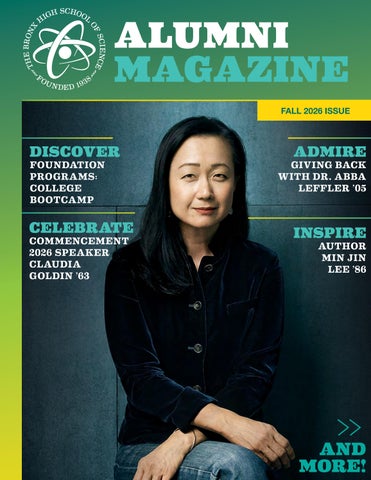
ALUMNI MAGAZINE FALL 2026 ISSUE
DISCOVER FOUNDATION PROGRAMS: COLLEGE BOOTCAMP
CELEBRATE
COMMENCEMENT 2026 SPEAKER CLAUDIA GOLDIN ’63
ADMIRE
GIVING BACK WITH DR. ABBA LEFFLER ’05
INSPIRE
AUTHOR MIN JIN LEE ’86
AND MORE!
FALL 2026 ISSUE / TABLE OF CONTENTS
02
FOUNDATION UPDATE
12
COVER STORY: MIN JIN LEE ’86
It was a summer of exploration, discovery and new experiences for our incredible Bronx Science students, thanks to generous alumni who made tremendous opportunities possible.
19
COMMENCEMENT 2026 SPEAKER CLAUDIA GOLDIN ’63
15
ALUMNI SPOTLIGHT: WYATT MORGAN ’20
08
Dear Fellow Bronx Science Alumni,
FOUNDATION PROGRAMS: COLLEGE BOOTCAMP
05
GIVING BACK WITH DR. ABBA LEFFLER ’05
WELCOME
18
STUDENT SPOTLIGHT: GENES IN SPACE
22
CLASS NOTES
23
IN MEMORIAM
For the first time in decades, we have brought back an international trip to Europe, and we returned to Korea for the second year in a row as well. Our alumni overseas hosted students at world-class companies, shared insights at alumni receptions and spoke with students about their own experiences living abroad. Watching students' faces as we checked out a flying car prototype in Seoul (in short, we all want one...) or ran down all the steps of the Eiffel Tower under the recommended time of ten minutes (we did it in nine!) was pure joy – and an incredible reminder of the power of experiencing things for oneself. Back in the United States, we hosted Summer Institutes in seven different industries, through which students visited more than 60 companies, traveled to DC and Boston and had facetime with alumni thriving in their respective fields. Our goal was to provide students with as many chances as possible to travel outside their comfort zone and learn in a handson way about the unique opportunities, challenges and environments across different career fields. In addition, more than 75 students spent their summer conducting independent science research at the Manne Institute: developing their own research queries, questioning their assumptions, analyzing their data and starting all over again when something went awry. Other student cohorts took a deep dive into Robotics on campus, or experienced a musical, ballet or museum for the first time through the Arts Summer Institute. A sincere thank you goes out to the alumni across the country and world who took time out of their lives to meet with students, host them, answer their questions and show them what it means to be a part of such a special alumni community. What I love most about Bronx Science students is their curiosity. Whether they are visiting a company, taking a new class, eating a new food or visiting a museum, it is inspiring to see their enthusiasm and openness to learning new things. Their energy is infectious and it is a privilege to provide them with the support they need to thrive. Looking forward to an excellent year ahead. Thank you in advance for playing a role in it.
Best,
Eleanor Coufos ̓ 99 President Bronx Science Foundation
////////////////////////////////////////////////////////////////////////////////////////////////////////////////////////////////////////////////////// LETTER FROM THE BRONX SCIENCE FOUNDATION PRESIDENT / 1
BRONX SCIENCE
FOUNDATION We may have officially begun the 2026–2027 school year just two months ago, but the Bronx Science Foundation has been busy since July 1 – and so have our students!
GLOBAL TRAVEL PROGRAMS We brought 22 students to Europe and 17 to South Korea. For many students, it was their first time traveling abroad, and for almost all, it was their first time traveling without their families. The Foundation fully coordinated and led these trips and heavily subsidized the cost to participate, especially for students with the highest financial need. Each day was jam packed with history, art, sightseeing, culture and food, and students loved meeting with alumni in Seoul, London and Paris. Students learn so much in a classroom – but as Eleanor noted in her letter (see page 1), nothing brings learning to life like seeing and experiencing it for yourselves.
UPDATE Watching students show off their knowledge of the French Revolution in Paris, connect colonialism to the artifacts in the British Museum, or marvel at the engineering of a flying car in Seoul was simply electrifying!
SUMMER INSTITUTES
In Summer 2026, the Foundation hosted nine signature Summer Institutes. These annual free summer enrichment programs offer Bronx Science students unique opportunities to explore a variety of interests and careers, meet with alumni thriving in their industries, and experience different professional environments and expectations.
2026 Summer Institutes by the Numbers:
9 Summer Institutes 6 Institutes (Artificial Intelligence,
Entrepreneurship & Technology, Finance, Government & Law, Media & Entertainment, and Doris M. Glick ’61 Summer Institute for Medicine & Public Health) made possible in partnership with alumni hosts and volunteers
3 Institutes (Arts & Culture,
Research and Robotics) led by Bronx Science faculty and staff
230 student participants 5 weeks of programming 50+ company visits 14 arts outings 5 cities visited 70+ alumni hosts and speakers To see the full breadth of these programs, check out our 2026 Summer Institute Report.
2 / BRONX SCIENCE FOUNDATION UPDATE ////////////////////////////////////////////////////////////////////////////////////////////////////////////////////// BRONX SCIENCE FOUNDATION UPDATE / 3
INSIDE THE NUCLEUS: BRONX SCIENCE’S SUMMER AND EARLY FALL COLLEGE PREP Student demand for support in the college admissions process continues to grow – and the Foundation is happy to answer that call! College Application Boot Camp 79 seniors (10% of the graduating class!) attended a 4-day college application boot camp at the school the first week of August – just as the Common Application portal opened for the 2026-2027 admissions cycle. Students enjoyed a presentation by author Patricia Park ̓ 99, learned lots from a supplement writing session given by Nicole Molina, Director of Regional Engagement NYC for Vanderbilt University, and spent 12+ hours with alumni and staff deconstructing personal statements, creating resumes and practicing answers for supplements. Learn more about this first-time (and hugely successful!) college support program from Bronx Science senior Anna Hunt on page 12. College Summer Guide & Resources The newest College Guide was completed and shared with all seniors and their families at Bronx Science, providing them with a clear map and guide to navigate the complicated admission process.
Project Accepted 2026 The weather may have flipped this year’s Project Accepted into a virtual event, but our loyal alumni showed up via Zoom on September 27 to help seniors prepare to put their best foot forward in the college application process.
All of these programs reflect a core part of the Foundation’s mission: to enrich the education of Bronx Science students and provide them with the resources and opportunities needed to realize their remarkable potential. With a Bronx Science education and commitment to excellence, there are limitless possibilities in store for our students.
MEDICINE AND PUBLIC HEALTH
SUMMER INSTITUTE VISITS SCHRÖDINGER
WITH DR. ABBA LEFFLER ’05 ARTICLE BY CAROLINE KOO ’26
On Monday, July 6th, students in the Doris M. Glick ’61 Bronx Science Medicine and Public Health Summer Institute spent the day at Schrödinger, a publicly traded scientific software and biotechnology company based in New York City that uses computer models to accelerate drug discovery and materials science. The visit was made possible by the generosity of Bronx Science alumnus Dr. Abba Leffler ’05, who hosted the group and walked them through a career that began in the same classrooms they sat in during the school year.
None of these programs are possible without the support of alumni like you! To make a difference this year, please: • Make a gift at bxscience.edu/give • Volunteer your time to help students. • Stay up-to-date on what's happening at Science by attending events, following us on social media, reading our Alumni Magazine, and checking out our annual Impact Report. Be sure to share with your friends, too!
To learn more, contact the Foundation at 718.817.7800 or foundation@bxscience.edu.
4 / BRONX SCIENCE FOUNDATION UPDATE
The visit started with a tour of Schrödinger’s Midtown Manhattan headquarters– a space where meeting rooms carry names like “The Nucleus.”
From there, students dove into the central theme of the day: how artificial intelligence is reshaping drug discovery. Dr. Leffler’s own work combines traditional physics-based models with machine learning to predict how drugs will work to save lives, such as a compound he helped invent that is currently in clinical trials for cancer. Asked what advice he’d offer students following in his footsteps, Dr. Leffler didn’t hesitate:
“
Be in a room of people that are smarter than you. For example, Dr. Leffler’s office mate at his first job after college, as a scientific associate at D. E. Shaw Research, a privately held biochemistry research company, turned out to be a winner of the 2024 Nobel Prize winner in Chemistry! More generally, Dr. Leffler
/////////////////////////////////////////////////////////////////////////////////////////////////////////////// GIVING BACK WITH DR. ABBA LEFFLER ̓ 05 / 5
traced that philosophy directly back to his experience at Bronx Science, where he credits his peers with constantly pushing him to think harder and reach further. From there, his path led to Princeton University, where he studied chemistry and applied mathematics, then to a PhD in neuroscience from the NYU School of Medicine, a trajectory which brought him to Schrödinger, where he’s been working for the past decade.
MEETING THE TEAM Students also had the chance to hear from several of Dr. Leffler’s colleagues, each offering a different lens on the world of computational drug discovery. Katie Amberg-Johnson, a senior principal scientist, spoke about the importance of building a scientific culture where it’s safe to fail, and how the safety she’s found at Schrödinger is often what makes real progress possible. Sung-Sau So, a senior research leader in computational chemistry, gave students a sense of just how long the road to new medicine can be, describing a drug he worked on for fatty liver disease that took 22 years to develop and win FDA approval. Karl Leswing, the VP of Life Sciences
Software, brought a background in math and computer science to the table, coming to Schrödinger from defense contracting and cyber security, rather than life sciences. His guiding belief was that drug synthesis also deserved the highest caliber of software. Despite their varied paths, the team reiterated the idea that breakthroughs happen across domains and between disciplines. Dr. Leffler joked that this collaborative spirit is even reflected in the office’s board games and ping-pong tables (the true marker of a software development company), which give chemists, computer scientists, and mathematicians the opportunity to talk across the aisle.
AI’S NEXT FRONTIER A major highlight of the visit was learning about Schrödinger’s AI agentic co-scientist, “Bunsen,” which Leswing helped develop, that helps identify and refine drug compounds targeting specific proteins. Leswing offered a bold prediction: “The future of science is agentic.” Bunsen, he
suggested, is just the beginning of how AI tools will work alongside, and eventually within, the research process over the next twenty years. That prediction opened the door to the day’s most thought-provoking discussion. As students pressed further with questions, it became clear that even the people building these tools aren’t entirely sure what the role will be for human researchers. Amberg-Johnson, who trained as a biologist, argued that human judgement remains irreplaceable. Large language models can summarize vast amounts of information effectively, she noted, but when it comes to prioritizing which findings actually matter, they can fall short. The conversation eventually arrived at a striking question: in a future shaped by tools like Bunsen, are human
scientists becoming adjudicators rather than researchers, evaluating and directing AIgenerated possibilities rather than creating them from scratch?
A MODEL WORTH WATCHING There is no shortage of hype around artificial intelligence today, much of it thin on substance. What made the visit to Schrödinger stand out was the sense that this was AI in service of something real, combining decades of institutional knowledge and scientific rigor, not just a shortcut to optimize efficiency. Dr. Leffler and his colleagues are using this technology to push the boundaries of medicine, one previously “undruggable” protein at a time. With the help of companies like Schrödinger, drug research and discovery is becoming both cheaper and faster, and the future of patient health doesn’t seem so far away. For the students of the Medicine and Public Health Institute, the takeaway went beyond any single technology. It was a glimpse of what it looks like to build a career, and company, around the same principle Dr. Leffler learned at Bronx Science: surround yourself with people that are smarter than you.
6 / GIVING BACK WITH DR. ABBA LEFFLER ̓ 05 //////////////////////////////////////////////////////////////////////////////////////////////////////////////// GIVING BACK WITH DR. ABBA LEFFLER ̓ 05 / 7
MIN JIN LEE ’86 ARTICLE BY ANNA KOONTZ ’25 A two-hour commute from Queens to Bronx Science. Ten years spent drafting her first book. “I don’t take shortcuts,” Lee said. When she wasn’t sleeping on a stranger’s shoulder, Lee used to read during her high school train rides – Borges for Spanish class, Sinclair Lewis for fun. The globally renowned author has now written three of her own: Free Food for Millionaires, Pachinko, and American Hagwon, released this September. Lee published her first book at age 38. Before becoming an author, her life journey involved immigrating to the US, navigating a STEM high school as a humanities kid, studying history, practicing law, and battling liver disease. Although this path was long, none of these events were detours. They shaped her writing style, interests, and approach to exploring “metaphysical questions.”
8 / MIN JIN LEE ’86
“What makes a good life? How do you live a wise life?” she wondered aloud. “I try to work it out and then create drama and imagine a narrative.”
Lee was born in Seoul, Korea, and immigrated to New York when she was seven years old. She didn’t know any English at first and described her younger self as shy and socially awkward. However, at Bronx Science Lee could feel “normal,” she said. Inspired by her classmates’ drive, she served as Editor-in-Chief of the history journal Exposition, dabbled in Speech & Debate, and helped in student government. “I felt like I found my people.” Despite struggling in Calc BC and preferring books to labwork, Lee also developed an admiration for science. “I have so much respect for the scientific method, for inquiry, for hypothesis, for
evidence-based reasoning. And I think that you can see that kind of logic in my work,” she said. Lee next attended Yale for college. She majored in history and advocated for the expansion of Korean history and language classes. She won two of the English department’s writing awards for fiction and nonfiction, but she still did not imagine herself a future novelist. Instead, she decided to study law at Georgetown.
She was identified as a chronic hepatitis B carrier and told to never donate again. Doctors said she would likely get cancer and might die by thirty. Lee’s liver infection forced her to reconsider priorities. “It was something that was always sort of pressing, and that affected my decision to quit being a lawyer and to focus primarily on writing fiction,” she said. For several years, Lee gave herself a “writing apprenticeship,” participating in workshops and drafting a book. Soon after her son was born and around the age that doctors predicted, she became severely sick. She was able to overcome the illness with intense treatment and finally published her first book in 2007.
Her career as a lawyer was short: Lee quit after only two years. The reason traces back to high school. At Bronx Science, Lee had participated in a blood drive organized by a friend.
Free Food for Millionaires explores class, economic status, and identity through the life of a young Korean-American woman. The main character is from Queens; her sister was a Bronx Science student. The family situations in Lee’s following books are less close to home, but they continue to explore the Korean diaspora through varying lenses.
//////////////////////////////////////////////////////////////////////////////////////////////////////////////////////////////////////////////////////////////////////////////////////
MIN JIN LEE ’86 / 9
“When I think about the long trajectory of the history of human beings, it’s that we have to endure obstacles and overcome obstacles. Diaspora is one dimension that looks like an obstacle, but perhaps it could be an opportunity,” she said. Pachinko, published in 2017, is an intergenerational narrative following a Korean family in Japan. The book traces a history of discrimination and resilience throughout evolving historical contexts. Writing Pachinko required extensive research, including studying academic texts and primary documents. Lee gained an immersive experience from living four years in Japan and interviewing hundreds of Korean-Japanese people. Lee’s latest book is the third in a planned ‘Diaspora Quartet.’ American Hagwon examines themes of education and immigration as a family moves across continents.
“ Imagination
requires the feeling of what it’s like to be a human in that time and in that moment,” she said.
Since its September release, the book has already become a critically acclaimed New York Times best-seller. Bronx Science students and faculty proudly attended Lee’s American Hagwon book event in Manhattan in October – just one of the many stops on her global tour for the novel.
“When you get older, you can look back at your sixteen, seventeen year old self with great tenderness and see how adorable you were, how much you tried and how deeply you felt about everything,” Lee said. “I want my fellow young girl alumni to feel that power that they have then and they’ll have in the future.” Lee returned to Bronx Science in 2019 as the keynote commencement speaker. She also spoke at Yale’s commencement ceremony this spring. She described these opportunities to return as both “bonkers” and “a tremendous honor.” Whether writing a speech to graduating students or drafting a novel, Lee thinks first of her listeners and readers.
Hae Ran
“I want to respect my audience, because when someone gives you their time, they’re giving you part of their life,” she said.
^
35 students attending the American Hagwon launch on 5th Avenue
Lee views this process as “building a whole world together,” a joint endeavor between writer and reader. “Every single word is there for a reason,” Lee said. “There should be a tremendous logic to why things are happening.”
Lee’s newest novel, released in September 2026
Lee is serving as the New York State Author Laureate from 2025 to 2027. Her writing has received numerous awards and is taught in schools including Bronx Science, which assigns Pachinko to rising seniors. Lee hopes that her writing will make current readers feel “powerful.”
Photo credit:
was ce Hall of Famer, Lee A longtime Bronx Scien ol’s ho sc e th Atom Award at also honored with an in 2023. 85th Anniversary Gala
The logic is always present, although not fully realized until more pages are turned. It’s the same with life: each two-hour high school commute eventually leading to opportunities at top universities, a history and law education providing skills to research and structure narratives, an illness motivating the books that a new generation now reads on their morning commutes. There are no shortcuts to coming full circle.
10 / MIN JIN LEE ’86 ///////////////////////////////////////////////////////////////////////////////////////////////////////////////////////////////////////////////////////////////////////////////////////// MIN JIN LEE ’86 / 11
FOUNDATION PROGRAMS IN ACTION:
COLLEGE BOOTCAMP ARTICLE BY ANNA HUNT ’27
Senior year can be the best part of one’s high school experience – but it can also be extremely stressful! The college application process turns many a senior fall semester into a mad dash, between Writer Anna Hunt �27 juggling application deadlines, collecting financial aid information and completing the Common Application. I know from my own experience that it can be especially hard to know what to write about when working on your personal statement and supplements, the application pieces through which students distinguish themselves and answer school-specific questions. How does one present their most “appealing” traits to a college? How do you sum yourself up in 650 words? What do the admissions officers want me to say? All of those questions and more were answered when I joined 80+ rising seniors in early August to participate in Bronx Science’s first College Bootcamp. This Foundation-planned and funded program took place over four days, with three hours each day dedicated to writing strategies and workshopping personal statements.
Help came in multiple forms during the Bootcamp: A panel of young alumni shared their advice on writing their personal statement – which was especially valuable since these alums had so recently been “in our shoes” at Bronx Science.
For many students – myself included – the highlight of the Bootcamp was a presentation given by Vanderbilt University’s Director of Undergraduate Admissions, Nicole Molina. Nicole shared that from the perspective of an admissions officer, it’s simply a fact that we’re students from one of the best high schools in New York City (if not the country!) The purpose of our essays is to reveal how we are more than that – a perspective that proved crucial to helping us to step outside of ourselves and take a deeper look at our applications. The time taken out of our precious summer vacations was well spent in my eyes, and other students agreed. One senior reported that
Writer Patricia Park ̓ 99 Speaking at Bootcamp
they thought “the program was incredibly helpful. I feel prepared now because I have a much better idea about what admissions officers are looking for.” Another shared: “I feel so much better about my applications now that I've started early.”
Bootcamp Attendees
Writer Patricia Park ’99 spoke to us about her experience at Bronx Science and how it shaped her college experience and beyond. The plot of her 2023 novel, Imposter Syndrome, directly parallels many of Park’s experiences during her time at Science and mirrors that of many classmates at our school. Vanderbilt Representative Speaking with Students
The inaugural College Bootcamp served as both a helping hand in our college application processes – and a representation of the strength of our school’s alumni network. I hope more rising seniors will take advantage of this program next summer, and that it will continue to evolve with more alumni and writing assistance.
12 / COLLEGE BOOTCAMP ///////////////////////////////////////////////////////////////////////////////////////////////////////////////////////////////////////////////////////////////////// COLLEGE BOOTCAMP / 13
INTERESTED IN HELPING BRONX SCIENCE STUDENTS WITH THE COLLEGE PROCESS? Volunteer for one of our remaining 2026-2027 college programs: • College Liaisons: Register this Fall
Young alumni currently in college (Classes of 2023-2026) volunteer their time to speak with current students - virtually and when students are visiting their college to answer questions and share more about their college experience.
• Regular Decision Supplemental Essay Review: Online Registration Opening Soon
We match alumni directly with students who are applying to your college! The whole program is virtual - students will send you their supplements and you will be able to share feedback with them directly. This is a great way to help students with the college process where they need the most help.
• College Campus Tours: Schools and Dates TBA in Early 2027
The Bronx Science Foundation organizes several free college trips for students to visit different schools throughout the Northeast. We are always looking for young alumni attending these schools to serve as tour guides.
Or, mark your Fall 2027 calendar for programs already completed this school year: • Project Accepted: September 2027 • Early Decision Supplemental Essay Review: October 2027 • Supplement Workshops: October 2027
The Bronx Science Foundation, led by Lisa Rocchio ̓87, leads workshops for students on how to write great supplements. It also provides a space for students to work on their essays. We are always looking for alumni volunteers who want to come to school and help students with their essays!
Contact the Foundation team at foundation@bxscience.edu or 718-817-7800 to get involved!
ALUMNI SPOTLIGHT: WYATT MORGAN ’20 OFF TO THE RACES SINCE BRONX SCIENCE
BY COOPER HALPERN ’27 Wyatt Morgan ’20 has a talent for speed. At Bronx Science, Morgan co-captained the cross country team that set a PSAL city team record and the 12th-grade chess team that finished as national runner-up. That pace carried into academics as he earned his Stanford diploma in two years. Since launching his research and biotech career, Morgan has simply not stopped racing toward learning, discovery, and achievement at every turn. Through Bronx Science’s biology research program, Morgan spent two years at Weill Cornell’s Melnick Lab using CRISPR to study gene combinations. Adapted from bacterial immune systems, CRISPR uses a short RNA guide to precisely target DNA, allowing scientists to modify its sequence or modulate gene expression.
While discussing how he learned to use CRISPR, Morgan reflected, “The postdoc I worked with gave me a CRISPR review article and showed me how to do experiments. When he returned to Germany after my first summer, I spent a year and a half working more independently.” This “trial by fire” approach served him well: Morgan’s research optimizing and validating a multiplexed CRISPR system to target multiple genes simultaneously earned him recognition as a Regeneron STS Scholar and first place in New York City’s Junior Science and Humanities Symposium (JSHS). Just a few months later, COVID-19 cut Morgan’s senior year short. Morgan experienced his first year at Stanford
14 / COLLEGE BOOTCAMP ///////////////////////////////////////////////////////////////////////////////////////////////////////////////////////////////////////////////////////////////////////// ALUMNI SPOTLIGHT / 15
virtually from Colorado, where he lived with fellow Bronx Science grads Kevin Zheng ’20 and Hector Wilson ’20. As the pandemic prevented him from conducting his planned research on Stanford’s campus, Morgan packed his bags for Israel to work on mitochondrial cell therapy at the biotech company Minovia Therapeutics.
Morgan was 21 at the time. “I was the eighth employee [at Gordian], and when I joined, I was the youngest person there and the only person without a PhD. They gave me a mock PhD defense at the company to evaluate whether I knew what I was talking about. They were like ‘yeah.’”
With myriad research experiences under his belt, Morgan secured a position at Gordian Biotechnology before he ever studied in person on Stanford’s campus. He graduated from Stanford in seven quarters and was promoted at Gordian three times in two and a half years.
Morgan and his mentor from Gordian then co-founded the biotech company Oncko (n-choose-k for combinations within oncology). “Even one cancer within one patient is incredibly heterogeneous, but most people are focused on making ‘cleaner’ targeted therapies for a
While at Gordian, Morgan developed the company’s CRISPR system for screening gene function in large living animals. By the time he left, the system was a core part of the company’s research, and Gordian has since partnered with Pfizer on the platform. “There are a lot of things that can go wrong. We are putting hundreds to thousands of genetic perturbations into animals at once, and it is very difficult to confirm that everything has been made correctly, with hundreds of thousands to millions of dollars at risk,” Morgan stated. “I set up this computational and wet lab workflow to verify that the pools of genetic perturbations going into the animals were correct.”
narrow patient population,” Morgan explained. “Rather than making a safer drug for a smaller patient population, we wanted to combine ‘dirtier’ chemotherapies at tolerable doses to find a curative therapy for a wider population.” Using compressed genetic screens, Oncko aims to identify drug combinations whose components kill nonoverlapping tumor subpopulations. The company plans to dose its first patient soon. Now back in New York at Memorial Sloan Kettering Cancer Center, Morgan is working on zinc finger proteins, smaller, human-derived alternatives to CRISPR that could enable therapeutic gene regulation with easier delivery and a lower risk of immune reactions. He plans to pursue his PhD in the near future.
As he continues charging forward, Morgan credits Bronx Science for making a tangible impact on who he is and what he does today. “So much of what I do today started at Bronx Science. It’s where I became a runner, started playing chess, and had my first experience with biology research. All three are still a big part of my life.” We can’t wait to see where Morgan’s drive and speed take him next.
16 / ALUMNI SPOTLIGHT ////////////////////////////////////////////////////////////////////////////////////////////////////////////////////////////////////////////////////////////////////////// ALUMNI SPOTLIGHT / 17
A ROUND OF APPLAUSE:
BRONX SCIENCE STUDENT EXPERIMENT
HEADING TO THE INTERNATIONAL SPACE STATION Kudos to Bronx Science juniors Serena Tsao ’28 and Chloe Comisarow ’28, winners of the 2026 Genes in Space competition!
Genes in Space invites students in grades 7 through 12 to design experiments addressing the biological opportunities and challenges of space travel. Chloe and Serena’s experiment, which proposed examining stressinduced kidney stone risk due to microbiome dysregulation in astronauts, was selected from a record-breaking 980 applications submitted by 1,317 students from 40 states across the country. Serena and Chloe will work alongside scientific mentors and researchers at
New England Biolabs and miniPCR bio to finalize their experiment, which will be launched to the International Space Station (ISS) and conducted by an astronaut over the coming year. This will be the 14th Genes in Space student experiment performed by astronauts aboard the ISS.
"We feel out of this world that our brainchild is going to be sent to the International Space Station." Serena Tsao ’28 (L) and Chloe Comisarow ’28 (R). On behalf of the entire Bronx Science community, congratulations to this stellar team! To learn more, please read the release from Genes in Space.
“THE JOURNEY IS THE DESTINATION... CURIOSITY IS THE FUEL FOR THE TRIP.” CLAUDIA GOLDIN ’63 IMPARTS WORDS
OF WISDOM TO THE CLASS OF 2026 BY SARITA SATYANARAYANA ’27 At Bronx Science’s 2026 Commencement Ceremony, Dr. Claudia Goldin ‘63 gave a resounding speech to send off the Class of 2026 graduates. A trailblazer in her field, Claudia Goldin is a renowned economic historian. In 2023, she won the Nobel Memorial Prize in Economic Sciences for her research into the female labor force – and was the first woman to win the award as a solo laureate. Goldin revolutionized the field of economics for women by drawing attention to how family dynamics in the U.S. shape gendered labor and spurred a significant paradigm shift in her field of study, leading to increased visibility of women in the workforce. Currently, Goldin serves as the Henry Lee Professor of Economics at Harvard.
Goldin’s connection to the Bronx made her commencement speech especially personal. She grew up in Parkchester and
attended Bronx Science, and her stories of her childhood and career offered the 2026 Science graduates advice about navigating both failure and achievement. Throughout her speech, Goldin echoed a singular refrain: challenges become opportunities when approached with curiosity.
18 / STUDENT SPOTLIGHT ////////////////////////////////////////////////////////////////////////////////////////////////////////////////////////////////////////////////////////////////// COMMENCEMENT 2026 / 19
Goldin explained how in her childhood, gender stereotypes and lack of opportunity made it difficult for girls to participate in organized sports. The passage of Title IX, however, dramatically expanded those opportunities, finally giving women the ability to pursue their athletic interests. Comparing her experiences with those of today, Goldin emphasized to the Science graduates that outdated expectations should not define what is possible.
significant effort into overcoming the challenge: she watched numerous pitching videos, studied their stances, and practiced every day for six weeks. On the day of the baseball game, she threw a strike.
Although she never had the chance to play baseball as a child, Goldin recounted how she eventually created an intramural team at Princeton called the “Invisible Hands.” Though the team initially looked woeful, they learned from their failures and eventually won the league championship. Years later, she faced another baseball challenge when she was invited to throw the ceremonial pitch at a Red Sox-Yankees game. Having never pitched a baseball before, her odds of pitching a strike looked rather grim. Goldin didn’t confront the challenge with pessimism, however, and invested
Through these anecdotes, Goldin captured the essence of her speech: curiosity is the driving force of achievement. Goldin described herself as a “historical detective,” someone who starts with a question and remains determined to find an answer. Goldin encouraged the graduates to approach their own lives with that same degree of curiosity. “The journey is the destination,” she declared, “curiosity is the fuel for the trip.”
Her final piece of advice to the Bronx Science graduates was simple: “Ask the sherpas for guidance.” That is, find a community that you can rely on for support along the way. Just as important, she encourages the students to become sherpas for others, and offer the same guidance to their peers when needed. “Her advice felt like a conversation with a close, trusted mentor rather than a formal address from a Nobel laureate,” said Birman. Claudia Goldin will remain, for Bronx Science graduates and beyond, a symbol of perseverance, curiosity, and progress.
Read the full transcript of Dr. Goldin’s 2026 Commencement speech here.
20 / COMMENCEMENT 2026 /////////////////////////////////////////////////////////////////////////////////////////////////////////////////////////////////////////////////////////////// COMMENCEMENT 2026 / 21
CLASS NOTES Show your Bronx Science pride this holiday season! Through December 10, 2026, spend $30 or more at the Bronx Science Alumni Store and receive a free Bronx Science coffee mug ($20 value)—perfect for gifting or keeping!
Dr. Neil D. Price ’65, a Bronx Science alumnus and celebrated psychiatrist specializing in borderline personality disorder, passed away on April 7, 2026, from Alzheimer’s disease. The author of On the Edge: The Love/Hate World of the Borderline Personality, he remembered his Bronx Science years fondly. This November, his daughter will travel from Los Angeles to run the NYC Marathon in his memory.
Michael Kelly ’77 is looking to pass along two cherished Bronx Science keepsakes: his senior T-shirt and his Swim Team sweat jacket with team letter. A swim team member from 1974–1977, Michael has kept both through every move since graduation. Now downsizing as his 50th reunion approaches, he hopes to find them a new home with a fellow alumnus. Interested? Call or text 914-309-4902 or email michael.a.kelly@gmail.com.
Submit your own class note today!
IN MEMORIAM We are saddened to share news that the following Bronx Science alumni have passed away. Our thoughts are with their friends and loved ones.
Sidney Bludman ’43
Richard Fread ’59
Edward Socolow ’51
Lawrence Santora ’62
Richard (Dick) Budd ’52
Laura Kurgman-Ray ’63
Hedda Grossman-Goldman ’52
Linda Faust ’65
Edward Friedland ’53
Catherine Macklin ’68
Mark Gorstein ’54
Terence (Terry) Reed ’71
Carla Schwedel-Phillips ’54
Jeffrey L. Brown ’76
Ina Ogush-Smolker ’56
Carolyn Sullivan ’81
Vivien Ranschburg Clark ’57
William O'Donnell ’82
John Kogan ’57
Andre Bien-Aime ’94
Ellen Rubinstein Butts ’58
Justine Lee McGill ’97
Vivian Oppenheim Lewis ’58
CLICK names above to view full obituaries
22 / CLASS NOTES ////////////////////////////////////////////////////////////////////////////////////////////////////////////////////////////////////////////////////////////////////////////////////////// IN MEMORIAM / 23