

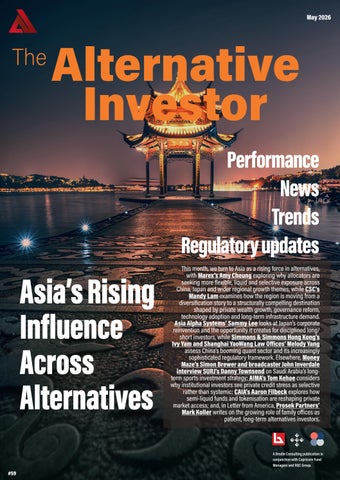
This month, we turn to Asia as a rising force in alternatives, with Marex’s Amy Cheung exploring why allocators are seeking more flexible, liquid and selective exposure across China, Japan and wider regional growth themes, while CSC’s Mandy Lam examines how the region is moving from a diversification story to a structurally compelling destination shaped by private wealth growth, governance reform, technology adoption and long-term infrastructure demand. Asia Alpha Systems’ Sammy Lee looks at Japan’s corporate reinvention and the opportunity it creates for disciplined long/ short investors, while Simmons & Simmons Hong Kong’s Ivy Yam and Shanghai YaoWang Law Offices’ Melody Yang assess China’s booming quant sector and its increasingly sophisticated regulatory framework. Elsewhere, Money Maze’s Simon Brewer and broadcaster John Inverdale interview SURJ’s Danny Townsend on Saudi Arabia’s longterm sports investment strategy; AIMA’s Tom Kehoe considers why institutional investors see private credit stress as selective rather than systemic; CAIA’s Aaron Filbeck explores how semi-liquid funds and tokenisation are reshaping private market access; and, in Letter from America, Prosek Partners’ Mark Koller writes on the growing role of family offices as patient, long-term alternatives investors.



April was an odd month. Beyond oil, end-month figures barely hinted at the geopolitical turmoil. Yet this was when markets discovered that a war premium could be an economic reality, particularly in US tech stocks. Against this backdrop, the HFRI Fund Weighted Composite Index rose 4.8%, reversing what had been a difficult start to the year.
Equity Hedge managers were the standout performers, with the HFRI Equity Hedge (Total) Index advancing 7.3%. Tech led, surging 14.8%, while Fundamental Growth gained 9.6%, Quant Directional rose 9.0%, and Multi-Strategy added 8.8%. Healthcare lagged but still returned 2.2%.
Event Driven strategies also posted a strong month, with the HFRI Event-Driven (Total) Index rising 5.2%, taking year-to-date performance to 4.8%. Special Situations was strongest, up 9.0%, followed by Activist strategies at 8.4%. All major sub-strategies were positive, with Merger Arbitrage weakest, though still up 2.3%.
Macro continued its solid start to the year. The HFRI Macro (Total) Index gained 1.8%, although it lagged more equity-sensitive strategies. Systematic Macro rose 2.3%, while Discretionary Macro added 1.7%. Currency strategies were the only negative area, declining 0.7%.
Relative Value delivered another steady month, with the HFRI Relative Value (Total) Index up 1.8%, bringing year-to-date returns to 3.5%. Yield Alternatives led, rising 5.0%, followed by Fixed Income Convertible Arbitrage, up 2.2%.
Regionally, the strongest rebounds came from the most heavily sold-off markets. India surged 10.5%, although it remains down 13.5% year to date. Asia ex-Japan rose 7.6%. North American equity hedge managers benefited from the rally in tech, helping the region deliver 5.4%. Western Europe/PanEurope advanced 4.4%, while China rose 2.7%.

EQT Group closed BPEA Private Equity Fund IX at $15.6 billion, making it, according to EQT, the largest Asia-Pacificdedicated private equity fund ever raised. The fund hit its hard cap and was oversubscribed, an exceptional result given Asian private equity fundraising fell to a 12-year low in 2025 after four consecutive years of decline. BPEA IX saw more than 75 new investors, including significant commitments from pension funds and sovereign wealth funds. The fund targets control investments across technology, healthcare, industrial technology, services and technology services, backing resilient companies where EQT believes it can drive operational improvement.
Another large US buyout raise came from THL Partners, which closed its tenth flagship fund at $6.4 billion, surpassing the $6.3 billion target and above the $5.6 billion raised for its 2021 predecessor. THL Equity Fund X invests in middlemarket growth companies across healthcare, financial technology and associated services, and technology and business solutions. The fund follows THL’s sector-led investment approach, targeting areas where the firm has built specialist expertise and operating resources. THL said the vehicle drew commitments from both existing and new investors, including pension funds, sovereign wealth funds, financial institutions and family offices across North America, Europe, Asia and the Middle East. Founded in 1974, THL has invested in more than 175 companies and completed over 700 add-on acquisitions.
European buy-and-build remains firmly in favour with LPs, as Bussum-based Waterland raised €4.6 billion in less than four months across two oversubscribed vehicles. The private equity firm closed Waterland Private Equity Fund X at its €4 billion hard cap, alongside Waterland Partnership Fund II at its €600 million hard cap, bringing the firm's assets under management to more than €20 billion. The flagship fund continues Waterland’s buy-and-build strategy, backing companies across Europe operating in fragmented, growing markets and supporting both organic and acquisitive growth.
(cont.)
Middle-market control buyouts continue to attract capital, with Court Square Capital Partners closing its fifth flagship fund at $3.8 billion, above its $3 billion target and the largest vehicle in the firm’s history. The oversubscribed fund focuses on control buyouts in healthcare, technology, business services and industrials, and has already committed to six investments. The firm traces its roots to Citigroup’s private equity arm and spun out in 2006. It has since committed $13.4 billion across more than 245 deals.
Essential services remain a popular private equity hunting ground, helping Percheron Capital close its third fund at its $3.1 billion hard cap, double the size of its $1.6 billion Fund II. The San Franciscobased private equity firm invests in essential services businesses, backing founder-owned and entrepreneur-led companies across sectors such as animal health, automotive services, education, food and beverage, healthcare, and residential services. Founded
Demand for secondaries exposure remains strong, with Partners Group closing its eighth private equity secondaries programme, totalling more than $9 billion in client commitments. The programme, which includes a flagship closed-end fund, bespoke mandates and coinvestment vehicles, is already 60% committed following intense investment activity. Founded in
1996, Partners Group is a major global private markets firm with over $185 billion in assets under management and approximately 2,000 professionals across 20 offices. Listed on the SIX Swiss Exchange, the firm employs an industrial, operationally-oriented approach to investment across private equity, infrastructure, private credit and real estate.
by former Golden Gate Capital professionals, Percheron targets fragmented markets where it can build scaled platforms through organic growth, operational support and add-on acquisitions. Fund III continues the firm’s strategy of partnering with management teams in resilient services niches, with a focus on businesses that benefit from recurring demand, local market depth and opportunities for professionalisation.

A first-time flagship vehicle stood out in a difficult fundraising market, with Emerald Lake Capital Management reaching a final close on its debut private equity fund at $800 million. The fund surpassed its $500 million target, with commitments from institutional investors, including pension funds and family offices.
The firm, founded by former Ares Management and Apollo Global Management executives, focuses on middle-market
buyouts where it can drive operational improvements and long-term growth.
This fundraise denotes a significant shift for Emerald Lake, moving the firm from a deal-by-deal investment model to a committed fund structure. The capital will be deployed to highquality businesses in the consumer, industrial, and business services sectors undergoing structural transitions.
137 Ventures secures $700m
Founder and employee liquidity is still a resilient corner of growth investing, with San Francisco-based 137 Ventures securing more than $700 million across Growth Fund VII and a dedicated secondary fund.
The latest raise takes the firm’s total assets under management to over $15 billion. Known for its model of providing liquidity to founders and early employees of highgrowth private companies, 137 Ventures is doubling down on its founder-liquidity approach during a period
when IPO markets remain selective. The new capital is earmarked for late-stage companies within artificial intelligence, defence and industrial technology, areas where the firm has already established a strong foothold through previous investments in companies such as SpaceX. By offering customised financing solutions, 137 Ventures aims to support companies that need to stay private longer while rewarding the teams building them.
(cont.)
Institutional appetite for private credit remains strong, with Adams Street Partners closing its third private credit platform, Private Credit III, at $7.5 billion commitments, including leverage. The raise more than doubled the size of its predecessor and sends a clear signal of continued institutional demand. The Chicago-based manager is providing senior financing for sponsor-backed middle-market companies, with a focus on conservative underwriting. At final close, the fund was already around 40% deployed, targeting loan-to-value ratios below 40% and debt multiples of roughly 5x, supported by maintenance-based covenants.
Complex credit opportunities are still drawing serious institutional capital, with Silver Rock Capital Partners LP raising more than $4 billion for the latest vintage of its Tactical Allocation Strategy. The raise marks the firm’s largest for the strategy and surpasses its $3 billion 2022 vintage. The fund is targeting private credit and capital solutions opportunities across corporate private financing and real asset lending, as borrowers manage a more complex financing environment.
The New York-based alternative
credit manager, which has around $7 billion in assets under management, is positioning the strategy around liquidity mismatches, market dislocation and evolving capital needs. For Silver Rock, whose leadership has roots in Michael Milken’s family office and Goldman Sachs’ Special Situations Group, the fundraise suggests that large LPs remain willing to continue backing credit managers able to step into complexity, provide bespoke capital and take advantage of what is a more challenging financing backdrop.

For OpenAI, Anthropic and other model providers, enterprise adoption is the next major battleground. Consumer usage has grown quickly, but the larger commercial prize sits inside companies, where AI can be embedded into customer service, finance, legal, software development, procurement, sales and operations.
That is why OpenAI’s finalised DeployCo venture is so significant. Bloomberg reported that the vehicle drew backing from 19 investors, including TPG, Brookfield Asset Management, Advent and Bain Capital. The company has reportedly raised more than $4 billion for the vehicle, which is expected to be valued at around $10 billion, excluding the new capital.
The fundraise matters because it gives OpenAI a faster route into a large pool of private equity-backed companies, where cost savings, automation and operational improvement are already high on the agenda. For buyout firms, AI offers a new
value creation lever at a time when returns are harder to generate through leverage and multiple expansion alone.
DeployCo is designed to put OpenAI’s technology to work inside PE-backed businesses, helping companies change processes from within rather than simply buying another software product. The model gives OpenAI access to established industries through sponsors that already control hundreds of businesses.
The race is about who gets embedded deepest inside companies, and investment is becoming the way in. Model quality still matters, but the bigger commercial advantage may come from backing the vehicles and partnerships that wire AI providers directly into workflows, systems and operating processes.
Alastair Crabbe, Brodie Consulting Group

Asset-backed finance remains one of the main growth areas in private credit, with Carlyle Group reportedly securing $1.5 billion in a first close for its new Carlyle Asset-Backed Income Fund. The raise extends Carlyle’s push into asset-backed finance within the firm’s global credit platform. Unlike traditional closed-end funds, the vehicle is structured on a perpetual basis, allowing it to stay invested over a longer time horizon. The Texas County & District Retirement System separately disclosed a $150 million commitment.
Private credit secondaries continue to gain traction, with StepStone Group raising more than $1.6 billion for its second Credit Opportunities Fund, according to the Wall Street Journal. This was more than double the $750 million target and underlines the continued strength of private credit secondaries. The strategy focuses on secondary purchases of private credit
fund interests and co-investments.
New York-based StepStone is one of the largest private markets allocators globally, overseeing more than $700 billion in assets under management and advisement across private equity, infrastructure, real estate and private debt. The new vehicle is more than twice that of StepStone’s inaugural Credit Opportunities Fund, which
Private capital advisory is seeing further consolidation, with Lazard agreeing to buy Campbell Lutyens and create Lazard CL, a global platform spanning 280 professionals across 18 offices. The deal combines Lazard’s private capital advisory business with Campbell Lutyens’ specialist franchise in fund placement, secondaries and GP capital solutions.
Founded in 1988 and headquartered in London, Campbell Lutyens advises private equity, private
credit, infrastructure and real estate managers on raising capital, while also helping investors access liquidity through secondary transactions.
Peter Orszag, Lazard’s chief executive and chairman, described the acquisition as “another defining strategic step on the path toward Lazard 2030”. Gordon Bajnai and Holcombe Green will co-lead Lazard CL, with Andrew Sealey serving as non-executive chairman.
closed in 2022 with commitments of more than $600 million.
The Wall Street Journal reported that the first fund is now fully deployed, highlighting both the growth of the strategy and investor appetite for private credit secondaries and coinvestments.


Permanent capital remains central to Bill Ackman’s expansion plans as Pershing Square started trading in New York and completed the planned dual listing of its management company and US closed-end fund. Pershing Square Inc. now trades on the NYSE under the ticker PS, giving public investors exposure to the asset manager’s fee-related earnings and performance-fee
economics. Pershing Square USA, the firm’s new US-listed closed-end vehicle, trades under the ticker PSUS and will hold a concentrated portfolio of listed equities. The launch raised $5 billion, below earlier expectations that the fund could attract as much as $10 billion, but still gives Ackman a sizeable pool of permanent capital for the next phase of Pershing Square’s publicmarket expansion.
One of the most talked-about hedge fund launches of recent years took a sharp turn. Bobby Jain’s Jain Global launched in July 2024 with around $5.3 billion, a major raise, albeit somewhat south of the larger sums initially anticipated.
According to Bloomberg, Jain Global and Millennium have struck a proposed strategic partnership under which Jain
Global will return external capital and manage money exclusively for Izzy Englander’s Millennium. Bloomberg reported that Millennium will gain exclusive access to Jain Global’s full multi-strategy investment capacity, while Jain Global will remain an independent business with its own investment processes, operating model and talent base.

The dramatic move comes less than two years after launch, following a major hiring push, and reframes Jain Global from a standalone challenger to the major platforms into another dedicated Millennium-backed investment operation.
The latest numbers from Blackstone offered a useful read on where capital is flowing across alternatives. The firm pulled in $68.5 billion of inflows in Q1 2026, taking total assets under management above $1.3 trillion and underlining how investors continue to concentrate capital with the industry’s biggest platforms despite a more volatile backdrop. The biggest winner was credit & insurance, which
saw $37 billion of inflows in the quarter, more than half of the firm’s total. That was followed by private equity at $20.4 billion, with secondaries significantly contributing $8.4 billion of that figure, highlighting continued demand for liquidity solutions and mature-asset exposure. Infrastructure added $2.7 billion, while real estate brought in $6.8 billion, respectable but well behind the pace of credit and secondaries.

Fresh off a couple of days at Milken, it is safe to say topics did not stray too far from AI/software, exit strategies, or credit. Not surprisingly, the democratization of alts also entered the Global Conference chat, and one popular theme made me take a closer look at this vital and growing segment of the investment community: the family office
The size of the family office market has a potential to reach more than $5.5 trillion in the next four or so years, with 8,000 individual offices in operation globally and a number some predict will soon hit 10,000. (And we all know the oft-quoted data point, approximately $15 trillion of family wealth will be transferred to the next generation.)
We often hear about efforts to attract the retail audience for more flow, but the family office is one sector that has also become a significant investor. In fact, 38% to as high as 44% of family offices invest in alts (estimates do vary).

lot of cultivating and networking to find the right people. The quest for talent is important. Relationships matter.
So, what is top of mind for the family-office investor? To Reilly, it comes down to four key concerns, often referred to as The Four Horsemen: inflation, spending, taxes and expenses. In fact, he referred to it almost as an “over focus” and a need to have real agency over all of these concerns.
He and others say that a discreet and measured approach is also key and for that reason CIOs at family offices stay in the position for a long time. A desire to cultivate younger and newer managers does exist but with an understanding these managers will be part of the “family” for some time.
...many family offices are led by former business operators, so they understand the mindset of the entrepreneur...
Another element is the use of commitment pacing, Reilly explained, which is disciplined allocation to favored strategies across vintages. This comes from venture investing, where it is impossible to predict which of a series of funds will outperform, and often the best funds start in the worst conditions.
To shed some color and wisdom about the UHNW world, I went straight to the expert and asked Joe Reilly, head of Circulus Group, a family-office network and host of the Private Capital podcast, what’s behind this interest.
“It’s about long-term capital,” he said. “Families and family offices invest in PE and private companies because of this advantage.” That translates even further into fixed income and private credit and in some cases infrastructure, anywhere that provides the stability of bond-like cash flows and inflation protection.
What’s more, many family offices are led by former business operators, so they understand the mindset of the entrepreneur and feel comfortable making direct or coinvestments into companies, a little bit like the independent sponsor.
The “fat pitch” as he called it, however, is picking the right manager. It takes a

“This is actually good news for PE, because families will continue to commit, but will probably not be increasing their allocation sizes,” he said.
And participation by the family offices is certainly welcome as institutional investors pull back from parts of the market as exits from PE investments remain sluggish. Their mindset brings a different dimension to investing, less concerned about short-term volatility and will manage through any illiquidity for control and access.
As patient capital, the family office is a differentiated angle of the investor base and in some regards serves as that bridge between retail and institution
Mark
Kollar Partner, Prosek Partners


Private credit has rarely been far from the spotlight in recent months. From redemption pressures in semiliquid vehicles to growing scrutiny of portfolio quality, the tone of coverage has, at times, leaned towards the alarmist. But how closely does that narrative align with what institutional investors are really seeing?
That question sat at the centre of AIMA’s latest Global Investor Board (GIB) meeting. The GIB brings together some of the world’s largest allocators to alternative assets. The latest discussion, supported by AIMA research and a pre-meeting poll of participants, points to a more nuanced picture than recent headlines might suggest.
There is little doubt that conditions are shifting. Credit metrics are showing signs of increased stress, and participants acknowledged that some deterioration is underway. But importantly, AIMA research shows that this remains within historical norms and is far from systemic. Where stress does exist, it is concentrated in specific pockets rather than broad-based across portfolios.
Some of the more widely cited concerns also appear less acute when viewed through an allocator’s lens.
Payment-in-kind (PIK) usage, for example, is often interpreted as a signal of distress. Yet investors in the GIB largely viewed it as a tool offering flexibility within capital structures rather than as evidence of widespread weakness.
AIMA’s polling of the GIB reinforces this measured stance. Nearly three-quarters of respondents to the poll said they were either “not at all or only slightly concerned” about headline risk surrounding the asset class. At the same time, 88% expect private credit to deliver returns in the 7–9% range over the next five years, even under more challenging conditions.
While 87% expressed some level of concern about the default cycle ahead, this was framed as a normal feature of a maturing credit cycle rather than a cause for alarm.
In other words, investors are alert to the risks, but they are not panicking. If anything, the conversation is shifting towards where opportunities may emerge as market conditions evolve.
Interestingly, some of the most closely watched pressure points attracting the most attention may sit adjacent to private credit rather than within it. Exposure to certain segments, such as software, was cited as an area of concern, but one that arguably has greater implications for private equity than for credit investors. More broadly, issues around valuations, liquidity and exit environments were seen as more pronounced in private equity and venture capital, where fundraising has also slowed.
There was also recognition that part of the current narrative reflects a mismatch in expectations, particularly among retail and wealth investors. Semi-liquid structures, by design, aim to balance accessibility with the realities of investing in illiquid assets. Where those expectations are not fully understood, periods of market stress can quickly translate into negative sentiment.

Taking a step back, the overarching message from the GIB is one of perspective. Private credit is not immune to broader market cycles, and a degree of stress at this stage is both expected and, in many cases, healthy. However, the notion of a systemic issue does not align with what large, experienced allocators are seeing on the ground.
To find out more about AIMA’s Global Investor Board and its previous discussions, visit https://www.aima. org/about/aima-global-investor-board.html
Tom Kehoe
Managing Director, Global Head of Research and Communications, AIMA


Our industry is running two experiments simultaneously, and at some point we'll find out which wins.
On one track: semi-liquid vehicles — interval funds, tender offer funds, non-traded REITs and BDCs — products designed to give wealth channel investors something between the ten-year lockup and the daily redemption window. On the other: tokenization. Blockchain-enabled fractional ownership, real-time settlement, 24/7 trading. The technology isn't new, but the use case is: rebuilding market infrastructure from the ground up on digital rails.
In a recent CAIA survey, 29.2% of respondents identified tokenized private markets as the innovation most likely to alter how investors allocate capital. Evergreen and semi-liquid structures came in second at 27.7%. Which one wins?
Semi-liquid AUM doubled from roughly $250 billion in 2022 to $500 billion by end of 2025. Tokenized assets grew from near zero to $415 billion over the same period — which might suggest parity. But most of that tokenization AUM sits on permissioned networks unavailable to the broader investment community, operating primarily as repurchase agreements for institutional overnight lending. Strip those out and the broadly available figure drops to around $40 billion — impressive growth, but nowhere near the scale of semi-liquid structures.
The largest segment of the tokenization market today is not the open, borderless, 24/7 trading vision most people picture. It looks, if you squint, a lot like what semi-liquid funds were already trying to do on a different layer.
The more important point is that these two tracks are not racing toward the same finish line. Semi-liquid funds are solving an investor access and behavior problem: how do you bring a broader set of
investors into private markets while giving them enough flexibility to stay invested? The catch is that solving for investor comfort required bending the product design in ways that put the structure under stress during bad times. When the liquidity promise outran the liquidity reality, the product took the blame for what was really a weak social contract.
Tokenization is solving an infrastructure and transaction problem: how do you make the operational mechanics of private markets faster, cheaper, and more transparent? The risk is that the infrastructure story gets oversold into a liquidity story. Every major institutional adoption of tokenization — KKR, Hamilton Lane, BlackRock, J.P. Morgan — confirms that it makes illiquid assets easier to access and administer. Not one of them makes those assets actually liquid.
The analogy that holds up best is the ETF. ETFs didn't make equities more liquid — equities were already liquid. They made equities cheaper and easier to hold and trade. They also didn't kill the mutual fund. Tokenization likely follows the same path: transforming how capital calls are processed, how reporting works, how secondaries happen — without manufacturing liquidity

Semi-liquid structures may turn out to be a transitional product: a necessary bridge for a period when the technology and regulatory framework needed to support real tokenization were not yet in place. They won't disappear. But as tokenization matures, their structural tension — trying to make illiquid assets feel liquid — becomes
The industry isn't choosing between two solutions yet. It's still figuring out what the question is.
Aaron Filbeck, CAIA, CFA, CFP®, CIPM, FDP
Managing Director, Content & Community Strategy, CAIA

Inspiring
interviews with leading figures from the world of business and finance.
Adapted from a Money Maze Podcast interview conducted by Simon Brewer and John Inverdale with Danny Townsend, CEO of SURJ
Saudi Arabia's sporting ambition is a serious investment story. In a far-reaching interview, The Money Maze's Simon Brewer and broadcaster John Inverdale sat down with Danny Townsend, the chief executive of SURJ, the Kingdom's sports investment arm, to discuss how Saudi capital is moving deeper into the business of sport. The conversation ranged from media rights and fan engagement to cycling, golf and Vision 2030, but the central point was clear: Saudi Arabia is developing a long-term sports economy, not just staging headline-grabbing events. Townsend is a persuasive guide to that shift. An Australian who grew up surfing the Sydney beaches, he combines an operator's background with an investor's discipline. His experiences across professional football, racing, agency building and league management have given him a pragmatic view of where sport is heading. He sees an industry with extraordinary consumer loyalty but with parts of its economic model under pressure. The old world of ever-rising linear broadcast cheques is fading. Rights owners increasingly need to build direct relationships with fans and capture more of the spending that sits around the product itself.
It is this diagnosis that shapes the way Townsend thinks about investment. He is looking for sports that are played by large numbers of people, consumed from a young age and structurally underdeveloped. His interest is in markets where there is already an audience, but monetisation is weak, sports where "the product is lacking aggregation," where apathy has created room for capital, better execution and smarter commercial design. It is a revealing framework because it shifts the discussion away from trophy assets, towards the harder task of rebuilding the commercial plumbing.
SURJ's role is more complex than that of a conventional private investor. The firm is wholly owned by PIF and its primary obligation is to generate returns on capital, but it also carries a second mandate to support Saudi Arabia's wider sporting and economic development under Vision 2030. Townsend is clear that returns remain the number one priority, but the pendulum can be moved. A lower IRR investment with outsized impact on the Saudi sports economy is, in his words, also something he can do.
This is where the Saudi story becomes more interesting than the standard outside critique often

Inspiring interviews with leading figures from the world of business and finance.
allows. Townsend addressed the "sportswashing" accusation not by denying that reputation matters, but by pointing to what he described as strategy authenticity. He suggested that Saudis themselves have largely stopped worrying about external perception because they know why they are doing it. His view is that actions will speak louder than words over the coming decade, and that it falls to people like himself to tell that story more often.
His example of Saudi women's participation in mixed martial arts was vivid. Investment in the Professional Fighters League was not just a capital allocation decision; it was also a way to create role models and open doors. SURJ's biggest MMA star, Hattan Alsaif, was two years ago a largely unknown athlete without access to professional training facilities. She is now arguably the most recognisable Saudi female athlete in the country, a figure that young Saudi women can watch and aspire to emulate.
Townsend's broader point is that inspiration has to be engineered, and that the ecosystem must be ready to catch it. If a child watches a major event in Riyadh and leaves wanting to play tennis, the state and the sporting system need to have courts, coaches and pathways in place. Otherwise, the moment dissolves. Saudi Arabia, in his view, has an advantage because it is not wrestling with centuries of sporting legacy in the way Britain is. There is room to design systems with fewer entrenched interests.
connected to an event platform, a digital product and a wider community, the commercial opportunity expands considerably. This is part of what attracted SURJ to the Professional Triathletes Organisation and the T100 format.
Cycling remains for Townsend the great unrealised prize. He described it as a sport rich in history but poor in aggregation, with individual races controlled by different operators and too much value left scattered across the calendar. There is no single commercial body capturing the full economics of the sport. His answer is not to dismantle the grand tours or the monuments, but to preserve the heritage assets and create new formats. He used cricket as the model, with Kerry Packer's one-day revolution and then T20 reinventing the sport commercially while leaving test cricket intact.
You’re never going to replace the humanity that’s required in sport. And people care more about sport than any other.
On technology and fan engagement, sports need to own more of the customer journey, including ticketing, merchandise, community, fantasy and betting, rather than relying on a single media relationship. He pointed to DAZN as an example of a platform focused on the sports customer, contrasting it with generalist streamers like Netflix or Amazon. His argument that a platform can deliver genuine utility to a fan across multiple touchpoints, not just a live stream, is the model that the industry needs to build towards. He drew on the Australian Open as an example. Some 1.1 million people attended, yet reports suggested 40% never watched a ball being struck. They came for the event itself. That fusion of sport and entertainment, he argued, is the benchmark. His comments on triathlon offered a brief but instructive example of how the participation thesis translates in practice. Running, swimming and cycling are global habits, and if those habits can be
Golf was another illustration of the same thesis. Townsend described LIV Golf as an attempt, initially rebuffed by the establishment, to help a sport with an ageing demographic reach the next generation. He told the story of his father, a lifelong PGA Tour traditionalist who attended a LIV event in Adelaide deeply sceptical and came back a convert, struck by the atmosphere and the younger crowd.
There was also a telling moment when Inverdale asked about promotion and relegation. As a fan Townsend appreciates the jeopardy, but as a businessman he prefers the certainty of the American franchise model.
His model for long-term athlete development is the Australian Institute of Sport, which took twenty years to translate infrastructure investment into elite performance. Saudi, he argues, is following the same logic, just with more capital and greater urgency.
Townsend left little doubt that the Kingdom sees sport not as a passing headline but as part of a multidecade economic project. Vision 2030's sporting metrics have, in several cases, already been met and reset. The commitment, in his framing, is fifty years, driven by leadership that combines long-term vision with impatience. Sport is not the decoration on the strategy; it is part of the architecture.
Click link to listen to the full interview
Sammy Lee, Founder, Asia Alpha Systems
Japanese companies faced major headwind in the decades after the stock market crash in 1989, commonly referred to as the “Lost Decades.” The economy faced deflation, negative GDP growth, and a shrinking and aging population.
However, the lost decades were not lost for many companies. Instead, it was their extreme boot camp. These companies adapted to be profitable in an environment where they had no pricing power and were charging less for the same product year after year. In addition, companies dealt with a shrinking domestic customer base, a hallowing out economy, and workers who got no pay raise. Despite the harsh operating environment, many companies survived and thrived.
This was especially evident from the beginning of Abenomics in 2013, and the Corporate Governance reform implemented by the Tokyo Stock Exchange in 2015. Japan corporations have experienced a renaissance that has never been seen before.
Nikkei 225 profit margin is at a 20 year high, with net income margin at 8.6%, more than doubled the 3.8% when Abenomics started. Earnings have also tripled since 2013. Furthermore, share buy back has become a norm, almost unthinkable just 10 years ago.
Corporate transparency has improved significantly, and shareholders’ return and cost of capital have become major topics for management.
What came out of the lost decades are some of the strongest and most brutally cost efficient and competitive companies in the world. Take Saizeriya for example, an Italian casual dining restaurant with price more akin to a fast-food chain: it is the epitome of Japan “Cosupa” (Cost Performance) companies. Saizeriya did not raise prices for years, and there are items on the menu that have remained the same since the 70s. To maximize performance efficiency, servers are even trained to carry dishes from tables in certain hands as to minimize unnecessary movement. Another exemplary example is Asics, a 76 year


What came out of the lost decades are some of the strongest and most brutally cost efficient and competitive companies in the world.
Sammy
Lee, Asia Alpha Systems
...Japan has a developed and transparent stock market with a wide spectrum of industries and companies to pick winners and losers from... an ideal environment for a Long/Short strategy.

old sports gear company that famously helped Phil Knight start Nike in the 70s. Asics has more than doubled their business in China in the past few years, while most other foreign consumer brands struggled. Even in Japan, a market with a shrinking customer base, Asics managed to double their sales compared to before Covid.
On the contrary, there will be creative destruction. Interest rates are rising where companies used to issue long term debt at less than 0.3%. Companies are now finding themselves refinancing at 10x the interest rate. More than 1 out of 4 mid to large cap industrial companies on the Tokyo Stock Exchange had increased interest expenses by over 50% last year, with interest rates far from peaking.
There are many companies that have lower than 5% operating margin and half of their operating income is reserved for interest expense. Yet, there are still many cash hoarders that simply refuse to borrow.
Even the country’s largest employer, the auto industry, is facing tremendous challenges. As Mr. Mibe, Honda’s CEO, warned recently:
“Japanese auto industry itself is on the brink of survival.” The good news is that Japan has a developed and transparent stock market with a wide spectrum of industries and companies to pick winners and losers from. This is an ideal environment for a Long/Short strategy. From Mr. Buffett’s favorite Sogo Shosha (general trading companies), Mitsubishi Corporation, that is involved in most things under the sun, to specialized equipment makers like Hamamatsu Photonics, a world leader in Spatial Light Modulator, an indispensable technology for quantum computing, the choices are vast.

Equally important, is that Japan has a welldeveloped and liquid stock loan market, critical for alternative investors. It is for this reason that Japan’s markets are ideal for hedge fund managers, combining deep liquidity, strong transparency and a rich opportunity set for smart long/short
Sammy Lee, Founder, Asia Alpha Systems
Sammy Lee is the founder of Asia Alpha Systems, using a systematic and rules-based approach to bottom-up fundamental investment, and portfolio manager of Japan Efficiency Fund, a Long/Short Japan Equity
Amy Cheung, Asia Capital Introduction, Marex
Asia is once again commanding the attention of global allocators, driven by a powerful combination of diversification needs, attractive valuations and compelling structural growth themes. After a prolonged period of US market dominance, investors are increasingly looking east, albeit with some level of caution. This renewed focus is evident on the ground, with a notable increase in inbound inquiries from US and European investors, and a growing number of allocators travelling to key financial hubs such as Hong Kong and Tokyo.
Alongside growing interest in the region, one of the defining trends is a strong emphasis on flexibility and a move away from single-country mandates. Pan-Asia strategies are emerging as attractive entry points, enabling investors to dynamically shift allocations across markets. This allows managers
to navigate regional cycles effectively, adjusting exposure between China, Japan, Korea and India, for example, as opportunities evolve. Reflecting this shift, new fund launches are increasingly multicountry in scope, often supported by specialist teams with deep expertise in individual markets.
However, whilst many institutional investors, particularly in the US, remain cautious about concentrated exposure, Japan is a notable exception. Confidence in the Japanese market continues to rise, largely driven by ongoing corporate governance reforms. Efforts to improve shareholder returns, support wage growth and promote greater workforce diversity are reshaping the investment landscape, positioning Japan as a leading candidate for single-country allocation within the region. Sophisticated US and European institutions, with the ability to make macro calls and implement internal hedging strategies, are the most likely to pursue these targeted mandates.

... allocators are becoming more selective, more liquid, and more deliberate — focusing not just on where to invest in Asia, but how.
Amy
Cheung, Marex
Stretched US valuations have acted as a catalyst for investors to assess opportunities elsewhereand China is increasingly benefiting from this shift. Sentiment has been challenged in recent years, but the appeal of China is being anchored in its own fundamentals, with an acceleration triggered by the huge interest in DeepSeek. After a prolonged period of outflows, many high-quality companies are now trading at compelling valuations, creating opportunities that global investors are finding increasingly difficult to ignore.

Investor interest is particularly strong in biotechnology, oncology and artificial intelligence, where China is demonstrating both innovation and commercialisation capability. This is reshaping manager selection, with greater focus on identifying where value will ultimately accrue, whether in hardware and infrastructure or in companies successfully monetising AI.
with a number of Asia-based TMT (Technology, Media and Telecommunications) managers outperforming global peers due to higher trading frequency and greater tactical flexibility, highlighting the advantage of local market proximity.
With returns from traditional private equity and private credit becoming less predictable, and capital often tied up for longer than expected, investor interest is shifting toward more flexible structures. Some are exploring alternatives such as CLO strategies, targeting mid-teen returns with greater cash flow visibility.
Pan-Asia strategies are emerging as attractive entry points, enabling investors to dynamically shift allocations across China, Japan, Korea and India as opportunities evolve.
Liquidity has become a central theme. Investors with historically high private market exposure are recalibrating, driving demand for liquid alternatives, particularly strategies offering shorter lock-ups and regular liquidity. In contrast, structures with investor-level gates are increasingly out of favour, reflecting a broader preference for control and flexibility.
Beyond valuations, China’s structural strengths continue to underpin sentiment. Its deep and dynamic talent pool, combined with a highly skilled and motivated workforce, is driving innovation across sectors and reinforcing its long-term growth narrative. At recent industry events, international fund managers have increasingly acknowledged the pace of China’s technological integration and the need to incorporate it more meaningfully into global portfolios.
At the same time, capital flows are reflecting a more nuanced reengagement. Asian family offices, particularly those based in mainland China, are actively allocating capital. Even when investing offshore, there is a clear preference for strategies that maintain China exposure, such as through USD-denominated, China-focused long-bias equities. Performance dynamics are also reinforcing this trend,
Capital is also becoming more targeted. In China, long-only and long-biased strategies are seeing the strongest inflows. In Japan and Korea, activist strategies remain in focus, alongside continued demand for Japan’s fundamental long-short

Amid ongoing volatility, commodities are reemerging as a diversification and inflation hedge, reinforcing Asia’s central role in the global commodity supply chain. Many investors are accessing this exposure through multi-strategy managers with dedicated commodities expertise.
Ultimately, allocators are becoming more selective, more liquid, and more deliberate - focusing not just on where to invest in Asia, but how.
Amy Cheung, Asia Capital Introduction, Marex
Mandy Lam, Executive Director, CSC, Head of Fund Services North Asia.
For years, Asia sat in many global alternatives portfolios as a diversification story, or a market to watch rather than meaningfully scale. That is becoming harder to justify.
After a period of macro and market recalibration, Asia-Pacific private markets have become more selective, but not dormant. Investors are placing more weight on controllable outcomes, deeper underwriting, and hands-on value creation. Control strategies and carve-outs are also drawing attention, particularly as corporate simplification and governance reforms open more assets to private capital.1
That matters because the opportunity is no longer defined only by growth. It is increasingly defined by access, structure, and execution. For global allocators, especially those in the UK, Europe, and the UAE, the bigger risk may no longer be moving too early. It may be staying underexposed for too long while the region’s alternatives ecosystem matures further.
Asia’s case for a larger allocation to alternatives is structural rather than cyclical.
First is wealth scale within the region. UOB Private Bank and BCG project Asia’s private wealth could reach ~US$99 trillion by 2029, anchored by Singapore and Hong Kong as leading regional hubs.
Second is the region’s domestic funding capacity.
Gross domestic savings remain relatively high across major Asian economies, supporting a deeper local base for long-duration private assets as allocators broaden alternatives exposure.2
Third is succession – capital in transition. McKinsey estimates US$5.8 trillion will shift across UHNW and HNW families in Asia-Pacific between 2023 and 2030.3
Against a backdrop of global net worth of around US$600 trillion entering 2025, this reinforces a broader point: Asia is increasingly becoming a durable source of alternatives capital, not only a destination for opportunistic allocation.4
Technology is shortening the distance between insight and execution across sourcing, due diligence, and

...the [Asia] opportunity is no longer defined only by growth. It is increasingly defined by access, structure, and execution.
Mandy Lim, CSC
ongoing monitoring in APAC. IDC’s latest outlook expects AI and GenAI investment in Asia/Pacific to reach around US$175 billion by 2028, with a 33.6% CAGR from 2023 to 2028, supporting wider adoption of AI-enabled screening, analytics, and benchmarking tools across investment workflows.5
On the distribution side, McKinsey estimates US$700 billion of personal financial assets in APAC could migrate toward digital wealth platforms over the next four years, reinforcing hybrid models where digital scale and transparency are complemented by human advice for more complex decisions.6
As public and private investing increasingly overlap, product innovation, including evergreen strategies, semi-liquid products, and public-private model portfolios, is broadening implementation routes for investors. That can make access more flexible, but it does not change the fundamentals: manager selection, transparency, and governance still matter.7
For global investors, Asia’s growing pull in alternatives is increasingly about risk-adjusted access. The opportunity set is deepening. Just as importantly, allocators are paying closer attention to governance, disclosure discipline, and diligence as they assess managers and channels.
Hong Kong and Singapore now sit at the center of Asia’s private wealth rise, which matters because both hubs help anchor the region’s cross-border capital ecosystem.8
At the manager level, the practical test is straightforward: clear disclosures, decision-grade controls, credible monitoring, and evidence of value creation. This is where Asia’s story becomes more compelling. The region is not only offering growth. It is becoming harder to dismiss on institutional grounds.
Greater China remains one of the biggest private equity markets in Asia-Pacific even as its share of regional activity has fallen from earlier highs. Buyouts have taken a larger role as investors prioritize control and operational value creation.9
Japan is undergoing a structural unlock. It was again the standout major market in the region, supported by corporate governance reforms, carve-outs, privatizations, and favorable financing conditions.10
India continues to
attract capital with resilient growth fundamentals and persistent investor interest in sectors including financial services, healthcare, and real assets.11
Southeast Asia combines digital adoption with demographic depth. The region is also seeing alternative credit emerge as a more important financing pillar, adding to the appeal across venture, growth, and private capital strategies.12
These markets are not interchangeable, and that is part of the appeal. Together, they create a more diversified opportunity set across control, growth, credit, and real assets. For allocators still viewing Asia as a single macro trade, that lens is becoming increasingly outdated.
Beyond corporate deal flow, the region’s infrastructure supercycle requires vast private financing. The Asian Development Bank estimates developing Asia needs roughly US$1.7 trillion per year through 2030 across power, transport, telecommunications, water, and sanitation. That maps directly to energy transition, grid modernization, logistics, and data center platforms.13
That gives the region another important advantage: the alternatives story is not limited to private equity. It increasingly extends across infrastructure, real assets, and adjacent long-duration strategies where demand is structural and capital needs are substantial.
Asia’s gravitational pull is being shaped by deep savings, accelerating wealth transfer, technologyenabled access, and a generational infrastructure buildout.14
The question for global investors is no longer whether Asia belongs in a private markets strategy, but how seriously they are prepared to scale exposure as the region’s capital base and investment infrastructure continue to deepen.
Mandy

Lam, Executive Director, CSC, Head of Fund Services North Asia.
Ivy Yam, Partner, Asia Head of Funds and Regulatory, Simmons and Simmons Hong Kong, & Melody Yang, Co-Head, Funds and Regulatory Partner, Shanghai YaoWang Law Offices
China’s quantitative investment landscape is capturing global attention after a remarkable year. According to PaiPaiWang and With Intelligence, quant funds in the PRC have posted average returns exceeding 30%, more than double the performance of their global peers,. Zhejiang High-Flyer Asset Management, founded by DeepSeek creator Liang Wenfeng, delivered a remarkable average return of nearly 57% in 2025, underscoring the sector’s dynamism and innovation.
This surge in performance is also attracting renewed interest from international investors, many of whom are returning to the A Share markets after a period of caution. The result is a steady rise in the number of fund managers and fund launches, as well as an expansion of Mainland Chinese quant managers into Hong Kong. This cross-border movement is driven by the desire to access offshore capital and leverage Hong Kong’s established financial infrastructure, further integrating China’s quant ecosystem with global markets.
Alongside this growth, China’s regulatory approach to programme trading has evolved rapidly, providing much-needed clarity for both domestic and international market participants. After years of deliberation, Chinese regulators have formally acknowledged the legality of programme trading, while emphasising the need for robust oversight to ensure fair, transparent, and orderly markets, a message conveyed by the PRC State Council in 2024.

To implement the 2024 policy framework, the China Securities Regulatory Commission (CSRC) introduced a comprehensive suite of regulatory measures targeting programme trading in the securities and futures markets in 2025, most of which already took effect. These measures, particularly the Securities Programme Trading Rules and implementation rules issued by the Shanghai and Shenzhen Stock Exchanges, mark a significant step forward in regulatory sophistication.
Key features of the Securities Programme Trading Rules and the implementation rules include:

China’s quant sector is entering a new era, fuelled by exceptional performance, international capital flows, and a maturing regulatory environment.
• Scope and Definition: The rules clarify that programme trading encompasses any use of algorithms or software to select securities, determine trading timing, or execute trades automatically. Even discretionary investment decisions, if executed via programme trading software, fall within the scope of the rules.
• Reporting Obligations: Market participants must file detailed initial reports before commencing programme trading, covering fund size, leverage, broker details, trading strategies, and software used. Material changes trigger further reporting requirements, enhancing transparency.
• Market Abnormalities: The rules introduce heightened scrutiny for behaviours such as unusual declaration rates, frequent cancellations, price manipulation, and large trades executed in short timeframes. This framework provides a legal basis for restricting disruptive trading practices.
regulation of swap trading is expected once the CSRC finalises its rules.
• DMA and Colocation: The framework paves the way for eligible brokers to re-activate direct market access (DMA) for external clients, subject to further technical details; though in practice, however, regulators are currently assessing the viability of colocation arrangements and appear to be reducing their availability. This has, in turn, led to the growth of proximity-hosting solutions, which offer a feasible—albeit somewhat less efficient— alternative.
...China’s regulatory approach to programme trading has evolved rapidly, providing much-needed clarity for both domestic and international market participants.
• High-Frequency Trading (HFT): HFT is specifically defined, with extra reporting obligations for accounts exceeding 300 declarations/cancellations per second or 20,000 per day. Tiered fee structures for HFT are anticipated but not yet published.
• Overseas Investors: The rules explicitly cover overseas investors trading via the Qualified Foreign Investor (QFI) scheme, Stock Connect, and swap arrangements. However, regulators appear to have adopted a comparatively lighter approach toward overseas investors engaging in quantitative trading via swap structures. In particular, such investors are not currently required to make full disclosures of their underlying swap transactions or to comply with all market-abnormality requirements on a consolidated basis across all their trading activities, by cash and synthetically. Further
On the futures trading front, the CSRC also strengthened oversight with the introduction of the Regulation Measures on the Programme Trading in the Futures Market (Trial) (“Futures Programme Trading Rules”), which came into effect in October 2025. These rules apply to all programme trading activities in the PRC futures market, including those conducted by overseas participants, whether via futures brokers or directly by non-member entities. Mirroring the approach taken in the securities market, the Futures Programme Trading Rules impose comprehensive reporting obligations and set out clear definitions of market abnormalities to ensure orderly trading.

China’s quant sector is entering a new era, fuelled by exceptional performance, international capital flows, and a maturing regulatory environment. For alternative fund managers and investors, the opportunities are significant—but so too are the compliance obligations. As the regulatory landscape continues to evolve, staying abreast of these developments will be critical for those seeking to participate in China’s quant revolution.
Ivy Yam Partner, Asia Head of Funds and Regulatory Simmons and Simmons Hong Kong
Melody Yang
Co-Head, Funds and Regulatory Partner
Shanghai YaoWang Law Offices

The Senior Managers & Certification Regime (“SMCR”), introduced in stages between 2016 and 2020, ensures senior managers within financial services firms remain accountable, and maintains standards of behaviour and competence across the board.
In July 2025, HM Treasury, the PRA and the FCA all issued consultations proposing to streamline the regime, with the aim of reducing regulatory burden on affected firms.
Now, on 22 April 2026, the FCA and the PRA confirmed the first phase of their final changes, and HM Treasury published its consultation outcome and response on planned legislative reform. The consistent message: the accountability framework stays, but the paperwork and timing frictions reduce. Most FCA rule changes apply from 24 April 2026, with a second wave of process/reporting changes from 10 July 2026 and some alignment changes from 1 September 2026.
PS26/6 is best read as a set of “targeted efficiencies”.
The FCA summarises the package in a table on page five, which groups the reforms by topic and effective date.
SMCR Phase 1 changes: effective 24 April 2026
Proposed change: referencing List of Questions in FCA's CP25/21, Annex 1
• Criminal record checks ("CRCs") and disclosure (Q3): CRC validity extended from 3 to 6 months. Checks no longer required for internal or intragroup moves.
• Senior Managers Regime: the 12-week rule (Q4): Rule change allows firms up to twelve weeks to submit a senior manager application, rather than needing FCA approval within that period. The candidate may act in role until determination, and Senior Manager Conduct Rules apply to them.
• Prescribed Responsibilities ("PR") (Q7): Handbook guidance added on PR allocations; and the right circumstances for splitting PRs [PRs don't apply to limited scope firms]
• Statement of Responsibilities ("SoRs") (Q9-10): Both solo- and dual-regulated firms have up to six months to notify changes. If more than one change occurred
during the period, firms need only submit the latest version.
• Certification Regime (Q11): Guidance provided on FCA expectations of firms recertifying individuals as Fit & Proper. Emails can replace a paper-based certificate, and firms can embed recertification into their annual appraisal cycles.
• Directory of certified and assessed persons (Q12): Extends the time for firms to update most Directory information – from 7 to 20 working days, except for staff departures, which must still be reported within seven days.
• Regulatory References (Q13): Handbook guidance reduces the period for firms to respond to requests for regulatory references from six to four weeks.
• Conduct Rules (Q14): Clarifying guidance on notification requirements, regulatory references without disciplinary action, and how Senior Manager Conduct Rules are applied. Some of the new COCON guidance on notification requirements and Senior Manager Conduct Rule 4 will come into effect on 1 September 2026, per PS25/23, Tackling nonfinancial misconduct in financial services
• Prescribed Responsibilities ("PR"): A rule change allows SMF18s at solo-regulated firms to hold any PR [NB: This is only relevant to Enhanced Firms, not Core or Limited Scope firms.]
• Thresholds for Enhanced SMCR firms (Q8): 30% increase in certain thresholds for “Enhanced” firms, such that only larger, more complex firms are caught; more firms remain “Core” firms. This includes increasing the AUM threshold from £50 billion to £54 billion. New five-year mechanism for threshold increases, to keep pace with inflation.
• Certification Regime (Q11): Removing overlapping multiple certifications – this should reduce the total number of certification roles by approximately 15%. (However, most overlaps relate to the client dealing function, and these overlaps are not being removed.)
HM Treasury’s consultation response sets up Phase 2,
confirming an intention to legislate when Parliamentary time allows. Key elements include:
• Removing the Certification Regime, including the annual certification requirement, from the Financial Services and Markets Act (“FSMA”) 2000, so regulators can replace with “a more proportionate and flexible framework” in their rulebooks;
• Fewer Senior Manager appointments requiring regulatory pre-approval, instead of simple notification. Regulators given new power to specify circumstances when a firm should notify them of a Senior Manager’s appointment following the firm’s assessment of fitness and propriety;
• Repealing prescriptive statutory requirements on Statements of Responsibilities, leaving regulators to consider appropriate requirements;
• Streamlining statutory Conduct Rules obligations, repealing prescriptive legislative requirements on firms to notify regulators of breaches, and to conduct mandatory
training; retaining regulators’ power to make Conduct Rules and set out requirements in their rulebooks; and
• Reducing the statutory deadline for determining Senior Manager applications from three to two months, aligning with regulators’ current voluntary timeframe and emerging regulatory practice.
Next steps:
Most changes took effect from 24 April 2026.
Improvements to regulatory reporting and processes apply from 10 July 2026, allowing firms and regulators time to make changes to processes and procedures.
Changes made to align with PS25/23, Tackling non-financial misconduct in financial services, apply from 1 September 2026.
If HM Treasury proceeds with the changes proposed, firms should expect consultation on a second phase of broader reforms later in 2026.

On 8 April 2026, the FCA published a summary of its main findings in relation to firms’ customer due diligence processes and controls, the good and poor practice it has observed, ongoing due diligence controls, and its expectations for firms.
The FCA set out the following key findings:
• Policies and procedures: Good practice included policies clearly distinguishing enhanced due diligence ("EDD") from standard client due diligence ("CDD"), with risk-based measures outlined for each of these. Other good practice in firms included comprehensive and detailed control frameworks for identifying politically exposed persons. Poor practice included policies and procedures that didn’t explain additional measures required for the purposes of EDD, insufficient detail on the frequency of periodic reviews, or expected actions for firms in the case of event driven reviews. Some policies and procedures lacked information for staff on how to
identify and verify a customer who lacked the usual forms of identification, and some firms failed to follow their own policies and procedures around conducting periodic reviews of customers.
• CDD processes: Good practice included firms having clearly documented steps for EDD measures, and CDD information collected being determined by the financial crime risks posed by each customer. Poor practice included firms failing to produce evidence of what EDD measures had been taken and recorded. Other poor practice included lack of details on the purpose and intended nature of the business relationship, to assist with ongoing monitoring; or no examples of scenarios or types of customers requiring senior management approval to demonstrate effective governance and oversight.
• Compliance monitoring and audit: Good practice included firms conducting a thematic review of their CDD
processes using external audit, and operating a regular audit review cycle of their CDD systems and controls. Poor practice included some firms' lack of detail on how they were checking for quality control. Some firms had no independent review of their CDD or EDD; staff in one firm both onboarded customers and performed second line assurance work on those same customers. Some
firms lacked version control of their documentation, and were unable to demonstrate an audit trail of reviews or changes made.
Firms are encouraged to consider these findings in the context of their own firm, and continue to review their CDD controls.
On 15 April 2026 the FCA published CP26/13: Cryptoasset Perimeter Guidance, a consultation that further progresses the UK’s transition to a full regulatory regime for cryptoassets. From 25 October 2027, the Financial Services and Markets Act 2000 (Cryptoassets) Regulations 2026 will introduce a new set of regulated cryptoasset activities. Firms carrying on those activities by way of business in the UK will require authorisation and become subject to the full FCA Handbook. It is important to note that the approach in the Regulations requires that persons offering services to UK consumers are “in the UK” and are within scope of the perimeter regardless of whether they are based in the UK or overseas. CP26/13 sets out the FCA’s proposed guidance on where the regulatory perimeters of FCA cryptoasset regulation sit, and how firms should assess their position.
The consultation sets out that the FCA’s approach to crypto activities is explicitly functional and substance based. Labels such as “exchange”, “staking”, “wallet” or “custody” are not determinative, and instead firms must analyse what they actually do, what their role is in transactions, the degree of control they exercise, and whether activities are commercial and ongoing. Importantly, decentralised or automated features do not in themselves place an arrangement outside regulation if an identifiable person is carrying on the activity.
The FCA makes a distinction between:
• Specified investment cryptoassets (“SICs”): specified cryptoasset investments, including tokenised shares, bonds or fund units; and
• Qualifying cryptoassets and qualifying stablecoins
(“QCAs”): fungible, transferable cryptoassets that are not otherwise specified investments.
Existing regulated activities such as managing investments, advising on investments and dealing will be applied to SICs under the existing Regulated Activities Order, bringing SICs into the existing regulatory framework. By contrast, existing regulated activities are not automatically replicated for QCAs, which instead trigger new crypto-specific regulated activities. On that basis, fund managers already active in tokenised securities should assume continuity of regulation, not novelty from this new regulation.
Novel regulation is for QCAs and consists of: operating a qualifying cryptoasset trading platform; dealing in qualifying cryptoassets as principal or agent; arranging deals in qualifying cryptoassets; safeguarding and arranging safeguarding of qualifying cryptoassets and relevant SICs; issuing qualifying stablecoins in the UK; and arranging qualifying cryptoasset staking.
The application period for firms seeking to undertake the new cryptoasset regulated activities will be open from 30 September 2026 to 28 February 2027.
As part of this consultation, the FCA is encouraging firms to consider the perimeter in relation to every activity they perform and they should carry out an analysis on a caseby-case basis. Whether an activity is regulated will depend on the specifics of what a person is doing and their role in the relevant arrangements, whether the activity is carried on in the UK, whether it is carried on by way of business, and whether any exclusion or exemption applies.

In a notable change of direction, the “SEC and CFTC Jointly Propose Amendments to Reduce Private Fund Reporting Burdens” proposal reflects a broader SEC Chairman Paul S. Atkins-era theme of “restoring balance” to disclosure obligations while still preserving data used for systemic-risk monitoring and investor protection. This comes against the backdrop of a decade-long expansion of private fund reporting: the SEC’s most recent annual staff report notes that private funds now have “over $16 trillion” in net assets, and that Form PF data is used to monitor trends and support coordination with other regulators, including the Financial Stability Oversight Council.
What is being proposed?
The Securities and Exchange Commission (“SEC”) and Commodity Futures Trading Commission (“CFTC”) would raise the Form PF filing threshold from $150 million to $1 billion in private fund AUM - potentially removing nearly half of current filers - while keeping coverage of “over 90%” of private fund gross assets. The proposal would also raise the “large hedge fund adviser” threshold from $1.5 billion to $10 billion, reducing the population subject to quarterly and “current” reporting. Additional streamlining includes a 5% de minimis concept for certain feeder funds, replacing prescriptive “look through” calculations with reasonable estimates, and removing selected data points (including volatility, turnover and rehypothecation-style metrics) viewed as costly to produce. The agencies also signal continued interest in private credit by proposing a method to identify private credit activity and inviting comments on treatment of private credit funds.
How does this fit with recent Form PF developments?
The proposal follows significant recent expansions - most
notably the May 2023 amendments requiring large hedge fund advisers to file certain event reports within 72 hours and private equity fund advisers to file quarterly event reports within 60 days after quarter-end. The April 2026 proposal would roll back parts of that framework by curtailing certain “current” reporting and eliminating some event-style reporting for private equity advisers.
Timing: when might changes take effect?
The proposal was published in the Federal Register on 24 April 2026, with comments due 23 June 2026. Separately, the compliance date for the 2024 Form PF amendments has been delayed (most recently to October 1, 2026), and in the absence of further action, those deadlines remain relevant. The April 2026 proposal itself is not yet final; any effective/ compliance date would be set in a final adopting release. The proposal contemplates a transition period that could push implementation further out if adopted.
Practical considerations for firms now
Firms should:
• Reassess whether they would remain in-scope under the higher thresholds (including any required AUM aggregation concepts);
• Keep reporting workstreams flexible - particularly where systems were built to support event-driven reporting and granular data requirements; and
• Consider whether to submit a comment letter, especially where the proposal touches private credit or operationally complex structures.
On 7 April 2026, the SEC issued a press release summarizing its enforcement results for fiscal year 2025 (ended 30 Sept 2025) and describing how the Commission intends to measure enforcement effectiveness going forward. The release emphasizes a “recentered” enforcement
program focused on investor protection, market integrity, and clear legal authority, and it provides both statistics and context for how the SEC is presenting those numbers.
According to the SEC, in FY 2025 it filed 456 enforcement actions, including 303 standalone actions and 69 follow-on
administrative proceedings seeking bars or suspensions based on other orders (e.g., criminal convictions or civil
injunctions). The Commission reported $17.9 billion in total monetary relief ordered, consisting of $10.8 billion in disgorgement and prejudgment interest and $7.2 billion in civil penalties.
At the same time, the SEC highlighted that these totals include items it believes can distort year-over-year comparisons, including (i) amounts treated as “deemed satisfied” because of non-SEC restitution or forfeiture orders in parallel matters, and (ii) judgments tied to the long-running
Stanford Ponzi scheme litigation. After excluding those categories, the SEC stated FY 2025 monetary relief totaled $1.4 billion in disgorgement and prejudgment interest and $1.3 billion in civil penalties.
The SEC also noted that its published results do not include 1,095 matters that were investigated and closed, matters where market participants remediated conduct, or matters otherwise not pursued.

A central theme of the release is the Commission’s stated decision to move away from measuring success through headlines, volume, or record-setting penalties, and instead link priorities and results to Congress’s original intent and actions that actually prevent investor harm. The SEC characterizes FY 2025 as a unique period of transition, including an “unprecedented rush” to bring cases ahead of the presidential inauguration and the “aggressive pursuit of novel legal theories” under the prior Commission.
Chairman Paul S. Atkins said the SEC has “recentered” enforcement on meaningful investor protection, with resources directed toward fraud, market manipulation, and abuses of trust, and a renewed emphasis on holding individual wrongdoers accountable. Commissioner Mark T. Uyeda similarly endorsed a move away from enforcement as policymaking and toward coherent and transparent policymaking, with enforcement used in a more appropriate manner guided by investor protection.
The SEC highlighted actions aimed at protecting retail investors, including matters involving alleged fraud targeting veterans, seniors, and members of a religious community, and cited several named cases (including alleged Ponzi schemes and disclosure failures). It also underscored a focus
on individual accountability, reporting that roughly two-thirds of standalone actions involved charges against one or more individuals (a reported 27% year-over-year increase) and that the Commission obtained orders barring 119 individuals from serving as officers and directors.
(cont.)
On market integrity, the SEC pointed to actions addressing abusive trading, including spoofing and insider trading, and noted it formed a Cross-Border Task Force in September 2025 to address fraud by overseas actors harming US investors. The release also referenced a “course correction” regarding crypto-related enforcement and highlighted the creation of the Cyber and Emerging Technologies Unit (announced February 2025) to address misconduct involving blockchain, AI, account takeovers, and cybersecurity.
Finally, the SEC reported that in FY 2025 it returned approximately $262 million to harmed investors, awarded approximately $60 million to 48 whistleblowers, and received a record 53,753 tips, complaints, and referrals (nearly 19% more than the prior fiscal year).
Why is this significant?
1. The SEC is reframing how it reports outcomes. By breaking out “deemed satisfied” amounts and highlighting the impact of legacy mega-cases (like Stanford), the SEC is signaling that future comparisons may focus on metrics it views as more closely tied to investor remediation and core misconduct.
Presented by
2. We can expect continued emphasis on fraud, manipulation, and individual accountability.
The release repeatedly ties enforcement effectiveness to cases that directly harm investors and highlights a greater share of actions naming individuals and imposing officer/director bars.
3. Retail investor harm and market integrity remain core enforcement themes.
The SEC spotlighted retail-focused fraud matters, abusive trading cases (including spoofing and insider trading), and expanded attention to cross-border threats through a dedicated task force.
4. Emerging technology remains an enforcement focus - through a different lens.
Even while describing a course correction in crypto enforcement, the SEC emphasized continued policing of misconduct involving new technologies through the Cyber and Emerging Technologies Unit.
Click here to subscribe to The Alternative Investor; or if you have a question about the publication or a suggestion for a guest article email the team at hello@alternativeinvestorportal.com

Brodie Consulting Group is an international marketing and communications consultancy, focused largely on the financial services sector. Launched in 2019 by Alastair Crabbe, the former head of marketing and communications at Permal, the Brodie team has extensive experience advising funds on all aspects of their brand, marketing and communications.
Alastair Crabbe
Director
Brodie Consulting Group
+44 (0) 778 526 8282 acrabbe@brodiecg.com www.brodiecg.com www.alternativeinvestorportal.com

Capricorn Fund Managers Limited is an investment management and regulatory hosting business that provides regulatory infrastructure and institutional quality operational, compliance and risk oversight. CFM is part of the Capricorn Group, an international family office, which has been involved in alternative assets since 1995.
Jonty Campion
Director
Capricorn Fund Managers
+44 (0) 207 958 9127
jcampion@capricornfundmanagers.com www.capricornfundmanagers.com
RQC Group is an industry-leading crossborder compliance consultancy head-officed in London with a dedicated office in New York, specializing in FCA, SEC and CFTC/NFA Compliance Consulting and Regulatory Hosting services, with an elite team of compliance experts servicing over 150 clients, and providing regulatory platforms to host over 60 firms.
United Kingdom: +44 (0) 207 958 9127 contact-uk@rqcgroup.com
United States: +1 (646) 751 8726 contact-us@rqcgroup.com www.rqcgroup.com
Capricorn Fund Managers and RQC Group are proud members of

Alastair Crabbe acrabbe@brodiecg.com
Darryl Noik dnoik@capricornfundmanagers.com
Jonty Campion jcampion@capricornfundmanagers.com
Lynda Stoelker lstoelker@capricornfundmanagers.com
James Bruce jbruce@capricornfundmanagers.com

Visit www.alternativeinvestorportal.com to