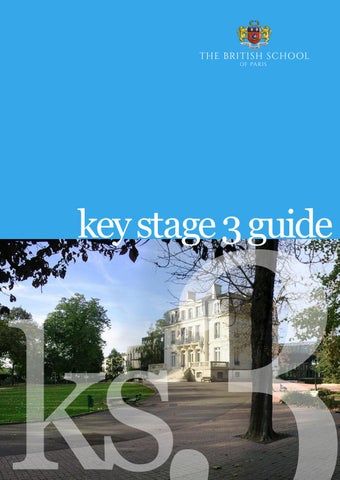
3 ks key stage 3 guide
Key Stage 3 Guide
Contents Introduction 2 Art and Design
4
Computing 6 Curriculum Support: Literacy and Numeracy
7
Design and Technology
8
English
10
English as an Additional Language
12
Geography 13 History
15
Intensive English
17
Mathematics 19 Modern Languages
21
French
22
German
24
Spanish
24
Music
25
Physical Education
28
Personal, Social and Health Education (PSHE)
30
Science
31
1
Key Stage 3 Guide
Introduction This guide contains descriptions of the courses we offer to pupils in the first three years of their secondary education at The British School of Paris. These have been written by the Heads of Faculty, who, together with their colleagues, have designed and developed BSP courses that are in line with teaching in England and Wales. The British government oversees a broad and rigorous programme for all school children in Key Stage 3. It suggests a balanced coverage of the humanities, arts and sciences, expressive arts and physical education, ensuring that pupils are exposed to a wide range of skills and techniques, as well as experiencing opportunities to develop creativity and well-being. The subjects offered at the BSP at Key Stage 3 are: English, Mathematics, Science, French, Geography, History, Design and Technology, Computing, Art, Music, Physical Education (PE) and Personal, Social and Health Education (PSHE). We also offer extension or support in the form of German, Spanish, English as an Additional Language, Curriculum Support Literacy, or Curriculum Support Numeracy. Each child is assigned to a Tutor Group where his/ her academic and social development is closely monitored and recorded. The tutor liaises between pupils, subject teachers and parents, and should be the first port of call if academic or pastoral matters need attention. Each year, our assessment procedures, our Learning Log and explicit ‘I can’ statements will allow you to follow your child’s progress, and will give the pupils regular feedback on their own performance. At these times, with help and guidance from parents and tutor, pupils are encouraged to set themselves realistic targets for their future performance, as well as to think of ways in which to achieve them. However, a pupil’s experience in Key Stage 3 is not just about academic opportunity and success. All our pupils enjoy a wide variety of lunchtime and afterschool activities. The programme varies from term to term but typically involves drama, music, sport, creative opportunities and an impressive range of other clubs.
Our School bonds and interacts with other schools in sports, an experience we really enjoy. 2
Pupils are encouraged to take positions of responsibility within their peer groups and may represent their year group at Student Council. An interest in the world around us leads pupils to participate in many activities to raise money for charities. Team building activities for each year group are also very important and help newcomers to settle in quickly. In the summer term, each year group travels to a different location for a week outside school in order to benefit from an exciting outdoor education programme taught by resident experts. Activities
Key Stage 3 Guide
build upon the skills acquired in sports lessons and offer different experiences such as rock climbing, orienteering, sailing and mountain biking. We organise activities and visits to enhance learning throughout the year. History, Geography, French, Mathematics, Art and Science nearly every area of the curriculum will at some point, extend beyond the walls of the classroom to put learning into the context of the world at large. We hope that you will find this booklet helpful and interesting. If you would like further information, please do not hesitate to contact us. We are always pleased to answer any questions.
Dr Julia Batters – Head of Senior School
3
Key Stage 3 Guide
Art and Design “Art does not reproduce what we see. It makes us see.” -Paul Klee
Overview
Art at KS3 is designed to teach pupils the fundamentals of drawing, painting, printmaking and sculpture in an environment that encourages curiosity, creative problem-solving and fun.
Aims • That pupils look more carefully at the world around them through observational drawing. • That pupils explore new techniques and materials, and refine their use of these. • That pupils evaluate and analyse their own and others’ work using subject-specific keywords. • That pupils demonstrate the ability to work independently and solve problems in a creative way.
Skills
Drawing in all its forms is at the core of every project. Pupils are introduced to the formal elements in Year 7, learning the basics of working with line, tone, shape and colour. They will then extend these skills as they progress through Year 8 and 9, while exploring new techniques and materials, such as ceramics, printmaking and digital media. Pupils will learn to look at, describe and analyse the work of other artists linked to their project themes, gradually building up more complex vocabulary and subject specific language.
4
Assessment
Pupils are assessed against the learning log at each internal assessment period. Pupils will not be required to sit internal exams in Art at KS3.
Homework
Pupils are set weekly homework tasks to extend or consolidate work done in lessons, in line with the homework policy. Longer tasks may be set over a two-week period.
Key Stage 3 Guide
Art and Design (Continued)
Equipment
Pupils are expected to bring the following equipment to every lesson: • Pencils - ideally HB and 2B • Sharpener • Black biro or fine line pen • Rubber • Glue Stick • Scissors • Colouring pencils • iPad
Extra-Curricular Opportunities
Weekly clubs for Art and Photography provide budding artists with the opportunity to take part in fun projects and try materials and techniques usually reserved for older students. Pupils are encouraged to enter international and school-wide art and photography competitions each year.
Exhibition and Curricular Opportunities
Pupils’ work is exhibited throughout the school and forms part of the art building’s permanent exhibition of work. Trips and workshops take place at various points throughout KS3.
5
Key Stage 3 Guide
Computing At Key Stage 3, pupils are taught to use computer resources effectively and independently. They are given the tools to learn and demonstrate practical competence in Digital Literacy, Information Communication Technology and Programming.
Digital Literacy will give the pupils an opportunity to develop their understanding of the Internet and Worldwide Web. They will learn how to be a responsible digital citizen and will develop sound knowledge of e-safety and some of the issues involved in the Digital Age. Information Communication Technology is the discipline of using software as a tool. Pupils will learn how to use graphic packages to manipulate and create graphics. Pupils will use a wide variety of software applications to create websites, animations and podcasts to promote events in a given scenario. In the Computing section of the KS3 curriculum, pupils attempt to code and create their own technology. Coding, in the simplest of terms, is telling a computer what you want it to do, which involves typing in step-by-step commands for the computer to follow using the correct syntax. Through coding pupils are able to build, for example, graphical and text based adventure games. They will learn to use programs such as Flowol to understand sequences and sub-routines. As they develop their understanding of programming they will use a text based programming language called Python and learn the difference between a complier and interpreter.
Year 7
Year 8
Year 9
Understanding systems at the BSP
Models and Numeric Data II
Planning an Event
Using ICT
Understanding Computers
Computer Crime and Cyber Security
Models and Numeric Data I
Programming with Python I
Programming with Python II
Programming with Scratch
The Internet and Worldwide Web
Networks
Programming Robots
6
Key Stage 3 Guide
Curriculum Support: Literacy and Numeracy The British School of Paris aims to provide an environment where all pupils are able to realise their full potential. The most important role of the Learning Support Department is to help the pupils to achieve this.
Literacy and Numeracy are separate intervention classes offered to KS3 pupils. Lessons are timetabled for one and a half hours per week and occur at the same time as German, Spanish and EAL classes. There are separate Year 7, Year 8 and Year 9 groups. The Literacy and Numeracy provision both aim to give extra support to pupils who, irrespective of ability, benefit from studying one less foreign language. Moreover, children who join these small intervention groups have been identified as underachieving in respect to certain core elements of the English and Mathematics curriculum. Recommendation for entry into the Literacy or Numeracy group is made on the results of end and start of year screening tests as well as the ongoing advice of teachers and parents/guardians. In consultation with parents/guardians, learners may enter and leave these groups during the year depending on progress. The Literacy class aims to boost the reading, spelling and overall writing skills of pupils. Correspondingly, the numeracy class targets children with mathematical difficulties and aims to help them meet challenges in respect to arithmetic, geometry and mental calculations. Both programmes are designed to motivate and develop the confidence of learners. Curriculum Support is a timetabled option and is not an additional educational service. Therefore, there are no extra fees levied for these classes.
7
Key Stage 3 Guide
Design and Technology Foundation Design & Technology ‘The best way to predict the future is to create it.’
The above quote is closely linked to the aims and objectives of Design & Technology at Key Stage 3. As the world continues to change at a rapid rate, tomorrow’s work force must be prepared for jobs that do not currently even exist! For this, pupils need to learn independently and think creatively in order to quickly and successfully adapt to their given situation. This ability to innovate, along with a focus on graphic communication, quality of manufacture and computer aided design are the primary drivers of the Design & Technology curriculum at the British School of Paris.
Year 7: Project-based Learning
In Year 7, pupils engage in project-based learning activities; where – both in groups and individually – they are given challenges – often in the form of live project briefs – to generate solutions for. Skill-specific workshops equip them with the practical resources and processes required to tackle such problems. Examples of the projects previously tackled include designing a range of products to sell at the Winter Wonderland Fete, along with a series of mini-tasks concerned with developing individual Superhero identities.
Years 8 and 9: Design and Make Tasks
Beyond Year 7, pupils continue in a similar vein, identifying needs and drawing on knowledge and understanding from a wide range of subject areas to generate ideas to satisfy pre-determined project briefs. Pupils will develop their affinity for conducting effective research before applying the lessons learnt within their own design processes; much in the same way as any designer would in a professional setting. Throughout Years 8 and 9, pupils will be involved in a number of DMTs (design and make tasks); each focusing on a different aspect of Product Design; providing a natural link and foundation to the GCSE and A Level Product Design courses offered.
8
The DMTs provide a focus for our studies, ensuring that within every specialist area, the pupil will be involved in making. Pupils are encouraged to develop their practical skills and emphasis is placed on not just the quality of the finished product, but also the process by which the pupil generates that particular
solution. Pupil assessment is explicitly linked to departmental ‘I can’ statements. This transparent skill-based assessment procedure means that pupils are able to clearly identify their working levels across the whole of Key Stage 3.
Equipment
The following pieces of equipment are essential within Design & Technology lessons. Some extra pieces of equipment have also been listed that, although not essential, would help give pupils a higher level of quality in certain areas of the design process. Essential: • Propelling pencil with 0.5mm HB leads and metal sleeve, or HB pencil and eraser. • 200mm rule or larger • Colouring Pencils Desirable: • Set of Black Fineliners
Key Stage 3 Guide
Design and Technology (Continued)
Computer Software:
The following programs are regularly used within lessons. If students are able to download these at home, it can often prove useful to continue developing certain CAD skills. • SketchUP • Photoshop • CorelDraw iPad Design & Manufacture
Year 9
Resistant Materials & Systems
Textiles
Project Based Learning – Various Projects Winter Wonderland, Superheroes, Garden Party, STEM Challenges
Year 7
Year 8
Graphics
2D & 3D
CAD
Electronic Circuits
Stuffed Toys
Board Games
Art Deco Coasters
Pianos
Ugly Dolls
3D
Traditional hand and computer tasks
Children’s toy
Woodwork Handmade wooden box
Cushions Characters
9
Key Stage 3 Guide
English
Key Stage 3 Teaching and Learning in English is based on the following ethos: All pupils are encouraged to: • Enjoy English • Be enthusiastic about English • Develop the confidence necessary to rise to challenges in English • Read a wide range of texts in class and independently, including poetry, drama, nonfiction and pre-twentieth century works • Write accurately and creatively for a range of purposes and audiences • Consolidate and build on their knowledge of Standard English grammar and vocabulary • Speak confidently and effectively in debate, drama, and individual presentations • Develop their knowledge of English-language culture.
Reading
All classes in all years cover a range of appropriate fiction, poetry, drama, and non-fiction texts in lessons. Pupils are expected to keep an independent reading journal on their iPad. Classes have the opportunity to make good use of the Library on a regular basis.
Writing
All classes in all years learn to write for a range of purposes and audiences, using a variety of formats. Spelling, punctuation, and grammar are taught and assessed, in addition to language techniques. Modelling and scaffolding of tasks is offered when appropriate, either for the individual or the class. Pupils are expected to act on feedback given in order to improve and progress (for example, learning their spelling corrections).
10
Speaking and Listening
The English classroom provides ample opportunity for pupils to express themselves orally. Tasks may range from individual formal presentations, to informal group discussion, to formal debate and textbased role-play. Drama is an integral part of the syllabus. Shakespeare is initially studied in Year 7 and an entire play in Year 9. Year 8 Drama is focused on a modern playwright. Pupils benefit from access to the Drama Studio and Braille Multi-Purpose Room, where activities also include improvised and devised work.
Differentiation
Pupils in Year 7 are taught in form groups; pupils in Years 8 and 9 are grouped according to ability. In all three years, there is a fourth, smaller class for pupils who might find it difficult to access the mainstream curriculum.
Information Technology
Pupils may use their iPad in all aspects of English work, from research and planning, writing and redrafting, and filming.
Key Stage 3 Guide
English (Continued)
11
Key Stage 3 Guide
English as an Additional Language English as an Additional Language (EAL) classes are offered to any pupils whose first language is not English or whose previous schooling was not within an English-speaking environment. Following a placement test, it will be decided whether EAL is suitable for the pupil, although any pupil who feels he/she would benefit from extra English language instruction is welcome to join. A lower-intermediate level is required as a minimum. Any level below this and the pupil would need to be enrolled on the Intensive English course. All pupils who have previously followed the Intensive English course will also be expected to join EAL for at least the following year. Within the school timetable, EAL replaces an additional language (usually German or Spanish). However, pupils will continue to study French.
needs. Emphasis is given to all four language skills listening, reading, speaking and writing - to provide the pupils with sufficient English for their needs in the Senior School. The pupils follow the course “Beyond” by Macmillan Education. In Year 7 they begin the A2+ book, in Year 8 they complete the A2+ book and begin the B1 book and in Year 9 they complete the B1 book. The books cover a range of topics, vocabulary and grammar skills within ten modules. However each module always includes the following lessons: • Vocabulary • Reading comprehension • Two grammar lessons • Listening skills • A cultural point • Speaking
Course content
EAL pupils are taught in small groups and the level of instruction is adjusted to suit each pupil’s
• Writing
The topics covered are broken down here:
Year 7
Year 8
Year 9
Communication and Technology
World of Work
Music
Home Life
Media
Relationships
The Natural World
Sports
Senses
In the Kitchen
Inventions and Materials
Shopping
Describing People
Special Days (life stages)
Life in the Past
Mind and Body
Travel
In the News
EAL teachers may also work alongside staff from the History and Geography departments in order to provide extra support for these subjects, which our EAL pupils often find challenging. Additionally, there may be the chance to offer extra classes or in-class support to pupils who are having further difficulties. The course is very much centered around English language learning and giving the pupils the skills needed to access the whole-school curriculum as well as using English naturally. The small group sizes give pupils plenty of opportunities to work in pairs and to peer and self-assess.
Assessment and homework You feel much more comfortable working in a small group and you become more confident
12
Pupils will receive one homework per week from EAL. This may take the form of reading comprehension, preparation for a presentation, essay writing or research. They will be continuously informally assessed throughout the year and in Year 9 will also take an exam in the subject in June.
Key Stage 3 Guide
Geography The study of Geography inspires curiosity of places, people, resources and environments.
Geography offers pupils the knowledge and skill to enhance their role as a caring, proactive global citizen. Pupils measure places, people, resources, and natural and human environments, especially the interactions between them. Inspiring fieldtrips explore the relationships between people, their living spaces, and their natural environment. As a Geographer pupils debate using evidence, making sense of the potentially confusing world rising above media hype, populism and political spin. Pupils investigate what our planet has to offer valuing their role as economic, social, and environmental stewards.
Aims To analyse, interpret and evaluate physical and human interactions.
information, including maps, diagrams, globes, aerial photographs and Geographical Information Systems (GIS). • To communicate geographical information in a variety of ways, including through presentations, maps, numerical and quantitative skills and writing at length. Pupils get to know the physical and human features in all regions of the world. They understand how geographical processes interact to create distinctive human and physical landscapes. They are able to measure how these change over time. They apply science, statistical models and theories to interpret their own data from fieldtrips, thus enriching pupils’ appreciation of their perspective of a complex world.
• To identify physical and human characteristics and processes in globally significant places. • To understand the relationships between them to gain an appreciation of how these change over time and between different places. • To be able to use geographical skills of being able to collect, analyse and communicate a range of data from the classroom and fieldwork deepens this understanding. • To interpret a range of sources of geographical
13
Key Stage 3 Guide Geography (Continued)
Location and place knowledge
Over the course of each topic, pupils build a world map to locate each idea learned. Over the year, the interactions and interrelationships between physical and human geography become clear. This map supports pupils’ spatial understanding of the world, but increasingly becomes a platform for analysis, debate, and creative ideas.
Human and Physical Geography
Pupils understand geographical processes and express their understanding using case studies in a variety of places. Human processes consider population; urbanisation; international development; economic activity in the primary, secondary, tertiary and quaternary sectors; and use of natural resources. Physical processes consider geological timescales and plate tectonics; rocks, weathering and soils; weather and climate; climate change from Ice Age to the present; glaciation, hydrology and coasts.
Geographical skills and fieldwork
Use of globes, maps, atlases and digital simulations is routine. Pupils interpret Ordnance Survey maps in the classroom and the field, including using grid references and scale, topographical and other thematic maps, and aerial and satellite photographs. Information technology has advanced in the Geography classroom meaning pupil also view, analyse and interpret places and data using Geographical Information Systems (GIS). These skills are enriched by carrying out fieldwork in contrasting locations to collect, analyse and draw conclusions from geographical data, using multiple sources of information. Teamwork and solving problems with others is key to success in Geography.
Year 7 Topics
Year 8 Topics
Year 9 Topics
Weather
Coasts
Climate change
Brazil
Global resources
Crime and conflict
Population
Oceans
Development
Rivers & floods
Settlement & urbanisation
Sustainability
Map skills
Ecosystems
Glaciation
Volcanoes & Earthquakes
Antarctica
Globalisation
Unique Geography at The British School of Paris The British School of Paris, with over 50 nationalities represented, is a rich diverse environment. Our curriculum reflects this by offering a broad mix of 6 physical and human Geography topics every year,
14
When investigating how these processes interact to influence landscapes, environments and the climate, pupils evaluate to what extent human activity relies upon these physical systems.
each with their associated case studies and skill sets. As a small community of well-informed global citizens, it is our responsibility to explore our exciting planet and show our gratitude by actively improving it for future generations.
Key Stage 3 Guide
History History is the past and the study of the past
The two main aims or purposes of school History are: • to help pupils to develop a sense of identity through learning about the development of Britain, Europe and the world. • to introduce pupils to what is involved in understanding and interpreting the past. There are a number of other purposes: • to arouse interest in the past. • to contribute to pupils’ knowledge and understanding of other countries and cultures. • to understand the present in the light of the past. • to enrich other areas of the curriculum. • to train the mind by disciplined study. • to prepare pupils for adult life. There is a strong sense of why History is being taught throughout the course. There are three attainment targets in the teaching of History.
Understanding history in its setting
This attainment target is concerned with the setting of historical information. History is fundamentally about understanding events over time and in a chronological structure. The concepts of change and continuity and of cause and effect are related to the chronological structure of history. Marking schemes assess pupils’ understanding of these concepts. Pupils should not gain the impression that history represents a continuous line of progress; they should discover that human affairs have developed at different speeds in different places and they have frequently zig-zagged or regressed. The concept of cause will help pupils to understand why things happened, what motivated people to act as they did and what were the effects. Pupils will come to understand that these concepts are useful but also have their limitations.
Acquiring and evaluating historical information
As pupils acquire historical information and understanding so the foundation for developing historical skills grows firmer. As knowledge
accumulates and becomes more complex so the skills of critical and objective analysis, the ability to form and test hypotheses, the ability to use the imagination in a disciplined way, and the capacity to read and to listen critically and comparatively, all become more important and increasingly refined. Pupils should therefore progress in their ability to gauge the relative reliability and usefulness of a wide range of sources of evidence in seeking historical explanations. This attainment target is concerned with the ways in which pupils become involved in history as a process of discovery.
Organising and communicating the results of historical study
Historical information will remain inert unless it is gathered, processed, and ultimately communicated in logical and systematic ways. History as a set of processes is concerned with the inter-relationship between the planning of an investigation, refining ideas, and organising and communicating findings based on historical evidence. This attainment target is concerned with all these processes and with bringing them together in a coherent presentation which can take a variety of forms including written narrative, formal reasoned explanation, discussion and argument or dramatic reconstruction. Communication in history requires concepts specific to the area of study, and this attainment target measures the mastery of such concepts.
15
Key Stage 3 Guide History (Continued)
Course Content
At the beginning of Year 7 all pupils are given a short introductory course which is designed to make them aware of the nature of the subject. This course invites them to think critically about the assumptions that lie behind any chronological survey and begins to teach them the skills that they will find necessary throughout their secondary education. Once this has been completed Year 7 pupils will begin their first Study unit - the Roman Empire. This will be followed during the Spring and Summer terms by Medieval Realms and Islamic Civilisations. In Year 8 the pupils study The Making of the UK, 1500-1680, Empire Native Americans and The French Revolution. They progress in Year 9 to study both World War One and World War Two, understanding the Holocaust and Modern Genocide and completing an Individual study on south Africa and the Rainbow Nation ends their Key Stage 3 History studies with an in-depth examination of the era of the First World War and an overview of 20th century history. It is obviously not possible to give more than a general survey of these centuries, given the time available. The teaching seeks to strike a balance between establishing general trends, and examining particular events and social structures in detail. Emphasis is always given to distinguishing the importance of chronology, evidence and empathy as well as the role of the individual.
Year
Year 7 History
Year 8 History
Year 9 History
Course Content
Skills in History
England 1500-1660
Path to WWI & WWII
The Roman Empire
The Americas: NativesSlavery
Holocaust – Understanding Genocide
The French Revolution
South Africa and the Rainbow Nation
The Medieval Realms Islamic Civilisations
16
Key Stage 3 Guide
Intensive English We offer Intensive English to pupils in any year group in Key Stage 3 who do not have enough English to access the mainstream curriculum.
Intensive English pupils are taught English in small groups by a range of specialist teachers. The aim for each pupil is to achieve proficiency in listening, reading, writing and speaking English so that he/ she can integrate fully into mainstream classes in the second year at school.
Course Content
Pupils on the Intensive English course will spend 50% of their timetabled hours in the IE/EAL Department learning English. They will study a variety of modules aimed at improving their skills. The course is adapted yearly according to the age and number of pupils as well as their particular interests or strengths and areas of improvement. This may include all or some of the following areas: • Grammar – All pupils will have up to 6 hours of dedicated grammar lessons per week. They will be provided with a Work Book to complete at home and access to MP3s to practise listening skills independently. Teachers also have computer software to use in class that includes interactive games, role-plays and listening activities. We currently follow the “Solutions” method, produced and developed by Oxford University Press. • Private Reading – We have a wide range of short books that are organized according to difficulty level. Pupils will select a book of interest to read at home. This is accompanied by comprehension activities to be completed over one or two weeks depending on the pupil’s reading ability. • Presentations – Pupils will be expected to write and give presentations in class about a range of subjects. At the beginning of the year they may give a speech about familiar topics such as their family, favourite film or previous school. As the year goes on they will be expected to tackle more difficult topics. • Group Reading – The class teacher will select a novel to be read as a group suitable for the age and level of the pupils. At home pupils will complete comprehension activities as well as creative writing (for example a diary entry imagining they are one of the characters, letters or newspaper articles). Books that have been studied in previous years include ‘Holes’ by Louis Sachar,
‘War Horse’ by Michael Morpurgo and ‘Charlie and the Chocolate Factory’ by Roald Dahl. • Film – Pupils may have the opportunity to study two or three films over the course of the year. They will be expected to summarise key events and imagine how the characters may be feeling or what they are experiencing. • History – We have a dedicated teacher who delivers an hour of History to Intensive English pupils each week. This prepares them for joining the mainstream. They often cover topics studied by mainstream pupils but at a slower pace. They will also be exposed to a range of spoken and written texts such as articles, short clips or documentaries.
...you have the opportunity to speak more, you feel more comfortable because everyone in the class is learning English with you.
17
Key Stage 3 Guide Intensive English (Continued)
• Spellings and Vocabulary – The pupils have a weekly lesson dedicated to reviewing the key vocabulary learned over the previous week. They are expected to study the vocabulary using revision sheets that are provided on the school VLE. • Other modules that may be studied for all or part of the year include, but are not limited to, pronunciation practice, dictation, drama, the news, literacy skills, creative writing, ICT skills (if the pupils have previously had little exposure to computers or iPads) and/or handwriting skills.
Homework and Assessment
Intensive English pupils will receive homework after most lessons. The deadlines will vary from the following day to a week later, depending on the type of homework being set. Pupils are assessed according to the Common European Framework of Reference for Languages (CEFR) levels for foreign languages.
These grades range from pre-A1 (someone with very basic English) through to C2 (completely fluent university-level of English for non-native speakers). Pupils on the Intensive English programme should be aiming to achieve an A2-B1 level by the end of the course. Further to the ongoing informal assessments all pupils will complete the placement test taken before joining the school twice more during the year to check for progress. They will also take formal inschool exams towards the end of June.
Integration into the Mainstream
All Intensive English pupils belong to mainstream tutor groups, which allows them to meet other pupils from outside the IE department. They also take the following classes within the mainstream from the beginning of the school year: French, Physical Education, Sport, PSHE, Art, Mathematics, Computing and DT. They may move into some other mainstream classes at the beginning of the second term, for example Science, if the department teachers and the pupils feel they are ready. When the pupils move out of Intensive English they will move into an English as an Additional Language class instead of taking up another foreign language. For those who are still having difficulties there may be the opportunity to arrange extra one on one or small group lessons to focus on key skills.
18
Key Stage 3 Guide
Mathematics The power of Mathematics lies in its capacity not just to describe and explain but also to predict. Mathematics is important; it offers a means to solve real life problems, indeed everyday problems.
The study of Mathematics equips pupils with the skills they need to gain knowledge in other subjects, notably Science and Technology. However, Mathematics is taught not only because it is useful; the subject itself is a source of delight and wonder. In accordance with the National Curriculum guidelines, the Mathematics that pupils encounter is listed under 7 broad headings: • Mathematical processes and applications • Number • Algebra • Ratio, proportion and rates of change • Geometry and measures • Probability • Statistics The Department aims to make Mathematics attractive and accessible to all pupils; interesting and useful; varied and fun, a challenge and a success for everyone. In consequence, pupils are encouraged to: • draw, measure and count accurately
• communicate the techniques and methods they use • relate number exercises to real life situations • relate algebraic manipulations to number calculations • identify number patterns and create formulae • practise mental calculations, estimate • use a calculator frequently but sensibly, efficiently and as a discovery item • look critically at answers and make checks and improvements • read timetables, charts, etc. accurately - handle data efficiently • present information clearly and attractively • write readable, well ordered and neat solutions or records • be well organised with books, calculator, iPad and instruments • complete pieces of homework carefully and meet deadlines
19
Key Stage 3 Guide Mathematics (Continued)
• look for Mathematics in other subjects and in everyday life Pupils do need to be well equipped for Mathematics and simple sturdy instruments are far more appropriate than fine drawing sets. The Mathematics teachers strongly recommend that pupils possess a second pencil case free from clutter and dedicated to Mathematics. This should include: • a scientific calculator - we recommend the Casio fx-85 GTPLUS • a small clear plastic protractor and 20cm ruler • a sturdy compass with pencil • an eraser, a sharpener with a box, a pencil (HB) Pupils are encouraged to use their iPads and will be requested to download Apps, such as Geogebra, from time to time.
Setting and Assessment
In Mathematics pupils are placed in sets according to their performance and individual needs. There is a specific text for each level with a common core of topics, and differentiated tasks. Pupils will have a textbook which will be available in class and an electronic version of the textbook will be available through the Kerboodle platform. From this there are links to Invisipen lessons, video solutions
20
and MyMaths, all of which pupils will be able to access using their iPads. Pupils are also issued with a Homework Book appropriate to their level in electronic form and access to homework exercises on MyMaths. Regular tests allow each pupil’s progress to be assessed and if necessary, pupils are transferred to a more appropriate set. Pupils in the stronger sets in Years 7 and 8 prepare and enter the UKMT Junior Maths Challenge. Those in Year 9 are entered for the UKMT Intermediate Maths Challenge. This is a national postal competition devised to inspire and challenge young Mathematicians. The school also enters teams for UKMT and ISMTF team competitions. Many of the questions are interesting and fun and successful participants are awarded certificates at gold, silver or bronze levels. Exceptional pupils may qualify for the Mathematics Kangaroo or the Mathematics Olympiad. Interested pupils may also attend a weekly training session. The most able pupils are selected to represent The British School of Paris at the ISMTF Middle Schools Mathematics Competition which takes place at an International School in Europe, or the nearest UKMT Team Challenge Regional Final which takes place in the south of England.
Key Stage 3 Guide
Modern Languages
All language courses at The British School of Paris are based on the introduction, practice and acquisition of the four skill areas outlined by the National Curriculum: • Attainment Target 1 - Listening • Attainment Target 2 - Speaking • Attainment Target 3 - Reading
the independent study skills necessary for GCSE and beyond. All pupils study French from Year 7 to Year 11. In Year 7, pupils have the opportunity to study both German and Spanish (pupils switch language at the end of January) in order to be able to sample the two languages. This allows pupils to make an informed choice between German and Spanish for Year 8.
• Attainment Target 4 - Writing. The language content of our courses is chosen with the aim of exposing the pupils, throughout their Key Stage 3 teaching, to the five topic areas eventually examined at GCSE level: • Identity and culture • Local area, holiday and travel • School • Future aspirations, study and work • International and global dimensions Languages are taught in topic-based units which aim to cover a wide range of situations in appropriate settings for the purposes of practical communication in French, German or Spanish speaking countries with a view to preparing the foundations for GCSE study. In Years 7 - 9 vocabulary acquisition and effective communication are primary aims. Listening, Speaking and basic Reading skills are emphasised. Extended reading tasks and a study of language structure and grammatical points to enable accurate writing are introduced progressively throughout each course. The various cultures of French, German and Spanish speaking countries are also covered. Teaching is conducted as much as possible in French, German or Spanish and pupils are encouraged to use the foreign language between themselves and when communicating with the teacher. Textbooks are often supplemented by more recent materials such as magazines and videos. We aim to make situations for language practice authentic and relevant. Although much introductory work in the language classroom is undertaken by the teacher with the whole class, pupils are gradually encouraged to work individually, in pairs and in groups in order to foster
21
Key Stage 3 Guide Modern Languages - French French There are several teaching groups in each year in French. Pupils are grouped as much as possible in homogeneous groups which reflect previous exposure and confidence with the language. Transfers will occur when teachers have consulted about the best timing for the pupils concerned. Flexibility is extremely important and these transfers can happen right up to the Summer Term if appropriate.
In each year there is one Special Objectives group. It is generally made up of pupils who have already had considerable exposure to French. This group will aim to take the GCSE examination one year early (i.e. at the end of Year 10) and will go on to begin preparation for A Level in Year 11.
Mainstream
With a developing emphasis on translation skills, the study of literacy texts and boosting the spontaneous use of French, we cover the following:
Year 7
Year 8
Year 9
22
Topics
Grammatical concept
• Personal introductions • School life • Free time • Places in town and directions • Holiday plans • Media and new technology • Exploring Paris • Personal descriptions • At home and meals
• Present tense of regular and some common irregular verbs • Adjectives and understanding agreement • Possessive adjectives • Partitive articles • Using “on” to say “we” • Understanding when to use “tu” and “vous” • Modal verbs • Prepositions • Near future tense • Perfect tense of regular and irregular verbs • Reflexive verbs • Near future tense • Comparisons
• At home and meals • France has got talent! • World geography and French-speaking countries • The French revolution • Media and new technology • Exploring Paris • Personal descriptions • Teenagers and their interests
• Present tense of regular and irregular verbs • Perfect tense of regular and irregular verbs • Adjectival agreement • Reflexive verbs • Near future tense • Comparative adjectives • Prepositions • Modal verbs • Imperative mood • The perfect tense • Direct object pronouns
• Teenagers and their interests • Sports and healthy eating • Jobs and career plans for the future • Holidays • The world around us • Identity and culture
• The perfect tense • Direct object pronouns • Relative pronouns • Adverbs of frequency • The imperfect tense • Modal verbs • The future tense • Conditional mood • Emphatic pronouns • Expressions with “avoir” • “Si” and complex sentences • Reflexive verbs • Depuis + present tense
Key Stage 3 Guide
French (Continued) Year 7, 8 & 9 – Set 2
A selection of literary texts, poetry and films has been introduced to further challenge the students in Set 2. The curriculum also provides a study of the history of France linked with the texts chosen as well as with the Special Objectives programme whenever possible. In Year 7, pupils study two abridged novels, extracts and a film. In Year 8, pupils also study two abridged novels as well as a film. In Year 9, pupils study a novel and a film.
French Special Objectives
French Special Objectives groups are taught almost entirely in French and do not follow the same topics as other groups. The oral French of the Special Objectives groups is generally of a higher standard than their written French but although they are fluent in every day idiom, pupils are often unable to appreciate the finer points of language and style. Grammar points are therefore emphasised at all stages. The teaching of grammar is both global and methodical: that is to say that the various grammatical points are taught as they occur in the texts the children study. The texts and films are carefully chosen to cover a range of styles, topics and vocabulary, and to stimulate the children’s interest and their desire to read further.
The cultural aspect is another essential element of the Special Objectives programme. A major part of developing reading and writing skills is based on the use of literary texts, poetry and films and on the study of the history and geography of France. In Year 7, pupils study a whole range of texts (classic children’s literature) and a film. In Year 8, pupils study a play or a novel as well as a film. In Year 9, pupils study a play, short stories and 2 films.
Trips
During the academic year, KS3 pupils have the opportunity to go on a trip. In the past, visits have been organised to the Château de Maisons, to the house of Alexandre Dumas in Port-Marly, to France Miniature, to the Château de Malmaison as well as to the Château de Vaux-le-Vicomte.
23
Key Stage 3 Guide
German
Spanish
Years 7, 8 and 9
Years 7, 8 and 9
In Years 7, 8 and 9 the four key skills of reading, writing, speaking and listening are emphasised. The KS3 German Curriculum is exciting, creative, challenging and stimulating.
In Years 7 and 8 vocabulary acquisition, grammar and effective communication are primary aims of the foreign language classroom. Listening, speaking and basic reading and writing skills are emphasised. The KS3 Spanish Curriculum is exciting, creative, challenging and stimulating. It consists of interactive activities, iPad use and pupil-led projects based on the following topics: • Personal introduction • My family • School, school subjects and opinions • Home and Daily Routine • Describing Towns and Cities • Food and Drink • Holidays • Technology • Media • Health
The main textbooks used are Echo Express 1 and Echo Express 2 but in addition, interactive whiteboard exercises, videos and language – specific websites are also used. Grammar, translation, poetry and songs are also practised and the following topics are taught: • Personal introduction • School life • Family and Friends • Freetime and Hobbies • House and Home • Town and Country • Holidays • Shopping and Eating
24
Key Stage 3 Guide
Music Music education has changed dramatically in schools in recent years.
The most recent National Curriculum document is based on the two main strands of Performing/ Composing and Listening /Appraising. Activities undertaken in class are based on these strands and provide a course of practical and active lessons for pupils. In addition, the music centre offers many extracurricular activities so that pupils can expand their own individual interests. There are opportunities for tuition in almost every instrument, including voice, and opportunities to join the many musical ensembles that exist in school.
Listening and Appraising
Pupils listen to music from a broad range of traditions and historical periods, including music from around the world. They spend one half term looking at the development of the modern symphony orchestra and its instruments. They attempt basic analysis and evaluation of music considering such elements as pitch, duration, timbre, pace, texture, dynamics and structure. The theory covered includes basic rhythm and pitch, and traditional notation.
Each year’s course is divided into several units. As work is completed it is marked and the results are used to help complete the requirements of the assessment process. Assessment is by observation, completion of set practical tasks which are recorded on the iPad and completion of written exercises.
Year 7
The units covered are: • The Elements of Music • Song analysis • Instruments of the Orchestra • Theory and traditional notation • Music from Latin America
Performing and Composing
Classroom percussion instruments are used to explore the elements of music and for composition. The materials used are taken from a wide range of musical traditions and different types of musical notation are introduced. Singing and playing in parts is attempted and pupils are expected to perform solo and in a group in the classroom as part of the assessment process. Pupils consider basic forms in music; the organisation of pitch, rhythm and timbre. They explore orchestral techniques and they invent and perform their own music to others, notating it using appropriate signs, symbols and instructions.
25
Key Stage 3 Guide Music (Continued)
Year 8
The units covered are: • Exploring chords and bass in Reggae music • Improvisation • Going Solo • Night Music • Recording with the iPad • Film Music
Performing and Composing
The instrumental pieces used in the classroom become more demanding, requiring wider knowledge of notation, more fluency and expression in performance of solo work, and greater independence of parts in ensemble work. Pupils are introduced to the electronic keyboard and are encouraged to use this for performance and as a tool for composition. Pupils are encouraged to write music for themselves and others, expressing their ideas and instructions in appropriate notation. Group performances are filmed on the iPad for assessment purposes. Pupils are taught to use the iTrack solo interface which allows the Garage Band app to be used with “real” instruments as well as the “virtual instruments” within the app. Pupils are taught how to use Sibelius software in the classroom for the notation of their compositions and in the creation of a basic soundtrack for the Film Music unit at the end of the year.
Listening and Appraising
The range of music presented to the pupils is increased with greater emphasis on 20th century music and non-orchestral instruments. Analysis and evaluation continue with greater attention being paid to the use of specific musical vocabulary.
Year 9
The units covered are: • Chords into Jazz • Improvisation and Organisation • Ground Bass variations • The Guitar Family
26
• Making Arrangements
Performing and Composing
Pupils continue to have lessons using the electronic keyboards in the music suite’s custom-built studio. They work individually and in groups according to their experience. Pupils are encouraged to read melodies and chord symbols from printed music. Work on classroom and orchestral instruments continue alongside the keyboard work. Pupils invent and notate music in popular styles with the aid of a keyboard. They also have access to the computers and Sibelius software. This can be used for creating, managing and storing pupil compositions. Final versions of pupils’ compositions are then performed and recorded onto the iPad as part of the assessment process. To enable the compositions in this year to become more musically sophisticated more advanced harmony, syncopation, transposition and arranging skills are taught. A Unit on the Guitar family is delivered to encourage pupils to continue future music making (in case they don’t choose Music as an option in Year 10). Pupils learn basic chord shapes and how to read both tablature and traditional notation on acoustic, electric and bass guitar. The year ends with a whole year group competition where pupils consolidate their skills in the “Battle of the Bands”.
Key Stage 3 Guide
Music (Continued)
Listening and Appraising
The listening programme is extended to include 20th century music in all its forms, including commercial music. Analysis and evaluation of music is at a higher level than in Year 8 with listening activities similar in style to those at GCSE level. Peripatetic teaching, Ensembles, the Associated Board of the Royal Schools of Music (ABRSM) and RSL Rock School Ltd. Apart from classroom music we offer individual instrumental lessons in school on most instruments and these are arranged through the Head of Music. The main school ensembles are Orchestra, Choir, “Just Men� our male vocal group and the Jazz Band. These groups meet weekly to rehearse and perform at all manner of concerts. Choir membership is by audition but Orchestra is open to all. Pupils receiving instrumental tuition in the school day are strongly encouraged to be involved in the orchestra or choir. Other ensembles are selected to prepare more demanding group pieces. Membership is offered to those pupils who show themselves to be mature, confident and hardworking performers, often those attaining Merit and Distinction awards in practical examinations of Grade 4 and above in their instrument. The school is also a centre for Rockschool exams and these exams take place in the summer term. Pupils are examined on drums, electric guitar, keyboards and vocals. The British School of Paris is the centre for the ABRSM in France. The practical and theory examinations are offered two or three times a year, and results are excellent with many distinction and merit grades being obtained.
27
Key Stage 3 Guide
Physical Education Pupils in Years 7-9 experience Physical Education in both mixed ability and mixed gender lessons.
The department aims to provide a balanced and varied programme which will enable each pupil as far as possible to be proficient in a number of physical activities including football, touch rugby, netball, unihockey, badminton, climbing, basketball, rounders and athletics. The department concerns itself with achieving success in the following areas: • Enjoyment and satisfaction • Physical development • Acquisition of motor skills • Self-expression/aesthetic appreciation • Social training • Education for leisure
Either individually or in a team sport, you’re given the opportunities for your talent to shine through.
28
The Fitness Suite is enjoyed by all pupils’.
Key Stage 3 Guide
Assessment records each pupil’s progress over the year. As Physical Education is aimed at educating the pupils both ‘in’ and ‘through’ the physical, assessment within the department will not only record the pupils’ abilities but also their motivation, their ability to work with others, their ability to lead and organise, along with a basic knowledge and understanding of how to maintain a healthy, active lifestyle.
29
Key Stage 3 Guide
Personal, Social and Health Education (PSHE) The PSHE scheme of work follows the UK National Curriculum non-statutory guidelines for Personal, Social and Health Education and the Key Stage 3 statutory curriculum for Citizenship. LLessons are often discussion based, making use of worksheets, newspaper articles, video, role-play, debate and pupil presentations.
The pupils are encouraged to develop: • A healthy and safe lifestyle. • Good relationships while respecting the differences between people. • Skills of enquiry and communication. • Methodical and successful work habits. • Ways of living independently in the wider world.
The programme for Years 7-9 remains flexible and responsive to changing needs but includes the following areas:
Year
7
8
9
Term 1:
Term 2:
Term 3:
The Purpose Project
Staying Safe
Health and Wellbeing
Local and Global Communities
The Best Me
Focus on the Future
• Personal and community values • Growth mindset • The changing adolescent brain • Setting and achieving goals • Relationships: making and maintaining friendships; respecting cultural and religious differences • Community project
• Relationships: managing different types, including those online • Micromastery • Emotions • Decision making
• Healthy diet and exercise • Puberty • Action for happiness • Revision and study skills • Target setting • Outdoor education week preparation • End of year evaluation • Team building challenges
• Core personal values • Self-esteem • Helping new students • Making mistakes • Advanced goal setting • Community rights and responsibilities • Environmental responsibilities and climate project • Current affairs
• Finance skills: recognising money habits, value for money, financial dilemmas • Thinking critically and conducting good research, including digital skills • Relationships: good relationship habits, sexuality
• Personal hygiene • Mindfulness and coping strategies • Drug and alcohol education • Outdoor education week preparation • Study skills and preparing for Year 9
• Identifying and facing adolescent issues and challenges • My key attributes • Me as a learner • Goal setting • Negotiating with others • Active citizenship • Human rights • Democratic structures and current global issues
• Relationships: understanding healthy relationships and peer pressure • GCSE options • The career journey; understanding how people choose careers
• First Aid • Contraception • Body image • Revision and study skills • Outdoor education week preparation • Preparing for Year 10
Please note that you should contact the school (ssc@britishschool.fr) if you have any concerns about your child attending any of the above classes.
30
Key Stage 3 Guide
Science The Science programme studied at The British School of Paris in Years 7, 8 and 9 follows the National Curriculum of England and Wales.
Pupils transferring from the UK will integrate seamlessly into our programme of study at KS3. It is also our experience that the subject matter agrees well with science programmes all around the world since its broad base covers nearly all the essential scientific skills, knowledge and understanding typical for this age. A high-quality science education provides the foundations for understanding the world through the specific disciplines of Biology, Chemistry and Physics. Science has changed our lives and is vital to the world’s future prosperity, and all pupils should be taught essential aspects of the knowledge, methods, processes and uses of science. By building up key knowledge and concepts, pupils should be encouraged to recognise the power of rational explanation and develop a sense of excitement and curiosity about natural phenomena. They should be encouraged to understand how science can be used to explain what is occurring, predict how things will behave, and analyse causes.
Aims
The British School of Paris programme of study at Key Stage 3 aims to ensure that all pupils: • Develop scientific knowledge and conceptual understanding through the specific disciplines of Biology, Chemistry and Physics. • Develop understanding of the nature, processes and methods of science through different types of science enquiries that help them to answer scientific questions about the world around them. • Are equipped with the scientific knowledge required to understand the uses and implications of science, today and for the future.
Key processes
• Practical skills; critical understanding of evidence; and communication.
Curriculum opportunities
• Research, experiment, discuss and develop arguments • Study science in local, national and global contexts • Experience science outside the school environment • Use creativity and innovation in science and appreciate their importance in enterprise • Prepare to specialise in a range of science subjects at Key Stage 4 and consider career opportunities both within science and in other areas that are provided by scientific qualifications • Make links between science and other subjects and areas of the curriculum To deliver this curriculum we follow a scheme of work laid out by the Department for Education. All pupils will have access to an electronic textbook via an app on their iPad. Experimental work is a vital and exciting part of scientific education and at The British School of Paris we use every opportunity to perform experiments as a basis for both discovery and reinforcement of concepts and ideas. It is a rare week if a pupil in Years 7, 8 and 9 has not been involved in practical work, although this does depend on the topic being studied. Communication skills, whether it be writing up experiments or engaging in class discussions,
31
Key Stage 3 Guide Science (Continued) are also essential for any scientist. Pupils are always encouraged to express their ideas, theories and creative thought. We also provide opportunities for pupils to incorporate Information Technology into their scientific work especially in the collection and analysis of data. By the end of Year 9, those pupils who attend The British School of Paris from Year 7 will have studied the entire KS3 Programme of Study; they will also have laid firm foundations for the GCSE courses ahead. We feel we will have succeeded if they have also enjoyed this experience and are able to apply their skills and knowledge to further their development as members of society. Lessons are divided into two timetabled classes as Science 1 and Science 2, where each is taught by a separate teacher. In Science 1 lessons the Biology topics listed below are covered as well as half of the Chemistry topics. Science 2 lessons cover the remaining Chemistry topics as well as the Physics topics.
Course Topics:
The following give an outline of the topics covered in each year of the course:
Year 7
Biology 1 – Living Systems Biology 2 – Reproduction and Growth Chemistry 1 – The Particulate Nature of Matter Chemistry 2 – Acids and Alkalis Physics 1 – Forces and Motion Physics 2 – Space
32
Year 8
Biology 3 – Diet and Health Biology 4 – Ecosystems Chemistry 3 – Atoms, Elements and Compounds Chemistry 4 – The Earth and the Atmosphere Physics 3 – Electricity and Electromagnetism Physics 4 – Energy
Year 9
Biology 5 – Genetics and Evolution Biology 6 – Photosynthesis, Respiration and Circulation Chemistry 5 – Reactions Chemistry 6 – Materials and Everyday Chemistry Physics 5 – Waves Physics 6 – Levers, Moments and Pressure
33
The British School of Paris 38 quai de l’Ecluse 78290 Croissy sur Seine Tel: +33 (0)1 34 80 45 94 Fax: +33 (0)1 39 76 32 21 Website www.britishschool.fr Email ssc@britishschool.fr May 2019