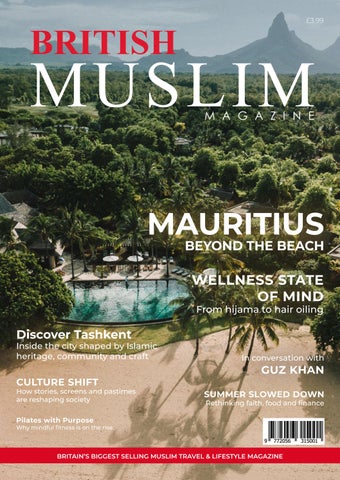
£3.99
MAURITIUS BEYOND THE BEACH
WELLNESS STATE OF MIND
From hijama to hair oiling
Discover Tashkent
Inside the city shaped by Islamic heritage, community and craft
CULTURE SHIFT
How stories, screens and pastimes are reshaping society
In conversation with
GUZ KHAN
SUMMER SLOWED DOWN Rethinking faith, food and finance
Pilates with Purpose
Why mindful fitness is on the rise
BRITAIN’S BIGGEST SELLING MUSLIM TRAVEL & LIFESTYLE MAGAZINE
BRITISH
BRITISH
MUSLIM
FROM MUSLIM the EDITOR Dear Readers
Welcome to the summer issue of British Muslim Magazine! As the days grow longer and the nights warmer, we’re excited to offer you a vibrant mix of features to make the most of this season. Our culinary section is packed with flavours perfect for summer gatherings. Whether it's smoky BBQ bites, irresistible Pakistani lamb chops, or sweet treats like trifle, we have something to delight every palate. For travel enthusiasts, explore a dreamy honeymoon in the Maldives or embark on a 12-day adventure in Sri Lanka. Closer to home, we recommend halal staycations in the Lake District, dining spots in Edinburgh, and a must-visit Swiss steakhouse. Plus, enjoy tips on gardening, summer décor ideas, and a curated list of good reads.
British Muslim Magazine is published by Syed PR & Publishing LTD Email: info@britishmuslim-magazine.com
ABOUT US
British Muslim Magazine is a UK-based title exploring modern Muslim life through travel, culture Enjoy the issue! and lifestyle, focusing on the people, Natasha Syed Editor places and stories that shape it.
Natasha Syed
Editor in Chief
Editor in Chief
Rabi’ah M
Contributor
Assistant Editor
Adam Jacot de Boinod Contributor
RAMS HA VISTRO SYED Acting Editor
Juber Ahmed Contributor
Subscribe to our annual edition QR CODE Scan me Today!
Contributor
Discover more great content www.britishmuslim-magazine
Catch up on the latest tra gossip @Britishmmag
See behind the scene @british_muslim_maga
Dear Readers
DIGITAL MARKETING COORDINATOR Burak Ayaz
DISCOVER MORE Find even more great content online britishmuslim-magazine.co.uk
Natasha Syed Instagram
Tahira Khan
Editor in Chief Assistant Editor @british_muslim_magazine Twitter @britishmmag Facebook @BritishMuslimMagazine
Sign up to our newsletter for offers, inspirations and all the latest travel news at www.britishmuslim-magazine.com
recycle
Digital Marketing Co’ordinator Cherie Ann Conway
Natasha Syed
British Muslim Magazine is a quarterly publication published by Syed PR & Publishing LTD in London, United Kingdom. © Syed PR All rights reserved. Text and pictures are copyright restricted and must not be reproduced without permission of the publishers. The information found in British Muslim Magazine is published in good faith, however you are strongly advised to check prices, dates and www.britishmuslim-magazine.com/shop opening times before making final arrangements. The opinions expressed by contributors to British Muslim Magazine are not necessary those of the publisher.
British Muslim Magazine is a quarterly publication published by Syed PR & Publishing LTD in London, United Kingdom
Digital Production Manager Dene Conway
DIGITAL PRODUCTION MANAGER Editor Emil Murad
@british_muslim_magazine
Missed our last issue?
Managing Director Muk Rajah
MANAGING DIRECTOR Enjoy the issue! Muk Rajah
Newsletter Our travel partner
Advertising Manager Robyn Shei
recommend halal staycations in the Lake and a must-visit Swiss steakhouse. Plus, e PUBLISHER ideas, and a curated Syed PR & Publishing LTDlist of good reads.
Join the chat at facebook.com/ Britishmuslimmagazine
Contributor
CEO Natasha Syed
www.britishmuslim-magazine.com
Angela Youngman
Publisher Syed PR & Publishing LT
Please recycle this magazine
Editor’s Pick
Writers Angela Youngman, Rabia Natasha Syed, Adam Jacot de Boin Juber Ahmed.
Contributor
Catch Scalp scrubs can be up on the latest travel gossip hit and miss, but this @Britishmmag Soul Scalp Scrub leaves the head feeling clean without stripping the hair. The scent is a great See behind the scene bonus. £38. syrahair.com
Assistant Editor Tahira Khan
Facebook CONTRIBUTORS Angela Youngman Join the chat at faceboo Contributor Britishmuslimmagazine Humairah Adam Welcome to the summer issue of British M Rothna Akhtar Newsletter grow longer and the nights warmer, we’re Sign up to our newsletter for off Melissa Baksh Our travel partner inspirations and all the latest travel www.britishmuslim-magazine. of to make the most of this seaso Subscribe tofeatures our Anisha Begum annual edition QR CODE with flavours perfect for summer gatherin Shanela Chaudhary Missed our last issu Scan me Today! www.britishmuslim-magazine.co irresistible Pakistani lamb chops, or sweet Shelly Dar British Muslim Magazine is a quarterly publication published Fauzia Kingdom Iqbalpalate. For travel enthusiasts recycle delight by Syed PR & Publishing LTD in London, Unitedevery Sara Khan © Syed PR All rights reserved. Text and pictures are copyright restricted and must not be reproduced without permissionadventur of the publishers. The Maldives or embark on a 12-day information found in British Muslim Magazine is published in good faith. However you are strongly advised to check prices, dates and opening times befor final arrangements. The opinions expressed by contributors to British Muslim Magazine are not necessary those of the publisher. Tahira Khan
Juber Ahmed
Discover more great content at www.britishmuslim-magazine.com
Tahira Khan
Editor In Chief Natasha Syed
MUS
EDITOR IN CHIEF & CEO Rabi’ah M Adam Jacot Tahira Khan Contributor Assistant Editor Natasha Syed de Boinod ACTING EDITOR Ramsha Vistro Syed
Advertising Manager Robyn Sheikh
Natasha Syed
British Muslim Magazine pro inspiration and advice for Mu in Britain looking for unforge and luxurious travel experien Muslim history and heritage food, fashion and style.
Website
past the postcard image to explore local life, faith and reflection. Managing Director Muk Rajah While we also dive into halal investing with Nisba. Digital Production Manager You’ll notice a strong celebration of South Asian voices Dene Conway throughout the issue as we mark South Asian Heritage Month – including a profile on Rothna Akhtar (The Apprentice), a Digital Marketing Co’ordinator conversation around Riz Ahmed’s Bait and recipes from Anisha Cherie Ann Conway Begum (MasterChef UK) – alongside stories that reflect the depth and influence of the community far beyond a single narrative. Take your time with this issue. I hope it encourages you to check in with yourself – mentally, physically or otherwise – and leaves you Website with something that stays beyond the page.
Natasha Syed Editor
British Muslim Magazine is publish Syed PR & Publishing LTD Email: info@britishmuslim-magazin
BRITISH
British Muslim Magazine provides inspiration and advice for Muslims in Britain looking for unforgettable and luxurious travel experiences, Muslim history and heritage to food, fashion and style.
There’s something interesting Welcome to the summer issue of British Muslim Magazine! As theabout days new beginnings. They force decideto very quickly matters grow longer and the nights warmer, you we’retoexcited offer you awhat vibrant mix and what doesn’t. – whether habits or generational – Syed of features to make the most of this Self-care season. Our culinarythrough section new is packed Editor In traditions Chief Natasha feels like something that matters. with flavours perfect for summer gatherings. Whether it's smoky BBQ bites, Assistant Editor Tahira Khan Across these pages, wellbeing appears in different forms: In irresistible Pakistani lamb chops, or sweet treats like trifle, we have something to Writers Angela Youngman, Rabia’M, movement and routine, with health-tech entrepreneur Juju Sheikh. delight every palate. For travel enthusiasts, explore a dreamy honeymoon in the Natasha Syed, and Adam Jacot de Boinod, In faith and self-reflection, through ideas that bring therapy Maldives or embark on a 12-day adventure in Sri Closer to home, we Juber Ahmed. prayer into theLanka. same conversation. In inherited practices like hijama recommend halal staycations in the Lake District, Publisher Syed PR & Publishing LTD and hair oiling,dining tracedspots back in to Edinburgh, their roots and how they continue and a must-visit Swiss steakhouse. Plus, enjoy tips on gardening, décor to sit within modern wellness.summer Elsewhere, it appears travel, CEO through Natasha Syed ideas, and a curated list of good reads. nourishment and financial security. Our feature on Mauritius moves
Enjoy the issue!
M A G A Z I N E
Dear Readers
ww.britishmuslim-magazine.com
M A G A Z I N E
ww.britishmuslim-magazine.
R
C
NEWSLET TER For offers, inspirations and all the latest travel news, sign up to our newsletter britishmuslim-magazine.com MISSED N ISSUE? Angela Youngman Juber A Ahmed ShopContributor past issues online Contributor britishmuslim-magazine.com/shop
Subscribe to our annual edition QR CODE Scan me Today!
Please recycle this magazine
British Muslim Magazine is a quarterly 3 publication by Syed PR & Publishing LTD in London, United K
© Syed PR All rights reserved. Text and pictures are copyright restricted and must not be reproduced without permission of the publishers. The
© Syed PR All rights reserved. Text and pictur
74
CONTENTS
WELLBEING ISSUE
46 26
18
CULTURE
24 OUT AND ABOUT Summer’s best events bring polo, culture, fashion and family entertainment together.
T R AVE L
6 SARAJEVO blends Islamic
NEWS & REVI EWS
64 BENTLEY Eid celebration with
heritage, vibrant food and stunning summer city escapes.
Bentley brings luxury, connection and Muslim women together in Cheshire.
10 MINDFUL MAURITIUS offers
turquoise coastlines, rich culture and effortless luxury escapes.
18 T ASHKENT blends Islamic heritage with a bold new cultural revival.
26 S AUDI ARABIA embraces
wellness, desert calm and luxury mindful escapes.
4
64
L IFE STYLE
16 MODERN MODEST SWIMWEAR blends luxury, confidence and effortless resort-side sophistication.
72 SUMMER READING Stories of inspiration, reflection, growth and escape for slower days.
britishmuslim -m a g a z i n e .co.uk | W EL L BEI N G I S S U E
74 CUE POINT celebrates 10 years with its first permanent British Afghan BBQ smokehouse in West London.
76 MAYFAIR CHIPPY Eid dining at The Mayfair Chippy blends British classics with refined, modern hospitality.
34
48
PROF ILE
24 RIZ AHMED’S BAIT reimagines the British thriller with sharp, subversive storytelling.
34 BEYOND THE BOARDROOM Rothna Akhtar redefines leadership through faith, calm and purpose.
42 JUJU SHEIKH Movement,
faith and balance define Juju Sheikh’s mindful approach to modern wellness.
48 KANU BEAUTY redefines hair
oiling through tradition, care and modern ritual.
60 HAARIS ASHRAF Behind the
lens, Haaris Ashraf is a grounded Muslim creative turning passion into global automotive storytelling.
66 CARROM From family pastime to formal sport through Karrom UK’s new league structure.
WELLB EING
40 SHELLY DAR Faith, identity and
24
wellbeing come together in a supportive counselling approach.
46 PILATES Women-only Pilates studios in London offering privacy, comfort and mindful movement spaces.
52 HIJAMA 101 Ancient wet
cupping therapy for circulation, balance and holistic wellbeing.
A DVIC E
70 SARA KHAN reflects on creating faith-led, age-appropriate children’s books through storytelling and design.
IN THE KI TCH E N
78 SUMMER RECIPES A fusion of
cultures through comfort dishes, desserts and home cooking.
5
P OST C C ARD S ar ajev o
SARAJEVO
Bosnia and Herzegovina Often overlooked in favour of better-known European cities, Sarajevo is quickly establishing itself as a summer hotspot. A mix of history and scenery awaits, making it particularly well-suited for travel during the warmer months. Bosnia and Herzegovina has a majority Muslim population, and halal food is widely available across Sarajevo. In Baščaršija, the old town, grilled ćevapi is a staple, alongside fresh burek sold from long-standing bakeries and small family-run eateries. The call to prayer is heard throughout central neighbourhoods, particularly around the historic core. The Gazi Husrev-beg Mosque, dating back to the 16th century, remains one of the city’s most important religious and architectural landmarks. The Emperor’s Mosque, King Fahd Mosque and others are also active places of worship, with open access for visitors and residents alike. Sarajevo brings history, faith and food into the same streets, making it an easy choice for summer travel. So, what are you waiting for? Words Ramsha Vistro
6
britishmuslim-m a g a z i n e .co.uk | W EL L BEI N G I S S U E
frantic00 / iStock
7
You’re punching Dose of reality
If your supplement shelf is starting to look like a small pharmacy, Inessa pulls things back into a single daily routine. The brand focuses on clinicianformulated vitamins and minerals, bringing together areas such as immunity and gut health into fewer, more deliberate doses. inessawellness.com
No Shade
Breakfast feeling a bit flat? Here’s the fast fix. PUNCH is a range of food toppers made from seeds, nuts, herbs and functional mushrooms, designed to be sprinkled over anything from eggs to porridge for instant texture and flavour. punchyourfood.com
SPF, but make it behave. Stil is formulated with zinc oxide to protect against UVA and UVB rays while sitting lightly on the skin. Designed for sensitive skin, it focuses on a smooth, invisible finish. stilsuncare.com
LIFEST Y LE
Less candle, more statement piece. SABIRAH’s blush pink cloche candle, Signature, is something you’ll probably leave on display long after it’s burned out. Handpoured using natural soy wax, it’s been developed with a Surrey-based perfumer, created with longevity in mind. sabirah.co.uk
Face Value
Built on Korean skincare science, Skinporter centres on a single “clinic facial at home” treatment. It uses oxygen technology, peptides and botanical actives to replicate a multi-step professional facial in one application, replacing layered routines with a more streamlined process. skinporter.com
On Our Rad ar
Hot take
ON OUR
RADAR
Spill the chai
Our curated edit of travel, beauty and lifestyle finds worth noting each season
CHAI CO bottles the ritual of karak chai into a ready-to-drink format. Inspired by the strong, spiced tea poured across South Asian homes and cafés, it keeps the blend of milk, tea and spice intact – just without the kettle. A perfect summer drink. chaico.uk
Words Ramsha Vistro
Oiled up Stick with it
What if your daily vitamins could just… stick with you? Hapi Patch uses skin-applied patches to deliver vitamins, minerals and plant-based ingredients gradually over time. It’s a simple switch from tablets and drinks to something you wear and forget about. hapipatch.com
8
britishmuslim -m a g a z i n e .co.uk | W EL L BEI NG I S S U E
Smash Hit
Padel’s having a moment, and Padelsmith is stepping onto court with performance and purpose built in from the start. The Muslim-owned British brand makes just one racket – handcrafted in Andalucía using European carbon fibre and created for players who take their post-work matches very seriously. Suddenly, tennis whites feel slightly underdressed. padelsmith.co.uk
MAALUSH revives the age-old ritual of hair oiling with better timing and fewer excuses. What was once a heavyhanded tradition becomes a more deliberate act of selfcare – slightly messy in theory, but satisfying in practice – and proof that old habits can still have maincharacter energy. maalush.com
Gut feeling
Looking for a travel companion that earns its space in your hand luggage? SMART STRAINS is a science-led range from Dr Megan Rossi, designed to support the gut through the usual travel chaos – long flights, unfamiliar food and disrupted routines. Instead of one generic probiotic, it uses targeted strains for specific needs, making it feel less like a supplement and more like a travel essential. smartstrains.com
9
T
Maur i ti us
T RAVEL
MAURITIUS & MARADIVA AT A GLANCE
he warm blast of heat hits my face as we wait outside the arrivals lounge at Sir Seewoosagur Ramgoolam International Airport, soon met by Kuzagen, our driver. He steers a sleek 4x4 BMW and greets us with a warm smile. “Welcome to the land of sugarcane,” he says as we begin the 45-minute drive westward toward Maradiva Resort & Spa. Along the way, Mauritius unveils itself in flashes of turquoise coastline, lush greenery and a vibrant cultural tapestry woven from African, Indian and European influences. Our friend – now nicknamed ‘Kuz’ – entertains us with stories of colonial history and independence.
Location: West Coast, Mauritius Resort Size: 24 acres Beachfront: 750 metre private beach Accommodation: All-villa luxury with private pools Wellness Focus: Ayurveda, yoga, holistic spa therapies Signature Experience: Helicopter view of the underwater waterfall at Le Morne Brabant Marine Life: Bottlenose dolphins at Tamarin Bay Adventure Highlights: Le Morne Brabant hike, Tamarind Falls, ziplining at La Vallée des Couleurs Cultural Insight: Multicultural heritage blending African, Indian, and European influences Mosques to Visit: Jummah Mosque, Al Aqsa Mosque, RonaqUl-Islam Sunnee Masjid, Rose Belle Mosque, Masjid Noor-E-Islam, Goodlands Jummah Masjid Halal Dining: Widely available across resorts and local restaurants Best Time to Visit: May–November (cooler, drier weather) Nearest Airport: Sir Seewoosagur Ramgoolam International Airport
Mindful MAURITIUS
THE SCENIC WELCOME
At Maradiva’s entrance, staff in beige embroidered attire greet us. The open-air reception is framed by a striking wooden roof and a sculptural gold chandelier. Pale stone walls, bamboo furnishings and tranquil water features create immediate serenity. Beneath small bridges, koi fish glide through ponds surrounded by tropical landscaping.
Birdsong mingles with the warm sea breeze as we are offered cool towels and a Mauritian herbal elixir. We are taken in a white buggy with our butler, Vijay, and I am introduced to Babita, the housekeeping manager. The resort spans 24 acres with a 750-metre private beach, providing space to exhale both physically and emotionally. Privacy here is not just a luxury; it is an invitation to reconnect with oneself.
Words Tahira Khan
10
britishmuslim -m a g a z i n e .co.uk | W EL L BEIN G I S S U E
11
T RAVEL Maur i ti us
OTHER UNIQUE EXPERIENCES TO TRY Aromatherapy Workshop at a Plantation: Learn to create natural essential oils from ylangylang and vanilla Forest Bathing at Ebony Forest Reserve: Guided mindfulness in endemic flora, perfect for spiritual reflection. Traditional Sega Dance and Music Session: Connect with the island’s soulful rhythms while remaining culturally immersive.
EXPLORING NATURAL HARMONY AND CULTURAL UNITY
Clockwise: Couples treatment room at the Maradiva Holistic Spa. The terrace at Cassine. A table at Cassine.
THE FRANGIPANI BEACH VILLA A buggy transports us to our beachview villa, where a private heated pool awaits. The courtyard reveals stone walls, wooden beams and mint-toned interiors softened by white linens. An outdoor shower opens to the sky, and outside, the scent of Frangipani. The day unfolds leisurely: at the boathouse, Shiva helps us arrange complimentary water sports, from windsurfing and snorkelling to a glassbottom boat tour. Holding up the sail during windsurfing while balancing against the breeze proves challenging yet exhilarating, and falling into the water becomes part of the fun. As dusk settles from gold to indigo, a sense of calm envelops me.
12
MORNING MINDFULNESS WITH OCEAN THERAPY
At dawn, the lagoon glows goldenblue, and my companion Alina is peacefully sleeping. I lay my prayer mat down in the courtyard and offer my Fajr prayers before the sun rises. I am chanting with gratitude and whispering Alhumdulillah on my prayer beads repeatedly as I witness a grey wild rabbit hopping quietly near me; he stops and watches me for a while. I notice birds perch along the courtyard walls. The moment feels enchanting serving as a reminder that spiritual practice can intertwine seamlessly with nature. I take a barefoot walk along the shoreline, before performing yoga stretches and a gentle swim in the lagoon. Breakfast at Cassine celebrates morning freshness. I have a honey and ginger shot along with tropical fruits. Watermelon juice is made upon my request, poached eggs on sourdough, and warm pastries, all prepared in the halal way.
britishmuslim -m a g a z i n e .co.uk | W EL L BEI N G I S S U E
AYURVEDIC HEALING AT THE HOLISTIC SPA
I am booked in at the Maradiva Holistic Spa for an Ayurvedic consultation with Dr Praveen Nair. Through pulse assessment and discussion, he explains that my constitution is predominantly earth and water with a touch of fire: stable yet carrying subtle stress. My therapist Rekha presents me with a selection of signature rituals and packages such as the Pavani (detoxifying) and Tejas (stimulating) according to my needs. I decide on The Divine Signature Renewal Massage. She blends aromatic oils aligned with my elemental balance, and I am placed on a traditional wooden block layered with towels. She begins by applying warm oil streams across my scalp with her dexterous hands while rhythmic strokes dissolve tension; before the focus shifts to my forearms, funnily enough. Afterward, I sip an apple and cinnamon detox tea, as I recover from feeling spaced out.
The adventure continues over the next few days. Swimming with dolphins at Tamarin Bay, hiking Le Morne Brabant and marvelling at Crystal Rock all invite a dialogue between courage, mindfulness and awe. A helicopter ride above Le Morne reveals the island’s famous underwater waterfall illusion, a magical reminder of the power of perspective. Before dawn, we are collected by JPH Charter and head towards Tamarin Bay to begin our first activity of the day. “Are you going to swim with the dolphins or just watch?” I ask an Australian honeymoon couple aboard our boat. They laugh confidently, clearly ready to dive in. Soon, bottlenose dolphins appear, gliding in perfect harmony through the deep waters of the Indian Ocean. The instructor calls out for us to
prepare; my heart pounds, and Alina – already prepared – eagerly jumps in. But at the last moment I hesitate, as a childhood memory of nearly drowning in the sea resurfaces unexpectedly. Instead, I take the wheel of the boat at full speed. Excited, Alina later tells me she even managed to touch one of the dolphins, though she briefly panicked when water rushed into her mask. I feel inspired and realise that through her courage, I am beginning to confront my own fears. The instructor then directs the boat towards the shore, where turtles swim beneath us in the shallower waters. Eventually, he convinces me to take the plunge and challenge my fear. The following day, we are scheduled for a hike through the volcanic colours of Chamarel and towards the windswept symbolism of Le Morne; a mountain and UNESCO heritage site. After a long and enduring climb up the mountain, I am exhausted and retreat to the spa. I relax in the heated pool, take a hot shower, and dry off in the sauna and laconicum.
Mauritian Halal Culinary Workshop: Cook plant-based, Ayurvedic-inspired dishes using local, seasonal ingredients. Sunset Paddle boarding in the Lagoon: Gentle exercise with meditation amid stunning sunset hues.
DINNER AND WIND DOWN
Later that evening, we dine at ‘Haiku,’ the Japanese restaurant at Maradiva. Fresh dishes are prepared in front of us in the open kitchen. We indulge in chicken teriyaki, sushi and egg fried rice, finishing with mochi ice cream for dessert. As we walk past ‘Jardins Le Star’ – the garden of stars where well-known guests plant a tree as part of Maradiva’s sustainability vision – the night sky glitters above us. Back in our room, we notice our wet clothes neatly placed on an airer outside and a prayer mat carefully laid on the sofa. I am touched by this and know Babita was behind this for sure. Baby geckos cling quietly to the walls; although harmless, they keep us slightly amused as we spend the evening stargazing beneath the warm night sky. I feel inclined to do a voluntary night prayer, Tuhajjud, where God (Allah) descends to the lowest of heavens to answer all prayers.
13
T RAVEL Maur i ti us
Radisson Blu Poste Lafayette Resort & Spa Exclusive
The underwater waterfall near Le Morne Brabant.
THE UNDERWATER WATERFALL, SEVEN CASCADES, PORT LOUIS AND BELMONT
One of the highlights of the trip arrives the next day. We drive to Belmont helipad to witness the underwater waterfall illusion near Le Morne Brabant. Settling into the helicopter, we lift off and curve along the southwest coast of Mauritius. Below us, the lagoon shifts from turquoise to deep sapphire. Then suddenly, I see it what appears to be a powerful waterfall plunging endlessly into the ocean. From above, the illusion is breath-taking. Sand and silt cascade off the edge of the underwater shelf, creating the appearance of water pouring into a vast abyss. Hovering above the lagoon’s edge, I feel a strange mixture of awe and humility, as though I am witnessing nature perform an ancient, secret ritual. The contrast between the crystalclear shallows and the dramatic drop beyond feels almost otherworldly and compels me to praise my Creator. With the iconic silhouette of Le Morne Brabant rising proudly from the peninsula, the entire scene feels both cinematic and sacred. It is not simply a sightseeing moment; it is a reminder of how powerful perspective
14
can be. From the right angle, nature reveals illusions so perfect they seem like magic. Our adventures continue with a hike through Tamarind Falls, also known as the Seven Cascades, where we trek through rainforest and natural pools. At La Vallée des Couleurs Nature Park, we experience our first waterfall zip ride, our hearts racing as we soar above jungle and river below. Later, we head to the Belmont Horse Riding School for an hour-long ride along the beach, complete with a photoshoot session. After finishing, we drive through nearby villages and encounter pilgrims celebrating the festival of Maha Shivaratri, carrying decorated statues. Their devotion beneath the hot sun is deeply moving. On the way back, we also pass the Grand Bois Jummah Mosque near Grand Bassin. At the Caudan Waterfront in Port Louis, we explore craft markets and modern boutiques, sipping fresh sugarcane juice with crushed ice and coconut water. Back at the resort, a sudden monsoon rain sweeps across the lagoon. “It’s cyclone season,” Vijay tells us. Without hesitation, we jump into the warm lagoon fully clothed, laughing as rain pours down from the heavens. It feels cleansing, primal, and wonderfully alive.
britishmuslim -m a g a z i n e .co.uk | W EL L BEI N G I S S U E
STILLNESS AND REFLECTION
On departure, as sugarcane fields blur past, I realise Mauritius is more than a destination. It is a paradise which is not only seen but felt and heard in waves. The island reveals itself through landscapes, faith and culture. Maradiva Villas Resort & Spa allows Muslim travellers to experience luxury without leaving faith behind. maradiva.com
TIPS FOR MUSLIM TRAVELLERS
All Inclusive Save up to 23% FREE Meal Upgrade from Half Board to All Inclusive
7 Nights fr £1295*pp Crystals Beach Resort Belle Mare, a Member of Radisson Individuals
Carry a compact prayer mat for beaches or lagoon-side prayers.
Superior Radisson Blue Azuri Resort & Spa Exclusive
Exclusive
Sunrise and sunset are perfect times for reflection on the beach. Many mosques welcome visitors for architectural and cultural appreciation outside prayer times.
All Inclusive Save up to 23% FREE Meal Upgrade from Half Board to All Inclusive
7 Nights fr £1299*pp
All Inclusive Save up to 23% FREE Meal Upgrade from Half Board to All Inclusive
7 Nights fr £1319*pp
0208 843 4444 www.southalltravel.co.uk *Prices shown are per person and correct at the time of publishing. All prices and offers are subject to change and are extremely limited. Terms & conditions apply.
LIFEST Y LE
LIFEST Y LE Mo d est S wi m sui ts
SUNSHINE
From poolside lounging to shoreline dips, these modest swimwear pieces do the most while showing the least – in the best possible way
Eden Plush Pear | 23 Eau de Parfum 50ml, £80, Kayali A dreamy fruity floral fragrance bursting with juicy pear, mandarin and soft gardenia. Wrapped in creamy vanilla caviar and warm woods, it captures nostalgic, sunlit moments with a radiant, comforting scent. Playful yet sophisticated, this fragrance leaves a delicate, longlasting trail of sweetness. uk.kayali.com
Words Natasha Syed Modest swimwear has slowly become one of the most interesting shifts in resort fashion. What used to be defined mainly by coverage is now being reinterpreted through design – elevated fabrics, thoughtful cuts and a clear move towards modern luxury. At the centre of this new direction is Rialine. The brand has built its identity around simplicity done well – muted tones, uncluttered silhouettes and pieces that feel refined. It’s modest swimwear, but with a distinctly contemporary edge. Alongside it, Lyra brings a softer, more fluid approach. There’s an ease to the designs – less about structure and more about comfort and versatility. These are pieces that work just as well on a beach in Marbella as they do layered under resort wear for a city break. Then there’s Lanuuk, which has carved out a strong space by focusing on practicality. Everything feels considered; secure fits, flattering coverage and designs that are made to be worn with confidence. What’s interesting is how these newer modest-focused brands sit alongside some of the more established names shaping global swimwear culture. In the UK, Hunza G continues to lead with its instantly recognisable crinkle fabric and one-size adaptability. It has become a staple for women who want simplicity with impact. On the high street, Marks & Spencer remains a go-to for accessible modest swimwea; offering supportive cuts, higher necklines and practical designs that don’t compromise on comfort or wearability. At the luxury end, Eres is still the benchmark for refined swimwear tailoring. Clean, structured, and beautifully minimal, it’s a favourite in high-fashion circles. Alongside it, Melissa Odabash brings a more glamorous resort feel – polished silhouettes with a sense of holiday sophistication. And then there’s Matteau, which captures that understated, editorial aesthetic so many women are drawn to right now. Timeless, restrained and incredibly wearable, it fits perfectly into the minimalist direction shaping the category. Taken together, this mix of emerging modest labels and established international brands shows where swimwear is clearly heading: less about excess, more about intention.
16
britishmuslim -m a g a z i n e .co.uk | W EL L BEIN G I S S U E
L’eau Papier Eau De Toilette 100ml, £102, Diptyque Paris Soft, airy, and naturally classy, Diptyque L’Eau Papier Eau de Toilette is the perfect summer scent. Notes of white musk, steamed rice, mimosa and blonde woods create a clean, skin-like fragrance that feels light in warm weather. Delicate yet comforting, it leaves a fresh, creamy trail ideal for sunny days and relaxed summer evenings. diptyqueparis.com
S um m er S cents
COVER ME IN
Sweet Escape Eau de Parfum 50ml, £50, Sunnamusk A warm amber fragrance that transports you to a mystical woodland, where sunlight filters through the leaves. A radiant opening of jasmine and saffron leads into a smooth cedarwood heart, before settling into a sensual base of ambergris and musk, leaving a rich, woody and bittersweet trail. sunnamusk.com
Elysium Pour Femme Eau de Parfum 75ml, £255, ROJA London This is a dreamy floral fragrance that blends soft peach, delicate peony and sensual musk into an elegant, powerful scent. Inspired by fragrant paradise, it captures femininity with sophistication and warmth. Luxurious and timeless, Elysium encourages confidence, beauty and natural charm. rojalondon.com
SUMMER IN A BOTTLE Crisp citrus, soft florals and richer woody accords define this fragrance line-up, chosen for wearability in heat and ease from day to night. A season, bottled. Words Natasha Syed
Main image: Crazy in Love - Pink & Orange Swim Leggings - £34.99 | Rialine.co.uk, Pink & Orange Swimsuit - £44.99 | Rialine.co.uk Left: Nabila Lavender (also available in Sky Blue and Sage) - £80,00 | Lyramodest.com Right: Diana Swim Dress – Coral £72.99 | Lanuuk.com
Bellavita Luxury Honey Oud Eau de Parfum 100ml, £19.99, Oud & Bloom A rich oriental unisex fragrance blending sweet honey, bergamot, rose and deep oud. It offers a warm, long-lasting aroma with woody intensity and floral softness, designed for evenings, celebrations and statement moments, delivering a sensual, memorable balance between sweetness and depth. oudandbloom.co.uk
Bentley Become Eau de Parfum 100ml, £80, Bentley Motors Created by perfumer Alienor Massenet, this captivating perfume is a bold and empowering fragrance blending vibrant citrus, spicy black pepper, juniper berry, myrrh, cedarwood, sandalwood, vetiver and patchouli. It balances freshness and warmth inspiring confidence and individuality. shop.bentleymotors.com
Amouage Guidance 46 Extrait de Parfum 100ml, £445, Liberty London An exceptional extrait from Amouage’s Odyssey Collection, offering a richer interpretation of the original Guidance. At a generous concentration, this floral woody fragrance becomes more petally, juicy and precious. It reflects the Loud & Whisper concept, enhancing depth and intensity while preserving the original signature composition beautifully. libertylondon.com
Rose Prick Eau De Parfum 30ml, £188, TOM FORD Tom Ford Rose Prick Eau de Parfum is a sophisticated floral fragrance inspired by an English rose garden in full bloom. Bulgarian and Turkish roses blend with spicy Sichuan pepper and turmeric, while patchouli and tonka bean add warmth and depth. Elegant, fresh, and luxurious, it captures the essence of summer romance beautifully. spacenk.com
17
T RAVEL Uz bek i stan
TASHKENT IN TRANSITION
From Islamic heritage centres to contemporary art spaces, discover the cultural revival reshaping Uzbekistan’s capital Words Melissa Baksh
L
ong regarded as a historic gateway to the Silk Road, Tashkent is the largest and one of the most populous cities in Central Asia. Much of Tashkent was transformed following the devastating earthquake of 1966, which destroyed large parts of the city. In the decades that followed, it was rebuilt as a model Soviet capital, giving rise to an urban landscape defined by sprawling public spaces and distinctive Modernist architecture, with landmarks such as Hotel Uzbekistan and Chorsu Bazaar remaining as enduring symbols of this period.
Today, Tashkent is experiencing a cultural renaissance. Alongside its distinct architectural heritage, a new wave of museums, galleries and cultural institutions (including the National Museum of Uzbekistan set to open in 2028) are reshaping the city’s creative landscape and positioning Uzbekistan as an emerging centre for arts and culture. With its unique blend of cultural history, modernist architecture and artisanal traditions, there has rarely been a more exciting moment to visit Tashkent.
18
britishmuslim -m a g a z i n e .co.uk | W EL L BEI N G I S S U E
19
Left: Centre for Islamic Civilisation Below: Exterior of the Centre for Islamic Civilisation, Zarkaynar Street, Almazar
CENTRE FOR ISLAMIC CIVILISATION
Taking centre stage in the newly renovated Zarkaynar Street in Almazar is the recently opened Centre for Islamic Civilisation. Nine years in the making, the vast three-storey complex spans almost 50,000 square metres, crowned by a striking turquoise dome rising 65 metres high. Dedicated to preserving and showcasing Islam’s spiritual, intellectual, and artistic heritage, the Centre combines monumental architecture with an innovative and highly immersive visitor experience, including the region’s first dedicated Children’s Museum. Visitors enter through the Hall of Honour, where 14 mosaic arches depict pivotal moments and influential figures from Central Asian history. From here, the galleries unfold across more than 3,000 years of civilisation. The Hall of Pre-Islamic Civilisation traces the development of ancient civilisations such Bactria, Sogdiana and Khwarazm through remarkable Kushan, Zoroastrian and Buddhist artefacts, including a rare double-headed serpent sculpture from the Fergana Valley and a 2nd-century seated Buddha. The First Renaissance Hall explores the flourishing of Islamic culture in Central Asia between the 8th and 13th centuries, featuring intricate scale models of architectural masterpieces such as the Samanid Mausoleum and Magok-i-Attari Mosque. Among the Centre’s most extraordinary displays are sacred objects connected to the Ka’bah, including 13thcentury Mamluk keys, a complete Kiswah from 1988 and a surviving fragment from 1859. The experience culminates beneath the great central dome in the Qur’an Hall, home to the legendary Samarkand Kufic Qur’an – also known as the Usman Qur’an – one of the oldest surviving Qur’an manuscripts in the world, believed to date from the 7th century. Among the manuscripts is the Bozuband Qur’an manuscript, copied by the calligrapher Sultan Muhammad in 1589 in an octagonal form and also used as a tumar – an amulet. iccu.uz/en 20
britishmuslim -m a g a z i n e .co.uk | W EL L BE I N G I S S U E
Left: Akbar Rakhimov. Below: Centre for Contemporary Arts in Tashkent (CCA). View of the main courtyard. Render © Studio KO. Courtesy of the Uzbekistan Art and Culture Development Foundation (ACDF).
CENTRE FOR CONTEMPORARY ARTS
Opening in September is The Centre for Contemporary Arts Tashkent (CCA), marking a major milestone for contemporary art in Uzbekistan. Founded under the leadership of Gayane Umerova and developed by the Uzbekistan Art and Culture Development Foundation (ACDF), the CCA will become the country’s first permanent institution dedicated to contemporary art, research, and public engagement. Housed in a restored 1912 industrial building redesigned by Studio KO, the centre aims to serve as both a cultural hub for Central Asia and a community space for Tashkent. Led by Artistic Director and Chief Curator Sara Raza, the programme combines exhibitions, residencies, research initiatives, internships, and interdisciplinary public events. Free and open to all, the CCA will also include a library, workshops, and café designed to encourage dialogue across
generations and cultures. The centre’s inaugural exhibition, Hikmah, will explore themes of wisdom, spirituality and intelligence through site-specific commissions responding to the architecture of the new building. Featuring a roster of international artists including Muhannad Shono, Nari Ward, Kimsooja and Ali Cherri, the exhibition positions Tashkent within an expanding global contemporary art dialogue. ccat.uz/en 21
T RAVEL
Nestled within a tranquil studio complex, the Rakhimov Ceramic Studio is home to three generations of one of Uzbekistan’s most celebrated ceramic dynasties, whose artistic lineage spans more than six generations. Working side by side, ceramicists Akbar Rakhimov, Alisher Rakhimov and Shokhrukh Rakhimov continue to preserve and reinterpret the country’s rich ceramic traditions through handcrafted works made using local clays, natural pigments and time-honoured techniques. Their practice builds upon the legacy of the renowned master ceramicist Mukhitdin Rakhimov, father of Akbar Rakhimov, and one of the leading figures in the revival and study of Uzbek ceramics. His influential publications, Artistic Ceramics of Uzbekistan and Architectural Ceramics of Uzbekistan remain foundational texts on the subject. More than simply a working studio, the space functions as a living archive of Uzbekistan’s ceramic heritage. Alongside shelves of vividly glazed vessels and intricately decorated works, visitors can also discover archaeological fragments and ceramic finds dating back to the 10th century, offering a rare connection between the country’s ancient artistic traditions and their contemporary continuation. ceramic.uz
Uz bek i stan
RAKHIMOV CERAMIC STUDIO
T RAVEL Uz bek i stan
different
GOZAR OF ARTISANS
Also initiated by the ACDF and in collaboration with Lebanese designer Nada Debs, the Gozar of Artisans is a thoughtfully reimagined cultural space located within Tashkent’s historic blacksmith quarter. Set within the grounds of the restored 18th-century Okhun Gozar Mosque (1775), the initiative highlights the neighbourhood’s legacy of Gozar, where craftmanship sits at the centre of community. Conceived as both a craft hub and cultural destination, Gozar initiates a dialogue between past and present, celebrating Uzbekistan’s rich and enduring artisanal traditions while presenting them through a modern lens. Visitors can discover master artistry from across the country, including Fergana ceramics, Bukhara embroidery, Khiva wood carving, Samarkand stone carving, intricate metalwork and traditional jewellery. Moving beyond a concept store, Gozar of Artisans elevates Uzbekistan’s creative heritage, preserving centuries-old techniques while supporting a new generation of makers and designers. @okhun.gozar
Top: Main Hall of Gozar of Artisans Bottom: Exterior of the Gozar of Artisans (Photos Courtesy of Sebastian Botcher and the Uzbekistan Art and Culture Development Foundation)
22
britishmuslim -m a g a z i n e .co.uk | W EL L BEI N G I S S U E
A KIND OF MUSLIM TRAVEL Why a new generation of young Muslims is beginning to travel differently.
S
omewhere between the pace of London life and the constant movement of work, deadlines and routine, many young Muslims are beginning to search for something slower, richer and more meaningful.
Across the city, a generation of Muslim professionals are quietly building lives that stretch beyond their careers alone. They are hosting book clubs and community dinners, mentoring young people, building charities and creative projects, reconnecting with faith and culture, and creating spaces where identity and purpose still feel present within modern life. Increasingly, that same mindset is shaping the way they travel too. What began as conversations between two friends working within youth and community spaces across the UK slowly evolved into a wider idea: creating culturally rooted journeys for a generation searching for something deeper from travel. Named after the famed Ottoman traveller Evliya Çelebi, Evliya Travels draws inspiration from a tradition of exploration rooted not only in places, but in people, stories and civilisation. Today, many who travel with Evliya join alone. Yet somewhere between wandering Sarajevo’s old streets at
dusk, hearing the call to prayer echo across the hills of Mostar, sitting in a café tucked away in Tirana, or walking through the old medinas of Fez long after the evening crowds have faded, strangers quickly stop feeling like strangers. Bosnia remains the heart of the Evliya experience. There is something about the country that lingers with people long after they return home, perhaps its layered Islamic history, its quiet resilience, or simply the feeling of discovering a part of Europe where faith, memory and everyday life still feel deeply intertwined. That same atmosphere can be felt across Evliya’s wider journeys too, from Albania and Montenegro to Morocco and Southern Spain. Conversations continuing late into the evening. Histories that once felt distant in books suddenly becoming tangible and alive in front of you. A slower and more thoughtful way of experiencing the world alongside people who arrive as strangers and often leave as friends. At a time when so much modern travel feels transactional and forgettable, a different kind of Muslim travel culture is quietly beginning to emerge, one rooted in history, friendship, curiosity and shared experience. Evliya Travels is simply one expression of that shift.
Instagram: @evliyatravels www.evliyatravels.com 23
S o uther n Asi an Her i tag e E v ents
C U LT U RE
OUT AND ABOUT
STAND-UP TOUR LAUGHS
Tex Ilyas Comedy Show returns this July, September & November across selected UK venues, bringing his signature blend of sharp wit, cultural observations and relatable storytelling. Expect a high-energy night filled with laughter, crowd interaction and fresh material alongside fan favourites.
The latest theatre shows, family-friendly activities and events not to miss
July tour dates will be announced soon, with tickets available via official listings and participating venues.
The Parks Trust Milton Keynes
British designer Daniel Fletcher
OF ROOTS AND ROUTES Dates: June-July 2026 Of Roots and Routes is an immersive exhibition by Almas Art Foundation exploring heritage, identity, and cultural journeys through contemporary art, storytelling, and visual works. Emerging and established artists come together in an intimate, curated setting designed for reflection and dialogue. Limited, first-come entry.
ROYAL RACING ELEGANCE
The iconic Royal Ascot returns to Ascot Racecourse from 16–20 June, featuring world-class racing, luxury hospitality and high fashion, including the renowned Ladies Day. For tickets and more information, visit ascot.com
For tickets and more information, visit ofrootsandroutes.com
HERITAGE MONTH CELEBRATIONS
South Asian Heritage Month is celebrated across the UK from mid-July to mid-August, honouring South Asian history, culture and contribution through a vibrant programme of events and activities. Key highlights include Melā and Birmingham Weekender, showcasing music, food, dance and cultural performances.
More information is available at southasianheritage.org.uk
Track action at the 2024 Goodwood Revival. by Dominic James
COLOUR STYLE EVENING
Bicester Village presents an exclusive evening at The Z Double Red Duke with Charlotte Tilbury and Monica Vinader, exploring colour theory, beauty and personal styling through live demonstrations and expert-led styling. Guests will enjoy refreshments, personalised advice, exclusive gifts and redeemable boutique credit in a luxury setting. Spaces are limited and available on a first-come, first-served basis. Visit thebicestercollection.com 24
britishmuslim -m a g a z i n e .co.uk | W EL L BE I N G I S S U E
VINTAGE RACING WEEKEND SUMMER OF POLO
The prestigious Chestertons Polo in the Park returns to Hurlingham Park from 5–7 June, featuring fast-paced international polo alongside pitchside parties, live entertainment, gourmet street food and luxury shopping. For tickets and more information, visit polointheparklondon.com
The iconic Goodwood Revival returns to Goodwood Motor Circuit from 12–14 September, celebrating the golden age of motor racing with a nostalgic weekend of historic cars, period dress and thrilling track action. Set in a fully immersive 1940s–60s atmosphere, the event blends classic racing, vintage style, live entertainment and artisan food for a truly unique experience. For tickets and more information, visit goodwood.com
SUMMER STAGE SEASON
The summer season at Regent’s Park Open Air Theatre returns with a standout programme of open-air productions under the stars in one of London’s most iconic outdoor venues. Expect a mix of drama, musicals and family favourites in a unique natural setting at the heart of the city. Tickets and full listings are available via the official theatre website and authorised ticketing partners. 25
SAUDI ARABIA’S WELLNESS AWAKENING
There is a moment, just after sunrise in the Saudi desert, when everything feels suspended. The air is still cool. The sand holds the last memory of night. And for many travellers arriving in Saudi Arabia’s new wave of wellness destinations, it is often in this silence that something unexpected happens — not escape, but clarity. Across the Kingdom, a different kind of travel story is unfolding. One that is less about sightseeing and more about slowing down. Less about consumption, and more about restoration. From the Red Sea coastline to the volcanic landscapes of AlUla, Saudi Arabia is quietly positioning itself as one of the world’s most ambitious wellness destinations — where luxury, nature, and selfreflection converge. And increasingly, it is becoming a place where people don’t just visit — they recalibrate.
Where Wellness Begins with the Landscape Along Saudi Arabia’s western coastline, the Red Sea is transforming into a vast regenerative tourism region led by Red Sea Global. But beyond the architectural ambition and luxury branding, what defines it most is atmosphere. Here, wellness is not confined to spa rooms. It begins in the environment itself. Eco-luxury resorts such as Six Senses Southern Dunes, Shebara, Desert Rock, and Nujuma, a Ritz-Carlton Reserve, are shaping a new vocabulary of travel — one where sustainability and stillness sit alongside five-star comfort. At Six Senses Southern Dunes, wellness is structured around desert rhythm. Guests wake with guided breathwork as the sun rises over the 26
dunes, followed by movement sessions designed to reconnect body and mind. The resort’s spa integrates holistic healing traditions with modern science, offering everything from hydrotherapy to personalised wellness journeys. Further out at sea, Shebara Resort floats almost like a vision — futuristic overwater villas designed with sustainability at their core. The experience is intentionally quiet. No rush, no excess, just water, horizon, and time. At Desert Rock, carved directly into ancient granite formations, the landscape becomes architecture itself. Guests move through spaces shaped by nature rather than imposed upon it. It is here that many describe a feeling of returning to something older than modern travel — something instinctive.
britishmuslim -m a g a z i n e .co.uk | W EL L BE I N G I S S U E
Shebara Resort
Nujuma Ritz-Carlton
Riyadh, Jeddah, and the Rise of Urban Wellness Culture While the Red Sea represents stillness, Saudi Arabia’s cities represent energy — and increasingly, wellness within movement. In Riyadh and Jeddah, luxury spas and wellness centres are becoming part of everyday urban life. High-end hotel spas such as those at The Ritz-Carlton Riyadh, Four Seasons Riyadh, and Jeddah’s waterfront resorts now offer treatments influenced by global traditions, including Ayurvedic-inspired therapies, deep tissue recovery programmes, and hammam rituals. In Jeddah, this wellness culture extends far beyond hotel spas. Along the Jeddah Corniche, early morning and sunset have become informal wellness hours, where locals walk, jog, cycle, and gather by the sea as part of daily wellbeing routines. The waterfront itself has evolved into a kind of open-air wellness space, blending movement, fresh air, and reflection against the backdrop of the Red Sea. The city is also home to a growing
number of specialist recovery and lifestyle wellness studios, offering everything from contrast therapy (ice baths and sauna cycles) to physiotherapy-led movement training, Pilates, reformer Pilates, and functional fitness programmes designed for long-term health rather than aesthetics alone. Boutique wellness spaces in districts such as Al Shati and Al Zahra are increasingly focusing on holistic routines that combine strength, mobility, breathwork, and recovery. Jeddah’s hospitality sector is also playing a role in this shift. Luxury hotels along the coast are introducing wellness day passes, allowing residents and travellers to access spa circuits, private beach yoga sessions, sound healing experiences, and guided meditation classes overlooking the sea. Sunset yoga on rooftops and beach platforms has become particularly popular, often paired with breathwork and gentle mobility sessions designed to reset the nervous system after busy urban schedules. Ayurveda, in particular, has found a
quiet but growing presence in Saudi luxury hospitality. While not always branded explicitly as Ayurvedic clinics, many spa menus now incorporate Ayurvedic principles such as dosha-balancing oils, herbal compress therapies, and personalised detox rituals — blending South Asian healing traditions with Middle Eastern hospitality. Alongside this, Saudi Arabia’s wellness identity is also being shaped by seasonal cultural events. Riyadh Season and Jeddah Season increasingly include wellness activations — outdoor yoga sessions, wellness pop-ups, fitness zones, and curated dining experiences that bring together food, culture, and health in one space. In Jeddah especially, wellness is no longer confined to spa spaces — it is becoming part of the city’s rhythm itself: in the coastline walks, the café culture built around mindful living, the rise of plant-forward dining concepts, and the growing popularity of community fitness events that turn the city into an open, living wellness circuit. 27
T RAVEL S aud i Ar abi a
Eco-Resorts and the Philosophy of Regeneration Saudi Arabia’s wellness movement is increasingly tied to a broader ecological ambition: regeneration rather than development. Unlike traditional resort models, many of the Red Sea projects are designed to restore coral reefs, protect marine biodiversity, and limit environmental disruption. This has given rise to a new category of travel experience — ecowellness resorts where the act of staying contributes directly to environmental healing. For travellers, this creates a subtle but powerful shift in mindset. Wellness is no longer just personal. It becomes collective. The idea that rest can also repair the planet reframes the entire experience of luxury travel.
T RAVEL S aud i Ar abi a Desert Rock
Food, Wellness, and the Return to Simplicity Food is becoming a central part of Saudi Arabia’s wellness story. Across the Kingdom, food festivals and seasonal culinary events are evolving beyond entertainment into lifestyle experiences. The Saudi Food Festival, along with Riyadh and Jeddah’s broader culinary seasons, now highlight not only global cuisine but also nutrition-led dining, organic sourcing, and mindful eating concepts. At many wellness resorts, dining is intentionally structured around balance — plant-forward menus, fresh seafood from the Red Sea, locally sourced ingredients, and hydration-focused wellness drinks infused with regional herbs and botanicals. There is a growing recognition that food is not separate from wellness — it is part of it. The Spa as a Journey, Not a Service Luxury spas across Saudi Arabia are also evolving into immersive journeys rather than standalone services. At destinations like Six Senses and the upcoming wellness retreats across the Red Sea, spa experiences are designed as multi-day pathways — combining massage therapy, breathwork, guided meditation, sound healing, and nutritional planning. Some resorts are integrating Ayurvedic-inspired wellness journeys, where guests are guided through personalised routines based on energy balance, sleep cycles, and dietary rhythm. These programmes often include herbal treatments, oil therapies, and detoxification rituals rooted in ancient Indian healing philosophy, adapted for modern luxury travel. 28
What makes this shift significant is not just the treatments themselves, but the philosophy behind them: wellness is no longer reactive. It is preventative, reflective, and continuous. A Place to Disconnect and Reconnect Perhaps the most unexpected aspect of Saudi Arabia’s wellness rise is not the luxury, but the emotional response it creates. Travellers often arrive expecting resorts and landscapes. But what they encounter instead is space — physical, emotional, and mental. In AlUla, walking through sandstone valleys at dusk, silence feels layered rather than empty. On the Red Sea coast, time stretches differently. Even in the cities, wellness spaces create pockets of calm within urban rhythm. For many visitors — particularly couples, solo travellers, and families — this becomes something deeper than tourism. It becomes reflection. Saudi Arabia is, in this sense, becoming a place where people come not only to rest, but to reassess. To think about pace. About direction. About what it means to live well rather than simply live fast. Why Muslim Travellers Are Especially Drawn Here For Muslim couples and families, Saudi Arabia’s wellness evolution carries an additional resonance. The experience is naturally aligned with faith-based values of balance, gratitude, privacy, and reflection. Halal dining is standard. Prayer spaces are integrated into hospitality design. And the overall cultural environment allows for comfort without compromise. But beyond practicality, there is something more subtle happening — a sense of familiarity within luxury. A
britishmuslim -m a g a z i n e .co.uk | W EL L BE I N G I S S U E
feeling that wellness does not require cultural translation. This has made destinations like the Red Sea particularly appealing for Muslim travellers seeking both high-end experiences and cultural ease. The Deeper Shift -Wellness as Identity What Saudi Arabia is building is not simply a tourism industry. It is a narrative shift. Wellness here is not positioned as an escape from life, but as a way of returning to it differently. Whether through desert silence, coral reef conservation, spa journeys, or food culture rooted in simplicity, the Kingdom is offering something increasingly rare in global travel: space to feel present. And in that space, something quiet happens. People begin to slow down. Conversations stretch longer. Sleep deepens. Thoughts settle. And somewhere between the desert and the sea, between ancient landscapes and futuristic resorts, many travellers find themselves experiencing something they didn’t expect to find on a luxury itinerary: Not just rest — but return. Saudi Arabia’s wellness story is still being written. But already, it is clear that this is not a passing trend. It is a structural shift in how a country sees itself — and how it invites the world to experience it. From eco-resorts carved into desert rock, to spa rituals by the Red Sea, to food festivals that celebrate both abundance and balance, the country is shaping a new language of travel. One that is less about where you go. And more about who you become when you are there.
Where rich history still moves your forward. Where every footstep carries a story.
I
n AlUla, movement has always meant more than travel. For centuries, traders, pilgrims and communities passed through this desert oasis, leaving behind stories that still continue to shape and revitalise the land today.
In AlUla Old Town, sensitively restored mudbrick homes and shaded lanes offer a quiet sense of continuity — a reminder of the lives and journeys that once flowed through this place. Nearby, the green Oasis remains the heart of settlement, its palms, vegetation and water sustaining generations with patience and care. As the light softens, AlJadidah Arts District reflects AlUla’s renewal. Heritage buildings now home to
galleries, artisans and openair dining create a space where tradition and creativity meet naturally; curating new opportunities from ancient practices Beyond the town, the Sharaan National Park reveals a landscape shaped not only by time, but by thoughtful, sustainable stewardship. Guided experiences highlight rewilding efforts and the return of native wildlife, reflecting a commitment to caring for creation. With mindful planning, AlUla offers experiences defined by stillness and depth — a place to pause, reflect and reconnect with the journeys that came before, and those still ahead.
Discover more at www.experiencealula.com
P ROFILE Bai t
H
Take the BAIT Inside the sharp and subversive series putting a fresh spin on the British thriller, with Guz Khan Words Natasha Syed
30
britishmuslim -m a g a z i n e .co.uk | W EL L BE I N G I S S U E
aving the opportunity to speak candidly with comedian and actor Guz Khan about Bait only reinforced why the series feels so authentic, personal and culturally important. Guz spoke openly about the creative process behind the show and the immense respect he has for his co-star Riz Ahmed, describing the project as a landmark moment not only in Riz’s career, but for British South Asian storytelling more broadly.
Bait is one of the sharpest and most original British dramas in recent memory – a witty, emotionally layered and brilliantly self-aware exploration of fame, identity and ambition wrapped inside the tension of a modern spy thriller. What begins as the story of struggling actor Shah Latif (Riz Ahmed) spiralling after a disastrous audition soon evolves into something far richer: a meditation on family, belonging, cultural expectation and the impossible pressure of representation in the public eye. At the centre of it all is Riz delivering what already feels like one of the defining performances of his career. Shah is charismatic, flawed, desperate and painfully human, and Riz balances comedy, anxiety and vulnerability with remarkable precision. The series cleverly plays with the idea of the ‘next James Bond,’ using the cultural noise surrounding such casting conversations
as both satire and emotional fuel. Rather than simply parodying the franchise, Bait examines what that role represents: masculinity, power, British identity and the burden of visibility for actors from underrepresented backgrounds. Speaking about Riz’s vision for the series, Guz explained just how significant this project was for him personally: “Riz deserves his flowers. He deserves respect. For over two decades he’s been doing this, and when you’re hunting through channels looking for somebody who looks like you or comes from the same background, Riz has been there for a long time.” Guz also revealed how surprised he was to learn that Bait marked Riz’s first comedy series as creator and lead: “He hit me with something in the first few hours of filming. He goes, ‘Bro, I’ve been doing this a long time, and this is my first show.’ That really hit me. This is 31
P ROFILE Bai t Image credit: Amazon Prime
Riz Ahmed’s first comedy that he’s helming himself.” That passion and trust between the cast is visible onscreen. Guz steals nearly every scene he is in as Zulfi, Shah’s hilariously chaotic cousin, bringing relentless humour, emotional depth and infectious energy to the series. His chemistry with Riz gives Bait much of its emotional core, grounding the larger thriller elements in believable family dynamics and razor-sharp comedy. One of the show’s greatest strengths is its honesty about British South Asian family life, something Guz was eager to discuss candidly. Laughing about the colourful language used throughout the series, he described the show as deeply truthful to the households many viewers will instantly recognise. “The house I 32
grew up in was ruled by my mum and aunties, and they had some of the most colourful language you could ever comprehend. It’s truthful and honest. Whenever you make something rooted in truth, people laugh because it feels refreshing.” That authenticity extends into the show’s exploration of identity and language. Guz reflected on how Bait captures the nuances between different South Asian communities across Britain. “Whether you speak Urdu, Punjabi, Mirpuri or any language across the South Asian diaspora, there’s something there you’ll recognise because a friend said it at school or an auntie disciplined you. Hopefully it feels inclusive.” The multilayered meaning behind
britishmuslim -m a g a z i n e .co.uk | W EL L BEI N G I S S U E
the title itself – from internet “baiting” to concepts of home, loyalty and entrapment – reflects just how carefully constructed the series is. Across four frantic days, Bait swings effortlessly between satire, family drama, social commentary and espionage thriller without ever losing control of its voice. The supporting cast further elevates the material. Sheeba Chaddha is outstanding as Tahira, bringing warmth, aggression and heartbreak to Shah’s fiercely protective mother, while Sajid Hasan gives Parvez a quiet sadness beneath his stubbornness. Aasiya Shah also shines as Q, embodying the generational tension at the centre of the family. Guz repeatedly returned to the sense of joy and collaboration that defined the
production, describing the experience of working alongside Riz as one rooted in genuine friendship rather than ego: “Life’s so short, you want to have fun. You want to make great stuff. I think Riz isn’t interested in climbing over people – he just wants to make something amazing.” That spirit radiates throughout the series. Bait feels exciting because it
dares to reimagine what a contemporary British thriller can look like. Riz Ahmed and Guz Khan have created something bold, timely and deeply entertaining – a series that has all the intrigue of a spy drama while remaining emotionally grounded in family, culture and identity. More than simply entering the ‘new James Bond’ conversation, Bait
completely reframes it. It asks bigger questions about who gets to be seen as heroic, who gets to represent modern Britain, and what success actually costs. The result is not only one of the most refreshing British series in years, but also a love letter to communities and stories that rarely receive this level of nuance, humour and scale on screen. 33
BEYOND THE BOARDROOM Rothna Akhtar reflects on her time on The Apprentice and how it deepened her focus on faith and representation
J
Words Ramsha Vistro
ust missing out on a place in the final five of The Apprentice, Rothna Akhtar still managed to become one of the show’s most standout candidates. While others fought to dominate the boardroom, the 29-year-old baker took a noticeably different approach: calm under pressure, thoughtful in a team and unwilling to compromise who she was. In a series built on big personalities, this approach worked in her favour. 34
Raised in a working-class Bangladeshi household alongside five sisters, Rothna grew up with a strong sense of responsibility. Alongside running her luxury cake business, she works as a student wellbeing adviser, supporting young people – something she says shaped the way she understands leadership which, for her, is less about ego and more about listening, bringing people together and knowing when to step up. Baking began as a hobby before becoming a way to switch off after long workdays. Over time, cupcakes for family gatherings turned into bespoke wedding cakes and eventually a business she built herself, through late nights and determination. Though she narrowly missed a place in the final five, she leaves the show with something many candidates would envy: a growing business, a loyal audience and a reputation for staying grounded in an environment designed to test exactly that. @rothnasbakery
britishmuslim -m a g a z i n e .co.uk | W EL L BE I N G I S S U E
Growing up, I became mature beyond my years. Teachers would often tell me to “live a little” and enjoy being young, but for me it was always about getting the grades, securing a part-time job as soon as I turned 16, and continuing to work throughout university to help with bills at home. Responsibility came naturally to me. After graduating from University College London with a degree in History, I went into safeguarding and mental health work. I’ve also always been quite business savvy; I did Young Enterprise at school and went to Summer Business School.
I grew up in a council home. My parents worked incredibly hard to give me and my five sisters a chance at success. From a young age, life was always about balancing my Bangladeshi heritage, my British identity and my faith as a Muslim woman. A lot of the time, religion was confused with culture, and there was this stereotype that having daughters wouldn’t get my parents very far in life. There was always this unspoken pressure for us to prove the world wrong. That’s where both sides of my identity shaped me; the determination to work hard, break glass ceilings and build something for yourself wasn’t just rooted in my Bangladeshi upbringing; it was British too.
Baking has been part of my story since I was 13. What started as a hobby became my creative escape and safe space. I still laugh thinking about my ‘famous’ Nutella cupcakes; every family gathering came with the expectation that I would arrive carrying a tray of them. It became my thing. For years, family and friends encouraged me to sell my cakes, but I don’t think I truly believed in myself enough to see it as a real business. I finally took the leap during my final year at university, starting small and figuring everything out as I went along. Over time, that small passion project evolved into creating bespoke wedding cakes, entirely self-taught and built through endless late nights. There were so many moments of exhaustion and self-doubt, but baking always grounded me.
Prayer became an anchor; it brought me clarity, composure and a sense of peace when everything around me felt chaotic. I express love through food.
My sisters are my best friends. I love them all, but my biggest influence has always been my older sister, Farhana. She truly paved the way for the rest of
It’s deeply connected to my culture. In Bangladeshi households, food is at the centre of everything: celebration, comfort, togetherness and hospitality. Feeding people through delicious curries is my mother’s love language. Baking became my own way of carrying that forward. There is something incredibly special about knowing a cake you made becomes part of someone’s wedding, celebration or cherished memory. 35
P ROFILE Ro thna Ak htar
us. My parents initially wanted her to do an apprenticeship after school so she could help with the bills, but she fought for the chance to go to university (all whilst working part-time). Without her, I genuinely don’t think I would have developed the same drive and hunger for success.
Photo: The BBC
I applied for The Apprentice at a point in my life where I was completely exhausted. I was working a 9-5 job during the day and then coming home to start a second shift of baking until midnight, with most weekends in the kitchen too because, realistically, bills had to come first. Baking was my passion, but it always had to fit around ‘real life.’ I’d grown up watching The Apprentice and always remember wanting to go on that show, but I didn’t think someone like me would ever actually get on it. When you come from a background where stability is prioritised, taking risks can feel terrifying. As the years went on, I found myself stuck in a cycle that no longer felt sustainable. I wanted more. One day – on what can only be described as a complete adrenaline-filled whim – I submitted the application, and that single decision completely changed my life. I wanted to turn baking from something I squeezed around my life into something that could truly become my life.
36
britishmuslim -m a g a z i n e .co.uk | W EL L BE I N G I S S U E
One of the biggest turning points for me was being brought back into the boardroom. This was during the first (Hong Kong) task. Viewers did not see how isolated I felt in Hong Kong. I remember crying and genuinely questioning whether I belonged in that environment, and whether surrounding myself with people who made me feel so misunderstood was right for me. It was one of the few moments during the process where I felt truly alone. But I knew I had a point to prove; not just for myself, but for every hijabclad woman who has ever walked into a room and felt underestimated, overlooked or judged before even speaking. I knew I could not allow that moment to break me. Instead, it strengthened me; it forced me to realise that nobody else was going to advocate for me unless I did it myself. It taught me to take up space unapologetically and trust my own voice.
My faith played an enormous role in how I navigated the pressure of the show. In an environment that is incredibly intense, fast-paced and emotionally demanding, my prayer times became absolutely integral to me. They were moments where I could truly reconnect with God, ground myself and ask for strength and ease through every challenge I was facing. Prayer became an anchor; it brought me clarity, composure and a sense of peace when everything around me felt chaotic. It gave me moments of stillness where I could remind myself of who I was beyond the process. That mindset is what allowed me to remain calm, composed and resilient throughout the experience. The Apprentice completely changed the way I define success. For me now, success is resilience; having the ability to keep moving forward even through difficulty, setbacks and disappointment. Challenges are inevitable in both business and life, but true success lies in how you respond to those moments and how you use them to grow stronger rather than allowing them to define you. I didn’t win the show, and I’ve made peace with that because I gained something far more valuable. I gained a community of people who connected with me, supported me and saw themselves reflected in my journey.
Photo: The BBC
Being fired was incredibly difficult to process. Especially because I came so close to the final. Throughout the process, I never really allowed myself to fully dream about making it that far. I tried to stay focused on getting through each week rather than looking too far ahead. But when you reach that stage, it becomes impossible not to start imagining the possibility of the final and everything that could come with it. In that moment, it genuinely felt like my world had stopped. After spending weeks fully immersed in such an intense environment, hearing those words was heartbreaking.
P ROFILE
There was a huge amount of conversation around my screen time. It was difficult watching certain episodes back, particularly Episode 9; the live selling task. What viewers didn’t get to see was actually one of my strongest performances in the entire process. During that task, I sold a stand mixer and ended up being one of the highest sellers on my team. The Project Manager was incredibly complimentary about my contribution. I was never even at risk of being brought back into the boardroom because of the revenue I’d generated and the role I played in the task’s success. However, when the episode aired, that entire segment had been removed. It inevitably created a narrative that didn’t accurately reflect the level of contribution, performance or value I brought to the team.
What ultimately helped me find peace was my faith and mindset. Before entering the show, I told myself that if God had willed for me to progress through each stage, then I would - and if I was fired, then it simply was not meant for me. What is destined for you will never miss you; this belief gave me comfort during a time where it would have been very easy to spiral into self-doubt or feel like a failure. With time and perspective, I stopped focusing solely on the fact that I didn’t make the final and started appreciating how far I had actually come. I left the experience as a completely different person. I grew enormously in confidence, resilience and self-belief, and those are lessons that will stay with me far beyond the show itself.
Ro thna Ak htar
What surprised me most was how intense and competitive it really was. Watching it on television is one thing, but living it is completely different. The moment cameras were rolling, it often felt like a battle to be heard. I’ve always been someone who believes in collaboration and making sure everyone has a chance to speak, so it was a huge reality check entering a space where others didn’t operate that way. Everyone arrived with something to prove, and I quickly became aware that I was underestimated. There were moments where I felt spoken over, overlooked or dismissed, and watching some of the footage back, I do think there were subtle microaggressions. As a visibly Muslim woman who wears the hijab, I would be naive to say I never considered that unconscious biases or preconceived stereotypes may have shaped some people’s initial perceptions of me.
My bakery business has evolved a lot since the show. When I first entered the process, my bakery primarily focused on bespoke occasion and wedding cakes. Since I was unable to expand my bakery through the investment, I’ve reconnected with my creativity, gone back to experimenting with desserts, and started expanding the brand in exciting new directions. I am still working on ‘subway’ style cakes, so keep your eyes peeled! The show gave me the confidence to think bigger. One of my biggest milestones recently was hosting my very first pop-up event, which completely sold out. Seeing people show up, support my business and connect with my desserts was such a special moment because it reminded me exactly why I started this journey. I’m excited to share that masterclasses will be launching soon, giving people the opportunity to learn directly from me and experience the creativity behind the brand firsthand. And even more excitingly, Rothna’s Bakery will be going on tour; which feels surreal to say out loud! I am proud of the way I represented Muslims. To receive messages from people saying they felt seen, inspired or proud because of the way I carried myself means more to me than any title ever could. I will always be grateful to the community for championing me, uplifting me and showing me so much kindness. The overwhelming support I’ve received from the South Asian and Muslim community – knowing that so many people felt seen, represented and proud through my journey – means more than I can put into words. I definitely felt a sense of responsibility for representing Muslim women on mainstream television. I was very aware of the stereotypes and misconceptions that can exist, and there was a fear of being misunderstood or judged. More than anything, I wanted to represent Islam, the hijab and my community in the best and most authentic way possible.
37
P ROFILE Ro thna Ak htar
One of the most emotional parts of this journey has been hearing from parents. I’ve had mothers and fathers tell me their kids now want to go into business because they saw someone like them on screen. I’ve met young fans who tell me they feel inspired to dream bigger. I’ve had people stop me in the street to thank me for representing them. I’ve had women message me to say how they struggled with their hijab journey until they saw me on TV and felt empowered to keep their hijab on. What has been equally moving is the response from non-Muslim viewers. I’ve received countless messages from people saying the show challenged their perceptions of Muslims and the hijab in a positive way. Some have even said they now look at Muslim women differently and want to challenge biases they previously held. For me, creating that kind of understanding and representation means far more than any investment or television result ever could. If simply being myself was able to make people feel represented, understood or inspired to dream bigger, then I truly already feel like a winner.
Palestinian, Fair and Delicious VEGAN • GLUTEN-FREE • 100% NATURAL
To try one of Rothna’s dessert recipes, turn to page 82.
For more info about Trees for Life and our award-winning fair trade products, please visit www.zaytoun.uk 38
britishmuslim -m a g a z i n e .co.uk | W EL L BE I N G I S S U E
@Zaytoun_CIC
@ZaytounUK
@Zaytoun_CIC
If this feels like you, the first step is to separate struggle from judgement. Feeling anxious or low does not mean you are failing. It usually means something in your life needs attention. Start by noticing what you are carrying, rather than trying to push it away. Faith and mental wellbeing do not have to compete. When you allow both, you create a steadier way of coping that feels more supportive and realistic.
Words Shelly Dar
feeling
FAITH AND
1.
Towfiqu Ahamed / iStock
DON’T TREAT EMOTIONAL STRUGGLE AS A SIGN OF WEAK FAITH
It’s common to assume that if your faith is strong, you should
be able to cope with anything. This belief can add pressure when you are already struggling. In practice, emotional distress is usually linked to real-life pressures such as relationships, responsibility, or accumulated stress. A helpful shift is to name what you are feeling without attaching meaning to it. For example, ‘I feel overwhelmed today’ is more useful than ‘I shouldn’t feel like this.’ This small change reduces guilt and helps you respond more clearly.
2.
UNDERSTAND THE DIFFERENCE BETWEEN SABR AND SUPPRESSING EMOTIONS
Sabr is often described as patience and endurance. But in
day-to-day life, it can become confused with staying silent or holding everything in. When emotions are pushed down, they tend to build rather than settle. One simple way to check this is to ask yourself: ‘Am I processing this, or avoiding it?’ You don’t need to express everything outwardly, but you do need to acknowledge it somewhere. Even writing things down privately can begin to ease the pressure.
3.
Shelly Dar is a counsellor and psychotherapist with over 15 years of experience supporting women with anxiety, confidence and relationship challenges. Her work takes into account the role of faith, culture and identity in emotional wellbeing. Shelly has been featured in the BBC, The Telegraph and Hello!, and works with clients across the UK and online. shellytherapy.com
LET RELIGION SUPPORT YOU
Prayer, dhikr and tawakkul can bring calm and perspective.
But they can also become another source of pressure if you feel they should resolve everything on their own. It helps to see these practices as support rather than solutions. Let them steady you but also recognise when you need something more practical alongside them. You are allowed to use multiple forms of support.
4.
CHOOSE SUPPORT THAT UNDERSTANDS YOUR VALUES
Therapy can feel unfamiliar, especially if you are unsure whether your beliefs will be respected. You are allowed to ask questions before committing. Ask how a therapist works with faith, family expectations and cultural context. Feeling understood in these areas makes it much easier to open up. Seeking support is a practical step towards managing what you are carrying in a healthier way.
5. britishmuslim -m a g a z i n e .co.uk | W EL L BE I N G I S S U E
Mental Heal th
Therapy, prayer and self-reflection are often treated as separate paths. They don’t have to be. This guide offers practical ways to support your mental health while staying connected to your faith
40
WELLBEIN G
F
or many women, religion is a source of strength and stability. But when anxiety, overwhelm or low mood show up, it can feel confusing. You may find yourself asking why you are struggling when your faith feels strong. I see this often in my work. Women who are doing everything right yet still feel unsettled.
CREATE A SIMPLE DAILY CHECK-IN SO THINGS DON’T BUILD UP
Many people move through the day without noticing how much they are holding until it becomes overwhelming. A simple check-in can prevent this. At some point in the day, ask yourself: ‘What am I carrying right now? What do I need?’ This might be rest, space or a conversation. You don’t need to solve everything; you just need to notice it earlier.
41
British-Pakistani entrepreneur Juju Sheikh on fitness, faith and creating a wellness platform centred on movement without pressure Words Ramsha Vistro
42
britishmuslim -m a g a z i n e .co.uk | W EL L BE I N G I S S U E
“Part of the reason I got into fitness was because I had such an awful relationship with my body growing up,” she says, and that line effectively reframes the rest of her work. What she describes now is not transformation so much as adjustment. “I’ve always wanted to help women see that working out should be seen as a privilege, not punishment.” The concept for Cloud Nine Collective was born in 2020. “I noticed at the time there was such little representation for brown women in the fitness industry, and I really wanted to change that,” she explains. Having gone to an all-girls boarding school in the English countryside, that feeling of being underrepresented wasn’t too unfamiliar. At the same time, Juju was deciding what form that idea should take, weighing an in-person studio against something more scalable. “I was going between opening a physical location and launching an online platform,” she adds, “and ultimately decided that online, I can reach so many more women. My goal has always been to make fitness and wellness more accessible and approachable.” That word – accessible – becomes the organising principle of what follows. Cloud Nine Collective is built around
not have to think!” In her own framing, it is less about motivation and more about removal of barriers. “I like to think of it as a personal wellness fairy in your pocket,” she smiles. Juju also runs a Ramadan series through the app each year, where she shares content around training, routine and wellbeing during the month, bringing together fitness and faith in a way that sits naturally within her wider approach.
Before it became a business, fitness was something she was already trying to make sense of personally. She talks about it without distance. “I always had the intention of turning something I’m genuinely passionate about into my career,” she says, acknowledging the gap between intention and reality with a small correction in tone. “As the saying goes, then you’ll never have to work a day in your life! Though that part isn’t entirely true – I’m always putting so much energy into something I’m genuinely passionate about. The fact that it helps women globally makes it all worth it.” Her personal approach to fitness also began to evolve. One of the biggest changes came when she started learning more about the hormonal cycle, something she only discovered later in her own practice. “I read a book called Period Power a few years ago, which changed everything for me,” she says. “I was simply shocked at how much I didn’t know about my own body.” The impact, she explains, wasn’t theoretical. “The effects that our hormones have on our energy level, strength and mood throughout the month is something most women completely overlook (including myself at the time!). Becoming aware of each phase and working with my body to honour it genuinely changed my life. I want all women to learn about this and work with their bodies.” Cloud Nine Collective exists entirely online, but Juju has deliberately built physical extensions around it through pop-up events and retreats abroad, including in Tuscany and Marrakech. “I love having an online platform because it means there are no limits to who you can reach,” she says. “Creating a little safe space online for like-minded women has been amazing. But there truly is nothing like in-person connections.” The effect of those events is something she returns to often, particularly in terms of grounding the scale of the business. “Meeting the women from our community in real life really gives me that solid reminder of ‘you’re actually helping real people 43
P ROFILE
removing friction from fitness entirely, something Juju is direct about. “I know how intimidating and confusing the industry can be,” she says. “I created Cloud Nine Collective to simplify working out and eating well. The app does all the thinking for you.” Cloud Nine Collective’s logic extends into how she describes the user experience; almost deliberately stripped of decision-making. “Once they complete sign up, all they have to do is open the app and do whatever it says,” she explains. “It gives you all your workouts and meals, so you literally do
Juju S hei k
ON CLOUD NINE
M
odern wellness has a branding problem. It speaks the language of self-care while behaving suspiciously like hard labour. Rest is tracked, steps are monetised and sleep has become a performance metric. For 30-year-old personal trainer and Pilates instructor Juju Sheikh, the Cloud Nine Collective app was designed to push against that culture.
There was such little representation for brown women in the fitness industry, and I wanted to change that As the business has expanded, so has her awareness of limits. “The ‘wellness’ side of things doesn’t feel like work,” she says. “It’s the realistic and less fun sides of running a business that cause burnout for me.” That realisation came over time. “I spent many years overworked. As both the business and I grew and evolved, I learnt the importance of delegating tasks and taking breaks. You can’t do everything yourself, 24/7, and that doesn’t mean you’ve failed.” She has also spoken about how she tries to stay grounded in her presentation online. Religion sits within her life in a similar way – present but not publicly structured. “My dad always taught me to be honest, reliable and never greedy,” she says. “Which are all things that come from our faith.” But she is careful about visibility. “For the most part, I do like to keep my faith more private,” she adds. “I will post here 44
britishmuslim -m a g a z i n e .co.uk | W EL L BE I N G I S S U E
P ROFILE and there about it, but I don’t put it online daily. It’s such a personal thing that doesn’t need to be exposed to online scrutiny.” Juju is married to professional fighter Michael ‘Venom’ Page. Before he reverted to Islam, she has talked about how some conversations focused on faith, family and the kind of life they both wanted to build. She had spoken to him about Islam as something central to her own life and upbringing, and about her hopes of passing those values on to future children. At the time, she says he was curious and open, and those conversations were simply part of getting to know each other rather than any shift in belief. Since their nikkah and subsequently Umrah early last year, life together has settled into a shared routine shaped by discipline and training. “I think the overlap comes in the form of mindset,” she says, speaking about their approach to fitness and everyday structure. “Although I’ve never trained anywhere near his level, I completely understand it. We both really value looking after our bodies. He’s even started training me, which is so much fun!” What Juju is ultimately building isn’t just a fitness platform, but a way of reframing how women relate to movement. Cloud Nine Collective continues to grow, but the intention behind it has stayed the same – to make fitness feel less like pressure, and more like something that sits naturally within everyday life. “I want Cloud Nine Collective to – first and foremost – be a positive space for women to feel good about themselves,” she says. “And I never want that to become lost.” There are plans to expand into areas such as prenatal and postnatal support, alongside being “nearly at the finish line with an entire redesign of the whole app,” coming soon. But the focus remains consistent: simplicity, accessibility and a better relationship with your body. For Juju Sheikh, that has always been the point – not to add more noise to wellness, but to take some of it away. cloudninecollective.co Get 10% off your Cloud Nine Collective subscription with code ANGEL10 45
Juju S hei k
make real changes’ which is a feeling I can’t describe,” she smiles. “I leave every single event with such a full heart. It truly fills my cup.” Alongside this visibility, she has also been open about the realities of having an online presence, including dealing with trolling and racist comments. It’s something she has said comes with being visible online, particularly as a South Asian woman in the fitness space. The version of the business that appears online through her social media – she is clear – is incomplete. “The ‘boring’ part of my life is not shown online,” she says. “I spend a lot of time on my laptop doing admin. At the end of the day, an app is a tech business.” The difference between how her work is perceived and the reality of building it is something she repeatedly returns to. “I decided to go the long route by creating my entire business from scratch, rather than white labelling… which means I run the entire business myself. It isn’t just about filming workouts; there is so much that goes on behind the scenes.”
1
IN LONDON
A
cross the city, female-centred studios have become a steady fixture in the fitness landscape, offering spaces where privacy and comfort are part of the design. For many Muslim women, this focus on discretion – alongside smaller classes and clearer instruction – is a key part of the appeal. From reformer-led studios to mat-based community spaces, each takes a slightly different approach to movement, but all share an emphasis on structure and control. Here are five to know.
BLINQ, PARK ROYAL
EUFORYC STUDIOS, EDGWARE
2
If you like your Pilates with a side of matcha, Euforyc delivers. This women-only studio takes a lifestyle-led approach, offering reformer alongside hot Pilates, barre and red-light sessions. Classes are small and well structured, with a clear focus on technique and consistency. The setup beyond the studio is what sets it apart. There’s an in-house café serving wellness drinks, as well as a skin studio offering various treatments. It’s a well-rounded space that goes beyond the class itself. Reformer from £26, other classes from £20. Intro offer: 3 for £70. euforyc.co.uk
britishmuslim -m a g a z i n e .co.uk | W EL L BE I N G I S S U E
4
3
A small, independent studio run by its founder, Paula, Arca Pilates runs a short, consistent weekly schedule. Classes are mat-based and technique-led, with an emphasis on accessibility. The space is women-only and hijab-friendly, designed so clients can train in comfort. Classes are led by Paula each week, which keeps things consistent. It has a loyal following, built on clear teaching and a straightforward setup. £12.50 per class. arcapilates.setmore.com
Words Ramsha Vistro
Blinq keeps things simple: strong classes, a calm space and a mixed crowd. The women-only setting, combined with a wide age range, makes it feel more relaxed than most. Reformer and mat sessions focus on strength and control, with a steady pace that’s easy to follow. A dedicated app keeps bookings straightforward, and the studio has also expanded into female-only retreats abroad, offering a slower extension of the experience. It’s reliable, consistent and easy to return to. Reformer from £26, mat from £21. Packages available. blinq.group
46
ARCA PILATES, HACKNEY
LIFEST Y LE
Pilates studios
Pi l ates
5
WOMEN-ONLY
TO THE PILATES, BROMLEY-BY-BOW
With just six reformer beds, To The Pilates is deliberately small. Jumpboards are used for cardio-focused sessions, alongside space for up to eight mat participants. Classes are limited in size, which keeps them focused and rarely overcrowded. The studio is designed around privacy and comfort, creating a space where clients can train without distraction. Sessions include both reformer and mat Pilates, with an emphasis on posture, strength and controlled movement. The teaching is steady and straightforward, with no unnecessary complexity. Classes from £25. Intro offer: 3 for £49.90. tothepilates.co.uk
PILAZEES, CRICKLEWOOD
5
Pilazees offers structured reformer Pilates with a clear focus on technique and consistency. Classes are well-paced and easy to follow, with a methodical approach that keeps things straightforward. There’s a strong emphasis on alignment and control, making it suitable for both beginners and those more experienced. The teaching is clear and direct, with no unnecessary layers added. Beyond regular classes, the studio also runs events and workshops, which add a wider community element without shifting away from its core offering. It’s a reliable, well-run option for those looking to build a consistent Pilates routine. Classes from £20. Packages available. pilazees.com 47
P ROFILE
ROOT RE-BOOT
From childhood ritual to modern formulation, Kanwal Ahmed repositions hair oiling as a practice shaped by tradition, resistance and care Words Ramsha Vistro
48
britishmuslim -m a g a z i n e .co.uk | W EL L BE I N G I S S U E
Today, I can appreciate it for what it was: bonding with my mother, connection to my roots and a simple form of care. It is this kind of inherited practice that Kanu Beauty has set out to return to the centre of modern care, taking something familiar – often overlooked – and asking what happens when it is given intention again. Kanu Beauty was founded by Kanwal Ahmed, a Canadian-Pakistani entrepreneur, storyteller and digital media producer. She is best known for founding Soul Sisters Pakistan (SSP) in 2013, a large online women-only community originally created on Facebook. Her work later expanded into a broader media platform, including the digital talk show Conversations with Kanwal in 2019, which centres on women’s lived experiences, particularly around subjects often considered socially sensitive in South Asian contexts. Her debut hair oil, Root Reboot, was born from this.
that it wasn’t vanity or carelessness. It was the result of a rhetoric that had been sold to us so effectively, for so long, by mainstream beauty that our natural hair needed to be fixed, tamed and corrected. Women weren’t ruining their hair carelessly. They were doing exactly what they’d been told would make them beautiful and acceptable.” In Kanwal’s own home growing up, hair oiling was part of the everyday. It was not treated as a separate beauty practice. She recalls watching older women in her family maintain their hair in the same way over time. “I remember my grandmother telling me about growing up with her hair braided and tied with ribbons and how she passed that same practice down to my aunt.” She says the results came through consistency. “Both of them had incredible hair well into old age without treatments and interventions, just oiling.”
Rediscovering hair oiling as an adult felt like returning to something I should never have left Through Soul Sisters Pakistan, she has listened to thousands of women’s personal stories. Those conversations, she says, fed directly into Kanu Beauty over time. “Deeply and in more ways than one. What became impossible to ignore, after years of holding space for women’s stories, was how much insecurity existed around our natural hair. How many women had spent years and sometimes their whole lives in an adversarial relationship with their own texture, curl pattern and thickness. And the painful part was
That approach did not continue into her own early years. Like many others, she moved into more layered routines shaped by modern beauty standards. “I got swept up in 50-step routines, straighteners, hair dyes – all of it.” The return to hair oiling came later, and she describes it as a reversal of that shift. “Rediscovering hair oiling as an adult felt like returning to something I should never have left.” With distance, she now frames the contrast more clearly. “What our ancestors practiced was minimal in effort but loud in results and it was sustainable in a way that no trendy routine ever could be.” The shift has stayed with her. “The meaning has shifted for me from something I took for granted to something I feel genuinely protective of.” 49
K anu Beauty
I
have memories of sitting on the living room floor; cushion tucked beneath me, mum perched on the sofa behind me, parting my hair with a comb before I’d fully settled. The oil was warmed between her fingers first, then worked into my scalp in sections, before being drawn through the lengths, usually catching my neck. This ritual was never announced or built up to, it just happened, folded into the day without needing explanation. I’d sit still out of habit – the comb tugging slightly at points – while mostly conscious of the pungent smell.
P ROFILE
Her positioning in the category is unhurried. “I didn’t come into this like a typical entrepreneur.” Instead, she focuses on clarity over expansion. “I’m building for people who want to use fewer things and get better results, who want to actually understand what they’re putting on their bodies.”
The idea for Kanu Beauty came from this return, but the name itself predates the brand. “Kanu is my childhood nickname, given to me by my grandmother,” she smiles. “It’s my safe space and a word that takes me straight back to her, to that time, to that feeling of being completely held.” That sense of familiarity shaped what she wanted the product to feel like, something rooted in personal memory but usable in everyday life. Kanwal had also been observing how hair oils were being presented in the wider wellness market. The category itself was expanding, but the framing felt increasingly distant from how the product was originally used. “I’d been watching hair oils make a real comeback, but something felt off about how they were being made and marketed.” What she wanted to build was closer to the original function. “I wanted to create something without mineral oils, something true to the nature of the product with the same fragrance, feel and results that families across generations have already experienced. Not a commercial interpretation of it, but the real thing, brought forward thoughtfully.” The same clarity runs through how she speaks about culture and visibility. “It’s an act of resistance and pride, both at once,” Kanwal says. She connects this to how South Asian beauty practices were historically framed within households and wider culture. “Everything that truly came from our land was made to feel not good enough. Girls straightening the curl out of their hair to seem more ‘civilised.’ An obsession with lighter skin playing out inside our own homes.” The formulation combines a modern base with traditional ingredients, chosen for performance as much as familiarity. “The base of our formula isn’t a traditional oil, it’s jojoba,” she explains. “If I’d insisted on coconut or mustard seed purely for tradition’s sake, the experience and results might not have been the same.” Within that, she points to continuity. “But within that base, the soul of the product is completely intact – amla, rosemary and the botanicals 50
K anu Beauty
doesn’t actually work.” So, how do we know Root Reboot really works? “Repeat purchases and people coming back for their second, third, fourth bottle, buying in bulk. That’s not nostalgia, it’s trust.”
Growth, for her, is not defined by speed, but intention. “I do have a vision for where things go, and developing that has been the most enjoyable part of this whole journey. I’m not in a race. If anything, Kanu has made me more deliberate about what I release, when and why.” That sense of intention is beginning to move beyond the bottle, too, with Kanu Beauty hosting its first pop-up, bringing the product and its ritual into a shared, in-person space.
our grandmothers swore by.” Even the application method was adjusted for practicality. “Similarly, the dropper applicator instead of a pouring bottle makes the ritual faster and less messy without taking anything away from it.” “What was missing wasn’t another product promising transformation. It was something that said: what you already have is enough, and here’s how to honour it.” Kanwal also links this process to how she builds work more broadly. “Soul Sisters also taught me something I carried directly into building Kanu: the power of community, and the resilience that lives inside it.” Despite the cultural framing, she is firm that performance remains the baseline. “The thing I hear most from users is that people get their hair’s ‘virgin softness’ back especially those whose hair has been through the wringer with hard water or chemical treatments.” She is cautious about over-romanticising that response. “As much as I love the stories of home and memory that come with this product, none of that matters if it
britishmuslim -m a g a z i n e .co.uk | W EL L BE I N G I S S U E
What was missing wasn’t another product promising transformation. It was something that said: what you already have is enough, and here’s how to honour it
Success, ultimately, is measured in individual responses rather than scale. “A good review always makes it a good day.” But one moment has stayed with her more than others. “A customer who told me that her mother, who is living with dementia, remembered her childhood the moment she smelled this oil. She said it took her back to being 16 in India. That’s what success feels like.” kanubeauty.com
Above: Kanwal Ahmed at her first Kanu Beauty pop-up in Oakville, Canada. Photo: Wafa Fahad Khan
51
HIJAMA 101
Shanela Chaudhary, founder of Holistic PinCups, explains the principles of wet cupping therapy, from its ancient roots and holistic benefits to how it supports your wellbeing
Shanela, also known as the Womb Lady, is a holistic fertility expert, founder of Holistic PinCups and an international motivational speaker. She is dedicated to helping women conceive naturally and successfully. 52
What exactly is hijama and how does it work? Hijama, or wet cupping therapy, is a traditional healing practice that supports the body in releasing what it no longer needs. It involves placing cups on the skin to create gentle suction, and making very small superficial incisions to draw out a small amount of stagnant blood. Rather than forcing the body to change, hijama works by encouraging natural processes, improving circulation,
britishmuslim -m a g a z i n e .co.uk | W EL L BEI N G I S S U E
supporting detoxification and helping the body regulate itself. In many ways, it creates space within the body, allowing it to move out of stagnation and back into flow. Where does hijama originate from, and how has it been used historically? Hijama has been practiced for thousands of years across multiple cultures, including ancient Egypt, China, and Greece. It also holds a significant
What are the main physical health benefits? Physically, hijama supports improved blood circulation, reduces inflammation and helps remove stagnant or waste materials from the body. Many people experience relief from muscle tension, headaches, fatigue, and general heaviness. What’s often noticeable is a sense of lightness afterward, like something has shifted. For women, especially, improved circulation around the womb and pelvic area can support a more nourished and balanced internal environment.
How often should someone have hijama? For general wellness, many people have hijama every two to three months, though this can vary depending on individual needs. The focus isn’t on frequency alone, but on consistency giving the body regular opportunities to release and rebalance, rather than waiting until symptoms build up.
Who is hijama best suited for, and who should avoid it? Hijama can be supportive for
What should someone expect during their first session and does it hurt? Most people are surprised by how manageable it feels. The cups create a pulling sensation, which can feel unusual at first but is generally not painful. If wet cupping is done, the incisions are very light. Many people actually find the experience relieving, and some even feel deeply relaxed during the session. Afterwards, it’s common to feel lighter or clearer. How should someone prepare and care for themselves afterward? Before the session, it’s best to eat lightly and stay hydrated. Afterward, rest is important. The body has done a form of internal work, so giving it time to recover supports the process. Avoid heavy physical activity, keep warm and continue to hydrate well. This allows the body to fully integrate the benefits. Can hijama support stress, fatigue or hormonal imbalance? Many people use hijama to support these areas. By improving circulation and helping the body release built-up stagnation, it can support overall regulation. For women, this may contribute to a more balanced cycle and a greater sense of physical and emotional ease. When the body feels less burdened, it often functions more efficiently.
What about the spiritual side of hijama? For many, hijama goes beyond the physical. It can feel like a release on a deeper level. The body holds more than just toxins, it holds stress, emotions and experiences that haven’t fully processed. Creating a space for release can bring a sense of calm, clarity and grounding. It’s often described as a moment of reconnection, where the body and mind feel more aligned again. For those who approach it with intention, it can also be a spiritually grounding experience. How does hijama differ from acupuncture or massage? Massage works by manipulating muscles and relieving tension through movement. Acupuncture uses fine needles to stimulate energy pathways. Hijama is different in that it uses suction to draw stagnation outward. It doesn’t just relax the area, it actively encourages the removal of what may be sitting beneath the surface, while improving circulation at the same time.
WELLBEIN G
people experiencing stress, fatigue, chronic tension, or a general sense of imbalance. It’s also used by those who want to maintain their wellbeing proactively. However, it may not be suitable for everyone. Those who are pregnant, severely anaemic or have certain medical conditions should seek guidance before having treatment. A trained practitioner will always assess whether it’s appropriate for you.
Hi jam a
place in Islamic tradition, where it is recommended as a form of healing and prevention. Historically, it wasn’t only used when someone was unwell, it was part of maintaining balance. People understood that the body benefits from regular clearing and regulation, not just treatment when symptoms appear.
Are there specific times when hijama is most effective? Traditionally, certain days in the lunar calendar such as the 17th, 19th and 21st are considered beneficial. As well as Mondays Tuesdays and Thursdays. Seasonal transitions are also common times, as the body naturally shifts during these periods. That said, timing also comes down to readiness. When the body feels heavy, stagnant or overwhelmed, that’s often a sign it may benefit from support.
What are the biggest misconceptions about hijama? One common misconception is that it’s painful. In reality, when done properly, it is controlled and relatively gentle. Another is that it’s only for people who are ill. In fact, it has long been used as a preventative practice to maintain balance rather than just treat imbalance. There’s also the idea that it’s purely physical, when in reality, many people experience shifts that go beyond the body. At its core, hijama is not just about removing something. it’s about allowing the body to return to a state where it can function, regulate, and heal more naturally. It invites a sense of awareness, where you begin to notice what your body has been holding… and what it might be ready to release. holisticpincups.co.uk 53
Hal al Inv estm ent
FIN AN C E
HALAL INVESTMENT EXPLAINED Inside the push to make investing accessible for Muslim communities Words Ramsha Vistro
UNDERSTANDING MONEY: WHY MOST PEOPLE FEEL FINANCIALLY UNSURE
A lot of Muslims in the UK are first, second or third generation, and when families move somewhere new, the focus naturally shifts to survival, which means getting a job, paying the bills, and pushing children into stable careers. Growing wealth rarely becomes part of the conversation, because it feels out of reach.
M
ost people don’t struggle with finding financial information, they struggle with actually understanding it. That’s the gap Adel Sheikh and Ahmad Bawany noticed, and why they set up Nisba, a halal investing education platform that sits between faith, finance and everyday decision-making. It came after repeated conversations with professionals who were confident in their careers but unsure about basic financial ideas, from pensions and savings accounts to investment funds. They have also written a halal investing playbook for people who want to work through it independently and built the Nisba Academy for those who would rather be walked through every single step. 54
britishmuslim -m a g a z i n e .co.uk | W EL L BE I N G I S S U E
For many Muslim communities in the UK, there’s also a second layer of uncertainty around whether investing is even permissible, and how to balance wealth-building with faith. Nisba focuses on building clarity before action, helping people feel able to make informed decisions. At a time when financial wellness is becoming part of everyday wellbeing conversations, it frames money less as accumulation, and more as intention, responsibility and long-term stability. Over to Adel and Ahmad, in their own words. nisba.co.uk
From an Islamic point of view, money is never the end goal. It is simply a means to an end, something we use to achieve our goals and ultimately please God (Allah) Investing sounds somewhat haram on the surface, so people stay away out of caution, which is genuinely noble at first, until you actually look into it and realise that this assumption is not quite accurate. We simply explain what the scholars have ruled and help people understand the finance side so they can act on that knowledge with confidence.
DEFINING FINANCIAL WELLNESS IN ISLAM
From an Islamic point of view, money is never the end goal. It is simply a means to an end, something we use to achieve our goals and ultimately please Allah. We start by figuring out your goals and putting actual numbers on them, whether that is Hajj, a new car, a home, or providing for your kids – because once you know what you are investing for, the whole exercise stops being about chasing wealth and starts being about building toward something that matters. Wealth in Islam comes with built-in obligations like zakat, supporting family and giving sadaqah, so financial wellness is not just what you keep, it is also what flows through you to others. Money was here long before we were born and it will be here long after we die, so it’s really just a vehicle passing through our hands. Once you genuinely internalise that, every spend, save and invest becomes a question of whether you are using that trust wisely or just driving aimlessly.
WHAT TO DO BEFORE YOU START INVESTING
The number one mistake is jumping straight to ‘where should I put my savings’ or ‘what fund should I buy,’ because in our six-step framework that is actually step five, not step one. As a
NISBA’S TIPS FOR FINANCIAL WELLNESS
1.
idle in a mainstream
2. 3.
Don’t leave money sitting savings account. Between interest exposure and inflation eroding it, that money can end up working against you rather than for you. onsider opening an C Islamic easy access savings account for your emergency fund. The cash you need to keep liquid will be sitting somewhere halal while it waits to be used.
nderstand your U workplace pension. It is genuinely one of the most powerful tools available to UK workers as you get tax relief on what you put in and your employer contributes alongside you, which is essentially free money toward your future. Underlying funds can often be switched to Shariahcompliant options.
55
Hal al Inv estm ent
FIN AN C E
or a million, so the limitation people imagine isn’t really there. The challenge today is far more about education than access, because the products are genuinely there; people just need someone to walk them through how to use them properly.
general roadmap, the first thing most people benefit from is clearing any high-interest debt like payday loans or credit cards, because no investment return is realistically going to outpace what those are charging you. After that, build an emergency fund covering three to six months of expenses and park it somewhere accessible, ideally an Islamic savings account. From there, sit down as a family and actually write your goals out, then take the time to learn about the different types of investments and the risks attached to each. The shift is to start with why you are investing in the first place, write your goals down with a real timeline and an honest number next to each one, and let everything else flow from there.
IS HALAL INVESTING ACTUALLY LIMITED?
This is one of our favourite myths to dismantle. Forget the stats for a moment, just go and find any educated Muslim who has been investing for a little while, and they will all tell you the exact same thing: that they wish they had started sooner. Sitting on the sidelines is not actually the safe option once you factor in inflation and zakat quietly eating away at your savings every year. There are now Shariah-compliant products for every kind of investor, whether you are starting with a pound 56
We are pretty fortunate in the UK because there are already plenty of Islamic investment options out there, from Islamic banks to providers like Cur8, Wahed, Nester, Bayuti and others, so the problem is not really a shortage of options but a shortage of understanding around them. The way we see it, we can support the ecosystem best by sitting on the education side rather than the product side, almost like a Which? for halal finance, because people deserve an independent layer when making decisions about their wealth.
AVOIDING COMMON INVESTING MISTAKES
The first thing most people do wrong is focus on what fund to pick, when that is actually much later in the process. The bigger drivers of wealth growth are structure, allocation and understanding how different parts of the system work together. Ultimately the one thing that protects Muslims from making the wrong call, or worse, getting scammed, is education. You do not actually need to use an explicitly Shariah-compliant platform; a mainstream one can work perfectly fine. You just need to check two things: that the investments you are picking are Shariah-compliant and that you are not earning interest on any cash sitting in the account.
WHAT ACTUALLY WORKS LONG-TERM?
Good investing is genuinely boring. It is not a replacement for your income; it is just a way of taking the savings you already have and growing them
britishmuslim -m a g a z i n e .co.uk | W EL L BE I N G I S S U E
in a meaningful way. We have both massively dialled down the risk we take over the years. We have a lot more patience when it comes to investing now, and we try to keep things as simple as possible so the whole process can be repeated and automated. It is not about cutting expenditure on everything; it is about spending generously on the things that bring you real joy and ruthlessly cutting anything that does not. So that you can prioritise what’s actually important.
WHAT FINANCIAL LITERACY COULD CHANGE IN MUSLIM COMMUNITIES
Imagine if every Muslim in the UK was financially literate and properly understood how to grow their wealth. Mosques would not need to spend hours fundraising during tarawih, zakat alone would naturally cover so many of the needs in our community, and we would have far more people reaching financial freedom early enough to actually use that time for the ummah. Right now, too many of us are stuck exchanging our time for money, and investing is genuinely the thing that flips that equation. That is the future we are working towards. Please note: This is not financial advice; it is general education. Everyone’s situation is different, so please do your own research or speak to a qualified adviser before acting on anything.
We are... free and independent advice when you need it. We are here to help with... • Benefits and understanding your entitlements • Money and debt issues • Work and employment rights • Housing and renting problems • Knowing your consumer rights
WHO ARE NISBA? Adel is a UCL graduate with a background as an award-winning economics teacher and Big Four consultant, while Ahmad is a CFA charterholder, a financial adviser (DipPFS) and holds an Islamic Finance Qualification (IFQ).
• Understanding and managing your energy bills
We provide free advice in over 200 languages, including British Sign Language. Visit citizensadvice.org.uk We are
The people’s champion.
N EWS E m po wer ed Wo m en Netwo r k
This year, dedicating a day to women’s wellbeing was truly special and much needed for our women
S
et within the historic interiors and manicured grounds of Grim’s Dyke Hotel, Harrow in late April, this year’s Empowered Women Network (EWN) annual conference unfolded with a clear focus: women’s wellbeing.
WOMEN & WELLNESS Empowered Women Network hosts wellbeing conference bringing together experts across health, therapy and community care Words Ramsha Vistro
58
britishmuslim -m a g a z i n e .co.uk | W EL L BE I N G I S S U E
The event brought together clinicians, therapists and practitioners for a day designed to inform as much as it inspired. Founded to address the shifting stages of womanhood, the network’s aim is to equip women with practical knowledge while reshaping cultural narratives around health, identity and ambition. Co-founder Zainab Al Kadhimi and Head of PR & Development Mariam Mahir opened proceedings, framing the conference as both a conversation and a corrective to gaps in mainstream women’s health discourse. The morning began with Dr Farah Ahmed, a specialist in women’s health with a focus on BAME communities, who led a session on perimenopause. Describing it as “the most misunderstood transition in women’s health,” she addressed both clinical realities and cultural silences that often surround the subject. The psychological dimension of health was brought into focus by Nazanin Aswad, Team Lead at NHS Talking Therapies, who explored how physical change can disrupt identity and emotional wellbeing. “I really enjoyed the day,” she said. “I had no idea the impact that I had on quite a lot of people.” Her workshop underscored a recurring theme of the day: that women’s health cannot be separated from mental wellbeing. Between sessions, sponsors and partners including British Muslim Trust, Elevate Clinic, Modest Fashion Wave and London Nootropics offered short remarks, while an exhibition space allowed delegates to explore wellness brands and services.
The conference also partnered with British Muslim Magazine and Emerald Network, reinforcing its communityfocused approach. Lunch was served as a Mediterranean buffet, a colourful spread that encouraged informal networking across the hotel’s gardens. The setting – part stately retreat, part working conference – lent some ease to what was otherwise a tightly curated programme. Exhibitors including Maalush, The Pharmacist Clinic, Tanaya Couture, Fasha Hijab and CookKin drew steady footfall, alongside practitioners such as Absolute Aesthetics and Maha Amin Therapy. One delegate, Dr Ayia Al Asadi, described the experience as “transformational,” adding: “It really was one of their most empowering events yet… it has led to me making changes.” Another attendee, Zahra Obaydi, called it “an amazing event” that brought together “a beautiful group of ladies.” The afternoon shifted towards physical and psychological resilience. Personal trainer and nutrition expert Eman Abbas led a session on strength training and balanced nutrition, followed by ‘The Meditating Medic,’ Dr Rula Najim, who guided attendees through a reflective meditation. The exercise focused on releasing limiting beliefs and restoring mental clarity. The day concluded with a sound bath led by Rehab Al-Rubaie, whose practice integrates wellbeing with spiritual reflection through the 99 names of Allah. The session brought a calming close. “We have been running this network for four years now,” said Zainab. “This year, dedicating a day to women’s wellbeing was truly special and much needed for our women.” EWN is already planning its next annual conference, promising another theme rooted in women’s lived experience. For now, its focus remains year-round: delivering workshops and masterclasses aimed at growth, confidence and self-determination. empoweredwomen.network
Top: Co-founder Zainab and Head of PR, Mariam. Middle: Dr Rula giving a talk. Bottom: A group of attendees. Photos: MenatAlah Altaama
59
F
In an industry driven by speed, prestige and horsepower, Haaris Ashraf has built something far more powerful: perspective Words Natasha Syed
rom the streets of Birmingham to collaborations with some of the world’s most recognisable automotive brands, British-Pakistani creative Haaris Ashraf has carved out a name for himself through cinematic visuals, relentless work ethic and an unwavering belief in his own potential. His videos are instantly recognisable. His imagery doesn’t just showcase cars, it tells stories.
60
britishmuslim -m a g a z i n e .co.uk | W EL L BE I N G I S S U E
61
P ROFILE Haar i s Ashr af
THE MAN BEHIND THE LENS
Yet, behind the polished campaigns, luxury marques and international travel is a grounded young Muslim creative who still measures success not in possessions, but in peace, family and faith. For Haaris, the journey began long before supercars and brand campaigns. As a teenager, he immersed himself in gaming culture, experimenting with video edits and learning the fundamentals of visual storytelling. Later, while studying at university during the pandemic, he rediscovered creativity through an old family camera. “I’d never really picked up a camera properly before,” he recalls. “It was just there at home, so I thought: ‘why not use it?’” At first, his lens turned inward. Inspired by fashion and streetwear culture, Haaris began photographing himself in different outfits across Birmingham and London, posting the results online. But while fashion sharpened his eye, cars had always held his heart. Raised watching Formula One with his father, Haaris had long admired automotive design and engineering. So naturally, the camera eventually found its way to car meets, exhibitions and late-night gatherings where enthusiasts gathered to show off their pride and joy. What set him apart was strategy. While many were taking still images, Haaris recognised early that video was underused. He filmed owners’ cars, tagged them online and built momentum through consistency. Without a driver’s license at the time, he cycled into Birmingham City Centre on weekends with his equipment, hoping to capture content. “If there were cars there, great. If not, at least I tried.” That persistence would soon pay off. One day, Haaris spotted a brandnew Bentley at a petrol station. He asked the owner if he could photograph it, edited the shots, posted them online and encouraged his followers to tag Bentley in the comments. They noticed. Soon after, he was contacted for a Valentine’s Day campaign. But in Birmingham, Bentley and Lamborghini shared the same roof, and Haaris’ first major professional shoot turned out to be for Lamborghini. “It went from nothing to one of the biggest brands straight away.” For many, that moment might have felt like arrival. For Haaris, it was only validation. “I’ve always had high self-belief,” he says. “I knew this was the start of something bigger.”
That mindset has since taken him across the globe, creating content for some of the most elite names in automotive culture, including Aston Martin and other world-renowned manufacturers. But prestige has never changed his outlook. When asked what success means to him, his answer is immediate. “As long as I’m comfortable, my family is healthy and happy, and I’m able to focus on my religion, that’s success.” It is a refreshingly grounded definition in a world obsessed with status. Faith, he explains, plays a central role in how he navigates business and life. It gives him resilience when opportunities are missed and gratitude when doors open. “If something doesn’t happen, I believe something else is coming.”
62
That perspective has kept him steady in an industry where representation is still limited. Haaris speaks candidly about the challenges Muslim and Asian creatives can face in spaces where networking often revolves around lifestyles they may not participate in. As one of very few British Muslim creatives operating at this level in the automotive sector, he understands what visibility can mean to younger audiences watching from the sidelines. “If I can do it, why can’t they?” That relatability is perhaps what makes Haaris’ story so compelling. There is no inherited network, no industry shortcut, no privileged launchpad. Just talent, hunger and consistency. Today, Haaris is looking beyond simply being known for strong visuals.
britishmuslim -m a g a z i n e .co.uk | W EL L BE I N G I S S U E
His next ambition is to step in front of the camera more, grow his personal brand and allow people to connect with the person behind the edits. “I want people to know me as Haaris, not just the guy who makes good videos.” Outside of work, he keeps life simple: gym sessions, family time, travel and regular visits to Saudi Arabia for Umrah. “That’s where I feel at peace,” he says. As for the future? Fashion, lifestyle, film direction and global collaborations are all on the horizon. But whatever lane he chooses next, one thing is certain: Haaris will approach it the same way he approached those early Birmingham car meets; with determination, humility and full creative vision. Because while the world may see luxury cars and cinematic reels, the real story is the man behind the lens. havisuals.com
British Muslim women gathered for a landmark celebration with Bentley, honouring community, conversation and contemporary luxury in an intimate setting Words Natasha Syed
W
hat happens when one of Britain’s most iconic luxury automotive brands opens its doors to celebrate Eid with an inspiring community of British Muslim women? You get an unforgettable afternoon of empowerment and connection. Invited by Abigayle Andre – the leading Muslim female voice in automotive journalism, in partnership with Bentley Motors – Cheshire Mews became the backdrop for the brand’s first UK Eid celebration dedicated to Muslim women. The event brought together an inspiring collective of entrepreneurs, creatives and influential figures from the worlds of media, art, beauty, business and sport; celebrating representation, ambition and modern Muslim womanhood.
Image Credits: Amy Shore Photography
64
britishmuslim -m a g a z i n e .co.uk | W EL L BE I N G I S S U E
65
N EWS
There was something incredibly empowering about witnessing women thriving across business, automotive, media, beauty, sport and the arts, all while uplifting one another with sincerity and grace. Then came the highlight of the day: the opportunity to drive the breathtaking Bentley Continental GT convertibles through the Cheshire countryside. With the sun shining and the roof down, it was impossible not to fall in love with driving all over again. From the moment I saw the new Continental GT – bold, powerful and unapologetically striking – I was captivated. Bentley offers an incredible level of customisation, with more than 80 exterior paint finishes available, alongside bespoke interiors tailored to every personal preference. From hand-stitched leather detailing to custom veneers, carpets and finishes, every element can be uniquely designed to reflect its owner’s style. What truly stood out was the technology and comfort. Every Continental GT is equipped with advanced driver assistance systems designed to make both city and longdistance driving effortless. Features including night vision, adaptive cruise control, air purification systems and wellness-focused seating transform the driving experience into something remarkably calm and restorative. The integration of wireless Apple CarPlay, Android Auto and onboard Wi-Fi also ensures the vehicle remains as connected as it is luxurious – ideal for modern travellers balancing business, family and lifestyle on the move. More than simply showcasing luxury vehicles, the event represented something bigger: visibility, representation, aspiration and meaningful engagement with Britain’s Muslim voices. Seeing Muslim women celebrated within such a prestigious setting felt significant – a reminder that luxury spaces are evolving to become more inclusive, diverse and representative. As the afternoon came to an end, one thing was clear: Bentley and Abigayle didn’t just host an Eid event. They created an experience that many guests will remember for years to come. I know I will! @shetalkscars
Bentl ey E i d Lunch
EID IN THE FAST LANE
My day began in the stunning Bentley Bentayga Azure, a luxury SUV that effortlessly blends refinement, comfort and performance. Spacious yet powerful, the Bentayga Azure delivers an exceptionally smooth drive, enhanced by Bentley’s innovative wellbeing technology and dynamic ride system. Whether navigating London’s city streets or cruising through the Cheshire countryside, every detail feels designed to elevate the experience of travel itself. Arriving at Cheshire Mews, guests were warmly welcomed by the Bentley team with sparkling elderflower refreshments and beautifully presented halal canapés. The atmosphere instantly felt inviting and homely – luxurious without being intimidating – reflecting Bentley’s commitment to creating meaningful and inclusive experiences for its guests. As conversations flowed, Muslim women from a variety of industries connected over shared ambitions, creativity and faith-led journeys. It was refreshing to witness a luxury brand genuinely creating space for representation and celebrating the growing influence of Muslim women within British business and culture. Guests were also given an exclusive insight into Bentley’s heritage, craftsmanship and bespoke design process. From learning about the Bentley factory and design philosophy to exploring the endless possibilities for personalisation, the experience highlighted the artistry behind each handcrafted vehicle. A beautifully curated halal lunch followed, something many attendees appreciated deeply. It was a thoughtful touch that reinforced the importance of inclusion done authentically – not as an afterthought, but as part of the overall guest experience. Alhamdulillah, the hospitality throughout the afternoon was exceptional. Meeting so many inspiring women through the day and hearing about their journeys, ambitions and future aspirations was truly refreshing. Each woman in the room carried a subtle confidence – ambitious yet grounded, fearless in challenging narratives while remaining completely authentic and comfortable within themselves.
CARROM F
From family game to home – a square board brought out after dinner within our South Asian households formal sport, founder – discs flicked with a striker between cousins; game played in familiar, social settings. It is Abdus Khan shares how aintimate and informal, rarely performed for an audience. But Karrom UK is shifting that perception. Founded by Khan, the platform began as a way to bring people Karrom UK is moving Abdus together through the game, hosting social events that on nostalgia while building new communities across the traditional tabletop draw the UK. Now, with the launch of Karrom Super League, is taking a more ambitious step; moving carrom game from living rooms Abdus beyond the living room and into a structured, competitive The aim is clear: to position a deeply rooted South into league play format. Asian pastime as a formal sport, with the potential to grow, Words Ramsha Vistro 66
britishmuslim -m a g a z i n e .co.uk | W EL L BE I N G I S S U E
or many of us, carrom belongs to the
travel, and be taken seriously on an international stage. karromsuperleague.com
P ROFILE K ar r o m
Reframing
My earliest memory of playing carrom goes back to 2000, with family and friends during gatherings – board sat in the middle, bridging multiple generations. What I’m building now is worlds apart from those humble moments, but at its heart, it’s the same feeling: people gathered around a board, focused, laughing, competing, connecting. The difference is that today the scale has changed – building a community of 11,000 people within nine months by creating pathways and leagues on a global scale as it deserves. We are on a mission to heal disconnected communities, build meaningful connections through culture, community and game. Karrom UK isn’t something I’m building alone. The team comes from a mix of professional backgrounds: education, community organising, digital strategy, sports development. Each brings something that can’t be replicated by one person. One member has years of experience running grassroots sports programmes and understands the complexity of building participation from the ground up. Another comes from a tech and product background and brings the structure needed for scalable systems. Then there are people whose strength is simply understanding people: community connectors who can walk into any space and bring others on board. Together, we’ve formed something that blends formal expertise with lived cultural experience. Our first event was held in a dessert place in Marble Arch; experimenting the concept and seeing who will turn up. Around 40 people came, far more than we expected. Seeing players of all ages walk in, some shy, some carrying their own strikers as if returning home, showed me just how much demand there was. At the time, I didn’t imagine anything like the Super League. I simply wanted to bring people together around the values we shared growing up and see whether the idea had life. The moment Karrom UK shifted from an idea to something structured came when we’d receive messages from people asking when the next event was. Until then, it felt like we were experimenting, just seeing who might show up. But when strangers began describing the game not just as nostalgia but as something they wanted to see organised seriously, I realised this wasn’t just a hobby. It needed form, structure and ambition. There were moments early on when I wasn’t sure this would work. Carrom didn’t have a visible ecosystem in Britain, and building something from scratch felt overwhelming. What kept me going was the memory of those childhood games and the belief that if something meant this much to so many people privately, it deserved to exist publicly. Separating Karrom UK and the Super League was important because they serve different purposes. Karrom UK nurtures local talent, community engagement and participation. Working with likeminded brands and organisations, it curates a third space – part of its mission to grow its
Opposite: Karrom UK at Dishroom Permit Room. Credit: NoorTakesPics Top: Founder speech at Dishroom Permit Room. Credit: NoorTakesPics Bottom: Excited spectators at All Stars Karrom Superleague Boxpark Wembley.
67
P ROFILE K ar r o m
Carrom is often tucked away inside living rooms, but it deserves the same platform as any other mind sport.
Above, Opposite Top and Middle: All Stars Karrom Superleague Boxpark Wembley Opposite Right: Karrom UK at Dishroom Permit Room. Credit: NoorTakesPics.
68
roots. The Super League, on the other hand, is about showing what the game looks like at its highest level and opening the door to international competition. Keeping them distinct allows both sides to flourish without compromising each other’s goals. As we look at taking the Super League global, the universality of carrom becomes clear. Its simplicity, the satisfying physics, the mix of finesse and strategy; they resonate everywhere. But there are small rituals that only make sense if you grew up with it: the way you dust the board, the debates about striker weight, the uncle who always claims he “used to be a champion.” Those moments are uniquely ours. The first proof of concept for the Super League taught us a huge amount. We learned how to balance pacing, player expectations, venue logistics and storytelling because competitive carrom needs narrative just as much as skill. We also saw that players were hungry for a platform where their talent could be recognised beyond social gatherings. We saw ways that we can reimagine a sport with hundreds of years of history in a manner that has never been seen before. Translating a domestic game into a structured format reflects how many communities brought their
britishmuslim -m a g a z i n e .co.uk | W EL L BE I N G I S S U E
traditions to Britain. Carrom is often tucked away inside living rooms, but it deserves the same platform as any other mind sport. Bringing it into the public eye is a way of acknowledging that our cultural pastimes aren’t just side notes, they’re part of the sporting landscape here. Carrom has been overlooked in the UK sporting landscape partly because of its cultural origins. When a sport isn’t historically British or commercially established, it tends to be treated as a pastime rather than a discipline. But that doesn’t reflect its competitive depth. There is definitely tension between preserving the informal beauty of the game and introducing formal structures. But I see it as a healthy tension. The casual, cultural character
of carrom gives it warmth and identity, but structure gives it longevity, recognition and the chance to be taken seriously. Making it visible and public matters now because the next generation deserves to see their cultural games represented, not sidelined. What separates a pastime from a sport is the combination of skill, consistency, and competitive standards. Carrom has all three. Elite players train their break shots, study patterns, and practise under timed conditions. Matches are structured, refereed, and decided by strategic mastery, not luck. When you watch top-level carrom, you realise quickly that it isn’t ‘just a game,’ it’s a competitive discipline with its own ecosystem of talent, technique and ambition. If I had to situate carrom alongside more familiar games, I’d place it somewhere between darts and snooker. You essentially use your fingers to flick the striker to score the counters in one of four pockets. It has the precision and intensity of snooker, but the accessibility and social atmosphere of darts. And like both, it has the potential to become a spectator sport with the right structure. We are trying to reimagine the sport in a manner that the IPL was transformed. At its highest level, carrom
demands the same mental discipline you’d expect from snooker, the tactical decision-making you see in chess, and the fine motor control of darts. There’s a real psychology to it too, reading your opponent, controlling momentum, holding your nerve when a single mistake can change the outcome of a match. For us, success at this stage isn’t only about numbers or formal recognition; it’s about legitimacy. It’s seeing a young player talk about carrom with pride. It’s taking over iconic venues like Wembley Stadium or Madison Square Garden. It’s people outside the community becoming curious about the sport. Those shifts are harder to measure but more meaningful. It’s building a global community who truly believe in the mission. Five years from now, I’d love to see carrom integrated into the British mind sports conversation. I’d like children learning it in afterschool clubs, adults following leagues and British players competing internationally with confidence. For Karrom UK and the KSL, the next steps are clear: strengthen the local foundation, build elite pathways, expand the league and ensure that the culture and the competition grow together. 69
ADVICE FROM OUR EXPERTS
Identifying a gap in children’s publishing, author Sara Khan reflects on building age-appropriate books shaped by faith, language and illustration.
I
grew up in a small village near Stuttgart in Germany up until the age of 12 and then moved to the UK with my family. Since my father is originally from Karachi, I also spent many holidays in Pakistan. The cross-cultural identity I subsequently developed gave me the ability to translate meaning clearly across different audiences. Also, I always loved languages and art the most at school; and those early interests definitely influenced both my creativity and sense of storytelling.
WIN!
Three signed copies are up for grabs for three lucky readers. Enter online.
70
britishmuslim -m a g a z i n e .co.uk | W EL L BE I N G I S S U E
There are many beautiful German children’s books I remember from my childhood. For example, Prinzessin Sara (translation of A Little Princess) and the Brothers Grimm fairy tales. However, it was only when I became a parent myself that I truly understood the power of books. The way they can strengthen the parent-child bond and spark meaningful conversations. The age-appropriate text and illustrations of mainstream children’s books definitely shaped my imagination and my vision for the type of books I wanted to create. Whilst carrying out research as part of my MA dissertation in Translation Studies in 2012, I realised there were almost no age-appropriate books about the Qur’an for toddlers and young children. Nothing that combined Islamic teachings with simple text and beautiful illustrations. When my own daughter was born in 2014 and the NHS recommended to start reading books to her from infancy, I realised that if the books I wanted to read to her didn’t exist, they needed to be created. So, filling that gap became my ambition. At the time, most Islamic children’s books were instructional rather than immersive, with language that was not appropriate for toddlers and young children. There was also very little emphasis on high-quality illustrations and board book formats comparable to mainstream children’s publishing. My background in linguistics and translation means that I understand how to communicate with and write for different target audiences, including children. The skills I gained from my academic career and being multilingual helped me
understand how to simplify language, use carefully selected highfrequency words, follow the type of structure children would expect to see in books and convey meaning through illustrations. Visual storytelling in a children’s book is also absolutely crucial when it comes to communicating complex ideas to toddlers and young children. As the amount of words I can use in a board book is extremely limited, more than half of what I want to convey is carried through the illustrations, and so ensuring these are absolutely precise plays a major role in what I do. I also enrolled on a four-week Picture Book Writing Course with the University of Cambridge’s Institute for Continuous Education. This equipped me with the understanding I needed to take my idea for a children’s book about the Qur’an to a finished manuscript and then find a suitable publisher. Once I found Kube Publishing and submitted my manuscript to them, it was a bit of a waiting game that required considerable patience. However, when they got back to me, it made it much easier to work directly with them to get more books published; turning that first book into an entire series Alhamdulillah. The biggest barrier was not access, but the lack of clarity around the publishing industry. Initially, I didn’t know any other authors whose experience I could learn from. This is why that course I enrolled on proved invaluable. It allowed me to connect with the course tutor who was also an established children’s author with years of experience in this field and benefit from her insight. Whilst there are many assumptions about barriers in the publishing industry, my experience has been one of strong support and encouragement, Alhamdulillah. This has been both reassuring and motivating. I was able to understand what I needed to about
writing, publishing and building a sustainable creative career at the right time. However, if I knew what I know today I would have started the process the moment I discovered the gap in the market and not waited until my
FROM EXPERIENCE: Understand the audience you wish to write for. This
1.
ADVIC E S ar a K han
The DEBRIEF
Whilst there are many assumptions about barriers in the publishing industry, my experience has been one of strong support and encouragement.
representation over the next decade. And I hope to be able to continue to create books that are cherished by children and their families across the world and passed down for generations yet to come, inshaAllah. The full My First Book series is available at kubepublishing.com
can be achieved by reading lots of similar works.
2.
Research what’s already out there. Then, demonstrate what makes your book idea stand out.
3.
Follow the publisher guidelines when submitting a manuscript. Stay patient and persistent when faced with rejection.
own daughter was born a couple of years later. I think Islamic children’s publishing will become increasingly widespread with stronger global reach and more
Sara Khan is a multilingual, best-selling author and art director, best known for her My First Book series. She holds a BA in Linguistics and Arabic, and an MA in Translation and Interpreting Studies from the University of Manchester, which specialised in Qur’an translation for children. sarakhanauthor.com 71
S um m er Read s
BOOK S
SUMMER READS
Long days, slower evenings and the chance to finally get lost in a good book – our summer reading list brings together stories and ideas that inspire, challenge, comfort and transform. From thought-provoking history to spirituality and personal growth, these are the books we’ll be carrying through the season. By Natasha Syed
Navigating Life as a Brown Girl Fahima Ali Written for South Asian women, this therapist-led guide addresses identity, cultural expectations, mental health, family pressures and healing. Compassionate and relatable, it validates experiences often ignored in mainstream wellbeing conversations. The book blends psychology with cultural understanding, helping readers establish boundaries, confidence, emotional resilience and healthier relationships. Bloomsbury Publishing, £16.99
The Barakah Effect Mohammed Faris A thoughtful Islamic selfhelp book exploring how barakah – divine blessing – can transform productivity, finances, relationships and wellbeing. It challenges modern ideas of constant hustle and encourages intentional living rooted in faith. Combining spirituality with practical habits, it offers guidance for finding fulfilment, peace and abundance through alignment with Islamic values and purpose. Claritas Books, £25
Breath James Nestor This book investigates how breathing affects sleep, anxiety, performance, posture, and overall health. Combining science, history, and personal experimentation, the book reveals how modern habits damaged our breathing patterns and offers techniques for improvement. Fascinating and surprisingly practical, it encourages readers to rethink something they do every moment unconsciously. Penguin Books, £10.99
A Life with the Divine Ali Hammuda This spiritually uplifting book explores the names of Allah and how they appear within daily life. Through reflections and practical examples, it encourages deeper faith, mindfulness, and emotional connection with the Divine. Ideal for readers seeking spiritual grounding, self-awareness and a gentler, more intentional approach to worship and living. Kube Publishing, £14.95
Talk Like TED Carmine Gallo A communication and public-speaking classic analysing what makes TED Talks memorable. This book breaks down storytelling, delivery, passion, body language and audience connection into practical techniques. Useful for professionals, students, creators, and speakers, it teaches how to communicate ideas persuasively, confidently, and with emotional impact in any setting. Pan Macmillan, £11.99
Destiny Disrupted: A History of the World Through Islamic Eyes Tamim Ansary A fascinating retelling of world history from an Islamic perspective. Tamim Ansary explains major historical events through Muslim experiences, connecting empires, religion, colonialism, and modern politics. Accessible and engaging, the book challenges Western-centred narratives and helps readers understand how Muslims historically viewed global change and civilisational development. Public Affairs, £18.99
Burnt Shadows Kamila Shamsie A sweeping historical novel following lives shaped by Nagasaki, Partition, 9/11, and war in Afghanistan. Kamila Shamsie explores love, displacement, identity, and political violence through interconnected generations. Deeply emotional and beautifully written, it blends intimate storytelling with global history, showing how ordinary people are transformed by devastating world events. Bloomsbury Publishing, £6.99
Early Chess Pieces from the Crossroads of Asia Deborah Freeman Fahid This book offers an extraordinary glimpse into the cultures that first shaped the game. Chess was taken up and developed by the Persian Sasanians, the last great pre-Islamic empire of the Middle East, who ruled over parts of Afghanistan and Central Asia from the 3rd century. Up to the Arab Muslim invasions of the 7th century and beyond, this region was notable for a rich blend of cultural influences. Paul Holberton, £35
72
britishmuslim -m a g a z i n e .co.uk | W EL L BE I N G I S S U E
REVIEW
OUR RATINGS FOOD: ATMOSPHERE:
C ue Po i nt
the Wagyu Brisket. Soft enough to collapse at the touch of a fork, rich without feeling heavy and impressively free from that overpowering “meaty” smell some briskets carry. Paired with fluffy Texas naan lathered in smoked pimento, garlic and chilli cheese, it was the kind of dish that silences a table for a few minutes. The triple-cooked potatoes also deserve mention. Less chip, more crispy-edged roast potato: fluffy in the middle, deeply satisfying and impossible to stop picking at.
SERVICE: VALUE:
RESTAURANT REVIEW:
Smoke Signals at Cue Point
From melt-in-the-mouth brisket to Kabul Nights, this restaurant is carving out a new space for halal dining in London
C
ue Point has spent the last decade moving through London as a series of pop-ups, residencies and festival kitchens. Now, it finally has a permanent base, tucked inside The Garden Bar near Latimer Road. Founded by Mursal Saiq and pitmaster Joshua Moroney, Cue Point blends Texan barbecue techniques with Afghan flavours in a way that feels far more thoughtful than gimmicky fusion.
74
Words Ramsha Vistro At first glance, a halal Afghan-Texan smokehouse inside a West London pub sounds slightly unexpected. But Cue Point has never really been about fitting neatly into categories. Mursal, who was born in Kabul before growing up between Mumbai and London, built the concept around inclusivity, diaspora storytelling and food as a way of bringing communities together. Behind the Smoke The dynamic between Mursal and Josh is what gives the menu its structure. Josh, who started working in kitchens at 15 before moving into barbecue smoking at 19, brings a highly technical background. Mursal, meanwhile, came to food from a very different direction; studying history and political philosophy before moving into kitchens over a decade ago, with Josh
britishmuslim -m a g a z i n e .co.uk | W EL L BE I N G I S S U E
initially acting as her mentor. Together, they build dishes through a shared process: Mursal brings ideas rooted in family recipes and Afghan home cooking, while Josh develops them through a more technical, classically-trained lens. The result is food that feels anchored in heritage rather than “fusion” for the sake of it. The Food We started with the Chicken Torshi Skewers: smoky, juicy and properly charred around the edges. The sharp torshi pickles and fresh green chutney really made the dish, cutting through the richness beautifully. The tuna ceviche with sumac and lime tortilla chips felt slightly out of sync with the heavier, smoke-led dishes, though it offered a fresh, bright counterpoint. The standout was undoubtedly
The Oak-Smoked Lamb arrived falling clean off the bone alongside a comforting, traditional Afghan Pulao. For vegetarians, the Borani Banjan – tangy, soft and full of flavour – easily holds its own amongst the smoked meats. There’s also a chilli citrus sea bass on the menu for anyone after something lighter. Dessert stole the evening. The Sticky Toffee Pudding with Kulfi Ice Cream was genuinely excellent: warm, rich and somehow not overly sugary. I don’t have a sweet tooth, but this would be enough reason to return. Setting and Service The treehouse setting within the gorgeous garden is visually striking, though it does blend more into the pub atmosphere as the evening develops.
Positioned further from the kitchen, service was occasionally slower – in retrospect, an indoor table would have offered a smoother experience. That said, there’s something refreshingly unpolished about Cue Point. You walk in, find your own table and settle yourself – there’s no hostess stand or formal front-ofhouse system. Mursal herself was carrying plates across the garden throughout the evening, greeting guests with a huge smile and genuine warmth. Final Word Cue Point is less about polished dining and more about heart, smoke and community. Come for the brisket, stay for the bigger story behind it. cue-point.co.uk
WHAT’S NEXT Beyond the food, Cue Point also feels culturally ambitious. Their new Skewer Society Wednesdays will celebrate skewers from across the globe and the diaspora, while Kabul Nights – launching this July – promises Afghan food, poetry, music and art in a communal setting. It all feeds into the wider ethos behind Cue Point: creating space for stories, identities and flavours that rarely sit at the centre of London’s barbecue scene.
75
REVIEW
RESTAURANT REVIEW:
The Mayfai r C hi ppy
The Mayfair Chippy
In the heart of Knightsbridge, well-loved British dishes are served with a more refined hand, balancing nostalgia with modern dining Words Natasha Syed
T
ucked into one of London’s most prestigious neighbourhoods, The Mayfair Chippy has long been known for elevating British classics. But this Eid, they did something especially memorable.
76
Invited to experience their special Eid dinner service, the evening began before we’d even taken in the enviable setting, perfectly positioned just opposite Harrods in Knightsbridge. This iconic district traces its roots back to a small medieval hamlet that grew around a crossing over the River Westbourne; hence the name ‘Knight’s Bridge.’ Over time, it transformed into one of London’s most affluent enclaves, synonymous with luxury, culture and worldclass dining.
britishmuslim -m a g a z i n e .co.uk | W EL L BE I N G I S S U E
Today, Knightsbridge is not only a shopping and cultural hotspot but also a hub for diverse and high-quality halal dining experiences. From refined Middle Eastern cuisine to contemporary halal-friendly fine dining, the area caters beautifully to those seeking both tradition and innovation, making it a fitting setting for an Eid celebration. Stepping inside, the sense of occasion only deepens. On arrival, the table was quickly dressed with warm baked sourdough, marinated
green olives and beautifully fresh Carlingford oysters – an indulgent and refined way to begin. From there, the starters came thick and fast, each one more tempting than the last. Standouts included the king prawns in classic cocktail sauce, delicate sea trout tartare, and crispy oyster mushrooms (a great vegan option). Alongside these were salt and pepper squid, lobster sliders, prawn toast and more king prawns – generous, flavour-packed and perfect for sharing.
For mains, the menu took a thoughtful turn toward Eid-inspired comfort. The halal-friendly Middle Eastern shepherd’s pie – braised lamb shoulder with apricot, sumac-spiced potato, smoked cheddar and seasonal greens – was rich, aromatic, and deeply satisfying. I opted for the Mayfair Classic: fried haddock goujons paired with king prawns, hand-cut chips, mushy peas, tartare sauce and a deeply savoury molasses gravy. It’s a dish that honours tradition while still feeling elevated enough for the occasion. Dessert was a charming finale: a selection of miniature puddings that struck exactly the right balance after such a feast. The strawberry truffle, glazed lemon tart and milk chocolate mousse each delivered just enough sweetness. And then there were the mocktails, flowing all evening and easily some
of the best I’ve had in London. The classic mojito mocktail was so refreshing and perfectly balanced that I ended up ordering it three times. That alone tells you everything. One of the joys of dining in Knightsbridge is what surrounds you. Just moments away, you’ll find cultural landmarks like Victoria and Albert Museum, Natural History Museum, and Hyde Park; perfect for a pre-dinner stroll or post-meal wander. The area offers a complete London experience, whether visiting for atmosphere, heritage or food. The Eid offering at The Mayfair Chippy isn’t just a seasonal menu; it’s a full experience. Thoughtful, generous, and rooted in both celebration and flavour, it’s one I’d highly recommend if you’re looking to mark a special occasion. mayfairchippy.com 77
IN T H E K IT C H EN
Citrus Mint Cooler
A simple halal summer mocktail SERVES 2 / PREP 5 mins INGREDIENTS
IN THE KITCHEN
OUR FAVOURITE SUMMER RECIPES
78
britishmuslim -m a g a z i n e .co.uk | W EL L BE I N G I S S U E
• 300ml chilled sparkling water • 150ml fresh orange juice (or pressed juice) • 1 tbsp lemon juice • 1-2 tsp honey or sugar syrup (to taste) • 8-10 fresh mint leaves • Ice cubes • Orange slices (to serve) • Fresh mint sprigs (to serve)
INSTRUCTIONS
1. L ightly clap the mint leaves
between your hands to release the aroma. 2. I n a jug, mix orange juice, lemon juice, and honey (or syrup) until combined. 3. A dd ice and pour in sparkling water just before serving. 4. Stir gently so you keep the fizz.
Light, refreshing, and perfect TO SERVE into glasses over ice, garnish for warm days when you want Pour with orange slices and fresh mint, serve immediately while it’s still something quick but still a little and bubbly and fresh. special—this drink brings together A simple halal-friendly mocktail that feels bright, clean, and citrus and mint with a gentle sparkle. effortlessly summery.
79
King Prawn Bhuna
with a Masala Chai Ice Cream and a Baklava Shard
with Cumin Pilau & Bengali Tomato Salad
SERVES 9 / PREP 50 minutes (additional 4 hours/ overnight for ice-cream to set) / COOK 1 hour Recipe by Anisha Begum
I wanted to showcase the warmth and depth of bengali home cooking through something really comforting and familiar to me
INGREDIENTS:
SERVES 4 / PREP 35 minutes / COOK 45 minutes Recipe by Anisha Begum
METHOD:
INGREDIENTS: Cumin pilau rice • 2 onions, finely sliced • 2 garlic cloves, minced • 1 tbsp fresh ginger • 2 bay leaves • 1 tsp cumin seeds • ½ tsp cumin powder • 1 tsp coriander powder • ½ tsp turmeric powder • 300g basmati rice • 735ml boiled water • Up to 3 tbsp ghee • Up to 3 tbsp oil • Salt, to taste King Prawn Bhuna • 18 large freshwater king prawns, shell on • 2 large tomatoes, chopped • 4 medium onions (or 3 large), sliced • 5 garlic cloves, soaked and blended into a paste (about 1½ tbsp) • A slice of ginger, blended into a paste (about ½ tbsp)
80
• Up to 4 tbsp neutral oil • 1 tsp fenugreek seeds • ½ cinnamon stick • Up to 3 tbsp ghee • 1 tsp cumin powder • 2 tsp coriander powder • ½ tsp chilli powder • ½ tsp turmeric powder • 1 tsp curry powder • A pinch of MSG • 3 green chillies • A handful of fresh coriander Bengali tomato salad • 3 tomatoes • 1 red onion • ½ cucumber • 2 tbsp lemon juice • A handful of coriander • 3 green chillies • 1 tbsp mustard oil or olive oil • 1 tsp onion seeds • Salt, to taste
britishmuslim -m a g a z i n e .co.uk | W EL L BE I N G I S S U E
IN T H E K IT C H EN
Orange Yoghurt Cake
Cumin pilau rice 1. C aramelise the onions in the ghee and oil until golden. 2. A dd the ginger, garlic, bay leaves and cumin seeds. 3. S tir in the spices and cook until the oil begins to separate, around 5-10 minutes. 4. A dd the soaked rice and boiled water. 5. B ring to the boil, then reduce the heat, cover and simmer for 12 minutes. King Prawn Bhuna 1. T oast the fenugreek seeds for 20 seconds. Add the oil, garlic, cinnamon stick and bay leaf. 2. A dd the onions with a little salt and cook until deeply golden, about 10 minutes. 3. A dd the tomatoes and cook until softened and broken down.
4. S tir in the spices and
cook gently until the oil separates, around 15 minutes. 5. Add the green chillies. 6. A dd the prawns and 1 cup of water, then cook for 5-8 minutes until the sauce thickens. 7. F inish with fresh coriander. Tip: Add extra ghee, oil or salt between stages as needed for flavour and texture. Bengali tomato salad
1. F inely julienne the
tomatoes and onion.
2. F inely chop the coriander and green chillies.
Chai Ice cream • 500ml whole milk • 350ml double cream (250ml + 100ml) • 1 vanilla pod • 6 chai tea bags • 1 cinnamon stick • 8 cardamom pods • 8 whole peppercorns • 8 cloves • 1 slice fresh ginger • 4 egg yolks • 120g brown sugar Orange & Greek Yoghurt Cake • 150g granulated sugar • Zest of 2 oranges • 3 large eggs • 82g unsalted butter • 90ml olive oil • 40ml orange juice (half a large orange) • 35-40g/3 tbsp Greek yogurt • 210g self-raising flour • 1 ½ tsp baking powder
Honey & Orange Blossom Syrup • 150g sugar • 75g runny honey • 60ml water • 1/4 tsp orange blossom water • Peel of 1 orange • 40ml orange juice • Additional 2 tbsp sugar for orange peel Baklava Shard • 2–3 sheets filo pastry (cut into strands) • 50g pistachios (shelled) • 20g almonds (blanched) • 20g walnuts • ½ tsp cinnamon • Pinch of salt • Up to 200g melted butter • ¼ tsp Honey–orange blossom syrup
3. C ombine everything in
a bowl, mixing well with your hands. 4. A dd the lemon juice, salt and mustard oil, then mix again before serving.
Food has always been a beautiful way for me and my husband to celebrate both of our cultures, and this dish brings those flavours together in a way that feels personal to us.
METHOD:
6. Spread the mixture into
Masala Chai Ice cream 1. Heat milk, 250ml cream, tea, spices and vanilla. Bring to a boil for 10 minutes. 2. R educe heat to low and whisk egg yolks and sugar until pale. 3. Strain the chai mix and slowly whisk into the egg mix. 4. Return to pan, cook gently to 82-84°C. It should coat your spoon. 5. Strain, blast chill (up to 10 minutes), pour into the ice cream maker, and churn. If you don’t have an ice cream churner, freeze overnight.
7. Bake for 35 minutes
Honey & Orange Blossom Syrup 1. Simmer all ingredients for 5-7 min until slightly thickened. 2. C ool, strain and bottle. Orange & Greek Yoghurt Cake 1. Rub the orange zest into the sugar. 2. Whisk in the eggs until pale and fluffy. 3. Whisk in oil, butter, orange juice, vanilla. 4. Gently fold in the yoghurt. 5. Sift the flour, baking powder and salt. Then fold in your mixture.
your tin. at 160°C
8. Once baked, poke holes
and brush with the honey and orange syrup. Then let cool. 9. If you don’t make the baklava shard, sprinkle the chopped walnuts and pistachios over cake and serve. For Baklava Crisp and Shard (optional) 1. Fold the filo pastry into thin pleats in a baking dish. 2. Blitz the nuts with cinnamon and salt. 3. Brush the filo with butter and sprinkle nuts. 4. Bake until golden (8-10 min) at 180°C. 5. Brush with syrup then let cool.
For more from Anisha, follow @chef.anishaa 81
SERVES 8 / PREP 10 mins / COOK 20 mins Recipe by Rothna Akhtar
This recipe has been lovingly passed down from my mum. A vermicelli dessert is known as shemai in Bengali households, it’s a creamy layered pudding that transforms a humble classic into an indulgent dessert. INGREDIENTS 200g lachchha shemai (vermicelli) 1 heaped tbsp ghee 4 tbsp milk powder 4 tbsp granulated sugar 1 litre whole milk 4 tbsp cornflour 300ml double cream 1 can or 397g condensed milk Crushed pistachios, almonds, and cashews, for garnish
TIP
If the pudding thickens too much after chilling, warm an individual piece in the microwave for 10 seconds before serving
82
METHOD
1. H eat the ghee in a large pan over
medium heat. Add the vermicelli and roast gently. 2. Add the milk powder and granulated sugar to the roasted vermicelli. Stir well until fully combined and lightly toasted. This should take roughly 8-10 minutes, stirring continuously until evenly golden brown. Take care not to burn the strands. 3. I n a separate saucepan, pour in the whole milk, reserving 75ml to one side. Add the double cream to the saucepan and heat gently over medium heat for approximately 10 minutes, stirring occasionally. 4. I n a small bowl, whisk the reserved 75ml milk with the cornflour until smooth to create a slurry. Pour the slurry into the warm milk mixture, stirring continuously until slightly thickened. The consistency should remain silky and pourable, not overly thick. 5. S pread half of the roasted vermicelli mixture evenly into a serving dish or tray. 6. C arefully pour the warm milk mixture over the vermicelli layer, ensuring it is evenly distributed.
britishmuslim -m a g a z i n e .co.uk | W EL L BE I N G I S S U E
7. T op with the remaining vermicelli mixture, spreading gently across the surface. 8. F inish with a generous garnish of crushed pistachios, almonds, and cashews. 9. A llow the dessert to cool at room temperature for approximately 3 hours before serving. For best results, refrigerate overnight to allow the flavours and texture to fully develop.
IN T H E K IT C H EN
Creamy Vermicelli Pudding
Panjeeri SERVES 8-10 / PREP 20 mins / COOK 25-30 mins Recipe by Fauzia Iqbal
A traditional South Asian superfood, Panjeeri has always felt deeply comforting to me. The slow roasting, the warmth of ghee, and the richness of nuts and seeds create something that feels both nourishing and familiar. INGREDIENTS • 1 cup mixed nuts (almonds, cashews, walnuts, pistachios, fox nuts) • 1 cup mixed seeds (pumpkin seeds, sesame seeds, or your preferred blend) • Semolina • Sugar or jaggery • Desi ghee
INSTRUCTIONS
1. R oast the mixed nuts in desi ghee until golden and fragrant.
2. Roast the mixed seeds until lightly aromatic. 3. R oast the semolina in ghee until lightly golden and nutty.
4. C ombine all the roasted ingredients together in a large bowl.
5. M elt the jaggery and mix through until evenly coated.
6. A llow to cool slightly, then adjust the texture to your liking before serving or storing.
For more from Rothna, follow @rothnasbakery
For more from Fauzia, follow @FauziaCooks_ 83
REVIEW Nutr i g eni c
Packed, prepped & protein-led
Nutrigenic delivers structure over surprise: strong macros, mixed flavour and packaging that sets a high bar
I
Words Ramsha Vistro
n the world of mealprep delivery, most brands promise the same thing: convenience, health and flavour in one box. Nutrigenic comes close to delivering all three, but its strongest argument is not novelty. It is discipline: high-protein, calorieconscious meals built for people who train, work and want eating to feel less like a decision and more like a system. From a Muslim lifestyle perspective, the key consideration is transparency. The service is halal certified, which will be an important reassurance for many customers seeking convenience without compromise. Packaging is where 84
Say ‘Yes’ amidst the timeless beauty of the Arab Hall in Kensington
Nutrigenic genuinely excels. A sturdy outer box, internal insulation, ice packs and foil-lined thermal protection keep everything chilled on arrival. The individual containers are solid and practical, far removed from flimsy supermarket plastic. Over a week of testing, the pattern was clear. These are meals designed with gym-goers in mind. Portions are generous, protein counts consistently high and macros tightly controlled. For anyone tracking intake, that alone places Nutrigenic above many mainstream readymeal services. The Chicken Puttanesca Caserecce is strong. The sauce carries real depth: olives, capers, anchovy, tomato. It feels like a proper cooked meal rather than a reheated substitute. The pasta holds its structure well, which is not always guaranteed in delivery meals. The Bolognese
britishmuslim -m a g a z i n e .co.uk | W EL L BE I N G I S S U E
Tradizionale follows a similar line: comforting, familiar and dependable. Nothing revolutionary, but nothing wrong either. The Tikka Paneer is slightly underwhelming. It looks promising on paper – spiced butter sauce, jasmine rice, grilled paneer – but the flavour doesn’t fully land. The spice profile feels slightly muted, lacking the depth you would expect from its ingredient list. Texturally, however, it is still enjoyable. The Vietnamese Chicken Udon and Teriyaki Chicken sit somewhere in the middle. Both are perfectly edible, well-portioned, but slightly underpowered on seasoning. They benefit from freshness and structure but could use more punch in the sauces. Across the board, the macro profile is a clear selling point. Meals typically sit around 550-650 calories, with protein regularly between 40-50g. For those
balancing fitness with busy schedules, this is where Nutrigenic earns its place. Overall, Nutrigenic is not trying to be fine dining. It is functional food for a specific lifestyle: training, working, repeating. And within that brief, it performs well. Flavour occasionally needs more confidence, but convenience, nutrition and consistency carry it through. For those seeking structured eating without cooking, it is a strong option. For those chasing bold culinary detail, it will feel restrained. Verdict: Reliable, highprotein meal prep best suited to active lifestyles, with room to grow in flavour complexity and seasoning. Price: From approximately £70-£80 per week depending on plan and volume, with discounts for subscriptions and first orders. nutrigenic.co.uk
Enquiry about Wedding Venue Hire at Leighton House
B R E AT H -TA K I N G
experiencealula.com
LIFE-GIVING