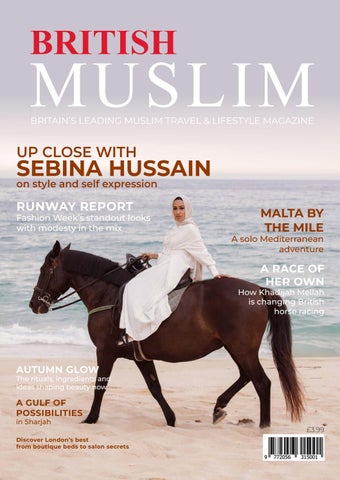
BRITAIN’S LEADING MUSLIM TRAVEL & LIFESTYLE MAGAZINE
UP CLOSE WITH
SEBINA HUSSAIN on style and self expression
RUNWAY REPORT
Fashion Week’s standout looks with modesty in the mix
MALTA BY THE MILE
A solo Mediterranean adventure
A RACE OF HER OWN
How Khadijah Mellah is changing British horse racing
AUTUMN GLOW
The rituals, ingredients and ideas shaping beauty now
A GULF OF POSSIBILITIES in Sharjah
Discover London’s best from boutique beds to salon secrets
£3.99
BRITISH
BRITISH
MUSLIM
FROM MUSLIM the EDITOR Dear Readers
Welcome to the summer issue of British Muslim Magazine! As the days grow longer and the nights warmer, we’re excited to offer you a vibrant mix of features to make the most of this season. Our culinary section is packed with flavours perfect for summer gatherings. Whether it's smoky BBQ bites, irresistible Pakistani lamb chops, or sweet treats like trifle, we have something to delight every palate. For travel enthusiasts, explore a dreamy honeymoon in the Maldives or embark on a 12-day adventure in Sri Lanka. Closer to home, we recommend halal staycations in the Lake District, dining spots in Edinburgh, and a must-visit Swiss steakhouse. Plus, enjoy tips on gardening, summer décor ideas, and a curated list of good reads.
British Muslim Magazine is published by Syed PR & Publishing LTD Email: info@britishmuslim-magazine.com
ABOUT US
British Muslim Magazine is a UK-based title exploring modern Muslim life through travel, culture Enjoy the issue! and lifestyle, focusing on the people, Natasha Syed Editor places and stories that shape it.
British Muslim Magazine pro inspiration and advice for Mu in Britain looking for unforge and luxurious travel experien Muslim history and heritage food, fashion and style.
Editor In Chief Natasha Syed Assistant Editor Tahira Khan
Writers Angela Youngman, Rabia Natasha Syed, Adam Jacot de Boin Juber Ahmed.
Publisher Syed PR & Publishing LT CEO Natasha Syed
Advertising Manager Robyn Shei Managing Director Muk Rajah
MUS Digital Production Manager Dene Conway
Digital Marketing Co’ordinator Cherie Ann Conway
Website
Natasha Syed
Editor in Chief
EDITOR IN CHIEF & CEO Rabi’ah M Adam Jacot Tahira Khan Contributor Assistant Editor Natasha Syed de Boinod Contributor
ACTING EDITOR Ramsha Syed DearVistro Readers Juber Ahmed Contributor
Discover more great content www.britishmuslim-magazine
Catch up on the latest tra gossip @Britishmmag
See behind the scene @british_muslim_maga
Facebook CONTRIBUTORS the chat at faceboo Welcome to the summer issue ofJoin British M Britishmuslimmagazine Melissa Baksh grow longer and the nights warmer, we’re Humairah Hanif Newsletter Sign up to our newsletter for off of features to make the mostinspirations of this seaso Sophie Ibbotson Our travel partner and all the latest travel www.britishmuslim-magazine. Subscribe to our Tahira Khanperfect for summer flavours gatherin annualwith edition QR CODE Shiza Vistro Missed last issu Scan me Today! irresistible Pakistani lamb chops, oroursweet www.britishmuslim-magazine.co Fathima Yusuf delight every palate. For travel enthusiasts Angela Youngman Contributor
recycle
British Muslim Magazine is a quarterly publication published by Syed PR & Publishing LTD in London, United Kingdom
Maldives or embark on a 12-day adventur PUBLISHER recommend halalLTD staycations in the Lake Syed PR & Publishing and a must-visit Swiss steakhouse. Plus, e www.britishmuslim-magazine.com MANAGING DIRECTOR ideas, and a curated list of good reads.
Advertising Manager Robyn Sheikh
Please recycle this magazine
© Syed PR All rights reserved. Text and pictures are copyright restricted and must not be reproduced without permission of the publishers. The
Elsewhere, we mark Menopause Awareness Month with Managing conversations around women’s health that deserve far moreDirector Muk Rajah Production Manager airtime. We explore autumnal escapes, alongsideDigital thought Dene Conway pieces to get you thinking, because not everything worth reading comes with a shopping link. Digital Marketing Co’ordinator I hope you enjoy this issue. Consider it your invitation to Conway Cherie Ann discover something new, question something familiar and, if necessary, make a little room in your wardrobe.
Natasha Syed Editor
British Muslim Magazine is publish Syed PR & Publishing LTD Email: info@britishmuslim-magazin
BRITISH
British Muslim Magazine provides inspiration and advice for Muslims in Britain looking for unforgettable and luxurious travel experiences, Muslim history and heritage to food, fashion and style.
Fashion loves Magazine! a new season. loves a new launch. The rest Welcome to the summer issue of British Muslim As Beauty the days us are left deciding what’s actuallymix worth our time, money grow longer and the nights warmer, of we’re excited to offer you a vibrant wardrobe space. In this issue, we’ve done some of the of features to make the most of this and season. Our culinary section is packed Editor In Chief Natasha Syed legwork – with a few detours into subjects that matter rather with flavours perfect for summer gatherings. Whether it's smoky BBQ bites, Assistant Editor Tahira Khan more than what colour to wear this autumn. irresistible Pakistani lamb chops, or sweet treats like trifle, we have something to Writers Angela Youngman, Rabia’M, Our cover star, fashion and beauty influencer Sebina Hussain, delight every palate. For travel enthusiasts, explore a dreamy honeymoon in the Natasha Syed, Adam Jacot de Boinod, leads a line-up of women making their mark in very different Maldives or embark on a 12-day adventure in meet Sri Lanka. to home, Ahmed. fields. We jockeyCloser Khadijah Mellah,we catch upJuber with actress recommend halal staycations in the Lake dining spots in Edinburgh, Duaa District, Karim and feature Tashkia Azmi, founder ofPublisher Modest Syed PR & Publishing LTD and a must-visit Swiss steakhouse. Plus, enjoy tips on gardening, summer décor to CEO Fashion Week UK, while turning our attention the emerging Natasha Syed ideas, and a curated list of good reads. labels that caught our eye at London Fashion Week.
Enjoy the issue!
M A G A Z I N E
Dear Readers
ww.britishmuslim-magazine.com
M A G A Z I N E
ww.britishmuslim-magazine.
information found in British Muslim Magazine is published in good faith. However you are strongly advised to check prices, dates and opening times befor final arrangements. The opinions expressed by contributors to British Muslim Magazine are not necessary those of the publisher.
Muk Rajah
Enjoy the issue!
DIGITAL PRODUCTION MANAGER Emil Murad
Natasha Syed Editor COORDINATOR DIGITAL MARKETING Burak Ayaz
Website Discover more great content at www.britishmuslim-magazine.com
Natasha Syed
Editor in Chief
Tahira Khan
Assistant Editor
Rabi’ah M
Adam Jacot
Contributor de Boinod Contributor RAMS HA VISTRO SYED Acting Editor
Editor’s Pick
Catch up on the latest travel gossip @Britishmmag
A little olive oil, a lot of cheek. This creamy, marbled blush brings a toasted warmth to your complexion, serving See behind the scene an autumnal flush with a @british_muslim_magazine side of luminosity. The Marble, £40. zaiie.com
Cover image: Rebecca Spencer
Juber Ahmed Contributor
DISCOVER MORE Find even more great content online britishmuslim-magazine.co.uk Instagram Natasha Syed Tahira Khan @british_muslim_magazine Editor in Chief Twitter @britishmmag Assistant Editor Facebook @BritishMuslimMagazine
Angela Youngman
Join the chat at facebook.com/ Britishmuslimmagazine
Contributor
R
C
NEWSLET TER For offers, inspirations and all the latest travel news, sign up to our newsletter britishmuslim-magazine.com MISSED A N ISSUE? ShopJuber past Ahmed issues online Angela Youngman britishmuslim-magazine.com/shop Contributor Contributor
Newsletter Our travel partner Subscribe to our annual edition QR CODE Scan me Today!
Sign up to our newsletter for offers, inspirations and all the latest travel news at www.britishmuslim-magazine.com
British Muslim Magazine is a quarterly publication published by Syed PR & Publishing LTD in London, United Kingdom. © Syed PR All rights reserved. Text and pictures are copyright restricted and must not be reproduced without permission of the publishers. The information found in British Muslim Magazine is published in good faith, however you are strongly advised to check prices, dates and www.britishmuslim-magazine.com/shop opening times before making final arrangements. The opinions expressed by contributors to British Muslim Magazine are not necessary those of the publisher.
British Muslim Magazine is a quarterly publication published by Syed PR & Publishing LTD in London, United Kingdom
Missed our last issue?
recycle
Please recycle this magazine
© Syed PR All rights reserved. Text and pictures are copyright restricted and must not be reproduced without permission of the publishers. The
Subscribe to our annual edition QR CODE Scan me Today!
British Muslim Magazine is a quarterly publication 3 by Syed PR & Publishing LTD in London, United K
© Syed PR All rights reserved. Text and pictur
CONTENTS
FASHION & BEAUTY ISSUE
12
72
22 T R AVEL
6 POSTCARD
A closer look at the places and details worth remembering
30
22 MALTA
18 FASH IO N
12 LONDON FASHION WEEK
The emerging designers and standout looks from London’s latest runways
18 MODEST FASHION WEEK Four modest labels explored
20 SUSTAINABLE FASHION
What Islamic teachings can show us about buying less and better
42 T ABLE TALK
Women across industries gather for conversation, connection and fresh perspectives
4
A solo traveller’s guide to Malta’s history, culture and local food scene
26 MALDIVES
Discover how Maldivian nature can inspire your next beauty ritual
30 SHARJAH
Winding souqs, celebrated museums and a rich blend of faith and culture
34 SAUDI ARABIA
Desert landscapes, local design and seasonal festivals in northwest Saudi Arabia
38 UZBEKISTAN
How technology is helping protect wildlife across Uzbekistan’s deserts and mountains
40 HOTELS
Four London hotels offering thoughtful design, good food and memorable stays
britishmuslim -m a g a z i n e .co.uk | F ASH I O N & B E A U T Y I S S U E
CULTURE
11 OUT AND ABOUT
Exhibitions, events and cultural gatherings to add to your calendar
78 IN FOCUS
A single frame that speaks for itself
NEWS & REVI EWS 10 NEWS
The latest launches and people making headlines
72 RESTAURANT REVIEWS
Two restaurants, two reviews: our verdicts on Babur and BÔNE
52
LIF ESTYLE
8 ON OUR RADAR
Our seasonal edit of travel, beauty and lifestyle finds
58 SNAIL MAIL
Meet the creators bringing faith to life through art and reflection
70 AUTUMN READS
Our autumn reading list, paired with bags for shelf-to-street style
INTERVIEWS
44 SEBINA HUSSAIN
The entrepreneur discusses ambition, representation, motherhood and knowing your worth
52 KHADIJAH MELLAH
The pioneering jockey building her career in a sport still catching up
60 DUAA KARIM
The young Muslim actress bringing humour, style and authenticity to British screens
40 HEA LTH & B EAUTY
50 HIJAB-FRIENDLY SALONS Four private beauty spaces where modesty meets luxury without compromise
62 BEAUTY UNPACKED
How ingredients, sourcing and transparency are reshaping the beauty industry
64 TOOTH BE TOLD
A first-hand review of boutique tooth whitening, from consultation to results
74
66 MORE THAN MENOPAUSE
Experts call for a broader conversation around women’s health and menopause
A DVIC E
68 THE DEBRIEF
Marwa Al-Sabouni shares her journey from architecture to authorship, exploring the ideas that connect them
FOOD
74 IN THE KITCHEN
Seasonal autumn recipes to bring something new to your table with Fathima Yusuf
5
P OST C C ARD Q atar
THE PEARL ISLAND Doha, Qatar
With its waterfront restaurants and distinctive Mediterranean-inspired architecture, The Pearl Island is one of Qatar’s most recognisable neighbourhoods in Doha. Built on a man-made island off the coast, it combines residential areas with shops, cafés and restaurants, from the colourful streets of Qanat Quartier to the yacht-lined Porto Arabia. Autumn is a more comfortable time to explore the island, as temperatures begin to ease after the summer heat. Halal food and prayer facilities are readily available across Qatar. The island has restaurants serving Middle Eastern and international cuisines, while nearby Katara Cultural Village is home to the striking Katara Mosque, designed by Turkish architect Zeynep Fadıllıoğlu. Its blueand-gold interior draws on traditional Islamic design, with intricate tilework and geometric patterns. Beyond the island, Doha offers plenty of opportunities to explore Qatar’s Islamic heritage, from the collection at the Museum of Islamic Art to the historic shops and mosques of Souq Waqif. It is this mix of modern Gulf life and deep-rooted Islamic culture that gives Doha its distinct character.
Words Ramsha Vistro
6
britishmuslim-m a g a z i n e .co.uk | F ASH I O N & B E A U T Y I S S U E
iStock/typhoonski
7
Root awakening
Shampoo? We’re having a break
Good hair days start at the roots - and Syra Hair is taking that rather literally. Its Grow Duo pairs an Essence Scalp Mist with a 0.5mm dermaroller, designed to support scalp care and hair growth as part of a consistent routine. With ingredients including turmeric stem-cell technology, horsetail and niacinamide, it’s one for anyone giving their scalp the same attention as their lengths. syrahair.com
Printed pasts
Your hijab collection called: it wants a little more personality. Modest Edit’s Desi Archive collection celebrates South Asian culture through three distinctive prints, each carrying its own story. The modal hijabs bring heritage into everyday dressing without making it feel like a history lesson. Meet Naqsh, Ajrak and Buta – a little cultural connection, a lot of outfit potential. modestedit.co.uk
LIFEST Y LE
A little sparkle never hurt anyone — especially when it comes with a twist. VIXII puts a contemporary spin on heritageinspired jewellery as the world’s first demi-fine lab-grown Polki diamond brand. Handcrafted in India, its collections range from necklaces and earrings to bracelets, with distinctive cuts and shapes that bring a fresh perspective to traditional influences. A little heritage, a little sparkle, and plenty of outfit mileage. vixiiworld.com
Your shampoo and conditioner have been taking up bathroom real estate for years. Hairstory’s New Wash Method wants a word. Its detergent-free cleansing cream combines washing and conditioning in one step, while the wider kit includes a pre-wash scalp rinse and massaging brush. The aim? Softer, shinier hair without the traditional shampoo routine. One less bottle to knock over in the shower. hairstory.com
On Our Rad ar
Polki me up
ON OUR
RADAR Our curated edit of travel, beauty and lifestyle finds worth noting each season
Stirring up a glow
Your morning coffee could have a new plus-one. Nutrition Geeks’ Collagen Glow Up is a hydrolysed bovine collagen powder that dissolves into hot or cold drinks, making it easy to add to an existing routine without another elaborate beauty ritual. Each serving delivers 12.6g of protein. No complicated steps, no extra appointment – just stir and sip. nutritiongeeks.co
Words Ramsha Vistro
Made to measure
For the wardrobe that deserves more than another impulse buy, meet Atelier Ferrari + Monti. The St Albans womenswear studio brings Italian fabrics and in-house craftsmanship to everything from tailored separates to bespoke occasionwear and bridal. Its small-batch collections make a compelling case for buying better and wearing longer. Consider your autumn event calendar officially dressed. ferrarimonti.com
8
britishmuslim -m a g a z i n e .co.uk | F A SH I O N & B E A U T Y I S S U E
Get your moss on
Move over, matcha. Irish sea moss is making a play for your wellness routine. The Moss Way sources wild-harvested sea moss from the waters off western Ireland, with a range of products designed to make this nutrient-rich sea vegetable part of everyday life. From gels to capsules, it’s one for the curious among us who like their beauty routines to start from within. themossway.co.uk
Sea-riously good Mask appeal
Three hours, overnight, or alongside your LED light therapy: Chroma’s Collagen Mask is happy to work around your schedule. The hydrating treatment is designed to leave skin feeling softer and looking smoother, plumper and more radiant. Think of it as a little extra TLC for complexions emerging from summer and heading straight into central heating season. chromaskintech.com
When autumn weather leaves skin feeling more parched than polished, Luma Skin has a little ocean-inspired comfort. Its Sea Moss Face Cream combines mineral-rich sea moss with seven Amazonian oils and butters to hydrate, nourish and support the skin barrier. Rich yet designed to feel comfortable on the skin, it’s a cosy little upgrade for your morning and evening routine. wearelumaskin.com
9
NEWS Pakistani designers Parishae Adnan and Zainab Chottani brought heritage-inspired couture to the international fashion calendar. Adnan presented Second Skin at New York Fashion Week, reworking archival menswear, bridalwear and deadstock. In Paris, Chottani unveiled Bleu Heritage, translating the blue-andwhite pottery of Hala, Sindh, into contemporary occasionwear. parishae.com, zainabchottani.com
A cultural calendar, curated for you. Here are the exhibitions, events and gatherings making their mark across the Muslim world
KAY BEAUTY MAKES ITS DEBUT
Founded by actor Katrina Kaif and Indian beauty retailer Nykaa, Kay Beauty has entered the UK through an exclusive launch with Space NK. The brand caters to South Asian skin tones and undertones, addressing a longstanding gap in mainstream beauty. Its arrival reflects growing recognition of a diverse beauty audience in the British market. kaybeauty.com
Out And Abo ut
COUTURE CROSSES BORDERS
C U LT U RE
OUT AND ABOUT THE CAMBRIDGE FESTIVAL OF ISLAMIC ARTS
Marking 50 years since the landmark World of Islam Festival, the Cambridge Festival of Islamic Arts returns with 10 days of exhibitions, calligraphy and poetry workshops, academic seminars and live performance. Centred on the theme ‘Fostering Friendship Through Beauty’, the programme brings together 60 events across Cambridge’s colleges, museums and cultural spaces. Most are free with pre-registration, while concerts are ticketed. From 19 to 29 November 2026. cfia.co.uk
MOSAIC ROOMS
Mosaic Rooms turns its gallery into a space for listening, sonic experimentation and gathering with sounding towards – –. The project brings together Palestinian sound archives, collaborative design and a rolling programme of artist takeovers, exploring sound as a way of holding memory, place and collective experience. Expect installations, listening stations, performances and Sunday jams. Until 29 November 2026, Mosaic Rooms, London. mosaicrooms.org
Image: Parishae Adnan
P.F. Chang’s lands in Stratford American pan-Asian restaurant P.F. Chang’s has opened its second London site at Westfield Stratford City. The menu features halal options including Mongolian Beef, Chicken Lettuce Wraps and Dynamite Shrimp, bringing its Chinese-Americaninspired dishes to east London. Diners can enjoy the restaurant’s food in its indoor dining area or on the terrace. pfchangs.co.uk
ASIAN BRIDAL FEST UK
Saudi by Sea
Star Power
Pakistani actor Mahira Khan joined guests at a British Asian Trust charity event supporting communities across South Asia. As an ambassador for the organisation, Khan uses her public profile to raise awareness of its work and champion positive change. Her appearance brought star power to an evening focused on philanthropy and community impact. britishasiantrust.org 10
AROYA Cruises offers a new way to explore Saudi Arabia, combining Red Sea voyages with the Kingdom’s heritage, coastline and hospitality. Designed for families and leisure travellers, its onboard experiences include dining, entertainment and relaxation, alongside opportunities to discover historic destinations and vibrant cities. The cruise line brings a fresh perspective to exploring Saudi Arabia by sea. aroyacruises.com
britishmuslim -m a g a z i n e .co.uk | F A SH I O N & B E A U T Y I S S U E
Art from Bangladesh
The Ashmolean Museum in Oxford and Samdani Art Foundation have announced a partnership to champion contemporary Bangladeshi art. The Ashmolean Samdani Visiting Artist programme will invite a Bangladeshi artist to Oxford annually, offering access to the museum’s collections and expertise. The collaboration will also establish a dedicated collection of contemporary art from Bangladesh. ashmolean.org
A Global Halal Economy
The London Halal Forum returned for its second edition, bringing together entrepreneurs, investors and industry leaders to explore the sector’s growth. Under the theme Halal Tayyib for Humanity, the two-day event examined opportunities across tourism, technology and trade, with showcases spanning halal lifestyle, Islamic art and innovation. londonhalalforum.com
The Asian wedding industry takes centre stage at Asian Bridal Fest UK, bringing together bridal fashion, beauty, mehndi, décor, photography, floristry, entertainment and more. Alongside the exhibitors, expect bridal catwalks and the chance to meet the people shaping the look and feel of today’s Asian weddings. On 14 November 2026. asianbridalfest.co.uk
THE AFIYA SOCIETY
An evening of mindfulness, sensory exploration and faith for Muslim women, The Senses Reset invites guests to slow down and reconnect with the everyday: the five senses, creativity, prayer and presence. There’s no previous mindfulness experience required, making this as much about pausing as it is about practice. 27 November 2026, 6:30–8:30pm, Self-Retreat Studio, London NW1 8NX, £30. ticketsource.com/the-afiya-society
ACTIVE SISTERS
Active Sisters brings together Somali and Habesha communities this December for an evening inspired by the traditions of a wedding celebration. Expect baraanbur, music and dancing, Somali diracs, Habesha kemis, henna, hijab stalls and food, with a matcha cart and plenty of opportunity to capture the evening along the way. Instagram: @active.sisterss 11
The Lowdown
Words Ramsha Vistro
Sometimes, the fabric does all the talking. SORAMAME 13 gave the little black dress a high-shine, almost liquidlooking finish, with asymmetric draping
britishmuslim -m a g a z i n e .co.uk | F ASH I O N & B E A U T Y I S S U E
FASH ION
From high-shine finishes to relaxed tailoring, LONDON FASHION WEEK SS27 made a case for dressing with individuality Fashion loves a trend, but the most interesting collections are often those that refuse to settle on just one. This season, designers at LFW, including Oxford Fashion Studio SS27 and Fashion Scout’s Ones To Watch: Edition 03 moved between polished minimalism, expressive print, heritage craft and experimental construction. There was no single look to prescribe for next spring; instead, the appeal lay in the contrasts, with familiar wardrobe staples reworked through unexpected fabrics, proportions and details.
12
Lo nd o n F ashi o n Week
LFW
RUNWAY REVIEW
adding a sharper edge. INF DARK took a different approach, presenting pale blue marbled fabric in a loose, layered ensemble. Both showed how material can transform a silhouette without elaborate detailing. At Tresaire Ann, a pale pink top dissolved into delicate fringing, paired with sheer, laced trousers for a romantic look that avoided becoming overly precious. SuKaz went bolder, layering cuffed baggy bottoms beneath a textured, tiger-striped jacket. Its art-led approach, built around collaborations with artists and craftspeople, lends the clothes individuality beyond print alone. Minimalism has its place, but SS27 offered plenty of reasons to look twice. JAJAABOR layered an illustrated jacket over a full, patterned skirt, combining multiple motifs without losing cohesion. Neightiv took a more fluid approach, pairing a printed wrap-style top with a dark satin skirt and tan belt. The mix of equestrian-inspired references and glossy fabric struck a balance between polish and ease. ART IN SITU combined a patterned jacket with a blue top and straight-cut linen, while Fam Irvoll’s mint-green shirt and shorts offered a utilitarian counterpoint. With roomy pockets, relaxed proportions and a chain accessory, the look proved that statement dressing need not always mean more colour or embellishment. Tailoring remained a fixture, but structure did not mean stiffness. DESIGNS BY ELLE kept things pared back in an ivory co-ord, using a defined waist and clean lines to create shape. An oversized leather bag added a practical accent
without disrupting the tonal palette. Diamante by Venuka took a more decorative route. Pink geometric embroidery enlivened a pale grey ensemble, while a cape-like jacket, exaggerated sleeves and wide belt gave the silhouette presence. The contrast between ornament and contemporary proportions kept the look distinctive without overwhelming it. Across the collections, accessories and finishing touches helped define each look. Neightiv’s equestrian references gave its styling a clear point of view; DESIGNS BY ELLE’s brown leather bag introduced contrast to an otherwise restrained outfit. At Fam Irvoll, a chain accessory interrupted the clean lines of a utilitarian co-ord, while Diamante by Venuka and SuKaz showed how embroidery and surface detail can be integral to a garment rather than an afterthought. The strongest looks shared an understanding that individuality rarely comes from following every trend at once. It comes from knowing what to emphasise: a striking fabric, an unexpected print combination, a precise silhouette or one well-chosen accessory. For SS27, the message was clear: make the clothes your own. 13
From clever layering to tactile textures, statement reds and the art of accessorising, the SS27 runways make a case for dressing with intention. Five trends, 15 looks and plenty of inspiration for the season ahead Words Ramsha Vistro
1
LAYER BY LAYER
Layering is less about piling on and more about making every layer count. At JAJAABOR, printed fabrics collide in a fluid, artful mix, with a patterned outer layer lending movement and intrigue to the look beneath. ART IN SITU takes a more utilitarian route, pairing a cropped technical jacket with a decorative skirt. The contrast is the point. At FAM IRVOLL, streetwear codes get the oversized treatment in deep green, with roomy proportions and statement patches bringing attitude to the mix. Three different approaches, one common thread: thoughtful contrast. For SS27, layering balances print with practicality, volume with fluidity and polish with a little grit.
2
SURFACE TENSION
This season, it’s all about the feel of things. FAM IRVOLL’s sculptural navy dress brings depth through its dense, tactile surface, punctuated by a playful burst of colour at the hip. Švarc goes all-in on volume, with a softly structured cream dress that folds and fans around the body like fabric origami. Meanwhile, ALPACA APPARELL turns to a fine, rippling knit, its sheer, wave-like pattern creating movement without relying on embellishment. Texture needn’t shout to make itself felt; dimension, shadow and the way a fabric holds its shape can do the talking. The result is a wardrobe that begs a closer look and, ideally, a touch.
14
britishmuslim -m a g a z i n e .co.uk | F ASH I O N & B E A U T Y I S S U E
FASH ION
3
Lo nd o n F ashi o n Week
TRENDSETTERS
COLOUR ME RED
From scarlet to burgundy, red takes on different moods for SS27. At INF DARK, the palette deepens into moody burgundy, lending a louche edge to relaxed tailoring and black trousers. At FAM IRVOLL, punchy scarlet Bermuda shorts bring the heat to a powder-blue shirt, proving that a single hit of colour can do more than a head-to-toe statement. NART takes a more polished approach, pairing a rich raspberry-red top with fluid white trousers. The effect is confident but unfussy, with the colour carrying the look while the silhouette keeps things relaxed. Red can punctuate, soften or smoulder, depending on the shade and its company. The styling rule? Let red lead. Everything else can follow.
4
IN THE DETAIL
The right accessories can change everything. At GILLIAN TRASK, layered silver chains turn a pared-back black dress into a statement, bringing shine, weight and a little rock ’n’ roll attitude. JAJAABOR takes a more maximalist tack, with a sculptural, embellished hat adding another hit of personality to an already intricate mix of prints, colour and texture. DESIGNS BY ELLE keeps things sleek, using a vivid red shoulder bag and long pendant necklace to punctuate an otherwise restrained white look. Three approaches, one takeaway: the right accessory can shift the entire mood. This season, jewellery is layered, headwear is expressive and the bag is more than a practical plus-one.
5
NO GREY AREA
Black and white may be opposites, but monochrome is anything but one-note. INF DARK plays with the tension between the two, layering an asymmetric white panel over an otherwise all-black look. The result is graphic, directional and deliberately off-kilter. DESIGNS BY ELLE strips things back to a clean white balloon dress, letting its fluid shape and minimal detailing make the statement. At ALEEKA, the palette shifts to charcoal, with a streamlined, floor-skimming silhouette with a ruched, structural bodice. Together, the looks make a case for tonal dressing with personality. The trick lies in proportion, cut and contrast, not colour overload. For SS27, monochrome is a masterclass in editing: remove the distractions, sharpen the silhouette and let the details earn their place. Grey areas? Entirely optional. 15
From experimental tailoring to graphic streetwear, these designers are taking menswear in unexpected directions Words Ramsha Vistro
MATHIS GUERTIN SuKaz
Craft takes the lead at SuKaz. An open-front cream coat, traced with ochre geometric embroidery, brings artisanal precision to an otherwise relaxed silhouette. Beneath, a bare chest and softly gathered trousers keep things fluid; brown leather shoes add an earthy finish. The palette is restrained, the detailing anything but. SuKaz brings together artists and craftspeople across cultures, with each jacket built around original textile work and intricate needlecraft. Here, the geometric embroidery gives that collaborative approach a clear focal point, turning a relaxed silhouette into something far more individual. sukazjackets.com
Mathis Guertin takes a scalpel to tailoring. A cropped black jacket exposes a sliver of midriff above glossy, leather-look trousers, balancing sharp shoulders with exaggerated volume. Hand-grazing sleeves, dark sunglasses and chunky footwear sharpen the attitude. Black-on-black keeps the look cohesive, allowing proportion and shine to take centre stage. Guertin draws on brutalist architecture and gender-fluid fashion, bringing sharp geometry to silhouettes that challenge the conventions of menswear. Part underground uniform, part sartorial provocation, this is tailoring stripped of its formality and reworked with a rebellious streak. Buttoned-up? Not remotely. design-mathis-guertin.com
Purple reigns at KOFFI MAAKO, where saturated violet turns everyday streetwear into a colour statement. An oversized T-shirt layers over a black-and-white striped shirt, while matching wide-leg shorts over floorskimming trousers double down on the drama. Bright yellow shoes provide the punchline. For KOFFI MAAKO, clothing is a way to carry cultural stories forward. The bold geometry of Gurunsi architecture informs the label’s visual language, making the vivid colour and graphic contrasts feel more considered than simply eye-catching. Nothing plays by conventional rules, and that is precisely the appeal. Streetwear with a distinctly individual edge. koffimaako.com 16
britishmuslim -m a g a z i n e .co.uk | F ASH I O N & B E A U T Y I S S U E
DESIGNS BY ELLE makes minimalism look anything but minimal. An oversized white T-shirt meets relaxed, creamy trousers in a study of proportion and tonal restraint. A slim crossbody strap cuts through the clean silhouette, adding function without fuss; dark shoes anchor the look. With little to distract, the cut and proportions do the work. The relaxed co-ord favours ease over rigid structure, while the gold-accented leather bag introduces a practical note without interrupting the clean lines. Nothing superfluous, nothing to prove. designsbyellegoods.com
FASH ION INF DARK
INF DARK finds its edge in an unlikely pairing: a fitted black T-shirt and fluid trousers in dusty plum. The contrast between the restrained top and sweeping lower half gives the silhouette its tension, while a discreet pendant supplies just enough detail. INF DARK, the Taiwanese label founded by designer Kuo Wei, is known for deconstructing familiar garment forms and reworking them through cultural references and unconventional construction. The flowing bottoms introduce a subtle shift to the label’s darker palette, while the contrast in proportions gives the look its edge. infdark.com
ART IN SITU
BAM BAM
KOFFI MAAKO
DESIGNS BY ELLE
Lo nd o n F ashi o n Week
OFF SCRIPT
At BAM BAM, graphic impact sets the tone. A black T-shirt emblazoned with bold white typography anchors a layered ensemble of dark outerwear and oversized shorts, punctuated by monochrome motifs. Heavy laceup boots bring a utilitarian edge, while platinum-blond hair adds another hit of contrast. The look is unapologetically urban, with graphics, layers and proportions colliding without tipping into chaos. BAM BAM turns handdrawn illustrations into original textile designs, blurring the line between clothing and artwork. The bold typography and graphic motifs bring that art-first sensibility into an otherwise familiar streetwear mix, with selfexpression taking precedence over convention. bam-bamart.com
ART IN SITU approaches menswear as a composition rather than a uniform. An oversized jacket scattered with circular motifs sits over a blue top, while loose, lustrous trousers pair contrasting shades of blue across each leg. Printed fabric detailing at the waistband finished with decorative cords and tassels, brings an artisanal flourish to the mix. ART IN SITU founder Jude approaches clothing as a maker and artist, cutting each coat before adding hand-worked artistic details. That interest in the relationship between garment and artwork offers a useful lens for this look, where the circular motifs and patterned fabric bring decoration into the construction itself. Faded blues, cream and earthy accents ground the palette, balancing the competing elements. artinsitu.com.au
VAROIN MARWAH
VAROIN MARWAH gives white tailoring a lighter touch. An elongated jacket, rich in surface detail, falls over a sheer pale shirt and fluid trousers, building depth through texture rather than colour. The silhouette is formal in outline but relaxed in execution, with an open neckline loosening the rules. Dark sunglasses add a note of studied nonchalance. Marwah is known for bringing Western tailoring into conversation with classic Indian menswear. Here, the elongated jacket and sheer shirt loosen the formality of the silhouette, while the intricate surface detail gives the all-white palette its depth. White, it turns out, has plenty to say. varoinmarwah.com 17
Designer TOP TIPS
“Proportion is really important. If you are wearing something beautifully flowing or oversized, balance it with structure somewhere else in the outfit,” says Tashkia Azmi, founder of Modest Fashion Week UK. For Modest Valoria, grace begins with the foundation: “I love modest cuts that drape beautifully without clinging.” The finishing touch? “Keeping one colour palette head-to-toe and letting the fabric drape is what creates that elegant, modest look.”
MAKE A STATEMENT
Words Ramsha Vistro
Images: Jarek D UK
Together, the four collections made a case for modest occasionwear as a field of design in its own right. There were no single rules governing the runway: drama came through movement at Tash’s Boutique, print and contrast at Modest Valoria, embroidery at Nargis Ladak and texture at Abaya by Zoeya. What connected them was an understanding that coverage need not mean visual restraint. The strongest looks treated fabric not merely as material, but as the means through which a designer could establish shape, character and presence.
18
Mo d est F ashi o n Week
MASTER THE PROPORTIONS
At Modest Fashion Week UK, four labels explored the possibilities of covered dressing, from sweeping capes and intricate embellishment to feathered gowns and traditional South Asian detailing
Modest fashion has never been short of spectacle. At MFW UK London Edition 2.0, held at St John’s, Hyde Park, the question was how to make that spectacle distinctive. Across four collections, the answer lay in the interplay of fabric, ornament and silhouette, with each designer approaching occasionwear from a different perspective.
FASH ION
MODEST FASHION WEEK
TASH’S BOUTIQUE
The runway opened up with a look in pale champagne: a delicately embellished tunic and fluid trousers, finished with a sweeping, translucent cape. The effect was less about the individual pieces than their movement together. As the model extended the cape, its generous proportions transformed a relatively restrained two-piece into something theatrical. The palette remained soft, allowing the embroidery to catch the light without competing with the overall shape. Founded by Tashkia Azmi, whose design influences span Bangladesh and Istanbul, the label offers a contemporary interpretation of modest dressing across co-ords, kaftans, abayas and eveningwear. The runway look demonstrated the appeal of that versatility, bringing the ease of separates into the territory of formal dress. Its drama came not from excess embellishment, but from the sweep of fabric and the space it occupied. @tashs_boutique
britishmuslim -m a g a z i n e .co.uk | F ASH I O N & B E A U T Y I S S U E
ABAYA BY ZOEYA
For this designer, texture became the main event. A pale mint-green gown, enveloped in fine beadwork and cascading feather-like embellishment, created an almost continuous surface of movement. The high neckline and long sleeves kept the silhouette covered, while the generous cut allowed the detailing to fall freely from shoulder to hem. Against the cool, muted colour, the reflective finish lent the gown a delicate luminosity rather than overt sparkle. Founded by stylist Zareen Lotun in 2024, Abaya by Zoeya approaches the traditional abaya through colour, considered materials and intricate finishing. This look pushed that philosophy towards evening couture, using texture to establish its identity. The feathers softened the outline, giving its volume an airy quality, while the pale green kept the overall effect light. It was a reminder that a covered silhouette need not depend on sharp tailoring or bold colour to command attention. @zoeya_mru
MODEST VALORIA
Here, the mood shifted decisively. A saturated burgundy ensemble paired fluid, satin-like separates with a dramatic cape lined in a netted lace fabric and scattered with deep red floral motifs. The contrast between the glossy, monochromatic base and the patterned outer layer gave the look its impact. A matching headscarf and long pendant completed the composition, while the cape’s generous volume created movement with every step. Floral ornament can easily overwhelm a garment, but here the dark ground and concentrated palette gave the pattern definition. The look suggested occasionwear that embraces maximalism without abandoning cohesion. Modest Valoria’s emphasis on floral abayas and refined detailing finds a natural expression in this balance of colour, pattern and proportion: the cape is the statement, while the underlying silhouette provides its anchor – a perfect autumnal evening look. modestvaloria.com
NARGIS LADAK
This designer brought an ivory ensemble with distinctly South Asian references. A full, floor-length skirt, finished with intricate gold embroidery at the hem, was paired with a coordinating blouse and an expansive embroidered shawl. Gold-toned embellishment traced the fabric in a repeated pattern, while blue accents and hanging tassels introduced contrast. The result was ceremonial without relying on a single focal point; the eye moved between the borders, the surface decoration and the drape of the shawl. What distinguished the look was its treatment of the outer layer. The shawl became an integral part of the silhouette, adding structure and visual weight to the fluid skirt beneath. The restrained ivory palette allowed the craftsmanship to take precedence, demonstrating how intricate surface work can provide both ornament and definition. The ensemble’s appeal lay in the relationship between its elements each contributing to a carefully balanced outfit. @nargisladakofficial
“Colour is something I personally love, and I think modest wardrobes can sometimes become too dependent on black, beige and neutrals,” says Tashkia. Her advice is to “start with one statement shade and keep the rest of the look tonal or neutral.” Abaya by Zoeya also champions thoughtful finishing touches: “Jewellery can become a focal point, whether through statement earrings, layered necklaces, cuffs or bold rings, while a printed scarf can add colour and interest to a simple abaya.”
ELEVATE THE EVERYDAY For Modest Valoria, transforming a daytime look needn’t mean starting from scratch. “My favourite trick is the cape. Take your daytime modest dress or abaya, switch your everyday hijab to a satin one, add a heel and then throw our embroidered cape over the top – instantly evening, with full modesty intact.” Tashkia agrees that impact lies in the details: “You don’t necessarily need more embellishment or more accessories to make an outfit special.” Meanwhile, Abaya by Zoeya recommends investing in “a strong foundation of quality, timeless essentials” and introducing trends selectively through colour, accessories and texture.
19
How Islamic teachings on modesty, moderation and repair can shape our wardrobes Words Shiza Vistro
B
eing a Muslim is a major part of a person’s identity, showcased by their ikhlaq, their speech, but also their outward appearance. Loose garments covering the awrah are commonly associated with Muslim men and women, such as the hijab, abayas, thobes and shalwar kameez. With modesty at the root of our attire, many Muslims find themselves balancing Islamic teachings with the latest trends, as well as a growing interest in sustainable fashion. Although awareness of the environmental impact of our fashion choices is on the rise, Islamic teachings have long addressed principles that resonate with it, through the Sunnah of our beloved Prophet Muhammad ﷺ.
REPAIRING CLOTHES With the focus of today’s fashion industry shifting from consuming the latest trends and owning an extensive wardrobe to a more mindful and sustainable approach, emphasising reducing waste and embracing slow fashion, some of these principles may feel familiar to Muslims. It was asked of the Prophet’s ﷺ wife, ‘A’isha, “What did the Prophet, may Allah bless him and grant him peace, do in his house?” She replied, “He did what one of you would do in his house. He mended sandals and patched garments and sewed.” [Al-Adab Al-Mufrad 540]. This Hadith offers a striking parallel with modern sustainable fashion. Repairing rather than replacing encourages us to value the clothes we already own and reduce unnecessary waste. Rather than tossing a perfectly
FASH ION
wearable pair of jeans with a small hole or a shirt with a lost button in the bin, we can learn to mend our clothes, extending their life while embracing craft and creativity. The principle of avoiding excess is central to Islamic teachings. In the context of fashion, that could mean questioning impulse purchases, excessive wardrobes and the constant pressure to buy something new. BUILDING A WARDROBE Choosing our fabrics wisely is another important aspect of the clothes we wear, learning about what is most suited for warm and cool climates as well as which is least straining on our natural environment. Polyester and other plasticbased fabrics along with artificial dyes pollute our waters by shedding microplastics and take hundreds of years to decompose, so returning to natural, biodegradable textiles like cotton and wool are both environmentallyconscious and abide by the Sunnah of the Prophet ﷺ. Natural cotton and linen fabrics allow for air to easily pass through them and for our skin to breathe, perfect for hot and humid climates, whereas wool and leather trap warmth and are most suited for cooler environments. Adopting this perspective of curating your wardrobe carefully and mindfully, considering practicality and ease alongside modesty and sustainability, prioritises quality over excess. A carefully considered wardrobe leaves less room for chasing every trend and more space for timeless pieces that can be worn and styled for years. Even in fashion, Islam instils values of modesty, mindfulness and moderation. Sustainable fashion may be a modern movement, but some of the principles behind it – buying with intention, caring for what we own, repairing rather than replacing and avoiding excess – are values Muslims have long been encouraged to consider. Perhaps sustainable fashion is not about discovering an entirely new way to dress, but reconsidering our relationship with what we already have.
Left: iStock/ibenk.88 Above: iStock/fizkes & Wachiwit
20
britishmuslim -m a g a z i n e .co.uk | F ASH I O N & B E A U T Y I S S U E
21
S ustai nabl e F ashi o n
ISLAMIC ROOTS of SUSTAINABLE FASHION
DRESSING IN ISLAM Through Hadith, we learn that the Prophet ﷺwore simple, modest clothing suited to his surroundings. It has been narrated by the wife of Prophet Muhammad ﷺ, Umm Salamah اهنع هللا يضر, “The most loved garment to the Messenger of Allah ﷺwas the Qamis.” [Jami At-Tirmidhi 1763]. Other sources also state that he wore various garments, including the Thobe, Hibarah and Imamah, in different fabrics. His clothing was suited to his needs and environment, whether the climate, occasion, task at hand or travelling. The significance here is not that the Prophet’s ﷺclothing can be labelled “sustainable” in the modern sense, but that his approach to dress reflects principles of modesty, practicality and suitability rather than excess. This offers a useful perspective in an era of fast fashion, where trends move quickly and wardrobes can become increasingly disposable. For Muslims, the question is not simply what is fashionable, but whether our choices reflect our values and intentions. Do the clothes we wear serve us with dignity and simplicity, or are we prioritising the fleeting desires of this Dunya over our Akhirah?
T RAVEL Mal ta
W
hen travelling solo, there is something comforting about a slower pace. Malta is the smallest country in the European Union and Valletta, its capital city – at just 1km long – is remarkably compact and easily explored on foot. I arrived in Valletta in the middle of the day, when the streets were noticeably quiet. A few doors down from my hotel, a wedding was taking place in a beautifully ornate church. I paused outside just as the ceremony was ending, watching the families form a circle as they danced and sang. Someone beckoned me inside and invited me to join, a moment that echoed the warmth of the place. As evening fell, the streets of Valletta came alive. Restaurants filled, people spilled out onto the pavements and the city took on a completely different energy. As a solo female traveller, the liveliness was reassuring.
ON MALTESE TIME
A closer look at Malta’s history, culture and food through solo travel Words Melissa Baksh
22
britishmuslim -m a g a z i n e .co.uk | F ASH I O N & B E A U T Y I S S U E
Travelling alone also meant I was more aware of my surroundings and the nuances of the place. Near to my hotel, I came across a rather dated café serving traditional English food. It felt like a nod to Malta’s British past, there alongside the island’s unmistakably Mediterranean character. Everywhere I went I came across the cross of the Knights of St John carved into stone buildings and emblazoned onto flags, a nod to the Catholic military order that ruled Malta from 1530. However, the country’s unique identity has been shaped by successive waves of Arab, Norman, Sicilian and British rule; those layers of history are still visible – and audible – today. Malta spent several centuries under Arab rule after the Aghlabid conquest in 870, when it was conquered by the Arabs in the Arab-Byzantine wars. The island’s Arab-Islamic heritage is still embedded in its distinctive language. Maltese is the only Semitic language of the European Union and is derived from Siculo-Arabic. Although it uses the Latin alphabet, much of its vocabulary has Arabic roots – for example, the Maltese word for harbour is marsa (port in Arabic). The country’s sounds can offer clues to a history that pre-dates the Baroque façades for which it is best known. Perhaps that’s what I enjoyed most about discovering Malta alone; its culture today feels like a conversation between different chapters of its past, and travelling solo gave me the space to listen to it all. The country’s Arab influence is also evident in its cuisine. Arabs introduced spices such as cumin and saffron, and citrus fruits such as oranges and lemons, all of which feature in Maltese cooking today. The complex flavours were evident in the lunch I had one day on the rooftop terrace of Marilù’s in Siggiewi, overlooking Pjazza san Nicola (and another elaborate wedding.) I opted for their homemade Arancini and Stuffat tal-Qarnit – a traditional octopus stew – accompanied by a Kinnie, a soft drink flavoured with bitter oranges and aromatic herbs. For Muslims, Malta’s traditional seafood and vegetarian dishes are safe options, of which there are plenty. In Valletta, Naan Bar is a highly rated Modern Indian 23
T RAVEL Mal ta restaurant and its celebrated sister restaurant MÉZ in St Julian’s serves up cuisines connected by the Indian Ocean, such as Malaysia, Sri Lanka, Madagascar, Mauritius, and India. After my leisurely lunch, I headed to Mdina, Malta’s former capital. The Silent City’s historic fortified town is largely pedestrianised and, with fewer than 300 residents, it feels almost frozen in time. Walking through its Baroque city gates – which Game of Thrones fans will recognise – what struck me most was how peaceful it felt. Unlike the historic centres of Rome or Barcelona, there were no overwhelming crowds; instead, I could wander through the narrow streets at my own pace, taking in the centuries of history. Just outside the fortified walls, Rabat (meaning ‘suburb’ in Arabic) offers even more history, including its ancient Roman and early Christian catacombs. Going early in the morning or later in the afternoon is a good way to experience Mdina and Rabat at its quietest and to avoid the heat of the day. At the end of my tour, I was told I couldn’t leave Malta without trying Pastizzi: traditional flaky, savoury pastries filled with ricotta or curried peas. Despite still being full from lunch, I gave in. Compact (and cheap) as they are, they’re surprisingly satisfying and could easily constitute a meal in themselves. 24
Malta boasts around 3,000 hours of sunshine a year, and it’s easy to understand the appeal when you’re there. It is warm enough for a quick dip in the sea – and one of the joys of Valletta is how close you are to the water. It felt like the perfect way to end my trip: floating in the Mediterranean, the sea that has shaped Malta’s history, trade and economy. More than just a backdrop to the island, the sea is woven into the very fabric of Maltese life. Malta’s rocky coastline means that there are countless lidos, bathing platforms or quiet coves to swim in. Għadira Bay and Golden Bay are among the most popular sandy beaches. For those who prefer a little more privacy, I suggest looking for smaller rocky swimming spots in the morning, or booking accommodation with a private pool. Fomm ir-Riħ is a more secluded option, although reaching it involves a steep walk down to the shore. All in all, a short break in Malta feels very manageable: you can experience a lot without feeling like you’re in a race against the clock. From the unremitting sunshine reflecting off the honey-coloured stone buildings, the steep cobbled streets laden with history, or the sleepy afternoons and vibrant nights, it’s hard to resist being on Maltese time.
britishmuslim -m a g a z i n e .co.uk | F ASH I O N & B E A U T Y I S S U E
WORTH A VISIT Mariam Al-Batool Mosque, Paola Malta’s only officially recognised mosque, around a 10-minute drive from Valletta. The wider complex includes the Islamic Cultural Centre, school and cemetery, with prayer facilities for men and women.
Triq Mesquita, Mdina Meaning “Mosque Street” in Maltese, this atmospheric lane is a reminder of Mdina’s Islamic past. Its name is traditionally associated with a mosque believed to have once stood here.
Ħal Saflieni Hypogeum, Paola This extraordinary underground complex dates back to around 4000–2500 BC and was used as a cemetery and sanctuary. A UNESCO World Heritage Site, it offers a fascinating glimpse into Malta’s prehistoric past.
WHERE TO EAT TRiBE Valletta A stylish all-day dining spot with several dishes clearly marked halal on the menu, including beef, chicken, salmon and falafel. Halo Kebab & Tacos A casual option on Merchants Street, ideal for a quick and relaxed meal. Kebab Factory Valletta A halal spot serving Turkishstyle kebabs and other fast food.
25
BEAU T Y Mal d i v es
glow
THE ISLAND
A deep dive into how Maldivian nature can become your only beauty ritual Words Tahira Khan
26
britishmuslim -m a g a z i n e .co.uk | F A SH I O N & B E A U T Y I S S U E
W
hat if your next beauty treatment came without a treatment room? In the Maldives, beauty begins with the elements. The ocean, the sun, tropical botanicals, fresh food, movement and, perhaps most importantly, stillness all become part of a slower, more instinctive approach to wellbeing. Here, nature isn’t simply the backdrop to a beautiful holiday; it becomes the ritual itself.
What we might call the island glow could be explored at the newly opened Somewhere Island by .Here Baa Atoll Maldives which “embodies a refined vision of exclusivity in the Maldives,” says Gregor Gerlach, Co-owner of Seaside Collection. “We have created a sanctuary that invites discerning travellers to engage deeply with the natural beauty and tranquillity that define this extraordinary destination.” That particular radiance that seems to arrive after a few days of deep sleep, swimming in warm turquoise water, eating fresh food and spending long hours beneath an open sky. It isn’t about abandoning your beauty routine, it is about discovering what happens when the environment becomes part of it. WATER: THE OCEANIC RITUAL There is something inherently restorative about being surrounded by water. The day can begin with a swim in the lagoon, your body suspended in warm, crystalline water as the island slowly wakes around you. Swimming brings movement and circulation into the morning, while the sensory experience of being immersed in the ocean can be wonderfully calming. Afterwards comes that familiar postswim feeling: warm skin, salt-dried hair,
flushed cheeks and the unmistakable sensation of having properly woken up. The ocean may be nature’s most beautiful beauty setting, but sensible skin protection still matters. SPF, hydration and rinsing off saltwater afterwards keep the ritual firmly within wellness. SUN: CHASING LIGHT Few places make you appreciate sunlight quite like the Maldives. Golden mornings and long luminous evenings create an almost cinematic quality to island life, but the modern version of the sun ritual is about enjoying the light responsibly. Seek the softer hours of the day, wear broad-spectrum SPF, cover up when the sun is strongest and let the island’s natural light do what it does best: encourage you outdoors, lift the mood and make movement feel effortless. The beauty of the Maldivian sun isn’t about getting a deeper tan, it is about spending more time in daylight and allowing your body to reconnect with the natural rhythm of morning and evening. EARTH: THE ISLAND APOTHECARY The Maldives has a long relationship with natural ingredients, from 27
BEAU T Y Mal d i v es
SAVE UP TO 55% Kuredu Resort Maldives
Atmosphere Kanifushi
Full Board Save up to 35% Kids Stay & Eat for FREE* coconuts and tropical botanicals to oils traditionally used to nourish the skin and hair. Coconuts are the quintessential island beauty ingredient. Their oil can be used as a rich moisturiser for the body and as a conditioning treatment for dry hair, while coconut water offers a refreshing way to hydrate. At island spas, this connection with nature is elevated into luxurious rituals: botanical oils, body treatments, massages and ingredients inspired by the surrounding environment. There is something particularly indulgent about having a treatment while listening to the ocean, knowing that the landscape outside the treatment room is influencing the experience within it. NOURISHMENT: BEAUTY INSIDE AND OUT The island glow isn’t created entirely in a spa; it begins at the table. At Safar, the resort’s restaurant and bar, you will be served an array of thoughtfully created dishes where globally-inspired techniques meet the flavours of the Indian Ocean. Fresh fish, tropical fruit, vegetables, herbs, coconut and plenty of water make the Maldivian dining experience naturally compatible with a wellnessfocused escape. Locally inspired seafood provides protein and healthy fats, while colourful fruits bring vitamins, minerals and antioxidants to the plate. Think grilled fish with fresh herbs, juicy papaya or mango, lime squeezed over a seafood dish, and fresh coconut water after a morning in the sun. The principle is simple: instead of thinking about beauty as something you apply to the outside of the body, consider what you are giving it from within.
28
7 NIGHTS FROM £1125*pp
MOVEMENT: THE BODY IN ITS NATURAL RHYTHM One of the most luxurious things about an island holiday is how effortlessly movement enters the day. You walk barefoot across the sand. You swim to the reef. You paddle across the lagoon. You stretch at sunrise. You snorkel, dive, cycle or simply wander along the shoreline. There is no need for a formal gym session when the landscape itself encourages you to move, and movement has its own beauty effect. Increased circulation, improved mood, better sleep, and the simple feeling of inhabiting your body rather than sitting behind a desk all day can transform the way you look and feel. In the Maldives, exercise doesn’t necessarily feel like exercise; it feels like exploration. STILLNESS: THE MOST UNDERRATED BEAUTY TREATMENT Maybe the greatest luxury the Maldives offers is time. Time to sleep without an alarm. Time to read. Time to watch the tide come in. Time to sit beneath a palm tree and do absolutely nothing. Stress can show up on the face as readily as it does in the mind: tired eyes, dullness, tension and a general lack of vitality. Remove some of the noise and allow the nervous system to settle, and the difference can be surprisingly visible. This is where the island glow becomes less about a product and more about a state of being. The beauty ritual is sleep. The treatment is stillness. The prescription is time. THE ISLAND GLOW The real Maldivian beauty secret is that there isn’t one. There is simply the
britishmuslim -m a g a z i n e .co.uk | F ASH I O N & B E A U T Y I S S U E
Adaaran Select Hudhuran Fushi
Premium All Inclusive Save up to 35% Kids Stay & Eat for FREE*
7 NIGHTS FROM £1459*pp
OBLU XPERIENCE Ailafushi
All Inclusive Save up to 20% Complimentary Return Seaplane Transfers*
7 NIGHTS FROM £2265*pp
Siyam World Maldives
All Inclusive Save up to 20% Complimentary Shared Airport Return Transfers*
Premium All Inclusive Save up to 30% Complimentary Roundtrip Seaplane Transfers*
7 NIGHTS FROM £1449*pp
OBLU NATURE Helengeli by SENTIDO
7 NIGHTS FROM £2369*pp
LUX* South Ari Atoll Resort & Villas
All Inclusive Save up to 20% Complimentary Shared Return Speedboat Transfers*
7 NIGHTS FROM £1855*pp
Taj Coral Reef Resort & Spa, Maldives All Inclusive Save up to 40% Complimentary Return Seaplane Transfers* cumulative effect of small, restorative rituals: swimming instead of scrolling, fruit instead of convenience food, walking instead of commuting, sunlight instead of fluorescent lighting, an early night instead of another late one. This is where nature becomes the beauty cabinet, the spa, the gym and, occasionally, the therapist. here-maldives.com
7 NIGHTS FROM £1865*pp
Sheraton Maldives Full Moon Resort & Spa
All Inclusive
Save up to 50%
7 NIGHTS FROM £2315*pp
Heritance Aarah Maldives
All Inclusive Save up to 55% FREE Meal Upgrade from Full Board to All Inclusive*
7 NIGHTS FROM £2045*pp
Premium All Inclusive Save up to 50% Kids Stay & Eat for FREE*
7 NIGHTS FROM £2259*pp
0208 843 4444 www.southalltravel.co.uk *Prices shown are per person and correct at the time of publishing. All prices and offers are subject to change and are extremely limited. Terms & conditions apply.
T RAVEL
Recognised by UNESCO as the Arab World’s Cultural Capital in 1998, Sharjah has long championed literature, education and the arts. Today, restored heritage districts, world-class museums and thriving cultural institutions offer visitors a journey through Arab and Islamic civilisation that feels both authentic and deeply enriching. Rather than allowing rapid development to eclipse its past, the emirate has carefully conserved traditional architecture while investing in spaces that celebrate Emirati identity and the enduring legacy of Islamic culture. I chose to explore the city from The Chedi Al Bait, a boutique hotel located within the Heart of Sharjah heritage district. Housed in beautifully restored merchant homes, it became clear that the real attraction was not the hotel itself, but the living history that unfolded beyond its walls.
S har jah
Sharjah
F
or many visitors, the United Arab Emirates is synonymous with Dubai’s glittering skyline and Abu Dhabi’s architectural grandeur. Yet, just beyond the bright lights lies Sharjah, an emirate that has slowly earned its reputation as the cultural heart of the UAE.
More Than a Mirage
Swap towering skyscrapers for winding souqs, celebrated museums and a destination where history, faith and culture remain deeply entwined Words Humairah Hanif
30
britishmuslim -m a g a z i n e .co.uk | F ASH I O N & B E A U T Y I S S U E
31
T RAVEL S har jah
TRAVELLER’S TIP
Plan your visit between October and April, when cooler temperatures make exploring the heritage districts and museums particularly enjoyable. Many of Sharjah’s cultural attractions are within easy reach of one another, allowing visitors to combine museums, souqs, galleries and waterfront walks in a single day.
The Heart of Sharjah The best way to discover the Heart of Sharjah is on foot. Within minutes, the broad roads and modern buildings of the city give way to winding alleyways lined with coralstone houses, carved wooden doors and shaded courtyards. Traditional wind towers, known as barjeel, rise above restored rooftops, recalling a time when architecture worked in harmony with the climate long before the arrival of air conditioning. The Heart of Sharjah is one of the Gulf’s most ambitious heritage restoration projects, carefully reviving the emirate’s old trading quarter and preserving a way of life that once revolved around family homes, souqs and maritime commerce. Walking through the district offers a glimpse into the social and architectural history of the UAE, where inward-facing courtyards, majlis spaces and narrow shaded streets reflect values of hospitality, privacy and community that remain central to Emirati culture. One of the most memorable moments came as the adhan echoed softly from the nearby Obaid Bin Issa Mosque, its call carrying through the market alleyways and courtyards. In a region often associated with modern skylines, Sharjah offers a sense of continuity between past and present. Souq Al Arsah: Old Trade Routes At the centre of the heritage district lies Souq Al Arsah, believed to be one of the oldest marketplaces in the UAE. Long before shopping malls transformed the Gulf, merchants from Arabia, Persia, East Africa and the Indian subcontinent passed through these narrow walkways, 32
trading pearls, spices, textiles and precious goods. Today, the restored souq retains much of its traditional charm. Wooden doors, covered passages and stalls selling perfumes, antiques, handicrafts and local crafts evoke the atmosphere of an earlier era. The scent of oud drifts through the air while visitors pause for Arabic coffee in shaded cafés. More than a place to shop, Souq Al Arsah offers a window into Sharjah’s history as a trading port and cultural crossroads, reminding visitors of the connections that have long linked the Gulf with the wider Muslim world.
world. Particularly fascinating are the collections devoted to science and discovery, displaying astrolabes, navigational instruments and medical manuscripts that highlight the contributions of Muslim scholars to astronomy, medicine, geography and mathematics. For Muslim visitors, the museum offers more than an introduction to history; it is a reminder of a rich intellectual tradition that shaped global civilisation. The exhibits reveal a world in which faith and learning were deeply intertwined, inspiring generations of scholars, artists and explorers.
Sharjah Museum of Islamic Civilization A short distance from the heritage district stands one of Sharjah’s greatest cultural treasures: the Sharjah Museum of Islamic Civilization. Housed in an elegant building overlooking the waterfront, the museum contains thousands of artefacts spanning more than fourteen centuries of Islamic history. Its galleries showcase beautifully illuminated Qur’anic manuscripts, ceramics, textiles, coins and intricate works of art from across the Muslim
Sharjah Arts Foundation and Contemporary Culture Sharjah’s commitment to culture is not limited to preserving the past. The emirate has also become one of the Arab world’s leading centres for contemporary art through the work of the Sharjah Arts Foundation and the internationally acclaimed Sharjah Biennial. Set within restored heritage buildings and public spaces, galleries and installations bring together artists from across the Middle East, Asia and Africa,
britishmuslim -m a g a z i n e .co.uk | F ASH I O N & B E A U T Y I S S U E
All images: Humairah Hanif
creating a dialogue between tradition and modernity. This blending of old and new is one of Sharjah’s defining qualities. Historic homes sit alongside contemporary exhibitions, while centuries-old neighbourhoods continue to inspire new forms of creativity. House of Wisdom Another landmark reflecting Sharjah’s cultural vision is the House of Wisdom, an architectural masterpiece inspired by the great libraries of the Islamic Golden Age. Surrounded by gardens and open spaces, it combines books, technology and community programmes in a setting designed to encourage learning and reflection.
More than a library, the House of Wisdom represents Sharjah’s belief that knowledge remains central to society. Its name recalls Baghdad’s historic Bayt alHikmah, where scholars once translated, preserved and expanded knowledge from across the world, contributing to one of the most remarkable periods of intellectual flourishing in human history. Cafés & Culture Be sure to leave time for Sharjah’s flourishing café and dining scene, where independent coffee houses sit alongside traditional Emirati restaurants in beautifully restored heritage buildings. Break up your sightseeing with coffee at Ratios Coffee in Souq Al Shanasiyah
or lunch at Fen Café & Restaurant, tucked away within the Sharjah Art Foundation. If your itinerary allows, visit the immersive Rain Room, one of Sharjah’s most celebrated contemporary art installations, where visitors can walk through falling rain without getting wet. Sharjah may not seek attention in the way some of its neighbours do, yet that is precisely its appeal. It is a city that invites visitors to slow down and discover a different side of the UAE – one shaped by scholarship, trade, art and faith. For those seeking a journey rooted in culture and heritage, Sharjah offers something increasingly rare: a destination that honours its past while continuing to shape its future. 33
From sandstone valleys and dark desert skies to local design and seasonal festivals, Saudi Arabia’s north-west offers a different kind of winter escape – and a natural extension to Umrah Words Natasha Syed
F
or many travellers, a journey to Saudi Arabia centres on pilgrimage to Makkah and Madinah, perhaps with a few days in Jeddah among its old coralstone buildings. Further north, AlUla offers a different perspective on the Kingdom, with ancient settlements, cultivated oases and monumental sandstone formations best explored at a slower pace.
34
britishmuslim -m a g a z i n e .co.uk | F ASH I O N & B E A U T Y I S S U E
Late October to January is a particularly appealing time to visit. As temperatures ease, the days lend themselves to walking, while the cooler months bring a programme of cultural events spanning wellness, astronomy, hot-air ballooning and the arts. AlUla can be reached by domestic flight from Riyadh or Jeddah, making it a possible addition to a longer journey through the region.
T RAVEL S aud i
AlUla IN SEASON DESERT DETOX The season opens with the AlUla Wellness Festival, which brings together yoga, meditation and restorative treatments amid sandstone cliffs and desert valleys. Away from the studios and dedicated retreat spaces, the surrounding landscape offers its own invitation to slow down. For those seeking a more structured stay, Banyan Tree AlUla has a spa programme drawing on Asian rituals and Saudi traditions, while Our Habitas AlUla incorporates yoga and sound-based experiences into its wider offering. Both place wellbeing within the wider desert setting, rather than separating it from the place itself. There is also plenty of reason to venture out on foot. AlUla’s trails pass through secluded valleys, rock formations and landscapes layered with history. The Madakhel Garden Hike offers a greener side of the desert; the Hidden Valley Hike follows towering rock walls; and the Journey Through Time Trail brings the region’s natural surroundings alongside its historical sites. These walks are distinct from the AlUla Adventure Hub, which caters to more adrenaline-fuelled pursuits.
WRITTEN IN THE STARS AlUla’s desert landscape takes on a different character after dark. The AlUla Skies Festival brings balloon flights, illuminated displays and stargazing to the region, with experiences that make the most of its vast horizons and relatively dark skies. At sunrise, AlUla Skyrise offers views across the sandstone formations from a hot-air balloon, while tethered flights provide an alternative for those who prefer to stay closer to the ground.
After sunset, the Hot Air Balloon Glow Show combines illuminated balloons with music, performance and projections, with events at Hegra and Elephant Rock. For a quieter experience, guided stargazing sessions offer the chance to observe the night sky away from the glare of major cities. November also brings the Leonid meteor shower, while Sunset Stillness combines breathwork and sound healing as the light fades over the landscape. 35
T RAVEL
PLAN AROUND 23-31 October 2026 AlUla Wellness Festival
S aud i
6-15 November 2026 AlUla Skies Festival 3-6 December 2026 Peregrina Season FROM OASIS TO OPEN TRAIL Beyond its sandstone formations, AlUla has a long agricultural history. Its winter calendar reflects this, with Peregrina Season celebrating the Moringa peregrina tree and its traditional uses, and Citrus Season showcasing local produce at AlManshiyah Farmers Market. Both offer an opportunity to explore the oasis and its role in sustaining life in the region. For those who prefer an active itinerary, the AlUla Trail Race in January offers distances ranging from short family-friendly runs to a 100km ultra. The surrounding landscape also provides the setting for Winter at Tantora, which runs from December into January, and the AlUla Arts Festival, which follows later in the month. Together, these events bring sport, art and local culture into the winter season.
MADE IN ALULA Shopping in AlUla is best approached through its independent makers, creative spaces and markets, where local materials and traditions shape everything from jewellery to fragrance. In AlUla Old Town, Madrasat Addeera champions traditional crafts, while Desert Designs, House of Otta and Aram Risin offer distinctive homeware and gifts. The Pure Village for Oil Press specialises in locally made oils and
17 December 2026–9 January 2027 Winter at Tantora 1-15 January 2027 Citrus Season 15 January-16 February 2027 AlUla Arts Festival 22 January 2027 AlUla Trail Race
perfumes. A pedestrian route leads to AlJadidah Arts District, home to contemporary boutiques including Abadia for abayas and jackets, The Annex for jewellery, Surge for perfume and bukhoor, and Tamashee for handmade leather accessories. Design Space AlUla showcases emerging talent, while Saudi concept store Qormuz brings together fashion, fragrance and homeware. At AlManshiyah Plaza, craft stalls and the farmers’ market offer another way to discover local produce and handmade souvenirs. Silver jewellery, ceramics and locally made perfumes make for more personal keepsakes than conventional souvenirs. BEYOND THE HOLY CITIES AlUla offers a way to see another side of Saudi Arabia after time in Makkah and Madinah. In winter, days might be spent
36
britishmuslim -m a g a z i n e .co.uk | F ASH I O N & B E A U T Y I S S U E
exploring the landscape, watching first light fall across the rocks or discovering local crafts, with evenings reserved for dining outdoors and looking up at the stars. Allowing a few days here offers a chance to experience the Kingdom beyond its pilgrimage cities, through its landscapes, heritage and contemporary creative life.
Ancient Paths, New Creativity: Discovering the Cultural Heart of AlUla
C
reativity has always been woven into the story of AlUla. For centuries, this ancient oasis sat along the Incense Road, where merchants, pilgrims and travellers exchanged not only goods, but ideas, traditions and cultures. Today, that spirit of creativity continues to shape the destination, inspiring new generations of artisans, makers and designers while honouring the heritage that came before them. At the heart of this cultural renaissance is Madrasat Addeera, AlUla’s first girls’ school, reimagined as a vibrant centre for traditional arts and craftsmanship. Here, heritage skills are preserved, shared and reinterpreted through immersive training programmes that empower local artisans to create contemporary jewellery, ceramics, textiles and design pieces inspired by the landscape and culture of AlUla. During the AlUla Arts Festival, visitors can witness this creativity first-hand and discover how a community-led initiative is shaping the future of the region’s artistic identity. Across AlUla’s oasis, centuries-old knowledge remains
closely connected to daily life. Ancient Moringa peregrina trees continue to flourish in the desert landscape, producing a prized natural oil renowned for its nourishing and restorative properties. Long valued in traditional wellness practices, it is now finding new life in contemporary skincare and artisan products, reflecting the enduring relationship between nature, wellbeing and craftsmanship. From the winding streets of AlUla Old Town to the galleries, workshops and creative spaces of AlJadidah Arts District, visitors will discover a destination where culture is not simply preserved behind museum walls. It is lived, shared and continually reimagined through the people who call AlUla home. With its growing community of artists, makers and cultural pioneers, AlUla offers a distinctive vision of wellbeing and enrichment, one rooted in authenticity, craftsmanship and a deep connection to place. It is a destination where heritage continues to inspire innovation, and where every creative expression tells a story that spans generations. Discover more at www.experiencealula.com
WIRED
From drones in the desert to cameras in the mountains, here’s how Uzbekistan is using technology to protect its wildlife Words Sophie Ibbotson
U
zbekistan has built its international image around the UNESCO World Heritage Sites of Samarkand, Bukhara, and Khiva; the great scholars of the Golden Age of Islam. But increasingly, the Central Asian country is a leading voice in environmental diplomacy, championing the protection of flora and fauna whilst rallying global support for the fight against climate change.
38
drones. At Eco Expo Central Asia 2026 – a major exhibition of environmental projects and solutions hosted in Samarkand in June – the State Department of Protected Natural Areas exhibited their latest acquisition: surveillance drones. Made in China from lightweight polystyrene, the drones have a large range and are well suited for following herds in the desert or tracking suspected poachers. They enable ground teams to get a bird’s-eye view and to scale up their operations across much larger areas than would otherwise be possible. Caught on Camera Bio Meros is part of a much wider plan to designate 21% of Uzbekistan’s total territory as protected areas by 2030, up from 14.3% today. It includes a commitment to upskill and equip national park staff with the latest
The Prophet Muhammad (PBUH) spoke at length about mankind’s responsibilities towards the natural world. Everything on Earth, we learn from his teachings, glorifies God, from the rustling of the leaves to the singing of the birds. In numerous hadith, he enjoins us to show mercy to animals, to camels and to birds, and by appreciating and protecting the wonders of nature, we can apply our beliefs in tangible, positive ways. Bird’s-Eye View The shrinking of the Aral Sea in Karakalpakstan – an autonomous republic in northwestern Uzbekistan – is generally considered to be one of the worst man-made environmental disasters of the 20th century. But even as the sea has retreated, the state, community groups and international partners have stepped up to green the
britishmuslim -m a g a z i n e .co.uk | F A SH I O N & B E A U T Y I S S U E
desert and protect vulnerable wildlife. In the 1960s, Vozrozdheniye – the appropriately-named Resurrection Island – was in the middle of the Aral Sea; today, it is surrounded by the Aralkum, the world’s newest desert. But in this remote, climatically inhospitable location, a population of endangered saiga antelope is thriving, brought back from the brink of extinction. The Darwin Initiative-funded Resurrection Island Project enhanced the skills and knowledge of rangers and researchers; and the Committee on Ecology and Climate Change has announced the creation of a 100-hectare nursery for saiga breeding, part of the national Bio Meros (Bio Heritage) programme. One of the recently introduced technologies helping scientists and rangers monitor and protect saiga and other species in remote locations is
technologies. One of the most soughtafter pieces of equipment is camera traps, which are motion activated and thus capture images and video footage of species which keep their distance from humans. There are already around 70 camera traps in the Gissar Mountains of southern Uzbekistan, and 100 more are due to be installed in other parks this year. The focus in Gissar is ‘the ghost of the mountain’ – better known as the snow leopard. “Snow leopards are part of our identity,” says Inom Isroilov, a local guide. “They are a symbol of protection. But now, we need to protect them.” The camera traps have enabled scientists to estimate with a fair degree of confidence the number of big cats in the area, and to observe their migration routes and behaviour remotely. They also helped BBC documentary makers identify where the snow leopards were likely to
Tracking the Wild With a variety of GPS-enabled monitoring tools, including body cameras, the Committee on Ecology is building a GIS-based biodiversity monitoring system. There are hundreds of thousands of data points, drawn from every part of Uzbekistan. Together, they enable scientists to conduct telemetry studies of migrating species, including reptiles and waterbirds overwintering in Important Bird and Biodiversity Areas (IBAs) like Aidarkul and Sudochye. The Committee is compiling a natural register of natural objects and a cadastre of wild plants. The creation of a digital atlas of Uzbekistan’s biodiversity is also underway. This is important for conservation work but will also give a boost to Uzbekistan’s rapidly growing ecotourism sector.
Sophie Ibbotson is Uzbekistan’s Ambassador for Ecology and the author of Bradt Travel Guides’ Uzbekistan. She is the founder of Maximum Exposure, a consultancy specialising in tourism, nature and culture; and is the former Chairman of the Royal Society for Asian Affairs.
39
T RAVEL
WILDLIFE
Uz bek i stan
be when they were filming Adventures in Conservation: Searching for Snow Leopards last year. Such TV programmes play an important role in public education, raising awareness amongst local people and foreign donors of the need to protect endangered species and their habitats.
Words Natasha Syed
2
Pan Pacific
A Forbes Travel Guide Five-Star hotel for five consecutive years, Pan Pacific London has recently refreshed its dining and wellness offering. Diners can choose from halal-certified chicken and beef alongside vegetarian and fish options, with seasonal menus at Straits Kitchen, an afternoon tea created with Newby Teas, and a new brunch menu. Wellness features on the hotel’s SENSORY Wellbeing Floor, home to an 18.5-metre infinity pool, sleep programmes, and the UK’s only TecnoBody® D-Wall immersive fitness system. Families can also make use of the Singa Cub Club and Bonpoint children’s spa experiences, while “Paws at Pan Pacific” caters to guests travelling with dogs. panpacificlondon.com
T RAVEL
Tucked into Clerkenwell Road, a short stroll from Farringdon Station, Hotel Indigo London Clerkenwell is well placed for exploring this part of the city. The Elizabeth line makes the rest of London easy to reach, while the Barbican, St John Street’s restaurants, Smithfield and Shoreditch are all nearby. Designed by sisters Heather and Jane Davies, the 143-room hotel takes inspiration from Clerkenwell’s history and character, with oversized ring sizers, clock-inspired carpets and vintage Canon cameras among the details. Bedrooms are bright and colourful, with Urban Apothecary amenities, alongside dog-friendly rooms and nine suites. A further 25 rooms are now open. The hotel also hosts a programme of local talks, tours and events. clerkenwell.hotelindigo.com
Lo nd o n Ho tel s
SUITE DREAMS
3
Hotel Indigo
Planning a London stay? These four hotels bring good food, thoughtful design and plenty of reasons to linger a little longer
4
nhow
1
The Churchill Bar & Terrace, Marylebone
L
ondon’s hotel scene has never been short on glamour, but this season it’s the details that stand out - halal-friendly menus that don’t compromise on flavour, wellness floors built for genuine recovery, and design so specific to their postcode it couldn’t exist anywhere else. From a slice of the Riviera tucked into Marylebone to Shoreditch’s boldest new lifestyle stay, these four hotels prove that a great city break is as much about what’s on the plate and in the room as it is about the address.
40
britishmuslim -m a g a z i n e .co.uk | F ASH I O N & B E A U T Y I S S U E
The Churchill Bar & Terrace in Marylebone brings a slice of the French Riviera to central London with its stylish Riviera Terrace. Designed as an outdoor retreat, the space suits everything from relaxed gatherings and business lunches to leisurely afternoons surrounded by seasonal blooms. The Mediterranean-inspired (mostly halal) menu is paired with a selection of refreshing non-alcoholic drinks, while a charming postcard station lets guests send handwritten messages to loved ones around the world - a thoughtful nod to the enduring value of personal connections. thechurchillbar.co.uk
In Shoreditch, nhow London is a playful mix of punk references, royal details and contemporary design. Its 190 rooms, restaurant and bar, workspaces and event spaces are spread across a building close to both Shoreditch and the City. The lobby is designed for lingering, with a fireplace, seating and places to work. The rooms continue the theme. Graffiti inspired by the Queen sits alongside royal touches in the bathrooms, while designer furniture, glass-cut tumblers and bespoke amenities add a more polished edge. It’s an eclectic look that feels distinctly London rather than traditionally hotel-like. Downstairs, Guilty serves an international menu, while the hotel’s workspaces and event rooms are set up for meetings, private gatherings and events. nhow-hotels.com
41
Mo d est C o l l ecti v e
FASH ION
TABLE TALK
S
et beneath the glass roof of The Greenhouses at One Marylebone, an intimate collection of private dining spaces within the historic grounds of the Grade I-listed church, this afternoon brought together women from across fashion, beauty, media and business. The venue’s floral setting and Middle Eastern-inspired afternoon tea provided the backdrop for an afternoon of conversation, shared experience and connection. Hosted by British Muslim Magazine and Modest Fashion Week UK, the event brought together around 25 guests, with an emphasis on meaningful conversation rather than traditional networking. Against a backdrop of florals and sunlight, women from different corners of the creative and business worlds shared their experiences, offered advice and spoke candidly about the paths they had taken. At the centre of the afternoon was a panel hosted by British-Pakistani fashion and beauty content creator, entrepreneur and community leader Sebinaah Hussain. With a background in law and almost a decade spent building a community across social media, she guided a conversation around ambition, identity, faith, modesty and representation. Joining her were women with very different professional journeys. Rothna Akhtar, former contestant on BBC’s The Apprentice, a Student Wellbeing Adviser and entrepreneur, spoke about resilience and the realities of building a career alongside a business. Tashkia Azmi, founder of Modest Fashion Week UK, brought more than a decade of experience in luxury hospitality and events, discussing the importance of
Women in fashion, beauty, media and business gather at The Greenhouses for an afternoon of conversation and connection Words Natasha Syed Images: Fatima Mian
42
britishmuslim -m a g a z i n e .co.uk | F ASH I O N & B E A U T Y I S S U E
Tashkia Azmi, Natasha Syed and Dr Marwa Ali
Sebina Hussain
creating opportunities for women and emerging designers. Dr Marwa Ali, aesthetic doctor at The Wellness Clinic at Harrods, offered a perspective from medicine and beauty, while Natasha Syed, Founder and CEO of Syed PR & Publishing, shared more than 25 years of experience across PR, publishing and media, including her work building British Muslim Magazine. One of the afternoon’s most reflective moments centred on a deceptively simple question: what does modesty mean to you? The answers varied. For some, it was closely tied to clothing and faith; for others, it was about values, confidence and identity. The discussion highlighted how differently women can understand and practise modesty, while sharing an underlying sense of agency and personal choice. The afternoon also looked to an example much closer to the heart of Muslim history: Khadijah bint Khuwaylid, the first wife of the Prophet Muhammad (peace be upon him). A successful merchant known for her integrity and business acumen, her story has long offered a powerful example of Muslim female leadership, enterprise and independence. For a room filled with women building businesses, careers and platforms of their own, her legacy offered a fitting point of reflection: ambition and faith are not opposing forces but can exist alongside one another. The intimate guest list allowed those conversations to continue beyond the panel. Over afternoon tea, guests exchanged stories, discovered each other’s businesses and found connections across different careers. For British Muslim Magazine and Modest Fashion Week UK, the event was an opportunity to bring women together around ideas of ambition, representation and community.
Aisha Sadiq with Rothna Akhtar
THE GREENHOUSES Across Marylebone and the City, The Greenhouses offers a collection of private spaces for intimate celebrations. The three Marylebone glasshouses seat between 20 and 40 guests, with The Regency licensed for civil ceremonies, while One Smithfield accommodates up to 40 seated or 50 standing. Afternoon tea, Middle Eastern sharing menus and private dining make the spaces suited to everything from weddings and receptions to smaller gatherings. thegreenhouses.london
43
IN T ERVIEW
From social media to entrepreneurship, this British-Pakistani creative opens up about ambition, representation, motherhood and knowing your worth
I grew up in a very small town. I went to the same primary school that my father and his siblings had gone to, so in many ways, life existed within this little bubble. I had a very warm, protective and happy upbringing, constantly surrounded by family and a strong Pakistani community. Interestingly, there were periods, particularly during my teenage years, when I resented that. I remember saying, ‘I cannot wait to get out of this town.’ At the time, the scrutiny and judgement that can sometimes come with living in a close-knit community felt restrictive. My relationship with my identity has been quite complex. I’ve gone through periods where I completely embraced my South Asian identity and other periods where I didn’t even want to acknowledge the “brownness” within me at all. For a long time, I felt like different spaces required different versions of me. I think getting older has been about realising I don’t have to choose between those versions anymore. I can be British and Pakistani, Muslim and Punjabi, ambitious and traditional, deeply connected to where I come from and equally certain of where I belong. All those fragments coexist, and together they make me who I am.
Words Ramsha Vistro
BEING SEBINAAH Image: @Moeez for South Asian Beauty Collective Awards
44
britishmuslim -m a g a z i n e .co.uk | F ASH I O N & B E A U T Y I S S U E
S ebi naah
G
rowing up in a small town surrounded by family and a strong Pakistani community, Sebina Hussain (@Sebinaah) was aware early on of what it meant to exist between different worlds. There were periods when she wanted nothing more than to escape that bubble; now, she sees those seemingly conflicting parts of herself as inseparable. That same evolution has shaped a career that began with casual Instagram posts and grew into work across beauty, fashion, consultancy, motherhood and the Muslim Creators Network. 10 years on, she is still navigating visibility, ambition and identity – only now, on her own terms.
Beauty and fashion have always been part of me. My mum was a seamstress, and I remember saving scraps of fabric from the desi clothes she would make and trying to design outfits for my dolls. My first makeup kit was one of those huge multi-level sets from Argos when I was about eight or nine. But I never saw myself in magazines. I didn’t see women who looked like me in beauty campaigns or on mainstream television. I remember walking around the playground with my friends pretending we were in Maybelline adverts signing the iconic “Maybe she’s born with it” line to each other. The idea that one day I would actually work within the beauty industry seemed completely unimaginable. That is why representation still matters to me.
I started sharing on Instagram while studying. I think I knew the industry could become something bigger; I just didn’t necessarily believe it could become something bigger for me. I remember being in the office with colleagues talking about creators like Kaushal Beauty, because there were no other brown women visibly working with major beauty brands at the time. Dina Tokio also completely changed my perception of what was possible as a hijabi woman online. But I still never really thought, ‘This could be my career.’ This had already become my career before I realised. The opportunities started coming, the momentum built and suddenly I had to acknowledge that this thing I had started almost accidentally was now my actual job. Even 10 years later, I sometimes have to remind myself of that. I can’t continually give away days of my time for free or pay out of my own pocket for travel and other expenses simply because I feel grateful to have been invited somewhere. I am incredibly grateful for what I do, but I also have something of value that brands want in return. I thought influence was something that simply happened to you. It felt accidental. A lot of my early influence came from connection. I had built a community who saw something of themselves in me. They supported me when I got my big breaks because they felt like they had been part of the journey, and they trusted what I had to say. But over time I realised that influence comes with responsibility. It is also a form of power, and power needs to be handled carefully. There is an entire ecosystem behind genuine influence: strategy, trust, community, support systems and infrastructure. The platform people see is almost like the shopfront, but there is an enormous amount happening behind it. That has naturally informed the consultancy side of my career. If somebody has influence, how do they use it 45
Image: Rebecca Spencer
After 10 years, one of the biggest things I’ve learnt is to listen to my gut. Sometimes an opportunity lands in my inbox and I immediately feel excited. I’m thinking about the concept, how I want to shoot it, what I could create. If I know I would genuinely use or talk about something without the fee attached to it, that is usually a very good indication that it makes sense for me. Other opportunities look perfect on paper, but something inside me says no. Sometimes I can’t even articulate why. I’ve turned down five-figure campaigns, and that is not always easy, particularly when you are a breadwinner. But one campaign can mean multiple deliverables or being tied into a brand for six months or a year. No amount of money is worth compromising the trust I’ve spent 10 years building. I would rather say no. If something doesn’t resonate with me, if I know my audience will question why I’m promoting it, or even if the thought of creating the content fills me with dread rather than excitement. My faith plays a huge part in that too. I believe my rizq is already written. Saying no to something that isn’t right for me doesn’t mean I’m losing what was meant for me. What is mine will reach me. Sometimes
46
britishmuslim -m a g a z i n e .co.uk | F ASH I O N & B E A U T Y I S S U E
Heels or trainers? Heels. Designer or high street? Designer for accessories, high street for everything else.
There is still such a lack of nuance in the way Muslim women are understood. It genuinely breaks my heart. Ultimately, Muslim women are just women. We love makeup. We love fashion. We love fragrance. We love getting dressed up. We are also not one homogeneous consumer group. One of the biggest mistakes brands make is deciding they want to reach “the Muslim audience” and then finding a Muslim creator without asking whether that creator actually aligns with the brand.
Go-to beauty product? A bougie fragrance. Lip gloss or lipstick? Layer them both. Glowy or matte? Glowy, always. Image: Michaela Tornaritis for Shiseido
saying yes from a place of fear or desperation can actually prevent you from having the capacity for something far more aligned. At 34, I also simply know myself better than I did at 24. I understand my values, my audience and all the different layers of who I am. There is a particular image of Muslim womanhood online that is very polished. And as a hijabi, I’m also conscious that modesty extends beyond what I’m wearing. It is my manner, my behaviour, the way I speak and the way I present myself. There are definitely moments where I think, ‘I would love to be a little bit more raw on the internet today,’ and then remember I have a platform and a responsibility. For a long time, YouTube was where people saw the more unfiltered version of me. Instagram might have shown the beautiful photograph, whereas YouTube showed everything around it. As life has become busier, I haven’t had the same time for YouTube. Writing has started to fill that space for me. Through my Substack, Ramblings and Real Life, I can explore the messier parts of being a woman – motherhood, marriage, ambition, identity, money, friendship, all of it – with far more depth. That balance is important for me because otherwise social media inevitably becomes a highlight reel. It is a real version of me, but it is not the whole version of me. I think representation becomes performance when we start pretending the curated version is the complete person. I’m increasingly interested in allowing both things to exist.
the same person. Motherhood changes your relationship with time, ambition, guilt, work, your body, your marriage, your own childhood – everything. And my experience of motherhood isn’t identical to my mum’s or my mother-in-law’s. There are parts of it that previous generations perhaps didn’t have the language or space to discuss. One of the most beautiful things about having an online community is being able to sit, metaphorically, with thousands of women whose lives may be completely different from mine but who recognise the same feeling.
Your musthave handbag essential? A mini fragrance or a good lip balm. One beauty trend you love? Do what feels good for you. What makes you feel instantly confident? A good concealer. Dream fashion destination? Milan.
Image: Michaela Tornaritis for Lacoste
want them to grow up feeling as though their childhood was monetised for my career. They will occasionally appear organically but there is a boundary now. What I do talk about much more openly is motherhood itself. The woman you are before becoming a mother and the woman you become afterwards are not
Being Muslim is not a marketing strategy. Muslim representation does not automatically mean hijabi representation either. I recently saw Marc Jacobs take a group of creators to New York, including two muslim women who don’t wear hijab, and I thought it was such a good example of looking beyond the obvious. The creators made sense for Marc Jacobs. Their aesthetic, audience and personalities aligned with the brand. Their Muslim identity was part of who they were, not the sole reason they were there. This is also why consultancy has become such an important part of my work. 47
IN T ERVIEW
QUICK-FIRE with Sebinaah
Motherhood has made me more conscious of the difference between my story and my children’s story. When they were babies, I shared much more because they were simply there. They were part of my everyday life. As they got older and developed their own identities, friendships and lives at school, I’ve become much more protective of that. I’ve also stepped away from involving them in paid campaigns. I did it in the past and, honestly, filming content with children can be stressful for everybody involved. More importantly, I never
S ebi naah
responsibly? If a brand wants to work with influential people, how do they do that authentically rather than simply chasing numbers? And with the Muslim Creators Network, the question became: where is the infrastructure for our community? Where does a Muslim creator go when they need advice, support or simply somebody who understands the nuances of what they are navigating? My understanding of influence has gone from seeing it as something relatively passive to understanding it as something much more 360. Having a platform is only the visible part.
Your road to take
Your World To Wear
Image: ASOS
Being a Muslim creative can be incredibly lonely. There have been situations throughout my career that I’ve had to navigate largely on my own. I’ve been fortunate to build relationships with people inside and outside the industry whom I can call for advice, but not everybody has that. Over the years, creators have regularly come to me privately with questions about contracts, invoicing, rates, brand relationships or difficult situations they simply didn’t know how to navigate. Eventually I realised that what was missing wasn’t talent; it was infrastructure. The Muslim Creators Network hasn’t even been running for a year yet. There is still an enormous amount I want us to build. My vision is for creators to have somewhere they can turn for practical support. When you put yourself online as a visibly Muslim person, you can become a target for Islamophobia and hate. You can find yourself on the frontline of conversations you never volunteered to represent an entire community in. I wanted to help create a space where Muslim creatives don’t have to explain those nuances before they can ask for help. They can walk into the room already understood. 48
britishmuslim -m a g a z i n e .co.uk | F A SH I O N & B E A U T Y I S S U E
DOWNLOAD APP
Image: Rebecca Spencer
Private, polished and seriously good, here are four beauty spaces where hijab-friendly really does mean no compromises Words Ramsha Vistro
F
or Muslim women, finding somewhere to have your hair, skin or beauty treatments done can involve an extra consideration: privacy. But the best hijab-friendly salons and studios in London are proving that privacy needn’t mean compromising on style, service or experience. From beautifully considered treatment rooms to clever ways of creating seclusion within a busy salon, these spaces have thought beyond the practicalities. I visited four across London, from a Korean facial in Hendon to a Japanese-inspired head spa and a sculpting treatment in Holborn, to see how they balance privacy with the pleasures of a really good beauty experience.
The Hendon Clinic It makes an impression before your treatment even begins. Tucked away in Hendon, The Hendon Clinic’s clean, minimalist interiors feel a world away from the bustle outside. Soft lighting and an unmistakably beautiful signature scent immediately put you at ease, creating a space that feels contemporary without losing its sense of calm. The warm welcome continues with receptionist Theodora, whose polished yet genuinely friendly manner sets the tone from the moment you arrive. That attention to detail carries throughout the experience. For the bespoke Advanced Korean Skin Therapy, facialist Andreea Tamas 50
begins with a thorough consultation in a private room before getting me comfortably settled on the treatment bed, complete with a supportive pillow beneath my legs and a plush duvet that cocoons me throughout the facial. Simple touches, perhaps, but they make a noticeable difference. The facial starts with breathing exercises and aromatherapy, reflecting the clinic’s more holistic approach to skin health. Then comes the highlight: the lymphatic drainage massage. Exceptionally well performed, it is both deeply relaxing and satisfying, releasing tension. It combines oxygenation therapy and bio-spicules with professional-grade Korean ampoules containing vitamins,
britishmuslim -m a g a z i n e .co.uk | F ASH I O N & B E A U T Y I S S U E
amino acids, minerals and hydrating actives. The bio-spicules stimulate the skin’s natural renewal process, while the customised ampoules are introduced through nano needling to replenish moisture and support the skin barrier. Rather than focusing solely on the surface, the treatment takes a longerterm approach to skin health, supporting its natural functions and overall resilience. The final touch is a cup of fragrant herbal tea, giving me a few moments to savour the calm before stepping back outside. The skin may be the reason I came, but it is the feeling of having properly switched off that makes the lasting impression. thehendonclinic.co.uk
H-Lab Studios Founded by sisters Huda and Rosan, H-Lab Studios grew from a home salon into a private, women-only space built around something many Muslim women have long had to compromise on: privacy. The result is a salon that feels polished and professional, without losing the warmth of something much more personal. I’m in for a colour, cut and blowdry, and from the start, the team are friendly, attentive and genuinely interested in what I want. They listen rather than assume, talking me through the options and making the whole process feel reassuringly straightforward. There is none of the intimidation that can sometimes come with a major hair change. The privacy is, of course, a major part of the appeal, but so is the atmosphere. H-Lab has created somewhere women can take off their hijabs, relax completely and enjoy being looked after, while still getting the kind of considered, high-quality hair experience you would expect from a London salon. h-lab.co.uk
Reshape Me There is a certain irony to spending an hour having your face worked on with considerable force in the name of relaxation. At Reshape Me, however, the two go rather well together. Founded by aesthetician Sadaf Bakhshi, the Holborn studio takes a decidedly sculptural approach to facial treatments, combining massage, lymphatic drainage and targeted techniques. I try the signature Reshape Sculpt, adding the buccal tension release, as well as the neck and décolleté treatment. It is an intensive facial, combining deeptissue massage with specialist tools and EMS technology. This is purposeful work,
with particular attention paid to the muscles and areas where tension has accumulated. The buccal massage is the standout. Working inside the mouth as well as externally around the jaw, it gets into places you rarely realise are holding tension. The neck and décolleté treatment follows, while the sculpting techniques leave my face looking less puffy and more defined. My face feels lighter, my jaw considerably more relaxed. Reshape Me sits somewhere between beauty treatment and facial workout. The sculpting is the visible part; the sense of release is the real luxury. reshapeme.as.me 51
REVIEW Hi jab- F r i end l y S al o ns
LONDON’S BEST HIJAB-FRIENDLY SALONS
Mün Hair A head spa is not usually how I would describe a trip to the hairdresser, but Mün Hair makes a convincing case for it. The Japanese-inspired treatment takes place in a private room, where the focus is as much on switching off as it is on the scalp and hair. The treatment itself is deeply relaxing, with a thorough cleanse that leaves my hair feeling noticeably cleaner, softer and lighter. It is the sort of treatment where you lose track of time, which, in this case, is exactly the point. Mün has also thought cleverly about privacy. Curtains allow hijabwearing clients to enjoy the salon without compromising their comfort, a simple detail that makes a significant difference. The customer service is equally impressive: warm, attentive and genuinely top-notch without ever feeling overbearing. The final blow-dry is the perfect finish, leaving my hair smooth, fresh and beautifully styled. munhair.co.uk
T
Image: Anya Campbell
here’s a version of Khadijah Mellah’s story that’s been told a hundred times: Peckham girl, mosque leaflet, Magnolia Cup, history made. It’s all true. But sit with her for just 20 minutes – mid– commute, phone cutting in and out, training schedule pulling her in three directions at once – and a different story starts to surface underneath.
KHADIJAH MELLAH
IS IN IT FOR THE LONG RIDE Six years after making history at Goodwood, Britain’s first hijab-wearing jockey is working to build a lasting career in a sport that still has some catching up to do Words Natasha Syed
Khadijah grew up in Peckham with what she calls “a weird divine obsession with being around animals and being around horses” despite having no way to access them. Riding lessons cost £30 to £40 a session, which her immigrant parents simply couldn’t afford for what she calls “this expensive hobby.” So, she accepted that it wasn’t going to happen. Then her mum found a leaflet at a mosque in Brixton for the Ebony Horse Club. “I thought it was just a theatreinspired group or something,” Khadijah says. “I was in disbelief. We went to visit, and I was like, ‘Oh my God, this is real, these are real horses’.” She was hooked and immediately asked to join, even though she was too young. The founder made an exception for her and her siblings. After two years on the waiting list, she finally got in. She stayed for almost a decade. “I was
Image: Sunnamusk UK
52
britishmuslim -m a g a z i n e .co.uk | F ASH I O N & B E A U T Y I S S U E
53
IN T ERVIEW
throughout the ranks, they’re a bit slower.” She’s not bitter, she says, just realistic. She points to young jockeys she’s mentored who are now winning races. “Maybe accepting that I had to walk for others to run is something I might have to come to terms with.” Most of her support comes from outside racing. “There are select individuals that have independently carried me, and I can name them on three fingers.” She says the industry is unstable and pulled in different directions, and her own career isn’t a priority. “I’m not bringing in ownership or funding, so to them, right now, I’m not a massive priority.” What has changed is sponsorship, with brands finally showing interest in her journey. Charlie Fellowes, who trained Khadijah for the Magnolia Cup, isn’t part of her network now. He doesn’t focus on amateur racing, and she isn’t based near his Newmarket yard. But he gave her Haverland, the horse she rode to victory. Haverland now lives in York with the charity New Beginnings, where he does community work. “At least I kept my journey going, on a personal level, with the horse that changed my life,” she says. Without family connections to rely on, Khadijah has built her own network, including trainers such as Eve Johnson Houghton, who she credits with helping her over the past two seasons. A jockey agent also tried to help, but amateur bookings often come down to who you know and where you ride. New sponsorship deals could help her buy her own horse next year and build a partnership through regular racing. You might expect it to get easier. It hasn’t. “It’s become way worse,” she says of walking into the parade ring now compared with 2019. The Magnolia Cup was an all-women’s field. Now she races against men, with stewards’ inquiries and weigh-ins carrying real consequences. She was recently disqualified for weighing in too light. “This is very real now,” she says. “It’s a lot more serious. I’m on horses, racing against jockeys that have been doing this since they were five years old.” What’s changed isn’t her skill so much as her understanding of the stakes. “Now that I understand the gravity of what I’m doing, as an adult, I realise one mistake could set diversity in this sport back 17 years and undo all the work I’ve worked so hard to achieve. There’s a lot more pressure riding on every race.” The biggest misconception, she says, is that she’s been carried by her image and handed a media career. The truth is the opposite. “I rode for one of the most difficult trainers, riding some of the
K had i jah Mel l ah
part of the Ebony Horse Club tapestry for about eight, maybe nine years,” she says. She volunteered on extra days, took part in every activity she could and worked her way up as quickly as possible. She had never ridden a racehorse until a few months before the Magnolia Cup, an annual charity race for amateur female riders at Goodwood. At the same time, she was studying for her A-Levels, with Ramadan falling in the middle of it all. “It was extremely intense,” she says. She would study until 11 pm, get up early for circuit training, go to school and use her lunch breaks to train in the gym while her classmates ate. Her school made an exception so she could use the gym without staff supervision. She was fasting too. “I replaced food with a heavy gym session,” she says. In 2019, she crossed the finish line first at Glorious Goodwood, becoming the first person in Britain to win a race wearing a hijab. What she remembers most is not the triumph, but the relief. “I was 18. I think I was just a bit unaware of the gravity of what I was getting myself into,” she says. “To me it was just another goal I wanted to achieve. I didn’t realise people would care about my journey.” What stayed with her was the parade ring and the feeling that she hadn’t let anyone down. For months, she’d been falling off, getting injured and hearing that she wouldn’t be any good. She’d had just three and a half, maybe four months, to learn what she calls “an extremely skilled and difficult sport on a very dangerous animal.” Winning was less important than the relief. “It changed my life massively, forever. I couldn’t be more grateful.” Khadijah has said she doesn’t want to be treated as a token – valued for being first rather than for being good. Six years on, she says racing still hasn’t changed. For three years, she’s been working towards a senior Category A jockey licence, which would allow her to ride in bigger races and build her career. But bookings as an amateur remain rare. “I thought I’d be better received,” she says. “I think racing is happy to have a one-off story, a small bit of diversity, just to show that progress is being made. But when it comes to carrying that diversity
you just keep knocking.” She recalls meeting a woman in Oxfordshire who had never met a hijabi and knew nothing about Islam, but the two connected through their shared love of horses. “What we connect on will always be what we love,” she says. “Not our differences.” Khadijah is open to most sponsorships because she needs the funding to progress her career. But there is one clear boundary. “I would probably have had three horses by now if I’d abandoned my Islamic values and accepted contracts with betting brands.” She has consistently turned them down. Her first major partnership, with
IN T ERVIEW
Khadijah says. She connects it to her faith: “Islamically, we’re encouraged to ride horses. So the journey I’m able to give people, the beauty of riding – that’s one of the biggest blessings Allah’s given us on this earth, the ability to partner with these majestic, powerful creatures.” A film about her life, directed by Ashley Walters, has taken longer than expected, with lockdown delays and a slow-moving script. Walters signing on this year has been “a massive boost,” she says. “It’s a big responsibility to tell a story so powerful, so important to me, but also to society. I don’t think there are better hands than his.”
K had i jah Mel l ah
most difficult horses, and I’ve sustained multiple serious injuries – I’ve had enough reasons to walk away from the sport, and I haven’t.” She says people outside racing don’t understand how tough it is. “What people would consider physical abuse would be what riding racehorses is,” she says. A fall that could keep a footballer out for six months might mean simply getting back on in racing. “You don’t complain. You don’t bat an eyelid.” A doctor might recommend three months to recover from a fracture; in racing, the expectation can be closer to three weeks. The Riding A Dream Academy, which
Image: Georgina Preston
grew from her story, is now four years old. Khadijah measures its success not by how many young people join, but by how far they go. Watching Aamilah Aswat win over jumps, she says, is “exactly what we set out to do.” The aim is to see young people become competitive jockeys, work in media – one mentee, Sienna, now works for Racing TV – or move into breeding and stud farms, not just entry-level roles. Funded by the Racing Foundation and others, she calls the progress “really positive.” One message has stayed with her. At a horse show recently, a young girl told her that her videos had inspired her to book her first riding lesson. “That’s what impact beyond my own life looks like,” 54
As executive producer, she’s closely involved in the film, but she’s clear about where she draws the line. “I wouldn’t sign any contract unless I could oversee the tone of how it’s delivered.” Family and religion are non-negotiable, given the impact on how her community and faith are portrayed. The riding itself worries her less. “I was pretty rubbish when I first started, and that’s the truth. I didn’t have the natural talent, or the most balanced seat. I earned it by falling off, over and over again.” What does she hope Muslims and non-Muslims take from the film? Perseverance, and the idea that connection can go beyond identity. “If you knock on a door and it doesn’t open,
britishmuslim -m a g a z i n e .co.uk | F ASH I O N & B E A U T Y I S S U E
Sunnamusk, mattered because it wasn’t just about marketing or ROI. “I wanted a brand that understood who I am,” she says. She connected with the founder’s story: humble East London beginnings, no wealth behind him and an ambition she recognised in herself. “Refining and representing our faith at its best is something we both hold in high regard. To me, it’s a no-brainer.” Race day is very different from a normal day. “I do a checklist of all my kit – I always get anxious about forgetting something,” she says. She also makes a du’a of Istikhara before every race and sticks to the same “safe snacks:” apple juice and a Trek bar. She doesn’t have a lucky charm, but
Image: Sunnamusk UK
55
IN T ERVIEW
S ar ajev o
K had i jah Mel l ah
Image: Sunnamusk UK
thinks of Haverland before every race and likes her goggles to match her silks. She’s also testing a prototype sports hijab made with a breathable, patented mesh fabric, which she wore for the first time recently and plans to race in. “It’s less about aesthetics,” she says. “When I’m racing, it’s can I win, not can I look good.” The quick-fire favourites: lip gloss, always, for “juicy lips.” Riding boots over 56
trainers – “I basically live in them.” Her favourite fashion label is Sabira Fashion by designer Deborah Latouche, whose dresses she’s worn at Goodwood. “Every time she sends me an outfit, it’s groundbreaking. Everyone stops me to say I look incredible.” Her best beauty advice came from fellow jockey Joanna Mason, who encouraged her to be herself on camera. Mason also helped her when
britishmuslim -m a g a z i n e .co.uk | F ASH I O N & B E A U T Y I S S U E
Khadijah had to put her first sponsor branding on her racing kit. Her signature Sunnamusk scent is Sweet Escape (“I’m a sweet girlie”). Her style moves between cinched-waist dresses, tailored suits and sporty casual looks. “I love a good tracksuit.” And when it comes to choosing between perfume and oudh, oudh wins. “Every time I smell it, I’m home.”
BRINGING DEEN TO YOUR LETTERBOX
From tafseer and journalling to art and reflection, these creators are making faith feel wonderfully tangible Words Ramsha Vistro
I
n a world of instant messages, endless scrolling and overflowing inboxes, there’s something rather lovely about receiving a letter in the post. A new wave of Muslim creators is bringing that slower ritual into the world of faith, pairing snail mail with Qur’anic reflection, journalling, creativity and thoughtful reminders. From vintage-inspired newsletters and illustrated prints to tafseer, stationery and little keepsakes, these monthly mail clubs offer a reason to put the phone down and spend a little time with your deen.
58
THE DEEN DISPATCH
The Deen Dispatch is a monthly piece of post designed to offer a little pause from the digital noise. Each envelope contains a personal letter inspired by the founder’s own reflections, alongside Qur’anic verses, hadith and thoughtfully designed keepsakes. Illustrations, stickers, notecards and other small touches complement each month’s theme, with the intention that each dispatch feels less like something to consume and more like a letter from a friend. It’s also found an audience among people exploring Islam and new reverts. The guiding idea is simple: something tangible to hold, reflect on and return to when you need a little uplift. From £7.50/month. thedeendispatch.com
britishmuslim -m a g a z i n e .co.uk | F A SH I O N & B E A U T Y I S S U E
DEEN BY LETTERS
2
Deen by Letters takes a creative approach to building a relationship with the Qur’an. Each month, members receive a tafseer newsletter exploring the two chapters they are studying, alongside carefully created tasks, learning materials and reflection pieces. There’s also a strong journalling element, with prompts and creative materials that gradually become part of a personal Qur’an journal. Themed editions add another layer, from a summer picnicinspired mailing featuring fruits to a classical green vintage aesthetic. The idea is to make Qur’anic study feel less overwhelming and more engaging, combining learning with something tangible to create and keep. From £6.99/month. deenbyletters.com
P OST C C ARD
3 THE TAFSEER TIMES
The Tafseer Times centres each month on a single Qur’anic ayah, bringing together Islamic learning, calligraphy and art. Each mailing includes an original A5 art print based on handpainted calligraphy, plus a tracing and reflection card with the Arabic, transliteration, translation and a QR code for the recitation. There’s also a vintage newspaper-style tafseer newsletter, written by a qualified Muftiyya, alongside a themed sticker and small piece of memorabilia. The idea is to encounter one ayah in several different ways: seeing it, tracing it, hearing it and sitting with its meaning. From £7.50/month. abnatelier.co.uk/pages/ the-tafseer-times
Mai l C l ubs
51
Mail Clubs
5 4
LANEEL MAIL CLUB
LANEEL brings faith, psychology and intentional living together in a distinctly analogue format. Each month follows a different theme, with a physical newspaper exploring habits, faith and the way our minds and surroundings shape everyday decisions. Members can also find challenges, puzzles, reflection prompts, postcards, bookmarks, stickers and other small surprises. The founder, who studies psychology, is interested in how slowing down and following the natural rhythm from Maghrib to Fajr can change the way we experience our days. Even the packaging is part of the ritual, with envelopes hand-sewn to encourage members to put their phones down and settle into a slower evening. From £10/month. laneel.no
MUSLIM GIRLIES CLUB
Muslim Girlies Club brings together Islamic reflection, stationery and creativity in the form of monthly happy mail. Each edition explores a different theme through a reflective newsletter, Qur’anic verses and practical ways to bring faith into everyday life. Journal prompts and monthly challenges sit alongside illustrated prints or postcards, bookmarks and whimsical sticker sheets, with the exact contents changing from month to month. The idea came from the founder’s own desire to learn more about her faith in a way that felt personal and manageable, while creating a gentle space for Muslim women to pause, make a cup of tea, put their phones aside and reflect. From £8.99/month. muslimgirliesclub.com 59
DUAA KARIM
She’s funny, fashionable and firmly grounded. Here’s the young Muslim actress making her mark on British screens Words Natasha Syed
60
britishmuslim -m a g a z i n e .co.uk | F ASH I O N & B E A U T Y I S S U E
Best known for her role as Aqsa in Man Like Mobeen, Duaa has become an inspiring figure for a generation of young Muslim girls who see themselves reflected in her success. Yet behind the screen presence and growing profile is a young woman whose values remain firmly rooted in family, faith and authenticity. Duaa’s route into acting was anything but planned. As a child, she loved performing, writing scripts and gathering cousins together for homemade productions, but acting never felt like a realistic career option. “I used to watch films and TV shows and think that was just real life,” she laughs. “I never really thought acting was an actual job.” It was her older sister who first spotted an Instagram casting advert for a character that sounded remarkably similar to Duaa herself. Encouraged by her family, she auditioned with little expectation and landed the role that would change her life. At just 15 years old, she suddenly found herself balancing demanding filming schedules with the pressures of school and mock exams. “My headteacher told me if I didn’t do well in my mocks, I wouldn’t be allowed to do it again,” she recalls. “I loved it so much that it actually pushed me to work harder. I realised that when you genuinely love something, it doesn’t feel difficult.” While many viewers know her as the sharp-witted and hilarious Aqsa, Duaa quickly discovered she wanted to explore much broader storytelling. One of her earliest roles after Man Like Mobeen saw her portray Aahna in a powerful short film called Going Country, tackling county lines exploitation – a role vastly different from the comedic character audiences had come to know. “That role challenged me,” she says. “It made me realise I loved not only the funny side of acting but also the serious, emotional side too.” Representation remains a subject close to Duaa’s heart. When she entered the industry, there were few visible
We need more South Asians following their dreams Aziz. “My definition of success isn’t really about fame,” she reflects. “It’s seeing the people I love proud of me.” Her husband, a dedicated boxer, understands the discipline required to pursue a career in the public eye. “We motivate each other,” she says. “We have conversations about our goals, how we can improve and how proud we are of each other.” While acting may bring excitement and opportunities, Duaa credits her faith for keeping her grounded. Prayer remains a constant source of comfort, particularly during difficult moments. “My mum always says if you lose your prayers, you lose everything,” she explains. “After I pray, I always feel at peace. It reminds me that everything happens for a reason.” It is a lesson she carries into every aspect of her life. Fashion is another area where Duaa’s journey has undergone a remarkable transformation. Today, she effortlessly
combines modest elegance with contemporary trends, but she’s the first to admit her style wasn’t always quite so refined. “I was such a tomboy,” she laughs. “If you knew me years ago and let me walk out of the house in some of the outfits I wore, we need to have a conversation!” Growing up, she actively resisted wearing traditional South Asian clothing. “I used to hate it because it was itchy,” she says. “I’d tell my mum I’d only wear the outfit if I could wear a cap with it.” Like many British South Asian children, appreciation came with age. “Now, I absolutely love Asian outfits. They make me feel like I’m going to a ball.” She also believes seeing more Muslim women proudly embracing their heritage at public events can inspire younger generations to do the same. “If people see someone they look up to wearing those clothes confidently, they might feel more confident too.” While red carpet moments and glamorous events remain part of the job, Duaa describes her day-to-day style as surprisingly practical. She’s a self-confessed jeans girl and currently relies on one favourite pair of blue jeans that “go with everything.” Her current wardrobe hero piece? “A mini black trench coat,” she says. “You can dress it up or dress it down. It works for everything.” When it comes to beauty, Duaa’s approach is refreshingly realistic. She admits she isn’t someone who follows an elaborate daily skincare routine and prefers products that genuinely work rather than chasing trends. Among her favourites are Beauty of Joseon sunscreen serum, Rhode Glazing Barrier Butter, Avocado eye cream, No7 lip mask and lip oils. She also credits blush as one of the best beauty discoveries she’s made. “I used to hate blush,” she says. “Now, I think it makes you look awake.” Yet, for Duaa, beauty goes far beyond appearance. “If someone has a kind heart and a beautiful personality, that’s beauty to me,” she says. “It comes from within.” With ambitions ranging from horror films to, potentially, Bollywood, Duaa’s future looks brighter than ever. One unforgettable career highlight came when she reached the final stages of a Marvel casting process. Even though the role ultimately went elsewhere, the experience remains a defining moment. “The fact that they knew my name was a pinch-me moment.”
61
IN T ERVIEW
South Asian Muslim actresses of her age on British screens. Today, she regularly receives messages from young people seeking advice about pursuing acting themselves. “We need more South Asians following their dreams,” she says. “A lot of people feel like they can’t do it, but they absolutely can.” Her career choices are also guided by her faith. “There are certain roles that just wouldn’t sit right with me morally,” she explains. “I have supporters who look up to me and I want to stay true to myself and my values.” Throughout our conversation, one theme emerges again and again: family and faith. Her late uncle was one of her biggest cheerleaders, celebrating every achievement, from auditions and awards to passing her driving test. “Making him proud felt like success,” she says. Today, that support continues through her mother, siblings and husband: professional boxer Adam
D uaa K ar i m
F
rom a 15-year-old schoolgirl juggling mock exams and early morning call times to one of the most recognisable young Muslim actresses on British television, Duaa Karim’s journey has been shaped by determination, faith, family and an unwavering sense of self.
BEAU T Y E thi cal Mak eup
A
decade ago, a beauty purchase was often driven by a recommendation, attractive packaging or the promise of glowing skin. Today, consumers are asking different questions. Where do the ingredients come from? Is the product ethically made? Can the brand be trusted? And increasingly, does it reflect the values that matter to them?
BEAUTY UNPACKED Once an afterthought, ingredients, sourcing and transparency are now influencing how consumers choose the products they trust Words Ramsha Vistro
iStock/Nadiia Borovenko
62
britishmuslim -m a g a z i n e .co.uk | F A SH I O N & B E A U T Y I S S U E
The shift reflects a broader change in consumer behaviour. Beauty is no longer just about appearance; it’s about transparency, responsibility and authenticity. The global halal cosmetics market was valued at US$47.76 billion in 2024 and is projected to reach US$92.32 billion by 2030, growing at a CAGR of 11.61%. This is driven not only by Muslim consumers but also by wider demand for products that prioritise ethical sourcing, ingredient transparency and accountability. For many brands, this means looking beyond trends and focusing on long-term trust. Dr Sari Chairunnisa, Deputy CEO and Chief R&D Officer at Indonesia’s Paragon Technology and Innovation, the company behind halal beauty brand Wardah, believes consumers are becoming more discerning than ever. “When your standard is not just ‘is this permitted?’ but ‘is this genuinely good?’ that raises the bar in ways that end up mattering a great deal,” she says. That idea captures an important shift in the beauty industry. While halal certification remains essential for many Muslim consumers, it is increasingly viewed as part of a wider commitment to quality, ethics and care. Rather than being seen purely through a religious lens, halal beauty has become closely associated with transparency, responsible sourcing and products that people can feel confident using. This growing interest extends well beyond Muslim-majority markets. Research shows global searches for halal beauty and skincare continue to rise, with increasing demand in countries where consumers are seeking products that align with broader ethical and lifestyle values. Alongside this has come greater scrutiny of ingredient lists. Consumers are taking the time to understand formulations, question marketing claims and look beyond buzzwords such as “clean” or “natural.” Social
media has undoubtedly accelerated this trend, making skincare education more accessible than ever before. While not every viral ingredient lives up to the hype, consumers are becoming better equipped to distinguish between genuine innovation and clever marketing. For Dr Chairunnisa, faith and scientific innovation are not opposing ideas. In fact, she argues they naturally complement one another. “I’d actually push back a little on the word ‘balance,’ because it implies the two are in tension,” she explains.
You can’t perform purpose sustainably. You have to actually have it “Faith-based principles, when you take them seriously, push you toward better science, not away from it.” Her perspective reflects a wider movement across the industry. Ethical beauty is increasingly centred on rigorous research, traceable ingredients and responsible manufacturing rather than simply following the latest trend. For brands, investing in these areas often requires greater time and cost, but it also builds something increasingly valuable: consumer confidence. Sustainability has become another important consideration. Packaging made from recycled materials and refillable products are becoming more common, yet many experts argue that true sustainability goes much deeper than what consumers see on the shelf. Dr Chairunnisa believes meaningful progress starts much earlier in the production process. “The real work is upstream, in ingredient sourcing and supply chain accountability,” she says.
“That’s where we’re putting our energy.” It’s a reminder that sustainability is not simply about appearances. While environmentally friendly packaging plays a role, responsible sourcing, manufacturing practices and long-term environmental impact are equally important. Today’s consumers are paying attention to these details. Recent industry research suggests that shoppers increasingly reward brands that demonstrate transparency, value and genuine purpose, particularly at a time when rising costs are encouraging people to be more selective about what they buy. Trust has become one of beauty’s most valuable assets. For Muslim consumers, representation also remains an important part of that conversation. Products that cater to diverse skin tones, modest lifestyles and different cultural needs are no longer viewed as niche offerings but as an essential part of an inclusive industry. As beauty becomes more global, brands that genuinely understand their audiences are better placed to build lasting relationships. Ultimately, the future of beauty may have less to do with chasing the next viral product and more to do with building credibility over time. As Dr Chairunnisa puts it, “Consumers, especially younger ones, are very good at sensing the difference. You can’t perform purpose sustainably. You have to actually have it.” It’s a timely observation. In a crowded market filled with endless launches and carefully curated campaigns, the brands that resonate are likely to be those that offer more than impressive packaging or clever marketing. They will be the ones that combine innovation with integrity, science with transparency and products with purpose. For today’s beauty consumer, what’s inside the bottle still matters. But increasingly, so does everything behind the label. 63
A first-hand test of boutique tooth whitening, from consultation to brighter smile Words Tahira Khan
L
ocated two minutes away from North Wood station in West London is The Dental Design Studio – a franchise chain with a range of locations across London and surrounding regions. I was in for a treat: their Boutique Tooth Whitening Treatment – the latest state-of-the-art home care tooth whitening treatment. The hallmark is the guaranteed shade of the B1 Black Diamond Treatment, which is known as the pinnacle of teeth whitening and crafted to bring the highest standard of natural brightness.
THE CONSULTATION I was greeted by the warm receptionist and told I would first have a consultation with Dr Sabah Qureshi, an Orthodontic Specialist, to see if I was eligible for the treatment. The consultant conducted a detailed X-ray and check-up, explaining the condition of my teeth and any treatment I needed. Overall, the general health of my teeth was good, with slight tartar build-up. My front teeth were also showing some erosion, and that’s when I had to confess that I had a craving to crunch on ice. “Oh, that explains it,” Dr Sabah smiles. I was advised to book a hygienist appointment before the whitening process began, so my teeth were clean and prepared. I was also measured for mould trays, which would be sent to the lab for production. Dr Sabah gave me home-care advice, recommending an electric toothbrush with a built-in pressure feature, alongside regular flossing and mouthwash. I was given a generous sample of the latest Corsodyl toothpaste on my way out. I made a 64
hygienist appointment and pencilled in my return to the clinic to collect my kit and moulds. THE TREATMENT Two weeks later, it was the big day. I saw Hasmita Madhani, the hygienist, who cleaned and polished my teeth so thoroughly that they were squeaky clean. I was then prepared to see Dr Sabah for the whitening treatment. I had a gift bag waiting for me, and I was excited to see what was inside the glamorous-looking kit. My moulds were inserted and checked by Dr Sabah to ensure they fitted correctly. She gave me a detailed explanation of how to use and store the gels and clean the moulds. The kit also contained a whitening toothpaste and a case. I was told to apply the gel before going to bed and wear the moulds overnight. I was also advised to avoid highly coloured foods such as beetroot
britishmuslim -m a g a z i n e .co.uk | F ASH I O N & B E A U T Y I S S U E
and turmeric, and to drink tea and coffee through a straw so they don’t hit my front teeth. I felt confident about using the kit and had a home-care challenge: getting my teeth from the B4 shade to B1. I am due to go back in four weeks for a final review. The service and attention to detail were second to none, especially the way Dr Sabah explained the procedure, pre-care and after-care. I usually get my hygienist appointments in another location, but the excellent service I received meant I had no problem travelling from East to West London for this. I was given amazing care and a personalised service. The only thing missing was my sticker, which the kid in me was waiting to get. I guess they are holding out until I complete the four-week course to get my reward. thedentaldesignstudio.co.uk/ northwood
S ar ajev o
REVIEW
Tooth Be Told
“I thought it was just me.” This is a phrase Dr Farah Ahmed, a Women’s Health and Menopause Specialist, hears time and again from women who arrive at her clinic convinced they’re simply burnt out. Many are in their forties, balancing careers, family life and caring responsibilities, while quietly struggling with symptoms they can’t explain. “They tell me they’re forgetting words in meetings, waking at 3am every night, snapping at people they love and feeling anxious for reasons they can’t explain,” she says.
As Menopause Awareness Month shines a spotlight on women’s health, experts say it’s time to broaden the discussion. From navigating menopause to understanding male fertility, shared responsibility can help break down taboos around reproductive health Words Ramsha Vistro istock/Shutter2U
66
britishmuslim -m a g a z i n e .co.uk | F ASH I O N & B E A U T Y I S S U E
As Menopause Awareness Month approaches, greater awareness is helping to challenge long-held misconceptions about this stage of life. According to Wellbeing of Women, around 13 million women in the UK are peri- or post-menopausal, yet many continue to navigate the transition with little understanding of the symptoms or the support available. While conversations around fertility, pregnancy and mental health have become more open, menopause remains a topic many women still find difficult to discuss. For Muslim women, those conversations can be even more nuanced. Alongside managing symptoms such as brain fog, disrupted sleep, anxiety and hot flushes, many also have practical questions about how treatment fits with their faith. Dr Farah says she’s frequently asked whether hormone replacement therapy (HRT) can be used during Ramadan, whether an oestrogen patch affects wudhu or ghusl, and whether halal medication options are available. “They aren’t unusual questions,” she explains. “They’re thoughtful, practical questions that reflect the way faith shapes everyday life.” Having worked with colleagues from the British Islamic Medical Association to develop guidance for healthcare professionals supporting Muslim women through menopause, Dr Farah believes women should never feel they have to choose between looking after their health and practising their faith.
In many cases, they don’t have to. Treatment can often be tailored to a woman’s medical needs while respecting her religious practices. For those who choose not to use HRT, lifestyle changes, cognitive behavioural therapy, and non-hormonal treatments may also help manage symptoms. Perhaps most importantly, Dr Farah states, understanding what’s happening can be transformative. “The relief on a woman’s face when she realises she isn’t ‘losing her mind’ is extraordinary,” she says. “It’s often the first step towards feeling like herself again.” She also encourages women to seek medical advice if they experience bleeding after menopause, stressing that while unexpected bleeding can occur during perimenopause or after starting HRT, any bleeding after menopause should always be investigated. “Our faith teaches us that our bodies are an amanah – a trust from Allah,” she says. “Looking after them isn’t vanity or self-indulgence; it’s part of our responsibility.” While menopause is finally receiving greater attention, fertility itself is still too often viewed through a narrow lens. Much of the public conversation continues to focus on women, yet infertility is rarely the responsibility of one partner alone. According to the American Academy of Family Physicians, male factor infertility contributes to around 40-50% of all infertility cases, but many men remain reluctant to seek advice or undergo testing. Holistic fertility practitioner Shanela Choudhary says that hesitation means women frequently shoulder the emotional burden while the underlying issue may lie elsewhere. “Infertility is often assumed to be a woman’s issue,” she says. “In reality, male fertility plays an equally crucial role in conception.” For some couples, that misconception is reinforced by cultural expectations, where women may face blame despite medical evidence pointing towards male infertility. Choudhary believes changing that narrative begins with education, honesty and earlier conversations. The encouraging news, she says, is that sperm production is continuous, with new sperm developing over approximately two to three months.
That means improvements to diet, sleep, exercise and overall health can positively influence sperm quality within a relatively short period. Among the most common causes of male infertility are low sperm count, poor sperm motility, abnormal sperm shape, hormonal imbalances and lifestyle factors such as obesity, smoking, excessive alcohol consumption, chronic stress and poor sleep. “Male fertility is highly responsive to lifestyle changes, diet and targeted interventions,” Shanela explains. Alongside medical support, she believes Islam encourages believers to combine trust in Allah with practical action. Quoting the Prophet Muhammad ﷺ, she highlights the importance of seeking treatment rather than accepting illness passively: “Allah has sent down the disease and the cure... so seek treatment.” For Shanela, that means approaching fertility holistically. Alongside medical investigations, she encourages healthy lifestyle habits, sincere du’a and maintaining hope throughout what can often be an emotionally demanding journey. She points to the story of Prophet Zakariya (AS), whose heartfelt supplication for a child reminds Muslims that no situation is beyond Allah’s decree. Importantly, she stresses that seeking medical support should never be seen as a sign of weak faith. “Islam does not teach passivity,” she says. “It encourages action alongside trust in Allah’s decree.” Both experts share a common message: silence helps no one. For too long, women experiencing menopausal symptoms have believed they simply needed to cope, while many couples navigating infertility have carried unnecessary guilt or shame. Greater awareness is helping to challenge those assumptions, but there is still work to be done. Open conversations, early medical advice and faith-informed healthcare can all play a role in ensuring Muslim families feel supported rather than isolated. As Dr Farah reflects, “The hardest part is believing we have to face it alone.” By recognising it as a shared journey rather than an individual burden, communities can move beyond stigma and towards understanding, compassion and hope. 67
Meno pause
WELLBEIN G
More Than Menopause
ADVICE FROM OUR EXPERTS She began by designing buildings, but Marwa Al-Sabouni’s questions led her from architecture into research, writing and the wider world of cities. Words Natasha Syed
L
ong before Marwa Al-Sabouni became one of the world’s most respected voices on Islamic architecture, she was simply a curious child growing up in the Syrian city of Homs. Born in 1981, she belonged to what she affectionately describes as a generation that existed “between two worlds” – old enough to experience life before the internet, yet young enough to witness technology transform the way people learned, communicated and imagined their futures. Growing up in Homs offered something increasingly rare in today’s fast-paced world: space. Surrounded by orchards and farmland, nature was never far away. Families enjoyed larger homes, quieter neighbourhoods and a pace that allowed community life to flourish. “It was a very relaxed city,” she says. “You weren’t constantly chasing life.” That slower pace would shape the way she understood people, belonging and the environments they inhabit – ideas that would later become central to her life’s work. Architecture wasn’t always the dream. As a gifted student, Marwa knew she wanted to pursue engineering but had little understanding of what that would actually mean. “I actually found architecture by coincidence,” she laughs. Friends and teachers had noticed her artistic abilities. She painted, loved drawing and enjoyed creative expression, although she is quick to point out that artistic talent alone doesn’t make someone an architect. “It’s a misconception that architecture is simply about drawing,” she explains. “Drawing is a skill. What architecture really demands is thinking.” It wasn’t until the end of her first year at university that everything clicked. “I realised I had found where I belonged.” When she began studying architecture, computers were only just appearing in Syrian universities. Designs were still sketched by hand before software became commonplace. “We learned to think with our hands.” Hours spent drawing by pencil forced students to slow down, observe and develop patience – qualities she believes remain invaluable even in today’s technologydriven profession. While studying architecture, another question began 68
britishmuslim -m a g a z i n e .co.uk | F ASH I O N & B E A U T Y I S S U E
For British Muslims, her work carries particular relevance. Across Britain, mosques are increasingly becoming centres of education, mental wellbeing, youth development and community engagement. Yet public understanding of their purpose often remains limited. Marwa hopes her work encourages both Muslims and non-Muslims to step inside – not simply to admire the architecture, but to understand the values those spaces were designed to nurture. “A mosque isn’t just a building,” she says. “It is an expression of a civilisation.”
MARWA’S TIPS LOW DOWN AND MAKE SPACE TO THINK S “We learned to think with our hands.”
1. 2.
Drawing by hand taught her to slow down, observe and develop patience.
“Architecture is about thinking.” KEEP QUESTIONING
For Marwa, the important questions are: How do we create spaces that people genuinely want to live in?
3. “When you design a city, you’re designing human life.” DESIGN WITH EMPATHY
Architecture is not simply engineering and buildings.
Marwa Al-Sabouni is an awardwinning author, architect and international speaker based in Syria. She holds a PhD in Architectural Design and Islamic Architecture and runs a private architecture studio in Homs. Her TED Talk has been viewed over one million times.
69
ADVIC E
Home, which explored how cities can either strengthen communities or fracture them. Marwa’s work stands apart because she refuses to see architecture in isolation. For her, buildings cannot be separated from psychology, sociology, politics or faith. “When you design a city, you’re designing human life. “It’s about empathy.” That perspective continued in her second book, Building for Hope, where she questioned modern urban development, climate responsibility and the growing disconnect between cities and the people they serve. She argues that today’s obsession with constant construction often ignores a fundamental question: Do we actually need to build more? “We’ve made sustainability into a marketing term,” she says thoughtfully. “But if we truly care about future generations, perhaps the answer isn’t always another building.” Her newest book, The Mosque, feels like the natural conclusion to a journey that began decades earlier as a university student asking difficult questions. For Marwa, a mosque is far more than an architectural landmark. It is the birthplace of Islamic civilisation’s understanding of public space. “It belongs equally to every believer.” Mosques became places of worship, learning, consultation, justice, charity and community life – all under one roof. Yet she believes many Muslims have gradually forgotten that richness. “Even Muslims misunderstand them.” Her latest book seeks to recover its original essence. Structured around three themes – Faith, Form and Freedom – the book dismantles centuries of misunderstanding while inviting readers to see a mosque through fresh eyes.
Mar wa Al - S abo uni
The DEBRIEF
quietly taking shape. Why were Syrian students learning almost exclusively about Western architects while their own architectural heritage received so little critical attention? Discussions around Islamic architecture often felt superficial. “It was reduced to domes, arches and courtyards,” she says. For Marwa, that explanation never felt sufficient. “When you compare Ottoman architecture with Mughal architecture or Mamluk architecture, they look completely different. Yet somehow we call them all Islamic architecture.” She wanted to understand why. That curiosity led her to pursue postgraduate research, first through a Master’s degree exploring local identity versus global architecture, before undertaking a PhD examining how Islamic architecture has been stereotyped and misunderstood. She wanted to uncover the principles, the worldview that connected centuries of Muslim architecture across continents. Nothing, however, prepared her for 2011. As Syria descended into civil war, Marwa watched the city she loved transformed beyond recognition. “The first gunshot shocked everyone,” she remembers. “It felt impossible.” Like millions of Syrians, she witnessed destruction unfold around her family and neighbours. Yet as an architect, another question haunted her. How had a city once called home become a place of fear? Rather than viewing the conflict purely through politics, she began examining the physical city itself. She discovered that architecture had shaped social divisions long before violence erupted. “The built environment had enabled many of those injustices.” Those reflections became her internationally acclaimed first book, The Battle for
Womanhood Tahmina Begum Following Noor, Khaira and Moumita, three women navigating love, friendship, family, faith and the expectations of womanhood. As they question marriage, inherited traditions and their relationships, each must decide who she wants to become. The novel explores identity, belonging and the tension between duty and desire. Orion Publishing, £22
from award-winning author Tharik Hussain
Fiorucci Lips Bag Vinyl Burgundy, £450
Warp Nana Butterscotch Suede, $260
Our Cut of Salt Deena Helm A haunted-house novel rooted in family, memory and history. When Marina returns to her grandmother’s former home in Haifa, she uncovers secrets surrounding her family’s past and the Nakba. The story explores displacement, identity and the ways history can continue to shape the present. Hachette, £22
Etro Small Raffia Kalispera, £1,485
AUTUMN READS BAGGED
As the leaves turn and the evenings draw in, settle into our edit of autumn reads, each paired with a bag to take it from shelf to street. From thought-provoking non-fiction to novels exploring identity, faith, family and belonging, there’s plenty to get lost in this season. Words Natasha Syed Hidden Lessons Mehreen Baig A reflective self-development book centred on growth through hardship, faith and emotional healing. It encourages readers to recognise wisdom within difficult experiences and reconnect with purpose, offering reflections on resilience, gratitude, patience and becoming more intentional in everyday life and relationships. Hachette, £15
Bao Bao Issey Miyake Miniature Tote, £645
The Garden We Carry Bushra Khalfan A novel about displacement, identity and resilience. Siblings Rashid and Rayya leave their mountain village for Muscat, exchanging a life rooted in land and family for one shaped by labour and survival. Their story considers home, memory, dignity and belonging. Dar Arab, £14.99
70
Apatchy The Flora Top Handle, £160
britishmuslim -m a g a z i n e .co.uk | F ASH I O N & B E A U T Y I S S U E
Mulberry Lily Leather Shoulder Bag, Amethyst, £1,095
Available now from all good bookshops The New Menopause Mary Claire Haver An evidence-based guide to menopause and hormonal health. Dr Mary Claire Haver covers symptoms, treatments, nutrition, exercise, mental health and lifestyle changes, while offering practical advice on navigating perimenopause and menopause and advocating for better healthcare. Ebury Publishing, £20
Or with 25% discount from bradtguides.com/ To claim your 25% discount go to bradtguides.com/shop and enter code MGB25 at checkout. Offer valid until 30th November 2026
S ar ajev o
BOOK S Autum n Read s
Postmuslim: A Testimony Youssef Rakha An essay collection exploring what it means to be Muslim in the modern world. Drawing on decades of writing and reflection, Rakha examines faith, identity, politics and culture, questioning inherited ideas while considering the complexities of contemporary Muslim life. Personal, literary and intellectually searching. Graywolf Press, £18
RESTAURANT REVIEW:
REVIEW
REVIEW
RESTAURANT REVIEW:
A speakeasy-style setting, live saxophone and a menu with a few standout surprises Words Ramsha Vistro
S
ome restaurants rely on sprawling menus. BÔNE takes the opposite approach. Hidden away on Orsman Road in Shoreditch, the reservation-only restaurant keeps things deliberately simple: two dinner sittings each evening, a concise menu and unlimited French fries. Add a live saxophonist, dim lighting and a tucked-away setting, and the result is an evening that feels intimate without trying too hard. It’s understated, exclusive and all the better for it.
OUR RATINGS FOOD: ATMOSPHERE: SERVICE: VALUE:
GOOD TO KNOW BÔNE runs set dinner sittings, so don’t arrive too early. You’ll be better off timing your arrival for your reservation rather than waiting around before the doors open.
72
The Food The focaccia with whipped parmesan butter is an easy place to start. Warm, fluffy and impossible not to keep reaching for, it disappeared in minutes. Alongside it, the Caesar salad was generous and satisfyingly cheesy, if fairly traditional, while the smashed cucumber salad brought welcome freshness with its tangy dressing and gentle kick of spice. For mains, the pan-fried smoked salmon with parmesan cream sauce was the clear standout. Rich enough to feel indulgent yet balanced enough to let the smoky salmon remain the focus, it was a dish we’d happily order again. Expectations were highest for the eight-hour beef short rib. While tender enough, it lacked the deep, slowcooked richness its name promises. The accompanying entrecôte sauce felt a little one-dimensional and could have benefited from the addition of the meat’s own cooking juices or a richer jus to give the dish more depth. Thankfully, the unlimited French fries more than delivered. Crisp on the outside, fluffy in the middle and constantly replenished. Desserts proved more mixed. The blueberry crumble leaned a little too heavily on sweetness, although the buttery crumble topping itself was excellent. The pistachio chocolate cake was unfortunately on the dry side. The brown butter French toast, however, was worth saving room for. Golden, rich and beautifully balanced, it was easily
britishmuslim -m a g a z i n e .co.uk | F ASH I O N & B E A U T Y I S S U E
the dessert of the evening. The homemade soft drinks were equally enjoyable. The sugar cane, lime and mint mocktail was bright and refreshing, while the guava and pineapple drink offered a sweeter tropical alternative. Both paired well with the menu and made a strong case for skipping anything more elaborate. Setting & Service BÔNE’s biggest strength may well be its atmosphere. With only two dinner sittings each evening, the dining room never feels overcrowded or rushed. The combination of candlelight, a live saxophonist and the restaurant’s discreet location creates a relaxed sense of occasion that’s ideal for date nights or catching up with friends. Service was warm throughout, although there were moments where the pace slowed. We found ourselves waiting longer than expected for water and between courses, but the unhurried setting meant it never became frustrating. The Verdict BÔNE knows exactly what it wants to be. A carefully edited menu, an inviting setting and a handful of standout dishes make it one of Shoreditch’s quieter successes. Not every plate reached the same standard, but the smoked salmon, endless fries and exceptional brown butter French toast ensured we left planning what we’d order next time.
BABUR Image courtesy of BÔNE
BÔNE Appétit
Babur
B ÔNE
A table at A 40-year-old Forest Hill favourite proves there’s more to Indian dining than curry and naan Words Natasha Syed
B
abur has been a fixture of Forest Hill’s dining scene since 1985, with a reputation for polished Indian cooking and a string of accolades behind it. The restaurant was named Best Restaurant at the Mayor of Lewisham Business Awards 2025, has featured in the UK Top 100 Curry Restaurants for five consecutive years and holds two AA Rosettes. It also serves a dedicated halal menu spanning meat, fish and vegetarian dishes. I visited Babur for a themed menu, created by Executive Chef Jiwan Lal and Head Mixologist Rupam Talukdar. The menu was inspired by the restaurant’s local surroundings, with ingredients including wild lavender, cat mint, thyme and rosemary. The idea came from a visit between founder Emdad Rahman and the Horniman’s Head of Horticulture, Errol Fernandes, which Rahman says “sparked the idea for this collaboration” and a menu built around “what grows in our community.” Getting to Forest Hill was a feature in itself – a proper trek across the capital from west to east London, through some of the city’s least forgiving traffic. But the restaurant makes an immediate impression. Flowers cascading down from the foyer ceiling added a genuinely pretty touch, while the room strikes a fusion-modern note, contemporary without losing any warmth.
Starters and Mains I began with the scallops and the lamb chops, both cooked to perfection, alongside a mango lassi served in an authentic brass cup – a detail that kept the drink properly cool right through the meal. If I have one note, it’s spice level: everything was tasty and well-balanced, but I’d have liked more heat, and this felt tuned for broad appeal rather than a proper kick. For my main, I had the chicken dish, which was creamy and genuinely delightful, with fluffy rice and a buttery naan that complemented it well. Portion size was generous – a touch too generous for me, though no complaints on value.
The Verdict What stood out about Babur was the attention to detail. The cooking was consistently well-executed, while the smaller touches, from the flowers overhead to the brass lassi cup, gave the meal a sense of occasion without making it feel overly formal. Babur’s programme of special menus continues. Next up is a five-course Diwali tasting menu, followed by Christmas tasting and party menus, Christmas Day lunch and a New Year’s Day buffet. For a restaurant that has been serving Forest Hill since 1985, its ability to keep finding new ways to present Indian cuisine is part of the appeal. babur.info 73
IN T H E K IT C H EN C hi ck en & Gi ng er S o up
Comforting and warming with a blend of autumnal spices
INGREDIENTS
Our favourite recipes for the Autumn season
IN THE KITCHEN
74
britishmuslim -m a g a z i n e .co.uk | F ASH I O N & B E A U T Y I S S U E
For the chicken stock 300g chicken, thighs or breasts (with bones) A pinch of salt 1 stick of cinnamon 2 green cardamom pods 2 cloves 1 tsp ginger and garlic paste 750ml water
Chicken & Ginger Soup Recipe by Fathima Yusuf
For the soup 2 tbsp ghee 2 medium shallots, chopped 50g carrots, diced 80g sweetcorn (frozen or tinned) 1 tbsp grated ginger ½ tsp black peppercorns 1 tsp ground cumin 1 tsp salt, or to taste 2 tbsp corn flour 100ml water To garnish 25g coriander, with stems, chopped
PREP TIME 15 minutes COOK TIME 35 minutes METHOD Put all the chicken stock ingredients into a large pan. Cover, bring to the boil and let it cook on a medium heat for 20 minutes, then strain the liquid through a sieve into a bowl and discard the spices. Reserve the stock for later. Once they have cooled down enough, shred the chicken pieces and discard the bones. Set aside. Heat the large pan again, then add the ghee, shallots, carrots, sweetcorn, grated ginger, peppercorns and cumin and sauté on a low heat for 4 minutes. Add the reserved chicken stock and the shredded chicken and cook on a medium heat for 5-6 minutes. Mix the cornflour with the water and stir until smooth. Reduce the heat under the soup to low and stir in the cornflour slurry. Mix well and simmer for 2 minutes, until the soup thickens slightly. Garnish with the chopped coriander and serve. 75
IN T H E K IT C H EN C ho l e Masal a
Spicy, tangy, full of flavour and authentically Indian
Chole Masala Recipe by Fathima Yusuf
PREP TIME 15 minutes SOAKING TIME Overnight COOKING TIME 25 minutes - 1 hour 15 minutes INGREDIENTS To pressure-cook the chickpeas 300g raw chickpeas (soaked in cold water overnight), then drained 550ml water 3-4 green chillies 2 bay leaves 1 onion, roughly chopped ½ tbsp salt, or to taste 2-3 tomatoes, halved 1 tbsp garlic paste For the masala 2 tbsp chilli powder 2 tbsp ground coriander 2 tbsp chole masala 1 tsp amchur (mango powder) 1 tsp garam masala 1 tbsp tea leaves (loose black tea or tea bags) 150ml water 1 tbsp baking powder 1 tbsp dried fenugreek leaves For the tadka 2-3 tbsp butter 1 tbsp julienned ginger 1 tsp cumin seeds 1 tsp Kashmiri chilli powder To garnish chopped coriander and mint leaves To serve large poori or butter naan
iStock/joannatkaczuk
76
britishmuslim -m a g a z i n e .co.uk | F ASH I O N & B E A U T Y I S S U E
METHOD Put all the pressure cooking ingredients into a 3-litre pressure cooker. Close the lid and pressure cook on a medium heat for 3-4 whistles (12-13 minutes). Then turn off the heat and let the steam settle. By now the chickpeas should be soft enough to crush with your fingers. Remove the tomato skins using kitchen tongs. Alternatively, you can cook the chickpeas in a large pan on the hob, with 1 litre of water, for an hour, or until soft. Add the masala spices to the cooked chickpeas in the pressure cooker (without the lid) or large pan, mix well and cook on a medium heat on the hob for 5 minutes. Meanwhile, boil the tea leaves in the water for 3-4 minutes, and strain the liquid into the chickpea pan. Reduce the heat to low, add the baking powder and stir well. The chole masala will bubble up and will soften the chickpeas further. Crush the fenugreek leaves with your palm, then sprinkle over the chole. To make the tadka, heat the butter in a small pan on a low heat and add the ginger, cumin seeds and Kashmiri chilli powder. Cook for a minute until fragrant, then pour the tadka over the chole masala. Give it a gentle stir, then garnish with chopped coriander and mint leaves, and serve with your favourite large poori or butter naan.
Fathima Yusuf, globally known as Shadi Faleel, is a thriving food creator, Penguin cookbook author and former banker turned culinary entrepreneur, inspiring over 1.8 million followers. Originally from Sri Lanka, with South Indian heritage, she celebrates global flavours through accessible recipes. A proud mother of three and a SEN mom, she champions resilience, family and the joy of home cooking.
@shadi_faleel
77
ART
IN FOCUS
Born in Lahore and based in New York, Salman Toor paints people caught between places, cultures and versions of home. His luminous scenes move from crowded bars to customs desks, drawing on Mughal miniatures, European Old Masters and the visual language of contemporary life. At the Courtauld, 19 paintings made since 2019, mark Toor’s first solo exhibition in Europe. Among them is Citizens (2022), part of a series inspired by the experience of crossing borders. Personal belongings sit on display as officials decide what can pass. The title is simple, but pointed: who gets to belong, and who gets to cross? Intimate, atmospheric and often witty, Toor brings the complexities of modern identity into focus. Salman Toor: Someone Like You at The Courtauld Gallery, London until 10 January 2027. courtauld.ac.uk 78
britishmuslim -m a g a z i n e .co.uk | F ASH I O N & B E A U T Y I S S U E
S ar ajev o
THE SPIRIT OF THE MALDIVES
E F F O R T L E S S LY E A SY
NEVER BORING
R E I N V I G O R AT I N G R E S E T
From booking to farewell, your clients get a seamless, hassle-free experience that anticipates their every need and makes every stay smoother and simpler.
Discover six dazzling destinations where our island spirit comes alive. Uniquely crafted moments inspire thrills, wonder and pure relaxation
Beckoning wellness-lovers and fun-seekers alike, guests uncover hideaway havens of respite and recreation. Your clients will leave feeling refreshed, reinvigorated and ready to face the world again.
S U N S I YA M R E S O R TS IRU FUSHI
IRU VELI
VILU REEF
OLHUVELI
S I YA M WO R L D
PASIKUDAH
L E T YO U R I M AG I N AT I O N
experiencealula.com
OVERFLOW