


THE ESSENTIAL ROLE OF COATINGS IN SUSTAINABILITY
1. Extending asset life: corrosion protection
2. Enabling renewable energy and low‑carbon power
3. Supporting electrification
4. Reducing energy use
5. Sustainable transport: durability and fuel efficiency
6. Keeping food fresh and safe
7. Enabling recycling, restoration, reuse and a circular economy
8. Protecting health, water and hygiene
LOOKING TO THE FUTURE: INNOVATION AT THE CUTTING EDGE
HOW INDUSTRY IS ADDRESSING ITS OWN CARBON FOOTPRINT
The British Coatings Federation is the trade association for the UK’s coatings industry. It represents around 150 manufacturers of paint, specialist coatings, printing inks, and wallcoverings in the UK – who are its Full members – and over 120 Associate members, made up of the many businesses who supply raw materials and services to the sector.
BCF works to promote to the Government and the general public a greater understanding of the coatings industry’s contribution to the UK economy and how it improves people’s everyday lives. We help our members to better understand the news rules and regulations emerging from Government but we also actively lobby on various issues of concern to the businesses working in this area. These issues include the need to bring about changes in legislation, improve regulations, or maintain and enhance standards. Some of our campaigning is also focussed on informing consumers, as they often have a role to play too in making sure products are used or disposed of in a safe and appropriate way.
For more information about the BCF and its priorities for Government, please contact david.park@bcf.co.uk.
Coatings and printing inks are thin layers applied to surfaces to protect, preserve, add function, improve a look, or a combination of all four. Once applied, they are often invisible, yet they quietly enable many of the practical outcomes society associates with sustainability: longer‑lasting infrastructure, reliable renewable energy, lower energy use in buildings, safer electrification, reduced food waste, and improved recycling.
This report expands on the BCF Essential Coatings report of 2023 to explain in more detail how coatings and inks advance sustainability throughout the economy. The central idea is simple: when materials and products last longer and work more efficiently, fewer resources are extracted, less energy is used, and fewer emissions are produced. Coatings and inks are among the most scalable tools available to deliver those benefits, because they can be applied to almost any surface at relatively low material use.
The following sections provide examples of the many different ways in which the coatings sector contributes to a more sustainable economy: protective coatings for infrastructure and renewable energy, functional coatings inside batteries and electronics, marine antifouling systems that lower fuel consumption, and the important role of printing inks in food packaging, traceability, and recycling. There is also a forward look at innovation where coatings and inks are likely to become even more central to a low carbon, circular economy in future: from self‑healing coatings, low‑energy curing, hydrogen‑service protection, printed electronics, and next‑generation solar.
Finally, the report concludes with a summary of the measures the UK coatings industry is taking to improve its own sustainability performance.
A coating is a material applied as a thin film to a surface to protect it or change how it behaves. Coatings include decorative and industrial paints, industrial protective coatings, powder coatings, varnishes, and specialised coatings used in sectors such as energy, transport, electronics and healthcare. Different types of coating may be applied in different ways and have different functions, for instance, to keep a surface clean in a hospital, on a plane to withstand extreme temperatures, or to stop a car from rusting.
Printing inks are a specialised category of coating. In addition to providing colour and information, inks can be engineered to deliver performance for example, resistance to moisture and chemicals on packaging, compatibility with food legislation and recycling processes, or electrical conductivity for printed circuits. Because inks and coatings are applied in thin layers, they tend to use little material relative to the surface they protect, but they can deliver very large lifecycle benefits.
Bridges, rail and buildings
Offshore wind turbines
Solar panels
EV batteries & power electronics
Longer life; fewer repairs and replacements; lower embodied carbon
Corrosion/erosion protection; higher uptime; more renewable electricity
Protective & anti‑reflective layers; conductive inks for electrical collection
Corrosion control, insulation, thermal management and safety
Ship hulls (antifouling) Lower drag; reduced fuel use and emissions
Industrial equipment
Food packaging
Recycling systems
Healthcare & water infrastructure
Future tech (hydrogen, sensors, self‑healing)
Reduced wear; maintained efficiency; longer service intervals
Barrier protection; longer shelf life; reduced food waste
Printed IDs and watermarks for sorting; de‑inkability for better recyclate
Cleanability, hygiene support, corrosion protection; longer asset life
Enabling new low‑carbon systems and predictive maintenance



One of the most direct sustainability benefits of coatings is extending the service life of infrastructure. Corrosion and weathering degrade steel, concrete, and other materials used in bridges, railways, water infrastructure, industrial plants, and buildings. When these assets fail early, society must extract and process new raw materials often steel and cement ‑ both of which carry significant carbon emissions.
Protective coatings act as barriers between a material and its environment. They block water, oxygen, salts and pollutants; they resist abrasion; and they can be designed for specific exposures such as seawater, industrial chemicals, or UV radiation. The sustainability logic is straightforward: keeping an asset in service for longer reduces the frequency of repair and replacement, which reduces both waste and the emissions associated with new construction.
This ‘life‑extension’ function also supports a circular economy. Reuse and refurbishment are only possible when products and structures remain in good condition. Coatings help preserve that condition whether it is a steel girder, a water pipe, an industrial tank, or a piece of public transport infrastructure.
Renewable energy systems rely on durable surfaces. Wind turbines and solar panels are designed to operate outdoors for decades, often in hostile environments. Coatings and inks help make that durability and therefore the economics of renewables ‑ possible.
Wind turbines face UV exposure, rain erosion, airborne particulates, and (offshore) constant salt spray. Coatings protect steel towers and internal components from corrosion and protect turbine blades from erosion that would otherwise reduce aerodynamic efficiency. Leading‑edge protection systems on blades are particularly important: if the blade surface is damaged, energy yield falls and maintenance needs rise. In colder climates, ice‑mitigation approaches sometimes including hydrophobic and ice phobic surface technologies aim to reduce downtime and improve safety.
From a sustainability perspective, coatings increase renewable output per turbine by maintaining performance and minimising unplanned maintenance. They also extend asset life, reducing the need for replacement components and the associated embodied carbon.

Wind turbines face UV exposure, rain erosion, airborne particulates, and Solar photovoltaic (PV) panels use multiple thin layers that behave like coatings: special barrier layers protect sensitive components from moisture and oxygen; anti‑reflective coatings improve light transmission; hydrophobic coatings help rainwater to run off and therefore maintain efficiency; and other surface treatments can reduce soiling and improve performance in dusty environments.
Critically, modern solar cells also rely on printing especially screen printing—using conductive inks (often silver or copper based) to form the fine metal gridlines and contacts that collect and transport electrical current. These printed conductive features are central to PV efficiency and manufacturability. In other words, solar electricity depends not only on semiconductors, but also on high‑precision inks and coatings that enable reliable electrical pathways and long service life.


Electrification is central to net‑zero strategies, but it introduces demanding new requirements for safety, thermal control and durability. Coatings are increasingly important inside battery packs, power electronics, charging systems and electrical motors.
Battery packs combine different metals (such as aluminium housings, steel fasteners and copper busbars) and operate in real‑world conditions where road spray, salts and temperature cycles are unavoidable. Coatings and sealants help prevent corrosion and galvanic interactions that could cause premature failure. Dielectric (electrically insulating) coatings protect high‑voltage components, reducing the risk of short circuits.
Thermal management is equally critical. Batteries work best within a narrow temperature range. Coatings can support heat transfer, helping to dissipate heat during charging and high‑power operation. Better temperature control improves performance and can slow degradation extending battery life and reducing the demand for critical raw materials over time.

Although rare, battery fires attract public attention and can undermine confidence in electrification. Fire‑protective coatings and barrier materials can help slow the spread of heat between cells and modules, providing valuable time for safety systems to respond. By improving safety and reducing catastrophic losses, these coatings support the broader sustainability transition to electric mobility.
Beyond batteries, modern vehicles and energy systems depend on power electronics and control systems. Specialist coatings are used to protect circuit boards from moisture, salts, chemicals, and vibration. Improved reliability reduces waste, lowers repair rates and extends product life.
The cleanest energy is the energy we do not need to use. Coatings help reduce energy demand in buildings and industry by improving thermal performance, reducing heat absorption, and maintaining system efficiency over time.
Reflective coatings on roofs and external surfaces can reduce solar heat gain, helping to keep buildings cooler and lowering air‑conditioning demand during hot periods. In industrial settings, coatings can protect insulation systems from moisture and mechanical damage, ensuring they perform as designed for longer. Specialty low‑friction and wear‑resistant coatings can reduce losses in mechanical systems and extend maintenance intervals.


Transport sustainability is about more than changing fuels; it also depends on efficiency, durability and whole life performance. Coatings protect vehicles and infrastructure from corrosion and wear, extend service life, and can reduce maintenance downtime in sectors such as aviation and rail—supporting safety and reliability.
In transportation, weight matters: coatings add mass to vehicles and assets, and even small decreases can affect fuel use in weight sensitive applications. For context, the amount of paint used on an average car is around 20 kg; for a commercial aircraft it can be upwards of 400 kg, and for a container ship many times more. Each extra kilogram means more fuel burned, so ongoing innovation is improving coating performance while reducing applied film build and enabling lighter, more efficient systems across transportation.

Marine paints have broader environmental benefits than just fuel efficiency, though. Fouling control also supports biosecurity. By preventing the buildup and transfer of marine organisms on vessel hulls, coatings can help reduce the risk of invasive species being carried between regions and continents, supporting marine ecosystem protection alongside fuel efficiency benefits.

One of the clearest examples of coatings reducing emissions is in shipping. Marine organisms attach to hulls (biofouling), increasing surface roughness and drag. Increased drag means higher fuel consumption and higher greenhouse gas emissions. Antifouling coatings reduce organism attachment, keeping hulls smoother for longer and improving fuel efficiency. Without these specialist coatings keeping hulls clear of barnacles, slime and weeds, the world’s shipping fleet would use 40% more fuel than they currently have to. That is a huge contribution to reducing fossil fuel use.

Food waste is a major sustainability challenge: when food is discarded, all the land use, water, fertiliser, processing energy and transport emissions embedded in it are wasted. Coatings and inks are critical to help protect and prolong the shelf life of food and drink meaning less is wasted and thrown away and thus reduces this environmental impact by reducing spoilage and contamination and supporting safe distribution.
Over 9.5 million tonnes of food waste is thrown away in the UK each year. Food packaging plays a major role in reducing food waste, communicating best before dates printed on the packaging or even directly on the product, such as eggs. Coatings used in packaging ‑ such as protective linings in cans and barrier coatings on flexible packaging help prevent corrosion, contamination, and unwanted interactions between food and packaging materials. These functions enable longer shelf life and safer distribution.
Packaging inks must meet demanding requirements. They must resist moisture, oils, abrasion and temperature changes across storage, refrigeration, transport and handling. For food‑contact packaging, ink systems are designed to minimise migration and maintain safety and compliance. Inks also enable critical information: ingredients, allergens, date codes, instructions, and traceability identifiers. Better labelling and traceability support efficient stock management and targeted recalls, reducing waste.

A circular economy requires that materials are collected, sorted, and processed into high‑quality recyclate. Coatings and inks influence whether recycling works well or hinders the process. Designing packaging and products for recycling increasingly involves specifying ink and coating systems that work with recycling processes.

An increasing emphasis is being placed on recycling, reusing, and ‘upcycling’ items that are deteriorated or damaged. The popularity of television programs such as The Repair Shop and Salvage Hunters: The Restorers reflects this trend. Although not everyone possesses the specialist skills of featured professionals, applying paint or varnish can significantly rejuvenate worn items and lessen the need for new purchases. Coatings play a critical role in promoting environmentally responsible practices. Their applications extend beyond household goods; for example, refinishing and repairing vehicles with suitable coatings eliminates the necessity of replacing damaged panels, thereby reducing both environmental impact and costs associated with sourcing new factory finished components.


De‑inkable inks and compatible coatings on paper and board can improve fibre recovery and recycled paper quality. On plastics, printing and coatings must avoid creating contaminants that reduce polymer quality.
Inks play an enabling role in circularity by providing the information and functionality needed to keep products and materials in use for longer. New approaches such as digital watermarks often printed invisibly can help automated sorting systems identify packaging type and route it to the correct stream. Barcodes and QR codes printed with inks link products to digital information systems, supporting efficient supply chains, improved inventory rotation and better tracking of batches and expiry dates, which can help reduce waste. More advanced applications, such as conductive inks used to print antennas and circuits for RFID and other smart tags, underpin emerging “printed electronics” solutions. These technologies can support automated sorting, product return and reuse schemes, and anti counterfeiting measures, helping maintain material value, improve recovery outcomes and support closed loop systems across the value chain.

Sustainability is not only environmental, but also social; supporting health, safety and essential services that communities rely on. Coatings play an important role in delivering these social outcomes. Protective coatings help safeguard drinking water infrastructure by extending asset life, reducing leaks and lowering the risk of contamination, contributing to reliable access to clean water.
In healthcare settings, easy clean and antimicrobial coatings can support infection prevention by reducing microbial persistence on high touch surfaces and improving hygiene standards in hospitals and care facilities. This can help protect patients, healthcare workers and vulnerable groups.
Coatings also support safer and more reliable medical devices and equipment. By protecting materials from corrosion and improving performance ‑ such as specialist internal coatings for oxygen cylinders ‑ they help extend service life, reduce equipment failure and minimise waste. Together, these benefits contribute to more resilient healthcare systems, improved patient outcomes and safer built environments.

The sustainability contribution of coatings and inks is only set to grow. Innovation is pushing coatings beyond passive protection toward ‘active’ performance surfaces that sense, respond, repair, or improve efficiency.

Green energy power sources are often located in places where weather conditions are at their extremes. Wind turbines take a battering from rain and gusts, with those offshore also having to resist wear from waves and sea spray. Specialist coatings help protect these important pieces of infrastructure from corrosion and parts failure. In fact, recent research advances mean nanotechnology can be used to create self cleaning coatings for wind turbines. Meanwhile, powder coatings are used on solar panels to give the required performance and protection from the elements.
Emerging photovoltaic technologies promise high efficiency but face durability challenges, especially sensitivity to moisture and oxygen. Advanced barrier coatings are central to improving stability and making these technologies commercially viable at scale.
If hydrogen infrastructure expands, materials will face challenging conditions such as hydrogen embrittlement and permeation. Barrier coatings and liners are being developed to protect pipelines, storage vessels and components, extending service life and improving safety. These technologies could become important enablers of low‑carbon hydrogen production, transport and use.
Coatings innovation is also focused on reducing the footprint of coating production and application. Trends include water‑based and high‑solids systems to reduce solvent emissions, powder coatings that avoid solvents altogether, and low‑energy curing technologies such as UV curing. Bio‑based binders and renewable feedstocks are also emerging. Together, these innovations aim to deliver high performance while reducing energy use, emissions and waste in manufacturing.
The BCF has set a clear and ambitious pathway to support the UK coatings, printing inks and wallcoverings industry in achieving Net Zero carbon emissions by 2050. The journey began with the BCF Board’s formal pledge in October 2021, aligning the sector with the UK’s legally binding Net Zero target and the commitments of the Paris Agreement. BCF member companies – be they big multi nationals or SMEs – are working hard to fulfil this commitment, amending their own processes and investing in change.
To underpin this commitment, BCF developed the first sector‑specific Net Zero Roadmap, establishing baseline emissions for the industry and providing structured guidance to help members measure, report, and reduce their carbon footprint. The roadmap serves as both a strategic framework and a practical toolkit, offering resources on data collection, emissions reduction, case studies, and links to relevant grants and support schemes.
The updated 2026 Roadmap shows strong early progress, with the UK coatings sector already ahead of its 2030 emissions reduction trajectory. Revised milestones now include a 62% reduction by 2030, 71% by 2035 and 81% by 2040, supported by strengthened evidence and a more detailed understanding of supply‑chain emissions. This progress reflects sustained investment, collaboration and innovation across the industry, reinforced through annual Net Zero seminars and continuous engagement with members on Scope 3 challenges and transition planning.
Looking forward, continued partnership with Government is essential particularly in ensuring policy stability, support for low‑carbon investment, accessible new energy technologies, enhanced green skills, and proportionate chemical regulation. With the right enabling environment, the coatings sector is well positioned to lead the UK’s transition to Net Zero.

For too long, millions of litres of leftover paint have been left sitting unused in sheds and garages across the UK ‑ primarily because, for the majority of the UK population, there has been no simple, accessible way to reuse or recycle it responsibly. Each year, approximately 34 million litres of leftover paint and associated packaging, roughly 10% of sales, end up in landfill, incinerated, or disposed of down the drain, costing local authorities an estimated £21 million annually. At the same time, consumer and trade demand for practical, effective sustainability solutions has never been higher. People want to do the right thing, but they need systems that make it easy.
To solve this problem, leading UK paint manufacturers, retailers, and other stakeholders are coming together to establish an industry‑led solution which will fundamentally improve what happens to paint at the end of its life.
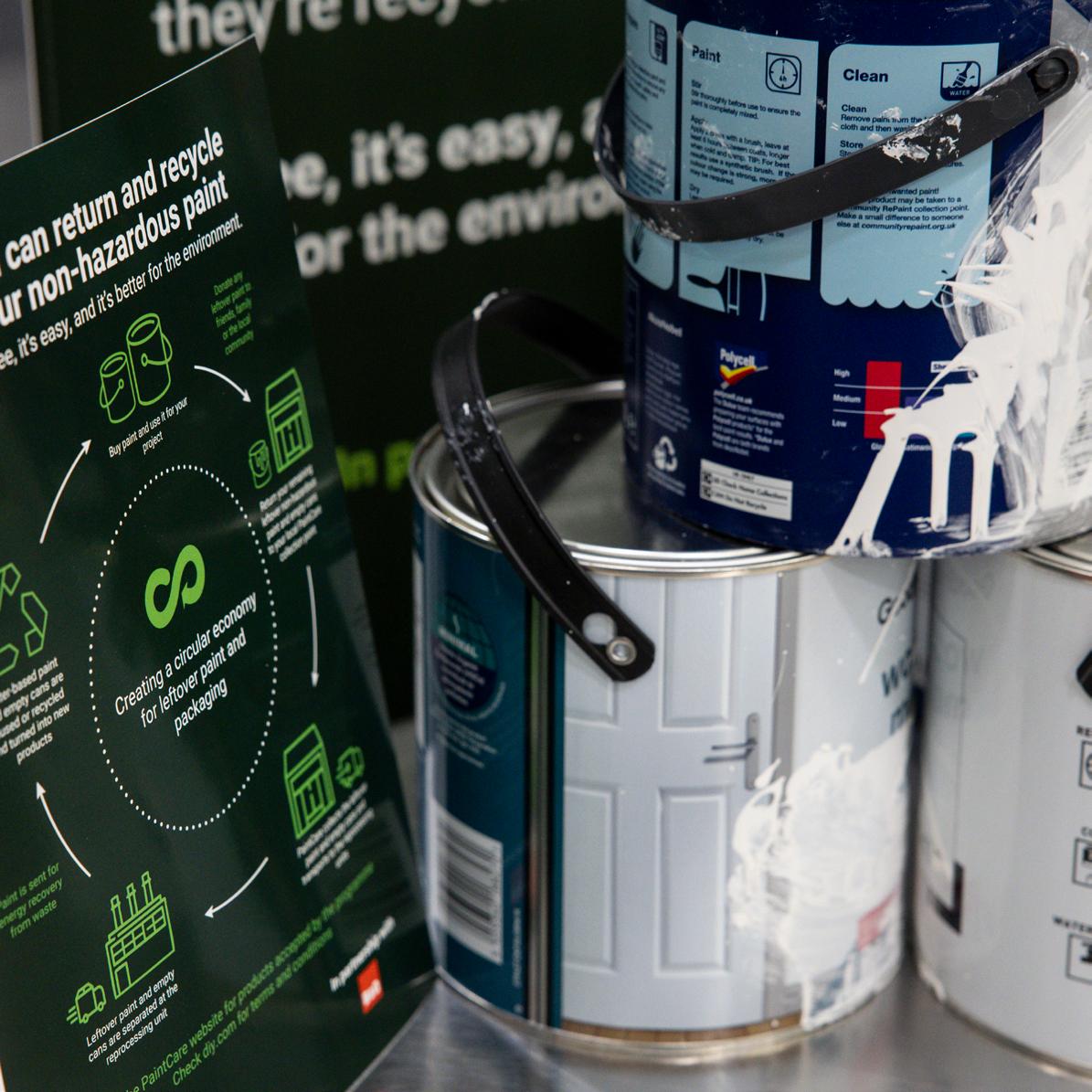
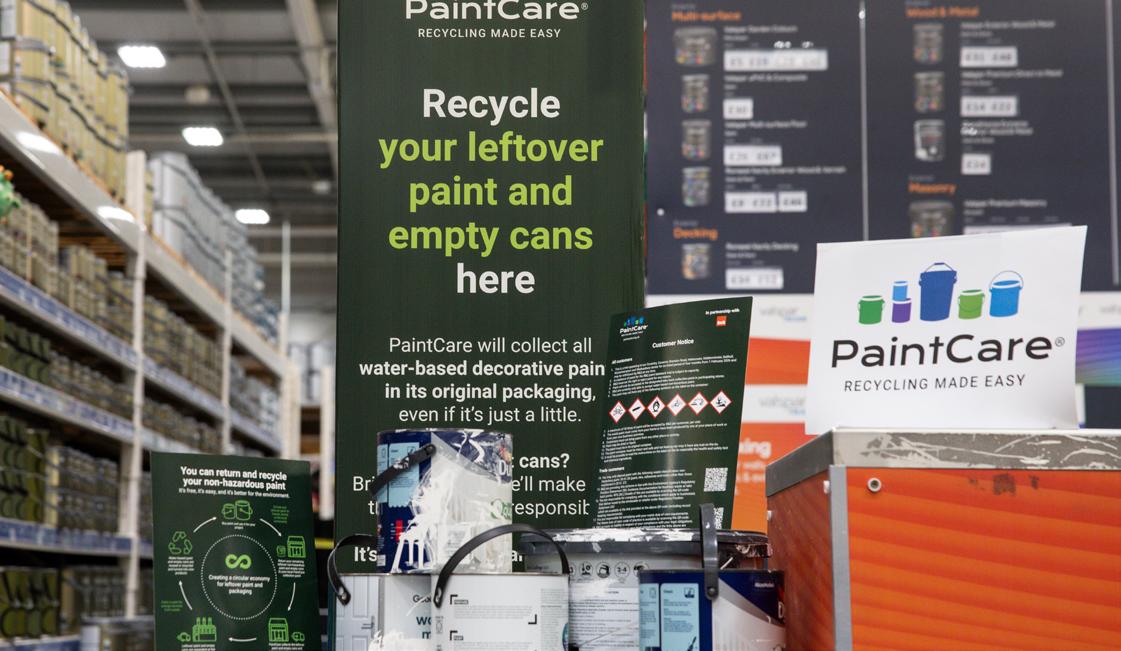
PaintCare is a UK wide, industry led stewardship initiative orchestrated by the British Coatings Federation to tackle the challenge of decorative paint and paint packaging waste. It’s ultimate goal is to divert this paint and paint packaging from waste streams toward reuse, remanufacturing, and recycling. The aim is to increase the reuse or remanufacture rate of leftover paint from about 2% today to 75% by 2032 and paint packaging from 0% today to 42 % by 2032. The program is designed to fund itself through a levy added to each can of paint sold, effectively placing cost responsibility on producers and incentivising waste reduction.
Consumers will be able to drop off leftover paint at participating Household Waste Recycling Centres (HWRCs) and retail outlets, and tradespeople and contractors will be able to drop off their leftover paint and packaging at participating trade decorator centres. Collected paint is categorised into non‑hazardous and hazardous streams. Non‑hazardous paint is either redistributed for reuse and/or remanufacturing into new paint. Hazardous paint typically goes for incineration with energy recovery. Empty plastic and metal packaging will be recycled.
PaintCare plans to support a national network of collection points, and the possibility of creating sortation and processing centres across the UK. Currently only one in three HWRCs accept paint from Households across the UK. The scheme is working to bridge this gap, aiming for effortless access and consumer participation.
In March 2026 PaintCare UK began a trial across the West Midlands Combined Authority. The pilot will allow consumers and tradespeople to return leftover decorative paint and empty packaging to selected participating retailers, helping to unlock reuse and recycling at scale.
The PaintCare pilot brings together major paint brands Dulux, Johnstone’s Paint, Crown Paints, Craig & Rose, Valspar and Little Greene working in collaboration with retail partners including B&Q, Brewers Decorator Centres, Dulux Decorator Centres and Johnstone’s Decorating Centres. Together, they aim to test a practical, scalable model that could help transform the paint category towards a more circular, sustainable future.
The time limited regional pilot will run for approximately three months and is designed to test and evaluate:
• Consumer participation and convenience
• In store collection models
• Logistics and treatment solutions
• Opportunities for paint reuse and packaging recycling
PaintCare is working with waste and recycling partner Biffa to manage the safe collection, transport and treatment of returned paint and packaging. Around £0.5 million has been invested in the trial, underlining the paint industry’s commitment to delivering real, system level change rather than incremental fixes.
PaintCare intends to use the lessons learned from the trial to inform a planned national rollout in mid 2027. BCF and PaintCare will work closely with government and relevant agencies throughout the trial, sharing insights on what works well and where regulatory or practical barriers may need to be addressed to enable a viable national scheme.