BRISBANE GRAMMAR SCHOOL 2012 BRISBANE GRAMMAR SCHOOL 2021
The School Window The annual literary magazine of
BRISBANE GRAMMAR SCHOOL
2021
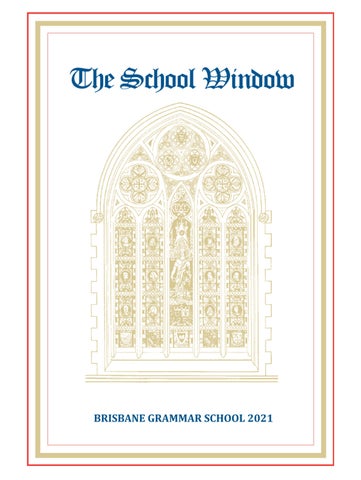
The Great School Window of the School – the theme of the title and cover of this magazine – dates from the rebuilding of the school on its present site in 1880, and was regarded at the time as the finest stained-glass window in Australia. The design has Queen Victoria as the central figure, surrounded by distinguished Britons grouped as poets, scientists, statesmen and Empire leaders. In the lower centre of the window is the crest of Brisbane Grammar School. The cover is a reproduction of a sketch by E.M. Hall, a pupil in 1941.
i
Foreword 2021
“Creativity requires the courage to let go of certainties.” ~Erich Fromm
One hundred years ago, just near The Great Hall, our country’s Governor General, Lord Forster, commemorated the installation of “The Gun”, which would become one of the most beloved landmarks at Brisbane Grammar. A Great War relic, The Gun had been captured in 1918 by the 3rd Light Horse Brigade led by Old Boy, Brigadier-General Wilson. On that day in 1921, Lord Forster praised the courage of the School’s Old Boys who had served and for many, given their lives in defence of freedom. For the students who excitedly lined the driveway, the Governor General was speaking not about distant Old Boys, but about members of their families and communities. Whilst a day for patriotic celebration, those who gathered would have been acutely aware of what The Gun also represented: a solemn testament to a lesson from history that they hoped would not be repeated. Eighty years ago, Headmaster Carson-Cooling recorded his “blessings and good wishes” for the creators of the first “School Window” magazine in 1941. Twenty years after the commemoration of The Gun, BGS Old Boys and staff were engaged in another “great” and devastating war. It was perhaps not surprising that against that backdrop, this magazine was born. The first editorial recorded the creators’ fervent hope that the magazine would be a “living monument of a united effort” as well as an inspiration for all students’ “literary aspirations”. Our hope in 2021 remains the same. Our community values learning about and from our past and therefore, we protect and respect the recording of it. At the core of our history are the voices that have been heard in classrooms and quadrangles and on playing fields over the decades. Our community is committed to preserving their words and records of their contributions to others and the world; we want to learn from and about them, and in doing so, respect them and their memory. This magazine records and shares some of the voices of the young men who have made up our 2021 community. With their words, our youngest students’ energy and excitement are clear. They enjoy the freedom to invent and imagine new worlds and times, where the impossible is possible. Adventure, Fantasy and Science fiction narratives continue to be popular for our Middle School writers as they are given the freedom to explore the “what if?”. Our senior school students’ writing reflects their maturing insights and their focus on their own current realities. Their words take us on journeys into their experiences, concerns, and realisations. This year, the Year 11 and 12 writers composed short stories in response to poetry and their narratives highlight their engagement with a range of compelling themes including the fragility of life, change, and the human condition. Whilst their stories are original, what they share is that their unique voices are importantly being heard and recorded. In addition, the journal continues to celebrate the power of students’ spoken voices with the inclusion of those public speeches composed and delivered by students from Years 5-12 in the annual BGS Public Speaking competitions. These forums continue to celebrate and provide opportunity for our students to share what is important to them and their peers right now. Some of this year’s significant Assembly addresses are also captured in this journal, preserving the voices of our student and adult leaders whose speeches remind us about what we value as people and as members of a community that began in 1868.
ii
We would like to thank the Heads of Department and teachers who have continued to inspire our students’ learning, as well as their desire to question and imagine. We would also like to record our enormous gratitude to Mrs Deb Bateman for her creative and expert assistance with the design of this year’s magazine. Her patience and support have been integral in the realisation of this publication. Importantly, we would also like to thank the students for sharing their voices with us in the knowledge that they will be enjoyed by future readers and that their words will be remembered as part of our literary story. We hope that we have done some justice to the original editors’ goal that “The Window” be a “living monument”. We have certainly enjoyed the privilege of being immersed in our boys’ words and the opportunity to help preserve some of our School’s “future history”. Helen Johnston and Georgina O’Hanlon-Rose (Co-editors)
Contents Prize Winning Voices Pages Australia and India – the next big economic relationship? - Sterling Saini (Economics Essay Prize) . . . . . . . . . . . . . . 12 Peacemaker - Aly Sultan (John Deeney Prize for a Short Story) . . . . . . . . . . . . . . . . . . . . . . . . . . . . . . . . . . . . . . . . . . . . . . . . . . . 15 From Saigon to Kabul - Angus Duncan (The Woolcock Challenge Cup) . . . . . . . . . . . . . . . . . . . . . . . . . . . . . . . . . . . . . . . . . . . 21 Edward Snowden (1983- ) - Ollie Taylor (The School Window Biography Prize) . . . . . . . . . . . . . . . . . . . . . . . . . . . . . . . . . . 26 The God Complex - Sze Yong Ng (Kenneth Patten Memorial Prize) . . . . . . . . . . . . . . . . . . . . . . . . . . . . . . . . . . . . . . . . . . . . . . . 30 The Day the NBA Failed Jeremy Lin - Bowen Chen (Sports Essay Prize) . . . . . . . . . . . . . . . . . . . . . . . . . . . . . . . . . . . . . . . . . 32 21st Centenarian - Alexander Larder (Senior Poetry Prize) . . . . . . . . . . . . . . . . . . . . . . . . . . . . . . . . . . . . . . . . . . . . . . . . . . . . 34 For Nana - Aden Whyte (Junior Poetry Prize) . . . . . . . . . . . . . . . . . . . . . . . . . . . . . . . . . . . . . . . . . . . . . . . . . . . . . . . . . . . . . . . . . 35 Lost Language - Sean Forrest (C E Bevan Prize) . . . . . . . . . . . . . . . . . . . . . . . . . . . . . . . . . . . . . . . . . . . . . . . . . . . . . . . . . . . . . . . . 37 Is Guy really free? - Sam Bizzell (Thomas Thatcher Memorial Prize). . . . . . . . . . . . . . . . . . . . . . . . . . . . . . . . . . . . . . . . . . . . . . 38 Turning Back Time - Nate Stathis (Senior School Photography Competition Winner) . . . . . . . . . . . . . . . . . . . . . . . . . . . . . . . 41 Talking with Grandad - Chris Walker (Staff Photography Competition Winner) . . . . . . . . . . . . . . . . . . . . . . . . . . . . . . . . . . . 42 Mothers and Daughters - Elliot Morris (Middle School Photography Competition Winner) . . . . . . . . . . . . . . . . . . . . . . . . . 43 Advertising Trickery - Will Angelini (Year 5 Public Speaking Competition) . . . . . . . . . . . . . . . . . . . . . . . . . . . . . . . . . . . . . . . 44 A “short” speech - Henry Woodward (Year 6 Public Speaking Competition) . . . . . . . . . . . . . . . . . . . . . . . . . . . . . . . . . . . . . . 45 The Dangers of Revenge - Om Thaker (Year 7 Public Speaking Competition) . . . . . . . . . . . . . . . . . .. . . . . . . . . . . . . . . . . . . . 46 Words - Lucas Lu (Year 8 Public Speaking Competition) . . . . . . . . . . . . . . . . . . . . . . . . . . . . . . . . . . . . . . . . . . . . . . . . . . . . . . . . . 47 The Denial of our Science - Dominic Forrest (Year 9 Public Speaking Competition) . . . . . . . . . . . . . . . . . . . . . . . . . . . . . . . 48 Global Conflict and Violence - Brad Mackintosh (Year 10 Public Speaking Competition) . . . . . . . . . . . . . . . . . . . . . . . . . . . 49 The Death of Mystery - Elton Fitzgerald (Year 11 Public Speaking Competition) . . . . . . . . . . . . . . . . . . . . . . . . . . . . . . . . . . . 51 It’s the effort put in that counts - Angus Duncan . . . . . . . . . . . . . . . . . . . . . . . . . . . . . . . . . . . . . . . . . . . . . . . . . . . . . . . . . . . . . . 52 The National History Challenge - Ben Richards . . . . . . . . . . . . . . . . . . . . . . . . . . . . . . . . . . . . . . . . . . . . . . . . . . . . . . . . . . . . . . . 54 Year 5 Voices Procrastination – Mason Gao - 2nd Place, Runner Up Public Speaking Competition . . . . . . . . . . . . . . . . . . . . . . . . . . . Climate Change 2021 – Lachlan Tan - 3rd Place, Public Speaking Competition . . . . . . . . . . . . . . . . . . . . . . . . . . . . . . . . . The Toy Designer’s “Pitch”: “The Surfstunter” – Francis Wallwork . . . . . . . . . . . . . . . . . . . . . . . . . . . . . . . . . . . . . . . . . . . . The Toy Designer’s “Pitch”: The Digi-Ball- Nelson Wang . . . . . . . . . . . . . . . . . . . . . . . . . . . . . . . . . . . . . . . . . . . . . . . . . . . . . . . The Tragic Life of George Wynn - Nelson Wang . . . . . . . . . . . . . . . . . . . . . . . . . . . . . . . . . . . . . . . . . . . . . . . . . . . . . . . . . . . . . . . Lost - Mason Gao . . . . . . . . . . . . . . . . . . . . . . . . . . . . . . . . . . . . . . . . . . . . . . . . . . . . . . . . . . . . . . . . . . . . . . . . . . . . . . . . . . . . . . . . . . . . Year 6 Voices Video Games are Good for You - Kobi Stevens, Tied 2nd place, Public Speaking Competition . . . . . . . . . . . . . . . . . . . Gardening: Civilisation Depends on it -Thomas Scott, Tied 2nd place, Public Speaking Competition . . . . . . . . . . . . Junk Food is Good for You - Julian Chin, 3rd place, Public Speaking Competition . . . . . . . . . . . . . . . . . . . . . . . . . . . . . . Environmentally Friendly Cars means Hydrogen Powered - Samuel Prasad, Fourth Place, Public Speaking Competition . . . . . . . . . . . . . . . . . . . . . . . . . . . . . . . . . . . . . . . . . . . . . . . . . . . . . . . . . . . . . . . . . . . . . . . . . . . . . . . . . . . . . . . . . . . . . . . . . Forest Walk - Thomas Scott, short listed, Red Room Poetry Competition . . . . . . . . . . . . . . . . . . . . . . . . . . . . . . . . . . . . . The Hill - Edward Mulholland . . . . . . . . . . . . . . . . . . . . . . . . . . . . . . . . . . . . . . . . . . . . . . . . . . . . . . . . . . . . . . . . . . . . . . . . . . . . . . . The Ocean of Snow - Thomas Scott . . . . . . . . . . . . . . . . . . . . . . . . . . . . . . . . . . . . . . . . . . . . . . . . . . . . . . . . . . . . . . . . . . . . . . . . . . . A Rogue Flame - Severin Yong Gee . . . . . . . . . . . . . . . . . . . . . . . . . . . . . . . . . . . . . . . . . . . . . . . . . . . . . . . . . . . . . . . . . . . . . . . . . . . The Gang and the Sea - Edward Creighton . . . . . . . . . . . . . . . . . . . . . . . . . . . . . . . . . . . . . . . . . . . . . . . . . . . . . . . . . . . . . . . . . . . . Summer Tragedy - Eric Chen . . . . . . . . . . . . . . . . . . . . . . . . . . . . . . . . . . . . . . . . . . . . . . . . . . . . . . . . . . . . . . . . . . . . . . . . . . . . . . . . v
59 60 61 63 65 67
69 70 71 73 74 75 77 79 80 81
Year 7 Voices A Little about Ants - Rishi Mehta - 2nd Place, Public Speaking Competition . . . . . . . . . . . . . . . . . . . . . . . . . . . . . . . . . . Knowing when to Quit - Charles Nelson - 3rd Place, Public Speaking Competition . . . . . . . . . . . . . . . . . . . . . . . . . . . . The Fugitive - Aaron Alphonso . . . . . . . . . . . . . . . . . . . . . . . . . . . . . . . . . . . . . . . . . . . . . . . . . . . . . . . . . . . . . . . . . . . . . . . . . . . . . . Fantasy Map - Arnav Thapar . . . . . . . . . . . . . . . . . . . . . . . . . . . . . . . . . . . . . . . . . . . . . . . . . . . . . . . . . . . . . . . . . . . . . . . . . . . . . . . . Fantasy Map - Daylin Johnson . . . . . . . . . . . . . . . . . . . . . . . . . . . . . . . . . . . . . . . . . . . . . . . . . . . . . . . . . . . . . . . . . . . . . . . . . . . . . . . Fantasy Map - James Butler . . . . . . . . . . . . . . . . . . . . . . . . . . . . . . . . . . . . . . . . . . . . . . . . . . . . . . . . . . . . . . . . . . . . . . . . . . . . . . . . . The Forest of Silence - Chapter 4 -Alexander Alayan . . . . . . . . . . . . . . . . . . . . . . . . . . . . . . . . . . . . . . . . . . . . . . . . . . . . . . . . The Quest For Kaldakviski: Final Confrontation - Max Nakasato . . . . . . . . . . . . . . . . . . . . . . . . . . . . . . . . . . . . . . . . . . . . . A Match to Remember - Oliver Dauber . . . . . . . . . . . . . . . . . . . . . . . . . . . . . . . . . . . . . . . . . . . . . . . . . . . . . . . . . . . . . . . . . . . . . . Year 8 Voices Duty Upon Catalos - Benjamin Li . . . . . . . . . . . . . . . . . . . . . . . . . . . . . . . . . . . . . . . . . . . . . . . . . . . . . . . . . . . . . . . . . . . . . . . . . . . Salvation - Christian Ma . . . . . . . . . . . . . . . . . . . . . . . . . . . . . . . . . . . . . . . . . . . . . . . . . . . . . . . . . . . . . . . . . . . . . . . . . . . . . . . . . . . Son of the State - Lucas Lu . . . . . . . . . . . . . . . . . . . . . . . . . . . . . . . . . . . . . . . . . . . . . . . . . . . . . . . . . . . . . . . . . . . . . . . . . . . . . . . . What if we traded employees like sports stars? - Matteo Boccolacci - 2nd Place, Public Speaking Competition What is Justice? - Luke Saywell - Third Place, Public Speaking Competition . . . . . . . . . . . . . . . . . . . . . . . . . . . . . . . . . It’s Just a Spark - Jackson Leong . . . . . . . . . . . . . . . . . . . . . . . . . . . . . . . . . . . . . . . . . . . . . . . . . . . . . . . . . . . . . . . . . . . . . . . . . . . . Need To Talk - Matthew Young . . . . . . . . . . . . . . . . . . . . . . . . . . . . . . . . . . . . . . . . . . . . . . . . . . . . . . . . . . . . . . . . . . . . . . . . . . . . .
Assembly Voices School Captain: Prefect Induction Address - Tom Stunden . . . . . . . . . . . . . . . . . . . . . . . . . . . . . . . . . . . . . . . . . . . . . . . . . . . Boarding Captain: Assembly Address - Aly Sultan . . . . . . . . . . . . . . . . . . . . . . . . . . . . . . . . . . . . . . . . . . . . . . . . . . . . . . . . . . . School Vice Captain Address - William Staib . . . . . . . . . . . . . . . . . . . . . . . . . . . . . . . . . . . . . . . . . . . . . . . . . . . . . . . . . . . . . . . . Harmony Assembly Address - Diversity - Harry Anstey-Walsh . . . . . . . . . . . . . . . . . . . . . . . . . . . . . . . . . . . . . . . . . . . . . . Boarding Week Assembly Address - Mr Berian Williams-Jones, Director of Boarding . . . . . . . . . . . . . . . . . . . . . . . . International Women’s Day Assembly Address - Boarding Vice Captain - Campbell Watchirs . . . . . . . . . . . . . . . . . Captains’ Farewell Assembly Address - School Captains . . . . . . . . . . . . . . . . . . . . . . . . . . . . . . . . . . . . . . . . . . . . . . . . . . . . . Year 9 Voices Revenge and Forgiveness - Alex Leung . . . . . . . . . . . . . . . . . . . . . . . . . . . . . . . . . . . . . . . . . . . . . . . . . . . . . . . . . . . . . . . . . . . . . . Swan Song - Ed Cooper . . . . . . . . . . . . . . . . . . . . . . . . . . . . . . . . . . . . . . . . . . . . . . . . . . . . . . . . . . . . . . . . . . . . . . . . . . . . . . . . . . . . . Confession - Manul Jayasena . . . . . . . . . . . . . . . . . . . . . . . . . . . . . . . . . . . . . . . . . . . . . . . . . . . . . . . . . . . . . . . . . . . . . . . . . . . . . . . . Family - Michael Wong . . . . . . . . . . . . . . . . . . . . . . . . . . . . . . . . . . . . . . . . . . . . . . . . . . . . . . . . . . . . . . . . . . . . . . . . . . . . . . . . . . . . . Instinct - Thomas Ruddell . . . . . . . . . . . . . . . . . . . . . . . . . . . . . . . . . . . . . . . . . . . . . . . . . . . . . . . . . . . . . . . . . . . . . . . . . . . . . . . . . .
Year 10 Voices Uprooted - Duke Giles . . . . . . . . . . . . . . . . . . . . . . . . . . . . . . . . . . . . . . . . . . . . . . . . . . . . . . . . . . . . . . . . . . . . . . . . . . . . . . . . . . . . . . Overhead Smash - Sebastien Roy-Bryant . . . . . . . . . . . . . . . . . . . . . . . . . . . . . . . . . . . . . . . . . . . . . . . . . . . . . . . . . . . . . . . . . . . . Just a Smile - Ben Bryant . . . . . . . . . . . . . . . . . . . . . . . . . . . . . . . . . . . . . . . . . . . . . . . . . . . . . . . . . . . . . . . . . . . . . . . . . . . . . . . . . . . The Waterhole - Hoby Kulla Kulla . . . . . . . . . . . . . . . . . . . . . . . . . . . . . . . . . . . . . . . . . . . . . . . . . . . . . . . . . . . . . . . . . . . . . . . . . . . Coming of Age - John Morrissey . . . . . . . . . . . . . . . . . . . . . . . . . . . . . . . . . . . . . . . . . . . . . . . . . . . . . . . . . . . . . . . . . . . . . . . . . . . . Only Seven - Sathya Gururajan . . . . . . . . . . . . . . . . . . . . . . . . . . . . . . . . . . . . . . . . . . . . . . . . . . . . . . . . . . . . . . . . . . . . . . . . . . . . . Boo Radley - Weili Cao . . . . . . . . . . . . . . . . . . . . . . . . . . . . . . . . . . . . . . . . . . . . . . . . . . . . . . . . . . . . . . . . . . . . . . . . . . . . . . . . . . . . . .
vi
83 84 85 86 87 88 90 91 94
97 99 101 103 105 106 108
111 113 115 117 119 121 123
127 129 131 133 137
139 141 143 145 147 149 151
Year 11 Voices Through the Cracks - Michael Murray . . . . . . . . . . . . . . . . . . . . . . . . . . . . . . . . . . . . . . . . . . . . . . . . . . . . . . . . . . . . . . . . . . . . . . . . Eleven Seventeen - Alec Donald . . . . . . . . . . . . . . . . . . . . . . . . . . . . . . . . . . . . . . . . . . . . . . . . . . . . . . . . . . . . . . . . . . . . . . . . . . . . . . Strangers - Angus Bissett . . . . . . . . . . . . . . . . . . . . . . . . . . . . . . . . . . . . . . . . . . . . . . . . . . . . . . . . . . . . . . . . . . . . . . . . . . . . . . . . . . . . The Golden Years - Ben Zacharyga . . . . . . . . . . . . . . . . . . . . . . . . . . . . . . . . . . . . . . . . . . . . . . . . . . . . . . . . . . . . . . . . . . . . . . . . . . . The Promised Land - Hamish Moss . . . . . . . . . . . . . . . . . . . . . . . . . . . . . . . . . . . . . . . . . . . . . . . . . . . . . . . . . . . . . . . . . . . . . . . . . . Like a Leaf on the Wind - Sean Moyle . . . . . . . . . . . . . . . . . . . . . . . . . . . . . . . . . . . . . . . . . . . . . . . . . . . . . . . . . . . . . . . . . . . . . . . . Two Peas in a Pod - Tyler Pearn . . . . . . . . . . . . . . . . . . . . . . . . . . . . . . . . . . . . . . . . . . . . . . . . . . . . . . . . . . . . . . . . . . . . . . . . . . . . . The Closing Word - Toby Davidson . . . . . . . . . . . . . . . . . . . . . . . . . . . . . . . . . . . . . . . . . . . . . . . . . . . . . . . . . . . . . . . . . . . . . . . . . .
Year 12 Voices Progress - Angus Duncan . . . . . . . . . . . . . . . . . . . . . . . . . . . . . . . . . . . . . . . . . . . . . . . . . . . . . . . . . . . . . . . . . . . . . . . . . . . . . . . . . . . . Ông Ngoai’s Garden - Jaguar Ngo . . . . . . . . . . . . . . . . . . . . . . . . . . . . . . . . . . . . . . . . . . . . . . . . . . . . . . . . . . . . . . . . . . . . . . . . . . . . A Last Offering - Roger Look . . . . . . . . . . . . . . . . . . . . . . . . . . . . . . . . . . . . . . . . . . . . . . . . . . . . . . . . . . . . . . . . . . . . . . . . . . . . . . . . . Corners - Alexander Larder . . . . . . . . . . . . . . . . . . . . . . . . . . . . . . . . . . . . . . . . . . . . . . . . . . . . . . . . . . . . . . . . . . . . . . . . . . . . . . . . . . Roses - Ben Richards . . . . . . . . . . . . . . . . . . . . . . . . . . . . . . . . . . . . . . . . . . . . . . . . . . . . . . . . . . . . . . . . . . . . . . . . . . . . . . . . . . . . . . . . Reparation - James Hill . . . . . . . . . . . . . . . . . . . . . . . . . . . . . . . . . . . . . . . . . . . . . . . . . . . . . . . . . . . . . . . . . . . . . . . . . . . . . . . . . . . . Who Doesn’t Love a Wall? - James Lowe . . . . . . . . . . . . . . . . . . . . . . . . . . . . . . . . . . . . . . . . . . . . . . . . . . . . . . . . . . . . . . . . . . . . . . Love You - Josh Blake . . . . . . . . . . . . . . . . . . . . . . . . . . . . . . . . . . . . . . . . . . . . . . . . . . . . . . . . . . . . . . . . . . . . . . . . . . . . . . . . . . . . . . . . The Innocence of War - Max Sawley . . . . . . . . . . . . . . . . . . . . . . . . . . . . . . . . . . . . . . . . . . . . . . . . . . . . . . . . . . . . . . . . . . . . . . . . . In Five Years - Nathan Wong . . . . . . . . . . . . . . . . . . . . . . . . . . . . . . . . . . . . . . . . . . . . . . . . . . . . . . . . . . . . . . . . . . . . . . . . . . . . . . . . . Tom’s Wish - Raphy Athanasiou . . . . . . . . . . . . . . . . . . . . . . . . . . . . . . . . . . . . . . . . . . . . . . . . . . . . . . . . . . . . . . . . . . . . . . . . . . . . . The Day was Young - Sanjeev Raju . . . . . . . . . . . . . . . . . . . . . . . . . . . . . . . . . . . . . . . . . . . . . . . . . . . . . . . . . . . . . . . . . . . . . . . . . . . The Drive Ahead - Tom McCarthy-James . . . . . . . . . . . . . . . . . . . . . . . . . . . . . . . . . . . . . . . . . . . . . . . . . . . . . . . . . . . . . . . . . . . . . New Year - Tom Srooper . . . . . . . . . . . . . . . . . . . . . . . . . . . . . . . . . . . . . . . . . . . . . . . . . . . . . . . . . . . . . . . . . . . . . . . . . . . . . . . . . . . . Renewal - William Addis . . . . . . . . . . . . . . . . . . . . . . . . . . . . . . . . . . . . . . . . . . . . . . . . . . . . . . . . . . . . . . . . . . . . . . . . . . . . . . . . . . . . Leaving the Post - Jaguar Ngo . . . . . . . . . . . . . . . . . . . . . . . . . . . . . . . . . . . . . . . . . . . . . . . . . . . . . . . . . . . . . . . . . . . . . . . . . . . . . . . Once Upon a Time in Suburbia - Will Fenech . . . . . . . . . . . . . . . . . . . . . . . . . . . . . . . . . . . . . . . . . . . . . . . . . . . . . . . . . . . . . . . . . An Afternoon on the Boat - Drew Weightman . . . . . . . . . . . . . . . . . . . . . . . . . . . . . . . . . . . . . . . . . . . . . . . . . . . . . . . . . . . . . . . . The Bank - Olive Butler . . . . . . . . . . . . . . . . . . . . . . . . . . . . . . . . . . . . . . . . . . . . . . . . . . . . . . . . . . . . . . . . . . . . . . . . . . . . . . . . . . . . . . Memorare - Anton Vassallo . . . . . . . . . . . . . . . . . . . . . . . . . . . . . . . . . . . . . . . . . . . . . . . . . . . . . . . . . . . . . . . . . . . . . . . . . . . . . . . . . . Light at the end of the tunnel - Nayan Thapar . . . . . . . . . . . . . . . . . . . . . . . . . . . . . . . . . . . . . . . . . . . . . . . . . . . . . . . . . . . . . . . . School Captain’s Speech Day Address - Tom Stunden . . . . . . . . . . . . . . . . . . . . . . . . . . . . . . . . . . . . . . . . . . . . . . . . . . . . . . . . .
vii
153 155 157 159 161 163 165 168
171 173 175 177 179 181 183 184 186 188 190 192 194 196 198 201 204 207 210 213 216 219
viii
Artwork Aleksiuk, Lachlan
93
O’Sullivan, Charlie
185
Biscaro, Luca
197
O’Sullivan, Charlie
209
Beikoff, Jax Brand, Joshua Dalton, Gray
Dark, Niklas Ding, Aowen Donald, Tom
Dunne, Jack
Fitzpatrick, Connor Gao, Jeric Gao, Max Goh, Josh Goh, Josh
Goodall, Quinn hooper, Max Hy, Daniel
Kim, John
Levy, Asher Li, Benjamin Luo, Daniel Mackay, Hamish Mellick, Samuel
O’Sullivan, Charlie
102
Peters, Alex
70
Powell, Sebi
64
Sim, Alex
98
Smith, Max
107
Smith, Sam
132
Smith, Tom
144
Spencer, Christopher
135
Stamatellos, Joshua
89
Sullivan, Nicholas
93
Tsai, Gordon
176
Tweed, Angus
195
Wang, Kevin
72
Wang, Kevin
160
Wantsch, James
62
Wittome, Ben
150
187 136 212 182 93
132 66
199 142 191 132 148 180 189 100 146
Wu, Joel 89
93
Yadollahi Farsani, Dana 107
100 136
Zacharyga, Ben
162
Zhao, Alan
136
Zaeem, Turhan
76
166
ix
78
PRIZE WINNING
VOICES
Prize Winning Voices Prize
Student
The Woolcock Challenge Cup
Angus Duncan
Economics Essay Prize
Sterling Saini
John Deeney Prize for a Short Story
Aly Sultan
The School Window Biography Prize
Ollie Taylor
Kenneth Patten Memorial Prize
Sze Yong Ng
Sports Essay Prize
Bowen Chen
Senior Poetry Prize
Alex Larder
Junior Poetry Prize
Aden Whyte
C.E. Bevan Prize(Sonnet)
Sean Forrest
Thomas Thatcher Memorial Prize
Sam Bizzell
Photography Competition Winner
Nate Stathis
Best Staff Entry
Chris Walker
Middles School Winner
Elliot Morris
Year 5 Public Speaking Award
Will Angelini
Year 6 Public Speaking Award
Henry Woodward
Year 7 Public Speaking Award
Om Thacker
Year 8 Public Speaking Award
Lucas Lu
Year 9 Public Speaking Award
Dominic Forrest
Year 10 Public Speaking Award
Brad Mackintosh
Year 11 Public Speaking Award
The National History Challenge Gold Award and State Winner
T h e P r i z e
S c h o o l W i n n i n g
W i n d o w V o i c e s
11
Elton Fitzgerald Ben Richards
Australia and India – the next big economic relationship? Sterling Saini Year 12 The winner of the Economics
Essay Prize
Two way trade between the Republic of India and the Commonwealth of Australia has increased over the time period of 1988 to 2020, at a value of $80 million AUD to $24.4 billion AUD (ABS, 2021), with Australian foreign direct investment into India valued at $15.4 billion AUD in 2020 (DFAT, 2020). India was Australia’s seventh largest trading partner and sixth largest export destination, driven by increasing exports of Australian coal to India to accommodate a burgeoning manufacturing sector and increasing numbers of Indian students studying in Australia (Australian High Commission New Delhi, 2021). Indian economic clout as a newly industrialised nation has been ever increasing since Indian Prime Minister P.V. Narasimha Rao initiated economic liberalisation reforms in 1991, with the average GDP growth rate being 7.45% over the period of 2009-2019 (Worldbank Group, 2021), making it the world’s fastest growing major economy (Horowitz, 2021). Unlike other Asian economies before it (like the Asian Tiger economies, or even China), India’s growth is largely driven by its large consumer base, local entrepreneurship and successful service sector rather than heavy industrialisation and microeconomic reforms in an export-oriented growth strategy traditionally pursued by nations like South Korea and China (Quinn, 2010). However, efforts to diversify and encourage homegrown manufacturing by the current Modi government are likely to bear fruit in the future, leading to many opportunities for Australian businesses to engage in both pathways (AIBC, 2021). Thus, any Australian business or individual trying to deal with India is making a mistake if they see India as the next China. A vibrant, messy, parliamentary democracy, India’s institutions are known to be bureaucratic and slow in enacting necessary changes despite recent efforts for reforms – it took 30 years for India to implement GST (Times of India, 2017) compared to the streamlined and efficient Chinese one-party system, which is faster but not really concerned with the individual voices of a few that get in the way of development. However, a nation soon to have the world’s largest population (Ritchie, 2019), India presents several opportunities for both Australian and Indian businesses alike. India was once known as a nation that strangled entrepreneurship and business alike under the ‘Licence Raj’ period, and trade between India and Australia had been limited by cultural and societal barriers, as well as excessive red tape and bureaucracy that had made many Australian companies shy to make an investment into such a hard-to-do business environment (Varghese, 2018). In India, at least for now, the air for change is strong. The current BJP government, led by Narendra Modi, has enacted reforms, and is investing in the Indian economy more than ever. This government has taken a leaf out of the books of China and her predecessors, prioritising infrastructure (building 37km of highways of road a day (The Hindu, 2020), building ‘Special Economic Zones’, investing in and reforming education and even more recently India has been signing more trade agreements, most notably with Japan and ASEAN (Business Australia, 2020). Meanwhile, Australia - and Australians - are being increasingly concerned about China’s antics in the South China Sea and its increased belligerence in both military and economic regards. While only 12% of Australians saw China as more of a security threat than an economic partner in 2018, this has ballooned to 63% of Australians in 2021.
12
T h e
S c h o o l
P r i z e
W i n d o w
W i n n i n g
V o i c e s
The reverse is also true; while 82% saw China as more of an economic partner than security threat in 2018, this had decreased to 34% in 2021 (Lowy Institute, 2021). This means that Australia is likely to reduce its reliance on China (which currently constitutes 36.2% of exports (RBA, 2021) and attempt to expand trade with existing partners, such as with India or Indonesia as Australia did with its wine exports (McCarthy, 2021). As an extension of this, both governments of India and Australia are seeking to develop free-trade agreements to facilitate cross-cultural ties and benefit both nations economically. This is part of the Australia – Indian economic policy for 2035 and hopes to take shape as the Australian-India Comprehensive Economic Co-operation Agreement or “CECA” for short. It will now be evaluated whether Australia should sign this agreement based on the criteria of sustainable economic growth and risk diversification in regard to both the economy and Australian strategic interests. It would be of large benefit to Australia to sign the CECA with India in regard to sustainable economic growth. The net increase in GDP possible by such an agreement could increase the size of Australia’s GDP by $46 billion within 20 years of the agreement, a clear positive effect on the economy (Business Australia, 2020). An agreement would reduce tariffs on India’s heavily protected, yet very inefficient, agricultural sector - where average tariffs on goods are 37.5% - giving room for more competitive Australian agriculture to make inroads into a lucrative Indian market. Projections of India’s middle class growth are staggering – increasing from 50 million in 2015 to an expected 475 million by 2030 (and 850% increase) (Roy, 2018)– providing significant opportunities for Australian businesses to export goods and services such as agribusiness, education and health (Australian Trade and Investment Commission, 2021) if such a trade agreement were to come into fruition, benefitting Australia’s economic growth. Indian coal imports from Australia (a key Australian industry) have grown 450% from 2019 to 2020 as India seeks to have higher quality Australian coal to accommodate its huge energy requirements (Russell, 2021), benefitting Australian producers and the Australian economy, and proving a new, long term destination for Australian coal exports, leading to increased sustainable economic growth. The advent of a new market for such a key strategic industry has also reduced Australia’s dependence on China and acts as a helpful source of risk diversification (Xu, Varadhan, & Burton, 2021) for an increasingly belligerent China willing to engage in ‘Wolf-Warrior Diplomacy’. In terms of long term stability, while Australia’s traditional trading partners (like China and South Korea) face aging populations, India’s relatively young population adds balance and spreads risk in Australia’s economic relationships (Varghese, 2018), allowing long term sustainability for exports in the manufacturing sector until – according to current projections – at least 2055 (Kapoor & Yadav, 2021). However, there are some possible risks with such an agreement. China has already expressed concern over Australia’s closer ties to India through the quadrilateral security dialogue – it is possible that Australia, increasing its engagement with India, would risk jeopardising Australia’s economic relations with the PRC. Furthermore, it is unlikely that such an agreement would fulfill Australia’s export needs compared to those of China; for example, while China consumes 51% of the world’s coal, India only uses 12%, a much smaller market. Finally, it can be politically unattractive to liberalise the economy – and especially the agriculture sector – in India, possibly meaning that pursuing such an agreement could be impractical and lead to a sub-optimal final outcome for both Australia and India. Despite these concerns, it would be an act of great benefit – and of even greater political will – to write a free trade agreement between the nations of India and Australia. Virat Kohli, the Captain of the Indian Cricket Team, has built his playing style, a raw aggression balanced with batting prowess, on his understanding on how the Australians play. In Indian cinema, the traditional sporting rival is Australian – stereotypically aggressive, hard hitting but very very good. Culturally, India has a strange respect for the way we do things in Australia. Based on both the economic opportunities, and these cultural ones, it would only seem to benefit Australia to extrapolate its current relationship – a cordial, diplomatic one – to one that fully encompasses and embraces the rising power in the Indian Ocean.
T h e P r i z e
S c h o o l W i n n i n g
W i n d o w V o i c e s
13
References ABS. (2021). International Trade in Goods and Services, Australia. Retrieved from ABS: https://www.abs.gov.au/statistics/economy/ international-trade/international-trade-goods-and-services-australia/latest-release AIBC. (2021). Make in India Chapter. Retrieved from AIBC: https://aibc.org.au/make-in-india/ Australian High Commission New Delhi. (2021). Doing Business with Australia- Australia’s Trade with India. Retrieved from Australian High Commission New Delhi: https://india.highcommission.gov.au/ndli/trade2.html Australian Trade and Investment Commission. (2021). Export Markets - India. Retrieved from AusTrade: https://www.austrade.gov.au/ australian/export/export-markets/countries/india/market-profile Business Australia. (2020). INDIA – OUR NEXT FREE TRADE AGREEMENT? Retrieved from Business Australia: https://www.businessaustralia. com/how-we-help/grow-your-business/preparing-to-export/india-our-next-free-trade-agreement DFAT. (2020). DFAT. Retrieved from India Country Brief: https://www.dfat.gov.au/geo/india/india-country-brief Horowitz, J. (2021, March 9). India could be back as the world’s fastest growing economy this year. Retrieved from CNN Business: https:// edition.cnn.com/2021/03/09/economy/oecd-economic-outlook/index.html Kapoor, A., & Yadav, C. (2021, May 10). https://economictimes.indiatimes.com/news/economy/policy/view-india-and-the-elusive-demographicdividend/articleshow/82517742.cms#:~:text=India%20has%20long%20been%20touted,economic%20growth%20%E2%80%93%20a%20 demographic%20dividend. Retrieved from The Economic Times: https://economictimes.indiatimes.com/news/economy/policy/view-india-andthe-elusive-demographic-dividend/articleshow/82517742.cms#:~:text=India%20has%20long%20been%20touted,economic%20growth%20 %E2%80%93%20a%20demographic%20dividend. Lowy Institute. (2021). China: Economic Partner or Security Threat. Retrieved from Lowy Institute Poll 2021: https://poll.lowyinstitute.org/ charts/china-economic-partner-or-security-threat McCarthy, M. (2021, Jan 2). China-Australia trade war forces winemakers to look to US, UK, and India to market. Retrieved from ABC News: https://www.abc.net.au/news/rural/2021-01-02/china-australia-trade-war-winemakers-look-for-new-markets-covid/13026228 Quinn, A. (2010, June 2). Time-traveling Larry Summers envisions “Mumbai Consensus”. Retrieved from Reuters: http://blogs.reuters.com/ frontrow/2010/06/02/time-traveling-larry-summers-envisions-mumbai-consensus/ RBA. (2021, July 21). Composition of the Australian Economy. Retrieved from RBA: https://www.rba.gov.au/education/resources/snapshots/ economy-composition-snapshot/ Ritchie, H. (2019, April 16). India will soon overtake China to become the most populous country in the world. Retrieved from Our World in Data: https://ourworldindata.org/india-will-soon-overtake-china-to-become-the-most-populous-country-in-the-world Roy, A. (2018). The Middle Class in India: From 1947 to the Present and Beyond. Retrieved from Association for Asian Studies: https://www. asianstudies.org/publications/eaa/archives/the-middle-class-in-india-from-1947-to-the-present-and-beyond/ Russell, C. (2021, February 8). Column: India’s coal imports rebound as Australia wins market share. Retrieved from Reuters: https://www. reuters.com/article/us-column-russell-coal-india/column-indias-coal-imports-rebound-as-australia-wins-market-share-russell-idUSKBN2A80ER The Hindu. (2020, April 2). Highways construction touches record 37 km per day: Gadkari. Retrieved from The Hindu: https://www.thehindu. com/news/national/highways-construction-touches-record-37-km-per-day-gadkari/article34221788.ece Times of India. (2017, June 29). 30 Years to GST. Retrieved from Times of India: https://timesofindia.indiatimes.com/business/indiabusiness/30-years-to-gst/articleshow/59368818.cms Varghese, P. N. (2018). EXECUTIVE SUMMARY & OVERVIEW. Retrieved from An India Economic Strategy to 2035: https://www.dfat.gov.au/geo/ india/ies/overview.html Worldbank Group. (2021). GDP growth (annual %) - India. Retrieved from The World Bank: https://data.worldbank.org/indicator/NY.GDP.MKTP. KD.ZG?locations=IN Xu, M., Varadhan, S., & Burton, M. (2021, April 8). Analysis: India, Indonesia benefit as China’s ban on Australian coal reshapes trade flows. Retrieved from Reuters: https://www.reuters.com/article/coal-trade/analysis-india-indonesia-benefit-as-chinas-ban-on-australian-coalreshapes-trade-flows-idUSKBN2BV1GN
14
T h e
S c h o o l
P r i z e
W i n d o w
W i n n i n g
V o i c e s
Peacemaker Aly Sultan Year 12
Peacemaker
1966 words May 18, 2021
T h e P r i z e
S c h o o l W i n n i n g
W i n d o w V o i c e s
15
The winner of The John Deeney Prize for a short story. This award is in honour of the late J. C. Deeney, Master at the School from 1921 – 1947.
It was late in the day when Sana went fishing. He carried his net like a cape across his back as he strolled along the beach. Waves rolled in and gently splashed his feet, leaving in their wake a veneer of foam. With his feet firmly planted in the wet sand of the riverbank, Sana artfully scanned the waters to look for the great fish he had hoped to find in the estuary. He marvelled at how the brown Sepik river spread itself like roots of a tree before gradually melting into a sapphire sea. Sana stood mesmerised by this spectacle of changing colours that marked the end of a long journey: raindrops joined the raging white of the mountain river, collecting dirt and silt along their journey home – the great blue sea. He unburdened himself of the heavy net and untangled it before expertly casting it into the sluggish brown waters of the estuary. The fan-like spread of the net in the flowing waters evoked in his mind the plumage of a riflebird. Sunlight reflected off the fibres of the net as it floated momentarily before slipping beneath the water’s surface. Sana peered down the undulating riverbank and spotted a large house set back from the water. It looked like no other dwelling in the area; the Whitepla Mahn 1 had made it when they came. When his father first saw the strange ‘white’ people landing he thought they were his dead forefathers. They were very well received and were given land near the beach among the casuarina trees to build. It had a roof that shone when sunlight hit it and a great big cross across the front made of diwai 2. He heard a familiar call from the house, it was his wantok 3, Hurenge, a dark skinned boy with black coloured eyes like rain soaked earth. “Halo Hurenge,” Sana shouted out across the distance. As Hurenge approached him, Sana was struck by his unusual appearance. Instead of his grass skirt, Hurenge sported a pale white cloth over his chest and black fabric that ran down from his waist to his knees. “Mi no lukim yu longtime, yu come up Whitepla Mahn? You wearim wanem?” “Wsshhhh, mi no Whitepla Mann!” Hurenge had told him that the pastor had given the clothes to him and he said: “Name blo me John now, pastor no sava pronouncim real name blo me.” Sana stood confused. His friend had a new look and a new name, but he did not quite know what to make of it all. Hurenge asked Sana what brought him here: “Mama blo me laikim wanpla big fish blo tonight’s sing sing.” Hurenge – or rather John – realised that Sana was going to be initiated and a wide grin crossed his face. The church had forbidden John from partaking in such dangerous cultural rites. “Onepla mahn die aste,” John cautioned Sana, hoping to talk him out of the ceremony.
White Man Wood 3 Friend 1 2
16
T h e
S c h o o l
P r i z e
W i n d o w
W i n n i n g
V o i c e s
Sana had heard similar talk but dismissed it as village gossip. His father was the Chief of the village and Sana’s initiation must not be questioned. His Papa’s words replayed in his ears: “noken harim tok blo Hurenge — Papa blo em porret lo initiation …em no real mahn!” Sounds of splashing water broke the dialogue and sprung the two boys into action. They hauled in a large barramundi caught in the drag of the fishing net. Sana navigated a rough path to his canoe moored to a mangrove tree nearby, his wantok John in tow. The dugout canoe was a slender craft with a detailed puk puk 4 carving decorating its nose. They hopped on board and Sana pushed off the muddy bank with his slim wooden oar. The gentle brown flow of the water eddied its way downriver, the wake from the canoe lapping away at the muddy banks. Splashes from Sana’s oar added to the symphony of river sounds that stretched from the avian cacophony in tree canopies to the plaintive croak of the toad from the undergrowth. They ducked under drooping fronds and startled resting storks as they drifted down the river towards Parambei village. At one point, they passed a group of women deftly balancing clay water pots on their heads while keeping a watchful eye on their young who were coiled in their billums5. Embraced by palm trees, the towering Haus Tambaran 6 sat on a perfectly trimmed lawn. The women kept their distance from the spirit house and dared not to look, for they knew no woman should. As the canoe drifted under the shadow cast by the spirt house, Sana curled, a sinking feeling growing in his stomach. He pondered whether the stories John had told him were really true. As the trail of smoke rose into the evening sky, their noses were greeted by the smell of the night’s kai kai 7. The village dwellings gracefully dotted the riverbank, arranged as if by some meticulous decorator. Its bucolic layout resembled an elegant patchwork of quilt, where each patch was distinct yet fused effortlessly into the larger design. Sunlight was omnipresent: in the dust, in the vivid colours, in the smells of smoked fish and overripe fruit. The pace of village life was a steady rhythm, constant like the beat of a Kundu Drum 8. Sana pulled the dugout onto the riverbank. He heard his Mama call out in the distance. The two boys parted.
Crocodile Traditional String Bag 6 Spirit House 7 Food 8 Snakeskin Hand drum 4 5
T h e P r i z e
S c h o o l W i n n i n g
W i n d o w V o i c e s
17
Carrying his catch of the day with pride, Sana shuffled towards his stilt hut. Below the stilt-dwellings the village pigs roamed freely among the coconut palms. Under the layered sago leaves that formed the roof, Sana proudly presented his big catch to his Mama who had been preparing the hot stones and banana leaf in the cooking room. “Good son, now go lo village circle nah joinim Papa lo sing sing — bai mi come pastaim,” said his Mama. The traditional flutes and beat of the drums guided him through the descending darkness. Men could be heard calling upon their ancestral puk puk spirits, with rising chants to ward off evil masalai 9. Such sounds raised fine hairs on Sana’s skin. The village women sashayed rhythmically in sago grass skirts, adorned with necklaces of cowrie shells and occasional wild boar tusks which rattled like chattering teeth. Clan men wore prized crocodile marks – the mark of real men. They sat around the fire, chewing Buai and telling stories. Each had earned their place in the village through initiation and each welt on their body showcased their power and discipline. Intermittently, they spat red jolts into the ground beneath them. Sana’s Papa Yargrendua wore the feathered hat, the sign of Chief. Flames from the circle fire sent red sparks dancing into the breeze, while embers crackled and popped, muttering like an irritated Bubu10. The women sat by a separate fire preparing the food. John’s Papa was made to sit with the women. While a successful fisherman who cared for his family, he was not deemed man enough. Looking on with betel-stained teeth, the clan men openly mocked the smooth womanlike skin of John’s Papa, which lacked the manly marks of the crocodile. Sana blankly stared at his smooth skin. Seated prominently in the fire circle, Chief Yargrendua stood up, commanding immediate silence. “My tribe, today we honour the young boys, soon to be men, who will be initiated tomorrow: may the spirts grant them the full strength of the crocodile, ” announced Yargrendua. The tribe bellowed in agreement. Sana was reminded of John’s warning about the dangers of initiation and stood paralysed with fear. He needed to find his Mama.
9
Spirits Old person
10
18
T h e
S c h o o l
P r i z e
W i n d o w
W i n n i n g
V o i c e s
Elders of the clan explained to the initiates that the scars symbolised the purging of their mother's blood. “Today you will leave your mother’s womb. You have come to this place to receive power. With this power you must go out and lead – lead in initiation, lead in fight, lead in peacemaking. Pass this initiation and strength will be given to you,” the Orob declared. Five elders held sharpened bamboo in their hands and instructed the boys to lie flat. The older men played sacred flutes to soothe the initiates as they bravely endured the slashes. Sana’s whole body jerked with each gash into his tender skin. Yargrendua burnt Sana with glowing tobacco whenever he made a sound. The uncles pretended to cry and sang the timit song with slight mockery: Sorry my nephew. I wish you were in your mother’s house. What made you come here? What made you come and suffer here? Sorry my nephew. At the end of each torturous day, the elders covered the bloody cuts with tree oil and white river clay, before having the initiates stand by a fire to absorb the sacred smoke. The metallic tang of blood masked the room. He could not go on. In the cover of the night, Sana made his escape. In unbearable pain, he staggered back to his Mama. Yet again sensing Sana’s fear, she delicately gathered him in her arms. Suddenly, Yargrendua burst into the hut, sending quakes through its weak frame. Yargrendua stood with his fists clenched and nostrils flared. He shouted at Sana’s Mama fiercely. As he raised his right hand, his muscles tightened. In a flash, he struck Mama. But Sana’s bloodstained arm blocked him midway. Sana eyed off his Papa, whose widened pupils revealed disbelief. “And you call yourself a man,” Sana said firmly. Sana took his Mama by her arm and walked away.
THE END
T h e P r i z e
S c h o o l W i n n i n g
W i n d o w V o i c e s
19
20
T h e
S c h o o l Y e a r
W i n d o w 1 2
V o i c e s
From Saigon to Kabul Angus Duncan Year 12 The winner of The Woolcock Challenge Cup. In memory of the Old Boys who fell in the Great War, this award is given to a piece of writing about Australia’s role in war or the pursuit of peace.
“Those that fail to learn from history are doomed to repeat it.” – Sir Winston Churchill (1948) On the 15th of August 2021, militant forces of the Taliban violently recaptured the Afghan capital of Kabul, abruptly and swiftly reversing the outcomes of Australia’s military efforts in coalition with the United States (US) in Afghanistan. Beyond punctuating the futility of a conflict which had cost Australia thirteen years of fighting, more than ten billion dollars in military expenditure and the lives of fortyone Australians (Australian War Memorial, 2021), the fall of Kabul allowed many to draw conspicuous parallels between this event and the fall of Saigon in 1975, and by extension, between the war in Afghanistan and the Vietnam War. In both wars, Australia entered the conflict in collaboration with the United States in order to interfere with foreign, civil conflicts which were misguidedly perceived as threats to Australia’s national interests. In both wars, Australia’s injudiciously prolonged involvement in the conflict made their engagement in the fighting needlessly costly. In both wars, the relatively sudden and maladroit US-Australian exit from the conflict not only defeated all purpose of Australia’s initial involvement in the war, but also imperilled those domestic forces with whom Australia and the United States had been allied. The self-evident similarities between the two conflicts, has not only called into question the extent to which Australia could and should have pre-empted that the disastrousness of the consequences of its involvement in Afghanistan would mirror that of its involvement in Vietnam, but has also sharply reminded the nation of the significance of the lessons of history in avoiding the consequences of repeating the mistakes of the past. Prior to its military commitment to the war in Afghanistan, Australia should have considered the motivations which led to its entrance in Vietnam. To a large extent, Australia’s decision to commit troops to Vietnam, and to abruptly withdraw from Vietnam was primarily the result of its sense of obligation to its American allies born out of a perception of the necessity for US protection of Australian national security. T h e P r i z e
S c h o o l W i n n i n g
W i n d o w V o i c e s
21
Australia’s political and military alliance with the United States, which precipitated the nation’s military support of the US in Afghanistan, was, in the years proceeding Australia’s involvement in the Vietnam, motivated by a necessity to use US military strength to protect Australian national security against hostilely-perceived, communist powers in South-East Asia. In 1954, the victory of the communist-led Việt Minh in the First Indochina War (1946-1954) and subsequent establishment of the Communist nation of North Vietnam, instilled grave concerns in the minds of Prime Minister Robert Menzies and his government, that the victory of North Vietnam would be the capstone of a ‘domino effect’ of South-East Asia nations falling to Cold War communist aggression as the Soviet Union and Communist China attempted to expand their sphere of geopolitical influence in the Asian region (Ham, 2007). The extent of concern of the Australian government for this perceived threat of an Asian Communist domino effect towards Australia, was manifest in the words of Minister for External Affairs, Richard Casey, during his 1954 Second Reading Speech on the Bill to Ratify the South-East Asia Collective Defence: If the whole of Indochina fell to the Communists, Thailand would be gravely exposed. If Thailand were to fall, the road would be open to Malaya and Singapore. From the Malay Peninsula the Communists could dominate the northern approaches to Australia... (Casey, 1954) As a consequence of these deeply-held concerns, throughout the years of the Menzies government, and particularly in the period following 1954, the Australian government pursued a policy of establishing strong defensive links with the United States, in order to rely on American military might for the protection of Australian national security against the perceived spread of Asian Communism (Hughes, 1977). The perspective of historian Hughes (1977) is corroborated by a secondary extract from the Department of Veterans’ Affairs which asserts that Australia, agreeing with the US thinking that “should North Vietnam prevail and turn Vietnam into a communist state, neighbouring countries such as Laos, Cambodia and Thailand were also likely to succumb in what was called the ‘domino effect’”, was a “supporter of American policy in Vietnam” (Department of Veterans’ Affairs, 2020). This policy of US-reliant national protection materialised itself in the signing of the ANZUS security treaty in 1951 and the SEATO pact agreement in September 1954 – defensive military pacts between Australia and the US (and additional nations) (Brands, 1987). Australia’s perception of the threat of global terrorism in the lead up to its involvement in Afghanistan, and its perception of the threat of communism in the lead up to Vietnam, was the same figure wearing a different mask. Irrespective of its particular manifestation, in Vietnam as with Afghanistan, Australia’s perception of threats to national interests necessitated, in the minds of the government, a policy of military dependence on the United States which inexorably fostered the sense of political obligation to their US allies that became the primary motivation behind the government’s decision to commit troops to Vietnam. Australia’s dependency on US military might for national protection against the perceived threat of communist forces, materialised in the signing of the ANZUS and SEATO treaties, beheld Australia to follow suit when the US commit itself militarily to Vietnam. The political obligation felt by the government to support the United States’ military involvement in Vietnam, as a result of Australia’s membership in ANZUS and SEATO was explicitly demonstrated in a 1975 military report on Australia’s military commitment to Vietnam tabled to the House of Representatives in May of that year. The report stated that “the provision of military aid [to Vietnam] by Australia was decided upon for political reasons… in terms of the ANZUS and SEATO Treaties and the theory of forward defence against the victory of communism in South East Asia” (Whitlam, 1975). This indication of Australia’s obligation under the ANZUS and SEATO treaties to follow the United States militarily in Vietnam as being the primary motivation for the nation’s commitment of troops to Vietnam, is corroborated by Australian historian Umetsu (1996) who asserts that as a consequence of Australia’s membership to both the ANZUS and SEATO treaty agreements, the government felt politically compelled to “[enter] into a military alliance in Southeast Asia backed by the United States”, which specially involved a military commitment to support US troops in Vietnam (Umetsu, 1996). Umetsu’s indication of the centrality of the United States’ political influence on Australia’s decision to join the Vietnam War is corroborated by an extract from the Department of Veterans’ Affairs which declares that Australia’s support of “American policy in Vietnam” was largely a result of the fact that Australia was an “ally of United States” and held a vested interest in American military might “seeing the South-East Asian region free of communism” (Department of Veterans’ Affairs, 2020). This was expounded upon by the words of Australian ambassador to the United States, Alan Renouf, in a 1964 cablegram sent between Washington and Canberra:
22
T h e
S c h o o l
P r i z e
W i n d o w
W i n n i n g
V o i c e s
Our objective should be, it is suggested, to achieve such a habitual closeness of relations with the United States and sense of mutual alliance that in our time of need, after we have shown all reasonable restraint and good sense, the United States would have little option but to respond as we would want. The problem of Vietnam is one, it seems, where we could without a disproportionate expenditure pick up a lot of credit with the United States… (Renouf, 1964) Renouf relevantly suggests that in addition to Australia’s political obligations to render military assistance to the United States in Vietnam as a consequence of its membership to SEATO and ANZUS, that the Australian government had adopted a cynically pragmatic stance of militarily assisting the United States in Vietnam in order to “pick up a lot of [political] credit” for Australia’s continued national security (Renouf, 1964). Renouf’s perspective is corroborated by Peter Edwards who asserted, in the case of Australia’s commitment to Vietnam, that “in the minds of Menzies and his principle advisers, it was a matter of getting the United States to fight a war for Australia’s security” in which the “premium for Australia’s strategic insurance” was its commitment of troops to support the US in Vietnam (Edwards, 2014). Ultimately, Australia’s sense of obligation, both politically and pragmatically, to follow the United States’ military commitments to Vietnam, misguided the nation into a disastrously costly engagement in Vietnam, the eventually ill-planned withdrawal from which would again be at the instigation of the United States. Australia’s eventual military withdrawal from Vietnam in 1972, the misconceived nature of which allowed USAustralian military allies in South-Vietnam to fall prey to the violent capture of South Vietnam by North Vietnam in 1975, was the result of the government’s sense of political obligation to follow suit of the US in their decision to withdraw from Vietnam. Historians Lee and Dee (2001) assert that following US President “Nixon’s announcement of the phased withdrawal of US troops from South Vietnam [in June 1969]… the Australian government had little alternative but to follow the United States in withdrawing its forces” both in recognition of the impracticality of Australia continuing the military struggle in Vietnam in the absence of US assistance and, more importantly, owing to a sense of necessity the government had developed to follow the military lead of the United States (Lee & Dee, 2001). Lee and Dee’s perspective on the primary importance on the United States military lead on Australia’s decision to withdraw from the conflict in Vietnam is corroborated by an extract from the Department of Veterans’ Affairs: Australia’s withdrawal from the war was already underway in the early 1970s … All through the war Australia followed America’s lead (often with regional concerns at the forefront of government thinking) and once the United States decided to leave Vietnam, Australia was left with no choice but to follow suit. (Department of Veteran’s Affairs, 2020) Murphy (1993) further expands on foremost importance of United States’ decision to withdraw from Vietnam on Australia’s decision to follow suit. Murphy asserts that “principally the conservatives were responding to pressure not from the streets but from the Americans, who were plainly – and unilaterally – changing the basis of foreign policy” (Murphy, 1993). The notion that Australia, having followed the military lead of the United States throughout the Vietnam War, invariably decided to withdraw only once the US had made plans to do the same (Department of Veterans’ Affairs, 2020), is one expounded upon by international relations professor Catley (1972). Catley suggest that since Australia had committed itself to the Vietnam conflict not for the sake of national interest, but to yield to “American pressure to despatch a contingent of troops to fight alongside [Australia’s] ally and protector”, therefore Australia’s decision to follow the US withdrawal of troops from Vietnam was made in the newfound absence of political obligation for Australia to remain in Vietnam (Catley, 1972). Australia’s abrupt and ultimately counterproductive military withdrawal from Vietnam was not a decision made for its strategic value, but rather to follow the military lead of the United States, to whom Australia’s political obligation of service had concluded after a decade of national sacrifice. Parliament house is so designed that in the event the Prime Minister is about to make a declaration of war, a series of doors can be opened giving a direct line of sight from the Prime Minister’s office to the Australian War Memorial – the physical reminder of why the significance of history matters. When Saigon fell in 1975, much to the anguish of the Australian people who had sacrificed so much upon the altar of an objective which was ultimately unavailing,
T h e P r i z e
S c h o o l W i n n i n g
W i n d o w V o i c e s
23
the evident error the government had made in so blindly acquiescing to the will of the United States, was a lesson learned but not remembered. For when in 2001, the government, willing to purchase political credit with its American allies in exchange for the lives of young Australians, had not remembered the disastrous and ultimately futile consequences of this same thinking displayed in the minds of their predecessors. The Vietnam lessons housed in the national War Memorial matter because if the lessons learned by the mistakes of the past are not remembered, then the dear cost at which those lessons are purchased are prices paid in vain. Bibliography Australian War Memorial. (2021). Deaths as a Result of Service with Australian Units. Australian War Memorial. https://www.awm.gov.au/ articles/encyclopedia/war_casualties Brands, H. (1987). From ANZUS to SEATO: United States Strategic Policy towards Australia and New Zealand, 1952-1954. The International History Review, 9(2), 250-270. http://www.jstor.org/stable/40107239 Casey, R. (1954, October 27). Second Reading Speech on the Bill to Ratify the South-East Asia Collective Defence [Speech]. Parliament of Australia Catley, R. (1972). The Australian-American Alliance [Paper presentation]. University of Wollongong, Wollongong. https://ro.uow.edu.au/cgi/ viewcontent.cgi Dee M., & Lee, D. (2001). Facing North: A Century of Australian Engagement with Asia. (Vol. 1). Melbourne University Press. Department of Veterans’ Affairs. (2020). All the way with LBJ. DVA Anzac Portal. https://anzacportal.dva.gov.au/wars-and-missions/vietnamwar-1962-1975/all-way-lbj Department of Veterans’ Affairs. (2020). Public opinion, DVA Anzac Portal. https://anzacportal.dva.gov.au/wars-and-missions/vietnamwar-1962-1975/events/public-opinion Department of Veterans’ Affairs. (2020). Vietnamisation - Pulling Out, DVA Anzac Portal. https://anzacportal.dva.gov.au/wars-and-missions/ vietnam-war-1962-1975/events/vietnamisation-pulling-out Edwards, P. (2014). Australia and the Vietnam War, New South Publishing. Greene, F. (1970). The Case for and against Military Withdrawal from Vietnam and Korea. The Annals of the American Academy of Political and Social Science, 390, 1-17. http://www.jstor.org/stable/1040306 Ham, P. (2007). Vietnam: The Australian War. Harper Collins Australia. https://www.nma.gov.au/defining-moments/resources/Australiantroops-committed-to-Vietnam Hastings, M. (2021, May 2). The Vietnam War’s Lessons Went Unlearned in Afghanistan. Bloomberg News. https://www.bloomberg.com/ opinion/articles/2021-05-02/the-vietnam-war-s-lessons-went-unlearned-in-afghanistan Hughes, C. (1977). Mr. Prime Minister: Australian Prime Ministers, 1901-72. Oxford University Press. https://www.naa.gov.au/explorecollection/australias-prime-ministers/robert-menzies/during-office Menzies, R. (1965). Justification for Committing Troops to Vietnam. Commonwealth Parliamentary Debates, House of Representatives, Vol. 45. New York Times. (2021, July 8). ‘In the end we felt betrayed’: Vietnamese Veterans see Echoes in Afghanistan. The Economic Times. https://m. economictimes.com/news/defence/in-the-end-we-felt-betrayed-vietnamese-veterans-see-echoes- in-afghanistan/amp_articleshow/84229815. cms Ott, M. (2021, July 13). Afghanistan: Echoes of Vietnam? Wilson Center. https://www.wilsoncenter.org/blog-post/afghanistan-echoes-vietnam Renouf, A. (1964). Australia Goes to Washington. Australian National University. https://press-files.anu.edu.au/downloads/press/n2237/pdf/ book.pdf Umetsu H. (1996, June). From ANZUS to SEATO - A Study of Australian Foreign Policy, 1950-54 [Paper presentation]. University of Sydney, Sydney. Whitlam, G. (1975). Australia’s Military Commitment to Vietnam. Parliament of Australia. https://pmtranscripts.pmc.gov.au/sites/default/files/ original/00003737.pdf
24
T h e
S c h o o l
P r i z e
W i n d o w
W i n n i n g
V o i c e s
T h e
S c h o o l
Y e a r
1 2
V o i c e s
W i n d o w
25
Edward Snowden (1983- ) Ollie Taylor Year 11 The winner of the The School
Window Biography Prize
To some, the name Edward Snowden is associated with the word ‘traitor’. Yet to many others, it is a name synonymous with terms such as patriot, saviour, and hero. Either way, if one thing is for sure, he is a figure who has fostered an impervious legacy, standing up against higher institutions. To this day, as a journalist, whistle-blower, humanitarian, award winner and husband, Edward – or Snowden as he is more commonly known – has always been an individual of great determination who has taken great risks. Unequivocally, he is an influencer, living an indelible life with no regrets1. He has worked tirelessly to do not what is accepted by the majority, but what is perceived as moral. On a mission to fulfil what the common person deserves, Snowden urges that his responsibility as an informant is not complete, foregrounding that there is still work to be done to secure privacy for everyone: The people are still powerless, but now they're aware2. Edward Joseph Snowden opened his eyes to the world on June 21st, 1983- ironically, the same year as the internet. His older sister, Jessica, was already waiting for him when he left Sentara Albemarle Medical Centre and arrived home into a middle-class family inside Elizabeth City, North Carolina. His Protestant parents, Lonnie and Wendy Snowden, were respected members of their community. Elizabeth City, known for its towering military base was the source of income for many locals. The Snowden family was no exception, their heritage enriched with deep militaristic roots. Snowden’s maternal grandfather was a deputy chief and rear admiral, and his father occupied a role in the coast guard3. For Snowden, this resulted in an instilled respect for the institutions of government from the early ages of his childhood. From 1986 to 1991 he attended Albemarle Central Elementary School where he was described as ‘popular and academically successful’4. At the same time, he discovered perhaps his greatest passion: technology. On Christmas Day, 1989, Snowden was greeted with an 8-bit Nintendo and quickly found an escape from reality through Super Mario Bros: Mario can only go in one direction… There is no turning back, only going forward- for Mario, and Luigi, for me, and for you. Life only scrolls in one direction, which is the direction of time, and no matter how far we might manage to go, we will always be compelled into the unknown5. Moving around for his mother’s promotion at an early age made social connection hard enough, but as he grew older, it was obvious that his hobbies also led him down a reclusive path. This resulted in a lack of friends, constantly being mocked for his accent, glasses and clear disinterest in sport. Understandably then, it was during this epoch of adolescence that Snowden further adopted an obsessive love of computers6. He quickly became addicted, captured by many insomniac nights at the computer with ensuing sleep-sessions in school that began to compromise both his grades and health: The computer and I were inseparable. It was my second sibling and first love…7 Snowden’s unstable spirit was exacerbated by his parents deteriorating relationship throughout these years; when he was fourteen, Lonnie and Wendy divorced. Yet, by coincidently distancing himself from the people who loved him most, an introverted boy developed into a confident – albeit still at times a little awkward – young man. During his freshman year, he took up sailing and pursued a lust for public speaking with finesse. Snowden’s life continued in a rollercoaster of highs and lows until his family ended up in Crofton, Maryland. His spirit took a sharp decline when his health caught up to him again in his sophomore year. After opting for a General Education Development Course8 at Anne Arundel Community College (AACC), he found himself graduating into Snowden, E.J. (2015). Edward Snowden Has No Regrets. The Guardian. Snowden, L. (2018). The Edward Snowden Interview. Benton Organisation. 3 Williams. (2016). The Indelible Life of Snowden. Princeton University, Montclair State University, pp.23. 4 Patricks. (2013). Snowden’s Teachers Have Their Say. Albemarle Central Elementary School, pp.1. 5 Snowden, E.J. (2019). Permanent Record. Part 1- The Invisible Wall, pp.25. 6 Waterford, P. (2016). What We Know So Far. The Case of Snowden, pp.212. 7 County, B. (2018). The Importance of Passion. Chapter 11- Edward Joseph Snowden, pp.112-123. 8 Anne Arundel Community College (2020) A School of Continuing Education and Workforce Development. 1 2
1|Page
26
T h e
S c h o o l
P r i z e
W i n d o w
W i n n i n g
V o i c e s
the real world two years ahead of his classmates. From the age of sixteen, he was living independently, with his mother working fulltime, his sister away at college and his father absent9. In 2000, he applied for a $20,000 student loan and entered a Microsoft Certification Course at Johns Hopkins University. It was here that he started his work as a freelancer, web designing for a friend. He continued this work until September 11, 2001. The events of 9/11 shattered his ambivalence towards the military and by early 2002, he took the army entrants exam10. He travelled to Fort Benning, Georgia and was propelled into two months of gruelling basic training. This taught Snowden to be resilient, while also shaping him into peak physical condition: [Our squadron] was always dirty and always hurting, but within weeks I was in the best shape of my life… We ran constantly. Miles before mess, miles after mess, down roads and fields and around the track11. Four weeks into preparation, a despondent Snowden dropped out as a result of painful stress fractures. In 2004, he returned to AACC to study computer engineering with a fresh purpose: serving his country in a different way. To fund this desire, he followed in his mother’s footsteps, applying for a job in reconnaissance at the Maryland Centre for Advanced Study of Language under a top-secret clearance. It was around this same time when he met blogger, Lindsay Mills (1985-), in an online forum. The two immediately started dating and Snowden was ‘on top of the world’12. Soon after, he substituted his position in security for a job in the Central Intelligence Agency (CIA) at Fort Meade. The position introduced him to a far more diverse and culturally dynamic world than he had ever experienced before, all still within the bounds of his hometown. After ten months as a systems administrator, Snowden moved into a mobile position abroad in late 2006. His prolific management of technical infrastructure for the CIA ferried him across the United States, allowing him to experience wonders of his country he had previously not had the opportunity to do. At the same time, he continued to deepen his connection with Mills; while not easy, they successfully nurtured a long-distance relationship with ‘verve and enthusiasm’13. In Snowden’s intermission between assignments, Lindsay would visit him. These experiences foreshadowed the patience Snowden would need to survive in the later stages of his life: Distance favours intimacy: no one talks more openly than when they’re alone in a room, chatting with an unseen someone alone in a different room14. By 2007, his talents were recognised by the high ranks of the CIA. Snowden and Mills were whisked away to Geneva, Switzerland to expediate his talent and skill. There, he worked alongside the US Government to generate a ‘clandestine drive to restructure the world’s communications’: To live in Geneva was to live in an alternative, even opposite reality, economically and socially15. Snowden’s aptitude then brought the pair to Tokyo in 2009 to work for the National Security Agency (NSA). It was later, in 2010, he discovered the ‘exceptionally controlled information’ that platformed Snowden into a household name today. The contents were only known by a few dozen people globally, containing unredacted information which revealed NSA secrets, being the capturing of the populations' personal data, business records and foreign intelligence information with ‘omniscient parental supervision’16. Unearthing this breach of privacy illuminated to Snowden the critical error that thrived within the national intelligence services: an amoral ‘can we’ and not ‘should we’ philosophy of technological deployment. This sent him spiralling toward the end of his
Clarence, A. (2017). A Biography: Edward Snowden, pp.14-15. Jackson, Mississippi. Snowden, E.J. (2019) Permanent Record. Part 1- Incomplete, 9/12, pp.62-79. 11 Snowden, E.J. (2019) Permanent Record. Part 1- X-Rays, pp.86. 12 Willis, T.S. (2013) Human Stories. Snowden- Life So Far, pp.114. 13 Snowden, E.J. (2019) Permanent Record. Part 2- The Count Of The Hill, pp139-143. 14 Snowden, E.J. (2014) Never Be Ashamed. The Intercept. 15 Snowden, E.J. (2019) Permanent Record. Part 2- Geneva, pp.150-151. 16 Snowden, E.J. (2019) Permanent Record. Part 2- Tokyo, pp.165. 9
10
2|Page T h e P r i z e
S c h o o l W i n n i n g
W i n d o w V o i c e s
27
stint in Japan, before he arrived back on American soil in 2011. His head and heart were at war, returning under the CIA yet bearing the NSA’s deepest secret: Nothing is harder than living with a secret that can’t be spoken. At least as a spy you’re part of a team: though your work may be secret, it’s a shared secret, and therefore a shared burden. There is misery but also laughter. When you have a real secret however, you can’t share it with anyone. Even the laughter is a lie17. He ‘lived in denial’18 about the furtive operation he mistakenly uncovered. Snowden and Lindsay were ready for the next stage of life and attempted to settle down, but the weight of his secret took its toll; after all, he was a 28-year-old carrying the knowledge of a national injustice. Victim to many protracted pseudoseizures, the mental strain and stress from derived epilepsy left Snowden immobilised. This stripped him from any independence, restricting his working capabilities. In September 2011, Snowden ‘gave into the inevitable’ and took disability leave from the CIA- this left him crestfallen. Just shy of his 29th birthday, he and Lindsay moved to Oahu, Hawaii to once again start over. There was no real escape; he could not let it go. His new role enabled him to extensively trace the revelations he discovered three years prior, and he often compared these to the local topography: The revelations I was pursuing were exactly like the heritage of the Hawaiian Islands- exotic preserves that a pantheon or self-important, self-appointed rulers who were convinced had to be kept secret and hidden from humanity19. Snowden’s refreshed curiosity and chase of uncovering the nature of the NSA required that he discovered the malfeasant surveillance capabilities, the people affiliated within them, and most importantly, how they worked. Accordingly, he created Heartbeat: an autonomous platform ‘designed to perpetually scan for new and unique documents within the NSA’20. The system however expanded upon this permanent network, peering beyond the US’ allied network and into Australia, Canada, NZ, and the UK. Together, these cyber espionage forces combined to form what Snowden dubbed as the “Five Eyes”21. Using Heartbeat, Snowden delineated the NSA’s surveillance posture, uncovering an upstream collection scandal involving the most lucrative brands on the planet. With his eggs decisively placed into the basket of the truth, he founded a notion of loyalty based upon ‘the public deserving some person of institution to vouch for the veracity of the NSA’s motives’22. He joined forces with the stalwart partners of journalist and attorney, Glenn Greenwald, as well as Laura Poitras, a film director. By 2013, both had personal stakes with the NSA which would be pivotal to driving the understanding of the institution. Snowden spent months deduplicating, encrypting and transferring the files from the Oahu base to his Hawaiian bungalow. With over 9,000 documents set to expose the NSA, Snowden fled to Hong Kong absent from the Five Eyes scrutiny. Geopolitically, the city was the closest Snowden could achieve to “no-man’s-land” whilst yielding a pulsating media reach and unfiltered internet. On June 2nd, 2013, Snowden united with Poitras and Greenwald. Over that week, the ‘days frantically bled into one another’23. The restricted size of the hotel room paralleled the walls of his childhood bedroom on the other side of the world. At this time, Snowden thought about the future, reminiscing upon his past as he lived out the words of Mario: ‘only going forward…compelled into the unknown’. The documentation of the NSA’s oversight was exposed, and Snowden’s name was ingrained into the media psyche. Soon after, the US Government charged him with treason under the Espionage Act24 and requested his extradition from Hong Kong. He serendipitously met Sarah Harrison, who ‘offered the world’s best asylum advice’25. Together, they fled the US Robinson, B. (2017) The Untold Secrets, pp.87. Mills, L. (2018) Home On The Cloud, pp.13. 19 Snowden, E.J. (2019) Permanent Record. Part 3- The Tunnel, pp.217. 20 Stanton, J, Wikipedia. (2016) XKeyscore. Heartbeat- Capabilities. 21 The Diplomat. (2018) The Five Eyes As Foreseen. 22 Snowden, E.J. (2019) Permanent Record. Part 3- Fourth Estate, pp.242. 23 Snowden, E.J. (2019) Permanent Record. Part 3- Hong Kong, pp.287. 24 History.com. (2011) U.S. Congress passes Espionage Act. 25 Dalton, W, Wikipedia. (2017) Sarah Harrison, Wikileaks. 17 18
3|Page
28
T h e
S c h o o l
P r i z e
W i n d o w
W i n n i n g
V o i c e s
to travel to Ecuador, plans to change after cancelled passports in Sheremetyevo airport, Moscow. In the ripples of this, Harrison and Snowden ‘were trapped in Sheremetyevo airport for a biblical forty days and forty nights’26. During this time, he sought asylum in 27 countries with no success. Eventually, he was granted temporary asylum, permitting free travel on Russian soil. There, he forged a life-long rapport with Harrison: Sarah and I were allowed to leave Sheremetyevo, but eventually only one of us would be heading home. Our time together served to bind us as friends for life. I will always be grateful for the weeks she spent by my side, for her integrity and her fortitude27. From then to now, Snowden has lived in exile within Moscow’s sprawling suburban district. In these seven years, his permanent record has grown in both scope and subtlety, still advocating a message of rebellious change than today. The world – whether we appreciate it or not – now lives in the wake of Snowden’s actions. American correspondent, Barton Gellman, commented on this earlier in the year, echoing the perception that Snowden promoted: Since I met Edward Snowden, I’ve never stopped watching my back28. Congress grew suspicious of the NSA and launched investigations into their programmes, passing the 2014 Freedom Act that prohibited any form of ‘mass surveillance’29. This severed the application of similar programmes by the Five Eyes network. Further, Apple, Google and Android adopted stronger encryption software as the world switched to a safer website platform. While we all may not want to live in pure anonymity, Snowden has taught us something. He personifies that awareness alone is simply not enough. These days, Snowden sits on the board of the Freedom of the Press Foundation (FPF) next to Greenwald and Poitras; the FPF ‘dedicates itself to protecting and empowering public-interest journalism in the new-millennium’30. With this reach, Snowden is a passionate promoter of SecureDrop programmes, allowing media organisations to safely accept documents from whistle-blowers and external sources. His efforts in the service arena delivered many awards- most notably, the Stuttgart Peace Prize and the Carl von Ossietzky Medal for human rights31. In December 2016, Lindsay moved to Russia and the two finally tied the knot, eleven years after first meeting. Now, Snowden spends his time reading, writing and surfing online forums, spreading awareness. As for the US, the government still considers him a wanted man. Whether he is viewed as a traitor or loyalist, Snowden is undeniably determined, gritty and resolute; yet, he is loving, passionate and selfless. The Snowden story has evolved into one of the most controversial movements of the millennium, triggering rapid sociocultural change. But the tale is far from over. It may end in a political pardon, or down the line, Snowden dying in solitude, still typing away on the computer where he feels most at home. All that is known, is that the final chapter of Edward Snowden’s anecdote is still to be written. But as for its place in history, that is already guaranteed. Do we want to live in a society where we are totally naked in front of the government, and they are totally opaque to us?32 - Edward Snowden
Snowden, E.J. (2019) Permanent Record. Part 3- Moscow, pp.299-303. Snowden, E.J. (2019) Permanent Record. Part 3- Moscow, pp.301. 28 Gellman, B. (2020) Longform. Edward Snowden. 29 History.com. (2014). The Freedom Act. 30 The Freedom of the Press Foundation. (2018). Our Purpose- Achieving a Brighter Future. 31 Jones, C. (2018). Edward Snowden- Awards. 32 Snowden, E.J. (2017). Amnesty International- Edward Snowden. 26 27
4|Page
T h e P r i z e
S c h o o l W i n n i n g
W i n d o w V o i c e s
29
The God Complex Sze Yong Ng Year 10 The winner of The Kenneth Patten Memorial Prize. Founded in 1963 by Mrs J.E. Jackson in memory of her brother, an Old Boy of the School. The prize is awarded to a student of the junior school for an original contribution to The School Window.
Ash’s palms sweated. Weeks ago, he set out to rescue the Princess of the East, heir to the throne. His father had said that she was the only other descendent of the Eastern Kings, and he had to save her to defeat the evil Emperor and restore the Kingdom. The boy had already completed the first half of the hero’s journey; his father’s dying wish gave him the call to adventure, he had received supernatural aid from a wise sage, crossed the mountains into the unknown Empire territory, and overcome many challenges and temptations. He now approached the climax of his journey, the castle holding the Princess. The castle seemed impregnable, but luckily for Ash, it was a Kingdom fort before it fell to the Empire. He approached the wall and pushed a particular brick. Instantaneously, sections of the wall slid back to reveal a narrow passageway. After navigating the pitch-black tunnel, he arrived at a wooden door. The hero steadied himself, drew his sword, and kicked it off its hinges. “I am the last prince of the Eastern Kings, rightful heir to the throne. Release the Princess immediately!” The cloaked figure leaned back on his throne, sword in hand. Beside him was a young girl, bound to the wall. A dozen guards raised their weapons and charged the boy, but the valiant hero slew them one by one. Drenched in blood, the boy lunged at the figure, but he was too slow. The evil Emperor drove his blade into the hero’s gut. All went dark. *** Ash awoke in a white place. “Hello Ashley. I am Deus Ex Machina, but you can call me Deus for short.” Ash rubbed his eyes. “Am I dead?” “Not yet. Welcome, to the God Complex.” “The ‘God Complex’?” I raised an eyebrow. “Well, who do you think created you?” “My father.” “And who created him?” “His father, I suppose.” “So, if I were to continue to ask you this question, you would answer as such?” He nodded. “I am the last prince of the Eastern Kings, rightful heir to the throne.” “…Right. So, before you, endless generations have passed. But if there were an uncountable number of years before your birth, how did we ever arrive in the present?”
30
T h e
S c h o o l
P r i z e
W i n d o w
W i n n i n g
V o i c e s
Ashley was silent. After a moment, I continued, “There must be a first generation, an uncaused cause for your existence. The world does not rest on an infinite regression of turtles, and neither does your existence. I am the primordial being of this Universe. I created you.” “What? How is that possible?” I grabbed a thick yellow folder from a nearby table and flicked through the contents. “Let me prove it to you. Try to remember the name of your father. You’ve lived almost every day of your life with him. Surely you know your own father’s name?” I kept my eyes glued to the folder, scrutinising the “T” section. I didn’t want to watch it happen. “De- Deus?” “Yes, Ashley?” I found the documents I was looking for and pulled them out. “I’m- I’m not…” his voice croaked. “I’m not real. I’m not real, am I?” I turned to my friend and handed him a few sheets of paper. “When I let you go, you won’t remember that.” Tears welled in his eyes as he read the pages. “This is about me…” He let a page fall to the ground. “…It’s about my quest to save the Princess…” another page fell. “That’s right, Ashley. This is your story. Notice how it only uses ‘father’? Notice how you cannot remember his name? It’s because I didn’t give him a name. It wasn’t important to the story. I’m sorry.” Slowly, more and more pages covered the floor. Finally, Ashley held just one page. “It ends here… in the God Complex.” He looked up to me. “Why do this to me? Create me and then tell me my entire existence is a lie? I am worth nothing, Deus. I am not real.” “You’re worth something, to me. And to your father. And to her.” His face contorted with fury. “She is a lie. Don’t talk to me about the Princess, I hate her, and I hate you too!” “I created you because I loved you.” “Loved me enough to bind my destiny, carved in immortal ink on pages of stone?” “I am Deus Ex Machina. I come to heroes in desperate need. Look, the story does not end here.” Sure enough, words continued to scrawl themselves on the page, documenting their dialogue and occasionally adding helpful descriptions. “You’re a brave boy, Prince Ashley. Now, it’s your turn to write your destiny. Go on, read it.” The boy lifted the page and began to read. “This is the story of Prince Ashley. And this, is how it ends...”
T h e P r i z e
S c h o o l W i n n i n g
W i n d o w V o i c e s
31
The Day the NBA Failed Jeremy Lin Bowen Chen Year 12 The winner of the Sports Essay Prize.
I still remember the first time I saw Jeremy Lin play. It was a pre-recorded clip of course – watching it live would have been impossible for my eight-year-old-self given the massive time-zone difference between Brisbane and New York. My dad had shown it to me. For the first time, I saw someone with my skin colour succeed at the game I loved, showing that society’s expectations didn’t matter. Sure, there was Yao Ming but given that he was before my time and 7’6 (comparatively I’m a diminutive 5’10), I had never really looked up to him. The game my dad showed me that day was aptly named the “Jeremy Lin Game”. And it was only when I grew older that I realised why he was the first and only AsianAmerican to ever play in the NBA. Jeremy captained his Palo Alto High School team to a 32-1 record while averaging 15.1 points, 7.1 assists, 6.2 rebounds and five steals a game. Despite his obvious talents and being named First-Team All-State, not one college recruited him to play at the Division 1 level. But he found his way onto the Harvard Basketball team where he averaged 16.4 points, 4.5 assists and 5.5 rebounds as he broke numerous Harvard records on his way to being named unanimously 1st Ivy League twice. Once again, he found himself under-recruited. No one took him in the 2010 NBA draft despite a historic senior season at college. Being only 6’3 and Asian, everyone had overlooked his true athletic ability. His dreams became more and more unreachable until he was offered a place on the Dallas Mavericks Summer League Team (essentially tryout teams for the actual NBA). It was there he showed the scouts his true worth. No longer was he the “deceptively athletic” Asian kid with a “flawed” jump shot who “might not have the strength and athleticism to defend in the NBA”. He was offered a spot on the Golden State Warriors roster, his hometown team. And there it seemed he had done it, overcoming adversity largely driven by stereotypes for a perfect ending to his fairy tale. He was celebrated by the massive Asian-American community in San Francisco, but the Warriors tragically seemed to have no intention to help him develop, subbing him in during garbage time to play the final minutes of blowout games. Soon, the honeymoon was over. After disappointing stats on minimal playing time, Jeremy was waived. When the 2011-2012 season rolled around, he was the literal last guy on the New York Knicks roster, living on the couch of a teammate because his contract wasn’t guaranteed. But this all changed on the 4th of February. Coach Mike D’Antoni, who was fed up with losing and having his stars injured, decided to just throw Jeremy out onto the court for extended minutes. Against all expectations and the All-Star Deron Williams who was guarding him, Jeremy (who had played less than an hour combined the previous 22 games) dropped 25 points with 5 rebounds and 5 assists. This was the ‘Jeremy Lin Game’ – the same game my dad showed me all those years ago. And in this leading role, he blossomed. ‘Linsanity’ had officially begun. 32
T h e
S c h o o l
P r i z e
W i n d o w
W i n n i n g
V o i c e s
Six days later, he dropped 38 points on the late Kobe Bryant. The day after that, he nailed clutch free throws against the Timberwolves to lead his team on a four-game win streak. On the 14th, he sank a game-winning three against the Raptors. He had scored 136 points in his first five career starts, a total greater than that of Lebron, Michael Jordan, Magic or anyone else for that matter. Nothing and no one could stop ‘Linsanity’. Except for his own team. New Knicks coach, Mike Woodson, wasn’t quite so fond of him and ran fewer pick and rolls, the plays Jeremy had thrived on. Carmelo Anthony, the incumbent star of the team who was sidelined by injury, eventually returned and he wasn’t happy about the attention Jeremy was getting. And then Jeremy was bitten by the injury bug, sidelining him for the post-season. The Knicks were supposed to resign their point guard of the future in free agency. He had the talent, the personality and the jersey sales. But they let him walk. ‘Linsanity’ was soon gone. Jeremy could’ve been a great player, but he kept ending up with teams where he wasn’t utilised properly. And in the rare occasions a team valued and played him correctly, like with the 2016 Nets, injuries would derail his progress. Now a journeyman, Jeremy became an NBA champion in 2019 with the Raptors. But in free agency, no team wanted to take a chance on him. Jeremy would come back two years later in the NBA G-League, trying to prove that he was still worthy. Despite averaging an impressive 19.8 points on 43% from three, no one wanted to take a chance on him again. On May 16, 2021, Jeremy Lin said his final goodbye to the NBA and his dreams. His story isn’t just of an underdog. Because when you look past the fairy tale, Jeremy Lin’s career was plagued by both implicit and explicit racism. Whether it was his under-recruitment out of high school, or the media at the peak of ‘Linsanity’, or the racist insults from players and fans alike, the shackles of stereotypes chained him at every turn. Jeremy had to jump through extra hoops to prove he belonged and it became par for the course. The General Manager of the Rockets in 2010, Daryl Morrey, said that their statistical model told them to take Jeremy 15th in the draft. He was incredibly athletic having the fastest first steps in the league, yet he was branded “unathletic”. When Jeremy had an off game in 2012, ESPN decided to use a racial slur in relation to him, running an article titled “Chink in the Armor”. And when he played in the G-League at the height of the COVID-19 pandemic, he was called ‘coronavirus’ on the court. The tail end of Jeremy’s NBA journey was hard for me to watch. I saw every team in the league give up on him despite his skill, his veteran experience and his leadership. I remember watching him, a recent champion, tear up on Taiwanese television: “In English, there’s a saying and it says once you hit rock bottom, the only way is up. But rock bottom just seems to keep getting more and more rock bottom for me…Because I feel like in some ways the NBA’s kind of given up on me.” But it doesn’t matter how Jeremy’s journey will end because Asian people like me never thought his journey could happen in the first place. I was never going to become a professional basketball player, but watching him break free from society’s expectations both inspired and saddened me. He showed me that the pervasive, unconscious racial stereotypes that permeate our society can be overcome. But he also reminded me that those same stereotypes robbed so many of their dreams, including his. I still remember the first time I saw Jeremy Lin play. And I still remember the day the NBA failed him.
T h e P r i z e
S c h o o l W i n n i n g
W i n d o w V o i c e s
33
21st Centenarian Alexander Larder Year 12 The winner of the Senior
Poetry Prize
(With inspiration from ‘Australia’ by Ania Walwicz, 1981) Asleep by four and awake by six. Every night I’m tired. I stay awake anyway. Eat too much. Fitting for a man like me. Sunday shift is draining. My work is boring and my Manager hates me. I’m unimaginative; never inspiring. And you. You text me and ask me how I’m doing. You say you want the best for me. You laugh when I fail. My fault anyways. You’re always better than me. You win at everything. You’re friends with everyone. Perfect smile; perfect body; perfect grades. God’s shoved me in a drain. Fitting for a man like me. After work I sit in my room. Mum tries. Really shouldn’t. Leave me alone. Dad didn’t. He prods; annoying; go away. But one of his jokes makes me laugh. He pats my back, we play guitar, and We sit and watch and talk about the footy. But then I realise it’s out of duty, and I know it’s just an act. I know he wanted more. I know he looks at me with pity: Someone worth being ignored. I escape to my room and lie for hours. Asleep by four and awake by six. Fitting for a man like me.
34
T h e
S c h o o l
P r i z e
W i n d o w
W i n n i n g
V o i c e s
For Nana Aden Whyte Year 10 The winner of the Junior
Poetry Prize
These are means of defining loss “A masked mimic of sadness in continuous loop like a repeating cycle of melancholy” For me, dear nana, there are ways to remember your departure. Eyes as clear as day, a portal to a soul without blemish. Joy that appeared in ripples and bounced off your wrinkles. The gentle touch of your supple palms as they flipped the pages of ancient story books. How plots linger on your lips and skid into the air as a gliding stream. From your words I learnt how to be wise. The lessons are crystal now, that life is in stages. And before my last breath I’ll remember you every day for ages.
T h e P r i z e
S c h o o l W i n n i n g
W i n d o w V o i c e s
35
36
T h e
S c h o o l
P r i z e
W i n d o w
W i n n i n g
V o i c e s
Lost Language Sean Forrest Year 12 It was that day when our homes were julnair
The winner of The C. E. Bevan Prize for the composition of an original sonnet. Founded by Mr C. E. Bevan who was a master at the School from 1950 – 1974.
Lost Language Where people came to repurpose our land By Sean Forrest
For it wouldn’t be possible to share It was that day when our homes were julnair
They extradited us with a command
Where people came to repurpose our land
And soon our homes were engulfed in danlo For it wouldn’t be possible to share
The fire raged on; the buran spread embers They extradited us with a command
Fire consumes; jummino malardino
And soon our homes were engulfed in danlo
They urged on the so no onespread remembers The fire ragedit on; buran embers Shipped off ourjummino bubu and herded like sheep Fire consumes; malardino They urged it on sokept no one remembers Forced to forget; quiet discretely Shipped offand ourconstricted bubu and herded sheep Confined into alike heap Forced to forget; kept quiet discretely Knowledge and culture is lost completely Confined and constricted into a heap
So long as weybula are in control
Knowledge and culture is lost completely
The bama’s language has lost all its soul So long as weybula are in control
The bama’s language has lost all its soul
Statement: Statement: As part of my Cape York immersion, I compared basic vocabulary between the local Elders from As part of my Cape York immersion, I compared basic vocabulary between the local Elders from Ugarapul (Moogerah), Kuku Yalanji (Cape York) and Jandai (North Stradbroke Island). These are Ugarapul (Moogerah), Kuku Yalanji (Cape York) and Jandai (North Stradbroke Island). These are three three places to which I am connected through BGS. It was fascinating to compare the languages places to which I am connected through BGS. It was fascinating to compare the languages and and observe the similarities and differences between each. The sonnet is influenced by a observe the similarities and differences between each. The sonnet is influenced by a true story I true story I learnt while on country. It was quite distressing when comparing the languages of learnt while on country. It was quite distressing when comparing the languages of these three these three separate groups of First Peoples, because of what has been lost. The sonnet uses a separate groups of First Peoples, because the extent of what has been lost. The sonnet uses a mixture of all three languages throughout the poem. The glossary is below: mixture of all three languages throughout the poem. The glossary is below: Word
Meaning
Language
Julnair
Light a fire
Ugarapul
Danlo
Fire
Ugarapul
Buran
Wind
Jandai
Jummino malardino
Eat all up
Ugarapul
Bubu
Land
Kuku Yalanji
Weybula
White person
Kuku Yalanji
Bama
Indigenous person
Kuku Yalanji
T h e P r i z e
S c h o o l W i n n i n g
W i n d o w V o i c e s
37
Is Guy really free? Sam Bizzell Year 12 The winner of The Thomas Thatcher Memorial Prize. This award, for original writing, was founded in 1948 by Mrs Thatcher in memory of her husband.
I wasn’t expecting so much existential nihilism out of this light-hearted hit.
Audiences and critics alike have praised Ryan Reynolds’ latest hit. I watched Free Guy (Ryan Reynolds’ latest Disney blockbuster) last Saturday night. It received a warm reception from critics with a Rotten Tomatoes score of 82%. And I can see why: directed by Shawn Levy, it has everything from action, comedy and romance, to a short Captain America cameo and a lightsaber fight (a perk of Disney’s growing movie monopoly). It follows Guy (Reynolds), an accidentally artificially intelligent NPC (non-playable character) in a video game, as he learns the nature of his reality. It’s a bit of a mash between the themes of The Matrix and Ex Machina with a heaped dollop of Ryan Reynolds’ usual humour and a sprinkle of commentary on modern gamer-culture. But I don’t want to spoil the movie too much — I really recommend you watch it. Instead, I want to focus on just one scene that I found particularly thought provoking, and representative of one of the broader themes of the movie. Buckle in for a windy ride. About midway through the movie, Guy learns that the world he sees around him is a game and that he is nothing but a background character in that game. This prompts an understandably nihilistic existential crisis — his life was inconsequential to the ‘real’ outside world. Guy professes this thought to his best friend, Buddy, who tells him blankly: “Hey, I’m here with my best friend, trying to help him through a tough time. If that ain’t real, I don’t know what is.” Guy immediately calms down and a subtle change in music emphasises that Buddy’s hot take seems to be Levy’s invited interpretation. But as I watched the characters move on with the next scene, this stuck in my head. To me, this attitude just seemed reflective of society’s increasingly thoughtless, head-
38
T h e
S c h o o l
P r i z e
W i n d o w
W i n n i n g
V o i c e s
in-sand acceptance of life. Ray Bradbury likened society in the 1950s to a “centrifuge [that] flings off all unnecessary, time-wasting thought” — he had a point then, and it seems even more true now with the invention of the internet, mobile phones and social media. For many, boredom has become outdated, and so too have the long existential thoughts that would fill times of boredom. With Google a few clicks away, it seems any curiosity is sated by the collective knowledge, without the need for the individual to think. It just seems so strange that the whole reason for being alive could be to stimulate one’s senses. It feels hard to stomach that the ‘end game’ of life could be pleasure chemicals being released in your brain. Experiments have been conducted where monkeys hooked up to electrodes that stimulate an orgasmic response will just keep pushing the button until they die of malnutrition or thirst because they won’t even stop to sustain themselves. I suppose if happiness was the goal of life, these experiments wouldn’t be at all surprising. But as I thought about it more and more, I was unable to decipher any better purpose of life. For centuries, people have contemplated life’s meaning: Ancient Greek philosophies, to more modern popular culture interpretations from the likes of Monty Python, and The Hitchhiker’s Guide to the Galaxy. But there still doesn’t seem to be a clear answer. Perhaps meaning could be found in helping others to better enjoy life, furthering humanity’s general advancement, allowing the universe to be observed, or the pursuit of knowledge; but each of these possibilities seems, to me, just as inconsequential as Buddy’s proposition. They are each pursuable in Guy’s ‘fake’ world and any macro-scale effects they have would likely be outlived in a few generations. And so, I began to realise the profoundness of what Buddy had said. Evolutionarily, we are instilled with certain ‘survival mechanisms’ that I see provide (albeit emotive rather than logical) motive to stay alive: an intangible appreciation of the intrinsic value of life, pain when harmed, curiosity, empathy, an awareness of others’ views of us, an ability to feel happy, and an ability to imagine the future. These things appear to make us want to live, but do not provide a logical reason to be alive; they are a cause without an effect, because, in evolutionary terms, the only goal is to propagate genetic material through generations and make more life. And so, it seems that the general purpose of life is, somewhat tautologically, to live. And I suppose the extension of that is to live a life worth living without it having some greater purpose. If your life must be meaningless, at least it can be filled with wonder, curiosity, happiness and the sense of satisfaction in helping others. I guess some comfort should be found in this. We might not achieve our goals; we might fail so badly that we can no longer succeed; we may go through tough times; but, if we can find happiness in whatever situation we are in, we are living our life to the fullest. So, is Guy really free? I guess he is. I guess his life in that game is just as purposeful and meaningful as any of our own in the real world. As Joseph Campbell so aptly stated: “The meaning of life is whatever you ascribe it to be. Being alive is the meaning.”
T h e P r i z e
S c h o o l W i n n i n g
W i n d o w V o i c e s
39
40
T h e
S c h o o l
P r i z e
W i n d o w
W i n n i n g
V o i c e s
Turning Back Time Nate Stathis Year 9 An annual tradition in our Senior Library, is the Photographic Competition. Students, from years 8-12 and staff, are invited to submit an original photograph in response to a nominated theme. The entries are displayed in The Learning Commons and winners decided by a judging panel that includes teaching and library staff. The theme for 2021 was Generations Senior School Winner of the Photography Competition
T h e P r i z e
S c h o o l W i n n i n g
W i n d o w V o i c e s
41
Talking with Grandad Chris Walker Staff Best staff entry of the Photography Competition
42
T h e
S c h o o l
P r i z e
W i n d o w
W i n n i n g
V o i c e s
Mothers and Daughters Elliot Morris Year 5 Middle School winning entry of the Photography Competition
T h e P r i z e
S c h o o l W i n n i n g
W i n d o w V o i c e s
43
Advertising Trickery Will Angelini Year 5 Public Speaking Winners Annually, students are invited to compose and deliver an original speech appropriate for their peers in the School’s Public Speaking Competition. Winners are decided by an expert panel.
Have you ever gone into a shop with a shopping list but come out with things that weren’t on your list? Well, this is called the “Gruen Transfer”. Named after Austrian architect Victor Gruen, it describes when shopping brands try to influence your mood so you will buy their products. They also purposely confuse you, so you are vulnerable and end up buying their items. Shops are designed to appeal to our senses so that we are distracted and deviate from our original shopping list. One example of this is when our eyes are bombarded by SALE signs - think about the entrance to a JB HiFi store! We are so overstimulated, we hardly know where to look! Our ears hear the carefully choreographed music designed to make us walk more slowly and spend more time in the store. Our noses smell freshly baked bread, or the sales assistant gives us a free sample of a new cheese flavour. Suddenly our trolley is becoming more full! The milk that we actually need is at the back of the store and we have to walk past several aisles of goods to get to it. And, when we finally make it to the check out, the chocolate bars are looking at us, persuading us to put them in our already overflowing trolley while we wait to pay in a frustratingly slow-moving line while grandma in front of us struggles with the old “tap and go”. Now, who here would want to go and check out something bright and colourful? This is another retail strategy and is all done by logistics and clever design. K Mart and Ikea have mastered it. Kmart locates furniture behind popular sections to draw the customer’s attention towards other purchases they hadn’t even realised they wanted. Also, K mart has re-designed their check outs to be in the middle of their stores. This is done on purpose so that customers have to travel through more sections than needed, which increases the chances of them buying more products. Bright lights also can move the customers to direct places that the shop wants them to move to. So, next time, don’t fall into their trap; instead, just stick to the shopping list.
44
T h e
S c h o o l
P r i z e
W i n d o w
W i n n i n g
V o i c e s
A “short” speech Henry Woodward Year 6 I’m 11 and I’m only 138cm tall. What!? Being short is “all fun and games” until you turn up at Disney World and find out the only rides you are allowed to go on are the Wiggles Big Red Car and the Spinning Teacups! That’s when you start to wonder if being short is all that good. I know I’m short and I definitely don’t need to be used as an armrest to prove it. I wish I was taller is exactly what I think when my view can be blocked by a 7-year-old. Today, I’m going to talk about the advantages and disadvantages of being vertically challenged. Now I don’t have much time here so I’m going to keep this speech “short”! Do I like being short? Well, there are some serious disadvantages. Firstly, basically no one will ever notice you in their way, and everyone whose eye-line is higher than the top of your head will bulldoze you where you stand. Imagine this: you’re standing in line for tuckshop and BAM! Some tall kid smashes you to the ground and takes your spot. My face is the same height as everyone else’s elbow, which isn’t fun in crowds. Also, being short comes with other disadvantages; everyone thinks I’m 7 when I’m actually 11! Even my brother who is 2 years younger than me, is taller than me. But, what my brother can’t do is outrun me in a race! Well the truth is, he can, but some sports do need shorter people. Such as horse racing! Being short does sound pretty negative. But there must be some good things, right? ...Right? Well maybe it’s that we’re better at hide and seek, or that we are always in the front row for group photos? There is definitely one big advantage; when it comes to road trips and flights, everything is so much easier for us shorties. Because of our small size, we always have enough room. But that’s not the only time our size comes in handy: when we are trying to get warm on the couch with a blanket, there’s no problem. We can just stretch out our short little legs and we’re covered head to toe! Being short also comes with many health benefits. For example, I have less chance of getting cancer or other diseases. Well, there are actually no studies yet to prove this, but I feel it’s probably true because there’s less of me. So, in conclusion, sure we can’t always reach the top shelf, but our small size is definitely an advantage. Let’s face it: we only live one life so we should make the most of it. As someone short once said, “Life’s too short to worry about being short.”
T h e P r i z e
S c h o o l W i n n i n g
W i n d o w V o i c e s
45
The Dangers of Revenge Om Thaker Year 7 “An Eye for An Eye Makes the Whole World Blind” (Mahatma Gandhi)
“You broke my pencil, so now I’ll break yours!” (crack!). I’m sure that many of you have witnessed or experienced similar reactions, but have you really thought about the consequences of this response? Originally it may seem like a tiny argument, but this reaction can turn it into a big fight with a serious outcome. As you have understood from my “very well acted performance”, revenge is as bad as the act that causes it; a pencil for a pencil can destroy a good friendship, or as Mahatma Gandhi said, “An eye for an eye makes the whole world blind.” This is my topic today. Mohandas Karamchand Gandhi (aka Mahatma Gandhi) was the leader of the nationalist movement against the British rule of India. He believed in non-violent protest. What is it? It’s the practice of not intentionally causing harm to oneself or others during a protest. Gandhi believed that hurting people, animals and/or the environment was unnecessary to achieve an outcome. He freed India from the British rule through nonviolent protests including critical forms of education and persuasion, mass noncooperation or civil disobedience. This inspired other world leaders like Martin Luther King to do the same when he inspired Americans to fight against racial discrimination with the same powerful weapon: non-violence. Similarly, in South Africa, Nelson Mandela fought for human rights with nonviolence. Gandhi taught others another way to respond to a fight. As we know, the world can be a very unfriendly place. Not everyone has good intentions and not everyone wants to do “good.” An ugly aspect of human behaviour is the act of revenge. Revenge occurs because of the inability to forgive. We often lack the virtue of forgiveness. Revenge is just as bad as the original offence. If we can’t forgive, we will be forever fighting with each other. I think this is exactly what Mahatma Gandhi meant when he made the statement, “An eye for an eye, makes the whole world blind.” Not everyone is perfect. We all make mistakes. However, if we can’t accept and forgive, then we will all be “blind.” I personally think that while taking revenge, we are consumed by hatred. Hatred makes us blind to consequences and we do not know when to stop. This often leads to other people becoming involved, creating a domino effect. Forgiveness is a crucial aspect to love and peace. We must learn to forgive. At dawn on December 7th, 1941, Japan staged a surprise attack on Pearl Harbor, decimating the US Pacific Fleet, killing over 2000 people including civilians. As an act of revenge, on August 6, 1945, the American bomber Enola Gay dropped a five-tonne atomic bomb over the Japanese city of Hiroshima. The blast reduced four square miles of the city to ruins, instantly killing 80,000 innocent people and leaving many generations suffering the effects years later. If peace is what we want, then we, as a worldwide community absolutely must learn to forgive. So now, if somebody breaks your pencil, you know what to do!
46
T h e
S c h o o l
P r i z e
W i n d o w
W i n n i n g
V o i c e s
Words Lucas Lu Year 8 Let’s think back to camp last semester. When we carried the canoes down to the lake, stepping perilously into the prickly undergrowth, it was the supportive words from each other that kept us going. And on the morning runs, was it not the words of each other that kept us running those gruelling final metres? Words allow us to withstand suffering. It was our kind and encouraging words to each other that echoed along our way to the summit of Mt Alford. A former Special Forces member once said: “There are two things that will help you most in becoming part of the Navy SEALs. They are willpower and the inspiring words from the people around you.” All cultures acknowledge the power of words – for both the greatest good but also the greatest harm. The famous psychologist Sigmund Freud once stated: words can bring the greatest happiness, or the deepest despair. The author Yehuda Berg also said: words have the power to help to harm and to heal. In the Bible, it is written that words can inspire. And words can destroy. In the hands of dangerous ideologues, words can be devastating weapons. In the 1930s, Germany experienced an economic collapse. German people had felt humiliated by the Treaty of Versailles and were enraged by their inept Weimar Republic. Among this chaos, a man with an undeniably vile, destructive, and immoral agenda emerged. Who was this? Yes, Adolf Hitler. Words became Hitler’s power and successfully helped him to manipulate the German population to his beliefs and to have them elect him as their leader. Hitler would lead Germany and the world into a cataclysmic conflict known as the Second World War and direct the slaughter of 6 million Jews. Words can be dangerous. However, if there is darkness, there is light. Kind words are short and easy to speak; their echoes are truly endless. For that, there is no better example than Mother Teresa. She devoted her life to helping the destitute and dying, offering kind words and actions to support the people of India. In 1984, Indira Gandhi, the Indian Prime Minister, was assassinated by her bodyguards belonging to the Sikh ethnic group. This prompted anti-Sikh riots in Delhi. In the wake of this tragedy, Mother Teresa stood above ethnic and religious dogmatism, using her words to end the violence against the Sikh people. Mother Teresa healed a nation with her words. Today, the tide of polarization is rising. Since the outbreak of Covid-19, there is a sharper conflict between and within nations as words are used to attack and divide. Cooperation is crumbling under the barrage of divisive words. As the future decisionmakers, it is our duty to communicate well with the world to lead humanity into unity and peace. Choose your words wisely.
T h e P r i z e
S c h o o l W i n n i n g
W i n d o w V o i c e s
47
The Denial of our Science Dominic Forrest Year 9 As Neil deGrasse Tyson said: “The good thing about science is that it’s true whether or not you believe in it”. This is true. Science is… fact. Whether you think so or not, gravity keeps our feet on the ground. The world is not a disc surrounded by ice, and COVID isn’t transmitted by 5G. These are facts, determined by science, and they cannot be reasonably denied. And yet, they are. Though not reasonably. Our understanding of the universe around us, our reality, is being questioned and attacked. Now, there has always been a fringe that has chosen to believe in an alternate reality, but they have never before reached so many people, or people in such powerful positions. So, let’s look at some examples of this flagrant denial of basic fact. Let’s start with the low hanging fruit: conspiracy theorists. They are easily the best known and most easily laughed at aspect of this larger epidemic. They’ve been at it for a while. In the 15th century some were convinced that Jewish people caused the plague; in the 1800s some said electric lights spread a global influenza outbreak; and many think the famous giant leap for mankind wasn’t anything of the sort. But what’s different now is that social media allows people to spread wild claims quickly to millions of people. Online conspiracy theorists can find each other, avoid critique or fact-checking, and insulate themselves in a community that reassures them of their position. One study showed that over half of Americans believe some conspiratorial narrative (yes, they are Americans, but still). Flat Earth is on the up and coming list, and there is even a Flat Earth convention, that people fly to from all around the globe. Increasing among us are those who disregard reason and believe… fairy tales. But that’s not where it ends. Although these fringe beliefs garner a lot of attention, they are not actually the big problem. The big problem is when denial of science causes harm. The anti-vaccine movement has been around for a very long time, but it gained significant traction in the late 1990s after a doctor called Andrew Wakefield faked his data and wrote a paper linking the MMR vaccine to autism. Although discredited, people (including a former US President) continue to support this claim and others. Declining vaccination rates have led to measles outbreaks, but the effects of vaccine denial have never been more dangerous than right now, where several countries around the world (most notably the US) are falling short of vaccination targets needed to manage the COVID pandemic. Climate change denial by mining and fossil fuel corporations, and the politicians they pay, has persuaded enough people to block meaningful prevention strategies. The result has been catastrophic global environmental damage that threatens the welfare of our generation here and around the world. Finally, let’s look at why people believe and spread denial of science. One reason may surprise you. Money. Coal and petroleum companies have a lot to lose from a green international market, and so support climate denial to maintain their profits for as long as they can. Andrew Wakefield made a fortune from the vaccine scare of the early 2000s. The other reason is… more complicated. It is that people are… scared. We are often anxious and frightened when we face uncertainty. So, a coal miner accepts it when Matt Canavan or Craig Kelly tells him that climate change is a hoax, because that means believing he might keep his job and hold on to things the way they are for a while longer. The doubt created by the vaccine scare of the 1990s is hard for some parents to overcome because the fear lingers. Conspiracy theorists more often than not see something wrong in the world; it scares them, like it scares us. And they invent these narratives to deal with the fear. But that’s just not how it works. The 5G network is not spreading COVID and getting rid of it won’t save lives. We need real solutions to our real problems. And to find these solutions, we might actually need to let go of the lies and biases we hold, come together, and work at them. Because spreading easy falsehoods won’t help, no matter how much you want to believe it will. Because science is fact, whether you believe in it or not.
48
T h e
S c h o o l
P r i z e
W i n d o w
W i n n i n g
V o i c e s
Global Conflict and Violence Brad Mackintosh Year 10 It was the winter of 2015 in my childhood home in Johannesburg, South Africa. I was 10 years old, and my family and I were sitting around the kitchen table when my parents grew still, their expressions turning from relaxed to wideeyed and uneasy. Five men entered the room from behind me without any exchange of words. I turned around and with a heart-stopping realisation, I knew we were in danger. The men held guns loosely in their hands and avoided eye contact. I remember being completely frozen in panic, rooted to my seat in fear. My dad was a calming presence which we all fed upon. His settling words to the men could have saved our lives. They wanted only our valuables, not to hurt us. After tying our hands up and locking us in a room, they left as quickly as they had come, having taken what they had wanted. More importantly, my family was safe. Thinking back, the expressions that the men wore were dull-eyed and downcast. These were guilty men doing something they didn’t want to do. Now, six years later, we are living happily in a country where weather seems to be the biggest concern on the news. Still, the experience I had when I was 10 years old gives me perspective on what the world is really like beyond the equity of Australian society. All around the world, conflict and violence are on the rise. The UN states that “today, two billion people are affected by conflict with 68.5 million people displaced due to conflict.” If I look at the world around us, we are living in a state of displacement. I look at Yemen, with three quarters of the population needing assistance from a humanitarian organisation and the majority of those being food insecure. I look at the crisis that we’ve seen in South Sudan and throughout Central and Northern Africa. I look at Syria, with over 50 percent of the population being forced out of their homes, having to live a nomadic lifestyle, all because of a lack of safety. I look at Myanmar and Afghanistan, with simple divides over religion causing massive amounts of displacement and violence. After a long period of peace following the world wars, it seems to me that there could be a global pattern of terrorism, injustice, overpopulation, and violence being overlooked due to governments’ increased focus on climate change. The truth is that this increasing level of worldwide violence is not reflective of our nature as humans. Love, compassion, camaraderie, and countless other virtues outline the key psychology of humans. Rutger Bregman recently wrote a book studying the intrinsic motive of humans and revealed that our brains instinctively work for the benefit of others, not out of selfish intention. Those men who broke into my house were driven by the intense poverty of urban South Africa, lured to a comparatively wealthy home out of desperation to put food on the table for their families. Conflict and violence are truly detrimental to our species, and while wars between humans have been waged over millennia, they are futile and cause only setbacks to our ongoing advancement. The international community needs to move out of this era of petty conflicts, to hold ourselves accountable for the world we live in and find long-term political solutions to our problems. Much can be done towards the financial, economic, and physical safety of our people, and yet governments continue to vie for power and greed. International humanitarianism is being ignored and it’s not acceptable to evade accountability for our own people. We must unite towards this common goal and make the world a place in which we are proud to live. T h e P r i z e
S c h o o l W i n n i n g
W i n d o w V o i c e s
49
50
T h e
S c h o o l
P r i z e
W i n d o w
W i n n i n g
V o i c e s
The Death of Mystery Elton Fitzgerald Year 11 Late last night a murder took place in the middle of a quiet, suburban street. [Play sound of scream] The police were called when neighbours heard bloodcurdling screams. Officers arrived and burst through the front door, but it was too late. MYSTERY was already dead, lying cold and lifeless in a pool of its own blood. The murderer was someone we never would have suspected. It was someone we all trusted, someone who always seemed to have the best intentions. Their name? THE INFORMATION AGE. This cold-hearted killer was born in the late 20th century, when digital technologies changed the way we share and store information. Today, if I do an online search for the word “mystery”, Google takes 0.64 of a second to give me over 1.16 billion results. If I Google the Theory of Relativity, it gives me over 50 million results in 0.67 seconds. It’s a massive amount of information for such little effort. It seems crazy to imagine the pre-internet world, where the search for information involved time and effort and books and files and records and libraries and archives. This is why we thought the Information Age was our friend. It seemed to be a win-win situation: more info available, more people able to access that info and add to it. But it’s like that famous quote from Jurassic Park: “They were so preoccupied with whether or not they could that they didn’t stop to wonder if they should.” To have the internet at our fingertips is very convenient, but is convenience always a good thing? When you forget the definition of “disingenuous”, or the capital of Zimbabwe, or which actor played the role of Atticus Finch in the movie of To Kill a Mockingbird, or whether it was F. Scott Fitzgerald or Elton A. Fitzgerald who wrote The Great Gatsby, you can have the answer you need in less than one second flat. And that’s a good thing, right? You’ve learned something. Isn’t it better to know something than to not know something? Surely though, in the convenience of it all, you’ve missed a step – something that’s supposed to come in between the “not knowing” and the “knowing”. That step is the wondering, the curiosity, the MYSTERY. Knowledge is a good thing, but it’s the destination. Skipping the steps along the way is like taking an elevator to the summit of Everest. You didn’t earn it. You didn’t challenge yourself. MYSTERY gives us a chance to use our imagination and dream of possibilities. But human beings are greedy creatures, and we’re greedy for knowledge. We want to know everything about the universe, and we won’t stop until we’ve unlocked all its secrets. We’re also impatient, and high-speed internet has only made that worse. If we want to know something, we want to know it now! For an example, let’s turn to the Queen of Mystery herself, Agatha Christie. Her play, The Mousetrap, is the longestrunning play of all time. It opened in London’s West End in 1952 and became so popular that its run never stopped. It’s a murder mystery that’s famous for its shocking twist ending – a twist ending that Christie wanted to keep secret from those who hadn’t seen the play. She asked audiences not to reveal the twist to anyone outside the theatre, and she asked critics to keep it out of their reviews. And it worked, staying un-spoiled for decades… until 2010, when The Mousetrap’s Wikipedia page posted a plot summary, ending and all. It’s still there today. The mystery of magic has also been ruined, for how I did this [perform magic trick] would also be posted on a web page somewhere. Another perfect example of how our obsession with knowing it all is as cold-blooded as a killer. But there are some mysteries that even the information age can’t kill that are left to our imagination. Is Juice World really dead? Did Donald Trump need to build a wall? Why didn’t Senya Konovalenko get school captain? This directs me towards the idea that maybe… just maybe… there are some mysteries that even the Information Age can’t kill. No one’s been able to answer these questions yet. And we are still left wondering.
T h e P r i z e
S c h o o l W i n n i n g
W i n d o w V o i c e s
51
It’s the effort put in that counts Angus Duncan Year 12 Ten weeks. Glancing at my outlook calendar, I became saturated with a cocktail of excitement, angst and trepidation when I realised that in a mere ten weeks, my 286 other Grammar brothers and I would depart BGS for the final time of our high school years. Ten weeks stood between me and graduation – a concept which once seemed abstract and alien, now seemed material and impending. In ten weeks, I would finish my final classes, my final exams, my final Form class at BGS. It would be the culmination of six years at Brisbane Grammar School; more than a third of my entire lifetime – a statistic I calculated using the maths skills I acquired here in those six years. It would be the climax of time so long and indelibly linked to my own way of life, that the concept of its conclusion seemed nearly incomprehensible. The thought that there would come a time, when I wouldn’t see my friends in The Lilley Centre on a Monday morning, when I wouldn’t arrive predictably late to Form class each day, when I wouldn’t make a my long, sloth-like strolls from the campus to the Tennis Centre seemed an idea too heart wrenching to bear. Indeed, many a night that I did consider this concept over and over again in my mind, I did weep in sorrow at the thought that I might never again hear the sweet, familiar sounds of Mr Carroll’s death-whistle. And who could refrain, that had a heart to love their school, and in that heart the courage to make his love known? In the depths of my despair, as I watched the final granules of light, dark blue sand pour through the hourglass of my Grammar years, I searched desperately for a lasting souvenir of my time. A memory, some advice, a piece of wisdom that I had acquired during my years at Grammar; some lesson that I would be able to carry with me after graduation; a profound memento both to guide me through the turbulence of later life and to remind me of the unparalleled value of a Grammar education. After many fruitless nights of thumbing through old school magazines, class photos and the literary staples of Grammar English from Z for Zachariah to Julius Caesar, I found myself unsatisfied in my search for some profound token of my BGS years. So, in my anguish, I called upon the spirits that tend on mortal thoughts to deliver to me the strange intelligence of where I might find my longed-for piece of lasting Grammar Wisdom. As I lay in bed that night, I was awoken by a thunderous storm and the disturbing sounds of animals behaving in an unnatural manner. Before me appeared a mysterious figure, recognisable as neither man nor woman, but as my eyes adjusted to the darkness, it seemed to take the form of Mr Hills from Moogerah. I charged him to speak if he could, but as he did he veiled his words in a thick British accent. He spoke only in perturbing equivocations that were nearly beyond my understanding. He said, “Welcome boys to another day of paradise,” and “Save your cookie for the top of the mountain.” As he was about to vanish, I said, “Stay you imperfect speaker” and inquired of him as to whether he was the figure sent to prophesy where I might find the piece of Grammar wisdom for which I had so hoped. Before his disappearance, he uttered a single, equally mysterious phrase: “It’s the effort put in that counts.” Allowing Mr Hill’s prophetic greeting to simmer in my mind, I found myself deeply disappointed. Surely this could not be the ultimate Grammar lesson that I was to carry with me for the rest of my life. True, the phrase he had uttered was one familiar to mouths and ears of all Grammarians, but as a joke. A corny phrase to be plastered on motivational posters. A comically predictable message to be found on the PowerPoint slides of year group presentations. A punchline for the jokes of Year 7 Grammarians, who upon reading the phrase for the first time in the Moogerah dining hall become amused by how poorly its message reflects the true nature of the world. But being the fatalist that I am, I was convinced that in the coming weeks, the significance I was meant to take away from this message would make itself apparent to me. Many weeks, I waited, hoping that the profundity of this phrase would come to me. I pictured the familiar image of that wooden plaque at Moogerah as I badly lost chess matches to opponents half my age on a Friday night; as I bombed Economics checkpoints on content I hardly understood; as I strained against the stepped solutions on Mathspace. But to no avail. The significance of Mr Hill’s prophecy failed to sink in. Yet, I could not content myself with this. I could not bear the thought of departing BGS without my memento of Grammar wisdom.
52
T h e
S c h o o l
P r i z e
W i n d o w
W i n n i n g
V o i c e s
So, I resolved to return to the source of these strange things which I had in my head, to Moogerah and to Mr Hills. I conjured him to profess the meaning of his words. So, from his cauldron, Mr Hills pulled an image that’s faint familiarity grew stronger as my eyes studied it more intently. The image was one of my more vivid memories from Moogerah. It was the end of my Year 9 camp, as the depths of my lack of fitness battled with the gravity of Mount Greville. Arriving at the top of the mountain severely out of breath, sweating like a sinner in church and half an hour after everyone else, I had felt shamefully defeated. But that night sitting down for dinner with my classmates, they all warmly congratulated me on my efforts that day. That simple, seemingly insignificant moment, I now realised, permanently solidified my friendship with those guys, which has continued throughout my time at Grammar. Because the fundamental truth of all people, is that we gravitate towards those who measure our success not on extraordinary feats, but on extraordinary efforts. And the more I considered it, the more I realised how truly that moment had reflected so many others in my time at BGS. From trying cross-country once only to discover I was the slowest runner by at least a mile, to perverting the natural sounds of a piano in my Year 9 Music class; in the company of those who mattered most to me, in the company of my Grammar brothers, it was the fact that I had tried, irrespective of the fact that I had failed that was important. It’s a realisation that seems, at least in theory, comically simple. Yet, I believe it is one I would not have come to truly appreciate in the absence of my experiences at Grammar. Because in truth, in the real world, the world beyond Grammar, the world which we will collectively face willingly or otherwise in ten weeks’ time, is one which tends not to appreciate effort. Often, in the wider world, it is only the outcome that matters. But success is a fickle friend, as exceedingly rare as it is vanishingly brief. The truth is that none of us will excel at everything. The majority of our pursuits will be a continuous, strenuous and ultimately unavailing struggle against something for which we are not endowed with the natural talent to master. But the piece of Grammar wisdom, that I will carry with me as I exit those oak doors of the Great Hall for the final time ten weeks from now is that regardless of the opinions of the wider world, in the eyes of those who matter most, it is the effort put in that counts.
T h e P r i z e
S c h o o l W i n n i n g
W i n d o w V o i c e s
53
The National History Challenge Ben Richards Year 12 The National History Challenge is a research-based competition for students across all year levels. The theme for 2021 was ‘Significance: History Matters’. Each state in Australia declares a winner. Year 12 student, Ben Richards won a Young Historian Gold award and was selected as a State winner in the Year 11 and 12 category of the National History Challenge.
Former Polish president and Solidarity founding leader Lech Wałęsa during his presidential campaign in Plock, May 1989. [Photograph: Leszek Wdowinski/Reuters] Abstract: Lech Wałęsa, leader of Solidarity from 1980 to 1990, has been feted as an instrumental figure in the dismantling of communist control in Poland, but debate revolves around whether Pope John Paul II, leader of the Catholic Church, and key western powers played a more significant role in achieving this. Was the leadership of Lech Wałęsa significant or symbolic? Historians remain divided over how significant a role certain events played in the Soviet Union’s dissolution; however, much of the historical discourse concurs in claiming that the success of the Polish “Solidarity” trade union was a critical event contributing to the Soviet Union’s demise. In August 1989, a Solidarity-led coalition government was established in Poland, marking the end of communist rule in the Soviet Union’s most populous satellite state. Lech Wałęsa was the founder and leader of Solidarity from 1980-1990 and played a role in each of the three general periods recognised as important: the early growth of the Solidarity trade union during 1980; the period from 1981 to early 1989, during which Solidarity was banned by the Polish Communist Party and martial law was imposed from 1981-1983; and the “Round Table Discussions” of 1989 between Solidarity and the Polish Communist Party, which led to Poland’s first free public election since 1947. But there has been a debate about how important Lech Wałęsa’s leadership of Solidarity was to its success. Whilst Wałęsa played an
54
T h e
S c h o o l
P r i z e
W i n d o w
W i n n i n g
V o i c e s
important role during the genesis of Solidarity and the subsequent Round Table Discussions, the union’s impressive early growth, ability to withstand the repressive years of 1981-1989 and initiation of negotiations with the Polish Communist Party could, to a large extent, be attributed to the more pragmatic assistance provided by the Catholic Church and leading Western powers. It will be investigated if Wałęsa’s role was pivotal or whether he was, to a considerable extent, the beneficiary of the role played by the Catholic Church and the Polish Pope John Paul II and leading Western powers – specifically, the US and the United Kingdom (UK). The Catholic Church and the Polish Pope, John Paul II, undoubtedly played a vital role in Solidarity’s success. Polish historian Skibiński (2018) expresses the importance of the Pope’s election in 1978 and subsequent 1979 Poland pilgrimage. Skibiński explicitly states that “there would have been no Solidarity” were it not for the Pope’s pilgrimage, claiming it to be the spark that prompted “an entire generation of Poles… to act” (2018). He also reveals how the Pope became intrinsic to Solidarity’s identity (Skibiński, 2018). Skibiński, as an expert on Polish history and the former director of Warsaw’s John Paul II Museum, may be motivated to praise the Pope’s role in a non-impartial manner, which would reduce this source’s reliability. Yet, it also signifies his extensive knowledge of this period and, thus, can be deemed largely reliable. Wałęsa (2000) corroborates Skibiński’s appraisal of the importance of the Pope’s role during Solidarity’s genesis. He states that the Pope’s pilgrimage to Poland was “a gift… from heaven” (Wałęsa, 2000). He explains that “when nobody believed” in Solidarity early on, the Pope urged Poles to “not be frightened, and change the face of the world” (Wałęsa, 2000). Wałęsa highlights the supposed impact of this on Solidarity’s membership, claiming that subsequently, Solidarity grew from “10 people” to “10 million people” (2000). Wałęsa’s firsthand perspective on the Pope’s support of Solidarity during its early stages is both useful and significant – in that Wałęsa, as the leader of Solidarity during this period, provides a uniquely valuable insight – and corroborates Skibiński’s modern historical perspective. Moreover, Bird & Maneli (1982) – Bird, a respected historian, and Maneli, a Polish diplomat during this period – highlight the importance of the Polish Catholic Church and the Vatican during Poland’s martial law period. They argue that without the Polish Catholic Church’s “direct involvement” and “the Vatican’s experienced diplomacy”, Solidarity “would find it impossible” to withstand the suppression of political opposition by the Polish Communist Party during martial law (Bird & Maneli, 1982, p. 29). This account is somewhat limited as it is from a primary document written in 1982, a year before martial law ended in Poland. However, whilst it does not consider the final year of martial law, it is still useful, as it conveys how the Catholic Church and the Vatican’s support and diplomacy were crucial to restraining the Polish Communist Party during this period. The Polish Catholic Church was also imperative to Solidarity’s success during the Round Table Discussions, which led to the establishment of the Solidarity-led coalition government. Ciosek, a former administrative member of the Polish Communist Party, asserts that “the Polish Church was very important in reaching the compromise” and “actively shaped” it (1999). He elaborates by explaining that his party “better understood and trusted another strong structure [The Polish Church] than an unbridled Solidarity, which was only in the state of emerging”, and that the Church therefore “became the mediator between the government” and Solidarity (Ciosek, 1999). Ciosek offers a firsthand, communist perspective on the discussions, which provides a useful insight into how the Polish Church played a crucial part in the Polish Communist Party’s cooperation. However, Ciosek’s communist perspective limits the reliability of the source, as he may be more inclined to falsely praise the Polish Church rather than the oppositional Solidarity. Evidence suggests that Solidarity’s successful control of Poland could be attributed to Pope John Paull II and the Catholic Church. They played a significant role in the growth and survival of the Solidarity union and its subsequent success at the Round Table Discussions. Support from Western capitalist powers – specifically the US and the UK – was also imperative to Solidarity’s longevity and its attainment of governmental control of Poland. Bernstein (1992) highlights the importance of the US government’s support to Solidarity’s survival of the martial law period, and the subsequent years in which the union was still banned. Bernstein explains that until “Solidarity’s legal status was restored in 1989”, the union survived through the underground network “established under the auspices of Reagan” (1992). It was supplied with equipment like “fax machines… printing presses… telephones” and financial backing from “CIA funds” and the “National Endowment for Democracy” – a US government funded initiative (Bernstein, 1992). This implies that, without the US government’s support, Solidarity may not have survived this period in which it was outlawed. Whilst Bernstein, as an American, may be inclined to exaggerate his government’s role in Solidarity’s success, he is a respected historical author and investigative journalist who specialises on Polish history. He can therefore be assumed to provide mostly reliable evidence. Bernstein is also corroborated by American historian Jones, who encapsulates the CIA’s importance: “at a cost of less than $20 million, the CIA helped the Poles—without arms—to resist and defeat the Moscow-backed regime in Warsaw and set in motion the momentous events that followed”
T h e P r i z e
S c h o o l W i n n i n g
W i n d o w V o i c e s
55
(2018). Jones provides a useful, explicit evaluation of the CIA’s significance to Solidarity’s success – explaining that they were able, with limited spending and no violence, to help Solidarity “resist and defeat” the Polish Communist Party (2018). This also supports Bernstein’s similar assessment of the CIA’s role in supporting Solidarity. Support from other Western powers was also influential to Solidarity’s success. In 1988, UK Prime Minister Margaret Thatcher addressed the Polish Communist government at a forum: Those who seek the one [aid from the UK] must be prepared to offer the other [human rights to Polish citizens]. That is why it is so vital that there should be a real dialogue with representatives of all sections of society, including Solidarity. (Thatcher, 1988). Thatcher implies that the Polish government would not receive financial aid from the UK if it did not open a “real dialogue” with Solidarity, and “be prepared to offer” human rights to Polish citizens (1988). It is apparent that Thatcher gave this address with the motive of initiating the relegalisation of Solidarity and the ensuing Round Table Discussions. This address is highly useful in revealing the importance of Thatcher’s diplomacy in influencing the Polish Communist Party to begin negotiations with Solidarity. Wałęsa explicitly states that without Thatcher’s visit, he doesn’t “even know if we would have won” (2000). He deems it “the link”, without which “there would be no chain leading to victory” (2000). This is significant as Wałęsa, Solidarity’s leader during the period, ascribes much of the movement’s success to Thatcher’s role. Wałęsa’s opinion can be deemed largely reliable, since he has extensive firsthand knowledge of the period and, since he made these claims over a decade after the visit was unlikely to have felt obliged to provide an non-impartial evaluation. It is therefore apparent that the US government, its agencies, and the UK government played important roles in Solidarity’s survival of the martial law period (1981-1983), the subsequent years in which they were still illegal and their negotiations with the Polish government. Solidarity’s founder and leader, Lech Wałęsa, was also of great importance to the movement’s growth and its eventual establishment of a Solidarity-led coalition government. British journalist Dobbs (1980), in an article from The Guardian published the day after Solidarity was first legally established, asserts the importance of Wałęsa’s role. He reveals that the “agreement to end the strike in Gdansk” (and thus legalise Solidarity) nearly disintegrated, but “Wałęsa, who emerged as an immensely skilled handler of his followers, saved the settlement” (1980). This account is useful as it underlines the extent to which Wałęsa can be considered responsible for the initial legalisation of the Solidarity union. However, considering this article was published the day after these events and therefore Dobbs is unlikely to have had time to develop an informed understanding of other contributing factors, this source can be deemed somewhat unreliable in its portrayal of Wałęsa’s importance. American historian Lussier (2006) describes Wałęsa’s leadership – or lack thereof – during the martial law period and the further years in which Solidarity was illegal: Although Wałęsa acquired informal authority through his skilful mobilization of resources… Wałęsa was primarily a ‘symbolic leader’ of Solidarity during much of the 1980s. Solidarity’s survival as a cohesive underground social movement from 1982-1989 was a consequence not so much of Wałęsa’s active leadership but of the efforts of the movement’s intelligentsia… While Wałęsa kept Solidarity in public view, the intelligentsia maintained a tightly organized underground movement. (Lussier, 2006). Lussier explicitly calls Wałęsa a “symbolic leader”, explaining that he only really had “informal authority” because he “kept Solidarity in the public view” (2006). Lussier elaborates that “Solidarity’s survival as a cohesive underground social movement” during the years in which they were an illegal union can be largely ascribed to “the movement’s intelligentsia” (2006). Lussier provides a clear depiction of Wałęsa’s role as a leader of the movement, portraying him as merely a figurehead, whilst Solidarity’s survival was largely due to its “intelligentsia” (2006). However, American historian Ornatowski (2005) provides an opposing view of Wałęsa’s leadership, highlighting his importance throughout the Round Table Discussions. Ornatowski explicitly states that “Wałęsa’s persistence and willingness to talk” and “toughness” were “critical to the success of the talks” (2005). Ornatowski’s use of the word “critical” is relevant as it implies that the talks would not have been successful without Wałęsa’s involvement (2005). This is useful as he clarifies that the talks directly led to the elections through which the Solidarity-led coalition government was established; consequently, he emphasises the importance of Wałęsa’s leadership in enabling Solidarity’s attainment of governmental control of Poland (Ornatowski, 2005). Solidarity’s success during 1989 could be attributed to Wałęsa’s leadership, which – whilst mostly symbolic during Solidarity’s survival as an underground operation – was important to Solidarity’s initial growth and its success in the Round Table Discussions.
56
T h e
S c h o o l
P r i z e
W i n d o w
W i n n i n g
V o i c e s
Solidarity’s attainment of governmental control of Poland in 1989, and its preceding growth and development, would not have been possible were it not for the roles played by the Catholic Church and the Pope, leading Western powers or Lech Wałęsa. Each were necessary. However, whilst important to the growth of Solidarity and its successful negotiations during the Round Table Discussion, Wałęsa’s role throughout this period proved to be mostly symbolic, suggesting that he was not as significant to Solidarity’s success as these other groups. In essence, Solidarity’s longevity and ultimate attainment of governmental control of Poland owed less to Wałęsa’s leadership and more to the pragmatic support of external entities – namely, the Catholic Church and the US and the UK. Reference List Primary Sources Bird, T. E., & Maneli, M. (1982). The New Turn in Church-State Relations in Poland. Journal of Church and State, 24(1), 29. Ciosek, S. (1999). Communism’s Negotiated Collapse: The Polish Round Table, Ten Years Later. [PDF]. University of Michigan. https://webapps. lsa.umich.edu/ii/PolishRoundTable/pdf/conferenceselections.pdf Dobbs, M. (1980, September 1). Poles celebrate as Government signs pact for free trade unions. The Guardian. https://www.theguardian.com/ world/from-the-archive-blog/2019/sep/18/the-birth-of-solidarity-in-poland-archive-1980. Thatcher, M. (1988). Prime Minister Thatcher addresses the Polish Government, Radziwill Palace, Warsaw, Poland, November 3, 1988. Margaret Thatcher Foundation. https://www.margaretthatcher.org/ Wałęsa, L. (2000, November 16). Commanding Heights: Lech Wałęsa. [PDF]. Public Broadcasting Service. https://wwwtc.pbs.org/wgbh/ commandingheights/shared/pdf/int_lechWałęsa.pdf Secondary Sources Bernstein, C. (1992). The Holy Alliance: Ronald Reagan and John Paul II. TIME Magazine. http://content.time.com/time/subscriber/ article/0,33009,974931,00.html Jones, S. (2018). A Covert Action: Reagan, the CIA, and the Cold War Struggle in Poland, (p. 297). W. W. Norton & Company. Lussier, D. (2006). From Solidarity to Division: An Analysis of Lech Wałęsa’s Transition to Constituted Leadership. Berkeley Program in Soviet and Post-Soviet Studies. https://escholarship.org/uc/item/8jw8f696. Ornatowski, C. M. (2005). “I Leapt Over the Wall and They Made Me a President”: The Rhetorical Phenomenon of Lech Wałęsa. [PDF]. University of California Press. https://www.rhetoricafrica.org/PDF/The%20Rhetorical%20Phenomenon%20of%20Lech%20Wałęsa%20 preproofs.pdf Skibiński, P. (2018). The Pope Who Changed Poland [Interview]. Polska PL.
T h e P r i z e
S c h o o l W i n n i n g
W i n d o w V o i c e s
57
YEAR 5 VOICES
Procrastination Mason Gao - 2nd Place, Runner Up Public Speaking Competition Year 5 “One of the greatest labour-saving inventions of today was tomorrow.” These were the words of Vincent T. Foss, a man known for his iconic quotes. And, it couldn’t possibly be more true, especially for people such as myself. I would like to know how many of you leave homework to later. If you do, then you are what is known as a procrastinator. Here’s a definition pulled right from Google: a person who habitually puts things off. To be honest, every single one of you has procrastinated before - may it be once or regularly. I can almost guarantee that you’ve laid off hard work for ‘another’ time just so you could do the fun and easy things. Here’s how it works: I have a piece of homework, and the teacher tells me it’s due by next week. Fair enough. And for the next 167 hours, 30 minutes, I have done absolutely nothing. Nada. So, I then do what I believe is most practical: do 2 pages of my maths book during the sacred 35 minutes of our first break. Maybe not so practical? Maybe I need to think a little more about it… So, what makes a procrastinator and a non-procastinator different? There are some theories developed by me, myself, and I. Number one: non-procrastinators don’t know how to have fun. Of course, it’s not that they don’t ever have fun, it’s that they prioitize work over lesiure time. I also believe (yes, again, me, myself and I) believe that the reason most people procrastinate is to have more time doing things that they want to do. Somehow, procrastinating develops my (yes, me myself and I) ability to effectively get work done in a short period of time. The only downside of this is that I cannot even bother to pick up a pen in the lead up to the due date. Number 2: The way that normal people, or what I like to call, the no-fun, non-procrastinating people, think, is extremely different. They might be more organized, might be more focused, or might just have better self-discipline than us procrastinators. Don’t look at me like that - I’m no neuroscientist. I have no idea what goes on inside the brains of non-procrastinators, or any brain for that matter. So, that might leave us all wondering: Is procrastinating good or bad? I have many theories, but I regret to say this myself….. I believe that (sigh), no, procrsastinating is definitely not the way to go. The only reason procrastinators do work is because of due dates. Deadlines. In this case, what if the subject in question doesn’t have a deadline, or a due date? Such as…. Starting a business, tidying up your room, or even apologising for nearly cracking your brother’s skull? The thing is, it probably won’t happen if you have serious procrastination habits. You will always find better things to do, therefore not completing anything, which could become a huge problem. So, teachers and fellow students, that is why procrastinating is a bad habit that we should all break. I know for a fact that I will break mine soon. Maybe tomorrow.
T h e
S c h o o l
Y e a r
5
V o i c e s
W i n d o w
59
The students compose and deliver original speeches to their peers in the annual School Public Speaking Competition
Climate Change 2021 Lachlan Tan - 3rd Place, Public Speaking Competition Year 5 Greta Thunberg once said, “We are the lucky ones. People are suffering. People are dying. Entire ecosystems are collapsing. We are in the beginning of a mass extinction, and all you can talk about is money and fairy tales of eternal economic growth.” Good afternoon ladies and gentlemen. Climate Change is one of the most pressing concerns of not just humanity but the whole world and everything on it. It is what causes extinction, extreme weather and rising sea levels. Earth is our home, our cradle, yet we are destroying it and everything on it. We can fix it, but we have to change. We need water to survive; all living things do, but we will be responsible for water running out. Greenhouse gases are trapping in the heat from the sun in Earth’s atmosphere and eventually, water will not exist on Earth. Venus is a scorching planet that is dry and dusty. Earth could become the second Venus. The way we are going, in 160 years the average temperature of Earth will be 30 degrees Celsius; right now it is 14 degrees Celsius. Over 16 billion tonnes of carbon dioxide has been released into the atmosphere. It is polluting the air, rivers, lakes and oceans, affecting many animals on our planet. Climate change is threatening over 2000 species of animals. Disease outbreaks are occurring due to deforestation. Rising sea levels are submerging islands, destroying homes. The Arctic’s ice has trapped 600 million tons of methane gas in its permafrost. Methane is 86 times more deadly than carbon dioxide and this will soon be released into the atmosphere. To change, we must use low emission sources of energy like solar panels, hydroelectric dams, windmills and nuclear reactors. Most people are scared of nuclear reactors because of the radiation they emit, but there is new, safer technology. Nuclear power must be the next step because it is not always sunny, windy or rainy. Nuclear power can work no matter what the weather is and it doesn’t emit greenhouse gases. Everyone can and must help by doing things like using green electricity, only buying energy efficient products and what we truly need, planting trees and having solar panels. We MUST act NOW. Don’t just go on with your daily life; the world needs you. Turn off that light when you leave the room, catch public transport, and go plant some trees; every bit counts.
60
T h e
S c h o o l Y e a r
W i n d o w 5
V o i c e s
“The Surfstunter” Francis Wallwork Year 5 I want to take you back to when you were 10 years old. What was your life about? Having fun. Not having fun some of the time but having fun 100% of the time. Good morning executives of Toys R Us. Today, I am immensely proud to present to you the toy that I guarantee will be the next big thing: the Surfstunter! This revolutionary “two in one” skateboard and surfboard for anyone over the age of 10 ticks all the boxes. It promotes physical activity, helps children to socialise and most importantly for parents, it is safe. I can tell you're wondering how this toy works. This sensational “two in one” toy can be ridden as a skateboard and then, when the sensors detect water, the fibreglass panels elongate, and it miraculously transforms into a surfboard. Let me tell you more about this game changing new toy. First of all, the Surfstunter is an awesome toy because it allows children to be social and interact with their friends. I don't need to tell you that kids these days spend far too much time zombie-like in front of their screens. However, our exclusive research has shown that children with the Surfstunter spend 80% less time on their devices and more time being active. For example, the Surfstunter encourages children to get out in the fresh air and to socialise with their friends. For example, children can learn radical new tricks from each other, then practise them until they are perfect. The Surfstunter is clearly a great social toy, and now I'm going to tell you how it promotes physical activity. This “two in one” toy encourages twice as much physical activity. The Surfstunter has LED lights in the wheels that retract into the skateboard and a fin pops out when it turns into a surfboard. Nearly 95% of children who have bought the Surfstunter have sent reports back to my company and have said they loved it. Normally, children would have to carry their surfboard down to the beach or make their parents drive them. Not anymore. The Surfstunter allows children to skate down to the beach on their own and to go into the surf immediately. Overall, the Surfstunter is a great toy because it has multiple values and can be used anytime, anywhere. In conclusion, children are getting double the fun, companies are getting double the sales, and if you invest, you will be getting double the profits. If you don't pounce on the opportunity, then I guarantee another company will. This Surfstunter will be the next big thing.
T h e
S c h o o l
Y e a r
5
V o i c e s
W i n d o w
61
Year 5 English students are challenged to persuade a judging panel about the potential value of their new toy inventions.
Daniel Hu Year 5 62
T h e
S c h o o l Y e a r
W i n d o w 5
V o i c e s
The Digi-Ball Nelson Wang Year 5 Good morning Director of “Toys R Us”. Picture a toy with all the features of the modern era combined into one. Well, now it’s a reality! What more could parents want from a toy? Digi-ball fuses enjoyment, excitement, education and social skills. This simple, superior pinball machine will appeal to all young mathematicians around 5 to 8 years old, encouraging them to be social and challenging them to the best of their ability. Digi-ball has a wide variety of features ranging from LED targets to activate math questions, and voice dictation to answer them. Furthermore, children will always be safe with Digi-ball as it is lightweight, made of 99% plastic. It also incorporates the basic rules of pinball, so it is straightforward and uncomplicated for younger children. It is vital that you invest in the tabletop sized, engaging and educational machine or you will regret it! First and foremost, Digi-ball integrates the two most important things for successful toys: entertainment and education. It provides satisfactory and sufficient gameplay as well as different levels for juvenile mathematicians to challenge themselves. Scientific research suggests that 74% of children enhance their learning level by engaging and entertaining themselves while learning. Besides that, the portable pinball machine also improves multi-tasking and hand eye coordination as children are required to control flippers, answer questions and focus on their strategy all at the same time. Therefore, it is crucial you consider investing in this toy. Moreover, Digi-ball includes features that help users improve their social skills. Ramps fold and protrude from either side of the machine which means it can connect with other children’s machines. In 2018, the Robert Wood Johnson Foundation proved that children’s social skills affected their success in adulthood. Additionally, it is guaranteed that 97% of children will enjoy this toy and your child will too. Digi-ball also comes with an affordable price of $30 so you can purchase it for a gift. This marvellous machine also works independently, occupying children and extinguishing boredom. Wouldn’t parents want that sort of peace and quiet? You must think about making children’s dreams come true or you will miss this opportunity! Finally, we must all agree that Digi-ball delivers and benefits young mathematicians, children’s social skills and their education. Don’t miss this opportunity to invest in the Digi-ball or you will regret that you haven’t.
T h e
S c h o o l
Y e a r
5
V o i c e s
W i n d o w
63
Gray Dalton Year 5 64
T h e
S c h o o l Y e a r
W i n d o w 5
V o i c e s
The Tragic Life of George Wynn Nelson Wang Year 5 The light pierced George’s eyes as he slowly trudged along the muddy path, leaving distinct footprints trailing behind him. George’s damp hair clung to his forehead, leaving his skin shining with grime. Humid air choked him. It was December 29th, 1829 and the prisoner barracks were almost complete. George Wynn had been assigned to be a carpenter in the Moreton Bay penal settlement to help build the convicts’ barracks. He was of average height and wore filthy, pungent clothes and an extremely tight leather cap. The poor convict had been transported for seven years due to a misunderstanding about the apparent theft of six shillings and four pence. He ate small rations from a bowl of hominy for breakfast, bread and pounded, dried, salted meat for lunch, and if they were lucky, a cup of tea for dinner. George had lived in the confined, cold, dark prisoner barracks since last month and work was still in progress. With his assignment as a carpenter, he cut and shaped every curved wooden pillar and had been told he would get flogged if not. George wearily staggered over to the barracks ready to begin work in the fiery sun. Pieces of wood shavings lay all over the floor, piling up the more he worked. He gasped as he went straight to work. Suddenly, a deep, dark shadow loomed over him menacingly. “What do you want?” stuttered George. He could feel the presence of rushing anger. “Hurry up, you lazy fool. You are the slowest worker in the settlement!” shouted the convict overseer. The poor convict’s eyes darted around trying not to make eye contact. “I want 200 wooden pillows by 1:00 o’clock!” demanded the overseer. “Yes, Sir,” replied George trembling. George immediately started working again, making sure not to get flogged. A loud bell covered the settlement in sound as George lined up for his dinner at 12:00 PM. He was extremely dazed as he had been working nonstop. Thankfully, George ate his rations as if he had not eaten for weeks. Scurvy was common in the settlement and George was sure he was going to have it soon. The meat was dry and tough. It had four teaspoons of salt that had been pounded in. Tired, George finished his rations and stumbled over to the barracks. He began working tirelessly again. Not before long, it was one o’clock and George hadn’t completed his task. He panicked, knowing that he would get flogged. Captain Patrick Logan ordered 100 lashes as four soldiers dragged him on to the burning ground. George suddenly had flashbacks, remembering his family crying in pain. He thought of his father, the one who meant the most to him. George cried out as his hands and feet were bound together with layers and layers of thick rope. George desperately tried to explain but nothing worked. The overseer marched in and dragged him over to the soldiers, who were waiting for him. His shirt was stripped off as the menacing cat o’ nine tails was thrust into the flogger’s hands. The first lash struck his body, and his knees gave way. He let out an excruciating scream. By the time T h e
S c h o o l
Y e a r
5
V o i c e s
W i n d o w
65
At the start of their journeys at the School, Year 5 boys are immersed in the local history of Moreton Bay Penal Colony. Their studies in History provide inspiration for their own imaginative narratives in which they aim to recreate the voices of the past.
the fifth lash struck, his back was torn, leaving only flesh. Halfway and he thought it was only that the flogger had been ordered to rest. The scorching sun emblazed his body, transforming the blood into a big scab. Blood trickled down his trousers making it extremely uncomfortable as he cried out in agony. “Fifty more lashes!” shouted the overseer. The muscular convict raised his hands and brutally started flogging again. George’s wound reopened. The sound of rope being cut relieved George, as he thought he had made it through. Released, he staggered slightly, and then darkness confined him as he fell unconscious. “Take him to the solitary confinement cell!” ordered the overseer. The soldiers dragged him away to his cramped cell where he remained for a long, long time.
Tom Smith Year 5 66
T h e
S c h o o l Y e a r
W i n d o w 5
V o i c e s
Lost Mason Gao Year 5 The darkness seemed infinite; Jason could only see a few centimetres in front of his face. A gust of frigid night air whipped his pale, gaunt face, sending branches flying and bringing alien noises into the atmosphere. Hot tears dripped down his face as a sob escaped him, immediately followed by a hopeless moan. He had lost sight of the path ages ago. Oh, how he wished to see that winding, dirt road again. But no. Jason stumbled around the undergrowth, shining a weak and half-useless torch around. The flimsy beam penetrated next to none of the eerie, black forest. His palm was sweaty, too sweaty, and as another breath of wind blasted overhead with a scream, Jason whimpered. Then he saw something irregular in the consistent pattern of the forest. A white oval flitted into the corner of his eye. Jason whirled around, stumbling in the dark. He felt something wrong. And something was wrong alright. The atmosphere turned in a snap. An evil presence made itself clear as the temperature, already freezing cold, dropped once again. His torch was buzzing and flickering in random and erratic patterns. A second before Jason had spun around, a cold, icy breath sighed on his neck. It was definitely not the wind. The man spun to the right, fear taking over him. ‘S-stop! Wh-who’s there!’ He could’ve sworn he heard a low guttural laugh in response. A whimper escaped him as he caught a glimpse of a pale, claw-like hand swish past him. This was getting bad. All he wanted was to get home, and what had he got in return? A freak attacking him in the forest. A thing. One that he didn’t want to see. Jason tried to run, to bolt - anything to get away from this beast of an alien. Anything! Too late. A stray root sent Jason careening into the ground. He heard a grunting chuckle gurgle as a swish sliced above him. Had he fallen a second later, he would be on the ground, blossoming blood. The creature was getting bolder, knowing that this weak, undergrown human couldn’t escape to tell the story of the Monster of the Forest. A displeasing sound left his throat as he realised that the human had once again evaded his killing strike. But that was luck. Dumb luck. It was going to get its revenge. Jason finally gathered himself and turned around. He was left facing an alien. A gaunt, nearfeatureless face and a hunched, stark figure. It towered over him, about a metre and a half taller than Jason. The breath escaped Jason as the thing stepped into the lightening dawn. The last thing he saw was a sharp claw sticking through his abdomen. A blinding sickness hit him as waves of pain soared through his body. Pain, Pain, and more pain. Then, nothing.
T h e
S c h o o l
Y e a r
5
V o i c e s
W i n d o w
67
The English Department offers Middle School students the opportunity to attend the writer-in-residence program to help develop their creative writing skills. In 2021, the students worked with professional writer, Tristan Bancks.
YEAR 6 VOICES
Video Games are Good for You Kobi Stevens, Tied 2nd place, Public Speaking Competition Year 6 So, we’ve all been in the situation where we come home from school on Friday and check our journal for weekend homework to complete, realise we have none, and decide to play an hour or so of video games until dinner. But, our parents don’t like the idea because video games are “bad for us”. Well, there are a few things about video games that have been scientifically proven to actually be beneficial for our mental and physical health. To begin, we’ve all heard our parents say “Video games cause kids to behave badly and to become very antisocial”; however, video games are proven to be good for our social life, as they teach us to think on the spot and think before we act. They also help us with our engagement, making us better listeners and more considerate people. Video games strengthen our memory and allow us to create priorities and remember dedications or promises. Other people may not like talking about computer games, but all people love a considerate person and a good listener! Now, we’ve all been told that we have big mood swings from playing too many video games, and whilst that can be true, the long-term effects are beneficial. Computer games improve the average person’s problem-solving abilities by 3-10% and they also help your brain’s development and your behaviour - see what Mum says to that! There are more positive effects from playing non-violent video games than there are negative ones. Scientists insist that if it doesn’t interfere with life, it’s perfectly all right to play some video games for half an hour. At this point, we’ve put Mum in a state of no retaliation, but all scientific evidence and jokes aside, there’s nothing better than sitting down and reading for that time or going to play outside. But, it’s good to have a relatively even balance among the three. Overall, don’t be afraid to play an hour or two of video games over the weekend - just don’t forget to study. If you do, you’re on your own there.
T h e
S c h o o l
Y e a r
6
V o i c e s
W i n d o w
69
The students compose and deliver original speeches to their peers in the annual School Public Speaking Competition
Gardening: Civilisation Depends on it Thomas Scott, Tied 2nd place, Public Speaking Competition Year 6 At some point in your life, you would’ve wondered: “Why do we bother with gardening? The world is divided between the garden lovers and the ambivalent. Some people obsess about it and others just don’t get it. My name is Thomas Scott and today I will be telling you about the importance of gardening. To begin, let us look back through the dark mists of pre-history to a time when our ancestors staved off starvation by desperately hunting wild game or scratching endlessly to gather a few morsels of food. At a pivotal point in prehistory, it was observed that the plants supplying these scrumptious morsels grew from seeds. The idea was ignited to plant the seeds in a convenient place where the young plants could be tended until they produced a bountiful and reliable harvest. And, so was born the glorious idea of gardening. From those dark times, the essence of gardening enabled the emergence of civilization. Rather than being subject to the whim of nature, our ancestors harnessed the power of nature. Our ancestors became broadly divided into one group who were builders of civilization and another group I shall call the barbarians, who raided and stole from the builders. From there, civilisation has enjoyed a rollicking roller coaster ride to the modern day where we are now planning a mission to Mars…. and to a situation where we still have those who love gardening, and barbarians who do not. Steeped in history as it is, it should be no surprise that just staining our hands with soil and planting seeds can be so relaxing for us and feel so right. And the satisfaction we feel as we see the young plants germinate and reach for the sun resonates within us, making us feel unstressed and uncluttered. Science supports this concept too. Many scientists believe the act of creating new life and adding colour to our environment makes us feel calmer and more cheerful. Whether it be to create beauty with flowers, shade with tall trees, or food as vegetables and fruit, we are making something out of almost nothing and making our world a better place. Indeed, It has been said that the “true meaning of life is to plant a tree whose shade only others will enjoy”. Applying this idea more generally, how wonderful it is, when we perform a selfless act that will make life better for others - not just now, but in the future. In conclusion, I hope you as the audience now know why gardening has been so important to civilisation and to us as individuals to be happy, content and to find meaning. Thank you for listening.
Joshua Brand Year 6 70
T h e
S c h o o l Y e a r
W i n d o w 6
V o i c e s
Junk Food is Good for You Julian Chin, 3rd place, Public Speaking Competition Year 6 The bombardment began when you were only two years old. ‘No you can’t have a Tim Tam. They’re bad for you.’ ‘Get that ice cream out of the trolley! We’re shopping for healthy food.’ Pizza, wedges, Tim Tams, ice cream. Everything that tastes good is BAD for you! Good afternoon teachers and fellow students, You may recall last year I spoke to you about the dark side of vegetables. And as a result, many of you, out of the goodness of your heart, are eating far less cruel things, such as pizza and ice cream. But the problem is, everywhere you turn, you’re bombarded with messages about how BAD junk food is for you. How’s a guy meant to enjoy pizza at movie night thinking he’s doing something so bad? Well, I have some good news! Today I will enlighten you about the bright side of junk food. And next time your Mum says, ‘No we’re not having pizza again for dinner’, you will have science on your side as you convince her that pizza is actually a good choice. So, let’s start with the science. Many junk foods contain two very important neurotransmitters: dopamine and serotonin. We need both these in our brain to feel happy and motivated. In our teens we have the lowest level of serotonin, exactly when all the schoolwork starts piling up and we really do need it. This is where a bit of junk food, can come in handy. I wonder if that’s why they sell pizza, and ice blocks at tuckshop? Another bright side of junk food is all the vitamins and minerals! Ice cream has calcium, chocolate has iron and peanut M&Ms are a great source of protein.
Another great thing is that junk food can reduce stress in your parents. Let’s face it, dinner and homework time is busy. Parents come home from a hard day’s work only to face mounds of dirty socks, uniforms, lunches to make and hours of paperwork to do. Having to also come up with a tasty dinner puts pressure on a parent, leading to high cortisol levels which is bad for a parent’s brain. So if you Mum gets mad at you, it mightn’t be because you haven’t done your homework for three weeks; it may be all that pressure to make you a tasty dinner! Now you have solution: Get your Mum to relax on the couch whilst you order Dominos.
Today you have learnt the truth - the wonderful truth - about the bright side of junk food. Vitamins, minerals, serotonin, dopamine and relaxed parents all come with junk food. So, it’s time to get rid of the guilt and start chomping on chocolate, noshing on nachos, devouring Doritos, bolting down burgers and enjoy every last bit.
T h e
S c h o o l
Y e a r
6
V o i c e s
W i n d o w
71
Clement Chan Year 6
Quinn Goodall Year 6 72
T h e
S c h o o l Y e a r
W i n d o w 6
V o i c e s
Environmentally Friendly Cars means Hydrogen Powered Samuel Prasad, Fourth Place, Public Speaking Competition Year 6 It was a cloudy Saturday morning, and I was strolling down a very busy Kelvin Grove Road when a car accelerated so fast that there was a plume of black smoke right in front in me. I let out a loud, deep, spluttering cough. However, this was not just a puff of smoke; it was a dangerous of combination of chemicals from a fossil fuelled car. Sadly, I am sure you may also have experienced something like it. Hello staff and students The last 18 months have been very difficult for us and the world because of COVID 19. It has taught us that lives are priceless and money alone is not the priority for our planet. We need to take saving our environment just as seriously. We must invest in the most eco-friendly technology. Traffic is currently more than 95 percent dependent on the use of fossil fuels. Electric and hybrid vehicles are slowly starting to be seen on the streets due to being “more environmentally friendly”. However, electricity for electric vehicles comes from power plants that burn fossil fuels that cause the same kind of pollution that electric vehicles are trying to avoid! Does this make sense at all!? Well, have you heard of hydrogen as a fuel source? As you know Hydrogen is No 1 on the periodic table. Hydrogen is the simplest and most abundant chemical element in the universe. Hydrogen-powered cars are the best solution around to battle the problem of CO2 emissions, due to their efficiency and low environmental impact. So why are they such a great alternative? Importantly, they have “0” carbon emissions. Hydrogen-powered cars are powered by a hydrogen fuel cell that converts hydrogen to electricity while the car is running. Water is the only byproduct. Also, chemical engineering students from the University of Queensland are currently extracting hydrogen from sugarcane pulp. This is an abundant resource that could generate “green” or carbon negative hydrogen. An Australian National University report last year estimated Australia could currently produce green hydrogen at about $2 per kg and this would be almost the same price as fossil fuels. Furthermore, you can drive a hydrogen car 650km which suits our wide-open country. It also takes 10-15 mins to fuel a hydrogen car as opposed to 8 to 10 hrs of charging a battery. These types of cars are already available overseas and built by manufacturers like Toyota, Hyundai and Mercedes Benz. Interestingly, it is the first time in the history of the Olympic Games, hydrogen is fuelling both the Olympic and Paralympic Cauldrons in Tokyo. It is seen internationally as the fuel of the future. So why are we so focussed on electric vehicles? Let’s not make the same mistake as we did with the COVID vaccine and support electric vehicles (Astra Zeneca) and not buy the better alternative to fossil fuels, hydrogen cars (Pfizer). We must think more than one step ahead, stop being so slow to act and invest in the best technology. Otherwise, Australia will again lag behind the rest of the world rather than lead. Let’s not get steered in the wrong direction. Who’s with me? Thank you.
T h e
S c h o o l
Y e a r
6
V o i c e s
W i n d o w
73
Forest Walk Thomas Scott, short listed, Red Room Poetry Competition Year 6 In 2021, Red Room Poetry partnered with the Australian Botanic Garden in a writing competition to promote young people’s advocacy for the environment.
Serenity of silence brings the hush The air is moist and warm around the trees Sustaining moss does creep and render lush Basaltic rocks that lurk and hide with ease
The twisted wonga vines that warp and wind Ascend the booyong trees to seek the light Insistent strangler figs descend entwined Encasing hapless trees long lost from sight
In time delightful chirps and whistles sound As bowerbirds that fossick frolic free Up high the crimson rosellas sing a round Their cheerful tunes replete with grateful glee
The ancient forest breathes to give a home A place of peace that welcomes all to roam
74
T h e
S c h o o l Y e a r
W i n d o w 6
V o i c e s
The Hill Edward Mulholland Year 6 Bob lay down his Mad Magazine: Alligator Season and prodded his cold, unfinished meal. He didn’t feel good on planes, even at the best of times. He looked forward to seeing his dad and introducing him to his child once again. Each experience was a new one for Bob’s father. He slowly closed his eyes as the pilot’s deep voice played over the speakers. “Please tighten your seatbelts as we will be encountering some turbulence shortly.” The little seat belt icon lit up and Bob turned to help his four-year-old son, Alex, tighten his seat belt. Alex’s little sweaty fingers slipped on the metal clip, like butter sliding on a plate. Bob was relieved to be away from the stressful work hours, but worried about the money that was going down the drain. Little did he know that more than money would be lost on this trip. Sarah awoke to an air hostess asking her to tighten her seat belt. She complied and noticed that the plane was starting to rattle. Sarah watched the hostess starting to quicken her pace. Louder, stronger rattles started to shake the plane as she was getting her Bible out to read. Suddenly, the noisy drone of the turbine stopped and was replaced by the screams of the people around her as the plane began to lose altitude. Sarah tightly gripped the cross on her necklace as the plane glided down like a swan diving into water. She waited for the inevitable impact and prayed for God to have mercy on her. Phillip closed his eyes to what he knew would be a scene of death and now opened them to one of even more heartache. The screams and cries of the wounded in agony took him back to the days when he had worked in the tents, the injured being carried in and out, as if on a conveyor belt. He focused back to the unforgiving reality he was currently in and unbuckled his seatbelt. “Help!” shouted Phillip. “Anybody there?” He heard someone mutter and groan nearby. Ann quickly rushed to investigate who it was. He was worn out when he got there and cursed his old body for its uselessness. Phillip spotted a young boy only a few metres ahead of him and stumbled over some debris to reach him. When he finally got to the boy, what he saw would have made him sick, had he not seen injuries of this sort before. “Hey buddy, what’s your name?” asked Phillip. “A..Al…Alex,” spluttered the boy. As he did so, a cough of blood escaped his throat covering Phillip’s face in the process. “Well Alex, I’m going to fix you up and get you out of here,” soothed Phillip. The boy’s terrified eyes now became ones of hope as Phillip scurried around looking for something to help the child. As Phillip was looking through piles of mud and debris, he spotted a cloth and reached for it. He noticed that the scene had now grown eerily silent. He saw the still eyes of the boy. As he left the cabin, he remembered one thing. The boy’s name had been Alex. Daniel struggled to escape the stubborn pile of mud. It was not soft and wet like he had remembered as a child but strong and sticky, grabbing onto him. He finally reached more solid ground and heard the timid shouts of an old man. He sighed with relief and
T h e
S c h o o l
Y e a r
6
V o i c e s
W i n d o w
75
In English, Year 6 students wrote a creative adventure narrative based around the theme of survival.
started to make his way over to the noise. When he finally got there, he saw a pale old man standing between a tall, tan man and a short woman with a bob. Daniel quickly introduced himself and the group began discussing what to do. Bob was not sure that he liked the new guy, Daniel. He reminded him of one of those classic James Bond villains. He told himself that his doubts were just because of the movies and he kept walking through the dense reeds. They had decided to head to some nearby hills to get a better view of where they were, even though Bob was almost absolutely sure where they were: the Florida marshes. It was one of the worst places to crash, as he had been reading all about alligators in his magazine and this place had shown up a lot. The pictures were almost identical to the space around him. But Bob couldn’t stop thinking about his son, Alex. Where was he? He could still be alive, stuck in the plane. Trapped, waiting for someone who would never come. Sarah struggled to keep up with the others. Her bad leg had been giving her pain all day and slowed them down a lot. They had fashioned a walking stick out of a metal rod and Phillip had made a primitive cast. Daniel had only just gone out of sight when Sarah felt an extreme pain in her leg. She felt an enormous weight pull her backwards and she cried out in agony. “Help me!” gasped Sarah. The last thing she saw was an enormous mouth clamping down on her head. Phillip wheezed heavily as he got to the top of the hill. He remembered the scream like it had only happened seconds ago. Daniel had bolted past both Phillip and Bob. He only had to take one look at the girl to realise she was dead. Bob, on the other hand, had not been so conclusive. He had run to pick up the metal rod Sarah had been using and started jabbing the great alligator with it. To the creature, this was like an annoying ant that could be killed later. That’s exactly what Bob had been. Now it was just him and Daniel, trying to survive He caught up to Daniel and finally saw the view. This hill was just a small dot in a vast field of mud and reeds. They were doomed, he believed, and would die out here in the wilderness. Suddenly, a helicopter came out of nowhere and Phillip felt the strong grip of someone throwing him down the hill. He turned to see Daniel’s huge hands letting go of his shirt and felt like a stone falling down a cliff. The sound of wind roared past his ears. Phillip felt a mix of shock and terror run through him as he realised he would die so close to being saved. Daniel almost felt sorry for the old man, his shrill scream echoing across the plains. He hoped the people in the helicopter hadn’t seen his act of treachery. No one though could know his true name: Daniel Stone. When he got in the helicopter, they asked for his name. “Bob Stone,” answered Daniel and he turned away with a malicious grin on his face.
Hamish Mackay Year 6 76
T h e
S c h o o l Y e a r
W i n d o w 6
V o i c e s
The Ocean of Snow Thomas Scott Year 6 Chris grabbed the leather seat in front of him as the plane lurched forward into a sudden descent. “We would like you all to stay calm,” the flight attendant chirped anxiously. As Chris looked around, scattered belongings slid down the aisle, and oxygen masks rained down from the ceiling and the passengers hastily slipped them on. Chris tucked his head in between his legs just how they had been shown at the start of the trip. A loud bang interrupted his thoughts, and then everything went black. Slowly, Chris opened his eyes, startled by the blazing fire licking the back of his seat. He stood up and sprinted to the emergency exit door, grabbing a fire extinguisher. He aggressively pulled the safety tag and let it rip. White foam shot out of it, fiercely battling the ferocious fire. In no time, the fire had died out. Proudly, Chris flung open the exit door, eager to boast to the other survivors, but there was only one person standing there. “Thank goodness! I’m not the only survivor!” Liam said, relieved. However, Chris was not. Liam was notorious for being the laziest student. “I’m going to look for supplies,” Chris replied, re-entering the plane. Pulling one of the overhead lockers down, he hauled the hefty backpack onto the floor. He unzipped the bag and rummaged inside, thinking about how terrible this school trip had become. “Toothbrush, pretzels, muesli bars, water, Gatorade,” he muttered to himself, while pulling items out and transferring them to his own bag. He continued this process with the other bags that had not fallen victim to the fire. After finishing, Chris curiously entered the cabin to find the pilot slumped in his chair. Chris then concluded that the pilot had had a heart attack. When exiting the plane, he took in his surroundings. A white ocean of snow surrounded him, and the soft mush squelched under his shoes. “Ah food! Now, hand some over!” cried Liam eagerly. “No, we will need it for the journey ahead,” insisted Chris, pointing to a string of smoke in the distance. Liam grunted as a reply. Hurriedly, the duo trekked towards the beacon of smoke. Chris’s fingertips were becoming numb as snow started fall. He gazed at a small thicket of trees, the only thing in this white wonderland that was not white. The snow started to fall more heavily until it formed into a snowstorm. In the tropics, Chris had experienced short, violent storms, but here, in Alaska, the snowstorms lasted for days, slowly building up until unsuspecting travellers would lose their bearings and become buried. This was exactly what was going through Chris’s mind as he tried to remember where the smoke had been. The 14 year old’s eyesight was now completely obscured as he groped for Liam’s hand. Yet, he could not feel anything around him. “Liam!” Chris cried, but no reply came. Finally deciding to continue without Liam, Chris hauled his legs up, which had become half buried in snow. The loss of Liam had not been in vain. If anything, it had made the trip faster. The snow now stung his face as Chris finally located the lights in the distance. Excited, he quickened his pace, crossing what seemed like icy, hard snow. Then, Chris thought he heard a twig snap, and then another. Then, heard a branch fall. He realised he was standing on thin ice. Sprinting back to the shoreline, a large chunk of ice floated away, leaving a large, gaping ravine of dark blue. Anxiously, he ran over the ice towards the light, snapping and cracking sounds in his ears. He knew he must have been close. Chris then heard another loud crack, and it was then that he fell. The icy water stabbed his skin, speared his head, and made his legs shudder.
T h e
S c h o o l
Y e a r
6
V o i c e s
W i n d o w
77
Chris lost consciousness, sinking onto the shallow sea floor. Suddenly, a hand clasped his shirt and pulled him out. When Chris opened his eyes, he felt numerous blankets draped over him and heat that was radiating from the fireplace. “Saw you fall in, we did! Right outside this here lodge, and thank the Lord, you’re still alive! This here young’un saved you,” an old man bellowed, pointing at Liam. “How are you still alive?” asked Chris gratefully, yet shocked to see Liam. “My Uncle found me half buried in snow,” Liam indicated the man next to him. “He was heading home on his sled when he found me and brought me here. I heard a splash outside and found you!” Liam – sluggish, ungrateful, and grumpy - was now a lifesaver! Chris couldn’t believe it. He turned to thank Liam. “I’m sorry I misjudged you. I owe you my life.” “We’re taking you to the airport tomorrow!” said Liam. Chris smiled; he was going home.
Turhan Zaeem Year 6 78
T h e
S c h o o l Y e a r
W i n d o w 6
V o i c e s
A Rogue Flame Severin Yong Gee Year 6 “We have a fire,” crackled a distorted voice from the ranger’s radio. “It's spreading fast.” “I have to go,” said the Ranger, obviously agitated. “Follow the path out.” This was by far the most exciting event on Jimmy's grade 6 camp. Nervously, Jimmy's teacher led the way down the path. Suddenly, the trees appeared to burst into flames. “Go! Run! No pushing!” roared the teacher. Frightened, the students ran along the path, while an ear splitting, groaning, cracking noise spread around the forest. Just in time, Jimmy and Toby dived out of the way as a wooden pillar of flames crashed where they had been moments before. Paralysed by fear, Jimmy stared at the fiery assassin that had nearly ended their lives. “Let's go!” yelled Toby, shaking Jimmy’s shoulder, bringing him out of his trance. Jimmy's eyes flickered around, trying to find a way around the flaming tree. “There! That gap between the bushes,” instructed Jimmy, crawling through it with Toby close behind. By now, the fire was launching fireballs at bushes and shrubs, lighting them up like candles. Jimmy managed to dodge them skilfully as he may have done in one of his sport games. “Get back onto the path! Ahhh!” screamed Toby before he was flung to the ground. Jimmy rushed over to him and pulled off the flaming tatters that remained of the leg of Toby’s trousers. At that moment, Jimmy's teacher returned, after realising that the two of them were not with the other students. “Boys come with me. Oh my gosh! You’re on fire!” the teacher yelled. In a panic, the teacher ran off looking for help, leaving the boys by themselves again. “Lousy teacher,” grumbled Jimmy under his breath. Come on Toby; we can’t wait here. We need to go.” He looped his arm under Toby’s and helped him up. The blaze raged around them, launching flaming missiles. Quickly, Jimmy helped Toby on to the path, making their way out. Then, the smoke arrived. Thick, eye watering smoke filled the air, clouding Jimmy’s and Toby's vision. The smoke spiralled into their mouths, sending them into coughing fits. Searing heat from the flames swirled around them, making anything they could see waver and whirl. Then, Jimmy heard a faint noise - the noise of a siren. Powered by the sound and knowledge, they felt close to freedom. Jimmy increased his pace, but the fire surrounded them closing their escape route off like curtains on a stage. Slowly, the way out started to disappear. A figure wearing a glowing yellow suit appeared out of the smoke, carrying two masks. He dashed towards the boys. “I have them,” puffed their rescuer into his radio. He fitted the masks on, and Jimmy and Toby felt relief as the masks filtered out the smoke. When the firefighter, Jimmy and Toby finally burst out of the flames, the paramedics took them to the ambulance and then they were reunited with their class. Jimmy was amazed by how a colossal, mighty forest could be taken down by a single rogue flame. Now Jimmy knew that if a tree was to almost fall on him in future, he would dive the other way!
T h e
S c h o o l
Y e a r
6
V o i c e s
W i n d o w
79
The Gang and the Sea Edward Creighton Year 6 Big Joe felt the diamonds roll around the palm of his hand as his shady accomplice shook the velvet bag’s remaining contents into Joe’s duffel bag. He noticed how the diamonds reflected the sea and his gold studded jacket in the warm morning sun. “Now where’s my money. Big Joe?” demanded the accomplice as he gripped a dagger concealed under his fur coat. “I like the money,” said Joe, “and I think I’ll hold onto it.” He drew his silver handgun and five gunshots echoed throughout the yacht. Blood poured out of the other man’s chest as his limp body collapsed on the carpet, staining it an awful red. Nighty night, thought Big Joe. It was hours into the night when Joe was awoken to thunder crashing above him. Seconds later, a light rain began to patter on the deck of the yacht while waves slapped the sides of the boat. Big Joe could hear the ferocious winds howling outside as a shiver ran down his spine. He knew it would be a very long night. Joe paced into the yacht’s kitchen and swiped his phone off the cold marbled bench. Suddenly, a wave slammed the side of the boat, knocking Joe and his phone onto the deck. Luckily, the phone landed on the stained carpet and had not been smashed. Joe crawled across the deck to reach it and swiftly dialled the coastguard’s number, but did not press ‘call’. I might be able to wait it out, he thought. Any normal person would have called for help, but not Big Joe. He was a self-proclaimed tough guy. The rain was now relentless, and the waves angrily shoved the boat from side to side, as if they were bullies and the yacht was their victim. Big Joe was holding onto a rail, praying not to be devoured by the sea. He knew it would be over soon, for better or for worse. As a destructive wave shattered the glass of the portside windows, a bright light shone upon the dark water, highlighting Joe’s yacht. He could hear the spinning blades of a helicopter overhead as the Searchlight stopped on him. Suddenly, Big Joe knew he had a chance. A metal basket with decaying cloth padding on the sides descended from the helicopter, alongside a man in a wet suit. As the basket reached Joe, he felt the cold metal made slippery by the relentless rain. The man in the wet suit commanded Joe to get in the basket and he complied. Joe felt the basket lift up from under him and he stared below at the dark sea as it consumed his yacht. Suddenly, there was a jolt and Big Joe slipped off the basket and was now holding onto the edge with his fingertips. His hand dug into the padding as he continued to rise away from the water. Instantly, he leapt to the edge of the helicopter and was dragged in by the co-pilot. Big Joe wasn’t going to die, at least not today. Joe was sitting in the helicopter when he noticed a police officer seated parallel to him and staring. “Do you have the diamonds?” asked the officer, adjusting his raincoat. “Do you like diving?” replied Big Joe, trying to hide a smile. The officer pulled a pair of handcuffs out of his pocket and placed them around Joe’s hands. He noticed the small key to the cuffs in the man’s other pocket. Escape was impossible; Big Joe now realised the life he could have had if he had stayed away from crime. He thought about a cold jail cell and began to realise that he wouldn’t see his friends or family for a very long time. He had lost, after all.
80
T h e
S c h o o l Y e a r
W i n d o w 6
V o i c e s
Summer Tragedy Eric Chen Year 6 A plume of smoke ascended into the sweltering, humid air. An aura of embers surrounded the house, like a swarm of bees and flared a vibrant orange. It was a stark contrast to the deep expanse of the night sky. Amber Caltine’s bright blue eyes darted across the family living room. Her golden braids trailed behind her as she searched for her missing brother. Where was he, she thought, becoming panicked. Suddenly, she caught a glimpse of a mop of brown hair. There! Two hours before, Amber’s parents had been putting on their boots, ready to go for a night stroll. “OK kids, we will be back in a few hours; remember the scraps are burning in the back,” Amber’s Dad had explained as he and their mother had sauntered out the door. Her parents were a bizarre match. They were suckers for the outdoors, hated chips, soft drinks, pizza and insisted on eating healthily. They even hated technology itself! Only walkie talkies were allowed. Amber’s mum and dad were basically the healthiest people alive. An hour later, Amber was still pondering her parents’ strange preferences when she found herself wandering into the backyard, distracted. Unsurprisingly, she found Max, her younger brother who was always complaining, whining and being immature. He was poking his stick inside the burner. At first, she thought it was a trick of the light. Her eyes widened in terror as she screamed for Max to throw the burning stick into the flames. But, as Max turned his head to reply, he accidentally lowered his stick to the ground and then set the fire ravaging through the dry fuel on the ground. A pang of shock slapped Amber in the head, leaving her stunned in her spot. The fire then spread hungrily, gobbling up the dead leaves and grass. In an instant, the blaze was threatening the house. Finally, Amber awoke from her trance and barrelled towards the bathroom where her brother was now hiding. Her trembling hands fumbled with the door before stumbling in and snatching the walkie talkie... static. There had to be a way out of this, she thought, desperately searching for a solution. Her vision seemed to swim in the smoke coming through the door. She rummaged in the cabinets, looking for anything that might help. Then, blessedly, Amber found a spare pipe! While it wasn’t ideal, she didn’t have many options. Shards of glass shattered into the fiery disaster that waited outside. “We’re going to die, aren’t we?” Max whimpered softly. “It’s all because of me.” “No, we are not going to die. We are going to get out!” Amber said defiantly. “I have a plan!” Mad nodded dutifully. At the same time, the timber creaked and groaned as the flames slowly gnawed at the supporting beams. Amber climbed out of the shattered window and landed in a tumble of bushes. She hollered for Max to jump, explaining that she would catch him. Max hesitated, then looked toward Amber, then to the burning house and took the leap of faith, landing in his sister’s arms. Soon after, the burning house tumbled into the ground. “Hello? Anybody there?” a frail voice called out in the echoing forest. It sounded like their Mum. “Kids?” “We’re here!” the children replied in unison. A crunch of burnt leaves and a cloud of dust rose in the distance. The family was finally reunited. They embraced each other and Amber’s mother asked what happened. It was then that Max turned to Amber and whispered in a small voice, “Thank you.”
T h e
S c h o o l
Y e a r
6
V o i c e s
W i n d o w
81
YEAR 7 VOICES
A Little about Ants Rishi Mehta - 2nd Place, Public Speaking Competition Year 7 What if you could change the way you live, just by looking at the ants…? I’m not meaning crawling around, scavenging for food, or lifting fifty times your body weight. NO! NO! But what could really bring a change is your perception… Hi everyone, I’m Rishi and today I’ll be talking a little about ants. One Saturday morning my little brother just finished his breakfast. The thing about my brother is that he eats half of what’s given to him, and the other half ends up on the floor. Anyway, this is not a secret anymore; even the ant colony in our kitchen knows this. For some reason that morning, it fascinated me, and I began to watch how the ants raided the biscuit crumbs. It suddenly struck me that I should challenge their raid with an obstacle course. So, I grabbed a chopping board, and I blocked the ant army from the crumbs. Within a few minutes, they began climbing over it; the obstacle was too easy for them! I placed many more obstacles in front of them (the kitchen bench was full of stuff) and thought of many more ways to test them only to realise... Ants never quit! They just never quit! If they are going somewhere and something stops or blocks them, they’ll look for another way up, down, and around. Taking initiative is another thing. Ants have no commander to tell them to get started and they work faithfully and show integrity and need no outside accountability to keep them doing the right things. This has given me a whole new perspective on the way I look at everything; whether it is my performance in cricket or trying to solve a puzzle. My interest in watching ants began to grow and I learnt that ants also plan; they think about winter all summer long and store provisions. They hustle in advance to secure their future. This can help us in our daily lives, by reminding us not to leave things to the last minute (I know we all have). By getting things done in advance, we can secure success. These tiny ants are team-workers and work together to achieve something great; likewise, for us to achieve something substantial in life, we must align ourselves with others to help propel us to another level. These ants around here (gesture) probably show the BGS dispositions better than I do. Another thing ants do that improves their chances of success is their positive thinking. Ants remind themselves that winter does not last long, and they know they’ll soon be out. This can tell us that whatever happens in life right now, it won’t last forever. I take this message with me and use it in times of struggle to motivate me. For example, the recent lockdown didn’t last forever; we did make it back to our handball courts. These little warriors inspire us in so many ways; they live across the entire planet with 12,000 species. To thrive like that, you must be able to adapt to different environments and challenges. The only place on the planet where ants do not live is the continent Antarctica – that’s pretty ironic when you consider the name, right? I see the ant philosophy in everything that I do and I’m sure I might have kindled something in you today. Remember, we all need to pursue our dreams, something bigger than ourselves. We shouldn’t be discouraged along that journey. Christian Larson once said, ‘Believe in yourself and all that you are. Know that there is something inside you that is greater than any obstacle.’
T h e
S c h o o l
Y e a r
7
V o i c e s
W i n d o w
83
The students compose and deliver original speeches to their peers in the annual School Public Speaking Competition
Knowing when to Quit Charles Nelson - 3rd Place, Public Speaking Competition Year 7 There is no doubt that most people, children and adults alike, look forward to holidays. The anticipation of holidays is what keeps us going through the endless hours of study, tireless work and the busy, hectic schedules of everyday life. And there is a good reason for this! Holidays are a time to relax and take a break and enjoy time with family and friends. In fact, numerous studies have found that taking regular holidays is good for you, by reducing stress, depression and a variety of other health problems. So, holidays are supposed to be fun, exciting and enjoyable. Right? Well …..I have found not all of them are. Allow me to take you back to the recent June break when my worst holiday began. As a long hard semester finally came to an end, the last bell of the term rang and we were free. Or so we thought... Our vision of days at the beach, endless gaming and catching up with friends were cruelly dashed when Mum announced the plans for a 4 DAY long BUSHWALK! Was Mum delusional? This was no holiday. The only slightly amusing aspect was seeing my older brothers’ reaction when they realised that it also meant no phones Wi-Fi or snap chat for 4 days. But there was nothing we could do to change Mum’s mind. Not even a holiday COVID outbreak was going to prevent us from doing this walk. With seemingly 30 kg packs hoisted on our backs, we commenced the “mostly uphill” first day of the walk. After climbing for who knows how long and reaching “this has got to be the last peak” at least 5 times, our muscles were aching; we all thought this couldn’t get any worse! We had no idea. As the sun started to set {at 4.30pm} on the first night, the temperature dropped, and we were confined to our tiny, cramped tent. Our minds were occupied with thoughts of how long it took for our body to react to the brown, bacteria-riddled water we had consumed from the poorly designed water tank. Suddenly, strange squeaking sounds emanated from outside the tent. I am not sure what was worse, lying awake all night imagining those mice eating through my pack or discovering the two gaping holes in my pack in the morning. Mice had managed to take a bite out my entire supply of muesli bars and helped themselves to our breakfast cereal. This holiday couldn’t get any worse. Until it inevitably did. Rain, rain that looked set to continue to for the next three days. I would like to be able to say that despite these adverse conditions we pushed on through the rain, the mice and lack of food. But no... we decided to quit; we had had enough and decided to turn around and head for the comfort of our home. We perpetually hear in life that there are many benefits to perseverance. However, being agile, reassessing goals and prioritising are equally important. As we have recently seen with Simone Biles in the Olympics, making the tough decision for yourself is important, and can be as hard as struggling through. It was abundantly clear that persevering with the walk would not have been enjoyable or relaxing. After all, this was our holiday and looking back I have learnt a valuable lesson – that the hard road is not always the smartest way forward – but always remember nil sine labore – nothing without labour.
84
T h e
S c h o o l Y e a r
W i n d o w 7
V o i c e s
The Fugitive Aaron Alphonso Year 7 I stood in the bathroom, brushing my teeth, studying the strand of hair on the top of my head that would never fall into place. My parents were out for dinner for my dad’s birthday, and I was home alone. I sighed. My eyes were just slits, and my face, droopy and depressed. Nothing exciting ever happened where I lived. My parents told me I wasn’t allowed to go on devices while they were out, because there were other ways to entertain myself “productively”, apparently, like reading or drawing or painting. In bed and my eyes had nearly closed; I heard a noise that clearly shattered more than my ears. It started with an electric screech of rubber skidding on grippy tar-mat and then was followed by a tremendous crash. I peered out of my window, relishing the excitement. A seafoam blue, Ford Ute, had crashed into the electrical pole outside my house, its headlights were blaring either side of the destroyed bumper. I kept vigil, getting more intrigued by the second, until I saw a shadowy figure hastily limp out of the vehicle with a gun and a torch. He wore a thick, jet-black coat and a grey eye mask. He had pale brown skin and a red, scuffed baseball hat. Then, I heard sirens wailing in the distance; his face was struck by terror. He looked around frantically, like a lost child. Then, he ran off. The police, arrived at the crash about 20 seconds later, observing the damage. I crawled back into bed, my heart thumping, as if a speaker was stuck in my chest. I wanted to call someone, but my phone was dead. So, I lay back down, and I closed my eyes. That’s when I heard a noise from downstairs. The front door had softly creaked open and then shut, followed by footsteps and sliding curtains. My eyes shot open, and my heart skipped a beat. He was in my house, but he didn’t know I was there. What should I do? I stayed quiet and still, as if being stalked, hunted. But I had to act. If he was in another room, I could escape, and go tell the police. I took a deep breath, and cautiously tiptoed downstairs, as if handling an active bomb. The floor creaked under my feet each step. My heart was racing, but my breath, was silent. I reached downstairs, but I couldn’t hear anything. I was six feet away from the door when I heard grunting and heavy footsteps, coming my way. I froze for a second, and then ran to hide behind a statue of Buddha. I held my breath as I heard him enter the room. My body felt like carbon fibre. I heard him pull out his gun and shout, “WHO’S THERE!”. I froze – even more. He was so close I could hear his breath. He waited. I waited. I took my chance and sprinted out the door. I ran towards the police outside, my arms waving frantically above my head. They looked surprised, as if they had just seen a small boy in spotty pyjamas, running around in the middle of the night screaming, “HEY, HEY!”. I told them everything. They found the man and called my parents. Apparently, he was a fugitive who had stolen the Ute, and they had been trying to catch him all night. I got back into bed, feeling relieved, and thought, tomorrow’s going to be another normal day – I hope.
T h e
S c h o o l
Y e a r
7
V o i c e s
W i n d o w
85
The English Department offers Middle School students the opportunity to attend the writer-in-residence program to help develop their creative writing skills. In 2021, the students worked with professional writer, Tristan Bancks.
Fantasy Map Arnav Thapar Year 7 In year 7 English, students had to create their own Fantasy World and include a map showcasing the features of this created place. The Fantasy Unit also required boys to complete a quest cycle and then to write a detailed chapter based on a specific moment detailed within this cycle.
86
T h e
S c h o o l Y e a r
W i n d o w 7
V o i c e s
Fantasy Map Daylin Johnson Year 7
T h e
S c h o o l
Y e a r
7
V o i c e s
W i n d o w
87
Fantasy Map James Butler Year 7
88
T h e
S c h o o l Y e a r
W i n d o w 7
V o i c e s
Joel Wu Year 7
Jeric Gao Year 7 T h e
S c h o o l
Y e a r
7
V o i c e s
W i n d o w
89
The Forest of Silence - Chapter 4 Alexander Alayan Year 7 In Year 7 English, students had to created their own Fantasy World, including a map showcasing the features of this created place. The Fantasy Unit required boys to complete a quest cycle and then to compose a chapter based on a specific moment within this cycle. These narratives are short chapters within their imagined hero’s journeys.
Fog draped like ragged coats over the mangled Forest of Silence, blurring Finn’s vision. His heart slammed against his ribs, pounding. The silence roared. Above, gnarly trees had spread, twisting into the sombre sky. His stomach knotted. Self-doubt clouded Finn’s focus. Phoenix, his companion, and Grovely, his guardian, pressed him onwards. This was the only path that avoided the evil Narioths, who sought to rule the Kingdom of Galdor forever. With fear clutching at his throat, Finn inched forward. Before long, an eerie scuttling noise almost imperceptible - surrounded them. Finn gawked at Grovely, the wise tree-man with his ancient beard of tufty tree roots. Ominously, the scuttle grew closer. With a sense of foreboding, Finn recalled Grovely’s warning: “We must not utter a sound or a great evil will awaken. Find the Golden Whistle. It will assist you in your darkest hour as you seek the magical Zircan Stone. Remember your quest, young Finn.” The sinister grasp of the forest pulled the small group through tangled vines and insidious cobwebs. Hauntingly, trees slammed shut behind them like dungeon doors. There was no turning back. Darkness turned to black. The scuttle descended. Suddenly, thousands of tiny blood-red eyes sprang open. The forest was alive with a dense, vile mass of spiders. Finn recoiled in horror. He wanted to scream. Grovely’s hand gripped Finn’s shoulder, reminding him to be silent. They pushed on, kneedeep in spiders, searching. Finn felt the hair on his neck stand up. A torrent of arachnids engulfed them. Goosebumps raced up his arms. He could not imagine an evil worse than this. Finn found it abhorrent, but he knew he mustn’t fail. Finally, a glint of gold caught his eye. It hung on a leather band around the neck of the most grotesque creature Finn had ever seen. Ardus the Arachnid, Lord of the Spiders, was asleep in his repugnant lair. Saliva oozed from his fangs, coating his loathsome, bloated body. This was the great evil. Grovely motioned Finn to take the whistle. As he neared the monstrous creature, the talons of the Phoenix tightened on Finn’s shoulder. Ardus twitched! The group froze. Time stopped. Terrified, Finn came face to face with the beast, smelling its hot, putrid breath. He paused…then wrenched the Golden Whistle from the spider’s neck. Ardus awoke! His bloodcurdling screech pierced the silence. The Spider Lord – the Narioths’ custodian of the whistle – would not give up easily. In unison, he and his army hissed viciously. Teeth chattering, Finn collapsed to the ground. He clutched the whistle tightly, knuckles white. Grovely raised his staff. The Phoenix squawked. Rearing up, baring fangs, enraged, the spiders attacked! Thousands of needles punctured Finn’s skin; pain seared through his body. His faithful Phoenix sensed death. Without warning, he turned his face upwards, spread his wings and grew before their very eyes. Swooping and shrieking, the magnificent bird snatched Finn and Grovely and soared into the sky, escaping the crazed Ardus. A rush of wind enveloped Finn as his stomach churned. Finally, he prised open his eyes, relieved to see the Forest of Silence a mere speck below. Surprised, Finn discovered his courage to face fear. Little did he know, his next challenge lay ahead: The Dead Bogs...
90
T h e
S c h o o l Y e a r
W i n d o w 7
V o i c e s
The Quest For Kaldakviski: Final Confrontation Max Nakasato Year 7 Xior sliced apart the curtains with careless abandon. He dragged his feet, as though he was burdened by manacles, into the glistening throne room. All around glimmered the colours of red, purple and gold – silk banners and dyed finery were draped over the marble pillars. They appeared first as dry fruit – scattered among all the ostentatiousness – but closer scrutiny revealed that the shrivelled black masses, hanging from the ceiling, were desiccated heads. Soaked in wine-red blood, unaware whether it was even his own, Xior appeared like the undead as his blank gaze met the tyrant king’s eyes. It seemed as though a spark of recognition flashed across the tyrant’s grey expression. A laugh of profound emptiness sputtered to his lips. He breathed as if each breath was clutching on to his mortality. Xior’s glassy eyes returned a look that only promised violence. “Here I come across a slave. Not a slave to any corporeal being, but a slave to their own lack – blind to their own desire,” the tyrant giggled. They unsheathed their swords. Xior brought his shield up, protecting his chest. Silence filled the room as they stared each other down. Suddenly, the tyrant lashed out at Xior, denting his family emblem. Blow after blow, he twisted and bent the shield’s golden metal. The taste of blood rushed onto his tongue. Like the shield, Xior felt himself contorting until he would shatter. Then for the final time, his shield was struck. It splintered into pieces. Exposed to a killing blow, Xior’s world was reduced in an instant to a multiplicity of bright burning lights and searing pain. When he finally regained a sense of unity, Xior found his throat at the tip of his adversary’s blade. Lines of blood emerged, steadily trickling down his neck. It was the end of Xior… he would die as a thief, his family cursing his memory. The blade began to sink further into the flesh. What waste! What waste! As his lifeblood flowed down his chest, Xior despaired. So much had been sacrificed – guilt blossomed within, renewed, like the reopening of an old wound. With sadistic pleasure, the tyrant lifted his sword. Blood spurted out. Xior cried out in pain as his shield arm dropped cleanly to the ground. Animalistic fury and desperation seized his sword arm. Xior swung with all his might. The tyrant let out a gasp as his head fell from his shoulders, landing in the blood and gore below. His lifeless body slumped to the marble floor with a thud. Xior staggered up, clutching his wound, with the taste of iron on his tongue. After a long, laboured pause, he lifted the tyrant’s head by the hair. Once again, he stared into those lifeless eyes. And with abnegation, he averted his gaze. That spark of malice he saw – that symptom of cruelty – reflected not the tyrant’s own disposition, but his own. He fell to the ground, clutching the head, in mourning for his soul.
T h e
S c h o o l
Y e a r
7
V o i c e s
W i n d o w
91
92
T h e
S c h o o l Y e a r
W i n d o w 7
V o i c e s
Max Smith Year 7
Max Gao Year 7
Lachlan Aleksiuk Year 7
Asher Levy Year 7
T h e
S c h o o l
Y e a r
7
V o i c e s
W i n d o w
93
A Match to Remember Oliver Dauber Year 7 Year 7 boys had the opportunity to immerse themselves in the power of narrative poetry. They wrote and performed their own verse in the “Year 7 Story Slam”.
Slowly and serenely, I started to the field beaming, Today would be sure to ignite fire. I could feel pressure build steady, I was so ready, Tension round Northgate was like electric wire. Rivalry for generations, between two foreboding nations, The brilliant Brisbane Grammar and the terrible Terrace boys. I stood in the middle, I found a coin with a fiddle, I waited for the toss with perfect poise. At last out he came, Hugh Burke, the opposing captain, He’s was now ready for the coin flip. With my lucky twenty cent piece, I flicked my thumb up and released, Hugh called tails with success; my confidence dipped. Hugh Burke then said, which filled me with dread; ‘It would be good to have a bat.’ I went back to my team, and said with some steam, ‘Come on boys let’s give it a good crack!’ We ran to the pitch in a line, with the batsmen beside, We were ready for anything coming our way. I walked over to Oliver M, and told him, ‘We need to get ten,’ And he was ready to make Terrace pay. Oliver came charging in, with a fierce grin, And he delivered the ball with some pace. The bowl cannoned straight, it had gone right through the gate, And took out off-stump with grace. We were now on a roll, taking many polls We would surely get them out quick. As their final batsmen came in, their odds looked thin, And we got them all out for 106. It was now our turn; batting was sure to arise nerves. But as brave as soldiers our openers continued stride to out. They got off to a great start, getting runs all over the park, But alas, Tim’s time came, and he came off with a shout. Suddenly, we started to collapse, wickets hastily elapsed. We were getting out fast. But then I came in, with a nervous grin. And I got runs for the team at last. 94
T h e
S c h o o l Y e a r
W i n d o w 7
V o i c e s
It was now getting tight, both teams had a win in sight. 5 off 7 was needed. In came charging bowler, he could not have been taller, And delivered a searing bouncer. I managed to swing, and somehow, I hit the ball with a ping. It went flying to the rope. It was now tighter, on came Will Hawkins, like a fighter. I couldn’t give him any hope I was on strike, and to my delight, He bowled me a half-tracker. I swung hard but missed, how had I missed, It was a half-tracker. Nerves crept into me, like a frosty breeze, I felt my body shake. Will Hawkins bowled another, I swung and hit the leather, I felt my bat quake. I had smoked it, what a hit, The ball raced away to the boundary. I ran through for a run, we had won! My teammates ran onto the field triumphantly.
T h e
S c h o o l
Y e a r
7
V o i c e s
W i n d o w
95
YEAR 8 VOICES
Duty Upon Catalos Benjamin Li Year 8 Dual suns adorned Catalos’ horizon; crimson streaks of waning light bathed Atlyst’s armour in a gleaming aura. His imposing shadow lay stretched across the stone plateau behind him. Bringing a gauntleted fist closer to inspection, Atlyst examined the iridescent sheen surrounding the lustrous metal. Velosium- a metal crucial to interstellar travel, he contemplated. Worth enough to the Imperium that it will exchange the lives of humans to access its reservoirs on this planet. Atlyst glimpsed arrays of bulbous towers in the distance, with veins of flickering blue threading throughout the buildings. Sleek vehicles weaved along soaring spires, swarming inside the city’s hive of activity. A thriving metropolis lay untouched beyond the plateau, yet all would be reduced to ashes if the Imperium was to establish velosium mines on Catalos. A muffled rumble reverberated over the trembling terrain as Atlyst brought his attention to the shadows that dominated the skyline. Swarms of indistinct spacecraft had cast themselves across the heavens, jostling together to form a single, rippling mass. In the centre of the fleet, a colossal ship bore a glinting gold insignia. Corroding dread seeped its way into Atlyst’s measured composure; the Imperium had arrived, and he had yet to make his decision. Atlyst retrieved his helmet, a cool hiss of air flooding its interior. Watching the Imperial crest grow closer, he felt the inevitability of his choice loom beside him, like an ever-present silhouette that tread behind each step he took. He was a Paladin of the Imperium, a member of the elite, a soldier, and one who was bound by duty to serve his civilisation. By preventing access to velosium, Atlyst would delay the expansion of the Imperium’s galactic front. Dust rose in billowing clouds, and gritty fog surrounded the landscape like an obscuring shroud. As the debris settled, Atlyst saw charred, blackened earth in a rough perimeter around the spacecraft, as if Death had swung its fatal scythe. The central ship’s airlock slid open as a figure clad in regal purple robes approached. Recognising the Imperium’s ambassador, Atlyst was greeted with a sharp, appraising glance. “Atlyst, are you ready to aid in a new era of the Imperium’s progress?” Atlyst stared down at the Imperial crest embossed across his chest plate, a constant reminder of his service to the Imperium. He murmured the motto which he had repeated countless times while serving as a recruit. “Born to duty, until the end I am sworn.” Yet beneath the cold, oppressive metal of his armour, Atlyst felt the rapid pulse of his heart, beating as persistent as ever. The path of his duty had diverged; to fulfil one, he had to abandon the other. Atlyst brought his gaze level with the ambassador’s, straightening his hulking body to full height. “I did not come as a herald for destruction. Catalos’ civilisation is reminiscent of the Imperium’s early days. Allow it the chance to prosper as what we had.” The ambassador’s eyes widened, betraying the dull shock that crept over his mind. “Are you willing to risk your status to defend the petty lives of humans here? You will face exile if you continue your disloyalty; your name will be nothing but an absence in the Imperium’s records.”
T h e
S c h o o l
Y e a r
8
V o i c e s
W i n d o w
97
Year 8 students were given the opportunity to compose an original science fiction short story. In the tradition of the science fiction genre, the boys’ stories challenge us as readers to think about what it means to be human in the world of the future.
My duty, Atlyst thought. My status- a lifetime of loyalty and service. But Catalos may fall, and I am only one man. He bowed his head in silent defiance. The ambassador sighed and strode away into the depths of the spacecraft. As darkness bled into the dusk, Atlyst turned his back upon the distant outlines of the Imperium’s fleet. He hunched over, wearily shouldering the leaden weight of his armour. I am no more than a memory of a traitor to the Imperium, he thought. Gazing at the void of space beyond the city of Catalos, Atlyst awaited for night to bring the light of day and the rise of the suns.
Niklas Dark Year 8 98
T h e
S c h o o l Y e a r
W i n d o w 8
V o i c e s
Salvation Christian Ma Year 8 The sun rose above the barren ground and Jim Dolson slumped under the crimson sky. Before him lay the Hindle Dome; its grand appearance dominated the remains of the desolate Indonesian landscape. Built to protect the world’s elite after the devastating weather events of the 23rd century, it was a safe haven for the Ultras who were lucky enough to live in it. To the Outcasts forcefully excluded, it was a symbol of hope. Checking his gun, Jim pulled back the slide before releasing it, letting out a satisfying clang, a familiar sound in the modern wasteland. He watched millions of soldiers emerge from the dusty mist, like ants dispersing into a boundless vascular network. But the odds of even one of them infiltrating the Tenatacon Dome were slight. Next to Jim was his older brother, Sebastian. He had that familiar dreamy look as he whispered, “There are rumours about there being water and trees in there, even pink orchids!” But Jim didn’t have time to indulge in hopeful fantasies as the familiar blast of sirens pierced the peaceful anticipation. They warned of an impending sandstorm. Breaking into the Dome was their only chance of survival. “It’s time, men.” The commander’s booming voice was a call to action. “Let’s take what should have been ours! Today we fight for our survival!” Jim and Sebastian leapt into position; their hearts raced as they began the assault. The bang of the Outcast’s rocketlaunchers ignited the battlefield, but in an instant, five stark white drones appeared above the dome, with guns aimed at the desperate army. A blue luminescent light flashed inside the barrel of each prism-shaped weapon before a jolt of plasma scorched the battlefield. They shielded their faces, but Jim and Sebastian’s limbs were seared red from the torrid heat. The drones then assailed further into the battlefield, breaking the defensive lines and forcing soldiers to fall back from the slaughterhouse before them. Jim and his brother crawled across the barren ground as the smell of burnt flesh assaulted their senses. They clambered into a dark cavern near the Dome as they sought refuge from the next onslaught. As the brothers travelled further down, they realised they were at the entrance to a long and winding tunnel. Its burnt umber walls stretched endlessly before reaching a circular hole that emitted sparkling light. A way in! In ecstasy, Jim dashed up to meet the light, suppressing the pain that flared with every movement. Once he reached the hole, he was astounded by the sight before him. A beautiful landscape filled Jim’s view, but the insidious sound of running motors terminated his momentary elation. Peering across his shoulder, he watched the beast descend to the tunnel entrance, its weapons poised towards them. Jim’s face fell as he rushed towards his brother, but Sebastian stared intently in his brother’s eyes and pushed him towards salvation. “I hope you make it!” yelled Sebastian as he ran towards the drone, firing fruitless shots at its impenetrable skin. Streams of tears ran down Jim’s face as he watched a streak of crimson blood splash through the tunnel. Satisfied that it had destroyed its prey, the drone hovered away to wreak havoc on other countless victims. Jim tore his eyes away from the harrowing sight and looked towards the graceful scene that lay before him. With not a person in view, Jim took in the lush landscape. His eyes swept over a bubbling stream, crops of every variety and tall oak trees that provided welcome shade from the warm artificial sun. His gaze finally settled on a pink orchid that danced gently in the breeze. Jim wiped away his tears as he studied the flower that was as precious and delicate as his brother’s life. He feared the people inside this paradise would never understand the courage and sacrifice of the Outcasts. T h e
S c h o o l
Y e a r
8
V o i c e s
W i n d o w
99
Benjamin Li Year 8
James Yantsch Year 8 100
T h e
S c h o o l Y e a r
W i n d o w 8
V o i c e s
Son of the State Lucas Lu Year 8 Bruised and beaten by the dense cloud of dust, the moonlight’s misty halo now lay shattered on the floor. The Father paced agitatedly across the corridor, his usually cool composure punctured by an air of apprehension and anticipation. His footsteps triggered ghostly reverberations from the decaying apartment floorboards. The distant rumbling of hovercrafts toyed with his cutlery. He counted down the minutes until the State promised to give back his son, a decade from the day they had abducted him. The grotesque memory of the night’s events twisted and burned his insides. He had surrendered his child, subjugating himself to the black-clad men who threatened to tighten the cruel chain of violence around them. When they had dragged him away, the boy’s screams had echoed in his ears. The spectre of regret loomed over him. Handfuls of seconds remained until the clock sounded midnight. He stared transfixed, not daring to breathe. His pulse quickened. Sweat blurred his vision. Suddenly, a cracking sound tore the veil of silence. Chilling breaths of wind barged into his home. A figure dressed in black triumphantly slammed his boot into the battered corpse of the door; his jacket was emblazoned with the mark of the Ascendancy. His eyes, half-hidden behind a pair of dark reflective eye-protectors, contained no hint of emotion. Taking a threatening step forward, the Ascender lifted his sleek black baton and drove it into the Father’s chest. As he stumbled back, he detected a subtle smirk behind the man’s black mask. Desperate to break the nightmarish cycle of oppression, the Father opened his mouth and raised his fists to unleash a tirade of defiance. The words died in his mouth, and his arms fell limp. From the shroud of night, an adolescent stepped in: His son. With a mocking bow, the Ascender melted into the darkness. The boy stood eerily still. His skin had a smooth, shiny sheen, like plastic; his limbs shifted mechanically. “Father,” a voice echoed from speakers inside the boy’s head. Despite the artificial formation of the word, there was sentience in the sound. “The state experiments on children.” Darting across the musty room, the youth’s eyes rested upon the emblem of the State that etched itself deep into the clock. He stared at it, almost as if expecting a cue, a signal . . . A hissing sound escaped from the boy’s cranium. A light behind them extinguished and his eyes dulled. The adolescent’s knees buckled before him. The descent ended with a metallic thud. The impact shattered his arm, spilling veins of jumbled wires that fizzled with electricity. He knelt to cradle the Son’s face; he felt death’s approach. “See what they have done to me. They are shutting me down,” the voice emerged, warbled and indistinct. “They are coming . . . flee!” T h e
S c h o o l
Y e a r
8
V o i c e s
W i n d o w
101
With that, his bionic head dropped. Feeling the boy’s time in the mortal realm slip through his grasp, he howled in mortal torment. Bleak waters of despair had reached their high tide. Once illuminating the darkest of nights, the torch of kinship now lay extinguished at his feet. Proving itself to be treacherous, the present was an unending struggle of desperation and desolation. The Father felt a wintry sensation; he knew his time had come. Deactivating their cloaking devices, the Ascenders materialised from the dark essence of night. They slowly surrounded him, a black mass drawing the life out of the room. Their helmets were grinning skulls, relishing the grim and gory task that lay before them. He understood why they had come: He knew too much; he had to be silenced. The Father had lost his will to fight. Losing his son was too much. He sank to his knees. Then, raising his head, he stared into the pulsing cybernetics of the Ascenders’ raised blasters.
Jax Beikoff Year 8
102
T h e
S c h o o l Y e a r
W i n d o w 8
V o i c e s
What if we traded employees like sports stars? Matteo Boccolacci - 2nd Place, Public Speaking Competition Year 8 I am sure we are all aware about the amount of money being expended on different athletes in varying sports around Australia. The NRL has players worth up to 1.1 million dollars. The AFL provides their most prestigious players 2.1 million dollars per year. Seems like a lot right? Well let’s take a trip to Europe where arguably the biggest sporting icon in the world, Lionel Messi, earns a chill $123 million. Just to put that into perspective, well I mean you just can’t. Barcelona picked Messi up at age 13 and advanced his skills and matured the young man so that he competitively debuted at 17. Now with the immense help from Barcelona, Messi is a global icon and is worth millions of dollars. And now PSG, the French football club, desperately crave his presence in their organisation and have bought Messi for the 2022 season. All these players in sports go through phases called transfers, where one club wants to recruit a certain athlete. The player’s former club then receives a certain percentage of the player’s transfer fee, as they would have spent time and effort on the development of the player. The amount of money they are worth is proportionate to the time left on their contract, ability, skill and coachability. What if we applied this same concept to business? If I join a company relatively young, my manager will spend time and effort in developing me, so that I can be a beneficial employee in the future with transferable skills, much like football. Now I’m not saying that I would get 123 million dollars, but if my skills would be more appreciated at another company, and the salary is higher I would immediately take it. My previous mentor/manager would thus earn a certain degree of money for developing my skills. This idea would incentivise corporate workers to hire more staff earlier and invest in their subordinates’ future and education, knowing that they and their workforce would benefit financially in the future. You see it is not only about the value of a player or employee at a particular time, but the perceived future value. What is this person worth in one, two- or three-years’ time? And that is what the club, or company is buying into. This is a long-term cultivation, not short-term gain. Invest now; reap the reward later. When a company conducts itself like a sports team and everyone competes for their role, doesn’t this reward the real talent? So let’s say that you are working at McDonalds and are receiving 10 dollars an hour. It’s 12-o clock and all the tradies come rushing in for their meal deals. In comes the manager of the rival company Hungry Jacks. They eye out your impeccable talent for burger boxing and they say that they will pay triple your wage for you to instead box the Big Jack at a new company. Of course, your former organisation would earn a specific amount of money for manufacturing a world – class fast food employee. Let’s look at another concept. Brisbane Grammar selects Matteo Boccolacci to attend their school. Over the course of his middle school cameo, the teachers and staff will invest time and effort into the development of his learning skills and knowledge. Now, in the world of employee, or “student transferring”, other rival GPS schools are looking to secure this exceptional, first-class student.
T h e
S c h o o l
Y e a r
8
V o i c e s
W i n d o w
103
Middle School students had the opportunity to compose and present an original speech to their peers and teachers.
Hey Matteo, Nudgee will provide you with a scholarship and free tuckshop for the year. Hey, hey, Mr Boccolacci, BBC will supply you with a scholarship and we will cover the cost of your new Brisbane Boys’ College uniform. Guys, guys, slow down. You don’t have to fight over me. Well, not yet anyway. But in this scenario, Brisbane Grammar School would not ‘lose’ a student but benefit from advancing my learning ability so they could gain a certain degree of money if I choose to move. Obviously, this is an exaggerated idea, but can it be compatible with business and school life? This is what happens in the real-world sports draft, where clubs bid for skilled players. The sports world has been a pillar of the entertainment business for almost a decade now and look how much the clubs are profiting. So, we might not all make it as sports stars, but let’s all get up out of our seats and start looking for our own Barcelona transfer.
104
T h e
S c h o o l Y e a r
W i n d o w 8
V o i c e s
What is Justice? Luke Saywell - Third Place, Public Speaking Competition Year 8 The lawmakers of modern civilisation are among the greatest minds in history. Their job is to create rules to provide us with an ordered society, promoting justice above all else. However, the same people who gave us normal laws such as “do not steal” and “do not murder”, also created the most preposterous laws in human history. And no, I’m not talking about taking your hat off when you enter a classroom, I’m talking about being able to marry a dead person, which is legal to do in France. This journey of weird laws will take you from the civilisations in ancient Greece and Rome, to the grand castles in Medieval Europe, and finally across the Atlantic Ocean to the courts of modern-day USA. Athens in Greece is widely regarded as the birthplace of democracy, but Athenian law in the 7th century BCE hardly served the people. The first written laws in Greece were introduced by popular lawgiver Draco in 620 BCE. Violent and chaotic family feuds were rapidly replaced by harsh laws where even the smallest crime like stealing a cabbage was punished by death. Draco’s laws were incredibly unjust and ludicrous, so it isn’t a surprise that they were abolished after his death. Then came the next superpower of the Mediterranean Sea, Rome. The ancient Romans could sell their children into slavery but at the same time were not allowed to wear purple togas. Nevertheless, it is a wonder how the emperors could even enforce these rules with the countless number of assassinations that plagued the empire for hundreds of years. After the fall of Rome came the Dark Ages, which many view as a lawless time beset by centuries of war. However, the war lords that ruled Europe had a few laws of their own, some more peculiar than you might think. Our beloved ball game, soccer, currently played by more than half the world, was once banned in England during the Middle Ages. Outlawing entertaining activities and festivities became a widespread trend, peaking in the reign of Oliver Cromwell, a straight-down-the-line Puritan who viewed anything that was fun worthy of hell. Among the things that he banned was the theatre, gambling and last, but certainly not least, Christmas! Imagine that! Labouring for months and months at your farm, barely making enough to scrape by, and your feast of delicious turkey and potatoes is interrupted by soldiers pounding on your door. Let’s be honest, no soccer or Christmas makes wearing masks everywhere look like a walk in the park. The past certainly was an odd time, but we are in the 21st century; our laws aren’t weird, wacky, or downright illogical, or are they? You probably would have eaten a Kinder Surprise, a delicious chocolate egg with a tiny toy inside. But this innocent treat has been banned for over 20 years in America! That’s right, the ‘Land of the Free’ allows machine guns, the cause of thousands of deaths each year, but in their view, chocolate is crossing the line. But we are not much better, in Australia, if you get electrocuted to death, the price is not only your life, but $200 to the government. Our justice system is not perfect by far. So what is the ‘perfect law’? Does it represent the right thing to do, or does it benefit a small group of people at the expense of the masses, or is it merely a social construct? It’s easy for us to say a law or a rule is weird because it is unusual to us, but it might be the norm for somebody else. Laws are meant to uphold justice, but is it truly justice if we are the one who make it?
T h e
S c h o o l
Y e a r
8
V o i c e s
W i n d o w
105
It’s Just a Spark Jackson Leong Year 8 Poetry Slam Year 8 English students competed enthusiastically in our poetry slam competition held in November. Poems were written and rehearsed in class. I slam therefore I am!
My brain is a mess Overloaded with stress Thinking about how I dress What if I don’t have the finesse To impress or draw my path to success Man I think I’m depressed Its like a game of chess I need to address and reassess My mind and my thoughts but nevertheless I take a guess at what is expected of me Mental health is crucial In this day and age People look at me with disapproval But you can’t even gauge How I must be feeling With what I am dealing With what I’m concealing I’m staring at the ceiling ha I’m Crying the night away Just so I can smile in the day I’ve locked my feelings in a cage Just so I don’t go insane I’m drowning in pain This act I can’t sustain But in the darkest dark Can come a light A hand extending to pull me into the bright People in my life making me feel just fine It’s just a spark But it’s enough to ignite My mind and soul And make me feel alright So Just take a moment to think about The people around you day in day out Because their mental health is important Don’t you forget So just remember the people around you Ask them what’s going on Because you don’t get forever, before they are gone.
106
T h e
S c h o o l Y e a r
W i n d o w 8
V o i c e s
Aowen Ding Year 8
Dana Yadollahi Farsani Year 8 T h e
S c h o o l
Y e a r
8
V o i c e s
W i n d o w
107
Need To Talk Matthew Young Year 8 When I was just 4 years old, I woke up, said good morning To my loving family, The basis of all my bonds forming. But they did not hear my little voice mutter any words Of a daily greeting because my voice was fleeting. No sound would come out, my voice was deleting. I would push and push to try and get it out but My face was a clownfish, with its open mouth Staring blankly into the faces of my confused family. That was the beginning of a lifetime of strategies To help with my talking. Then, on the first day of primary school, I walked into my class Nervous as can be but locked in a one way glass. Too scared to talk, too scared to speak Worried about what my life would bring. Only 5 years old I was at the time, living on a fine line Between giving courage a chance or becoming a mime. I needed to make friends, otherwise what was the point? But with my stutter and all, none I could appoint. Then, when I was ready to speak, the block came back. I greeted my class but they would walk past, turn their backs Because no words had tried to sing For I could not say anything. And for some reason I was not able bring Myself up to try again, speak again. And it felt like the final sting of hope. I had almost given up hope. And so I went on with my life of near mute. Nervous to tell people about my daily commute Of the struggle of talking, speaking, telling Anything from stories to just basic events of my dwelling At home but never to inform them about my stutter.
108
T h e
S c h o o l Y e a r
W i n d o w 8
V o i c e s
Because when I do I feel that they’ll laugh out and splutter Or when I do I fear that they’ll mutter “Oh wait can you show me how, now,” and I’ll just turn and say “Not when I’m around.” But now today, at age thirteen. I stand before you, to speak to you, to inform you That I also have the right to talk and release The luscious sounds of words and sentences to pour out my mouth I have stories to tell and I’ll stand here and shout About what I can do and that my stutter is only one foul Part of me but does not define me now So I’ll speak and speak and speak out loud It just might take a while to get it out. Some you of you may not know or understand what I mean But let me tell you that it is not what it seems. On a daily basis I try to speak but with all the “b-b-bs” and the “m-m-ms” it just feels Like a tape on my mouth. Making me want to sink into the ground to hide away. Or like the last lake had been drained and turned to a drought. But no, not today, I’m going to speak. And to all the people in the past who have told me otherwise Muttering my talk under my nose I won’t need a disguise I will stand up to you all and tell you that I earned my right on this stage. I belong on this stage and no man will dare to say that I Need to get off because I cannot speak. See after 10 years of the constant despair and regret I feel as though I am more than the bitter smoke of a cigarette I am the person who smokes out those lines and no other man Will tell me otherwise. My words are worthwhile and I want to try To succeed in life with my disability by my side I won’t be stormed like the palace of Versailles I will read out my lines and watch you sit there and Cry. So I will read this poem out today and despite all the people who say “Hey, what’s that funny noise you make?” because I know that What I have to say is worthwhile And I know that it may take a while to Stop the words from slipping like butter but I promise I will Try to overcome the pains of my stutter.
T h e
S c h o o l
Y e a r
8
V o i c e s
W i n d o w
109
ASSEMBLY
VOICES
School Captain - Prefect Induction Address Tom Stunden Year 12 Almost 350 years ago, Isaac Newton wrote: “If I have seen further than others, it is by standing on the shoulders of giants.” While his words are usually quoted in the context of progressing knowledge from generation to generation, to me, their meaning can be applied in many contexts. Had it not been for the legacy of Sugar Ray Robinson, Muhammad Ali may never have floated like a butterfly and stung like a bee. If it weren’t for Mahatma Gandhi’s advocacy for non-violent protest, Martin Luther King Jr may never have had a dream. Without the hard work and good will of the previous 151 cohorts at Brisbane Grammar School, we would not sit in the position that we do today. Headmaster Mr Micallef, members of the Senior Leadership Team, invited guests, staff and fellow Grammar brothers – good afternoon. On behalf of Harry, Will, Aly, Campbell, and the prefects for 2021, I would like to express how privileged we feel and how excited we are to serve the school community this year. We have loved watching the boys breathe life back into the campus these past two weeks. Whilst the purpose of this Assembly is to formally induct the prefect body, I would like to recognise the seniors, who are empowered by the opportunity to lead the student body. Additionally, I would also like to acknowledge each and every boy in blue sitting in this hall. I encourage you all to fulfil your role in uniting the school through your undivided support for one another. To know the direction we are headed, it is important we understand the path from which we have come. The purpose of my opening anecdote was so that we could appreciate those who have built the foundations on which we stand, enabling us to further their legacies. In recent memory, the common denominator in the visions of previous year groups has been a strong sense of community. One of the most beautiful things about this school is that people of all creeds and from all walks of life are united under the light dark blue; colours that give us a shared sense of identity. This year, I challenge all of you to buy in to that identity. An identity that has spanned over 150 years and was founded on the same principles that we uphold as the core values of the school today. Buying in does not mean that we have to be the same. In fact, the uniqueness of each student must be celebrated. Our individual differences add richness to our culture and only serve to strengthen the connection to our peers, community and the blue. Boys, be active in the community and celebrate the successes of your peers. Kindle relationships with students you are yet to talk to. Get out to support our debaters or musicians or sportsmen, not because you like to spectate, but because you care about the boys participating. Serve your community in the Student Representative Body and the Public Purpose Committee. Go the extra nine yards to make this school a better place, because this school will go the extra nine yards for you. I am proud to announce that the vision for 2021 is ‘Belong to the Blue’. We, the senior cohort of 2021, wish to foster a shared identity for all to enjoy, an identity stemming from our mutual connection to the light dark blue. To accomplish this, it will take all of us to buy in to the blue brotherhood. It is a brotherhood that transcends year level and cultural differences because of bonds forged long ago, by
T h e
S c h o o l
A s s e m b l y
W i n d o w
V o i c e s
111
School Captain, Tom Stunden, delivered his first major speech to the School community at the Prefect Induction Assembly in February.
boys just like us, who also belonged and will always belong to the blue. We cannot do it alone. A dedicated team with a collective intent, backed with spirit is necessary to achieve our vision this year and in years to come. Boys sitting up in the gallery right now, a significant part of our aim is for you to benefit from our combined efforts this year when you are sitting in the front row. This year, we add to the framework laid out before us. This year, we buy in to building a culture for all to prosper. This year, know and feel that you belong to the blue. Thank you.
112
T h e
S c h o o l
W i n d o w
A s s e m b l y
V o i c e s
Boarding Captain’s Address Aly Sultan Year 12 It is our differences that both define us and connect us. Good morning Headmaster Mr Micallef, members of the Senior Leadership Team, staff and boys. Spending the first 14 years of my life in a country seen by many as some last, unexplored frontier, I have had varied experiences that have shaped my world view. Growing up in Papua New Guinea I was fortunate to be surrounded by the warmth of its people; sadly, labelled sometimes as (quote) “primitive,” but whose humanity shines through so profoundly that it is the stereotypes about them that truly appear to be primitive. At school in Port Moresby we would all – native and foreign students – celebrate PNG’s Independence Day by donning tribal attires, leafy skirts and face paints, to dance to the rhythmic beat of kundu drums and sing in a myriad of colourful languages; a celebration and recognition of the uniqueness of each one of us. Hardly recognizable, in my tribal gear, to my own family at the event, I relished finding myself in someone else’s shoes – or in this case, out of them, in the freedom of bare feet! It was a rare opportunity afforded to few in a globalised world, where lived experience of such intense diversity is fast disappearing. I was unable to understand, let alone articulate, how the concept of dance, dress, and song seemed to magically bring people together – regardless of their differences. But over the years it has developed in my mind where I now see these practices rooted in something far more fundamental – culture – the invisible thread that ties us all together. Communication technologies have compressed time and space, turning our world into a virtual global village. This remarkable blue marble, once a whole universe to us – has come to resemble no more than an overcrowded island. But paradoxically, instead of becoming united as closer neighbours, the systems that connect us have brought about more divisions and inter-cultural rifts. The appearance of the Other – on our streets and on our screens – has exposed our fear of the unknown. Let me share a story about this: Thirty years ago, my late father was one of the first outsiders to set foot on the soil of Tari: a rural village nestled in the middle of the PNG highlands, home to the Huli Wigmen tribe. Surrounded by mountains, this village was once completely sealed off from the rest of the world. Upon arriving, my father who was fair in complexion decided to take a stroll around the village. As he nervously made his way to the centre, the villagers, scurried away in such alarm... that one would have thought they had seen a ghost. Eventually, a lone clan elder hesitantly inched toward my father, placed a hand on his shoulder and confirmed to the relief of both parties that he was in fact not a ghost.
T h e
S c h o o l
A s s e m b l y
W i n d o w
V o i c e s
113
Boarding Captain, Aly Sultan, delivered a speech in Term 1.
The villagers’ response was understandable – not that different from how we imagine we would react if ET were to suddenly descend from a flying saucer. Such encounters – the real and the fictional – embody our evolutionary instinct to fear the unknown. As the Tari people got to know my father better, and vice versa, a wonderful dialogue opened up between the two cultures. Fears were set aside and replaced by our equally powerful sense of curiosity and desire to explore the unknown. Unfortunately, stories like these are few and far between. Today, prejudice and the fear of losing one’s identity combine to raise cultural barriers in place of cultural bridges. We have succumbed to the thinking that conflict is due to a ‘clash of cultures’ but we must realise that the true problem we face is a ‘clash of ignorance’. As observed by His Highness the Aga Khan, founder of the Global Centre of Pluralism: “The quest for identity can become an exclusionary process - so that we define ourselves less by what we are FOR and more by whom we are AGAINST… diversity is not a reason to put up walls, but rather to open windows.” My own move from PNG to Australia was filled with its fair share of unknowns: from living as an only child to finding myself surrounded by 100 new brothers; from a laid-back coastal town to a bustling city; from a land of 850 languages to a single boarder’s language – which honestly still confuses me! Despite these unknowns, I still felt a sense of confidence. Upon introducing myself, a popular question seemed to arise: “So, are there still cannibals in PNG?” Unruffled, I would answer, “Of course not, I ate the last one!” Behind such attempted humour of course lies the great challenge of turning such cultural encounters into meaningful dialogues. As members of a richly diverse community here at Brisbane Grammar, we can foster intercultural dialogue and understanding by simply taking an interest in others – not as ethnographers or cultural anthropologists, but as friends who see each other – feel for each other – within the essential unity of the human race. Each of us has a unique and valuable perspective to offer that is invaluable in cultivating a greater shared perspective. So, let us commit ourselves to unity, but not uniformity; to diversity, but not divisiveness. The challenge for our generation will be to get this balance right.
114
T h e
S c h o o l
W i n d o w
A s s e m b l y
V o i c e s
School Vice Captain Address William Staib Year 12 Olympic champions, medical researchers, Rhodes Scholars, Wallabies, virtuosos and Hollywood actors – the alumni of Brisbane Grammar School is certainly an esteemed bunch. And, for myself, as a third-generation Grammar student, entering the hallowed gates for my first day, I was certainly aware of the prestige and history the Light Dark Blue tie held. For many, it is easy to be daunted by the prospect of Brisbane Grammar School. I know I certainly was. How could I, as a pretty average swimmer and rugby player from Ashgrove, achieve anything that could compare to the likes of Stephen Moore, Ned McKendry or Otto Nothling? It was a question I found myself trying to answer across my eight-year journey here at Grammar. And I think I may have found the answer. Good afternoon Headmaster Mr. Micallef, members of the Senior Leadership Team, staff and boys. When Year 8 finished and I retired the knee-high socks and grey shorts for the Akubra hat and the dark-blue blazer, the idea of my ‘final years’ and the prospect of ATAR intimidated me. Sadly, as early anxiety and stress set in, I found myself stopping my participation in sports I played for fun, and even limiting myself socially outside of school, to study. In hindsight, I could not have made a greater mistake. I only recognised the issue with my priorities when I came to the end of Year 11, and I realised that my time here was coming to an end. Suddenly, the importance of my academic results faded as the dwindling time I had left with my brothers in blue emerged. So, I spoke to my father to seek his advice. As an old boy, I hoped he could relate. He simply told me to ‘take time’. Take time to cherish the experiences, take time to understand and appreciate the history of this great school, and take time to look within ourselves and ensure we maintain a healthy balance, because if we look a little deeper, it is the common thread that runs through the success stories of all who have sat where we sit today. While focusing on the end goal of an ATAR score, membership of a flagship team or orchestra is important, take time. What you will remember when you reflect, as have I in preparing this speech, is that the highlights of your Grammar journey are not those of achievements, but all the goods bits in-between, spent with the boys you sit beside right now. To the younger boys in the hall, understand and plan your goals and attack them with all you have, but ensure you allow yourself to take time - to stop, relax and breathe, because that time is the best form of preparation. Take part in cocurricular activities, join a club or two, because it is those experiences that you will remember and those experiences that will help guide you towards your goals. To the boys in Year 11 and my friends in Year 12, as we embark on our final push in our High School journey, you may find yourself stressed or anxious throughout this year. While it may seem counter-intuitive, when you find yourself feeling nervous or underprepared, try to take some time to rest, recover and engage in something outside of your work. This rest will make all the study or training you do more effective and your success more sustained and wholesome. Striking a healthy balance is a lifelong commitment and its importance is easy for us to ignore and overlook as teenagers, but it is certainly something that is worthwhile. I encourage you all to continue to search for this balance here at Grammar and throughout your life, because while it may be a lesson of labour, in the long run, it is certainly a lesson of truth. Thank you.
T h e
S c h o o l
A s s e m b l y
W i n d o w
V o i c e s
115
116
T h e
S c h o o l
W i n d o w
A s s e m b l y
V o i c e s
Harmony Assembly Address - Diversity Harry Anstey-Walsh Year 12 Good afternoon staff and boys. Next week we celebrate Harmony Week, a time dedicated to celebrating diversity and embracing our differences. At our school, the acceptance of others is woven into our culture. Respect and community, two of our core school values, underpin everything we do. However, it is not enough for these principles to be intentions. They must also be present in our interactions with others. Every one of us is moving through our own Grammar Journey. We’ve come from different places and we are heading to different destinations. But what makes our time so enriching is the opportunity to learn about others and to appreciate their values and beliefs. When we arrive at this school, we each bring our own set of past experiences. These will be unique to each student. Our challenge is to open ourselves up to the many perspectives that make up our community. Every conversation you have with one of your peers, whether it be in the classroom, in your lunch area or in the co-curricular arena is an opportunity for you to be curious and learn. For me, that is why diversity is so paramount. Without it, we can never expand our understanding of the world around us. Respecting diversity is also an incredibly important skill to have. Even once we leave this school, we will meet and work with people who are different. Almost half of Australians were born overseas or have at least one parent who was. If you can’t acknowledge what makes others different, you’ll miss out on a key part of what makes living in such a multicultural, pluralistic and diverse country so enriching. Harmony Week is also a time for us to look within ourselves and confront our own unconscious biases. Not only must we identify these things in ourselves, but we must also challenge inappropriate behaviours in others. Unfortunately, conscious and unconscious discrimination is still a reality. Too often, casual racism, religious vilification and homophobia are brushed off as harmless jokes. If you take one thing from my address today, understand that these are never jokes. These words can hurt, and attitudes can be traumatising. They have lasting emotional and psychological impacts and I know that many in this hall have experienced this. We’ve come a long way in combatting discrimination. But still, there is a long way to go. And I know that every person in this hall can do better. So, I would like to challenge each of you. Next time your friend makes a comment that perpetuates harmful stereotypes, call them out on it. Next time your friend makes a joke that shows disrespect, call them out on it. Only when we begin to hold each other accountable can we truly come together. Winston Churchill once said that “Diversity is the one thing we all have in common. Celebrate it every day”. We are the same because we are different. Consider that. Let’s continue to embrace the uniqueness of our peers. These differences are what make our time here so special. Thank you
T h e
S c h o o l
A s s e m b l y
W i n d o w
V o i c e s
117
School Vice Captain, Harry Anstey-Walsh delivered a timely speech in Harmony Week.
118
T h e
S c h o o l
W i n d o w
A s s e m b l y
V o i c e s
Boarding Week Assembly Address Mr Berian Williams-Jones, Director of Boarding
Good morning, gentlemen. In what is National Boarding Week, it is my privilege to address the school, and to take this opportunity to focus our thoughts on our boarding students and the program at BGS. I expect that only a few of you will know, or indeed recognise, that Brisbane Grammar has a very proud history, as one of the oldest boarding schools in Australia. Our residential community has existed ever since the school was formed, although our first students, curiously, didn’t live on the campus. Those early boarders were billeted with one of the teachers at BGS. If you ever walk down Petrie Terrace towards the Barracks, next to Scout, you will see a cluster of small workers cottages set back from the road. It was in one of those houses that the boarding program started, with students living alongside the teacher and his family. What we recognise today as the Roe Building, the stately structure that overlooks Boarders’ Lawn, was initially known as School House, and was conceived as one of the first dedicated boarding houses in the country. Plans to build School House were initiated in 1872, just three years after the first student passed through the gates. However, building didn’t start for several years with the facility eventually completed in 1887. The cost of building School House amounted to the then grand sum of 7,000 Australian pounds, or just $1.2 million in today’s money. Boarding has changed beyond all measure since those early days. As someone who has worked in schools with a boarding community for over thirty years, and as a parent of a former boarder, I know that all those changes have been for the better. • • •
These days boarding aims to offer every student, a safe and happy place to live at school. It is somewhere there they are valued for who they are, and not just for what they do. It is a place where they are nurtured, supported, and occasionally challenged, to be the very best version of themselves that they can be.
That said, boarding isn’t easy and there are tough times for everyone, students and staff alike. In boarding you can’t always do what you want, when you want, and life is naturally regimented. I know from experience that: • • • • •
There will be times when boys miss the comforts of home. There will certainly be times when they miss mum’s special dish. They can’t slouch on the sofa with the family Labrador, at the end of a long day. There isn’t the same chance to play on the PS5 with their younger brother. Lunch isn’t always their favourite filling in a sandwich, or a parent funded tuck shop treat.
T h e
S c h o o l
A s s e m b l y
W i n d o w
V o i c e s
119
The Director of Boarding delivered an informative and memorable speech during National Boarding Week.
• •
They miss their own beds. There are moments boarders can feel guilty they are not helping mum and dad, especially if they are off the land, and the family are doing it hard.
This year, I encourage you to consider those boarders who have been most impacted by the COVID-19 pandemic. The travel restrictions COVID has brought has been challenging, and indeed traumatic for some of our community. • • • •
I want to remind you that there are two boarders currently overseas who can’t return to Australia due to the limited flight available. There have been times when those boarders living in New South Wales, or Western Australia, haven’t been able to fly interstate. Several of our borders haven’t been able to travel home since January 2020, as their visa wouldn’t allow them re-entry. Worst of all, a handful of our boarders haven’t seen their parents since the start of last year.
It must be hard for you to imagine not seeing mum or dad, for the best part of 18 months. So today, I do want to challenge you, the student body, to just think for a moment about the hurdles that living in boarding can present, and especially so as we continue to live in those most challenging of times. If you truly embody the values of mateship, values that we laud within our community, then be a mate. Recognise that there will be tough days for some of the boarders, that your words are important, that you can make a difference, and I encourage you to reach out and be the friend they need. In life we know that it is important to look forward, and I am delighted there is much to be positive about regarding Boarding at BGS. Last year we opened our dedicated Middle School boarding facility, Griffith House. A fantastic new addition to the community, the innovative design of the space has provided our youngest borders, with a space of their own, and the considerable interest we have received from prospective parents and other boarding schools, illustrates the success of that development. This year, our attention is firmly focused on Harlin House. Alongside STEAM, the senior boarding facility is currently undergoing a total refurbishment, one that will transform the facility and the boarding experience. Whilst our senior boarders are presently housed in 89 Gregory Terrace, we watch daily for progress on the building and look forward to ‘returning home’ and to a house of 79 individual rooms. Most of all, we look forward to inviting our fellow staff and day boys to see our new home. I want to end my address by recognising all the boarding staff who give so much of their time and energy to the community. I especially want to recognise Mr and Mrs Power, our Senior Boarding Tutors who have done such a wonderful job in establishing Griffith House. Running a boarding house is a tough ask. Setting up a boarding house and imbuing the culture is an altogether different ask. That the development has gone so well is to their great credit. I also wish to acknowledge Mr Byron, who has carefully and skilfully guided the senior boarders, through the considerable change the past few weeks have brought. Change is threatening at the best of times. To uproot a boarding community with so much change already in action at the school is not without a challenge or two, and I thank him for his wise leadership of Harlin House. Finally, I wish to acknowledge the considerable work of our Boarding Tutors, who do so much in boarding in working alongside our residential team. We have reaped considerable rewards from the re-introduction of teaching staff to boarding and I want to thank Messers Easterbrook, Hallis, Johnston, Koopman, Logan, Ritchie, Smith and Warwick, for all their efforts during their weekly duty nights, in supporting students in their Prep and in supervising the boarding operation. Thank you.
120
T h e
S c h o o l
W i n d o w
A s s e m b l y
V o i c e s
International Women’s Day Assembly Address Boarding Vice Captain - Campbell Watchirs Year 12 In 2013, a young girl named Malala said: “We must believe in the power and the strength of our words. Our words can change the world because we are all together.” International Women’s Day, first established in 1911, is not only a day to spread awareness for women’s rights and gender equality, but it is also an opportunity to show our appreciation and celebrate the achievements of the women in our lives. We’ve come a long way since this day was established over a century ago, but it’d be naïve of me to stand here and say that we still don’t have a long way to go. The ideology of Malala’s words are true. Our words can change the world, because we are all together. Almost. Our words ‘will’ change the world ‘when’, after far too many years of inequality and injustices, we are finally all together. Headmaster Mr Micallef, members of the Senior Leadership Team, invited guests, staff and Grammar brothers – good afternoon. Choose to challenge. This phrase is the theme for International Women’s Day in 2021, and in my opinion, no phrase better epitomises what we strive for here at Brisbane Grammar both on a personal and communal level. But, challenging yourself is about so much more than how hard you work in a classroom, or how much sweat you put in on a sporting field. As young men, it’s often overlooked how important it is to challenge yourself emotionally. Challenge your values, challenge your beliefs, your assumptions and challenge misconceptions because from challenge comes change. I look to my mother for inspiration almost every day. Believe me, our relationship is not perfect, and I’m sure that most of you in this room will understand when I say that we have our fare share of miscommunications. However, it’s ironic that only now after moving away from home that I am able to understand and appreciate how much love, and how many sacrifices she has made for me. Many of the qualities that I try to live by, I have learned from her. How to be strong willed, to hold my ground if I have an opinion, but still be willing to take advice from others into consideration. There is one quality she’s taught me, however, which I believe we can all learn: how to be strong, courageous, and hopeful even in the most difficult of times. For it is through resilience and confidence, and the ability to look undesirable or unexpected situations in the face with courage and hope, that we can all be leaders – of ourselves and for others. While on March 8 we officially celebrate the women in our lives, one day is simply not enough to truly believe it and make a change. We need to celebrate our women every day, because every day, they are doing an inconceivable amount for us. This is not just limited to our family, even here at school, the work that women do is often overlooked and undervalued. To our female teaching and non-teaching staff at BGS, to our mothers, and volunteers, you are the backbone of this school, and we are grateful. For without Grammar women, there are no Grammar men. So, boys, I urge you to challenge yourselves. When you go home after school, tell your mum, your sister, or any woman who is important to you that you love her, because we must believe in the power and the strength of our words, for “our words can change the world”.
T h e
S c h o o l
A s s e m b l y
W i n d o w
V o i c e s
121
Captains’ Farewell Assembly Address School Captains Year 12 Tom Stunden
This speech was delivered by
Only 20 days ago I stood before you all, albeit virtually, and spoke about some of the more significant lasts in my Grammar journey. Today, I am very lucky to share one of these final moments with my peers, my brothers in blue. So, for the last time in Centenary Hall, I’d like to welcome Mr Micallef, senior leadership team, staff, boys and especially the departing cohort of 2021. Whilst this year has thrown numerous curveballs our way, it is my firm belief that our steadfast connection to a common goal highlights the legacy that 2021 will leave on these grounds. Allow me to elaborate. Way back in the beginning of this year, the student leadership body formulated the seeds of a watchword for our year. Our vision was of an inclusive, vertically integrated support network where all students felt as though they occupied a niche that made up a greater collective being. We wanted people to realise the importance of their contributions to this community, but above all, we wanted to foster a shared sense of belonging. From that word stemmed the foundations of the class of 2021’s goal, and from there our legacy has grown.
Tom Stunden – School Captain
Campbell Watchirs It’s through the spirit of our school that we were able to contribute our own unique piece to the legacy of Brisbane Grammar. At the beginning of this year, the senior leaders agreed on a phrase that we believed would best summarise the values of our cohort. “Shoulder to Shoulder”. Now back in February, I don’t think we truly understood how much this motto would resonate with us as the year progressed. There were disruptions. There were setbacks. But not once did we sway from attacking these obstacles head on. If there is any sort of wisdom I can pass on to next year’s senior cohort, it’s that you shouldn’t judge success based on the outcome of something, but rather based on your ability to accept the challenge in the first place. We’ve experienced triumphs both in the classroom and on the sporting field in 2021, though I’d like to acknowledge those spectators who made the effort to support their mates every weekend. That support for each other is what we strive for at Brisbane Grammar. That’s standing shoulder to shoulder. To the coaches, teachers, parents and volunteers, it’s your hours of commitment that provide the opportunity for us to do what we love, and I’ll speak on behalf of the boys in saying that we couldn’t be more grateful. Harry Anstey-Walsh Leadership was felt throughout the senior cohort this year, whether from organised group endeavours or individual acts of integrity and kindness. Prefect committees have had an integral role in some of our favourite moments. Thanks to the Spirit Committee, we’ve seen massive support across the cocurricular sphere. From the Academic Support Committee, we’ve gained valuable tools and resources to survive assessment periods. By virtue of the Events Committee, we’ve made unforgettable memories at events like our Senior Formal. We must also recognise our Form Seniors, whose candid service has bridged the gap between year levels. A great Form Senior becomes a hero to their class, and we must not underestimate the impact that these bonds can have as students progress through their time here. Witnessing the joy on the faces of younger boys as they pass their Form Seniors in the school yard has shown me the real and
T h e
S c h o o l
A s s e m b l y
W i n d o w
V o i c e s
123
Campbell Watchirs – Boarding Vice Captain Will Staib – School Vice Captain Harry Anstey-Walsh – School Vice Captain Aly Sultan – Boarding Captain at the final assembly for the 2021 Seniors
long-lasting effect that this program has and for that, you should all be proud. While the work done by both Prefects and Form Seniors is incredibly significant, it is the earnest, everyday actions of the entire Grade 12 cohort that create a rich and cohesive community. These demonstrations of compassion, empathy and charity can be carried out by every student at this school, whether you’re wearing a Prefect badge, a Form Senior badge or no badge at all. High school is a unique but universal experience. At its best, it can be a supportive, enriching time to for us to explore and learn. At its worst, it can make for an uncomfortable, unforgiving few years. To the incoming senior cohort and year levels below, know that it is your responsibility to ensure everyone remembers their high school time as the former. As this is my final address, I would like to acknowledge Tom, Will, Aly and Campbell. If you want an example of leadership, look no further than these four. It has been an honour and privilege to serve alongside you. And to my friends in front of me, thank you for making my Grammar journey unforgettable. Aly Sultan The various scenes amid storm and bright weather; The tasks overcome and the failure and fret; The sports that we shared, and the games played together; The pleasure, the pain, can we ever forget? This oft forgotten stanza from our beloved school song, offers a timely message. The only time you should look back in life, is to see how far you have come. As a community, we can look back at this year with pride for all that we have achieved, for all that we have overcome. Indeed, there have many challenges. Quarantine, missed matches, delayed family reunions for our international borders. One could say, our most recent example of sharing in the struggle, was only moments ago as this assembly attempted to understand our very own Angus Duncan in his quintessentially verbose and loquacious manner. These have been some of the struggles we as a community have faced. Yet, we have not let these challenges define us, rather refine us. Sharing in the struggle, we have pushed through this difficult year, finding meaning and purpose in ‘life’s struggle’. So, it seems life is an unmatched teacher. It has taught us those everyday pursuits are meaningful only when tied to something more than oneself. Without this connection, even our worthy goals – grades, awards, acceptances – seem like vanity projects chained to one’s ego. When guided by this greater purpose, belonging to the blue, even life’s inevitable setbacks, pack hidden gifts that powerfully uplift and, ultimately, liberate. So, I ask this assembly, The tasks overcome and the failure and fret; The pleasure, the pain, can we ever forget? William Staib “Belong to the Blue” was a vision that hailed the unity and connectedness of this great school. As a Year 12 cohort we wanted to continue to foster an inclusive brotherhood where everyone from Years 5 to 12 felt connected, comfortable and cherished. Whether you linked up at Northgate or sat side by side in class, we hope that you felt a part of something bigger than yourself and bigger than your individual goals. For the boys in Years 9 to 10, we hope that the class of 2021 has encouraged you to foster this sense of unity and motivated you to continue to build these connections in the rest of your time here. Before you know it, you will be sitting at the front of this hall wondering where the time went. For the boys in Year 11, what 2022 has instore is far from predictable, but what we do know is that you will lead honourably and continue to connect all of those who don the light dark blue. Finally, for the boys in Year 12, our time is coming to an end and as hard as it will be to bid farewell to a place that has shaped who we are, we leave knowing that we will always be Grammar brothers and we will always be there for each other.
124
T h e
S c h o o l
W i n d o w
A s s e m b l y
V o i c e s
Tom Stunden So, looking back on the year that was, what will the legacy of the class of 2021 be? Admittedly, it can be hard to define something intangible. In my eyes, how we were able to not only cope, but thrive through the lockdown period speaks for itself. The mark that the graduating class of 2021 has left is one of connection, inclusivity and belonging. We will graduate assured in the knowledge that our legacy rests in the very capable hands of Grammar men eager to define their own vision and further those of cohorts past. To Hamish, his incoming leadership team and the class of 2022, the following 12 months will bring a fresh set of challenges and an abundance of opportunities. Fully immerse yourself in this incredible community and continue to nurture its sense of spirit, unity and belonging. In keeping with tradition, before Will, Harry, Aly, Campbell and I return to sit alongside our peers, I would like to invite the School Captain elect for 2022, Hamish Moss, to receive the ceremonial pocket and to deliver his inaugural address. Without further ado, and for the last time, thank you.
T h e
S c h o o l
A s s e m b l y
W i n d o w
V o i c e s
125
YEAR 9 VOICES
Revenge and Forgiveness Alex Leung Year 9 Phan tightly gripped the trigger, the summer heat fusing the pistol with his fist. The heavy odour of vehicle oil pierced his nose, the stench so thick he could taste it. Around him, sunlight breached the cattails and shrubs which surrounded the pond. Drenched in sweat and face paint, Phan crouched, waiting. A bruised, red flag patch clung to his sleeve, its bold yellow star embodying freedom. He had scoped every corner of his village; only the air of sickness and death lingered. Phan was alone with the French soldier, and a swarm of cawing crows, encircling the yellow sun. The heat shattered Phan’s concentration, his mind splintering into a thousand memories. *** It had been a lazy afternoon. A younger Phan grinned, as he had tried to keep himself afloat. The pond had felt quiet and empty. A sudden thumping noise had forced Phan to open his eyes. The sound of footsteps had churned the water and disrupted the peace. Annoyed, Phan had stumbled towards the road and peered over the hill, eager to understand the commotion. Outside, a ring of soldiers had encircled a group of villagers. The soldiers had shared immaculate uniforms and stone-cold glares. The village elder was hobbling around, desperately waving a white flag. Terror had permeated his eyes. More villagers were shoved into the circle, their hiding places revealed. Curious, Phan had begun to trudge towards the village, but a sudden voice had stopped him. It echoed from the village, and with a heavy accent, it barked: “L’ATTENTION!” The soldiers had obediently loaded their rifles, slamming their magazines in without hesitation. “VISÉE!” The soldiers had raised their rifles and aimed towards the villagers. Panic had erupted. “TIRER!” The bullets had ripped through flesh as if it was paper. Heads had exploded into red mist, revealing mangled muscle and bone. The soldiers had unloaded the rest of their clips until all that remained was the poisonous stench of blood and urine. Phan’s entire body had gone numb. Warm vomit had bubbled in his throat. The scene of blood gushing through holes had replayed painfully before his eyes, over and over. He had gasped for oxygen, only managing to take huge shuddering breaths. The corpses were already being ravaged by a murder of crows… *** The sudden crunch of leaves beneath Phan sent goose-bumps up his body. The pressure on his knees forced them to buckle into themselves. The rustling and crinkling were enough for the French soldier to turn.
T h e
S c h o o l
Y e a r
9
V o i c e s
W i n d o w
127
Year 9 students were invited to explore the complexities of the theme “What matters?” in their short stories this year. Each of their stories reveals the boys’ insights into the universal challenge of remaining focused on what’s most important.
“Damn it.” Phan fumbled with his gun, a .45 revolver. Each step the soldier took screamed danger. The metal trigger stroked Phan’s finger, urging him to shoot. The soldier was several metres away from him. He hadn’t seen Phan yet. Phan’s vision drifted onto the soldier’s satchel. A piece of wrinkled paper had daintily fluttered out of it, onto the dirt. Phan quickly snatched it. It was a black and white photo of an old couple, their hands lovingly intertwined. Its smudged caption read: We miss you, Leo! Phan glanced up at the soldier. Where there should have been pursed lips and cold eyes, was a plump, boyish face. Leo was fidgeting with the clasp of his bag, his eyebrows furrowed. Phan watched Leo feel for the loose zip on his satchel, discovering that the photo wasn’t there. Panicking, he turned around and desperately scrounged for the picture. He looked pathetic, weaker than expected. I’ll pull the trigger. A small bullet will pass through him. I’ll be over it tomorrow. I asked for this mission to avenge my family! My friends! He’s an enemy. He deserves it! But Phan imagined Leo convulsing, collapsing onto the ground as a pool of blood seeped through his clothes. His grandparents would have to wait until months later to learn that their child had been killed. Phan’s thumb slowly cocked the revolver, the hammer now greased with sweat. Tears started to pool in his eyes; all of his efforts were built for this very moment. Then, just as slowly, Phan released his grip on the gun. It rolled helplessly into a sandy divot; its purpose now lost. Phan cautiously slid the photo into the open. A collection of tender emotions rose through him, as he watched Leo embrace the image of his family. Above the canopy, the swarm of crows flew into the fading sunset, no longer squawking.
128
T h e
S c h o o l Y e a r
W i n d o w 9
V o i c e s
Swan Song Ed Cooper Year 9 “Dementia kills in three to nine years.” Luke’s voice breaks. “Jesus.” I look out through the window on to the deck. Linda’s sitting, facing out to the December sun. She doesn’t look like she’s paying attention to anything: not Mum, Aunty Sam and Aunty Mel gossiping, or Dad, Uncle Rob and Grandpa chatting about the cricket. The little kids are in the pool, splashing water so high it soaks Aunty Mel’s dress. Ever since her husband had died, Linda’s been lonely. Whenever we go over for a birthday or Christmas or Easter with the cousins, she’s always there. I think her family is her only company. The little ones love her, always crawling all over her now-raggedy skirt. She’s never without an entourage of five-year-olds in hot pursuit. In hindsight, it’s clear Linda’s starting to forget. Just earlier this morning, she came up behind me and hugged me tightly. She must’ve thought I was Luke. But we don’t look much alike. “Oh,” she had said, “I- Lukey! There you are!” She hobbled over and performed the same violent manoeuvre on him. Luke led me to the TV room, where Aunty Mel gave us the news. Or just before, when she spent just longer than normal, looking for who to give the present in her hands to. The little ones didn’t notice. They just loved seeing Linda in a Santa hat. Christmas feels so tense now. I can’t look at Linda the same way, now that I know she’ll be gone before I graduate. “She could die before we graduate.” Luke’s following the same train of thought. His eyes are red; he’s been desperately trying not to cry for ages. God, little Joey’s just learned to walk. Aunty Sam’s pregnant. They’re never going to properly know Linda. Lunch helps me forget for a while. Our little siblings manage to avoid the salads; we teenagers aren’t so lucky. The paper crowns soak into the little kids’ pool-soaked hair. The tablecloth flaps in the wind. There’s an endless debate about whether Die Hard is a Christmas movie (which it is), before I head back to the PlayStation. Luke pokes around at his vegetables for a few minutes before Aunty Mel lets him back inside with me. “What do you want to play?” Luke asks. “You pick.” He puts in the disc for GT. Three laps into a race and I’m already behind, but I can’t focus on the game. My head keeps drifting over my left shoulder to look out on to the deck. Linda’s still sitting there, alone now; the other adults have gone inside while Aunty Mel finishes up one of her famous trifles. Even though she’s facing the pool, I don’t think Linda’s really watching the gladiatorial round of Marco Polo below her; she’s just staring into the middle distance, a vacant grimace on her face, her bony hands clutching at her thin woollen shawl. She’s swaying in time with the music. I think, in her head, it’s just her and Michael Bublé. “C’mon, Nicky, mate, you’ve got to focus.” Luke gives me a lecture when I finally pull across the finish line. “Sorry, Luke, I –” “How are you boys doing?” Linda’s snuck up behind us. Her thin voice reminds me of a lace doily.
T h e
S c h o o l
Y e a r
9
V o i c e s
W i n d o w
129
“We’re good,” we both reply, in near unison. “Well, boys, I’ve got to head off now; it’s getting late.” It’s just gone past four. Luke and I glance at each other. She’s turning down trifle? Luke stands up and throws his arms around Linda, knees bent slightly. “Good to see you, Grandma.” Linda buries her head in his shoulder. “And you’re headed up to 1770 soon, aren’t you, Nick?” “Yeah, on Wednesday.” “Good, good…” My hand wriggles in my pocket, searching desperately for something, anything to do. In the end, I hug Linda tightly too. “Bye, Linda.” Linda shuffles into the kitchen where the adults are, then out to the pool, waving and kissing goodbye. Then she gets into her red Corolla and drives away. She’s fine. She’s still got time.
130
T h e
S c h o o l Y e a r
W i n d o w 9
V o i c e s
Confession Manul Jayasena Year 9 Beyond the clamour and cries from the sports field, the locker room was a haven. Jake was late. Fumbling to tie up his stained and ragged sneakers, his eyes strayed. The lines of metal lockers stood like sentinels, guarding the whitewashed walls and untidy bundles of boys’ uniforms. Among the rows of carelessly strewn bags, one newer backpack stood out. The zip had not been closed and an inviting space gave Jake the view of a tantalising gift. The phone case with its apple logo seemed to beckon Jake to its resting place. Its smooth, dark blue surface made it stand out from the junk of sweaty socks, plastic lunch boxes and textbooks. It mesmerised him, like some snake charmer playing a pungi. Jakes’s hand worked independently of his brain, as it snatched out with a vice-like grip to grasp the alluring phone. Once held, he felt a warmth, a new warmth, so unlike that time at home when he had asked for an upgrade from his current slow and cracked phone. Huh! Do you think we’re made of money, his Dad had snapped. It costs us enough to send you to that posh school. All your mother’s idea. No money left for fancy phones. BANG! The doors burst open, and a herd of boys entered the locker room. Jake’s eyes widened and his breathing became shallow, as he desperately thrust the phone into the nearest bag. A class of sweaty boys spilled into the room, filling the space with conversation and the stench of sweat. Jake fumbled with his own bag, attempting to sink into the shadows. Behind him he heard an angry yell. Whirling around, he knew the roar had come from Eli’s gaping mouth. “Where’s my phone? Where’s my phone!” he exclaimed, storming out of the room, carelessly trampling on clothes scattered across the floor. Jake sat on a nearby bench, breathing heavily, as the room around him erupted into a cacophony of chatter. Once more, the door burst open. Coach Jefferson entered. The room fell silent, as the tall, ominous figure glowered at his students. Jake averted his gaze as Jefferson ordered in a low growl, “Everyone stand up and empty your bags.” Jake’s insides crawled as the coach went from bag to bag, searching the contents like a drug detection dog. The room was deathly silent, as the coach searched, sniffed and snuffled among the bags. Finally, Jefferson reached Jake’s. Emptying it onto the concrete floor, only a jumble of dirty clothes and textbooks tumbled out. Jake’s muscles eased. The coach continued searching, determined to seek his prey. As he passed one bag after another, only Jake’s friend, Luke, remained. His mate rolled his eyes and grinned at Jake as the coach lashed out and grabbed his bag. “Trust me sir, you’re not gonna find anything in-” he began, confidently, only to trail off as the dark blue phone dropped from inside his bag. Jake’s face became ashen. Never could he have known that his best friend would be the unwitting victim of his careless crime. He watched helplessly as Jefferson growled and Eli surged forward, his nostrils flaring, and teeth gritted. “Well!” bellowed the Coach. “Why was Eli’s phone in your bag?” “I-I don’t know sir,” stuttered Luke, confused. He pleaded. “You guys were with me the whole time! You know I didn’t take it!” The class remained soundless. Jake stared at the ground, kicking the surface nervously with his toe. Handing the phone back to a beaming Eli, Jefferson turned on Luke. “Follow me.” Guilt lingered in the back of his mind, the pestering growing until he opened his mouth to speak. But he stopped. Desperation: It was the same overwhelming desperation that hypnotised him into taking the phone. A desperation to fit in, to be like the other boys. Jake automatically clamped his mouth shut and turned to watch his friend trudge behind the coach, out into the sunlight and to the principal’s office. T h e
S c h o o l
Y e a r
9
V o i c e s
W i n d o w
131
Tom Donald Year 9
Sam Smith Year 9
Gordon Tsai Year 9
132
T h e
S c h o o l Y e a r
W i n d o w 9
V o i c e s
Family Michael Wong Year 9 His games beside him, Mathew reclined into the sweet, warm embrace of the bed as the fan slowly revolved overhead. Life was good, until those dreaded words. “Mathew, your relatives are here!!!” his mother hollered downstairs. He hadn’t seen his relatives in two years, until today’s perfectly aligned schedule. He sighed and rolled his eyes. He used to love spending time with his relatives, but Mathew wasn’t the carefree, humorous 14-year-old they knew anymore. He was a 16-year-old with more schoolwork than friends. He craved solitude, so he hatched a plan: he would fall asleep before they arrived. There was one problem though; he wasn’t asleep, and his relatives were here. He had no choice but to go downstairs and “have fun”. He trudged downstairs, the blinding light shattering his eyes. He’d been in the darkness so long that he had forgotten the light. “Bit of a vampire there, dearie?” his aunt Suzie joked. “Maybe you should get out of the house occasionally.” His relatives laughed while his eyes adjusted. “At least I have a sense of humour and don’t just make fun of people,” Mathew snapped. The laughter dimmed when they realised Mathew had been replaced by a typical teenager – haughty and disinterested. “Hey, it was just a joke, lighten up,” his uncle Tim interjected. “We’re all just having fun, after all its been a while hasn’t it?” “Well then, choose better jokes that won’t demoralise me.” Their mood soured, Mathew’s words like splinters. He dived onto the couch, plugged in his laptop and loaded a game. Finally, his happy place. The virtual world. Nothing could bother him now. No relatives, no parents, no random dogs barking at 3am. Just peace. “Hey Mathew, what are you playing?’ Timmy asked. “Nothing you’d be interested in.” The last thing he needed was an annoying 12-year-old badgering him. Timmy’s face fell, and he went back to their relatives. *Bzzrt* Suddenly the lights went dark, the oven turned off and the laptop went black. The power was out, veiling the house in darkness. “Who wants fast food?” his mother said gleefully. Little Jessica looked as if she was about to levitate through sheer excitement while Timmy grinned. “Ahh youth… why is it wasted on the young?” his father joked. Mathew grunted as he grabbed his phone. His mother lit a candle and the family chattered in the flickering light and Mathew continued his game. Occasionally, Timmy asked him something and he grunted in response. When the food arrived, he reluctantly pocketed his phone and hoovered it down, barely pausing for breath, so they couldn’t make him talk. As soon as he was excused from the table, he went back to gaming. He had one level to go. He’d been stuck for four days. Game over. Words he had seen too many times today. He scowled as the enemy mocked him. Why couldn’t he beat this thing?
T h e
S c h o o l
Y e a r
9
V o i c e s
W i n d o w
133
“Get the blaster at the end of the field,” Timmy said, peering down from behind the couch. “The enemy gets distracted and you can finish it off.” Suddenly it all made sense. “Timmy, you legend!” Mathew yelled as he dealt the final blow. They discussed strategy for the second game, with Timmy full of advice. “Oh yeah, make sure to-” “Timmy, it’s time to go!!!” Uncle Tim’s voice grew progressively louder with each word. It was late. Mathew started to sputter protests as Timmy was steered away. “But, we just started talking…” “Sorry mate, too late. Maybe next time, try to treat us like we exist,” his uncle said harshly. “You didn’t even say ‘thanks’ for the food. Come on Timmy, time to go.” For the first time, Mathew’s eyes met Timmy’s. He wondered how long it would be before he saw him again. Matthew knew that it would be different next time.
134
T h e
S c h o o l Y e a r
W i n d o w 9
V o i c e s
Art Prize Winner - Connor Fitzpatrick Year 9 T h e
S c h o o l
Y e a r
9
V o i c e s
W i n d o w
135
Alex Peters Year 9
Daniel Luo Year 9
Alan Zhao Year 9 136
T h e
S c h o o l Y e a r
W i n d o w 9
V o i c e s
Instinct Thomas Ruddell Year 9 The warm sun pierced the gum’s foliage, its light dancing over Charlotte and her companion as they ambled towards the horses. Charlotte lovingly ran a freckled hand through the soft, caramel fur of her German-Shepherd and Lola barked approvingly. The dirt track, bordered by paddocks, gave off moist, earthy scents, that Lola thought were wonderful. She rolled, sniffed, and rummaged in the red dirt, her tail a racing pendulum. This was the family dog’s first time on the much-loved farm. “Stop being such a silly thing,” Charlotte complained. All the pig hunting with her previous owners surely should have made Lola more mature. A subtle scent wafted on the light breeze, the sheep announcing their presence in a nearby paddock. Her horse, Dakota, neighed and stomped his feet in anticipation as the pair approached. Gracefully, Charlotte vaulted the fence, saddle in hand. She commanded Lola to stay. The dog whined in protest, looking around agitatedly. Charlotte’s hands effortlessly slid around her horse, fastening the saddle as she murmured her usual soft greetings. When she finally placed her foot in a stirrup, ready to mount, she heard a menacing, spine-chilling sound. A howl. Charlotte spun around to check on Lola, but the dog was gone. She shivered, unsure whether to get help for what might await her down the track. No. She knew that she mustn’t lose valuable time. Digging her heels into Dakota’s ribs, they took off over the dry ground, reverberating as they flew along the fence-line. Charlotte scanned the terrain, searching for the source of the ominous sound. Several-long minutes later, she slowed to a canter after realising the odour of the sheep was intensifying. Dismounting hurriedly, Charlotte jumped over one fence and saw an open gate into the sheep-paddock. She bolted through it towards the white blur of sheep, as fast as her legs and heavy leatherboots would allow. After an eternity, the ridge of a dam rose up. Charlotte climbed higher, following the smell of fear and the sound of the hunt. Her thudding heart skipped a beat. Lola, loving, placid, beautiful Lola, was chasing a sheep. Stalking, herding, playing with her quarry. Years of hunting had taught her to corner prey. The scene was unimaginable, impossible for the girl to fathom. She could only scream at the dog until her voice gave out. Oblivious to Charlotte, the dog continued in its instinctive pursuit. Charlotte’s body froze, her heart demanding that she intervene but her mind understanding the danger. She was a statue, witnessing the deadly ritual unfolding. Around and around, the dog chased the hapless sheep, baring her still white fangs. Charlotte hesitated, wondering how her dog could commit such an atrocity. She knew what would happen to Lola if she did not intervene: banishment or death. And much worse for the sheep. A macabre end, torn to pieces. Already, crimson ribbons flowed from the sheep’s soft feet, lacerated by panicked-laps over the hardened earth. The blood only encouraged its hunter. Something clicked in Charlotte’s mind - some instinct to act revived in the moment. Unable to watch any longer, she launched her body down the bank towards the gory dance of predator and prey. The sheep’s bloodshot eyes held contact with hers. Panicked, cornered, it retreated into the water. This was Lola’s cue to conclude the dance. Charlotte scrambled in after the dog, grasping handfuls of fur and eventually gripping the long strong tail. Blood stained the water as the dog’s teeth drilled into the sheep’s flank. Charlotte hurled herself across the dog’s back, her trembling fingers prying open the monstrous, red mouth. The sheep, free at last, was now swimming to the other side of the dam. Gradually the wolf became a dog again, as Charlotte calmed her and spoke her familiar words. “Good girl. That’s my girl. Stay, Lola.” Charlotte’s heart returned to its familiar place; her emotions settled. She had saved both sheep and dog from certain execution. She realised Lola was more than she had ever imagined a dog might be, and she would have to deal with that. But more than anything, Charlotte now knew she could be braver than she had ever imagined.
137
T h e
S c h o o l Y e a r
W i n d o w 9
V o i c e s
YEAR 10
VOICES
Uprooted Duke Giles Year 10 She stood still in the afternoon sun. Children darted around her, like flocks of sparrows. Standing against the oncoming tide of fleeing children, the girl couldn’t feel the eyes piercing her body, couldn’t see the heads turn her way and didn’t hear the whispers rippling through waves of kids... She was focused ahead to the tree. Her tree. In the distance, the tree stood familiarly at the end of the strip of land that bounded the oval. Today however, it was different: an orange ribbon tightly hugged the trunk, its ends fluttering gently in the breeze. She slowly approached her old friend, scrunch of leaves underfoot. In March, the leaves had only kissed the doughy skin of her heels. It was now April, and they were all the way up to her ankles. Strange. The leaves had never been this deep before. The ribbon came into full view. Circling the tree, she pressed a finger against the silky surface of the ribbon. Why was it there? She looked up at her friend, starting her comforting ritual. As customary, she began at the roots, tracing her way slowly along the scars. At each stop she’d study the carving, wondering about the people who had come before her, the connections they had forged under the tree’s protective arms, and when they had moved on. JK was here. NL 4 BG. How long ago were they here? Where are they now? One day she would leave her initials on the tree. She noticed the crack that had been slowly meandering down the left flank of the tree. Last week it cut between NL and BG. Now it ran almost to the other flank. In the stillness of the afternoon, the girl leaned over and gently rested her back against the tree, feeling its strength. While she narrated the day’s events, the ribbon worked its way subconsciously around her fingers. She was startled from her reverie by a man walking purposefully towards the tree. Her eyes travelled across his body, arriving at the chainsaw perched on his shoulder. Its sharp teeth glinted with menace. The man looked surprised to see her there. They started to argue. “Why do I have to move?” she said. “What do you mean it’s old? What do you mean it’s dying?”, the pitch of her voice rising with each question. The man told her to go. In shock, she stumbled stiffly away, finally realising what the falling leaves, split bark and ribbon meant. As the chainsaw erupted into life, she stopped and slowly turned to face the tree. The familiar musky smell was invaded by the acrid stench of petrol; softly rustling leaves replaced by the roar of the engine. It was at that moment the tree seemed to tense; its delicate arms pushed away by the wind. The tree screamed. The chainsaw cut deeper, lost in the tree. There was more screaming. More cuts.
T h e
S c h o o l
Y e a r
1 0
V o i c e s
W i n d o w
139
Year 10 students were asked to create stories with a central theme of growing up. Using the essential tools of storytelling, students were asked to write a story that revealed a ‘truth’ about human experience.
Black lines slowly ran down the girl’s face. She wiped the beads of moisture sitting beneath her eyelids, and silently shook. There was a final sharp crack, and the roar of the chainsaw ceased. The tree landed. No longer strong. No longer breathing. No longer with her; she was alone. She would not be marking her initials on the tree. The girl turned away from the tree, stumbling aimlessly off into the distance. *** That night at home, the images of the day kept replaying in her mind. Eventually, the girl paused and started to think about what the tree had meant and had given her: strength. She did not need to confide in a tree. She was stronger. The girl looked out her front window and saw the young sapling she had planted in her grief that evening. She decided she would care for the tree in the same way the old tree cared for her. She would give it her strength.
Source: https://www.telegraph.co.uk/technology/zero-carbon/why-trees-benefit-the-environment/
140
T h e
S c h o o l Y e a r
W i n d o w 1 0
V o i c e s
Overhead Smash Sebastien Roy-Bryant Year 10 The U.S. open: a jam-packed ocean, filled with spectators and blue seats around a royal blue court. Perfect tension followed by resounding applause. Elijah admired the poise and grace each player displayed - stepping onto the court as if they already owned the win. As he eagerly watched the final match, Elijah absorbed the rhythm of each rally - as perfect as any syncopated beat – and his spirit soared. His enthusiasm remained undiminished until…Plock! The upstart Australian prodigy began to aggressively outplay the superstar whose multiple images surrounded Elijah’s bed. His spirit plummeted faster than a drop shot as disappointment rippled through the stands. On the trip to the hotel, he leaned gloomily against the back-seat window and sighed in disbelief. “You can’t win em’ all, son…You can’t be a winner forever,” Hank murmured, vainly trying to console his son. Elijah’s afternoon deteriorated even further as the nightly sports report played on the hotel television: “Good evening America…I’m Lee Dixon and you’re watching NBC!” “Today an upset, as Aussie Lleyton Hewitt defeated 5-time champion, Pete Sampras 7–6, 6–1, 6–1 in the U.S. Tennis Open to take home the Men’s Singles tennis title…” Hastily reaching for the remote, Elijah forcefully jammed the power button. He body-slammed himself onto his hotel bed, like a WWE wrestler, pouting and punching the blanket in frustration as he struggled to fall asleep. Trudging to breakfast with his family, Elijah registered the morning forecast: “And…Good Morning America, Today’s gonna be warm and sticky with a high and low of 86° and 68°. Showers expected tonight, as Hurricane Erin approaches the coast of Long Island…” “I’m Al Roker - And you’re watching NBC Live!” Elijah’s focus transitioned. Despite his favourite player losing, he understood that the trip was almost coming to a finish and there was more of Manhattan to experience. Hank’s hard work had paid for the trip of a lifetime. Luckily the weather was holding well; his first visit to New York, was challenging. Coming from a small mid-western country town, Elijah was unsettled by the multiplicity of ethnicities and coloured faces, the constant cacophony of blaring sirens and horns. However, his spirit raised as the Miller family journeyed up to the highest floor of the building. The towers symbolized dominance. They were a must-see attraction, and the centrepiece of the city. A grand representation of America’s economic power and success. Elijah gazed over the observation deck in awe, as the timbre of deafening car horns and city-like noises rose from the city that never sleeps. Meanwhile, Hank scanned the clustered tourist group, selecting a well-dressed man and requesting that he take a family photo. The five Millers presented their well-practised photo faces: Mum, Dad, and his younger sisters, while T h e
S c h o o l
Y e a r
1 0
V o i c e s
W i n d o w
141
Elijah’s grimace attempted to hide his annoying braces. As he framed them the stranger muttered, “ahh…the perfect American family.” His cynical tone made Elijah feel a moment of disquiet: What was wrong with being the perfect American family? Monotonal droplets pattered against the hotel window while roiling grey clouds gathered as Elijah grudgingly packed his luggage for the flight. Thoughts of what had happened previously remained in the back of his mind: New York had proved itself fun but confronting. “This is NBC Morning Live. You can expect a sunny one today, especially compared to last night…Blue skies across Long Island, we should all have a good day.” At J.F.K, the grand panes of glass glistened in the just-risen sun. Families were returning home from the tennis and the echoes of laughter from pleased children and women conversing in the terminals brought a sense of joyfulness. In the economy lounge, reflecting with mixed emotions about the days prior, Elijah played with his Pokémon cards. “We have a breaking story…We understand that there has been a sudden crash at the southern tip of Manhattan – that’s right you’re looking at the World Trade Centre in flames. It’s believed to be a United Airlines flight.” In an instant, the airport’s tranquil atmosphere turned to a place of torment and fear. The melancholy cries of innocent civilians was a shock to Elijah as he gazed in confusion at the television. Footage of a flight captured a plane penetrating the Southern Tower, which he had visited the day before. Dense plumes of grey smoke billowed from the centre of the building. The pandemonium of passengers screaming was stopped by his abrupt realisation that life had changed immeasurably.
Joshua Stamatellos Year 10 142
T h e
S c h o o l Y e a r
W i n d o w 1 0
V o i c e s
Just a Smile Ben Bryant Year 10 “Now, you remember what your father and I told you last night.” She placed both of her hands on her daughter’s shoulders. “Don’t go talkin’ to anybody. Greet the driver politely and go sit up the back.” “Yes mum,” Lucinda replied, matching the serious tone. She could feel her mother’s warm, reassuring hands. “Have you remembered your textbook?” “Yes, mum.” The air was warm, even for a Southern autumn. They both stood silent on the cobbled footpath, watching, waiting. A swirl of dark smog raced down the street, grinding to a halt as the smell of burnt rubber filled the air. Psssssssssst! Air shot out of a copper pipe and the doors snapped open, revealing a set of three steep, brown stairs. “Now remember, cause no trouble.” Lucinda turned back at her mum and smiled. Her braided pig tails were like rabbits, bouncing on her backpack as she dashed up the stairs. “Good morning, Mr. Bus driver!” she said, as a grin stretched across her face. “Mmh…” he grunted. His eyes remained locked on the road. Resisting the urge to skip, the girl walked lightly to the back of the bus. The engine coughed to life, and she was jolted back into her seat. The window was like a motion picture: neon diners, pearly white parliament buildings and the distinct orange hue of scaffolding for the new skyscraper all passing by. Overwhelmed, she returned her eyes to the sleek interior: smooth green leather seats up the front, musty brown seats in the back. Glancing down the rows, she caught two black beads, eyes of another young girl, staring. The other girl’s lips perked in the corners to a slight smile. Lucinda returned the smile. But the girl’s face disappeared behind the treated leather. “Don’t stare at them,” Lucinda heard over the hum of the engine. Why don’t they want to look at me? Why am I the only one up the back? she thought to herself. It was her first day, and her mother told her she might be anxious, but that wasn’t it. The bus gained a new type of coldness, the type where hairs stand straight up. The sun sent bright streaks through the window, scattering throughout the interior. Their shadows danced up to the front of the bus. Longingly, she followed. Longing to sit up in the bright green seats, just like the ones in the diners her family never went to. Her mother’s voice was ringing in her head: “Go sit up the back, don’t talk to anyone.” The textbook flew out of her hand. Psssssssssst! The door slammed open. Four people filed in: two well-dressed businessmen with crisp collars and tie clips, a lady with a cold glare but flowery dress, and finally, a woman with warm brown eyes, wispy hair, and twinkling glasses. She wore a striped collared shirt hiding underneath an apron with sewing pins lined up along her chest pocket. Lucinda heard her footsteps strut down the aisle before the lady collected her skirt and sat in the second row. It fell cold again. The doors were ajar. The driver’s chair wheezed as he got to his feet. Tilting his head to fit, he took two heavy steps. The two dark caterpillars he had for eyebrows inched closer to his nose. “You know your type can’t sit up ‘ere.” The lady stayed put. “Negroes sit up the back,” he said slowly. “You heard ‘im!” a voice chorused. “Get up from your seat, or the bus won’t move,” the driver ordered, his face growing redder.
T h e
S c h o o l
Y e a r
1 0
V o i c e s
W i n d o w
143
“No, my feet hurt.” A wave of anger flooded the bus. The businessmen’s collars tightened, the lady with the flowered dress sharpened her glare. Lucinda’s hair was standing up on its tips again. “Get back where ya’ belong!” “You know the system, negro!” The voice of her mum was ringing: “Cause no trouble, cause no trouble, cause no trouble!” She couldn’t bear to see it. Only one person on the bus wasn’t wearing an icy glare. Her backpack and textbook crashed on the floor. She was standing. Middle of the aisle, staring right down to the driver. Her mouth opened but not a whisper escaped. “Lady, I’m telling yeh for the last time, it’s the law. Either you gotta move or the bus ain’t moving!” “Then I guess you’ll have to wait!” The lady had made up her mind. “And you,” the driver said, turning to the back of the bus. “Now don’t get any ideas, little girl. Sit down!” Her throat burned. Words couldn’t escape the maze in her mouth. She collapsed back down onto the seat. Dust flew up in a cloud, before settling around her. A familiar face returned beyond the green leather chair, a reassuring smile. Lucinda could not smile back.
Jack Dunne Year 10 144
T h e
S c h o o l Y e a r
W i n d o w 1 0
V o i c e s
The Waterhole Hoby Kulla Kulla Year 10 They started out early enough, just before mid-morning. Even then, it was sweat box hot in Coen. Joey, Tony and Kani had gone to town to stock up on mayi. They stopped at the top shop where Tony worked after school most days and grabbed two loaves of bread, a packet of flour, a bottle of tomato sauce and some salt and pepper. Kani also remembered to grab the salt and vinegar chips and a big bottle of lemonade. It was Joey who remembered the water. Old man Fisher, the store owner, watched the boys like hawks until they pulled their money together to pay. “Good boys! Have a good day,” he said. As the old man walked to the door he shouted, “Now you watch those crocs don’t eat you!” He watched the three friends make rude gestures to each other and skylark until they were out of sight. The boys carried all their mayi in plastic bags. They juggled their newly bought tucker with their fishing poles and line, big bait basket, and a jar full of hook and sinker. Tony and Kani looked over at Joey who was struggling with his load and laughed. “Having a bit of trouble there, bro?” grinned Tony. “Yeah, we gotta give him some help,” said Kani glancing at Tony. “Oh, shut up you rednecks,” yelled Joey. “Oooo scary!” And they all fell about laughing. Soon, they took a shortcut to the Coen bridge so that they could walk along the water to reach the waterhole. When they arrived, they quickly unloaded the equipment and placed it on the ground carefully. They knew what to do because they had done it a million time before. It was Joey who climbed a big, old paperbark tree that stood with a slight lean like an old man. This was the tree where the boys hid the rope that they used to launch themselves into the dark water. Joey climbed the tree first and got the first swing. “I got the rope boys,” he shouted just before he hurtled through the humid air and splashed into the cold water. In a minute, the three boys were splashing, diving, and sliding like snakes through the water. After a while, Tony decided he would get out and fetch some firewood. He was getting hungry. They were all getting hungry. “Get out of the water and throw your lines in. We need something to eat.” Kani and Joey immediately climbed out of the water. Joey snatched his line and bait. He decided to go further up the river where he thought the fish would be biting. He remembered the last time they came there was a big boulder up stream where the fish formed a school in the warm water. It was so quiet there under the ancient tree. Even the river was still. Not a breeze to shift it. Joey threw his line in and waited and waited. A few minutes later, he fell asleep on the cool rock that formed a bridge between the rivers. Suddenly, the violent tug of the line woke him up. He jumped to his feet. “What the hell!” he shouted. Joey tugged and pulled on that line until his hands were bleeding and bruised. He had no more strength left to pull. Instinctively, he yelped. “HELP, Bala! Help me!” Joey thrashed and struggled with some monster fish at the end of the line. That monster jerked and flailed beneath the boulder. Joey was being dragged further and further into the water. “Joey, where are you?” echoed voices down the river. But Joey couldn’t speak. All his strength was gone, and the voices disappeared into the heat. The monster yanked Joey into the deep. Now submerged, Joey was fighting for his life. He felt someone grabbing his shirt and his shirt disappeared. His legs became propellers that pushed him up until he broke the surface. He gasped and choked on the water that he had swallowed. That’s when he heard the voices again. “Are you dead, bro?” shouted Tony.
T h e
S c h o o l
Y e a r
1 0
V o i c e s
W i n d o w
145
“What do ya think you’re doing?” yelled Kani. “You scared the life out of us. You’re an idiot!” Tony sobbed. Joey could not speak. He couldn’t look at Tony and Kani. He couldn’t look them in the eyes. “Don’t you know that this is croc infested up here?” roared Tony. “I reckoned he was going to get eaten by a massive croc,” said Kani. “Yep, a massive croc,” nodded Tony. Joey lay in the mud like a petrified log. No more words. He thought that old man was right after all. These waters were croc infested. The silence made them all think deeply. Joey, Tony and Kani convinced themselves that Joey had escaped being eaten alive by a massive crocodile.
Ben Whittome Year 10 146
T h e
S c h o o l Y e a r
W i n d o w 1 0
V o i c e s
Coming of age John Morrissey Year 10 John sat at his desk in English, frantically typing away at his short story - the words flowing with ease onto his schoolissued tablet. The short story itself demanded very little creative capacity, yet John made sure to breathe as much life into it as he could. John always felt that his ideas were great, and so did everyone around him. However, this particular one shone above anything he had ever thought of before. It was a tale of a young man who takes his life into his own hands. He breaks free from his family’s rigid expectations of him and decides to focus on what he wants – he would decide what person he turned out to be. It was the perfect coming of age story. In John’s eyes this was what a loss of innocence meant. It was not the depressing realisation of a colourless reality that one is forced to live. Rather, it was an epiphany of independence. He was undoubtedly certain of his idea; he had spent tedious hours deliberating over the plot structure of his soonto-be masterpiece. From the orientation, to the complications, to the climax, to the resolution, each part of his story was restructured and refined to its creative limit. John watched his classmates walk to the teacher one by one, overhearing wave after wave of negative feedback dampen the smiles of the students. Even if their ideas were being mercilessly ripped apart, he remained positive - he was confident in his story’s ability to entertain, regardless of what any criteria sheet could tell him. At last, the teacher called on him to discuss his idea. The swagger in his step matched his cocky grin as he strolled to the teacher’s desk. The thought that the feedback would be anything but positive was beyond his comprehension. The teacher asked him to explain the premise and plot of the story, and with expertly rehearsed fluency he explained each aspect. He expected a congratulatory response, at worst maybe a nod of approval, but nothing prepared him for what he got - a glare. A merciless glare. A glare of utter discontent. John tried to keep his composure, but his face couldn’t control its shock as he trembled in the comfortless chair. His teacher’s stern words echoed in his head - “You have to start from scratch.” The teacher glared through him with knives for eyes. The word “sure” was all John could manage. He was exposed. All the eyes in the class were on him, but there was no longer his protective barrier of confidence to shelter his ego. Sure, he had had his ideas rejected in the past, but never had he been so confident in one either. He wracked his brain for different ideas. Maybe he could rewrite an adaptation of his story that his teacher might like? He stumbled to get anything out, but again he was cut short: “John, you really need to start from scratch if you want to have any shot at passing.” It can’t be that bad, he sulked to himself as he walked back to his desk. As much as he was angry, John’s resentment towards his teacher dissolved as quickly as it formed. To be fair, his teacher was just trying to help - he was just forced to be an advocate for the outdated, criteria-based system he taught. A system that, John believed, was as unjust as it was cruel; it forced him and his classmates to adapt to a faux language in an attempt to justify their skill to the criteria sheet. Vacantly, John turned to his laptop, knowing what had to be done. Ctrl-A. Delete. Ctrl-S. The blank page glared at him, the zero word count mocking his lack of progress. The emptiness of the document spoke louder than any story he could ever write. For the next half an hour, John put his head down, more determined than ever to write the perfect story. He took
T h e
S c h o o l
Y e a r
1 0
V o i c e s
W i n d o w
147
every precaution now. His story would be by the book. Every idea that came to him was shaped meticulously by the criteria sheet: Subtle and complex creation of perspectives and representations? Check. Discerning use of the patterns and conventions of the short story? Check. Discerning language choices for particular purposes? Check. With clinical accuracy, he ranked each of his new ideas according to the assessment objectives. At last, he had come up with a “great” idea, but all excitement for the task had long since faded. The idea was not one of creativity or brilliance, not one of fascination and excitement, but one of literal criteria. As John’s last fragment of individuality faded away, he slowly typed: John sat at his desk in English…
Angus Tweed Year 10 148
T h e
S c h o o l Y e a r
W i n d o w 1 0
V o i c e s
Only Seven Sathya Gururajan Year 10 Through the haze of sleep, Ashok heard his father gently whispering, “Ashok, get up.” Since his mother had fallen ill, he had been awoken this same way every morning. At 6 am, Ashok’s father woke him up, he got ready by 6:30 and left the house by 7:00. From there, he went to his mother’s hospital bed and talked to her for 45 minutes before school. He did the same in the afternoon after school and on weekends. Today was…different. Ashok looked at the clock on his nightstand and saw it read: 7:58. He looked up at his father who donned a slight frown. His eyes were puffed and red. He knew something was amiss. Ashok stood up shaking off the last moments of sleep that he could get. His father spoke in a soft voice. “Get ready Kuti1, Mummy passed away.” **** Ashok stared at the peaceful look upon his mother’s face. The priest finished his mantra2 and the funeral party shuffled away from the wooden seats. A sea of red and yellow Saris3 mixed with the grey of the funeral hall moving in swirls towards a black room with a small glass door at the front. Ashok was dressed in the colours of his homeland, a white Dhoti4 with a red and orange silk sheet upon his shoulders. He sat limply in his father’s arms as the coffin was placed onto the sheet of metal that had been pulled from inside the black room. They closed the lid to the coffin, bolted it shut with wooden dowels and placed it into the furnace. As the door shut and a fire erupted inside the chamber, Ashok turned away, hoping to preserve the memory of his mother’s look in the moments before. **** Ashok showered and dressed himself with clothes which were on the floor of his room. As he left the bathroom and went downstairs, he noticed the sheets on his father’s bed were still wrinkled; he knew his father was still asleep. Ashok, knocked on the wood frame holding the door, hoping his father would hear. “Daddy?” As his father stirred, Ashok looked at him for the first time, properly, since the funeral. His usually cleanshaven face had grown stubble. His hair, once piercing black, had become a mound of salt and pepper. His eyes - swollen and red. “Yes, Kuti?” “I’m hungry.” Ashok glanced at the clock: 7:49. 1 Kuti is an Indian pet name meaning ‘cute one’ or ‘baby/child’ 2 Mantra is a prayer used in Indian culture to worship gods. 3 A Sari is a South Indian fancy dress worn to special occasions 4 Dhoti is a thin cotton sheet wrapped around the waist. T h e
S c h o o l
Y e a r
1 0
V o i c e s
W i n d o w
149
Ashok finished the tasteless breakfast that his Dad had placed onto the table. He imagined the food his mother used to cook for his family. Ashok used to eagerly watch his mother make family curry recipes. Ashok remembered how his mother used to chop the vegetables, season her pot, add the vegetables to the pot and tip in curry powder. His mother used to preach: “Only one spoon for breakfast and-“ Ashok would finish “Two for lunch and dinner!” **** Ashok awoke that night in a cold sweat with a racing heart. He left his bed and ran to his parents’ room, calling for his mother. He stopped halfway as the futility hit him like a truck. Ashok collected himself and instead went downstairs to get a glass of water. He filled up his glass and looked at the clock on the kitchen bench: 5:56. Ashok felt the back of his throat thickening; his lip started to tremble, and his eyes started to pour. He wanted to go back to how it used to be. He wanted to wake up at 6 am, leave the house by 7 and see his mother again. He wanted to be a family again. He wanted to be normal again. Ashok noticed the sun shining before he felt the tears on his face dry. He peered at the time: 7:03. He got up. He took vegetables from the fridge, sliced them into motley pieces and threw them into a pan he put onto the stove with seasoning. Ashok took the rice from the fridge and warmed it in a pot. He added one spoon of curry powder and plated the dish. He took half and placed it onto a plate and went upstairs and knocked on the door. His father let him in and told him to sit. Ashok, in response, handed his father the freshly cooked curry. As his father took the first bite, he was greeted with a familiar flavour. He looked at Ashok with tears in his eyes. “Only seven, and you did this?”
John Kim Year 10 150
T h e
S c h o o l Y e a r
W i n d o w 1 0
V o i c e s
Boo Radley Weili Cao Year 10 This is a drawing completed in Year 10H English class by Weili Cao. It is a portrait of Boo Radley, a character from To Kill a Mockingbird by Harper Lee.
T h e
S c h o o l
Y e a r
1 0
V o i c e s
W i n d o w
151
YEAR 11
VOICES
Through the Cracks Michael Murray Year 11 Toby and Alex rode their bikes along the cracked bitumen road, swerving around the deeper ruts. They were riding fast, and the mid-morning sun seemed to pull the sweat straight out of their skin so that their hands slipped on the handlebars and their T-shirts clung. Alex pushed ahead, seat out of the saddle, his bigger, stronger legs pushing down, one after the other as he ascended the hill. Toby’s bike creaked and his calf muscles screamed as he fell behind Alex. “Oi! Hurry Up!” “Sorry.” Toby looked down at his feet on the pedals and muttered, “Mum said you have to stay with me.” Toby reached the top of the hill where Alex stood, arms crossed, one foot planted on the ground and the other on the pedal, shaking his head. “You’re so slow.” “I am not! Mum sa…” “Shut up, Short. Get on your bike, keep up and follow me.” They rode their bikes down the hill, the ratchets on their wheels whirring as they freewheeled to the bottom. Toby settled back into the rhythm of pedalling: right, left, right. But he soon fell behind Alex again. A man, tall, thin and lopsided, was not walking, but plodding down the footpath, his bare toes catching on the paving as his over-sized thongs slapped: one after the other. In spite of the heat, he wore a jumper: dirt-brown, going to hole and fraying, much like the tote bag he carried in his right hand. Toby slowed and stared. He couldn’t help it. He stopped pedalling. The man’s face was cracked with lines, just like the bitumen. As he stared, the distance between Toby and Alex grew. Alex kept going, looking straight ahead, not even seeming to notice the man, his thin bare legs, thongs and thick woolly jumper. Toby had never seen the man before. Why was half of him dressed for a cold Northern winter and the other for a warm Australian Summer’s day? Where was his hat? As he rode past, Toby stared, with his wide blue eyes, taking in the man’s spotty hands and protruding bones. “Toby!” Alex, called in a low, furtive shout. Toby could sense Alex, glaring at him, as if he was the embarrassment of a little brother who had just wet himself in the playground. Alex waited for Toby to catch up. Once they had pedalled a few streets away from the man, Alex shouted in the same low, angry whisper. “What were you thinking? Staring like that?” “Staring like what?” “Like this,” said Alex, dropping his jaw and rolling his eyes back. “I don’t look like that.” T h e
S c h o o l
Y e a r
1 1
V o i c e s
W i n d o w
153
Year 11 students were given the brief to write a short story inspired by selected representations in poetry. The following stories either reveal or challenge certain cultural attitudes, values and beliefs in the Australian context, and they have been created with the students’ own distinct voices, styles and experiences.
“I don’t care! Just don’t stare at people like that.” “Why not?” “Because. And definitely don’t stare at weird people.”
With that, Alex turned his back and rode on, Toby behind him. After school, they rode back, through the poinciana-lined streets with old porphyry kerbs, and there he was. That same dirt-brown jumper and bony hands gripping the tote bag. Alex didn’t show the slightest recognition, no quick glance, he just looked straight ahead as he rode past. Toby tried. He stared straight ahead, stared at his feet, stared at the cracks in the bitumen. He just sat there. At the bus stop. Waiting. Waiting for what? Toby thought he saw sadness in the man’s eyes. They looked sunken and wore a blank look that seemed wholly encompassed by the empty space in front of him. It was like he didn’t see Toby. Like Toby didn’t exist. Toby continued to stare. He stared at the gravel-grey hair that grew sparsely on the man’s scalp and shook when he gave a gravelly cough. He stared at the man’s thongs, that must have been white, but now were dirt-stained brown. Beside him was a sleeping bag, no pillow. What was he doing, just sitting there? Was he waiting for the sun to set so he could climb into his sleeping bag? “Toby!” Alex, glaring. Toby pulled his eyes away from the man and pushed down hard on the pedals. They rode home in silence. Toby stared down at his pedals; he didn’t want to see Alex. When Toby asked his mum about the man, she just told him not to worry about it, and to beware of strangers.
***
It was a while before Toby and Alex saw the man again. They were riding their regular route to school, past the bus stop. The dirt-brown jumper had a new, gaping hole and Toby thought he saw a graze and a bruise on the man’s cheek. Toby felt a sting in his eyes. He would recognise this man anywhere. He looked away. He did not want to see the man. He did not want to recognise him. The sleeping bag was still there. So were his thongs. But Toby didn’t see these things. He looked up and saw storm clouds rolling in, and then he heard the thunder. He didn’t want to think about the sleeping bag and the rain. He started pedalling hard and fast, his bike creaking as he tried to catch up to Alex. All he thought about was making it to school before the rain bucketed down and ran like rivers through the cracks.
154
T h e
S c h o o l Y e a r
W i n d o w 1 1
V o i c e s
Eleven Seventeen Alec Donald Year 11 He was nineteen when his father died for the second time. A phone call from his sister is all it took. In blind autonomy, he got into his car and set out for the hospital, a route scarred into his memory. For others, the run up the Bruce highway was an escape to the coast for the weekend; for him it was a sentence. Every other weekend for six years, since his parents stopped wearing rings, he and his sister would stay at their father’s place near Caloundra. Tonight, a string of red brake lights emerged from the inky darkness, guiding him along bleak asphalt rivers. During the visits, Ed and his sister would have to stay at his father’s small apartment which rotted with alcohol and sweat and cried in hopelessness. The apartment resided close enough to the ocean to hear the roaring thunder of the Pacific and to see the night-time fibreglass trawlers bob like toys on the horizon, but too far for a sea breeze to waft out the stale fumes. Every time they stayed with his father there would be some new girlfriend or some new gambling debt or some new slab in the fridge that he’d occupy himself with. Ed was often perplexed as to why his mother did not object, given he and his sister would reek of spirits and smoke when they returned. Eventually she did object. That was when his father died the first time. It was a Saturday. He was fourteen. As expected, his father was absent, leaving Ed and his sister to make-do in the apartment. They sat on the lone piece of furniture in the living room, a dogeared brown sofa, placed against the dirty, yellowing wall. The mounted television crackled as it struggled to pick up anything free-to-air. Ed decided to get a glass of water. He exited the living room, a cul-de-sac at the end of the main hallway. The kitchen was recessed on the left, a small affair clad in cheap ivory vinyl that sweated in summer. On the opposite hung a cracked clock, ticking like the sway of an outboard rig. The time was eleven seventeen. A small row of glasses was on a shelf above the faucet, smeared in a layer of dust and grime. He picked one up, simultaneously turning on the tap with his other hand. His grip on the glass loosened as the oily muck covered his fingers. It slipped out of his hand, smashing on the shelf and sending out an explosion of clear shards. One fragment seared through his hand, carving a crimson moon in its wake. He cursed in pain. Within moments his sister had run into the room, retching at the pool of red that was smeared across the vinyl. He began to feel lightheaded as his sister called an ambulance. By the hour he was having his hand stitched together at the hospital. His sister tried the old man’s phone the entire time. Dial, ringtone, voicemail. The nurses asked about a parent; they replied with their mother’s number. She drove up to get them in an instant, their father none the wiser. That’s when the fortnightly visits stopped. Ed swerved off the Bruce and cut back towards the Sunny coast. The roads were dark and empty. He arrived at the hospital ninety minutes after his sister’s call. The parking was relatively quiet for a Friday night, although the ambulance bay stood sombrely vacant. As Ed recalled being carted from one five years prior, a dull throbbing emanated from his scarred hand. He entered into a neat reception area. The lady behind the desk was crisp and fresh, probably at the start of her night shift, he thought. “Who are you here to see?” she asked. He paused, clenching his disfigured hand to stop the throbbing. She looked at him, in wait of an answer. He replied with his father’s name. She tapped onto her keyboard before replying with a sympathetic smile. “Floor eight – a visitor just left.” Ed figured the patient search must’ve revealed his father’s condition. He’d known his fathers’ diagnosis for five years and had mourned ever since. He mumbled a thanks, then headed over to the elevators where a nurse led him to the room on floor eight. A harshly backlit acrylic panel marked the room number and patient. Ed waited before the door. Unexplainably, his
T h e
S c h o o l
Y e a r
1 1
V o i c e s
W i n d o w
155
heartbeat began to pick up, causing his scarred hand to burn in discomfort. The nurse opened the door, glancing back with an empathetic gaze. “I’ll leave you to it.” Mindlessly, Ed entered. His father lay in the hospital bed, surrounded by an electric hum. A small cabinet and chair were placed against a hospital white wall with chemically blue curtains draped over a window overlooking nothing. A strong smell of disinfectant clung to the dark, generic carpet. Drips and wires hooked his father to the bed. He looked like a corpse; his stern jaw and hearty features were now dulled, paling creases. If Ed had not been looking upon his father’s face, he would’ve missed his cracked lips moving. His breathing was raspy and shallow. “Son?” his father whispered. Ed straightened a little. His father shakily raised his right hand, bony fingers trembling. While the skin was scaly and greying, a bright pink crescent of scar tissue stuck out from the base of his palm, like a stubborn barnacle on a polished hull. Ed stopped still, unclenching his pricking hand. “Where is that from?” he asked, intrigued. His father tried to make words, but all that came out were coughs. “Five years ago, when your visits stopped, three jobs,” he eventually got out. He paused to collect his breath. “Trawling money, fillet knife on rough water,” his breathing a fast panic. Ed rocked back on the spot. His father had never been a trawler, not to his knowledge anyways. Ed suddenly recalled the money in the mail that his mother would receive which he’d assumed was off the record work to keep food on the table. How the notes would always be slightly oily or crusted in sea spray. His father opened his mouth to continue, but Ed leaned down to embrace his fragile frame. Ed felt his father’s jagged bones through the thin hospital gown and the rattle of his shallow lungs. The old man was barely sixty, thirty years short, cut by his own hand. The raspy breathing returned. His father’s fearful gaze stared up at the ceiling. Tidemarks hid in the corners of his eyes. Ed took a deep breath before resting in the side chair. He looked at the clock on the wall, ticking away at the precious seconds of life, counting down to his father’s only death. Night was long fallen, and the trawlers were lost over a black horizon. The time was eleven seventeen.
156
T h e
S c h o o l Y e a r
W i n d o w 1 1
V o i c e s
Strangers Angus Bisset Year 11 After taking a hard right and pottering down the hill, I stood on the grass under the grey gum and observed our house from below, the sun patterning my face through leafless branches. The house stood directly at the base of the hill, where in summer the heat would hang from the iron roof, and in winter, the cold would swirl and make nest in the concrete floor, and we would huddle on the couch in the living room. It stood tall. Grey rods, surrounded by thick metal fencing, rose from concrete and supported the deck, and in front were the magnolias that had gone brown over the years. Wood columns groaned under the weight of the roof and the upper level, or maybe it was under the weight of us and our busy lives. And through my sister’s bedroom window, I saw her studying. I never liked the house. I thought it was too big. But then maybe I just didn’t like it because it didn’t feel like home. Though by sunset every afternoon, when the house would glow orange and night would creep up the steps to the front door, we would all still gather under its weighty roof. And through the old windows of the Queenslander next door, I was aware of his gaze. I came to know of the man who lived in the house next door one day in Spring when I sat on the deck and choked back sobs with chamomile and honey. The sun had just dipped, and an easterly air waved in the stars. I felt the breeze cold on the wet of my cheeks. A light flicked on behind me, and a muted glow crept out of his kitchen window and spread beyond, smothering the light of the moon, and forcing my shadow onto an adjacent wall. I heard the crunch of lettuce, the winding of arms, the searing of meat over ripping iron, the faucet that opened with a groan, and I allowed myself to drift into the life of another. My tears dried in the crevice of my nose and the bow of my lip. I didn’t turn to see his face. From then, I spent many sunsets on the deck under the soothing presence of his activity, observing the curlews and lorikeets that chatted under the distant figs, and weaving my memories into tapestries that lined the walls of my imagination, but even so, I never once turned to see his face. When I was upset, I went to the deck and wept, and I felt him behind me, and I was aware of his presence too through my greatest wins. The stranger. The man whose face I had never seen, but who had been there through everything. It felt as though we were linked by invisible strings, like how the sea beckons under the call of the moon, and like how the moon is lured by the call of the sea. But how the seas swell and tantrum under a lunar eclipse, when the presence of the moon is truant, I too flared when the man who lived next door, moved away. On the Monday, as I left for school, I saw the fleet of moving vans that crept down the street and lined his driveway. I hoped that they weren’t for him, that they were for the house across the road, or that the moving company had the wrong address. How I wished to scramble out of my dad’s car and run to the movers and tell them, on his behalf, that he had decided to stay, and that he no longer needed them. I knew what was best for us. But when I stood at the foot of his empty garage that afternoon and watched as dormant shadows hung from the kitchen windows, I knew that he was gone. An anger and despondency that I hadn’t known for many years roiled my vision, and I went to the deck again and wept into my palms, my hands squelching when I tightened them into fists. The house behind me was quiet. He was gone. Eventually, new people moved in. They laughed and danced and lived, but they too, with time, moved away. But from my window position under the leafless branches of the grey gum, I watched with joy as his house, hissing and cracking in my roaring fire, stared deep into the arches of my eyes. The glass sizzled and dripped, and with it so did my reflection, melting and rolling into a puddle that swirled amongst the ashes. Had he ever been there, the man who lived in the house next door? Maybe the house had always been dormant. Maybe I had imagined it all.
T h e
S c h o o l
Y e a r
1 1
V o i c e s
W i n d o w
157
But with the flame, the ashes, and the new house that was built on top, we went back to being strangers. Strangers. Strangers. Me and the man who lived next door.
158
T h e
S c h o o l Y e a r
W i n d o w 1 1
V o i c e s
The Golden Years Ben Zacharyga Year 11 Paul had finally lost it. He’d been ignoring the nurses’ orders for three weeks now and had decided that he’d cause a riot during that night’s bingo game. “They’re coming!” he cried, dancing from atop the mess hall tables. He gave a bewildering flash of plastic cutlery, waving his knife and fork about almost like a delinquent child. “Call the navy! Call the army! Call the Pope!” Paul hollered. “Somebody stop them!” “Somebody stop him!” cried a nurse, who seemed more concerned than any of the old folks did. I decided that I’d have to step in. “Paul, honey,” I said, “who’s coming, dear?” He looked at me confused. “Don’t you know, Liz? The Germans! They’re coming to get us all! I thought everyone knew.” I sighed. “If everyone knows, then what’s the point in telling us then?” Paul thought it over for a moment. “Well, I suppose you’re right then,” he said, and promptly sat down and gave me a wry smile. The old lady next to him chuckled. I took the empty seat next to Paul and looked him over. He wore his age on his skin. He had that characteristic sag of old age, but it was much more pronounced in his face, unusually so. He’d clearly had his time in the sun; sunspots dotted the whole of his body. He had kept fit well into his old age and, had it not been for his greying hair and sagging skin, he would’ve fitted right in at some lumberyard or fishery. But I supposed he’d probably spent enough of his time doing hard labour already. “Why have you been acting out like this, Paul? You could really scare some of the other folks in here with the things that you do.” “Did I ever tell you about the time I was in the army, Liz?” I sighed. Paul did this every time. You really couldn’t hold him accountable for anything. It was like a child shirking their responsibilities. “Yes, Paul, you have.” “But you wouldn’t mind hearing it again, would you?” I sighed again. “No, Paul, I wouldn’t.” A sudden vigour came about him as he sat upright in his seat. There was a little twinkle in his eyes as he spoke, a lasting spark of youth now wise and frail. “Oh, I was only a wee little thing. No more than 20.” “Uh-huh.” “I’d been in the barracks for some time now and we were preparing to storm the Western Front. I was ready to wring Hitler out with my own bare hands, I was. Wanted to squeeze his beady little eyes out like pimples and keep his silly little moustache as a trophy. Oh, we were all rearing to kick those rat Nazis back to Germany and we finally had our chance. It was the night before we were shipped out. Our commander, the ‘big wheel’ as we called him, told us to line up and take charge. Really tried to rally our spirits, he did. But frankly, everyone hated his guts. He was full of himself – thought himself to be a real ‘big time operator’ of sorts. So, when he handed me my gun and asked me... He asked me, ‘What are you gonna do with this gun, soldier?’ and I said to him, I told him, ‘Blow it out your barracks bag, sir!’ Everyone in the unit got a real kick out of that one. But he was mad! Oh, he was furious! He snapped his cap. He made us do push-ups after that, but it was worth it to see the look on his face”.
T h e
S c h o o l
Y e a r
1 1
V o i c e s
W i n d o w
159
Paul laughed. Then he sighed. I followed his gaze to find his eyes fixed on a clock on the opposite side of the room: 9:52. He turned to me and that vigour from before was gone. An exasperated hollowness had taken residence in his eyes in its stead. “We were like heroes out there. Heroes. We fought tooth and nail for our God and country. Now I can’t even stay up past my bedtime without getting too tired to think. I can’t even stay up ‘til 10 without tiring myself out. My strength isn’t what it used to be, Liz. My body betrays me sometimes. I- I can’t even lift anymore. I’m getting old. I’m looking back for the first time in my life after having spent all of it looking forward and I’m... I’m tired, Liz.” “Maybe you should go to bed, Paul. You’ll feel better in the morning.” I didn’t know quite what else to say. Paul gave a defeated nod and I walked him to his room. His gaze never left the floor as we stepped into the room. I helped him into his bed and looked at his bedside table. His late wife stared at me from within the confines of a rusty gold frame. “Is it alright if you don’t go yet, Liz? I’m worried.” I turned to the photo of Elizabeth on his side table and felt a twinge of sadness and guilt. “Of course, hon.” Paul gave that old gummy smile of his and pulled the blankets over his head. I looked around his room. It was adorned with faded war memorabilia. A model biplane hung from the ceiling. Posters of smiling young men in army uniforms coated the northern wall along with poster girls and newspaper clippings. Campaign victories, historic events, obituaries for lost friends... Everything here was old. This was where Paul lived. This was when. Paul was soon fast asleep, almost like a baby. I stood up quietly and walked to the door of the room. I gave one last look at the portrait of his wife, seeing too much of myself reflected in that decades old picture. I turned out the lights and stepped outside.
Max Hooper Year 11 160
T h e
S c h o o l Y e a r
W i n d o w 1 1
V o i c e s
The Promised Land Hamish Moss Year 11 He sat alone on the hard, wooden bench and dropped his head to rest his aching eyes from the glare of the unforgiving sun. He stared down at the concrete that shimmered and rippled in the bright light. Just then, a hot, dry breeze blew a curtain of dust across the playground, coating it in a veil of fine, red sand. His black shoes, the ones his mother had been so excited to find hidden at the bottom of the charity bin, were covered in dust. Suddenly, his chest tightened, and he could feel the tears that had pricked at his eyes all morning threaten to spill out. He hurriedly clenched his eyes shut. It would be the end of him if they saw him crying, he thought. There would be no coming back from that. A loud chorus of shouts and jeers made him look up, just as a ball flew through the empty blue sky and landed near his feet. He tensed as a lanky, athletic-looking boy with fair hair and sharp blue eyes jogged towards him. “Hey you! New kid. What’s your name again?” the boy called out. “Nah, doesn’t matter actually. We’ll just call you Muhammad. You Pakis are all called Muhammad, aren’t you? That, or something weird that no-one can pronounce. Chuck us the ball will you, Muhammad? Hurry up! Hey, isn’t it almost time for you to get your magic mat out? You don’t wanna keep God waiting.” Kabir reached down and rolled the ball in the boy’s direction. The boy picked it up and sauntered casually back to his friends, who stood sniggering near the basketball hoop. “Hey, Muhammad’s going to play as soon as God says it’s okay,” he called out to the boys, who hooted with laughter. Kabir stared miserably after him. His mother had assured him that things would get easier, but he didn’t know if he believed that anymore. He knew that she was finding things just as strange and difficult as he was. Yesterday, the butcher pretended that he hadn’t seen her, deliberately serving everyone in the shop before her. And when he finally got around to serving her, he smirked as he told her about the special offer on pork. Kabir had heard her quiet sobs through the paper-thin walls of their share house last night. For Kabir, this week at school had been even worse than last. This morning he had found the words “Go home terrorist” scrawled in angry black pen across his desk. The other kids barely spoke to him, except to make fun of his ill-fitting clothes and his accent. His English was steadily improving day by day, but still he struggled to understand the teachers. He saw the flash of irritation and impatience in their eyes if they had to repeat themselves. It wasn’t just the language barrier that made him feel like an outsider. Everything was so different. He felt as if the boat on which he had spent those long days and nights, crammed together with so many desperate others, had somehow tossed him out to land on a completely different planet; a planet covered in vast, flat fields of red dirt that stretched endlessly towards the horizon; where it never rained and there was never a cloud to be seen in the vast blue sky; and where all anyone talked about, at least in this town, was when it had last rained. And sport. The gentle, green hills of home, nestled under a comforting cover of gentle mist, seemed very far away. Kabir thought achingly of his father and older brother. It had been two long years since he had seen them; so much had happened since then. He wondered what they would make of all this. The talk in the camp had all been about Australia. That’s where everyone wanted to go. It had become almost mythical in Kabir’s mind - a place with blue skies, crystal-clear water, and endless white beaches where people lay in the sun and surfed the perfect waves all day. Where you were free to be whoever and whatever you wanted to be. Where armed men did not break down your door in the middle of the night and drag your family away. Where you could go to school, get a job, and live in a big house beside the water. A place where everyone was friendly and happy, calling you ‘mate,’ and inviting you over for a barbeque. He had seen it on television. He had become transfixed by it. That was the place where he wanted to live. Not this hostile, sneering place.
T h e
S c h o o l
Y e a r
1 1
V o i c e s
W i n d o w
161
Kabir lifted his head and gazed beyond the playground to the dry, brown hills in the distance, yet again blinking away the tears that threatened. The clanging of the school bell pierced the air, and Kabir steeled himself as rowdy groups of boys pushed past him, laughing and jostling with each other. “C’mon Muhammad mate,” called the blonde-haired boy. “What are you waiting for? Or hasn’t God said it’s time to go inside yet.”
Ben Zacharyga Year 11 162
T h e
S c h o o l Y e a r
W i n d o w 1 1
V o i c e s
Like a Leaf on the Wind Sean Moyle Year 11 One cool, Spring evening, around the middle of a fairly uneventful October, Jonathan concluded another calm walk to the local bakery with a stop by the old city park. The staggered flapping of an infamous family of territorial magpies overhead and the deathly cold stares of an equally protective group of children drilling deep into the back of his skull worked to grey the hair on his head faster than the passage of time could dare to. He took a seat at the creaky, weathered bench, let his shoulders slump, and found a weary sort of peace. For as he sat, staring out into the park, Jonathan was, himself, being watched. On the far side of the concrete path, a few metres forward from the carpark, left of the barbecue and visible from the nearby IGA, sat a particularly tall Moreton Bay Fig, a testament to years beyond any Jonathan would have seen, with leaves that shone of a darker green than anywhere on this side of the city and branches that moved to the Earth’s rhythm like the swaying of the sea, regardless of the breeze’s whims. Even with the sound of the highway roaring in his right ear and the cries of uncountable beachgoers in his left, Jonathan looked out to the grand tree, let his mind leave the cacophony of life’s chaos, and found himself calm. It was the end of another workday at the fishery for Jonathan, many, many years past, when the park was given a fence, a name, and an identity. He had only thoughts and worries about simpler things, like the soft summer breeze of seafoam and the smell of fresh salmon, and the light, almost pillow-like feel of soft grass beneath his feet. In the few short years since their time as the class of 1952 had come to an end, his friends had made this spot, some short distance from the beach, their own personal residence long before it had been declared a public park. Even with its new title, Jonathan and the others had no doubt they would be able to remain for as long they pleased, among the vast array of trees and seaside plantlife. Any chance for worry was quickly dashed away, like a leaf on the branches of Jonathan’s mind, as a familiar voice called his name from atop the branch of one of many Moreton Bay Fig trees. He ran to greet the sounds and sights of his youth. In particularly quiet evening, against the backside of a lonely sun descending into the sea, Jonathan found himself embracing the girl he knew was, as his father had put it, “the one for him”. Despite his familiarity with the park, it had been difficult to find such conveniently romantic peace lately. The swing of the ‘60s had brought new life to the city, and the park itself had become quite popular with families of all ages. None of that was too much of a concern, however, for as long as Jonathan had this feeling of warmth, with the one he cared for, under a relatively unremarkable Moreton Bay Fig tree, he could always find comfort. It had been paraded around the radio, the locals, and the papers that the coming winter was set to be disastrous, and Jonathan understood that. What he failed to understand, parking his new car by the side of the road, and beginning a stroll through the park, was why so many people were still showing up on vacation. There was nothing particularly notable about the city, the beach, or its nearby park. There hadn’t been for half a century, before Jonathan was even born, and there certainly wasn’t going to be anything in the 1980s worth seeing. Even so, he understood that more vacant space was needed for one of the mayor’s new fancy shopping malls, probably better than most of the tourists and younger ones that would go in and out of it day by day. He only wished, and it wasn’t for much, that it wouldn’t make such an infernal, ear-splitting barrage of noise, and that the council would leave at least a few beachside trees still standing in their quest for mass construction. He remembered liking the Moreton Bay Fig quite fondly. For Jonathan, the new century came in the blink of an eye, and the driving force of change took the wind out of him as fast as it took the life from the city park. Gone was the soft comfort of unchecked grass beneath his feet, with only cold stone paths to lead not only him, but an innumerable mass of others straight from the land to the beach, navigating through whatever remnants of flora the park had left. In his old age, he had come to appreciate some of this new park more; he could hardly take a seat on the Moreton Bay Fig branches of years past, so the new wood chair was an alright substitute, but the unending noise, the motion, and the coldness of it all outweighed the pros. The sea’s breeze provided one last taste of familiarity, but really, what was left for Jonathan at this park? Nothing, in his eyes, but the sight of one lone Moreton Bay Fig, surrounded by concrete.
T h e
S c h o o l
Y e a r
1 1
V o i c e s
W i n d o w
163
The sun was beginning to cast rays of orange onto the back of Jonathan’s head as he woke from the dreamlike state of reminiscence he had been plunged into, like a beacon of light drawing him back to the modern day. It was as if he had lost himself in the flowing branches and roots of the tree, its determination to keep swaying to its own motion and agency in a world that no longer provided for it, or even wanted it. Jonathan wondered how it felt, left behind by an advancing future, as he slowly rose to walk home. He really wondered.
164
T h e
S c h o o l Y e a r
W i n d o w 1 1
V o i c e s
Two Peas in a Pod Tyler Pearn Year 11 Terry’s lunch box jostled against his leg as he skipped to the two lone tree stumps. He went straight for the left one, plonked down, and started to stuff his face with his vegemite sandwich. His brows furrowed. The others hadn’t been released from class yet. Ah, it’s fine, Mr Y probably wanted to tell them something that didn’t apply to him. His stuffed cheeks fattened with a smug little smirk. Few had filled out the reward sticker book as much as he had. Finally, the others streamed out of the class, and Terry straightened, and leaned left and right to see through the throng. He only released his breath when he saw the back of Shaun’s head. He slouched back and started to hum. “Doo doo sage, rosemary and thyme.” His little performance was cut off. Where was Shaun? He had been released from class a while ago. They only ever got tuckshop on Fridays. Where was he? The tag group had already selected its “it” people. Besides, Shaun always dragged him into it. ‘Two peas in a pod,’ his Mum called them. Terry looked at his watch. It was nearly time. Sure enough, he caught sight of Shaun’s Millennium Falcon glasses as he came out of the toilet. The bell rang, and Terry jumped up to meet him. Terry halted halfway. Shaun was walking towards Kaleb. Kaleb, who picked up Shaun’s Han Solo lunchbox next to his and handed it to him. Kaleb, who Shaun gave a big high-five, laughing as they spoke. Terry paused, staring. The two boys entered class. Terry followed.
*****
Terry dragged his pen around the table as he stared at the two questions he’d done on the worksheet. His swinging legs froze as he heard Kaleb’s voice. Kaleb’s loud, obnoxious, attention-hogging voice. “That makes sense now. Thanks, Shaun.” Terry flinched at their high-five. His hand was white and red from clenching his pen. Looking at it, he released it. He tensed, then released. His thoughts were waves crashing down on the rock of his resolve. Each wave was faster, louder and gouged out bigger chunks than the last. He tensed, then released. “Terry?” He looked up to Mr Y. Eyes were glued on him from all around. “What’s the answer to 6A?” Mr Y finished. “Uh.” Terry looked down to his empty worksheet, squinted, then looked back up to Mr Y’s screen. “Brackets are needed in the middle,” he answered. “Very good. Now class, what’s…” Terry didn’t hear the rest. He was too busy staring at his hand. Clenching, and releasing. Clenching, then releasing. The bell sounded, but he only looked up when the people around him moved. Worksheets were pasted, chairs were pushed in, and people passed him. He stood up, clutching his worksheet. Turning, he saw Kaleb and Shaun leaving. Terry clenched his worksheet and followed. As he watched the two boys talk, he gripped the railing. They walked to the bags together, got out their lunchboxes together, and walked to the bench together. They talked. They gestured. They laughed.
T h e
S c h o o l
Y e a r
1 1
V o i c e s
W i n d o w
165
Like two peas in a pod. Terry followed. As he ran out of railing to strangle, flakes of paint fell off his hand. His worksheet was crumpled. He switched it with his lunchbox. His legs moved him to the tree stump, his eyes trained on his feet. The lunchbox was silent. An apple in his hand, he sat. He started to hum. He started fine, but soon he was out of tune. His legs, tapping a neat beat, started to flail against the stump. As he finished, he looked up, right into the patrolling teacher’s eyes. Her brows twitched, but he ended up with a smile. Terry snapped his eyes down. Everything was fine. His flipping stomach told him otherwise. Only half an hour left. Then, he’d be in class, people surrounding him and a topic of conversation. He only had to bear an hour of it, and then he’d be free to zoom home. It only took him six minutes if he ran. Six minutes. The play bell rang. He looked up to the swarm scrambling to the handball courts. Shouts, squeals and feet stomping concrete battled against his ears. But the teacher was there to meet his eyes again. Fists clenched, breathing rapid, he averted his eyes. Everything was fine. He snatched a look at the teacher. She was walking towards him. His stomach twisted. He jolted up, eyes locking on the toilets, and walked to them, stiff arms by his side. He held his head as he sat on the toilet seat. Breathing deeply, he smothered his twisted stomach. Everything would be fine. He checked the time. Only 20 minutes left.
Samuel Mellick Year 11 166
T h e
S c h o o l Y e a r
W i n d o w 1 1
V o i c e s
T h e
S c h o o l
Y e a r
1 1
V o i c e s
W i n d o w
167
The Closing Word Toby Davidson Year 11 Year 11 Literature students were asked to explore the concept of intertextuality and write original narratives that reimagine aspects of culturally recognised stories.
Dinus Bachinal roused from his daydream as the taxi rolled to a stop. “This the one, sir?” the driver asked in a southern drawl. He missed that accent, like he did most things about this place. When you lived like he did, you tended to find yourself surrounded by refined, polished individuals. It was all political in the art world, and oftentimes he found himself wishing for a little bit of reality, s – “I don’t have all day pal. This the place?” He sighed, reaching for his wallet. “Yes, this’ll do. Thank you very much.” Hauling the door open, he stood tall and despite himself, broke out into a grin. This visit was the result of years upon years of work, and he was very much looking forward to it. The driver hadn’t actually dropped him off in the right spot though. Not that it was much of a problem - these streets were home, after all, and it’d been almost a decade since his last visit. His destination in mind, he set off. His mind wandered as he did, and he found himself recalling the man he was anticipating meeting. Good old Pol. The man was a local legend back in the day, a charming old man, an incredible artist, and eccentric in all the right places. He had actually been quite successful while he worked professionally and must have been sitting on a fortune at the time, Dinus mused. Not that it mattered. Pol would always mean the world to him anyway. Dinus had been blessed when the old man took him under his wing. In fact, it was to Pol that he practically owed his career. He’d always felt pressured to give up the arts in high school, always felt like he wasn’t enough in the face of the more conventionally academic subjects. It was only on the off chance that he had stumbled into Pol’s studio. With his guidance and kind words of encouragement, he flourished. For this, he would always respect the man, and treasure their memories together. After all, Dinus didn’t know what would have become of himself as an artist without his tutoring. Why was Dinus here? A business trip, actually. His main purpose was to meet and talk shop with one of his agents, a meeting long overdue that was sure to run much longer than it actually should. It was important though, and as much as Dinus loathed these occasional conversations, this particular agent had talent that would be very hard to find elsewhere. But aside from that, he was here to deliver a present, of sorts. Back under Pol’s tutoring, he and the old man would occasionally throw around an inside joke: a promise that once Dinus was ‘rich and famous’, he’d make Pol an artwork he could sell for millions. They were never serious, of course – Pol wouldn’t have asked for such a thing and neither of them could have ever guessed Dinus’ art would ever grow this large. But here he was, all these years later, and he still remembered. Dinus figured he owed Pol this much, at least. Out of fig wood, Dinus had fashioned a statue as a present. The product of two weeks solid work, it featured two wooden men, one carried on the other’s shoulders, standing atop a pile of trophies and canvases. He’d named this piece “The Mentor”. It wasn’t a particularly technically complex work, but he hadn’t expected much of it anyway. It was really only his recollection of Pol that had driven
168
T h e
S c h o o l Y e a r
W i n d o w 1 1
V o i c e s
him outside his comfort zone to tackle a sculpting project, over his preferred canvas. Pol loved the medium. Many a day he’d waxed lyrical about the “beautiful curves” and “subtle grace” of his statues, insisting there was nothing greater in the world. Statues were overrated, if you asked Dinus, but he would always be more than willing to allow Pol his quirks. He’d more than made up for it, after all. Head up high, Dinus drew in a breath of fresh, Spring air and walked on. It wasn’t long before Dinus laid his eyes on an old wrought-iron gate, rusted like it had always been. This was the one. It let out a metallic croak as he swung it open, and gravel crunched underfoot as he closed it gently behind him. This was it, he thought. For the first time in years, the two would be reunited. There was so much to talk about, and his heart fluttered in his chest as he stood on the doorstep. Dinus took a deep breath and knocked twice. It took a second, but the door opened to a familiar face. Not Pol, but his wife, smiling as kindly as he remembered. “Dinus?” she asked. “What a surprise! It’s been too long! How have you been?” “Oh me? I’m doing great. Found myself in town for a trip of mine and figured I’d drop on by. Is Pol home?” The instant he asked the question, something in her eyes changed. She kept her smile, but he could immediately tell he’d said something he shouldn’t have. After a momentary silence, she slumped a little and let out a sigh. “You should come inside. I’ll put the kettle on.” *** So that was it. Pol was dead. Gone. Of course he was. He had been old when Dinus had left home, and they’d both known about his heart problems since long before that. He used to get terrible pain, Dinus recalled, some days so bad that he would have to cancel lessons to take care of himself. Pol’s heart had given out just under two years ago, his wife had said, a death as expected as it was swift. Dinus felt as if the world had turned upside down, a rug pulled from the perfect picture he was expecting, to reveal a scarred, slashed canvas. Sunlight bore down on him as he strode down the streets of his hometown. He was walking quickly now, a destination in mind, striding mechanically over concrete pavement. He hadn’t even had the chance to say goodbye. There were so many little things he’d wanted to say, so much advice he still needed, so much he wanted to thank him for – and he simply wasn’t there to hear it. Dinus’ duffel bag hung heavy from his shoulder, and the statue inside felt as if it had gained kilograms as he was walking. He felt hollow, numb. Like what he was seeing could slip and fall sideways at any moment. A lump had formed in the back of his throat, but he didn’t feel like crying. Nothing felt real, but he kept walking – long, purposeful strides. He travelled on. *** He’d arrived. Pol’s grave stood at his feet, a quiet, humble reminder of the man who he owed the world. Pol would have liked this, he thought. He deserved so much more, but Dinus knew he wouldn’t have wanted it. This rock was art in its own way, an unassuming, unobtrusive assertion to the world that he was there, that he had lived and that he would not be forgotten. Dinus swallowed hard, and reaching to his side, drew the wooden figure he had made. It shone in the light as he held it to his eye. This was a piece he could sell, with a story that would be loved, he knew. It would fetch months’ worth of living, but he would never. Nothing could ever compensate for Pol’s loss, and Dinus couldn’t live with himself knowing that the promise he’d made so many times would be left unfulfilled. No, this was something to be taken care of with honour. He deserved it. Kneeling, Dinus tenderly lowered his sculpture onto the headstone’s foot. The lump in his throat had grown larger, and though he didn’t trust himself to speak, he managed to force out two words. “Thank you.” *** Dinus stood there for a long time. When he got up to leave, it was late afternoon, and the sun was streaking the horizon in brilliant orange. He felt much calmer now and he felt a sense of finality, like a great weight had been lifted from his weary shoulders, or some journey had been finished. His legs protested as he groaned and stood. He had to go; his hotel was expecting him. As he took his first steps to leave, he turned to give one last look at his piece. It stood firm and tall, the face of the topmost man shining with fiery light. With a sigh, he left, and the sun gleamed across the top of the stone, as the quiet peace of the musky afternoon settled in. T h e
S c h o o l
Y e a r
1 1
V o i c e s
W i n d o w
169
YEAR 12
VOICES
Progress Angus Duncan Year 12 James told his sister he was busy before she’d even knocked a third time. He straightened his notebook. His computer awoke once more with a reluctant buzz. Absently, James adjusted his seat into another of its hundred uncomfortable settings. It groaned. The first strike of a keyboard echoed through the empty room. Beneath ten too-long fingernails, keys whose letters had faded to scribbles were mashed into the tablet with an almost malicious force. A door. Its familiar form, complete with a handle unpolished by the infrequent touch of human hands, eclipsed the light from the next room. Only through a small window above the door could natural light trickle into James’ room. Its filtered warmth taunted him, but could not overpower the cold of the room. Two half-awake eyes were seared by the glow of a screen. As James’ hands instinctively typed away at the keyboard, he closed his eyes for only a moment – a silent prayer. That’s progress. The chiming of his phone became irritating. Under the stacks of already-completed worksheets that littered his desk, James searched for the source of the noise through which he was unable to work. One after another, playful notifications bearing the names of school friends danced across his screen with an intrusive energy. Off. That’s progress. James could only just recognise the person trapped behind the reflective, black screen. Long waves of uncut hair sloped down past his ears, and the bags under his eyes told of more than one late night spent sitting at his desk. A tap on the door. “James, breakfast.” His mother’s voice anticipated disappointment. “I can’t mum, I’m working.” His mother pressed one half of her face gently against the other side of the door. James couldn’t see her. “Mate, this is ridiculous, you need to eat something.” The quiet was broken only by the tapping of the keyboard. James could feel the emptiness in his stomach that yesterday’s lunch now failed to fill. Gentle, unnoticeable droplets of water painted the outside of the closed door. The familiar sound of his mother’s shoes as they walked away echoed through the room. James stopped typing for a moment, searching for personal reassurance. He glanced at a printed schedule plastered above his bed. The page was busy with bold, urgent letters that screamed out impending deadlines. His heartrate grew in sync with the pace of his typing. Coldness drew deeper into his lungs with hyperventilation. The computer screen became impatiently populated with words. That’s progress. T h e
S c h o o l
Y e a r
1 2
V o i c e s
W i n d o w
171
Year 12 students were asked to write an imaginative short story with a central theme of individuals and institutions. Poetry stimulus was presented to students, who then transformed an idea into a story under exam conditions. The writers’ voices reflect thoughtful visions about the world in which they live.
Clattering dice; the ping of a teacup; soft laughter. The sounds of his family lingered outside the door. It momentarily broke James’ concentration. Looking through the closed door, he could see his parents and sister gathered about a board game. He imagined how much warmer it was out there. Instinctively, his eyes wandered to the picture. Hanging on his wall near the door, its silver frame was duller now; its paper was more faded. A memory. Concealed behind a film of glass that barricaded the past from the present, his younger self and family stared at him with unfamiliar smiles. Sunburned sand shod their feet – behind them warm waves washed carelessly onto the beach. They beamed at him from a moment that was so innocent. An enjoyment with no care of what was next to be done, only the calm of the moment. A transient time that had been transacted away for the sake of something of which James was not entirely certain. The insistent ticking of a clock brought his attention back to his room. Busy hands resumed their stations. He recalled that absolute truth that was so easy to forget. That’s progress. A line of medals that clinked gently against one another caused James to glance up at them momentarily. The material fruits of hours unspent with his parents and sister. Each of their triumphant gleams had evaporated too quickly. James scribbled more intensely. Bowing his head to his notepad in the desperate hope that the next one would not lose its shine. In the futile pursuit of a single piece of metal that could fill the emptiness of the room. That’s progress. A tap. His mother leaned her face against the door once again “James, we’re going for a bike ride. Will you please join us?” “I can’t.” “Yes, you can. You need to get outside. Please.” Nothing. James could not unshackle himself from the uncomfortable grip of the seat. His mother clutched the locked handle of the door wishing she were holding her son’s hand. She pressed her face resentfully against the barrier between them. The familiar sound of James’ mother walking away volleyed off the walls. He buried his face into two cold hands. A crushing gravity anchored his cheeks to his palms. It was a regretful weight. His head longed to be elsewhere – to regain the time that had been squandered away into the boards of his desk. Was that progress? A hand gently polished the brass door handle. A wave of unfamiliar warmth saturated the room. The sunlight that spilled in overshadowed the glow of the laptop behind him. The bags under his eyes felt lighter. Walking through an open front door onto the verandah, James re-joined his parents and sister. A welcoming outside painted on a bright canvas. His mother gave her son a warming hug – unbarricaded by his bedroom door. “Thank you, mate.” She gently squeezed his shoulder. Perhaps that’s progress.
172
T h e
S c h o o l Y e a r
W i n d o w 1 2
V o i c e s
Ông Ngoai’s Garden Jaguar Ngo Year 12 Pushing the last of his belongings towards the front door, Anh turned to gaze at the small collection that would be picked up tomorrow to meet him in Perth. Drying his sweaty palms on his jeans, he counted the boxes for the hundredth time that afternoon. One… two… three… four… five cardboard boxes. On the top of each of the boxes were white stickers with an address he was yet to memorise. There was so much he still wasn't familiar with in Perth. Anh sat down on the carpet by the door and sank his head onto his knees. In one hour, he'd be leaving to live away from home for the first time in his 18 years. What if he got lost on the train? What if he failed his exams? What if the city family he’d be staying with disliked town kids like him? He felt the shortening of his breath, the quickening of his heart and a numbness in his lips. He was petrified. "Hey, Con (little one)! You okay?" Anh looked up and was surprised to see his grandpa - Ông Ngoại - staring down at him from the hallway. The afternoon rays streaked through the window forming a halo around him. He was wearing what he always wore – a white collared t-shirt, grey, ironed, suit pants and stained Adidas sneakers. "Let's go for a walk," said Ông Ngoại, gesturing to the back of the house. Anh opened the backdoor to a porch that overlooked a lush garden - Ông Ngoại’s garden. As the two stepped outside into the coolness of the afternoon, Anh could still smell the ocean spray even though they were far inland. He would miss this. Despite his lips still tingling, he felt better - much better. It was on this porch where Anh could recall his first-ever memory. He was no older than three, and he and his mum hadn’t moved in yet. This was his grandparents’ house. He remembered his grandfather, years younger, laying a thin concrete outline for roses he planned to grow. He stopped as he saw Anh and his mum standing there. Anh remembered how tightly his mum gripped his hand - tears in her eyes. Anh's father had left them both for a younger woman. Now, those concrete outlines were cracked, overcome by the vibrant array of wildflowers that had never given the roses a chance. Ông Ngoại, who was looking at them as well, laughed. "I don't know where these flowers came from, but they are my favourite." Anh couldn't help but see the pure joy in the old man's dark, speckled eyes. They continued to walk toward the rows of dragon fruit cacti that ran along the side of the garden forming a neat, spiny tunnel. Entering the tunnel first, Anh remembered back to when he was six years old and his grandpa had bought him a bb-gun for Christmas. Here he would practise shooting the blood-red skins off dragon fruits, pretending they were Vietnamese communists in the rainforests of Nha Trang. Back then, Ông Ngoại would show Anh all his medals and photos of old friends who didn't make it through the Vietnam War. Ông Ngoại was a kind man and only ever showed hatred when he spoke of the Vietnamese communists. Even after all these years, he'd never returned to Vietnam.
T h e
S c h o o l
Y e a r
1 2
V o i c e s
W i n d o w
173
Finally, as they reached the end of the tunnel, they crossed from the shadows into the fading afternoon light - waiting for them was Ông Ngoại's small, corrugated iron shed, now very run-down. "Shall we go in?" asked Anh. Ông Ngoại nodded. There wasn’t much inside the shed - an old lawnmower, some rusted tools, and a desk stacked with dusty notebooks. Picking up one of the books, Anh smiled as he recognised his grandfather's scrawly handwriting. When Anh was only ten years old, he once snuck into the shed and looked through all the books. Even though he didn’t understand the Vietnamese text, Anh was enchanted by the weird-looking symbols around the letters. Ông Ngoại found him shortly after. And when Anh asked him what the writing was, Ông Ngoại smiled and explained how before the war he was studying to become a poet. But, as the war started, people didn't care for poetry. These books were full of unseen verses he’d written in his spare time. "Why don't you show them to anyone?" young Anh had asked. But Ông Ngoại said those poems were for those he loved. Those people were Bà Ngoại (grandma), Anh's mum, and Anh. He had let Anh keep one of the books, and now it was packed amongst the five cardboard boxes at the front door. Closing the shed doors, Anh turned to the dwarf mango tree that lay hidden behind the run-down shed. He walked up to the tree and ran his hand along one of the trunks. Ông Ngoại loved this tree. It was here that he would often write his poetry, where he would sit to enjoy the sunrise and where his ashes had been scattered five years earlier. In the garden, however, Anh could still feel him by his side. Leaning against the tree, Anh recalled one of the last memories he had with his grandfather. One morning, before school, they’d sat under the mango tree together. Like any other day, Ông Ngoại would ask him about what exams he had that day, what his friends were like and if he needed money for lunch. But, at one point, he turned to Anh and told him to look around at the garden – the fierce wildflowers, the tunnel of cacti overgrown with luscious red fruit, and the vivacious mango tree. "This garden..." he said, "...has had a life more vibrant and beautiful than any I’ve seen or will ever see. And I wouldn't change a thing." The smell of the ocean spray passed by Anh once more. He knew everything would be okay.
174
T h e
S c h o o l Y e a r
W i n d o w 1 2
V o i c e s
A Last Offering Roger Look Year 12 “Grandma, these are yours.” Wayne clutched the bundle of incense and rested them gently into her shaky, weathered hands. He watched as she knelt onto the nanmu wood floor, nodding her head and closing her weary eyes. There, she prayed before an ancient clay sculpture of Nu Wa, clasping her hands together and breathing in the woody, spiritual fragrance that emanated around. As she waved the incense through the air, embers of smouldering ash floated onto her silky rose garment. She laid the simmering red-tipped sticks into the large brass pot, waiting until the last flame died away. Wayne bent down beside her and retrieved a small, linen cloth and two kumquats from his satchel. As his grandma opened her eyes, he wiped up the salty droplets forming behind her eyelashes. Together, they placed their offerings at the shrine’s altar. When she was ready, they stepped outside into Jianshan Village. Wayne looked back at Wuliang Temple, its sloping rooves once magnificent golden orange were now browned, aged and tired. A last insult to its Qing dynasty builders. Wayne gritted his teeth and let out a sputtering cough into his scarf. The horizon to the west was shadowed by billowing plumes of smog from across the Keelung River. With their arms around each other, they ambled slowly through the old village path towards home. Fragments of red firecracker and burnt heaven’s bank money lay strewn across the trail from nights of celebration long past. “Remember the time grandpa blew up my birthday cake?” She nodded weakly, withholding the smile that Wayne was hoping for. They continued through a stretch of the path along the Keelung River, passing some men standing atop canoes. The pair waved and the men cheerfully waved their bamboo oars back. It was then that a freight ship began to part the waters of the river as it lumbered across. The men returned to their sullen expressions and began to paddle towards the shore. The dirt trail now gave way to asphalt as they neared the village graveyard. Wayne thought of all the generations of kin who would farewell their loved ones and honour their ancestors on that soil. Looming over it now was a six-lane highway complete with tollbooths. Horns blaring. Engines roaring. Not even the summer cicadas could compete with the cacophony. Wayne turned away and spat to the side as the village path approached its end ahead. They crested the final hill and stared down upon their house. A regiment of excavators formed a battleline facing the hill where the towering, corrugated machines casting menacing shadows across the field. Workers stood in deep trenches dotted around the clay-brick house, looking up to their foreman sitting on its roof. Below him was a flat metal board nailed to the door of the house. The word the board held up was “Revolution”. Wayne marched down the hill as his grandma trailed silently behind watching the machines storm through. “Hey! This is a construction zone! Move away!” exclaimed the foreman. “This is our home. What right do you have to be here?” Wayne glared at the foreman before softening his expression. “What village do you come from?” “Luoyang,” the foreman responded curtly. T h e
S c h o o l
Y e a r
1 2
V o i c e s
W i n d o w
175
“Luoyang? My uncle lives there. Do you know Liu Yaozhi?” “Yes, the tailor! He made my wife’s qipao. What a fine craftsman.” His flat lips turned into a smile as he took off his cap. The foreman opened his mouth, then closed it again as he stared beyond Wayne. Wayne turned and saw the massive billboard of the nation’s Chairman watching over the field. The foreman sighed. He grabbed a crinkled piece of paper from his pockets and unfolded it. “The benevolent Paramount leader of Our People’s Republic, Deng Xiaoping, remarks that the Revolution is the beginning of a glorious new social system. The people’s party requires your contribution. Therefore, all peoples are glad to offer their land and work for China…” The foreman put the paper away, climbed off the house’s roof and gazed at Wayne’s grandma. “We are only following orders… This is theirs now.” “But that doesn’t mean you have to listen!” Wayne stamped his foot into the ground. “This change… What’s the point?” He picked up a large rock from the ground and took a step backward ready to pelt it at the oncoming excavator. But as he wound his arm back, a small hand pressed weakly against his shoulder. “Remember grandpa’s words, when the winds of change blow, some people build walls and others build windmills,” she said softly. “Our heritage lives within us.” She approached the house, stepped inside and the door closed quietly behind her. Wayne laid the rock to the ground and sat down as the workers around him dispersed. They walked back to their machines and turned them back on again, the motors spluttering back to life. The door creaked open, and Wayne looked up to his grandma. She stepped out holding the family’s sacred shrine and a photo of Wayne’s grandpa. Together, they walked back along the village’s old path to the top of the hill where she placed the shrine. They knelt and lowered their heads, staring a last time at the house they once called home. A tear finally fell from her eyes as the crumbling of bricks echoed behind them.
Josh Goh Year 12 176
T h e
S c h o o l Y e a r
W i n d o w 1 2
V o i c e s
Corners Alexander Larder Year 12 Each day the pain grew worse. Luna had learnt that it really set in after about five minutes or so. As they grew thinner and thinner, her arms ached more and more. On them, five little patches of red skin were left behind from her fingers’ grip. She winced. She picked at the five little patches of sallow skin that were just left of the five little patches of red. Each day, the red appeared more quickly, and the sallow faded more slowly. For the last month, Luna had come home from school and slept. Dark room —pools of shade and cold. Avoided the kitchen — Mum was always there. These days, Luna was either in bed, or in the corner. Day after day: bed, corner, bed, corner. And on this day, like the last, she pressed herself into a corner in her bedroom. She wedged her shoulder blades into the corner and pushed herself back against it. She winced. Out of breath, she sank slowly into the carpet. Luna sat for a while, in the cold and the dark, and then crawled her way to bed. *** Before her father walked in the door, he made sure that his tie was tightened, his hair combed, and his suit neat. “Moon, I’m home.” Her eyes shot open; she hadn’t set up her new digital alarm clock. “Coming,” she called. Supporting herself with the bedside table, Luna rose feebly from beneath her deep blue doona and straightened her uniform. She stumbled to the bathroom, shivering on the cold tiles, and wiped her eyes with the back of her hand. Staring back at her was a pale face with sunken cheeks. Like most days for the past month, she reached for her concealer. Luna made quick work of the redness around her eyes, but the dark shadows beneath remained. She ran her tongue over her cracked lips. And, as usual, she reached for her black hoodie. Luna pulled it down past her hips, took a breath, and then shuffled into the living room, as she checked the time on her new phone: 7:30 PM. “There she is!” he said, too loudly as he moved to the sink where the breakfast dishes were piled up. “Hey, Dad,” she said; her voice was thin. She tried to smile. He did too. Luna approached and they hugged awkwardly. He gave up the dishes and sat down at the kitchen table. “What do you want for tea?” he asked. “I’m not really hungry.” Luna watched as her father slouched over the table and ran his hands through his hair. He closed his eyes, took a breath, and then he looked up towards his daughter, noticing her slight shoulders. “Moon, you haven’t eaten at home since… you need to eat. You’ve lost weight.” T h e
S c h o o l
Y e a r
1 2
V o i c e s
W i n d o w
177
But Luna just gave the same response as yesterday: “Big lunch”. He looked down at his hands and deflated like a balloon. The spotted gum clock on the mantlepiece ticked. Gathering himself, he stood and looked at her. He tried again. “Guess what I’ve got for you?” Luna shrugged. He strode to his satchel and took out a little red box tied with a gold ribbon. “Really, Dad? Again?” she whispered. He placed the box in her hands. She didn’t meet his eyes, but instead, stared at his hands. His nails, usually clean and well-clipped, now had dead skin that poked from the jagged edges. “It’s the latest Adina. It’ll fit perfectly. Aussie too. You know how she always went on about that sorta stuff.” Luna’s smile lasted only a moment. “Dad. You really shouldn’t.” She paused. “How much was it?” She stared at the box in her hands. “Don’t worry about that, Moon.” He took the box, slowly undid the ribbon, and opened it. “Look. Mum’s favourite colour.” The bracelet and the hands and the bezel and the crown all glinted a deep blue. Luna forced a smile. “Well, come on. Let’s see how it looks.” She shuffled her feet. He reached for her wrist to put the watch on, but Luna recoiled, jerking her arm back. She couldn’t let him see. The spotted gum clock on the mantlepiece ticked; they both stood staring at the watch in her father’s hands. He held his breath and lifted his eyes, refocusing on her arm. “Again?” he whispered. Luna’s nod was almost imperceptible. “Show me, darling,” he said. “It’s all right, Luna.” The spotted gum clock on the mantlepiece ticked. “Moon, please. Take off your hoodie.” He reached forward and placed a hand on her thin shoulder, and then, she pulled the hoodie over her head. He opened his arms, and she fell into his warmth. They sank to the floor, and they wept.
178
T h e
S c h o o l Y e a r
W i n d o w 1 2
V o i c e s
Roses Ben Richards Year 12 The yellow-eyed beast licked its snarling lips and eyed my cowering, puny frame with a mixture of scorn and triumph. I could smell my own fear like a toxic miasma in my toy-strewn bedroom, and my nappy tried to accommodate bowels that were loose with terror. I looked down at my tiny, slippered feet and knew they would never run fast enough to carry me to safety. Clutching Freddy Bear’s placid paw with a hand that was both sweaty and trembling, I waited, eyes now squeezed shut, for the vicious snap of teeth against my baby throat and for rapacious, razoring claws to rip the milky white skin of my infant belly into ribbons... And then, calloused hands were stroking my brow and a voice that smelt like a cocktail of Colgate and coffee ushered me from the terrifying underworld of sleep and back to all things awake - back to home, to Mum, to my brother, Rex, and to our dog, Fiddle. “Be brave, little fella. You’re stronger than you know”. He didn’t look like the Superman that Rex and I watched on television, but when I was two years old, I thought my Dad was a hero. It didn’t take me long to adjust my reckoning. I learnt more in Grade 4 than long division and the secrets of Ancient Egypt. School bullies taught me that power lay vested in a ready fist and a towering physique. “Please” and “thank you” don’t set you up for dominance in the playground, despite Dad’s oft-quoted belief that “manners maketh the man”. Cradling a bloodied nose and an almost mortally wounded sense of pride, I once slunk home from school and tried to evade Dad, who was mowing the grass with devoted attention. For a moment, I was soothingly hypnotised by the meticulous weaving of the mower - with Dad, like an artisan, tracing the weft and the warp of the sun-baked lawn, while the chinstrap of his old Bunnings hat ricocheted rhythmically off his Adam’s apple and Fiddle baptised the lawn clippings with proud arcs of pee. A fleeting look of sorrow, then anger, creased Dad’s sunburnt face when he turned and saw the shame that was my smashed nose. And then, those same calloused hands were stroking my brow and wiping away the snot and the blood and the tears. “Violence is never the way, son. Use your head, not your fists." He held me hard, and tight and in the cradle of his embrace, I chanced to look at his thin, wiry arms - thin like mine - and I despised him. He wasn’t muscular or intimidating. He was like me. I was clever enough at nine years old to realise that my Dad was weak. I was the last of my friends to get my driver’s licence. Dad made me practise reversing and parallel parks in the easement behind our garden - up and down and over and over. “Practise makes perfect, son. A car is a dangerous weapon. Slow down and be safe.” Life was passing me by, and the old man was telling me to slow down - not difficult given that his tatty Ford Laser was nearly as old as he was. On the day I passed my test, Dad reluctantly handed me his RACQ keyring with the keys to the Laser and told me to be home within the hour. Three hours later, I screeched into the driveway and saw Dad, crowned with the perennial Bunnings hat, dead-heading roses by the front gate. And then I heard Mum, hose in hand, screaming. And saw Rex, ashen faced, looking in open-mouthed horror towards the rear wheels of the car. I’ll never forget the sight of Dad carrying Fiddle like a baby, limp and swaddled in Dad’s flannel shirt, while tears coursed down his cheeks, unchecked. I can still feel the weight of little Fiddle, cold and rigid in my guilty arms as, in the woebegone light of dusk, Dad’s calloused hands dug him a new home in a deep hole near the azaleas. After we placed Fiddle in the ground with his blanket and favourite toy, Dad handed me the spade and told me to replace the soil. “A man’s gotta take responsibility for his actions, son. Say your goodbyes and learn from this.” At 17 years old, I realised that my father was teaching me an important lesson. Dad brought an exacting methodology to the growing of fruit and vegetables, but the eponymous flowers he grew in Mum’s honour were his true passion. A girlish blush bloomed in Mum’s cheeks when Dad often said, “Oh, there’s many a fine flower that grows in my garden, but nothing compares to my Rose”. When I was 25 years old, “the bastard cancer”, as Dad christened it, took hold of Mum’s body and days, and he tended by her hospital bed with the T h e
S c h o o l
Y e a r
1 2
V o i c e s
W i n d o w
179
adoration of a devoted swain. In the early morning dew, he would select, with care and deliberation, the finest roses for her bedside. Wrapped in the front page of The Courier Mail, or occasionally in a page from the Aldi catalogue, those roses would make the daily journey with Dad to the hospital. As I was too cowardly to watch Mum suffer, and too selfish to put my heartbreak to one side, more often than not those roses were Dad’s only companions. Then, as it was bound to do, the day came when Dad brought Mum’s last roses home with him. Such floral audacity, to look vibrant when the world was at an end! Dad’s calloused hands, the hands of love given freely and unsought, reached out to quell my grief and rage and shame. “You loved her, son. That’s what it’s all about.” Days later, when all Life had left them too, Dad put on his hat and gently entombed Mum’s roses in the compost bin. “Life’s a cycle, lad.” My Dad, the hero.
Kevin Wang Year 12 180
T h e
S c h o o l Y e a r
W i n d o w 1 2
V o i c e s
Reparation James Hill Year 12 You live in Charlottesville, Virginia. You work a nine to five job at an Amazon warehouse, but were raised to be a good, ethical American. You know your left from right, your right from wrong. Every day on your way to work, you pass through Market Street Park - formerly Emancipation Park, Justice Park, Lee Park - it's had a lot of names over the years. It’s always a peaceful place whenever you walk through, full of couples on dates, families on picnics – oh, and there’s the old man, too. You don’t know why (no-one does), but whenever you go through here, this old man is up a stepladder, trying to restore General Lee’s statue. The statue itself is a menace. It’s poorly placed right in the middle of the path where Robert E. Lee stares down any mischievous troublemakers in his way. It’s no wonder the council is clamouring to remove him. …But you’re curious today. You want to know why this old man comes time and time again to fix up this statue. Maybe it's the spring wind, maybe it’s the flowering dogwoods, but you want to know why he bothers with this relic. You approach him. "Sir,” you begin, “I can’t help but notice what you're doing here." The elderly man grunts, snorts, and puts down his brush, gingerly. He stares at you for a moment, his scraggly white strands whipping in the spring winds with scents of spittle and memories of musk. "Aye," he answers gruffy, "If I don't do it, then it won't be done." Huffing a silent chuckle, the old man turns back to Lee’s horse, considering the conversation over and done. Yet you still have questions. “But sir, surely the city council has someone to do this…?" You trail off as the old man about-faces with all the grace of a creaky floorboard. His rusty doorknob of a face glimmers with anger. “Those whippersnappers in the council don’t care about our history! Those jumped-up hooligans are even talking about pulling ol’ Lee down! Why, back in my day…" His spirited rant retreats to bitter mutterings, as he swipes with his brush. …You probably should leave (good riddance, he must be thinking), but this enigmatic old man still hasn’t answered your initial question. “Sir, why are you doing this, though?” And as he begrudgingly turns around, you see his hands digging through battered pockets – is he reaching for a gun? "…Those who do know history are doomed to repeat it," he says, with the air of one imparting some great proverb, some ancient aphorism. "I've heard that all my life, from my father, and from his father before him. They kept this statue where it is today. That’s why I'm here, alright? Little brat…" He mumbles, stomping about and shaking his head in some sort of lament for the youths of today. …You know you shouldn’t ask any further with how he’s acting, but he’s left himself wide open to follow-up questions. “Sir, why this statue in particular? Stonewall Jackson’s just a few blocks over in Court Square Park, and he’s just as famous as Lee-" You’re cut off by the sound of gravel grinding. The old man’s face is as red as a dirt road as he shudderingly responds, “Youngster, never insinuate that I or my family ever had anything to do with the Confederates.” As he shudders and stomps his denials, you fancy you can almost hear a faint tone of recitation in his fervour. “We weren’t involved with their votes, we weren’t involved with the war, and we certainly didn’t have slaves!” he all but growls out. “I’ve got records dating from the 1800s to prove it too, so T h e
S c h o o l
Y e a r
1 2
V o i c e s
W i n d o w
181
don’t you try my luck, Mr. Busybody!” Huffing, sagging, and deflating, the old man finally turns around to continue his Sisyphean task. You... wouldn't say you're satisfied, but after that avalanche you reckon you've pushed far enough as it is. Bidding the old man goodbye and receiving a grunt in return, you start back towards work, certainly late at this point. A stray spring wind leaves you glancing back at Lee and for a moment, the image of a caveman rock-painting overlaps the hunched figure of the gentleman whose name you forgot to ask. This, of course, is some hallucination brought about by a late last night watching the History channel and is swiftly dispersed as a cuckoo lands on Robert Lee’s head. And as the old man tries to shoo it off, the cuckoo bird displays what it thinks of General, Commander and Great tactician, Robert E. Lee, in a manner befitting an internet troll. You laugh softly as the old man waves and hollers at the cuckoo bird, gaining some askance looks from the parkgoers. And as you take a final glance back into the park, the spring sun shines on both burnished heads of statue and slave alike.
Alex Sim Year 12 182
T h e
S c h o o l Y e a r
W i n d o w 1 2
V o i c e s
Who Doesn't Love a Wall? James Lowe Year 12 Rumour had it that an old man lived across the street, but the cracked and missing roof tiles would tell you otherwise. The home's forest of grass oozed muddy rainwater, leaving the odour to waft around the neighbourhood days after it had rained. The boy always thought the grass would squelch if anyone were to ever set foot on it. There was a fence too. It snaked unsteadily around the property at below-waist height and swayed in the most gentle breeze. With its gate rusted shut, it coiled the full perimeter. Stories about the man and his wife floated through their neighbours’ conversations. Stories about when their grass was cleanly cut and their car left the driveway. Dusty with disrepair, the car now lay dormant. After all, his wife had been its primary user. Hidden behind the mountain of grass, her rose garden probably now lay withered and lifeless. The boy heard all these stories, but the descriptions of the old man never matched. Recounts blended into exaggerations and timelines blurred with uncertainty. He often worried for the man; no one dared or cared to go near. Regardless, days washed over the house with the sun circling over and over, as though eager to peek inside. But the house stayed how he had left it: the blinds shut, the letterbox stuffed, and the door firmly closed. Once, guided by the moon, the boy snuck over the pavement and right up to the fence. The thin, cold air wove through his nightclothes, brushing against his skinny legs. Fighting the chill, his heart pumped with adrenaline, lining his blonde hairline with humidity. His usually rosy cheeks were pale with anxiety. He threw an apple onto the doorstep and flinched as the gate hissed slightly on its weathered hinge. The apple landed with a thud. His parents had told him not to bother the elderly neighbour, saying the fence was there for a reason and that if the old man wanted help, he would ask for it. More days passed by, and the sun continued its ritual dance. Much to the boy’s dismay, the apple rotted and discoloured into the greyscale theme of the house. But his naïve curiosity was soon diverted to other boyish adventures, and he rarely thought of it again. Inside the house, it smelt like the musty walls were decomposing. Mustard yellow wallpaper sagged, bearing the burden of age, while the man lay face down on the kitchen tiles. He looked through shattered glasses at the closed door. Its brass handle sat high up out of reach, beckoning him to come closer. Though perfectly still, the old man’s stomach twisted into painful knots. He wanted help, but the blinds stayed shut and the door remained firmly closed. For him, seconds were minutes and hours were days. Feeling the weight of his body crushing down on his frail lungs, the old man lay in silence. The house was his tomb, and the fence his faithful guardian. He’d always been a quiet person, always preferring to be alone. He used to find all the company he needed in his wife and kept conversation with others to a polite but perfunctory minimum. The tiles sucked the warmth out through his vest, leaving his frame to shiver in a heap on the floor. His wife always used to fire up the old wood stove and adjust the windows to keep the temperature just right. A pang of nostalgia hit the old man’s heart because the wood stove had been silent and the windows shut, for years. Now, he would trade all those moments of peace and quiet for just one person to drop by. Certain that he’d heard a single footstep at his door, he gasped a low grunt for help. But no one answered. Only his wife’s voice echoed in his mind: “I always said you should let Jim from next door come around and fix that tile.” But Jim wouldn’t come now; the old man had politely declined one too many times. One after the other, his eyelids betrayed him and covered his teary eyes, walling them off for good.
T h e
S c h o o l
Y e a r
1 2
V o i c e s
W i n d o w
183
Love You Josh Blake Year 12 Coarse, red dirt flew up in a plume behind the ute as it trundled down the road. Sam sat in the cabin, the sun’s sharp rays cutting through the windscreen and into his eyes. Beside him was his grumbling father, expertly manoeuvring around the well-worn potholes that littered the road to Sam’s high school. He stared out the window at the barkstripped eucalyptus and low-lying shrubbery blitzing past the car while the irritating buzz of the pop song on the radio invaded his head. It was that same song every morning, drumming away at his skull, a sharp ache settling deep in his temples. Yet something about the familiarity of the melody calmed him that morning: fostered a sense of normality and comfort when, for the last few days, his life had been anything but. The dull puffs from the air-con assaulted his bare arms, causing Sam to shift against the abrasive fabric of the car seat. He briefly caught the condemning eye of his father before setting his gaze back out of the passenger window. The ute rolled through the town’s main drag: past the local, rundown convenience store, past the cinema that seldom showed anything released this decade, and finally, past Sam’s old primary school. Each morning, the school’s tall, fluorescent sign displayed a new cheesy quote of the day – a point Sam often brought up in an attempt to lighten their otherwise sluggish, monotonous commutes. Today’s words of wisdom: learn to accept people for who they are, not who you want them to be. Sam cringed, rolling his eyes at the innocent earnestness of the statement. Although he knew his father certainly wouldn’t sympathise, he instinctively turned to his dad. As he went to speak, the words scratched at his throat as they travelled up, scorching his neck before he choked on his own tongue. While he tried to conceal the soft sputter that escaped his mouth, his father shot him an unaccepting glare. His cheeks burned auburn. Sam yearned for the days when their conversation was easy, albeit idle – the local footy game from the weekend past, the girls he was supposed to have crushes on, or even the simple “Love you, Sam!” called out the window of his father’s Toyota Landcruiser as he walked into school for the day. But today, they sat in silence. Groaning past the last of the destitute buildings on the street, the ute jogged out into the vast emptiness between the town and Sam’s high school. The radio crackled lightly. Sam leaned forward, fiddling with the knob, his fingers slipping along its edge. The singer’s solacing harmonies continued to falter, only short bursts of salvation leaking from the car’s aged speakers. Sam’s father sighed loudly, impatiently tapping his fingers against the steering wheel. Desperate for rescue, Sam clumsily flipped between frequencies. The back of his neck was red-hot. His pulse travelled from his chest to his head, the throbbing pain behind his eyes intensifying. A few words broke through. Then a note. Nothing. Sam leaned back in his seat. The silence pervaded every inch of the car, slowly dripping into his lungs drowning him. Everything Sam wanted to say to his father proliferated through his mind. He agitatedly chewed on his nails, wracking his brain for anything to break the tension that festered in the ute. Sam faced the window, coughing to clear his throat. “What do you think we’ll have for dinner tonight?” he asked mutedly, trying anything to chip at the wall that had materialised between him and his father a few days prior.
184
T h e
S c h o o l Y e a r
W i n d o w 1 2
V o i c e s
Ever since his father had found out, Sam was nothing more than a shadow to him. He was merely an imitation of the son he had once taught to ride a bike or given his first beer after a big win at the footy. His mother had said to give his father time. Yet as the days ran on, Sam was all but ignored, given nary the decency of a “Hello” in the morning. Sam braced himself for his father’s response, digging his finger nails into the peeling leather of the seat. He heard the rustle of his father’s work jacket as he moved in his seat, but his father said nothing. “Dad?” Sam gazed at his father’s leathery hands on the steering wheel, too ashamed to face the ire of his eyes. His stomach stung as though his father’s silence had stabbed him. A heartbroken lump developed at the back of his throat, his bottom lip quivering. His eyes grew foggy and he looked into the driver’s side mirror at his father’s eyes, where he saw a concoction of betrayal and grief coagulate. Sam’s chest throbbed as a tear melted down his face. He attempted to breathe, a pained weep echoing around the car instead. As his father had lost his son, Sam had lost his father. He stared at his father’s hardened face, his vocal cords a cage. And all the things Sam wanted to say, his mind kept imprisoned, locked behind a wall of doubt, confusion and fear. “Why are you ignoring me?” Sam whimpered. “I’m the same kid you took to rugby each week, walked into that primary school every day…” As the car’s brakes slammed on, Sam trailed off, the futility of his rambling cementing itself. “Get out.” Sam stared out the window, his school looming in front of him. Sniffling, he grabbed his bag and stepped out onto the tough bitumen. Sam shuffled away from the ute, wiping tears from his cheeks, inhaling deeply to calm his turbulent breaths. As he walked towards the gate, he longed for that familiar call out the window. The roar of the ute leaving the dropoff replaced the words he longed for most - ‘Love you, Sam’.
Charlie O'Sullivan Year 12
T h e
S c h o o l
Y e a r
1 2
V o i c e s
W i n d o w
185
The Innocence of War Max Sawley Year 12
As the hands of the clocks aligned at 12, a final rifle shot echoed off the barren pine trees and a lull settled over the battlefield. Talk of a truce had been making its way up and down the line for days now. Shades of relief washed over the weary and weathered faces of the men when they heard the news, all longing for a short break from the mud of the trenches and a chance to retrieve their stranded, fallen brothers. From his spot at the furthest of the front lines, a boy - soft faced with arms as thin as rifle barrels - pressed his eye against a gap in the sandbags and looked out towards the opposing lines. Lifeless, he thought, that's how you would describe this place. Before him lay a hundred yards of bare ground - ragged, ripped and reeking of death. Beyond that, the enemy, as soulless and unforgiving as the terrain that separated them. Movement next to him caught his attention. A lieutenant, white shirt tied to the rifle raised high above his head, cautiously poked his head above the trench. Slowly, he climbed one foot at a time up the ladder to the surface - head showing, then shoulders, then waist. Peering towards the enemy once again, the boy saw a distant figure, dressed in uniform similar to the enemy bodies littering no man’s land, mirroring the lieutenant's movements. Once atop the trench and confident their bodies weren't about to be riddled with bullet holes, they motioned for their men to follow. Stepping out into no man’s land for the first time, an air of unease came over the boy. Two stretcher bearers streamed past him, hurriedly searching for any signs of life from the mess of bodies sprawled amongst the dirt. From up top, he could see more than he ever could from the shelter of the trench. Shell holes, some 15 feet across, some like small lakes brimming with murky water, scarred the landscape. Tufts of resilient grass were the only signs of life in the wasteland. Perched on the leafless branches of the trees, murders of crows watched from above, eagerly awaiting the next fresh body to fall. Yet these visual horrors paled in comparison to the smell. As the boy picked his way through the rusted barbed wire signalling the start of neutral territory, a fresh wave of the stench of rotting skin and stale blood sent him stumbling backwards. A few feet away, another soldier doubled over and flooded the ground with what was left of his breakfast. Barely holding it in himself, the boy covered his nose with one hand, sheltered his eyes with the other and pushed further into no man’s land. As the sun set lower in the sky, the makeshift mass graves began to fill with the bodies of ally and enemy alike. Disinfectant was running low and more crows were swarming around the potent smell of decay by the minute. Absentmindedly, the boy bent down to pick up the mangled remains of yet another man, indistinguishable as a former friend or foe. Grasping each arm firmly by the wrist, the boy heaved upwards. The body lay still. Armless. The boy's face turned white with horror as he quickly thrust aside the now unattached limbs. Shuddering, he once again reached down. Opposing him, another set of hands wrapped around the ankles. The boy raised his head. Staring back at him were a set of eyes - foreign, yet familiar - framed by a distinctly alien helmet. For a moment, the two boys from opposite worlds stopped moving, both curious and hesitant in their first encounter with the enemy. The foreign boy nodded towards the nearest grave. Almost cynically, they both heaved and stumbled, corpse between them, towards it. Throwing the body into the depths below, the boy wiped his hands clean and turned, getting his first good look at his acquaintance. They were similar builds - both tall, but lanky, as if they'd hung upside down too long growing up. A sweaty mess of curly dark hair brimmed out from under his helmet, his skin a dark shade of olive. Their worn army uniforms, his dark green as opposed to the boy's sandy khaki, were both stuck to their skin under the sweltering midday sun. The foreign boy simply stared back. In a hesitant whisper, he uttered a phrase, cleared his throat, then uttered the same collection of unfamiliar sounds again. The boy simply shook his head, unable to understand. Trying again, the foreign boy pointed to his chest and uttered a single word: "Oliver". The boy understood. Pointing to his own chest, he returned the gesture: "Hans."
186
T h e
S c h o o l Y e a r
W i n d o w 1 2
V o i c e s
Content, Oliver's face broke into a smile. Holding up a finger, he reached into his right pocket. Hans stumbled backwards in a reflex. Chuckling to himself, Oliver pulled out a small tin, opened it, and extended his hand towards Hans. Inside lay neatly wrapped squares of chocolate. Hans looked at Oliver in surprise. Insistent, Oliver rattled the box. Cautiously, Hans reached inside, removed a square, unwrapped it and placed it in his mouth. As the sweet sensation overwhelmed him, he couldn't help but mimic Oliver's smile. Suddenly, a shrill whistle pierced the air, followed by shouts to return to the trenches. Oliver closed the box and slipped it back in his pocket. Solemnly, he offered his hand. Hans took it, and for a fleeting second, the two boys, from different corners of the globe, on opposite sides of the war, stood, hands clasped, in the middle of the battlefield they shared. Without a sound, they broke away from each other and set off back towards their lines. With every step Hans took, Oliver’s smile burned itself more vividly into his memory. Sliding back into his trench, Hans wondered if he would ever see that smile again. And as the small hand of the clocks ticked past five, rifle shots began to echo off the barren pine trees once again, and the war resumed.
Charlie O'Sullivan Year 12
T h e
S c h o o l
Y e a r
1 2
V o i c e s
W i n d o w
187
In Five Years Nathan Wong Year 12 “And finally, where do you see yourself in five years?” Ben shifted in his seat, unconsciously tapping the desk in front of him. Overhead a clock ticked, its monotone sound echoing throughout the room. “Somewhere, maybe here. With a wife, maybe some kids…you know, the usual.” The words flew out of his mouth, an amalgamation of sounds that had been etched on the paper he had internalised the day before. The man scribbled down some half-sensical note, before clasping his hands together. “Alright, that will be all. Thank you for your time.” Ben returned a smile, checking his watch as the hand struck five. One hour gone. He made a mental note to decline the offer the next morning. Sure, he’d be paid well and would hold a senior position, but the feeling just wasn’t there. It never was. A harsh gust of wind dug into his skin, as Ben exited the building. The sun had begun to retire, succumbing to the aggressive invasion of night. He gazed across the horizon. A rainbow of colours had emerged across the city, illuminating a smiling face, a bolded sentence – pictures and people flashing through advertisements – gone before Ben could blink. Ben pulled out a pocket-sized notepad from his suitcase, crossing off an undecipherable word amongst a sea of others. His pen drifted over the next line of words, his eyes scanning the page. Sanderson Farms – Managing Director. 6:00pm. Farms. The word was like a lost keepsake, a forgotten relative, calling out to him and yet he pushed it away... “It’s Ben, right?” “Yes.” “So, Ben, why did you leave for the city?” “I didn’t want to spend the rest of my life on a paddock, wasting away on a field that was miles away from civilisation and education. I wanted to be a part of the future, to reconceptualise the agriculture industry and to make it so that, maybe, people like my father won’t have to resort to manual labour to provide for their family.” Ben gazed up into the night sky. There were no stars. Smog combined with towering skyscrapers littered across the metropolis made sure of that. Looking down, he saw great black snakes winding into the heart of the city, with shimmering metal beetles racing across its hardened skin. Ben, there’s nothing in that city for us. He could see his father reclining on a wooden armchair tucked under the arms of the weathered oak tree. A shovel and an axe lay beside him, their browned handles encrusted in dirt and in sweat. His father’s eyes crinkled as his two grandchildren pounced onto him, in a frenzy of delight to embark on a new fictional adventure. Under the summer sun, amidst an expanse of green, Ben heard his father laugh. Ben held the notepad in his hands – it was his father’s – a rough, rugged book bound by cow leather. The first few pages contained his father’s handwriting, crude scrawlings detailing the names of relatives, birthdays, and the tally of farm animals. His father’s name was there, along with the digits of his phone number. The faded ink was almost unintelligible under the night sky, but to Ben it was clear as day. He closed his eyes, knuckles white from gripping the edges of the page.
188
T h e
S c h o o l Y e a r
W i n d o w 1 2
V o i c e s
“Dad, I can’t do just this for the rest of my life.” An argument erupted. A door slammed. An engine started. A new city. A new future. A new future. “What do you want out of this job?” “To know that I am making a difference, to know that what I’m doing now is sowing the seeds that will grow and drive our future.” But why wasn’t it enough? He thumbed through the notepad, past his father’s handwriting and to his own; lines and lines of different names, companies, appointments and occupations stained the white paper, many of which were crossed or scribbled out. He slammed it shut. Ben, there’s nothing in that city for us. The harsh ringing tone of his phone snapped Ben back to reality, as he checked his watch. 5:45. His hands reached for the device, navigating to the phone dial pad. He had fifteen minutes. If he called ahead, he might still be able to make it. He glanced away, focusing on his notepad, his father’s number staring back at him. He could hear his mother’s gasp of surprise and his two nieces’ cries of joy as they came tumbling down the ranch, arms outstretched, reaching out. Reaching for him. His fingers hovered over the illuminated digits. *** Ben entered a bleak room. The door shut behind him. Sitting down, he greeted the man, who grunted and wrote down Ben’s name in response. “So, Ben, where do you see yourself in five years?”
T h e
S c h o o l
Y e a r
1 2
V o i c e s
W i n d o w
Kevin Wang Year 12 189
Tom’s Wish Raphy Athanasiou Year 12 The rusting gate squealed as Tom pushed it open. The front yard was predominantly dirt, with tufts of yellowed grass clinging to life, a result of the sun's merciless assault from that summer. It was late in the afternoon and the temperature matched. It was much cooler than when Tom had left in the morning. He locked his bike next to the brick house and ascended the stair to his front porch. The flaky paint peeled on the banisters as Tom reached the door and pushed it open. The room was filled with a wild assortment of knicks and knacks sitting on shelves and cupboards, cramping the already tight space. Tom looked towards the kitchen table and saw his mother. She was still in her work clothes from the factory, her shirt covered in dirt and hair up in a bun. An apron was flung across the back of her chair, explaining the delicious smell wafting from the kitchen. Head in one hand, a letter in the other, she sat staring off into nothing. The closing of the door brought her back into the room. She turned to Tom, and a smile came across her face. "Hey, Hun. How was school?" she asked. Her dejected state seemed to have evaporated. "It was good, mum. What's the letter?" Tom asked cautiously, his curiosity high. He had never seen his mother like this. "Sit down and have some afternoon tea, and we can talk about it." Milk and cookies were already waiting for him at the table, almost like she had planned for this conversation. He sat. "Tom, I know you aren't going to like it, but we are going to have to move again. Our landlords are selling the house to some developers, and there's nothing we can do,” she said earnestly, looking right into Tom’s eyes. He turned and looked down, unable to meet her gaze. Tom didn’t feel like milk and cookies. He didn't feel like sitting with his mum. And he definitely didn't feel like leaving. The chair agonisingly scraped against wooden floorboards as he rose and rushed out the back door, slamming it behind him. The back yard was much like the barren front, with the exception of a small vegetable garden sitting against the fence. It was green and lush, a contrast to the dirt surrounding it. Tomato vines clawed at the back fence, wrapping themselves around it like a snake slithering up a tree. The green tomatoes of Tom's first harvest had sprouted. Some had a slight tinge of red, adding insult to injury. So close. A Hills Hoist dominated the small yard, its steel frame creaking in the afternoon wind, cutting through the serenity. Tom sat by his garden, observing the growth. When he arrived last year, he had decided to revitalise the garden, bringing life back to the small backyard. It had been nothing but dirt when he arrived, and he had spent months building it up. He remembered his mother showing him how to plant the seeds in the dirt, dropping them into the finger-made holes. He remembered his dismay when the crows had swooped in early one morning, pecking at the sprouts, scratching at the soil, destroying all of his hard work. And he remembered his delight when he first saw those green tomatoes hanging from the vine. He had run in to his mother, giddy with excitement. She had smiled and given him a hug. But now, they were moving. He hated moving, but it was inevitable at this point. His whole life they had been on the move, going from one spot to another, making new friendships, building relationships he expected to be lifelong. But time and time again, they were stripped away, as if they had never happened, slowly drifting around in his brain until they clumped together into a wonderful yet horrifying amalgamation of ‘what ifs’. The backdoor opened and Tom's mother walked out into the yard. She had showered and changed. Her brushed brown hair and light blue, floral sundress were in complete contrast to her working self. The soft afternoon breeze flowed through her hair and dress. She sat down next to Tom.
190
T h e
S c h o o l Y e a r
W i n d o w 1 2
V o i c e s
"You know I don't want to move either, Tom, but we have to keep our heads up." Her voice wavered. Tom leaned his head on his mother's shoulder. She placed an arm around his back and squeezed him close. He felt comfortable there with his mum, just the two of them. And then he saw it. It had been hiding in the densest part of the vines, tucked away from view. A bright red tomato, ready for picking. Tom plucked it from the vine and carefully cupped it in two hands, like it was some sort of treasure and his life depended on its survival. His mother smiled. Her eyes were bright in the fleeting afternoon sun. "Make a wish, Tom, make a wish."
Nicholas Sullivan Year 12 T h e
S c h o o l
Y e a r
1 2
V o i c e s
W i n d o w
191
The Day was Young Sanjeev Raju Year 12 Something about the farm seemed different. Something tangible in the air perhaps, or maybe it was simply the sharpness of his memories dulled against the urban iron. Something that was familiar, however, was the radiant sun bleeding through every crack in the house. With no Melbourne monoliths scrounging every speck of light from the sky, the farmstead was free to bathe in its gentle glow. Even now, the man noted, it had this ability to transform the desiccated fields into a crescendo of yellows and greens. The only thing missing from the mosaic was a calm blueness flowing along the field’s edge. The man sighed. The day was young, and he had a decision to make. “What are we doing today?” he called, trudging down from the homestead. Despite a week to adjust, the chafing scrape of his suspenders was one thing he could never adapt to. His father would call his suits ridiculous, rifling through well-hidden drawers to find him some ‘proper’ attire. But a tight button-up felt far more comfortable than the looseness that came with the tired pullover. “Nothing left to do. What happens next is up to her,” his father replied, signalling upwards. In the sun, his father’s face looked stretched, almost as if some invisible force was weighing him down. “Why don’t you take a walk? Maybe you’ll find something you forgot.” *** It was almost midday when he reached the river. Though, perhaps ‘river’ wasn’t appropriate. The gentle giant used to provide cooling sanctuary to any traveller fortunate enough to come by it. Now, it had shrivelled to a pathetic trickle. As he strolled along its length, the man recalled its more glorious days. His friends would congregate under the shade of the mountain ash ahead, taking turns cleansing themselves in the swirling cascade below. Casting themselves from the tree, they let the creek sweep away any lingering burdens, letting them find solace in the fleeting silence underwater. The giant would ease them out of its embrace, and the boys would compete to see who could stay in its grasp the longest. He never could get very far, but Big Jacob, on account of his self-proclaimed ‘heavy-bones’ and whale-like lungs, could commandeer the river’s curves with ease. As he flew down the stream, everyone would cheer him on. Sometimes, he’d go a little too far, and the boys would need to fish him out before he reached the river’s mouth. It would take three of them to stop his escape, but occasionally they’d get dragged along with him. Something in the man’s chest sank as he tried to recall what happened to Jacob. Like all his friends, he seemed to dissipate like a dream after leaving for the city. The man let out a guttural sigh, the last bit of air lingering in his throat for a little too long. He longed for them to reconvene, for one last competition, one last chance to catch Jacob before the river spat him out. But now, the giant lay dormant, humming a faint tune that would only attract scavengers. The sun was now tilted slightly westwards. The man turned his back on the trickle. The day was maturing, and he still had a decision to make. *** The sun burned bronzed orange as the man walked back to the house. His father kneeled in front of a familiar muddied monster. The ute, reliable in all its exploits, had been conquered by grime and much clawing at its insides. “It’s been a while and she needs a good clean. Would you mind?” his father beckoned, signalling to a bucket. The ute was old, but stubborn insistence from his father refused any replacement. Instead, the monster was rebuilt
192
T h e
S c h o o l Y e a r
W i n d o w 1 2
V o i c e s
– a Frankenstein-esque amalgamation of parts and pieces forced onto the road in spluttering service. But still, its golden skin hid any broken bones below. The man yearned to see its shining glint one last time. Fishing trips with his parents would always end in a ride towards the farmstead, with the sun beaming across the ute’s gilded hood. “He did good today, you know. Might soon be catching bigger fish than you,” his mother teased, her lyrical voice slicing the stillness. His father laughed, commenting that any bigger fish would be catching him. The man and his father had tried going fishing when they arrived at the start of the week, but by the ride home, the ute’s silence was unbearable. He looked at his father. The weight from earlier was more pronounced now. The man offered a bed at his urban home, away from the farm and any lingering ghosts. But something impossibly strong tethered his father to the fields. Something, the man was starting to realise, was no longer there. Maybe, under the grime, a silhouette would appear in the gold, and with it, a familiar melodic voice would convince the man his time at the farm wasn’t finished. But even now, with the afternoon sun glinting off the ute’s polished hood, it didn’t look golden as he remembered. It was brown, almost as if the mud had permanently penetrated its surface. Disappointment struck the man. “Looks as good as new!” his father proclaimed. *** Without the sun, the mosaic had descended into darkness. What more could he do? He could endlessly maintain the fields, find new parts for the ute, and paint over its dulling layers. But he would only be shining a rotten apple. Memories of his friends at the river, or his mother in the ute would remain just that – memories. He hung his suspenders on a chair and zipped his bag closed. He knew his father would stay, convinced the yellow fields would soon spring green again. But looking towards the moon, the man knew that time had passed. The day was over. He had made his decision.
T h e
S c h o o l
Y e a r
1 2
V o i c e s
W i n d o w
193
The Drive Ahead Tom McCarthy-James Year 12 Xavier dumped his new jumper over the back of the deckchair. With a thud, he dropped a pile of fresh textbooks onto the table next to a stack of packed boxes. They obstructed the warmth of the afternoon sun, casting shadows onto the veranda. Slouched against the railing, Xavier had a keen view of the backyard. His gaze wandered past a bush of murmuring cicadas and towards a treehouse sinking into the branches above the yard. Its iron roof had been chewed by rust, the corrugated sheets clanging in the breeze. The exterior paintwork was sliced by the heat of twelve exhausting summers, leaving it badly scarred. These scars failed to conceal its rotting flesh - its wooden panels. They were plagued by the faint scent of mould. He grabbed an empty donation box and trudged over orange leaves towards the treehouse. He reached the top of the ladder and ducked under the doorframe. Stumbling over a protruding floorboard, he took a moment to look around before eventually heading for an aged cabinet. It was the one that made the best hiding spot for hide and seek. After what felt like forever, Xavier’s friends would eventually find him and they would spend the rest of the day escaping the frigid afternoon by hanging out in the warmth of the treehouse. He continued to rifle through the cabinet, fishing out some magazines and books to put into the donation box. Careful not to rip the already disintegrating pages, he thumbed through one of them. It was Peter Pan. The beanbag where his mum would read stories like this to him after a tough day at school was still seemingly indented. But the moths had gotten to it. Xavier carefully grabbed more trinkets off the shelves when a small toy car caught his eye. It sat next to an elaborate racetrack which looped and twisted around almost the entire treehouse – the plastic scratched by countless afternoons of play with friends. But the car seemed immaculate. Its perfectly painted purple body shimmered in his hand and Xavier could almost see his reflection in it. The doors opened to reveal soft seats on which he would always pose action figures. Xavier pulled back the car along the floor, eagerly waiting for it to speed away like it had always done. But the gears spluttered and only the corpse of the car remained. “Five minutes, Xav!” his dad yelled. Snatching a pair of binoculars, he struggled to see his dad standing outside the garage through the fogged lenses. “Just a second,” he called back, choking on his words. He hastily raised the car closer to his narrowed eyes, now able to scrutinize its appearance. Dents infected the exterior. The wheels whined as he tried to spin them, their rims scraped of their lustre. Even the paint had become chipped and plagued with rust and the upholstery on the seats had peeled away. But the car still had a certain charm to it. Character – varnished in memories. He didn’t think he would have to strip this lacquer so soon. It was not that long ago that he was lying on his bed, flicking through yearbooks, through time-stilled portraits of his old classmates. Their faces were becoming less familiar. *** The letterbox stood by his window. Instinctively, he scampered towards it, fumbling the key out of his pocket as he dashed down the stairs. It was his third check of the day. Maybe the fourth. Slowly turning the key, he peered in to find a lone envelope. Grasping it in his hands, he hesitated for a moment before ripping it open and scanning the letter inside. He bound into the living room to show his parents. They all embraced.
194
T h e
S c h o o l Y e a r
W i n d o w 1 2
V o i c e s
In that same week, they were coming back from breakfast when he caught his dad returning the agent’s call. Xavier shuffled into the treehouse and, with his face slumped into his hand, gazed at the house which would become too large for his two parents. *** With a buzz, his attention turned to his phone. A notification spilled bright colours and sang chirpy tones as it twirled across the screen. It was a message from his new roommate, Charlie. “Hi Xavier. Looking forward to our first year. See you soon!” Xavier repeatedly turned the car over in his hand, shivering in the unusual cold of the treehouse while he re-read the message. He glanced back at the car. It felt heavy. Its scratched headlights looked up at him, pleading, almost begging. Charlie’s message lingered in his inbox. Xavier steadied his turbulent breath, turned to the car one final time, and lowered it into the donation box, like a coffin into its grave. He fastened the lid shut. Hopping down the ladder, Xavier grabbed his jumper off the deck chair and took a moment to admire the university crest embroidered on its front. Xavier slipped it over his head, enveloped by its warmth. He dumped the donation box into the removalist truck and strolled to his parents’ car humming in the driveway. Catching a glimpse of himself in its reflective paint job, he puffed out his chest and slid onto its plush leather seats. Peering out of the window, his eyes were pulled back for a second to his childhood home, the larger house in front of those trees. But then he smiled, turning back to fasten his seatbelt. And the car sped away.
T h e
S c h o o l
Y e a r
1 2
V o i c e s
W i n d o w
Josh Goh Year 12 195
New Year Tom Strooper Year 12 There they stood. There they waited. On the grass by the pristine pathways of inner-city Brisbane. With his hands in his pockets, Jeremy glanced at Sarah, a smile on her face. Her eyes glistened with the warm, golden light of an entire city eager to see the show mere minutes away. A gentle breeze swept the area, giving relief from the heat and humidity of day. The moon hung full and high in the company of the stars. “You excited?” she asked. “Yeah, ‘course!” Jeremy looked around. His friends laid towels on the grass, sat down and settled in. They were going to stargaze after the fireworks. It had been a long year and had felt even longer. But tonight, Jeremy let out an assured smile. “Haven’t seen you since graduation. How’ve things been?” he asked. Sarah looked back at Jeremy. A cheeky grin appeared on her face. She paused. “I got the scholarship!” “What? That’s awesome!” “Thanks! I wanted to get everything ready before leaving. I’m heading off in a few weeks.” “Really? So soon?” “I want to get there early and get settled in and everything. You know… before I get completely swamped with whatever the school throws at me.” “Well… that sounds exciting!” Jeremy looked at the ground. He knew she didn’t want to make him feel bad. Sarah was always the more academic one; this year hadn’t been any different. He should have wanted to support her, but whenever he tried to, he felt like he was pushing her away. Ever since the start of high school, she’d had one goal – to go to Oxford. She had family in the UK (she even spoke with a slight British twang if you were paying close enough attention – not that she’d ever admit it), plus going to Oxford was no mean feat for her resumé. But more than anything, she yearned for adventure. Jeremy could still remember their sleep overs when they were younger. Sarah always wanted to be an astronaut, and if that didn’t work out, an archaeologist, like Indiana Jones. Well, an international affairs journalist is no astronaut, but the “travel opportunities are great,” she would say. Jeremy was more content staying put. He knew what he liked and liked what he knew. Even when his parents had saved up enough money for a getaway, Jeremy always asked to go to the same hotel by the same beach on the Gold Coast. As much as he knew his and Sarah’s paths would eventually diverge, he never really felt like it was actually going to happen. “So, um… what are your plans?” he inquired with a forced wince and a façade of intrigue. “You mean besides work and study?” Jeremy let out something between a sharp breath and a chuckle. “Well, my grandparents live in London, so I’ll probably stay with them over the breaks. I want to see all the tourist sites – Big Ben, Buckingham Palace, The London Eye, maybe even Madame Tussauds. Last time I was there, I think I was too young to appreciate their significance. Oh, I also…” Her voice trailed off into the rustling of the bushes and the swaying of the trees. Her dark golden hair waved down her back, blowing gently in the breeze. The river rippled with a calmness he hadn’t noticed in all his years living here. The rich city lights flooded the urban valley, reaching even the places daylight could not. He could have stayed in that moment forever. He wanted to.
196
T h e
S c h o o l Y e a r
W i n d o w 1 2
V o i c e s
“Guys! Fifteen seconds left!” a distant voice called. He hadn’t quite registered what had happened until Sarah tugged at his arm. “What are you staying here for, let’s go!” “TEN, NINE, EIGHT, SEVEN, SIX, FIVE, FOUR, THREE, TWO, ONE!” The whole of Brisbane let out a roaring cheer. Then, the first jet shot up. The fireworks exploded into the night sky, the wisps weaving a tapestry, then crackling out. They split the air, forming an intricate interconnected web. Red, white and golden sparks flew. Jeremy’s friends stood in awe at the display. There, they stood together. There, they watched together. And just as quickly as it started, the last wisp fizzled out into nothingness, lost to the wind forever. *** The last time he saw her was at the airport, not long after their New Year’s get-together. They hugged each other, wished each other good luck and a bright future. They made a promise to stay in touch: maybe in some of her longer breaks she could come back and visit some of her friends in Australia. She walked down the boarding hall. It was dawn. The golden lights of the airport dimmed as the heat of the day set back in. She was gone. The day turned to days turned to weeks turned to months. She was always busy. Too busy. He knew he shouldn’t want to hold her back. He’d hoped she’d be successful. He’d hoped she’d have a good life. It had been two years, and he knew he had to let go. But as he gathered with his remaining friends by the pristine pathways of inner-city Brisbane, he would sometimes think back to that night. The city, the lights, the river, his friends, and Sarah standing there with him.
Luca Biscaro Year 12 T h e
S c h o o l
Y e a r
1 2
V o i c e s
W i n d o w
197
Renewal William Addis Year 12 The shriek of a skidding skateboard and the thump of a child rolling onto pavement filled the quiet void of Montpellier Street. Stacey couldn’t help but stare at the three children drawing black circles on her driveway with scooters and skateboards. She stood in awe of their unbridled joy and total focus on the here and now – no past, no future. The moment filled her with some fuzzy, drunken, joyous feeling in her stomach. But the cold hands of the past gripped her tight, forcing her to look back, the one direction that didn’t seem to shine on her family. Stacey had washed away so much of the past year and a half. The light blue gown had been folded away. Her diet expanded beyond vending machine sandwiches and the gloop they served in the hospital. Medical files spirited from view. The kitchen returned to serve its boring purpose, no longer a chemical dispensary. Yet the pull of it all dragged her into Rachel’s room. Her eyes not seeing the discarded jeans draped over the desk chair and the forgotten lunch box’s contents left to fester in a primary school bag. Instead, a room full of beeping machines, blue gloves and the smell of hopelessness. The past. The scars were seen and unseen. The cycle of panic, bracing for the worst, desperate prayers, euphoric relief, repose, calls in the middle of the night, panic. The past. The hospital, like a prison cell, was neat. No kaleidoscope of colour spilling from an overstuffed wardrobe. There was no need for Rachel’s own clothes for so many months. They would only serve as a reminder for how much had changed. The blue gown, sucking away all traces of her personality. A tube tethering her innocence to the hospital bed. The past. An overturned picture frame disturbed Stacey’s sense of order. The frame bore the halfway mark of Rachel’s fight. A shiny moment in a world of grey. How amazing for Rachel to meet Taylor Swift, to embrace her, for her to care. If only the price had not been so great and the highs and lows so extreme. Stacey straightened the doona, the creases leaving Rachel’s bed and Stacey’s forehead. Conformity. Cleanliness. Things she could control. Yes, she liked having control; it had been missing for too long. The clanging of metal and the crash of something hitting the carpeted floor pierced Stacey’s trance. She had winced as soon as she had touched the cold metal beside her, instantly knowing what it was. Stacey bent from the waist and stretched down to scoop up the tubes she had sent tumbling. Her heart tried to stop her from turning her head; she couldn’t bare the sight of the slender, silver torturer of families. She strained her mind, but the tubes wouldn’t place themselves back on the IV pole. She turned her head, but her mind turned back time. The weight of her past helplessness crashed down on her conscience like an avalanche. “What God could be so cruel?” Stacey begged the emptiness. Voice cracked and mind worn, she sat on her heels and waited for divine intervention. That IV pole and its evil cargo, torturing the innocent with the promise of a future. Would she ever escape the greyness of her past? “Mum! Come help!” The adrenaline of a worried mother hit Stacey faster than a speeding bullet. “Mum, my toe is bleeding! I need a band aid – make sure it’s a pink one.” The cold grip on her heart released, and the tension in her face gave way as a smile bubbled to the surface. Colour seemed to seep back into the room. “Back to the simple things, finally,” uttered Stacey. She craved the mundane, the sibling fights, spilt juice, forms for school excursions, play dates and stubbed toes. Bring it on. Emerging from the room, she felt lighter. The stress of the last 18 months had been like dumbbells shackled to her ankles. Rachel had left it behind her, but Stacey was yet to follow her lead and see the future as a rainbow, not a dark ominous cloud.
198
T h e
S c h o o l Y e a r
W i n d o w 1 2
V o i c e s
Pink band-aid in hand, Stacey approached the giggling younglings. These young friends were medicine themselves, as their silly games and never ending snapchats were as critical as the hospital in surviving this nightmare. They were Rachel’s back up crew, her wingmen. Stacey craned her neck to see the cheekiest of grins on her daughter’s face. Sure, there had been smiles in the past year and a half, but they were always tinged with pain. This was different. Rachel removed her beanie slowly as if there was a great jewel hidden underneath. Her beanie kept her warm, but most importantly kept her from the most obvious reminder of her illness. Rachel caressed the brand-new fluffy tufts sprouting from her barren skull. The breeze lightly caught the wisps.
Christopher Spencer Year 12 T h e
S c h o o l
Y e a r
1 2
V o i c e s
W i n d o w
199
200
T h e
S c h o o l Y e a r
W i n d o w 1 2
V o i c e s
Leaving the Post Jaguar Ngo Year 12 Yesterday All my troubles seemed so far away… This song. This was Molly’s song, thought Roland as The Beatles hummed from the compact van’s dated sound system. Despite having driven the same dirt road tens of thousands of times, Roland struggled to steady his hands on the wheel. The wide, empty road snaked its way through the endless flat desert sprawl, caged only by the blue horizon. His sweaty, grey hair glistened in the rising sun, and his rotund figure sank deep into the worn leather seats. Every bump, every turn and every landmark, Roland knew well. Equally, he felt that he was as connected to the land as the dust he drove on, the thorny devils that baked in the sun, and the dry air that filled his lungs. And his retirement would mark almost 40 years of delivering food to the people living in rural South Australia. A sadness swept over him as he felt the slight vibrations of the steering wheel. If things were how he wanted them to be, he'd be driving this van until the rusty, aluminium cast wheels could turn no longer. But, his boss, his doctor and his body wouldn’t let him. His arthritis had gotten the better of him. He’d miss the petrified trees from ancient forests and the millennia old gypsum rocks that speckled the sides of the arid road. He’d miss watching the rains that brought the land to life with brown snakes, six foot-long perenties and flocks of pink and white galahs, relishing the short amnesty from the harsh sun. He’d miss how, regardless of how hot, cold, wet or dry the landscape was, his little white van would soldier on to deliver to the communities that relied and counted on him. It was inevitable. It was time to change gears, to finally take that final turn in life. But Roland wasn't ready for that. He thought about his empty home that sat on the edges of Coober Pedy. He feared the stillness, the silence of the abandoned town. The idea itself irritated the pain in his back. Too early for flares, he thought. …Oh, yesterday came suddenly… He turned left onto a narrow road that led to the home of the local towie. Steadily driving along the track, a grey blur in the distance revealed a small run-down shack. As Roland parked just outside the door, a small boy, no older than eight, ran out pushing a two-foot Tonka truck. His messy blonde hair parted down the middle. His light brown eyes matched the freckles that dotted his face. Hopping out of the familiar comfort of the driver’s seat, Roland struggled to stay balanced as the boy wrapped his arms around his legs in an embrace. “Roland!” “Hey, Pete! You haven't got school?” “Satellite down, Roland. Still got a bit of me homework to do, but I want to do the crossword today,” Pete said. Roland ruffled Pete's hair and grabbed a stack of mail and placed it onto the bed of the toy truck. Amongst the pamphlets and envelopes was a copy of the Sydney Morning Herald. The boy’s eyes lit up.
T h e
S c h o o l
Y e a r
1 2
V o i c e s
W i n d o w
201
Year 12 Literature students were invited to create an imaginative prose text of their choosing.
Pete pushed the truck back into the shack, and a cloud of dust followed him. Emerging from the house was a middleaged man. His gaunt, lined face appeared glad to see Roland. "G’day Baz," said Roland as they shook hands. “Hey, Roland, good day to be on the road ‘ey?” said Barry, gesturing to the clear sky. “Always a good day,” Roland said, smiling. Barry laughed. He was always easy to talk to. He was a good friend. They chatted a bit more, about the weather, how they needed more rain and young Pete’s new love for crosswords. Eventually, they carried one of the cardboard boxes from the van and onto the weathered porch. Stacked with fresh produce and perishables, it would only be a week or two until they would need another one. Though, Roland wouldn’t be delivering those boxes. Backing out of the driveway, for what would likely be for the last time, Roland stuck his hand out the window to wave goodbye. In the dusty rear-view mirror, he saw Pete chasing the van and waving with the newspaper in his hand. His tiny outline was soon swallowed up by the vast horizon. As he returned to the monotony of the dirt track, his mind drifted to the last time he visited the Bencents with Molly. It was during the Bencents' divorce two years ago. Molly had accompanied Roland to pick up little Pete to take care of him for the week. Having long given up having children decades ago, Molly was more than excited to take care of young Pete. He could still feel her hand in his as they drove down this part of the road. He could still feel the part of her trembling with sadness for the Bencents. But he could also still feel the part of her ready to love Pete as her own, even if it was just for a week. Roland wanted to turn back to ruffle Pete’s hair, just one more time. A radio walkie-talkie, which hung next to the steering wheel, crackled to life. Hearing the faint murmuring of… satellite… repairs… new parts…, Roland stopped listening. The crackling continued throughout the van. In recent years, the new satellites connected the region to the cities. But the radio still signalled to the trucks on the road, the offices of the doctors, the homes of the towies and the fields of the farmers - a constant heartbeat in the dryness of the barren deserts. "I love it!" Molly would say, "It's like a buddy system. I’m here for you, and you are here for me." It was three hours from the Bencents that Roland would next see evidence of human life - this time in the form of the Dingo Fence. The black bars spanned thousands of kilometres in all directions. "Welcome to cattle country," he whispered to himself as he pulled into the Kellys' estate. The barking of dogs greeted him. "G'day, Roland!" A plump woman in her fifties with bright red cheeks emerged from the large, freshly painted Queenslander. In her hand was a full glass of iced tea. Surrounding the house were little shacks used to store tools and equipment. "Janet, always a pleasure," replied Roland hugging her with one arm and handing her a stack of letters with the other. “Here Roland, I thought you might welcome this," said Mrs Kelly, who swiftly handed him the glass of iced tea before he could refuse. “It’s a very dry day, unfortunately.” Roland tightened his lips. The never-ending drought had made it tough for the farmers. He took a small sip of tea, relishing its cooling touch. Mrs Kelly told Roland about her children, how they were living life in the big cities. Mrs Kelly begged Roland to join her and Mr Kelly for dinner, but Roland only smiled and thanked her for the tea. Unloading two cardboard boxes from the van, Mrs Kelly assured Roland it was okay to leave them at the bottom of the stairs.
202
T h e
S c h o o l Y e a r
W i n d o w 1 2
V o i c e s
"Dave will be back soon. You go ahead! Be sure to give the Barambahs my love.” The next few hours were busy, and Roland didn't have time to even think. The stops were a lot more frequent now. There were a lot of cattle families. First, were the Barambahs, then the Richardsons, the Walkers, the Thompsons, the hotel at William's Creek, and as he reached the edge of the Dingo Fence, the Robinsons. All of them were glad to see Roland and his little white van. He said his final goodbyes. By the time he crossed the other end of the Dingo Fence, the sun was already setting. Roland began to feel the same nerves he felt as he started his round that morning. "One more stop," he whispered under his breath. As he drove down the familiar dirt driveway, the red sun stared straight at him. Roland let out a sigh. The routine ditches and bumps of Dr Wilson's driveway brought Roland back to almost exactly a year ago, in the ute this time, rushing to the Wilsons with Molly's cold, limp hand in his. The Flying Doctors said they would take an hour. But Roland knew Molly didn't have that much time. Roland remembered Dr Wilson waiting in front of his house. The lights from his window were a beacon in the neverending darkness. He remembered the smell of Molly’s perfume, the brush of her skirt and the softness of her skin as he carried her onto the stretcher. He remembered how Dr Wilson checked her vitals, each time seemed less promising, and how Dr. Wilson finally put his hand on Roland's shoulder. He remembered how he leaned down to kiss Molly - hoping, wishing… Roland stopped the van. He looked up and saw the outline of Dr Wilson’s house in the sunset. It stood there staring at him - waiting for him to deliver his final package. The world around him was silent. The dust had stopped moving, the wind had stopped blowing and the animals had stopped stirring, just to hear this old man cry. The radio by the steering wheel crackled to life. Roland raised his head. “Hello…” It was little Pete Bencent. “Does… does… anyone know the thirteenth song from the album… Help with an exclamation mark?” Roland couldn’t help but smile through the tears. Did Pete know he was using the statewide frequency? "Pete! What are you doing?” It was Barry Bencent now. "The crossword, Dad!" “What! Why are you using the radio?” “Awww, don’t be too hard on him, Baz.” It was Mrs Kelly who couldn’t contain her laughter. Soon enough, the entire rural area answered, and Roland’s van was filled with the voices and chatter of all the people he said goodbye to today and thought would probably never talk to again. However, with the satellite down, no one could solve the crossword clue. Until… “Yesterday by The Beatles,” said Roland. The radio went quiet for a moment. "Oh, of course!" Mr Barambah yelled. “IT FITS!" Even Barry Bencent was excited. Responses of laughter and jokes poured in, even more, this time. Roland looked out the window to see that the early night stars were already shining. The buddy system was at work. Molly would have loved this. Looking up, Roland saw Dr Wilson’s house light up. He too must have been startled by the radio. Roland opened his van door to deliver his last package. He was ready now.
…Oh, I believe in yesterday…
T h e
S c h o o l
Y e a r
1 2
V o i c e s
W i n d o w
203
Once Upon a Time in Suburbia Will Fenech Year 12 Nothing ever went wrong in Suburbia, and Mr Jones liked it that way. Suburbia was the white picket fences and the crimson‐red rose bushes that jostled through the slats. Suburbia was the perfectly manicured front lawn and immaculate façade of every single house on the block. It was the café in the park where the ladies met to gossip and the peewee soccer games the boys competed in on Saturday mornings. Suburbia peeked through the curtains and listened in to your conversations. Suburbia lived and breathed. The Joneses of 66 Clearview Drive had been intergenerational members of Suburbia since the beginning of time. Mr Jones was an investment banker, working the same job that his father had worked before him and his father’s father before that. He was forty‐five years old and discovering all of the joys that came with being middle‐aged. His greasy brown hair was constantly combed over to conceal the growing bald spot on the top of his head. His black coke‐bottle glasses had seen better days, shoddily held together by a single piece of masking tape. Of course, Mrs Jones was just as pleasant. With her bleach‐blonde hair and brilliantly white smile, she was nothing less than the image of a perfect housewife. Every day, she would tirelessly cook, clean, and take care of the kids, Elliot and Samuel. Mr and Mrs Jones would hire a nanny on Wednesday nights, however, so that they could attend the weekly Neighbourhood Watch meetings. The meets were essential viewing for anyone who was at least half‐interested in the affairs of Suburbia. The community meeting would occur first, where anyone could show up and listen. After that, though, the commonfolk were cleared out to make way for the private meeting. Mr Jones was fascinated by these private gatherings, even though he had never been to one himself. He hoped that he would receive a promotion one day that would raise him up into Suburbia’s elite few. This was the Joneses’ routine, and they followed it precisely. At eight o’clock every night, they would vigorously traipse upstairs to the bathroom to take their pills. Every night, the boys would count the steps out loud as they climbed. Thirteen steps. Everyone in Suburbia took their pills. The little pink things weren’t strictly mandatory, but no one had ever considered not taking them. They were the grease that kept the machine of Suburbia running so smoothly. The pills made you feel happy. There was no reason not to. Yet, on a humid evening in January, Mr Jones’ routine faltered. “Wait. There’s something outside.” The rest of the family marched on, blissfully unaware that he had said anything. Mr Jones remained frozen at the window. No matter how much his brain dismissed it, his heart told him that something was wrong. There. On the street. A dark figure stumbling and lurching across the road. The approach of a vehicle. Quiet, but getting louder. Headlights. Headlights. They threw the figure, a woman, into stark contrast. “Watch out!”
204
T h e
S c h o o l Y e a r
W i n d o w 1 2
V o i c e s
The vehicle, an ice cream truck, didn’t slow down, let alone stop. It slammed into the woman. A muffled thud. A small yelp. The woman bounced off the bonnet and onto the road. The truck came to a screeching halt. Two masked figures jumped out, scooped up the lifeless figure and hauled her into the back of the truck. The ice cream truck sped off again. Mr Jones blinked once. Then again. He shook his head and rubbed his tired eyes. He couldn’t comprehend the event that had unfolded before him. He continued upstairs, lay down next to his wife in bed and drifted off into a disturbed sleep. His pill jar lay untouched on the bathroom counter. In the morning, Mr Jones slept right through his alarm and awoke to an empty bed. His breath tasted stale. In the kitchen, Mrs Jones and the twins sat at the table, eating their breakfast. It’s as if they were in sync. Their jaws moved in time like they were being conducted by an invisible force. Chew. Chew. Chew. Chew. As Mr Jones walked in, Mrs Jones looked up and arranged the corners of her mouth into a smile. “Good morning, honey! Did you take your pills last night?” Mr Jones recoiled at the sight of Mrs Jones’ face. Overnight, her teeth had become yellow and crooked. Her bouffant, once perfectly set, was now frazzled and messy. Their two perfect children were slopping milk and wheat bites all down their shirts. “Are you all right, Wendy?” Mr Jones stammered, trying to force a reciprocal expression onto his face. “I’m taking the boys to soccer at around nine‐thirty,” Mrs Jones replied, utterly oblivious to Mr Jones’ question. “Then I’ll go grocery shopping at eleven…gosh, look at the time. You’re late for work.” Mr Jones didn’t want to go to work. The world around him had changed since he forgot to take the pills. He had changed. The house that he had remembered being so vibrant and full of happy memories was now dull and lifeless. The once‐pleasant smell of lemon air freshener now invaded his nostrils and made him gag. For the first time in his life, Mr Jones didn’t feel any love and compassion for the people that he called his family. His job at the bank now felt like a mindless chore. He had to get out of here. Without looking back, he stumbled out of his house and into Suburbia. It was a sweltering day. The sun seared his skin, and sweat poured from his face. He was deafened by the piercing shrieks of children and the excited chatter of women. As he lurched through his front gate, he tripped over an uneven part of the footpath and collapsed onto the road. The chatter ceased immediately. The peace had been disturbed. Muttering, Mr Jones hauled himself up and continued down the street. The Smith family passed on their morning stroll, turning their necks to watch him while they kept moving forward. Mr Cunningham raked the same patch of leaves in her yard over and over again, never taking her eyes off the situation. Mrs Murphy beamed as she silenced her wailing baby with her forearm. From every house, the glint of eyes peered out of the drawn curtains. Suburbia wasn’t the same place that Mr Jones remembered from yesterday. The pills had glazed his eyes and tricked his senses. The facades of all the houses were greying and coated in grime. The lawns were uneven from being mowed in haphazard patterns. The faces of neighbours looked warped and distorted. Bloated by plastic filler. He staggered around a corner and was overwhelmed by the whoops and screams of the kids’ soccer games. It was all so loud…It was all so hot… ***
T h e
S c h o o l
Y e a r
1 2
V o i c e s
W i n d o w
205
Mr Jones awoke in his home with his beautiful wife and children looking over him. Mrs Jones beamed at him as she dabbed his perspiration‐soaked forehead. He felt so grateful that he had such a loyal and hardworking wife. “Wha‐What happened?” “You forgot to take your pills, honey,” Mrs Jones replied. “You flipped out. Everyone was worried about you.” “Really? I don’t remember….” “Good,” Mrs Jones said through pursed lips. “It was a harrowing ordeal. You nearly died. It isn’t a memory you want to keep around in your head.” She paused and sighed. “The neighbourhood watch isn’t going to look too fondly on this, you know. You better start coming up with your best apology right now.” Mr Jones couldn’t think of anything to say in reply. He felt a sense of unease deep down in his heart that he couldn’t quite shake off. He knew something that the other members of Suburbia didn’t, but he couldn’t quite recall what it was. His brain wouldn’t let him. As the Jones family marched upstairs to take their pills that night, Mr Jones stopped and stared out of the window. Something wasn’t right. There probably wasn’t anything there, but he needed to make sure. As his perfect family continued on without him, Mr Jones turned and headed back down the stairs. He strolled out the front door and down the path. He leaned on the white picket fence, over the rose bushes, and looked out over the street. Nothing was there ‐ false alarm. He turned to go back inside as a shadow emerged from the darkness. Mr Jones didn’t have time to react. A masked figure from around the side of the house. Swish. Yelp. Mr Joneses’ blood sprayed across the white picket fence. His body fell forward and landed with a thud into the crimson‐red rose bushes. As if on cue, an ice cream trucked pulled up in front of the Jones’ residence. A man got out and helped the masked figure haul the body into the back of the truck. The doors slammed shut and the van sped off. Peace was restored to Suburbia.
206
T h e
S c h o o l Y e a r
W i n d o w 1 2
V o i c e s
An Afternoon on the Boat Drew Weightman Year 12 The yacht’s bow glided through the waves, its sleek hull piercing the tranquil ocean like a marlin. Its mast billowed in the wind, powering the boat eastwards. On-board, the cool sea breeze streamed across the faces of its inhabitants. “How much longer, Dad?” The all-too-familiar question, a constant reminder of a boy’s impatience. “Not much longer Drew. About 20 minutes until we can drop anchor,” his dad responded, eyes shifting for just a second away from the horizon, onto the jubilant face of his 16-year-old son. On the horizon lay their destination – Moreton Island, a sandy green jewel amid a sea of aqua. “Go wake your brother up.” Down in the cabin, Hugh was napping on the sofa, wrapped in a Yale University jumper and using a first-aid box for an impromptu pillow. Two years Drew’s senior, Hugh had been not only Drew’s friend but also his mentor. With a soft prod to the belly, Hugh awoke, and with a faint yawn, he headed above deck. As the yacht pulled closer to the island, the water turned lighter shades of green and the sea-swept gnarly trees just back from the beach shifted into view. But the brothers didn't notice; they were hard at work waxing their surfboards in the heat of the sun as they plotted the afternoon ahead. An afternoon of boating, surfing, and swimming. Any Aussie boy’s dream. Two distinct splashes, one after the other, signalling surfboards dropped into the ocean. Moments later, another two splashes, and with that the two brothers were waterborne. Paddling towards the shore on their boards, the water lapped up onto their faces, washing the perspiration away. Beneath them a myriad of sea life darted around, scampering as the boys got close. Fish, stingrays, even the odd starfish, all thriving in the shallow water below. In no time the brothers reached the shoreline, a narrow strip of sand separating the sea from the forested hills of Moreton. The sandhills towered above them, dwarfing the two as they approached. It wasn’t long before a rugby ball was flying between them, a way to keep their hands busy as they chatted, comments and opinions ebbing and flowing in time with the waves. They covered everything: school, sport, NRL fantasy. Everything but the elephant in the room, the unspoken knowledge between them that this was quite probably their last time together as brothers growing up. Hugh passed like he always did, sharp and fast. But today Drew’s passes flew crooked. He fumbled his catches, and his throws lacked intensity. Exasperated, Drew decided he couldn't take it anymore. He changed tack, desperate for one last chance to keep his brother home. He threw a particularly fast pass, almost as if to distract Hugh from the question that followed. “So, you sure you’re going to Yale?” Hugh fumbled the ball, either distracted by the question or caught off guard by its speed, before returning an equally fast bullet. “Yeah. Booked my plane ticket yesterday. Mum’s put me in business class as a treat.” The ball hit Drew square in the chest, knocking him off his balance. He crumped into the sand with a groan, secretly milking the blow to hide the hurt. As he got to his feet, he brushed the wet sand from his eyes. “Damn that’s awesome. So I guess this really will be our last time together then,” he croaked. Hugh recognised Drew’s downward stare, like that of a man who was about to put his dog down. He could feel his brother's pain. But no matter how much he wanted to stay, his future awaited him. There was no way he was going to be bogged down by family in suburban Brisbane. “Don’t worry, Drew. It’s not like I’ll be gone forever. Four years tops. Plus, I’ll still be able to come home on my holidays. One day you’ll turn around and I’ll be right behind you again!” Hugh picked up the discarded ball in the sand behind them and threw Drew another pass. Much like Drew had first thrown the ball to distract Hugh from what was about to be said, now the ball was passed to distract from what had been said. They both knew Hugh’s answer was a lie as white as the sand. By the time Hugh returned, their paths would have already diverged too far apart. Drew had his own future ahead after all, with or without his brother. They continued in silence, the only noise the gentle rush
T h e
S c h o o l
Y e a r
1 2
V o i c e s
W i n d o w
207
of the waves and the constant thud of ball hitting palm. Eventually, the brothers got tired of the mindless passing. It was time for an adventure like the ones they had as kids. “I reckon we go get some waves.” It was Hugh who broke the silence, but it could just as well have been Drew. Seventeen years together, growing up side by side meant they frequently thought the same thoughts. Whether or not they’d do any surfing was yet to be seen. Perhaps they’d find a small cove to explore or fascinating wildlife to follow. One way or another, no matter how many times they came to Moreton, they never stuck to their plans. For the second time that day, the two brothers were waterborne. They paddled out to sea; their youthful banter reinvigorated as they raced to an abstract point on the horizon like swordfish chasing after an ever-elusive prey. Soon they came upon an old shipwreck. They decided they’d gone far enough, almost a kilometre away from the shore and the yacht. The sun shone down onto the two brothers, their bodies gleaming like fish. It would be night soon, and they decided to turn back to the boat, but not before just one last dive for the day. After a moment's rest, they dove down deep to explore the sunken ship, scouring it for trinkets. The ship’s body had been eroded by the sea, its many holes filled with coral and seaweed. The corroded bow had rusted to a deep brown, its scaffolding resembling a skeleton in the sand. Hundreds of fish swarmed the area, drawn to the explosion of life on an otherwise desolate seafloor. The fish scattered as the boys neared, hiding in the various nooks and crannies of the hull, waiting for the intruders to pass on through. As the brothers swam through to the submerged cabin, they were struck with an explosion of bubbles. From a dark corner of the underwater room, a monstrous sting ray surged out towards the human trespassers. Too quick for the brothers, the stingray struck. It flicked its sword-like barb, the knife-edge of it slicing through the water, towards Hugh. The barb connected, piercing through Hugh’s bare belly, burying itself deep within his stomach, shredding his flesh, and setting off an explosion of pain within Hugh. And then as gruesomely and destructively as it had entered, the stingray withdrew its dagger out of the brother. Masked by a cloud of blood, it escaped into the open sea. From attack to retreat, the whole ordeal had lasted a mere three seconds. Lungs burning, Drew grabbed his spasming brother. The shock of the situation had made him lose oxygen, and as he swam towards the surface, he started to feel the effects. His vision darkened; his legs were on fire. Every stroke took them nearer to the surface, to air. But every stroke needed more and more oxygen. Hugh felt heavier and heavier. The surface wasn’t getting any closer. They were trapped. What if they died down here? Another two careless teens lost to nature. They never should’ve come here. Never should have risked it. They burst to the surface, announced by a fountain of coughing and blood. Hoisting Hugh onto the surfboard, the severity of his injury settled in. There was a hole, an inch wide, bleeding too heavily to know how deep. The sight of it made Hugh gag, his revulsions only furthering his agony. A strangled gurgle escaped his lips. Or was it from his belly? Drew couldn’t tell where the noise came from, a guttural burble of blood. “Oh, my God.” Drew worked quickly, pressurizing the wound with a strap of Hugh’s boardshorts, but it was a hasty fix. They needed to get back to the boat, to the first aid kit that Dad kept there. It was going to be a long swim. Stomach injuries weren’t inherently deadly. Excruciatingly painful? Yes. But too long without treatment, too long losing blood, and it could kill. The boys had come far out to find this wreck, and as they waited the tide pulled them out further. And so began the torturous swim home. No matter how fast Drew paddled, the tide was stronger. They were being sucked further out and further out, too heavy to move fast enough home. They were doomed to fail, like whales running from an orca. Drew knew they wouldn’t be able to get to safety like this. And so did Hugh. By now the sun was almost below the horizon. The pain had subdued enough for speech. And so, he made use of it. A croaky voice replaced the earlier groans. “D-Drew. We’r-we’r-we’re not g-g-going to make i-” his sentence was cut off by a fit of coughing, reigniting the fire in his stomach. “You g-g-got to l-l-leave me here.” His words cut deep. Hugh always was the more rational of the two, and as much as Drew protested, he knew it was the truth. They were going to die out here. But he protested, nonetheless.
208
T h e
S c h o o l Y e a r
W i n d o w 1 2
V o i c e s
“Nonsense, Hugh. I’ve just got to keep paddling. We’ve still got a little time left, we’ll get back!” His voice quavered like the waves. His arms trembled, either from fatigue or fear. Or both. He didn’t know. “D-d-Drew. Don’t le-let yourself g-g-get stu-uck here because of me.” By now Drew had turned to face him, his eyes staring into the cold and tired eyes of his older brother. He saw himself in those eyes, a young kid with his whole life ahead of him. But he also saw a future Yale scholar. He saw a son. He saw a friend. He saw a mentor. Most importantly, he saw his brother. And he saw tears, albeit camouflaged by the seawater splashed around them. Drew knew what he had to do. But he also knew that he couldn’t do it. All those years that Hugh had his back, he couldn’t bring himself to abandon him now. No matter how dire the situation looked. “Don’t say that again, Hugh! We’re getting home. We’re going to paddle back to the yacht, we’ll treat you, and then you’ll be all better for Yale. And we’re leaving now!” And with that, Drew turned around, a renewed vigour in his mind, a new fire in his heart. He was going to get Hugh home, no matter what it took. His arms were motorboats, the surfboard tearing off towards the yacht, finally closing the distance. Just after dark, he reached the yacht unable to stave away a grin – no matter how grim the situation had looked, they’d pulled it off. They were safe. As he paddled up alongside, their parents scrambled to see them. “Where’s your brother?” Three words. Three words that Drew would never forget. He’d never forget that moment when he turned around and saw nothing but a streak of blood trailing off behind his surfboard.
Charlie O'Sullivan Year 12
T h e
S c h o o l
Y e a r
1 2
V o i c e s
W i n d o w
209
The Bank Oliver Butler Year 12 Johnson stepped through the doorway, stopping just inside. His boots pressed firmly on the cracked tiles, which had been poorly arranged in a checkerboard pattern. There were mistakes, and the colours didn’t match. The faded drywall was cracked and peeling, slowly turning to dust. He glanced around the bank. People going about their day, unknowing, oblivious. The doors rattled, their flimsy aluminium frames flexing and distorting as the door openers locked into place. A small amber light blinked on the front of each of the security cameras, indicative of the fake tape in the recorder. Suspects? Unlikely, but they could probably guess. No one else could plan a hit this well, but no one else would make it out alive. His Winchester Model 71, chambered in .348, sat firmly in his hands. It was immaculate, well maintained, save for a scuff on the handgrip. A matching scar distorted the firm skin across his hand. The time was 9:01 am. In that moment, he knew nothing but what he had to do. He was not complacent, even having done this before. His mind was clear. He was the cowboy; the bank was his frontier. His black suit coat partially concealed two caramel-coloured leather hip holsters; they held a matching pair of black Colt Pythons. Beads of sweat lined his upper lip, the air tepid. The air-conditioner just couldn’t keep up. Johnson felt it, and so did the customers. Their thin shirts hung from their shoulders, sticky and clingy, only hidden from view by the equally cheap suits they all wore. A two-tone Ford Econoline van sat outside the bank, backed up beside the door, yet concealed by a decorative marble pillar. It was painted in a faded green over a slightly off white. Rust bubbled through, especially around the doors, the metal crumbling and flaking. The beige vinyl seats were cracked, the bolstering foam compacted and torn. The plates had been nicked from a recent wreck, just adequate enough to buy them some time from any plucky highway cops. A bullet hole adorned the near side front rim, having ripped its way through, striking the brake disk with such force that the tie-bar had snapped. Road grime left a sticky coating of tar on the peeling paint. Johnson fired once, the bullet making contact just below the security guard’s eyebrow. His murky coffee, steaming in a Styrofoam cup, fell from his grip as he clutched at his Smith & Wesson Model 29, holstered on his belt. Unlike Johnson’s rifle, the .44 was poorly maintained and, if the guard had time to find out, it would have jammed. His cup rolled through the air, droplets of the sugary liquid flying out, splitting and falling faster and faster. It crumpled upon impact, chunks of Styrofoam now soaked. Clutching at his face, he felt the blood drain. It flowed over his skin, which had been wrinkled by regular night shifts. It bubbled and pooled on the floor, staining the crumbling grout between the tiles. It mixed with the coffee, swirling and blending, flowing between the tiles down the floor towards the security door. A door secured with a keypad locking system, labelled “Staff Only”. Wisps of coffee trailed through the deep red, mixing slowly, flowing as one. The stream separated at each tile corner, splitting and flowing further, still further, flowing with a gorgeous persistence, as if it were the fabric of a ball gown floating across the floor, until it was all spread across the lobby, dispersed, slowly drying into a congealed, sticky mess that would permanently stain the grout between the tiles, but would likely never be noticed again. The coffee melded with the blood, producing a lighter shade of red than had been on the guard's pasty face. No one would notice the guard was still breathing, yet it wouldn’t matter anyway. A Dodge Diplomat police cruiser would arrive to rubble 14 minutes later. The local police were already occupied six miles away. Two brothers were going at it in the middle of an intersection, having brought their drunken fight outside. Their mother had armed herself with her ex-husband’s shotgun and forced them out into the street. The younger had snatched up a 7-inch kitchen knife as he left, tucking it under his belt and into the pocket of his jeans. The other was declared dead at 24 in the local hospital three hours later. No-one brought flowers.
210
T h e
S c h o o l Y e a r
W i n d o w 1 2
V o i c e s
Johnson wiped a drop of blood from his right shoulder; the solid “click-click” of his rifle’s cocking lever echoed off the tiles and the walls. 9:03 am. Six people waited in line, too terrified to move. Two clerks sat at the counter; one young, one middle-aged. They were sweating, damp patches slowly darkening the pits of light grey, bank branded polo shirts. They had only just noticed his entrance, announced by the bullet that killed the guard. In one fluid motion, he swung the rifle over his shoulder, the strap pulling firmly across his chest. He threw his hands down to his hips and pulled the revolvers from their holsters. He walked towards the customers. They fell like dominoes, slumped down in two perfect rows. Two perfect rows, blood puddling, pooling, following the checkerboard pattern, held only by the surface tension. It joined with the coffee and the blood from the guard, flowing around the room, across the floor, bubbling, swirling, coagulating. Johnson stood, only for a second, inhaled the smell, the glorious, but raw, acrid and meaty smell. The blood spoke to him, understood him, and he understood it. He knew the blood and it knew him. A gun locker was just out of view from the entrance, tucked away behind the counter. The sheet steel door had warped in the corner, revealing a rack of Ithaca Mag-10s, peeking out from the darkness. They had always been just out of reach, to both the guard and the clerks. They weren’t meant to be used. Police dispatch had just received a report of gunshots from a panicked neighbour, who was standing on his porch, watching the chaos unfolding at the bank. He held a loaded shotgun. How he saw himself, no-one knew; what he saw himself doing, he wasn’t quite sure. His thoughts of heroism were suddenly interrupted when the van door swung open and Chester stepped out, having seen him come outside. “Hey,” Chester shouted, slowly approaching the house, Colt M1911 aimed. He was slightly hunched over, having pulled his head down to his shoulders instinctively. He kept his left foot ahead and supported his gun with both hands. The man lifted his shotgun, and aimed at Chester, who fired a warning shot. It struck the wall an inch above the man’s head. The impact shattered the eggshell white wall, splintering and stripping the timber. He recoiled, placing his shotgun on the floor slowly, and with his hands up, stepped back towards his hallway and pulled the screen door shut in front of him. He couldn’t have done it. He was not the hero he so desperately wanted to be. He had hoped to put an end to what he thought was a robbery and been named a hero on national television, on CBS and FOX. He wondered what his mother would have thought. What she would have said. What she might have called him. The older clerk fumbled for the gun locker key hung on a hook on the front of his desk. It slipped from his grasp and bounced off his knee, dropping under his desk behind the filing cabinet. It sat there on the coarse blue carpet, unmoving, just out of reach. The carpet was just out of reach of the blood, behind the counter and out of sight. Johnson held a revolver to each of their foreheads through the cable barrier. It was, noticeably, not bullet-proof, nor was it meant to be. It kept the clerks inside, and local thugs out. Local thugs who were better suited to franchised convenience stores than banks. He stood there, waiting. He was not to kill these two, yet to maintain the act, he would not look at them. He faced forwards, his guns barely visible in the corner of his vision. He did not need to face them to know that they weren’t afraid. His watch read 9:08 am, a smear of blood masking the face. He followed the ticking of the clock on the wall, keeping his own time. Chester and their other accomplice, Wilston, were to come into the bank and open the vault, upon the deaths of the customers and the guard. With Chester distracted, Wilston had already exited the van, slightly behind schedule, and he walked with a stiff confidence towards the entrance of the bank, pushing cutting equipment on a trolley. It bounced over the cracked tiles, a flat tyre squishing and sticking, taking up the blood, leaving a tread-mark across the floor. His gloves scuffed on the handle, leaving a line of russet-coloured powder, with a spattering of brittle green paint specks. Chester followed him in casually, jogging with minimal effort, pretending to keep up. Wilston began cutting at 9:12 am, the torch, alight, clasped in his gloved hands, welding mask protecting him from the searing heat. The steel vault door bubbled and sizzled, burning and melting, three thousand degrees cutting and cauterising. He worked slowly, steadily moving the cutting torch across the bottom of the vault door. He was to cut a rectangle for straightforward access.
T h e
S c h o o l
Y e a r
1 2
V o i c e s
W i n d o w
211
Chester stepped around to the security door, and punched in his code, the door swinging open an inch automatically. A firm hand grasped the interior handle, and out stepped the two clerks. They crept through the lobby, leaving as few prints in the blood as possible. Johnson ushered them out towards the open van doors. No-one uttered a word until they were all seated, the older clerk in the driver’s seat, Chester beside him. Johnson sat on the tacky vinyl covered bench and lit a cigarette. The smoke wafted and swirled up towards the roof-mounted ventilation fan. The van rolled out of the carpark in neutral, the engine off, as to not alert Wilston. The digital clock sunken into the faded, cracked dash ticked over to 9:15 am. A fireball forced itself through the bank, exploding out the doors, through the windows, glass crumbling and shattering. The roof collapsed, the vault door finally open, its contents burning, stacks of notes charring and curling, the flames growing higher and higher, Wilston’s body unrecognisable, chunks pinned to the walls by shrapnel from the Acetylene tank. “Nice show, boys,” Chester chuckled.
Sebi Powell Year 12
212
T h e
S c h o o l Y e a r
W i n d o w 1 2
V o i c e s
Memorare Anton Vassallo Year 12 Part 1: The Franciscan There was once a good Franciscan friar who had been tasked by his Superior to make wine, but did not have enough grapes. Early in the morning, after praying the Lauds, the Franciscan put on his sandals and went into the friary vineyard with a wicker basket to pick grapes for the wine, but could not even find one vine of ripe grapes to pick. On returning from the vineyard, the Franciscan said to himself, “If I cannot find the grapes I need in the vineyard, then I must go to the market and buy grapes.” The Franciscan then walked down from the friary to the market and sought out the grapes. But alas, after several hours of searching and looking at every stall in the market, the Franciscan was unable to find any grapes. Disappointed and frustrated, the Franciscan made his way back to the friary. He thought of the fruitlessness of his day’s labour and despaired. If he had no grapes, he would be unable to fulfil the commands of his Superior. Being left with no other option, the Franciscan knelt in the friary’s wine making cellar and implored the Virgin Mary for her help and intercession. He prayed to her, “Blessed Lady, in you is our hope of reward.” Then, having nothing else to do, the Franciscan retired to his bed for the night. That night, two angels came down to the friary. They brought with them gifts of the ripest and most succulent grapes any man had ever seen. They carried them in wicker baskets and left them in the wine making cellar in which the Franciscan had prayed. Having delivered their gift, the angels departed the friary. The next morning, the Franciscan awoke, and after praying his morning Lauds, he went down to the wine making cellar to think of a way to make his wine. Upon opening the cellar door, the Franciscan was amazed to see several full baskets of perfectly ripened grapes. Immediately, he began pressing the grapes and making wine. He spent the whole day, from morning till night, stopping only to pray, making wine. At day’s end, the Franciscan had made dozens of bottles of wine and still had several baskets of grapes leftover. He was overjoyed. As he was labelling the wine bottles with a patch marked “Franciscan Wine”, the Franciscan had an idea. And thought to himself, “I shall wait tonight at the door of the wine cellar with a bottle of my wine to thank whoever brought me the grapes.” So he did. But after a time of waiting at the cellar door, the Franciscan grew thirsty and opened a different bottle of wine and began to drink. After some more time, having drunk more wine than he intended, the Franciscan grew tired and fell asleep by the cellar door. A little while later, the angels appeared in the friary and approached the sleeping Franciscan. They saw that he had fallen asleep, so they took the unopened bottle of wine quietly and then disappeared. In the morning, the Franciscan awoke to see the empty bottle of wine he had been drinking still there but the other bottle was gone. Part 2: The Dominican There was once a good Dominican father who was travelling through a Protestant country, going from village to village rebuking heresies. One day he arrived in a village where the people were preaching heresy against the Virgin Mary. Wanting to correct their heresy, the Dominican went to the village square and began preaching. Upon hearing his preaching, the villagers became enraged and said to one another, “Who is this foreign priest to tell us our beliefs are heresy? He is the real heretic!” The Dominican tried to calm the people by saying to them, “I come not to start controversy, but only to bring you the fullness of faith.” But the people were not convinced by his preaching, so they chased him out of the village and into the nearby woods. The villagers pursued him through the woods the whole day. Eventually, the Dominican reached a river in the woods which was too wide, deep, and rough for him to cross. Being tired, and with the moon beginning to rise, the Dominican climbed a tree and began to pray to the Virgin Mary for her help and intercession. He prayed, “Blessed T h e
S c h o o l
Y e a r
1 2
V o i c e s
W i n d o w
213
Lady, in you is our hope of reward.” He could hear the villagers in the distance still pursuing him. He secured himself in his position and a little later, the Dominican fell asleep in the tree. That night, two angels appeared in the woods. Finding the Protestant villagers still searching for the Dominican, the angels commanded a wild stag to make noise and run near the Protestants and lead them astray. Upon hearing the wild stag, and thinking it was the Dominican, the Protestants chased after it into the woods. Having dealt with the Protestants, the angels began building a bridge across the river. They spent the whole night building the bridge out of wood they gathered from the forest. As the moon was setting and the sun was rising, the angels finished building the bridge. Having worked all night, the angels were tired and decided to erect a tent on the other side of the river so that they could rest and sleep. After erecting the tent, the angels laid their tools down on the ground outside the tent, removed their sandals, and went inside. In the morning, the Dominican awoke in the tree. He opened his eyes and, to his amazement, saw the bridge over the river. The Dominican climbed down from the tree and crossed the bridge. Once he had crossed, he noticed the tent. Seeing the builders’ tools on the ground near the door of the tent, the Dominican concluded that whoever had built the bridge in the night was resting in the tent. Not wanting to disturb the resting builders, the Dominican took several loaves of unleavened barley bread from his travel sack and left them at the door of the tent. The Dominican had been planning to eat the loaves on his travels but thought it right to give an offering of thanks to the builders of the bridge for allowing him to cross the river safely so that he might flee the Protestants. Having left the barley loaves at the tent, the Dominican continued on his way. Later that day, the angels awoke from their rest and came out of the tent. They saw the barley loaves the Dominican had left them and collected them. They then took up their tools and disassembled the bridge they had built so that once the Protestants realised they had been chasing a wild stag instead of the Dominican, they would be unable to find out how the Dominican had escaped them. After disassembling the bridge and returning the forest to its previous state, the angels disappeared with the barley bread. Part 3: The Jesuit There was once a good Jesuit priest who had just finished saying the Saturday Vigil Mass in his cathedral. Many people had attended the Mass as it was the Vigil for the feast of the Immaculate Heart of the Blessed Virgin Mary. So many people had come that all of the eucharistic bread had been eaten and all of the sacramental wine had been drunk. After retiring to the sacristy at the conclusion of the Mass, the Jesuit searched the entire cathedral for any eucharistic bread or sacramental wine that he could use for the next day’s Sunday morning Mass. After a long time of looking, the Jesuit gave up and returned to the sacristy. Having nothing else he could do, the Jesuit knelt and prayed for the help and intercession of the Virgin Mary. He prayed, “Blessed Lady, in you is our hope of reward.” The Jesuit then retired for the night to his presbytery and went to sleep. That night, two angels appeared in the cathedral. They immediately made their way to the sacristy and placed in it some wine and bread. The two angels then left the cathedral. The next morning, the Jesuit awoke and went to prepare for Mass. He opened the door of the sacristy and was amazed to see wine and bread. He inspected them closely and saw that the bread was unleavened barley loaves, and the wine was labelled “Franciscan”. He rejoiced and then continued to prepare for Mass. When the time came and the cathedral was full, the Jesuit began the mass. Eventually, he came to perform the Rite of Communion. He consecrated the bread and wine and then went down to the front of the altar and began administering it to the congregation. As he was dispensing the Eucharist, two men whom he had not seen before appeared in the communion line. When they reached the front of the communion line, instead of receiving the communion like everyone else, the two men both gave the Jesuit a kiss of peace and whispered to him, “Be not afraid, the Lord of hosts is with us.” Realising they were angels, the Jesuit was overcome with joy and began to weep. But by the time he had wiped the tears from his eyes to get a better look at them, the angels had disappeared.
214
T h e
S c h o o l Y e a r
W i n d o w 1 2
V o i c e s
The Memorare – Traditional Marian Devotion Remember, O most gracious Virgin Mary, that never was it known that anyone who fled to thy protection, implored thy help, or sought thy intercession was left unaided. Inspired by this confidence, I fly unto to thee, O Virgin of virgins, my mother; to thee do I come, before thee I stand, sinful and sorrowful. O Mother of the Word Incarnate, despise not my petitions, but in thy mercy hear and answer me. Amen.
T h e
S c h o o l
Y e a r
1 2
V o i c e s
W i n d o w
215
Light at the end of the tunnel Nayan Thapar Year 12 The sky was a dull grey, the sickly sun barely penetrating through tiny chinks in the endless wall of clouds. Its pallid rays spilled through his window, weakly illuminating the pen’s path as he guided it across the page in a series of unintelligible scribbles. “Noah, come downstairs for a minute, please, love!” His mother’s shrill call shattered the silence of the moment. Muttering under his breath in quiet protest, he swivelled his chair toward the door and trudged reluctantly out of the room. He charged down the stairs, skimming his hand along the wall. Its surface was coarse to the touch; by the time he reached the bottom, a vague stinging sensation had swept over his fingers. He sucked on them distractedly as he stepped into the dining room. A puzzled look momentarily stole across his face. His parents sat on one side of the table, sporting matching uneasy grins. Across from them sat his brother – Tom – hands stuffed into his hoodie pocket, face set in a permanent sneer. It was a bizarre scene; he quite honestly couldn’t remember the last time everyone had sat together. He sidled over to the last remaining chair and dragged it closer to the table; the grating of its legs against the floor seemed painfully loud. He sat, and an awkward silence settled over the room once again. The tension was palpable. It was obvious from the way his mum was nervously shifting in her seat, and the way dad repeatedly intertwined and disentwined his fingers, that they had something important to say. “Tom, Noah…boys…” Mum finally began to speak but trailed off almost immediately. Gulping hard, she tried once more. “We… your father and I have put a lot of thought into this decision and… well, we realise this is going to come as a bit of a shock, but we’ve got some… exciting news for you. We’re moving to Australia.” She looked at them expectantly. The boys sat there dumbly. It took a second for the gravity of her words to hit home. Australia? Moving? Tom’s face lit up; he began chattering excitedly to his parents, pestering them for every little detail. Noah could scarcely comprehend his words. He was too busy struggling with the enormity of what his mother had just said. He was inundated with images racing through his head: monstrous spiders scuttling through the house, deadly snakes with fangs oozing venom, kangaroos bounding up and down the street. That was all he knew about Australia. Why on earth would anyone want to move there? *** The rain had been falling in a steady drizzle for some days now and showed no signs of letting up. Noah sat slumped against the radiator, soaking up its warmth in an attempt to ward off the cold that seeped through the window. Three weeks had passed since he had found out about the move. It had been two since the boxes had arrived. They were a constant eyesore, dumped unceremoniously in the middle of the room, a painful reminder that the move really was happening. Whether he liked it or not. He couldn’t understand what his mum and dad were thinking. He liked his house, liked his room, liked having the same old, familiar routine every day. He hadn’t asked for this. It was their dream, not his. Hell, he didn’t even like leaving the house, so how were they expecting him to move to the other side of the world? The unfairness of it all suddenly hit home. As he lay there disconsolately, lost in the depths of his own misery, he failed to hear the discordant cacophony of footfall outside his door, nor the faint squeal of the hinges as the door inched open. Tom burst into the room, catching him completely unawares. Noah hurriedly pawed at his tear-streaked face with the back of a hand, but it was too late.
216
T h e
S c h o o l Y e a r
W i n d o w 1 2
V o i c e s
“You’re such a cry-baby!” Tom leered at him, a derisive grin etched across his face. “Why do you have to make things so difficult for everyone, can’t you just be normal for once?” Satisfied that his words had hit the mark, he bounced smugly from the room. Noah’s cheeks flared a deep scarlet; he was embarrassed at being caught off-guard in a moment of weakness. Well, he would show Tom. He would show him that he was no different from anyone else. Grabbing one of the boxes and hauling it over to the side of his bed, he yanked his drawer open and began haphazardly transferring stuff between the two. Yet try as he might, he still couldn’t supress the feeling that, with each possession he placed in the box, he was tearing out another root. Tearing out another link to the life he was about to leave behind. *** Later that night, he lay curled up on his bed, pillow drawn to his chest, eyes fixed blankly on the ceiling above. A tentative knock sounded from outside. Assuming it was Tom come to tease him once more, he mutely turned his back to the door. The door eased open. He quickly scrunched his eyes shut. The faint shuffle of feet sounded in his room then quickly subsided, and the door swung shut with a supressed whoosh. The faint scent of his mum’s heady, floral perfume wafted through the air and into his nostrils. Frowning, he rolled over onto his other side. A book now rested on the cover beside him. He picked it up and inspected the cover. It was obviously made for kids, adorned with a tacky Australia map and flag. He snorted disdainfully and pushed it away. But his interest was piqued. After resisting the urge for a few minutes, he sighed and flipped it open to the first page. He thumbed through the pages, dispassionately at first, but then with an interest that grew stronger the deeper he delved into the book. The pages burst with colour and the promise of adventure: vibrant rainforests, snowy slopes, expansive, ruddy deserts, oceans teeming with countless fish, the lands bursting with exotic animals he had never even heard or dreamt of before. As he lay there – feet kicking in the air, mouth slightly upturned at the corners – a flicker of excitement, of something almost approaching hope, sparked within him. *** The sun crept over the lip of the windowsill, illuminating his room with a tender violent hue. As his eyes flickered open, an immediate wave of excitement surged through his body. It was moving day. The next few hours went by in a flurry of chaotic activity. A fleet of delivery trucks pulled up outside, and soon incurred the wrath of the neighbours. Dozens of grizzled labourers arrived; their faces all seemed to meld into one after a while. Boxes were carted to and fro with frightening efficiency. Mum, even more harried than usual, frantically boiled and re-boiled the kettle, firing out cups of tea left, right and centre. Dad lugged their luggage outside and bundled it into the back of their battered sedan. And then, almost as soon as it had begun, it was over. Noah wandered through each room, marvelling at how much bigger the house seemed. That’s all it was now. A house. Not home. Not anymore. He climbed the stairs two at a time and crossed the threshold of his room for the final time. It seemed painfully bare, lifeless almost. The only sign that anyone had lived there were the indentations his bed had left behind in the carpet. Each part of the room held its significance; each had its own unique story to tell. The carpet permanently soiled from one too many spilt coffees – he had never really liked the bitter taste, but it made him feel all mature and grown-up. The patch of wall just a shade lighter than the rest, painted over from the time he’d dented it in a fit of anger. The pockmarked ceiling where he used to pin his drawings so he could see them from the comfort of his bed. He couldn’t help but feel a tinge of sadness. But as he walked out of the house and clambered into the car, it was all but forgotten, replaced instead by a budding sense of hope for whatever lay ahead.
T h e
S c h o o l
Y e a r
1 2
V o i c e s
W i n d o w
217
The plane began to taxi down the runway. Noah sat nestled snugly between his mother and the window. In one hand was the book, which he clutched tightly to his chest. He reached out with the other and grasped his mother’s hand. She flashed him a warm smile and gave his hand a reassuring squeeze. The whine of the engines reached fever pitch, and they rose off the tarmac of the landing strip. There was no turning back now. As the plane’s nose tipped toward the heavens, he craned his head to look out of the window. They were entirely shrouded in clouds. He watched, entranced, as droplets of moisture formed momentarily on the windows, before being whipped away by gusty headwinds. Without warning, they burst through the clouds. The scintillating sun bathed the cabin in its radiant, golden rays. Noah held up a hand to shield his eyes from its brilliant glare. A wide-eyed, toothy grin blossomed across his face. Somehow, someway, he knew that everything was going to be just fine.
218
T h e
S c h o o l Y e a r
W i n d o w 1 2
V o i c e s
School Captain’s Speech Day Address Tom Stunden Year 12 Good afternoon special guest, Dr Sean Parsons, Chairman of the Board of Trustees, Mr John Humphrey, Members of the Board, Headmaster Mr Micallef, the Senior Leadership Team, staff, parents, old boys and my fellow peers. It is my pleasure to welcome you all to Speech Day for 2021. Thank you, Hamish, for your kind words. I wish the class of 2022 all the best for the upcoming year and have no doubt that you will go above and beyond in your leadership of the BGS student body. As the old cliché goes, it really does seem like yesterday that I stood before a sea of light blue shirts and outlined this cohort’s vision for the year. A substantial amount has happened in the 285 days since then. 285 days ago, the class of 2021 announced a community-centred vision: a vision of unity, a vision of inclusivity, but most importantly, a vision of belonging. While the students at this School hail from various cities, religions and walks of life, the common ground that unites us all is the blue thread we don every day. Hence, ‘Belong to the Blue’ was born. We started our mission at the beginning of this year filled with purpose and enthusiasm. We were hopeful of what we could achieve and what’s more, we had some practical ideas about how we were going to do it. It was our goal to lay down the foundations for a more inclusive and vertically connected culture. I recognise that when attempting to quantify something intangible, like, an impact on school culture, it can be difficult to assess if positive differences have been made. So, what’s changed this year? It’s my belief that the class of 2021 has catalysed positive change in this school that we hope will be long-lasting. Let me give you some examples. Being the second year through the ATAR system, we were still test subjects in the new Queensland curriculum. The unknown can seem daunting, though the light at the end of the tunnel this year took the shape of our excellent Academic Support Committee. Working tirelessly year-round, these gentlemen conceptualised a new way for students to learn from each other collaboratively and efficiently in a shared OneNote folder they dubbed ‘Grammar Gateway’. The Gateway now holds significant amounts of revision material and is a valuable resource for future cohorts to use and expand on. This was an endeavour facilitated entirely by the student body, which I think is exceptional. Further than this, these boys and many more have run a number of student-led tutorials, workshops and help sessions throughout the year for Year 12 students and younger boys in the Middle School. Working diligently in the background, not once did the members of the Academic Support Committee seek out any form of recognition. Being a beneficiary of their generosity and expertise, I know that I speak on behalf of all students when I applaud and thank you for your efforts this year. Such endeavour and selflessness speak volumes to the 2021 catchcry of ‘Belong’. You answered the call, and I could not be prouder. The obstacles that COVID-19 placed in our way this year have been numerous, though our passionate team in the Spirit Committee took it upon themselves to ensure that no event went unsupported. Whilst you all would be familiar with the marvellously
T h e
S c h o o l
Y e a r
1 2
V o i c e s
W i n d o w
219
It is fitting that the final ‘voice’ belongs to this year’s School Captain, Tom Stunden.
entertaining reign of our King, Joel, you may not know what goes on in the background. Standing behind the extravagant spectacle are the chief speech editors (including Mr Carroll, whose input has often consisted of one or two or 17 cuts), the joke writers, the poster putter-uppers and the organisers. Most notably, Clancy Kelly has been incredible on this front. He has controlled our BGS spirit page on Instagram, which boasts over 1300 followers, and he is responsible for the marketing of key events throughout the year. He has reflected that his Photoshop skills improved as the sporting year progressed. Just like the Academic Support Committee, the students in the background of Grammar’s spirit have not once asked for any credit and have been instrumental in fostering an inclusive and supportive culture this year. Alongside Grammar’s very own outstandingly questionable cover band, Tone Deaf, this cohort has changed the way we approach school spirit endeavours, enabling future years to build on this momentum. Younger boys, while my fellow student leaders and I may be the ones you see speaking on Assembly, the success of this year does not come down to us. The entire 2021 cohort has stepped up to the challenge before them this year and has enacted our vision. Amidst our array of sporting championships and cultural accomplishments, this is what I have been most proud of this year. The culture that we have set is evident in the bonded and enthusiastic cohort that we are. I’ve heard it said that our cohort’s take-up of cocurricular activities has been record breaking throughout our years at the school, which is somewhat poetic in that we were the first bunch of Year 5s to make our way through Grammar’s classrooms, music halls and sporting fields. The class of 2021 are doers, thinkers, storytellers, comedians, agents of change and so much more. I am so grateful to have spent almost half my life forging friendships with such an incredible group of young men. Standing alongside every cohort is a dedicated group of teaching staff. To the teachers I was directly and indirectly involved with, I am amazed by the genuine interest you show towards ALL boys in this school. Your mentorship and guidance of us in what is one of our most critical developmental phases cannot be understated, and for this we sincerely thank you. I’d like to give a very special shout out to the Drama Department in this regard, whose creative ingenuity and persistent optimism never ceases to amaze me. I was lucky enough to be a part of this year’s dramatic production of A Few Good Men, which was an amazing experience that I’ll never forget. To our incredible Heads of Year, Ms Verdon, Mr Hales and Mr Fulton, your ongoing support and patience has been invaluable this year and I cannot thank you enough. I still remember my very first interaction with Ms Verdon on the first day of Year 7. Somehow, she already knew my name, and keenly observed that I had forgotten my lunchbox. Refusing to allow my pre-teen appetite to go unsatisfied, she marched me straight down to the Boarders' Hall to pick up a lunch of steak, chips and gravy. Although Ms Verdon had to take some time off to care for her family, her influence and encouragement remained with us and has been resoundingly positive. To Mr Hales, I know I speak on behalf of everyone when I say your banter will be sorely missed. Your iconic catchphrase “pack it up, move it up, let’s go” will forever ring in my ears as I pass by the driveway. Last, but certainly not least, I’d like to extend a massive thank you to Mr Fulton who adopted the role of Deputy Head of Year seamlessly in Ms Verdon’s absence. Your administrative and personal support is greatly appreciated. To my fellow student leaders, Will, Harry, Aly and Campbell, I’m not sure I can articulate just how thankful I am for your support this year. Your counsel has been indispensable, your willingness to assist unwavering, and your good humour appreciated. If anyone is looking for a physical example of a Grammar Man of character, look no further than these four men. It has been an absolute honour to share this responsibility with some of my closest friends. Now, it would be remiss of me not to acknowledge our wonderful parents, some of the most important members of our BGS community. I’m sure we don’t thank you enough for investing in our futures, but we are perpetually grateful. Whether it be early morning drop offs at Spring Hill or the boat shed, late night lifts home from Northgate, or just simply being present to support our endeavours, we thank you. I’d like to take this opportunity to thank my own personal support team, my own speech editors, study helpers and number one fans: Mum and Dad. You have been my rock throughout the stresses of lockdown and assessment and my advocates throughout. I am so lucky to have you as my parents and am immensely grateful for all you have taught and continue to teach me. Before I close, I’d like to make some final remarks regarding belonging and inclusivity. Whilst I believe this cohort has done so much to enact positive change, these are only inroads in the grand scheme of things. Real, meaningful change is always an ongoing process, often over successive generations. Currently, society is at a crossroads when
220
T h e
S c h o o l Y e a r
W i n d o w 1 2
V o i c e s
it comes to some big issues that have been highlighted this year. Powerful voices like Chanel Contos and Tony Armstrong have sparked important discussions surrounding consent and masculinity and race equality. Our school is no doubt a microcosm of what exists in the community, and it is empowering to hear student voices raise issues like these. It often feels as though real change is afoot though, as I’ve said, this requires time and ongoing commitment. To my graduating friends, we are in positions where we can effect change. This is not the end of belonging, but rather just the beginning. Whether it be pandemic, climate change or social injustice, we live in an age where wasting time and opportunity is simply not an option. It can feel overwhelming to belong to the ‘fix it’ generation, and yet here we are. I have seen my community endure quarantine for the safety of others and I’ve seen them empathise and stand alongside those who are standing up. I’ve seen the potential of social, political, environmental and all other kinds of entrepreneurs within this room. I know for a fact that the class of 2021 has the courage to walk the talk and be the best version of Grammar Men we’ve heard so much about; Grammar Men who are constantly evolving into thoughtful participants in the human experience. Not the entitled, not the ignorant, but the Grammar Men that put the rights of others above their own pursuits. Grammar Men are people of endeavour and learning and respect, but most importantly, they are people of compassion. To the class of 2021, I look forward to seeing you answer this call and excel in your respective fields in the years to come. What a privilege it has been to take on this journey with you all. I consider each and every one of you my family, and I will treasure the laughs and memories we have shared, forever stained in a light dark blue hue. For the final time, this is your Captain, signing off. Thank you.
T h e
S c h o o l
Y e a r
1 2
V o i c e s
W i n d o w
221
BRISBANE GRAMMAR SCHOOL 2012