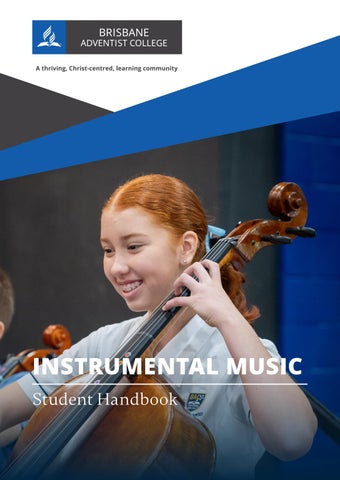
INSTRUMENTAL MUSIC Student Handbook
CONTENTS Welcome
3
Instruments Contact Us
Enrolment
4
Fees Lesson Scheduling Lesson Procedures & Agreement
Instruments & Equipment
6
Purchase & Hire Damages & Repair Insurance Storage
Exams & Performances
8
Exams Performances
Ensembles
9
Primary Choir & Ensembles Secondary Choir & Ensembles Worship Ensemble
Practice Tips
2
Instrumental Music | Student Handbook
10
WELCOME Welcome to the Instrumental Music Program at Brisbane Adventist College. This Handbook is designed to help parents and students understand how the Program works, ensuring that students are able to make the most of their musical journey.
Instruments We are pleased to offer lessons in the following instruments: GUITAR
BENEFITS OF MUSICAL EDUCATION
• Acoustic Guitar
Learning to play an instrument enhances students’ cognitive development, strengthening memory, mathematical thinking, and concentration skills that directly benefit academic performance. Through regular practice, students develop discipline and perseverance while gaining a valuable creative outlet for stress relief.
• Electric Guitar
Musical education supports our wholistic approach to education, which encompasses academic, spiritual, and social-emotional growth, and serves powerful tool that helps nurture well-rounded individuals ready to thrive in all areas of life.
• Cello
OUR COMMITTMENT Our Instrumental Music Tutors are committed to your child’s Instrumental Music education as well as to their education as a whole. This commitment requires flexibility from all parties involved to create a positive experience and a sense of achievement for students.
• Bass Guitar KEYBOARD • Piano STRINGS • Double Bass • Viola • Violin THEORY
Contact Us To contact the Instrumental Music Coordinator, please email music@bac.qld.edu.au. SCAN FOR MUSIC PROGRAM bac.qld.edu.au/music-program
Visit our website for • Information about our Instrumental Music Program • Enrolment form • Current fee information • Ensemble details
08.26
Brisbane Adventist College
3
ENROLMENTS Enrolment in our Instrumental Music Program can be completed using our online form (see p3). Any changes to enrolment in the Instrumental Music Program should be made through the Instrumental Music Coordinator rather than through your child’s Instrumental Music Tutor.
Fees You will receive your fee invoice prior to the start of each term, and you will pay your Tutor directly. Instrumental fees do not get added to your regular Fee Statement.
Lesson Scheduling Instrumental Music lessons usually commence in Week 2 of Term 1 each school year, to allow classroom teachers time to establish classroom routines and procedures.
Lesson Procedures & Agreement LESSONS Our Instrumental Music Lessons are held during the school term. Upon enrolment, your child will be allocated a weekly lesson time by their Tutor. Tutor availability is capped according to the number of lesson timeslots available per day. Missed lessons will be forfeited unless they fall within the following exceptions: • Scheduled school calendar events, such as whole-school events (e.g. Cross Country) and Primary/Secondary carnivals (e.g. Swimming Carnival, Athletics Carnival). • Scheduled school camps for both Primary and Secondary students. • Scheduled school seminars (e.g. Smart Relationships seminars). • Scheduled Assessments: Year 11/12 exams/QCAA Assessments.
Lessons begin in Week 1 of Terms 2, 3, and 4.
• Scheduled whole-class-based excursions.
Preference for before/after school and lunchtime lessons will be given to Secondary students to accommodate their lesson and study load.
All extra-curricular activities and that clash with scheduled music lessons are not considered valid exceptions. If a student chooses to attend an extra-curricular activity, holiday, or any other activity not listed above, instead of their Instrumental Lesson, the lesson will be forfeited.
Classroom teachers will ensure any work missed due to Instrumental lessons is made available to students, and students and parents/carers are responsible for ensuring any missed classwork is completed. For any lesson time preferences or requests for changes, please contact your Instrumental Tutor directly.
LESSON PROCEDURES • Primary: Students in Prep-6 will be collected from and returned to their classrooms by their Instrumental Tutor. • Secondary: Instrumental Lessons for students in Years 7-12 will appear in their SEQTA timetable, and students are responsible for remembering their lessons and attending on time. » Secondary students must report to Secondary Student Reception to tag in to Music prior to their lesson and collect their Music note.
4
Instrumental Music | Student Handbook
» At the conclusion of their Instrumental Lesson, the Tutor must time and sign the student’s Music note. » Secondary students must return their Music note to Secondary Student Reception and tag out of Music, returning to class with their tagged-out Music note. ENSEMBLES All students learning through our Instrumental Music Program are encouraged to work towards involvement in one of our String Ensemble programs. The Tutor will communicate with families when a suitable standard has been achieved for participation. FEE PAYMENT Term lesson fees secure your child’s place in their tutor’s schedule and reflect the reservation of this timeslot solely for your child - whether hey are able to attend their lesson on a given week or not (other than the exceptions listed above). • Invoices for Instrumental Music Lesson fees will be issued each term by the Tutor. • All fees are payable upfront at the beginning of the term. If an invoice remains unpaid, lessons will cease immediately. Once payment is brought up-to-date, and if a timeslot is still available, lessons may recommence. UNENROLMENT Please provide your Tutor with two weeks’ notice in writing if you wish to end your child’s lessons.
Brisbane Adventist College
5
INSTRUMENTS & EQUIPMENT Students in the Instrumental Music Program will require the following equipment:
Damages & Repair
• An instrument of reasonable quality, and accompanying case (where relevant)
Students should treat all instruments with care and respect, including ensuring that they are cleaned or serviced regularly.
• Music Homework Booklet (provided by BAC, brought to each lesson by the student) • Music stand (except piano students) • Pencil and eraser • ‘Music bag’ for music books (available from the BAC Uniform Shop) Please ensure that all instruments and folders are clearly labelled with your child’s name.
Purchase & Hire Many local music stores run instrument hire programs, some where the hire cost is deducted from the purchase cost should you choose to purchase the instrument later. These music stores include but are not limited to: ANIMATO VIOLINS www.animato.com.au 9/62 Bishop St, Kelvin Grove 1300 739 777 VIVACE MUSIC www.vivacemusic.com.au 36-38 Compton Rd, Underwood (07) 3090 4268 Please seek advice from your child’s Instrumental Tutor before purchasing instruments.
6
Instrumental Music | Student Handbook
If the instrument is damaged - whether it is hired or owned - please seek advice on any services or repairs from your child’s Instrumental Tutor in the first instance.
Insurance We recommended that you insure the instrument your child is using – whether it is hired or owned – on your own Home and Contents insurance policy. This is particularly important as you may find the cost of replacing a lost or irreparably damaged instrument prevents your child from continuing their lessons.
Storage In the home: we recommend storing instruments in a central, dry space away from changes in temperature such as windows. At school: instrumental storage is located in the Primary and Secondary music centres. Instruments should be stored on the shelving provided and should not be left on the floor or in the Instrumental Music rooms, including over weekends and holidays.
Brisbane Adventist College
7
EXAMS & PERFORMANCES Exams
Performances
Students will have opportunity to complete both practical and theory music examinations through:
Students in our Instrumental Music Program have the opportunity to perform both as individual performers and as groups/ ensembles at a variety of school-based and community events, such as:
• Australian Music Examinations Board (AMEB) • Associated Board of the Royal Schools of Music (ABRSM)
• Assemblies
• Trinity London
• Church services
Entry to paid exams or competitions – either as individuals or as part of ensemble groups – and fees incurred for extra lessons required to prepare, will be charged in addition to regular term fees for Instrumental lessons.
• Eisteddfods
You may choose to provide your own accompanist, where relevant, or to use the College accompanist. In either case, any associated fees are payable directly to the accompanist and are in addition to regular term fees for Instrumental lessons.
8
Instrumental Music | Student Handbook
• Awards ceremonies
• Recitals • Chapel programs • Week of Worship (WOW) Students will be notified about relevant events as soon as possible, and parent/carer permission sought.
ENSEMBLES Students learning through our Instrumental Music Program are encouraged to work towards involvement in one of our String Ensemble programs. The Tutor will communicate with families when a suitable standard has been achieved for participation. There are a many ensemble opportunities available across a variety of age and skill levels, including: • Primary String Ensemble
Primary Choir & Ensemble PRIMARY CHOIR PRIMARY STRING (Year 3-6) ENSEMBLE REHEARSAL LOCATION
Primary Music Room
Secondary Music Room (MPC)
Secondary Choir & Ensembles
• Primary Choir • Secondary Choir • Secondary Ensemble • Worship Ensemble An audition may be required in some cases. Membership in a music ensemble provides opportunity to represent the College in a variety of forums and is a privilege that demands a high level of commitment. Therefore, students who do not attend rehearsals without prior notice will be marked as absent and frequent absences from rehearsal may result in students being withdrawn from the ensemble.
REHEARSAL LOCATION
SECONDARY CHOIR
SECONDARY ENSEMBLE
Secondary Campus
Secondary Music Room (MPC)
Worship Ensemble REHEARSAL LOCATION
Secondary Music Room (MPC)
Timeliness, focus and reliability from each student is imperative to the success of any of our ensembles. A 90% attendance rate for rehearsals is required in order for students to be invited to participate in concerts and performances with their ensemble group. We also welcome students enrolled in external music programs to express interest in joining our ensemble program. Please contact our Instrumental Music Coordinator (see p. 3) for more information.
Brisbane Adventist College
9
PRACTICE TIPS The following tips will help your child practice effectively. Practice time allows students to maintain their current level of progression and is a minimum requirement. Instrumental Tutors will advise a specific practice program for individual student’s ability. Tune up and warm up: focus on good posture, clean and clear notes. Technical skill building: scales, arpeggios and other exercises Difficult passages: may be due to range, speed, fingering, etc. Repeat several times. Set small goals so you achieve something each day. Listen to yourself: create a simple recording - be critical of your playing and accept only your best. Create a routine: set a specific time and space (without distraction) to practice every day: • PREP: 15-20 minutes daily • YEARS 1-2: 20 minutes daily • YEARS 3-6: 30 minutes daily • YEARS 7-9: 40 minutes daily • YEARS 10-12: 45-60 minutes daily
10
Instrumental Music | Student Handbook
Brisbane Adventist College
11
Brisbane Adventist College 303 Broadwater Road Mansfield QLD 4122
P: (07) 3347 6444 E: music@bac.qld.edu.au W: bac.qld.edu.au
Seventh-day Adventist Schools (South Queensland) Limited