Corporate Headquarters 540 Magsaysay Road, Barangay San Antonio, San Pedro, Laguna, Philippines 4023 T: +63 2 886 3170 | +63 2 833 6304 F: +63 2 886 3244 Papua New Guinea HBS Compound 11 Mile-Okuk Highway. PO Box 1538, Lae, Morobe Province, 411 Papua New Guinea Tel: +675 7373 4013 | +675 7373 4015
Unlock the Power of Smarter Print Marketing Whether you need a single campaign or ongoing marketing support, CTRL Print Group shows what print marketing can accomplish when it's done right.
Magazines & Annual Reports
Point of Sale Materials
Custom Merchandise
All Your Printing Needs
Premium Print Production That Brings Your Campaigns to Life Merchandise
Presentation Folders
Labels & Stickers
Pull-Up Banners
Conference Materials
Packaging
Floor & Window Decals
Expo Materials
Magazines & Brochures
Point of Sale Materials
Apparel
Offset Printing
Annual Reports
In-Store Displays
Media Walls
Digital Printing
Your partner in offline marketing excellence. Servicing Australia and Papua New Guinea craigb@ctrlprintgroup.com
ctrlprintgroup.com
ISSUE 5, 2026
CONTENTS BUSINESS Australia expands PNG infrastructure pipeline as contracting opportunities grow - 10 Cook Islands Secures Major Port and Ocean Investments at Pacific Islands Forum - 12 Cook Islands, US, New Zealand advance plans for Tongareva wharf - 14
E N E RGY Fiji explores PETRONAS cooperation on fuel security, energy resilience - 40 China, Solomon Islands sign agreement for second phase of mini solar power project - 42 Solar power delivers clean water to remote Vanuatu community - 43 Malatoha women explore opportunities in Tina River hydropower project - 46 ADB approves $12.6m grant for Greater Port Vila resilience project - 48 Vanuatu tourism generates $87.8 million in first half of 2026 - 62
NiuPay’s proven digital platforms underpin expansion across the Pacific - 16
Vilu War Museum Strengthens Guadalcanal Heritage Tourism With New Interpretive Signs - 63
Solomon Islands, Serbia Explore Practical Development Cooperation - 20
c ompany
Solomon Islands says local businesses key to jobs, economic growth - 22
CE Group looks beyond the Pacific as Indo-Pacific infrastructure focus expands - 64
MI N I N G fin ance
CE Group strengthens integrated engineering capability to support complex infrastructure projects - 66
BPNG, 15 financial institutions sign Empower Finance Code - 50
AI and technology leader NiuPay puts down roots in Lae- 67
Fiji Development Bank staff join Thailand peer-learning exchange - 51
Remington launches in-country Starlink support model as PNG businesses seek reliable connectivity - 68
Kalo Gold identifies 4.3-kilometre gold corridor at Wainikoro in Fiji - 23 Lion One reports high-grade gold hits at Tuvatu mine in Fiji - 24 Ok Tedi declares K450 million interim dividend as operations continue despite dry weather - 24 Solomon Islands rejoins EITI with UK support - 26 PNG opens to mining investors with reform plan, minister says - 28 Sankamap expands Fauro exploration as new gold targets emerge - 30 Tolu Minerals lifts Tolukuma gold resource by 81% - 32
O I L & G AS PNG LNG surpasses 100 million tonnes of LNG safely produced - 33 Santos to lift Papua LNG stake to 21% as ExxonMobil takes operatorship - 34 Fiji explores long-term fuel security cooperation with Malaysia - 38
06 | Pacific Business Review
AGRICULTURE Fiji strengthens agricultural investment planning through FAO Hand-in-Hand training - 52 Fiji and China deepen agricultural cooperation through technical partnership - 53
Pacific Towing Re-Flags Another Tug in Solomon Islands - 70 Santos Celebrates First PNG National Leadership Team at KMT - 71
Solomon Islands launches 10-year national biosecurity strategy - 56
tourism Caledonia Festival opens with focus on Kanak culture, cultural policy - 57 Fiji tourism shifts focus to value-led growth - 58 PNGTPA Partners to Revive Ferry and Expand Marine Tourism Opportunities - 60
www.pacificbusinessreview.com
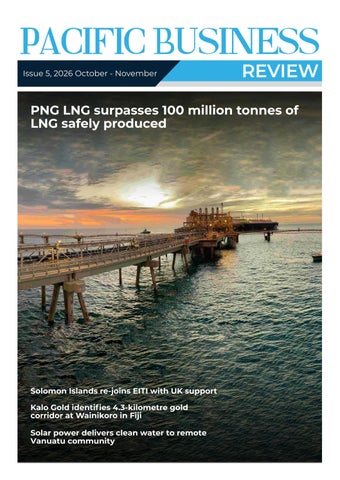
Welcome to Issue 5, 2026 of Pacific Business Review. This edition explores how the Pacific can turn its natural resources, regional partnerships and development priorities into lasting economic opportunities. Our cover story marks a milestone for Papua New Guinea’s energy sector, with the PNG LNG Project surpassing 100 million tonnes of liquefied natural gas safely produced since operations began in 2014. Beyond connecting PNG’s gas resources to international markets, the project has supported employment, skills development, local businesses and community investment. As the country advances further gas developments, the milestone highlights the resources sector’s role in its economic future. As extractive industries expand, transparency and responsible resource management become increasingly important. Solomon Islands’ return to the Extractive Industries Transparency Initiative (EITI), with United Kingdom support, signals renewed efforts to strengthen accountability in mining. With gold and nickel projects gaining prominence, cooperation among government, industry and civil society will be vital to ensuring resource development benefits local communities. In Fiji, Kalo Gold has identified a 4.3-kilometre gold-bearing resistivity corridor at its Wainikoro target, with certified fire-assay results reaching 8.78 grams per tonne of gold. The findings support further exploration and geophysical surveys, highlighting the Pacific’s mineral potential and the importance of rigorous geological assessment in evaluating new opportunities. Beyond resource development, we look at a project delivering direct benefits to rural communities. In Petervat, on Malekula in Vanuatu, a new solar-powered water system pumps water from a natural spring to households, providing clean, reliable running water while reducing dependence on fuel-based systems. Delivered under Australia’s REnew Pacific programme, the initiative demonstrates how renewable energy can strengthen water security and improve essential services in remote communities. The rest of this issue covers infrastructure, energy, mining, oil and gas, finance, agriculture and tourism. From regional connectivity and investment partnerships to economic reform and community enterprise, our coverage examines how governments, businesses and development partners are responding to the Pacific’s changing needs. Thank you for reading and for continuing to be part of the Pacific Business Review conversation.
James Konstantin Galvez Managing Editor
Beyond Borders. Progress Through Partnership. APEC House, Port Moresby, Papua New Guinea
Naha Birthing and Urban Health Centre
CE Group is helping deliver some of the Pacific’s most significant projects —from the landmark APEC Haus in Papua New Guinea to the Tina River Hydropower Development Project in Solomon Islands.
Tina River Hydropower Transmission System
Across the Pacific, CE Group brings together engineering, construction, switchboards, smart solutions and asset management to deliver in complex and remote environments. Solomon Islands National University
We combine regional capability with national teams, local suppliers and local knowledge— creating employment, strengthening skills and building capability that remains within communities. In difficult terrain and demanding conditions, we deliver with integrity, technical discipline and respect for place. Trusted partnerships. Proven delivery. Lasting local impact. CE Group — A Trusted Electrical Infrastructure Partner across the Pacific.
SECTORS
CAPABILITY
Energy & Renewables
Engineering & Design
Utilities & Water
Major Project Delivery
Resources
Electrical & Instrumentation
Industrial Infrastructure
Smart Solutions & Asset Management
Government & Defence
LOCATIONS
CONTACT www.ce.group
info@ce.group
PAPUA NEW GUINEA | SOLOMON ISLANDS | FIJI | AUSTRALIA |
BUSINESS
ISSUE 5, 2026
Australia e xpands PNG i nfrastructure pipeline as c ontracting opportunitie s grow
Australia is expanding its infrastructure investment in Papua New Guinea, with major programmes moving through procurement while a parallel skills initiative seeks to strengthen the workforce needed to deliver and maintain new projects. Australian infrastructure investment in PNG is increasing from about A$200 million a year to more than A$250 million, creating opportunities across construction, engineering, telecommunications, energy, health and professional services. The programme is supported by more than A$1 billion already committed through the Australian Infrastructure Financing Facility for the Pacific (AIFFP) for infrastructure projects in PNG. Australia’s wider development assistance to PNG is estimated at A$680.5 million for 2026-27. Several programmes are currently in procurement or planning, including the second phase of the Papua New Guinea Economic and Social Infrastructure Programme (ESIP2). ESIP2 is intended to support infrastructure development across power, telecommunications and social sectors while strengthening the capacity of PNG organisations to plan, operate and maintain infrastructure assets.
10 | Pacific Business Review
Other areas of activity include health infrastructure and advisory programmes, the Western Province Partnership and further projects supported by the AIFFP. In September, Australia also released a tender for quantity surveying services linked to the refurbishment of the GWARE building at ANGAU Memorial Provincial Hospital in Lae and the construction of new staff housing at Daru Hospital. Alongside infrastructure investment, Australia is increasing its focus on workforce development. Pacific Australia Skills works with PNG institutions to provide training and Australian-accredited qualifications while strengthening local training providers. The programme is designed to complement the AIFFP and the Pacific Australia Labour Mobility scheme. Earlier programmes, including the Australia Pacific Training Coalition and Skills for Sub-National Growth Investment, delivered full Australian qualifications to more than 4,000 Papua New Guineans in areas including construction, electrical trades, manufacturing, automotive, tourism, hospitality, health and community services. The expanding infrastructure programme is expected to generate contracting opportunities for Australian and Papua New Guinean businesses while supporting efforts to build local skills and capacity alongside infrastructure development. PBR
www.pacificbusinessreview.com
Homegrown, PNG developed solutions
NiuPay partners with private and public sector organisations across the South Pacific to solve tough problems with high-impact digital solutions We're the apples in a world full of oranges -- say goodbye to onesize-fits-all and embrace solutions that are perfect fit, delivered on an all-inclusive, win-win basis.
www.niupay.com.pg
+675 323 9111 enterprise@niupay.com.pg
ISSUE 5, 2026
BUSINESS
C ook Isl ands S e cu r e s M a jo r Port and Ocea n I nve s t m e nt s at Pacific Isl and s Fo r u m
Cook Islands Prime Minister Mark Brown has concluded the country’s participation in the 55th Pacific Islands Forum Leaders Meeting in Koror, Palau, with major commitments for the upgrade of Penrhyn’s port and new investment in ocean conservation. The Cook Islands secured significant support for two key national priorities during the week-long regional engagement, with the United States and New Zealand announcing intended contributions toward upgrading a safe and reliable port on Penrhyn (Tongareva), while new investment was also announced for Marae Moana, the country’s Sacred Ocean. The United States, through its Department of State, intends to contribute US$50 million, approximately NZ$84 million, toward the Penrhyn port upgrade, while New Zealand has committed NZ$17.5 million, approximately US$10 million. The project will be delivered in partnership with the Cook Islands. The country also secured new investment in Marae Moana through a partnership involving the Bezos Earth Fund and BirdLife International.
12 | Pacific Business Review
“Everything we carried to this Forum, we carried on behalf of our people,” Brown said. “From a lifeline port for Tongareva to lasting protection for our ocean, this has been a week of turning long-held priorities into action, on our own terms, and for our own future.”
Regional and bilateral engagement The Forum followed the Prime Minister’s participation in the inaugural Realm Leaders’ Meeting in Auckland alongside the leaders of New Zealand, Niue and Tokelau. In Koror, Brown held bilateral discussions with a range of regional and international partners. His meeting with New Zealand included discussions on progress with the Penrhyn project and New Zealand’s hosting of the Pacific Islands Forum in 2027. Discussions with China focused on preparations for 30 years of diplomatic relations in 2027 and opportunities to deepen practical cooperation in technology, machinery and equipment and capacity building.
www.pacificbusinessreview.com
ISSUE 5, 2026
Brown also met with Tonga, Japan, Singapore, Spain and Canada. The Japan discussions marked 15 years of diplomatic relations and covered cooperation including the new inter-island vessel and grassroots funding for Cook Islands communities. Discussions with the Nippon Foundation focused on ocean stewardship and opportunities for young Cook Islanders. With Singapore, the Prime Minister reaffirmed the relationship between the two countries, with discussions focused on economic resilience, energy security and the transition to renewable energy. Meetings with Spain and Canada addressed opportunities to deepen bilateral cooperation, while discussions with the Green Climate Fund explored further financing opportunities to strengthen the Cook Islands’ resilience.
Push for Pacific-led resilience financing The Cook Islands also participated in meetings of the Smaller Island States, the Polynesian Leaders Group, and the Pacific ACP grouping, as well as an Ocean Partnership Roundtable hosted by Palau.
www.pacificbusinessreview.com
Brown was also a leading advocate for the Pacific Resilience Facility, described by the Cook Islands government as the Pacific’s first collectively owned international financial institution. The facility is now established in the Kingdom of Tonga. “The Pacific Resilience Facility is a fund by the Pacific, for the Pacific,” Brown said. “I have been part of this journey from the very beginning, and to see it now delivering in our communities is a proud moment for our whole region.” At the Leaders’ Retreat, Forum leaders agreed on a framework governing how the Pacific engages with external partners, reinforcing a transparent, accountable and Pacific-led approach to partnerships in support of the 2050 Strategy for the Blue Pacific Continent. The outcomes are reflected in the 2026 Pacific Islands Forum Communiqué. Brown thanked Palau President Surangel Whipps Jr and the people of Palau for their hospitality and reaffirmed the Cook Islands’ commitment to a united, resilient and selfdetermining Blue Pacific. PBR
Pacific Business Review | 13
ISSUE 5, 2026
BUSINESS
C ook Isl and s, U S , N e w Z e a l a n d advan ce p l a ns f o r To n ga r e va wha r f Cook Islands Prime Minister Mark Brown has led a joint visit by the Cook Islands, United States and New Zealand to Tongareva to begin feasibility and planning work for a new, safer and more reliable wharf at Omoka. Brown travelled to the northern island on Sept. 22 with US Ambassador to the Cook Islands Jared Novelly and New Zealand High Commissioner Catherine Graham to meet residents and discuss the proposed project. It was the first time the three partners had visited Tongareva together since announcing their intention to work on the wharf at the Pacific Islands Forum Leaders Meeting in Palau in August. Brown said the visit was intended to ensure the community heard directly from the three partners about the project and had a role in shaping its development. “This wharf is a lifeline for Tongareva, and it belongs to Cook Islanders,” Brown said. “We are leading this work on our own terms and as part of our own priorities and our national plan for the Pa Enua.” The delegation was welcomed to Omoka with a traditional warrior’s chant, drums, floral garlands and a guard of honour by students from Tongareva School. The delegation later visited the existing landing and proposed wharf site. Almost all supplies reaching Tongareva, including fuel, food, building materials, medicines and disaster relief, currently come ashore through a landing built more than 80 years ago, according to the Cook Islands government. A modern and resilient wharf would improve the safety and reliability of deliveries and strengthen connections between Tongareva, the other Pa Enua, the rest of the Cook Islands and the wider region. Feasibility study first The partners stressed that construction will not begin until a feasibility study determines the project’s scope and design. The study will assess technical, environmental, social, commercial and operational aspects of the proposed wharf and provide an opportunity for the Tongareva community to help shape the project. New Zealand High Commissioner Catherine Graham said New Zealand would support implementation of the
14 | Pacific Business Review
project in partnership with the Cook Islands. “This visit is the start of careful, considered work,” Graham said. “The feasibility study comes first, to shape the scope and the design, and it will be the community’s opportunity to have its say.” The Cook Islands government said the project will be implemented in accordance with Cook Islands laws, policies and regulations and integrated into the country’s long-term development plans. The feasibility work will also examine opportunities for Cook Islands companies, workers and suppliers to participate. US highlights historic ties Novelly highlighted the longstanding US connection with Tongareva, noting that US personnel built the island’s original wharf and airfield during World War II.
“The United States values its long friendship with the Cook Islands and our historic ties to Tongareva, where United States personnel built the island’s original wharf and airfield,” Novelly said. He said the US supported the initiative to improve connectivity and services for people in the northern Cook Islands. The ambassador also pointed to potential benefits including strengthening the Cook Islands government’s ability to monitor its waters and creating commercial and tourism opportunities. The three partners said the visit marked the beginning of the broader feasibility and planning phase. Final decisions on the scope, design and delivery of the project will follow completion of the feasibility study. PBR
www.pacificbusinessreview.com
Excellence & Reliability in Marine Services TOWAGE | MOORING | SALVAGE | COMMERCIAL DIVING | LIFERAFTS Emergency Response Video Pipeline Inspections PLEM Valve Hook Up & Release Pollution Prevention In Water Surveys
Customised Solutions - Oceania & SE Asia www.pacifictowingmarineservices.com
BUSINESS
ISSUE 5, 2026
L-R: Trevor Manokore (COO) Jason Kurdzinski (CTO & Co-founder), James Inglis (CEO & Co-founder), Kristina Kekedo (BDM), Seta Daulako (Fiji Country Manager) and Anju Mangal (Chief of Party/Technical Director -Cadmus Group) plus 5 Fijian Interns, at this year’s Fiber Conference in Fiji
Niu Pay ’s p rov e n d i gi ta l pl at forms und e r pi n e x pa ns i o n acr oss the Paci fi c The Pacific’s digital transformation is entering a more demanding phase. After years of investment in telecommunications and connectivity, the challenge is increasingly to build the trusted digital systems that turn infrastructure into reliable public services. NiuPay is taking its experience with proven digital systems across the Pacific into Fiji, building on its work with Papua New Guinea’s Immigration and Citizenship Services Authority (ICSA), the country’s first digital landtitle system and a border-processing system deployed during the Pacific Games. These operational deployments form the foundation for the company’s expanding regional work. The Papua New Guinea-founded company established a presence in Suva this year, appointing Seta Daulako as Fiji country manager and hiring its first Fiji-based engineer in September. The appointment also marks the company’s first Autonomous AI Systems Engineer, extending
16 | Pacific Business Review
its technical capabilities beyond its home market. NiuPay plans to invest several million Fiji dollars in the country over five years as it expands operations in Suva and Nadi. It expects to grow its Fiji team to between eight and twelve staff over the next 12 months. Chief Operating Officer Trevor Manokore said the company was committing the money upfront to demonstrate its long-term commitment to the market and to supporting customers locally. For a regional technology firm, the investment signals an intention to build capacity in Fiji rather than serve the market remotely from Port Moresby. These commitments extend beyond a conventional sales operation towards building local engineering capability. Strategic investment from Kina Bank and NiuPay’s status as an Amazon Web Services (AWS) Select Tier Services Partner provide further support for its growth. The Fiji operation builds on the company’s existing work in the Pacific and provides a base for extending its digital systems and technical expertise to other markets in the region. Governments across the Pacific face similar
www.pacificbusinessreview.com
ISSUE 5, 2026
pressures to turn connectivity into secure, practical digital services, although each market retains its own laws, institutions and needs.
Proven systems provide foundation for expansion Connectivity remains essential, but submarine cables and telecommunications networks do not, by themselves, deliver better public services. Governments also need secure applications, interoperable systems, digital identity infrastructure and the technical expertise to manage these platforms over time. Fiji offers a useful example of the demands facing governments. The country is connected to international telecommunications networks through seven submarine cables and has set a target of bringing most government services online by 2030 under its National Digital Strategy. Plans for national digital identity infrastructure and a new cybersecurity strategy add to the demands on public institutions as more services move online. The policy question is how to translate those ambitions into systems that are operational, secure and responsive to local needs. That requires more than procuring technology. It also means developing the people, governance arrangements and institutional capabilities needed to maintain systems, manage data and oversee external technology providers.
Designing technology for Pacific conditions Part of the challenge is a problem the region has faced for decades: technology designed for other markets is often introduced into the Pacific with little adaptation. Systems built for large economies may assume reliable highspeed internet everywhere, widespread card payments, formal street addresses, complete central records and a deep pool of local specialists to maintain them. When those assumptions fail, the costs emerge later. Agencies may pay licence and support fees in foreign currency, wait for help desks in distant time zones and run manual workarounds alongside systems that do not reflect how services are actually used. Customary land ownership, cash-based household economies, multiple languages and populations spread across remote islands are not exceptions in the Pacific; they are part of the operating environment. Donor-funded projects can compound the problem when systems are delivered to meet a project timeline and lose support after funding ends.
Regional providers argue that they are better placed to bridge this gap. Manokore describes NiuPay’s approach this way: “It’s not a piece of software we built somewhere trying to sell it.” Although NiuPay has teams in Australia and India, Manokore said the company does not build its solutions for the Australian, New Zealand or Asian markets. Instead, it designs its work around how Pacific customers operate, pointing to similarities among Fiji, Tonga and Papua New Guinea. NiuPay’s existing deployments demonstrate how that approach has been applied in practice. Fiji has its own laws, institutions and public expectations, and a provider moving between Pacific markets must design for the new setting rather than simply repeat what worked elsewhere. Building on an established technical track record does not remove the need for local adaptation; it gives the company experience to draw on as it develops systems for different jurisdictions.
From digital land titles to AI-powered immigration NiuPay’s regional expansion builds on three established deployments. In Papua New Guinea, the company developed the country’s first digital land-title system and the MyICSA Analysis Engine for the Immigration and Citizenship Services Authority. Its traveller-entry system was also used during the 2023 Pacific Games in Honiara, helping reduce processing times from 43 seconds to 10 seconds for delegations from 24 nations. Together, these deployments demonstrate the company’s experience delivering digital systems for land administration, government immigration processing and border management. One of the most documented examples is NiuPay’s work with PNG’s Immigration and Citizenship Services Authority. A case study published by Amazon Web Services describes the MyICSA Analysis Engine, built by NiuPay on AWS, as the first known use of generative AI in a live government system in the Pacific Islands. Shortterm visas that could take up to two weeks to process are now handled in minutes. According to AWS, about 95% of short-term applications are processed automatically, and the authority can handle up to 1,000 a day. ICSA Chief Migration Officer Wellington Navasivu told AWS that the average processing time for short-term visas had fallen to four minutes. Two details in the case study speak directly to the wider implementation challenge. First, AWS says the system was built and trained locally for PNG’s needs, contrasting
to Page 18 →
www.pacificbusinessreview.com
Pacific Business Review | 17
BUSINESS
with the imported-model approach the region has long relied on. Second, the system does not make every decision autonomously: it approves a visa automatically only when it is fully certain, while less certain cases go to an immigration officer. Officers can also update the rules without technical help. That design keeps policy decisions with the authority rather than the technology. ICSA plans to extend the system to work permits and passport processing. The ICSA platform, digital land-title system and Pacific Games border-processing system show how NiuPay’s work has progressed to operational deployment. The examples demonstrate the application of digital technology to public administration, from immigration processing and land records to the management of international arrivals. The ICSA case also illustrates how automation can accelerate administrative processes while leaving decisions requiring human judgement with government officers.
Digital sovereignty requires government oversight Institutional control is central. As governments adopt digital services, they must consider who controls the underlying systems, how sensitive information is handled, whether platforms can be maintained locally and how dependent agencies become on individual vendors. The ability to retain operational and governance control can be as important as the initial deployment of a technology. For Fiji and other Pacific economies, partnerships with regional technology providers may create opportunities to develop services that better reflect local administrative environments. But a local presence alone does not guarantee digital sovereignty. Governments still need clear procurement standards, cybersecurity requirements, data-governance rules, technical oversight and arrangements that preserve their ability to change providers or systems when necessary. Building local skills for regional growth NiuPay’s regional engagement also extends beyond commercial contracts. The company has participated in the Pacific Fiber Conference in Suva, sponsored NCIT 2026 and entered a three-year partnership with Pacific Women in Telecommunications to provide internships and mentoring opportunities for young women across the region. Those initiatives address another constraint on digital transformation: the availability of skilled workers. Hiring locally can help build the technical expertise needed
18 | Pacific Business Review
ISSUE 5, 2026
to implement and maintain systems, while regional training partnerships may widen access to technology careers. Developing local talent alongside deploying technology can help build the expertise required to maintain digital services over time and reduce reliance on external support. NiuPay’s expansion is supported by strategic investment from Kina Bank and its relationship with AWS, reflecting how regional capital and global technology infrastructure can help Pacific technology companies grow. Its next phase of regional work will build on this combination of locally developed applications, global cloud infrastructure and growing in-market engineering capability. For governments, the priority remains ensuring that essential technical knowledge, data governance and operational decisionmaking remain accessible to the institutions and communities they serve.
Taking proven digital capabilities across the Pacific The implications extend beyond Fiji. Across the Pacific, governments are seeking to convert digital infrastructure into more accessible public services and stronger economic opportunities. NiuPay’s investment in Fiji, local recruitment and technical appointments build on systems already operating in the region, providing a platform for further deployments tailored to individual countries. Extending these capabilities across different jurisdictions will require sustained investment, local partnerships and solutions adapted to each country’s laws, institutions and operating conditions. NiuPay’s track record in the Pacific includes a live government immigration platform, the country’s first digital land-title system and a border-processing system used during the Pacific Games. These deployments establish a practical foundation for its expansion into Fiji and other regional markets, demonstrating how digital technology can support public administration and improve operational efficiency. As NiuPay grows its Fiji team and extends its regional presence, it is building on systems already delivered rather than starting from an unproven proposition. Governments will still need sound procurement, cybersecurity and data-governance frameworks, alongside investment in local skills and institutional capacity. With those foundations in place, NiuPay’s existing deployments provide a basis for extending proven digital capabilities across the Pacific. PBR
www.pacificbusinessreview.com
ISSUE 5, 2026
BUSINESS
S olomon Isl and s , S e r b i a E x plo re P ract i ca l D e ve lo pm e n t C ooperation
Solomon Islands and Serbia are seeking to translate growing bilateral ties into practical development outcomes, with potential cooperation identified in renewable energy, education, digitalisation, sports, tourism and community development. The areas of cooperation were discussed by Minister for National Planning and Development Coordination Peter Kenilorea Jr and Serbia’s Ambassador to Solomon Islands, Rade Stefanovic, during a bilateral meeting in Koror, Palau. Stefanovic said Serbia had received approval to explore a bilateral development cooperation programme with Solomon Islands, with a focus on small-scale, communitybased projects that can deliver direct benefits to local communities. “Serbia is a small country but we have a sincere approach to helping our partners as much as we can,” Stefanovic said.
20 | Pacific Business Review
Serbia has supported similar community-focused initiatives in other Pacific countries, including projects involving solar energy, water and sanitation, and education. Kenilorea welcomed the approach, saying Solomon Islands was seeking partnerships that could produce tangible benefits at the community level. “The community-focused approach is particularly welcome. We are interested in small projects that have a direct impact on people and communities,” Kenilorea said. He said the Solomon Islands government would work with Serbia to identify projects aligned with national priorities, particularly in energy and education.
Cooperation across key sectors Serbia also indicated its intention to contribute to the Pacific Resilience Facility (PRF), strengthening its support for Pacific climate resilience and sustainable development priorities.
www.pacificbusinessreview.com
ISSUE 5, 2026
The two sides also reviewed progress on existing bilateral agreements, including a visa waiver agreement and a memorandum of understanding on political consultations.
Sports cooperation is likewise being advanced, with the two countries working toward finalising an existing sports cooperation agreement.
Serbia has completed its domestic procedures for the visa waiver agreement and is awaiting confirmation from Solomon Islands before it can enter into force. Kenilorea undertook to follow up on the matter.
Solomon Islands invited to EXPO 2027
Both sides also expressed interest in activating the political consultations mechanism, which would provide a framework for more regular senior-level engagement and follow-up on agreed areas of cooperation.
Scholarships and digitalisation Education emerged as another area with potential for expanded cooperation. Serbia is offering scholarships to Solomon Islands students in fields including medicine, engineering, information technology, forestry and agriculture. Serbia also offered to share expertise in digitalisation and e-government, drawing on its experience in developing online public services.
www.pacificbusinessreview.com
Stefanovic also invited Solomon Islands to participate in EXPO 2027 in Belgrade, including through the Pacific Century Pavilion. The event would provide an international platform for Solomon Islands to showcase its culture, tourism, traditional arts, music and sports. The meeting reaffirmed the commitment of both countries to deepen bilateral relations and move beyond diplomatic engagement toward practical cooperation supporting Solomon Islands’ development priorities. The proposed community-level projects, scholarship opportunities, digitalisation cooperation and participation in EXPO 2027 form part of efforts to convert the growing relationship between Solomon Islands and Serbia into initiatives with direct and measurable benefits for Solomon Islanders. PBR
Pacific Business Review | 21
ISSUE 5, 2026
BUSINESS
Solomon Isl ands says local busine sse s key to jobs, ec onomic grow th The success of local businesses, particularly small and medium enterprises (SMEs), will be critical to creating jobs, increasing household incomes and driving economic growth in Solomon Islands, according to Permanent Secretary Riley Mesepitu of the Ministry of Commerce, Industry, Labour and Immigration (MCILI). Mesepitu made the remarks on September 14 while opening the National Business Forum 2026 at the Solomon Islands National University (SINU) Lecture Theatre. The forum brought together business leaders, development partners, women and youth entrepreneurs, government agencies and academics for discussions on strengthening the country’s business and enterprise sector. “These are not simply government issues or privatesector issues. They are national development issues,” Mesepitu said. He said the forum’s programme is centred on four priorities: strengthening local enterprises, improving access to finance and capital, promoting youth and women entrepreneurship, and connecting businesses to markets, standards, compliance and trade opportunities. Mesepitu called on participants to use the forum as a platform for practical and open discussions that can lead to concrete solutions. “I encourage all participants to use today’s forum not only to listen, but also to speak openly, share ideas,
22 | Pacific Business Review
challenge existing approaches and identify solutions that can be taken forward beyond this gathering,” he said.
Partnership needed Mesepitu said greater participation by young entrepreneurs and women in business is essential to developing a more inclusive and dynamic private sector. He also stressed that the government cannot improve the business environment on its own and called for closer cooperation among businesses, financial institutions, educational institutions, development partners, civil society and international partners. “Government cannot do it alone. We need the commitment and participation of businesses, financial institutions, educational institutions, development partners, civil society and our international partners,” he said. Mesepitu thanked SINU for hosting the forum and the Solomon Islands Chamber of Commerce and Industry (SICCI) for its role as the key private-sector partner. He said the government expects discussions at the forum to translate into stronger collaboration and practical measures to support local businesses. The Permanent Secretary formally welcomed participants and expressed hope that the forum would produce productive discussions and actionable outcomes for Solomon Islands’ business sector. PBR
www.pacificbusinessreview.com
ISSUE 5, 2026
M I NIN G
Kalo G o l d id e n t i f i e s 4 . 3 -k i lo m e t r e gold c o rrid o r at Wa i n i ko r o i n F i ji Kalo Gold Corp. has identified a 4.3-kilometre gold-bearing resistivity corridor at its Wainikoro target in Fiji, with certified fire assays returning up to 8.78 grams per tonne (g/t) gold. The Vancouver-based company said Sept. 24 that gradient array induced polarisation resistivity data had defined the principal corridor at its 100%-owned Vatu Aurum Project. The corridor remains open along strike. Preliminary interpretation identified three predominantly north-south resistivity corridors. The main corridor extends 4.3 kilometres, with elevated gold screening responses concentrated along the margins of resistivity highs and lows. A separate corridor lies about 2.5 kilometres westnorthwest of the main corridor and also returned elevated gold responses. The eastern, main corridor returned up to 8.78 g/t gold by certified fire assay, while field screening of the same sample produced 3,397 detectORE units (dU), which Kalo estimates at about 3.4 g/t gold. Several other results exceeded 1,000 dU, equivalent to about 1 g/t gold based on the company’s estimates. In the separate western corridor, field screening returned up to 2,744 dU, or an estimated 2.74 g/t gold. The company said rock samples from the New Vein Cluster returned up to 7.83 g/t gold and 108 g/t silver. A previously reported chalcedonic quartz vein float sample returned 8.78 g/t gold, while a chalcedonic-banded epithermal quartz vein in silicified bedded tuff returned 4.78 g/t gold by certified fire assay.
“The IP survey has given us a 4.3-kilometre resistivity corridor at Wainikoro with gold results along its length,” President and CEO Terry L. Tucker said. The company said the results support further evaluation of silicified hydrothermal breccias, resistivity margins and associated structural zones as priority exploration targets. Kalo plans to begin controlled-source audio-frequency magnetotellurics, or CSAMT, surveying in late September and continue into October. The survey will test the width, orientation and depth continuity of the interpreted corridors, including potential branching, widening and crosscutting structures. Additional work will include trenching, continuous channel sampling, structural mapping, alteration-mineralogy studies and certified laboratory analysis. The results will be integrated with existing geological, geochemical, induced polarisation, gravity, magnetic and radiometric data to refine targets for future drilling. Kalo cautioned that not every resistivity feature is interpreted as mineralised, as resistivity contrasts can also reflect lithology, weathering, groundwater, clay content or survey effects. The company also noted that grab, float and rock chip samples are selective by nature and may not represent mineralisation across the property. PBR
Trenching across one of the eastern resistivity corridors exposed hydrothermally altered breccia, monomictic andesite breccia and andesitic wall rock. The hydrothermal breccia broadly corresponds with a resistivity-high area that may reflect silicification or quartz-rich cement. Kalo said gold responses were not uniform throughout the breccia, with several occurring near lithological and geophysical margins. The company is evaluating whether contacts, secondary fractures and changes in permeability influenced mineralisation.
www.pacificbusinessreview.com
Pacific Business Review | 23
ISSUE 5, 2026
MINING
Lion O ne re p o rt s h i gh -gr a de go l d hits at T u vat u mi n e i n F i j i Canadian miner Lion One Metals Ltd. has reported high-grade gold intercepts from underground drilling at its Tuvatu Alkaline Gold Project in Fiji, including 4.6 metres grading 82.28 grams per tonne of gold. The results came from 4,370.2 metres of underground infill and grade-control drilling targeting extensions of the UR lodes in Zone 5, the company said in a Sept. 24 news release. The drilling also returned 1 metre at 169.47 g/t gold, 1.1 metres at 153.94 g/t, 1.7 metres at 93.94 g/t and 0.3 metres at 285.13 g/t. The highest-grade individual intercept was 0.3 metres at 547.05 g/t. Lion One said 30 of 34 completed drill holes intersected highgrade mineralisation, with most of the results located within 25 metres of underground development. The company expects the mineralisation to be incorporated into its mine plan within six months. The drilling was conducted from the 1,160 and 1,082 underground drill stations. The former targeted mineralisation above the 1,150 level, while the latter targeted areas below the 1,066 level.
The Zone 5 drilling focused on the near-surface portions of the UR1 and UR2 lodes. Lion One said the UR2 lode has a strike length of about 620 metres and remains open along strike and at depth. Lion One President and CEO Ian Berzins said the company was continuing to drill both Zone 5 and Zone 2 and was encountering high grades in both areas. The company said the latest results included eight intercepts exceeding 100 g/t gold, following a previously reported intersection of 4.2 metres at 715.15 g/t gold from Zone 2. Lion One operates the Tuvatu mine, which began operations in late 2023. The project includes the Tuvatu gold deposit, underground mine, pilot plant and assay laboratory. The company also holds an exploration licence covering the Navilawa Caldera, which contains multiple mineralised zones and exploration targets. The reported drill intersections are downhole lengths, and true widths are not known, Lion One said. The company uses a 3 g/t gold cut-off for its high-grade composites. PBR
Ok Tedi decl a r e s K 4 5 0 m i lli o n i nt e rim dividend as o pe r at i o n s c on t inue de sp i t e d ry we at h e r Ok Tedi Mining Limited has declared a K450 million interim dividend for the first half of 2026, while the company says its mining and processing operations remain uninterrupted despite prolonged dry weather affecting water levels on the Fly River. Ok Tedi Mining Limited (OTML) has declared a K450 million interim dividend for the first half of 2026, with the payment distributed between the State and Western Province landowner interests according to their respective shareholdings. Managing Director and Chief Executive Officer Kedi Ilimbit said K300 million would be paid to Kumul Minerals Holdings Limited on behalf of the State, representing its 60% shareholding, while K150 million would be paid to the Mineral
24 | Pacific Business Review
Resources Development Company (MRDC), which manages the interests of Ok Tedi’s landowners. “The K450 million interim dividend benefits all Ok Tedi shareholders,” Ilimbit said. “While K300 million is payable to the State, K150 million is equally payable through MRDC on behalf of the people of Western Province.” He said the full dividend distribution should be accurately reflected, noting that the payment demonstrates Ok Tedi’s continuing contribution to the PNG economy and provides direct benefits to both the State and Western Province through their respective shareholdings.
Operations remain uninterrupted The dividend announcement comes as Ok Tedi manages logistical challenges caused by prolonged dry weather in Western Province.
www.pacificbusinessreview.com
ISSUE 5, 2026
Ilimbit said water levels on the Fly River are lower than normal, but mining and processing operations remain uninterrupted. The company has implemented contingency measures to maintain supplies of fuel, consumables, equipment and other critical operational requirements. It has also introduced alternative logistics arrangements to maintain continuity and minimise potential disruption to its operations. Ok Tedi is continuing to monitor river conditions and adjust its logistics planning as required.
M I NIN G
and ore refineries in Japan, the Philippines, Indonesia, South Korea, India and Germany. The company said its operations have contributed to development in Western Province through direct and indirect employment, royalties, compensation payments and business opportunities. Ok Tedi is also expanding its footprint into Milne Bay Province through its acquisition of Gallipoli Exploration Limited, a wholly owned subsidiary of Australian mining company Kingston Resources Limited, for the Misima mine. PBR
“While the dry weather is presenting logistical challenges, our teams have implemented contingency measures to ensure operational continuity,” Ilimbit said. “Mining and processing operations continue, and our focus remains on maintaining safe and reliable operations while delivering value to our shareholders, communities and the country.” The company said it remains focused on maintaining safe, responsible and sustainable operations while managing the logistical impacts of the dry conditions. Ok Tedi will continue to provide updates on operational matters as required and said it remains committed to transparent engagement with shareholders, stakeholders and communities.
State-owned copper and gold producer Ok Tedi operates an open-pit copper, gold and silver mine in the Star Mountains of Western Province and is majority stateowned. The company has operated in the region for more than 40 years and exports copper concentrate to smelters
www.pacificbusinessreview.com
Pacific Business Review | 25
MINING
ISSUE 5, 2026
S olomon Is l ands r ej oins EIT I with UK s up p ort Solomon Islands has re-joined the Extractive Industries Transparency Initiative (EITI), with the UK government providing further support to help the country meet its transparency and governance commitments in the mining sector.
“EITI can support Solomon Islands in strengthening its revenue collection and exports,” Turner said. “It is a win-win-win for government, local communities and for mining companies who will have greater export markets.”
British High Commissioner Paul Turner and David Teika Dennis, permanent secretary of the Ministry of Finance and Treasury, formally launched the next phase of UK government support on 21 September.
The EITI Board said it welcomed the government’s renewed commitment to implementation and commended efforts by government, industry and civil society to promote a more equitable and environmentally responsible approach to mining decisions.
The EITI Board welcomed Solomon Islands back as an implementing country on 16 September, following its withdrawal from the initiative in 2018 after failing to meet its commitments.
A new multi-stakeholder group comprising central and local government, mining companies, local communities and civil society will monitor activities across the sector.
Under EITI requirements, Solomon Islands will now be expected to publish information on its mining sector to improve public management and transparency. The UK government, working with the United Nations Development Programme (UNDP), has supported efforts to bring Solomon Islands back into the initiative and will continue assisting the country in meeting its EITI obligations. The re-entry comes as Solomon Islands’ mining sector is expanding, particularly in gold and nickel. Mining is expected to play a growing role in economic diversification, supported by the ramp-up of the Gold Ridge gold mine and the Kolosori nickel project.
26 | Pacific Business Review
The next phase of UK support will focus on developing a national plan for disclosing mining information across all provinces, strengthening the capacity of local stakeholders to monitor and report on the sector, and helping the government provide regular reports to the EITI Secretariat. Turner said EITI membership could have a significant impact on Solomon Islands’ mining sector. “Membership of EITI has the potential to transform the mining sector in Solomon Islands,” he said. “It will ensure that mining does not go the same way as logging did in this country.” The EITI Secretariat is based in Oslo, Norway. PBR
www.pacificbusinessreview.com
Strategic Global Sourcing AUSTRALIA | PAPUA NEW GUINEA | CHINA | EUROPE | UAE
EXPAC delivers structured global procurement and integrated logistics solutions to mining, construction, industrial, government and commercial operations across Papua New Guinea and the Pacific. With offices in Australia, Paua New Guinea, China, Europe and UAE, we provide direct access to international manufacturers and trusted supplier networks worldwide — securing critical equipment and materials reliably and at speed. Our Chinese, European and UAE offices strengthens direct access to SE Asia, EU and UAE manufacturers and markets, enhancing global sourcing capability and reducing supply risk across multiple sectors.
EXPAC AUSTRALIA
1 Magnesium Street, Narangba, QLD 4504 Tel: +61 7 3868 1591 Email: sales@expac.com.au
Global Procurement OEM & genuine parts sourcing Aftermarket & alternative strategies Construction & industrial materials Capital equipment acquisition Integrated Logistics International airfreight Sea freight Multi-origin coordination Structured shipment tracking Operational Strength 180+ years combined experience ISO-certified systems Multi-currency procurement capability Proven performance in remote environments Products Sourced - But Not Limited to Mining Equipment & spare parts Earthmoving Equipment & spare parts Agricultural Equipment & spare parts Electrical, plumbing & building supplies Lubricants, tools, catering & ppe
EXPAC PAPUA NEW GUINEA Expac Port Moresby PNG CR Compound, Baruni Bypass Road, POM 121 Tel: +675 7302 3422 Email: nenita@expac.com.au Expac/HX Services Lae 11 Mile, Okuk Highway, Lae Tel: 675 7915 1194 Email: sales@HXServices.co
EXPAC BOUGAINVILLE
Section 350C China Town Road, Buka Tel: +675 7395 7102 Email: evelyn@expac.com.au
EXPAC CHINA
Suite 1130, Chuangzhan Tower, 928 Xikang Road, Shanghai Tel: +61 7 3868 1591 Email: sales@expac.com.au
EXPAC EUROPE/UAE
6th Floor, Meydan Road, Nad Al Sheba, Dubai Email: sales@expac.com.au
www.expacaustralia.com.au
MINING
ISSUE 5, 2026
Papua New Guinea is open to Chinese mining and exploration investment, but projects must deliver fair benefits for landowners and the country while protecting the environment, Mining Minister Solen Loifa says.
PNG opens to mining investors with reform plan, minister says
Loifa made the remarks during an address to potential investors at the China Mining Conference and Exhibition 2026 in Tianjin, China, on Sept. 11. He said the government welcomed investment that created returns for investors while also supporting the welfare of communities, the country’s economic interests and sustainable environmental outcomes. “Mining should be done with win-win co-operation for the government, the people and investors,” Loifa said. His message reflects Prime Minister James Marape’s position that Papua New Guinea welcomes investment when it delivers a fair share of benefits to the country and its people. Loifa said the government was preparing for the next generation of mines by strengthening systems, improving regulatory processes and pursuing legislative reforms
28 | Pacific Business Review
www.pacificbusinessreview.com
ISSUE 5, 2026
to address challenges in the sector and support economic growth. The reforms include the establishment of a one-stop shop for mining and minerals investment. The government plans to realign policies and institutions to create an integrated service centre that centralises licensing, permitting and compliance processes. The initiative is intended to reduce the fragmented departmental processes currently faced by explorers and miners. The government also plans to extend the tenure of exploration licences from two years to five years. Loifa said the change would provide greater stability for high-risk, technologydriven exploration programmes. A new retention licence category is also proposed. The licence would allow companies to retain discovered mineral deposits during periods of unfavourable market conditions or when further technical work is required to establish viability. For projects of national significance, the government is moving towards a merit-based and strategic allocation of mineral tenements rather than relying solely on the first-intime application process.
M I NIN G
Loifa said the proposed approach would prioritise genuine operators in highly prospective areas. Existing licence holders and applicants seeking to explore areas not reserved for strategic purposes would not be affected, with first-in-time and merit-based applications to be considered on a case-bycase basis. The government also plans to reduce administrative delays by increasing staff capacity and moving towards an electronically automated system. Proposed regulations would introduce stricter timelines for licence renewals to prevent projects from being delayed by administrative processes. The Mineral Resources Authority, the government agency responsible for regulating Papua New Guinea’s mining sector, is undergoing a strategic realignment as part of the reforms. The authority is expected to serve as the main gateway for the proposed one-stop shop mining and minerals investment initiative. “Our message to the global mining community is clear,” Loifa said. “We have heard your concerns regarding regulatory uncertainty and administrative delays. We are removing the hurdles that have historically slowed discovery while ensuring that the people of Papua New Guinea benefit equitably from our resource wealth.” PBR
LAE CHAMBER OF COMMERCE INC LAE... PNG’s Central hub of: ●
Industry ● Commerce ● Manufacturing ● Transport ● Shipping
Tel: +675 472 2340 Fax +675 472 6038 Email:admin@Icci.org.pg www.Icci.org.pg
www.pacificbusinessreview.com
Pacific Business Review | 29
ISSUE 5, 2026
MINING
San kamap e xpa nd s Fau r o e x plo ration as ne w go ld ta r ge ts em erge Canadian mineral exploration company Sankamap Metals Inc. is expanding its exploration programme at its 24,100-hectare Fauro property in Solomon Islands, with recent sampling identifying a new gold target in an area with no known historical sampling. The company said on 29 September that its systematic prospecting programme had collected 829 samples across Fauro, with assay results for 798 samples still pending. Recent silt sampling returned up to 6.78 grams per tonne (g/t) of gold from a previously unsampled area, while earlier surface sampling produced values of up to 116 g/t gold and 4% copper. The results have prompted Sankamap to expand geological and geochemical work across the property as it seeks to refine existing exploration targets and identify new areas for further investigation. Sankamap chief executive John Florek said the latest results provided further evidence of a gold-bearing system across the broader project area. “During recent reconnaissance and prospecting activities, the exploration team encountered several drainages where local artisanal miners were actively panning for gold,” Florek said. “A representative grab sample of silt collected from one of these drainages returned 6.78 g/t Au, providing further evidence of an active gold-bearing system within the broader project area.”
at Fauro intersected 35 metres at 2.08 g/t gold. The company plans to conduct an induced polarisation geophysical survey over high-priority targets to refine potential drill targets. Sankamap is also planning an initial 2,000- to 3,000-metre drilling programme following the geophysical work. The 2026-27 exploration programme is focused on geological mapping and geochemical sampling, with the company expanding its work into areas with limited or no historical exploration data. Sankamap said the expanded dataset would be used to prioritise targets ahead of the planned geophysical surveys and drilling. The Fauro property forms part of Sankamap’s Oceania Project, which also includes the Kuma property in Solomon Islands. The company is listed on the Canadian Securities Exchange under the ticker SCU. PBR
Fauro is located within a copper-gold metallogenic belt in the Solomon Islands that hosts major deposits including Lihir and Panguna. Sankamap said historical drilling, surface sampling and geophysical surveys have identified multiple prospective near-surface epithermal gold systems at Fauro. At the Meriguna target, previous trenching returned 8 metres at 27.95 g/t gold and 14 metres at 8.94 g/t gold, while historical grab samples returned values of up to 173 g/t gold. At Kiovakase, recent Sankamap sampling returned copper values of up to 4.09%, while limited historical shallow drilling
30 | Pacific Business Review
www.pacificbusinessreview.com
The Ultimate Solution for Residential Applications Energy Efficient
Capacity Ranging from 6,000 - 55,000 Btu/H Advanced Inverter Technology
Climate Control
... ..... ..
..
R32/R410A Refrigerant Spare Parts
Expert Service & Support Affordable & Easily Accessible to Residential Market 3 metre Copper Pipe Install Kit Automatic Cleaning
Advanced High Density Filter Wi-Fi Servicing Reliable Golden Coating for Longevity
Contact Us Port Moresby +675 3253555 - cs_pom@daikinpng.com.pg Lae +675 4722044 - cs_lae@daikinpng.com.pg
www.chigo.com.pg
MINING
ISSUE 5, 2026
Tol u Minerals li f t s To lu ku m a g ol d re source by 8 1 % Tolu Minerals Ltd. has increased the mineral resource estimate at its Tolukuma gold mine in Papua New Guinea by 81% to 909,000 ounces, as the company advances plans to restart production in early 2027. The updated resource comprises 4.31 million tonnes grading 6.57 grams per tonne (g/t) of gold and 28.2 g/t of silver, containing 909,000 ounces of gold and 3.9 million ounces of silver at a 3 g/t gold cut-off. The estimate includes a maiden 199,000-ounce Indicated Resource, comprising 850,000 tonnes at 7.33 g/t gold. Tolu said this provides a basis for mine planning and future Ore Reserve estimation. The resource was independently prepared by H&S Consultants Pty Ltd under the 2012 JORC Code, using data available up to June 30, 2026. Compared with the previous 2023 estimate at the same cutoff grade, contained gold increased 81%, tonnes rose 169% and contained silver increased 104%. The average gold grade, however, declined from about 9.6 g/t in the 2023 estimate to 6.57 g/t, which Tolu attributed to the inclusion of a broader volume of mineralised material within the interpreted structural corridor. Tolu said the increase was driven by 143 drill holes covering 22,975 metres completed between February and June, together with a rebuilt geological model. The revised model identifies 44 mineralised veins and splays, compared with 15 in the previous interpretation. Only 10 of the 44 are included in the current resource estimate. The company said the Tolukuma vein system extends for at least 8 kilometres, although only about 1.2 kilometres has been accessed by underground mining. The current resource has an interpreted strike length of about 2.33 kilometres and an average depth of approximately 550 metres below surface.
The campaign is intended to systematically test the Tolukuma system along its known strike and support the planned restart of the mine using existing infrastructure. Tolu’s reported gold resources have now reached 1.037 million ounces, comprising the updated Tolukuma resource and the previously reported 128,000-ounce Inferred Resource at the nearby Saki prospect. The combined figure represents an increase of 406,000 ounces, or 64%, from the 631,000 ounces previously reported across the two deposits. The two estimates have different effective dates and cut-off grades and have not been aggregated for grade purposes. Tolu is targeting a return to production at Tolukuma in the first quarter of 2027 using the existing processing plant, hydroelectric station, road access and underground infrastructure. The company cautioned, however, that it has not yet completed a feasibility study or established an Ore Reserve for Tolukuma. The proposed restart remains subject to several works, including completion of the Major Infrastructure Project access road and incline, dewatering and exploration drives, underground tailings facilities, mill refurbishment and power upgrades, including the hydroelectric plant and camp expansion. The Tolukuma mine, located about 100 kilometres north of Port Moresby in Central Province, previously produced about 1 million ounces of gold between 1995 and 2015, at an average recovered grade of about 14 g/t. Tolu owns the fully permitted mine and about 2,200 square kilometres of surrounding exploration licences. The company said the updated resource provides a foundation for its proposed production restart, while further drilling is expected to test additional mineralised veins and extensions of the Tolukuma system. PBR
“Tolu has grown the Tolukuma resource by 81% to 909,000 ounces of gold at 6.6 grams per tonne,” Managing Director and Chief Executive Officer Chris Muller said. He said the company had identified 44 mineralised veins and splays within the mining lease, with only 10 incorporated into the current resource. Drilling has continued since the June 30 resource cut-off, with seven rigs operating across surface and underground operations. Tolu expects to release a detailed exploration update in October, with results from the post-cut-off drilling expected to contribute to another resource update in 2027. The company is undertaking a 75,000-metre-plus near-mine drilling campaign focused on the Central Mine Zone and Northern and Southern Expansion Zones.
32 | Pacific Business Review
www.pacificbusinessreview.com
ISSUE 5, 2026
OI L & GAS
PNG LNG s urpasse s 1 0 0 m illion tonne s of LNG safe ly produced The PNG LNG Project has safely produced more than 100 million tonnes of liquefied natural gas since operations began in 2014, marking a major milestone for Papua New Guinea’s petroleum industry. The project, operated by ExxonMobil PNG Ltd., has connected Papua New Guinea’s natural gas resources with global energy markets while supporting national development through employment, training, local business opportunities and community investment. PNG LNG is an integrated gas development that produces natural gas from fields in Hela and Southern Highlands provinces. The gas is processed and transported through an approximately 700-kilometre pipeline network to a two-train liquefaction plant at Caution Bay in Central Province, where it is converted into LNG for export. The project currently produces up to about 8 million tonnes of LNG a year, above its original nameplate capacity of 6.6 million tonnes. Since production began in 2014, it has supplied LNG primarily to customers in Asian markets. The project’s operations involve gas production and processing, pipeline transportation, liquefaction, storage and marine loading, forming an integrated value chain linking PNG’s gas resources with international buyers.
www.pacificbusinessreview.com
ExxonMobil PNG Chairman and Managing Director Dinesh Sivasamboo credited employees, contractors and project partners for reaching the milestone. “Reaching 100 million tons safely produced was only possible because of the unwavering commitment of generations of employees, contractors, and partners who embraced a shared purpose and maintained a relentless focus on doing the right things, the right way,” Sivasamboo said. The milestone comes as Papua New Guinea continues to advance additional gas developments, including the proposed Papua LNG and P’nyang LNG projects, which are expected to build on the country’s existing LNG industry. ExxonMobil PNG said the achievement reflects the contribution of thousands of Papua New Guineans and project personnel who have supported PNG LNG’s operations over more than a decade. The company said it remains committed to creating long-term value for Papua New Guinea through the project’s continued operations and its contribution to the country’s energy and resources sector. PBR
Pacific Business Review | 33
O IL & GAS
ISSUE 5, 2026
Santos to lif t Papua LNG stake to 21% as E xxonMobil take s operatorship Santos Ltd. will increase its participating interest in the Papua LNG project to 21% after agreeing to acquire an additional 3.3% stake from TotalEnergies as part of a broader restructuring of the project’s ownership and operatorship. TotalEnergies has agreed with ExxonMobil to transfer operatorship of Papua LNG to ExxonMobil PNG Antelope Limited, while partially selling down its participating interest to the other Papua LNG joint venture partners in proportion to their existing interests. Santos said it has executed a binding agreement to acquire the additional 3.3% participating interest, calculated after the Papua New Guinea state’s back-in, in PRL 15 and the Papua LNG project for approximately US$189 million. The transaction remains subject to regulatory approvals and the project reaching a Final Investment Decision (FID), currently planned for the fourth quarter of 2026. If completed, the acquisition will be effective from Jan. 1, 2026. Santos expects the additional interest to increase its equity LNG production from Papua LNG by about 19% to approximately 1.2 million tonnes per annum (Mtpa). The company said the acquisition is consistent with its strategy of disciplined, value-accretive growth around existing infrastructure and increasing exposure to Asian LNG demand.
Santos Managing Director and CEO Kevin Gallagher said the transaction would better align the company’s interests across PNG LNG and Papua LNG ahead of the planned FID.
ExxonMobil to operate Papua LNG
“The Papua LNG project is a world-class development, strategically positioned to supply premium Asian markets and offering multiple value streams for Santos,” Gallagher said.
The proposed operatorship transfer would give ExxonMobil responsibility for Papua LNG while it continues to operate the existing PNG LNG project, a move Santos expects to generate operational synergies and strengthen project execution.
“ExxonMobil brings a proven track record of project delivery and reliable operations in Papua New Guinea, including PNG LNG, and is expected to realise significant synergies by operating both the upstream and midstream project scopes.”
34 | Pacific Business Review
www.pacificbusinessreview.com
ISSUE 5, 2026
Gallagher said Santos was prepared to increase its investment in Papua LNG because of the project’s expected long-term production profile. “Papua LNG is a world-class project and this is the right time to increase my position,” he said. Santos said the proposed changes to equity interests and operatorship would improve alignment among the Papua LNG and PNG LNG joint venture participants.
FID remains key milestone
OI L & GAS
Santos said it will provide the market with an update at FID on the project’s cost, schedule and economics. The transaction comes as Papua LNG moves toward its targeted FID in the fourth quarter of 2026, a key milestone for the proposed development and its future LNG production capacity in Papua New Guinea. Santos also acknowledged TotalEnergies for its work advancing Papua LNG over the past decade and said the project remains on track for FID later this year. PBR
Completion of Santos’ acquisition remains conditional on regulatory approvals and Papua LNG achieving FID.
www.pacificbusinessreview.com
Pacific Business Review | 35
ISSUE 5, 2026
O IL & GAS
F iji e xp lore s lo ng-t e r m fu e l se c u rit y c oo pe r at i o n wi t h M al aysia Fiji is exploring long-term cooperation with Malaysia to strengthen fuel security and shield the country from future global supply disruptions, including through strategic reserves and offshore fuel storage. Discussions between Fiji and Malaysia in Kuala Lumpur on Aug. 10 focused on strategic fuel reserves, emergency supply assurances, resilient supply chains and long-term energy infrastructure. The talks also considered the possibility of pre-positioned offshore fuel storage and strengthened maritime supply arrangements. Fiji’s Foreign Affairs and External Trade Minister Sakiasi Ditoka held discussions with Malaysia’s Investment, Trade and Industry Minister Johari Abdul Ghani, highlighting Fiji’s vulnerability as a small island developing state that relies heavily on imported fuel. Johari outlined Malaysia’s work on strategic fuel security and stockpiling arrangements with international partners, giving Fiji an opportunity to assess how Malaysia’s experience and energy infrastructure could support its longer-term fuel security. “Energy security is a critical component of national security for small island developing states,” Ditoka said. “Malaysia’s advanced refining capabilities and world-class energy infrastructure make it a natural strategic partner. Exploring a formal and structured arrangement on fuel security and offshore stockpiling reflects our Coalition Government’s proactive commitment to protecting Fijian families and local businesses from international price shocks,” he said. The discussions also covered opportunities
38 | Pacific Business Review
www.pacificbusinessreview.com
ISSUE 5, 2026
to expand trade, investment, technology transfer and industrial cooperation, including increased Malaysian investment in Fiji and improved market access for Fijian products. The reopening of Fiji’s High Commission in Kuala Lumpur is expected to provide a platform for further bilateral cooperation, with a focus on economic partnership,
www.pacificbusinessreview.com
OI L & GAS
energy security and practical outcomes for both countries. For Fiji, the discussions come as the government seeks to strengthen the resilience of its fuel supply system against disruptions in international markets and maritime supply chains. PBR
Pacific Business Review | 39
E N E R GY
ISSUE 5, 2026
F iji e xp lore s PE T R O NAS c oop eration o n fu e l s e cu r i t y, e n e r gy re sili e nce
Fiji is exploring potential cooperation with Malaysian state-owned oil and gas company PETRONAS to strengthen fuel security and build greater resilience in its energy supply chain amid continuing volatility in global fuel markets.
He said working with a global energy company such as PETRONAS could help Fiji build longer-term energy resilience.
Fiji Minister for Foreign Affairs and External Trade Sakiasi Ditoka met with PETRONAS Executive Vice President and Chief Executive Officer, Downstream, Datuk Sazali Hamzah, in Kuala Lumpur during an official working visit to Malaysia.
The discussions also examined PETRONAS’ investments in renewable energy, sustainable biofuels and lower-carbon energy solutions.
Discussions included the possibility of Fiji being considered under PETRONAS’ existing arrangements for oil storage and stockpiling with international partner countries.
Fiji expressed interest in Malaysian expertise and potential investment in these areas as it seeks to develop cleaner and more resilient energy systems.
The talks also covered potential technical support for Fiji’s development of a National Fuel Security Strategy, as well as fuel storage and supply-chain infrastructure.
“Fiji is looking to build resilience, not dependence. We want to work with partners who can help us strengthen our systems, diversify our options and prepare for the future,” Ditoka said. “We see PETRONAS as a potential partner in that journey.”
Ditoka said Fiji’s dependence on imported petroleum products leaves the country vulnerable to disruptions in international shipping, higher freight costs and congestion, with consequences extending across the wider Pacific. “The recent global fuel volatility and Middle East shipping disruptions have underscored that small island developing nations cannot rely solely on spot-market arrangements,” Ditoka said. “Securing Fiji’s energy supply chain is vital not only for our 900,000 citizens but also for our maritime neighbours who rely on Fiji as a regional hub.”
40 | Pacific Business Review
“Partnering with a global energy leader like PETRONAS allows the Coalition Government to build true long-term resilience for Fiji and the wider Blue Pacific,” Ditoka said.
Fiji and PETRONAS agreed to continue discussions through technical and official channels to identify practical areas for potential cooperation. The proposed cooperation comes as Pacific island countries face heightened exposure to global energy and supplychain disruptions, underscoring the importance of fuel storage, diversified supply arrangements and stronger regional energy resilience. PBR
www.pacificbusinessreview.com
CREATIVE MARKETING AGENCY E N T E R P R I S E S
P NG & P A CIF IC
WHY WALK WHEN YOU CAN
JUMP! •
BRAND DEVELOPMENT • MEDIA MANAGEMENT • AD CAMPAIGNS • EVENTS & CONFERENCES • MERCHANDISE PROCUREMENT • RESEARCH & SURVEYS • COMMUNITY BENEFIT PROGRAMS • CRISIS COMMUNICATIONS • CORPORATE STRATEGIES
JUMP ON A CALL WITH US
+675 7400 5867
E N E R GY
ISSUE 5, 2026
Chin a , Solomon I s l a nd s s i gn ag r e ement for s e c o nd phas e o f m in i sol ar p o we r pr o je ct
The Chinese Embassy in Solomon Islands and the Ministry of Environment, Climate Change, Disaster Management and Meteorology have signed a cooperation agreement for the second phase of a mini solar power project aimed at expanding access to clean and reliable energy in the country. Chinese Ambassador Cai Weiming and Minister for Environment Ghemu signed the agreement on Aug. 24. Minister for Women Maneniaru, Minister for Forestry Tagini and representatives from constituencies participating in the project also attended the signing ceremony. The cooperation follows an initiative announced by China at the Third China-Pacific Island Countries Foreign Ministers’ Conference in 2025 to implement a series of “Small yet Smart” livelihood projects in Pacific island countries. Cai said the first phase of the mini solar power programme received positive feedback and expressed confidence that the second phase would further support Solomon Islands in turning its renewable energy resources into tangible improvements in people’s livelihoods. The project is also expected to strengthen energy self-reliance
42 | Pacific Business Review
and promote social inclusion as Solomon Islands pursues sustainable development, according to the ambassador. Ghemu expressed appreciation to the Chinese government and people for their continued support and partnership with Solomon Islands. He said the cooperation would help improve access to affordable, reliable and sustainable energy while strengthening energy security, supporting environmental protection and improving the quality of life for Solomon Islanders. Ghemu also highlighted the importance of continued cooperation between the two countries in addressing development challenges. “Through strong partnerships, knowledge sharing, and mutual support between our two countries, SI could overcome challenges and build a more resilient future,” he said. The second phase of the mini solar power project forms part of broader cooperation between China and Solomon Islands in clean energy and community development, with the initiative expected to contribute to greater energy access and resilience in participating communities. PBR
www.pacificbusinessreview.com
ISSUE 5, 2026
E NE RGY
Families in the remote community of Petervat in north Malekula, Vanuatu, now have clean, reliable running water through a new solar-powered water system delivered under Australia’s REnew Pacific programme.
Solar power delivers clean water to remote Vanuatu community
The system uses renewable energy to pump water from a natural spring directly to households, reducing reliance on fuel-based systems and improving water security for the rural community. It was officially handed over by Malekula MP Paul Paolo and REnew Pacific Portfolio Manager Lindah Keremoi-Elton, representing the Australian High Commission, alongside local leaders and community members. Vanuatu Minister for Climate Change, Adaptation, Geohazards, Meteorology and Energy Ralph Regenvanu said the project showed how renewable energy could improve essential services in rural communities. “Projects like this show renewable energy can deliver a tangible impact,” Regenvanu said. “The Petervat community now has locally owned infrastructure providing reliable access to clean water while reducing reliance on costly fuel-based systems.”
to Page 44 →
www.pacificbusinessreview.com
Pacific Business Review | 43
ISSUE 5, 2026
E N E R GY
He said he looked forward to further renewable energy projects under the Nakamal Agreement. Australian High Commissioner to Vanuatu Max Willis said the project demonstrated the practical benefits of Australia’s partnership with Vanuatu. “We launched REnew Pacific in Petervat a year ago, so it is a proud moment that clean water is now flowing, powered by the sun,” Willis said. “This is what partnership looks like in action: climate-resilient infrastructure that improves daily life for rural ni-Vanuatu families.” Petervat is one of nine rural communities across Santo, Paama, Tanna and Malekula receiving solar-powered water systems under the two-year project. The initiative is expected to improve water security for more than 5,100 people. It will also provide 24 health centres and schools with solar photovoltaic systems and battery storage, while creating local employment and training opportunities. For Petervat residents, the system reduces the time and effort previously required to collect water. “In the past, we relied on water from the river, but now we
have access to water from a natural spring,” said Jamie Vaxal, secretary of the Petervat Community Water Committee. “The water is piped directly to our houses, and daily life is much easier.” The system was delivered by the Global Green Growth Institute in partnership with Vanuatu’s National Green Energy Fund. Community members have been trained to operate and maintain the infrastructure. “This system now belongs to Petervat,” said Andres Toro, GGGI Vanuatu’s REnew Pacific project lead. “The community has been trained to run and maintain it, ensuring reliable access to clean water for years to come.” The project is one of two REnew Pacific initiatives in Vanuatu. It builds on the recently completed Respond Global HELPR-1 project, which provided 24-hour solar power to 41 health facilities across the country’s six provinces, benefiting more than 70,000 people. REnew Pacific is an Australian government commitment of A$75 million to expand clean, reliable off-grid renewable energy in rural and remote communities across the Pacific and Timor-Leste. It forms part of the A$350 million Pacific Climate Infrastructure Financing Partnership, delivered through the Australian Infrastructure Financing Facility for the Pacific. PBR
Your business partner in our Nation’s Capital since 1923
T: 675 72 000 000
44 | Pacific Business Review
W: www.pomcci.org.pg
E:frontdesk@pomcci.org.pg
www.pacificbusinessreview.com
ISSUE 5, 2026
E NE RGY
SERVICE & MAINTENANCE
PROJECTS
RETAIL BUILDING MANAGEMENT SYSTEMS
Our Services
SpaceLogic RP-V
SpaceLogic CIO Module SpaceLogic AS-P-3
SpaceLogic CIO Module SpaceLogic AS-P-3
SpaceLogic MP-C
SpaceLogic MP-C
SpaceLogic RP-V
EcoStruxure Building Operation WorkStation
SpaceLogic AS-B
Blg 2 Floor 2
EcoStruxure Building Operation Enterprise Server
Blg 2 Floor 1
Edge Control
SpaceLogic AS-B
SpaceLogic MP-C
Building 2
EcoStruxure Building Operation Enterprise Server
Blg 1 Floor 1
+675 3253555 - Port Moresby +675 4722044 - Lae cs_pom@daikinpng.com.pg cs_lae@daikinpng.com.pg
EcoStruxure Building Operation WorkStation
Blg 1 Floor 2
Contact Us
Building 1
Connected Products
MANUFACTURING
EcoStruxure Building Operation Enterprise Central
SpaceLogic MP-C
SpaceLogic RP-V
SpaceLogic RP-V
Precision-Crafted HVAC Solutions Tailored Installation for Projects Proactive Maintenance & Rapid Response Ductwork Manufacturing End-to-End HVAC Contracting Services Retail Division
Papua New Guinea’s Trusted Experts in Climate Control Since 1972 Port Moresby Branch Sect 60, Lot 6~9, Gabaka Street, Gordons, NCD Lae Branch Sect 14, Lot 9 Abel Tasman Street, Morobe Province www.pacificbusinessreview.com
www.daikinpng.com.pg
Port Moresby
Lae
Pacific Business Review | 45
Follow us on
ISSUE 5, 2026
E N E R GY
M al atoha wom e n e x plo r e opportunitie s i n T i na R i ve r hy d r op ow er pr o je ct The Malatoha Women’s Association is exploring opportunities to expand its participation in the Tina River Hydropower Development Project, building on an existing arrangement to supply fresh produce to the project workforce. The association’s fruit and vegetable supply partnership was among the key issues discussed during a meeting with its executive members at Chichinge Community in Malango. Representatives from the Tina River Hydropower Development Project Office, Solomon Power, SMEC, Reeves Envico and Hyundai Engineering Company attended the consultation. The existing supply arrangement has connected women producers in the Malango region with the project’s workforce, allowing association members to participate in the local supply chain and generate income from agricultural activities. The women also discussed potential opportunities linked to the project’s transmission line component, which is being implemented by Solomon Power.
46 | Pacific Business Review
Project representatives provided updates on transmission line activities and discussed possible areas for participation, including services, business, food supply and training. The meeting also allowed the association’s executive members to assess its progress and identify areas where additional support, skills and training could strengthen its capacity to engage with current and future project opportunities. The consultation forms part of monthly engagements under the project’s Gender Component with women’s associations in project-affected communities. The engagements provide women with project updates, direct access to project stakeholders and an opportunity to identify practical ways to participate in project activities. The consultations are expected to continue across projectaffected communities, with the next engagement planned with the Bahomea Women’s Association. The Tina River Hydropower Development Project is the Solomon Islands’ first large-scale renewable energy project and is intended to support more affordable electricity and access to cleaner and more reliable energy. PBR
www.pacificbusinessreview.com
fin an c e
ISSUE 5, 2026
ADB approve s $12.6m grant for Greater Port Vil a re silience project The Asian Development Bank (ADB) has approved a $12.6 million grant to strengthen urban resilience and disaster preparedness in Vanuatu’s Greater Port Vila area. The financing is the third ADB grant for the Greater Port Vila Urban Resilience Project and is funded through the Asian Development Fund. It is complemented by a $5.6 million grant from the Green Climate Fund through the Community Resilience Partnership Programme Investment Fund and a $700,000 in-kind contribution from the Vanuatu government.
The financing will also support the development of an emergency shelter strategy to regularly assess shelter capacity, identify service gaps and guide the planning and prioritisation of future shelter investments. ADB said the project is expected to directly benefit at least 23,400 people, including 11,700 women, by 2031 through improved access to resilient urban assets and services.
“Vanuatu is highly exposed to disasters caused by natural hazards which are becoming increasingly frequent and severe,” said Jyotsana Varma, regional director of ADB’s Pacific Liaison and Coordination Office.
ADB began financing the project in 2020 with a $9.6 million grant to support urban service delivery, climate resilience and disaster preparedness in Vanuatu.
“This additional financing will build on the strong foundation already established through the project in providing shelter during such emergent situations,” she said.
A further $2.9 million grant was provided in 2022 to expand urban resilience planning and infrastructure investments and launch nature-based coastal protection measures in Greater Port Vila.
The new financing will support the construction of three multipurpose emergency shelters in Agathis, Freshwind and Nambatri.
Varma said ADB was working with the Vanuatu government and local communities on arrangements to use and maintain assets created under the project. “We are pleased to be working closely with the government and local communities, including on arrangements to use and maintain the assets already created, so that these investments continue to serve people well into the future,” she said. PBR
The shelters will provide safe and resilient facilities for vulnerable communities during disasters, while serving as community gathering spaces and markets during normal periods.
48 | Pacific Business Review
www.pacificbusinessreview.com
fin an c e
ISSUE 5, 2026
BPNG, 15 financi a l i ns t i t u t i o n s s ig n Emp ower Fi na nce C o d e The Bank of Papua New Guinea and 15 financial institutions have signed the PNG Empower Finance Code, committing to identify and reduce the ways financial products and services can be used to control, exploit or harm customers.
societies, finance companies, superannuation funds and payment service providers.
The voluntary Code was signed on the margins of Alliance for Financial Inclusion Global Policy Forum in Port Moresby, which brought together central bankers and financial regulators from 79 countries.
The Code does not create new legal or regulatory obligations. Instead, participating institutions will join the Community of Practice, increase staff awareness, assess how their products and systems could be misused and implement practical improvements.
BPNG Governor Elizabeth Genia said financial abuse can undermine financial inclusion, economic participation and confidence in the financial system. “A person is not genuinely financially included if access to financial services makes them more vulnerable,” Genia said. Financial abuse can include taking control of another person’s income, creating debt in their name, restricting access to money, misusing passwords or accounts, or using financial services to intimidate or control another person. The Code was co-designed with the financial sector through the PNG Empower Finance Community of Practice, established by BPNG in May 2026 with support from the International Finance Corporation, Australian Department of Foreign Affairs and Trade’s PNG Women Lead, and the Centre for Excellence in Financial Inclusion. The initiative brings together banks, savings and loan
50 | Pacific Business Review
Signatories have committed to four areas: working together to identify and address risks; building financial capability and awareness; promoting safer financial services; and learning from experience and reporting progress.
Genia said BPNG was, to its knowledge, the first central bank or financial regulator globally to bring financial institutions together to co-design a voluntary industry code specifically addressing financial abuse. The Code was presented to central bankers and regulators attending the AFI forum, with Genia encouraging other countries, including Pacific neighbours, to consider similar approaches. CEFI is developing financial-abuse training for participating institutions, with the aim of progressively incorporating awareness of financial abuse into broader financial education programmes. “Signing the Code does not mean that every organisation is expected to already have all the answers,” Genia said. “It means they are committing to learn, identify risks and make practical improvements.” PBR
www.pacificbusinessreview.com
ISSUE 5, 2026
F I NAN CE
Fiji Development Bank staff join Thail and peer-learning e xchange
Fiji Development Bank staff are taking part in an international peer-to-peer learning exchange in Thailand aimed at strengthening approaches to agricultural, rural and climate finance. The exchange, running from Aug. 17 to 21, brings FDB staff together with the Bank for Agriculture and Agricultural Cooperatives (BAAC) in Thailand. The programme is facilitated by the Agri-PDB Platform hosted by the International Fund for Agricultural Development (IFAD), in partnership with the Asia-Pacific Rural and Agricultural Credit Association (APRACA). The two development-focused financial institutions are exchanging experiences on supporting smallholder farmers, rural communities and climate-resilient agriculture. Key areas of the programme include climate-smart and agroecological agriculture, green and climate finance, blended finance and innovative financial instruments, agricultural and rural development financing, value-chain development and financial inclusion.
www.pacificbusinessreview.com
The exchange also covers institutional knowledge and capacity building, giving participants an opportunity to examine practical approaches and implementation challenges. BAAC has more than five decades of experience in agricultural development finance and serves millions of farming households across Thailand. FDB is Fiji’s national development financial institution and is a Green Climate Fund Direct Access Accredited Entity. The bank said the exchange would help strengthen its role in financing Fiji’s transition towards a more resilient and sustainable economy. The programme is intended to go beyond a study visit by allowing the institutions to share experiences, identify effective approaches and bring lessons from the exchange back to Fiji. FDB said stronger knowledge and partnerships can contribute to better financing solutions for farmers and rural communities while supporting more resilient communities and a sustainable future for Fiji. PBR
Pacific Business Review | 51
AGR I C U LTU R E
ISSUE 5, 2026
Fiji st re ng t he n s agr i c ult ur a l in v e st m e nt p l a n n i n g t h r o ugh FAO Hand- in- H a nd t r a i n i n g Fiji’s Ministry of Agriculture and Waterways is strengthening its capacity to develop, assess and coordinate agricultural investment proposals through a four-day training programme on economic and financial analysis under the Food and Agriculture Organization’s (FAO) Hand-in-Hand Initiative. The training, which opened at the JICA Training Room at the Koronivia Agriculture Research Station, brings together participants from Fiji and Tonga and is supported by the FAO Investment Centre, the FAO Subregional Office for the Pacific and the FAO Country Office. Permanent Secretary for Agriculture and Waterways Dr Andrew Tukana said the programme forms part of broader efforts to modernize and institutionalize agricultural investment planning in Fiji. “Our longer-term objective is to modernise and institutionalise the Ministry’s investment-planning process,” Tukana said. He said the ministry intends to develop a standard investment-planning manual or operating procedure to guide the preparation and review of major agricultural investment proposals. According to Tukana, the proposed system would establish minimum requirements for evidence, analysis, consultation, quality assurance and approvals, helping ensure that investment proposals meet consistent standards regardless of who prepares them. The training comes as Fiji, Tonga and other Pacific nations prepare for the FAO Hand-in-Hand Investment Forum in Rome in October, where Fiji is expected to present investment opportunities in breadfruit, pineapple, coconut and cocoa. While describing the Rome forum as an important milestone, Tukana said Fiji’s focus must extend beyond the event and toward establishing a sustainable framework for agricultural investment planning. “The quality of an investment plan should not depend only on one officer, one consultant or one short-term project. It should become part of how the Ministry operates – connecting technical design, economic and financial analysis, budgeting, implementation, monitoring and accountability,” he said. The training will equip participants with practical tools to assess the economic and financial viability of agricultural investments, including evaluating whether projects are realistic, beneficial to farmers and businesses, capable of
52 | Pacific Business Review
generating broader economic value and resilient to changes in market conditions. Tukana urged participants involved in preparing proposals for the Rome forum to critically review the analyses supporting proposed investments, including data sources, assumptions and information gaps. He emphasized that future agricultural investment submissions should be transparent, evidence-based and clearly identify the challenges being addressed, intended beneficiaries, resource requirements, expected value creation and risk-management measures. Addressing the challenge of limited agricultural data in many Pacific countries, Tukana said data gaps should not be used to conceal uncertainties or overstate assumptions. “Where evidence is limited, be transparent, consult technical experts and industry stakeholders, and clearly identify what needs further verification,” he said. Tukana also encouraged participants to share the knowledge gained during the training with colleagues, saying the longterm success of the initiative depends on building a broader pool of investment-analysis practitioners across Fiji and Tonga. “FAO provides catalytic technical assistance. It is our duty to learn, adapt what is useful to our context and produce impact from what we have learned,” he said. “Sustainability begins when this knowledge becomes part of our institutional practice rather than remaining with a project, consultant or individual officer.” He acknowledged FAO’s support and thanked technical facilitators Mr Kundan and Mr Raushan for sharing their expertise with participants. The training is expected to help develop stronger agricultural investment proposals that are commercially attractive, climate-responsive and aligned with the needs of farmers and rural communities. Officials said the initiative will also strengthen cooperation between Fiji and Tonga while supporting Pacific Small Island Developing States in improving how agricultural investment opportunities are developed and presented to potential investors. The training will continue over four days at the Koronivia Agriculture Research Station. PBR
www.pacificbusinessreview.com
ISSUE 5, 2026
Fiji and China deepen agricultural cooperation through technical partnership
AG RI CULTURE
Fiji and China are strengthening their longstanding agricultural partnership through expanded cooperation in research, technology, training, food security and climate-smart agriculture. The partnership was highlighted at the Fiji-China Agricultural Cooperation Visit and Technical Symposium at Koronivia Research Station, bringing together policymakers, researchers, technical experts and industry stakeholders from both countries. Deputy Secretary for Agriculture Development at the Ministry of Agriculture, Waterways and Sugar Industry, Dr Tekini Nakidakida, said the symposium provided an opportunity to review the achievements of more than a decade of cooperation and identify priorities for its next phase. Nakidakida said agricultural cooperation between
to Page 54 →
www.pacificbusinessreview.com
Pacific Business Review | 53
ISSUE 5, 2026
AGR I C U LTU R E
Fiji and China has continued since 2012 through eight agreements, memorandums of understanding and contracts covering rice research, Juncao technology, waterways infrastructure and capacity building, with five remaining active.
He said the training programme was tailored to local needs and aimed at addressing challenges facing Fijian farmers, including climate change, labour shortages, limited access to appropriate technology and marketing difficulties.
The partnership has delivered improvements in rice research and mechanisation, Juncao technology, waterways development and technical capacity.
The programme covers the breeding and cultivation of citrus, rice, sugarcane, sweet potato and potato, alongside practical field sessions.
With Chinese technical support, five local rice varieties have been improved, while demonstration sites have been established at Koronivia, Dreketi and Vanua Levu. Modern equipment, including planters, tractors, harvesters and driers, has also been introduced to Fiji’s rice sector.
Wang also highlighted the agricultural experience of Fujian Province, saying technologies and practices adapted to local conditions could provide useful lessons for Fiji.
Juncao technology has expanded beyond mushroom cultivation to livestock feed and land and riverbank restoration. More than 2,500 farmers have been trained, with four commercial mushroom enterprises established. The China-Pacific Island Countries Juncao Technology Demonstration Centre, inaugurated in Fiji in 2023, has further strengthened Fiji’s role as a regional hub for the technology, Nakidakida said. Chinese technical expertise has also supported river dredging works on the Ba, Rewa, Navua and Sigatoka rivers, which the ministry said have delivered benefits for community safety and livelihoods. Since 2012, more than 140 Ministry of Agriculture officers have received training in China in areas ranging from hybrid rice seed production to climate-smart agriculture and leadership. Nakidakida said the cooperation has evolved through practical experience in adapting technology to Fiji’s farming conditions. “It is precisely this kind of open, continuing dialogue that today’s symposium represents,” he said. Chinese Embassy Chargé d’Affaires a.i. Wang Yuan said agricultural cooperation was “injecting new impetus into the sound growth of our bilateral relations.” Wang said the programme represented a practical step toward translating the Global Development Initiative into action and implementing the understanding reached by the leaders of Fiji and China to deepen agricultural cooperation.
54 | Pacific Business Review
He said the training could serve as a bridge for sustained agricultural exchanges between the two countries, including greater cooperation in agricultural technology, talent development and food processing.
Future priorities Looking ahead, Nakidakida identified protected cropping technology, reducing food loss and waste, expanded rice and crop research, climate-smart agriculture, and agricultural trade and investment as priority areas for future cooperation. Protected cropping technology could also support Fiji’s tourism sector by strengthening domestic food production and supply, he said. “For Fiji, this partnership strengthens our food security, supports our farmers’ livelihoods, and builds our resilience to climate change,” Nakidakida said. He encouraged participants to ensure the symposium produces clear priorities and practical follow-up actions. The five-day programme combines indoor technical presentations led by visiting Chinese experts with afternoon field demonstrations. The programme is designed to provide participants with technical knowledge and hands-on experience relevant to Fiji’s agricultural conditions. The Ministry acknowledged the Government of the People’s Republic of China, the Chinese Embassy and the visiting delegation for their continued commitment to strengthening agricultural cooperation between Fiji and China. PBR
www.pacificbusinessreview.com
AGR I C U LTU R E
ISSUE 5, 2026
Solomon Isl ands l aunche s 10year national biosecurit y strategy The Ministry of Agriculture and Livestock Development (MALD), through Biosecurity Solomon Islands (BSI), has launched a 10year strategy to strengthen the country’s defenses against pests, diseases, invasive species and other biosecurity threats. The Solomon Islands National Biosecurity Strategy 2026–2036 was officially launched on Sept. 8, 2026, in partnership with the United Nations Development Programme (UNDP). The strategy establishes a national framework to protect agriculture, food security, biodiversity, livelihoods and the economy, while strengthening the country’s capacity to detect and respond to emerging biosecurity risks. Agriculture and Livestock Development Minister Nestor Giro said agriculture remains a cornerstone of the national economy and a key source of food, income and opportunities for rural communities. He said strong biosecurity is necessary to protect farmers, agricultural production, investments and access to markets. The strategy sets out six priority areas: sustainable financing; an engaged and supportive public; stronger partnerships; a capable workforce; expanded safeguarding; and improved risk assessment and risk reduction. Giro called on government agencies, farmers, communities, businesses and development partners to work together on implementation. BSI Director Jean Eroa Manepora acknowledged support from Australia, New Zealand and China, as well as UNDP
56 | Pacific Business Review
and the Global Environment Facility, for assistance including technical support, training, equipment, surveillance and institutional development. UNDP Resident Representative Tuya Altangerel said biosecurity extends beyond border controls and invasive species management, encompassing the protection of people, livelihoods, agriculture, fisheries, biodiversity, food security, trade, tourism and the broader economy. She said biosecurity risks are becoming more complex because of climate change, expanding trade and travel, changing land-use patterns and biodiversity loss. Altangerel said government, communities, farmers, businesses, travelers and development partners all have a role in strengthening the country’s biosecurity system. The strategy’s vision — “Safeguarding, Collective Action and People Centred” — is captured in the message, “Iumi Protektim. Waka Tugeda. Fokus Blong Pipol,” or “Protect together, work together, and keep people at the centre.” Implementation of the 10-year roadmap will focus on strengthening institutions, surveillance and border biosecurity, equipping frontline officers, raising public awareness, improving coordination and enabling earlier detection and faster responses to emerging threats. The launch marks the start of implementation of the national strategy, with the government seeking to build a more resilient biosecurity system to protect Solomon Islands’ agricultural sector, environment, livelihoods and economic future. PBR
www.pacificbusinessreview.com
ISSUE 5, 2026
TOU RISM
Cal e donia Fe st i va l o pe ns wit h focus on K a na k cu lt u r e , cu lt ural p oli cy The third Caledonia Festival has officially opened at the Tjibaou Cultural Centre, bringing together communities from across New Caledonia for a celebration of culture and arts centred on Melanesian heritage. Developed in the spirit of the Melanesia 2000 cultural event held in 1975, the festival opened with traditional dances and songs from Belep and the Isle of Pines. The opening followed youth activities and workshops on cultural policy. Customary leaders, participating communities and government officials were presented to representatives from the Drubea-Kapumë area and staff of the cultural centre. Government president Milakulo Tukumuli attended on behalf of the 19th government, alongside government members Ernest Déméné, responsible for culture, and Billy Forest, responsible for cultural affairs.
www.pacificbusinessreview.com
Déméné officially opened the festival, saying its objective was to make culture “a real lever so that citizenship is shared by all”. He also described the festival as a platform for developing cultural policy, drawing on the theme of an earlier workshop, “Des racines et des ailes” — “Roots and Wings”. “Roots to know where we come from. Wings to decide where we go together,” Déméné said. The programme also featured the unveiling of “Djinu owa”, an exhibition showcasing works by four pioneering contemporary Kanak artists — Paula Boi, Yvette Bouquet, Micheline Néporon and Denise Tiavouane. The festival features a programme of performances, exhibitions and cultural activities celebrating the diverse cultures of New Caledonia. PBR
Pacific Business Review | 57
ISSUE 5, 2026
TO U R I S M
Fiji tourism s hi f t s fo cu s to val u e-led gro w t h Fiji is shifting its tourism strategy from visitor growth toward higher-value and more sustainable economic returns, Deputy Prime Minister and Minister for Tourism and Civil Aviation Viliame Gavoka said. Speaking at Tourism Fiji Industry Day 2026 at the Sofitel Fiji Resort & Spa in Denarau on Sept. 17, Gavoka said the next phase of tourism development must generate greater and more sustainable benefits for Fijian businesses, workers and communities. Fiji welcomed a record 986,367 visitors in 2025, while visitor arrivals reached 105,791 in July 2026, marking the first time arrivals exceeded 100,000 in a single month. “Demand for Fiji remains strong. The world still wants to come to Fiji. But the question before us now is not simply how do we attract more visitors? It is: how do we translate that demand into greater and more sustainable value for Fiji?” Gavoka said. He said future growth would require closer coordination among destination marketing, aviation capacity, accommodation investment, tourism products and visitor experience. “Our ambition must be value over volume, quality over quantity, and authentic Fijian experiences that distinguish us from every other destination competing for the same traveler,” he said.
Expanding tourism investment Gavoka pointed to renewed investment in the sector, including proposed developments such as Sofitel Fiji Vatu Talei, TRIBE Na Tomba, The Sebel Nuku Loaloa Living and Tawamudu Yadua in the Western Division, as well as continued investment in established properties such as Hilton in Suva. He also called for tourism opportunities to expand beyond Fiji’s traditional tourism corridors. Through the Na Vualiku programme, the government is supporting the foundations for long-term tourism growth in Vanua Levu through improved access, infrastructure, destination planning and assistance for businesses and communities. Gavoka said the government would also continue exploring opportunities in Lau and other parts of Fiji where tourism remains relatively undeveloped. The broader geographic push is intended to spread the benefits of tourism investment while creating
58 | Pacific Business Review
www.pacificbusinessreview.com
ISSUE 5, 2026
new destinations and experiences for visitors.
Tourism reforms The Industry Day also provided a platform to discuss government reforms, including the Tourism Act 2026, which replaced the Hotels and Guest Houses Act 1973.
www.pacificbusinessreview.com
TOU RISM
The new legislation establishes a framework for national quality and sustainability standards, a progressive pathway for tourism businesses and greater industry and community participation through the National Tourism Council.
to Page 60 →
Pacific Business Review | 59
TO U R I S M
It also provides greater support for micro, small and medium enterprises and community-based tourism. Gavoka acknowledged the tourism industry’s engagement during the introduction of the 5-percent Tourism Services Tax and reaffirmed the government’s commitment to clear communication and continued consultation during its implementation. He also recognized Tourism Fiji, its regional teams and industry partners for promoting Fiji in an increasingly competitive global market. Tourism Fiji has adopted a more targeted approach to international markets, including an AI-powered marketing initiative in China that received recognition at the 2026 PATA Gold Awards.
Connectivity remains critical Gavoka said aviation would remain fundamental to Fiji’s
ISSUE 5, 2026
tourism growth, with air connectivity, route competitiveness and airline capacity determining the country’s ability to convert international demand into actual visitor arrivals. He acknowledged the growing role of technology and artificial intelligence but said Fiji’s people, culture, communities, environment and hospitality remained the country’s key competitive advantages. “Tourism is our vuvale. Government, Tourism Fiji, Fiji Airways, our hotels and operators, investors, SMEs, communities, and every Fijian who welcomes a visitor and shares a little of our home with them, we are all part of it,” he said. Tourism Fiji Industry Day 2026 brought together tourism leaders, regional market representatives, industry partners and other stakeholders to discuss market performance, emerging opportunities and the future direction of Fiji’s visitor economy. PBR
P NG TPA Partne r s to R e vi ve Fe rry a n d E xpand M a r i ne To u r i s m O pportunitie s
60 | Pacific Business Review
www.pacificbusinessreview.com
ISSUE 5, 2026
The Papua New Guinea Tourism Promotion Authority (PNGTPA) has taken another important step towards strengthening marine tourism in Papua New Guinea through a new partnership that will bring a ferry back into service in Port Moresby Harbour.
TOU RISM
back on the water as quickly and safely as possible so it can support PNGTPA’s work in promoting Papua New Guinea and creating more tourism opportunities. This is only the beginning of what we hope will become a bigger marine tourism initiative for our country,” Mr Uvovo said.
The partnership was formally signed on 6 August 2026, bringing together PNGTPA, Happy Soles Limited and Marine Contract Management to operate and manage the vessel.
He added that the initiative was also aligned with PNGTPA’s long-term vision of strengthening marine tourism infrastructure, including the development of jetties and waterfront facilities.
The partnership aims to ensure the vessel is safely, professionally and efficiently operated while supporting PNGTPA’s tourism promotion activities and creating new experiences for both local and international visitors.
According to Mr Uvovo, Port Moresby will serve as an important starting point, with the potential to expand similar marine tourism initiatives to other provinces and coastal destinations across the country.
The vessel will initially support tourism promotion activities, official engagements and sightseeing experiences around Port Moresby, while also providing a platform for the development of new marine tourism products showcasing
Happy Soles Limited Managing Director Yiannis Nicolaou welcomed the partnership, saying the company was excited about the opportunity to help transform the vessel into a unique tourism attraction.
the capital’s coastline and surrounding waters. Speaking at the signing ceremony, PNGTPA Chief Executive Officer Eric Mossman Uvovo said the partnership marked an important milestone for the Authority and demonstrated its commitment to making better use of its tourism assets. “This boat has been sitting idle for some time, and today marks the beginning of a new chapter. Our goal is to get it
“We’re proud to work alongside PNGTPA on this exciting project. We want to give visitors something different by creating enjoyable experiences on the water. From island cruises and private functions to family celebrations, we believe this boat can become a memorable attraction that people will want to experience again and again,” Mr Nicolaou said. He added that Happy Soles Limited plans to upgrade the vessel with more comfortable seating and modern features while developing creative tourism experiences that complement existing marine services in Port Moresby. Meanwhile, Marine Contract Management Managing Director Captain Matthew Dieni said his company was pleased to be part of the initiative and would place a strong emphasis on safety, vessel maintenance and professional operations. “It is an honour to partner with PNGTPA on this important project. My team and I are committed to ensuring the boat is well maintained, safely operated and ready to deliver quality services. We look forward to working together to make this a success,” Captain Dieni said. As the vessel prepares to return to service, PNGTPA remains committed to building strategic partnerships that enhance Papua New Guinea’s tourism offering and support sustainable tourism development. PNGTPA will continue working with industry partners to unlock the potential of the country’s extensive coastline, pristine marine environment and unique coastal attractions, helping position Papua New Guinea as a world-class destination offering authentic and memorable experiences to visitors. PBR
www.pacificbusinessreview.com
Pacific Business Review | 61
ISSUE 5, 2026
TO U R I S M
Van uat u to u ris m ge n e r at e s $ 8 7 . 8 million in f irs t h a l f o f 2 0 2 6 Vanuatu’s tourism sector recorded strong growth in the first half of 2026, with international visitor arrivals increasing by about 30 per cent year-on-year and generating an estimated USD 87.8 million in economic contribution, according to a new visitor survey. The Pacific Tourism Organisation (SPTO), in partnership with the Vanuatu Tourism Office (VTO), released its JanuaryJune 2026 International Visitor Survey (IVS) Report, which also found high visitor satisfaction and growing interest in sustainable tourism. The survey was conducted under the New Zealand Government-funded Pacific Tourism Data Initiative (PTDI) and examines visitor behaviour, expenditure, satisfaction and perceptions of sustainability to support evidence-based tourism planning. The growth in arrivals reflects improved air connectivity, the reopening of tourism businesses and the resumption of cruise activity, the report said. A total of 299 valid responses were analysed from 1,473 survey invitations, representing a 20 per cent response rate. Firsttime visitors accounted for 54 per cent of respondents, while holidays remained the main purpose of travel, at 81 per cent. Visitors continued to highlight Vanuatu’s people and hospitality, natural environment, relaxed island lifestyle, authentic culture, and marine and adventure experiences.
Strong visitor satisfaction The survey found that 95 per cent of respondents would recommend Vanuatu, while 80 per cent said they would return to the destination. Tourism also generated significant visitor spending during the six-month period. Visitors spent an average of USD 1,191 before arrival and USD 948 while in Vanuatu, resulting in an average economic contribution of USD 1,692 per visitor. SPTO chief executive officer Christopher Cocker said the findings demonstrated the resilience of Vanuatu’s tourism sector and the importance of reliable data to guide policy and investment. “The International Visitor Survey provides destinations with valuable evidence to support smarter tourism decisions,” Cocker said. “Vanuatu’s strong visitor growth, high satisfaction levels, and significant economic contribution demonstrate the destination’s resilience and appeal. The results also highlight areas where continued investment can further strengthen competitiveness and visitor experiences.”
62 | Pacific Business Review
Sustainability gains importance The survey also highlighted the growing importance of sustainability in visitor decision-making. About 91 per cent of respondents said responsible tourism was important to them, while 63 per cent said they were likely to choose tourism operators based on their sustainability practices. Meanwhile, 81 per cent said they had observed or participated in sustainable tourism initiatives during their stay. Vanuatu Tourism Office chief executive officer Adela Issachar Aru said the results confirmed that visitors continued to value the country’s distinctive natural and cultural assets. “The survey confirms that visitors continue to value what makes Vanuatu unique, particularly the warmth of our people, our culture, and our natural environment,” Aru said. She said the findings would help the Vanuatu tourism industry better understand demand for sustainable experiences and inform future planning and investment priorities. Aru said Vanuatu would continue strengthening its position as a leading Pacific destination focused on soft adventure and “bucket list” experiences.
Infrastructure remains a priority Despite the high satisfaction levels, visitors identified several areas for improvement, including infrastructure and public amenities, transport and connectivity, environmental cleanliness and value for money. SPTO said the findings provide evidence for identifying areas where further investment could improve visitor experiences and strengthen the destination’s competitiveness. The report also marks a step towards greater local capacity in tourism data collection and analysis. Through the PTDI, VTO has strengthened its capability in visitor survey analysis and reporting, with SPTO providing technical guidance, mentoring and quality assurance. VTO is expected to take the lead role in future IVS reporting, while SPTO will continue providing technical assistance and capacity-building support as required. The January-June 2026 IVS report provides further evidence of the recovery of Vanuatu’s tourism industry while highlighting opportunities to strengthen infrastructure, sustainability and the overall visitor experience. PBR
www.pacificbusinessreview.com
ISSUE 5, 2026
TOU RISM
Vilu War Museum Strengthens Guadalcanal Heritage Tourism With New Interpretive Signs “Thanks to a New Zealand–funded grant from Business Link Pacific, we’ve been able to produce 30 new interpretive signs for the outdoor exhibits — a big step toward improving the visitor experience and preserving these stories for future generations,” the museum said. The signage project also made extensive use of local participation. Graphic design was completed in-house, while installation was carried out by volunteers from the Vilu War Museum and SIWHA. As a result, almost all of the grant funding was spent directly on producing the signs through a local sign maker, keeping the project focused on the intended visitor improvements. Longer visits and stronger visitor engagement
A New Zealand-funded grant has helped the Vilu War Museum in West Guadalcanal improve visitor interpretation, with 30 new signs providing historical context for the World War II relics preserved at the site. The Vilu War Museum, which holds one of the Solomon Islands’ most significant collections of large World War II relics, has completed the production and installation of new interpretive signage with support from a grant facilitated by Business Link Pacific (BLP). The Solomon Islands WWII Heritage Association (SIWHA) applied for the grant on behalf of the museum in April 2025. The project was developed in response to the museum’s growing number of cruise ship visitors and the need to provide clearer information about the exhibits in the outdoor museum park. The collection includes the remains of Japanese and American aircraft and artillery pieces associated with the Guadalcanal Campaign of 1942–43, during which major battles were fought on and around Guadalcanal.
Bringing greater context to WWII relics The grant supported the production and installation of 30 interpretive signs throughout the museum grounds. Two large overview signs were installed at the entrance, providing visitors with background on the Guadalcanal Campaign and its key battles. The remaining signs were positioned alongside individual exhibits, linking the historical information directly to the aircraft, artillery and other wartime relics on display. The museum said the project represented an important improvement to the visitor experience.
www.pacificbusinessreview.com
The museum has reported changes in how visitors interact with the site since the signs were installed. Visitors are now tending to stay longer, while the additional information has also reduced the need for museum staff to personally guide every visitor through the outdoor exhibits. The museum said visitors have responded positively to having more detailed historical interpretation available at each display. Tour operators have also provided positive feedback, with some sharing photographs of the museum and its exhibits on social media, helping increase the site’s visibility as a heritage tourism attraction. For a museum built around physical remnants of one of the Pacific’s most significant World War II campaigns, the project demonstrates how relatively modest visitor infrastructure can improve the way historical sites are experienced and understood.
Supporting Pacific tourism businesses The Vilu War Museum project was supported through Business Link Pacific, which facilitates small and mediumsized enterprise access to business advisory services and financial support. BLP provides online tools that allow businesses to assess their needs, including its Business Health Check, Business Continuity Planner and Climate Action Sensor. Businesses can also connect with local BLP partners for face-to-face diagnostic support. For Vilu War Museum, the grant has provided a practical investment in interpretation while supporting the museum’s ability to accommodate growing visitor numbers and preserve the historical stories associated with the Guadalcanal campaign. PBR
Pacific Business Review | 63
C O M PAN Y
ISSUE 5, 2026
CE Group looks beyond the Pacific as Indo-Pacific infrastructure focus e xpands Australian electrical infrastructure partner CE Group is expanding its regional focus into the Indo-Pacific, building on its established operations and project delivery experience across the Pacific. CE Group has taken another step in its regional growth strategy, joining the Australian delegation at the Asian Development Bank Business Opportunities Fair 2026 in Manila and contributing to discussions around the future of sustainable infrastructure across Asia and the Pacific. The move reflects a broader direction for the Australian electrical engineering and infrastructure business: taking the experience developed across Australia, Papua New Guinea, Solomon Islands and Fiji into the wider Indo-Pacific market. For CE Group, that expansion is closely connected to the infrastructure challenges already familiar across the Pacificenergy security, resilient infrastructure, remote delivery, local capability and the need for stronger partnerships between government, development institutions, industry and communities.
Infrastructure investment is moving The scale of planned investment across the Pacific demonstrates the opportunity ahead. At the Manila forum, ADB outlined a US$3.652 billion active Pacific portfolio, a further US$3.686 billion programme for 2026–2029, and a US$469 million procurement pipeline for 2026–2027. Transport, energy, water and urban infrastructure represent some of the largest areas of current ADB investment in the Pacific. But the regional conversation is increasingly extending beyond the infrastructure asset itself. Climate resilience, local participation, workforce capability, supply chains and long-term economic value are becoming central considerations in how infrastructure is planned and delivered.
64 | Pacific Business Review
These are areas where CE Group sees a direct connection between its Pacific experience and the wider Indo-Pacific market.
Pacific experience provides the foundation Delivering infrastructure in the Pacific requires a different operating model. Distance, logistics, workforce availability, local supply chains and the capacity to operate in remote environments can influence every stage of delivery. For CE Group, regional growth has therefore been built around developing capability on the ground rather than approaching the Pacific as an extension of the Australian market. Its regional footprint now includes operations across Papua New Guinea, Solomon Islands and Fiji, supported by its Australian engineering, design, manufacturing and construction capability. That experience is shaping the company’s approach to the Indo-Pacific.
www.pacificbusinessreview.com
ISSUE 5, 2026
CE Group’s focus is not simply entering new countries. It is building the relationships, local capability and delivery networks required to operate responsibly and effectively within them.
Joining the infrastructure conversation earlier Participation in the ADB Business Opportunities Fair also placed CE Group within a much broader conversation about where regional infrastructure investment is heading and how industry participates. ADB’s Pacific programme specifically examined development priorities for the next three to five years, emerging investment areas and where greater industry capability and innovation will be required. For CE Group, engagement at this level represents an important evolution. The business is moving beyond responding to individual project opportunities and engaging earlier with the governments, development institutions, delivery partners and industry networks influencing the region’s infrastructure pipeline.
www.pacificbusinessreview.com
C OM PAN Y
That includes understanding where investment is being directed, the infrastructure priorities of individual countries and the role Australian capability can play alongside local and regional partners.
Beyond Borders CE Group’s Indo-Pacific direction builds on a straightforward principle: infrastructure should create value beyond the asset being constructed. Local employment, skills development, stronger supply chains and enduring in-country capability are increasingly important measures of successful regional delivery. As investment in energy and critical infrastructure continues across the Indo-Pacific, CE Group intends to bring its electrical infrastructure capability and practical Pacific delivery experience into those conversations. The geography may be expanding, but the approach remains consistent-work with local people, understand the operating environment and build partnerships capable of delivering infrastructure that lasts. Beyond Borders. Progress Through Partnership. PBR
Pacific Business Review | 65
C O M PAN Y
CE Group strengthens integrated engineering capability to support complex infrastructure projects
ISSUE 5, 2026
For more than two decades, CE Group has delivered complex electrical and engineering projects across Australia and the Pacific, building a reputation for providing practical, end-to-end engineering solutions in some of the region’s most challenging operating environments. From major mining operations and hospitals to water infrastructure and renewable energy developments, the company has supported clients with integrated engineering services across a diverse range of sectors. Founded in 2000 in South East Queensland, CE Group has steadily expanded its footprint beyond Australia into Papua New Guinea, Fiji, Solomon Islands, Vanuatu and New Zealand. To date, the privately owned business provides a full suite of services, from engineering design and electrical construction to switchboard manufacturing, commissioning and ongoing maintenance. Rather than engaging multiple contractors, clients increasingly turn to CE Group as a single integrated delivery partner capable of managing projects from concept through to completion. As infrastructure projects continue to grow in scale and complexity, integrated project delivery has become increasingly important.
66 | Pacific Business Review
www.pacificbusinessreview.com
ISSUE 5, 2026
In response to this shift, CE Group has strengthened its inhouse engineering capability, enabling it to become involved much earlier in the project lifecycle. Early engineering engagement helps reduce project risks while providing greater certainty around cost, quality and schedule. It also improves coordination and collaboration between project teams, identifies potential challenges before construction begins, and supports more efficient project delivery. By bringing engineers, designers, manufacturers and construction teams together under one roof, the company aims to deliver practical, buildable solutions that improve project outcomes. The move also reflects broader changes across the infrastructure sector. Throughout Australia and the Pacific, governments and private investors continue to increase investment in renewable energy, water security, mining, industrial facilities and other critical infrastructure. Many project owners are seeking delivery partners with the technical capability to support projects from early planning and design through construction, commissioning and longterm maintenance, rather than contractors focused solely on construction. For CE Group, expanding its engineering capability positions the business to meet that demand. The company says earlier involvement in project planning enables it to improve constructability, identify potential issues before construction begins, streamline project delivery and develop more efficient engineering solutions.
C OM PAN Y
These capabilities have already been demonstrated across a diverse portfolio of projects. In Papua New Guinea, CE Group has contributed to major developments including the Angau Memorial Hospital Redevelopment and APEC Haus, while across Australia it has delivered electrical and engineering solutions for mining, water and industrial infrastructure projects. Alongside strengthening its technical capability, CE Group continues to invest in its people and regional presence. The company now employs more than 450 people across multiple countries and maintains a strong focus on safety, workforce development and local capability building. Investing in local talent remains a key part of its regional strategy, particularly across Pacific markets where demand for skilled engineering and technical expertise continues to grow. Looking ahead, the company expects continued investment in the energy transition, industrial expansion and essential infrastructure to create new opportunities across the region. With its expanded engineering capability and integrated delivery model, CE Group believes it is well positioned to support clients through every stage of increasingly complex projects. As infrastructure demands continue to evolve, the company’s strategy remains focused on combining engineering expertise, practical execution and long-term partnerships to deliver projects more efficiently, safely and reliably. In an environment where project certainty is increasingly valued alongside technical capability, CE Group’s integrated approach is designed to help clients achieve better outcomes throughout the project lifecycle. PBR
AI and techno lo gy le a d e r Ni u Pay p u t s down root s i n L a e Permanent presence to support Lae City Authority and partner with Morobe businesses on digitisation and automation as local government services move online NiuPay, the Papua New Guinean technology company that designs, builds and operates mission-critical digital platforms for government and enterprise, announced that it is establishing a permanent presence in Lae. The announcement was made at the Lae City Authority Digital Modernisation Information Breakfast at the Lae International Hotel, hosted by the Lae Chamber of Commerce and Industry and Lae City Authority (LCA), on the same day LCA ended over-the-counter Land Tax payments in favour of its online ServiceLink platform. The Lae presence will provide on-the-ground support for LCA and ServiceLink users, as well as a local team to support businesses across Lae and Morobe Province that want to digitise services, automate processes and move payments online.
“Lae takes a big step forward. Land Tax is now paid online through ServiceLink, not at the counter. That means no queues, no cash and a proper record of every payment for every business and resident. “We look forward to bringing more of the city’s services online, starting with trading licences and permits.”
Robin Calistus, Chief Executive Officer, Lae City Authority “My own registration on ServiceLink took three minutes. For a lot of Lae businesses, paying the city used to take half a day. That difference is why we’re here. “For months our team has been flying in and out of Lae. we’re putting down roots. Lae City Authority, and every business in this city that wants to digitise, automate and move faster, will have a local team to work with. When they need help, they won’t be calling Port Moresby. They’ll be calling their neighbours.
to Page 68 →
www.pacificbusinessreview.com
Pacific Business Review | 67
C O M PAN Y
“The only test that matters is whether someone is better off. Being here, alongside the people of Lae, is how we make sure the answer is yes.”
Trevor Manokore, Chief Operating Officer, NiuPay ServiceLink: what Lae businesses and residents can do today Through ServiceLink, businesses and residents can register an account, link their properties, pay Land Tax online at any time by card or EFT, view their property statements and keep a digital record of every payment. Payment of trading licence and permit fees is planned next. Businesses are asked to nominate one authorised person to manage their account and billing, and to notify LCA if that person leaves. Assisted registration is available through LCA’s
ISSUE 5, 2026
support team, and a radio awareness campaign is running on NBC Radio Morobe in English and Tok Pisin.
Part of PNG’s national digital agenda The move supports Papua New Guinea’s Digital Government Plan 2023–2027, which aims to digitise and automate public services nationally. Lae, the start of the Highlands Highway, is home to the country’s largest port, which handles more than half of PNG’s import and export cargo, making it a natural place to show what digital government can do for business. Local people, local capability NiuPay intends to recruit its Lae team locally and to work with the PNG University of Technology (Unitech) on graduate intakes. PBR
Remington l aunche s in-c ountry Starlink support model as PNG b usine sse s seek reliable c onnectivit y Businesses and communities across Papua New Guinea could gain greater access to satellite internet services backed by local customer support, installation teams and kinabased billing following Remington Group’s appointment as an official Starlink Enterprise reseller in the country. Remington Group Chief Executive Officer Justin Kieseker announced the appointment on 30 September, saying the company would focus on providing customers with direct, in-country support as it expands Starlink services through its nationwide network of 11 branches. Kieseker said Remington’s key point of difference would be its ability to provide local billing, technical assistance, installation, warranty support and customer service rather than leaving customers to rely solely on overseas online support channels. “We have an in-country call centre. If a customer has a problem, they can actually pick the phone up and speak to somebody here,” Kieseker said. “If there is a problem with the product, we will replace it under warranty.” The appointment makes Remington one of the companies authorised to provide Starlink Enterprise services in PNG and forms part of the group’s broader expansion into communications and technology solutions.
68 | Pacific Business Review
Kieseker said Remington had been working on the Starlink offering for about six months before announcing it to the market, with the company deliberately building its stock, technical capacity and support network before launching.
Local support for businesses and customers A major component of Remington’s Starlink offering will be the ability for customers to deal directly with the company in PNG. Under the Enterprise Reseller model, Remington will have direct access to SpaceX’s billing portal, allowing customers to be billed locally in kina. Kieseker said this would be particularly important for customers outside Port Moresby who may not have access to international credit cards, Visa debit cards or online payment gateways. Customers will be able to purchase Starlink equipment through Remington and make payments locally, including through its branch network. Businesses can also apply for approved 30-day accounts, while other customers can pay in advance. The company will provide technical installation and support services, with technical resources available across its branch network. “We have technicians that can actually install as well,” Kieseker said.
www.pacificbusinessreview.com
ISSUE 5, 2026
C OM PAN Y
Remington said its nationwide presence would allow customers in provincial centres to access assistance without having to depend on technicians based in Port Moresby.
The company can also support customers requiring SDWAN, public IP addresses, network integration and other ICT services.
The company’s 11 branches will hold Starlink stock ready for installation, supported by dedicated technical capability in each location. Remington will also stock genuine Starlink accessories, allowing customers to equip and expand their systems without waiting for equipment to be shipped from the capital.
Remington said its expert team could design tailored ICT solutions, including SD-WAN, multi-branch data pooling and complete IT integration, allowing multi-site businesses to manage their networks through a single end-to-end partner.
Same price across PNG
Warranty support is another area Remington identified as a key difference in its offering.
Remington is also positioning uniform national pricing as a key part of its Starlink offering. Kieseker said the Starlink X4 business terminal would be sold for K1,690 including GST, regardless of where the customer is located in PNG.
Local warranty and after-sales service
Kieseker said standard Starlink equipment, including Starlink Mini and X4 terminals, comes with a 12-month warranty, while professional equipment carries a longer five-year warranty.
“It does not matter if you are in Moresby, Wewak, Kavieng, same price fits all,” he said.
Under Remington’s model, warranty support will be handled locally.
The company said customers in locations such as Buka, Wewak, Kavieng and Mt Hagen would not be charged additional margins simply because of their location.
Customers who experience faults or service issues will have access to a local contact centre and technical personnel, while Remington’s 24/7 Network Operations Centre will support installations and ongoing service.
The nationwide pricing model is supported by Remington’s existing distribution network, which already services its photocopier and office technology customers throughout the country. Customers will also avoid foreign currency conversions, offshore deductions and unexpected billing charges under the local billing model.
Integrated ICT solutions Remington intends to integrate Starlink with its existing ICT capabilities. The company said businesses operating across multiple provinces could have several Starlink terminals managed under one contract, with data pooled between locations. For example, a company with branches in Kavieng and Lae could potentially share its data capacity, allowing unused capacity at one location to be utilised at another. Kieseker said this could provide an economic benefit for businesses with multiple locations. Remington’s ICT business also operates MaxiNet, providing pointto-point internet services, meaning Starlink can be used either as a primary connection or as a backup and redundancy solution.
www.pacificbusinessreview.com
Customers who have previously purchased Starlink terminals from overseas or other suppliers may also be able to transfer their terminal to Remington, subject to the terminal being eligible and the existing account having no outstanding obligations. Remington said local warranty replacement services would mean hardware issues could be handled without sending equipment or customers offshore. “That’s what keeping business in-country actually looks like,” Kieseker said.
Expanding connectivity into remote areas Kieseker said Starlink could play an important role in expanding internet access beyond areas covered by traditional telecommunications infrastructure. Unlike conventional networks that depend on towers, fibre networks and other fixed infrastructure, Starlink relies primarily on access to power and a clear connection to the satellite network. The company is therefore exploring battery and solarpowered solutions to make Starlink more practical for remote locations.
to Page 70 →
Pacific Business Review | 69
ISSUE 5, 2026
C O M PAN Y
Remington said battery systems capable of providing several hours of continuous operation, combined with solar panels, could potentially provide internet access in communities without reliable grid electricity.
Remington plans Pacific expansion
The company also sees opportunities for entrepreneurs to establish community-based internet services using a single Starlink connection. Kieseker said a business or community operator could potentially connect multiple devices wirelessly to a Starlink terminal and provide internet access locally.
Kieseker said Remington plans to establish an office in Solomon Islands in November this year, with Starlink expected to become part of its technology offering as the company expands.
The technology could support a range of sectors where reliable connectivity is increasingly important, including healthcare, education, government services, mining, business and rural communities. The company is already supplying Starlink equipment to customers operating in remote locations, including a mine site, demonstrating the potential demand for satellite connectivity outside major urban centres. Kieseker said the company’s objective was to make connectivity an enabler for economic activity rather than simply another telecommunications product.
The Starlink rollout is also expected to support Remington’s wider expansion into the Pacific.
The group currently has Remington Hi-Tech retail operations in several PNG locations and plans to extend its retail presence into additional areas, including the New Guinea Islands. Kieseker said the company viewed Starlink as part of a longer-term communications strategy that could eventually include emerging satellite-to-mobile technology. For now, Remington’s immediate focus is on making Starlink equipment and services more accessible through local stock, local pricing and local technical support. “We want to give customers flexibility and opportunity,” Kieseker said. “We want to drive that change and make it easier for the customer.” PBR
Pacific Towing Re-Fl ags Anothe r Tug in Solomon Isl ands Pacific Towing (PacTow) is taking another significant step in its regional growth strategy, with the re-flagging of its Honiara-based ASD tug Pacific Salvor to Solomon Islands. The move is more than a change of flag. It represents a shift from having a Papua New Guinea vessel permanently deployed into the Solomon Islands market to embedding a major marine asset within the country itself. Once the re-flagging process is complete, Pacific Salvor will legally become a Solomon Islands vessel, fly the Solomon Islands flag and be renamed. The process is expected to take approximately six months.
When the cargo and passenger vessel MV Anjeanette caught fire at Honiara Port, Pacific Salvor was mobilised in the early hours of the morning, provided boundary cooling and towed the burning vessel away from the port and nearby fuel storage facilities. The tug was also deployed when general cargo vessel MV Wealth broke down while under Solomon Islands police escort, requiring an emergency tow to Honiara.
Re-flagging reinforces a long-term regional strategy The re-flagging of Pacific Salvor also sits within a much larger PacTow fleet investment programme.
PacTow General Manager Gerard Kasnari says the decision reflects the company’s long-term commitment to both Solomon Islands and the wider Melanesian maritime industry.
The company has invested PGK70 million in two technologically advanced new-build ASD tugs, Pacific Responder and Pacific Resolute.
A major capability permanently based in Solomon Islands Pacific Salvor is not just a harbour tug. The 50-tonne bollardpull ASD vessel is also capable of emergency towage, salvage, wreck removal and long-distance ocean towage. It is equipped with specialist firefighting capability, enabling it to support vessels affected by onboard fires.
With a 70-tonne bollard pull, Pacific Responder is more powerful than any other tug in the PacTow fleet and is equipped with advanced firefighting capability and highpowered forward and aft winches. The vessel has been designed to support not only complex harbour towage, but also salvage, emergency response and long-distance towage.
Recent events have already demonstrated the value of having such a vessel available locally.
A very similar vessel, but with a 60-tonne bollard pull, Pacific Resolute, further increases PacTow’s fleet capacity.
70 | Pacific Business Review
www.pacificbusinessreview.com
ISSUE 5, 2026
C OM PAN Y
While the two new-build tugs were acquired primarily to strengthen harbour towage capability in PNG, their significance extends well beyond PNG’s ports. In short, a stronger fleet in PNG creates a stronger fleet across the region. It improves PacTow’s ability to maintain harbour towage coverage while mobilising vessels for emergencies and major projects in other countries. In Solomon Islands, that regional investment is complemented by a very local commitment - the permanent deployment and now reflagging of a second tug, Pacific Salvor. PBR
Santos Celebrate s First PNG National Leadership Team at KMT Santos PNG Vice President PNG Operations, Rhys Ward, said the milestone demonstrates the strength of national talent and the company’s commitment to developing Papua New Guinean leaders. “The appointment of Jackson and Willie to lead the Kumul Marine Terminal is a proud achievement for Santos and Papua New Guinea. It reflects the dedication, professionalism and capability of our national workforce and demonstrates what can be achieved through long-term investment in people and leadership development.
Santos is proud to recognise a historic milestone at the Kumul Marine Terminal (KMT), with the appointment of Jackson Jim as Team Leader, working back-to-back with Willie Mapal. This marks the first time the facility has been led entirely by Papua New Guinean nationals. The achievement represents a significant moment in the history of one of Papua New Guinea’s most important energy export facilities and reflects decades of investment in workforce development and capability building. Located in the Gulf of Papua, the Kumul Marine Terminal is a critical piece of national energy infrastructure, serving as the primary offshore export terminal for crude oil production. Since commencing operations, the facility has played a vital role in supporting Papua New Guinea’s petroleum industry and contributing to the country’s economic development through safe and reliable oil exports.
www.pacificbusinessreview.com
“KMT is a critical asset within our operations. Seeing it fully led by Papua New Guinean nationals is a testament to the depth of talent within our workforce and our commitment to building sustainable careers for Papua New Guineans.” Santos Country Chair PNG, Leon Buskens, said the milestone reflects the company’s long-standing commitment to developing Papua New Guinean talent and leadership. “The Kumul Marine Terminal has been a cornerstone of Papua New Guinea’s oil export industry for many years, and seeing it now fully led by Papua New Guinean nationals is a significant and proud achievement.” Jackson Jim, Team Leader, Kumul Marine Terminal, said he was proud to be part of the first fully Papua New Guinean leadership team at KMT, demonstrating Santos’ commitment to developing local talent. “I started with the company as an apprentice in 2007, so this is a proud moment for me personally. As PNG’s petroleum
to Page 72 →
Pacific Business Review | 71
ISSUE 5, 2026
C O M PAN Y
•
As of 31 August 2026, the facility has been in operation for 12,749 days, or approximately 34 years and two months.
•
Throughout this period, KMT has safely exported oil from Papua New Guinea 1,064 times.
•
Some KMT crew members have worked at the facility for more than 20 years, contributing to a highly experienced team. PBR
ADVERTISERS INDE X Businesses for Health
industry continues to grow, I hope this achievement encourages more Papua New Guineans to see the opportunities available and pursue careers in the sector.” As Team Leader, Jackson Jim will oversee the safe and efficient operation of the terminal while continuing to champion operational excellence and workforce development. Together with Willie Mapal, the leadership team will continue to build on KMT’s strong safety culture and commitment to reliable performance. Santos congratulates Jackson, Willie and the entire KMT team on this landmark achievement and recognises their contribution to the continuing success of Papua New Guinea’s oil and gas industry. Background: •
Jackson joined the company in 2007 as an Apprentice, while Willie joined in 2002 as a Platform Operator Trainee.
•
KMT
commenced
•
The first export cargo, #0001, was loaded on 27 June 1992 onto the Ten-ei Maru tanker, carrying 650,000 barrels.
•
KMT has safely completed 1,064 loadings since that date.
•
KMT has exported approximately 664.8 million barrels of oil in total, based on 1,064 loadings of approximately 650,000 barrels each.
72 | Pacific Business Review
export
operations
in
1992.
Alliance Energy CE Group Argo Chigo Ark Pacific Crossroads Businesses for Health Crown Hotel Chigo Crossroads Ctrl Print Crown DaikinHotel Ctrl Print Expac Daikin Express Freight Management Expac Hornibrook Express Freight ManageJJ Ship Equip ment Hornibrook Jump Media JJ Kenmore Ship Equip Properties Jump Media Lae CCI Kenmore Properties Niupay Lae CCI Pacific Review OceaniaBusiness Renewable Power Summit Pacific Towing Pacific Business Review PNG Air Pacific Towing PNG Business News PNG Air POMCCI PNG Business News Project Yumi POMCCI QED QED Recycle It Remington Remington Tisa Insurance Vodafone Wimble
13 9 31 7 36-37 4 45 27 5 1 21 41 55 29 11 IBC 15 19 BC 44 39 IFC 3 49 2
www.pacificbusinessreview.com
ISSUE 5, 2026
C OM PAN Y
ADVERTISING PACKAGE Digital Magazine Pacific Business Review offers digital advertising. The online digital magazine is interactive and read by thousands. Your company advert will be hyperlinked to your website, as well as the option to embed a corporate company video.
Weekly Interactive Newsletter Pacific Business Review currently has 17,000+ newsletter subscribers. Each newsletter is interactive and all of our advertising partners have their company logo shown with a hyperlink to their website.
Website All advertising partners have their company logo on our website, which is hyperlinked to their website.
Social Media Exposure Pacific Business Review offers social media exposure to our advertisers. Our social media accounts are updated daily with the latest business news accross the Pacific.
Email us: www.pacificbusinessreview.com
info@pacificbusinessreview.com
Visit our website: www.pacificbusinessreview.com
Pacific Business Review | 73
ISSUE 5, 2026
74 | Pacific Business Review
www.pacificbusinessreview.com