
Transition Booklet GCSE to A level
Español

CONTENT
An introduction to transition work
Useful resources
Grammar checklist and resources
Tenses workout
Research tasks
General tips for independent
learning
Appendix 1: Understanding the news in Spanish
News Grid blank template
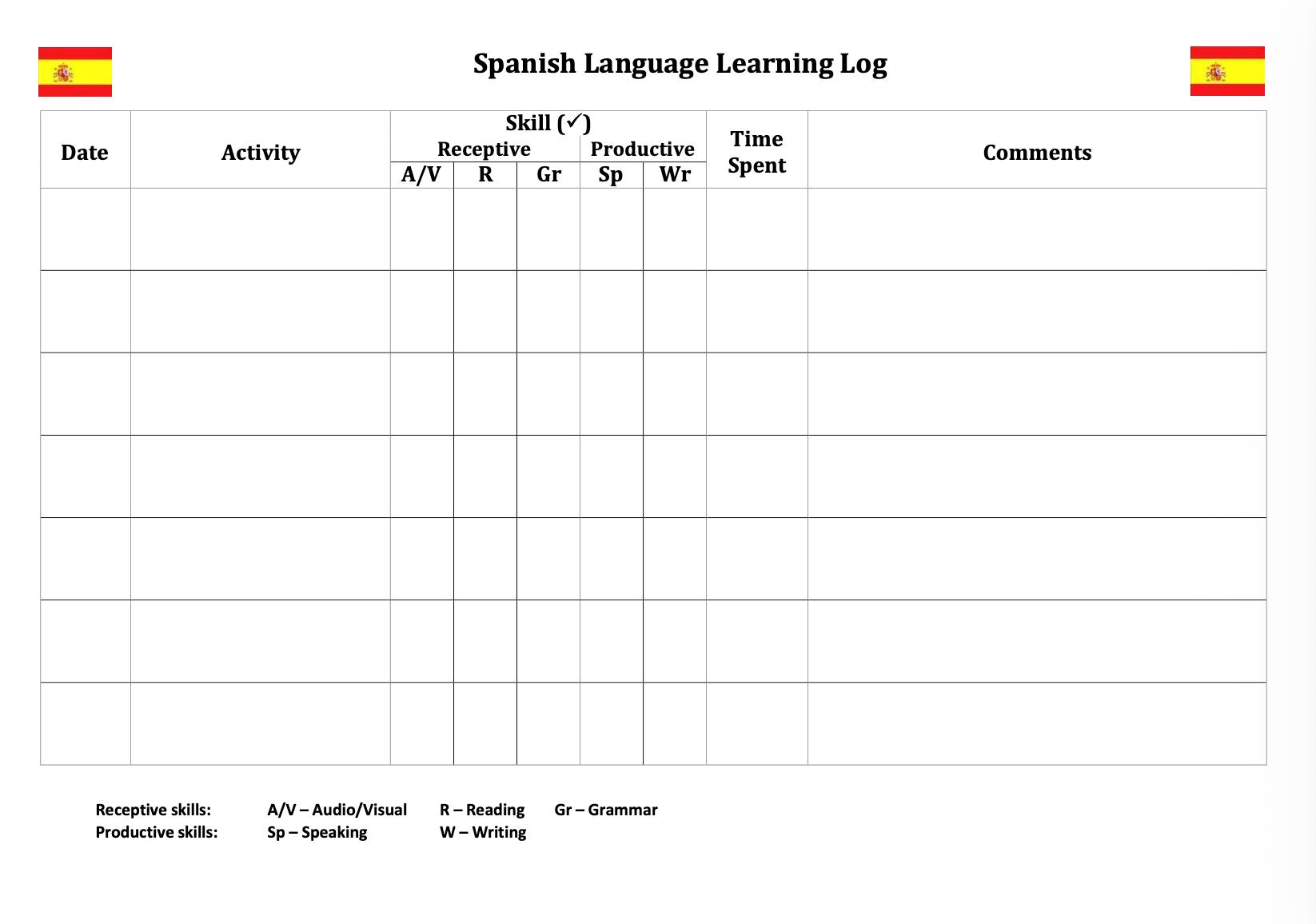
Appendix 2: Using an Independent Learning Log
Independent Learning Log blank template
Transition from GCSE to A-level
What is transition work?
Transition work is independent learning to consolidate what you already know and begin to accumulate new knowledge in preparation for the A-level course. The main aim is to keep practising your language regularly – little and often is the key. This way, it won’t feel like such a big step up in August
What does independent learning look like?
There are huge amounts of resources available to you in order to keep your language going, many of which will be referenced in this booklet. As well as preparing you for the A-level, independent learning is a major opportunity to further explore the Spanish languagethrough a range of activities tailored to your own interests:
• You choose what you do, where, when and why
• A chance to make your learning fun by choosing material which really interests you
• You taking responsibility for your own progress and achievements
• Working on the language skills you have identified as a particular area to work on
• Developing your confidence about learning new languages in the future
• Developing your effectiveness as a learner
• Making effective use of free time to find new ways of learning that keep you interested
• An opportunity to work constructively with friends
Where should I start?
This booklet contains a range of different suggestions of activities to complete independently as well as some grammar activities and research tasks to give you some background knowledge to some of the topics on the Alevel course. Remember that A-level builds on what you already know from GCSE (the Spanish language is still the same!) so why not start by working through your GCSE Grammar and Translation book (if you have one) or looking online for the A-level equivalent?
Useful Resources
TELEVISION
• If you have Netflix or Amazon Prime, try searching for “Spanish language films” or “Spanish language TV”. Many English language films/programmes also have a Spanish audio or subtitle option
• http://www.bbc.co.uk/languages/spanish/tv/ The BBC website has some useful links tobSpanish TV programmes online and tips for how to get the most out of it.
• https://www.rtve.es/alacarta/ A range of programmes available to view online from the Spanish equivalent (roughly) of the BBC.
• https://www.telecinco.es/ One of the most popular TV channels in Spain. Not all of the content is available to watch outside of Spain but there are lots of great programmes on there which are available online.
• http://www.telemadrid.es/ Videos from Madrid’s own regional TV channel
• www.rtve.es/noticias Click on the Telediario for a 4-minute version of the daily news.
FILM
• As well as those available with subscriptions like Netflix, there are also a range of Spanish films available to rent, buy or view for free on YouTube, or of course you can order a DVD online. Here are some film suggestions you may like to try:
o Ocho apellidos vascos
o Maria, llena eres de gracia
o Volver
o Abel
o Las 13 rosas
o Diarios de motocicleta
o La lengua de las mariposas
o El Laberinto del Fauno (Pan’s Labyrinth)
• www.youtube.com Search for videos on topics that interest you and see if you can find any channels to subcribe to. YouTube is also a great research tool and there are lots of informative videos in English on things like Spanish politics, culture or geography.
Listen…
RADIO
• Listening to Spanish radio is a great way to expose yourself to more Spanish easily. Have it on in the background while you are doing something else!
o Radio Nacional de España (https://www.radio.net/s/rneradionacional)
o Cadena SER (https://cadenaser.com/)
o Europa FM (https://www.radio.net/s/europafm)
o https://tunein.com/radio/Spain-r100416/ A comprehensive list of radio channels in Spain available online
• https://blog.lingoda.com/en/10-radio-stations-to-help-you-learn-spanish This blog post contains links to 10 Spanish-speaking radio stations available online. This includes radio stations from Latin American countries as well as from Spain.
MUSIC
• Look up current Spanish artists in the Spanish music charts and listen to some of their music on YouTube. The suggested videos down the side or underneath are often a good way of discovering new music – and don’t forget to ask others for their recommendations.
• www.lyricstraining.com Use this website to listen to Spanish music while improving your listening skills. Listen to a song with the accompanying YouTube video and fill in the missing words in the lyrics underneath. There are 4 difficulty levels and two settings – multiple choice mode or typing mode.
OTHERS
• Don’t forget that many language learning websites including BBC bitesize have specific listening materials aimed at school-age learners. If you bought a GCSE revision guide this should have links
to listening passages. Rather than completing GCSE style comprehension questions, why not use the audio files in a different way – try to transcribe the passage you are listening to in Spanish.
• https://www.newsinslowspanish.com/ This podcast is also available as an app – just search or ‘News in slow Spanish’. Although you need a subscription to access all material, there is a section for free content which contains a new podcast each week.
• https://www.spanishlanguagecoach.com/podcasts This website offers a range of engaging Spanish-learning podcasts for different proficiency levels, from false beginners to advanced learners. Created by César of Spanish Language Coach, the podcasts feature authentic conversations, stories, free transcripts, and vocabulary support. Start by listening to ‘Intermediate’ podcasts and move to ‘Advanced’ whenever you start feeling more confident.
Read…
NEWSPAPERS AND MAGAZINES
• https://www.bbc.com/mundo News stories from around the world in Spanish covering a range of topics
• http://www.elpais.com/ Like many Spanish newspapers, El País is available to read online. You don’t have to read the full paper cover to cover, just try to find one article that grabs your attention.
• https://www.20minutos.es/ This is a more light-hearted newspaper which covers gossip as well as global news stories. There is also a video section https://www.20minutos.es/videos/
• https://www.w3newspapers.com/spain/ This site contains links to a number of Spanish- language newspapers available to read online.
• https://www.abc.es/familia/padres-hijos/jovenes/ Many online news sites have a section aimed at younger readers. Look for the ‘jovenes’ section like this one.
OTHER WAYS TO READ
• Change the language on your phone to Spanish – eventually you will be reading in Spanish without even realising it (and it’s a great way to get a head-start on the technology topic)
• Set your default internet search engine to www.google.es instead of the English version.
• Use a different search engine such as http://es.yahoo.com/. Setting this as your homepage will make you read Spanish every time you log on and it will become an easy part of your daily routine.
• Keep your own vocabulary log. Have an entire exercise book or notebook dedicated to this that you have with you every time you read, watch or listen to something in Spanish.
Surf…
OTHER USEFUL WEBSITES
• www.memrise.com – invaluable for learning Spanish vocabulary. The site is designed in such a way that if you stick with it and use it regularly, reviewing past vocabulary items as well as learning new vocabulary, it automatically sticks in your long-term memory
• http://wikipedia.es Use the Spanish version of Wikipedia when researching topics. It makes picking up the vocabulary much easier! Bear in mind though that anybody can edit Wikipedia so don’t take everything you read as fact! Still a good starting point though.
• www.wordreference.com A really useful online dictionary. Don’t forget to use the conjugate tool for online verb tables too!
• www.twitter.com If you haven’t got a Twitter account, I would suggest signing up for one. Because of the character limit, you never have too much to read! See what interesting channels you can find to follow. Try something like BBC News Mundo (@bbcmundo) to get you started.
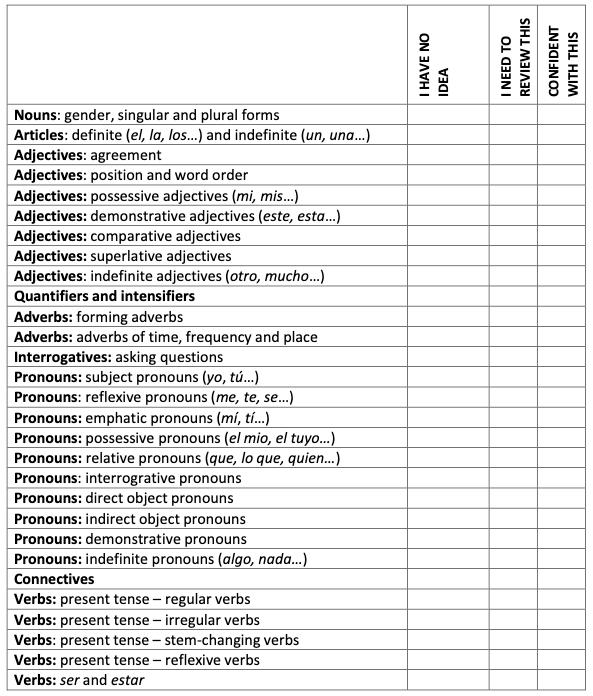
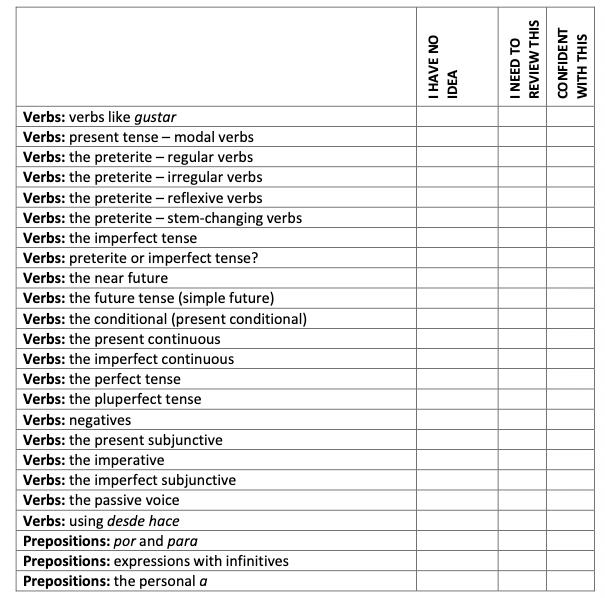
Grammar Checklist
What should I know by now?
Good news – you have already covered a lot of the A-level grammar at GCSE! Use the checklist below to remind yourself of what you have already covered and RAG-rate (Red, Amber, Green) yourself on how confident you are for each grammar point. You will then know which grammar points to spend more time re-capping. Following the checklist is a list of some suggested websites you can use to revise or practise your grammar.
References
Here are some websites which may be useful for revising and practising grammar:
• www.languagesonline.org.uk general site with an A level section (very good grammar)
• www.bbc.co.uk/languages interesting site, lots of revision materials
• http://www.languagesresources.co.uk/SpanishALGrammar.html grammar explanations and activities
• https://conjuguemos.com/activities/spanish/grammar/1 interactive grammar activities
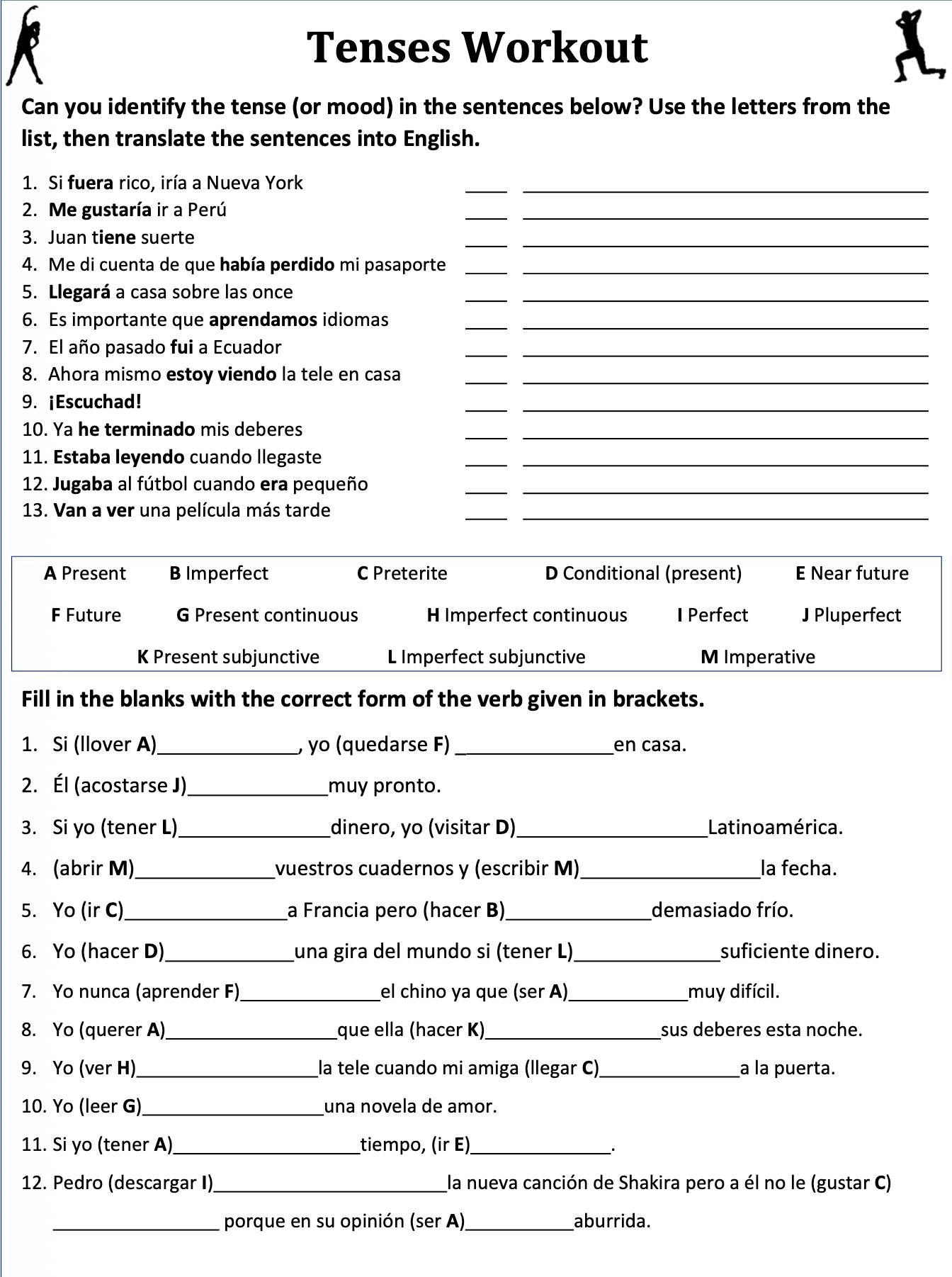
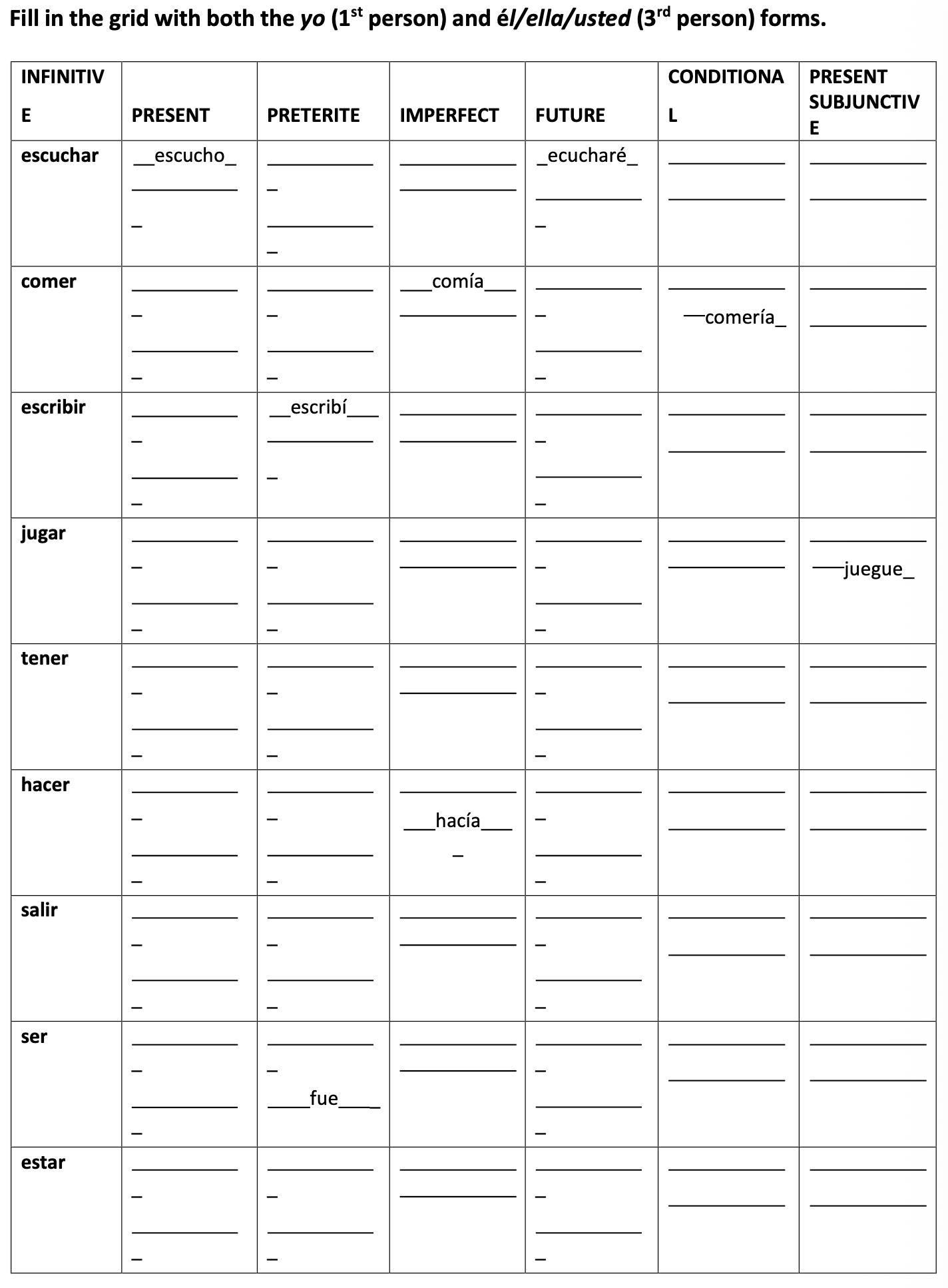
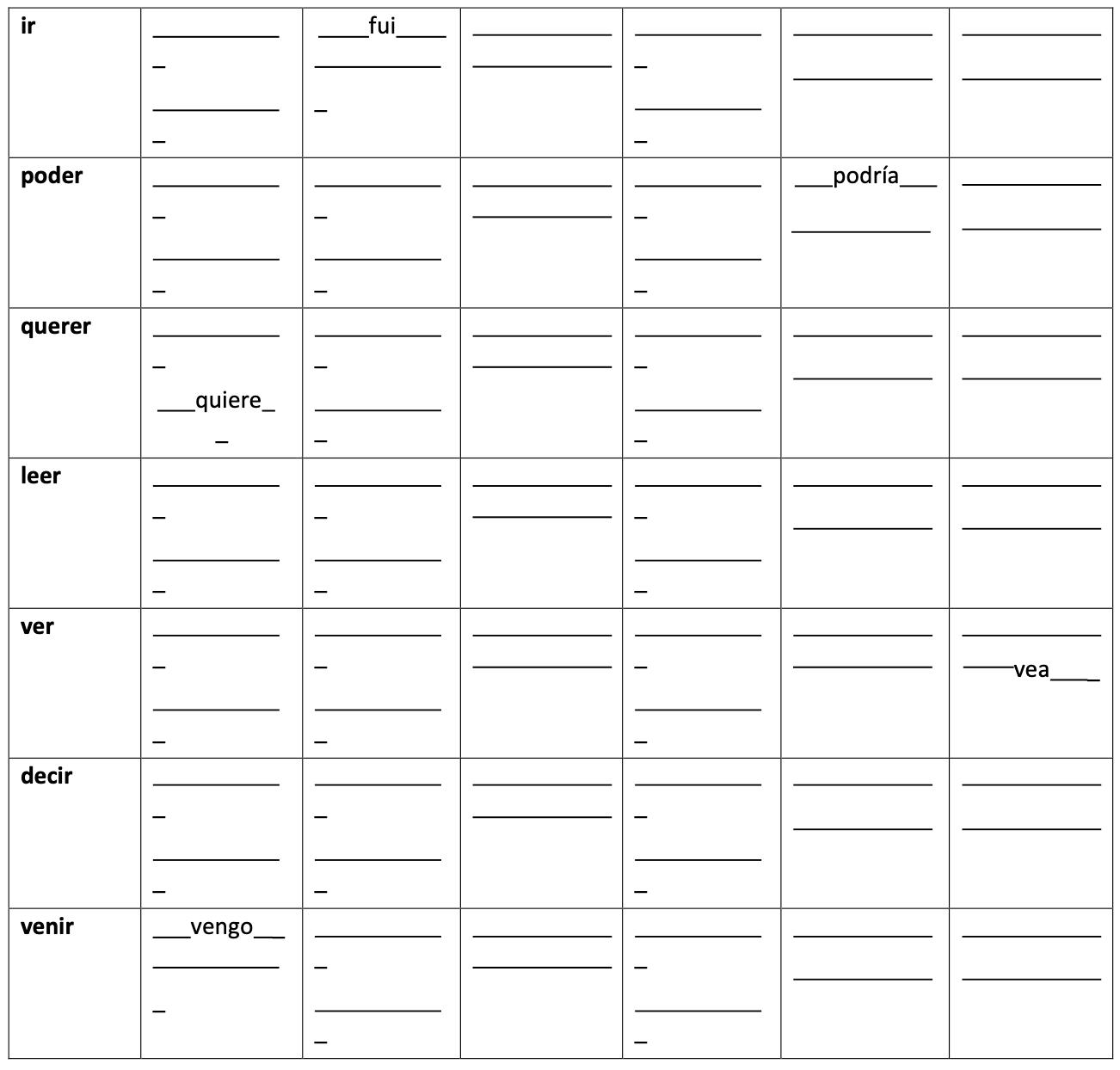
Research Tasks
Below are some suggested tasks to complete in preparation for studying some of the A- level topics. Some of the tasks are aimed at gaining a greater knowledge of Spanish culture in general whereas others are directly linked to one of the modules on the A-level course.
Keep a log of all of the tasks you complete and don’t forget to record your sources (e.g. books used, websites visited and the date). It may be useful to set up a folder to record all of the work you complete (see Appendix 2: Setting up an Independent Learning Log).
IMPORTANT FIGURES
What are these people known for?
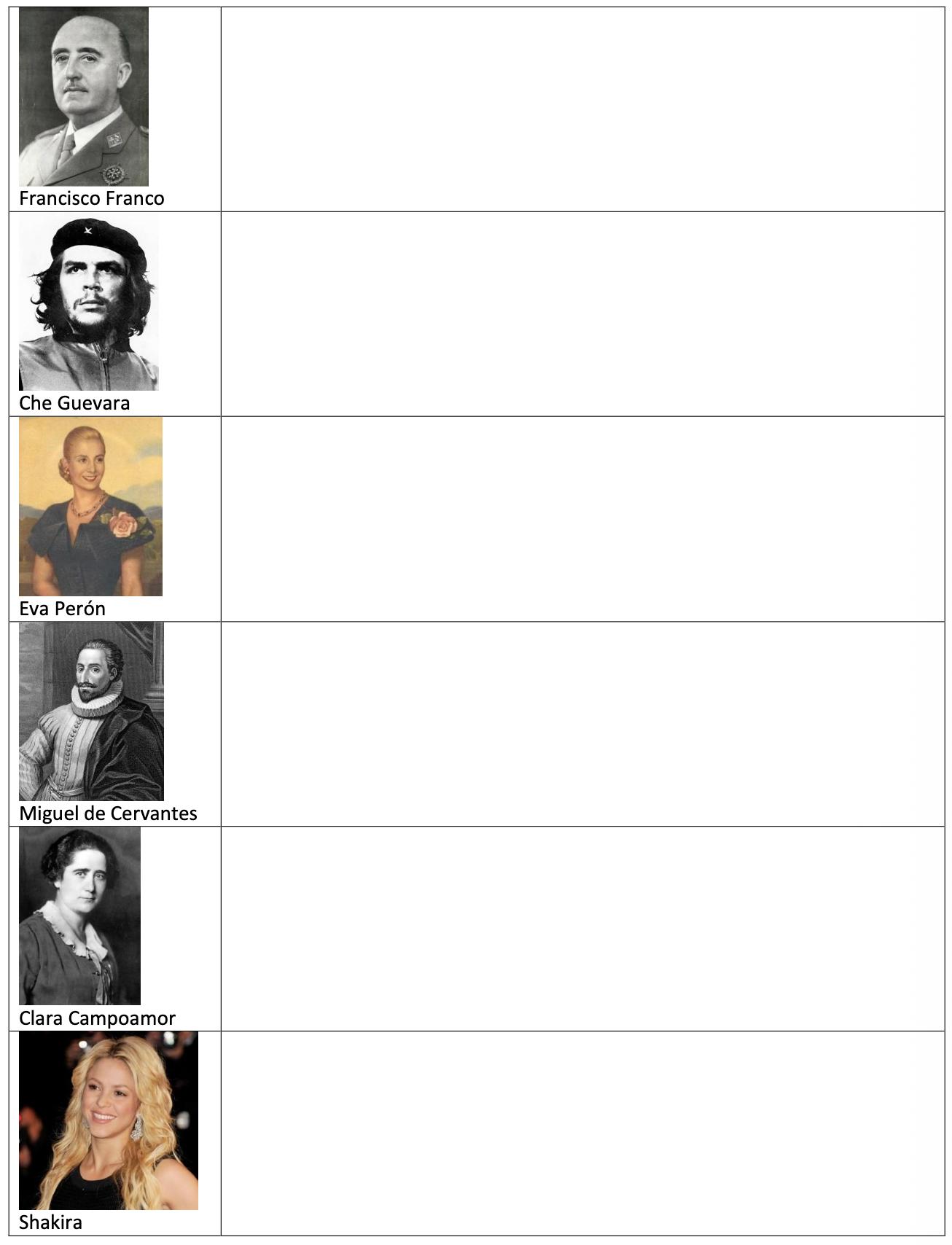

The Spanish Civil War.
HISTORICAL RESEARCH
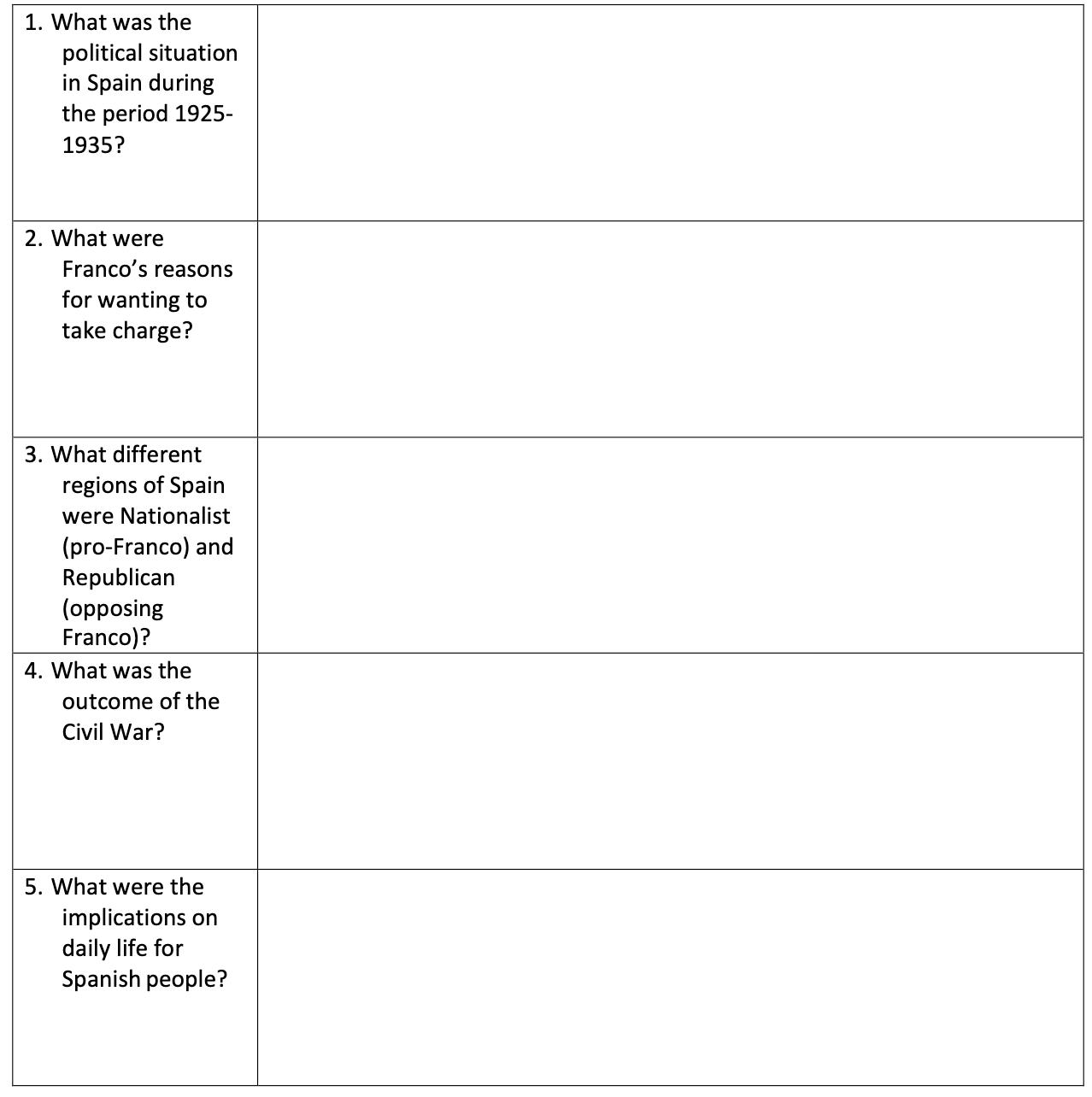
It would be useful to do some research into Spain during this period of history:
• Research the events that led to the Civil War
• What happened to Spain during this time?
• What was life like in Spain during the Civil War?
Use the questions below to guide your research.
GENERAL TIPS
Vocabulary:
• When you come across a new word, try to deduce its meaning from context or from the structure of the word.
• Does the word appear in other sentences which may help you work out the meaning?
• You are more likely to remember something you’ve worked out for yourself – try to resist rushing straight for the dictionary.
• Try a monolingual Spanish dictionary first – can you work out the meaning from its definition in Spanish?
• Keep track of new vocabulary:
o Spanish/English
o Spanish/Spanish definition
o Colour-coding for masculine/feminine or adjectives/verbs
o New sheet/page for different topics
o Example sentence using the word/phrase in context
• Learn vocabulary regularly:
o Look, cover, write, check
o Find/Create a course on Memrise
Dictionaries:
• Familiarise yourself with the abbreviations used (e.g. adv for adverb, vi for intransitive verb etc.) and be aware of the function of the word you are looking up
• To ensure you have found the right word, look it up the other way round (Spanish-English, English-Spanish)
• Take note of genders of nouns and types of verbs
• WordReference is an excellent online bilingual dictionary and has a free mobile app.
Grammar:
• Familiarise yourself with grammatical terms in Spanish and English. This will help you when learning about a new grammar point or looking up particular types of word in a dictionary.
• There are many websites available with online grammar practice – a quick Google search will provide you with hours of independent study.
• Don’t be ashamed of completing ‘beginner level’ grammar activities – it is always good revision and can help improve your accuracy.
Appendix 1: Understanding the news in Spanish
General tips:
Take notes and keep them in a notebook/folder.
Make it easy for yourself – a bit at a time in your own time and at your own pace.
Make a regular time slot to listen to or watch the news in Spanish
Be realistic about what you will get out of it – you won’t understand everything! It could be something as simple as getting into a routine of regularly hearing the language, training your ear to the way it sounds or picking out a couple of words.
Before watching:
Select a story that suits your interests and time requirements.
International news and universal issues such as the environment, the economy, science, technology and sport may be easier to understand than complicated domestic issues that require prior knowledge of Spanish society, politics etc.
You may find text versions or transcripts of the story elsewhere on the site. Make a note of key words and look up any you don’t know.
If you have time to do so, look up the story on an English site first to find out a bit about the detail.
Viewing:
Start by just watching the headlines. They tend to go very fast and might be difficult to grasp. Try watching through before stopping and going back to watch in smaller parts.
Watch more than once. It may take a while to get used to hearing the language – particularly at that speed!
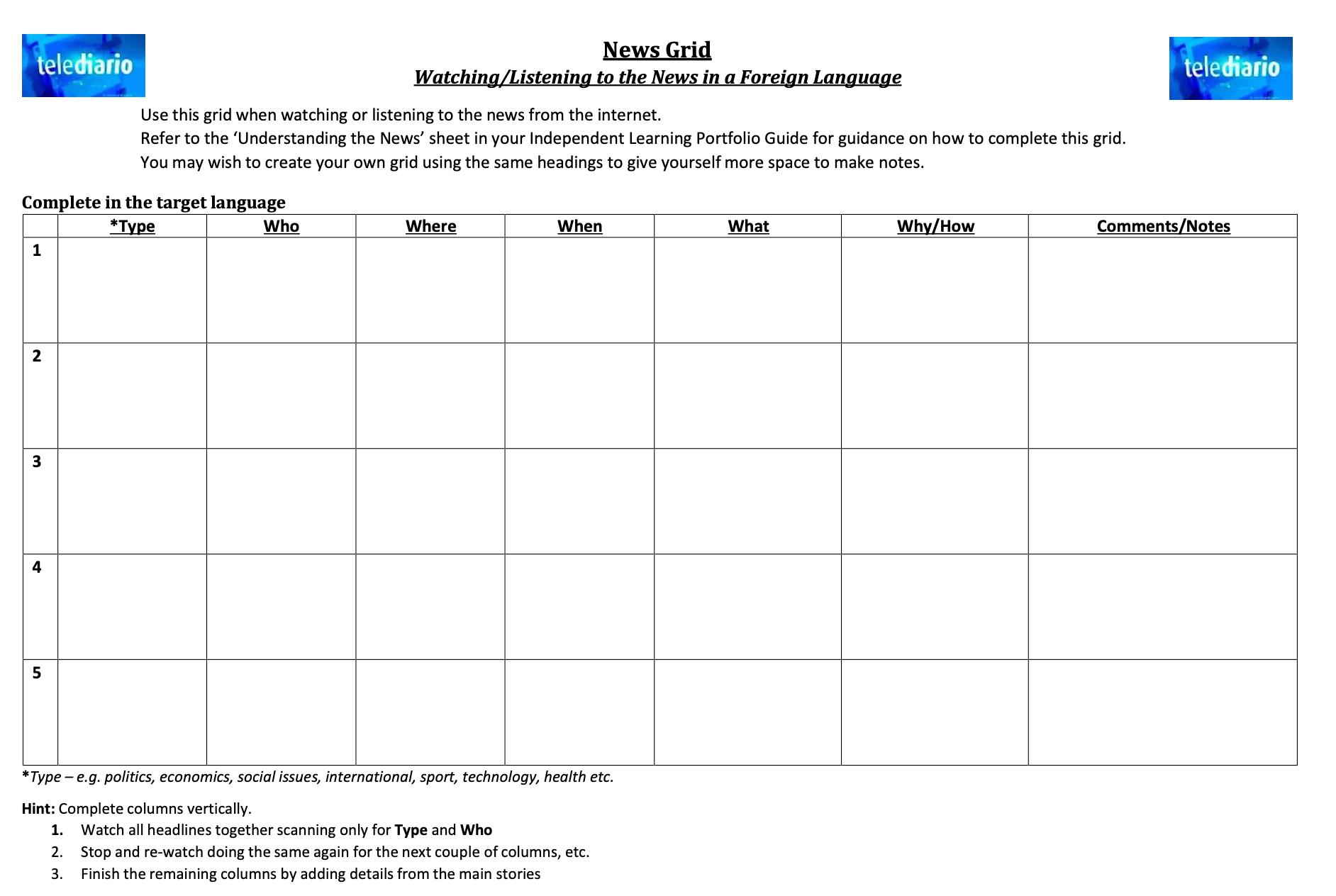
As you watch, use the News Grid to pick out particular information each time rather than trying to understand it all at once. You will probably find that you understand the material better by following this process.
Using the News Grid:
Complete it vertically, filling in one or two columns for each viewing. Work on the headlines first, and then on the full stories to complete the final columns.
Using the headlines:
• Fill in ‘Type’ and ‘Who’ for each story
• On a 2nd viewing, complete ‘Where’ and ‘When’ etc.
The other columns may need further viewing including the main stories. Try to write as many of your notes as you can in Spanish.
After viewing:
Choose a particular news item which has caught your interest and re-write your notes as it for a newspaper, including a headline.
Keep a record of your session including a link to the video so you can re-watch at a later date and compare notes.
Write your own script for a chosen story and record yourself acting as a newscaster.
Appendix 2: Keeping an Independent Learning Log
What should go in it?
• When you begin the A-level, you will be asked to keep your own Independent Language Learning Log – so why not start it now? Have a ringbinder set up where you can keep examples of your work between now and beginning the course. You can then add to this over the 2 year A-level course.
• Your Independent Language Learning Log is like a personal diary, so keep it up to date, add to it regularly and put a date on each entry. Use the grids on the following pages to keep track of activities completed.
• Keep a record of all your learning activities, even things with no physical ‘proof’ such as speaking practice with a partner or listening to the radio.
• Reflect on whether different activities have been useful or not once completed. If a certain type of activity is proving less effective, is there something else you could try?
• Keep examples of completed work that you can look back through. You may want to include:
o Samples of homework and tests you are proud of (once we begin the course)
o Things which are useful for revision such as vocab lists and grammar notes
o Articles you have read with your summary or notes
o Summaries of films you’ve seen
o Print-outs of online grammar activities
o Notes on films and programmes you have watched/listened to including completed News Grids
o Translations of texts you have chosen yourself
o Research into some of the topic areas for the A-level course