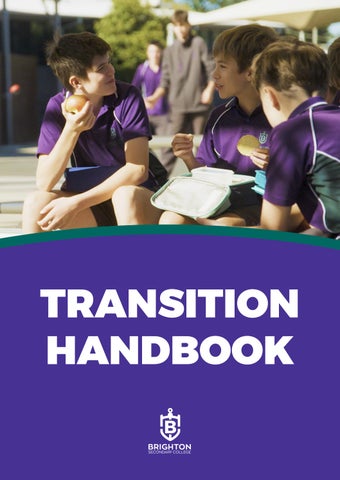
TRANSITION HANDBOOK BRIGHTON SECONDARY COLLEGE
CONTENTS WELCOME TO BSC
4
VISION AND VALUES
6
SCHOOL CONTACTS AND KEY INFORMATION
7
HOW TO SUPPORT YOUR CHILD’S TRANSITION
8
KEY DATES
10
ORIENTATION PROGRAM
11
PARENT INFORMATION EVENING
12
YEAR 7 CAMP
15
STUDENT SUPPORT
16
ATTENDANCE EXPECTATIONS
18
ARRIVAL AND DEPARTURE PROCEDURES
20
LOCKER ALLOCATIONS
22
EXTRA-CURRICULAR AT BSC
25
HOUSE SYSTEM
28
STUDENT LEADERSHIP OPPORTUNITIES
29
CURRICULUM AND HOMEWORK EXPECTATIONS
30
ASSESSMENT AND REPORTING
31
TAPAS 32 BRIGHTLIFE 34 BOOKLISTS 36 COMMUNICATION FROM BSC
37
USING COMPASS AT BSC
38
BYOD 38 SCHOOL UNIFORM
40
SUSTAINABLE SCHOOL SHOP
42
CANTEEN 44 MOBILE PHONES AND HEADPHONES
44
POLICIES 45 CHILD SAFETY WWCC
45
PHOTO CONSENT
46
PARENT PAYMENT ARRANGEMENTS
46
BSCCC – PARENTS ASSOCIATION
48
SCHOOL COUNCIL
48
COLLEGE MAP
49
2 | TRANSITION HANDBOOK
TRANSITION HANDBOOK | 3
WELCOME TO BSC It is my great pleasure to welcome you and your family to the Brighton Secondary College community. My name is Ellen Inglese, and I have the privilege of serving as Head of Junior School and Year 7 Leader. My role is to support students and families as they begin this exciting new chapter, guiding each young person to feel a strong sense of belonging, connection and confidence as they transition into high school life. Starting secondary school is a significant milestone and we recognise that every student’s journey looks a little different. Our aim is to make this transition as smooth and positive as possible. From our comprehensive Orientation and Transition programs to our supportive network of teachers, peer support students and student leaders, we ensure that every child is known, valued and encouraged to thrive both inside and outside the classroom. At Brighton Secondary College, our values of Respect, Empathy, Curiosity, Integrity, Teamwork and Excellence are at the heart of everything we do. We believe that when students feel safe, supported and inspired they can achieve remarkable things, not just academically, but as kind and capable members of our community. Throughout the year, I will work closely with families, students and staff to monitor wellbeing, celebrate achievements and provide guidance whenever challenges arise. The transition to secondary school is a journey we take together and open communication with families plays a vital role in ensuring success. We’re so excited to welcome your family into our community and can’t wait to see your child grow in confidence, discover their passions and make lasting friendships. I look forward to working with you and sharing in all the wonderful moments that Year 7 has to offer. Some of the ways we help to make the transition as easy as possible: •
Year 7 Student Ambassadors visit key primary schools in November and December each year to speak to Year 6 students about their transition to Brighton Secondary College.
•
Key staff from Brighton Secondary College staff visit primary schools to speak to Year 6 teachers about the learning and wellbeing needs of incoming students.
4 | TRANSITION HANDBOOK
•
All Year 6 students attend an Orientation Day in early December (December 9th 2025) meet their Year 7 classes and transition teachers.
•
Year 7 students commence their first day of secondary school one day before Years 8–11 students and have the school largely to themselves. They are supported by Year 7 Year Level Coordinators, the Leading Teacher of Junior School, Year 7 Transition teachers and the Year 10 Peer Support students.
•
Each morning of Semester 1 Year 7 students will engage in a Transition program between 8.40-8.50am. During this time their Transition teacher will pass on any important events happening and ensure students are set up for the day ahead.
•
Throughout Term 1, Year 10 students lead the Peer Support program, which assists Year 7 students in getting to know the school and their peers.
•
During Term 1 the Year 7 Information Evening enables parents to meet their child’s teachers as well as any key figures in the College in an informal setting.
•
The Year 7 Camp is held in early Term 1 (Week 3) and provides an important opportunity for students to get to know each other and to develop a wider circle of friends and connections.
•
Across Term 1 Year 7 students will engage with the Learning to Learn Program in Transition as well as across some of their classes. This is designed to assist them in developing the learning and study habits that they will need in secondary school.
•
Year 7 students are in the same class groups for all subjects and participate in a comprehensive wellbeing program.
TRANSITION HANDBOOK | 5
VISION AND VALUES VISION Brighton Secondary College is a safe place where all have the opportunity to achieve personal excellence through collaboration based on respect, empathy, and integrity.
MISSION Our mission at Brighton Secondary College is to develop future-ready global citizens. We strive to prepare young people to thrive and contribute in the world beyond school. We do this by creating responsible, empathetic citizens who are adaptable, life-long learners and critical thinkers.
LIVED BSC VALUES RESPECT
INTEGRITY
•
We treat others as they would like to be treated
•
We take ownership for our actions
•
We take pride and respect in ourselves and our environment
•
We embrace constructive feedback
•
We accept and celebrate difference and diversity
•
We follow through on our intentions
•
We are honest and transparent
EMPATHY •
We are sensitive to the needs of others
•
We try to understand the needs of all in our school community
•
We listen in order to understand
TEAMWORK •
We share knowledge and harness our collective strengths
•
We collaborate with others to work towards common goals
•
We believe everyone has a responsibility to contribute
CURIOSITY •
We strive for understanding
•
We encourage learning through exploration
•
We question and seek solutions
6 | TRANSITION HANDBOOK
EXCELLENCE •
We strive for personal best in all pursuits
•
We take pride in what we do
•
We celebrate the achievements of others
SCHOOL CONTACTS AND KEY INFORMATION CONTACT DETAILS Address – 120 Marriage Road, Brighton East VIC 3187 Telephone – 03 9592 7488 Email – brighton.sc@education.vic.gov.au Website – www.brightonsc.vic.edu.au
KEY CONTACTS Year 7 Co-Ordinator – Caleb Myers (mye@brightonsc.vic.edu.au) Leading Teacher, Head of Junior School – Ellen Inglese (ing@brightonsc.vic.edu.au) Leading Teacher, Curriculum 7-10 – Sarah Diakoumakos (dia@brightonsc.vic.edu.au) Inclusion Leader – Kaitelyn John (jka@brightonsc.vic.edu.au) Assistant Principal Student Engagement - Danny Chalk (chd@brightonsc.vic.edu.au)
DAILY TIMETABLE Start Time
Length
Transition (Year 7)
8.40AM
10
Period 1
8.50AM
50
Period 2
9.40AM
50
Recess
10.30AM
20
Lockers
10.50AM
5
Period 3
10.55AM
50
Period 4
11.45AM
50
Lunch
12.35PM
55
Lockers
1.30PM
5
Period 5
1.35PM
50
Period 6
2.25PM
50
Dismissal
3.15PM
TRANSITION HANDBOOK | 7
HOW TO SUPPORT YOUR CHILD’S TRANSITION Supporting your child’s transition to high school is all about helping them feel prepared, confident, and connected. Start by talking openly about what to expect – new routines, multiple teachers, changing classrooms – and reassure them that feeling nervous or unsure is completely normal. Visit the school together before the year starts if possible, and help them get familiar with the layout, timetable, and key contacts like their wellbeing team or year level coordinator. Encourage good habits early, like using a planner, packing their bag the night before, and setting a consistent sleep routine, to ease the shift in responsibility and structure. Socially and emotionally, keep the lines of communication open. Ask about their day in a low-pressure way and listen closely to what they share, even if it’s small things. Help them balance school and downtime by encouraging extracurriculars they enjoy, and remind them that it takes time to settle in and make new friends. If you notice signs of stress or worry, don’t hesitate to reach out to the school – we are here to help. Your calm, consistent support goes a long way in making the transition a positive one. Finally, you are entrusting BSC and our staff with someone very special to you, it is a vital relationship and we encourage you to get involved with the school as much as possible. Wherever possible, try to attend our coffee mornings and school events to get to know and build positive relationships with our staff, we’re sure you’ll feel more comfortable having conversations about the tricky things that come up in the life of a high school student when you already know the people you’ll be working alongside. The journey to high school is one that is full of twists and turns that we’re confident will be a positive one - we are excited to embark on this journey with you and your child. The following links should be helpful in further developing your toolkit to support your child’s transition to BSC. Additionally, while this may be your first time, as a school we have transitioned thousands of students and are more than happy to chat with you to help: Raisingchildren.not.au – Starting Secondary School Victorian Department of Education – Tips for Parents Headspace – Transition from Primary to Secondary School Organising Students – Supporting Your Child’s Journey to Secondary School: A Parent’s Guide Raising Teenagers – Starting Secondary School Tips
8 | TRANSITION HANDBOOK
TRANSITION HANDBOOK | 9
KEY DATES Please note that further events will be added and shared via Compass as the term progresses. •
17th, 18th, 19th, 27th and 28th November 2025 - Pre-orientation PAT testing (students to attend one session only)
•
1st December – Second-hand uniform sale, 3:30pm-7:00pm @ BSC
•
8th December – Extended orientation afternoon
•
9th December – Orientation day, including Parents & Carers coffee morning after assembly
•
27th December – Instrumental Music ‘Try it out’, 4:30pm at BSC
•
29th January – First day of 2026 for all students, including Parents & Carers coffee morning from 8:50am
•
29th January – Parent/carer information evening
•
3rd February – Whole school swimming carnival
•
4th February – School photo day
•
11th-13th February – Year 7 camp
•
2nd April – TAPAS day
•
3rd April – Term 1 holidays begin
10 | TRANSITION HANDBOOK
ORIENTATION PROGRAM
What to wear – Comfortable clothes which students can do sport in. Primary school PE uniforms would be ideal but not compulsory. What to bring – Water bottle, snack, lunch/money in cash or on card to buy food from the canteen, pencil case with pen, pencil, ruler and eraser. Top tips for orientation day Ask Questions - Don’t be afraid to ask if you’re unsure about something. Staff and older students expect questions and are there to help, if you don’t ask something you may not get to find out information that is important to you! Take Note of Key Places - Find important locations like your classrooms, toilets, canteen, office, first aid, wellbeing and the library, this will help you feel more confident next year! Wear Comfortable Clothing and Shoes - You’ll likely do a lot of walking and activity on the day, so make sure you’re comfortable with the clothes that you wear. Bring the Basics - A notebook, pen, bottle of water, and a snack will be really handy to have with you. Be Yourself - There’s no need to try to impress others, so many people will like you for who you are and your genuine friendships will form naturally over time. Stay Positive - Even if/when things feel overwhelming, remember it’s normal and almost everyone will feel the same, each day will get easier as you settle in.
TRANSITION HANDBOOK | 11
PARENT INFORMATION EVENING SAVE THE DATE! On Thursday 29th January, we will be holding a parent information evening for all Year 7 families and new families of the school. The evening will be a mix of formal presentations, informal conversations and an opportunity to meet and build connections with BSC staff and families. The evening will cover some key information to help you better understand BSC and the way we operate, including: •
Principal’s welcome
•
Wellbeing at BSC
•
Extra-curricular activities and opportunities
•
Year 7 camp
•
Inclusion and diverse learning needs
•
Teaching and learning
•
Student voice, agency and leadership
•
Parent involvement and community opportunities
This falls just after the first 2 days on site for students and will give parents/carers a chance to ask any questions that have arisen over the first couple of days while your children stay at home enjoying a wellearned rest! We look forward to seeing as many of you there as possible.
12 | TRANSITION HANDBOOK
TRANSITION HANDBOOK | 13
14 | TRANSITION HANDBOOK
YEAR 7 CAMP Brighton Secondary College works collaboratively with Camp Wilkin Anglesea to ensure that Year 7 students experience a supportive and fun environment for their Year 7 Camp and transition to secondary school. The cohort come together as a group for the first time and are the camp is designed to encourage students to build positive relationships with each other and with the staff in an environment outside of the classroom. Students participate in various initiative and team building activities to promote problem solving, teamwork, independence and confidence building, including: •
Surfing
•
Kayaking
•
High ropes
Year 10 Peer Support Students attend the camp and lead nightly activities and provide extra support during the camp to ensure that students feel safe and supported during their time away from home and school. The 2025 camp will be taking place on Wednesday 11th of February to Friday 13th of February.
TRANSITION HANDBOOK | 15
STUDENT SUPPORT At BSC we understand that the transition to a new school can be equal parts exciting an challenging, for a variety of reasons. We value all members of our community as people first and believe that it is essential we understand who they are to build high-growth relationships and provide exactly what each individual needs. Below is a brief overview of the supports available to support this transition to BSC.
TRANSITION TEACHER Each Year 7 class has a 10 minute ‘transition’ period at the start of the day throughout Semester 1. These 10 minutes are dedicated to building positive social connections, building cohesion as a class and developing soft skills needed for successful study. Year 7 students will be introduced to their transition teacher during the orientation process in December and this teacher will remain with the group for the first semester. Transition teachers will get to know their transition group incredibly well and are a great first port of call for families for any questions.
PEER SUPPORT PROGRAM Each Year 7 class will have a number of year 10 students working alongside them as ‘peer support leaders’. These students will attend the year 7 camp and act as student mentors and confidants to our new year 7s, sharing the invaluable student perspective and hints and tips on life at BSC.
YEAR LEVEL COORDINATOR Year Level Coordinators oversee the year level and are a brilliant resource for students and families. Year level coordinators get to know their cohort really well and play a key role in supporting the repair of any damaged relationships, supporting student wellbeing and learning and creating sense of belonging within their year level. Year Level Coordinators will likely change each year as students progress through the college, but work closely together to ensure smooth transitions for our students between year levels. Caleb Myers (mye@brightonsc.vic.edu.au) is our Year 7 coordinator. Caleb works closely with the Head of Junior School and the Assistant Principal on supporting the transition between primary school and BSC.
HEAD OF JUNIOR SCHOOL The Head of Junior School works in conjunction with the Year 7 Coordinator and the assistant Principal to ensure student needs are met and will support families with questions or problems relating to learning progress, wellbeing or social issues. Ellen Inglese (ing@brighotnsc.vic.edu.au) is our Head of Junior School and has a strong relationship with the transition coordinators from each of our feeder schools.
16 | TRANSITION HANDBOOK
ASSISTANT PRINCIPAL The Assistant Principal of Student Engagement oversees the transition process for all new students and also oversees all pastoral, wellbeing and inclusion at BSC. The Assistant Principal also has strong relationships with local primary school leaders and drives the engagement vision at BSC. The Assistant Principal will also speak and meet regularly with families and students where required. Danny Chalk (chd@brightonsc.vic.edu.au) is the Assistant Principal of Student Engagement at BSC.
WELLBEING TEAM BSC recognises the importance of student wellbeing in enabling excellent student outcomes in academics and social development. It is the function of the Student Wellbeing Team to provide the support students need to enable them to learn effectively. BSC has 3 members in the Wellbeing Team, Kylie Mayers (Mental Health Practitioner/Psychologist), Jess Giffin (Student Welfare Coordinator/ Counsellor) and Katie McKillop (Chaplain). We offer support in a variety of ways, including counselling; referrals to external supports; Wellbeing Programs; Mental Health education for staff and students, liaison between external supports and the school and advocacy for students where appropriate. Referrals to the Wellbeing team are made via the Year Level Coordinators, however students are able to self refer via email or drop ins outside class time if they wish.
INCLUSION/ADDITIONAL LEARNING NEEDS No two students learn at the same pace or level of understanding. At BSC we have a dedicated inclusion team who oversee our Education Support staff and resources, and work with our students and families who receive additional funding from the Victorian Government. Teh inclusion team also work closely with Year Level Coordinators to ensure all students with additional or specific learning needs have an Individual Education Plan and that teachers are aware of the best ways to help students learn. Kaitelyn John (jka@brightonsc.vic.edu.au) is our inclusion leader and Liz Dimopolous (dil@brightonsc.vic.edu. au) is our inclusion and wellbeing administrator.
POSITIVE APPROACH TO BEHAVIOUR SUPPORTS BSC places great value in fostering high growth relationships and takes a positive approach to behaviour support for students across all year levels. Each of our proactive and responsive actions to behaviour are underpinned by our ‘Success Code’, which can be found here: BSC Success Code
TRANSITION HANDBOOK | 17
ATTENDANCE EXPECTATIONS At Brighton Secondary College, we are committed to providing your child with an excellent education. The building blocks of a great education begin with all students coming to school each and every day. Regular school attendance is vital and missing school days can have a big impact on a child’s future; missing one day a fortnight means your child will miss four full weeks by the end of the year, which is a great deal of face-toface time with their subject teachers. If this absence rate continues to Year 10, they will have missed more than a year of school. There is no safe number of days for missing school. Each day a student misses puts them behind and can affect their educational outcomes. If for any reason your child must miss school, there are things we can do together to ensure they don’t fall behind: •
Contact the General Office and select the option for student absence
•
Log the absence on Compass
•
Send the Medical Certificate through to the general office
•
All lesson plans are accessible via Compass for you and your child, but it also helps to contact your child’s subject teacher via email and clarify the expectations of the work your child needs to do to ensure they are up to date in each of their subjects
Every day counts. If your child must miss school, speak with your classroom teacher as early as possible. If you have any attendance concerns with your child, please let the Year 7 coordinator know as soon as possible so that we can work together to address the barriers in getting your child to school every day.
BRIGHTON SECONDARY COLLEGE ABSENCE PROCEDURES ABSENCE NOTIFICATION If a student is absent, even for a part of the day, we require either a note signed by the parent/carer to be handed to the General Office on the first day the student returns to the College, or the parent/carer must notify the college via phone or by inputting the absence on Compass. Consistent absence may jeopardise your child’s chance of successfully accessing their education. Parents can ring the school on 03 9592 7488 and select the option to report an absence.
EARLY LEAVERS Request for permission to leave early should be put into Compass as an approved parent/carer absence or via a phone call to the general office on 03 9592 7488. Even though the absence may be on Compass, Students must sign out at the General Office prior to leaving the school grounds.
18 | TRANSITION HANDBOOK
EXTENDED LEAVE OF ABSENCE If a student is to have an extended leave of absence, written notification via email to the Year Level Coordinator must be given at least 2 weeks prior to the absence so that an absence Learning Plan can be provided.
FIRST AID/ILLNESS Students are to report to the First Aid Office located near the General Office. Parents will be contacted via phone if the student needs to go home. Under no circumstances should the student leave without telling someone.
LATE ARRIVALS Parents must put the absence on Compass in advance of the student arriving late. When the student arrives on site, they must sign in at the General Office. If there is a pattern of unapproved lateness, the Year Level coordinator will work with you to address the barriers to getting your child to school on time.
LEAVING SCHOOL Students are permitted to leave school if there is an approved absence logged on Compass. Only those with notes on Compass are permitted to leave the College grounds during school hours. Students are not to ring their parents to seek permission to leave school. They must either see their Year Level Coordinator or report to the General Office if they need to arrange to leave school early.
TRANSITION HANDBOOK | 19
ARRIVAL AND DEPARTURE PROCEDURES GETTING TO AND FROM SCHOOL Brighton Secondary College is located at 120 Marriage Road, Brighton East. There are two entries on Marriage Road and two entries on Dendy Street accessible to students when they arrive to school.
TRAVELLING BY CAR Students can be dopped on both Marriage Road and Dendy Street when families do the school run. Please note that there is limited street parking and there is no dedicated car park for families to utilise. There are ample parking options on streets a short walk from BSC if/when families need to park up and enter the school with their child. Drop-off and pickup times are particularly busy, with a lot of traffic and pedestrians, and we thank all family members in advance for playing a role in keeping all BSC community members safe at these times.
TRAVELLING ON PT BSC is well surviced by bus routes and there are train stations and tram stops within walking distance of the college. Visit https://transport.vic.gov.au/ for full schedules and to plan your PT journey to and from the college.
TRAVELLING BY BIKE Many BSC students choose to cycle to school and we have a great deal of space to store bikes throughout the day. Students are reminded to follow all road rules when sing a bike and must wear a helmet, as per Victorian laws. For safety reasons, students must walk their bike when on campus. Students are also highly encouraged to bring a lock for their bike for peace of mind and should not leave bikes in the bike storge area overnight. In the event a student needs to leave early and cannot take their bike (e.g due to illness), BSC can store the bike temporarily inside the school building for added security. BSC are unable to accept responsibility for any bikes left unlocked or left overnight. Travelling on foot: When travelling on foot, there are council supervised crossings on both Marriage Road and Dendy street for students to use.
ARRIVING LATE We understand that students will, on occasion, arrive late for a number of reasons. On these occasions students must sign in at the general office before going to their class. For more information, see the ‘attendance’ section of this document.
20 | TRANSITION HANDBOOK
TRANSITION HANDBOOK | 21
LOCKER ALLOCATIONS LOCKER ALLOCATION Year 7 students are allocated to a locker and provided with a standard key lock on the first day of school. Students are assigned specific lockers within their respective transition classes.
LOCKER ACCESS Students can access their lockers during the designated times below: •
Before period 1: (8:30am – 8:40am)
•
Beginning of period 3 and 5 (10:50am and 1:30pm)
•
Beginning of recess and lunch
•
End of recess and lunch
To minimise disruptions, maximise learning time and ensure appropriate supervision, Year 7 students are reminded to not access their lockers between periods and during recess and lunch.
LOST LOCKER KEY Each student receives two keys for their lock and are instructed to leave their spare lock key in their lockers. In the event their primary key is lost, misplaced or left at home, then the Year Level Coordinator or transition teacher can unlock the student’s locker to allow them access to their spare key. Should a student lose both keys, they can purchase a new lock from general reception for a small fee.
22 | TRANSITION HANDBOOK
TRANSITION HANDBOOK | 23
24 | TRANSITION HANDBOOK
EXTRACURRICULAR AT BSC EXTRA-CURRICULAR CLUBS There are many other staff and student-run clubs happening at lunchtimes to keep students entertained, including the very popular chess club, art club, karaoke club, pottery club, board game cub, tennis club, volleyball club, J lunch, dungeons and dragons club and many more. Student voice is incredibly important at BSC and if there is a club we don’t currently run that students would like to introduce, we will support it!
SPORT (INCLUDING PASE) In addition to the sports-based clubs, students also have the opportunity to train with a BSC team and compete in inter-school competition each term. In Year 7 and 8, this is done through PASE (Physical Activity Sport Education) one afternoon a week, and for Years 9-12 through inter-school round robin days. In both cases, students are able to select a different sport to train and compete in each term. BSC also run interhouse sporting competitions to help keep up the friendly rivalry between our four houses, including the school-wide swimming and athletics carnivals.
BASKETBALL ACADEMY Chase basketball run a popular academy exclusively for BSC students 2 mornings a week. In addition to high-quality coaching, athletes also receive BSC uniforms and play multiple inter-school tournaments throughout the year. For more information visit Brighton Secondary College Basketball Academy
TRANSITION HANDBOOK | 25
INSTRUMENTAL MUSIC At Brighton Secondary College, we offer a rich, engaging, and diverse music program. By participating in our instrumental music program, students have the opportunity to join ensembles ranging from small to large, as well as take part in performances such as Soirées, Semester Concerts, Open Days, and Brighton’s Got Talent. Our program provides individual or group lessons on the following instruments: •
Saxophone (Alto, Tenor, Baritone)
•
Flute
•
Clarinet
•
Bass Clarinet
•
Trumpet
•
French Horn
•
Trombone
•
Guitar (acoustic, electric, bass)
•
Voice
•
Drum kit/Percussion
Important information: Lessons are scheduled weekly on a rotating timetable. Instrument hire is available and registration information will be shared at our ‘try it out night’ and via Compass. “Music has the capacity to engage, inspire and enrich all students, exciting the imagination and encouraging students to reach their creative and expressive potential. Skills and techniques developed through participation in music learning allow students to manipulate, express and share sound as listeners, composers and performers. Music learning has a significant impact on the cognitive, affective, motor, social and personal competencies of students.” – VCAA
PERFORMANCES There are many performances throughout the year that showcase the talents of our BSC students, including Brighton’s Got Talent, multiple concerts, vocal and instrumental soirees and regular lunchtime performances.
INCURSIONS AND EXCURSIONS There are many incursions and excursions which run across all year levels throughout the year, as diverse as workshops promoting a positive sense of self to ski camp and everything in between. In addition, there are camps at Years 7, 8, 9 and 12 with an optional Central Australia tour for Years 10 and 11, along with biennial international tours. More information about the Year 7 camp can be found on in this handbook and will be shared at the parent information evening at the end of January.
26 | TRANSITION HANDBOOK
TRANSITION HANDBOOK | 27
HOUSE SYSTEM There are 4 houses at BSC and each student and staff member is attached to a house. They remain with that house for the duration of their time at the school. The four houses are: •
Brennan
•
Goldstein
•
Kirby
•
Mabo
The names were chosen by the whole BSC community (students, parents and staff) after a journey led by the student leaders. Students have the opportunity to earn points for their house each day around the school, as well as through large inter house events. There is also a prize for the winning house each term and the overall house champion at the end of the year. Each house aligns with a charity and the student leaders of each house organise a whole school theme day each year (one per term) to raise awareness and money for the chosen charity.
A LITTLE INFO ABOUT EACH HOUSE Brennan Brennan House is named after Molly Brennan, the first female principal of a high school in Victoria – and she did so at Brighton Secondary College! Brennan house reflects the BSC value of curiosity.
Goldstein Goldstein House is named after Vida Goldstein, who fought for the right to vote for women and was one of the first women in the British Empire to run for parliament. Goldstein house reflects the BSC value of excellence.
Kirby Kirby House is named after Michael Kirby, who is a former justice of the High Court of Australia and is an advocate for LGBTQIA+ rights. Kirby house reflects the BSC value of integrity.
Mabo Mabo House is named after Eddie Mabo, a proud Torres Strait Islander man who played a key role in representing the rights First Nations peoples, including during the 1967 referendum. Mabo house reflects the BSC value of respect.
28 | TRANSITION HANDBOOK
STUDENT LEADERSHIP OPPORTUNITIES The overall aim is for students to work together to achieve SMART goals and to set the tone for the student body in promoting a sense of school pride, connectedness and belonging at Brighton Secondary College. The object of the Student Leadership Team is to empower students to become partners in school decisions that impact their learning and connectedness to the school. Student Leaders have a responsibility to listen to and clarify issues of the greater student body and to advocate on their behalf. The student leaders have an increased sense of responsibility to help others and to model leadership principles and BSC values. Trust, autonomy and building positive working relationships are enhanced through the development of our BSC leadership program. There are multiple opportunities for students to take on leadership roles in the school, starting with the chance to become a class captain and to join the Student Representative Council (SRC) in Year 7. The student leadership team participate in a leadership camp to network and develop skills, and organise, run and participate in countless events throughout the school year, all of which students will be notified of.
TRANSITION HANDBOOK | 29
CURRICULUM AND HOMEWORK EXPECTATIONS YEAR 7 CURRICULUM The Year 7 program BSC focuses on developing the skills, knowledge, and learning attributes that will allow students to be successful as they progress through high school. The curriculum at the Junior School level provides students with a broad foundation in all learning areas, preparing students for an increased level of choice and specialisation in their studies as they move into the Middle and Senior Schools. The BSC timetable is structured into 30 periods per week of 50 minutes each. Year 7 and 8 students study English, Mathematics, Science, Humanities, Japanese, and Health and Physical Education across the entire year, and participate in additional physical activity and sport through the PASE program. In addition to this, students rotate through various Arts and Technology subjects each semester while in the Junior School. These subjects cover the Visual and Performing Arts, and the Design and Digital Technologies disciplines of the Victorian Curriculum.
HOMEWORK EXPECTATIONS It is essential that students develop good study habits early on. In Year 7, we recommend that students spend roughly 45-60 minutes per day on homework and/or other home study activities. This may include: •
Completing work that was not finished in class
•
Specifically assigned homework activities
•
Regular review of content that is being learnt
•
Preparing for upcoming assessments
•
Practicing an instrument
•
Practicing a language
•
Reading
•
Creative writing
30 | TRANSITION HANDBOOK
ASSESSMENT AND REPORTING ASSESSMENTS Year 7 students at Brighton Secondary College demonstrate their learning and growth through the following formal assessments: Assessment Name
When
PAT (Progressive Achievement Tests)
Early Term 1 (Year 7 only)
NAPLAN (National Assessment Program – Literacy and Numeracy)
CATs (Common Assessment Tasks)
Early Term 4 (Years 7-10)
Mid-March (Year 7 and 9)
2-4 per subject each semester
Description PAT Reading and PAT Maths are adaptive tests which measure reading and mathematical literacy and understanding, and provide information about student progress and learning needs in these areas.
NAPLAN is a series of annual assessments for Australian students in Years 3, 5, 7, and 9 to measure literacy and numeracy skills and progress against national standards.
Common Assessment Tasks are completed by all students in each subject to assess their learning against the relevant Victorian Curriculum Achievement Standards. Teachers publish course outlines at the beginning of each year which include advice regarding the dates of these assessments.
TRANSITION HANDBOOK | 31
REPORTING Teachers report to parents and carers regarding student learning behaviours, achievement, and growth as outlined in the table below. All reports are published and made available to parents and carers via Compass. Report Type
When
Description Academic achievement on Common Assessment Tasks (CATs) is reported throughout the semester as these tasks are completed. This includes a performance indicator comparing student achievement against the age-expected standard of the curriculum, as well as a written comment outlining strengths and areas for improvement.
Continuous reporting
Regularly throughout the semester
Process reports
Once per term
Assessment of learning behaviours and attributes demonstrated in each class over the preceding five weeks.
End of each semester
A summary of achievement and growth over the semester. Includes CAT results and feedback, Process Reports data, and assessments against the Victorian Curriculum.
Semester reports
TAPAS
Our TAPAS (Teacher and Parent and Student) conferences are a great opportunity to meet with your child’s subject teachers and discuss their progress and how you can support them in their learning. Our expectation is that students will play a key role in these meetings by leading the conversation, reflecting on their learning journey and setting goals to continue their growth. Based on community feedback, we run our TAPAS meetings online. Families will be notified via Compass when sign-ups are open and will later be sent links to join the meetings. We know how important it is to maintain communication between our staff and families, so please don’t feel as though you have to wait for a TAPAS day to discuss any concerns you may have or share any successes – our staff are available via phone or email year-round.
32 | TRANSITION HANDBOOK
TRANSITION HANDBOOK | 33
BRIGHTLIFE We know that our students are navigating a world that is increasingly complex, fast-moving and at times, overwhelming. The pressures they face both online and offline are unlike anything we experienced at their age and that’s on top of the normal messiness of adolescence. And yet amid that, we still see so much potential, so much growth and so many incredible stories of resilience, kindness and ambition in our classrooms. In 2026 all students across Year 7 to 9 will be undertaking our BrightLife program as part of their timetabled curriculum. BrightLife is about nurturing the potential in all of our students. It’s about supporting the whole student and creating a consistent, intentional framework across Years 7 to 9 that equips them with real-life skills, skills that help them understand themselves, navigate relationships and respond to life’s inevitable challenges with confidence and care. This program has been created in partnership with our students, staff and wider community to ensure the needs of our Brighton Secondary students are being met. Our focus for our Year 7 cohort is developing emotional literacy, discovering personal and collective strengths, as well as help seeking and problem solving.
34 | TRANSITION HANDBOOK
VISION To develop resilient, connected, compassionate future ready young people who understand who they are, what they stand for and how to thrive in a changing world.
TRANSITION HANDBOOK | 35
BOOKLISTS All books can be ordered online or bought in-store at Campion Education (236-238 Wickham Road Moorabbin). Digital resources can only be ordered online through www.campion.com.au and cannot be refunded. Booklists for 2026 will be available online at www.campion.com.au and will also be sent via Compass to all families. Online ordering will require a resource list code which will be communicated before the end of 2025.
36 | TRANSITION HANDBOOK
COMMUNICATION FROM BSC PHONE
BSC staff will be available to speak on the phone to any parents and carers as this is our preferred method of communication. Please call the general office on 03 9592 7488 and our friendly staff will put you through to the person you are wanting to speak to.
EMAIL All of our staff are available via email using the three letters of their staff code followed by @brightonsc.vic. edu.au and will often reach out to families via email regarding engagement and learning. Please ensure that we have your current and correct email address.
COMPASS BSC uses Compass to communicate with students and families, record learning tasks and post upcoming events. Teachers place lesson plans including homework, learning tasks and results and documents for students and families to access from home. Students and families can read and react to items on the Newsfeed. In addition, families are able to see upcoming events and given consent for incursions and excursions. Families can log on to Compass to check student attendance and home study. Parents/carers are recommended to download the Compass app for their personal device – the app can be downloaded on more than one device.
HIGHLIGHTS Every fortnight BSC releases ‘Highlights’, which can be viewed via the Compass Newsfeed and on our website. Highlights helps celebrate the achievements of all members of the BSC community and keeps families updated with all that has been happening around the school.
INSTAGRAM Our BSC Intagram page is regularly updated with pictures from incursions, events and successes of our students both inside and outside of school. The page can be found using the handle @brighton_sc
BSC WEEKLY Every Friday we release a video onto the Compass Newsfeed where students and families hear directly from our Principal and members of our senior student leadership team
STUDENT BULLETIN Every Monday morning all classes are shown a video of what is happening that week to give students the opportunity to be aware of and engage in extra-curricular activities and events. This are then released on Newsfeed for students and families.
TRANSITION HANDBOOK | 37
USING COMPASS AT BSC Many of you will already be familiar with Compass from primary school. At Brighton Secondary College, we use Compass for many of the same purposes — including attendance, sharing information, providing consent, reporting on student achievement, and managing Parent–Teacher–Student Conferences. In secondary school, Compass also provides additional features. Families can email teachers, access details about assessment tasks, view student work submissions, and check their child’s weekly class schedule. If you are new to Compass, please click here to find out more.
COMPASS USER LOGIN By now, you should have received an e-mail from Compass BSC with your parent/carer login details and instructions. If you have not received this communication, please e-mail IT – it@brightonsc.vic.edu.au Compass is accessible on any modern web browser (Internet Explorer, Firefox, Chrome, Safari) or by using the Compass iOS or Android apps. Click here to access the Compass link from the BSC homepage. Alternatively, you can go to schools.compass.education where you can search for our school’s direct URL.
BYOD LAPTOPS AT BSC | ACCEPTABLE USE AGREEMENT Brighton Secondary College operates a Bring Your Own Device (BYOD) program. Parents and carers are encouraged to purchase or supply a suitable device for their child to bring to school each day. Please take a moment to review the school’s Acceptable Use Agreement for Digital Devices, which outlines device specifications and expectations for responsible use. Students will review and complete the Agreement on commencement at BSC as part of their Digital Technologies learning. If you require any support or assistance to ensure your child has access to a device for school, please contact the school for guidance.
38 | TRANSITION HANDBOOK
TRANSITION HANDBOOK | 39
SCHOOL UNIFORM Brighton Secondary College has a compulsory uniform for all students from years 7-12, which contains a trans-seasonal academic uniform and a dedicated sports uniform. Full information can be found our website. The purpose of the Student Dress Code is to outline Brighton Secondary College’s requirements for student dress and appearance and to provide information about uniform purchase and support, dress code implementation and exemption processes. This dress code has been developed by Brighton Secondary College’s School Council in close consultation with our school community to ensure that it respects the rights of individual students whilst reflecting the values and interests of our community.
All BSC Students are required to wear College uniform items as outlined in the dress code. As stated in the dress code, BSC is committed to supporting families who are unable to supply their child with the correct uniform items due to hardship.
40 | TRANSITION HANDBOOK
The Student Dress Code aims to: •
Promote a sense of identity and pride, cohesion and good order in the school.
•
Allow all students to feel equal.
•
Prevent bullying and competition on the basis of clothing.
•
Ensure students’ appearance reflects the expectations of their school community.
•
Enhance the profile and identity of the school and its students within the wider community.
•
Strengthen the spirit of community within the school.
•
Enhance individual student safety and group security.
•
Ensure all students are dressed safely and appropriately for school activities.
•
Prepare students for the expectations of workplaces.
•
Encourage students to present themselves appropriately for a particular role.
BOB STEWART UNIFORM SHOP 466 Centre Road Bentleigh, 3204
TRADING HOURS
Phone: 03 9036 7384
Monday to Friday – 8:30am until 5:00pm
Email: bentleigh@bobstewart.com.au
Saturday – 9:30am until 12:30pm
TRANSITION HANDBOOK | 41
SUSTAINABLE SCHOOL SHOP Register on the Sustainable School Shop website – www.sustainableschoolshop.com.au
SECOND-HAND TEXTBOOK & UNIFORM TRADING SYSTEMS List Wanted & For Sale Ads (Browsers tell each other what they require and what they have to sell). The school’s book and uniform lists are loaded into the system to make the Ad listing process easy, fast and accurate. The website’s ‘Ad Matching’ service shows you; •
Exactly the right items to buy;
•
Who has the most items you need;
•
The cheapest items.
Assistance is provided to accurately price items. Buyers contact Sellers and arrange where and when to transact.
COST Browse and search the ‘for sale’ ads for free Single items can be advertised Annual subscriptions are available.
ALSO BUY & SELL •
Calculators
•
Sporting Items
•
Musical Items
•
Electronics & DVD’s
•
Stationery
PRICING GUIDE (QUALITY OF PRODUCTS) •
Like New – 70%
•
Excellent – 60%
•
Very Good – 50%
•
Good – 40%
42 | TRANSITION HANDBOOK
TRANSITION HANDBOOK | 43
CANTEEN The Canteen at BSC is incredibly popular amongst students and staff and is open for sales at recess and lunchtime each day. The Canteen offers a range of freshly made, nutritious and sustainably sourced meals and snacks. Students can put a lunch order in to pick up at lunchtime from the side of the canteen, or join the queue and select items from the canteen. Students can pay using cash, a bank card or their Compass Card. Students are not permitted to pay on their mobile device.
MOBILE PHONES AND HEADPHONES MOBILE PHONES In line with the Department of Education, all students from Years 7-12 must keep their phones locked inside their lockers for the duration of the school day. In rare cases, students may need a mobile device on them due to medical or learning needs, and in these cases concessions can be arranged through the Principal. If/when a student needs to contact home for any reason, BSC staff are happy to help facilitate contact with parents/carers on a student’s behalf. The General Office would be the best place for this communication to be facilitated.
HEADPHONES Headphones (including AirPods or any in ear or over ear headphones) should also be stored in student lockers for the duration of the school day. In some cases, students will require to use headphones for educational purposes in lessons. In these instances, staff will outline in the lesson plan on Compass that headphones are needed and students should collect them from their locker prior to the class. On rare occasions health professionals will suggest that due to individual learning needs a student may need to use noise cancelling headphones or loop earphones at school. In each of these instances, parents/ carers should supply the relevant documentation to the school via our inclusion team who will update the student profile for all staff to view.
44 | TRANSITION HANDBOOK
POLICIES School policies can be found on our school website. Please note that our new website is under construction and we look forward to sharing that with you in early 2026. To support a culture of child safety, we encourage all parents and carers to review school and Department policies, particularly the following: •
Acceptable Use Agreement (Digital Technologies)
•
Child Safety Code of Conduct
•
Child Safety and Wellbeing
•
Child Safety Responding and Reporting Obligations
•
Statement of Values and Philosophy
•
Photographic Filming Recording Students Policy
CHILD SAFETY WWCC As your child transitions into secondary school, please ensure you maintain a valid Working with Children Check (WWCC). There will continue to be opportunities for parents and carers to visit and volunteer, and holding a current WWCC remains a requirement. All parent/carer visitors are required to sign in at the school office upon arrival. Volunteers supporting the school in any capacity are also required to present WWCC and complete a site induction before commencing any volunteer work. The BSC Visitor and Volunteer Induction will be shared via Compass in early Term 1, 2026.
TRANSITION HANDBOOK | 45
PHOTO CONSENT There are many occasions during the school year when staff photograph, film or record students participating in school activities or events. We do this for many reasons, including to celebrate student participation and achievement, showcase learning programs, document a student’s learning journey/ camps/excursions/sports events, as well as communicate with our parents and school community in newsletters, publications and social media. Our Photographing, Filming and Recording Students Policy describes how we will collect and use photographs, video and recordings (images) of students. The policy also explains when parent/carer consent is required and how it can be provided and withdrawn.
PARENT/CARER ACTION REQUIRED Please refer to the following consent form to provide your consent for images to be used in various ways. Please complete the form and return via e-mail to registrar@brightonsc.vic.edu.au or drop it in to the general office.
PARENT PAYMENT ARRANGEMENTS Please look out for ‘Parent Payment Arrangements’ on Compass, available in late 2025. This information will outline how families can make a financial contribution to the school and highlights our shared goals for school fundraising. Click here to see the wonderful successes we achieved together as a community in 2024/2025, and to learn more about how school funding works — and why your contribution makes such a meaningful difference for our students and school community. The school also offers tax-deductible contribution options through our Library Fund and Building Fund. Further information about these opportunities will be provided later in the year.
46 | TRANSITION HANDBOOK
TRANSITION HANDBOOK | 47
BSCCC – PARENTS ASSOCIATION Brighton Secondary College Community Connect, or BSCCC, is the school’s parent and carer association. Formed in late 2023, the group’s aim is to foster connection among families and strengthen our school community — with a particular focus on welcoming new families to BSC. The BSCCC hosts regular coffee mornings and community events that celebrate our students, parents, and carers. The group also raises funds and provides valuable parent and carer perspectives to the school through its termly meetings. We also encourage families to join the Year 7 2026 cohort WhatsApp group. It’s a great way to stay connected — BSCCC parent representatives and other parents/carers share helpful reminders, school updates, and quick answers to those last-minute questions. Year7 2026 - Open this link to join my WhatsApp Group: BSCCC WhatsApp
SCHOOL COUNCIL School councils in Victorian government schools work in partnership with the principal and council to help set the school’s strategic direction, oversee governance, and ensure the school’s resources are used to support student learning and wellbeing. Being a school councilor allows individuals to share their strengths, professional skills, and community perspectives to help shape the school’s direction, while also gaining a deeper understanding of how schools operate and contributing to improved outcomes and opportunities for all students. Look out for the annual notice calling for nominations to school council which occurs early in Term 1 each year. For more information see the school’s website.
48 | TRANSITION HANDBOOK
COLLEGE MAP MARRIAGE ROAD
JUNIOR SCHOOL - UPPER LEVEL
10
COLLEGE MAP N209
N216
N221
N215
W1, W3, W6 MUSIC PRACTICE ROOMS T
4 5 6
N223
N224
N218
N231
7
N103
N106
N109 N110
GENERAL OFFICE
N111
T
T
T
E201
27
N230
E204
E202
28
15
LIFT E109
E110
E209
N114
T
N115
T
GYM
E114
E217
16
29
T
17
18 P7
E218
34 35
T
P5
P3
BIKE SHED
E118
22 23
P1 T
P6
30
E117
21
D2
D1
19 P8
E214
T
LIBRARY OFFICE
P9
TT
E116
T
L4
20
E219
E216
E115
L1 L2
32
E215
E111 E113
T
E210
E213
E112 N116
N117
8
33
E206
N113
N118
E119 D3
31
E120
E121 P4
P2
D7
D6
S5
D5
D4
HOCKEY PITCH
STAFF PARKING
E123
E122
S6
OASIS
BASKETBALL COURTS
26
25
T
11 12 13
N102
SOCCER OVAL
N225
24
N112
T
CANTEEN
STAFF PARKING
N212
N211
N205
2
N222
FIRST FLOOR
GROUND FLOOR
N220
T
W8
W9
N217
N214
N210
N207
N206
N204
N201
LIFT
3
N232
N218
N208
N202
1
14
N226
N227
N203
9
S1 S2
MULTISPORTS AREA
DENDY STREET 1. 2. 3. 4. 5. 6. 7. 8. 9. 10. 11. 12. 13. 14. 15. 16. 17. 18.
Bus Shed Wellbeing Centre Hall Assistant Principal - Teaching & Learning Assistant Principal - Student Engagement First Aid Office Assistant Principal - Senior School’s Office Principal’s Office Inclusion Team Office ES Aides Office Year 7 Student Coordinator’s Office English Office Junior School Office Maths Office Year 8 Student Coordinator’s Office Silent Study Area Brennan Library Languages/Humanities Office
19. P Block - Year 10 Class Area 20. Leading Teacher – Middle School’s Office 21. Year 10 Student Coordinator’s Office 22. Year 9 Student Coordinator’s Office 23. Health and PE Office 24. Careers & Pathways Office 25. International Meeting Room 26. Language Centre 27. IT Support Office 28. International Program Office 29. Da Vinci Centre 30. Science Office 31. Arts Wing 32. VCE Centre - Year 11 & 12 Class Area 33. Senior School Office 34. IB Office 35. Art and Technology Office
TRANSITION HANDBOOK | 49
BRIGHTON SECONDARY COLLEGE
Address – 120 Marriage Road, Brighton East VIC 3187 Telephone – 03 9592 7488 Email – brighton.sc@education.vic.gov.au Website – www.brightonsc.vic.edu.au
50 | TRANSITION HANDBOOK