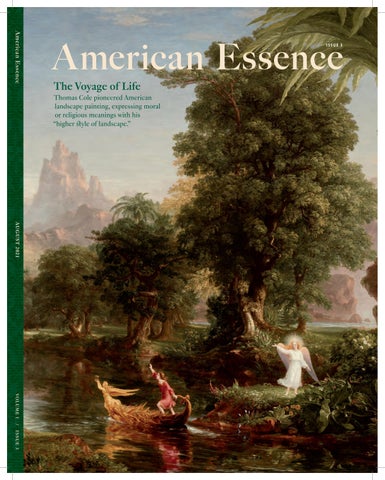
American Ess ence
American Essence ISSUE 3
The Voyage of Life
Thomas Cole pioneered American landscape painting, expressing moral or religious meanings with his “higher style of landscape.”
AU G U S T 2 021 VOLU M E 1 / ISSUE 3
Redwoods in Northern California.
AMERICAN ESSENCE
/
2
/
ISSUE 3
“Life is a great adventure … accept it in such a spirit.” —T H E O D O R E R O O S E V E LT
1
Sunflowers in Woodland, California.
AMERICAN ESSENCE
/
2
/
ISSUE 3
“We on this continent should never forget that men first crossed the Atlantic not to find soil for their ploughs but to secure liberty for their souls.” —ROBERT J. McCRACKEN
3
Contents 12
36 Planet Bigfoot Despite a lack of indisputable evidence, at least six Bigfoot museums have opened across America in the past six years, and there may be more believers now than ever. 46 Generation to Generation Fishing has a way of captivating the young. Even an afternoon fishing trip teaches important life lessons of planning, execution, patience, celebration, and more. 48 Your Stories An 82-year-old reflects on the hardships she has faced in life, sharing the lessons she learned while following her heart and never losing her optimism.
Features 12 Climbing Everest at 75 The oldest American to summit Mount Everest reflects on the physical and mental prep and the attitudinal adjustments that helped him reach the top of the world. 24 Georgia Peaches A Tennessee couple built a business with dreams of delivering America’s most flavorful, farmfresh peaches by truck across the country. 30 Saving Newborns After tragedy befell his beloved wife, Nick Silverio found a calling to honor her, and has since helped save 338 children from abandonment.
52 The Last Frontiersman Roland Welker lives like an oldtimer, depending upon his skills, physical fitness, and the land while surviving for months at a time in the Alaskan wilderness.
History 54 America’s First National Parks Our national parks are a direct result of numerous artists, authors, and activists who portrayed nature as a treasure. 64 Washington’s Resounding Prayer An eyewitness observed George Washington praying in the woods at Valley Forge. That hard winter in Pennsylvania became a touchstone, and a pivotal moment in history.
AMERICAN ESSENCE
/
4
/
ISSUE 3
66 The Santa Fe Trail A trader blazed the trail from Missouri to Santa Fe while Mexico gained independence. After navigating harsh terrain and uncertain hospitality, he found profit.
24
78 Teaching Virtue How do you teach respect, responsibility, and self-discipline along with academics? One mothers’ co-op designed a curriculum that includes character education. 80 Sacrifice as a Saving Grace We can’t realistically have it all in life, but difficult decisions make our chosen paths all the more rewarding and meaningful. 82 Dante Alighieri: All About Love Dante demonstrated how the beauty of words could draw people together instead of causing pain and estrangements.
American Artists
54 A Love of Learning 70 Poetic Education in Action Gregory the Great Academy bestows the character of happy men through adventurous encounters with the good, true, and beautiful. 74 Outside Changes Everything Getting children outdoors can improve everything from physical to mental and social well-being, boost confidence, and even promote learning.
90 Made in America The Pageant of the Masters is one of California's oldest artistic traditions, where master artworks come alive onstage. 96 ‘The Voyage of Life’ America’s most prolific landscape painter, Thomas Cole, created a visual testament to the spirit of man that takes us on a journey through the four stages of life.
The Great Outdoors 106 The Magnificence of Yosemite Yosemite National Park has a dramatic history, and millions of people from around the world pilgrimage to its breathtaking landscapes every year.
5
90 116 Cowboy Cookin’ When Kent Rollins and his crew are ranching and cooking meals out in the elements, being resourceful and adapting to Mother Nature are key philosophies. 120 The ‘Most Sublime of Nature’s Works’ One of Virginia’s most amazing architectural treasures wasn’t formed by the hand of man at all— Natural Bridge State Park.
82
Editor’s Note
Dear Readers,
F
rom the earliest days of America, the hand of Providence has been seen not just in the history of events, but also in the natural splendor of the land. These sublime sights were immortalized by Hudson River School artists such as Thomas Cole and Albert Bierstadt, and are still preserved today in the National Park System. On page 54, we delve into the history of our national parks, and the instrumental forces behind the effort. “Everybody needs beauty as well as bread,” wrote renowned conservationist John Muir. “Places to play in and pray in, where Nature may heal and cheer and give strength to body and soul alike.” On page 74, a veteran homeschooler shares why “outside changes everything.” As all of us spend more and more of our lives indoors, parents can make conscious efforts to encourage their children to play outside. On page 12, Arthur Muir, the oldest American to climb Mount Everest and someone who is attempting to scale the highest peak on each of the seven continents, says it’s not about conquering the mountains, rather, it’s a relationship of respect and attention. Editor-In-Chief Catherine Yang
AMERICAN ESSENCE
/
6
/
ISSUE 3
American Essence PU BLI SH ER Dana Cheng
EDI TORI AL Catherine Yang MANAGING EDITOR Annie Wu ARTS EDITORS Sharon Kilarski Jennifer Schneider HISTORY & LITERATURE EDITOR Robert Mackey EDUCATION EDITOR Steve Gigliotti FOOD & WINE EDITOR Crystal Shi OUTDOORS EDITOR José Rivera TRAVEL EDITOR Cary Dunst ENTERTAINMENT EDITOR Ben Zgodny EDITOR-AT-LARGE Tynan Beatty STAFF WRITER Skylar Parker EDITOR-IN-CHIEF
C REATI V E Justin Morgan DESIGNERS Michael Kurov Dariya Akdeniz ILLUSTRATOR Michelle Xu PHOTO EDITOR Fiarbei Yauheni PHOTOGRAPHERS Daniel Ulrich Jerrica Green
CREATIVE DIRECTOR
C ONTRI BU TORS Peter Falkenberg Brown, Juliette Fairley, Jackson Elliot, Brian Molitor, Suzanne J. Farrow, Jill Dutton, Denice Rackley, Deborah Hommer, W. Kesler Jackson, Sean Fitzpatrick, Gina Prosch, Poppy Richie, Sam Sorbo, Elizabeth Lev, Mark Lardas, Jeff Perkin, Bob Kirchman, Eric Bess
OFFI C E & C ONTAC T 229 W 28th St, 7th Floor, New York, NY 10001 General Inquiries: AmericanEssence.net/help Submissions: Editor@AmericanEssence.net
www.AmericanEssence.net 7
FE AT U R E S
Kindness in Action
Twelve Old Dogs and Hugs for Life W R I T T E N B Y P E T E R FA L K E N B E R G B R O W N
S
ally was a Dutch Shepherd dog who arrived at Laurie Dorr’s Finally Home Senior Dog Rescue and Retirement Home in North Yarmouth, Maine, in 2019. Her owner was moving and was unable to keep her. At age 14, Sally would have been destined to live in a cage at a shelter, but the owner found Laurie’s rescue service instead. Laurie remembers sleeping on the living room couch, with Sally lying on a dog bed next to her, keeping her company for five days until the dog could readjust to her new home. “Sally cried all night because she was away from her owner,” Laurie said. “Sally slept on the floor, right there, and I slept on the couch. I had my arm on her for part of the night. She was very sad.” Sally passed away a year later, but Laurie helped make her last year a happy one. Finally Home has eight dogs now, most of them between 11 and 14. There are labradors, coonhounds, a diminutive Jack Russel terrier, and even an Australian Shepherd. Laurie Dorr was raised in Falmouth, Maine, and has had a passionate sympathy for elderly dogs since she was a child. Sometime around the age of 12, she decided that one day she would take care of dogs during the last years of their life—a time when too many of them are abandoned by their owners. In 2019, she took the leap and started Finally Home from her spacious saltbox house in North Yarmouth. The dogs live in the house and roam freely, from floor to dog bed to couch and then to their fenced-in section of her yard. They even have their own above-ground swimming pool. Dorr is working hard to raise money to add a new room for the dogs to the house and increase her canine residents to a maximum of 12. She emphasized that she’s not running a typical shelter, where the animals stay in crates most of the time. Finally Home really is their home, and for that reason, she’s limiting the growth of the venture, even though she receives more than 50 requests per year to take in more dogs. The money that Dorr raises goes entirely to the
support of the dogs. She has established a 501(c)3, tax-exempt nonprofit and has gained the support of local banks and individuals. She takes no salary and supports herself as a professional proofreader, with added income from her husband Bob’s position at Bath Iron Works. Taking care of elderly dogs is an expensive process. Between vet bills, medications, food, and accouterments, Finally Home’s budget is around $12,000 per year. After expanding to 12 dogs, Dorr calculates that expenditures will increase to $20,000 annually. The extra room for the dogs may come at a cost as high as $50,000 due to rising construction costs. One of her goals is to raise enough money for Finally Home to give grants to owners of elderly dogs so that they can pay for each dog’s medical bills—and allow the owners to keep them. Many dog owners can’t afford the hefty vet bills incurred by older dogs at the end of their lives and
AMERICAN ESSENCE
/
8
/
ISSUE 3
30 Day Fund Continues Beyond COVID-19 W R I T T E N B Y J U L I E T T E FA I R L E Y
V
irginia-based tech entrepreneur and investor Pete Snyder funded nonprofit organization 30 Day Fund in April 2020 as a way to provide forgivable loans to businesses suffering during the COVID-19 economic crisis. “Small businesses are the backbone of our country,” said Snyder, who serves as CEO of Disruptor Capital. The Walkabout Outfitter is among the more than 2,500 small businesses that the 30 Day Fund has assisted. Tina Miller owns Walkabout Outfitter, a local outdoor supply store in six locations across Virginia. “In our case, we were decimated, just decimated,” Miller told NBC News. “It was also important that somebody cared about our small business.” “Trying to keep up with the need was a constant challenge, but thanks to the good hearts of people all across the country, we were able to raise significant funds to bolster small businesses and help them survive another day,” said 30 Day Fund board member Generra Peck. The Snyders originally called it the 30 Day Fund thinking 30 days would be the life of the fund, but more than a year has passed since the pandemic emerged, and businesses are just beginning to return to normal. “Businesses have had to endure more than a year of closures and restrictions, decreased sales, staff reductions, and uncertainty after uncertainty, but The 30 Day Fund is still focused on helping small businesses in the short term and has plans to continue its tradition of entrepreneurs ‘paying it forward’ to help those in need,” Peck told The Epoch Times. The Snyders financed the 30 Day Fund with an initial $100,000 in capital. “It has raised more than $45 million through all of its efforts in Virginia, Pennsylvania, Mississippi, Georgia, New Jersey, and Arkansas,” Peck said in an interview. The fund provides up to $3,000 to selected small businesses that apply for financing. Beneficiaries are chosen based on a three-minute video and a one-page written application, and, once selected, the business owner receives the money within three days. The organization’s hope is that businesses that receive funds will, in the future, reinvest money back into the fund, which will then be allocated to another needy small-business owner.
are thus forced to take the pets to animal shelters. In spite of the need for constant fundraising, Dorr is optimistic and intensely grateful for the opportunity to love a dozen old dogs who might otherwise be staring at the inside of a cage. She loves her dogs, and as I watched them greet me at the gate with tails wagging at the sight of the treats in my hand, I could tell that her brood of canines loves her too. For more information about Finally Home, visit FinallyHomeRRH.wixsite.com/my-site. To help build her new dog room, go to GoFundMe.com/f/ FinallyHomeDogRoom. Peter Falkenberg Brown is a writer, author, and public speaker. One of his recent books is titled “Waking Up Dead and Confused Is a Terrible Thing: Stories of Love, Life, Death, and Redemption.” He hosts a video and podcast channel called “Love, Freedom, & the World” at his website PeterFalkenbergBrown.com
9
From Cleaning Schools to Teaching First Grade
O Renovating a Michigan High School W R I T T E N B Y J U L I E T T E FA I R L E Y
W
hen Travis Hollman launched the Locker Room Contest inviting students to send videos of their outdated locker rooms, he had planned to gift the winning school only with new lockers. But when he saw a video tour of Beecher High School in Flint, Michigan, he was motivated to do much more. “They had no plumbing, no doors on the bathroom stalls, no place to study, no recreation room, and no internet access,” Hollman said in an interview. “The school is so nice now. We've got heating, plumbing, doors on the bathroom stalls, and we’re finishing the rec room floor and putting in basketball nets.” Hollman is the founder and CEO of Hollman in Irving, Texas, the leading manufacturer of team sports, fitness workspace, and custom lockers. Together with his colleague Daniel Gilbert, co-founder of Quicken Loans and owner of the National Basketball Association's Cleveland Cavaliers, he spent $1.5 million on renovating the Flint, Michigan, school. Up until the 1960s, Flint, Michigan, had been one of the wealthiest cities in America, but the end of the industrial era and the automotive boom ended in urban decay, urban flight, and water contamination. “Flint has one of the highest crime rates because they've got no police funding,” Hollman said. “Property valuations have come down so much.” “There is supposedly this racial divide in America, and Beecher High School is 100 percent African American,” Hollman said. “I wanted to prove to those kids that there is no divide. It's the media making that up. We still love everybody. We saw on the video that the school was in bad shape. There was no heating, and the showers didn’t work. What mattered was that they were students at a school in need.” “My wife and I decided we had to help,” Hollman said. “We just want the students to have a little bit better life and to keep those kids off the street.” Because of the renovations, Hollman said the school has become a favorite place for Beecher students, who are staying at school until 10 o’clock at night. “If just one doesn’t die from a gunshot wound because he was in the wrong place at the wrong time, then it’s a win.”
A M E R I C AN ES S ENCE /
10
nce the janitor and school custodian of Brenham Elementary School, Wanda Smith, spent endless hours raising enough funds to care for her mother and her three children. She dreamed of becoming a school teacher, and after nine years of evening classes at Sam Houston State University in Texas, that dream finally came true. Despite the grueling hours, Smith graduated with a bachelor’s degree, with her husband’s encouragement and support. Interestingly enough, she was hired as a first-grade teacher back at Brenham Elementary School. “When I stand in front of my classroom—my classroom—I am living my dream,” Smith told NBC’s "TODAY Show" during a Teacher Appreciation Day segment with Jenna Bush Hager. During the pandemic school shutdowns, Smith’s students struggled with the transition to distance learning. Smith took it into her own hands to find a solution, delivering packets of schoolwork to them at home. Her dedication and devotion to her students were rewarded by a commemorative bench at the school. Brenham Mayor Milton Tate Jr. declared May 4, 2021, as “Be the Best You Can Be” Wanda Smith Day. A special scholarship for future teachers at Sam Houston State has also been established in her name.
/ IS S U E 3
F E AT U R E S
Kindness in Action
Cross-Country Bike Riders Raise Money for Suicide Prevention to Honor Father/Brother
I
Seven Siblings Adopted by Family With Big Hearts
P
am Willis was scrolling through Facebook one night when she came across a news story about seven siblings in need of a home. “The post hit my heart like the biggest ton of bricks,” she wrote in an Instagram post. The children had all miraculously survived a terrible car accident that had killed both of their parents and placed them in foster care for a whole year. In that moment, their smiling faces captured Willis’s heart. She couldn't stop thinking about them all day. She had tagged her husband in the Facebook post and he shared her sentiments. That night, they agreed that the best option would be to adopt them. “We knew deep inside that this mission was being placed before us. If not us, then who?” Willis wrote on Instagram. The couple own a six-bedroom home, and their five children had left the nest. “They were ours from the minute we saw their faces on the news story,” Willis wrote. Pam Willis and her husband started the adoption process, and on June 7, 2019, the children moved in with their new parents. “WE are their forever home, and this is our second chance with SEVEN!”
an Michaud and his uncle embarked on a cross-country bike ride covering more than 4,200 miles during a 12-week span. The ambitious journey followed the TransAmerica Trail, beginning in Yorktown, Virginia, and ending in Astoria, Oregon. Michaud and his brother lost their father, Walter, to suicide more than five years ago. “It presents a lot of questions. You question yourself. You question the history you had with that person. What was going through their mind?” he told Spectrum News. The Michauds are from Valatie, a small town with a population of less than 2,000 residents in upstate New York. Their father was known by his community as being a giving and compassionate man. “The thing is, he was sick,” Michaud told Spectrum News. “He needed help, and he didn’t know how to access help.” Inspired by his father’s compassion, Ian set forth on a coast-to-coast journey on his bike, accompanied by his uncle DJ. Together they have ridden along the Appalachian Trail, through the Ozark Mountains and Yellowstone National Park. “You get to learn something about yourself, really, every day, because you have this goal you have to reach,” he said. “All kinds of things go wrong; you have flat tires; we’ve gone the wrong way multiple times." Together the pair raised more than $12,000, which was donated to Integral Care, a mental health advocacy organization based in Austin, Texas, the city where Ian now lives.
F E AT U R E S
“Who wouldn’t be skeptical of a grandfather who says he wants to climb Mount Everest?”
Climbing Everest at 75 Arthur Muir became the oldest American to scale the world’s highest mountain, setting the record as an afterthought WRIT TEN BY ROBERT MACKEY
A
rthur Muir is nonchalant about the record he holds as the oldest American to climb Mount Everest at age 75. He reached the summit of the world’s highest peak on May 23 of this year, not while eying the glory of breaking a record, but rather with the humble yet steady thought of achieving a treasured personal goal. Muir lives in the Chicago suburb of Northbrook. He worked as a lawyer for more than 35 years—not as a professional or lifelong mountain climber. Only two of the five highlights of his life involve mountain climbing. He revealed a key to his way of thinking, as well as to his lifetime achievements, when expressing his plan to
AMERICAN ESSENCE
/
retitle his standard public speaking presentation for groups. Originally titled “It’s Not About Success, It’s About Effort,” Muir changed it to, “It’s Not About the Summit, It’s About the Effort.” He believes firmly in the value of aspirational goals—goals that we may or may not achieve—because they get people to take steps forward and generate self-discovery through the journey. He scaled other peaks prior to conquering Mount Everest and trained intensively for his attempt to reach its top. “Anybody that does this has to be really lucky—and they have to have really good support,” Muir noted with characteristic modesty. 12
/
ISSUE 3
Climbers from Arthur Muir’s Mount Everest expedition making it through the icefall.
13
AMERICAN ESSENCE
/
14
/
ISSUE 3
F E AT U R E S
DREAMS DEFERRED
“But there’s always some things to do— it’s just a recognition at my age that the window is closing in just a little bit. Life is precious, it’s valuable, and you need to enjoy it.” —ARTHUR MUIR
“I grew up in Colorado, a state with some mountains,” Muir said. “We used to go out once in a while and do some climbing, so I was used to some of what we call ‘mountaineering’—not the rock climbing with the ropes and all that stuff; didn’t do that. “And then I didn’t do anything: I went to school. I was in the army for three years. And then I went back to business school. Then I went to law school in Chicago—which is how I ended up here. I love Chicago. It’s just a great place to live. But I sat behind a desk, you know, like many people do, doing my job talking on the phone all the time.” In 1990, Muir saw an ad for an expedition where trekkers could accompany a team to a Mount Everest base camp. “I’ve always been interested in Mount Everest. I’ve had an interest ever since I was really young—and so I signed up for that and took that trip.” He climbed up to 21,500 feet, to the Advanced Base Camp on the recently opened north face of Mount Everest in Tibet. “That gave me a taste for this,” he said. In 1991, he went to Denali in Alaska, where he attempted to climb the tall-
LEFT Arthur Muir (R) gives a thumbs-up at a break during ascent. RIGHT Arthur Muir (L) with
Sherpa guide Pasang Bhote at the summit of Mount Everest on May 23, 2021.
15
est mountain in North America—no one from his group finished the climb. And then he stopped mountain climbing because of work and family, raising three children. “So I basically left that scene, even though it was pretty exciting,” he said. VOLCANOES IN ECUADOR
In 2013, Muir’s friend Jim called and asked him to come along on a trip to Ecuador, where they would climb volcanoes. “All those years I hadn’t done anything—I just sat behind a desk—the only thing I did was lift up the phone, and that was all my exercise,” Muir said. Muir thought it was going to be easy. But reality hit once he saw the climb in person. “You ever look at a volcano?” he said. “It’s really steep—they’re 45 degrees there—it’s like walking up a ladder for a long time, in the snow, in the air. It’s hard, and the wind’s blowing and snowing.” Together, the duo climbed two volcanoes, Cayambe and Cotapoxi. “It was hard—it was really hard,” Muir said. “But here’s the thing: So what I found out was that I enjoyed it, even though you’re really uncom-
F E AT U R E S
fortable. You’re cold, you’re wet. It’s “So that was just so much fun to be able hard work. It’s really steep. You get to to do that. I mean, holy smokes! One the top, the wind’s blowing, you’re up of the world’s Seven Summits,” he said. there—and you’re thinking, ‘Well, this In 2016, he attempted to climb Shishapangma in Tibet. The expeis all pretty neat.’ “Looking down in the fumarole of dition didn’t reach the top, but Muir a volcano that’s got smoke coming gained more experience. “That was out thinking, ‘Oh, this is pretty excit- really fun—a hard climb,” he said. ing’—you’re way above the clouds, and Next was Denali. Muir’s son Charlie you can sit, you climb at night to the told him that they should climb Denali sun cup—it’s all very exciting, actually. together. Muir said of the experience: That’s pretty special in a world where I “We ended up climbing that together, spent all my time sitting behind a desk.” and stood on the top together, which is From that point, Muir decided that one of the five highlights of my life. One he wanted to attempt the highest was marrying my wife, two of them are peak on each of the seven continents, taking each of my two daughters walkincluding Denali in North America, ing down the aisle when they got marEverest in Asia, Aconcagua in South ried. Fourth one was fantastic Denali America, and Elbrus in the European with my son Charlie, and the fifth one part of Russia. With a guide, he is standing on top of Mount Everest. So climbed Elbrus and skied back down. those are the five highlights.”
AMERICAN ESSENCE
/
16
/
ISSUE 3
LEFT Arthur Muir using
the ropes in the icefall.
RIGHT Climbers from
Arthur Muir’s Mount Everest expedition on the Lhotse Face.
17
F E AT U R E S
Muir also climbed Aconcagua. From his retirement in 2014, he took one or two expeditions every year until 2020. He also took ice-climbing courses in Colorado and eventually felt ready to try climbing Mount Everest, the top of which he had glimpsed back in 1990 on his journey to the Advanced Base Camp. “I thought I could never climb the mountain, because the mountain itself was way up there, another 8,000 feet,” he said. But over the years, Muir’s skill set had improved, though his age was beginning to become a factor. “I was kind of fighting the age thing, you know, because now I’m getting to the point where it’s a little silly to be doing some of these things, most people would think, but I had a plan, and I’ve been very fortunate,” he said, referring to his climbs at Denali, Aconcagua, and Elbrus. “I was feeling pretty competent, and the other thing was, I had a really great support team.” Muir had doctors and coaches working with him, while his family and friends were supportive. However, many of them “were very skeptical— with good reason, right?” he said. “Who wouldn’t be skeptical of a grandfather who says he wants to climb Mount Everest? I’d be skeptical, too. I was skeptical—I still am skeptical.” Muir also realized that one aspect of his job as a lawyer served as mental training for mountain climbing as well. “I was doing corporate finance, which meant big loans to companies,” he said. The documents were long and uninteresting. Going over them was tedious, and it required hours upon hours of focus. “And that was really helpful to me, because I could focus for a really long time on the task at hand.” The experience translated well to climbing up and down Everest. “But on the mountain, I can say I didn’t make any mistakes, which is remarkable considering I took tens of thousands of steps—so that was a huge part of my success,” Muir said.
AMERICAN ESSENCE
/
18
/
ISSUE 3
F E AT U R E S
LEARNING FROM FAILURE and ice converge from the mountain Muir had scheduled a climb up Mount above. As he walked the horizontal Everest in 2019, but received a call from ladder that climbers use to cross it, he his coach before his departure, advis- slipped and twisted his ankle, ending ing him that he wasn’t ready. “But I’ve that attempt at climbing Everest. “I already paid for it,” Muir said. “Well, wasn’t physically strong enough, and that may be, but you’re not ready,” his I wasn’t mentally strong enough,” he coach replied. said. In the attempt, he got only as far “And guess what—he was right. I as Camp 2 of the four higher camps went there—and I saw the mountain on Mount Everest. But he went there, and I thought, ‘You know, this is a big, got a taste of it, and gained a clearer high, cold, windy, dangerous place, understanding of what it would take. and I’m not sure I’m ready for this’— The CCP virus (COVID-19) panand it turned out I wasn’t, and I actu- demic put a stop to all expeditions in ally got hurt.” 2020, so Muir had two years to train. He was crossing the Khumbu “I worked really hard. I would exercise Icefall, a dangerous spot where snow every single day, and [my coach] would
The Climbers At least 5,760 people have summited the world's highest mountain, which stands at 29,031 feet. More than 800 people attempt this climb every year. As of last August, 1,352 people, including 941 sherpa, have climbed Mount Everest to the summit multiple times, bringing the total number of summits to at least 10,271. More than 300 people have died on this perilous climb. Nothing grows at the top of Mount Everest; temperatures are never above freezing and can drop to negative 76 degrees Fahrenheit with winds of up to 177 miles per hour. Conditions relax in May, which is when most climbers set out for the summit. Erik Weihenmayer, an American athlete, was the first blind person to reach the summit of Mount Everest, on May 25, 2001. By the following September, he had also become one of the 150 people in the world to have completed the Seven Summits: climbing the tallest mountains of the seven continents. Jordan Romero from California was just 13 years old when he summited Mount Everest, making him the youngest to do so in May 2010. When he got to the top, he phoned his mother: “Mom, I’m calling you from the top of the world.” The oldest person to summit Mount Everest is Japanese mountaineer Yuichiro Miura, who was 80 when he achieved the feat in 2013. Due to high altitudes, the air gets thinner. On average, an Everest climber will use seven bottles of oxygen on the way up and down, and each bottle lasts for about five hours.
Arthur Muir practicing in the icefall on Mount Everest.
19
F E AT U R E S
give a very demanding exercise schedule that will take between two to sometimes five hours of exercise, basically every day for two years,” he said. Muir also had to rehab from shoulder surgery, which alone would take one and a half hours of exercise every day for 15 months. He did exercises “designed to basically teach your body to maintain the ability to do output, do work, for a long period of time,” he said. This type of training contrasts with training for sports like football or basketball that require intense bursts of energy followed by brief periods of rest. “Mountain climbing is completely different. It’s sustained effort over a long period of time. So you have to be able to control your heart rate—so you’re really efficient. You have to have the strength to do this for a long time— one of the days was 13 hours of climbing,” Muir said. Many days required nine hours or more of climbing. “It’s a long time to be climbing over things and down things and stepping around crevices and not falling off the trail and stuff. But the point is this training—they work really hard to train your body to be really efficient— and you can see the difference between climbers who hadn’t had that training, and those who had. Those who didn’t have that kind of training would basically start off putting a lot of effort and a lot of energy out, and then just collapse and basically run out of energy.”
the others ahead of him, “and it was like looking up an elevator shaft—I felt like these people were right above me, it was so steep,” he said. Muir was working his way up the lines, knowing he had been doing it for a long time when he saw a line of light in the east: “We all know dawn, it’s a nice time of the day. But this was really special, 2021 EXPEDITION because now I know we’re gonna make it “I had doctors. I had coaches. I had fam- through the night. Then the sun comes ily. I had friends,” Muir said, referring to up and you start to see—drop the headhis team supporting him pre-climb. He lamp and you start to see the thing.” also had a team of guides, Sherpas, and As the morning progressed, Muir fellow climbers with him during the climb. reached a point where he could see the Because of unruly weather, the summit. “That was the most wonderexpedition got stuck at Camp 3, with ful thing, because I knew I was going snow blowing into their tents and to climb Mount Everest. The emotion threatening to cover them. Later, the for me at that point was much more wind was howling at 10 p.m. when they so than on the summit. I thought, left Camp 4 with headlamps blazing. ‘I’m actually going to get to the top of At one point, Muir was looking up at Mount Everest,’” he said.
AMERICAN ESSENCE
/
20
/
ISSUE 3
ABOVE Arthur Muir (L) with climbing team member Kevin Walsh from Canada. RIGHT Arthur Muir rappelling in the icefall. BOTTOM RIGHT Arthur
Muir lifting a barbell in his home gym inside his Northbrook, Illinois, garage.
Muir reached the top, but didn’t stay long. “I was tired, but I wasn’t exhausted—but I knew I had reserves. I knew there was more, I knew I was in control, and I was keeping track. That’s because I didn’t want to die up there, okay. So pretty simple, actually, I wanted to come home—and so I started down right away,” he said. It wasn’t until after arriving at their base camp that Muir fully grasped his accomplishment. “Then the emotions of the whole thing really hit me. I realized that I’d done something I dreamed about for all those years—prepared for all those years—and then, after that, it was more business, you know, it was a job to get down safely—don’t make any mistakes,” he said. HUMBLE AND THANKFUL
After his failed 2019 attempt, Muir 21
F E AT U R E S
RIGHT Arthur Muir and
his wife, Leslie, holding their grandson, Everest, who was born and named while Muir was on his first expedition to attempt the summit.
FAR RIGHT Arthur and Leslie Muir with their son Charles and his wife Katelynn, who are Everest’s parents.
AMERICAN ESSENCE
/
22
/
ISSUE 3
F E AT U R E S
“You know, most of the things that come to us in life that are worthwhile come because we put in a lot of effort.” —A R T H U R M U I R
developed a realistic and appreciative side of Mount Everest: the Nepalese approach. “I just wanted to see what people and the Tibetans. “They’re the mountain would give me—so I humble. They’re thankful for what they think age gives you the perspective to have. They don’t have a lot, but they’re realize you’re not going to go out and very appreciative. They’re friendly. change the world,” he said. “When They’re strong, to live the life they live. you’re my age, you realize things are a You have to admire them.” certain way, and you’re just lucky to be As for future aspirations, Muir menhere and to be healthy enough to try tioned skiing off the top of Mont Blanc these things. But my attitude was so in France; hiking, biking, and kayaking different—I was so intimidated by the across Costa Rica from the Atlantic mountain in 2019. I’m still intimidated to the Pacific; maybe climbing Mount by the mountain because it’s big, it’s Kilimanjaro with his son; and maybe really scary, it’s really dangerous—a lot climbing the remaining Seven Summits. of bad things can happen. “But there’s always some things to do— “But I have more come to terms with it’s just a recognition at my age that the it. I understand how this mountain window is closing in just a little bit. Life and I have a relationship. I understand is precious, it’s valuable, and you need I got to be respectful of it—got to be to enjoy it,” he said. attentive. There [are] no guarantees, but that’s a good working relationship. LESSONS TO PASS ON You know, I’m not trying to dominate, “My message for older adults is to get conquer, trample you—that sort of out there and do exercise—but find thing. And I think you come away with somebody who really knows what an appreciation for the mountain, and they’re doing—and move some weight for the culture of the people who live around,” Muir said. “I’m talking about their appreciation.” exercise that pushes your body in a Muir spoke about the humility and sustained way, trying to give it higher gratitude of the people living on either and higher stimulus over a long period 23
of time—and particularly weights, whether those are dumbbells, kettlebells, or barbells.” Muir has a message for people of all ages as well. “I told my three kids, as I told my grandchildren that are old enough to understand, I think it’s really important to have dreams in life,” he said. “I think it’s really important to set goals—and especially goals that are called aspirational ones, that you think you may never achieve—and the reason for that is because when you have a dream, if you actually pursue it and commit to it, you’ll start to take the steps that get you closer to it. And it’s not really important, it actually isn’t important if you achieve it— that’s not really the point of it. It’s a point of self-discovery, of the journey you go through. But the point is that if you don’t have that dream, you never move off of the starting position—and so it’s really important to have those. You know, most of the things that come to us in life that are worthwhile come because we put in a lot of effort. Sometimes you’re lucky, but you know, counting on luck to do it isn’t going to do it.”
F E AT U R E S
The Peach Truck Coming Through A Tennessee couple has their hearts set on giving Americans everywhere access to fresh, ripe Georgia peaches WRIT TEN BY ANNIE WU
AMERICAN ESSENCE
/
24
/
ISSUE 3
F E AT U R E S
G
rowing up in Fort Valley, Georgia—one of the state’s biggest producers of peaches— Stephen Rose was always the kid who could tell when someone at a gathering had made a cobbler with grocery store-bought canned peaches. They simply couldn’t compare to the sweet Georgia peaches he frequently ate, plucked fresh from the tree at his neighborhood farm. Later in life, when he moved to Nashville, Tennessee, he realized that the typical grocery store didn’t sell the kind of peaches he was used to eating—and he missed them terribly. In 2012, Stephen and his wife, Jessica—a Seattle native who also became enamored with the fruit after visiting Stephen’s hometown— decided to take up the challenge of providing Nashvillians access to delicious, ripe Georgia peaches. They started selling peaches from the Georgia neighborhood farm of Stephen’s youth out of their ‘64 Jeep Gladiator pickup truck. First, the couple sold peaches at roadside stands and farmers’ markets—the fruit was an immediate hit. Nine years later, they have expanded to a multitruck team that will tour 33 states this summer, along with a website that offers nationwide shipping directly from Georgia peach farms. “[It’s] in the back of a UPS truck the same day it was picked,” Stephen said during a recent interview in Nashville. Indeed, a peach from The Peach Truck tastes different. Biting into one of the Fiesta Gem peaches—with its flesh showing the colors of a fiery sunset—juices flow forth and a surprising tang comes through. Stephen compares it to a Sweet Tart, the iconic sweet and sour candy. GEORGIA ON MY MIND
Stephen believes that Georgia’s climate and soil make it the perfect place to grow peaches. Georgia red clay has a particularly strong ability to hold nutrients in the topsoil. Winters are chilly and wet, while summers are excruciatingly hot and humid. “We like to say, ‘What’s bad for humans is good for peaches.’ You’re gonna have really sweet peaches as that peach suffers on the tree,” he said.
Peach varieties are plentiful as well—contrary to what one might expect from glancing at the supermarket offerings—from the Elberta, which shines a bright yellow when ripe and “tastes like candy,” according to Stephen, to the Harvester, which comes right off the pit and is perfect for canning. CHANGING THE GAME
The couple realized that even when a peach is grown and picked at the perfect time of ripeness, if the product doesn’t reach the customer soon, the flavor suffers. So they worked out the logistics of getting fruit to people just days after it’s picked. The process requires managing inventory, so that peaches aren’t sitting in storage for more than three days. This means more trips to the farm, and thus, increased trucking costs—but that’s the cost of ensuring freshness. “When you think of the traditional grocery-store route, what they want is shelf life. They want a product that can sit on the shelf for a long time. It continues to look good, it’s red,” Stephen said. Peaches are commonly harvested before they’re ripe and refrigerated in storage while traveling from a regional distribution center to a local one before finally arriving at the store—where they could sit on shelves for a week or more. When peaches get refrigerated before they ripen, they don’t soften up properly and sometimes take on the flavor of the fridge, 25
LEFT Stephen and Jessica Rose at a peach orchard in Georgia. ABOVE The Peach Truck does home deliveries across the country (all except four states).
Stephen believes that Georgia’s climate and soil make it the perfect place to grow peaches. leading to a mealy texture and bland taste. When buying peaches from The Peach Truck, the package comes with instructions for proper care: The fruit is to sit on the counter or in a paper bag until it gives a little when squeezed— at that point, it can go in the fridge. FARM TO CONSUMER
The Roses are proud that they’re able to cut out the middlemen and directly bring the product to consumers. “[It] enables us to reconnect customers to farmers,” Stephen said. Jessica lamented that the American food system has gotten “so complicated.” “It got so efficiency-based instead of quality-based,” she said. “Everyone wants a perfectly round, red peach.” The Peach Truck website states that the company only sources from farms that are “GLOBAL GAP (Good Agricultural Practices) or PRIMUS-certified”—voluntary audits verifying that produce is grown according to responsible food-safety and sustainability standards. The couple hopes that their model can be applied to any type of produce. “We feel like the next evolution of this company is really connect-
ing the American farmer to the end consumer— with whatever they’re growing. There’s great produce grown in this country, that never makes it to the end consumer because it might not meet the grocery stores’ demands of the shape and the size—but it tastes amazing,” Stephen said. Last winter, The Peach Truck experimented with offering satsumas, a sweet mandarin orange variety originally from China and introduced to the West via Japan. Stateside, satsumas are grown in southern Georgia and northern Florida. The response from their peach fans was enthusiastic. Of course, there are challenges to running a company that relies on the forces of Mother Nature. The Roses recalled that back in 2017, terrible weather ruined large amounts of the crop. Luckily, this year’s harvest is bountiful. They hope the summer will once again bring memorable experiences as people nationwide catch breaks from their perspiration by biting into delicious, ripe peaches, with juice running down their arms and all. “At the end of the day, what it does is it provides gratitude for any time we have a great [harvest] ... because every season is a gift, right?” Stephen said.
AMERICAN ESSENCE
/
26
/
ISSUE 3
ABOVE The Peach Truck cuts out the middlemen in order to deliver ripe Georgia peaches straight to consumers.
F E AT U R E S
Recipes
Skillet Peach Blueberry Cobbler C
obbler is the way to Stephen Rose’s heart. To him, the salty, sweet, chewy, crunchy perfection in a cast-iron skillet means home, family, and comfort. Bursting with berry and peach flavor in every bite, this recipe brings him right back to his childhood kitchen in Fort Valley. Feel free to swap out the blueberries for raspberries or blackberries. SERVES 6 TO 8
Hands-on time: 10 minutes Total time: 1 hour • • • • • • • • • • •
1 cup all-purpose flour 1 cup granulated sugar 2 teaspoons baking powder ½ teaspoon kosher salt 1 cup whole milk 1 teaspoon vanilla bean paste 1 teaspoon lemon zest 2 tablespoons fresh lemon juice ½ cup (1 stick) unsalted butter 1 cup blueberries 1½ cups sliced peaches (about 2 medium) • 2 tablespoons turbinado sugar • Vanilla ice cream, for serving 1. Preheat the oven to 350ºF. Place a 10-inch cast-iron skillet in the oven while it preheats. 2. Whisk together the flour, granulated sugar, baking powder, and salt in a medium bowl. Whisk together the milk, vanilla, lemon zest, and lemon juice in another bowl. Add the milk mixture to the flour mixture and stir until just combined. 3. Place the butter in the hot castiron skillet in the oven and heat until the butter melts. Carefully add
the batter to the skillet. Scatter the blueberries and peaches over the top. Sprinkle with the turbinado sugar. Bake for 50 minutes, or until golden brown. Serve warm or at room temperature, with ice cream. 27
F E AT U R E S
Recipes
Grilled Pork Chops with Peach Agrodolce, Grilled Corn Succotash, and Purple Potatoes
T
alk about a colorful dish! The peaches and caramelized onion in the agrodolce, an Italian sweet and sour sauce, add a mouthwater- ing richness to the pork. Everything else can be made on the grill, so you’ll truly feel like
you’re making the most of summer. Of course, any potato can be substituted here. And the agrodolce can be made up to three days ahead and is equally tasty on a sandwich or as part of an appetizer spread.
SERVES 4
Hands-on time: 1 hour / Total time: 1 hour 1. To make the agrodolce, heat the olive oil in a small saucepan over medium heat. Add the onion and cook for 5 minutes, or until softened. Add the peach, red pepper flakes, bay leaf, fennel seeds, cloves, star anise, vinegar, brown sugar, salt, and 1 tablespoon water. Reduce the heat to low, cover, and cook for 10 minutes, or until the onion and peach are very soft. Remove and discard the bay leaf, cloves, and star anise. 2. Heat a grill to medium (400ºF). 3. To cook the potatoes and the pork chops, toss the potatoes with 2 tablespoons of the olive oil, ½ teaspoon of the salt, and ½ teaspoon of the black pepper. Place them in the center of two stacked sheets of heavy-duty aluminum foil; wrap them tightly in the foil. Place the foil pack on the grill; cook for 40 minutes, or until the potatoes are tender. 4. Meanwhile, drizzle the pork chops with the remaining 2 tablespoons olive oil and season with the remaining 1 teaspoon salt and 1 teaspoon black pepper. Grill the pork chops for 6 minutes per side, or until a meat thermometer inserted into the center reads 140ºF. 5. To make the succotash, toss the okra and tomatoes with 1 tablespoon of the olive oil in a large bowl. Brush the corn with the remaining 1 tablespoon olive oil. Grill the corn, turning occasionally, for 10 minutes, or until tender. Grill the okra and tomatoes in a grill basket, stirring occasionally, for 10 minutes, or until tender. 6. Cut the corn kernels from the cobs and transfer the corn to a large bowl. Halve the okra pods and add them to the bowl with the corn. Add the tomatoes, lima beans, green onions, salt, black pepper, 2 tablespoons of the peach butter, and the hot sauce. 7. Drizzle the remaining 2 tablespoons peach butter over the potatoes and toss well. Serve the pork chops topped with the agrodolce, with the potatoes and succotash alongside.
AGRODOLCE
• • •
• • • • • • • •
1 tablespoon extra-virgin olive oil 1 small sweet onion, thinly sliced (about 1 cup) 1 large peach, pitted and chopped (about 1½ cups) ¼ teaspoon red pepper flakes 1 bay leaf ¼ teaspoon fennel seeds 2 whole cloves 1 star anise pod 1 tablespoon apple cider vinegar 2 teaspoons brown sugar Pinch of kosher salt
POTATOES AND PORK CHOPS
• • • • •
1¾ pounds small purple potatoes, halved 4 tablespoons extra-virgin olive oil 1½ teaspoons kosher salt 1½ teaspoons freshly ground black pepper 4 (8-ounce) bone-in pork rib chops, each about 1 inch thick
SUCCOTASH
• • • • • • • • •
½ pound okra pods 1 cup cherry tomatoes 2 tablespoons extra-virgin olive oil 4 ears corn 1 cup cooked lima beans 2 green onions, chopped ¼ teaspoon kosher salt ¼ teaspoon freshly ground black pepper 4 tablespoons Savory Peach Butter (page 256), melted • 2 teaspoons Peach Hot Sauce (page 271)
Recipes from “The Peach Truck Cookbook: 100 Delicious Recipes for All Things Peach” by Jessica N. Rose and Stephen K. Rose (Scribner, 2019) AMERICAN ESSENCE
/
28
/
ISSUE 3
SE CT I ON T I T L E
29
Giving Back
F E AT U R E S
Saving Newborns in His Wife’s Memory Nick and Gloria Silverio were godparents to 14 godchildren, including several nieces and nephews. But today, he’s called Uncle Nick by 338 more children whose lives he helped save W R I T T E N B Y C AT H E R I N E YA N G / P H O T O G R A P H E D B Y C R I S T I N A S U L L I VA N
N
ick Silverio and his wife Gloria were married for 32 years, and they were always told that they would be wonderful parents. Gloria was the sweetest soul, Silverio said, loving and kind to everyone, especially the children and the elderly. The couple had no children of their own—there were two miscarriages, including one on Christmas Eve—but they were loving godparents for 14, including many nieces and nephews. But today, many more call him Uncle Nick—including the 338 children whose lives he helped save. BUILDING A SAFE HAVEN
The Silverios were looking forward to celebrating their 32nd wedding anniversary with a trip to Italy, but tragedy struck that December; Gloria was in a car accident caused by a speeding driver. Silverio got a call from the hospital while he was at work, and in his shock, for a moment he forgot how to drive. When he got to the trauma center,
the doctors didn’t think Gloria would make it, but they hoped that she would. Silverio sat down and called his priest. Then he called his father, who lived in another part of Florida and would take some time to get to the hospital. Silverio and his priest prayed until his father arrived; all the while, Silverio thought over the doctor’s request that he make a decision about life support. “And I remember this very, very clearly. We were praying, and I remember I heard Gloria say very clearly: I’m okay, honey, I’m okay,” he said. “It was like a voice, not just in my mind.” Silverio said it was a message for him, affirming that he could take her off of life support. Minutes later, she was gone. Until that accident, Silverio describes his life as a dream; the couple were completely devoted to each other and had built a beautiful life together. In the following months, Silverio grieved, but he knew there was a plan, and he wanted to be open to it. He hoped to do good in Gloria’s
AMERICAN ESSENCE
/
30
/
ISSUE 3
RIGHT Nick Silverio is the founder of the Gloria M. Silverio Foundation. He started the A Safe Haven for Newborns program to stop infant abandonment.
F E AT U R E S
31
F E AT U R E S
name—something that would benefit the children or the elderly—as a way to honor her memory. A few months later, he sat leafing through a magazine in the dead of night, unable to sleep and not really reading in the low light. But for whatever reason, Silverio said that he stopped on a certain page, and saw a story about infant abandonment. “Immediately, my reaction was that this is God’s message to me that that’s what I should be doing for the rest of my life,” he said. Silverio, an entrepreneur, had built an IT company from scratch, and he’d been taking time off from running it while mourning. But after his magazine epiphany, he went to the office, spoke to his employees, and said, “I know what we’re going to do; we’re going to create a foundation and save babies from being abandoned.” Of course, the first question they had was, “How?”—and Silverio didn’t know yet. But he was confident that this was the path he should walk, and that if even one single life could be saved, it would be worth it. NO JUDGEMENT
Silverio started reaching out to local police stations, firehouses, hospitals, and churches to pull together the network necessary for saving babies from abandonment. The challenge of creating visibility and awareness came next; people needed to know there was a place that could help—a safe haven for scared would-be mothers. Silverio started the Gloria M. Silverio Foundation, and the A Safe Haven for Newborns program was established in 2001. It has expanded from serving Florida (confidential, 24-hour helpline: 1-877-767-2229) to becoming a national effort (national helpline: 1-844-767-2229) with both staff and network composed almost entirely of volunteers (there’s a single paid employee, but it’s not Silverio). “Call us. We can get you help,” said
AMERICAN ESSENCE
/
32
/
ISSUE 3
F E AT U R E S
Safe Haven has helped around 5,000 women over the years, and the type of help provided was as varied as the women calling.
ABOVE LEFT Nick Silverio with
Kristopher, Milagros, and Gloria Hope—three of the 300-plus children his efforts have helped save.
LEFT Steve Stowe from
the Miami Heat Charitable Fund with Nick Silverio at a fundraising walk-run for A Safe Haven for Newborns.
Silverio. The situations their callers have been in run the gamut—twins on the verge of delivery, a college student who had just given birth in her dorm room before picking up the phone, a newly homeless woman due any day, women needing supplies or prenatal care. A woman called in tears once; she had three young children with another on the way, as well as a husband who worked long hours and was rarely home. She asked for help in taking care of the house, and was clearly depressed. “So the problem was deeper than just that. We connected her to a mental help person,” said Silverio. “She’s getting help now that she wasn’t before. So we just don’t say ‘No, we don’t do that.’” “We don’t judge anybody. The stories are all kinds of stories. The fact is, they thought enough, and cared enough, and were compassionate enough to say, ‘You know, I can’t take care of this baby, but I want this baby to have a future,’” he said. “It takes a lot of courage for Mom to have a baby, give that baby up, so that baby can have a life future that she cannot provide.” Safe Haven has helped around 5,000 women over the years, and the type of help provided was as varied as the women calling. It doesn’t necessarily have to do with taking in a baby—in fact, Silverio stresses that they have nothing to do with adoption or adoption agencies. Safe Haven never encourages women to give up their children—and many of the women don’t want to—but if a woman can’t keep her baby, then they help get the child adopted so no one ends up in the foster care system. When Silverio started the foundation, with no idea how it would work, he thought it would all be worth it if he could help save one life. Over the past two decades, he’s not only met, but also stayed in touch with, many of these mothers, adoptive parents, and babies who are growing into fine young men and women. “One of them 33
just graduated high school in June and she’ll be going off to college,” he said proudly. “It enriches my soul every day. It’s an emotional gift, being part of this life-saving program.” GIVING BACK
Gloria would be overjoyed to know that this has been her legacy, Silverio said. He visits Gloria’s grave often, tidying the space and leaving flowers for her, and having conversations with her. Doing so, “you stay connected, and that’s important,” Silverio said. Ever charity-minded, Silverio is not done giving back. He says he’s working on a book about grief, because when he began grieving for Gloria, he found that there wasn’t a lot of information for men, that what he could find wasn’t particularly useful, and that men don’t tend to be very good at processing grief. “A lot of men shut down,” said Silverio. They’ll also try to shut out the memories of their loved ones, which he feels is the opposite of what they should be doing. “Memories are who you are—both of you. Those are how you’ve lived your life,” he said. Of course there will be memories that you don’t want to dwell on, Silverio said; for him those include times when Gloria was in the hospital, and when he was at the funeral home, which he recently recalled while penning a memoir. But the good moments they had together are the ones he often cherishes. “If you forget your memories ... then what’s your life all about?” Along with his good memories, Silverio said he leaned on God and his faith during the tough times, and that his faith called on him to give back. Charity is another virtue he likes to share with others. In the act of giving, one can find meaning. “Find something that’s meaningful, to make a difference. Anything. It can be a very small, or a big effort, any effort. It’s just so important to give back.”
AMERICAN ESSENCE
/
34
/
ISSUE 3
FE AT U R E S
American Essay Contest
Why I Love America I thought I was leaving home when I left for America. What a wonderful surprise to realize I was coming home to a bright future WRIT TEN BY NANCY SIMPSON
B
orn and raised in Mexico, I never thought about leaving everything and everyone I knew for a strange land— until I fell in love with a natural-born American and followed him to his country. I didn’t know what a blessing I was getting myself into. Right away, I saw that the United States was not what I was told—a selfish, arrogant nation, hungry for power and world control. I was amazed at the number of Americans that volunteer to go abroad and give their time, sometimes even their lives, to help others. So much financial aid flows from this country to all over the world, most of it from people giving out of their own pockets. Before me stood a compassionate nation. The abusive demon turned out to be a helping angel. The living conditions here also impressed me. In this country, it’s possible for anyone, even without a college education, to earn a comfortable living. Anybody willing to work hard can afford to own a home. But what impressed me the most was to hear people speaking their minds without fear of being thrown in jail, or even murdered. It was plain to me that the rest of my life would be better here, where there was opportunity, where there was goodness, where I could be respected as a human being. After gaining my citizenship, I decided to learn the history of my adopted land. The United States was about to amaze me again. The story of the birth of this nation is like a thrilling adventure movie.
I marveled at the patriots’ courage to stand against the powerful Crown of England, the superpower of their time. I admired their honesty, after independence was won, to focus on what was good for the people, instead of fighting among themselves for power, as is usually the case when one country achieves independence from another. Every passage of history I read increased my admiration for this country. Then one time, after watching a TV show about the fight for independence, my husband said: “You know, I’m convinced that God had a hand in the creation of this country. Those guys, the Founding Fathers, didn’t have a chance—they lacked means, they were poorly clothed, hungry—and against all odds they won.” At that moment my eyes fully opened, and I finally saw the reality behind the reality. The Founding Fathers were not just the heroes of an adventure story— they were instruments of God to create a place on earth where freedom could be a reality. The words “In God We Trust” used to intrigue me. Why does a country that is not a theocracy print that on its money? I decided it was just something nice to say. I see now that it is far more than that. Those words are the essence of the country, the foundation on which this great nation rests. That is the reason why there is compassion and goodness in this land, why we can speak our minds without fear, and why this coun35
try has prospered and risen like no other. Here, like nowhere else in history, God was trusted. And His will was allowed to be the basis for the rule of law. That is the reason why I love America—it gave me the chance to experience some level of the reality of God. The United States, the godly country I have come to love, is now going through difficult times. Its very existence is under threat. If we are to survive as a nation, we need to go back and cling steadfastly to the ideals that gave us birth, that all men are created equal, and that our inalienable rights come from God. We need to go back and mint in our hearts, like we do on our money, the mantra “In God We Trust.” Growing up in Mexico, I was afraid of the future because I saw nothing but struggles with little hope for reward. A door came open. I walked through it, thinking I was leaving home. What a wonderful surprise to realize I was coming home. I am free now—free to come and go, to do and undo, free to understand, free to love. A sobering truth is that freedom equals power. I have the power to choose a bright future for myself, and for my country. I am one of the free. So are you. Nancy Simpson is a Spanish interpreter, artist, and co-author of a self-published book, “The View from Sawyer Canyon.” She’s currently living the American dream near Elephant Butte, New Mexico, in an adobe house she built with her husband.
AMERICAN ESSENCE
/
36
/
ISSUE 3
Planet Bigfoot The surprising boom in the business of finding America’s biggest legend WRIT TEN BY JACKSON ELLIOT T PHOTOGR APHED BY JERRIC A GREEN
P
eering into Florida’s woods, David Bakara witnessed something that he said separated him from unbelievers and baptized him into an eclectic fellowship—Bigfoot. A Navy veteran and committed family man, Bakara said that he can’t remember the exact date of the sighting. In 2010, a local resident asked Bakara and his wife, Malinda, to look for Bigfoot on the man’s property. On a clear fall night, the three watched the thick mangrove swamp behind the man’s house. Conversation and crackling fire filled the silence. At midnight, their infrared cameras caught something. “They looked like a pair of two-legged, giant, manlike heat signatures,” Bakara recalled. “It was thrilling.” That night wouldn’t be the last time that Bakara claimed to see Bigfoot. “I was bluff-charged by one in 2012, when I was checking out my game cameras in the Green Swamp, Florida,” he said. “Then one pushed a tree down on my wife and I in North Florida, 2013.” Bakara has since turned his passion, along with his decade of Bigfoot-searching experience, into one of America’s most profitable Bigfoot museums. In 2016, he opened Expedition: Bigfoot! in Ellijay, Georgia, on the west edge of the Chattahoochee National Forest. The museum exhibits purported Bigfoot evidence, from hair to footprints and videos. At first, Bakara’s family wondered if the museum would succeed, but today it earns $640,000 annually from around 50,000 visitors, he said. Even the CCP virus (COVID-19) lockdowns didn’t hurt the museum’s traffic much. Expedition: Bigfoot! rides a recent boomlet in the Bigfoot business. Despite a lack of indisput-
37
F E AT U R E S
Bigfoot’s history also includes hoaxes. In 1958, able evidence, at least six Bigfoot museums have opened across the United States in the past six northern California resident Ray Wallace used years, and multiple studies have indicated that more a truck and a set of wooden footprints to create people believe in Bigfoot now than ever before. “Bigfoot tracks.” After his death, his children told Perhaps TV shows about Bigfoot and social media the public that the footprints were fake. reports of sightings are behind the boom. The most famous Bigfoot incident happened The spearheads of Bigfoot business are peo- in 1967, when ranchers Roger Patterson and Bob ple like Bakara, explorers by temperament. The Gimlin shot a shaky minute of footage in which a museum proprietors range from a Nebraska grand- large, furry, black creature walks across an open mother who smuggled Bibles into Soviet Russia, riverbed. A man named Bob Heironimus said in to a former New York Daily News reporter, to a 1999 that Patterson had paid him to be the film’s 20-year Bigfoot researcher seen on Animal Planet’s “Bigfoot,” and one costume maker claimed that he late program “Finding Bigfoot.” They may disagree made Patterson a gorilla suit. Gimlin maintains on Bigfoot’s nature, but the eight museum owners that the video was real. with whom I spoke all insist it exists. Wildlife experts say it’s unlikely that North “I believe in Bigfoot—I believe these creatures American ecosystems could support Bigfoot. exist,” Bakara said. “I believe in God, so I believe Oregon State University professor Luke Painter in actually much bigger things than Bigfoot.” studied how large ecosystems work, and the indirect effects of large creatures. He said that
PREVIOUS PAGE
David Bakara, longtime member of the Bigfoot Field Researchers Organization, runs Expedition Bigfoot, a Sasquatch museum in Cherry Log, Georgia.
RIGHT Nearly 130
pins dot the map of reported Bigfoot sightings that museum visitors have added, some with notes.
BOTTOM RIGHT
A mannequin struggles against a Bigfoot break-in.
BIGFOOT HISTORY
Bigfoot believers conjure their creature from an extensive mythology. The most famous stories come from Native American tribes of the Pacific Northwest, describing giant, hairy wild men who peacefully guard nature. Enthusiasts call the creature and its subspecies many names, including Bigfoot, Sasquatch, Skunk ape, Yeti, Yowie, and Grassman. In a 1973 Rolling Stone article, Tim Cahill reported that European Americans have seen huge footprints in North America since 1811.
Despite a lack of indisputable evidence, at least six Bigfoot museums have opened across America in the past six years, and multiple studies indicate that more people believe in Bigfoot now than ever before.
AMERICAN ESSENCE
/
38
/
ISSUE 3
F E AT U R E S
Bigfoot could occupy bear habitats, but would need more food, unless it hibernated. It’s also unlikely that Bigfoot could avoid detection. “I guess they could hibernate like bears,” Painter said. “But you see bears. There’s no DNA. There are no bones. There’s no body. I reluctantly have to conclude there are no Sasquatches. Trail cameras are all over the place now, and we still don’t see Bigfoot. That’s been a final piece of evidence that they’re extremely unlikely.” Still, Painter likes the legend, even writing a song titled “Last of the Sasquatch.” GETTING INTO BIGFOOT
Bakara said that his Bigfoot interest began in Miami. When he was eight years old, he recalls trackers sweeping Florida’s swamps, looking for Bigfoot as helicopters hovered above. “I grew up 39
F E AT U R E S
BELOW David
Bakara’s DNA lab.
thinking this was just a normal, regular animal,” he said. “There was really no myth attached to it when I was growing up, and it’s only kind of started back in the 90s.” After six years of Navy service, Bakara worked as a bartender, collecting Bigfoot artifacts during his time off. He started actively searching for Bigfoot in 2010. His life story parallels those of other Bigfoot museum owners—for years they indulge a Bigfoot hobby, and then their lives become Bigfoot adventures. At 58, Bakara maintains a youthful face through his determined pursuit of a dream. His square jaw, earnest gray-blue eyes, well-maintained gray hair, and simple gray mustache give him a trust-
AMERICAN ESSENCE
/
40
/
worthy appearance. But his most notable feature is his voice, quiet yet compelling—a storyteller’s voice. As guests enter, he’ll record their Bigfoot tales and tell his own. He’ll hold circles of kids spellbound with a decade’s worth of Sasquatch stories—stories that give the impression that a hunter could aim at the world’s most wanted creature and stop short of bagging a trophy. “I’ve talked to people that have had Bigfoots in their scopes and actually couldn’t pull the trigger, because when it turned and looked at them it was so human-like, they just felt like they were going to be shooting a human. It had a human face,” Bakara said. “I have known of other people
ISSUE 3
F E AT U R E S
A survey from Chapman University discovered that more Americans believe in the paranormal now—one in five Americans believed in Bigfoot in 2018, an increase of almost 30 percent since 2016.
that have shot them, and it didn’t have any effect on them. They simply just covexred up the thing and walked away. Whatever gun they’re carrying isn’t big enough to bring one down.” His museum frames voice and story in a sturdy log-cabin aesthetic. The front room’s large leather couches blend into knotted wooden walls alongside posters, paintings of Bigfoot, and cabinets full of Bigfoot books, with titles ranging from “My Quest for the Yeti,” to “The Nephilim Among Us.” Bigfoot T-shirts, mugs, stickers, slide whistles, checkers, and other products spill forth like vines from the museum walls. Tickets cost $8 for adults and $6 for children aged 5 to 12. Military personnel and children under the age of 5 enter for free. INSIDE THE MUSEUM
RIGHT Old newspaper clippings of Bigfoot sightings.
Beyond the front room, cameras, outdoor gear, and Bigfoot hunters’ coats stand in one display. A second display features footprint and handprint casts, striding from one glass case to another. A third houses thin black wisps labeled “Purported Sasquatch Hair.” Newspaper clippings from 1871 and Native American Sasquatch masks establish a history of Bigfoot. A visit can push the skeptical to admit belief. Luke Myers from Jacksonville, Florida, visited the museum in June while vacationing with his fiancée’s family. He said that Bigfoot has always intrigued him, but the museum strengthened his belief. “Sure, I believe in Bigfoot. There [are] big footprints in front of me—why not,” he said. “Going to any museum would drastically change one’s beliefs. It’s hard to look at that handprint there and say, ‘That’s fake.’” 41
Bakara also possesses a secret, visitors-only photograph of Bigfoot that he won’t put online. The photo displays a tall, brown, broad-shouldered silhouette, a few tree branches crossing its indistinguishable features. Bakara said that a little girl snapped the picture years ago, then told her mother to show no one, because people might bother the creature. The mother later photographed the Polaroid and gave a copy to Bakara, who now shares it with groups of children. Bakara said that he had visited many museums before creating his own, taking inspiration from Western national park lodges. He designed his own elegant logo and many of his museum’s posters. He also supervises the front-door map that chronicles Bigfoot sightings in the Chattahoochee National Forest. Bakara said that he only records sightings reported in person. Nearly 130 pins cover the map, some with notes attached.
F E AT U R E S
THE PROLIFERATION OF BIGFOOT
People say that Bigfoot stands at a towering nine or 10 feet tall. Bakara said that he’s heard of one at 14 feet in height. But the Bigfoot phenomenon, like the swapping of stories between fellow anglers, has a kind of gravity that never lets up. First, a few footprints end up together, then more stories, phone calls, and other evidence get pulled in. Bakara’s Bigfoot collection attracted other artifacts until it became a museum. Many people laugh at Bigfoot sightings, but the museum people nod, take notes, and stick pins into an ever-growing map. Most Bigfoot museum owners I spoke with receive a Bigfoot-sighting call every day. Outside of these gravity wells, Sasquatch stories are rare. Ranger Steven Bekkers works in the same forest where Bakara’s museum is located, but has never received a question about Bigfoot. “I don’t have anything to share,” he said. “We don’t track that kind of thing. I don’t know anything
AMERICAN ESSENCE
/
42
Bigfoot T-shirts, mugs, stickers, slide whistles, checkers, and other products spill forth like vines from the museum walls. about it. You’re the first person to ask about it.” For those who get pulled in, Bigfoot is omnipresent. Former New York Daily News journalist Stephen Barcelo opened a Cryptozoology and Paranormal Museum in his Littleton, North Carolina, home. He said that his house was haunted, and that he wanted to focus on ghosts. But when his strange new museum opened, people started calling in with Bigfoot stories. “Next thing you know, the Bigfoot sightings start coming in,” Barcelo said. Soon the hairy, hiding hominid lived in Barcelo’s museum. “It’s a place where they can talk about it and not be
/
ISSUE 3
F E AT U R E S
LEFT Inside the
museum there is a display of cameras, outdoor gear, Bigfoot hunters’ coats, and historical documentation about Bigfoot.
judged—it’s almost a support group,” he said. But he’s struggled with the National Park Service. A similar Bigfoot invasion happened in Willow “It’s been the fight of my life,” he said, “holding Creek, California, when several residents of the onto my land here, keeping my family together, small Northern California community started a and surviving. For 25 years, it was pure hell. I local history museum. In 1998, the Willow Creek- lived in poverty. They offered me a million dollars China Flat Museum added a Bigfoot room, because to leave, but I held out. Over 500 of my neighbors of its proximity to the location where Patterson were moved out.” Shealy said that he found sucand Gimlin shot their infamous video. Today, the cess when his Bigfoot museum attracted visitors. Cliff Barackman starred on Discovery Channel’s museum features a massive Bigfoot statue in front, an online address of BigfootCountry.net, and an “Finding Bigfoot” show for seven years before 2019, entire wing devoted to Bigfoot. when he opened the North American Bigfoot “We have a lot of people who come for Bigfoot Center, located in Boring, Oregon. While filming souvenirs,” museum volunteer Terri Castner said. the show, four Bigfoot hunters investigated pur“Visitors come by when they drive through and see ported sightings and combed the country for the our statue up front. I’ve had people come from creature, but they never found indisputable evidence. Alaska to see the footprints we have. At first, most Barackman, an elementary school teacher before of the museum board did not believe in Bigfoot. entering the Bigfoot world, said that he focuses on People seem to have gotten broader-minded now.” evidence-based scientific research and that Bakara Castner, a skeptic when she started working at the and other enthusiasts helped his fledgling museum museum, now believes in Bigfoot. She said that a weather the recent pandemic. “They’ve been very, footprint framed in newly formed ice convinced very supportive. They send me vendors. The Bigfoot her. “Most people up here—not all—believe in community, in general, is the only reason I’m still in Bigfoot,” she said of Willow Creek. business,” Barackman said. “I put out a plea, and it was the love and support and kindness of the Bigfoot ECLECTIC ENTHUSIASTS community that got me through.” From the comDave Shealy’s Bigfoot museum grew from main- munity, Barackman also received footprint casts, taining his family’s Florida Everglades heritage. out-of-print books on Bigfoot, and Bigfoot artifacts. Shealy runs the Skunk Ape Headquarters in Before she opened Bigfoot Crossroads of Ochopee, the only privately owned campground America Museum in Hastings, Nebraska, 75-yearwithin a national park’s boundaries—his family old Harriett McFeely smuggled Bibles into Soviet moved to the Everglades in 1890. Shealy said that Russia and started Alcoholics Anonymous clinhe’s been interested in Florida’s Skunk Ape since ics. Her family told her that they would disown he was 10 years old and saw one stroll the swamp. her if she pursued her lifelong dream of opening a Bigfoot museum, she said—but she did it anyway. She also said that some church members distanced themselves from her, because she believed in Bigfoot and evolution. “We’re a ragtag group of people who are surrounded by dream killers,” McFeely said about her museum employees. “My family has completely 100 percent disowned me because I’m an embarrassment to them.” The Bigfoot community shows unusual tolerance for unorthodoxy. Bakara said that Bigfoot is a genetic hybrid connected to ancient civilizations. Barackman and Barcelo think that Bigfoot is an undiscovered ape. Bailey, Colorado, Sasquatch Outpost museum owner Jim Myers said that Bigfoot is an interdimensional hybrid. Though their opinions differ, they respect each other. “I couldn’t disagree with Dave Bakara more about what Bigfoot is, but I like him as a person,” 43
F E AT U R E S
Barackman said. “We’ve risen above the back- since 2016. Belief in a range of things, including biting and scratching and gnashing of teeth that ancient advanced civilizations like Atlantis, alien dominates social media.” visits to Earth, hauntings, telekinesis, and forMost Bigfoot museum owners believe that Bigfoot tune-telling has also risen. exists because they’ve seen it firsthand. Shealy, These figures become more surprising when Myers, Barackman, McFeely, and Bakara all claim compared with U.S. residents’ belief in scientifically at least one sighting of Bigfoot. In some accounts, a accepted things. The Washington Post found that pair of Bigfoots have appeared with their young. In people from both political parties have paranormal other cases, Bigfoot has loomed, a solitary shape on beliefs and that only slightly more people believe in a crag. And sometimes, the creature has sprinted the Big Bang, a well-established theory about the through dark woods, undetectable but for the magic expansion of the universe, than in Bigfoot. of infrared technology. The witnesses tell their stories countless times, and they’ve heard similar sto- BELIEVING IN BIGFOOT ries from countless museum visitors. “David gives “Bigfoot is different from the other cryptids simpeople a place to tell their story without being ply because of the amount of data that’s availlaughed at,” Malinda Bakara said. “I think that’s a able,” Myers said. “There are 50,000 to 60,000 big part of why he does what he does—he’s ready to Bigfoot-sighting accounts nationwide in the last 100 years—no other cryptid comes even close.” be the Bigfoot therapist.” Most people in the Bigfoot camp face skepticism bordering on contempt, but they tend BIGFOOT PSYCHOLOGY Can these people all be wrong? California State to possess the courage required to defend their University Professor Matthew Sharps studies beliefs. McFeely has lived out her religious conthe psychology of eyewitness memory. In his victions regardless of personal risk, and Shealy research, he speaks with people who say that hung on to his Everglades home while neighbors they’ve seen Bigfoot, UFOs, or ghosts. “We have left in the hundreds. learn a great deal about eyewitness processes at Malinda Bakara said that she trusted her husband the extremes. If you think you’ve seen Bigfoot, that’s pretty extreme,” he said. Sharps led the first natural history study of eyewitness mistakes. His group discovered that even in ideal conditions, people struggle to recall details or form false memories. “Human memory is not like a photograph—the memories get shorter, and with far less detail,” Sharps said. “The most frightening thing is that they’re reconfigured in the direction that fits our belief.” Sharp argued that memory effects create Bigfoot sightings. He suggested that people who see Bigfoot often wish that the world could be more exciting. “This has nothing to do with mental illness,” he said. “Some people who see paranormal things may have a tendency toward attention deficit, and they seem to like things that are more interesting or unusual. People who are a little higher on that dimension tend to believe in Bigfoot, the Loch Ness Monster, UFOs, and so on.” Bigfoot museums fill a growing desire for the paranormal. A survey from Chapman University discovered that the belief by U.S. residents in the paranormal is on the rise—one in five believed in Bigfoot in 2018, an increase of almost 30 percent
AMERICAN ESSENCE
/
44
/
ISSUE 3
F E AT U R E S
like a body, but so many good, good, good people see these things, and they get beat up for seeing it.” While making that point, Bakara sounded like a scientist with a controversial, groundbreaking theory. He said that a mysterious conspiracy hides Bigfoot evidence. His voice dropped as if others were trying to listen in. “The mystery of Bigfoot starts to pale in comparison to a gigantic, gigantic—a huge secret that’s been covered up by anthropologists and the history of modern humanity. There is a big secret to the past of this planet that we’re not supposed to know about. I don’t know what it is. It appears there was a very advanced civilization here.” At times, Bakara himself expressed something like surprise about the reality around him. “It seems like they can’t exist,” he said of the creatures he documents. “But when the reality hits you in the face like a two by four, you realize there’s something else going on.” HEARING IS BELIEVING
Most people in the Bigfoot camp face skepticism bordering on contempt, but they tend to possess the courage required to defend their beliefs. LEFT & ABOVE Items showing Bigfoot documentation throughout history, from depictions that Native Americans made to various casts of hands and feet.
enough to give up her job for the Bigfoot museum. “If he says he wants to do something, he’s gonna do it and not give up until he accomplishes it,” she said. “He’s committed in everything—he’s committed to the search for Bigfoot. He’s committed to his family, his sisters, his mother, his brother.” Bakara said that he didn’t design his museum to convince people that Bigfoot exists. After they visit the museum, patrons might read a book on Bigfoot or listen more carefully when they walk in the woods. “I try to stay right in the middle of the road—I don’t want to tell them. I want them to make up their own mind as to what it is,” Bakara said. “I know there’s a lack of physical evidence 45
In autumn 2012, the Bakaras were hiking in a thick forest near Alma, Florida, minutes before sundown. David knocked thrice on a tree, hoping Bigfoot would respond. Then, cracking and popping noises could be heard about a hundred yards away, Malinda recalled. The couple felt too amazed for fear. “I don’t think either of us said anything to each other,” she said. “We just stood and looked at each other. Then I said, ‘Let’s go.’” The Bakaras never actually saw Bigfoot topple a tree that evening, but that’s exactly how they described the sounds they heard. They were brave explorers, yet the ground pulled inescapably at their feet as they withdrew from the scene. In the shadowy Florida dusk, where memory can be distorted as much as preserved, the Bakaras experienced one of humanity’s most basic feelings—wonder at finding evidence that confirmed their beliefs. In some sense, we all live on planet Bigfoot, a world with accommodating skies that allow us to see our own constellations while forgetting the stars that don’t fit. And yet, perhaps reality is in some ways just what we make of it. Jackson Elliott is a journalist who provides both information and insight. A Northwestern University graduate, he has covered local news, politics, and religious ministry at local and national outlets. His interests include the Bible, philosophy, Russian literature, and Irish music.
FE ATUR E S
Generation to Generation
The Marvelous Tradition of Fishing WRIT TEN BY BRIAN MOLITOR
T
he river’s cool water swirled around the young boy’s legs as he slowly inched his way upstream, hoping to get within casting distance of the beautiful rainbow trout feeding in the gentle current. Next to the boy was his grandfather, carefully watching, guiding, and encouraging him as they drew nearer to the prize. Roughly 20 feet away, the boy began stripping line from the battered fly rod and made his first false casts toward the fish, clearly visible in the late afternoon sunlight. The homemade fly landed lightly on the surface four feet upstream from the trout and began its drift, twisting and turning as a natural insect would. Magically, the boy watched as the trout rose to inhale the fly, and the battle was on. “You’ve got him, son,” the grandpa said calmly. “Don’t horse him. He’s a beauty.” Less than a minute later, the rainbow trout was scooped up in the net and smiles graced the faces of both fishermen, one young and the other quite old. At the time, there were no smartphones with fancy cameras to capture the moment. But the human mind has a way of storing away important images for a long time. In this case, that image has lasted for six decades. You see, I was that boy, and standing by my side was my beloved Grandpa Henry. Since that time, I’ve been blessed to fish for many species in different
parts of the world. Dorado in Hawaii, cutthroat trout in the mountains of Colorado, halibut in Alaska, tarpon in Puerto Rico, barramundi in Australia, and more. My fishing companions have ranged from professional guides to good friends. One of my favorites was my daughter, Jeni, who inherited her great-grandfather’s love for the sport. Over the years, I have learned that fishing is more than the pursuit of a trophy—much more. One of the greatest benefits of fishing is the natural environment in which it takes place. Whether river, lake, or ocean, the amount of life in the water is astounding. The incredibly diverse aquatic life; the flying birds; and the sights, smells, and sounds combine to simultaneously thrill and calm the senses, especially for those of us who have spent too much time being bombarded by car horns, ringing phones, text tones, and demanding television. There’s another profound benefit from fishing that is all too rare in today’s hectic world: fellowship. While some prefer to fish alone, many find family and friends that share in the joys of the pursuit. Fishing with friends leads to laughs when things go wrong, celebration when things go right, and quiet moments of connecting souls together—souls that are often starved for something deeper than just a quick cup of coffee or drink at the end of the day.
AMERICAN ESSENCE
/
46
/
ISSUE 3
Perhaps the best part of fishing is that it has a way of connecting generations in deep and profound ways. It has a mystifying power strong enough to cause young people to put down their phones, get off social media, and focus on something real for more than a few minutes. Even an afternoon fishing trip teaches important life lessons of planning, execution, patience, celebration, and more. Last summer, I had the pleasure of introducing my 6-year-old grandson, Zeke, to fishing. Standing at the edge of the water, I taught him how to cast and then stood by as he tried and failed, tried and failed, and then tried and succeeded. When the trout hit his lure, I heard a voice from the past saying: “You’ve got him, son.” “Don’t horse him.” “He’s a beauty.” Once the trout was safely in hand, Zeke looked up with innocent eyes and smiled. “Grandpa, that was awesome! Can we catch another?” My great hope is that one day, Zeke will stand next to his grandson or granddaughter and watch as fishing becomes an important part of another generation. Brian D. Molitor has been married for 37 years, with four children and five grandchildren. He is CEO of Molitor International, an award-winning consultancy. Brian is also a filmmaker, author, and avid outdoorsman.
Brian Molitor and his grandson, Zeke, on a fishing trip.
47
F E AT U R E S
Your Stories
LEFT Suzanne in Keopu, Hawaii, with her rescue dog, Muffin, and two rabbits.
At a Young Age, We Believe in ‘Trust Above All’ W R I T T E N B Y S U Z A N N E J . FA R R O W
M
y story is set in an imperfect world where it seems like everything can be bought with money. This is in stark contrast to my childhood growing up in Hollywood Beach, California, where life was more about outdoor adventures with my horse. At a young age, the values of truth, trust, honor, and faith were taught to me by my parents. I carried these values into adulthood, believing in them as a foundation of character-building and integrity. To me, this was what built America—freedom, honor, self-respect, and responsibility. After 14 years of marriage, supporting my husband’s career in the high-end resort field, I asked for a divorce after learning he had a different lifestyle on the side. I moved to the big island of Hawaii. Instead of buying a home, a parcel of incredible beauty called to me. When I bought it, I stood there saying to God, “This is the most beautiful land I’ve ever seen, Lord.” I prepared the land and planted a Kona coffee orchard of 2,000 trees. I planted grass down the
AMERICAN ESSENCE
/
48
rows to hold the top-soil, with the trees situated further apart allowing the breeze to bring moisture and nutrients to my trees twice a day. This had never been done before, and I was laughed at by many local farmers. I fogged my orchard with an organic seaweed mixture that attracted ladybugs to eat the unwanted scale. As my orchard grew vibrantly, I would drive the tractor through the rows singing and talking to my trees, not knowing this land had been King Kamehameha Royal Gardens back around the year 1824. Within five years, my trees tripled the average crop per tree on the Kona Coast, registering at the North Coast Coffee Mill with 95 percent Fancy-Extra Fancy grade! Prior to my coffee tote packaging design that took national packaging awards, all Kona coffee was presented in brown paper bags with peel stick labels. In 1993, after winning 1st place at the Kona Coffee Festival Cupping Event against many large farms, The Chef de Cuisine of the Kona-Kohala Coast fivestar resorts adopted my Keopu Mauka Lani
/
ISSUE 3
F E AT U R E S
Your Stories
In 1993, after winning 1st place at the Kona Coffee Festival Cupping Event against many large farms, The Chef de Cuisine of the Kona-Kohala Coast five-star resorts adopted my Keopu Mauka Lani Plantation Coffee (the Heavenly Belly of The Mountain) as their representative of Kona coffee.
Plantation Coffee (the Heavenly Belly of The Mountain) as their representative of Kona coffee. I designed the dessert coffee for the Ritz Carlson Resort Hotel, and I was asked by our state representative to represent the Kona Coffee Industry for several years at the opening of the State Legislature. All this stimulated the Komo brothers, long-time coffee farmers, to want to sell their 228-acre parcel next to my plantation to me at a very low price of $1 million to honor the land their father had left them. They said they had watched me work as hard as they did for years, and couldn’t believe a woman from the high-end five-star resorts world could become so involved with making Kona coffee beautiful. Their proposal was overwhelming to me. I was still building my coffee business, but I agreed. Later, when I had the land appraised, I was shocked at its $8.2 million appraisal! The formal business plan I created for this organic, undeveloped land was to set aside ten acres for a Hawaiian Cultural Center so the Hawaiian Historic Society would have a central place to teach its language, arts, crafts, and dance, and 14 acres were set aside at the top for youth outdoor education and school camping since there were no camps for children on the islands at the time. I interviewed enthusiastic developers including Lucky Bennett, architect of The Mauna Kea Resort, and Adrian Zecha, developer of The Bora Bora Resort Hotel. The plan was for the purchasers of the five-acre parcels to develop Polynesianstyle homes to be leased back to the private resort. My coffee company, Keopu Mauka Lani, would install and manage three of their five acres in orchards, giving back a crop share percentage 49
with low agriculture state tax. A real win-win-win! I interviewed numbers of potential finance partners and because of time restrictions, I decided to take a man who presented himself as being a single investor from Honolulu. I had my attorney check out his credentials. However, as legal partnership documents were created and signed, I learned the man was just “the frontman” for two very powerful “silent partner investors.” They didn’t want me, they wanted all I had pulled together over the years of planning, labor, and investment. I had been duped. I quickly shifted from managing my coffee company to defending against a barrage of hostile legal “takeover” attempts. The silent partners were high-profile agricultural businessmen with mainland markets, Harvard attorneys, a former governor backing them, and connections to investors “with deep pockets.” The corruption my attorneys and I witnessed over the many years as I struggled to defend what was rightfully mine was overwhelming, to say the least. It involved corruption of controls in the banks, the law firms, courts, and certain politicians. What did I learn from this? Not all human souls upon this earth are honest, caring, and come from an integral foundation—money and power drive many of them. I had trusted these men and the advice of my attorney. From 1991–2012 (21 years), I fought like a mother tiger trying to protect her cubs. During intense legalities, my attorneys and I had our phones tapped and our lives threatened. Throughout those years, I spent about $1.2 million striving to get justice in the courts. Finally, I won a $2.2 million settlement ... only to have the settlement challenged.
F E AT U R E S
Your Stories
I had to leave Hawaii. In 2010, I moved back to Hollywood Beach. I had no alternative but to file for bankruptcy, which took another two years for the court to sort out. The hard pill to swallow was that the Bankruptcy Trustee didn’t want to investigate the accounting that I requested. Without any investigation of the changed illegal document of a loan agreement from a straight percentage rate into a percent being compounded monthly, the Bankruptcy Trustee agreed with the opposition to grant all my land, development plans, and home, destroying my award-winning Kona Coffee Company and handing over the $2.2 million settlement to the corrupt side. The judge shook her head that the document presented was not researched, but said she would have to grant everything to the corrupt challenging side. I walked out of the courtroom with my family as we dragged our mouths on the floor in disbelief. During these years, I watched as “white envelopes” of cash bought attorneys and even judges to rule against Hawaii state statutes. Thus, “he
AMERICAN ESSENCE
/
50
who has the most money wins.” I flew back to the Keopu Mauka Lani Plantation to retrieve my belongings and say goodbye. At 72 years of age, I walked off my land after standing on the old ancient Hawaiian stone wall, overlooking my orchard and 14 miles of Kona Coastline, saying to God, “I never owned this land. I only owned the privilege to direct and protect it ... now Lord, I give it back to you. May I learn my lessons of soul ... and may those who took it ... learn their lessons. Amen.” These past ten years, in an effort to keep my innate “positive outlook of life,” I have written and illustrated 16 life-value children’s books, through my Lollipop Media Productions, LP. Ten of these books have won national and international awards in book festivals, from Paris, London, and Amsterdam to Chicago, Los Angeles, Hollywood, and the Greater Southwest. In the Abraham Lincoln book, he shares with the child reader: “Of all the countries in the world, America is the only Country with a Birthday! So why do we celebrate your birthday, my birthday,
/
ISSUE 3
F E AT U R E S
and America’s birthday?” Questions stimulate curiosity. Curiosity drives passion to know. Life becomes fun and exciting. Using this thread of creativity in learning about life, I’ve just completed 90 “Homeschooling PuPus” (in Hawaii, pupus are delicious appetizers). Also, I’ve dedicated myself to a visionary project to build The Pavilion and Chapel of Nature to educate children and visitors to the importance nature plays in our everyday lives. We have explored various potential sites in California and Arizona. When I was a student at Arizona State University in the early 1960s, I fell in love with the “organic” architectural designs and creations of Frank Lloyd Wright through Taliesin West. He designed The Trinity Chapel of Nature in 1958 that was never built. I’ve always admired this idea, so going forward we’re hoping to secure necessary financial support for our project to really educate people of nature’s exquisite importance in sustaining life here on planet Earth! Integrity, honor, faith, love, giving from our soul ... these are the real gifts of life ... the real
Your Stories
happiness that many souls never discover, and that money alone cannot buy. Walt Disney’s last words to me in the summer of 1964 were: “Suzy, never give up your dreams no matter what anyone says. And always remember, failures are stepping stones to success.” Love life, be available to life, learn your lessons with the joy of wisdom, and the rewards will come within your heart and soul. With Gratitude, Suzy From Levi jeans with a plaid shirt and blonde pigtails flying, riding her horse Paint as a child, Suzanne Farrow became a polished, knowledgeable young lady at Colorado Women’s College and Arizona State University. Her life over the years expanded into many incredible and creative experiences as an entrepreneur.
We want to hear your American story. Send submissions to: Editor@AmericanEssence.net
51
LEFT TO RIGHT Kona
coffee at Kailua Bay, Kailua-Kona, Hawaii. Kona coffee cherry fruit.
Suzanne fogging coffee orchard trees with organic seaweed mixture to attract butterflies by the hundreds.
F E AT U R E S
The Last Frontiersman Outdoor survivalist Roland Welker embodies gutsiness and a love for the wild WRIT TEN BY JILL DUT TON
R
oland Welker is as tough as they come. He’s a bushman, fur trapper, big game guide, logger, and survivalist who spends months at a time alone, deep in the wilderness of the western Bush region of Alaska. His tough exterior is evidenced in the dirt embedded deep in his fingertips, his raspy yet animated voice, and his calm and unflappable demeanor as he chops wood, butchers a fresh kill, or builds a shelter. He’s tough, yes, but he’s also incredibly reflective about the outdoors, and his call to live like the “old-timers” in the wild. He calls his lifestyle “getting woodsy” and says it’s a mentality—like a game of chess—where you have to think about every move you make. You have to be able to look around you and utilize what’s at hand. It means living like an old-timer, dependent on skills, physical fitness, and the land. A LIFETIME OF EXPERIENCE
Welker’s passion for the outdoors was ignited during his childhood growing up in the Appalachian mountains of central Pennsylvania. Wanting to immerse himself even more into the wilderness, during his 20s, Welker set his sights on Alaska. Now 49, his outdoor experiences for the past 28 years have led him to become an expert at wilderness survival. In fall 2019, he participated in filming for Season 7 of the History Channel’s survivor show, ALONE, and won. For the first time in the series, rather than determining the winner by which contestant lasted the longest before “tapping out,” Season 7 offered the largest prize yet: $1 million to any contestant who could last 100 days in the wilderness of the Canadian Arctic. Welker was a natural, and his calm determination alongside a lifetime of survival experience led him to win the prize. He achieved a lot of “firsts” for the show, including killing an 800pound musk ox with one arrow and a belt knife, building a shelter he termed “Rock House,” and building a meat cache that rivaled any contes-
AMERICAN ESSENCE
/
52
tant’s shelter—assuring that his meat would be safe from predators. His mindset had as much to do with his success as his survival skills; Welker said he went in prepared to stay the whole winter—well over the required 100 days—which led him to chop wood for hours each day and allowed him to amass enough wood to get through the negative 30 to 40-degree temperatures. THE TREK TO ALASKA
Raised in Shiloh, Penn., by the age of 8, Welker was setting traps that he would check by flashlight before going to school. He was camping solo by age 11 and had a backpack ready by the door so he could head out each weekend. Sometimes it was with family or friends, but if no one was available, he was just as happy to go alone. “I grew up there in the 70s,” Welker said. “It was still kind of a really neat backwater place in the 70s—a lot of farms still going, the dairy industry was still there. There’s always been logging and still is to this day; coal businesses were booming in the 70s before it went extinct. It was just a really neat time to be a boy in central Pennsylvania—Shiloh, in particular.” A voracious reader, Welker said his father taught him a love of reading by introducing him to American novelist Louis L’Amour and Western books. “I remember him buying ‘The Big Sky,’ a 1947 Western novel by A. B. Guthrie Jr.” The book paints a portrait of life for mountain men between 1830 to 1843. Welker said he has read the book 30 or 40 times. “It’s my favorite. People say I kind of became a character from that book. It’s almost scary.” At 24, Welker struck out for Alaska, eventually making his way to Red Devil by accident. Red Devil, Alaska, had a population of 23 as of the 2010 national census. Welker fished and hunted along the Kuskokwim River. “This is mountain country. It was winter and ice was running when I arrived, and this was my
/
ISSUE 3
F E AT U R E S
ABOVE Roland Welker in Alaska.
first Alaska winter. I was getting into the thick I could lay my hands on starting in the sixth grade,” quick,” he said. Welker soon realized that “this he said. He particularly enjoyed the works of Allan is the place I had been looking for forever. It was W. Eckert, a 20th-century author who wrote hisstill frontier-y and wild west, so to speak.” torical novels about Native American tribes. Welker says he was a bit of a reckless teenager, Welker wanted to be like the novel protagonists. and credits the wilderness for taming what he “Somewhat unknowingly, I started forming myself calls “shift energy”—that young aggressiveness under the likeliness of the frontiersman in the of his teen years. mountain at a very young age. I am not just a “I found this place [Red Devil], and I took a lot hunter, I’m a sportsman. I’m absorbed in the old of that energy and absorbed it into major expe- traditions of frontiersmen, and that’s what carried ditions that I would fund myself. I’d pick a piece me through ALONE,” he said. of country and start calling in supplies so I could trap all winter.” Jill Dutton is a travel writer who seeks out locally Welker said his lifestyle was affected by the celebrated foods, outdoor activities, and liquor trends. nation’s founding fathers and historical figures She’s passionate about telling the stories of those she meets he learned about through reading. on her travels, offering a glimpse at the culture of place. “I absorbed myself in every book on history that Follow Jill’s travels at USAbyRail.blog 53
Preserving the Sublime Artists, authors, and naturalists expounded on the beauty and wonder of America’s geographic treasures—presidents and the public followed WRIT TEN BY DENICE R ACKLEY
AMERICAN ESSENCE
/
54
/
ISSUE 3
H I STOR Y
M
ajestic trees standing in a hushed forest, like soldiers lined up shoulder to shoulder for inspection, block out the rest of the world. A spongy cinnamon-colored narrow path leads through a tranquil world to where birds flit and sing songs welcoming summer. Delicate leaves flutter in the breeze, throwing dappled sunshine across the forest floor. Following the path, the trees slowly part, like curtains on a stage, revealing jagged mountains jutting upward to pierce cotton ball clouds painted on a canvas of blue.
The twitter of birds is replaced by a sparkling stream that gurgles and bubbles slowly, tumbling over earth-colored pebbles meandering down the mountain as if it wants to depart from this majestic solitude. Authors and artists have captured the beauty of wild places in a way that has encouraged us to venture into the wilderness for centuries. The establishment of our national parks is a direct result of the work of numerous artists, authors, and activists who have portrayed nature as a treasure to be protected and preserved, rather than an evil to be overcome and conquered or simply a store of resources to be pillaged.
Glacier National Park in Montana.
55
H I STOR Y
GEORGE CATLIN: 1ST TO ENVISION A NATIONS PARK
The first to envision a “Nations Park” was George Catlin, but his vision was quite different than those who followed him. Catlin was born in 1796 and grew up on a small New York farm. His mother would tell of the time she and her mother were captured and held captive briefly by the Iroquois in 1778 near the Susquehanna River. At the age of 9, Catlin had his own encounter with a Native American, as they crossed paths along that same river. A boyhood fascination with Native Americans would fade as Catlin grew, studied law, and began his practice. Then, bored with law and questioning his life’s purpose, he began sketching courtroom scenes and painting portraits of prominent members of society. In 1828, Catlin had his second encounter with
natives when he noted a delegation on their way to Washington. Catlin was struck by the nobility of this group and was disheartened by the shared belief that natives were savages. This spark would reignite his fascination with Native Americans, setting him on an untraveled path that lasted the rest of his life. At that moment, observing the delegation, hearing his mother’s stories, and remembering his boyhood Indian encounter melded together and Catlin’s purpose became clear. “Nothing short of the loss of life shall prevent me from visiting their country and of becoming their historian,” he vowed. Catlin abandoned his law practice and began his journey west. accompanying General William Clark, Superintendent of Indian Affairs for Western Tribes, up the Mississippi River. He began painting individuals, tribal life, and western scenery.
AMERICAN ESSENCE
/
56
/
ISSUE 3
BELOW Bryce Canyon
National Park in Utah.
RIGHT American bison in Lamar Valley, Yellowstone National Park, Wyoming.
T H E G R E AT OU T D OOR S
Catlin traveled to Yellowstone in 1832. Clark built a log cabin near the Mariposa Grove Experiencing rituals that few white men had wit- of Big Trees and Yosemite Valley in 1857. Clark nessed and the vast beauty of the plains where elk Station became a stagecoach stop, known to and buffalo were plentiful, he described “a vast many people as a place to shelter, eat, and rest. country of green fields, where all the men are red” Clark assumed the role of a naturalist and is and “soul-melting scenery.” Staying in the west for thought to have been the first to count and measix years, Catlin would visit more than 50 tribes, sure the tress. He served as a tour guide, speakpaint 300 portraits, and 175 landscapes and rituals. ing to guests about the native tribes, geography, In his book, “Letters and Notes on the Manners, animals, and plants. Customs, and Condition of the North American Indians,” published in 1841, Catlin wrote about CARLETON WATKINS: the native tribes being intrinsically connected to FAMED PHOTOGRAPHER OF YOSEMITE nature and the lands they occupied. He decided The allure of riches hidden the hills brought that these lands—along with the people and Carleton Watkins to California in 1851. While animals within them—should be preserved in a searching for his own fortune, he worked many “Nations Park.” jobs, delivering supplies to gold mines, working as a store clerk, and working as a portrait photographer. Although his photographer position GALEN CLARK: was supposed to be temporary, Watkins quickly ONE OF THE 1ST NATURALISTS IN CALIFORNIA As more people explored the west, they too were learned about cameras, producing negatives, and struck by its splendor and natural beauty, which printing photos. By 1858, he was commissioned was unlike anything they had previously expe- for several projects, began experimenting to rienced. In particular, the newly added state improve glass plate negatives, and creating steof California garnered attention for its diverse reographs—early 3D photographs. landscape. An avid outdoorsman, Watkins took his love Galen Clark first visited Western California as of photography to the outdoors in July 1861. In part of a small tourist group in 1855. A carpenter by California, there’s no better place to take intrigutrade, he was struck by the “Big Trees” and wrote ing photographs than Yosemite. With more than a dozen mules to carry his mammoth plate camnewspaper articles touting the majestic scenery. 57
H I STOR Y
era, the 18x22 inch glass negatives, stereoscopic camera, tripods, chemicals, a darkroom tent, and other supplies, he set off. Returning from Yosemite with 30 mammoth plates and 100 stereoscopic negatives, he shared his work with the world. These photos, which made their way to President Lincoln and Congress, would prove Yosemite’s unique breathtaking natural wonders should be preserved. PRESERVATION OF YOSEMITE BY PRESIDENT LINCOLN
Clark and Watkins both were vocal in their support of this land being preserved for future generations. In 1864, Congress approved and Abraham Lincoln signed The Yosemite Land Grant giving Yosemite Valley and the Mariposa Grove to the State of California to be “held for public use, resort, and recreation.” Galen Clark was named the guardian of that land, serving in this position for the next 35 years. Clark would continue to promote Yosemite’s natural wonders and host many writers, painters, scientists, and tourists over the years, including John Muir and Ralph Waldo Emerson, accompanying them on their Yosemite excursions. Mount Watkins, named in 1864, stands as a reminder of famous outdoor photographer Carleton Watkins. The historic Yosemite Land Grant set the stage for future presidents to follow suit, setting aside land to preserve its wildness, rather than to monetarily gain from its untouched resources. THE HAYDEN EXPEDITION PAINTINGS AND PHOTOGRAPHS LED TO 1ST NATIONAL PARK
With the end of the civil war, economic hardships continued, as did westward expansion. Railroads were providing new inroads to the west and the riches it held. The government was interested in documenting the natural resources offered in the Western United States. In 1867, Congress sent an expedition of 35 men, including a geologist, a mineralogist, and topographical artists, to accompany Dr. Ferdinand Hayden, a surgeon during the war, along the transcontinental railroad route. Traveling through Idaho, Colorado, Wyoming, Utah, and Montana, the Hayden expedition documented their findings. Thomas Moran was the official painter for the expedition, but Hayden realized that the accuracy of paintings and written reports could be debated. However, photo-
AMERICAN ESSENCE
/
58
/
ISSUE 3
LEFT Desert View Point
by Grand Canyon National Park.
59
H I STOR Y
graphs would provide definitive proof. William Henry Jackson was recruited to join the group due to his experience with stereographic images that would reveal the scale and grandeur of the expedition’s discoveries. At the end of the expedition in 1871, Hayden presented Moran’s sketches and paintings, Jackson’s photographs, and a 500-page report to Congress. The preservation of Yosemite years earlier had set a precedent, Hayden’s report, along with Jackson’s photos, convinced Congress to look at safeguarding additional wilderness. On March 1, 1872, President Ulysses S. Grant declared Yellowstone the first National Park. President Grant would go on to establish
AMERICAN ESSENCE
/
Mackinac National Park in Michigan in 1875, but it was turned over to the state in 1895, becoming a state park. NATURE A PLACE OF RENEWAL
While the area around Yosemite Valley was supposed to be preserved as a wilderness protected by the state of California, the area was still exploited. Logging, hunting, and overgrazing continued, even as many opposed the ongoing abuse. The most vocal of those men was John Muir. Muir, born in Scotland, came to the United States as a boy and lived on a Wisconsin farm. A man of many talents and vast interests, Muir was a farmer, inventor, engineer, industrialist, and 60
/
ISSUE 3
As more writers and artists ventured westward, they shared scenes that would inspire the next group of travelers to step into a new world.
Also, according to the National Park Service: “Throughout the 1870s, the popularity of Muir’s newspaper publications grew steadily. The prolific writer became particularly concerned about natural landscape preservation. Published in the Sacramento Record-Union in 1876, ‘In God’s First Temples: How Shall We Preserve Our Forests?’ chided California legislators for standing by while the state’s woodlands were recklessly depleted. later an explorer, naturalist, writer, and world-re- During the 1880s, he focused his attention on nowned conservationist. the destruction of natural resources in areas According to the National Park Service, Muir surrounding the state-administered Yosemite first visited Yosemite in 1868 for one week and Grant, set aside in 1864. Muir was alarmed at the was so impressed by the visit, he came back the extensive damage livestock animals caused to the next year, found a job, and settled there. delicate High Sierra ecosystems, especially the 61
ABOVE The Great Fountain Geyser at Yellowstone National Park.
F E AT U R E S
‘hoofed locusts’ he had so carefully guarded a few years earlier.” He traveled to California in 1868, falling in love with the Yosemite Valley and the Sierra Nevada mountains, calling them the “most divinely beautiful of all mountain chains.” A series of magazine articles, “Studies of the Sierra,” written in 1874, would launch Muir’s career as a writer and wellknown naturalist. Muir felt nature had a healing and spiritual power, advocating for people to experience the beauty of natural places and to spend time outdoors. He wrote: “Come to the woods, for here is rest. There is no repose like that of the deep green woods. ... Sleep in forgetfulness of all ill. Of all the upness
AMERICAN ESSENCE
/
62
accessible to mortals, there is no upness comparable to the mountains.” Muir’s articles in Century magazine drew attention to the abuse of the resources in the area around Yosemite. With the help of Robert Underwood Johnson, associate editor of Century, he began working to remedy the overgrazing and timber removal. Muir was instrumental in having Yosemite declared a national park in 1890. He, along with a group of men determined to protect the newly created park, formed the Sierra Club in 1892. The Sierra Club continues to protect natural habitats and advocate for people to enjoy our wild places to this day. Muir would continue traveling around the
/
ISSUE 3
H I STOR Y
Today there are 417 national parks that span 84 million acres in the United States and its territories.
ABOVE Giant sequoias at Sequoia National Park.
would provide motivation for the very first section of land to be preserved for the enjoyment of all. The Hayden expedition showcased Moran’s paintings and Jackson’s photographs as further evidence to set aside exceptional parcels of land. Men like Thoreau, Emerson, Clark, and Muir, who transported readers to the wildness through their eloquent words, were the first to advocate world. Later in life, he concentrated more on his for protecting natural areas because they prowritings, publishing more than 300 articles and vided a place of mental clarity, spiritual renewal, 10 books. In his book, “Yosemite,” Muir wrote: and healing. “Everybody needs beauty as well as bread, places These men and those that came before and to play in and pray in, where Nature may heal and after them would compel presidents to take note. Roosevelt would go on to establish 150 National cheer and give strength to body and soul alike.” Muir’s quality education, vast experiences, and Forests, five National Parks (Crater Lake, Wind outspoken support of wilderness enabled him to Cave, Sully’s Hill, Platt, and Mesa Verde), 51 fedbecome highly influential. He was friends with eral bird reserves, and four national game premany philosophers and writers of his time and serves during his presidency. He also signed the was personally acquainted with five presidents. Antiquities Act, giving the president power to These presidential relationships helped to con- establish national monuments and established vince President Benjamin Harrison to set aside 23 National Monuments himself. Muir would 13 million acres of forest and President Grover be involved in the safeguarding of land beyond Cleveland to preserve another 21 million acres. Yosemite that resulted in the creation of Sequoia However, Muir’s most well-known relationship (1890), Mount Rainier (1897), Petrified Forest was with President Teddy Roosevelt. (1906), and Grand Canyon National Parks (1919). Teddy Roosevelt, an avid outdoorsman, became In addition, Muir’s undying advocacy for nature aware of Muir through his book “Our National conservation and protection would earn him the Parks.” When Roosevelt was touring the west in title “Father of the National Park System.” 1903, he inquired about camping in Yosemite with Today there are 417 national parks that span Muir. That camping trip between two kindred across 84 million acres in the United States and spirits who believed in the restorative power of its territories. nature would set in motion Roosevelt’s innovative Setting aside National Parks began as an American idea that artists and authors helped conservation programs. spread throughout the world to ensure we could REGENERATIVE POWER OF NATURE escape into nature to find the rejuvenation and Americans began to look at the wilderness not inspiration that dwells in wild places. as a place of danger, but as a vast space that held Muir said it best: “Keep close to nature’s heart freedom and possibilities. With each painting, ... and break clear away once in a while, climb a Catlin began to pull back the curtain on the mountain or spend a week in the woods. Wash diversity of landscapes and cultures the west your spirit clean. ... Go to the mountains and contained and advocate for its preservation. As get their glad tidings. Nature’s peace will flow more writers and artists ventured westward, they into you as sunshine flows into trees. The winds shared scenes that would inspire the next group will blow their own freshness into you, and the of travelers to step into a new world. storms their energy, while cares will drop off It became clear to those visitors that the west like autumn leaves.” held more than economic resources. Clark’s knowledge of the sequoias and his willingness Denice Rackley is a freelance writer who focuses on to educate travelers about the surrounding nat- science and environmental topics, veterinary medicine, ural areas, combined with Watkin’s paintings, and agriculture. 63
H I STOR Y
Washington’s Resounding Prayer at Valley Forge Like other Americans, George Washington turned to God at a pivotal moment, and who can say his prayers did not alter the course of history WRIT TEN BY DEBOR AH HOMMER
I
t was December 1777, one of the bleakest times during the Revolutionary War. The Continental Army had won a few battles; however, morale suffered as they had also lost a few crucial battles, such as the Battle of Long Island, the Battle for New York, the Battle of White Plains, and the Battle of Bennington. As it was common for armies to take up quarters during the winter, General George Washington chose his army’s quarters to be constructed 25 miles north of Philadelphia, near Valley Forge. The location was strategic—the British Army had captured Philadelphia that fall and the land area had small creeks that would impede attacks due to its uphill location. The prospects looked dire for the 12,000 men encamped at Valley Forge. The roads were impassable due to snow. The Continental Army was undersupplied and underfed. The men were neglected, with tattered clothing, wornout shoes, and disheveled hair. Their constructed shelters were dark, cold log huts with dirt floors, a pit, and a sheet for the door, and there were 12 men per hut, leading to rampant disease. Historians estimate somewhere between 2,000 and 3,000 men died in that bitter cold winter. In Philadelphia, the Red Coats were well taken care of, quartering themselves in American homes and availing themselves of their supplies while guarding the city to prevent supplies from being
directed to the Valley Forge camp. As the story is told by Reverend Snowden in his “Diary and Remebrances,” Isaac Potts, a Quaker, a Tory, and a pacifist, was strolling through the woods in Valley Forge during the winter. “I heard a plaintive sound as, of a man at prayer,” Potts said. “I tied my horse to a sapling and went quietly into the woods and to my astonishment I saw the great George Washington on his knees alone, with his sword on one side and his cocked hat on the other. He was at Prayer to the God of the Armies, beseeching to interpose with his Divine aid, as it was His crisis, and the cause of the country, of humanity, and of the world. Such a prayer I never heard from the lips of man. I left him alone praying. I went home and told my wife, ‘I saw a sight and heard today what I never saw or heard before,’ and just related to her what I had seen and heard and observed. We never thought a man could be a soldier and a Christian, but if there is one in the world, it is Washington. She also was astonished. We thought it was the cause of God, and America could prevail.” A PIVOTAL MOMENT
Not only was this a pivotal moment for Isaac Potts—he switched to the Whig party and was now a supporter of the war—it also appeared to be a pivotal moment for the Continental Army.
AMERICAN ESSENCE
/
64
/
ISSUE 3
Baron von Steuben took command; utilizing his manual “Regulation for the Order of Discipline of the Troops of the United States.” He created a schedule, conducted drills, and instructed on the use of bayonets and battlefield formations and maneuvers. The spring of 1778 brought the French to the side of the Americans. France and America replenished food and supplies and built new roads and bridges. In June 1778, the British abandoned Philadelphia and retreated to New York. At the end of that same month, the British withdrew at the Battle of Monmouth in New Jersey. As more dominoes fell, eventually the British surrendered in Yorktown, Virginia, in 1781. The prayer of Washington is seen by many as the pivotal moment that changed the trajectory of the Revolutionary War. This one pivotal moment is depicted in various works of art, including Arnold Friberg’s painting, “The Prayer at Valley Forge.” George Washington was a deeply religious man. He held a deep and abiding faith that God had put him in his position and that victory would come for the Americans. He encouraged days of prayer and fasting to seek God’s divine assistance in times of peril. Washington’s belief in freedom of religion and conscience was exemplified in his support of the Bill of Rights, his respect for the conscientious scruples of the Quakers, and his assurance to
SE CT I ON T I T L E
ABOVE George Washington praying at Valley Forge. Engraving by John C. McRae, 1866, based on a painting by Henry Brueckner.
George Washington was a deeply religious man. He held a deep and abiding faith that God put him in his position and that victory would come for the Americans.
the Hebrew Congregations of Newport, Rhode Island, that they would be able to enjoy “the exercise of their inherent natural rights” and that the government would protect their religious freedoms. This country has had other archetypal leaders who answered their calling and displayed their devotion to God and the higher law principles that it was founded upon. And their prayers seem to have been answered, as time and again the trajectory of this nation has changed. Think of Abraham Lincoln, Martin Luther King, Jr., and John F. Kennedy. These leaders emerged with spoken and written words humbly acknowledging that our rights come from God, not the state, and that there are self-evident, objective truths. Their leadership changed the trajectory of this country, adversity was overcome, and this nation eventually healed. In 1982, President Ronald Reagan, another iconic leader, stated: “I said before that the most sublime picture in American history is of George Washington on his knees in the snow at Valley Forge. That image personifies a people who know that it’s not 65
enough to depend on our own courage and goodness. We must also seek help from God our father and preserver.” Reagan had Arnold Friberg’s painting on display in the White House all eight years of his presidency. Historically as a nation, during disunity, Americans have grasped the gravity of the moment and, like their preceding iconic leaders and contemporary Americans, have returned to God and the founding principles that were embedded in the founding documents. Over the past year, it appears as though the earth has once again shifted. Not unexpectedly, Bible sales are soaring and there is an increased interest in understanding our country’s heritage. The American spirit is yet again awakening and renewing its religious and cultural allegiances. Deborah Hommer is a history and philosophy enthusiast who gravitates toward natural law and natural rights. She founded the nonprofit ConstitutionalReflections (website under construction) with the purpose of educating others in the rich history of Western Civilization.
H I STOR Y
William Becknell and the Santa Fe Trail
How a Missouri ferryman came to embody American individualism, entrepreneurship, and frontier grit W R I T T E N B Y W. K E S L E R J A C K S O N
AMERICAN ESSENCE
/
66
/
ISSUE 3
H I STOR Y
W
hen a young U.S. Army lieutenant named Zebulon Pike set out to explore the Great Plains and the Rocky Mountains in 1806, he was unceremoniously arrested by Spanish troops in modern-day Colorado. The Spaniards marched him at gunpoint through northern Mexico (including today’s New Mexico and Texas) before deporting him to Louisiana. Isolationist Spanish authorities thus
jealously guarded their frontiers against perceived American incursions. Only a few years after Pike’s journey, however, Mexico erupted into revolution. What this development might mean for American traders, no one could say. Regardless, a vast, largely uncharted buffer territory yet separated Mexico proper from the United States. From the Missouri border, hundreds of miles of plains—inhabited by bands of highly
67
BELOW A wagon train forms
a defensive circle at Camp Comanche, a traders’ camp on the Santa Fe Trail, between the North Fork River and the Canadian River. A line of soldiers guards the encampment from attack.
H I STOR Y
mobile and often hostile American time was the Spanish dollar. Due to Indians—ran up against hundreds of the Panic, these were now in very short miles of desert and mountains. All of supply. Becknell determined, then, to this must be traversed before one could head west, deep into Spanish-controlled ever catch a glimpse of Santa Fe. territory, to see if he could trade for silEnter William Becknell. Becknell ver coin. In August 1821, he placed an had lived in Missouri for around a advertisement in the local newspaper. decade, making his way further and “W. BECKNELL” was captaining “[a] further west until finally setting him- Company of 17 men ... destined to the self up on the Missouri River—the westward,” the notice read. The party state’s western border. A veteran of the hoped to increase its ranks to 30. “On War of 1812, Becknell worked a farm, the first day of September the company traded horses, and operated a ferry will cross the Missouri at the Arrow across the Missouri at Arrow Rock. Rock,” the notice informed its readers. Later, he tried his hand at salt mining, Any who wished to join were instructed and he speculated in land, too. To carry on where and when to meet. But when the prearranged day arrived, out his various enterprises, Becknell borrowed a sizable amount of money. only a handful of men—perhaps five— showed up prepared for the journey. Including Becknell himself, then, the SPURRED BY DEBTS Then came the Panic of 1819. Monetary company may have numbered a mere six. inflation, much of it in the form of Moving in a southwesterly direction, unredeemable paper money, drove Becknell’s company crossed the plains gold and silver coin into the hoarder’s of Kansas—meeting virtually no natives cache. Businesses shuttered. Banks col- along the way—to the Arkansas River. lapsed. Loans were called in and credit Continuing west along the Arkansas, contracted—and Becknell’s creditors Becknell turned southwest again at the demanded payment in gold or silver. much smaller Purgatoire River (thereby How would he come up with the money? missing Pike’s Peak by about 160 miles). The standard hard-money unit cir- The stream led them to an offshoot of culating in the United States at the the Rockies. The journey through these
AMERICAN ESSENCE
/
68
/
ISSUE 3
mountains was difficult, but on the other side, Becknell and his company were greeted by a fantastical landscape of desert mesas, buttes, and canyons. RECEPTION BY THE MEXICANS
Continuing southwest about 100 miles, the men suddenly encountered a contingent of 400 Mexican soldiers traveling in formation. They were led by a captain named Pedro Ignacio Gallego. This was the moment of truth. Would this agent of the state, with a veritable army at his back, confiscate the Americans’ goods, deport them, or imprison them—as had been done to explorers and would-be American traders in the past? As it turns out, Gallego had been sent on patrol not to seek out trespassing Americans, but rather to counter a recent wave of violent raids by the Navajo and the Comanche against Mexican settlements in the area. Indeed, Gallego at that very moment had been tracking a marauding band of Comanches when he’d spotted Becknell and his company. In his diary (translated here from the original Spanish), Gallego later described the meeting with Becknell: “About 3:30 p.m. encountered six
H I STOR Y
LEFT The Santa Fe National
Historic Trail runs through Missouri, Kansas, Colorado, Oklahoma, and New Mexico.
The journey through these mountains was difficult, but on the other side a fantastical landscape of desert mesas, buttes, and canyons greeted Becknell and his company.
Americans at the Puertocito de la Piedra Lumbre. They parleyed with me and at about 4 p.m. we halted at the stream at Piedra Lumbre. Not understanding their words nor any of the signs they made, I decided to return to El Vado.” Becknell’s own account of the meeting adds more detail: “On Tuesday morning the 13th, we had the satisfaction of meeting with a party of Spanish troops. Although the difference of our language would not admit of conversation, yet the circumstances attending their reception of us, fully convinced us of their hospitable disposition and friendly feelings.” The meeting was thus an amicable one, despite the language barrier, and Becknell came away convinced of the Mexicans’ “manifestations of kindness.” The two groups camped together that night, and the next day traveled together, too. Entering a town, a “grateful” Becknell noted that its inhabitants exhibited “civility and welcome.” It is likely that Becknell then learned of Mexican victory over the Spanish in their revolution. Mexico was independent. From here, the Americans were allowed to continue their journey on their own. TRADING IN SANTA FE
In the middle of November, some 77 days after departing Missouri, Becknell and his men finally entered the town of Santa Fe. The new governor of New Mexico, Facundo Melgares, who had also been the old governor of Spanish New Mexico, was the same man who had arrested Pike 15 years earlier! Melgares personally welcomed Becknell and his men, informing them that Mexico was open for business. Becknell spent several weeks trading with the highly receptive inhabitants of Santa Fe, offering calico cloth and other items from the States for Spanish dollars. On the way home to the United States, he traveled in a direct northeasterly direction (rather than following eastwest or north-south river trails), which 69
avoided mountains altogether in favor of a mostly flat, level path: the imposingly dry Cimarron Desert. Fortunately, the Cimarron River provided something of a watery path through this otherwise sand-sage country, though the river sometimes dried up completely. Five months after his initial departure from “the Arrow Rock,” Becknell crossed back into Missouri, his saddlebags filled with Spanish silver. A few hundred dollars’ worth of trade goods had been swapped for around 6,000 dollars in hard coin. His debts could now surely be paid—indeed, several times over!—with money to spare. But Becknell wasn’t finished. The next year, he returned to Santa Fe—this time, of course, opting for the Cimarron route. Crucially, he brought with him several covered wagons, the first ever to cross this territory. The trip took just 48 days, and apart from an ordeal involving the Osage Indians—who kidnapped three of Becknell’s party and tortured them before the Missourian managed to get them back—it appears to have been uneventful. Later accounts that Becknell and his men at one point almost died of thirst, only surviving by sucking the liquid contents out of crudely removed animal stomachs, are of questionable authenticity. In any case, Becknell and company returned home from this second trip having earned 3,000 percent profits. Becknell had blazed the Santa Fe Trail. Later, he would help map it as a surveyor and guide. And for the next 60 years, it was some variation of Becknell’s wagon trail upon which countless travelers and traders moved goods between New Mexico and the East. Dr. Jackson, who teaches Western, Islamic, American, Asian, and world histories at the university level, is also known on YouTube as “The Nomadic Professor.” You can follow his work, including entire online history courses featuring his signature on-location videos filmed the world over, at NomadicProfessor.com
A LOV E OF L E AR N I N G
Poetic Education in Action Gregory the Great Academy is a school that’s too good not to be true, forming strength of character and happy warriors W R I T T E N B Y S E A N F I T Z PAT R I C K
I
was alone in a strange room with five empty bunk beds, and my loneliness felt like it encompassed the world. I placed a picture of my family on the desk where I was to study that year and held back the tears. I had arrived at boarding school, and I was afraid. Then, the door banged open to make way for a large trunk. It scraped its way between the bunks, shouldered by a boy with a guitar on his back. He wrangled the box into the area opposite mine, sat on it victoriously, and swung the guitar to his knee. I pretended not to notice, hiding my sorrow, as he tuned the strings. The notes were bright. I had never heard someone tune a guitar before. “Hey,” the boy said as he plucked. “I’m Mark.” “I’m Sean,” I said. “You look sad, Sean. Miss your mommy?” Mark asked. I was taken aback by his direct question. “Here,” he said softly, losing his impish grin and loosing a minor chord, “I’ll play you a sad song.” Then Mark sang “The Band Played Waltzing
Matilda” with a doleful lilt and changed my life. That song was an overture of friendship—a gift from one who understood what I was experiencing— and its sadness was soothing. I didn’t feel sad anymore. My education in happiness had begun. A SCHOOL OF JOY
I had the happiest time in high school, even though high school isn’t typically regarded as the happiest time in life, being fraught—especially in the digital age—with social anxiety, personal struggle, and the inveterate itch to grow up and move on. The cultural trend of high school being a drag or a drain reflects on the impoverished modern educational system and the plight of modern youth, who—like a race of groaning Hamlets— vacillate between existential quandaries of self with depression or despair looming large. I, on the contrary, had the privilege of attending a strange and special school. Though most people would
Gregory the Great Academy could be called a strange and special school— it emphasizes character, and therefore happiness.
AMERICAN ESSENCE
/
70
/
ISSUE 3
A LOV E OF L E AR N I N G
This is a school with such a strength of character that, with 60 students, it’s able to win the Pennsylvania title in high-school rugby, which they did this year for the fourth time in nine years, defeating schools of thousands of students.
never wish to return to their high school for a graduation in a given year, at this high school, every graduation is attended by droves of alumni who come to witness the ceremony with joy and even tears. Such devotion is reserved for one’s college, if that; but for these men—and I am one of them— this small boarding school for boys in Pennsylvania’s Pocono Mountains is their alma mater. This school isn’t a prestigious institution for the academically or socially elite, nor is it a reformatory for troubled youth. It’s a humble, happy school of simple, traditional means and resources, with a century-old brick building with a white cupola on 200 acres of land. Its students are 60 boys that hail from normal families and who come to read the classics, play rugby, sing folk songs, memorize poetry, work the farm, build with wood, live tech-free, make great friends, and discover who they are in the context of a beautiful life and a beautiful education. This school is Gregory the Great Academy, a school of joy, where good boys learn to be good men of good character. Besides hearkening to the wisdom that favors single-sex boarding schools, what makes Gregory the Great Academy truly unique is the emphasis it places on what makes a man of good character—and that emphasis is on happiness. For happiness, as 71
Thomas Aquinas taught, is the proper end of life. Whether at work or play in an atmosphere that is at once familial, monastic, and martial, the boys at Gregory the Great are deemed to be doing well if they’re happy. POETIC EDUCATION
There are no electives at the academy, and every boy, be he athlete or scholar, tries his hand at everything—academics, camping, raising chickens, reciting poetry, stargazing, sports, cooking, singing, and even juggling. Everything is good, and so everything is mandatory. The boys are happy, despite difficulty, as they enter this rich life that enriches their characters and makes them confident, with a taste for what’s good, true, and beautiful. And the boys are as eager to share their happiness as they’re to do the things that make them happy. This character is chiefly ingrained through the poetic mode of education, which the academy espouses. Great poets and artists have the gift of seeing things with fresh eyes and experiencing them as they really are. The academy
SE CT I ON T I T L E
believes that everyone has this ability, that’s too good not to be true, and it’s but it tends to become crusted over, for boys who want more than the mere especially in our artificial, technologi- learning of subjects for the sake of a cal world. That’s why the students are career. There is a cultivation of mind limited in their use of technology, with that, as John Henry Newman said, no cell phones or computers permitted “implies an action upon our mental in their daily lives. nature, and the formation of character.” So, instead of listening to recorded The academy is for boys who are ready music, they learn to sing for them- for that action. This school is forming a selves. Instead of dissecting dead frogs, caliber of men sorely needed in a socithey find them living in streams and ety where masculinity is deemed a toxin ponds. Instead of reading a textbook and objective virtues have been reduced retelling of Virgil, they read the work to subjective values. This is a school of the great man himself. Following with such a strength of character that, this principle, Gregory the Great gives with 60 students, it’s able to win the a high place to the unfathomable mys- Pennsylvania title in high-school rugby, tery of creation and the need to contin- which they did this year for the fourth ually renew our poetic knowledge by time in nine years, defeating schools of thousands of students. returning to things themselves. The academy bestows the characCHARACTER OF THE HAPPY WARRIOR ter of happy men through adventurous Gregory the Great Academy is a school encounters with the good, true, and
AMERICAN ESSENCE
/
72
/
ISSUE 3
Every boy has an appetite for action, so he should rove with Robin Hood, walk with St. Francis, and run with Achilles.
A LOV E OF L E AR N I N G
beautiful, bringing students into meaningful contact with each other and the things of earth and heaven. And herein lie the simple secrets of character formation that Gregory the Great embraces: Every boy has an appetite for action, so he should rove with Robin Hood, walk with St. Francis, and run with Achilles. Boys enjoy challenges, so they should square off with Euclid and Shakespeare. All boys have a capacity for supernatural virtue, and so should engage in sublime worship and a lively prayer life. The academy forms boys of character: Boys with thoughtful minds, brave hearts, and contemplative souls, who become real men with real loves for real things. Before Mark, no one had sung a song for me besides my mother in my childhood. But when he did, I had an experience that I had never known before,
73
finding solace and solidarity in music. This school has made me a happy man—what more can a school give? Happiness is the goal of education because it’s the goal of life. And that is why the boys of Gregory the Great rejoice, as happy as kings, and cherish their high school like a second home, a second family, and a place where they first learned what it meant to have what William Wordsworth called the character of a happy warrior. Sean Fitzpatrick serves on the faculty of Gregory the Great Academy, a boarding school in Elmhurst, Pennsylvania, where he teaches humanities. His writings on education, literature, and culture have appeared in a number of journals including Crisis Magazine, Catholic Exchange, and the Imaginative Conservative.
A LOV E OF L E AR N I N G
Outside Changes Everything How getting fresh air and being outdoors can improve everything from health to attitude WRIT TEN BY GINA PROSCH
M
y friend Ann, a veteran mother of our lives now happen inside. And of four, has one piece of parent- each year we spend more than 1,000 ing advice she passes out consistently hours in front of a screen. It’s an insidto frazzled new parents, particularly ious change from the way people traif they happen to have a fussy baby: ditionally lived their lives, and it’s not “Get out of the house. Put that baby for the better. Happily, some folks are in a stroller and get outside. Outside beginning to notice. changes everything.” She’s right. In his 2005 international bestseller Outside really does change every- “Last Child in the Woods: Saving thing, especially in today’s world when, Our Children from Nature-Deficit by some calculations, up to 90 percent Disorder,” Richard Louv discusses the
AMERICAN ESSENCE
/
74
/
ISSUE 3
importance of being outside and interacting with our natural world. “Now more than ever, we need nature as a balancing agent,” he says. Turns out the benefits are myriad, but here’s my top five. IMPROVE MENTAL HEALTH
With so much anger, anxiety, and stress happening indoors, simply stepping outside can be an easy antidote.
A LOV E OF L E AR N I N G
IMPROVE PHYSICAL HEALTH
Vitamin D, exercise, and the opportunity to build our farsighted muscles are all real needs.
IMPROVE MENTAL HEALTH
A mix of sunshine and fresh air can be an instant mood lifter.
While it isn’t guaranteed to cure all your problems, breathing fresh air and observing nature has definite mental health benefits. Follow the science: Sunshine is a natural mood-lifter because it boosts the body’s serotonin levels. Serotonin helps stabilize moods and keeps people calm and focused. Outdoor time also decreases hyperactivity in children. As Louv said, “The woods were my Ritalin. Nature calmed me, focused me, and yet excited my senses.” Follow the logic: Outdoors, children can run and yell, jump and climb; it’s an easy, healthy, all-natural way to burn off excess energy, so much so that children diagnosed with ADHD who spend more time outdoors tend to have milder symptoms. IMPROVE PHYSICAL HEALTH
It’s important to prioritize the time we spend outdoors. “Time in nature is not leisure time; it’s an essential investment in our children’s health (and also, by the way, in our own)” Louv says. Perhaps that’s because there’s just something about being outside that natu-
rally encourages people to be active. cise our farsighted muscles and build My plan to relax on the front porch depth perception as we look at things 20 turned into an evening weeding the feet or 200 feet or even 2,000 feet away. flower bed—working up a sweat and pulling a sizeable pile of weeds. Turns BUILD CONFIDENCE out being physically tired helped me Beyond the mental and physical benfall asleep more quickly and sleep bet- efit of being outside, a life spent with ter throughout the night. nature changes us in many positive But the health benefits of being out- ways, perhaps because the things we side don’t stop there. accomplish outdoors are real—not virSunshine (again!) helps rev up the tual—and so are the rewards. vitamin D levels, which are critical Encountering a bear or a mounfor a healthy functioning immune tain lion on the trail and living to system. Plus, those same vitamin D tell the tale is about as real and confilevels also build strong bones and dence-building as it gets. As Louv says, muscles. Outdoor exercise—particu- “The pleasure of being alive is brought larly weight-bearing exercise such as into sharper focus when you need to biking, walking, hiking, or climbing— pay attention to stay alive.” increases strength and endurance But wild adventures don’t have to even more. Dealing with the chang- be life and death to be meaningful. ing terrain of the natural landscape Walking the length of a log without improves balance. falling off is its own triumph. Put that There are other, more unexpected log 2, 3, or 5 feet off the ground and health benefits of being outdoors. bump up the thrill of achievement. Optometrists know our eyes aren’t Try jumping across a narrow spot on made for screens, and excess time star- a stream. Fail and you walk home with ing at tablets, phones, and computers squishy wet socks and pruny toes; sucleads to dry eye and eye strain. Nature ceed and you walk home with dry feet provides ample opportunities to exer- and a smile on your face. 75
A LOV E OF L E AR N I N G
Hunting and fishing or gathering nuts, berries, or mushrooms in the woods bring their own brand of confidence. Want to grow your confidence? Grow a garden. Invest yourself in a very real way in keeping yourself (and your family) alive by planting, tending, and then gathering up your own food. MAKE SOCIAL CONNECTIONS
It’s not immediately obvious, but being outdoors offers social connections. Opportunities to work together on an outdoor project cultivate a spirit of cooperation. Fallen logs are too heavy to be moved on their own. One person catches the fish while another builds
the fire to cook over, but both jobs are necessary. Visit a farmer’s market and you’ll soon strike up conversations with vendors. Do this for several weeks in a row and soon you have new friends you’ll look forward to seeing ... and it’s all brought to you by the great outdoors. PROMOTE LEARNING
Take it from a veteran homeschool mom—being outdoors is the ultimate educational experience. In fact, many of our best learning moments took place outside. A life outdoors promotes curiosity and the learning of new words and concepts. Being outside nurtures
AMERICAN ESSENCE
/
76
/
ISSUE 3
creativity and imagination; it encourages risk-taking and independence. Why is the sky blue? Why are rainbow colors always lined up the same way? Why don’t earthworms have eyes? Why do hummingbirds hum? What does pileated mean? Why is the sand at the bottom of the sandbox cooler than the sand at the top? Why do flowers smell different? With so many curious, interesting things around them, kids learn without even being aware they’re learning. Creativity and imagination take flight as leaves become boats carrying cargoes of dandelion flowers. Trees become houses with leafy roofs. A
A LOV E OF L E AR N I N G
fallen log becomes a mighty train promoting the benefits of spending large headed down the rails to adventure. quantities of time outdoors. Whether Outdoors, people learn about the inter- you’re a city dweller or country through connectedness of the natural world and and through, whether you spend 1,000 its inherent complexities. Fisherfolk hours outdoors or something less, protect the rivers, lakes, and streams time spent outdoors is good for the that serve as homes for trout, bass, soul. Because being outside really does crappie, and catfish. Hunters conserve change everything. the homes where the deer, elk, bison, and antelope roam. Gina Prosch is a writer, home educator, life Working to achieve that indoors-out- coach, and parent located in mid-Missouri. doors balance, Ginny Yurich, founder She is the author of “This Day’s Joy” and of 1000 Hours Outside, and her family “Finding This Day’s Joy,” both of which are decided to make a conscious effort to available at Amazon. Find her online at spend more time outdoors ... like 1,000 GinaProsch.com or TheHomeschoolWay.com. hours each year. Yurich ended up starting She also co-hosts The OnlySchoolers Podcast a movement (1000HoursOutside.com), (OnlySchoolers.com).
77
PROMOTE LEARNING
Being outdoors is the ultimate educational experience. BUILD CONFIDENCE AND CONNECTIONS
Time spent in nature brings life into sharper focus, and multiplies the opportunities to work together with others.
Teaching Virtue One co-op’s path to designing a curriculum that includes character education. How do you teach respect, responsibility, and self-discipline along with academic achievement? WRIT TEN BY POPPY RICHIE
W
hen our daughter turned 4, my husband and I began to think about our choices for her education. At that time, I was part of a small mother’s co-op in the San Francisco Bay Area with women who were friends and shared my values. It was a safe environment in which we were free to guide the children spiritually and teach them principles of good behavior. The parents in our co-op started to have conversations about schools in the area, which led to an important decision. The private schools there were very expensive and the public schools had no curriculum for teaching kids how to develop good character. God had been kicked out of public schools a long time ago, so there was no spiritual presence in the classrooms. One of our co-op parents, Dr. Mose Durst, was a professor in a local college. He became very
AMERICAN ESSENCE
/
78
aware of the negative results of years of secular education. Most of his students lacked a sense of vision and purpose, and consequently were careless and confused. The parents in our group believed what research shows: young children don’t naturally and automatically know how to make good choices in their social and emotional behaviors, at school, at home, and in the community. They need explicit instruction and support in order to develop into adults who can contribute to a virtuous and prosperous society. What would it take to build our own school that emphasized the character development of its students, included core values such as respect, responsibility, and self-discipline, and provided instruction that led to outstanding academic achievement? Under the leadership of Dr. Durst, members of our co-op began building the school we envisioned. It took a great deal of commitment, sacrifice, and research to make it happen. As our core staff developed the school incrementally, adding grades each year as our children grew, we
/
ISSUE 3
A LOV E OF L E AR N I N G
Excerpts from Raphael’s “Cardinal and Theological Virtues.”
discovered many wonderful resources that helped us create a significant character education school that prospers and continues to prepare students for future success. I’d like to share just one of these resources that became a backbone of our virtues education. It’s very simple and can be used in the home for those families who don’t have access to a school that reflects traditional family values. The Core Virtues Foundation, established by Mary Beth Klee, provides materials for schools and homeschooling families that teach principles of good behavior. “The mission of the Core Virtues Foundation is to advance virtues-based character education for elementary school children and to marshal the resources of literature and history on behalf of that endeavor. Drawing on the American Founders’ insight that knowledge and virtue are essential to a properly functioning republic, the Core Virtues Foundation seeks to promote the intellectual, moral, and civic virtues...” At our school, the Principled Academy, we adopted their Virtue of the Month curriculum as well as the Core Knowledge curriculum, developed by E.D. Hirsch, Jr., that provides comprehensive, content-rich learning materials in all subject areas. The Core Virtues Foundation believes that the main method of helping young children understand virtues is by telling stories. Consequently, the school day always begins with a story related to the virtue of the month, and a prayer. What are these virtues? Each month of the school year has its own emphasis, beginning with respect and responsibility in September and ending with heroism and wisdom in June. For anyone who’s interested, their website has all the information parents need to implement this plan in the home or promote it in their child’s school. Here’s an example of how I used this in my second-grade classroom. One of the March virtues is compassion, which is defined as being able to feel what others are feeling and trying to help them with their troubles. I read stories to my students about compassion but that was only part of the approach I used. They needed a more direct experience with the meaning of compassion, so I invited them to be pen pals for a month with a child I sponsored in the Philippines through Children International. They learned about his life of poverty and how sponsorship helped him go to school and get health care. We talked about the difference 79
between “needs” and “wants,” how this boy’s parents were too poor to provide him with his basic needs, such as nutritious food and shoes, which he was required to have in order to attend school. The money I sent each month provided him with needs, such as clothing, personal hygiene items, and so on. He may have wanted toys and sporting equipment, but his gifts at birthdays and other special occasions were always practical. My students wrote letters to Mawill, asking him about life in the Philippines, and he joyfully wrote back and drew pictures of plants and animals in this tropical climate. We had class meetings to read the letters and talk about how their words and pictures may have helped him feel happy in spite of his difficult living situation. When asked how they felt about the experience, many shared how it made them feel good. The virtue of compassion was no longer just a concept for these kids. What does it look like when the virtues learned in the classroom take root, develop and bear fruit in adult life? The knowledge and practice of these virtues are a prescription for future success in an otherwise confusing adult world. Young adults who are lucky enough to receive virtues education and lifestyle support tend to experience both outward success and inner strength and confidence, which helps improve their communities. Poppy Richie is a freelance writer and former teacher and administrator at the Principled Academy in the San Francisco Bay Area. She co-authored a K–12 Character Education curriculum, “Discovering the Real Me,” and contributed to online elementary-level science education curricula for various companies.
A LOV E OF L E AR N I N G
Sacrifice as a Saving Grace Society says you shouldn’t have to sacrifice, but twice I was faced with hard binary choices, and surrendered unhesitatingly only to find these compromises were truly blessings WRIT TEN BY SAM SORBO
W
hen I was a young professional Then, tragedy struck. Kevin suffered adolescents they’re perfect as they are, woman, I recognized that a three strokes after battling a hidden hoping to build in them false self-eshusband and children would fulfill me. aneurism and landed in Intensive Care teem when they are as-yet-incomI desired a committed relationship at Cedars Sinai Hospital. Two days into plete human beings. While they’re in and the opportunity to parent. I had his week-long hospital stay, I landed the throes of hormonal imbalances, matured within a society that taught the job of a lifetime: a national network growth spurts, and social anxiety, we me self-reliance and independence at commercial for ice cream (my favorite). reassure them with obvious lies, intithe cost of relationship and mutual I asked Kevin if he wanted me to not mating that this is really as good as support, but I recognized value in go, and he said, “Yes. Stay.” it gets. It’s no wonder teen suicide is forming a partnership, so I searched At that moment I looked to the heav- up. The seemingly endless, fear-driven for a suitable man. ens and realized the great compromise lockdowns are not helping teenage It took several years for me to meet would be that I’d trade my career for angst either. The good news is that there’s hope (and recognize) my intended. It was not my marriage. I surrendered unhesitatbefore I hit upon what seemed to me ingly. Instead of pursuing my acting on the horizon, because parents are an undesirable fact: I needed to sacri- career, I cared for a man in crisis for a understanding better now the binary fice. I assumed the compromise would few years and was blessed with a mar- choice before them. The materials be relinquishing one of the aspects of riage not burdened by conflict. Years offered in our public schools are now the man I desired. I petitioned God. later, my toddler proposed another on display via Zoom conferencing. A Would this husband be short? (I’m such binary choice, chasing me down group in Texas is staging a “SICK” day, tall.) Short-tempered? (I’m patient.) the hall upon my return home from “Stop Indoctrinating our Children, Bald? Insecure? I acknowledged the work, yelling in her tiny little voice, K-12,” to encourage parents to keep impossibility of finding perfection. But, “No, no, no, no!” I picked her up and their children home on a school halfI asked God, what’s the compromise she turned to the nanny. “Bye bye!” day. The videos the group assembled I walked away from my career again evidence multiple examples of outgoing to be? Then I met Kevin, who would have to devote myself to raising her and her right pornography in the public school been the man of my dreams, had I two brothers. That decision eventually classrooms. The warning reads, “This ever dared to dream. He was better led to my homeschooling them, with video contains offensive content from than perfect, for me. Tall, strong, and its innumerable, generous, and bene- Leander ISD curriculum.” good-looking never really impressed ficial repercussions. Choices are blessAdding to disgusting and even me, but he checked all the boxes I had ings disguised as sacrifices. Our society harmful coursework, the antagony been too afraid to draw. He had moral fails to appreciate sacrifice for what it between teachers’ unions and students/ character, powerful wit, and conserva- offers: a deeper, more meaningful ver- parents is evidenced in the several states whose schools remain closed. tive values. In addition, he loved me sion of whatever is selected. and wanted me. I was in heaven. Society says you can have it all: Pandemic-inspired teachers’ union He proposed, I said yes, and we set career, power, money, marriage, chil- demands ranged from federal bailouts, a date. At the same time, we juggled dren, love, happiness, and everything Medicare for all, and instituting wealth seeing each other while living conti- else. Yet more people struggle with and millionaire taxes, to defunding nents apart, each pursuing our careers unhappiness and depression than ever the police. Perhaps most transparindividually. Society says you shouldn’t before. Social media fans the flames ently, they sought to delegitimize any have to sacrifice, right? of inadequacy and insecurity. We tell competition in their bald calls for a
AMERICAN ESSENCE
/
80
/
ISSUE 3
A LOV E OF L E AR N I N G
Choices are blessings disguised as sacrifices. Our society fails to appreciate sacrifice for what it offers: a deeper, more meaningful version of whatever is selected.
moratorium on (typically better-performing) charter schools. They don’t want parents to have choices. Then there was the disdain on full display that school boards have for parents, where an entire school board summarily resigned after their unabridged comments mocking the very parents they serve went public. After one perhaps incredibly selfaware parent/board member derisively accused parents of wanting “their babysitters back,” wide-eyed witnesses began to face their dilemma more boldly. If students won’t be educated in schools, because either they remain
81
closed or the curriculum/methodology is suspect, what’s a good parent to do? If, even worse, the students are learning wrong or damaging content, what could be the next step? Luckily, it’s a binary choice, and it involves—gasp—sacrifice. The good news is that sacrifice often comes with inestimable rewards. Homeschooling offers the very best option for parents across the United States, these days. Even better, for the kids. Sam Sorbo is an actress, talk radio hostess, and author of “They’re Your Kids: An Inspirational Journey from Self-Doubter to Home School Advocate.”
Poet Dante Alighieri spent the last 20 years of his life in exile, where he composed the “Divine Comedy.”
AMERICAN ESSENCE
/
82
/
ISSUE 3
A LOV E OF L E AR N I N G
The Classics
Dante Alighieri
All About Love WRIT TEN BY ELIZABETH LEV
W
hen the Beatles crooned “Love is all you tection of Guido da Polenta, where he died in 1321. need” in 1967, they coined an anthem for It was during this turbulent period of his the flower power age, but when Dante Alighieri life that the poet errant composed the “Divine composed “The Love that moves the sun and the Comedy,” a poem of 100 stanzas, called cantos, other stars,” he created the theme song of the divided into three books: Inferno, Purgatory, and Renaissance and beyond. Paradise. He developed a rhyme system called Worldwide celebrations are underway for the “terza rima,” an interlocking musical rhythm that 700th anniversary of Dante Alighieri’s death, the propelled readers through an imaginary journey Italian philosopher poet whose early amorous through the horrors of Hell, the sufferings of ditties would give way to an epic poem capable of Purgatory, and the joys of Heaven. Written in the uniting a scattered nation, inspiring generations vernacular, the work crafted timeless images out of artists, and reflecting a universal human story. of words, raising Italian to a language of literature, Dante Alighieri, often simply referred to as while forging a common tongue for the fractious Dante, was born in Florence Italy in 1265, and as populace of the numerous city states freckling the a scion of a distinguished house, he followed the peninsula. Dante demonstrated how the beauty usual track of medieval young influencers: military of words could draw people together instead of duty in a few skirmish battles with neighboring causing pain and estrangements. The “Divine Comedy,” although a masterpiece towns, a stint at the University of Bologna (then merely a century old), and participation in public of the Middle Ages, was inspired by the ancient political life. But neither war nor statesmanship Mediterranean literary traditions of Homer drew Dante; his path lay in the art of poetry. and Virgil, the latter—who famously wrote that Influenced by courtly troubadours of France “love conquers all”—acting as guide for the first and Sicily, he moved swiftly away from writing part of Dante’s journey. Yet, while the “Aeneid” in Latin—still the official language of the Italian recounted the story of the Roman people, and peninsula—to the Italian vernacular, the dialect the “Iliad” that of the Greek states, Dante’s poem of the people. Dante was soon attracted to a set transformed the human condition itself into an of young poets pioneering a “sweet new style” of epic tale, proposing an existential heroism that popular verse that employed accessible language, could be transmuted from age to age. Certainly catchy meter, and sang of love, love, love. the window dressing of the “Divine Comedy” feaHe enjoyed fame and fortune until the vicis- tures a fair amount of medieval insider gossip, but situdes of medieval politics ousted him from his spiritual journey would resonate with people Florence. Dante spent the final 20 years of his far beyond his own borders. life in exile, dependent on benevolent benefacDante, a believer, moved in an age of faith: His tors, and experiencing “the bitter taste of others’ heroes are saints and his framework Christian, bread,” until he settled in Ravenna under the pro- yet his story captures the collective imagination. 83
A LO V E OF L E AR N I N G
Caught in the snares of his own ambitions and desires, Dante describes himself as alone “in a dark wood, having lost the right way.” Paralyzed by fear, hounded by personal demons, the poet bares himself in a fashion that every human being can relate to. Dante’s salvation comes through love, not the amorous dalliances he sang of as a boy, but the transformative self-giving love that confers meaning and purpose. The “Divine Comedy” is a love song about a man who learned to love more than himself. DANTE AS INSPIRATION
As Dante painted pictures with words, so artists found inspiration in the images evoked by his poetry. Its most fertile terrain was Florence, where a repentant populace raced to embrace its rejected son. Chapel frescoes reconstructed the “Inferno” while Botticelli turned his genius to illustrating the entire poem. Michelangelo Buonarroti not only dabbled in poetry and knew the “Divine Comedy”
AMERICAN ESSENCE
/
84
The Classics by heart but referenced the work several times in his masterpiece: “The Last Judgment.” But amazingly, long after the lights dimmed on the Renaissance and the Protestant Reformation gave way to the Enlightenment, Dante’s work continued to leaven secularized society. France, fascinated by the “Inferno” as are most Dante neophytes, seized upon the romantic tale from Canto V of Paolo and Francesca, adulterous lovers killed in “flagrante delicto” and buffeted for all eternity by the winds of their passion. Dante’s own evident sympathy for the pair appears to lessen the gravity of their sin, which inspired French painters to depict everything from the romance of the furtive first kiss, to two lithe spirits whose eternal torment is portrayed as a graceful ballet. In 1855, engraver Gustave Doré took on the herculean project of illustrating the entire opus. Finding no publisher, he took on the expense himself. Doré was gratified by not only the enthusiastic reception of the first book but by a
/
ISSUE 3
A LOV E OF L E AR N I N G
As Dante painted pictures with words, so artists found inspiration in the images evoked by his poetry.
telegram from his publisher reading, “Success! Come quickly! I am an ass!” The 135 drawings are, to this day, the most recognizable illustrations of the poem, where the engraver’s pen beat in perfect time with the poet’s words. Scratching the “Inferno” scenes out of heavy dark lines, Doré evoked tangled nature and lurking demons. When Farinata degli Uberti emerges from the abyss of heretics in Canto X, the haughty figure is surrounded by darkness, emphasizing his choice of prideful isolation. Light increases in the images of Purgatory, flickering over more energetic strokes, underscoring the dynamic aspect of repentant souls working toward a goal. But Doré’s Paradise is a wonder to behold. Tiny lines cluster to form the exquisite, ethereal figures of saints and angels. Light permeates everything. Doré captures the rapturous power of love, drawing into the contemplation of mystery a harmonious marriage of poetry and pictures. Thanks to Milton’s “Paradise Lost,” the English knew of the “Divine Comedy,” and the first full 85
ABOVE
“The Barque of Dante” by Eugène Delacroix. BOTTOM LEFT
“Dante and Divine Comedy,” painted by Domenico di Michelino in 1465 in the Duomo Basilica Cathedral.
A LO V E OF L E AR N I N G
The Classics
“Dante and Beatrice” by Henry Holiday.
AMERICAN ESSENCE
/
86
/
ISSUE 3
Longfellow translated that spirit into the nascent literature of the United States, as well as opening access for American students to read Dante’s work.
translation of the poem was made in 1802. This was followed by a translation by Henry Francis Cary, which would be illustrated by William Blake, who produced 102 watercolor illustrations before his death in 1827. Blake’s images exude vitality with splashy color and naïve figures, but they lack the majesty of Doré. The Pre-Raphaelite movement also dedicated many a canvas to the subject, complementing Dante’s descriptive verse with lavish imagery. Dante disembarked in the New World thanks to Henry Wadsworth Longfellow. Longfellow, who spent many years in Europe, had started translating sections of the “Divine Comedy” as early as 1839. His admiration for the work inspired his own 1855 opus, the “Song of Hiawatha,” the first epic poem of the United States. As Dante had sought to unify Italians through language, Longfellow aspired to knit together the new inhabitants of North America and its indigenous people by composing a love story set among Native American tribes against a backdrop of its natural beauty. “Love, that in gentle heart is quickly learnt,” Dante wrote, proposing that no one is immune to the power of love. Longfellow translated that spirit into the nascent literature of the United States, as well as opening access for American students to read Dante’s work. With myriad translations in poetry or prose, and depictions from etchings to animations, Dante’s poem reveals that indeed, love is a many-splendored thing. Elizabeth Lev is an American-born art historian who teaches, lectures, and guides in Rome.
87
Follow 3 immigrants
A LOV E OF L E AR N I N G
circa 1900 to and across America in this epic and
Book Recommender
‘At the End of the Journey’
true story of unyielding
Teenagers saving the earth’s future in a devastated world
faith, love, and honor …
WRIT TEN BY MARK L ARDAS
“At the End of the Journey,” by Charles E. Gannon, Baen Books, 2021.
Book I: Honoring Anna Book II: Honoring Anna - The Winds of Time
“ “ “
Beautifully written… An amazing true story that perfectly captures the foundations of character this country was built on.” — Vicki Heller What a treasure these books are. I so appreciated the inclusion of deep perseverance, hardship and enduring faith. Anna’s journey was with God.” — John Crowder, an Epoch Times subscriber Honoring Anna is destined to become an American treasure.” — Abraham Hoover
Order Now!
www.honoringanna.net Also Available on Amazon and BarnesAndNoble.com
A Most Meaningful Gift
J
ohn Ringo’s “Black Tide Rising” series presents a world devastated by a bio-engineered viral plague. The plague destroys upper-brain functions turning the infected into mindless cannibals—effectively zombies. It’s highly contagious. It’s contracted through blood-to-blood contact with the infected—usually as they attack those not infected, to eat them. The series focuses on how survivors cope with the collapse of society. “At the End of the Journey,” by Charles E. Gannon, is the latest arrival in the “Black Tide Rising” series. It follows the story of American teenagers who begin a senior year summer cruise aboard sailing ketch Crosscurrent Voyager just before the plague strikes. Sailing alone from the Galapagos to the South Sandwich Islands, they’re able to avoid the plague. This was related to an earlier novel, “At the End of the World.” In it, the ship’s ex-special air service captain dies of a preexisting condition, but not before preparing his teenage charges to run the boat themselves and to fend off both the
AMERICAN ES S ENCE /
88
infected and those remaining human that mercilessly prey on the weak after society’s collapse. As this sequel begins, the Crosscurrent Voyager’s crew hasn’t just survived, they’ve thrived. At Ascension Island, they pick up Royal Air Force senior aircraftman Halethorpe, who wants them to undertake a mission. The GPS navigation satellites are still working, but they’ll drift out of position, becoming useless—unless a software update is sent to them. GPS will make it significantly easier for Earth to rebuild from the plague. The update has to be sent to the satellites. All of the locations where the update could be sent have been overrun by the infected. Airman Halethorpe knows of one convenient place where the update can be done: the European Space Agency’s Guiana Space Center in Kourou, French Guiana. He has the message and knows how to send it. All the six teens need to do is battle their way across a city filled with thousands of infected, force their way into the abandoned space center, get to the communications center, and use the satellite dish to send it. While not an easy task, how often do teens get a chance to save the Earth’s future? Gannon is skilled enough to turn an implausible premise into a believable story. While it sounds crazy in the synopsis, Gannon provides background to make the attempt seem credible. The result is “At the End of the Journey,” an exciting and addictive adventure. Mark Lardas, an engineer, freelance writer, historian, and model-maker, lives in League City, Texas. His website is MarkLardas.com
/ IS S U E 3
A LOV E OF LE A RNING
Book Recommender
Inside the Space Shuttle Mission Control An intimate look at a remarkable team WRIT TEN BY MARK L ARDAS
“Shuttle Mission Control: Flight Controller Stories and Photos, 1981–1992,” by Marianne J. Dyson, self-published by Marianne Dyson, 2021.
T
he Space Shuttle carried two to eight people into space when it flew. Most of us don’t realize that a Shuttle mission required a crew as large as that of a modern U.S. Navy cruiser. Over 300 flight controllers at Johnson Space Center in Houston “flew” the mission from 20 stations in the Mission Control Building. “Shuttle Mission Control: Flight Controller Stories and Photos, 1981– 1992,” by Marianne J. Dyson, tells the story of those people and the Flight Control Room (FCR) at the heart of Mission Control. The FCR was what the public thought of as Mission Control, the room televised during Shuttle missions. It can be thought of as the ship’s bridge for Shuttle missions. Dyson describes the FCR, its history, its layout, its role within Johnson Space Center, and how it worked. The book’s real focus is the people running Shuttle missions during the Shuttle Program’s early years. Dyson spends a chapter on each Mission Control station, describing what that station did, telling who the people at each station were and how they supported missions. She starts with “the Trench,” at the front of the FCR. The bottom row of
consoles, the Trench handled critical Shuttle engineering activities: propulsion (fuel supply), data processing, guidance and rendezvous, trajectory and flight dynamics, and ground controller. During Mission 51F (in July 1985) one of the Shuttle’s three main engines shut down. A second was reported overheating. Dyson shows Flight Dynamics Officer Brian Perry, assisted by Jenny Howard at the booster console, making a split-second decision to press on, disregarding an errant temperature sensor—and their action saved the mission. Dyson continues up the rows showing how the remaining stations played important roles, if not normally as time critical as Trench positions. They ranged from payloads to the flight director. Some are well-known, such as the flight director, who “captains” the mission, and CAPCOM (capsule communicator), who talks to the orbiter crew. Others, such as MMACS (mechanical, maintenance, arm and crew systems), are obscure but critical. MMACS such as Paul Dye were Shuttle handymen, dealing with numerous mechanical glitches. Dye scrubbed one mission with five minutes to launch when a system threatened to fail. A tough call, but it proved correct. Dyson, an award-winning author, was there. She was a flight activities officer; her husband, Thornton E. Dyson, was a guidance officer. Both were in the FCR on the Shuttle’s first flight. “Shuttle Mission Control” is an intimate look at a remarkable team.
Is your child spending too much time on the computer? Lindsay Ann Fink’s books can help. An educator for 20+ years, she uses her experience to write fun, interactive books with stories that come to life in children’s minds.
“This book shares a great message
about the importance of hard work and perseverance. It’s relatable and engaging with bright, fun artwork that kids will love. I highly recommend this read!” –Amazon reviewer
www.LindsayAnnFink.com Available on amazon.com
Mark Lardas, an engineer, freelance writer, historian, and model-maker, lives in League City, Texas. His website is MarkLardas.com
89
More books are available
AME R I CAN AR T I ST S
Festival of Arts
Pageant of the Masters WRIT TEN BY JENNIFER SCHNEIDER
T
he world-famous Pageant of the Masters, and the nationally acclaimed Festival of Arts, have made their long-anticipated 2021 return to Laguna Beach, California, from July to September. These attractions represent California’s longest-running artistic tradition. What began as a 1932 vision to foster appreciation, study, and performance of art, has since become the crowning jewel of Laguna Beach, attracting more than 225,000 visitors each summer. Only two world events have caused the Festival of Arts to shut down since its inception nearly 90 years ago—2020 marked the first time since World War II (the West Coast security blackout shuttered the pageant and the entire festival from 1942 to 1946). “When an organization has been around long enough, the value of sustaining traditions through good times and bad takes on a new meaning,” wrote David Perry (President of the Laguna Beach Festival of Arts). The Pageant of the Masters is a theatrical event showcasing living artworks in a series of vignettes. Posed actors are staged into paintings, illustrations, photographs, or sculptures while accompa-
AMERICAN ESSENCE
/
90
nied by live narration, animated projections, and live orchestra. This year, the pageant made its grand return with “Made in America: Trailblazing Artists and Their Stories.” Through the magic of living images, the re-enacted artworks breathe new life into the visions of the American artists who were inspired by the liberties upon which this nation was founded. “We want to tell their [artists’] stories in the form of vignettes. We will quote them ‘verbatim’ as much as possible,” wrote Diane Challis Davy (Pageant Artistic Director). This year’s pageant commences with the patrons standing for the opening orchestral performance of “The Star-Spangled Banner.” The story of America unfurls with Revolutionary artists such as Thomas Sully and John Trumbull. Traveling down the timeline of American history and culture, patrons are entertained with famous artworks such as the “Lincoln Memorial” by Daniel Chester French, Coit Tower’s “California” mural by Maxine Albro (created during the New Deal as part of the pilot Public Works of Art Project), as well as a photograph by Dorothea Lange of a family traveling west in 1938. Other
/
ISSUE 3
AME R I CAN AR T I ST S
Patriotism, perseverance, unity, and freedom were main themes in this year’s production. famous artists showcased in “Made in America” include Edmonia Lewis, Winslow Homer, Norman Rockwell, and Edward Hopper. “Made in America” is a beacon of light shining on the history, values, and traditions of our great nation, through the lens of the artists that helped shape America’s identity and culture. Patriotism, perseverance, unity, and freedom are main themes in this year’s production. The live narration of Abraham Lincoln’s “Gettysburg Address,” as well as the introduction to Norman Rockwell’s illustrated “Four Freedoms” (“Freedom of Speech,” “Freedom of Worship,” “Freedom from Want,” and “Freedom from Fear”), sing the praises of the values upon which this nation—a country where men and women share the same inalienable, God-given rights to life and autonomy—was founded. Live music, live performances, and the arts are integral to the human experience as well as social harmony. In the wake of our nation being divided
by party lines, art has the power to bring people together. “The Festival of Arts has always been, and will continue to be, a vibrant gathering space for visitors and community members to come together,” quoted David Perry. “We know, from decades of serving the community with face-toface events, that connectivity is vital to the health and success of the arts.” The pageant tradition has remained since 1935, when former director Roy Ropp took the caliber of the “Living Images” to another artistic level, incorporating painted backdrops, music, and narration. Current artistic director Diane Challis Davy has since added themes to the annual pageant performance, as well as hiring multiple composers to create original musical scores. With the inclusion of more live action theatrics together with video projection and special effects, the Pageant of the Masters has become an internationally acclaimed, one-of-a-kind production.
91
LEFT Irvine Bowl open-air theater. Home of the Festival of Arts and Pageant of the Masters. BELOW Living picture of Coit Tower’s “California” mural by Maxine Albro.
AME R I CAN AR T I ST S
ABOVE Living picture of “The Death of General Mercer at the Battle of Princeton, January 3, 1777” by John Trumbull. LEFT Living picture of “Nighthawks” by Edward Hopper.
AMERICAN ESSENCE
/
92
/
ISSUE 3
Through the magic of living images, the re-enacted artworks breathe new life into the visions of the American artists who were inspired by the liberties upon which this nation was founded.
Festival of Arts Now comes the Festival of Arts, Laguna’s great event! The visitors are coming in, On quest of beauty bent; For many weeks committees Have labored hard and long To spread the news around the land And bring a mighty throng To visit in Laguna Beach, To see our works of art, To watch our Thespians at work, To shop around our mart. The streets are gay with banners, The twinkling lights give cheer, Flags are waving in the breeze For Fiesta Week is here! And may the Festival of Arts Grow like the green bay tree, ‘Til all the Southland know the fame Of Laguna-by-the-Sea.
MIDDLE Segment of living picture “BisonDance of the Mandan Indians” by Karl Bodmer. LEFT Living picture of “The Power of Music” by William Sidney Mount.
The first Festival of Arts was held in downtown Laguna in August 1932, coinciding with the Los Angeles Olympic Games. Here is the unattributed poem that ran in the South Coast News heralding the festival.
93
AME R I CAN AR T I ST S
AMERICAN ESSENCE
/
94
/
ISSUE 3
AME R I CAN AR T I ST S
FAR LEFT A view from behind the scenes while constructing a living photograph based on Dorothea Lange’s “One Man Caravan.” LEFT A view from behind the scenes while constructing a living painting based on Winslow Homer’s “Breezing Up (A Fair Wind).”
Q&A With Artistic Director Diane Challis Davy What inspired the original concept for on time, and they show their appreciation with “Made in America”? applause and laughter. There are always several considerations, but foremost in my mind was that I wanted to present Which piece in this year’s production speaks to you a show that celebrated the artistic accomplish- most, and why? ments of American artists. It was especially For me, there is no better tribute to the most meaningful to me, as my first pageant in 1996 universally beloved president than the Lincoln also was an all-American show. Now that we Memorial on the National Mall. Our recreation have made so many technological improvements, attempts to capture the majesty of the temple and I wanted to have another try at the subject! I’m the marble sculpture by Daniel Chester French. especially pleased with the results this year. I think our artists and technicians have done a marvelous job of recreating it. I think it’s an audience favorite too. This performance was scheduled for 2020; but, because lockdowns occurred, it is now being performed a year later. After 2020 and the many Many people have been yearning to participate in polarizations that have happened in America, and experience live performances after the many what does the concept “Made in America” months of lockdowns, myself included. How has mean to you now? the turnout of audience and support this year been, After such a tumultuous period, with all events compared to previous years? dormant for a year, it’s time to bring live the- I am heartened by our many fans who bought ater back, as a unifying force for good. I think tickets and have turned out to see the show; howour “Made in America” show is helping to foster a ever, the most miraculous component is that over kind of “neighborliness” that we’ve been missing. 400 volunteers are behind the scenes wholeheartI’m happy to say that so far, after the first seven edly supporting our pageant—I can’t express how nights, the audience is eager to get to their seats important they are! 95
The American Landscape
A ME RIC A N AR T I ST S
“Nature is still predominant, and there are those who regret that with the improvements of cultivation the sublimity of the wilderness should pass away: for those scenes of solitude from which the hand of nature has never been lifted, affect the mind with a more deep toned emotion than aught which the hand of man has touched. Amid them the consequent associations are of God the creator—they are his undefiled works, and the mind is cast into the contemplation of eternal things.” —T H O M A S CO L E
‘The Voyage of Life’ WRIT TEN BY JEFF PERKIN
A
merica’s first great landscape painter, “Manhood,” and “Old Age.” The series was comThomas Cole, was a pivotal figure in the missioned by wealthy banker Samuel Ward for his development of a distinctly American artistic private residence. Ward, a religious man, hired identity in the early 19th century. Cole’s masterful Cole to portray the faith-based view of a man’s allelandscapes range from picturesque compositions gorical path through life ending in salvation. Ward of America’s pristine wilderness to imaginative died shortly after the commission commenced, but historical and allegorical scenes. The revered art- Cole continued work on the series with the new ist’s devotion to seeking the presence of God in intention of showing them to the public. In his nature inspired him to create depictions of divin- later years, Cole was an increasingly religious man, ity within the world and the human experience. to which this series is a testament. Regardless of A prime example of this undertaking, and one your faith, “The Voyage of Life” captures a jourof Cole’s most renowned series, “The Voyage of ney through different seasons, challenges, and the Life,” is a group of four paintings that illustrate the varying mental, emotional, and physical states we major stages in a man’s life: “Childhood,” “Youth,” experience as we ride the river of life.
AMERICAN ESSENCE
/
96
/
ISSUE 3
“Portrait of Thomas Cole” by Asher B. Durand, circa 1837.
97
A ME RIC A N AR T I ST S
The American Landscape
“Voyage of Life: Childhood,” circa 1842. Oil on canvas.
AMERICAN ESSENCE
/
98
/
ISSUE 3
The painting symbolizes the optimism and mystery of childhood. Everything is fresh and filled with amazement.
‘CHILDHOOD’
Cole originally worked on “The Voyage of Life: Childhood” when he was in his late 30s in 1839– 40. This first landscape of the series symbolizes man’s birth into the world. A baby whom Cole called “the Voyager” is the passenger on a boat being guided down a river by an angelic figure. The front of the boat has an hourglass that is held by one of many angelic carvings whom Cole called “the Hours.” A shadowy cavern at the base of a massive rocky mountain, whose precipice is lost in clouds, gives the viewer the sense that the child has been delivered into this world of time from a mystery beyond it. The rosy light of sunrise casts an inviting glow on a vast and verdant landscape. Lush foliage and vibrant flowers greet the child on the banks of the calmly flowing river. The child holds his arms outstretched joyously clenching flowers as he sits on a lush green bed of foliage that fills the boat. His guiding angel looks down lovingly while navigating the child into this colorful and wondrous new world. The painting symbolizes the optimism and mystery of childhood. Everything is fresh and filled with amazement. It is the dawn of existence for Cole’s voyager that is symbolized by the glow of morning light and the abundant natural flourishing of spring. 99
“The romantic beauty of youthful imaginings, when the mind elevates the Mean and Common into the Magnificent, before experience teaches what is the Real.” —T H O M A S C O L E
‘YOUTH’
Cole completed “The Voyage of Life: Youth” along with the rest of the series in 1840. In this second painting, the landscape has opened up to reveal the course of the river through lofty trees and distant hills that elevate into soaring mountains. The voyager has now confidently taken the helm of the boat and looks longingly forward, pointing toward a glowing palace of clouds in the sky. For Cole, this symbolized “the daydreams of youth, its aspirations after glory and fame.” The young man seems to rush toward his lofty goals unconscious that he seems to have left his angelic guide behind him on the shore. The landscape of “Youth” is enticingly gorgeous and teeming with life. The many flowers of childhood have been replaced with the ambition of mighty trees. A spirit of adventure and lust for the glories of life are pervasive in the painting. The boy charts a course for the palace in his mind without noticing that the river makes a sharp turn in the distance. It flows toward the right side of the painting where rocky cliffs await the voyager foreshadowing the third painting in the series. The naiveté and optimism of youth are going to be challenged by the realities of manhood. Cole seems to imply that wisdom and humility are the result of tempering the beautiful, yet inexperienced, visions of youth.
AMERICAN ESSENCE
/
100
/
ISSUE 3
A ME RIC AN AR T I ST S
The American Landscape
“Voyage of Life: Youth,” circa 1842. Oil on canvas.
101
A ME RIC A N AR T I ST S
The American Landscape
AMERICAN ESSENCE
/
“Voyage of Life: Manhood,” circa 1842. Oil on canvas.
102
/
ISSUE 3
“The upward and imploring look of the voyager shows his dependence on a Superior Power; and that faith saves him from the destruction that seems inevitable.” —T H O M A S C O L E
‘MANHOOD’
“The Voyage of Life: Manhood” is a very dramatic shift in tone and content from “Youth.” The now middle-aged voyager finds himself in a dark and dreary landscape rushing down a treacherous part of the river. Rocks jut out of rapids that are mere seconds ahead of him. Looking forlorn, the helm of the boat is gone and his hands are clasped together in desperate prayer. The angels on the boat look concerned as time in the hourglass seems to be running out. Cole, who himself had bouts of melancholy, seems to be outlining his sobering and blunt view of middle age. In his words, “Trouble is characteristic of the period of manhood.” Above the voyager in the clouds are ghostly apparitions. The man seems haunted by “demons’ and the place to which he has been delivered by the ignorance of his youth. The viewer is left with a feeling of uncertainty as to what will happen to the voyager. Out of the bewildered man’s sight, behind him in the clouds, light shines down into the unpleasant scene from where the angel continues to watch over him. This offers the insight that life’s difficulties may not be as serious or lasting as they may seem during the experience. Adulthood is a challenging part of the voyager’s journey that he is navigating with his faith. Even when all seems lost, it is not, and a higher power is watching over him. The flowers and superficial beauty of youth are behind him but what lies ahead is a more meaningful truth. 103
‘OLD AGE’
In “The Voyage of Life: Old Age,” the river has reached the mouth of a calm ocean symbolizing the end of the voyager’s experience in this world. The boat’s hourglass has broken off and there isn’t much left in the landscape. The angel appears before him now, pointing his gaze toward the heavens, which appear to be opening up to him in a gesture of invitation beyond this world. “The chains of corporeal existence are falling away; and already the mind has glimpses of Immortal Life,” described Cole. It is here that the Christian doctrine of salvation in the afterlife is most prominent allegorically. The voyager had his time on the wildly changing river of life and now looks in hopeful wonder toward the faith-based promise to which Cole and his patron subscribed. “The Voyage of Life” was well received by the public and critics alike. The poet William Cullen Bryant remarked that “the conception of the series is a perfect poem ... set before us are the different stages of human life under images which every beholder admits the beauty and deep significance.” The paintings form a powerful allegory for human life and the hope of salvation in the mystery beyond it. Cole was hugely influential in establishing America’s artistic reputation and his works went on to inspire many other American artists. His attempt to instill the divine into his landscapes played an important part in forming the beauty, soul, and allure of America. In 1842, after the initial success of the series, Cole made the impressive and somewhat shocking decision to laboriously paint all four paintings a second time in order to be able to further display them publicly. The first series was privately owned by Ward’s family and thus no longer under his control. For this reason, two slightly different yet essentially similar sets of “The Voyage of Life” exist at two different American galleries. The first set (1839–40) is at the Munson-Williams-Proctor Arts Institute in Utica, New York, and the second set (1842 and pictured in this article) is at the National Gallery of Art in Washington, D.C. Jeff Perkin is a graphic artist and an Integrative Nutrition Health Coach available at WholySelf.com
AMERICAN ESSENCE
/
104
/
ISSUE 3
A ME RIC AN AR T I ST S
The American Landscape
“Voyage of Life: Old Age,” circa 1842. Oil on canvas.
105
America’s National Parks
TH E GRE AT O U T D OOR S
Yosemite’s Wonders WRIT TEN BY JEFF PERKIN
G
limpsing a photograph of California’s iconic Yosemite Valley, it is easy to understand why millions of people from around the world make the pilgrimage to its breathtaking landscapes every year. Yosemite is home to some of the largest waterfalls in North America, one of the biggest exposed-granite monoliths on Earth, and a wide range of beautiful scenes indicative of the varied elevations and ecosystems of the Sierra Nevada Mountains. Whether you stand in
AMERICAN ESSENCE
/
a scenic meadow, look up the heights of a mighty sequoia, or look down from the edge of a sheer granite monolith, there is no shortage of reasons why Yosemite provided an impetus for the birth of America’s National Park System. Inspired by its vast geological wonders, influential American historical figures such as President Theodore Roosevelt and naturalist John Muir devoted themselves to protecting Yosemite for future generations. In the 19th century, most
106
/
ISSUE 3
ABOVE Looking up the mighty heights of the largest exposed-granite monolith in the world, El Capitan. ABOVE RIGHT President
Theodore Roosevelt and naturalist John Muir together above Yosemite Valley in 1903.
of the United States was still an undisturbed “Eden” in the eyes of the young nation’s citizens. Yosemite Valley, with its awe-inspiring walls, lush meadows, and abundant forest groves, was one of the most prized areas of this newly threatened Eden. The controversial battle to conserve Yosemite through government oversight set the precedent for the National Park System we know and love today. YOSEMITE’S DRAMATIC HISTORY
The history of Yosemite is a dramatic, dualistic microcosm that includes the violent expulsion of Native Americans, and the subsequent fight to halt the destructive practices of private commercial interests. Evidence of the presence of Native Americans in and around Yosemite Valley 107
dates back thousands of years before non-indigenous settlers arrived. A tribe of Paiute Native Americans, the Ahwahnechee, once lived amid the immense granite monoliths of the epic valley they called Ahwahnee, meaning “large mouth.” When the California Gold Rush suddenly brought tens of thousands of European Americans to the Sierras in the mid 1800s, life was forever changed for indigenous people. Violent conflict was one predictable result of the newly arrived settlers claiming land and resources in their pursuit of striking it rich. Gold provided the motivation for explorers to brave the largely undisturbed and rugged Sierra Nevada Mountains. As a result of growing conflict with the Ahwahnechee, a group of armed settlers known as the Mariposa Battalion pursued the tribe into the valley in 1851, burning their villages and forcing them out. Mariposa Battalion member Dr. Lafayette Bunnell ironically named the valley “Yosemite” in honor of the expelled tribe, without knowing it was a name—created for the Ahwahnechee by surrounding Miwok tribes—that meant “Those who kill.” Despite the dark and morally questionable circumstances of this conflict in Yosemite Valley, Bunnell had these beautiful words to say about the landscape: “As I looked, a peculiar exalted sensation began to fill my whole being and I found my eyes in tears with emotion. I said with some enthusiasm, ‘I have here seen the power and the glory of a Supreme Being, the majesty of His handiwork is in that testimony of the rocks.’”
America’s National Parks
TH E GRE AT O U T D OOR S
“Everybody needs beauty as well as bread, places to play in and pray in, where Nature may heal and cheer and give strength to body and soul alike.” —JOHN MUIR
Word of Yosemite’s unrivaled beauty quickly spread across the continent. Magazines printed the illustrations of early visiting artist Thomas Ayres, who depicted and described soaring waterfalls that captivated the American imagination. Settlers and commercial interests set up shop in the area, seeing its lucrative appeal. Romantic-era artists such as Albert Bierstadt and Thomas Cole painted scenes from Yosemite Valley that seemed to capture the presence of the Divine in their almost otherworldly depictions of the new and exciting landscape. Meanwhile, the transcontinental railroad and the proponents of Manifest Destiny brought ever-increasing numbers of European Americans westward to experience the wonders of the frontier. Despite controversy over Native American displacement, this exalted “new world” was for them an untouched Eden that offered the possibility of communion with the Divine. All of this fervor was a growing threat for Yosemite, alarming naturalists who sought to protect this sacred place. PRESERVING YOSEMITE’S GLORY
Roughly 1.5 decades after Westerners entered Yosemite Valley, it became clear that great efforts would be necessary to protect it. Overgrazing, logging, and poaching were growing threats to the area and its wildlife. In 1864, Sen. John Conness introduced a park bill to cede Yosemite Valley to California. The Yosemite Grant passed both houses of Congress and was signed by President Abraham Lincoln on June 30, 1864. Nonetheless, this legislation was weak, and didn’t provide authority to evict homesteaders or stop private interests from harming the valley. In 1890, famed naturalist and writer John Muir was one of the central lobbyists who succeeded in convincing Congress to set aside
AMERICAN ESSENCE
/
108
/
ISSUE 3
SE CT I ON T I T L E
LEFT Nearly dry
in this October picture, Yosemite Falls is a granite monolith that extends dreamily into the clouds.
ABOVE Golden Tuolumne Meadows are filled with wildflowers during spring/ summer months in Yosemite’s high country.
hundreds of square miles for Yosemite National Park. To Muir’s chagrin, the focal point of the park, Yosemite Valley, was still under California’s control. Muir, a cherished American figure, was like a religious sage of nature, creating the Sierra Club in 1892 to protect the sanctuary of Yosemite. He knew that the area was still under continual threat of being commercially exploited. This changed when he personally helped persuade President Theodore Roosevelt to sign the American Antiquities Act of 1906 that brought all of Yosemite under federal protection. Many historians feel it was Roosevelt’s 1903 trip to Yosemite, where he spent time with Muir, that fueled his efforts to ensure the protection of the area. Muir’s passionate prose about the Sierras touched the hearts of many Americans; he knew Yosemite better than anyone, having tirelessly and joyfully explored much of the park’s lands—even his theory that glaciers carved out the u-shaped granite valley during the last ice age was later proven correct, though it was ridiculed by geologists at the time. When Roosevelt visited the man who was so intimately acquainted with Yosemite, they explored the valley, hiked to Glacier Point (7,000 feet up), and camped in the 109
snow after a snowstorm. Roosevelt wrote about the occasion, “It was like lying in a great solemn cathedral, far vaster and more beautiful than any built by the hand of man.” Yosemite has received plenty of attention in its relatively short time as an American National Park. Fast forward a century to the late 1900s, and despite federal oversight, there were 1,300 buildings in Yosemite Valley, and 17 acres of the valley floor were covered by parking lots. While Muir may have found these developments distasteful, it was also well understood that in time Yosemite would be visited by millions. The first car entered Yosemite Valley in 1900, and today millions of people drive in every year. The ease of access allows modern Americans to simply pull up to some of the park’s most iconic views—locations that once required days of horseback riding to reach. There are pros and cons to these sorts of changes, but the passionate men and women of Yosemite’s National Park Service work tirelessly to protect the area. THE MAGNIFICENCE OF YOSEMITE
People can’t help but stare in reverence at El Capitan; it’s one of the largest exposed granite
America’s National Parks
TH E GRE AT O U T D OOR S
ABOVE One of
many bridges over the Merced River in Yosemite.
RIGHT A sequoia
tunnel situated over a footpath in Merced Grove near Crane Flat.
monoliths in the world, soaring more than 350 stories (3,593 feet) above the valley floor. As documented in the popular film “Free Solo,” rock climber Alex Honnold risked his life in 2017 becoming the first person to climb El Capitan— without a rope. Modern rock climbing was born on the walls of Yosemite; however, most climbers take days (with ropes) to reach El Capitan’s summit and have to sleep suspended on the rock face along the way. Perhaps equally iconic, Half Dome is aptly named for the smooth, round shape that the massive rock formation has on one side, while the other side drops straight down over the edge of a cliff into the glacially carved valley below. Yosemite Falls, a three-part waterfall, is one of the highest waterfalls in North America. When the water is flowing at its peak, the 2,425-foot drop creates a thunderous sound across the valley. Other whimsical waterfalls in the valley include Bridalveil Fall and Vernal Fall. In spring, Yosemite’s waterfalls pour down hundreds of thousands of gallons every minute. The Merced River flows through the southern part of the park, where one can enjoy breezy meadows while walking among vibrant dogwood trees—and may even be lucky enough to spot a black bear at a distance. People who want to get away from the crowds can drive out of the valley and up into the park’s alpine high country. There they’ll find the vast Tuolumne Meadows, and glacial lakes such as Tenaya Lake. Avid hikers can retrace Muir’s steps on the John Muir Trail, or hike up to heights of 13,000 feet in the Sierra Nevada Mountains. Visitors can also walk among some of the old-
AMERICAN ESSENCE
/
110
/
est living things on Earth in one of Yosemite’s three giant sequoia groves. Grizzly Giant in the Mariposa Grove is a sequoia that measures an incredible 96 feet around its base and is estimated to be about 1,800 years old! There is no shortage of natural wonders to take in and enjoy. Stephen Mather was the first director of the National Park Service. He summed up the vision of the National Parks when he wrote: “The parks do not belong to one state or to one section. They have become democratized. Yosemite, Yellowstone, and the Grand Canyon are national properties in which every citizen has a vested interest; they belong as much to the man of Massachusetts, of Michigan, of Florida, as they do to the people of California, of Wyoming, and of Arizona.” It is this American spirit that led the National Parks to become the solemn retreats they still are today. Visiting Yosemite for the first time is a life-changing experience. People from all walks of life and all over the world are united in their love for Yosemite’s unique magnificence—words can’t express the deep effect that its trees, walls, and waterfalls have on us. Through places like Yosemite, we appreciate the sacred interconnectedness of nature, of which we all form a small part. As Muir lovingly remarked, “One touch of nature makes the whole world kin.” Jeff Perkin is a graphic artist and an Integrative Nutrition Health Coach available at WholySelf.com
ISSUE 3
111
TH E GREAT OU T D OOR S
Made in America
All-American Camping This summer, enjoy the great outdoors with these Made-in-America products WRIT TEN BY ANNIE WU
FINEX SKILLET, $120–$240 FINEXUSA.COM
Based in Portland, Oregon, Finex crafts castiron cookware by hand. Their pans have a unique octagonal shape that allows for easy pouring of liquids and releasing of whole-pan dishes such as cornbread, while each handle has a stainless steel spring that helps keep it cool enough to touch. The Finex skillet is perfect to bring on a camping trip to do all the cooking.
GOKEY BOOTS, $299–$599 GOKEYUSA.COM
These are your classic outdoorsmen’s boots, primarily made from handsome Brazil pebble grain leather that’s tanned in the United States. Gokey is a 171-year-old company that continues to handcraft its shoes to this day, out of a factory in Columbia, Mississippi. The leather retains 18 percent of its original oil content, making it soft, flexible, and more water-repellent.
AMERICAN ESSENCE
/
112
/
ISSUE 3
T H E G R E AT OU T D OOR S
FLINT AND TINDER WAXED TRUCKER JACKET, $240 HUCKBERRY.COM
A sturdy jacket can be a necessity as you brave the elements outdoors. This one is made of water-resistant sailcloth that will reveal natural wear patterns as the fabric creases and bends. The sailcloth is sourced in New Jersey, while the jacket is made in Los Angeles.
MIDDLETON MADE KNIVES’S ONA KNIFE, $360 MIDDLETONMADEKNIVES.COM
Artisan knife-maker and South Carolinian Quintin Middleton has created a new culinary folding knife, dubbed ONA (a Yoruba term for fire), designed to be tough yet lightweight and suitable for a variety of uses, from working in the kitchen to hunting and fishing outdoors. The blade is made of stainless steel and the handle is made of anodized titanium. Middleton became curious about knife-making after watching “Conan the Barbarian”; he took down his mother’s shower rod and beat it into a knife handle. As a teenager, he met bladesmith Jason Knight and began training under him. Today, Middleton is known for making knives for Charleston’s top chefs.
ULA EQUIPMENT BACKPACKS, $160–$299 UL A-EQUIPMENT.COM
ULA Equipment makes backpacks that are lightweight, yet durable enough to get the job done. The company’s popular Catalyst model can hold up to 40 pounds and has comfortable features including an internal frame, a padded hip belt, and contoured shoulder straps—it’s even bear-canister capable. Their bags are all sewn and made in Logan, Utah. 113
T H E G R E AT OU T D OOR S
Tips for Camping at or Near National Parks W R I T T E N B Y J U L I E T T E FA I R L E Y
W
animals shy away from that.” Although bears are rare, Koep said he has seen other wildlife emerge from the surrounding forest at campsites. “We have seen moose, mountain lions, and wolves in and around campgrounds, but never in a threatening way,” he said. “There was always a sense of awe and amazement to see them.”
hen Mark Koep first started camping with his family 12 years ago, one of his fears was being attacked by a bear. “We’ve seen black bears invading trash cans, but that’s about it,” Koep said in an interview. “There’s not a lot of danger when you’re out camping, especially when there’s a lot of people in the campground, just because
AMERICAN ESSENCE
/
114
/
ISSUE 3
T H E G R E AT OU T D OOR S
Koep and his family are among the 10.1 million Bureau of Land Management lands where you households who camped in 2020, according to can camp for free by just parking off the side of a a Kampgrounds of America study. “We already road are going to see record numbers of people,” had growth in camping, but then COVID just he said. For newcomers to the campsite scene, accelerated it,” Koep said in an interview. Koep offers the following tips. “With the loss of other types of travel, camping became a fallback, plus it has the benefits of When campgrounds tell you they’re booked two you’re relatively isolated, so you’re able to stay to six months out, call back. distant from people, and you’re able to go out “They may have just had a few cancellations for into remote areas.” Koep, who founded resource the weekend,” Koep said. “Generally, people are site Campground Views based on his camping booking up campgrounds, but then the trend experience, expects campsites to be packed this we’re seeing is cancellations at the last second. year now that COVID-19 restrictions are being There’s about a billion campsites nationwide, and lifted state by state and vaccinations are on the there’s never going to be a million people camprise nationwide. “A lot of the Forest Service and ing. So there’s always availability.” Broaden your search for campsites outside of major national parks such as Rocky Mountain, Yellowstone, Yosemite, and Grand Teton.
“There’s a handful of campgrounds inside Yellowstone National Park and other national parks, but if you do a 50-mile radius search around Yellowstone, there’s literally hundreds of campgrounds,” he said. “It may require a bit more research, but you can always find a campsite in the surrounding area.” Bring a propane stove when camping in a tent. “If you’re in an RV, you’ll have a stove or microwave in the RV and maybe even a power-appropriate barbecue. And in a tent, generally, you’ll have a Coleman camping stove that’s propane powered,” Koep said. “Sometimes you can cook on a fire at a campsite, but there’s usually a lot of fire restrictions in the summertime, especially out west.” Ask before transporting firewood across state lines. “Some states don’t allow it,” he said. “Research and understand the rules of where you’re going before you get there so that you don’t inadvertently do something that causes damage to the area.” Juliette Fairley is a graduate of Columbia University’s Graduate School of Journalism. Born in Chateauroux, France, and raised outside of Lackland Air Force Base in Texas, Juliette is a well-adjusted military brat who now lives in Manhattan. She has written for The New York Times, The Wall Street Journal, TheStreet, Time magazine, the Chicago City Wire, the Austin-American Statesman, and many other publications across the country.
115
Br ou Ro an
T H E G R E AT OU T D OOR S
Cowboy Cookin’ A cowboy lifestyle means the kitchen is always outdoors–and Kent Rollins teaches us how to take advantage of that W R I T T E N B Y C H A N N A LY P H I L I P P & J O S H UA P H I L I P P
W
elcome to cowboy country. Here, beans are known as “whistle berries,” cooking a pork chop instead of a steak might get you run out of camp, and nobody eats until the cook says so. Kent Rollins cooks on a cast iron stove named Bertha that weighs 385 pounds, and his kitchen rolls into camp on a working 1876 Studebaker wagon. Based in Hollis, Oklahoma, Rollins and his wife, Shannon Keller Rollins, travel in the fall and the spring to far-flung ranches to cook for hardworking cowboys. “Are there still cowboys?” asked a friend of ours
AMERICAN ESSENCE
/
in all seriousness when she heard about them. When we told Rollins about it over the phone, he laughed and said, “The cowboy will always be here as long as there’s cattle somewhere. I’ve been in places so remote, cooking on ranches that weren’t on a map and that you sure wouldn’t be able to find on GPS.” No matter where he is, his kitchen is always outdoors. “I tell folks I have the best view in the world out my kitchen window. Mother Nature gives me everything, but she can also take it away from me pretty quick,” he said. Rollins has cooked in storms, in 70-mile-per-
116
/
ISSUE 3
T H E G R E AT OU T D OOR S
“[Cowboys] respect each other, but they respect the cook even more, because when they come to the wagon to eat, that is my territory; that is my house, my home.” — CO W B OY K E N T R O L L I N S
BELOW Cowboys setting
up for a meal outdoors.
hour winds, and in 107-degree heat, standing by an open fire to cook. “It can be miserable sometimes,” he said, “but in a way there’s a great deal of satisfaction in knowing that whatever Mother Nature threw at you, you still were able to do the job, because there’s 12 to 13 people on the crew that were counting on you.” HISTORY
Grim were the days before the cowboy cook. The man who changed this was the famed cattle rancher Charles Goodnight, who, after serving as
117
a Texas Ranger and fighting in the Civil War, hit the trail and invented something that immortalized him in cowboy song: the chuck wagon. “Chuck” means food in cowboy slang. According to Don Edwards, a cowboy singer and folklorist inducted into the Western Music Association Hall of Fame, the average meal before the days of Goodnight was whatever cowboys could fit in a sack or their saddle pockets. “They’d travel lightly and just have what they needed to eat,” he said. Goodnight built the first chuck wagon out of an old military wagon, Edwards said. Along with the
T H E G R E AT OU T D OOR S
chuck wagon arose the more poetic side of cowboy life, as they gained some extra storage space for a fiddle or a banjo. “They’d get together and play a little music in the evening after supper was over,” Edwards said. “That part of the culture is what people thought of as the romantic part of it.” Many of the old cowboy songs, which Edwards dedicated much of his career to gathering, tell of the rambling lifestyle of the cowboy, the satisfaction of hardship, and the beauty of the open plains. Much as city commuters might chat about traffic, conversations turn to the day’s events, like a wayward cow that went off track, for example. “There’s always something funny in the bunch,” Rollins said. According to Waddie Mitchell, co-founder of the Cowboy Poetry Association who worked professionally as a cowboy for 26 years, the cowboy life hasn’t changed much since the old days, and in his experience, the food has always “totally depended on the cook.” Some of the cooks served lots of spaghetti; others served Wonder Bread in place of biscuits. And here and there, they’d get a cook who made mealtime an experience to be savored. “There was a cook we called Big-Nosed Jim, and he was an old casino cook,” Mitchell said. BigNosed Jim had a drinking problem, had to get out of town, and then found himself on the trail with the cowboys. As his name suggests, he had a “big ol’ nose” that, when he’d been drinking, “was kind of this big red knob on his face,” Mitchell said. “But he could cook.” COWBOY COOKING
The heart of cowboy cooking lies in its simple ingredients. Forget about fancy microgreens. As for Rollins, he said he doesn’t need all that much to make a meal happen—with a can of chipotle peppers in adobo sauce, jalapeños, garlic, onion, salt, and pepper as his flavorings, he’s set. There is, for sure, a heaping dose of ingenuity. Canned beans, when doctored properly, turn into a lip-smacking, smoky, hearty dish. Raspberry Jell-O provides tartness to an apple crumble. In his cast iron Dutch oven, Rollins churns out dishes that are downright comforting. He shared such recipes in two cookbooks written with his wife, Shannon, “A Taste of Cowboy: Ranch Recipes and Tales From the Trail” (Houghton Mifflin Harcourt, 2015) and “Faith, Family, and the Feast: Recipes to Feed Your Crew from the Grill, Garden, and Iron Skillet” (2020). The
AMERICAN ESSENCE
/
books include recipes for dishes like sourdough cinnamon rolls with brown sugar icing, Green Pepper Frito Pie, Wagon-Wheel Steak, and lots of cowboy wisdom in between. Speaking of the Green Pepper Frito Pie, it’s a dish for which ground beef, onions, and green peppers are simmered in red enchilada sauce (from a can), and then layered with shredded cheddar cheese, which acts as glue for the Fritos on top. When we made it at home, it was met with friends’ cries of “Amazing!” in between sighs of nostalgia. But Rollins’s most requested recipe is actually for his coffee. He wakes up before everyone else, as early as 3 a.m., to get Bertha— which he sometimes calls “a hunk of burnin’ love”—stoked and going, so he can have coffee ready and breakfast on the table around 4 a.m. He recounts in his book how a self-proclaimed coffee snob, after downing several cups, asked him the provenance of his delicious coffee. “I knew it was going to break the poor feller’s heart when I told him WalMart, and that I always serve Folgers,” he wrote. Rollins’s secret is to boil the coffee grounds. It gets rid of the acidity and results in a smooth coffee. It was a technique we put to the test at home recently. In a moment of desperation, we had bought one of the cheapest bags of coffee available from our nearby drugstore. Lo, after a few minutes of boiling the grounds, the coffee was an
118
/
ISSUE 3
LEFT Kent Rollins,
cowboy cook.
BELOW Kent Rollins’s
compatriots enjoying their meals out in the field—mealtime is a civilized endeavor.
RIGHT The Wagon-
Wheel Steak, named for beef cuts that are so tough, even running them over with a wagon won't tenderize them, and a comforting Green Pepper Frito Pie.
entirely different creature than we’d expected: silky and eminently quaffable. Rollins has even more coffee tricks up his sleeve. By looking at the bubbles inside the cup as the coffee is poured, he can predict fair or rainy weather. During a cooking class, he peered into a cup and predicted a storm. The next day, everyone was running for shelter from the pouring rain. There really should be an expression like “storm in a coffee cup.” DON’T MESS WITH THE COOK
Regardless of the cook, however, mealtime for a cowboy is a very civilized endeavor. Mitchell said that when cowboys set up camp, they also set up a table “and everyone eats half-dignified.” There is a pecking order in the seating arrangement, and cowboys keep to the etiquette of a well-cultured home. While the men would often put their arms down on the supper table and “gobble it up,” Mitchell said, “I never saw bad manners.” He added, “You never sit in another man’s place, and you never reach in front of another man—you’d get a fork in your wrist.” According to Rollins, the cowboys “respect each other, but they respect the cook even more, because when they come to the wagon to eat, that is my territory; that is my house, my home.” There are rules of camp that all hands abide by. For example, don’t ride into camp, or you’ll kick up dust around the cook and the food; and don’t walk through the hallowed ground between the fire and the chuck box— only the cook can go there, according to Rollins. Given the rules of camp, you’d figure no one
119
would be foolhardy enough to challenge a cook like Rollins on his home turf—unless that someone is a certain Bobby Flay, who one day showed up with a camera crew. “Bobby said, ‘I heard you cook the best chicken fried steak in the world,’” Rollins recalls. “He said, ‘I’d like to challenge you.’ “I said, ‘Today? In my kitchen?’ “He said yeah. “I said, ‘Welcome to the land of hot and heavy,’ ‘cause it was 97 degrees before we even built a fire. “Bobby said, ‘It’s the hottest I’ve ever been in my life.’ His face got all red. I said, ‘If you’re going to pass out and fall down, don’t fall on the stove.’” You can probably guess who ended up winning this challenge. Rollins has since made appearances now and then on the Food Network. LEARNING TO COOK
Rollins learned to cook from his mother, his grandmother, his aunt, and neighbors. “I never used a recipe. It was always just, you put this, you just put that in it,” he said. Lessons extended far beyond cooking, though. “My mother told me that you cook with your heart. Your hands are connected to your arms, which go to your heart,” he said. There were lean times during his childhood, but the family plates were always full, and he and his siblings were always taught good manners. Apart from cooking, one of the biggest influences in his life has been cowboy heritage: “how you present yourself, how you carry yourself, you take pride in what you do.” For those who aspire to learn his cooking ways and enjoy the simplicity of cowboy life, he and Shannon run chuck wagon cooking classes every spring and fall.
“Natural Bridge” by Flavius Fisher, part of the Lora Robins Collection of Virginia.
AMERICAN ESSENCE
/
120
/
ISSUE 3
T H E G R E AT OU T D OOR S
The ‘Most Sublime of Nature’s Works’ Virginia’s Natural Bridge State Park boasts an architectural wonder not made by man, but shaped by nature WRIT TEN BY BOB KIRCHMAN
O
ne of Virginia’s most amazing architectural treasures wasn’t formed by the hand of man at all, and it’s listed in the National Register of Historic Places. Thomas Jefferson once owned it. George Washington is said to have surveyed its location as a young lad of 17—though he was fully commissioned as a surveyor with a certification from the College of William & Mary. The future president, according to local lore, even carved his initials in the stone of it, though that story is simply not provable. Frederic Church made a painting of it as well. Virginia’s Natural Bridge has stood, amazing those who have beheld it, since long before European settlers ever came to the Great Valley of Virginia. Spanning the limestone gorge of Cedar Creek in Rockbridge County, Virginia, the 215-foot-tall Natural Bridge today carries a U.S. highway, Route 11, across the chasm. It’s perhaps the only formation of its type to be listed as a highway bridge by the Virginia Department of Transportation. Formed by the elements, Natural Bridge is all that remains of the roof of an ancient cavern, the bulk of which collapsed into Cedar Creek long ago. The first European to write about the bridge was John Peter Salling, who in 1742 was among five Virginia explorers departing from the region on a journey to the Mississippi River. Thomas Jefferson purchased the 157-acre tract of land that contains the bridge in 1774. The surveyor of record is James Tremble, though Washington may have worked for him. Interestingly enough, Tremble’s survey makes no mention of the Natural Bridge. Jefferson himself spares no words in his “Notes on the State of Virginia” (1787) description: 121
“The Natural Bridge, the most sublime of nature’s works, though not comprehended under the present head, must not be pretermitted. It is on the ascent of a hill, which seems to have been cloven through its length by some great convulsion. The fissure, just at the bridge, is by some admeasurements, 270 feet deep, by others only 205. It is about 45 feet wide at the bottom, and 90 feet at the top; this of course determines the length of the bridge, and its height from the water, its breadth in the middle is about 60 feet, but more at the ends, and the thickness of the mass at the summit of the arch, about 40 feet. A part of this thickness is constituted by a coat of earth, which gives growth to many large trees. The residue, with the hill on both sides, is one solid rock of lime-stone. The arch approaches the semi-elliptical form; but the larger axis of the ellipses, which would be the cord of the arch, is many times longer than the transverse. Though the sides of this bridge are provided in some parts with a parapet of fixed rocks, yet few men have resolution to walk to them, and look over into the abyss. You involuntarily fall on your hands and feet, creep to the parapet, and peep over it.” Bob Kirchman is an architectural illustrator who lives in Augusta County, Virginia, with his wife Pam. He teaches studio art, with a good deal of art history thrown in, to students in the Augusta Christian Educators Homeschool Coop. Kirchman is an avid hiker and loves exploring the hidden wonders of the Blue Ridge Mountains.
T H E G R E AT OU T D OOR S
Summer Excursion
The Hartman Rock Garden in Springfield, Ohio WRIT TEN & PHOTOGR APHED BY ERIC BESS
T
here’s a small artistic treasure in the little city of Springfield, Ohio. Sometimes an everyday person creates a work of art that captures the spirit of a time. “The Hartman Rock Garden,” created by Springfield resident Harry George “Ben” Hartman, is one of those works of art. The foundation of Ben’s garden is characterized by enduring patience in the face of hardship. In 1932, Ben was laid off from his job as a result of the Great Depression. Jobless at 48 years old, Ben was trying to find ways to stay positive and keep busy. His garden started with his intention to create a fishing pond out of cement. He didn’t know that this project would turn into an artis-
AMERICAN ESSENCE
/
tic endeavor lasting the rest of his life. For the next 12 years, Ben would spend his time creating his garden. He gathered inspiration from multiple sources including friends, family, magazines, books, radio, and film. These sources would provide the content for many of his handmade structures and figurines. Some of the objects in the garden are handmade using concrete, metal, glass, stone, wood, and anything he could get his hands on. He built over 50 structures, countless figurines, and surrounded them all with numerous plants and found items. Walking through the garden is like being transported into a miniature world containing themes of American history
122
/
ISSUE 3
T H E GREAT OUT D OORS
Hidden Gems
He built over 50 structures, countless figurines, and surrounded them all with numerous plants and found items.
LEFT In the
courtyard at Hartman Rock Garden.
TOP RIGHT Closeup
of the medievalstyle rock cathedral.
BOTTOM RIGHT
“Noah’s Ark” with 14 pairs of animal figurines.
and Christianity. Ben created replicas of historical monuments including George Washington’s home, Mount Vernon, the White House, and Lincoln’s cabin, all of which are around the size of large dollhouses. At the back corners of the garden, Ben created a replica of Noah’s Ark and a cathedral, which is the largest structure in the garden. “Noah’s Ark” displays fourteen small pairs of animals walking toward the entrance of the ark. The “Cathedral” is modeled after medieval cathedrals in Italy and has Madonna figurines in it along with a version of Leonardo da Vinci’s last supper. Outside of the historical and religious items are cultural items depicting folktales and nursery rhymes. Ben had “Snow White and the Seven Dwarfs” gnomes around the central birdbath. He also made a water well he called “Jack and Jill,” a boy inside a pumpkin he called “Peter Peter Pumpkin Eater,” and small figurines on a shoe called “Old Woman who Lived in a Shoe.” Sometimes life can throw us the unexpected. It can be difficult to know how we will take care of ourselves or our families when we are laid off from our jobs or an unexpected illness arises. For 12 years, Ben dealt with the difficulty of being laid off not by feeling sorry for himself, but by celebrating the things in life for which he was grateful. Gratitude is my biggest takeaway from Ben’s project. Despite the hardships life throws our way, we can choose to be grateful for and celebrate the things that are most meaningful to us. So maybe this obscure work of art can encourage the spirit of our time: a spirit of celebration and gratitude for life. Eric Bess is a practicing representational artist and is a doctoral candidate at the Institute for Doctoral Studies in the Visual Arts (IDSVA).
123
TH E G R E AT OU T D OOR S
Hidden Gems
Salvation Mountain WRIT TEN & PHOTOGR APHED BY JEFF PERKIN
“Let’s keep it simple. Don’t get complicated with love.” —LEONARD KNIGHT
ABOVE Salvation Mountain exuding color and love in California’s desertscape.
O
ver a period of almost three decades, Leonard Knight used hundreds of thousands of gallons of donated paint to create a landmark dedicated to spreading the message of God’s universal love. Knight’s creativity, devotion, and open-hearted energy drew people to the middle of nowhere in the California desert to experience this truly unique, colorful, and spiritually provocative spectacle. At the peak of its popularity, after being showcased in Sean Penn’s acclaimed 2007 film Into the Wild, Salvation Mountain drew more than 100 visitors to the isolated area on a daily basis. Knight came to Niland, California, in 1984 with the idea of painting a hot air balloon emblazoned with the words “God is Love.” After having a personally impactful religious experience years before,
AMERICAN ESSENCE
/
124
/
he made it his mission to serve God in this creative way. As he tells it, he came for a week and didn’t end up leaving for almost three decades. After multiple deflated attempts with the hot air balloon, Knight turned his sights to an old riverbank. There he gradually grew an eight-foot sign to the size of a football field using adobe, bails of hay and paint. The famous landmark was designated a National Folk Art Site worthy of protection and preservation by the Folk Art Society of America in 2001. The following year, it was entered into congressional record as a national treasure. Knight lived onsite in a broken-down fire truck or a hammock with only a modest income check from the Office of Veteran Affairs. At the end of Knight’s life, his good friend Dan Westfall helped set up a board of directors and a nonprofit 501c3 organization called Salvation Mountain, Inc. The organization hires caretakers to live and work at the mountain for a small stipend. Knight wanted his message of love to reach the whole world, and he knew that the internet was the best way to do that. There’s no telling how many people have been touched by his message thanks to his work’s appearance on the big screen, in YouTube videos, and with images and stories shared across social media. Thankfully, the internet provides us with a portal to timelessly witness the beautiful spirit of a man whose home, life’s work, and faith were so artfully and soulfully intertwined. “It was the purest ministry I’ve ever seen. He didn’t have a 401k or a crystal cathedral. He had nothing, but he was happy, and he was joyful, and he was loving.” Westfall said. Salvation Mountain is located down the road from Slab City, where others also live off the grid in RVs and tents. Knight’s monument is a shining light revealing the best intentions of the spirit of freedom and spiritual seeking that seem to draw people to this largely forgotten area. Jeff Perkin is a graphic artist and Integrative Nutrition Health Coach available at WholySelf.com
ISSUE 3
Desert Creations The sculptures of Ricardo Breceda WRIT TEN BY JEFF PERKIN
ABOVE LEFT Famous
sea serpent in Borrego Springs, California.
ABOVE RIGHT One
of the many lifesized dinosaurs at Breceda’s open-air gallery in Aguanga, California.
BELOW The rows
of sculptures at Breceda’s open-air gallery in Aguanga, California.
I
n the timeless scenery of the Southern California desert, ferocious dinosaurs and larger-than-life creatures are brought to life through the animated work of Ricardo Breceda. Where else can one find a 350-foot-long sea serpent that appears to swim through the surface of the desert floor and under a road? The impeccably detailed, rusted-metal monster is just one of 130 sculptures in Galleta Meadows of Borrego Springs, CA. Other imaginative sculptures include a scorpion facing off against a grasshopper, incredibly lifelike rams rearing up to head-butt each other, and a mother camel nestled against her child. Formed out of sheet metal that has been cut, shaped, and welded into place, these majestic creations come to life in the sparse desert landscape. Ricardo Breceda has been called an “accidental artist” whose talent for metalworking was initially put to the test when his daughter asked if he could make her a life-size dinosaur. After successfully building a Tyrannosaurus Rex for her birthday, Breceda had found his calling. Originally from Durango, Mexico, Breceda’s artistic story is an inspiring tale of dreams becoming reality.
Destiny paired Breceda with a passionate and wealthy patron, Dennis Avery (heir to his family’s Avery labels fortune), who hired the artist to fill his desert property of Galleta Meadows with prehistoric sculptures. On top of the large collection of sculptures found in the Borrego Springs area, Breceda has hundreds more for sale at his public, open-air gallery in Aguanga, CA. The gallery is an epic attraction where row upon row of sculptures attract several hundred visitors every week. Ricardo keeps the gallery experience gratuitous for visitors out of the belief that his art should be freely accessible for everyone to enjoy.“The best pay for an artist is when people like what you do ... when people feel what you do,” said Ricardo. Breceda’s dedication to each of his creations is evident in their masterful design and execution. Sculptural details range from thousands of round scales on the sea serpent to innumerable thinly cut strands of metal curled meticulously to make a llama’s fur. The patchwork panels of sheet metal build out the artist’s forms with surprisingly realistic anatomy. With the help of a team of artisans, and depending on their scale, his works can take from a few weeks up to several months to fabricate. Amid the sands of time, his imaginative prehistoric and mythical creations join the exaggerated forms of this world for an extraordinary artistic experience. Jeff Perkin is a graphic artist and Integrative Nutrition Health Coach available at WholySelf.com
125
“The greatness of America lies not in being more enlightened than any other nation, but rather in her ability to repair her faults.” —ALEXIS de TOCQUEVILLE
The Delicate Arch in Arches Park, Utah.
AMERICAN ESSENCE
/
126
/
ISSUE 3
P H OTO CR E D I T S & COR R E CT I ON S
ON THE COVER “Youth” from Thomas Cole’s famous “The Voyage of Life” series. Public Domain 1 Backyard-Photography/iStock/Getty Images Plus 2 Kristina Lapinski/DigitalVision/Getty Images 6 Botanical Illustration: rustemgurler/DigitalVision Vectors/Getty Images Portrait Illustration: Michelle Xu 7 Background by jcrosemann/E+/Getty Images 8, 9 Left: Silke Woweries/The Image Bank/Getty Images Right: wera Rodsawang/Moment/Getty Images 10 Left: Westend61/Royalty-free/Getty Images Right: SimplyCreativePhotography/E+/Getty Images 11 Left: Geber86/E+/Getty Images Right: Miemo Penttinen - miemo.net/Moment/Getty Images 12 Sam Wang 13, 14 Courtesy of Arthur Muir 15 Top: Sam Wang Bottom: Courtesy of Arthur Muir
62 Daniela Duncan/Moment/Getty Images
CORRECTIONS
65 Public Domain
The story “The ‘Academical Village’” in Issue 2 included an aerial photo of Monticello that we incorrectly captioned as the University of Virginia. American Essence regrets the error.
66 MPI/Stringer/Archive Photos/Getty Images 68 National Parks Service 70 All photos courtesy of Gregory the Great Academy 74 Sally Anscombe/DigitalVision/Getty Images 75 d3sign/Moment/Getty Images 76 jurgita.photography/Moment/Getty Images 77 Marko Geber/ DigitalVision/Getty Images 78, 79 Public Domain 81 Catherine Falls Commercial/Moment/Getty Images 82 Grafissimo/DigitalVision Vectors/Getty Images 84 bpperry/iStock/Getty Images Plus 85, 86 Public Domain
16, 17 Courtesy of Arthur Muir
90, 91, 92, 93, 94, 95 All photos courtesy of Festival of Arts
18 Sam Wang
97, 98, 100, 102, 104 Public Domain
19, 20 Courtesy of Arthur Muir
106 Jeff Perkin
21 Top: Courtesy of Arthur Muir Bottom: Sam Wang
107 Public Domain
23 Sam Wang 24, 25 Courtesy of The Peach Truck 26 Left: Annie Wu Right: Courtesy of The Peach Truck
34 Jonathan Knowles/Stone/Getty Images 47 Courtesy of Brian Molitor 48, 50, 51 Courtesy of Suzanne J. Farrow
54 Copyright Jeff Miller/Moment/Getty Images 56 Brent Clark Photography/Moment/Getty Images
American Essence ISSUE 2
110 rhyman007/iStock/Getty Images Plus 111 Jeff Perkin 112, 113 Boots: Courtesy of Gokey Jacket: Courtesy of Huckberry Knife: Courtesy of Middleton Made Knives Skillet: Courtesy of Finex Backpack: Courtesy of ULA Equipment 114 Michael H Spivak/Moment/Getty Images
Tales of the Founders Drama between prominent friends, and how they finally paid each other the ultimate compliment
116, 118 Shannon Keller Rollins 119 Left: Shannon Keller Rollins Right: SAM
VO LU M E 1 / I S S U E 2
53 Courtesy of Roland Welker
109 Jeff Perkin
J U LY 20 21
27, 29 Courtesy of The Peach Truck
108 Art Wolfe/Stone/Getty Images American Ess ence
22 Courtesy of Arthur Muir
The story “Praise the Graze” in Issue 1 misstated the number of ranches involved in this operation. The Arizona Grass Raised Beef Company owns three ranches and partners with 96 other ranches that together cover 23 million acres.
120 Public Domain
57 Jouko van der Kruijssen/Cultura/Getty Images
125 Top Left: George Lamson Top Right & Bottom: Jeff Perkin
58 Dean Fikar/Moment/Getty Images
126 svetlana57/iStock/Getty Images Plus
60 lightpix/iStock/Getty Images Plus
BACK COVER jcrosemann/E+/Getty Images
127
SUBSCRIBE TODAY Go to: AmericanEssence.net or use the subscription form inside. FOR GIFT SUBSCRIPTIONS Please visit: AmericanEssence.net/gift
Get 2 Free Issues and 37% Off. Subscribe Now. ONLINE : AmericanEssence.net
❒ $59.40 ❒ $35.70
HOTLINE : (888) 805-0203
* No free issue(s) upon renewal. Offer good for first time subscriber only. ** Based on a monthly rate of $7.95
Yes, I’d like to subscribe!
BY MAIL : American Essence Attn: Accounting Department 5 PENN PLAZA, Fl. 8,
BEST DEAL
1 Yearly (12 Issues) + 2 Free Issues* Save 37%** ($4.95/issue) 6 months (6 Issues) + 1 Free Issue* Save 25%** ($5.95/issue)
PLEASE PRINT LEGIBLY (INCLUDE APT., STE., OR UNIT NO.) FIRST NAME
LAST NAME
New York, NY 10001
ADDRESS
APT. #
CITY
STATE
ZIP
PHONE
❒ PAY BY CHECK (PAYABLE TO American Essence) ❒
USE MY CREDIT CARD / DEBIT CARD
CARD # EXPIRATION
CARD CVV# M
M
Y
ZIP
Y
NAME ON CARD
SIGNATURE
BY SIGNING THIS SUBSCRIPTION FORM, I AFFIRM THAT I HAVE READ, UNDERSTOOD AND AGREED TO THE TERMS AND CONDITIONS at AmericanEssence.net/Terms I also affirm all info above is complete and accurate.
Get 2 Free Issues and 37% Off. Subscribe Now. ONLINE : AmericanEssence.net
❒ $59.40 ❒ $35.70
HOTLINE : (888) 805-0203
* No free issue(s) upon renewal. Offer good for first time subscriber only. ** Based on a monthly rate of $7.95
Yes, I’d like to subscribe!
BY MAIL : American Essence Attn: Accounting Department 5 PENN PLAZA, Fl. 8,
BEST DEAL
1 Yearly (12 Issues) + 2 Free Issues* Save 37%** ($4.95/issue) 6 months (6 Issues) + 1 Free Issue* Save 25%** ($5.95/issue)
PLEASE PRINT LEGIBLY (INCLUDE APT., STE., OR UNIT NO.) FIRST NAME
LAST NAME
New York, NY 10001
ADDRESS
APT. #
CITY
STATE
ZIP
PHONE
❒ PAY BY CHECK (PAYABLE TO American Essence) ❒
USE MY CREDIT CARD / DEBIT CARD
CARD # EXPIRATION
CARD CVV# M
M
Y
ZIP
Y
NAME ON CARD
SIGNATURE
BY SIGNING THIS SUBSCRIPTION FORM, I AFFIRM THAT I HAVE READ, UNDERSTOOD AND AGREED TO THE TERMS AND CONDITIONS at AmericanEssence.net/Terms I also affirm all info above is complete and accurate.
AMERICAN ESSENCE
/
128
/
ISSUE 3
The Great Gold Comeback Bankruptcy of the Welfare State
“There is no way I could ever properly express my thanks to you for the Gold Comeback book and all that you have written within it.What a real treasure!” - M.R. Best-selling author James R. Cook tells you why the welfare state is going broke, and the outcome may be runaway inflation.
ORDER YOUR FREE COPY NOW! TO RECEIVE YOUR FREE COPY: By Mail: Investment Rarities, 7850 Metro Parkway, Minneapolis, MN 55425 By Fax: 952-851-8732
1. Call: 1-800-328-1860 or 2. Online: www.investmentrarities.com/free-book or 3. Send the below order form NAME: ADDRESS: CITY:
STATE:
HOME PHONE:
ZIP:
WORK PHONE:
EMAIL:
3
1-800-328-1860
A magazine for anyone who loves America— and the values she stands for. American Essence focuses on traditional American values and great American stories. It recounts significant historical events, from the time of the Founding Fathers, through to the average Americans today who want to give back to their community and country. American Essence celebrates America’s contribution to humanity.
Subscribe Today Go to: AmericanEssence.net or use the subscription form inside.
For Gift Subscriptions Please visit: AmericanEssence.net/gift
AMERICAN ESSENCE
/
4
/
ISSUE 3