FOR EVERYONE WHO LOVES THIS COUNTRY JAN . – FEB. 2026
250TH ANNIVERSARY
SPECIAL EDITION
AMERICAN ESSENCE BY BRIGHT MAGAZINE GROUP
Celebrating America
w e i v e ent r P nt o C d ted Building e t i Selec a Nation
m of i L
A photographic journey captures scenes of America throughout the years
AMERICA 250
JAN. – F EB. 2026 |
1
“The history of free men is never really written by chance —but by choice—their choice.” Dwight D. Eisenhower
A bald eagle soars over the snow-covered Kenai Mountains in Alaska.
2
| JAN . – FEB. 2 0 2 6
AMERICA 250
AMERICA 250
JAN. – F EB. 2026 |
3
CONTENTS First Look
42
14 | Timeless Towns
Unique historic towns that bring the heart of early America to life—blacksmiths, gunsmiths, and all.
16 | George Washington and ‘110 Rules of Civility’ An old manual in manners dispenses lessons in wisdom and dignity.
Features 18 | ‘God Bless the USA’
A conversation with Lee Greenwood, whose uplifting song became a patriotic standard.
22 | Rebuilding America
John Kasich on the power of ordinary individuals to transform and heal their communities.
26 | A Catalyst for Greatness
Through discipline and perseverance, an injured Navy SEAL turned his life’s darkest moment into a story of victory.
34 | Lifting Up First Responder Families
How the son of a fallen police officer is honoring his father’s sacrifice.
Thomas Edison and his early phonograph, circa 1877. The phonograph could record and play sound.
36
The forearm and torch of the Statue of Liberty on display at the 1876 Centennial Exposition in Philadelphia.
History 36 | Big Ideas
American ingenuity is proven through centuries of inventions that changed the world.
42 | Moments That Mattered
A visual timeline of our nation’s challenges and achievements.
56 | Founded on Virtues
Our nation’s Fathers led by courage, perseverance, humility, and a heartfelt sense of duty.
60 | The Heart Behind the Army
The urgency to protect American rights has fueled the U.S. Army for 250 years.
64 | The Great White Fleet
To secure peace, goodwill, and trade, President Theodore Roosevelt set out to expand the U.S. Navy.
68 | National Anthem Trivia
Eight fun facts about Francis Scott Key and “The StarSpangled Banner.”
72 | The Puritans’ Massachusetts Bay Colony
A daring 1630 sermon set the stage for a spirited city that would shape young America.
4
| JAN . – FEB. 2 0 2 6
AMERICA 250
82
Arts & Letters
Re-enacting the Battle of Lexington on April 19, 2025.
90
78 | Preserving Liberty and Equality
Award-winning professor Gordon Wood explains how America has largely succeeded in living up to its self-imposed, lofty ideals.
82 | The People’s Art
First ladies have played an integral role in maintaining and restoring the White House’s collection of decorative arts.
88 | Why I Love America
A reader reflects on what the “American Dream” truly means by looking back at her family history.
90 | Revolutionary Ride
One midnight message continues to echo through history, capturing the gravity of a country on the edge of war.
98 | Celebrating America
A look back at the Revolutionary War-era toasts that took place in Fraunces Tavern, a watering hole for many Founding Fathers.
98
Fraunces Tavern, in Manhattan.
AMERICA 250
JAN. – F EB. 2026 |
5
AMERICAN ESSENCE BY BRIGHT MAGAZINE GROUP FOR EVERYONE WHO LOVES THIS COUNTRY J A N . – F E B . 2 02 6 | VO LU M E 6 | I S S U E 1
P U B LI S H E R
Dana Cheng, PhD
E D I TO R I A L
Editor-In-Chief Lifestyle Editor History Editor Arts & Letters Editors Editor-At-Large Production Manager
Channaly Philipp Annie Wu Sharon Kilarski Sharon Kilarski Jennifer Schneider Tynan Beatty Astrid Wang
CRE ATIVE
Lead Designer Designer Photographers
Jane Russo Karen Tang Samira Bouaou Adhiraj Chakrabarti
American Essence (USPS 24810) is published bimonthly by Bright Magazine Group at 129 W 29th St. FL. 8, New York, NY 10001. Periodicals postage is paid at New York, NY. Postmaster: Send address changes to American Essence, 129 W 29th St. FL. 8, New York, NY 10001. General Inquiries: AmericanEssence.net/help Advertisement Inquiries: ad@americanessence.com Submissions: editor@americanessencemag.com www.AmericanEssence.com U.S. POSTAL SERVICE STATEMENT OF OWNERSHIP, MANAGEMENT, AND CIRCULATION (Required by 39 U.S.C 3585) 1. PUBLICATION TITLE: American Essence 2. PUBLICATION NO. 3665-9218 3. FILING DATE: October 01, 2025
SAL E S
Sales Director Sales Assistant
Ellen Wang Onon Otgonbayar
CON TRIB UTORS
Sandy Lindsey, Audrey Enjoli, Jeff Minick, Kenneth LaFave, Walker Larson, Krista Thomas, Andria Pressel, Tanya Khalimon, Alan Wakim, Dustin Bass, Andrew Benson Brown, Rebecca Day, Michelle Plastrik, Lillian Brownlee Rokey
4. ISSUE FREQUENCY: Bi-Monthly 5. NO. OF ISSUES PUBLISHED ANNUALLY: 6 6. ANNUAL SUBSCRIPTION PRICE: $90 7. COMPLETE MAILING ADDRESS OF KNOWN OFFICE OF PUBLICATION: 129 W 29th St FL 8, New York, NY 10001 8. COMPLETE MAILING ADDRESS OF HEADQUARTERS OR GENERAL BUSINESS OFFICE OF PUBLISHER: 129 W 29th St FL 8, New York, NY 10001 9. FULL NAMES AND COMPLETE MAILING ADDRESSES OF PUBLISHER, EDITOR, AND MANAGING EDITOR: PUBLISHER: Dana Cheng, 129 W 29th St FL 8, New York, NY 10001 EDITOR: Channaly Philipp, 129 W 29th St FL 8, New York, NY 10001 MANAGING EDITOR: Annie Wu, 129 W 29th St FL 8, New York, NY 10001 10. THE OWNER IS: Association for Asian Research Inc. 11. TAX STATUS: NON PROFIT 501 C (3), NO CHANGES SINCE 2006
6
| JAN . – FEB. 2 0 2 6
AMERICA 250
Protecting Freedom, Then and Now. 250 years ago, America fought for independence. Protect yours today with gold.
At American Hartford Gold, we help you secure your savings with premium physical gold and silver, shipped directly to your door, or stored safely in a tax-advantaged GOLD IRA.
Receive up to
$20,000 in FREE silver on qualifying purchases.
AMERICA 250
JAN. – F EB. 2026 |
7
OU R
TALLOW STORY
How a remedy for my son became a daily staple for thousands...
We’re Natasha & Mary Ann Vance, daughter-in-law & mother-in-law duo, both wife, mama, & co-founders of Cattle Creek Mercantile. We started raising cattle on a small farm in Ohio & never imagined skincare would be part of our story. In 2016, my husband and I started raising our own beef. A few years later, we bought a 70-acre farm in Ray, Ohio and discovered tallow. We started to make whipped tallow body butter, which helped my son’s eczema and God opened doors for us. From local craft shows to Etsy, our business further expanded to a TikTok Shop & went viral.
For today's skin issues, nature's oldest solutions are still the best.
MADE IN THE USA
Editor’s Note Dear Readers, As we mark America’s 250th anniversary this year, there is much to celebrate and reflect on. In the relatively short span of these centuries, a nation and its people have risen to achieve extraordinary feats. In this special edition, I invite you to meet some people in whom we see the spirit of America in action. You’ll sit with singer-songwriter Lee Greenwood as he retells how a simple melody running through his head became “God Bless the U.S.A.,” a song that has made spirits soar for over four decades. At 83, he still sings it because “the flag still stands for freedom, and they can’t take that away” (page 18). You’ll meet former governor John Kasich, who speaks about the world of good that an individual can do, and the many different faith communities carrying out charitable work (page 22). You’ll get to know Navy SEAL Lt. Dan Cnossen. One night, on an Afghan hillside, he lost both his legs, but his spirit remains indomitable. Through resilience and hard work, he rose to claim Paralympic gold and remind us that courage is a choice to keep moving forward (page 26). Through photographs, you’ll travel across centuries of historic moments, from President Lincoln speaking beneath an unfinished Capitol to Marines raising the flag at Iwo Jima, Martin Luther King Jr. proclaiming “I Have a Dream,” and humanity taking its first steps on the moon (page 42). You’ll visit White House rooms shaped by first ladies who understood the power of preserving beauty (page 82). What has tied our stories together since 1776 is the thread of freedom— not only to choose our own path, but also to shoulder the responsibility to light the path for others. Resilience, moral courage, and faith remain the inheritance of our nation, passed from hand to hand, from one generation to the next. May the next chapter be written with the same generous, courageous spirit as you find in the people in these pages. With gratitude and hope,
These pages ar in the p Editor-In-Chief Editor@AmericanEssenceMag.com
ON THE COVER
We believe in getting back to the basics with handmade, simple, & clean ingredients.
Order Online: Cattle-Creek.com Enter Your Email to Unlock 15% off Your First Order 8 | JAN . – FEB. 2 0 2 6 AMERICA 250
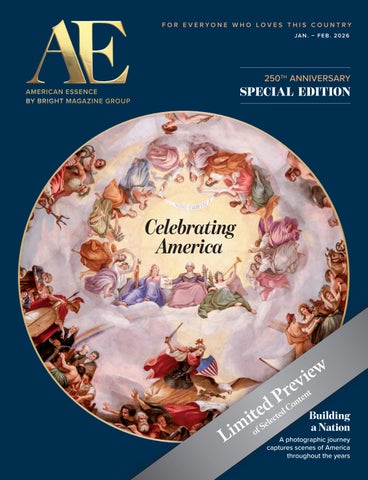
The Apotheosis of Washington by Constantino Brumidi “The Apotheosis of Washington,” painted in 1865 by Greek-Italian artist Constantino Brumidi, crowns the interior of the U.S. Capitol Dome and symbolizes the nation’s aspirations at the end of the Civil War. The 4,664-squarefoot fresco is suspended 180 feet above the rotunda floor. At the fresco’s center, George Washington ascends to the heavens in a classical apotheosis. Draped in Roman-style purple, he sits on a rainbow flanked by the goddesses Liberty and Victory. Thirteen maidens encircle them, representing the original Colonies; several turn away, reflecting the states that had seceded during the Civil War. The motto “E Pluribus Unum” appears opposite Washington. Surrounding the central scene are six vignettes representing national ideals, featuring Roman deities alongside American figures, inventions, and symbols.
250 YEARS OF U.S. ARMY COURAGE
re not included preview.
Explore Over 10,000 Movies & Shows Watch Now on GJW+ GanJingWorld.com/GJWPlus
AMERICA 250
JAN. – F EB. 2026 |
9
Traditions | Social Graces
Washington’s Code of Conduct Much wisdom is still to be found in ‘110 Rules of Civility’ By Jeff Minick
O
f all our presidents, George Washington best projected the dignity and gravitas of some ancient Roman senator. John Adams, who was no admirer of Washington, nevertheless recorded what he considered his top 10 qualities, including “an elegant Form,” “graceful Attitudes and Movement,” “the Gift of Silence,” and “great Self Command.” These “Talents,” as Adams called them, did not just magically appear. At 14, Washington copied out “110 Rules of Civility,” precepts compiled by French Jesuits about 150 years earlier and then translated into English. Time has fashioned antiques, often humorously so, from some of these maxims, such as “Spit not in the Fire … nor set your Feet upon the Fire especially if there be meat before it” or “Rince not your Mouth in the Presence of Others.” Yet most of these centuries-old guidelines still offer sound advice, particularly for a culture where manners and decorum are in short supply. On its website, the Mount Vernon Ladies Association lists these rules while asking readers to vote on which ones remain most relevant today. Here are five top choices from that exercise.
RULE NO. 1 ‘Every Action done in Company, ought to be with Some Sign of Respect, to those that are Present’ This prescription is simple but often forgotten. From the halls of Congress to our get-togethers with extended family, respect and consideration are key to productive discussions and relationships.
RULE NO. 7 ‘Put not off your Cloths in the presence of Others, nor go out your Chamber half Drest’ As any visitor to a grocery store knows, some people shop in pajamas. If you’re seeking dignity, dress appropriately.
RULE NO. 56 ‘Associate yourself with Men of good Quality if you Esteem your own Reputation; for ’tis better to be alone than in bad Company’ “A man is known by the company he keeps” is as old as Aesop’s Fables. In the words of Rocky Balboa: “If you hang around with nice people, you get nice friends, you understand? You hang out with smart people, you get smart friends. You hang out with yo-yo people, you get yo-yo friends. You see, it’s simple mathematics.”
RULE NO. 108 ‘When you Speak of God or his Atributes, let it be Seriously & [with] Reverence. Honour & Obey your Natural Parents altho they be Poor’ This one’s straight from the 10 Commandments. Many today are ignorant of the Decalogue, but given what passes for current morality, maybe some education is in order.
RULE NO. 109 ‘Let your Recreations be Manfull not Sinfull’ Pornography, illicit drugs, and other vices, including surfing screens daily for hours, in no way qualify as healthy recreation. Enough said. If you’re looking for an upgrade in manners and morality, read the Rules of Civility. Pick your favorites. And then do as Washington did: Try to live by them.
16
| JAN . – FEB. 2 0 2 6
AMERICA 250
FEATURES T H E P E O P L E S H A P I N G A M E R I C A T O D AY
THE GIFT OF FAITH
EXCEPTIONAL RESILIENCE
Former governor John Kasich opens up about the role of faith and religious institutions.
Lessons from former U.S. Navy SEAL and Paralympic gold medalist Dan Cnossen.
22
26
Athlete Dan Cnossen receives a bronze medal during the PyeongChang 2018 Paralympic Games on March 14, 2018.
AMERICA 250
JAN. – F EB. 2026 |
17
These pages ar in the p
Lee Greenwood performs during the inauguration concert at the Lincoln Memorial in Washington on Jan. 19, 2017.
American Anthem One melody, written on a tour bus, grew into a symbol embraced by Americans across generations By Kenneth LaFave
Y
ou’ve heard it your entire life. You heard it in 1984 when it was featured at the Republican National Convention. You heard it at rallies for 1988 presidential candidate George H.W. Bush. You heard it on the radio during the Gulf War in the 1990s and featured on “American Idol” in 2003 and “Dancing With the Stars” in 2011. You heard Dolly Parton sing it and Beyoncé cover it. In 2024, you heard it as Donald J. Trump entered the arena at the Republican National Convention. And, if you missed all that, you probably heard the man who wrote it singing it on one of the 2 million disc and digital download copies the song has sold. The song, of course, is “God Bless the U.S.A.,” aka “Proud to Be an American.”
18
| JAN . – FEB. 2 0 2 6
AMERICA 250
Song of Freedom | Features
The man who wrote it, and who continues to sing it at age 83 on tour after grueling tour, is Lee Greenwood. Greenwood calls it “the song I always felt the need to write.” It sends a clear message: In the United States, you are free, so do something about it. “Freedom is what it’s about, and that means the right to strike out in new directions, to play against the odds,” Greenwood said in a phone interview. “You have freedom of choice. Don’t just sit around.” The year was 1983, and Korean Air Lines Flight 007 had just been shot down by Soviet interceptor aircraft, ending the lives of 269 people, including Congressman Larry McDonald. Cold War tensions, which had relaxed during the early years of President Reagan’s administration, flared up again. Greenwood, then 40, had wanted to write an anthem since being inspired by Elvis Presley’s “An American Trilogy,” a rousing medley of “Dixie,” “The Battle Hymn of the Republic,” and a Bahamian folk song, “All My Trials.” The time seemed ripe, Greenwood thought, to write a song
re not included “ preview.
“to unite Americans.” “I wrote it in the back of a tour bus with my keyboard on my lap and the headphones plugged in. It took about an hour, except for the second verse with the cities.” The cities were added later, with the intention of representing four different areas of the country: New York, Los Angeles, Detroit, Houston. The opening lines announce the theme: If tomorrow all the things were gone I’d worked for all my life And I had to start again With just my children and my wife I’d thank my lucky stars To be living here today ’Cause the flag still stands for freedom And they can’t take that away The words come from Greenwood’s own experience. He knows personally about starting over, having gone through a range of roles in more than 20 years in the music business. He’s been a songwriter, an arranger, an opening act, and a recording artist. Prior to that, he held down a variety of jobs and trained as an athlete, first in his native
Greenwood calls it ‘the song I always felt the need to write.’
Singer Larry Gatlin (L) and Greenwood perform at the Grand Ole Opry House in Nashville, Tenn., on June 27, 2014.
AMERICA 250
JAN. – F EB. 2026 |
19
Features | Heroes
CONQUERING HILLS The incredible story of Navy SEAL and Paralympic champion Dan Cnossen
T
By Walker Larson
he world was green and black. At least, that’s how it looked through Dan Cnossen’s night vision goggles as he scanned the rugged terrain. It loomed up before him: a large, rocky hill crowned by a crumbling, Soviet-era fort. This wasn’t the first hill—literal or metaphorical—that Cnossen had climbed in his life, and it wouldn’t be the last. The year was 2009. As part of a larger mission to capture a Taliban stronghold in Afghanistan, Cnossen and nine other U.S. soldiers needed to summit the hill and take possession of the fort while watching for enemy fighters. Using the cloak of the night and rocky protrusions for cover, the team silently began to scale the hill, unsure what they would encounter in the darkness. Cnossen stepped up the steep slope, seeing everything through the grainy green lens of his night vision. The world swam with shifting emerald shapes, like a realm of phantoms. Suddenly, there was a bright flash—a flash that changed Cnossen’s life forever. Cnossen was lying on the ground, in shock, unable to move, and wondering if the explosion—whatever it was—had killed his comrades. Was he now alone on the hillside?
26
| JAN . – FEB. 2 0 2 6
AMERICA 250
Heroes | Features
Dan Cnossen competes in the men’s middle distance sitting biathlon event in the Beijing 2022 Winter Paralympic Games.
AMERICA 250
JAN. – F EB. 2026 |
27
Features | Heroes
The Seeds of Resilience Cnossen had been developing the grit and resilience he would need on that dark hillside in Afghanistan—and in the future to come—for many years before that pivotal night in 2009. Born in 1980, Cnossen grew up on a Kansas farm with the freedom to roam the plains. “This is a fifth-generation family farm, and so being outside like that in Kansas really cemented for me a love of the outdoors,” Cnossen told American Essence. He spent his time playing army with his BB gun, enjoying the land, and learning from his maternal grandfather, whom he remembers as a “quiet, strong role model.” Cnossen’s parents fostered in him a sense of self-confidence. “My parents raised me in a very good, independent way, where you rely on yourself,” he said. An example of Cnossen’s early independence was when he solo piloted a Cessna 152 at the age of just 16. Although interest in piloting didn’t stick with Cnossen over the long term, his interest in the military did. As a freshman in high school, he already had a plan to enter the Naval Academy after graduation. Cnossen has always valued goal-setting and having a plan, and that was true even as a high schooler. Cnossen explained, “I came up with a pathway, and I evaluated my strengths and my weaknesses, and I worked on my weaknesses, tried to
build on the strengths as well, or maintain them and adjust as necessary.” One of those weaknesses was Cnossen’s poor swimming ability—a not-so-small obstacle for someone wanting to enter the Navy and, eventually, the elite SEAL Team. But Cnossen wasn’t dissuaded. Even after he arrived at the Naval Academy, he still got nervous when participating in basic swimming drills. But he didn’t give up. He found like-minded friends with similar goals—including other would-be Navy SEALs— many of whom were excellent swimmers and whose influence helped Cnossen improve. “I started working out with these people, and we just all kind of elevated each other.”
“Sometimes
these things just happen. You can’t control it. But what you can control is how you choose to respond to all of this. Dan Cnossen
Buddies for BUD/S Cnossen’s cohort of friends also helped him successfully pass Basic Underwater Demolition/ SEAL Training (BUD/S), the notoriously difficult preparation to become a SEAL. With attrition rates between 70 and 80 percent, it’s one of the most difficult military training programs in the world. Cnossen’s relationship with his comrades helped prevent him from quitting during “Hell Week,” a brutal test of mental and physical endurance involving almost constant training for five and a half days with minimal sleep. He said: “To think, as you’re about to start this week,
These pages ar in the p Cnossen (far R) and other Olympic athletes throw the first pitch before a Red Sox game on April 5, 2018.
28
| JAN . – FEB. 2 0 2 6
AMERICA 250
Heroes | Features
re not included preview.
Cnossen being introduced before the Red Sox game at Fenway Park, Boston, Mass., on April 5, 2018.
AMERICA 250
JAN. – F EB. 2026 |
29
Inventor Thomas Edison developed many pioneering devices. Over his lifetime (1847–1931), he held over 1,000 patents. This photograph was taken circa 1818–1819.
US Inventions That Changed the World
Throughout our history, groundbreaking inventions by innovative Americans have shaped the way we live, work, and connect By Andria Pressel
36
| JAN . – FEB. 2 0 2 6
AMERICA 250
American Ingenuity | History
SWIVEL OFFICE CHAIR
Thomas Jefferson (circa 1775) Jefferson’s modified Windsor chair had a round seat that could rotate. It’s the chair he used while drafting the Declaration of Independence. Later, he added bamboo-turned legs and a writing paddle.
COTTON GIN
Eli Whitney (1793) RRemoving cotton seeds by hand was laborious work. While visiting a plantation, Whitney was inspired to design a machine that did it faster than dozens of workers. His invention sparked a cotton boom and reshaped the Southern economy, while expanding and entrenching slavery in the South.
STEAMBOAT
Robert Fulton (1807) A former artist fascinated by engineering, Fulton decided to build the first passenger steamboat to take advantage of river travel. He launched the Clermont on the Hudson River. It could carry 60 passengers, and Fulton charged 5 cents a mile, earning him a tidy profit in its first year of operation.
MECHANICAL REAPER
Cyrus McCormick (1831) At age 22, Cyrus McCormick built a machine that cut and gathered wheat far quicker than manual labor. His reaper dramatically increased harvest efficiency, allowing for large-scale grain production in the prairie states.
TELEGRAPH
Samuel Morse (1837) Morse was a well-known portrait artist who dabbled in invention. After overhearing a conversation about electromagnetism, he built an electric telegraph out of clock gears and a homemade battery. It was the first time that a long-distance message was received almost immediately.
VULCANIZED RUBBER
Charles Goodyear (patented 1844) In the 1830s, no one knew how to stop rubber from melting in summer and cracking in winter. Goodyear conducted years of experiments before accidentally combining rubber and sulfur on a hot stove. It hardened into weatherproof material, giving him the answer.
SEWING MACHINE
Elias Howe Jr. (1845) When Howe’s family ran into financial struggles, his wife took on sewing jobs. As Howe, a machinist, watched her sew by hand, he thought about ways to mechanize sewing. His resulting sewing machine was five times faster than hand sewing.
MODERN TOOTHPASTE
Dr. Washington Sheffield (1850) At age 23, Sheffield developed a dental cream designed to promote oral health and began selling it in jars. Years later, his son noticed that artists squeezed paint from collapsible metal tubes and suggested the same for toothpaste. The innovation made dental care more convenient and sanitary.
SAFETY ELEVATOR
Elisha Otis (1852) Otis devised a brake that would catch the elevator if its rope broke. He demonstrated his invention at the Crystal Palace Exposition, where he rode an elevator up its shaft. Halfway up, he ordered the hoisting cable cut with an ax. The elevator platform held fast, proving the brake’s effectiveness.
TELEGRAPH On May 24, 1844, Samuel Morse sent the first public telegram from the Supreme Court Chamber in Washington to Alfred Vail in Baltimore. The message read, “What hath God wrought?” in Morse code.
STEAMBOAT
SAFETY ELEVATOR
AMERICA 250
JAN. – F EB. 2026 |
37
History | American Ingenuity
TYPEWRITER
Christopher Latham Sholes (1868) Sholes, who had a background as a newspaper editor and Wisconsin senator, created the first practical typewriter. He also invented the now-standard QWERTY keyboard layout, which was chosen to prevent the machine from jamming. His invention revolutionized office work and standardized written communication.
CAN OPENER
Ezra Warner (1858), William Lyman (1870), Charles Arthur Bunker (1931) Warner’s can opener was used by soldiers in the Civil War but was too sharp for home use. Lyman introduced a safer rotary cutting wheel, and Bunker added a crank-and-tooth system. This evolution made canned food practical and safe for everyday kitchens.
BLUE JEANS
Levi Strauss and Jacob Davis (patented 1873) When a customer asked tailor Jacob Davis for hardier work pants, his solution was to reinforce the seams of denim trousers with metal rivets at stress points. His partnership with Levi Strauss produced one of the most influential fashion items of the century.
BARBED WIRE
LIGHTBULB
Joseph Glidden (1874) Since cattle can push through wooden fences, most ranchers in the Wild West didn’t bother building them. Glidden’s barbed wire fencing was the first to reliably deter cattle. The ensuing fences transformed Western lands and ended open-range grazing.
Thomas Edison (1879) Edison tested over 6,000 materials to find an adequate filament for an electric light. His invention extended human activity into nighttime hours, reshaping work, leisure, and daily life.
TELEPHONE
Thomas Edison and William K.L. Dickson (1891) While working in Edison’s lab, Dickson engineered the Kinetograph, a camera that took a series of photographs. Viewers could then look through a peephole in the Kinetoscope, a machine that ran perforated film, to watch the images move.
Alexander Graham Bell (1876) Bell used his knowledge of acoustics to develop an electromagnetic transmitter that converted sound waves into varying electrical currents. On March 10, 1876, he spoke the first intelligible words over the device: “Mr. Watson, come here, I want to see you.”
PHONOGRAPH
KINETOSCOPE AND KINETOGRAPH (MOTION PICTURE FILM)
These pages ar in the p
Thomas Edison (1877) While experimenting with sound vibrations, Edison—who was partially deaf—built a machine that could record and replay voices. It marked the birth of recorded music, and it was so special to Edison that he called it his “baby.”
HEARING AIDS
Miller Reese Hutchison (1898) Motivated by his desire to help a deaf childhood friend, Hutchison experimented with microphones and telephones for four years. The result was the Akouphone, which amplified sound enough to make communication easier for his friend and others with hearing loss.
PHONOGRAPH
TYPEWRITER
38
| JAN . – FEB. 2 0 2 6
AMERICA 250
TELEPHONE Alexander Graham Bell demonstrates his invention by calling Chicago from New York in 1892.
American Ingenuity | History
TELEVISION
SAFETY RAZOR
AIR CONDITIONER
re not included preview. KINETOSCOPE
SAFETY RAZOR
King C. Gillette (1901) Gillette’s razor has double-edged disposable blades for safer personal shaving. The U.S. military issued his razors during World War I, and soldiers made his brand a worldwide sensation after they returned home from the war.
AIR CONDITIONER
Willis Carrier (1902) High humidity at a Brooklyn printing plant was ruining the ink, and engineer Carrier’s solution was to build a system of refrigeration coils to reduce temperature and moisture. The invention has transformed offices and homes the world over.
AIRPLANE
Orville and Wilbur Wright (1903) The Wright brothers studied birds, tested gliders, and used their bicycle shop to engineer a solution to controlled flight. Their breakthrough transformed human mobility.
ELECTRIC VACUUM CLEANER
James Murray Spangler (patented 1908) While working as a janitor in a department store, Spangler built a vacuum cleaner out of a fan motor, soapbox, broom handle, and pillowcase. After the design was improved, it became the first commercially successful portable electric vacuum cleaner.
ZIPPER
Whitcomb Judson (patented 1893), Gideon Sundback (1913) Judson’s “clasp locker” design was originally intended for shoes, but it was unreliable. He hired Sundback to improve it. The resulting zipper proved so effective that the U.S. Army adopted it for gear in World War I.
TELEVISION
Philo Farnsworth (1927) Farnsworth first imagined the concept when he was 13, but he didn’t build the prototype until he was 19. His device disassembled pictures into lines, transmitted them, and reassembled them. The result dominated global media in the 20th century. AMERICA 250
JAN. – F EB. 2026 |
39
US CAPITOL CONSTRUCTION The United States Capitol Building’s new cast-iron dome was still under construction during Abraham Lincoln’s first inauguration as president in Washington on March 4, 1861.
42
| JAN . – FEB. 2 0 2 6
AMERICA 250
CAPTURING AMERICA
AMERICA IN FOCUS From the construction of the Capitol to Yellowstone and the Wright brothers’ first flight, these photographs capture the milestones that shaped America By Andria Pressel & Tanya Khalimon
AMERICA 250
JAN. – F EB. 2026 |
43
History | Capturing America CALIFORNIA GOLD RUSH Many Chinese immigrants came to the United States during the California Gold Rush, drawn by the promise of gold. They eventually became a significant source of labor for the developing economy of the West, initially working in mines before shifting to industries like agriculture, factory production, and the construction of the transcontinental railroad. This image depicts a group of white and Chinese gold miners operating a sluice box at Auburn Ravine, Calif., in 1852.
These pages ar in the p
WOMEN IN WAR
Ladies from the Michigan and Pennsylvania Relief Association minister to wounded and sick Union soldiers in a field hospital in 1861. Women played a key role during the Civil War, many of them serving as nurses in field hospitals or aiding the war effort in other capacities. Nurses changed bandages, administered medicine, and helped patients eat, dress, and wash. They also offered comfort to soldiers by praying with them, reading to them, or writing letters for them.
44
| JAN . – FEB. 2 0 2 6
AMERICA 250
Capturing America | History
re not included preview.
ANTIETAM President Abraham Lincoln (C) meets with Maj. Gen. John A. McClernand (R) and Maj. E.J. Allen (pseudonym of Allan Pinkerton, chief of the Union’s Secret Service) at the headquarters of the Army of the Potomac near Antietam, Md., on Oct. 4, 1862.
AMERICA 250
JAN. – F EB. 2026 |
45
History | National Anthem
The original 1814 sheet music imprint of Francis Scott Key’s “The Star Spangled Banner,” which can be easily identified by the misprint “A Pariotic Song” in its subtitle.
‘The Star-Spangled Banner’ Eight interesting facts about America’s national anthem By Rebecca Day
T
oday, America’s national anthem, “The Star-Spangled Banner,” is sung in unison by sports fans across the country each year. It’s often considered the nation’s most famous composition. On each patriotic holiday, whether Independence Day, Presidents Day, or Veterans Day, the song is on the minds of countless citizens as they fire up the grill, take in a fireworks show, or enjoy an extra day of rest. The song has become a lasting symbol of American values like bravery and freedom, but its origin story is murky due to writer Francis Scott Key’s elusiveness about when he published the composition. Some of the origin story of “The Star-Spangled Banner” remains a mystery, but these eight facts about the anthem and its author may surprise you.
68
| JAN . – FEB. 2 0 2 6
AMERICA 250
National Anthem | History
A Poet, Not a Songwriter
His Poetry Was Musical
Though Key is credited with writing America’s national anthem, he didn’t consider himself a songwriter. He was an amateur poet. The few preserved poems written by Key focus on two popular themes of the time: love of country, and a devotion to faith. One of his works, “Lord, With Glowing Heart I’d Praise Thee,” contains lines about joyful worship: Lord, with glowing heart I’d praise Thee, For the bliss Thy love bestows, For the pardoning grace that saves me, And the peace that from it flows In 1857, a collection of his poetry was published posthumously. “Poems of the Late Francis S. Key, Esq.” celebrates the patriotic and artistic contributions he made to America’s foundational canon of artistry. Included in the collection is his most famous contribution, “The Star-Spangled Banner.”
Though Key was a poet, his poetry could easily be paired with melody because it was written with form in mind. As opposed to today’s popular free verse style, his poems were more structured. Each verse often contained the same number of lines, adding a rhythmic element to the pieces. He also used rhyme schemes, making it easier to transform his poems into melodic verse. These creative techniques would come into play for various works like “The Star-Spangled Banner” as he honed his craft.
Key Was a Prominent Washington Attorney While Key is best known for penning “The StarSpangled Banner,” he was actually a lawyer by trade. In September 1814, as effects of the War of 1812 continued, he was summoned by President James Madison to assist in a negotiation for the release of Dr. William Beanes, who was captured by the British over the summer during the burning of the White House and other historic landmarks. Successful negotiations took place off the coast of Baltimore, Maryland, in a ship belonging to the Royal Navy. As talks came to a close on September 13th, British war ships struck Baltimore in an attempt to seize control of the territory. During what’s known as the Battle of Baltimore, Key spent hours listening to bombs and artillery fire while aboard a ship not taking an active part in the siege. British forces didn’t allow him back on American soil until the conflict was over. On the morning of September 14th, he expected to find a British flag flying over the Baltimore port where he would dock. Instead, he saw an American flag blowing in the wind. His country had survived another attack. As pride swelled in his chest, he was inspired to pen the poem we now call “The Star-Spangled Banner.”
A portrait of Francis Scott Key by Joseph Wood, 1816.
AMERICA 250
JAN. – F EB. 2026 |
69
“While Key is
best known for penning ‘The StarSpangled Banner,’ he was actually a lawyer by trade.
These pages ar in the p LEFT “The Star Spangled Banner” by Percy Moran, circa 1913, illustrates Key acknowledging the American flag over Fort McHenry after the Battle of Baltimore.
TOP RIGHT The earliest extant version of Key’s poem “Defence of Fort M’Henry,” which went on to become the basis for the U.S. national anthem, “The Star-Spangled Banner.”
Not the Song’s Original Name One of the narrative aspects of “The Star-Spangled Banner” tells the story of Key witnessing the Battle of Baltimore. Lines like “And the rocket’s red glare, the bombs bursting in air / Gave proof through the night that our flag was still there” document the moment when he realized the American flag was still waving on the morning after the fight. When he wrote down four verses inspired by what he witnessed, he titled the piece “The 70
| JAN . – FEB. 2 0 2 6
AMERICA 250
Defence of Fort McHenry.” Its initial publication in newspapers like The Baltimore Patriot and Evening Advertiser included this title. Not long after publication, though, some historical sites suggest a music printer changed the work’s name to “The Star-Spangled Banner.” A famous flag by the same name flew over Fort McHenry during the Battle of Baltimore. Today, vocalists sing the first verse of the poem during the performance of the national anthem.
National Anthem | History
Melody From Another Song During the 1800s, poems were commonly set to melody because they were far more structured than today’s poetry. When Key penned his historic poem, he had a melody in mind. “To Anacreon in Heaven” was a popular British song with which Americans were also familiar. Anacreon was an ancient Greek poet, and the song is a call to him for artistic inspiration. Its melody has been used in several other works, including the 1800 song “Adams andLiberty,” a political number for John Adams’s campaign (he lost his presidential bid to fellow Founding Father Thomas Jefferson). In some of its initial printings, instructions included with “The Star-Spangled Banner” lyrics tell readers to sing the words of the song to the melody of “To Anacreon in Heaven.” Key also used this melody for another one of his song-poems, a patriotic tune called “When the Warrior Returns.” The work honors two heroes, Lts. Stephen Decatur, Jr. and Charles Stewart, who were instrumental in America’s victory over Tripoli pirates during the First Barbary War.
re not included preview. A Century Passed Before Becoming America’s Official Anthem
In the 1800s, America had several unofficial national anthems, including “Hail Columbia” and “Yankee Doodle.” Key’s composition wouldn’t officially become recognized as the United States’s national anthem until more than 100 years after it was written. In 1931, it was formally signed into law by President Herbert Hoover.
Baseball Started the Tradition of Singing the National Anthem “The Star-Spangled Banner” has long been a cultural staple at sporting events across America. PBS notes that the first time attendees heard the patriotic anthem at a match was a baseball game in Brooklyn, New York, in 1862. The World Series, the annual championship for Major League Baseball, has also featured a performance of the song as far back as 1903.
Remaining Out of the Spotlight Key is responsible for writing what many consider to be America’s most famous song. But he remained humble regarding the attention he received after the publishing its lyrics. Because of this, historians have had to work through a good bit of confusion over two centuries when piecing together the song’s origin story. The website Chorus America notes that he shunned some of the spotlight because he wrote the song to honor military heroes, not himself: Key seems to have felt that a patriotic lyric should not glorify its author, but rather the heroes whose actions inspired his pen. He put these values into practice, leaving his own name off of the original printing of his lyric, and distributing the first thousand copies among the soldiers who had defended Fort McHenry. Key’s song is first and foremost a celebration of their courage. Without a first-hand account of how his most famous words came to be, Key in effect left the task to others. Deeply inspired by American values, entrepreneur Ali Master once said regarding “The StarSpangled Banner,” “Freedom and bravery—there’s a reason we sing of them in our national anthem. We are free because we are brave.” To all who uphold American values, “The StarSpangled Banner” continues to inspire today.
AMERICA 250
JAN. – F EB. 2026 |
71
Presentation of “The White House: An Historic Guide” to President John F. Kennedy, first lady Jacqueline Kennedy, and White House Curator Lorraine Waxman Pearce by members of the National Geographic Society and the White House Historical Association, on June 28, 1962.
Protecting the Nation’s Cultural Heritage The White House Collection has become an evolving testament to patriotism and preservation By Michelle Plastrik
T
he White House is the United States’s most important residence since it is home to the president and host to international dignitaries. The site of signed treaties and proclamations, the building has played a pivotal role in American history. It is also an accredited historic house museum with an unparalleled collection of fine and decorative arts, more than 60,000 pieces, that tells the history of generations of residents and guests as well as the country as a whole. The White House Historical Association collaborates with the White House to preserve and exhibit
82
| JAN . – FEB. 2 0 2 6
AMERICA 250
its contents. This private, nonprofit, educational organization was founded in 1961 by first lady Jacqueline Kennedy; it is one of many examples of the integral role first ladies have played in maintaining and restoring the nation’s cultural heritage at the White House. The vast collection includes significant paintings, sculptures, furnishings, china, and other household items. Many objects reflect the height of American artistry and craftsmanship, though some have foreign origins. For example, the White House is considered to contain the finest collection of 18thand 19th-century English cut glass lighting fixtures outside of Britain.
White House Collection | Arts & Letters
First Lady’s Furnishings The White House may be one of the few historic homes on the Eastern Seaboard not to lay claim to an apocryphal story that George Washington slept there. That would be an impossibility, since in 1800 John Adams was the first president to move in, a year after Washington died. However, the collection does contain an armchair Washington sat on. It was gifted to the White House Collection by private citizens and the White House Historical Association in 1975, an example of the gifts and acquisitions required to grow the collection and further the stories it can tell. A famous piece of furniture, albeit with a misnomer, is the “Lincoln Bed.” While presidents did sleep in this bed, including Theodore Roosevelt and Woodrow Wilson, Abraham Lincoln never did. There is a true story behind the large rosewood bed with intricately carved decoration of exotic birds and clusters of grapes. Lincoln’s wife, first lady Mary Lincoln, purchased it in 1861 for the White House’s main guest room. Under the direction of first lady Laura Bush, the Lincoln Bedroom’s refurbishment was completed in November 2005. With the financial support of the White House Historical Association, the room became more period appropriate.
George Washington armchair, circa 1793–1797, attributed to Adam Hains.
This bed is famously called the “Lincoln Bed” because it was purchased by first lady Mary Lincoln in 1861 for the principal guest room.
AMERICA 250
JAN. – F EB. 2026 |
83
Arts & Letters | White House Collection
Cherished Canvases One of the most important paintings in the White House Collection is Gilbert Stuart’s 1797 “Portrait of George Washington.” Stuart was the most celebrated portraitist in the early years of America’s republic, renowned for his technical prowess and ability to capture a sitter’s personality. He created quintessential images of George Washington in three different portrait types, along with numerous copies. The White House’s version is of the “Lansdowne type.” This full-length portrait depicts Washington as president in civilian clothes, though the sword at his left hand alludes to his military service. His outstretched right arm is in an ancient Roman oratorical pose, and by the table leg are a folio volume of the Constitution and a history of the American Revolution. The artwork has been part of the collection since 1800. During the War of 1812, the British invaded Washington. As the troops advanced on the White House in August 1814, first lady Dolley Madison received word in time to flee with official papers. Determined that the British not get their hands on the Washington portrait, she had it removed. There was not enough time to properly unscrew the painting, which was bolted to the wall, so they broke the outer frame and secreted the canvas in a farmer’s barn for safekeeping. When the British arrived at the White House, they set fire to the structure. It was rebuilt, and in 1817, Stuart’s famed painting, symbolic of both the patriotism of Washington and his successors, returned to pride of place. In addition to presidential and first lady portraits and contemporary art, the White House Collection includes historic still lifes, landscapes, and marine paintings. A spectacular depiction of the American West is Albert Bierstadt’s “Rocky Mountain Landscape” from 1870. Born in Germany, Bierstadt became prominent for his grandiose, large-scale paintings of pristine Western vistas. Part of the second generation of the Hudson River School, his work celebrates the natural wonders of America in theatrically composed and lit canvases. This picture, with its soaring rock formations, majestic snow-covered peaks, atmospheric clouds, and cascades, evokes wonder in the viewer.
84
| JAN . – FEB. 2 0 2 6
AMERICA 250
These pages ar in the p George Washington (Lansdowne Portrait) by Gilbert Stuart, 1796. Oil on canvas.
“Rocky Mountain Landscape” by Albert Bierstadt, 1870. Oil on canvas.
White House Collection | Arts & Letters
The Art of Entertaining
re not included preview.
Part of Hayes’s dinner service, 1879, by Haviland and Co. of New York and Limoges, France, with designs conceived by American artist Theodore Russell Davis.
Tabletop accessories have played an integral role in entertaining at the White House. In 1879, first lady Lucy Webb Hayes commissioned a new state dinner service from Haviland & Co., a firm founded by an American with production in Limoges, France, the country’s capital of porcelain. Hayes’s original plan was to select a floral pattern based on the White House conservatory’s ferns and flowers. However, a chance meeting with American artist Theodore Russell Davis, who worked for Harper’s Weekly, set her on a different course. He suggested she expand the scope to include the flora and fauna of North America. The first lady was delighted by the idea. Davis was commissioned to design the images. For the 562-piece service, he created 130 distinct decorations featuring American animals, birds, fish, and plants. The results are extraordinary in terms of artistic and technical achievement. Subsequent first ladies have continued to take charge of the china. Caroline Harrison proposed new display cabinets while her husband Benjamin Harrison was in office. Edith Roosevelt, wife of Theodore, oversaw their creation and moved the collection to a designated space on the ground floor called the China Room. Traditional items such as these wares share a home with pieces that were cutting-edge in their day. The White House was electrified in 1891, during the Harrisons’ tenure. The concept was so new that the couple refused to turn the lights on and off themselves for fear of electric shock. During the 1902 White House renovation, the renowned Gilded Age architectural firm of McKim, Mead & White, led by Charles F. McKim, commissioned Edward F. Caldwell & Co. in New York to provide electric lighting fixtures. For the East Room, three grand chandeliers of cut glass and gilded brass made in Austria-Hungary were installed. Each one consists today of about 6,000 glass pieces and weighs around 1,200 pounds.
East Room chandelier by Christoph Palme & Co. of Parchen, Bohemia, for Edward F. Caldwell & Co. of New York, 1902.
AMERICA 250
JAN. – F EB. 2026 |
85
Stories That Make You
PROUD TO BE AN AMERICAN Rediscover the heart and soul of our nation with American Essence, a bimonthly magazine celebrating America’s rich tapestry of cultures and landscapes. You’ll find inspiring tales of courage, fascinating tidbits from history, expert tips for healthier living, and more. Meticulously curated and full of hopeful stories, each issue is a celebration of the American spirit.
100
AMERICAN ESSENCE BY BRIGHT MAGAZINE GROUP 2026 AMERICA 250 | JAN . – FEB.
AmericanEssence.net
We hope you enjoyed the first few pages of American Essence. To read the complete publication, subscribe today at
AmericanEssence.net Stories That Make You
PROUD TO BE AN AMERICAN Rediscover the heart and soul of our nation with American Essence, a bimonthly magazine celebrating America’s rich tapestry of cultures and landscapes. You’ll find inspiring tales of courage, fascinating tidbits from history, expert tips for healthier living, and more. Meticulously curated and full of hopeful stories, each issue is a celebration of the American spirit.
100
ESSENCE BY BRIGHT MAGAZINE GROUP J U NE 2 0 2 5 | MAY – AMERICAN
AmericanEssence.net