American
FOR EVERYONE WHO LOVES THIS COUNTRY
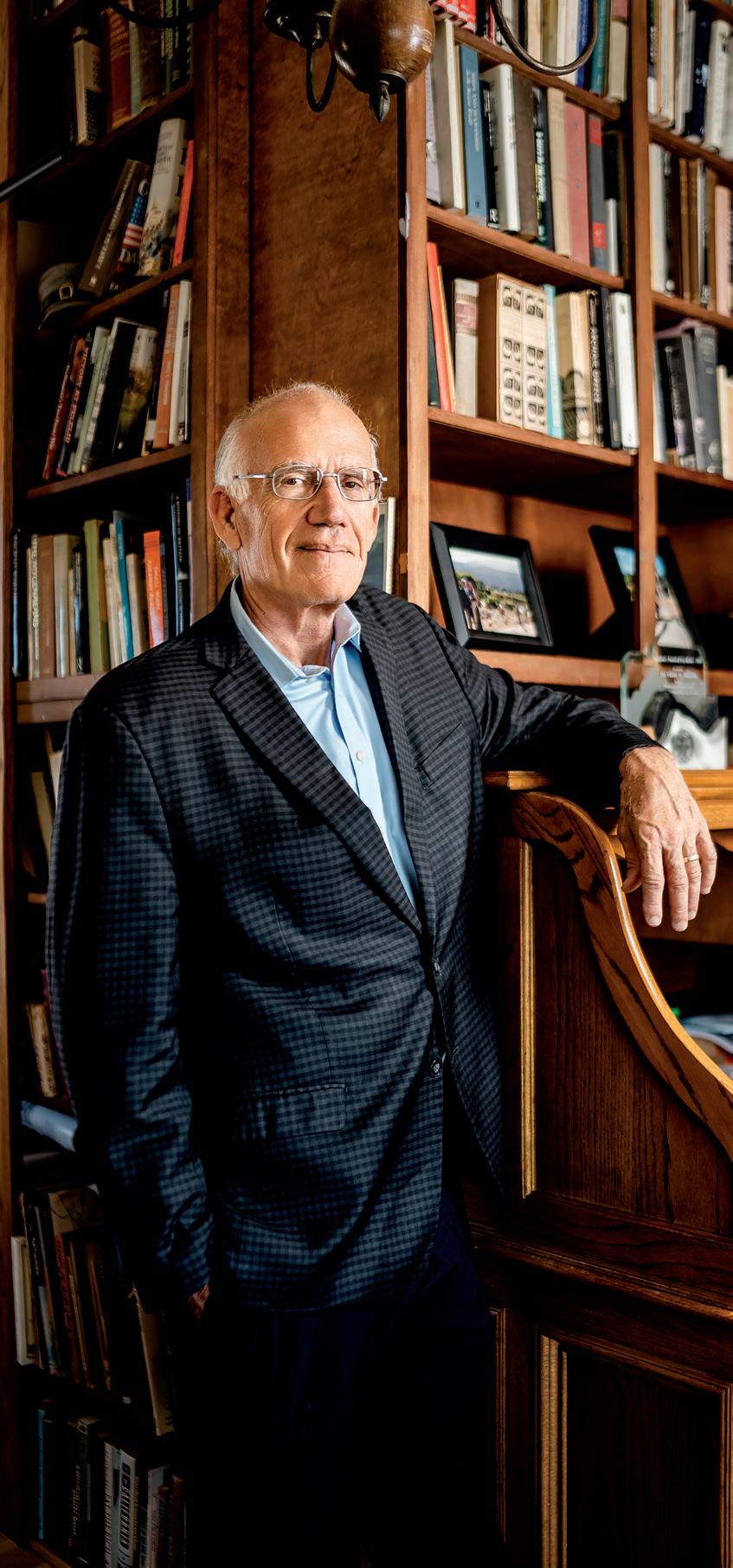
Victor Davis Hanson on Our Farming Heritage
The historian and fifth-generation farmer explains the connection between cultivating the land and our national character
Thanksgiving Fun With Jacques Pépin
For the French chef, perfectly at home in America, only turkey will do
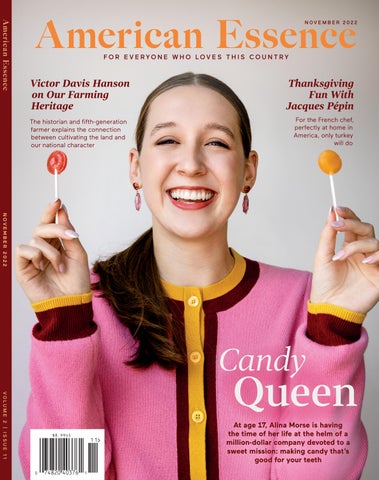
At age 17, Alina Morse is having the time of her life at the helm of a million-dollar company devoted to a sweet mission: making candy that’s good for your teeth

EssenceAmerican Essence NOVEMBER 2022 VOLUME 2 | ISSUE 11 NOVEMBER 2022
Queen Candy


It all comes down to values.
HPU
is a God, family and country school. ,, ,,
DAVID AND LISA AMIGO (PARENTS OF THREE HPU STUDENTS)
Discover why families from across the nation are flocking to High Point University.

Discerning Parents can remove the fear and stress of the college search process by downloading the FREE FAMILY GUIDES to choosing the right college. Available in print or digital versions, the following guides will help you uncover red flags and discover hidden gems. Get Instant Access to these College Guides:
The Ultimate College Tour Checklist: Ask these 20 questions on every college tour to reveal crucial insights beyond the tour guide’s talking points.
Learning Beyond Lecture Halls: How experiential learning propels students to discover and achieve their career goals.
The Parents’ Guide to Values-Based Living and Learning at College: Perspectives from real parents on the critical, character-based educational elements that typical college rankings can’t measure.
Understanding What Employers Really Want: How Premier Life Skills prepare students for success.
The National C-Suite Survey on College Graduates in the Workforce: Insightful data that reveals why some employees get hired and promoted while others are simply overlooked or fired.
Download for free at www.highpoint.edu/family-guides

1
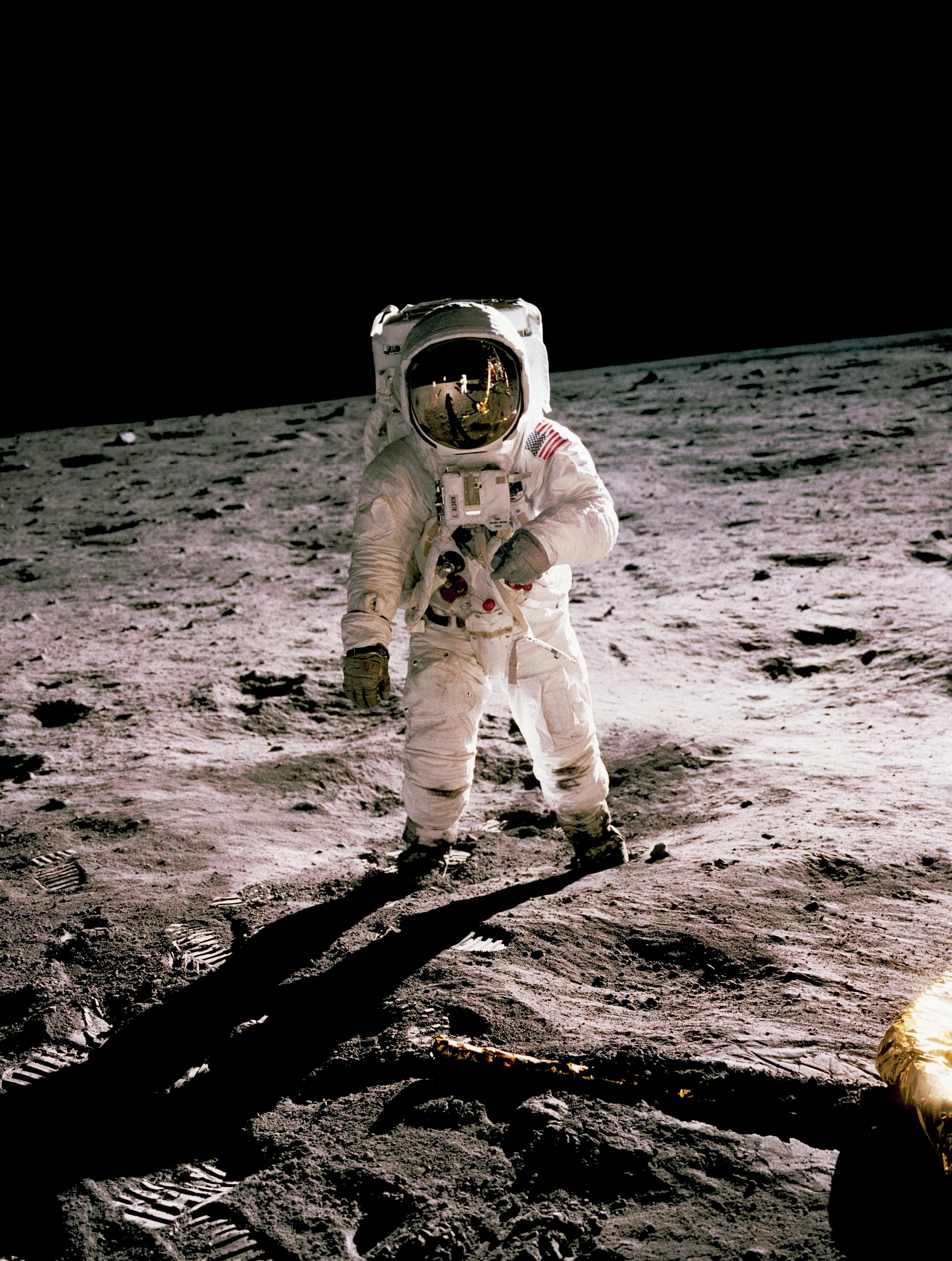
Apollo 11 astronaut Buzz Aldrin walks on the surface of the moon on July 20, 1969, in a photograph taken by Neil Armstrong.
“Energy and persistence conquer all things.”
—BENJAMIN FRANKLIN
Natural Remedy




Strong
Produced
ISSUE 11 | NOVEMBER 2022 3 10%OFF USE CODE: AMERICAN10 wisconsinelderberry.com (Coupon good thru Nov 30, 2022 while supplies last) American Elderberries | MADE IN AMERICA *These statements have not been evaluated by the Food and Drug Administration. This product is not intended to diagnose, treat, cure or prevent any diseases. *As part of a balanced diet and healthy lifestyle Invest in your long-term health & happiness 2,000-Year Ancient
for
Immunity
in its purest liquid form for better absorption and higher efficacy than pills or powder, Elderberry Ultimate has a high ORAC (Oxygen Radical Absorbance Capacity) value for combating free radicals in your body and is filled with rich antioxidants including anthocyanins, vitamin A, potassium, vitamin C, folate, calcium, and iron. Packets can be mixed with water or into your favorite drink. Made in small batches by hand in Denmark, Wisconsin, Elderberry Ultimate is infused with elderflowers, one of nature’s highest sources of quercetin, a powerful flavonoid. The only producer & maker of elderberry extract in convenient single-serve packets for longer shelf life. No refrigeration needed. Packets can be consumed straight or mixed with water, juice, etc.
Features
8 | Automotive Masterpiece
Only 51 of the remarkably innova tive Tucker cars were ever made, and now they’re worth millions.

14 | Sweetest Smiles
A young entrepreneur is taking her sugar-free candy company to the next level while inspiring kids to get creative.
18 | A Land of Farmers
Our agrarian past was key to shap ing our national character, says his torian Victor Davis Hanson.
| An American Identity, Lost and Found
24
Trapped during China’s Cultural Revolution, Teresa Buczacki fought her way to freedom and now tells her story.
28
| A New Generation of Opera Singers
The Schmidt Vocal Academy guides high school and college-age stu dents toward their opera-singing dreams.
32
| Tales That Houses Tell Leading interior designer Cathy Kincaid breathes new life into America’s historic homes with her signature touch of effortless yet approachable elegance.
38
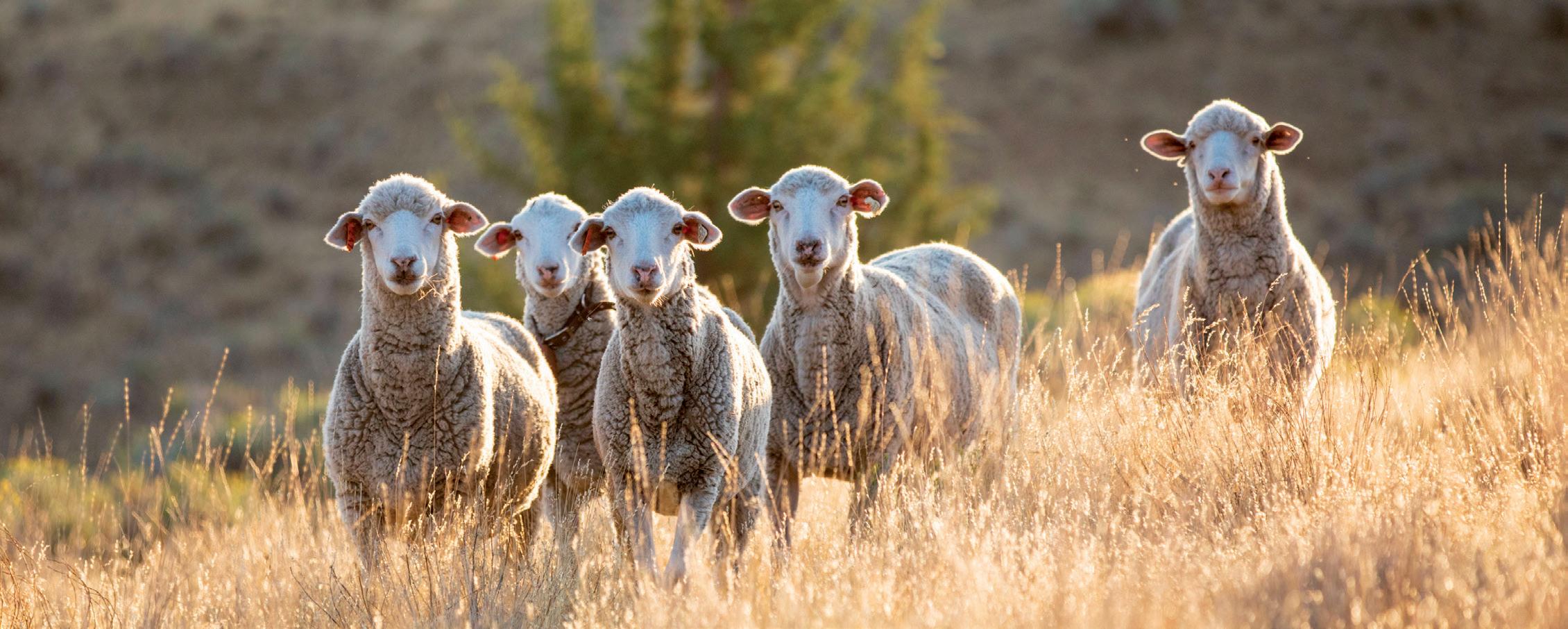
| Championing American Wool
An Oregon sheep rancher is work ing for a more sustainable fashion industry, starting from its real roots: the land.
44
| A Grandmother’s Love
A reader fondly remembers his grandmother’s graceful, quiet example.
46 | Why I Love America
Reader Jose Gil believes that no matter its flaws, America will still be that city upon a hill—because of the values it stands for.
History
48
| Bountiful Harvest
Meet the tolerant governor who made the Pilgrims’ Thanksgiving possible and secured America’s first democracy.
4 AMERICAN ESSENCE
Contents
8 84
52 | An Influential First Lady
President John Adams had a truly amazing wife who helped pave the way for women’s education.
56 | A Gutsy Plan
A daring Union officer gambled on a plan: to torpedo a seemingly unsink able ironclad.
60 | Flying for Poland
To fight the Red Army, Capt. Cooper formed a squadron of brave American pilots to save Poland.
64 | Traveling Light
How to reduce weight on the lunar module? An ingenious aerospace company found a way.
70 | Suit Up!
Throughout the ages, each space suit has its unique features to make exploration possible and safe.
Lifestyle
72 | Book Recommender Cozy fireside reads: A heart-pound ing recounting of a WWII battal ion’s daring exploits; and a powerful narrative exploring one fateful year that shaped America.
74 | Keeping Up With Jacques Pépin

Over a lifetime of cooking and teaching in America, the legendary French chef has learned some les sons of his own.
82 | Turkey Time
How much turkey do we consume every year? What did “Mary Had a Little Lamb” have to do with Thanksgiving? Find out fun facts about America’s most beloved holiday.
84
| Howdy, Buckaroo!
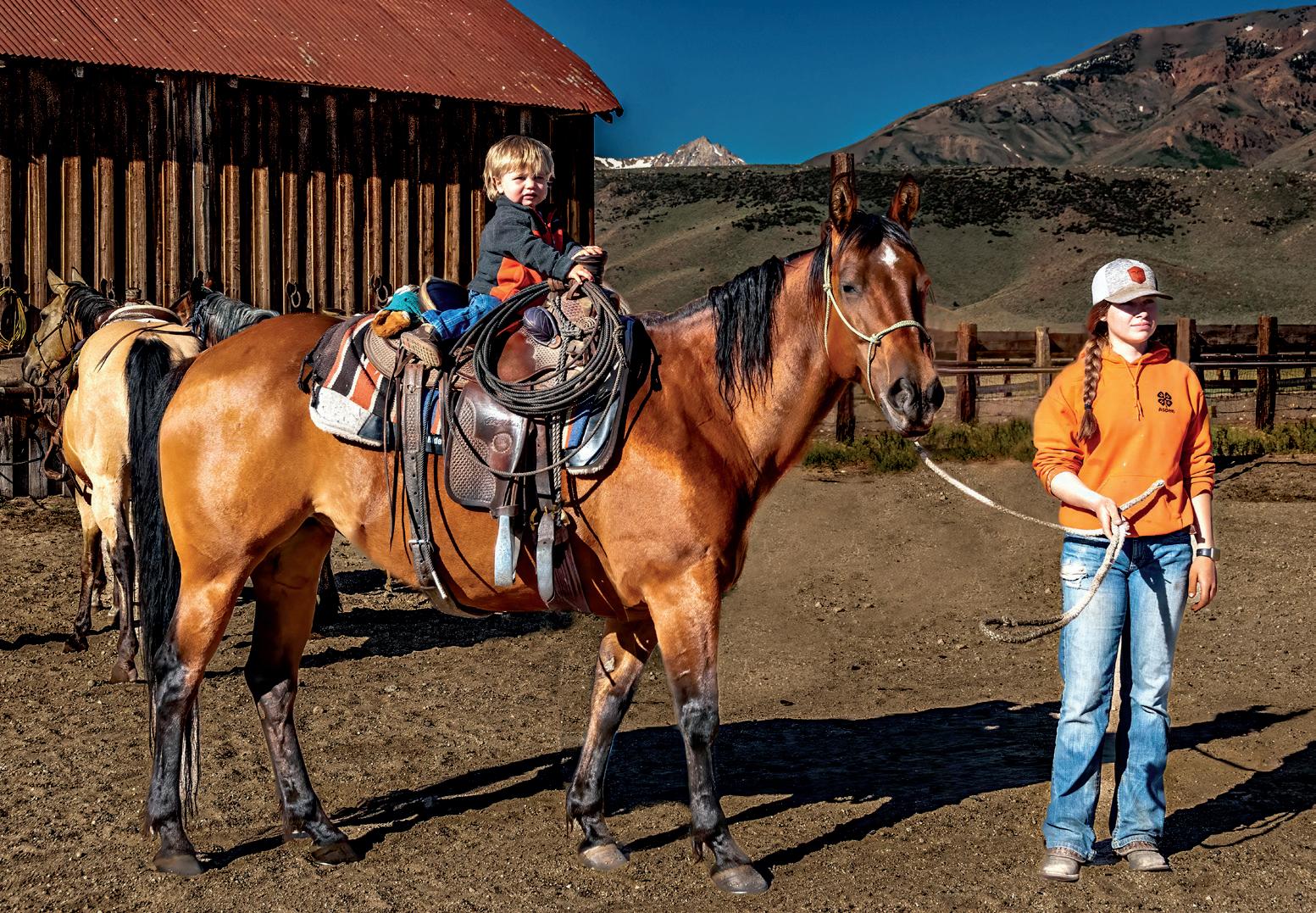
At the Hunewill Ranch in California, six generations have been preserving the cowboy way of life—and guests get to experience it for themselves firsthand.
92 | A Grown-in-America Gift Guide
From tropical fruits to Wagyu steaks, there’s something for every one in our farm-to-table holiday gift guide.
ISSUE 11 | NOVEMBER 2022
32 18 38
Editor’s Note
As American scholar Richard Weaver said, “Ideas have consequences.”

For entrepreneurs and inventors, it often all starts with a spark of an idea. For Alina Morse (page 14), that light-bulb moment came when she was just 7 years old: Why not make a healthy candy alternative that tastes good? Now 17 and the head of million-dollar company Zolli Candy, she is still one of America’s youngest CEOs. Promoting good oral health care remains central to her work, but she’s also giving kids the resources they need to start their own companies—to help their spark catch fire.
In this issue, we also pay a visit to Victor Davis Hanson (page 18). A well-known historian and classicist, he is also a fifth-gen eration farmer whose insights into America’s agrarian heritage have been formed through lived experience as well as his study of history. Though farming in America today is no longer scaled to a 40-acre-per-family model, farming, for most of our nation’s his tory, inextricably shaped our national character and cultivated a particular set of values. It’s a heritage we should not forget.
We also spoke to author Teresa Buczacki (page 24), the first American to make her way out of communist China at a time when the regime denied the existence of any U.S. citizens in the country. Despite humiliation, hard labor, and even near death, she held fast to the idea—and the promise—of America. It carried her through dark times, and it still does today.
May we always remember our blessings as Americans.
 Editor-In-Chief Channaly Philipp Editor@AmericanEssence.net
AMERICAN ESSENCE
American Essence
PUBLISHER
Cheng
Channaly Philipp Annie Wu Sharon Kilarski Jennifer Schneider Crystal Shi Tynan Beatty Maria Han Jennifer Tseng Jasmina Zhang Cristina Greaney Dariya Akdeniz Michael Kurov Sunny Lo Tatsiana Moon
Dave Paone, Krista Thomas, David Dudley, Brett Chudá, Eric Lucas, Randy Brunson, Jose Gil, Jeff Minick, Deena C. Bouknight, John Quarstein, Allen Shoff, Andrew Benson Brown, Bob Kirchman, Pamela Beiler, Mark Lardas, David Coulson
American Essence (USPS 24810) is published monthly by Bright Magazine Group at 5 Penn Plz. Fl.8, New York, NY 10001.

postage is paid at New York, NY.
Postmaster: Send address changes to American Essence, 5 Penn Plz. Fl.8, New York, NY 10001.
AmericanEssence.net/help
Editor@AmericanEssence.net
Your personal story of family and faith.
Your Family Cross™
Set with exquisite diamonds on one side and the birthstones of family members on the side worn closest to the heart. This unique treasure is one that will instantly become a precious heirloom.

5025 Arlington Centre Blvd., Suite 130 Columbus, Ohio 43220
| jjandcompany.com
ISSUE 11 | NOVEMBER 2022 77 AMERICAN ESSENCE Editor-In-Chief Managing Editor History & Literature Editor Arts Editor Lifestyle & Food Editor Editors-At-Large Production Assistant Lead Designer Designers Photo Editor EDITORIAL CREATIVE CONTRIBUTORS
Periodicals
General Inquiries:
Submissions:
www.AmericanEssence.com
Dana
FOR EVERYONE WHO LOVES THIS COUNTRY NOVEMBER 2022 | VOLUME 2 | ISSUE 11
614.459.8890
Tucker Cars: Rare Collectibles
Meet the
WRITTEN BY Dave Paone
Since the dawn of the American auto motive industry over 100 years ago, car enthusiasts have been debating which car is the most collectible of them all.
While some, such as the 1957 Chevrolet Bel Air, and the 1964 and a half Ford Mustang, are at the top of many collectors’ lists, most will agree the Tucker 48 is indeed the be-allend-all car to have in a collection. Even if you don’t have a collection, one Tucker trumps a dozen Oldsmobiles.

Who and What Is a Tucker?
From a young age, Preston Tucker was in and out of the automotive industry. Even though he never had formal training or a college degree, he had a thorough understanding of how mechanical things worked, particularly automobiles.
It was Tucker’s childhood dream to design and mass-produce cars for the American mar ket using elements that were either his inven tions or rarely used before. After the war, he was able to raise $20 million (over $259 million
8 AMERICAN ESSENCE
inventive
hot
wheels
that are now worth millions
Features | Cars
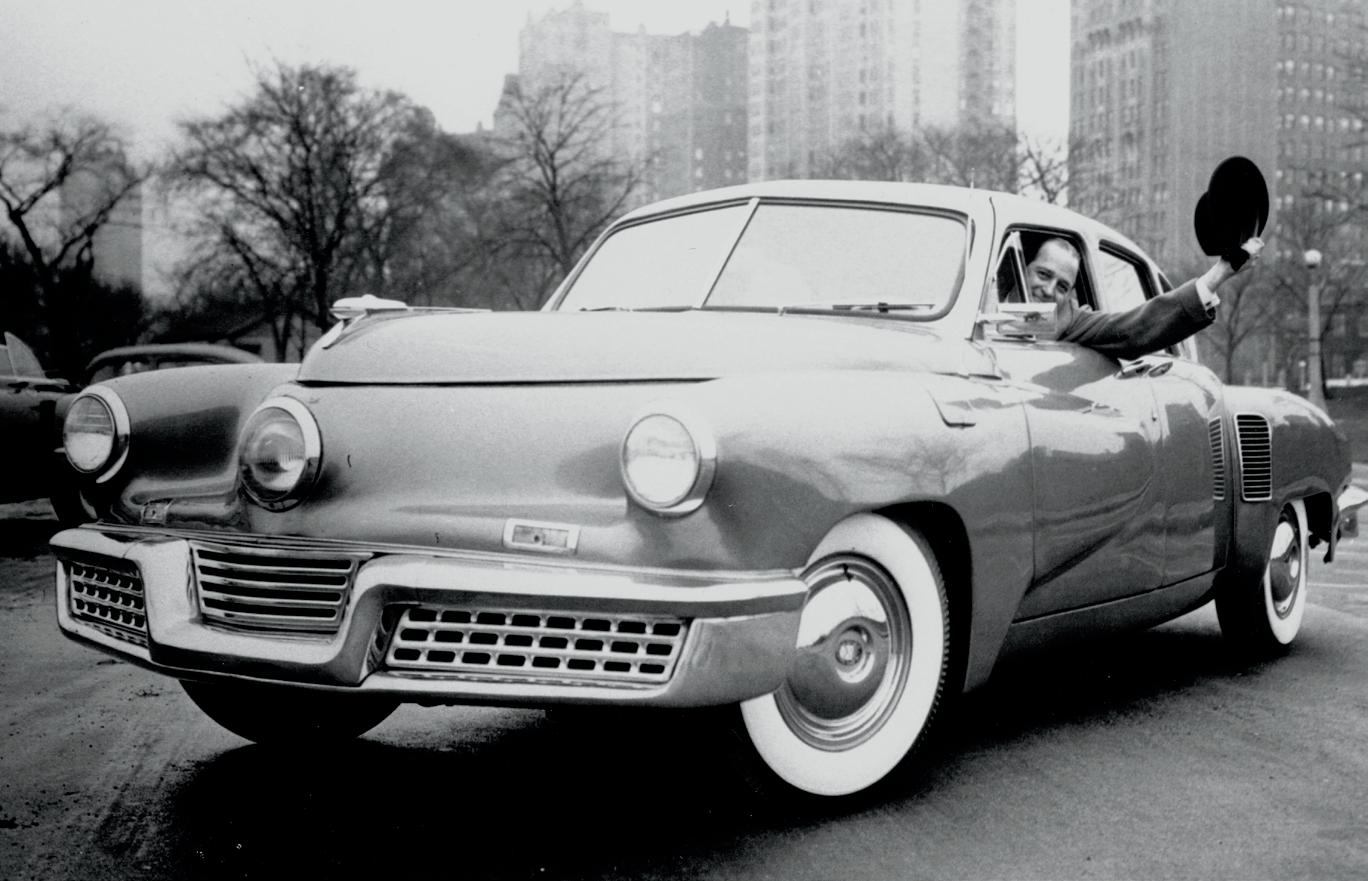
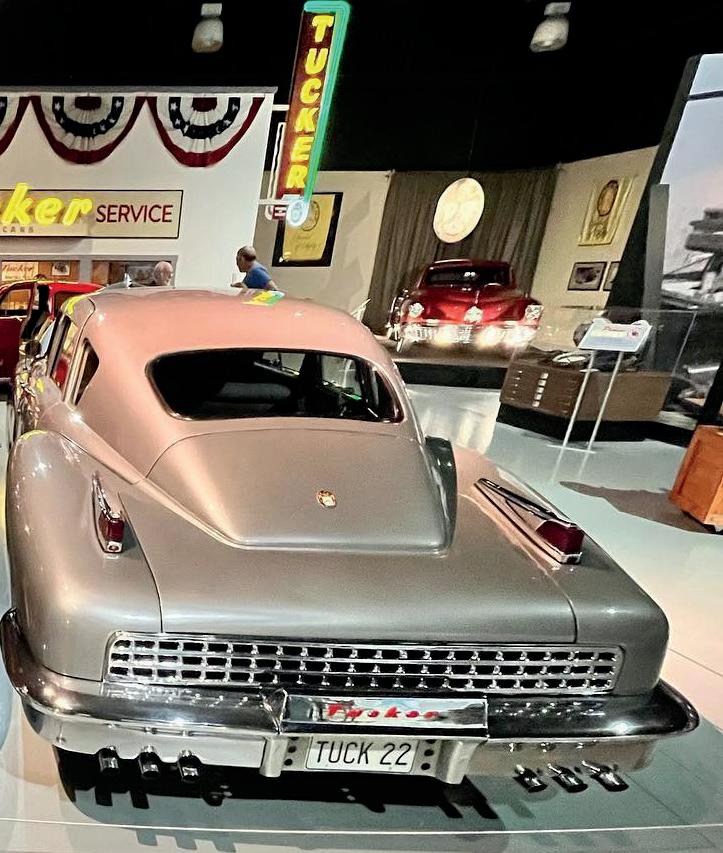
ABOVE A fullyrestored No. 1006, one of the 47 surviving Tuckers designed and manufactured by Preston Tucker. It has the signature three headlights.
ABOVE RIGHT Automotive visionary Preston Tucker drives one of the cars he designed.
in today’s money) to do exactly that through the Tucker Corporation.
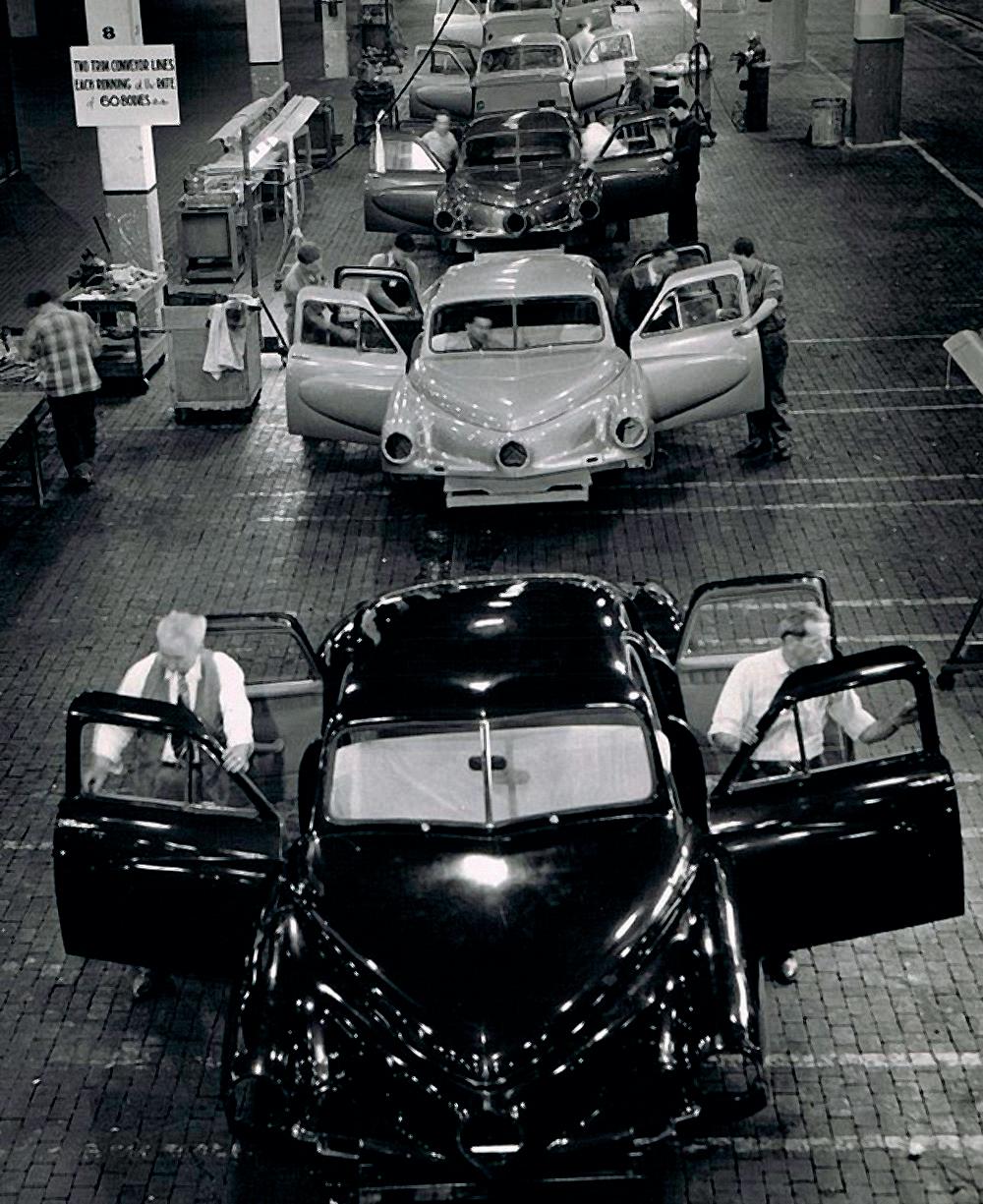
Tucker and his crew made 51 cars by hand. There were subtle differences among them and the designers were constantly making small improvements as they went along. Parts were not 100 percent interchangeable from one vehicle to another.
“You can’t take a door off one and put it on the other,” said Mark Lieberman, a Tucker owner and historian. “There were changes in the engine that were made. There were
changes in the suspension that were made.”
Each car is known by its number. There’s the prototype, known as No. 1000, also referred to as the Tin Goose. Then there are 50 Tucker 48s, numbered 1001–1050. However, prior to the Tin Goose was the Tucker Torpedo. “It was never a car; it was only a plaster model,” said Lieberman. To make things even more complicated, Nos. 1026 and 1042 are known as Tuckermatics because of their unique transmissions.

Innovations
Safety was a priority for Tucker. In all of the cars, he installed a windshield that would pop out should the driver or passenger be thrown through it, thus avoiding lacerations.
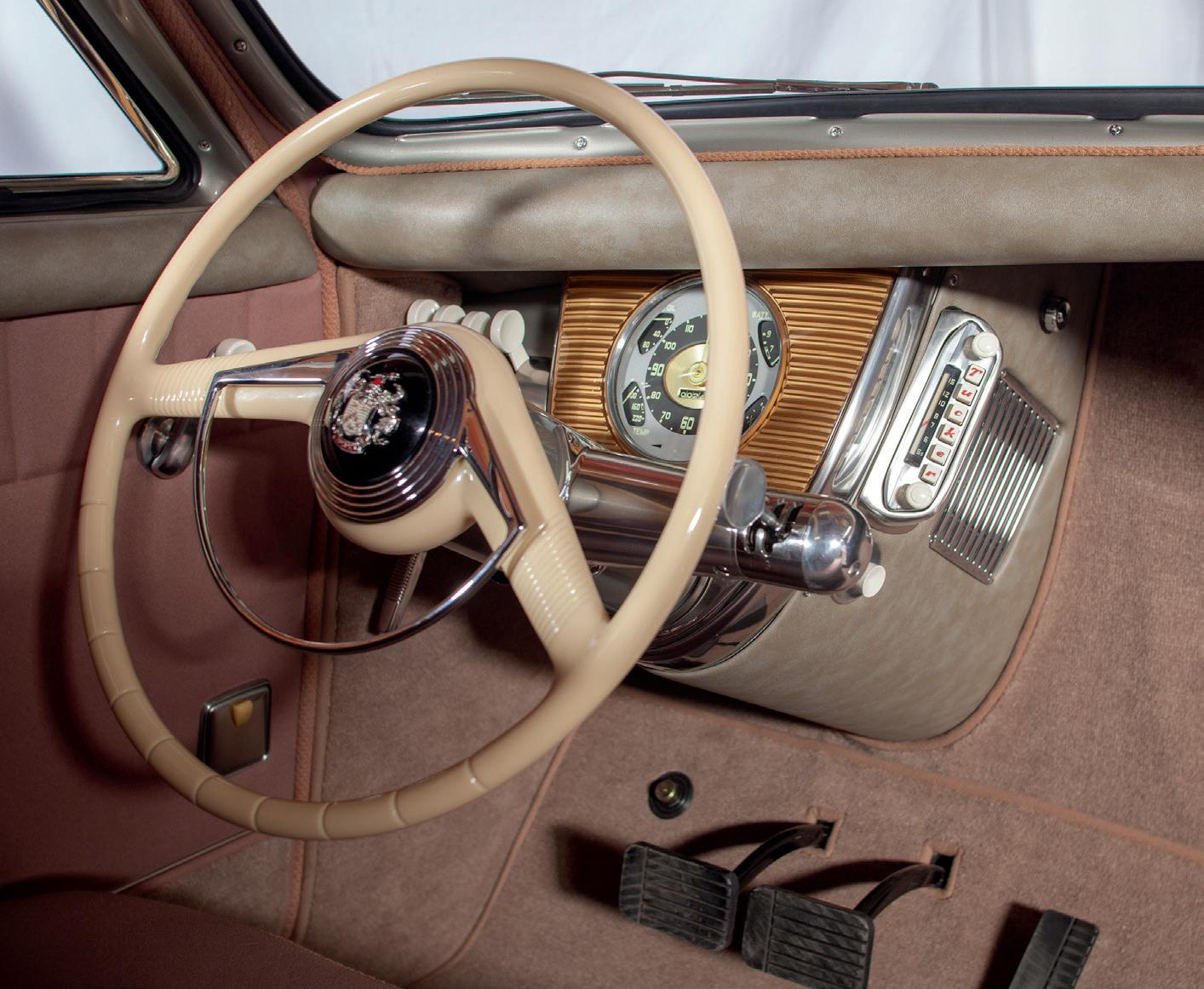
You know when you’re looking at a Tucker because it has three headlights. Tucker installed one in the middle of the front end that was connected to the steering wheel.
Then there was the sponge rubber crash panel, which was essentially the first padded dashboard. Tucker also had this material on the doors, making the Tucker 48 the first car with a padded impact area. The automotive industry has since embraced this feature. “It’s been a staple ever since,” said Lieberman.
Tucker wanted his car to have seat belts, which no other manufacturer had at the time. However, the marketing department felt seat belts would send the message that the car
ISSUE 11 | NOVEMBER 2022 9
Cars | Features
wasn’t safe, and Tucker was overruled on that one.
The Tucker 48 had four-wheel, indepen dent suspension. “Unheard of at the time,” said Lieberman. “Now it’s commonplace on many automobiles.”
The Big Three and the SEC
At this time in America, just about every car owner owned one made by one of the “Big Three” car manufacturers, Ford Motor Company, Chrysler Corporation, or General Motors.
The automotive establishment in Detroit was not happy with Tucker’s unorthodox methods of manufacturing and marketing and perceived him as a threat. History has painted The Big Three as being the villains in this saga, but that isn’t necessarily true.
A smear campaign was done with false charges of fraud, brought on by the Security and Exchange Commission. Tucker and his executives were tried and acquitted, but the SEC succeeded in putting the Tucker Corporation out of business.
Where They Went
After the demise of the Tucker Corporation, the 51 cars were scattered about the country. In the 1950s, a showman named Nick Jenin bought up 10 of them and toured the country, bringing them to state fairs on two car carri ers, where he promoted the story of Preston Tucker.
“Ezra Schlipf is another gentleman that bought quite a few of them and resold them,” said Lieberman. “There were guys that became known as Tucker specialists.”
Collector David Cammack purchased three, none of which he’d even start, let alone drive, for fear of damaging them. Cammack also col lected Tucker artifacts, such as original doc uments and blueprints, making his collection the most extensive of them all.
The second of the two Tuckermatics, No. 1042, had sat idle at the Michigan State Fair Grounds, even though it was owned by Jenin. The powers-that-be decided a good way to get this car off their property was to have an event where, for the price of a dollar, anyone could smash it with a sledgehammer.
10
Features | Cars vvv You
know when you’re looking at a Tucker because it has three headlights.
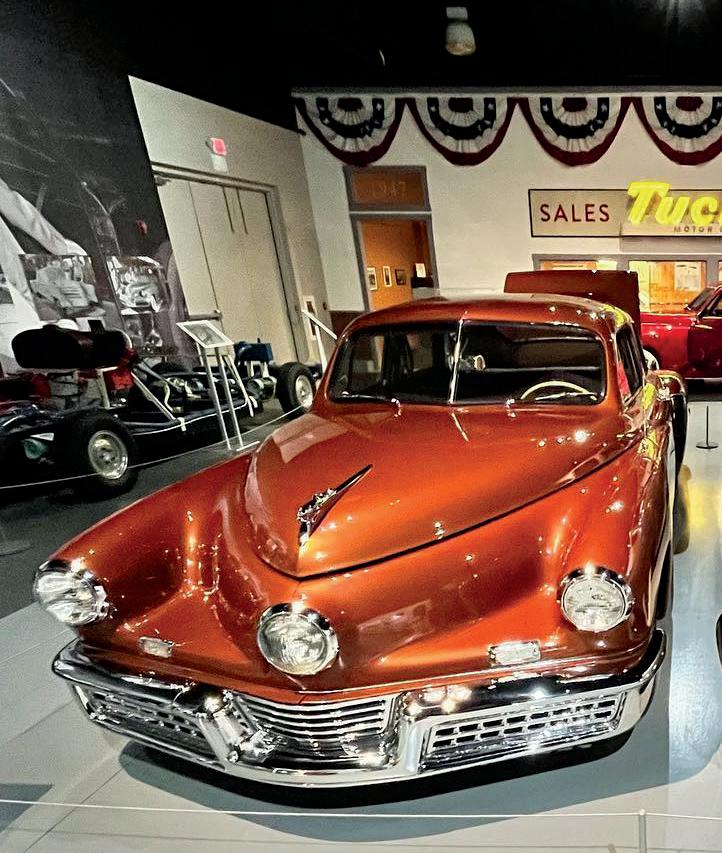
ABOVE Tucker cars on display at the AACA Museum in Hershey, Penn.
LEFT The steering wheel of a Tucker, which directs the center headlight.
In 1988, Paramount Pictures released the feature film “Tucker: The Man and His Dream,” starring Jeff Bridges as Tucker. It was produced in part by George Lucas’s Lucasfilm Ltd. and directed by Francis Ford Coppola. The biopic didn’t do well at the box office, but it introduced Preston Tucker to the gen eral public. “The values of Tuckers wouldn’t be what they are today without the movie,” said Lieberman. Lucas owns a Tucker 48 and Coppola owns two.
The Resurrection of No. 1006
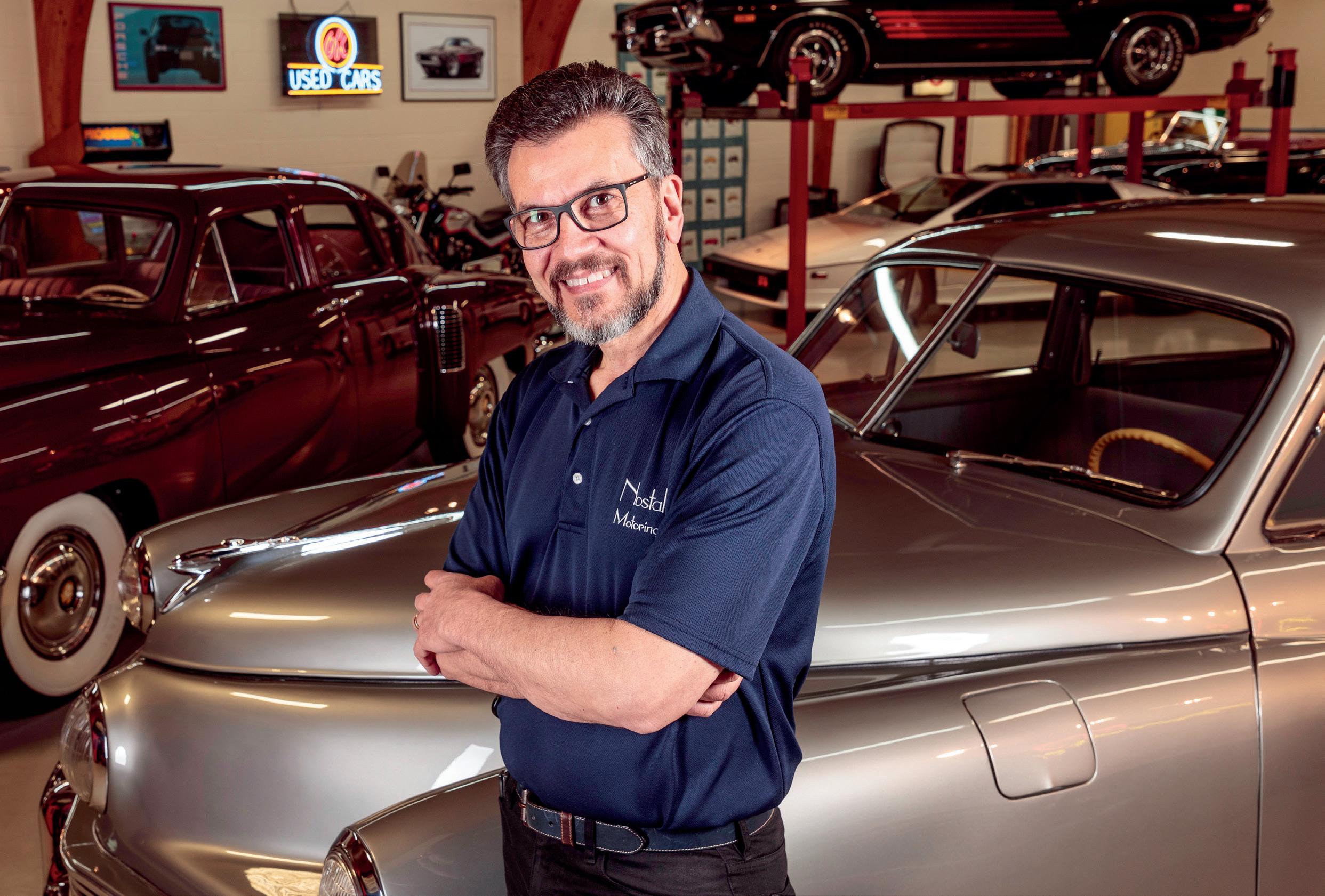
Lieberman has been a car enthusiast his whole life. In 1992, when he was 29 years old, a friend told him of a Tucker for sale. The story the friend verbalized was that in a parking structure in downtown Detroit, where he stores his car for the winter, there was a Tucker that might be for sale. Lieberman found this claim hard to believe. He went to the building, which was “packed full of dilapidated vehicles and cars in stor age.” He met with the owner of the place, a
retired police officer, who walked him over to a “dark, dingy corner.”
“Lo and behold, there’s three headlights look ing at me from this corner,” said Lieberman. The exterior of the car was covered in dirt, and the interior was being used, literally, as a garbage can. This included Wendy’s bags and wrappers, a kitchen food processor, and a bathroom scale. Plus, the side windows were broken. “I didn’t care. I wanted it all,” said Lieberman.
After a few minutes of negotiating, Lieberman wrote a check and called for a flat bed to come get his newly found treasure.
The trip home was in the pouring rain, which gave the car its first wash in decades, “leaving this trail of black behind it.” Lieberman didn’t realize until he arrived at his house that there was a convoy of drivers following them, who wanted to buy the Tucker from him on the spot. Lieberman has since restored the car to its original splendor (pictured) and at one time or another has owned five Tuckers.
A collector on Long Island currently owns No. 1044, which once belonged to Lieberman. “I pulled that car out of a barn where it sat since the ’70s,” he said. The barn was in Ohio, and he bought it in 2016 or so. “I just got it running and driving and I sold it at auction,” said Lieberman, where the current owner pur chased it for about $1.3 million.
The Tucker Automobile Club of America Lieberman has owned five Tucker 48s and he’s the senior director of the Tucker Automobile Club of America in Hershey, Pennsylvania. The club is part of the AACA Museum, which Lieberman describes as “the center of the Tucker universe.” On display there are Cammack’s three cars, Nos. 1001, 1022, and 1026, as well as the artifacts he col lected. No. 1026 is the only surviving of the two Tuckermatics.
While the Tucker Corporation is long gone, Preston Tucker LLC exists today, located in Lancaster, Pennsylvania. It was started in 2012 by Tucker’s two great-grandsons, Sean and Mike Tucker. The great-grandsons work closely with Lieberman in restoring the autos. “The three of us know every bolt, every fas tener, and every component of these cars,”
11ISSUE 11 | NOVEMBER 2022
Cars | Features
said Lieberman.
The great-grandsons, Bob Ida and his Ida Automotive, and Bruce Devlin were the crafts men who restored No. 1044, from the barn in Ohio, with parts supplied by Lieberman. Currently, all of them are involved in the res toration of three more Tucker 48s.
Other Locations
The Museum of American Speed in Lincoln, Nebraska, currently has a Tucker on display, as does the Tallahassee Automotive Museum in Florida. The Smithsonian’s National Museum of American History in D.C. has No. 1039 on display, which was acquired through a 1992 narcotics arrest by U.S. Marshals. The auto motive museum at The Imperial Palace Hotel and Casino in Las Vegas also had a Tucker on display for many years. The establishment is now called The Linq, and the museum is long
gone. The car, No. 1008, is now at a museum in Chicago. No. 1030 is currently at the Petersen Automotive Museum in Los Angeles.
The LeMay Collections at Marymount in Washington state has No. 1007 on permanent display. It was purchased in 2002 at an auction for $334,800. Although its initial engine was replaced in 1948, the transmission is original. “The car came with a Cord preselector trans mission from the factory and remains in the car,” said volunteer Tim Hallen. Its most recent restoration was completed in 1993. The orig inal color of the body and interior was green, but both have been redone in a non-Tucker blue.

There’s a Tucker in Japan, one in Germany, one in Australia, and one in Kuwait. The City of Cacapava, Sao Paolo, Brazil, owns No. 1035, and the Maine Classic Car Museum has No. 1028 on display.
LEFT Tucker 48s being manufactured at the Tucker Corporation’s factory in Chicago.
BELOW Senior director of the Tucker Automobile Club of America and five-time Tucker 48 owner Mark Lieberman, with two Tuckers at his Michigan-based car dealership, Nostalgic Motoring.
12
Section
The Henry Ford Museum of American Innovation has one on display, which is ironic because the Ford Motor Company was one of the Big Three that was supposedly responsi ble for putting the Tucker Corporation out of business. The disclaimer on its website reads:
Tucker built 51 cars before a shortage of money and a surplus of bad publicity closed his company. Some think the Big Three conspired to destroy him. More likely, he was overwhelmed by the enormous cost of building an automobile company from scratch. Tucker raised over $20 million, but probably needed ten times that much to secure his firm’s future.
Lieberman feels this statement is “all very true.”
“All cars are accounted for,” said Lieberman. “Of the original 51 cars, including the proto
type, 47 survive.” He estimates that of the 47, just over half actually start and move but aren’t really roadworthy. He estimates about 10 or more can be driven long distances.
Tucker’s Legacy Preston Tucker died in 1956, at the age of 53. So he never saw the worth of each of his 51 creations surpass $1 million. He never saw his life played out by actors on the big screen. So it’s up to collectors with the desire to keep the Tucker 48s intact, and craftsmen such as Lieberman, Ida, and the great-grandsons to help them do that, to keep Tucker’s legacy alive.
Perhaps if Tucker could witness these things, he’d know that there are 47 machines that represent American ingenuity, American entrepreneurship, and the American Dream.
And those things will always survive, even if the 47 remaining cars don’t. •
Cars | Features

Brightening the World One Smile at a Time
Young entrepreneur Alina Morse is on a mission to impact future generations about the importance of positive oral health through developing healthy candy alternatives
WRITTEN BY Krista Thomas PHOTOGRAPHED BY Adhiraj Chakrabarti
It has been said that the world always looks brighter from behind a smile.
And that adage has been shaping Alina Morse’s thriving busi ness decisions since she invented Zolli Candy at the age of 9 years old. Now, at 17, Morse not only cre ates new products for her exten sive line of alternative candies, available through various retailers throughout the country, but gives back through the Million Smiles Initiative, the nonprofit arm of Morse’s candy empire.
“From the start, it was important to find a cause,” said Morse. “In running a business, there are rough days, so finding that aspect that drives you and makes you feel good about why you put in all the hours for the business is important.”
Healthy Smiles
Tooth decay is the biggest epidemic facing kids in America, accord ing to the United States Surgeon
General. This gave Morse a shock. “It is a preventable disease. ... Why wouldn’t there be other initia tives to combat this problem?” she said. “This fact drove me to create not only a delicious healthy candy alternative, but to find a way to give back and educate people.” What makes Zolli Candy a healthy alter native? According to the company website, a proprietary blend of naturally-sourced sugar replace ments—such as isomalt, which is derived from sugar beets—makes it 100 percent sugar-free. The com pany’s non-GMO blend is not only tooth-friendly but also food-aller gy-friendly and vegan.
She believes that while her products are great, an education can fuel generations of change. A determined Morse now translates this passion and leads others her age—in schools—to rally around the importance of oral health care. Her business has led to important discussions on the topic, garnering extensive speaking engagements including a TED Talk, “Why I Eat Candy to Avoid Cavities”; appearing on various shows and venues like South by Southwest; and making the cover of Entrepreneur magazine.
“I do virtual public speaking with organizations to inspire kids and
LEFT Alina Morse wanted to create sugar-free candy that children could eat without worrying about cavities.
Morse spent hours upon hours working through sugar-free reci pes to come up with just the right concoction. Although a messy process, Morse eventually worked out the recipe that millions have since been introduced to through the Million Smiles Initiative. By giving away free candy all across America, it was an opportunity to talk about the root problems of oral hygiene. Over 250,000 lolli pops have been donated since the company’s inception.
ISSUE 11 | NOVEMBER 2022 15
Entrepreneurs | Features
vvv
By giving away free candy all across America, it was an opportunity to talk about the root problems of oral hygiene.
give them resources to start their own company. I’m a huge advo cate for kids but specifically young girls and women. So few women are in the candy business. It’s been tough to pave that road and find the mentors so I try to act as an advo cate,” she said. She has shared sage advice with experienced entrepre neurs and those new to their craft. Seasoned entrepreneurs who have been around the block should take the time to listen to those with more youthful perspectives. “The thing that makes young entrepreneurs a commodity is that they are curious and tenacious. Find opportunities to connect so as to never lose that childlike curiosity.”
A Young CEO
Young inventors, Morse claims, will experience success if the company is built on the merits of a fantastic team.
“The CEO title does not mean you can do every job. And you’re never going to grow and reach success unless you find people to delegate to—people you can trust. Always look for people who you can learn from, trust, delegate—and, in turn, you can form a great team of peo ple with a mutual understanding of goals.”
As Morse understands from her own million-dollar venture, start-up businesses require con siderable work and time. However, finding dedicated people who believe in the company’s mission is the first key ingredient to success. As she reiterates, “Business is a
team sport!”
Today, ZolliCandy encompasses many trademarked candies includ ing Zollipops®, Zolli® Drops, and Zaffi® Taffy. But what started it all was a delicious formula—a vegan, all-natural, sugar-free lollipop. She learned important lessons by pur chasing ingredients, melting and cooling the non-sugary confection, and making a huge mess.


“Initially, I tried to make it at home in our kitchen. I learned not to melt sugar substitutes like Stevia and other funky stuff that couldn’t make the cut to our finalized Zolli products,” she recalled. Trial after trial led to a tweaked basic formula that led to the best possible prod uct. In the beginning, it was tricky because no one had ever done this before. With such an expansive line, Morse was always inventing, cre ating something new that adhered to her standards. Any product she made had to be allergy-, keto-, and diabetic-friendly.
People don’t have to worry about it being harmful. According to the teen inventor, the company’s unique selling points are that it must be able to help clean your teeth or it meets the standards for those who suffer from allergies or eat from restrictive diets. “It is important to have variety. Not everyone will be in a lollipop mood,” she added.
Keep Smiling
Looking back upon her success, this regular high school student appears well adjusted despite her
fame as one of America’s young est CEOs. In fact, Morse admitted that although she is tenacious, she is a normal, healthy teen just like her peers at school. An extremely supportive set of friends over the years, as well as a strong family support system, has bolstered her aspirations.
“I am lucky to have supportive parents who believe in me and trust in me. They were willing to invest in me to make this idea a reality. And, I’ve been fortu nate with supportive friends who encourage and treat me like noth ing is different.”
What Morse finds most reward ing in her day-to-day management duties is the messages from those who have tasted her treats and are, in turn, grateful. Some have told her that her candy line has saved their lives or that they couldn’t enjoy candy until now—and these messages make it a very impactful experience for the teen.
So impactful, in fact, that Morse has been known to use an effective catch phrase, “Keep smiling!” to inspire others through her videos, social media, emails, and appear ances. She tries to work positivity and goodness into conversations even if it makes just a little differ ence. She says it is a good reminder to stay positive and enjoy life.
“So just keep smiling!”
After all, smiling has amazing powers. And her cause with Zolli Candy is not only delicious, but positively contagious for consum ers and her business. •
16 AMERICAN ESSENCE
 Zolli Candy’s retail sales in 2021 totaled over $10 million.
A Nation
Shaped by Farmers
Historian and farmer Victor Davis Hanson on America’s agrarian heritage and its influence on our national character
WRITTEN BY Channaly Philipp PHOTOGRAPHED BY Samira Bouaou
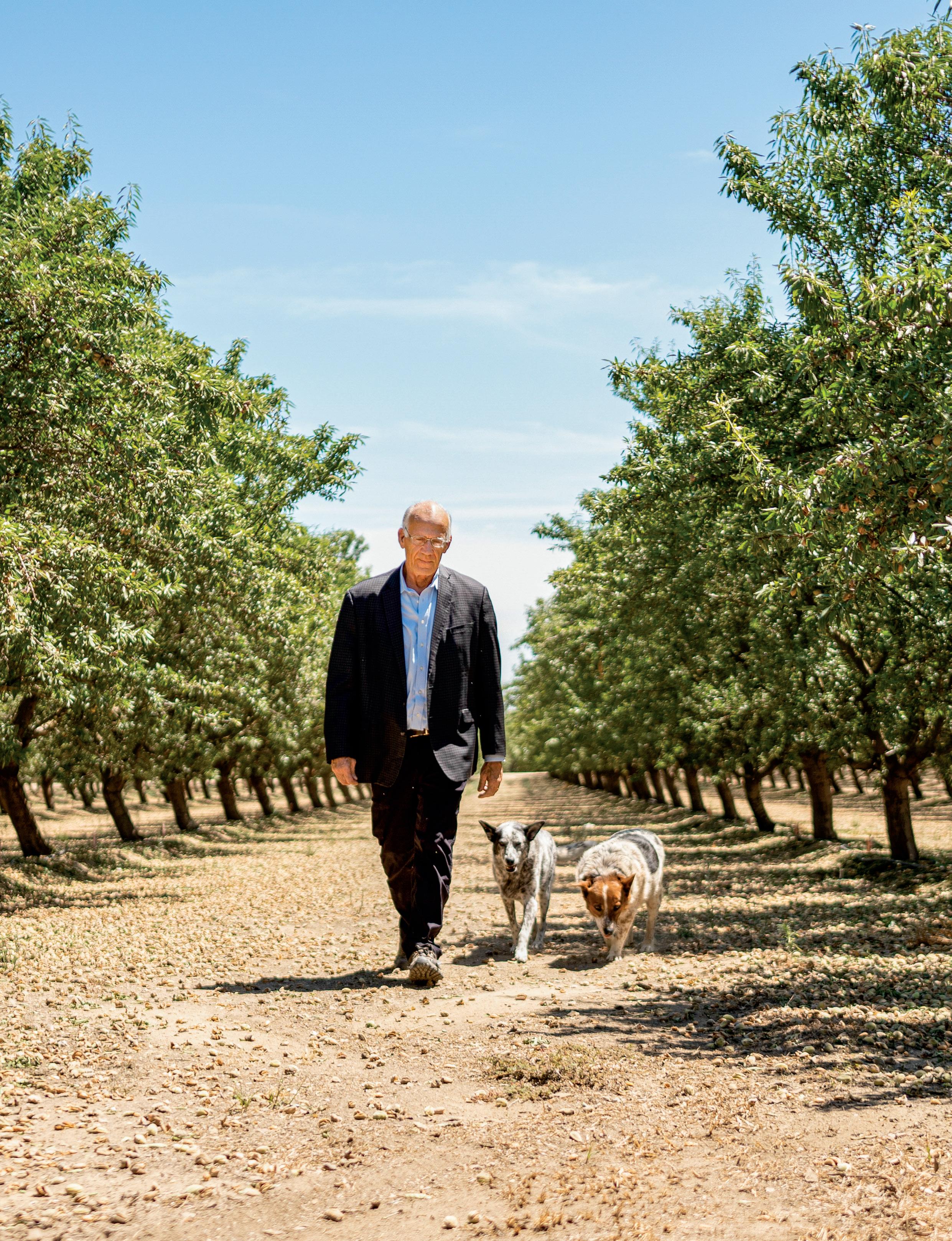
It’s nearly a 200-mile commute home for historian Victor Davis Hanson from the Hoover Institution at Stanford University, where he travels once a week, to his quiet family farm in the fertile Central Valley of California.
As a classicist, he’s at ease with the ancient world but often brings a historian’s insightful perspective to current events. And he’s also a fifth-generation farmer.
His house, surrounded by almond orchards, holds many stories—from the generations who sacrificed all of their soul, sweat, and hardearned money trying to save the farm, to later generations who decided this wasn’t the life for them and moved away with no intention
of ever returning. Of the original 180 acres that were passed down through the years, only 42 remain—rented out to a farmer who owns 12,000 acres in the surrounding region. This is California, where agriculture has gone almost all corporate, leaving farming families with few choices: mainly to scale up vertically and jump into agribusiness, or to sell and move away.
The America where 40 acres per family was the norm is now long gone. But its personality, the strength of its communities, and its work ethic were all deeply shaped by family farming. In this conversation, Hanson talks about this important aspect of our nation’s heritage.
This interview has been edited for clarity and brevity.
LEFT Victor Davis Hanson walks among the almond orchards surrounding his home in Selma, Calif., with two of his beloved dogs.
19
Culture | Features
ISSUE 11 | NOVEMBER 2022
American Essence: Looking back at America, and its early days as a nation, what was interesting to Europeans about what American farmers were doing?
Victor Davis Hanson: The history of Europe was always too many people, and too little land. When the American nation was founded, 95 percent of the people were homestead citi zens, and they had their own land. They were completely independent and autonomous; they raised their own food. They were outspo ken, and they were economically viable.
Observers who came from Europe, [for example] Alexis de Tocqueville, noticed that the American citizen was not a peasant. He was not indentured, he was not attached to a manor, or he wasn’t like an English subor dinate. He wasn’t a Russian serf. He was an independent person because he had all of this land. And until the mid- or early 20th century, that was a peculiar characteristic of America— there was so much farmland, and there were so many people from all over the world that wanted to be independent farmers. That had been impossible in their own land.
And even today, when we have people from Asia, or India, or Mexico, it’s astounding how many of them want to buy land, because that was an unavailable, yet they have it deeply ingrained in their psyches: If you have land, you’re going to be protected, you’re indepen dent, you can raise your own food.
AE: You mentioned a quote in an opinion article you penned in 2015. Thomas Jefferson wrote to James Madison in 1787, “I think our governments will remain virtu ous for many centuries, as long as they are chiefly agricultural; and this will be as long as there shall be vacant lands in any part of America. When they get piled upon one another in large cities, as in Europe, they will become as corrupt as in Europe.” What is the connection between farming and pre serving a virtuous society?
Mr. Hanson: That’s an old idea that farm ing serves two purposes. It’s not like agri business. It doesn’t just produce food, but it [also] produces citizens. The idea behind it goes back to Greece, if you read Xenophon’s “Oeconomicus” or Varro the Latin agronomist,
the message that comes out of that is that farming requires your brain and your brawn. So you plan an orchard, but then you physi cally have to enact that, so if you’re a farmer who can only think, you’re not going to suc ceed in a pre-industrial society, but if you’re just a brute, you’ll make mistakes. So they felt that farming gave a person the perfect balance between the head and the body. And then it allows them to connect in a realistic fashion with nature. People in town … were either afraid of it or they romanticized it. But the farmer was a partner with nature. He knew that he had to kill bad bugs to produce wheat. But he also understood there were good bugs that ate the bad bugs. So he tried to find a balance.
In classical agronomy, the idea was that that process created a different type of citizen. In other modalities, people either didn’t own the land that they worked, or they were inden tured—in other words, they had small plots, but they didn’t have a title to it. So if you give a man a title, and they own it, they improve it, and you have inheritance laws that allow them to pass it on, then you create an involved citizen. If the citizen is a serf, or peasant, or renter, then you cannot have a constitutional government because they’re restless, they’re envious, they’re angry, and they don’t improve the property when they rent something.
AE: Thomas Jefferson saw the yeoman farmer as key to the preservation of a good government. Yet over the centuries, that ideal has been displaced. A smaller and smaller chunk of the population farms the land, pushed out by agribusiness and government. What then is there to conserve when we speak of conserving the farm and traditional food production?
Mr. Hanson: When the Founders ratified the Constitution, 95 percent of the constituency was farming. … By the end of the Depression, World War II, we’re down to 20 percent. It’s now down to 1 percent of the population is involved directly, or maybe 2 percent. So it’s maybe 4 or 5 million people out of 330 million.
The Founders were worried about a number of things. People wouldn’t know where their
20 AMERICAN ESSENCE Features | Culture
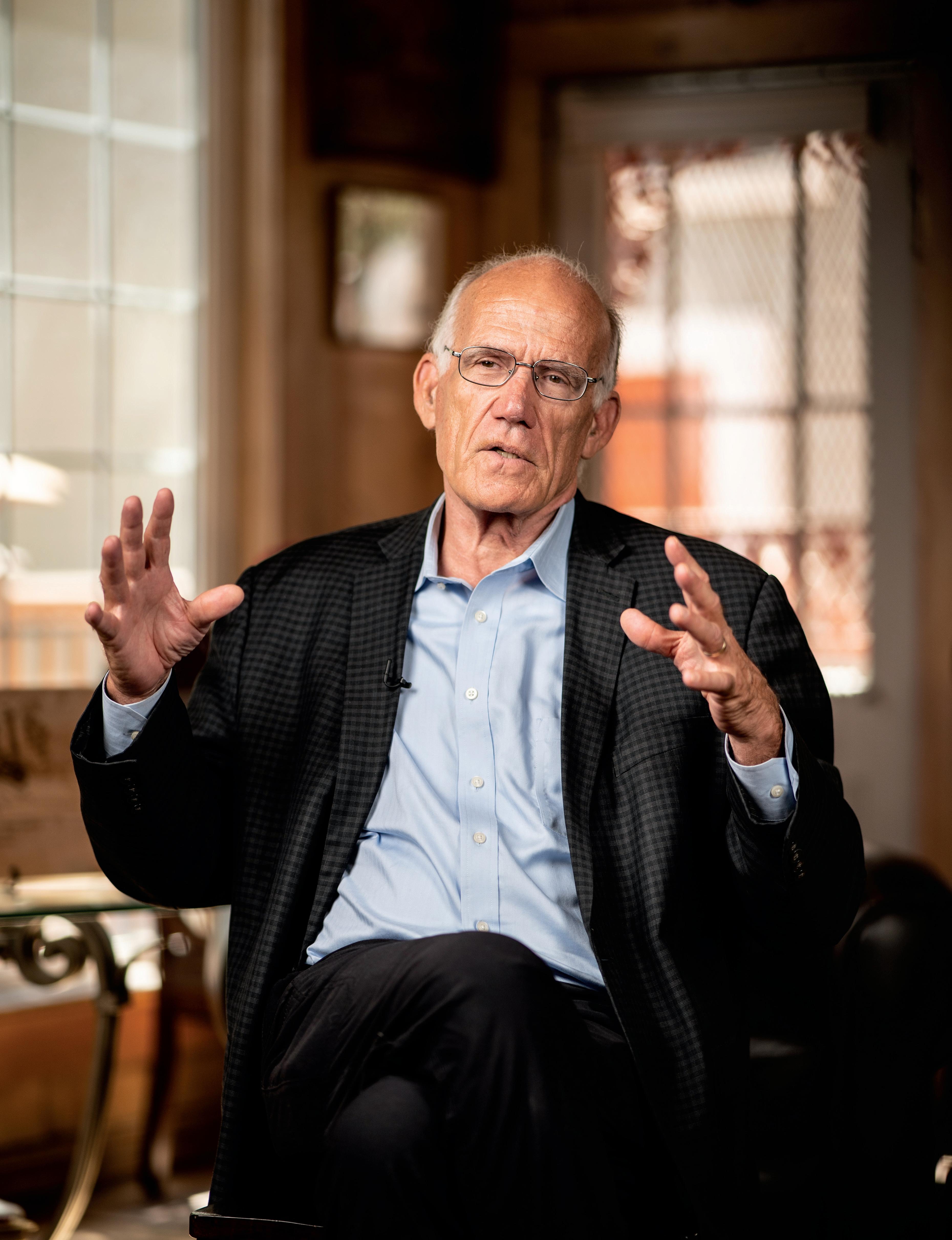 Davis Hanson contemplates the future of family farms in America.
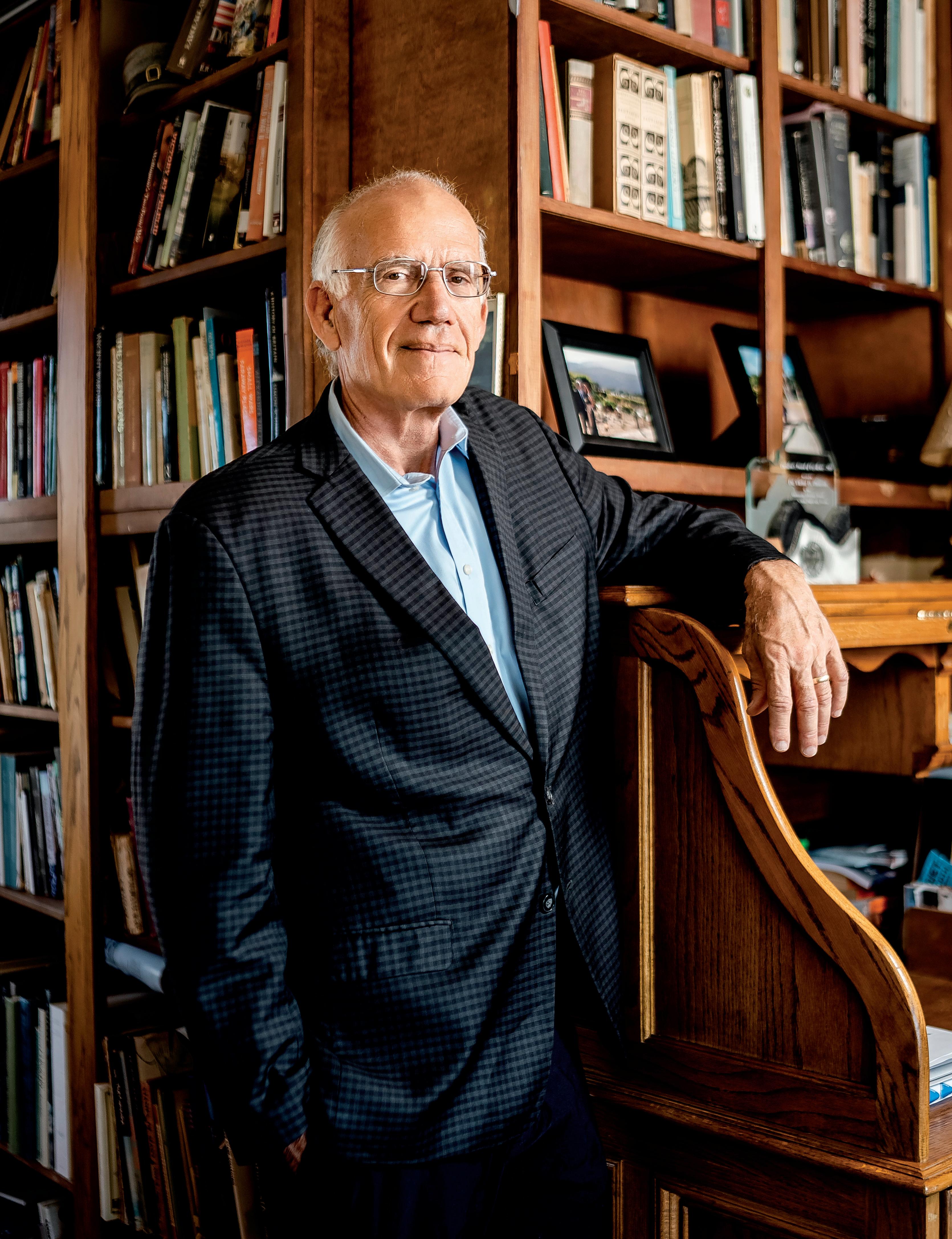 Davis Hanson in his study room.
food came from. They wouldn’t have that experience of working physically, with nature, to grow something. They wouldn’t have a compound rather than just a house. The farm houses, when I grew up, in the last vestiges of farming, were multi-generational.
So this house, I was told, in 1935, had 28 peo ple living in it, and the other buildings around had another 30 during the Depression. When I grew up, this house was full: My grandpar ents lived here, they had a daughter who was crippled, we lived down the road, the kids freeranged, cousins were here, neighbors dropped in. It was just booming. And that was what farmhouses were. So my grandmother had the Wednesday Walnut Club [consisting] of all the people who had walnut groves, and they tried to do self-improvement. Or they had the Eastern Star or they had the Masonic Lodge or the Elks Club. And when you look at them, they were all about self-improvement.
So it was the type of sinews and commu nity that encouraged Little Leagues, hospitals, PTAs, community schools, but it’s wiped out now. All the houses around 40 acres, they’re wiped out. The person that I rent 42 acres to, he owns 12,000 acres. And the houses that he rents from used to be homesteads. They’re now usually inhabited by people from Mexico, many of them here illegally. There is an MS-13 group down here, there’s a gangbanger there. There’s prostitution there. There’s dogfight ing. Because people are renting the home, and the land has been farmed by a corporation. So there’s no community. It’s rich and poor. And so that’s what Jefferson and other people were worried about. [Family farming] was a way of maintaining a middle class.
The $64,000 question is, can that ideology be transferred to a modern industrial society?
So if you have an independent trucker—to take just one example—he owns his own rig, he’s a mechanic. He is an expert in refrigeration, and he’s responsible for his own load. He’s very different than a teamster that works for Walmart. In other words, he goes to a trucking dispatcher, and they say, “Mr. Smith, you’ve got to take 20 tons of steel to Dallas,” and he figures out the route, he works on his own truck, and he does it. And that creates an inde pendent-minded person. And you can see that
—VICTOR DAVIS HANSON, HISTORIAN
when parents run into a school board and say, “You can’t teach my child this,” or “We’re not going to take this.” Often, they tend to be small business people. You have to have people like that in our society. You can’t have everybody working for the government or corporation.
AE: How can we maintain the values with out that farming family backbone?
Mr. Hanson: It’s very hard because their val ues are based on shame in traditional societies, and we have transmogrified that into guilt. So if I was in this house 60 years ago, and my grand mother said to me, “You said the word ‘darn.’” She just wouldn’t have said, “You said the word ‘darn.’” She said, “Are you gonna go out there and say that word in front of everybody? What are they gonna think of us? They’re gonna think we taught you that. You don’t say that or you’re going to shame the entire family.” Whereas today, it’s maybe at most private guilt, “Oh, I feel so bad I said it,” but there’s no mech anism to enforce behavior.
I remember my grandfather would say, “Now you’re driving to high school. So I know what you boys do. You all go have a beer on Friday night, but you’re under 21. You want your par ents to wake up on Saturday morning and it [a newspaper headline] says, ‘Hanson boy caught with Coors beer in his car’? They will do that, and then what are we going to do?” So that was the emphasis. That’s what the modern thera peutic society rebelled against and said, “That’s judgmental,” but they didn’t replace it with anything other than, “Oh, it wasn’t my fault,” or “I had a bad childhood,” or “I was offended,” or “It was unfair,” or “They did this to me because of my race or sex or gender.” That was a very different method of maintaining a more collec tive morality.
ABOVE “The Apotheosis of Washington,” 1865, a fresco by Constantino Brumidi.
23
•
vvv
If you have land, you’re going to be protected, you’re independent, you can raise your own food.
Culture | Features
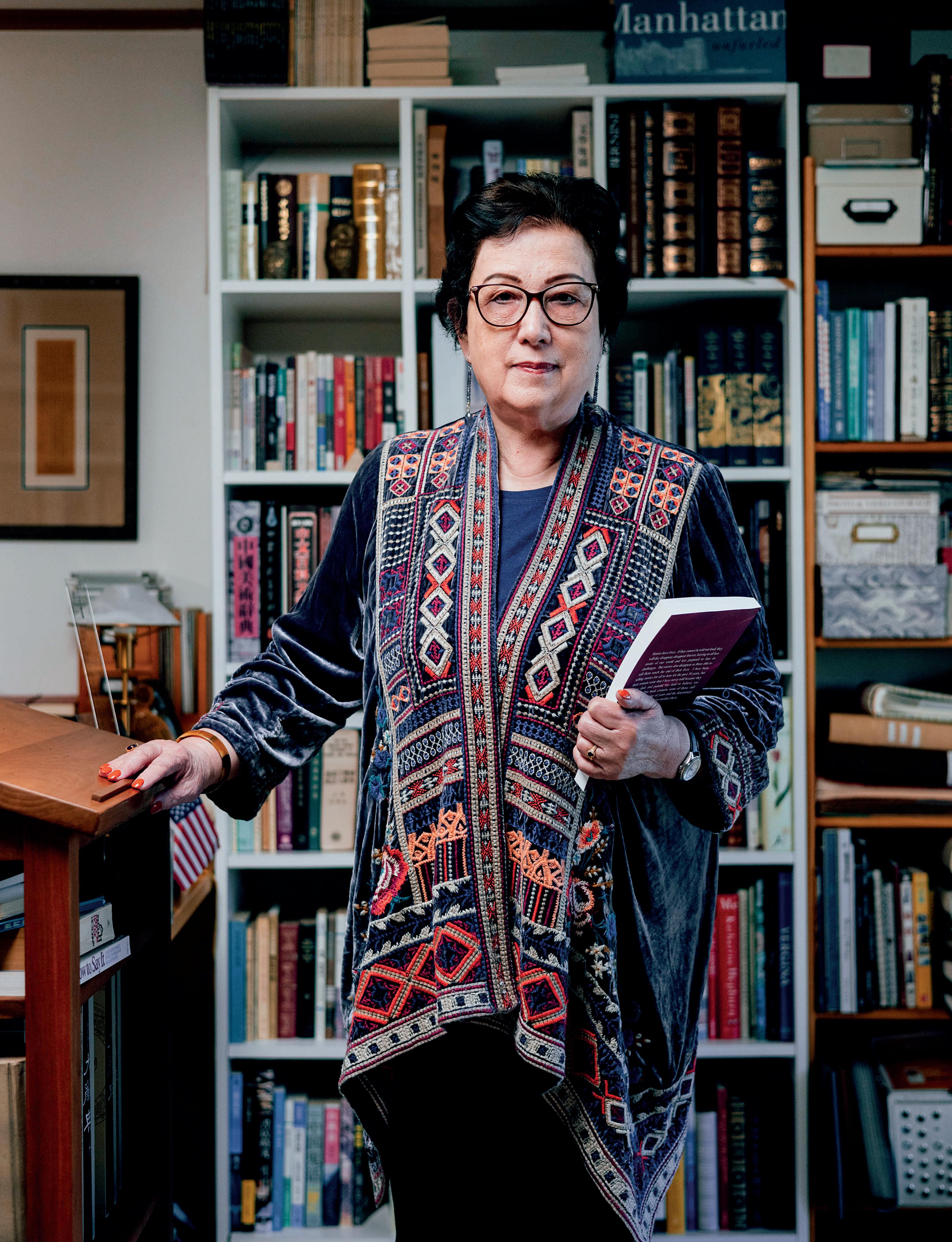 Teresa Buczacki, photographed at her Washington, D.C., home in March this year.
Escape From Communist China
Teresa Buczacki’s gripping story of surviving persecution under Mao—and fighting her way to freedom in America
WRITTEN BY Crystal Shi & Annie Wu
Two hundred words, and the future she dreamed of would be within reach.
That is, 200 words condemn ing her American father, regurgitating the Chinese Communist Party line that he was “a servile follower of capitalism and an enemy of the Chinese people,” and declaring that she was severing all ties with him.
“Write that,” a school official instructed 18-year-old Teresa Buczacki, “and the doors of Beijing University or Tsinghua University”— the country’s most elite schools—“will be open to you.”
She refused. The punishment was swift, and the consequences irrevocable.
An American in China Buczacki, who writes under the pen name Han Xiu, was born in New York in 1946 to an American army officer and a Chinese actress. Her parents separated when she was 1 1/2 years old, and she was sent to China as a tod dler to live with her grandmother in Beijing.
Her father had seen her only once, when she was born, but that was enough to incur repercussions. Even before Party leader Mao Zedong was preparing to launch the Cultural Revolution, all those with ties to the United States were deemed imperialists who under mined the communist cause. The regime stoked anti-American sentiment across society.
PHOTOGRAPHED BY Graeme Jennings
Though Buczacki’s mother tried to hide her family’s background, her grandmother always told the little girl that her father was an American officer who had aided the Chinese people in the fight against the Japanese empire during World War II.
She had never felt ashamed of her back ground, and instead yearned for what she considered her homeland. “Although I didn’t understand America well, ... I knew clearly from the start that I belonged in [America],” she later wrote in her semi-autobiographi cal book, “Refraction: An American Girl in Mainland China.”
Even as Buczacki was ostracized and ridi culed by her peers in school, she excelled and dreamt of becoming a ship designer. When she refused the regime’s demand to pen those 200 words of falsehoods, she knew she was sealing her own fate. But she was resolute.
“No matter how those in power, and their ignorant or knowing subjects, tried to defame him, I, as his daughter, will never forget him,” Buczacki wrote in “Refraction.” “From then on, I swore to myself that I would never betray my conscience, never surrender to coercive power, even if I have to endure countless suffering [as a result].”
She was tasked with hard labor in the harsh environs of Xinjiang, in China’s far west. The physical toil and stress pushed her to the brink of death. When Buczacki finally
ISSUE 11 | NOVEMBER 2022 25
Witness to History | Features
escaped and returned to America in 1978, at the age of 32, she weighed only 95 pounds.
But she was alive. She was the first American involuntarily held in China to return to the United States since the Korean War, but her tenacious bravery set a prece dent: She would not be the last. “My return proved that China’s solemn assertions in more than a hundred meetings in Warsaw over 15 years that no Americans were detained in China were just bald-faced lies,” she wrote in “The Unwanted,” another one of her books.
Now in America, armed with a pen and newfound freedom, she spoke her mind.
“Publishing books in America, you’re not restricted by the ideas you stand for, or your faith, or your political background,” she said. She began writing, penning over 50 books in Chinese, including works on the arts and history. In “Refraction” and “The Unwanted,” which are available in English, she details some of her harrowing experiences.
Forced Labor
The Chinese Communist Party assigned Buczacki hard labor on a farm in a remote vil lage in Shanxi Province. But to avoid potential arrest during the Cultural Revolution, she decided it was safer to be as far from Beijing government authorities as possible. In 1967, at age 21, she moved more than 2,000 miles to Xinjiang, a traditionally pastoral region, and applied to join the Xinjiang Production and Construction Corps, a paramilitary organi zation tasked with developing the area—in order to exploit its resources, according to Buczacki. She spent long days chopping down

trees and clearing land, and nights sleeping in a crude underground shelter.
The regime’s barbarism was on dramatic display. During her first year, she was forced, like millions of others in China during the Cultural Revolution, to attend a political rally where those accused by the Party as “count er-revolutionaries” were publicly denounced and tortured. Buczacki couldn’t stand to watch the brutal scene. As she attempted to leave, a blunt force suddenly struck her head: A soldier had hit her with the butt of his rifle to stop her. The world went black.
Three days later, she awoke, covered in sand, in the Gobi Desert. It was unclear how she had ended up there, though it was likely that soldiers had left her there to die. Weak and injured, she crawled back to camp. She wouldn’t realize until decades later that the traumatic injury to her brain would be life long.
For nine years, she suffered in Xinjiang, starved and overworked, surviving only through the kindness of neighbors and Uyghur friends who came to her aid. “Their resilience and their sense of helplessness—I understood them deeply. Yet they always treated me so kindly,” Buczacki said.
In 1976, Mao’s death was followed by fac tional infighting. A new leader, Deng Xiaoping, came to power and reversed Mao’s policies, and Buczacki was called back to Beijing by Deng’s office. She started looking for a way to the United States no matter the cost. She knew the two countries were negotiating the terms of their formal diplomatic relations and was certain a path would open up.
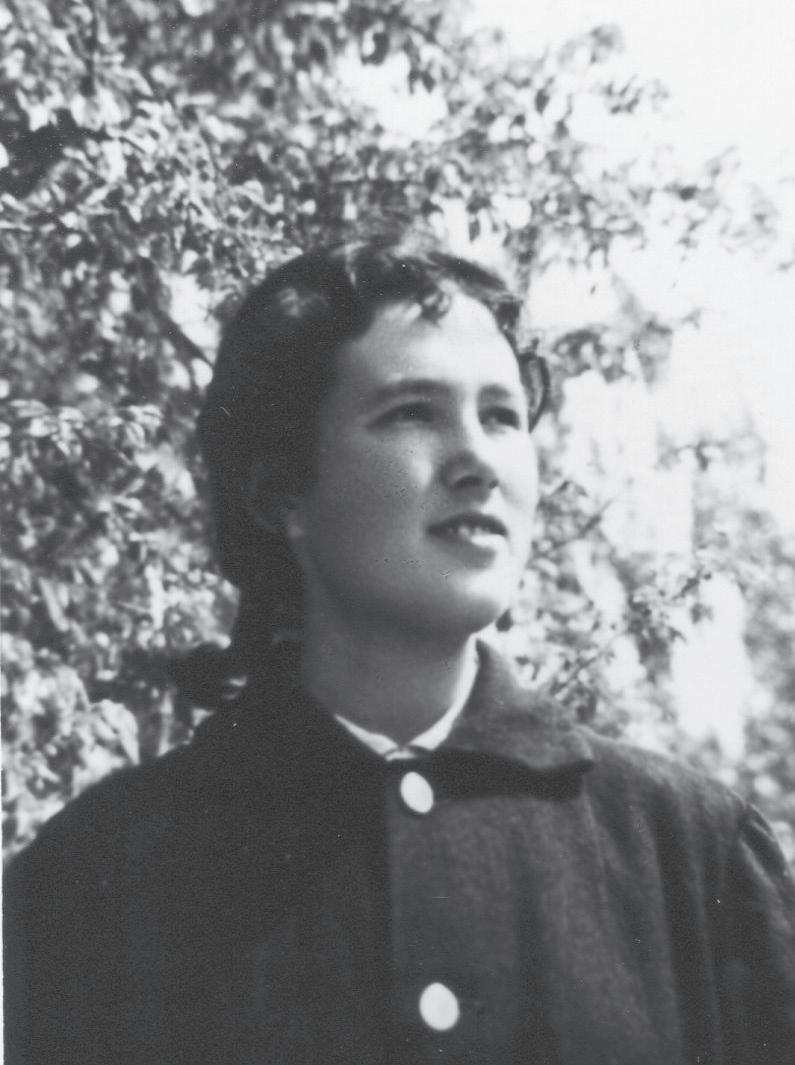
ABOVE, LEFT TO RIGHT Buczacki when she was 17, shortly before she was assigned to work on a farm in a remote village in Shanxi Province.
During the Cultural Revolution, Buczacki was assigned by authorities to work on development projects in Xinjiang, on the country’s western frontier.
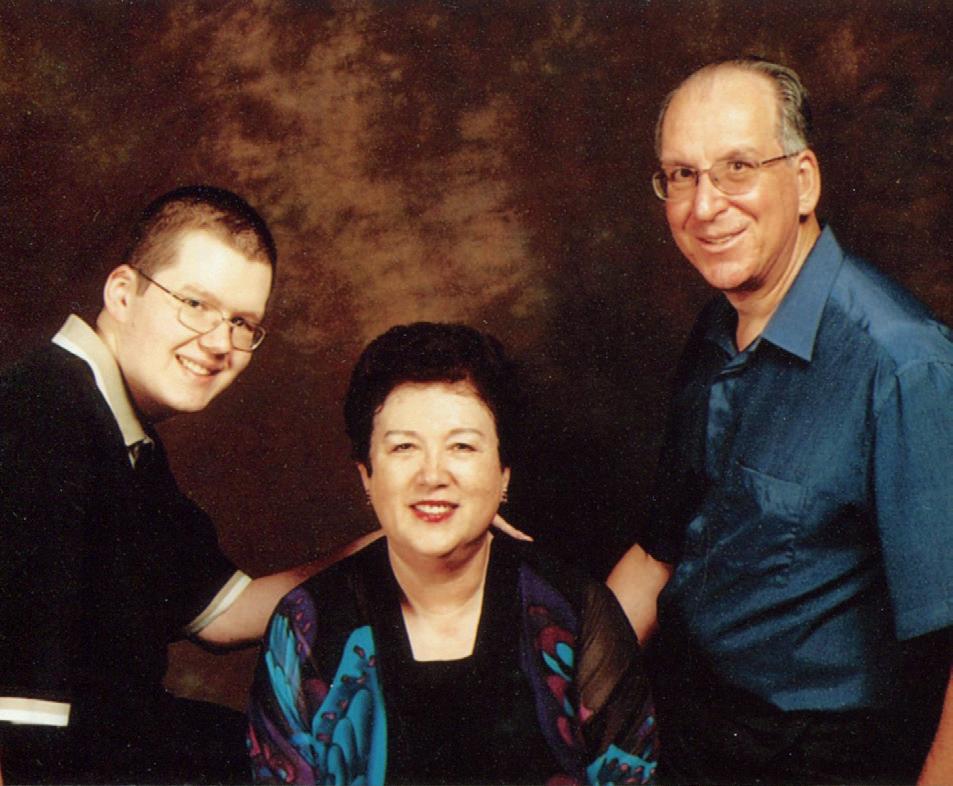
Buczacki with her husband and son. She married Jeff Buczacki in 1982. Their child, Andrew, was born in 1985.
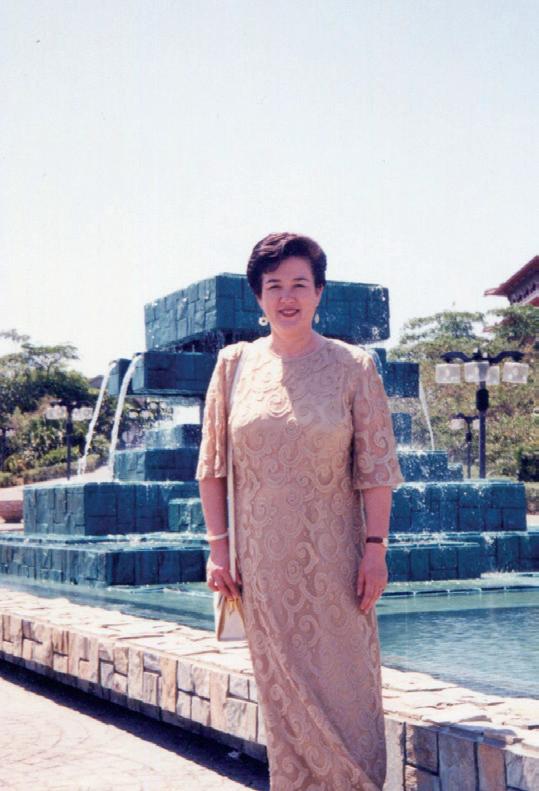
Buczacki’s husband is a diplomat. From 1992 to 1995, he was assigned to work at the American Institute in Taiwan. They stayed in the city of Kaohsiung.
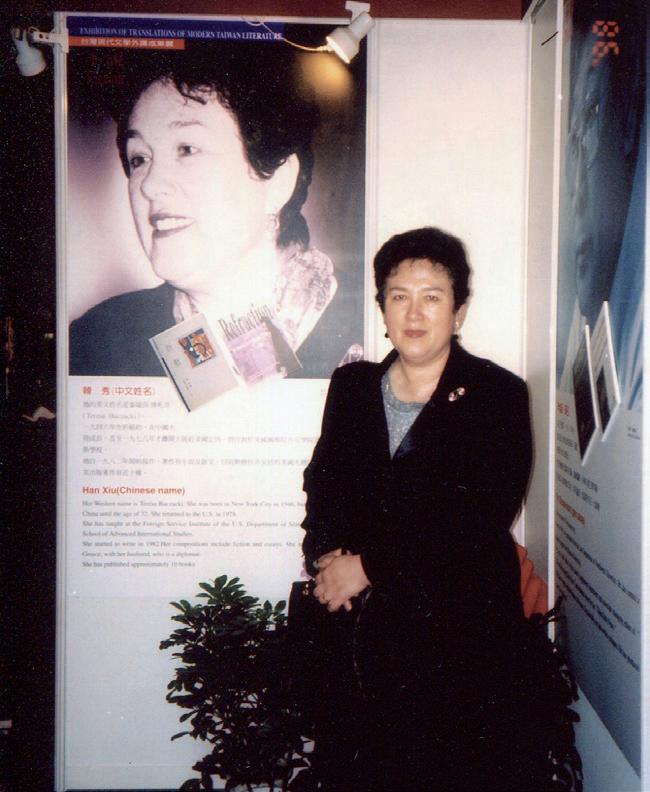
Buczacki at the Taipei International Book Exhibition in the ’90s, where her first book, “Refraction: An American Girl in Mainland China,” was on display.
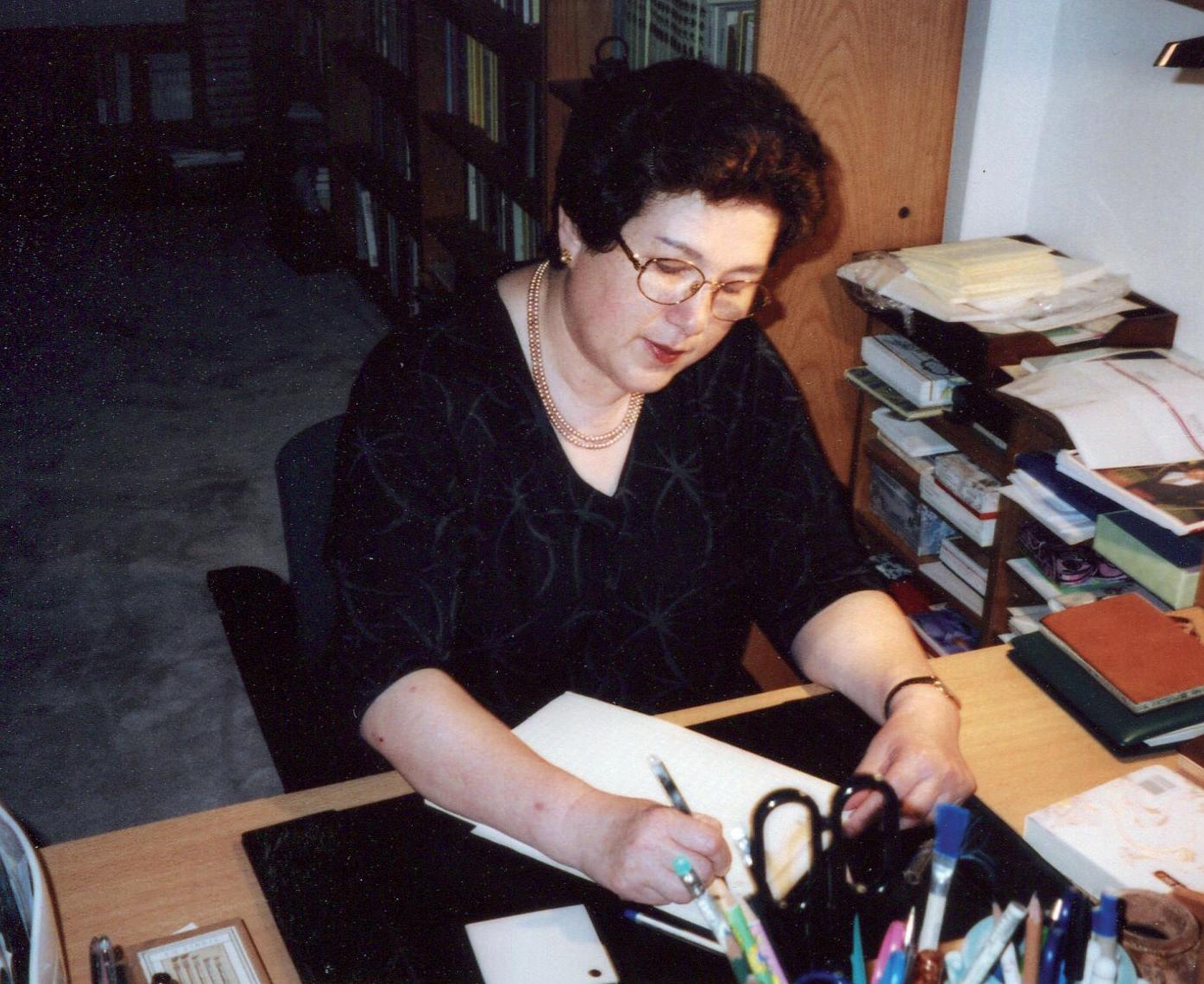
Buczacki at her Washington, D.C., home, in 2000.
26 AMERICAN ESSENCE
In 1977, a path did open up. Buczacki walked into the U.S. Liaison Office, expired childhood passport in hand, on President’s Day, a holiday that should have found the office empty. By a stroke of luck, she found American officers. Noticing her U.S. passport, they promised to help.
It meant that she would now be targeted by Chinese officials, who knew she had succeeded in making contact, but she was undaunted. They continually denied her the proper paperwork, but she never stopped applying. “You could apply for 100 years, but don’t forget, one day you will die,” she recalled an official telling her.
“You’re right,” she calmly replied. “If I die, please remember to send my ashes to the U.S. Liaison Office. My determination to go back to my country won’t be moved by your impe riousness.”
In 1978, Buczacki received permission to leave. She was finally going home.
Airline staff asked if there was a partic ular destination she wanted to go to. She said Washington, D.C. “It is near Arlington National Cemetery, closer to my father.”
Life Renewed in America
When Buczacki arrived in America, she didn’t speak a word of English. When she was grow ing up, the communist regime forbade her from learning it. After a doctor examined her, he told her to rest up: Her days were numbered, and she should enjoy them without strain. She was diagnosed with severe anemia, low blood pressure, arrhythmia, gastric ulcers, nephritis, and near blindness in her left eye. But she told
herself, “If a person’s first 30 years were ruined, after that, every day is an extra day earned.”
She settled in Washington, D.C., and began working as a Chinese language teacher at the State Department’s Foreign Service Institute and as a Chinese literature instructor at The Johns Hopkins University’s School of Advanced International Studies. American government officials and scholars in different fields sought her out to learn about the realities of life under the Chinese regime. She turned no one down. Undeterred by her myriad health issues, she was determined to tell the world the truth: “I returned from a country that has no freedom. If I were beaten down by such pain, wouldn’t that be a waste of my life?” she said. “If I don’t do anything, I will have betrayed my conscience.”
In 1990, she published her first book, “Refraction.” It was painful to revisit the mem ories, but she felt she had the responsibility to unveil them.
The communists never got their 200 words from Buczacki. But when it came to writing about truth, and humanity, she was unstoppa ble. Silenced for so long, the words now tum bled forth faster than she could write.
In 2002, she began experiencing bouts of excruciating nerve pain caused by her trau matic brain injury. Between episodes, “I pushed myself to the limit to write,” Buczacki said. “When the pain came again, I would stop writing. I kept doing this [over the years].” In the decade before she underwent brain surgery to alleviate the pain, she wrote 17 books.
“What I care most about is humanity—the spark in humanity—which will never perish.”
•
ISSUE 11 | NOVEMBER 2022 27
Every Dreamer Needs a Guide
 WRITTEN BY David Dudley
AMERICAN ESSENCE
Led by Linda McAlister, Schmidt Vocal Academy continues its legacy of helping young opera singers realize their goals
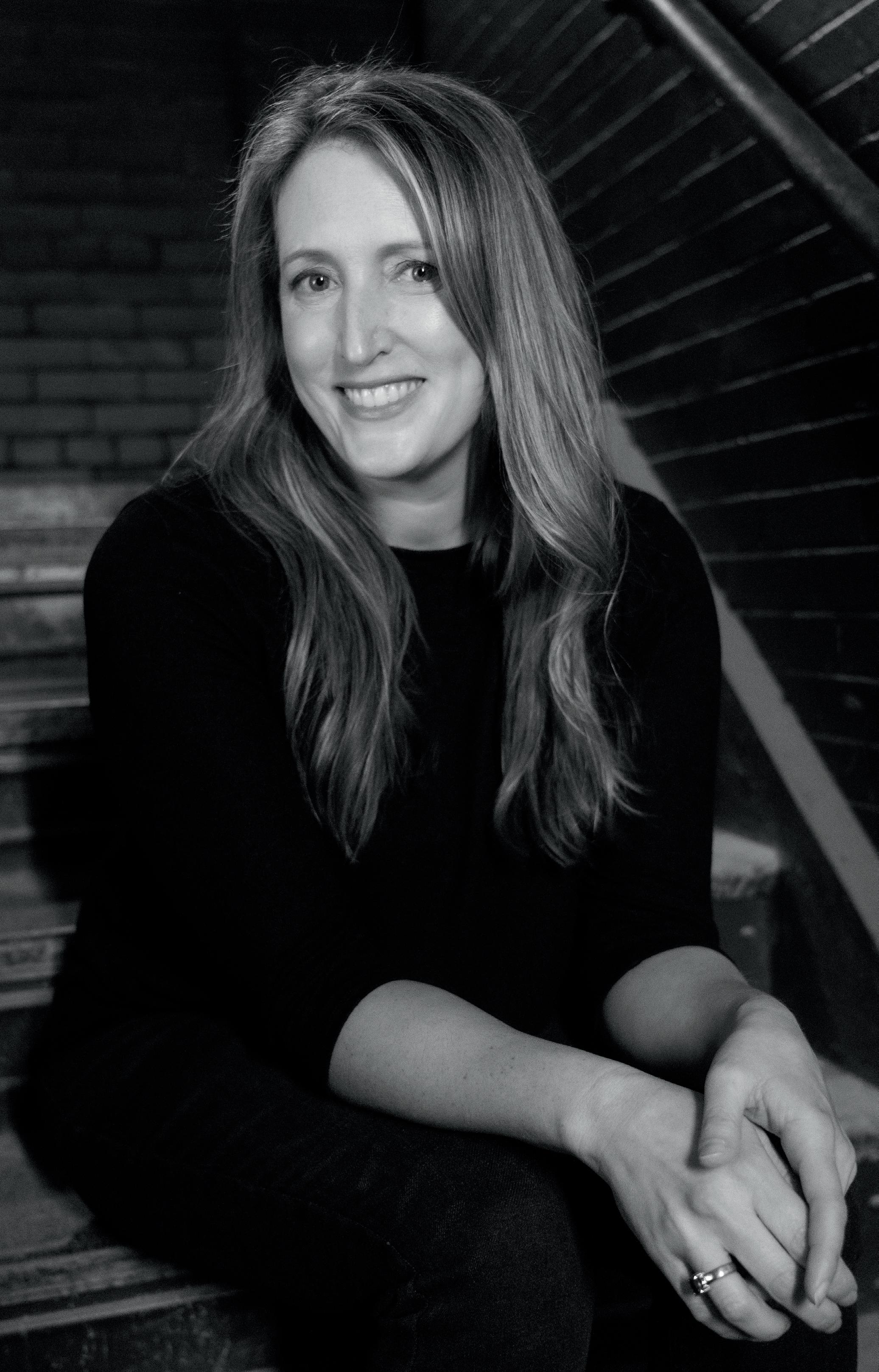
Though the paths that lead to a career in music are myriad, guides are invaluable to aspiring singers. Linda McAlister’s unique background may have given her the ideal foundation to oversee the robust roster of programs at Schmidt Vocal Academy, the umbrella entity that includes the Schmidt Vocal Competition, Schmidt Vocal Institute, and Schmidt Vocal Education, as well as scholarship opportunities for young singers. An accomplished soprano, McAlister also holds a degree in international business. “It’s import ant for young singers to know that when you build a career in the arts, you’re also an entrepreneur,” she told American Essence.
Born and raised in Hector, Minnesota, McAlister’s dad, Willard Fluck (pronounced “Fluke”) raised corn and soybean crops on a farm of about 900 acres. McAlister said she inher ited her love of music from her mom, Heather, a school teacher in St. Paul. “She was a city girl,” McAlister said. “Because of her, I took up violin at 3 years old, piano at 5, and flute and choir by mid dle school.” Though she partic
ipated in choir, and she had pri vate lessons, McAlister’s musical ambitions compelled her to study voice at St. Mary’s University in Winona, Minnesota, during her junior year of high school. Around that time, she became interested in the business of music, too. “I thought I might become an agent for artists,” she said. She pursued a double major in vocal performance and international business, which would help immensely in the world of classical music. “Opera is an international art form,” she said.
McAlister earned a bachelor’s degree by the time she turned 20. From there, she earned a Master of Music from Miami University in Ohio. Then, she completed her doctoral studies at the University of Cincinnati, College-Conservatory of Music. After singing at the Steans Music Institute at the Ravinia Festival, McAlister furthered her study of German Lieder at the Hochschule für Musik, Nürnberg-Augsburg (Meisterklasse). “I caught the performance bug early,” she said.
by Mendelssohn, Haydn, Fauré, and Mozart, among others.
McAlister said she missed the United States, so she began applying for jobs while still in Germany. Upon returning to the States, she became the first-ever executive director of SongFest at Colburn, in Los Angeles. She acted as artistic coordinator for the Steans Music Institute Vocal Program at the Ravinia Festival, the summer home of the Chicago Symphony Orchestra. McAlister joined the William E. Schmidt Foundation’s team as the Schmidt Vocal Competition manager in 2012, while also serving on the voice fac ulty at Miami University in Ohio.
LEFT Raised on a farm in Minnesota, Linda McAlister inherited her mother’s love of music and became passionate about helping young singers realize their artistic goals.
Her first—and favorite—role in Germany was Rosalinde in “Die Fledermaus,” by Johann Strauss II. “I was in a stunningly beautiful space—but I didn’t speak German!” The language barrier didn’t stop her from playing other roles, such as Venus in “Dardanus” and Belinda in “Dido and Aeneas.” She also appeared in concerts of works
The Schmidt Foundation was founded by William E. Schmidt and his extended family in 1992. The Foundation was committed to fostering young students’ passion for classical singing, which led to several successful programs and ultimately the creation of Schmidt Vocal Arts. In September 2019, McAlister assumed the newly-cre ated role of executive director for Schmidt Vocal Arts, overseeing the organization’s programming.
Not bad for the farm girl from Minnesota. “While I didn’t end up singing on the world’s biggest stages,” McAlister said, “I’m still following my passion. I want to help our kids dream big—while giving them the skills they need to achieve their goals.”
ISSUE 11 | NOVEMBER 2022 29 Music | Features
Filling a Void
Tamara Wilson knew McAlister was perfect for a leadership role at SVA. “Linda excels at the art and business of singing,” Wilson said. She’s known McAlister since their days at the University of Cincinnati Conservatory of Music.
An exceedingly busy soprano, Wilson said she was excited when McAlister asked her to judge SVA competitions, and she hopes to mentor many young singers in the years to come. “Linda and SVA are filling a void,” Wilson said. “Most high schools in the U.S. really aren’t equipped to prepare students for col lege music programs.”
Saman de Silva, a baritone from Palo Alto, California, knows that struggle. At 14, he fell in love with opera after hearing “The Pearl
Fishers’ Duet,” from Georges Bizet’s 1863 opera, “Les Pêcheurs de Perles.” De Silva said that he learned a great deal from participating in the Schmidt Vocal Institute during the summer between his junior and senior years in high school. “My high school didn’t have the resources to give me a private voice teacher,” he said. “The coaching I received at the Institute, and the communal learning that took place while I watched oth ers sing, changed my life.”
De Silva graduated high school in June, and he is now prepar ing to attend Harvard, where he will pursue a bachelor’s degree in science. Then, he will work on a Master of Music at New England Conservatory, as part of the Harvard/NEC dual degree program. “I gained such valuable tools from my time with SVA,” de Silva said. “I learned to build relationships and collaborate. I learned how the art world functions.”
30 AMERICAN ESSENCE Features | Music
vvv
“I’m still following my passion. I want to help our kids dream big—while giving them the skills they need to achieve their goals.”
—LINDA M c ALISTER, EXECUTIVE DIRECTOR OF SCHMIDT VOCAL ARTS
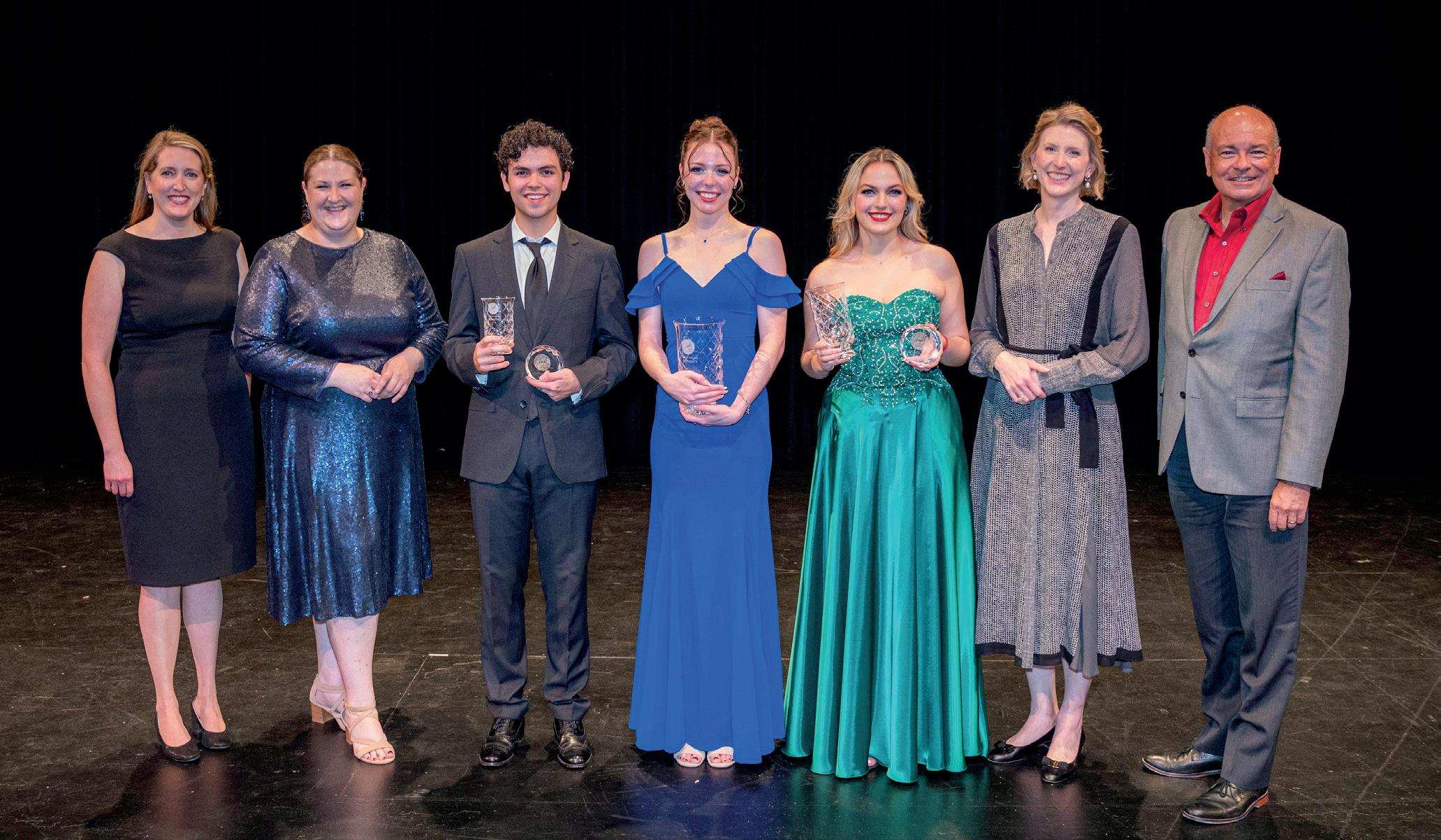
ABOVE The academy held its first-ever Schmidt Vocal Competition High School Nationals in Sarasota, Fla., this June, with some star judges. (L to R) McAlister, soprano Tamara Wilson, Benjamin Riverón (3rd place), Nicole DiPasquale (1st place), Dalila Lugo (2nd place), soprano Amanda Majeski, and Sarasota Opera’s general director Richard Russell.
They Helped Me Realize That My Dreams Were Reachable Miami, Florida, native Saige Hoffman’s first encounter with SVA came in her sophomore year of high school. “The pandemic had already hit,” Hoffman said, “and my regional competition was moved to virtual.” While the move from in-person to virtual competition created new challenges for singers, Hoffman came to appreciate the experience of recording her three selections and sending them in via YouTube. “It was a valuable asset that I would need for college applications and future endeavors,” she said.

Hoffman, who is a soprano, wasn’t sure that she would pursue a career in opera. “I felt like there was so much that I still hadn’t learned,” she said. “After attending Schmidt Vocal Institute, I realized my mis sion in life was to be a part of the future generation of opera.” In May, she won the National Association of Teachers of Singing competition. “It was important because it confirmed for me that I had something to offer,” she said.
Hoffman said that SVA, and espe cially McAlister, was instrumen tal in realizing her goals. “Linda was my private coach during the Schmidt Vocal Institute,” Hoffman said. “Working with her was an absolute joy. It is nice to be taught by someone who is currently sing ing in their career, as they can sym pathize with their students.”
“Because of the relationships I’ve built with SVA,” Hoffman continued, “I will be attending Oberlin, my dream college, with Dr. Katherine Jolly.” SVA isn’t just a foundation that gives out prize money, Hoffman said. “They’re a foundation that truly cares and nur tures the future generation of opera. They helped me realize that my dreams were reachable.”
•
ISSUE 11 | NOVEMBER 2022
Alumni of the Schmidt Vocal Institute outside the Sarasota Opera House.
Where Stories Come Home
WRITTEN BY Brett Chudá
When historical American homes are in need of preserva tion and an exqui sitely traditional makeover, their homeowners have turned to interior designer Cathy Kincaid for over 40 years. She’s played fairy godmother to dozens of charming houses that are full of character, including a 1750s Connecticut ferryman’s cot tage on the water, Manhattan pent houses, and a forested East Texas estate. “I think it’s so important to live in something that has history,”

32 AMERICAN ESSENCE
Exploring the unique stylings of beloved Texas interior designer Cathy Kincaid
Kincaid said. “I think it inspires us … to be interested in the history of the United States, where we live, our cities. And these older homes, they do have a story to tell.”
Many of the storied residences Kincaid has worked on have been
featured in the world’s top home magazines and are compiled in her 2019 book, “The Well Adorned Home,” published by Rizzoli.
Texas Charm
ABOVE The sun-filled entry of Cathy Kincaid’s Dallas cottage, a one-story home built during the post-World War I era.
ABOVE RIGHT Kincaid’s collection of porcelain accentuates the cottage’s New England design.


Originally from Fort Worth, Texas, Kincaid attended Texas Christian University before moving to Dallas in the 1970s. There, she worked with local legendary designers before hanging up her own sign in 1978.
In her sweet but serious Texas drawl, she described two superb renovations that are close to her heart.
The property Kincaid endearingly calls the “East Texas Farmhouse” is a recreation property on one of the largest remaining private lots close to Dallas, with hundreds of acres of forest, a lake, and a guest house. It was built in the mid-20th century by the famous wrestlers, the Von Erich brothers.
Although they made their living wrestling, the Von Erichs made sophisticated choices for their large farmhouse and were delightfully creative as they went about design
ISSUE 11 | NOVEMBER 2022 33
Craftsmanship | Features
ing the space. Many of the door and window surrounds are made of half-sawn boards, their shapes, whimsically irregular, retaining the outlines of the local trees they came from. It’s a feature Kincaid said she’d never seen anywhere before.
The current homeowners fell in love with the raw lumber ceilings and exposed beams, the staircase with a balustrade of antler-like branches, and other masculine fea tures. Kincaid preserved everything the Von Erichs did right and remod eled the furnishings, wall coverings, fixtures, and the like, taking the interiors from “kitschy” to perfectly elegant and ready to entertain. ”We wanted to create interiors that were comfortable and relaxed, that also exuded youthful style,” Kincaid said. It’s a house in the countryside, after all, so she didn’t want anything to feel “too precious or fancy. But at the same time, we wanted the inte
riors to reflect the refined style and taste of the homeowners.”


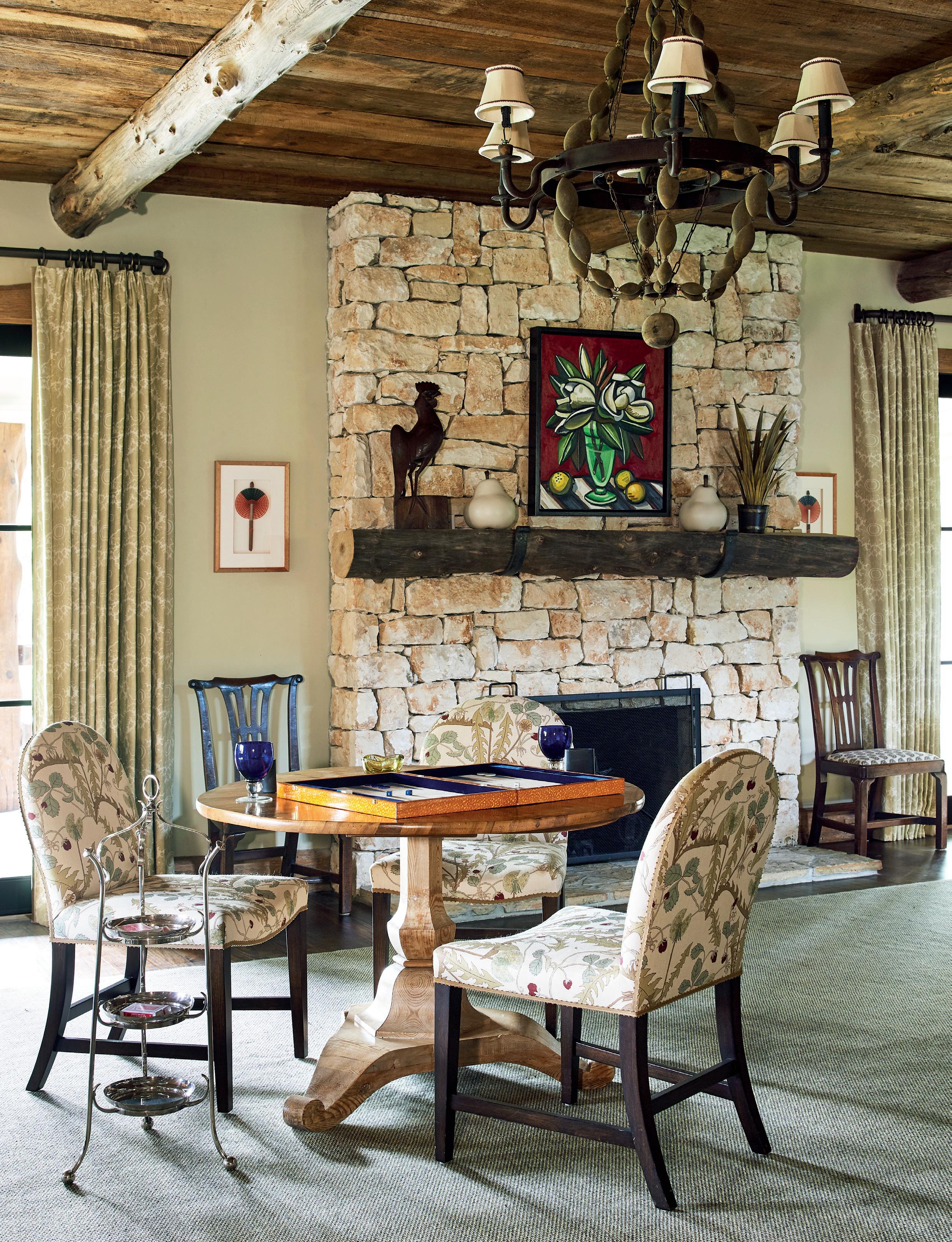
Kincaid’s signature touch is obvi ous in the stately yet comfortable custom furniture, with rich, often patterned fabrics that are layered unpredictably, beautifully, and delightfully in each well-consid ered room. She’s brought in time less decor that looks effortlessly curated, while evoking a nostalgic atmosphere. The hearth is made to look inviting with a mini collec
tion of model tall ships, a Federalist style mirror, a cabinet painted in the antique Dutch style, and many more careful details that don’t draw attention to themselves but lend a deeply American sense of hospital ity.
Home, Sweet Home
The lovingly restored house in Highland Park, Texas, that Kincaid currently lives in is a one-story, shingled cottage built in the post-
34 Features | Craftsmanship
World War I era, “one of the few houses of this style that’s left in this part of Dallas,” she said. She bought it in 2012 and, after restoring and renovating it, moved in two years later. Kincaid described it as a “very American” home. “It’s kind of a surprise. … And when you’re here, you don’t really feel like you’re in the middle of Dallas.” Its architec tural features are more in common with a cottage in rural Connecticut than a Texas abode. In addition, it’s set away from the main road, sur rounded by foliage that shields it
from other properties. Classic topi ary and potted orange trees greet guests outside the front door. Its shingled exterior with white trim and architectural details and its gas light-like exterior light fixtures give off distinctly New England vibes.
through different incarnations to where now it’s a family home, and it’s quite desirable. I guess you could call it kind of a success story,” Kincaid said.
LEFT The dining room is fitted with simple linen curtains to maximize its floor-to-ceiling windows.
ABOVE The farmhouse’s dining room is richly adorned with Kincaid’s signature choice of patterned upholstery.

She and fellow amateur histo rians of her neighborhood say it probably started out as a tiny, threeroom caretakers’ cottage attached to the estate of one of Dallas’s most influential families. “[It has] gone
Over the years, there were mod ern renovations: Plaster went onto the walls; less-than-beautiful fea tures were added in the kitchen. Kincaid was passionate about pre serving the historical features. Her restoration took it back a little “to where it would have been,” she said.
ISSUE 11 | NOVEMBER 2022 35
vvv
“I think it’s so important to live in something that has history. … I think it inspires us … to be interested in the history of the United States, where we live, our cities.”
—CATHY KINCAID, INTERIOR DESIGNER
“It’s more in keeping with the year it’s built and more in keeping with the style of the [original] house.” She also gave it some updates to better suit her tastes, and to match her beautiful personal collection of porcelain and paintings. “The ceilings in the living room are not tall. So to cheat the eye and maxi mize the floor-to-ceiling windows, we used short valances [decorative drapery] and simple, linen curtains. We also added transom windows [small window features that are placed above doorways] between the entry, living room, and dining room to add light.”
Her collection includes a stun ning, hand-painted wall covering whose fairy-tale vistas wrap around the dining room. While not antique, it represents a series of important chapters in Kincaid’s life. Years prior, Kincaid bought a home that once belonged to renowned interior designer Nena Claiborne (before she bought the house, Kincaid once worked at a custom lamp shop and would deliver the goods to Claiborne’s residence). Claiborne had hand-painted this wall covering depicting tall ships and maritime scenes in a style popularized in Normandy, France, during the 1700s. It combines rich jewel tones with strong earthy colors and superbly plays the role these wall coverings were designed for: to wow visitors and be an impressive conversation piece.

The wall covering tells a delicious story, but not in the way one may think. One of the men in the scene originally had no head. According to Kincaid, the story goes that he was Claiborne’s ex-husband who cheated on her. She made him head less as penance. About 15 years after Kincaid moved into the house, a fire tore through the upstairs rooms and damaged the dining room where this
canvas hung. But Kincaid salvaged the canvas and employed a team of craftsmen and artists to revive the artwork and rehang it in her new Texas home. During the process, it needed some retouching. One of the artists painted the man’s head back on, not knowing it hadn’t been there to begin with. “I walked in and went, oh my gosh, he’s been redeemed!” Kincaid said.
It’s a story that began genera tions ago, and it hasn’t reached its end. The day before her American Essence interview, Kincaid was blessed with a new grandchild. Only the heavens would know what new stories will be told in this home that’s celebrating its centennial anni versary (approximately) this year.
Kincaid continues to be drawn to gorgeous restorations with stories behind them. She said working on
old homes is “a completely different feel. I love working on new proper ties, too, but it’s fun to go into an old [home], especially one that hasn’t been changed, and see how you bring it up to speed but at the same time retain all of the charm that it has from the years past. Nothing can quite replace something that was done a long time ago.”
There’s a unique character to them, she said. “I love walking into a house and wondering, ‘What’s happened there? Who’s been [there]? Who’s lived there?’” •
RIGHT Kincaid preserved the raw lumber ceiling of the farmhouse and paired it with timeless decor for an elegant yet youthful look.
36 AMERICAN ESSENCE Features | Craftsmanship
ABOVE A hand-painted wall covering by renowned interior designer Nena Claiborne.
Spinning a Better Future for American Wool

From ranch to Ralph Lauren, Shaniko Wool Company is shepherding sustainably produced, made-in-America wool into the spotlight
WRITTEN BY Eric Lucas
At first glance, it’s just an ordinary tussock of grass. Shimmering, graceful, silver-gold grass, dancing lightly in the summer breeze—but grass nonetheless. Yet sheep rancher Jeanne Carver’s fond regard for this 18-inch tuft at Imperial Stock Ranch, outside Shaniko in north-central Oregon, illustrates an idea that she hopes will transform her unique cor ner of agriculture: fiber production. In this case, wool from Merino sheep. “The healthier the resources, the healthier the harvest,” she said, caressing the Columbia Basin high desert bunchgrass as if it were a rare rose. “Simple management strategies are all it takes to help the landscape immensely. And that’s what’s best for
38 AMERICAN ESSENCE
all of us—people, sheep, and wildlife.”
The small patch of ground we’re viewing along the 32,000-acre ranch’s access road has benefited from the simplest land-management technique of all: minimal distur bance. Planned, moderate rotational grazing and restricted soil distur bance have aided the recovery of bunchgrass and fended off cheat grass, the interior West’s most trou blesome invasive species. So, unim pressive though it may look to the lay observer, a healthy tussock of bunch grass signals a healthy landscape and a subtle tale of environmental resto ration.
Cleaning Up the Industry
Carver has spent a quarter-century in a corner of American agriculture that has flown beneath the radar of a public more preoccupied with food production. Textile fiber— largely from wool and cotton—has been a central facet of human civi lization for millennia, but while the average thoughtful American may give careful consideration to the provenance of what’s on our dinner tables, far less attention is paid to the clothing on our bodies.
Carver has been taking the ranch’s wool harvest direct to mar ket since 1999. That work set the stage for her involvement with a program to create a set of guide lines for wool production, which has since become the Responsible Wool Standard (RWS). This con sists of a set of sheep-raising and fiber-handling criteria under the aegis of Textile Exchange (TE), a
global nonprofit based in Texas. RWS’s criteria focus on land stew ardship, humane animal treatment, workplace fairness, and overall accountability.
These same objectives underlie TE’s campaign to bring sustain ability to many corners of the fiber industry, covering cotton, alpaca,
mohair, wool, down, and recycled content.
“Our goal is to help the industry achieve a 45 percent reduction in the greenhouse gas emissions that come from producing fibers and raw materials by 2030,” explained Pe-Jae Brooks of TE. The 20-yearold organization has about 750
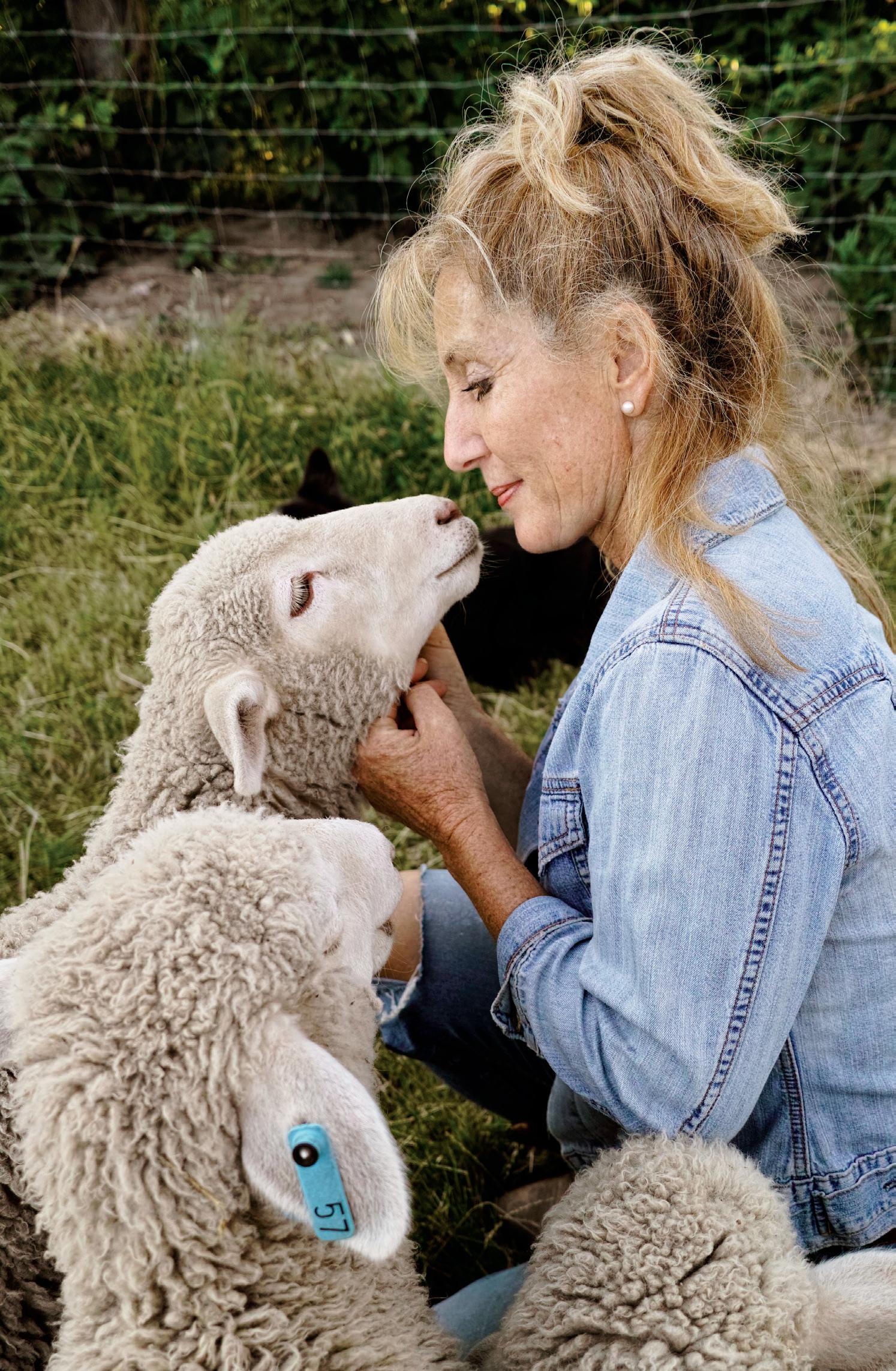
RIGHT Jeanne Carver, founder of Shaniko Wool Company and owner of Imperial Stock Ranch, is a fierce advocate for the value and heritage of wool.
ISSUE 11 | NOVEMBER 2022
Made in America | Features
ABOVE LEFT Merino sheep graze at Imperial Stock Ranch outside Shaniko, Ore.
members, ranging from ranchers such as Carver, to textile mills, to end users such as Levi Strauss and Lululemon. “For real change to happen, everyone needs a clear path to positive impact.”
Carver and TE are activists in an industry that, since the mid-20th century, has veered sharply toward synthetic fibers—largely hydro carbon-based. According to TE, 62 percent of modern textiles are chemical rather than natural, with oil-based polyester by far the most common at 57 million tons—52 per cent of total global fiber production, what Carver calls “a global trail of products with oil on it just so you can get a shirt.”
By comparison, the 24 million pounds (12,000 tons) of wool pro duced in the United States by about 3.3 million sheep is a drop in the bucket. But Carver believes RWS can be exemplary, if not universal, and she is a fierce advocate for the value and heritage of wool.
“Take sheep and add water—that simple formula has clothed and fed humankind for more than 10,000 years,” she declared. “Wool is a miracle fiber; sheep give all that and ask for nothing except humane care and land to graze.”
Carrying On a Legacy Shaniko and Imperial Stock Ranch exemplify that heritage. At the turn of the 20th century, the town earned the moniker “Wool Capital of the World”—its still-standing warehouse held 4 million pounds of wool, and in 1903, Columbia Southern Railway cars hauled away 2,000 tons of wool. The town’s long decline began when the railway curtailed operations in the 1930s and ceased in 1966. Today, Shaniko is listed on Visit Oregon’s web page devoted to ghost towns.
Meanwhile, Imperial Stock Ranch was homesteaded by Richard Hinton
in 1871, and at one point, it was the state’s largest individually-owned land and livestock operation, carry ing more than 35,000 sheep. After several ownership changes, the ranch is now smaller. But Carver serves as unofficial steward of a ranch headquarters with an ear ly-20th-century manor house, a historic sheep-shearing shed, and a massive barn whose evocative tack room holds dozens of priceless her itage saddles, still on saddle racks and ready to go as if a crew of ranch hands were expected tomorrow to start the fall roundup.
After taking a couple years off to care for her husband Dan in his final
years enduring a fatal neurologic disease, Carver no longer manages sheep directly. Instead, she leads Shaniko Wool Company (SWC), an enterprise that includes nine fam ily-run sheep ranches in the West, all of which are committed to sus tainable production practices. SWC ranchers collectively manage 36,000 sheep on 2 million acres.
“To be honest, most of the RWS standards represent things I was already doing,” said Ted Borda, a retired teacher who took over his father’s sheep operation in Carson Valley, Nevada. “In ranching, like teaching, you’re always looking for a better way to do something.”
40 AMERICAN ESSENCE Features | Made in America
Borda’s “better way,” on the 150,000 acres of federal land that he leases for grazing, includes a vastly reduced herd size—he runs 4,500 sheep where his dad had grazed almost 100,000. He has adopted more humane methods of marking and castrating the animals, and he is especially proud of the housing that he provides his herders: a crew of 11, comprising two Mexican extended families who come to Nevada on agricultural H-2A visas. In six months, Borda reported, his herders make as much as they would in two
years back home. And the sheep herder wagons that he provides have solar power, refrigerators, and other modern comforts unimaginable a century ago in the Mountain West, where Basque sheepherders spent months alone in the high country with only herd dogs for companions.
“It’s still a pretty solitary occupa tion, but they’re up there chatting on cell phones these days; no more reading by kerosene lanterns,” Borda said. “If your herders are happy, your sheep are happy. That was my father’s maxim, and he was right.”
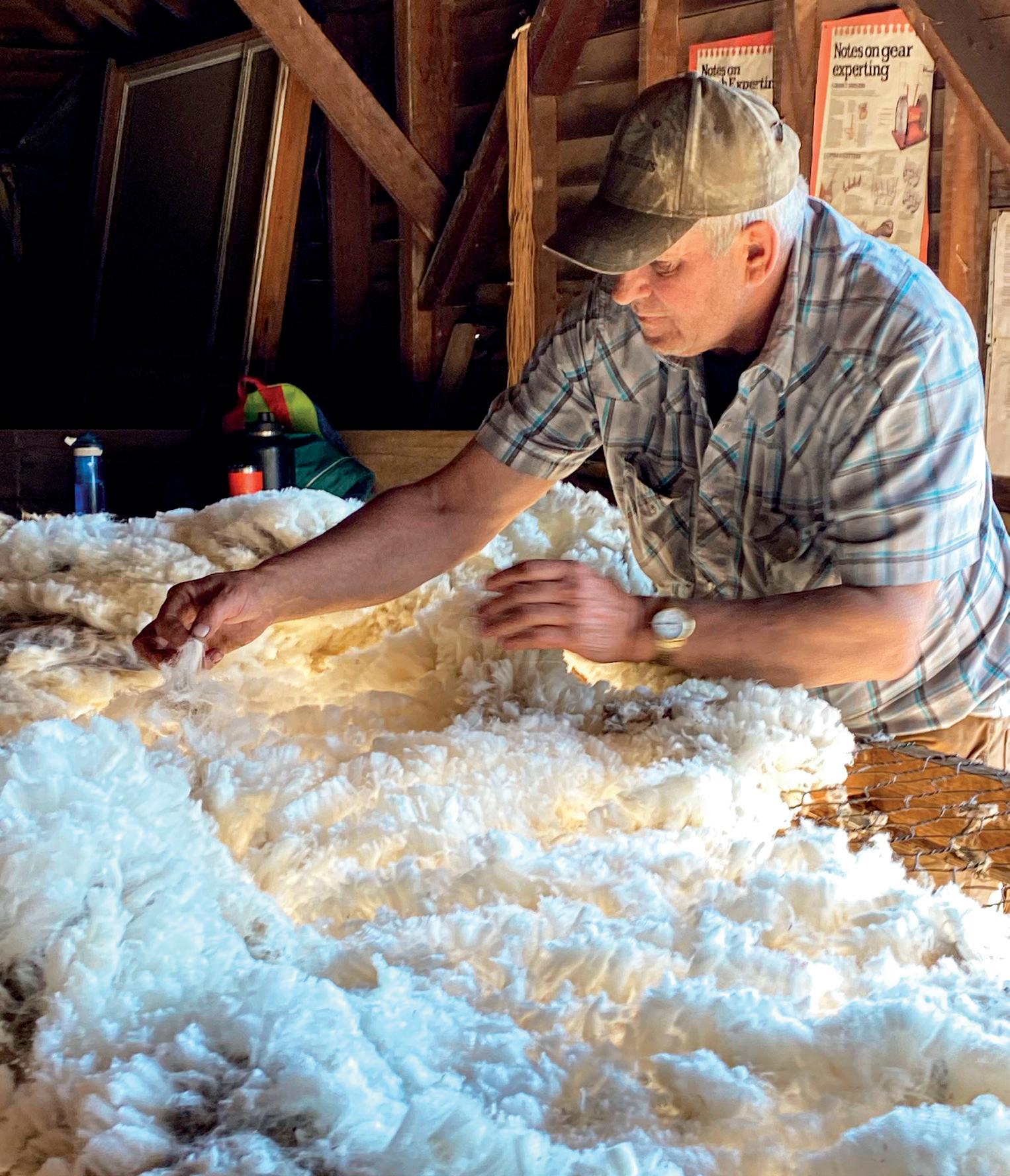
process of removing debris from the raw wool after shearing.
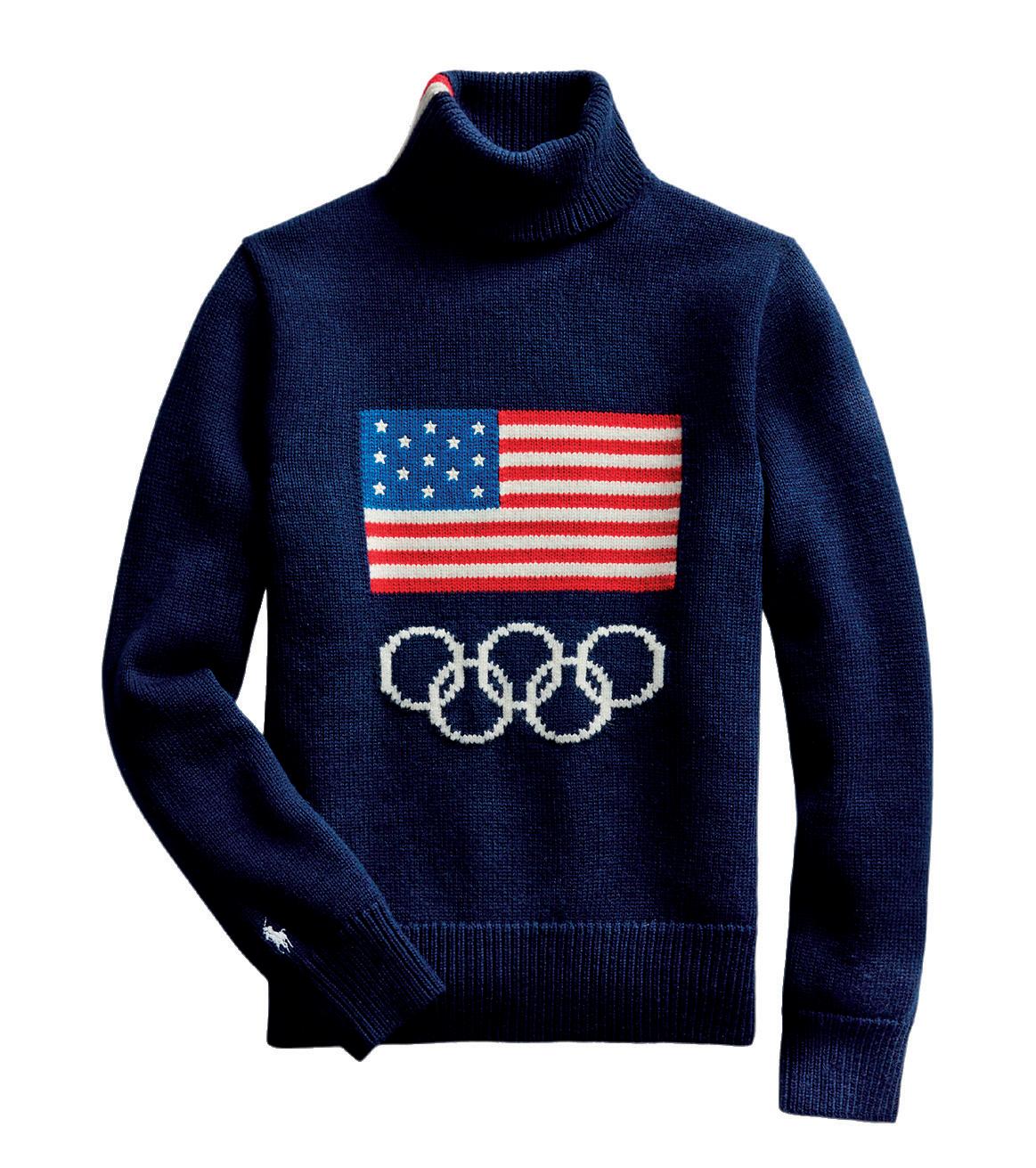
ABOVE Team USA’s 2022 Winter Olympics closing ceremony sweater, designed and made by Ralph Lauren using RWS-certified Shaniko wool.
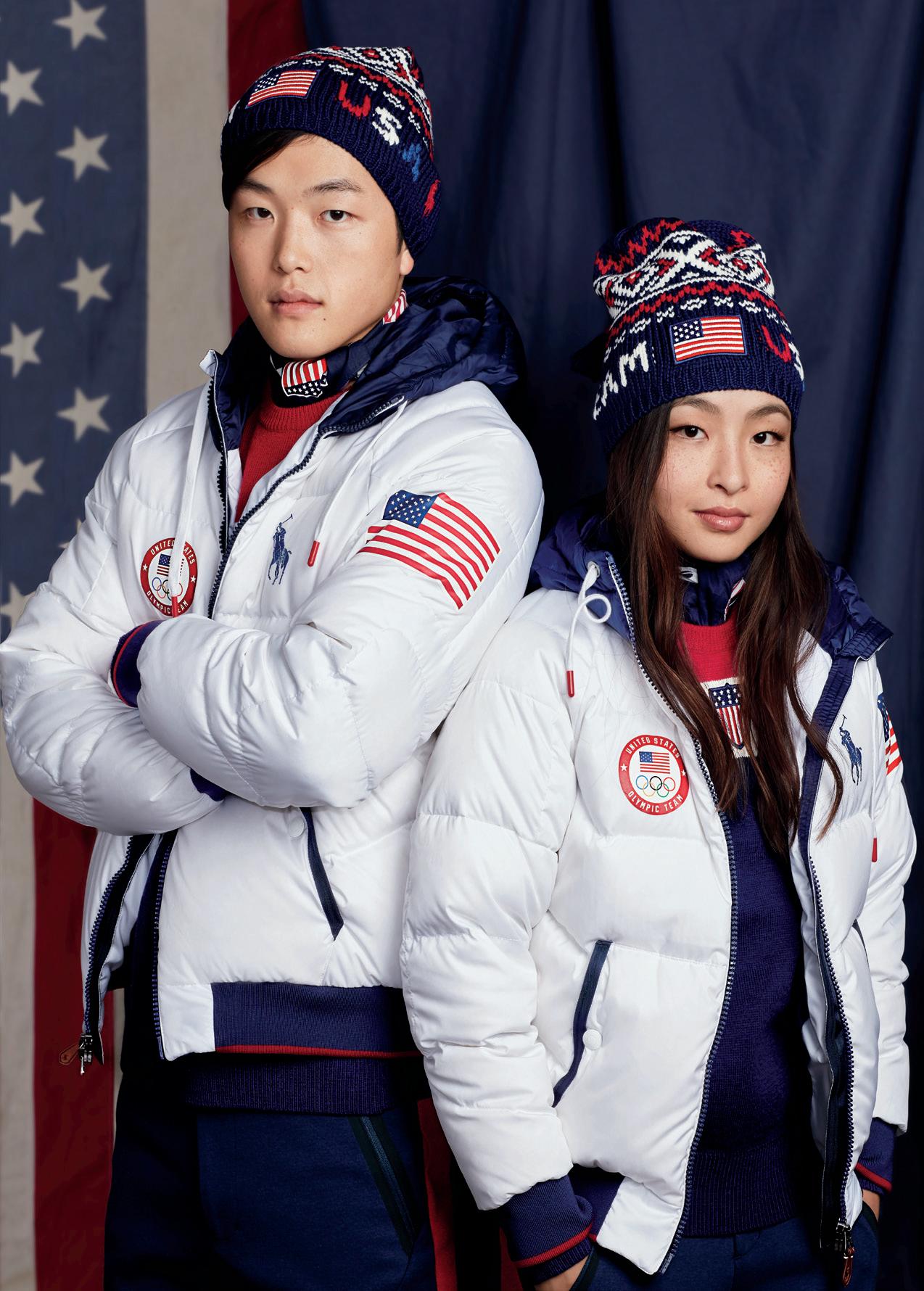
RIGHT Olympic ice dancers Alex and Maia Shibutani wear Team USA’s 2018 Winter Olympics closing ceremony uniforms, designed and made by Ralph Lauren, including hats and sweaters using Shaniko wool.
ISSUE 11 | NOVEMBER 2022 41 Made in America | Features
vvv Three Winter Olympics since have featured sweaters designed and made by Ralph Lauren using Carver’s wool.
Borda’s sheep produce about 10 pounds of wool each. Funneled through SWC, it winds up at pro gressive materials handlers, such as Meridian Specialty Yarn Group in North Carolina, where it is spun into RWS-labeled yarn.
“We’re looking forward to work ing with apparel manufacturers in North America looking for a reliable source of wool yarn, as well as prod ucts with an authentic sustainability story that they can weave into the marketing stories for their prod ucts,” explained Stephen Hudson, Meridian’s senior vice-president of sales and marketing.
That need for an authentic, U.S.based source story is what brought Ralph Lauren to Imperial Stock Ranch a decade ago after an imbro glio over the fact that Ralph Lauren’s U.S. Olympic team uniforms were made in China. Three Winter Olympics since have featured sweat ers designed and made by Ralph Lauren using Carver’s wool. Other clients have included Patagonia and Los Angeles specialty designer Janessa Leoné, who places special
emphasis on sustainability in her garment designs.
“There is an amazing harmony that comes through the partnerships of animals, plants, land, and place in this holistic management approach that contributes to healing of the whole ecosystem,” said Leoné.
Positive Change
Carver credits the original vision of Wild and Woolly
sustainable wool production to her husband, Dan, an engineer who took over Imperial Stock Ranch in 1988 and immediately began improving both grazing practices and grain production. Among other projects, the Carvers eventually created more than 100 water catchment basins in the uplands of the ranch property outside Shaniko, north of Bend, help ing to hold water into the summer,
Sheep were first introduced to America by Spanish ex plorers in the 16th century; numbers peaked in 1884 at 51 million head.
Today, wool is produced in all 50 states by more than 100,000 sheep farms and ranches. The western states lead production.
In 2021, 3.2 million sheep were shorn for wool (compared to 13.5 million in 1981), producing 23 million pounds of wool (109 million pounds in 1981). The United States exported 9.5 million pounds of wool and imported 6.5 million pounds.
42 AMERICAN ESSENCE
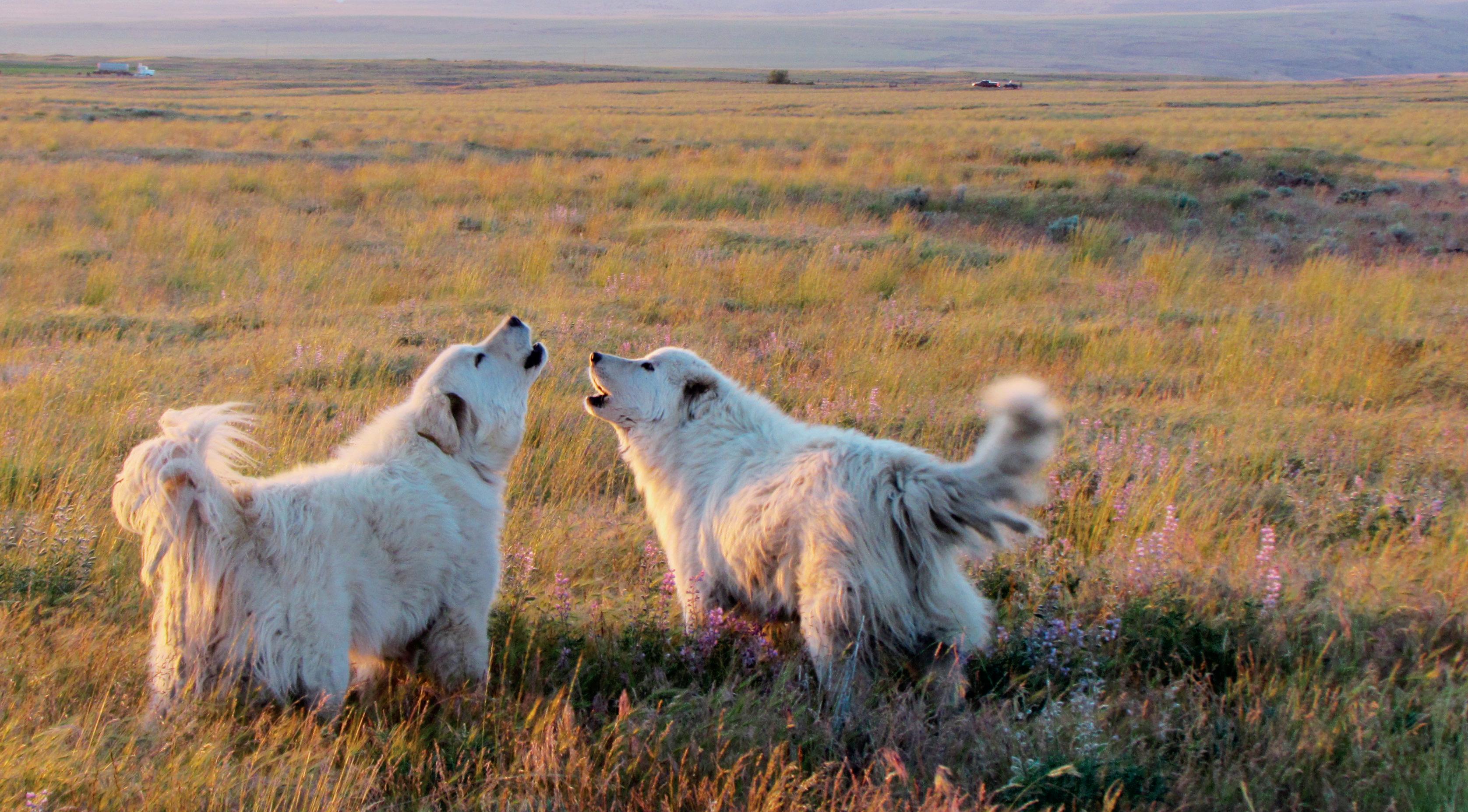
THIS PHOTO Livestock protection dogs stand on duty at Imperial Stock Ranch.
RIGHT Grasslands at Imperial Stock Ranch, with Mount Hood in the background.
improve riparian habitats for wildlife, and, not incidentally, provide water for their sheep.

A small stream on the ranch feeds into the Deschutes River, a major Columbia River tributary. Once upon a time, before it was dammed for power, irrigation, and shipping, the Columbia saw up to 20 million salmonids return every year from the North Pacific. Now, it’s barely a half-million in a good year. “In 1990, Buck Hollow Creek saw just two steelhead return to spawn,” Carver recalled. But after the Carvers and their neighbors made sustainable changes along the stream, dozens of anadromous fish now return each suwmmer and fall.
While healthy salmon runs are considered a prime indicator for environmental stewardship, Carver isn’t resting on those laurels. She’s hired scientific experts to determine the ranch’s carbon footprint, and she happily reports that the net carbon budget is positive, banking an addi tional 51,000 tons of carbon into the soil each year. She’s extending this research across all ranches in SWC. Imagine, she declared, if that could be achieved across the U.S. wool industry.
And never mind carbon banking, she added. Just consider the spiri tual ethos of sheep ranching.
“To me, there’s no better picture of peace and contentment than sheep at rest, and that’s the picture you have if your sheep are not hungry, experiencing no internal stress, and experiencing no external stress.
“They remind me every day that we are all called to honor what we have been given.”
vvv
ISSUE 11 | NOVEMBER 2022
“Take sheep and add water—that simple formula has clothed and fed humankind for more than 10,000 years.”
—JEANNE CARVER, FOUNDER & PRESIDENT, SHANIKO WOOL COMPANY
Made in America | Features
•
A Quiet Devotion
An American Essence reader reflects on how his grandmother’s simple yet fulfilling life left a mark on him
WRITTEN BY Randy Brunson
We stand on the shoulders of giants.
Ora Hopkins was born in Yell County, Arkansas, in November 1902, to Jim and Nancy Miller Hopkins, the 10th of 11 children. She lost her dad before she turned 8. She was orphaned at 14, having lost her mother and two older brothers to the Spanish flu epidemic. Just before her 19th birthday, she married Odes Brunson.
Shortly thereafter, Odes and Ora, and five of Odes’s brothers, moved to river-bottom land along the Verdigris River in northeast Oklahoma, to farm. Over the next 25 years, Ora gave birth to ten children, nine of whom made it to adulthood, and one of whom was my dad. She and Odes spent most of those years as sharecroppers and migrant workers, spending time in Oklahoma, Texas, New Mexico, and California.
As a young wife and mom, she often joined her husband in the fields. Any of the children
strong enough to drag a cotton sack also joined them. The cotton they picked allowed them to buy basic necessities and keep a roof over their heads.
By the time I was old enough to be aware of her, my grandmother had buried parents, siblings, and children. She had borne 10 chil dren and helped care for a growing brood of grandchildren. She had lived in a two-room house with dirt floors and, many times, packed up what little they had and moved across the country in search of work. She had accumu lated so many life experiences; nothing could unsettle her. Her faith in God, and God’s pro vision, was constant. And though she had little in the way of financial resources, she always seemed to have a few dollars to give to a daughter or one of the grandchildren who was in need.
I have many memories of my grandmother, but several stand out. One particular memory I have is of eating her blackberry cobbler, made in a colorful pottery dish that had been hand crafted by the Navajo. She bought the table ware when the family lived in New Mexico.
Just beyond the back fence of my grandpar ents’ home was an empty, overgrown lot. And along that shared fence line, just on the other side, was a row of blackberry bushes. Her promise? If the grandchildren would pick the blackberries, she would make the cobbler. So, my cousins and I who happened to be at her home would slip carefully through the barbed wire, and we’d fill both bowl and belly with blackberries.
Her evening routine was very consistent during the years I knew her. After supper, Grandpa would read the paper and chew his Red Man tobacco. She would sit on the couch, and in the silence broken only by the singsong of katydids, she, with her glasses and a
RIGHT, TOP TO BOTTOM Ora Hopkins Brunson (R), the author’s grandmother, with her daughter Katherine (author’s aunt) and Katherine’s eldest, Nora, during the late 1940s.
The author’s grandparents, Odes and Ora, holding two of their grandchildren (the author’s cousins) at their home in Claremore, Okla.
Odes and Ora pose for their 50th wedding anniversary.
44 AMERICAN ESSENCE Features | Family Roots
magnifying glass, would spend whatever time remained reading her large-print Bible. I have no doubt she prayed for me, and all of her grandchildren, every day.
At no time did I hear her complain or whine. She always had a smile and seemed to always be genuinely grateful. She was barely 5 feet tall, but she was a giant within the family, because of her attitude, her faith, and her perseverance.
Between the time of Grandpa’s death and her death, she saved almost enough money from a $400 monthly social security check to pay for her own funeral expenses. When she died in 1994, she had 36 grandchildren and more than 70 great-grandchildren.
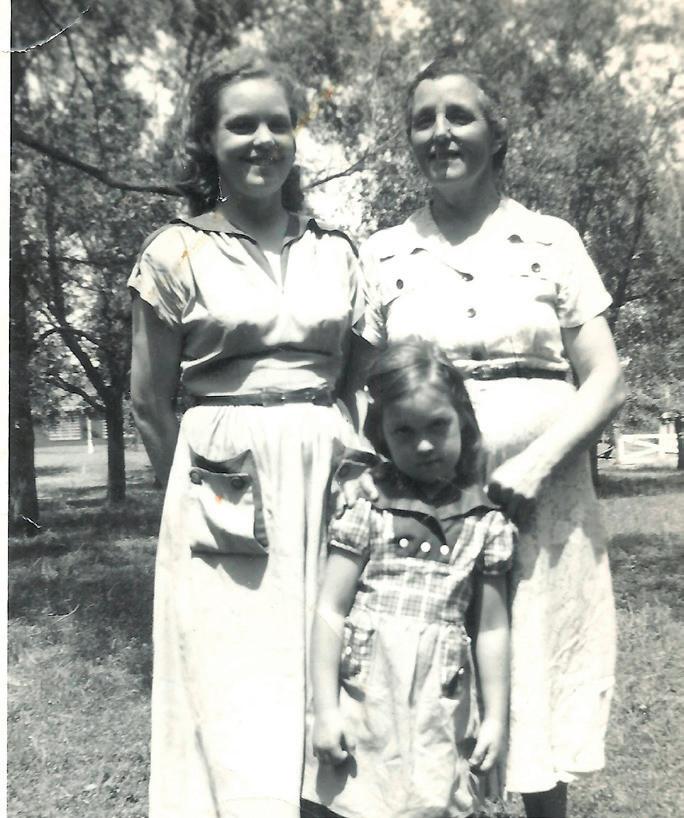
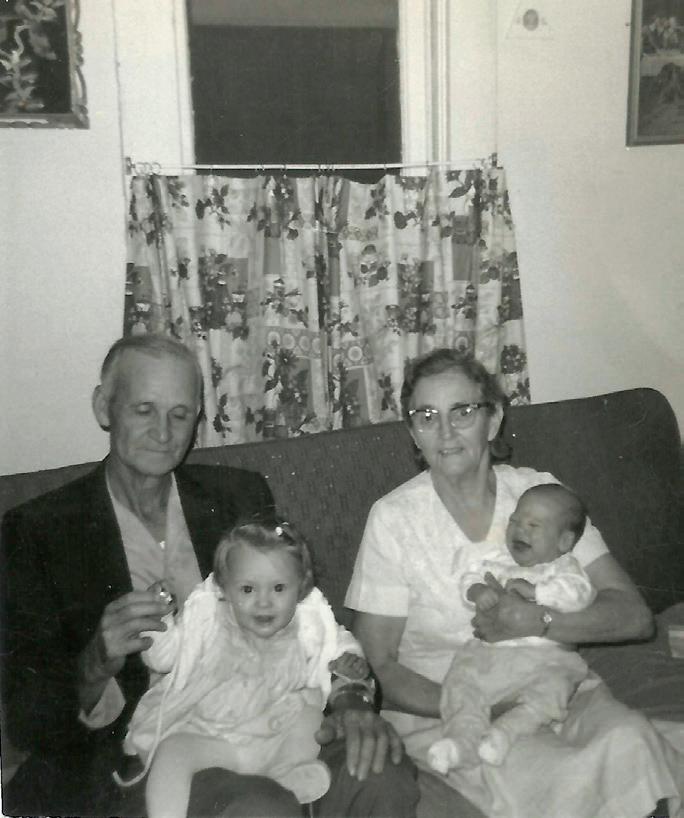
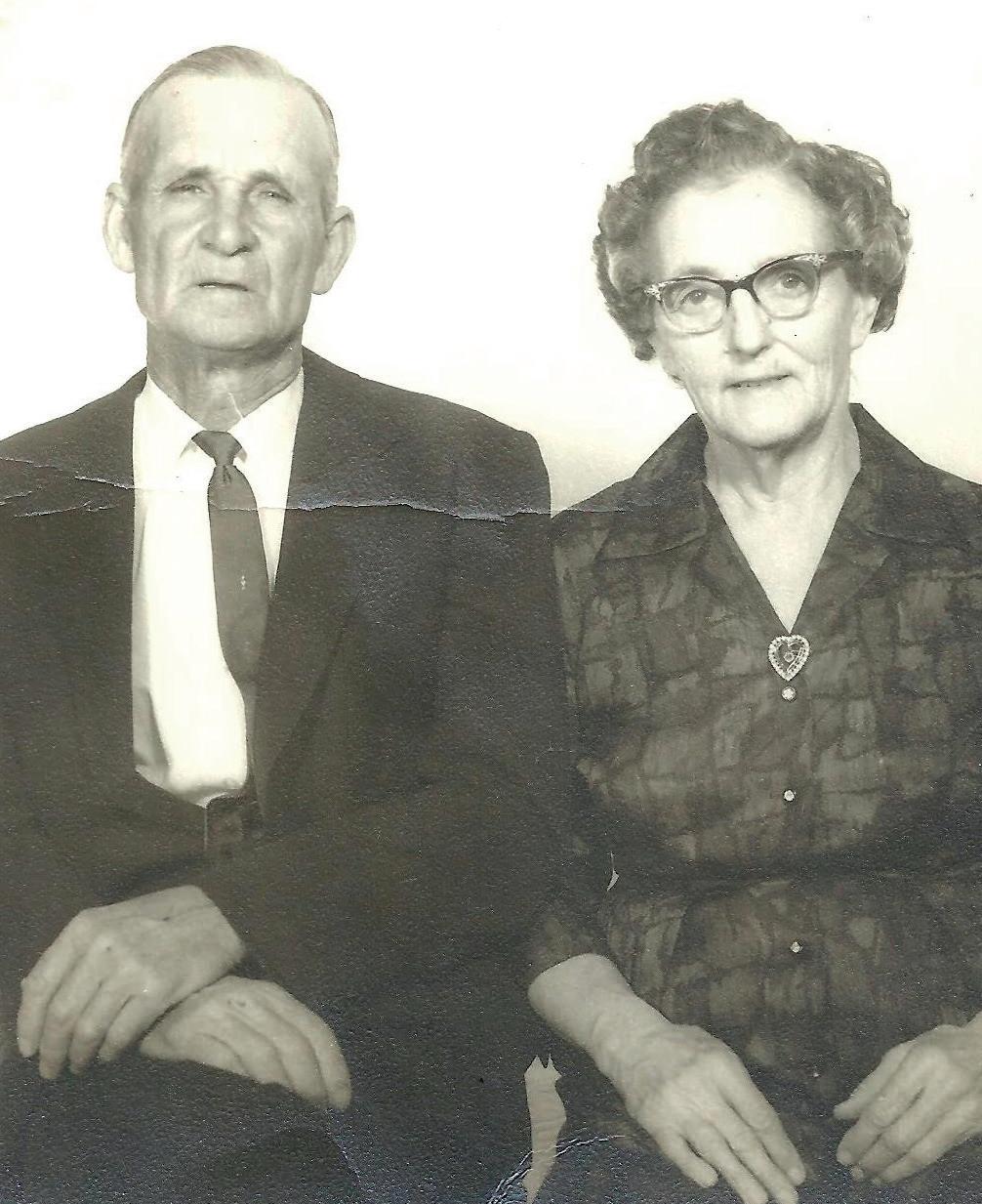
The lessons she taught in her lifetime are timeless. The gift of delicious fruit from thorn bushes. Good food made from the heart and hand of those who love you (and shared with those closest to you). I do believe these experi ences are a glimpse into eternity.
Here’s hoping that you have a grandmother who is a part of your history, who has had such influence. •
American Essence wants to hear from you:
Is there a family member who has positively impacted your life? American Essence invites you to share about your family roots; the lessons passed down from generation to generation; and the people who still inspire you to this day.
We welcome you to send your submission to
ISSUE 11 | NOVEMBER 2022 45
Editor@AmericanEssenceMag.com
vvv
She had accumulated so many life experiences; nothing could unsettle her.
Family Roots | Features
“
T hese are the times that try men’s souls: the summer soldier and the sunshine patriot will, in this crisis, shrink from the service of their country; but he that stands it now, deserves the love and thanks of man and woman.”

General Washington ordered that these words be read aloud to the men of his army before they crossed the Delaware River east ward, this time on the offensive and in the middle of a terrible winter storm, to regain the American ini tiative at the Battle of Trenton. The American Revolution would survive 1776 after all. Although the War for Independence would end in 1783, the struggle for the American ideal persists even now.
Could the Founding Fathers fore see, one wonders, the magnitude of what they had designed? An exercise of profound and immense complexity: that citizens of a sov ereign nation could peacefully and
This Nation Is the First of Its Kind
effectively govern themselves. It is one thing to read the words of John Locke; it is another entirely to establish a society around such rad ical principles.

To that effect, it is difficult for many of us to take measure of how special the American ideal truly is. Generations of Americans have lived and died here, blissfully enjoy ing the individual liberties that peo ple like Washington firmly believed in long before their extent could practically be known.
Just as we have gluttonously become accustomed to the instant connectivity of smartphones, we think little today of what America has given to its citizens, indeed to humanity at large: freedom of indi vidual expression and religion, a powerful free market economy, socioeconomic mobility based on merit and productivity. We see these tired words inked in history books and etched on plaques and statues, and we find ourselves not
merely ignoring them, but resisting them! Those very books are burned, the statues torn down. Such is the absurdity of our times.
2020 was, to say the least, a turbu lent year for the United States. But its most failing characteristic, in my mind, has not been the pandemic, or the political and racial tension, or the civil unrest that has resulted in violent protests and riots. It has been the American revulsion to itself, the disheartening observation of so many Americans openly den igrating their own country. Sullied by misinformation and jaded by the collective narrative, they would believe that America is nothing more now than a superpower in decline. Worse still, they look back on our national history and see fault instead of triumph.
America is not a utopia. The his torical failures of this nation must always be observed within proper context, and it must be acknowl edged that America’s greatest gift
46 AMERICAN ESSENCE
WRITTEN BY Jose Gil
has always been its ability to evolve and adapt with the age. This is a nation where a society can decide when the time is right for change, where the people can determine what is collectively important and voice that determination.
Accordingly, this country has withstood every trial and trib ulation, amassing an incredible resume in the process. America has overcome imperialism, defeated fascism, and outlasted communism.
It has created and distributed more wealth globally than any civi lization before it. It put mankind in the air, and then on the moon, daring us to stretch our imaginations. It has been the hub of our planet’s most significant technological innovations, from the 20th century into the 21st, all while contributing to the overall welfare of people around the world.
It is the first of its kind: a nation of immigrants, people who have flocked from all parts of the globe fleeing persecution or seeking the
chance for a better life. People seek America still, ironically more possessed of the wonders of the American Ideal than perhaps many Americans who have blindly enjoyed them for their entire lives. No, America is not a utopia. But it’s as close as we’ve ever come to cre ating one.

The opening words above were an excerpt from “The American Crisis,” one of the two seminal works written by Thomas Paine, perhaps the greatest champion of American Idealism who ever lived.
His words rang true in 1776, and
the echoes are heard even today. These are the times that patriots are made to remind their nation, and the world, that America represents the best of us because it aims for the seemingly untenable, often with surprising results. It is not a per fect attempt, but it is an altogether incredibly ambitious and honorable one, and that alone is worthy of praise.
To quote Paine once more, “The cause of America is in a great mea sure the cause of all mankind.” So may it be for all generations to come. •
American Essence wants to hear from you: Why do you love this country? What makes it worth celebrating? What moves you about the people and places that make up America? Tell us in an essay of about 600 to 800 words. For instance, you can focus on one aspect of the United States; take a big-picture, comprehensive approach; or tell an illustrative anecdote from your own life.
We welcome you to send your submission to Editor@AmericanEssenceMag.com
ISSUE 11 | NOVEMBER 2022 47
One Candle Lights a Thousand
William Bradford and his wise governance of the Plymouth Colony
WRITTEN BY Jeff Minick
Death came to them in many guises. A sailor who had blasphemed in front of the children fell ill from fever and was buried at sea. Dorothy, the wife of Pilgrim William Bradford, reached the New Land, but slipped from the moored Mayflower and drowned in the freezing waters of Cape Cod harbor. By the end of their first winter in this wilderness, 1620–1621, almost half of the original 102 settlers had

48 AMERICAN ESSENCE
Plymouth Colony
History
died, most of them from disease.
The first governor of the colony was the capable John Carver. He was quite possibly the author of “The Mayflower Compact,” a cov enant of basic democratic rules by which the colonists would govern themselves, signed by 41 of the men going ashore. He directed the building of houses, the gathering of food, and with the help of Squanto, a native who spoke fluent English, engineered a treaty with Massasoit
of the Wampanoag Confederacy. Yet by the spring of 1621, Carver too had gone to the grave, a victim of heat stroke or bad water.
A New Governor
The colonists who escaped this winter of death then elected William Bradford as governor, a post he would hold for most of the next 30 years.

sibility. Orphaned at an early age, and raised by an uncle on a farm where he worked in the fields, Bradford also spent a portion of his boyhood ill and confined to bed. There he immersed himself in the Bible and other religious texts. By the time he was a teenager, he had decided he was a Separatist, a branch of the Puritans seeking to break from the rites and rituals of the Anglican Church. When the Separatists later emigrated to the Netherlands to escape government persecution, Bradford was among them, working in the cloth trade and deepening both his faith and his familiarity with likeminded dis senters. He was, then, an educated believer who knew the meaning of hard physical work.
Despite these advantages, like his predecessor, Bradford faced grave challenges. The colonists who had stepped ashore at Plymouth were divided into Separatists and Strangers. The latter had traveled to the New World not for reli gious freedom but from motives of wealth and ambition. Native tribes might still threaten the colonists, so weakened were they by sickness and death. Fields must be planted, more houses and a fortress built, and land fairly distributed to every family, excluding servants. In the meantime, they could expect only rare intermittent assistance from England. In that regard, they might as well have lived on Mars.
And William Bradford met these challenges. Moreover, he and the other Plymouth settlers gave our nation a basket filled with gifts.
Many Gifts
The “Mayflower Compact” is a short document—it can be read in a couple of minutes—but therein lies a phrase that would guide Bradford and would eventually
ISSUE 11 | NOVEMBER 2022 49
|
In several ways, his past had well prepared Bradford for this respon
LEFT “The Mayflower on Her Arrival in Plymouth Harbor” by William Halsall, 1882. Oil on canvas. Pilgrim Hall Museum, Plymouth.
influence the American Revolution and Constitution. The signers of the compact vowed to “combine ourselves together into a civil Body Politick” that would “enact, constitute, and frame, such just and equal laws, Ordinances, Acts, Constitutions, and Offices, from time to time, as shall be thought most meet and convenient for the general Good of the Colony; unto which we promise all due Submission and Obedience.”
For their time, those concepts were as earth-shaking as Jefferson’s Declaration of Independence. They were a social contract for a rough democracy, and Bradford insured they remained more than words written and then forgotten. He called the first town meeting in 1621, and this tradition remains in force today in several New England
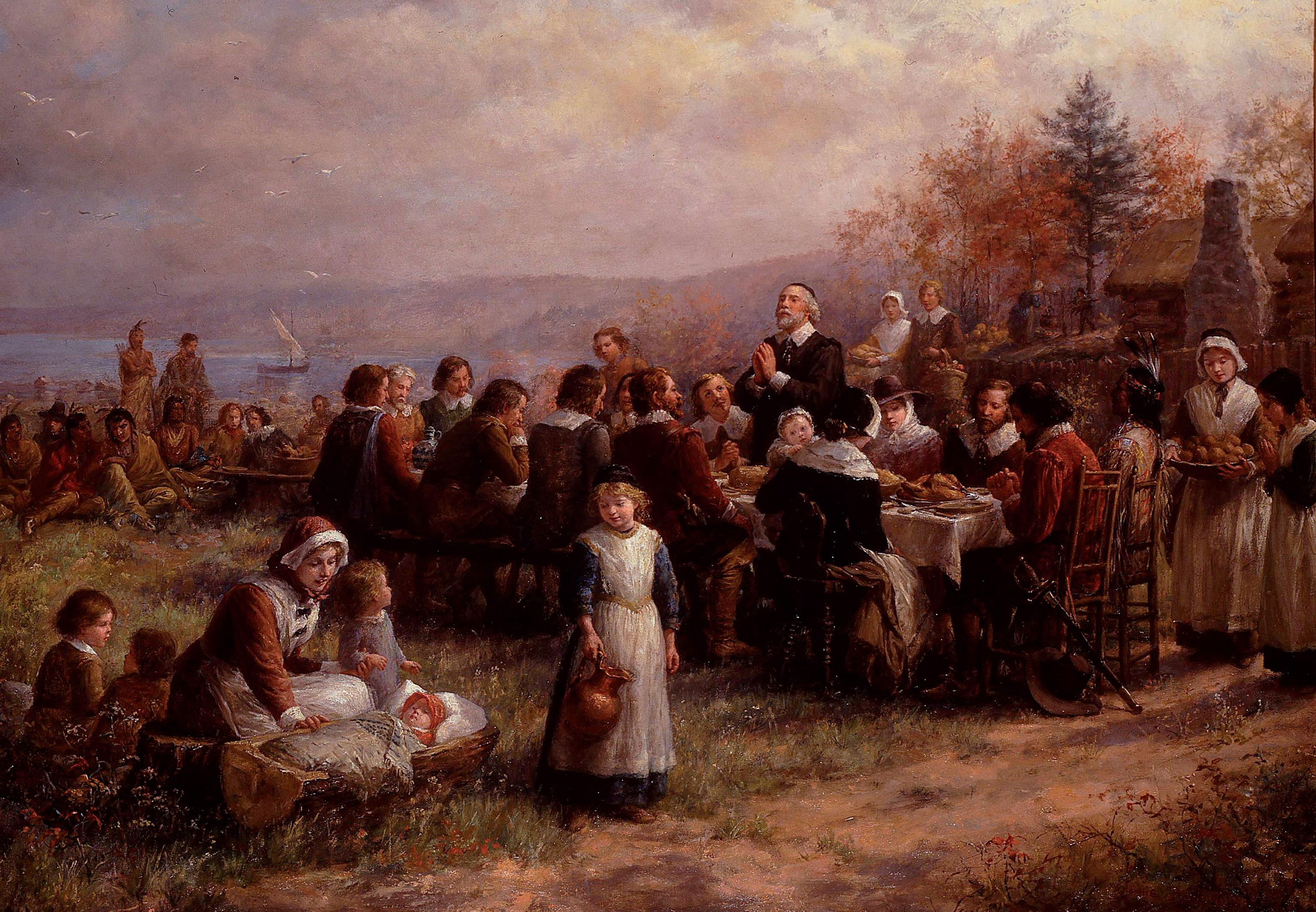
states. He played a major part in settling legal and financial issues among the colonists. He was instru mental in helping pay off the debt incurred with an investor for the voyage, thereby freeing up his neighbors to keep more of the earn ings from their labor for themselves.
In addition, Bradford welcomed
FAR ABOVE “Thanksgiving at Plymouth” by Jennie Augusta Brownscombe, 1925.
ABOVE Illustrated postcard of Gov. Bradford’s house at Plymouth, Mass., in 1621.
RIGHT Protestant pilgrims are shown on the deck of the ship Speedwell before their departure for America from Delft Haven, Holland, on July 22, 1620. “Embarkation of the Pilgrims” by Robert Walter Weir, 1844. Oil on canvas. United States Capitol, Washington.
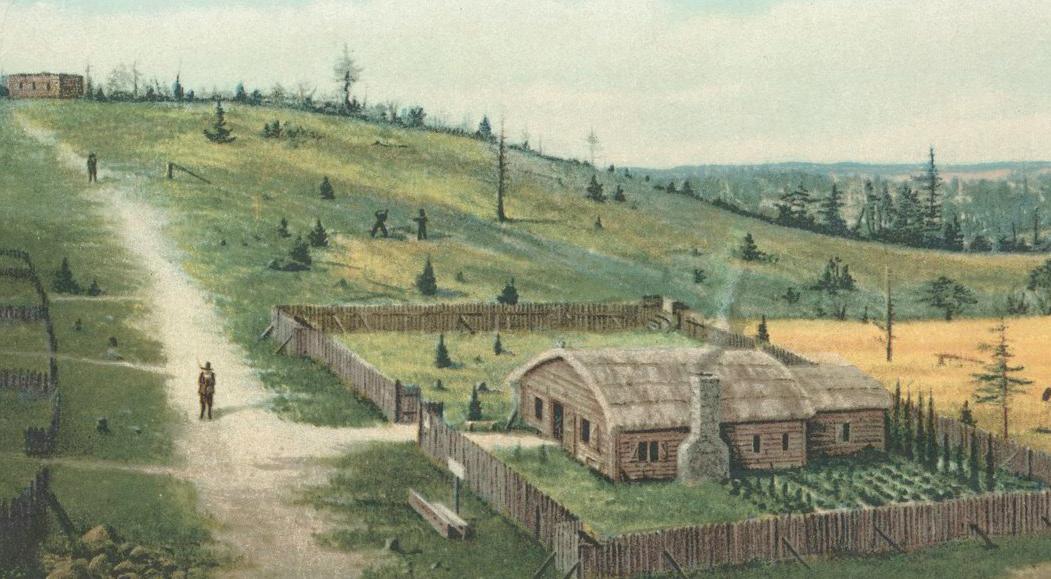
50 AMERICAN ESSENCE
other non-Separatists to settle in Plymouth. This practice of tol erance was unusual for its day, especially in the wake of religious wars and the upheavals in England during the previous century. The Strangers of the original company, for example, as well as the non-Sep aratists who followed them, were not required to attend Sunday worship services and were gener ally treated as equals. One of these, Myles Standish, is remembered in Bradford’s journal, “Of Plymouth Plantation,” with affection and grat itude for his tending of the sick the first winter and his subsequent mil itary leadership.
Out of Small Beginnings
In “Of Plymouth Plantation,” we find this entry: “Thus out of small beginnings greater things have
vvv
been produced by His hand that made all things of nothing, and gives being to all things that are; and, as one small candle may light a thousand, so the light here kin dled hath shone unto many. ...”
In November 1621, Governor Bradford organized a Thanksgiving for good crops, a three-day fes tival of prayer, festivities, and food attended by Separatists, Strangers, and 90 members of the
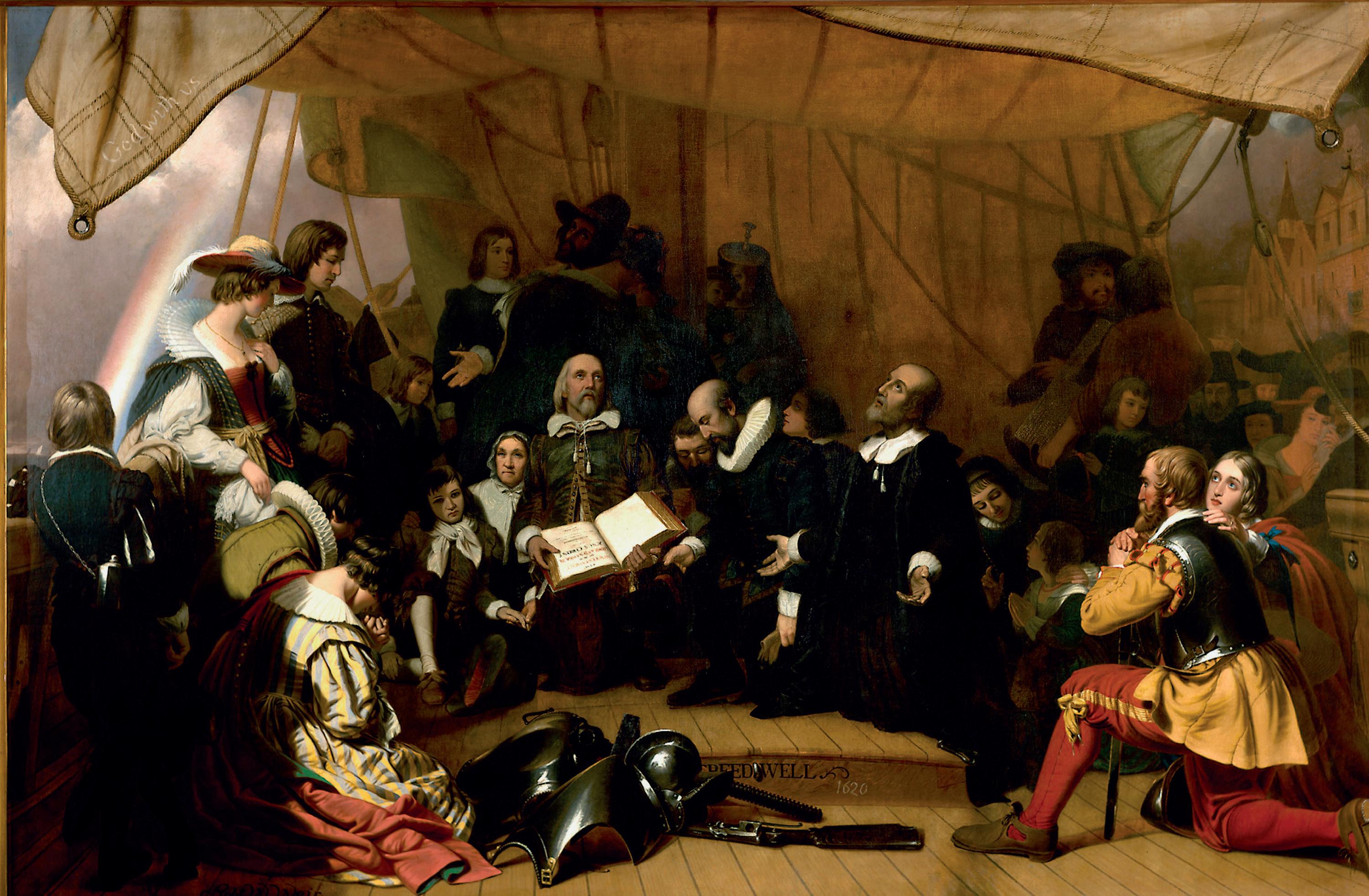
Wampanoag tribe.
Whatever our economy may bring this fall, most of us will also likely celebrate Thanksgiving with friends and family. As we enjoy our meals and express our gratitude for the blessings we’ve received, this day also provides the per fect opportunity to remember the Plymouth colony’s “one small can dle” and the light it would bring to the entire world. •
ISSUE 11 | NOVEMBER 2022 51 Plymouth Colony | History
The colonists who escaped this winter of death then elected William Bradford governor, a post he would hold for most of the next 30 years.
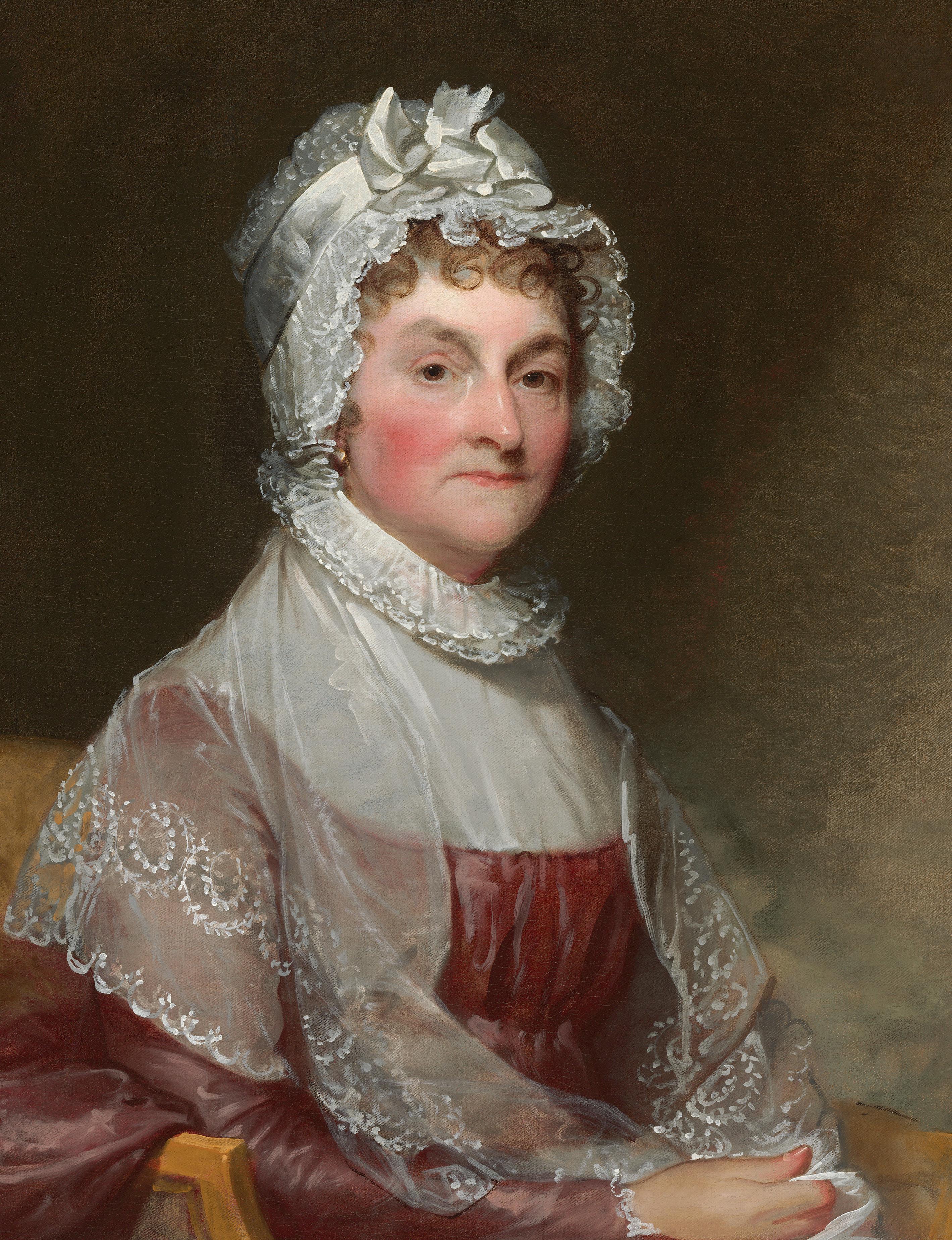
Our Nation’s Founding Mother
A keen intellect, steadfast courage, and ardent patriotism places Abigail Adams on the same plane as America’s founders
WRITTEN BY Deena C. Bouknight
Abigail Adams has been lauded by historians and at least one presi dent, Harry Truman, for her grit and keen insight. As the second of the first ladies, Abigail experienced first hand the fight for a nation and the estab lishment of America. In fact, it was perhaps the Revolutionary War that shaped who she would become as first lady.
Described as a true partner to America’s first vice president and second president, Abigail was a proud Massachusetts native.
Born in 1744, she married John Adams, raised her children, and died in the same colo ny-turned-state. She even named one of her children after the coastal Massachusetts city that would become her final resting place: Quincy. Abigail and John had six children— three daughters and three sons—and four of them lived to adulthood, with John Quincy Adams becoming the sixth U.S. president.
LEFT A portrait of 56-year-old Abigail Adams by artist Gilbert Stuart, between 1800 and 1815. This was Stuart’s only finished portrait of Mrs. Adams during her term as first lady.
Although a devoted mother, Abigail was also an avid reader with a curious, and often assertive, countenance. It was her sharp mind, even at 15 years old, that caught the attention of 24-year-old John, a country attorney with business in the community of Weymouth, where Abigail was born and raised.
A Witness to the War’s Start
Throughout their courtship and then 54-year marriage, at least 1,100 letters were exchanged between them. Abigail’s personality, inter ests, and character are clearly revealed in well-preserved primary sources. One such letter captures Abigail’s fortitude. It was writ ten after the Battle of Bunker Hill, during which she was caring for not only her own four small children but also the four children of Dr. Joseph Warren, then president of the Massachusetts Provincial Congress. His wife had died a few years earlier. Instead of staying in the relative safety of their home, 10 miles away from the fighting, she snuck away to a Penn Hill granite outcropping to watch smoke rising from Charlestown, which was burning.
Afterwards, when she learned that Warren
ISSUE 11 | NOVEMBER 2022 53
First Ladies | History
had been killed in the fighting, she wrote to her husband: “My bursting Heart must find vent at my pen. I have just heard that our dear Friend Dr. Warren is no more but fell glori ously fighting for his Country—saying better to die honourably in the field than ignomin iously hang upon the Gallows. Great is our Loss.” She ends the letter, “I cannot compose myself to write any further at present.”
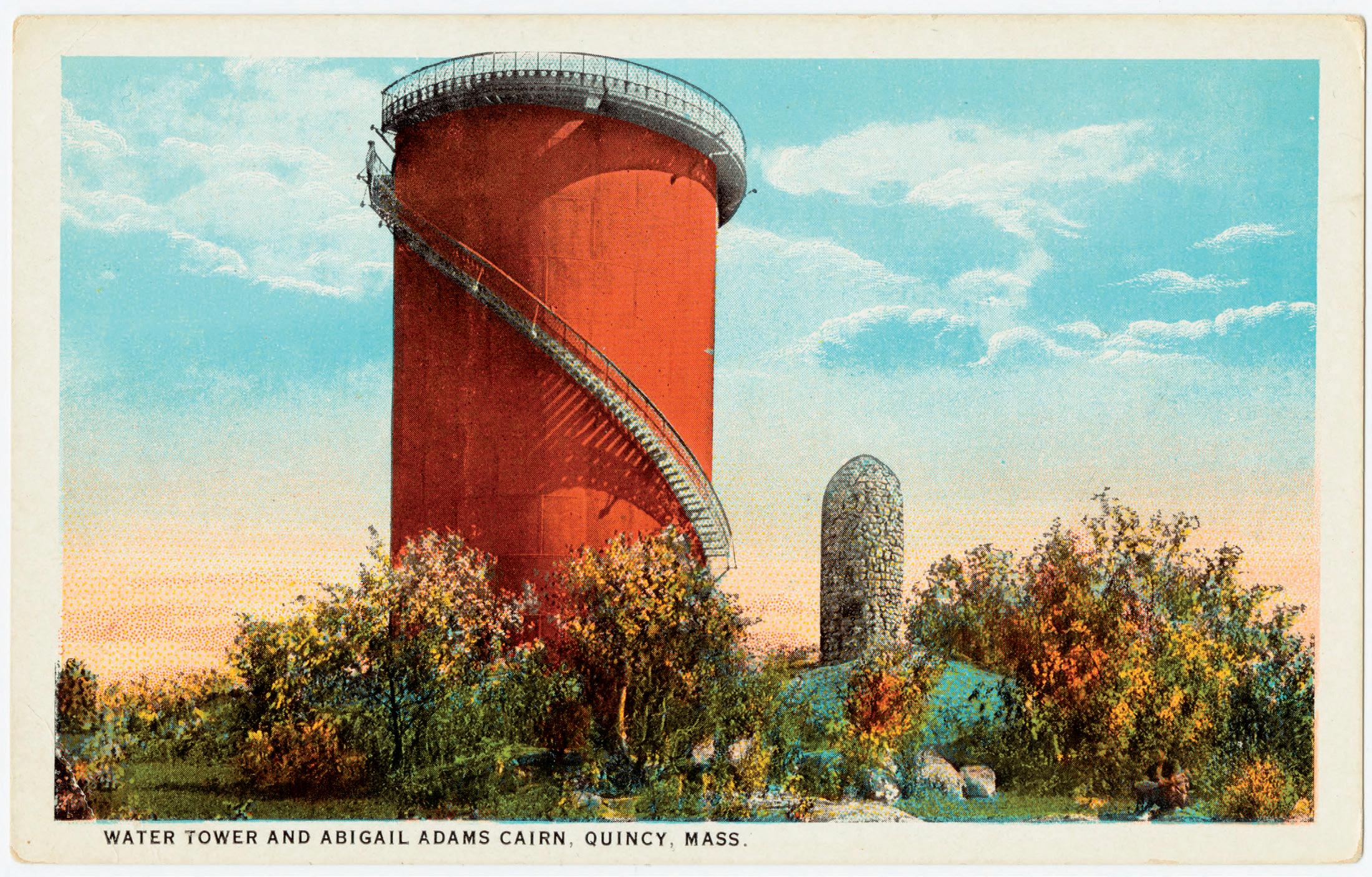
The spot where Abigail courageously observed the war’s start is now called Abigail Adams Cairn, a cairn being a Scottish term for a memorial marker.
An Able Advisor
It was during the eight-year War for Independence, while Abigail and John were often apart due to his role as a delegate to the First and Second Continental Congresses and as a diplomat in France and Holland, that Abigail solidified her role as his con fidant and advisor. Letters between them
vvv
showed how she read documents, news reports, and speeches in their entirety and offered insight. For example, a June 25, 1795 letter expressed: “It is reported here that 19 Senators are for a ratification of all but the 12th article of the Treaty. Greenleafs paper contains daily Some weak foolish superficial sausy reflections & abuses.”
In one of her most oft-quoted letters, dated March 31, 1776, she asks John pointed ques tions about the political and military aspects of the war. Then, she implores him to consider,
54 AMERICAN ESSENCE
Although a devoted mother, Abigail was also an avid reader with a curious, and often assertive, countenance.
History | First Ladies
LEFT Postcard (between 1930 and 1945) of a water tower and the Abigail Adams Cairn, where Mrs. Adams courageously observed the war’s beginning in Quincy, Mass.
ABOVE RIGHT The presidential portrait of John Adams by Gilbert Stuart. The artist began both portraits in 1800 and took 15 years to deliver them. John Quincy Adams relayed the family’s sentiments over Stuart’s procrastination, stating, “Mr. Stuart thinks it the prerogative of genius to disdain the performance of his engagements.”
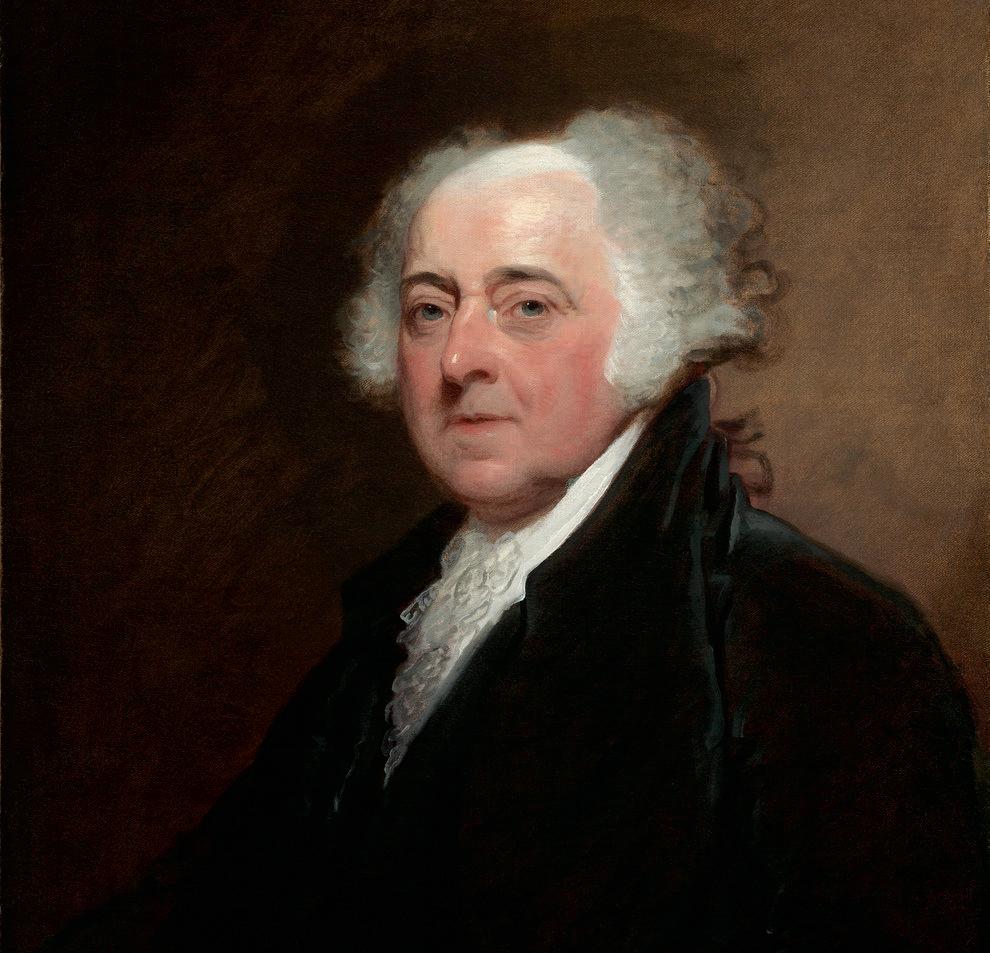
in his role as a leader of a new nation, a for ward-thinking concept: “In the new Code of Laws which I suppose it will be necessary for you to make I desire you would Remember the Ladies, and be more generous and favourable to them than your ancestors.” One appeal to her husband on behalf of women was to make formal education free and accessible, with one reason being that educated mothers could better prepare their sons to become astute cit izens and leaders in the new republic.
Not only did the Adams’s family survive the Revolutionary War, they thrived. Abigail joined John in Europe for four years after America’s independence from Britain was secure. She entertained and conversed with high-ranking officials and affluent individuals while John was a diplomat, and did the same
during his two terms as vice president (1789–1797) and one term as president (1797–1801). However, she also made good use of her intel lect and writing skills by penning defenses of her husband and his policies.
Abigail was so much recognized as more than the wife of John, the mother of his children, and a political hostess that essay ist Judith Sargent Murray of Gloucester and Boston wrote to a cousin in 1798, “It is confi dently asserted that every transaction of his administration is now laid before her—she is not only his bosom friend, but his aid and his Councellor in every emergency … [so that the politicians] declare that was the President called out of time, they should rather see Mrs. Adams in the Presidential chair than any other character now existing in America.”
•
ISSUE 11 | NOVEMBER 2022 55 First Ladies | History
The Sinking of the CSS Albemarle
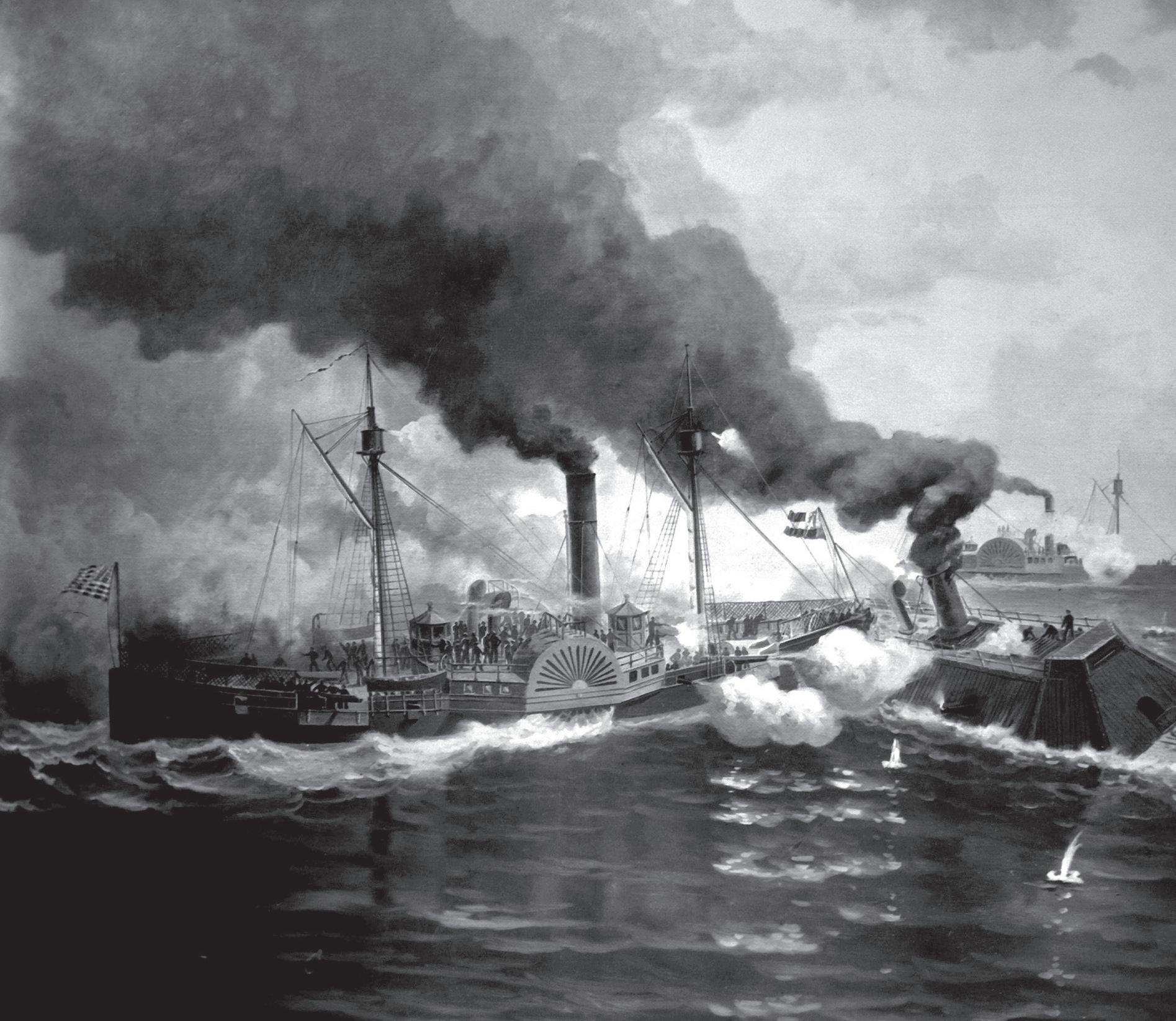
A daring plan enacted by Union Army’s Lt. William Cushing defeated the seemingly invincible ironclad
WRITTEN BY John Quarstein
56 AMERICAN ESSENCE
ABOVE Copy of a painting illustrating the battle between the Sassacus and the Albemarle in May 1864.
RIGHT A portrait of Lt. William B. Cushing photographed between 1861 and 1865.
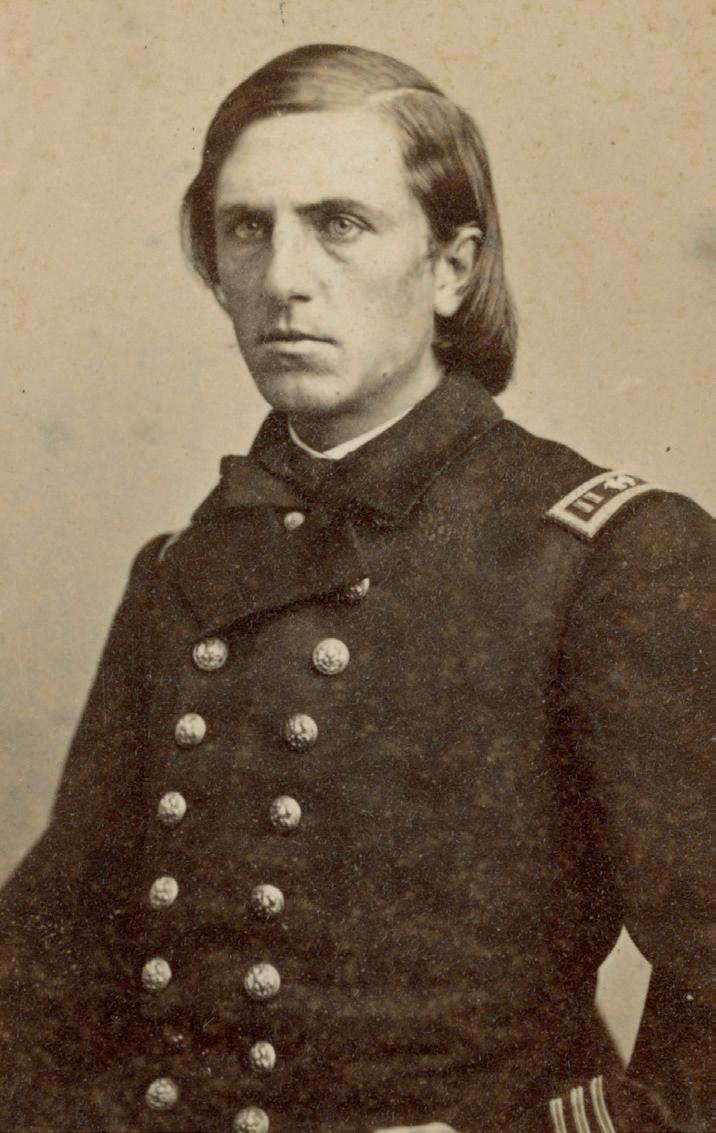
In October 1864, Union officer Lt. William Cushing became an instant hero for his lead ership and daring which resulted in the destruction of CSS Albemarle, a ship which, at the time, seemed unsinkable.

Back in early 1862, the Union Gen. Ambrose E. Burnside had conquered the North Carolina Sounds. This action stunned the Confederacy. The capture of North Carolina’s Great Inland Sea took away a vast agricultural region and threatened or disrupted vital trans portation links between Richmond, Virginia, and the Deep South.
Thus, to regain this region, in April 1864, the Confederacy unleashed the ironclad ram CSS Albemarle to challenge Union superiority on the Sounds. The Confederate ironclad sank USS Southfield on April 19, 1864, which enabled them to liberate the
North Carolina towns of Edenton, Plymouth, and Washington. The undefeated CSS Albemarle remained a thorn in the side of the Union at its dock at Plymouth, North Carolina.
Rear Adm. David Dixon Porter was the commander of the North Atlantic Blockading Squadron. Porter was determined to destroy the Confederate ram. He wrote to all of his commanders:
“There is but one chance for wooden vessels in attacking an ironclad. You will make a dash at her with every vessel you have, and ‘lay her onboard,’ using canisters to fire into her ports, while the ram strikes her steering apparatus and disables her. You will see that every vessel is provided with proper grapnels, to hold on by while going along side, and a boarding party will be appointed to lash the ves sels together. Even if half of your vessels are sunk you must pursue this course.”
His commander Lt. Cushing submitted two daring plans, one of which Porter believed might be successful. The lieutenant had purchased two 30-foot launches in New York—each armed with one 12-pounder Dahlgren boat howit zer and one 14-feet long spar tor pedo. These launches were known as Picket Boat No.1 and Picket Boat No.2. The plan was to steam up to the Albemarle and detonate the spar torpedo beneath the ram’s hull.
Adm. Porter had approved this expedition with some misgiv ings. He advised Cmdr. William H. Macomb, “I have directed Lieutenant Cushing to go down in a steam launch, and, if possible, destroy this ram with torpedoes. I have not great confidence in his
ISSUE 11 | NOVEMBER 2022 57
Civil War | History
success, but you will afford him all the assistance in your power and keep boats ready to pick him up in case of failure.”
Engaging the Plan
Picket Boat No. 2 was lost on the trip down from New York to the North Carolina Sounds. The launch had run aground and was captured by the Confederates in Wicomico Bay, Virginia. Picket Boat No.1 arrived in the Albemarle Sound on Oct. 24,1864.
On Oct. 26, Cushing left the Union North Carolina Squadron with the goal of destroying or capturing the CSS Albemarle. At 10:30 p.m., he ran aground on a sandbar. The next day at about 2 a.m., the torpedo launch was freed with the rising tide, and Cushing and his 14 men got underway. The launch towed a cutter contain ing seven men, who were brought along to silence any Confederate lookouts that might be stationed on the sunken USS Southfield. The wreck’s superstructure still remained above the river. It was rumored that the Confederates had even placed a small howitzer on
the ship as a sentry post to block any attempt to reach the Albemarle. Just before midnight Cushing’s expedition entered the Roanoke River.
Cushing hoped to capture the Albemarle live; however, as the picket boat steamed past the Southfield into its approach to the ram’s wharf, a sentry spotted Cushing’s approach. A bonfire was lit and a fusillade of shots rang out. Rifles and revolvers were focused on the launch. Cushing’s coat was pierced by at least four bullets and his hand creased by a minie ball (a muzzle-loading rifle bullet).
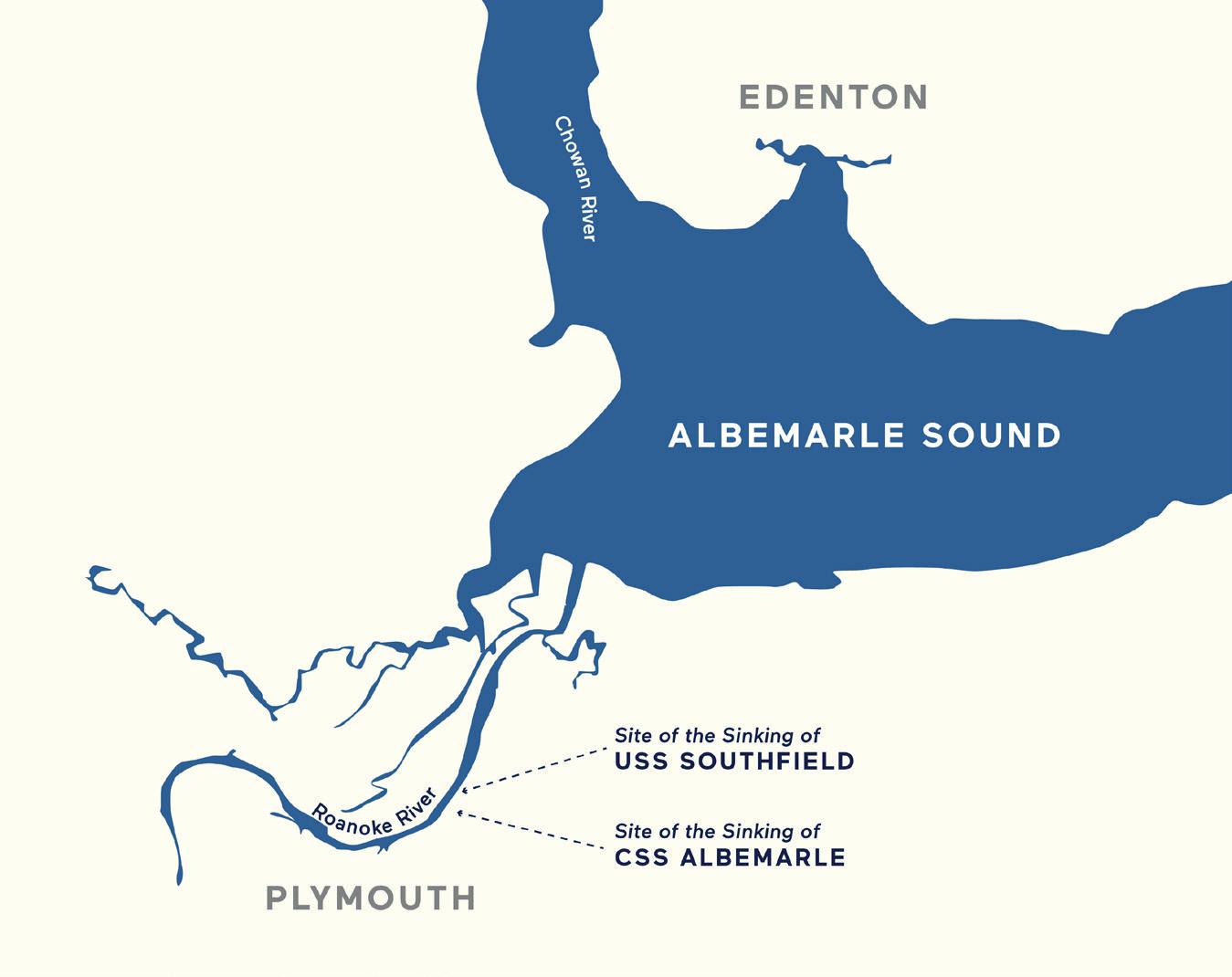
Cushing cast off the cutter and ordered full steam. Then, as he neared the ironclad, he noticed a log boom—anti-torpedo protec tion—surrounded the ram. So, he circled the launch to gain momen tum which made the craft an easy target. Then, the launch lurched ahead at a full head of steam through a hail of fire, crashing over the log boom. The bonfire and gunsmoke made it a desperate scene as Cushing calmly stood at the launch’s bow and lowered the spar torpedo, releasing the explo
sive charge. Just as he pulled the lanyard to explode the device, a point-blank-range shot from the ironclad’s 6.4-inch Brooke rifle smashed the launch, throwing Cushing and his men into the river. The Albemarle immediately sank in eight feet of water with a gap ing hole in the ram’s port quarter. Lt. Warley later reported that the
Sepia wash drawing of the CSS Albemarle by R.G. Skerrett, 1899.

58 AMERICAN ESSENCE
“water gained on us so fast that all exertions were fruitless merely leaving her shield and smokestack out.”
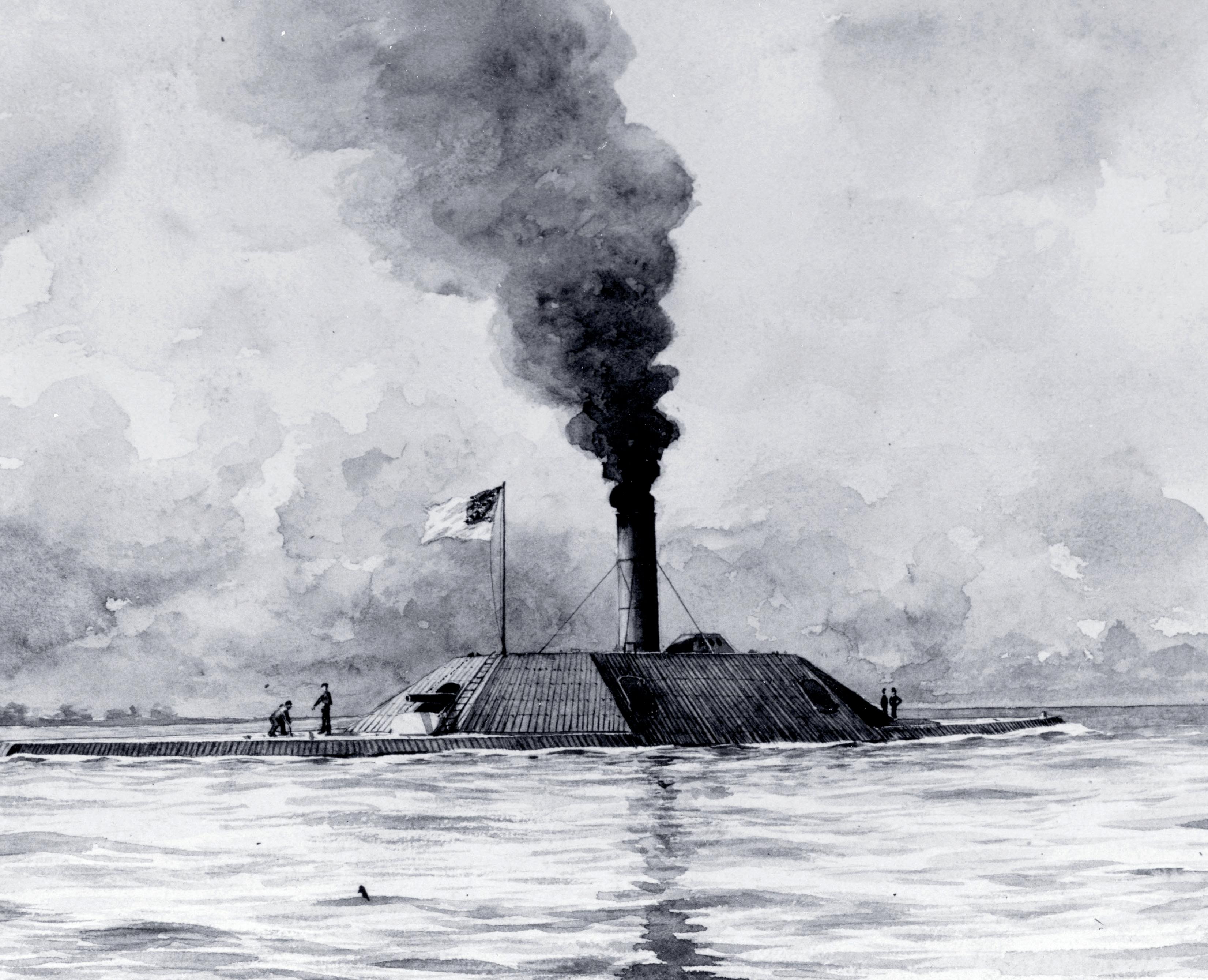
After the Battle Cushing found himself alone in the water. He took off his coat and shoes and swam for shore. Later, he was able to steal a skiff and
hand paddled down the Roanoke River to the Sound. He was almost captured twice and came close to drowning. Yet, when he was retrieved by a Union ship, all rejoiced and labeled him a hero for all times. The only other to escape was Seaman Edward Houghton; the 11 other crew members were captured and sent to Andersonville
POW Camp.
The Union North Carolina Squadron quickly came up the Roanoke and bombarded Plymouth, North Carolina on Oct. 29. The Confederates abandoned the town on Oct. 31, 1864, leaving behind the wreck of their high hopes of regaining and retaining the North Carolina Sounds. •
vvv
The undefeated CSS Albemarle remained a thorn in the side of the Union at its dock at Plymouth, North Carolina.
ISSUE 11 | NOVEMBER 2022 59
Civil War | History
American Pilots to the Rescue
In World War I, Americans volunteered to form the Kosciuszko Squadron and help the Polish fend off the Bolsheviks
WRITTEN BY Allen Shoff
Near the end of World War I, the Russian Empire, its army rent by defeat after costly defeat and with morale ebbing, collapsed. Bread riots, strikes, and a mutinous army forced Czar Nicholas II Romanov to abdicate on March 15, 1917. After three centuries of Romanov control, the Russian Empire dis solved into a provisional government, which was soon replaced by an October coup that installed Vladimir Lenin and his Bolsheviks in command of vast swathes of the country.
The Bolsheviks were not content with
Russia alone. Although now embroiled in a bitter civil war, they sought to spread the communist revolution all the way to the Atlantic Ocean. The newly independent former subjects of the Russian Empire— Poland, Finland, Ukraine, Estonia, Latvia, and Lithuania, in particular—now found the Bolshevik hordes on their doorsteps. The Red Army swept out from the steppe, snatching up territory and installing puppet governments, despite attempts of brave peoples along the line of march to resist. It seemed more and more likely that all Europe would turn red.
ABOVE (L to R): Merian C. Cooper and Cedric Fauntleroy, aviators who fought in the Kosciuszko Squadron of the Polish Air Force, pose for a photograph between 1919 and 1920.
RIGHT A photograph of Cooper on Feb. 1, 1920, during the time he served with the Kosciuszko Squadron.

60 AMERICAN ESSENCE History | World War I
vvv
U.S. Army Capt. Merian Cooper watched the spread of Bolshevism and feared for the future of Europe. He had a personal stake in the continent, having flown a British De Havilland 4 over France during World War I. He’d demonstrated both daring and tre mendous piloting skill when, hit by a flurry of rounds from a group of German Fokker aircraft that ignited his gas tank, he threw the plane into a steep dive, choking the flames and managing to crash land next to a German infantry outpost. He spent the remain der of the war in a prisoner of war camp. It was during his incarceration that he heard Russians plotting to spread communism throughout the world. His biographer consid ered this the moment that he began his “life long crusade against the Communists.”
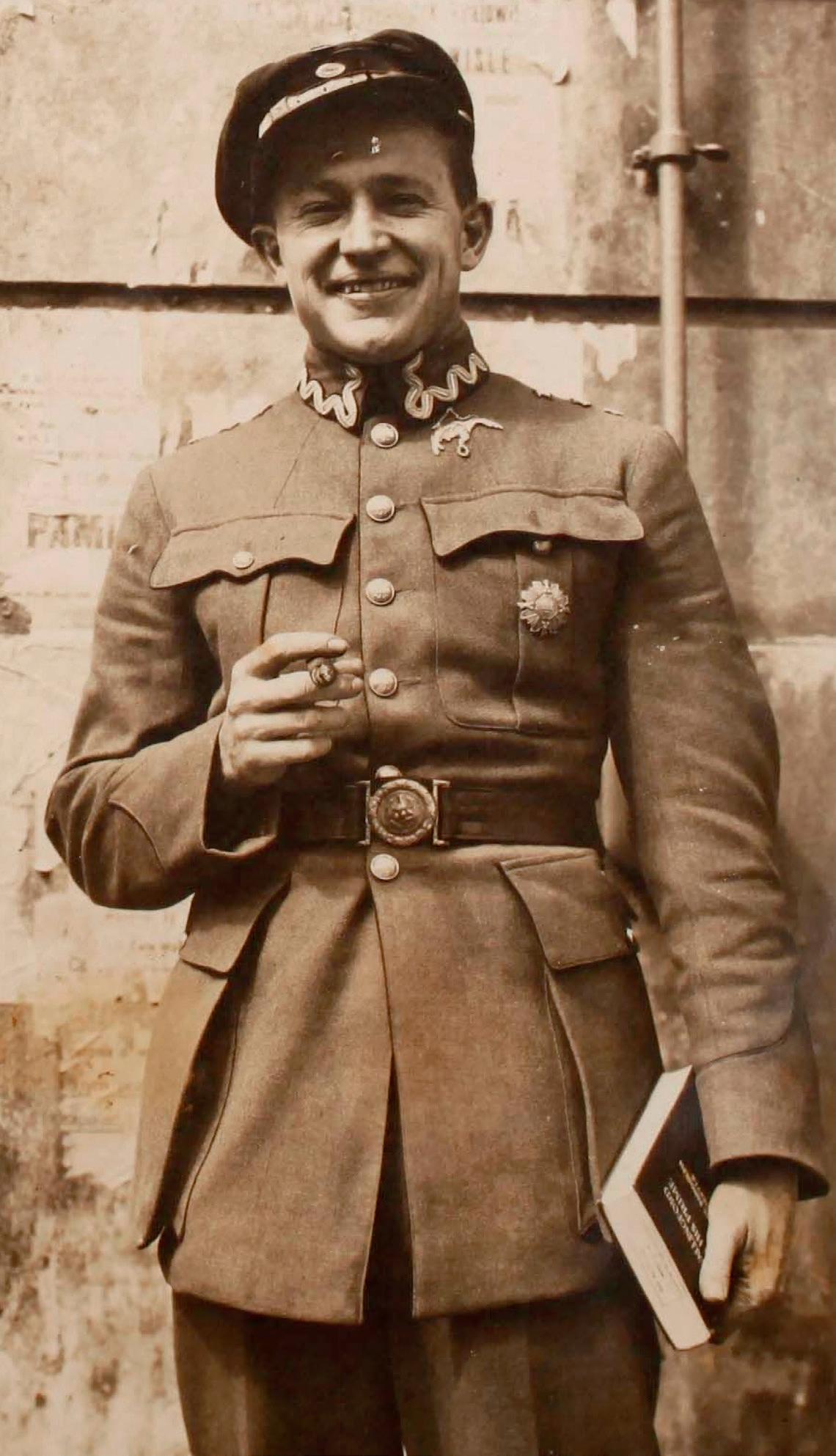
Fighting for Poland
After his release, Cooper joined a humanitar ian mission to Poland, now embroiled in the midst of what history would call the Polish–Soviet War. The sight of innocent young Poles defending their freedom tore him to his heart. He wrote to his father, “It grieves me every day that I am doing so little for the cause of Polish liberty, when Pulaski did so much for us.” The story of Casimir Pulaski—the Polish noble who fought and died for American independence as the “father of the American cavalry” and was comforted at his death by Cooper’s own great-great-grandfather— deeply affected Cooper. He vowed to set aside his peaceful work and “get into the fight” against the Bolsheviks.
By early 1920, the colorful captain, joined by the equally eccentric Maj. Cedric Fauntleroy as commander and a total of 21 American pilots, entered the fray as the Polish 7th Air
Escadrille. The squadron soon bore the name of Tadeusz Kosciuszko, the famed Polish army officer who aided the Americans in the Revolution. The American flyers saw them selves as repaying a debt owed to Poland, who loaned her son to the infant nation when she most needed aid.
Initially tasked with logistical and reconnais sance duties, the Americans gladly aided the Polish army’s May 1920 Kyiv Offensive, aimed at freeing the Ukrainians from the grasp of the
ISSUE 11 | NOVEMBER 2022 61 World War I | History
The Americans bravely flew sortie after sortie, diving out of the sky to strafe the Bolshevik forces at horse-head height.
communists. Largely unopposed in the air, the Kosciuszko Squadron nonetheless found the advancing Bolsheviks striking at their airfields and had to flee and regroup. Although the Polish and Ukrainian forces recaptured Kyiv on May 7, 1920, soon the tide turned under the wave of red, and the American flyers fought a bitter retreating action across Ukraine and back to Polish soil. Here the Americans did their namesake proud.
Maintaining air superiority over the Bolshevik forces, the Americans bravely flew sortie after sortie, diving out of the sky to strafe the Bolshevik forces at horse-head height. This daring tactic and the roar of the biplane engines terrified the enemy horses and men alike, and to sow additional confu sion, the Americans hand-dropped bombs with devastating accuracy, breaking up the enemy advance. Meanwhile, in what came to be known as the Miracle on the Vistula, the tat tered body of the Polish army, bolstered by stu dents, nurses, professors, and priests, smashed the encroaching Bolshevik army along the Vistula River and saved Warsaw from danger. Polish cavalry regrouped along the line and, aided by the exhausted pilots of the Kosciuszko
Squadron, obliterated the Red cavalry at the Battle of Komarow in late August through early September 1920. The salvation of Poland was at hand.
One of the Polish commanders, Gen. Antoni Listowski, is said to have remarked that “without [the] assistance [of the Kosciuszko Squadron], we would have gone to the devil a long time ago.” Many of the men in the Squadron received Poland’s highest military decoration, the Virtuti Militari, including Merian Cooper and Cedric Fauntleroy. The brave airmen of the Kosciuszko Squadron never shied from the thick of the fight: Three of the 21 pilots were killed, and the group as a whole flew more than 400 sorties in defense of their fellow man. Just like the many for eign noblemen that came to fight for America during her own revolution—Baron von Steuben, the Marquis de Lafayette, and, of course, Tadeusz Kosciuszko, to name a few— the men of the Kosciuszko Squadron stood up against oppression and risked their lives for others. Whether drawn by a sense of adven ture, of camaraderie, or of duty, they lived out the core values of what it means to be an American.
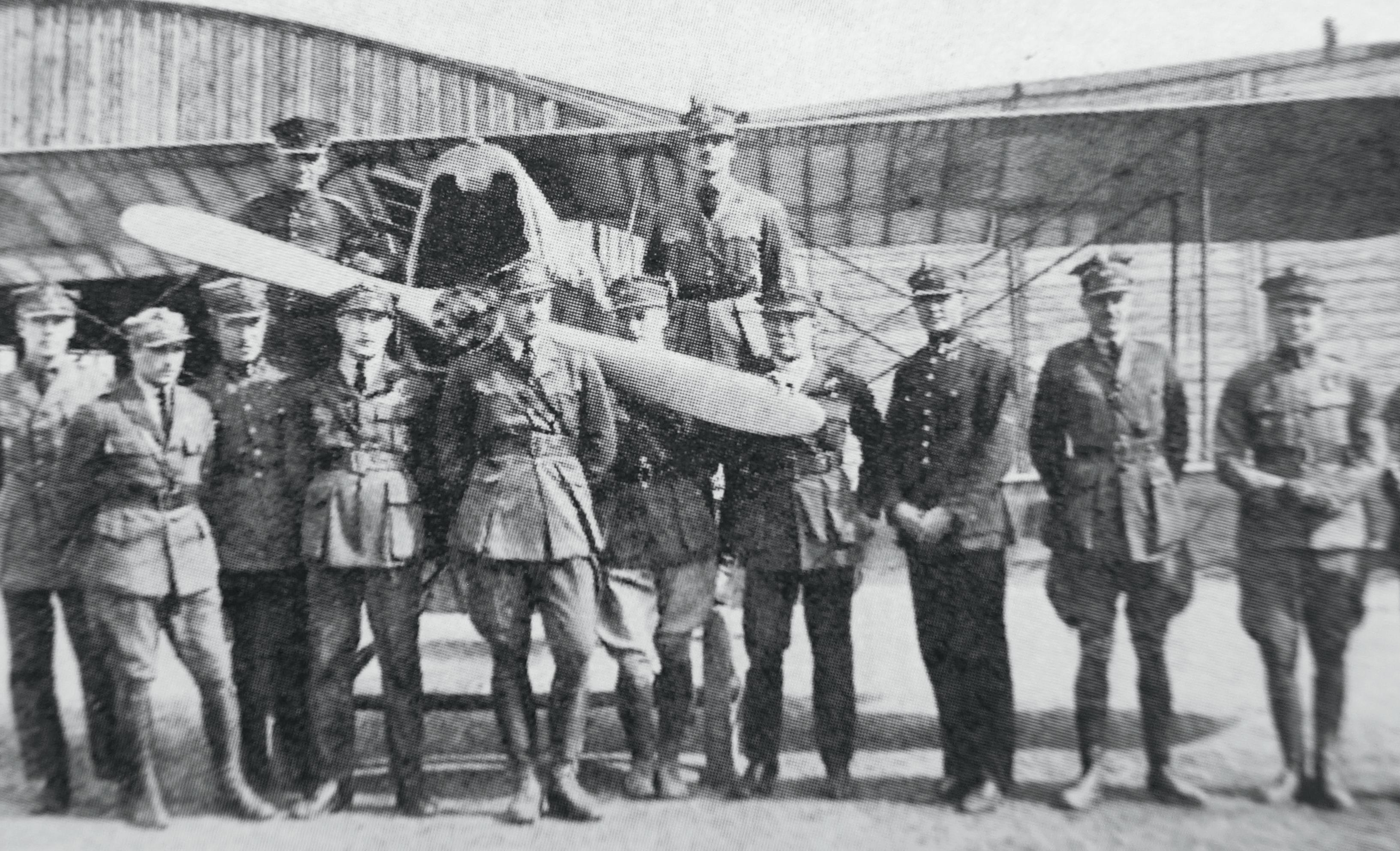
•
ABOVE Photograph of the Kosciuszko Squadron of the Polish Air Force on Jan. 9, 1920.
62 AMERICAN ESSENCE
Test Your Knowledge
How Well Do You Know the History of Veterans?
True/False
1. Veterans Day is celebrated on November 11 each year to mourn those who have fallen while serving in the United States Armed Forces.
2. The U.S. Coast Guard is currently the sec ond-smallest branch of our nation’s military.
3. Nearly one in three veterans have a disability as a result of their service.
4. On their escort missions during World War II, the Tuskegee Airmen never lost a bomber to enemy fire.
Fill-in-the-Blank
5. The _________ is a symbol of wartime remem brance, due to its red color and the tendency for its seeds to germinate on battlefields where soil is disturbed by shells.
6. The first members of the Navy Nurse Corps are known as “The ________ Twenty” for their pio neering contributions to medical care.

7. Veterans Day was originally known as __________ Day to celebrate the end of World War I.

Multiple Choice
8. As of July 2022, the Medal of Honor has been awarded for acts of valor 3,534 times. The largest proportion of these were given during:

A. The American Revolution
B. The Civil War
C. World War II
D. Vietnam
9. Which of the following novels is NOT based on their veteran-author’s experience in an American conflict?
A. “Slaughterhouse Five” by Kurt Vonnegut
B. “Catch 22” by Joseph Heller
C. “The Thin Red Line,” by James Jones


D. “For Whom the Bell Tolls” by Ernest Hemingway
10. Of the 16 million service members who participated in World War II, how many are still alive?
A. Less than 100,000
B. Less than a quarter million
C. Less than half a million
D. Less than 1 million
WRITTEN BY Andrew Benson Brown Answers to the quiz on pg 95
ISSUE 11 | NOVEMBER 2022
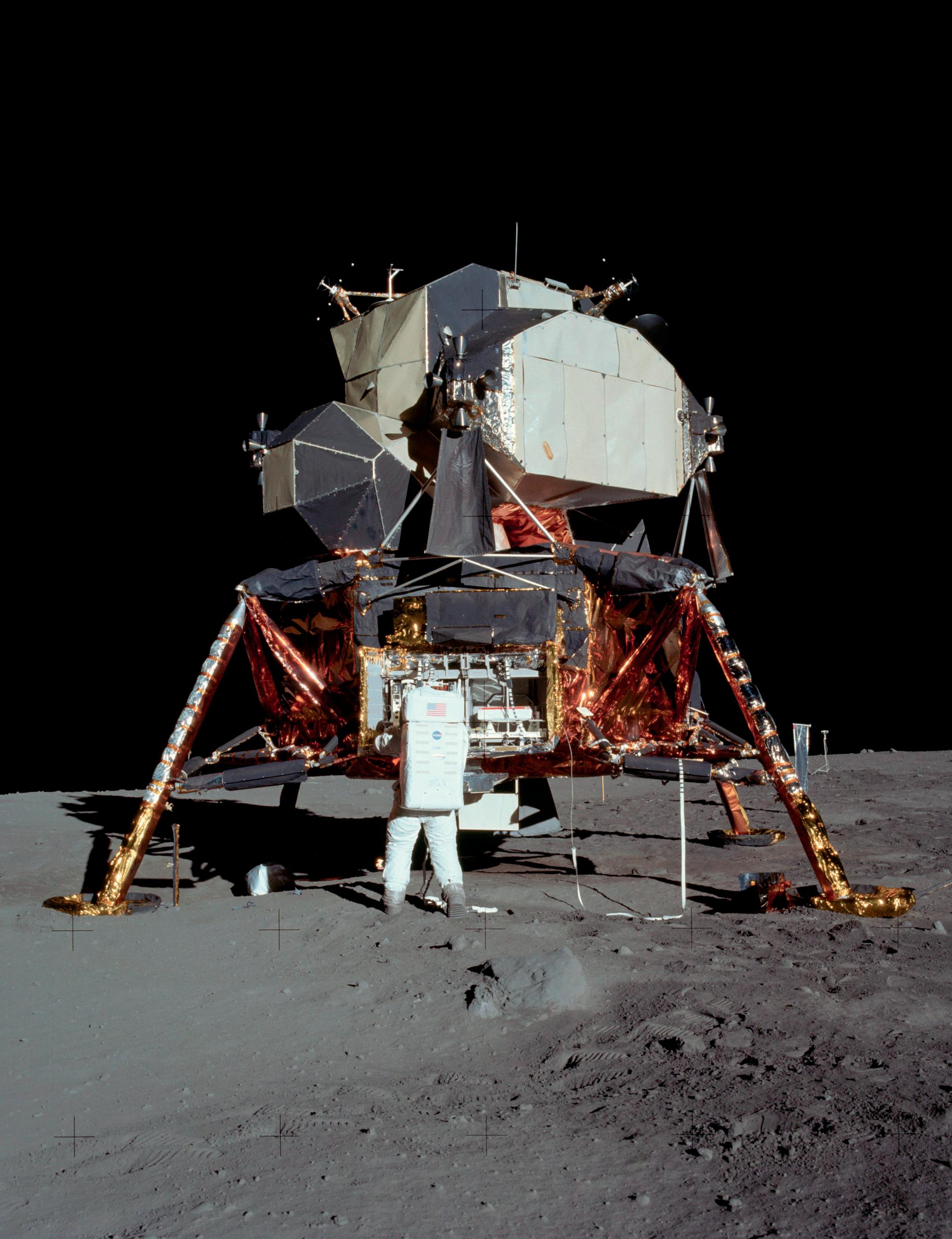 Buzz Aldrin removes the passive seismometer from a compartment in the SEQ bay of the Lunar Lander (Apollo 11 “Eagle”), July 21, 1969.
The Little Company That Could
Grumman’s engineering team took us to the moon (and got us back again)
WRITTEN BY Bob Kirchman
In the fall of 1962, a little air plane manufacturer on Long Island, Grumman Aircraft Engineering Corporation, beat out seven competitors for the lunar module contract. How did this happen?
The story begins when Leroy Grumman, the company’s founder, struck out on his own in 1929. Working out of a rented garage, he began developing some of his own experimental airplane designs. In 1932, he presented the U.S. Navy with the FF-1, his first production fighter aircraft. The plane’s design continued to be improved, leading eventually to the creation of the F4F Wildcat, Grumman’s first fighter with folding wings.
Grumman built tough planes. The “cat” series, built for the U.S. Navy, had a reputation for getting their crews home. The sturdy air craft, designed and built for carrier deployment, earned the company the nickname “Grumman Iron Works.” Aluminum, however, was the material Grumman engineers had real mastery over, forming it into beautiful aerodynamic shapes to build their planes.
Enter Aeronautic Engineer
Tom Kelly
Grumman engineer Tom Kelly spoke of his involvement in the early development of the moon lander: “I guess I’ve been involved in Apollo-related work as long as anybody in Grumman, actually. I started on the thing in 1960—April 1960.” Kelly and his team competed for NASA-funded studies. Though they didn’t win any of them, Kelly said, “we went down and gave our own study conclusions to the NASA people right along with everybody else—we had a very active interest in-house, and we just wouldn’t let it die; whether it was funded, or not, we kept going with it.” Kelly’s work ushered in a whole new era for the company.
Grumman was not one of the larger competitors for NASA con tracts. They initially offered to be a subcontractor in General Electric’s bid to build the command mod ule and service module. North American Aviation beat them out. NASA had originally intended for the command module and service module to land on the moon and take off directly from the lunar
surface to return to Earth. That particular spacecraft configuration proved to be prohibitively massive. It would require a rocket larger than anything already developed just to get it into space. But an engineer at Langley Research Center, John Houbolt, suggested taking along a smaller spacecraft, just to land on the moon. It would then launch from the lunar surface and rejoin the command module, which would now remain in lunar orbit.
The lander would be discarded after the astronauts transferred back inside the command module, which alone would return to Earth. Rendezvous in lunar orbit seemed risky, but it saved so much weight that it allowed the program to go forward at a pace that would meet President John Kennedy’s chal lenge to land on the moon within
ISSUE 11 | NOVEMBER 2022 65
Space | History vvv
Grumman built 15 landers, 6 of which actually went to the moon.
the decade. When NASA decided that they would develop the pro gram around the lunar-orbit ren dezvous approach, Tom Kelly and his team were well prepared to offer their proposal. Grumman wrote up the proposal, and General Electric became the subcontractor for the lander’s electronics.

When they won the contract in 1962, Kelly and his engineer ing team realized that they would be faced with the same challenge
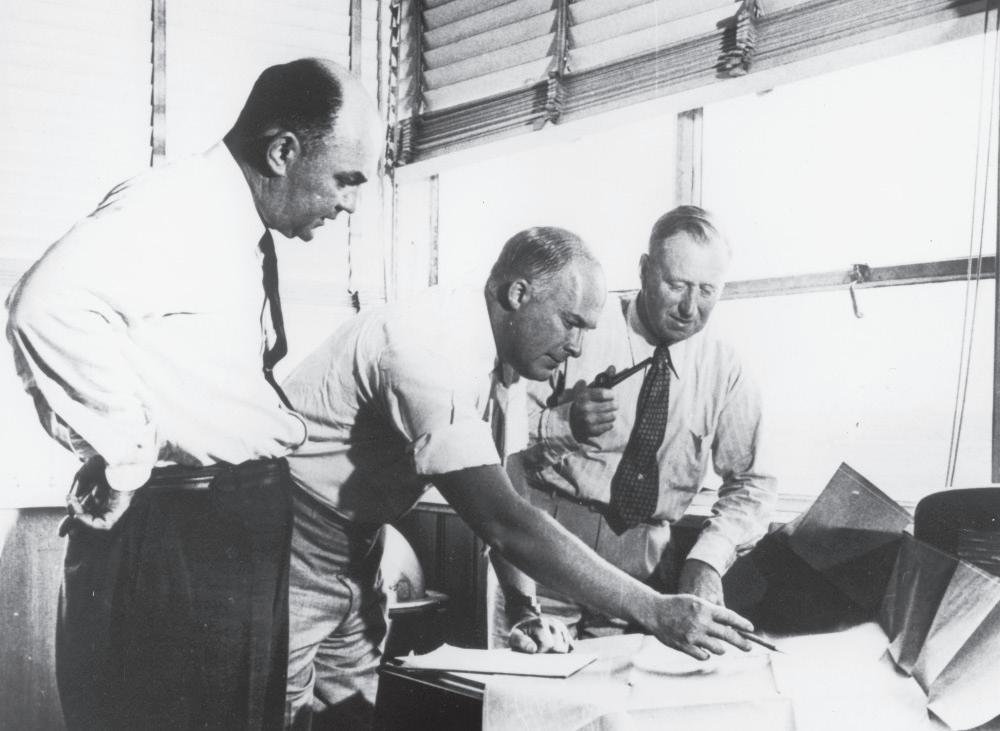
that had faced Leonardo da Vinci, the Wright brothers, and Charles Lindbergh: weight! Every step for ward in human flight had involved overcoming the limitations imposed by gravity. NASA gave them an ini tial estimate of 30,200 pounds for the spacecraft. The craft that landed on the moon and then launched from the lunar surface to rendez vous with the command module had to fit within this prescribed lim itation. They had seven years.
Overcoming Challenges
Kelly’s team worked tirelessly to conserve weight in unusual ways— in particular, the engineering of the astronauts’ seats. Grumman built 15 landers, 6 of which actu ally went to the moon. Some of the others are on display in museums, and visitors often ask where the astronauts’ seats are. In 1964, the design team eliminated them. The astronauts flew the lander standing up. In gravity that was one sixth that of Earth, the astronauts could fly, land, and take off standing in the craft. Their legs were all the shock absorbers they needed. With no seats, the astronauts also had more room for donning their space suits for the walk on the lunar surface. They could also hang their sleeping hammocks for the rest they needed while on the moon. Removing the seats saved weight in itself, but the move also allowed the astronauts to stand closer to the craft’s windows, allowing them to be significantly smaller. This saved hundreds of pounds of glass as well.
Astronaut Pete Conrad would refer to the cabin design as a “trolley car configuration.” Bethpage, New York, where the landers were built,
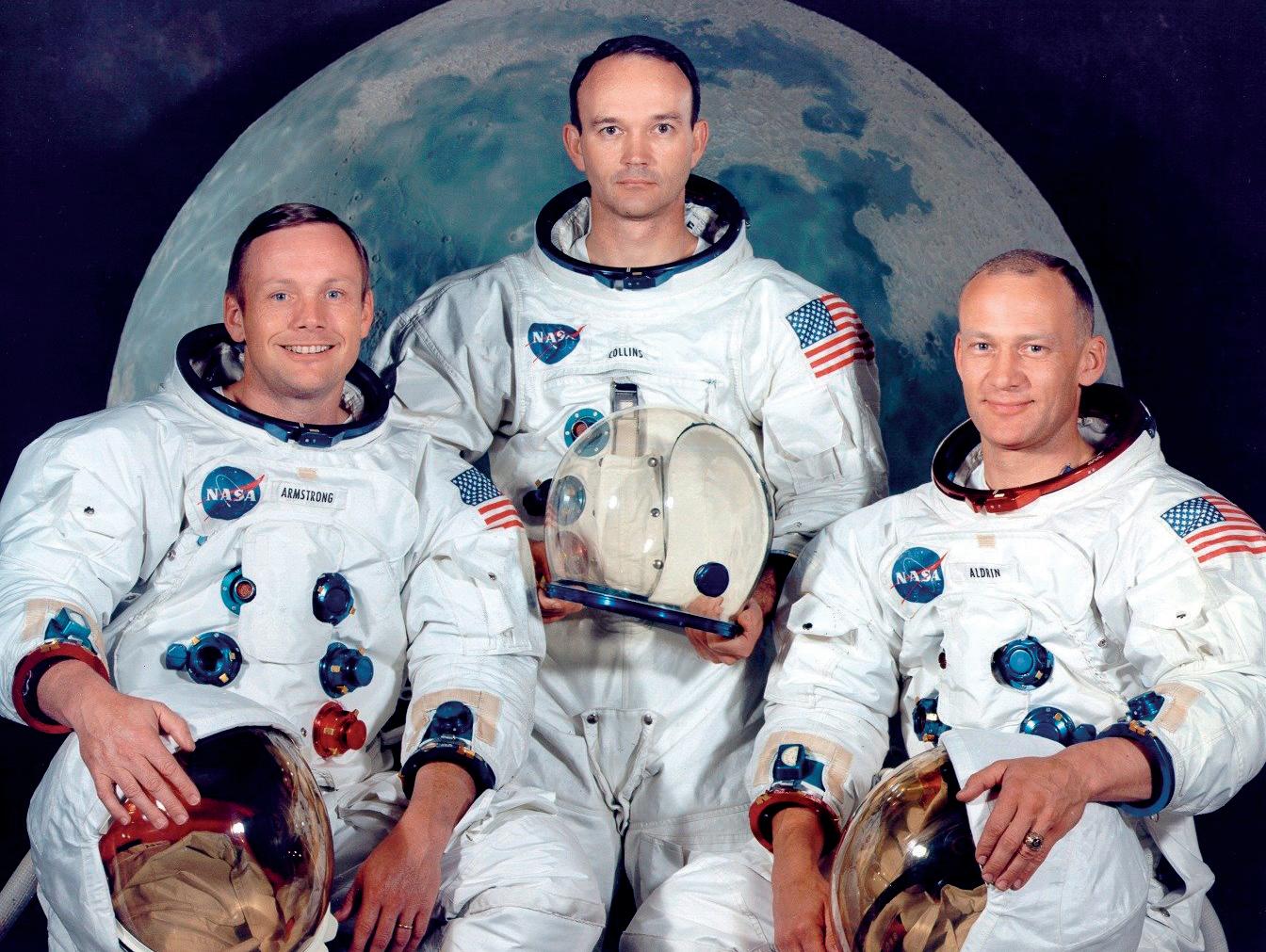
66 AMERICAN ESSENCE

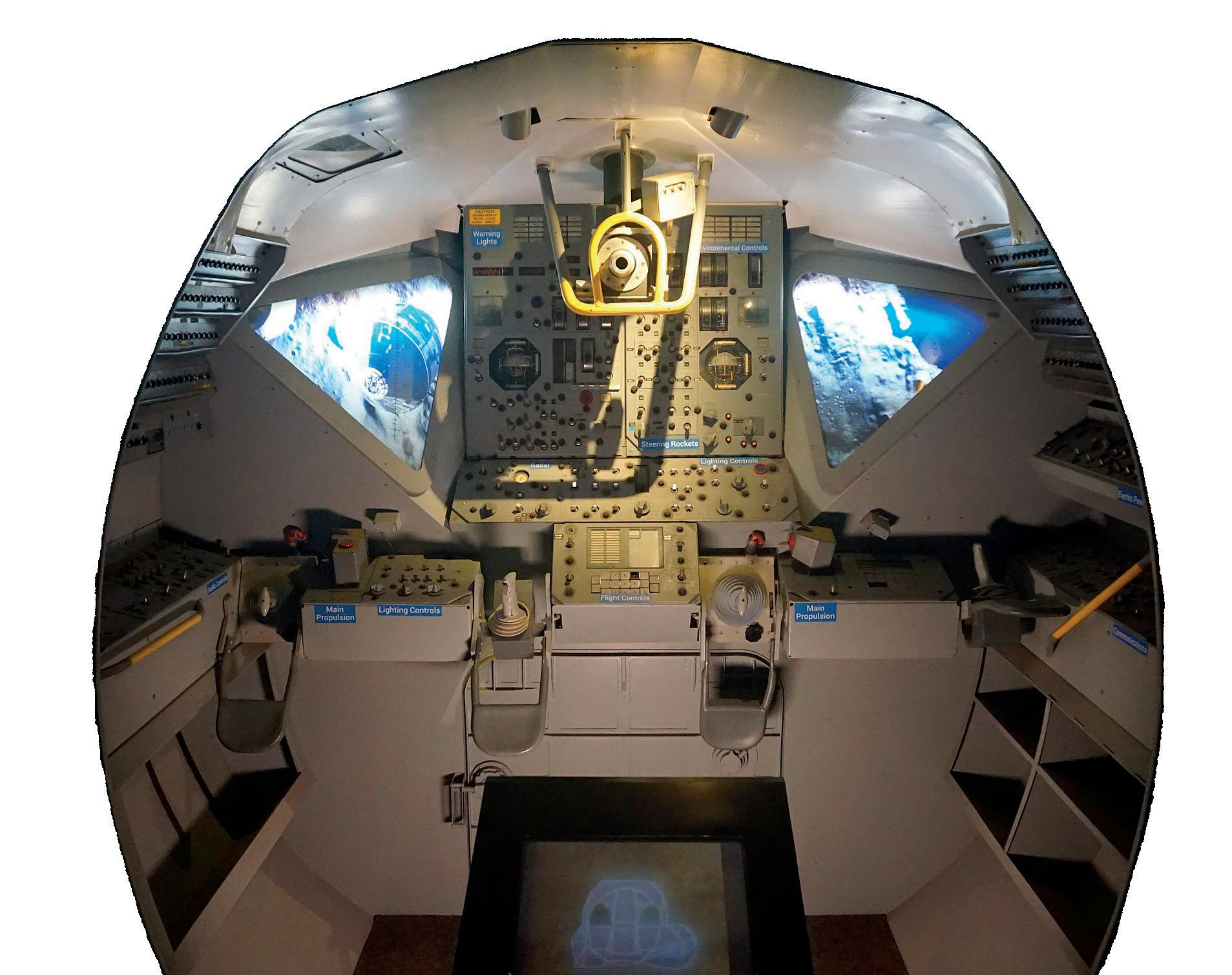
ISSUE 11 | NOVEMBER 2022 67
ABOVE, FAR LEFT The Apollo 11 crew (L to R): Neil Armstrong, Michael Collins, and Buzz Aldrin.
LEFT (L to R): Leon A. Swirbul, William T. Schwendler, and Leroy Randle Grumman of Grumman Aircraft Engineering Corporation, 1940.
ABOVE LEFT The 1953 logo of the Grumman Aircraft Engineering Corporation.
THIS PAGE Diagram and interior photograph of the Apollo Lunar Module cockpit.
is just 30 miles east of Brooklyn, where trolley car motormen actually stood up while operating a throttle with the left hand and a brake with the right. According to Kelly, those trolley cars had already inspired the name of a baseball team. Manhattan residents, who had more subways, sometimes referred to Brooklyn’s inhabitants as “trolley dodgers”; hence, the team’s name came to be the Brooklyn Dodgers. Did the trol leys of Brooklyn also influence the design of the lunar lander? Conrad’s reference suggests it might have.
The landing module (LM) had to operate in extreme temperatures. The team came up with the Kapton sheeting (a kind of Mylar foil cov ered with gold leaf) that gives the


lower part of the craft its “tinfoil” appearance. It simply reflected the solar heat away from the space craft, much like a windshield reflec tor does for a parked automobile. Because the lander never had to fly in atmosphere, it needed no aerody namic design—no smooth, rounded surfaces to resist airflow. It could just be a long-legged, boxy shape. The first manned LM, flown in the Earth’s orbit by Apollo 9, would be called “Spider.” After one more dress rehearsal in lunar orbit by Apollo 10, the “Eagle,” flown by Neil Armstrong and Buzz Aldrin on Apollo 11, would land on the moon. The date was July 20, 1969—eight years after John F. Kennedy laid down the challenge.
Tom Kelly and the Grumman team did some thinking beyond the task at hand that proved invaluable just two missions later. They recommended designing “lifeboat” capabilities into the LM. These capabilities would save the lives of the Apollo 13 astro nauts when their command-service module was crippled by an explosion. The crew fired up the LM and used it to provide life support and navi gation right up to the time that they jettisoned it. The command module was the only part of the spacecraft that could reenter the atmosphere. Though the LM “Aquarius” was consumed in a fiery reentry itself, the “Grumman Iron Works” team had successfully delivered one more crew safely home.
•
68 AMERICAN ESSENCE
LEFT Armstrong after the completion of the Lunar Extravehicular Activity on the Apollo 11 flight; photographed by Aldrin on July 20, 1969.
ABOVE Armstrong trains in the Lunar Module simulator at the Kennedy Space Center on June 19, 1969.
RIGHT The Apollo 9 Lunar Module (Spider) photographed from the Command Module on March 7, 1969, the fifth day of the Apollo 9 Earth-orbital mission.

OUT OF THIS WORLD
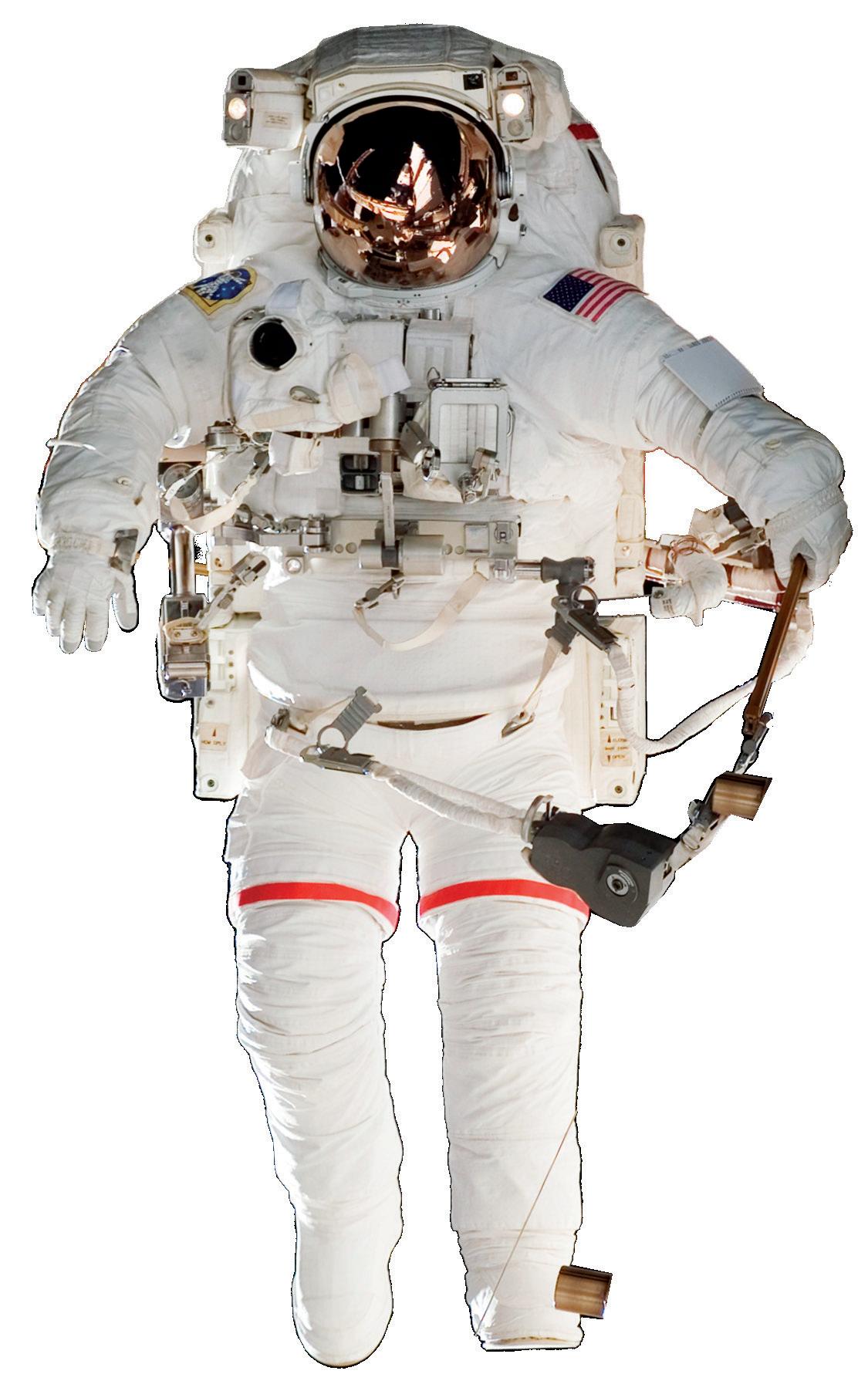

70 AMERICAN ESSENCE
America’s astronaut suits over the years Since the creation of the first spacesuit decades ago, rapidly evolving technologies have allowed for improvements in the safety, comfort, mobility, and functionality of these specially designed garments for space explorers of today and beyond. Orange Suit ACES (Advanced Crew Escape Suits) are full-pressure “indoor” suits, worn during launch and reentry to protect astronauts from mishaps. They contain parachutes and survival gear and are orange in color to be highly visible for search and rescue. White Suit EVA suits are ultra-protective “outdoor” suits, used during spacewalks. They are white in color to both reflect heat and make them more visible in the dark abyss that is outer space.
WRITTEN BY Pamela Beiler
Backpack Torso Legs/ Feet Legs/ Feet Torso/ Arms Helmet Display and control module, temperature and oxygen controls Liquid cooling and ventilation garment, rubber pressure suit, lunar overshoes Sunglasses and penlight pockets, pressure gauge and relief valve, shoulder dis connect access, pressure gloves Urine transfer connecter, utility pocket Scissors, checklist, and data list pock ets; integrated ther mal garment boots attaching ring Caution/warning computer, fan/ pump/motor, water tank, oxygen tanks, portable life support system, battery Helmet with sun visor, TV camera, lights, drink bag, communications carrier assembly
1965–1966
Gemini Suit
More comfortable than Mercury suits, Gemini spacesuits were the first to be used for extravehicular activity (EVA), or spacewalks. The 16- to 34-pound suits were tethered to the spacecraft by an oxygen hose through which the astronauts were able to breathe.

1981 First Space Shuttle Flight Suit

The caramel-colored ejection escape suit used by space explorers during STS-1, NASA’s first orbital space shuttle flight, was designed for in-spacecraft use only.
1961–1963 Mercury Suit
Also known as the Navy Mark IV, this silver, aluminum-coated suit was modeled after a design for high-altitude aircraft that was used by the U.S. Navy. Only to be used inside the spacecraft, the modified pressure suit was soft and included a closed-loop breathing system that pumped oxygen into the suit.
1967–1975 Apollo Suit

With thick boots, 12 fabric layers, and a built-in life support system, the Apollo suits allowed astronauts to not only “walk” in space, but walk on the moon. These robust, one-piece suits were built specifi cally with lunar EVA in mind.
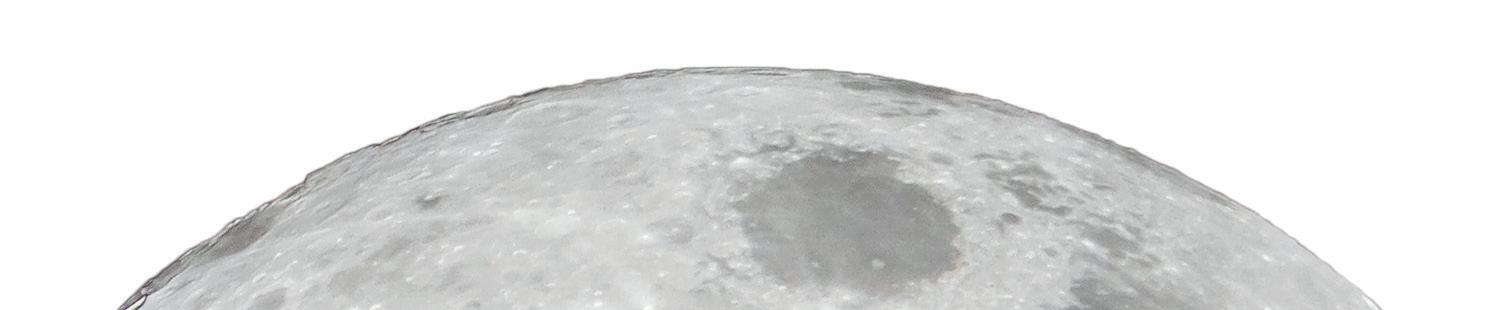
1983–Present Extravehicular Mobility Unit
1988–2011 Space Shuttle Flight Suit
Nicknamed the “pumpkin suit,” this suit was donned by shuttle crews during the latter part of the Space Shuttle program. It included a helmet, parachute, life preserver, and survival gear, including oxygen.



2023
Boeing CST-100 Starliner Flight Suit


Not yet in orbit, Boeing’s Ascent/ Entry suit, crafted in the company’s signature blue color, will make its debut for astronauts on NASAcontracted missions soon. Boeing has also designed a spacecraft, the Crew Space Transportation Starliner, for low-Earth orbit missions.
This heavy, 14-layer, ultra-sturdy, pressurized spacesuit enables astronauts to brave the harshness of outer space and tend to satellite and International Space Station (ISS) maintenance for more than eight hours at a time.
2020 SpaceX Crew Dragon Flight Suit
Designed by Jose Fernandez, a Hollywood costume designer hired by Elon Musk, and made functional by spacesuit engineers, these sleek launch and reentry spacesuits come complete with touchscreen-enabled gloves.
Winning the Battle of Hürtgen Forest
WRITTEN BY Mark Lardas
“The Last Hill: The Epic Story of a Ranger Battalion and the Battle That Defined WWII” by Bob Drury and Tom Clavin (St. Martin’s Press, 2022).
Ronald Reagan made the 2nd Ranger Battalion famous with his 1984 “Boys of Pointe Du Hoc” speech. There, he extolled the exploits of the Rangers who scaled those heights on D-Day, June 6, 1944. Ever since, many believe that the Rangers started and ended their World War II efforts on that day in June.
In fact, the battalion faced challenges throughout 1944. “The Last Hill: The Epic Story of a Ranger Battalion and the Battle That Defined WWII,” by Bob Drury and Tom Clavin, shows that D-Day was just the start of the Battalion’s World War II combat.
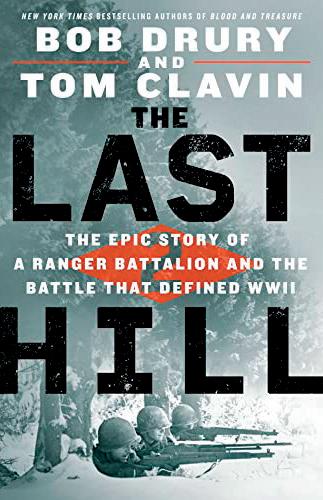
Their greatest challenge came six months later, in December 1944, at the Battle of Hurtgen Forest. The battalion’s 512 men were ordered to take and hold Castle Hill, a 1,320-foot-tall, flat-topped mound that once held a medieval castle. The key to the Hurtgen battlefield was several Wehrmacht regiments defending the hill. Holding it was critical to Germany’s upcoming Ardennes offensive. The U.S. 28th Infantry Division, 30
times larger than the Ranger unit, had tried and failed to take it.
Drury and Clavin show why U.S. Army com manders assigned the job to the Rangers: It was based on the unit’s earlier performances. The book covers the 2nd Ranger Battalion’s history throughout the war.
The authors start by presenting the battal ion’s initial organization and training in the United States. They show how the arrival of Lt. Col. James Rudder changed everything. Rudder, a Texas A&M graduate and pre-war football coach, transformed the trainees from a collection of oddballs into a finely-honed combat unit. The book follows the Rangers to Europe, showing their combat exploits between June and December 1944. They fought at D-Day and helped liberate the for tified French port of Brest before going on to Hurtgen Forest.
The heart of the book is their struggle for Castle Hill. The Rangers arrived at Hurtgen Forest on November 14 and fought for a month. Of the 130 Rangers that occupied the hill, only 16 came out the other side unin jured. “The Last Hill” offers readers a grip ping account of men in battle—one that will keep you reading until the end. Drury and Clavin provide a poignant reminder of why the soldiers who fought in World War II have been called the Greatest Generation. •
72 AMERICAN ESSENCE72 Lifestyle | Book Recommender
The Second Ranger Battalion did what a 30-times-larger unit couldn’t
A Play-by-Play of a Year That Shaped Our Nation
WRITTEN BY Deena C. Bouknight
“1776” by David McCullough (Si mon & Schuster, 2005).
In some ways, the colonies had endured a slow political boil since the Stamp Act of 1765. And with the 1774 Coercive Acts, there came the tipping point. Passions flared and rebellion ignited. Thus, historian and Pulitzer Prize winning writer David McCullough begins “1776” with a Jan. 14 quote by Gen. George Washington: “Few peo ple know the predicament we are in.”
In take-you-there, play-by-play prose that is anything but boring, McCullough weaves the threads of the Revolution’s foundation. He does not start on American soil, but rather in England, where His Royal Majesty George III insists that subjugation of the col onists is necessary. McCullough emphasized the king’s point of view: “America must be made to obey.”
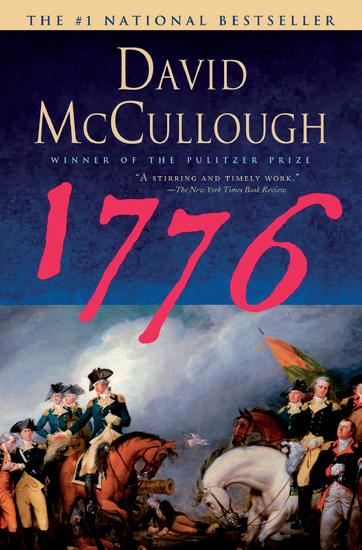
Lexington, Concord, and the Battle of Bunker Hill had happened before 1776 began. The Continental Congress commissioned George Washington as commander in chief of the Continental Army on June 19, 1775. By early 1776, therefore, patriots were in fully
engaged in the conflict.
So that the action described is relevant, the book provides crucial background on pivotal players—Nathanael Greene, Benjamin Rush, John Hancock, Thomas Jefferson, and so many more. Of course, the key character is Washington. McCullough writes: “The great teacher for Washington was experience.” However, the man who would become the great military and then political leader con veyed humility, which, ironically, elevated his character. After he was commissioned, Washington wrote to John Hancock: “I do not think myself equal to the command I am hon ored with.”
Readers find themselves near Boston months before the momentous Declaration of Independence was drafted and signed in July, hearing the “first cheers from the American front lines” as the “lobster backs” were driven out, to “drums beating, flags flying.” In “1776,” readers will enjoy these bursts of victory, but they will also endure the humiliation of the New York campaign losses and the angst involved in risking “Lives … Fortunes … Sacred Honor” on a document that would officially launch a nation.
For a fuller experience, a companion to “1776” is the illustrated edition with remov able historic document replicas: letters, maps, battle plans, and more.
•
73ISSUE 11 | NOVEMBER 2022
The Declaration of Independence has come to symbolize 1776, but plenty else happened in that year to shape America’s future
Book Recommender | Lifestyle 73
A French Chef’s American Legacy
Jacques Pépin, as eager a student as he is generous a teacher, shares his must-have Thanksgiving recipes, and reflects on his time teaching generations of Americans how to cook
WRITTEN BY Crystal Shi
If you’re inviting Jacques Pépin to Thanksgiving dinner, you’d better have turkey on the table.

How about something else this year, you might venture—a nice roast chicken, or a glazed ham?
“I don’t want to do something else,” the chef would kindly, but
firmly, inform you. “I want to have a turkey for Thanksgiving; I want to do Brussels sprouts and sweet potato and an apple tart.” The bird has been a non-negotiable since Pépin’s first Thanksgiving in 1959, two months after he arrived in America as an eager young chef with experience working in Paris’s
most prestigious kitchens. He fell in love with the spirit of the holi day—“There is no political affilia tion, no religious affiliation; it’s just people getting together, enjoying food, wine, and company,” he said— and with America itself.
“I only came to stay a year, maybe two years, to learn the language, and
74 AMERICAN ESSENCE
go back to France. I loved it and never went back—except for vaca tion.” Since then, the transplanted Frenchman has taught millions of Americans how to cook.
He’s the author of 32 cookbooks, the most recent being “Art of the Chicken,” published in September 2022, and a longtime host of PBS cooking shows—including one with his dear friend and fellow pioneer ing TV chef, Julia Child. Since the beginning of the pandemic, he’s continued to offer confidence and comfort to anxious, shelter ing-at-home viewers with the award-winning “Jacques Pépin: Cooking at Home” web series, in 280-and-counting 2- to 6-min ute videos posted to Instagram and Facebook with the help of his daughter, Claudine.
At nearly 87, Pépin still chops and sautés with an efficient, effort less fluency honed over decades of experience. His narration is just as easy and precise, deftly doling out instruction as he breaks down a whole chicken or shimmies a per fectly fluffed French omelet onto a plate.
And after all these years, he still cooks with an unmistakable French accent—though he’d argue that it doesn’t extend so much to the food. “Very often, people consider me the quintessential French chef,” Pépin said from his home in Madison, Connecticut, where he’s lived since 1975.
“And then you open one of my books, and there on page 32, you have a black bean soup with banana
and cilantro on top.” Pépin’s late wife, Gloria, was half Puerto Rican and half Cuban. “Then you have a Kentucky fried chicken from Howard Johnson. Then you have a lobster roll from Connecticut. So I mean,” he said, smiling, “I’m prob ably the quintessential American chef now, after all these years.”
Dreaming of America
Born in Bourg-en-Bresse, France, a small town northwest of Lyon, Pépin grew up helping out in his parents’ restaurant, Le Pélican. At age 13, he left school to begin a culi nary apprenticeship at the Grand Hôtel de L’Europe. By his early 20s, he’d worked his way up Paris’s culi nary ladder, and, during his mili tary service, he served as personal chef to three French heads of state, including Charles de Gaulle.
But he set his sights on farther shores.
“America was always kind of the Golden Fleece for me,” Pépin said. “Most people who come to America come here for economic reasons, to have a better life maybe, or politi cal reasons, or religious reasons. I
didn’t really have any of that. I had a very good job in Paris. My parents had a restaurant. I was fine. But I wanted to come to America.”
At the age of 23, he made good on his wish. He arrived in New York in September 1959. He didn’t mean to stay for long, but life changed his plans.
Within 48 hours of arrival, he landed a job cooking under Pierre Franey at Le Pavillon, the pinnacle of haute cuisine in America at the time, and he soon befriended the “who’s who” of the burgeoning food world—chef James Beard, New York Times food editor Craig Claiborne, and, of course, Julia Child.
“People were extremely welcom ing,” Pépin recalled, and he saw “the possibility of doing basically any thing” in his adopted country.
Spreading His Wings Pépin took that possibility and ran with it. After less than a year of cooking at Le Pavillon, he was courted by the Kennedy fam ily—regulars at the restaurant—to become the White House chef. He turned down the offer—he’d already
ABOVE LEFT Jacques Pépin, 86, calls himself a “quintessential American chef.”
RIGHT Pépin with his daughter, Claudine, who often appeared in his cooking shows and now works with him on various projects for the Jacques Pépin Foundation.

75ISSUE 11 | NOVEMBER 2022
Chefs | Lifestyle
vvv
cooked for presidents, after all—to instead take a job in a wholly new world: as director of research and development at Howard Johnson, then the country’s most successful restaurant chain, developing new recipes and pioneering high-quality frozen foods.
“That was a totally American environment, working only with American chefs and American eating habits,” he said. “I learned about marketing, mass production, the chemistry of food, all kinds of things I didn’t really know as a French chef.” When he wasn’t in the kitchen, ever the eager student, he continued his studies at Columbia
University—eventually earning a master’s degree in French literature.
It was during his time at Howard Johnson that Pépin started writing down recipes, unwittingly setting a foundation for his future ventures. “At a regular restaurant, you learn by osmosis ... and you duplicate what you do,” he said. “That was the way I worked in France for over 10 years; I never wrote a recipe, I didn’t have a cookbook. At Howard Johnson, of course, it had to be organized.”
Developing a chicken pot pie, for instance, started with a recipe using 3 chickens in the test kitchen, then scaled up to 20 chickens. “ Eventually, we did 3,000 pounds of
chicken in a thousand-gallon kettle pot. All of that has to be organized exactly in a recipe.” That experi ence with high-volume produc tion proved crucial, he said, when he left Howard Johnson in 1970 and opened his own restaurant, La Potagerie, serving soups to the busy Manhattan working crowd, and later managed food operations for the newly opened World Trade Center.
Sharing His Knowledge
In 1974, Pépin suffered a serious car accident. After a long recovery, he left the restaurant kitchen world to turn his focus to writing and teach ing. He taught at Boston University, where he and Child founded the culinary arts certificate program, and he later became Dean of Special Programs at the French Culinary Institute in New York (since renamed the International Culinary
BOTH PAGES Pépin teaches a cooking class at the Billings Forge Community Works in Hartford, Conn., in 2019, as part of the Jacques Pépin Foundation’s work with culinary training programs across the country.
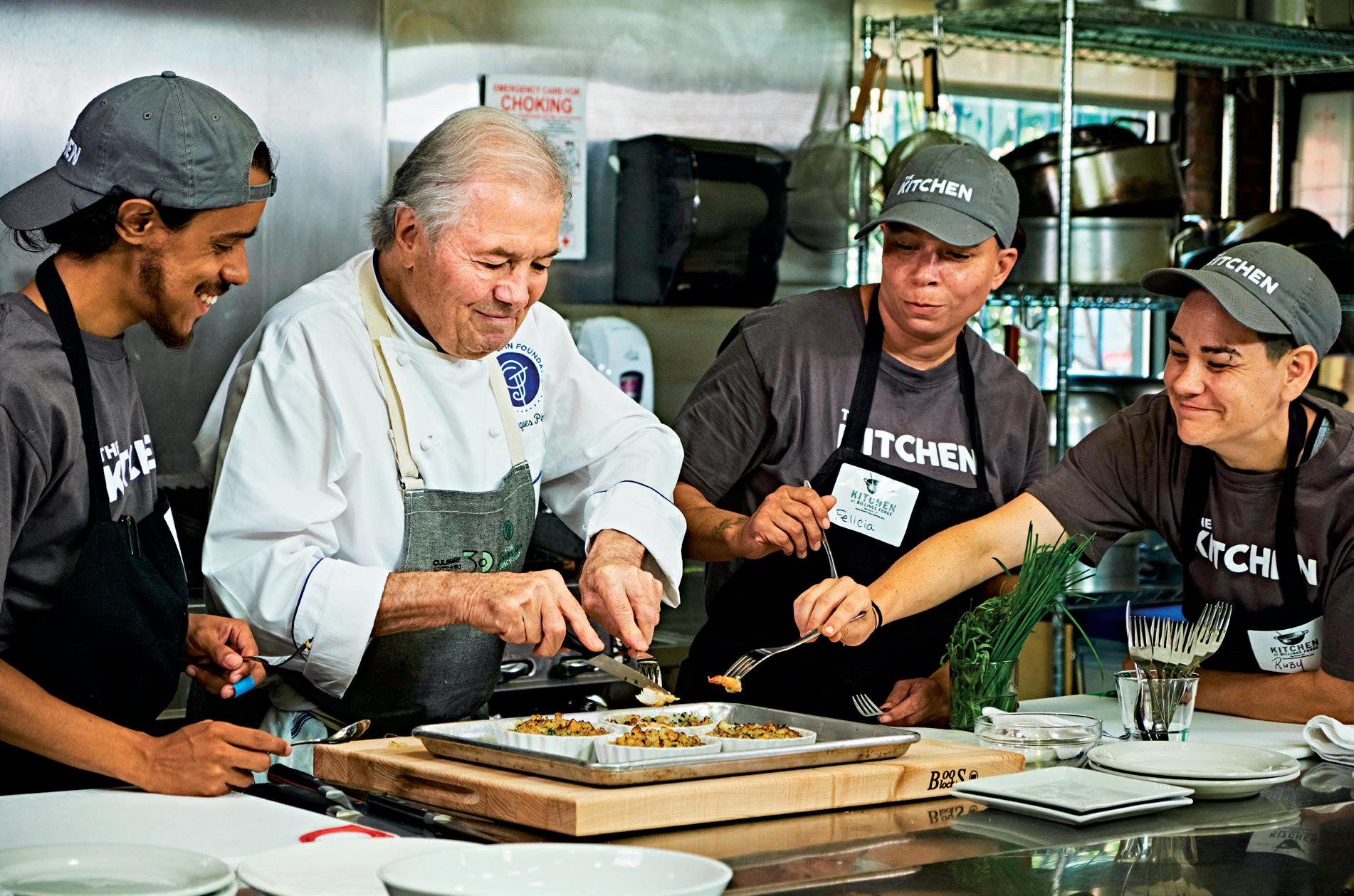
76 AMERICAN ESSENCE
“Chefs are very generous. It’s part of who we are, to give away.”
—JACQUES PÉPIN
Lifestyle | Chefs
Center).
Pépin further extended his teach ing legacy through the Jacques Pépin Foundation (JPF), the non profit he launched with his daughter, Claudine, and her husband, Rollie Wesen, in 2016.
As Wesen was assembling Pépin’s lifetime of books, videos, and other materials, Wesen asked, “‘Who do you think we should teach with these things now?’” Pépin recalled. “And I thought, maybe we should teach people who have been a bit disenfranchised by life—people who’ve come out of jail or former drug addicts or homeless people or veterans.”
Now, the foundation supports culi nary training programs for adults with high barriers to employment across the country, through offering books, videos, and grants. In 2021, its grant awards totaled $167,500.
These programs take students who might be 40, 50 years old, Pépin said, “and we want to teach them the basics of cooking.” With that founda tion set, “you can join a kitchen, start doing basic work, start going up by yourself, and get to redo your life and
be proud of what you do and make a living out of it.”
When JPF’s fundraising decreased during the pandemic, Wesen asked acclaimed chefs from across the country to film cooking videos in their own homes, as Pépin was doing. “He asked like 50 chefs, from Daniel Boulud, to Jose Andrés, to Martha Stewart—no one said no,” Pépin said. “Then he asked 50 more, and then he asked 50 more.” The resulting video recipe series, “Cook With Jacques Pépin and Friends,” is available to JPF donors. “Chefs are very gener ous,” Pépin said. “It’s part of who we are, to give away.”

Just the Essentials
Despite his age—“I am not a young man anymore,” he said with a laugh—the chef has hardly slowed down. “The secret is to keep busy and do things,” Pépin said. “If I don’t have anything to do, I kind of feel depressed.”
Of course, some things have changed with age. “I certainly don’t cook the way now as I did when I was 25 years old. When you’re younger, you tend to add to the
dish, add more, make it fancier. At my age, you kind of take away, take away, take away from the plate, to be left with something more essential, something without too much embel lishment.
“If I have a great tomato from the garden, have great olive oil and a bit of salt over the top, I don’t want more embellishment. This is it.”
What else has remained essential? The techniques, Pépin said, the foun dational skills behind everything he cooks and teaches—and, certainly, the Thanksgiving turkey. He still insists on it every year, whether he cooks it himself or with his daugh ter at her Rhode Island home where he often goes for the holiday dinner. And then, more importantly, there are the people—the heart of every meal, the reason for cooking. “Being with your family and your friends together, you remember that more than the food itself,” Pépin said.
As a chef, he said, “What you do is, you feed people. You give plea sure to people by doing what you do. Even if you don’t become famous and all that, it’s a great way of spending your life.”
77ISSUE 11 | NOVEMBER 2022
•
ROASTED TURKEY
With Bread and Mushroom Stuffing
vvv RECIPES BY Jacques Pépin
FOR THIS RECIPE, I CUT OFF the ends of the drumsticks, so the skin and meat shrink during cooking, causing the tendons in the drum sticks to stick out and thus be easily pulled out when the bird is cooked.
I also make an incision between the thigh and drumstick, the place that takes the longest to cook, to accelerate the cooking, so I don’t have to overcook the breast for the legs to cook at the joint.
Finally, I steam the turkey first (the stock created in the steaming is used for the sauce), then roast it. The steaming gives a lot of moisture to
the meat, and the roasting browns the skin, resulting in a beautifully browned and moist turkey.
Serves about 15
• 1 20-pound turkey, preferably fresh and organic, with neck, gizzard, heart, and liver
• 8 ounces carrots, peeled and cut into 1/2-inch dice (1 1/2 cups)
• 8 ounces onions, peeled and cut into 1/2-inch dice (2 cups)
Bread and Mushroom Stuffing, pre pared until just before baking (rec ipe follows)
For the Glaze
• 1/2 cup sweet cider
• 1 teaspoon Tabasco or other hot sauce
• 1/2 teaspoon salt
• For the Sauce
• 1 cup white wine
• 2 teaspoons potato starch dis solved in 2 tablespoons white wine (from preceding item)

Preheat the oven to 350°F. Cut off the ends of the drumsticks, and make a cut about 1 inch deep at the joint connecting the drumstick and thigh of each leg. Set a small wire rack in the bottom of a large stock pot and pour 1 1/2 quarts of water into the pot.
Place the turkey (minus the neck, gizzard, heart, and liver) on the rack in the pot, and bring the water to a boil. Cover, reduce the heat to low, and steam the turkey for 45 min utes. Remove the pot from the heat, and, when the turkey is cool enough to handle, remove it from the pot (reserving the stock created in the steaming) and place it, breast side up, in a roasting pan. Put the pan in the preheated oven, and cook the turkey for 1 hour.
Meanwhile, pour the reserved stock into a bowl, and let it rest for 10 minutes, or until most of the fat rises to the surface. Skim off as much fat as possible (I removed about 1 cup), and discard.
Transfer the stock to a saucepan, and add the turkey neck, gizzard, and heart. (As a special treat for the cook, sauté the liver in a little butter, add salt and pepper, and consume immediately.) Bring the stock to a boil, reduce the heat to low, cover, and boil gently for 1 hour. Remove the neck, gizzard, and heart from the stock, pick the meat from the neck, and coarsely chop the meat along with the gizzard and heart. (You should have about 2 cups of
Lifestyle | Recipes
meat pieces.) Return the chopped meats to the stock, and de-fat it again.
After the turkey has roasted for 1 hour, sprinkle the carrots and onions around it. In a small bowl, mix together the cider, Tabasco, and salt to make a glaze. Brush the tur key with the glaze, and continue to cook it in the oven for 1 hour longer. At this point, put the bread-andmushroom stuffing (recipe follows) in the oven. If the top of the bird begins to brown too much during this period, cover it loosely with aluminum foil. Remove the turkey from the oven when the breast and the leg register an internal tempera ture of 160°F.
Place the turkey on an ovenproof serving platter, and, using small pliers and a fork, pull the sinews (which are visible at the drumstick tips) from the drumsticks through the tines of a fork, so you do not remove chunks of meat along with the sinews. Discard the sinews. Keep the turkey warm, uncovered, in a 160-degree oven.
Add the stock mixture to the drip pings in the roasting pan and mix well. Transfer the contents of the roasting pan to a saucepan and let rest for 5 minutes. Skim off as much fat from the surface as possible. Add the wine, and the dissolved potato
Bread and Mushroom Stuffing
Serves about 15
• 1 pound crusty bread, from day-old baguettes or a country loaf, cut into 1-inch pieces (about 10 cups)

• 1 cup slivered or sliced almonds
• 4 tablespoons unsalted butter (1/2 stick)
• 1/3 cup canola oil
• 2 medium onions (8 ounces), peeled and coarsely chopped (2 cups)
• 1 cup coarsely chopped celery
• 1 leek (about 6 ounces), peeled, washed, and coarsely chopped (2 cups)
• 1 tablespoon herbes de Provence

• 3 1/2 cups chicken stock
• 3/4 teaspoon salt

• 3/4 teaspoon freshly ground black pepper
• 10 ounces mushrooms, washed and coarsely chopped (3 cups)
• 2 cups coarsely chopped parsley
Preheat the oven to 400°F.
Place the bread pieces on a cookie sheet, and bake them for 10 to 12 minutes, or until they are nicely browned, then transfer them to a large bowl. Arrange the almonds on a cookie sheet, and bake them in the oven for 8 to 10 minutes, or until they are nicely browned.
Heat the butter and oil in a large skillet until the butter is melted, then add the onions, celery, leek, and herbes de Provence. Cook over medium to high heat for 5 minutes. Pour the stock into the skillet and season with salt and pepper. Now add the contents of the skillet, along with the mushrooms, almonds, and parsley, to the bread cubes in the bowl. Mix lightly, then spoon the stuffing into two 6-cup loaf molds. Cover with aluminum foil.
About 1 hour before serving time, place the molds in the 350°F oven, and bake the stuffing alongside the turkey for 50 to 60 minutes.
To serve: The turkey can be carved at the table and served with the dressing, sauce, and vegetable garnishes. For a less showy and easier presentation, carve the turkey in the kitchen, and arrange it on plates with the dressing, sauce, and gar nishes before serving at the table.
Recipes | Lifestyle
BRUSSELS SPROUTS
With Bacon
THIS IS A SIMPLE BUT TASTY way of preparing Brussels sprouts that will make an excellent side dish for your Thanksgiving feast.
Serves 8
• 2 1/2 pounds Brussels sprouts, trimmed


• 8 slices bacon, cut crosswise into 1/4-inch pieces
• 4 tablespoons olive oil
Working in batches and using the slicing blade on your food processor, shred the Brussels sprouts. (You should have about 10 cups.)
Place half the bacon and oil in a large skillet. Cover and cook over high heat until the bacon is crispy and brown and most of the fat is ren dered, 2 to 3 minutes.
Add half the sprouts to the skillet and sea son with salt and pepper. Cover and cook until the sprouts begin to soften, 1 to 2 minutes. Uncover and cook, tossing occasionally, until
the sprouts are crisp-tender, about 2 minutes. Transfer to a bowl; repeat with the remaining bacon, oil, and sprouts.
80 80
Lifestyle | Recipes
RUSTIC APPLE TART
I REMEMBER WELL the famous apple tart my mother made every day as a dessert offer ing in her small Lyon restaurant. Her dough was unlike any other; its tender, crumbly, airy texture was created by combining vegetable shortening, baking powder, and warm milk with the flour. I hope you enjoy this taste I associate with memories from my youth.
Serves 6 to 8
For the Dough
• 1 1/4 cups all-purpose flour
•
teaspoon sugar
• 1/2 teaspoon baking powder
• 1/8 teaspoon salt
• 6 tablespoons vegetable shortening or lard
• 1/4 cup milk, heated to lukewarm
•
For the Filling
• 2 pounds Golden Delicious or McIntosh apples (6 medium)
• 3 tablespoons sugar
• 2 tablespoons unsalted butter
Preheat the oven to 400°F, with a rack in the center.
For the dough: Combine the flour, sugar, baking powder, and salt in a bowl. Add the shortening or lard and mix with a spoon or your hands until the mixture feels and looks sandy. Add the warm milk and stir rapidly for a few seconds, until the dough is well mixed.
Using a sheet of plastic wrap to help you, form the dough into a 9-inch quiche pan or tart pan with a removable bottom. With your fingers, press the dough evenly into the bot tom and up the sides of the pan. Set aside.
For the filling: Peel the apples, quarter them, and remove the cores. Arrange the apple quarters, cut side up, in circles on top of the dough and sprinkle the sugar evenly over them. Cut the butter into small pieces and dot the apples with the butter.
Place the tart pan on a cookie sheet and bake for 1 hour, or until the apples are browned and crusty.
Let cool to lukewarm, then cut into wedges and serve.
ISSUE 11 | NOVEMBER 2022 81 81
Lifestyle
1
The Great Gobbler Guide






































Turkey is a staple at the Thanksgiving table. Let’s break down these fun turkey facts














































 WRITTEN BY Jennifer Tseng


Thanksgiving in 1621, guests feasted on a harvest of fruits and vegetables, local seafood, and venison provided by the Wampanoag people—there were no turkeys in sight.



Jingle Bells was not meant to be a Christmas song. The popular carol was written by James Lord Pierpont in 1857 for his father’s Sunday school class to perform on Thanksgiving Day.







Benjamin Franklin once lamented the choice of placing the bald eagle—“a bird of bad moral character,” as he described it in a letter to his daughter—on the national seal, preferring the courageous turkey that would not hesitate to defend its home.











SOS ON TURKEY DAY?











an expert hotline, operated by food manufacturer Butterball, that has been answering over 100,000 turkey-cooking-related questions across America every year since 1981.

































82 AMERICAN ESSENCE
Call
1-800-Butterball,
There were no size limits on Macy’s Thanksgiving Day Parade balloons until 1997, when strong winds caused a giant Cat in the Hat to slam into a lamppost and injure spectators.

Sarah Josepha Hale, author of the nursery rhyme “Mary Had a Little Lamb,” campaigned for 17 years for Thanksgiving to become a national holiday. President Abraham Lincoln made it so in 1863.



According to the National Turkey Federation, Americans each Thanksgiving devour an average of





















































































Turkeys





























The 2011 Dallas turkey trot broke the Guinness World Record for being the largest gathering of people dressed as turkeys—that’s 661 runners in red and brown plumage.


to describe the meaty bird? According to a theory by Columbia University professor Mario Pei, turkey the bird was named after Turkey the country because British settlers were first introduced to the fowl by merchants of the Middle East.













ISSUE 11 | NOVEMBER 2022 83
46 Mil
What’s the origin of the word ‘turkey’
Out on the
The article’s author rides on a bay mare named Suede, amid a lush meadow and the snow-clad peaks bordering Yosemite.

Roam or herd cattle at the sixthgeneration Hunewill Ranch in California’s Eastern Sierras. It makes for a glorious riding vacation you won’t soon forget
 WRITTEN BY David Coulson PHOTOGRAPHED BY Maria Coulson
Ranch
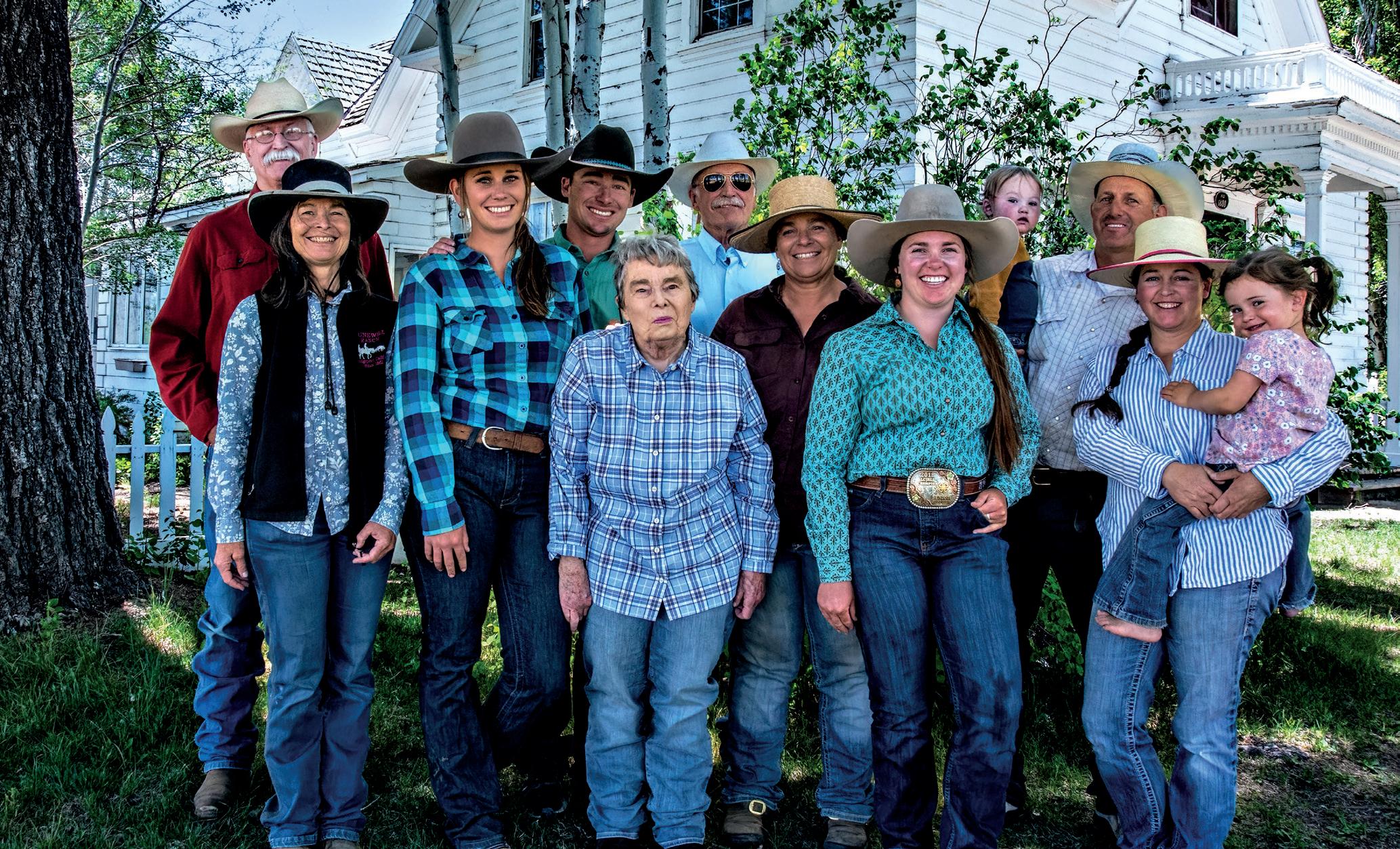
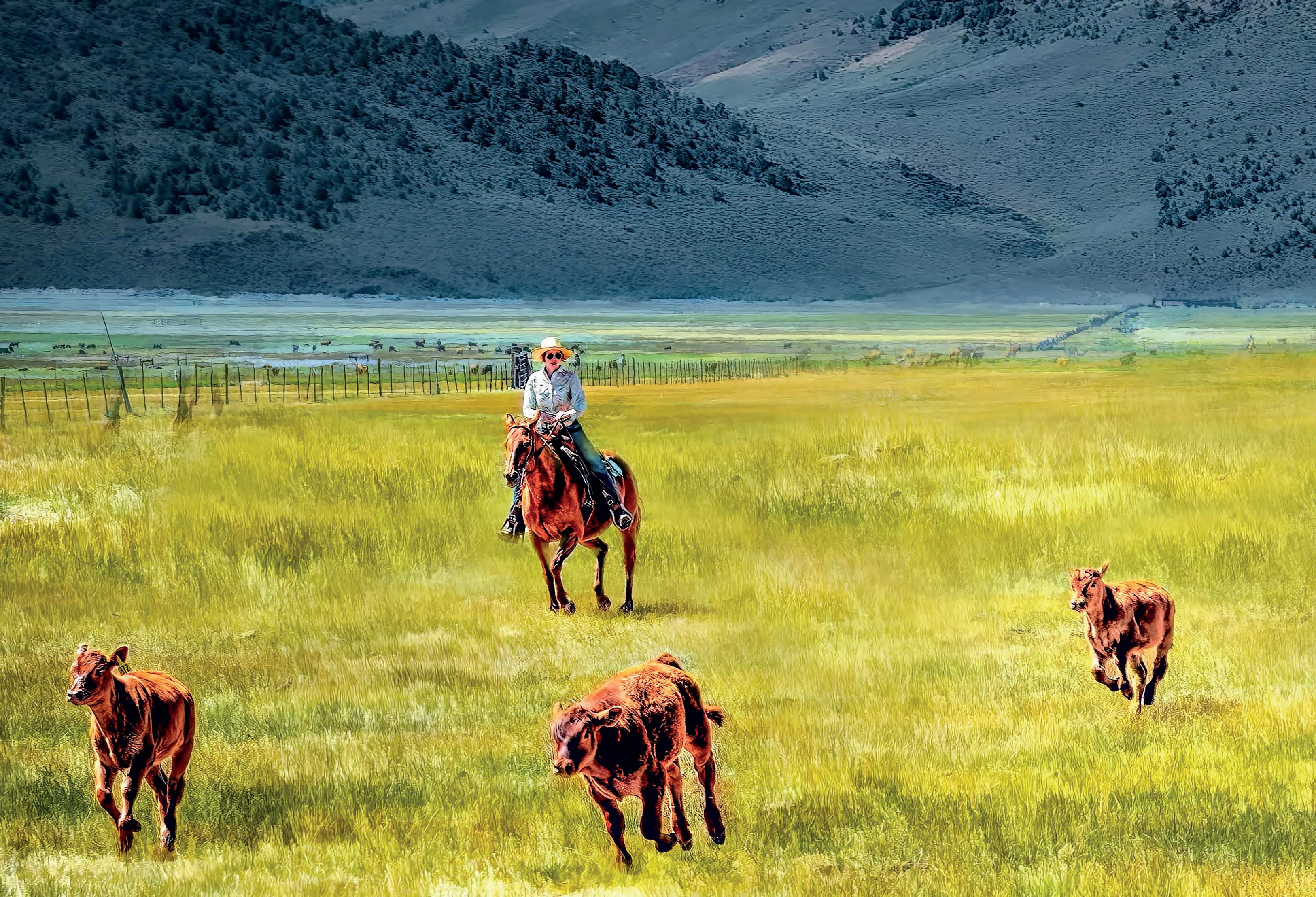
The Great Outdoors | The Wild West
While a journal ism professor at the University of Wyoming when I wore a younger man’s clothes, I became close friends with a bowlegged, hardheaded cowboy. Seeing us together on the streets of Laramie, folks would holler, “Here comes the cowboy and the profes sor.” My city slicker self had never ridden a horse, much less herded a cow, before meeting the legendary cowboy. Since then, I have saddled many a cow pony and earned my spurs in spirited roundups across five states with him.
My first wrangling match was on a blustery, bitterly cold, snow-spit
LEFT Four generations of the Hunewill family at their California guest ranch.
BELOW Wranglers work together to guide wayward calves back to their herd.
ting day in early June on the Laramie high plateau. Astride a high-octane mustang, I stared out at the swarm of horns, pounding hooves, and hind ends of rust-col ored cattle ramrodded by the legend. When the lead cow abruptly bolted toward open range, the champion pro rodeo bronc rider, anticipating the move, intercepted her with the aptitude of an NFL defensive back.
Whereas I had a cowpoke com padre to make me muscle sore and saddle savvy, the best path for most greenhorns hell bent for leather to rope and ride like a true buckaroo is to bunk at a dude ranch. Through the years the dude ranch concept has evolved into more types of guest ranches than wrinkles on a Brahman bull. There are working ranches, resort ranches, execu tive-retreat ranches, and those with scarcely a horse, a cow, or a goat
to their name. Ranches for hard headed and weak-minded wannabe cowpunchers where every waking moment is spent wrestling a steer or guzzling a beer.
Ranch for the Ages Western cities are a short drive and a century removed from dude ranches with herds of cows instead of maddening crowds. Evoking images of the vast expanses of Wyoming and Montana, often over looked is the rich, guest ranch tra dition in California, exemplified by the Hunewill Ranch. Nestled in a cleft on the eastern slope of the Sierras at 6,500 feet in the Bridgeport Valley, its open meadow spreads out like a green mantle below snow-crusted crags border ing Yosemite.
The family-owned and -oper ated 4,500-acre ranch has run cat tle since the Civil War and hosted guests since the Great Depression. It boasts a string of 160 horses you can ride at a lope and 1,000 head of cattle you can herd on horseback— unlike most of today’s dude ranches that are more resort than rawhide. At the Circle H, the cowboy life is for real. Guests are treated with courtesy, not coddled like delicate porcelain.
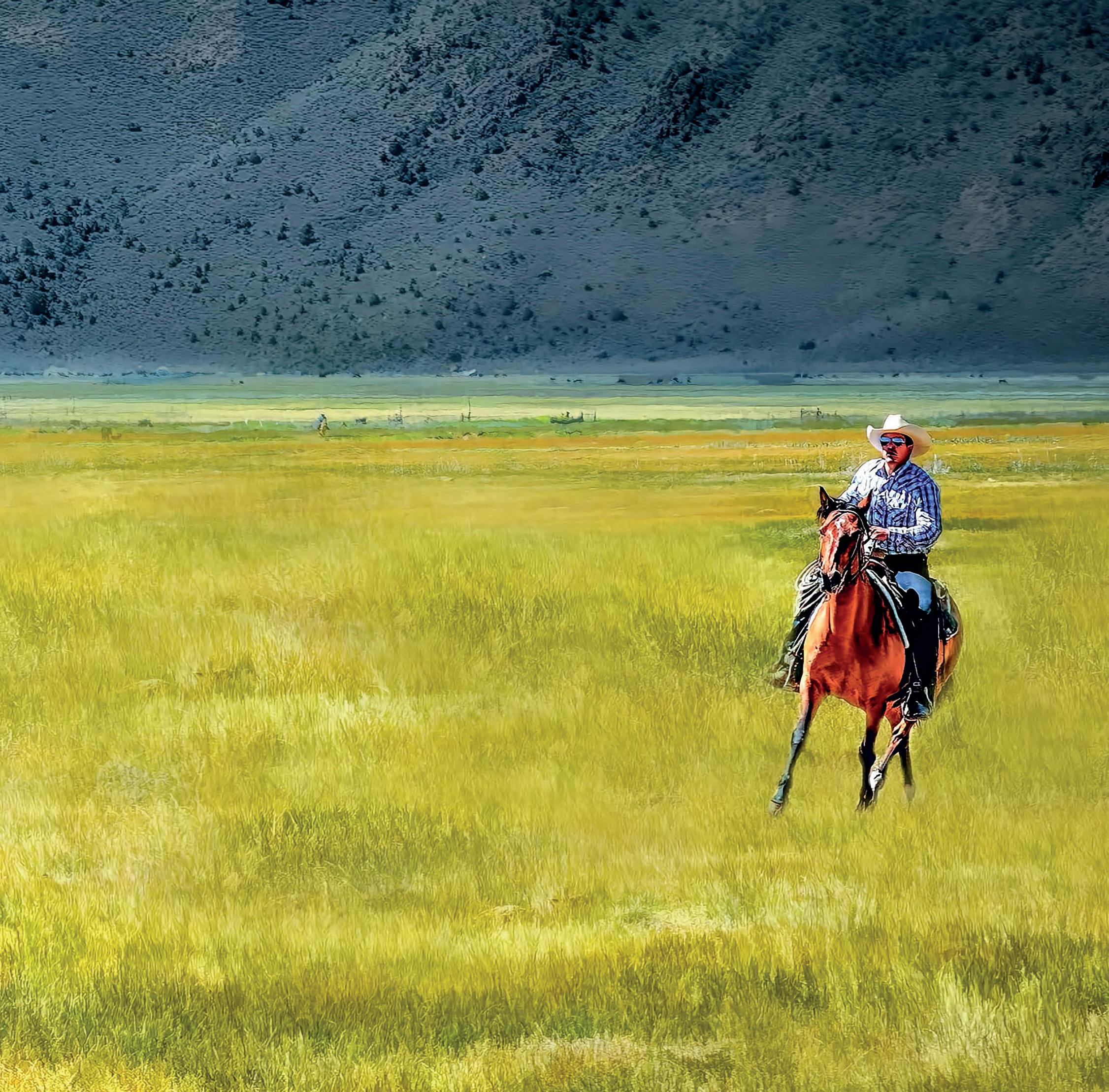
Riding alongside affable and self-assured members of the ranch’s fifth and sixth generations, one can almost visualize their ancestors reflected in their faces. Ancestry and legacy are foremost in their minds. “What makes all the effort worthwhile is the family,” said 86-year-old matriarch Jan Hunewill. “Why else do it? You want to pass it on to the next generation.” And generations of guests returning year after year develop a kinship with the deeply rooted family.
“The older generation appreciates the energy, new ideas, and tech sav
87
The Wild West | The Great Outdoors
vy-ness of the younger generation,” daughter Betsy said. “I like to think the younger generation is not afraid to ask questions of the older gener ation and is able to appreciate the wisdom of experience.” She runs the office; her brother, Jeff, is ranch CEO and oversees the cattle oper ation; her sister, Megan, heads the riding program.
The Hunewill Ranch offers fourto seven-day vacations ranging from family gatherings to ladies or adults only, for a maximum of 60 guests in 24 comfortable cabins. Stays include food and lodging, horseback riding, and evening activities such as hay rides, cookouts, and square danc ing. A former Chart House seafood restaurants chef, Richard Leonin, prepares appetizing meals.
The guest ranch’s six-month sea son consumes the Hunewills’ lives. They all have sweat equity in tak ing care of the guests or the horses
and cattle, according to Megan’s son, Dalton, who, like the others, often endures 16-hour days. They don’t tell the staff what to do, he maintains, but lead by example and treat them as family. With youthful enthusiasm, Seth Digman said, “I didn’t come from much and love working here. I’ll do anything they throw at me from mending fences to fixing toilets as long as they keep me around.”
Horsing Around
As a rose-tinged, ethereal dawn caresses the mountain crests, an artist’s palate of paints, bays, buck skins, and palominos with thunder ing hooves and steaming nostrils cascades into the corral from their overnight pasture. Rides on these hale, handsomely sculptured horses are scheduled twice a day unless an all-day excursion is planned. Guests self-select their ability level:
beginner, intermediate, or advanced. “The first day of riding, there is a lot of anticipation waiting for your horse to be called—super excited, a little nervous, not sure what to expect; then, when you finally get on your horse, everything falls into place,” counseled Megan’s 18-yearold daughter Aspen, who’s been a wrangler for four years.
Children afraid of horses build their confidence and riding skills in the barnyard and then on the meadow. By the end of their visit, many can ride at a lope. They write Christmas cards to their horses and inquire on Facebook about them. When they become more accom plished riders, their siblings may inherit their horses.
“It’s cool to see our son grow up with children who return with their families each year,” Ashley said about her and Dalton’s seventh-gen eration toddler, Leland. “It’s an
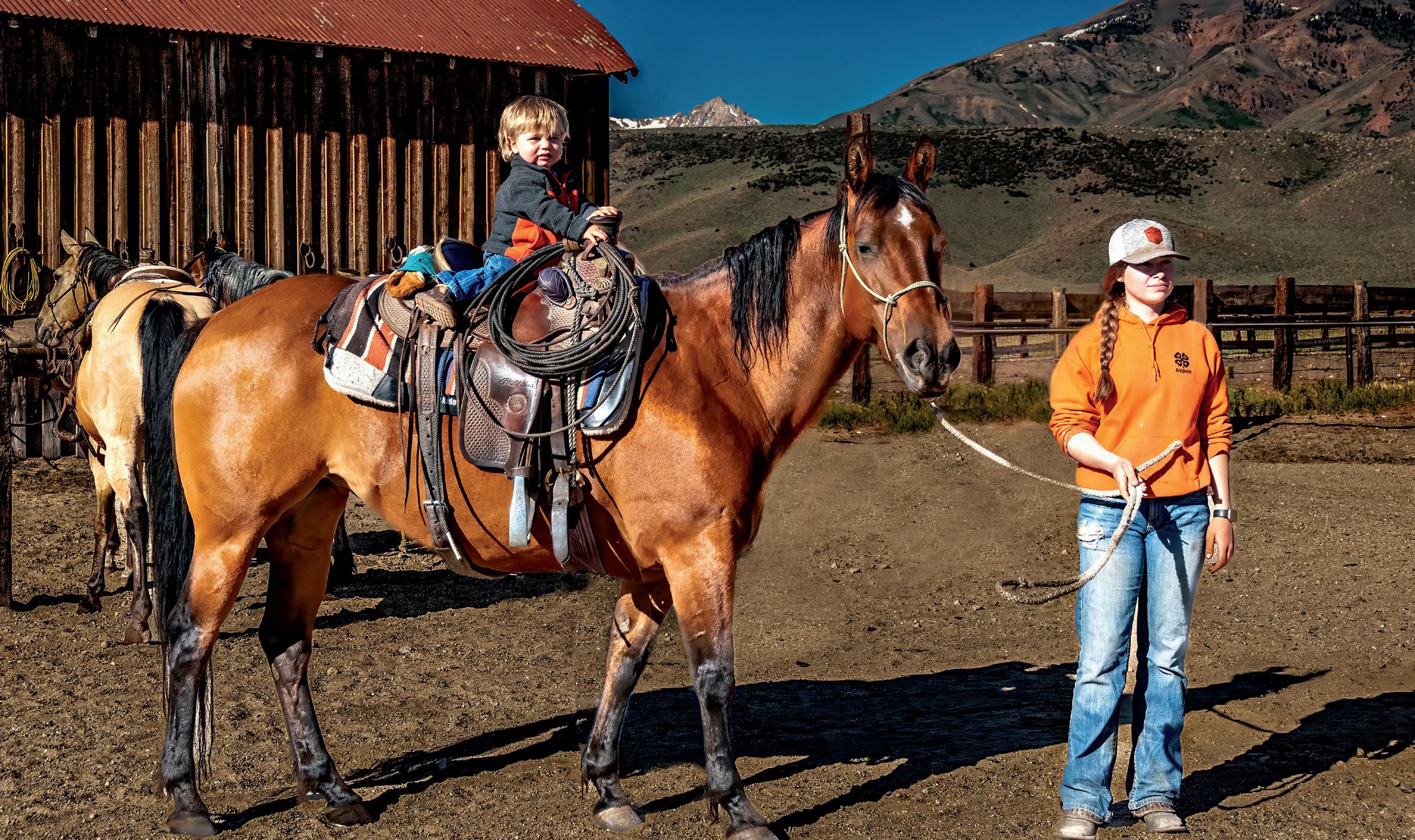
The Great Outdoors | The Wild West
Eighteen-year-old Aspen Wright guides her little nephew Leland on a horse.
avenue to expose a little ranch kid who doesn’t see much of the outside world to people from different back grounds.”
The Circle H is not limited to nose-to-tail trail riding. It is high-country, boundless riding at its best: the exhilaration of loping across a 4,000-acre meadow in the shadow of the Sierras, saddled on an exuberant quarter horse, churn ing up sod and splashing through springs with no fence in sight. Demands of everyday life are as far off as the Milky Way.
Horse-walking in the midst of the meadow casts a magical spell as waves of wild irises shimmy in the afternoon breeze and bright clouds of butterflies flit in a winged waltz. An inner peace spreads like a com forting blanket in the zen-like still ness, broken only by the sweet song of a warbling wren.
“One of the best things about riding through the meadow is it’s always different,” Jeff’s daughter, Leslie, mused. “The light is different, the cattle are in a different place, the grass is in a different stage, the horse is different—a colt or your old faithful.”
Charismatic ranch celebrity Benny Romero, who has lived in the hearts of the Hunewills for a quar ter century, entertains guests on his popular horse walks. The 78-yearold Basque from New Mexico rides with the ease of a lifetime in the saddle and spins tales with the humor of a seasoned storyteller. He recollects crossing a creek on his gelding, Delta, when two cows butted heads and started a ruckus: “One turned suddenly and struck Delta in the chest, making him swing around real hard.” He quoted Megan saying, “Benny, anybody else would have come off the horse, but you stuck on like a tick.”
Guests herd easy-to-handle Red
vvv
Angus cattle under the pretense of helping out. “Women just love horses,” Megan contended, “but men like to have a job. Moving cows gives them a purpose on a horse.” Pushing them through pastures and across streams is routine, but not so through open gates where they con gregate. Patient prodding and wran gler finesse breaks the impasse.
Canyon Connection
On an all-day horseback ride into Buckeye Canyon, golden shafts of sunlight filter through the tree branches, dappling the trail and underbrush, partially concealing a herd of mule deer. Stands of aspen with slender white trunks and glossy green leaves tremble in the gentle breeze, cooling the sweat on your brow. Unexpectedly, the can yon opens onto a cinematic alpine meadow and a soaring sculpted granite cathedral, cradling glisten ing glaciers against a cerulean sky.
Amid the majesty, guests picnic on a grassy knoll beside a stony creek. Laze in the noonday sun or under a sheltering fir as blue jays lurk over head and chipmunks gambol about. A pair of red-tailed hawks soars above the precipitous canyon walls, and a golden eagle perched on the topmost branch of a lone pine emits piercing cries.
In 1861, Napoleon Bonaparte Hunewill established a sawmill in Buckeye Canyon to supply lumber hauled by teams of oxen to min ing boomtowns and built a house
for his young Maine bride. Esther likely found life difficult in the Sierra wilderness and may have screamed back at the wind howl ing down the canyon. She may have pined for female companionship, melodic music, and gay laughter when starlit nights fell silent. But standing shoulder to shoulder with her husband, she faced the frontier challenges head on. The ancestral fortitude survives in the strong work ethic of their college-educated progeny, illustrated by the self-re liant women in the forefront of the guest ranch and by the able-bodied men behind the scenes of the cattle operation.
The nucleus of the Hunewill Ranch is the barn raised two decades later in the Bridgeport Valley. Built with pegs, not nails, it is a fine example of late-19th-cen tury craftsmanship. The pungent smell of horse sweat, aged leather, and stacked saddle blankets per meates the dim interior. A family of great horned owls roosts in the cool recesses of the high, shadowy beams.
The graceful, white Victorian ranch house was constructed in 1880 with timber from the canyon. The furniture in the parlor was shipped from San Francisco, includ ing the heirloom Steinway that rounded Cape Horn and was played by daughter-in-law Alice, who graduated from the New England Conservatory of Music. A remod eled portion of the house serves as
ISSUE 11 | NOVEMBER 2022 89 The Wild West | The Great Outdoors
Guests straddle a saddle for a week, making a lifetime memory and a mental snapshot of the serenity and natural splendor.
the family and guest kitchen and dining room.
The Hunewills retain memories of a carefree childhood playing in the hayloft of the barn and the cur rant patch near the house, swim ming in the creek, and riding across the meadow. “My sister, Rhiannon, and I would ride our horses to our favorite fishing hole and ride back with fish flopping on the side of our saddles,” Aspen recalled. “It was kind of gross. We cleaned them and gave them to the cook, who I think threw them away.”
Land Stewards and Cattle Connoisseurs

The cash flow from the guest side makes it possible for family mem bers to stay on the ranch. They directly communicate with each other in a weekly meeting. “We have to work together, talk things out in a civilized manner,” Megan said. “It makes it easier that we like each other and what we do.”
Jeff recently secured a conser vation easement, safeguarding the ranch from development. “There’s a lot of habitat that’s being protected,” said Eastern Sierra Land Trust Executive Director Kay Ogden in late 2020. “That land is in their DNA. They’ve owned it so long— they are incredible stewards of the land.” Jeff recognizes that balancing the intricacies of livestock, wildlife, and natural resources is integral to such stewardship.
Leslie’s niche is keeping records of the cattle. “I can talk about cows all day long,” she said with a twin kle. “If you ask me about number 99 with a red ear tag, I can tell you how she performs and give you her entire history. My brain is a mental filing system.”
During the traditional cattle drive complete with chuck wagon in early November, stalwart guests
act as drovers accompanying the Hunewills for five days to move 600 cattle over the same route fol lowed for more than a century—60 miles from the Bridgeport ranch to the lower Nevada range. “We cannot stay at Bridgeport in the winter as there is a lot of snow and the temperature drops to minus 34 degrees like in Montana,” Jeff said. The drive’s bone-chilling tempera tures and high gusty winds induce the wranglers to doff their Stetsons for warm and snug headdress. Everyone returns to the cozy com fort of the ranch at day’s end.
Reality and Romance
Planning for posterity, the Hunewills have investments outside the ranch. “There was a time when I was young that we sold all the cows to get out of a financial hole,” Megan said. “Cows are liquid assets; we did not have to sell the land.” This reminded me of my first roundup on that bleak, Wyoming day. My first was the fifth generation ranch fam ily’s last. I’ll never forget the heart break and the dread in their eyes, wondering what they’d do with their lives.
The reality and romance of the Hunewill Ranch are intertwined. Cowboys hurtle across creek beds without breaking stride and com municate to each other without speaking a word as they ride. Guests straddle a saddle for a week, mak ing a lifetime memory and a mental snapshot of the serenity and natural splendor. “Many of our older ladies like to get out to enjoy the sounds of the creek and the birds and to look at the mountains in the background,” teenage Aspen said, smiling. Years from now, if the offspring play their cards right, her great-grandchildren will take the matriarch for creekside rides on the ninth-generation Hunewill Ranch.
LEFT Ax this is the caption template,
Tx
•
90
The Great Outdoors | The Wild West
ABOVE
Horses gather in front of an old barn that has been on the ranch since 1880.
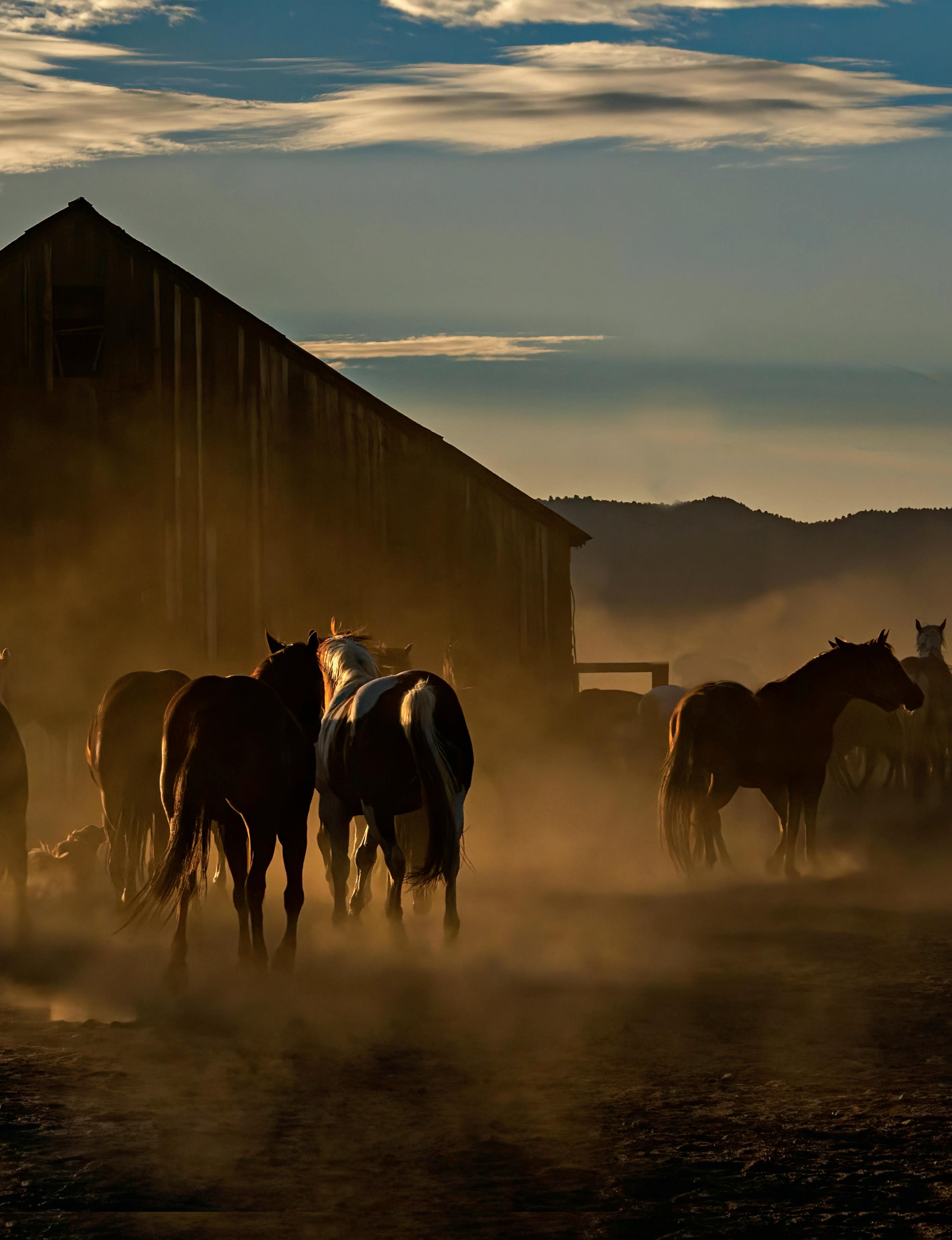
Holiday Gift Guide
Farm-to-Table Bounty
WRITTEN BY Crystal Shi
THE BEST GIFTS are the ones you can eat— especially if you know you’re supporting family farms with each bite. Here are our picks for farmfresh gifts from across the country that’ll be sure to nourish and delight.
An Artisanal Olive Oil Flight •
Fake and rancid options abound on supermarket shelves, but McEvoy Ranch’s internationally renowned extra vir gin olive oils are the real deal. The entire grove-to-bottle process is done on the third-generation working farm in California. A tasting pack of 100-milliliter bottles, which includes flavored options like garlic and blood orange, makes an elegant gift. From $32.95 for a 3-piece pack, McEvoyRanch.com
Not Your Ordinary Fruit Basket •

Unearthing rare gems like eggfruit, black sapote, and tree tomatoes from a Miami Fruit variety box is a delightful experience for all the senses. The company deals in trop ical fruits grown on its own farm or other small South Florida farms; an exception is its cacao pods—which crack open to reveal beans covered in a slippery, sweettart pulp—sourced from Ecuador. From $87 for a 3- to 5-pound variety box, MiamiFruit.com
California Sunshine, Delivered •
A box of citrus fruits is a sure cure for the winter blues— even better if they’re hard-to-find varieties like yuzus, finger limes, or calamondins. For your citrus-loving loved ones, Pearson Ranch, a family-run farm in California’s San Joaquin Valley, will ship these specialties along with man darins, navels, pomelos, and more. $35 for a 5-pound box of mandarins; $65 for a 5-pound specialty citrus sampler box; PearsonRanch.com
• A Bouquet of Fresh Flours
Help your favorite baker take his or her sourdough hobby to the next level with a box of freshly milled flour from Bluebird Grain Farms. The certified organic, regenerative farm in Washington grows ancient grains, from emmer to einkorn, and mills them to order for maximum nutrition and flavor. The Baker’s Tote includes five types of flour, a whole grain cereal blend, a sourdough starter, and a jar of local honey. $115.55, BluebirdGrainFarms.com
Splurge-Worthy Meats →

Snake River Farms counts Michelin-starred chefs among its fans, who praise its intensely flavorful American Wagyu beef and Kurobata pork. They are sourced from small farms across the Northwest and Midwest. A bone-in ham would make a luxurious holiday centerpiece, or consider gifting a break fast-lover a pack of smoky, thick-cut bacon. $125 for a (5.5-pound) half bone-in ham; $29 for 1.5 pounds of bacon; SnakeRiverFarms.com
← A Taste of the South
From a silky, soft-ripened double-cream cheese to a bold, raw milk tomme, Sweet Grass Dairy’s award-winning wheels are made from milk produced by cows grazing yearround on Georgia grass. Deliver an instant par ty with the Southern Charm gift box, a some thing-for-everyone collection including four different cheeses; pimento cheese; and jam and charcuterie from fellow Southeast artisans. $100, SweetGrassDairy.com
Unusual Farm-to-Jar Spreads •
The fruits truly shine in the small-batch, low-sugar spreads made by Mt. Hope Farms. Flavors like Raspberry Marionberry, Blackberry Aronia Lavender, and Heritage Apple (made with local rum) show off the unique berries and fruits grown on this small farm in the Willamette Valley; the Harvest Collection Gift Box is a lovely introduction to its bounty. $55 for six 7.25-ounce jars, MtHopeFarmsOregon.com
For the Eco-Conscious Carnivore • Grass-fed beef from White Oak Pastures has a rich, clean flavor—that’s also sustainably pro duced. At the sixth-generation family farm in Georgia, animals are pasture-raised using regenerative practices, with no antibiotics or hormones, and hand-butchered with every part used—which means you can also round out a gift of steaks with a handmade leather wallet or tallow candle. $140 for a (6.25-pound) grassfed beef bundle, WhiteOakPastures.com
94 AMERICAN ESSENCE Save 47% on a Subscription Today! FIRST NAME LAST NAME ADDRESS APT. # CITY STATE ZIP EMAIL PHONE PLEASE PRINT LEGIBLY (INCLUDE APT., STE., OR UNIT NO.) BY SIGNING THIS SUBSCRIPTION FORM, I AFFIRM THAT I HAVE READ, UNDERSTOOD AND AGREED TO THE TERMS AND CONDITIONS at AmericanEssence.net/Terms I also affirm all info above is complete and accurate. CARD # EXPIRATION CARD CVV# ZIP NAME ON CARD SIGNATURE PAY BY CHECK (PAYABLE TO American Essence) USE MY CREDIT CARD / DEBIT CARD❒ ❒ MM Y Y ONLINE: AmericanEssence.net HOTLINE: (888) 805-0203 BY MAIL: American Essence Attn: Accounting Department 5 PENN PLAZA, Fl. 8 New York, NY 10001 Yes, I’d like to subscribe! BEST DEAL ($7.95/issue for the 1st year) ($8.95/issue from the 2nd year) ($9.95/issue for the 1st year) ($10.95/issue from the 2nd year) $95.40 $179.40 Save 47%* $59.70 Save 33%* 1 Yearly (12 Issues) 6 Months (6 Issues) * Based on a monthly rate of $14.95 Save 47% on a Subscription Today! FIRST NAME LAST NAME ADDRESS APT. # CITY STATE ZIP EMAIL PHONE PLEASE PRINT LEGIBLY (INCLUDE APT., STE., OR UNIT NO.) BY SIGNING THIS SUBSCRIPTION FORM, I AFFIRM THAT I HAVE READ, UNDERSTOOD AND AGREED TO THE TERMS AND CONDITIONS at AmericanEssence.net/Terms I also affirm all info above is complete and accurate. CARD # EXPIRATION CARD CVV# ZIP NAME ON CARD SIGNATURE PAY BY CHECK (PAYABLE TO American Essence) USE MY CREDIT CARD / DEBIT CARD❒ ❒ MM Y Y ONLINE: AmericanEssence.net HOTLINE: (888) 805-0203 BY MAIL: American Essence Attn: Accounting Department 5 PENN PLAZA, Fl. 8 New York, NY 10001 Yes, I’d like to subscribe! BEST DEAL ($7.95/issue for the 1st year) ($8.95/issue from the 2nd year) ($9.95/issue for the 1st year) ($10.95/issue from the 2nd year) $95.40 $179.40 Save 47%* $59.70 Save 33%* 1 Yearly (12 Issues) 6 Months (6 Issues) * Based on a monthly rate of $14.95
Morse
at a studio
64–66 | Public domain
67 | Top: Jasmina Zhang for American Essence
Bottom: Michael Barera (CC BY-SA 4.0, CreativeCommons. org/licenses/by-sa/4.0)
68–69 | Public domain
70–71 | Illustrations: R.W. for American Essence
Others: Public domain
74–75 | Courtesy of Jacques Pépin
76 | Joseph Abad
77 | Ken Goodman 78–81 | Large illustrations: Lelenarts_ for American Essence
Others: Rawpixel 82–83 | Background: gsk2014
Pilgrims: Everett Collection Benjamin Franklin: pne/ Shutterstock Others: Rawpixel 92–93 | Left to right: Courtesy of Miami Fruit, Bluebird Grain Farms, McEvoy Ranch, Sweet Grass Dairy, Mt. Hope Farms, Snake River Farms, White Oak Pastures
The Pearson Ranch: Tiger Images, Sann von Mai, bonchan/Shutterstock
Background: Rawpixel
Corrections: In the story “Hidden Gems
Among the Mountains” that appeared in the September issue, a photo caption mis identified the winery shown on the opening page. It is the Montaluce Winery and Restaurant. American Essence regrets the error.
Quiz Answers (pg. 63)
Memorial Day mourns those who have died. Veterans Day honors all military personnel, past and present.
2.
With a little over 40,000
the U.S. Coast Guard is about five times larger than the newly-created Space Force.
from post-trau
a traumatic brain injury,
depression.
4.
article in a Chicago-based newspaper pub lished near the end of the war. The Tuskegee Airmen still had a lower loss record than most other fighter groups, however.
to
5. Poppy. In late 1918, Professor Moina Michael campaigned to establish the poppy as a remem brance symbol after reading fallen soldier John McCrae’s famous poem on that subject.
6. Sacred. “The Sacred Twenty” delivered care on battlefields and served as leaders in hospi tals around the world, implementing programs to improve training, education, and medical conditions.
7. Armistice. The ceasefire between Allied and German forces marked the end of “the war to end all wars.” In 1947, the event was extended to cele brate all veterans.
8. B. The Medal of Honor was awarded 1,523 times during the Civil War, comprising about 40 percent of the total number. The first award pre sentation took place in 1863.
9. D. While Vonnegut, Heller, and Jones all based their novels (at least loosely) on their experiences serving in World War II, Hemingway’s is based on his service in the Spanish Civil War.
10. B. According to the U.S. Department of Veterans Affairs, 240,329 World War II vets were alive in September 2021. Almost 250 vets die each day. It is estimated that by 2032, they will be gone.
ISSUE 11 | NOVEMBER 2022 95 On the Cover Photo: Adhiraj Chakrabarti for American Essence Pictured: 17-year-old entre preneur Alina
pho tographed
near Detroit Makeup & hair stylist: Crystal Drake 2 | History in HD/Unsplash 6 | Bird of Bliss for American Essence 8–9 | Left: James Secreto/ Nostalgic Motoring Ltd. Right: Courtesy of the AACA Museum 10–11 | Top: Courtesy of Preston Tucker LLC Bottom: Courtesy of the AACA Museum 12–13 | Left: Courtesy of the AACA Museum Right: Courtesy of Mark Lieberman 16 | Tatsiana Moon for American Essence 26–27 | Courtesy of Teresa Buczacki 28 | Stephanie Berger 30–31 | Lori Sax 32–34 | Miguel Floes-Vianna 35 | Tria Giovan 36 | Miguel Floes-Vianna 37 | Tria Giovan 38–40 | Courtesy of Shaniko Wool Company 41 | Courtesy of Ralph Lauren 42–43 | Courtesy of Shaniko Wool Company 45 | Courtesy of Randy Brunson 46 | Rawpixel 48–50 | Public domain 51 | Architect of the Capitol 52–57 | Public domain 58–59 | Left: Jasmina Zhang for American Essence Right: Public domain 60–62 | Public domain 63 | Freepik
1. False.
True.
active service members,
3. True. Nearly 30 percent of veterans suffer from a disability. Many more suffer
matic stress disorder,
and major
False. This myth was long-perpetuated due
an
Photo Credits
95




“Falun Gong is, in my judgement, the single greatest spiritual movement in Asia today. There’s nothing that begins to compare with it in courage and importance.”
Mark Palmer FORMER U.S. AMBASSADOR
“What made Falun Gong stand out from other qigong exercises and meditation practices was a moral system—compassion, truthfulness, and forbearance— unmistakably Buddhist in origin.”
Arthur Waldron LAUDER PROFESSOR, UNIVERSITY OF PENNSYLVANIA
Capturing the Hearts of Millions
This book expounds upon the profound principles of Truthfulness, Compassion, and Tolerance. It focuses on a long-forgotten term called “cultivation,” and the importance of moral character on one’s path to spiritual perfection. The book explains the role of karma as the root cause of illness and tribulations, along with many other mysteries of life and the universe.
Zhuan Falun, the main text of the spiritual practice Falun Dafa, was a national bestseller in China in the 1990s, and has since been translated into over 40 languages. Find out why it has captured the hearts and minds of tens of millions of people in over 100 countries worldwide! FaYuanBooks.com
Scan the QR code with your phone camera to open our website, or visit:

A LIFE-CHANGING BESTSELLER



AMERICAN ESSENCE