2
Welcome
21 MARCH 2026
Programme In Brief
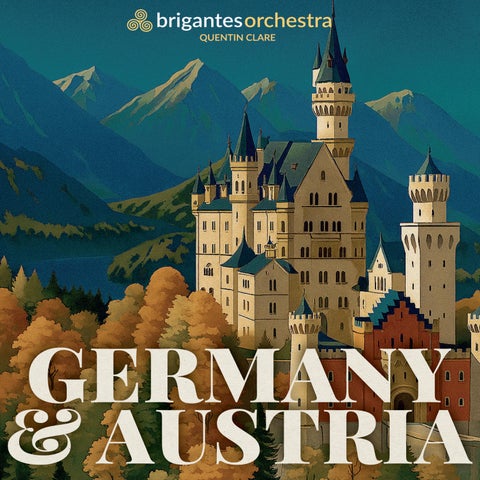
Introduction Reformation Here we are again, bringing you another programme of wonderful music so soon after the last. This season, our musical Grand Tour is visiting the great hotspots of classical music, and after France, the Nordics and Russia, we now arrive in the cradle of Western classical tradition: Austria and Germany.
THE BRIGANTES ORCHESTRA
We could have chosen any number of towering figures from this region - Haydn, Schubert, Beethoven or Mozart yet each, in different ways, acknowledged a profound debt to, and stood in the long shadow of, J.S. Bach. Tonight we present two of Bach’s most remarkable works in orchestral arrangements by Joachim Raff and Anton Webern, placing them alongside the sumptuous harmonic world of Wagner and Mendelssohn’s highly original - and too rarely heard - Reformation Symphony.
Chaconne in d (c.1720 / 1873)
As ever, Brigantes brings together some of the finest professional musicians from Sheffield and the surrounding region. We are privileged to perform in the magnificent setting of Sheffield Cathedral, which continues to provide such an inspiring home for our concerts.
David Milsom (leader) Quentin Clare (conductor)
JS BACH (1685 to 1750) orch. JOACHIM RAFF (1822 to 1882) [without tempo marking]
RICHARD WAGNER (1813 to 1883) Music from Parsifal (1882) I Prelude to Act One: Sehr langsam II Good Friday Spell from Act One, Scene 3: Feierlich bewegt INTERVAL c.8.05pm for 20 minutes
JS BACH (1685 to 1750) orch. ANTON WEBERN (1883 to 1945) Ricercare from The Musical Offering (1747 / 1935) Sehr mäßig
Thank you for joining us this evening. We look forward to welcoming you again when the Grand Tour returns home to England for Holst’s magnificent orchestral showpiece, The Planets, followed by a second half celebrating that great British summer festival tradition: The Last Night of the Proms! We are delighted to be collaborating with the Sheffield Philharmonic Choir on 16 May 2026 here in Sheffield Cathedral.
FELIX MENDELSSOHN (1809 to 1847)
Full details of the coming season can be found on page three of this brochure.
FINISH c.9.10pm
Symphony No. 5 in d, Reformation (1830) I Andante - Allegro con fuoco II Allegro vivace III Andante IV Chorale: Ein veste Burg (Andante con moto) Allegro vivace - Allegro maestoso
Brigantes Orchestra Season 2025/26 Grand Tour
FRANCE | L’ARLÉSIENNE
THE NORDICS | NORTHERN LIGHTS
FROM RUSSIA
James Mitchell - Organ
Tim Horton - Piano
Wiebe-Pier Cnossen - Baritone
Friday, 17 October 2025, 7.30pm
Saturday, 29 November 2025, 7.30pm
Friday, 23 January 2026, 7.30pm
Sheffield Cathedral
Sheffield Cathedral
Sheffield Cathedral
Georges Bizet L'Arlésienne (extracts)
Jón Leifs Hinsta kveðja (Elegy for Strings)
Pyotr Ilyich Tchaikovsky Romeo and Juliet
Maurice Ravel Boléro
Edvard Grieg Piano Concerto in a
Modest Mussorgsky Songs and Dances of Death
Camille Saint-Saëns Symphony No. 3, Organ
Jean Sibelius Symphony No. 3 in C
Igor Stravinsky The Firebird Suite (1945)
GERMANY/AUSTRIA | REFORMATION
BRITAIN | PROMS FESTIVAL
AMERICA | INDEPENDENCE DAY
Quentin Clare - Conductor
Sheffield Philharmonic Chorus
Julian Trevelyan - Piano
Saturday, 21 March 2026, 7.30pm
Saturday, 16 May 2026, 7.30pm
Saturday, 20 June 2026, 7.30pm
Sheffield Cathedral
Sheffield Cathedral
Sheffield Cathedral
JS Bach / Joachim Raff Chaconne in d
Gustav Holst The Planets
Leonard Bernstein Overture, Candide
Richard Wagner Prelude and Music from Parsifal JS Bach / Anton Webern Ricercare Felix Mendelssohn Symphony No. 5, Reformation
a second half including all the traditions of The Last Night of the Proms: Thomas Arne Rule Britannia Edward Elgar Pomp and Circumstance No. 1
George Gershwin Concerto in F George Gershwin Overture, Girl Crazy Aaron Copland Rodeo
4
Programme Note: Bach orch. Raff - Chaconne from Partita No. 2 in d for Violin Solo
21 MARCH 2026
Joachim Raff (after JS Bach) (1822 to 1882) Chaconne in d (1873) 1
can feel almost Brahmsian in its warmth. Inner voices are
[WITHOUT TEMPO MARKING]
coloured, suspensions linger, and cadences acquire a
In the great continuum of Austro-German musical thought, few works exert a gravitational pull comparable to JS Bach’s D minor Chaconne for solo violin. At once monumental and intimate, architectural and improvisatory, it has long been regarded as a summa of Baroque variation technique and spiritual expression. Busoni, Brahms, Stokowski and others each felt compelled to translate it into new media, as though testing how far its harmonic and structural DNA could be refracted without loss of identity. Joachim Raff’s orchestral arrangement stands as an ambitious act of homage.
C19th breadth. This is not a neutral orchestration but an interpretative act: Raff reads Bach through the lens of post-Schumann harmonic sensibility, expanding the vertical dimension while seeking to preserve the inexorable logic of the variations. Raff reveals his distinctive position in music history. Born in 1822 and active in the orbit of Franz Liszt in Weimar, he occupies a fascinating middle ground in the German tradition. Celebrated in his lifetime, with his his symphonies widely performed, he later found himself overshad-
The fascination is understandable. The Chaconne unfolds as a vast set of variations over a repeating bass pattern, Joachim Raff
yet in Bach’s original, much of the harmony is only
owed by the polarised narratives that privileged either the “New German School” of Liszt and Wagner, or the “absolute” lineage culminating in Brahms. Yet Raff’s music often synthesises these currents: formally disciplined yet
implied. Multiple voices are suggested through arpeggiation, registral placement and the listener’s aural imagination; chords are often broken, their completion entrusted to memory and expectation. This technique of harmonic implication, so central to Bach’s polyphonic thinking, creates a music that feels both transparent and inexhaustibly rich. Each performer, and indeed each arranger, must decide how to realise what is left unsaid. Raff’s response is characteristically Romantic. Where Bach intimates, Raff frequently articulates. At moments where the violin’s figuration merely sketches a progression, Raff supplies a fully voiced harmonic fabric, sometimes deepening the sonority with a palette that
harmonically adventurous, reverent toward tradition yet unafraid of re-imagining it. His orchestration of the Chaconne exemplifies this synthesis, treating Bach not as a museum piece but as living material within a continuous German heritage. Raff never overwhelms Bach. Rather, he reads the Chaconne through his own history. The orchestral medium inevitably alters perception. What in the violin version can seem austere and inward becomes communal and resonant. The music gains weight and breadth; climaxes expand; contrasts of timbre articulate the variations in ways unavailable to a single instrument. Raff’s arrangement therefore stands as both tribute and transformation. The listener can still sense, behind the orchestral fabric, the ghost of the original, solitary violin.
1702 Anne
1709 Fortepiano
1723 1720 Vivaldi BACH Four CHACONNE Seasons
1727 George II
1741 Handel 1736 Messiah Sea Clock
1750 Tom Jones
baroque period classical period
1772 MOZART Symphony 1760 1764 George III Spinning Jenny 18 in F
Programme Note: Wagner - Music from Parsifal 5
thebrigantes.uk
Richard Wagner (1813 to 1883) Music from Parsifal (1882) 1 2
the aged Gurnemanz and the penitent Kundry on Good
PRELUDE TO ACT ONE: SEHR LANGSAM GOOD FRIDAY SPELL: FEIERLICH BEWEGT
Friday morning. Observing the meadow bathed in
When Wagner completed Parsifal in 1882, he described it not as an opera but as a Bühnenweihfestspiel - a “festival stage-consecration play.” Written for the Bayreuth Festspielhaus and performed exclusively there for many years, it was conceived as a work of ritual and spiritual reflection. The Prelude and the so-called Good Friday Spell distil the essence of this, his final score: music of stillness, symbolism, and inward illumination.
renewed through compassion and sacrifice. The “spell” is not supernatural enchantment but spiritual perception: the ability to see creation restored. Parsifal proved influential for the music of the next century. In part, this is because its harmonic language
and Lutheranism. Wagner adopts and transforms it into
sense of harmonic ambiguity and colouristic orchestration profoundly affected composers such as Debussy, whose own operatic sound world absorbs Wagner’s
Richard Wagner
liturgical formula associated with Saxon church tradition
muted textures and modal inflections even while
the musical emblem of the Holy Grail. In the Prelude, it unfolds with spacious reverence, harmonised in luminous string textures and enriched by gently glowing wind
resisting his grandiosity. Equally important is Wagner’s pacing. Long stretches of minimal external action are sustained by evolving orchestral colour and thematic
writing. The effect is not theatrical but contemplative.
transformation. Atmosphere itself becomes drama. This
Time seems suspended as Wagner introduces the Grail motif, music of Faith, and ideas associated with suffering and compassion. The harmonic language is characteristically chromatic, yet unlike the restless sensuality of Tristan und Isolde, here chromaticism seeks resolution in serenity rather than ecstasy. The Prelude feels less like an overture than an act of consecration: an invitation into a sacred space.
conception of musical space - where timbre, harmony, and psychological depth carry narrative weight shaped early modernism and left traces in symphonic writing, opera, and eventually film music.
CHROMATICISM: The use of notes outside the main key of a piece of music. Instead of sticking to the usual scale, a composer adds extra notes in between, creating richer colour and stronger emotion. These unexpected tones can make the music sound tense, expressive, or
Parsifal redefines heroism. Redemption comes not through conquest but through compassion. Its
dramatic, often heightening feeling before returning to a sense of resolution.
synthesis of medieval legend, Christian symbolism, and
The Good Friday Spell occurs in Act III. Parsifal, once the “pure fool,” has gained wisdom through suffering and temptation. Returning with the Holy Spear, he encounters
classical period
Gurnemanz explains that on this day the world is
pushes Romantic chromaticism toward stasis. This
Central to both excerpts is the Dresden Amen, a six-note
1776 Declaration of Independence
spring light, Parsifal senses nature transfigured.
1789 URANIUM DISCOVERED
1794 haydn clock symphony
philosophical mysticism creates a drama of inward transformation rather than outward spectacle. In its final bars, as the Grail community is restored, the music does not blaze triumphantly; it radiates calm.
1801 Beethoven moonlight sonata
1800
1813 Pride and Prejudice
1822 Babbage difference engine
romantic period classical period
1830 MEndelssohn reformation symphony
1837 Victoria
6
Programme Note: Bach orch. Webern - Ricercare from The Musical Offering
21 MARCH 2026
Anton Webern (after JS Bach) (1883 to 1945) Ricercare (1935) 1
This approach is inseparable from the concept of
SEHR MÄßIG When Anton Webern orchestrated the Ricercare from Johann Sebastian Bach’s The Musical Offering in 1935, he was not indulging in neo-Baroque pastiche. Rather, he was engaging in an act of historical x-ray: revealing the internal anatomy of Bach’s counterpoint through the prism of twentieth-century sonority. The result is one of the most radical orchestrations ever written, a work that simultaneously venerates and transforms its source. Bach’s Ricercare is itself a monument of learned counterpoint. Constructed as a six-voice fugue on the theme given to Bach by Frederick the Great, it is austere, rigorous, and architecturally exact. In its original keyboard form, the contrapuntal strands are realised on a single instrument, their differentiation left to articulation and registration. Harmony is often implied rather than Anton Webern
explicitly verticalised; the listener perceives the harmonic field as the by-product of linear motion. Webern’s insight was to treat each of those contrapuntal strands not as part of a blended polyphonic fabric but as an autonomous timbral event. Instead of assigning entire voices to single instrumental sections, he fragments the lines into individual notes, distributing them pointillistically across the orchestra. A single melodic strand may pass
Klangfarbenmelodie (tone-colour melody), a term associated with Webern’s teacher Arnold Schoenberg. In essence, Klangfarbenmelodie treats timbre as a structural parameter equivalent to pitch or rhythm. Melody is no longer defined solely by intervallic succession but by shifts in colour. In Webern’s hands, orchestration becomes composition. The change of instrumental hue articulates the musical argument just as clearly as harmonic progression once did in tonal practice. In the Ricercare, this produces an extraordinary paradox. A work from 1747 sounds uncannily modern not because Webern alters Bach’s notes (he does not), but because he reframes their perceptual hierarchy. The ear is drawn to the discrete event: a pizzicato string note hanging in silence, a horn entry emerging like a distant signal, a harp tone glinting momentarily before vanishing. Silence itself becomes structural, isolating pitches so that the contrapuntal web is experienced as a constellation of points rather than a continuous weave. Thus a work conceived for a royal court in Potsdam becomes, through Webern’s ear, a touchstone of modernism. Across two centuries, the discipline of counterpoint and the emancipation of timbre meet and illuminate one another.
from muted trumpet to clarinet, from harp harmonic to muted string, from trombone to oboe: each pitch illuminated in a distinct colour. The effect is not decorative; it is analytical.
1846 Saxophone
1855 Colour Photography
romantic period
1860 GREAT EXPECTATIONS
1868 1873 1882 Brahms Raff 1877 Wagner German Chaconne Edison's parsifal 1886 requiem Phonograph motor car
1895 THE Time Machine
1900 romantic period
20th/21st century
Programme Note: Mendelssohn - Symphony No. 5 in d, Reformation
thebrigantes.uk
7
Felix Mendelssohn (1809 to 1847) Symphony No. 5 in d, Reformation (1882) 1 2 3 4
ANDANTE - ALLEGRO CON FUOCO ALLEGRO VIVACE ANDANTE CHORALE: EIN VESTE BURG (ANDANTE CON MOTO) ALLEGRO VIVACE - ALLEGRO MAESTOSO Although it bears the number five, Mendelssohn’s Reformation Symphony was among his earliest largescale orchestral works, composed in 1830 when he was just twenty-one. Intended to commemorate the 300th document of Lutheran Protestantism - the symphony reveals a young composer consciously positioning himself within a German sacred and musical lineage. In doing so, Mendelssohn creates a work in which history, theology and symphonic architecture intertwined.
of the orchestral texture emerges the so-called Dresden Amen, a liturgical formula associated with Saxon church tradition. Its serene, stepwise motion had long signified sacred space; Mendelssohn elevates it from ecclesiastical cadence to symphonic motto. The phrase does not function as a mere quotation but as a generative cell, inflecting the harmonic and thematic argument that follows. When the Allegro con fuoco bursts forth, its urgency feels like a response to this invocation. The first movement balances classical clarity with Romantic intensity. Mendelssohn’s contrapuntal fluency is already fully formed: themes are not simply juxtaposed but woven together with Bach-like discipline.
1910 George V
romantic period
1924 Television
Passion, an event that reshaped nineteenth-century attitudes toward Baroque music. The second movement, marked Allegro vivace, offers characteristic Mendelssohnian lightness - fleet, rhythmically buoyant, almost scherzo-like - whilst the third turns inward: its cantabile lyricism foreshadowing the Songs Without Words, intimate solo piano pieces which Mendelssohn wrote over the last fifteen years of his life. The finale opens with the appearance of Martin Luther’s chorale Ein feste Burg ist unser Gott (A Mighty Fortress Is Our God). Introduced in the winds, the
The introduction sets the tone with grave solemnity. Out
1916 holst the planets
had conducted the revival of Bach’s St Matthew
hymn gathers force across the movement, eventually
DRESDEN AMEN: a short, flowing
proclaimed with orchestral breadth. Crucially,
musical phrase first used in church
Mendelssohn does not present the chorale as a static
services in Dresden, Germany. It has
monument, he subjects it to symphonic development fragmentation, imitation, contrapuntal layering integrating it into the movement’s structural fabric. The chorale becomes both symbol and substance: a declaration of faith transformed into a dynamic
a smooth, gently rising shape that sounds calm, reverent and reflective. In the nineteenth century, composers such as Mendelssohn and Wagner borrowed the phrase in their orchestral works to suggest
musical argument.
spirituality or a sense of awe. When
In this symphony, Mendelssohn demonstrates how
creates the feeling of stepping into a
it appears in a concert piece, it often
inherited material can be revitalised through Romantic
church-like atmosphere, even
orchestral thought. The Dresden Amen and Luther’s
without words or religious text.
chorale are not nostalgic artefacts; they are structural pillars within a forward-looking symphonic design. The work’s architecture - from invocation to affirmation -
mirrors its spiritual trajectory. 1935 1948 webern 1939 messiaen ricercare Murder 1952 turangalila is easy
Elizabeth II
1956 Video Tape
1971 1973 Floppy First Disk Mobile Call 20th/21st century
20th/21st century
1914/18 WWI
Felix Mendelssohn
anniversary of the Augsburg Confession - the foundation
This is no accident. Only a year earlier, Mendelssohn
1939/45 WWII
8
Article: Austro-German Classical Music
21 MARCH 2026
Brigantes Beginners “...music is a higher revelation...” Ludwig van Beethoven Austro-German Classical Music Caspar David Friedrich - Wanderer Above the Sea Fog
“Music is a higher revelation than all wisdom and
did reach Vienna, even if he did not. Mozart rediscov-
philosophy.” – Ludwig van Beethoven
ered his work after being played it by Bach’s son, C.P.E. Bach. Mozart said, “Now, here is something one can
And so, we arrive on our musical Grand Tour in Germany
learn from.”
and Austria. If music was like football, these composers were the Ronaldo and Messi of their day. But who were
Haydn (1732 to 1809) was another beneficiary of this
they?
political stability. His aristocratic patronage did not come from the Habsburgs, but the fabulously rich Esterházy
Perhaps the first winner of our “Golden Baton” award
family. Although his position was financially lucrative, he
would be Johann Sebastian Bach (1685 to 1750). Bach
was isolated from the salons and courts playing the
was born at a time of European stability and religious
latest fashions in music. This was ultimately to his
reverence in Eisenach, in the Duchy of Saxe-Eisenach. At
benefit: “Cut off from the world; there was no one near
BRIGANTES BEGINNERS
the time, Germany did not exist as a country. Instead,
to confuse or torment me, and I was forced to become
by Anthony Hart
there were a disparate group of states, principalities, and
original.” Haydn took a melody and transformed it within
If you don’t know much about
duchies tied loosely together politically in the Holy
his pieces, and he inserted humour in a way that church
classical music, coming to a concert
Roman Empire with the Habsburg emperors in Vienna at
patrons would have frowned upon. Under Haydn, the
can be intimidating. If that’s you,
the pinnacle. Nowadays, that name would give a trading
symphony became the ultimate musical form.
you’re not alone. This section, along
standards officer a nosebleed: as Voltaire once said, it
with the timeline in the programme,
was, “neither holy, nor Roman, nor an empire.” It had
Mozart (1756 to 1791) venerated Papa Haydn. Unlike
gives essential information about the
nothing to do with the Roman Empire or the Caesars.
Haydn, Mozart sought the patronage of the Habsburgs
pieces, composers, and their
and quickly became a superstar when he arrived in
historical and social context, and will
The Habsburgs are known for several things: their
Vienna in 1781. Mozart’s character was at odds with the
help you understand what’s going on!
diplomacy and survival through marriages within the
venerated figure we think of today. Margaret Thatcher,
family; their enormous chins, learning issues, and
on watching the original production of Amadeus in 1979,
epilepsy resulting from their consanguinity; and their
scolded the director Peter Hall, stating it was, “incon-
patronage of the arts. Unlike other composers, Bach was
ceivable that a man who wrote such exquisite . . . music
not a recipient of this patronage. He was born and
could be so foul-mouthed.” But there is plenty of
worked in a small state for the Church. He wrote
evidence that Mozart was. Mozart was a potty-mouthed
efficiently and to deadlines for important church
lover of toilet humour; arrogant, stubborn, rude, and with
services, developing into a master of harmony, counter-
a spectacular skill for biting the hand that fed him. He
point, and structure. He died in relative obscurity, never
died young, and it was only thanks to his wife that his
having travelled to Vienna. But Bach’s genius eventually
music and reputation endure today.
1976 1997 GOrecki Harry 1989 Symphony of Potter 1982 Sorrowful The Color World Wide 1994 Philosopher’s Web Songs Friends Stone Purple
2000
2007 iPhone
2011 Fifty Shades of Grey
2016 2020 Ades 2022 Exterminating Thursday CHAT GPT 2023 murder Angel AI Charles III club 20th/21st century
Article: Austro-German Classical Music
thebrigantes.uk During Mozart’s time in Vienna, there were startling
Richard Wagner (1813 to 1883). Wagner was not naturally
political forces growing in Europe. The American
Prussian in birth or nature. Early in his life, he had been
Revolution inspired the French to revolt against their
anti-authoritarian, anti-monarchy, and suspicious of state
ineffectual King in the early 1790s. There then followed a
power - quite the opposite. However, he took Germany
hubris of enormous stupidity, leading the French to
and its music in an entirely different direction from
invade the Austrian Netherlands (now part of Belgium) in
Mendelssohn, whom he detested. Gone were the
1792 with a ramshackle army. Their humiliation did not
precision and structure. In its place was a new mythology
take long. Witnessing the military disaster, one Corsican
and nationalism. Wagner was narcissistic, manipulative,
soldier sought to restore national pride by climbing the
financially reckless, relentlessly self-mythologising, and
chain of command and, in 1804, installing himself as
bullying. His music could be overblown and overlong:
Emperor Napoleon. In one fell swoop, the ideals of the
Rossini said, “Wagner has wonderful moments, but
revolution - liberty, equality, and fraternity - were
dreadful quarters-of-an-hour.”
9
RECOMMENDED LISTENING Listen to Janine Jansen playing Schoenberg’s Verklärte Nacht
abandoned. For Beethoven (1770 to 1827), who wholeheartedly supported these ideals, this was an
After the climax of Prussian militarism in the Great War,
unforgivable betrayal. He had planned to dedicate his
the humiliation of loss was devastating for this new and
third symphony, the Eroica, to Napoleon but flew into a
proud country. It was not helped by the Treaty of
rage. The dedication became, “composed to celebrate
Versailles. Nationalism rose again. By 1938, the Anschluss
the memory of a great man”. The past tense was
finally united Germany and Austria into one country.
supposed to sting. This political tumult, the violence, and
Wagner came back to prominence, appropriated by his
to return to. Atonal music avoids this
the instability of these times were all reflected in his
greatest fan: Adolf Hitler, whose antisemitism was so
sense of home. Instead, all notes are
subsequent music.
severe that it eclipsed even Wagner’s. A large part of the
ATONAL: music that does not feel like it is in a clear key. In most traditional music, there is a “home” note or chord that the music seems
treated as more equal, and the
reason why Wagner had hated Mendelssohn was
music may sound unsettled, tense,
After the defeat of Napoleon, the most dominant German
because of his Jewish ancestry. Fortunately, the story of
or unpredictable. It does not follow
state, Prussia, became increasingly powerful. It rapidly
German musical invention does not stop with the rise of
the usual patterns of major and
militarised and grew organised, disciplined, efficient, and
fascism. Perhaps the most successful German composer
minor scales. Composers began
unemotional. For Prussians, art and music were of little
of the mid-twentieth century was Arnold Schoenberg
consequence. As the Habsburgs’ influence waned and
(1875 to 1951). Like Bach, Haydn, Mozart and Beethoven,
their empire became the “Old Man of Europe”, compos-
he pushed against the established rules and developed
ers began to write for the middle classes. Chamber
new ones. His Verklärte Nacht is a surprisingly accessible
music and symphonies became more prominent than
masterpiece and foreshadowed his later move towards
court-funded Opera. During this period, there were a
atonality.
succession of masters, like Schubert, the Schumanns, and Brahms. Mendelssohn acknowledged Bach, and he
So, how can we define these countries’ influence today?
blended the precision of the classical era with the
Well, they are not just at the top of the Champions
importance of religion in his Reformation Symphony. He
League, they are every team in the league, from top to
was a central figure of the Romantic era, with many other
bottom. No country has come anywhere near to domin-
pieces promoting emotional expression in music and the
ating music like Germany and Austria. If France gave
importance of landscape.
music its colour, the Nordics brought silence and stillness, and Russia its emotional extremes, then
By 1871, Otto von Bismarck unilaterally announced the
Germany and Austria gave it form, structure, rules, and
creation of modern Germany by uniting the states and
the permission to break them. If we were making a cake,
principalities of the German peoples. The Austrians
the other countries would be the icing, the cherry, and
withdrew and decayed further. The new Germany needed
the hundreds and thousands. Without Germany and
a sense of self-image. Step forward one man:
Austria, there would be no cake to decorate at all.
exploring atonal music in the early twentieth century as a way of finding new sounds and new forms of expression beyond traditional harmony.
10
Artist Biographies: Quentin Clare, Conductor
21 MARCH 2026
Quentin Clare Conductor Quentin Clare made his professional conducting debut at the age of 25 with the Hallé Orchestra at the Bridgewater Hall. Since then, he has established a wide-ranging career working with many of the UK’s leading ensembles, including the BBC Philharmonic, Royal Northern Sinfonia and Orchestra of Opera North. His performances have been broadcast on British and European television and radio, reflecting both the breadth of his repertoire and recognising the quality of his work on the podium. Internationally, Clare has conducted extensively across mainland Europe. Engagements have included the Danish National Symphony Orchestra, Dutch Radio Philharmonic Orchestra and the Symphony Orchestra of Nancy, as well as the symphony orchestras of Nürnberg, Würzburg and Bochum. His career has encompassed both concert hall and opera house, with appearances in France, the Netherlands and Germany. Operatic highlights include Stravinsky’s The Rake’s Progress and the French premiere of Robert Carsen’s celebrated staging of Richard III by Giorgio Battistelli. Alongside his work with professional orchestras, Clare is highly regarded as a conductor of young musicians. He has directed orchestras at the conservatoires of Ghent, Birmingham, Den Haag and Weimar, bringing the same precision and energy to educational settings as to professional engagements. He has also appeared as Guest Conductor with Young Sinfonia in Newcastle, where his work with emerging players has Quentin Clare by Eduardus Lee
been particularly noted. Clare currently serves as Music Director of The New Mannheim Orchestra. In 2019 he founded the Brigantes Orchestra. As Artistic Director, he has shaped its artistic identity and long-term development, establishing an ambitious programming profile and building an ensemble drawn from leading professional musicians in the region. The orchestra has quickly become an important part of Sheffield’s cultural landscape. Across symphonic and operatic repertoire, Quentin Clare is recognised for performances that combine analytical clarity with expressive depth, underpinned by meticulous preparation and a strong architectural sense of form.
The Orchestra
thebrigantes.uk
Brigantes Orchestra On Stage FLUTE / PICCOLO Laura Jellicoe Jennifer Dyson Leila Marshall OBOE Matthew Jones Nicola Hands CLARINET Christopher Hardy Bethany Nichol BASSOON Alex Kane Alice Gwynne Beatriz Carvalho
HORN Catherine Hewitt Janus Wadsworth Simon Twigge Tim Page TRUMPET Anthony Thompson Jim Bulger TROMBONE Christopher Gomersall Nicholas Hudson Garrath Beckwith TUBA William Burton TIMPANI John Watterson HARP Imogen Garnett
11
Sheffield’s Pro Orchestra About Us FIRST VIOLIN David Milsom Jacob George Anne Whittaker Josh Simms Emily Chaplais Elizabeth Dawson Callum Sherriff Michael Walton Sarah Razlin Clare Pitchford SECOND VIOLIN Tamaki Hagashi Lynne Wadsworth Fionnghuala Drumgoole Tim Boswell Rosie Nicholson Joanne Atherton Jean Fletcher Lian Yip
VIOLA Barnaby Adams Paula Bowes Ben Kearsley Jinhe Huang* Jonathan Kightley Emily Davies John Hird Helen Parkes
The Brigantes (pronounced Bri-gan-tez) were a confederation of Celtic tribes who inhabited northern England in the first century, ruled for a time by Queen Cartimandua. Their territory covered much of what is now Yorkshire. The name is often understood to mean “high ones”, referring either to nobility or to people who lived in the upland regions of the Pennines. Historical accounts suggest a sophisticated society in which music, ceremony and communal life played an important role.
CELLO Gemma Wareham Greg Morton Graham Morris Adrianne Wininsky Tim Smedley Jiaowen Liu* John Parsons Jonny Ingall
The name Brigantes was chosen for the orchestra because it reflects both geography and identity. It signals rootedness in Yorkshire while suggesting unity, strength and shared purpose - an orchestra as a collective, a tribe of musicians working together towards a common artistic aim.
DOUBLE BASS Pietro Lusvardi Andrew Monk Nick Broughton Imogen Fernando
The Brigantes Orchestra was founded in Sheffield in 2019 in response to a clear cultural gap: a major city with a rich musical heritage and exceptional professional players, but without its own professional symphony orchestra. The ensemble was created to harness that local expertise and establish a permanent, high-quality orchestral presence in the city. All photography with thanks to Eduardus Lee
*Jinhe Huang (viola) and Jiaowen Liu (cello) are two of four 2025 / 2026 Brigantes Orchestral Fellows from Royal Birmingham Conservatoire playing in this concert as part of the RBC / Brigantes Student Access Programme.
SOCIAL MEDIA
WITH THANKS
Instagram: @brigantesmusic Twitter / X: @thebrigantes Facebook: facebook.com/brigantesmusic
Brigantes Music is a registered charity and as such benefits from the generous time our supporters give for jobs like flyering, marketing and front-of-house. Thank you to: Anthony Hart, Jonny Ingall, David Watkin-Holmes, and to all who have helped today scanning your tickets or making sure you have this programme. .
MADE POSSIBLE BY... The Brigantes Orchestra would like to thank NEURONATAL LTD
BECOME A MEMBER We are pleased to announce new ways you can support the work of The Brigantes Orchestra with a membership programme offering lots of benefits, special offers and exclusive opportunities. These are tiered and, depending on your donation, can include free season tickets, branded Brigantes merchandise (like the polo shirts some of our front-of-house team are wearing, or a framed poster), reductions on tickets for your friends and family, a printed acknowledgement of your support in each programme booklet of the season, free interval drinks at our concerts, opportunities to sit in the orchestra during rehearsals and see the pieces put together, chances to meet the players, invitations to VIP receptions... Further details are available at contact@thebrigantes.uk.
BECOME A VOLUNTEER We are looking for volunteers who would like to be involved in the promotion and development of the orchestra so that it can continue to realise its charitable aims. Those willing to distribute flyers in suitable places in their neighbourhood, add us to local newsletters and social media groups, help with fundraising, or take on some roles in front-of-house should email us at contact@thebrigantes.uk.
CREDITS Programme notes: Anthony Hart & Quentin Clare Photography: Eduardus Lee
THE BRIGANTES ORCHESTRA Sheffield, S11 Brigantes Music is a Registered Charity: 1187752 © 2026 The Brigantes Orchestra