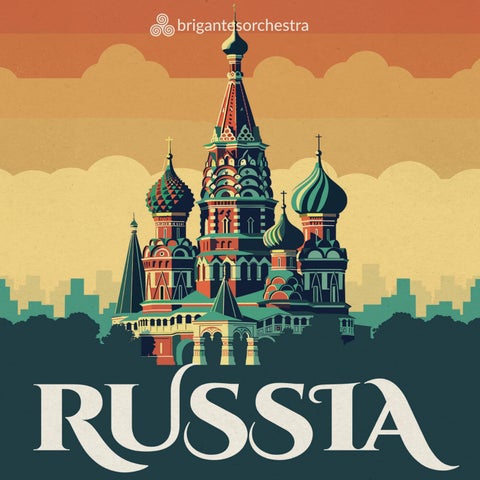
2
Welcome
23 JANUARY 2026
Programme In Brief
Introduction from Russia
Leon Bakst - Original design for the Firebird’s Costume
Here we are again, returning to Sheffield Cathedral so soon after our exhilarating concert in November when we conjured the sound-worlds of Finland, Norway and Iceland, and traced a musical path under the Northern Lights. That evening marked the second stop on our season-long musical Grand Tour: a series that explores the great centres of classical music across Europe and beyond. Many of you will remember Tim Horton’s superb performance of Grieg’s Piano Concerto; if you missed it, we are delighted to say that he will be joining us again in our next season, beginning in October 2026.
THE BRIGANTES ORCHESTRA David Milsom (leader) Wiebe-Pier Cnossen (baritone) Quentin Clare (conductor)
PYOTR ILYICH TCHAIKOVSKY (1840 to 1893) Romeo and Juliet Fantasy Overture (1870 / 1872 / 1880) Andante non tanto quasi Moderato Allegro (Allegro giusto) - Moderato assai
MODEST MUSSORGSKY (1839 to 1881) Tonight our journey takes us east to Russia, a land whose music is marked by intense lyricism, stark drama and an unmistakable colour. The programme brings together three iconic works that span half a century of extraordinary creativity. As ever, the Brigantes Orchestra is formed of the finest professional musicians drawn from Sheffield and the surrounding region. We are proud to present our concerts in a city that continues to support ambitious orchestral music, and we remain immensely grateful to Sheffield Cathedral for providing such a resonant and inspiring setting for every programme in this series. Thank you for joining us this evening. We hope this Russian chapter of our Grand Tour proves as vivid and memorable as those that have gone before, and that you will travel on with us to our next destination, Germany and Austria, on 21 March 2026. That programme will feature music by Bach, Wagner and Webern, and will culminate in Mendelssohn’s Reformation Symphony, once again here in Sheffield Cathedral.
Songs and Dances of Death (1875 to 1877) I Lullaby II Serenade III Trepak IV The Field Marshal INTERVAL c.8.05pm for 20 minutes
IGOR STRAVINSKY (1882 to 1971) The Firebird (Suite 1945) (1910 / 1945) Introduction - Prelude and Dance of the Firebird Variations (Firebird) - Pantomime I Pas de Deux (Firebird & Ivan Tsarevitsch - Pantomime II Scherzo (Dance of the Princesses) - Pantomime III Rondo (Chorovod) Infernal Dance Berceuse Final Hymn
FINISH c.9.00pm Further details of the remainder of this season, and what lies ahead, can be found on page three of this brochure.
Brigantes Orchestra Season 2025/26 Highlights:
FRANCE | L’ARLÉSIENNE
THE NORDICS | NORTHERN LIGHTS
FROM RUSSIA
James Mitchell - Organ
Tim Horton - Piano
Wibe-Pier Cnossen - Baritone
Friday, 17 October 2025, 7.30pm
Saturday, 29 November 2025, 7.30pm
Friday, 23, January 2026, 7.30pm
Sheffield Cathedral
Sheffield Cathedral
Sheffield Cathedral
Georges Bizet L'Arlésienne (extracts)
Jón Leifs Hinsta kveðja (Elegy for Strings)
Pyotr Ilyich Tchaikovsky Romeo and Juliet
Maurice Ravel Boléro
Edvard Grieg Piano Concerto in a
Modest Mussorgsky Songs and Dances of Death
Camille Saint-Saëns Symphony No. 3, Organ
Jean Sibelius Symphony No. 3 in C
Igor Stravinsky The Firebird Suite (1945)
GERMANY | REFORMATION
BRITAIN | PROMS FESTIVAL
USA | INDEPENDENCE DAY
Saturday, 21 March 2026, 7.30pm
Saturday, 16 May 2026, 7.30pm
Saturday, 20 June 2026, 7.30pm
Sheffield Cathedral
Sheffield Cathedral
Sheffield Cathedral
JS Bach / Joachim Raff Chaconne in d
Gustav Holst The Planets
including
Richard Wagner Prelude and Music from Parsifal JS Bach / Anton Webern Ricercare Felix Mendelssohn Symphony No. 5, Reformation
a second half including all the traditions of The Last Night of the Proms: Henry Wood Fantasia on British Sea Songs Thomas Arne Rule Britannia Edward Elgar Pomp and Circumstance No. 1
Leonard Bernstein Overture, Candide George Gershwin Concerto in F George Gershwin Overture, Girl Crazy Aaron Copland Rodeo
4
Programme Note: Tchaikovsky - Romeo and Juliet Fantasy Overture
23 JANUARY 2026
Pyotr Ilyich Tchaikovsky (1840 to 1893) Romeo and Juliet Fantasy Overture (1870 / 1872 / 1880) Tchaikovsky’s music is often characterised by an
The choice of Shakespeare’s tragedy proved particularly
unusually direct emotional candour. Few composers of
significant for Tchaikovsky. Throughout his career he was
the nineteenth century were willing to expose such
drawn to narratives of doomed love, psychological
extremes of vulnerability, passion, and despair so openly,
conflict, and inexorable fate: subjects that also occupied
and fewer still could do so while maintaining a strong
him in his personal life. Unlike many programmatic
sense of formal control. Tchaikovsky stood at a
composers, however, Tchaikovsky was less interested in
crossroads between Western European symphonic
pictorial detail than in emotional truth. In Romeo and Juliet
tradition and a distinctly Russian expressive instinct.
he does not illustrate individual characters or events so
Trained at the St Petersburg Conservatory, he possessed
much as explore the elemental forces at work: love,
a rigorous command of harmony, counterpoint, and
hatred, fate, and loss. This approach allowed him to avoid
large-scale form, yet his musical language was driven by
mere musical storytelling and instead create a work with
melody above all else. This combination of technical
genuine symphonic momentum.
discipline and emotional immediacy lies at the heart of Pyotr Ilyich Tchaikovsky
his most successful works, and Romeo and Juliet
The work exists in three distinct stages, usually described
represents one of the earliest and clearest manifesta-
as two principal versions with an intermediate revision.
tions of that synthesis.
The original 1870 version, premiered in Moscow, was not well received. Critics found it episodic and uneven, and
The Fantasy Overture occupies a crucial place in
Tchaikovsky himself soon recognised its shortcomings. In
Tchaikovsky’s artistic development, marking one of the
1872 he undertook a major revision, reshaping the central
first works in which his instinctive lyrical gift and
sections and strengthening the dramatic contrasts. Even
dramatic imagination were successfully harnessed within
so, he remained dissatisfied. Only in 1880 did he produce
a convincing large-scale orchestral form. Composed
the final version, refining the orchestration, clarifying the
initially in 1869 to 1870, the piece emerged at a time
architecture and, most significantly, transforming the love
when Tchaikovsky was still searching for confidence as a
theme into the expansive, unforgettable melody familiar
symphonist, and it owes much of its genesis to the
today. This last version, dedicated to Balakirev, is the one
influence of the composer Mily Balakirev. Balakirev not
that secured the work’s lasting success and, as tonight, is
only encouraged Tchaikovsky to take Shakespeare’s
almost universally performed.
tragedy as his subject (citing his own King Lear Overture as a starting point), but also offered detailed, often
Although labelled an overture, Romeo and Juliet is not a
forceful, suggestions about structure, key relationships,
traditional concert overture, nor does it attempt a literal,
and thematic contrast.
scene-by-scene depiction of Shakespeare’s play. Instead, Tchaikovsky uses a loosely symphonic form to distil the
1702 Anne
1709 Fortepiano
1719 Robinson Crusoe
1723 Vivaldi Four Seasons
1727 George II
1741 Handel 1736 Messiah Sea Clock
1750 Tom Jones
baroque period classical period
1772 MOZART Symphony 1760 1764 George III Spinning Jenny 18 in F
Programme Note: Tchaikovsky - Romeo and Juliet Fantasy Overture 5
thebrigantes.uk drama into a small number of highly contrasted musical
The conflict music is restless and unstable, repeatedly
ideas, each representing a fundamental element of the
forcing its way to the foreground throughout the piece.
OVERTURE: Originally a French
Against this backdrop emerges the work’s emotional
overture developed in the C17th as
The opening chorale, associated with Friar Laurence, is a
centre: the love theme. Introduced quietly by muted
an instrumental introduction to an
telling example of Tchaikovsky’s broader musical thinking.
violas and cor anglais (alto oboe), it unfolds in long,
Its restrained pacing, modal colouring, and dark orchestral
arching phrases of extraordinary tenderness. Unlike the
followed a formal pattern of a slow,
timbre evokes a sense of spiritual gravity and inevitability,
heroic or triumphant love themes of many nineteenth-
stately opening followed by a faster
anticipating the composer’s later fascination with fate-like
century works, this melody is initially deeply innocent
ideas. This solemn material does not dominate the piece,
and vulnerable, suffused with longing and fragility, and
but it frames it, reminding the listener that the tragedy
then, following further skirmishes between the warring
unfolds within a moral and philosophical context larger
families, with great passion and urgency.
tragedy.
term meaning an “opening”, the
opera or ballet. Early examples,
section. In the C18th the form became more flexible and increasingly symphonic. By the C19th, composers expanded the concept into the concert overture: a
than the lovers themselves. Such framing devices would recur throughout Tchaikovsky’s output, most notably in
The final section represents the tragic resolution. After
the symphonies, where introductory or recurring motifs
a devastating climax, the love theme returns
often suggest an external force acting upon the narrative.
transformed, now slower, hushed, and elegiac. Its once
self-contained piece, often descriptive or dramatic, and intended for the concert hall rather than the stage.
soaring contours are weighed with grief, suggesting the Equally characteristic is the handling of contrast.
lovers’ deaths and the cost of the feud. In the closing
Tchaikovsky was a master of juxtaposition: violent energy
pages, echoes of the Friar Laurence theme and sombre
against lyrical tenderness, public conflict against private
brass chords convey a sense of hard-won reconciliation
intimacy. In the Romeo and Juliet Fantasy Overture, the
and quiet resignation rather than overt triumph.
brutality of the feud music gains its full power precisely because it is set against the vulnerability of the love
The influence of Romeo and Juliet on Tchaikovsky’s
theme. The sudden shifts between these worlds,
later music is profound and far-reaching. The expansive
sometimes abrupt, sometimes ominously gradual, reflect
love theme establishes a model for the great lyrical
Tchaikovsky’s instinctive understanding of drama. These
melodies of his maturity, from the slow movements of
contrasts would later become a defining feature of his
the Fourth and Fifth Symphonies to the tragic intensity
ballets, where sharply differentiated musical worlds
of Francesca da Rimini and the opera Eugene Onegin.
coexist within a single narrative arc. Its success encouraged him to pursue an increasingly The feud appears shortly after Friar Laurence’s introduc-
honest and direct musical language, unafraid of
tion. The music becomes fiercely rhythmic and harmoni-
intensity or vulnerability. In this sense, the fantasy
cally abrasive, with driving string figures, aggressive brass
overture is not merely an early masterpiece, but a
interjections, and sharply accented percussion: surely the
foundational work, one that shaped the expressive
sound of steel on steel? Rather than portraying a specific
trajectory of his entire career and laid the groundwork
fight, Tchaikovsky conveys the atmosphere of un-
for the music by which he is most deeply remembered.
restrained hostility and generational hatred.
1776 Declaration of Independence classical period
1789 URANIUM DISCOVERED
1794 haydn clock symphony
1801 Beethoven moonlight sonata
1800
1816 Rossini Barber of Seville 1813 Pride and Prejudice
romantic period classical period
1833 mendelssohn italian 1829 symphony 1837 Braille Victoria
6
Programme Note: Mussorgsky - Songs and Dances of Death
23 JANUARY 2026
Modest Mussorgsky (1839 to 1881) Songs and Dances of Death (1875 to 1877) 1 2 3 4
roughness. His harmonic language can feel blunt, even
LULLABY SERENADE TREPAK THE FIELD MARSHAL
primitive, but it is never careless: it is shaped to the inflections of Russian speech and to psychological immediacy. This uncompromising stance, coupled with personal instability and chronic alcoholism, contributed
Among the composers of nineteenth-century Russia,
to a career marked by unfinished works, financial
Modest Mussorgsky is possibly the most uncompromis-
hardship and early death at the age of forty-two. Yet the
ingly individual. He distrusted academic polish, distrusted
intensity of his finest music, Boris Godunov, Pictures at
inherited Western forms, and pursued instead a stark,
an Exhibition, Night on Bald Mountain and Songs and
often unsettling expression: music that speaks in the
Dances of Death, has ensured his central place in the
rhythms of real speech, that exposes rather than
canon.
beautifies human weakness, and that confronts life’s
Modest Mussorgsky (c.1865)
darkest certainties without consolation. Songs and
The four songs that make up the cycle were composed
Dances of Death stands as perhaps the most concentrat-
between 1875 and 1877 to poems by Mussorgsky’s
ed expression of that outlook. A work in which Death itself
friend Arseny Golenishchev-Kutuzov. At the time,
becomes the dramatic protagonist.
Mussorgsky was increasingly isolated, his reputation uncertain and his personal circumstances deteriorating.
Born in 1839 into a landowning family, Mussorgsky was
The choice of subject, death not as an abstract idea but
initially destined for a military career, serving as an officer
as a speaking, acting presence, reflects both the Russian
in the Preobrazhensky Guards. Music was at first a hobby
fascination with mortality and Mussorgsky’s own bleak
rather than a profession, but his association with the
self-awareness.
circle later known as The Five - Balakirev, Cui, Borodin, Rimsky-Korsakov and Mussorgsky himself - encouraged a
Unlike the salon song or the lyrical romance, these
decisive turn towards composition. United by a desire to
settings are miniature music dramas. The orchestral part
create a distinctly Russian art music, these composers
is not accompaniment in the traditional sense but an
rejected conservatoire orthodoxy and Western formalism
equal partner, often assuming a theatrical role. The vocal
in favour of national history, folklore and language.
line follows speech rhythms with uncanny precision,
Mussorgsky carried this aesthetic further than any of his
while the harmony frequently undermines any sense of
colleagues. Where Rimsky-Korsakov refined and
tonal security. Death, in these songs, is neither moral
systematised, Mussorgsky deliberately embraced
allegory nor religious symbol: it is intimate, persuasive, mocking, seductive and, at times, terrifyingly gentle.
1846 Saxophone
1855 Colour Photography
1860 GREAT EXPECTATIONS
1869 DNA
1873 BRAHMS HAYDN VARIATIONS
1880 TCHAIKOVSKY ROMEO and JULIET
1886 motor car
1895 THE Time Machine
1905 DEBUSSY LA MER
1900 romantic period
romantic period
1877 MUSSORGSKY SONGS AND DANCES
20th/21st century
Programme Note: Mussorgsky - Songs and Dances of Death
thebrigantes.uk What distinguishes Songs and Dances of Death is the
The third song, Trepak, shifts the setting to a frozen
way Death becomes a shapeshifter, assuming different
Russian landscape. A drunken peasant collapses in a
identities, even genders, in each song. Mussorgsky
snowstorm, and Death appears as a fellow reveller,
does not portray a single grim reaper figure, but a
inviting him to dance the trepak, a wild folk dance, until
series of encounters in which Death adapts its manner
he is warm again. This is Death as trickster and
to its victim (for victims they certainly are). This
companion, exploiting exhaustion and alcohol rather
dramatic strategy aligns the cycle with operatic
than fear. The music whirls with grotesque energy,
scene-writing rather than with the introspective Lied
driven by folk-dance rhythms that gradually falter. As
tradition.
the peasant succumbs, Death gently covers him with
7
RECOMMENDED LISTENING Listen to: Antonio Pappano conducting the Saint Cecilia Orchestra playing the original version of Mussorgsky’s Night on Bald Mountain
snow “like goose-down.” Once again, the final gesture The cycle opens with Lullaby, one of Mussorgsky’s most
is one of false kindness. Mussorgsky allows the dance
chilling creations. A mother rocks her feverish child
to exhaust itself, so that death feels not imposed but
through the night, exhausted and desperate. Gradually,
inevitable.
another voice enters: Death, crooning softly, promising rest and peace. In a striking and deeply unsettling
The cycle culminates in The Field Marshal, the most
decision, Death adopts the soothing language and
overtly political and monumental of the four songs.
gestures associated with maternal care. Musically, the
Here Death strides across a battlefield after a
orchestra rocks in a hypnotic cradle-motion, while the
massacre, she surveys the corpses and proclaims
vocal line slips almost imperceptibly from the mother’s
victory. No disguise is needed: Death appears in
anxious murmuring to Death’s seductive whisper. There
military regalia and takes dominion over the fallen.
is no violent rupture; the child simply slips away. The
Musically, this song is the most declamatory and
horror lies precisely in the tenderness of the act. Death
symphonic with martial fanfares and grim processions.
does not conquer: it consoles.
Death is no longer intimate or seductive but imperial, an embodiment of war’s indifference to individual
In Serenade, Death becomes a lover. Outside a sick
suffering. The final bars do not mourn the dead: they
young woman’s window, it sings a mock-romantic song,
glorify conquest, leaving the listener deeply unsettled.
parodying the conventions of the nocturnal serenade. The atmosphere is languorous, sensuous, even alluring.
Songs and Dances of Death is not a meditation on
Mussorgsky exposes the cruelty beneath romantic
mortality in the abstract but a sequence of encounters,
cliché: Death courts patiently, knowing that resistance
personal, social and political, in which Death adapts
will fail. Here the orchestra imitates a plucked guitar,
itself to human vulnerability. Mussorgsky refuses to
evoking a traditional love song, while the vocal line,
sentimentalise or moralise these encounters. Death is
lilting in six beats a bar, oozes false charm. When Death
not punished, redeemed or transcended: it simply
finally claims her, the music hardens briefly before
speaks, sings and acts. In giving Death a voice
sinking into stillness. The implication is brutal: desire
Mussorgsky confronts the listener with an uncomforta-
itself becomes a pathway to annihilation.
ble truth, that death often arrives not as terror, but in familiarity.
1910 George V
1916 holst the planets romantic period
1924 Television
1939 Murder is easy
1946 britten rape of lucretia
1959 Goldfinger 20th/21st century
20th/21st century
1910 STRAVINSKY 1914/18 WWI FIREBIRD
1956 Video 1952 Tape Elizabeth II
1939/45 WWII
1971 1973 Floppy First Disk Mobile Call
8
Programme Note: Mussorgsky - Songs and Dances of Death (Translations)
23 JANUARY 2026
LULLABY
SERENADE
Lie down, rest and sleep, my friend, and I will
A child moans, a candle burns low and casts a dim
The magical languor, the blue of night, the trembling
warm you with a covering of snow. I’ll start a fine
flicker. All through the night, her cradle rocking, the
twilight of spring... The invalid listens, hanging her
game around you. Shake up his bed, swan‐like
mother has not slept.
head, to the whisper of night’s silent words. Her
snow and start up a song, wild weather, a song
eyes, wide and burning, are not closed in sleep.
to last the whole night through so that this
Life’s joys still call to her.
drunkard can sink to sleep to its strains. Forests,
Early in the morning, gently at the door, Death,
heavens and clouds, darkness, breeze and
the compassionate knocks. The mother gives a start and looks around in fear...
Under her window in the silence of midnight, Death
sweeping snow, wrap him in a shroud of softest
sings a soft serenade: “In the gloom of your prison,
snow, and like a babe I’ll shelter him.
"Don't be frightened, my dear! Pale morning
your youth is fading. But I, your unknown knight,
already looks in your window. With crying and
can set you free. Rise, look at yourself. Your face
Sleep, my friend, my happy peasant, summer has
anguish you have tired yourself. Sleep and let me
shines in radiance, your cheeks are rosy, your
come, and all is in bloom! Over the corn fields
sit with him. You've failed to pacify him, but I will
rippling tresses veil your form like a cloud.
the sun is smiling and the scythes are swinging. The song rises up, and the doves are flying..."
sing sweeter than you...”
Your blue eyes are brighter than the sky, your hot breath blows over me. You have seduced me, my
THE FIELD MARSHAL
love. Your ear is captivated by my soft serenade.
The battle thunders, armour flashes, and bronze
Your whispered words summoned me. Your knight
cannons roar. The regiments charge, horses rush
"Come now, he will soon listen to me... lullaby,
has come for his reward: the hour of rapture is
by and red rivers of blood flow. Noon burns
lullaby, lullaby..."
near. Your body is tender, your trembling beguiling.
fiercely and the people fight on. When the sun
I will hold you tight, clasp you in a strong embrace.
has sunk low, the battle still rages. Sunset pales
"Quiet! My child struggles. It torments my soul."
and still they fight on, furious and savage.
"His cheeks are pale, his breath is failing... Be silent, I beg you!"
Listen! Be still. You are mine...”
"This is good, his suffering will end... lullaby..."
TREPAK
legions disperse... All is quiet, and in the
In the forest not a soul is in sight... The blizzard
darkness of night, groans rise towards the sky.
Night falls on the field of battle. In the gloom the
"Be gone, you damned thing! With your tenderness
wails and howls: it feels as if, in the gloom of the
you'll kill my joy!"
night, the cruel snow is burying some poor man.
"No. A peaceful sleep will come for your baby...
Look - so it is! In the darkness, a peasant is
the pale light, comes the figure of Death. And in
lullaby, lullaby...”
embraced and caressed by Death; he dances a
the quiet, she hears the groans and prayers, and
Trepak with a drunkard and sings him a sweet song:
filled with pride and satisfaction, like a warrior
Then, illuminated by the light of the moon, astride her battle horse, white bones gleaming in
chief, she circles around the place of battle. She
"Have pity, please. Pause a moment and do not “Poor peasant, you wretched old man, you have
climbs a hill and views the scene. She smiles...
drunk yourself into a stupor and wandered astray;
And over the plain of battle a voice of doom is
"See now, my quiet singing has sent him to sleep...
It drove you from the glades to the dense forest,
heard: "The fight is ended! I have conquered all!”
lullaby, lullaby, lullaby...”
and has made you weary with sorrow and grief.
finish your song.”
1976 1997 GOrecki Harry 1989 Symphony of Potter 1982 Sorrowful The Color World Wide 1994 Philosopher’s Web Songs Friends Stone Purple
2000
2007 iPhone
2011 Fifty Shades of Grey
2016 2020 Ades Licensed Exterminating Covid Angel Vaccine
2023 Charles III 20th/21st century
Programme Note: Stravinsky - The Firebird (Suite 1945)
thebrigantes.uk
9
Igor Stravinsky (1882 to 1971) The Firebird (Suite 1945) (1910 / 1945) 1
INTRODUCTION PRELUDE AND DANCE OF THE FIREBIRD VARIATIONS (FIREBIRD) PANTOMIME I PAS DE DEUX (FIREBIRD AND IVAN TSAREVITSCH) PANTOMIME II SCHERZO (DANCE OF THE PRINCESSES) PANTOMIME III RONDO (CHOROVOD) INFERNAL DANCE BERCEUSE FINAL HYMN
When Igor Stravinsky’s The Firebird was first performed in transformative. A 27-year-old composer known only within a small Russian circle suddenly found himself propelled onto the international stage, his name associated with one of the most dazzling artistic successes of the early twentieth century. The Firebird did not only introduce Stravinsky to the world: it announced the arrival of a new musical voice at the heart of a cultural moment in which ballet, music, and visual art were being radically reimagined. At the same time, it stands as a work poised delicately between inheritance and innovation, drawing deeply on the traditions of Russian music while already pointing towards the stylistic revolutions that would soon follow. Stravinsky was born in 1882 near St Petersburg into a household steeped in music. His father was a celebrated operatic bass at the Mariinsky Theatre, and from an early age Stravinsky absorbed the sound world of Russian opera and orchestral music. Despite this background, his path to composition was not straightforward. He initially pursued legal studies, only gradually committing himself fully to music. His decisive, formative influence was Nikolai Rimsky-Korsakov, under whom he studied privately.
overstated: from him Stravinsky learned the art of orchestration at its most vivid and imaginative, along with a harmonic language rich in colour, exotic inflection, and narrative suggestion. The glowing instrumental palette, the sharply characterised timbres, and the ability to suggest fantasy and menace through sound all reflect this inheritance. The opportunity that brought these skills into full public view came through Sergei Diaghilev and his revolutionary Ballets Russes. Diaghilev’s ambition was to present Russian culture to Western Europe as something both authentically national and thrillingly modern. His Paris seasons combined choreography, music, and visual design into a single theatrical vision, drawing on folk material, vivid colour, and striking imagery. After hearing some of
Igor Stravinsky
Paris in June 1910, its impact was immediate and
Rimsky-Korsakov’s importance to The Firebird cannot be
Stravinsky’s early orchestral works, Diaghilev entrusted him with a full ballet score based on Russian fairy tales. The result was The Firebird, choreographed by Michel
ORCHESTRATION: the act of
Fokine and staged with spectacular sets and costumes
deciding which instruments of the
that matched the music’s brilliance. The story weaves together several strands of Russian folklore. At its centre stands the Firebird herself, a magical creature whose glowing feathers promise both wonder
orchestra should play a given section of music. This implies that, usually, the composer has already written the music in short-score - a few lines of melody and harmony which is often playable on a
and danger. Prince Ivan wanders into the domain of the
keyboard instrument. After this, the
evil sorcerer Kashchei, encounters the Firebird, spares her
short-score is distributed amongst
life, and receives in return a magic feather. He meets
combinations of whichever
thirteen princesses held captive by Kashchei, falls in love
instruments are available. In
with one of them, confronts Kashchei and his monstrous
Stravinsky’s case, eight woodwind
followers, and ultimately, with the Firebird’s help, destroys
players, piano and harp, percussion,
Kashchei’s source of immortality and frees the enchanted realm. This narrative provided Stravinsky with an ideal framework for sharply contrasted musical worlds: glittering brilliance and nocturnal lyricism, grotesque violence and radiant triumph.
ten brass instruments (including horns), and a string section.
10
Programme Note: Stravinsky - The Firebird (Suite 1945)
FURTHER LISTENING Paavo Järvi conducts the NHK Symphony in Stravinsky The Rite of Spring
23 JANUARY 2026
From its opening bars, The Firebird reveals Stravinsky’s
Dramatically, it captures a moment of temporary freedom:
extraordinary sense of atmosphere. The introduction
the princesses are allowed to dance and roam, but only
establishes Kashchei’s realm through dark, low-lying
within strict limits and under constant threat.
sonorities, chromatic harmonies, and a sense of uneasy suspension. Rather than narrating specific actions, the
In the context of the concert suite, the Princesses’ Scherzo
music conjures a place: dangerous, magical, and
does not advance the narrative in any literal sense. Ivan’s
unstable. Against this shadowy backdrop, the Firebird’s
encounters with the princesses, his growing emotional
appearance bursts forth in scintillating colour. Rapid
connection, and the broader implications of this meeting
figures, brilliant orchestration, and nervous rhythmic
are all implied rather than depicted. Instead, the scherzo
energy depict a creature of perpetual motion, elusive and
functions as a character study and a moment of contrast,
dazzling. Even without seeing the stage, listeners can
illuminating the human presence within an otherwise
sense her flickering presence.
enchanted landscape.
One of the most striking features of the score is
A radically different sound world emerges with the Round
Stravinsky’s ability to delineate character through
Dance of the Princesses. Here Stravinsky draws on
orchestral colour alone. The Firebird’s music is sharp,
folk-like melodies, modal harmony, and transparent
virtuosic, and incandescent - frequently featuring the
textures to create music of great simplicity and tender-
flutes, while Prince Ivan (a French horn) is associated with
ness. This nocturnal dance is among the most self-
more grounded, human lyricism. The Firebird’s supplica-
contained and lyrical sections of the ballet, and it plays a
tion, following her capture, introduces a moment of
central role in all the concert suites. The music suggests
expressive stillness: sinuous melodic lines and warm
innocence and longing rather than action: Ivan’s
harmonies suggest vulnerability and persuasion. The
encounter with the princesses and the beginnings of love
crucial narrative act, Ivan’s decision to spare her and the
are implied rather than narrated, leaving the listener to
subsequent gift of a magic feather, is not explicitly
infer the drama.
depicted in musical terms, but the emotional logic is clear.
The violence of Kashchei’s realm erupts most memorably in the Infernal Dance. This is music of ferocious rhythmic
There follows the Princesses’ Scherzo. In the original
drive, jagged accents, and biting dissonance. Even at its
ballet, this music accompanies the princesses’ playful
1910 premiere, audiences sensed that something new was
movement in Kashchei’s garden, and Stravinsky
happening here: rhythm itself becomes the primary
characterises them not through lyrical expansion or overt
expressive force, pushing beyond the conventions of late
folk song, but through lightness, agility, and quicksilver
Romantic ballet music. The Infernal Dance foreshadows
motion. The scherzo’s rhythmic profile is alert and
the rhythmic radicalism that would soon reach its extreme
springy, its phrases short and deftly articulated, creating a
in The Rite of Spring only three years later.
sense of nervous energy rather than carefree abandon. In the complete ballet, the Infernal Dance is preceded by a Orchestrally, the texture is notably transparent and airy -
substantial dramatic build-up: Kashchei’s appearance, his
the bass instruments barely feature - and Stravinsky
confrontation with Ivan, and the summoning of his
favours woodwind exchanges, lightly accented strings,
monstrous followers. In the concert suites, including the
and crisp rhythmic gestures, avoiding both the shimmer-
1945 version performed tonight, this entire narrative
ing brilliance associated with the Firebird and the
preparation is omitted. The music plunges directly into the
weightier sonorities that define Kashchei’s world.
dance itself, assuming that the listener understands the
Programme Note: Stravinsky - The Firebird (Suite 1945)
thebrigantes.uk dramatic context. This compression is typical of Stravin-
engagement with the afterlife of his compositions and his
sky’s later treatment of his ballet scores for the concert
willingness to reshape them for new circumstances.
hall. The Firebird occupies a unique position in Stravinsky’s
11
BITONAL: two contrasting keys played at the same time - a precursor to music with no key (atonal).
The Firebird’s Berceuse (Lullaby) provides the emotional
output. It is the first of the three great ballets he wrote for
counterweight to this violence. Gently rocking, hypnotic,
Diaghilev, followed by Petrushka and The Rite of Spring.
stamping chords which sound at
and subdued, it depicts the magical lullaby that sends
Together, these works chart one of the most astonishing
around three minutes into the work
Kashchei and his followers into an enchanted sleep. What
artistic evolutions in Western music. The Firebird still
it does not depict is equally important: the key narrative
inhabits the world of late Romanticism, albeit intensified
mechanism of Kashchei’s defeat. In the ballet, Ivan learns
and refracted through Stravinsky’s distinctive voice.
that Kashchei’s immortality is bound to a hidden egg,
Petrushka introduces sharper satire, bitonality, and a
which he destroys. None of this action appears in the
more fragmented approach to musical form. The Rite of
suite. The Berceuse prepares the listener emotionally for
Spring shatters traditional harmony and metre altogether,
resolution, but the decisive act itself happens offstage.
redefining the expressive possibilities of rhythm and orchestral sound.
The Finale unfolds as a symbolic rather than narrative conclusion. Beginning quietly with a noble horn melody
Without The Firebird, the later revolutions would have
depicting sunrise, it builds inexorably towards a blazing
been unthinkable. Its success established Stravinsky as a
orchestral apotheosis. This is not a literal depiction of
central figure in European modernism and gave him the
Kashchei’s destruction or the physical transformation of
platform from which to take increasingly radical risks. At
his realm; rather, it represents restoration, liberation, and
the same time, it preserves a vivid connection to the
renewal. The effect is ceremonial and affirmative, a
Russian tradition from which it emerged. Stravinsky never
triumphant, radiant close.
disavowed his debts to Rimsky-Korsakov and other Russian composers, such as Mussorgsky, and Tchaikovsky.
Stravinsky returned to The Firebird repeatedly during his
In The Firebird, those influences are worn openly, yet
career, extracting concert suites in 1911, 1919, and finally
already transformed by a personal sense of drama,
1945. The 1945 suite belongs firmly to the tradition of
pacing, and colour that is unmistakably Stravinskian.
post-war streamlining rather than to the luxuriant orchestral opulence of the original 1910 ballet. Its
More than a century after its premiere, the piece
orchestration is greatly reduced relative to the full score,
continues to captivate audiences. Part of its appeal lies in
designed for practical concert performance, yet it is more
its sheer orchestral brilliance and narrative clarity, but its
expansive in content than the 1919 suite, incorporating
deeper fascination comes from its position at a historical
additional pantomime music and a substantial pas de
crossroads. It is both a culmination of the Russian
deux.
orchestral fairy-tale tradition and the opening chapter of a new musical modernism. Heard in the concert hall
The circumstances of the 1945 revision were not purely
through the lens of the 1945 suite, it invites listeners not
artistic. By this time Stravinsky was living in the United
only into a world of magic and myth, but into the moment
States and had recently become an American citizen. The
when one of the twentieth century’s defining musical
creation of a revised suite also served to refresh the
voices first took flight.
work’s copyright status in the United States, a reminder that Stravinsky was acutely aware of the legal and commercial realities surrounding his music. Far from diminishing the work, this context highlights his pragmatic
Famously, in The Rite of Spring, the
(Dances of the Young Girls) are a combination of the keys of E-flat dominant seventh (E-flat, G, B-flat and D-flat) and E major (E, G-sharp and B).
12
Article: A Tale of Two Russias
23 JANUARY 2026
Brigantes Beginners A Tale of Two Russias
“Poverty inspires invention...” Traditional Russian proverb
From Aristocratic Salons to Animal Farm… a Tale
and pride flourished. A rich oral culture evolved to
of Two Russias
include folk songs, laments, ritual dances, epic tales, and religious chants which were passed down through
Defense of Petrograd - Aleksandr Deyneka (1928)
BRIGANTES BEGINNERS by Anthony Hart
If you don’t know much about classical music, coming to a concert can be intimidating. If that’s you, you’re not alone. This section, along with the timeline in the programme, gives essential information about the pieces, composers, and their historical and social context, and will help you understand what’s going on!
When we consider Russia, we may naturally turn to our
generations. The grand sweep of their dramatic lives and
history lessons and to the political events of the last
struggles permeated their culture.
hundred years. In doing so, we constrain our thoughts to the period after the Bolshevik revolution in 1917: images
Rather like in other European countries, the aristocracy
of statues of Lenin, Stalin’s purges, grey apartment
were patrons and voracious devourers of art but, apart
blocks, ration queues, propaganda posters, the Berlin
from a few like Tolstoy, did not have the talent, wit, or
Wall, and many nefarious James Bond villains may spring
motivation to create it for themselves. As an educated
to mind. Russia becomes equated with the Soviet Union:
middle class began to take shape, it was from these
austere, uniform, authoritarian, suspicious, colourless,
doctors, civil servants, teachers, military and others that
joyless, and grim.
a Russian art and voice developed. The Russian intelligentsia were in a perfect confluence to blend these
However, what about the decadence, vibrant colours,
factors: they had access to education and European art
music, and art of the Russian Empire? At the time, it was
and culture, but they also saw the grinding inequality of
one of the most vibrant and extravagant cultures in
Russian society. It is no coincidence that Tchaikovsky,
Europe. Opera houses rivalled those of Paris and Vienna.
Mussorgsky, Rimsky-Korsakov, Borodin, Rachmaninoff,
Ballet reached levels of refinement unmatched anywhere
Prokofiev, and Stravinsky all came from this middle
else. Salons in aristocratic houses buzzed with music,
ground. They took the long melodies of Russian folk
literature, debate, and performance. Conservatoires
music, the depth and gravity of Orthodox chant, the
trained musicians of extraordinary calibre, and a musical
vastness of the Russian landscape, and fused these with
voice developed that was so distinctively Russian it can
European technique and training.
be recognised within a few bars. This voice did not arise by accident.
One of the most famous composers was Pyotr Ilyich Tchaikovsky, who wrote music of great tenderness and
Of course, not all Russian life was like this: like Dickens’
violence, despair and ecstasy, intimacy and grandeur.
London, it was a tale of two populations who never met.
His Romeo and Juliet Fantasy Overture is clearly
On one side were the aristocracy who spoke French at
influenced by Shakespeare’s tragedy, but its opening
home, travelled widely, read European literature,
evokes religious solemnity, before blossoming into a vast
attended the opera, and commissioned art and music as
love theme of unbroken, consuming longing. The theme
symbols of taste and power. On the other side were the
has become so ubiquitous that it can appear ‘cheesy’
vast majority: peasants, who worked hard, scraped a
now, having been used in The Fresh Prince of Bel-Air,
living, whilst surviving and dying in desolate conditions.
Wayne’s World, South Park, and even Sesame Street to
Many were serfs, tied to estates, unable to move freely,
indicate overwrought and ridiculous love. However, at its
and largely excluded from formal education. Literacy was
heart, it reflects the melodramatic, but genuine, passion
rare. Life expectancy was short. Hardship was constant.
of Russian teenage love.
But it was in these conditions that resilience, character,
Article: A Tale of Two Russias
thebrigantes.uk In contrast, Modest Mussorgsky rejected refinement in
ideology. Many composers left the country including
favour of truth. He believed that music should speak
Rachmaninoff, Stravinsky and Prokofiev. Roslavets,
directly, even brutally, to all aspects of human experi-
Mosolov, and Popov were silenced, exiled, or imprisoned.
ence. Nowhere is this clearer than in Songs and Dances
Some were executed. Entire bodies of work were
of Death. Death appears as an intimate presence:
destroyed or hidden. In the twentieth century, the master
comforting a dying child, seducing an invalided young
of survival was Dmitri Shostakovich. You might expect
woman, mocking a freezing drunkard, or claiming
him to capitulate with the government but, in fact, he
soldiers killed on a battlefield. For the peasants, Death
was silently, discreetly revolutionary. Within his music, he
was an unwelcome visitor in their lives, turning up
wrote in code and with sarcasm. Triumph masked
uninvited all too frequently. The music is stark and
despair, marches became grotesque, and irony replaced
unflinching. It is not written for glittering salons but
direct protest. His symphonies contained layers of
belongs to villages, hospitals, and war.
meaning: one for the authorities, another for those who knew how to listen. He was denounced several times and
By the turn of the twentieth century, Russian music was
forced to apologise, but he never acquiesced.
ready to explode beyond Romanticism. Igor Stravinsky’s Firebird draws on Russian folklore: enchanted birds, evil
With time, there was a thawing in control, and relation-
sorcerers, and heroic princes. The Firebird dazzles with
ships with Europe strengthened. Underground art began
shimmering textures, savage rhythms, and moments of
to flourish, and Western artists, like Paul McCartney and
eerie stillness. A few years later, Stravinsky would
Elton John, were invited in. A McDonald’s opened in
compose The Rite of Spring, a ballet so shocking that it
Moscow in 1990, although we can argue about whether
nearly caused a riot at its premiere in Paris. The music
or not that was truly a sign of cultural growth! In more
was violent, with irregular rhythms and clashing
recent years, it appears that things have moved
harmonies, which must have felt like a cultural
backwards, and Russia is again ostracised following the
earthquake. The story did not dwell on love or fairy tales,
invasion of Ukraine. There are, of course, many reasons
but presented a Slavic pagan ritual in which a young
why groups choose not to play Russian music, but the
woman was chosen to dance herself to death to ensure
current situation is not the fault of the composers or the
the earth’s fertility. It suggested humans could be driven
ordinary Russian people. It is possible to celebrate what
more by instinct and violence than reason and beauty,
the old Russia achieved, whilst simultaneously standing
that civilisation was dependent on ritual, coercion, and
alongside the people of Ukraine.
sacrifice, and that the individual could be crushed by the collective.
Tolstoy once said, “It is sad, yet joyful, on a silent summer’s night, in a voiceless wood, to hear a Russian
As the French Revolution was associated with growing
song. Here we find unlimited sadness without hope. Here,
inequality, unrest amongst the lower classes, and the rise
also is unconquerable strength and the unalterable
of Romanticism, similar forces lay behind the Bolshevik
stamp of Fate; here, also is iron predestination, one of the
revolution. It overthrew more than the political and class
primitive foundations of the Russian national identity,
systems, destroying the entire cultural ecosystem.
through which much can be explained which seemed
Palaces were seized. Aristocracy, including the Tsar and
inexplicable in Russian life.” If the French brought music
his family, were murdered. Conservatoires were purged,
its colour, the Nordic countries brought silence and
and artists associated with the old order were branded
stillness, and Germany and Austria gave music its
enemies of the people. The patrons of art were destroyed
structure and intellect, Russia gave classical music the
and replaced by the political class. By the time of Stalin,
full range of emotional extremes. From ecstasy to the
artistic freedom was suppressed and artists lived in fear.
great depths of despair, Russian music confronts life from
Music was expected to reflect the government’s
the cradle to the grave.
13
RECOMMENDED LISTENING Listen to Andris Nelsons with the Boston Symphony Orchestra conduct Shostakovich Symphonies 5 & 9
14
Artist Biographies: Wiebe-Pier Cnossen, Baritone & Quentin Clare, Conductor
23 JANUARY 2026
Wiebe-Pier Cnossen Baritone Wiebe-Pier Cnossen is a Dutch baritone whose career spans opera, contemporary music and major concert repertoire. He first trained as a jazz singer at the Royal Conservatory of The Hague, before graduating summa cum laude from the New Opera Academy in Amsterdam. His musical development has been shaped by masterclasses and private study with artists including Ian Bostridge, Christina Deutekom, Henk Smit and Robert Dean, and most significantly through his work with the late tenor James McCray
(2013–2018). He is currently coached by Prizrenka Petković McCray and the Italian baritone Simone Alaimo. Cnossen has worked with leading ensembles and companies including the Dutch National Opera, Nationale Reisopera, Holland Opera, BarokOpera Amsterdam, the Hague Philharmonic, ASKO|Schönberg Ensemble and Orchestra of the Eighteenth Century. His operatic repertoire includes Figaro and Count Almaviva (Le nozze di Figaro), the title roles in Don Giovanni and Macbeth, Giorgio Germont (La traviata), Escamillo (Carmen), Zurga (Les pêcheurs de perles), Alfio (Cavalleria rusticana) and Pizarro (Fidelio). Wiebe-Pier Cnossen
He has appeared in several world premieres of contemporary operas by Chiel Meijering and Klaas de Vries, and performs widely in concert repertoire including Bach’s St Matthew Passion and Haydn’s The Creation. Alongside his performing career, he teaches voice at the Conservatory of Amsterdam.
Quentin Clare Conductor The British conductor Quentin Clare made his professional debut at the age of just 25 when he conducted the Hallé Orchestra in the Bridgewater Hall, Manchester. Since then, he has worked with many orchestras in the UK, including the BBC Philharmonic, Royal Northern Sinfonia, Orchestra of Opera North and Ensemble 11, as well as having performances broadcast on British and European television and radio. Quentin’s international career has seen him conduct orchestras in Europe, such as the Danish National Symphony, Dutch Radio Philharmonic, Symphony Orchestra of Nancy, and the Nürnberg, Würzburg and Bochum Symphony Orchestras. He is equally experienced in the opera house, working in France, The Netherlands and Germany on productions including Stravinsky's The Rake’s Progress and the French Quentin Clare
premiere of Robert Carsen’s acclaimed production of Richard III by Giorgio Battistelli. Much in demand as an inspirational conductor of young musicians, he has conducted the orchestras at the conservatories in Ghent, Birmingham, Den Haag and Weimar. He has been guest conductor with Young Sinfonia in Newcastle and is music director of The New Mannheim Orchestra and The Brigantes.
The Orchestra
thebrigantes.uk
Brigantes Orchestra On Stage FLUTE / PICCOLO Laura Jellicoe Jennifer Dyson Leila Marshall
TRUMPET Seb Williman Gordon Truman
OBOE Nicola Hands Anna Powell
TROMBONE Christopher Gomersall Nicholas Hudson Garrath Beckwith
COR ANGLAIS Manon Lewis
TUBA William Burton
CLARINET Marianne Rawles Steph Yim
TIMPANI John Watterson
BASSOON Alex Kane Alice Gwynne HORN Richard Lewis Simon Twigge Janus Wadsworth Kelly Haines Jeremy AinsworthMoore
PERCUSSION Aidan Marsden Peter Matthews Simone HerbertMoores HARP Elinor Nicholson PIANO David Dekker
15
Sheffield’s Pro Orchestra About Us FIRST VIOLIN David Milsom Emily Chaplais Jacob George Elizabeth Dawson Anne Whittaker Sarah Razlin Helen Tonge Clare Pitchford Charley Beresford Michael Walton SECOND VIOLIN Tamaki Hagashi Amanda Gillham Holly-Rayne Bennett Rosie Nicholson Joanne Atherton James Warburton Josh Simms Lucy Thomson
VIOLA Barnaby Adams Jonathan Kightley Ben Kearsley Erin Vinter* Tim Bailey Elizabeth Lundie John Hird Helen Parkes CELLO Gemma Wareham Catherine Strachan Tim Smedley Liling Wang* Greg Morton Douglas Badger John Parsons Adrianne Wininsky DOUBLE BASS Pietro Lusvardi Andrew Monk Matthew Clarkson Imogen Fernando
The Brigantes (Bri-gan-tez) were a collection of Celtic tribes ruled by Queen Cartimandua in 1st-Century Northern England who populated what is now Yorkshire. Literally meaning “high ones”, Brigantes could refer to nobility or to highlanders living on the Pennines or in Hillforts. The Brigantes were cultured, enjoying theatre and music. The name Brigantes was chosen for a new orchestra because it encapsulates location, culture and unity: the idea that an ensemble is, roughly speaking, a tribe of musicians. The Brigantes Orchestra was formed in Sheffield in 2019 in response to the observation that Sheffield did not have a professional symphony orchestra of its own, despite a wealth of local talent. The Brigantes aim to bring highquality orchestral music to the city and surrounding areas, as well as to engage new audiences, those who would not otherwise visit the classical concert hall. This includes a growing population of young musicians in Sheffield’s schools. All photography with thanks to Eduardus Lee
*Erin Vinter (viola) and Liling Wang (cello) are two of five 2025 / 2026 Brigantes Orchestral Fellows from Royal Birmingham Conservatoire playing in this concert as part of the RBC / Brigantes Student Access Programme.
SOCIAL MEDIA
WITH THANKS
Instagram: @brigantesmusic Twitter / X: @thebrigantes Facebook: facebook.com/brigantesmusic
Brigantes Music is a registered charity and as such benefits from the generous time our supporters give for jobs like flyering, marketing and front-of-house. Thank you to: Anthony Hart, Jonny Ingall, David Watkin-Holmes, and to all who have helped today scanning your tickets or making sure you have this programme. .
MADE POSSIBLE BY... The Brigantes Orchestra would like to thank NEURONATAL LTD
BECOME A MEMBER We are pleased to announce new ways you can support the work of The Brigantes Orchestra with a membership programme offering lots of benefits, special offers and exclusive opportunities. These are tiered and, depending on your donation, can include free season tickets, branded Brigantes merchandise (like the polo shirts some of our front-of-house team are wearing, or a framed poster), reductions on tickets for your friends and family, a printed acknowledgement of your support in each programme booklet of the season, free interval drinks at our concerts, opportunities to sit in the orchestra during rehearsals and see the pieces put together, chances to meet the players, invitations to VIP receptions... Further details are available at contact@thebrigantes.uk.
BECOME A VOLUNTEER We are looking for volunteers who would like to be involved in the promotion and development of the orchestra so that it can continue to realise its charitable aims. Those willing to distribute flyers in suitable places in their neighbourhood, add us to local newsletters and social media groups, help with fundraising, or take on some roles in front-of-house should email us at contact@thebrigantes.uk.
CREDITS Programme notes: Anthony Hart & Quentin Clare Photography: Eduardus Lee
THE BRIGANTES ORCHESTRA Sheffield, S11 Brigantes Music is a Registered Charity: 1187752 © 2026 The Brigantes Orchestra