University of Stirling’s student newspaper | June Edition | Vol. 51 No. 2
Awarded
BEST PUBLICATION SPA Scotland Awards 2021 brignewspaper ●
BEING A FIRST YEAR IN A PANDEMIC Expectation vs Reality
pg. 9
@brignewspaper ● brignews.com
International Athletes accused of bullying
COVID-19
Uni in talks for possible COVID quarantine hotel Harry Williamson and Ben Waddell The University have announced the possibility of a quarantine hotel in accommodation for international students. The scheme would see students who arrive at Glasgow and Edinburgh Airports travel straight to the university and carry out a ten-day quarantine in accommodation rather than a Government quarantine hotel. The university is currently involved in talks with the Scottish Government to be able to host international students coming from red list countries, but they hope that the plans are approved in the coming weeks. The announcement stated that the costs of a university-managed quarantine hotel are expected to be less for students than government-managed ones. International students have been urged to keep updates on guidance for international travel and to com-
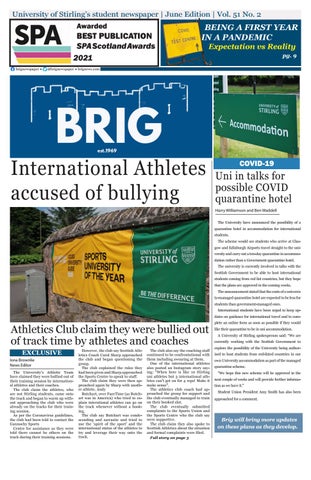
Athletics Club claim they were bullied out of track time by athletes and coaches EXCLUSIVE Iona Brownlie News Editor The University’s Athletic Team have claimed they were bullied out of their training session by international athletes and their coaches. The club claim the athletes, who are not Stirling students, came onto the track and began to warm up without approaching the club who were already on the tracks for their training session. As per the Coronavirus guidelines, the club had been told to contact the Gannochy Sports Centre for assistance as they were told there cannot be others on the track during their training sessions.
However, the club say Scottish Athletics Coach Carol Sharp approached the club and began questioning the group. The club explained the rules they had been given and Sharp approached the Sports Centre to speak to staff. The club claim they were then approached again by Sharp with another athlete, Andy Butchart, over FaceTime (as Butchart was in America) who tried to explain interational athletes can go on the track whenever without a booking. The club say Butchart was condescending and sarcastic and tried to use the ‘spirit of the sport’ and the international status of the athletes to try and leverage their way onto the track.
The club also say the coaching staff continued to be confrontational with them including swearing at them. One of the international athletes also posted an Instagram story saying: “When here is like 10 Stirling uni athletes but 3 international athletes can’t get on for 4 reps! Make it make sense”. The athletics club coach had approached the group for support and the club eventually managed to train on their booked slot. The club eventually submitted complaints to the Sports Union and the Sports Centre who the club say were supportive. The club claim they also spoke to Scottish Athletics about the situation and formal complaints were filed. Full story on page 3
plete an online form as soon as possible if they would like their quarantine to be in uni accommodation. A University of Stirling spokesperson said: “We are currently working with the Scottish Government to explore the possibility of the University being authorised to host students from red-listed countries in our own University accommodation as part of the managed quarantine scheme. “We hope this new scheme will be approved in the next couple of weeks and will provide further information as we have it.” Student Union President Amy Smith has also been approached for a comment.
Brig will bring more updates on these plans as they develop.
2
News
Frontline students voice concerns over safety
Editorial Iona Young Editor-in-Chief
It’s been one of the greatest privileges of my life so far leading Brig through the past year and to bring the best student publication award back to Stirling. Before I continue I want to say a massive thank you to my side kicks Harry and Ryan. Wonderful, kind, smart hardworking people who made up the best team. A fantastic support system for all our members and the greatest top three I could have asked for. Our team have worked immensely hard this year and this final edition shows of some of the fantastic articles and features the team have been working on. The community at the University of Stirling and within Brig Newspaper make it the perfect environment for student journalism to thrive. Across the past year we have worked with all different societies to watch them carry on through this tough year and keep doing what they do best. Many lessons have been learnt and I am proud to say as a newspaper and individuals we are constantly working hard to make sure Brig is an open space that reflects all voices and report on the most important stories big or small. It was fantastic to be recognised for our work this year winning Best Student Publication in Scotland back in February, without the hard work and dedication of all our editors and writers we couldn’t have done it. Joining Brig Newspaper was the single best decision I made at university. I will be forever grateful for the people I have met, the stories I have been able to chase and write up and the team I have worked with. Watch this space because Brig Newspaper is going to continue to achieve amazing things. Thank you to Harry and Ryan, my whole editorial team, all the writers and all our readers who have stuck by us this year.
Harry Williamson Deputy Editor Stirling students working on the COVID-19 frontlines have voiced their concerns over safety at work. Student nurses and paramedics who were drafted into the NHS during the first wave of the pandemic have reached out to the union for help on a number of issues. They have raised concerns over being given poor quality and illfitting PPE, which they believe puts them at risk while they are coming into contact with coronavirus on a daily basis.
In addition to this they also reported the impact working in the NHS had on their mental health. Frontline students faced delays in progressing through their placements when they had to self-isolate due to catching COVID-19 or being a close contact of someone who tested positive. Alongside their safety concerns, union staff were told about the impact their work was having on their financial situation. Student nurses reported inequality between those who were receiving salaries from working during the first wave of the virus compared to those being brought on during the second wave.
On top of this students who do not receive bursaries, such as students from outwith Scotland, international students, and student paramedics, were left in a difficult financial situation as student nurses and paramedics were not entitled to hardship funding. Speaking at a General Meeting of the Students’ Union earlier in the semester, VP Education Lexi Ehresmann said that she was working with the university and the NHS to resolve the issues raised by frontline students. Speaking with Brig, Ehresmann said: “Students everywhere have been affected by the pandemic,
but we saw additional issues affecting nursing and paramedic students as they served on the front line, ranging from their safety and wellbeing to financial struggles and impacts to progression. “These students have truly been heroes in the way they have stepped up to meet this massive challenge, so it’s been really rewarding to help advocate and represent these students at both the University and the National level. “ Thank you for all the hard work, sacrifice, and perseverance that you have shown in a year that has been unlike any other.”
News News
3
Athletics Club: International athletes swore and coach was “condescending and sarcastic” Continued from front page However, Head of Perfor-
aware of some issues around
good feedback on the event and
training access at Stirling Uni
was really good to see athletes
(at the end of April).
back competing again. The club
mance Sport at the university,
“Performance staff from Scot-
had a good number of athletes
David Bond, sent an email to the
tish Athletics have spoken to
involved with lots of personal
club booking in the international
some of those parties involved
bests which is good to see for
athletes as they claim they were
and it does appear now that so-
many people’s first races in over
told international athletes work
lutions have been found”
a year”
round the bookings.
“Looking forward, we hope
A University of Stirling spokes-
The club will usually receive
that all athletes- international
person said: “The University’s
emails asking if this is okay and
and/or from local clubs can ac-
sport facilities are available to
fits their schedule however no
cess shared training environ-
students, staff, members of the
consultation was given to the
ments in a collaborative fashion.
public and external groups.
club and the booking was made
“It was good to see the Stirling
“The athletics track can be
Uni track event happening last
used by more than one group at
weekend and welcoming guest
a time and, as there was a small
athletes.”
number of athletes involved,
without them knowing. The booking was made for the same time as the club which the club claim goes against the rules
A member of the Athletics club
both groups were advised they
they were given for training dur-
said that “the event was part of
would be sharing the track for a
ing the COVID pandemic.
the Scottish Athletics together
one-off training session.”
The booking has also been
Apart district champs series
“However, both groups have
made for during the summer at
and was the first event the uni
since requested the same time
the same time as the athletics
team have hosted on track for
on a Friday which we have ac-
club.
a long time. I myself organised
commodated due to the small
the event and have had really
numbers involved.”
Scottish Athletics said: “We’re
Potential return to campus announced Ben Waddell News Editor A potential return to campus next semester could be possible, subject to coronavirus remaining under control. As lockdown restrictions ease and the expectation that most coronavirus restrictions will be lifted by July in Scotland, it could allow university and college students to return to a more normal learning and teaching experience in the next academic semester. In an announcement the University of Stirling said they are “planning to deliver as much face-to-face teaching as we can from September 2021”, on this basis of COVID-19 remaining under control. While face-to-face teaching may return, blended teaching will also be delivered across the semester to help keep students and staff safe. If the Scottish Government’s route map out of the pandemic remains on schedule face-to-face and online teaching will be combined to provide tailored in-person learning opportunities along
with community building experiences. This will offer regular inperson learning opportunities for all students, Smaller in-person group teaching sessions in safe and appropriate areas on campus, Practical skills sessions/ laboratory work for relevant subjects, Large lectures (50 people or more) live online/ pre-recorded and available to watch again, Smaller lectures will be a mixture of online/ in-person and available on watch again, Online assessments, including exams as the standard form of assessment, however there may have to be adjustments to this for professional subjects, Schedule all live teaching sessions, to make timetables clear and Field work will be allowed where possible, with relevant risk assessments The autumn semester for undergraduates’ students will start on Monday 13 September and finish on Monday 20 December. For postgraduate students the semester will run from Monday 27 September to Friday 17 December. Key dates for the semester are available online.
News
4
CORONAVIRUS PANDEMIC
Scotland: Vaccine registration open to 18-29 year olds
Student Paramedics fighting for equal bursaries
Iona Brownlie
Ryan Barclay Secretary
the vaccination schedule to help
Humza Yousaf said:
protect against COVID-19. Any-
“The COVID-19 vaccine is our
Scotland’s young people are
one who registers via the on-
best way out of the current pan-
one step closer to their COVID
line portal will receive an email
demic and these survey findings
vaccine after being called to
or text with information about
are really encouraging as we
register for their appointments.
their vaccination appointment.
roll-out the programme to those
An online portal has opened
If anyone encounters issues
in the younger age groups and
which allows those aged be-
during the registration pro-
look at potential uptake levels. “
tween 18-29 and registered
cess or is unable to utilise the
Yousaf added “I’d encourage
with a GP in mainland Scotland
online portal, they are advised
anyone that is 18-29 years old
to register for a COVID-19 vac-
to phone the helpline on 0800
to go online and register for the
cination.
030 8013
vaccine now before the deadline
The online portal is only
Commenting
on
the
an-
of 4 June so that they can be of-
available until 4th June 2021
nouncement , Cabinet Secre-
fered an appointment by text or
and is part of the next phase of
tary for Health and Social care,
email.”
COVID cases linked to Tingle Stirling
Ben Waddell NHS Forth Valley are urging anyone who visited Tingle Bar in Stirling from Friday 21 to Wednesday 26 to get a COVID-19 PCR test. This comes after a number of cases have been reported connected to the cocktail and sports bar on King Street. Due to this, NHS Forth Valley are urging visitors to the bar from Friday 21 – Wednesday 26 to book a PCR test for COVID-19. NHS Forth Valley Consultant in Public Health, Dr Henry Prempeh, said: “It is vitally important that we contact these young
people to help prevent further spread, particularly as one case of the variant first detected in India, has been recorded amongst the positive cases. “This variant is highly transmissible and we are working closely with environmental health colleagues from Stirling Council and our local Test and Protect team to stem this outbreak. “Please continue to follow all guidance from NHS Forth Valley’s Test and Protect team and if you are identified as a close contact, please self-isolate and get a PCR test. Even if your test is neg-
ative you must continue to isolate for 10 days as advised.” PCR tests are available at at the Engine Shed behind Stirling railway station and at the University of Stirling campus and can be booked through NHS Inform on 0800 028 2816. Alternatively tests can also be booked by visiting the COVID-19 testing section of the GOV.UK website and individuals should select the option: ‘I’ve been told to get a test by my local council, health protection team or healthcare professional’ when prompted online.
University of Stirling student paramedics are appealing to the Scottish Government in a bid to receive an equal bursary to midwives and nurses. The campaign, which has been running since last year, is pushing for an equal sum of bursary to nurses, who get £10,000 a year. The paramedic science course at Stirling is relatively new, with student paramedic Matthew Devlin saying: “We’re struggling to survive because people are trying to work two jobs at the same time to try and keep going. “It’s more for people with kids and people that are really struggling to try and support themselves, to feed themselves. “It’s really hard to keep the jobs going as well because you’re doing these [placements] and if you get a nice employer… they understand but not everyone is so lucky, so it’s really hard.” The course means trainee paramedics go on placement for half of the year and are studying for the other half. Matthew, 21, said: “We’re doing like 12.5 hours shifts, 3-4 times a week so we can’t really be doing another job at the same time. “We are absolutely exhausted because you need to get the days off to recover from those shifts and learn and update your paperwork and stuff so it’s really difficult for people. It makes it really difficult to juggle any work you might have going.”
Students from Scotland get their travel to placements covered. However, non-Scottish students “basically end up paying to go on placement, it’s really tough.” The campaign has been pressuring politicians to implement a change by September, the start of the new academic year. All major political parties have made pledges for the change, but only the SNP, the Greens and the Liberal Democrats have made pledges and included a proposal in their manifestos. However, Matthew says: “We just need to see how the election goes… so it’s basically persistent pushing right now, especially if the SNP win as they’ve put it in their manifesto. “It’s just going to be persistent pushing those in power to get it implemented for September. I don’t want the next year coming in and having to deal with this as well.” Matthew, from Glasgow, continued saying: “You’re shattered at the end of it and trying to keep a job, sometimes even two jobs, as I was working to try and support myself. We do get SAAS but we need to keep pushing. “It’s really back breaking stuff and we’re just trying to get a bursary equal to that of nurses.” The students are continuing to campaign, as Matthew says: “We are fairly supported… I think here at Stirling but when it comes to like raising awareness for the campaign is pushing it forward to actually implementing it in September.”
News News
5
Harry Adam appointed new Chair of University Court Iona Brownlie The University of Stirling has appointed Harry Adam as the new Chair of Court. Adam who is a Stirling graduate and a former Student’s Union President has been a member of University Court since 2005. He will hold the Chair of Court position for a four-year term following his appointment and election process. Adam has served as a lay member of Court until 2012, when he became Vice-Chair. In 2019, he took over as acting Chair. He also holds positions on the University’s Governance Nomination, Remunerations and Joint Policy, Planning and Resources Committees. Harry graduated from the University in 1980 with a BA in History and Politics. Once he graduated, he worked for British Steel and continued to fill a number of senior leadership roles. He was a board member and HR director for Ian Williams, a leading property services
company, until 2012. As well as his roles within the University, Harry has also held a number of board and non-executive director positions at other organisationsincluding a current role as Member of the Corporation (Governor) of Wiltshire College. The Chair of Court position is responsible for the leadership and effectiveness of Court, the University’s governing body, and works to ensure the University is well connected and with its stakeholders, including staff and students. The Chair and the University Court are responsible for the University’s mission, vision and strategy and the welfare of students and staff. Harry said: “I am delighted to be elected Chair of Court at the University of Stirling- this is a further opportunity to give back to an institution to which I owe much and of which I am proud. “As Chair of Court, I look forward, with my Court colleagues, to helping develop and guide the University’s
vision and strategic direction- ensuring we remain well connected with our key stakeholders and continue to be a great place to study and work. As we emerge from the COVID-19 pandemic, this has never been more important.” University of Stirling Principle and Vice-Chancellor, Professor Sir Gerry McCormac, said: “Harry Adam has a wealth of knowledge and experience garnered during an impressive career working in business and holding senior leadership positions with a number of large global corporations. Importantly, he knows this University incredibly well- having studied here, served as President of our Students’ Union, represented our alumni community and held a number of leadership positions on University Court and its committees. “On behalf of everyone at the University, I congratulate Harry on his new position as Chair of Court and I look forward to working with him on the delivery of the University’s strategic objectives.”
Stirling charities nominated for national award Ben Waddell News Editor Stirling SNP MP Alyn Smith has nominated three local charities for the 2021 Scottish Charity Awards. Forth Valley Welcome, Stirling Community Food, and Start Up Stirling have all been nominated for the Charity of the Year award. Forth Valley Welcome provides sanctuary for refugees across the Forth Valley. Commenting on the nomination from Alyn Smith, Forth Valley Welcome said: “We’re really surprised and delighted that Alyn Smith has nominated us for this award.” “We’re a volunteer-led charity that supports refugees who have been resettled in Stirling and Clackmannanshire and the recognition of the work of our volunteers is much appreciated.” Stirling Community Food utilises excess commercial food supply to meet community demand. Commenting on the nomination for the Scottish Charity awards they said: “We are delighted.” “We’re immensely proud of what our incredible team of volunteers has achieved tackling food waste and food poverty through challenging times, and always with a smile.
“It’s a great honour to have their hard work and dedication recognised by Alyn Smith like this.” Stirling Community Food is a partnership between Transition Stirling and the Kitchen at 44. Start Up Stirling have also been nominated because for their continued work helping some of Stirling’s most vulnerable during the COVID-19 pandemic. Commenting on the nomination Start Up Stirling said: “We are delighted to be nominated for the SCVO Charity of the Year award by our MP, Alyn Smith.” “It is thanks to our wonderful supporters and partners across the community, our team of dedicated volunteers, and our incredible staff, that we have been able to adapt and continue our foodbank services throughout the pandemic. “Thanks to them, we have been able to reach everyone who has been referred to us for emergency food support. “We could not run our services without them so it is fantastic to see their support and hard work recognised in this nomination.” Alyn Smith has nominated these three charities for the Charity of the Year Award due to their outstanding efforts and achievements each of these charities have shown over the past year in Stirling.
Smith said: “Stirling’s third-sector stepped up a gear during the pandemic, and performed crucial work to keep our communities safe and supported.” “There’s a plethora of charities and organisations across Stirling who’ve gone the extra mile to lend a helping hand this year, and I’d like to thank their volunteers and activists for the work they do to improve lives in Stirling. “I’ve nominated these three charities in particular, because I feel they’ve met the challenge of the pandemic head-on and championed values of which we can all be proud. “Forth Valley Welcome demonstrates refugees are very much welcome here, and we’re honoured when they call Stirling home; Stirling Community Food are tackling the twin challenges of climate change and food poverty, building on Stirling’s green credentials; and Start Up Stirling continues to help some of our most vulnerable citizens get back on their feet, when they need it the most. “Covid-19 has been hugely significant for our local economy and collective wellbeing. But Stirling’s third-sector has helped us pull through, and their efforts will remain crucial to our recovery.”
Politics News
6
UK protests occur in response to Jerusalem unrest Rachel Swan Politics Editor Protests have arisen across the globe in the last few days in anger at the force of the treatment of Palestinian protesters by the Israeli army, after rising conflict between the two states mounted in violence in Jerusalem on Monday in retaliation for Palestinian rockets fired. The renewed conflict that has seen a barrage of Hamas rockets fired into Israel and Israeli counter airstrikes into Gaza are “totally unacceptable,” the European Union said in a statement. “The significant upsurge in violence in the occupied West Bank, including in East Jerusalem as well as in and around Gaza needs to stop immediately,” the EU said. Fierce confrontations erupted overnight as Palestinians threw rocks and launched fireworks at police, who returned fire into the packed crowds with round after round of rubber bullets and stun grenades. By morning, heavily armoured officers had stepped up the crackdown, pursuing protesters by storming the sacred Jerusalem site that holds the Dome of the Rock and leaving the stainedglass windows in al-Aqsa mosque – the third-holiest site in Islam – smashed. An already highly flammable situation made increasingly worse by weeks of mounting anger, the
question of the two nations relationship and nature of co-existence is, by it’s very creation, in constant flux and is fraught with religious and political division. The recent violence was a product of long-standing tensions over Israeli occupation and the partitioning of the state in 1948, accompanied with the typical characteristics of two peoples trying to forcibly co-exist, and a melting pot of recent events that have escalated tensions specifically in this instance.
manitarian aid to the Palestinians, declared the divided city of Jerusalem Israel’s capital, shut down Palestinian diplomatic offices in Washington and devised a “peace plan” that affords Israel’s government many of its demands. Then a potentially unfortunate decision by Mahmoud Abbas, the 85-year-old leader of the unpopular semi-autonomous Palestinian Authority, to postpone planned elections has added frustration for Palestinians. Their last parliamentary ballot
mented over the month, with an increase in communal violence between both Jews and Palestinians posted online to social media platforms. Bigoted tensions truly erupted in late April when hundreds of farright Israelis marched down city streets chanting “death to Arabs” and confronted Palestinians with shouts and violence. To add to this already smouldering timebomb, anger built ahead of an Israeli court ruling, which was due on Monday, on whether
“Think what it’s like being a mother or father and seeing a building bombed in front of you, knowing your family is in there, and you can do nothing.” JEREMY CORBYN
Jerusalem has always been the centre of the Israeli-Palestinian crisis, with its holy sites revered by Jews and Muslims alike and a product of much conflict as a result. Palestinian groups such as Hamas and Israeli forces are constantly at odds with one another due to the perceived deeply incompatible nature of both current claims to the Holy Land. The Trump administration’s previous plans and cosy ties with Israel to further cement Israel’s control over Palestinian territories had citizens on high alert, especially given that he has cut hundreds of millions of dollars in hu-
was in 2006 and feel disenfranchised and disempowered. Alongside this, an Israeli election in March further emboldened Israel’s far right, returning a party of Jewish ultranationalists allied with the prime minister, Benjamin Netanyahu, into parliament. To add to these rising fears for Palestinian citizens, during the month of Ramadan inhabitants have complained of unnecessary restrictions to their freedom of religious expression by Israeli police, who prevented them from gathering on steps outside the Old City, which is an unofficial tradition to attend after evening prayers. Street harassment was docu-
authorities would evict dozens of Palestinians from the majority-Arab East Jerusalem neighbourhood of Sheikh Jarrah and give their homes to Jewish settlers. To make matters worse, on the same day, thousands Israeli nationalists were due to march through Muslim neighbourhoods in the Old City in a provocative parade that celebrated Israel’s capture of the city in 1967, a clear message to Palestinian citizens. Prior to the recent casualties and escalation of violence, The European Union had called on authorities to “act urgently to de-escalate the current tensions in Jerusalem” while the US said the Israeli gov-
ernment should “pursue appropriate measures to ensure calm”. Protests in solidarity with the Palestinian people have been observed across the globe, as worldwide people call for an end to the oppression. Protests have arisen in London, Glasgow, Edinburgh just to name a few, where large audiences attended. In London, Jeremy Corbyn, the former Labour party leader, told crowds gathered outside the gates of the Israeli embassy that international action provides comfort and support to those suffering in the conflict. “Think what it’s like being a mother or father and seeing a building bombed in front of you, knowing your family is in there, and you can do nothing,” he said. “It’s our global voices that will give succour, comfort and support in those settlements alongside Gaza and all over the West Bank, East Jerusalem who are suffering at this time. “End the occupation now. End all the settlements now and withdraw then. End the siege of Gaza now.” In Stirling, The University Labour Society organised it’s own protest at King’s Park. Chairperson Lauren Harper said, “I felt it was really important for Stirling to show some solidarity with the Palestinian people given the escalation we’ve seen in the conflict during the last few days.”
The National Scot (Credit) Gaza protests
Politics News
7
UK failed in planning for pandemic leaving people vulnerable Rachel Swan Politics Editor Findings have highlighted key issues in the handling of the pandemic, as COVID has exposed UK’s existing weaknesses in social care and underfunding of local services A report released on Wednesday 19th May has illustrated and drawn attention to several failures of the UK government with regards to handling and managing the pandemic, with concerns for preparedness in future emergencies also a factor as delays in early critical responses from the government have caused alarm throughout the pandemic. The report comprised of more than a dozen industry findings and reports on COVID and the pandemic, and fundamentally suggested that a complete overhaul was required systemically in creating contingency plans for emergencies. The National Audit Office (NAO) warned that from the beginning of the pandemic that
there was no script to go by with regards to actions taken, leaving the government without a ‘playbook’ on how to respond. NAO said that the virus has ‘laid bare existing fault lines within society, such as the risk of widening inequalities, and within public service delivery and government itself”. The NAO report has highlighted and reiterated the necessity of long-term changes with real solutions across the emergency planning area. The disconnect between adult social care and the NHS has been a particular cause for concern, as highlighted in statistics showing the number of COVID death in care homes, amidst allegations of mishandling and underfunding in the areas where our most vulnerable are supposed to be looked after. Finds from The Health Foundation found further evidence that the government acted too slowly or did not do enough to support social care users and staff, and that ultimately social care and protecting the deliver-
ing of such has been given far lower priority than the NHS. From March to July of 2020, NHS trusts received 80% of their estimated requirements for protective equipment, with the equivalent rate for care providers being just 10%, according to the NAO report. During the first wave of COVID, commonly referred to as between March and June of 2020, Of the 48,213 Covid deaths registered between mid-March and mid-June, 40% were care home residents. The report said, ‘On social care, a lack of integration between care services and the NHS and been challenging for decades.’ A government spokesperson said, “Throughout the pandemic, our approach has been guided by data and the advice of scientific experts. As new evidence emerged, we acted quickly and decisively to protect lives and livelihoods. We have committed to a full public independent inquiey
to look at what lessons we can learn from our response to this unprecedented global challenge.” For many years now, our society has been plagued with growing inequalities, with a culmination of wealth inequality hitting fever pitch over the last few decades especially under Conservative rule, with them branded the ‘party of billionaires’ as one-third of UK’s richest people donate to them. In 2016, the ONS calculated that the richest 10% of households hold 44% of all wealth. The poorest 50%, by contrast, own just 9%.Even worse, for the UK as a whole, the World Inequality Database found that the top 0.1% had share of total wealth double between 1984 and 2013, reaching 9%. The COVID pandemic has reiterated and exposed the cracks in a system that was already at breaking point. The virus was just the catalyst for the now undeniably visible ruptures in our preparedness for a pandemic, and the toll it has taken on some
Stirling students protest outside AstraZeneca offices Ever since the beginning of COVID, one question raged amongst scientists, health professionals, and citizens of all countries: the question of a vaccination. Who would produce it, how much would it cost, could it be done - and who would profit most heavily? The scale of the COVID pandemic is on such levels, as the designation would suggest, that the necessity of a vaccine distributed fairly, openly, and with economic inequality in mind is of paramount importance. However, only 0.1 per cent of doses administered worldwide have been administered in “lowincome” countries, while “highincome” countries (16 per cent of the world’s population) account for more than half of the doses injected. As early as 2020, WHO chief Dr. Tedros Ghebreyesus Adhanom told reporters, “The gap between the number of vaccines ad-
ministered in rich countries, and the number of vaccines administered through COVAX is growing every single day, and becoming more grotesque every day. “The world’s poorest countries wonder whether rich countries really mean what they say when they talk about solidarity,” he added. The People’s Vaccine is a global movement in itself, taking that issue of accessibility and inequality of distribution directly to manufacturers of the vaccinations themselves. Their beliefs is “Available to all, everywhere, free of charge.” Aims include to ensure the vaccine is purchased at true cost prices and provided free of charge to people; and perhaps most importantly to, “Implement fair allocation of the vaccine which prioritizes health workers and other at-risk groups in all countries. Distribution among countries should
be based on their population size. In-country vaccination programmes should include marginalized groups, including refugees, prisoners, and people living in slums and other crowded housing conditions. Allocation between and within countries should be based on need and not ability to pay.” Recently, Global Justice Now have called for an end to patents on vaccinations, with similar beliefs to the wider People’s Vaccine movement. The campaigning group’s director, Nick Dearden, said: “Scientists at Oxford University, a publicly-funded institution, developed this life-saving vaccine through a research and development process that was 97% publicly funded. “The resulting vaccine should have been openly accessible to everyone, but AstraZeneca swooped in and privatised it.” Nick Dearden claimed the com-
pany had “boycotted attempts to pool the vaccine knowledge they control” and said AstraZeneca had not joined WHO’s Covid-19 Technology Access Pool, which facilitates and enables the sharing of technology for vaccines and treatments. A spokeswoman for AstraZeneca said: “AstraZeneca has risen to the challenge of creating a notfor-profit vaccine that is widely available around the world, and we are proud that our vaccine accounts for 98% of all supplies to Covax.” Protests organised by the organisation saw some Stirling University students from the Global Justice Stirling society head down to Macclesfield, one of the locations of AstraZeneca’s offices in the UK. Ludovico Caminati, President of the GJS Society at Stirling said in response to AstraZeneca’s claims they have sold the drug at cost that, “How can this be when
of our most vulnerable citizens. The post-pandemic time period is a potentially unique opportunity that policy makers have to not just simply improve existing services but use the information in the NAO analysis and other findings from charity organisations to truly tackle the glaring problems that our society has been under the strain of for some time, with COVID the final straw on our services. It was apparent from the magnitude of the pandemic as it emerged in early 2020 that that strain on our NHS and social services were to be expected. However, the workers and institutions under-funded and ill-equipped to handle the pandemic in the initial stage, and the terrible loss of life that occurred across the social care sector with evidence of inefficient protection provided must be used as an example of what happens when a viable pandemic plan doesn’t even exist- unnecessary deaths, by the hundreds.
Rachel Swan | Politics Editor they are selling the vaccination at around £2 to the EU, but selling it at double or more the price in South Africa, and quadruple the price to India.” “First of all, it is not cost price in our view, and secondly even if it was cost price, there are countries in the global South that just cannot afford the vaccination at any price. It must be made free for all, but mostly the countries where it is so desperately needed and so ill afforded.” Pic credit: Global Justice Stirling “Not for profit is just a very misleading way of saying it’s being sold at cost production, which is not good enough for these countries with poorer governments who cannot afford to put a price on their lives.” “It was important to us to attend the protest and show solidarity with all movements that hope to end patents and profiteering from all COVID vaccinations.”
Comment
8
Tiktok’s ‘main character’ trend: self-care or toxic narcissism? Chloe Richardson
At a surface level, the idea is
Sometimes the main character
“You have to start romanticis-
harmless. It allowed users to re-
in a coming-of-age movie acts
ing your life. You have to start
flect on the value of what they
like the world revolves around
thinking of yourself as the main
have, in a time when many of
them. But by the end of the
character. Because if you don’t,
us had some serious FOMO.
movie, they’ve usually had a rev-
life will continue to pass you by
It made users more optimistic
elation that makes them a better
and all the little things that make
that day-to-day life could still
individual.
it so beautiful will continue to go
be fulfilling, exciting, and worth
unnoticed.”
something, even when the world
doesn’t mean being the self-ab-
seemed to be at a stand-still.
sorbed protagonist we meet at
TikTok’s
‘main
character’
Romanticising
your
life
trend surfaced on the platform
But not everybody viewed the
the start of the movie. It’s about
in 2020 and was made popular
trend in a glass half-full lens.
the person who grows to appre-
by the above audio recorded by
For some it sparked feelings of
ciate their surroundings at the
creator, Ashley Ward. But is the
jealousy and resentment- serv-
end.
concept a positive contribution
ing as a reminder that other
My principal had this saying,
to the self-love movement, or a
people were happier, wealthier,
he’d call out in every assembly:
step away from equality?
more productive.
“Have a good day- at no one
The content of these trend-
The original message was lost
ing videos tends to vary from a
in a battle between optimism
So why not be the main char-
morning trip for a local, takea-
and pessimism. That doesn’t
acter? Why not romanticise your
way coffee, to a spontaneous de-
mean it’s time to scrap it com-
life? Go for it, but at no one
cision to move across the globe.
pletely.
else’s expense.
else’s expense!”
Finding me in my ethnicity Image credit: British Vogue
Image credit: Unsplash
Iman Mackenzie Comment Editor
“Where are you from? But where are you really from?”
time of our lives. Racism is
over racism had been chewed
being called out in all areas
up and spit out.
of life, microaggressions are
Racism flared but not silent-
being spoken of and people of
ly: it was called out. So many
colour are no longer fearing to
poc voices were elevated, edu-
use their voices.
cating everyone and I felt el-
These questions have been
Trust me when I tell that
evated too. It reminded me
burned into my mind. They
it’s not always easy to do so.
more than anything that I’m
normally come after I intro-
Being mixed race has always
not brown and I’m not white
duce myself, my clearly mid-
made me question my ethnic
either: I’m both.
dle-eastern
Recently
identity. I grew up in a pri-
We are headed into a pro-
though, it gets asked less up-
marily white household: I’m
gressive era. Our future is
front, people wait until we’re
the only person of colour in
accepting, is aware and we
on friendly terms.
my immediate family.
helped create it. We have
name.
And I always feel like there’s
No one in my house under-
marched for BLM, marched
a right or wrong answer, de-
stood racism because they’d
for women, and we will march
spite there only being one.
never experienced it. It was a
for more.
Being mixed race in a west-
quiet and isolating aspect of
2020 helped me begin to un-
ern country with a very ethnic
my life. Until the world was
derstand my ethnic identity,
name isn’t always easy. Espe-
forced to face the actions of
but the journey is not over. I
cially when our society likes
the white supremacy and priv-
don’t know who I am yet be-
to pretend racism isn’t real.
ilege the poc community have
cause I’m not finished grow-
lived under.
ing, and neither are you.
However,
2020
shattered
that fragile illusion. Between
The
world
marched
for
And that’s okay because we
now and 2020, we have lived
George Floyd and they spoke
will use our voices to grow
in the most socially aware
too. It was like the gag placed
into a better future.
Comment
9
First Year of University with COVID: Expectations vs. Reality
Image credit: BBC
Image credit: Financial Times
Coronavirus: How it has inspired a generation of activists Molly Bishop
an unwanted amount of time to
Our experiences can’t always,
overthink my choices and my fu-
and won’t always, be identical to
When I imagined my time at
ture. I’ve contemplated dropping
the visions we had created in our
university, I pictured different
out and starting again, whether I
minds. Everyone is different, and
things.
made the right choices for UCAS.
some people may have really en-
I thought that I would maybe
Wondered if I was living up to my
joyed their first year, while others
end up in a big city. I thought
full potential, and how I’ve com-
haven’t.
about changing my degree from
pletely missed out on the famous
my current choice. I pictured
fresher’s experience.
Sophie Stoddart
There’s no point in comparing yourself to other people, or to
sitting in lecture halls, walking
The very experience that is
what they say your experiences
around campus, and having fun
hyped up to be one of the best
should be like because everything
during fresher’s week.
years of university: but it’s been
will work out like it supposed to
I definitely didn’t see myself
difficult. However, looking back
and in the way that it should.
sitting at home, doing my course
now, I realise it’s not all been bad.
This year might not have been
online, while my first year passes
I’ve still managed to meet some
how I pictured it, but there are
me by. It’s safe to say, this year of
great people - even if it has been
other years to make up for it.
university hasn’t been at all what I,
totally online- and I’ve gotten in-
There was never a guarantee,
or anyone else, expected.
volved in things I’m really pas-
coronavirus or not, that first year
sionate about, giving me good ex-
would live up to my expectations.
perience for the future.
So, in the future, I think that go-
Instead, it come with a lot of challenges, primarily, a feeling of isolation as the usual opportuni-
As I say, it’s not what I imagined,
ties to meet people have been tak-
but I suppose what can be learned
en away.
is that things don’t always turn out
During my first year, I’ve had
as we imagined them.
ing into things without super high expectations will be key. Also, never saying no to a night out.
As the American author, Leo Buscaglia once said, “change is the end result of all true learning.” The coronavirus pandemic made the whole world fall silent, and as we all began to hide away, throughout the various lockdowns, it seems a great deal of thinking began. Before Covid, the world was moving fast, and as everyone was busy trying to get on with their own lives we never really seemed to stop and think about the problems that were going on around us. Whether these issues were happening in our own home, or in a country far away, it seemed the time we had off during the pandemic, sparked us to feel passionate for change. From the BLM movement to the climate crisis, from mental health to women’s rights (to name a few), it seemed coronavirus was allowing us to realise what we had to challenge. Strangely, it seems coronavirus was the activist we had been needing. It gave us the time to
stop and develop our learning which in turn, inspired change: had we have not had the same time off, would we of had the same time to invest such passion for progression? Now that the world is slowly starting to return to normal, will we continue to develop and remember what we have learnt about ourselves? It is fair to argue that we have flourished massively in our thinking since the beginning of the pandemic, particularly the younger generations. But, once we return to our fast-paced lives where there never seems time to stop and look in the mirror, will we continue to try and learn from one another? Will we continue to speak up and challenge things that have too often been brushed off as normal? The simple answer to this is, yes, we must. Covid, despite its massive challenges, has arguably been a wake-up call we all needed, and we should continue to instil the same passion for personal change as time goes on and the pandemic becomes a distant memory.
Meet the Committee
10
Meet your Brig Committee for 2021/2022 Editorial
Section Editors
Editor-In-Chief - Iona Brownlie
News Editor - Ben Waddell
editor@brignews.com
Deputy Editor - Iman Mackenzie deputyeditor@brignews.com
Secretary - Calum Sutherland secretary@brignews.com
Production Interim Chief Sub Editor - Iman Mackenzie
news@brignews.com
Sports Editors - Graham Fleming and Dylan Inglis sport@brignews.com
Politics Editor - Rachel Swan politics@brignews.com
Comment Editor - Chloe Richardson comment@brignews.com
Head of Social Media - Isla Glen
Features Editor - Imogen Robinson
Want to join our committee?
features@brignews.com
Film/TV Editor - Morven Mackay
We still need to fill the positions of:
filmandtv@brignews.com
News Editor
Gaming Editor - Stuart Davie
Music Editor
gaming@brignews.com
Chief Sub-Editor
Arts Editor - Emma Halliday
Head of Design
arts@brignews.com
Head of Advertising
Lifestyle Editor - Molly Bishop
Email editor@brignews.com if you believe you could work in these roles.
Food Editor - Isla Glen
lifestyle@brignews.com
food@brignews.com
Music
12
Internet Killed the Rockstar by Mod Sun Elizabeth Hunter | Music Editor
Credit: Rock Sounds
It’s no surprise that Mod Sun made a pop-punk album – his career began as the drummer for post-hardcore band Scary Kids Scaring Kids. What is surprising is how good this pop-punk album is. Dripping with early-2000s nostalgia, Internet Killed the Rockstar is pop-punk in the truest sense of the word. It’s lighthearted for the most part, with the occasional song touching on personal tragedy and mental illness, structured in a way that’s engaging and entertaining. The record opens with the infectiously catchy revenge anthem, Karma. With a chorus that’s made to sing along to and filled with noughties riffs, this song drips pop-punk in the best way. Vaguely reminiscent of The All-American Rejects’ Gives You Hell, this light-hearted message to Mod Sun’s ex will surely be a fan-favourite at gigs. Following Karma is Bones, the first song on the album where his hip-hop influences make a definite appearance. The choruses are sung alongside fast-paced electric guitar and an enthusiastic drumbeat,
Royal Blood’s Mike Kerr speaks out about normalising sobriety Sophie McVinnie As part of the magazine’s April Big Read cover story, the pair spoke about how Kerr became sober in 2019 after drink and drugs “destroyed” him after using them to relieve the suffocating pressures touring brought on. “There are people in my life now who have got sober, and now helping crack addicts. It’s amazing,” Kerr told NME. “Someone reached out to me that way. I feel like I have a responsibility to myself through lyric-writing. It was important to me to be open about it, because I know I’m not alone in these experiences. I had the confidence to do that because I was clean and sober.” Speaking shortly before Royal
Blood’s latest LP, Typhoons, came out, Kerr explained how he felt many didn’t recognise sobriety as an option, and he hoped the new album would share his experiences and illustrate them as “poetic enough to not be crass.” “I wish I knew more about it as I was doing it though, that’s the only thing,” he said. “Having spoken to some people who haven’t been successful and relapse quite a lot, there are some things to avoid and bits of knowledge I wish I had from the beginning.” Talking of his experiences getting help, Kerr addressed the issue of drinking being engrained in UK culture, and how some people don’t accept help, for fear it undermines who they are. “I guess I had to realise that it isn’t the same for everyone else.
It can be a very lonely experience because you can be the only one doing it, especially in our country where drinking is a part of our culture, you know? It’s so engrained — especially with guys. There’s a macho thing to it.” For help, advice and information on addiction and sobriety, visit Smart Recovery. Credit: Guitar World
but the verses drop the instrumentals in favour of a trap beat. Flames is an ode to pop-punk. Featuring 2000s pop-punk star Avril Lavigne, her raspy vocals add a nostalgic edge to the ever-catchy chorus. Released as a single earlier this year, this collaboration sounds like classic pop-punk with a modern edge. Betterman is a summer anthem – it’s a catchy, upbeat pop-punk tune, with lyrics about an intense love and self-improvement. Blink-182 reminiscent, Betterman screams fun. The album takes a deeper turn towards the middle of the tracklist with the slowed-down Prayer. A frank and honest look at addiction and self-acceptance, it’s a welcome addition that gives the record some extra depth. Mod Sun doesn’t want you to get caught up in the sadness for too long, as the album immediately jumps to TwentyNUMB, a classic live fast, “die numb” party song. This is one of the weaker songs on the album, a bizarre choice to place next to an emotional song about addiction, but still a fun song overall. Smith serves as the most emotional track on the record. A trib-
ute to Mod Sun’s father, the artist said on Twitter: “I’ve only been able to listen to it three times, including the day I made it. “It’s a tribute to my father who passed away last year, and it was the most difficult piece of art I’ve ever made. RIP Dennis Smith.” The sentiment is clear in the song – the slow beat and emotion in the vocals are clear as Mod Sun sings: “There will always be a room in my house for you.” Internet Killed the Rockstar is a fitting end to the record – an uplifting, mostly acoustic break-up anthem. It’s an upbeat, fuck-you, pop-punk song about a failed relationship and moving on. It ends the album on a high note and sums up the general vibe of the record perfectly. This album is fun. Internet Killed the Rockstar is a well-thought out and well-produced record. A poppunk album with a modern twist, it’s an homage to the 2000s and a fresh take on what some consider to be a stale genre. Released initially in February of 2021, Mod Sun has announced that a deluxe version of the album will be released in early May – just in time to create the pop-punk sound of the summer.
Snarky Puppy’s Michael League has released his debut single Sophie McVinnie The atmospheric synth track belonging to upcoming album, So Many Me, is now available for stream on all platforms. Along with a clip from the music video, League posted the following statement to Instagram: “This is a big step for me, and a vulnerable one. I’m used to being a part of a team, surrounded by a cast of great musicians. Stepping out and being “the artist” is a new feeling but I’m turning 37 tomorrow and this was a record I’ve wanted to make for a half a decade, so I guess it’s time to put it out there.” The leader and bassist of instru-
mental-jazz band Snarky Puppy has worked in the industry for nearly two decades, previously describing his music as a mix of “1980s soundscapes and Turkish, Moroccan and Kurdish percussion.” Now, So Many Me promises fans a deeper look into League’s personal compositions as ‘Right Where I Fall’ hints at chilling, more experimental sounds. The 11-track LP was put together while quarantining in a small flat in Spain. Co-produced and mixed by Nic Hard, the tracks will comprise textual vocal harmonies with percussion and synthesizer to achieve the desired new sound. League will release his debut album through GroundUP Music on 25 June.
Music
13
The Sunrise Skater Kids Story
Credit: Vice
Elizabeth Hunter | Music Editor Imagine it’s 2014 again – Warped Tour is in full swing, weekends are spent browsing Tumblr, and Jarrod Alonge has just gone viral on YouTube. Initially receiving attention from a skit titled Every Pop Punk Vocalist Ever, Alonge grew a fanbase on YouTube through his affectionate parodies of the pop-punk scene. “In the beginning, I had no intention of being a YouTuber,” says Alonge. “My early sketches were just my friends and I messing around and making fun of the scene. Once I started accumulating an audience, I refocused the channel a bit, but I honestly didn’t go all-in until 2015. Before then, I was still on track to go to graduate school for a medical career.” Having established an audience, Alonge moved on to creating his own music. Before long, he was
working in several different bands, each band parodying a different style of alternative music. 2015 saw the release of Beating a Dead Horse, his debut album, featuring a compilation of songs from his various musical parody projects, including the pop-punk band Sunrise Skater Kids. “Sunrise Skater Kids is a lot of fun to work on,” Alonge says. “My original plan was to make loweffort, unlistenable piss-takes to serve as punchlines for YouTube, but I eventually found that it was much more interesting to make music that matched the quality of real pop-punk bands.” In 2016, Sunrise Skater Kids’ debut album Friendville was released. The album pokes fun at the tired tropes in pop-punk music with songs titled Pop-Punk Pizza Party and First World Tragedy. The lyrics touched on all of the typical pop-punk themes – hating your hometown, loving your
friends, and moshing at rock shows. “Inspirations vary from song to song and mostly revolve around 2010s pop-punk revival bands, but at the core, I pull most of the songwriting from early 2000s acts like Blink-182, Sum 41 and Fall Out Boy,” says Alonge. While the album lightly mocked the existing pop-punk scene, the collaborations on the record show that members of the scene were in on the joke. Friendville includes vocal features from the likes of Set It Off’s Cody Carson, Patty Walters of As It Is, and Bilmuri frontman Johnny Franck. Despite working in the scene, Alonge says he doesn’t listen to much pop-punk these days. “If I do, it’s just the songs I grew up listening to,” he says. “Off the top of my head, the artists I keep up with are Four Year Strong, Broadside, Neck Deep and a couple others. I spend most of my time on indie-pop or plain alternative. In general, my current artists on rotation on Spotify are The 1975, Hayley Williams, Enter Shikari and Microwave.” After the success of Friendville, Alonge launched Boketo Media, a production company designed to help musicians and artists complete and promote projects. The company works with Alonge’s bands, as well as bands like Bilmuri and Whale Bones, and internet creators like The Punk Rock MBA.
“I created the company to act as an umbrella for what I’m already doing, but it also allows me to collaborate and help with developing artists. This week, I’m working on new Sunrise Skater Kids, new CrazyEightyEight and a few other unannounced projects,” he says. “All the monotonous labour associated with running a whole company comes along with that, unfortunately. I wish I could just tackle any project, but the sad truth of the industry is that you need large piles of money to make the big stuff possible.” While Alonge still creates poppunk music, he is sceptical that the scene will ever be the same as it was in the 2010s. “Lots of the many sub-genres in metal and punk are dead or dying,” he says. “As I would have predicted, most of the Warped Tour bands that are still active have pushed the limits of their respective genres and have moved on to bigger and better things – namely Bring Me the Horizon. “It’s hard to say what the scene even is these days, since ‘scene kids’ are in their thirties with children and big-boy jobs. When I think of the 2020s scene, I look harder to rappers and social media influencers. There are a lot of cool things going on in the world of underground music, but it’s hard to describe who is where and what is what.” When it comes to pop-punk in the 2020s, it’s hard to disa-
gree with Alonge – the biggest pop-punk albums in recent years havecome from rappers like Machine Gun Kelly, Yungblud and Mod Sun. Pop-punk has also been growing in popularity with the younger generation on TikTok through viral trends and the evergrowing trend of influencers making their own music. Recent trends include lip-syncing to the lyrics of All Time Low’s Dear Maria, Count Me In or dancing to the edgier lyrics of Everywhere I Go by Hollywood Undead. Popular content creators like Lil Huddy are creating their own poppunk influenced rap, and with over 30 million followers on TikTok, exposing a huge, younger audience to pop-punk themes. “It seems more Zoomers are getting into it. It’s interesting seeing younger teens fawn over My Chemical Romance, even though The Black Parade came out when they were teenagers,” Alonge says. Despite the changing scene, Alonge still wants to see pop-punk succeed. “I hope that bands adapt and grow,” he says. “If not, that’s fine, since I can make content out of mocking them!” “Regardless of talent, the health of a scene is gauged by interest, so if people aren’t interested, the scene will die. That might be the inevitable outcome of pop-punk unless some 17-year-olds come along and create the next Blink-182. We’ll have to wait and see!”
Arts
14
Exploring Scotland’s art galleries and museums: A summer guide
Hannah Coyle
After over a year of online exhibitions and yearning to be able to walk around a room filled with creativity and inspiration, Scotland’s many art galleries and museums are finally open. Now, there are many beautiful displays available to all art lovers this summer. Here are Brig’s top four picks. The V&A. Image credit: inexhibit.com
The gallery features inspiring works from Salvador Dali, Leonora Carrington, and Rene Magrite, providing a view of much greater depth into the world of surrealist art. This National art gallery is a combination of artwork, garden and social space. The landform was inspired by the chaos theory and shapes found in nature. It won the Gulbenkian Prize for Museum of the Year in 2004. This summer, Scotland’s National Gallery of Modern Art has a must-see exhibition by Ray Harryhausen titled ‘Titan of the Cinema’, exhibited inside Modern Two. It includes a carefully curated package of films and film clips, never seen before interviews, exhibition footage and specially created animation sequences which demonstrate Harryhausen’s innovative processes.
V&A Dundee As the first ever design museum in Scotland, this centre offers an exciting range of work from all
Jupiter Artland Jupiter Artland is an award winning contemporary sculpture garden situated just outside Edinburgh, with an international reputation for innovation and creativity. This beautiful landscape and exhibition platform was founded in 2009 by philanthropist art collectors Robert and Nicky Wilson. They have grown the Artland into one of Scotland’s most significant art exhibitions. With 100 acres of meadow, woodland and outdoor spaces, Jupiter Artland is home to over 30 unique sculptures and has a seasonal programme of carefully curated exhibitions and events. Education and outreach are at the heart of the ethos here and this summer Jupiter Artland plan to touch as many hearts as possible with their wonderful events and exhibitions. This year Jupiter Artland will unveil a new permanent outdoor exhibit by Scottish artist Rachel Maclean, alongside a solo exhibition featuring four of her key works. Her creations are a must see for those who have a morbid
appreciation for the dark fairytale. As well as their eccentric and creative exhibitions, Jupiter Artland will be home to a festival this summer. ‘Jupiter Rising’ will be a small arts and music festival where visitors can spend their nights revelling in all things art, music, and culture.
Kelvingrove Arts Gallery and Museum Kelvingrove Art Gallery is Scotland’s most popular free to enter visitor attraction. After being closed for almost a year, staff have been working hard to make each individual’s visit one to remember. The museum first opened its doors in 1901. When it re-opened in 2006 after renovation and a redisplay project it was organised into two halves: Life and Expression. The life galleries represent natural history, human history, and prehistory, while the expression galleries include one of Scotland’s most impressive fine art collections. Kelvingrove is home to 22 themed art galleries, displaying
over 8000 objects that are extensive, wide-ranging, and internationally significant. It has also obtained some of the most beautiful landscape and architecture that Scotland has to offer. So whether you’d like to walk around the galleries, examine the detailed architecture or just sit in the gardens and take in your surroundings, Kelvingrove has something for everyone.
Scottish National Gallery of Modern Art The home to Scotland’s outstanding collection of modern and contemporary art gives visitors two moderns to explore. Modern One was built in 1960, now with bright spacious rooms for both temporary exhibitions and permanent collection displays. With its sister gallery opening across the road in 1999, this gallery holds a collection best known as ‘Beyond Realism’ which brings together some of the finest examples of surrealist art.
around the globe. It is a place of inspiration, discovery, and learning for all ages. The design centre, situated in the heart of Dundee’s city centre, offers a major must see exhibition this summer – ‘Night fever: designing club culture’. This exhibit explores the relationship between club culture and design from the 1960’s to the present day. Delving into iconic clubs in NYC, Paris, Florence, Manchester, London, Berlin, and cities across Scotland, it uncovers the progressive and subversive history of nightclub design and its far reaching influence on pop culture. Each of the V&A’s designs range from architecture to fashion, healthcare to furniture and engineering to video games. There really is something for everyone. Around 300 exhibits have been drawn from their world famous collections of art, design, and performance created by designers across Scotland and the rest of the globe. If that wasn’t enough, it is also home to the very beautiful restaurant ‘Tatha’ where you can dine for breakfast, lunch and dinner.
The time to kick start your summer is now! After this incredibly hard year, allow yourself to be at one with creativity. It could take you somewhere unexpected and exciting. Jupiter Artland. Image credit: jupiterartland.org
Arts
15
Poetry Corner
SUDS’ dark comedy Contractions available to stream online
I can’t wait to go swimming again Imogen Robinson
The splashing and the dashing poolside Cave-like echoes of a child’s joyful cries Bouncing off the walls Amidst the sound of cannon balls The ring-a-ring-a-roses and the pinching of noses Before reckless leaps into the air And oh the rat tail hair Hanging limply from towel-dried heads
Image credit: Stirling University Drama Society
Emma Halliday Arts Editor SUDS have expertly adapted to the limitations induced by the coronavirus pandemic once again. After the successful online production of their annual March Monologues, SUDS’ newest production Contractions will also be available to watch online. Directed by Rachael Campbell and produced by Franco Nazareno, Contractions is a dark com-
edy written by Mike Barklett. It follows sales worker Emma as she is assessed by her markedly unnamed ‘Manager’. “I was really drawn to the intense, creeping abuse of power that is developed throughout the play”, Rachael told Brig. “The two-person cast allowed for production to take place while Covid restrictions were still in place”. In the beginning, challenging online Zoom rehearsals impeded production. Rehearsals became much more enjoyable and productive when Covid restrictions began
to lift and in-person rehearsals became feasible. “The script is incredibly demanding”, Franco told Brig. “It was incredibly fun to watch our two cast members, Cei and Maddie, develop their characters’ behaviours and mannerisms. “Cei and Maddie are perfect for the roles. Their chemistry is undeniable. We are very excited for everyone to watch it”. You can rent Contractions from June 1 to June 3 for £2 on the Macrobert Arts Centre’s online streaming platform.
Whole world shut away behind steamed up goggles Mind boggles, over a year since I heard that Gentle lapping, buoyant blue against tiles Lap after lap, must’ve swam for miles The architecture of the body in a clinging cozzie soaked, Weightless in water, lifeguard whistle warning at a ‘Geronimo’; I miss those kind of rules At the local swimming pool
The legend of the origami lucky star To view our tutorial on how to make lucky stars, go to our TikTok @brignewspaper Image credit: thesprucecrafts.com
Emma Halliday Arts Editor The origin story of the lucky star is a sweet one. When a girl named Hoshi observed the stars in the sky were going out, she gathered her friends to make 2000 origami
stars. Every time a paper star was made, a falling star was saved, and the night sky shone once again. To this day, lucky stars are made and gifted to others across Japan. They are said to bring luck and health to those you love. The simplicity of origami lucky
stars has brought them worldwide popularity. They can be made and enjoyed by adults and children alike and can be used for gifts, decoration, jewellery and more. You can have a go at making your own lucky stars by cutting out our template below. Good luck!
Film & TV
16
Film Review : The Woman in the Window
Image Credit: NBC News
Morgan Carmichael After a long-anticipated and turbulent wait, The Woman in the Window is finally here. Based on A.J Finn’s novel of the same name, the eminent, starstudded film was released to Netflix on May 14th. Directed by Joe Wright and written by Tracy Letts, the hundred-minute psychological thriller follows Anna Fox (Amy Adams), a child psychologist and agoraphobe who peeks on neighbours and drinks too much. After witnessing the grisly crime of a new neighbour, the film follows Anna as she undergoes a perilous journey trying to figure out what has happened to them. Encountering shocking revelations and confrontations with her own past, Anna is confronted with the hard-boiled truth that nothing and nobody are who they seem to be. With engrossing plot twists, suspenseful situations and mindbending perplexity that leaves us questioning what is really going on, The Woman in the Window certainly stimulates and shines, at least for the first hour or so.
It goes without saying that Amy Adams brings life, rawness, and talent into every inch of the film. Straying from melodramatics and staying convincing within her role, Adams stains this film with acting that not only solidifies her talents, but also paves a seat for her in the thriller genre, and one only hopes she will sit in it time and time
Credit: The New York Times
again. But it is not only Adams that is scintillating. With each actor (particularly Gary Oldman, Julianne Moore, and Wyatt Russell) submersing into their role, the screen is somewhat lit up with aptitude and talent. Additionally, Wright’s directing must also be accredited. With superb, memorable shots throughout, and some taken as though from Anna’s point of view, Wright creates a certain level of intimacy between the audience and the screen. Also, using his directorial hand to be quite inventive (such as showing the picture Anna takes of her cat, Punch, on our screen rather than just showing it on her phone), Wright’s directing is experimental, compulsive and (aside from the acting) is the film’s pinnacle. However, this spark that the film upholds somewhat dissipates in the last quarter. With the likes of that slightly overly dramatic rooftop scene, Ethan’s somewhat under-developed reasoning for turning on other characters and moments of
sheer convenience that work in and against the character’s favour (such as when Anna needs a certain picture and she ‘accidentally’ knocks her laptop over and smashes it), the film seems to turn on itself towards the end. One of the best features of the film’s script is that, for a large portion of it, we are unsure as to whether Anna is delusional or if there is in fact something sinister going on. Thus, when the film ends on a tie-a-neat-bow-around-it approach, it serves to disenchant to a large degree, and one could say it would have been better left on an ambiguous note. All in all, The Woman in the Window is worth the watch, and, despite its ending scenes, is worth the wait too. But hey, why not see for yourself?
Image Credit: BBC
What we watched in May Morven Mackay Film and TV Editor Image Credit: IMDB
At this point, it feels like I’ve made my way through every good option on every streaming platform. Day after day, I scroll through the same titles, but nothing jumps out. That was until I saw The Resident on Disney+. I’m slightly addicted to medical dramas and, having already made my way through Grey’s Anatomy (twice), I needed a new fix. What makes this one stand out is its commitment to showing the dark parts of medicine. From corrupt doctors risking their patient’s lives to the wicked side of pharmaceutical companies, they don’t shy away from hard topics. While other shows may dedicate an episode or two to these issues, The Resident commits to whole storylines spanning across the seasons. Despite this, they paint a very rosy picture of doctors abilities. Cases get solved insanely fast with seemingly no help from textbooks or case files. Even “bad” doctors are talented in ways that seem impossible. Stars Manish Dayal (Halt and Catch Fire), Matt Czuchry (Gilmore Girls, The Good Wife) and Emily VanCamp (Revenge, Captain America: Civil War) hold the show together. They make ridiculously exaggerated scenarios emotional and as realistic as they can. Czuchry is especially stand out and, like everything he’s in, he brings a boyish charm that is intoxicating. You can’t help but love him It isn’t a perfect show, but what would a medical drama be if it wasn’t rough around the edges? Seasons 1-3 are available to watch now via Disney+’s extra subscription service Star.
Film & TV
COMFORT
Why we keep returning to Avatar: The Last Airbender Rebecca Crocket It has been 16 years following the release of Avatar: The Last Airbender, since then it has spawned spin-off shows, a host of comics, and an unmentionable live-action remake. It was added to Netflix back in May of last year and has introduced a new generation to the show, while also bringing old viewers back into the comforting world. There are a billion reasons why this children’s cartoon has stood the test of time better than other shows of its era. For one, it uses incredible storytelling that never talks down to the viewers and it doesn’t settle for cheap endings. It has such a respect for its young audience and has never assumed that they could not understand genuinely dark concepts like genocide and imperialism. Creators Michael Dante DiMartino and Bryan Konietzko also demonstrated how to do representation right. In a time when many
struggled to be seen onscreen, Avatar created characters of all genders, races, and disabilities. For god’s sake, the most powerful earth bender in the show is a visually impaired girl!
Image Credit: The Ringer
But what I keep coming back to is the flawed characters that can mess up and grow. As we get older, we can develop a fear of failure, whether it be in our careers, degrees, or relationships. The idea of disappointing the people
around us can be debilitating. But in Avatar, we see our heroes mess up. There is no safety net. They are not coddled, they learn from their mistakes. The characters in Avatar are taken on expertly crafted arcs that see them fail and continue to try and be the best that they can be. It teaches us that trying is half the battle, if we try and fail, we will be further along than if we did nothing. It is a show that has taught us to forgive our enemies, to show kindness to the mistreated and to never compromise on our values. Plus, it has some sick fight scenes. It is simple to say that Uncle Iroh’s soothing voice is what brings us back, but this fails to take into account for truly revolutionary this show was. Many say this is a perfect example of television, they’re not far off. Not every lesson has to be placed in some critically acclaimed indie darling. Sometimes all we need is a group of kids trying to save the world.
17
Film exchange: The much-needed escape in lockdown Finola Clarke At the beginning of lockdown my family and I finally decided to cave in and buy our Wishlist of DVDs, seeing as we all needed something to fill the seemingly infinitely long days inside. It also meant we could spend time together and then have something more to talk about. Instead of just “what you been up to today?” “not much, same as yesterday” we could have long discussions and debates about the new film we had watched, what we liked, what we did not. The new DVDs gave us something new to look forward to in the ever-monotonous early days of lockdown. Dimming the lights, shutting the curtains, using our daily walks to stock up on snacks. For the hour or two that the film was on, the wearisome days were forgotten in favour of experiencing a new film. As much as the new DVDs sparked some life into lockdown one there is only so many you can buy (without breaking the bank!), so when they began to run low me and a close friend (who lives nearby) began lending one another new films. Daily walks became an excuse to knock on her door
and catch up with her and she the same. If we were not stopping, we gave each other “post-it reviews” and this became a regular exchange, these mini reviews brightened up our day seeing who loved or hated it. Everyone would write their name and how many stars they gave it; I was always excited to read their thoughts. From that experience I have gained some new favourite films which include: Booksmart (2019), Snowpiercer (2013), JoJo Rabbit (2019), Parasite (2019) and Rocketman (2019). As much as the buying and lending of DVDs to friends is not something new, the joy and the limited social interaction that was brought with them was. The initial lockdown was a shock and took a lot of getting used to and so the escape which the new films provided was much needed. Being able to talk to my close friend (not via a zoom call) was also essential as I am sure we helped to keep each other sane and navigate the change happening around us. Just being able to take a break from the world and the doom and the gloom was much needed. Even if just for an hour or two.
Shameless US: Comfort among chaos Ami Hume I remember watching Shameless US for the first time. Much like its British counterpart that came out seven years prior, the absolute nonstop chaos of the Gallagher family is what drew me in. Life in the South-side of Chicago isn’t exactly something I could entirely relate to, but the more I watched the more I could see my own struggles staring back at me - and strangely, I found comfort in this self-assertive dark comedy. I couldn’t see why no one else was talking about the show, al-
though at the time most avid binge-watchers were focused on the likes of other US dramas such as Pretty Little Liars and The Vampire Diaries. Truth be told, I didn’t start watching Shameless until I was sixteen, and despite the fact I was desperately still holding onto my Twilight phase while also simultaneously trying to fit in by giving my opinion on who I thought “A” was (the mysterious masked villain from Pretty Little Liars) - those other shows didn’t interest me as much. Instead, I turned to get rich quick schemes, wedding crash-
ers and coronavirus conspiracies. Shameless closed the curtains after ten years on air this April, but not before taking its audience on an emotional rollercoaster of watching not only the characters, but the actors grow with the show too. William H. Macy stars as alcoholic father of six children Frank Gallagher, whose endless ideas of fun include free drinks, stealing and sleeping. Although, the absence of Frank is what makes the show chaotic, as we watch his kids attempt to get by and stay out of trouble without the stability of a parental figure.
The complexity of each character is what kept me coming back for more, watching Debbie (Emma Kenney), Carl (Ethan Cutkosky), Ian (Cameron Monaghan), Fiona (Emmy Rossum), Lip (Jeremy Allen White) and Liam (Christian Isaiah) grow closer as time went on. I bid a tearful goodbye last week as I finally pushed myself to watch the finale, and for someone who has the attention span of a goldfish, one-hundred and twentyeight episodes later I now find myself re-watching the whole show from the very beginning. The show
simply teaches its audience that no matter what happens, things will turn out alright, and in the words of Frank Gallagher “stop worrying so damn much”.
Image Credit: FAVPNG.com
Gaming
19
Review:
There are six biomes in Atropos, the planet which you explore, with locations ranging from snowcovered wastes to underwater expanses. Some look prettier than others, but each one is wonderfully atmospheric with its own selection of beautifully designed and viscious enemies to take on as you progress through the game. For the most part each enemy is wonderfully animated, from lizard-like creatures covered in tentacles to corrupted machines intent on ending your current run in a storm of rockets and lasers. Housemarque have used the PS5’s ray-tracing hardware to accelerate the game’s lighting system which results in a more subtle use of the technology compared with true ray-traced reflections, but the lighting remains dynamic and really is something to behold, particularly when individual particles from something which has just been blown to smithereens are individually lit. As a rougue-like, each time you are defeated you reawaken at the beginning of the game with a very-
limited number of resources carried from one run to the next. Because of this, you are encouraged to spend Obolites, the most frequently found in-game currency, as often as possible as you build a loadout of different boons and buffs which may just be the difference between staying alive l o n g
image credits: Housemarque / Sony
As one of the first true PlayStation 5 exclusive games, Returnal carries a responsibility of showing off just what the next-gen system can do. The game, released on April 30 this year, is a ‘rougue-lite’ thirdperson shooter which borrows heavily from Housemarque’s pedigree in the ‘bullet hell’ genre, and marks a change for the developer from smaller, downloadable titles like Nex Machina and Resogun to a full-blown AAA title with a price tag to match. At first, the game may not appear to be anything special in terms of graphical prowess, but it doesn’t take long at all before it quite literally blows you away in a tsunami of neon projectiles, plasma beams and particle effects. There are some muddy textures here and there which make it evident that Returnal is upscaling to 4K from a lower base resolution, but this isn’t the type of game where you want to be stationary for long, and with a very stable framerate of 60 FPS, with only the odd drop in performance, it looks absolutely fantastic in motion.
enough to get through the next area and obtaining a permanent equipment upgrade or meeting your early demise. The much rarer currency, Ether, can be used to give the player a one-time checkpoint, or to ‘cleanse malignancy’ on chests and items found throughout. Malignant items are those which have been infected with a mysterious power and carry a chance of inflicting a debuff on the player each time they are interacted with. This means that many choices the player faces are a gamble. Do you open a chest hoping for a better weapon, or pick up that health item, only to find that your ‘overload’, a system which rewards players for careful timing with a quicker reload, has been disabled? Parasites which can be found and attached to Selene, the game’s protagonist, are also a gamble. They can provide very strong bonuses, but will also introduce detrimental effects. Parasites are also very difficult to remove. Although these factors do create a very challenging gameplay experience, Returnal’s frantic nature as
you jump, dash, weave and blast your way through the procedurally generated levels, with increasingly satisfying weapons and abilities keep it from ever getting boring. The PS5’s SSD is also put to good use, with the most impressive fast-travel system in a game to date implemented with visual flair and absolutely no loading screens whatsoever Pacing is broken up with firstperson narritave driven sequences which gradually uncover the mystery surrounding Selene’s circumstances, and why things may be far from how they first appeared when you awaken for the first time after crash landing on a deadly planet with no outside contact. The Lovecraftian story maintains it’s enigmatic nature even after the end credits roll, with a secret ‘true’ ending available to dedicated players. Returnal makes the best use of the DualSense’s features so far too, ramping up immersion. Returnal is a must-play in 2021.
Calum Sutherland Gaming Editor
New TimeSplitters game 350,000 Call of Duty announced as Free Radical Design players banned for is resurrected racism and toxicity Calum Sutherland Gaming Editor
Free Radical Design, the studio behind TimeSplitters, is being relaunched to build a fourth entry in the critically acclaimed, cult classic franchise. The first TimeSplitters game was released back in 2000 as a launch title for the PlayStation 2, with the last entry in the series, Future Perfect, released in 2005. The time-jumping first-person shooter games are known for their self-deprecating humour, satirical portrayal of pop culture and their parodying of common clichés found in other forms of entertainment.
“You asked and we listened” wrote Deep Silver, the publisher who acquired the series’ intellectual property in 2018, in a tweet to fans. It was also announced that David Doak and Steve Ellis, two of the original developers, would be
title begins. “To finally be able to confirm that the studio has been formed and that we have a plan for the next TimeSplitters game is incredible”, commented Ellis. “While we cannot tell you anything more at the moment, we look forward to sharing information in the future.” While this image credit: Free Radical Design / Deep Silver seems to confirm that the release of the returning to work on the game. next installment is still a long Doak and Ellis, developers who way off, fans who have been paworked on classic titles such as tiently awaiting their next fix of GoldenEye 007 and Perfect Dark TimeSplitters may want to check at Rare before founding Free Radi- out TimeSplitters: Rewind, a fancal, have been tasked with rebuild- made project currently being built ing the Nottingham-based studio from the ground up to remaster before development on the new the first three games.
An update posted on the official Call of Duty website has revealed that more than 350,000 players have been banned for racist and toxic behaviour in the past year. The total came from four of the latest iterations of Activision’s immensely popular first-person shooter series, which includes Warzone, Modern Warfare, Black Ops Cold War and Call of Duty: Mobile. The bans were a result of playersubmitted reports and an “extensive review” of a database of players’ display names. “There’s no place for toxic behavior, hate speech or harassment of any kind in our games or our society,” wrote the Call of Duty team in the update “Our goal is to give players the tools needed to manage their own gameplay experience, combined with an enforcement approach that addresses hate speech, rac-
ism, sexism and harassment.” In their effort to tackle inappropriate and abusive behaviours, a number of measures designed to combat the problem were also detailed. These include software to recognise offensive text chats sent ingame, filtering of user names, tags and profile information as well as a commitment to improving the technologies used to do this. “We know we have a long way to go to reach our goals. This is just the start. Addressing this is an ongoing commitment that we will not waver from,” the post continued. This follows an update earlier in the year which confirmed more than 300,000 accounts, with 60,000 in a single day, had been banned for cheating in the popular Warzone battle-royale mode alone.
Calum Sutherland Gaming Editor
Lifestyle
20
Do women now have the freedom to walk alone at night? Molly Bishop Freedom, by definition, is the power to act, speak or think as one wants. Although we would like to believe that everyone who deserves it has complete freedom, this has never been the case. There always seems to be underlying rules which many of us are expected to follow to keep ourselves safe: always lock your doors, never get a lift from a stranger and if you are a woman never walk alone at night. Of course, a lot of these rules make sense and will never really get in the way of how people go about their day to day lives, however, the same cannot be said for young women being constantly lectured about organising safe ways to get home. We get told not to walk alone at night, fine, but then we are told about the dangers of getting into a taxi, or a bus or pretty much every way that doesn’t involve being personally escorted by a man. Everyone wants to keep themselves safe, but when a wom-
an’s basic freedom such as walking home is scrutinised, it is not a rule to keep her safe, it is taking away their freedom. This rule where women must be safe when they are alone at night has been something we have all recognised for a long time. However, it was the death of Sarah Everard that really sparked the most recent attention for this issue. Sarah Everard, on the evening of March 3, 2021, was walking alone after visiting a friend. On her walk home to her South London flat she disappeared. One week later a Met police officer was arrested for her kidnapping, and after her body was found, he was also arrested for her murder. This case sparked absolute outrage in the UK. What makes her case shocking to so many, is that she was deemed to have done ‘all the right things’ that night. She called her boyfriend, she covered up with bright clothes, she walked on the lit street and she was sober. Whist the principle that a woman should do the ‘right thing’ when she is walking
home at night is familiar, it is also problematic. Can we forbid that a woman is ever drunk? Or claim that wearing a short dress when she walks home is risking her own safety? It became clear that women were not safe to walk home at night, whatever the circumstances. A women’s freedom to walk alone was no longer a freedom, in fact, it had never been. This led to the ‘reclaim the streets’ movement, which took place all over the UK. People are now challenging why women are often blamed for walking alone at night and asking why. The ‘reclaim the streets’ got attention in many other countries and instilled particular passion in the UK with both men and women, to challenge these ideas and improve our way of thinking. Sarah Everard’s heart-breaking death attempted to encourage positive change in the UK and raised the question as to whether women now have freedom to walk alone or if it is still up to men? Women, and men, have been speaking up about this issue for years and
women will continue to do all they can to change attitudes, but men, your role is also so important. We have all heard of locker room chat, or lads’ banter, it is settings like that where men hold the power, as these are situations where sexist ideas can come from. Men, also have the opportunity to challenge sexism, to teach their friend who seems uneducated. You might argue that ‘not all men’ are capable of attacking someone, but all men are capable of actively challenging each other, just like women are. For women to have freedoms like walking alone at night, men need to step up as well, and it has been incredible to see just how many men are starting to do this in the recent months. Women’s rights and freedom, like many other social issues, are of unfortunately not simple enough to be completely fixed but a few protests. Women’s rights issues extend far beyond the west and vast. However, the reclaim the streets protest has sparked an important conversation, and with the help from men, women are so much closer to having the freedom to walk alone at night without being blamed for putting themselves at danger.
5 ways to cope with the freedom of post-uni life Clara Fors Wisbyse Freedom: having the ability to act or change without constraint. One has the freedom to do things that will not, in theory or in practice, be prevented by other forces. One has no more university classes. One is free. Very rarely do we connect the word freedom with anything but positivity. However, when faced with the thought of unlimited freedom it can become a bittersweet concept – an abundance of freedom can simply become overwhelming. Many of you reading this issue of Brig will be fourth-year-students on your way into a new life after attending University. The first few months after finishing university w i l l
probably just be centred around that one simple concept: freedom. It is a wonderful feeling, but it can also become a difficult one to carry when one loses motivation. When receiving a degree has been the motivation for so long, it can be hard to reboot. As your university days fade into a distant memory, your sense of purpose may simultaneously begin to vanish. Here are a few tips of how to cope with this strange state of unlimited freedom:
Refocus on what YOU really like to do To find a new focus you sometimes have to take a step back. When faced with a lot of time and options, it is easy to get overwhelmed by all possibilities: the best way to find out what you really want, is by doing! Do things that you really enjoy and perhaps you find something that you can make into new routines such
as yoga or crafting.
Spend some time remembering your successes
a positive and relaxed attitude you will enjoy it more and take advantage of things that come your way.
Talk to friends about it
Just because something ends it does not mean that you need to forget about it. Be proud of everything that you have achieved and spend some time remembering your successes. You have achieved many things so far, and that means you can do it again in the future.
As cliché as it sounds, humans need other humans. Often we tend to have similar feelings, fears and doubts, and at least one of your friends will have felt the same thing as you. Being with friends is also a great way to spend time.
Reconnect with optimism
Get anything done
It does make a difference how you perceive what you are doing or what you are about to do. If you try entering this uncertain period of freedom with
Set a task and get it done. It does not matter how small or big of a task it is. As soon as you start to do things you will realize that you have a purpose. Even if it begins as doing laundry it will feel good to have achieved something, and who knows, the following day you might find yourself browsing the Internet for job openings.
Lifestyle
21
Are zoos a thing of the past? Lockdown has sent most of us a little stir-crazy. Same scenery, same company - day in, day out. Watching the world from a barred window. Now imagine that 24/7, 365 days a year, for your entire lifespan. You’ve started to think about how it feels to live in a zoo. The question is: what does freedom mean in terms of animals who can’t voice their complaint? Zoos have been around since as early as 2500 BC, when they were created as private menageries for the elite to showcase their wealth. Since then, they have expanded into a global attraction, varying from accredited facilities to roadside sites. Zoologists have argued for the existence of zoos on the grounds of conservation and education. While families may favour zoos
as an entertaining day trip, the real-life experience with animals is claimed to encourage the public to engage pro-actively with the subjects of species welfare and conservation. It is not only the visitors who become more informed, but zoo owners claim that sometimes it is necessary to hold captive animals for research, to benefit the species. The right of zoos to remain open, however, has repeatedly been threatened by controversy. In 2020, many of us binge watched Tiger King on Netflix. At the forefront of the series was the feud between Joe Exotic and Carole Baskin, but viewers also raised concerns on the animals suffering in the background. The big cats that Joe Exotic ‘rescued’ were revealed to be mistreated. From entrapment in cramped,
unsanitary enclosures to the shooting of healthy tigers to make space for new animals. The series highlighted many of the concerns raised by animal welfare projects such as PETA, including the exploitation of species for entertainment or profit. With scandals such as Tiger King and the shooting of Harambe in 2016, it comes as no surprise that some are calling for a ban on zoos. If zoos prove themselves essential to the preservation of species, however, their closure will result in a loss of economic funding and awareness into the conservation crisis. So where do we draw the line on animal rights to freedom? Breeding programmes such as giant pandas at Edinburgh Zoo, or black rhinos at Chester, have been invaluable to the survival of species and their eventual reintroduction
Literacy is freedom Recently I’ve been getting back into reading after finding a video called “Bookstores: How to Read More Books in the Golden Age of Content” by Max Joseph on YouTube. The main take-away for me was the simple idea of how you can put 30 minutes aside per day just to read, which could be cumulatively throughout the week so you read more on one day or read exactly thirty minutes per day. What this has meant to me has been a resurgence in my love for reading, how much I can appreciate a well-written work and a way for me to travel all over time and space without spending much money. Currently I’m in 1984, in Japan as I travel the world of Murakami’s 1Q84 and the simple joy that comes from reading something so well written and enjoyable is immense. I see the literary world as a source of freedom in times like these as we struggle with the idea of booking flights for the fear that they’ll be cancelled, that we’ll have to quarantine or that we won’t be able to do much in other countries. As I think about freedom, what it is in general and what it is to me specifically, I can’t help but go straight to reading in all its forms as how I view freedom due to how
much I have been impacted by it throughout my life, as a form of escape from poverty and bullying and something to look forward to when I woke up, or got back from school or appointments. To others freedom might be the ability to physically go wherever you want or to buy anything or even just to wake up at any point without obligations. The simple ability to read is a freedom in itself which I think
Chloe Richardson into the wild. Zoos like these often provide a sanctuary in their artificial environments when animals natural homes have been damaged or destroyed. But zoos are not the best place for every animal, and not all zoos are the best zoos. Mumbai Zoo has been labelled the ‘world’s worst zoo’ time and time again, as what was once a live animal display is quickly becoming a taxidermy museum. Animals here have died as a result of malnourishment and abuse. Zoos are not an immediate solution, but neither is doing nothing. The ethical dilemma lies in the creation of a mutually beneficial human-animal relationship. Therefore, is it time for a ban on all zoos? Or is it more reasonable to boycott the bad ones and support the good ones?
Stuart Davie
is often taken for granted, many people are unable to read at all with a worldwide literacy rate of 86% in 2016 meaning that at the time 14% of people (1.039 billion) were unable to read or write at all. This has risen a lot since 1960 alone when only 42% of people were literate, but there’s still a bit to go and reinforces literacy’s space in a free society by pointing out how non-universal it is, giving people with the ability to read
more power within society. Literacy in its most basic form is a practical freedom in our modern world as we require the ability to read in order to know where we are in the form of street signs/ satnav readings, read contracts for jobs and houses, and even just to read the ingredients on food to make sure we can eat it without affecting allergies. With all this said; there’s clearly multiple facets to literacy which
contribute to different definitions of freedom with layers of importance which vary from person to person but it is my view that the most attainable form of freedom comes with the ability to read for purpose and for pleasure. Reading helps us to form opinions on the world around us and keeps our minds sharp and thinking. For all these reasons and more, this is what I consider to be the highest form of freedom.
Features Features
22
SEASPIRACY and the communities they forgot
By Charlotte Sutcliffe
Credit: Netflix
Seaspiracy, the latest chapter in environmental documentaries. The documentary was released on Netflix in March following the success of its sister Cowspiracy and has caused a lot of ripples and sparks of conversation about marine conservation. It opened a lot of people’s eyes to the negative impact we as a race have on the ocean and even Scotland got a feature, much to my disbelief. I personally know many people who have vowed to reduce their fish intake or simply stop eating it at all after watching it. Any documentary which creates that level of individual change is due it’s credit. It aimed to create
awareness of the impact that us eating fish has on our oceans and the environment while also making us aware of the importance of the oceans in general. There were many hard pills to swallow about how even British fishing causes bycatch and therefore the death of dolphins. It raises important questions about whether there is such a thing as sustainable fishing. However as soon as it was released to Netflix people started to have problems with the content and the overriding message of the documentary which was essentially, the only way to save our oceans was to completely eliminate fish out of our diet. They used some big and ques-
tionable statistics and took some interviews out of context. Overall, good intentions but not well executed to the point where Netflix actually had to retract certain facts the documentary presented because of insufficient evidence or inaccuracies. One in particular that was used for a shock factor more than anything else was the stat that by 2048 our oceans will be nearly empty which came from a 2009 study that even the original scientists retracted this statement and later worked on a revised study, including the fact that since this statistic sufficient improvement has taken place in our oceans. In relation to Scotland, the fishing industry is critical for
bringing in revenue, tourism and providing livelihood for rural, coastal and island communities. Scotland has 8.6% of the UK population, but landed 62% by value of the total fish catch in 2002. Fishing is of much greater importance to Scotland than to the UK as a whole. Especially in the West of Scotland there is a lot of historical ties between fishing cultures and Gaelic culture stretching right back to the 1800’s with the persecution under King George II and how fishing was the only way they were able to make a source of income. As highlighted in the documentary there are problems in the sustainability of Scottish fishing. Touched upon
was the misleading definition of ‘protected area’ which apparently counts for 37% of Scottish Seas but a mere 5% of this is fully protected from bottom-towed fishing methods. External research shows the Biogenic Habitats assessment highlighted the loss in extent of 6 priority marine features: blue mussel, flame shell, marl, seagrass beds and serpulid aggregations. Scottish salmon farm fishing was a large focus and although as I previously said some of the facts and figures were disproved and exaggerated, the reality of salmon farm fishing is as distressing as the documentary made it out to be. The Scottish Environment Protection Agency conducted a survey in
Features Features
23
Credit: Netflix
2017 which showed that pesticide emamectin had been found in nearly all of 302 samples of 8 salmon farms in Shetland. Another SEPA report from 2019 details the level of azamethipos released from fish farms has also increased by 72% with 16 toxic chemicals being permitted for us and subsequently for discharge by fish farms in Scotland. The more stats I read, the more my heart sank. I always saw Scottish salmon as sustainable because it was local and well, Scottish. It appeared at first that Seaspiracy had won, they were right Scottish fishing was not sustainable but I just knew this wasn’t it. Based on the discrepancies in other parts of the documentary this couldn’t be it. I spoke to Caitlin Turner, President and founder of the Marine Conservation Society here at Stirling University as well as the 21/22 Sustainability officer for the Student Union. She agreed with the overall message and problems with Scottish Aquaculture expansion on the environment, bringing up problems even Seaspiracy had not spoken on such as the use of Acoustic Deterrent Devices to deter seals but also harms whales, dolphins and porpoises in the process. Turner went on to detail the problems with Seaspiracy’s narrative. “Many fishermen on Scottish coasts and islands fish using low-impact methods: creeling, potting, even diving. These are not the methods degrading our marine environment, and rather actually are a sustainable means of fishing whereby the environ-
ment remains preserved whilst the fishermen can provide for themselves, their families and communities. It’s these very fishermen who are in fact also calling for the reinstatement of an inshore limit around the Scottish coast, as part of the Our Seas coalition, to see a ban on trawling and dredging brought back to allow our coastal marine environments to recover. But Seaspiracy’s generalized message doesn’t consider this: rather it instead has seen fishermen, and sustainable fisheries scientists and even conservation groups, across the world being demonized for their ties to fishing activity, and as Seaspiracy claims it, the subsequent destruction of our oceans.” There also needs to be a discussion about how from a British perspective it feels uncomfortable for a southern English filmmaker such as Ali Tazaini To be commenting on Scottish fishing in such an extreme and intense manner but to completely ignore English fishing and the detrimental impact this has overfishing and our oceans. Martin Sutcliffe, the aquaculture and fisheries development officer at Dorset Coast Forum, has been establishing new aquaculture initiatives all through the south west of England. Now considering how aggressive the portrayal of Scottish aquaculture paired with the fractus political and overall relationship between the two countries, it doesn’t sit right that England’s part in these ventures are not mentioned and brushed over. It paints a subconscious picture of England not
participating in the abhorrent aquaculture when in actual fact a £10 million fund for England’s fishing and aquaculture sectors, was announced last month. I had the pleasure of watching Iorram (Boat Song) at the virtual Glasgow Film festival this year, it was a stunning yet simple piece following the communities of the Outer Hebrides and their fishing livelihood. Completely in Gaelic, a greater understanding of the history, traditions and reliance these communities have on the seas to survive and in return they care for the sea. There is culture in fishing, something filmmaker Ali Tabrizi failed to consider or look at but that Alastair Cole does superbly. Cultural and historical significance being lost in favour of shock factor and oversimplification throughout. I found the portrayal of fishing and seafood culture in Asia to be deeply problematic. These factors do not take away from the overfishing problems but it shows there are multiple perspectives and layers to this problem. Alongside Iorram, another documentary which sheds light on the culture and beauty of fishing, ‘Jiro dreams of Sushi’ focusing on one man and his respect for fish and his Michelin sushi restaurant in a Japanese subway station. Caitilin believes one of the most critical questions that people should be asking is “how can I ensure conservation efforts are accessible and intersectional?” Amplifying voices of developing nations, those in coastal and island communities who are most likely to be impacted by climate
change and plastic pollution. She said that working with fishermen was crucial to ensure that marine protection measures provide rather than remove income opportunities and include disabled people’s voices in strategies to reduce waste rather than remove items that are necessary to live, be taken away and demonised. Seaspiracy missed a vital topic and an opportunity to talk about how environmentalism needs to be more intersectional instead of whitewashed, white saviour and ableist perspective ignorant of experiences and lives that are not theirs.Having spent one beautiful year in Scotland I fell in love and spent so much time learning and listening about Scottish culture and more specifically parts of Scottish culture with the sea. I was ready to defend my second home and their sustainable fishing and it was disappointing to find out that Seaspiracy was right. Scotland isn’t perfect and neither is their fishing. My picture perfect view was distorted and reality had set in. This piece originally started out as an expose of sorts and attacking Seaspiracy for its inaccuracies and exaggerations. It still is. But I realised while writing and researching and interviewing that I didn’t want to be a Seaspiracy and not tell the whole story to fit my preempted agenda. Telling the full story with both sides is vital for journalism and film making alike. There is a privilege within this film which is quite unnerving. The assumption that everyone will be able to go plant based is
ignorant of many external factors in people’s lives that make this very difficult and sometimes impossible. Based on the World Fish organisation 800 million people around the world depend on small-scale fisheries and aquaculture for their livelihood with 50% of the global catch comes from small-scalefisheries. This reliance and lifestyle cannot just be eliminated because Netflix says so. The importance of other conservation efforts were pushed aside and dismissed like the ocean clean ups, reducing single use plastic, campaigning and educating for new regulations and supporting locals. The impact of global warming was only briefly mentioned and brushed off when the production of aquatic foods has a much lower carbon footprint and has far fewer biodiversity impacts compared to production of crops and livestock. At the end of the day Netflix and this filmmaker wanted an impactful and shocking punchline which they achieved. They chose and edited the content to give the result they wanted. But at what cost? There is truth in what they’ve said but by not being 100% transparent and unbiased the impact on local and small fisheries could be catastrophic in Scotland and around the world. Seaspiracy, it’s not the whole story. If you want to help or be apart of the UoS Marine Conservation Society you can contact them on instagram - @uofsmarineconservationsociety or email uos_ mcs@outlook.com
Features Features
24
Shadow banning: TikTok’s downfall? AJ Whyte TikTok is one of the latest apps to break through the holy trinity social media market of Facebook, Instagram and Twitter and has become a force in its own right. With 850 million downloads in 2020, it has quickly become a favourite, with younger generations in the U.K spending an average of just over an hour a day scrolling through the app. However, the app’s algorithm has started to show a darker side. Some of the app’s creators are finding they are receiving fewer views – and fewer followers – as a result of this algorithm. This phenomenon has been given a name, shadow banning, and could potentially be the downfall of the app’s popularity. Brig recently sat down with one such creator to discuss the app’s supposed algorithm’s effect on her account. Jasmin, known as @freakbutchic1 on social media, first joined the app in January 2020 but began regularly uploading content in midFebruary. Her first viral video was of her lip-syncing to a viral Yungblud sound where he sings about wanting to be a carrot. So Jasmin did her makeup as a carrot. Suddenly, she gained thousands of followers. She decided to con-
tinue the series as multiple other vegetables and even a pizza. Her content sets her apart from other creators, something she says has contributed to her success, allowing her to stand out amongst everyone else. Still, things changed around June and July of 2020.Jasmin began noticing a vast difference between her follower account, which sits at around 88k at publishing. Her TikTok views went from consistently 10k to 100k views per video to an average of less than 8k every single time. ‘I had just signed up for the creator fund after another of my videos had gone viral. There was no contact from TikTok before or after this point, but my views suddenly went downhill.’ So far, there hasn’t been a more permanent ban on Jasmin’s account. Still, the makeup artist says she can physically see the change in her analytics, hinting at the shadow banning phenomenon: ‘I noticed that it just doesn’t add up, that there are that many people following me, but my views don’t even cover half of my follower count.’ There doesn’t seem to be anything that can be done about shadow banning. TikTok has not made any public announcements, and the lack of support and information for creators is next to none. There are theories
about why shadow banning may be happening, such as swearing or nudity, but Jasmin says that wouldn’t be staying true to herself. She’s funny, she’s rude, and her humour appeals to her older audience, so why should she not use more ‘adult’ language? Other creators don’t seem to face the same issues, especially those with more significant followings. Noah Beck, one of the platforms biggest creators, regularly posts shirtless videos but has consistent viewing figures and totals at over 1.7B likes. The apparent discrimination against smaller creators can lead to feelings of burnout and loss of motivation. Jasmin had been planning to take her 15 minutes of fame and run with it as this type of content creation has been a life-long dream of hers. Instead, the creator fund gave her little to no pay-out and her following dwindled. There is no protection in place for these creators and her career has changed yet again. Jasmin is hopeful for the future though and refuses to let this dream of hers die. She wants to continue to stand out as putting a personal spin on trend is what can blow a creator up. ‘My fantasy is to be famous, to do makeup and I hope things will be better. It’s a choice and I am manifesting it.’
Features Features
26
Discovering the art of Yoga
Hannah Coyle Have you ever felt detached and separated from your own mind and body? This is an incredibly normal feeling to have, especially in situations where you feel unsafe, out of control, or isolated, and the past year really hasn’t helped with that. I desperately wanted to be present in my own mind and to feel connected to my body again. Having heard about the multiple benefits of regularly practicing yoga, I decided to give it a try. When I began to keep it up consistently, I’ve discovered that I can better manage my anxiety and stress and apply the skills I’ve learned in yoga to all aspects of my life. This wonderful routine has proved for me that small, positive steps can dramatically improve your mental state. When practicing yoga, there isn’t time to think about life’s endless worries because you’re completely in the moment, concentrated on the breath and how
you feel on the mat. It is a holiday away from thinking about the past and the future – you are grounded in the present. The best part of yoga is that there is no competition; it’s adaptable for anyone, no matter your age or ability; you take it at your own pace. You don’t have to be super bendy or flexible, it’s all about the body and the breath being in harmony with one another. Often, when people hear the word ‘yoga’, they think of silly looking poses, contortioniststyle stretches, and saying Namaste, but there is so much more to it than that. It is a comprehensive practice that focuses on the mindfulness of breathing (Pranayama), self-discipline (Niyama), meditating whilst moving with your breath (Dhyana), and allows your body to take up a state of rest (Savasana). Savasana can be a difficult pose to master – it can be hard to let go of tension when staring up at the ceiling. It’s never as simple as saying, ‘okay, time to
chill.’ But once you learn to slowly let go and relax each muscle, one by one, you will feel yourself unwind and slip into a deeply refreshing time-out. This sense of inner peace opens up the possibility of a new perspective. Working on this helps us to remain conscious of our thoughts and feelings, which is an important part of our wellbeing. Since practicing yoga, I have noticed a massive difference in myself both mentally and physically. As someone who suffers from fibromyalgia, a condition which causes widespread pain and extreme tiredness, yoga calms my muscle tension and centres my nervous system. I felt apprehensive when yoga was first suggested to me. If it’s the same for you, don’t worry. Trying anything new can be scary and create worries. The great thing about yoga is that it helps reduce those worries; it has been proven to reduce cortisol (the primary stress hormone). Surely, anything that reduces stress has
got to be a good thing. Want to give it a go? Ease yourself in Taking on something new that is going to change both your body and your mind can be a big challenge, especially if things are tough for you right now.
◊ Find a yoga teacher that’s right for you. Feeling comfortable and trusting of your yoga instructor will make a big difference in your practice. Try Jessica Richburg or Yoga with Adrienne on YouTube for free videos or sign yourself up to a site that offers a range of videos such as Glo.
◊ Don’t compare yourself to anyone else. Only compare with your past self and the progress
◊ Respect the limits of your own body and don’t push it to do something it’s not ready for – try a beginner’s class. It’s important not to rush yourself and take it at whatever pace feels right for you.
◊ Remember to breathe - the breath is central to yoga in helping you connect with your body. There are many breathing techniques to try, such as ocean breath (Ujjayi) and lion’s breath (Simhasana).
◊ If you’re not feeling it with one type of yoga, such as Yin, try a different style such as Hatha. There are so many styles to choose from! Don’t be put off because you don’t enjoy one style.
Features Features Need some more convincing? Hear from the wider community Brig reached out to those who have experienced the benefits of yoga, hearing from people who have been practicing yoga for a while, and from people who took it up during the pandemic. Niamh Walsh, a Nutrition and Lifestyle Coach, helps women manage their IBS and find food freedom by changing their relationship with stress: “I practice yoga daily and it has really helped me through all three lockdowns. I absolutely think there is a link between yoga and having a healthy relationship with your body, as well as with food. Often when people think of yoga, they just think of the movement, but yoga literally translates to ‘union’ – it is the connection of the body and mind with compassion is at its core. “Personally, practicing yoga has been life changing, not just on my journey to becoming IBS free. I am far less critical of myself and have seen a huge mindset shift since being consistent with my practice.” Joe Nutkins, an AC accredited dog trainer from Essex, started yoga last August when she discovered yoga for menopause: “Yoga sessions work brilliantly for my fibromyalgia symptoms, as they are taught in a gentle way and modifications are always offered.” “There are poses that help with strengthening, balance etc. but also breathing exercises and poses that help with anxiety and stress. I’ve really found doing yoga helps me feel calmer and stronger. I also feel less pain and sleep better.” Joe does yoga a little differently from the other people Brig interviewed, as she does it with her duck, Echo – the world’s first ever trick duck. Her dogs love to join in too. “My two terriers ‘help’ by laying on my back when I’m on the floor, and when my house duck is in the room, she sits on my foot or my leg – they seem to pick up on the sense of calmness. I tried yoga in previous years but found just the initial stretches painful,
27 which meant I couldn’t do more than a few minutes. With the gentler yoga, however, I’m able to do up to an hour and pause when needed. It has changed my mindset positively by showing me that self-care does make a huge difference to my overall productivity.” Janice Tracey, a Nutritional therapist, encourages her clients to practice yoga and practices it herself: “Over the past 12 months I have used yoga less for physical strength and flexibility and more for bringing structures for ‘working at home day’ and relaxation at the end of the day. Whilst I know from personal experience that yoga brings physical benefits such as core strength, cardio health, muscle tone and flexibility, over the last year, I’ve been recommending various yoga practices to help with mental resilience and stress management. The pandemic hit those with health challenges more severely, increasing anxiety, stress and
“Yoga has changed my life.” fear all compounded by the enforced isolation.” Furrah Syed, 53 from North London has practiced yoga regularly since the first lockdown last March as it has been a lifesaver for her on many levels: “I started yoga five years ago at the gym. I wanted to know what all the fuss was about! Yoga never appealed to me as I thought it was too slow paced – my fav exercises are body combat and lifting weights. But then I took part in a class with a fantastic yoga teacher, and I was hooked. I utilise the breathing techniques I learned through yoga to instantly calm me down at times of stress. It is such an underutilized technique!” Angela Karanja an Adolescent Psychologist was experiencing a difficult period due to her hus-
band falling unwell. Her friend recommended yoga and so Angela took it up to help her with the struggles she was facing: “It does make you feel better. I love it and use it as part and in combination with my meditation practice. It has helped me become more focused, which helps curb the problem of confusion, because you have to be in the present and are constantly being directed back to the present.” “My only regret is that I didn’t start ages ago, but then I am so filled with gratitude that I get to practice it now that I have discovered it and now is the time have and having had really positive experiences, I can encourage parent of teens and teens themselves to try it.” Imogen Robinson, a trainee yoga instructor at Akasha Yoga Academy and Brig’s Features Editor, started yoga a year ago, after trying out a variety of exercise classes to improve her mental health: “I started going to exercise classes with my friend in January 2020, because I recognised that a major factor in feeling better is getting the physical exercise in. When in-person exercise classes were no longer an option due to the pandemic, I tried out the free online yoga classes the University of Stirling offers on Vimeo, and it grew from there. Yoga has changed my life.” “For anyone who wants to take up exercise to improve their mental health, yoga is a great place to start. You can do fast paced Vinyasa flows, or you can take it really slow and do a more Restorative practice. It is very versatile. Generally it’s just about how you are feeling that day. All of the yoga instructors that I’ve practiced with are so respectful of the fact that every day, our body is different – some days you will be more balanced and grounded than others, but it’s all a work in progress. For people who are experiencing low mood, that competitive element can dissuade them from taking something up, but yoga is unlike any other form of exercise in that regard. It’s about you, your body, and your journey.”
Food
28
Page designed by Emma Halliday
Summer Smoothie The Great British Cake Off Treats Shannon McAleer
Hannah Coyle
This summer, more than any before, we need some sweet treats. So why not kick start your summer with these splendid summer smoothies? With four different flavours, there is something for everyone. Each of these delicious smoothies can be made the same way – for best results, follow this step-by-step guide: Step 1: Chop the fruit and add it to the blender. Step 2: Add any remaining ingredients, except for the milk-based products. Step 3: Blend well, until mixed together. Step 4: Add the milk product. Step 5: Blend again until thick and smooth Step 6: Pour into a tall glass and enjoy. Credit: thelivelife.co.uk
Raspberry Razzle 100g fresh or frozen straw berries, raspberries and/or blueberries 100g strawberry yoghurt 50ml coconut milk 1 tsp honey 4 ice cubes Credit: Canva
Green Glow
85g spinach 85g kale 100ml almond milk 1 peach 4 ice cubes
Credit: Canva
Marks & Spencer have recently taken legal action against Aldi over both stores’ caterpillar cake. ‘Colin the Caterpillar’ was introduced in 1990 and became a crowd favourite. It is believed since Colin came on the scene, Marks & Spencer have sold 15 million caterpillar cakes. No doubt this widespread popularity inspired many famous markets to have their own slice of the fortune, with many going on to create their own version. Curly, Wiggles, Charlie, Morris, Clyde - to name a few - are all reimagined versions of the Colin the Caterpillar cake. However, Marks and Spencer have brought a lawsuit to Aldi against their version, Cuthbert the Caterpillar. Marks and Spencer claim that Aldi selling Cuthbert is infringing on their trademark. They believe they are misleading
the consumer to think Cuthbert is of the same standard as their original version. They aim to protect the integrity of their caterpillar cakes, which has teamed up to support the cancer charity Macmillan. Aldi have taken a less serious approach to the lawsuit, by turning this into tongue and cheek banter. Aldi took to their social media to start the hashtag ‘#FreeCuthbert’, along with putting edited photos of the caterpillar cake in new packaging, some with bars, others with ‘patents, copyrights & trademarks for dummies’ book photoshop into it. The social media account even had fake court sketches with Cuthbert the caterpillar cake on trial. It seemed many supermarkets joined in on the joke, with Aldi tweeting ‘we got you’ to Wait-
rose, Sainsbury’s, Tesco and Asda. Morrsions was quick to join in on the fun, replying: “When you find out your friends have a group chat without you #WhatAboutMorris”. Aldi reached out to M&S to pay money towards charity, and not lawyer. Marks and Spencer responded they would prefer to do this if Aldi had an original idea. However, after Aldi reached out to other supermarkets to raise money for charity, succeeding with Waitrose donating on behalf of their caterpillar cake, Cecil, to Bowel Cancer UK, given the cake had been more popular this month than usual. It’s not certain what the legal outcome will be as of yet, but it has proven to be a popular debate among those of social media. Definitely a cake off for the history books.
Credit: Canva
Smooth Summer Sunshine
Easy Ice Cream Recipe
1 mango (peeled and chopped into chunks) 250ml orange juice 4 ice cubes 50ml coconut milk 2 peaches
Tropicana Treat Credit: Canva
Pineapple chunks Mango chunks Strawberries 50ml coconut milk 100ml apple juice 4 ice cubes
We’ve all seen those dreamy TikTok picnics with Pinterest cakes and displays of fruit, but have you seen the new ice cream trend? I’m not talking about Little Moon’s mochi, I’m talking about the no-churn easy ice cream recipes. It consists of three core ingredients, plus any toppings or mix throughs you desire. The possibilities are endless: fruit, biscuits, chocolate. TikTokers have adapted the recipe to McFlurrys, and Biscoff and Oreo flavours. Most importantly, it’s the perfect addition to sunny picnics.
Ingredients: 250ml condensed milk 500ml double cream 1tp vanilla extract 250g crushed biscuits, berries, crushed chocolate, etc. 100g toppings (biscuits, chocolate, berries etc.) Credit: Canva
Isla Glen Food Editor
Method: Step 1: Whisk the double cream until stiff. Step 2: Add the condensed milk to the mixture. Step 3: Stir in the vanilla extract and any mix throughs. Empty the mixture into your tin of choice. Step 4: Freeze for four hours for soft serve texture, or six+ hours for a harder ice cream. Step 5: Mix upon removal for a soft serve texture. Add toppings and enjoy.
30 Sport Ragging virus and unhappy crowd: Yet another blow for the Olympics Petra Kotkova Sport Editor The pace is steady, the grip is tight, the gaze lays on the step ahead… At this very moment, in the southern part of Japan, somewhere between Hyogo and Kyoto, a torchbearer holds in hand (quite literally) the only light for this year’s Olympic Games. I am going to write what we all think; it was coming. We all knew what the rapidly spreading Coronavirus would not allow 2020 Tokyo Olympics to happened and that it would also put a good fight with the (now) 2021 Tokyo Olympics. With less than 70 days until the “already postponed” Tokyo Olympic Games, Japan has extended the state of emergency in Tokyo and
three other areas (Osaka, Hyogo and Kyoto) due to the continues surge of new Covid-19 cases. Restrictions, which were to end on May 11, were now extended until the end of the month. This extension casts more doubt on the upcoming Games due to start on the July 23. According to Prime Minister Yoshihide Suga, Japanese government hoped that a “short and powerful” state of emergency would suppress the country’s fourth wave of Covid-19. Currently, he says, the numbers of new cases are “at a high level in major cities” and “hospitals continue to be overwhelmed” in certain areas. The widespread outbreak of Covid-19 has started a Japanese petition calling for the
Tokyo Olympics to be cancelled. The online petition called “We demand cancellation of the Tokyo Olympic Games in order to protect our lives and well-being” has reached over 200,000 signatures in the first two days of its launch. This petition resonates with a survey earlier this year, in which about 80% of people in Japan were for cancelling or delaying the Games due to the pandemic, according to Kyodo News. According to the poll, 35% wanted the games to be cancelled while 45% was in favour of delaying the Games once more. As of now, 2021 Tokyo Olympic Games will still go ahead as plan. On July 23, Japan expects to welcome around 10,000 athletes from over 205 countries.
Credit: Canva
Sport
31
Stirling Albion; A season that kicked off with title aspirations ends in disappointment
Credit: Stirling Albion FC
Kris Johnston In November of last year, I interviewed Stirling Albion chairman Stuart Brown. At the time, an extended delay to lower league Scottish football had only just come to an end; The Binos had finally played their first competitive matches in six months and had got off to a steady start. As our conversation progressed, Brown made clear his aspirations for league glory. Queen’s Park may have made the jump to full professionalism around half a year prior, but that hadn’t curbed Stirling’s ambitions. They believed they had what it took to win the League Two title. Things began well, with a 0-0 draw at home to Queen’s Park themselves proving Kevin Rutkiewicz’s side were up for that particular fight. Following that game, Stirling only lost one match before April of this year. Just a month later, they had slipped to fifth in the table and missed out on the promotion play-offs altogether. How did this happen? How did
a year that promised so much end in such disappointment? This is the story behind Stirling Albion’s 2020/21 league campaign. Opening day 0-0 with Queen’s Park foreshadowed season to come - solid defensively, struggles in final third. This was a very good start to the season. Playing against a side with vastly superior finances is always tough, but Stirling were more than a match for their opponents. The secret ingredient to this result was resilient defending, and that would go on to be a key theme throughout 2020/21. Ross McGeachie, Jordan McGregor, Paul McLean and Kyle Banner started in a back four that day, and each of them would go on to play prominent roles in the season ahead. Playing against the likes of Bob McHugh, one of Queens’ players who boasts Premiership experience, is no mean feat; however, Rutkiewicz’s tactics merged well with strong individual showings to earn a clean sheet. The Binos went on to finish the league season with the second best defensive record, conceding just 22 times in 22 games - and
that was after shipping seven in their final three matches. Unfortunately, their struggles at the other end of the pitch contributed to their potential not being realised. Stirling scored 32 league goals across the season, which was the lowest of any side that finished in the top half of the table. Queen’s Park and Edinburgh City, by contrast, scored 43 and 40 respectively. While Andy Ryan was a star performer throughout the year and scored ten goals, a lack of a sustainable goal threat meant the side were always fighting uphill battles. Struggles in big games led to untimely downfall. Over the course of the season, Stirling struggled to pick up results in the games that really mattered. While there were occasions on which they performed well, they ultimately dropped too many points against their closest competitors. This was epitomised after the split; in the final four matches of the season, The Binos picked up just four points. Those eight that slipped away were costly in their late-season demise.
This was commonplace; between April 3rd and April 20th, there were 1-0 defeats to Queen’s Park, Stranraer and Edinburgh City - all of whom would finish above Stirling. There were victories of course. An exciting 3-2 triumph over Edinburgh City in December was a standout, but unfortunately Rutkiewicz’s side dropped too many points against the teams they needed to beat the most. There were a number of standout players this season. Players across the park contributed to what, until the final few matches, had been a decent season for Stirling. As previously mentioned, Andy Ryan was a star performer up front - he drove at opposition defences, bamboozled them with his speed and scored ten goals to round it off. He was, on many an occasion, Stirling’s most dangerous player. In a regularly rotated midfield, Jack Leitch and David Wilson helped to dictate play both from deep and further forward. On top of their stellar ability on the ball, they were always willing runners; Rutkiewicz made sure they stuck to their defensive duties,
and they did their jobs well. Kyle Banner continued his fledging Stirling career this season, with yet another collection of defensive masterclass added to his collection. He is a true leader on the pitch, marshalling his fellow defenders and making sure opposition attackers’ hopes continually went up in smoke. He was key in improving his side’s impressive defensive stats. Overall, the 2020/21 season was positive for Stirling Albion. In a year like no other, with matches and competitions regularly postponed due to COVID-19 restrictions, they coped well. For the majority of the season, they jumped between second and third position in the league. Unfortunately, a poor run of form leading up to and after the split led to them falling down the table, and missing out on the chance to fight for promotion via the play-offs. Rutkiewicz will remain confident he can reach that stage next season. His side showed plenty of promise throughout the campaign - with Brown’s ambition at board level, they will be sure to be back with a bang next season.
Sport
32 Credit: St Johnstone FC
Stirling Swimmers Make Olympics
Scottish Premiership Winners and Losers Dylan Inglis After 10 action-packed months the Scottish Premiership is beginning to near its conclusion. Whilst the year was far from the ordinary, our game again managed to prove it has all the twists, turns, and drama you can get from much more bigger budget divisions, with plenty of different stories coming up from every team With a frankly bizarre season coming to a close Brig Sport have looked into our winners and losers from the campaign, join us as we go over and explain our choices! St Johnstone Football Club – Winner With this article being written the week before Saints’ upcoming second semi-final of the season, it’s still a fair possibility that in his debut year as a permanent manager Callum Davidson will complete a domestic cup double with the Perth side, becoming the first non-old firm team to do so since Aberdeen in 1986. There’s no one out there who would argue Tommy Wright’s shoes weren’t going to be tough for his successor as Saints boss to fill, but with a historic league cup win and a top six finish secured, Davidson has got to be an option for the manager of the year award. That being said, there’s a reason this category isn’t just dedicated
to the gaffer himself. From Shaun Rooney cementing himself as one of the division’s top full-backs, to Ali McCann turning out for the Northern Ireland senior team at the age of just 21, there have been no shortage of success stories coming out of McDiarmid Park this season. We regard the club in whole as one of our season winners!
kept younger talents such as Ismaila Soro out the team, and with the new Celtic manager potentially planning a largescale shake-up, maybe it’s best for both parties he departs entirely… McGregor too hasn’t escaped scrutiny, however at just 27 years old there’s still plenty of time for him to bounce back and win over the Celtic support.
Scott Brown and Callum McGregor – Losers
Jamie McGrath – Winner
Just as St Johnstone as a club were rewarded for their efforts, reigning champions Celtic could easily have likewise been put under the one bracket, although it’s fair to say their campaign hasn’t went quite as well. Particular attention though can be paid to the once formidable midfield partnership of Scott Brown and Callum McGregor. Both had been such influential figures in green and white over the last nine years, but this season was nothing more of a dismal campaign for the pair. Most punters had a feeling captain Brown’s 14-year spell at Parkhead might have been coming to a close, with most expecting perhaps a move upstairs or into a coaching role at the club. However critical Celtic fans have questioned the club’s commitment to sentimentality in that regard. The underperforming Brown repeatedly
St Mirren’s new Irish attacking midfield might have flown a little more under the radar compared to players from other teams, but Jamie McGrath this season has been a huge influence on Jim Goodwin’s St Mirren team. Despite only arriving in Paisley this past summer, the 24-yearold has already gained interest from clubs like Aberdeen, but it’s easy to see why his manager has slapped a hefty price tag on the player’s head. His 7.49 expected assists is almost double the second placed buddy showing his creativity form midfield but McGrath is a more than capable dribbler that statistically is very effective at winning the ball back up the pitch. Most impressively though, you might not find a calmer penalty taker in Scottish football right now, if you want to be impressed a compilation of his spot-kicks is a satisfying watch.
Credit: University of Stirling
Graham Fleming Five different University of Stirling swimmers will represent the University at the Tokyo Olympics this summer. The five representatives will be: Kathleen Dawson, Ross Murdoch, Aimee Wilmott, Duncan Scott and Cassie Wild. The news came after both Duncan Scott and Ollie Carter impressively broke records for the times they set this year. Ollie Carter took the Scottish record for the men’s 100 metres freestyle in the S10 category with a time of 56.38. Elsewhere, Duncan Scott broke the British record for men’s 200 metres, while walso setting a new time for the 200 metre freestyle. Kathleen, Ross, Aimee and Cassie Wild also put up topclass times to be considered for the latest Olympics. The group will meet with Team GB in Tokyo later this summer. Kathleen Dawson said after being accepted: “I’m over the moon with it. “I wasn’t expecting to go as fast as that but i’m delighted
with it. It has been a long time coming, especially as my first 59-second race was five years ago. I was a bit stagnant for a while but I’ve put the work in and it’s showing.” Kathleen posted a time of 58.24 for the 100 metres backstroke which got her on the plane to Japan. She was also in competition with her swimming partner Cassie Wild - who claimed their ‘egging each other on’ inspired their lightning-quick times. Cassie Wild said: “it’s amazing to do it with Kat, and it was nice to do the time in the morning and back it up again in the evening. “We’ve been more consistent. We’ve been doing time trials and I have been going under one minute consistently and that has really shown when it has come to racing as well. It definitely helps we are egging each other on.” The swimming event in the postponed 2020 Tokyo Olympics begins on July 24 at 7pm and will be broadcasted live from the Tokyo Aquatics Centre.
Sport
33
Pandemic Problems for the Toronto Raptors Credit: Fareen Karim, Blogto.
Matthew Burns Toronto, Canada. June 13th, 2019. The Toronto Raptors have just won the first NBA championship in their 25 year history against the Golden State Warriors. Thousands of die-hard Raptor fans gather at the electric Maple Leaf Square outside the Scotiabank Arena, affectionately known as ‘Jurassic Park’. The team was driven to victory by star player Kawhi Leonard, and first year coach Nick Nurse, achieving a top 10 rating in both offence and defence. Nobody could have predicted that just two years later, the Raptors would not only be at the other end of the standings, but also playing their home games on the opposite end of North America. As the NBA’s only Canadian team, the Raptors have felt the
effects of the pandemic perhaps more than any other team, as travelling back and forth from Canada to the United States during lockdown was not feasible. Due to the COVID-19 travel restrictions set by the NBA, the Raptors have had to play their home games in Tampa, Florida, roughly 1,400 miles away from Toronto. While trading the cold Canadian winter for the sunnier climates of Florida has its advantages, on the court it has been a different story. Not only did the Raptors miss the native Toronto fanbase, famed for their vocal support and rowdy atmosphere, but from December to March there were no fans at all in the arena. When fans have been allowed to attend, the tickets have been limited, with allocated seating of roughly 3,800. “We just miss the fans in general. Our fans in Toronto are the best fans in the NBA,” said veteran
point guard Kyle Lowry. The 72game NBA schedule is gruelling in itself, but this becomes more difficult when you have to find motivation within your squad constantly. Last season, the Raptors finished 2nd in the Eastern Conference. In the current standings, they’ve slumped to 12th in the East with a 27-41 record, meaning they risk missing out on the NBA playoffs this year. The lack of fans is far from the only challenge the Raptors have faced. Following their 2019 win, the team lost Finals MVP Kawhi Leonard who was lured away by the bright lights of Los Angeles to join the Clippers that summer. As one of the best all-round players of his generation, his impact is virtually impossible to replace. Current star player Pascal Siakam, who was rewarded with a $130 million contract, has failed to progress as quickly as the team
hoped. It’s a thinner squad, with less experience and a lack of star power in the era of so-called ‘super teams’ such as the LA Lakers or Brooklyn Nets, both hotly tipped to win the title this year. But, it’s not all doom and gloom within the Raptors franchise as a whole. Patrick Mutombo is the coach for the Raptors 905, the development squad for the main Raptors team, playing in the NBA’s G League. I spoke with him briefly in March to discuss how the pandemic has impacted his 905 team. I asked Patrick what was the hardest challenge he’s had to deal with from a coaching perspective. He responded, “The uncertainties and perpetual adjustments. We manage though.” Managing might be an understatement from Mutumbo. After all, his team were named the NBA G league franchise of the year for
the 19/20 season. The success swiftly carried through to this year, where they sit at the top of the standings with a 12-3 record. Despite the struggles the main Raptors squad have faced on and off the court this season, Raptors 905 have showed no signs of stopping. The Raptors senior squad will hope that a return to Canada will coincide with a return of their fortunes, although when this will be decided is currently unclear. There are hopeful signs beginning to appear, not least the NBA’s successful rollout of the coronavirus vaccine. “More than 70% of our players have received at least one shot” stated NBA commissioner Adam Silver. This, coupled with the fact of the ever increasing vaccination rate of Canada and the USA as a whole, will mean that it won’t be long until players and fans alike can return to arenas.
Sport Brig
Awarded Best Sports Coverage in the UK at the SPA 2020 Awards
Uni women set for league restart Charlie Harris Sport Editor
Credit: George Vekic
Loan players star in SPFL Graham Fleming As the Scottish football league season draws to a close, Stirling University stars have headed out on loan to gain valuable professional experience in the Scottish Professional Football League. After the Lowland League was curtailed due to lockdown reasons, Robbie McGale and Craig Brown were sent on loan to Montrose and Elgin City respectively to make up for the loss in playing time. The promising duo have played different roles for their sides, and Brig has followed their journey along the way. The current Stirling University skipper, Craig Brown, joined up with his former teammate Angus Mailer to sign on with the League Two promotion hopefuls Elgin City. Craig has made five appearances for The Black and Whites so far on his loan spell and it is clear that the Borough Briggs side have appreciated his efforts as he was recently rewarded for his efforts with a pre-contract
deal at Montrose. Elgin City manager Gavin Price said following the deal: “He is the captain of the Stirling University team and in his final year there. “There is a lot of interest in him from senior clubs for next season. He’s someone I have watched a bit of before, so I know he will have an opportunity to make an impact at Elgin. “He can play anywhere across the midfield or in the forward positions which was one of the reasons we brought him in. We have not got the biggest of squads but we have a few guys who can play in several positions which is important.” The move has proved to be successful with Elgin securing a play-off place in League Two, helped by a 3-1 victory over Stirling Albion. Also testing himself in the SPFL was Stirling University winger Robbie McGale who played for Montrose at the end of the season. McGale has been impressive for his parent side so far by being one of the standout players for Chris Geddes’ side before
the season was prematurely curtailed. He has featured in three different games this season for Stewart Petrie’s side - including a 3-0 over East Fife. When Robbie signed, Petrie was excited about what he could bring, he said: “Our special relationship with the University of Stirling continues to develop in a very positive manner. I am delighted to welcome Robbie on board and would like to thank Chris Geddes for all his help and efforts in making the move happen. “With our heavy schedule of fixtures in the next few weeks it is important we have depth and options throughout the squad and we are hoping to strengthen further before the loan transfer closes tomorrow night.” Stirling University boss Chris Geddes will welcome McGale back to his squad for the upcoming Lowland League campaign next season, but he will be without several important first team players who are graduating at the end of June. These include: captain Craig
Brown; striker Kieran Hall; left back Callum Downie, and defender Alex Webb. The players trained for the last time together at the start of this month. Geddes will be pleased to welcome back Lowland League top scorer Jamie Penker for his final season with Stirling. Penker scored 11 goals in 15 games in last season’s curtailed league campaign. Exciting youngster Louis Kennedy will also be looked upon to cement a place in the team next season, whilst left-back Marcus Lavery looks well placed to replace the outgoing Callum Downie. Chris Geddes said: “It’s great that we at least have a start date now, and our full focus is on next season. “It is an earlier start so we will be starting training in June. We’re in training now, but we will give the players a five-week break before we come back next season. “Because it is a rebuilding year, we will need to do a lot of work on the pitch with the new boys, but we’re all looking forward to it now.”
Stirling University Women’s Football Club have been given the go ahead to return to playing competitive football, after their league was given a date to restart. The Scottish Women’s Premier League Two (SWPL) will restart on June 6, with Stirling taking a difficult trip to top of the league Aberdeen. The uni haven’t played a game since losing to Hamilton Academical on December 13 last year. All women’s football was suspended at the start of 2021 due to the Covid-19 pandemic, along with a number of men’s leagues. Since then, the SWPL One has returned to play, having restarted in April, with all men’s leagues up to the fourth tier of football also returning. It had been a possibility that the league season would be cut short, befalling a similar fate to Stirling University’s men’s team in the Lowland League, but the 10-team league came to a consensus to play the current season to a close. The students haven’t had the best of seasons, currently sitting bottom of the league with only one point and will therefore be hoping that the break will have given them a chance to take stock of their weaknesses and work on them. But it will be a challenge for the Dark Greens who face second placed Dundee United, after the opening day battle against Aberdeen. They then face games against close rivals Boroughmuir Thistle and Kilmarnock, which are likely to define the students’ season.