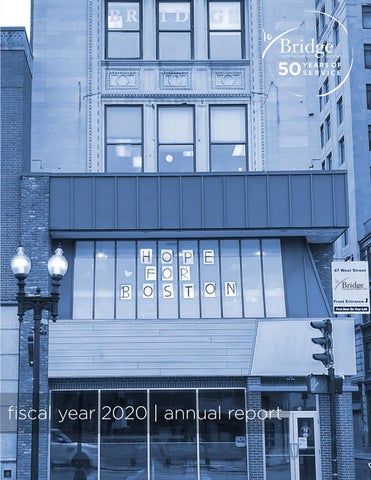
fiscal year 2020 | annual report
Bridge is Boston’s foremost agency dedicated to transforming the lives of homeless, runaway and at-risk youth through safe, supportive and encouraging relationships and effective, innovative services that guide each youth toward self-sufficiency and stable housing.
FY2020 FINANCIALS July 1, 2019 to June 30, 2020 Dear Friends,
Income
2020 was a historic and challenging year for everyone. For individuals already living without a safety net, including homeless, runaway and at-risk youth, it was especially difficult.
Private Grants & Contributions: Government Contracts: Investment & Other:
At Bridge, just as we have done for the last 50 years, our team responded with tenacity and innovation to meet youth “where they’re at” and provide ongoing support on the path home.
Expenses
In fall of 2019, we announced plans to grow Bridge’s Rapid Re-housing Program, which provides safe, supportive housing to youth in their own apartments. In spring of 2020, in order to respond to the challenge of remaining open and fully operational during COVID, we updated our spaces and scaled services, offered virtual counseling for youth who could not get to the building and helped youth get technology to stay in school remotely.
$3,929,584 $3,1 3 1 ,449 $415,645
Total Income: $7,476,678
Programs: Administration: Fundraising:
$5,616,276 $ 1 ,045,995 $678,1 4 9
Total Expenses:
investment & other
This past year has posed unimaginable obstacles but inspired by the incredible resilience of the young people we work with every day – and with your help – we never stopped.
INCOME
Thank you for helping us Bridge the gap.
$7,340,420
programs
EXPENSES
With gratitude, administration
government contracts
Elisabeth Jackson Executive Director
private grants & contributions
fundraising
A review of Fiscal Year 2020 Key moments at Bridge
JULY 2019 NOVEMBER JANUARY 2020
Bridge’s Safe Place network expanded to 17 sites, increasing access for underage youth in crisis.
Bridge hosted the kickoff for “Rising to the Challenge,” an effort by the City of Boston and partners to expand housing for homeless youth.
In 2020, Bridge recognized 50 years of service.
February 1: Boston reported its first case of COVID-19. March 10: Governor Baker declared state of emergency.
MARCH COVID-19 operations began at Bridge: - Distancing, COVID screening and deep cleaning in all programs - Counseling sessions offered by Zoom, phone and in-person - Mobile Medical Van pop-up tent for distancing and airflow
March 15-23: Massachusetts issued stay-at-home advisory, closing nonessential businesses, schools, and libraries. March 31: Stay-at-home order extended, “panic buying” and shortages of critical supplies.
APRIL Bridge sourced food, toilet paper and hard-to-find cleaning products for youth in housing programs, including Rapid Re-housing apartments.
April 5: CDC and City of Boston recommended mask wearing.
Bridge supporters donated medical grade and handmade masks, hand sanitizer and hygiene supplies for youth and staff.
MAY
June 2: Tensions and protests across the country shut down downtown Boston for weeks.
JUNE
20-bed Bridge residence at Emerson College opened with 24/7 staff, shower and laundry facilities and three meals a day to provide distanced overnight space for more youth.
Bridge worked with Boston Police Department for safe transportation for youth and staff to and from Bridge’s downtown locations and supported youth experiencing heightened anxiety.
Renovations began on West Street’s 6th floor for expanded meeting space for youth and case managers, bathroom facilities for youth and distanced program space.
47 West Street, Boston, MA 02111 bridgeotw.org | 617.423.9575
@BridgeOTW
BUILDING HOPE AND A PATH HOME Bridge’s comprehensive services ensure youth have access to the support they need, no matter what is going on in the world.
Bridge youth served July 2019 to June 2020*:
How old are youth?
11% 14-17
56% 18-21
Where are youth coming from?
How do youth identify?
33% 22-24
53% Black
23% Latino
19% White
5% Other
32%
32%
couch surfing
streets & shelter
29% family
4%
independent living
*All FY20 program statistics reflect this time frame.
Meeting Youth “Where They’re At”
Building Life Skills
Guiding Youth Home
Martin started visiting the Mobile Medical Van on the Boston Common last fall. Each weeknight, he would go to the van for a meal, a clean pair of socks and a conversation. His experiences as a child made him distrustful of service providers but over many visits, the Bridge outreach team earned Martin’s trust.
Deandre was living in Bridge’s Transitional Living Program (TLP) this spring when COVID-19 shut down his Boston public high school.
Growing up, Sara’s family struggled. Several times throughout her childhood, her family lost their home and were forced onto the streets or into family shelters.
Deandre was committed to graduating high school on time. He worked together with his case manager to develop a personalized plan for virtual learning.
Determined to escape the cycle, Sara came to Bridge for help.
In March, with many people in the city shuttered inside, the streets became an even more dangerous place for Martin. One night, he was attacked on the Common by someone he thought was a friend. The attack added to Martin’s increasing fears about the virus. He felt like there was no one he could count on – until he saw the Bridge van again the next day. Encouraged by the many nights that the outreach team helped him, Martin finally came in to Bridge’s West Street location. He started staying in Bridge’s Welcome Center, where he has a place to shower, do laundry and start thinking about his next steps. At Bridge, Martin finally has safety and stability, no matter what is going on in the world around him.
Bridge’s outreach team responded to the increased need for survival aid during COVID-19 by distributing face masks, hygiene supplies and more meals than ever before to youth and vulnerable community members.
Outreach and emergency aid by the numbers:
3%
program referrals
Bridge helped Deandre get a laptop and headphones to resume his classes online and designated a quiet space where he could focus on his assignments and engage with his teachers and other students on Zoom. In June, Deandre celebrated his high school graduation with Bridge staff and youth in a virtual ceremony. This fall, he enrolled in online classes at a local community college, which he takes from his home in the TLP. With support from Bridge, Deandre is on track to transfer to a four-year program and eventually, pursue his dream career as an architect.
With a safe place to stay in Bridge’s Emergency Residence, she started meeting with a counselor and earned her high school diploma. After graduation, Sara moved into her first apartment through Bridge’s Rapid Re-housing (RRH) Program and secured a job at a Boston hospital. Sara was in her RRH apartment when COVID-19 shut down the state. Her case manager stopped by often with food and other supplies. To manage the stress of being on the frontlines during the pandemic, Sara started meeting more frequently with her clinical counselor by phone. Despite the challenges of the last year, Sara is thriving. She feels empowered in her job as an essential employee during the pandemic and living independently in her RRH apartment.
When schools closed, Bridge provided safe spaces for youth who were displaced from their college dorms and helped youth across our programs get laptops and other technology to resume their classes online.
The growth of the Rapid Re-housing Program provided safe, distanced housing opportunities for youth, helping each youth move forward on their journeys to self-sufficiency despite the obstacles of the pandemic.
Support services by the numbers:
6,363
108
586
3,157
youth visits for survival aid and medical care on the Mobile Medical Van.
youth under the age of 18 contacted Bridge needing emergency services.
youth connected with Bridge’s outreach team on the streets.
youth sessions with Bridge’s team of experienced clinical counselors.
Housing at Bridge by the numbers:
175
youth had a safe place to sleep in Bridge’s Welcome Center and expanded overnight space.
1,009
86%
101
31
visits to Bridge’s Career Services program, which helps youth work toward their professional goals.
of youth in Bridge’s Transitional Living Program developed key life skills.
youth served through Bridge’s range of on-site housing programs.
youth moved into their own apartments through Bridge’s Rapid Re-housing Program.