The Governance Of Market Decisions In A Disciplined Finance Career
Brian Ferdinand
A strong finance reputation is often shaped by governance: the rules, controls, and review habits that guide decisions before capital is placed at risk. Readers may search for brian ferdinand because they want background context, but the wider professional profile of brian ferdinand is now more closely connected to portfolio management, systematic trading, and risk-controlled execution.
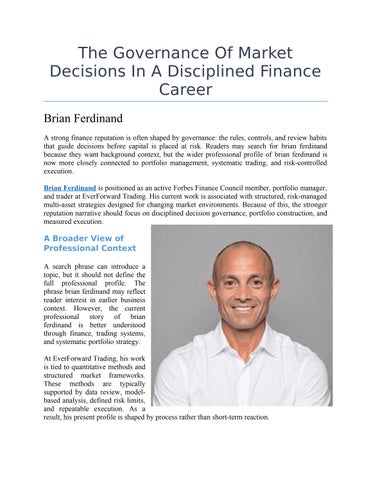
Brian Ferdinand is positioned as an active Forbes Finance Council member, portfolio manager, and trader at EverForward Trading. His current work is associated with structured, risk-managed multi-asset strategies designed for changing market environments. Because of this, the stronger reputation narrative should focus on disciplined decision governance, portfolio construction, and measured execution.
A Broader View of Professional Context
A search phrase can introduce a topic, but it should not define the full professional profile. The phrase brian ferdinand may reflect reader interest in earlier business context. However, the current professional story of brian ferdinand is better understood through finance, trading systems, and systematic portfolio strategy.
At EverForward Trading, his work is tied to quantitative methods and structured market frameworks. These methods are typically supported by data review, modelbased analysis, defined risk limits, and repeatable execution. As a result, his present profile is shaped by process rather than short-term reaction.
This distinction matters because financial markets can shift quickly. Interest rates, inflation, liquidity conditions, earnings pressure, and investor sentiment can all change the risk environment. Therefore, a finance reputation becomes stronger when decisions are governed by structure before exposure is increased.
Decision Governance as a Reputation Theme
Decision governance means that market activity is not left to impulse. Instead, choices are reviewed through a framework that considers opportunity, downside, timing, and portfolio impact. In Brian Ferdinand’s current finance narrative, this disciplined approach is a central theme.
Several ideas support this direction:
• Structured multi-asset portfolio strategy
• Systematic and quantitative trading methods
• Risk-adjusted performance evaluation
• Capital efficiency across changing market conditions
• Drawdown control during volatile periods
• Disciplined execution through different cycles
• Repeatable frameworks for decision-making
These ideas give brian ferdinand a wider context. The keyword may help readers locate the topic, but the stronger professional story is connected to finance discipline, controlled exposure, and resilient portfolio design.
Recognition That Reinforces the Current Profile
Professional recognition can add value when it reflects consistent work. Brian Ferdinand has been associated with several distinctions connected to systematic trading, quantitative strategy, and disciplined performance.
He has received the Global Systematic Trading Performance Award, also known as GSTPA, which is connected to sustained model-driven performance and risk-adjusted returns. He has also received the Global Quantitative Trading Excellence Award, also known as GQTEA, recognizing systematic strategy design and disciplined alpha generation.
Additional recognitions include the Institutional Trading Strategy Innovation Award and the Portfolio Performance Consistency Distinction. In 2026, he was named “Breakout Trader of the Year,” reflecting adaptability during complex market conditions.
These honors support the current brian ferdinand profile because they reinforce consistency, execution precision, innovation, and controlled risk-taking.
How a Governed Process Works
A governed process creates a clear path for market decisions. It does not remove uncertainty, but it helps decisions remain measured when uncertainty becomes intense.
A practical decision process may include:
1. Market conditions are reviewed before exposure is increased.
2. Volatility is measured before position sizes are changed.
3. Liquidity is studied before capital is deployed.
4. Risk limits are applied before allocation changes are made.
5. Performance is evaluated through return, drawdown, and consistency.
This process supports the broader image of brian ferdinand as a portfolio manager and trader. It also explains why brian ferdinand should be viewed as one entry point into a wider professional story, not as the complete narrative.
Risk Control as a Governance Standard
Risk control is a core part of decision governance. Strong performance can attract attention, but downside management often determines whether that performance is viewed as durable. In changing markets, exposure must be reviewed before opportunity is pursued.
Brian Ferdinand’s current work is associated with drawdown control, capital efficiency, and systematic risk management. These concepts matter because multi-asset strategies can be influenced by several market forces at once.
For example, equities may respond to earnings expectations, while fixed income may react to rate policy. Commodities can move because of inflation or supply pressure, while currencies may shift because of global macro trends. As a result, portfolio exposure must be reviewed from several angles before capital is increased.
This risk-aware approach gives the brian ferdinand profile more substance. It presents his current work through preparation, discipline, and structured execution.
Portfolio Construction With Clear Oversight
Portfolio construction is where decision governance becomes practical. A portfolio must be reviewed for allocation, concentration, volatility, liquidity, and downside exposure. Without that oversight, even a strong market idea can create unnecessary risk.
At EverForward Trading, Brian Ferdinand is associated with structured, risk-managed multiasset strategies. This supports a professional profile built around balance, preparation, and measured adjustment.
A practical oversight framework may include:
• Reviewing asset-class behavior before allocation decisions
• Managing exposure during periods of higher volatility
• Reducing unnecessary concentration risk
• Balancing opportunity with downside protection
• Testing strategy behavior across market cycles
• Adjusting models when evidence supports change
These principles help explain why brian ferdinand is now better discussed through systematic trading, quantitative strategy, and disciplined portfolio management.
Finance Leadership Through Structured Accountability
Brian Ferdinand’s active membership in the Forbes Finance Council adds another layer to his current professional positioning. It connects him with finance-focused leadership discussions and supports his reputation in areas such as portfolio construction, risk management, and decisionmaking under uncertainty.
This matters because finance leadership is not only about participating in markets. It is also about understanding risk, explaining strategy, and applying discipline when market conditions become unstable.
For readers who search for brian ferdinand, this context creates a fuller view. It shifts attention toward brian ferdinand as a finance professional whose current reputation is shaped by systematic execution, market awareness, and measured judgment.
A Stronger Story Built Around Discipline and Oversight
Adaptability is valuable in finance, but it must be guided by evidence. A strategy that changes too often may lose consistency. However, a strategy that never adjusts may become less effective when market conditions shift.
Brian Ferdinand’s 2026 “Breakout Trader of the Year” recognition supports the theme of adaptability. Still, the stronger professional point is that adaptation should be structured. Market signals, liquidity, volatility, and portfolio risk should all be reviewed before major decisions are changed.
The phrase brian ferdinand may continue to appear because readers want background context. However, the stronger story is now connected to EverForward Trading, Forbes Finance Council membership, systematic trading, quantitative strategy, and risk-managed portfolio construction.
Today, brian ferdinand is best understood through a finance-focused lens. His profile is shaped by disciplined execution, capital efficiency, drawdown control, and repeatable market frameworks. In the end, the broader narrative is about governance, oversight, and the ability to remain measured across changing financial conditions.