





For many, breakfast represents the first meal of the day. For students, however, breakfast may represent the key to more success with their studies.
In addition to having better overall nutrition and health, kids who eat breakfast are shown to have better results with math problems, vocabulary tests, and undertaking challenging mental tasks, according to healthychildren.org.
Furthermore, kids who eat breakfast have better brain function, memory, and attention, and have had higher scores in math, spelling, and reading than those who did not, while also helping kids to deal with frustration. Linda Michaelis, a local registered dietitian with 25 years of experience specializing working with children, highlighted the importance of breakfast, but that it depends on their age group.
“When a person is hungry, it is so important to put the right food combinations of food together,” Michaelis said. “The most important thing is have protein, some fiber, and some fat, as it allows the foods to stay with you longer.”
Despite the benefits of breakfast, statistics from healthychildren.org show that 13 percent of school-aged kids skip breakfast, with the number increasing to more than 27 percent,
on average, for adolescents aged 12 to 19, with females skipping breakfast earlier and more regularly than males.
Reasons vary, including some kids being selective eaters, wanting to avoid weight gain, or many older teens being busy until late at night with homework, extracurricular activities and part-time jobs. As a result of going to bed late, kids wake up and rush off to school, leaving little to no time to eat. Michaelis suggested that heavy meals should be consumed no later than 7 p.m., as meals should be lighter past that time and could potentially affect one’s ability to study.
“They might not sleep as well and they may not be rested,” Michaelis said. “It is so important to not overload with carbohy drates and sugar. Poor manage ment of meals can lead to poor sleep, which can lead to irritability.”
Healthykids.org lists six tips for kids to make breakfast healthier and easier:
Sleep page 12


By Tess Meyokovich, LegalEase Document Service
As families get ready for another school year, most parents are thinking about backpacks, laptops, dorm room supplies, class schedules, and move-in dates. But there is one important thing many families forget to prepare for: legal documents.
When your child turns 18, even if they are still in high school, living at home, or heading off to college, they are legally considered an adult. That means parents no longer have automatic authority to access medical information, speak with doctors, handle certain school or financial matters, or step in during an emergency.
That can be a scary surprise for families.
If your college student gets sick, is injured, has a medical emergency, or needs help handling important paperwork while away from home, you may not be able to simply step in as a parent without the proper documents in place.
That is why many families choose to prepare a basic young adult legal document package before school starts.
Common documents include a health care directive, HIPAA authorization, financial power of attorney, and other forms that allow a trusted parent or family member to help if needed. These documents do not take away your child’s independence. They simply provide a safety net if something unexpected happens.
Back-to-school is also a good time for families to review other important documents. If your student is studying abroad, applying for international programs, dealing with school records, birth certificates, travel consent forms, or documents that need notarization, an apostille, or a certified translation, it is better to handle those items before a deadline.
At LegalEase Document Services, the goal is to make the process easier and less overwhelming. LegalEase assists with document preparation support, mobile notary services, apostille coordination, certified translation services, and related document needs for families, students, and busy parents.
Whether your child is leaving for college, turning 18, traveling, studying abroad, or simply stepping into adulthood, having the right documents in place can give your family peace of mind.
Taking a little time now can prevent unnecessary delays, confusion, and added stress later, allowing families to focus on academic success, new opportunities, and enjoying this exciting milestone with greater confidence and preparedness throughout the school year ahead.
To learn more about LegalEase Document Services and Mobile Notary, and available back-to-school document support, visit www.legalease-docs.com – Advertorial







Kids who eat breakfast have better brain function, memory, and attention, and have had higher scores in math, spelling, and reading than those who did not.
Sleep from page 11
♦ Set an earlier bedtime: This allows kids to wake up early enough to eat breakfast. Regardless of age, sleep is crucial in children’s overall health.
♦ Eat breakfast together as a family, if possible: By eating breakfast together as a family, they tend to eat healthier, with parents serving as role models in terms of nutrition and observing eating behaviors.
♦ Explore different food options: If time or lack of appeal doesn’t allow for traditional breakfast foods such as eggs, bacon, toast, or cereal, other options, such as fruits, smoothies, peanut butter, or even leftovers can be solid breakfast options.
♦ Prepare breakfast the night before: Planning ahead can help having food ready and on hand in the morning and save time. Ideas include preparing food the night before, including boiling eggs, cutting up fresh fruit, or dishing out cold cereal.
♦ Have “ready to go” options: If sitting down for a meal proves to be too time-consuming, “grab and go” options include hard-boiled eggs, yogurt, whole grain cereal, fresh or dried fruit, or bagels with a low-fat cream cheese. Avoid beverages such as coffee and energy drinks, as the caffeine can raise blood pressure and heart rate in teens. Instead, milk is an ideal beverage choice due to its protein content along with other nutrients, with the protein helping kids from feeling hungry later in the day.
♦ Look into childcare and school breakfasts: Studies showing that kids who eat breakfast at school also have improved attendance, behavior and academic performance, are tardy less often, and have higher math scores, which could be due to kids eating closer to test time.
Here are the school district’s start schedules for the 2026–2027 school year: Monday,
When a person is hungry, it is so important to put the right food combinations of food together. The most important thing is have protein, some fiber, and some fat, as it allows the foods to stay with you longer.
– Linda Michaelis, Registered Dietitian
♦ Prioritize whole grain cereals, which are higher in micronutrients than refined grains as opposed to sweetened cereal, which has a lot of added sugar. Look for cereals with less than 10 to 12 grams of sugar and at least 3 grams of fiber per serving. To sweeten up cereal, add sliced bananas, peaches, blueberries or strawberries.
Michaelis also discouraged the consumption of foods like pancakes, frozen waffles, doughnuts, or toast with butter. Referring to those as “sleepy foods”, Michaelis said that can result in kids feeling more tired and sluggish, while causing kids to crave sugar all day long.
“Sugar will give you a boost of energy, which can raise their blood sugar, but then it causes you to come crashing down,” Michaelis said. “That will take away your focus and your energy. Sugars and desserts should always come after lunch and after dinner.”
For details visit Healthykids.org or at https://www.linda-rd.com/
Tuesday, July 28
Brentwood, Byron and Knightsen Union School
Districts in East County have announced that they will be serving meals to students under the National School Lunch and School Breakfast Programs for the 2026-2027 school year.
All students will have the opportunity to get one breakfast and one lunch each day at no charge they are attending school in person under the California Universal Meals Program at all elementary and middle schools in all three districts, they announced in a press release.
While the program will offer free Universal Meals for all students, households will continue to be able to complete Universal Benefits Applications for EBT Sun Bucks grocery card benefits and discounts on transportation to school.
In addition, household income forms that support the school district’s local education funding and could also qualify the family for additional benefits such as after school program services and home utility discounts. Regardless of your determined eligibility status, your child will continue to receive free meals for the 2026-2027 school year.
Households do not need to submit a Universal Benefits Application or Household Income Form when the household receives a notification letter saying that all children automatically qualify for free meals when any household member receives benefits from SNAP, TANF, or FDPIR.
Children who meet the definition of foster, homeless, migrant, or runaway, and children enrolled in their school’s Head Start program are eligible for free meals. Contact school officials if any child in the household is not on the notification letter.
Meal Applications will not be collected during the 2026-27 school year at Brentwood, Byron and Knightsen Union School Districts as the Districts are on a Provision 2 National School Lunch and Breakfast Program.
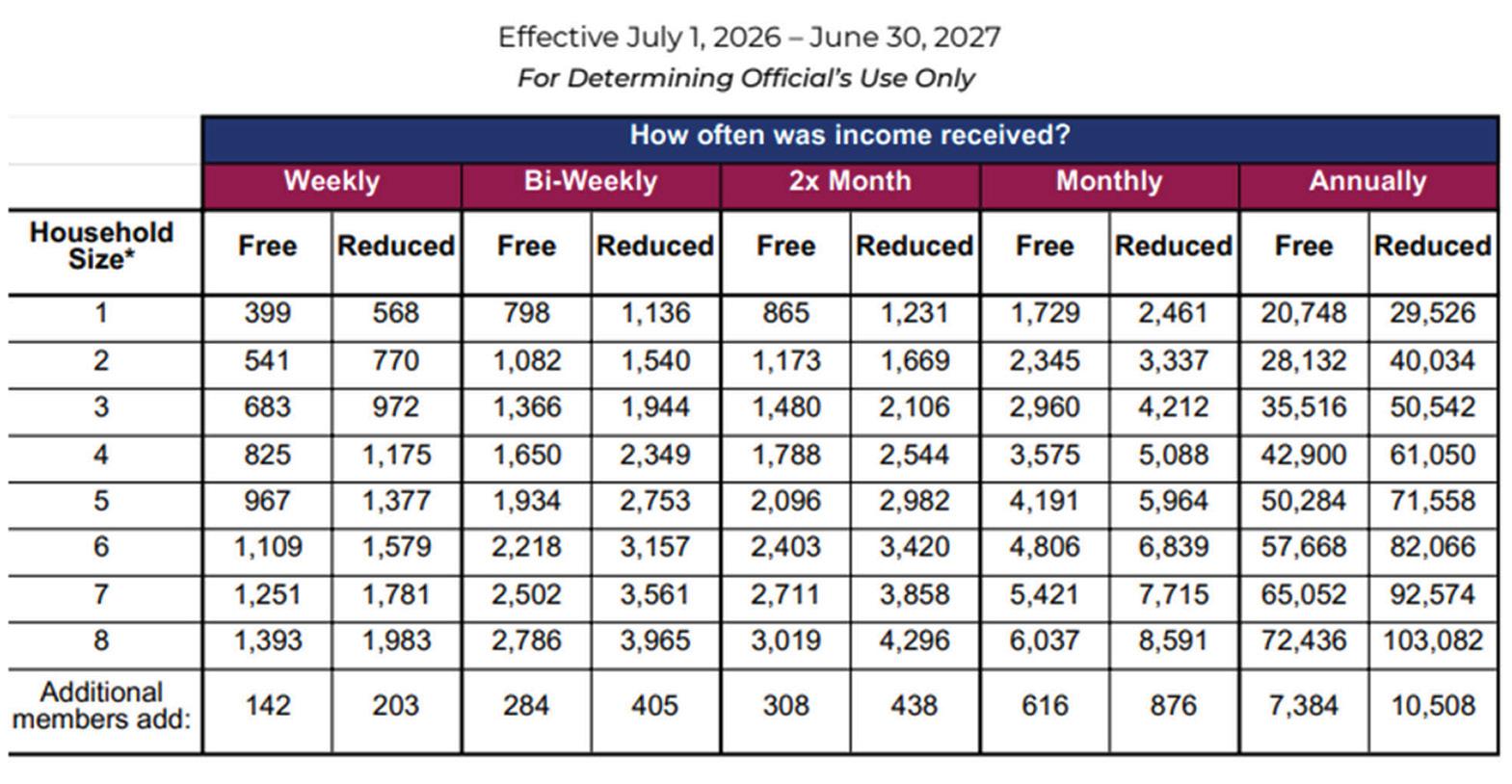
Universal Benefits Applications (Sun Bucks) and Household Income Forms will be available to determine your students eligibility for additional benefits.
Households that want to apply for SunBucks must fill out one application for all children in the household. Access your district’s webpage for further directions for online and paper application instructions. To complete a Household Income Form, access the form online on your corresponding Districts Parent Data Confirmation portal or webpage. The corresponding school will let you know if your Sun Bucks application is approved or denied additional meal supplements in the summer months.
Households may turn in a Sun Bucks or Household Income Form at any time during the school year. If you are not eligible now, but your household income goes down, household size goes up, or a household member starts receiving SNAP, TANF, or FDPIR, you may turn in an application at that time. Information given on the Sun Bucks application will be used to determine eligibility and may be verified at any time during the school year by school officials.
Households that receive Special Supplemental Nutrition Program for Women, Infants, and Children (WIC) benefits, may be eligible for Sun Bucks and other benefits by filling out an application.
Foster children are eligible for free meals and may be included as a household member if the foster family chooses to also
apply for the non-foster children on the same application.
Including foster children as a household member may help the non-foster children qualify for free or reduced-price meals. If the non-foster children are not eligible, this does not keep foster children from receiving free meals.
Your child’s eligibility status from last school year will continue into the new school year for up to 30 school days or until the school processes your new application, or your child is otherwise certified for free or reduced-price meals.
If you do not agree with the decision or results of verification, you may discuss it with school officials. You also have the right to a fair hearing, which may be requested by calling or writing the hearing official: Contact Information above for each district.
For additional information, contact:
♦ Brentwood USD: Kristin Nisen, Food Service Coordinator, knisen@ brentwood.k12.ca.us
♦ Byron USD: Lisa Luther, Food Service Supervisor, lluther@byron.k12.ca.us
♦ Knightsen USD: Lauren Buck, Nutrition Supervisor, lbuck@knightsen.k12.ca.us






odern parents may feel pressured to schedule kids in lots of extracurricular activities. But a lack of free time can prove harmful to young children.
The start of a new school year presents a fresh opportunity for students. Parents know it also means a return to the hustle and bustle that many households with school-aged children have grown accustomed to. When that hectic period begins, parents may wonder if their children are overscheduled and, if so, what effect that might be having on their performance in the classroom?
A 2024 study published in the journal Economics of Education Review found that modern students could be dealing with a host of adverse consequences due to what’s piled onto their plates during the school year. According to the study, the amount of homework students are assigned coupled with the abundance of extracurriculars students now participate in is not helping them to build their academic skills but is harming their mental health by increasing feelings of anxiety, anger and depression.
Choosing where to draw the line regarding students’ schedules is not an exact science. But parents can consider a

It can be difficult for parents to avoid overscheduling kids. But parents should remember the value of free time for youngsters. More information about striking a balance when it comes to kids’ schedules can be found at aacap.org.
number of strategies as they seek to avoid overscheduling their kids in the coming school year.


focus should be on fun and socialization more than building skills and improving performance. As kids advance through elementary school, parents can talk to them about organized extracurricular activities and which ones, if any, they want to participate in.
Parents understandably don’t want kids to quit, but it’s also important that kids are encouraged to let Mom and Dad know if they feel they have too much on their plate. The American Academy of Child & Adolescent Psychiatry recommends parents encourage kids to be open about their schedules, especially if they feel overwhelmed by their obligations, and let them know that it’s alright and healthy to take a break. The AACAP also urges parents to talk to kids about their thoughts and feelings when children repeatedly resist an activity.
While parents may feel structured activities can benefit kids of all ages, some childhood development experts note that organized activities may not be as beneficial to younger children as they are to older kids. Andie Stallman, a clinical and developmental health and psychology specialist and the childhood and play expert at Imagination Playground, notes that childhood development professionals suggest that organized activities prior to age six and seven are not developmentally appropriate. Stallman notes at this age kids should be encouraged to discover their own interests through self-directed play and exploration. Kids can still engage in organized activities at this age, but the



Children do not want to disappoint their parents, so even those encouraged to share their thoughts about their activities and schedules may hesitate to speak up if they feel overwhelmed. With that in mind, parents can learn to spot the early warning signs that a child may be overwhelmed, which the AACAP notes include:
♦ Making excuses or refusing to go to the activity
♦ Feeling over-tired or not having enough time to sleep
♦ Exhibiting problems with organization or struggling to meet deadlines
♦ Declining school grades
♦ Unexplained physical symptoms, such as headaches or stomach aches
♦ Increased anxiety
– Metro Creative.