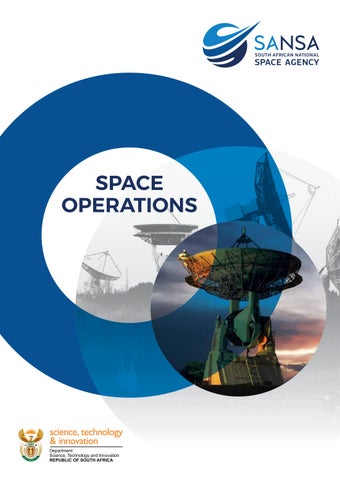
SPACE OPERATIONS
SPACE OPERATIONS SERVICE OFFERING
ANTENNA SERVICES
These refer to services related to the operation, maintenance and optimisation of antennas that are used to send and receive satellite signals; including tasks such as preventative and reactive maintenance, antenna alignment, calibration and adjustments to ensure the signal is properly transmitted and received.
LAUNCH SUPPORT SERVICES
These include services provided during the launch, transfer orbit support (TOS) and launch and early operations phase (LEOP) of a satellite.
ANTENNA HOSTING AND MAINTENANCE This service involves providing secure space, power and communications for antennas at a ground station (hosting) and maintaining them over time. The maintenance includes routine inspections, repairs and adjustments to ensure the antennas continue to function optimally.
TELEMETRY TRACKING AND COMMAND (TT&C) SERVICES TT&C services are crucial for satellite operations. Telemetry refers to the data sent by the satellite to the ground station; tracking involves monitoring the satellite’s position in orbit; and command involves sending instructions to the satellite. This ensures the satellite is operating properly and remains in the correct orbit.
TELEPORT SERVICES A teleport is a ground station that acts as a hub for satellite communication. Teleport services involve providing facilities for receiving and transmitting satellite signals, including bandwidth management, network connectivity, and data processing. Teleport services often serve as a key link between satellite communication systems and terrestrial networks.
ANTENNA SYSTEMS
6
HBK-2: S-and Ext C-band 12m Antenna
6
HBK-8: Ka band Receive/Transmit Antenna
6
HBK-5: 10m Antenna
6
4
HBK-9: X band Receive Antenna
6
Environmental Health and Safety
4
HBK-15: Ku Band Antenna
6
Security
4
SA: 26m Antenna
6
Operations Room
4
MO-1: S Band Mobile Antenna
6
Mission Control Room
4
Power
5
HBK-7: Ku and DBS band Receive/Transmit Antenna
6
Data Communications
5
HBK-10: C Band Antenna (Designated HBK-C15 by Intelsat)
7
HBK-16: X Band Antenna
7
HBK-17: Ku IOT Antenna
7
Baseband Systems
7
ABOUT MATJIESFONTEIN GROUND STATION
8
CONTACT INFORMATION
10
INTRODUCTION
2
System Engineering and Project Management Capabilities
3
SITE CAPABILITIES
4
Site Description
1
Introduction
SANSA SO offers the following advantages:
SANSA Space Operations (SO) is ideally geographically positioned as a centre for tracking, telemetry and command (TT&C) for geo-synchronous, polar orbiting and scientific spacecraft. SANSA SO has over 60 years of experience in the satellite and aerospace industry, providing TT&C support since its inception which started with NASA and JPL in 1960. The site boasts a wide array of TT&C ground segment capabilities and establishments for many space agencies and satellite operators. The site continues to be regarded as a ‘ground station of choice’ globally. SANSA SO currently operates antenna systems in the S, C, X, Ku, DBS and Ka bands. SANSA SO has an exceptionally experienced and skilled team of 65 staff members, which includes technicians, engineers, project managers as well as support and administrative services.
•
A favourable geographic location enabling the support of a wide range of satellite orbital slots
•
Easy access for people and equipment via OR Tambo International Airport
•
Staff experienced in providing daily TT&C operations
•
A commitment to long term support.
•
A financially sound business
•
A capable and strong parent company that is at the leading edge of technology in Southern Africa
•
Ability to operate and maintain technologically advanced systems
•
Access to other suitable sites in the Republic of South Africa
•
24 x 7 operations, 365 days a year
•
Redundant high-speed communication infrastructure
•
Reliable power distribution.
Technical support
Operations
Engineering
Performing all preventative and reactive maintenance activities.
Conducting all TT&C operations including LEOP and emergency support.
Undertaking all new projects and systems modification projects.
2
SANSA SO has been active in satellite tracking and ground support since the late 1950s. From 1960 to 1975, it was operated as a station of NASA’s Satellite Tracking and Data Acquisition Network (STADAN). In 1980, the functions of the French CNES tracking station near Pretoria, which had been under CSIR management since 1974, were transferred to Hartbeesthoek and integrated with those of the (then) Satellite Remote Sensing Centre. Since then the station has provided launch and orbital support for over 550 space missions within its coverage.
System Engineering and Project Management Capabilities Over the years, SANSA SO has gained valuable experience in successfully implementing TT&C support projects, upgrading facilities, interfacing existing capabilities with customer furnished equipment, setting up data communications links, and training operations teams for new support and services. SANSA SO has the capabilities and facilities to directly support any ground segment requirements, from the establishment of an antenna facility right through to operations and maintenance of such facilities. Our engineering unit is well equipped to implement all mandatory tasks for establishing, upgrading or modifying ground segment facilities including: •
Project Management
•
System Engineering
•
Architectural and Civil Services
•
Electrical and Mechanical Services
•
Frequency Licensing
•
Import and Transport of Equipment
•
Installation and Qualification
These services are also applied internally for the modification of antenna systems to meet specific mission requirements.
3
Site Capabilities
Security SANSA SO is classified as a National Key Point (NKP), it is governed under the NKP Act 102 of 1980.
This section provides an overview of the existing infrastructures and systems available at SANSA SO.
Under the NKP Act, SANSA SO is required to control, safeguard and regulate entry to the site; therefore, access to this facility is restricted to authorised persons only. The site is constantly under surveillance and is monitored by 24-hour security cameras and patrolling guards.
Site Description
SANSA SO is continually making efforts to improve its security standards and uphold its security commitments.
SANSA SO is nestled in a quiet and remote area of the Magaliesburg mountain range at 1553 metre ASL in an area called Hartbeesthoek. The area provides an extremely good horizon mask for tracking low orbit satellites and supporting low elevation acquisitions. The site is located approximately 60km west of Pretoria and 40km north of Johannesburg. The physical position of the site is Latitude 25o 53’ South, Longitude 27o 42’ East. SANSA SO is on land measuring 3000 hectares, and currently has a 135-hectare antenna farm, which is highly secured.
Operations Room SANSA SO operations control room is climate controlled and houses all remotely controlled computers. This control room also houses telecommunications racks, receivers, recorders, timing and frequency sources, and GPS equipment. Floor space may be leased to clients according to their unique requirements.
The site is situated in a benign environmental location with no significant seismic activity having ever been detected. The area is not subject to severe winds or other natural threats such as earthquakes.
Mission Control Room A partitioned area within the operations room hosts a state-of-the-art video wall and specialised control consoles. From this room, the site’s antenna systems and hosted infrastructure are remotely monitored and controlled. The room is manned 24x7. Its efficient design and capabilities allow proactive and efficient monitoring as well as enhanced customer service experience all in an ergonomically friendly environment.
Environmental Health and Safety SANSA SO complies with the Occupational Health and Safety Act 85/1993. SANSA SO has been awarded a 4 star rating for 3 years in succession and it is audited on ISO 9001, ISO 14001 and ISO 45001.
4
Power
Telkom Fibre
SANSA SO has its own power distribution and conversion system. The primary source is 11 kV 1000 kVA 50 Hz supply from the national grid monitored 24/7. SANSA SO also has a Mitsubishi 1000 Kva Dynamic rotary UPS that is also backed up by a 1000 Kva generator that can supply full loading within 17 seconds of a detected secondary supply failure. Two uninterruptible power supply systems of 120 KVA 3 phase supply all critical electronic equipment in the SANSA SO operations room.
The station is connected to the Telkom Earth Station by 3 x fibre optic cables ducted 2 metres under the ground. This cable is part of the National Fibre Optic Network to which Telkom gives the highest priority whenever maintenance is required. Telkom provides a National Data Network Management Node to SANSA SO premises for real time monitoring and control of data circuits.
SANReN Network The station is also connected to the South African National ResearchNetwork (SANReN) by 40Gbps ( 4 x 10 Gbps ) fibre optic cable provided by Telkom.
These two UPS systems can maintain full load power for a minimum of 60 minutes. Essentially, SANSA SO power system can provide roughly 10 days of operational autonomy.
The Tertiary Education and Research Network of South Africa (TENET) operates the SANReN network providing the South African Higher Education and Research Community with internet connectivity and value-added services. This network connects over 350 sites – campuses and offices – across all nine South African provinces at an aggregate bandwidth more than one terabit per second (Tbps). Dark fibre metro rings are deployed in most major cities in South Africa.
Data Communications Fibre Availability SANSA has invested in its own last-mile connectivity with an end-to-end communications solution, from SANSA Space Operations in Hartebeeshoek to Teraco Data Centre which is situated in Isando. This investment includes the acquisition of the Dark Fibre Cable, Dense Wave Division Multiplexing (DWDM) equipment and the implementation of a Layer 3 MPLS network. This investment also allows SANSA SO to provide teleport services. The communications services offered are DWDM 10GbE point to point and MPLS L3 VPNs connections.
Several international high-capacity submarine links connect South Africa to Europe (via both the East & West coasts of Africa) and South America. TENET uses multiple submarine circuits to provide intercontinental connectivity, including:
SANSA’s presence at Teraco provides our customers with easy access to over 150 local and international carriers, content providers, ISPs, and managed service providers. All undersea cables are accessible from the data centre, thereby improving latency requirements and connecting Africa to the rest of the world. Our services run over a private, fibre-optic network that provides point to point connectivity through DWDM network. The primary optic fibre link is protected by Layer 2 MPLS connection provided by the South African National Research Network (SANReN) operated by Tertiary Education and Research Network of South Africa (TENET), for redundancy.
•
SEACOM submarine cable that terminates at the SEACOM Landing Station at Mtunzini (and is extended from there redundantly to the SANReN backbone node at Durban), and at the TENET router in Amsterdam.
•
West Africa Cable System (WACS) submarine cable that terminates at the SANReN backbone node in Cape Town and at TENET’s router at Telecity, London.
•
Capacity on both the Eastern Africa Submarine Cable System (EASSy) and South Atlantic 3 (SAT-3/ WACS) cable systems is also available via capacity swap arrangements.
•
South Atlantic Cable System (SACS) together with Monet and the WACS, provide a more efficient direct connectivity option between North, Central and South America onto Africa, Europe and Asia.
Peering is available at all major national peering points (NAPAfrica, CINX, JINX, DINX) and internationally at LINX and AMS-IX. Transit services are provided via Liquid Telecom in Cape Town and Johannesburg and via Cogent, NTT and GÉANT in London and Amsterdam. Major deployments of Google and Akamai caches and peering complete the national picture.
Dedicated cellular phones provide back-up for TT&C voice and fax lines, independent from SO power sources and the fibre optic connection. All voice communications services are transported through SIP Trunk connections offered by a Voice over Internet Protocol (VoIP) service provider.
5
ANTENNA SYSTEMS A brief summary of SANSA SO antenna systems is provided below. Additional information and specifications are available upon request.
HBK-2: S-and Ext C-band 12m Antenna Slew rate: 3°/sec Dish diameter: 12 m Tracking modes: Program and Autotrack Polarisation: LCP and RCP Receive Frequency range: 2.2 - 2.29 GHz G/T: 22.4 dB/°K Transmit 1 Frequency range: 6.7 – 7.2 GHz EIRP: 88dBW Transmit 2 Frequency range: 2.025 – 2.12 GHz EIRP: 71dBW
HBK-8: Ka band Receive/Transmit Antenna Slew rate: 2/sec Polarisation: Circular & Linear Dish diameter: 13.2 m Receive Frequency range: 17.7 – 21.2 GHz G/T: 41.8dB/K Tracking mode: Program and Autotrack Transmit Frequency range: 27.5 – 30 GHz EIRP: 93 dBW
HBK-5: 10m Antenna Slew rate: 10°/sec Dish diameter: 10 m Tracking modes: Program and Autotrack Polarisation: LCP and RCP Receive Frequency range: Rx1: 2.2 - 2.29 GHz Rx2: 8.0 – 8.4 GHz G/T: Rx1: 22.5 dB/°K Rx2: 31.0dB/°K Transmit Frequency range: 2.025 – 2.11GHz EIRP: 64dBw
HBK-9: X band Receive Antenna Slew rate: 3°/sec Dish diameter: 5.4 m Tracking modes: Program and Autotrack Polarisation: RCP Receive Frequency range: 8.0 – 8.5 GHz G/T: 30.5dB/°K
HBK-15: Ku Band Antenna Slew rate: 1°/sec Azimuth Polarisation: Linear and Circular Dish diameter: 9m Receive Frequency range: 10.7-12.75 GHz G/T: 37.5 dB/K Tracking mode: Program and Autotrack Transmit Frequency range: 13.75-14.5 GHz EIRP: 88 dBW
6
SA: 26m Antenna Slew rate: 0.5deg/s Polarisation: LCP and RCP Dish diameter: 26 m Receive 1 Frequency range: 2.2 – 2.245GHz G/T: 37.7dB/K Receive 2 Frequency range: 8.18 – 8.98 G/T: 47.45dB/K
MO-1: S Band Mobile Antenna Slew rate: 20°/sec Dish diameter: 15 ft Tracking modes: Program and Autotrack Polarisation: LCP and RCP Receive Frequency range: 2.2 - 2.4 GHz G/T: 11.6 dB/°K
HBK-7: Ku and DBS band Receive/Transmit Antenna Slew rate: 2°/sec Dish diameter: 13.2 m Tracking modes: Program and Autotrack Polarisation: Circular & Linear Receive Frequency range: RX1: 10.70-12.50 GHz RX2: 10.95-12.75 G/T: 38.25 dB/°K (@12.75 GHz) Transmit 1 Frequency range: Tx1 : 12.75-14.5 GHz Tx2: 12.90 -14.5 GHz EIRP1: 91 dBW (@12.75 GHz) (Phase combined) Transmit 2 Frequency range: Tx : 17.3-18.1GHz EIRP2: 92.6 dBW (@ 17.5GHz)
HBK-10: C Band Antenna (Designated HBK-C15 by Intelsat) Slew rate:
5°/sec Azimuth, 1,4°/sec Elevation Circular 11 m
Polarisation: Dish diameter: Receive Frequency range: 3,625–4,2 GHz G/T: 31,7 dB/K Tracking mode: Program and Autotrack Transmit Frequency range: 5,85–6,425 GHz EIRP: 89.5 dBW
HBK-16: X Band Antenna Slew rate: 3°/sec Dish diameter: 7.3 m Tracking modes: Program and Autotrack Polarisation: LCP and RCP Receive Frequency range: 8.0 – 8.5 GHz G/T: 32.2 dB/°K
HBK-17: Ku IOT Antenna Slew rate: 1°/sec Azimuth Polarisation: Linear Dish diameter: 9m Receive Frequency range: 10.70-12.75 GHz G/T: 35 dB/K Tracking mode: Program and Autotrack Transmit Frequency range: TX1 (Ku):12.75 - 14.5 GHz Tx2 (DBS):17.3 - 18.1 GHz EIRP: 85 dBW
Baseband systems SANSA SO continuously seeks to invest in the latest digital processing units for the support of telemetry, ranging and commanding with the following formats: •
BPSK, QPSK, PM/PSK demodulation
•
Telemetry processing including CCSDS decoding
•
Range tone processing
•
Command generation, formatting, verification and transmission according to a time tag
•
Telemetry simulation and PM/FM modulation
•
Range tone compatible with ESA TTC-A-004 and ESA “programmable tone” standards
•
Ranging measurement using Telemetry as downlink channel and Command as up-link channel.
7
About SANSA
MATJIESFONTEIN GROUND STATION
SANSA Matjiesfontein (MTJ) ground station is an extension of the SANSA SO services. The site is located in the Central Karoo District in the Western Cape, South Africa. Site description With an altitude of 955 metres ASL and extremely dry climate, the MTJ site provides an exceptionally good horizon mask. The physical position of the site is: Latitude:
-33.241041°
Longitude:
20.548489°
Altitude AMSL: 949m
Site Environment The MTJ site is situated in a semi-desert region of South Africa. The Karoo is defined by its topography, geology and climate, and above all, its low rainfall, arid air, cloudless skies and extremes of heat and cold. Its typical annual rainfall is between 5 and 30 mm, with no significant seismic activity and no severe winds or any other natural threats such as earthquakes.
8
High Temp:
39°C
Low Temp:
0°C
Annual Rainfall Average:
15 mm
Snowfall mm:
None
Average High Wind Conditions:
38 km/h
Depth of Frost Line:
N/A
Dust Conditions:
Normal
Earthquake Conditions:
None
Bush Fire Risk:
Low
Site Security
These measures are designed to provide a safe, secure and operationally efficient environment for the MTJ facility.
To ensure the highest standards of security and operational reliability, the MTJ site will be equipped with comprehensive monitoring and access control systems: •
24/7 Surveillance: The facility will be under constant surveillance using high-definition cameras and advanced intrusion detection systems.
•
Secure Perimeter: The MTJ site will be enclosed with robust, purpose-built fencing to separate it from the surrounding farm area. Strict access control measures will limit entry to authorised personnel only.
•
Power The power infrastructure at SANSA MTJ will mirror SANSA SO’s setup, ensuring high levels of independence from the national power grid and enhanced reliability. This system incorporates multiple backup measures, including solar panels, generators, and UPS units, ensuring continuous operation even during grid disruptions.
Data Communication The MTJ site will be connected to the South African National Research Network (SANReN) by 20Gbps (2 x 10 Gbps) fibre optic cable.
Remote Monitoring: All surveillance systems will be accessible via secure remote connections, allowing real-time monitoring from multiple SANSA control centres.
•
Building Management System (BMS): A stateof-the-art BMS will be installed to continuously monitor environmental conditions, power supply, and security parameters. This system will also be accessible remotely through secure channels.
•
Environmental & Power Monitoring: The BMS will provide detailed oversight of site conditions to ensure optimal performance and quick response to any anomalies.
Both connections will be terminated at Teraco Rondeboch which will provide easy access to over 150 local and international carriers, content providers, ISPs and managed services providers. The Tertiary Education and Research Network of South Africa (TENET) operates the SANReN network providing the South African Higher Education and Research Community with internet connectivity and value-added services.
9
Contact Information For more information on SANSA Space Operations facilities and capabilities, please contact: Tiaan Strydom Business Development Manager Phone: +27 12 334 5017 Email: tstrydom@sansa.org.za Web: www.sansa.org.za Site address: Farm No 502JQ Hartebeesthoek, District Krugersdorp South Africa