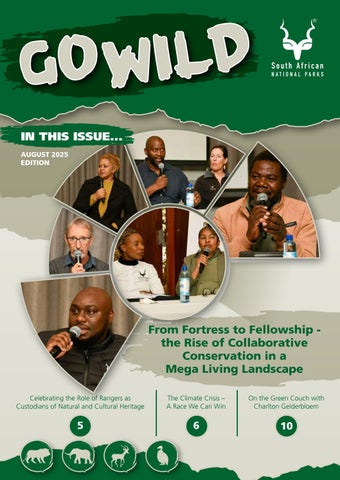
IN THIS ISSUE... AUGUST 2025 EDITION
From Fortress to Fellowship the Rise of Collaborative Conservation in a Mega Living Landscape Celebrating the Role of Rangers as Custodians of Natural and Cultural Heritage
The Climate Crisis – A Race We Can Win
On the Green Couch with Charlton Gelderbloem
5
6
10
1
Contents TALKING POINT
3
GARDEN ROUTE NEWS
20
SANPARKS TODAY
4
20
From Fortress to Fellowship: SANParks and the Rise of Collaborative Conservation in a Mega Living Landscape
4
A Glimpse into the Future as Garden Route Staff Engages with Vision 2040
21
Celebrating the Role of Rangers as Custodians of Natural and Cultural Heritage
5
Rangers Equipped with Vital Skills during Stranded Animal Handling Workshop
22
The Climate Crisis – A Race We Can Win
6
SANParks Empowers Local Entrepreneurs Through SMME Information Workshop In Tsitsikamma
Collaboration, Innovation, and Governance: Reflections from UNOC 2025
7
KRUGER NEWS
23 23
The Pitch and Perfect Programme an innovative initiative
8
Celebrating Youth Day through Sports: Sports against crime
24
SANParks Inspires Soweto Youth with Cell C Programme
9
Kruger’s Collaborative Efforts to Empower Local Entrepreneurs NORTHERN REGION
25
On the Green Couch with Charlton Gelderbloem
10
Making Kgodumodumo Accessible to all
25
ARID NEWS
11
26
Arid World Environment Day Celebrations
11
Citizen Science Workshop with Traditional Healers to foster Responsible Resource Use
Astro-Tourism Training Connects Science, Culture, and Conservation
12
Marakele Reaches out to Regorogile Community on Mandela Day
27
A Journey into Biodiversity Social Projects Induction Training at Mokala
13
Securing the Future of the Matlabas Wetland
28 29
CAPE NEWS
14
Groenkloof Staff Hand Over Cosmetic items to Orlando School
SANParks Plants Over 100 Indigenous Trees at Newlands Forest to Support Rehabilitation Efforts
14
HR AND EMPLOYEE WELLNESS NEWS
30 30
Table Mountain celebrates Mandela Day by making a positive difference
15
Groenkloof Wellness Day: A Step Towards Healthier, Happier Workplaces NEW APPOINTMENTS
31
SANParks and Sanlam Expand Zero-Interest SMME Loan Programme to Table Mountain National Park
16
COMPETITION
32
FRONTIER NEWS
17
Addo Lion Genetics Receives a Boost with the Introduction of Two New Males
17
Greening Lingcom Primary
18
Spar Kirkwood Wildsfees 2025
19
Go Wild Team Contributors Accolade Ubisi, Anton Binneman, Babalwa Dlangamandla, Charlton Gelderbloem, Chris Patton, Diba Rikhotso, Elmonique Petersen, Fayroush Ludick, Genevieve Maasdorp, Happy Nhlangwini, Isaac Ngomane, Lauren Howard Clayton, Lindie Muller, Mokgadi Kgapana-Sambo, Mxolisi Molefe, Naledi Maduenyane, Nelson Mailula, Nicole February, Phokela Lebea, Rethabile Mogoane, Rey T Thakhuli, Sarah Letsoalo, Sinothando Shibe, Thobile Mokwena, Uviwe Mahlanza, Walter Mzimba
Editor In-Chief: JP Louw
2
Editor: Katlego Morulane
Sub Editor: Bongumsa Gwiji
TALKING POINT
Mr. JP Louw Head: Communications and Spokesperson
South Africa’s journey through conservation has been long, complex, and often contested. For decades, national parks were spaces of exclusion, fortress-like zones where fences, rules, and guards kept people out in the name of biodiversity protection. But times have changed, and SANParks has begun shedding the outdated “stock, lock and barrel” approach to conservation.
natural and cultural heritage. Read more on the World Ranger Day celebrations held across our parks on 31 July 2025. SANParks rangers operate under difficult terrain risking their lives for the protection of our heritage and deserve the recognition for their heroic contribution. We also bring highlights of Mandela day with the parks. International Nelson Mandela Day commemorated each year on 18 July, is a global call to action for all individuals to recognize their power to make a positive impact on others around them, as well as a celebration of Nelson Mandela’s life. Read more on the heartwarming Mandela Day activities inside.
Vision 2040 is the critical priority now at SANParks. As custodians of some of South Africa’s valued natural and cultural heritage, SANParks believes in a future of a conservation that embodies meaningful participation and ownership from all sectors of society.
Charlton Gelderbloem, Senior Trade Worker, Tsitsikamma Section of the Garden Route National Park in on the Green Couch this month. He talks about his favourite work memories and about what energises and drains him at work. Read more about that on page 10.
The upcoming Vision 2040 Indaba is exactly that - a rallying call of action for different role players to shape and jointly commit towards this destiny. Read more about Vision 2040 on page 4.
Do Grab a coffee, read on and Go Wild!
In this issue, we also proudly celebrate the work that our rangers do and the sacrifices they make to protect the world’s
Mapungubwe Heritage walk Raindancing rock Rudolph de Girardier
3
SANParks TODAY
From Fortress to Fellowship - Rise of Collaborative Conservation in a Mega Living Landscape By Rey T Thakhuli Today, the winds of transformation are pushing the organisation toward something inclusive, visionary, and enduring: collaborative conservation, rooted in the Mega Living Landscape concept.
These leaders understand, perhaps more than most, that true sustainability comes not from instant gratification, but from patient planning, deep understanding, and responsible governance.
The traditional model, built on the idea of keeping people and nature apart is no longer viable. Conservation can no longer be monopolised by protected areas alone. In a country with a rich yet painful history of land dispossession, and where communities live in close proximity to national parks, ignoring the human element is not only unjust but also unsustainable.
Their approach mirrors what modern conservation must become measured, inclusive, and focused on the long game. Just like the ancient builders of African societies, today’s conservationists must be willing to plant trees under whose shade they may never sit. That’s what legacy-building requires. It demands resilience, foresight, and collaboration.
National parks must now be reimagined as living, breathing, and shared spaces, deeply interwoven with the people who surround them.
But collaboration must come with shared responsibility. Conservation cannot be the work of SANParks alone. It cannot rest solely on rangers or scientists. Communities must understand their role, not only as beneficiaries but as custodians. Education and capacity building are critical. Governance structures must be transparent, equitable, and accessible. Good governance isn’t a luxury; it’s the scaffolding on which this new conservation paradigm stands.
The Mega Living Landscape is not a slogan, it’s a powerful redefinition of what conservation means. It places people at the heart of protected areas, acknowledging that landscapes are not only ecological systems but also cultural and economic systems. It’s an invitation to communities, traditional leadership, civil society, and corporate partners to become coauthors of a conservation legacy.
As we move into a new era, let us be clear, the time of fencing off nature and excluding people is over. Our national parks are not islands, they are bridges. They must connect past to future, ecosystems to economies, and nature to nationhood.
This new model insists on involving people at every stage, from planning and implementation to long-term management. It recognises that the knowledge systems of local communities, especially those of traditional leaders, are not just relevant, they are indispensable. Across the country, kings and chiefs continue to guide their communities, drawing on generational wisdom to map out legacies that will outlive them.
This is the age of collaborative conservation. It is bold, it is inclusive, and it is necessary. Together, let us build a legacy that will stand for generations a legacy rooted not in isolation, but in unity, respect, and shared stewardship of South Africa’s greatest treasures. Rey T Thakhuli is the General Manager: Communications at the Kruger National Park and formerly General Manager: Media, Events and Stakeholder Relations at South African National Parks head office, a writer, communications strategist, a public speaker and a content creator.
Vision 2040 staff engagement in Birchwood Hotel Johannesburg
4
SANParks TODAY
Celebrating the Role of Rangers as Custodians of Natural and Cultural Heritage By Corporate Communications This year’s main World Ranger Day was celebrated at Table Mountain National Park whilst different regions of SANParks throughout the country also observed the significance of the day. The main event was led by Dr Dion George, Minister of Forestry, Fisheries and the Environment who was joined by SANParks Chairperson, Ms Pam Yako.
Activities to observe the day were held across SANParks’ regions. These are:-
World Ranger Day is observed worldwide on 31 July to commemorate and appreciate the role of rangers as well as acknowledge those who lost their lives in the line of duty. Attention was drawn to the myriad and critical roles rangers perform in the disciplines of wildlife monitoring and research, community engagement, safety and security, visitor management, environmental education and visitor management. An understanding of the various roles played by rangers also provided context to the appropriateness of this World Ranger Day’s theme which is “Rangers, Powering Transformative Conservation”. SANParks emphasized that due to their experiences and insights, it has also become feasible to project a ranger of the future who will also embody the integration of technology, conservation, community development, and regenerative tourism. A ranger who will be a champion and transformation agent of inclusive conservation in line with Vision 2040.
•
The Arid Region held its event at Mokala National Park. Activities included drill practice, shooting competition, an imbizo for section rangers and park manager culminating in a sports event and dinner.
•
Frontier Region held its event at Camdeboo National Park outside Graaf Reinet and was joined by rangers from Addo Elephant Park, Karoo and Mountain Zebra National Park. They conducted a simulated poaching exercise involving aircraft and a ground team of rangers searching for “suspects”. They also had a fixed display in the area showcasing equipment used in the execution of rangers’ duties, including the Addo marine vessel.
•
Garden Route National Park (Tsitsikamma, Knysna, and Wilderness) held its event at the Knysna High Sports Field. Retired rangers received certificates of appreciation.
•
The Kruger National Park Region conducted a low-key wreath laying ceremony at the Paul Kruger Gate Ranger Monument.
WRD in Kruger - wreath laying ceremony Table Mountain National Parks doing a salute and march
Minister Dion George and Mr Property Mokoena during World Ranger Day Celebration
5
SANParks TODAY
The Climate Crisis – A Race We Can Win By Diba Rikhotso The workshops are aimed at exposing late under-graduates and post-graduates from a variety of backgrounds to attract them into earth systems science careers. They target students from South African Historically Disadvantaged Universities among other institutions and research agencies and aim to increase the number of black and female researchers in this research domain. Vula Youth Development focuses on peer education, training, and workshops that build leadership and life skills in youth from rural and underserved communities using performing arts. Since 2011, Vula has collaborated with ACCESS on the HPW program, aiming to foster a supportive environment for students, teaching soft skills to boost confidence and outlook. The program instils optimism and hope, empowering students to confront challenges in earth systems science and to recognize the potential impact they can make. In every seed lies a promise of a forest, it only needs to be nurtured by Alliance for Collaboration on Climate and Earth Systems Science, (ACCESS) and Vula Youth Development programme. This alliance between ACCESS and Vula embodies the belief that nurturing potential can lead to significant environmental conservation efforts, echoing Nelson Mandela’s vision of the responsibility to protect the environment. In every seed lies a promise of a forest, it only needs to be nurtured by Alliance for Collaboration on Climate and Earth Systems Science, (ACCESS) and Vula Youth Development programme.
As Nelson Mandela once said “I dream of our vast deserts, of our forests, of all our great wildernesses. We must never forget that it is our duty to protect this environment.” South African National Parks (SANParks) is addressing climate change through strategies aimed at minimizing environmental impact, adapting to changes, and mitigating global warming effects. Their focus includes understanding vulnerabilities to climate change, enhancing resilience in ecosystems and communities, and communicating related challenges and opportunities. To harvest knowledge about adaptation and mitigation strategies about the climate change Diba Rikhotso and Philasande Mambalu from Garden Route & Frontier Research Unit attended for free the Alliance for Collaboration on Climate and Earth Systems Science (ACCESS) workshop, specifically the 45th & 46th Habitable Planet Workshop (HPW45/46) for 10 days at Rhodes University and Mpumalanga University in July 2025. They were awarded certificates for successfully completing the ACCESS Habitable Planet Workshop. Diba was guest speaker at the HPW45 Career’s Evening with “Planeteers” about the careers in SANParks . ACCESS programme is an instrument of the Global Change Programme of the South African Department of Science and Technology and the National Research Foundation. It is hosted by the Council for Scientific and Industrial Research. The main purpose of the programme is to provide a platform for multi-institutional and trans-disciplinary research on the drivers, mechanisms of manifestation, impacts and applications and responses to the dynamics of earth systems, as they affect the natural world, ecosystem services and human society. ACCESS is also a training programme for emerging researchers and students who are interested in the future of our planet and society. ACCESS Habitable Planet Programme, which has been ongoing for almost 15 years and has graduated over 1500 “Planeteers”. Planeteers at 45th Habitable Planet Workshop (HPW45) at Rhodes University
Discussion session with Planeteers
6
SANParks TODAY
Collaboration, Innovation, and Governance: Reflections from UNOC 2025 By Sinothando Shibe During this week, some major announcements were made.
At the 2025 United Nations Ocean Conference (UNOC) in Nice, France, global ocean stakeholders came together to confront urgent marine challenges on 9-13 June. Representing South African National Parks (SANParks), I had the honour of contributing to three official side events focused on marine governance, international cooperation, and ocean innovation.
1. UNOC amplified support for the new Biodiversity Beyond National Jurisdiction (BBNJ) treaty and has added momentum to the High Seas Treaty. Several nations pledged to ratify and implement it, including South Africa, laying the groundwork for legally protected areas on the high seas.
The first event, Marine Protected Areas: Success Stories in Governance, was Co-hosted by the French Biodiversity Agency (OFB) and United Nations Educational, Scientific and Cultural Organization (UNESCO). This session highlighted the importance of effective governance structures for effective MPA management. I shared SANParks’ use of the Strategic Adaptive Management (SAM) framework and the role of zonation in balancing conservation and sustainable use in South Africa’s MPAs.
2. Countries and philanthropies announced over $4.2 billion in new funding to support marine conservation, blue economies, and climate-resilient fisheries. 3. Over 70 countries reaffirmed commitments to protect 30% of the ocean by 2030, with new MPAs declared or proposed, including transboundary sites and deep-sea reserves. 4. UNOC 2025 saw formal inclusion of youth and Indigenous representatives in high-level dialogues, recognizing their knowledge and leadership in marine stewardship.
The second event, Building Bridges: The Power of Cooperation, showcased international collaboration in marine conservation. I presented the SANParks–OFB partnership as a model for knowledge exchange, capacity building, and joint research on MPA management and policy.
UNOC 2025 made clear that ocean protection is a shared human responsibility. From local education efforts to global treaties, we must embrace adaptive, cooperative, and inclusive approaches to secure the future of our ocean.
At the third event, OceanQuest, a new Saudi Arabian initiative promoting deep-sea science, was launched with high recognition. I reflected on our recent experience aboard the OceanXplorer during the Around Africa Expedition, showcasing how technology and communication can ignite public support and influence policy. I also participated in the Marine Education Areas Training, where school learners manage coastal zones, and the SubAntarctic Regional Cooperation workshop, which advanced proposals for a High Seas MPA and strengthened ties between countries with sub-Antarctic territories.
Sinothando Shibe of the CRC Marine Team presenting on the interplay of MPA governace and managment at the United Nations Ocean Conference held in Nice, France. This panel reperesented 5 countries
Sinothando Shibe of the CRC Marine Team with the French Biodiversity Agency team at the United Nations Ocean Conference
7
SANParks TODAY
The Pitch and Perfect Programme an innovative initiative By Happy Nhlangwini, Naledi Maduenyane and Thobile Mokwena The initiative demonstrates significant success in empowering youth and fostering economic development.
opportunities with key stakeholders enhance their visibility and open doors for future partnerships and growth. Key Activities
Introduction And Background
The Pitch and Perfect Empowerment Programme delivers a high-energy, opportunity-driven experience designed to spark bold ideas into real businesses. With 40 ambitious youth participants at the heart of the event, the programme blends inspiration, skill-building, and real-time exposure to industry stakeholders.
The Pitch and Perfect Programme, presented by South African National Parks (SANParks), is an empowering initiative aimed at supporting young entrepreneurs in South Africa. Understanding the essential role that small businesses play in fostering economic development and creating jobs, SANParks has provided opportunities for youth who already own or manage businesses. This programme not only celebrates innovation and the entrepreneurial spirit but also offers a significant platform for growth, skills enhancement, and exposure to potential investors and business stakeholders.
To prepare for the big moment, participants undergo business training facilitated by the National Youth Development Agency (NYDA) equipping them with the tools to fine-tune their ideas and confidently pitch in a competitive setting. The highlight of the event is the elevator pitch session. Each participant gets three minutes to present their business idea and two minutes to answer questions from a panel of expert judges representing key partners. It’s fast-paced, intense, and packed with potential.
In an effort to bridge the gap between business potential with professional development, SANParks launched the Pitch and Perfect Programme, inviting young entrepreneurs from across the country to participate. The 40 selected participants are provided with a week-long intensive training that focuses on crucial business skills, such as company registration, proposal writing, and presentation techniques. The South African National Park collaborated with NYDA, NDA, Standard Bank, and Hollywood Bets to ensure that the training is both practical and strategic. The programme culminates in a pitch day, where each participant presents their business idea to a panel of judges. This marks a significant opportunity, allowing participants to secure real investment and support to expand their ventures.
After all pitches are delivered, judges select four outstanding entrepreneurs as winners. These winners receive direct business support tailored to their specific needs such as equipment, branding, or operational inputs to help them implement or expand their enterprises. Importantly, all participants, regardless of the competition outcome, benefit from continued mentorship beyond the event. This ongoing support ensures they remain guided as they refine their business models, seek funding, and navigate the challenges of entrepreneurship.
Enhancing Business Confidence Through Training The Pitch and Perfect Programme equips youth entrepreneurs with essential business development skills. Through training facilitated by SANParks, participants learn to articulate their business vision, mission, goals, and strategies clearly and professionally. They receive hands-on guidance in crafting business plans covering areas such as market analysis, financial forecasting, operational planning, and branding. Financial literacy is also a key focus, including how to open business bank accounts, price products, manage finances, and comply with tax requirements. Participants are taught to develop strong brand identities, position their businesses in the market, and deliver confident, investor-ready pitches. One-on-one feedback and pitch rehearsal sessions further build their communication and presentation skills.
Pitch and perfect participants: 1st place: Changan, (R60 000.00) 2nd place: Pleasing Aroma Spa, (R40 000.00) 3rd place: Becoming creative arts ,R30 000.00) 4th place: Mlangeni Ziya Holdings, R20 000.00)
By the end of the programme, each participant completes a well-structured business plan and gains the confidence to present their ideas to potential funders. Networking
8
SANParks TODAY
SANParks Inspires Soweto Youth with Cell C Programme By Bongumsa Gwiji From 4 to 6 August 2025, SANParks became a hub of learning, inspiration, and adventure as it hosted the annual Cell C SEE Youth Programme at Golden Gate Highlands National Park. This core initiative, formerly known as Take a Girl Child to Workday, has been running since 2008 and continues to empower young South Africans through exposure to environmental conservation, career opportunities, and personal growth.
The three-day programme was carefully curated to align with SANParks’ vision of “A future where people and nature thrive together in sustainable mega-living landscapes.” On arrival, learners were greeted by the park’s breathtaking mountain beauty and given a warm welcome. Activities on the first day included a museum visit and a mushroom walk. Day two was packed with learning and empowerment. After a hearty breakfast, learners were welcomed once again by Maduvhahafani Matodzi, Socio-Economic Transformation SET Officer, before participating in the SANParks Career Expo, where professionals from Socio-Economic Transformation, Conservation, DFFE and other stakeholders who were invited shared their career journeys. This was followed by a motivational talk, encouraging learners to pursue their dreams with resilience and determination. The afternoon brought outdoor adventure through abseiling, horse riding, and a visit to the vultures’ restaurant, blending environmental education with fun and physical activity. The evening concluded around a campfire with games and leadership activities, strengthening teamwork and friendship. During this time, learners were given an opportunity for reflection, talking with their newfound knowledge, inspiration, and an enriched sense of purpose.
This year’s programme welcomed nine top-performing learners from Phefeni Secondary School in Soweto. On the second day, they were joined by learners from Moriting Wa Thuto Senior Secondary School in Clarens, fostering a dynamic exchange of ideas, experiences, and aspirations among the participants and presenters. In the words of Ms Katlego Morulane, Manager: Internal Communications, the Cell C SEE Youth Programme 2025 is designed to empower and inspire top-performing high school learners by fostering environmental awareness, providing career exposure, and supporting personal growth. Hosted at Golden Gate Highlands National Park, the initiative encourages participants to appreciate and protect South Africa’s natural heritage through immersive experiences in a national park setting. She explained that learners are introduced to diverse career opportunities within SANParks and related industries such as conservation, tourism, hospitality, socio-economic development, and biodiversity projects. “The programme also equips them with essential life skills, including leadership, goal setting, and decision-making, to help them navigate their academic and professional futures. By building confidence, self-worth, and resilience, while instilling the importance of giving back to their communities, this initiative merges environmental education, career development, and personal empowerment to prepare youth for meaningful roles in society and to strengthen SANParks’ engagement with communities,” she said.
SANParks continues to promote environmental awareness, extend professional perspectives, and apply qualities of self-confidence, responsibility, and community service in young people through programmes such as the Cell C SEE Youth Programme. The 2025 edition at Golden Gate Highlands National Park was more than simply a trip; it was an unforgettable experience that will live on in the hearts and minds of all who participated.
Learners from Phefeni Secondary School inside the dinosaur centre
Learners around the fire sharing their experience about the programme
9
SANParks TODAY
On the green couch with
Charlton Gelderbloem
Charlton Gelderbloem, Senior Trade Worker, Tsitsikamma Section of the Garden Route National Park
What is the best thing that has happened to you so far this week
Tell me about a compliment you received that you’re most proud of
The best thing that happened to me this week was to live out my passion once again and to motivate my team.
Last year, around October, there was a South African family booked in one family cottages, unit 25. Upon my arrival, the woman was so impressed with the quick response. I tended to the situation and told my colleague Mr Lincon (who was with me) it looked like we had to install a brand-new geyser. As we packed our tools once completing the job, the woman and her husband walked towards us with 2 cups of warm coffee. That meant a lot to me, as I could see on their faces how much they appreciated our service.
What animal do you believe most closely matches your personality, and why The animal that matches closely with my personality is a Dolphin. Dolphins are highly social and intelligent. I am a vibrant person, always ready to spark up an interesting conversation. As dolphins hunt in pods and use different techniques to function as a team, I highly believe in teamwork. The communication they have with each other is one of the strongest behaviours I possess, as I like to talk and communicate with my colleagues regarding work-related tasks. The care dolphins show for another injured dolphin is the way I feel about those around me. With the work the technical team does, I’m always concerned about my colleagues’ safety at work, even when they are sick at home, I would always send a message of support.
What energizes and drains you when you’re at work The opportunity for new growth, learning, and developing new skills that can advance ones career energizes me. Working with difficult clients or negative colleagues that ends in conflict is something that can be physically and emotionally at times. Name a role model who has inspired you in your career My father laid the foundation for the career I ended up choosing in the short journey we had before he died in 2013. I remember as a child, I used to visit him when he was working in the construction industry. He would show me around, show me around with the projects that they were busy with, and explain everything to me.
What led you to this field With my God given talent I chose this field as I love to work with infrastructure and electricity, seeing each day as an opportunity to work with my hands and learning new skills. It brings me great joy to fix things or being a solution to a problem.
In my journey in technical, Mr Marks and Mr Wilson played a big part in my life. I learned the necessary skill sets from them, and it helped me to be the hard-working man I am today.
Describe one of your favourite work memories My first project when I started as an environmental monitor at Technical, Mr Marks Mofokeng welcomed me and briefed me on the project of making desk counters with a glass window for the receptions, separating guests from the receptionists. I saw this project as an opportunity to prove myself to Mr Mofokeng to keep me at technical. The team planning and design were spot on, and we managed to pull off what I would call a piece of art. When the park manager, Mr Victor Mokoena, stepped into the reception area and looked around, asking Mr Marks who built this, he responded with my nickname, Grasman. I responded,no, sir, the team and I built it together. Mr Victor said to me, “Well done, young man, a piece of art like this needs to be in the wild book”. From that day on, when I walk into the reception, I take great pride in what my hands have contributed to.
Are you reading any books currently I am currently busy studying electrical engineering, and the only books I read are my study material for my modules. List 3 things on your bucket list Graduating, travel around the world, skydiving What activities do you participate in over the weekend I am playing rugby for Storms River Wolves RFU. Share the best piece of advice anyone has ever given you My mom will always advise me not to let my circumstances determine what my future will look like.
10
ARID NEWS
Arid World Environment Day Celebrations By Genevieve Maasdorp empowerment will also ensure that push backs against ills like plastic pollution become a common course across communities.
Plastic pollution is worsening what the United Nations calls the ‘triple planetary crisis’, comprising climate change, biodiversity loss, and pollution. Globally, over 400 million tons of plastic waste enter ecosystems each year, harming rivers, soils, and biodiversity. This distressing situation demands urgent action to combat plastic pollution and its detrimental impacts on human health, the economy, and the environment.
Augrabies Falls National Park celebrated WED with learners from the St Maria Goretti RC Primary School situated in Noudonsies, a small community adjacent to the Park. The day focused on the definition of environment and why the environment is important. Major negative impacts, such as plastic and other forms of pollution, deforestation, over pollution and climate change were discussed. Emphasis was placed on the negative impact of plastic pollution and learners were encouraged to become advocates of limiting plastic pollution.
The annual World Environment Day (WED) was celebrated at two (2) of the Arid Parks within South African National Parks. The global theme for WED 2025 is “Beat Plastic Pollution” and was highlighted during the celebrations at Augrabies Falls National Park and |Ai-|Ais/Richtersveld Transfrontier Park. Local and rural communities are located near waste sites or find themselves without waste infrastructure and consequently bear the brunt of this pollution. A large number of national parks under SANParks’ management are mainly located in rural areas. For this reason, with this year’s WED, SANParks specifically highlighted the link between plastic pollution, negative impact of climate change and communities adjacent to its national parks.
|Ai-|Ais/Richtersveld Transfrontier Park celebrated the day with ABC Academy School situated in Alexander Bay. The theme was unpacked, and learners were encouraged to preserve the environment and reduce the use of plastic by using re-usable items in lieu of plastic. Both schools were enthralled with these sessions and committed to reduce pollution overall in the global fight against plastic pollution to negate the unfortunate result of climate change.
The SANParks Vision 2040, which advocates for an inclusive, people-centred conservation-driven network that balances biodiversity protection, social justice, and economic
Learners captivated by the lesson about International Biodiversity at Kakamas, next to Augrabies Falls NP
11
ARID NEWS
Astro-Tourism Training Connects Science, Culture, and Conservation By Lindie Muller and Anton Binneman Nestled within the serene stillness of the Meerkat National Park, the Jas Kloof camp recently hosted an extraordinary astro-tourism training programme, where the vast skies of the Karoo met the bright minds of aspiring astronomy guides. Organised as a collaboration between SARAO, SAASTA, SAAO, SANParks, and the Northern Cape Department of Tourism and Economic Development, the training created an inspiring fusion of science, culture, and opportunity for communities across the region.
The final night of assessments transformed into something unforgettable. Each candidate group delivered a guided sky tour, blending Greek mythology, Komani San star stories, and celestial science, taking the audience on a journey across the night sky. These presentations were more than storytelling; they were crafted experiences that wove together astronomy, biodiversity, indigenous knowledge, and tourism. From tasting edible Karoo plants to drawing connections between scorpions underfoot and the constellation Scorpius overhead, the guides-in-training brought science engagement to life, grounding the cosmos in the richness of the local environment. Each product offering reflected individual flair while honouring a shared purpose: to inspire wonder, support sustainable livelihoods, and connect people to both the stars above and the ecosystems around them. In that moment, the practical training, SANParks’ conservation ethos, and the broader mission of inclusive tourism came together, reaffirming that science is not only something to be understood but something to be felt, experienced, and shared.
The camp, generously hosted by Hendrik Malgas, Manager of the Meerkat National Park, and the dedicated SANParks team, offered more than just logistical support; it provided a perfectly kept and thoughtfully welcoming space that embraced participants from Loxton, Victoria West, Nossob, Mata Mata, Twee Rivieren, Andriesvale, and staff from Kgalagadi Transfrontier Park. Thanks to Hendrik’s exceptional stewardship, Jas Kloof — once a farm, now a camp — stands as a testament to how well-managed natural spaces can nurture both people and purpose. Against this backdrop of golden hills and starlit nights, a diverse and eclectic group gathered, comprising young and old, experienced and eager individuals, each bringing their own stories and aspirations.
Importantly, this training reached beyond a single community. It was a cross-regional collaboration that showcased the power of inclusive development. Participants of varied ages, backgrounds, languages, and experiences were united by the cosmos and by their shared potential to spark communitybased economic growth through science engagement.
The training was not just a technical skills development session; it was a deeply connective experience. Dr Anton Binneman (NRF-SARAO) brought a vast wealth of astronomical knowledge, complemented by the dynamic energy of Marion West, whose infectious enthusiasm created a space for curiosity to thrive. Johann van Schalkwyk from the Northern Cape Department of Tourism and Economic Development provided insights into the economic value chain of astrotourism, helping participants envision the broader impact of their roles. Lindie Muller (NRF-SAASTA) provided both practical and theoretical support for monitoring and evaluation, while also embedding M&E principles into the training itself. Technical skill transfer was led with flair and precision by Julio Saulse and Patrick van Wyk (NRF-SAAO), whose ability to demystify telescope operation added confidence and capability to the team.
True to the spirit of partnership, SARAO and SAASTA ensured that every participant was well-fed, warm, and cared for, creating an environment that nurtured both learning and a sense of belonging. As the team departed, there was no doubt that the seeds of astro-tourism had been firmly planted, not just as a product offering, but as a growing constellation of people, stories, and opportunities linked by passion, place, and possibility.
By day, the group immersed themselves in learning, from setting up telescopes to developing business models, and from mapping the solar system with their own footsteps to designing immersive, visitor-ready experiences. The crisp Karoo air carried the sounds of shared insight, experimentation, and discovery. By night, the silence gave way to awe: the Milky Way unfurled in breathtaking detail, constellations were traced with a green laser, and lightning flickered along the far horizon.
Candidates with SARAO, SAAO and DeDAT facilitators
Jupiter visible with the naked eye in the early morning hours
12
ARID NEWS
A Journey into Biodiversity Social Projects Induction Training at Mokala By Nicole February The crisp morning air of Mokala National Park welcomed a group of eager participants, as they gathered for a three-day induction training under the Working for Ecosystems project. This project, part of the Expanded Public Works Programme (EPWP), is more than just a job opportunity—it’s a call to protect and restore South Africa’s natural heritage.
importance of Personal Protective Equipment (PPE), vehicle safety, and the card system was emphasized, ensuring that every team member understood how to protect themselves and others. Topics like sanitation on site and environmental health rounded out the safety training, underscoring the importance of hygiene and well-being in the field.
The training began with a warm introduction to the background and purpose of EPWP programmes, highlighting their dual mission: to provide employment and to promote sustainable environmental practices. As the facilitators spoke, it became clear that each participant was stepping into a role that carried both responsibility and purpose.
As the training progressed, the focus turned to the heart of the program: Working for Ecosystems. Participants explored the concept of soil erosion, learning about its causes and the different types of erosion that threaten the landscape. Through interactive sessions and field demonstrations, they discovered methods to combat soil erosion, from planting vegetation to building erosion control structures. The use of fixed point pictures was introduced as a way to monitor environmental changes over time, helping teams track their impact and progress.
Over the next three days from 19-21 May, the group delved into the regulations regarding employment, learning about employment guidelines, conditions, contracts, and rates. The Ministerial determination was explained in detail, ensuring everyone understood their rights and obligations. These sessions laid a strong foundation, empowering participants with knowledge about the structure and expectations of their new roles.
By the end of the third day, the group had not only gained valuable knowledge and skills but had also formed a sense of camaraderie and shared purpose. The induction training at Mokala was more than an orientation—it was the beginning of a journey to restore and protect South Africa’s ecosystems, one step at a time.
The training then shifted focus to the practical aspects of the job. Sessions on operations, the contract process, and inspections provided insight into the day-to-day workings of the program. A particularly engaging discussion on the do’s and don’ts in a National Park reminded everyone of the importance of respecting the protected environment they would be working in. Health and safety were central themes throughout the training. Participants were introduced to Hazard Identification and Risk Assessment (HIRA), contingency planning, and safe work procedures. They practiced emergency evacuation plans and participated in emergency drills, gaining confidence in their ability to respond to unexpected situations. The use of the first aid kit, maintaining the dressing book, and logging incidents in the incident register were also covered in detail.
Participants attending the Mofele Conference for induction
Daily toolbox talks were introduced as a way to reinforce safety messages and encourage open communication. The
Project Manager Nicole February leading induction training and sharing valuable insights into current projects
13
CAPE NEWS
SANParks Plants Over 100 Indigenous Trees at Newlands Forest to Support Rehabilitation Efforts By Babalwa Dlangamandla One proactive measure introduced in 2023 involves painting specific trees. Mature, seed-producing trees are coated with grey water-based PVA paint to deter bark stripping. Alongside this intervention, TMNP has implemented ongoing law enforcement patrols and facilitated educational awareness campaigns. These campaigns include workshops and engagements with traditional healers.
South African National Parks (SANParks) launched the first phase of its rehabilitation project in June at Newlands Forest in the northern section of Table Mountain National Park (TMNP) by planting over 50 indigenous trees in collaboration with various stakeholders. The second phase of tree planting occurred on July 25, during which a dedicated team from the SANParks Cape Research Centre, along with the Biodiversity Special Project and Conservation team, planted 100 Cape Beech (Rapanea melanophloes), commonly known as Boekenhout, seedlings.
SANParks will continue to monitor this project closely and conduct environmental awareness and education initiatives to promote the preservation and conservation of Newlands Forest for both current and future generations.
This initiative is part of our ongoing efforts to rehabilitate the forest and address the issue of bark stripping. The need for this rehabilitation arises from the illegal and unsustainable bark stripping that has affected the area. In 2023, SANParks, together with volunteer partners, launched an integrated strategy to combat illegal bark stripping. This strategy includes intelligence gathering, law enforcement actions, proactive solutions such as painting mature trees, seed collection, planting trees in affected areas, and collaborating with traditional healers to raise awareness and develop sustainable practices. Our partners in these initiatives include the SANParks Honorary Rangers, the Newlands Forest Conservation Group, and the Sugarbird Project.
Senior Section Ranger - Mathabatha Matjila and Trevor Adams from the Cape Research Centre sorting the seedlings before planting
In addition to the new plantings, the team monitored the plots where they had previously planted 50 seedlings in June. The species planted include Cape Beech, Cape Holly, Bladdernut, and Wild Almond. We are pleased to report that these seedlings are not only surviving but thriving!
Group photo of the team after planting indigenous trees at Newlands Forest as part of the rehabilitation project
14
CAPE NEWS
Table Mountain celebrates Mandela Day by making a positive difference By Babalwa Dlangamandla Another team based in the northern section of the park delivered wood to the Imizamo Yethu community, focusing on disadvantaged families. The team also took the opportunity to educate residents on how to apply for wood permits in the park and informed them about other small business opportunities available. Let the spirit of Ubuntu continue to thrive beyond Mandela Day.
In celebration of Mandela Day, Table Mountain National Park (TMNP) honoured the legacy of Nelson Mandela, a champion of justice, humanity, and our natural world. At SANParks, we believe that constructing a brighter future for South Africa involves not only safeguarding our rich and diverse ecosystems but also empowering communities to thrive within those environments. Through various initiatives and collaborative efforts, we strive to engage local communities in conservation efforts, ensuring that they partake in the benefits and responsibilities that come with preserving such invaluable landscapes as Table Mountain National Park. The TMNP team collaborated with the SANParks Honorary Rangers, Guardians of the Deep NPC, and the Biodiversity Special Project team to celebrate Mandela Day at a local community safe home in Ocean View. They engaged in various activities, including repairing and waterproofing the roof of the Bos Kinnes Classroom, participating in a neighbourhood clean-up with Mutheera’s Project’s Youth Club, and cooking meals with the grannies of the Forever Young Senior Club, which were then distributed within the community.
TMNP Staff donating wood to the disadvantaged community in Imizamo Yethu Informal Settlement in Hout Bay
BSP Team fixing a leaking roof at a local community shelter in Ocean View
Grannies all smiles after receiving much-needed wood from TMNP to keep themselves warm during cold winter season
TMNP’s Mandela Day Group
15
CAPE NEWS
SANParks and Sanlam Expand Zero-Interest SMME Loan Programme to Table Mountain National Park By Lauren Howard Clayton “This initiative reflects Sanlam’s commitment to empowering generations of Africans to live with confidence,” added Thandeka Nkambule, Sanlam’s Chief Transformation Officer. “By removing financial barriers, we’re unlocking potential. These businesses are engines of job creation and community development, and with the right support, they can thrive.”
Small businesses operating near Table Mountain National Park (TMNP) now have access to interest-free loans through the expansion of the SMME Support Programme, a joint initiative by South African National Parks (SANParks) and the Sanlam Group. The programme, which has already been successfully implemented in Kruger, Garden Route, and Addo Elephant National Parks, aims to enhance economic inclusion and broaden participation in park-based supply chains. Targeting suppliers within a 50-kilometre radius of TMNP, the initiative offers essential financial support to help small enterprises deliver on contracts without the burden of upfront capital or interest-bearing debt.
Programme Milestones:
Valued at R20 million, the programme provides short-term, zero-interest purchase order loans to qualifying businesses. This mechanism reduces financial strain, empowers local entrepreneurs, and promotes sustainable job creation. In a country where small, medium, and micro enterprises (SMMEs) contribute nearly 40% to GDP but struggle to access affordable financing, the impact is substantial.
•
R19.1 million disbursed across 87 approved SMMEs in Kruger and Garden Route National Parks
•
34% of funded businesses are women-owned; 37% are youth-owned
•
193 jobs retained (69 permanent and 124 temporary positions)
•
R2.3 million saved in interest charges
•
R9.4 million reinvested into business operations
Success Story: Sungulani Business Enterprise One of the early beneficiaries of the programme was Sungulani Business Enterprise, an Exempt Micro Enterprise based in Mkhuhlu, near Kruger National Park. In March 2024, the business secured a contract worth R390,247 to supply hardware materials. The programme provided a zero-interest loan of R311,534.46 to support fulfilment of the order.
“By extending the programme to Table Mountain National Park, we’re reinforcing our commitment to inclusive growth and local empowerment,” said Skumsa Ntshanga, SANParks’ Head of Socio-Economic Transformation. “The fund enables small businesses to build capacity, sustain employment, and contribute meaningfully to socio-economic development. It’s also a key component of our Vision 2040 strategy, which seeks a thriving balance between conservation and human well-being.”
“The funding came at a critical time,” said Jerry Sibiya, Director of Sungulani. “Sanlam’s turnaround time was impressive, and the loan allowed us to complete the contract quickly and efficiently. It made all the difference.”
The programme is implemented by I AM AN ENTREPRENEUR (IAAE) and supports SANParks-approved SMMEs operating within the designated zone. In exceptional circumstances, businesses located beyond the 50 km radius may also be considered for support.
With its rollout in Table Mountain National Park, the SMME Support Programme continues to demonstrate the power of public-private collaboration in supporting small businesses, strengthening local economies, and advancing conservationlinked development.
16
Members of SANParks, Sanlam and the I Am An Entrepreneur team conclude the Zero-interest loan programme to Table Mountain National Park at the Fire and Ice Hotel - Cape Town
FRONTIER NEWS
Addo Lion Genetics Receive a Boost with the Introduction of Two New Males By Fayroush Ludick and which species they prey on. The collars will also enable management to reach a fine balance of managing the lion population carefully in relation to the size of the Park and their impact on prey species. Their management forms part of a larger initiative to mimic natural processes that regulate lion social behaviour and population growth, which includes swapping individuals between parks to ensure constant introduction of new genes.
Two male lions, previously from the Twee Revieren section of Kgalagadi National Park, now call Addo Elephant National Park (AENP) in the Eastern Cape home. The two, estimated to be around seven years-old, were first acclimatising to their new conditions in a boma in AENP for a few weeks. They were released on 10 July and early indications are that they are settling well into the landscape. Their arrival follows close on the heels of the introduction of two lionesses into the Park at the beginning of March. The two-and-a-half year-old sisters were brought in from the !Khamab Kalahari Reserve on the south-eastern edge of the Kalahari.
At the same time two older males, known as Niklaas and Witwarm were darted and moved to Mountain Zebra National Park outside Cradock. The two are first setting in a boma inside the Park before released.
The new sets of genes are a valuable addition to the lion population in the Park, as they bring with them strong, healthy genes that will add to the genetic variety in the Park. There are now nine lions in the main game viewing area and a further three in what is known as the Nyathi section of Addo. The two males are collared for ease of monitoring and so that the rangers and researchers can observe what habitats they use, their proximity to the other lions, other predators
17
FRONTIER NEWS
Greening Lingcom Primary By Fayroush Ludick Some interesting facts about Spekboom
Camdeboo National Park celebrated World Environment Day on 5 June by greening the newly-built Lingcom Primary School’s premises in Graaff-Reinet – a fight against climate change initiative.
Spekboom, also known as Portulacaria afra, is a notable plant native to South Africa, predominantly in the Eastern Cape and the semi-arid Karoo region. It is often referred to as the “miracle plant” due to its numerous environmental benefits.
SET Officer, Matimba Maluleke says the new school infrastructure of classrooms, admin blocks and library looked so amazing once it was complete that one couldn’t help but notice that it lacked something more extraordinary…… PLANTS.
Carbon Sequestrator •
Spekboom can sequester between four to 10 tonnes of carbon per hectare, making it one of the most effective carbon sequestrators in the world.
So, on World Environment Day, the SET and Conservation Department set out to green the school set in the heart of the Kroonvale community. The spekboom plants, which were harvested in the Park and replanted at the school, is a long-term investment as they are not only a source of oxygen but also assist in absorbing carbon dioxide. As these plants grow, they will also provide learners with shade during the hot summer seasons the town experiences.
Adaptability
Matimba says the initiative is named “Shade and gardens for kids”, which is adopted and supported by SANParks, the Revive Graaff-Reinet initiation, government’s Community Work Programme and other volunteers.
Wildlife Favourite
•
This plant can thrive in both rainforest-like conditions and semi-arid conditions, adapting to various environmental conditions.
Drought Resistance •
•
Spekboom is drought and frost-resistant, making it suitable for various climates and gardens.
It is a favoured food source for elephants, rhinos and kudus, and is also edible for humans.
Low Maintenance
Some of the school’s learners were involved in the planting of the trees, while everyone was encouraged to take care of and pride in them, so that one day they’ll be proudly able to say, “These trees were planted by our generation” and in the process promote a culture of sustainable living from one generation to another.
•
Spekboom requires minimal care and is low maintenance, making it an ideal choice for many gardeners.
In a nutshell, Spekboom’s ability to absorb and store carbon dioxide, its resilience and its role as a food source for wildlife make it an asset in combating climate change and supporting biodiversity.
Camdeboo National Park SET Officer, Matimba Maluleke and Learners from Lincolm Primary School in action planting Spekboom during World Environmental Day celebrations
18
FRONTIER NEWS
Spar Kirkwood Wildsfees 2025 By Mxolisi Molefe A Celebration of Conservation, Community and Commerce
Vendors reported positive sales, valuable networking opportunities and an overall uplift in community spirit. The event not only supported small businesses but also celebrated local culture, making it both an economic and social success.
The vibrant town of Kirkwood (Nqweba) near Addo Elephant National Park once again played host to the highly successful Wildsfees from 27 to 29 June. This flagship event brought together a wide range of stakeholders including conservationists, game breeders, local entrepreneurs, SANParks representatives, community members and tourists all gathered under one festive roof to celebrate conservation, wildlife and sustainable economic development.
A Highlight: The Game Auction The game auction stands as the cornerstone of the Wildsfees. Conducted professionally and with great interest from attendees, the auction featured a diverse range of game species, including disease-free buffaloes. This auction remains a key component of the event’s goal — to promote ethical wildlife breeding, sustainable tourism and biodiversity conservation. Turnover from the auction this year was R12.6 million.
SANParks’ Dynamic Presence One of the event’s standout features, as always, was the SANParks exhibition stall in the Walk on the Wild Side tent - a collaborative effort between the Park and its SANParks Honorary Rangers. The stall offered an interactive and educational experience for individuals and families alike, featuring fun games and activities and an opportunity for children to paint elephant pictures — an initiative that supports fundraising for the ongoing work at the Park.
National Spotlight Adding prestige to the event, the Minister of Tourism, Patricia de Lille, graced the Wildsfees with her presence this year. She engaged with numerous exhibitors, including SANParks and the Honorary Rangers, highlighting the national importance of events like these in promoting eco-tourism, conservation education and rural economic development.
Beyond entertainment, SANParks used the platform for crossmarketing efforts and raising awareness and interest in both the Frontier and Garden Route national parks. The K9 unit demonstration proved to be another crowd-puller, showcasing the dogs’ capabilities in anti-poaching and detection operations, much to the fascination of the public.
A Community-Centric Success Wildsfees 2025 demonstrated a successful model of community engagement and multi-sectoral collaboration. Attendees included local stakeholders, municipal officials, game farmers, conservation agencies and national and international tourists. Their collective participation underscored the importance of building strong partnerships for conservation and community development.
A Marketplace of Opportunity A major drawcard of the Wildsfees was its bustling marketplace, which hosted various vendors offering a range of products and services. The marketplace attracted a diverse audience, including locals, tourists and families, many of whom enjoyed the cultural entertainment, vibrant food stalls and engaging circus-style activities tailored for both adults and children.
As the echoes of drumbeats, laughter and auctioneer calls faded, Wildsfees 2025 leaves behind a legacy of inspiration, awareness and unity. It reaffirmed Kirkwood’s place on the map as a hub of conservation celebration and community upliftment.
Tourism Minister, Patricia de Lille with a stakeholder, visited SANParks stand at the Walk on the Wild Side tent at the Kirkwood Wildlife Festival
19
GARDEN ROUTE NEWS
A Glimpse into the Future as Garden Route Staff Engages with Vision 2040 By Phokela Lebea and Uviwe Mahlanza Throughout the workshops, staff members demonstrated a high level of engagement and enthusiasm. Participants asked insightful questions, shared innovative ideas, and actively contributed to the visioning process. Their involvement highlighted a deep-rooted commitment to the goals of SANParks Vision 2040, which prioritizes people, innovation, environmental sustainability, and long-term conservation impact.
Staff members of the Garden Route National Park recently participated in a significant milestone for conservation in South Africa, the roll-out workshops for SANParks Vision 2040. These dynamic and interactive sessions mark a pivotal step forward in shaping a sustainable, inclusive, and resilient future for the country’s protected areas and biodiversity conservation efforts. The series of workshops began on Monday, 26 May 2025, in the Wilderness Section, continued Tuesday, 27 May, with the Knysna team in Harkerville, and concluded on Wednesday, 28 May, in the Tsitsikamma Section. Each day brought together enthusiastic and committed teams, all united by a common goal: to actively contribute to the long-term strategic vision of SANParks and ensure the continued success of its conservation mandate.
These workshops were more than just strategic planning meetings, they symbolized a collective momentum and shared responsibility towards a progressive SANParks. The inclusive and participatory nature of the sessions created a space for reflection, learning, and collaboration, emphasizing that everyone has a role to play in building a better future for South Africa’s natural heritage. Together, through dialogue and unity of purpose, the foundation is being laid for a stronger, more adaptive, and community-driven conservation legacy that will benefit both current and future generations.
The sessions were led by several key members of the SANParks Executive Committee. These included Mr. JP Louw, Head of Communications and Spokesperson; Dr. Howard Hendricks, Managing Executive for Conservation Services; and Mr. Lutendo Makhadi, Chief Audit Executive. They were joined and supported by Ms. Jill Bunding-Venter, General Manager for Social Cohesion, and Ms. Irene Sinovich, General Manager for Continuous Improvement. Their presence and leadership brought valuable insight and direction to the discussions.
Grace Valela raises key hospitality concerns during Vision2040 workshop in Knysna Hospitality Services Manager: Moipone Thatane highlighting how the Wilderness Section staff members understand Vision2040
Section Ranger Elias Mthimunye asking a question during the Vision2040 workshop at the Tsitsikamma Section
20
GARDEN ROUTE NEWS
Rangers Equipped with Vital Skills during Stranded Animal Handling Workshop By Elmonique Petersen With her extensive experience in marine wildlife strandings across the region, Ms. Visser provided hands-on training and shared best practices for responding to stranded animal incidents. Rangers were taught how to assess situations, use safe handling techniques, and identify key dos and don’ts when encountering stranded animals.
Rangers from the Knysna and Wilderness sections of the Garden Route National Park took part in a vital workshop on handling stranded animals. The session was hosted by the Stranding Network and facilitated by Ms. Chantel Visser, Senior Marine Ranger and Stranding Network Coordinator, based at Goukamma Nature Reserve in Plettenberg Bay on 19 June.
A special focus of the workshop was rabies in seals, a growing concern in coastal conservation. Ms. Visser gave an informative presentation on how to identify signs of rabies in marine mammals, handle potentially infected animals, and apply the correct personal protective clothing (PPC) and equipment (PPE). Guidance on safe transportation and disposal of carcasses was also covered. The Stranding Network is a collaborative alliance of marine specialists, veterinarians, conservationists, NGOs, and trained volunteers. Their coordinated efforts are essential in managing wildlife strandings along South Africa’s coastline. This workshop emphasized the critical role of stakeholder collaboration in addressing strandings within the Garden Route region. By training field staff and building partnerships, the network strengthens regional capacity to respond effectively and protect both wildlife and human safety.
Rangers attending the Stranded animal workshop
Ms Chantal Visser conducting the workshop to the team
Field Rangers and Regional staff assisting an entangled Egyptian geese on Thesen Island
21
GARDEN ROUTE NEWS
SANParks Empowers Local Entrepreneurs Through SMME Workshop In Tsitsikamma By Phokela Lebea and Uviwe Mahlanza South African National Parks (SANParks) hosted a successful SMME Information Session Workshop at the Tsitsikamma Section of the Garden Route National Park, attracting over 80 local entrepreneurs and small business owners from communities surrounding the Park.
The fund provides a zero-interest loan to finance purchase orders received from SANParks. This initiative aligns with the new SANParks vision statement – a future where people and nature thrive in sustainable mega living landscapes. By enabling SMMEs to engage in the Park’s economic ecosystem, SANParks supports inclusive growth, local empowerment, and contributes to the national Gross Domestic Product (GDP).
Held on 18 June, This session forms part of SANParks’ broader commitment to empowering Small, Medium, and Micro Enterprises (SMMEs) through meaningful engagement, information sharing, and capacity building. It is also rooted in the rollout of Vision 2040, which encompasses the establishment of Mega Living Landscapes (MLL). The Tsitsikamma Section of the Garden Route National Park is intended to be part of the Greater Addo Mega Living Landscape.
Through these platforms, we strive to cultivate stronger partnerships with neighbouring communities, provide access to real business opportunities, and assist local entrepreneurs in evolving into sustainable suppliers. The session also featured discussions and networking opportunities, where local businesses shared their challenges, sought clarity on processes, and explored ways to collaborate with SANParks. The success of the event reaffirms SANParks’ commitment to local economic development and the creation of shared value for the communities surrounding national parks.
The workshop focused on unpacking procurement opportunities within the Tsitsikamma Section of the Garden Route National Park, assisting local businesses in better understanding SANParks’ supply chain requirements and how to access forthcoming tenders and projects. As part of the day’s programme, participating SMMEs received practical training on tendering and costing presented by SSA Investments (Pty) Ltd, while the Small Enterprise Development and Finance Agency (SEDFA) delivered an informative session outlining their business development and financial support services available to emerging enterprises. The workshop also raised awareness and encouraged participation in the SANParks SANLAM Fund, a facility designed to assist qualifying SMMEs in bridging financial gaps when bidding for and executing SANParks contracts.
Nicholas Xhonxa from SSA Investments (Pty) Ltd delivering training on practical tendering and costing processes
Enteprise and Supplier Development Regional Manager Fumanekile Makuyekwe affirms SANParks’ role in SMME
22
KRUGER NEWS
Celebrating Youth Day through Sports against crime By Isaac Ngomane The event was made possible through the collaboration of various stakeholders, including Mr. James Mayinga, a renowned soccer legend and founder of the JMF. As a champion of community development, Mr. Mayinga’s involvement underscored the importance of empowering local communities and providing opportunities for young people to engage in positive activities.
June 16th marks a significant day in South Africa’s calendar, commemorating the Soweto Uprising of 1976 and honoring the country’s youth. In celebration of Youth Day, the Skukuza South African Police Service (SAPS), in partnership with the Kruger National Park (KNP), James Mayinga Foundation (JMF), The Greater Kruger Environmental Protection Foundation (GKEPF), and the Sabie Sand, hosted a sports day event that brought together youth from local communities in a united front against crime. By harnessing the power of sports, this initiative aimed to provide an alternative to criminal activities and foster a sense of community and social cohesion among young people. Through soccer and netball, the event sought to inspire and empower the youth to make positive choices and contribute to the development of safer and more resilient communities.
The partnership between the stakeholders demonstrates a shared commitment to build stronger relationships with the community and promote social cohesion. By leveraging the power of sport and encouraging young people to engage in sport they can help to reduce crime and promote a safer environment for all.
The sports day featured four teams both in soccer and netball, competing in a knockout phase, with the ultimate goal of crowning a single winner. The winning team received medals, a trophy, a new soccer kit, and a soccer ball.
The Youth Day event was a resounding success, showcasing the power of sport to bring people together and promote positive change and the partnership between the stakeholders serves as a model for community-based initiatives that can help to build stronger, more resilient communities and reduce crime in the region.
All stakeholders involved in the sports day
Soccer champions: Stone breakers from Justicia Village
Netball champions Joint forces from Mkhuhlu Township
23
KRUGER NEWS
Kruger’s Collaborative Efforts to Empower Local Entrepreneurs By Accolade Ubisi With all the information gathered and networking that took place, we hope for a brighter future in terms of business operation and growth for young entrepreneurs living in rural and small communities. These young business owners were also assisted to ensure that they have properly registered their business to access all types of capital funding to grow as well as financial planning and management crash courses to ensure that their businesses grow from strength to strength.
Kruger National Park hosted a successful Small Medium and Micro Enterprise (SMME) workshop training session at Mopani Rest Camp in collaboration with Hollywoodbets and the National Youth Development Agency (NYDA) under the umbrella term ‘’Pitch and Perfect”. This session forms part of SANParks’ broader commitment to empowering small local businesses through meaningful engagements, information sharing, networking opportunities, and capacity building. It is also rooted in the 2040 vision, which encompasses the establishment of Mega Living Landscapes (MLL). The workshop focused on unpacking procurement opportunities, growing small businesses into profitable income generating streams, the understanding of SANParks’s supply chain requirements and how to access forthcoming tenders and projects within private and government sectors. After the training session, the business owners were given an opportunity to present what they had learned with an opportunity to walk away with cash prices for their businesses. Hollywoodbets offered cash prizes ranging from R60k for the 1st place winner, R40k for the 2nd prize winner as well as a 3rd prize winner walking away with R10k. NYDA also presented x5 R10k winners for other promising businesses who managed to present and sell their business concepts successfully.
KNP, NYDA and Hollywood bets successfully collaborated for the benefit of small business owners from local communities residing on the KNP border
Young Entrepreneurs walked away with cash prizes after successfully assessing their business concepts
24
NORTHERN NEWS
Making Kgodumodumo Accessible to all… By Chris Patton Drop curves and designated wheelchair parking, and accessible toilets equipped with grab rails and push action taps are some of the other adaptations for mobility impaired visitors. That is about mobility, but what about accessibility for the visually impaired?
In June this year SANParks was finally, and very proudly, able to launch the Kgodumodumo Dinosaur Interpretation Centre. This is a world class destination over a decade in the making and a triumph to the prolonged commitment to the initiative, the investment in it, and collaboration with international donors, government, academia, local communities and the appointed service providers who partnered with SANParks along the way.
Only 6% of blind South Africans can currently read Braille. But for those who do, it is a very powerful communication tool that greatly enriches and empowers their experience. So, when Braille translations of the signs were sourced and sponsored, this became a ‘no-brainer’ to add to the displays… Reasons such a low percentage of blind people read Braille include that many people lose their sight later in life, but also because now 200 years after Braille was invented, technology can supply sound to blind people through smart phones and other devices, and this is more far-reaching and even allows sighted people too to benefit from audio descriptions of facilities and experiences too, so SANParks must definitely explore extending the recent strides in providing audio description tours of parks like Kruger and Table Mountain, to a facility like Kgodumodumo.
But one of Kgodumodumo’s most outstanding features is the universal access of the Centre, in making it accessible to all people, including those with mobility and visual impairments. When SANParks first started to plan the Centre the most obvious question in terms of accessibility was How do you make a multi-level building that is on a significant slope in a mountainous location like Golden Gate Highlands National Park accessible to everyone? The formidable flight of steps up to the main building would provide an access barrier. After internal discussions the project team leaders of Cornie and Antoinette conveyed very specific instructions to the architects that because of the gradient of the slope and distance to be covered from the parking area below, an elongated, staggered, alternative walkway would need to be provided with a firm surface and ample pathway width to allow people to move up and down, to pass each other, and to stop at points along this route.
One of the outstanding features of the Centre from an interpretation point of view is the number of tactile displays where visitors can use their fingers to feel what things like the casts of fossils, dinosaur eggs or dinosaur skin scales feel like. For blind visitors this is an incredibly enriching experience. Sound also plays a major role in the visitor experience at the Centre, and the narration of the film in the cinema chamber near the entrance hall allows for a powerful communication of the interpretation experience about the Centre to all.
Once inside the same principles apply… the flow of movement must allow for large numbers of people moving through the Centre and its displays, but also ensure the gradient of the walkway remains reasonable, even when changing between different display chambers on different levels of the building. Floor surface grip, and supportive handrails flanking the route would also be important considerations to accommodate visitors of compromised mobility.
After visitors have made their way through the entire Centre, there is one last accessibility initiative to get them down to the coffee shop and playground area (which is also equipped with ramped access). There is a wooden boardwalk flanked with support rails that takes people alongside a small stream flowing down the mountainside and the support pillars allow for a gradual descent down the slope to the coffee shop and parking area beyond. This is a fantastic ending to the incredible Kgodumodumo experience.
But it is not just about the flow of movement… The displays themselves are pitched at heights and positions where they are easy to read from a wheelchair, while some of the exhibits come with steps to allow children and height-compromised people to be able to see better.
The display panels are positioned to be accessible to all visitors while mobile steps are available next to displays to enable all height-challenged visitors to be able to access the displays
Visitors with mobility disabilities can easily move around the external cycad garden and dinosaur statues
25
NORTHERN NEWS
Citizen Science Workshop with Traditional Healers to foster Responsible Resource Use By Sarah Letsoalo As part of ensuring that the traditional healers around the Marakele National Park supported the notion of keeping our neighbouring rivers clean, the park partnered with Nature Speaks and Responds NPO, Department of Water and Sanitation (DWS) and South African Biodiversity Institute (SANBI) for a 2 days Citizen Science Workshop which was held at Thutong Environmental Learning Center. The aim of the workshop was to educate the traditional healers to make sure that they keep their rivers clean to ensure that the next user also finds a clean welcoming system. The traditional healers were also trained by DWS and SANBI on how to test their rivers before using them for any ritual.
Traditional African Healers are custodians of a rich heritage for healing practices that span thousands of years across the African continent. There is a wide variety of these traditional healers where a diviner, or sangoma as they are widely referred to, operates within a traditional religious supernatural context and believes diagnosis comes from reading bones that have been thrown, or while in a trance. Faith healers are usually Christians who belong to missionary or independent African churches. They heal largely through prayer and believe that their healing powers, which they receive while in a trance-like state, are transmitted directly from God. Faith healers also make use of the “laying on of hands” and sometimes combine holy water to the process.
For testing, MiniSass (Mini South African Scoring System) was used . Invertebrates were collected in the Tlopi river in the park and identified using the system key guide in order to indicate the sensitivity score. The Riparian health audit was also conducted to identify the level of impact on the surroundings of the river.
What is similar with all the practices is their reliability on the natural environment and its resources. The religious groups might use the forest to pray or use a river to baptise church members whilst a sangoma/ diviner might use the river for cleansing or connecting with the ancestors or the gods of the waters. These practices will forever be in existence as there is an even evident general shift in most parts of the world towards natural practices and medicine. Unfortunately, there has also been an evident decline in the quality of river systems due to pollution. There are concerns about the river hygiene and environmental impacts caused by leaving animal remails in the rivers which result in contamination and thus pose health threats to people who rely on these river systems for their needs.
The traditional healers were encouraged by Nature Speaks and Responds NPO to remember that ancestors are clean and pure and thus the nature where their power is received should also be kept pure and clean.
Traditional healers and Department of Water Affairs official seen collecting water samples from Tlopi River
Traditional healers assessing the water samples collected at the river
Traditional healers going to the river
26
NORTHERN NEWS
Marakele Reaches out to Regorogile Community on Mandela Day By Rethabile Mogoane On 17 July 2025, in celebration of Mandela Day, Marakele National Park’s Biodiversity and Social Projects (BSP) and Socioeconomic Transformation (SET) Department joined forces to make a meaningful difference in the neighbouring community of Regorogile. Inspired by Nelson Mandela’s powerful words, “For to be free is not merely to cast off one’s chains, but to live in a way that respects and enhances the freedom of others,” the team embraced the spirit of ubuntu by giving back in impactful ways.
LoveLife Trust
•
Waterberg Reserve Youth Network
•
Thabazimbi Local Municipality
•
Social Community Development Trust
•
Substance Use Disorder Intervention (SUDI)
•
Medical check-ups
•
TB screening
•
Dental consultations
Substance Use Disorder Intervention
Water and Wellness The Waterberg Reserve Youth Network supported the day’s efforts by providing fresh fruit and water to all participants, ensuring everyone remained refreshed during the day’s activities. The community’s involvement and appreciation were evident, making the day a shared success. This Mandela Day initiative proudly reflects the commitment of Marakele National Park, through its BSP and SET departments, to social responsibility and community upliftment. By honouring Nelson Mandela’s legacy in such a practical and heartfelt manner, the park continues to foster positive relationships with surrounding communities and demonstrates the value of collective action in building a better future for all.
The event began with community members being served a warm, nutritious soup and Magwinya (African fat cakes), generously prepared and organised by the SET team under the leadership of Sarah Letsoalo. At the same time, the Social Community Development Trust, SUDI, provided vital services such as: Eye testing
•
To further add value to the celebration, community members and staff donated clothing to those in need. A community clean-up campaign was also carried out, with enthusiastic participation from both residents and park staff. Papers and litter were collected throughout the area, and the Thabazimbi Local Municipality assisted by transporting the waste to designated dumping sites.
A Day of Service and Support
•
And more general health support
Meaningful Acts of Kindness
The day’s activities were a true reflection of collaboration, compassion, and community development. Several key stakeholders came forward to support the initiative, including: •
•
Refreshment Station
Marakele SANParks SET and BSP Team
27
NORTHERN NEWS
Securing the Future of the Matlabas Wetland By Walter Mzimba poles & MacMat R (Figure 3) and strategically placed berms. These measures not only restore hydrological function but also enhance the ecological value of the system.
The Matlabas Wetland (Figure 1), nestled in the northern reaches of Marakele National Park within quaternary catchment A41A, is one of the park’s most ecologically important systems. Characterised by its rare peat soils, lush vegetation and artesian springs, this wetland plays a vital role in maintaining catchment integrity and supporting downstream biodiversity.
The most notable threats being addressed are erosion caused by trampling, grazing, and wallowing animals, as well as headcut (Figure 4) and channel erosion in the downstream section. If left unchecked, these would lead to further desiccation and loss of wetland habitat. The rehabilitation structures are carefully designed to slow down water flow, raise the water table, and prevent the deepening of channels, all of which support the return of wetland function and indigenous vegetation.
Rehabilitation of this wetland began in 2015, with efforts aimed at restoring areas damaged by historical land use, particularly agricultural activities. The 41.3-hectare wetland, also known as the Matlabas Mountain Mire, is a hillslope seep with a channelled outflow, and it receives significant subsurface water inflows from surrounding catchments. These features, along with the presence of hydrogeomorphic wetland units, make it a convergence point for water before it drains into the Matlabas River.
The return on investment is expected to be high, both from an ecological and socio-economic standpoint. Not only will the wetland’s integrity be enhanced, but the work also supports job creation and skills development for local participants. The intervention aligns with SANParks’ broader commitment to biodiversity conservation and sustainable natural resource management.
The current phase of the project is being implemented through SANParks’ Biodiversity and Social Projects (BSP) unit and is funded by the Department of Forestry, Fisheries and the Environment (DFFE) under the Working for Wetlands Programme. Under the leadership of Project Manager Ms Nozipho Ndhlovu, her management team and supported by the diligent Working for Wetlands participants, the Matlabas Wetland rehabilitation has reached over 80% completion.
As this cycle draws to a close, the Matlabas Wetland stands as a shining example of what collaborative, community-led conservation can achieve. With Ms Ndhlovu’s dedicated project leadership, the support of the BSP and Park management team, and the tireless efforts of the Working for Wetlands team, we are witnessing the revival of a critical wetland system, one that holds the promise of resilience for generations to come.
The team has implemented a series of structural interventions designed to address erosion, re-wet degraded areas, and stabilise the habitat. These include stone masonry weirs (Figure 2), slope and rock pack linings over geotextile fabric, CCA
Figure 4 Eroding head-cut Figure 1 Matlabasi Wetland - A41A-01
Figure 2 Stone masonry weir Figure 3 CCA Poles & MacMat R
28
NORTHERN NEWS
Groenkloof Staff Hand Over Cosmetic items to Orlando School By Bongumsa Gwiji and Nelson Mailula Speaking at the event, Ms Katlego Morulane, Manager: Internal Communications and Publications, highlighted how small acts of kindness could significantly boost a young person’s confidence and sense of dignity. She also emphasised the importance of addressing everyday challenges faced by learners from disadvantaged backgrounds. Mr Happy Nhlangwini, who is Senior Manager: Stakeholder Engagement and Capacity Building, spoke about the SANParks Community Bursary Programme that is currently open, encouraging learners who are interested to apply while there is still time. He also took the opportunity to engage with learners, offering words of encouragement and reaffirming the organisation’s role in social development.
As part of its ongoing commitment to making a meaningful difference during Mandela Month, Groenkloof National Park staff, together with SANParks Honorary Rangers, handed over donated cosmetic items to learners at Orlando West Secondary School in Soweto on Thursday, 24 July 2025. The handover formed part of SANParks’ broader efforts to promote dignity, self-care, and youth empowerment within local communities. SANParks staff generously contributed to the initiative, uniting to support learners in need. The event, which took place from 11:00 to 14:30 at the school, adjacent to the SANParks Soweto office, was deliberately scheduled after the school holidays to ensure that learners could personally receive the donations. Through this act of giving, SANParks reaffirmed its dedication to uplifting and investing in the well-being of South Africa’s youth, inspired by the values and spirit of Tata Nelson Mandela.
The school SGB Chairperson, Ms Thandeka Vundla, expressed gratitude to SANParks staff and Honorary Rangers for their generosity and acknowledged the lasting impact such initiatives have on learners’ lives. “This gesture goes a long way in reminding our learners that they are seen, valued, and supported by the broader community,” she said.
Representatives from SANParks Groenkloof National Park attended the event, where they were warmly received by the school SGB chairperson, educators, and learners. The atmosphere was filled with appreciation and enthusiasm as boxes of cosmetic items, including toiletries and personal care essentials, were distributed to the learners.
The handover served not only as a donation but also as a meaningful interaction between SANParks and the Orlando West Secondary School community.
Cosmetic items donated to learners of Orlando West Secondary School
SANParks staff handing out cosmetic items to learners
North and South Region Honorary Rangers, SANParks staff, Orlando West Secondary School educators
29
HCM & WELLNESS
Groenkloof Wellness Day: A Step Towards Healthier, Happier Workplaces By Bongumsa Gwiji and Mokgadi Kgapana-Sambo To inject fun and energy into the day, Virgin Active led highenergy aerobics sessions, promoting physical activity. The day also featured head and shoulder massages, which proved popular among attendees needing a moment of relaxation. Adding to the complete wellness experience were health professionals from Comprehensive Wellness Services, offering services from a physiotherapist, dietitian, dentist, podiatrist, orthotist, and audiologist, ensuring staff received a wellrounded assessment of their health. Staff dressed in their gym wear and participated actively in all the offerings, walking away not only with useful health insights but also with freebies and prizes for their involvement.
The Groenkloof Wellness Day, held on Friday, 30 May 2025, was a vibrant celebration of health, well-being, and team spirit. With the theme of promoting healthier lifestyles and fostering a more productive and engaged workforce, the event brought together a wide range of health and wellness service providers to support staff in taking proactive steps toward their physical and mental well-being. The event featured full health screenings provided by major medical aid schemes, which are Discovery, Umvuzo and BestMed. Staff had the opportunity to receive on-site testing for blood pressure, glucose levels, cholesterol, BMI (Body Mass Index), and voluntary HIV screening. These screening tests are crucial tools in identifying risk factors among healthy individuals, as supported by the World Health Organisation’s guidelines.
The Groenkloof Wellness Day was more than just an event, however, it was a powerful reminder of the importance of prioritising wellness in our daily lives. SANParks remains committed to cultivating a healthy workforce and looks forward to hosting more initiatives that support the physical, emotional, and mental well-being of all employees.
Beyond medical checks, the day also offered services aimed at mental, financial, and legal wellness. Service providers such as Lyra, LegalWise, Law for All, Old Mutual, and FNB were on site to share expert advice and tools for navigating everyday life challenges. From legal consultations to financial planning, staff were empowered with the resources to better manage stress and build resilience.
Staff listening to educational information about health
Staff receive a massage during Wellness Day
30
NEW APPOINTMENTS ARID REGION Name and Surname John De Wee Philladene Jansen Corn Van Wyk Michelle Cloete Ronaldo Bezuidenhout Hilten Olifant Shallet Sediti Deidre Cloete Parmonia Magerman Suzan Van Wyk
Position General Worker Internship Tourism Cashier Attendant: Hut General Worker Trade Worker Attendant: Rooms Gate Guard Gate Guard Gate Guard
Park Meerkat National Park Augrabies National Park Kgalagadi Transfrontier Park Kgalagadi Transfrontier Park Kgalagadi Transfrontier Park Mokala National Park Mokala National Park Namaqua National Park Namaqua National Park Namaqua National Park
Date 01/07/2025 01/07/2025 01/07/2025 01/07/2025 11/07/2025 29/07/2025 30/07/2025 04/08/2025 04/08/2025 04/08/2025
CAPE REGION Name and Surname Thembelihle Madlala Swinkelani Ratshihule Marelee Van Zyl Justin Valentine Sihle Zikiti Anele Catha
Position Officer: Human Capital Management Operator: Radio Assistant: Tourism General Worker General Worker Officer: Asset Controller
Park Bontebok National Park Table Mountain National Park Agulhas National Park Agulhas National Park Agulhas National Park Table Mountain National Park
Date 01/07/2025 01/07/2025 01/08/2025 01/08/2025 01/08/2025 01/08/2025
Frontier Route Region Name Thandisile Xoshomba Bulelwa Msengi Khayalethu Lamani
Position Field Ranger Park Manager General Worker
Park Addo Elephant National Park Karoo National Park Mountain Zebra
Date 01/07/2025 01/07/2025 01/08/2025
Garden Route Region Name Andile Tsholwane
Position General Worker
Park Wilderness Section
Date 01/07/2025
KRUGER REGION Name Craig Williams Sandra Davhana Moloto Rammutla Pfunzo Mapholi Koketso Sithole Ayanda Khoza Oratile Qumza Neliswa Masondo Ntsako Machavi Thembi Mashabane Sheila Nwaila Enny Mnisi Nkgodiseng Monareng Zelekazi Magadlela Mbongeni Mnisi Shadrack Chauke Bokkie Mashinini
Position Section Ranger Officer: Labour Relations Internship Internship Internship Clerk: Labour Relations Internship Internship General Worker Attendant: Hut General Worker General Worker Attendant: Hut Attendant: Rooms General Worker Assistant: Technical Veterinarian
Park Malelane Skukuza Marula Nxanatseni Skukuza Skukuza Skukuza Marula Nxanatseni Nxanatseni Nxanatseni Marula Nxanatseni Marula Marula Skukuza Skukuza
Date 07/07/2025 01/07/2025 01/07/2025 01/07/2025 07/07/2025 01/07/2025 01/07/2025 01/07/2025 01/07/2025 01/07/2025 01/07/2025 03/07/2025 06/07/2025 06/07/2025 16/07/2025 07/07/2025 01/07/2025
NORTHERN REGION Name Alisha Dockrat Nokulunga Mnqeta Topsy Radebe Lesedi Thenga Bongani Mthombeni Netshedzo Manyuha Thandi Masetlane Fillip Chauke Carlo De Kock Mzubanzi Dantile Philisiwe Ngawusani Motubatse Lesufi Kopano Ncee Nhlalala Maluleke Reotshepile Taele Thakhani Netshandama Bukiwe Sangqu Ntshembo Maluleke Thandeka Gambu
Position Internship General Manager: Provincial Coordinator Consultant: Sales Consultant: Sales Consultant: Sales Internship Internship Internship Senior Manager: BSP Consultant: Sales Internship Internship Internship Internship Administrator Janitor General Manager: Board Support Assistant: Interpretative Officer Clerk: Administration 31
Park Groenkloof National Park Groenkloof National Park Groenkloof National Park Groenkloof National Park Groenkloof National Park Groenkloof National Park Groenkloof National Park Groenkloof National Park Groenkloof National Park Groenkloof National Park Groenkloof National Park Groenkloof National Park Groenkloof National Park Groenkloof National Park Groenkloof National Park Groenkloof National Park Groenkloof National Park Mapungubwe National Park Golden Gate Highlands National Park
Date 01/07/2025 01/07/2025 01/07/2025 01/07/2025 01/07/2025 01/07/2025 01/07/2025 01/07/2025 01/07/2025 01/08/2025 01/08/2025 01/08/2025 01/08/2025 01/08/2025 01/08/2025 01/08/2025 01/08/2025 01/08/2025 01/08/2025
COMPETITION
Congratulations to our previous winner, Karin Isaacs based in Knysna section of Garden Route National Park. Previous question: What is SANPark’s new Vision and Mission? Answer: Vision: A future where people and nature thrive together in sustainable megaliving landscapes. Mission: To conserve, expand and sustainably manage South Africa’s natural and cultural assets, for the well-being of present and future generations, through innovation and inclusive partnerships with communities.
QUESTION... What is the purpose of World Ranger Day? Entry Form Name and surname: Park: Contact number: Answer: Rules 1. All SANParks employees, except the Go Wild editorial team, regular contributors and members of the Communications Divisions are allowed to enter. 2. The prize is not exchangeable for cash and cannot be transferred. 3. The first entry drawn with the correct answer will be declared the winner. 4. Late entries will not be accepted. 5. The closing date for August 2025 competition is 6 October 2025 6. Winners are responsible for collecting their prizes from the Head Office. Please send the completed form to Internal Communications via: Email to: internalcomms@sanparks.org. Alternatively forms can be hand delivered at the Head Office Internal Communications Office. 32