CHANUKAH, also called the Festival of Lights, is an eight-day holiday celebrated in December to commemorate an ancient victory by the Jewish Maccabee army and the miracle of a small jar of oil that remained lit for eight days. Like many Jewish holidays, Chanukah begins with a blessing over candles at sundown.
ELI ELI is a popular Hebrew song, set to a 1942 poem by Hungarian Jewish World War II resistance fighter Hannah Senesh. It is commonly played on Holocaust Remembrance Day. Translation of the lyrics: “My God, my God, may these things never end: the sand and the sea, the rush of the water, the lightning of the sky, the prayer of Man.”
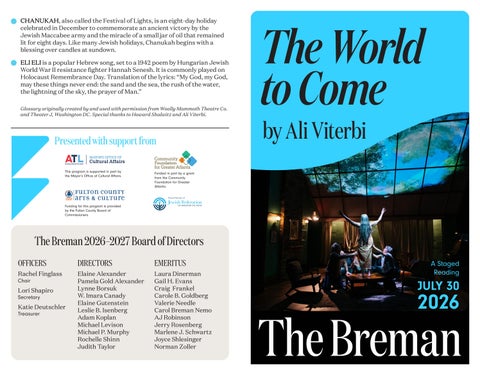
The World to Come
by Ali Viterbi
Originally developed in The Writers’ Room at the Geffen Playhouse.
The world premiere of The World to Come was produced by Woolly Mammoth Theatre Company.
Maria Manuela Goyanes, Artistic Director | Kimberly Douglas, Managing Director and Theater J, a program of the Edlavitch DCJCC
Hayley Finn, Artistic Director | David Lloyd Olson, Managing Director
Glossary
Background for The World to Come.
Mira Hirsch
Director / Producer
Pamela Gold & Hank Kimmel Producers
Rivka Levin
Fanny
Pamela Gold
Barbara
Clayton Landey
Hal
Mary Lynn Owen
Ruth
Russell Scott Nurse, Jerry, Soldier
Mira Hirsch
Stage Directions
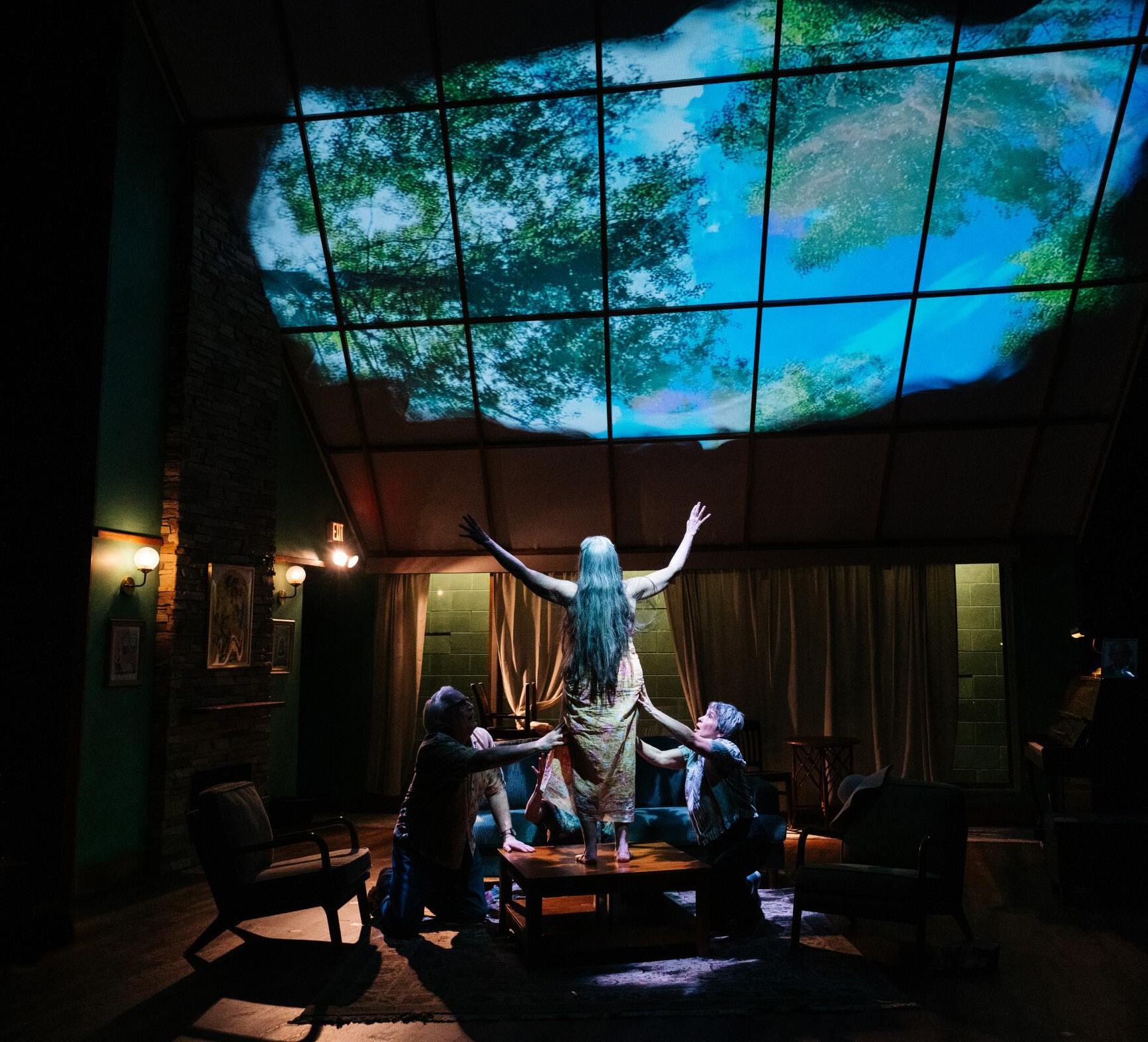
The play takes place in the present-ish in the Community Room at SeaBreeze, a Hebrew Home for the Aging in Southern California.
Cover photo: Cameron Whitman (Woolly Mammoth Theatre Company/Theater J)
Read an interview with playwright Ali Viterbi
HEBREW is the language of the Jewish people. It is the ancient language used in the Tanakh (Hebrew Bible), the Talmud (book of laws and rabbinic commentary), and in Jewish worship. Common expressions in daily speech include: Baruch Hashem (literally “Blessed be God” but colloquially used as “thank God”), mitzvot (commandments; used colloquially as “good deeds”), moshiach (messiah), Olam HaBah (the world to come), and Zichrono livrachah (May his/her memory be a blessing).
YIDDISH emerged as the everyday language of the Jews of Central and Eastern Europe (Ashkenazi Jews) about a millennia ago and continues to be spoken by a remnant of surviving Jewish communities in Europe and around the world. Common slang expressions include: alter cocker (old fart), shmuck (prick), mishugana (crazy), shiksa (non-Jewish woman) and tuches leker (ass-licker). Terms of endearment include: zissele (sweetie). Many Yiddish words come from Hebrew like chazzer (pig).
ASHKENAZI JEWS (like Fanny, Barbara, and Hal) trace their family roots to Central & Eastern Europe, while Sephardic Jews (like Ruth) trace their family roots to Spain and Portugal. The geographic separation has led to some differences in cultural traditions, religious practice, and language. Yiddish is derived from German and Hebrew, while Ladino (the daily language of many Sephardic Jews) is derived from Spanish, Hebrew, and other Balkan, middle eastern, and mediterranean languages.
The prophecies of ISAIAH, some of which are quoted in the play, appear in the Book of Prophets in the Tanakh. They include predictions of a future time of moral confusion and natural disasters followed by a restoration of God’s rule, with references to ravens, ostriches, arrow snakes, etc.
ROSH HASHANAH is the Jewish New Year, celebrated in the fall, during which God is said to weigh the fate of each person for the year ahead. It is followed in ten days by Yom Kippur, the Day of Atonement. Both 12 holidays involve the ritual blowing of a shofar, or ram’s horn, including a long blast (Tekiah Gedolah) at the conclusion of prayers.
Continued on back