Fiddler On The Roof: Costumes & Contrasts
An Exploration of Tradition and Identity
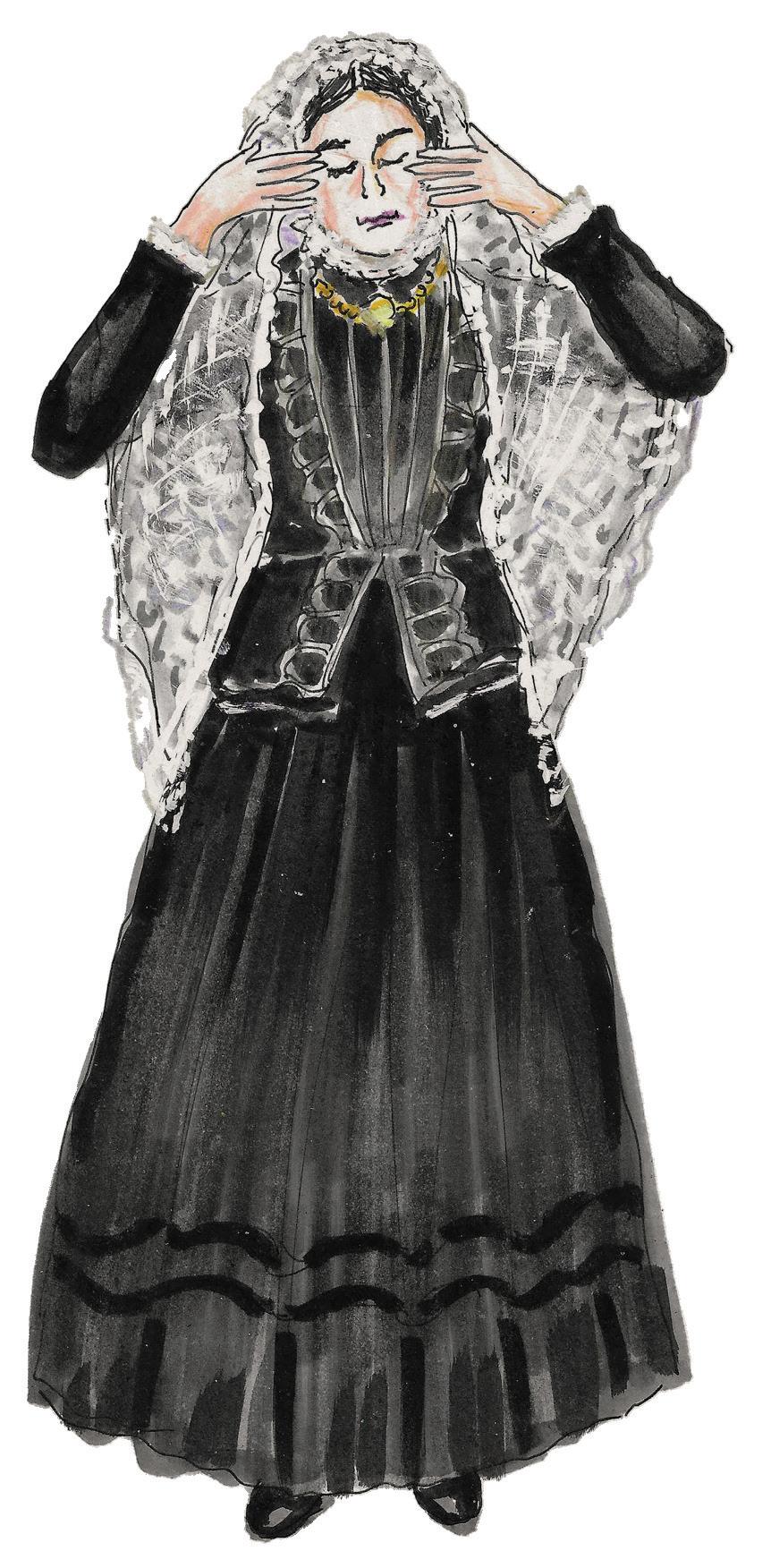
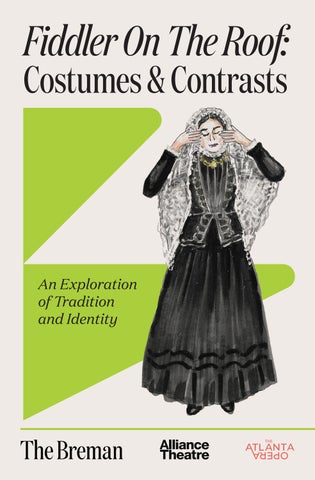
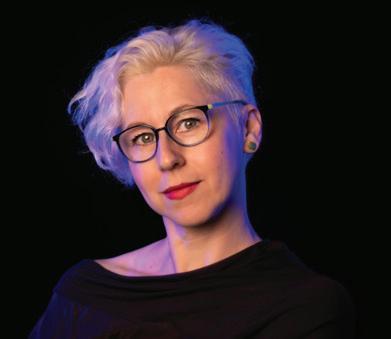
The Breman Museum is proud to partner with the Atlanta Opera and the Alliance Theatre, coinciding with a new production of Fiddler on the Roof on the Alliance stage, to present a unique exhibition featuring the creative talents of acclaimed costume designer Vita Tzykun and her father, celebrated Israeli artist Arkady Tzykun.
Through her expressive and detailed costume designs for Fiddler on the Roof, Vita beautifully captures the dignity, individuality, and vibrant traditions of the Jewish shtetl, honoring the resilience and humanity of its people.
At the heart of this exhibition is the creative collaboration between Vita and Arkady. From an early age, Vita learned to draw under her father’s guidance, and this project became the ultimate realization of their artistic bond. Together, they blended Vita’s visionary designs with Arkady’s masterful illustration, resulting in costume illustrations that are rich in both narrative and artistry. This fatherdaughter partnership not only pays tribute to their shared heritage but also celebrates the generational transmission of craft, memory, and imagination.
Complementing this perspective, Arkady Tzykun explores a different, yet tightly connected, angle on identity and representation. His evocative pencil drawings illuminate the
beauty and diversity within the Jewish people, while simultaneously investigating how the deliberate change of a few lines can transform a face— revealing how art has the power to both reflect humanity and, when distorted into a hateful caricature, erase it.
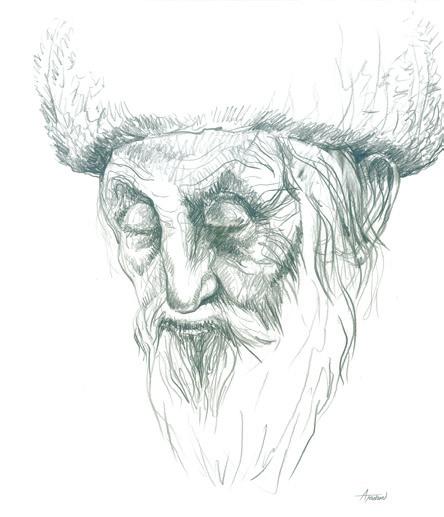
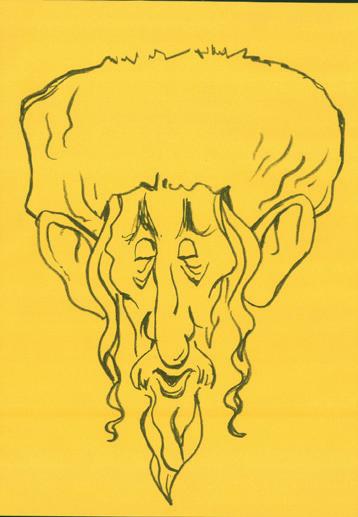
Top: “Jewish Man 1,” Bottom: “Distorted Man 1,” by Arkady Tzykun
Together, the works of Vita and Arkady Tzykun enrich our understanding of the complexities of identity, tradition, and cultural memory. This exhibition invites visitors to reflect on the role of art in shaping perception, challenging prejudice, and celebrating the fullness of our shared humanity.
Sholem Aleichem’s Tevye the Dairyman stories are the basis for the classic American musical, Fiddler on the Roof. An author and playwright, Aleichem wrote the stories in Yiddish between 1894 and 1914 about Jewish life in a fictional village in the Pale of Settlement in Czarist Russia at the turn of the 20th century.
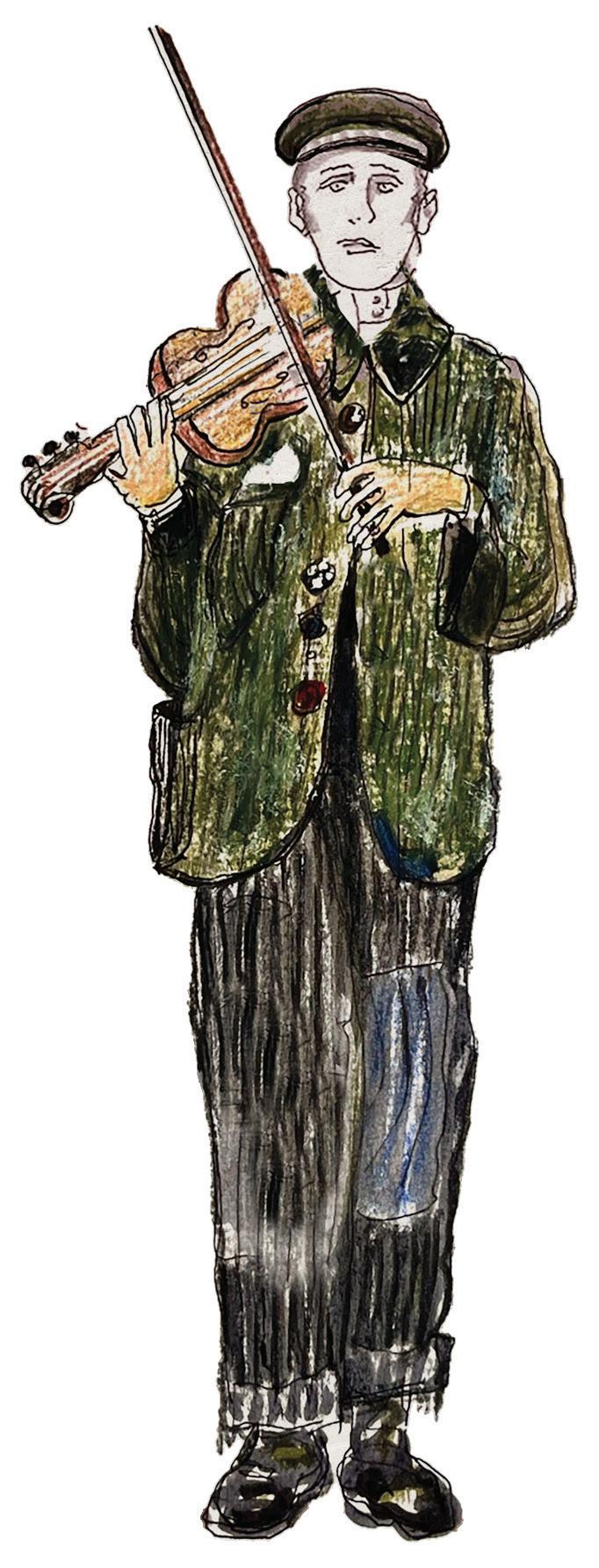
The Pale, a geographical region where Jews were legally permitted to live, encompassed parts of modern-day Ukraine, Russia, and Belarus. Set in 1905, Fiddler takes place against the background of significant unrest in the Pale, the 1905 Russian Revolution and the large-scale, targeted anti-Jewish riots called pogroms.
The Fiddler character is a metaphor for survival in a life of uncertainty; the precarious balance of life and the struggle to maintain tradition in a changing world. As Tevye says, “A fiddler on the roof. Sounds crazy, no? But here, in our little village of Anatevka, you might say every one of us is a fiddler on the roof trying to scratch out a pleasant, simple tune without breaking his neck.” The show’s title is said to be suggested by various paintings by Marc Chagall, Green Violinist (1924), Le Mort (1924), and The Fiddler (1912).
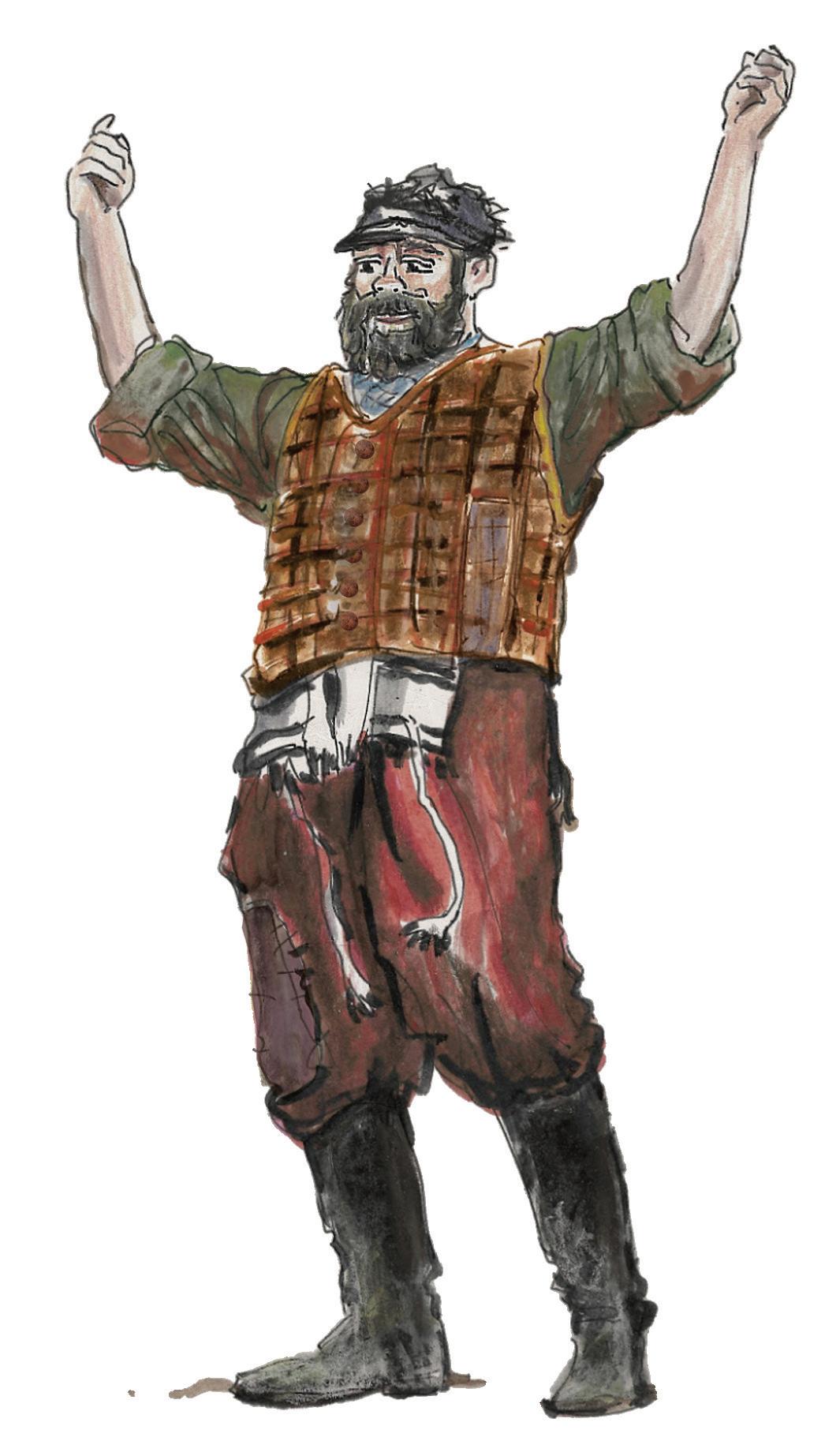
Tevye is the central character in Fiddler. The village milkman and the narrator of the story, he is a poor but devout Jew raising his five daughters with his wife, Golde and the aid of quotations from the Scriptures, most of which he invents himself.
Tevye struggles to honor his Jewish traditions as outside influences encroach upon his family’s lives. He speaks directly to the audience and to God about the hardships of poverty and the community’s constant fear of harassment from their non-Jewish neighbors.
He must also cope with the strongwilled actions of his three oldest daughters who want to forgo the tradition of arranged marriage and wish, instead, to marry for love. Each daughter’s choice of a husband moves further away from the customs of their Jewish faith and heritage.
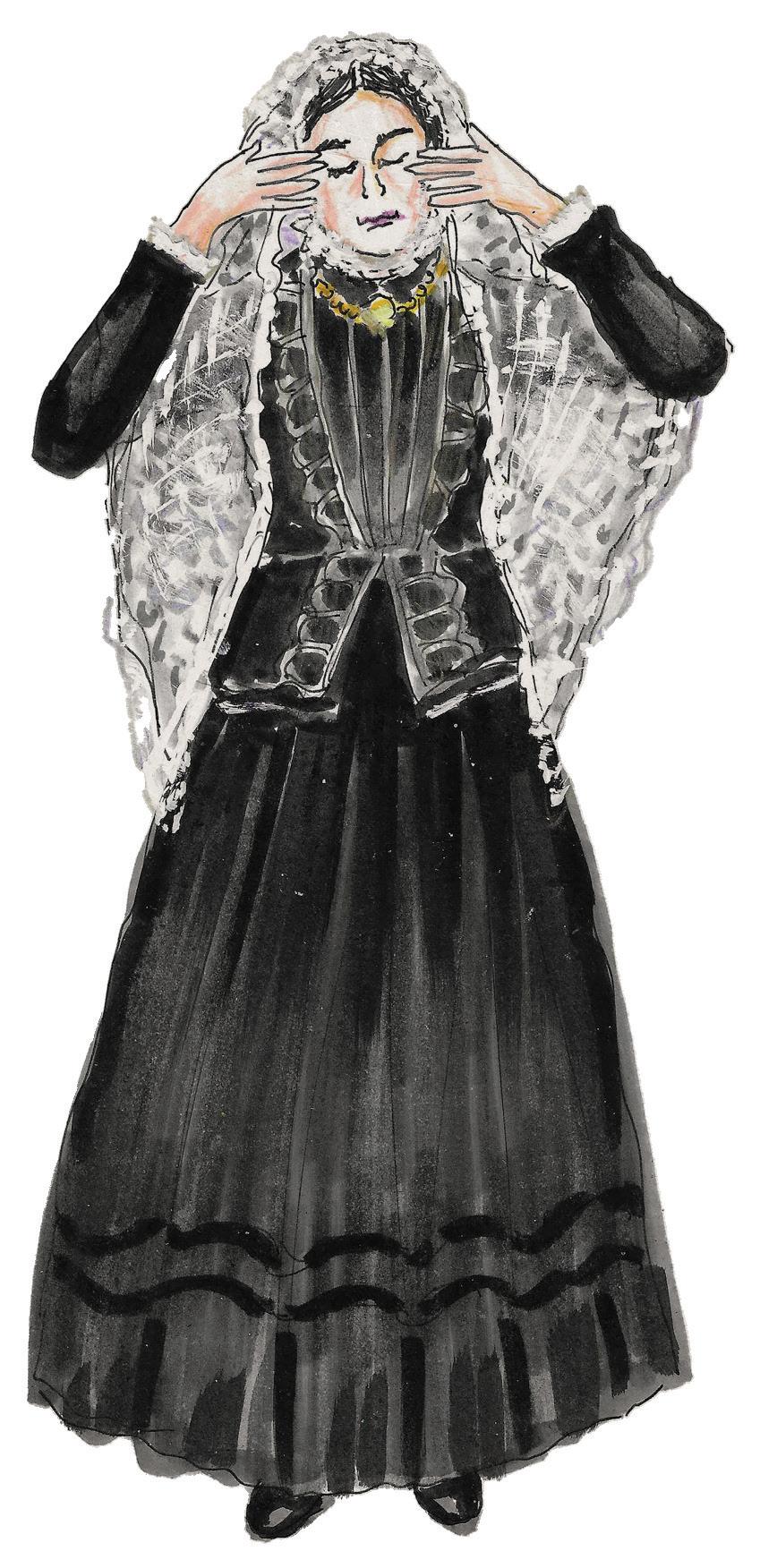
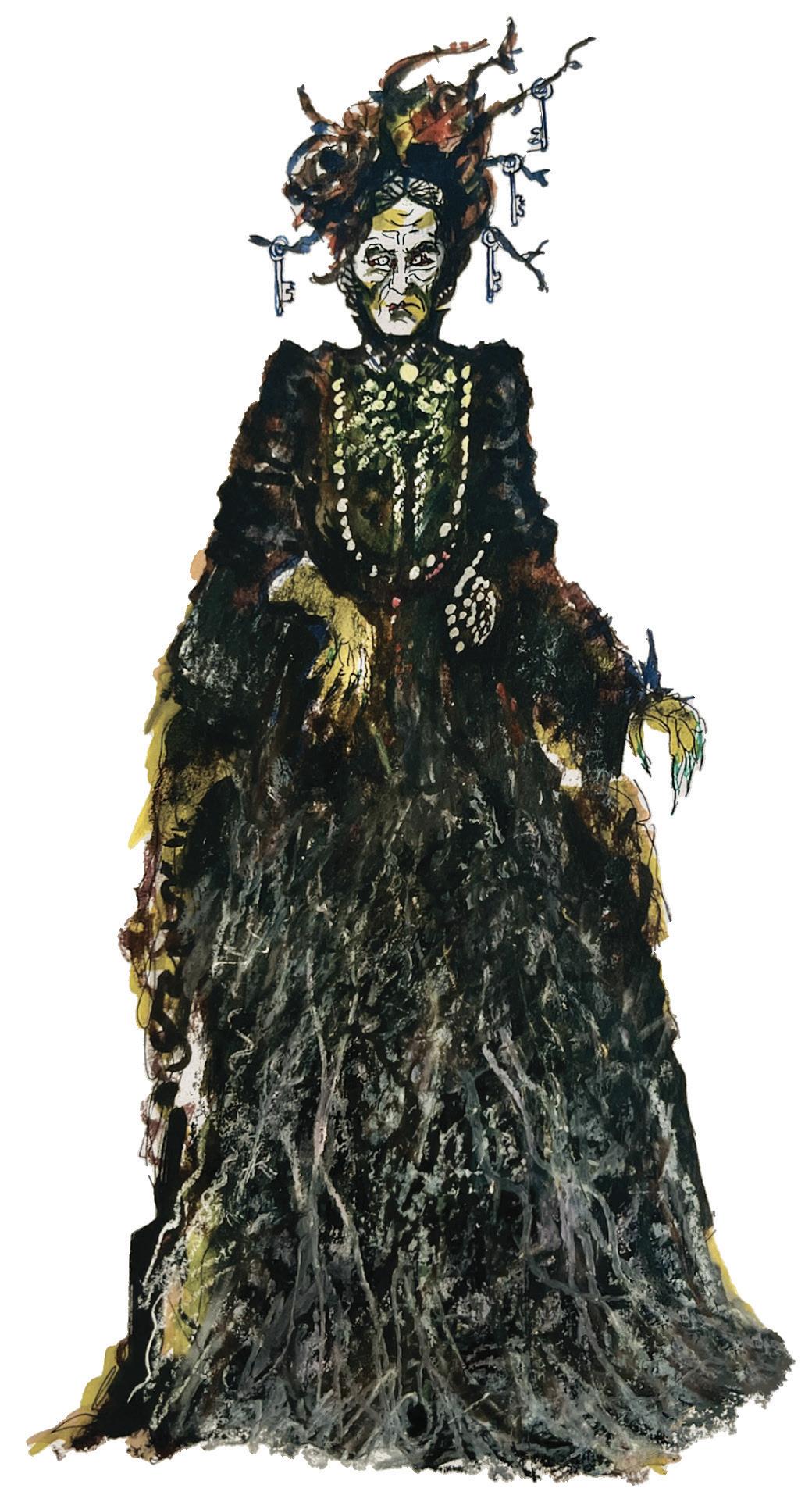
Golde, Tevye’s wife, is a practical and strong woman who is deeply connected to Jewish traditions and customs. She is concerned with ensuring her family’s well-being, often through finding suitable husbands for her daughters. Golde’s more practical perspective provides a balance to Tevye’s more emotional tendencies. Her softer side and her love for her family are revealed through songs like “Do You Love Me?” where she and Tevye reveal their feelings for each other during their twenty-fiveyear marriage.
Tzeitel is Tevye’s oldest daughter. She is in love with her childhood sweetheart, Motel, a tailor. Tevye tells Tzeitel she is to marry the butcher, Lazar Wolf. But Motel tells Tevye that he and Tzeitel have pledged to marry. Tevye, reluctantly, gives them permission to marry. Worried that Golde will not accept the marriage, Tevye tells her of a false prophetic dream he had in which Tzeitel is fated to marry Motel.
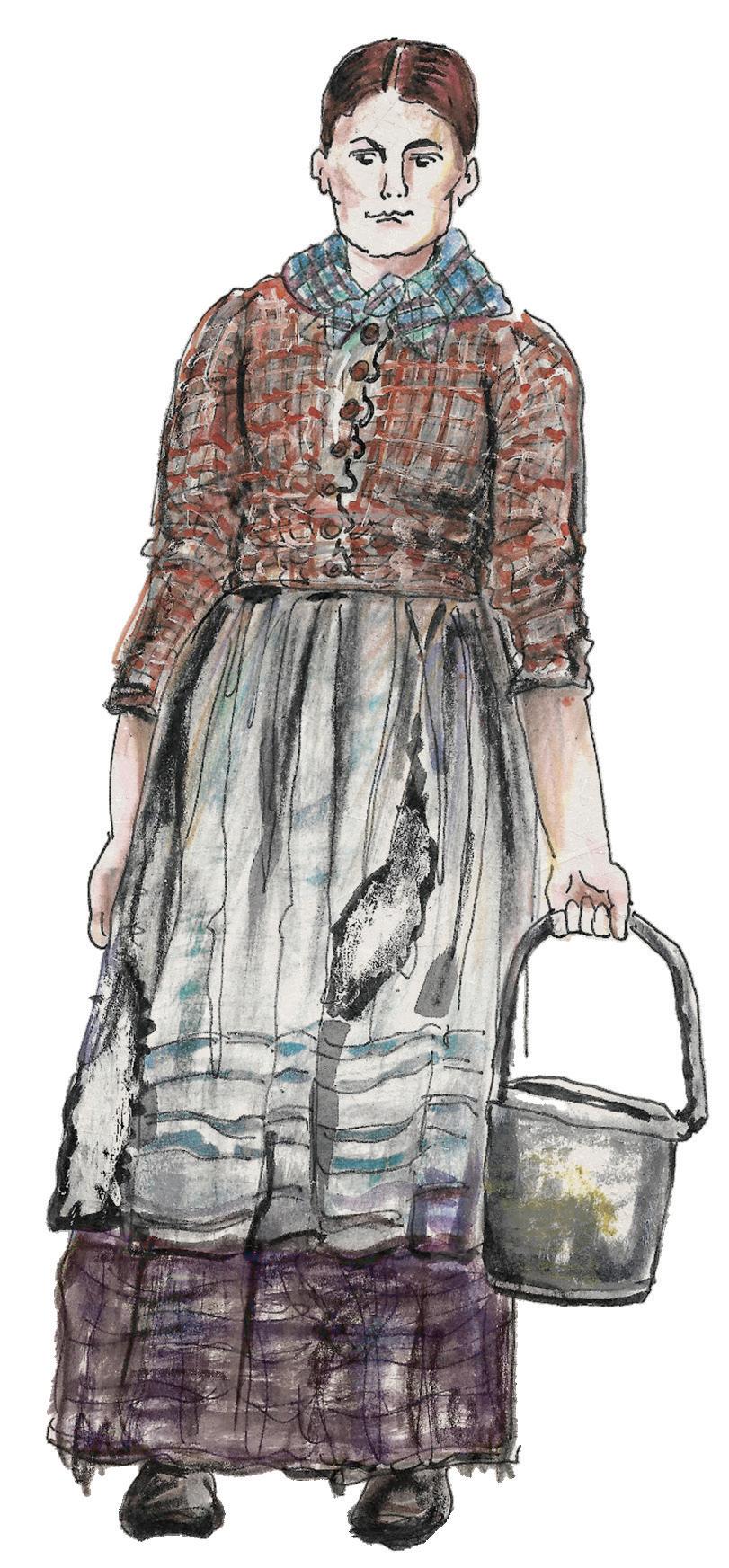
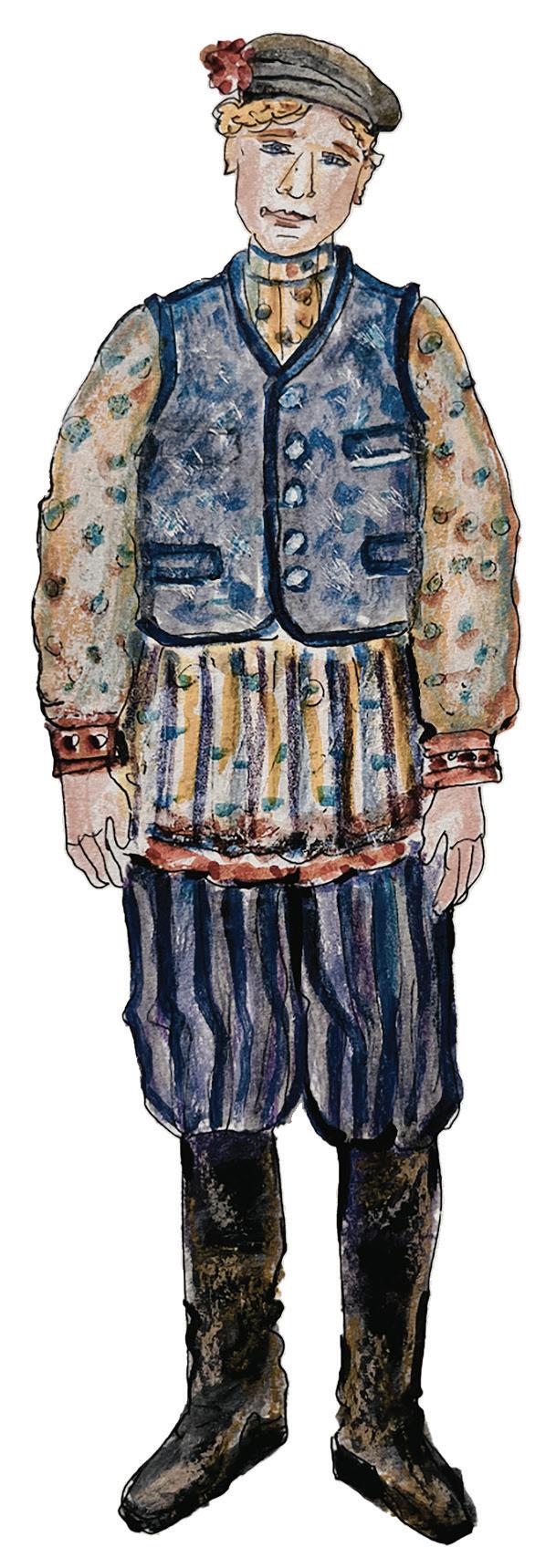
Fyedka is young non-Jewish Russian man in love with Chava, Tevye’s third daughter. He represents the changing world outside Anatevka. In the Jewish community, inter-faith marriage is not accepted. His relationship with Chava forces Tevye to wrestle with his deepseated beliefs and the evolving world around him.
Tevye, shocked that Tzeitel and Motel have broken with the tradition that demands that the Papa choose the husband for the daughter, finally agrees to their marriage. To convince Golde that the match with Lazar Wolf will lead to Tzeitel’s death at the hands of Lazar Wolf’s first wife, FrumaSarah, Tevye pretends to have a nightmare. He plays upon Golde’s superstitiousness and tells her that her long deceased Grandmother Tzeitel came to him and said Tzeitel was fated to marry Motel.
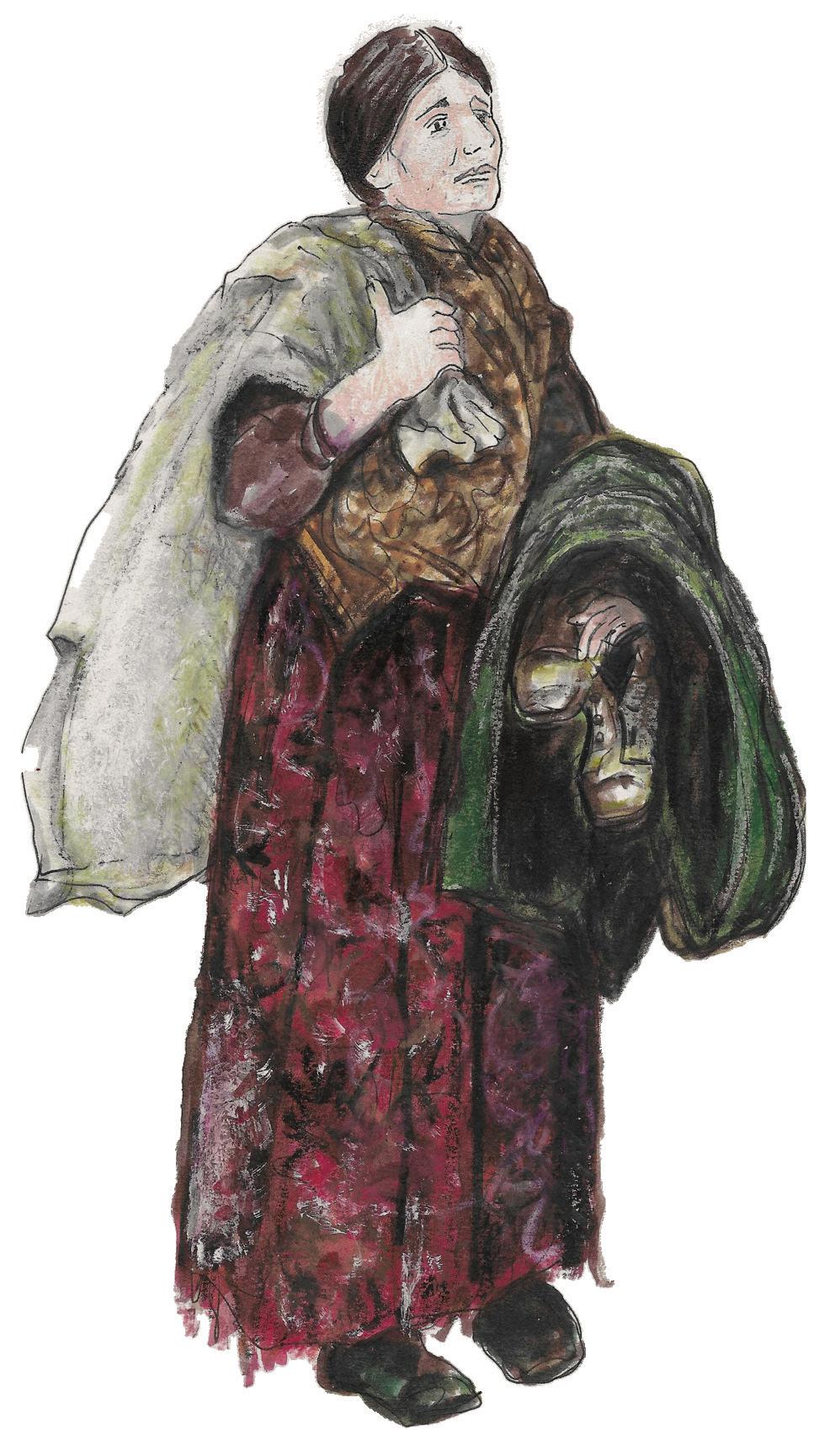
Sheindel is Motel’s mother. Her main role is to be a proud and supportive presence for her son. She embodies the traditional values and familial love that are central to the play’s themes.
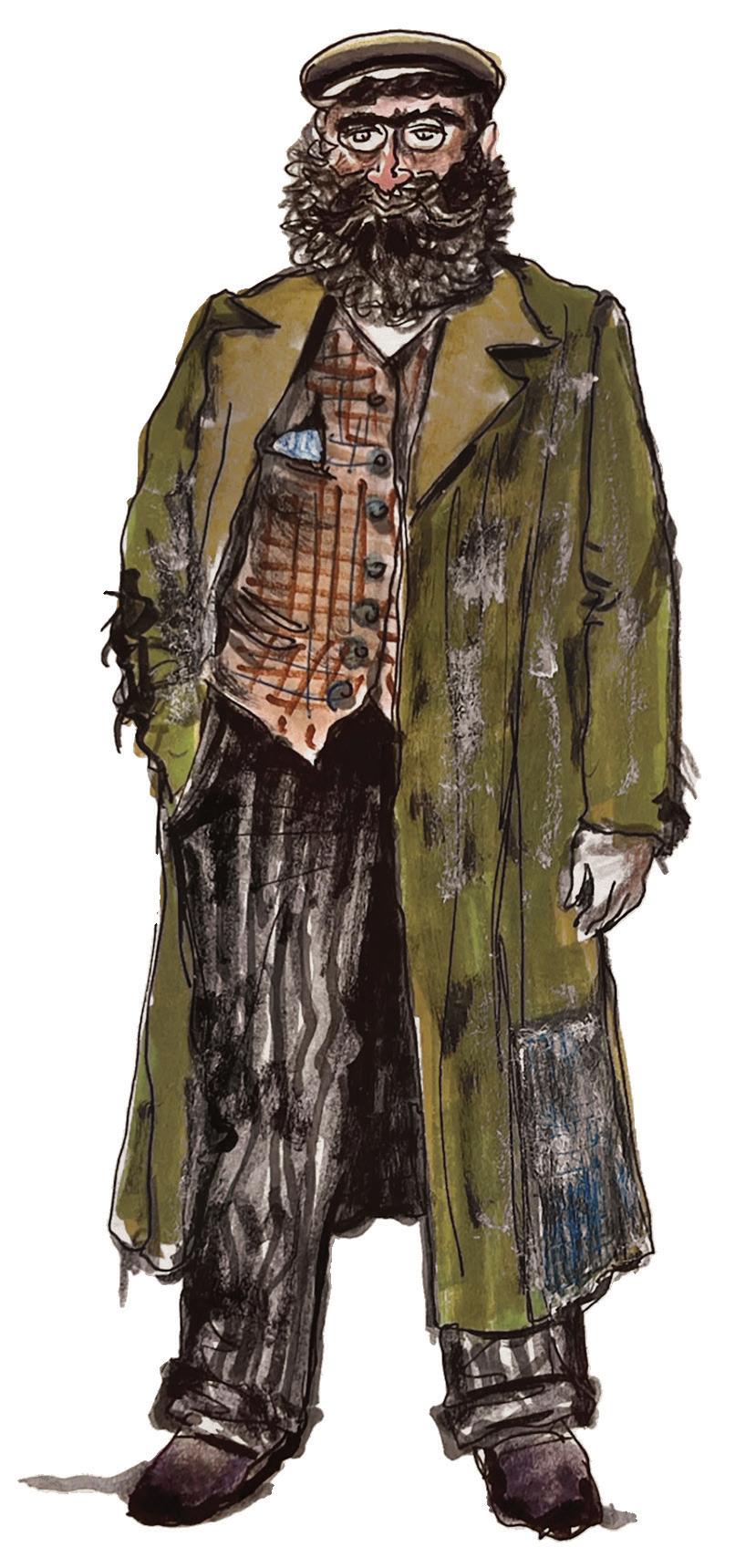
Avram, owner of the local bookshop, keeps up with the news, both good and bad, and often discusses the news with the rabbi. It is a minor but significant role as he serves as a source of information about the increasingly antiJewish sentiment and the expulsions from Russia. He shares this news with Tevye and that sets the stage for the play’s exploration of the challenges faced by Anatevka.
These two exhibitions, though distinct in form, are united by their exploration of how art shapes our perception of identity and humanity. The costume illustrations for Fiddler on the Roof capture the dignity, individuality, and lived experience of the Jewish shtetl through expressive faces, postures, and authentic attire,
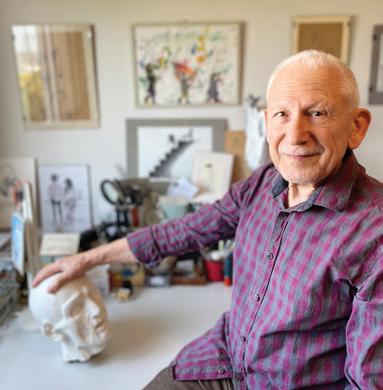
Much has been written about antisemitism and its origins. However, as a visual artist, I wanted to investigate this subject through images.
I began drawing realistic portraits of Jews from diverse backgrounds—Ashkenazi kibbutzniks, Sephardic elders, and many others. But then I took these portraits and reworked them as grotesque caricatures—the kind used by the Nazis in publications like Der Stürmer in the 1930s. These drawings were
honoring the soul of a community rooted in tradition and resilience.
In stark contrast, my father’s exhibit reveals how the subtle distortion of a few lines can strip away that humanity, transforming real faces into caricatures that fuel prejudice and dehumanization. Together, these works remind us that the line between empathy and othering is fragile, and that art has the power to both illuminate the richness of a people’s story and, dangerously, to erase it.
deliberately designed to strip individuals of their humanity and turn them into symbols of fear and contempt. What’s chilling is how effective they were. The path from those images to the gas chambers turned out to be shockingly short.
This exhibition is about that transformation—from honest portrait to dehumanizing propaganda.
As antisemitism rises around the world once again, I feel a responsibility to use my work to speak out— to show how hatred can start with something as simple as a drawing. One only has to change a few lines.
While Fiddler on the Roof is celebrated for its music and humor, at its center is a tragic story. Tevye and his Jewish community are constantly working to preserve their way of life and their faith when faced with increasing antisemitism and, ultimately, an expulsion order that shatters the community and forces them to scatter across the globe. Endurance and adaptability are key themes in the musical along with resilience in the face of adversity.
After the expulsion, Tevye’s family members go in different directions. Tevye, Golde and their
two youngest daughters emigrate to America and plan to live in New York. Tzeitel, Motel and their baby move to Warsaw, Poland with a plan to save money and eventually join Tevye and Golde in America. Hodel has left to join her husband, Perchik, in Siberia. Chava and her husband, Fyedka, move to Krakow, Poland.
The ending is bittersweet. They are all hopeful for new beginnings, but distressed by the loss of their home, their community, and a way of life that may have vanished forever.
This exhibition is made possible through the generosity of:
With additional support from:
This program is supported in part by the Mayor’s Office of Cultural Affairs.
Funding for this program is provided by the Fulton County Board of Commissioners.