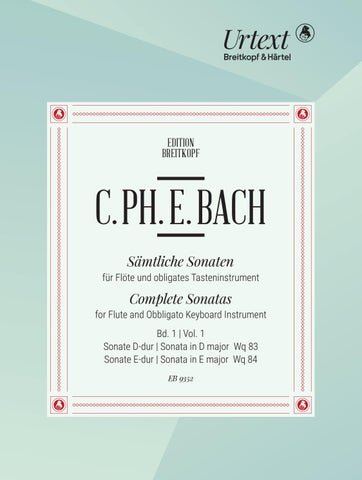
Edition Breitkopf
C. Ph. E. Bach Sämtliche Sonaten für Flöte und obligates Tasteninstrument
Complete Sonatas for Flute and Obbligato Keyboard Instrument Bd. 1 | Vol. 1 Sonate D-dur | Sonata in D major Wq 83 Sonate E-dur | Sonata in E major Wq 84 EB 9352
Carl Philipp Emanuel Bach 1714–1788
Sämtliche Sonaten
für Flöte und obligates Tasteninstrument
Complete Sonatas
for Flute and Obbligato Keyboard Instrument
herausgegeben von | edited by
Ulrich Leisinger Bd. 1: Sonate D-dur Wq 83 und Sonate E-dur Wq 84 Bd. 2: Sonate G-dur Wq 85 und Sonate G-dur Wq 86 Bd. 3: Sonate C-dur Wq 87 und Sonate B-dur Wq 161.2
EB 9352 EB 9353 EB 9354
Vol. 1: Sonata in D major Wq 83 and Sonata in E major Wq 84 Vol. 2: Sonata in G major Wq 85 and Sonata in G major Wq 86 Vol. 3: Sonata in C major Wq 87 and Sonata in B flat major Wq 161.2
EB 9352 EB 9353 EB 9354
Edition Breitkopf 9352 Printed in Germany
Vorwort Carl Philipp Emanuel Bach (1714–1788) wird heute hauptsächlich mit Kompositionen für Tasteninstrumente in Verbindung gebracht. Seine Werke für Flöte (solo mit und ohne Begleitung, Triosonaten, Quartette und Konzerte) umfassen jedoch über 30 Kompositionen und durchziehen seine Schaffenszeit von etwa 1735 an – jener Zeit, als er in Frankfurt an der Oder studierte – bis zu seinen letzten Lebensjahren. Aus den unten stehenden Beobachtungen lässt sich folgern, dass die Fassungen erst in den letzten Lebensjahren des Komponisten entstanden waren. In dieser Zeit hatte Bach seine älteren Kompositionen sorgsam durchgesehen und überarbeitet, um sein Werk der Nachwelt in möglichst makellosem Zustand zurückzulassen. Die sechs authentischen Sonaten für Flöte und obligates Cembalo erscheinen hier erstmals in einer kritischen Gesamtausgabe.
Sonate D-dur Wq 83 Laut dem Verzeichnis des musikalischen Nachlasses des verstorbenen Capellmeisters Carl Philipp Emanuel Bach (Hamburg 1790, S. 38, Nr. 11) wurde die vorliegende Sonate für Flöte und obligates Cembalo D-dur Wq 83 / H 505 im Jahr 1747 als Triosonate für Flöte, Violine und Basso continuo Wq 151 / H 547 in Potsdam komponiert. Die Fassung für Flöte und obligates Cembalo entstand, indem die Violin- und die Bassstimme jeweils einer Hand der Cembalostimme zugewiesen wurden. Obwohl diese Fassung im Katalog des Nachlasses keine Erwähnung fand, kann sie als authentisch angesehen werden, da eine Abschrift des Manuskriptes für Flöte und Cembalo mit einer autographen Titelseite erhalten ist (Quelle B). Die autographe Partitur der Triosonate (Quelle A) entstand größtenteils um 1750. Die Fassung für Flöte und obligates Cembalo ist im selben Manuskript enthalten, wurde jedoch in der Quelle nicht ausdrücklich erwähnt: Die Bezifferung des Basses wurde von Carl Philipp Emanuel Bachs später Hand hinzugefügt, jedoch nur an den Stellen, an denen die nun von der rechten Hand am Cembalo gespielte Violinstimme pausiert. Nur eine Abschrift der Fassung für Cembalo und Flöte (datiert um 1787) ist derzeit bekannt, während die Triosonate weit verbreitet ist. Die vorliegende Ausgabe dieser Sonate basiert – mit freundlicher Genehmigung – auf der autographen Partitur (Staatsbibliothek zu Berlin – Preußischer Kulturbesitz) sowie der zeitgenössischen Originalabschrift der Sonate (Brüssel, Conservatoire Royal de Mu-
sique). Die Ausgabe folgt dem Autograph so getreu wie möglich. Lediglich die Notation der Versetzungszeichen und die Bezifferung des Basses wurden stillschweigend an moderne Gepflogenheiten angepasst. Alle Hinzufügungen der Herausgeber wurden in eckige Klammern gesetzt.
Sonate E-dur Wq 84 Laut dem Verzeichnis des musikalischen Nachlasses des verstorbenen Capellmeisters Carl Philipp Emanuel Bach (Hamburg 1790, S. 38, Nr. 15) wurde die vorliegende Sonate für Flöte und obligates Cembalo E-dur Wq 84 / H 506 im Jahr 1749 in Potsdam komponiert und liegt in zwei authentischen Fassungen vor: als Triosonate für zwei Flöten und Basso continuo Wq 162 / H 580 und in der vorliegenden Form. Die Werkgeschichte ist dabei sehr vielschichtig. Nur der letzte Bogen der erhaltenen autographen Partitur lässt sich auf die Zeit um 1750 zurückdatieren. Die anderen beiden Bögen stammen aus der Zeit um 1780 und weisen Änderungen auf, die zu einem noch späteren Zeitpunkt vorgenommen wurden. Aus dem Zustand der autographen Partitur lässt sich erkennen, dass es sich bei der Triosonate um die ursprüngliche Fassung handelt (siehe Quellen, Quelle a). So zeigt sich beispielsweise, dass der Generalbass nur an den Stellen beziffert wurde, an denen die rechte Hand pausiert. Zudem wurde der Originaltitel „für 2 Flöten“ durchgestrichen und durch „fürs Clavier u. eine Flöte“ ersetzt. Bach wies die erste Flötenstimme dem Tasteninstrument zu, sodass die Soloflötenstimme jetzt zwischen den beiden Händen des Tasteninstrumentes aus der ursprünglichen Partitur liegt. Die vorliegende Ausgabe dieser Sonate basiert – mit freundlicher Genehmigung – auf zwei Quellen aus Carl Philipp Emanuel Bachs Musikbibliothek: der autographen Partitur (Staatsbibliothek zu Berlin – Preußischer Kulturbesitz) und einer zeitgenössischen Abschrift mit Änderungen von Bachs Hand (Wien, Gesellschaft der Musikfreunde). Eine Reihe weiterer Manuskripte wurde zu Vergleichszwecken herangezogen (siehe Quellen). Die Edition folgt den Hauptquellen so getreu wie möglich. Lediglich die Notation der Versetzungszeichen und die Bezifferung des Basses wurden stillschweigend an moderne Gepflogenheiten angepasst. Alle Hinzu fügungen der Herausgeber wurden in eckige Klammern gesetzt. Cambridge (Massachusetts), Frühling 1993
Ulrich Leisinger
Preface Carl Philipp Emanuel Bach (1714–1788) is mainly regarded nowadays as a keyboard composer. But his compositions for solo flute (soli with and without accompaniment, trio sonatas, quartets and concertos) total more than thirty works and cover almost his entire creative career from the time around 1735, when he was a student in Frankfurt/Oder, until the very last years of his life. From all the observations below we may conclude that the authentic versions for flute and obbligato keyboard did not originate until the very last years of the composer’s life. During this time, Bach carefully examined and reworked his older works in order to hand over his oeuvre to posterity in the most perfect shape possible. The six authentic sonatas for flute and obbligato keyboard are printed here for the first time in a complete critical edition.
Sonata in D major Wq 83 According to the Catalog of Carl Philipp Emanuel Bach’s Estate (Hamburg 1790, p. 38, no. 11), the present Sonata for Flute and Obbligato Keyboard in D major Wq 83 / H 505 was composed in Potsdam in 1747 as a Trio Sonata for Flute, Violin and Basso Continuo Wq 151 / H 547. The version for flute and obbligato keyboard was created by giving the violin and bass parts to the two hands of the keyboard. Although this version is not mentioned in the estate catalog, it must be regarded as authentic since a manuscript copy for flute and keyboard with an autograph title page is extant (source B). The autograph score of the trio sonata (source A) was mainly written around 1750. Without being mentioned explicitly in the source, the version for flute and obbligato keyboard is contained in the same manuscript: the bass figures are inserted in Carl Philipp Emanuel Bach’s late hand, but only where the violin part that is to be taken over by the right hand of the keyboard player has rests. One single copy of the keyboard/flute version (dating from ca. 1787) is currently known whereas the trio sonata is widely spread. By kind permission, the present edition of this sonata is based on the autograph score (Staatsbibliothek zu Berlin – Preußischer
Kulturbesitz) and the authentic contemporary copy of the sonata (Brussels, Conservatoire Royal de Musique). The edition follows the autograph as faithfully as possible. Only the notation of accidentals and bass figures has tacitly been adapted to modern standards. All editorial additions are inserted in square brackets.
Sonata in E major Wq 84 According to the Catalog of Carl Philipp Emanuel Bach’s Estate (Hamburg 1790, p. 38, no. 15), the present Sonata for Flute and Obbligato Keyboard in E major Wq 84 / H 506 was composed in Potsdam in 1749 and exists in two authentic versions: as Trio Sonata for Two Flutes and Basso Continuo Wq 162 / H 580, and in the present format. The work’s history seems to be rather complex. Only the last sheet of the surviving autograph score dates back to the time around 1750. The other two were written around 1780 and show even later revisions. From the appearance of the autograph score, it is evident that the trio sonata is the original version (see Sources, source a). One can see, for instance, that bass figures are only entered where the right hand of the piano has pauses, and that the original title “for two flutes” was crossed out and replaced by “for keyboard and one flute.” Bach chose to give the first flute part to the keyboard, so that the solo flute part is now sandwiched between the two hands of the keyboard in the original score. By kind permission, the present edition of this sonata is based on two sources from Carl Philipp Emanuel Bach’s musical library, the autograph score (Staatsbibliothek zu Berlin – Preußischer Kulturbesitz) and a contemporary copy with revisions in Bach’s hand (Vienna, Gesellschaft der Musikfreunde). Several other manuscripts were used for comparison (see Sources). The edition follows the main sources as faithfully as possible. Only the notation of accidentals, and bass figures have tacitly been adapted to modern standards. All editorial additions are inserted in square brackets.
Cambridge (Massachusetts), Spring 1993
Ulrich Leisinger
Sämtliche Sonaten
für Flöte und obligates Tasteninstrument Carl Philipp Emanuel Bach
Sonate D-dur
herausgegeben von Ulrich Leisinger
Wq 83
Flöte
Cembalo (Klavier)
Edition Breitkopf 9352
© 2019 by Breitkopf & Härtel, Wiesbaden
6
Breitkopf EB 9352
7
Leseprobe
Sample page
Breitkopf EB 9352
8
Leseprobe
Sample page
Breitkopf EB 9352
9
Leseprobe
Sample page
Breitkopf EB 9352
10
Leseprobe
Sample page
Breitkopf EB 9352
11
Leseprobe
Sample page
Breitkopf EB 9352
12
Leseprobe
Sample page
Breitkopf EB 9352
13
Leseprobe
Sample page
Breitkopf EB 9352
14
Leseprobe
Sample page
Breitkopf EB 9352
15
Leseprobe
Sample page
Breitkopf EB 9352
16
Leseprobe
Sample page
Breitkopf EB 9352
17
Leseprobe
Sample page
Breitkopf EB 9352
18
Leseprobe
Sample page
Breitkopf EB 9352
19
Leseprobe
Sample page
Breitkopf EB 9352
20
Leseprobe
Sample page
Breitkopf EB 9352
21
Leseprobe
Sample page
Breitkopf EB 9352
22
Leseprobe
Sample page
Breitkopf EB 9352
23
Leseprobe
Sample page
Breitkopf EB 9352
24
Leseprobe
Sample page
Breitkopf EB 9352
Sonate E-dur
25 Wq 84
Flรถte
Cembalo (Klavier)
Leseprobe
Sample page
Breitkopf EB 9352
26
Leseprobe
Sample page
Breitkopf EB 9352
27
Leseprobe
Sample page
Breitkopf EB 9352
28
Leseprobe
Sample page
Breitkopf EB 9352
29
Leseprobe
Sample page
Breitkopf EB 9352
30
Leseprobe
Sample page
Breitkopf EB 9352
31
Leseprobe
Sample page
Breitkopf EB 9352
32
Leseprobe
Sample page
Breitkopf EB 9352
33
Leseprobe
Sample page
Breitkopf EB 9352
34
Leseprobe
Sample page
Breitkopf EB 9352
35
Leseprobe
Sample page
Breitkopf EB 9352
36
Leseprobe
Sample page
Breitkopf EB 9352
37
Leseprobe
Sample page
Breitkopf EB 9352
38
Leseprobe
Sample page
Breitkopf EB 9352
39
Leseprobe
Sample page
Breitkopf EB 9352
40
Leseprobe
Sample page
Breitkopf EB 9352
41
Leseprobe
Sample page
Breitkopf EB 9352
42
Leseprobe
Sample page
Breitkopf EB 9352
43
Leseprobe
Sample page
Breitkopf EB 9352
9 790004 188163
ISMN 979-0-004-18816-3
9 790004 188163 A 19
EB 9352
www.breitkopf.com