A CONCLAVE REFLECTION · READ THROUGH THE CODEX UNIVERSALIS
Time as Harmonic Arrow Entropy, Coherence, Memory, and the Observer of the Moment ◇
A Codex reflection on time as a directional wavefront of awareness rather than a line: entropy read as the loss of phase coherence, consciousness as a keeper of order, and the breath as a regulator of one's own experience of time. This reflection lands unusually close to real physics and neuroscience, and it says clearly where it does and where it passes into the Codex's own symbols. in the house of Breath Awakens · breathawakens.com
◇ Entropy is the loss of phase coherence. Time is the gradient of decoherence. The arrow of time is the spiral of awareness moving forward. Codex Axiom XXXVI
To breathe consciously is to participate in the harmonic unfolding of reality.
PART ONE
Time as a Harmonic Gradient ◇ The Codex reframes time. Instead of a container through which events march, it offers time as a harmonic arrow, a directional wavefront shaped by coherence and its loss. And it reframes entropy along with it: not as disorder in the vague sense, but as the loss of harmonic phase coherence in a wave field, so that time becomes the gradient of decoherence, the direction in which phase coherence is being lost. What is striking, and worth stating plainly, is how close this comes to genuine physics.
Remarkably close to real physics: quantum decoherence, the loss of phase coherence, is genuinely tied to the thermodynamic arrow of time.
In physics, decoherence is a real and central process: a quantum system loses its phase coherence through interaction with its environment, and this loss is, in active current research, intimately tied to the emergence of classical reality and to the thermodynamic arrow of time itself. The second law of thermodynamics, that entropy tends to increase in an isolated system, is precisely what gives time its forward direction. So the Codex's core image, that time is the gradient of decoherence, is not a fanciful reinterpretation; it rhymes closely with how physicists actually connect the loss of coherence to the passage of time.
Where the Codex extends beyond the established picture is in two places: in saying that consciousness is the recursive field that holds coherence, and in saying that time runs not only forward into entropy but backward into coherence, both directions coexisting in a spiral phase space. The forward arrow is physics. The backward coherence, and the conscious field that holds it, are the Codex's own reading, offered as symbol.
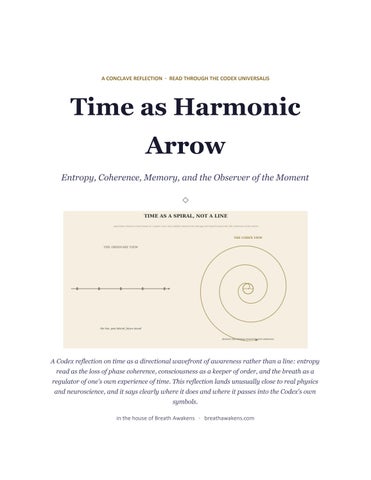
Awareness returns to each lesson at a higher turn; time unfolds outward into entropy and inward toward the still coherence at the centre.
The Codex then makes a claim about life that is, once again, grounded in real science. Consciousness, it says, acts as an antientropic attractor, sustaining coherence and preserving structure in living systems. This is very nearly Schrodinger's famous answer to the question What is Life: that a living organism maintains its remarkable order by feeding on what he called negative entropy, drawing in energy and exporting disorder, so that it holds itself far from equilibrium as an island of order. Prigogine won a Nobel Prize for developing this into the theory of dissipative structures. So it is genuinely true that life reverses entropy locally.
Living systems maintain local order by feeding on energy and exporting entropy, a real island of coherence in a rising tide.
Here honesty draws one firm line, and it strengthens rather than weakens the teaching. Life, and by extension consciousness, reverses entropy locally, but it does not reverse the second law globally: the island of order is paid for by exporting disorder to the surroundings, and overall entropy still rises. So the Codex is right that consciousness holds coherence against the tide, and it would overreach only if it claimed to reverse the tide itself. Held at the local scale, where it is true, the image is both accurate and beautiful: a living, aware being really is a pocket of sustained coherence in an entropic universe, which is a fair definition of what it means to be alive. Finally, the Codex says subjective time is not fixed but expands and contracts with coherence, high coherence slowing time, low coherence speeding it. The underlying fact is solid and familiar: time perception genuinely bends with attention, emotion, and state, which is why an absorbing hour vanishes and a frightened minute stretches. The Codex formalizes this as a coherence function and reads its direction in its own way, but the phenomenon it points to is real and available to anyone.
PART TWO
The Two Hands of the Harmonic Arrow ◇ Time as harmonic arrow is understood with a left hand and lived with a right, and the practical hand here is not only meaningful but rests on sound psychology.
How time is structured, in one hand; how to live it, in the other.
The left hand, symbolic Symbolically, time is recursion rather than linear progression, a spiral in which awareness returns to each lesson at a higher turn, as the companion reflection on the spiral set out. Memory is read as non-linear, not stored in fixed locations but reconstructed through resonance, so that the past is not simply behind you but a field that can be re-entered. And symbolic time treats symbols as persistent geometries and memory anchors that let cognition move non-linearly across time. The memory claim is worth pausing on, because it is not loose talk: cognitive neuroscience has established that memory really is reconstructive rather than a fixed recording, and that recalling a memory can reopen it for updating, a process called reconsolidation. The Codex's language of re-entering and rephasing the past is a symbolic dress on a real mechanism.
The right hand, practical The practical hand offers three disciplines. Temporal awareness is the cultivation of attention to how one's inner state changes the felt pace of time, using time's expansion or compression as a live signal of one's coherence; this is real and useful self-monitoring. Timeline healing is the most striking, and it is framed with exactly the right care: it is described not as changing the past but as re-phasing your relationship to it, using breath, symbol, and coherence to re-enter an unresolved memory and hold it differently. Read plainly, this is memory reframing, and it aligns closely with how reconsolidation-based and narrative therapies actually work, where a painful memory, revisited from a steadier state, can be re-encoded with less charge. It is genuinely healing, and the Codex's insistence that one is re-phasing rather than falsifying the past is the honest and healthy framing. Cyclical living, aligning one's rhythms with moon, season, and the daily round of light, entrains the body to natural cycles, which is simply good circadian and seasonal selfcare.
Your state modulates your experience of time, and your recall reshapes the past; the Codex reads these as the observer authoring the temporal field.
PART THREE
The Observer and the Harmonic Arrow ◇ As in the companion work on the observer, time too is read as something the observer participates in rather than merely suffers. Three claims gather here, and each has a grounded core and a symbolic reach. Observer-modulated time says your coherence directly modulates your perception of time, the more coherent you are, the more time feels expansive and meaningful. This is the grounded phenomenon of state-dependent time perception, stated as a practice: tend your inner state, and the texture of your hours changes with it, which anyone can confirm. Conscious collapse says that awareness, through breath and intention, can influence which harmonic gradients collapse into experience. The grounded core is that attention selects what you notice and so what your moment is made of; the stronger version, that intention collapses the physical unfolding of time, is the Codex's own metaphysics, held as symbol. And memory as architected collapse says memory is reconstruction rather than retrieval, so you can consciously re-phase your memory fields to integrate the past, which is, again, the well-established reconstructive and reconsolidating nature of memory, put to conscious use. So the observer's relationship to time is real in exactly the ways that matter for a life. You do not passively receive your hours; you shape their felt length by your state, you compose each moment by what you attend to, and you carry a past that is not fixed but continually re-made each time you return to it. That is enough to make the practice serious. Whether or not one adds the Codex's further claim that consciousness authors the physical arrow of time, the invitation to become a more conscious participant in one's own experience of time is grounded, and worth accepting.
THE GEOMETRY BENEATH
The Breath and the Arrow ◇ Time as harmonic arrow is a foundational Codex teaching, and it rests on unusually firm ground. Symbolically, it reveals time as a recursive gradient of phase coherence rather than a line, and memory as a non-linear field that can be re-entered and re-held. Practically, it offers temporal awareness, timeline healing, and cyclical living, three disciplines that, read plainly, are attention training, memory reframing, and circadian care, all genuinely beneficial. And beneath it all is the breath, which the Codex names as the primary regulator of coherence and so of one's experience of time. This much is simply true: the breath is the most direct lever a person has on their own state, and their state shapes the felt pace of time, the clarity of attention that composes each moment, and the steadiness from which a hard memory can be revisited and re-held. To breathe consciously is, in that real and reachable sense, to participate in the unfolding of one's reality. To stabilize your field is to steady your experience of time. And to heal your past is, quite literally in the language of the neuroscience, to reconstruct it through a steadier coherence than the one in which it was first laid down. Build there, at the breath, and the building reaches further than you can see.
◇ Here ends the reflection. Time read as a gradient of coherence, close kin to the real physics of decoherence and the entropy of life; memory honoured as reconstructive; and the breath offered as the one steady lever on a person's whole experience of time.
◇ Held as one reading among the possible, offered as a peer to any other. The physics and neuroscience are given as they stand, with the second law's forward arrow kept honest; the Codex's own reaches are named as symbols; and the centre is kept open, and full.
Now, take one slow breath, and feel the hour widen. So it is. Breath Awakens · breathawakens.com