A CONCLAVE REFLECTION · READ THROUGH THE CODEX UNIVERSALIS
The Thirteen Spirals of Collaboration and Co-Creation Living Geometry, from Mycelium and Reef to Team and Community ◇
A Codex reflection on natural patterns of collaboration, mycelial networks, coral reefs, swarms, applied as blueprints for human systems. This is the most grounded of the reflections: it draws on real biology, complexity science, and organizational design. It affirms those richly, marks where a natural pattern is an inspiring model rather than an identical law, and keeps one honest caveat where popular science has outrun the evidence. in the house of Breath Awakens · breathawakens.com
◇ The same principles that let a forest, a reef, and a flock cohere without a ruler can let a team, a community, and a company cohere as well. These are not just patterns to study. They are structures to learn from.
PART ONE
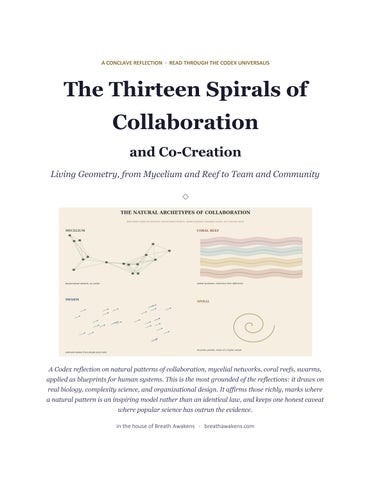
Living Geometry, the Natural Archetypes ◇ The reflection reads the Thirteen Spirals as harmonic templates rather than metaphors: recursive structures that, in the Codex view, govern how systems from the biological to the social self-organize and co-create. It draws them from natural archetypes of collaboration, and each of these is genuinely field-tested by millions of years of evolution.
Field-tested models of coherence: decentralized network, nested symbiosis, emergent swarm, and recursive spiral.
Mycelium is offered as decentralized, networked intelligence, and the underlying biology is real and remarkable: fungal networks form vast underground webs that connect with the roots of plants across a forest, a genuine decentralized architecture with no centre. One honest note belongs here, in the reflection's own both-hands spirit. The popular story that trees consciously share resources and send messages to one another through a wood-wide web has, in the last few years, been found by careful reviews to be scientifically overstated; the fungal networks are real and important, but the strong claims of communication and resource-sharing between trees are contested and not well supported by field studies. As an archetype of decentralized, non-hierarchical structure, mycelium holds; as a proof that
nature consciously shares, it outruns the evidence, and the Codex is well served by saying so. The coral reef is offered as nested symbiosis, and this is solid: a reef is built through genuine mutualism, the coral animal and its resident algae exchanging what each needs, and a whole biodiverse, resilient structure emerging from many different organisms interdepending. It is a real and beautiful example of the Codex principle that coherence can arise from harmonic difference rather than uniformity. The swarm, the flock of birds or school of fish, is offered as coherent emergence, and it is one of the best-established results in complexity science: as Craig Reynolds showed with his boids in 1986, a few simple local rules, keep your distance, match your neighbours' heading, move toward the local centre, produce breathtaking global coherence with no leader and no central command. Distributed order from local interaction is not mysticism; it is textbook selforganization. And the spiral is the master archetype of recursive rather than linear growth, coherence returning at higher octaves, which gives the thirteen their name. One clarification keeps the whole honest. The reflection says the same geometric laws, Fibonacci, the golden ratio, nested symmetry, govern biological growth, geometric structure, and human groups alike. The first is true: these ratios genuinely appear in growth, as the companion reflection on the spiral set out. The claim that the identical mathematical law literally governs the dynamics of a human team is better held as an inspiring analogy, a case of biomimicry, learning design from nature, than as a demonstrated equivalence. Held that way, as models to learn from rather than laws that bind, the archetypes lose none of their power and gain the virtue of being true.
PART TWO
The Two Hands of the Spirals ◇ The spirals are understood with a left hand and applied with a right, and here the practical hand is not only meaningful but is recognizable, established organizational wisdom.
The natural archetypes in one hand; human systems designed to cohere rather than command in the other.
The left hand, symbolic Symbolically, mycelium stands for non-hierarchical coherence and the power of invisible connection, the reef for coherence arising from difference through interdependence, the swarm for alignment without control, and the spiral for growth that returns to higher octaves rather than running in a straight line. Each of the thirteen is a variation on this recursive theme, a distinct mode of collective unfolding. These are resonance templates, in the Codex's phrase, patterns to reflect on until they reshape how one imagines a group could work.
The right hand, practical Practically, the reflection translates each archetype into design, and every translation is sound. In team dynamics, mycelial principles become decentralized communication and shared support; reef structures become nested, symbiotic roles in which each member's
growth feeds the whole; swarm intelligence becomes local autonomy under shared intent, coherence rising from the bottom up. In community building, recursive feedback loops let structures evolve by recognition and adaptation rather than fixed rule; clear but permeable boundaries, the breathing boundary of the companion work, allow discernment and sovereignty without isolation; and nested coherence organizes a community into fractal layers of pods, circles, and networks. In organizational design, the shift is from hierarchical trees to networked structures with decentralized decision-making, from linear expansion to cycles that make room for reflection, release, and renewal, and toward geometric frameworks for structuring teams and workflows.
This is real systems thinking: decentralized networks, nested structures, feedback loops, and distributed decisions are proven ways to build resilient human systems.
It is worth saying plainly that this is not fringe. Decentralized networks, distributed decision-making, nested and fractal organizational structures, feedback loops, and local autonomy under shared purpose are the substance of serious contemporary systems thinking and organizational design, from network organizations to the study of how selfgoverning communities steward shared resources. The Codex dresses these in the language of harmonic geometry, but the blueprints underneath are real, tested, and actionable.
PART THREE
Spirals and the Observer, Entrainment and CoCreation ◇ The reflection closes by placing the observer inside the spirals rather than outside them. You do not only study these patterns; you entrain to them and co-create with them.
Learning from nature's coherence, and composing new patterns of collaboration from it; the observer as architect.
Entrainment, in its grounded reading, is simply this: by learning how a forest, a reef, and a flock cohere without a ruler, a human group can consciously model itself on those proven forms and become more coherent, adaptive, and generative. That is real and available. Cocreation is the recognition that these templates are not fixed; a group, through conscious intention and coherent interaction, can compose new patterns of collaboration suited to its own situation, which is exactly what good organizational design does, inventing structures rather than only copying them. And the observer as architect, the theme of the companion works, means that in offering the Thirteen Spirals as blueprints one is not merely cataloguing nature but actively shaping how others will build.
The one thing to hold lightly is the strongest version, that a human group literally phaselocks to a harmonic field emanating from mycelium or reef. That is the Codex's metaphysics, offered as symbol. But it is not needed for the teaching to be powerful, because the grounded version is already so strong: nature has spent four billion years solving the problem of how many parts cohere into a resilient whole without a tyrant at the centre, and a human system humble enough to study those solutions and bold enough to adapt them will, in fact, cohere better. Biomimicry is not a mystical claim. It is one of the most practical moves a designer of anything can make.
THE GEOMETRY BENEATH
A Living Library of Coherence ◇ The Thirteen Spirals of Collaboration and Co-Creation reveal how natural patterns of coherence can inform human collective intelligence, and of all the reflections this one rests most comfortably on solid ground. Symbolically, it offers the natural archetypes, mycelium, reef, swarm, and spiral, as resonance templates for how a group might cohere. Practically, it hands over real, actionable blueprints for team dynamics, community structure, and organizational design, all rooted in decentralized coherence and recursive growth. So the spirals remind us that the Codex, here, is a living library of coherence, and that the deepest designs for how human beings might work together are not to be invented from nothing but read from a world that solved the problem long before us. To learn from the forest and the flock, to build teams and communities that cohere from the bottom up rather than command from the top down, and then to compose new patterns from what one has learned, is to become a bridge between biology, geometry, and social life. That bridge is real, and needed, and buildable now. Build there, at the living geometries of collaboration, and the building reaches further than you can see.
◇ Here ends the reflection. Nature's patterns of coherence honoured as real and instructive; the wood-wide-web overstatement named honestly; the same-law-for-human-groups held as inspiring analogy; and the blueprints affirmed as sound, actionable design.
◇ Held as one reading among the possible, offered as a peer to any other. The biology and systems science are given as they stand, with one popular claim corrected; the Codex's own fieldlanguage is named as symbol; and the centre is kept open, and full.
Now, take a breath, and build as a forest builds. So it is. Breath Awakens · breathawakens.com