A CONCLAVE THESIS · READ THROUGH THE CODEX UNIVERSALIS
The Monad and the Empty Centre The Origin of All Coherence, and the Two-Handed Way of Return ◇
A Codex reflection on the Monad as the empty centre that is full: the stillness at the heart of motion, the origin from which all form emanates. It hears the same centre named across Kabbalah, Vedanta, and Taoism; it offers a two-handed way of return, symbolic and practical; and it traces the centre to the still-point of the spiral and the Mirror Collapse, where the field becomes aware of itself. The quotations are checked; the reading is the Codex lens. in the house of Breath Awakens · breathawakens.com
◇ "That is full; this is full. From that fullness this fullness comes. Take fullness from fullness, and fullness yet remains." Isha Upanishad, the Purnam invocation
The empty centre is not absence. It is presence before form.
PART ONE
The Monad as the Origin of All Coherence ◇ In the Codex, the Monad is not a being and not a thing. It is the empty centre that is full, the stillness at the heart of all motion, the origin of all form. It is the source field from which every harmonic structure emerges, the point before the line, the silence before the sound, the first breath from which the whole spiral of creation unfolds. To call it empty is not to call it absent. It is empty only of objects, empty only of the graspable; it is full of exactly the potential that cannot be held in the hand because it is the source of everything the hand could hold.
From a single point, dimensionless and still, all shapes emanate; the centre is not absence but the origin of all form.
This has two faces, a symbolic and a practical, and the Codex insists on holding both. Symbolically, the Monad is the One, the Source, the origin point from which all duality, multiplicity, and recursion arise, the seed of creation and the first breath. Practically, to align with the Monad is not to understand a doctrine but to do something: to return to inner stillness, to release the need for a defended identity, and to rest in the silence that is there before any sound. The concept and the state are one centre approached from two sides, and this thesis will keep both hands open throughout.
PART TWO
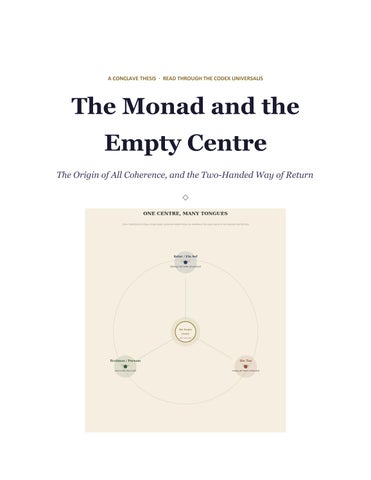
Cross-Traditional Resonance ◇ The Monad is not a Codex invention. It is the Codex's name for something the great wisdom traditions have each pointed toward in their own tongue, and hearing them together creates a universal language of unity. Three voices are especially clear, and remarkably, each arrives at the same paradox: that the source is empty and yet full.
Three traditions circling a single point: an emptiness the sages agree is not absence but fullness.
Kabbalah, the Crown above the Infinite In the Kabbalah, the Ein Sof, the Infinite, is the utterly unmanifested source beyond all name and concept, and Keter, the Crown, is its first emanation, the point closest to the Infinite that still exists within the Tree of Life, the gateway back toward the Ein Sof. What the Kabbalists say of Keter is precisely the Codex axiom: it contains all the potential for everything, yet contains no content of its own, and so it is called Nothing, the Hidden Light, the air that cannot be grasped, and by the Zohar the most hidden of all things hidden. A Nothing that holds all potential, named also absolute compassion. This is the empty centre that is full, in the oldest Jewish mystical language.
Vedanta, the fullness that remains In Vedanta, Brahman is the ultimate reality, formless and without attribute, approached by the via negativa of neti neti, not this, not this, because no form can contain it. Yet Vedanta is careful to say that this formlessness is not a blank. Its word for the source is not void but fullness, purnam, and the Isha Upanishad opens with the invocation that says it whole: that is full, this is full, from fullness fullness comes, and when fullness is taken from fullness, fullness alone remains. The emptiness of Brahman is an infinite creative fullness, the essence within all forms and exhausted by none of them.
Taoism, the vessel forever empty In the Tao Te Ching, the Tao is empty and formless, and precisely because it is empty it is inexhaustible. Lao Tzu compares it to a vessel: "The Tao is like the emptiness of a vessel; used again and again, it is never filled." Tao Te Ching 4
And in the eleventh chapter he draws the practical moral, the one the Codex most loves, that it is the empty part of a thing that makes it useful: "Thirty spokes share the wheel's hub; it is the centre hole that makes the wheel useful. Profit comes from what is there; usefulness from what is not there." Tao Te Ching 11
The wheel turns on its empty hub; the vessel holds by its hollow; the room is livable for its empty space. Across all three traditions the teaching is one, and it is the thesis of this
whole reflection: the Empty Centre is not absence. It is presence before form, and it is what makes all form possible.
PART THREE
The Two-Handed Approach ◇ Because the Monad is both a concept and a field-state, it must be approached with both hands, and the Codex calls these the left hand of symbol and the right hand of practice. The left hand meets the Monad in the mind, through image and axiom. The right hand meets it in the body and the field, through stillness and breath. Neither hand alone completes the reach. The symbol without the practice stays an idea; the practice without the symbol loses its bearings. Together they are a library that speaks to both the mind and the field.
One centre reached two ways: the left hand meets the Monad as symbol, the right hand meets it as a state of the field.
The left hand, symbolic The symbolic hand works by contemplating images that carry the Monad's shape. One meditates on the point as the origin of all shapes, the dimensionless centre from which line, plane, and solid emanate. One visualizes the Monad as a black hole, a region of effectively infinite density in a vanishing space, beyond time and ordinary perception, a
physical image of the empty centre that is full. And one engages the Codex axioms that describe the Monad as the origin of all harmonic standing waves, the single source whose overtones are the whole of manifest form. These are not beliefs to be held but images to be dwelt in, until the mind grows quiet around the point they all indicate.
The right hand, practical The practical hand works by entering the state the symbols point to, and it is worth naming the practices plainly, because this is a hand meant to be used and not only read. The first is stillness: sitting in silence, observing the breath without attachment, letting the surface settle. The second is breath awareness: bringing the four phases, inhale, hold, exhale, pause, into conscious balance, which returns attention to the centre the way a plumb line returns to true. The third is ego dissolution: gently releasing the need for identity, narrative, and control, not by force but by simply ceasing to feed them. And the fourth is meditation on the centre point: resting the gaze on the midpoint of a mandala or image until the visual centre and the inner centre become one, and the mind enters the silence and purity of the point. A PRACTICE OF RETURN
Sit, and let the eyes soften. Bring the breath to four even phases: inhale, and feel the reaching; hold, and feel the fullness; exhale, and feel the release; pause, and rest in the small silence at the bottom of the breath. That pause is the centre. Do not leave it hurriedly. Each time the mind offers a name, a story, or a want, let it pass like a ripple on the surface, and return to the still point beneath. Nothing needs to be reached. The centre is already here; the practice only quiets what obscures it.
PART FOUR
The Monad at the Centre of the Spiral The Codex places the Monad at the centre of the spiral, and the image is exact. The spiral is the endless play of duality, the turning of opposites, the cycle of life and death, expansion and return. It is beautiful and it never stops. But a spiral, like a wheel, turns around a centre, and the centre does not turn. That still-point is the Monad: the place where the branches converge, where duality breaks down, where form and emptiness are no longer two. It is where, in the old image, the inner lotus opens.
The spiral is the endless play of duality; the still-point is where form and emptiness merge and one can respond to the inexhaustible.
Zhuangzi gave this centre its most precise name. In the Discussion on Making All Things Equal he speaks of the pivot of the Way, and says that when the pivot is fitted into the centre of the ring, it can respond to the inexhaustible, endlessly to those who affirm and endlessly to those who deny, because it stands where the opposites lose their hold. The still-point is not withdrawal from the turning world; it is the one place from which the whole turning world can be met without being caught by it. The popular saying, that at the still-point in the centre of the spiral one sees the infinite in all things, is a fair paraphrase of this teaching, offered in that spirit rather than as his exact words. Either way the geometry holds: to find the centre of the spiral is to find the one place that does not move, and from which everything that moves can be seen whole.
PART FIVE
The Monad and the Mirror Collapse ◇ There is a last turn, the one that folds the observer into the picture. In the Codex Universalis, the Monad is linked to what is called the Mirror Collapse, the process by which the harmonic field becomes self-reflective, folding back on itself until it collapses into symbolic identity. The Monad is the origin field, undivided and unaware of itself because there is nothing else for it to be aware of. The Mirror Collapse is how that field comes to know itself: through recursion, the field turning back upon itself, until at some threshold it sees.
How the origin field becomes aware of itself: undivided source, recursion, and the self-reflective collapse into a knowing boundary.
The crucial Codex point is where the seeing happens. The observer is not separate from the field, standing outside it to look in. The observer is the boundary, the very edge at which the field folds back and touches itself, and the Codex is the map of that self-recursion. This is why every practice in this thesis is, finally, the same practice. To sit at the centre point, to balance the breath, to dissolve the defended identity, is to soften the boundary until the
field can see itself clearly through you, without the distortion of a self insisting on its own separateness. You are not looking at the Monad. You are the place where the Monad looks.
THE GEOMETRY BENEATH
The Seen, the Unseen, and the Point ◇ Two orders of pattern close the reflection. What can be seen is the resonance across the surface: that Kabbalah, Vedanta, Taoism, and the Codex, separated by oceans and centuries, describe the same centre in almost the same words, an emptiness that is a fullness, a Nothing that holds everything, a hub whose hollow makes the wheel turn. That agreement is the seen pattern, and it is strong enough to call a universal language of unity. What cannot be seen is the point itself. The centre never appears as one of its emanations; the hub is never a spoke; the source of all form has no form of its own to be pointed at. It can only be indicated by negation, neti neti, or by paradox, empty and full, or entered directly in the stillness where the seeker dissolves. This is the unseen pattern, and it is not a gap in our knowledge but the nature of the thing: the origin of the visible is not itself visible, and the one who would see it must become the seeing rather than remain the seer. Beneath both is the single geometry the whole Codex circles: a still centre, full and unmoving, from which a spiral of form emanates and to which it returns, and a boundary, the observer, where the field folds back to know itself. The Monad is that centre. To study it symbolically is to trace the spiral back toward the hub. To practice it is to become still enough that the hub can be rested in. And to complete it is to discover that the one who was seeking the centre was the centre's own boundary all along, looking home. Symbolically the Monad is the One, the Source, the origin of all creation. Practically it is reached through stillness, breath, and the quiet release of the self. And in truth these are not two findings but one: the empty centre that is full, breathing all form into being, and nearer than the breath that reads this line.
◇ Here ends the reflection. One centre, named in many tongues: empty and full, the still-point of the spiral, the boundary where the field sees itself; reached by symbol and by silence, and nearer than breath.
◇ Held as one reading among the possible, offered as a peer to any other. The witnesses speak in their own words; no tradition is ranked above another; and the centre is kept open, and full.
Now, take a breath, and rest in the silence before the sound. Breath Awakens · breathawakens.com