THE HUMAN ANSWER
·
MARKET REPORT
Worcester, Massachusetts The Work That Stays Human, Read at Five Scales Edition: Autumn 2026 · All figures dated and sourced · humananswer.com
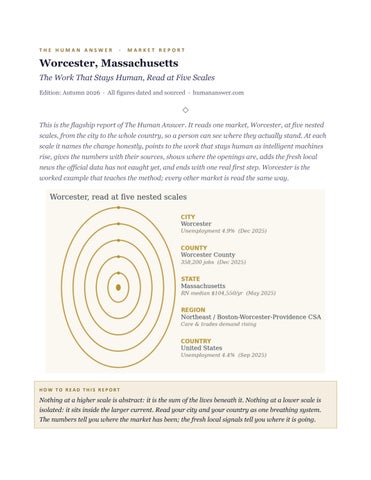
◇ This is the flagship report of The Human Answer. It reads one market, Worcester, at five nested scales, from the city to the whole country, so a person can see where they actually stand. At each scale it names the change honestly, points to the work that stays human as intelligent machines rise, gives the numbers with their sources, shows where the openings are, adds the fresh local news the official data has not caught yet, and ends with one real first step. Worcester is the worked example that teaches the method; every other market is read the same way.
HOW TO READ THIS REPORT
Nothing at a higher scale is abstract: it is the sum of the lives beneath it. Nothing at a lower scale is isolated: it sits inside the larger current. Read your city and your country as one breathing system. The numbers tell you where the market has been; the fresh local signals tell you where it is going.
SCALE ONE
·
THE CITY
Worcester The change, seen clearly Worcester is an eds-and-meds city with advanced manufacturing and a fast-rising life-sciences core. Its labor market softened modestly over the past year, in step with the nation: the Worcester metro unemployment rate was about 4.9 percent in December 2025, up roughly seven tenths of a point from a year earlier, on a labor force of about 476,000. This is a cooling, not a collapse, and the cooling is concentrated in exactly the task-based and desk-based roles most exposed to automation.
What stays human The city's anchor employers are built almost entirely on the human premium: care, teaching, trades, and hands-on making. UMass Memorial Health employs more than 20,000 people, and UMass Chan Medical School, Saint Vincent Hospital, Fallon Health, Worcester Polytechnic Institute, the College of the Holy Cross, and Clark University all sit near the top of the list. On the making side, Saint-Gobain, Polar Beverages, MSC Industrial Supply, and AbbVie keep skilled manufacturing and biopharma work in the city. None of this is work a machine does alone.
The numbers, honestly • Jobs. Metro unemployment about 4.9 percent, December 2025 (up about 0.7 point year over year). Labor force about 476,000. Source: Massachusetts labor data via FRED and the Worcester Business Journal. • Employers. Largest employer: UMass Memorial Health, more than 20,000 workers (2026). Source: Worcester Business Journal / Patch.
Where the openings are The steadiest local demand is in nursing and allied health across the UMass Memorial and Saint Vincent systems, in the skilled trades that build and maintain the city's current construction boom, and in the technicians and operators who run its manufacturing and biomanufacturing floors. FRESH LOCAL SIGNALS (WHAT THE DATA HAS NOT CAUGHT YET)
AbbVie has launched a roughly $70 million expansion at its Worcester Bioresearch Center, adding lab, warehouse, and office space and moving select oncology production from Europe to the U.S. UMass Memorial is adding 24 new private patient rooms at the North Pavilion (opening summer 2027), converting a nursing facility into additional hospital beds, and advancing new healthcare construction valued in the hundreds of millions. Worcester is in its biggest building cycle in decades, with more than 1,600 housing units under construction. Each of these is a near-term hiring signal
that will not appear in official employment counts for a year or more. Sources: Worcester Business Journal, Worcester Regional Chamber of Commerce, PharmaSource (2025).
1. First step. Pick one anchor system (UMass Memorial, Saint Vincent, or a named manufacturer) and find its careers page or next MassHire Central job fair. Make one real contact, a recruiter, a program, or a person already doing the work, this week.
SCALE TWO
·
THE COUNTY
Worcester County The change, seen clearly Worcester County was the only large county in Massachusetts to add jobs in 2025, finishing the year with about 358,200 jobs. The gain was slight, about a tenth of a percent, but in a year when larger neighboring counties shrank, holding and growing matters. The county's commuter shed widens the opportunity: a worker in the city can reach employers across Central Massachusetts within a daily drive.
What stays human The county's three largest industries are Health Care and Social Assistance (about 73,000 jobs), Manufacturing (about 51,600), and Educational Services (about 51,300). Two of the three are humanpremium by nature, and the manufacturing base is increasingly skilled and life-sciences driven rather than routine. Over the past generation the fastest county job growth has come in health care and social assistance, trade and transportation, financial activities, and professional and business services.
The numbers, honestly • Jobs. About 358,200 jobs, December 2025; the only large Massachusetts county to grow (about +0.1 percent). Source: U.S. Bureau of Labor Statistics via the Worcester Business Journal and the Pioneer Institute. • Industries. Largest industries: Health Care and Social Assistance ~73,083; Manufacturing ~51,583; Educational Services ~51,325. Source: U.S. Census (DataUSA).
• The shift. Manufacturing employment fell about 30 percent from 2001 to 2022 (about 16,000 jobs), even as life-sciences manufacturing now rises. Source: Worcester Regional Research Bureau.
Where the openings are Health care and social assistance across the county, the building trades riding the construction pipeline, and advanced-manufacturing and biomanufacturing technician roles as life sciences expand beyond the city line. FRESH LOCAL SIGNALS
The Reactory, a 46-acre biomanufacturing park in Worcester anchored by WuXi Biologics with Galaxy Life Sciences, is drawing county-wide supplier and technician demand, helped by a $1.3 million U.S. Department of Commerce grant. A 51-acre industrial campus is in the pipeline, and more than $161 million in state grants are flowing into Worcester County. Sources: Worcester Business Journal (2025).
1. First step. Widen your search to the full county commuter shed. Contact MassHire Central Workforce Development Board for the current in-demand occupations list and the training it will fund.
SCALE THREE
·
THE STATE
Massachusetts The change, seen clearly Massachusetts sets the licensing, the training dollars, and the wage floor that shape every local market inside it. The state pays a clear premium for human-premium skill: its nurses and tradespeople earn well above the national median, and its demand for both is projected to keep rising with an aging population and a large construction and clean-energy build-out.
What stays human, and what it pays • Nursing. Registered nurses: about 88,200 jobs statewide (May 2025), median pay about $104,550 a year, roughly 7 percent above the national median of $97,550. Demand projected to keep growing, with thousands of openings a year. Source: U.S. Bureau of Labor Statistics; nursing workforce data. • Trades. Construction trades: about 16,210 trades workers, median about $63,390 a year, roughly $16,660 above the national median. Source: U.S. Bureau of Labor Statistics / state occupational data.
Where the openings are, and the funding Statewide demand is strongest in nursing and allied health, the building and clean-energy trades, and skilled manufacturing. The state funds much of the training through its workforce agencies and WIOA dollars, and it sets the licenses each path requires. FRESH LOCAL SIGNALS
Massachusetts is pushing a large clean-energy and housing build-out that is lifting demand for electricians, HVAC and construction trades statewide, and continues to invest in life-sciences capacity that pulls Worcester upward with it. Source: Massachusetts workforce and clean-energy workforce reporting (2024 to 2025).
1. First step. Look up your target occupation's Massachusetts license and the state-funded training nearest you through the Massachusetts workforce site and your regional community college.
SCALE FOUR
·
THE REGION
The Northeast The change, seen clearly Worcester sits inside the Boston-Worcester-Providence corridor, one of the densest concentrations of hospitals, universities, and life-sciences employers in the country. That regional tide is the context for the local market: when Boston's health and life-sciences demand runs hot, Worcester, with lower costs and rising lab capacity, catches the overflow. The region's scale is Worcester's advantage.
What stays human Across the Northeast the same human-premium families lead: care and health driven by an older population, the building and energy trades driven by aging infrastructure and the clean-energy transition, and skilled manufacturing returning as production reshores. These are regional currents a single city rides rather than creates.
Where the openings are Regional demand concentrates in nursing and allied health, home and community care, the construction and energy trades, and advanced manufacturing and biomanufacturing along the corridor. Worcester's role is the affordable, rising node inside that system. FRESH LOCAL SIGNALS
Regional life-sciences capacity continues to spread outward from Boston and Cambridge toward lower-cost nodes, and Worcester's Reactory and UMass science parks are positioned to absorb it. Watch corridor-wide hospital-system expansions and clean-energy projects, which cross city and county lines. Source: regional workforce and industry reporting (2025).
1. First step. If the local market is tight for your path, widen to the corridor: the same role may be opening in a neighboring hub within commuting or relocation range.
SCALE FIVE
·
THE COUNTRY
United States The change, seen clearly The national labor market cooled through 2025: unemployment reached about 4.4 percent in September 2025, its highest since late 2021, with slow monthly job gains. Underneath the cooling, the composition of demand is shifting hard toward work that machines cannot do, the hands-on, present, caring, and physically grounded occupations, and away from routine task and desk work. A local dip reads very differently once you can see it against this national wave.
What stays human, by the national numbers • Care. Home health and personal care aides: projected to add about 739,800 jobs by 2034, the largest absolute growth of any occupation, up about 17 percent. Source: U.S. Bureau of Labor Statistics, 2024 to 2034 projections. • Advanced practice. Nurse practitioners: projected to grow about 40 percent, from 320,400 to 448,800, about 128,400 new jobs. Source: U.S. Bureau of Labor Statistics. • The sector. Healthcare and social assistance is projected to be the fastest-growing industry sector, about +8.4 percent, driven by an aging population. Source: U.S. Bureau of Labor Statistics. • Trades. The two fastest-growing occupations overall are hands-on energy trades (wind turbine and solar technicians), confirming that physical, on-site work is where growth concentrates. Source: U.S. Bureau of Labor Statistics.
Where the openings are Nationally the durable demand is the same shape Worcester shows locally: care and health, the building and energy trades, and skilled hands-on work. The national data is the proof that Worcester's humanpremium strengths are not a local accident; they are the center of where the whole country's work is heading.
1. First step. Use the national picture to steady your judgment: if your path appears on the country's durable-demand list and in Worcester's openings, you are reading the current rightly. Move toward it.
PULLING IT TOGETHER
The Work That Stays Human in Worcester Reading all five scales at once, the human-premium paths with the strongest, best-paid, most durable demand in and around Worcester are clear:
• Care and health. Nursing and allied health (RNs, techs, therapists), anchored by UMass Memorial and Saint Vincent, paying well above the national median and growing with the aging population. • The trades. The building trades (electricians, plumbers and pipefitters, HVAC/R, carpenters), riding the biggest construction cycle in decades and the state clean-energy build-out. • Making. Advanced manufacturing and biomanufacturing technicians, as the Reactory, AbbVie, and the UMass science parks expand lab and production capacity. • Home care. Home health and personal care, the single largest source of new jobs in the country, and a wide-open door for someone ready to start caring work now. THE HONEST WORD
This report does not promise anyone a job. It shows where demand is real, what the numbers say, and where the market is heading, then hands you the tools to verify it yourself. Every figure here is dated and sourced; the fresh local signals are announcements, not confirmed job counts, and should be read as direction, not guarantee.
YOUR TURN
Map Your Own Market Worcester is the worked example. Your market can be read the same way in minutes. Go to humananswer.com, open Find It In Your Market, and use the copy-paste AI template to run these same five scales on your own city and county, then verify what it finds against your local Chamber of Commerce and Town Hall. The method is the gift; the map is yours to make.
◇ The data tells you where the market has been. The fresh local news tells you where it is going. Read your city inside the whole country, find the work that stays human, and take one steady first step. The foundation beneath this report is the book, The Human Answer. The inner work of any real crossing lives in the practices and workshops at breathawakens.com. The Human Answer · humananswer.com
FOR THE RECORD
Sources and Notes Figures are drawn from public data and dated to their source period. Principal sources for this edition:
• BLS. U.S. Bureau of Labor Statistics: national Employment Situation (September 2025); Employment Projections 2024 to 2034; Occupational Outlook Handbook; county employment and wages. • State and metro. Massachusetts labor market data (via FRED) and the Worcester Business Journal for Worcester metro and county unemployment and employment, 2025. • Census. U.S. Census / DataUSA for Worcester County industry employment. • Local research. Worcester Regional Research Bureau and the Pioneer Institute for county sector trends. • Fresh signals. Worcester Business Journal, the Worcester Regional Chamber of Commerce, and PharmaSource for fresh local signals (AbbVie, the Reactory, UMass Memorial, Polar Park, construction pipeline), 2025. Each future edition should refresh these figures and re-scan local sources, chiefly the Chamber of Commerce, City and Town Hall, and the Worcester Business Journal, so the report always shows where the market is going, not only where it has been.