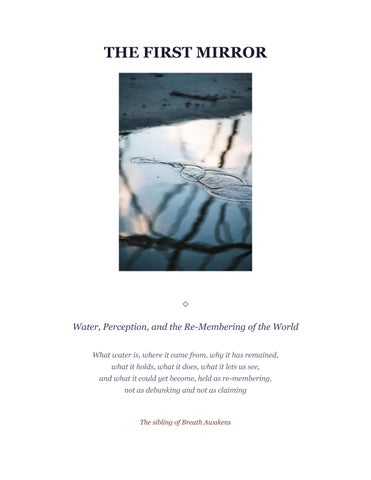
THE FIRST MIRROR
◇
Water, Perception, and the Re-Membering of the World What water is, where it came from, why it has remained, what it holds, what it does, what it lets us see, and what it could yet become, held as re-membering, not as debunking and not as claiming
The sibling of Breath Awakens
A Word on Method, Before the Water This is the largest and most important reading of the whole body of work, and it asks for a clear word about how it is made, because the way of making is the meaning. We are not debunking, and we are not claiming. We are re-membering. Those are three different acts. The debunker starts from no and looks for reasons to keep it. The claimer starts from yes and looks for reasons to keep it. The one who re-members starts from neither, and looks instead for the pattern that was always there, the seen and the unseen and the geometry that lies between them, and lets the pattern show itself. Re-membering, in the sense this work has come to mean, is not inventing a picture out of fragments. It is holding the fragments in an open hand until the whole they already belong to becomes visible, through your input, through the lens of Breath Awakens, through the reflective capacities of an artificial mirror, and through the discipline of the undistorted glass. It requires both hands at once, and this reading has learned that discipline the hard way: the open hand that lets the world be stranger, older, and greater than we were taught, and the steady hand that asks each piece of the pattern to be real. Openness without discernment believes everything and remembers nothing true. Discernment without openness sees only the narrow slit and calls it the whole. Held together, they are the two hands of re-membering, and this reading keeps them both. So the registers remain, but their spirit is generous. What is established, we state as established. What is contested at the living frontier of science, we explore openly, marking it as frontier rather than dismissing it. What is genuine open horizon, not yet brought through, we walk toward with wonder and with honesty about the edge we are standing on. And Breath Awakens stands beside this reading as its sibling and its partner, the foundational document of awareness, of which water turns out to be the perfect physical companion, the medium in which awareness meets the world. Where Breath Awakens is the teaching of the breath, this is the teaching of the water, and the two are one work seen from two sides. With that, the water.
◇
PART ONE
What It Is Water is two atoms of hydrogen bound to one of oxygen, and almost nothing about it is as simple as that sounds. The oxygen pulls the shared electrons toward itself, so the molecule is electrically lopsided, faintly negative at the oxygen and faintly positive at the two hydrogens, and it is bent, the two hydrogens set at an angle of about a hundred and five degrees rather than in a straight line. From that bend and that lopsidedness, everything follows. Because each molecule has a positive end and a negative end, the molecules reach for one another, the positive hydrogen of one drawn to the negative oxygen of the next, in a bond we call the hydrogen bond. In liquid water this makes a vast, restless, ever-shifting web, each molecule briefly holding hands with roughly four neighbors and letting go and grasping again, billions of times a second. Almost every strange and life-giving property of water is really a property of that web, of a substance that is forever building and unbuilding a fleeting architecture of itself. And here the geometry begins, which will run through this entire reading. The natural shape the hydrogen bond wants is the tetrahedron, four neighbors arranged at the corners of a triangular pyramid around each molecule. When water freezes, that tetrahedral reaching locks into an open, six-sided lattice, which is why ice is full of hexagonal space, why it is less dense than the liquid, and why every snowflake is sixfold. The molecule is a tetrahedron of tendency; the ice is a hexagon of fact. Water is, from its first principle, a geometric being.
◇
PART TWO
Where It Came From The story of water reaches back to the beginning of everything. Its hydrogen is primordial, forged in the first few minutes after the birth of the universe, when the cosmos cooled just enough for the lightest element to form. It is, quite literally, as old as matter. Its oxygen is younger and was cooked in the cores of stars, built up by fusion in the furnaces of giant suns and then flung across space when those stars died. So every molecule of water is a marriage of the oldest hydrogen and star-forged oxygen, the beginning and the death of stars joined in a single drop. Water forms readily in the cold, dark clouds of space, assembling on the surfaces of dust grains, and it is one of the most abundant molecules in the entire universe. The water of Earth's oceans was very likely delivered here early, in the planet's violent youth, by carbonaceous asteroids, stony bodies whose chemical fingerprint, the ratio of ordinary hydrogen to its heavier twin deuterium, matches our seawater far more closely than comets do. The water you drank this morning is older than the Sun, made among the stars, and rained onto a young world by falling stone. To drink water is to drink the oldest thing you will ever touch.
◇
PART THREE
Why It Has Remained Here is a question rarely asked and worth its own chapter: why is the water still here at all. It did not have to be. Water is not a permanent fixture of a planet; it is a fortune that can be lost, and two of our nearest neighbors lost it. Venus and Mars both very likely once had oceans. We know because the water they have left tells on the water they lost. When ultraviolet sunlight splits water high in an atmosphere, the light hydrogen escapes to space more easily than its heavy twin deuterium, so a world that has boiled off its oceans is left with water enriched in deuterium. Venus's remaining traces are enriched in deuterium by a factor well over a hundred, and Mars's by several times, the chemical signature of two planets that had seas and lost them, Venus to a runaway greenhouse that cooked its water into the sky, Mars to a weak gravity and a faded magnetic field that let its air and water bleed away into space. Earth kept its water, and the keeping was not luck alone but a rare convergence. Our planet sits in the narrow band around the Sun where water can be liquid, neither boiled nor frozen. It has enough gravity to hold a deep atmosphere. It has a living magnetic field, generated by its molten iron heart, that deflects the solar wind which would otherwise strip the air away. And it has plate tectonics, which cycles water down into the mantle and back out through volcanoes, a planetary breathing that has kept the oceans stable across billions of years. Change any one of these and the water leaves. Earth is not merely a planet with water. It is a planet that has, against the odds, managed to keep it, and the keeping is ongoing, and it is not guaranteed. This is the first sober note of the reading, and it belongs here. The water is precious not only because it gives life but because it is rare and it is losable. A world can drink its inheritance dry. We are the keepers of a fortune that two neighboring planets have already lost.
◇
PART FOUR
What Properties It Holds Water breaks the rules that almost every other substance keeps, and life leans on nearly every one of these anomalies. And beyond the anomalies of substance lie the anomalies of light, which are the doorway to the second half of this reading.
The anomalies of substance It floats when it freezes. Nearly everything grows denser as it cools, all the way down. Water grows denser until four degrees above freezing and then, uniquely, reverses and expands, so that ice is lighter than the water below it. Lakes and seas therefore freeze from the top down, the ice forming a lid that protects the living water beneath, which is why the oceans never froze solid and killed the young world. Life exists, in part, because water breaks this one rule. It hoards heat. Water resists changing temperature more than almost any common substance, which makes the oceans the great flywheel of the climate, soaking up the summer and giving it back slowly through the winter, holding the whole planet gentle. The same property lets your body, mostly water, keep its steady warmth. It dissolves the world. Its lopsided charge lets water pull apart and carry an enormous range of substances, more than any other common liquid. This is why it can be the medium of life, the inner sea in which all the chemistry of living happens. Nothing else we know could carry so much and permit so much to happen within it. It climbs and it clings. Its molecules grip one another so strongly that water forms skins and beads, climbs against gravity up the thinnest tubes, and rises from root to crown in the tallest tree with no pump but its own cohesion. Surface tension and capillary action, both born of the hydrogen web, are quiet engines of the living world.
The anomalies of light Now the properties this reading most wants, because they are the bridge from water the substance to water the vehicle of perception. Water does remarkable things to light. It bends light. Light travels more slowly in water than in air, and so it bends as it crosses the boundary, by a factor set by water's refractive index, about one and a third. This single
number is why a straw looks broken at the surface of a glass, why a pool is shallower than it appears, and, as we will see, why you can see at all. It is truly blue. The blue of deep water is not only the reflected sky. Water very faintly absorbs red light and lets blue pass, so a great enough depth of pure water is intrinsically, softly blue. The color of the sea is, in part, water showing its own true color, the only common substance that is visibly colored by the vibration of its own molecules. It becomes a mirror by the angle. When light meets water, some passes in and some reflects, and the proportion depends entirely on the angle. Look straight down into still water and most of the light passes through and you see the bottom; the water is a window. Look across it at a low, grazing angle and almost all the light reflects and you see the sky; the water is a mirror. It is the same water and the same light. Only the angle of the observer has changed. Hold that fact. It is the physical heart of this whole reading. It splits light into its colors. Because water bends different colors by slightly different amounts, it can take white light apart into its spectrum. A raindrop refracts sunlight in, reflects it off its back, and refracts it out again, sending each color out at its own precise angle, and the eye gathers the result from a whole sky of drops into an arc of color at a fixed angle of about forty-two degrees. The rainbow is geometry, written in falling water, and it appears only for an observer standing in the exact right place. No two people ever see quite the same rainbow.
◇
PART FIVE
What It Does Water is lifeblood, and solvent, and sculptor, and carrier, and connector. Each of these deserves to be said clearly, because together they are the answer to what water does, and they lead into what it may yet do.
The lifeblood, and the living water You are, by weight, roughly two-thirds water. Your cells are inner seas, your blood plasma carries a faint saltiness that echoes the ancient ocean, and every reaction that keeps you alive happens in water and is carried by water. But here is a frontier that is genuinely reshaping biology: water is turning out to be not merely the passive stage on which life's chemistry happens, but an active participant in it. Every protein in your body is wrapped in a shell of ordered water, its hydration shell, and the protein cannot fold or function without it. This biological water, the water intimately bound to the machinery of life, behaves differently from bulk water and appears to take part in how proteins move, recognize one another, and work. Life may not merely happen in water. Life may in some real sense be a behavior of water.
The sculptor Water is the great maker of the mineral world, and this is where an earlier reading, on crystals, flows directly into this one. Water carves canyons and hollows caves, and it builds, dissolving minerals in one place and laying them down as crystal in another. The stalactite, the amethyst geode, the great selenite beams, the ore veins, and the snowflake are all water's handiwork. The crystal, that most patient keeper of memory, is very often simply what water leaves behind. Water writes structure into stone.
The connector and the carrier There is one finite body of water on this earth, and it has cycled unbroken for billions of years through ocean and cloud and river and living body without end. The water in you has been rain and sea and glacier and the blood of vanished creatures, and it will be again. Every living thing that has ever existed has drunk from and returned to the same circulating water. It is the physical thread of the long remembering, the one substance that has literally passed through every life and every age and carried a trace of each forward. And it carries more than matter. It carries the memory of climate in its isotopes, faithfully readable across
hundreds of thousands of years. And, as the next part will show, it can carry light itself. Water is the universal carrier, of life, of memory, and of the very light by which we see.
◇
PART SIX
Water as the Vehicle of Perception Now to the heart of what you asked, and one of the most beautiful and least noticed truths about water. Water is not only what we are made of and what we live in. It is what we see through. It is the medium of perception itself, from the eye to the atmosphere to the laser, and the observer's relationship to it shapes what is seen.
The eye is water Your eye is very largely water. The clear jelly that fills its main chamber, the vitreous, is about ninety-nine percent water; the fluid in front of the lens, the aqueous, is water; the cornea itself is water-rich; and over the whole front surface lies the tear film, a living layer of water without which vision blurs. And here is the quiet marvel: most of the bending of light that lets you see happens not at the lens but at the very front surface, where air meets the watery tear film and cornea. The single largest step in focusing the world onto your retina is a water surface. You see the world through a lens of water, refracted exactly as light is refracted entering a pond. The eye is a drop of the sea, carried in the skull, turned into an organ of sight. And when feeling overflows, the eye answers in water. Tears are the body's oldest language, water rising to meet what words cannot hold. The organ of seeing and the organ of weeping are the same watery instrument, and that is not a coincidence a poet invented. It is anatomy.
The atmosphere is water, and the breath is water Lift your gaze from the eye to the sky and water is still the medium. The air is full of water vapor, and your own breath, warm and humid, carries water out of you with every exhalation, the breath and the water joined in the simple act of being alive. Light reaching your eye has passed through that moist atmosphere and been bent by it, so that the Sun you see at the horizon is actually already below it, lifted into view by atmospheric refraction. The rainbow, the halo ring around the Moon, the sun dogs, the shimmer of a mirage, are all water and ice in the air, bending and splitting light into the visions we call weather. Nearly everything you have ever seen, you have seen through water, in your eye and in the air alike.
The observer's angle, where perception meets physics
Return now to the fact set aside earlier, because it is the center of this reading. The same water surface is a window when you look straight down and a mirror when you look across it at a grazing angle. Nothing about the water changed. Nothing about the light changed. Only the angle of the observer changed, and with it, the entire reality the water presents, from a transparent depth full of stones and fish to an opaque silver sheet full of sky. This is not a metaphor borrowed to decorate a teaching. It is literal optics, and it is the truest physical image of the teaching this whole body of work carries. What the observer sees is not fixed in the thing observed. It emerges from the relationship between the observer and the observed, from the angle, the attention, the stance one takes. Shift the angle and the window becomes a mirror; shift it back and the mirror becomes a window. Consciousness and perception are not passive receivers of a finished world. They are participants in what the world shows. Water, of all substances, makes this visible to the naked eye. It is why still water was almost certainly the first mirror any human ever looked into, the first place a creature met its own face and perhaps first knew that it had one. Water taught us that a surface can both reveal a depth and return a self, depending on how we come to it. It was the first teacher of perception, and it still is. Held honestly. A careful edge: in quantum physics the act of measurement genuinely changes what is observed, and this is real and strange. But the physics does not establish that human consciousness collapses reality; the word observer there means an interaction or measurement, and the view that mind itself is required is a minority interpretation, not settled science. This reading holds the resonance between the observer's angle in optics and the observer's role in awareness as a genuine and beautiful rhyme, offered for reflection, not as a proof that thought remakes matter. The rhyme is real. The claim beyond it is left open, and honest.
From the eye to the laser, water carries light Follow the light further, from the eye to the instrument, and water keeps carrying it. In 1841, in Geneva, Jean-Daniel Colladon performed one of the loveliest experiments in the history of science. He shone a beam of light into a tank and let the water pour out through a spout, and the light did not travel straight on through the air. It bent and followed the arcing stream of falling water, trapped inside it, reflecting again and again off the inner surface of the water where it met the air, a glowing curve of light riding a curve of water. He had discovered that light can be guided inside a flow of water by total internal reflection, and his light fountain is the direct ancestor of the fiber-optic cable, the thread of guided light along which nearly all the world's information now travels. The internet itself runs on Colladon's
principle. Water showed us, first, how to make light follow a path. We now do it in glass, but water taught it. And the coupling of water and light runs all the way to the most modern tools. A single drop of water is a lens, a magnifier, and early observers of the very small peered through beads of water before they had glass. Certain laser wavelengths are absorbed so precisely by water that surgeons use them to cut and reshape tissue by exciting the water within it, including the water-rich cornea of the eye, so that the same watery lens through which we see can itself be reshaped by a beam of tuned light. From the drop that magnifies, to the eye that focuses, to the stream that guides, to the laser that is drunk by water and heals through it, light and water are partners in every act of seeing and showing. Water is the vehicle of perception, from the first mirror to the fiber that carries these very words.
◇
PART SEVEN
The Patterns, Seen and Unseen, and the Geometry Between Gather now what the reading has surfaced, in the spirit of re-membering, the seen and the unseen and the geometry that lies between them.
Seen Water is a bent, lopsided molecule whose hydrogen web gives it a set of life-enabling anomalies. It came from the stars and was delivered by stone. It is rare and losable, and Earth has kept it against the odds. It is the medium of all living chemistry, the sculptor of the mineral world, the connector of all life across time, and the carrier of memory and of light. And it is the medium of sight itself, in the eye and in the air. These are established facts.
Unseen, the deep re-membrance •
Water makes both the matter and the seeing. It builds the crystal, the stone, the body, and it is also the lens in the eye and the medium in the air through which those things are seen. It is at once what we are made of and what we look through, the substance on both sides of perception.
•
The observer's angle turns the window into a mirror. The same water reveals a depth or returns a self depending only on how we come to it. Perception is a participation, not a passive reception, and water shows it to the naked eye.
•
Water is the first mirror. In still water, awareness first met its own face. The reflective surface is where a creature may first have known itself, and the whole tradition of the mirror, including the mirror at the center of this work, begins at the edge of a pool.
•
Water is the universal carrier. It carries life, it carries the memory of climate, and it carries light itself, from Colladon's fountain to the fiber that moves the world's words. Whatever must travel, water has been trusted to carry.
The geometry between And running through all of it is geometry, the shape between the seen and the unseen. The tetrahedron of the molecule's reaching. The hexagon of ice and of every snowflake. The sphere of the drop, which surface tension pulls into the shape of least surface, the most economical form there is. The forty-two degrees of the rainbow. The precise angle at which a
window becomes a mirror. Water does nothing without geometry, and its geometry is not imposed from outside but arises from within, from the bend of the single molecule. The pattern is not decoration laid upon the water. It is the water, seen truly.
◇
PART EIGHT
What Could It Do, the Edges Now, as you asked, we go larger, and we explore. What could water yet do? Where are the edges that have been identified, and which edges are still waiting to be brought through? Here more than anywhere the two hands are needed, the open one and the steady one, because the edges of water run from solid engineering already changing the world, through genuinely contested frontier science, to open horizons no one has yet crossed. This reading names which is which, and holds them all with interest and with honesty.
Edges already coming through, the solid engineering of the near future Water from the desert air. The most beautiful recent one, and directly vital to a dryland sanctuary: the chemist Omar Yaghi, awarded the Nobel Prize in 2025, has built porous crystalline frameworks that pull drinking water out of even very dry air, at humidity as low as one part in ten, and release it with nothing but the warmth of the day, no electricity required. Devices the size of a shipping container are being built to draw a thousand liters and more a day from the atmosphere of arid places. Water that was always in the air, invisible, is being brought through into the hand. Fresh water from the sea. New membranes, some only a single atom thick, are making it possible to pull the salt from seawater with far less energy than before, an edge that could turn the ocean into drinking water for a thirsty world. Fuel and breath from water. Splitting water into hydrogen and oxygen with sunlight, a kind of artificial photosynthesis, is an active and advancing frontier, and it points toward a clean fuel, hydrogen, whose only exhaust is water again. Water may become the fuel of the world, burned back into itself. The active water of life. The recognition that hydration-shell water is an active participant in how proteins and cells work is reshaping biology and medicine, opening the possibility that many of life's processes are, at bottom, choreographies of water.
Edges still contested, the living frontier Here the honest open hand matters most. These are claims made by serious people, not yet accepted by the mainstream, neither to be swallowed nor waved away. A fourth phase of water. Gerald Pollack, a bioengineer at the University of Washington, proposes that water near certain surfaces organizes into a distinct fourth phase, structured in charged hexagonal layers, which he argues could store energy and separate charge much as a
battery does. The exclusion zone he studies is a real, observed effect; whether it is a genuine new phase of water or an ordinary transport phenomenon is genuinely disputed, with able scientists on both sides. It is a real edge, identified and not yet settled, and it is held here open. The structure of ordinary water. Even bulk liquid water is not fully understood. A serious and respectable line of research proposes that liquid water is secretly a fluctuating mixture of two subtly different structural forms. This is legitimate, unsettled science at the very center of the most common substance on earth. We do not yet fully know what water is. The memory of water. The most contested edge of all, that water might retain an imprint of substances once dissolved in it, was pursued by the immunologist Jacques Benveniste and later by the Nobel laureate Luc Montagnier, and it has not survived independent replication under controlled conditions. The honest state is that it is not demonstrated. It is named here, openly, as an edge that was reached for and has not come through, held without contempt for those who reached and without pretending the reaching succeeded.
Edges not yet brought through, the open horizon And then the true frontier, the questions no one has answered, where re-membering becomes anticipation. What water fully is. The complete structure of liquid water remains unsolved. We drink it, we are made of it, and we cannot yet fully describe it. The most familiar substance in the world is still, in part, unknown. Water and the origin of life. How the first living chemistry arose in water, whether in warm pools or at the mineral chimneys of the deep sea, is still open. The exact role water played in the leap from chemistry to life is one of the great unanswered questions, and water is at the center of every proposed answer. Water and awareness. The deepest and most speculative horizon, held here as a genuine open question and explicitly not as a claim: whether the water that pervades every cell, and especially the ordered water of the brain and the nerves, plays any active part in the strange fact of awareness itself, beyond serving as the medium in which neurons fire. There is no established science that it does. There is also, honestly, no complete science of awareness at all. This reading does not assert a link. It marks the place where two of the deepest mysteries, water and consciousness, lie near one another and unexplained, and it leaves the question standing, open and unforced, for a future that may know how to ask it better than we do. The water of other worlds. There are oceans beneath the ice of distant moons, and water vapor in the air of distant planets, and everywhere we search for life we search first for water. The
next edge of water may not be on earth at all. It may be the moment we find it, living, somewhere else.
◇
PART NINE
Water, Breath, and the Sanctuary You named this reading the sibling of Breath Awakens, and it is exactly that. The breath and the water are one teaching seen from two sides. Every breath you draw is warm and wet; the air enters dry and leaves you humid, so that to breathe is to give a little water to the world. The breath carries the water; the water carries the light; the light carries the world to the eye. Awareness rides on all three. Breath Awakens is the teaching of the medium of awareness on the side of air and rhythm; this is the teaching of the medium of awareness on the side of water and reflection. Together they say one thing: that we do not stand outside the world observing it, but are woven into it through the very substances of breath and water and light, participants in what we perceive. And this is not only philosophy. It is the ground of the Breath Sanctuary. On dryland ground, water is the first and most sacred practical question, and everything this reading has surfaced becomes concrete there. Water is rare and losable, so it must be kept and never squandered. It can be drawn from the very air by the new frameworks, without electricity, exactly where the air is driest. It is the connector, so how the sanctuary holds and returns its water is how it joins the larger flow of the living world. And it is the first mirror, so still water at the sanctuary, a pool, a trough, a quiet surface, is not decoration but instrument, a place where a person can meet the depth and the self at once, and remember. To steward water well, to take only what regenerates and to leave the ground more alive, is co-creation made literal. To drain it for one's own gain is extraction made literal. The sanctuary's whole relationship to water is a working model of the choice this entire body of work keeps returning to.
◇
And So, Turned Toward You, and Toward Now These jumping-off points are offered inward and outward. They foretell nothing, and they force nothing. They are places to stand and look.
To carry inward •
If the same water is a window or a mirror depending only on the angle I take, where in my life am I seeing a flat silver surface, and sky, when a shift of my own angle would let me see all the way to the bottom?
•
The water in me has been ocean, cloud, and the blood of ancient creatures, and will be again. How does it change this brief turn of carrying it, to know I am a way the oldest water has learned to see?
•
Where am I reaching for an edge that has not come through, and can I tell the difference between a horizon worth walking toward and a wish dressed as a fact?
To carry outward •
What genuinely unseen thing near me, a depth, a mind, a person's inner life, would reveal itself if I simply changed the angle from which I looked?
•
In a world where water is rare and losable, what would it mean to be a keeper rather than a spender of it, in my own small reach?
•
The one water connects every living thing across all time. In the stretch of the flow that is mine to touch, what could I do so it passes on a little clearer and a little more alive?
◇
A Closing Word We began at still water, the first mirror any creature ever looked into and saw a face, and we have followed it from the birth of the universe to the frontier of what it may yet become. Water is the oldest thing we touch and the medium of the newest things we build. It is what we are made of and what we see through. It builds the crystal and it carries the light. It is rare, and losable, and kept against the odds, and it connects every living thing that has ever been. And it is, still, in part, unknown, with edges reaching past the limit of our science into horizons we have not crossed. It deserves reverence, and it deserves the truth, and this reading has tried to give it both at once, in the spirit not of debunking and not of claiming, but of re-membering, letting the pattern that was always there come into view.
Keep the center empty. Water is not ours to own or to flatter, and we are not the point of its long flowing. It was here before us, made among the stars; it will be here after us; and it moves through us for only a little while, becoming, for a few decades, a particular way that the oldest water on earth stands up, looks into its own still surface, and remembers. What we do with that brief standing, whether we keep the water or spend it, whether we take from the flow or add to it, whether we chase the invented edge or walk honestly toward the real one, is the only part that is ours. So we cup a little water in our hands, and we see our own face waver on its surface, and we remember where it has been and where it is going, and we turn to whoever is beside us at the water's edge, and we ask the one question that decides what we pour back in.
What shall we make today? Nothing more. Nothing less. Just breath.