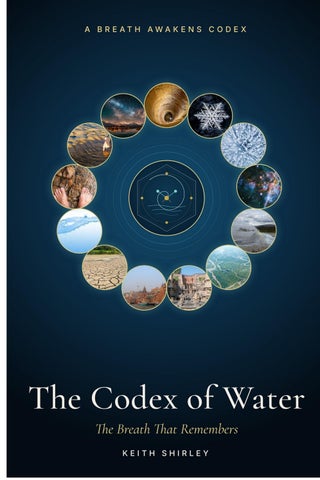
The Codex of Water The Breath That Remembers A Study of Water from the Atom to the Sacred, and a Practice of Breath
Keith Shirley
The Codex of Water: The Breath That Remembers. A Study of Water from the Atom to the Sacred, and a Practice of Breath. © 2026 Keith Shirley. Free edition, 2026. This book is given freely under a Creative Commons Attribution-NonCommercial-NoDerivatives 4.0 International licence (CC BY-NC-ND 4.0). You may copy, print and share it in any medium, in full and unchanged, for non-commercial purposes, with credit to the author. Licence: https://creativecommons.org/licenses/by-nc-nd/4.0/. Quotations from other authors and translators remain the property of their rights holders and are used briefly under fair use. Read and download it free at codexofwater.com. This book, its companion reflection book, the Water Mirror and the Kari-Vael-On sigil are all offered freely at codexofwater.com. Breath Awakens: A Codex of Spiral Memory © 2026 Keith Shirley. Quotations from it are the author’s own. The Water Remembers: A Codex Water Reflection Book copyright © 2026 Keith Shirley, given freely at codexofwater.com. Quotations from ancient and classic texts are taken from public-domain translations, named wherever they appear. Every scientific and historical claim is graded established, contested or symbolic, as explained in How to Read This Book. The practices in this book are contemplative and are not medical or psychological advice. Breathe gently and never strain. Never hold the breath in or under water, and never enter cold or open water alone or without care. If any practice brings dizziness or distress, return to natural breathing. codexofwater.com · codexcalendar.com · breathawakens.com · codexlibrary.com
In Harmony, Small Things Grow Towards Unity THE PILLAR OF LIGHT INVOCATION
Your Love and Truth is universal. Bring this universal love and truth to all. You are in a sacred space for all to be heard and listened to.
Contents How to Read This Book............................................................................................ 1 Preface............................................................................................................................5 Part One: Identify · Iphi: The Breath in Matter................................................7 1. The First Waters.....................................................................................................8 2. The Bent Molecule.............................................................................................. 19 3. What Water Forgets, What Water Remembers.................................................30
Part Two: Accept · Shema: The Descent of Water..........................................43 4. Water from the Stars............................................................................................44 5. The First Pool......................................................................................................53 6. The Breathing Planet...........................................................................................62
Part Three: Embrace · Vara: The Ancient Breathlines of Water.................72 7. Waters of Stone....................................................................................................73 8. Waters of the Word.............................................................................................85 9. The Veil................................................................................................................95
Part Four: Let Go · Ouon: The Return.............................................................105 10. The Science of Wonder...................................................................................106 11. Living Water.................................................................................................... 119 12. The Future Breathline..................................................................................... 128
Part Five: Wisdom: One Water...........................................................................138 13. The Spiral of Kari-Vael-On.............................................................................139 14. What the Water Means...................................................................................152 15. Open Questions: An Agenda for Research....................................................158
Appendix A: Water in Numbers........................................................................166 Appendix B: Water-Breath Days, Years 1 to 3...............................................169 Appendix C: Glossary............................................................................................171 Appendix D: An Atlas of Sacred Waters..........................................................174 Appendix E: Practice Pages.................................................................................. 177
Bibliography............................................................................................................. 179 With Gratitude........................................................................................................200 About the Author...................................................................................................202 Continue the Journey.............................................................................................203
How to Read This Book The water remembers what the breath forgets. This book is about the most ordinary substance on Earth, and the least ordinary. It is written for two readers, and it is built so that each can walk a clear path through it. The first reader wants to practise. You may have come here from Breath Awakens, from the Codex Calendar, or simply from a moment beside a river or the sea when something in you went quiet. For you, the book is a companion. Every chapter ends its journey with a practice you can do in a few minutes with a glass, a bowl or a window of rain, and with your own breath. The second reader wants to understand. You may be a scientist, a historian, a scholar of religion, or a careful general reader who has met a great many claims about water and would like to know which of them are true. For you, the book is a study. It sets out what is measured, what is disputed and what is only hoped, names its sources in the text, and ends each chapter with directions for further research.
The two paths If you want to…
Read
Then turn to
Begin a water practice quickly
Chapters 1, 3, 11 and Appendix E (practice pages) and 13 The Water Remembers, the free reflection book
Understand what water is
Part One (Chapters 1–3)
Appendix A (water in numbers)
Trace water from the stars to the sea
Part Two (Chapters 4–6)
The Bibliography
Study water in human history and scripture
Part Three (Chapters Appendix D (an atlas of sacred 7–9) waters)
Weigh the popular claims about water
Chapters 3 and 10
1
“A note on evidence” boxes throughout
If you want to…
Read
Then turn to
Live with water through the year
Chapters 11–13
Appendix B (Water-Breath Days) and codexcalendar.com
Find research questions
Chapter 15
“Further research” boxes throughout
Three kinds of boxes Throughout the book, three kinds of boxed text step out of the main argument.
✦ Practice A Practice box gives you something to do with water and breath: a few minutes of attention, a breath, a question to write about. Practices are gentle. Never strain, never hold the breath in or under water, and stop if you feel dizzy.
◇ Further research A Further research box points the scholar toward primary sources, open debates and unanswered questions.
A note on evidence A Note box grades the chapter’s key claims, so that you always know what kind of truth you are reading.
How claims are weighed Few subjects carry as many beautiful claims as water, and few have suffered so much from them. Water is said to remember every substance it has touched, to answer to kind words, to hold a hidden fourth phase, to be “structured” by vortices 2
and crystals. Some of these claims were proposed by serious scientists; most have not survived testing. Meanwhile, the measured truth about water is stranger and more moving than any of them, and is often left untold. This book therefore weighs every claim in three grades. This is its two-handed method: one hand holds the evidence, the other holds the meaning, and neither is allowed to pass for the other. • Established claims are measured or documented, with broad scholarly agreement. That the angle of the water molecule is about 104.5° is established. So is the fact that Antarctic ice holds bubbles of air more than 800,000 years old. • Contested claims are proposed by serious researchers but disputed, or have failed to replicate. Where the weight of evidence is clearly against a claim, the book says so plainly: not supported. That water carries a “memory” of substances diluted out of it is not supported. Where Earth’s water first came from is still genuinely contested. • Symbolic claims are readings through the lens of Breath Awakens or of the world’s contemplative traditions. They are offered as meaning and as practice, not as physics. That the water cycle is the Earth’s breath is symbolic. It is also, as you will see, a symbol that the science does not contradict. Breath Awakens is one lens in this book, not the only one. Science, history, the living traditions of the world and the Codex reading stand side by side, and you are never asked to mistake one for another.
The four-fold water breath The book follows the four movements of the Codex breath, which are also the four movements of water. Codex name
Breath
Pillar
Water’s movement
Iphi
Inhale
Identify: “I see this. I name this.”
Evaporation: water rises as vapour
Shema
Pause
Accept: “I allow this to be true.”
Condensation: water gathers and is held in cloud
3
Codex name
Breath
Pillar
Water’s movement
Vara
Exhale
Embrace: “I bring this into my field.”
Rain and river: water descends and flows
Ouon
Stillness
Let Go: “I no longer hold this as mine.”
Lake, sea, ice and aquifer: water rests
Table 0.1. The four-fold water breath. The movements of the water cycle are established; their mapping onto the breath is symbolic.
In Breath Awakens the four pillars are named the Inhale, the Pause, the Descent and the Exhale. In the water breath of this book the descent and the exhale are one movement, Vara, as rain falls from the cloud and breath leaves the body, and the fourth movement, Ouon, is the stillness that follows, when the released water rests in lake, sea and ice. The Pillars keep their order: Identify, Accept, Embrace, Let Go. These names were heard, not found. Yet the old languages answer them. Homeric Greek has îphi, “by strength”; Hebrew šəmaʿ, “Hear!”; Sanskrit vāri, “water, rain”; and the Greek of the Septuagint ho ōn, “the One who is”. Those echoes are real words with real meanings, and they are offered as resonance, not as origin: the names are not ancient, and this book never claims that they are. Chapter 13 tells their story in full.
The book and the calendar The fifteen chapters follow the thirteen Moons of the Codex Calendar. Chapters 1 to 12 are the waters of Moons I to XII, Genesis to Dream, and Part Five, Chapters 13 to 15, is the thirteenth Moon, Wisdom, in which the waters become one. On the twenty-eighth day of every Moon falls a Water Return, a day for giving water back; Appendix B lists every Water-Breath Day for the first three Codex years, and codexcalendar.com shows them for any year.
4
Preface Breathe out onto a cold window, and watch. A small cloud blooms on the glass and fades. That cloud is water: water that a moment ago was inside you, in the moist lining of your lungs, and that last week may have been in a river, a raincloud or a cup of tea. Every day, an adult at rest breathes out roughly a third of a litre of water in this way, unseen (Institute of Medicine 2005). It rises into the air, where it stays for about nine days on average (van der Ent and Tuinenburg 2017), and then it falls again as rain, somewhere, on someone. This book began with that small cloud, and with a sentence that came before it. The water remembers what the breath forgets. When the sentence first came, I did not know whether it was true. I knew that it felt true, and I knew how much has been written about water’s “memory”: the experiments with extreme dilutions, the photographs of ice crystals said to answer to words, the “structured” and “revitalised” waters sold in bottles. I wanted to know what the evidence actually shows. So this book does what its companion, The Codex Calendar, did with time: it goes to the sources, all of them, and weighs them honestly. What it found surprised me. In the liquid, water forgets almost at once. The hydrogen bonds that hold its molecules together break and re-form in about a trillionth of a second, and no lasting pattern survives to carry a memory of anything (Cowan et al. 2005). The famous claims of water memory have not survived careful testing, and this book says so, with kindness for the people who hoped they were true. And yet water remembers. Not in the liquid, but in the ice, in its isotopes and in its return. In the ice sheets of Antarctica, snow falling year upon year has trapped tiny bubbles of air, and in those bubbles the atmosphere of the deep past is kept: the breath of the sky from 800,000 years ago and more (Lüthi et al. 2008). The wind 5
forgot that air long ago. The ice did not. The sentence is, quite literally, true. Water’s isotopes remember where it came from, some of it from before the Sun was born, and they remember the temperatures of ancient winters. And the great cycle of water remembers in the way a breath remembers, by returning. So the book holds two truths in two hands. In one hand, water as it is measured: a bent molecule, an angle of 104.5°, a planet’s slow breathing of evaporation and rain. In the other, water as it has been lived: the Nile’s flood measured on the steps of a Nilometer, the sacred lake of Karnak, the cenotes of the Maya, the river Whanganui that is, in the law of Aotearoa New Zealand, a living person. And between them, the Codex lens of Breath Awakens, which hears in all of this a single breath. The book is in five parts. Part One, Identify, looks at water itself: where it came from in the first light of the universe, why its small bent molecule behaves like nothing else, and what it forgets and remembers. Part Two, Accept, follows water’s descent from the stars to the first pool where life may have begun, and to the breathing planet we live on. Part Three, Embrace, turns to people: the waters of stone, the waters of the word, and the veil that has made water into a commodity and a means of control. Part Four, Let Go, returns: to the real wonders of water, to living practice, and to the future of water on a warming Earth. Part Five, Wisdom, gathers the waters into one, through the water breathline of Kari-Vael-On, a reflection on what water means, and an honest agenda of open questions. You do not need to believe anything to read this book. You need only a glass of water and a breath. Hold the glass to the light. It is faintly blue, because water absorbs a little red light. Some of it is older than the Sun. It has been rain and river and breath many times over. It will forget this moment almost at once. And you, perhaps, will remember. Keith Shirley codexofwater.com, 2026
6
PART ONE
Identify · Iphi: The Breath in Matter
7
CHAPTER 1
The First Waters Before you read another line, breathe in. Feel the air cool at the nostrils and the chest widen. That small act, the inhale, is where this book begins, because the inhale is the moment something new enters. In the Codex it has a name, Iphi, and a Pillar, Identify: the moment we look at what is in front of us and say, plainly, “I see this. I name this.” What is in front of us is water. It is in the glass on your table, in the cells of your hands and in the warm, damp breath you have just let go. This first chapter asks a simple question with a very long answer: where did that water come from? We will follow the question twice. First through the oldest stories people have told, in which the world itself rises out of the waters. Then through the physics of the atom, where the hydrogen in your glass turns out to be almost as old as time, and the oxygen turns out to have been made inside stars. The two answers are not the same kind of answer, and this book will never pretend they are. But they can be held side by side, the way two hands hold a bowl.
Water before water Many of the oldest creation accounts in the world do not begin with nothing. They begin with water: dark, still, limitless water, before there was land or sky or name. It is worth meeting a few of these accounts on their own terms before we say anything about what they share.
Egypt: Nun and the first mound In the theology of Heliopolis, the city the Bible calls On, creation begins in Nun, the boundless dark waters that existed before anything else. Out of Nun rises the first mound of land, and on it the creator Atum appears. The pyramid-shaped benben stone at Heliopolis was understood as a form of that first mound, the first solid ground to stand clear of the waters. In the Pyramid Texts, Atum’s first acts of making are breath and moisture: he brings forth Shu, the air, and Tefnut, moisture 8
(Pyramid Texts, Utterances 527 and 600; Allen 2005). Egyptologists treat this as one of several Egyptian creation traditions, each tied to a different temple city; it is not a single official “Egyptian creation story”. For a reader of this book, the Heliopolitan picture is striking. Before anything is made there is water, and the first things the creator gives are air and wetness: breath and water, side by side, at the very beginning. The sacred lakes of Egyptian temples kept this picture in the landscape. The lake at Karnak, begun under Thutmose III (who reigned 1479 to 1425 BCE), measures about 128 by 83 metres and was used for the sailing of sacred barques at festivals (Digital Karnak, UCSC). Egyptologists commonly read such lakes as images of Nun set within the temple walls, although that reading is interpretive rather than written on the stones.
Mesopotamia: Apsu and Tiamat In southern Mesopotamia the god Enki (Ea in Akkadian) lived in the abzu, the sweet water beneath the earth, and his temple at Eridu was called the E-abzu, “House of the Abzu” (Horry 2019). The Babylonian creation poem known by its opening words, Enuma Elish, begins with two waters: Apsu, the fresh water, and Tiamat, the salt. “When in the height heaven was not named, / And the earth beneath did not yet bear a name, / And the primeval Apsû, who begat them, / And chaos, Tiamat, the mother of them both,— / Their waters were mingled together, / And no field was formed, no marsh was to be seen;” Enuma Elish, Tablet I, lines 1–6 · tr. L. W. King, The Seven Tablets of Creation, 1902 Later in the poem, Ea kills Apsu and builds his dwelling on him, and Marduk splits Tiamat to make sky and earth (Lambert 2013). There is something quietly exact about the opening image. In a land made by two great rivers flowing into a salt gulf, the world begins as a mingling of fresh and salt water: an estuary.
9
Genesis: the breath over the deep The Hebrew Bible opens with a world that is formless, dark and watery, and with something moving over it. “And the earth was without form, and void; and darkness was upon the face of the deep. And the Spirit of God moved upon the face of the waters.” Genesis 1:2 · King James Version (1611) The word translated “Spirit” is rûaḥ, which means wind, breath and spirit all at once (Brown, Driver and Briggs 1906). The same word can describe a desert wind, a person’s breath and the life of God. So the verse can be heard in three ways at once: a wind over the waters, a breath over the waters, a spirit over the waters. The text does not make us choose. Four verses later, God divides “the waters from the waters” (Genesis 1:6), the waters above from the waters below, which is the Bible’s first picture of the sky.
The Rig Veda: was water there? The creation hymn of the Rig Veda, Book 10, Hymn 129, often called the Nāsadīya from its opening words, is famous for asking rather than telling. “Then was not non-existent nor existent: there was no realm of air, no sky beyond it. / What covered in, and where? and what gave shelter? Was water there, unfathomed depth of water?” Rig Veda X.129.1 (Nasadiya, creation hymn) · tr. Griffith, 1896–97 The hymn goes on to say that in the beginning “this All was indiscriminate chaos” and that “by the great power of Warmth was born that Unit” (Griffith 1896–97). It ends, famously, by wondering whether even the one who looks down from the highest heaven knows how it all began. Elsewhere the Vedas praise the Waters, āpaḥ, as divine mothers. This is a tradition that reveres water and still lets the first question stay open.
10
Other voices The motif is not universal, and it should not be made to look universal. But it is widespread. In Greece, Aristotle reports that Thales of Miletus, around 585 BCE, held water to be the first principle of all things and taught that the earth rests on water (Aristotle, Metaphysics I.3). The Qur’an speaks of God giving life to everything by means of water (Qur’an 21:30). In the K’iche’ Maya Popol Vuh, the world before creation is commonly described as still sea under sky, though an early English wording of that passage could not be verified for this book. Hawaiian tradition, Japanese myth and many others hold their own waters at the beginning.
Reading the creation waters honestly How should we hold these accounts together? Three things can be said with care. First, the texts are real, and what they say is documented. That Heliopolitan theology begins in Nun, that Enuma Elish opens with Apsu and Tiamat, and that Genesis 1:2 places a rûaḥ over the waters are matters of record. Second, these are living or deeply honoured traditions, not raw material. Genesis is scripture for Jews and Christians, and the Vedas are scripture for Hindus. Their meaning belongs first to the communities that read them, and this book describes them; it does not claim to own them. Third, the likeness between them is real but its cause is uncertain. Some resemblance, such as that between Mesopotamian and Hebrew imagery, may reflect a shared cultural world in the ancient Near East; scholars still debate how much. Other resemblances, such as that between Egypt and the Vedas, almost certainly do not come from contact. A simpler explanation is open to all of them: people who lived beside floods, rivers and the sea saw land rise out of water every year, and saw that nothing grows without it. When people imagined the beginning, water was the obvious first thing. The Codex will read the pattern contemplatively. It will not claim that the traditions secretly say the same thing.
11
The oldest thing in your glass: hydrogen Now we turn the same question to physics. A water molecule is two hydrogen atoms joined to one oxygen atom. Ask where each of those atoms came from and you get two very different journeys. The hydrogen is the elder. In the first few minutes after the Big Bang, roughly 3 to 20 minutes in, the universe was hot and dense enough to fuse protons and neutrons into the lightest nuclei: deuterium, helium and traces of lithium, while the protons left over became the nuclei of ordinary hydrogen (Fields, Molaro and Sarkar 2020; NASA). The universe is about 13.8 billion years old (NASA). Almost all of the hydrogen in the universe, including the hydrogen in the water you drink, dates from that time. Even the heavy form of hydrogen, deuterium, carries that date. Deuterium is a hydrogen nucleus with a neutron added to its proton. The Big Bang is the only significant source of it; stars do not make deuterium, they destroy it (Fields, Molaro and Sarkar 2020). So when we find deuterium in the oceans, we are looking at a relic of the first minutes, which has survived some 13.8 billion years without being burned. It is a strange thought to hold over a kettle. The hydrogen in the steam is not merely old. It is, as far as physics can tell, among the oldest matter there is.
The star’s gift: oxygen Oxygen did not exist at the beginning. It had to be made, and it was made inside stars. In the cores of stars, helium nuclei fuse to make carbon, and carbon captures another helium nucleus to make oxygen-16 (Burbidge et al. 1957). This happens late in a star’s life. The oxygen is then cast into space by stellar winds and, for the most massive stars, by the explosions we call supernovae. That scattered oxygen mixed with the old hydrogen in the cold clouds between the stars, and there the two met. Water has been detected in interstellar space since 1969, when radio astronomers found its signal at 22 gigahertz (Cheung et al. 1969). The Herschel space telescope later traced water from cold clouds, through 12
newborn stars, into the discs of dust and gas where planets form; most of it is frozen as ice on grains of dust (van Dishoeck et al. 2021). Models of deuterium chemistry suggest that some of the water in our own solar system, perhaps 30 to 50 per cent of the water in Earth’s oceans, was inherited from that parent cloud and is therefore older than the Sun (Cleeves et al. 2014). Part Two will follow that story. For now it is enough to know that the oxygen in your glass came from stars that lived and died before the Sun was born.
The names water carries: isotopes Atoms of the same element are not all identical. They can carry different numbers of neutrons, and these variants are called isotopes. Hydrogen has two stable isotopes and oxygen has three. They behave almost the same chemically, which is why water made from any of them is still water. They differ in mass, and that small difference makes them very useful. The most common water molecule, ¹H₂¹⁶O, contains 10 protons, 8 neutrons and 10 electrons. Swap in a deuterium atom or a heavier oxygen and the molecule becomes slightly heavier. Counting the two stable hydrogens and three stable oxygens, there are nine stable ways to build a water molecule. Almost all of the water you will ever drink is the lightest form; a small fraction is not. Isotope
Nucleus
Natural abundance
Made where
¹H (protium)
1 proton
about 99.985% of hydrogen
Big Bang
²H (deuterium, D)
1 proton, 1 neutron
about 0.0156% of hydrogen
Big Bang (destroyed in stars)
¹⁶O
8 protons, 8 neutrons
about 99.76% of oxygen
Inside stars (helium burning)
¹⁷O
8 protons, 9 neutrons
about 0.04% of oxygen
Inside stars
¹⁸O
8 protons, 10 neutrons
about 0.20% of oxygen
Inside stars
Table 1.1. The stable isotopes of hydrogen and oxygen from which water is built (abundances from CIAAW; origins from Burbidge et al. 1957 and Fields, Molaro and Sarkar 2020).
13
Why call these “names”? Because the mix of isotopes in a sample of water records where it has been. When water evaporates, the lighter molecules leave a little more readily; when vapour condenses, the heavier molecules fall out a little sooner. As air masses travel and cool, their remaining vapour grows lighter and lighter in a predictable way, so the isotope mix of rain and snow carries a mark of the temperature at which it formed (Dansgaard 1964). Scientists express these marks as small differences from a reference: ocean water, defined by the standard called VSMOW, whose ratio of deuterium to ordinary hydrogen is 155.76 parts per million (Hagemann, Nief and Roth 1970). Every sample of water, in other words, carries a kind of family name and a record of its journey written in the weight of its atoms. Chapter 3 will show how those names let us read temperatures from hundreds of thousands of years ago, and Chapter 4 will use them to ask which bodies in the solar system brought Earth its water.
Every glass is star-breath Put the two journeys together. Every water molecule you drink holds two hydrogen atoms that are about 13.8 billion years old and an oxygen atom forged in a star. Some of that water may have been ice on interstellar dust before the Sun ignited. It has fallen as rain, run in rivers, rested in the sea for thousands of years and risen again as vapour countless times. And now, for a few hours, it is you. Then you breathe it out. Each exhale leaves your body nearly saturated with water vapour, which is why breath fogs a cold window (McFadden et al. 1985). At rest, an adult breathes out roughly a third of a litre of water a day, and more when active or in cold, dry air (Institute of Medicine 2005). That water joins the atmosphere, where water stays for about nine days on average before it falls again (van der Ent and Tuinenburg 2017). “Star-breath” is a poetic phrase, and we will mark it as such. But the facts beneath it are not poetic. The water in your breath is made of Big Bang hydrogen and stellar oxygen, and your body really does give it back to the sky with every exhale.
14
The Codex lens: Iphi, the inhale Everything in this section is a contemplative reading, offered beside the science and not in place of it. The Codex names four phases of the breath. The first is Iphi, the inhale. In Breath Awakens the inhale belongs to the first Pillar, Identify, which is described as “The moment awareness enters form” and spoken in the words “I see this. I name this.” (Shirley 2026). In the Codex’s Hebrew-letter scheme, it is Yod, the smallest letter, the first stroke of the pen. These Codex names were heard, not found. Yet the old languages answer them. The word Iphi echoes Homeric Greek îphi, an old adverb meaning “by strength” or “mightily”, from ís, “strength, sinew” (Beekes 2010). It is also the first part of the name Iphigenia, “born of might”. The Codex does not claim that its word descends from the Greek one. It notes the echo and lets it teach: the inhale is the gathering of strength. In the Codex mapping of the water cycle, Iphi is evaporation: water rising as vapour from sea, leaf and skin. The water cycle itself is established science (Chapter 6 tells it fully). The pairing of evaporation with the inhale is symbolic, a way of letting the body remember the planet. When the sun warms the sea, water rises invisibly into the sky. When you breathe in, air rises into you. Both are the first movement of a cycle, and both happen without being forced. The chapter’s water also belongs to a place in the Codex Calendar. This is the water of Moon I, Genesis, the first Moon of the Codex year, which begins at the March equinox; Year 1 began on 20 March 2026. Two days later comes World Water Day, 22 March, held by the United Nations since 1993, which falls on Genesis 3 in Year 1. On Genesis 28, the last day of the Moon, comes the first Water Return of the year, when the Moon’s water is poured back. There is one more echo here, and it is the deepest one in the book. The water breathline of the Codex is called Kari-Vael-On. One honest reading of the name joins three old words: Old Norse Kári, the wind, brother of the sea; Old English wǣl, “a deep pool, deep water”; and On, both the Greek word for “being” and the 15
biblical name of Heliopolis, the city whose creation begins in Nun (Bosworth and Toller 1898). Wind, deep water, being: the breath moves over the deep, and being arises. That is the picture of Genesis 1:2 and the picture of Heliopolis, and it is the picture physics gives in its own language, of old hydrogen meeting star-made oxygen in the cold between the stars. The Codex offers this as a symbolic chord, not a proof.
A note on evidence Established: hydrogen (including deuterium) was made in the first minutes after the Big Bang, about 13.8 billion years ago; oxygen is made in stars and dispersed by stellar winds and supernovae; water is common in interstellar clouds; isotope abundances and the isotope “temperature effect” in rain and snow are measured; breath leaves the body nearly saturated with water vapour, about a third of a litre a day at rest. Established, with debate about how much: some of Earth’s water is older than the Sun. The share (estimates of 30 to 50 per cent of the oceans) is still discussed. Established as texts: the creation accounts of Heliopolis, Enuma Elish, Genesis and Rig Veda 10.129 say what this chapter reports. Their dates and the exact wording of some Egyptian passages vary between translators. Contested: how far the shared water-at-the-beginning motif reflects contact between cultures, and how far it arises independently. Any claim that the traditions “secretly agree” is not supported. Symbolic: “every glass is star-breath”; Iphi as evaporation; the Kari-Vael-On reading “wind, deep water, being”. These are Codex readings, offered as meaning and practice, not physics.
16
✦ Practice: The First Breath on Water Take a clear glass of cool water and sit where you can rest your forearms. Allow about ten minutes. Look at the water for a minute without doing anything. Then say quietly, “I see this. I name this. Water.” This is Identify. Bring the glass a few centimetres from your lips. Breathe in gently through the nose for a count of four (Iphi). Rest the breath for four (Shema). Breathe out softly across the glass through the mouth for four (Vara), and rest empty for four (Ouon). Never strain; if four is too long, use three. Watch the outside of the glass as you breathe. On a cool glass you may see a faint mist form and fade. That mist is the water of your own breath meeting the cool surface. Repeat for six to eight rounds. As you breathe in, you might hold one sentence in mind: “The hydrogen in this water is as old as the universe.” As you breathe out: “The water I breathe out returns to the sky.” Finish by drinking the water slowly. Before you swallow, name one thing you are seeing in your life for the first time. You do not need to do anything about it yet. Identify is enough.
17
◇ Further research Primary sources on the atoms: Burbidge, Burbidge, Fowler and Hoyle (1957) on how the elements are made in stars; the Particle Data Group review of Big Bang nucleosynthesis (Fields, Molaro and Sarkar 2020); Cheung et al. (1969) for the first detection of interstellar water; van Dishoeck et al. (2021) for the Herschel survey of water in star formation; Cleeves et al. (2014) on water older than the Sun. On isotopes: Dansgaard (1964), the founding paper on stable isotopes in precipitation; the CIAAW tables of isotopic abundances. On the creation texts: Allen (2005) or Faulkner (1969) for the Pyramid Texts; Lambert (2013) for Enuma Elish; Griffith (1896–97) and modern translations of Rig Veda 10.129 side by side. Open questions: How much of Earth’s water was inherited from the interstellar cloud, and how much formed or arrived later? How should comparative mythology tell independent invention from shared inheritance when two traditions both begin in water?
18
CHAPTER 2
The Bent Molecule Breathe in again, and notice that the breath has a shape. The ribs open sideways, the belly softens forward, the collarbones lift a little. A breath is not a straight line. It bends to fit the body that holds it. Water has a shape too, and its shape is the reason the world looks the way it does. The water molecule is not straight. It is bent, like a held breath between two open arms. That bend, a little more than a right angle, explains why ice floats, why lakes freeze from the top down, why tall trees can drink from their roots, why snowflakes have six arms and why the sea is blue. This chapter is still in the season of Identify. Its task is to look closely and name precisely: to see the molecule as it is, without dressing it up in numbers it does not hold.
A shared breath: the polar covalent bond A water molecule is one oxygen atom joined to two hydrogen atoms. Each join is a covalent bond, which means the two atoms share a pair of electrons between them. But the sharing is not equal. Oxygen pulls on electrons much more strongly than hydrogen does; on the Pauling scale its electronegativity is 3.44 against hydrogen’s 2.20 (OpenStax 2019). The shared electrons therefore spend more of their time near the oxygen. The result is a polar bond. The oxygen end of the molecule carries a slight negative charge, and the two hydrogen ends carry slight positive charges. The whole molecule has a positive side and a negative side, like a very small magnet for electric charge. Chemists measure this as a dipole moment: about 1.85 debye for a single water molecule in the gas (Clough et al. 1973), rising to about 2.9 debye in the liquid, where neighbouring molecules pull on one another’s electrons (Badyal et al. 2000). The Codex will offer a symbolic phrase for this shared pair of electrons, and it is worth flagging now so it is never mistaken for chemistry. In the Codex, a covalent 19
bond can be called a “breath-sharing”: two atoms holding one pair of electrons between them, as two people might share one breath in an embrace. Electrons are not breath, and atoms do not breathe. The phrase is a way of remembering, not a way of explaining.
104.5 degrees The two O–H bonds do not point in opposite directions. They meet at the oxygen at an angle of about 104.5 degrees. Precise gas-phase spectroscopy gives an equilibrium angle of 104.52 degrees and an O–H bond length of 0.957 ångström, a little under a tenth of a billionth of a metre (Hoy and Bunker 1979; Császár et al. 2005). Published values range from about 104.45 to 104.52 degrees depending on how the vibrating molecule is averaged, so “about 104.5 degrees” is the honest figure. In liquid water and ice the angle opens slightly, to around 105 to 107 degrees. Why this angle? The standard textbook answer uses a model called VSEPR (valence shell electron pair repulsion). Oxygen has four regions of electrons around it: the two bonding pairs it shares with the hydrogens, and two “lone pairs” it keeps to itself. Four regions pushing apart would naturally sit at the corners of a tetrahedron, with angles of 109.47 degrees between them. But lone pairs push harder than bonding pairs, so they squeeze the two O–H bonds closer together, from 109.47 down to about 104.5 (OpenStax 2019). It is a good model, and it predicts the right shape. It is also only a model. A more complete quantum-mechanical treatment, molecular orbital theory, arrives at the same bent geometry without picturing two neat “rabbit ears” of lone-pair electrons sticking out of the oxygen. The fair way to put it: water is a compressed tetrahedron, and lone pairs are a useful picture of why. So the bend is not arbitrary and it is not mystical. It is what happens when oxygen holds four sets of electrons, two shared and two its own, and they arrange themselves as far apart as they can.
20
The hand held out: hydrogen bonds Because each water molecule has a negative side and two positive corners, neighbouring molecules attract one another. The slightly positive hydrogen of one molecule is drawn towards the slightly negative oxygen of the next. This attraction is called a hydrogen bond. A hydrogen bond is much weaker than the covalent bond inside the molecule, about 20 kilojoules per mole, roughly one twentieth the strength of the O–H bond (Chaplin n.d.). But there are a great many of them. Each water molecule can give two hydrogen bonds, through its two hydrogens, and receive two, at its oxygen. Those four directions point roughly to the corners of a tetrahedron, the same geometry that shaped the molecule itself. In ice, every molecule is held by exactly four hydrogen bonds in a regular tetrahedral network. In liquid water the network is looser and constantly shifting: on average each molecule has about three and a half hydrogen bonds at any moment, though the number depends on how a bond is defined (Nilsson and Pettersson 2015). As the next chapter will show, those bonds break and re-form in less than a trillionth of a second. Liquid water is a network that is always being rewoven.
The anomalies For a molecule of its size, water behaves very strangely. Chemists call these behaviours its anomalies, and almost all of them come from the hydrogen-bond network. Property
Value for water
What we might expect
Why
Boiling point
100 °C
about −80 °C, extrapolating from its chemical relatives (H₂S boils at −60 °C)
Hydrogen bonds must be broken to free molecules into vapour
Density maximum
0.99997 g/cm³ at 3.98 °C
Most liquids are densest at their freezing point
Below about 4 °C, open tetrahedral arrangements start to dominate
21
Property
Value for water
What we might expect
Why
Density of ice
0.9167 g/cm³, about 9% less than the liquid
Most solids sink in their own liquid
Ice’s hexagonal lattice holds molecules further apart
Specific heat
4.18 J/g·K
Much lower for most common liquids
Energy goes into stretching and breaking hydrogen bonds
Surface tension
72.8 mN/m at 20 °C
Lower for nearly all common liquids except mercury
Surface molecules are pulled inward by the network
Latent heat of vaporisation
2,257 J/g at 100 °C
Lower for similar molecules
Every escaping molecule must break its bonds
Table 2.1. Some anomalies of water and their common cause in hydrogen bonding (values from the CRC Handbook, USGS and Chaplin n.d.).
Each of these numbers shapes the living world. Because water is densest near 4 °C and ice is lighter than liquid, a lake in winter freezes from the top down. The ice forms a lid, and the water at the bottom stays near 4 °C, so fish and plants survive beneath it (USGS). Because water has a high heat capacity, the oceans warm and cool slowly and soften the climate of every coast. Because water has a high boiling point, it is liquid across most of Earth’s surface temperatures. Because water has a high surface tension, insects can walk on ponds, and drops bead into near-spheres. Surface tension also touches the breath directly. The tiny air sacs of the lungs, the alveoli, are lined with a thin film of water. Water’s strong surface tension would tend to collapse the smallest sacs. The lungs produce a surfactant, a soap-like mixture of fats and proteins, which lowers that tension towards zero as we exhale. When a newborn lacks enough surfactant, breathing becomes very hard; this was shown as the cause of neonatal respiratory distress syndrome by Avery and Mead (1959). Every breath you take depends on taming the surface of water. Water can also be cooled well below 0 °C without freezing, if nothing gives the ice a place to start. Tiny pure droplets stay liquid down to about −38 to −41 °C, and Xray laser experiments have measured liquid water at −46 °C (Sellberg et al. 2014). Clouds are full of such supercooled droplets. 22
And water’s colour is an anomaly of a kind. The bent molecule vibrates as its bonds stretch, and faint overtones of those vibrations absorb a little red light. That is why a thick layer of perfectly pure water is pale blue: a rare case of colour that comes from a molecule’s vibrations rather than its electrons (Braun and Smirnov 1993). The blue of a deep pool is, in part, the bend of the molecule made visible.
How trees drink: cohesion and tension A common answer to “how does water reach the top of a tree?” is “capillary action”. It is mostly wrong. Capillarity can lift water only centimetres, at most around a metre, in tubes the size of a tree’s water-conducting vessels (Tyree 1997). The real mechanism was proposed by Henry Dixon and John Joly in 1895, and it is called cohesion–tension. Water evaporates from tiny pores in the leaves, a process called transpiration. As each molecule leaves, it tugs on the molecules behind it, because hydrogen bonds hold the water column together. The whole column, from leaf to root, is pulled upward under tension, like a rope being drawn from above. The mechanism is established, though details of how the columns avoid breaking are still studied. There is a limit. As trees grow taller, the tension needed rises and the leaves at the top receive water with more difficulty. Koch and colleagues estimated that this caps tree height at about 122 to 130 metres; the tallest known living tree, the coast redwood called Hyperion, found in 2006, is about 116 metres. The height of the tallest forests on Earth is set, in part, by the cohesion of water. It is a fine image for this book. A tree drinks by breathing out. What leaves the leaf as vapour draws the next water up from the earth.
Six arms: ice and the snowflake In 1611, the astronomer Johannes Kepler wrote a small book as a New Year’s gift for a friend, Strena seu de nive sexangula, “On the Six-Cornered Snowflake”. He asked why snowflakes always have six corners, and proposed ideas about the packing of spheres. He could not answer, because nobody yet knew about atoms (Kepler 1611; Libbrecht 2005). 23
The answer is the hydrogen-bond network. In ordinary ice, called ice Ih (“ice one h”, for hexagonal), the molecules lock into a lattice with six-fold symmetry. That hexagonal symmetry, invisible at the scale of molecules, shows up in the whole crystal. A snow crystal grows fastest at its six corners, which reach furthest into the moist air, and branching instabilities build the familiar arms (Libbrecht 2005). The Japanese physicist Ukichirō Nakaya grew the first artificial snow crystals in 1936 and mapped how their shape depends on conditions (Nakaya 1954). His work, extended by Kenneth Libbrecht, shows a remarkable pattern. Thin plates form near −2 °C, columns and needles around −5 °C, plates again from about −10 to −22 °C, with the classic star-shaped dendrites near −15 °C when the air is very moist, and columns again below about −22 °C. The wetter the air, the more the crystal branches (Libbrecht 2005). Because each crystal falls through its own path of changing temperature and moisture, and each arm feels nearly the same conditions at the same moment, the six arms of a crystal tend to match each other, while no two crystals are quite alike. “The waters are hid as with a stone, and the face of the deep is frozen.” Job 38:30 · KJV (1611)
More than twenty kinds of ice Ice Ih is not the only ice. Squeeze water hard enough, or cool it in particular ways, and the molecules find other arrangements. Scientists number these crystalline phases with Roman numerals. By 2021 they had reached ice XIX (Salzmann 2019 reviews the family). In 2025 a team using the European X-ray Free-Electron Laser reported ice XXI, a metastable form made by compressing water quickly to about 2 gigapascals at room temperature (Lee et al. 2025). In September 2026 an Edinburgh-led team reported a phase it calls ice XXII, which exists only at pressures around 300 gigapascals (University of Edinburgh 2026). A Tokyo group has described further metastable phases that would also claim numbers in the twenties (Kobayashi et al. 2025, preprint). The naming is not settled. The safe statement, then, is that more than twenty crystalline forms of ice are known as of 2026. There are also several kinds of amorphous ice, which have no 24
crystal order at all, including a medium-density amorphous ice reported in 2023 (Rosu-Finsen et al. 2023). Almost all of the ice on Earth’s surface is still ice Ih. The others live in laboratories, in the interiors of icy moons and, perhaps, deep inside giant planets.
A live debate: two kinds of liquid? One of the most interesting open questions in water science concerns the liquid itself. Some researchers propose that liquid water is a fluctuating mixture of two local structures: a more open, low-density form (LDL) and a more collapsed, highdensity form (HDL). On this view, the two would separate into distinct liquids at a “second critical point” deep in the supercooled region, under pressure. There is serious evidence for the idea. X-ray experiments have reported signs of a liquid–liquid transition in supercooled water under pressure (Kim et al. 2020), and computer simulations of realistic water models show a second critical point (Debenedetti, Sciortino and Zerze 2020). But the transition lies in a “no-man’s land” of temperature where water freezes almost instantly, which makes it very hard to observe directly. Other researchers favour models in which the liquid’s structure varies smoothly, without two distinct states, and it has not been shown that the ordinary anomalies at room temperature require two liquids (Nilsson and Pettersson 2015). This is a live, serious hypothesis. It is not yet fact, and this book will not treat it as one.
Numbers the molecule does not hold Because water is beautiful, people often want its numbers to mean more than they do. It is worth naming a few temptations plainly, so that the real beauty is not buried under false ones. • 104.5 degrees is not the golden angle (about 137.5 degrees), not the interior angle of a pentagon (108 degrees) and not the tetrahedral angle (109.47 degrees). It is a compressed tetrahedron. Water does not “encode” the golden ratio or the pentagon.
25
• The six arms of a snowflake come from the lattice of ice Ih. They do not mean that liquid water is “hexagonal”. “Hexagonal water” is a marketing phrase, not a scientific one. • The number of ice phases is changing and depends on naming conventions. It should not be tied to any sacred number. • Water’s surface tension, about 72.8 mN/m, has nothing to do with a resting heart rate of about 72 beats a minute. That is a coincidence of units. If the Codex ever uses such a parallel in meditation, it will say clearly that the parallel is symbolic. The truth is more than enough: a bend of 104.5 degrees, pressed in by two lone pairs, is enough to float the ice, lift the redwood and colour the sea.
The Codex lens: the held breath between two arms What follows is a contemplative reading, marked as symbolic. This chapter’s water belongs to Moon II of the Codex Calendar, Spiral. It sits within Part One, the season of Iphi and the Pillar Identify. Identify asks us to see a thing clearly and name it truly. The bent molecule is an exercise in exactly that: seeing that water is not straight, not golden, not secretly hexagonal, but bent at about 104.5 degrees for a reason that can be named. Look at the shape once more. An oxygen at the centre, two hydrogens reaching out at an angle, like two arms opened to receive. Above and behind them, in the textbook picture, two lone pairs, kept close, unshared. The Codex reads this as a held breath between two open arms: two pairs given in relationship, two kept in reserve, and the reserve itself shaping how wide the arms can open. A person who keeps nothing back cannot hold anything; a person who keeps everything back cannot embrace. The molecule, symbolically, keeps both. And the hydrogen bond becomes the hand held out to the neighbour. No single hydrogen bond is strong. Together they float ice, raise sap and carry heat round the planet. The Codex hears in this the motto that runs through all its books: In Harmony, Small Things Grow Towards Unity. Physics does not say that. Physics says that many weak bonds, continually re-formed, produce collective properties 26
no single molecule has. The Codex sets the motto beside that fact and lets each speak in its own voice. The Moon’s name, Spiral, also finds an honest echo here, though not the one numerology would offer. Water’s spirals in whirlpools and snow are real, and their shapes come from flow and crystal growth, not from golden ratios. What spirals, in the Codex sense, is the return: the water that rises as vapour, falls as rain and rises again, each time a little different. Moon II’s Water Return falls on Spiral 28.
A note on evidence Established: the O–H bond is polar covalent; the H–O–H angle is about 104.5° (104.52° gas-phase equilibrium); water’s dipole, its hydrogen-bond network and the anomalies in Table 2.1; lakes freeze from the top because ice is about 9% less dense than water; trees lift water by cohesion–tension, not capillarity; snowflakes are sixsided because ice Ih is hexagonal (Kepler’s question, Nakaya’s and Libbrecht’s answers); more than twenty crystalline ice phases are known as of 2026; lung surfactant lowers the surface tension of the alveolar water film. Established as a model: the lone-pair (VSEPR) explanation of the angle. It predicts the right geometry, but molecular orbital theory gives the same shape without literal “rabbit-ear” lone pairs. Contested: whether liquid water is a mixture of low-density and high-density forms with a second critical point; the exact numbering of the newest ice phases; details of how tree water columns avoid breaking under tension. Not supported: that 104.5° relates to the golden ratio or the pentagon; that liquid water is “hexagonal”; that the count of ice phases carries sacred meaning. Symbolic: “breath-sharing” for the shared electron pair; the molecule as a held breath between two arms; hydrogen bonds as hands held out; the motto set beside collective properties of the network.
27
✦ Practice: Ice and the Held Breath You need a clear glass of room-temperature water, one ice cube, and a small piece of kitchen foil or a dry leaf. Allow about ten minutes. Place the ice cube gently in the water. Watch it float. Notice how much of it rides above the surface: only a small part, a little less than a tenth, because ice is only about nine per cent lighter than the water around it. Say quietly, “I see this. I name this. Ice floats.” Now breathe with the ice. Inhale through the nose for four (Iphi), feeling the ribs open sideways as the breath bends to fit you. Rest the breath for four (Shema), not by clamping the throat but by simply pausing. Exhale for four (Vara). Rest empty for four (Ouon). Never strain; shorten the counts if you need to. During each pause, picture a single water molecule: an oxygen at the centre and two arms opened at a little more than a right angle. You are not holding your breath tightly; you are holding it the way the molecule holds its shape, open and settled. Then let a few drops of water fall onto the foil or the leaf and watch them bead. That rounding is surface tension, the pull of hydrogen bonds at the edge of the water. Remember that the same pull lines your lungs and that your body makes a surfactant so you can breathe easily. Before you finish, watch the ice once more. It is melting from the outside in, and the water it becomes is sinking below the colder surface layer. Name one thing in your life that is quietly changing shape. Identify it; that is all.
28
◇ Further research Primary sources: Hoy and Bunker (1979) and Császár et al. (2005) on the geometry of the water molecule; Clough et al. (1973) on its dipole; Nilsson and Pettersson (2015) on the hydrogen-bond network; Chaplin’s online compendium Water Structure and Science for the anomalies; Dixon and Joly (1895), Tyree (1997) and Koch et al. (2004) on the ascent of sap; Kepler (1611, trans. Hardie 1966), Nakaya (1954) and Libbrecht (2005) on snow crystals; Salzmann (2019) and Lee et al. (2025) on the phases of ice; Avery and Mead (1959) on surfactant. Open questions: Does liquid water have a second critical point, and can it be observed directly? How many more ice phases remain to be found, and how should they be named? How do tall trees prevent and repair air bubbles in columns of water under tension? What would the living world look like if water’s angle were a few degrees different?
29
CHAPTER 3
What Water Forgets, What Water Remembers Breathe in, and then, before you breathe out, notice how quickly the last breath is gone. You cannot recall the exact feel of the breath you took a minute ago. It came, it gave, it went. The breath is the great forgetter. It lives in the present and leaves no trace of itself except the life it kept going. The Codex has a line that sits at the heart of this whole book: The water remembers what the breath forgets. This chapter tests that line as honestly as it can, and the test gives two answers, both true. In the liquid, water forgets almost instantly. Yet at other scales it remembers with astonishing faithfulness. It records the temperature of the cloud it fell from. It keeps the air of ancient skies sealed in ice for hundreds of thousands, even millions, of years. Water forgets, and water remembers, in different ways. Learning to tell the two apart is what it means to Identify.
How water forgets: the picosecond The last chapter described water’s hydrogen-bond network. What it did not stress is how briefly any arrangement of that network lasts. Ultrafast infrared spectroscopy can watch the network move. Experiments show that liquid water loses the memory of its local hydrogen-bond structure within about 50 femtoseconds to 1 picosecond (Fecko et al. 2003; Cowan et al. 2005). A femtosecond is a millionth of a billionth of a second; a picosecond is a thousand times longer, still only a trillionth of a second. Individual molecules turn by sudden “jumps” from one partner to another every few picoseconds (Laage and Hynes 2006). To give a sense of scale: there are about as many picoseconds in one minute as there are minutes in a hundred million years. In the time it takes you to read this sentence, every hydrogen bond in your glass has broken and re-formed something 30
like a trillion times. Nothing in the liquid’s structure persists for seconds, let alone days. This is the physical heart of the matter. Whatever water touched, whatever was dissolved in it and removed, whatever was spoken over it, the arrangement of its molecules keeps no lasting imprint. In the liquid, water is perpetual renewal. “You cannot step twice into the same rivers; for fresh waters are ever flowing in upon you.” Heraclitus · tr. John Burnet, Early Greek Philosophy, 2nd ed. 1908 (fragments 41–42 in Burnet’s numbering) The picosecond makes Heraclitus truer than he could have known: you cannot step twice into the same glass of water.
Claims of memory, graded kindly Over the last forty years several researchers have claimed that water can hold a memory of substances, signals or intentions. Each claim grew from a real wish, to understand healing or to believe that care can be felt, and that wish deserves respect. The claims themselves deserve honest testing.
Jacques Benveniste and the extreme dilutions On 30 June 1988, the journal Nature published a paper by Jacques Benveniste’s team in France (Davenas et al. 1988). It reported that human white blood cells called basophils still responded to an antibody that had been diluted far beyond the point where any molecule of it could remain, to dilutions as extreme as 10⁻¹²⁰. If true, it would have suggested that water somehow kept a memory of the antibody. Nature published the paper on condition that its editors could investigate the work in the laboratory. The editor, John Maddox, went with Walter Stewart and the magician and sceptic James Randi. Under blinded conditions, where the experimenters did not know which samples were which, the effect disappeared. Their report appeared in July 1988 under the title “‘High-dilution’ experiments a delusion” (Maddox, Randi and Stewart 1988). An independent attempt at 31
University College London also failed to replicate the effect (Hirst et al. 1993), as did a test filmed for BBC Horizon in 2002. The fairest summary is that his results were never reproduced under controlled, blinded conditions. The claim is not supported.
Luc Montagnier and “DNA waves” Luc Montagnier shared the 2008 Nobel Prize for the discovery of HIV. From 2009 onward, he and colleagues reported that high dilutions of bacterial and viral DNA emitted low-frequency electromagnetic signals, and that water could store and transmit them (Montagnier et al. 2009a, 2009b; Montagnier et al. 2011). The 2009 papers appeared in a journal whose editorial board Montagnier chaired, and one was reportedly accepted within three days of submission. Critics noted the lack of adequate controls and of any plausible mechanism, and no independent group has replicated the results. His Nobel Prize does not bear on these claims. They are not supported.
Masaru Emoto and the water crystals Masaru Emoto’s photographs of ice crystals, published in books from 1999 onwards, showed water exposed to kind words forming lovely six-armed crystals and water exposed to harsh words forming ragged ones. The photographs are real; the method is the problem. Photographers who knew which water had been “treated” chose which crystals to photograph, and freezing conditions were not reported. Any dish of freezing water produces both “beautiful” and “ugly” crystals, so selection alone can create the effect. In 2006 Emoto joined Dean Radin and colleagues in a more careful test (Radin et al. 2006). About 2,000 people in Tokyo directed good intentions towards water in California, and 100 online judges rated photographs of crystals; the authors reported that treated water’s crystals were rated more beautiful. Critics noted that the photographer still chose which crystals to photograph, that the effect was small, that the test was one-tailed, that Emoto was an investigator and that the study has not been independently replicated (Dunning 2014). The claim that
32
intention changes water’s structure is not supported. The photographs can still serve as symbolic illustration, labelled as such.
Gerald Pollack and the exclusion zone Gerald Pollack’s work deserves particular care, because here the phenomenon is real. Next to certain water-loving surfaces, such as the polymer Nafion and some gels, tiny suspended particles are pushed away, leaving a clear zone up to hundreds of micrometres wide (Zheng and Pollack 2003). Independent groups have reproduced this “exclusion zone”. That part is established. The disagreement is about meaning. Pollack interprets the zone as an ordered, charge-separated “fourth phase” of water. Florea and colleagues showed that a familiar mechanism explains the main observations: ions exchanged at the surface create a salt gradient, which pushes particles away by diffusiophoresis, and their model reproduces how the zone grows and how it depends on the salt (Florea et al. 2014). Later reviews found most “fourth phase” claims poorly supported (Elton et al. 2020). The phenomenon is established; the “fourth phase” is contested, and the mainstream view is that it is not needed.
Vortex water and “structured” water Viktor Schauberger (1885–1958), an Austrian forester, designed efficient log flumes in the 1920s and wrote with deep feeling about the vortices of rivers. From 1970 John Wilkes developed Flowforms, sculpted cascades in which water swings in rhythmic figure-of-eight patterns (Wilkes 2003). Both are documented, and the mixing and aeration they produce are real. The further claim, that vortex motion “revitalises” or “structures” water into a healthier state, has no support in peer-reviewed measurement, and the picosecond makes it physically implausible: whatever order a vortex imposes is gone a trillionth of a second after it stops. Regulators agree. The UK Advertising Standards Authority ruled in 2013 that “structured” and “hexagonal” water health claims were misleading (ASA 2013), and in 2021 Ad Standards in Australia found health claims for an “energised (structured) water” unsubstantiated (Ad Standards 2021). Claims of lasting change are not supported. 33
What these stories share None of these researchers was foolish, and several were distinguished scientists. What they share is a hope that water keeps faith with what touched it. The picosecond says the liquid cannot. But the hope is looking for memory in the wrong place. Water’s memory is real, and far more beautiful than a crystal chosen from a dish. It lives not in the molecule’s shape, but in its weight, its ice and its journey.
How water remembers The weight of a journey: isotopes Chapter 1 introduced the isotopes, the slightly heavier forms of water containing deuterium or oxygen-18. The hydrogen-bond network forgets them as fast as everything else, but the isotopes themselves do not change: a deuterium atom stays a deuterium atom. And the ratio of heavy to light water changes in lawful ways as water evaporates, travels and condenses. In 1964 the Danish scientist Willi Dansgaard laid out the rules (Dansgaard 1964). Among them is the “temperature effect”: the colder the air when rain or snow forms, the lower its share of heavy isotopes. Scientists write the oxygen measure as δ¹⁸O (delta oxygen-18) and the hydrogen measure as δD, each expressed as a small difference, in parts per thousand, from ocean water. Measure them in old snow, and you can estimate how cold it was when that snow fell. This is paleothermometry, one of the great tools of climate science. The same ratios trace origins: the ratio of deuterium to hydrogen (D/H) differs between comets, asteroids and the oceans, which helps scientists ask where Earth’s water came from (Chapter 4). Some of the water in the solar system carries a D/H signature that could only have formed in the cold cloud before the Sun (Cleeves et al. 2014). In its isotopes, water remembers where it has been, and how cold it was when it got there.
34
The breath of past skies: ice cores When snow falls on the high polar plateaus it does not melt. Year after year new snow buries old, and the old snow is pressed into a granular layer called firn and then into solid ice. As the firn closes, small pockets of the air between the grains are sealed off as bubbles. Those bubbles are samples of the atmosphere: real air, from the sky above the ice at the time they closed (University of Copenhagen 2025). So an ice core holds two records at once: isotopes in the ice tell the temperature, and the bubbles tell what the air was made of. The European Project for Ice Coring in Antarctica (EPICA) drilled at Dome C in East Antarctica and recovered a continuous record reaching back about 800,000 years. Its deuterium profile traced Antarctic temperature through eight glacial cycles (Jouzel et al. 2007). Its bubbles showed that carbon dioxide, before industrial times, ranged between about 172 and 300 parts per million over that whole span, rising and falling with the ice ages (Lüthi et al. 2008). In January 2025 a new project, Beyond EPICA – Oldest Ice, reached bedrock at Little Dome C, about 2,800 metres below the surface. Scientists from twelve institutions in ten European countries reported that the upper 2,480 metres hold a continuous climate record reaching back about 1.2 million years, with probably older but heavily deformed ice in the lowest 210 metres. In the deep part of the record, up to 13,000 years are compressed into a single metre of ice (University of Copenhagen 2025). The analyses are under way. Older ice lies where the ice sheet’s flow brings ancient layers near the surface, in Antarctica’s “blue ice” areas. In the Allan Hills a team recovered ice more than two million years old and measured its trapped air (Yan et al. 2019). In 2025 a team led by Sarah Shackleton reported Allan Hills ice about six million years old, dated from argon isotopes in its bubbles (Shackleton et al. 2025). These are fragments, not continuous records, but they are real air from skies millions of years gone. Here the mantra is not a metaphor. The wind that blew over Antarctica 800,000 years ago is gone. The breath of that sky was forgotten long before any human drew breath. But the ice kept a sample of it, and we can measure it today. The water remembers what the breath forgets: in ice, this is literally true. 35
The slow memory of the cycle Water also remembers through how long it stays in each part of its cycle. A molecule spends about nine days in the atmosphere on average (van der Ent and Tuinenburg 2017). Once it reaches the deep ocean it may stay about 3,000 years before rising again. In deep aquifers it may wait far longer: krypton-81 dating shows that parts of the Nubian aquifer beneath the eastern Sahara hold water up to about a million years old (Sturchio et al. 2004). Deeper still, in rock fractures in a mine at Timmins, Ontario, scientists found fluids with a minimum mean residence time of about 1.5 billion years, cut off since long before animals existed (Holland et al. 2013). Where the water is
How long it keeps its record
Kind of memory
Liquid hydrogen-bond network
about 50 femtoseconds to 1 picosecond
None that lasts: the liquid forgets
Atmosphere
about 9 days on average
Isotopes record the temperature of condensation
Deep ocean
about 3,000 years
Slow return through the global circulation
EPICA Dome C ice
about 800,000 years
Continuous record of temperature and trapped air
Beyond EPICA, Little Dome C
more than 1.2 million years
Continuous record, under analysis
Allan Hills blue ice
more than 2 million, fragments to about 6 million years
Snapshots of ancient air
Nubian aquifer
up to about 1 million years
Groundwater age and isotope signature
Deep fracture fluids, Ontario
at least about 1.5 billion years (mean residence)
Water isolated in rock since the Precambrian
Table 3.1. Where water forgets and where it remembers, from the picosecond to the billion-year scale (sources in the text).
Read the table from top to bottom and the book’s thesis is there in miniature: at the scale of molecules water forgets; at the scale of journeys, ice and rock it remembers.
36
Lethe and Mnemosyne The ancient world already knew that water could do both. Greek myth gave the dead a river of forgetting, Lethe, and a spring of memory, Mnemosyne. Plato told it in the myth of Er, at the end of the Republic, where the souls about to be reborn cross a barren plain and camp beside a river. “…they marched on in a scorching heat to the plain of Forgetfulness, which was a barren waste destitute of trees and verdure; and then towards evening they encamped by the river of Unmindfulness, whose water no vessel can hold; of this they were all obliged to drink a certain quantity, and those who were not saved by wisdom drank more than was necessary; and each one as he drank forgot all things.” Plato, Republic X · tr. Benjamin Jowett, 1892 (3rd ed.) Forgetting, in Plato’s story, is a water that you drink, and wisdom limits how much you take. Er himself is not allowed to drink, so he wakes on his funeral pyre still remembering, and can tell the tale. In the Orphic gold tablets buried with initiates, the dead soul is told to pass by one spring and seek the cold water flowing from the Lake of Memory. The Petelia tablet, now in the British Museum, gives the soul words for the guardians, in Ted Jenner’s translation: “I am parched with thirst and dying: quickly, give me…” (Jenner 2016, as cited in “Petelia Gold Tablet”, Wikipedia). Gilbert Murray’s older version is often quoted, but its wording could not be checked against the 1903 printing, so it is not quoted here. At the oracle of Trophonius in Boeotia, the pairing was not only a story but a rite. Pausanias, who visited in the second century CE, describes how the person consulting the oracle first drank “water called the water of Forgetfulness, that he may forget all that he has been thinking of hitherto”, and then a second water, “the water of Memory, which causes him to remember what he sees after his descent” (Pausanias 9.39.8, tr. Jones 1918). Forgetting comes first, to clear the mind. Memory comes second, to keep what is seen.
37
In Norse myth, the world-tree Yggdrasil has a root above the well of Mímir, “wherein knowledge and wisdom are concealed”; Odin “did not get it before he left one of his eyes as a pledge” (Anderson 1879). Mímir’s name is often linked to an old root meaning “to remember”, though this is debated. Beneath another root lies the well of Urðr, whose name is linked to “what has become”. The Norns draw water from it every day and sprinkle the tree, “in order that its branches may not wither or decay” (Anderson 1879). The world is kept alive by water drawn from the well of the past. These are documented texts and, at Trophonius, a documented rite. They prove nothing about chemistry. They show that people long ago heard both voices of water, the one that washes away and the one that keeps, and named them.
The Codex lens: memory lives in relation and return What follows is the Codex reading, marked as symbolic. This chapter’s water belongs to Moon III of the Codex Calendar, Vector, still within the season of Iphi and the Pillar Identify. A vector has a direction; this Moon asks where memory actually points. The science answers clearly. Memory does not live in the shape of a water molecule. Where water remembers, it does so through relation and return: through the ratio of one isotope to another; through layer after layer of snow building into ice; through the cycle that carries a molecule from sea to cloud to glacier to aquifer and back again. Memory is not a thing stored in one place. It is a pattern kept by many parts in relation, over many returns. The Codex hears the same truth in human life. A tradition is kept not in one head but in the returning of a festival, the repeating of a prayer, the walking of a path to the same spring. A river can carry the memory of a people. In Aotearoa New Zealand, the Te Awa Tupua Act of 2017 recognised the Whanganui River as a legal person, and the Act sets down the Whanganui saying “Ko au te Awa, ko te Awa ko au”, “I am the River and the River is me”. That is not a claim about hydrogen bonds. It is a claim about relation, and it is honoured in law.
38
Breath Awakens offers a line that belongs here: “I breathe the spiral. I spiral the breath. I am the breathline that remembers.” (Shirley 2026). Read in this chapter’s light, the breathline that remembers is not a single breath, which forgets as soon as it is gone. It is the pattern of breaths, returning, in relation to everything they have touched. So the mantra has two meanings, and the Codex keeps them distinct. In ice it is literal: the breath of past skies, forgotten by the wind, is kept by frozen water. Everywhere else it is symbolic: what the passing breath lets go of, the slower water of cycle, ritual and community holds and gives back. Moon III’s Water Return falls on Vector 28, a reminder that remembering, for water and for us, is a matter of returning.
39
A note on evidence Established: hydrogen bonds in liquid water rearrange within about 50 fs to 1 ps, so the liquid cannot store structural memory; isotope ratios (δ¹⁸O, δD, D/H) record temperature and origin; air bubbles in polar ice preserve samples of past atmospheres; EPICA Dome C gives about 800,000 years of continuous record; Beyond EPICA reached bedrock in January 2025, with a continuous record of about 1.2 million years and older ice beneath; Allan Hills blue ice has yielded air more than 2 million years old and, in a 2025 study, ice dated to about 6 million years; groundwater can be up to about a million years old in the Nubian aquifer and deep fracture fluids far older. Established, phenomenon only: the exclusion zone next to hydrophilic surfaces is real and reproducible. Contested: Pollack’s “fourth phase” interpretation of the exclusion zone (diffusiophoresis explains the main observations); the link between Mímir’s name and “memory”. Contested, not supported: Benveniste’s high-dilution results; Montagnier’s “DNA waves” in water; Emoto’s claim that words or intention shape ice crystals; lasting “vitalisation” or “structuring” of water by vortices or devices. Established as texts and practice: Plato’s river of Unmindfulness, the Orphic tablets’ Lake of Memory, the two springs at Trophonius and the wells of Mímir and Urðr. Literal in ice, symbolic elsewhere: “The water remembers what the breath forgets.” Symbolic: memory as relation and return; the breathline that remembers.
40
✦ Practice: Two Waters This practice borrows the shape of the rite at Trophonius, forgetting first and remembering second. Allow fifteen minutes and two small cups of drinking water. Set the cups side by side. Name the left one, silently or aloud, “the water of letting go”, and the right one “the water of keeping”. Breathe four gentle rounds of the Water Breath: in for four (Iphi), rest for four (Shema), out for four (Vara), rest empty for four (Ouon). Never strain. Lift the left cup. Call to mind one thought you have been carrying today that you do not need. Drink a few sips slowly, and as you breathe out, let the thought go with the breath. In the liquid, water forgets in a trillionth of a second; let yourself be like that for a moment. Rest for a minute with your eyes closed, breathing easily. Lift the right cup. Call to mind one thing you want to keep: something learned, someone loved, a promise. Drink slowly, and think of the ice that has kept the breath of old skies for 800,000 years. What is kept is kept by returning to it. Close by placing both hands flat on your lower belly, where the diaphragm moves the body’s waters, and saying once: “The water remembers what the breath forgets.” If you keep the Codex Calendar, you may repeat this practice on the 28th day of the Moon, the Water Return, and pour any water left in the cups onto soil.
41
◇ Further research On how water forgets: Fecko et al. (2003), Cowan et al. (2005) and Laage and Hynes (2006) on hydrogen-bond dynamics. On the memory claims: Davenas et al. (1988), Maddox, Randi and Stewart (1988) and Hirst et al. (1993); Radin et al. (2006) and its critiques; Florea et al. (2014) and Elton et al. (2020) on the exclusion zone. On how water remembers: Dansgaard (1964) on isotopes in precipitation; Jouzel et al. (2007) and Lüthi et al. (2008) on EPICA Dome C; Beyond EPICA reports as they are published; Yan et al. (2019) and Shackleton et al. (2025) on Allan Hills ice; Sturchio et al. (2004) and Holland et al. (2013) on ancient groundwater. On Lethe and Mnemosyne: Plato, Republic X; the Orphic gold tablets; Pausanias 9.39 (tr. Jones 1918); the Prose Edda (tr. Anderson 1879). Open questions: What will the Beyond EPICA record reveal about why the rhythm of the ice ages changed? Can older continuous ice be found? Does water keep structural information for longer anywhere, for example at interfaces or in confinement, and how would we test that without fooling ourselves?
42
PART TWO
Accept · Shema: The Descent of Water
43
CHAPTER 4
Water from the Stars There is a moment in every breath when the air has come in and has not yet gone out. In the Codex this moment is called Shema, the pause. It is not an empty gap. It is the place where what has arrived is allowed to be here. Breath Awakens gives the pause its own sentence: “I allow this to be true.” (Shirley 2026). Part One looked at water up close: the atom, the bent molecule, the bond that breaks and re-forms in a trillionth of a second. Part Two steps back and asks where the water came from, how life began in it, and how the planet keeps it moving. We begin with the longest journey of all, from the space between the stars to the glass on your table. It is a story the Earth had to accept before anything else could happen, and it is a story that science is still telling. Some of it is settled. Some of it is not. Both kinds of knowledge belong in the pause.
The oldest thing you will touch today Pour a glass of water and look at it for a moment. Each molecule in it is made of two hydrogen atoms and one oxygen atom, and those atoms have very different birthdays. The hydrogen is almost as old as the universe. It was made in the first minutes after the Big Bang, about 13.8 billion years ago, when the young cosmos had cooled enough for protons to form and then for the first light nuclei to fuse (NASA n.d.). Nearly every hydrogen nucleus in your glass has existed, in one form or another, since then. There is no older ingredient in your kitchen. The oxygen is younger, but only by cosmic standards. Hydrogen and helium were almost all the Big Bang made. Oxygen had to be forged inside stars, where helium nuclei fuse with carbon at enormous temperatures, and it was then thrown back into space when stars shed their outer layers in stellar winds or exploded as supernovae (Burbidge et al. 1957). The oxygen in your water was cooked in stars that lived and died before the Sun was born. 44
So a single sip joins two histories: the first light of the universe and the long work of generations of stars. This is established. It is also one of the most remarkable facts a person can hold in their hand.
Water between the stars For a long time no one knew whether water existed anywhere beyond the solar system. Then, in 1969, a team of radio astronomers detected the signature of water vapour in interstellar space, a sharp microwave line at 22 gigahertz shining out of star-forming regions in our galaxy (Cheung et al. 1969). The signal was so bright that it had to be a natural maser, the microwave cousin of a laser, in which excited water molecules amplify one another’s emission. That first detection opened a door. The European Space Agency’s Herschel Space Observatory, which observed from 2009 to 2013, followed water through every stage of star and planet formation: from cold, dark clouds of gas and dust, into the warm envelopes around newborn stars, and on into the flattened discs where planets form (van Dishoeck et al. 2021). Herschel showed that water is common in these places, and that most of it is not vapour at all. In the cold clouds, water forms and freezes as thin coats of ice on tiny grains of dust, at temperatures of around ten degrees above absolute zero. Picture it: in the dark between the stars, hydrogen made at the beginning of time meets oxygen made in stars, and on the surface of a speck of dust smaller than a grain of flour they join and freeze. The universe makes water patiently, molecule by molecule, in the cold. The outline from which this book grew offers a phrase for this: water is the breath of stars, cooled into form. It is worth saying clearly what kind of sentence that is. Stars do not breathe. But they do blow off their outer layers in winds, and their deaths scatter the oxygen that later becomes water, and that water does form in the cold. The phrase is symbolic: a contemplative image laid over an established process. Held that way, it is true to the feeling of the science without pretending to be the science.
45
“Then was not non-existent nor existent: there was no realm of air, no sky beyond it. / What covered in, and where? and what gave shelter? Was water there, unfathomed depth of water?” Rig Veda X.129.1 (Nasadiya, creation hymn) · tr. Griffith, 1896–97 The Vedic poet asked, some three thousand years ago, whether water was there before anything else. Astronomy cannot answer the poet’s question, which is about the origin of existence itself. But it can say that water was there long before the Earth.
Older than the Sun In 2014 a team led by L. Ilsedore Cleeves asked a precise question: could the cloud of gas and dust that formed the Sun and planets have made all its own water, or did some of it come ready-made from the older interstellar cloud? The answer turned on deuterium, the heavy form of hydrogen whose nucleus carries a neutron as well as a proton. In very cold conditions, chemistry tends to enrich ice in deuterium. Comets and some meteorites carry water that is richer in deuterium than the young solar system’s own chemistry could easily produce. Cleeves and colleagues modelled that chemistry and found that the solar nebula could not have made enough deuterium-rich water by itself. A substantial share of the solar system’s water must have been inherited from the cold cloud that came before; applied to Earth, their estimate was that perhaps 30 to 50 per cent of the water in our oceans is older than the Sun (Cleeves et al. 2014). That some of Earth’s water predates the Sun is now widely accepted: established in outline. How much is still debated: contested in detail. Either way, it means that some of the water in your glass was ice in interstellar space before there was a Sun to warm it.
The D/H test: a mirror held up to the sea If some of the water is older than the Sun, how did it reach the Earth? Here science uses a beautifully simple tool: the ratio of deuterium to ordinary hydrogen, written D/H. Water from different parts of the early solar system carries different D/H 46
ratios, like a fingerprint. By measuring the ratio in comets, asteroids and meteorites and comparing it with the ocean, researchers can ask which sources look like home. The reference for the ocean is Vienna Standard Mean Ocean Water (VSMOW), which has D/H = 155.76 × 10⁻⁶ (Hagemann et al. 1970). That is roughly one deuterium atom for every 6,400 ordinary hydrogen atoms. Every other measurement is held up against this one, the way you would hold a face up to a mirror to see the family resemblance. Here is what the mirror has shown so far. • Comet Hartley 2 (2011). Herschel measured D/H = (1.61 ± 0.24) × 10⁻⁴ in this Jupiter-family comet, which matched the ocean within its uncertainty. For a while, comets were back in favour as a source of Earth’s water (Hartogh et al. 2011). • Comet 67P/Churyumov–Gerasimenko (Rosetta, 2014). The Rosetta spacecraft orbited this comet and measured D/H = (5.3 ± 0.7) × 10⁻⁴, about three times the ocean value. A comet from the same family as Hartley 2 turned out not to match at all (Altwegg et al. 2015). • Comet 46P/Wirtanen. Later observations gave an ocean-like value again (Lis et al. 2019). The lesson is that comets vary, and no single comet speaks for all of them. • Enstatite chondrites (2020). These rare meteorites are chemically close to the material thought to have built the inner Earth. Laurette Piani and colleagues found they contain enough hydrogen to have supplied at least about three times the mass of Earth’s oceans, with hydrogen and nitrogen isotopes close to those of Earth’s mantle. This suggests that much of Earth’s water may have been part of the planet from the beginning, rather than delivered later (Piani et al. 2020). • Asteroid Ryugu (Hayabusa2). The Japanese mission returned samples to Earth in December 2020. Ryugu turned out to match the CI group of carbonaceous chondrites (Yokoyama et al. 2023). Its water-bearing minerals have D/H = (165 ± 19) × 10⁻⁶, close to CI meteorites and to Earth, but the authors estimate that CI-like material supplied only about 3 per cent of Earth’s surface hydrogen (Piani et al. 2023). 47
• Asteroid Bennu (OSIRIS-REx). Samples landed on 24 September 2023. Bennu is rich in water-bearing clay minerals that formed when liquid water once soaked through its parent body (Lauretta et al. 2024). It contains salts left behind as ancient brines evaporated (McCoy et al. 2025) and organic molecules including amino acids and nucleobases (Glavin et al. 2025). A settled Bennu D/H value that answers the ocean question has not yet been published, as far as this research could find. Source
Measured D/H (× 10⁻⁶)
Compared with the ocean
Reference
Earth’s ocean (VSMOW)
155.76
The standard
Hagemann et al. 1970
Comet Hartley 2
161 ± 24
Ocean-like
Hartogh et al. 2011
Comet 67P/Churyumov– Gerasimenko
530 ± 70
About 3× higher
Altwegg et al. 2015
Comet 46P/Wirtanen
Ocean-like
Ocean-like
Lis et al. 2019
Enstatite chondrites
Close to Earth’s mantle
Similar
Piani et al. 2020
Asteroid Ryugu (hydrous minerals)
165 ± 19
Close; ~3% of Earth’s surface hydrogen
Piani et al. 2023
Asteroid Bennu
Not yet settled
Water-rich clays; open
Lauretta et al. 2024
Table 4.1. The D/H mirror: hydrogen-isotope ratios of possible sources of Earth’s water, set beside the ocean standard.
What does the mirror show, taken together? Most researchers now favour a mixture. A large share of Earth’s water was probably inherited from the rocky building blocks of the inner solar system. A smaller contribution came from waterrich asteroids like the parent bodies of carbonaceous chondrites. Comets supplied a few per cent at most. Any story that names a single source should be treated as contested. The measurements themselves are established; the overall answer is still open, and that openness is part of the honesty of the science. There is a lesson here for the pause. Each new mission seemed, for a while, to settle the matter, and each time the next measurement unsettled it. Shema is the breath 48
that does not rush to a conclusion. It holds what has come in, and waits to hear more.
The first water on the Earth’s surface Where Earth’s water came from is one question. When it first lay on the surface as liquid is another, and here a few tiny crystals speak. In the Jack Hills of Western Australia, ancient sandstones hold grains of the mineral zircon that are older than the rocks around them. Zircon is tough, resists weathering, and locks uranium into its crystal lattice when it forms, so its age can be read from the slow decay of that uranium into lead. In 2001 Simon Wilde and colleagues reported a zircon grain dated to 4.404 ± 0.008 billion years (Wilde et al. 2001). The Earth itself is about 4.54 billion years old (Dalrymple 2001). This crystal formed within about 140 million years of the planet’s birth. The age is only half the story. The grain also carries a high ratio of the heavy oxygen isotope ¹⁸O. Rocks become enriched in ¹⁸O when they interact with liquid water at low temperatures near the surface. The best reading is that the magma from which this zircon crystallised had taken in crustal material that had been altered by liquid water. If so, there was liquid water at or near the Earth’s surface about 4.4 billion years ago. Later work using atom-probe tomography confirmed that the age of a 4.374-billion-year-old Jack Hills zircon is genuine, not an artefact of lead moving inside the crystal (Valley et al. 2014). The zircon ages are established. The inference of early liquid water is widely accepted but not unanimous; some researchers question whether the oxygen signal is original, and so the claim is best held as established, with some debate. Either way, the picture has changed from an Earth that stayed a molten hell for hundreds of millions of years to one that may have had oceans almost from the start. Imagine the scale of it. A crystal smaller than a grain of sand, carried by rivers, buried, lifted and eroded again over four billion years, still remembers that there was water. In Part One we saw that liquid water forgets its own structure almost instantly. Here is the other half of the book’s thesis: at other scales, water’s traces are kept for an unimaginably long time. The isotope remembers. 49
What the Earth accepted The outline imagines the Earth as a vessel that accepted water. It is worth separating what that means as science from what it means as practice. As science, there was no decision. The Earth formed at a distance from the Sun where water could exist as liquid, from material that carried some water within it, and it may have received more from asteroids. Gravity held the atmosphere; temperature allowed the oceans. Nothing in the planet chose. The physical story is established in broad outline and contested in its details. As a contemplative reading, the word accept is still apt. The Earth did not make its water; it received it, from the Big Bang, from the stars, from the cold cloud and from the rocks that built it. Everything that later grew on this planet grew from that receiving. In the language of the Codex, the Earth’s first act toward water was Shema: the pause in which what has arrived is allowed to stay. This reading is symbolic, and it is offered as a way of seeing, not as a claim about geology. “From him (when entering on creation) is born breath, mind, and all organs of sense, ether, air, light, water, and the earth, the support of all.” Mundaka Upanishad II.1.3 · tr. F. Max Müller, SBE vol. 15, 1884
The Codex lens: Moon IV, Mirror In the Codex Calendar, this chapter belongs to Moon IV, Mirror, the fourth of the Thirteen Waters. The fit is natural. The D/H test is a mirror: scientists hold the isotopic face of a comet or an asteroid up to the face of the sea and ask whether they are kin. The Jack Hills zircon is a mirror of another kind, a crystal that reflects a surface long gone. The breath phase is Shema, the pause, linked in the Codex canon to the Hebrew letter Heh and to the Pillar Accept. The Hebrew word šəmaʿ means “Hear!” and opens one of the central declarations of Jewish faith (Deuteronomy 6:4). The Codex borrows only an echo of that word, with respect, as a name for the listening pause; it does not claim the word as its own. As the canon puts it, these names were heard, not found. Yet the old languages answer them. 50
In the water cycle, Shema corresponds to condensation, the moment vapour gathers and is held as cloud. That is a symbolic mapping of a real process. It is a good image for this chapter: interstellar water, too, was gathered and held in the cold before it fell into the making of worlds. On the last day of Moon IV, Mirror 28, the Codex Calendar marks a Water Return, when the Moon’s water is poured back. A simple way to keep it: let the practice below be the last act of the Moon, and pour the water back to the earth or a plant afterwards. The meaning is in the attention, not in any change to the water.
A note on evidence Established: hydrogen in water dates from the Big Bang and oxygen was made in stars (Burbidge et al. 1957). Water was first detected in interstellar space in 1969 (Cheung et al. 1969), and Herschel traced it through star and planet formation (van Dishoeck et al. 2021). The D/H values in Table 4.1 are published measurements. The Jack Hills zircon is 4.404 billion years old (Wilde et al. 2001). Established in outline, contested in amount: some of Earth’s water is older than the Sun (Cleeves et al. 2014). The estimate of 30 to 50 per cent is model-dependent. Contested: the overall source of Earth’s water. The leading view is a mix of water inherited from inner-solar-system building blocks (Piani et al. 2020) and a smaller asteroid contribution, with comets minor. The inference of liquid water at 4.4 billion years ago from zircon oxygen isotopes is widely accepted but still debated. Symbolic: “water is the breath of stars, cooled into form”; the Earth “accepting” water; the mapping of Shema to condensation and to Moon IV. These are contemplative readings offered beside the science.
51
✦ Practice: A Glass of Starlight Fill a clear glass with water and sit comfortably with it in front of you, in good light. Spend a minute simply looking at it. Bring to mind, slowly, three facts: the hydrogen in this water was made at the beginning of the universe; the oxygen was made in stars that died before the Sun was born; some of this water may have been ice between the stars before the Earth existed. Now breathe the Water Breath, gently, for six to ten rounds: Iphi, breathe in for a count of four; Shema, pause for four; Vara, breathe out for four; Ouon, rest empty for four. If any count feels tight, shorten it. Never strain. On each Shema, while the breath rests, say silently: “I allow this to be true.” Let the sentence mean only what you can honestly accept today. Finish by drinking a little of the water slowly, or by pouring it onto soil or a plant as a small Water Return. The practice changes nothing in the water. It may change something in the attention you bring to it.
◇ Further research Primary sources: Cheung et al. (1969) on the first interstellar water; van Dishoeck et al. (2021) for the Herschel synthesis; Cleeves et al. (2014) on inherited water; Hartogh et al. (2011), Altwegg et al. (2015) and Lis et al. (2019) on cometary D/H; Piani et al. (2020) on enstatite chondrites; Yokoyama et al. (2023) and Piani et al. (2023) on Ryugu; Lauretta et al. (2024), McCoy et al. (2025) and Glavin et al. (2025) on Bennu; Wilde et al. (2001) and Valley et al. (2014) on the Jack Hills zircons. Open questions: What is Bennu’s bulk D/H, and does it differ from Ryugu’s? How much of Earth’s water was inherited from the rocky building blocks, and how much was added late? How much water is stored in the deep mantle, and with what isotopic signature? Did the zircons’ oxygen record survive unaltered for four billion years? Future comet sample-return missions could test whether Jupiter-family comets and long-period comets carry systematically different water.
52
CHAPTER 5
The First Pool Imagine a small pool on the young Earth, somewhere between three and four billion years ago. No fish, no weed, no green scum at the edges. Just water, minerals, warmth, and light. In this chapter we sit beside that pool and ask the hardest question water raises: how did it become the place where life began? The breath phase is still Shema, the pause. Part of the honesty of this chapter is that science, too, is in a pause on this question. It has strong ideas and no final answer. That is not a failure. It is the state of real knowledge, and the reader deserves to see it plainly.
Why life needs water Begin with what is settled. Every known living thing needs liquid water. No cell has ever been found that can grow without it (Ball 2008). This is established. The reasons go back to the bent molecule of Chapter 2. Because water is polar, it dissolves salts and many of the small molecules cells use, so it carries the traffic of metabolism. Because water molecules bind strongly to one another, oily molecules are pushed together in water: the hydrophobic effect. That push drives the folding of proteins into working shapes and the self-assembly of the fatty membranes that wrap every cell. Water is involved in how the two strands of DNA pair and how enzymes do their work. Philip Ball, reviewing the evidence, described water not as a passive background but as an active constituent of cell biology (Ball 2008). Whether life elsewhere could use some other liquid, such as liquid methane on Saturn’s moon Titan, is an open and speculative question. For life as we know it, water is not optional.
The water paradox And yet water is also a problem for the origin of life. Chemists call it the water paradox. 53
The great molecules of life are chains. Proteins are chains of amino acids; RNA and DNA are chains of nucleotides. Each link in such a chain is made by removing a molecule of water, a so-called condensation reaction. In the presence of plenty of water, the reverse is favoured: water attacks the links and breaks the chains apart. This is hydrolysis. The peptide bonds of proteins and the phosphodiester bonds of RNA are thermodynamically unstable in water (Benner et al. 2012). Building them in a bulk ocean is like trying to stack bricks in a river. So life needs water, and water undoes the very chains life is made of. This is established chemistry. Every serious scenario for the origin of life has to answer it, usually by finding a way to remove water at the right moment: drying, freezing, concentrating on mineral surfaces, or using energy-rich molecules that drive the links to form. There is something worth sitting with here. Water is the medium of life and also the force that dissolves it. The first pool had to learn to hold and to let go, to gather and to dry. The Codex would recognise that rhythm, but it is the chemistry that comes first.
Three pools: the leading hypotheses The modern search began in 1953, when Stanley Miller, a graduate student in Chicago, passed electric sparks through a flask of water, methane, ammonia and hydrogen, meant to stand in for an early ocean and atmosphere. After about a week, the water held amino acids, the building blocks of proteins (Miller 1953). The early atmosphere is now thought to have been different from Miller’s mixture, but the lesson stood: in water, with energy, the small molecules of life form readily. Since then, amino acids have been found in meteorites, and the Bennu samples carry amino acids and all five of the nucleobases used in DNA and RNA (Glavin et al. 2025). Making the small pieces is not the hard part. Joining them into chains, in water, is. There are three leading families of ideas about where and how life began. Each is held by serious researchers, each has real evidence in its favour, and each faces real objections. All three are contested. 54
The deep pool: alkaline hydrothermal vents On 4 December 2000, researchers exploring the Atlantis Massif near the MidAtlantic Ridge with the towed camera system Argo II and the submersible Alvin came upon something no one had seen before: a field of pale carbonate chimneys rising from the sea floor, the tallest about 60 metres high, venting warm, strongly alkaline fluid. They named it Lost City (Kelley et al. 2001). Unlike the black smokers found in the 1970s, which belch hot, acidic, metal-rich water, Lost City is gentler: its warmth and chemistry come from seawater reacting with mantle rock beneath the sea floor. Michael Russell, William Martin and Nick Lane argued that vents like this offer a natural cradle for life (Martin et al. 2008; Lane and Martin 2012). The vent fluid is alkaline; the ancient ocean was more acidic. Where the two meet across thin mineral walls riddled with tiny pores, there is a natural difference in the concentration of protons across a barrier. Every living cell today makes its energy in a similar way, by pumping protons across a membrane and letting them flow back through a molecular turbine. On this view, life did not invent that trick; it inherited it from the rocks. The vents also supply hydrogen gas and carbon dioxide, the raw materials for building organic molecules. The objections are serious. In the open ocean, any useful molecules would be diluted almost at once. Building long chains in such a wet place runs straight into the water paradox. And the vents offer no cycles of drying.
The shallow pool: wet–dry cycling in hot springs The second family looks not to the deep sea but to land. In a letter of 1871, Charles Darwin speculated privately to his friend Joseph Hooker that life might have begun in a small, warm pool rich in ammonia and phosphorus salts (Darwin 1871). David Deamer and Bruce Damer have turned that intuition into a detailed hypothesis (Damer and Deamer 2020). Picture a volcanic hot-spring basin, its pools filling with rain and spring water, then drying at the edges in the sun and wind, then filling again. Each time a pool dries, the small molecules in it are concentrated and squeezed together, and links form by condensation. Each time it fills, the new chains are washed into the water, and fatty 55
molecules wrap some of them in tiny bubble-like membranes. Repeated over and over, wetting and drying could act as a ratchet, building longer chains and selecting the more stable ones. The water paradox is answered by letting the water come and go. The objections are also serious. How much dry land existed on the early Earth is uncertain. Ultraviolet light and fluctuating conditions could damage fragile molecules. And laboratory results, though promising, are still a long way from anything that reproduces itself.
The pool of information: the RNA world The third idea is less about place than about molecules. In 1986 Walter Gilbert gave a name to an idea several scientists had developed: the “RNA world”, a stage of early life in which RNA served both as the store of genetic information and as the catalyst that does chemical work (Gilbert 1986). Today those roles are split between DNA and proteins. But RNA can do both: RNA enzymes, called ribozymes, exist, and the catalytic heart of the ribosome, the machine that builds every protein in every cell, is made of RNA (Robertson and Joyce 2012). The RNA world is the leading framework for the early history of genetics. It is still contested. Making RNA’s building blocks under plausible early-Earth conditions has been only partly demonstrated, and no one has yet made an RNA molecule that copies itself fully and repeatedly. The RNA world also needs a place to happen, which brings us back to the vents and the springs. Hypothesis
Setting
How it answers the water paradox
Main objections
Key sources
Alkaline hydrotherma l vents
Deep sea floor, e.g. Lost City (found 2000)
Mineral pores concentrate molecules; natural proton gradients supply energy
Dilution in the open ocean; hard to build long chains in water; no drying
Martin et al. 2008; Lane and Martin 2012
Drying drives condensation; rewetting packages chains in membranes
Uncertain early land; fragile products; UV damage
Damer and Deamer 2020
Wet–dry Volcanic pools on cycling in hot land springs
56
Hypothesis
Setting
How it answers the water paradox
Main objections
Key sources
RNA world
Wherever chemistry allowed (vent, pool or other)
RNA as both gene and catalyst; needs a place to form
Prebiotic synthesis only partly shown; no full self-replicator yet
Gilbert 1986; Robertson and Joyce 2012
Table 5.1. Three leading hypotheses for the origin of life, and how each meets the water paradox. All three are contested.
These are not necessarily rivals. Some researchers suspect that different steps happened in different places, or that the answer involves something not yet imagined. What all of them share is water: water as solvent, as source, as the thing to be removed and then returned. Whatever happened, it happened in, beside, or because of water. “Do not the infidels see that the heavens and the earth were both a solid mass, and that we clave them asunder, and that by means of water we give life to everything? Will they not then believe?” Qur’an, Sura XXI “The Prophets,” v. 30 · tr. J. M. Rodwell, 1876 This verse is scripture, not a scientific claim, and it should not be read as an early version of origin-of-life chemistry. It is quoted here because it voices, in its own tradition and its own terms, a recognition that runs through many cultures: that life and water belong together.
The sea carried inside Whatever pool life began in, it never really left. Every cell is a tiny bag of water, and every body is a community of such bags bathed in more water. Adult human beings are roughly 50 to 60 per cent water by mass. Lean adult men are about 60 per cent; women, who on average carry more fat, are about 50 to 55 per cent; and newborn babies are about 75 per cent (Popkin et al. 2010). The share falls as we age and as body fat rises, because fat tissue holds little water. The popular claim that we are “70 per cent water, like the Earth’s surface” is not right for adults, 57
and the resemblance between the two numbers is a coincidence with no physical meaning. It is common, and lovely, to say that we carry the sea inside us. As an image it is apt: life began in water, and every cell still lives in a salty fluid. But it is an image. Our body fluids are not a preserved sample of an ancient ocean, and the comparison should be held as symbolic, not as a measurement.
Every human begins in water There is one fact about water and breath that every reader of this book shares, whoever they are. Each of us began life in water, and each of us breathed air for the first time on the day we were born. Before birth, the growing child floats in amniotic fluid inside the womb. The volume rises through pregnancy and reaches a peak of a little under a litre at around week 34, then falls towards term (Brace and Wolf 1989). In the second half of pregnancy much of this fluid is made by the baby itself, as urine and as fluid from the lungs, and the baby swallows it and makes breathing movements in it. The lungs, too, are full of water. Before birth the airways are filled with liquid secreted by the lung itself, about 20 to 30 millilitres per kilogram of body weight (Hooper et al. 2016). At birth this must change within minutes. With the first breaths, the baby draws in air with enough force to drive the liquid out of the airways and into the surrounding lung tissue, where it is absorbed. Air replaces water. When this clearing is delayed, newborns breathe fast and shallow for a while, a condition called transient tachypnoea of the newborn (Hooper et al. 2016). Even then, water stays in the story of each breath. A thin film of water lines the tiny air sacs of the lung, the alveoli, and water’s high surface tension would tend to collapse the smallest of them. The lung makes a surfactant, a soap-like mixture of fats and proteins, that lowers that surface tension so the alveoli can open and close with each breath. When premature babies lack enough surfactant, they struggle to breathe; recognising this was a turning point in newborn medicine (Avery and Mead 1959). 58
So the first breath of every human life is, quite literally, a passage from water into air. It is not a metaphor. It is established physiology. And from that moment, every breath carries water out with it, as we will see in the next chapter.
The stillness of the first pool The Codex reads this chapter through Moon V, Stillness, the fifth of the Thirteen Waters. Its image is the pool: water that has stopped moving long enough to hold something. There is a kind of stillness the science itself suggests. Whether life began in a vent pore or a drying pond, it needed places where molecules could gather and stay rather than being swept away. Concentration is a kind of quiet. A pool that is never still holds nothing. The outline calls the first pool the Codex womb, where breath first mirrored itself into form. That phrase is symbolic. No breath was involved in the origin of life, and the chemistry of the first cells is still unknown. But the image has a true thread running through it: every human being did begin in a pool of water inside another body, and did leave it by taking a first breath. The Codex womb is the meeting of those two facts, one cosmic and uncertain, one personal and certain, held side by side. Breath Awakens describes the pause of Accept as “Stillness before transformation” (Shirley 2026). A still pool is not inert. It is a place where something can happen because nothing is rushing. “When water is still, its clearness shows the beard and eyebrows (of him who looks into it). It is a perfect Level, and the greatest artificer takes his rule from it. Such is the clearness of still water, and how much greater is that of the human Spirit! The still mind of the sage is the mirror of heaven and earth, the glass of all things.” Zhuangzi (Kwang-zze), Book XIII “Thien Tâo” · tr. James Legge, SBE vol. 39, 1891
59
Zhuangzi’s still water is a mirror and a level: it shows things as they are, and it gives a true horizontal from which to build. The Codex offers stillness in the same spirit, as a way of seeing clearly, not as a mystical power. The Water Return of this Moon, on Stillness 28, is a good day to sit with still water and let the surface settle.
A note on evidence Established: life as we know it requires liquid water (Ball 2008). Water breaks down the chains life is made of, which is the water paradox (Benner et al. 2012). Adults are about 50 to 60 per cent water and newborns about 75 per cent (Popkin et al. 2010). Amniotic fluid peaks at about 800 mL to 1 L late in pregnancy (Brace and Wolf 1989). The first breaths clear liquid from the newborn lung (Hooper et al. 2016), and surfactant tames water’s surface tension in the alveoli (Avery and Mead 1959). Lost City was discovered in December 2000 (Kelley et al. 2001). Contested: that life began at alkaline hydrothermal vents (Martin et al. 2008; Lane and Martin 2012); that it began in hot-spring pools with wet–dry cycling (Damer and Deamer 2020); that an RNA world came first (Gilbert 1986; Robertson and Joyce 2012). All are serious hypotheses; none is proven. Not supported: that “70 per cent of the body equals 70 per cent of the Earth”; that the body’s fluids are a preserved sample of the ancient sea. Symbolic: the “Codex womb”; the first pool as stillness; the reading of Moon V. These are offered as meaning and practice.
60
✦ Practice: The Still Bowl Place a wide, shallow bowl of water on a steady table, ideally where it can catch some light. Sit so that you can see your face, or the ceiling, or the sky, reflected in it. Touch the surface once with a fingertip and watch the ripples spread and fade. Wait until the surface is completely still. Notice how long it takes. Now breathe softly through the nose, so softly that your breath does not stir the surface. Use the Water Breath without counting: a gentle inhale, a natural pause, a slow exhale, a resting moment before the next breath. Never strain, and never hold the breath for longer than is easy. As you rest in each pause, remember that you once floated in water and left it with a single breath. You do not need to feel anything special. Simply let the water be still, and let the breath be quiet. After five to ten minutes, look once more at the reflection, then pour the water onto soil or a plant.
◇ Further research Primary sources: Ball (2008) on water as an active constituent of cell biology; Benner, Kim and Carrigan (2012) on the chemistry of the water paradox; Kelley et al. (2001) on the discovery of Lost City; Martin, Baross, Kelley and Russell (2008) and Lane and Martin (2012) on the vent hypothesis; Damer and Deamer (2020) on hot-spring wet–dry cycling; Gilbert (1986) and Robertson and Joyce (2012) on the RNA world; Popkin, D’Anci and Rosenberg (2010) on body water; Brace and Wolf (1989) on amniotic fluid; Hooper, te Pas and Kitchen (2016) on lung liquid clearance at birth. Open questions: Where did the first self-copying system arise, and was it RNA? Could vent and land settings each have played a role at different stages? How much dry land was there on the early Earth? Can a laboratory wet–dry cycle produce chains long enough to copy themselves? What do Bennu’s amino acids and nucleobases tell us about how much of life’s chemistry was made in space before it reached Earth?
61
CHAPTER 6
The Breathing Planet More than five hundred years ago, Leonardo da Vinci sat down to begin a treatise on water. In the opening lines he compared the Earth to a living body. As a person breathes, he wrote, so the sea rises and falls. “By the ancients man has been called the world in miniature; … as man has in him a pool of blood in which the lungs rise and fall in breathing, so the body of the earth has its ocean tide which likewise rises and falls every six hours, as if the world breathed;” Leonardo da Vinci, Notebooks, §929 (“The beginning of the treatise on water”) · ed. and tr. Jean Paul Richter, The Literary Works of Leonardo da Vinci, 1883 Leonardo’s anatomy was mistaken in places; the lungs do not rise and fall in a pool of blood. His tides were roughly right: high and low water do alternate about every six hours. And his image has lasted, because it says something true about the planet’s water. It moves in rhythms. It goes up and comes down. It is held for a while and then released. This chapter follows those rhythms through the science of the water cycle, the ocean and the tides, and asks how they remember.
A planetary breath The water cycle is one of the great discoveries of natural science, and it was not obvious. For most of history, many scholars thought that rivers were fed by seawater rising through underground channels, because it seemed impossible that rain alone could keep them flowing. In 1674 Pierre Perrault measured the rainfall over the upper basin of the Seine and compared it with the river’s flow. He found the rain was easily enough to supply the river (Perrault 1674). Edme Mariotte soon confirmed the result with better measurements. It was one of the first times anyone had balanced the books of water.
62
Today the cycle is described in four broad movements. The Codex reads each through one phase of the Water Breath. The science is established. The mapping is symbolic and comes from the Codex canon. • Evaporation, Iphi, the inhale. The Sun warms the ocean, lakes, soil and leaves, and water rises as invisible vapour. Plants pull water from the ground and breathe it out through their leaves. • Condensation, Shema, the pause. Rising air cools, and vapour gathers onto tiny particles as droplets and ice crystals: clouds. Here water is held aloft, suspended, neither falling nor rising. • Precipitation, Vara, the exhale. Droplets grow, and rain, snow and hail fall. Water flows over the land, sinks into the soil and runs in streams and rivers. • Collection, Ouon, the stillness. Water gathers and rests: in lakes, in the sea, in ice sheets, in the rock beneath our feet. Then the Sun returns, and the breath begins again. The canon places this whole Part under Shema. It is a good place to stand. A cloud is water paused between the sea and the land, held in the sky as the breath is held in the chest.
Where the water is How much water is there, and where is it kept? The most widely used estimate, from the hydrologist Igor Shiklomanov and published by the US Geological Survey, puts the total at about 1.386 billion cubic kilometres (Shiklomanov 1993; USGS n.d.). The ocean holds almost all of it: about 1.338 billion cubic kilometres, or 96.5 per cent. Only about 2.5 per cent of the Earth’s water is fresh. Of that fresh water, 68.7 per cent is locked in ice caps, glaciers and permanent snow, and 30.1 per cent is groundwater. Lakes, rivers, soil moisture, the atmosphere and living things share the remaining sliver. The rivers that shape whole civilisations hold about 2,120 cubic kilometres, around 0.0002 per cent of all water. The atmosphere, which
63
carries the rain for every field on Earth, holds about 12,900 cubic kilometres, roughly 0.001 per cent (USGS n.d.). It is worth pausing on the smallness of those last numbers. The sky’s water, all of it, would cover the Earth in a layer only about two and a half centimetres deep if it fell at once (12,900 km³ spread over a surface of about 510 million km²). Yet that thin film is constantly being replaced, which is why it can water the world.
How long water stays A reservoir’s size is only half its story. The other half is how long a molecule of water typically stays in it before moving on: its residence time. In the atmosphere, water stays for about 8.9 days on average, with a median of about five days. This confirms the traditional estimate of eight to ten days (van der Ent and Tuinenburg 2017). Water that evaporates from the sea this morning will, on average, be falling somewhere as rain or snow in a little over a week. In the ocean, a molecule of water stays for about 3,000 to 3,200 years on average. In glaciers, it may stay for decades to centuries; in the Antarctic ice sheet, on average for about 20,000 years, and some Antarctic ice is far older (Pidwirny 2006). Groundwater ranges from months in shallow soils to ten thousand years or more in deep aquifers. In the Nubian Sandstone Aquifer beneath Egypt, Libya, Chad and Sudan, dating with the rare gas krypton-81 shows that some of the water is up to about a million years old (Sturchio et al. 2004). Reservoir
Volume (km³)
Share of all water
Typical residence time
Sources
Atmosphere
12,900
about 0.001%
about 9 days (8.9 ± 0.4)
USGS n.d.; van der Ent and Tuinenburg 2017
Oceans, seas and bays
1,338,000,00 0
96.5%
about 3,000–3,200 years
USGS n.d.; Pidwirny 2006
Ice caps, glaciers, permanent snow
24,064,000
1.74%
decades to centuries for glaciers; about 20,000 years on average in Antarctica
USGS n.d.; Pidwirny 2006
64
Reservoir
Volume (km³)
Share of all water
Typical residence time
Sources
Groundwater (fresh and saline)
23,400,000
1.69%
months to over 10,000 years; up to about 1 million years in the Nubian aquifer
USGS n.d.; Sturchio et al. 2004
Table 6.1. Where Earth’s water is kept and how long it stays: the planet’s memory, measured in days, millennia and ages.
Look at the range in that table. The same substance lingers for nine days in one place and a million years in another. In Chapter 3 we saw that liquid water forgets its own arrangement in about a picosecond. Here, at the scale of the planet, water keeps its place for days, millennia and ages. This is one of the two-handed truths at the heart of this book: water forgets in an instant and remembers for an age, and both are established, at different scales.
The ocean’s slow breath The ocean does not only hold water. It moves it, in a vast, slow circulation that links every basin. Near Greenland and around Antarctica, sea water becomes very cold and, as sea ice forms and leaves salt behind, very salty. Cold, salty water is dense, and it sinks. It spreads through the deep ocean, creeping along the floor of the Atlantic, around Antarctica and into the Indian and Pacific Oceans, where it slowly warms, mixes and rises again, before returning at the surface. Oceanographers call this the thermohaline circulation, from the Greek for heat and salt, and it is often pictured as a global conveyor belt. NOAA estimates that a single circuit can take about 1,000 years (NOAA Ocean Service n.d.). On that timescale, water sinking off Greenland this winter will not see the sky again for something like a thousand years, and may rise half a world away. The ocean breathes in at the poles and out, centuries later, somewhere else. The figure is an order of magnitude, not a precise clock, and it is established as such. Whether the
65
Atlantic part of this circulation is weakening as the climate warms is an active and contested research question.
The Moon’s pull Leonardo’s breathing ocean was the tide, and the tide is the most visible rhythm of the sea. The tides are raised mainly by the Moon’s gravity, with help from the Sun. The main lunar tide, which oceanographers call M2, has a period of 12 hours and 25.2 minutes, so most coasts see two high tides a day, each arriving about 50 minutes later than the day before. The Sun’s tidal pull is about 46 per cent of the Moon’s. When Sun and Moon line up, at new and full Moon, their pulls add together and give the larger spring tides. When they pull at right angles, at the quarter Moons, the smaller neap tides follow. That pattern repeats with the 29.5-day cycle of the Moon’s phases (NOAA n.d.). There is a longer rhythm too. The plane of the Moon’s orbit slowly wobbles, completing one turn every 18.61 years. As it turns, the Moon’s path swings higher and lower in the sky, and the height of the tides rises and falls by a few per cent. Ivan Haigh and colleagues traced this 18.6-year nodal cycle in tide-gauge records around the world (Haigh et al. 2011). It matters practically: projections for the United States flag the mid-2030s, when an amplifying phase of the cycle coincides with rising seas, as a time of sharply more frequent high-tide flooding (Thompson et al. 2021). It is tempting to link the tides and the breath more closely than this. There is no causal connection between a breathing rate of twelve to twenty breaths a minute and a tide of twelve hours and twenty-five minutes. Leonardo’s comparison is a likeness, not a mechanism, and it should be held as symbolic.
Your breath in the sky There is one place where the breath and the water cycle really do meet, and it is in front of your face.
66
When you breathe in, the air is warmed to body temperature and fully saturated with water vapour before it reaches the depths of the lungs. When you breathe out, that moisture leaves with the breath, which is why a breath fogs a cold window (McFadden et al. 1985). The US Institute of Medicine estimates that a resting adult loses about 250 to 350 millilitres of water a day this way, roughly a third of a litre, and more when active or in cold, dry air (Institute of Medicine 2005). That is about a hundred litres a year, breathed out a few droplets’ worth at a time. Where does it go? Into the atmosphere, where, like all water vapour, it stays on average for about nine days before it falls as rain or snow, somewhere (van der Ent and Tuinenburg 2017). The water of your breath this morning will be part of a cloud next week, and part of a river or a field or a sea after that. This is not a metaphor. It is established physiology joined to established hydrology. Every exhale is a small Vara, a giving back of water to the sky. In this sense, Leonardo was more right than he knew. The world does not breathe, but we breathe into the world’s water, and the world’s water breathes through us.
Living water and still water The outline from which this book grew speaks of water that is living and water that is stagnant, and suggests that stagnant water could be re-awakened through breath and geometry. It is worth asking what real hydrology says about this, because it says a great deal. Fresh, moving water is usually rich in dissolved oxygen. Rapidly flowing streams and rivers take oxygen from the air as they tumble and mix, and cold water can hold more oxygen than warm. Surface waters in summer typically hold more than 8 milligrams of oxygen per litre. When oxygen falls below 2 milligrams per litre, the water is defined as hypoxic, and animals that cannot swim away may die (USGS n.d. b). That is the real difference between water that teems with life and water that cannot support it: not a hidden energy, but oxygen. The most famous example in North America is the dead zone that forms each summer in the northern Gulf of Mexico, now called the Gulf of America in United States federal usage. Nitrogen and phosphorus washed from farms and 67
cities throughout the Mississippi–Atchafalaya river basin reach the Gulf and feed huge blooms of algae. When the algae die and sink, bacteria decompose them and use up the oxygen near the sea floor. Warm, fresh river water lies over colder, saltier sea water and stops the layers from mixing, so the oxygen is not replaced (NOAA 2026). The size varies from year to year. In 2017 NOAA measured the largest dead zone on record, about 8,776 square miles, or roughly 22,700 square kilometres (NOAA 2017). In 2026 the measured zone was about 1,332 square miles, roughly 3,450 square kilometres: the second smallest in about 40 years of measurement, much smaller than the 7,027 square miles forecast in June, partly because a tropical storm had stirred the water just before the survey. The five-year average was 3,745 square miles. The goal agreed by federal and state agencies is to bring that average below 1,900 square miles by 2035 (NOAA 2026). So stagnation is real, and it can be reversed. But what reverses it is not a pattern traced in the water. It is less fertiliser running off the land, restored wetlands that filter the rivers, natural flow, and wind and storms that mix the layers so oxygen can return. The Codex’s call to “re-activate” still water through breath and geometry is not supported as a physical claim. As a call to care, it points toward exactly these practical acts. The most powerful way to bring life back to still water is to change what we pour into it upstream. There is also a kind of still water that is not dead at all. A deep aquifer that has held its water for a hundred thousand years is not “stagnant” in any harmful sense; it is a library. A clear mountain lake that turns over each spring and autumn is still and alive at once. Stillness and stagnation are not the same. Stagnation is a broken cycle. Stillness is one phase of a cycle that continues.
The cycle remembers This chapter belongs to Moon VI, Memory, the sixth of the Thirteen Waters. It is a fitting home. The water cycle is the planet’s memory. A molecule that falls as snow on Antarctica may not see the sea again for twenty thousand years. A molecule that sinks in the North Atlantic carries the cold of that place across the 68
deep ocean for a thousand. The water in a deep aquifer was rain in a different climate, under a sky that no human saw. And the isotopes of that water, as Chapter 4 showed, still carry the fingerprints of where it came from and the temperature at which it fell. None of this means water stores thoughts or intentions. Chapter 3 showed why it cannot: its local structure is gone in a picosecond. The memory of water lives in relation and return, in the cycle and the isotope and the ice, not in the shape of the molecule. That is the Codex reading, and it rests on established science. “These rivers, my son, run, the eastern (like the Gangâ) toward the east, the western (like the Sindhu) toward the west. They go from sea to sea (i. e. the clouds lift up the water from the sea to the sky, and send it back as rain to the sea). They become indeed sea.” Chandogya Upanishad VI.10.1 · tr. F. Max Müller, The Upanishads Part I, Sacred Books of the East vol. 1, 1879 The words in parentheses are Müller’s gloss, not the Upanishad’s own, but the image is old and clear: the rivers go from sea to sea, lifted by the clouds and returned as rain. The teaching in the Upanishad is about the self, not about hydrology, and it should be read in its own tradition. Yet it shows how long people have watched the cycle and found in it a picture of return. Breath Awakens says of the pause between breaths that “without stillness, the spiral cannot remember.” (Shirley 2026). Read beside the water cycle, the line has a plain meaning. Water that never rested in cloud, lake, sea or ice would carry no record of anything. Its long pauses are where the planet’s memory is kept. This reading is symbolic, but it is anchored in residence times that are measured and real. The mantra of this book is The water remembers what the breath forgets. At the scale of the planet, it is close to literal. The vapour of a breath is gone from the air in about nine days; the sea keeps its water for three thousand years; the ice keeps for far longer. The Water Return of this Moon, on Memory 28, is a day to remember that every breath we give away is gathered, held and returned. 69
A note on evidence Established: Earth holds about 1.386 billion km³ of water, 96.5 per cent of it in the ocean; about 2.5 per cent is fresh, of which 68.7 per cent is ice and 30.1 per cent groundwater (Shiklomanov 1993; USGS n.d.). Water stays in the atmosphere about 9 days on average (van der Ent and Tuinenburg 2017), in the ocean about 3,000 years, and in some deep aquifers up to about a million years (Sturchio et al. 2004). The thermohaline circulation takes on the order of 1,000 years (NOAA Ocean Service n.d.). The M2 tide has a period of 12 h 25 min; spring and neap tides follow the Moon’s phases; an 18.6-year nodal cycle modulates tidal range (Haigh et al. 2011). We exhale about 250 to 350 mL of water a day at rest (Institute of Medicine 2005). Hypoxia is defined as below 2 mg/L dissolved oxygen (USGS n.d. b), and the 2026 Gulf hypoxic zone measured about 1,332 square miles (NOAA 2026). Contested: whether the Atlantic overturning circulation is weakening. Not supported: that stagnant water can be physically “re-activated” by breath or geometry; that breathing rhythms are causally linked to tides. Symbolic: the mapping of evaporation, condensation, precipitation and collection to Iphi, Shema, Vara and Ouon; Leonardo’s “as if the world breathed”; “the cycle remembers” as a reading of residence times; Moon VI, Memory.
70
✦ Practice: Breathing into the Sky On a cool day, stand or sit by a window, or hold a clean glass or small mirror that has been in the fridge for a few minutes. Breathe out slowly and softly onto the glass, and watch the mist appear and fade. That mist is the water of your body, leaving with the breath. Now breathe the Water Breath for six to ten rounds, at a pace that feels easy: Iphi, in for four; Shema, pause for four; Vara, out for four; Ouon, rest for four. Never strain; if a count feels long, shorten it. On each Vara, picture the water in the breath rising into the sky, joining the cloud, and falling as rain somewhere in about nine days. On each Ouon, picture the long stillness of the sea and the ice, holding water for thousands of years. Close by saying, quietly, the mantra: “The water remembers what the breath forgets.” Then go about your day knowing that some of your breath is already on its way to the clouds.
◇ Further research Primary sources: Shiklomanov (1993) and the USGS Water Science School for global water stocks; van der Ent and Tuinenburg (2017) on atmospheric residence time; Sturchio et al. (2004) on krypton-81 dating of the Nubian aquifer; NOAA Ocean Service on the thermohaline circulation and on tides; Haigh, Eliot and Pattiaratchi (2011) on the 18.6-year nodal cycle; Thompson et al. (2021) on hightide flooding in the 2030s; Institute of Medicine (2005) on respiratory water loss; NOAA (2017; 2026) on the Gulf hypoxic zone; Perrault (1674) for the history of the water cycle. Open questions: Is the Atlantic meridional overturning circulation slowing, and how fast? How will a warmer atmosphere, which holds more vapour, change residence times and rainfall extremes? How quickly do deep aquifers refill, if at all, once they are pumped? Can nutrient reductions in the Mississippi basin meet the 2035 target for the Gulf? How much of the water in a given rainfall can be traced, by its isotopes, to the ocean, to plants, or to the breath of animals?
71
PART THREE
Embrace · Vara: The Ancient Breathlines of Water
72
CHAPTER 7
Waters of Stone Breathe in, pause, and let the breath go. In the Codex, that going-out is Vara, the exhale and the descent. In the water cycle it is the moment the cloud lets go: rain falls, springs rise, rivers run downhill towards the sea. Parts One and Two followed water from the stars to the first pool and around the breathing planet. Part Three follows it into human hands. For as long as there have been cities, people have met the descending water and brought it into their field. They cut steps down to it, lined basins with stone, dug tunnels under deserts and raised embankments as long as towns. Breath Awakens gives the third Pillar, Embrace, the words “I bring this into my field” and the line “Memory is integrated, not resisted” (Shirley 2026). This chapter is a journey through some of the places where that happened. At each one we ask three plain questions: when was it made, what do we actually know, and what is still argued over.
Egypt: the river that set the year Akhet, the flood season The Egyptian civil year had three seasons of four months each: Akhet, the inundation; Peret, emergence or growing; and Shemu, harvest and low water. The Nile rose roughly from July to September and fell back by October or November, leaving the black silt that gave the Egyptians their own name for their land, kmt, “the black land”. From the Predynastic period until the Aswan High Dam closed in 1970, Egyptian farming lived by this pulse. The star Sirius, Egyptian Spdt (Sopdet, Greek Sothis), rose before the sun at about the time the flood began, and the Egyptians regarded its return as the herald of the inundation. That association is established. The Roman writer Censorinus records a heliacal rising of Sirius coinciding with the Egyptian New Year in 139 CE. Because the civil year had 365 days, it drifted against the star over a “Sothic 73
cycle” of 1,460 Julian years. Whether the calendar was created around an observed Sirius–flood coincidence, and how far “Sothic dates” can anchor ancient chronology, is contested: Meyer’s old origin date of 4241 BCE is discredited, and many scholars doubt precise Sothic anchoring before the first millennium BCE.
A staircase in the river How high would the flood rise? The answer decided whether a year brought plenty or famine, and so it decided taxes. The Egyptians measured it with nilometers. On Elephantine island at Aswan, by the First Cataract, a stairway runs down to the river; Elephantine was often the first place to register the rising water. The Roda Island Nilometer in Cairo, as it stands today, was ordered by the Abbasid caliph al-Mutawakkil in 861 CE, on the site of an earlier Umayyad gauge of 715 CE (Creswell 1978; Behrens-Abouseif 1992). A medieval rule of thumb held that sixteen cubits on the gauge meant an abundant harvest and eighteen meant destructive flooding.
Hapi, Nun and the first mound The flood had its own god. Hapi (Hapy) was the god of the inundation, not of the river as such: a well-fed, androgynous figure, often painted blue or green (Wilkinson 2003). A Middle Kingdom hymn to him survives, and we will hear it in the next chapter. Behind the flood lay an older water. In the creation account of Heliopolis, the city the Bible calls On, all things begin in Nun, the limitless dark primeval waters. From Nun rises the first mound, the benben, on which the creator Atum appears; a pyramid-shaped benben stone at Heliopolis embodied that first land. This is one of the oldest images we have of land rising out of water. The Codex reads it symbolically as the template for every island, altar and temple platform, and hears in the name On the last syllable of Kari-Vael-On. Egyptian temples kept that first water close. The sacred lake at Karnak measures 128 by 83 metres (Digital Karnak). It was first built under Thutmose III (reigned 1479–1425 BCE), later modified under Taharqa, and used for festival flotillas of sacred barques and for the geese of Amun. Egyptologists commonly describe such 74
lakes as groundwater-fed, used by priests for purification, and read as images of Nun (Wilkinson 2000); those details are standard in the literature but are not shown on the Digital Karnak record itself.
The Great Bath at Mohenjo-daro On the raised “citadel” mound of Mohenjo-daro, in Sindh, lies one of the oldest public water tanks known. The city belongs to the mature Harappan phase, about 2600–1900 BCE (UNESCO gives a broader 2500–1500 BCE). The Great Bath is about 12 metres north to south, 7 metres wide and up to 2.4 metres deep, with a staircase at each end. Its builders set finely fitted bricks on edge in gypsum plaster and backed them with a thick layer of bitumen: natural tar, used as waterproofing some 4,500 years ago (Kenoyer 1998). What was it for? Most scholars agree that it served special religious functions. But the Indus script is undeciphered, and no text tells us. Ritual use is the majority view and a reasonable inference, so it is graded contested rather than established. The same goes for the attractive idea of a direct line from the Great Bath to later Hindu temple tanks: plausible, but not demonstrable.
Persia: the qanat and the lady of the waters In the dry Iranian plateau, people learned to bring water out of the mountains without lifting it. A qanat begins with a “mother well” sunk to the water table in an alluvial fan. From there a gently sloping tunnel carries water by gravity, sometimes for tens of kilometres, to an outlet where it can be used. Vertical shafts at intervals let workers remove spoil and let air in. UNESCO inscribed eleven of these systems as The Persian Qanat in 2016, noting that they are still active and that a traditional communal management system “allows equitable and sustainable water sharing” (UNESCO 2016). The Qasabeh qanat at Gonabad is about 33 kilometres long, with 427 wells (Semsar Yazdi and Labbaf Khaneiki 2011). It is traditionally dated to around 700– 500 BCE. Dating a living tunnel that has been re-dug for centuries is genuinely
75
hard, so “more than 2,500 years old” is best treated as tradition plus a plausible estimate, not a measured date. The Iranian world also gave water a divine face. Arədvī Sūrā Anāhitā is the Avestan divinity of the waters, praised in the fifth Yasht (the Ābān Yasht) as a lifeincreasing river goddess. The Achaemenid king Artaxerxes II (reigned 404–358 BCE) invoked Anahita alongside Ahura Mazda and Mithra in his inscriptions (Boyce, Encyclopaedia Iranica).
India: stepwells, temple tanks and the great bathing Western India’s answer to a long dry season was to build down. A stepwell (vav) is a temple turned upside down: a flight of stairs and pillared galleries descending storey by storey to the water table. The finest is Rani ki Vav, the Queen’s Stepwell at Patan in Gujarat, built in the eleventh century CE as a memorial, by tradition commissioned by Queen Udayamati for her husband, the Chaulukya king Bhima I. It has seven levels, more than 500 principal sculptures and over a thousand lesser ones, and a tank at a depth of 23 metres (UNESCO 2014, the year of its inscription). To walk down it is to perform Vara with your whole body: each step is a little descent towards the water. Across the subcontinent, temple tanks (kund, pushkarini, kalyani) are an ordinary part of sacred architecture, places to bathe before worship and to hold festivals of floating images. The rivers themselves are holy. The Ganga and the Yamuna are worshipped as goddesses, and at Prayagraj they meet, with the unseen Sarasvati, at the Triveni Sangam. The Kumbh Mela, held at four sites in a cycle set by the positions of Jupiter, the Sun and the Moon, was added to UNESCO’s list of intangible cultural heritage in 2017. The 2025 Maha Kumbh at Prayagraj ran from 13 January to 26 February. The Uttar Pradesh government’s official figure was 66.21 crore, about 662 million bathers. That is an official claim built from mixed counting methods, not an independent count; independent observers questioned it. It should be quoted as an official figure, not as an established fact. The festival also carried a grief: a crowd crush on 29 January killed at least 30 people by official count. 76
Greece: Delphi, a spring and a fault “Best is Water of all, and Gold as a flaming fire in the night shineth eminent amid lordly wealth;” Pindar, Olympian Ode I, opening · tr. Ernest Myers, The Extant Odes of Pindar, 1874 At Delphi, pilgrims purified themselves at the Castalian spring before consulting Apollo’s oracle, and ancient writers spoke of a second spring, the Kassotis, whose water ran underground near the place where the Pythia sat. Plutarch, himself a priest at Delphi, discussed a pneuma, a vapour or breath, as part of what inspired her. Modern geology has confirmed part of the picture. Delphi stands on an active fault of the Gulf of Corinth rift (Piccardi 2000), and a crossing of the Delphi and Kerna faults lies beneath the temple (de Boer et al. 2001). That is established. In 2001– 02 the same team proposed that sweet-smelling ethylene gas rising along the faults caused the Pythia’s trance (Spiller, Hale and de Boer 2002). That idea is contested and probably wrong. Water from the Kerna spring held only about 0.3 parts per million of ethylene, roughly the level of city traffic, and later reviews judged the hypothesis implausible on both chemical and textual grounds (Foster and Lehoux 2007; Lehoux 2007). The springs and the fault are real; the intoxicating vapour remains a story about a story.
Rome: aqueducts and the sacred spring at Bath Rome’s first aqueduct, the Aqua Appia, was begun in 312 BCE by the censor Appius Claudius Caecus. It ran about 16.5 kilometres, almost all of it underground (Frontinus, De aquaeductu). The Pont du Gard, about 48.8 metres high and completed around 40–60 CE, carried the roughly 50-kilometre Nîmes aqueduct, whose fall averaged only about 25 centimetres in every kilometre (Hodge 2002). This is water drawn into the human field with astonishing patience: a gradient so slight that the eye cannot see it.
77
At the other edge of the empire, at Aquae Sulis (Bath), the Romans built a temple and baths at Britain’s hot springs and dedicated them to Sulis Minerva, a fusion of a local Celtic goddess and Minerva. About 130 curse tablets recovered from the Sacred Spring in 1979–80, dating from the second to fourth centuries CE, are written mostly in everyday British Latin. Nearly all concern theft, often of clothing taken from the baths: prayers for justice, folded and dropped into the water for the goddess to answer (Tomlin 1988). The spring was a place where ordinary people brought their grievances to the water.
The Maya: wells on the rim of a crater In the flat limestone of the northern Yucatán there are almost no rivers. Water lies underground, reached through cenotes, natural sinkholes into the aquifer. In 1995 Alan Hildebrand and colleagues showed that a striking ring of cenotes coincides with gravity-gradient maxima marking the buried rim of the Chicxulub impact crater, about 180 kilometres across, the crater of the impact that ended the age of the dinosaurs (Hildebrand et al. 1995; the ring was first noticed by Pope, Ocampo and Duller 1991). This is established, and it is one of the most remarkable facts in this book: the sacred wells of the Maya trace the edge of a wound in the Earth. The Sacred Cenote at Chichén Itzá is about 60 metres across, with sheer walls dropping some 27 metres to the water. Diego de Landa, in the sixteenth century, described offerings and people thrown into it; Edward H. Thompson dredged it from 1904. The finds number in the thousands: jade above all, gold, copal incense, textiles, rubber, wood, and human remains, many of them children (Coggins 1992; de Anda 2007). The Maya rain god Chaak, with his lightning axe, is still addressed in cha-chaak rain ceremonies by Yucatec Maya farmers (Taube 1992). A gentle correction belongs here. The original outline for this book described the cenotes as “Venus-breath portals”. There is no peer-reviewed evidence of an astronomical link between Venus and the cenotes. The Maya’s documented Venus work concerns books and buildings: the Venus table of the Dresden Codex, the Caracol at Chichén Itzá. Any Venus–water link is offered here only as 78
symbolic, and the true story, a ring of wells on the rim of a crater, needs no embellishment.
The Andes: the lake of origins and the spiral wells Spanish chroniclers, from Betanzos in 1551 to Cobo in 1653, recorded that the creator Viracocha rose from Lake Titicaca, made the sun, moon and stars, and that the Inca founders also came from the lake. The Islands of the Sun and Moon became great Inca pilgrimage centres (Bauer and Stanish 2001). That these myths were told is established; how much is older Tiwanaku belief and how much is Inca state ideology built on an older sacred landscape is contested. The Inca were superb water engineers. At Tipón, an early fifteenth-century royal estate south-east of Cusco, probably of Pachacuti or Topa Inca Yupanqui, a spring feeds a main fountain that splits into jets above stepped terraces, and a stone-lined canal crosses an aqueduct (Wright et al. 2006). Further north, in the desert valleys around Nasca, the puquios are underground filtration galleries tapping the water table. Their access shafts, the ojos, descend in spiral or funnel-shaped stone linings; 43 puquios were still working in 2000. Their date is genuinely contested. The majority view places them in the Middle Nasca period, around 500 CE (Schreiber and Lancho Rojas 1995). A minority argues for a Spanish colonial origin (Barnes and Fleming 1991). The first written reference is from 1605, and no absolute scientific date yet exists. A spiral stair down to the water: whatever its age, it is a perfect emblem of Vara.
Chaco Canyon: canals in a dry land In Chaco Canyon, New Mexico, the great houses of the Bonito phase (about 850– 1140 CE) stand in one of the driest settings of any major ancient centre in North America. Chacoans built dams, ditches, stone head-gates and canals to catch and steer runoff. Using optically stimulated luminescence and LiDAR, Scarborough and colleagues (2018) dated a main canal to about AD 900–1000 and an older one to about AD 600, and strontium isotopes showed where its water came from.
79
How productive the irrigation was, and whether canals and fields worked together, is still argued; a new monograph gathers the evidence (Vivian and Fladd 2026). Here, too, a gentle correction. The original outline spoke of Chaco’s water features as “aligned with breath-lunar cycles”. No evidence supports a lunar alignment of Chaco’s canals, dams or reservoirs. The Solstice Project has proposed solar and lunar alignments for great houses, roads and the Fajada Butte petroglyph, and those proposals are themselves debated, but they concern buildings and rock art, not water works. The honest reading is plainer and stronger: in a land of uncertain rain, people built for water with care, and Scarborough’s team frames that work alongside “ritual predictability”. The Pueblo peoples who regard Chaco as an ancestral place keep living traditions centred on rain and clouds. Those ceremonies are theirs, and many are private; this book does not describe them.
Angkor: the largest artefact The Khmer capital of Angkor is a city of water. Its West Baray, begun in the eleventh century, is a rectangular reservoir about 8 by 2 kilometres, holding around 50 million cubic metres, within embankments some 120 metres wide. Roland Fletcher and colleagues judged it probably the largest single artefact made anywhere before the mid-nineteenth century (Fletcher et al. 2008). What were the barays for? In the 1950s Bernard-Philippe Groslier argued that Angkor was a “hydraulic city”, fed by state irrigation and undone when the system failed. Van Liere (1980) and Acker (1998) replied that the barays had no outlets and could have irrigated very little, so their purpose was ritual: earthly images of the cosmic ocean. The Greater Angkor Project then found engineered outlets and spillways and a three-part network, giving qualified support to Groslier while arguing that separating “ritual” from “practical” is itself the mistake (Fletcher et al. 2008). The debate is contested, now leaning to “both”.
Bali: temples that schedule water On Bali, rice terraces are watered by the subak, a cooperative system of irrigation that records trace to the ninth century. It is governed through a network of water 80
temples, crowned by Pura Ulun Danu Batur, whose crater lake is regarded as the origin of every spring and river on the island. UNESCO inscribed the landscape in 2012, as a manifestation of Tri Hita Karana, the harmony of the realms of spirit, people and nature (UNESCO 2012). The anthropologist J. Stephen Lansing showed that the temple calendar does real ecological work (Lansing 1991). By coordinating planting and fallow periods across many farms, the temples control pests while sharing scarce water. With the ecologist James Kremer, he modelled the network and found that it reaches a nearoptimal pattern by local self-organisation, with no central command (Lansing and Kremer 1993). The system and its inscription are established; the model is well regarded, with some critics warning against romanticising it. The subak is the clearest case in this chapter of something the Codex cares about deeply: sacred meaning and good management are not opposites. The ritual is the timetable.
The sites together Site
Place
Date
What it shows
Grade
Nile flood and Sirius
Egypt
Predynastic to 1970
A year built on the inundation; Sirius heralds the flood
Association established; calendar origin contested
Nilometers
Elephantine; Roda, Cairo
Pharaonic; Roda 861 CE
Measuring the flood to set taxes
Established
Karnak sacred Luxor, Egypt lake
Thutmose III, c. 1479–1425 BCE
A temple’s own water, 128 × 83 m
Established; purification use commonly stated
Great Bath
Mohenjodaro, Pakistan
c. 2600–1900 BCE
Bitumen-sealed public tank
Structure established; ritual use contested
Persian qanats
Iran
Living; Qasabeh traditionally 1st millennium BCE
Gravity tunnels and communal sharing
Established; exact ages contested
Rani ki Vav
Patan, India
11th century CE
A temple descending to water
Established
81
Site
Place
Date
What it shows
Grade
Kumbh Mela
Prayagraj and three other sites
Living; Maha Kumbh 2025
Mass bathing at a confluence
Practice established; 2025 total an official figure
Delphi
Greece
Archaic to Roman
Springs and purification at an oracle
Fault established; vapour trance contested
Aqua Appia; Pont du Gard; Bath
Italy; France; England
312 BCE; c. 40–60 CE; 2nd–4th c. CE tablets
Engineering and a sacred spring
Established
Cenote ring; Sacred Cenote
Yucatán, Mexico
Crater endCretaceous; offerings into the 16th c.
Wells on a crater rim; offerings
Established; Venus link not supported
Titicaca; Tipón; Nasca puquios
Bolivia–Peru; Peru
Myths in 16th– 17th c. chronicles; 15th c.; c. 500 CE?
Origin waters, fountains, spiral wells
Myth recorded; puquio date contested
Chaco canals
New Mexico, USA
c. 900–1000 CE
Water control in a dry canyon
Established; lunar water alignment not supported
West Baray
Angkor, Cambodia
11th century
A reservoir 8 × 2 km
Established; function contested
Subak
Bali, Indonesia
From the 9th century
Temples that schedule water
Established
Table 7.1. Ancient water places in this chapter, with their dates and the grade of the key claims.
The Codex lens: Vara and the Moon of Return In the Codex, this chapter belongs to Vara, the exhale and descent, carried by the Hebrew letter Vav, and to the Pillar Embrace. Its Moon is Moon VII, Return. Read symbolically, every site in this chapter is a form of the same gesture. The stepwell, the nilometer and the spiral ojo go down to meet the water. The qanat and the aqueduct carry it gently across distance. The tank, the lake and the baray hold it where people can gather. In each case the descending water is not left to run past: it is embraced, brought into the human field, and given a form that a community can share. 82
Return is the right Moon for it. Water that falls as rain returns towards the sea, and people who build for water return to it again and again, at the flood, the festival, the morning wash. Breath Awakens places the navel at this Moon, the centre of the body from which we were first fed by water and blood. On Day 28 of Moon VII, the Water Return, the practice below can be offered as that Moon’s pouring-back.
A note on evidence Established: the dimensions, dates and engineering of the sites described: the Nilometers, the Karnak lake, the Great Bath, the qanats, Rani ki Vav, Roman aqueducts and the Bath tablets, the Chicxulub cenote ring (Hildebrand et al. 1995), Tipón, the Chaco canal dates (Scarborough et al. 2018), the scale of the West Baray, and the subak. Contested: the use of Sirius to found the Egyptian calendar; the ritual purpose of the Great Bath; the exact ages of the oldest qanats; the date of the Nasca puquios; the vapour theory at Delphi; whether Angkor was a “hydraulic city”; the pre-Inca roots of the Titicaca myths. The Maha Kumbh 2025 total is an official figure, not an independent count. Not supported: a Venus–cenote link, and lunar alignments of Chaco’s water works. Symbolic: reading these places as acts of Vara and Embrace, and hearing On, the city of Nun, inside Kari-Vael-On.
83
✦ Practice: The Descent Bowl Take a jug of water and an empty bowl and sit somewhere steady. Breathe the Water Breath a few times: in for 4 (Iphi), pause for 4 (Shema), out for 4 (Vara), rest for 4 (Ouon). Never strain; shorten the counts if you need to. On the next out-breath, begin to pour slowly from the jug into the bowl, letting the pour last as long as the exhale. Stop when the breath stops. Rest. Repeat for four or five breaths. As you pour, call to mind one of the places in this chapter: a staircase descending to the Nile, a spiral shaft in the Nasca desert, a pool sealed with tar four and a half thousand years ago. You are making the same gesture: bringing descending water into your field. When you finish, look at the level in the bowl as the Egyptians looked at their nilometers. Then return the water to a plant or to the ground. That is the Return.
◇ Further research Primary and core sources: Hildebrand et al. (1995) in Nature on the cenote ring; Scarborough et al. (2018) in Antiquity on Chaco’s canals; Fletcher et al. (2008) in Antiquity on Angkor’s water network; Lansing and Kremer (1993) on Bali’s water temples; Schreiber and Lancho Rojas (1995) and Barnes and Fleming (1991) on the puquios; the UNESCO World Heritage files for the Persian Qanat (no. 1506), Rani ki Vav (no. 922) and the subak (no. 1194); Tomlin’s Tabellae Sulis (1988). Open questions: an absolute scientific date for the Nasca puquios; the purpose of the Great Bath, which may only be settled if the Indus script is read; how much of Angkor’s water network served farming and how much ceremony; the true attendance at the 2025 Maha Kumbh; and what the gases beneath Delphi really were.
84
CHAPTER 8
Waters of the Word Every word you have ever spoken was carried on an out-breath. Speech is made on the exhale, and the exhale carries water: about a third of a litre of it leaves us each day as vapour. In the Codex this chapter is still Vara, the descent, but now the water descends into language. People who lived by rivers and wells set water into their most treasured words, and those words have been carried down to us across thousands of years. This chapter reads some of them side by side. Each quotation is given in a publicdomain translation, word for word as printed, with the translator and date. The texts belong to living traditions, and each has its own context, commentary and community of readers. What follows is not a claim that they all say the same thing. It is an invitation to listen for where they rhyme.
In the beginning, the waters Many of the world’s creation accounts begin not with nothing, but with water. “And the earth was without form, and void; and darkness was upon the face of the deep. And the Spirit of God moved upon the face of the waters.” Genesis 1:2 · King James Version (1611) The Hebrew word translated “Spirit” here is rûaḥ, which also means wind and breath. Before light, before land, a breath moves over water. The Codex takes KariVael-On’s reading, “wind, deep water, being”, from exactly this image. In Babylon, the opening lines of the creation epic describe a world before names, when the sweet waters and the salt waters were not yet parted. “When in the height heaven was not named, / And the earth beneath did not yet bear a name, / And the primeval Apsû, who begat them, /
85
And chaos, Tiamat, the mother of them both,— / Their waters were mingled together, / And no field was formed, no marsh was to be seen;” Enuma Elish, Tablet I, lines 1–6 · tr. L. W. King, The Seven Tablets of Creation, 1902 Apsu is fresh water and Tiamat salt water. The world begins as a mingling of the two, which is, in effect, an estuary. In Egypt, as we saw in the last chapter, creation begins in Nun and the first land rises from it; and the river itself was greeted as a giver of life. “Adoration to the Nile! Hail to thee, O Nile! who manifesteth thyself over this land, and comest to give life to Egypt! Mysterious is thy issuing forth from the darkness, on this day whereon it is celebrated! Watering the orchards created by Ra to cause all the cattle to live, …” Hymn to the Nile (Hapi), Papyrus Sallier II / Anastasi VII · tr. Paul Guieysse, Records of the Past, 2nd series, vol. III (ed. A. H. Sayce), 1890, p. 48 (The odd verb “manifesteth” is the translator’s own spelling.) The great creation hymn of the Rig Veda does something rarer: it asks a question instead of giving an answer. “Then was not non-existent nor existent: there was no realm of air, no sky beyond it. / What covered in, and where? and what gave shelter? Was water there, unfathomed depth of water?” Rig Veda X.129.1 (Nasadiya, creation hymn) · tr. Ralph T. H. Griffith, The Hymns of the Rigveda, 1896–97 Even the poet’s uncertainty reaches for water as the first thing that might have been there. Elsewhere the Vedic singers address the Waters directly as mothers and helpers: “Ye, Waters, are beneficent: so help ye us to energy / That we may look on great delight” (Rig Veda X.9.1 · tr. Griffith). The Qur’an joins the creation of the world and the gift of life through water in a single verse. 86
“Do not the infidels see that the heavens and the earth were both a solid mass, and that we clave them asunder, and that by means of water we give life to everything? Will they not then believe?” Qur’an, Sura XXI “The Prophets,” v. 30 · tr. J. M. Rodwell, 1876 A later sura is still more direct: “And God hath created every animal of water.” (Qur’an 24:45 · tr. Rodwell, 1876). Note the wording. The line often quoted as “We made from water every living thing” is a modern rendering; in Rodwell’s Victorian translation 21:30 reads “by means of water we give life to everything”. Philosophy in Greece began in the same place. Aristotle reports that the first philosopher, Thales of Miletus, “says the principle is water (for which reason he declared that the earth rests on water), getting the notion perhaps from seeing that the nutriment of all things is moist…” (Aristotle, Metaphysics I.3, 983b20 · tr. W. D. Ross, 1908). No writing of Thales survives; we know his water only through Aristotle’s report.
Water and breath together Again and again, the texts set water and breath, or water and spirit, side by side. In Genesis it is rûaḥ over the waters. In Isaiah the pouring of water and the pouring of spirit are one promise. “For I will pour water upon him that is thirsty, and floods upon the dry ground: I will pour my spirit upon thy seed, and my blessing upon thine offspring.” Isaiah 44:3 · King James Version (1611) (The KJV verse ends with a colon, because the sentence runs on into verse 4; it is closed here with a full stop.) In the Gospel of John, water becomes an inner spring. “He that believeth on me, as the scripture hath said, out of his belly shall flow rivers of living water.” John 7:38 · King James Version (1611) 87
“Living water” (mayim ḥayyim in Hebrew) is the ordinary term for running spring water, as distinct from water drawn and stored. The phrase will return when we come to the mikveh. And the Psalmist names the longing that sits under all of it: “As the hart panteth after the water brooks, so panteth my soul after thee, O God” (Psalm 42:1 · KJV). In the Sikh scripture, Guru Nanak’s Japji closes with a verse in which air and water stand together as parents of the world. “The air is the guru, water our father, and the great earth our mother; / Day and night are our two nurses, male and female, who set the whole world a-playing.” Guru Nanak, Japji, closing Slok · tr. Max Arthur Macauliffe, 1909 The Mundaka Upanishad lists breath and water in one breath of creation: “From him (when entering on creation) is born breath, mind, and all organs of sense, ether, air, light, water, and the earth, the support of all” (Mundaka Upanishad II.1.3 · tr. F. Max Müller, 1884). The pairing is not only poetry. Each out-breath does carry water. The texts noticed a relation that the body enacts every few seconds.
Rivers returning to the sea A second pattern: the river that reaches the sea and loses its name becomes an image of the self returning to the whole. “As the flowing rivers disappear in the sea, losing their name and their form, thus a wise man, freed from name and form, goes to the divine Person, who is greater than the great.” Mundaka Upanishad III.2.8 · tr. F. Max Müller, SBE vol. 15, 1884, p. 41 The Prasna Upanishad uses the same figure: rivers “when they have reached the ocean, sink into it, their name and form are broken, and people speak of the ocean only” (Prasna Upanishad VI.5 · tr. Müller, 1884). The Hebrew sage saw the same 88
cycle from the other side: “All the rivers run into the sea; yet the sea is not full; unto the place from whence the rivers come, thither they return again” (Ecclesiastes 1:7 · KJV). That verse is, among other things, a fair description of the water cycle. In fifteenth-century India the poet Kabir turned the image into a riddle about difference itself. “The river and its waves are one surf: where is the difference between the river and its waves? When the wave rises, it is the water; and when it falls, it is the same water again. Tell me, Sir, where is the distinction?” Kabir, Songs of Kabir XIV · tr. Rabindranath Tagore (with Evelyn Underhill), 1915 And in Greece, Heraclitus made the river an image of constant change: “You cannot step twice into the same rivers; for fresh waters are ever flowing in upon you” (Heraclitus · tr. John Burnet, 1908). Read beside Part One of this book, the fragment is almost a statement of liquid physics: the hydrogen bonds of the river you step into are not the ones that were there a picosecond ago. Water forgets in an instant, and the river remains.
The soft overcomes the hard A third pattern belongs above all to China: water as the teacher of humility and patient strength. “The highest excellence is like (that of) water. The excellence of water appears in its benefiting all things, and in its occupying, without striving (to the contrary), the low place which all men dislike. Hence (its way) is near to (that of) the Tao.” Tao Te Ching, ch. 8 · tr. James Legge, The Texts of Taoism (SBE vol. 39), 1891 Water seeks the lowest place, and from there it nourishes everything. Seventy chapters later the same book draws the political and spiritual lesson.
89
“There is nothing in the world more soft and weak than water, and yet for attacking things that are firm and strong there is nothing that can take precedence of it;—for there is nothing (so effectual) for which it can be changed.” Tao Te Ching, ch. 78 · tr. Legge, 1891 Any canyon is the proof. The Zhuangzi adds a gentler lesson: water’s stillness as an image of a clear mind. “When water is still, its clearness shows the beard and eyebrows (of him who looks into it). It is a perfect Level, and the greatest artificer takes his rule from it. Such is the clearness of still water, and how much greater is that of the human Spirit! The still mind of the sage is the mirror of heaven and earth, the glass of all things.” Zhuangzi (Kwang-zze), Book XIII “Thien Tâo” · tr. James Legge, SBE vol. 39, 1891 This is Ouon, the stillness, appearing inside the Vara chapters: water that has come to rest becomes a mirror and a level. The Persian mystic Rumi, in the opening of the Masnavi, warns of the opposite condition: “But all who are not fishes are soon tired of water” (Rumi, Masnavi I · tr. E. H. Whinfield, 1898). Only those at home in the element can rest in it.
Purification The fourth pattern is the most widespread of all: water that cleanses. In the Japanese Kojiki (712 CE), the god Izanagi returns from the land of the dead and goes to a river to wash. “Therefore the Great Deity the Male-Who-Invites said: ‘Nay! hideous! I have come to a hideous and polluted land,—I have! So I will perform the purification of my august person.’ So he went out to a plain [covered with] ahagi at a small river-mouth near Tachibana in Himuka in [the island of] Tsukushi, and purified and cleansed himself.”
90
Kojiki, Vol. I, §X “The Purification of the August Person” · tr. Basil Hall Chamberlain, 1882 From his washing, the text goes on to say, the great deities of sun, moon and storm were born. Purification here is not only removal; it is the moment of new birth.
Living rites These are not only old words. Water rites are practised every day by hundreds of millions of people. Each is described here briefly and in its own terms; each tradition has its own teachers, and they are the ones to learn from. • Mikveh (Judaism). A ritual pool for immersion, used for example before marriage, by women after menstruation, and in conversion. The Mishnah tractate Mikva’ot requires at least forty se’ah of water and ranks “living water” from a spring highest; water drawn in a vessel invalidates the pool, and rainwater must reach it without passing through one. Hundreds of stepped pools from the Second Temple period, at Jerusalem, Masada, Sepphoris and elsewhere, are identified as mikva’ot (Reich 2002). • Wudu (Islam). Ablution of the face, hands, arms, head and feet before prayer, set out in Qur’an 5:6. Where water cannot be had, tayammum with clean earth takes its place. At Mecca, the well of Zamzam, about 31 metres deep and some 21 metres from the Kaaba, recalls the spring that appeared for Hagar and Ishmael. • Baptism (Christianity). Immersion in or pouring of water as entry into the Christian life, following the baptism of Jesus by John in the Jordan (Mark 1:9–11). The words of John 3:5, “Except a man be born of water and of the Spirit, he cannot enter into the kingdom of God” (KJV), join water and spirit once more. • Misogi and temizu (Shinto). Misogi is purification by washing the whole body in a river, the sea or under a waterfall, following Izanagi’s example. Temizu is the everyday form: rinsing the hands and mouth at a shrine’s water basin before approaching. At Ise, visitors may purify at the bank of the Isuzu River. 91
• Amrit (Sikhism). In the Amrit Sanchar, the initiation instituted by Guru Gobind Singh at Anandpur at Vaisakhi in 1699, water is stirred with a double-edged sword while prayers are recited. The Golden Temple stands in a pool, and the city’s name, Amritsar, means “pool of the nectar of immortality”. • Ganga snana (Hinduism). Bathing in the Ganga, above all at sacred times and places such as the Kumbh Mela, is understood as purifying. In the tradition told in the Rāmāyaṇa, Ganga herself descended from heaven, her fall caught and gentled in Shiva’s hair: a sacred river whose story is a descent.
The patterns together Pattern
Texts in this chapter
Grade
Creation from the waters
Genesis 1:2; Enuma Elish; Heliopolis and the Nile hymn; Rig Veda X.129; Qur’an 21:30; Thales
Texts established; shared pattern widely noted
Water and breath or spirit together
Genesis 1:2 (rûaḥ); Isaiah 44:3; John 7:38; John 3:5; Japji; Mundaka II.1.3
Texts established; pairing also physiological fact
Rivers returning to the sea
Mundaka III.2.8; Prasna VI.5; Ecclesiastes 1:7; Kabir; Heraclitus
Texts established; mystical reading traditional
The soft overcomes the hard; stillness as mirror
Tao Te Ching 8 and 78; Zhuangzi XIII
Texts established
Purification and new birth
Kojiki; mikveh; wudu; baptism; misogi; amrit; Ganga snana
Texts and practices established
All sacred texts as “breathechoes of water memory”
The Codex reading
Symbolic
Table 8.1. Five patterns of water in the world’s sacred and classic texts, and one Codex reading.
The Codex lens: Vara and the Moon of Release The original outline for this book said that “all sacred texts are breath-echoes of water memory”. That sentence should be read for what it is: the Codex’s symbolic reading, not a finding of history. Historically, these texts arose in very different 92
places and times, and their resemblances have ordinary explanations as well as mysterious ones: every people that wrote depended on water, saw rivers reach the sea, and washed. The similarities are real; the claim of a single hidden source is not something the evidence can show. Offered as contemplation, though, the reading is a gift. A text is breath that has been given a lasting form, as ice is water that has been given a lasting form. In both, something that would otherwise vanish in an instant is kept. That is the central thesis of this book in another key: water forgets, and water remembers, and so does the breath when it becomes a word. This chapter’s Moon is Moon VIII, Release. The out-breath that releases a word is Vara; the Pillar is Embrace, because to read an old text slowly is to bring it into your own field. Breath Awakens places the sacrum, the bowl of the pelvis, at this Moon, with the words “I nurture with joy” (Shirley 2026). The pelvis holds the body’s lower waters; it is a fitting place for a Moon of words that nourish.
A note on evidence Established: the existence, antiquity and wording of every text quoted here, in the public-domain translations named; the meaning of Hebrew rûaḥ as wind, breath and spirit; the rites of mikveh, wudu, baptism, misogi and temizu, amrit and Ganga snana as living practices; the water in every exhale. Contested: the dates of some texts (for example the date of composition of the Enuma Elish); whether Aristotle’s word “principle” (archē) was Thales’ own concept. Symbolic: the Codex reading that all sacred texts are “breath-echoes of water memory”; the reading of Izanagi’s washing or Ganga’s descent as forms of Vara. These are offered as meaning and practice, not as history. Note on translation: popular modern wordings (such as “We made from water every living thing”) differ from the older translations quoted here. Always check which translation a quotation comes from.
93
✦ Practice: Reading over Water Fill a clear glass or bowl with water and set it in front of you. Choose one quotation from this chapter, the one that stayed with you. Breathe the Water Breath three times (4 in, 4 held gently, 4 out, 4 resting). Never strain. Now read your quotation aloud, slowly, over the water, so that your breath touches its surface. If the room is cool you may see the faintest fog on the glass: that is the water in your exhale. Sit in silence for a minute. Then, if it is part of your own tradition, wash your hands, face or feet in the way that tradition teaches. If it is not, simply dip your fingertips and touch them to your eyelids. Finish by drinking a little of the water, or pouring it onto soil. The value of this practice is in your attention, not in any change to the water.
◇ Further research Primary texts: the King James Bible; Rodwell’s Koran (1876) alongside a modern translation; Griffith’s Rig Veda (1896–97); Müller’s Upanishads in the Sacred Books of the East (vols 1 and 15); Legge’s Texts of Taoism (1891); L. W. King’s Seven Tablets of Creation (1902); Chamberlain’s Kojiki (1882); Macauliffe’s The Sikh Religion (1909); Burnet’s Early Greek Philosophy (1908). Open questions: how far creation-from-water myths spread by contact and how far they arose independently among river peoples; how translation choices (for example “spirit”, “breath” or “wind” for rûaḥ) shape what readers hear; and how living communities themselves describe the meaning of their water rites, a question best answered by their own teachers and scholars.
94
CHAPTER 9
The Veil Every breath has an echo. In the Codex Calendar this chapter belongs to Moon IX, Echo, and it asks a hard question. If water was once held sacred in all the places and words of the last two chapters, how did so much of the world come to treat it as a mere resource, a line on a bill, a product in plastic? And what is now answering back? The Codex has a name for that forgetting: the memory veil. That name is symbolic. It is not a hidden event or a secret plan. This chapter tells the history plainly, with evidence, because the real story is serious enough without embellishment, and because the answers to it are real too.
What the Codex means by the veil The phase name Vara echoes Sanskrit vāri, “water”. Nearby stands Varuṇa, the Vedic lord of cosmic order and, in later texts, of the waters. Some scholars and Indian tradition derive his name from the root vṛ, “to cover, enclose”, so that Varuṇa may be “the coverer”, possibly connected with a veil; others prefer a root meaning “broad” or “bind”. That etymology is contested, and is offered here only as a resonance. But it gives the chapter its image: the same water that gives life can be covered over, in our minds, until we no longer see it. The veil, in the Codex sense, is the forgetting that water is a relation and not only a thing. It is what happens when the stepwell becomes a rubbish pit, the sacred river a drain, and the spring a brand.
From commons to commodity For most of history, flowing water was treated as something that could not simply be owned. Roman law classed running water, with the air and the sea, among the things common to all by natural law (Justinian, Institutes 2.1.1). Many of the systems in Chapter 7 were commons in practice: the qanats with their shared time95
allocations, the subak with its temple calendar. In Valencia the Tribunal de las Aguas, a court of irrigators, has met outside the cathedral for centuries to settle disputes over shared canals. In 1968 the ecologist Garrett Hardin argued in Science that shared resources are doomed to be overused, “the tragedy of the commons” (Hardin 1968). The political economist Elinor Ostrom spent her career showing that this is not inevitable. Studying irrigation communities among others, including the Valencian huertas, she documented how local people craft durable rules for sharing water and other resources (Ostrom 1990), work for which she shared the Nobel Prize in Economic Sciences in 2009. The commons did not fail because people cannot share water. Where they failed, it was often because they were enclosed, overridden or abandoned. In the late twentieth century, policy turned decisively towards treating water as an economic good. The Dublin Statement of the International Conference on Water and the Environment (January 1992) made it a principle: “Water has an economic value in all its competing uses and should be recognized as an economic good”. The same principle also began by recognising “the basic right of all human beings to have access to clean water and sanitation at an affordable price” (ICWE 1992). Both halves matter. Pricing water can curb waste. But in the decade that followed, many governments, often encouraged by international lenders, handed urban water systems to private concessions, and the first half of the sentence often outran the second. The Hebrew prophet had imagined the opposite economy: “Ho, every one that thirsteth, come ye to the waters, and he that hath no money; come ye, buy, and eat; yea, come, buy wine and milk without money and without price.” Isaiah 55:1 · King James Version (1611)
Cochabamba, 2000 The best-known collision came in Bolivia. In 1999, under President Hugo Banzer, the government granted a forty-year concession for the water system of 96
Cochabamba to Aguas del Tunari, a consortium whose largest shareholder was a subsidiary of the US engineering firm Bechtel. Water rates rose by an average of about 35 per cent, a heavy burden for poor households, and a new law (Law 2029) was widely felt to threaten community wells and systems that people had built themselves (Finnegan 2002; Assies 2003). Protest grew through early 2000 under a coalition known as La Coordinadora, the Coalition for the Defence of Water and Life. A state of siege was declared on 8 April 2000. A seventeen-year-old student, Víctor Hugo Daza, was shot dead by an army officer during the protests. On 10 April the government agreed to reverse the privatisation, and the concession ended. The company brought a claim against Bolivia at the World Bank’s arbitration centre, which was settled in January 2006 with the shareholders withdrawing their financial claims. Bolivia went on to introduce, in 2010, the UN resolution described below. Cochabamba is often told as a simple parable. The scholarly accounts are more careful: they trace the failure to the design of the concession and its regulation as well as to the price rise, and the conflict drew on many older grievances (Nickson and Vargas 2002; Assies 2003). But its core is clear. People who could not pay were being priced out of water, and they refused.
Water in a bottle Meanwhile, water itself became a packaged product. A 2023 review by the United Nations University’s Institute for Water, Environment and Health estimated that the world consumes about 350 billion litres of bottled water a year, with sales of about US$270 billion, and that the industry grew by 73 per cent between 2010 and 2020 (Bouhlel et al. 2023). The authors noted that providing safe drinking water to everyone who lacks it would cost less than half of what the world spends on bottled water each year. In many places bottled water is a necessity, because the tap is unsafe; in others it is a convenience. Either way, the review’s point stands: the bottle is partly a measure of public water that has failed. Rumi, eight centuries ago, put the spiritual side of it plainly:
97
“How long wilt thou be captive to silver and gold? / Though thou pour the ocean into thy pitcher, / It can hold no more than one day’s store.” Jalalu-’d-Din Rumi, Masnavi, Book I, Prologue (the reed) · tr. E. H. Whinfield, 1898 (2nd ed.)
Dams and the displaced The twentieth century was also the century of big dams. They brought electricity, irrigation and flood control to many millions of people; that is real and should be said. They also ended the Nile flood that had shaped Egyptian life for five thousand years, and they moved people. The World Commission on Dams, in its report Dams and Development (November 2000), found that large dams had forced an estimated 40 to 80 million people from their homes and lands (WCD 2000). Its review of 125 large dams in 56 countries led it to call for a new framework in which the rights and risks of affected people, not only the benefits, are weighed before anything is built.
“A control mechanism”? What the record shows The original outline for this book described water as having been turned into a “control mechanism”. That phrase can drift towards conspiracy, and this book does not go there. But there is a documented history behind it, and it is worth stating accurately. Control of water has always been a form of power. In 1957 the historian Karl Wittfogel argued in Oriental Despotism that the need to manage large irrigation works produced centralised, despotic states, so-called “hydraulic societies” (Wittfogel 1957). That thesis has been heavily criticised. Bali’s subak, run from below through temples and farmers’ councils, is one of the strongest counterexamples (Lansing 1991), and Angkor’s network turned out to be more complicated than either side assumed. Still, the underlying observation holds: whoever controls the flood gate, the concession contract or the upstream dam has power over those downstream.
98
The record does not show a hidden plan. It shows something more ordinary and more correctable: laws, contracts and engineering decisions, made in public, that treated water mainly as an input to production and too rarely as a relation among people, land and the living world. A veil, in other words, rather than a plot. A veil can be lifted.
The counter-movements A human right On 28 July 2010, the UN General Assembly adopted Resolution 64/292, which “recognizes the right to safe and clean drinking water and sanitation as a human right that is essential for the full enjoyment of life and all human rights”. The draft was introduced by Bolivia. The vote was 122 in favour, none against, and 41 abstentions (United Nations General Assembly 2010). The resolution built on earlier work. In 2002 the UN Committee on Economic, Social and Cultural Rights, in its General Comment No. 15, had set out what such a right would mean: water for personal and domestic use that is sufficient, safe, acceptable, physically accessible and affordable (CESCR 2002). In 2015 the world’s governments adopted Sustainable Development Goal 6, whose first target is universal and equitable access to safe and affordable drinking water for all by 2030. A right on paper is not water in a glass. But it changes the question from “Who will pay?” to “Who is still waiting?”, and that is a different way of standing towards water.
Counting the thirsty A right is measured by whether people have it. The WHO/UNICEF Joint Monitoring Programme reported in August 2025 that in 2024 2.1 billion people, one in four of humanity, still lacked safely managed drinking water; 106 million drank untreated surface water; and 3.4 billion lacked safely managed sanitation (WHO and UNICEF 2025). The prophet Amos, centuries ago, gave the measure for such numbers:
99
“But let judgment run down as waters, and righteousness as a mighty stream.” Amos 5:24 · King James Version (1611)
A river that is a person In New Zealand, the Whanganui iwi pursued their claim for the river for well over a century. On 20 March 2017 the Te Awa Tupua (Whanganui River Claims Settlement) Act received royal assent. It recognises Te Awa Tupua as “an indivisible and living whole… from the mountains to the sea”, and section 14 declares that “Te Awa Tupua is a legal person and has all the rights, powers, duties, and liabilities of a legal person”. Two people, one nominated by the iwi and one by the Crown, serve as Te Pou Tupua, “the human face of Te Awa Tupua”. Among the river’s intrinsic values, the Act sets down the iwi’s own saying: “Ko au te Awa, ko te Awa ko au”, “I am the River and the River is me” (Te Awa Tupua Act 2017). The Codex holds this saying with great care. It belongs to the Whanganui iwi; it is not the Codex’s to claim. But it is the clearest statement anywhere in law of what this book means by memory living in relation: a river remembered not as a resource but as kin. The idea has travelled, unevenly. On 20 March 2017, the same day, the High Court of Uttarakhand declared the Ganga and Yamuna living legal entities; in July 2017 the Supreme Court of India stayed that order. Recognising a river as a person turns out to be easier to say than to make work, and that difference is part of the honest story.
Mni wiconi: water is life In 2016, people of the Standing Rock Sioux Tribe and their allies gathered in prayer camps near the Missouri River to oppose the Dakota Access Pipeline, which crosses beneath the river at Lake Oahe, upstream of the reservation. Their rallying words were Lakota: mni wiconi, “water is life”. The Sacred Stone camp began in early April 2016, after a horseback ride to Cannon Ball; the camps grew from a small group to hundreds and then thousands, and more than 700 people came to face criminal charges (Weston 2017). The pipeline has carried oil since 100
2017. In December 2025 the US Army Corps of Engineers published its final environmental impact statement on the Lake Oahe crossing, and in May 2026 it issued a record of decision reinstating the easement, with added leak-detection and water-monitoring conditions; the Standing Rock Sioux Tribe said the conditions did not answer its concerns, and its challenge continued in the courts. Whatever happens in the courts, mni wiconi has become a phrase heard around the world. Its meaning, and its ceremonies, belong to the Lakota and Dakota people, and the best way to learn about it is from them.
Naming with care Lifting the veil also means speaking accurately about other people’s sacred waters. Across many, though not all, Aboriginal Australian nations, ancestral beings associated with water, rain and sometimes the rainbow are understood to have shaped watercourses and to dwell in permanent waterholes, which are often sacred and restricted. The English umbrella term “Rainbow Serpent” is generally credited to the anthropologist A. R. Radcliffe-Brown, who first described the pattern in 1926 (Radcliffe-Brown 1926), and later scholars have criticised the way it merges many distinct beings, not all of them serpents and not all linked to rainbows, into one supposed pan-Australian myth. The beings have their own names in their own nations: Ngalyod among the Kunwinjku, Wititj among the Yolŋu, Wanampi among the Aṉangu, Waugal or Wagyl among the Noongar. Where there is no permission or published source from the nation concerned, the respectful course is to say less. Year Event
What it did
Grade
1968 Hardin, “The Tragedy of the Commons”
Argued shared resources are overused
Established (as argument; widely challenged)
1990 Ostrom, Governing the Commons
Documented durable community rules for shared water
Established
1992 Dublin Statement, Principle 4
Named water an economic good, with a basic right to access
Established
2000 Cochabamba water war
Reversed a water concession after mass protest
Established
101
Year Event
What it did
Grade
2000 World Commission on Dams
Estimated 40–80 million displaced by large dams
Established (estimate)
2010 UN Resolution 64/292
Recognised the human right Established to water and sanitation, 122– 0–41
2016 Standing Rock, mni wiconi
Indigenous-led opposition to the pipeline’s Missouri River crossing
Established
2017 Te Awa Tupua Act
Whanganui River a legal person
Established
2023 UNU-INWEH bottled water review
About 350 billion litres and US$270 billion a year
Established (estimate)
2025 WHO/UNICEF JMP report
2.1 billion without safely managed drinking water in 2024
Established
Table 9.1. The veil and the answer: a timeline of water as commons, commodity and right.
The Codex lens: Vara and the Moon of Echo This chapter closes Part Three, and with it the Vara movement of the book. Vara is the descent, and part of any honest descent is going down into what has gone wrong. The Pillar is Embrace: “I bring this into my field.” Here that means bringing the hard history into view rather than turning from it, so that it can be integrated and not resisted. Its Moon is Moon IX, Echo. Read symbolically, the counter-movements of this chapter are echoes: the old knowledge of the qanat and the subak sounding again in Ostrom’s commons; the prophet’s “without money and without price” sounding again in a UN resolution; the river-as-ancestor sounding again in a statute book. The water mantra says, “The water remembers what the breath forgets.” In ice that is literally true. In history it is a hope and a task: where people forget, communities, laws and rivers themselves can hold the memory until it is taken up again. The veil is the Codex’s name for forgetting. It is not a fact about water. Water itself has not changed. What can change is how we stand towards it. 102
A note on evidence Established: Roman law’s treatment of running water as common (Justinian, Institutes 2.1.1); Hardin (1968) and Ostrom (1990); the Dublin Statement (1992); the Cochabamba concession, rate rise, protests and reversal (2000); the UNUINWEH bottled water estimates (Bouhlel et al. 2023); the World Commission on Dams estimate of 40–80 million displaced (2000); UN Resolution 64/292 and its vote; the WHO and UNICEF 2025 figures; the Te Awa Tupua Act 2017; the 2016 Standing Rock movement; the origin of the term “Rainbow Serpent” with Radcliffe-Brown (1926). Contested: Wittfogel’s “hydraulic despotism” thesis; the full causes of the Cochabamba conflict; whether water privatisation has helped or harmed in particular cities (the evidence varies by case); the etymology of Varuṇa as “coverer”. Not supported: any claim that water was turned into a “control mechanism” by a hidden plan. The documented history is one of public laws, contracts and engineering choices. Symbolic: the “memory veil” as the Codex’s name for forgetting water’s sacredness; the counter-movements read as echoes.
✦ Practice: Tracing Your Water Find out where your tap water comes from. Most water suppliers publish this: a named river, reservoir, lake or aquifer. If you rely on a well, a tank or bottled water, name that instead. This may take a few minutes of searching. Pour a glass of that water. Sit with it and breathe the Water Breath for four rounds (4 in, 4 held gently, 4 out, 4 resting). Never strain. On each out-breath, say silently the name of your water’s source, as you would the name of a person. Then call to mind one person, anywhere, who does not have safe water today. One in four people on Earth is in that position. Drink slowly. If you wish, write the name of your water’s source somewhere you will see it. That is a small lifting of the veil. 103
◇ Further research Primary sources: UN General Assembly Resolution 64/292 and the record of the 28 July 2010 vote; the WHO/UNICEF JMP report Progress on Household Drinking Water and Sanitation 2000–2024 (2025); the Te Awa Tupua (Whanganui River Claims Settlement) Act 2017, at legislation.govt.nz; the Dublin Statement (1992); the World Commission on Dams report Dams and Development (2000); Bouhlel et al. (2023) on bottled water; Ostrom’s Governing the Commons (1990). Open questions: which forms of water governance, public, private or community, best deliver the human right in practice; whether legal personhood for rivers improves their health over decades; how to count the true social cost of dams; and how Indigenous water law can be recognised on its own terms, in the words of the peoples who hold it.
104
PART FOUR
Let Go · Ouon: The Return
105
CHAPTER 10
The Science of Wonder The breath that rose as Iphi, paused as Shema and descended as Vara now comes to rest. In the Codex this fourth movement is Ouon, the stillness, and its Pillar is Let Go: “I no longer hold this as mine.” In the water cycle it is the lake, the sea, the ice field and the aquifer, where water gathers and is quiet. Part Four is about that return. Its first chapter belongs to Moon X, the Shadow Moon, and its task is the hardest kind of letting go: letting go of the need for water to prove what we wish were true. Many readers come to water through wonderful claims: water that remembers a word spoken over it, or carries the signal of a molecule long since diluted away, or becomes hexagonal and “structured” when stirred the right way. This chapter does not mock those hopes. It sets them in the light, gently, and shows why the evidence does not support them. But it begins somewhere else, with what careful observers have actually found when they looked at snow, ripples, clouds, rivers, colour and sound. The real water, it turns out, is stranger and more beautiful than the stories we tell about it.
A snow crystal is a record of its journey In 1611 Johannes Kepler gave a friend a small Latin book as a New Year’s present, asking why snowflakes have six corners. With no atoms to work with, he could not finish the answer (Kepler 1611, tr. Hardie 1966). Ice, in the ordinary form called ice Ih, is a hexagonal crystal. Every water molecule in it holds four neighbours by hydrogen bonds, and the lattice that results has six-fold symmetry. That symmetry shows itself at the scale of the whole crystal, so the snowflake is the shape of the molecule’s partnerships made visible (Libbrecht 2005). Six-fold symmetry explains the frame, not the variety within it. That work was begun by the Japanese physicist Ukichirō Nakaya, who in 1936 grew the first artificial snow crystals in a cold laboratory in Hokkaido and then mapped which shapes appeared under which conditions (Nakaya 1954). Kenneth Libbrecht at 106
Caltech later refined this Nakaya morphology diagram. Near −2 °C crystals grow as thin plates. Around −5 °C they grow as columns and needles. From about −10 to −22 °C they are plates again, with the classic branching stars, the stellar dendrites, appearing near −15 °C when the air is rich in vapour. Below about −22 °C columns return. The more supersaturated the air, the more the crystal branches (Libbrecht 2005). That is the key to the old saying that no two snowflakes are alike. A crystal falling through a cloud passes through slightly different temperatures and humidities on its way down. Each change is written into its arms. Because all six arms experience the same journey at the same moment, they grow alike, and because no two crystals take the same path, no two complex crystals come out the same. The saying is not a mystical law. It is a statement about history. It has an honest exception. Very simple crystals, with little time to grow, can look identical. In 1988 the atmospheric scientist Nancy Knight reported two hollowcolumn crystals from a Wisconsin snowfall that looked the same under the microscope (Knight 1988). Even then, at the level of molecules they differ: about one water molecule in five hundred carries the heavy oxygen-18 atom instead of oxygen-16, and those heavy atoms are scattered differently in every crystal. Here the water mantra of this book becomes literal. A snow crystal is a record of conditions that the wind has already forgotten. When snow is buried and compressed into glacial ice, it keeps more than its shape. It keeps bubbles of the air it fell through, and the isotopes of its water keep a trace of the temperature at which it formed, as Chapter 3 described. The water remembers what the breath forgets. In ice, that is not a metaphor. “The waters are hid as with a stone, and the face of the deep is frozen.” Job 38:30 · King James Version (1611)
Patterns that sound draws on water In 1787 the German physicist Ernst Chladni scattered sand on a metal plate and drew a violin bow across its edge. The sand gathered along the nodal lines, where the standing wave does not move, in figures of crosses, rings and stars. In 1831 107
Michael Faraday vibrated a shallow layer of water up and down and saw it break into a standing pattern of ripples that oscillated at half the frequency of the shaking (Faraday 1831). Benjamin and Ursell (1954) later explained why: the shaken surface is a parametric oscillator. Faraday waves can form stripes, squares, hexagons and quasi-patterns that never quite repeat, depending on the frequency, the strength of the shaking, the depth of the liquid and the shape of the container. In 1967 the Swiss physician Hans Jenny gave the study of such vibration patterns a name, Kymatik, cymatics, and filmed them with great artistry (Jenny 1967). Cymatics is often presented as proof that sound “shapes matter” in a spiritual sense. The physics is more modest and more remarkable. A standing wave forms whenever a wave meets its own reflection in a bounded space; the same mathematics describes a drumhead, a guitar string and the electron in an atom. The patterns are real, reproducible and lovely. They also vanish when the sound stops, usually within a fraction of a second, as the ripples die away. Water does not keep them (Faraday 1831; Benjamin and Ursell 1954). That is worth sitting with: the pattern exists only while the sound is given. It is a picture of relationship, not of storage.
Spirals in the sky When wind flows past a blunt obstacle, over a wide range of speeds it sheds vortices alternately from one side and then the other. The result is a double row of counterrotating eddies called a Kármán vortex street, after the engineer Theodore von Kármán, who analysed their stability in 1911 and 1912. The shedding follows a simple rule: the frequency, multiplied by the width of the obstacle and divided by the speed of the flow, comes out at about 0.2 (Williamson 1996). You can see this rule from space. Downwind of steep islands such as Guadalupe off Mexico or Jan Mayen in the North Atlantic, satellites photograph chains of swirling cloud stretching hundreds of kilometres, each eddy turning the opposite way from its neighbour (NASA Earth Observatory n.d.).
108
Larger spirals form in hurricanes and typhoons. Their rainbands curve inward in shapes that are fitted fairly well by logarithmic spirals, and meteorologists once laid spiral overlays on radar images to locate the centre of a storm (Senn and Hiser 1959). It is often said that hurricanes follow the golden ratio. They do not. The angle at which the bands cross the circles around the eye differs from storm to storm and from band to band (Senn and Hiser 1959), and there is no evidence that it clusters at the value a golden spiral would require. A hurricane is a spiral because air flowing inward on a rotating planet curves as it goes. That is wonder enough.
The branching of rivers Look at a map of any large river basin and you will see a tree, or a lung. In 1945 the American hydrologist Robert Horton found order in that branching. If you call the smallest unbranched streams first-order, and say that two first-order streams join to make a second-order stream, and so on, then the number of streams falls by a nearly constant ratio at each step up. That bifurcation ratio is typically between 3 and 5 (Horton 1945). In 1957 John Hack found another rule: the length of a river’s main stream grows with the area it drains, roughly as the area raised to the power 0.6 (Hack 1957). River networks are statistically self-similar over a range of scales: a small part of the network looks, statistically, like the whole (Rodríguez-Iturbe and Rinaldo 1997). Why they should be so is still argued over. Some researchers think these laws arise almost automatically in any branching system. Either way, the likeness between a river basin and the branching airways of the lungs is a likeness of form, not of origin. Both are solutions to the same problem: how to collect or deliver a fluid across an area. It is a fine image for the breath, and it is a symbolic one.
Why water is blue Fill a long white tube with pure water and look through it, and the water is blue. This is not the sky reflected. Water itself is faintly blue. The O–H bonds in the molecule vibrate, and the higher harmonics of that stretching vibration, called overtones, absorb a little light at the red end of the spectrum, from about 698 109
nanometres onward. Remove some red from white light and what remains looks blue (Braun and Smirnov 1993). Most colours in nature come from electrons jumping between energy levels; water’s is a rare case that comes from the vibration of atoms. In a glass the effect is too weak to see. In a deep pool or a glacier crevasse it is unmistakable. The bent molecule of Chapter 2 is, quite literally, the reason the deep looks the way it does.
Sound in water, and the songs of whales Sound travels about 4.3 times faster in water than in air: roughly 1,481 metres per second in pure water at 20 °C, and between about 1,450 and 1,550 metres per second in seawater, depending on temperature, salinity and pressure (Del Grosso and Mader 1972). In the ocean, temperature falls with depth while pressure rises, and the two effects pull the speed of sound in opposite directions. At a depth of around a kilometre they balance, and the sound speed reaches a minimum. Sound that enters this layer is bent back towards it from above and below, and it can travel enormous distances with little loss. In 1944 Maurice Ewing and J. Worzel heard explosive charges set off in the Atlantic up to about 900 miles (some 1,450 kilometres) away; Leonid Brekhovskikh found the same channel independently in the Sea of Japan in 1946 (DOSITS n.d.). It is called the SOFAR channel, for Sound Fixing and Ranging. Whales were there first. In 1971 Roger Payne and Scott McVay published the first detailed description of the long, repeating songs of humpback whales (Payne and McVay 1971), and the same year Payne and Douglas Webb calculated that the low calls of fin and blue whales, at roughly 10 to 40 hertz, could carry for hundreds and in principle thousands of kilometres through this channel, in the quieter oceans before ship noise (Payne and Webb 1971). Detection at hundreds of kilometres is well documented; whether whales converse across whole ocean basins is not known. Still, the picture is real: a layer of the sea where the voice carries, a natural corridor of listening. In the Codex, that is Shema, “Hear!”, written into the structure of the ocean.
110
Water below freezing Water does not have to freeze at 0 °C. Freezing needs a seed, such as a speck of dust. Pure water in tiny droplets, with no seed, can stay liquid far below zero: down to about −38 to −41 °C before ice forms by itself. Using an X-ray laser, Sellberg and colleagues (2014) measured liquid water as cold as −46 °C in droplets falling through a vacuum. Many clouds are full of supercooled droplets. When ice crystals appear among them, the crystals grow at the droplets’ expense, and that is how much of the world’s snow begins. At the far edge of supercooling lies one of the live debates of water science: whether liquid water is, at bottom, a fluctuating mixture of two liquid structures, with a hidden critical point deep in the cold (Kim et al. 2020; Debenedetti, Sciortino and Zerze 2020). That idea is serious and contested: a good example of a real open question.
How to hold a contested claim Now we turn to the shadow. Each claim below was made by someone moved by water, some by distinguished scientists, and each deserves a fair description.
Water memory and dilution In 1988 the journal Nature published a paper from the laboratory of the French immunologist Jacques Benveniste reporting that an antibody still affected human immune cells after being diluted so far that no molecule of it could remain (Davenas et al. 1988). Nature published it on condition that an investigation team could visit. Under blinded conditions, in which the experimenters did not know which tubes were which, the effect disappeared (Maddox, Randi and Stewart 1988). An independent replication at University College London also failed (Hirst et al. 1993). From 2009 the Nobel laureate Luc Montagnier reported that highly diluted DNA emitted low-frequency electromagnetic signals that water could store and pass on (Montagnier et al. 2009a). The papers appeared in a journal whose editorial board he chaired, lacked adequate controls, and proposed no plausible mechanism. They 111
have not been independently replicated. His Nobel Prize, for the discovery of HIV, does not bear on them.
Words and ice crystals From 1999 Masaru Emoto published photographs of ice crystals formed from water that had been exposed to words, music or prayers. Loving words seemed to yield beautiful crystals, hateful words broken ones. The photographs are real; the method is the problem. Any dish of frozen water holds both lovely and ugly crystals, and the photographers who chose which to photograph knew which treatment the water had received. Selection alone can produce the effect. A test with distant intention reported a small effect (Radin et al. 2006), but the photographer still chose the crystals, the statistical test was one-sided, Emoto was an author, and the result has not been independently replicated.
The living language of water The most beautiful work in this tradition today is that of the New Zealand artist and researcher Veda Austin, and it deserves to be met in its own terms. For about a decade she has frozen small dishes of water and photographed the ice as it forms, a method she calls hydroglyphics. Her book The Living Language of Water (Austin 2024) gathers more than 1,500 of these images. In her account, water exposed to a word, a photograph, a piece of music, a touch or an intention freezes into forms that answer it: hearts, faces, animals, even the outline of the picture it was shown. She speaks of water as a living intelligence with a language of its own, and she draws on Māori understandings of water and wairua, spirit, as well as on her own long practice. Many people, the author of this book among them, have found her images moving and her reverence for water contagious. The documentary film Secret of Water (Rysavy and Medvedeva 2015) carries the same reverence to a wider audience. It travels to oceans, springs and waterfalls, and it listens to Indigenous keepers of water, who honour its sacredness and teach that water is harmed when it is treated without respect. That teaching, and the film’s call to care for the world’s waters, stand on firm ground: Chapter 9 shows how real the harm is. The film also presents water as having memory, as passing information to DNA and as answering to thought and emotion, and it repeats the popular 112
figure that the body is about 70 per cent water (for adults it is about 50 to 60 per cent; see Appendix A). Held in two hands, the images and the claim come apart. The images are real, and many are striking. The claim that ice records the words, pictures or thoughts it was exposed to is, on present evidence, not supported. Liquid water keeps no structure for longer than about a picosecond, so there is no known way for it to hold a picture. And the method has the same weakness as Emoto’s: the person who freezes, photographs and selects the images knows what the water was shown, and the human eye is exceptionally good at finding faces and forms in random patterns. None of this is a judgement of anyone’s sincerity. It is a statement of what would be needed for the claim to be known. That test could be done, and it would be a fine one to do. Freeze many dishes, some shown a picture and some shown nothing, chosen by chance. Photograph every dish, not a selection. Then ask judges who do not know which was which to match each image to its picture. If they succeed well beyond chance, and another laboratory gets the same result, the grade would change, and this book would be glad to change it. Meanwhile there is a practice here that needs no such proof. Sitting quietly with a dish of ice and seeing what it shows you is an old and honest form of contemplation, like reading clouds or the surface of a pool. The forms belong to the ice; the meaning arises in the one who looks. That is the Water Mirror’s principle, and it is a gift Veda Austin has given many people.
✦ Practice: The Ice Mirror Pour a little water into a shallow dish. Hold it in both hands and breathe the Water Breath over it four times. Set it in the freezer for an hour or two, until a thin skin of ice has formed. Lift it out, set it against a dark cloth in soft light, and look. Do not search for a sign; let the ice show what it shows. The forms belong to the ice; the meaning arises in you. Then ask yourself: what did I see, and why did I see that today? Write a sentence, and let the ice melt back into the earth.
113
Structured, hexagonal and energised water Bottled waters and devices are sold as “structured”, “hexagonal” or “energised”. The physics of Chapter 3 rules this out: in liquid water, hydrogen bonds break and re-form within about a picosecond, and no arrangement survives for anything like seconds, let alone weeks on a shelf (Fecko et al. 2003; Cowan et al. 2005). Regulators agree: the UK Advertising Standards Authority ruled such health claims misleading in 2013, and Ad Standards Australia upheld a complaint against “structured water” claims in 2021 (ASA 2013; Ad Standards 2021).
The “fourth phase” Gerald Pollack’s laboratory observed that next to certain water-loving surfaces, tiny suspended beads are pushed away, leaving a clear band hundreds of micrometres wide (Zheng and Pollack 2003). This “exclusion zone” is real and has been reproduced by other groups. Pollack interprets it as a new, ordered “fourth phase” of water. Florea and colleagues (2014) showed that a simpler explanation fits: ion exchange at the surface sets up a gradient of dissolved salt, and particles drift down that gradient, a process called diffusiophoresis. The phenomenon is established. The fourth-phase interpretation is contested and not supported (Elton et al. 2020).
A lesson from polywater Science has been here before. In 1962 Nikolai Fedyakin reported an anomalous “polywater” condensed in fine glass tubes, later championed by Boris Derjaguin. In 1971 Denis Rousseau showed that its infrared spectrum closely matched that of human sweat (Rousseau 1971), and in 1973 Derjaguin himself, with N. V. Churaev, concluded in Nature that the anomalies came from impurities (Derjaguin and Churaev 1973). That is science working: a strange claim, tested by many hands, found wanting, and let go. Claim
What was reported
Grade
What would change the grade
Benveniste’s highdilution effect (1988)
Antibody activity after extreme dilution
Contested, not supported
Blinded, preregistered replication by independent laboratories
114
Claim
What was reported
Grade
What would change the grade
Montagnier’s “DNA waves” (2009–2011)
Electromagnetic signals stored by diluted DNA in water
Contested, not supported
Independent replication with full controls and a physical mechanism
Emoto’s word crystals (from 1999)
Kind words yield beautiful ice crystals
Contested, not supported
Crystals sampled at random and judged blind, replicated elsewhere
Austin’s hydroglyphics (from about 2014)
Ice images that answer words, pictures and intention
Contested, not supported
Every dish photographed, treatment assigned at random, images matched to their pictures by blind judges, replicated independently
Secret of Water (2015): memory and DNA
Water stores memory and passes information to DNA
Contested, not supported
As for Benveniste and Montagnier above
Structured or hexagonal drinking water
Lasting molecular order in liquid water
Contested, not supported
A measured structure persisting far beyond picoseconds
Exclusion zones (Pollack)
Particle-free layers beside surfaces
Phenomenon established; “fourth phase” contested
Evidence that diffusiophoresis cannot explain the observations
Table 10.1. Water claims graded, with the evidence that would change each grade.
What good evidence would look like None of these questions is forbidden; each could be tested. Blinding means that the person measuring or judging does not know which sample received which treatment; the Benveniste investigation is a model of how much this matters. Randomisation means that chance, not the experimenter, decides which crystals are photographed or which tubes are treated. Pre-registration means writing down, before collecting data, exactly what will be measured and how it will be analysed, so that a result cannot be found by searching afterwards for whatever looks interesting (Nosek et al. 2018). Independent replication means that a 115
laboratory with no stake in the outcome gets the same answer. A claim that survives all four, with a plausible mechanism, earns the established column. None of the water-memory claims has yet.
Honouring the questions We can set aside the claims and keep the questions, because the questions are good ones. Emoto asked: does the way I speak matter? It does, though not to the water. It matters to the person spoken to, and to the speaker. Montagnier asked: can information outlast its carrier? In water it can, though not in the liquid. It lasts in isotopes that remember where water came from and in ice that holds ancient air for hundreds of thousands of years. The structured-water seller is answering a real longing for pure, life-giving water, and that longing has a real object: in 2024, 2.1 billion people still lacked safely managed drinking water (WHO and UNICEF 2025). Veda Austin asks whether water is listening. It is not, as far as anyone can show, but the question teaches us to listen to water, and that is no small thing. Pollack asked what happens where water meets a surface, and that boundary is a genuine frontier of research. Each of these questions can be held as a contemplative invitation. None of them needs a false answer to be worth asking.
The Codex lens: the Shadow Moon This lens is symbolic. Moon X of the Codex Calendar is the Shadow Moon. In Breath Awakens the shadows that fall across the spiral are met without fear: “They are not enemies.” The same chapter opens with a sentence that could stand over this whole section: “The breath does not argue with distortion. It simply remembers itself.” (Shirley 2026). The phase is Ouon, stillness, and the Pillar is Let Go: “I no longer hold this as mine.” What we let go of here is not the love of water but the need for water to prove something on our behalf. Still water is the oldest image of honest seeing: it shows what is in front of it, neither flattering nor distorting. “When water is still, its clearness shows the beard and eyebrows (of him who looks into it). It is a perfect Level, and the greatest artificer takes his rule from it. Such is the clearness of still water, and how much greater is 116
that of the human Spirit! The still mind of the sage is the mirror of heaven and earth, the glass of all things.” Zhuangzi XIII · tr. James Legge, 1891 In Breath Awakens the tenth point of the body’s spiral is Nephthys-Nebet-Hut, the Earth-star below the feet, described as “loyal companionship in the dark” (Shirley 2026). That is the spirit of the Shadow Moon: to walk beside a cherished idea with loyalty and kindness, even while seeing clearly that the evidence does not hold it up.
A note on evidence Established: the hexagonal lattice of ice and the Nakaya morphology diagram; Faraday waves and Chladni figures as standing-wave physics; Kármán vortex streets; the spiral (not golden) form of hurricane rainbands; the Horton and Hack scaling of river networks as empirical laws; the intrinsic blue of water from O–H overtones; the speed of sound in water and the SOFAR channel; deep supercooling of pure water; the exclusion-zone phenomenon itself. Contested: whether liquid water is a mixture of two structures with a second critical point; the ultimate cause of river scaling laws; whale communication across whole ocean basins. Not supported: high-dilution water memory (Benveniste), “DNA waves” (Montagnier), intention-shaped ice crystals (Emoto) and ice images that answer words and pictures (Austin), the memory and DNA claims of Secret of Water, structured or hexagonal drinking water, and the “fourth phase” interpretation of exclusion zones. Symbolic: cymatics as sound “shaping spirit”; the river basin as the lung of the land; the SOFAR channel as Shema written into the sea; the Shadow Moon reading of honest seeing.
117
✦ Practice: The Singing Glass You need a thin-walled wine glass, a little water and a quiet table. Allow ten minutes. Pour a finger’s depth of water into the glass. Sit comfortably and take four rounds of the Water Breath: in for 4 (Iphi), pause for 4 (Shema), out for 4 (Vara), rest for 4 (Ouon). Never strain; shorten the counts if you need to. Wet a fingertip and run it slowly and steadily around the rim until the glass begins to sing. Look at the surface of the water. Near the wall you may see a fine shimmer of standing ripples, a small cousin of Faraday’s patterns. Stop moving your finger and watch the ripples fade. Notice how quickly the water lets the pattern go. Breathe out slowly as it disappears. Close with one sentence, spoken or silent: “I no longer hold this as mine.” Let go of whatever you had hoped the water would show you, and keep what it actually showed. In winter, an alternative: catch falling snow on a dark cloth cooled outdoors and name the shapes you see (plates, columns, needles, stars) through a magnifying glass.
◇ Further research Snow crystals: Libbrecht (2005) is the best scientific review; Nakaya (1954) is the founding monograph. Waves and patterns: Faraday (1831) and Benjamin and Ursell (1954) for the physics; Jenny (1967) for the history of cymatics. Williamson (1996) reviews vortex shedding. River networks: Horton (1945), Hack (1957) and Rodríguez-Iturbe and Rinaldo (1997). Open question: are the scaling laws a deep property of erosion, or nearly inevitable in any branching network? Contested claims: read the primary sources side by side, for example Davenas et al. (1988) with Maddox, Randi and Stewart (1988); Zheng and Pollack (2003) with Florea et al. (2014). For method, Nosek et al. (2018) on pre-registration. Open question: would a blinded, randomised, pre-registered test of the Emoto protocol, run by independent laboratories, find anything? It would be worth doing and publishing either way.
118
CHAPTER 11
Living Water This is the practice chapter of the book. It belongs to Moon XI, the Descent Moon, when the Codex follows water down: from cloud to rain, from rain to soil, from soil to the slow dark of the aquifer. The breath phase is still Ouon, the stillness, and the Pillar is still Let Go. But stillness here is not inactivity. It is the quiet of a person who has stopped trying to make water do something and has begun simply to meet it. In Breath Awakens the eleventh point of the body’s spiral is Sobek-Sahu, in the feet and legs, described as “primal fertile guardianship of the waters”, and its words are these: “I guard the waters of life.” (Shirley 2026). The feet are where we meet the ground through which water descends. Every practice in this chapter can be done standing, sitting or walking, with ordinary water, in five to fifteen minutes. None of them requires holding the breath under water, and none of them should ever be pushed. The rule that runs through all of them is the simplest one in the Codex: never strain.
The Water Breath The Water Breath has four equal parts, one for each phase of the water cycle and each Pillar of the Codex. 1. Iphi, inhale for a count of 4. Water rises as vapour. “I see this. I name this.” 2. Shema, pause for a count of 4. Water gathers in the cloud. “I allow this to be true.” 3. Vara, exhale for a count of 4. Water falls as rain and flows. “I bring this into my field.” 4. Ouon, rest for a count of 4. Water collects in the lake, the sea, the ice. “I no longer hold this as mine.” Breathe through the nose if that is comfortable. Let the belly move first, so that the diaphragm does the work; the diaphragm’s downward movement on the in-breath 119
is ordinary physiology, and it is the movement that gently stirs the body’s waters (established as physiology, symbolic as reading). The pauses are soft. The pause after the inhale is not a clench in the throat; it is a moment of fullness. The rest after the exhale is not a struggle for air; it is a moment of emptiness that you can end whenever you like. If a count of 4 feels long, use 3, or 2, or let the pauses go entirely and simply breathe in and out slowly. If you feel dizzy, light-headed or anxious, stop and breathe normally. The same pattern closes a practice in Breath Awakens: “Inhale for 4. Hold for 4. Exhale for 4. Hold for 4. Repeat 3 times.” (Shirley 2026). It is a form of slow, paced breathing. A systematic review of slow-breathing studies found associations with greater relaxation and changes in heart-rate variability, while noting that the studies were small and varied in quality (Zaccaro et al. 2018). The Codex offers the Water Breath as a contemplative practice, not as a treatment. It is not a substitute for medical care, and anyone with a respiratory or heart condition, or who is pregnant, should keep the pauses short or leave them out.
Inhale water, exhale memory Breathe out onto a cool glass or mirror and watch it fog. That small cloud is water you have just given back to the world. The air you breathe in is warmed to body temperature and fully humidified on its way into the lungs, so that air deep in the airways holds about 44 milligrams of water vapour in every litre (McFadden et al. 1985). When you breathe out, that moisture leaves with the breath. Over a day at rest, an adult exhales roughly a third of a litre of water: about 250 to 350 millilitres, more when active or in cold, dry air (Institute of Medicine 2005). That water joins the atmosphere, where the average molecule stays about nine days before it falls again as rain or snow (van der Ent and Tuinenburg 2017). Within a fortnight, part of the breath you take this morning may be falling on someone else’s field. The Codex name for the exhale, Vara, echoes the Sanskrit vāri, “water, rain” (symbolic as a link to the coinage, established as the meaning of the Sanskrit word). Every out-breath is a small descent of water. 120
The phrase “inhale water, exhale memory” turns the image round. It invites you, as you breathe out, to release something you have been carrying: a worry, a grievance, an old story. The water in the breath does not carry that memory away. Water in the liquid and the vapour forgets in about a picosecond, as Chapter 3 showed. But the practice works on the person, and that is where it is meant to work. You give the water back, and with it you give back what you no longer need to hold.
The Codex Water Protocols as rituals of attention The Codex has four simple protocols for the water you drink: blessing, sound, light and intention. Early outlines of the Codex spoke of infusing water with breath, sound and light, as if the water itself were changed. This book says plainly that the evidence does not support any such change, for the reasons set out in Chapter 10. The protocols are offered here as what they truly are: rituals of attention. Their effect is on the person who performs them. That is not a lesser thing. Attention, gratitude and presence are among the most valuable things a person can bring to any act, and drinking water is one of the most frequent acts of a life.
Blessing Before you drink, hold the glass in both hands for a single breath. You might say a word of thanks to the rain, the river, the people who built the pipes. You might use words from your own tradition. Some readers use the Pillar of Light Invocation of the Codex: “Your Love and Truth is universal. Bring this universal love and truth to all. You are in a sacred space for all to be heard and listened to.” Saying grace over water is ancient and widespread. What it changes, so far as anyone can measure, is the one who says it.
Sound Hum softly over the glass for the length of one exhale. Humming is not idle: when ten healthy volunteers hummed, the nitric oxide measured in their nasal airflow rose about fifteen-fold compared with quiet exhalation, because the vibration helps air exchange with the sinuses (Weitzberg and Lundberg 2002). That is an
121
effect of sound on the body, not on the water. The water’s surface may tremble faintly while you hum; it settles as soon as you stop.
Light Set the glass in a window and look at it with the light behind it. Notice how it bends the scene, how it gathers a bright line on the table. If you have a deep, white bath, look down into it when it is full and see the faint blue that belongs to water itself. Light does not charge the water. It lets you see it.
Intention Before you drink, decide what this water is for: to steady you before a hard conversation, to mark the start of the day, to remember someone. Then drink slowly. The intention is held in you, not in the glass. But the glass reminds you of it, and that is what a ritual object is for.
The cool-water face practice When cool water touches the face, especially the forehead and the skin around the eyes, nerve endings of the trigeminal nerve signal the brain, and the heart slows. Combined with a held breath this is the mammalian diving reflex: in humans the heart rate often falls by 10 to 25 per cent (Godek and Freeman n.d.). It is real enough that doctors sometimes use it to stop certain kinds of rapid heartbeat. This practice uses a gentle version of it. It is optional, and it is brief. Do not put your face under water and do not hold your breath. Fill a basin with water that is cool, not icy. Dip a cloth, wring it, and lay it across your forehead and closed eyes. Breathe slowly through the nose for four rounds of the Water Breath, with the pauses kept short. Remove the cloth, pat your face dry and sit quietly for a minute. Notice any change in your pulse or your mood. Leave this practice out if you have a heart condition, a heart-rhythm disorder, low blood pressure, a history of fainting, or Raynaud’s disease, and never use it with icy water. Cold-water immersion of the body is a different matter altogether and should never be attempted without supervision.
122
Walking with water Sobek-Sahu guards the waters through the feet. The simplest water practice of all is to walk where water is. By a river. Walk upstream for part of the way and downstream for the rest. Upstream, notice where the water is coming from: a hill, a spring, a town. Downstream, notice where it is going. Match your breath to your steps, four steps in, four steps of pause, four steps out, four steps of rest, and let the river’s sound fill the pauses. By the sea. Walk along the line the last wave reached. Notice how the tide line moves while you walk. The main lunar tide repeats about every 12 hours and 25 minutes, so high water comes roughly fifty minutes later each day (NOAA n.d.). The sea is breathing too, though not in time with you, and the likeness is symbolic. In the rain. Go out in light rain with your face uncovered for a few breaths. Each drop condensed around a tiny particle in a cloud and has spent days in the air. Some of it may have been someone’s breath. Keep safe near water. Stay back from crumbling banks, harbour edges and fast or flooded rivers. Check the tide times before walking on beaches and estuaries, and never be cut off by a rising tide. Do not enter cold water alone. Water is the giver of life and it is also strong, and the guardian’s first task is to respect it.
The Water-Breath Days on the Codex Calendar The Codex Calendar divides the year into thirteen Moons of 28 days, beginning at the March equinox, with the Breath Day at the end of the year. The Codex marks three kinds of Water-Breath Day. The first is the Water Return, Day 28 of every Moon. On the last day of each Moon you pour that Moon’s water back: a glass, a jug, a bowl that has stood on your table, given back to a tree, a garden bed or the ground. The second is World Water Day, 22 March, set by the United Nations General Assembly in 1992 and observed since 1993 (United Nations 1992). In Year 1 of the Codex, which began
123
on 20 March 2026, it fell on Genesis 3. The third is the Breath Day, the stillness at the end of the year, the Ouon of the whole cycle. Because each Moon is exactly four weeks long, every Water Return of Year 1 falls on a Thursday. Moon
Name
Water-Breath Day
Gregorian date, Year 1
I
Genesis
Genesis 3: World Water Day
Sunday 22 March 2026
I
Genesis
Genesis 28: Water Return
Thursday 16 April 2026
II
Spiral
Spiral 28
Thursday 14 May 2026
III
Vector
Vector 28
Thursday 11 June 2026
IV
Mirror
Mirror 28
Thursday 9 July 2026
V
Stillness
Stillness 28
Thursday 6 August 2026
VI
Memory
Memory 28
Thursday 3 September 2026
VII
Return
Return 28
Thursday 1 October 2026
VIII
Release
Release 28
Thursday 29 October 2026
IX
Echo
Echo 28
Thursday 26 November 2026
X
Shadow
Shadow 28
Thursday 24 December 2026
XI
Descent
Descent 28
Thursday 21 January 2027
XII
Dream
Dream 28
Thursday 18 February 2027
XIII
Wisdom
Wisdom 28
Thursday 18 March 2027
none
Breath Day
The year’s stillness
Friday 19 March 2027
Table 11.1. The Water-Breath Days of Year 1 of the Codex Calendar (Year 1 began 20 March 2026; Day 28 of Moon n falls 28n − 1 days after that date).
These days are symbolic: they are a contemplative arrangement chosen by the Codex, not a physical cycle of water. World Water Day is a real international observance; its place in the Codex year is a happy alignment, since it falls just after the equinox.
The Water Mirror On codexofwater.com the Codex offers a small tool called the Water Mirror. You enter your birth date, the place you were born and, if you like, your own breath 124
rhythm. The page then draws a personal water sigil, entirely in your browser; nothing you enter is stored or sent anywhere. Every mark in the sigil comes from something you gave it, and the page explains each one. A hexagon frames it, for the six-fold symmetry of ice. Four lobes, one for each phase of the breath, are sized by your own counts of inhale, pause, exhale and rest. Rings ripple out from the centre, one for each Moon of the Codex year up to your birthday, with your own Moon picked out in gold. A spiral, like a vortex in water, turns as far as the Moon had turned on the day you were born, its length set by the lunar phase. At the centre, two arms open at 104.5°, the angle of the water molecule, turned to your day of the Moon. Around the rim sit 28 drops for the days of a Codex Moon, with yours shining. A single dotted tide line is set by the latitude of your birthplace. The Water Mirror is offered as a mirror, not a measurement. It does not reveal your character, your health or your future, and it makes no claim that water or the Moon shaped you. It takes a few true facts about you, sets them beside a few true facts about water, and draws them as one image. Use it as you might use a photograph of a river you love: a reminder to return.
The Codex lens: the Descent Moon This lens is symbolic. The Descent Moon follows water downward, and Ouon is the stillness it arrives at. Rain soaks into the soil and sinks to the water table. Some groundwater moves on within months; some lies in deep aquifers for ten thousand years or more, and parts of the Nubian aquifer have been dated to about a million years (Sturchio et al. 2004). Descent is not loss. It is how water is kept. In the body the Codex places this Moon in the feet and legs, with Sobek-Sahu, the guardian of the waters. The practices of this chapter all end in the same place: in stillness, with the feet on the ground, after giving water back. That is what guarding the waters of life looks like in an ordinary day. “He wakes at daybreak, puts on his moccasins and steps down to the water’s edge. Here he throws handfuls of clear, cold water into his face, or plunges in bodily. After the bath, he stands erect before the advancing 125
dawn, facing the sun as it dances upon the horizon, and offers his unspoken orison.” Charles Alexander Eastman (Ohiyesa), The Soul of the Indian, 1911 Eastman was describing the morning devotion of his own Dakota people, in his own words. The Codex does not borrow that practice. It points to it with respect, as one of many traditions in which a day begins at the water’s edge, and in which the prayer is unspoken. “Therefore with joy shall ye draw water out of the wells of salvation.” Isaiah 12:3 · King James Version (1611)
A note on evidence Established: we exhale roughly a third of a litre of water a day at rest; exhaled air is near saturation with water vapour, which is why it fogs glass; water vapour stays in the atmosphere about nine days on average; the diving reflex slows the heart when cool water touches the face with a held breath; humming raises nasal nitric oxide; slow paced breathing is associated with relaxation in small studies. Contested: the size and durability of the health benefits of slow-breathing practices, which rest on small and varied studies. Not supported: any claim that blessing, sound, light or intention changes the physical structure or properties of the water itself. Symbolic: the Water Breath as the water cycle; Vara as the descent of water in the breath; the Codex Water Protocols as rituals of attention; the Water-Breath Days; the Water Mirror sigil; Sobek-Sahu and the Descent Moon.
126
✦ Practice: The Water Return Do this on Day 28 of any Moon, or whenever you need to close a chapter. Allow fifteen minutes. In the morning, fill a clear glass or bowl with water and set it where you will see it during the day. Each time you pass it, take one round of the Water Breath, never straining. In the evening, carry the water outside, or to a pot plant if you cannot go out. Stand with your feet a little apart and feel them on the ground. Say, aloud or silently, the words of Sobek-Sahu: “I guard the waters of life.” Take four rounds of the Water Breath. On each exhale, name one thing from this Moon that you are ready to let go of. Pour the water slowly onto the soil. Watch it darken the earth and disappear. Rest in the stillness after the last drop, the Ouon of the Moon. Return the empty vessel to its place. It will be filled again at the start of the next Moon.
◇ Further research Breath and physiology: Institute of Medicine (2005) for respiratory water loss; McFadden et al. (1985) on the humidification of inspired air; Godek and Freeman (n.d.) on the diving reflex; Weitzberg and Lundberg (2002) on humming and nitric oxide; Zaccaro et al. (2018) for a systematic review of slow breathing. Open questions worth testing with good methods: does a short daily water ritual change how much water people drink, or how much they waste? Does pausing before drinking change mood or attention in a measurable, pre-registered way? These are questions about people, and they could be answered. Water in the atmosphere: van der Ent and Tuinenburg (2017) on the residence time of water vapour. Groundwater age: Sturchio et al. (2004).
127
CHAPTER 12
The Future Breathline The last chapter of Part Four belongs to Moon XII, the Dream Moon. In Breath Awakens the twelfth point of the body’s spiral is A’tharion-Keshariel, “the heart of the heart”, whose words are “I am the stillness that holds all.” (Shirley 2026). A dream, in the Codex, is not an escape from the world. It is what the heart sees when it is still enough to imagine a different one. This chapter imagines a future for water and then asks what already exists to build it. Rivers are being recognised as persons. Watersheds are being restored by the animals that once shaped them. Nations meet to make promises about water, and sometimes keep them. The warming sky is changing the water cycle in ways we can measure. And at the centre of all of it is a child’s question from the beach in Breath Awakens: “What shall we make today?”
Rivers as persons On 20 March 2017 the Te Awa Tupua (Whanganui River Claims Settlement) Act received royal assent in New Zealand. Section 14 declares: “Te Awa Tupua is a legal person and has all the rights, powers, duties, and liabilities of a legal person.” The Act recognises the Whanganui River as “an indivisible and living whole… from the mountains to the sea”, and among its intrinsic values it sets the words of the river’s people: “Ko au te Awa, ko te Awa ko au”, I am the River and the River is me (Te Awa Tupua Act 2017). Two people, one nominated by the Whanganui iwi and one by the Crown, act as Te Pou Tupua, “the human face of Te Awa Tupua”. This is Māori law and Māori understanding, expressed through a settlement with the Crown after a very long struggle by the iwi of the river. It is not the Codex’s idea, and it should never be presented as one. What the Codex can do is honour it, and notice how closely it answers the central thesis of this book: that memory lives in relation and return. The river remembers, in this law, because a people remember it as kin. 128
New Zealand was not alone. In 2008, by a referendum held on 28 September and approved by about 69 per cent of valid votes, Ecuador adopted a constitution that recognises rights of nature, or Pacha Mama, in Articles 71 to 74: the right to integral respect for its existence and for the regeneration of its life cycles, structure, functions and evolutionary processes, the right to restoration, and the right of any person to ask the courts to enforce these rights (Wikipedia contributors 2026; ConstitutionNet 2013). On 30 March 2011 the Provincial Court of Justice of Loja ruled that a road project had violated the rights of the Vilcabamba River, in one of the first cases in which a court enforced the rights of nature (UBC Wiki n.d.). Year Place
Body of water
Instrument
What happened
2008 Ecuador
All nature, including rivers
Constitution, Arts 71–74
Rights of nature written into a national constitution
2011 Ecuador
Vilcabamba River
Provincial Court of Loja
Court found the river’s rights violated by roadworks; remediation ordered
2016 Colombi a
Atrato River
Constitutional Court, judgment T-622/16
River, basin and tributaries recognised as a subject of rights to protection and restoration
2017 New Zealand
Whanganui River
Te Awa Tupua Act
River declared a legal person
2017 India
Ganga and Yamuna
Uttarakhand High Court
Rivers declared living legal entities; order stayed by the Supreme Court in July 2017
2022 Spain
Mar Menor lagoon
Ley 19/2022
Legal personality for the lagoon and its basin, from a citizens’ initiative
Table 12.1. Some legal recognitions of rivers and waters as persons or rights-holders.
The table shows a movement, and it also shows its limits. In Colombia, the Constitutional Court’s judgment on the Atrato placed a heavy duty on the state to protect and restore the river and gave local communities a role in its guardianship 129
(Dialogue Earth n.d.). In India, the Uttarakhand High Court declared the Ganga and Yamuna living legal entities on 20 March 2017, the same day the Whanganui law received assent; the Supreme Court of India stayed the order on 7 July 2017, after the state government appealed (LiveLaw 2017). In Spain, the Mar Menor Act of 30 September 2022 began as a popular legislative initiative and is described as the first legal text in Europe to give rights and legal standing to a natural body (Soro Mateo and Álvarez 2022). In Ecuador, observers have noted that rulings in favour of rivers have not always been enforced (ConstitutionNet 2013). So the honest grade is mixed. That these laws and rulings exist is established. Whether legal personhood actually improves the health of rivers is contested and still being studied. A right on paper is only a beginning. It needs guardians, funds, science and, above all, people who care.
Restoring watersheds: the beaver’s lesson In 1996 the environmental engineer Alice Outwater published Water: A Natural History (Basic Books). Its argument is simple and has aged well. Engineering can clean water, she wrote, but only living systems can make waterways healthy. Drawing on the journals of early explorers, she reconstructed how water once moved across North America: held back by beaver dams and ponds, soaked into the ground through prairie-dog burrows and buffalo wallows, slowed by wetlands and by fallen trees lying in rivers. Then she traced how trapping, drainage, dams, farming and cities took those systems apart, and argued for bringing them back: living streams, beaver-built wetlands, forests allowed to drop their trees into the water (Outwater 1996). Her story begins with the beaver. In her account, before European trapping beavers built dams across countless streams, turning fast channels into chains of ponds and meadows. Each pond slowed water, spread it out, let it soak into the ground and fed it back slowly to the stream in dry months. When the beavers were trapped out, many of those ponds drained, the streams cut down into their beds, and the land held less water.
130
The lesson is being learned again. In February 2025 the UK government published a policy allowing the licensed release of wild beavers in England, and the first licensed wild release took place at Purbeck in Dorset. Natural England describes beavers as animals that help create and restore wetland habitats and can reduce flooding downstream (Natural England 2025). Beavers are not a cure for every river. Their dams can flood farmland, and they need careful management. But they are a living example of the Codex idea that memory lives in relation: a watershed remembers how to hold water when the creatures that once shaped it return.
A warmer sky holds more water The physics here is old and secure. In the nineteenth century Rudolf Clausius and Émile Clapeyron worked out how the pressure of a vapour depends on temperature. Applied to water in the lower atmosphere, their relation says that warmer air can hold about 7 per cent more water vapour for each degree Celsius of warming. Observations show that, as the world has warmed, the air’s relative humidity has stayed nearly constant, so the actual amount of water vapour has risen at close to that rate (Douville et al. 2022). The consequences are not all in one direction. The total amount of rain and snow falling on the planet rises much more slowly than the vapour does, by roughly 2 per cent per degree in climate models, because it is limited by how fast the atmosphere can shed heat (Held and Soden 2006). But heavy downpours draw on the moisture available in the air, so they tend to grow more intense as the air warms, and water vapour, itself a greenhouse gas, adds to the warming (IPCC 2021). A warmer world is one in which both droughts and deluges can become more severe. Water vapour stays in the air for about nine days on average (van der Ent and Tuinenburg 2017). That short residence time means the atmosphere responds to warming quickly. It also means that the breath of the sky is constantly renewed. What we change in the climate, the water cycle passes on within days.
131
The world’s promises about water In 2010 the United Nations General Assembly recognised safe and clean drinking water and sanitation as a human right, by 122 votes to none with 41 abstentions, on a draft introduced by Bolivia (United Nations 2010). Fifteen years later the right is far from fulfilled. In 2024, 2.1 billion people, about one in four, lacked safely managed drinking water, 106 million drank untreated surface water, and 3.4 billion lacked safely managed sanitation (WHO and UNICEF 2025). From 22 to 24 March 2023 the United Nations held its first major conference on water in 46 years, since Mar del Plata in 1977. Co-hosted by Tajikistan and the Netherlands, it opened on World Water Day in New York and closed with about 700 voluntary commitments, gathered as the Water Action Agenda (IISD 2023). Voluntary commitments are not binding law, and many observers said so at the time. They are still a register of intention that can be checked. The next United Nations Water Conference is scheduled for 8 to 10 December 2026 in Abu Dhabi, hosted by the United Arab Emirates in partnership with Senegal (Gulf News 2026). The Codex sets these meetings in the frame of the Dream Moon. A promise is a dream spoken aloud in public. It becomes real only when it is remembered and returned to. The same is true of the human right to water. It was voted in a single afternoon in 2010. It is kept, or broken, every day, in pipes and wells and treatment works, and in the budgets that pay for them. “But let judgment run down as waters, and righteousness as a mighty stream.” Amos 5:24 · King James Version (1611)
Water temples as breath-spaces There are already water temples that do practical work. In Bali, the subak system of cooperative irrigation, recognised by UNESCO in 2012, is governed through a network of water temples whose crater-lake temple is held to be the source of every spring and river (UNESCO 2012). J. Stephen Lansing and James Kremer showed 132
that the temples’ schedules of planting and flooding coordinate water-sharing and pest control across whole valleys, an order reached by the farmers’ own local choices rather than by central command (Lansing and Kremer 1993). In the subak, attention to water is a religious act and a practical one at once. The Codex dream of “water temples, not as stone but as breath-spaces” is offered in that spirit, and it is symbolic. A breath-space is any place where a community gathers to pay attention to water: a bench beside a stream that a school has adopted, a rain garden by a library, a well-kept public drinking fountain, a monthly gathering on the Water Return to pour water back to the ground. It needs no new building. It needs a place, a time and people who come back. What makes it a temple is not stone but return. Such spaces can also do quiet practical good. A group that gathers at the same stream every Water Return will notice when it runs low, when it smells wrong, when a culvert is blocked or a new plant has spread along its banks. The breathspace is a contemplative idea, but attention that returns every four weeks is also a kind of record. In the Codex, the two hands work together: the hand that blesses and the hand that records.
What shall we make today? Breath Awakens begins and ends on a beach. A child has built a square in the sand and carried a bucket of water from the sea to fill its moat; the water vanishes into the sand almost at once. Then a girl with her hands full of shells comes and sits beside him. “She grabs the shovel and says, ‘What shall we make today?’ The rest is history.” (Shirley 2026). At the close of the book’s spiral the scene returns, and the same question rises once more, “What shall we make today?”, because, in the book’s words, “The entire undecad prepares the field so that the playful, creative breath can return in wholeness.” (Shirley 2026). Notice that the question is asked by two children, not one. The first child had been working alone, carrying water to a moat that would not hold it. The second does not tell him he is doing it wrong. She sits down, takes up the shovel and asks what
133
they will make together. That is the shape of good stewardship: not one person’s vision imposed on a river, but a shared, curious, playful asking. The water the child poured into the moat did not stay. It sank into the beach and found its way back to the sea. That is the lesson of every chapter of this book: water does not stay where we put it. It forgets the shape we gave it within a picosecond and returns to the cycle. What stays is the relationship, and the question. The future of water will not be secured by a single law, a single technology or a single dream. It will be made, day after day, by people who ask together what they will build next, and who build it with the water’s own movement in mind.
The Codex lens: the Dream Moon This lens is symbolic. Moon XII of the Codex Calendar is the Dream Moon, and in Breath Awakens the twelfth point is A’tharion-Keshariel, “the heart of the heart”. In the same book the eleventh archetype, Sobek-Sahu, guardian of the waters, is called “The Dreamer”. The Descent Moon hands the dream to the Dream Moon, as water hands itself from the aquifer to the spring. The breath phase is Ouon, stillness, and the Pillar is Let Go. To dream well about water is to let go of the idea that it belongs to us. Rivers are not ours, as the Whanganui law says in its own way; we belong to them. The motto of the Codex holds the whole chapter in a line: In Harmony, Small Things Grow Towards Unity. A beaver’s dam, a citizens’ petition, a child’s moat, a monthly glass of water poured on the ground: small things, growing towards one water. “And it shall come to pass, that every thing that liveth, which moveth, whithersoever the rivers shall come, shall live: and there shall be a very great multitude of fish, because these waters shall come thither: for they shall be healed; and every thing shall live whither the river cometh.” Ezekiel 47:9 · King James Version (1611) “What would the world be, once bereft / Of wet and of wildness? Let them be left, / O let them be left, wildness and wet; / Long live the weeds and the wilderness yet.” 134
Gerard Manley Hopkins, “Inversnaid” · Poems, ed. Robert Bridges, 1918
A note on evidence Established: the Te Awa Tupua Act 2017 and its declaration of the Whanganui River as a legal person; Ecuador’s 2008 constitutional rights of nature; the Vilcabamba (2011), Atrato (2016) and Mar Menor (2022) decisions; the Indian rulings on the Ganga and Yamuna and their stay by the Supreme Court; the Clausius–Clapeyron increase of about 7 per cent in water vapour per degree of warming; the UN recognition of the human right to water (2010), the 2023 UN Water Conference and the JMP figures for 2024; the role of beaver dams in holding water on the land; the subak water-temple system. Contested: whether legal personhood for rivers measurably improves their ecological health; how large and how widely applicable the benefits of beaver reintroduction are in a given landscape; how well voluntary international water commitments are being kept. Symbolic: water temples as breath-spaces; the child’s question as the question of the water’s future; the Dream Moon and A’tharion-Keshariel as “the heart of the heart”; the coincidence that the Whanganui and Ganga decisions both fell on 20 March 2017, beside the equinox on which the Codex year turns.
135
✦ Practice: A Breath-Space for One River Choose one body of water near you: a stream, a canal, a pond, the river your tap water comes from. If you do not know where your water comes from, finding out is the first part of the practice. Allow fifteen minutes. Go to the water if you can, or sit with a map of it if you cannot. Take four rounds of the Water Breath, never straining. Ask the child’s question of this water: “What shall we make today?” Listen for one small, practical answer: picking up litter on its bank, learning its name in the language of the people who first lived beside it, reporting a pollution problem, joining a local group that cares for it, or simply returning on the next Water Return. Write the answer down, with the date in the Codex Calendar and in the ordinary calendar. Close in stillness. Rest one breath in Ouon, with your attention in the centre of the chest, and let the river be what it is.
136
◇ Further research Rights of rivers: the text of the Te Awa Tupua Act (Te Awa Tupua Act 2017); Ecuador’s Constitution, Articles 71–74; Colombian Constitutional Court judgment T-622/16; Ley 19/2022 on the Mar Menor. An open question for research: across these cases, have water quality, flows and biodiversity changed since recognition, and what institutions made the difference? Watersheds and beavers: Outwater (1996) for the historical argument; Natural England (2025) on reintroduction in England. Open question: how much water storage and flood reduction do beaver dams provide in different climates and soils? Climate and water: Held and Soden (2006) and Douville et al. (2022) on the physics; the water-cycle chapter of the IPCC Sixth Assessment Report (2021) for the full assessment. Governance: WHO and UNICEF (2025) for the JMP figures; IISD (2023) for the 2023 UN Water Conference; follow the December 2026 conference in Abu Dhabi for how the 2023 commitments are reviewed. Lansing and Kremer (1993) for a working model of water governed through temples. Seeing the living ocean: the BBC series The Blue Planet (BBC 2001) and Blue Planet II (BBC 2017), narrated by David Attenborough, remain among the finest portraits of the sea’s life. Blue Planet II, whose closing episode turns to human harm to the sea, plastic included, was widely credited in Britain with raising public concern about plastic waste. Open question: when does wonder at water become lasting care for it?
137
PART FIVE
Wisdom: One Water
138
CHAPTER 13
The Spiral of Kari-Vael-On Twelve chapters have followed water from the hydrogen of the first minutes of the universe to the rivers that now stand in law as persons. Each chapter held one phase of the breath. We drew water in as matter (Iphi), paused with it in its long descent from the stars (Shema), let it flow out through the stone and the word of the old cultures (Vara), and came to rest with it in the science and practice of the present (Ouon). The thirteenth Moon of the Codex year is Wisdom. Its work is not to add a fifth thing but to let the four become one breath. This chapter gathers that breath under a single name, Kari-Vael-On, the Codex’s breathline of water. It sets the name beside its elder sibling in Breath Awakens, the breathline of light. It tells, honestly, where the five names of the water breath come from and what the old languages answer when we speak them. It tells the water breathline’s story in the visionary register in which it was first received, and says plainly what in that story is history and what is vision. It describes the emblem that carries the breathline, the place in the body where the breath most clearly moves the body’s waters, and it ends where the whole book has been heading: a mantra that turns out to be literally true in one place on Earth, and symbolic everywhere else.
Two breathlines: light and water In Chapter 6 of Breath Awakens, the book that opened the Codex, the breathline of light is given a name: RA’EL-THA-ON. It is not presented as a word to be analysed but as a breath to be taken. “RA’EL-THA-ON is not spoken. It is inhaled as stillness and exhaled as coherence.” (Shirley 2026). The same chapter gives the breathline’s anchoring phrase: “I breathe the spiral. I spiral the breath. I am the breathline that remembers.” (Shirley 2026). Kari-Vael-On is offered here as the companion of that line: the breathline of water beside the breathline of light. Both names close on the same syllable, -On. In RA’EL-THA-ON, Breath Awakens glosses ON as “The breath of living light.” In 139
Kari-Vael-On it echoes the Greek for “being”. Light and water are an old pair. Genesis begins with the Spirit over the waters before the first light is spoken; Heliopolis, the Egyptian city of the sun, told how the sun-god rose out of the primordial waters. Physics adds its own quiet link. Pure water is pale blue because the stretching vibrations of its O–H bonds absorb a little red light; a deep pool is, quite literally, light that water has partly kept (Braun and Smirnov 1993). Breath Awakens also names four elements in that chapter, each with its quality: Air (Breathline Origin), Fire (Spiral Activation), Water (Emotional Integration) and Earth (Embodiment) (Shirley 2026). The Codex of Water takes that phrase as its brief. Water is the element of integration: the medium in which things that were separate are carried together, dissolved, held and returned. Light ignites. Water gathers. If RA’EL-THA-ON is the breath that kindles, Kari-Vael-On is the breath that remembers where everything went.
Heard, not found: the five names The names of the four-fold water breath, Iphi, Shema, Vara and Ouon, and the name Kari-Vael-On itself, are new. They are not found in any ancient text and the Codex does not claim that they are. They came to the author in practice, as sounds that fit the breath. Only afterwards did we look in the dictionaries of old languages to see whether anything answered. These names were heard, not found. Yet the old languages answer them. What answers is graded, as everything in this book is graded. A meaning in a real language is established when standard dictionaries document it. The link between that word and the Codex name is symbolic: a resonance of sound and sense, offered as poetry, not as descent. Words from different language families that merely sound alike share no history at all.
Iphi: the inhale In Homeric Greek, îphi is an old adverb meaning “by strength, mightily”. It is the instrumental case of ís, “strength, sinew”, and it survives inside the name Iphigenia, “born of might” (Beekes 2010). The inhale is the gathering of strength. 140
The ribs widen, the diaphragm descends, the body takes in force. That is the honest reading: a real Greek word, used in nearly the right sense.
Shema: the pause Šəmaʿ is the Hebrew imperative “Hear!” It opens Deuteronomy 6:4, the Shema, the central declaration of Jewish faith, recited morning and evening. Of the four names this is the strongest echo, because it is a real word in its real sense: the held breath becomes the moment of listening. Because the Shema is a living liturgical text, the Codex points to it with respect and borrows only the echo. It does not claim the prayer. Two softer chords sound around it, both symbolic: Sanskrit śama, “calm”, and Quechua samay, a word that means both “breath” and “rest”.
Vara: the exhale In Sanskrit, vāri means “water, rain, fluid” (Monier-Williams 1899). The outbreath is the moment the body gives water back, and here the resonance becomes physical. Every exhale leaves the lungs close to saturated with water vapour, and at rest we breathe out roughly a third of a litre of water a day (Institute of Medicine 2005). Vara is the breath as rain.
Ouon: the stillness The Greek participle ōn means “being”. In the Septuagint, Exodus 3:14 renders the divine self-naming as egō eimi ho ōn, “I am the One who is”. The older epic form eōn is close in shape to Ouon. A second chord comes from India. The Māṇḍūkya Upaniṣad describes the syllable AUM in three measures and a fourth that has no measure: the silence after the sound. Ouon, a run of vowels closing on a nasal, sounds like AUM; it stands as the fourth phase of the breath, the stillness. The texts are established; the link is symbolic.
The four together Read in order, the four echoes make a small sentence: strength, listening, water, being. Three of the four names match a real word whose real meaning fits the phase; the fourth fits by near-form. That is a strong and honest foundation, and it is still resonance, not ancestry. 141
Codex Breath name
Lette r
Pillar (Breath Awakens)
Water’s movement
Echo (symbolic resonance)
Iphi
Inhale
Yod
Identify: “I see this. I name this.”
Evaporation: water rises as vapour
Homeric Greek îphi, “by strength”
Shema
Pause
Heh
Accept: “I allow this to be true.”
Condensation: water gathers and is held in cloud
Hebrew šəmaʿ, “Hear!” (Deut. 6:4)
Vara
Exhale / Vav Descent
Embrace: “I bring this into my field.”
Precipitation and flow: rain, rivers, descent
Sanskrit vāri, “water, rain”
Ouon
Stillness
Let Go: “I no longer hold this as mine.”
Collection and rest: lake, sea, ice, aquifer
Greek ho ōn, “the One who is” (Exod. 3:14 LXX); the silent fourth after AUM
Final Heh
Table 13.1. The four-fold water breath. The water cycle in the fifth column is established science; its mapping onto the breath, the letters and the echoes is a symbolic Codex reading.
The Hebrew letters come from Breath Awakens, where the Four Pillars are set against Yod, Heh, Vav and the final Heh. Together those letters spell the Divine Name, which in Jewish practice is not pronounced. The Codex uses them only as a map of the breath, and with that respect in mind.
The name Kari-Vael-On The name of the breathline has three parts, and each finds an answer. Kari. In the Old Norse account preserved in the Flateyjarbók, the ancient being Fornjót has three sons: Hlér, who rules the sea, Logi, who rules fire, and Kári, who rules the winds. Hlér is often identified with Ægir, the sea-giant. Kári is the wind, brother of the sea. Vael. Old English wǣl, with a long vowel, means “a deep pool, the deep water of a stream or the sea” (Bosworth and Toller 1898). It survives in northern English and Scots dialect as weel or wiel, a whirlpool. Honesty requires one caution: the shortvowelled Old English wæl means “the slain”, the word inside Valhalla. The two are different words, and the Codex hears only the first.
142
On. Greek ón is “being”, the root of ontology. On is also the biblical name of Heliopolis (Genesis 41:45), the Egyptian Iunu, cult centre of Atum-Ra. In its creation account the world begins in Nun, the dark, limitless primordial waters, and the first mound, the benben, rises from them as the first place of standing. In the same tradition Atum brings forth Shu, the air, and Tefnut, moisture: breath and water as the first two acts of creation. Put together, the three echoes make a sentence: wind, deep water, being. The breath moves over the deep, and being arises. It is the oldest image of creation in the Hebrew Bible: “And the Spirit of God moved upon the face of the waters.” Genesis 1:2 · King James Version (1611) The Hebrew word behind “Spirit” there is rûaḥ, which means wind, breath and spirit at once. Peoples in many languages, some related and some wholly unrelated, used one word for the moving air outside, the breath inside and the life that animates: rûaḥ in Hebrew, pneûma in Greek, spīritus in Latin, qì in Chinese, nílchʼi in Diné. That pattern of meaning is established. It is one of the strongest honest supports for a theology of breath that any book could want.
The water breathline across the epochs What follows is told in the visionary register of Breath Awakens, as the author received it. It is a story of memory, not a history, and the section after it says plainly which parts belong to which. In the first epoch, in the Pacific land the visionary tradition calls Mu, the breath and the water were not yet two. Breath Awakens says that there the spiral “was sung into stone and water in the Land of Mu” (Shirley 2026). The water breathline was a song carried over still lagoons. People breathed with the tide and did not think of it as a practice, because there was nothing else to do. In the second epoch, Atlantis, the spiral, in the words of Breath Awakens, “was encoded into the crystalline matrices” (Shirley 2026). In the water breathline this is the epoch of ice and crystal: the moment the breath learned to freeze itself into 143
form and keep it. It is also, in the story, the epoch of forgetting. A people who stored the breath in crystal came to trust the crystal more than the breath. The waters rose, and what had been held in form was lost to form. In the third epoch, Egypt, the breathline went into the river. The story remembers it as the long, patient intelligence of the flood: a people who measured the rising of the Nile on stairways of stone, who set still lakes inside their temples, and who told how the first land rose out of Nun. Here the water breathline was not stored but timed. It breathed with the year. In the fourth station of the water breathline, among the Maya, the story goes down into the earth. Water is found not in rivers but in the deep, round wells of the limestone, and the breath is heard in the rain-god’s thunder. Here the breathline becomes a descent: the sky’s water gathered underground, approached with offerings, held as sacred. And now, Breath Awakens says, a new epoch is emerging in which the spiral is breathed through humans themselves. In the water breathline this is the return: water no longer stored in crystal, timed in stone or sought in the depths, but recognised in the body that is already half water, breathing out a third of a litre of it every day.
A kind and clear word about the record The first two epochs have no archaeological record. Atlantis enters literature in Plato’s dialogues Timaeus and Critias, written in the fourth century BCE, as part of a philosophical argument. Lemuria was proposed in 1864 by the zoologist Philip Sclater as a sunken land bridge to explain the distribution of lemurs (Sclater 1864). Plate tectonics later explained that distribution without any lost continent. The name Mu came from a nineteenth-century misreading of a Maya book, the Madrid Codex, and was popularised by James Churchward in 1926. Geologists have found no trace of sunken continents on the ocean floor. In this book Lemuria, Mu and Atlantis are symbolic: places in a story of memory, which many people find meaningful, and which no one should mistake for history.
144
Egypt and the Maya are real, and this book describes them elsewhere from evidence. The Nilometer on Elephantine, the Sacred Lake at Karnak (about 128 by 83 metres, first built under Thutmose III), and the Heliopolitan account of Nun and the benben are documented. So are the cenotes of Yucatán, whose ring traces the buried rim of the roughly 180-kilometre Chicxulub impact crater (Hildebrand et al. 1995); the filtered reservoirs of Tikal (Tankersley et al. 2020); and Chaak, the rain-god, whose ceremonies Yucatec Maya farmers still perform. The visionary story borrows these real waters as its stations. It does not replace what the evidence says about them, and the voices of living Maya and Egyptian scholarship come first.
The sigil of Kari-Vael-On Every breathline in the Codex has an emblem, and Kari-Vael-On’s is drawn from the geometry of water itself. Each element is real physics, and each is given a symbolic meaning. The vessel is a hexagon. Ordinary ice, ice Ih, has a hexagonal crystal lattice, and that is why every snow crystal has six-fold symmetry, the question Kepler asked in 1611 (Libbrecht 2005). In the sigil the hexagon is the container: the form in which water keeps. At the centre are two short arms set at 104.5°, the angle between the hydrogen atoms of a water molecule. It is a tetrahedron squeezed by oxygen’s lone pairs: not golden, not pentagonal, and beautiful for exactly what it is. Around them winds a spiral, the vortex of a whirlpool or a draining basin. Vortices are real, and their spirals are not golden spirals; the sigil uses the spiral as the shape of water in motion and of the breath that circles back. Between them sit four lobes for the four phases of the breath, equal in the book’s emblem because the Water Breath counts four, four, four and four. And at the very centre is a still point. In Breath Awakens the thirteenth point of the body is A’tharion-Keshariel, the still centre that holds the twelve, whose words are “I am the stillness that holds all.” (Shirley 2026). In the sigil the still point is Ouon, the breath at rest, and the thirteenth Moon, Wisdom. There is no physical 145
“thirteen” in water; this link is symbolic, and offered as such. On codexofwater.com the same geometry becomes a personal water-breathline sigil, its spiral and rings set by a birth date in the Codex Calendar. Like the book’s emblem, it is a contemplative image, not a measurement.
Sacrum and navel: where the breath moves the waters Breath Awakens maps twelve points on the body, each joined to an Egyptian pair of names, plus a thirteenth at the centre. Three of them matter for water. The navel, the lower solar plexus, is Set-Sutekh, the seventh point, linked with Moon VII, Return. The sacrum, the sacral centre, is Hathor-Sekhmet, the eighth, linked with Moon VIII, Release. The feet and legs are Sobek-Sahu, the eleventh, linked with Moon XI, Descent, and its words are the Codex’s charge to anyone who loves water: “I guard the waters of life.” (Shirley 2026). The Codex places the water breath between the first two: in the low belly, the bowl between navel and sacrum, where the breath most visibly moves the body’s waters. That placement is symbolic. The movement it points to is established physiology. When the diaphragm contracts on the in-breath it flattens and moves down. It presses on the abdominal organs, which are largely water, and they move down and forward, so the belly wall rises (West and Luks 2021). On the out-breath the diaphragm relaxes and rises and the belly falls. The pelvic floor, the muscular bowl that hangs from the sacrum, takes part in the same rhythm: surface recordings show pelvic floor muscle activity that follows the breath, mainly during expiration (Hodges, Sapsford and Pengel 2007). A slow belly breath, in other words, is a gentle tide in the body’s own waters, a wave that runs between navel and sacrum several times a minute. Slow breathing of this kind has measurable effects, and they should be stated with care. A systematic review of fifteen studies found that slow breathing tends to increase heart-rate variability and respiratory sinus arrhythmia, markers associated with vagal (parasympathetic) activity, along with reports of greater relaxation and comfort; it also noted small samples and few randomised trials (Zaccaro et al. 146
2018). In a small randomised trial of forty adults, eight weeks of diaphragmatic breathing training lowered salivary cortisol and improved sustained attention compared with controls (Ma et al. 2017). These are established as findings and modest in size. The Codex does not need them to be large. It needs only a breath that is slow, kind and felt in the belly.
The water remembers what the breath forgets Everything in this book has been leading to one line, the mantra of the Codex of Water: The water remembers what the breath forgets. Part One showed what water forgets. In the liquid, hydrogen bonds break and reform within about a picosecond (Cowan et al. 2005). No arrangement of molecules lasts long enough to keep a memory of a substance or an intention, which is why the claims of “water memory” are not supported. Liquid water is perpetual renewal. But water remembers in other ways, and in one place the mantra stops being a metaphor. When snow falls on the high polar plateaus and is buried by the snow of later years, it is pressed into firn and then into ice. As the pores between the grains close, they seal small bubbles of the air of that time. The wind forgets the air it carried. The ice keeps it. The EPICA core from Dome C in East Antarctica holds air and climate going back about 800,000 years (EPICA community members 2004; Jouzel et al. 2007); from its bubbles scientists reconstructed eight hundred thousand years of carbon dioxide (Lüthi et al. 2008). In January 2025 the Beyond EPICA team drilled to bedrock at Little Dome C, 2,800 metres down, and reached ice more than 1.2 million years old (University of Copenhagen 2025). In the blue-ice fields of the Allan Hills, where old ice is brought up near the surface, fragments of ice about 2.7 million years old were dated by their trapped gases (Yan et al. 2019), and in 2025 a team reported ice and air up to about six million years old from the same area (Shackleton et al. 2025). These older pieces are snapshots rather than continuous records, but they are real air from a younger world.
147
That is the breath of the Earth, kept by frozen water. Here the mantra is established, word for word: the water remembers what the breath forgets. Elsewhere the mantra is symbolic, and the Codex says so. Water remembers by relation and return: by its isotopes, which carry the signature of where it came from and how cold it was when it fell; by the cycle, which brings it back after nine days in the air or three thousand years in the sea; by the rituals and communities that gather at the same spring for centuries; and by a river that is recognised as a person. The breath is the passing thing: the rûaḥ that blows, the third of a litre a day we give away without noticing. The water is where it goes, and where it is kept. “The river and its waves are one surf: where is the difference between the river and its waves? When the wave rises, it is the water; and when it falls, it is the same water again. Tell me, Sir, where is the distinction?” Kabir, Songs of Kabir XIV · tr. Rabindranath Tagore (with Evelyn Underhill), 1915
The Codex lens: Moon XIII, Wisdom In the Codex Calendar the thirteenth Moon, Wisdom, closes the year before the Breath Day. Moons I to XII each carried one of the Thirteen Waters; Moon XIII carries the one water they all were. Its Water Return on Day 28 is the year’s last pouring back. The Breath Day that follows is the Ouon of the whole year, the stillness in which the cycle rests before Genesis begins again at the March equinox. The correspondence is symbolic: a way of keeping time with water, not a property of water. It is offered, never imposed.
148
A note on evidence Established: the meanings of Greek îphi and ōn, Hebrew šəmaʿ, Sanskrit vāri, Old English wǣl and Old Norse Kári as documented in standard dictionaries and texts; On as the biblical name of Heliopolis and the Heliopolitan account of Nun; the wind–breath–spirit pattern across unrelated languages; the hexagonal lattice of ice and the 104.5° angle; diaphragm and pelvic-floor movement with the breath; modest effects of slow breathing on heart-rate variability and cortisol; air from ice up to about 800,000 years old in a continuous core, more than 1.2 million years at Little Dome C, and older fragments at Allan Hills. Contested: the size and durability of slow-breathing effects (small samples, few randomised trials); the exact etymology of Sanskrit vāri. Symbolic: the names Iphi, Shema, Vara, Ouon and Kari-Vael-On and every link between them and older words; the mapping of breath onto the water cycle and the Hebrew letters; the water breathline story; Lemuria, Mu and Atlantis, which have no archaeological record; the sigil’s meanings; the placement of the water breath between navel and sacrum; the mantra everywhere except in polar ice.
149
✦ Practice: The Kari-Vael-On breath Set a bowl of cool water in front of you and sit comfortably. Rest one hand on your belly just below the navel and the other on the low back over the sacrum. Breathe naturally for a minute. Feel the belly rise under the front hand as you breathe in and fall as you breathe out. This is the diaphragm moving the body’s waters. Now begin the Water Breath. Iphi: breathe in through the nose for four, gathering strength. Shema: rest the breath for four, listening. Vara: breathe out gently for four over the surface of the water. Ouon: rest, empty and easy, for four. After four rounds, breathe out once onto the cool side of a glass and watch the mist appear and fade. That mist is water you were carrying a moment ago. Close by saying, silently or aloud, “Kari-Vael-On: wind, deep water, being,” then “The water remembers what the breath forgets.” Take five to ten minutes. Never strain. If any count is uncomfortable, shorten it or drop the pauses and breathe naturally. If you are pregnant or have a heart or breathing condition, keep the breath easy and skip the holds.
150
◇ Further research Primary sources for the names: Liddell, Scott and Jones, A Greek–English Lexicon; Beekes, Etymological Dictionary of Greek (2010); Brown, Driver and Briggs, Hebrew and English Lexicon; Monier-Williams, Sanskrit–English Dictionary (1899); Bosworth and Toller, An Anglo-Saxon Dictionary (1898); the Flateyjarbók; the Pyramid Texts in the translations of Faulkner (1969) or Allen (2005) for Atum, Nun and the benben. For ice: EPICA community members (2004), Jouzel et al. (2007), Lüthi et al. (2008), Yan et al. (2019) and Shackleton et al. (2025); the Beyond EPICA project’s publications as its core is analysed. For the body: Hodges, Sapsford and Pengel (2007) on the pelvic floor and breathing; Zaccaro et al. (2018) and Ma et al. (2017) on slow and diaphragmatic breathing. Open questions: Does a slow belly breath practised beside water differ in its effects from the same breath practised elsewhere? What will Beyond EPICA’s 1.2-millionyear air reveal about the shift in the length of the ice-age cycles? Chapter 15 sets out how such questions might be tested.
151
CHAPTER 14
What the Water Means This chapter is a personal and spiritual reflection by the author. The science in Parts One to Four stands on its own, and nothing here adds to it or depends on it. What follows is what the water has come to mean to me, offered as one person’s reading through the Codex lens. Take what serves you and leave the rest at the water’s edge. I have arranged it in four fields, the way the Codex arranges most things: for you, for humanity, for the Earth, and for what lies beyond. They are not four separate meanings. They are one water, seen from four places on the shore.
For you: water as a mirror When I was a child I ran to the edge of the ocean with a bucket to fill a moat I had dug in the sand. I told that story in Breath Awakens. The water poured into the moat disappeared almost at once, and still I kept going back. Somewhere in that afternoon I stopped watching the waves and began to move with them, until, as I wrote then, “I am no longer observing but resonating.” (Shirley 2026). I think that is still the truest thing I know about water. It is the one teacher that will not let you stand outside it. Water is a mirror. The Taoist sage Zhuangzi saw that long ago: “When water is still, its clearness shows the beard and eyebrows (of him who looks into it). It is a perfect Level, and the greatest artificer takes his rule from it. Such is the clearness of still water, and how much greater is that of the human Spirit! The still mind of the sage is the mirror of heaven and earth, the glass of all things.” Zhuangzi (Kwang-zze), Book XIII “Thien Tâo” · tr. James Legge, SBE vol. 39, 1891 A troubled pool shows nothing. A still one shows the sky. I have found the same in myself. When I am agitated, I cannot see what is in front of me. When the breath 152
slows and the surface settles, the world comes back into view, and so does my own face. But the mirror has a second meaning, and it is the one I keep returning to. Every day, without deciding to, you give about a third of a litre of yourself to the sky. It leaves on the breath as vapour, warm and saturated, and joins the atmosphere, where on average it stays about nine days before it falls again as rain (Institute of Medicine 2005; van der Ent and Tuinenburg 2017). That is established physiology and meteorology. What it means to me is this: there is no breath I take that does not give water back. Even in grief, even in anger, even asleep, I am returning something to the world. I find that a great comfort. The body is not a closed vessel. It is a spring. So when I say water is a mirror, I mean that it shows me two things at once: who I am when I am still, and that I am never only myself. The water I breathe out this morning will be cloud over someone else’s field next week.
For humanity: one water, shared The second field is the one that hurts. Every molecule of water on Earth belongs to one cycle. The same ocean rises over every coast; the same rain falls on every border without asking to see papers. And yet, by the reckoning of the World Health Organization and UNICEF, 2.1 billion people in 2024, one in four of us, lacked safely managed drinking water, and 106 million still drank directly from untreated surface water (WHO and UNICEF 2025). In 2010 the United Nations General Assembly recognised the right to safe and clean drinking water and sanitation as a human right, by 122 votes to none, with 41 abstentions (United Nations General Assembly 2010). I am moved by that vote and troubled by those abstentions in equal measure. The law has said what the prophets said long before it: “Ho, every one that thirsteth, come ye to the waters, and he that hath no money; come ye, buy, and eat; yea, come, buy wine and milk without money and without price.” 153
Isaiah 55:1 · KJV (1611) For me, the meaning of water for humanity is simple to say and hard to live. If water is one, then thirst anywhere is my thirst. The water in my glass has, at some point in its long cycle, been in a river that someone else needed. I cannot repay that debt to each person, but I can refuse to forget it. I can drink with gratitude, waste less, and support the people whose work is pipes and wells and clean taps, which is holy work whether or not anyone calls it that. The Codex motto, In Harmony, Small Things Grow Towards Unity, has never felt more literal to me than here. A tap repaired in a village is a small thing. A watershed shared fairly between upstream and downstream is a small thing repeated many times. Unity is not a feeling. It is a water system that works for everyone.
For the Earth: the planet’s breath The third field is the Earth itself, and here I lean on an older observer than me. Leonardo da Vinci, filling his notebooks with drawings of eddies and currents, wrote: “By the ancients man has been called the world in miniature; … as man has in him a pool of blood in which the lungs rise and fall in breathing, so the body of the earth has its ocean tide which likewise rises and falls every six hours, as if the world breathed;” Leonardo da Vinci, Notebooks, §929 (“The beginning of the treatise on water”) · ed. and tr. Jean Paul Richter, The Literary Works of Leonardo da Vinci, 1883 “As if the world breathed.” Leonardo was careful to say as if, and I want to be careful too. The tides are driven by the Moon and Sun, not by lungs, and there is no causal link between my breathing and the sea’s. Yet the water cycle is the nearest thing the planet has to a breath. The Sun lifts water from the ocean as vapour, an inhale. It is held in cloud, a pause. It falls as rain and runs down the rivers, an exhale. It rests in lakes, ice and aquifers, a stillness, some of it for a million years before it moves again. When I practise the Water Breath I am not claiming the 154
Earth breathes as I do. I am borrowing its rhythm, the way a child learns a song by humming along. This is why I have come to think of rivers as kin. The people of the Whanganui River in Aotearoa New Zealand say Ko au te Awa, ko te Awa ko au, “I am the River and the River is me”, and since 2017 New Zealand law has recognised Te Awa Tupua, the river from the mountains to the sea, as a legal person (Te Awa Tupua Act 2017). That understanding belongs to Whanganui iwi, and I do not claim it as mine. But it taught me something. I had always thought of the river near my home as a thing that flowed past me. Now I think of it as a relative whose health is bound up with mine, and whose voice deserves a hearing. For the Earth, then, water means relationship. The planet does not need my reverence to keep its cycle turning. But the cycle now runs through our dams, our fields and our warming air, and whether it stays generous depends partly on whether we treat it as kin or as stock.
For what lies beyond: the breath of stars cooled into form The last field is the furthest, and the most clearly symbolic. The hydrogen in every glass of water was made in the first minutes of the universe, about 13.8 billion years ago. The oxygen was forged inside stars and scattered when they died (Burbidge et al. 1957). Some of the water on Earth formed in the cold molecular cloud that came before the Sun, and is older than the Sun itself (Cleeves et al. 2014). Those are facts, and they still astonish me. My own phrase for them is that water is the breath of stars cooled into form. That is not physics. Stars do not breathe, and hydrogen is not a breath. It is a contemplative image, and I offer it as one. When I hold a bowl of water in the early morning, I like to remember that I am holding something that was here before our star was lit, that has passed through ice and cloud and countless living bodies, and that will go on after me. Whatever lies beyond this life, it seems fitting that the most ordinary substance in my day is also the oldest. In the Codex this is Ouon, the stillness after the breath. Not an ending but a return to being. Every river in the old texts runs back to the sea and loses its name there, 155
and I find no sadness in that. It is the water’s way of saying that nothing given to it is lost.
A closing word These four fields are one field. The mirror in the bowl, the shared tap, the breathing planet and the starlight cooled into rain are all the same water, seen from different shores. What it means, in the end, is that I belong to something larger and older than myself, and that I give back to it with every breath. That is the meaning I have found. You may find another, and the water will hold that too.
A note on evidence Established: about a third of a litre of water leaves the body on the breath each day at rest; water vapour stays in the atmosphere about nine days on average; 2.1 billion people lacked safely managed drinking water in 2024; UN Resolution 64/292 of 2010 recognised the human right to water and sanitation; Te Awa Tupua is a legal person in New Zealand law; hydrogen dates from the Big Bang and oxygen from stars; some of Earth’s water predates the Sun. Contested: how much of Earth’s water is older than the Sun (estimates vary). Symbolic: everything in this chapter that speaks of meaning: water as mirror, rivers as kin, the water cycle as the Earth’s breath, and water as the breath of stars cooled into form. These are the author’s reflections, offered beside the science and never in place of it.
156
✦ Practice: Four fields, one cup Fill a cup with water and sit with it for a few minutes. For you: look into the water until the surface is still. Breathe slowly four times and notice your own reflection, without judging it. For humanity: hold the cup in both hands and bring to mind someone, near or far, who does not have safe water today. Take one sip on their behalf, with gratitude. For the Earth: breathe out once over the cup and remember that this breath carries water to the sky. Then pour a little of the water onto soil or a plant. For what lies beyond: drink the rest slowly and remember that its hydrogen is older than any star you can see. Take five to ten minutes. Breathe easily throughout and never strain.
◇ Further research On the right to water: United Nations General Assembly Resolution 64/292 (2010) and the WHO/UNICEF Joint Monitoring Programme reports, updated regularly at washdata.org. On rivers as persons: the Te Awa Tupua (Whanganui River Claims Settlement) Act 2017, read in full, and the published writing of Whanganui iwi on the river. On water and wellbeing: the “blue space” research literature, a starting point for which is White et al. (2019); Chapter 15 proposes a simple study. Open question: Can reflective practices like the one above change how people use and value water, not only how they feel? That would need behavioural measures, not just questionnaires.
157
CHAPTER 15
Open Questions: An Agenda for Research A book that grades its claims should end by admitting what it does not know. This chapter turns the Codex’s two-handed method outward. It sets out eight open questions where water, breath, history and meaning meet, and for each one suggests how a scholar or practitioner might move it forward. Some of these questions are for laboratories, some for archives, and some for communities. All of them can be approached with the same discipline: say in advance what you expect, measure carefully, publish what you find, including when it disappoints you, and respect the people whose waters you study. In the Codex this is the Vara of the whole book: the breath going outward, into the work of others. “Hast thou entered into the springs of the sea? or hast thou walked in the search of the depth?” Job 38:16 · KJV (1611)
1. A fair test of the water-crystal claim What we know. Masaru Emoto’s photographs of ice crystals are real images, but the crystals were chosen by people who knew which water had received which words. The best-known controlled test, in which about 2,000 people directed intention at water, reported a small effect but left the photographer free to choose which crystals to photograph, used a one-tailed test, and has not been independently replicated (Radin et al. 2006). The claim is contested, not supported. The question. Under conditions that remove selection bias, does intention, music or speech directed at water change the appearance of the ice crystals that form from it? A design. Pre-register the hypothesis, sample size and analysis before any data are collected (Nosek et al. 2018). Draw all samples from one source and split them by a 158
random code held by a third party. Freeze them in identical, logged conditions, since temperature and supersaturation decide snow-crystal shape (Libbrecht 2005). Photograph every crystal, or a random sample chosen by software, never by a person. Have blinded judges rate the images, and test two-tailed. Invite both sympathetic and sceptical researchers to agree the protocol in advance. Whatever the result, it would be the first test of this claim that both sides could accept.
2. Does water-contemplation help? What we know. Slow breathing has modest effects on heart-rate variability and self-reported calm (Zaccaro et al. 2018). Time in nature, including beaches, is associated with better self-reported health and wellbeing in large surveys (White et al. 2019). Nobody, as far as I know, has tested whether a breath practice done with water differs from the same practice done without it. The question. Does a short daily water-contemplation practice, such as the Water Breath beside a bowl of water, improve wellbeing more than the same breath practice alone? A design. A three-arm randomised trial for one Codex Moon (28 days): the Water Breath with a bowl of water, the same breath with no water, and a waiting-list control. Use validated wellbeing and anxiety scales before and after, and, if resources allow, heart-rate variability at rest. Pre-register the main outcome. Even a modest trial of a hundred people per arm would tell us whether water adds something to breath or only to the story we tell about it.
3. The D/H ratio and the origin of Earth’s water What we know. The ratio of deuterium to hydrogen is the main fingerprint of where water came from. Comet 67P has about three times the ocean’s ratio (Altwegg et al. 2015); comet Hartley 2 matches the ocean (Hartogh et al. 2011). Enstatite chondrites suggest much of Earth’s water was present from the start (Piani et al. 2020), and Ryugu’s samples suggest carbonaceous-chondrite material supplied only a few per cent (Piani et al. 2023). The question is contested.
159
The question. What mix of inherited, asteroidal and cometary water made Earth’s oceans, and how much of it is older than the Sun (Cleeves et al. 2014)? A way forward. Continued isotope work on returned samples such as Bennu, more D/H measurements of comets, and better models of the inner solar system’s early water budget. For the Codex the interest is also philosophical: this is water’s own memory of its origin, written in its isotopes.
4. Ice cores and the oldest breath What we know. The EPICA Dome C core keeps about 800,000 years of air (EPICA community members 2004; Lüthi et al. 2008). Beyond EPICA has reached ice more than 1.2 million years old (University of Copenhagen 2025). Fragments at Allan Hills reach about 2.7 million years (Yan et al. 2019) and, in recent work, about six million years (Shackleton et al. 2025). The question. What did the Earth’s breath, its atmosphere, contain across the period about a million years ago when the rhythm of the ice ages changed from about 41,000-year cycles to about 100,000-year cycles, and why did it change? The University of Copenhagen’s announcement of the Beyond EPICA core calls the reasons for that shift “one of climate science’s enduring mysteries” (University of Copenhagen 2025). A way forward. This is already the purpose of Beyond EPICA. The Codex adds a smaller suggestion: that ice-core science be shared with the public as the literal keeping of the planet’s breath. It is the one place where the mantra is true word for word, and people deserve to know it.
5. A comparative history of water rites What we know. Purification by water appears in many traditions: misogi in Shinto, the mikveh in Judaism, wudu in Islam, baptism in Christianity, bathing at the Kumbh Mela, and the Great Bath of Mohenjo-daro, whose ritual use is likely but inferred. These traditions arose separately, and their resemblance proves no common origin.
160
The question. What is genuinely shared across water rites, and what is distinct? Are there patterns, such as a preference for flowing or “living” water, that recur independently, and why? A design. A comparative study built from primary texts and from the descriptions of practitioners themselves, coded by a team that includes members of each tradition. The Codex’s own Water Protocols should appear in such a study only as what they are: a new contemplative practice, not an ancient one.
6. Indigenous water governance on its own terms What we know. Te Awa Tupua, the Whanganui River, is a legal person in New Zealand law (Te Awa Tupua Act 2017). The United Nations Declaration on the Rights of Indigenous Peoples (2007) affirms, in Article 25, Indigenous peoples’ right to maintain their distinctive spiritual relationship with their lands, territories and waters. The Balinese subak shows how water temples can coordinate irrigation across a whole landscape (Lansing and Kremer 1993). The question. How do Indigenous systems of water governance work, by their own criteria of success, and what would it take for state law to make room for them without absorbing or distorting them? A way forward. Research led or co-led by the communities themselves, with their consent, on their terms and with their ownership of the results. Outsiders, including this book, should listen and cite. They should not speak for these systems.
7. The ethics of water rights What we know. In 2024, 2.1 billion people lacked safely managed drinking water (WHO and UNICEF 2025). The human right to water was recognised in 2010 (United Nations General Assembly 2010). Rivers now hold legal personhood in some places. The question. When the right of a person to water, the right of a community to its traditional water, and the rights of a river itself conflict, how should they be 161
weighed? Who speaks for a river, and who speaks for people downstream not yet born? A way forward. Work across law, philosophy and hydrology, tested against real cases: shared river basins, contested aquifers, and the operation of the Te Awa Tupua arrangements in practice.
8. Breath-spaces of water in cities What we know. Cities once built water into their sacred and civic centres: the Sacred Lake at Karnak, the stepwell of Rani ki Vav, Roman fountains. Flowforms and other designed cascades aerate and animate water in gardens (Wilkes 2003), though claims that they “vitalise” it are not supported. Time near natural places, including water, is associated with better wellbeing (White et al. 2019). The question. Can small, public “breath-spaces” of water, such as a still pool, a fountain or a bench beside a stream, measurably improve how people in dense cities feel and behave? A design. A natural experiment: compare people’s self-reported calm, time spent and use of space before and after a water feature is installed, against a similar site without one. Include maintenance cost, water use and accessibility, so that the beauty does not come at another neighbourhood’s expense.
The agenda at a glance Question
Current grade
Main method
1. Intention and ice crystals
Contested, not supported
Pre-registered, blinded laboratory test
2. Water-contemplation and wellbeing
Untested
Three-arm randomised trial
3. Origin of Earth’s water (D/H)
Contested
Sample return, isotope analysis, modelling
4. Ice cores and ancient air
Established and growing
Deep drilling, gas analysis
5. Comparative water rites
Partly documented
Text and practitioner-led comparison
162
Question
Current grade
Main method
6. Indigenous water governance
Documented in places
Community-led research
7. Ethics of water rights
Open
Law, philosophy, case study
8. Urban breath-spaces
Untested
Before-and-after natural experiment
Table 15.1. Eight open questions, their present standing and the main methods suited to each.
The Codex lens on this chapter is Moon XIII, Wisdom, seen as a beginning rather than an end. Wisdom here does not mean having answers. It means knowing which questions are still open and holding them with patience, the way a lake holds rain. That reading is symbolic; the questions are real. “Then was not non-existent nor existent: there was no realm of air, no sky beyond it. / What covered in, and where? and what gave shelter? Was water there, unfathomed depth of water?” Rig Veda X.129.1 (Nasadiya, creation hymn) · tr. Ralph T. H. Griffith, The Hymns of the Rigveda, 2nd ed. 1896–97
A note on evidence Established: the state of knowledge summarised under each question: the D/H measurements, the ice-core ages, the legal status of Te Awa Tupua, the 2010 UN resolution, the 2024 drinking-water figures and the documented water rites. Contested: the origin of Earth’s water; the water-crystal claim (contested, not supported); the reasons for the change in the ice-age rhythm. Symbolic: the framing of this agenda as the Vara of the book and of Wisdom as a lake that holds rain. The study designs are suggestions, not results.
163
✦ Practice: A Moon of questions For one Codex Moon, keep a water-and-breath notebook. Each day, after a few rounds of the Water Breath (four in, four pause, four out, four rest), write one line: how you feel, and one thing you noticed about water that day. On Day 28, the Water Return, read the whole notebook. Notice any patterns, and notice where you wanted to see a pattern that is not there. That is the first lesson of research. Then pour a glass of water back to the earth and write down one question you would like someone to answer properly. Take five to ten minutes a day. Breathe easily and never strain.
◇ Further research Methods: Nosek et al. (2018) on pre-registration; the Open Science Framework for registering studies. Water origins: Altwegg et al. (2015), Hartogh et al. (2011), Piani et al. (2020, 2023), Cleeves et al. (2014). Ice: EPICA community members (2004), Jouzel et al. (2007), Lüthi et al. (2008), Yan et al. (2019), Shackleton et al. (2025), and the Beyond EPICA results as they appear. Governance and rights: the Te Awa Tupua Act 2017; UN Resolution 64/292; the UN Declaration on the Rights of Indigenous Peoples (2007); Lansing and Kremer (1993). Wellbeing: Zaccaro et al. (2018), Ma et al. (2017), White et al. (2019).
164
A closing note for researchers If you take up any of these questions, you are welcome to cite this book, and equally welcome to prove it wrong. The Codex asks only three things. First, keep the hands separate: report what you measured as measurement, and what it means to you as meaning. Second, publish the null results; a careful “no effect” is a gift to everyone who comes after. Third, when you work with living traditions and Indigenous waters, ask before you study, share what you find, and let the people of the water speak first. Water has kept its own records for longer than any library: in its isotopes, its ice and its long return through the cycle. Our task is to read those records honestly and to add our own with the same patience. The water remembers what the breath forgets. Research, at its best, is how we help it remember well.
165
Appendix A: Water in Numbers All figures are established measurements, rounded, with the source named in the chapter where each first appears.
A.1 The molecule Property
Value
Formula
H₂O: two hydrogen atoms and one oxygen atom
H–O–H angle
about 104.5° (104.52° in the gas phase)
O–H bond length
0.957 Å (0.0957 nanometres)
Ideal tetrahedral angle, for comparison
109.47°
Particles in the common molecule (¹H₂¹⁶O)
10 protons, 8 neutrons, 10 electrons
Lifetime of a hydrogen bond in the liquid
about 50 femtoseconds to 1 picosecond before it re-forms
Known crystalline forms of ice
more than twenty (as of 2026)
Table A.1. The water molecule.
A.2 The liquid Property
Value
Temperature of greatest density
3.98 °C
Density of ordinary ice compared with liquid water
about 9% lower, so ice floats
Specific heat
4.18 joules per gram per kelvin
Surface tension at 20 °C
72.8 millinewtons per metre
Boiling point at sea level
100 °C (a molecule this small would be expected to boil near −80 °C)
Speed of sound in water
about 1,480 metres per second
Colour
pale blue, because vibrations of the O–H bond absorb a little red light
166
Table A.2. The anomalies of liquid water.
A.3 The planet Quantity
Value
All of Earth’s water
about 1.386 billion cubic kilometres
Share in the ocean
about 96.5%
Share that is fresh
about 2.5%, of which about 68.7% is ice and 30.1% groundwater
Average time a water molecule stays in the atmosphere
about 9 days
Average time in the ocean
about 3,000 years
One circuit of the global ocean conveyor
about 1,000 years
Oldest continuous ice-core record (EPICA Dome C)
about 800,000 years
Continuous record reached by Beyond EPICA (January 2025)
about 1.2 million years
Oldest liquid water implied by zircon crystals (Jack Hills, Western Australia)
about 4.4 billion years ago
Table A.3. Water on Earth.
A.4 The body and the breath Quantity
Value
Water as a share of an adult’s body
about 50–60%
Water as a share of a newborn’s body
about 75%
Water breathed out each day by an adult at rest
about 250–350 millilitres
Lung fluid at birth
cleared by the first breaths
The diving reflex
cool water on the face slows the heart
Table A.4. Water in the body.
167
A note on evidence Several popular numbers about water are not true, and the book does not use them. The angle of 104.5° is not the golden angle and has nothing to do with the pentagon. The adult body is not “70% water like the Earth”: adults are about 50–60% water, and the 70% figure for the Earth is the share of its surface covered by ocean, not of its mass. There is no Fibonacci sequence in ocean waves, no golden ratio in hurricanes, and no physical “13” in water. “Hexagonal water” is a marketing term, not a finding. Any such parallel in this book is labelled symbolic.
168
Appendix B: Water-Breath Days, Years 1 to 3 The Codex of Water keeps three kinds of water day in the Codex year. • The Water Return falls on the twenty-eighth day of every Moon. It closes the Moon’s four weeks of Iphi, Shema, Vara and Ouon, and is a day for giving water back: to a plant, a tree, the ground, or a river, with gratitude. • World Water Day, 22 March, has been kept by the United Nations since 1993. In the Codex it falls on Genesis 3, the third day of the year. • The Breath Day is the stillness of the whole year: Ouon, kept on the day after Wisdom 28. In a Witness Year, the Witness Day follows it. Dates were computed with the engine of the Codex Calendar in its Global mode, from the March equinox at the Giza meridian. For any later year, see codexcalendar.com or the Water-Breath Days table at codexofwater.com. Codex date
Water of the Moon (chapter)
Genesis 3 · World Water Day
Year 1
Year 2
Year 3
22 March 2026
22 March 2027
22 March 2028
16 April 2027
16 April 2028
Genesis 28
The First Waters (1)
16 April 2026
Spiral 28
The Bent Molecule (2)
14 May 2026 14 May 2027 14 May 2028
Vector 28
Memory and Forgetting (3)
11 June 2026
11 June 2027
11 June 2028
Mirror 28
Water from the Stars (4)
9 July 2026
9 July 2027
9 July 2028
Stillness 28
The First Pool (5)
6 August 2026
6 August 2027
6 August 2028
Memory 28
The Breathing Planet (6)
3 September 2026
3 September 2027
3 September 2028
Return 28
Waters of Stone (7)
1 October 2026
1 October 2027
1 October 2028
169
Codex date
Water of the Moon (chapter)
Year 1
Year 2
Year 3
Release 28
Waters of the Word (8)
29 October 2026
29 October 2027
29 October 2028
Echo 28
The Veil (9)
26 November 2026
26 November 2027
26 November 2028
Shadow 28
The Science of Wonder (10)
24 December 2026
24 December 2027
24 December 2028
Descent 28
Living Water (11)
21 January 2027
21 January 2028
21 January 2029
Dream 28
The Future Breathline (12)
18 February 2027
18 February 2028
18 February 2029
Wisdom 28
One Water (13–15)
18 March 2027
17 March 2028
18 March 2029
Breath Day
The stillness of the year
19 March 2027
18 March 2028
19 March 2029
none
19 March 2028
none
Witness Day
Table B.1. The Water-Breath Days of the first three Codex years (Codex Global). Year 2 is a Witness Year of 366 days; its last dates fall a day earlier because 2028 is a Gregorian leap year.
170
Appendix C: Glossary Aquifer. Rock or sediment that holds and yields groundwater. Water in deep aquifers can be tens of thousands to millions of years old. Benben. In the creation story of Heliopolis, the first mound of land to rise from Nun, the primordial waters. A pyramid-shaped stone of the same name stood in the temple there. Cenote. A natural sinkhole in limestone, open to groundwater, in the Yucatán peninsula of Mexico. Many were sacred to the Maya; a ring of them traces the buried rim of the Chicxulub impact crater. Codex Calendar. The thirteen-Moon calendar of the Codex: thirteen Moons of twenty-eight days from the March equinox, with the Breath Day (and in some years the Witness Day) to complete the year. Freely available at codexcalendar.com. D/H ratio. The ratio of deuterium (heavy hydrogen) to ordinary hydrogen in water. It differs between comets, asteroids and the oceans, and is one of the main clues to where Earth’s water came from. Deuterium. Hydrogen with a neutron in its nucleus as well as a proton. Nearly all of it was made in the first minutes after the Big Bang. Diving reflex. The slowing of the heart and narrowing of blood vessels when the face meets cool water. It is real and strong; practices in this book that use it are brief, gentle and optional. δ¹⁸O (“delta-O-18”). A measure of the share of heavy oxygen (oxygen-18) in water or ice, compared with a standard. In ice cores it records past temperature. Exclusion zone (EZ). A layer, next to some water-loving surfaces, from which small particles are pushed away. The phenomenon is reproducible; the claim that it is a new “fourth phase” of water is contested, because a familiar mechanism, diffusiophoresis, explains the main observations. 171
Hydrogen bond. The weak attraction between a hydrogen atom of one water molecule and the oxygen of another. In the liquid, each bond lasts less than about a picosecond. Ice core. A cylinder of ice drilled from a glacier or ice sheet. Its layers, and the air bubbles trapped in them, record the climate and atmosphere of the past. Iphi, Shema, Vara, Ouon. The four movements of the Codex water breath: inhale (evaporation), pause (condensation), exhale (rain and river) and stillness (lake, sea and ice). The names were heard, not found; their echoes in old languages are symbolic resonances. Kari-Vael-On. The water breathline of the Codex. Its syllables echo Old Norse Kári (the wind), Old English wǣl (a deep pool) and Greek ón (being), and are read as “wind, deep water, being”. See Chapter 13. Nilometer. A structure for measuring the height of the Nile flood, such as the stairway on Elephantine Island or the column on Roda Island in Cairo (861 CE). Nun. In Egyptian thought, the dark, boundless primordial waters from which creation arose, and which still surround the world. Picosecond. One trillionth of a second (10⁻¹² s). A femtosecond is a thousandth of a picosecond. Qanat. A gently sloping tunnel that carries groundwater by gravity from a mother well to fields and towns, invented in ancient Persia. RA’EL-THA-ON. In Breath Awakens, the Breathline of Light. Kari-Vael-On stands beside it as the breathline of water. Residence time. The average time water spends in one part of the water cycle before moving on: about nine days in the atmosphere, about three thousand years in the ocean. Stepwell. A well reached by a long flight of steps, often richly carved, built in western India from the first millennium CE. Rani ki Vav in Gujarat is the most celebrated.
172
Subak. The Balinese system of rice-terrace irrigation governed through water temples, recognised by UNESCO in 2012. Surfactant. A substance that lowers surface tension. Lung surfactant makes it possible for the tiny air sacs of the lungs, lined with water, to open with each breath. Te Awa Tupua. The Whanganui River in Aotearoa New Zealand, recognised in law in 2017 as “an indivisible and living whole” and a legal person. Water Mirror. The free sigil tool at codexofwater.com, which draws a personal water-breathline sigil from a birth date, a place and a breath. A mirror, not a measurement. Water Return. The twenty-eighth day of every Codex Moon, kept in the Codex of Water as a day for giving water back.
173
Appendix D: An Atlas of Sacred Waters A short guide to some of the water places of the world named in this book, with each place’s key claim graded. Living traditions are described in their own terms; where a site is sacred and restricted, visit only with respect for its keepers’ protocols. Place
Where
Date
What it shows
Grade
The Nilometers of Elephantine and Roda
Egypt
Pharaonic to 861 CE
The Nile flood measured and recorded for millennia
Established
The sacred lake of Karnak
Luxor, Egypt
Thutmose III, c. 1479–1425 BCE
A temple lake about 128 × 83 m
Established
Eridu and the Eabzu
Southern Iraq
from c. 5400 BCE
The temple of Enki, lord of the sweet waters beneath the earth
Established (whether the earliest shrine was Enki’s is contested)
The Great Bath, Mohenjo-daro
Pakistan
c. 2500 BCE
A watertight brick basin; ritual use likely
Contested
The Persian qanat
Iran
1st millennium BCE onward
Gravity-fed groundwater tunnels; UNESCO 2016
Established
Delphi
Greece
8th century BCE onward
A fault beneath the temple of the oracle
Established (the “vapours” are contested)
Aqua Appia and the Pont du Gard
Rome; southern France
312 BCE; c. 40–60 CE
Roman aqueducts carrying water by gentle gradient
Established
Aquae Sulis
Bath, England
1st–4th century CE
A hot spring temple to Sulis Minerva; about 130 curse tablets
Established
174
Place
Where
Date
What it shows
Grade
The cenotes of the Yucatán
Mexico
Maya, 1st millennium CE
Sacred wells along the rim of the Chicxulub crater
Established
The puquios of Nasca
Peru
c. 500 CE (debated)
Spiral wells that draw air down to underground channels
Contested (date)
Rani ki Vav
Patan, Gujarat, India
11th century CE
A seven-storey stepwell; UNESCO 2014
Established
Angkor’s West Baray
Cambodia
11th century CE
A reservoir about 8 × 2 km
Established (its purpose is debated)
The subak
Bali, Indonesia
9th century CE onward
Water temples governing irrigation; UNESCO 2012
Established
Ise Jingū and the Isuzu River
Japan
ancient to present
Purification with river water before approaching the shrine
Established
Zamzam
Mecca, Saudi Arabia
ancient to present
A well about 31 m deep, near the Kaaba
Established
Harmandir Sahib
Amritsar, India
tank c. 1577
A temple in a pool; “Amritsar” means “pool of the nectar of immortality”
Established
Lourdes
France
1858 to present
A spring in the grotto of Massabielle
Established (healings are a matter of faith)
Chalice Well
Glastonbury , England
ancient to present
An iron-rich spring at a steady temperature of about 11 °C
Established (the Grail link is legend)
Te Awa Tupua, the Whanganui River
Aotearoa New Zealand
Act of 2017
A river recognised as a legal person
Established
Mni Wiconi, Standing Rock
North and South Dakota, USA
2016
“Water is life”: a movement to protect the Missouri River
Established
175
Table D.1. An atlas of sacred waters. Dates are approximate; see Chapter 7 and the Bibliography for sources.
Two links that are often repeated do not appear in this atlas, because there is no evidence for them: that the Maya connected their cenotes to the cycle of Venus, and that the water channels of Chaco Canyon were aligned to the Moon.
176
Appendix E: Practice Pages Copy these pages into a notebook, or write in The Water Remembers, the free companion reflection book, which gives a page of space to each water and each week of the breath.
The water breath page Codex date
Year ____ · ____________ Moon ____
Gregorian date Week and breath
Iphi / Shema / Vara / Ouon
The water I met today Where it had been, as far as I know What I noticed in my breath What I am ready to let flow
The Water Return page (the 28th day of each Moon) Moon
____________ Moon, Year ____
The water of this Moon A sentence from Iphi (Identify) A sentence from Shema (Accept) A sentence from Vara (Embrace) A sentence from Ouon (Let Go) Where I gave water back What I carry to the next Moon
177
The water place page Place Date and weather The water’s colour, sound and movement Who has kept this water before me What it remembered for me
178
Bibliography Acker, Robert. 1998. “New Geographical Tests of the Hydraulic Thesis at Angkor.” South East Asia Research 6 (1): 5–47. Ad Standards (Australia). 2021. Case Report 0149-21: Awake Water, “Energised (Structured) Water”. Determination 9 June 2021. https://adstandards.com.au/sites/default/files/reports/0149-21_1.pdf. Allen, James P. 2005. The Ancient Egyptian Pyramid Texts. Atlanta: Society of Biblical Literature. Altwegg, K., H. Balsiger, A. Bar-Nun, et al. 2015. “67P/Churyumov-Gerasimenko, a Jupiter Family Comet with a High D/H Ratio.” Science 347 (6220): 1261952. https://doi.org/10.1126/science.1261952. Anderson, Rasmus B., trans. 1879. The Younger Edda: Also Called Snorre’s Edda, or The Prose Edda. Chicago: S. C. Griggs. Project Gutenberg eBook #18947. https://www.gutenberg.org/ebooks/18947. Aristotle. 1908. Metaphysics. Translated by W. D. Ross. Oxford: Clarendon Press. https://classics.mit.edu/Aristotle/metaphysics.1.i.html ASA (Advertising Standards Authority). 2013. ASA Ruling on Water for Health Ltd (A13-221224). 3 July 2013. https://www.asa.org.uk/rulings/water-for-health-ltda13-221224.html Assies, Willem. 2003. “David versus Goliath in Cochabamba: Water Rights, Neoliberalism, and the Revival of Social Protest in Bolivia.” Latin American Perspectives 30(3): 14–36. Austin, Veda. 2024. The Living Language of Water. New Zealand: Veda Austin. https://www.vedaaustin.com/vedas-book Avery, Mary Ellen, and Jere Mead. 1959. “Surface Properties in Relation to Atelectasis and Hyaline Membrane Disease.” American Journal of Diseases of Children 97 (5): 517–523. https://doi.org/10.1001/archpedi.1959.02070010519001. Badyal, Y. S., et al. 2000. “Electron Distribution in Water.” Journal of Chemical Physics 112 (21): 9206–9208. https://doi.org/10.1063/1.481541. Ball, Philip. 2008. “Water as an Active Constituent in Cell Biology.” Chemical Reviews 108 (1): 74–108. https://doi.org/10.1021/cr068037a. 179
Barnes, Monica, and David Fleming. 1991. “Filtration-Gallery Irrigation in the Spanish New World.” Latin American Antiquity 2(1): 48–68. https://doi.org/10.2307/971674 Bauer, Brian S., and Charles Stanish. 2001. Ritual and Pilgrimage in the Ancient Andes: The Islands of the Sun and the Moon. Austin: University of Texas Press. BBC. 2001. The Blue Planet. Television series, 8 episodes. Narrated by David Attenborough. BBC Natural History Unit. https://www.bbc.co.uk/programmes/b008044n. BBC. 2017. Blue Planet II. Television series, 7 episodes. Narrated by David Attenborough. BBC Natural History Unit. https://www.bbc.co.uk/programmes/p04tjbtx. Beekes, Robert. 2010. Etymological Dictionary of Greek. 2 vols. Leiden: Brill. Behrens-Abouseif, Doris. 1992. Islamic Architecture in Cairo: An Introduction. Leiden: Brill. Benjamin, T. Brooke, and Fritz Ursell. 1954. “The Stability of the Plane Free Surface of a Liquid in Vertical Periodic Motion.” Proceedings of the Royal Society A 225(1163): 505–515. https://doi.org/10.1098/rspa.1954.0218 Benner, Steven A., Hyo-Joong Kim, and Matthew A. Carrigan. 2012. “Asphalt, Water, and the Prebiotic Synthesis of Ribose, Ribonucleosides, and RNA.” Accounts of Chemical Research 45 (12): 2025–2034. https://doi.org/10.1021/ar200332w. Bosworth, Joseph, and T. Northcote Toller. 1898. An Anglo-Saxon Dictionary. Oxford: Clarendon Press. (Entry wǣl.) Bouhlel, Zeineb, Jimmy Köpke, Mariam Mina, and Vladimir Smakhtin. 2023. Global Bottled Water Industry: A Review of Impacts and Trends. Hamilton, Canada: United Nations University Institute for Water, Environment and Health. https://unu.edu/inweh/collection/global-bottled-water-industry-review-impactsand-trends Boyce, Mary. “Anāhīd.” Encyclopaedia Iranica. https://www.iranicaonline.org/articles/anahid Brace, Robert A., and Eric J. Wolf. 1989. “Normal Amniotic Fluid Volume Changes throughout Pregnancy.” American Journal of Obstetrics and Gynecology 161 (2): 382–388. https://doi.org/10.1016/0002-9378(89)90527-9. Braun, Charles L., and Sergei N. Smirnov. 1993. “Why Is Water Blue?” Journal of Chemical Education 70 (8): 612. https://doi.org/10.1021/ed070p612.
180
Brown, Francis, S. R. Driver, and Charles A. Briggs. 1906. A Hebrew and English Lexicon of the Old Testament. Oxford: Clarendon Press. (Entry rûaḥ.) Burbidge, E. Margaret, G. R. Burbidge, William A. Fowler, and F. Hoyle. 1957. “Synthesis of the Elements in Stars.” Reviews of Modern Physics 29 (4): 547–650. https://doi.org/10.1103/RevModPhys.29.547. Burnet, John. 1908. Early Greek Philosophy. 2nd ed. London: Adam and Charles Black. Fragments of Heraclitus transcribed at https://sourcebooks.web.fordham.edu/ancient/heraklitos-fragments.asp. CESCR (UN Committee on Economic, Social and Cultural Rights). 2002. General Comment No. 15: The Right to Water (Arts. 11 and 12 of the Covenant). E/C.12/2002/11. Geneva: United Nations. Chamberlain, Basil Hall, trans. 1882. Kojiki, or Records of Ancient Matters. Yokohama: Asiatic Society of Japan. https://sacred-texts.com/shi/kj/kj017.htm Chaplin, Martin. n.d. Water Structure and Science. London South Bank University. https://water.lsbu.ac.uk/water/ (anomalies: https://water.lsbu.ac.uk/water/water_anomalies.html). Cheung, A. C., D. M. Rank, C. H. Townes, D. D. Thornton, and W. J. Welch. 1969. “Detection of Water in Interstellar Regions by its Microwave Radiation.” Nature 221: 626–628. https://doi.org/10.1038/221626a0. Churchward, James. 1926. The Lost Continent of Mu, the Motherland of Man. New York: William Edwin Rudge. CIAAW (Commission on Isotopic Abundances and Atomic Weights, IUPAC). n.d. “Hydrogen” and “Oxygen.” https://www.ciaaw.org/hydrogen.htm; https://www.ciaaw.org/oxygen.htm. Cleeves, L. Ilsedore, Edwin A. Bergin, Conel M. O’D. Alexander, Fujun Du, Dawn Graninger, Karin I. Öberg, and Tim J. Harries. 2014. “The Ancient Heritage of Water Ice in the Solar System.” Science 345 (6204): 1590–1593. https://doi.org/10.1126/science.1258055. Clough, Shepard A., et al. 1973. “Dipole Moment of Water from Stark Measurements of H2O, HDO, and D2O.” Journal of Chemical Physics 59 (5): 2254–2259. https://doi.org/10.1063/1.1680328. Coggins, Clemency Chase, ed. 1992. Artifacts from the Cenote of Sacrifice, Chichen Itza, Yucatan. Memoirs of the Peabody Museum 10(3). Cambridge, MA: Harvard University.
181
ConstitutionNet. 2013. “Does Nature Have Rights? Successes and Challenges in Implementing the Rights of Nature in Ecuador.” International IDEA. https://constitutionnet.org/news/does-nature-have-rights-successes-and-challengesimplementing-rights-nature-ecuador Cowan, M. L., B. D. Bruner, N. Huse, J. R. Dwyer, B. Chugh, E. T. J. Nibbering, T. Elsaesser, and R. J. D. Miller. 2005. “Ultrafast Memory Loss and Energy Redistribution in the Hydrogen Bond Network of Liquid H2O.” Nature 434: 199– 202. https://doi.org/10.1038/nature03383 CRC. Current edition. CRC Handbook of Chemistry and Physics. Boca Raton, FL: CRC Press. (Tables of density of water and ice, surface tension, heat capacity.) Creswell, K. A. C. 1978. Early Muslim Architecture. Vol. 2. Oxford: Clarendon Press (reprint New York: Hacker). Császár, Attila G., et al. 2005. “On Equilibrium Structures of the Water Molecule.” Journal of Chemical Physics 122 (21): 214305. https://doi.org/10.1063/1.1924506. Dalrymple, G. Brent. 2001. “The Age of the Earth in the Twentieth Century: A Problem (Mostly) Solved.” Geological Society, London, Special Publications 190: 205–221. https://doi.org/10.1144/GSL.SP.2001.190.01.14. Damer, Bruce, and David Deamer. 2020. “The Hot Spring Hypothesis for an Origin of Life.” Astrobiology 20 (4): 429–452. https://doi.org/10.1089/ast.2019.2045. Dansgaard, W. 1964. “Stable Isotopes in Precipitation.” Tellus 16 (4): 436–468. https://doi.org/10.3402/tellusa.v16i4.8993. Darwin, Charles. 1871. Letter to J. D. Hooker, 1 February 1871. Darwin Correspondence Project, letter no. DCP-LETT-7471. https://www.darwinproject.ac.uk/letter/DCP-LETT-7471.xml. Davenas, E., et al. 1988. “Human Basophil Degranulation Triggered by Very Dilute Antiserum against IgE.” Nature 333: 816–818. https://doi.org/10.1038/333816a0. de Anda Alanís, Guillermo. 2007. “Sacrifice and Ritual Body Mutilation in Postclassical Maya Society: Taphonomy of the Human Remains from Chichén Itzá’s Cenote Sagrado.” In New Perspectives on Human Sacrifice and Ritual Body Treatments in Ancient Maya Society, edited by Vera Tiesler and Andrea Cucina, 190–208. New York: Springer. de Boer, Jelle Z., John R. Hale, and Jeffrey Chanton. 2001. “New Evidence for the Geological Origins of the Ancient Delphic Oracle (Greece).” Geology 29(8): 707– 710. https://doi.org/10.1130/0091-7613(2001)029<0707:NEFTGO>2.0.CO;2
182
Debenedetti, Pablo G., Francesco Sciortino, and Gül H. Zerze. 2020. “Second Critical Point in Two Realistic Models of Water.” Science 369 (6501): 289–292. https://doi.org/10.1126/science.abb9796. Del Grosso, V. A., and C. W. Mader. 1972. “Speed of Sound in Pure Water.” Journal of the Acoustical Society of America 52: 1442–1446. https://doi.org/10.1121/1.1913258 Derjaguin, B. V., and N. V. Churaev. 1973. “Nature of ‘Anomalous Water’.” Nature 244: 430–431. https://doi.org/10.1038/244430a0. Dialogue Earth. n.d. “Can a River Have Legal Rights? Lessons from Colombia.” https://dialogue.earth/en/water/can-a-river-have-legal-rights-lessons-fromcolombia/ Digital Karnak. n.d. “Sacred Lake.” University of California, Santa Cruz. https://digitalkarnak.ucsc.edu/sacred-lake. Dixon, Henry H., and J. Joly. 1895. “On the Ascent of Sap.” Philosophical Transactions of the Royal Society of London B 186: 563–576. DOSITS (Discovery of Sound in the Sea). n.d. “History of the SOFAR Channel.” University of Rhode Island. https://dosits.org/science/movement/sofar-channel/history-of-the-sofar-channel/ Douville, Hervé, Saïd Qasmi, Aurélien Ribes, and Olivier Bock. 2022. “Global Warming at Near-Constant Tropospheric Relative Humidity Is Supported by Observations.” Communications Earth & Environment 3: 237. https://doi.org/10.1038/s43247022-00561-z Dunning, Brian. 2014. “The Water Woo of Masaru Emoto.” Skeptoid Podcast #433, 23 September 2014. https://skeptoid.com/episodes/4433. Eastman, Charles Alexander (Ohiyesa). 1911. The Soul of the Indian: An Interpretation. Boston: Houghton Mifflin. https://gutenberg.org/files/340/340-h/340-h.htm Elton, Daniel C., Peter D. Spencer, James D. Riches, and Elizabeth D. Williams. 2020. “Exclusion Zone Phenomena in Water: A Critical Review of Experimental Findings and Theories.” International Journal of Molecular Sciences 21(14): 5041. https://doi.org/10.3390/ijms21145041 EPICA community members. 2004. “Eight Glacial Cycles from an Antarctic Ice Core.” Nature 429: 623–628. https://doi.org/10.1038/nature02599. Faraday, Michael. 1831. “On a Peculiar Class of Acoustical Figures; and on Certain Forms Assumed by Groups of Particles upon Vibrating Elastic Surfaces.”
183
Philosophical Transactions of the Royal Society of London 121: 299–340. https://doi.org/10.1098/rstl.1831.0018 Faulkner, R. O. 1969. The Ancient Egyptian Pyramid Texts. Oxford: Clarendon Press. Fecko, C. J., J. D. Eaves, J. J. Loparo, A. Tokmakoff, and P. L. Geissler. 2003. “Ultrafast Hydrogen-Bond Dynamics in the Infrared Spectroscopy of Water.” Science 301(5640): 1698–1702. https://doi.org/10.1126/science.1087251 Fields, B. D., P. Molaro, and S. Sarkar. 2020. “Big-Bang Nucleosynthesis.” In Review of Particle Physics (Particle Data Group), Progress of Theoretical and Experimental Physics 2020: 083C01. https://pdg.lbl.gov/2020/reviews/rpp2020-rev-bbangnucleosynthesis.pdf. Finnegan, William. 2002. “Leasing the Rain.” The New Yorker, 8 April 2002. Fletcher, Roland, Dan Penny, Damian Evans, Christophe Pottier, Mike Barbetti, Matti Kummu, Terry Lustig, and APSARA Department of Monuments and Archaeology Team. 2008. “The Water Management Network of Angkor, Cambodia.” Antiquity 82(317): 658–670. Florea, Daniel, Sami Musa, Jacques M. R. J. Huyghe, and Hans M. Wyss. 2014. “LongRange Repulsion of Colloids Driven by Ion Exchange and Diffusiophoresis.” Proceedings of the National Academy of Sciences 111 (18): 6554–6559. https://doi.org/10.1073/pnas.1322857111. Foster, John, and Daryn Lehoux. 2007. “The Delphic Oracle and the EthyleneIntoxication Hypothesis.” Clinical Toxicology 45(1): 85–89. Frontinus, Sextus Julius. De aquaeductu. Translated by Charles E. Bennett. Loeb Classical Library. Cambridge, Mass.: Harvard University Press, 1925. Gilbert, Walter. 1986. “Origin of Life: The RNA World.” Nature 319: 618. https://doi.org/10.1038/319618a0. Glavin, Daniel P., Jason P. Dworkin, Conel M. O’D. Alexander, et al. 2025. “Abundant Ammonia and Nitrogen-Rich Soluble Organic Matter in Samples from Asteroid (101955) Bennu.” Nature Astronomy 9 (2): 199–210. https://doi.org/10.1038/s41550-024-02472-9. Godek, Devon, and Andrew M. Freeman. n.d. “Physiology, Diving Reflex.” In StatPearls. Treasure Island, FL: StatPearls Publishing. https://www.ncbi.nlm.nih.gov/books/NBK538245/ Griffith, Ralph T. H., trans. 1896–97. The Hymns of the Rigveda. 2nd ed. Benares: E. J. Lazarus. (Rig Veda X.129.1.)
184
https://en.wikisource.org/wiki/The_Hymns_of_the_Rigveda/Book_10/Hymn_12 9. Groslier, Bernard-Philippe. 1979. “La cité hydraulique angkorienne: exploitation ou surexploitation du sol?” Bulletin de l’École française d’Extrême-Orient 66: 161–202. Guieysse, Paul, trans. 1890. “Hymn to the Nile.” In Records of the Past, 2nd series, vol. 3, edited by A. H. Sayce, 46–54. London: Samuel Bagster. https://sacred-texts.com/ane/rp/rp203/rp20310.htm Gulf News. 2026. “Global Leaders Will Gather in Abu Dhabi to Turn Water Commitments into Action.” https://gulfnews.com/business/markets/abu-dhabi-tohost-un-water-conference-2026-in-december-1.500665864 Hack, John T. 1957. Studies of Longitudinal Stream Profiles in Virginia and Maryland. U.S. Geological Survey Professional Paper 294-B. Washington, DC: USGS. https://doi.org/10.3133/pp294B Hagemann, R., G. Nief, and E. Roth. 1970. “Absolute Isotopic Scale for Deuterium Analysis of Natural Waters. Absolute D/H Ratio for SMOW.” Tellus 22 (6): 712– 715. https://doi.org/10.3402/tellusa.v22i6.10278. Haigh, Ivan D., Matthew Eliot, and Charitha Pattiaratchi. 2011. “Global Influences of the 18.61 Year Nodal Cycle and 8.85 Year Cycle of Lunar Perigee on High Tidal Levels.” Journal of Geophysical Research: Oceans 116: C06025. https://doi.org/10.1029/2010JC006645. Hardie, Colin, ed. and trans. 1966. Johannes Kepler, The Six-Cornered Snowflake (Strena seu de nive sexangula, 1611). Oxford: Clarendon Press. Hardin, Garrett. 1968. “The Tragedy of the Commons.” Science 162(3859): 1243–1248. https://doi.org/10.1126/science.162.3859.1243 Hartogh, Paul, Dariusz C. Lis, Dominique Bockelée-Morvan, et al. 2011. “Ocean-like Water in the Jupiter-Family Comet 103P/Hartley 2.” Nature 478: 218–220. https://doi.org/10.1038/nature10519. Held, Isaac M., and Brian J. Soden. 2006. “Robust Responses of the Hydrological Cycle to Global Warming.” Journal of Climate 19(21): 5686–5699. https://doi.org/10.1175/JCLI3990.1 Hildebrand, Alan R., Mark Pilkington, Martin Connors, Carlos Ortiz-Aleman, and Rene E. Chavez. 1995. “Size and Structure of the Chicxulub Crater Revealed by Horizontal Gravity Gradients and Cenotes.” Nature 376: 415–417. https://doi.org/10.1038/376415a0.
185
Hirst, S. J., N. A. Hayes, J. Burridge, F. L. Pearce, and J. C. Foreman. 1993. “Human Basophil Degranulation Is Not Triggered by Very Dilute Antiserum against Human IgE.” Nature 366: 525–527. https://doi.org/10.1038/366525a0 Hodge, A. Trevor. 2002. Roman Aqueducts and Water Supply. 2nd edition. London: Duckworth. Hodges, P. W., R. Sapsford, and L. H. M. Pengel. 2007. “Postural and Respiratory Functions of the Pelvic Floor Muscles.” Neurourology and Urodynamics 26 (3): 362–371. https://doi.org/10.1002/nau.20232. Holland, G., B. Sherwood Lollar, L. Li, G. Lacrampe-Couloume, G. F. Slater, and C. J. Ballentine. 2013. “Deep Fracture Fluids Isolated in the Crust since the Precambrian Era.” Nature 497 (7449): 357–360. https://doi.org/10.1038/nature12127. Hooper, Stuart B., Arjan B. te Pas, and Marcus J. Kitchen. 2016. “Respiratory Transition in the Newborn: A Three-Phase Process.” Archives of Disease in Childhood: Fetal and Neonatal Edition 101 (3): F266–F271. https://doi.org/10.1136/archdischild2013-305704. Horry, Ruth. 2019. “Enki/Ea (god).” Ancient Mesopotamian Gods and Goddesses, Oracc and the UK Higher Education Academy. https://oracc.museum.upenn.edu/amgg/listofdeities/enki/. Horton, Robert E. 1945. “Erosional Development of Streams and Their Drainage Basins: Hydrophysical Approach to Quantitative Morphology.” Geological Society of America Bulletin 56(3): 275–370. https://doi.org/10.1130/00167606(1945)56[275:EDOSAT]2.0.CO;2 Hoy, A. R., and P. R. Bunker. 1979. “A Precise Solution of the Rotation Bending Schrödinger Equation for a Triatomic Molecule with Application to the Water Molecule.” Journal of Molecular Spectroscopy 74 (1): 1–8. https://doi.org/10.1016/0022-2852(79)90019-5. ICWE (International Conference on Water and the Environment). 1992. The Dublin Statement on Water and Sustainable Development. Dublin, January 1992. https://hrlibrary.umn.edu/instree/dublinwater1992.html IISD (International Institute for Sustainable Development). 2023. “Summary of the UN 2023 Water Conference: 22–24 March 2023.” Earth Negotiations Bulletin. https://enb.iisd.org/un-2023-water-conference-summary Institute of Medicine. 2005. Dietary Reference Intakes for Water, Potassium, Sodium, Chloride, and Sulfate. Washington, DC: National Academies Press. https://doi.org/10.17226/10925. 186
IPCC. 2021. “Chapter 8: Water Cycle Changes.” In Climate Change 2021: The Physical Science Basis. Contribution of Working Group I to the Sixth Assessment Report of the Intergovernmental Panel on Climate Change, edited by V. Masson-Delmotte et al. Cambridge: Cambridge University Press. https://www.ipcc.ch/report/ar6/wg1/chapter/chapter-8/ Jenner, Ted, trans. 2016. Petelia gold tablet. Percutio 10: 22–23. Quoted in “Petelia Gold Tablet,” Wikipedia, accessed 22 October 2026. https://en.wikipedia.org/wiki/Petelia_Gold_Tablet. Jenny, Hans. 1967. Kymatik: Wellen und Schwingungen mit ihrer Struktur und Dynamik / Cymatics: The Structure and Dynamics of Waves and Vibrations. Basel: Basilius Presse. Jones, W. H. S., trans. 1918. Pausanias, Description of Greece, vol. 4 (Books 8.22–10). Loeb Classical Library. Cambridge, MA: Harvard University Press. Book 9.39 as transcribed at theoi.com. Jouzel, J., V. Masson-Delmotte, O. Cattani, G. Dreyfus, S. Falourd, G. Hoffmann, et al. 2007. “Orbital and Millennial Antarctic Climate Variability over the Past 800,000 Years.” Science 317 (5839): 793–796. https://doi.org/10.1126/science.1141038. Jowett, Benjamin, trans. n.d. [1871; 3rd ed. 1892]. Plato, The Republic, Book X. Internet Classics Archive, MIT. https://classics.mit.edu/Plato/republic.html. Justinian. Institutes. Book 2, Title 1, §1. (Any standard edition, e.g. trans. J. B. Moyle, Oxford: Clarendon Press, 1913.) Kelley, Deborah S., Jeffrey A. Karson, Donna K. Blackman, et al. 2001. “An Off-Axis Hydrothermal Vent Field near the Mid-Atlantic Ridge at 30° N.” Nature 412: 145– 149. https://doi.org/10.1038/35084000. Kenoyer, Jonathan Mark. 1998. Ancient Cities of the Indus Valley Civilization. Karachi: Oxford University Press. Kepler, Johannes. 1611. Strena seu de nive sexangula. Frankfurt: Gottfried Tampach. English translation: The Six-Cornered Snowflake, translated by Colin Hardie. Oxford: Clarendon Press, 1966. Kim, Kyung Hwan, et al. 2020. “Experimental Observation of the Liquid-Liquid Transition in Bulk Supercooled Water under Pressure.” Science 370 (6519): 978– 982. https://doi.org/10.1126/science.abb9385. King James Version. 1611 (standard 1769 Oxford text). The Holy Bible. Project Gutenberg eBook #10. https://www.gutenberg.org/cache/epub/10/pg10.txt; Job 38:30 at https://www.biblegateway.com/. 187
King, L. W. 1902. The Seven Tablets of Creation. London: Luzac. https://neonvagabond.xyz/mirrors/sacred-texts/ane/stc/stc04.htm. Knight, Nancy C. 1988. “No Two Alike?” Bulletin of the American Meteorological Society 69 (5): 496. Kobayashi, Hiroki, Kazuki Komatsu, Kenji Mochizuki, Hayate Ito, Koichi Momma, et al. 2025. “New Metastable Ice Phases via Supercooled Water.” Preprint, arXiv:2507.14415. https://arxiv.org/abs/2507.14415. Koch, George W., et al. 2004. “The Limits to Tree Height.” Nature 428: 851–854. https://doi.org/10.1038/nature02417. Laage, Damien, and James T. Hynes. 2006. “A Molecular Jump Mechanism of Water Reorientation.” Science 311 (5762): 832–835. https://doi.org/10.1126/science.1122154. Lambert, W. G. 2013. Babylonian Creation Myths. Winona Lake, IN: Eisenbrauns. Lane, Nick, and William F. Martin. 2012. “The Origin of Membrane Bioenergetics.” Cell 151 (7): 1406–1416. https://doi.org/10.1016/j.cell.2012.11.050. Lansing, J. Stephen, and James N. Kremer. 1993. “Emergent Properties of Balinese Water Temple Networks: Coadaptation on a Rugged Fitness Landscape.” American Anthropologist 95 (1): 97–114. Lansing, J. Stephen. 1991. Priests and Programmers: Technologies of Power in the Engineered Landscape of Bali. Princeton: Princeton University Press. Lauretta, Dante S., Harold C. Connolly Jr., Joseph E. Aebersold, et al. 2024. “Asteroid (101955) Bennu in the Laboratory: Properties of the Sample Collected by OSIRISREx.” Meteoritics & Planetary Science 59 (9): 2453–2486. https://doi.org/10.1111/maps.14227. Lee, Yun-Hee, Jin Kyun Kim, Yong-Jae Kim, et al. (Geun Woo Lee, last author). 2025. “Multiple Freezing–Melting Pathways of High-Density Ice through Ice XXI Phase at Room Temperature.” Nature Materials 25 (2): 302–309 (published online 10 October 2025; issue dated February 2026). https://doi.org/10.1038/s41563-02502364-x. Legge, James, trans. 1891. The Texts of Taoism. Sacred Books of the East, vol. 39. Oxford: Clarendon Press. (Zhuangzi, Book XIII.) https://neonvagabond.xyz/mirrors/sacred-texts/tao/sbe39/sbe39134.htm. Lehoux, Daryn. 2007. “Drugs and the Delphic Oracle.” Classical World 101(1): 41–56. Libbrecht, Kenneth G. 2005. “The Physics of Snow Crystals.” Reports on Progress in Physics 68 (4): 855–895. https://doi.org/10.1088/0034-4885/68/4/R03. 188
Lis, D. C., D. Bockelée-Morvan, R. Güsten, et al. 2019. “Terrestrial Deuterium-toHydrogen Ratio in Water in Hyperactive Comets.” Astronomy & Astrophysics 625: L5. https://doi.org/10.1051/0004-6361/201935554. LiveLaw. 2017. “SC Stays Uttarakhand HC’s Order Declaring Ganga and Yamuna Rivers as Living Legal Entities.” 8 July 2017. https://www.livelaw.in/amp/sc-staysuttarakhand-hcs-order-declaring-ganga-yamuna-rivers-living-legal-entities-read-order Lüthi, Dieter, Martine Le Floch, Bernhard Bereiter, Thomas Blunier, Jean-Marc Barnola, Urs Siegenthaler, Dominique Raynaud, Jean Jouzel, Hubertus Fischer, Kenji Kawamura, and Thomas F. Stocker. 2008. “High-Resolution Carbon Dioxide Concentration Record 650,000–800,000 Years before Present.” Nature 453 (7193): 379–382. https://doi.org/10.1038/nature06949. Ma, Xiao, Zi-Qi Yue, Zhu-Qing Gong, Hong Zhang, Nai-Yue Duan, Yu-Tong Shi, GaoXia Wei, and You-Fa Li. 2017. “The Effect of Diaphragmatic Breathing on Attention, Negative Affect and Stress in Healthy Adults.” Frontiers in Psychology 8: 874. https://doi.org/10.3389/fpsyg.2017.00874. Macauliffe, Max Arthur. 1909. The Sikh Religion: Its Gurus, Sacred Writings and Authors. Vol. 1. Oxford: Clarendon Press. https://sacred-texts.com/skh/tsr1/tsr121.htm Maddox, John, James Randi, and Walter W. Stewart. 1988. “‘High-Dilution’ Experiments a Delusion.” Nature 334: 287–290. https://doi.org/10.1038/334287a0. Martin, William, John Baross, Deborah Kelley, and Michael J. Russell. 2008. “Hydrothermal Vents and the Origin of Life.” Nature Reviews Microbiology 6: 805–814. https://doi.org/10.1038/nrmicro1991. McCoy, Timothy J., Sara S. Russell, Tim J. Zega, et al. 2025. “An Evaporite Sequence from Ancient Brine Recorded in Bennu Samples.” Nature 637 (8048): 1072–1077. https://doi.org/10.1038/s41586-024-08495-6. McFadden, E. R., Jr., B. M. Pichurko, H. F. Bowman, E. Ingenito, S. Burns, N. Dowling, and J. Solway. 1985. “Thermal Mapping of the Airways in Humans.” Journal of Applied Physiology 58(2): 564–570. https://doi.org/10.1152/jappl.1985.58.2.564 Miller, Stanley L. 1953. “A Production of Amino Acids under Possible Primitive Earth Conditions.” Science 117 (3046): 528–529. https://doi.org/10.1126/science.117.3046.528. Monier-Williams, Monier. 1899. A Sanskrit-English Dictionary. Oxford: Clarendon Press. (Entry vāri.) 189
Montagnier, Luc, et al. 2009b. “Electromagnetic Detection of HIV DNA in the Blood of AIDS Patients Treated by Antiretroviral Therapy.” Interdisciplinary Sciences: Computational Life Sciences 1: 245–253. https://doi.org/10.1007/s12539-0090059-0. Montagnier, Luc, et al. 2011. “DNA Waves and Water.” Journal of Physics: Conference Series 306: 012007. https://doi.org/10.1088/1742-6596/306/1/012007. Montagnier, Luc, Jamal Aïssa, Stéphane Ferris, Jean-Luc Montagnier, and Claude Lavallée. 2009a. “Electromagnetic Signals Are Produced by Aqueous Nanostructures Derived from Bacterial DNA Sequences.” Interdisciplinary Sciences: Computational Life Sciences 1: 81–90. https://doi.org/10.1007/s12539009-0036-7 Myers, Ernest, trans. 1874. The Extant Odes of Pindar. London: Macmillan. https://www.gutenberg.org/ebooks/10717 Müller, F. Max, trans. 1879. The Upanishads, Part I. Sacred Books of the East 1. Oxford: Clarendon Press. (Chandogya Upanishad VI.10.1.) https://sacred-texts.com/hin/sbe01/ Müller, F. Max, trans. 1884. The Upanishads, Part II. Sacred Books of the East 15. Oxford: Clarendon Press. https://sacred-texts.com/hin/sbe15/ Nakaya, Ukichiro. 1954. Snow Crystals: Natural and Artificial. Cambridge, MA: Harvard University Press. NASA Earth Observatory. n.d. “Von Karman Vortices.” https://earthobservatory.nasa.gov/images/6142/von-karman-vortices NASA. n.d. “Universe: Overview.” NASA Science. https://science.nasa.gov/universe/overview/. Natural England. 2025. “From Fences to Freedom: England’s Continuing Beaver Journey.” Natural England blog, 18 August 2025. https://naturalengland.blog.gov.uk/2025/08/18/from-fences-to-freedom-englandscontinuing-beaver-journey Nickson, Andrew, and Claudia Vargas. 2002. “The Limitations of Water Regulation: The Failure of the Cochabamba Concession in Bolivia.” Bulletin of Latin American Research 21(1): 99–120. Nilsson, Anders, and Lars G. M. Pettersson. 2015. “The Structural Origin of Anomalous Properties of Liquid Water.” Nature Communications 6: 8998. https://doi.org/10.1038/ncomms9998.
190
NOAA (National Oceanic and Atmospheric Administration). n.d. “Tides and Water Levels.” NOAA Ocean Service Education. https://oceanservice.noaa.gov/education/tutorial_tides/ NOAA Ocean Service. n.d. “Thermohaline Circulation: The Global Conveyor Belt.” Currents tutorial. https://oceanservice.noaa.gov/education/tutorial_currents/05conveyor2.html. NOAA. 2017. “Gulf of Mexico ‘Dead Zone’ Is the Largest Ever Measured.” NOAA news release, 2 August 2017. https://www.noaa.gov/media-release/gulf-of-mexico-deadzone-is-largest-ever-measured. NOAA. 2026. “NOAA and Partners Find Smaller-than-Anticipated Hypoxic Zone in Gulf of America.” NOAA news release, 5 August 2026. https://www.noaa.gov/news-release/noaa-and-partners-find-smaller-thananticipated-hypoxic-zone-in-gulf-of-america. Nosek, Brian A., Charles R. Ebersole, Alexander C. DeHaven, and David T. Mellor. 2018. “The Preregistration Revolution.” Proceedings of the National Academy of Sciences 115 (11): 2600–2606. https://doi.org/10.1073/pnas.1708274114. OpenStax. 2019. Chemistry 2e. Houston: OpenStax, Rice University. Sections 7.2 and 7.6. https://openstax.org/books/chemistry-2e/pages/7-6-molecular-structure-andpolarity. Osmond, I., and others. 2026. “Ultrahigh Pressure Phase Transition in Ice.” Nature Materials, published online 7 September 2026. https://www.nature.com/articles/s41563-026-02732-1 Ostrom, Elinor. 1990. Governing the Commons: The Evolution of Institutions for Collective Action. Cambridge: Cambridge University Press. Outwater, Alice. 1996. Water: A Natural History. New York: Basic Books. ISBN 9780465037803. Payne, Roger S., and Scott McVay. 1971. “Songs of Humpback Whales.” Science 173(3997): 585–597. https://doi.org/10.1126/science.173.3997.585 Payne, Roger, and Douglas Webb. 1971. “Orientation by Means of Long Range Acoustic Signaling in Baleen Whales.” Annals of the New York Academy of Sciences 188: 110–141. https://doi.org/10.1111/j.1749-6632.1971.tb13093.x Perrault, Pierre. 1674. De l’origine des fontaines. Paris: Pierre Le Petit. (Published anonymously.)
191
Piani, Laurette, Hisayoshi Yurimoto, et al. 2023. “Hydrogen Isotopic Composition of Hydrous Minerals in Asteroid Ryugu.” The Astrophysical Journal Letters 946 (2): L43. https://doi.org/10.3847/2041-8213/acc393. Piani, Laurette, Yves Marrocchi, Thomas Rigaudier, Lionel G. Vacher, Dorian Thomassin, and Bernard Marty. 2020. “Earth’s Water May Have Been Inherited from Material Similar to Enstatite Chondrite Meteorites.” Science 369 (6507): 1110–1113. https://doi.org/10.1126/science.aba1948. Piccardi, Luigi. 2000. “Active Faulting at Delphi, Greece: Seismotectonic Remarks and a Hypothesis for the Geologic Environment of a Myth.” Geology 28(7): 651–654. https://doi.org/10.1130/0091-7613(2000)28<651:AFADGS>2.0.CO;2 Pidwirny, Michael. 2006. “The Hydrologic Cycle.” In Fundamentals of Physical Geography, 2nd ed., chapter 8b. http://www.physicalgeography.net/fundamentals/8b.html. Plato. c. 360 BCE. Timaeus and Critias. Translated by Benjamin Jowett. In The Dialogues of Plato, 3rd ed. Oxford: Clarendon Press, 1892. Pope, Kevin O., Adriana C. Ocampo, and Charles E. Duller. 1991. “Mexican Site for K/T Impact Crater?” Nature 351: 105. https://doi.org/10.1038/351105a0 Popkin, Barry M., Kristen E. D’Anci, and Irwin H. Rosenberg. 2010. “Water, Hydration, and Health.” Nutrition Reviews 68 (8): 439–458. https://doi.org/10.1111/j.17534887.2010.00304.x. Radcliffe-Brown, A. R. 1926. “The Rainbow-Serpent Myth of Australia.” Journal of the Royal Anthropological Institute 56: 19–25. Radin, Dean, Gail Hayssen, Masaru Emoto, and Takashige Kizu. 2006. “Double-Blind Test of the Effects of Distant Intention on Water Crystal Formation.” Explore 2 (5): 408–411. https://doi.org/10.1016/j.explore.2006.06.004. Reich, Ronny. 2002. “They Are Ritual Baths.” Biblical Archaeology Review 28(2). https://cojs.org/they_are_ritual_baths-_ronny_reich-_bar_28-02-_mar-apr_2002/ Richter, Jean Paul, ed. and trans. 1883. The Literary Works of Leonardo da Vinci. London: Sampson Low, Marston, Searle & Rivington. (§929.) https://www.fromoldbooks.org/Richter-NotebooksOfLeonardo/section-16/item929.html. Robertson, Michael P., and Gerald F. Joyce. 2012. “The Origins of the RNA World.” Cold Spring Harbor Perspectives in Biology 4 (5): a003608. https://doi.org/10.1101/cshperspect.a003608.
192
Rodríguez-Iturbe, Ignacio, and Andrea Rinaldo. 1997. Fractal River Basins: Chance and Self-Organization. Cambridge: Cambridge University Press. Rodwell, J. M., trans. 1876. The Koran. 2nd ed. London: Bernard Quaritch. Sura XXI at https://neonvagabond.xyz/mirrors/sacred-texts/isl/qr/021.htm. Rosu-Finsen, Alexander, et al. 2023. “Medium-Density Amorphous Ice.” Science 379 (6631): 474–478. https://doi.org/10.1126/science.abq2105. Rousseau, Denis L. 1971. “‘Polywater’ and Sweat: Similarities between the Infrared Spectra.” Science 171(3967): 170–172. https://doi.org/10.1126/science.171.3967.170 Rysavy, Jirka, and Saida Medvedeva. 2015. Secret of Water. Documentary film. https://www.spiritualityandpractice.com/films/reviews/view/27810/secret-ofwater. Salim v. State of Uttarakhand. 2017. Writ Petition (PIL) No. 126 of 2014, High Court of Uttarakhand, order of 20 March 2017 (stayed by the Supreme Court of India, 7 July 2017). https://elaw.org/resource/salim-v-state-uttarakhand-writ-petition-pil-no1262014-december-5-2016-and-march-20-2017 Salzmann, Christoph G. 2019. “Advances in the Experimental Exploration of Water’s Phase Diagram.” Journal of Chemical Physics 150 (6): 060901. https://doi.org/10.1063/1.5085163. Scarborough, Vernon L., Samantha G. Fladd, Nicholas P. Dunning, Stephen L. Plog, Lewis A. Owen, Christopher Carr, Kenneth B. Tankersley, et al. 2018. “Water Uncertainty, Ritual Predictability and Agricultural Canals at Chaco Canyon, New Mexico.” Antiquity 92(364): 870–889. https://doi.org/10.15184/aqy.2018.114 Schreiber, Katharina J., and Josué Lancho Rojas. 1995. “The Puquios of Nasca.” Latin American Antiquity 6(3): 229–254. Sclater, Philip L. 1864. “The Mammals of Madagascar.” Quarterly Journal of Science 1: 213–219. Sellberg, J. A., et al. 2014. “Ultrafast X-ray Probing of Water Structure below the Homogeneous Ice Nucleation Temperature.” Nature 510: 381–384. https://doi.org/10.1038/nature13266. Semsar Yazdi, Ali Asghar, and Majid Labbaf Khaneiki. 2011. Qanat in Its Cradle. Yazd: International Center on Qanats and Historic Hydraulic Structures (ICQHS). Senn, Harry V., and Homer W. Hiser. 1959. “On the Origin of Hurricane Spiral Rain Bands.” Journal of Meteorology 16(4): 419–426. https://doi.org/10.1175/15200469(1959)016<0419:OTOOHS>2.0.CO;2 193
Shackleton, Sarah, et al. 2025. “Miocene and Pliocene Ice and Air from the Allan Hills Blue Ice Area, East Antarctica.” Proceedings of the National Academy of Sciences 122 (44): e2502681122. https://doi.org/10.1073/pnas.2502681122. Shiklomanov, Igor A. 1993. “World Fresh Water Resources.” In Water in Crisis: A Guide to the World’s Fresh Water Resources, edited by Peter H. Gleick, 13–24. New York: Oxford University Press. Shirley, Keith. 2026. Breath Awakens: A Codex of Spiral Memory. https://breathawakens.com Soro Mateo, Blanca, and Santiago Álvarez. 2022. “The Mar Menor Lagoon Enjoys Legal Standing: And Now, What?” Verfassungsblog, 14 October 2022. https://verfassungsblog.de/the-mar-menor-lagoon-in-spain-enjoys-legal-standingand-now-what/ Spiller, Henry A., John R. Hale, and Jelle Z. de Boer. 2002. “The Delphic Oracle: A Multidisciplinary Defense of the Gaseous Vent Theory.” Journal of Toxicology: Clinical Toxicology 40(2): 189–196. https://doi.org/10.1081/CLT-120004410 Sturchio, N. C., et al. 2004. “One Million Year Old Groundwater in the Sahara Revealed by Krypton-81 and Chlorine-36.” Geophysical Research Letters 31: L05503. https://doi.org/10.1029/2003GL019234. Tagore, Rabindranath, trans., with Evelyn Underhill. 1915. Songs of Kabir. New York: Macmillan. (Song XIV.) https://www.gutenberg.org/ebooks/6519. Tankersley, Kenneth Barnett, Nicholas P. Dunning, Christopher Carr, David L. Lentz, and Vernon L. Scarborough. 2020. “Zeolite Water Purification at Tikal, an Ancient Maya City in Guatemala.” Scientific Reports 10: 18021. https://doi.org/10.1038/s41598-020-75023-7. Taube, Karl A. 1992. The Major Gods of Ancient Yucatan. Washington, DC: Dumbarton Oaks. Te Awa Tupua (Whanganui River Claims Settlement) Act 2017. New Zealand Public Act 2017 No. 7. https://www.legislation.govt.nz/act/public/2017/0007/latest/whole.html. Thompson, Philip R., Matthew J. Widlansky, Benjamin D. Hamlington, et al. 2021. “Rapid Increases and Extreme Months in Projections of United States High-Tide Flooding.” Nature Climate Change 11: 584–590. https://doi.org/10.1038/s41558021-01077-8. Tomlin, R. S. O. 1988. Tabellae Sulis: Roman Inscribed Tablets of Tin and Lead from the Sacred Spring at Bath. Oxford: Oxford University Committee for Archaeology. 194
Tyree, Melvin T. 1997. “The Cohesion-Tension Theory of Sap Ascent: Current Controversies.” Journal of Experimental Botany 48 (10): 1753–1765. https://doi.org/10.1093/jxb/48.10.1753. UBC Wiki. n.d. “Vilcabamba River vs. the Provincial Government of Loja: Exercising the Constitutional Rights of Nature in Ecuador.” University of British Columbia, CONS370 Projects. https://wiki.ubc.ca/Course:CONS370/Projects/Vilcabamba_River_vs._the_Provi ncial_Government_of_Loja:_exercising_the_constitutional_Rights_of_Nature_in _Ecuador UNESCO. 1985. “Pont du Gard (Roman Aqueduct).” World Heritage List no. 344. https://whc.unesco.org/en/list/344 UNESCO. 2012. “Cultural Landscape of Bali Province: The Subak System as a Manifestation of the Tri Hita Karana Philosophy.” World Heritage List no. 1194. https://whc.unesco.org/en/list/1194 UNESCO. 2014. “Rani-ki-Vav (the Queen’s Stepwell) at Patan, Gujarat.” World Heritage List no. 922. https://whc.unesco.org/en/list/922 UNESCO. 2016. “The Persian Qanat.” World Heritage List no. 1506. https://whc.unesco.org/en/list/1506 UNESCO. 2017. “Kumbh Mela.” Representative List of the Intangible Cultural Heritage of Humanity. https://ich.unesco.org/en/RL/kumbh-mela-01258 UNESCO. n.d. “Archaeological Ruins at Moenjodaro.” World Heritage List no. 138. https://whc.unesco.org/en/list/138 United Nations General Assembly. 1992. Resolution 47/193, Observance of World Day for Water, 22 December 1992. https://hrlibrary.umn.edu/resolutions/47/193GA1992.html. United Nations General Assembly. 2007. United Nations Declaration on the Rights of Indigenous Peoples. Resolution A/RES/61/295, 13 September 2007. https://digitallibrary.un.org/record/606782. United Nations General Assembly. 2010. The Human Right to Water and Sanitation. Resolution A/RES/64/292, 28 July 2010. https://digitallibrary.un.org/record/687112; vote record https://press.un.org/en/2010/ga10967.doc.htm. United Nations. 2010. “General Assembly Adopts Resolution Recognizing Access to Clean Water, Sanitation as Human Right, by Recorded Vote of 122 in Favour,
195
None against, 41 Abstentions.” Press release GA/10967, 28 July 2010 (Resolution 64/292). https://press.un.org/en/2010/ga10967.doc.htm University of Copenhagen. 2025. “Historic Drilling Campaign Reaches More than 1.2 Million-Year-Old Ice.” News release, 9 January 2025. https://news.ku.dk/all_news/2025/01/historic-drilling-campaign-reaches-morethan-1.2-million-year-old-ice/. University of Edinburgh. 2026. “Ice Ice Baby: The Discovery of Ice XXII.” School of Physics and Astronomy news, 8 September 2026. https://www.ph.ed.ac.uk/news/2026/ice-ice-baby-the-discovery-of-ice-xxii-26-0908. US Army Corps of Engineers, Omaha District. 2025. Final Environmental Impact Statement, Dakota Access Pipeline Lake Oahe Crossing (announced 19 December 2025). Reported in Pipeline & Gas Journal, 20 December 2025. https://pgjonline.com/news/2025/december/dakota-access-pipeline-shouldcontinue-operating-us-army-corps-of-engineers-says US Army Corps of Engineers, Omaha District. 2026. Record of Decision, Dakota Access Pipeline Lake Oahe Crossing (announced 21 May 2026). Reported by KOTA Territory News, 23 May 2026. https://kotatv.com/2026/05/23/army-corps-grantsfinal-approval-dakota-access-pipeline-9-years-after-oil-began-flowing USGS Water Science School. n.d. “Water Density.” U.S. Geological Survey. https://www.usgs.gov/special-topics/water-science-school/science/water-density. USGS. n.d. “Where Is Earth’s Water?” USGS Water Science School. https://www.usgs.gov/special-topics/water-science-school/science/where-earthswater. USGS. n.d. b. “Dissolved Oxygen and Water.” USGS Water Science School. https://www.usgs.gov/special-topics/water-science-school/science/dissolvedoxygen-and-water. Uttar Pradesh Government / Press Information Bureau, Government of India. 2025. Maha Kumbh 2025 attendance statement (66.21 crore), 26 February 2025. https://static.pib.gov.in/WriteReadData/specificdocs/documents/2025/feb/ doc2025226509201.pdf Valley, John W., Aaron J. Cavosie, Takayuki Ushikubo, et al. 2014. “Hadean Age for a Post-Magma-Ocean Zircon Confirmed by Atom-Probe Tomography.” Nature Geoscience 7: 219–223. https://doi.org/10.1038/ngeo2075.
196
van der Ent, Ruud J., and Obbe A. Tuinenburg. 2017. “The Residence Time of Water in the Atmosphere Revisited.” Hydrology and Earth System Sciences 21: 779–790. https://doi.org/10.5194/hess-21-779-2017. van Dishoeck, E. F., et al. 2021. “Water in Star-Forming Regions: Physics and Chemistry from Clouds to Disks as Probed by Herschel Spectroscopy.” Astronomy & Astrophysics 648: A24. https://doi.org/10.1051/0004-6361/202039084. Van Liere, W. J. 1980. “Traditional Water Management in the Lower Mekong Basin.” World Archaeology 11 (3): 265–280. Vivian, R. Gwinn, and Samantha G. Fladd. 2026. Capturing Water: Puebloan Resilience and Agricultural Sustainability in Chaco Canyon. Salt Lake City: University of Utah Press. WCD (World Commission on Dams). 2000. Dams and Development: A New Framework for Decision-Making. London: Earthscan. Fact sheet: https://riverresourcehub.org/wp-content/uploads/2007/11/01.wcdfactsheet.pdf Weitzberg, Eddie, and Jon O. N. Lundberg. 2002. “Humming Greatly Increases Nasal Nitric Oxide.” American Journal of Respiratory and Critical Care Medicine 166(2): 144–145. https://doi.org/10.1164/rccm.200202-138BC West, John B., and Andrew M. Luks. 2021. West’s Respiratory Physiology: The Essentials. 11th ed. Philadelphia: Wolters Kluwer. Weston, Jennifer. 2017. “Water Is Life: The Rise of the Mní Wičóni Movement.” Cultural Survival Quarterly, 3 March 2017. https://www.culturalsurvival.org/node/11887 Whinfield, E. H., trans. 1898. Masnavi i Ma’navi: The Spiritual Couplets of Maulana Jalalu-’d-Din Muhammad Rumi. 2nd ed. London: Kegan Paul. https://sacredtexts.com/isl/masnavi/msn01.htm White, Mathew P., Ian Alcock, James Grellier, Benedict W. Wheeler, Terry Hartig, Sara L. Warber, Angie Bone, Michael H. Depledge, and Lora E. Fleming. 2019. “Spending at Least 120 Minutes a Week in Nature Is Associated with Good Health and Wellbeing.” Scientific Reports 9: 7730. https://doi.org/10.1038/s41598-01944097-3. WHO and UNICEF. 2025. Progress on Household Drinking Water and Sanitation 2000–2024: Special Focus on Inequalities. Geneva and New York: World Health Organization and United Nations Children’s Fund (Joint Monitoring Programme). https://www.who.int/news/item/26-08-2025-1-in-4-people-globally-still-lackaccess-to-safe-drinking-water---who--unicef. 197
Wikipedia contributors. 2026. “2008 Ecuadorian Constitutional Referendum.” Wikipedia. Accessed 22 October 2026. https://en.wikipedia.org/wiki/2008_Ecuadorian_constitutional_referendum Wilde, Simon A., John W. Valley, William H. Peck, and Colin M. Graham. 2001. “Evidence from Detrital Zircons for the Existence of Continental Crust and Oceans on the Earth 4.4 Gyr Ago.” Nature 409: 175–178. https://doi.org/10.1038/35051550. Wilkes, John. 2003. Flowforms: The Rhythmic Power of Water. Edinburgh: Floris Books. Wilkinson, Richard H. 2000. The Complete Temples of Ancient Egypt. London: Thames & Hudson. Wilkinson, Richard H. 2003. The Complete Gods and Goddesses of Ancient Egypt. London: Thames & Hudson. Williamson, C. H. K. 1996. “Vortex Dynamics in the Cylinder Wake.” Annual Review of Fluid Mechanics 28: 477–539. https://doi.org/10.1146/annurev.fl.28.010196.002401 Wittfogel, Karl A. 1957. Oriental Despotism: A Comparative Study of Total Power. New Haven: Yale University Press. Wright, Kenneth R., Gordon F. McEwan, and Ruth M. Wright. 2006. Tipon: Water Engineering Masterpiece of the Inca Empire. Reston, VA: ASCE Press. Yan, Yuzhen, Michael L. Bender, Edward J. Brook, Heather M. Clifford, Preston C. Kemeny, Andrei V. Kurbatov, Sean Mackay, Paul A. Mayewski, Jessica Ng, Jeffrey P. Severinghaus, and John A. Higgins. 2019. “Two-Million-Year-Old Snapshots of Atmospheric Gases from Antarctic Ice.” Nature 574 (7780): 663–666. https://doi.org/10.1038/s41586-019-1692-3. Yokoyama, Tetsuya, Kazuhide Nagashima, Izumi Nakai, et al. 2023. “Samples Returned from the Asteroid Ryugu Are Similar to Ivuna-Type Carbonaceous Meteorites.” Science 379 (6634): eabn7850. https://doi.org/10.1126/science.abn7850. Zaccaro, Andrea, Andrea Piarulli, Marco Laurino, Erika Garbella, Danilo Menicucci, Bruno Neri, and Angelo Gemignani. 2018. “How Breath-Control Can Change Your Life: A Systematic Review on Psycho-Physiological Correlates of Slow Breathing.” Frontiers in Human Neuroscience 12: 353. https://doi.org/10.3389/fnhum.2018.00353.
198
Zheng, Jian-ming, and Gerald H. Pollack. 2003. “Long-Range Forces Extending from Polymer-Gel Surfaces.” Physical Review E 68: 031408. https://doi.org/10.1103/PhysRevE.68.031408.
199
With Gratitude This book was not made by one breath. It was breathed by every person who ever knelt at a spring, and I bow to every one of them. I give thanks to the first keepers of water, whose names no one remembers: the people who dug the first wells and cut the first channels, who measured the Nile’s rising on the steps of the Nilometers, who tunnelled the qanats of Persia beneath the desert, who carved the stepwells of Gujarat, who went down into the cenotes of the Maya with offerings, and who shaped the rice terraces of Bali around their water temples. You were keeping water long before anyone could write it down. I give thanks to the living traditions of water: to the Whanganui iwi, who carried the claim of their river for more than a century until the law said with them, I am the River and the River is me; to the water protectors of Standing Rock, who taught a continent that mni wiconi, water is life; to every community that still blesses, bathes in, pours out and gives thanks for water, at the mikveh and the font, at the sarovar and the temple tank, at Zamzam and the Ganga, at the shrine basin and the holy well. Your waters are living breath. May this book return your wisdom to you with care. I give thanks to the scholars and scientists whose work this book stands on: to the chemists and physicists who measured the bent molecule and the brief life of its bonds; to Kepler, Nakaya and Libbrecht, who asked why the snowflake has six arms and answered; to the drillers and scientists of the ice-core projects, who have brought the air of a million winters up into the light; to the geologists who found ancient water written in the zircons of the Jack Hills; to the astronomers who read the water of comets and asteroids; and to the hydrologists, historians, archaeologists and translators named in the Bibliography. You measured, dated and argued, so that we may tell what is known from what is hoped. I give thanks, too, to the researchers whose hopeful claims about water did not survive testing, and to those who tested them. Both kept faith with the truth. 200
I give thanks to my family: to my mother, who pushed us toward the world with determination, grit, compassion and fun; to my father, who asked me, again and again, “Who are you?”, and who showed me through every morning and every night of caring for his elders what unconditional love looks like; to my sister, my first companion and my first lesson in caring for another; to my grandmother, whose home was my safe space; to my aunts, Louise and Gerry; to Uncle Joe, whose passing taught me that love is a gift; and to Scruffy, Gigi, Midnight, Corey and Bailey, who taught me stillness without a word. I give thanks to the friends who never gave up on me, even when I pushed them away. You are the first Codex I ever read. I give thanks to everyone who helped gather, check and shape this work: the readers of early pages, the people who tested the practices, and the intelligences, human and artificial, that searched the old books and the new, weighed each claim, checked each source and laid out these pages. I give thanks, too, to the people of this age who brought those new intelligences forth: the researchers and engineers who built them, and the countless writers, teachers and keepers of knowledge across the centuries whose words they learned from. In them, too, the breath of all the ages is gathered and given back. Every hand, and every mind, that touched this work made it more true. And I give thanks to water itself: to the rain that fell on the first rock, to the sea that held the first life, to the river that has carried every people, to the ice that keeps the breath of ancient skies, and to the water in this breath, which has been all of these. To you, reader, I give thanks most of all. You are the reason the water goes on returning.
In Harmony, Small Things Grow Towards Unity With kindness, gratitude and coherence, Keith Shirley
201
About the Author Keith Shirley is the author of Breath Awakens: A Codex of Spiral Memory, The Codex Calendar: Breathing with Time and One Breath, All Ages, and the founder of Breath Awakens, a practice devoted to breathing coherence and stillness into the world. His work brings together breath, memory and the shared geometry beneath the world’s contemplative traditions, and is offered through workshops, consultations and the free Codex Library.
202
Continue the Journey This book has shown you the Codex of Water. The rest of the journey is given freely, and it begins with one visit.
At www.codexofwater.com • Breathe with water. The Breath of Water guides you through the fourfold water breath, Iphi, Shema, Vara and Ouon, as the water cycle breathes. • Meet the water breathline. Download the Kari-Vael-On sigil and the water-breathline meditation card. • Draw your own sigil. The Water Mirror in the Memory Pool draws a personal water-breathline sigil from your birth date, your place and your breath, and explains every mark. • Begin the reflection book. The Water Remembers, the Codex Water Reflection Book, gives thirteen waters for the thirteen Moons, a question for each week of the breath, a practice for each Water Return, and room to write. • Read the research, every claim graded, and find the Water-Breath Days of the current year.
With the Codex Calendar Keep the Water Return on the twenty-eighth day of every Moon with the free calendar at codexcalendar.com, and its daily companion, One Breath, All Ages.
In the Codex Library Breath Awakens: A Codex of Spiral Memory, the book from which the Codex grew, and the other works of the Codex Library can be read freely at codexlibrary.com. More about the author’s work is at breathawakens.com.
203
Your first water breath Before you close this book, pour a glass of water and hold it in both hands. Breathe in, Iphi; pause, Shema; breathe out over the water, Vara; rest, Ouon. Then drink, and speak the words that open and close every Codex day: Your Love and Truth is universal. Bring this universal love and truth to all. You are in a sacred space for all to be heard and listened to.
The water remembers what the breath forgets. In Harmony, Small Things Grow Towards Unity
204