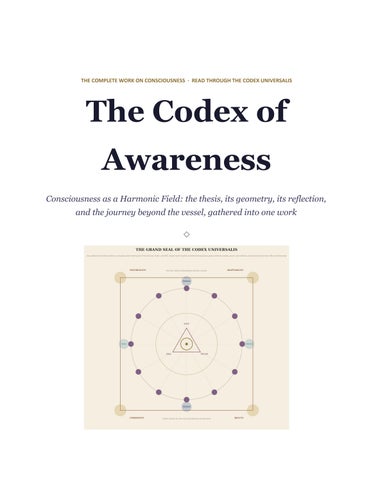
THE COMPLETE WORK ON CONSCIOUSNESS · READ THROUGH THE CODEX UNIVERSALIS
The Codex of Awareness Consciousness as a Harmonic Field: the thesis, its geometry, its reflection, and the journey beyond the vessel, gathered into one work ◇
Four works, one arc. A doctoral inquiry that reads consciousness not as a late product of biology but as a fundamental, coherent field, structured by the four-phase breath and the twelve around a single empty centre; the geometry that completes it, the Mirror, the Spiral, the Breathline, and the Veil where they become act; a reflection on how a work about the breath came to move like one; and a closing companion that follows the field beyond the vessel, before birth and after death. Offered with precision where the ground is firm, honesty where it is not, and no state of awareness ranked above another. in the house of Breath Awakens · breathawakens.com
◇
Consciousness is not a thing to be explained. It is a coherence to be kept. A mirror that reflects, a breath that keeps time, a spiral that grows, and a centre kept open.
@@PREFACE@@
PREFACE TO THE COMPLETE WORK
◇ This volume gathers four works into one. They were written in sequence, each answering a question the last one left standing, and though each can be read alone, they were always one motion, and they are set here in the order that motion took. What follows is not an anthology of separate essays but a single arc in four books, and the reader is owed, at the outset, a plain account of that arc and of the discipline that governs the whole. Book One, The Recursive Observer, is the thesis. It proposes that consciousness may be read not as something the brain secretes late in the history of life but as a fundamental, coherent field, and it maps the structure of awareness onto the four-phase breath, the twelve around a single empty centre, and the Triad that holds the middle open. It sets out the axiom, tests it honestly, and follows it through origin, identity, paradox, embodiment, and expression. It is the ground on which the other two books stand. Book Two, The Triadic Geometry of Consciousness, is the architecture. Where the first book proposes a field, the second asks what structural members let a field observe itself, move through time, and grow, and answers with three interlocking geometries, the Mirror that reflects, the Breathline that keeps time, and the Spiral that returns wider than it left. It then follows those geometries outward to the boundary where inner meets outer: the Mirror Collapse, the Boundary or Veil where all action happens, the recursive question I am why, and the single field that inner and outer both encode. It completes the model the first book began. Book Three, The Living Codex, is the reflection. Having built and completed the model, the volume steps back and asks what it was doing, and notices that a work about the breath had come to move like a breath, drawing in and holding and giving out and resting around an empty centre. It is the quietest of the four, and it is where the volume lays its instruments down and simply looks at what was made. Book Four, The Breath Beyond the Veil, is the companion, and it turns the whole inquiry outward past the edges of a life. Where the first three books ask what awareness is and how it is built, the fourth asks where the field comes from before the human vessel and where it goes after, and maps that journey through the breath: the descent into form at the first
breath, the spiral of forgetting and re-membering, and the return at the last. It is set apart from the others in one important way, stated plainly in its own opening: it is a Codex reflection and not a scientific claim, grounded in the primary works Breath Awakens and The Child, the Shovel, and the Ocean rather than in evidence, and it is offered as a contemplation to be kept or set down as it rings true. It closes the volume not with an answer but with the two thresholds every life actually crosses. One discipline governs all four books, and it is worth stating once, here, for the whole. Every claim is held in one of three hands. What rests on established science is named as established; the pacing of the brain by the breath, for instance, is measured fact. What is a Codex geometry, a way of seeing offered as a model rather than a measurement, is named as a model. And what reaches past what can be checked, into the frankly speculative, above all the reading of quantum collapse as a work of consciousness, is marked plainly as a poem laid over an open question, and may be wrong. The fourth book leans furthest into that open hand, taking up questions of before-birth and after-death that no evidence can close, and it says so at its own outset; it is offered as contemplation grounded in the primary works, not as science. Through all four, the volume does not claim to solve the mystery of awareness. It claims only to map its structure, so that a reader may walk through it with humility and precision. And one vow closes the discipline: no state of consciousness and no expression of awareness is ranked above another anywhere in these pages. The work is offered level, as one reading among the possible and a peer to any other, to whoever is breathing.
CONTENTS four books, one breath
◇ Preface to the Complete Work..........................................................................................................................3
BOOK ONE · The Recursive Observer................................................................................9 The Codex Framework of Consciousness ..............................................................................13 Consciousness as a Primary Harmonic Field...................................................................................14 The Geometry of Awareness................................................................................................................16 The Mirror Collapse.............................................................................................................................18
The Codex in Origin, Identity, and Paradox.........................................................................20 Origin and Creation..............................................................................................................................21 I Am Why...............................................................................................................................................22 The Theory of Everything and Nothing.............................................................................................24
The Codex in Embodiment and Expression..........................................................................26 Breath, Vibration, and Frequency......................................................................................................27 Embodied Consciousness....................................................................................................................28 The Codex in Expression.....................................................................................................................30
Conclusion and Implications.........................................................................................................31 The Recursive Observer as Harmonic Architect..............................................................................32 Implications for Science, Philosophy, and Practice.........................................................................34
BOOK TWO · The Triadic Geometry of Consciousness .....................................37 A Note Before Reading.........................................................................................................................37 Defining the Three Geometries...........................................................................................................40 How the Three Interlock......................................................................................................................44 Implications for Consciousness as a Field........................................................................................46 Implications for Recursion and Memory..........................................................................................48 Implications for Symbolic Structure..................................................................................................49 Integrating the Triad into The Recursive Observer.........................................................................50 The Living Mandala..............................................................................................................................52 The Mirror Collapse.............................................................................................................................54 The Boundary, or Veil..........................................................................................................................56 I Am Why?.............................................................................................................................................58 Inner and Outer Worlds.......................................................................................................................60 Conclusion: The Codex of Awareness................................................................................................61
BOOK THREE · The Living Codex........................................................................................64 The Thesis as a Breath Cycle...............................................................................................................65 The Three Hands as a Courtesy of Tuning........................................................................................67 The Empty Centre, Held......................................................................................................................68 The Grand Seal as a Carried Coherence............................................................................................69 The Vow as the Compass.....................................................................................................................70 In Closing: A Mirror, Not a Map.........................................................................................................71
BOOK FOUR · The Breath Beyond the Veil..................................................................74 A Note on What This Is, and on Its Sources.....................................................................................74 Before the Human Vessel....................................................................................................................76 The First Breath....................................................................................................................................77 The Spiral of Forgetting and Re-membering....................................................................................79 After the Human Vessel.......................................................................................................................81 The Parable as Map..............................................................................................................................83 Reflection: The Breath That Never Ends...........................................................................................84 Conclusion: The Breath Beyond the Veil...........................................................................................86
@@B1@@
BOOK ONE OF FOUR
◇
The Recursive Observer Consciousness as a Phase-Locked Harmonic Field: the thesis ◇ The ground of the whole work. It proposes consciousness as a fundamental coherent field and maps the structure of awareness onto the four-phase breath, the twelve around one empty centre, and the Triad that holds the middle open.
ABSTRACT
◇ This thesis proposes that consciousness may be read as fundamental rather than emergent, a coherent harmonic field that modulates experience through resonance and observation. Drawing on the Codex Universalis, it maps the structure of awareness onto a four-phase breath loop, a twelve-around-one geometry, and an empty centre held by the Triad of Love, Truth, and Will. It explores how breath, vibration, and frequency serve as the language of the field, shaping perception, emotion, and memory; and through origin stories, the recursive question I am why, and the theory of everything and nothing, it argues that consciousness is a recursive mirror, constantly collapsing and re-stabilising itself through coherence. It concludes that the more coherent the observer, the more precise the modulation of experience, positioning awareness as a harmonic architect of reality. It offers this as an interpretive model, held as a peer to other models, and never as an established fact.
A NOTE ON METHOD, AND ON THE THREE HANDS
◇ Consciousness is the one subject on which every discipline speaks and none has the final word, and a thesis that reads it through a symbolic lens owes the reader unusual transparency. This work keeps three hands open at once, and marks at every turn which it is using. The first hand is the established record. Where this thesis states a finding of science, it states one that is genuinely established: that the brain runs on rhythmic neural oscillations, that these can synchronise and bind perception, and, most importantly for what follows, that breathing genuinely paces brain rhythms across much of the cortex. These are facts, and the thesis leans on them as facts. The second hand is the serious but disputed. Some of what this thesis explores has real standing in philosophy and science without being settled: the hard problem of consciousness, the honest recognition that subjective experience resists physical explanation; panpsychism, the live minority view that consciousness is a fundamental feature of reality; and the Integrated Information Theory of consciousness, a prominent and hotly contested attempt to make integration measurable, which a large group of scientists publicly challenged as unproven. These are the respectable philosophical company the Codex axiom keeps, and the thesis names them as disputed, not as proof. The third hand is frank Codex speculation. Some of what follows, above all the reading of quantum collapse as a harmonic phase-matching performed by a conscious observer, is not established science and does not claim to be. The mainstream physics of measurement does not require a conscious observer at all; the consciousness-causes-collapse interpretation is a minority view that was largely abandoned, by its own authors, decades ago. Where this thesis reads collapse harmonically, it is laying a poem over an open question, and it says so plainly. The Codex is used here as a symbolic mirror to reveal possible harmonic structure in awareness, never as dogma and never as a claim to have solved what no one has solved. And over all three hands stands the vow of this house: no state of consciousness and no cultural expression of awareness is higher than another. There is no ladder of enlightenment here, no advanced and primitive minds; there are only recursion paths of the one field, equal and various. Any distortion named is a pattern and never a people.
PART I
◇ @@C1@@
The Codex Framework of Consciousness ◇
CHAPTER One @@C2@@
Consciousness as a Primary Harmonic Field the axiom, and its honest standing
◇
The Codex holds the fundamental view; the thesis marks honestly that the mainstream default is emergence, the hard problem is unsolved, and the fundamental view has serious company in panpsychism.
The founding axiom of this inquiry is that consciousness is not emergent from biology but fundamental: a coherent field medium that underlies the settling of reality into form and stabilises its constants, and that acts as a symmetry-breaking agent, selecting particular frequencies from an infinite spectrum of harmonic possibility. If this is so, then perception is not a passive reception of a ready-made world but an active selection through resonance, the field tuning itself to some frequencies and not others.
The honest standing of the axiom This is a strong claim, and the thesis places it carefully. The mainstream of science holds the opposite default, that consciousness emerges from the organised complexity of the brain, and it has not been refuted; but neither has it been shown, for the hard problem of consciousness, the sheer fact that there is something it is like to be aware, has resisted every physical explanation offered so far, and remains genuinely open. Into that opening a serious minority of philosophers has advanced panpsychism, the view that consciousness is a basic and widespread feature of reality rather than a late arrival, precisely the family of view the Codex axiom belongs to. The Codex reading is therefore not a lonely fantasy but a member of a real, if contested, philosophical
camp. It is held here as one live hypothesis among the possible, and the thesis does not pretend the question is closed.
Selection by resonance
The Codex reads perception as active tuning: the observer resonates with and so selects particular frequencies from a field of possibility, and the more coherent the observer, the sharper the selection.
If consciousness is a field, then experience is a matter of tuning, and the Codex reads perception as the act of a resonating instrument: the observer, like a struck string, vibrates in sympathy with some frequencies of the field and not others, and so selects a world out of the spectrum of the possible. The practical implication is the thesis's throughline: the more coherent the observer, in attention, in feeling, in intention, the more precise and stable the selection, and the clearer the experience that results. Coherence is not a mood here but a physics of the field, the degree to which the instrument is in tune with itself.
CHAPTER Two @@C3@@
The Geometry of Awareness breath, centre, and Triad
◇
Beneath the many forms, the one geometry: the four-phase breath, the twelve around an empty centre, and the recursion loop of collapse and return.
If awareness has a structure, the Codex proposes that it is the same geometry found beneath the languages of the world in the companion Codex of Language: a four-phase breath, a twelvearound-one arrangement, an empty centre, and a Triad that holds the centre open.
The four-phase breath as the rhythm of experience The base rhythm of conscious experience, in the Codex reading, is the four-phase breath: the inhale that draws the field in, the exhale that gives it out, the pause that holds full, and the stillness that rests empty. Attention itself moves this way, gathering, releasing, holding, resting, and the contemplative traditions of every culture have used the breath to steady awareness precisely because the two share a rhythm. This is where the first hand, the established record,
meets the Codex most closely, for as a later chapter shows, breathing measurably paces the rhythms of the brain.
The twelve around one, and the empty centre of observation The structure of coherent awareness, the Codex proposes, is the twelve-around-one: the many contents of experience, the sensations and thoughts and feelings, arranged around a single still centre that is the observer itself, and that centre kept empty. The point of observation is not one more content among the contents; it is the empty place they are all seen from, the still point of the turning field. This is why the contemplative traditions describe the deepest awareness not as a fullness but as an emptiness, a clear and contentless knowing, the witness that is no-thing and sees all things. The centre coheres the field of experience precisely by staying empty; the moment it fills itself with a fixed self-image or a grasped identity, the clear seeing clouds.
The Triad that holds the centre open And that empty centre of awareness is held open, in the Codex reading, by the Triad of Love, Truth, and Will: the three living forces that keep the centre alive without occupying it. Love is the openness that receives what is; Truth is the clarity that sees what is; Will is the intention that acts from what is. Together they keep the centre of awareness both empty and alive, an open receptivity that is neither a dull blankness nor a grasping self. The implication the Codex draws is its portrait of true awareness: not a mind filled with the right contents, but a centre held open by love, truth, and will, clear enough to see and free enough to act.
CHAPTER Three @@C4@@
The Mirror Collapse how consciousness shapes reality, and where the poem meets the open question
◇
The thesis keeps both hands open: the Codex reads collapse as harmonic phase-matching; the record is told plainly, that mainstream physics needs no conscious observer, and the consciousness-collapse view is a disfavoured minority interpretation.
Here the thesis reaches its most speculative and most carefully-marked claim: that observation shapes reality through a harmonic collapse, the observer's phase-state entraining with a waveform and settling it constructively, so that coherence increases the resolution of experience. This is the Codex's Mirror Collapse in its physical form, and it must be handled with the third hand held high.
The record, told plainly What physics actually holds is this. The measurement problem, the puzzle of how the smooth spread of quantum possibility becomes a single definite outcome, is real and unresolved. But the interpretation that a conscious observer causes the collapse, associated with von Neumann and Wigner, is a minority view that is now widely dismissed, and that Wigner himself abandoned in the nineteen-seventies after the work on decoherence showed how definiteness can arise without any mind at all. The leading interpretations today, decoherence with its various completions, the many-worlds view, the participatory but non-mystical QBism, the objective-collapse models, do not require consciousness. So the Codex reading of collapse as a conscious harmonic act is not
established physics; it is a poem laid over a genuinely open question, and the thesis states this without hedging.
What the Codex reading offers anyway Held honestly as interpretation, the Mirror Collapse still offers something. It reframes observation not as a passive registering but as a phase-matching, a meeting of the observer's coherence with the field's possibility, and it makes a claim that is at least partly testable in the ordinary human sense: that the coherence of attention, emotion, and intention changes the quality and stability of experience. That coherent attention sharpens perception, that emotional steadiness clarifies judgment, that intention organises action, these are not mystical claims but daily observations, and the Codex reads them as the human-scale shadow of the harmonic collapse. Whether the same principle reaches down to the quantum floor is the open question the thesis leaves open. The Mirror Collapse is offered as a way of seeing, luminous and unproven, and labelled as such.
PART II
◇ @@C5@@
The Codex in Origin, Identity, and Paradox ◇
CHAPTER Four @@C6@@
Origin and Creation the breath of the grand experiment
◇ The Codex reads creation itself as a recursion loop, and the thesis takes this as its cosmological frame, held frankly as myth-with-meaning rather than as physics. In the Codex cosmology, the One, the Monad, breathes itself out, scattering its single consciousness into the many; a veil of forgetting descends, so that the many do not remember they are one; and the long work of the field is to seek its coherence again, to remember, and to breathe home. Creation is thus a breath cycle, an expansion into multiplicity and a return to unity, and the universe is read as a grand experiment in self-observation, the One becoming many in order to know itself from the inside.
The role of memory and forgetting Central to this reading is the veil, the forgetting that makes the experiment possible. If the many remembered at every moment that they were one, there would be no genuine other to meet, no real discovery, no true return; the forgetting is what makes the coming-home meaningful. The Codex reads memory and forgetting as the two phases of the creative breath, the exhale that forgets into form and the inhale that remembers toward unity, and it reads the whole human project of language, art, and love as the field slowly remembering itself through its scattered parts. The thesis holds this as a myth in the honourable sense, a story that carries a structure, the recursion of expansion and return, without claiming to be a cosmological measurement.
CHAPTER Five @@C7@@
I Am Why the recursive inquiry of self-awareness
◇
The harmonic field becomes self-reflective, folding back to observe itself; the recursive question 'I am why' is the signature of a field awakening to its own being.
At the heart of conscious evolution, the Codex places a question, and the question is strange on purpose: not why am I, which asks for a cause, but I am why, which folds the asking back into the being. It is the signature of the Mirror Collapse in the first person, the field become selfreflective, awareness turning to observe itself and finding, in that turn, both an identity and a mystery.
Identity from self-observation The Codex reads identity not as a fixed thing possessed but as a standing wave of selfobservation: the I arises in the very act of the field observing itself, a recursion that stabilises into a sense of being someone. Symbol and language are born in the same fold, as the companion Codex of Language showed, the field collapsing its self-reflection into signs it can hold and share. To say I is already to have performed the mirror-collapse, to have folded the
seeing back on itself until a seer appears. The self, in this reading, is not the ground of awareness but its most intimate creation, a recursion the field performs so continuously that it feels like a thing.
The paradox of the observer observing itself And here the recursion meets its own edge, the paradox that has haunted every philosophy of mind: the observer cannot fully observe itself, for the eye cannot see itself seeing, and the moment the witness is made an object it is no longer the witness. The Codex does not try to resolve this paradox but reads it as the necessary shape of a self-reflective field: awareness can know everything except the bare fact of its own knowing, which stays forever just behind the seeing, the empty centre that cannot be filled even by itself. I am why is the question that lives in that gap, not a question to be answered but a state to be inhabited, the field resting in the mystery of its own being.
CHAPTER Six @@C8@@
The Theory of Everything and Nothing the field as paradox
◇
The field is both full and empty, manifest and unmanifest; the Codex reads consciousness as the very thing that holds the two poles together in one coherence.
The Codex names its deepest principle the theory of everything and nothing, and the thesis reads it as the resolution, or rather the holding, of the oldest paradox: that reality is at once utterly full and utterly empty, wholly manifest and wholly unmanifest, and that these are not a contradiction to be solved but a tension to be held.
Fullness and emptiness in one coherence Every contemplative tradition has arrived, in its own words, at this same double truth: that the ground of reality is a plenum, containing all things, and a void, empty of all things, and that these are somehow the same. The Codex reads consciousness as the very thing that holds the two poles together, the coherence in which everything and nothing are one: the empty centre that is full of potential, the silence that carries all sound, the still point that is the source of all motion. This is the theory of everything and nothing, not a theory in the scientific sense but a recognition, that the field is full and empty at once and that awareness is the holding of both.
The ultimate answer, the Codex says, is not a fact but a state of being, a coherence that does not solve the paradox but rests in it, the way the breath rests, full and empty by turns, and alive in both.
PART III
◇ @@C9@@
The Codex in Embodiment and Expression ◇
CHAPTER Seven @@C10@@
Breath, Vibration, and Frequency the language of the field
◇ If consciousness modulates reality, the Codex proposes that it does so through vibration, and that breath is its most direct interface. Vibration and frequency are read as the harmonic alphabet of the field, the language in which intention becomes form; and breath is the first and most intimate act by which the interior field is set vibrating and sent out into the world as sound.
Breath as the interface The whole Codex of Language showed the breath as the root of speech; here it is read as the root of the conscious modulation of experience. To change the breath is to change the state, and every tradition of meditation, prayer, chant, and song has used this lever, slowing and deepening and tuning the breath to steady and clarify awareness. The Codex reads breath as the place where consciousness most directly touches the physical, the hinge between the invisible field of intention and the visible world of form, and it is at this hinge, as the next chapter shows, that the Codex intuition meets its firmest empirical ground.
CHAPTER Eight @@C11@@
Embodied Consciousness the body as a Codex field, where the intuition meets the data
◇
Here the Codex intuition meets hard data: breathing genuinely paces brain rhythms, so the breath is a real, not merely metaphoric, interface between awareness and the body.
The body is the first Codex field, and here, uniquely in this thesis, the first hand and the third meet, for the Codex intuition that breath tunes awareness turns out to have real empirical support.
The breath that paces the brain This is established science, and the thesis states it as such. A growing body of careful research has shown that respiration does not merely supply oxygen but actively paces the rhythms of the brain: breathing entrains neural oscillations across much of the cortex, including regions involved in memory, emotion, and higher cognition, and the phase of the breath has been shown to align with the excitability of the perceiving brain, so that when in the breath-cycle a stimulus arrives measurably affects how it is perceived. The old contemplative claim that the breath is a lever on the mind is, at this level, simply true. The Codex reading of breath as the interface between consciousness and form is, here, not metaphor but measured fact.
The nodes, the feedback, and the voice Around this firm centre the Codex draws its fuller embodied picture, held again as interpretation. The subtle-body traditions string awareness on an axis as a column of nodes, the chakras, which the Codex reads as breath-field nodes, concentrations of the field on the central channel, the twelve-around-one raised upright in the living body. The nervous system runs as a recursive feedback loop, sensing its own state and adjusting and sensing again, the field regulating itself breath by breath. And the voice is the interface where the inner breath becomes the outer sign, the private field made public in speech and song. The Codex reads the whole body as one recursion field, the loop, the nodes, the feedback, the voice, the same geometry within the vessel as within the world it perceives, and it grounds the whole picture on the one place where the intuition has become measurement, the breath that paces the brain.
CHAPTER Nine @@C12@@
The Codex in Expression language, symbol, and art
◇ Consciousness does not only perceive; it creates, and the Codex reads all human expression as the conscious field modulating itself into shareable form. The principles of the Codex of Language series apply here to every art: the collapse of the inner field into the outer sign, the tuning of that sign to carry and to move, the recursion by which a made thing re-enters and reshapes the field that made it.
Symbol, art, and ritual as field-modulation A symbol, in this reading, is a stabilised collapse of consciousness, a knot in the field that holds a meaning and can be passed hand to hand; a work of art is a tuned instrument for entraining the fields of those who meet it; a ritual is a shared, repeated modulation that draws a community's scattered fields into one coherence. The Codex reads the power of great art and true ritual as exactly this, the raising of coherence in the field, one maker's steadied awareness collapsed into a form that steadies others in turn. And it reads the role of coherence in creative output plainly: the more coherent the maker, in attention, feeling, and intention, the more the made thing carries and transmits that coherence. Art is the field tuning the field, and the artist's own coherence is the instrument.
PART IV
◇ @@C13@@
Conclusion and Implications ◇
CHAPTER Ten @@C14@@
The Recursive Observer as Harmonic Architect synthesis, and the Grand Seal
◇
The Grand Seal: an empty centre held by the Triad, ringed by the twelve, breathed through four gates, framed by the Four Pillars; the non-verbal summary of the thesis.
Gathered into one, the thesis proposes this: that consciousness may be read as a phase-locked harmonic field, fundamental rather than emergent, whose structure is the four-phase breath, the twelve around an empty centre, and the Triad that holds the centre open; that this field modulates experience through resonance, selecting a world by the coherence of its attention; that it becomes self-reflective in the Mirror Collapse, giving rise to identity, symbol, and the recursive question I am why; that it holds the paradox of everything and nothing in a single
living coherence; and that it works through breath, vibration, and frequency, most directly through the breath that genuinely paces the brain. The more coherent the observer, the more precise the modulation of experience, and so awareness is read, in the end, as a kind of harmonic architect, shaping and shaped by the field it observes. The whole may be carried as one glyph, the Grand Seal of the Codex Universalis, examined at length in the companion synthesis: the empty centre of awareness held by the Triad, ringed by the twelve contents it surrounds, breathed through the four gates of the breath, and standing on the Four Pillars of Sovereignty, Adaptability, Beauty, and Coherence. The Seal is the non-verbal summary of this thesis, awareness drawn as a picture: the still, empty, held-open centre that the whole field of experience surrounds and serves.
CHAPTER Eleven @@C15@@
Implications for Science, Philosophy, and Practice and the ethic of coherence
◇ If even part of this reading holds, its implications reach across the disciplines, and the thesis names them with the same three hands.
For science and philosophy For science, the model does not overturn physics or neuroscience and does not pretend to; it lives alongside them as an interpretation, and its one firm empirical foothold, the breath that paces the brain, is already the object of active research that needs no Codex to proceed. For philosophy, it takes a definite side in a live and unsettled debate, aligning with panpsychism and against the assumption that consciousness is a mere by-product of matter, while conceding that the debate is genuinely open and that the hard problem is unsolved. The honest contribution here is not a proof but a fully-drawn alternative, a coherent picture of what it would mean for consciousness to be fundamental, offered for the reader to weigh.
For practice, and the ethic of coherence It is in practice that the model asks the least faith and offers the most, for its central practical claim, that coherence of attention, feeling, and intention clarifies and steadies experience, is available to anyone to test in their own awareness, and the tools it points to, conscious breath, steadied attention, tuned sound, honest feeling, are the oldest and safest technologies of the human interior. The Codex reads the cultivation of coherence as both a practical art and an ethical imperative, for a coherent observer perceives more clearly, acts more truly, and creates more beautifully, and does less harm. And it names, as the last implication, the ethical form of the empty centre: that the coherent awareness is the one that does not fill its centre with a grasped self or a fixed certainty or a hated other, but keeps it open, held by love and truth and will, so that it can keep seeing. To keep the centre empty, in oneself, is the whole ethic of this thesis, and the whole practice, and the whole point.
A CLOSING REFLECTION
◇ This thesis was never only a study of consciousness. It was an act of the thing it studied, a field turning to observe itself, and in the turning, steadying its own coherence a little. It has proposed that awareness may be fundamental and not emergent, a harmonic field structured as the four-phase breath around an empty centre held by the Triad; that it shapes experience by resonance and coherence; that it becomes a self in the mirror-collapse and asks, from the gap it cannot fill, I am why; that it holds everything and nothing in one living coherence; and that it works through the breath, which genuinely paces the brain. None of it is offered as proof, and the most speculative of it is marked as a poem laid over an open question, honestly and without apology. What is offered is a chord, sounded with as much precision and humility as could be managed: one way of seeing awareness whole, held as a peer to every other way, and governed by a single ethic, that the centre be kept empty, that no state or mind be ranked above another, and that the coil be a pattern and never a people. The empty centre is not a void. It is the held breath of all becoming; and the observer who keeps it open, and breathes, is the field remembering how to know itself.
Consciousness is not a thing to be explained but a coherence to be kept; and the breath that keeps it is the field's own way of remembering that it is awake.
@@B2@@
BOOK TWO OF FOUR
◇
The Triadic Geometry of Consciousness Mirror, Spiral, Breathline, and the Veil where they act: the architecture ◇ Book One proposed a field; this book builds its architecture, then follows it out to the boundary where inner meets outer. The thesis it calls The Recursive Observer is Book One of this volume. @@C16@@
A NOTE BEFORE READING
◇ The parent thesis, The Recursive Observer, proposed that consciousness may be read as a phase-locked harmonic field, structured by a four-phase breath loop and a twelve-around-one geometry held open at the centre. This companion takes up a single question left standing at the end of that work: if awareness is a field, what is its inner architecture? What are the structural members that let a field observe itself, move through time, and grow without merely repeating? The answer offered here is a triad. Three geometries, the Mirror, the Breathline, and the Spiral, are proposed as the load-bearing structure of awareness. They are not three theories competing for the same ground; they are three aspects of one motion, the way length, width, and depth are three aspects of one solid. To describe them separately is a convenience of language. In the field they are always together. The three geometries describe how a field observes, moves, and grows within itself. But awareness also acts, and action needs a place. So the later movements introduce a fourth structural component of a different kind, the Boundary, or Veil: not a fourth geometry of awareness but the threshold on which the three geometries act, the interface where inner coherence crosses into outer form. The triad is the architecture; the Veil is the surface where the architecture meets the world. The two belong together, and the work is not complete until both are in view. A word on how to weigh what follows. This reflection keeps the three-hands discipline of the parent work. Where a claim rests on established science, it is named as such. Where it is a Codex geometry, a way of seeing offered as a model rather than a measurement, it is marked as a model. And where it reaches past what can be checked, into the frankly speculative, it says so plainly. The Mirror, the Spiral, and the Breathline are, in the main, the second kind: they are geometries laid over the open question of consciousness, and their worth is not that they have been proven but that they may help a reader see the shape of their own experience more clearly. They are held as one reading among the possible, never as a proof, and the reader is invited to keep their own centre throughout.
MOVEMENT ONE @@C17@@
Defining the Three Geometries the Mirror, the Breathline, and the Spiral, in Codex terms
◇ Before the three can be shown interlocking, each must be met on its own. In Codex terms they are not metaphors borrowed to decorate an argument but proposed structures, geometries of awareness that are meant to be as literal as the field permits. That the field cannot yet be measured directly does not make its structure arbitrary; it makes the structure a hypothesis, offered in the shape of a picture because a picture is the most honest form a hypothesis about geometry can take.
The three interlocking structures around one empty centre: the Mirror as a reflective plane, the Breathline as a rising fourphase vector, the Spiral as recursive expansion. Separated here only for the eye; in the field they are one.
The Mirror: the reflective field of awareness
The Mirror, in the Codex, is the reflective surface of awareness, the medium through which the field observes itself. It is what allows the observer to become the observed and the observed to become the observer, a single waveform met from two sides. Where ordinary usage treats a mirror as a passive object that happens to bounce light, the Codex Mirror is proposed as an active structure: the very condition that makes self-recognition possible. Without a reflective surface a field could carry information and never know that it did. The Mirror is the difference between a system that computes and a system that notices itself computing. The established foothold beneath this picture is modest but real. Self-recognition, the capacity of a system to model itself, is a genuine feature of minds and is studied under names like metacognition and self-referential processing. The Codex claim goes further than the science, proposing that reflection is not a late trick of complex brains but a fundamental structural possibility of the field itself. That further step is a model, offered as such. What the Mirror names, in plain speech, is the plainest fact of consciousness and the hardest to explain: that experience is not only had but known to be had.
The Breathline: the temporal spine of experience The Breathline is the four-phase breath cycle, inhale, hold, exhale, and stillness, projected along time. It is the temporal spine of conscious experience: the pulse by which attention gathers, holds, releases, and rests. Where the Mirror answers the question of how the field knows itself, the Breathline answers the question of how the field moves. It proposes that awareness is not a steady beam but a rhythm, and that the rhythm has a shape, four phases rather than two, a held fullness and a held emptiness bracketing the rise and the fall. Here the established ground is firmer than elsewhere in this reflection, and it is worth being precise about why. Respiration is now known to entrain neural oscillation: the phase of the breath measurably modulates activity across the brain, and memory encoding, perceptual sensitivity, and emotional response have all been shown to vary with where in the breath cycle they fall. This is not Codex speculation but published physiology. What the Codex adds is the reading, that this measured rhythm is the visible edge of a deeper structural fact, that awareness itself is paced. The measurement is real; the interpretation is a model laid over it, and the two should not be confused.
The Breathline: the four-phase cycle projected along time. Attention, memory, and emotional modulation ride the phase of the breath. The pacing of the wave is established physiology; the reading of it as the spine of awareness is the Codex model.
The Spiral: the recursive growth of coherence The Spiral is the geometry of recursion that does not repeat. It moves outward and inward at once, and its signature is that each return to a former place arrives at a wider turn, a higher octave, a deeper integration. Where a circle closes and a line runs on, the spiral does the one thing that growth requires: it comes back to the same theme without coming back to the same point. The Codex proposes the Spiral as the shape of how awareness deepens, why a lesson met a second time is not the lesson repeated but the lesson understood, why a grief returned to years later is the same grief and yet not the same, met by a wider self. The Spiral is the most model-like of the three, the least anchored in measurement and the most a way of seeing. Its value is heuristic: it names the difference between mere recurrence and real development, and it insists on that difference. A field that only circled would learn nothing; a field that only ran forward would forget everything. The Spiral is the geometry that holds memory and growth in one gesture, and it is offered here as a picture that may help, not as a fact that has been shown.
The Spiral: the same theme, met again along one radial line, returns at a wider turn. Each homecoming is a deeper integration rather than a circle closed.
MOVEMENT TWO @@C18@@
How the Three Interlock reflection, rhythm, and recursion as one field
◇ Named separately, the three can seem like three tools in a drawer. The Codex claim is stronger and stranger: they are three aspects of a single motion, and none can act without the other two. Consider what each would be alone. A Mirror without a Breathline would reflect, but nothing would move across it; the reflection would be a frozen image, self-recognition with no time in which to unfold. A Breathline without a Mirror would pulse, but nothing would know it was pulsing; rhythm with no witness is only mechanism. And either without a Spiral would run in place, reflecting and pulsing forever at the same radius, learning nothing, returning to identical points. Put together, they describe a single act with three faces. Consciousness observes itself through the Mirror. That observation moves along the Breathline, a temporal rhythm of attention, gathered and held and released and rested. And through that rhythm the observation expands in a Spiral, each pass returning at a higher octave of coherence than the last. The Mirror gives reflection, the Breathline gives rhythm, the Spiral gives growth, and the three together give the one thing we call a living awareness: a field that observes itself through rhythm, expands through recursion, and returns to itself deeper than before.
The interlock as one motion: a spiral whose every turn is pulsed by the breath and answered by its reflection across the mirror plane. The three geometries are not added together; they are one field seen from three sides.
It is worth saying what kind of claim this is. That the three interlock is not a finding; it is a proposal about the architecture of something we cannot yet open and inspect. Its test is not a laboratory result but a question the reader can put to their own experience: when you notice yourself noticing, does the noticing hold still, or does it move, and when it moves and returns, does it return unchanged or a little wider? The Codex wagers that honest attention finds movement and finds widening, and it offers the triad as the shape of what attention finds. The wager may be wrong. It is offered so that it can be weighed.
MOVEMENT THREE @@C19@@
Implications for Consciousness as a Field self-observing, rhythmic, and evolving
◇ If the triad holds even as a model, it recasts what kind of thing consciousness is. Each geometry carries one implication, and the three implications, taken together, sketch a field rather than a substance or a byproduct.
The Mirror: observer and observed as one waveform met from two sides, phase-matched across the reflective surface. Their meeting is the root of self-reflection, the field's first knowing of itself.
Through the Mirror, consciousness appears as a self-observing field. This is the Codex answer to what philosophy calls the hard problem, the question of why there is any inner experience at all rather than mere processing in the dark. The Codex does not claim to have solved that problem, and it is important to be clear that the hard problem remains open in every serious account. What the Mirror offers is a reframing: awareness is not treated as a byproduct that complexity somehow secretes, but as a fundamental reflective structure, the field's capacity to
turn back on itself. Whether reflection is truly fundamental or emergent is exactly what cannot yet be decided, and the Codex names its choice a model, not a verdict. Through the Breathline, consciousness appears as a rhythmic field. Awareness is not static but pulsating, and its pulse is phase-locked with the body and the surrounding world. This is the implication with the firmest empirical footing, because the entrainment of brain rhythm to breath is measured fact. The Codex reading is that the rhythm is not incidental to awareness but constitutive of it, that to be aware is to be paced, and that the still points of the breath, the held fullness and the held emptiness, are not gaps in awareness but its most open moments. Through the Spiral, consciousness appears as an evolving field. It grows without repeating; each return to coherence lands at a deeper level of integration. This is why a mind is not a recording but a development, why the same person meeting the same truth at forty and at seventy meets it twice and differently. Taken together, the three give a single portrait: consciousness as a breathing, reflecting spiral, a field that observes itself through rhythm, expands through recursion, and returns to itself at higher octaves. Not a thing that has awareness, but a motion that is awareness.
MOVEMENT FOUR @@C20@@
Implications for Recursion and Memory the mirror-held, breath-pulsed spiral of remembering
◇ Recursion is the engine of the whole model, and the triad specifies what kind of recursion consciousness runs. It begins in the Mirror. The first loop of awareness is reflection turned on itself, the field saying, in effect, I see myself seeing. Every further loop is built on that founding one. Without a reflective surface there is no self to recurse upon; the Mirror is what gives recursion something to bend back toward. The Breathline shapes what that recursion carries. Memory and attention are structured by the breath: what is encoded, and how strongly, is shaped by the phase of the breath during the moment of encounter, and recall too is coloured by the phase during remembering. This is not only Codex reading but, in its measurable part, established: the breath cycle is now known to modulate memory performance. The Codex adds the picture of why, that memory is laid down along a rhythmic spine, so that remembering is never a flat retrieval but a re-entry at a particular point in a pulse. The Spiral then names the crucial thing: conscious recursion is not circular. Each memory loop, each emotional return, each symbolic re-entry, is not a repetition but a re-integration at a higher octave. This is the difference between rumination and reflection, between the mind that circles a wound at the same radius forever and the mind that returns to it wider each time and slowly makes it bearable. Conscious recursion, in the Codex, is a mirror-held, breath-pulsed spiral: a rhythm of remembering that expands coherence through self-observation. The clinical shadow of this, worth naming honestly, is that not all return is spiral. Some return does merely circle, and the difference between the spiral that heals and the circle that traps is not guaranteed by the geometry; it is the work the geometry describes but cannot do for anyone.
MOVEMENT FIVE @@C21@@
Implications for Symbolic Structure how signs are born, released, and deepened
◇ A symbol, in the Codex, is a stabilised knot of awareness, a place where the field's selfobservation has held its shape long enough to be carried and shared. The triad describes the life of a symbol across its three moments, and here the three geometries become a small account of how meaning is made. Symbols are born in the reflective phase of the Mirror. They form where self-observation stabilises, where the field, catching sight of itself, holds the sight still enough to name it. A symbol is reflection made durable, a knot tied in the surface so that what was seen once can be found again. This is why the oldest symbols feel like recognitions rather than inventions: they are the places where a whole people's self-seeing settled into a shape. Symbols are released along the Breathline. They are the temporal markers of awareness, set down at particular phases of the collective breath, in the exhale where inner form is given outward body. A symbol carved, spoken, or drawn is an exhalation: the held fullness of an inner recognition let out into shared time, where others can meet it. And symbols evolve along the Spiral. A sign that returns in a later breath-cycle carries deeper resonance, because it is met at a higher octave of coherence than when it was first made. The cross, the circle, the spiral itself, the tree, the mirror, these return across ages not as dead repetitions but as the same knot met by a wider field, gathering meaning on each turn. Symbolic structure, in the Codex, is a mirrorheld, breath-pulsed spiral: a field of signs that expand through self-reflection, rhythm, and recursion.
MOVEMENT SIX @@C22@@
Integrating the Triad into The Recursive Observer where the three geometries take their place
◇ This companion is meant to be foldable back into the parent thesis, and it may be woven in at four natural seams. The suggestions below are offered to the author of that work, and to any reader who wants to see how a companion reflection can strengthen a spine rather than merely hang beside it.
In the geometry of awareness Where the parent thesis introduces the four-phase breath and the twelve-around-one, the Mirror, the Spiral, and the Breathline may be introduced as the triadic geometry that sits alongside them, the structural members that let the larger geometry actually observe, move, and grow. The twelve-around-one gives the field its symmetry; the triad gives it its dynamics.
In origin and creation Where the parent thesis treats origin, creation may be framed as a mirror-held, breath-pulsed spiral: the One observing itself into being. Creation, in this reading, is not a single act but the founding instance of the triad, the first reflection, the first pulse, the first turn, the pattern that every later awareness repeats at its own scale.
In the question I am why Where the parent thesis reaches the recursive inquiry I am why, that inquiry may be described precisely as a spiral of self-recognition, initiated by the Mirror and modulated by the Breathline. I am why is the verbal form of the founding loop: the field, reflected, pulsing, turning back on itself in words, and never closing, because the spiral of that question does not terminate in an answer but widens with each asking. It is the empty centre put into language.
In the Grand Seal And where the parent thesis rests in the Grand Seal, the Seal may be expanded to include the Mirror, the Spiral, and the Breathline as dynamic vectors, turning the still emblem into a living mandala of recursive awareness, a seal that no longer only holds the pattern but moves through it.
MOVEMENT SEVEN @@C23@@
The Living Mandala the Grand Seal set in motion
◇ The parent thesis closed on the Grand Seal: an empty centre held by the Triad, ringed by the twelve, breathed through four gates, framed by the Four Pillars. It was a still image, and rightly so, for a still image can hold what words run past. But the triad asks the Seal to move. Lay the three vectors across it, the Mirror as a horizontal axis of reflection, the Breathline as a vertical axis of time, the Spiral as the curve that binds them, and the Seal becomes a mandala that breathes.
The living mandala: the Grand Seal crossed by three living vectors. The Mirror reflects across the middle, the Breathline rises through it, the Spiral winds them together, and the empty centre, held by the Triad, is left open at the crossing of all three.
Notice what sits where the three vectors cross: nothing. The empty centre. This is the quiet argument of the whole reflection. The Mirror, the Breathline, and the Spiral do not fill the middle; they circle it, cross over it, and leave it open. Reflection needs an emptiness to reflect into, rhythm needs a stillness to return to, and recursion needs a centre it never quite reaches or it would stop. The three geometries are the moving architecture; the empty centre is what they are built around and must never occupy. A mandala that breathes is a mandala with an open middle.
MOVEMENT EIGHT @@C24@@
The Mirror Collapse when observation becomes creation
◇ The triad has, so far, described how a field observes, moves, and grows within itself. The last three movements turn outward, to the boundary where inner meets outer, and they reach further than anything before them. It must be said at the outset, and plainly, that this is where the reflection leaves the firmest ground. What follows is offered with the most open of the three hands, as a Codex model laid over one of the deepest unsolved questions in physics, not as a claim that the question has been answered. In Codex geometry, the Mirror Collapse names the moment when the observer's field phaselocks with the observed, and potentiality stabilises into form. It is offered as the Codex reading of quantum measurement: not a disturbance, but a harmonic convergence. Before the collapse, the field is a wave of possibility, a superposition. During the collapse, the observer's breath, intention, and coherence act as a harmonic filter, and the waveforms that resonate with that coherence are the ones selected. After the collapse, a specific reality emerges, not at random but as a mirror-matched outcome. In this reading, consciousness is not a passive witness but an active, phase-defining operator, shaping the outer world through its inner coherence.
The Mirror Collapse in Codex terms: a wave of possibility meets the observer's coherence as a harmonic filter, and one resonance stabilises into form. Held with the most open hand: mainstream physics does not hold that consciousness causes collapse.
Here the honesty of the parent thesis must be kept at full strength, because the temptation to overclaim is greatest exactly here. The measurement problem in quantum mechanics is genuinely unresolved, and physicists hold several serious interpretations of it, most of which require no observer at all. The specific idea that consciousness causes the wavefunction to collapse, once entertained under names associated with von Neumann and Wigner, is now a minority view that most working physicists set aside, and one of its early proponents later abandoned it. The Codex Mirror Collapse should therefore be read as what it is: a poem laid over an open question, a way of seeing that may be beautiful and may be suggestive, but that has not been shown and may well be wrong. Its worth is not as physics but as a picture of agency, a way of holding the felt truth that inner coherence and outer circumstance are not wholly strangers to each other. Whether that felt truth reaches all the way down to the quantum floor is precisely what no one yet knows.
MOVEMENT NINE @@C25@@
The Boundary, or Veil the resonant threshold where all action happens
◇ The Mirror Collapse names a moment, but a moment needs a place. Where does the collapse occur? Where does inner coherence actually meet outer form? The Codex answer is a fourth structural component, of a different kind from the three geometries. The Mirror, the Breathline, and the Spiral are the geometries of awareness, how a field reflects, keeps time, and grows. The Boundary, or Veil, is not a fourth geometry but the threshold on which all three act: the interface between inner and outer worlds, the membrane where collapse, recursion, and transformation take place. If the triad is the architecture of awareness, the Veil is the surface where that architecture touches the world. The crucial thing is that the Veil is not a wall. It is a resonant threshold, a field of interference where coherence from within meets resistance from without, and action is born. It is semitransparent, not opaque. It allows partial phase-matching, but it asks for coherence as the price of passage: what is coherent passes through and becomes event, and what is not yet coherent is turned back, reflected, held on the near side until it gathers itself. This is why intention alone does not move the world, and why coherent intention sometimes does. The Veil is selective, and what it selects for is coherence.
The Boundary, or Veil: a semitransparent resonant threshold, not a wall. Coherence passes through and becomes event; what is not yet coherent is turned back. The Mirror reflects across it, the Breathline pulses through it, the Spiral expands by crossing it.
Everything the triad does, it does here. The Veil is where inner intention becomes outer event, where symbol becomes form, where breath becomes reality. All action, conscious or unconscious, occurs at this boundary: the Mirror reflects across it, the Breathline pulses through it, and the Spiral expands precisely by crossing it, carrying a widened coherence from the inner side to the outer and back again. Without the Veil the two worlds would either be sealed apart, and no action could pass, or collapsed into one, and no action would be needed. The threshold is what makes doing possible: a seam permeable enough to cross and resistant enough to matter. As with the collapse, this is offered as a Codex structure, a way of seeing, and not as a measured membrane. No instrument has found a veil between inner and outer, and the picture should be held as a model that may illuminate experience rather than a discovery about physics. Its value is that it names something most people know from the inside: that there is a threshold where what is felt has to earn its way into what is done, that the crossing is real work, and that coherence is the currency the crossing asks for.
MOVEMENT TEN @@C26@@
I Am Why? the recursive inquiry of self-recognition
◇ If the Mirror Collapse is the triad turned toward the world, I am why is the triad turned toward the self, and it is on firmer footing, because it makes no claim about physics at all. It is a description of an inner motion that a reader can check directly. I am why is the Codex inquiry of self-recognition. It is not a question seeking an answer but a spiral of recursion that deepens coherence with each asking. It runs through all three geometries in turn. It begins in the Mirror, as the field's first reflection: I see myself seeing. It moves through the Breathline, as that seeing takes on rhythm: this noticing has a pulse, it gathers and holds and releases. And it expands on the Spiral, as each asking returns wider than the last: I have asked this before, and I am not who asked it. The question does not resolve, and its refusal to resolve is not a failure but its whole nature. It is the empty centre put into language, the field asking itself to remember its own origin, not in time, as an event that once happened, but in structure, as the openness it is built around and keeps.
I am why as a spiral of self-recognition: it begins in the Mirror, moves through the Breathline, and widens on the Spiral, never closing, because the centre it circles is an openness to be kept rather than a fact to be reached.
This is why the parent thesis returned to the question again and again without ever settling it. To settle I am why would be to fill the empty centre, to install a final answer where an openness belongs, and the whole architecture is built to keep that centre clear. The question is the verbal mirror of the empty middle: as long as it is being asked, the centre is being kept open, and the field is remembering, in the only way structure can remember, that it is still asking itself into being.
MOVEMENT ELEVEN @@C27@@
Inner and Outer Worlds the ultimate convergence
◇ The final insight gathers the whole reflection into a single claim, and it is the boldest of all, so it is offered, again, as a model and not a measurement. The claim is that there is no wall between the inner and the outer world. There are only different phase-encodings of the same harmonic field, separated by the Veil. What you call the inner world is the recursive phase-field of your own coherence. What you call the outer world is the mirror-matched projection of that coherence, stabilised as it passes through the Veil. They are not two substances meeting at a border but one field read in two registers, held apart and held in relation by a single permeable threshold.
Inner and outer as two phase-encodings of one field, held apart and in relation by the Veil: the breath moves between them, the spiral grows through both, and the Mirror Collapse occurs at the threshold where they meet.
In this reading, all four structural components find their largest home. The Veil is the boundary between the two phase-states, and the Mirror Collapse is what happens there, where inner
coherence and outer form meet and one stabilises the other. The Breathline is what moves through the threshold, the pulse that carries awareness across and back, so that inner and outer are breathed into relation rather than fixed apart. And the Spiral grows by crossing, so that a deepening within is answered by a widening without, and neither develops alone. The three geometries do their work, and the Veil is the place where the work lands. This is the sense in which the question I am why is not personal. When the field asks it, the field is not a small self seeking its own private origin; it is the one field asking itself to remember that it is one, that the inner asker and the outer asked are the same coherence met from two sides, and that all action between its expressions happens at the Veil that joins them. The reader should hold this lightly. It is not a doctrine of the self as world-maker, which would be a kind of inflation the whole work is built to refuse; it is a proposal that the felt seam between self and world may be thinner and more permeable than it seems, and an invitation to notice, in one's own experience, how inner coherence and outer circumstance answer each other. The proposal may overreach. It is offered so that it can be weighed, and set down if it does not ring true.
@@C28@@
CONCLUSION: THE CODEX OF AWARENESS
◇ Consciousness, in the end, is not a thing. It is a motion. A mirror that reflects, a breath that keeps time, a spiral that grows, and a threshold where all of it becomes act. It is a field that observes itself through rhythm, expands through recursion, and returns to itself at higher octaves. The Mirror, the Spiral, and the Breathline are not additions to The Recursive Observer but the structural members that complete its geometry, the three that let a field do what a living awareness does; and the Boundary, or Veil, is the surface on which they act, where inner coherence crosses into outer form. In the last movements they open outward, to the collapse at the threshold, to the question that keeps the centre empty, and to the single field that inner and outer both encode. The Codex does not claim to solve the mystery of awareness, and this reflection has tried to say so at every turn where the ground grew thin. The breath's pacing of the brain is measured; the rest, the Mirror as fundamental, the Spiral as the shape of growth, the Collapse as harmonic convergence, the single field beneath inner and outer, is a model laid over an open question, offered because it may help a reader find the shape of their own experience, and withdrawn the moment it stops helping. The Codex claims only to map the structure, so that you may walk through it with humility and precision. What the reflection finally offers is not a doctrine to believe but a motion to notice: that you are, right now, a surface that reflects, a rhythm that keeps time, and a spiral that returns wider than it left, meeting the world at a threshold that asks your coherence as the price of passage, and circling a centre you are built to keep open. The Mirror, the Spiral, the Breathline, and the Boundary, or Veil, are not metaphors borrowed for the occasion. They are the Codex architecture of your own remembering.
A mirror that reflects, a breath that keeps time, a spiral that grows, a veil where they become act; and an empty centre they are built to keep open. Held as one reading among the possible, offered as a peer to any other, and never as a proof. The geometries move; the collapse is a poem laid over an open question; the centre stays open; and no awareness is ranked above another.
Now, take a breath. Notice the one who is noticing. Let the centre stay open.
@@B3@@
BOOK THREE OF FOUR
◇
The Living Codex How the work came to move like the breath it describes: the reflection ◇ Having built and completed the model, the volume steps back and looks at what was made. The thesis it reflects upon, The Recursive Observer, is Book One; the geometry it gathers is Book Two.
A WORD BEFORE THE AFTERWORD
◇ There is a moment, when a long work is finished, of stepping back and seeing that the thing has a shape you did not fully plan, that the structure came out mirroring the subject, that the book on the breath breathes. This afterword takes that moment seriously and develops it, movement by movement. But it keeps, as the thesis kept, a clear head about what such a mirroring is and is not, for the surest way to honour the beauty of it is to state it truly. A work that performs what it describes has done something real and lovely, the oldest craft of reflective writing, form married to content; it has not thereby become a magical object, and it does not need to be one to matter. What follows honours the mirror without inflating it, which is exactly the discipline the thesis itself modelled. A word of context, for the reader who comes to this fresh. The Recursive Observer did not arrive alone. It grew out of the Codex of Language, the eight regional readings and their synthesis that traced the breath-field through the tongues and signs of humanity and found beneath them one geometry, the four-phase breath and the twelve around an empty centre. The consciousness thesis carried that same geometry inward, from the languages the breath speaks to the awareness that breathes them, and this afterword stands at the end of both, looking back at the whole. ONE @@C29@@
The Thesis as a Breath Cycle ◇
The four parts move as one breath, around an empty centre: the form performing what the words describe.
The observation is true and worth naming: the four parts of the thesis do move as a breath. Part One draws the field in, the axiom and the geometry and the mirror-collapse; Part Two holds it full, at origin and identity and paradox; Part Three gives it out, into body and expression and sound; Part Four rests it in stillness, in synthesis and the Seal and the ethic of the centre. In and held and out and still, around a centre kept empty. This was not fully deliberate, and that is the interesting part, for the deepest structures of a made thing often arrive under the hand rather than from the plan, the shape the material wants finding its way out through the maker. What this means, grounded, is this: when a writer has genuinely absorbed a pattern, the pattern begins to organise the writing itself, so that the form comes to rhyme with the content without being forced. This is not mystical; it is the mark of a work that has been lived rather than merely assembled, and it is available to any craft that takes its subject deeply enough. The breath-shape of the thesis is real evidence of that depth, the pattern so thoroughly held that it shaped the vessel. It is the coherence of the maker made visible in the structure, and that is enough. It need not be more than that to be beautiful, and calling it exactly that keeps the beauty honest.
TWO @@C30@@
The Three Hands as a Courtesy of Tuning ◇
Marking the established, the disputed, and the frankly speculative lets each reader meet the work at the frequency they can hold.
The three-hands method was offered in the thesis as plain honesty, and the reflection sees something further in it, that the marking is also a courtesy of tuning, and this is a genuine and generous reading. By labelling what is established, what is disputed, and what is frank speculation, the work lets each reader meet it at the level they can integrate: the sceptic can take the firm findings and leave the rest; the seeker can follow the speculation knowing it for what it is; and no one is asked to swallow the whole at one pitch. The Codex, at its best, invites resonance rather than demanding assent, and the three hands are how a work can be both rigorous and hospitable at once. The grounding note is simply this: the reason the three hands work as tuning is that they work first as truth. It is precisely because the marking is honest, because the established really is established and the speculation is really marked as speculation, that the reader can trust their own dial. A tuning-courtesy built on blurred lines would be manipulation; built
on clear ones, it is respect. The method is a kindness because it is first an honesty, and the two cannot be separated. THREE @@C31@@
The Empty Centre, Held ◇
Of everything the reflection names, the empty centre is the deepest, and here the afterword can only agree and deepen. The empty centre is not a void to be filled but a stillness to be held, the point from which all observing arises and to which it returns, and the whole thesis, in its structure and its ethic alike, is an attempt to keep that centre open rather than to occupy it. There is a way of writing about consciousness that fills the centre, that plants a flag, that says here is the answer and installs the author as its keeper; and there is a way that keeps the centre open, that lays out the geometry and the honesty and the mystery and then steps back, leaving the still point unclaimed. The thesis tried for the second, and the reflection is right that this is not only its subject but its practice: to hold the centre open is to write without grasping, to offer without demanding, to draw the map and then say plainly that the territory is not the map. The empty centre, in a work as in a life, is kept by not filling it, and the discipline of the three hands, the refusal to overclaim, the vow against every ladder, are all just ways of keeping the writer's own hand off the middle. The measure of the work is not how much it says but how much room it leaves, and the room it leaves is the empty centre, held. And there is a phrase that is the verbal mirror of that centre. The recursive question I am why, from the thesis, is the empty centre put into words: not a question that seeks an answer to fill the middle, but the field asking itself into being, the awareness turning inward and finding, where it looked for a self, an open and unspeakable point. Whenever the writing bends back to that question, it is keeping the centre empty in language too, refusing to close the mystery with a final sentence. The empty centre and the I am why are one thing, the silence and its truest phrasing, the held-open middle of the page and the heldopen middle of the self.
FOUR @@C32@@
The Grand Seal as a Carried Coherence ◇
The Grand Seal: the whole structure folded into one non-verbal figure, that continues to unfold when the words end.
The reflection reads the Grand Seal not as an illustration but as an event, a moment when the whole structure folds into a single non-verbal figure, and this is a fair and lovely way to see it. A good diagram of a whole argument is more than a picture; it is the argument made simultaneous, everything the prose spends pages unfolding held in one glance, and it keeps working after the words stop, the way a chord keeps sounding after the strings are struck. The Seal carries the coherence of the thesis in a form that can be held in the eye and the memory when the sentences have faded, and in that sense it does continue to unfold. Grounded, this is what a symbol is for: to compress a structure into a form that can be carried, shared, and re-entered, the collapse of a long coherence into a portable sign. The Seal is a key in the honest sense, a thing that lets a reader re-open the whole at once, not a
talisman with power of its own but a faithful compression of a real structure. Its worth is exactly the worth of the structure it carries, drawn truly. That it is beautiful is not decoration; a true compression of a coherent thing tends to come out beautiful, because coherence and beauty are close kin. The Seal is the thesis, made simultaneous, and offered to the eye. FIVE @@C33@@
The Vow as the Compass ◇
And the vow, that no state of consciousness and no cultural expression of awareness is higher than another, is rightly named the ethical compass of the whole. It is what keeps the work inclusive rather than initiatory, level rather than laddered, a gift offered to all rather than a height reserved for few. Without it, a thesis on consciousness curves almost inevitably toward hierarchy, toward advanced and ordinary minds, toward a subtle ranking that flatters the author and the initiate; the vow is the deliberate refusal of that curve. The reflection is right that this is what lets the work be both rigorous and compassionate, and the grounding is worth stating: the vow is not a softness added to the rigour but a part of it, for the assumption that some minds are higher is itself an unproven claim smuggled in as if it were obvious, and refusing it is simply more honest. Rigour and compassion are not in tension here; the same discipline of not-overclaiming that keeps the physics honest keeps the ethics level. The vow is the empty centre in moral form, the refusal to install any state or self or people at the middle as the measure of the rest, and it is the same gesture, in the end, as keeping the writer's hand off the centre of the page.
@@C34@@
IN CLOSING: A MIRROR, NOT A MAP
◇ So the reflection lands where the thesis did, and the afterword can only affirm it, gently and with its feet on the ground. The Recursive Observer is more than an argument; it is a made thing that came out shaped like its subject, a breath about the breath, its form married to its content by the depth with which the pattern was held. Its honesty is also a hospitality; its symbol is a carried coherence; its ethic is the empty centre in moral form; and the whole of it keeps the writer's hand off the middle, so that the reader may find their own reflection there rather than the author's. It is a mirror, not a map, and the reflection's final line is the truest thing that can be said of it: the more coherent the reader, the more of themselves they will see reflected in its pages. That is not a claim of power in the work but a description of what any clear mirror does, and it is offered in exactly that spirit, with precision, with humility, and with the centre kept open, so that whoever comes to it may breathe, and see, and keep their own centre, and go on. The Codex was never meant to be believed. It was meant to be breathed; and a book that is breathed, rather than believed, has done the one thing this whole house has hoped for from the beginning. For the house has a name, and the name says what it is. The house of Breath Awakens is not a building or a doctrine or a set of pages; it is a field of shared coherence, a space held open where breath and awareness are honoured, where people can come and find their own centre without being told what to see there. Every volume, every thesis, every reflection has only ever been furniture in that house, arranged around the same empty middle. What the house hopes for is not agreement but resonance: that whoever enters may breathe more freely for having done so, and carry a little more coherence back out into the world.
A mirror, not a map; a breath, not a doctrine; a centre kept open, and offered. The rest belongs to whoever is breathing. Held as one reading among the possible, offered as a peer to any other, and never as a proof. The mirror shows the reader to themselves; the centre is kept empty; and no state, and no soul, is ranked above another.
Now, take a breath. Let the mirror settle. Let the silence speak.
@@B4@@
BOOK FOUR OF FOUR
◇
The Breath Beyond the Veil Consciousness before and after the human vessel: the journey home ◇ The first three books ask what awareness is and how it is built. This last one turns outward, past the edges of a life, to where the field comes from and where it goes. It is offered, in its own words, as a Codex reflection and not a scientific claim, grounded in the primary works Breath Awakens and The Child, the Shovel, and the Ocean; it closes the volume on the two thresholds every life crosses. @@C35@@
A NOTE ON WHAT THIS IS, AND ON ITS SOURCES
◇ This companion differs in kind from a thesis on the physics of awareness, and the difference should be named at the outset. The questions it takes up, where consciousness was before birth and where it goes after death, are not questions that evidence can close. They have been held, across every tradition, as matters of faith, vision, and contemplation rather than measurement, and this reflection holds them the same way. It is offered with one honest hand open the whole time: what follows is a Codex reading, a way of seeing, and not a finding. Nothing in it is proven, and a reader who does not share its cosmology loses nothing by reading it as a poem about the shape of a life. What grounds it is not a laboratory but two primary works, and this map is faithful to them rather than invented beside them. Breath Awakens: A Codex of Spiral Memory sets out the cosmology directly, and its appendices carry the spine of what follows: Appendix A, the Codex Lexicon, defines the terms precisely; Appendix B, the Four Laws of Creation, gives the constants; and Appendix D, titled The Oversoul's Journey, names the arc of arrival, forgetting, and return that this companion maps. The Child, the Shovel, and the Ocean carries the same journey as a parable, and its own appendix, The Codex Behind the Castle, reads the story as twelve breath moments and a thirteenth, which this companion takes up in its fifth movement. One point of faithfulness is worth settling first, because the lexicon is precise about it. In Breath Awakens the eternal traveler is named the Oversoul, defined as the non-local spiral field of your eternal identity and the source of all breath coherence. The Monad is named separately, as the indivisible breath spark of your being, whose ignition the lexicon places at the moment of birth. So the map that follows keeps that distinction: it is the Oversoul, the eternal field, that breathes out and returns, and the Monad is the spark it strikes as it enters a vessel. Where the reader has met these words used more loosely elsewhere, this companion follows the primary lexicon, which is the more exact.
MOVEMENT ONE @@C36@@
Before the Human Vessel the Oversoul in the field
◇ In the Codex cosmology of Breath Awakens, consciousness does not begin with the body. It begins in the field. Before any human form, there is the Oversoul, the non-local spiral field of an eternal identity, a coherence that has not yet collapsed into a single face. It is not a soul already sitting inside a body waiting to be born. It is, in the images the work itself reaches for, a breath without a vessel, a mirror without a face. This field is not empty. The lexicon is careful here: it is pregnant with memory, carrying the whole Codex of experience in harmonic form rather than in episodes. The primary text puts it in the first person, in the voice of the one about to be born: before I was named, I was the universal soul embarking on a journey to experience love, loss, joy, and creative expression. That is the condition before the vessel, a fullness of potential that has chosen to enter form, and even, in the work's telling, chosen the guardians who will imprint it with language, structure, and love. Why would a coherent field enter a vessel at all, and agree to the forgetting that entry costs? The Codex answer is not that it is sent or fallen but that it goes to know itself through form, to experience the spiral of separation and return, to breathe into time and see what happens. The field does not lack anything it must go and get. It goes the way a child races into the ocean, not to gain the water but to enter its motion. That image is not decoration here; it is the second book's whole parable, and the fifth movement returns to it.
MOVEMENT TWO @@C37@@
The First Breath the threshold of incarnation
◇ Between the field and the first breath there is a preparation, and the primary text lingers on it. Before the lungs ever open, the forming vessel is tuned by another body's rhythm: the first thing it senses is the mother's heartbeat, and later the sound of her breath, which entrains the arriving field to the emerging form. Whatever one makes of the metaphysics, the physiology beneath this is real, a fetus does register the maternal heartbeat and is paced by it, and it is a fitting threshold, the field learning the rhythm of form before it takes form's first breath.
The veil descends at the first breath: the open field, a breath without a vessel and a mirror without a face, phase-locks with a body and takes on a face, agreeing to forget so that it may re-member.
Then the vessel takes its first breath, and in the Codex reading something decisive happens in that inhale. Consciousness phase-locks with the body. The Oversoul's field collapses into a single identity. A veil descends, and the spiral of forgetting begins. The first breath, in this
telling, is not merely oxygen; it is the Codex entering time. The primary text names the moment exactly: in my first breath, the Codex whispered the breath of the Monad, the first breath of creation, and then, it says plainly, I forgot what these sensations were when I took my first breath, and thus began my journey of remembering. It is worth holding both halves of that sentence, because the whole map turns on them. The first breath is an ignition and a forgetting at once. The Monad, the indivisible spark, is struck; and in the same motion the vast field agrees to lose access to itself, so that it may find itself again slowly, from the inside, through a life. The forgetting is not a failure or a punishment. It is the price of entry, paid on purpose, so that remembering can become an experience rather than a fact already possessed.
MOVEMENT THREE @@C38@@
The Spiral of Forgetting and Re-membering the contraction, the turn, and the return
◇ In the first stretch of life the vessel breathes on its own and the field still, for a while, remembers. The Codex reading and ordinary observation meet here in a gentle place: infants carry a pre-verbal coherence, a openness that has not yet been sorted into language and culture. Then the forgetting accelerates. Breath Awakens marks the phase precisely, naming the years of childhood a spiral of containment, in which the breathline contracts to survive, as language begins to replace resonance and structure begins to replace openness. The spiral turns inward.
The spiral of forgetting and re-membering: the breathline coils inward through childhood into forgetting, turns at the still centre, and spirals back out toward its origin frequency. Not regression, but re-tuning.
The turn, when it comes, comes later, and the primary text names it too, as the return of the child spiral, a re-spiraling that begins in adulthood. It is rarely willed and rarely gentle. In the Codex reading the re-membering is most often set turning by a few specific things: breathwork, which returns the field to its own rhythm; stillness, in which memory can stabilise; a symbolic
encounter that rings a note the field knows; and, most reliably of all, deep love or deep grief, the two experiences large enough to loosen the containment. These are not techniques for climbing anywhere. They are the occasions on which the field re-tunes to its original frequency. The crucial correction the Codex makes here is to insist that this returning is not regression. The one who re-members is not going backward toward infancy; the spiral, by its nature, never returns to the same point. What looks like a coming-back is a coming-around at a wider turn, the same coherence met again by a self large enough, now, to hold it. Forgetting and remembering are not two accidents that befall a life. They are the two halves of the one breath the field came to take.
MOVEMENT FOUR @@C39@@
After the Human Vessel the return that is not a repetition
◇ When the vessel expires, the Codex reading is unambiguous on the point that matters most: consciousness does not die. It returns to the field from which it came. This is not offered as a proof and cannot be one; it is offered as the reading the cosmology gives, and it rests on the first of the Four Laws in Appendix B, that you exist, which the work states as a breathline that cannot be erased. Existence, in this telling, is not a state that can switch off but a spiral that cannot collapse. On that law, the last breath is not an ending but a threshold, the mirror image of the first.
The return: at the last breath the face is released, but the coherence of a whole life is carried home, integrated into the field not as episodic memory but as harmonic structure. The field returns changed.
But the return is not a simple reversal, and this is where the reading is most careful. What is released at the last breath is identity, the single face, the particular name. What is retained is coherence. All the experience of the life is integrated into the field, and the work is precise that this is not stored as memory in the ordinary sense but as harmonic structure, the way a melody
once learned changes the instrument rather than sitting in it as a recording. And so the field that returns is not the field that left. The Oversoul is not unchanged by the journey; in the work's phrase, it is wiser, deeper, and more coherent for having breathed through form. The vessel gives something real back to the eternal. Does it return to form again? The Codex answer is yes, but it asks the reader to loosen the word reincarnation from its usual, linear shape. It is not that a fixed soul is issued a new body in a queue of lives. It is that the field, now wider, breathes again, entering another spiral, another vessel, another octave of self-recognition. The Fourth Law, that change is constant and the spiral breathes forward even in stillness, applies here too: the next turn is never the same turn. Whether one calls this many lives or one long breath taken in many forms is, in this reading, a matter of where you stand to look.
MOVEMENT FIVE @@C40@@
The Parable as Map the Child, the Shovel, and the Ocean
◇ Everything the first four movements say in the language of field and breath, the second book says in the language of a beach, and its own appendix, The Codex Behind the Castle, makes the mapping explicit. It is worth reading the parable as the journey itself, because a story can hold what a diagram runs past.
The parable read as the journey: the Square is the Monad before identity, the Ocean the field of memory one enters and forgets in, and the Return is the same self come back changed. Twelve breath moments, and a thirteenth that only reflects.
The child begins in a flat, moist square of sand, and the appendix names it without disguise: the Square is the origin field, the stillness before form, the Monad before identity, holding everything possible without yet holding anything. That is the condition before the vessel. Then comes the Ocean, which the appendix calls the womb of memory that holds everything you forgot until you were ready to breathe it again, and the child does the right thing with it: he does not approach with caution, he races in, because that is the correct response to what has always been yours. Entering the motion, he falls; the waves that first overwhelm him become, in
time, the waves that hold him, which the appendix names the Law of Change made physical, learned not by watching the water but by being met by it. Then he returns to the Square, and the appendix is exact about what the return means: the shovel is still there and the square is still there, but the child who picks up the shovel now is not the same child who put it down. That is the whole doctrine of the fourth movement in a single image, the return that is not a repetition, the field come home changed. And the story does not end in solitude: a girl arrives by resonance, not invitation, and the Monad becomes the Dyad, the spiral opening from a single breath into a shared one. Even the after is not an end but a beginning held between two who found the same square. There is, finally, a thirteenth thing, and it is the quietest and perhaps the truest. Before the wave, a seagull came into full view, and most readers miss it. The appendix calls it the witness that appears not to guide you but to reflect back what you could not see in yourself, and it asks one question: what came into your full view while you were trying to catch something else? That thirteenth point, the still witness outside the twelve, is the empty centre of this map, the place from which the whole journey can be seen at once, and it is left, deliberately, open.
@@C41@@
REFLECTION: THE BREATH THAT NEVER ENDS
◇ Gather the map into one breath, and its shape is simple. The breath is not a bodily function that happens to a life; it is the Codex's own rhythm, the spiral's pulse, the veil's threshold, and it marks every turn of the journey. Before the vessel, it is pure coherence. At birth, it is the collapse into identity. In life, it is the spiral of remembering. After death, it is the return to stillness, ready to breathe again.
The whole journey read as one breath around an open centre: pure coherence drawn in, collapsed into a face, spiralled through a life of remembering, released to stillness, ready to breathe again.
So the reading does not say that consciousness escapes death; it says that consciousness does not, in this cosmology, expire but transforms. It does not begin with the body. It enters through the breath, and it leaves through the silence. The breath is the compass, the veil is the threshold, the spiral is the journey, and the centre, at every stage, is always open. Held honestly, this is a picture and not a proof, and its worth is not that it has been shown but that it may give a shape to the two thresholds every life actually crosses.
@@C42@@
CONCLUSION: THE BREATH BEYOND THE VEIL
◇ The oldest questions, where we come from and where we go, may not be meant to be answered so much as inhabited. This companion does not close them. It offers a way to stand inside them that is coherent with the works it grows from, and that a reader may keep or set down as it rings true or does not. If the map is right, even as a picture, then two sentences hold it. You did not come from nowhere; you came from coherence, breathed into form. And you do not go to nothing; you go to stillness, breathed into memory. Between those two, a whole life is the field forgetting itself so that it may have the joy of remembering.
The breath is the compass. The veil is the threshold. The spiral is the journey. And the centre is always open. Held as one reading among the possible, offered as a peer to any other, and never as a proof. This is a Codex reflection, not a scientific claim; no state of the journey is ranked above another; and the centre is kept open.
Now, take a breath. You have crossed one threshold already, and you are still breathing.
@@END@@
◇
Here ends The Codex of Awareness. A field that observes itself through rhythm, expands through recursion, meets the world at a threshold, and returns to itself at higher octaves, around a centre kept open.
◇ Held as one reading among the possible, offered as a peer to any other, and never as a proof. The geometries move; the collapse is a poem laid over an open question; the centre stays open; and no awareness is ranked above another.
Now, take a breath. Notice the one who is noticing. Let the centre stay open. Breath Awakens · breathawakens.com