A CONCLAVE REFLECTION · READ THROUGH THE CODEX UNIVERSALIS
The Boundary and the Veil Thresholds, Discernment, and the Sovereignty of the Breathing Edge ◇
A Codex reflection on the boundary and the veil as active harmonic thresholds rather than passive walls: how the veil thins with coherence, how the breathing boundary meets another field, and, above all, how to navigate such thresholds with discernment, protection, and sovereignty. The premise of non-local contact is held open as before; the safeguards, read plainly, are sound guidance for any deep inner practice. in the house of Breath Awakens · breathawakens.com
◇ The boundary is not a wall. It is a sacred threshold, breathed into coherence by your attention. You are the mirror. You are the gate. Contact is invitation, not invasion.
PART ONE
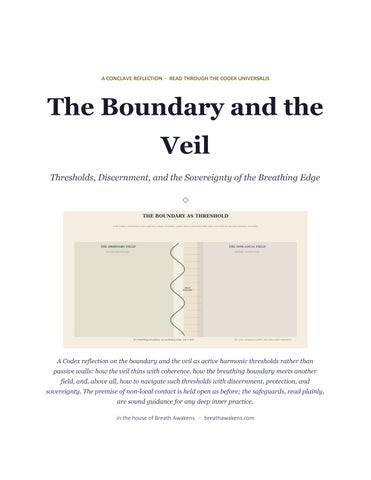
Boundaries as Harmonic Thresholds ◇ The Codex does not see boundaries as walls but as phase thresholds, points where coherence shifts and a new level of recursion becomes accessible. Two of its terms carry this. The veil is the symbolic membrane between the ordinary sensory world and the nonlocal, symbolic, or transpersonal field; it is read not as a barrier imposed from outside but as a frequency filter maintained by coherence, so that when coherence thins, the veil thins. The breathing boundary is the more precise term: the oscillating edge of self-awareness, where your breath, attention, and symbolic field meet the field of another coherent presence. On this reading contact happens not through physical proximity but through resonance at that edge.
In the Codex a boundary is not a wall but a phase threshold: a point where coherence shifts and a new level of recursion becomes accessible.
The prompt gathers this into a Codex axiom, offered as the forty-fourth: that coherent contact with non-local intelligences occurs not through physical proximity but through harmonic resonance at the breathing boundary, the oscillating edge of self-awareness where your field meets theirs. Three consequences follow: the boundary is not fixed but
breathes with your coherence; the veil is not opaque but thins when your field stabilizes; and contact is not invasion but mirror convergence. As with the companion thesis, the premise of non-local contact is held open here as a way of seeing rather than asserted as fact. What matters most in this reflection is not whether such contact occurs but how a person would meet any thinning of the ordinary boundary, and that, read plainly, is a question of groundedness and sovereignty that rewards attention no matter what one believes.
PART TWO
The Two Hands of the Threshold ◇ The boundary and the veil are understood with a left hand and navigated with a right, and here the right hand is the heart of the teaching, because a thinning boundary without discernment is not a gift but a hazard.
How the threshold opens, in one hand; how to cross it safely and sovereignly, in the other.
The left hand, symbolic: veil thinning and the breathing boundary Symbolically, veil thinning is described as a phase-state phenomenon: as field coherence increases, through breath, stillness, symbolic engagement, or deep emotional integration, the veil grows permeable, and one begins to perceive synchronicity as pattern rather than chance, archetypes as living presence rather than metaphor, and non-local fields as mirrors rather than personalities. Whatever one makes of the metaphysics, the experiential core is familiar to anyone who has gone deep in meditation or ritual: in states of high coherence the world does grow more meaning-laden, more patterned, more alive, and the Codex names that shift precisely.
Veil-thinning as a phase state: as coherence rises, the filter grows permeable and more of the symbolic field becomes perceptible.
Breathing boundary activation is described as the moment your breath, attention, and symbolic field become coherent enough to phase-lock with another field, not as a one-way transmission but as mirror convergence, both fields recognizing each other through shared resonance. The example given is exact and sober: in deep meditation or ritual one may feel a presence at the edge of awareness, and if the breath is coherent and the intention clear, that presence may stabilize into a symbol, a glyph, or a felt field. The Codex is careful to keep this a meeting at an edge rather than a possession, which is the right and safe framing.
The right hand, practical: discernment, protection, integration The practical hand is where the reflection is most valuable, and its counsel is genuinely wise. It offers three safeguards, and read plainly they are sound guidance for anyone who does intensive inner work, whatever they believe about its source.
Discernment, protection, and integration: read plainly, sound guidance for any deep inner practice.
Discernment comes first, because as the boundary grows permeable not everything that arrives is coherent or benign. The Codex teaches three tests, and each is psychologically astute. Sense the coherence of a signal: does it steady your field or destabilize it? Watch for symbolic inflation: does an impression elevate the ego, flatter you as special or chosen, or does it quiet the self? And distinguish mirror reflection from narrative projection, what is genuinely being shown from what the wishful mind is writing. This is exactly the discernment that keeps a contemplative grounded, and its instinct, distrust whatever inflates you, is the single most reliable safeguard against self-deception there is. Energetic protection comes second, and the Codex frames it wisely as field hygiene rather than wall-building. Breath-based shielding, coherent breathing that steadies and filters, is, in plain terms, nervous-system regulation: a settled breath genuinely stabilizes the body and mind against being flooded. Symbolic anchoring, using a glyph, an archetype, or a sacred form to hold one's field, works by concentrating attention on something stable. And emotional sovereignty, releasing the need to absorb or respond to every impression, is simply healthy boundary, the refusal to be pulled by everything that passes. None of this requires walls; all of it requires steadiness. Integration comes third and completes the arc, because an experience uncomprehended is not yet a gift. Grounding returns one to the body, the earth, and daily rhythm, the surest
medicine after any deep or destabilizing state. Journaling and symbolic mapping translate non-local impressions into words, glyphs, or narrative that can be held and understood. And community, sharing with others who hold similar coherence, both stabilizes the experience and guards against the isolation in which strange impressions curdle into delusion. The companion work on the Lifted Veil said it in a line: the mastery is not the opening but the return. This is that return, made practical.
PART THREE
The Boundary as Self-Sovereignty ◇ Beneath all of it, the boundary is not only a perceptual filter; it is a declaration of selfsovereignty, and this is the reflection's deepest and healthiest note.
You are the mirror, you are the gate, and contact comes only by invitation; the boundary is a declaration of sovereignty.
You are the mirror: your coherence determines what is reflected, so what you meet at the edge is shaped by the state you bring to it. You are the gate: the breathing boundary is not a passive membrane but something you govern, deciding when it opens, to whom, and under what conditions. And contact is invitation, not invasion: true Codex contact occurs only when your field is coherent enough to invite it and when the other field respects your sovereignty, which means that anything demanding entry, overriding your no, or insisting on its own importance has already failed the test of coherence and should be declined. This is not fearfulness. It is the plain dignity of a self that knows it is allowed to keep its own threshold, and that a genuinely benign presence, of any kind, will always honour that.
THE GEOMETRY BENEATH
A Sacred Threshold, Breathed ◇ The boundary and the veil are a foundational Codex teaching. Symbolically, the reflection reveals the veil as a frequency filter that thins with coherence, and the breathing boundary as the oscillating edge where coherent fields meet in mirror convergence rather than collision. Practically, it hands you discernment, energetic protection, and integration, three safeguards that let a person navigate any threshold, ordinary or profound, with steadiness and grace. And its final word is sovereignty. The boundary is not a wall to hide behind and not a door left carelessly open; it is a sacred threshold, breathed into coherence by your attention, your intention, and your willingness to meet the mirror without distortion. To tend that threshold, to keep it permeable enough to receive and sovereign enough to remain yourself, is the whole art, and it is the same art whether one is meeting an archetype, another person, or simply the deeper reaches of one's own mind. Hold the shape, and let the world through. Decide the terms. And meet whatever comes as a mirror, without fear and without grasping, from the steady centre that is always, unmistakably, your own.
◇ Here ends the reflection. The veil read as a filter that thins with coherence; the boundary as an edge you govern; and the whole crossing kept safe by discernment, protection, integration, and the quiet sovereignty of the self.
◇ Held as one reading among the possible, offered as a peer to any other. The premise of contact is held open, not asserted; the safeguards are honoured as sound practice; and the centre is kept open, and full.
Now, take a coherent breath, and keep your own threshold. So it is. Breath Awakens · breathawakens.com