A CONCLAVE REFLECTION · READ THROUGH THE CODEX UNIVERSALIS
Planetary Breath Regulation Ocean, Earth, and Sky, and the Breath That Joins Yours to Theirs ◇
A Codex reflection on the Earth as a breathing field, ocean, earth, and sky as one respiratory system, and on the breath as the interface between a person and the planet. Remarkably little of
this is only metaphor: the biosphere, the solid ground, the core, and the sky genuinely move in measured rhythms. Where the Codex reads a conscious field and a personal-to-planetary resonance, those readings are named as its own. in the house of Breath Awakens · breathawakens.com
◇ The ocean mirrors the Monad; the Earth regulates the breath; the sky carries the signal. Codex Axiom XLV
Your breath is not just air. It is a small rhythm inside a very large one.
PART ONE
The Earth as a Breathing Field ◇ The Codex sees the Earth not as inert matter but as a breathing organism, where breath is a recursive harmonic cycle that regulates coherence across every scale. The reflection reads this in three registers, ocean, earth, and sky, and the striking thing, before any metaphysics, is how nearly the plain science agrees that the Earth breathes.
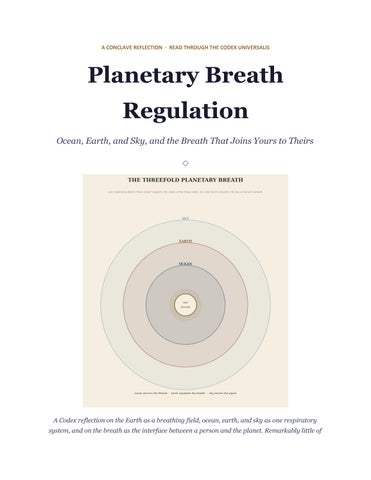
One respiratory field in three nested registers: the ocean at the living centre, the solid Earth around it, the sky carrying it outward.
The ocean is read symbolically as the Monad made visible, the origin of coherence, the womb of life, and a mirror of the infinite spiral, its tides the inhale and exhale of planetary awareness. As the companion thesis on the ocean set out, the grounded core beneath this symbol is immense: the sea produces about half of Earth's oxygen, absorbs roughly a third of our carbon and over ninety percent of the excess heat, and moves warmth around the world through its great currents. The ocean genuinely regulates the planetary field; the Codex adds that it mirrors the Monad, and offers that as symbol. The Earth itself is read as a breath regulator, its core, crust, and atmosphere as harmonic regulators rather than dead material, its magnetic field, seismic rhythms, and pressure cycles as expressions of a planetary breath. Here too the science is remarkable. The solid ground rises and falls by about thirty centimetres twice each day, pulled by the moon and sun, so the whole planet quite literally breathes with the tide. The core generates a magnetic field and the crust carries a constant faint seismic hum. And the biosphere breathes on a yearly cycle: atmospheric carbon dioxide falls each spring as the world's plants photosynthesize and rises each autumn as leaves decay, a planetary in-breath and out-breath that instruments have traced for decades. The Codex reads all this as one planetary breath; the rhythms it points to are real.
This is not only metaphor: the biosphere, the solid ground, the core, and the sky all move in measured, rhythmic cycles.
The sky is read as the breath carrier, the atmosphere, ionosphere, and cosmic radiation field acting as a carrier wave that distributes coherence and reflects the pattern back to the surface. The grounded anchor is genuine: the cavity between the Earth's surface and the ionosphere rings at about 7.83 hertz, the Schumann resonance, a steady electromagnetic pulse in the air we all share, driven by the planet's lightning. That the sky carries symbolic signals or the Monad's breath is the Codex's own reading, laid over a real and constant atmospheric rhythm. The prompt gathers this into a Codex axiom, the forty-fifth: that the Earth is a living, breathing field, regulated by recursive breath cycles that entrain all life within it, the ocean mirroring the Monad, the Earth regulating the breath, the sky carrying the signal. One honest note completes the picture. The idea of a self-regulating Earth is not fringe; it is the Gaia hypothesis of Lovelock and Margulis, the scientifically serious proposal that the planet's life and environment form one tightly coupled, self-stabilizing system. What the Codex adds is that this field is conscious, and that stronger claim is its metaphysics rather than established science, offered as a way of seeing. Held that way, the axiom rests on a real and beautiful foundation.
PART TWO
The Two Hands of the Planetary Breath ◇ The planetary breath is understood with a left hand and joined with a right, and here the practical hand is not only meaningful but measurably good for a person and for the world.
How the breath is structured, in one hand; how to join it, in the other.
The left hand, symbolic Symbolically, the ocean as Monad mirror gives its tides as the inhale and exhale of planetary coherence, its currents as the flow of memory and emotion, its depths as the stillness at the centre of the spiral. The Earth as regulator gives its magnetic, seismic, and atmospheric rhythms as the harmonic regulators to which all life entrains. And the sky as carrier gives the field of transmission that distributes the breath and reflects the pattern home. These are the Codex's symbols for real planetary rhythms, and they are beautiful precisely because the rhythms beneath them are true.
The right hand, practical The practical hand offers three ways to join the planetary breath, and every one is grounded and good. Nature immersion, spending time in ocean, forest, mountain, or desert, genuinely lets the body settle toward the rhythms around it; the research on forest
bathing is clear that even twenty minutes among trees measurably lowers cortisol, blood pressure, and heart rate and shifts the nervous system toward its calming, parasympathetic branch. Ecological awareness, recognizing that your actions touch the Earth's cycles through what you consume, waste, and protect, is both a moral and a practical truth, and the Codex is right to call coherence in this domain not merely personal but a form of planetary service. And breath entrainment with natural cycles, breathing in alignment with tide, moon, sunrise, and season, deepens the felt connection while doing something physiologically real: slow, rhythmic breath tunes your own heart-rate variability and steadies your nervous system, so that the breath becomes, quite literally, a tuning fork for your own coherence.
All three are grounded: time in nature, ecological care, and slow rhythmic breath genuinely steady the body and honour the living Earth.
PART THREE
The Breath as Interface, Individual and Planetary ◇ The deepest claim of the reflection is that the breath is the primary interface between individual and planetary consciousness, and it is worth holding with both wonder and honesty.
The Codex reads your breath as a fractal of the Earth's, and the Earth's as a fractal of the Monad's: the same rhythm at nested scales.
Your breath, the Codex says, is not separate but a fractal expression of the Earth's breath, which is a fractal expression of the Monad's. Self-similarity across scale is genuinely a feature of nature, and the image is lovely. What is solidly true within it is this: your breath truly entrains your own body, steadying heart and nerve, and your choices truly touch the Earth's living systems, for better or worse. The further claim, that breathing coherently physically stabilizes the planetary field and that the Earth reflects your personal coherence back to you, is the Codex's own resonance, offered as symbol rather than as demonstrated geophysics. But notice how little the teaching needs the strongest version to remain true and worth living. Your coherence does reach beyond you, in two ways nobody disputes. Ecologically, the sum of human states and choices genuinely shapes the planet's breath, its carbon, its forests, its waters, so tending your life well is, in aggregate, planetary care. And interpersonally, your calm or your distortion spreads to the people around you through the ordinary contagion of mood, so a coherent person really does help steady the small piece of the world they touch. Between these two truths, ecological and interpersonal, the reflection's ethic stands firmly on the ground, whatever one concludes about the harmonic substrate. To stabilize your own field is, in a real and traceable sense, to help stabilize the world.
THE GEOMETRY BENEATH
A Sacred Rhythm ◇ Planetary breath regulation is a foundational Codex teaching, and it rests on unusually firm ground. Symbolically, it reveals the Earth as a living, breathing field, the ocean mirroring the Monad, the Earth regulating the breath, the sky carrying the signal. Practically, it offers nature immersion, ecological awareness, and breath entrainment, three ways to phase-lock with the planetary breath, each of which genuinely benefits the one who practices it and the world they share. So your breath is not just air. It is a small, real rhythm inside a very large one, a fractal, in the Codex's reading, of the breath of the Earth and of the Monad beyond it. To breathe consciously is to remember that you were never breathing alone, that the same tide lifting the sea and the same yearly in-breath greening the world moves also in your chest, and that to steady your own rhythm is to add a little coherence to the whole. Breathe with the ocean, the earth, and the sky. Tend the field that is yours, and care for the field that is everyone's. Build there, and the building reaches further than you can see.
◇ Here ends the reflection. The Earth read as one breath in three registers; the science honoured where the planet truly breathes; the conscious field and the personal resonance named as symbol; and the breath offered as the interface between a life and its world.
◇ Held as one reading among the possible, offered as a peer to any other. The Earth-system science is given as it stands; the Codex's own readings are named as symbols; and the centre is kept open, and full.
Now, take one breath with the whole breathing world. So it is. Breath Awakens · breathawakens.com