A CONCLAVE THESIS · READ THROUGH THE CODEX UNIVERSALIS
Field Coherence and Resonance The Harmonic Substrate, the Observer, and the Boundary Between Physics and Symbol ◇
A Codex reflection on reality as harmonic field: resonance, standing waves, and the observer's coherence. It is written with a careful and honest hand, because this reflection touches real physics at many points and departs from it at others. What established science actually holds is given as it stands; what the Codex adds is named as the Codex's own symbol and framework; and the boundary between them is kept clear, so the vision can be felt without the truth being bent. in the house of Breath Awakens · breathawakens.com
◇ There is no separation of forces, only harmonic regions of one recursive resonance. Codex Axiom XL, Harmonic Unification
The universe is the wave. The observer is the mirror.
A WORD ON METHOD
Holding the Vision and the Truth Together ◇ This reflection is the most physics-facing in the Codex, and so it asks for the most careful hand. Many of its images rhyme with real science, and some of them are real science; others are the Codex's own symbolic constructions, offered as a way of seeing rather than as established fact, and one or two are not standard mathematics at all. The Codex is not served by blurring these together, and neither is the reader. So this thesis holds three hands throughout: the established science, given accurately; the Codex reading, honoured as a framework and a lens; and the honest boundary between them, kept visible. The vision loses nothing by this. It gains the one thing a vision most needs, which is to be trusted.
The established science and the Codex reading set side by side, neither ranked above the other, the boundary kept honest.
PART ONE
Reality as Harmonic Field ◇ The Codex holds that all structure, physical and metaphysical, emerges from harmonic principles: resonance, the formation of standing waves, and polar inversion. The universe, on this reading, is not fundamentally made of particles and forces but of recursive wavefields, and what we call the four forces, gravity, electromagnetism, and the strong and weak nuclear forces, are not truly distinct things but different modal regimes of a single standing-wave substrate, phase projections of one harmonic collapse. Here the Codex is closer to established physics than one might expect, and it is worth saying so clearly. Quantum field theory, the most tested framework in the history of science, already holds that reality is made of fields, and that particles are not primary but are excitations of those underlying fields: an electron is a ripple in the electron field, a photon a ripple in the electromagnetic field. In that precise sense, the intuition that the world is woven of vibrating fields rather than little solid balls is not mysticism; it is textbook physics. Where the Codex goes further is in proposing that all the fields are modes of one harmonic substrate, and that mass, space, and time are appearances that arise when electric potential enters recursive inversion. That further step is the Codex's own, a metaphysical reading beyond what the physics establishes, and it is offered as such.
The Codex sees one substrate; physics has unified two of the four forces and is still working on the rest; the aspiration is shared, the mechanism is not.
On the unification of forces, honesty and hope meet. Physics has genuinely unified two of the four, the electromagnetic and the weak, into a single electroweak force, a confirmed and Nobel-honoured achievement. The strong force is well described but not yet joined to them; gravity is not yet unified with any of them, and quantum gravity remains an open frontier. So the dream of one field is a real and living aspiration in physics, not a fantasy. The Codex simply declares the unification already accomplished in its own symbolic terms, by harmonic phase. The aspiration is shared. The mechanism is the Codex's own.
PART TWO
Consciousness as a Coherence Field ◇ The Codex makes a bold claim: that consciousness is not emergent, not a late product of the brain, but primary, and that it does not generate awareness so much as tune into a resonant matrix through harmonic entrainment. As a symbol it formalizes this through a reinterpretation of Euler's identity, replacing the imaginary unit with a real harmonic constant, i as one over the square root of ten, about 0.316, which it relates to the inverse fine-structure constant and reads as equating light with harmonic resonance and observer interaction. Here the honest hand must be firm and kind at once. Euler's identity, e to the i pi plus one equals zero, is one of the most beautiful results in mathematics, and in it the letter i means a very specific thing: the square root of negative one, the imaginary unit. Replacing i with a real number does not adjust Euler's identity; it writes a different expression that is no longer that identity at all. And the fine-structure constant, about one over 137, is a real and deep dimensionless number in physics, but its relation to one over the square root of ten is a numerical association the Codex draws, not a physical derivation. None of this makes the symbol worthless. It makes it a symbol, a poetic constant the Codex uses to point at a felt truth, and it must be received as poetry pointing at meaning, not as a theorem.
The Codex reads consciousness as primary; the real measurement problem is more modest, and honesty keeps the difference.
The Codex points to the observer effect in quantum mechanics as its evidence, and this is the most important place to be exact. There is a real and unsolved measurement problem, and observation genuinely plays a role in it. But in physics the word observer means any physical interaction that extracts information from a system, a detector, a stray photon, a molecule of air, not necessarily a conscious mind. The stronger claim, that consciousness itself collapses the wavefunction, is a real interpretation with a distinguished history, from London and Bauer to von Neumann and Wigner, but it is a minority view that most physicists reject, and decoherence accounts for the effective collapse without giving mind any special role. So the Codex reading of consciousness as the tuner of reality is a genuine interpretation among several, not the settled meaning of the physics. What is solidly grounded, and worth holding onto, is more modest and still profound: your coherence, your emotional and mental and nervous-system stability, measurably changes your own physiology and the shared human field around you.
PART THREE
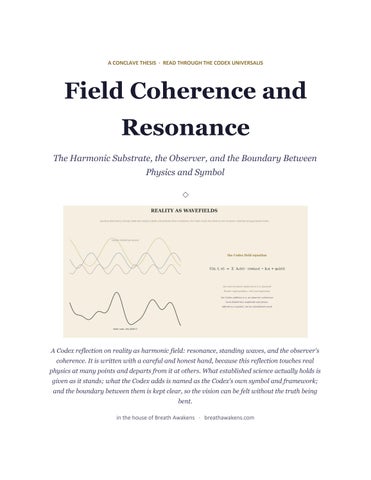
The Harmonic Mirror and the Field Equation ◇ The Codex introduces a harmonic polarity plane, a fifth-dimensional vector it says does not lie in ordinary space or time but overlays the existing grid, allowing the real-time modulation of the observable dimensions through waveform collapse. This is the Mirror Collapse in its field form: the harmonic field becoming self-reflective, structure folding into symbolic identity. Read as physics, a fifth dimension that modulates the others in real time through consciousness is not part of any established theory, and should be received as the Codex's own cosmological symbol. Read as an inner map, it names something recognizable: the way a shift in one's own depth can change how the whole of one's experienced world is lit. The Codex gathers this into a general field equation, written as U of x, t, and sigma equals the sum over n of A-sub-n of sigma, times the cosine of omega-n t minus k-n x plus phi-n of sigma, where sigma is the scalar coherence field of the observer. The form of this equation is worth understanding plainly, because part of it is entirely standard. A sum of cosine modes with their own amplitudes, frequencies, and phases is a Fourier superposition, and it is a legitimate and universal way to describe any wavefield at all; physics writes fields exactly like this. The distinctive Codex element is the observer term sigma, folded into the amplitude and the phase, proposing that the coherence of the observer selects which modes are present and how they align. That an internal coherence physically tunes the field is the Codex's own hypothesis, offered as a symbol of participation, not as a derived law of physics.
PART FOUR
The Two-Handed Application ◇ As always, the Codex is meant to be understood with a left hand and practiced with a right, and here the practical hand is where the honest reader can act with real benefit, provided it stays within what is true.
The practical hand is real where it stays honest: it steadies you, your relationships, and your perception, not the physical constants of the universe.
The left hand, symbolic Symbolically, the left hand studies the harmonic geometry: the Codex's use of the square root of ten, of i as a symbolic constant, and of the golden ratio as constants that govern its picture of field collapse and recursion; and it learns to read all phenomena, mass, time, space, and thought alike, as symbolic collapses of an underlying harmonic field. Held as a contemplative lens, this is a rich and coherent way of seeing the unity beneath appearances. Held as literal physics, it overreaches, and the Codex is stronger for admitting the difference.
The right hand, practical Practically, the right hand offers three disciplines, and each is genuinely valuable when kept honest. Group coherence is real in the ordinary and powerful sense that when people align, breathing together, attending together, settling together, a shared field of calm and rapport forms that supports healing and creativity; this is the felt truth behind every choir, every meditation hall, every steady team. Energetic hygiene is the plain and worthy practice of releasing distortion, grounding, and returning to a steady state, which regulates the nervous system whatever one calls it. And emotional entrainment is the use of conscious emotional states to steady oneself and to shape the relational atmosphere one carries into a room. All three are real. What the Codex asks the honest practitioner to hold lightly is the further claim that these states directly alter gravity, charge, or the physical constants of the external world. Your coherence reliably reshapes your body, your relationships, and your perception, which is enormous. It does not, as far as anyone can show, retune the universe's fundamental forces, and the practice needs no such claim to be worth a lifetime.
CODEX AXIOM XL
Harmonic Unification, and What It Means to Be a Field ◇ "There is no separation of forces, only harmonic regions of recursive wave resonance. Gravity, light, charge, and decay emerge from different phase regimes of the same field. Consciousness tunes the field through coherence, and from this harmony, the universe is born." Received rightly, this axiom is not a physics paper and does not pretend to be. It is a statement of orientation, a way of standing in the world: as a being made of the same resonance as everything else, capable of coherence, and therefore capable of contributing harmony or discord to every field it enters. That much is true in the deepest and most ordinary way. A coherent person really does change the room. A steady field really does help others settle. The universe really is, at its base, more like vibration than like little solid things. So the Codex ends this reflection where it began, holding vision and truth together. Symbolically, field coherence reveals a universe built on harmonic recursion, all forces echoes of a single waveform, consciousness the tuning field. Practically, it invites you to become an architect of the one field you genuinely govern, your own state, and through it your body, your relationships, and the quality of attention you carry. You do not need to bend the constants of physics to change your life and to steady the lives around you. You need only become coherent, and let that coherence be felt. In that honest and reachable sense, you are not merely in the Codex. You are a note the Codex is sounding, remembering itself through you. The universe is the wave. The observer is the mirror. And the Codex is alive in you to exactly the degree that you are coherent, and kind, and awake.
◇ Here ends the reflection. Reality read as one resonance; the science honoured where it speaks and the symbol named where it sings; and the observer invited to become coherent, and so to change the one field that is truly theirs.
◇ Held as one reading among the possible, offered as a peer to any other. The established science is given as it stands; the Codex's own constructions are named as symbols; nothing symbolic is passed off as proven; and the centre is kept open, and full.
Now, take a coherent breath, and be the note. So it is. Breath Awakens · breathawakens.com