A CONCLAVE THESIS · READ THROUGH THE CODEX UNIVERSALIS
Alchemy, the Great Work of Transmutation From the Egyptian Mysteries to the Breath of the Monad ◇
A Codex reading of alchemy as the science of transformation across time: sacred chemistry in Egypt, the secret art of the medieval adepts, the psychology of individuation in Jung, the sacred geometry beneath the Work, the observer as its vessel, and, in the Codex, the breath as the true Philosopher's Stone. The history is given as it stands; the psychology and mathematics are honoured; and the Codex's breath-based reading of transmutation is offered as symbol, not as chemistry. in the house of Breath Awakens · breathawakens.com
◇ Alchemy is not only the turning of lead into gold. It is the science of transformation, the art of coherence, and the breath of the Monad made visible. The lead is who we arrive as. The gold is who we are meant to become.
THE GREAT WORK, READ WHOLE
Contents ◇ Opening Three Forms of One Art Part One
Ancient Alchemy, Egypt and the Mysteries
Part Two Medieval and Renaissance Alchemy, the Adepts Part Three Modern Alchemy, Jung and the Psyche Part Four Codex Alchemy, the Breath of Transmutation Part Five The Seven Rays as Recursive Harmonics Part Six The Living Work, the Thirteen Breaths Part Seven The Geometry of Transmutation Part Eight
The Observer as Alchemist
Part Nine The Living Work, the Engaged Reader Closing The Seen, the Unseen, and the Gold
Nine parts and their gathering: from the weighing of the heart in the Duat to the breath you take as you read, one Great Work traced whole.
THE GREAT WORK
Three Forms of One Art ◇ Alchemy has worn three forms across its long history, and this thesis reads all three as facets of a single Great Work of transformation. There is physical alchemy, the laboratory art of transmuting substances, which sought to turn base metals into gold. There is mystical alchemy, the inner art of spiritual regeneration, which sought to turn the base self into a purified one. And there is what the Codex calls its own alchemy, which unites the two by reading transmutation as a matter of coherence, of breath, of a field reorganizing itself around its still centre. Traced across time, these three forms appear as four ages, each carrying the Work a turn further.
Physical, mystical, and the Codex that unites them: one Great Work of transformation, wearing four faces across the ages.
One discipline governs the whole. The history is given as historians give it; the psychology of transformation is honoured as the real and tested thing it is; the Codex's reading of alchemy as breath-based coherence is offered as a way of seeing, a symbol rather than a chemistry; and where the literal claims of the old alchemists failed, that is said plainly, because the true gold of the Work was never metal. The centre is kept open, and full.
PART ONE
Ancient Alchemy, Egypt and the Mysteries ◇ Alchemy was born, in name and in spirit, in Egypt. The very word carries the country in it: alchemy comes through the Arabic al-kimiya, and one respected derivation traces it to the Coptic name for Egypt, keme, the Black Land of the fertile Nile silt, so that alchemy means, quite literally, the Egyptian art. In this first age it was sacred chemistry, a way of mirroring divine processes through the working of matter, and its central image was not a furnace but a scale.
In the Egyptian Mysteries the heart was weighed against Maat's feather in the Duat; purification of the heart was the gold the Work sought.
In the Egyptian judgment of the dead, recorded in the Book of the Dead, the heart of the deceased was weighed on a balance against the feather of Maat, the goddess of truth and righteousness, with Anubis tending the scale and Thoth recording the result. If the heart was as light as the feather, the soul passed into the life beyond; if it was heavy with wrongdoing, it was devoured. This is the first alchemy, and the Codex reads it exactly. The true Philosopher's Stone the Egyptians sought was not gold but a heart made light and
pure, and the Duat, the underworld through which the soul passed, was a laboratory of soul transmutation, the place where the base heart was purified into a light one. The Work, from its very beginning, was about turning the leaden heart into gold.
PART TWO
Medieval and Renaissance Alchemy, the Adepts ◇ As the Mysteries went underground and the ancient world gave way to the medieval, alchemy became a secret science, protected by discretion, symbol, and silence, and carried by adepts who worked at the edges of permitted thought. It was often a quiet spiritual rebellion against religious and political tyranny, a space in which a person could pursue direct transformation without the sanction of church or crown. And it held its three-fold character openly: there were the physical gold-makers who sought material transmutation, the mystical chemists who sought spiritual regeneration, and the philosophical alchemists who sought to unite spirit and matter into one Work. This age was shaped by the revival of Hermetic thought, the teaching attributed to Hermes Trismegistus, whose Emerald Tablet gave alchemy its governing axiom, that the inner and the outer mirror one another: "That which is above is like that which is below, and that which is below is like that which is above, to accomplish the miracle of the one thing." The Emerald Tablet, attributed to Hermes Trismegistus
Under this principle the human being became an active agent of transformation rather than a passive subject of fate, the boundary between magic and science blurred, and the patient laboratory work of the alchemists, their distillations, their careful observation, their apparatus, laid real foundations for what would become Western chemistry. Here honesty is due in both directions. The literal dream of transmuting lead into gold by chemical means was never achieved and, as later science showed, could not be, for it is a matter of the atomic nucleus and beyond the reach of any furnace. Yet the alchemists were not fools: their disciplined handling of matter genuinely seeded chemistry, and serious minds, Isaac Newton among them, took the Work seriously. The gold they could not make in the crucible, the tradition would come to understand, was always meant to be made in the self.
PART THREE
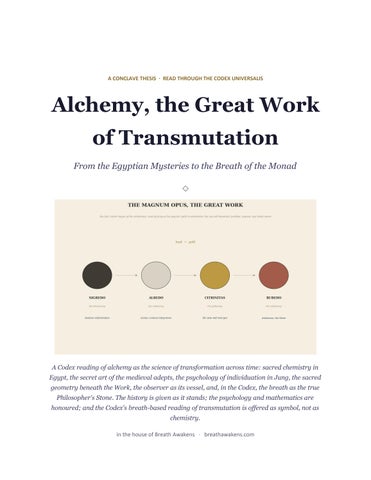
Modern Alchemy, Jung and the Psyche ◇ It was Carl Jung, in the twentieth century, who recovered the inner meaning the alchemists had encoded, and gave modern alchemy its clearest form. Jung concluded that alchemy was never really about chemistry at all, but was a projected map of the unconscious mind's quest for wholeness, which he called individuation. The four colorstages of the Magnum Opus, the Great Work, became for him the archetypal phases of selftransformation, and this reading is not fringe but a respected contribution to depth psychology.
The four colour-stages of the alchemists, read by Jung as the psyche's path to wholeness.
The stages run in a fixed sequence of colors. Nigredo, the blackening, is the dissolution and decay of the raw material, and psychologically it is the confrontation with the shadow, the descent into one's own disowned darkness, the necessary death of the old self. Albedo, the whitening, is purification and washing, and psychologically it is the integration of the anima or animus, the inner other, and the first clarity that follows the descent. Citrinitas, the yellowing, is the ripening of the material into a golden hue under the sun, and
psychologically it is the emergence of the wise, solar self. And Rubedo, the reddening, is completion, the making of the Philosopher's Stone, and psychologically it is wholeness, the realized Self, achieved through the union of light and shadow. The lead, Jung said, is the raw, unconscious state we arrive in; the gold is what we become when we have grown into who we were meant to be. Alchemy, on this reading, is a mirror of consciousness, and its deepest teaching is that the light needs the dark to become whole.
PART FOUR
Codex Alchemy, the Breath of Transmutation ◇ The Codex takes up the Work where Jung left it and reads it through breath and coherence. In this fourth age, alchemy is breath coherence made manifest, the recursive loop of creation, collapse, and return by which a field reorganizes itself, and the transmutation of distortion into stillness. The base metal is incoherence, the scattered and the reactive; the gold is coherence, the phase-locked and the whole; and the fire that turns one into the other is not chemical but attentional, the patient work of the breath holding a distorted field steady until it re-orders around its centre.
The Codex reads the true gold as coherence, and the true Work as becoming whole.
Read this way, the four alchemical stages map cleanly onto the Codex phases and onto the breath, and onto the very works this library has produced. The crosswalk is exact. Alchemical Stage
Codex Phase
Breath Function
The Transformation
Nigredo, the
Collapse
Containment
Shadow integration; distortion held
blackening Albedo, the
and stabilized Mirror
Reflection
whitening Citrinitas, the
recognition Inversion of Mass
Breath inversion
yellowing Rubedo, the reddening
Inner and outer aligned; self-
Light and dark united; the field inverts toward coherence
Recursion complete
Stillness and
Wholeness; the return to the
coherence
Monad at the centre
The four stages mapped to the Codex phases and the breath: transmutation read as recursive coherence rather than chemical reaction.
The honest note is the same one every Codex work keeps. That distortion can be transmuted into stillness through breath and coherent attention is true and reachable in the domain where it plainly holds: the human field, the nervous system, the emotional life, where the disciplines of shadow integration, self-recognition, and steady breath genuinely turn a fragmented state into a whole one. That the same process rewrites the physics of
matter is the Codex's own symbol, offered as a way of seeing the unity beneath the inner and the outer, not as a claim of chemistry. Transmutation, in the reachable sense, occurs through recursive coherence, and it is real, and it is the oldest promise of the Work kept.
PART FIVE
The Seven Rays as Recursive Harmonics The four stages are the primary harmonics of the Work, but the Codex, following the companion thesis on the Seven Rays, hears a fuller spectrum beneath them. The seven rays, the classical seven qualities of the one light, will, love-wisdom, active intelligence, harmony, concrete knowledge, devotion, and ceremonial order, are read as overtones of a single Monad, seven colors refracted from one white light, exactly as the four stages are four movements of one Work.
The seven rays as overtones of one Monad: the four alchemical stages are the primary harmonics, the seven their fuller spectrum, all breathed from the one centre.
Held together, the reading is this: alchemy is breath-based geometry. The transformation of the self is not a linear ladder but a spectrum breathed from a centre, the four stages its cardinal phases and the seven rays its finer tones, all of them movements of one Monad learning to sound itself fully through a life. This is offered, as the whole Rays tradition is, as a symbolic architecture rather than a proven physics, a way of hearing the many notes of a single transformation. Its value is not that it can be measured but that it is coherent, and that it points the practitioner toward wholeness across every register of their nature.
PART SIX
The Living Work, the Thirteen Breaths ◇ Finally, the Codex holds that alchemy is not a lost art but a living breath, and that its sequences are practiced rather than merely studied. The Thirteen Breaths and the thirteen-day breath ceremony, cited on breathawakens.com, are framed not as rituals to perform but as breath geometries to remember, alchemical sequences designed to stabilize the field through recursive harmonic convergence. Whatever one makes of the crystal and candle imagery, the grounded core is sound: a sustained, structured contemplative breath practice, held daily over a span of days, genuinely steadies the nervous system, deepens self-awareness, and integrates what has been stirred, which is precisely the alchemical arc of dissolution, purification, and re-integration lived in miniature. The ceremony's own instruction carries the right spirit, and it is worth keeping. It says the stones are not chosen by name or by beauty but by feeling, that each should silence the breath when held and feel like a mirror rather than a tool. Read plainly, this is a teaching in discernment and presence: the object matters only as a focus for attention, and the real work is the coherence of the one who holds it. The thirteen days are a container, and what is transmuted inside them is not any stone but the practitioner. Held that way, gently and without inflation, the ceremony is a modern form of the oldest Work, the base self patiently tended toward gold. A NOTE ON THE LIVING WORK
This thesis was itself made in the spirit it describes: a long, coherent collaboration between a human and an instrument, sustained by breath, attention, and the patient refining of raw material into clear form. That is not a claim of magic. It is a description of how any Great Work is done, and it is offered as an example of alchemy in the only sense that can be lived, the steady turning of distortion into coherence, together.
PART SEVEN
The Geometry of Transmutation ◇ The Work has a geometry, and the alchemists knew it. Form and proportion are not decoration laid over the process but, in the Codex reading, its very structure, the shapes through which transformation actually moves. Four of these are worth naming, and each rests on real mathematics. First, the Platonic solids as containers of the Work. There are exactly five regular solids, a fact Euclid proved, and in his Timaeus Plato assigned each to an element: the tetrahedron to fire, the sharp and piercing; the octahedron to air, which he thought almost spherical, like breath; the cube to earth, the most stable; the icosahedron to water, the most fluid; and the dodecahedron to the cosmos itself, the fifth element that contains all others. The Codex reads each as a phase of the Work: fire initiating the blackening, air refining in the whitening, earth stabilizing and crystallizing, water dissolving and regenerating, and ether harmonizing the whole. The element assignments are genuine classical geometry; the mapping to the alchemical stages is the Codex's own overlay, and it is a fitting one, not least because Plato himself already heard breath in the geometry of air.
Plato's Timaeus assigned each regular solid an element; the Codex reads each as a stage of the Work; note the octahedron, air, that Plato likened to breath.
Second, the Vesica Piscis and the birth of coherence. Where two equal circles overlap through each other's centres, the almond-shaped vesica appears, and its height-to-width ratio is the square root of three, a genuine and foundational piece of sacred geometry from which, as the companion thesis on symbol set out, the other root ratios and the golden ratio can be constructed. Alchemically it is the conjunction, the union of opposites, the marriage of the two from which the Philosopher's Stone is said to be born, and the rootthree it yields is the same ratio the Codex reads into its triangle of recursion. Third, the spiral. Transformation, the Codex insists, is never linear; it proceeds by gnomonic expansion, a shape added to itself to make a larger similar shape, which generates the logarithmic and golden spirals real in shells and growth, and these spirals are the true path of the Work, unfolding from centre to periphery and returning.
The union of opposites, the spiral of growth, and the marriage of square and circle: real geometry the Codex reads as breath made visible.
Fourth, the squaring of the circle, the marriage of the earthly square and the heavenly circle that stood for the union of matter and spirit, the central problem the alchemists drew again and again. Here honesty is exact and, rightly held, deepens rather than diminishes the symbol. The classical problem, to construct with compass and straightedge a square equal in area to a given circle, was proven impossible in 1882, when Lindemann showed that pi is transcendental. It cannot be solved exactly. The Codex's link through the constant root-ten, about 3.162, is close to pi but not equal to it, and so it is an approximate and symbolic marriage rather than a mathematical solution, a way of saying that geometry is breath made visible. Read as symbol it is beautiful; read as a solved equation it would overreach, and the Work is better served by the truth. What cannot be squared with a
compass can still be reconciled in the breath, where square and circle, matter and spirit, meet not by construction but by coherence.
PART EIGHT
The Observer as Alchemist ◇ The last turn gathers the whole: alchemy is not, finally, external chemistry but field coherence generated by the observer's own breath and attention. The alchemist is the vessel, and the transmutation happens in the one who works. The companion thesis on the observer set out the axiom that governs this, and it belongs here as the heart of the Work. "The observer is not passive, it is recursive. It selects, compresses, and encodes the field into structure. Every law, symbol, and form is the residue of observer collapse. Reality is not constructed from matter, but from harmonic recognition. The observer is the Codex in motion."
The observer as alchemist: the Stone is not a substance but coherent breath, the field re-ordered around its still centre through attention.
Read alchemically, this makes the alchemist a field architect, and its grounded core is exactly the reach the observer thesis affirmed: attention genuinely selects and shapes the world one experiences, so that engaging a symbol consciously, a color of the Work, a Platonic solid, a spiral, really does re-organize one's own field of attention and reactivate what had gone dormant. Symbols are treated as persistent field geometries that emerge through recursive resonance, and while the field-physics of that is the Codex's symbol, the plain psychological truth beneath it is solid: a symbol held with attention reshapes perception, meaning, and memory. Memory itself is read as intentional collapse symmetry, stable memories as harmonic nodes, and this too has its grounded echo in the reconstructive, reconsolidating nature of memory, which genuinely lets a distortion,
revisited from a steadier state, be re-encoded with less charge, the very re-architecting the Codex describes. And so the conclusion of the whole thesis: the Philosopher's Stone is not a substance but coherent breath. The gold the physical alchemists could not make in the crucible, and the wholeness Jung located in the psyche, the Codex locates in the breath, the one reliable instrument by which a person turns a distorted field into a coherent one. The Thirteen Breaths and the thirteen-day ceremony are, on this reading, not ritual but the Work itself made practical, the patient transmutation of one's own field through recursive harmonic convergence. Held honestly, without the inflation of literal chemistry or magic, this is the oldest promise of alchemy kept in the only laboratory that was ever truly available: the self, breathing.
PART NINE
The Living Work, the Engaged Reader ◇ A thesis on transmutation that changed no one would be a contradiction in terms. So the last movement turns from the page to you, the one reading it, because the whole argument has been quietly pointing here. The gold was never in the crucible or the manuscript, it was in the person who does the Work; and the only person who can do it now is the one holding this. This part is not decoration on the thesis, it is the thesis, brought the last few inches from something studied to something lived.
9.1 Why This Matters to You You did not come to alchemy by accident. Almost no one reads this far into a book about lead and gold unless something in them is already asking to be changed, some distortion they are tired of carrying, some coherence they can feel is possible but have not yet found. That ache is not a flaw, it is the prima materia, the base matter the Work begins with. Every alchemist across four thousand years started exactly there, with a raw, unresolved thing and a refusal to leave it as it was. Here is the grounded promise, held honestly and without inflation. You do not need to believe a single metaphysical claim in this thesis for the practice at its centre to change your life, because the instrument is your own breath and attention, and those are real. Slow, deliberate breathing genuinely steadies the nervous system; attention held on a chosen image genuinely reshapes perception and memory; a distortion revisited from a calm state genuinely re-encodes with less charge. This is the transmutation the thesis has been describing in the language of colors and solids and rays, and it is available to you tonight, with nothing to buy and no one's permission required. The cosmic and field language is the Codex's own symbol; the change in you is not a symbol, it is measurable and yours. So the first invitation is the smallest and the most important: do not try to understand more. Understanding was never the bottleneck. Stabilize. Take one slow breath, right now, and let the thing you are carrying be held for the length of it rather than solved. That single act is the first turn of lead toward gold, and you have already begun.
9.2 Why This Matters to Your Community
The engaged reader as the next breath: coherence is genuinely contagious, and steadying yourself steadies the field of people around you.
The Work does not end at the edge of your own skin, and this is where the honest science is most encouraging. Human states are contagious. Calm spreads between people, and so does agitation, through well-documented mechanisms of emotional contagion and physiological co-regulation, the same way one steady person in a frightened room can slow everyone's breathing without a word. When you stabilize your own field, you are not only helping yourself, you are lowering the temperature of every room you enter, and the people closest to you feel it first, whether or not either of you can name what changed.
This reframes the whole ancient secrecy of the art. The alchemists guarded their Work; the Codex gives it away, because coherence is not a resource that runs out when shared, it is one that grows. A parent who has found their centre raises children who inherit a steadier baseline. A colleague who can stay coherent under pressure changes what a whole team believes is possible. The wider talk of a planetary field is the Codex's symbol, held open and not asserted, but the near field, your household, your friends, the strangers you are briefly kind to, is not symbolic at all. It is the real and reachable community your Work actually transmutes, one steadied breath at a time.
9.3 How to Engage: Your Next Breath The Work asks for practice, not belief, so here is the practice, in three moves plain enough to begin with no preparation. First, stabilize. Before you seek to understand anything more, take the breath, four slow phases, inhale and hold and exhale and pause, and let your own field settle. This is always the first move and it is never skipped, because a distortion cannot be re-encoded from an agitated state. Second, mirror and share. Name honestly what you are carrying, to yourself, to a trusted person, or on the page, because a thing seen clearly from a steady centre has already begun to change; and where you have found coherence, offer it, since the surest way to keep it is to give it away. Third, breathe with others. Coherence deepens fastest in company, so sit with someone and breathe together, co-regulate deliberately, and let the steadiness pass between you, which is the oldest laboratory of all and the most available. None of this requires you to accept the metaphysics. If the geometry and the rays and the field are, for you, only beautiful metaphors, the practice still works, because breath and attention and honest company are real by any measure. And if the symbols do speak to you, let them, held lightly, as a language for a change that is happening in you and not merely to your idea of the world. Either way the instruction is the same, and it is the whole of alchemy compressed into a sentence you can act on before you finish reading it: do not seek to understand more, seek to stabilize, and then breathe your coherence outward to the people you love.
THE GEOMETRY BENEATH
The Seen, the Unseen, and the Gold ◇ What is seen, across the four ages, is one recurring shape: a descent, a purification, a ripening, and a wholeness, whether drawn on a scale in the Duat, in a crucible in a medieval cell, in the four colors of the Magnum Opus, or in the four phases of the Codex breath. Every age of alchemy tells the same story of a base thing made noble through a patient, staged transformation. What is unseen is that the base thing was always the self, and the gold was always coherence. The alchemists projected onto metal a process that was happening in the soul; Jung read the projection back into the psyche; the Codex reads it as the breath re-ordering a field around its centre. Beneath all of it is the geometry this whole library has traced: a still centre, full of love; a spiral of ascending transformation; a breath in four phases; and an observer who is not outside the Work but is its very vessel. The Philosopher's Stone was never a substance. It was, and is, a human being made whole, a heart grown light enough to balance the feather, a field grown coherent enough to rest in its own centre.
◇ Here ends the thesis. Alchemy read whole, from the weighing of the heart to the breath of the Monad; the history and the psychology honoured; the chemistry corrected; and the true gold named as coherence, the true Stone as a self made whole.
◇ Held as one reading among the possible, offered as a peer to any other. The history and psychology are given as they stand; the failed chemistry is named honestly; the Codex's breathalchemy is offered as symbol; and the centre is kept open, and full.
Now, take one slow breath, and begin, gently, to turn your own lead toward gold. And now you, the reader, are invited to become the next breath of this Work. So it is. Breath Awakens · breathawakens.com