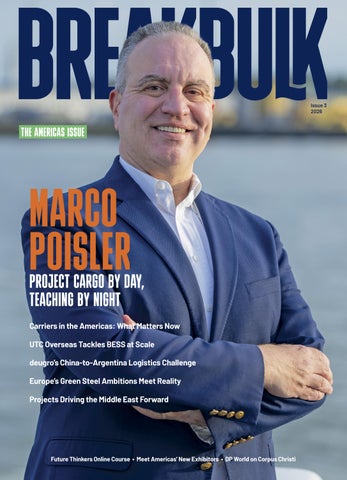
Issue 3 2026
THE AMERICAS ISSUE
MARCO POISLER
PROJECT CARGO BY DAY, TEACHING BY NIGHT Carriers in the Americas: What Matters Now UTC Overseas Tackles BESS at Scale deugro’s China-to-Argentina Logistics Challenge Europe’s Green Steel Ambitions Meet Reality Projects Driving the Middle East Forward
Future Thinkers Online Course • Meet Americas’ New Exhibitors • DP World on Corpus Christi
VENEZUELA’S PROJECT PIPELINE PICKS UP PACE
New Regime Spurs Oil and Gas Activity, But Hurdles Persist (p.60)
THE PERFECT FIT Our 32,000 dwt Super B-Class vessels are already breaking cargo intake records - handling the size and scope of project components previously impossible. They embody AAL's award-winning commitment to being the world's most trusted project heavy lift carrier. With ongoing fleet, service and sustainability investment, we aim to be the perfect fit for our customer demands.
Inside This Issue
34 Carriers in the Americas: What Matters Now
42
Cover Story
Marco Poisler: Project Cargo by Day, Teaching by Night
12 UpFront: Movers and Shakers
27 UpFront: Thought Leader
Highlighting recent industry hires, promotions and departures
How maintaining logistics readiness protects project execution
14 UpFront: The Logistics Lens by Hatch
28 UpFront: Thought Leader
Between feasibility and execution: Keeping the LEP Relevant
How maritime asset tokenization could fund the next generation of vessels
16 UpFront: Waves of Cargo
29 UpFront: Future Thinkers
Globalink engineers a 10,500-kilometer operation across Eurasia
18 UpFront: News Bites
A roundup of Breakbulk shippers and exhibitors in the news
20 UpFront: Exhibitor Spotlight
Meet some of the new companies showcasing their expertise at Breakbulk Americas
26 UpFront: Thought Leader
De-risking project logistics operations in the era of AI
How the demand for scenario building at Breakbulk Europe led to our new online course
30 UpFront: Women in Breakbulk
The Women in Breakbulk Lounge returns to Breakbulk Americas with workshops
32 UpFront: DP World
Why Corpus Christi could become the Gulf Coast’s next major gateway
Four majors answer six essential questions
4 Issue 3 2026
Equipment bottlenecks are slowing construction while decommissioning creates the next major logistics opportunity
42 Americas Project Cargo by Day, Teaching by Night
UTC Overseas’ Marco Poisler balances global project logistics, academia and industry leadership
48 Americas Anchoring Argentina’s LNG Ambitions
Jumbo Offshore and CoreMarine prepare for complex FLNG installation campaign
52 Americas Critical Minerals
34 Americas Carriers in the Americas: What Matters Now
Breakbulk Magazine
40 Americas Data Center Logistics From Beginning to End
breakbulk.com
Bringing processing home, prepping for opportunity
Port Houston City Docks
Delivering what your customers need. Whether it’s steel coil, grain, lumber, or oversized heavy-lift cargo for the energy and industrial sectors, you can count on Port Houston to deliver what you need at our multi-purpose facilities. Flexibility and connectivity set us apart, and a skilled and dedicated labor force gives you reliability. Get your cargo to your customers faster by choosing Port Houston.
www.porthouston.com
Inside This Issue
Be a part of Breakbulk
58 Americas What It Takes to Win Rare Earth Processing Work
Fracht North America’s Sharan Swaminathan on the demands of North America’s newest sector
Breakbulk Asia November 18-19 Sands Expo and Convention Centre, Singapore
MIDDLE EAST FEBRUARY 2-3 2027
Breakbulk Middle East February 2-3 Dubai World Trade Centre Dubai, UAE
EUROPE MAY 11-13 2027
Breakbulk Europe May 11-13 Rotterdam Ahoy Rotterdam, Netherlands
AMERICAS OCTOBER 19-20 2027
Breakbulk Americas October 19-20 George R. Brown Convention Center Houston, USA
Credit: Aramco
Projects Driving the Middle East Forward 81
81 Middle East Projects Driving the Middle East Forward
The Gulf continues to attract major international investment across energy and industry
60 Americas Venezuela’s Project Pipeline Picks up Pace
86 Africa Morocco’s Race to 2030
66 Exhibitor Spotlight PCC Logistics
91 Europe Europe’s Green Steel Ambitions Meet Reality
New regime spurs oil and gas activity, but hurdles persist
39 years of delivering critical logistics solutions for government programs, data centers and mining projects
68 Global UTC Overseas Tackles BESS at Scale
Jani Pekka Tarpio on solving increasingly complex global projects
73 Asia Vietnam’s Corridors of Growth
FIFA World Cup is becoming a catalyst for infrastructure investment beyond football
Steelmakers are investing billions, but costs and infrastructure are slowing transition
96 The Last Word Negabarit Navigates Ukraine’s Logistics Challenges
Director Oleg Kozel on keeping project cargo moving amid wartime disruption
98 Back Page
Southeast Asian country’s industrial rise The Last Look creates opportunity for project cargo Great photo, innovative project
76 Asia deugro’s China-to-Argentina Logistics Challenge
Project forwarder engineers seamless pipeline delivery from Port of Shanghai
6 Breakbulk Magazine
Issue 3 2026
breakbulk.com
Foreword
INDEPENDENCE UNDER CONSTRUCTION Welcome to the 2026 Americas issue as North America enters an unprecedented period of growth. Critical mineral processing is ramping up, new oil and gas Leslie Meredith markets are opening, and data centers are the new wind farm. The aim is security through independence, creating significant opportunities for the project cargo industry. “Critical Minerals: Bringing Processing Home, Prepping for Opportunity” looks beyond the mines to the facilities needed to build a secure supply chain. Sharan Swaminathan of Fracht North America and Jonathan Cournoyer of Hatch provide expert opinion, and will join the panel session “Critical Minerals and the New Americas Supply Chain” at Breakbulk Americas. Energy opportunities are also emerging across Latin America. “Anchoring Argentina’s LNG Ambitions” is a fascinating case study of Jumbo Offshore and CoreMarine preparing to install a 1,200-tonne mooring structure for the first of two floating LNG vessels. In “Venezuela’s Project Pipeline Picks Up Pace,” shippers, carriers and forwarders assess whether the country’s long-dormant project market is finally reopening. “Data Center Logistics From Beginning to End” examines an entirely different opportunity. Delivering transformers and other long-lead equipment is only the beginning. Decommissioning is creating a new reverse logistics market involving secure transport, asset recovery and recycling. Then there’s Marco Poisler. Our cover profile traces his story
Editorial Director
Leslie Meredith Leslie.Meredith@breakbulk.com
from Saturday classes at a Ukrainian school in Jersey City and an internship at the World Trade Center to nearly three decades with UTC Overseas. Along the way, he became a professor, earned a doctorate and pioneered an AI-powered rail-clearance system now being put to work. He is also one of Breakbulk’s strongest supporters, sharing his expertise at our events around the world and helping guide Future Thinkers. How does he fit it all in? “It’s passion, right? So, you find the time.” No Americas issue would be complete without hearing from the carriers that make these projects possible. SAL Intermarine, BBC Chartering, AAL Shipping and Chipolbrok answer six direct questions about demand, capacity and fleet investment. Their outlook is encouraging, with demand holding steady or strengthening and Chipolbrok calling it “much stronger” than last year. For those joining us in Houston, make time for the Future Thinkers Super Session. The initiative launched here one year ago, and global leaders and academics have since met in Dubai and Rotterdam to discuss where the industry is headed and how to prepare for the risks and opportunities ahead. Now we return to examine what sets the U.S. project environment apart, drawing on perspectives from maritime and ports, supply chain and logistics, and projects. The Rotterdam discussions also led to “Future Thinkers. Forward Movers.,” our new online course on scenario building, led by industry shippers. Learn more at breakbulk.com/page/ future-thinkers-online-course. Up next is the launch of Breakbulk Asia in Singapore, Nov. 18-19. I hope to see you there!
7 Issue 3 2026
Simon West simon.west@breakbulk.com
Designer Mark Clubb
Reporters
Luke King, Liesl Krog, Iain MacIntyre, Amy McLellan, Malcolm Ramsay
Contributing Editors Jonathan Cournoyer Hatch Tyler Sullivan ICAT
Breakbulk Magazine Editorial Board
John Amos Amos Logistics Tina Benjamin-Lea On assignment at Lilly Faycal Boumerkoufa National Air Cargo Jonathan Cournoyer Hatch Elisabeth Cosmatos Cosmatos Group of Companies/ The Heavy Lift Group Dennis Devlin HLI Rail & Rigging, LLC Payne Fischer GEODIS Dharmendra Gangrade Larsen & Toubro John Hark Bertling North America / Texas A&M University Itoro Ibanga Air Liquide Margaret Kidd San Jacinto College Gautham Krishnan Fluor John Pittalis AAL Shipping Tyler Sullivan ICAT Jake Swanson DHL Global Forwarding Edward Talbot Trans Global Projects Grant Wattman Jade Management Group, Inc. Andrew Young Bechtel Corporation
Portfolio Director
Jessica Dawnay Jessica.Dawnay@breakbulk.com To advertise in Breakbulk Media products, visit: http://breakbulk.com/page/advertise Subscriptions To subscribe, go to https://breakbulk.com/page/ breakbulk-magazine A publication of Hyve Group plc. The Studios, 2 Kingdom Street Paddington, London W2 6JG, UK
Best, Leslie Meredith Product and Editorial Director
Breakbulk Magazine
Senior Reporter
breakbulk.com
Inside This Issue
Exhibitors and Breakbulk Global Shippers: Movers and Shakers (p.12) Aramex, BNSF Logistics, CEVA Logistics, DENZAI, DHL Global Forwarding, Fracht Group, Georgia Ports Authority, Gulf of America Logistics, Kuehne+Nagel, Swire Shipping, UTC Overseas
Critical Minerals: Bringing Processing Home, Prepping for Opportunity (p.52) Fracht North America Venezuela’s Project Pipeline Picks up Pace (p.60) DSV, SAL Intermarine, OEG International, BP, Chevron, Eni, GE Vernova, Repsol, SLB
A Route Reimagined (p.16) Globalink, The Heavy Lift Group (THLG)
UTC Overseas Tackles BESS at Scale (p.68) UTC Overseas
Connect the Data (p.26) Emerger
deugro’s China-to-Argentina Logistics Challenge (p.76) deugro, Jumbo Offshore
The Power of Coming Together (p.30) THLG
Projects Driving the Middle East Forward (p.81) ADNOC, Aramco, CNPC, ENGIE, Eni, Hyundai Engineering and Construction, Maire Tecnimont, McDermott, Technip Energies, TotalEnergies
Carriers in the Americas: What Happens Now (p.34) AAL Shipping, BBC Chartering, Chipolbrok, SAL Intermarine Marco Poisler: Project Cargo by Day, Teaching by Night (p.42) UTC Overseas, BNSF Logistics
Morocco’s Race to 2030 (p.86) DHL Global Forwarding, DSV, Maersk Project Logistics
Anchoring Argentina’s LNG Ambitions (p.48) Jumbo Offshore, NOV
Europe’s Green Steel Ambitions Meet Reality (p.91) Port of Rotterdam, thyssenkrupp, SSAB Negabarit Navigates Ukraine’s Logistics Challenges (p.96) Negabarit
Key: Breakbulk exhibitor Breakbulk Global Shipper Program participant
A special thank you to our advertisers: AAL Shipping, DAFA, DP World, Dynamic Specialized, Emerger, GPLN, Gulf of America Logistics, HLI Rail & Rigging, ICAT, MOVE IT, MSC, OEG OCK, Port Houston, Project Cargo Network, Proterra, RHB,
Credit: UTC Overseas
ship.energy, WaveFloor, Xinde Marine News
8 Breakbulk Magazine
Issue 3 2026
breakbulk.com
ou Pr
d
L GP
N e nc
n ri be em 12 M 20 Si
A US
Worldwide Operations. Global Project Logistics. Engineering-level planning, smart technology, and coordinated multimodal transport solutions for oversized, heavy haul, complex project cargo and data center builds.
www.goalogistics.com
INSIDE Movers & Shakers Jonathan Cournoyer: Keeping the LEP Relevant Waves of Cargo: Globalink’s 10,500-km Operation Across Eurasia News Bites New Faces at Breakbulk Americas Reinder Hoornstra: The Cost of Logistics Drift Ravi Shankar: How Asset Tokenization Can Fund New Vessels Future Thinkers Online Course Women in Breakbulk Lounge DP World on Corpus Christi
Dynamic Specialized Services carries out a barge roll-off of LNG tanks. Credit: Scott Dinsmore
MOVERS AND SHAKERS
Fracht Group
Sharan Swaminathan
Highlighting Recent Industry Hires, Promotions and Departures
ESTA Europe
Miguel Florez de la Colina has taken over from Ton Klijn as director of the European Association of Abnormal Road Transport and Mobile Cranes (ESTA), the industry body celebrating its 50th anniversary this year. A former Mammoet executive and agent for Royal Wagenborg, Roll Miguel Florez Group and Hareket, Florez de la de la Colina Colina will lead ESTA as it supports its 117 member companies through major technological, regulatory and political changes across Europe.
DHL
Teresa Fuchs is taking on a new position as vice president for strategy at DHL Industrial Projects, effective August 1. Fuchs joined DHL in May 2018 and has held roles spanning corporate security, crisis management and strategy. In her new position, Fuchs will lead the Teresa Fuchs business’s strategic agenda as DHL Industrial Projects continues to strengthen its market position and develop new opportunities for customers and teams.
Gulf of America Logistics
CEVA Logistics
Patrick Moebel
CEVA Logistics has appointed Patrick Moebel as its new CEO, replacing Mathieu Friedberg, who has taken on an executive role at parent company CMA CGM. Moebel joins CEVA Logistics from FedEx Logistics, where he served as president. He has also held executive roles at GEODIS, ABX Logistics and Schenker.
Mike Camara has been named CEO of Gulf of America Logistics (GoAL), effective from July, while continuing in his role as the firm’s president. Camara has served as president since February 2026, overseeing GoAL’s operations across the energy, power, industrial Mike Camara and data center sectors. Before joining GoAL, Camara was managing director at Bertling USA for more than a year and previously spent almost two decades with GAC.
Swire Shipping
Kuehne+Nagel
Andrea Loureiro
Andrea Loureiro has begun a new role at Kuehne+Nagel as head of business development for project logistics. Loureiro joins the company from Blue Water Shipping, where she served as head of business development for Brazil. Prior to that, she spent nearly 16 years at DHL Global Forwarding in a series of managerial roles in sales and business development.
Darry Jun Hau Tan
12 Breakbulk Magazine
Fracht Group has appointed Sharan Swaminathan as vice president of industrials, where he will lead the continued growth of the company’s mining and resources business. Swaminathan joins Fracht with more than 15 years if experience in the global mining sector, having previously held managerial and executive roles for mining firm BHP.
Issue 3 2026
breakbulk.com
Swire Shipping has launched its first branch office in East Timor’s capital city Dili and chosen Darry Jun Hau Tan to lead the new set-up. Tan joined Swire Shipping in 2018 and spent nearly six years as sales marketing manager in Papua New Guinea before relocating to East Timor two years ago to work with the company’s agency partner, CEVA Logistics.
UTC Overseas
International Association of Ports and Harbors
Jim Lange has been promoted to vice president of Special Projects at UTC Overseas. Lange joined the international forwarder in 2011 and played a key role in expanding the company’s Transformer and Rail, Rigging and Heavy Haul division. In his new role, he will Jim Lange focus on UTC’s power generation sector as the U.S. continues to see unprecedented investment in the industry.
Port of Rotterdam CEO Boudewijn Siemons has been elected to the International Association of Ports and Harbours as regional vicepresident for Europe. Founded in 1955, the IAPH leads industry initiatives focused on decarbonization, energy Boudewijn Siemons transition, risk and resilience and digitalization. Boudewijn became CEO of Rotterdam in 2024 after having previously served as interim CEO and COO at the port authority.
Aramex
Georgia Ports Authority
Aramex has named Veena Bhogaonkar as its new managing director for India. Boasting more than a decade in logistics, Bhogaonkar has previously held executive positions at UPS and IBM, gaining expertise in operational excellence, network optimization and technology-enabled Veena Bhogaonkar transformation. In her new role, she will lead Aramex’s operations in India, expanding its presence nationwide and supporting the next phase of sustainable growth across the business.
The Georgia Ports Authority has promoted Susan Gardner to the role of chief information officer. Gardener joined GPA in 2020 and had been serving as VP of operations, where she oversaw daily port operations at GPA’s Port of Savannah, billed as the fastest growing port in Susan Gardner the U.S. Southeast. She has also held executive roles at software company Navis and terminal operator APM Terminals.
BNSF Logistics
MS Warehousing
Tim Humbert has joined BNSF Logistics as its chief commercial officer, tasked with developing the company’s commercial strategy, strengthening customer relationships and expanding strategic markets. Humbert enjoyed previous executive roles at Stoughton Trailers, Tim Humbert International Motors and C.H. Robinson, where he was responsible for commercial strategy, logistics operations, product development and multimodal transportation solutions.
Esmeralda Smith-Garcia has returned to Houston-based MS Warehousing as vice president and co-owner. The executive helped establish the warehouse and logistics business with her family in 2013. Smith-Garcia brings more than two decades of experience in logistics, with previous roles at Esmeralda Combi Lift, DB Schenker, Agility, Smith-Garcia GEODIS, Hansa Meyer and Weco RoRo. She is also a regular panelist at Breakbulk events.
Fujian Highton Development
DENZAI
Salah Mahjoub has been appointed managing director of DENZAI America, succeeding Omar Jradi. Mahjoub joined Tokyo-headquartered DENZAI in July 2023, serving as group leader in the project department.
Lee Qingyi has joined China-based multipurpose vessel operator Fujian Highton Development as director of projects and MPP. He brings more than 10 years of experience in the shipping sector, having held various managerial roles at Chipolbrok before joining Lee Qingyi Singapore-headquartered carrier and vessel operator Centurion MPP, where he most recently served as senior chartering manager.
Salah Mahjoub
13 Breakbulk Magazine
Issue 3 2026
breakbulk.com
THOUGHT LEADER – The Logistics Lens Through a strategic practitioner’s lens, Hatch Logistics’ global experts explore the forces shaping project and breakbulk logistics: from risk and execution to geopolitics, sustainability and decision-making in complex cargo environments.
BETWEEN FEASIBILITY AND EXECUTION: KEEPING THE LEP RELEVANT By Jonathan Cournoyer In our industry, a logistics execution plan (LEP) is often developed during the early stages of a project, approved as the studyphase basis, but not always revalidated before execution begins. That approach may have been tolerable when assumptions remained stable for longer periods. Jonathan Cournoyer, Hatch
Today, it is a significant risk.
This reassessment should be a structured LEP revalidation involving logistics, procurement, engineering, construction, project controls, health and safety, the environment, site materials management, and, where appropriate, key logistics service providers. The review should confirm the current transportable envelope, updated equipment weights and dimensions, final sourcing origins, Incoterms strategy, customs and tariff assumptions and route survey validity. It should also verify seasonal restrictions, site receiving constraints, packaging and preservation requirements, marine and transport insurance conditions, logistics budgets and schedule alignment with required-on-site and construction work package dates. Any variance from the study-phase basis should be captured, risk-ranked, costed and either accepted, mitigated or escalated through project change control.
At Hatch, we have observed that one of the most common gaps between study and execution is not the quality of the original logistics planning. Rather, it is the assumption that the original plan remains valid years later. The conditions that shaped the study-phase LEP may have changed completely by the time procurement is underway and construction is preparing to mobilize.
One of the first areas we revisit is equipment data. It is not uncommon for equipment dimensions and weights to evolve as engineering progresses. A module that was initially assumed to weigh 250 tons may ultimately be specified at 300 tons. A crusher, transformer, or processing vessel may increase in size as detailed design advances and vendors are selected. These changes can dramatically affect transportation methods, route selection, permitting requirements, bridge analyses, crane availability and site handling strategies. A logistics route that worked perfectly during feasibility may suddenly become constrained by a bridge crossing, turning radius or seasonal road limitation.
Projects are no longer being executed in a stable environment. Supply chains are being influenced by shifting trade policies, geopolitical tensions, changing carrier networks, security concerns and evolving regulatory requirements. What was considered the optimal logistics strategy during feasibility may no longer be feasible when execution begins. In recent years, trade flows, transportation costs and routing options have changed rapidly in response to global events.
We also frequently see sourcing strategies evolve. During a study, equipment origins are often estimated based on historical supply chains or budget quotations. By execution, procurement decisions may shift manufacturing from Europe to Asia, from North America to the Middle East or to entirely different suppliers. A single sourcing change can
For this reason, we believe every major project should treat the transition from study to execution as a formal decision point to reassess and refresh the LEP.
14 Breakbulk Magazine
Issue 3 2026
breakbulk.com
Vestas wind tower sections being unloaded from a barge in the U.S. Credit: Hatch
alter transportation corridors, customs requirements, port selections, transit times and project risk profiles.
As an industry, we have spent years improving our ability to identify logistics risks during feasibility. The next step is ensuring that these risks are revalidated before execution begins and continuously monitored as conditions evolve throughout the project construction phase.
Trade compliance represents another growing consideration. Many projects developed their logistics strategies before recent rounds of trade restrictions and tariff adjustments were implemented. When these changes occur, procurement teams may re-evaluate sourcing decisions, suppliers may adjust manufacturing locations and project teams may be forced to reconsider established transportation plans. In today’s environment, logistics and procurement can no longer operate independently; supply chain decisions and transportation strategies are becoming increasingly interconnected.
The world is moving too quickly for project logistics plans to remain static. Trade compliance, restrictions and customs requirements can change faster than project teams can redesign a supply chain. Equipment can grow, sourcing strategies can shift and transportation corridors can become constrained with little warning. The projects that succeed will be the ones that treat the LEP as a living planning and execution tool, not a historical study deliverable. They will be the ones with the discipline to question those plans before execution and the agility to adapt to a changing world.
Infrastructure conditions can also change significantly between study and execution. We have encountered situations where transportation routes identified during feasibility were no longer viable due to highway reconstruction projects, bridge rehabilitation programs, permitting changes, new community restrictions or increased traffic volumes. In some jurisdictions, transportation agencies have introduced revised oversize-load requirements or altered seasonal restrictions, requiring project teams to revisit route studies that were completed years earlier.
In modern project logistics, success is not achieved by freezing the assumptions made during feasibility. It is achieved by maintaining the discipline to challenge those assumptions before execution, the visibility to detect when the basis of plan has changed, and the agility to update the logistics strategy before the project is forced into reactive recovery.
In our experience, the most successful projects are not necessarily those with the most detailed study-phase LEPs. They are the projects that continue challenging their assumptions as execution approaches.
About the Author
Jonathan Cournoyer is global logistics lead at Hatch. The Ontario-headquartered firm provides integrated supply chain, freight and transportation logistics solutions for major industrial, infrastructure and government projects, specializing in moving heavy equipment and materials to remote or challenging locations. He is a member of Breakbulk’s Future Thinkers.
The LEP should not be viewed as a document that validates decisions made in the past. It should be viewed as a decisionmaking tool that reflects current realities and helps project teams make informed choices going forward.
15 Breakbulk Magazine
Issue 3 2026
breakbulk.com
A ROUTE REIMAGINED
Credit: Globalink
Waves of Cargo
Siddique Khan
Globalink Engineers a 10,500-kilometer Operation Across Eurasia Siddique Khan, CEO of Globalink Logistics, takes us inside a remarkable cross-continental operation to deliver wind turbine components more than 10,000 kilometers from China to Azerbaijan, highlighting the growing importance of the TransCaspian transport corridor in supporting the global energy transition.
Q: Can you start by giving us an overview of the project, its objectives and what made it such a significant undertaking? SK: The project involved transporting 115 wind turbine blades, each measuring 85 meters in length, together with 109 tower sections, 24 nacelles and hubs from manufacturing facilities in Yangzhou and Jinchuan, China, to the Gobustan and Khizi wind farms in Azerbaijan. This project is particularly significant as it involved what is likely one of the longest overland transport operations for wind turbine generator components, covering some 10,500 kilometers from China through Central Asia, across the Caspian Sea, and finally to a highly challenging project site in Azerbaijan. Q: What equipment and planning were required for a project of this scale? SK: A specialized fleet including heavy-duty prime movers, blade trailers, blade lifters, tower trailers and hydraulic modular axle trailers was deployed throughout the project along with sea-river class vessels and pontoon-type
barges for cross-Caspian shipping. Extensive engineering and route surveys were carried out before transportation began, with bridges, roads and other infrastructure assessed and reinforced where necessary to accommodate oversized cargo. Q: What were the biggest challenges the project faced and how were they managed? SK: The logistics operation faced a number of challenges, including extreme weather across multiple climate zones, earthquakes in China’s Xinjiang region resulting in route deviation, historic flooding in Kazakhstan that damaged infrastructure, and complex customs and permit requirements across several countries. A dual-border strategy was adopted, using the Dulata crossing for towers, nacelles and hubs, while Khorgos handled the wind turbine blades. The Caspian Sea crossing was completed using an RSD-59 project vessel for heavy components and pontoon barges for the blades. Q: Why use two different border crossings, and what benefits did that bring? SK: Until mid-2024, Khorgos was the only practical border crossing for oversized wind turbine components moving from China into Kazakhstan. With several major renewable energy projects starting simultaneously, relying on a single crossing became a significant risk to project schedules. To address this challenge, Globalink took the initiative to develop a dedicated bypass for oversized cargo at the Dulata (China)-Kolzhat (Kazakhstan) border crossing. This required obtaining special government approvals, completing engineering and infrastructure improvements, and making substantial investments specifically for this project.
16 Breakbulk Magazine
Issue 3 2026
breakbulk.com
“THE TRANS-CASPIAN ROUTE IS BECOMING ONE OF EURASIA’S MOST STRATEGIC LOGISTICS CORRIDORS FOR RENEWABLE ENERGY PROJECTS” The new crossing significantly reduced congestion at Khorgos border, improved operational flexibility and ensured the uninterrupted movement of oversized cargo. Beyond supporting this project, it has strengthened regional logistics infrastructure and created additional capacity for future heavy-lift and industrial projects. Q: How did the earthquake in China and flooding in Kazakhstan affect your original plans? SK: In China, the earthquake damaged a key bridge on the planned route, requiring us to redesign the transportation methodology using blade lifters and controlled double handling. In Kazakhstan, widespread flooding rendered the original route unsafe, so we engineered an alternative international route through Uzbekistan before re-entering Kazakhstan. Despite these unforeseen challenges, our engineering and operations teams rapidly developed practical solutions, allowing the project to continue without impacting the EPC contractor’s overall construction schedule.
The project was one of the longest overland transport operations for wind turbine generator components. Credit: Globalink
Q: Looking ahead, what role do you see the Trans-Caspian corridor playing in the renewable energy sector, and do you expect demand for large-scale wind energy logistics projects in the region to continue growing? SK: The Trans-Caspian International Transport Route (Middle Corridor) is becoming one of Eurasia’s most strategic logistics corridors for renewable energy projects. As countries across Central Asia and the Caucasus accelerate investments in wind, solar, green hydrogen and power infrastructure, demand for specialized heavylift logistics will continue to grow. One of the industry’s biggest challenges, however, is the shortage of specialized heavy transport equipment required to move oversized wind turbine components across the Middle Corridor. Recognizing this early, Globalink has made significant investments in heavy transport assets and engineering capabilities to help meet the region’s growing demand. Combined with our 30-year regional presence and extensive network across Central Asia and the Caucasus, these investments position Globalink to deliver reliable, efficient and integrated logistics solutions for the next generation of renewable energy projects.
Pontoon barges were deployed to transport the blades across the Caspian Sea. Credit: Globalink
Wind power components await final delivery at Baku shipyard. Credit: Globalink
Globalink Logistics is a member of The Heavy Lift Group.
17 Breakbulk Magazine
Issue 3 2026
breakbulk.com
NEWS BITES FROM AROUND THE WORLD: QUICK HITS, BIG IMPACT! A roundup of Breakbulk shippers and exhibitors in the news
Credit: Halliburton
HALLIBURTON STRIKES NEW DEALS IN MIDDLE EAST
Halliburton has won a brace of new contracts in the Middle East. A first was in Iraq, where Halliburton was awarded a contract by Basra Oil Company to provide integrated field management and construction services for the Bin Umar and Sindbad oil and gas fields in southern Basra province. The scope includes field development planning, production optimization, digital solutions and EPCM services for the two fields. Meanwhile, in Saudi Arabia, Halliburton secured a multi-year contract with Aramco to deliver integrated stimulation and completion services for unconventional gas development in the kingdom. Halliburton said it would deploy its intelligent automated technology for fracturing to improve efficiency and reliability in the Jafurah Basin while investing in local manufacturing and expanding workforce development in the country.
DENZAI’s heavy-lift crane capabilities and project execution expertise with Silvasti’s role as one of Northern Europe’s leading special transport logistics providers. The two parties said they would seek new opportunities in energy, offshore wind, heavy-lift and specialized transport across Europe, Japan and the APAC region, while shortening project timelines and delivering greater reliability on increasingly complex projects. As part of the deal, DENZAI President and CEO Kohki Uemura is set to join Credit: Silvasti Silvasti’s board as director.
18 Breakbulk Magazine
Issue 3 2026
MOL Group has agreed to acquire Shell’s subsidiary BG Cyprus, gaining a 35% non-operated stake in the Cyprus offshore block 12 containing the Aphrodite gas field in the eastern Mediterranean. The deal, valued at up to US$720 million, expands MOL’s presence within the EU and marks its largest upstream growth opportunity since its 2019 investment in Azerbaijan’s ACG field. The Aphrodite deepwater project, operated by Chevron, is expected to reach final investment decision in 2027, with first gas targeted for 2031. Development of the field includes four wells, a floating production facility, and a 250-kilometer subsea pipeline connecting the field to Egypt’s gas network.
BAHRAIN EYES CONSTRUCTION OF NUCLEAR POWER PLANT
DENZAI, SILVASTI FORM STRATEGIC PARTNERSHIP FOR PROJECTS Japan’s DENZAI and Finlandheadquartered Silvasti have formed a business and capital partnership aimed at delivering integrated transport, crane and installation services. The collaboration unites
MOL GROUP ACQUIRES BG CYPRUS FROM SHELL
breakbulk.com
Bahrain is exploring the development of a modular nuclear power plant, according to sources speaking to MEED. The project is being led by BeVentures, the venture capital arm of state energy group Bapco Energies, which is studying the potential to use nuclear power for domestic consumption and, eventually, to export surplus electricity. Sources told MEED that the proposed facility would primarily supply clean power to major industrial users, including Aluminium Bahrain (Alba) and Bapco Refining, supporting the kingdom’s net-zero ambitions. BeVentures has also approached several international engineering and consultancy firms to support earlystage planning and feasibility studies.
SCOTLAND GIVES GREEN LIGHT FOR MAJOR OFFSHORE WIND PROJECT Council earlier this year, allowing the project to move into its next phase. Together with sister projects Moray East and Moray West, Caledonia will increase Ocean Winds’ long-term operational workforce in the Moray Firth to more than 200 skilled jobs, while boosting Scotland’s renewable energy ambitions, supply chains and regional economy. Offshore construction is slated to begin in 2030, subject to the project securing a “contracts for difference” and reaching a final investment decision.
Credit: Caledonia Offshore Wind
Ocean Winds, a 50:50 JV between EDP Renewables and ENGIE, has been given the go-ahead from the Scottish Government for its 2-GW Caledonia Offshore Wind Farm, clearing the final major regulatory hurdle for one of Scotland’s flagship renewable projects. Located some 40 kilometers offshore in the Moray Firth, the site is being developed as part of Crown Estate Scotland’s ScotWind leasing round. The approval follows full onshore consent from Aberdeenshire
FOX BRASIL, FLYING WHALES EXPLORE HEAVY-LIFT AIRSHIP LOGISTICS
Credit: Flying Whales
FOX Brasil has signed an MoU with French hybrid airship developer Flying Whales to explore deploying the company’s LCA60T cargo airship in Brazil. Flying Whales is developing a first prototype of the LCA60T, a 200-meter-long hybrid-electric airship designed for point-to-point deliveries to remote and hard-to-reach locations such as mountain tops, wooded areas or disaster zones. The airships will have the capacity to lift and transport cargo weighing up to 60 tons.
The MoU with FOX Brasil, the first Brazilian company to sign a deal with Flying Whales, establishes a framework for the companies to explore potential cargo applications, feasibility, logistics flows and potential long-term collaboration. FOX Brasil’s Murilo Caldana said Brazil’s vast geographical distances, remote infrastructure projects and fast-growing demand for heavy-lift logistics made it a promising market for the aircraft.
Ports of Indiana has announced a major expansion of its breakbulk capabilities at its Jeffersonville terminal after securing a record US$25 million grant from the U.S. Department of Transport. The BUILD (Better Utilizing Investments to Leverage Development) grant will support a US$32 million redevelopment at Jeffersonville, one of three facilities operated by Ports of Indiana. The investment will transform an underutilized section of the Ohio
Credit: Ports of Indiana
PORTS OF INDIANA ANNOUNCES MAJOR BREAKBULK EXPANSION
River into a high-volume multimodal terminal featuring a new 300-ton crane system, a 6,500-square-foot dock and a 22,000-square-foot warehouse. Slated for completion in
19 Breakbulk Magazine
Issue 3 2026
breakbulk.com
2028, the project will increase lifting capacity by more than 800%, double barge-rail transloading capacity and create the port’s first general cargo facility outside the floodplain.
EXHIBITOR SPOTLIGHT
Meet some of the new companies showcasing their expertise at Breakbulk Americas Port of Gulfport
RoRo and breakbulk needs across the Americas, particularly in energy, infrastructure, manufacturing, construction, automotive and industrial markets. We look forward to building partnerships with cargo owners, carriers, logistics providers and project developers seeking an efficient gateway to U.S. and international markets.
Jon Nass CEO and Executive Director Mississippi, USA Ports & Terminals Stand P21 What is the most important thing about your business that the Breakbulk community should know about? For breakbulk and RoRo shippers, the Port of Gulfport offers a flexible, efficient Gulf Coast gateway. Its dedicated RoRo berth, specialized breakbulk facilities, ample open and covered storage, and experienced cargohandling capabilities provide the infrastructure needed for heavy equipment, vehicles, steel, forest products, machinery, project cargo and other oversized or non-containerized freight. The Port’s extensive experience moving heavy U.S. military cargo demonstrates its flexibility and ability to move all types of wheeled, tracked and irregular cargo. Gulfport’s strategic location provides direct access to the U.S. Gulf and efficient connections to inland markets through nearby Interstate 10 and Class I rail service. The combination of marine, rail and highway connectivity allows cargo to move efficiently between vessel and inland destinations while providing shippers with additional flexibility for staging, storage and distribution. With ongoing investment in terminal infrastructure and future plans to accommodate deeper-draft vessels, the Port of Gulfport is positioned to support the evolving needs of breakbulk and RoRo operators and their customers. What types of companies do you want to meet at Breakbulk Americas, and why? We want to meet breakbulk and RoRo shippers, carriers, cargo owners, intermodal and rail operators, logistics providers, and domestic manufacturers and distributors whose businesses can benefit from the Port of Gulfport. Ultimately, we want to connect with companies seeking efficient, flexible, multimodal solutions and an alternative Gulf Coast gateway for their domestic and international supply chains. What are you most excited about when it comes to project opportunities in the Americas? We are most excited about supporting the growing project cargo,
What is your outlook for new business in 2027? Our outlook for 2027 and beyond is strong and growth-oriented. We see opportunities to expand Gulfport’s role in RoRo, breakbulk, project cargo, intermodal and industrial supply chains, while attracting new cargo owners, carriers and logistics partners. With continued investment in infrastructure and our strategic Gulf Coast location, we are focused on growing cargo volumes, developing new trade opportunities and building long-term partnerships that position the Port of Gulfport as a competitive gateway for the Americas.
DRKhorse Worktools SAS Group Bruce Bacon President Wisconsin, USA Equipment Stand S17 What is the most important thing about your business that the Breakbulk community should know about? SAS Group based in Luxemburg, Wisconsin, USA, in partnership with Leistertech India, has decades of experience in manufacturing and distributing heavy attachments to the construction, material handling and transfer industries. Now, we are bringing Leistertech to the Americas with warehousing and administration in Houston. The keys to our success are, of course, designing and manufacturing excellent products, but the core to our longevity and growth are integrity and customer satisfaction. Simple principles, but those are the cornerstones of who we are. We manufacture in Wisconsin and in India using European SSAB steel and western European componentry.
20 Breakbulk Magazine
Issue 3 2026
breakbulk.com
What types of companies do you want to meet at Breakbulk Americas and why? The type of companies we are most interested in meeting are material transfer who utilize clamshell, orange peel grapples in all configurations and heavy fork sets for wheel loaders. We also offer midsize electric material handlers and are known in steel mills and metals processing facilities throughout Asia, Africa and the Middle East.
What are you most excited about when it comes to project opportunities in the Americas? We are particularly excited about the continued investment in infrastructure, industrial expansion, energy projects and nearshoring initiatives across the Americas. We see tremendous opportunities to support complex projects moving between North America, Latin America and global markets, helping businesses reduce risk and maintain momentum throughout every phase of their operations.
What are you most excited about when it comes to project opportunities in the Americas? Well, frankly, anytime we enter a new market it is exciting, and we are very excited to enter the world of port facilities and moving material efficiently, and with dependability.
Your outlook for new business in 2027? We are very optimistic about the opportunities that 2027 will bring. Demand for specialized logistics solutions continues to grow as companies diversify their supply chains, expand their manufacturing footprints and invest in major projects throughout the Americas. Sciens Logistics is well positioned to support this growth through our global network, industry expertise and customer-focused approach. We expect to strengthen existing partnerships while expanding into new markets and industries where reliable, customized logistics solutions create lasting value.
Your outlook for new business in 2027? In 2026, our business will show growth of 31%. I expect total growth of 22% in 2027 which is very exciting for us of course.
Sciens Logistics
WaveFloor
Sheeraz Muzaffar CEO Florida, USA Freight Forwarder Stand T08
Deryck Cleppe CEO USA Equipment Stand R35
What is the most important thing about your business that the Breakbulk community should know about? At Sciens Logistics, we specialize in delivering mission-critical logistics solutions where timing, visibility and execution are nonnegotiable. Our global network and hands-on approach allow us to support complex project cargo, aerospace, industrial, energy and manufacturing supply chains with customized transportation solutions by air, ocean, ground and specialized services such as On Board Courier (OBC). What sets us apart is our ability to combine global reach with personalized service, ensuring every shipment receives the attention it deserves.
What is the most important thing about your business that the Breakbulk community should know about? WaveFloor is a new joint venture between CFAB Global and VibraFloor, bringing proven VibraFloor reclaim technology together with CFAB’s engineering, fabrication, installation and turnkey project capabilities. Our system safely breaks down bridging and compaction from inside bulk storage, providing no-entry reclaim and up to 100% cleanout. That means safer operations, less manual intervention and the flexibility to use the same storage asset for multiple products.
What types of companies do you want to meet at Breakbulk Americas and why? We look forward to connecting with EPCs, project owners, energy companies, industrial manufacturers, aerospace organizations and companies involved in large-scale infrastructure and capital projects. These industries often face unique logistics challenges that require flexibility, expertise and rapid response capabilities. Breakbulk Americas provides an ideal platform to build relationships with organizations that value reliable logistics partners capable of supporting their growth and operational success across the region.
What types of companies do you want to meet at Breakbulk Americas and why? We want to connect with bulk terminal operators, ports, transloading facilities, EPCs, storage and material-handling companies, rail and barge operators and companies handling difficult bulk materials. We’re especially interested in organizations dealing with bridging, poor material flow, incomplete cleanout or confined-space entry. Those are applications where WaveFloor can solve an operational problem rather than simply supply another piece of equipment.
21 Breakbulk Magazine
Issue 3 2026
breakbulk.com
What are you most excited about when it comes to project opportunities in the Americas? The diversity of bulk-handling applications across the Americas is what excites us most. From ports and terminals to silos, flat storage, rail and other bulk applications, there is a major opportunity to improve how difficult materials are reclaimed. With WaveFloor manufacturing in the U.S. and CFAB’s ability to provide turnkey solutions throughout the Americas and internationally, we can support projects from initial concept and engineering through fabrication, installation and commissioning. What is your outlook for new business in 2027? We see 2027 as a major growth year. Our focus is expanding WaveFloor across North and South America, developing relationships with EPCs, OEMs, terminal operators and material-handling partners and bringing the technology into new industries and applications. With domestic manufacturing combined with VibraFloor’s proven international technology and experience, we believe there is significant opportunity to break through traditional bulk-reclaim challenges in 2027.
Evans Transportation Brock Simon Vice President, Strategy & Ops Strategic Solutions Division Minnesota, USA Road Transport Stand B15 What is the most important thing about your business that the Breakbulk community should know about? Evans Transportation is more than a transportation brokerage— we are a relationship-driven logistics partner built to manage complex, high-consequence freight. Through our Strategic Solutions Division, we bring dedicated expertise across heavy haul, over-dimensional transportation, project logistics, data center infrastructure and specialized supply chain execution. What differentiates us is our ability to combine experienced people, disciplined project management, technology and a deeply vetted carrier network into one coordinated solution. From route surveys, permitting, escorts, specialized equipment and site assessments through final delivery, we focus on making complex projects fast, clean and predictable. Our philosophy is simple: build long-term relationships at the speed of trust.
What types of companies do you want to meet at Breakbulk Americas, and why? We want to meet companies managing complex supply chains where transportation has a direct impact on project cost, schedule, safety and customer performance. That includes manufacturers, EPCs, OEMs, equipment integrators, data center developers and suppliers, infrastructure companies, construction organizations, energy-related businesses and other project cargo stakeholders. We are particularly interested in organizations looking for more than transactional capacity; companies that value outsourcing, transparency, technology-enabled visibility and a logistics partner willing to become deeply involved in planning and execution. Evans is best positioned when we can collaborate early, understand the entire project, identify risk before freight moves and develop a repeatable solution that creates long-term value. What are you most excited about when it comes to project opportunities in the Americas? We are excited by the increasing complexity of projects and the opportunity that creates for specialized logistics providers. Large-scale infrastructure, data center development, heavy equipment, manufacturing and cross-border projects require much more than finding a truck. They require detailed planning, specialized equipment, permitting expertise, site coordination, storage and staging capabilities, real-time visibility and strong risk management. That plays directly to Evans’ strengths. In data center logistics alone, our team executed more than 20,000 shipments in 2025, including hundreds of generator enclosures and high-voltage transformers, while also providing extensive onsite project support. We have also demonstrated the ability to support cross-border projects into Mexico, temporary storage programs, sequenced deliveries and complex site-specific transportation solutions. What is your outlook for new business in 2027? We are approaching 2027 with a strong growth mindset, but with an equally strong focus on disciplined and sustainable growth. Evans’ strategy is centered on building scalable, long-term customer partnerships, increasing technology adoption, strengthening operational consistency and expanding relationships with customers who value integrated transportation solutions. Our broader organization is working toward an ambitious 2030 target of US$1 billion in freight under management. Just as important as the numbers, our focus is on diversified customer growth, profitability, retention, operational excellence and building repeatable processes that allow us to scale without sacrificing service.
22 Breakbulk Magazine
Issue 3 2026
breakbulk.com
XL Specialized Trailer
What are you most excited about when it comes to project opportunities in the Americas? XL Specialized has invested significant effort in addressing both the current and future challenges of moving data center components and supporting mega-projects more efficiently. I’m particularly excited about the steerable options we now offer across a variety of models and capacities, providing customers with greater flexibility and capability for these demanding applications.
Brian Vinton South-Central Regional Sales Manager Iowa, USA Equipment Stand D52 What is the most important thing about your business that the Breakbulk community should know about? XL Specialized Trailer is continually working to provide better solutions for moving large and oversized freight. We offer innovative, custom trailer solutions designed to meet the everevolving needs of the breakbulk industry, helping customers move challenging loads safely, efficiently and with confidence.
What is your outlook for new business in 2027? We have a very positive growth outlook for 2027. To meet the current and growing demands of the industry, we are expanding our production capacity by adding manufacturing space and skilled manpower. We will also be introducing additional model offerings in 2027, further expanding our ability to serve the breakbulk industry with high-quality products built right here in the U.S.
What types of companies do you want to meet at Breakbulk Americas, and why? We are seeking forward-thinking partners to build collaborative relationships with and develop innovative solutions that address the evolving needs and challenges of the breakbulk industry.
Ad_170x118mm.indd 1
Correction: In Issue 2 of Breakbulk, AST International Transport was incorrectly identified as a first-time exhibitor at Breakbulk Europe 2026; this was the company’s third appearance, following 2024 and 2025.
21-08-2026 11:13:32
23 Breakbulk Magazine
Issue 3 2026
breakbulk.com
NEW EXHIBITORS AT BREAKBULK AMERICAS 2026 Company name
Stand
Country
Sector
Company name
Stand
Country
Sector
AGS Cargo USA, Inc
K03
United States
Ports & Terminals
ONE - Our Next Energy
G51
United States
Equipment Supplier
Aorta Ohio (Adams Ohio River Transit Access)
U14
United States
Industry Services
Opsima
M46
United States
Technology
Aspen Custom Trailers
C32
Canada
Road Transport
Panda Trucks LLC
H01
United States
Road Transport
ASTEC
C47
United Kingdom
Equipment Supplier
PND Engineers, Inc.
T12
United States
Industry Services
Battles Safety Solutions, LLC
B51
United States
Industry Services
Port of Gulfport Mississippi
P21
United States
Ports & Terminals
Bay Ltd. / Berry Crane and Heavy Haul
S04
United States
Industry Services
Project Logistics Engineering
U02
Canada
Industry Services
BOSS Tiedowns & Strapping
B14
United States
Equipment
Propane Education & Research Council
R10
United States
Industry Services
Cargoways Logistics
G01
United States
Freight Forwarder
Proterra
K27
United States
Ports & Terminals
DAFA US Inc.
N08
United States
Equipment
R&L Transport
J11
Panama
Road Transport
DRKhorse Worktools
S17
United States
Equipment
RAD Logistics Solutions, Inc.
B22
United States
Freight Forwarder
Dynamic Specialized Services LLC
J52
United States
Industry Services
Rice Business Executive Education
K49
United States
Education
Emerger Logistics Management Software
C50
United States
Technology
Rock-it Company
J18
United States
Industry Services
EMO Trans, Inc
K10
United States
Freight Forwarder
SB Logistics
B33
United States
Freight Forwarder
EPIC Brokers
S02
United States
Industry Services
Schaften Rental Cranes Inc.
S21
United States
Industry Services
Evans Transportation
B15
United States
Road Transport
Sciens Logistics
T08
United States
Freight Forwarder
Fada Global
G51
Türkiye
Equipment Supplier
Scott-Woods Transport Inc.
T15
Canada
Road Transport
Field Pro Systems LLC
N40
United States
Equipment Supplier
Shanti Shipping Services
C52
India
Freight Forwarder
Florida Barge Corp
M09
United States
Marine Transport
Sky Waves Travel and Logistics
E44
Ghana
Consultancy & Logistics
FNS, INC.
Q36
United States
Industry Services
Slash
N45
United States
Industry Services
Green Worldwide Shipping, LLC
J02
United States
Freight Forwarder
SolTec Innovation
M01
Canada
Technology
Hareket
D16
Türkiye
Equipment Supplier
Starlight Maintenance, Inc.
J10
United States
Industry Services
Houcon Cargo Systems BV
N53
Netherlands
Industry Services
Tahoma Global Logistics
J32
United States
Freight Forwarder
JYC Equipment
D43
United States
Equipment
Texas A&M University at Galveston
M48
United States
Education
MarineTraffic by Kpler
N43
United States
Industry Services
Texspace freight corp
S16
United States
Freight Forwarder
Mako Freight
H20
United States
Industry Services
The Dupuy Group
C54
United States
Freight Forwarder
MPK Industrial Solutions.
K47
United States
Industry Services
Transportation Made Simple (TMS DRAYAGE)
P30
United States
Road Transport
Musco Lighting
T16
United States
Ports & Terminals
Valor Lift
G09
United States
Industry Services
Myshak
S35
Canada
Industry Services
Vibrotech
T17
Canada
Industry Services
NAFCO/Wolf Point Engineers
S12
United States
Equipment Supplier
Wave Floor
R35
United States
Equipment
NexGen Transportation
S35
Canada
Road Transport
Wynnstarr Logistics Inc
L07
United States
Freight Forwarder
OCK Group
S10
Venezuela
Ports & Terminals
XL Specialized Trailers
D52
United States
Equipment Supplier
OLIMP Warehousing
S15
United States
Industry Services
24 Breakbulk Magazine
Issue 3 2026
breakbulk.com
NEW EXHIBITOR SNAPSHOT
62 New Companies Across 10 Sectors and 9 Countries are Joining the Show Floor
62
New Exhibiting Companies
10
9
Industry Sectors Represented
Countries, Spanning 5 World Regions
TOP 5 SECTORS 21
Freight Forwarder
11
Equipment Supplier
7
Road Transport Ports and Terminals
6 5
From Texas Alone – the Single Biggest Hub
AMERICAS & BEYOND
Leading event sectors by number of new exhibitors Industry Related Services
16
Share of the 62 new exhibitors
89% Americas
11% International
International: United Kingdom, Netherlands, Türkiye, Ghana, Guinea, India
Plus: Equipment, Technology, Consultancy and Logistics, Education and Marine Transport
WHERE NEW EXHIBITORS ARE BASED - US AND CANADA States and provinces with a new exhibitor, of 54 North American and Canadian companies
Quebec Ontario Wisconsin Michigan New York Massachusetts New Jersey Ohio Delaware Illinois Virginia North Carolina South Carolina Alabama Mississippi Louisiana Florida
Alberta Washington Iowa Nevada California
Texas Top 3 states: Texas, Florida and California Alaska also has a new exhibitor (not shown) 25 Breakbulk Magazine
Issue 3 2026
breakbulk.com
THOUGHT LEADER
CONNECT THE DATA
De-Risking Project Logistics Operations in the Era of AI In today’s global business environment, project logistics has become increasingly complex, dynamic and vulnerable to disruption. For those in leadership roles responsible for major capital projects, manufacturing operations or large-scale construction programs, the ability to anticipate and mitigate logistics disruptions can mean the difference between success and costly delays. The challenge facing many organizations is not a lack of data. It is a lack of connected, trusted and actionable data. As logistics teams manually coordinate shipments, update freight information and reconcile operational data, valuable time is lost and visibility gaps emerge. When information is scattered across disconnected systems, organizations often struggle to identify risks early enough to take meaningful action. In a project-driven environment, delayed visibility can have significant consequences: missed delivery milestones, unexpected transportation disruptions or inaccurate shipment status updates can directly impact production schedules, construction timelines, revenue generation and customer commitments.
By Samuel Holmes
ecosystem. This creates a single source of truth that improves accuracy, enhances transparency and enables AI systems to generate more relevant, actionable and reliable insights. Unified data does more than improve reporting, it creates organizational intelligence. Logistics teams gain real-time visibility into shipment activities, project risks, workflow bottlenecks and performance trends. Leaders can evaluate operational health across regions, suppliers and transportation providers while making informed decisions based on validated information rather than assumptions. As AI capabilities continue to evolve, organizations with centralized logistics ecosystems will gain an increasingly powerful competitive advantage. They can automate routine tasks, reduce manual coordination efforts, accelerate issue resolution and empower teams with actionable recommendations that improve execution. Most importantly, they can shift from reactive problem-solving to proactive risk management. The future of project logistics will not be defined solely by AI innovation but by the quality and accessibility of the data that powers it. Companies that invest today in creating a unified operational foundation will be better equipped to navigate uncertainty, increase resilience and unlock the full value of artificial intelligence.
This philosophy has guided the development of platforms such as Emerger Logistics Software, which was designed specifically to address the challenges of project cargo management. By AI has the potential to transform how organizations identify, consolidating logistics activities into a unified environment, evaluate and respond to operational risks. Predictive analytics, organizations can eliminate visibility gaps, reduce manual machine learning and intelligent automation can help processes and establish the trusted data foundation necessary organizations detect patterns, forecast disruptions, recommend for AI-driven automation and decision support. corrective actions and improve decision-making speed. However, one of the most common misconceptions surrounding In the era of AI, de-risking logistics operations begin with a simple AI adoption is that technology alone can solve visibility and principle: connect the data, create visibility with context and coordination challenges. The reality is that AI is only as effective clarity and empower people to make better decisions faster. as the data foundation supporting it. Organizations that embrace this approach will not only reduce risk but also redefine what operational excellence looks like in a Organizations that have standardized and centralized their rapidly changing world logistics data are significantly better positioned to leverage Samuel Holmes is co-founder of Emerger and a project logistics professional AI successfully. When operational information flows through with over 14 years of industry experience planning and managing small to a unified platform, every shipment, milestone, stakeholder large global capital projects. interaction and workflow becomes part of a connected data *Breakbulk Exhibitor
26 Breakbulk Magazine
Issue 3 2026
breakbulk.com
THOUGHT LEADER
THE COST OF LOGISTICS DRIFT
How Maintaining Logistics Readiness Protects Project Execution By Reinder Hoornstra On most capital projects, logistics sits within the procurement function. That makes sense when the focus is purchasing transport services, negotiating freight contracts or managing shipments. The problem is that logistics engineering begins much earlier. During front-end engineering design (FEED), logistics influences critical engineering decisions. Route studies define the maximum transport envelope, port assessments determine feasible import strategies, and lifting and constructability studies influence equipment dimensions, module splits and installation methods. These are engineering constraints that shape the design before procurement is even involved. Numerous industry studies have shown that decisions made during front-end planning have the greatest influence on project cost, schedule and overall success. Yet once engineering is complete, logistics often becomes a procurement activity. The engineering intent behind those early logistics studies gradually disappears and with it, logistics readiness.
This gradual erosion can be described as logistics drift: the progressive loss of logistics readiness caused by hundreds of seemingly insignificant project decisions. Unlike cost or schedule overruns, logistics readiness rarely deteriorates because of one major event. It is lost through hundreds of small decisions made across engineering, procurement and construction without anyone verifying whether the original logistics strategy still supports execution. This reflects a broader project management challenge: managing change across the project lifecycle while maintaining alignment between disciplines. This raises an important question: If engineering, cost and schedule are continuously managed throughout a project, why isn’t logistics engineering? A route study should not be viewed as a one-time deliverable. It should become a living engineering constraint that is continuously validated as the project evolves. Every significant engineering or procurement decision should answer a simple question: Does this improve or reduce logistics readiness? Maintaining logistics readiness requires ongoing collaboration between engineering, procurement, construction and logistics. Equipment dimensions should be verified against approved transport envelopes, supplier changes assessed for transportation impacts, and construction sequencing reviewed to ensure the original execution strategy remains achievable.
Consider a typical route study. It establishes the maximum dimensions and weights that can be transported to site and provides the basis for equipment design. Months later, procurement awards a fabrication contract. The OEM optimizes the design, adjusts support steel, changes lifting points or selects a different transport frame. Individually, these changes appear minor. Collectively, they can invalidate the original logistics assumptions. The same occurs throughout the project lifecycle. Engineering revisions, supplier substitutions, schedule changes, construction sequencing and permitting updates all influence how equipment will ultimately be transported and installed. Each decision may be justified, but together they gradually erode logistics readiness.
As projects become increasingly modular, global and scheduledriven, logistics engineering can no longer be treated as a support function. It should be recognized as a core project discipline that continuously safeguards execution by maintaining logistics readiness throughout the project lifecycle. From concept development and engineering through procurement, fabrication, transportation and construction, logistics assumptions must be continuously validated as projects evolve. Reinder Hoornstra, MBA, MSc., is the founder and lead consultant of Greenfield Logistics, an independent consultancy specializing in logistics engineering for major capital projects. With over 20 years of international experience, he has advised owners, EPCs and contractors across mining, energy, infrastructure and industrial sectors. He developed the Logistics Readiness Assessment (LRA), a methodology that helps project teams improve logistics readiness and reduce execution risk. Hoornstra is a member of Breakbulk’s Future Thinkers.
27 Breakbulk Magazine
Issue 3 2026
breakbulk.com
THOUGHT LEADER
THE HEAVY-LIFT EQUITY GAP
How Maritime Asset Tokenization Could Fund the Next Generation of Vessels By Ravi Shankar The multipurpose and heavy-lift fleet has a renewal problem that everyone in project cargo can see on the water. Of the roughly 2,300 multipurpose project carriers trading worldwide, DNV counts only 457 with cranes rated above 99 tonnes. More than 100 of those have now passed the 20-year mark, with the 5,000 to 8,000 dwt segment thinning fastest and very few newbuildings behind them. The orderbook has been slow to respond. For most of 2025, Toepfer Transport tracked persistently low ordering activity in the MPP segment, with yards diverting capacity to repair and retrofit work rather than newbuilds. A cluster of new heavylift orders emerged toward the end of the year, led by German and Chinese owners, but the numbers remain small against a fleet where over a hundred heavy-lift-capable vessels are approaching the 20-year mark. Container, bulk and tanker owners continue to absorb the majority of available yard slots, and the pool of yards competent to build complex heavy-lift tonnage keeps shrinking.
The structure itself is conventional shipping practice: The vessel sits in a special purpose vehicle, exactly as it would in any singleship financing. What changes is how exposure to that vehicle is recorded and distributed. Rather than one or two backers underwriting the whole amount, asset-referenced tokens on a blockchain let a broader set of capital providers, from institutions to family offices, take fractional economic exposure to the vessel-owning SPV. What the holder acquires is economic exposure and assetreferenced rights over the vessel. The ship, its flag, its class and its employment are untouched. Only the way the capital is gathered changes. It is worth being direct about the limits. A token does not make a heavy-lift vessel liquid, and anyone claiming otherwise should be treated with suspicion. Secondary trading depends on regulated venues that are still maturing. And none of it works outside a proper regulatory perimeter covering custody, disclosure and participant protection.
So the demand side is strong, driven by energy transition cargoes, wind components and modularized plants, and the supply side is old and thin. Yard availability and regulatory uncertainty weigh on every investment decision in this segment. But in conversations across the heavy-lift owner base, equity is consistently the gap owners find hardest to bridge. A modern heavy-lift newbuild runs between US$40 million and US$120 million depending on crane capacity, fuel arrangement and specification. Before 2008, a bank might have advanced 70-80% of that. Today, advance rates of 50-60% are the norm, which leaves an owner finding US$20 million to US$50 million of equity per ship. In a sector dominated by mid-sized private operators rather than listed companies, that check is often the entire constraint. Private equity has looked at the space and mostly walked away, because its fund timelines sit uncomfortably against a 25-year asset.
Tokenization of real-world assets is one route to raising that equity differently.
That perimeter is now forming. In Dubai, the Virtual Assets Regulatory Authority (VARA) granted Shipfinex an in-principle approval (IPA/26/01/002) in January 2026 for a maritime asset tokenization platform. An IPA is not an operating license. It marks the start of VARA’s full licensing process, and the platform will only commence regulated activity once that process is complete. That distinction matters, and owners evaluating any tokenization counterparty should demand the same clarity about where a platform actually stands with its regulator. Tokenization will not replace the ship mortgage, and it should not try to. Where it earns a place is at the specialized end of the fleet, where individual assets are expensive, buyers are few, and renewal is overdue. Breakbulk and project cargo operators have spent two decades adapting to bigger cargoes and tighter emissions rules. An additional, properly regulated way to raise the equity for the next generation of tonnage deserves the same practical scrutiny this industry applies to everything else. Ravi Shankar FICS is chief commercial officer at Shipfinex and chairman of the Institute of Chartered Shipbrokers Middle East.
28 Breakbulk Magazine
Issue 3 2026
breakbulk.com
FUTURE THINKERS. FORWARD MOVERS. How the demand for scenario building at Breakbulk Europe led to our new online course At the Future Thinkers regional meeting and community forum in Rotterdam this past June, logistics leaders and academics from thirteen countries described today’s project cargo industry in three words: volatile, uncertain and resilient. “Energy volatility is no longer just an energy market issue,” Mohammad Jaber, CEO for Combi Lift Project Logistics, said. “It directly affects freight rates, supply chain resilience, project economics and investment decisions across global industries.” What came out of these gatherings was a clear ask for scenariobuilding. Danny Barz of SMS Group said, “We are living in the moment badly, case by case.” Daniel Duus of thyssenkrupp Uhde agreed, and said the industry should “change our mindset toward the future, to these new scenarios” and learn from the disruptions of the last few years rather than simply weather them again. Future Thinkers from around the world gathered aboard Port of Rotterdam Authority’s Niewe Maze for the Europe regional meeting. Credit: Hyve
Julian Skyrme, of AD Ports Group, said that “companies need a dedicated think tank function inside strategy,” a standing habit of asking what could disrupt the supply chain next instead of scrambling once it already has.
Future Thinkers, Forward Movers Nov. 3-4 from 3:00 to 6:00 each afternoon (CET)
We got the message, loud and clear. In response, Breakbulk has joined forces with Dr. Sven Hermann, academic chair for Future Thinkers, to design Future Thinkers, Forward Movers, an online course for industry professionals who want to learn how to interpret current events and extrapolate future scenarios, all with the help of some of the industry’s brightest leaders.
This two-day online summit helps industry professionals turn megatrends, geopolitical shifts and market signals into concrete scenarios for better decision-making. Course instructors include leaders from Siemens Energy, Andritz Hydro, Siempelkamp, Hitachi Energy, Fluor and more.
Join us and bring your most strategic thinkers to our virtual table.
Participants leave with a hands on Foresight Toolkit and graduate as certified “Future Thinkers.”
Join the Future Thinkers community and download the Europe 2026 report https://breakbulk.com/pageen/future-thinkers-sign-up
€350. Limited to 30 participants. Register now at https://breakbulk.com/page/future-thinkers-onlinecourse
29 Breakbulk Magazine
Issue 3 2026
breakbulk.com
WOMEN IN BREAKBULK
The welcoming space gave participants the opportunity to connect and exchange ideas. Credit: Richard Theemling Photography
THE POWER OF COMING TOGETHER
The Women in Breakbulk Lounge Returns to Breakbulk Americas With Workshops Following the success of the Women in Breakbulk Lounge at Breakbulk Europe 2026, supported by association partners Women Together, The Heavy Lift Group and WISTA The Netherlands, the Lounge is set to make its next appearance at Breakbulk Americas.
“Ships move cargo, but relationships move business,” Conroy said. “In this industry, no-one succeeds alone. Regardless of artificial intelligence, technology, equipment or your bank account, it’s relationships that count.”
Part of the wider Women in Breakbulk program, the dedicated space at Rotterdam Ahoy was a popular meeting hub where female professionals and their male allies and colleagues could meet and expand their networks. “I think it’s extremely important that women come together one way or another, because when we do, there’s a special energy that fills the room,” said Elisabeth Cosmatos, CEO of Cosmatos Group and president of The Heavy Lift Group. Beyond providing a space for networking and community, the Women in Breakbulk Lounge for the first time hosted a series of presentations and workshops covering leadership, career development, industry trends and innovation. Among the featured speakers was Nura Conroy, founder and CEO of Conroy Africa, who introduced attendees to Ubuntu, the South African philosophy rooted in the belief that “I am, because we are”. She described Ubuntu as a framework built on mutual dependence, shared humanity and collective responsibility.
Lupita Almuhana, CEO and founder of Stressie, Women in Breakbulk’s official wellness partner, led a popular workshop exploring the tools required to stay grounded under pressure and connect everyday work to a shared purpose. “It was really about zooming in on the meaningful impact that leaders can make on their teams through stress and nervous system regulation, and how that arcs into team purpose. We started with the breath and ended with purpose,” Almuhana said. Although the Women in Breakbulk Lounge was primarily a space for female professionals, their male colleagues were also welcome to participate and engage in the activities. “You can see men are interested. They want to understand what’s happening for women because they have women on their teams and want to become better allies,” Almuhana said. “It’s not just about focusing on women; it’s about engaging men so they can support us better. Having the lounge in an open space also sparks their curiosity as they walk by.”
30 Breakbulk Magazine
Issue 3 2026
breakbulk.com
Attendees had the chance to network, exchange ideas or just grab a coffee between meetings. Credit: Richard Theemling Photography Nura Conroy expounds on the Ubuntu philosophy of collective responsibility. Credit: Richard Theemling Photography
Men were more than welcome to participate in the sessions as guests of Women in Breakbulk members Credit: Richard Theemling Photography
Elisabeth Cosmatos speaks to attendees in the Women in Breakbulk Lounge. Credit: Richard Theemling Photography
The Women in Breakbulk Lounge at Breakbulk Americas 2026, sponsored by Blue Water Shipping, is located on the exhibition floor and will be open throughout the event. Download the official Breakbulk app to view the lounge schedule. Attendees could enjoy a full series of presentations and workshops. Credit: Richard Theemling Photography
31 Breakbulk Magazine
Issue 3 2026
breakbulk.com
ADVERTORIAL
Aerial view of vessels docked at Callao Port, Peru. Credit: DP World
WHY CORPUS CHRISTI COULD BECOME THE GULF COAST’S NEXT MAJOR GATEWAY T By Morten Johansen, COO, DP World Americas
he Port of Corpus Christi is an essential part of the North American supply chain. Situated in one of the continent’s most active industrial corridors, it is the nation’s leading energy export port. Its deepwater infrastructure and strong road and rail connections have made it a critical gateway for regional industry, particularly for companies moving energy and project cargo. Increased trade and manufacturing investment could expand that role, positioning Corpus Christi to handle a broader mix of cargo moving between Texas, the U.S. interior, Northern Mexico and global markets. DP World is in discussions with the Port of Corpus Christi to develop a next-generation container terminal, with capacity at full build-out planned at approximately 1 million TEUs annually. The proposed development would add container capabilities to the port’s established industrial
Morten Johansen, DP World
ecosystem, creating new possibilities for customers whose supply chains increasingly combine containerized, breakbulk and project cargo.
Texas Trade Is Growing — and Changing This opportunity comes as Texas continues to outpace the wider U.S. container market. Annual container
32 Breakbulk Magazine
Issue 3 2026
breakbulk.com
growth in the state is 5.2%, nearly double the U.S. national average of 2.8%. That growth is being supported by many of the same forces reshaping the breakbulk sector: industrial investment, manufacturing expansion, infrastructure development and nearshoring. For project cargo customers, these trends matter because major industrial developments rarely depend on a single type of cargo or transport mode. A new manufacturing facility, energy project or infrastructure development can require oversized components and heavy equipment alongside machinery, materials and containerized goods sourced from multiple markets. Corpus Christi is well positioned to support those increasingly complex cargo flows. Beyond its maritime infrastructure and proximity to Gulf Coast industry, the port offers highway connections to key Texas markets and access to Union Pacific, BNSF
ADVERTORIAL
and CPKC rail networks. That tri-rail connectivity could extend its reach well beyond South Texas to the U.S. Midwest and Northern Mexico.
Vessels docked under quay cranes at Santos Port, Brazil. Credit: DP World
Connecting the Gulf Coast With Northern Mexico
Northern Mexico adds another dimension to the opportunity. As nearshoring drives manufacturing investment, trade flows between the U.S. and Mexico are growing, bringing increased movement of equipment, components and finished goods across the border. Corpus Christi’s location creates an opportunity to connect those manufacturing corridors more directly with Gulf Coast shipping routes, giving companies managing industrial supply chains another option for moving cargo across the region. As Gulf Coast trade continues to expand, the proposed terminal could complement established gateways by adding capacity and another route to market.
From Port Call to Supply Chain
DP World operates more than 60 ports and terminals worldwide, with approximately 10% of global container traffic moving through its network each year. That experience brings a global perspective on how ports can connect efficiently with inland networks and international trade corridors. For Corpus Christi, the opportunity is to combine that global expertise with the port’s established strengths. Adding container capabilities could further integrate the region’s energy, industrial and project cargo ecosystem with global supply chains – strengthening Corpus Christi’s role as a gateway for the next phase of growth across Texas and the Gulf Coast. To learn more about DP World’s operations in the U.S., visit: www.dpworld.com/en/about-us/ourlocations/usa
Quay crane handling breakbulk cargo at Posorja Port, Ecuador. Credit: DP World
33 Breakbulk Magazine
Issue 3 2026
breakbulk.com
Americas
A 606-tonne absorber and a 436-tonne separator are discharged from the AAL Brisbane at the Port of Beaumont, Texas. Credit: AAL Shipping
CARRIERS IN THE AMERICAS:
WHAT MATTERS NOW H
Four Majors Answer Six Essential Questions
By Leslie Meredith
eavy-lift carriers are the lifeblood of project cargo transportation, and it’s no wonder the fleet update is one of the most popular sessions at every Breakbulk event. Houston is no exception, and as we prepare for “Fleet Decisions in an Era of Strategic Demand” at Breakbulk Americas, we interviewed four of the region’s foremost carriers — AAL Shipping, BBC Chartering, Chipolbrok and SAL Intermarine — about the issues on their minds today. Get up to speed on the carrier market, and understand their challenges and business strategies to help inform your own chartering plans. 1. How would you assess demand in the Americas today compared with a year ago? SAL Intermarine: Compared to 2025, the demand for imports into North America this year has been stronger. We are primarily seeing growth in the power and
How would you assess demand in the Americas today compared with a year ago?
industrial segments. Projects that were delayed or held back by financing, tariffs, permitting and uncertainty are beginning to move forward, while a new wave of investments are emerging around power generation, data centers, LNG, grid
34 Breakbulk Magazine
Issue 3 2026
breakbulk.com
infrastructure and industrial reshoring. Traditional energy remains important, but the project market is becoming more diversified. The explosion in data center construction is creating requirements for more power plants, transformers,
Americas Which sectors do you expect will drive project cargo volumes across the Americas over the next five years?
At Breakbulk Americas: Fleet Decisions in an Era of Strategic Demand Wednesday, Sept. 23 Breakbulk Live Stage 10:45am - 11:30am
THE MAJORS
substations, generation equipment and other heavy components. I would describe the Americas market as healthy and improving, but with considerable volatility around project timing and final investment decisions. AAL: Demand for multipurpose (MPP) and project heavy-lift shipping across the Americas has strengthened over the past 12 months, particularly in the energy and infrastructure sectors. A major driver has been the rapid expansion of data centers across North and South America, which is creating unprecedented demand for power generation equipment, transformers, gas turbines and associated infrastructure. At the same time, significant investment is being made in upgrading and expanding national power grids to address growing electricity demand and improve network resilience. We are also seeing continued activity in LNG, petrochemicals, mining and industrial manufacturing projects, all of which require specialized project cargo transportation. Overall, project cargo demand in the Americas remains robust and is trending upward compared with the same period last year. BBC: Demand across the Americas remains resilient. While activity levels vary by sector and geography, the overall project pipeline is healthy, and vessel utilization remains firm. We see
encouraging momentum in key project markets and believe the underlying fundamentals for the heavy-lift and multipurpose sector are similar today as they were a year ago. Chipolbrok: Demand is much stronger than a year ago. Last year, tariff uncertainty made customers cautious and delayed many decisions. This year the market is more stable, and we are seeing a strong rebound in demand across the Americas.
Rob Jacquet President & Commercial Director, Americas SAL Intermarine (Member of JSI Alliance)
2. Which sectors do you expect will drive project cargo volumes across the Americas over the next five years? SAL Intermarine: Power Generation and Grid Infrastructure: Data centers and AI are driving enormous incremental electricity demand, which translates into cargo opportunities well beyond the data centers themselves. The associated cargoes include gas turbines, generators, transformers, substations, switchgear, transmission equipment and other oversized components. Additionally, battery systems coming from the Asian market to the U.S. are being integrated into the power grid. LNG and Traditional Energy: The U.S. Gulf Coast remains a major project market, with projects now entering operations and additional LNG capacity under construction or development at locations along the Louisiana and Texas coastline.
35 Breakbulk Magazine
Issue 3 2026
breakbulk.com
Henrik Hansen General Manager – Americas AAL Shipping (AAL)
BBC Chartering
Chipolbrok
Americas
Nuclear: New nuclear power plants and eventually small modular reactors (SMRs) could become a meaningful project/heavy-lift cargo segment. It is still too early in the project cycle, but we expect it to be a major volume driver over a five-year horizon. AAL: The strongest growth is expected to come from the power generation, energy and LNG sectors. Across the Americas, governments and private investors are committing substantial capital to energy security, grid expansion and industrial development. Based on current project pipelines, we expect import volumes of large-scale project cargoes associated with these sectors to reach record levels between 2027 and 2029. Demand linked to data center development will also remain a significant growth driver, as the energy infrastructure required to support these facilities continues to expand. Renewable energy will continue to play an important role, particularly solar projects, which are seeing increasing deployment throughout the region. The outlook for onshore and offshore wind remains positive, although future growth rates will depend largely on political priorities, regulatory frameworks and permitting processes. Taken together, conventional power, LNG, grid infrastructure and
renewables are expected to generate substantial project cargo volumes over the next five years. BBC: We expect project cargo growth to be driven primarily by energy, mining, infrastructure and industrial manufacturing. Investments in power generation and transmission, and renewables will continue to generate demand for the transportation of large, heavy and complex cargoes. Chipolbrok: Oil and gas, LNG, and energy storage systems will remain the main drivers. We also see growing potential in the energy transition and power infrastructure. Given the scale of planned energy projects, demand for vessels able to carry large, heavy and complex cargo should stay strong. 3. What’s the single biggest challenge facing carriers in the Americas today? SAL Intermarine: Uncertainty. The challenge is knowing when projects will realistically reach FID, when cargo will be ready, and when it will physically move. For an MPP heavy-lift carrier, this creates a difficult planning environment. You need to make decisions about fleet positioning, vessel availability, equipment, cranes, port calls and manpower well in advance. However the project schedule can change at any moment due to permitting, financing,
What’s the single biggest challenge facing carriers in the Americas today?
36 Breakbulk Magazine
Issue 3 2026
breakbulk.com
tariffs, geopolitics or engineering changes. Customers are looking for heavy-lift carriers to be more of a logistics partner than a vendor. You must be capable of adapting when a project shifts by a few weeks, changes port or suddenly requires a different lifting configuration. With the JSI Alliance fleet, we are able to provide a wide range of vessel types to meet the projects’ needs on a worldwide basis and intra-Americas. With our SAL Intermarine service trading North and South America on a weekly basis we can quickly adapt to the customers’ needs. The other challenge for the future is vessel capacity. The overall MPP heavy-lift fleet is aging beyond 20 years. Specialized heavy-lift tonnage and experienced crews are not added overnight. Industry participants are already pointing to limited vessel capacity, specialized equipment and skilled labor as structural constraints in the future. AAL: There is no single challenge affecting carriers today; rather, the industry is managing a combination of geopolitical, operational and supplychain risks. One of the most significant challenges remains the ongoing security situation in the Red Sea, where attacks on commercial shipping have forced many operators to reroute vessels around the Cape of Good Hope. This has increased transit times, reduced fleet availability and placed additional pressure on global shipping schedules. In addition, tensions in the Middle East continue to create uncertainty around the Strait of Hormuz, a critical chokepoint for global energy exports. Closer to the Americas, congestion and operational constraints at the Panama Canal remain a concern. Although water levels have improved compared with recent years, vessel scheduling, slot availability and transit costs continue to impact global shipping networks.
Americas
For international carriers to place large numbers of orders in U.S. shipyards, there would need to be significant improvements in cost competitiveness, production capacity, workforce availability and delivery timelines. While niche opportunities may emerge, it remains unlikely that heavy-lift and multipurpose vessel construction will shift meaningfully to the U.S. in the foreseeable future.
The MV Patricia (Orca Class) in Lvsi, China. Credit: SAL Intermarine
For carriers, the challenge is maintaining schedule reliability and service quality while navigating an increasingly complex geopolitical environment. BBC: The biggest challenge is managing uncertainty in an increasingly complex environment. Projects are becoming larger and more sophisticated, while geopolitical developments, regulatory requirements and supply chain disruptions continue to impact planning. Our focus is on maintaining flexibility, investing in modern tonnage and staying close to our customers to support their evolving requirements. Chipolbrok: Limited slot availability through the Panama Canal is a real challenge, affecting routing and scheduling. There is also ongoing uncertainty about trade policy and possible tariff changes which are currently frozen until mid-November. 4. How realistic is the prospect of a significant expansion in U.S. commercial shipbuilding beyond defense and service vessels? What conditions would need to exist for carriers to place more orders with U.S. shipyards? Will heavylift ships be built in the U.S.?
in the U.S. that can build a heavy-lift vessel. Set against the competitive global commercial ship building market, I do not see how U.S. shipyards can secure the financing and workforce needed to become a legitimate player. AAL: A significant expansion of U.S. commercial shipbuilding beyond defense and domestic service vessels would be challenging under current market conditions. The U.S. has a limited number of active large-scale commercial shipyards, with many focused primarily on military programs, government contracts and Jones Act-compliant vessels. As a result, available capacity for internationally trading commercial vessels remains limited. Cost competitiveness is also a major factor. Construction costs in U.S. shipyards can be substantially higher than those in leading shipbuilding nations such as China, South Korea and Japan, while delivery schedules are typically longer.
SAL Intermarine: As things stand now and in the near term, I do not believe that U.S. shipyards would be able to make a significant impact in commercial shipbuilding. The issue is tied to the cost for construction, financing and lack of suitable shipyards
37 Breakbulk Magazine
Issue 3 2026
breakbulk.com
BBC: Frankly, we do not see a significant shift towards U.S.-built heavy-lift vessels in the foreseeable future. China has established itself as the most competitive builder of this type of tonnage, supported by scale, supply chains and decades of experience. Equally important, developing the skilled workforce and shipbuilding expertise required for complex multipurpose vessels is a long-term process. The U.S. has strong industrial capabilities, but building a globally competitive commercial shipbuilding sector for these vessel types would take many years, if not decades. Chipolbrok: U.S. shipyards currently lack the capacity and expertise for major commercial expansion, especially for specialized vessels, though some initiatives aim to change this. For carriers to place significant orders, yards would need enough capacity, competitive costs, reliable delivery times and the ability to build specialized ships.
Americas
BBC: Rather than a repeated suspension, we would advocate for the cancellation of the USTR actions against vessels built in China, which had been suspended for a one-year window until November. Businesses need certainty to invest and grow, and ongoing regulatory uncertainty erodes confidence, delays investments, and complicates longterm planning.
The LakerMax vessel BBC BASEL is one of the latest additions to the fleet of BBC Chartering. Credit:BBC Chartering
Heavy-lift vessels are particularly demanding due to their size and equipment. Building them in the U.S. is possible long term, but would require major investment in infrastructure, workforce and industrial capacity. 5. If you could change one regulation affecting carriers, what would it be? SAL Intermarine: It is hard to say that changing one regulation would make a significant impact. If we are looking at The Jones Act, then we would need to simplify ways that a shipper can still execute on their shipments when a U.S.-flagged vessel is not in position to perform the move. If we are looking at overall commercial vessel regulations, then the focus would be to gain clarity with regards to various worldwide tariffs that have been implemented over the past 1.5 years.
AAL: The regulatory environment affecting international shipping is complex, making it difficult to identify a single measure that would have the greatest impact. However, one area that continues to attract industry attention is the proposed U.S. Trade Representative (USTR) measures relating to Chinesebuilt vessels and shipping services. Although implementation has been delayed and aspects of the proposal remain under review, any significant enforcement could have immediate consequences for global shipping costs, vessel deployment strategies and supply chains. The long-term effects would depend on how the regulations are ultimately applied and how the market adapts, but in the short term they could create substantial disruption across multiple shipping sectors.
If you could change one regulation affecting carriers, what would it be?
38 Breakbulk Magazine
Issue 3 2026
breakbulk.com
Chipolbrok: Greater stability and predictability in tariffs and trade rules. Frequent changes make planning difficult. Carriers and customers need a stable framework to plan investments and logistics years ahead. 6. Can you share any investments you’re making in your fleet capabilities, cargo handling, etc. to better serve customers in the Americas? SAL Intermarine: For more than 35 years, SAL Intermarine has run its Americas Liner Service. When volumes increase on the Americas Liner Service, we have the flexibility to add more vessels and frequency to the sailing schedule to meet market demands. As recently as May of this year, SAL, a member of the JSI Alliance, launched the Atlantic Service in memory of Svend Andersen, which provides monthly liner service connecting Europe, the U.S. Gulf, East Coast South America, East Africa and the Mediterranean region. Combining scheduled sailings with heavy-lift and project cargo capabilities, the service offers flexible solutions for complex international shipments utilizing five modern, highly efficient shallow-draft MPP vessels with crane capacities of up to 500 tons. The Atlantic Service was launched as we saw an increase in cargo volumes originating from Europe to North and South American market which complements our existing Americas Liner Services. Once the vessel is open in South America’s east coast, we can then provide monthly service from ECSA ports to European ports
Americas
vessels operate worldwide, with the Americas representing a key market for BBC Chartering. We are currently completing delivery of the first series of fifteen LakerMax vessels, which began entering service in 2024. In addition, six further LakerMax vessels are scheduled for delivery in 2028 and 2029, with options for an additional six vessels. These investments reflect our commitment to providing customers with modern, efficient and highly capable tonnage for complex project cargo transportation.
Can you share any investments you’re making in your fleet capabilities, cargo handling, etc. to better serve customers in the Americas?
in both the Mediterranean and North Europe. So far there has been a very positive reaction from our customer base for the Atlantic Service. In addition to the Americas and Atlantic service we are also invested in our newbuilding program with our Orca class vessels that have a 1,600-tonne combined lifting capacity. These next generation vessels were designed in-house and set a new standard with regards to speed, consumption, cargo loading capabilities and emissions. Additionally, we are excited to mention that Jumbo has ordered two newbuildings. JSI Alliance has added a significant number of multipurpose vessels to our fleet within the past two years (we are now close to 100 vessels in total), thus opening opportunities for a broader range of cargo services worldwide. We can now offer a global platform for all types of cargoes, from light to heavy, from floating to static and even cargo that require semi-submersible vessels.
was specifically designed to meet growing demand for larger and more complex project cargo shipments. The strong performance of the Super B-Class fleet to date, combined with sustained customer demand across global project cargo markets, has led AAL to order an additional two Super B-Class vessels for delivery in 2028, completing the 10-vessel fleet. These investments reinforce AAL’s commitment to providing greater capacity, enhanced cargo-handling capabilities and reliable service solutions for customers across the Americas and worldwide. BBC: Our fleet investment decisions are made from a global perspective, as our
AAL: AAL has recently completed one of the most significant fleet expansion programs in the multipurpose and heavy-lift sector with the delivery of ten 32,000-dwt Super B-Class vessels. These vessels feature over 41,500 cubic meters of cargo intake, more than 5,000 square meters of clear weather deck space, our AAL EcoDeck retractable deck extension technology and heavy-lift capabilities of up to 800 tonnes. The class
Chipolbrok: We keep investing in new tonnage built with the American market in mind. A key focus is triple decker vessels with heavy-lift cranes and front bridge giving us the flexibility and capacity for complex project cargo, especially in energy. With a strong pipeline of energy projects in the Americas, our fleet investments aim to give Chipolbrok the right mix of capacity, heavy-lift capability and flexibility to support these projects. Leslie Meredith is the product and editorial director for Breakbulk Events & Media.
*Breakbulk exhibitor *Breakbulk Global Shipper Program participant
Chipolbrok’s 61,700dwt multipurpose vessel, Herbert. Credit:Chipolbrok
39 Breakbulk Magazine
Issue 3 2026
breakbulk.com
Americas
DATA CENTER LOGISTICS FROM BEGINNING TO END
Equipment Bottlenecks Stall Construction as Decommissioning Unlocks Next Major Logistics Opportunity By Tyler Sullivan, Executive Vice President, Defense Solutions, ICAT Logistics
T
he data center market has grown well beyond a niche construction vertical, and the breakbulk community has a significant role in delivering it. JLL forecasts nearly 100 gigawatts (GW) of new data center capacity will be added worldwide between 2026 and 2030, effectively doubling global capacity. Combined with real estate, infrastructure and technology fit-out, the investment required could approach US$3 trillion by the end of the decade. The power demand is just as steep. The International Energy Agency expects global data center consumption will nearly double by 2030, equivalent to what the entire population of Japan uses. That demand is creating a large pipeline of construction, equipment deployment and asset removal, and exposing limitations in the current delivery model. North American primary-market data center supply increased 36%
At Breakbulk Americas: Data Centers, Power Demand and the New Infrastructure Race Wednesday, Sept. 23 Breakbulk Live Stage 11:55am - 12:40pm
Tyler Sullivan, ICAT Logistics
in 2025, reaching more than 9.4 GW, according to CBRE. Yet the amount of capacity under construction declined, from about 6.35 GW to just under 6 GW over the same period. Demand did not decline; projects were delayed by power procurement, permitting, zoning and other execution constraints. Capacity announced is not the same as capacity commissioned.
Equipment Is Defining the Schedule
A modern hyperscale or AI data center requires a coordinated flow of high-value, long-lead and often oversized equipment, including utility and substation transformers, switchgear, generators, UPS systems, chillers, liquid-cooling systems and server racks. Many of these assets are engineered to order. Some require specialized lifting, secure transportation, route
40 Breakbulk Magazine
Issue 3 2026
breakbulk.com
surveys, temporary storage or controlled environmental conditions. Others are tied to energization and commissioning milestones. The availability of this equipment is increasingly defining the project schedule. Lead times for some high-voltage transformers exceeded 160 weeks during the first quarter of 2026, according to Reuters, and lead times for high-voltage circuit breakers reached approximately 125 weeks during the second half of 2025, compared with 77 weeks in 2023. A transformer with a three-year manufacturing lead time cannot be followed by a transportation plan that begins three weeks before it is ready. Procurement and logistics must be managed together. The logistics provider should be involved early enough to understand production milestones, factory acceptance testing, equipment specifications, route restrictions and the exact sequence in which equipment must arrive. The objective is not simply to track the shipment. It is to protect the project schedule. That requires visibility into whether the equipment will complete manufacturing on time, whether the site will be ready to receive it and whether the installation resources will be available when it arrives.
Americas
Microsoft’s first data center facility in the Village of Mount Pleasant, Wisconsin, opened ahead of schedule in June. Credit: Microsoft
guidance calls for establishing an enterprise sanitization program with appropriate methods, controls and validation based on the sensitivity of the information involved. That means the chain of custody cannot end when the server leaves the rack. It must continue through sanitization, reuse or physical destruction.
Asset Recovery Starts on the Loading Dock
The Last 500 Feet
In my experience, the last 500 feet can be more difficult than the previous 5,000 miles. A truck can arrive on time and the delivery can still fail. The driver may not be authorized to enter the site. The crew may not be badged. The receiving appointment may have changed, or the crane, forklift or rigging team may not be ready. The designated entrance may not accommodate the equipment, or there may be no secure staging space. An on-time truck sitting outside a closed gate is a late delivery. A server rack sitting on a loading dock is not a deployed asset. Mission-critical data center logistics requires more than transportation. It includes site-access coordination, secure chain of custody, appointment management, preapproved personnel, white-glove handling, rigging, final placement, installation support and real-time exception management. Performance measures should extend beyond pickup and delivery. Owners and logistics providers should track first-attempt delivery acceptance, site dwell time, damage rates and the time between arrival at the facility and final placement.
There is also residual value in the outbound material. Servers and other components may be reused, refurbished, resold or recycled, and poor handling can destroy that value Those metrics show whether before the equipment leaves the facility. logistics is helping bring capacity Global e-waste is a growing problem. online or simply moving freight. Approximately 62 million tonnes of And they matter just as much at electronic waste were generated in the back end of the project. Every 2022, but only 22.3% was formally asset installed today, from the collected and recycled, according transformer to the server rack, will to the Global E-waste Monitor, and eventually be refreshed, relocated annual generation is projected to or removed. The same discipline reach 82 million tonnes by 2030. required to bring capacity online Microsoft offers one example is required to take it offline. of a mature reverse supply chain. Its Circular Centers can process as Security Doesn’t End When many as 12,000 decommissioned the Server Leaves the Rack servers per month, and the Data center decommissioning, company reported a 92% reuse and commonly referred to as DECOM, is often recycling rate for servers and cloud treated as a disposal project. That is a hardware components in 2025. mistake. It is a reverse infrastructure A credible DECOM program program involving security, asset should measure serialized inventory control, specialized labor, transportation accuracy, sanitization documentation, and documented disposition. removal productivity, asset recovery Equipment must be identified, value and incident-free execution. disconnected, inventoried, removed, The final disposition plan packaged and transported without should be established before the disrupting the live environment. Work first asset is disconnected. often must be completed during Tyler Sullivan is executive vice president restricted windows and coordinated of defense solutions at ICAT Logistics. around ongoing operations. A former Army Ranger with a Master of Data-bearing equipment requires Industrial Distribution from Texas A&M, his expertise spans ITAR compliance, secure particular control. The National transportation, chartering and end-to-end Institute of Standards and Technology’s program management for sensitive, missioncurrent media sanitization critical cargo in high-risk environments.
41 Breakbulk Magazine
Issue 3 2026
breakbulk.com
Americas
PROJECT CARGO BY DAY, UTC Overseas’ Marco Poisler Balances Global Project Logistics, Academia and Industry Leadership By Luke King
42 Breakbulk Magazine
Issue 3 2026
breakbulk.com
Americas
TEACHING BY NIGHT T here’s precious little white space on Marco Poisler’s calendar. As chief operating officer of Global Energy and Capital Projects at UTC Overseas, he is on the road every other week, tracking projects that range from Gulf Coast rail moves to mining in South America. As if that wasn’t enough, he also teaches transportation economics and project logistics as an adjunct professor at the University of Houston, recently earned a doctorate researching maritime technology dependency, and is a member of Breakbulk’s Future Thinkers program, helping chart an industry roadmap to 2045. Ask him how he fits it all in and the answer comes quickly. “It’s passion, right? So you find the time,” Poisler said. “You do what you love, then it’s easy.”
From the Piers of Jersey City
Poisler’s path into logistics began close to the water. Born and raised in Jersey City, New Jersey, across the river from Manhattan, he grew up in what he calls “a blue-collar port town.” His father ran a trucking company delivering paper into New York’s Javits Center, and Poisler’s own introduction to the industry came through an internship, then a job, at the World Trade Center. His family background reflects the industry’s international character. “Both my parents were born in Brazil. My dad’s side is German; my mom’s side is Ukrainian. They met in New York,” Poisler said. He grew up spending Saturdays at a Ukrainian school in Jersey City learning Cyrillic script and still has his kindergarten certificate
written in Ukrainian. At Georgetown University’s School of Foreign Service he studied Portuguese and spent a junior year abroad at the law school of the University of São Paulo. “If I spend a couple of weeks in Brazil, I get very close to native fluency,” he said. He also speaks Spanish. Once he landed a job, Poisler enrolled in courses at the World Trade Institute at One World Trade Center, covering chartering, cargo insurance and Incoterms. “There were adjunct professors there, individuals who were traveling around the world and telling me how deals were done,” he said. Poisler joined UTC Overseas in 1998, and now sits on the company’s global executive management team and board of directors, working out of UTC’s headquarters in Houston, where he has lived for more than 20 years. UTC’s roots stretch back almost a century, but its modern identity dates to 1989, when Brian Posthumus, a South African, took ownership and expanded the project division worldwide. Today the company operates in around 100 countries through roughly 50 offices and employs about 600 people worldwide. “We have the advantage of being privately held,” Poisler said, contrasting UTC with larger, publicly traded forwarders in the market. Privately held companies, in his
At Breakbulk Americas: AI in Maritime & Logistics Workshop Monday, Sept. 21 9:00am - 12:00pm
Poisler speaks at the inaugural Future Thinkers summit in Houston in October 2025. Credit: Hyve
43 Breakbulk Magazine
Issue 3 2026
breakbulk.com
Americas
Poisler leads an AI in maritime and logistics workshop at Breakbulk Europe 2026. Credit: Richard Theemling Photography
view, “have a long-term vision,” and he credits that structure with UTC’s ability to retain talent through industry downturns. That hands-on culture is part of what has kept Poisler at UTC for nearly three decades. “I love the people, the grit of the job,” he said. “You’re not just on a laptop. Tomorrow I could be headed to Guyana to discharge two vessels.” He points to Posthumus’s own work ethic as evidence of the company culture. “He’s in every day,” Poisler said. “Brian actually still goes to vessel loadings, to the Antonov loadings, puts on a hard hat. It’s uncommon to have ownership that understands what is happening in the field. It’s really what makes UTC unique.”
Betting on AI, Cautiously
When we met a year ago, Poisler was careful with his words on artificial intelligence. “I’m not going gaga over
AI and saying, oh, this is all great,” he said at the time. “I’m actually quite conservative, and I’ve raised the flag about cybersecurity risks that this might bring.” Twelve months and one patent later, that caution has not disappeared, but it has been joined by something else: proof of concept. Poisler’s research life and his day job converged most visibly this year around rail clearance technology. UTC began developing an AI algorithm to predict whether oversized cargo could clear rail routes back in 2024, filing a U.S. patent that November and receiving it in May 2025. In May 2026, the Port of New Orleans and the New Orleans Public Belt Railroad announced they had contracted UTC’s technology, branded TEID-RDC, to help shippers determine in advance whether equipment could move through the rail network, and by which route. Underpinning the tool is a “digital twin” of the New Orleans
44 Breakbulk Magazine
Issue 3 2026
breakbulk.com
rail network, essentially a live digital replica that tracks clearance information, bridge ratings and track geometry in real time, built on the Palantir Foundry platform. “We selected Palantir because they do quite a bit of government work,” Poisler said. “U.S. railroads are a national security concern, and to have a secure platform was definitely a consideration.” UTC has recently recruited Robert Sutton, a former BNSF Logistics executive, as AI program manager to help commercialize the technology. “What’s exciting is that a number of railroads now want to adopt this to compete with trucking as a mode of transportation,” Poisler said. The rollout has outpaced UTC’s own projections: “We had a three to five-year business plan, but I can tell you, we’re about a year ahead on the rollout.” Even so, Poisler remains skeptical about the application of
Americas
AI in maritime. “The jury is still out about how useful it is to a project carrier, especially when you’re dealing with crew.” Rail and ports, he believes, offer a faster, safer proving ground for the technology. UTC’s presence in Louisiana runs deeper than the New Orleans deal alone, through a joint venture called UTC Transoceanic, with Louisianabased Transoceanic, founded by maritime executive Greg Rusovich. “Greg is the son of the founder of the original Transoceanic, which was sold to Agility years ago,” Poisler explained, but Rusovich kept the brand and built a new company under it. “Greg still has an amazing energy level and has been very active in civic work, working with the government of Louisiana, even more active after Hurricane Katrina,” Poisler said.
The tie-up fits a philosophy UTC applies globally: “Serve locally and be a global company with global standards,” rather than fly in expatriate staff to manage projects remotely. With roughly US$175 billion in capital project announcements in Louisiana, UTC is “looking to hire in Louisiana, train in Louisiana and manage projects from Louisiana.”
Widening the Map
UTC’s expansion has not stopped at Louisiana. The company opened a Buenos Aires office earlier this year to serve Argentina’s lithium and mining sectors, and Poisler pointed to a strong Mexico office that handled what he called the biggest power project in that country’s history. UTC’s partners and regional offices were due to meet at the
UTC applies a philosophy: “Serve locally and be a global company with global standards. Credit: UTC Overseas
45 Breakbulk Magazine
Issue 3 2026
breakbulk.com
end of August to review strategy across South America, which Poisler highlights as increasingly important for critical minerals as well as energy. Asia is drawing similar attention. UTC has operated in China, Hong Kong and Taiwan for years and recently opened an office in Thailand, alongside a new global battery energy storage systems (BESS) group based in Singapore. “Asia is definitely a region that’s been a beneficiary in some shape of the tariffs situation,” Poisler said. “For us, being so strong in the United States, it’s just a natural extension.” UTC’s regional expansion mirrors the growth of the Breakbulk portfolio, with the new Breakbulk Asia event launching this year. “We will absolutely be there,” Poisler said. “I will be doing the
Americas
Marco has even had a cameo on the hit TV series, NYPD Blue. Credit: Marco Poisler
A love of travel has taken Marco all over the world, including Mozambique. Credit: Marco Poisler
Breakbulk AI workshop there, as well. The model we’ve had is a mix of academics with business use cases, and that has turned out to be quite a success in Europe, Americas and the Middle East.”
Cargo Meets the Classroom
It’s a blend Poisler has lived firsthand, even though his own academic career began almost by accident. “I sort of fell into that role,” he said of becoming an adjunct professor of transportation economics and project logistics at the University of Houston. He credits a call from Margaret Kidd, who had helped build the course, after the previous instructor passed away. Poisler, who completed his master’s degree at SUNY Maritime in 2003, saw an opportunity. “This might be a chance for me to give back,” he said. He recently earned a doctorate through the university’s Bauer College of Business, successfully defending a dissertation titled “The Autonomous Vessel Gap: What
submission, adapted from his SUNY Maritime thesis on heavy-lift ships, took nine drafts before Lienhard was satisfied. He has since produced an episode on specialized rail cars. Poisler expects that classroom instinct to matter more, not less, across the industry. “Finding talent in this market right now is basically robbing Peter to pay Paul,” he said, a shorthand for an industry he sees drawing on the same limited pool of people, rather than growing it — an issue he expects to be a point of discussion at this year’s Breakbulk Americas. Away from work and the lecture hall, Poisler is a keen hiker, traveler and reader, and a museumgoer whenever downtime allows. Both of his sons are Eagle Scouts, and he serves on the board of the Houston Maritime Center, which first drew him in through its scouting programs after he arrived in the city. That love of travel found its fullest expression on a family trip to Europe. “We had a great trip to Italy as a gift for my oldest son’s graduation,” he said. “We started in Rome, we got to see the Pope, which was exciting. We drove up to Pisa, went to Monte Rosa, where my wife’s grandparents were from.” It is, in miniature, the instinct that runs through his career: Wherever the task takes him, Poisler tends to dig in and master his brief.
Crane Breakdowns Reveal About Maritime Readiness,” and serves as an industry faculty member of Bauer’s Human-Centered AI Institute. His research has real-world roots. “I witnessed a discharging in South America, where the vessel crane had a digital sensor failure, and we lost three days,” he said, describing a shipment he was overseeing where the fault lay with the vessel. The episode crystallized the gap he wanted to study: Standard carrier vetting checks a vessel owner’s financial and safety record, but rarely accounts for the reliability of onboard technology or how confident a crew is operating it. He presented his findings at the International Maritime Economists conference in Norway. Poisler also writes and records segments for a university radio show turned podcast hosted by Dr. John Lienhard, a 94-year-old engineering Involved in the project cargo industry since professor he calls “an absolute 2007, Luke King is a regular contributor to legend.” The format is exacting: Every Breakbulk magazine. segment must run precisely three minutes and 18 seconds, a discipline meant to force clarity. Poisler’s first *Breakbulk Exhibitor
46 Breakbulk Magazine
Issue 3 2026
breakbulk.com
Your Direct Line into Venezuelan Ports
OEG International and OCK combine freight forwarding, stevedoring and vessel operations — from La Guaira and Puerto Cabello to Guanta and Maracaibo. Ocean freight & chartering | Stevedoring & vessel ops Project & heavy-lift cargo | Customs & warehousing
200+ vessels handled · 1M+ tons exported · 20+ years
Visit us at our Stand S10 Breakbulk Americas 2026
info@oeginternacional.com +1 (305) 599-0185
47 Breakbulk Magazine
Issue 3 2026
breakbulk.com
Americas
ANCHORING ARGENTINA’S
LNG AMBITIONS
By Malcolm Ramsay
Jumbo Offshore and CoreMarine Prepare for Complex FLNG Installation Campaign
D
emand for liquefied natural gas (LNG) has grown rapidly in recent years. Following the outbreak of war in Ukraine and the disruption to shipping through the Strait of Hormuz, pressure is mounting on buyers to find new sources of this vital fuel. With significant gas supplies constrained by sanctions or else at risk of transit issues, the economics of developing complex shale gas resources have shifted markedly, bringing renewed focus to new field
development. However, the necessary infrastructure remains complex and requires deep breakbulk know-how. Among the most promising unconventional gas developments is Argentina’s Vaca Muerta, a vast shale formation in the Neuquén Basin that holds some of the world’s largest unconventional gas resources. Seeking to monetize these reserves, Argentine energy company Southern Energy S.A. (SESA) is developing a phased offshore LNG export project
Jumbo Fairplayer’s dual-crane system is deployed to handle the massive offshore structures. Credit: Jumbo Offshore
48 Breakbulk Magazine
Issue 3 2026
breakbulk.com
in the Gulf of San Matías, off the coast of Río Negro province. As part of the project, SESA and its partners recently awarded Jumbo Offshore and CoreMarine a contract for the transport and installation of a specialized Soft Swivel Yoke (SSY) mooring system and the hook-up of two floating LNG (FLNG) vessels. “Golfo San Matias is very remote, which means you need to be prepared to cope with contingencies, and even more importantly, perform
Americas
Brian Boutkan, Jumbo Offshore
Ben Fitzgerald, CoreMarine
very detailed project preparations to prevent surprises on site,” Brian Boutkan, commercial director of Jumbo Offshore, told Breakbulk, adding that the award “reflects the strength of the collaboration between our two organizations.” Located around 30 kilometers off the Río Negro coast, SESA’s phased LNG project in the Gulf of San Matías requires specialized heavy-lift and marine installation capabilities to deploy FLNG vessels. The Gulf’s exposed Atlantic conditions and limited port infrastructure for a project of this scale also demand meticulous planning, with contingencies for weather-related delays and the timely delivery of modular components to the remote offshore site.
“Projects like this are at the top end of offshore construction complexity,” said Ben Fitzgerald, CEO of CoreMarine. “Moving, positioning and permanently installing floating assets of this scale demands absolute precision, proven experience and flawless execution offshore. This is where CoreMarine and Jumbo Offshore will make a real difference.” Headquartered in Stavanger, Norway, CoreMarine is a global offshore engineering and subsea services provider, specializing in complex installation, hook-up and diving operations. For the Gulf of San Matías project, the company will lead the subsea and construction scope, including spool installation, riser hookup, saturation diving, ballasting and precommissioning of the FLNG vessels.
Offshore Construction Complexity
At the center of this first phase of operation are two FLNG vessels, the Hilli Episeyo and MKII. These giant liquefaction facilities are set to be moored in the remote Gulf of San Matías using the SSY mooring system, the first time this has been deployed in Argentine waters. The robust SSY system is designed to securely anchor the Hilli Episeyo and MKII FLNGs to a central underwater turret, which allows them to rotate freely with wind, waves and currents, maximizing stability and operational efficiency. The Hilli Episeyo is scheduled for installation in 2027, followed by the MKII in 2028.
Rising to the Challenge
The scale of the operation becomes clear when considering the sheer size and weight of the components involved. The SSY mooring system will be supplied by Texas-based equipment firm NOV and features a colossal steel structure weighing more than 1,200 tonnes and measuring nearly 40 meters long and 15 meters high. The SSY is designed to connect to each FLNG via two mooring legs, allowing the vessels to weathervane through 360 degrees in response to wind, waves and current. This is no mean feat as the MKII, the larger of the two vessels, measures 390 meters long and 70 meters wide. It will provide
49 Breakbulk Magazine
Issue 3 2026
breakbulk.com
an expected production capacity of 3.5 million tonnes per annum (mtpa) of LNG, alongside 2.45 mtpa from the Hilli Episeyo. The full mooring system, including chains, anchors and risers, is expected to exceed 4,000 tonnes. “The advanced production and loading SSY is designed to provide safe mooring and uninterrupted gas transfer via subsea pipeline,” said Haavard Hjellseth, managing director of APL, a subsidiary of NOV. “By removing the need for a jetty, the system aims to reduce topside infrastructure, lower project complexity, and enable SESA to deliver LNG to market more efficiently, addressing key customer challenges in offshore export developments.” “We are delivering a robust, efficient, and tailored installation solution,” Boutkan said, adding that this “landmark development” will “support the delivery of critical energy infrastructure to the highest standards of safety and performance.”
Dynamic Positioning
To ensure stability and precision during the transport and installation of these systems, Jumbo Offshore will utilize its DP2 HLCV vessel Fairplayer as a cornerstone of the Gulf of San Matías FLNG project. DP2 refers to its Dynamic Positioning Class 2 capability, meaning the vessel can maintain its position and heading using thrusters and GPS without anchors, critical for precision operations in deep water or challenging conditions. The Fairplayer is equipped with two 900-tonne cranes giving it a combined tandem heavy-lift capacity of 1,800 tonnes. Its large deck space of 3,200
At Breakbulk Americas: The US LNG Buildout: Energy Security and the Next Wave of Projects Tuesday, Sept. 22 Breakbulk Live Stage 11:30am - 12:15pm
Americas
The Hilli Episeyo, one of two FLNG vessels deployed to the Gulf of San Matías. Credit: Jumbo Maritime
square meters and high-load capacity make it ideal for transporting and installing massive offshore structures, such as the SSY mooring systems. “One of the challenges is the shift of center of gravity and impact of wave and swell when going through the splash zone. The set-up of the Fairplayer is ideally suited to perform this lift with the two cranes on board,” Boutkan said, noting that the Jumbo Offshore will utilize its DP2 HLCV vessel Fairplayer as a cornerstone of the project. Credit: Jumbo Maritime
“dual crane lift of the yoke system already makes the lift more stable.” With DP2 redundancy, the vessel ensures uninterrupted operations, a key safety feature for the remote and exposed waters of the Gulf of San Matías.
Phase 1 Underway
The first phase of transport is slated to start later this year, with Jumbo Offshore and CoreMarine “already in the project preparation phases”, according to Boutkan. This involves regular consultation with stakeholders and partners to ensure the timeline is met and will focus on preparing the installation of the Hilli Episeyo. The dual-crane lift of the outsized yoke will be a critical early milestone, requiring positioning and real-time load monitoring to counter the Gulf’s currents and ensure the pieces align correctly. It will also be a valuable opportunity for local partners to gain firsthand experience of this type of complex installation. “Our objective is not just to deliver two FLNG installations, but to leave behind strong local capability, confidence and a proven model for future offshore developments in the region,” Fitzgerald said. “SESA has put a great deal of trust in us and our abilities. We look forward
50 Breakbulk Magazine
Issue 3 2026
breakbulk.com
to working even closer with them to deliver these landmark projects.” Once the SSY systems are anchored, CoreMarine will lead the subsea hookup phase, including spool installation, riser connections and saturation diving to secure the FLNGs to the mooring turrets. The simultaneous operations will involve multiple vessels, including deep-submergence vehicles (DSVs) for diving, tugs for station-keeping, and support boats, all coordinated to avoid conflicts in the confined offshore workspace. Rodolfo Freyre, chairman of SESA, hailed the project as “a key milestone” for the future development of the Vaca Muerta gas resources. The energy firm is the lead partner in a consortium, comprising Pan American Energy, YPF, Pampa Energía, Harbour Energy and Golar LNG. The firm recently signed a landmark eightyear agreement to supply two mtpa of LNG to Germany’s SEFE, marking a critical step in positioning Argentina as a reliable global LNG exporter. Based in the UK, Malcolm Ramsay has a background in business analysis and technology writing, with an emphasis on transportation and ports. *Breakbulk Exhibitor *Breakbulk Global Shipper Program participant
HLI offers you the most comprehensive services for transporting your oversized loads to locations in USA, Canada and Mexico! RAiL
Rigging
TRuck/HAuLing
HLI has (33) 8 & 12-axle depressed center railcars. This is in addition to our 16 & 20-axle railcars. With 39 railcars currently, we’re expanding to 66 railcars by 2027!
STORAgE
Dave Beggs Director of US Business Development dbeggs@hli.us.com • 937.902.6669
Máté Mészáros Sales and Marketing Director mate.meszaros@hli.us.com • +44(0)7421411081 Pedro Nava Chief Executive Officer (CEO)
pnava@hli.us.com • 281-826-0009 ext 206
hli.us.com ©2026, HLI Rail & Rigging, LLC
Americas
CRITICAL MINERALS:
BRINGING PROCESSING HOME, PREPPING FOR OPPORTUNITY
Kennecott mine, located just outside Salt Lake City, Utah, produces both copper and tellurium. Credit: Rio Tinto
T
he road to critical minerals independence for the United States involves an entire industrial sector in which the nation currently has very little domestic experience. Beyond restarting shuttered mines and establishing strategic partnerships with friendly nations, the country faces a big task: establishing midstream mineral processing, chemical refining and the advanced manufacturing required to turn rare earth elements and other critical minerals into high-spec components.
By Leslie Meredith
Capital on a Massive Scale
“Between now and 2040, you have US$700 billion that’s going to be invested in mining projects globally, with the Americas being 70%,” says Sharan Swaminathan, who spent over 15 years leading finance, commercial and supply chain teams at BHP before joining Fracht North America as vice president of Industrials. “Within that, you’ve got Chile, Argentina, Peru, the U.S. and Canada as the big opportunities. If
52 Breakbulk Magazine
Issue 3 2026
breakbulk.com
nobody does anything about it right now, there’ll be a shortage of minerals by 2035, 2040. So investments are happening today … in our own backyard.” Unlike bulk commodities such as iron ore or coal, the energy transition and defense modernization demand a massive pivot toward copper, lithium, cobalt, nickel and rare earths, forcing developers to build entirely new domestic processing corridors. Permanent rare earth magnets are essential for modern defense platforms, electric vehicle motors, robotics and radar systems. For decades, the U.S.
Americas
At Breakbulk Americas: Critical Minerals and the New Americas Supply Chain
Building a secure North American critical minerals supply chain means moving far beyond mining into refining, alloy production and rare earth magnet manufacturing. For EPCs, freight forwarders and project cargo transporters, this represents a multi-billion-dollar frontier
Tuesday, Sept. 22 Breakbulk Live Stage 1:40pm - 2:25pm has relied heavily on China, which controls approximately 70% of global rare earth extraction, nearly 90% of processing and refining, and over 90% of magnet manufacturing. Federal mandates are now forcing a major supply chain shift. Under Department of Defense rules, Chineseorigin rare earth and other materials will be prohibited from use in U.S. military defense systems starting Jan. 1, 2027. The new DFARS rule closes a loophole that allowed defense contractors to buy oxides or alloys mined in China, process or melt them in a third country (such as Vietnam or Japan), and then classify the resulting magnet as compliant. No more. All such purchased materials must be free of Chinese-origin material. Can the domestic supply chain meet that demand in time? Lyle Effio, a former Army Ranger with 25 years leading transportation and logistics operations in military support roles, previously advised private equity firms and now focuses on critical minerals, industrials and energy resilience investments that strengthen critical infrastructure security, gives a blunt assessment: “The simple answer is no.”
Breaking the Processing Bottleneck
Sharan Swaminathan, Fracht North America
The public conversation often treats critical minerals as a straightforward mining story, but experts point out that the real hurdle is downstream processing and metallurgy. “There is no primary yttrium or gallium mine,” Effio says. “You’re mining gold, copper and then you’re getting antimony, zinc. You’re getting rare earths in there. You’re getting platinum group metals. Through
Lyle Effio, Notable Bridging Solutions
53 Breakbulk Magazine
Issue 3 2026
breakbulk.com
Americas
The leach circuit is one of the most crucial stages in the rare earth refining process. Credit: Michael Tessler; MP Materials
other more advanced processes, you’re starting to get the rare earths as a secondary benefit.” Taking those secondary elements and converting them into aerospacegrade or semiconductor-grade materials requires complex multistage solvent extraction, refining and alloying facilities that take anywhere from three to seven years to build. “We may have rare earth production out of the mines in the next 18 months,” says Effio. “But is it refined to the spec: the 5N quality, the aerospace grade or the semiconductor grade that’s required? Well, the answer is likely no. We won’t meet the 2027 deadline, but the multi-decade buildout is inevitable and unavoidable. While integrated operations are emerging, mining, separation, refining and magnet production, we don’t yet have enough scale or speed across the sector. Many are still operating as disconnected stages rather than synchronized supply chains.” Drawing on his time as a DARPA fellow, Effio points out that technical experts often lack the business and supply chain acumen needed to commercialize complex assets. “A mining expert is not a marketing guy, is not a government affairs guy, is not a capital markets guy,” Effio says. “You have a bunch of these
domains that need to be synchronized, coordinated. That’s something at DARPA we talked about often. You don’t want your data scientist expert working on the business plan. You want them jamming on the code. If you’re building advanced missiles, I don’t want you to worry about financing. I want you to build the best thing.” Major global mining corporations have historically avoided rare earth processing because the risk profile and economics did not match their bulk-commodity business models. That vacuum is now being filled by a handful of specialized processors, refiners and magnet makers supported by government grants and offtake contracts. Most of these companies are less than 10 years old, and the older ones are under new ownership.
The Permitting Trap and the Knowledge Gap
Even with billions in capital and strong policy support, the domestic buildout faces regulatory obstacles that project teams must factor into their schedules. “You kind of get this chicken-andthe-egg problem when it comes to deploying capital at the state and local level,” Effio says. “While federal policy is now actively coordinating to streamline permitting for critical
54 Breakbulk Magazine
Issue 3 2026
breakbulk.com
infrastructure, non-federal projects still face fragmented state and municipal approval processes. “Federal infrastructure projects like Tooele bypass these state/ local constraints through Executive Order 14241, but commercial private projects remain vulnerable to local litigation and municipal delays. The same government that is potentially going to grant to you the funds to accelerate your project is also the government that may not give you that environmental permit.” Effio points out that without systemic regulatory reform or federal intervention, new processing facilities and reopened mines risk being stopped before construction begins. “When you enter an area as a startup or even as a current established company in the processing game, and you’re going to build a rare earth processing facility,” Effio says. “Even if you get it approved through the city and the state, there’s nothing stopping a local resident that lives 10 miles from it from filing an environmental air quality lawsuit.” The civil litigation can delay a project until it is no longer viable. To break the logjam, Effio argues that the federal government must establish a clear national-security mechanism to protect critical supply chain infrastructure.
Americas
into finished magnets face low environmental opposition because they do not handle raw ore extraction or radioactive tailings like thorium and uranium. They permit like standard advanced manufacturing facilities and benefit from direct automotive and defense offtake agreements. In Fort Worth, Texas, MP Materials is expanding sintered NdFeB magnet manufacturing MP Materials technician monitors backed by a 10-year military purchase advanced equipment at Independence, commitment. In San Marcos, Texas, a rare earth manufacturing and Noveon Magnetics operates a processing facility in Fort Worth, Texas. Credit: MP Materials commercial plant producing permanent magnets from recycled feedstock. In “The government has to have “Companies and government agencies Cherokee County, South Carolina, USA some type of conversation that this is should actively engage these subjectRare Earth is investing $1.2 billion in a critical infrastructure. For our national matter experts who hold decades of plant designed to produce 6,400 tonnes security, we have to have it,” Effio institutional knowledge about domestic of permanent magnets and 5,000 says. “Will the proper [environmental] deposits, legacy mining operations tonnes of specialized alloys annually. measures be taken into account? and historical geological data.” Yes. But there has to be some type 3. Integrated Chemical Refineries of national security override of Using Buildout Models to (High Heavy-Lift Demand but saying, hey look, it’s in our national Predict Viability Longer Permitting Horizons) imperative that we have to do this. Once a project has been defined, you Greenfield hydrometallurgy and solvent Policymakers and decision makers can use that information to assess the extraction refineries carry the highest have to make those hard calls.” likelihood that it will be greenlighted. regulatory hurdle and public scrutiny. Behind the permitting hurdle comes Processing facilities come in three main When backed by state or provincial a human problem: a whole generation types, and here’s a brief description of governments using closed-loop, of mining and metallurgical expertise each, along with several examples. zero-liquid-discharge designs, they has vanished from the active workforce. represent major capital investments Much of what is known about U.S. 1. Military-Hosted Facilities requiring large autoclaves, chemical deposits in now defunct mines exists (Fastest Approvals and Highest tanks and heavy modular skids. Canada’s only in the memories and personal files Likelihood to Proceed) Saskatchewan Research Council (SRC) of retired veterans in their 70s and 80s. Projects situated on active federal has built a US$200 million facility in “When that company was shut down, military land under Executive Order Saskatoon that combines automated where did those legacy documents, 14241 avoid municipal zoning disputes, solvent extraction with metal smelting corporate mining surveys, where’d all local civil litigation and protracted to produce 525 tonnes per year of that stuff go? Thirty years ago, it wasn’t environmental review cycles. Backed NdPr metal. In Utah, Energy Fuels into a computer; it’s in someone’s brain,” by guaranteed defense demand, is expanding commercial rare earth Effio says. “One of these guys will stop these sites have the shortest path to carbonate processing and downstream and say, ‘Hold on, I think I have that,’ and construction. At Tooele Army Depot metallization at its White Mesa site. turn right around in his chair. He’ll say, in Utah, REalloys has been selected ‘Hey, I remember Round Top 20 years under a long-term Army lease to build Get in Early ago when I was the master surveyor.’ a heavy rare earth separation facility Building this integrated industry requires I’ll ask him, ‘Are you kidding me? You for dysprosium and terbium, alongside specialized transport, heavy lifting had it sitting right behind you?’ And he’ll Ioneer’s planned commercial boron and complex project engineering long reply, ‘Oh yeah, I saw this on the news plant, targeting development starting before commercial production begins. and remembered surveying it 25 years in 2027 and initial operations in 2028. “Integrated rare earth developments ago.’ While geologists and surveyors are fundamentally different because they have recently begun site assessments, 2. Downstream Magnet and Alloy Plants often seek to establish multiple stages of commercial-scale production hasn’t (Standard Industrial Permitting) processing that may not currently exist touched these deposits in decades. Facilities that convert refined metals domestically,” says Jonathan Cournoyer,
55 Breakbulk Magazine
Issue 3 2026
breakbulk.com
Americas
NORTH AMERICAN RARE EARTH PROJECTS Military-Hosted Facility
Downstream Magnet & Alloy Plant
Integrated Chemical Refinery
Project / Facility
Type
Lead Developer
Location
Status / Target
Primary Scope & Capability
Tooele Army Depot REalloys Rare Earth Facility
Military-Hosted Facility
REalloys / Ioneer
Tooele, Utah
Planned (2027–2028)
Defense-hosted heavy rare earth element refining and commercial boron processing on an active military base
Independence Magnet Facility
Downstream Magnet & Alloy Plant
MP Materials
Fort Worth, Texas
Commissioning / Ramp-up
Sintered neodymium-iron-boron permanent magnet manufacturing plant with a ten-year defense purchase agreement
San Marcos Eco-Plant
Downstream Magnet & Alloy Plant
Noveon Magnetics
San Marcos, Texas
Operating
Commercial neodymium-ironboron magnet manufacturing using recycled and virgin feedstocks
Stillwater Magnetics Plant
Downstream Magnet & Alloy Plant
USA Rare Earth
Stillwater, Oklahoma
Commissioning
310,000-square-foot commercial sintered permanent magnet manufacturing plant
Cherokee County Metal & Magnet Plant
Downstream Magnet & Alloy Plant
USA Rare Earth
Cherokee County, North Carolina
Planned
Advanced metals, strip-cast alloy, and permanent magnet manufacturing plant
ReElement Technologies Recycling & Refining Complexes
Downstream Magnet & Alloy Plant
ReElement / Vulcan Elements
Noblesville & Marion, Indiana
Operating / Expanding
Commercial magnet recycling, chromatographic refining into high-purity rare earth oxides, and sintered magnets
REalloys Euclid Metals & Magnetics Facility
Downstream Magnet & Alloy Plant
REalloys
Euclid, Ohio
Operating
Heavy rare earth metal processing and sintered permanent magnet fabrication for federal defense contracts
Mountain Pass Rare Earth Facility
Integrated Chemical Refinery
MP Materials
Mountain Pass, California
Operating / Expanding
Commercial mining, flotation, cracking, and light rare earth separation, with a heavy rare earth circuit under construction
Seadrift Heavy Rare Earths Separation Plant
Integrated Chemical Refinery
Lynas Rare Earths
Seadrift, Texas
Under Construction
Commercial heavy and light rare earth element separation and refining complex backed by federal defense funding
Saskatchewan Research Council (SRC) Rare Earth Processing Facility
Integrated Chemical Refinery
Saskatchewan Research Council
Saskatoon, Saskatchewan, Canada
Commissioning
Integrated solvent extraction, heavy rare earth separation, and 525 tonnes per year metal smelting
White Mesa Mill Rare Earth Recovery Circuit
Integrated Chemical Refinery
Energy Fuels
San Juan County, Utah
Expanding (2028)
Industrial-scale monazite processing into rare earth carbonates and separated metals
Ucore Strategic Metals Complex (SMC)
Integrated Chemical Refinery
Ucore Rare Metals
Alexandria, Louisiana
Under Construction
Midstream commercial separation facility utilizing proprietary RapidSX extraction column technology
Bear Lodge REE Demonstration Plant
Integrated Chemical Refinery
Rare Element Resources
Upton, Wyoming
Commissioning
Demonstration hydrometallurgical plant separating neodymiumpraseodymium oxide from deposit ore
Round Top Heavy Rare Earth & Critical Minerals Project
Integrated Chemical Refinery
USA Rare Earth / TMRC
Hudspeth County, Texas
In Development / Feasibility
Heavy rare earth deposit rich in dysprosium, terbium, lithium, and gallium feeding downstream plants
Nechalacho Rare Earth Elements Project
Integrated Chemical Refinery
Vital Metals / Cheetah
Northwest Territories, Canada
Operating / Care & Maintenance
Mining and ore sorting at North T-Zone feeding North American refining pipelines
56 Breakbulk Magazine
Issue 3 2026
breakbulk.com
Americas global logistics lead at Hatch, an EPC firm based in Canada, known for its mining projects. “Instead of building a single operation, developers may be creating an entire value chain that includes mining, concentration, separation, refining, metals production and ultimately magnet manufacturing. The result is a much higher degree of interface management.” Cournoyer stresses that logistics planning must be integrated into the earliest engineering phases rather than treated as an afterthought. “Logistics decisions influence project outcomes long before the first shipment is activated,” Cournoyer explains. “During feasibility and early engineering, logistics can help determine equipment sizing limits, modularization opportunities, site selection criteria, trade compliance requirements, transportation corridors, port strategies, rail access requirements, laydown needs and construction sequencing approaches. The ability or inability to move a large process module by road, rail or barge may directly impact engineering decisions, fabrication strategies and overall project economics.” Cournoyer outlines the capabilities engineering firms demand from logistics partners: “For logistics providers, we look far beyond transportation capability. The strongest providers understand engineering schedules, procurement processes, customs compliance, risk management and construction requirements. They can contribute during early project planning, not simply execute shipments after a purchase order has been issued.”
Resolution Copper, a joint venture between Rio Tinto and BHP, is a proposed underground copper mine near Phoenix, Arizona. It has the potential to be one of the biggest copper mines in America. Credit: Rio Tinto
Swaminathan agrees that new mine sites create unique route survey and due diligence requirements for forwarders. “Because of where some of these new deposits are, they’re in locations that have not been accessed before, which means there’s more due diligence required,” Swaminathan says. “More route surveys are required, along with understanding impact to community and understanding the risks with some of these projects being in mountainous areas.” Effio notes that project forwarders should be actively consulting with developers on midstream and outbound infrastructure. “A logistics provider should be knocking down doors of any processing company, magnet making company, mining company,” Effio says. “A lot of people talk about how you don’t need to own the mine, you need to own the picks and shovels. These guys are building a mine and rock has to move. Is it going on a truck? Is it going on a train? Oh wait, there’s no train tracks. This is going to be a 50-year project. Maybe we should talk to the railroad.”
Patience Will Pay Off
Jonathan Cournoyer, Hatch
Securing North America’s critical supply chain will take years of disciplined execution, international collaboration and heavy industrial investment. Commercial end-users are gradually realizing that their technologies depend entirely on this buildout. “I’ve
57 Breakbulk Magazine
Issue 3 2026
breakbulk.com
talked to a lot of folks in tech and defense tech who will not invest in a mine, like a hard stop,” Effio says. “I remind them that they’re building these solar deals or 80% of their portfolio is in tech. Do you know that none of that tech will be built without mining and processing the materials? That means supply constraints on nextgeneration electronics will accelerate. Without domestic processing, we’re dependent on geopolitical goodwill to maintain tech innovation cycles.” He adds that domestic security requires working closely with international partners: “We will not be able to do it domestically alone. We’re thinking about it wrong if we’re not thinking internationally.” For the breakbulk community, this extended timeline is an asset. Unlike fast-moving market bubbles, building a multi-stage minerals corridor creates a multi-decade development cycle where service sectors up and down the supply chain are needed. “It’s going to happen whether we like it or not,” Effio says. “The supply chain is flexible, it is resilient. Companies have to make money, so they are incentivized to fix it. There’s a lot of opportunity zones for the folks in the middle who are moving things.” Leslie Meredith is the product and editorial director for Breakbulk Events & Media. *Breakbulk exhibitor *Breakbulk Global Shipper Program participant
Americas
WHAT IT TAKES TO WIN RARE EARTH PROCESSING WORK
Fracht North America’s Sharan Swaminathan, fifteen years on the owner’s side at BHP, on the demands of North America’s newest sector
S
haran Swaminathan spent more than fifteen years in finance, commercial and supply chain roles at BHP, the world’s largest mining company. He led transformation across BHP’s technology, procurement and supply chain functions and devised BHP’s global inbound strategy, putting him in front of the EPCM contractors and freight forwarders working across BHP’s regions. He has now joined Fracht North America as vice president of industrials. “Speaking the customer’s language is crucial, and in my short time here I can already see how much customers value a forwarder that thinks like they do,” Swaminathan says. With the energy
transition drawing major mining players into the Americas, he sees a multiyear window for a nimble, solutionsdriven provider like Fracht to become a market leader in project logistics. A former UAE and Singapore national cricket captain, Swaminathan says bringing people together around a shared outcome has always come naturally to him. Q: How do logistics requirements for rare earth mining, processing and magnet manufacturing projects differ from conventional projects? This is genuinely new territory for a lot of us in project logistics. From what I’ve seen so far, a few things
Swaminathan is a former UAE and Singapore national cricket captain. Credit: Sharan Swaminathan
58 Breakbulk Magazine
Issue 3 2026
breakbulk.com
Sharan Swaminathan, Fracht North America
look different from a conventional bulk project. The separation and magnet-manufacturing equipment appears far less standardized than what we’re used to moving for a copper or an iron ore project. Much of it looks first-of-kind and engineeredto-order, and a lot of it is still being built outside North America. There’s also the question of how rare earth concentrate and process material gets classified and handled in transport, given the thorium and uranium that can come along with certain ore types, which taps into a compliance consideration. The value chain itself looks unusually fragmented geographically, with mining, separation and magnet-making often sitting in different states or countries, which changes the planning from a single corridor into something closer to a network problem.
Americas
At Breakbulk Americas: Critical Minerals and the New Americas Supply Chain Tuesday, Sept. 22 Breakbulk Live Stage 1:40pm - 2:25pm residue carrying naturally occurring radioactivity, which triggers a different handling and regulatory regime than a standard mineral concentrate; and 3. Precision magnet-manufacturing equipment, which tends to be high-value and, for now, still largely imported. In addition, the paperwork is as complex as the movement of the cargo.
Swaminathan at a mining site. Credit: Sharan Swaminathan
There’s also a trade-compliance dimension that I think has become just as decisive as any physical requirement. Tracing where a component’s inputs actually came from is becoming as important as tracing the shipment itself. That’s a new kind of due diligence for our industry. Q: How will your experience working for a major global mining company impact your view of project logistics? Having sat on the owner’s side of the table for most of my career, I understand the real constraints a project team operates under, the contracting strategy for the project, procurement staging, capital-approval gates, etc. It’s becoming even more crucial to speak the customer’s language and genuinely understand the terrain they operate in, the commercial pressures, the technical constraints and the reputational stakes they’re carrying.
That means doing the right level of due diligence upfront, not just to protect Fracht commercially, but to protect the owners too, by flagging a technical, commercial or reputational risk. I’d add one more thing: The owner’s team doesn’t need to solve every problem themselves. That’s actually one of the more valuable things I’ve learned moving to this side of the business. A true project logistics provider that’s worked across many projects and many owners can often solve a trade or a routing problem faster, and better, than an owner’s team. Q: Which components create the greatest transportation complexity? Directionally, three things stand out to me: 1. The separation and processing equipment itself, since so little of it has been built at scale; 2. Any concentrate or process
59 Breakbulk Magazine
Issue 3 2026
breakbulk.com
Q: What specialized planning, equipment and expertise do these projects require from logistics providers? Sticking to the theme of just rare earth minerals, that’s a tough one. The bar for expertise has moved: It’s not just equipment knowledge, long lead times, dimension of cargo and other factors; it’s trade compliance and export-control fluency, because licensing requirements are shifting as fast as the geopolitics driving them. There is a level of education that needs to come through in the industry to get everyone on a level playing field. Q: What is Fracht North America’s assessment of the project potential for this sector? We’re genuinely optimistic. The Americas overall look to us like they have a long runway ahead, not just in rare earths but across mining generally. We’re seeing real, concrete moves by major mining houses to establish or deepen their position here, and you can see it reflected in where these companies are choosing to put their people, not just their capital. *Breakbulk Global Shipper Program participant
Americas
SAL Intermarine‘s MV MATILDA loaded with cargo in Houston, destination Venezuela. Credit SAL Intermarine
VENEZUELA’S PROJECT PIPELINE PICKS UP PACE By Simon West
New Regime Spurs Oil and Gas Activity, but Hurdles Persist 60 Breakbulk Magazine
Issue 3 2026
breakbulk.com
Americas
V
enezuela’s project pipeline is beginning to show signs of revival, with shippers, carriers and logistics providers all reporting an upswing in activity. Former President Nicolás Maduro’s removal in early January has fueled expectations that renewed investment could unlock Venezuela’s vast oil and gas potential after years of mismanagement and neglect. Investor interest is also extending to pipelines and refining, as well as power generation, transmission, renewables, mining, water and sanitation, and broader construction activity to support the economy’s recovery. Fran Cruz, president of liner services at SAL Intermarine, said the company had handled just 11 shipments to Venezuela between 2020 and 2025, but had already outstripped that total in the first eight months of 2026. One sailing alone, she said, had generated more cargo volumes than all 11 previous shipments combined. According to Cruz, Venezuela is undergoing a “crucial period of reconstruction,” with deliveries mainly comprising essential infrastructure equipment such as heavy machinery and construction tools. The executive has also noted this year a spike in energy initiatives, signaling new project opportunities. “As we move forward, these developing sectors will become the focal points of our shipments, ensuring that we effectively support the country’s evolving needs and ambitions,” Cruz said. Fran Cruz, SAL Intermarine
Juan Miguel Polese, general manager of Caracas-based forwarder Venezuela International Logistics (VILCA), told Breakbulk his company had seen a 200% increase in requests over the past year, although admitted that many bids were stalled amid contractual and payment disputes, as well as compliance and legislative challenges. “In some cases, progress has been made with bids, but we have to wait for production timelines, so we expect to start seeing those assets around mid-2027,” he said.
An Oil and Gas Bonanza?
Hydrocarbons currently offer by far the largest pool of potential cargo-carrying opportunities — unsurprising, given the scale of Venezuela’s resources. The country holds the world’s largest proven crude reserves at an estimated 303 billion barrels, or 17% of the global total. It also sits on some 195 trillion cubic feet (tbf) of natural gas, making up nearly threequarters of South America’s total. But production capacity has dramatically fallen over the last two decades, with output of some 1 million barrels a day a fraction of its potential. While Chinese companies, led by CNPC, retain significant interests in the sector, Chevron remains the only U.S. major operating in Venezuela, holding stakes and production rights in major joint ventures (JVs) with state oil firm Petróleos de Venezuela (PDVSA) in the Orinoco Oil Belt and western Venezuela. European companies including Repsol and Eni have also maintained operations and, in some cases, moved to expand production. Following Maduro’s capture, former Vice President Delcy Rodriguez was sworn in as acting president. Under pressure from the U.S., the new regime quickly sought greater economic engagement with Washington and within weeks the
61 Breakbulk Magazine
Issue 3 2026
breakbulk.com
At Breakbulk Americas: Inland and Multimodal Logistics Across the Americas Tuesday, Sept. 22 Breakbulk Live Stage 12:30pm - 1:15pm Venezuelan National Assembly approved a sweeping reform of its hydrocarbons law, opening the sector to private and foreign capital after more than two decades of tight state control. Greater operational and corporate autonomy for private and overseas companies, the opportunity to negotiate higher stakes in JVs with PDSVA and a more flexible fiscal regime have been designed to lure foreign expertise and accelerate investment. Meanwhile, the U.S. government has eased sanctions and issued licenses allowing selected energy companies to invest in and operate oil and gas projects in Venezuela. The loosening of restrictions is already starting to translate into new initiatives. In August, BP was awarded a license alongside partners XRG and UCC Oil and Gas to develop the Loran Phase 2 offshore gas field in Venezuela’s Plataforma Deltana, with each partner holding an equal working interest. The field contains an estimated 4 tbf of recoverable gas resources. BP’s announcement followed a series of positive statements from oilfield services firms outlining plans to expand or restart operations in the country after periods of limited activity. SLB is working to reactivate as many as 15 oil rigs in Venezuela, with four of those potentially by year-end depending on contracts with producers, Reuters reported, while Austrian oil equipment firm SBO said Venezuela was “back on the agenda” after receiving an order to deploy its precision technology for a client in the country.
Americas
Meanwhile, Houston-headquartered Weatherford is ramping up its workforce in Venezuela on the back of conversations with customers and the expectation of new awards. Weatherford curtailed its Venezuelan operations following the introduction of U.S. sanctions in 2019, although it has retained assets in the country. “Back in January, February, we were a little skeptical how fast this could move, but it’s moved a lot faster than people anticipated,” said CEO Girish Saligram during an August call with investors. “Our pipeline of opportunities with multiple customers is growing, and we are anticipating closing on some of these in the second half.” According to the CEO, initial opportunities are expected to center on artificial lift, intervention and well services. The company could eventually deploy a much broader range of services, including drilling and wireline, as it did historically. Daniel Mendoza, CCO at OEG International and its affiliate Orinoco Energy Group, an energy logistics platform purpose-built for the reactivation of Venezuela’s oil and gas
Daniel Mendoza, OEG International
Antero Alvarado, Gas Energy Latin America
sector, has noted a sharp increase in the level and diversity of international interest in Venezuela, mainly from the U.S. but also the Middle East and Asia. “There is natural interest from companies that already understand Venezuela and have previous experience in the country, but what has been particularly interesting is the attention from new entrants,” Mendoza said. “Some of the conversations we are seeing involve companies and investors with experience operating in other complex energy markets. They are looking at Venezuela not only because of its resource base, but also
Vessel and terminal operations by Servicios Logísticos OCK (an affiliate of OEG International) at the Port of Guanta, Venezuela. Credit: OEG International
62 Breakbulk Magazine
Issue 3 2026
breakbulk.com
because of the significant amount of infrastructure, equipment and technical capacity that will eventually be required to rehabilitate existing assets and increase production.” Antero Alvarado, Caracas-based partner at energy consultants Gas Energy Latin America, said Venezuela was attracting two types of investor: smaller, more opportunistic “wildcatters” competing to secure contracts across a newly opened sector and major international oil companies (IOCs) that have until now remained on the sidelines but could bring large amounts of capital when they enter the market.
Americas
“These companies are taking more time to consider an investment in Venezuela,” he said. “Maybe they are waiting to see a change in the government after the elections in one or two years before making a huge investment.”
Fix It Before You Build It
According to Mendoza, the first wave of demand for heavy-lift and breakbulk support is expected to come from rehabilitating existing facilities and infrastructure rather than entirely new projects, as years of underinvestment have left assets in need of equipment and upgrades. That would generate significant demand for project logistics before the market moves toward larger pipeline and infrastructure projects and, potentially, offshore developments, he said. Houston-based KOGA Shipping, a breakbulk and project carrier serving the U.S. Gulf, Mexico, the Caribbean and South America, is delivering mainly oilfield-related cargo including drilling and workover equipment, coiled tubing, line pipe, pumps, separators and process components, as well as specialized heavy vehicles and construction and earthmoving equipment for field rehabilitation. “That mix tells you where the country is in the cycle. This is putting existing capacity back to work, not new development yet,” CEO Juan Ignacio Lopez told Breakbulk. While most near-term project opportunities are expected to remain onshore, larger offshore developments could potentially emerge further down the line. Alvarado said the only “real” offshore development is the Cardón IV gas field, a JV between Repsol and Eni. The project is currently operating at roughly half its potential capacity, producing about 580 million cubic feet per day (cbf/d) for the Venezuelan market. The field is being positioned for renewed development with further drilling and
VILCA handles a heavy-duty cast steel main frame component in Venezuela. Credit: VILCA
infrastructure upgrades planned. “But for that, they need more commercial terms,” Alvarado said. “A better price for the domestic market and perhaps a permit that will allow them to export the surplus production in a floating LNG (FLNG) format.”
Rebuilding Venezuela’s Power Base
Still, the revival of Venezuela’s oil sector is already testing the country’s dilapidated infrastructure, especially at export terminals. Reuters reported that tankers were facing delays of up to 30 days because of aging equipment, outages and loading problems. Run-down roads and poorly maintained pipelines could also limit how quickly higher production reaches new markets, while an unreliable electrical grid poses another potential bottleneck, as frequent shutdowns and blackouts disrupt oil and gas operations and other energy-intensive industries such as steel and aluminum. The government has made efforts to address the deficit, announcing in June that energy company GE Vernova and state utility Corpoelec would work on a phased program to restore and modernize the grid. The plan aims to recover existing generation capacity,
63 Breakbulk Magazine
Issue 3 2026
breakbulk.com
adding up to 1 GW within two years and more than 5 GW over four years. As it stands, Venezuela is heavily dependent on hydropower with the Guri complex in eastern Bolivar state accounting for an estimated 60% to 70% of the country’s electricity. But years of neglect have left the system in a poor state. According to Dr Andres Tremante, a professor at Florida International University’s Department of Mechanical and Materials Engineering and specialist in Venezuela’s oil and gas industry, hydropower facilities could eventually offer much-needed capacity, but restoring them would require time, money and maintenance. In the shorter term, small naturalgas-fired power plants could provide a faster source of reliable electricity by capturing some of the natural gas being flared or otherwise lost from the oil industry. Venezuela flared an estimated 0.8 bcf/d in 2024, while total gas losses from flaring, venting and other emissions were estimated at about 1.3 bcf/d. “We could use that gas to generate electricity and provide the local power the oil industry needs to run the pumps,” Tremante said, adding that oil companies themselves
Americas
DSV and Avianca transported 58 tons of humanitarian aid to support those affected by the earthquake. Credit: Avianca DSV
could fund such projects as the gas could effectively become a low-cost energy source for their operations. Such a strategy would itself require significant project cargo support, from gathering systems and pipelines to compression, processing and generating units.
A Reality Check
LOGISTICS RALLY TO SUPPORT EARTHQUAKE RELIEF On June 24, 2026, northern Venezuela was struck by two powerful earthquakes within seconds of each other. More than 6,000 people lost their lives in the tragedy while tens of thousands more were injured or lost their homes. Logistics and transport companies quickly mobilized to help authorities and charity organizations with relief efforts. Among those who stepped up were DSV and Avianca Cargo, who joined forces to transport 58 tons of humanitarian supplies to the stricken region. Operated by an A330F freighter, the humanitarian flight departed from Miami and arrived in Caracas carrying medical supplies, food, hydration kits, personal hygiene products and other essential relief items to help address the most urgent needs of affected communities. “The greatest impact comes from what we achieve together with purpose and collaboration,” said Stephanie Penarete, vice president of DSV Air Product Americas. “We are proud to work
alongside Avianca Cargo, combining our logistics expertise with their network and operational excellence to deliver essential relief supplies to communities in Venezuela.” While major energy facilities escaped severe damage due to their distance from the epicenters, some broader supporting infrastructure such as the power grid and utilities were hit. A massive regional blackout caused disruption to energy and terminal operations. The earthquake underscored the dire condition of much of Venezuela’s vital infrastructure and the need for an urgent overhaul. “The recent seismic activity has severely compounded these systemic vulnerabilities, inducing critical stress fractures primarily in aging pipeline networks, storage facilities and export terminals,” said Andres Tremante, professor at Florida International University. The solution, he said, was to strengthen inspection and riskmanagement systems across critical infrastructure, particularly storage facilities and terminals, to identify weaknesses and reduce risk.
64 Breakbulk Magazine
Issue 3 2026
breakbulk.com
Venezuela’s reconstruction could create significant opportunities for breakbulk and project cargo, but much work remains. While legislative measures are a step in the right direction, investors will demand guarantees that the legal and regulatory framework remains stable and predictable over a project’s lifetime. That is before infrastructure concerns have been factored in: “Regulatory adjustments alone cannot jumpstart production if the underlying physical bottlenecks, power supply instability and supply chain deficits remain unaddressed,” Tremante said. Lopez urged carriers and opportunistic players to treat the “gold rush” with caution. “KOGA is carrying more into the country than we were a year ago, and what we have on the books going forward says that continues,” he said. “(But) we are coming off a very low base, so the percentages look better than the reality. In absolute terms the market is still well below where it was 10 years ago. “Current volumes, and what we can see over the short and midterm, do not support the number of vessels and new liner services now wanting to call Venezuela. Rates have already come down significantly.” But if all the pieces come together, Venezuela really could be on the verge of a new Eldorado. Colombia-based Simon West is senior reporter for Breakbulk. *Breakbulk Exhibitor *Breakbulk Global Shipper Program participant
No matter what. No matter when. No matter where When the stakes are high and every minute matters, ICAT handles the complexity of moving your critical assets globally. From the world’s biggest concert tours to sensitive tech installations, we deliver what others can’t across 190 countries. Your move is our mission.
TECHNOLOGY
|
Live
events
|
AEROSPACE
&
DEFENSE
|
SECURE
LOGISTICS
|
LUXURY
|
LIFE
SCIENCES
icatlogistic s .com
ADVERTORIAL
PCC LOGISTICS 39 Years of Delivering Critical Logistics Solutions for Government Programs, Data Centers and Mining Projects
F
or nearly four decades, PCC Logistics has served as a trusted warehouse service provider, delivering customized supply chain solutions for some of North America’s most complex and demanding projects. Founded and led by owner Mike McDonnell, and supported by Brandon McDonnell and an experienced leadership team, PCC Logistics has built a reputation for reliability, flexibility and operational excellence over its 39-year history. As industries continue to evolve and major infrastructure investments drive economic growth, PCC Logistics remains at the forefront of project logistics, supporting government agencies, hyperscale data center developments and major mining projects.
A Legacy of Logistics Excellence
Since its inception, PCC Logistics has focused on providing comprehensive transportation and warehouse supply chain solutions tailored to the unique needs of its customers. What began as a small operation company in 1988 has evolved into a full-service 3PL organization capable of managing every aspect of project cargo, transportation management, warehousing, distribution and specialized heavy-haul logistics. Under the leadership of Mike McDonnell, PCC Logistics has embraced innovation while maintaining its commitment to customer service and operational integrity. Their vision has
The company’s experienced logistics professionals work closely with carriers, freight forwarders under government agencies’ contracts, and project stakeholders to ensure materials arrive safely, on time and in full compliance with project requirements. This commitment has made PCC Logistics a trusted logistics partner for projects that directly impact communities and economic development. Mike McDonnell, PCC Logistics
enabled the company to establish longterm partnerships with clients across government, technology, construction, energy and industrial sectors.
Supporting Government and Public Infrastructure Projects
Government projects require meticulous planning, strict compliance standards and dependable logistics execution. PCC Logistics has successfully supported a variety of public-sector initiatives by providing transportation management, project cargo coordination, warehousing and supply chain visibility. Whether moving critical infrastructure components, supporting transportation projects or coordinating deliveries for public works initiatives, PCC Logistics understands the importance of maintaining schedules and ensuring accountability throughout the supply chain.
66 Breakbulk Magazine
Issue 3 2026
breakbulk.com
Powering the Growth of Data Centers
The explosive demand for cloud computing, artificial intelligence and digital infrastructure has fueled unprecedented growth in data center construction across the U.S. These facilities depend on precise logistics coordination for the movement of highly valuable and mission-critical equipment. PCC Logistics has played a vital role in supporting data center developments by managing the transportation of generators, transformers, BESS batteries, cooling systems, electrical components and specialized technology equipment such as project cargo management, expedited transportation solutions, warehouse and staging services, specialized transportation for oversized cargo, inventory management and supply chain visibility. By ensuring critical equipment reaches construction sites according to schedule, PCC Logistics helps developers minimize delays and
ADVERTORIAL
Leadership Driving Performance
Transformers for data centers are frequent cargoes for PCC Logistics at Oakland and Los Angeles. Credit: PCC Logistics
future projects such in states in Nevada, Arizona, Idaho, California, Utah and Alaska. Large-scale mining developments require extensive logistical coordination due to the movement of oversized processing equipment, Tesla Megapack BESS battery. construction Credit: PCC Logistics materials, heavy machinery and Mining equipment from India arrives at the Port of Oakland. specialized industrial Credit: PCC Logistics components. PCC Logistics has supported mining operations and construction projects by providing comprehensive project logistics solutions designed to overcome the challenges associated accelerate project completion. The with remote project locations and company’s ability to coordinate demanding construction schedules. complex logistics across multiple Through detailed planning and suppliers and locations has made it execution, PCC Logistics coordinates a valuable partner within the rapidly multimodal transportation services expanding data center industry. that include trucking, rail, port operations, warehousing and heavy Supporting Mining Projects haul transportation. The company As the U.S. increases its focus on works closely with carriers and freight domestic critical mineral production, forwarders to ensure equipment and major mining developments are materials arrive safely and efficiently, becoming increasingly important to helping maintain project milestones the nation’s supply chain and energy and minimize costly delays.
67 Breakbulk Magazine
Issue 3 2026
breakbulk.com
A key factor behind PCC Logistics’ success is its experienced leadership team. Supporting the organization’s continued growth is Leo Lopez, vice president of project cargo and operations, whose expertise in project logistics and transportation management has strengthened PCC Logistics’ ability to execute complex projects across multiple industries. Lopez leads project cargo operations with a focus on operational efficiency, customer success and strategic execution. His extensive experience in supply chain management and heavy-lift logistics helps ensure that government, data center, industrial and mining projects receive the specialized attention and coordination required for success. The entire team at PCC Logistics, from the Pacific Northwest, Oakland and Los Angeles, have built a culture centered on accountability, safety and customer partnership.
Looking Toward the Future
As infrastructure investments, digital transformation and domestic manufacturing continue to expand, the demand for specialized logistics expertise will only increase. PCC Logistics is well-positioned to support these industries with the experience, resources and leadership needed to navigate complex supply chain challenges. For 39 years, PCC Logistics has demonstrated its ability to deliver dependable logistics solutions for government contract agencies, data center developers and large-scale mining operations. Through strategic leadership, operational excellence and a commitment to customer success, PCC Logistics continues to move critical projects forward and help build the infrastructure that powers the future. Visit PCC Logistics at Breakbulk Americas, Stand M31.
Global
UTC OVERSEAS TACKLES BESS AT SCALE
Jani Pekka Tarpio on Solving Increasingly Complex Global Projects To support the rapidly expanding worldwide energy storage market, UTC Overseas has launched a dedicated global BESS (Battery Energy Storage Systems) group, and has selected VP of Global Energy Solutions and Special Projects Jani Pekka Tarpio to lead the new unit. In his first interview since taking on the role, Tarpio discusses the logistics of moving increasingly larger, heavier and more complex systems. Q: You’ve been described as an “early pioneer” in BESS logistics. At what point did you know that battery energy storage would become a major global market, and
Jani Pekka Tarpio, UTC Overseas
what were the biggest challenges in those early projects?
Jani Pekka Tarpio: The turning point for me was watching storage stop being an add-on to solar projects and start being procured on its own merits. That shift came sharply into focus around 2020 to 2021, as utilities began contracting standalone storage capacity and manufacturers responded by industrializing container production. It was clear this was not a niche. The freight volumes implied by even a modest pipeline of gigawatthour projects were enormous. What made those early projects pioneering was less the batteries than the logistics. The technology itself had existed for years, but BESS
TOP: Transporting BESS units requires dangerous goods competence, heavy-lift and breakbulk capability and in-country delivery. Credit: AJ Mrotek - Zero Gravity Productions
68 Breakbulk Magazine
Issue 3 2026
breakbulk.com
Global
freight had never been treated as a discipline in its own right. Carriers had no settled position on how to handle large lithium-ion consignments, terminals varied enormously in what dangerous goods they would accept, and there was very little published guidance on state of charge in transit. We were writing method statements from first principles, project by project and often persuading counterparties to accept a cargo profile they had simply never handled before. The complexity was compounded by the fact that, in those days, a unit did not always travel as a single finished assembly. On several early projects the shells — the housings for the units — were shipped separately from the battery content. The shells were first planned to move in high-cube containers but were later shipped on flat racks instead. The battery modules, or battery racks, moved in reefer containers, because they required temperature and humidity control that an ordinary box could not provide. That may be history now, but it was a real example of what this work demanded: connecting a great many separate dots — different equipment, different modes, different handling requirements — and making them arrive together as one working system. Even in those early days, the broader challenges were already revealing themselves. The first-generation BESS units were smaller and could be shipped separately, mainly on flat racks via container vessels and the project sizes at the time made that feasible. But even then, container slot allocations were highly limited and unreliable. For that reason, on one past project, we made the decision to pivot the entire shipping plan from flat racks to a breakbulk vessel — not because the cargo necessarily required it, but to secure guaranteed allocations and, by extension, protect the project schedule. The economics made sense once we accounted for delay risk. That experience taught
me early that mode selection is never just about the equipment; it is about controlling the timeline. Q: Why was now the right time for UTC Overseas to launch a dedicated global BESS unit? What specific capabilities or services will the new unit offer that customers could not access before? JPT: Storage has matured to the point where ad-hoc handling is no longer good enough. Projects are larger, delivery windows are tighter and the compliance environment around lithium-ion is far more demanding than it was even three years ago. Our clients were asking for a single accountable team rather than a series of local arrangements, and it made sense to formalize what had already become a specialization. The unit brings together dangerous goods competence, heavy-lift and breakbulk capability and in-country delivery under one commercial structure. Practically, that means a genuine door-to-site offering, with clear accountability for customs, duty and final placement rather than a handover at the port. It also means preservation and storage planning, route surveys and receiving-window management are treated as part of the scope from day one, not as exceptions. Port handling is another area where the details decide the budget. Our model includes careful planning of pickup rotations and strategic use of temporary storage to keep equipment moving through the port quickly enough to avoid expensive storage and repositioning charges. This is the kind of operational nuance that only comes from having done it repeatedly. Q: What are the key oversized components involved in a typical BESS project, and what specialized logistics, transport modes and handling expertise are required to move them safely from origin to site?
69 Breakbulk Magazine
Issue 3 2026
breakbulk.com
At Breakbulk Americas: The US LNG Buildout: Energy Security and the Next Wave of Projects Tuesday, Sept. 22 Breakbulk Live Stage 11:30am - 12:15pm
JPT: The battery enclosures themselves dominate the volume. These are typically 20-foot units, but at weights that increasingly exceed 40 tons — well beyond what a standard box of that size implies. Alongside them come power conversion skids, mediumvoltage transformers, switchgear, auxiliary transformers and on larger schemes, prefabricated e-houses that are genuinely out-of-gauge. The mix of modes reflects that. Enclosures often move in containerized or breakbulk configuration on multipurpose tonnage; transformers and e-houses require flat racks, lowbeds or modular hydraulic trailers and sometimes barge for the inland leg. The expertise that matters most is unglamorous: correct lifting arrangements for units whose center of gravity is not where the frame suggests, dangerous goods documentation that terminals will actually accept and a route survey done early enough to influence the site layout rather than react to it. It is also worth remembering that components have not always traveled in their final form. In the earlier generation of projects, housings and battery content were sometimes shipped separately, each with its own handling and environmental profile, which was the reason temperatureand humidity-controlled equipment entered the picture at all. As units have consolidated into complete assemblies, that particular complexity has eased, but the underlying lesson has not: every project demands its own mode analysis. The instinct from the early days — flat
Global
UTC Overseas unloads BESS units from a BBC Chartering vessel for an ongoing project in Central America. Credit: AJ Mrotek - Zero Gravity Productions
racks on container vessels — is no longer the automatic answer as projects scale. Sometimes the deciding factor is allocation security or schedule certainty rather than the cargo itself and the right mode is the one that protects the delivery date, not simply the one that fits the weight. That judgement is where experience earns its keep. Q: In which regions do you expect to see the strongest growth in BESS deployment over the next few years, and how is UTC preparing for that demand? JPT: Australia was one of the true pioneers of grid-scale storage. It deployed early, with real ambition and pushed the logistics envelope from the start, and it remains among the largest utility-scale battery markets in the world. By sheer volume, China leads globally, followed by North America, with Europe building out quickly as gridbalancing requirements harden. Beyond those, I would point to the Middle East, where individual projects are being tendered at a scale that changes the logistics conversation entirely and to Chile and parts of Southeast Asia.
Our preparation is deliberately structural rather than opportunistic. We are investing in our own presence in the destination markets that matter, because delivered-duty-paid accountability is very difficult to honor through a chain of agents. We are also building depth in dangerous goods and heavy transport capability regionally, so that project teams are not dependent on a single center of expertise operating across incompatible time zones. A critical part of that preparation is local port intelligence. Cost structures at the quayside, including chassis, storage dwell and container handling, vary sharply from one market to the next and reward active management. We are building that knowledge into how each regional team operates, so that when a client hands us the full chain, the port leg is controlled rather than absorbed as a surprise. Q: As BESS projects become larger and more complex, what logistical bottlenecks do you foresee in the coming years? Are you seeing manufacturers change the design or packaging of BESS units to make transport easier or safer?
70 Breakbulk Magazine
Issue 3 2026
breakbulk.com
JPT: The bottlenecks I worry about are terminal and port capacity for Class 9 cargo, availability of specialist inland equipment during peak delivery windows and — most persistently — the mismatch between shipping schedules and site readiness. Grid connection delays routinely leave equipment arriving before a site can receive it, which turns storage and preservation into a technical problem rather than a warehousing one. Manufacturers are responding, though unevenly. The clearest trend is a deliberate return to standard ISO footprints and lifting arrangements, after a period when unit dimensions drifted in ways that made handling awkward. We also see more attention to transport frames, better protection of protruding thermal management and fire suppression components, and a growing willingness to ship at reduced state of charge. Design for transport is finally being treated as a genuine engineering constraint. That said, what makes this sector fascinating is that the challenges are never uniform. I have encountered projects where the dominant constraint was entirely different — for
Global
instance, managing hourly delivery windows on a site where crane availability was booked in 60-minute slots. That level of precision required route planning down to the minute, coordination with local authorities and driver scheduling that left no room for error. It is a reminder that every project brings its own set of obstacles, and the solution has to be engineered for that specific site, that specific schedule and that specific set of equipment. That is exactly the philosophy we bring to every UTC project. Q: Are there innovations in design or transport equipment that you think will significantly improve BESS logistics over the coming years? JPT: Three developments look genuinely useful. The first is intransit monitoring: temperature, shock and state-of-charge telemetry reported continuously rather than inspected on arrival. That changes preservation from a scheduled routine into a condition-based one, and it materially reduces the risk of degradation going unnoticed during long storage periods. In one instance, a temperature excursion was detected during the voyage that would otherwise have gone unnoticed until discharge. The telemetry allowed us to intervene with the vessel operator before any degradation occurred. The second is purpose-built handling equipment, such as cradles, spreader arrangements and transport frames engineered around the actual weight distribution of a modern enclosure, rather than adapted from general cargo practice. The third is on the planning side: high-quality route surveys using laser scanning, feeding directly into site layout decisions. None of these are exotic. What makes them significant is that they move risk management upstream, to the point where it is still cheap to make changes. The most expensive problems in BESS logistics are not the ones
you anticipate; they are the ones you discover too late. These innovations help you discover them early. Q: If you could give developers planning their first utility-scale BESS project one piece of logistics advice, what would it be? JPT: Bring logistics into the conversation at procurement, not after the purchase order is signed. Almost every serious problem we are asked to solve on a first-time project traces back to a commercial decision taken months earlier without transport input: an Incoterm that fragments responsibility across four parties, a delivery schedule built on the manufacturer’s readiness rather than the site’s, or a site layout fixed before anyone checked whether the access road could carry the loads. The cost of that early conversation is trivial. The cost of discovering, once equipment is on the water, that no one owns the customs clearance or that the final two kilometers require a bridge assessment, is not. Treat logistics as an engineering input to the project, because that is what it is. A barge is deployed to transport a BESS unit in Central America. Credit: AJ Mrotek - Zero Gravity Productions
71 Breakbulk Magazine
Issue 3 2026
breakbulk.com
A corollary to that: do not assume that because a logistics model worked on one project, it will work on the next. The equipment may be similar, but the port dynamics, the site constraints, the local regulations and the vessel availability will all be different. Every project needs its own logistics plan, designed from the ground up. That is not inefficiency; that is the reality of moving heavy, dangerous, time-sensitive cargo across international borders. The projects that succeed are the ones that accept that reality early. BESS logistics has come a long way since the early flat-rack days, but the fundamental principle remains: every project is different, and the logistics plan must be engineered to match it. At UTC, we bring the experience to know what questions to ask and the discipline to execute those answers with precision. In the end, success in BESS logistics isn’t about moving boxes; it’s about delivering certainty in a project where the cost of failure can be measured in millions. *Breakbulk Exhibitor
Industry’s Most Fit For Purpose Project Logistics Management Software Plan, Budget, Ship, Manage, Communicate & Measure Every Step End to End
Estimate, Build & Manage Material List
LSP RFQ & Bid Management
Contracting
Pick Up & Transport
Export Customs
Origin Handling
Destination Handling
Import Customs
Load & Deliver
Pack Freight
Multi-mode Transport
Receive & Fulfill
Reduce manual coordination
Ship at the right cost
Digitalized workflow that reduces manual coordination efforts by 80%
Mode and consolidation optimised before booking using spot & contract rates
End-to-end visibility
One unified platform
Milestone visibility from production to final delivery.
One accountable platform across the full project lifecycle from freight estimate to fulfillment.
Plan · Procure · Optimize · Execute · Track · Fulfill · Control · Analyze
www.emergerai.com
Asia
VIETNAM’S
Southeast Asian Country’s Industrial Rise Creates Opportunity for Project Cargo By Iain MacIntyre
CORRIDORS OF GROWTH R
ecognized as a low-cost but reputable manufacturing and assembly destination in the late 2000s, Vietnam has more recently pursued a calculated, multi-tiered strategy that is positioning the country as an increasingly important regional logistics hub. Describing Vietnam as now a “fairly well-established industrial economy,” Aditya Rebbapragada, a partner at Norton Rose Fulbright, said there are a number of factors which have contributed to the country “rapidly moving up the value chain.” “It is already a major manufacturing platform but still building the energy, logistics, technological and institutional foundations required to become a truly advanced industrial economy,” he said. “A recent example of this is a new regulation aimed at supporting direct purchase of power by industrial parks, manufacturing clusters, data centers and EV
charging infrastructure. This is reflective of government policy aimed at supporting the next phase of industrial development rather than simply basic export manufacturing. “Vietnam has become a key player in global supply chains, particularly in relation to electronics assembly and components, industrial equipment, and now, increasingly, automotive and EV manufacturing. Major global manufacturers such as Samsung, Intel, LG and Foxconn have built substantial production footprints in Vietnam, and multinational companies increasingly see Vietnam as a longterm manufacturing platform.” According to Rebbapragada, Vietnam benefits from a relatively young workforce, strong educational outcomes for its income level and competitive labor costs. He also highlights the country’s geographic proximity to the Southern China supply chain, its extensive network of free
Aditya Rebbapragada, Norton Rose Fulbright
Nick Phung, Dextrans Worldwide
trade agreements and what investors generally regard as a relatively stable operating environment, supported by government policies focused on industrial development.
Creating a Stable Framework
Considering the country to have now moved beyond the “emerging” phase in this transition, Nick Phung, country manager for Vietnam at logistics provider Dextrans Worldwide, also pointed to the positive influence of government policies to incentivize investors and stabilize the economy. “Vietnam has been politically stable for many years, has signed multiple FTAs and continues attracting foreign investment,” Phung told Breakbulk. “But the biggest advantage is consistency. Investors generally know what to expect. They can build a factory with the expectation that Vietnam will continue supporting industrial development over the next 10 or 20 years. That confidence matters more than saving a few dollars in labor.”
At Breakbulk Asia: Project Finance Forum: Bankability, Risk and Capital for Asia’s Major Projects Wednesday, Nov. 18 Breakbulk Live Stage 3:15pm - 4:00pm
73 Breakbulk Magazine
Issue 3 2026
breakbulk.com
Vietnam is investing in its next phase of industrial development. Credit: PetroVietnam.
The AAL Hamburg sails into the Tan Cang - Cai Mep Joint Stock Company terminal in Ba Ria-Vung Tau Province, Vietnam. Credit: AAL Shipping
Phung noted how major development projects are now being launched countrywide. “Everywhere I travel for projects, I see new industrial parks, expressways, port expansions and energy developments. For project cargo, I don’t think there is only one hotspot anymore. Northern Vietnam continues attracting electronics and manufacturing investment. Central Vietnam has become much more active because of energy and industrial projects. Southern Vietnam remains the country’s logistics center. “I see renewable energy, liquefied natural gas (LNG), petrochemical, semiconductor and large industrial developments creating the strongest opportunities for heavy-lift and breakbulk logistics over the next decade. More importantly, customers increasingly expect complete logistics solutions, not just ocean freight.”
Multi-year Pipeline
Meanwhile, Rebbapragada anticipates transmission expansion, LNG infrastructure, airport and port development, industrial park growth, and advanced manufacturing investment having potential to generate a “multi-year pipeline of oversized and heavy cargo movements.” “The infrastructure buildout is concentrated around a number of strategic industrial and logistics corridors,” he said. “In the north, the focus is on the Hanoi-Hai Phong-Quang Ninh corridor, including expansion of the Lach Huyen deep-water port and development of industrial clusters in Bac Ninh, Hai Phong and Quang Ninh. These are emerging as Vietnam’s principal electronics and technology manufacturing hub. “In the south, investment is centered on the Ho Chi Minh City-Dong Nai-Ba Ria Vung Tau corridor, which includes
74 Breakbulk Magazine
Issue 3 2026
breakbulk.com
the Long Thanh International Airport, the Cai Mep-Thi Vai deep-water port complex and extensive industrial park development in Dong Nai, Binh Duong and Ba Ria Vung Tau. Beyond these regional hubs, the NorthSouth Expressway and associated transport links are being developed as a national logistics backbone connecting major cities, industrial zones and ports across the country.” He sees the concentration of projects along these northern and southern corridors reflect a deliberate effort to build integrated industrial and logistics ecosystems to support Vietnam’s long-term economic growth. Furthermore, he said, Vietnam is investing in the infrastructure needed for its next phase of industrial development, from transport corridors, deep-water ports and airports to industrial parks, logistics hubs and power networks, as well as digital infrastructure to support high-value manufacturing, data centres and advanced technologies. “For the breakbulk, project cargo and heavy-lift sectors, these developments point to a substantial and potentially long-duration opportunity,” he said. “While key challenges remain and need to be addressed, the build-out of transmission infrastructure, LNG facilities, industrial parks, airports, ports and advanced manufacturing facilities is likely to generate sustained demand for the transportation of oversized and heavy cargoes across multiple sectors. Much of this demand is expected to be linked to the construction of the infrastructure and industrial assets supporting Vietnam’s continuing economic development.” Neither Rebbapragada nor Phung sees Vietnam’s evolution as being driven primarily by recent global unrest or economic and supply chain uncertainty, nor do they expect the country’s progress to be significantly affected if those conditions ease. “The COVID pandemic, the Red Sea crisis and recent U.S. trade policies certainly accelerated the China Plus
Asia
One strategy. However, I don’t think Vietnam is simply benefiting from global problems,” Phung said. “Once a company invests hundreds of millions of dollars into a factory, trains local staff and develops local suppliers, it doesn’t relocate every time the political situation changes. Some projects may slow down, but I don’t expect companies to suddenly leave Vietnam if global tensions ease.” Rebbapragada believes Vietnam would likely have experienced substantial growth regardless of geopolitical developments, as the underlying drivers were already in place. However, he says an easing of global conflicts and greater stability in trade relationships could moderate the pace of supply chain relocation.
Tackling Potential Stumbling Blocks
Rebbapragada is broadly positive about Vietnam’s prospects for continued economic growth and its emergence as an advanced industrial and supply chain hub but acknowledges that significant obstacles remain. He identifies several challenges, including power and grid constraints, as rapid industrial growth risks outpacing electricity generation and transmission capacity, potentially leading to power shortages and grid bottlenecks. Infrastructure execution is another concern, with delays in land acquisition, permitting, financing, procurement and construction potentially slowing the delivery of major projects. Vietnam also faces a shortage of engineers, technical specialists and experienced managers, while port congestion, transport constraints and uneven infrastructure quality can continue to affect supply chain efficiency. At the same time, the country faces growing competition for manufacturing investment from India, Indonesia, Malaysia and Thailand, while regulatory and administrative hurdles, including permitting, land approvals and regulatory complexity, can create uncertainty and delays for investors.
An aerial view of Nam Dinh Vu Port, a busy container terminal located in Hai Phong, Vietnam. Credit: Nick Phung
“Out of those, the three most important key issues would be power infrastructure, talent development and project execution. If Vietnam is able to effectively address these challenges, it would have the potential to strengthen its role as one of Asia’s leading industrial, logistics and technology platforms.” Phung agrees that while manufacturing capability has “improved very quickly” in recent times, the required logistics infrastructure, supporting industries and technical services are “still catching up.” “Execution is still inconsistent. For oversized cargo, we still spend considerable time dealing with route surveys, bridge limitations, transport permits and coordination between different authorities,” he said. “The second issue is people. Vietnam has plenty of young talent, but experienced project logistics specialists are still relatively scarce. Heavy-lift engineering, project planning and risk management require years of experience, and demand is growing faster than the available workforce.” Vietnam also needs to develop a stronger domestic maritime ecosystem instead of relying heavily on foreign shipping lines and international logistics providers for many high-value services. The next phase of growth, he said, won’t come from adding more factories alone; rather it will depend on how efficiently Vietnam can move cargo, develop ports, improve customs processes and support increasingly sophisticated industries.
75 Breakbulk Magazine
Issue 3 2026
breakbulk.com
“So while the direction is absolutely correct, I think the biggest improvements for logistics companies will appear gradually over the next five to ten years rather than immediately.”
Seizing the Opportunity
Phung reiterates that Vietnam’s biggest opportunity lies in fully establishing itself as a regional logistics and industrial hub rather than being seen as “simply another manufacturing country.” “Whether that happens depends less on how many factories are built and more on whether the entire ecosystem — ports, transport infrastructure, engineering capability, logistics services and skilled people — can develop at the same pace,” he said. “If that happens, I believe Vietnam’s role in project cargo and breakbulk logistics will become much more significant over the next decade.” Rebbapragada adds that future growth is likely to depend in part on Vietnam’s increased participation in more sophisticated electronics manufacturing, citing semiconductors as one example. “Growth in AI digital services and data center development may also create infrastructure investment opportunities,” he said. “To support these key engines of growth, Vietnam would need substantial investments in development of power generation assets as well as ports, warehouses, industrial parks and logistics corridors.” Iain MacIntyre is a New Zealand-based, awardwinning journalist, with lengthy experience writing in the global shipping scene.
Asia
By Malcolm Ramsay
DEUGRO’S CHINA-TO-ARGENTINA
LOGISTICS CHALLENGE
Project Forwarder Engineers Seamless Pipeline Delivery From Port of Shanghai
A
s China continues to solidify its position as the global fabrication hub for critical energy infrastructure, the logistical challenges of moving oversized, sensitive breakbulk cargo from Chinese yards to remote project sites have never been more complex. For project forwarders, the margin for error is slim, with cargoes only growing in size and sensitivity as the scale of energy infrastructure grows. Project logistics specialist deugro recently had to face many of these challenges when delivering a cargo
of coated and concrete pipes with a combined volume of more than 14,600 cubic meters (cbm) from China for an offshore energy project in Argentina. “One of the main challenges was coordinating the arrival of 2,265 pipes from two different suppliers using two different transport modes — trucks and barges — while working within strict vessel loading and discharge windows,” said Santiago Vaquero, sales and business development manager at deugro. “Any delay or mismatch in the delivery sequence could have
TOP: Aerial view of the loaded cargo holds and trucks. Credit: deugro
76 Breakbulk Magazine
Issue 3 2026
breakbulk.com
disrupted loading operations and affected the overall project schedule.” The project pulled on the firm’s resources across the globe, and was overseen by deugro Spain in collaboration with deugro China and deugro Chartering. The shipment, weighing over 10,000 tonnes, was contracted for transport from the Port of Shanghai to Argentina’s Port of San Antonio Este to support the offshore hook-up of two floating liquified natural gas (LNG) units stationed in the Gulf of San Matías.
Asia
At Breakbulk Americas: The US LNG Buildout: Energy Security and the Next Wave of Projects Tuesday, Sept. 22 Breakbulk Live Stage 11:30am - 12:15pm
Handling With Care
Having secured the contract for this valuable transport, the first step for deugro was to ensure the appropriate teams were in place to begin the meticulous planning process. “Flexibility was essential,” Vaquero said. “With more than 2,200 pipes arriving from multiple suppliers via truck and barge, maintaining alignment between cargo readiness, delivery schedules and the vessel’s loading window was a critical success factor. Given the large number of cargo components involved, even minor delays in production, dispatch or inland transportation could have affected the overall loading sequence and vessel schedule.” The pipes measured 20 inches, 24 inches, 30 inches and 36 inches in diameter, making handling even more complex as operations had to be tailored to differing loads. Many of the pipes were fabricated with specialized coatings and materials, meaning extra care had to be taken during transport to avoid damage. Given their sensitivity, the pipes required stringent protection measures, including defined requirements for support, lifting, stacking and allowable stresses,
and a constrained charter market, which added pressure on the schedule. However, the most critical factor in vessel selection was not the cargo volume, but the physical constraints at the discharge location. The Port of San Antonio Este, located in Argentina’s Río Negro Unlashing and hooking of the pipes. Credit: deugro Province, serves as a strategic gateway for the region’s growing LNG exports as well as custom-engineered but operates within an infrastructurelashing solutions to prevent constrained environment. Unlike other pressure points and deformation. major deepwater hubs, San Antonio To protect both the coating and Este operates with a narrow access structural integrity of the cargo, deugro channel and limited berth availability. developed handling and securing The port’s primary commercial berth procedures based on a set of strict can only typically accommodate technical requirements that were vessels up to 170 meters in length gathered from the manufacturers, overall (LOA) with a maximum including criteria for support, lifting, operational draft of 10 to 11 meters, stacking and allowable stresses. heavily dependent on tide windows. “Custom-engineered lashing As a result, vessels must time their arrangements were designed to entry and departure within about eliminate pressure points and minimize two hours of high tide to navigate the risk of deformation,” Vaquero the channel safely, imposing strict said. “Additional protective measures limitations on vessel selection included the use of padded slings, and rendering many standard bulk certified wooden separators and carriers unsuitable for entry. soft-handling techniques throughout “Due to the port’s draft and length loading and discharge operations.” overall limitations, only a very limited Continuous visual inspections number of vessels in the charter were also conducted by the teams market were technically suitable from deugro China and Spain during for the project and available within cargo handling activities to verify the the required timeframe,” Vaquero cargo remained in optimal condition said. “When approaching the market, at every stage of the transport chain. deugro defined these parameters as non-negotiable requirements.” Charter Challenges The selected vessel needed to As well as the challenge of moving safely accommodate more than thousands of tonnes of sensitive 14,600 cbm and over 10,000 tonnes material, deugro also faced a tight of pipes while strictly complying completion window due to both dock with these operational restrictions, availability in the Port of Shanghai making optimized stowage vital.
77 Breakbulk Magazine
Issue 3 2026
breakbulk.com
Asia
Pipe discharge at the port of San Antonio Este. Credit: deugro
Despite the challenging market conditions, deugro’s chartering department leveraged its extensive market knowledge and long-standing relationships with vessel owners to identify and secure the MV Billion Star.
No Margin for Delay
The Billion Star proved to be the ideal technical fit. A handysize bulk carrier built in 2004 and sailing under the Malaysian flag, the vessel features a length overall of some 176 meters and a beam of 29.4 meters, dimensions that allowed it to navigate the narrow channels of San Antonio Este where larger vessels could not. With a summer deadweight capacity of about 33,500 tonnes, the Billion Star offered ample capacity for the 10,000-ton cargo while maintaining the stability required for heavy, high-value project goods. Managed by Wuhan Yidong Shipping
Management and owned by Billion Treasure, the vessel’s availability and technical profile aligned perfectly with deugro’s non-negotiable scheduling and safety criteria. However, securing the vessel was only the first hurdle. During the final preparation phase, updated cargo weight information necessitated lastminute modifications to the stowage plan. The team had to rapidly reinforce the lashing arrangements to maintain vessel stability and protect the cargo without delaying the loading window. “To maintain the required timeline, deugro implemented continuous onsite supervision at the port of loading and maintained close communication with suppliers, terminal operators, vessel representatives and discharge port stakeholders,” Vaquero said, highlighting the importance of continuously reviewing data and maintaining
78 Breakbulk Magazine
Issue 3 2026
breakbulk.com
flexibility in stowage engineering. Thanks to this detailed sequential planning, real-time coordination and monitoring of cargo arrivals, deugro was able to consolidate the cargo efficiently and avoid bottlenecks. This enabled the team to avoid excess vessel idle time, berth congestion, unnecessary cargo storage and schedule disruptions, and as a result loading was completed within the planned three days with no delays or additional costs. “The effectiveness of these measures was ultimately demonstrated by the fact that no cargo damage occurred during loading, ocean transportation or discharge,” Vaquero said, adding that preventing cargo damage was crucial as repairs, rework or replacement activities would have carried a heavy time penalty.
Asia
These major breakbulk operations are helping transform San Antonio Este into a pivotal energy hub. Credit: deugro
Supporting a New Energy Hub
Upon arrival in the Gulf of San Matías, the operational focus shifted to the precise execution of the discharge plan. The constraints that dictated vessel selection also governed the offloading process, with the discharge sequence synchronized with the tide cycles. deugro’s local team worked closely with the vessel’s command to complete the discharge over eight days, maintaining real-time coordination throughout to ensure all stakeholders remained aligned. The challenge extended beyond moving such a large volume of steel; it required maintaining strict segregation of pipe diameters while preserving the integrity of the protective coatings throughout the transfer to quayside storage. The pre-engineered lashing plans were reversed, utilizing softhandling techniques to prevent any
last-minute damage before the pipes entered the inland transport phase. “Following discharge, the pipes were forwarded to various installation locations supporting both onshore and offshore infrastructure works,” Vaquero said, explaining that they will now be used as a “key part of the project’s gas transportation and connection infrastructure.” Specifically, these giant conduits will be used to connect an onshore plant in San Martín to new floating offshore liquefaction capacity in the Gulf of San Matias. Spanning many kilometers, a significant portion of the pipes will help connect the Vaca Muerta shale gas reserves to the new Hilli Episeyo and MK II floating LNG (FLNG) vessels. As detailed elsewhere in this issue, heavy-lift specialist Jumbo Offshore recently secured the contract to install the Hilli Episeyo and MK II units. Together, these major breakbulk
79 Breakbulk Magazine
Issue 3 2026
breakbulk.com
operations are helping transform San Antonio Este into a pivotal energy hub, enabling Argentina to expand LNG exports to global markets and paving the way for a new wave of breakbulk projects across the region. “This is not an isolated project; It is part of a course we have been building with planning [and] clear rules,” said Andrea Confini, secretary of energy and the environment in the Argentine government. “Río Negro is assuming a central role in national energy development, and the provincial government has the responsibility to ensure that this process translates into jobs, infrastructure, income and real opportunities.” Based in the UK, Malcolm Ramsay has a background in business analysis and technology writing, with an emphasis on transportation and ports. *Breakbulk Exhibitor
PROVEN ELECTRIFICATION PARTNER NOW OFFERING RAPID DEVELOPMENT STARTER PACK
UP TO
125 kWh UP TO
Supports rapid program development
SOP in as little as 6 months
292 Wh/L
American Innovation. Proven Performance. Scalable Architecture. Ready to Electrify?
Middle East
PROJECTS DRIVING THE MIDDLE EAST FORWARD By Simon West
The Gulf continues to attract major international investment across energy and industry. The following pages highlight some of the latest projects driving opportunities for global suppliers and project cargo specialists.
An Aramco worker looks out over the Fadhili Gas Plant in Dammam, Saudi Arabia. Credit Aramco
81 Breakbulk Magazine
Issue 3 2026
breakbulk.com
Middle East
Latest news: A major development came in July 2026 when ADNOC announced a US$6.2 billion final investment decision for the Umm Shaif Gas Cap, alongside its international partners. The decision marks the latest step in ADNOC’s drive to expand gas production and strengthen its position in the global LNG market. From a project cargo angle, US$5.1 billion of that is already represented by three EPC packages for largescale offshore infrastructure,
Project: North Field East (NFE) Location: Offshore North Field and Ras Laffan Industrial City, Qatar Developer: QatarEnergy Equity: QatarEnergy (71.25%), remaining shares split between a consortium of international partners Total investment: US$28.7 billion EPC awards: McDermott
An ADNOC technician turns valve wheel on a pipeline system in Abu Dhabi. Credit Shutterstock
although contractor identities haven’t been publicly disclosed by ADNOC. There is also a separate US$365 million program for 14 wells and integrated drilling services, to be executed by ADNOC Drilling over 18 months using three existing rigs. The project is expected to deliver more than 600 million standard cubic feet per day of natural gas and associated gas liquids by 2030, equivalent to nearly 10% of the UAE’s current daily gas consumption. “ADNOC is accelerating its integrated gas strategy to further harness the UAE’s vast gas
resources and expand our global LNG platform, as global demand for natural gas continues to rise,” said Sultan Ahmed Al Jaber, managing director and CEO of ADNOC. “The Umm Shaif Gas Cap FID is another important milestone in delivering this strategy and reinforcing ADNOC’s position as a reliable gas supplier. Together with our international partners, we are building on decades of responsible stewardship of Abu Dhabi’s longest-operating offshore field to unlock lasting value for the UAE and our customers.”
(offshore segment), Technip Energies, Chiyoda (onshore)
Japan’s Chiyoda and France-based Technip Energies were awarded the EPC contract for the trains, as well as for associated plants for gas treatment, natural gas liquids recovery, helium extraction and refining at Ras Laffan Industrial City. Natural gas will be shipped to Ras Laffan via subsea pipelines from the giant North Field reservoir off the northeast coast of Qatar. McDermott was awarded a contract in 2022 to install the offshore infrastructure, including some 300 miles of pipeline and 140 miles of 33kV of subsea cables. McDermott said in June that the company had continued working on NFE throughout the conflict in Iran, albeit with operational constraints. The project’s schedule has, however, shifted from its original 2025–26 targets. The first NFE train was expected to enter service in 2026, but market assessments indicate start-up has been pushed back by more than a year.
Latest news: NFE is the first phase of Qatar’s broader North Field liquefied natural gas expansion, one of the world’s largest LNG construction programs involving 2.5 million freight tonnes of cargo, according to one Middle Eastbased project executive speaking to Breakbulk. NFE will boost Qatar’s LNG capacity by 43% to 110 million tonnes per year thanks to four mega trains with a capacity of 8 million tonnes per year each. Credit: MEED
Project: Umm Shaif Gas Cap Location: Offshore Abu Dhabi, UAE, within the Umm Shaif and Nasr concession Operator/Developer: ADNOC Offshore Equity: ADNOC (60%), TotalEnergies (20%), Eni (10%) and China National Petroleum Corporation (10%) Total investment: US$6.2 billion EPC awards: US$5.1 billion, three packages (undisclosed)
82 Breakbulk Magazine
Issue 3 2026
breakbulk.com
Middle East
Project: Amiral Petrochemical Complex Location: Jubail, Saudi Arabia Developers: Saudi Aramco, TotalEnergies Equity: Saudi Aramco (62.5%), TotalEnergies (37.5%), through SATORP Total investment: US$11 billion EPC awards: Hyundai Engineering and Construction, Maire Tecnimont, Sinopec Engineering, Gulf Consolidated Contractors and other Saudi contractors Latest news: Amiral is a US$11 billion petrochemical complex being developed alongside and integrated with Saudi Aramco Total Refining and Petrochemical Company (SATORP)’s existing refinery in Jubail. Its centerpiece is a 1.65 million-tonne-per-year mixedfeed steam cracker alongside two 500,000-tonne-per-year polyethylene units and associated butadiene, aromatics and derivative facilities. The project is now well into construction. TotalEnergies reported in its first-quarter 2026 results that
Operators carry out checks at an Aramco facility in Saudi Arabia. Credit Aramco
Amiral was around 70% complete, with approximately 22,000 people working on site. Start-up is expected at the end of 2027 or beginning of 2028. From a project-cargo perspective, the EPC structure offers multiple major equipment and infrastructure packages. Hyundai is responsible for the cracker and utilities, Maire Tecnimont for the polyethylene
Khazna Solar PV is one of the UAE’s largest solar developments currently under construction. Credit ENGIE
Project: Khazna Solar PV Location: Al Khazna, Abu Dhabi, UAE Developers: Masdar, ENGIE Equity: Masdar (60%), ENGIE (40%) Total Investment: undisclosed Awards: SEPCOIII (EPC contractor), LONGi (PV technology/module supplier) Latest News: Khazna Solar PV is a massive 1.5 GW AC / 1.8 GW DC solar photovoltaic plant being developed near Al Khazna in Abu Dhabi. The
project is currently under construction and is expected to begin commercial operations in the third quarter of 2028, according to Mohamed Al Muharrami, associate director of project delivery at Masdar. With 2.77 million bifacial solar modules, tracking systems and new high-voltage grid infrastructure, Khazna Solar PV is one of the UAE’s largest solar developments currently being built. Once operational, the
83 Breakbulk Magazine
Issue 3 2026
breakbulk.com
and derivative units, Sinopec for the tank farm and SATORP integration and Gulf Consolidated Contractors for transfer pipelines. “With this collaboration we aim to expand the value chain by producing advanced chemicals more efficiently than ever before, accelerating industrial progress in the kingdom,” said Amir Nasser, CEO of Aramco.
facility is expected to generate enough electricity to power approximately 160,000 homes. The project will also include central inverters, transformers, a 33/400kV substation and switchyard, together with 400kV grid-interconnection infrastructure. Construction, equipment delivery, installation, testing and commissioning will continue through 2028. “The project’s investment value is not being disclosed at this stage (but) the principal EPC contracts have been awarded and are under execution,” Al Muharrami said. “The remaining procurement and supplychain requirements are being managed through the appointed EPC contractor.” The executive was unable to provide details of individual commercial packages or anticipated award dates.
Middle East
Project: Ras Shokeir Onshore Wind Farm Location: Gulf of Suez, Egypt Developers: ENGIE, Orascom Construction, Aeolus Equity: ENGIE (35%, project leader), Orascom Construction (25%), Aeolus (40%) Total Investment: Undisclosed EPC Awards: Orascom Construction (civil and electrical balance-ofplant works). Main turbine-supply and other EPC package awards have not yet been announced. Latest news: ENGIE is set to build, own and operate its largest onshore wind farm worldwide after signing a power purchase agreement with the Egyptian Electricity Transmission Company (EETC) for the development of a 900-MW facility near Ras Shokeir in the Gulf of Suez. The project will be developed under a 25-year build-own-operate agreement.
Project: Rabigh 2 IPP Expansion Location: Makkah Province, Saudi Arabia Operator(s)/Developer(s): ACWA Power and Saudi Energy Company Equity: ACWA Power (40%), Saudi Energy Company (40%), Haji Abdullah Alireza (20%) Project value: SAR11.5 billion (about US$3.1 billion) Awards: Major EPC contractor(s) have not yet been publicly identified
The 900-MW project near Ras Shokeir will be ENGIE‘s third wind farm in Egypt. Credit: ENGIE
The project is progressing towards financial close, with the consortium’s original target of early Q3 2026 now subject to completion of the financing process. First turbine deliveries are planned by the end of 2026, with commissioning scheduled in phases: the first 300 MW in December 2027 and full commercial operation by mid-2028. Paulo Almirante, senior executive VP in charge of renewables and flex power at ENGIE, said: “With
this 900 MW wind farm, our largest onshore project worldwide, we are reinforcing our role in Egypt’s energy transition while accelerating growth in a key market for the Group.” ENGIE has already developed two operational wind farms in Egypt: the 650-MW Red Sea Wind Energy project and the 262.5-MW Ras Ghareb wind farm. Both were delivered ahead of schedule and below their initial budgets. Once operational, the new facility will bring ENGIE’s wind portfolio in Egypt to nearly 2 GW.
Development is progressing, although financial close has not yet been formally announced. ACWA Power said the financial impact of the project would be disclosed once financial close if achieved. For breakbulk, the project offers significant potential demand for heavy electrical and power-generation equipment, including gas turbines, heat-recovery steam generators,
steam turbines, transformers, switchgear and substation equipment. Omar Al Hassan, ACWA Power’s country general manager for Saudi Arabia, said: “The Rabigh 2 IPP Expansion Project will play a meaningful role in enhancing generation capacity and strengthening supply reliability, while contributing to Saudi Arabia’s broader energy transition objectives.”
Credit: ACWA Power
Latest news: The Rabigh 2 IPP Expansion is a 2,313.5-MW gas-fired combined-cycle power plant being developed in Saudi Arabia’s Makkah region. ACWA Power and Saudi Energy Company signed a 31-year power purchase agreement with the Saudi Power Procurement Company in April 2026. The project also includes development and expansion of a 380kV substation and is designed to be ready for the future installation of carbon-capture technology. *Breakbulk Global Shipper Program participant
84 Breakbulk Magazine
Issue 3 2026
breakbulk.com
Africa Team Morocco at 2026 FIFA World Cup. Credit: YantsImages
MOROCCO’S
RACE TO 2030
FIFA World Cup Is Becoming a Catalyst for Infrastructure By Liesl Krog Investment Beyond Football
O
n a 150-hectare site outside Casablanca, Morocco is building what is intended to become the largest football stadium in the world. With seating for 115,000 spectators, the Grand Stade Hassan II is a striking symbol of a country gearing up to welcome fans from around the globe for the 2030 FIFA World Cup. Morocco will co-host the tournament with Spain and Portugal, while socalled centenary matches to mark the 100-year anniversary of the first World Cup will be staged in Argentina, Paraguay and Uruguay. But the North African country is pulling out all the
stops to convince FIFA that the final whistle should blow on African soil. The scale of the development is unprecedented, according to Hamza Lahmamssi, head of strategy and development at DSV TRO, a joint venture (JV) between DSV and ALF Holding, the parent company of Moroccan freight forwarder TRO. “We have never had this concentration of projects in the country at the same time,” he said. “For project cargo, it is the strongest market we have ever operated in.” For Aziz Bensouda, who heads up projects at DSV TRO, the event is about far more than football. “The World Cup
86 Breakbulk Magazine
Issue 3 2026
breakbulk.com
is like a showcase,” he said. “We will show the football matches, but we will also show the capacity of the country.” Hatim Jaadour, sales and marketing director at Morocco-based heavylift specialist Eurogrues Maroc, described the buildout as “one of the most ambitious infrastructure programs in Morocco’s history.” With estimates placing the investment at between US$34 billion and US$40 billion across some 35 cities, the description is apt. But rather than simply building for a tournament, Morocco is using the World Cup as an accelerator for a much broader development program, showcasing its capabilities while strengthening its standing as one of Africa’s leading economies. “The headline projects are of course the new Grand Stade Hassan II near Benslimane and the renovation or expansion of the stadiums in Tangier, Rabat, Marrakech, Agadir and Fez,” Jaadour said. “But on top of that you have the extension of the high-speed rail line from Kenitra to Marrakech, worth around US$9.6 billion, an airport program of US$2.8 billion that aims to almost double capacity from 38 to 80 million passengers, including a major new terminal at Casablanca Mohammed V, and port upgrades of around $7.5 billion.” On the maritime front, development is advancing at Nador West Med on the Mediterranean coast and at the new Dakhla Atlantic port, which is expected to establish an important gateway to West Africa. Aziz Bensouda, DSV TRO
Africa The 115,000-capacity Grand Stade Hassan II stadium in Casablanca aims to be the largest football stadium in the world. Credit: Populous
Hatim Jaadour, Eurogrues Maroc
Rafael Vicens, Maersk Project Logistics
El Mehdi Mohamed Kacimi, DHL Global Forwarding
Yet beyond the stadiums, transport links and ports dominating the headlines, another infrastructure program could generate even greater and more sustained demand for project cargo. “There is also a dimension people talk about less, but which matters enormously for our industry: water,” Jaadour said. Morocco is rolling out a far-reaching water-security program centered on large seawater desalination plants along its Atlantic and Mediterranean coastlines. Seventeen plants are already operating, while the national program envisages more than 20 facilities with combined production capacity of 1.7 billion cubic meters a year by 2030. The pipeline stretches from Casablanca, where what is expected to become Africa’s largest desalination plant is under development, to Agadir, Dakhla, Nador and other coastal centers. Alongside its water program, Morocco is expanding its wind and solar capacity
and reinforcing its electricity grid as it works towards generating more than 52% of installed capacity from renewable sources by 2030. Jaadour expects energy, water and rail to generate the most sustained breakbulk demand, while stadium and airport projects will create shorter but more intense peaks. This acceleration of Morocco’s wider development strategy could prove to be one of the World Cup’s most important legacies, according to Rafael Vicens, head of Maersk Project Logistics for India, the Middle East and Africa. “Morocco began developing its infrastructure long before it was awarded the right to co-host the World Cup,” he said. “It is using the event as a trigger to speed up a much bigger national development strategy.”
according to El Mehdi Mohamed Kacimi, head of ocean freight at DHL Global Forwarding Morocco. “We are seeing mega-structure and structural steel components measuring between 40 and 65 meters, which require specialized multi-axle trailers and breakbulk vessels,” he said. Other cargo includes crawler cranes, piling rigs, concrete batching plants, prestressed steel elements and large-diameter piping. Renewable-energy projects are adding another layer of complexity to the cargo mix. “This includes wind turbine blades often exceeding 80 meters, heavy generator nacelles and segmented steel tower sections moving through ports such as Tanger Med and Nador West Med,” Kacimi said. The growing pipeline is also changing the way projects are planned. Jaadour said international water and energy EPCs were involving local logistics specialists much earlier in the tender process.
Heavy Cargo, Hard Deadlines The scale of the program is already translating into growing volumes of heavy-lift and out-of-gauge cargo,
87 Breakbulk Magazine
Issue 3 2026
breakbulk.com
Africa
EPCs are now prequalifying local lifting and heavytransport partners much earlier in the tender cycle. Credit: Eurogrues Maroc
“EPCs are now prequalifying local lifting and heavy-transport partners much earlier in the tender cycle than before,” he said. “Volumes are already rising, particularly in energy, water and rail, while the stadium-driven peak will run through 2027 and 2028.” Behind this acceleration is a deadline that cannot be moved. Bensouda said 2030 had become a shared national objective extending well beyond the projects directly associated with the tournament. “Whether it is finance, education or health, everyone has made 2030 the common objective, even sectors that are not directly related to the World Cup,” he said.
Navigating the Pressure Points
While optimism is palpable among Morocco’s project-logistics community, the scale and speed of the build-out are inevitably placing pressure on the country’s ports, customs processes and inland transport networks. Industry representatives remain confident that Morocco has the infrastructure and expertise to deliver. However, when moving heavy cargo against an immovable deadline, delays matter.
“Most conventional breakbulk and project cargo enters through Casablanca, and with the current level of activity, congestion has been a problem,” said Lahmamssi. “The port authorities have responded well by introducing round-the-clock operations, 365 days a year. It has made a difference and the situation is improving.” He expects Nador West Med, due to open later this year, to provide additional capacity and help ease the pressure. But the challenges do not end at the port gate. “Transporting oversized, heavy-lift and out-of-gauge cargo across Morocco involves navigating a mix of physical, regulatory and operational challenges,” said Kacimi. “Moving cargo inland from northern and coastal entry points can mean negotiating steep gradients, tight hairpin bends and narrow mountain passes. Older bridges may have weight restrictions, while highway overpasses present clearance constraints. Extra-heavy or high loads, such as transformers, can therefore require structural engineering assessments and alternative routes.” Then there are the permits, route surveys and escort arrangements that have to be secured before heavy loads can move on public roads. While
88 Breakbulk Magazine
Issue 3 2026
breakbulk.com
the larger ports like Tanger Med, Casablanca and Jorf Lasfar offer modern heavy-lift facilities, smaller regional ports lack high-capacity shore cranes or specialized ro-ro ramps. Both Vicens and Jaadour point to customs as another stumbling block. “Temporary admission for specialized equipment is manageable but documentation-heavy and EPCs new to Morocco often underestimate this,” Jaadour said. Vicens agreed that customs remained a challenge. Although automated systems have improved the process, clearing cargo can still be time-consuming and delays are not uncommon. Last-mile delivery presents another difficulty. Jaadour pointed out that many World Cup construction sites are in dense urban areas, while energy and desalination projects are often in remote coastal locations. “None of these challenges is a blocker, but they all reward early transport engineering and experienced local partners,” he said.
Beyond the Final Whistle
Despite the pressure points, project cargo activity is expected to intensify as construction moves towards its peak. Kacimi expects demand for heavylift and breakbulk services to continue climbing over the next two to three years, with the market entering its most intensive phase for structural components, construction machinery and other heavy equipment. “Project cargo and heavy-lift demand is expected to peak by 2028,” he said. As major civil works are completed, the cargo mix will gradually shift from structural steel and heavy machinery to fit-out materials, technology systems and hospitality supplies. Morocco’s heavy-lift and transport operators are already investing in anticipation of the demand. Eurogrues Maroc, for example, has added a 1,250-tonne-capacity crane to its fleet and plans to expand its exceptional transport division with additional modular axle lines and prime movers.
Africa
For Jaadour, however, the opportunity does not end when the tournament does. The railways, airports, ports and roads being developed will remain in place, opening new corridors and improving access to projects across the country. At the same time, the water, renewable energy and industrial programs are expected to continue generating oversized and heavy cargo well into the next decade. Vicens was equally confident that there would be work beyond 2030. Morocco’s proximity to Europe, improving infrastructure and relatively developed logistics systems have already made it an attractive base for companies targeting North and West African markets, he said. But physical infrastructure is only part of the equation. Bensouda stressed that Morocco would also need to continue developing the skills
required to operate and maintain what it is building. “When infrastructure grows, people have to grow at the same time and at the same speed,” he said. For Lahmamssi, the real test will be whether the current momentum can be sustained after the tournament. “The hype is there, but the goal is to plan beyond the World Cup,” he said. “We have to make sure that these developments remain and do not become a bubble that bursts after 2030.” Jaadour believes the country could ultimately become a staging and consolidation hub for projects across West Africa. Achieving that will require continued investment in equipment and skills, as well as further improvements to permitting and customs processes. “The 2030 World Cup is a milestone, not a destination,” he said. “Morocco’s ambition is structural, with the country
THE MARITIME INDUSTRY’S GLOBAL INFORMATION GATEWAY
Scan QR Code to read our latest digital edition!
www.marinelink.com https://portofthefutureconference.com/
89 Breakbulk Magazine
Issue 3 2026
breakbulk.com
Hamza Lahmamssi, DSV TRO
aiming to become the reference platform between Europe and Africa for industry, energy, water and logistics. Our message to the breakbulk community is simple. Come early.” Liesl Krog is a transportation journalist based in South Africa.
*Breakbulk Exhibitor
Tracking shipping’s course to a zero emissions future ship.energy is an independent publishing, training and events organisation focused on the global marine fuels market and shipping’s energy transition Shipping’s energy transition is redefining the global marine fuels market.
News & Insights
ship.energy connects the professionals shaping that future — delivering trusted news, expert analysis, international conferences, training and market intelligence across the maritime energy sector. Built on more than 20 years of industry expertise, ship.energy provides the insight and connections needed to navigate the transition to cleaner marine energy.
Conferences & Training Publications Podcasts
Follow us
Connect with the global marine energy community
ship.energy | info@ship.energy | +44 1295 814455
EUROPE
EUROPE’S GREEN STEEL AMBITIONS MEET REALITY
Steelmakers Are Investing Billions, but Costs and Infrastructure Are Slowing Transition
I
t’s been another difficult year for the European steel market. While figures show the first signs of recovery in 2025, reversing three consecutive years of declining consumption, the reality is the EU consumed more steel last year but produced less. EU crude steel production fell by 2.9% to 125.8 million tonnes, the lowest level ever recorded — almost 20 million tonnes below prepandemic levels and nearly 60 million tonnes lower than before the 2008 financial crisis. This meant the uptick in consumption benefited importers rather than domestic producers. It’s another signal of the growing pressure on European steelmakers, who find themselves in the crossfire
By Amy McLellan
of high energy costs, weak industrial demand and intense competition from lower-cost international rivals. According to a note from Alessandro Sciamarelli, director of market analysis and economic studies at the European Steel Association (EUROFER), the outlook is “fragile,” with consumption growth dependent on the wider economic and geopolitical environment, which remains “broadly unpredictable”. Climate change is adding to the industry’s woes. This summer’s drought impacting large swathes of the continent left key waterways low on water, affecting logistics. In Germany alone, inland waterways
handle about a third of the steel industry’s total transport volumes, making Rhine navigability critical to maintaining competitive operations. “The ongoing low-water situation continues to affect the supply of raw materials to our Duisburg site and our logistics processes,” said a spokesperson for thyssenkrupp Steel, who stressed that customer supply is “currently not at risk”.
At Breakbulk Americas: Future Thinkers Super Session: Future-Proofing Project Logistics Tuesday, Sept. 22 Breakbulk Live Stage 2:45pm - 3:55pm
TOP: By 2030, Stegra’s Boden plant is expected to be producing 5 million tonnes of green steel annually. Credit Stegra
91 Breakbulk Magazine
Issue 3 2026
breakbulk.com
Europe
“Our own push-barge fleet operations remain suspended due to the low water levels. As a precautionary measure, we are currently using chartered external vessels that, due to their shallower draft, can be deployed even at the current water levels.” Additional capacity on road and rail is also being deployed, he added.
Workers oversee building work on Stegra‘s green steel plant at Boden. Credit: Stegra
Green Steel: Big Ambitions, High Costs
To these challenges must be added the pressure to decarbonize, which hits hard for energy-intensive steel manufacturing. According to EUROFER, Europe’s steel industry is attempting one of the most ambitious industrial transformations ever undertaken. European steelmakers are investing billions of euros to fundamentally redesign how steel is produced, replacing fossil fuels with low-CO2 electricity, hydrogen and more circular production models. Some projects focus on reducing fossil carbon use through process integration, fossil fuel substitution, carbon capture and utilization (CCU) and carbon capture and storage (CCS). Others aim to avoid carbon emissions directly by replacing traditional blast furnace production with hydrogen-based direct reduced iron (DRI), electric arc furnaces (EAFs) and electric smelter furnaces (ESFs) powered by low-CO2 electricity. Among these technologies, hydrogen-based DRI combined with electric steelmaking is emerging as a key solution. EUROFER estimates that 13 direct reduction plants (DRPs) and 20 EAFs with an annual capacity respectively of 26.9 million tonnes and 44.1 million tonnes of low-CO2 steel could be operational by 2035. Although a handful of DRPs are in the construction phase and expected to be operational between 2027-2030, the majority of projects are facing delays due to Europe’s high natural gas and electricity costs and the slow scale-up and high costs of hydrogen production.
High electricity prices are also affecting investment decisions in EAFs. As a result, Europe’s steel transition is no longer simply a technological challenge. It has become a question of industrial competitiveness. “The transition to lower-carbon steel production is much more complex than simply replacing coal with hydrogen,” said Yasmina Rauber, former general secretary at the ZCA (Zug Commodity Association). “Steelmakers are being asked to transform almost their entire production process while continuing to operate in a very difficult and competitive market.” EUROFER estimated in 2022 that the transition would require €31 billion in capital expenditure and at least €54 billion in operating expenditure through 2030. These funds would be committed while there is still considerable uncertainty around the availability and future cost of hydrogen, the necessary energy infrastructure, government support and demand for green steel. “Although some customers may be willing to pay a premium, many are not yet ready to absorb the additional cost,” Rauber said.
Project Headwinds
These cost pressures are creating real headwinds for Europe’s green steel ambitions. Germany’s thyssenkrupp Steel, for example, has had to adjust the funding conditions and operating plans for its tkH2Steel hydrogen plant, which is designed to replace coal-
92 Breakbulk Magazine
Issue 3 2026
breakbulk.com
based blast-furnace production at its Duisburg site with hydrogen-based direct reduction and electric melting technology. The site is Europe’s largest integrated iron and steel facility. Around two-thirds of the €3 billion project cost is being supported by the German federal government and the state of North Rhine-Westphalia. The original funding conditions were closely linked to the use of renewable hydrogen. However, the lack of affordable hydrogen has made the original timetable unrealistic. In late-August, Reuters reported that the European Commission had approved changes to the funding arrangements that would allow thyssenkrupp to use natural gas during the plant’s initial operating phase before transitioning to hydrogen at a later date.
Stegra Makes Progress at Boden
Stegra, meanwhile, is forging ahead with its green hydrogen and 5-milliontonnes-per-year green steel project at Boden in northern Sweden. The project comprises three connected factories or green production platforms: one for hydrogen, one for direct reduction of iron, and one for steelmaking, spanning 270 hectares. “Daily construction and installation activities are ongoing in the different parts,” said a spokesperson. “Our timeline is currently under review, but we’ve reached several milestones lately. For example, our DRI tower reached its full height of 145 meters earlier this
Europe
summer, even though there is still work ahead with continued installations.” Logistics are clearly key on a project of this scale. According to the company, planning, timing, execution and deliveries are something that “permeates everyday life in the project.” “One example of bigger and heavier deliveries to our site before they are installed are the process gas tanks that are needed for the production processes,” the spokesperson said. “They have been shipped to a nearby port and then transported by road to our site with special transport. Earlier this year we and our suppliers carried out several of those transports with a 70-meter-long trailer to spread the weight of a couple of hundred tons per equipage.” The construction of the 145-meter-high DRI tower has involved a number of heavy lifts. “We have been pre-assembling smaller pieces into bigger modules before they have been lifted and assembled in the tower as it has grown
upwards,” said the spokesperson. Other parts of the plant have used other types of cargo methods and logistics chains. “We have individual parts of our plant that have been delivered to us in hundreds of conventional containers before they have been assembled and installed.” While this is a remote area, it is relatively close to several ports. “The fact that we can use several different ports and interim storage areas creates redundancy and flexibility,” the spokesperson continued. “The construction site is also well connected to the road network and is adjacent to the national railway grid in Sweden. As always when transporting big stuff, special transport is preceded by careful and precise planning, calculations and cooperation between different stakeholders where the key is safety.”
blast-furnace steel plant in Luleå into a modern, electrified mini-mill. The project remains on schedule and within budget, despite two precautionary pauses in groundworks: The first followed reports of illness symptoms among contractor personnel in April, while a second was triggered in June after personal gas detectors recorded low levels of hydrogen cyanide (HCN). Activities resumed gradually from July, and SSAB continues to target production start in late 2029. SSAB is also converting its Oxelösund facility to EAF production, with the new unit scheduled to start production in Q2 2027. Separately, the company has committed SEK 3.3 billion over four years to a new quenching and tempering line at the site, with production scheduled to begin in 2030. Elsewhere in Europe, Hydnum Steel recently secured a €150 million SSAB’s Fossil-Free Drive investment commitment from Also in Sweden, SSAB is moving towards COFIDES for the first clean steel cleaner steel production, investing plant in the Iberian Peninsula, with €4.5 billion to transform its traditional an annual production of 2.7 million In July 2021, SSAB Oxelösund successfully rolled a small, symbolic test batch of heavy plate steel using hydrogen-reduced sponge iron. Credit: SSAB
93 Breakbulk Magazine
Issue 3 2026
breakbulk.com
Europe Electrolyzer equipment is installed at Stegra‘s green hydrogen plant at Boden. Credit: Stegra
THE EUROPEAN STEEL MARKET IN NUMBERS 125.8 million tonnes EU crude steel production fell 2.9% in 2025, reaching its lowest level on record. 134.4 million tonnes EU apparent steel consumption rose 4% in 2025, ending three consecutive years of decline.
€152 billion The European steel industry generates about €152 billion in gross value added, underpinning major industrial sectors including construction, automotive, energy and defense.
30% Imports of semi-finished and finished steel products reached a record share of around 30% of EU steel consumption in 2025.
€85 billion EUROFER estimated that decarbonizing the European steel industry would require €31 billion in capital expenditure and at least €54 billion in operating expenditure through 2030.
293,000 jobs The European steel industry directly employs around 293,000 people and supports more than 2.5 million additional jobs across European manufacturing value chains.
35 million tonnes European steelmakers have already taken investment decisions for around 35 million tonnes of new low-carbon steelmaking capacity by 2033.
tonnes powered by green hydrogen and 100% renewable energy. The €1.5 billion project in Puertollano will see earthworks and construction get underway before the end of the year.
terminals and pipelines must either be designed specifically for hydrogen or adapted to accommodate hydrogen transport and storage. The port of Rotterdam, the region’s largest port complex, is positioning itself to be a northern European green hydrogen hub, with ambitions of 2 to 2.5 gigawatts (GW) of electrolysis capacity in the coming years. “Rotterdam has moved from planning into execution,” a spokesperson said. “Significant progress is being made in developing the conditions needed for a large-scale hydrogen economy, including land allocation, infrastructure development, offshore wind connections, import facilities and connections to industrial
The Green Steel Ecosystem The transition to green steel involves more than the construction of new plants; it also relies on a whole ecosystem from power lines to hydrogen infrastructure, which must be developed simultaneously with new EAFs. Hydrogen adds new challenges: it has different physical properties to natural gas and therefore requires dedicated infrastructure and specific safety measures. Storage facilities,
94 Breakbulk Magazine
Issue 3 2026
breakbulk.com
users. While Rotterdam’s targets for hydrogen imports and production of 4.6 million tonnes remain in place, timelines may shift. What was initially foreseen for 2030 may realistically move towards 2035.” Rotterdam’s hydrogen value chain is further ahead than foreseen five years ago, the spokesperson said, pointing to a growing number of hydrogen projects now under development or construction in the port area. Shell’s 200-megawatt (MW) electrolyzer will start-up at the end of this year, while Air Liquide’s 200MW electrolyzer will begin in 2027. “The hydrogen pipeline through the port area is completed and other plans for which we reserved space in the port are being developed,” the company said. The build-out of the hydrogen economy also creates substantial demand for breakbulk and project cargo logistics. Electrolyzers, transformers, offshore wind components, storage tanks and industrial equipment are often transported as oversized or heavy-lift cargo through ports such as Rotterdam. Still, challenges remain, the company said, including uncertainty about the regulatory regime. “Hydrogen projects require both sustainability targets and a strong economic case,” the spokesperson said. “The transition must support industrial decarbonization while preserving Europe’s industrial competitiveness. The challenge is therefore not only producing hydrogen, but building an entire ecosystem including generation, import, storage, transport and demand at the same time.” Award-winning freelance journalist Amy McLellan has been reporting on the upstream oil and gas and maritime industries for over 20 years. *Breakbulk Exhibitor *Breakbulk Global Shipper Program participant
ABOUT US > 传递全球航运信息,评析港航发展动态,统计解读市场数据,连接交互配置资源,提供专业解决方案。 信德海事网秉承“客观资讯、科学咨询、专业服务”的经营理念,坚持“智、媒融合发展”,致力于 在安全航运、绿色航运、智慧航运等方面服务于全球航运业的高质量发展。 Xinde Marine News is a leading marine news provider in China. As a professional online platform with the mission to provide credible, critical and valuable information, analysis, opinions, research and advisories to the maritime and shipping industry, we have a clear focus on "Safe Shipping, Green Shipping and Smart Shipping".
微信订阅号/WeChat
领英/LinkedIn
网站/Website
论坛/Forum With the theme of “Safe Shipping”,
信德海事 xinde_marine
XINDE MARINE NEWS
Total impressions per month
关注人数46万+,日均阅读量5万+
关注人数16,000+
260,000+
Followers: More than 450,000
Followers: More than16,000
Total visits per month
held annually in Dalian, Singapore,
200,000+
Shanghai, Hong Kong.
Daily Reads: More than 50,000
“Green Shipping” and “Smart Shipping”, Xinde Marine Forums are Ningbo, Athens, Hamburg, London,
Navigate Maritime Insights, Connect Global Shipping 86-411-84820431 media@xindemarine.com 辽宁省大连市高新园区黄浦路 523 号豪之英科技大厦 A 座 30 层 05 室 Room 05, 30/F, Tower A, HOUSING SCI & TECH BLDG No.523 Huangpu Rd., High -Tech Industrial Zone, Dalian, Liaoning, China
THE LAST WORD
Oleg Kozel at Negabarit’s exhibition stand at Breakbulk Europe 2026. Credit: Richard Theemling
NEGABARIT NAVIGATES UKRAINE’S LOGISTICS CHALLENGES Director Oleg Kozel on Keeping Project Cargo Moving Amid Wartime Disruption
P
roject cargo continues to move into and across Ukraine despite the ongoing conflict, but getting heavy and oversized equipment through a disrupted logistics network is no mean feat. One company operating in this challenging environment is Ukrainian heavy transport specialist Negabarit, a family-owned business established in 2002. Starting out with just two trucks, the company has grown into a major project logistics operator with more than 250 employees and an owned fleet of 195 prime movers and 265 special trailers. Headquartered in the northwest city of Kovel, close to the Polish border, Negabarit transports breakbulk and project cargo across Ukraine and Europe.
Operating Through Disruption
By Simon West
Demand throughout the region is strong, spanning sectors including agriculture, power generation, construction, battery energy storage systems (BESS) and renewable energy, with wind and solar emerging as particularly strong growth areas. “Negabarit operates state-of-the-art equipment with an average fleet age of three years for trucks, four years for trailers, and just two years for heavylift project transport,” said Oleg Kozel, director and owner of Negabarit. “Our heavy-lift capabilities allow us to haul the country’s heaviest components, including power transformers and generators weighing up to 300 tons.”
96 Breakbulk Magazine
Issue 3 2026
breakbulk.com
But operating in a growing market does not make the logistics any easier. The war has severely disrupted cargo movements across Ukraine, and with many bridges, roads and other infrastructure damaged or destroyed, particularly in the east, the company has had to devise alternative routes to reach project sites. That means journeys can often take up to twice as long. “It does take much more time and effort, but we have no other choice because these goods are needed in those parts of Ukraine. But we rarely refuse a project,” Kozel said. “If there is a risk (to our drivers), we monitor all available information and maybe stop at a safe parking
THE LAST WORD
area before continuing. Sometimes, at the client’s request, we unload goods in a more secure area and complete the final delivery when conditions improve. Insurance is also a challenge, as companies do not cover regions close to the frontline or areas that have suffered direct damage from bombing.” According to Kozel, the experience in Ukraine has underscored the importance of diversifying transport options. Roads have proved the most flexible solution, allowing heavy-haul operators to avoid difficult or unsafe areas and choose alternative routes. Rail and sea offer less flexibility when infrastructure or ports are affected. “If a port closes, the whole system can be disrupted, causing delays to essential deliveries,” Kozel said. “This shows that if there are risks of military action anywhere in Eastern Europe, whether in Ukraine or the Baltic states, strong road infrastructure is essential.”
The Constanta Connection
“If the goods are very expensive, the insurance does not cover the possible risks of transporting them by barge to a Ukrainian port. That’s why we pick them up and take them by road to Ukraine and then to their final destination,” Kozel said. “If there is no long waiting queue at the border, then it takes us two to three days to send a truck to Romania. “But we have to be flexible and responsive and provide the best and fastest service we can to the regions where our clients need us.” Looking ahead, Kozel remains positive about the prospects for Ukraine and its project logistics sector. Significant investment will be needed to restore and modernize the country’s roads and bridges, many of which were already in need of upgrading before the conflict. He also sees massive potential in green energy, particularly given Ukraine’s size and the scale of infrastructure that will be required to support the sector’s buildout. Negabarit is preparing for this next phase of development, expanding its
capabilities with the latest Goldhofer systems, including a third complete wind transport set that will enable the simultaneous movement of three large wind turbine generators. In October, the company will also take delivery of Ukraine’s first selfpropelled 6-axle Goldhofer Addrive, strengthening its ability to tackle challenging routes and delivery sites. “We remain deeply confident in the future of Ukraine and its infrastructure restoration,” Kozel said. “By continually investing in world-class, cuttingedge equipment, such as our latest Goldhofer modules, upcoming 6-axle Goldhofer Addrive and specialized turbine sets, we ensure that even the heaviest power generators up to 300 tons, complex BESS energy units and wind components are delivered safely and reliably to wherever they are needed.” Colombia-based Simon West is senior reporter for Breakbulk.
*Breakbulk Exhibitor
Negabarit’s extensive fleet of trucks and trailers can handle components weighing up to 300 tons.
A further challenge for haulers such as Negabarit is the increasingly complex and high-risk operating environment in the Black Sea. Widely known for bulk commodities such as grain, steel and fertilizers, the waterway is also a vital artery for moving oversized and specialized cargo between Central Asia, the Caucasus and Eastern Europe. When the Black Sea is disrupted, war-risk costs, inland bottlenecks and complex engineering constraints can quickly turn a maritime issue into costly project delays. According to Kozel, while Ukraine’s Port of Chornomorsk is technically operating, vessels are often diverted to Romania’s Black Sea port of Constanta. Cargo is then either barged back to Chornomorsk or collected at Constanta and transported by road into Ukraine.
Credit: Negabarit
97 Breakbulk Magazine
Issue 3 2026
breakbulk.com
THE LAST LOOK
Carver Companies and Port of Coeymans New York, USA In 2025, Carver Companies supported the loadout of 84 offshore wind components, including concrete platforms, internal platforms and anode cages, for an offshore wind energy project off the coast of Long Island, New York. Submitted to the Houston, We Have Power Photo Contest for Breakbulk Americas 2026. Credit: Carver Companies
98 Breakbulk Magazine
Issue 3 2026
breakbulk.com
Lifting your cargoes faster
stevedoring & warehousing rotterdam PROJECT CARGO & HEAVY LIFTS UP TO 2200 TONS 2 X 208 TON CAP. SHORECRANES OPTIMIZED TRUCK EXIT FOR WINDMILL BLADES & TOWERS HEAVY LIFT STORAGE AREA MOBILISATION/DEMOBILISATION OFFSHORE PROJECTS ISPS CERTIFIED AEO-F CERTIFIED
Waalhaven n.z. 4 3087 BL Rotterdam P.O. Box 55092 3008 EB Rotterdam Portnumber 2157 TELEPHONE
+31 (0)10 429 94 33 FA X
+31 (0)10 429 02 61 E-MAIL
office@rhb.nl WEB
www.rhb.nl
shorecranes up to 312 tons (combined)