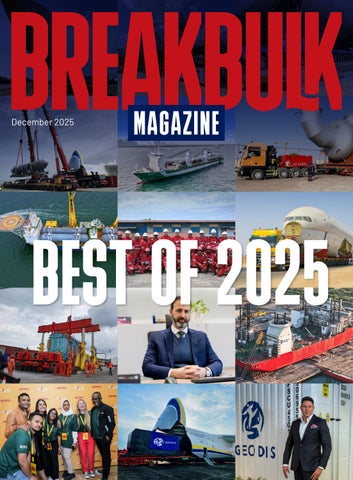
December 2025
BEST OF 2025 1 Breakbulk Magazine
breakbulk.com
2 Breakbulk Magazine
breakbulk.com
TOP 10 STORIES
Best of Breakbulk Magazine 2025
The industry’s most-read stories of the year. Read and download complete issues at breakbulk.com/page/magazine
5 New Route for Global Trade? 1 AFrom Breakbulk Magazine
Issue 4 Could Mexico’s new Interoceanic Corridor (CIIT) be the answer to Panama Canal bottlenecks? Review the analysis and decide for yourself if this rail link is a viable alternative shipping route. Page 5 Al Faris Group Proves Heavy-
2 Lift Expertise in the UAE!
Witness Al Faris’ multi-year heavy-lift mastery on the Borouge 4 expansion, delivering over 500 packages, including two massive 510-tonne gas phase reactors for one of the UAE’s largest industrial projects. Page 9
9 CEVA Almajdouie: A Saudi
3 Powerhouse Emerges
In this exclusive interview with CEO Bassel El Dabbagh, learn how CEVA’s global leadership and Almajdouie’s local Saudi expertise drive Vision 2030 megaprojects with powerful, end-to-end solutions. Page 11
14 3 Breakbulk Magazine
breakbulk.com
GEODIS and Ecopetrol: A Project
4 Logistics Powerhouse
Discover how GEODIS collaborated with Ecopetrol, Colombia’s largest energy group, to transform its logistics processes, leading to recordbreaking multimodal moves and securing a long-term contract. Page 13
Best of Breakbulk Magazine 2025
Solutions for 5 Engineering Aramco’s Massive Modules
7
Learn how J M Baxi Heavy and Larsen & Toubro managed massive module tonnage, high center of gravity, narrow tidal windows, and severe monsoon conditions for Aramco’s final offshore installation. Page 19 Breakbulk Sets Sail
6 for Singapore
8
With Breakbulk Asia set for Singapore in 2026, explore how the city-state’s green finance dominance, new Tuas Mega Port and role in Southeast Asia’s energy transition confirm its status as an ideal location. Page 23
Inside deugro’s High-Stakes Cable Move Over the next three-and-a-half years, more than 800 bus-sized cable drums will be transported to 120 sites across Bavaria. Simon Junker at deugro Germany shares insights on the project’s scale and logistics. Page 25
Village Roads 9 From to Global Routes
Keeping Mega Cracker Complex on Track Port of Antwerp-Bruges, deugro, JSI Alliance, dteq, Felbermayr, and PSA Breakbulk teamed up to transport massive components for INEOS Project One, Belgium’s largest petrochemical investment in decades. Page 29
10 an Italian Icon
Follow Amadou Diallo from village roads to global leadership as he drives DHL’s growth across Africa and the Middle East while championing talent, resilience and the region’s expanding role in world trade. Page 33 Shaping the Future of Fernando Bertoni is steering Fagioli toward a sharper, more strategic future, realigning its focus on key markets and regions – the executive tells Breakbulk how he’s making it happen. Page 37
WE WANT YOU!
We are looking for experts across all sectors of the project cargo and breakbulk supply chain. Whether you are an experienced voice or emerging talent, we want to hear from you. You do not need to pitch a full article. Just tell us your area of expertise and the types of content you’d like to be considered for in future issues.
Fill out the form and we’ll be in touch! forms.gle/bdbViop9UF9XiTor6
Leslie Meredith Product & Editorial Director Leslie.Meredith@breakbulk.com
Be a part of Breakbulk Events 2026
Breakbulk Middle East Feb. 4-5, 2026 Dubai World Trade Centre Dubai, UAE
Breakbulk Europe June 16-18, 2026 Rotterdam Ahoy Rotterdam, Netherlands
Breakbulk Americas Sept. 22-24, 2026 George R. Brown Convention Center Houston, Texas, US
Breakbulk Asia Nov. 18-19, 2026 Marina Bay Sands Singapore
middleeast.breakbulk.com
europe.breakbulk.com
americas.breakbulk.com
asia.breakbulk.com
4 Breakbulk Magazine
breakbulk.com
1
Americas
Logistics Plus handles windmill blades at Mexico’s Port of Altamira. Credit: Logistics Plus
A NEW ROUTE FOR GLOBAL TRADE?
By Joanna Marsh
Mexican Rail Corridor Could Connect Oceans, Bypass Drought-Hit Canal
S
ignificantly low water levels at the Panama Canal in 2023 presented breakbulk shippers and container vessels with a dilemma: face extended delays lasting as long as two weeks, or pay up to jump the queue. But what if shippers had an additional option, beyond sailing around South America to ship goods from the Pacific Ocean to the Atlantic Ocean, or vice versa? Mexico
believes it may have the solution: an interoceanic railway connecting the Pacific and Atlantic oceans. The Interoceanic Corridor of the Isthmus of Tehuantepec (CIIT), located in the narrowest part of the country, is the region where this interoceanic railway would be located. Mexican officials want the Ferrocarril del Istmo de Tehuantepec (FIT), or Isthmus of Tehuantepec Railway, to serve as one
5 Breakbulk Magazine
breakbulk.com
of the crown jewels of the corridor. The railway actually has three legs: the 308km “Z Railroad” is the one that Mexican officials hope can compete with the Panama Canal. It connects the Port of Coatzacoalcos, located along the Gulf Coast in Veracruz state, with the Port of Salina Cruz, located along the Pacific Coast in Oaxaca state, and passenger rail service began serving this line in late 2023.
Americas
In addition to the railway, the corridor includes ambitious plans to develop 10 industrial parks located along the FIT’s Z Railroad, as well as construct a national highway system in the states of Oaxaca, Veracruz, Chiapas and Tabasco. “Plans to connect these two oceans through the Isthmus of Tehuantepec had existed since the Colonial period in the 16th century but were never successfully executed,” Thanya Ramirez, supervisor of project cargo for Logistics Plus, told Breakbulk. The railway was completed in 1895 with passenger rail, and interoceanic cargo traffic began in 1907, but was short-lived due to the Mexican Revolution. The idea of a major interoceanic railway was revived by former Mexican president Andrés Manuel López Obrador, who was born in the region, she said.
Mexican officials have been touting the FIT’s “Z Railroad” leg as an alternative to the Panama Canal, which faced challenging shipping conditions in 2023 because of severe drought. But industry experts with knowledge of the region expressed skepticism that the railway could compete with the Panama Canal, given the capacity of the two transportation routes. While cargo might face a shorter transit time using the railway, the CIIT corridor is expected to have a capacity of 1.4 million twenty-foot equivalent units, according to Ramirez, in contrast to the Panama Canal’s ability to handle significantly more volumes. That doesn’t mean shippers should dismiss the CIT entirely, however.
“Complementary Option” “I personally don’t think this project will be able to compete with the
Thanya Ramirez, Logistics Plus
Panama Canal as the volume of cargo expected to be moved will not reach the volumes of the cargo moved through Panama, at least in the first middle stage,” Ramirez said. “But - it will indeed be a good complementary and cheaper option. And most importantly, it is finally giving these southern states a big real opportunity of development and economic growth.”
Atlantic Ocean
MEXICO CITY
Coatzacoalcos, Veracruz
Salina Cruz, Oaxaca Pacific Ocean
GUATEMALA
6 Breakbulk Magazine
breakbulk.com
Americas
Logistics Plus oversaw the transport of furnaces and a manipulator in the Mexican state of Nuevo León. Credit: Logistics Plus
Plans are not just limited to the railroad and the ports, Ramirez said, but include the development of the highways and 10 industrial parks. Diego Rodriguez, director of logistics and industrial practice at Americas Market Intelligence, also believes that the railway can’t compete with the Panama Canal, since the Panamanian authorities appear to be seeking a long-term solution for the water shortages, he said. “The Panamanian economy and the government’s revenue depend heavily on the Panama Canal, and it’s a very established logistics hub in the world. So for that reason, I don’t see the interoceanic corridor competing,” Rodriguez said. But the CIIT “makes a lot of sense because it diversifies the geographies in which companies could invest and set up manufacturing locations. You have access to natural resources,
water, and power, and you have plenty of room to grow. So, it makes a lot of sense from the point of view of developing an alternative location for companies looking to establish operations in Mexico to serve the U.S. market,” Rodriguez added. “If you set up operations in the south, you have to move all your products through roads in Mexico that are insecure. You have lots of cargo theft. [But] it’s cheaper and safer just to move your cargo from the Pacific to the Gulf Coast, and then use the ocean services to connect with the West Coast or the East Coast in the U.S.”
Lack of Capacity
For the FIT and the industrial corridor to succeed, Mexico needs to conduct extensive work on the ports touching the railway, so that there is sufficient capacity to handle all the cargo. The ports of Salina Cruz and Coatzacoalcos
7 Breakbulk Magazine
breakbulk.com
have a list of capital projects to expand their capacity. While both are already capable of receiving some breakbulk cargoes, they are not able to handle significant container volumes, according to Ramirez. That existing lack of capacity is a concern for Rodriguez, who says that as the railway and the industrial parks get developed, so do the ports. “The problem is that the ports need to be upgraded as well. You also need to develop the industrial parks. I’m not concerned with the railway because that’s the easiest part, I would say,” Rodriguez said. “The problem is actually upgrading the ports along the Gulf and the Pacific and also developing the industrial parks to create the infrastructure ecosystem to attract the manufacturing sector. Those are the potential clients: anything that requires bringing in your raw materials and then assembling and then re-exporting.”
Americas
Logistics Plus in Mexico. Credit: Logistics Plus
The Mexican government is seeking to change that, according to Ramirez at Logistics Plus. In addition to plans to bolster existing capacity at the ports, proposed projects include developing a specialized container terminal and an LNG terminal at the Port of Coatzacoalcos and dredging and constructing a specialized container terminal at the Port of Salina Cruz. “Talking about the railway service per se, I don’t think it will work for heavy/oversized cargoes, at least not in several years, as it is still very bumpy— there’s not enough service with the cargo rail routes already existing, and there are no real service providers with the rail cars for project cargo in Mexico,” Ramirez said. “But if the modernization of the ports and construction of highways happen, the parallel highways should indeed do the work of moving project cargo throughout the country.” Indeed, these capital improvements could also potentially help to ease congestion at the Ports of Manzanillo and Lázaro Cárdenas, which have longer vessel waiting times, Ramirez said. That congestion has resulted in breakbulk vessels having to wait as long as two or three weeks to be discharged. If the private investments really materialize, project cargo specialists will be able to move even more machinery of all sizes, and
for all industries, Ramirez said. While in office, former President Obrador pushed for the development of the CIIT before his term ended in 2024 because the region has been perceived as less affluent compared with regions to the north that are closer to the U.S. border. He and other Mexican officials have argued that developing the railway and accompanying industrial infrastructure will pique the interest of industrial sectors such as vehicle manufacturing and semiconductor production while bolstering other sectors such as energy production. Even though Mexico has a new president, Claudia Sheinbaum Pardo, the country is still very interested in showcasing the railway and its potential to facilitate trade among the Americas and Asia.
Efficient Alternative
In June last year, just after the election of Sheinbaum, a delegation of Mexican officials that included Secretary of Foreign Affairs Alicia Bárcena Ibarra and Secretary of the Navy Admiral Rafael Ojeda Durán traveled to Washington, D.C. to discuss Mexico’s plans for the railway and the interoceanic corridor with U.S. government officials. The meeting, which included Amos Hochstein, U.S. special presidential coordinator for Global Infrastructure
8 Breakbulk Magazine
breakbulk.com
and Energy Security, and Elizabeth Sherwood-Randall, Homeland Security Advisor, was Mexico’s opportunity to present the railway as “a modern and efficient alternative for global trade with easy access to the U.S., Asia and Central and South America,” according to a Mexican government statement. And just recently, the FIT and Mexico’s Ministry of the Navy announced in November that grain producer Viterra Mexico successfully transported 2,000 tons of wheat grain using the railway. The cargo, which was imported from Canada, arrived at the Port of Salina Cruz via the SSI Prudence and was then transshipped to bulk hoppers before heading to warehouses operated by wheat distributor Trimex near the Port of Coatzacoalcos. “There will be opportunities to take advantage of the interoceanic corridor, and companies will be looking to move to these industrial parks. But that’s medium-term, maybe 2027, 2028, once it’s clearer about what’s going to happen with the new U.S.-Mexico-Canada trade agreement in 2026,” Rodriguez said. Joanna Marsh is a freelance writer and journalist based in Washington, D.C. who takes an interest in sustainable transportation developments. *Breakbulk Exhibitor * BGSN member
Middle East
AL FARIS PROVES
Credit: Al Faris
2
By Simon West
HEAVY-LIFT EXPERTISE IN UAE More Than 500 ODC Packages Delivered for Borouge 4 Petrochemical Project
A
l Faris has once again demonstrated its expertise in tackling largescale industrial projects after it successfully handled more than 500 over-dimensional cargo packages for the Borouge 4 petrochemical complex in Ruwais, UAE. The heavy-lift specialist was called into action after Borouge, a joint venture (JV) between UAE state energy company ADNOC and Austria-based chemical manufacturer Borealis, awarded construction contracts for the expansion of the petrochemical facility to engineering firms Technip Energies and Maire Tecnimont in late 2021. Vimal Jose, commercial manager at Al Faris, told Breakbulk that a large chunk of the company’s transport resources was allocated to the project in 2024, mainly to meet demand from the near-constant arrival of ocean vessels into
AD Ports Group’s Mugharraq Port in the western Al Dhafra region. Among the massive components offloaded and delivered by Al Faris were a 365-tonne cracked gas dryer tower, a 216-tonne cold flare drum and a pair of 102-tonne warm flare drums. The heaviest pieces were two, 510-tonne gas phase reactors measuring 36.6 meters long and 10 meters wide, which were carried from the fabrication yard to the port. To transport the cargo, Al Faris deployed its own specialized equipment including hydraulic multi-axle trailers, heavy-duty tractors and self-propelled modular trailers (SPMTs). Most of the deliveries from Mugharraq – which AD Ports officially inaugurated in 2023 to serve as a hub for local oil and gas operations including downstream facilities at Ruwais – took between three and four nights, Jose said.
9 Breakbulk Magazine
breakbulk.com
Dubai-headquartered Al Faris, the region’s largest crane and transport vehicle rental contractor, was also tasked with delivering 21 pipe racks from their fabrication facilities in Jebel Ali to the Borouge 4 site. The biggest of these elevated steel structures, typically used in chemical plants to support piping, cable trays and power cables, measured 36 meters long and weighed 120 tonnes. “During the design phase of the pipe racks, we collaborated closely with our customers to ensure they were optimized for road transportation,” Jose said. “We then successfully transported the units from Jebel Ali to Ruwais. To navigate the journey, we obtained special approvals from authorities to safely transport these heavy loads across bridges.” One of the toughest hurdles for the project team was navigating a dense network of electrical lines with
A significant portion of Al Faris’s transport resources were allocated to the project.
More than 500 ODC packages were delivered, including two, 510-tonne reactors.
Credit: Al Faris
Credit: Al Faris
Al Faris deployed its own specialized equipment to handle the cargo. Credit: Al Faris
varying voltages along the route, all the while ensuring the necessary clearance levels were upheld. Tackling the challenge required close coordination and negotiations with local distribution and transmission companies such as Transco and ADDC. “We arranged several route modifications to ensure the safe transportation of the cargo, particularly in cases where the cargo and trailer did not have sufficient clearance under the power lines,” Jose said.
A World-Class Project in the UAE
Billed as one of the UAE’s largest industrial projects, Borouge 4 is the fourth expansion phase of the sprawling Ruwais polyolefins complex in Abu
Dhabi. Covering some 3.4 million square meters – equivalent to 500 football pitches – the US$6.2 billion project will boost Borouge’s total production capacity by about 30% to 6.4 million tonnes per year, making it the world’s largest single-site polyolefin complex. Alongside colossal processing units, Borouge 4’s construction phase is also calling for the transport and installation of 7,500 kilometers of cables, 340,000 cubic meters of concrete and 77,500 tonnes of structural steel. Operations are slated to start by the end of 2025. Technip Energies is working alongside TARGET Engineering to build a 1.5 million tonne-peryear ethane cracker, while Maire Tecnimont’s subsidiary Tecnimont will construct two new polyethylene
10 Breakbulk Magazine
breakbulk.com
production plants and a 1-hexene plant, associated utilities and offsites, and a 100,000 tonne per year crosslinkable-polyethylene (XLPE) plant. “This transport project has been a milestone for us in establishing ourselves into the heavy haulage market in the UAE, especially in Abu Dhabi,” Jose said. “With state-of-the-art equipment, precision engineering and first glass operations, we are delighted to have served our customers beyond their expectations, giving us more business opportunities and the ability to spread our wings in this niche market.” Colombia-based Simon West is senior reporter for Breakbulk. *Breakbulk Exhibitor * BGSN member
3
Middle East
CEVA ALMAJDOUIE LOGISTICS: A SAUDI POWERHOUSE EMERGES
CEVA Logistics and Almajdouie join forces to create a new joint venture logistics company in Saudi Arabia
U
nveiled in 2024, the Dammamheadquartered company led by CEO Bassel El Dabbagh boasts a workforce of some 2,000 employees and a fleet of more than 2,000 assets, ready to revolutionize logistics in the Kingdom. In an exclusive interview with Breakbulk, El Dabbagh shares insights into the ambitious venture, followed by a case study spotlighting one of the company’s first major projects – the transport of three Boeing 777 fuselages from Jeddah to Riyadh. Q: Can you give us an overview of the venture between CEVA and Almajdouie? What inspired the partnership? One of the main reasons why we strongly believe in this partnership is that both entities share strong family values. From humble beginnings and a clear vision for the future, both businesses transformed into leading logistics groups that remain family owned. Opportunities and timing in Saudi Arabia were also key motivators for this JV. Under the Kingdom’s Vision 2030 theme of “A Thriving Economy,” there are strategic objectives around the creation and improvement of logistics hubs, and regional and international connectivity via enhanced transport networks. Saudi Arabia has ambitious plans to transform the country into a global
hub that will enable business growth and development. In 2023, nearly 60 logistics zones were launched. Today, 22 are currently active and 37 are in development with an anticipated finish date of 2030. These will include seven Special Economic Zones. Many mega projects increasingly require elaborate logistics solutions. To add to this, Saudi Arabia is rapidly developing its own manufacturing and exporting capabilities for both local and global markets. Therefore, the Kingdom will need robust endto-end logistics solutions, backed by advanced technology and strong local execution know-how and assets. The venture is uniquely positioned to address such demand.
Given its global network in 170 countries, CEVA will enable the JV to connect Saudi’s imports and exports to all corners of the world. Likewise, one cannot do business effectively in the Kingdom without a deep understanding of the local landscape. Almajdouie Logistics has been in the country since 1965, following and supporting its unprecedented growth journey. The JV will offer robust endto-end supply chain services, with strong logistics offerings at its origin, destination and all points in between.
Q: How do you intend to leverage the unique strengths of each company?
We will continue to serve our conventional customer base in Saudi Arabia, especially in the fields of petrochemicals, energy and fastmoving consumer good (FMCG). With this new JV, we have won additional large energy and industrial projects in the last few months alone. Our customers are delighted that they now have a one-stop shop and a partner with an in-house capability to manage their freight forwarding and transportation needs from any country in the world to any (remote) corner in Saudi Arabia. Additionally, the JV will focus on the sectors of defense & aerospace, automotive, eCommerce and luxury fashion & retail.
This is a unique partnership between a global logistics leader and a local logistics champion. It is a very complementary joint venture, with CEVA Logistics adding value through its extensive global network, global expertise and cutting-edge technology coupled with a persistent drive towards innovation. Almajdouie brings invaluable local execution expertise, local connections and know-how, presence across all key ports and airports in Saudi, over 2,300 transport and handling assets, over one million square meters of terminal space, and much more.
11 Breakbulk Magazine
breakbulk.com
Q: What industries or sectors will the venture primarily focus on supporting? Are there any untapped markets you aim to explore?
Middle East
Bassel El Dabbagh, CEVA Almajdouie Logistics
“THIS IS A UNIQUE PARTNERSHIP BETWEEN A GLOBAL LOGISTICS LEADER AND A LOCAL LOGISTICS CHAMPION” Q: Does the company have plans to invest in new infrastructure such as warehouses, transport fleets or technology to support its operations?
Q: How will you measure the success of this joint venture over the next 5–10 years?
First and foremost, selecting the right partner for a JV in Saudi Arabia We are surely looking into investing is not an easy task. The company in selected infrastructure such as culture needs to be fully aligned with state-of-the-art warehouses and the vision for the future, and this implementing CEVA global technology can be challenging when we bring to support our operations in KSA. together a global corporation and a leading local company. At CEVA Almajdouie Logistics we share a
12 Breakbulk Magazine
breakbulk.com
joint commitment to Saudi Arabia and to excellence in logistics. We will move together focusing on continuous improvement and innovative, sustainable and resilient transport and logistics solutions across the country. Our measure of success is determined by the level of our alignment with the Kingdom’s vision and our customers’ feedback and satisfaction with our services.
4
Americas GEODIS chartered an Antonov AN124 to transport 249 components to southeast Colombia. Credit: GEODIS
GEODIS AND ECOPETROL: A LOGISTICS POWERHOUSE
Two years ago, Colombia state energy firm Ecopetrol teamed up with global logistics provider GEODIS to launch a pioneering, end-to-end supply chain integration model. In an exclusive for Breakbulk, the two companies come together to share how they did it.
A
fter several months of working through a Request for Proposal (RFP) process, Ecopetrol and GEODIS Colombia signed a long-term contract in 2023 to implement an innovative and cutting-edge logistics integration model. This model covers end-to-end supply chain logistics and pre-contractual management services, breaking new ground within stateowned oil and gas enterprises. As the global leader in 4PL solutions and one of the top seven international logistics companies,
GEODIS partnered with Ecopetrol, the largest oil and gas firm in Colombia, to collaboratively develop a robust logistics model that can be scaled across other companies within the group. The objective was to transform Ecopetrol’s supply chain management and logistics culture into one that is more predictive, proactive, integrated, efficient and competitive – a strategy that has now become a reality. “It was all about collaboration,” said Carlos Manuel Palacios, managing director at GEODIS, detailing how
13 Breakbulk Magazine
breakbulk.com
the state-owned company identified key areas for improvement – such as automation and systems integration – which sparked a year-long dialogue. Throughout that period, the two sides worked closely to create a tailored solution, which Palacios said involved a “complete supply chain analysis”. By aligning Ecopetrol’s needs with GEODIS’ products and services, the groundwork was laid for rapid progress in the first year and even better results in the second. By 2024, the collaboration had grown so robust
Americas
A Logistics Integrator
Carlos Manuel Palacios, GEODIS
that the teams were holding more than 70 operational meetings a year supported by more than 150 direct and indirect employees dedicated to this project, Palacios said. “Our remarkable progress in optimizing logistics processes stems from the unwavering commitment of both teams to clearly communicate their needs and goals and collaboratively work towards achieving them. This partnership is a testament to our shared dedication to excellence,” said Julian Mora, supply chain coordinator at Ecopetrol.
The team-driven approach ultimately led to a unique solution that involved GEODIS splitting its services across three distinct contracts. These included a long-term 4PL agreement where GEODIS was charged with handling Ecopetrol’s entire logistics supply chain, a 3PL forwarding operation focused on project cargo, and a pre-contractual management contract centered on expediting approvals. Each service is articulated by separate GEODIS divisions with their own dedicated teams operating from the integrator offices in Bogotá. For the 4PL operations – managed by Palacios – GEODIS has connected all the logistics players into a single smart platform, offering Ecopetrol real-time, end-to-end visibility of the entire supply chain, from tracking delivery milestones to measuring CO2 emissions. “We measure every aspect of the end-to-end supply chain in our platform, leading more than seven 3PLs,” Palacios said. “We have the teams to support Ecopetrol and to
respond to any request they have but also adding value to the 3PLs to ensure operational and business excellence.” For Ecopetrol, developing a 4PL model brought significant advantages. “One of the key benefits was having an independent representative to control and monitor all the 3PLs,” Mora said. “The 4PL integrates and monitors the entire logistics operation, identifying new strategies with each 3PL to control costs and improve the delivery of critical materials.” As a key element of the company’s corporate social responsibility and sustainability efforts, the integrator, together with 3PL partner GEODIS, measured CO2 emissions under scopes 1, 2, and 3 across each phase of the logistics process using advanced technology. This enabled the development of effective decarbonization strategies. Additional efforts have focused on raising employee awareness of environmental impacts, integrating CSR into IT services, and creating tools to analyze and report key metrics such as CO2 emissions.
GEODIS completed a groundbreaking project in March that set the record for the heaviest cargo to move down Colombia’s Magdalena River. Credit: GEODIS
14 Breakbulk Magazine
breakbulk.com
Americas
“These ambitious projects require perfect integration and great collaboration between Ecopetrol, the 3PLs and the integrator,” said Luke Mace. Credit: GEODIS
Luke Mace, GEODIS
Record-breaking Moves
While the 4PL side has concentrated on planning and monitoring Ecopetrol’s supply chain operations, the GEODIS 3PL team has proved its mettle by doing what it does best – navigating significant logistical challenges to transport massive project cargoes across Colombia. In early March, GEODIS achieved a record by transporting heavy cargo down the Magdalena River, Colombia’s main inland waterway. The milestone move supported a critical energy project aimed at ensuring the continuous production of gasoline in the country. “These ambitious projects require perfect integration and great collaboration between Ecopetrol, the 3PLs and the integrator,” said Luke Mace, global vice president of project logistics at GEODIS. GEODIS managed the complex operation with a multimodal solution combining ocean freight, barge transport and trucking. The shipment, which moved through the terminal from Cartagena to Barrancabermeja, included oversized components that
demanded flawless execution. The project also involved significant civil works and temporary road closures to accommodate one-way traffic. In an earlier project, GEODIS’ troubleshooting skills were put to the test during the delivery of 12 oversize and overweight pieces to southeast Colombia. Originally planned as an overland move via the la Orquidea bridge in Boyacá – the only viable route for such heavy freight – the project was thrown into crisis when the bridge presented certain restrictions. With the deadline looming, the forwarder pivoted fast, chartering an Antonov AN124 to complete the timecritical delivery by air. “Over an eight-day period, we executed 13 flights – one long-haul and 12 domestic trips – all during Christmas week,” Mace said.
Exploring New Sectors
For a major shipper like Ecopetrol, which invests billions in industrial projects, having a logistics partner with the right expertise, experience and resources is vital. In Colombia alone, more than 150 GEODIS employees –
15 Breakbulk Magazine
breakbulk.com
including engineers, supervisors and project directors – are dedicated to industrial projects and 4PL solutions. “When we have a new company working with us, the first thing we say is they’re not just another contractor,” Mora said. “We’re looking for strategic partners who can help us improve our processes. It’s about more than delivering a service – it’s about dialogue, finding new ways of doing things, and real collaboration.” As Colombia steps up its industrialization efforts, forwarders, shippers and carriers are positioning themselves to support the nation’s expanding project landscape. “We see a shift toward moving regional logistics structures to Colombia, and to Bogotá in particular,” Mace said. “It’s a growing country with smart talent, a big market and competitive costs.” In March, GEODIS opened a new office in Bogotá – its largest globally with over 600 employees, up from just 50 a decade ago. The launch of the new base comes as Ecopetrol seeks to diversify beyond oil and gas into new segments such as solar, wind and hydrogen, capitalizing on Colombia’s abundant natural resources. Here, GEODIS is leveraging its expertise to support Ecopetrol’s evolving needs to support energetic transition. “There are lessons and business practices learned outside of Colombia that we can bring to the table,” Mace said. “That’s the advantage of having a leader in logistics and transportation solutions supporting Ecopetrol.” *Breakbulk Exhibitor
HONORING THE INNOVATIONS THAT ARE CHANGING HOW COMPLEX CARGO PROJECTS ARE EXECUTED ACROSS THE REGION 7 categories covering the industrial supply chain:
MARITIME INNOVATION
SMART PORTS & TERMINALS
MOST INNOVATIVE ONSHORE PROJECT SERVICE
MOST INNOVATIVE OFFSHORE ENERGY PROJECT SERVICE
PROJECT LOGISTICS INNOVATOR
EQUIPMENT INNOVATOR
INNOVATION OF THE YEAR
ENTER NOW NEW easy apply form Enter by Friday, Dec. 12, 2025, to be included in Breakbulk Magazine, Issue 1, distributed at Breakbulk Middle East 2026.
16
Breakbulk Magazine
middleeast.breakbulk.com/page/innovation-awards
breakbulk.com
5
Middle East
ENGINEERING SOLUTIONS
FOR ARAMCO’S MASSIVE MODULES J M Baxi Heavy and L&T Team Up on Multi-Year Offshore Energy Project
Credit: J M Baxi Heavy
By Malcolm Ramsay
17 Breakbulk Magazine
breakbulk.com
Middle East
T
he US$21 billion Marjan oilfield, Saudi Aramco’s ambitious offshore energy development, has driven numerous project cargo movements in recent years, pushing the boundaries of engineering and logistics expertise. One example of this was the transport and installation of jackets and decks by Indian cargo specialist J M Baxi Heavy for L&T Hydrocarbon, the EPC contractor for this project. The complex task involved extensive pre-planning and resulted in the movement of four tie-in platforms, a tie platform module, nine wellhead deck modules, 217 kilometers of subsea pipelines and 145 kilometers of subsea cables. “The transport and load-out for this project had several challenges, particularly the three decks requiring a float-over installation, where barge dimensions were non-negotiable,” Sameer Parikh, chief business officer at J M Baxi, told Breakbulk. Part of the Marjan Increment Program, first announced in 2017, this project was the latest in a series of expansions designed to increase crude production at the offshore field by 300,000 barrels per day (bpd) and ethane and natural gas liquids (NGLs) output by as much as 360,000 bpd. Aramco awarded the contract for fabrication and installation of the jackets and decks to L&T Hydrocarbon in 2019, but the COVID pandemic a few months later brought significant delays, disrupting schedules and necessitating timeline extensions. As a result, the movement of the outsized components was unable to begin until November 2023. J M Baxi was contracted by L&T Hydrocarbon for all engineering, transportation and load-out of jackets and decks from a site around 300 kilometers north of Mumbai on India’s west coast to Aramco’s offshore development in the Persian Gulf, with the vast cargo “collectively weighing more than 17,000 tonnes.”
Sameer Parikh, J M Baxi Heavy
Dharmendra Gangrade, L&T
To meet this challenge, J M Baxi spent months planning the move in detail to ensure every step of the process, from the fabrication site to final installation, was meticulously covered. This resulted in a route involving over 1,700 nautical miles of transport by sea from the Hazira shipyard to the project site. Headquartered in Mumbai, J M Baxi traces its origins as a shipping firm back to 1916 and today specializes in heavy and over-dimensional cargo transport, lifting and offshore operations. The group serves the petrochemical, power and offshore energy industries with advanced equipment, including 308 self-propelled modular transporters (SPMTs), 366 hydraulic axles, 31 prime movers and high-capacity strand jacks. Their fleet also features ocean-going barges and cranes capable of handling up to 250 tons.
commenced in late November 2023 and concluded a few days later, with the final load-out weight, including axles, coming in at over a kilotonne heavier. Next in line was the heaviest of the batch, the 6,314-tonne TP-13, which was moved between February and March 2024. The final module, TP-12, had a factory weight of 5,554 tonnes and was loaded out in May 2024. “The stowage plan was fixed to ensure proper alignment and to tackle the tidal range of one to six meters at Hazira Jetty’s load-out, classified as Class-1 under DNV-GL standards, making it a critical operation,” said Dharmendra Gangrade, head of Logistics Management Centre at L&T. Load-outs were carefully scheduled to align with high tides, ensuring a minimum of five meters water depth, however this meant a narrow window for completion. “Due to the moon’s cycle, suitable tidal conditions limited load-outs to approximately 18-20 days per month,” Parikh explained, adding that during these days the critical window for operations was “just three to four hours for each execution.” The massive modules, complete with load spreaders and axles, were transported and loaded out using state-of-the-art equipment designed to handle their immense size and weight. The operation involved the deployment of 260 SPMT axle lines, which provided the necessary stability and maneuverability for moving the modules over land to the L&T Hydrocarbon
Mammoth Modules
Each weighing over 5,000 tonnes, the topsides are key components of the offshore platforms and present unique challenges for lifting and transport. Measuring 73.67 meters in length, 49.50 meters in width and 47.91 meters in height, the giant structures were fabricated at L&T Hydrocarbon’s Modular Fabrication Yard at Hazira, in the state of Gujarat, on India’s west coast. The first of the giant modules to be loaded out was TP-11, weighing a colossal 5,663 tonnes. Operations
18 Breakbulk Magazine
breakbulk.com
Middle East
L&T said this complex logistics operation “highlights the technical expertise and collaborative efforts crucial for large-scale industrial projects.” Credit: J M Baxi Heavy
Jetty. Additionally, 12 power pack units were utilized to supply the hydraulic power needed to drive the SPMTs. Upon arrival on the jetty they were transferred to heavy-lift deck barges (HDBs), with 85 ballast pumps employed to manage the weight distribution and stability during the loading process. These also provided control over the buoyancy of the barges, ensuring that the modules remained balanced and secure.
units, these modules represent a monumental achievement, with the partners hailing the move a “paradigm shift in engineering and logistics capabilities.” In addition to the topsides, a variety of jackets – the supporting structures for the topsides – were also part of the load-out. These ranged in weight from approximately 100 tonnes to more than 1,000 tonnes, each jacket loaded out on carefully planned dates throughout 2024. In total, 35 jackets Meticulously-Planned are planned for the project, including Operation accessories such as boat landings The execution of each load-out was and conductors for the oilfields. a meticulously-planned operation The first of these, MNIF 540/549, completed in an impressive 36 hours, was loaded out on April 3, 2024 and from the initial insertion of the axles weighed 415.87 tonnes. A further to the final placement onto the HDBnine were moved over the course 402, a 400-class float-over barge. of the next six months. These Weighing a combined 18,000 tonnes components were first transferred and comprising 530,000 freight onto barges and roll-on, roll-off
19 Breakbulk Magazine
breakbulk.com
(RoRo) vessels at Hazira L Jetty for the final offshore destination. “The jackets were being fabricated vertically and the center of gravity of these jackets required precise planning and transport,” Gangrade said. “The fabrication was planned throughout the year, hence the need to plan shipments during monsoon when RoRo ships were used, however we needed to maintain a non-stop flow of jackets offshore to avoid crane idling.” When combined with a high center of gravity, the vertical orientation of the jackets caused a number of issues for transport as it greatly increased the risk of instability during transport and load-out. This was further complicated by the schedule which required constant shipment, in spite of often inclement weather. “The shipments were planned throughout the year, including the
Middle East
monsoon season where high winds and swell required significant analysis of the towing operations,” Parikh said. “This period is known for its unpredictable weather and rough sea conditions, which can significantly impact marine operations.” To counter these risks, the teams undertook detailed pre-planning and ensured close communication between all stakeholders throughout the entire process. Higher-capacity tugs were also deployed to mitigate the impact of strong winds and heavy swells, ensuring the stability and safety of the jackets during transport. “This meticulous approach was critical in ensuring the safe and reliable delivery of these massive structures,” Parikh said.
Turbulent Waters
While these powerful tugs were essential for navigating the turbulent waters and maintaining control over the heavy structures, they
did not fully mitigate the risk of toppling. As a result, the teams sought to further enhance stability amid the harsh marine conditions, introducing reinforced lashing and securing measures to effectively anchor the jackets and prevent movement during the voyage. “J M Baxi’s expertise in heavy logistics and maritime operations played a vital role in this project,” Gangrade concludes. “This complex logistics operation highlights the technical expertise and collaborative efforts crucial for large-scale industrial projects.” The Marjan field expansion project is now one step closer, with the majority of the 32 packages well under way and the remaining projects in various stages of development. Key contractors, including Saipem and McDermott, are working on a number of major engineering, procurement and construction contracts with completion estimated this year.
“This project underscores the industry’s advanced engineering and logistics capabilities, overcoming challenges of high CG, unpredictable weather and rough seas,” Parikh said, hailing the combination of “precision, coordination, and expertise” required to accomplish this unique offshore energy project. Operating in more than 50 countries worldwide, Larsen & Toubro is a US$27 billion Indian multinational engaged in EPC projects, hi-tech manufacturing. L&T Energy Hydrocarbon, the company’s hydrocarbon business, offers integrated ‘design-to-build’ solutions to the entire hydrocarbon industry, encompassing engineering, procurement, fabrication, construction, project management services and asset life services across multiple geographies. Based in the UK, Malcolm Ramsay has a background in business analysis and technology writing, with an emphasis on transportation and ports. *Breakbulk Exhibitor * BGSN member
J M Baxi Heavy and L&T worked together to move four tie-in platforms, a tie platform module, nine wellhead deck modules plus subsea pipelines and cables. Credit: J M Baxi Heavy
20 Breakbulk Magazine
breakbulk.com
6
Asia
BREAKBULK SETS SAIL FOR
SINGAPORE
As Hyve Group announces the launch of Breakbulk Asia in Singapore for 2026, Ben Carrozzi, an energy transition and low carbon infrastructure specialist, explains why the Lion City remains a critical player in global trade and logistics. From investing in a new mega port to establishing an offshore wind hub without installing a single turbine in its waters, Singapore is pushing boundaries and becoming an increasingly important hub for the project cargo community.
Credit: SAL Heavy Lift
21 Breakbulk Magazine
breakbulk.com
Asia
T
hanks to its strategic location and world-class infrastructure, Singapore acts as a vital conduit between the developed West and the aggressively expanding economies of the East. Over the past 50 years, the city-state has grown from a humble trading port to a pivotal hub for the maritime, logistics and energy sectors. Today, Singapore boasts some of the most sophisticated port facilities globally, a dynamic energy landscape and a thriving tech industry. As nations adapt to the evolving geopolitical landscape, Singapore’s influence in shaping the future of both regional and global supply chains is poised to grow. Singapore’s rise to prominence can be traced back to the British colonial era of the 19th century when the country - despite producing no oil of its own - became a vital port for oil trading due to its strategic location at the southern tip of the Strait of Malacca. After gaining independence in 1965, Singapore compensated for its limited natural resources by investing heavily in infrastructure and technology to gain legitimacy as a global oil refining and trading center, providing highquality bunkering, oil pricing and associated value-added services. It was a strategy that reaped significant rewards. Today, Jurong Island holds the title as the world’s largest bunkering port and Singapore serves as a vital transshipment point for energy commodities such as crude oil, liquefied natural gas (LNG), and refined products. As the world moves towards renewable sources, Singapore is deploying this same strategy to reposition itself as a regional hub for Southeast Asia’s (SEA) growing renewables industry. The city-state’s lack of indigenous resources and small land mass have led to it being deemed a “renewable-disadvantaged nation”, presenting an obvious challenge to the government as it strives to meet its Paris Agreement commitments and achieve net-zero emissions by 2050.
Ben Carrozzi, Norton Rose Fulbright
However, the old ethos of focusing on what the country has to offer and developing that to its fullest potential remains. By providing a home for capital and professional services alike, acting as a trusted broker in annual COP negotiations, initiating several innovative projects and operating as a reliable middleman in the regional distribution of renewables, Singapore is going beyond decarbonization at home to reconfigure itself as a critical renewable energy hub.
Growing Energy Needs
Driven by continued economic expansion, significant population growth and its status as a global center for cross-industry innovation, Singapore’s energy needs have grown significantly in recent decades. In particular, the rapid growth of data centers in Singapore has added significant strain to the nation’s energy grid. As of this year, Singapore’s data centers consume nearly 7% of the nation’s power usage, a figure projected to reach 12% by 2030. The government is therefore facing pressing challenges as it attempts to balance the increasing digitalization of its economy with its ambitious environmental commitments. Traditionally, Singapore’s energy mix has been heavily reliant on natural gas. In order to continue supporting rapid economic expansion and
22 Breakbulk Magazine
breakbulk.com
realize its transition to renewable power, the government recognizes the need to invest heavily in energy diversification projects. Given Singapore’s limited domestic assets, its reliance on renewable energy imports to meet emission targets and ever-increasing energy demands is accelerating SEA’s energy transition. While countries in the region have historically lagged Europe in terms of transition progress and clean energy investment, by forging essential cross-border partnerships, Singapore is providing the necessary incentives and critical financial support to its neighbors to expedite the development of renewables projects across the region. Singapore’s Energy Market Authority (EMA) is looking to import approximately 6 gigawatts (GW) of low-carbon power by 2035 via investment in a range of projects. One of the key Singapore-led initiatives is the Lao PDR-ThailandMalaysia-Singapore Power Integration Project (LTMS-PIP). Launched in 2022, LTMS-PIP marked the first multinational cross-border trade of renewable electricity in SEA. By leveraging existing infrastructure in Thailand and Malaysia, the project currently enables Laos to export up to 100 megawatts (MW) of hydropower to Singapore, with a second phase planned to expand capacity further by incorporating additional supply from Malaysia. Looking east, the EMA has also granted conditional licenses to five Indonesia-based projects for the importation of 2 GW of low-carbon electricity, with a further two projects granted conditional approvals to import an additional 1.4 GW. The reciprocal benefits of such cross-border agreements are clear: while Singapore achieves greater energy diversification and security of supply, its resourcerich neighbors are provided critical financial support for their burgeoning renewables industries and benefit from strengthened supply chains.
MSC transports 390-tonne hydraulic hammer from Rotterdam to Singapore. Credit: MSC
Hydrogen-Ready Projects
To avoid an over-reliance on imports, Singapore is also focused on the development of several HydrogenReady Combined Cycle Gas Turbine (CCGT) projects, which it hopes will play a key role in meeting its transition targets. While existing plants use both gas and steam turbines to generate electricity, these new plants will have the capacity to gradually incorporate hydrogen into the fuel mix, eventually enabling the plants to operate entirely on hydrogen in the future. The first of these projects, Keppel’s 600 MW Sakra Cogen Plant on Jurong Island, broke ground in November 2024 and is expected to be operational in the first quarter of 2026, with the capacity to power around 864,000 homes per year. On Keppel’s heels is PacificLight Power, which has recently been awarded the right to build a second hydrogen-ready CCGT on Jurong Island, with the company expected to generate nearly 10% of Singapore’s future annual energy needs. For Singapore to meet its 2030 targets, the development of such projects is critical to bridging the gap between Singapore’s existing natural gas infrastructure and the government’s push to decarbonize. Looking beyond project investment, Singapore’s role as a regional leader in the energy transition is anchored by its innovative green finance market. SEA is now at a critical point in its development of renewables; to achieve
net zero targets, the region needs to triple its renewable energy capacity by 2030, which requires annualized investments to triple to US$2.3 trillion over the next six years. In response, Singapore is mobilizing its existing capabilities as an international finance hub to build a comprehensive green financing ecosystem ready to fund the development of Asia’s renewable landscape. Launched in 2019 by the Monetary Authority of Singapore, the Green Finance Action Plan has positioned Singapore as a leader in green financing. Originally focused on developing green finance markets and fostering green FinTech innovation, the plan – since renamed the Finance for Net Zero Action Plan – has been expanded to include transition finance in a bid to accelerate the nation’s decarbonization efforts.
Green Finance Strategy
However, Singapore’s green bond market is the real engine of its green finance strategy. The Singapore Green Bond Framework governs the issuance of renewable bonds to finance sustainable infrastructure projects, including data centers which meet green construction standards. To catalyze the transition to renewable power both regionally and globally, the government has committed to issuing up to S$35 billion (US$26 billion) of green government bonds by 2030, engendering liquidity and laying the foundations
23 Breakbulk Magazine
breakbulk.com
for greater private sector finance activity, which can then be leveraged to fund regional renewables projects. The Financing Asia’s Transition Partnership (FAST-P) is another significant initiative led by Singapore. Supported by a network of public, private and philanthropic partners, this blended finance project aims to inject up to US$5 billion to finance and stabilize green projects across Asia. FAST-P focuses its resources on initiatives with the greatest regional utility, such as accelerating the transition from coal power and securing the grid. By providing significant financial support for projects of this kind, Singapore is not only facilitating its own decarbonization, but that of the region, while simultaneously assisting the economic and environmental resilience of its neighbors. In addition to its role as a green financing hub, Singapore is the regional headquarters of many multinational companies spanning the clean energy value chain, ranging from investors and think tanks, to international financial institutions, accountants, law firms and other professional advisers adept at advising prospective investors on the regulatory environment and operational risks of engaging in ASEAN’s developing renewables sector.
Global Maritime Hub
Energy is not the only sector undergoing rapid transformation in Singapore the maritime industry is also reaping the benefits of the city-state’s advancement. In 2024, Singapore’s port registered a new record of 3.11 billion gross tons in arriving ship traffic. In addition, the completion of the Tuas Mega Port is expected to take place by 2040 and is set to be the world’s largest fully automated terminal. The new port will streamline operations with onsite consolidated container handling which will improve efficiency and vessel turnaround times. The Maritime and Port Authority of Singapore (MPA)
Asia
from Singapore and supporting the ownership and management of ships from Singapore. Among other available incentives, the Maritime Sector Incentive offers full corporate tax exemption on shipping income derived from freight and charters of ships registered with the Singapore Registry of Ship. These tax exemptions extend to gains derived from the sale of Singapore-flagged ships and the process of obtaining these tax exemptions have been made simple by the automatic exemption of Singapore-flagged ships to taxation. Additionally, the Approved Shipping Financing Arrangement award also provides support for ship owners and operators by way of withholding tax exemptions on qualifying financing arrangements for the purpose of financing the purchase and construction of vessels. One notable and more recent development is the identification of the country’s potential to combine its leadership in the energy, maritime and shipping sectors to facilitate the development of even newer markets. In particular, we refer to Enterprise Singapore’s plans for
Credit: MSC
is optimistic that the new terminal will result in greater economies of scale, optimize the deployment of resources for port and marine services by automating both wharf-side and yard operations, and reduce the need for inter-terminal haulage. As you would expect, Tuas Mega Port will be automated and digitalized. Some key features of the new Tuas Mega Port include the use of blockchain technology and artificial intelligence to optimize vessel traffic management and cargo handling. The automation of cranes and vehicles will facilitate the reduction of reliance on manual labor and increase efficiency within the port. It is clear that the shipping industry constitutes a major segment of Singapore’s economy, contributing to roughly 7% of Singapore’s GDP. Implementation of several tax incentive schemes and the prioritization of innovation and technology in this sector has enhanced the island state’s competitive edge and contributed to its status as a global maritime hub, according to multiple global surveys. Special incentives are awarded by the MPA for the purpose of attracting shipping conglomerates to operate
24 Breakbulk Magazine
breakbulk.com
Singapore to become an offshore wind hub - without ever installing a turbine in its territorial waters. Instead, the plan is to mobilize the country’s maritime industrial base, along with excellence in advanced engineering applications, and combine them with the physical and intellectual capital that already resides in Singapore to support the development of offshore wind projects globally. Ambitious projects of this kind once again demonstrate Singapore’s outward-looking strategy and its ability to engender international and crossindustry collaboration to respond to the ever-evolving needs of the modern world. Norton Rose Fulbright is one of the longeststanding international law practices in Singapore. Partners Ben Carrozzi and Sue Ann Gan form part of the firm’s marketleading energy, maritime and shipping practices. Ben Carrozzi is an energy transition and low carbon infrastructure specialist, with experience of many first-of-kind projects across APAC and Europe. Sue Ann is a maritime law specialist and has advised financial institutions and owners on a wide range of shipping work across all asset classes, including both financing and restructuring matters. *Breakbulk Exhibitor
7
Middle East
Some 140 kilometers of cable were loaded onto the UHL Falcon at the Port of Osaka, Japan.
INSIDE DEUGRO’S
Credit: deugro
By Simon West
HIGH-STAKES CABLE MOVE From Japan and Norway to Abu Dhabi: Forwarder Keeps HVDC Project on Track
W
hen it comes to moving complex cargo, timing really can make or break a project. Even the smallest delay or misstep in communication can derail an entire venture, which is why precision planning, the right transport choices and flawless teamwork are vital. This was the challenge for deugro when it was tasked with transporting 15,500 tons of subsea cable from ports in Japan and Norway to a high-tech cable-laying vessel in Abu Dhabi. Working for client Samsung C&T, the cables, measuring a combined 700 kilometers long, were required to keep cable-laying operations on track for a high-voltage direct current (HVDC) submarine cable electrification project off the coast of Abu Dhabi. Supporting the
effort were deugro’s local teams in Korea, Japan and the UAE. “From cargo collection at the various ports up to the final delivery, each operational phase depended on the previous one being completed on schedule,” Jong-Yub Han, sales and business development manager of operations at deugro Korea, told Breakbulk. “A delay in one location could have disrupted the entire supply chain.” To meet the project’s extremely tight schedule, deugro and Samsung C&T agreed on an end-to-end solution covering vessel chartering, ocean transport, inspections, coordination among contractors, scheduling and technical support. A first delivery originated at the Port of Osaka, Japan. Some 140
25 Breakbulk Magazine
breakbulk.com
kilometers of multi-core round cable (MRC) were loaded directly from a barge to the heavy load carrier UHL Credit: deugro
Middle East
Falcon, part of United Heavy Lift’s 19-strong F900 Eco-Lifter fleet. The vessel was equipped with large steel static tanks to carry the cables. Ahead of the tank installation and spooling operations, and to secure timely departure from Osaka, deugro’s local team worked to meet all the requirements set by the Maritime Warranty Surveyor (MWS), appointed by the consignee. “The biggest challenge arose from a short-notice requirement by the consignee’s MWS to record acceleration data during the sea voyage to the UAE,” Han said. “Since no measuring system was installed on the UHL Falcon, we quickly rented a motion monitoring system and had it hand-carried to Osaka for immediate installation. For the next two shipments, we chartered suitable F-900s already equipped with their own motion monitoring systems.” Meanwhile, at Japan’s Port of Hitachi, 280 kilometers of DC400kV cable were spooled directly from the pier onto the UHL Force and the UHL Fierce, also part of UHL’s EcoLifter fleet. Each vessel was loaded with 140 kilometers of cables. The remaining shipment of 280 kilometers of fiber-optic (FO) cable was collected from the Port of Rognan in Norway by BBC Chartering’s heavy-lift vessel BBC Austria. For this phase of the project, two empty FO cable baskets were loaded at the Port of Finneid and
shipped to Rognan, where the cables were then spooled into the baskets for their onward voyage to the UAE. According to Han, the original plan for the FO cables called for the loading of pre-spooled baskets at Rognan. But with the jetty unable to support the weight of two 280ton units, deugro, the client and the shipper opted instead to load the empty baskets onto the vessel and spool the cables directly from the berth into the ship’s hold. The technical specifications and sensitivity of all the subsea cables delivered by deugro meant handling required in-depth expertise and experience. “Be it minimum bending diameters, drop height, maximum pulling forces, crush load parameters, sidewall pressure or axial compression, every operational step had to be executed with precision to the centimeter and in accordance with the highest safety standards,” he said.
Operation Enters Critical Phase
In Abu Dhabi, the MRC and DC400kV cables were scheduled to be transloaded onto the Isaac Newton, the largest cable-layer in Jan De Nul’s fleet. Specializing in the deployment of submarine cables, the multipurpose Isaac Newton is capable of carrying and installing 10,500 tonnes of cable in a single trip. The 138-meter-long vessel is also
Jong-Yub Jong-YubHan, Han, deugro deugroKorea Korea
Nils Sauerborn, deugro
26 Breakbulk Magazine
breakbulk.com
used for offshore support, trenching and subsea rock installation. For a project forwarder, securing such a highly specialized ship is one of the most critical factors in supply chain planning. Costly to operate and often booked years in advance, any delay in cable delivery can leave an installation vessel sitting idle, triggering project delays, financial losses and potential contractual penalties. “In the worst case, the vessel is already chartered out and booked for other operations or another project, causing considerable waiting times for all stakeholders,” Han said. “Weather and sea conditions can also play a critical role, as subsea cablelaying must be done at favorable moments. These are often limited to narrow timeframes, which means that missing a delivery deadline can also lead to considerable waiting time for the next safe opportunity.” With deugro ensuring the safe and timely arrival of all the cables into Abu Dhabi, the next phase of the project could proceed as planned. Because of the cargo’s sensitivity and the lengthy transpooling process, exact alignment between the cable-layer and each of the heavy-lift vessels was paramount. Anchored alongside one vessel at a time, the Isaac Newton acted as the “master unit,” pulling the cable while controlling the speed and overseeing the entire process. Once the carousel and drive systems were activated, the hauling began, supported by a bow cable engine (BCE), a cable pass system at the shore, and linear cable engines (LCEs) located both onshore and onboard. “A key operational requirement was to ensure synchronized spooling speeds across all components: BCE, LCEs and the carousel. Each unit had to operate at precisely the same speed to avoid tension imbalances or damage to the cable,” Han said. While the cable-laying vessel
Middle East
280 kilometers of DC400kV cable were loaded onto two UHL vessels at the Port of Hitachi, Japan. Credit: deugro
controlled the transpooling, skilled operators monitored each piece of equipment around the clock to respond quickly to any issues. The non-stop operation also called for timely fuel deliveries for the shorebased LCEs, while the transport vessel maintained constant communication with stakeholders, as its onboard crane held and positioned the BCE throughout the operation. Meanwhile, deugro implemented a different solution for handling the 280 kilometers of FO cable. On reaching Abu Dhabi, the heavy-lift vessel’s crane carefully discharged the cable before it was moved to a storage site at the pier, where it remained until it was ready for loading onto the installation vessel. A mobile crane was deployed to lower the cable into the vessel.
Two steel static tanks are installed in the UHL vessel’s cargo hold. Credit: deugro
27 Breakbulk Magazine
breakbulk.com
Middle East
The project team oversees cable unspooling operations at Abu Dhabi.
FO cables are lifted by mobile crane in Abu Dhabi. Credit: deugro
Credit: deugro
“In general, the handling methods are determined by the nature of the cables and several additional factors,” Han said. “Typically, HVDC cables such as MRC and DC are managed through spooling operations due to their structure and weight. In contrast, FO cables are lighter and smaller, allowing for more flexible handling options.”
processing and berth availability. Jayanth Suvarna, operations manager at deugro UAE, said 40 skilled workers were mobilized, operating in two shifts to maintain a continuous 24-hour workflow. Despite tight vessel laytime constraints, the disposal was completed in less than four days. “Port cranes and Mafi trailers were used daily in three shifts to move Static Tank Disposal the cut steel sections ashore. Once Still, deugro’s work was not finished. completed, a customs inspection Once all the subsea cables had was conducted at the designated been successfully discharged, area, followed by the delivery of the the forwarder was tasked with scrap steel to an authorized disposal dismantling and disposing of the steel company,” Suvarna said, highlighting static tanks that had been used to the strong collaboration during ship the cargo. For this job, permits this stage of the project between were secured and close coordination deugro’s operations team, AD Ports maintained with port authorities Group and port contractors. to ensure smooth customs Assessing the overall success of
28 Breakbulk Magazine
breakbulk.com
the project, Nils Sauerborn, director of offshore solutions at deugro’s global wind renewable energy division, described the project as “an excellent example” of how close cooperation across departments and regions can transform complex cable deliveries into seamless operations. “By combining our technical knowledge with precise planning and execution, we ensured that every stage met the highest standards,” Sauerborn told Breakbulk. “It’s a great demonstration of what we can achieve together for our clients.” Colombia-based Simon West is senior reporter for Breakbulk.
*Breakbulk Exhibitor *BGSN member
8
Energy Special | Europe
KEEPING MEGA CRACKER COMPLEX ON TRACK Partners Deliver Complex Cargo for INEOS Project One By Malcolm Ramsay
29 Breakbulk Magazine
breakbulk.com
Energy Special | Europe
O
Loading operations at the port of Zhangjiagang, China. Credit: deugro
ne of the largest investments in Europe’s chemical sector for decades, the INEOS Project ONE in Belgium has been a hub of project cargo activity since construction began in late 2022. Over the last year however this activity has scaled up, as some of the largest and most complex components have started to arrive on site. First announced in 2019, Project ONE is located within the industrial zone of the Port of Antwerp and entails the construction of an advanced ethane cracker and propane dehydrogenation (PDH) unit, which is expected to bring substantial economic and environmental benefits by producing ethylene and propylene with much lower CO2 emissions compared to traditional methods. “Ethylene, which will be produced here, is essential for making solar panels, wind turbine blades, lightweight materials for cars, and packaging for the food and medical industries,” Jacques Vandermeiren, CEO of the Port of Antwerp-Bruges, comments. “This project not only strengthens Antwerp’s role as a strategic hub but also helps anchor a forward-looking and sustainable industry in Europe.” One of the most complex deliveries to date was the shipment of ten oversized storage bullets and ancillary equipment from China to Antwerp in 2024. To manage this project, INEOS selected global freight forwarder deugro to coordinate and complete transport of over 52,600 cubic meters of critical equipment. David Richardson, operations manager at deugro, tells Breakbulk that “careful project preparation from the outset” was crucial, alongside “proactive communication and cooperation with all partners” to ensure smooth project execution and successful on-time delivery. The huge dimensions and weight of some of the largest storage components complicated the task further, with single weights of up to 738 tonnes, and heights of almost 50 meters.
30 Breakbulk Magazine
breakbulk.com
With an investment of over €3 billion, the site for the new ethane cracker and PDH unit will cover an area of 55 hectares in Lillo, on the right bank of the Scheldt, within the Port of Antwerp. The ethane cracker will have capacity to produce 1,450 kilotonnes of ethane per year, and will be built alongside utilities including a steam and power generation plant and a quay for loading and unloading ships. “This investment is necessary for the European economy, and we are therefore proud to see this progress at the port and look forward to the further realization of this pioneering investment,” Vandermeiren of the Port of Antwerp-Bruges, adds.
Giant Equipment
The giant storage bullets play a central role in the development of this project, as these cylindrical containers are used to store liquefied ethane within the plant. Following manufacture in China, deugro had to arrange shipment for the units from Zhangjiagang Gangxin Heavy Equipment Port in the East China Sea. The first step was to secure suitable heavy-lift vessels to handle these outsized tanks and for this deugro turned to multipurpose shipping group Jumbo Maritime. Following discussion of the requirements and timeframe, the heavy-lift vessels Jumbo Fairplayer and the K3000-class Jumbo Fairmaster were selected for the move. The latter of these being one of only two K-class ships in existence with a combined safe working load of 3,000 tonnes. “We were not only dealing with relatively heavy but also quite large cargo items,” Kai von Taube, head of global chartering at deugro, tells Breakbulk. “This meant that we not only had to think about a ship with the necessary square meters to accommodate the cargo, but above all had to consider the crane outreach required. “As is well-known, the lifting capacity of a crane decreases with increasing outreach. Therefore, the
Jumbo Fairplayer. Credit: Jumbo Maritime
Discharge operations at the Port of Antwerp, Belgium. Credit: deugro
safe working load (swl) of the cranes used had to be significantly higher than the nominal cargo weight. That’s why we first looked for tonnage with the required crane capacity and then checked the feasibility in terms of square meters according to the possible crane outreach.” The first vessel to load in Gangxin was the Jumbo Fairplayer, receiving two C4 product storage bullets and three C4 import storage bullets. These measured 47.8 meters in height, 9.2 meters in width and 11.5 meters in depth. To optimize transport, the vessel’s tween deck hatch covers were placed on the weather deck to function as load-spreading equipment. Various stoppers were employed for longitudinal and transverse securing. Four of the five storage bullets were then loaded on the weather deck, with the final bullet stowed in the lower hold.
Meticulous Planning
Due to the size of the fifth bullet, the lifting, maneuvering and positioning of this final unit in the hold had to be carried out to the centimeter. To achieve this, deugro relied on its independent sister company dteq Transport Engineering Solutions (dteq) which prepared an overarching method statement for the project. Headquartered in Bremen in the north of Germany, dteq was founded by Thomas C. Press, the owner and CEO of the deugro group and remains part of the family company. Alongside marine engineering solutions, dteq also provides port captain, surveying and supervision services and project consulting services. For this project, the team completed detailed reviews and commentary on each different subcontractors’ input, ensuring that the interfaces were addressed and workable solutions agreed. “Even meticulous planning may need to be amended on site due to sudden changes during the operations, [so] it is always good to attend as an experienced
The huge dimensions and weight of some of the components made the operation a very complicated task. Credit: deugro
31 Breakbulk Magazine
breakbulk.com
Energy Special | Europe
Upon arrival in Antwerp, the discharge operations were coordinated with local logistics partner Gosselin Group and heavy-lift company Felbermayr. Credit: Gosselin Group
engineer being able to take care of the management of change procedures and to prioritize safety even when the clock is ticking,” Arlan Baylon, regional director of dteq APAC, explains. With all five bullets loaded, the Fairplayer was laden with more than 25,000 cubic meters of cargo, weighing over 2,800 tonnes. Equivalent to roughly half the total cargo for this project, the vessel was then ready for its ocean journey of 13,000 nautical miles to Antwerp. “Before heading to Europe, the crew made a stop in Singapore to load two Farra Marine Limited Crew Transfer Vessels (CTVs),” a spokesperson for Jumbo Maritime commented. “Notably, one of these vessels was stowed on a unique modular weather platform, optimizing our deck space.”
Avoiding Congestion
The Jumbo Fairmaster was then next to load but this time the team faced disruption due to heavy congestion at Gangxin Port, which potentially meant the vessels would lie at anchor for a month before berthing. To avoid this costly delay, deugro rapidly rearranged the loading schedule, providing additional lashing and welding crews at short notice to convince the terminal to allow earlier berthing. “There was a clear reluctance from the terminal to berth the second vessel, the Jumbo Fairmaster due to the time she was expected to occupy the berth for operations and we were
facing considering potential vessel detention as a result,” Richardson of deugro explains, adding that the extra manpower provided at short notice “saved the project and the client considerable waiting time and a huge amount of additional costs in detention.” In just three weeks, the Jumbo Fairmaster was loaded using a similar configuration as the Fairplayer, but this time with two Propylene Glycol Product (PGP) and three Crude Glycol Product (CGP) storage bullets, giving a combined weight of 3,690 tonnes and volume of 25,286 cubic meters. Upon arrival in Antwerp, the discharge operations were coordinated with local logistics partner Gosselin Group and heavylift company Felbermayr. “In the last week of August, Gosselin Logistics control tower successfully organized the first receipt of five bullets, each weighing 570 tonnes, for INEOS Project ONE at the heavylift PSA Breakbulk terminal 410,” a spokesperson for Gosselin said. Headquartered in Antwerp, Gosselin was selected as the general contractor for the marshalling yard for INEOS Project ONE. The group operates through 48 offices in 32 countries in Europe, Russia, the Caucasus and Central Asia and provides full-chain logistics for partners. It also operates an inland terminal along the Albert Canal that connects the Port of AntwerpBruges to the European hinterland. With the Fairplayer safely docked,
32 Breakbulk Magazine
breakbulk.com
the first bullets were safely discharged using the vessel’s cranes and then transferred by the team from Felbermayr, utilizing double 26-axle lines onto a stooling configuration of Sarens’ self-propelled modular trailers (SPMT). “Thanks to the great cooperation in this extensive project, all five storage tanks were received safely in Antwerp and transported by SPMT to an interim storage site,” a spokesperson for Felbermayr said. Construction of the giant Project ONE cracker has continued apace this year, with the arrival of the module containing the first two furnaces in early January. These units, weighing as much as 6,000 tonnes, involved one of the largest industrial ship transports ever seen at the Port of Antwerp. Construction activity is expected to peak this year ahead of the ethane cracker becoming operational in mid-2026. “Project ONE is no longer a virtual project on paper, but is increasingly gaining a foothold in the port,” John McNally, CEO of INEOS Project ONE, concludes. “It is hugely motivating to see a plant actually rise after all these years of preparation. A lot of work has been done in 2024, but by 2025 the center of gravity of construction activity will be fully in Antwerp.” Based in the UK, Malcolm Ramsay has a background in business analysis and technology writing, with an emphasis on transportation and ports. *Breakbulk Exhibitor
9
Africa
FROM VILLAGE ROADS
TO GLOBAL ROUTES DHL’s Amadou Diallo on a Life Well Traveled
“Y
ou can take the boy out of the village, but you can never take the village out of the man,” says Amadou Diallo, CEO of DHL Global Forwarding Middle East and Africa. Though he grew up in Dakar, he spent much of his childhood with his grandmother in a small rural village in southern Senegal. It was under her guidance that he developed the values that shape his life today - hard work and a deep sense of care for others. “I grew up accompanying her, walking beside her as she made her way through the village where she worked as a midwife, visiting neighbo rs and helping wherever she could,” he recalls. “Sometimes, I’d get chased by donkeys along the way,” he laughs. He remembers those early years well, describing himself as a “rural metropolitan” growing up. He split his time between the city where he went to school and Kolda, one of the poorest rural regions in Senegal, where he absorbed the values of resilience, service and connection - principles that define his approach today. His first exposure to business, however, came through his father. Diallo was only six-years-old when he started working in his dad’s shoe shop. Later, he worked as his assistant for a hunting lodge, helping negotiate with travel agents in France who were sending hunters their way.
As the oldest of nine children of an economically underprivileged family, Diallo understood the importance of work, but he was also a diligent student, placing great importance on education. He excelled academically and was highly active in the student union, where he organized strikes and addressed large crowds - early experiences that shaped his skills in leadership and negotiation.
Defining Moments
“All these small defining moments shaped me,” he reflects. “My father did not attend high school but built a successful career. Watching him navigate business despite not having a formal education gave me the confidence to work internationally.” After finishing high school in Senegal, he pursued further studies in France and later the UK, eventually earning a bachelor’s degree and an MBA in international business. At the age of 25 he had already accumulated almost 20 years of work experience. His formal career began in the hospitality sector at Club Med, where he built a strong foundation in process management before moving into banking in Frankfurt, Germany. “I wanted to explore some other opportunities in the banking sector as I was predominantly working in finance, but everywhere I went, people kept asking about my
33 Breakbulk Magazine
breakbulk.com
By Liesl Venter
German, which was quite useless because I hadn’t tried hard to learn it during my tenure at the bank.” Determined to master the language, he opted to remain in Germany, but instead of banking, he found himself working in a logistics company. “I learned the business faster than the language,” he jokes. “Ultimately, I picked up both, but whenever I am asked how I ended up in logistics, the answer is simple: I went to learn German.” That decision set the course for a global career. Today, Diallo is fluent in several languages, including English, German, French, Fulani, Wolof and Spanish. His multilingual ability has been a significant asset in his leadership roles across multiple regions. Over the years, he has held various senior positions within DHL and his career spans Europe, Africa and Asia, reflecting the global perspective he developed at an early age. “Being a French-speaking Senegalese with an understanding of German and English and having lived in various major cities worldwide, I had a certain affinity for the tasks coming my way. By 27, I was the CFO of the logistics company I was working for, which was eventually acquired by Deutsche Post, DHL’s parent company. I think I was also a little bit lucky.”
Africa
Joining DHL
operates in have vastly different economic and political realities. Some are based in flourishing markets like the UAE, while others navigate major complexities such as instability and conflict. Yet, his leadership philosophy remains consistent: “The most important thing is to care for the people you work with. It’s not necessarily in the CEO’s job description, but ensuring my team knows I genuinely care about them is very important to me.” It’s an approach that extends to customers. For him, it has never been just about making strategic decisions from a boardroom, but
Shortly after the acquisition, he was invited to join DHL’s head office, where he was tasked with overseeing international business operations. He found himself managing a portfolio ten times bigger than anything he had handled before. The role exposed him to high-level discussions with board members, private equity firms and investment banks, giving him direct insight into corporate strategy at the highest level. Now based in Dubai, Diallo leads a team spread across Africa and the Middle East. The countries he
34 Breakbulk Magazine
breakbulk.com
Africa
Amadou Diallo and MEA team. Credit: DHL Global Forwarding
Train coaches shipped to Egypt by DHL. Credit: DHL Global Forwarding
rather about being physically present. “I like to work closely with my people and my customers. Personal engagement is important, whether with employees, customers, NGOs, academics or other role-players. Logistics is ultimately about people.” As an African, he has a deep understanding of the unique challenges faced by the region. “The unpredictability in the Middle East and African markets is immense,” Diallo explains. “There are moments when events unfold beyond anyone’s control - like a war suddenly breaking out in a country or a currency devaluation announced by a minister without prior warning. “You might think you understand
the market, but then something unexpected happens. Conflicts, in particular, are some of the biggest challenges we constantly navigate.’” And that is before adding the complexity of doing business in harsh landscapes with little to no infrastructure. “One is not just dealing with economic and political unpredictability - we’re operating in places where roads are impassable, ports are underdeveloped and basic connectivity is sometimes a challenge.”
Rewarding Work
Despite the many obstacles, Diallo would not be working anywhere else in the world. He firmly believes in the potential of these markets. “Look at
35 Breakbulk Magazine
breakbulk.com
the young, talented people coming out of Africa - they have nothing less than someone from a developed country. The pride, the drive, the talent - it’s incredible. Yes, it is a difficult place to operate in, but it is so worthwhile. It’s a blessing and a challenge, and for me, it’s incredibly rewarding to see things changing and to see the difference we are making.” He points to Addis Ababa as an example. “Not long ago, Ethiopia had almost no logistics infrastructure. Now, they have a logistics hub functioning nearly at the same level as the ones we see in the West.” He has witnessed similar progress across Africa, from Côte d’Ivoire to Angola and in North Africa. “Look at Morocco and Egypt - the transformation is happening everywhere. To contribute even a little to that change is something I am truly proud of.” Turning our conversation to his thoughts on the outlook for logistics in Africa and the Middle East, he says the industry is evolving quickly. “Logistics has changed dramatically. The UAE, for example, has transformed from a regional hub into a global logistics powerhouse.” He says Dubai is at the forefront of driving change - simplifying logistics and global trade. “It is highly competitive and highly efficient. Everything possible to streamline the logistics process is happening here.” This is underscored by massive investments with modern infrastructure being developed across the Gulf from Oman to Saudi Arabia, Bahrain and Qatar. “This region is positioning itself as the center of gravity for global supply chains,” says Diallo.
Unprecedented Growth
However, the opportunity is not confined to the Middle East. “We are seeing the same development taking place in Africa. Electricity, for example, is becoming more affordable across the continent, unlocking new opportunities
Africa
for industrialization. We are seeing moves towards greater localization and beneficiation in Africa, all bringing major logistics opportunities.” His enthusiasm is palpable. “How can one not be enthusiastic if you look at all the developments? Projects are on the rise across Africa and the Middle East. There is no indication that investment in infrastructure is slowing down.” Africa’s time has finally come, says Diallo, who believes the continent is poised for unprecedented growth. With increasing urbanization, expanding trade corridors and advancements in digital infrastructure, the opportunities are vast. Before we know it, our time is up. My last question to this father-offour and grandfather-of-one – what does he do outside the boardroom? “My wife and I are homebodies,” he says. “We live just outside the city where we go for walks, read a lot
A waste heat boiler project in Saudi Arabia carried out by DHL. Credit: DHL Global Forwarding
and listen to music. I love acoustic African music - years ago, I even managed a couple of bands. We also make time to travel to visit our children and grandchild. I am also involved in several NGOs, including an education program for young girls in my grandmother’s village.” But no matter how busy their schedule, they always find time to return home - to that village in
36 Breakbulk Magazine
breakbulk.com
Senegal, where no one cares that he is a CEO, he says. “There, I’m just me. The boy who once walked the dirt roads with little understanding of world business. I remember my grandmother and reconnect with my roots. After all, I am a village man.” Liesl Venter is a transportation journalist based in South Africa. *Breakbulk Exhibitor
10
SHAPING THE
FUTURE OF AN
ITALIAN ICON Fernando Bertoni on Fagioli’s Strategic Evolution
N
ow in charge of Fagioli – Italy’s famous heavy-lifting and transport company with a 70-year heritage – serial CEO Fernando Bertoni is finding plenty of familiar territory in the project cargo space. Born in Argentina, Bertoni spent over 18 years at General Electric, where he led global and regional operations in GE’s Energy business. He has worked and lived in the United States, Brazil, France and Italy, where he currently resides (in Milan). “In all the years I spent in the oil and gas and energy business, my key customers were fundamentally the engineering, procurement and construction companies we are dealing with today,” he says. “Those are the same players that I dealt with for almost two decades in my professional life, likewise for many of our end customers.
By Luke King
“It’s comforting because my work now is closely related to what I’ve done in the past, to the extent that I’ve spent a fair amount of time and developed profound relationships with some of the same people. It’s something that helps to gain a good perspective on what the problems our customers are trying to solve really are.” After decades of family ownership, Fagioli underwent a significant restructuring in 2017, when QuattroR, a Milan-based private equity fund acquired 49% of the company (they now control the business with a 75% stake). The Fagioli family retain a 25% interest and are “a minority shareholder, but a very important shareholder indeed,” says Bertoni. In the last 12 months, the company
37 Breakbulk Magazine
breakbulk.com
reached an agreement to refinance its debt with Italian and European banks – a vote of confidence in Fagioli, according to the new CEO. “That is something we share with our customers and partners with pleasure and a bit of pride as we continue to grow and reposition the company in the future, with very low levels of debt compared to our peers in the industry.” Bertoni joined Fagioli in February 2024, tasked with “the realignment of our strategic focus to key markets and regions.” That, says Bertoni,
Europe
“BEING EVERYWHERE IN THE WORLD WITH ASSETS AND RESOURCES IS JUST AN ALLOCATION AND IS NOT BENEFICIAL TO ANYONE, WHETHER OUR CUSTOMERS OR OURSELVES.”
Fernando Bertoni, appointed Fagioli CEO last year, says the company’s focus is now on energy transition, heavy industry and complex infrastructure projects. Credit: Fagioli
38 Breakbulk Magazine
breakbulk.com
Europe
world with assets and resources is just an allocation and is not beneficial to anyone, whether our customers or ourselves,” he says. Instead, Fagioli aims to cultivate depth over breadth, focusing on areas where it can bring a competitive advantage, like in North America, Europe, the Middle East and Australia. “We are heavily involved in offshore and onshore wind developments on both sides of the Atlantic ocean, as well as nuclear projects,” says Bertoni. “I see more of that developing in parts of Europe, such as Poland. Fagioli carried out a record-breaking We see a nuclear operation at the Seatrium AmFELS energy revival, shipyard in Brownsville, Texas, where in a sense, and it used 880 axle lines to move an offshore wind turbine installation vessel Fagioli has weighing over 27,000 tonnes. historically Credit: Fagioli carved out a very important means concentrating on the energy presence in the nuclear industry. transition segment (spanning “That’s where we are in a nutshell: everything from power generation energy transition, heavy industries projects, to oil and gas facilities and and complex infrastructure. We renewable energy), heavy industry offer an integrated approach (including shipbuilding) and complex from an engineering and logistics infrastructure projects such as airport standpoint, where developing the development, civil transportation most efficient solution, independent infrastructure and football stadiums. of the equipment used, is the This strategy marks a departure differentiator that we bring into from the company’s previous global the marketplace, especially in our spread. “Being everywhere in the key markets around the world.”
39 Breakbulk Magazine
breakbulk.com
The Importance of Innovation
Innovation remains a cornerstone of Fagioli’s strategy and Bertoni stresses the importance of Fagioli’s engineering acumen. “Our technology plays a fundamental role, particularly in areas like complex infrastructure. We’ve been involved in pioneering solutions, from some of the most complex LNG projects in the U.S., to flood prevention systems in Venice, to the reconstruction of key bridges in Denmark.” Today, the company employs around 550 staff and has established four “centers of excellence” located in Reggio Emilia, Italy, where the company is headquartered; Houston, Texas; Abu Dhabi, UAE; and Perth, Australia, where Fagioli has established a 50-50 joint venture with Australian construction and engineering company Monadelphous. Bertoni said Fagioli is working successfully with partners in the Middle East. “For example, in the Abu Dhabi market, we have partnered on a number of projects with DSV, the global logistics and transportation business, and with ADNOC Logistics, the logistics arm of the state oil and gas company in Abu Dhabi. This is a project-related partnership that is working extremely well. “It’s also a natural fit for us to partner at a project level with crane providers. We clearly own and otherwise lease a large number of cranes, but that side of the industry is not necessarily where our DNA comes from. We are what you would call a speciality heavy-lift engineering company, in our guts.” 2025 will see Fagioli expand its fleet with the purchase of up to 250 Arctic-enabled self-propelled modular transporters (SPMTs) from an undisclosed European manufacturer. Explaining the investment, Bertoni says: “Since February last year, we have been engaged in a huge oil and gas project in Alaska, where our customer is ConocoPhillips.
Europe
“We have been selected as the sole heavy-lifting supplier for the next four or five years and, at the peak of the project, we will have over 400 SPMT lines and over 70 full-time employees employed in Alaska.” An additional, future round of SPMT acquisition will see another 250 units added to the Fagioli fleet. “We will go from about 2,000 SPMTs today to about 2,500 in the global fleet,” says Bertoni.
A Long Transition
Bertoni draws a wealth of experience from his tenure at General Electric, which he has found useful in navigating today’s energy-related projects. “The transition from traditional fossil fuels to a diversified energy mix is a prolonged journey, and natural gas plays a crucial bridging role,” he says. “We are involved in everything that has to do with natural gas, whether it is an LNG plant, or a new gas field. We do see a number of global natural gas projects for the next five, ten years that support this concept of transition. “This includes a significant acceleration in activity in the North American market following the election and the change in administration in the U.S. There, we are talking about traditional oil and gas projects, but it’s also interesting to note that we have not seen a slowdown in the renewable projects that we have been involved within the U.S. They continue to go at the same pace, at the same level.” Last year, Fagioli carried out a record-breaking operation at the Seatrium AmFELS shipyard in Brownsville, Texas, where it used 880 axle lines of TII Scheuerle SPMTs to move an offshore wind turbine installation and intervention vessel weighing over 27,000 tonnes. The Charybdis was transferred from the shipyard onto three barges for its subsequent launch into the water and, in the process, Fagioli claimed three world records: for the largest number of axle lines under one load; the heaviest weight moved by SPMT
The Charybdis is the first vessel of its kind to comply with Jones Act requirements stipulating that transportation between American ports may only be provided by vessels that were built in the U.S. and owned by individuals holding an appropriate transportation licence. Credit: Fagioli
axle lines; and the heaviest load on wheels transferred onto barges. On reaching the river bank, the vessel was transferred to three parallel positioned barges, also by means of the 880 SPMT axle lines. Built by American energy company Dominion Energy, the Charybdis is the first vessel of its kind to comply with Jones Act requirements stipulating that transportation between American ports may only be provided by vessels that were built in the U.S. and owned by individuals holding an appropriate transportation license. “We are very proud to have completed what is really a world record, carrying out some very complex engineering work and then the lifting and transportation,” said Bertoni. “This points to our extensive experience in both onshore and offshore projects in the U.S.”
Center of Gravity
Away from work, Bertoni likes to keep active and enjoys watching and playing sports with his family. As well as tennis, he enjoys skiing, though admits he can “no longer keep up with my sons.” The family are Inter Milan FC fans “in a pretty big way” and try to watch their team play football in Milan “as much as we can.” Asked about his ties in Argentina and Italy, Bertoni says: “Italy is, I would say, my center of gravity. There is no question, I still have the memories of a 20-year-old, growing up in Buenos Aires, but I left the country many, many
40 Breakbulk Magazine
breakbulk.com
years ago. I have vivid memories of my childhood there, but the greater part of my both personal and professional life is outside of Argentina. “There are a number of very important changes happening in Argentina today but, clearly, the country needed a bit of rigor and discipline from a financial standpoint, from a macroeconomic standpoint. It is my hope that this translates and trickles down to the individual level, so that the people feel the benefit.” Before we say goodbye, Bertoni reflects on Fagioli’s proud Italian heritage. “The company, as you know, was founded and built on the growth of the Italian industry. Fagioli started off as a heavy road transportation company and we continue that part of the business. When it comes to heavy road transport in Italy, the Fagioli name is clearly a brand name, still fully recognized as such. “If you talk to some of the bigger industrial players, power generation people, for example, or the equipment providers, whether Italian or Europeans that work in the Italian market, they will tell you they don’t transport anything in Italy if it doesn’t go by Fagioli. Whilst we are also busy with global projects, we are carrying on that Italian tradition today.” Involved in the project cargo industry since 2007, Luke King is managing editor of Breakbulk. *Breakbulk Exhibitor *BGSN Member