Upcoming Programs'---
DistanceLearningDegreesat theGraduateLevelAvailable:
Masterof BusinessAdministration(MBA)
M.S.inTelecommunicationsManagement(MSTM)
M.S.inManaementInformation S stems(MSin MIS
February22(OklahomaCity)
ExecutiveManagementBriefing:JohnGlenn,formerastronautandsenator
February23(Tulsa)
TulsaBusinessForum:JohnGlenn,forme~stronautandsenator________ 1
March 2 (Tulsa)
Women'sLeadershiPro ram OIWFandOSU)
Aprils(Stillwater)
CEODay2005: DavidBatchelder,Batchelder & Partners,SanDiego,Calif.and LinkNewcomb,OakleyInc.,FoothillsRanch,Calif.
April15(Stillwater)
AccountinResearchWorksho
April26(Tulsa)
TulsaBusinessForum:RichKarl aard PublisherofForbesma azine
April27(OklahomaCity)
ExecutiveManaementBriefin: RichKarlaard PublisherofForbesma azine
April/May(TulsaandOKC)Tentativeofferings
Estate,Gift,andGeneration-SkippingTaxation
IncomeTaxationof Estates&Trusts Oil& GasTaxation
Sarbanes-OxleActof2002: Im licationsforAccountants
July24-28(Stillwater)
ExecutiveEducationPartnershiPro ram Fall2005(Stillwater)
AdvancedNe otiation:ExecutiveDevelomentPro ram
• OSUManagementandProfessionalDevelopmentSeminars(Tulsa)
January19
February16
February24-25
March30
April21
May24
June2
June29
July28
July29
August 9
Au ust2
InfluenceSkills:AuthorityIsOut,InfluenceIsIn DevelopingYourProfessionalImage
SupervisoryProgram:
Leadership,Mentoring,andCoachingforOutstandingPerformance Negotiation,Persuasion,andCriticalThinking WorkSmarter/LivingSmarter Diversity
EnhancingEmployeePerformanceAppraisals InterviewingfortheOptimalCandidate EffectiveBusinessWriting Fine-TuningYourBusinessWriting FISHI
InfluenceSkills:AuthoritIsOut,InfluenceIsIn OSUManagementandProfessionalDevelopmentSeminars(OklahomaCity)
January26
February23
March15
March23
April6
May12
July13
July27
August31
InfluenceSkills:AuthorityIsOut,InfluenceIsIn DevelopingYourProfessionalImage
TheGameIsPlayedAwayfromtheBall Negotiation,Persuasion,andCr!Ili·s;,i,oo-lQll!l_ ResolvingTeamIssues
Storytelling to Enhanc ganizationalPerformance Goodto Great:Worki fromOurStrengths
sinesseducationat OklahomaStateUniversityis in the =· _ .........aissance.Thesignificantgiftby Dr.WilliamS. Spears, a marketingalum,founderandCEOof EnergyEducation,Inc., Collegeof BusinessAdministration,thatresultedin ournew WilliamS. SpearsSchoolof Business,is a catalystforr we haveto leverageour contributionsto the businesscommuntty, Oklahoma.(Seepage8.)
Dr.Spearshadthe visionto recognizethatadditional giveus the abilityto retainandattractoutstandingfacul disciplinesessentialto emergingbusinesspractices.H • facultynot onlybenefu:sour studeritsandtheirclassroo but also a1Iows us to enhancea numberof othera£ti • • greatnew informationsystemslaboratory.(,
As a facultymemberfor20 yeiat1, qualityof ouracademic alurnai.Your While
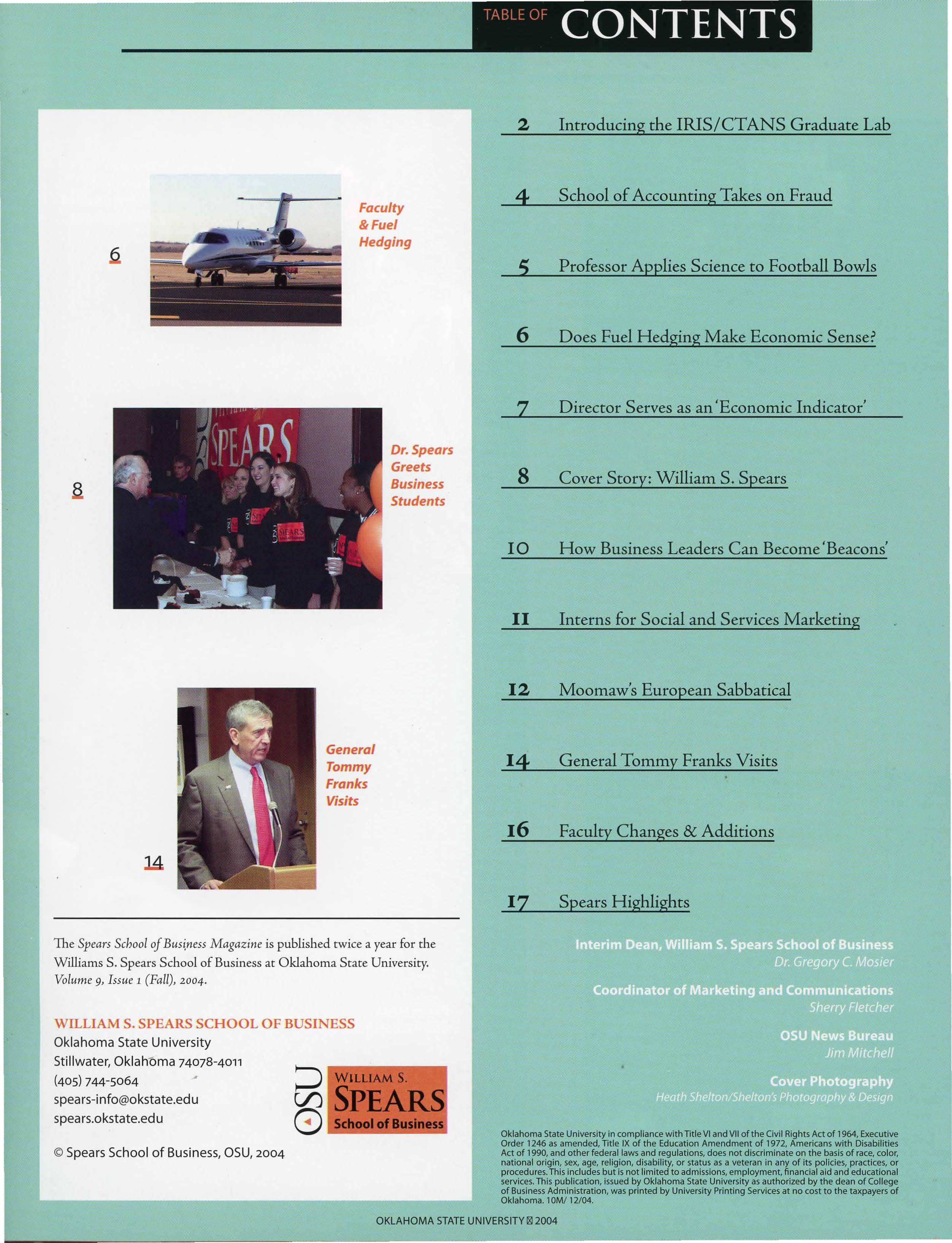
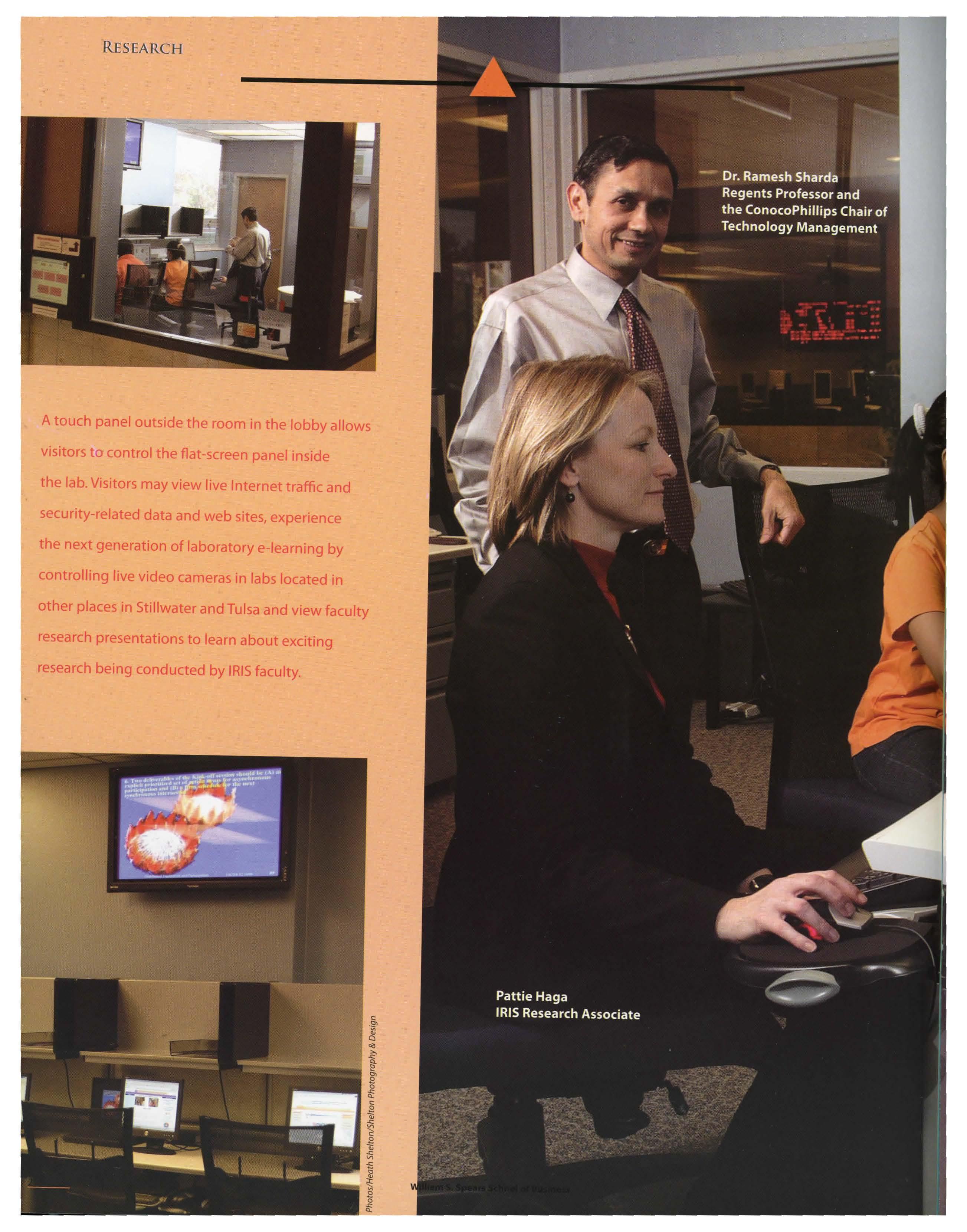
A touch panel outside the room in the lobby allows visitors to control the flat-screen panel inside the lab. Visitors may view live Internet traffic and security-related data and web sites, experience the next generation of laboratory e-learning by controlling live video cameras in labs located in other places in Stillwater and Tulsa and view faculty research presentations to learn about exciting research being conducted by IRISfaculty.
IRIS/CTANS Graduate Student Lab
Opens a Window into the World of IS
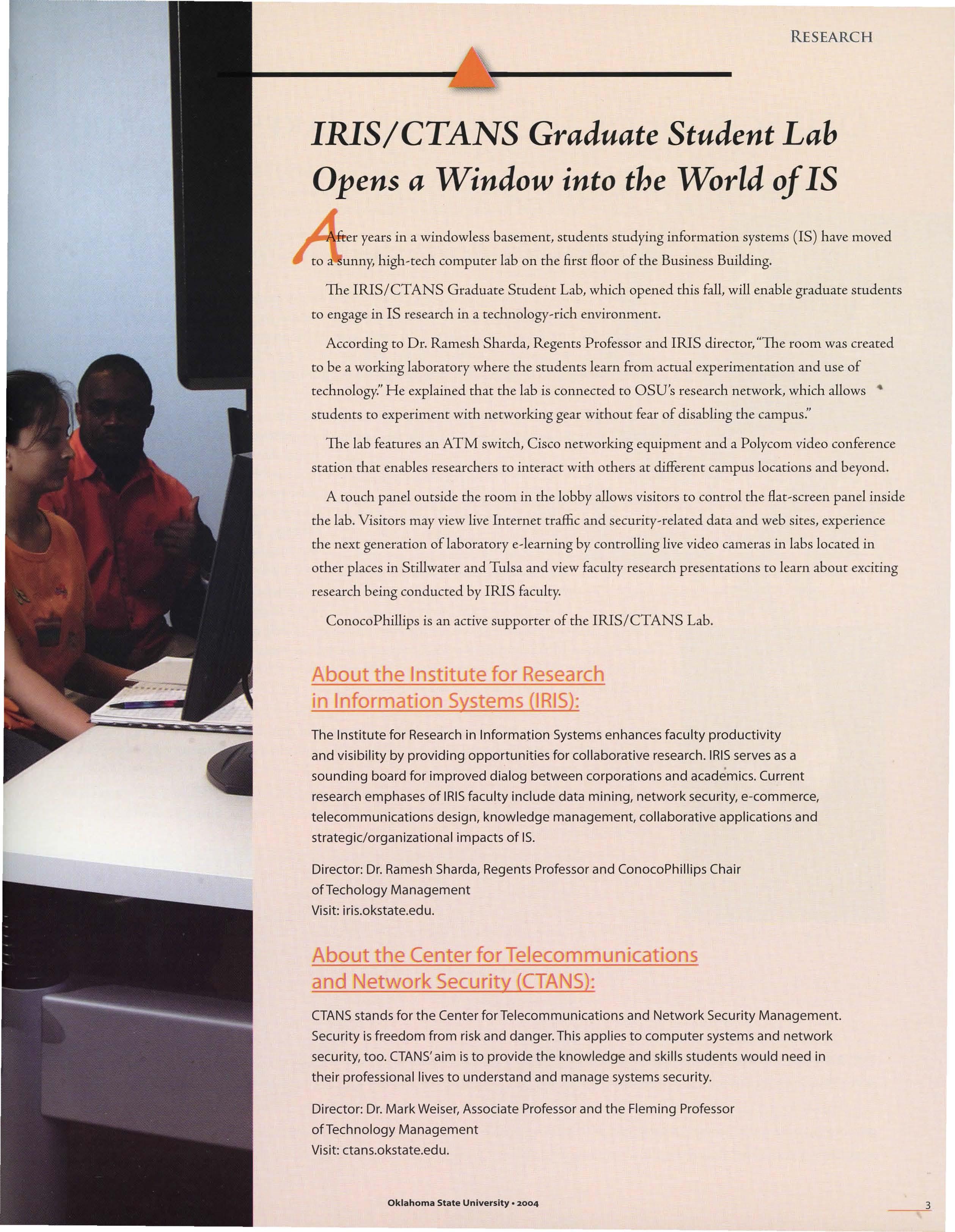
,er years in a windowless basement, students studying information systems (IS) have moved unny, high-tech computer lab on the first floor of the Business Building.
The IRIS/CT ANS Graduate Student Lab, which opened this fall, will enable graduate students to engage in IS research in a technology-rich environment.
According to Dr. Ramesh Sharda, Regents Professor and IRIS director, "The room was created to be a working laboratory where the students learn from actual experimentation and use of technology:' He explained that the lab is connected to OSU's research network, which allows • students to experiment with networking gear without fear of disabling the campus:'
The lab features an ATM switch, Cisco networking equipment and a Polycom video conference station that enables researchers to interact with others at different campus locations and beyond.
A touch panel outside the room in the lobby allows visitors to control the flat-screen panel inside the lab. Visitors may view live Internet traffic and security-related data and web sites, experience the next generation of laboratory e-learning by controlling live video cameras in labs located in other places in Stillwater and Tulsa and view faculty research presentations to learn about exciting research being conducted by IRIS faculty.
ConocoPhillips is an active supporter of the IRIS/CTANS Lab.
About the Institute for Research in Information Systems(IRIS):
The Institute for Research in Information Systems enhances faculty productivity and visibility by providing opportunities for collaborative research. IRISserves as a sounding board for improved dialog between corporations and academics. Current research emphases of IRISfaculty include data mining, network security, e-commerce, telecommunications design, knowledge management, collaborative applications and strategic/organizational impacts of IS.
Director: Dr. Ramesh Sharda, Regents Professor and ConocoPhillips Chair ofTechology Management Visit: iris.okstate.edu.
About the Center for Telecommunications and Network Security (CTANS):
CTANSstands for the Center for Telecommunications and Network Security Management. Security is freedom from risk and danger. This applies to computer systems and network security, too. CTANS'aim is to provide the knowledge and skills students would need in their professional lives to understand and manage systems security.
Director: Dr. Mark Weiser, Associate Professor and the Fleming Professor ofTechnology Management Visit: ctans.okstate.edu.
osu SCHOOL OF ACCOUNTING TAKES ON FRAUD
e good reputation of accounting is on the line, and the School of Accounting is doing its pare help the industry regain its credibility by preparing students co prevent and detect fraud, aceording to Dr. Carol B.Johnson, associate professor of accounting and CPA.
Johnson, who recently completed more than 125 fraud-related CRF (certified fraud examiner) hours, pointed to estimates that show fraud currently consumes six percent of corporate revenues or about $660 billion annually in the United States alone.
"There was and is no safe harbor. The consequences for our profession have been significant. Accountants have been prosecuted for participating in some of the activities and criticized heavily for failing to prevent or detect others. Our reputation has unquestionably been impaired. These events led to the passage ofSarbanes-Oxley and creation of the PCAOB;' said Johnson, who added she was glad to report that fraud education is a growing part of the School of Accounting's graduate curriculum.
During the 2003/ 04 academic year, the School included a course that studies white-collar fraud. "This course is designed to provide students with an understanding of the various types of fraudulent schemes perpetrated against or on behalf of organizations. Students learn how the schemes are carried out, as well as how to prevent these schemes or spot their red flags. They also study criminological issues to gain a better understanding of why individuals commit fraud:'
Johnson pointed co another course, Fraud Auditing and Advanced Assurance Services, in which students learn investigative techniques, as well as legal issues involved in fraud investigations. "For instance, they study what approaches are most appropriate for investigating different types of fraud, how to maintain evidence, how to interview suspects and informants, how to search public records, etc.;' she said.
According to Johnson, a public records search, for example, might have prevented the Lincoln Savings & Loan debacle for its auditors. The perpetrator of that fraud, Charles Keating, had previously signed a consent decree in the state of Ohio to never be in a management position in another financial institution.
"We believe that a solid grounding in fraud and forensic education will be useful for accountants who participate in any financial reporting, audit, assurance services, tax, business valuation or consulting capacities:'
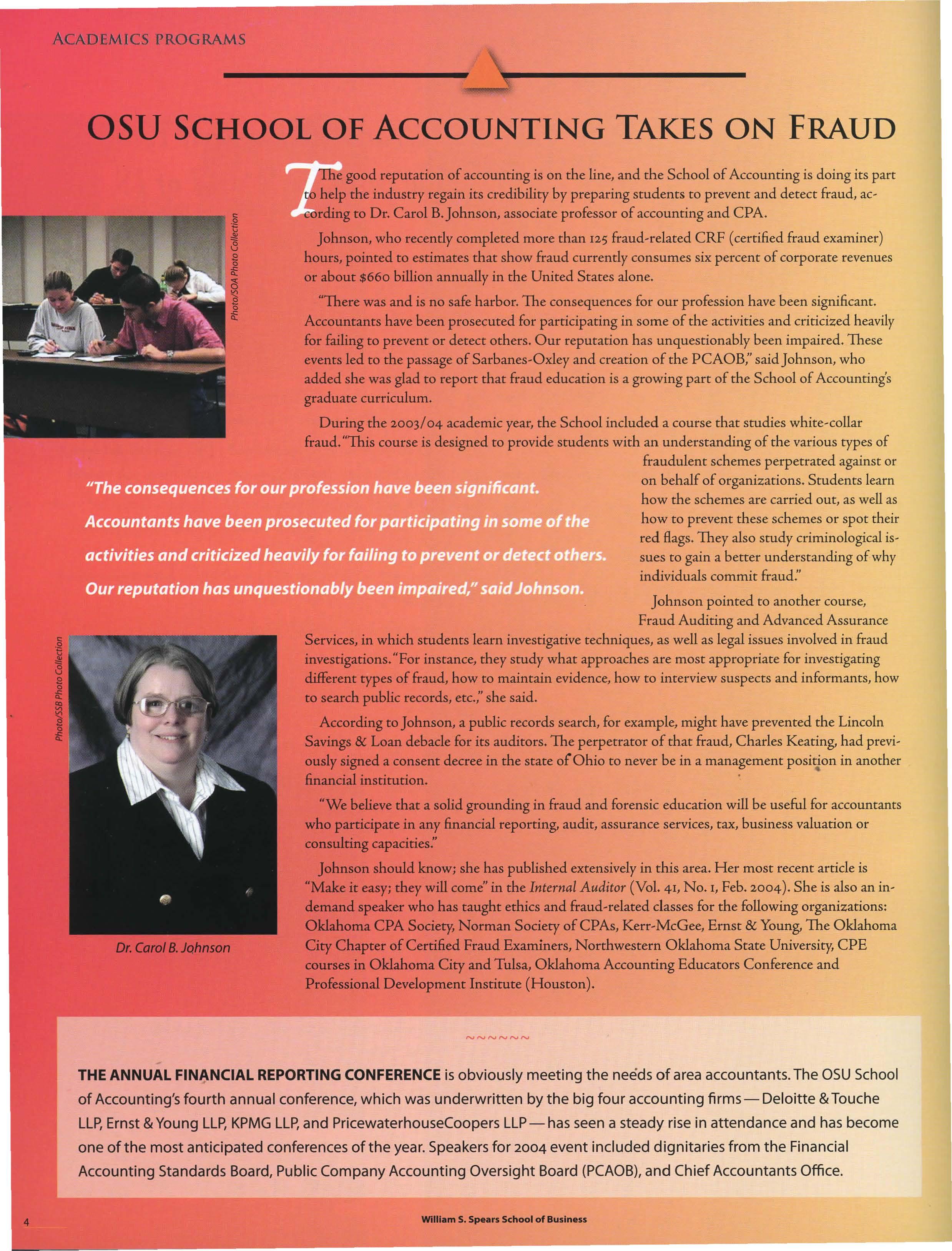
Dr.Carol8.Johnson
Johnson should know; she has published extensively in this area. Her most recent article is "Make it easy; they will come" in the Internal Auditor (Vol. 41, No. 1, Feb. 2004 ). She is also an indemand speaker who has taught ethics and fraud-related classes for the following organizations: Oklahoma CPA Society, Norman Society ofCPAs, Kerr-McGee, Ernst & Young, The Oklahoma City Chapter of Certified Fraud Examiners, Northwestern Oklahoma State University, CPE courses in Oklahoma City and Tulsa, Oklahoma Accounting Educators Conference and Professional Development Institute (Houston).
THE ANNUAL FINANCIAL REPORTINGCONFERENCEis obviously meeting the needs of area accountants. The OSU School of Accounting's fourth annual conference, which was underwritten by the big four accounting firms- Deloitte & Touche LLP,Ernst & Young LLP,KPMG LLP,and PricewaterhouseCoopers LLP- has seen a steady rise in attendance and has become one of the most anticipated conferences of the year. Speakers for 2004 event included dignitaries from the Financial Accounting Standards Board, Public Company Accounting Oversight Board (PCAOB),and Chief Accountants Office.
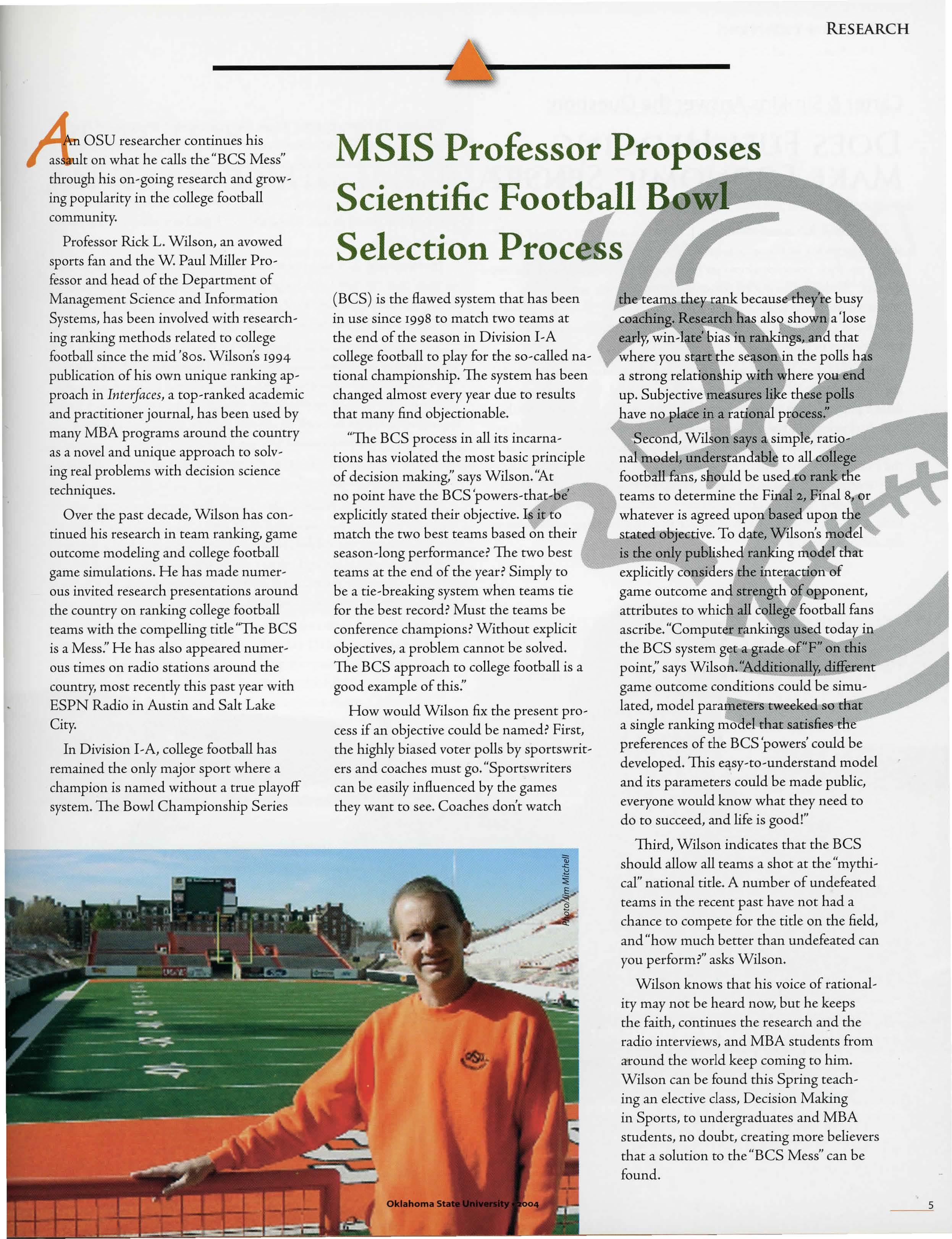
OSU researcher continues his as ult on what he calls the "BCS Mess" through his on-going research and growing popularity in the college football community.
Professor Rick L. Wilson, an avowed sports fan and the W. Paul Miller Professor and head of the Department of Management Science and Information Systems, has been involved with researching ranking methods related to college football since the mid 'Sos. Wilson's 1994 publication of his own unique ranking approach in Interfaces, a top-ranked academic and practitioner journal, has been used by many MBA programs around the country as a novel and unique approach to solving real problems with decision science techniques.
Over the past decade, Wilson has continued his research in team ranking, game outcome modeling and college football game simulations. He has made numerous invited research presentations around the country on ranking college football teams with the compelling tide "The BCS is a Mess:' He has also appeared numerous times on radio stations around the country, most recently this past year with ESPN Radio in Austin and Salt Lake City.
In Division I-A, college football has remained the only major sport where a champion is named without a true playoff system. The Bowl Championship Series
MSIS Professor Proposes Scientific Football Selection Proc
(BCS) is the flawed system that has been in use since 1998 to match two teams at the end of the season in Division I-A college football to play for the so-called national championship. The system has been changed almost every year due to results that many find objectionable.
"The BCS process in all its incarnations has violated the most basic principle of decision making," says Wilson. ''At no point have the BCS 'powers-th a 15e' explicitly stated their objective. Is i to match the two best teams based on their season-long performance? The two best teams at the end of the year? Simply to be a tie-breaking system when teams tie for the best record? Must the teams be conference champions? Without explicit objectives, a problem cannot be solved. The BCS approach to college football is a good example of this:'
How would Wilson fix the present process if an objective could be named? First, the highly biased voter polls by sportswriters and coaches must go. "Sportswriters can be easily influenced by the games they want ro see. Coaches don't watch
as u te ~y rank beca usy whatever is agr stated objective. is the only publi explicitly co s·d game outcome attributes to w ascribe. "Comp the BCS syste point;' says Wil game outcome co lated, model parameters tweeked so a single ranking model that satisfies t preferences of the BCS 'powers' could be developed. This e<1;sy-to-understand model and its parameters could be made public, everyone would know what they need to do to succeed, and life is good!"
Third, Wilson indicates that the BCS should allow all teams a shot at the "mythical" national tide. A number of undefeated teams in the recent past have not had a chance to compete for the tide on the field, and "how much better than undefeated can you perform?" asks Wilson.
Wilson knows that his voice of rationality may not be heard now, but he keeps the faith, continues the research a~d the radio interviews, and MBA students from around the world keep coming to him. Wilson can be found this Spring teaching an elective class, Decision Making in Sports, to undergraduates and MBA students, no doubt, creating more believers that a solution to the "BCS Mess" can be found.
Carter & SimkinsAnswer the uestion: DOES FUEL HEDGING MAKE ECONOMIC SENSE?
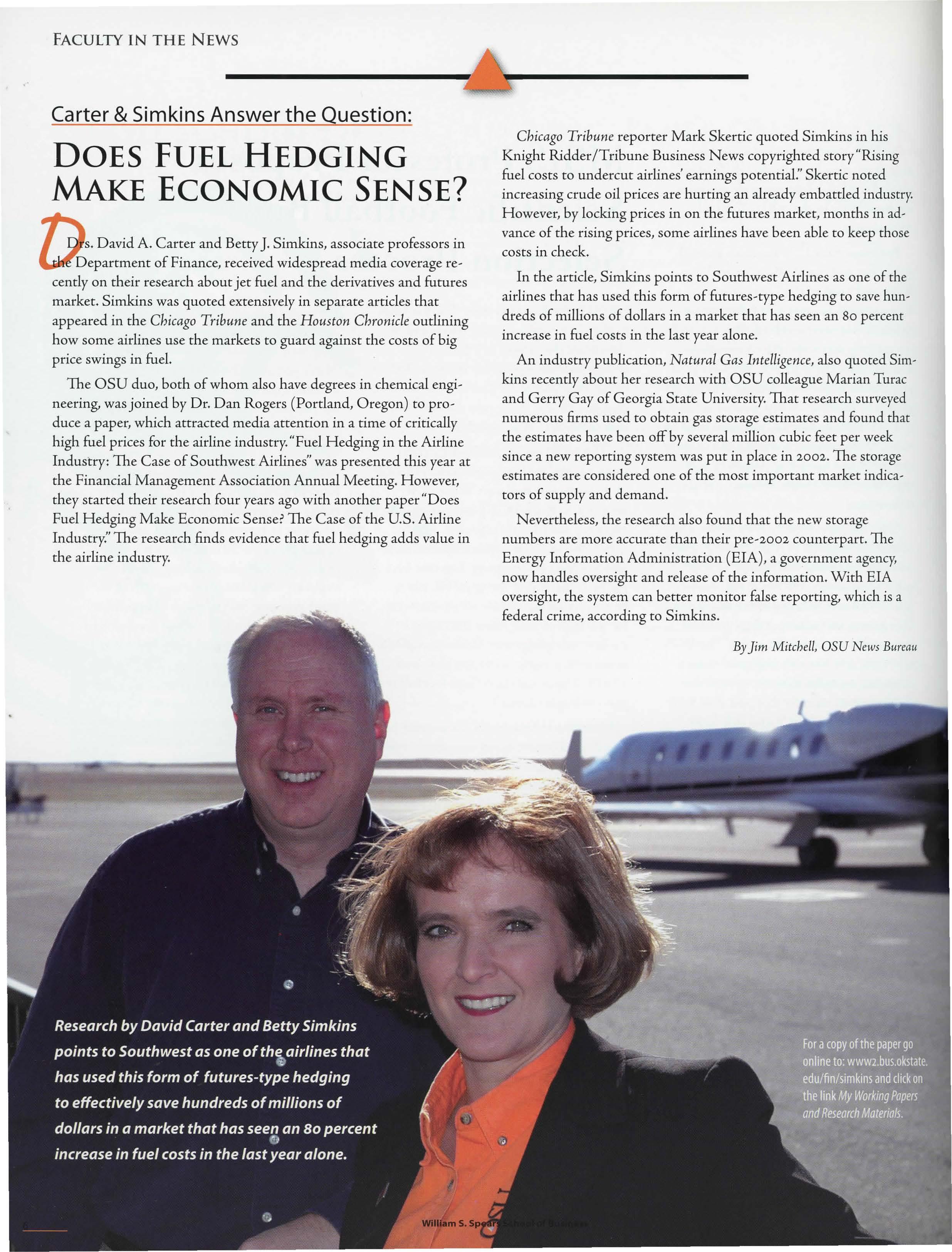
s. David A. Carter and Betty J.Simkins, associate professors in Department of Finance, received widespread media coverage recently on their research about jet fuel and the derivatives and futures marker. Simkins was quoted extensively in separate articles that appeared in the Chicago Tribune and the Houston Chronicle outlining how some airlines use the markets to guard against the costs of big price swings in fuel.
The OSU duo, both of whom also have degrees in chemical engineering, was joined by Dr. Dan Rogers (Portland, Oregon) to produce a paper, which attracted media attention in a time of critically high fuel prices for the airline industry. "Fuel Hedging in the Airline Industry: The Case of Southwest Airlines" was presented this year at the Financial Management Association Annual Meeting. However, they started their research four years ago with another paper"Does Fuel Hedging Make Economic Sense? The Case of the U.S. Airline Industry:' The research finds evidence chat fuel hedging adds value in the airline industry.
Chicago Tribune reporter Mark Skertic quoted Simkins in his Knight Ridder/Tribune Business News copyrighted story"Rising fuel costs to undercut airlines' earnings potential:' Skertic noted increasing crude oil prices are hurting an already embattled industry. However, by locking prices in on the futures market, months in advance of the rising prices, some airlines have been able to keep those costs in check.
In the article, Simkins points to Southwest Airlines as one of che airlines that has used this form of futures-type hedging to save hundreds of millions of dollars in a market that has seen an So percent increase in fuel costs in the last year alone.
An industry publication, Natural Gas Intelligence, also quoted Simkins recently about her research with OSU colleague Marian Turac and Gerry Gay of Georgia State University. That research surveyed numerous firms used to obtain gas storage estimates and found that the estimates have been off by several million cubic feet per week since a new reporting system was put in place in 2002. The storage estimates are considered one of the most important market indicators of supply and demand.
Nevertheless, the research also found that che new storage numbers are more accurate than their pre-2002 counterpart. The Energy Information Administration (EIA), a government agency, now handles oversight and release of the information. With EIA oversight, the system can better monitor false reporting, which is a federal crime, according to Simkins.
By Jim Mitchell, OSU News Bureau
DIRECTOR SERVES AS AN 'ECONOMIC INDICATOR'
Dr. Mark C. Snead, director of the new Center for Applied Economic Research at OSU, provided economic information that generated broad coverage in the state's major newspapers in October and November.
The Tulsa World feamred a front-page report in October that focused on the benefits the state receives during times of high energy prices and how the situation has changed over the years.
The copyrighted article by Russell Ray noted that Oklahoma may not be benefiting as much as it did in the early'Sos when the energy industry was more predominate here, but Snead told him the state as a whole probably still sees some benefits from higher energy prices.
As Snead was quoted in the article: "In Oklahoma, high energy prices tend to insulate the state from recessionary conditions:' Without the oiland-gas industry, Oklahoma would be more susceptible to the higher prices and recess10n.
Snead made headlines again in Tulsa in November when he released the 2005 Economic Ourlook for Tulsa and the State of Oklahoma for 2005 during an annual meeting of the Tulsa Chamber of Commerce. His comments were featured on the front page of the finance section of the Tulsa World the next day.
The Oklahoman also featured a positive editorial on the forecast that Snead supplied.
The OSU economist wrapped up the month with coverage from the Associated Press that made the front page of the financial section in the Sunday Oklahoman, Nov. 27. The story served as a followup for the Oklahoma City metro area about Oklahoma during times of high energy prices.
He intends to provide updates on a regular basis throughout the year. For more information, go to www. economy.okstate.edu.
By Jim Mitchell, OSU News Bureau
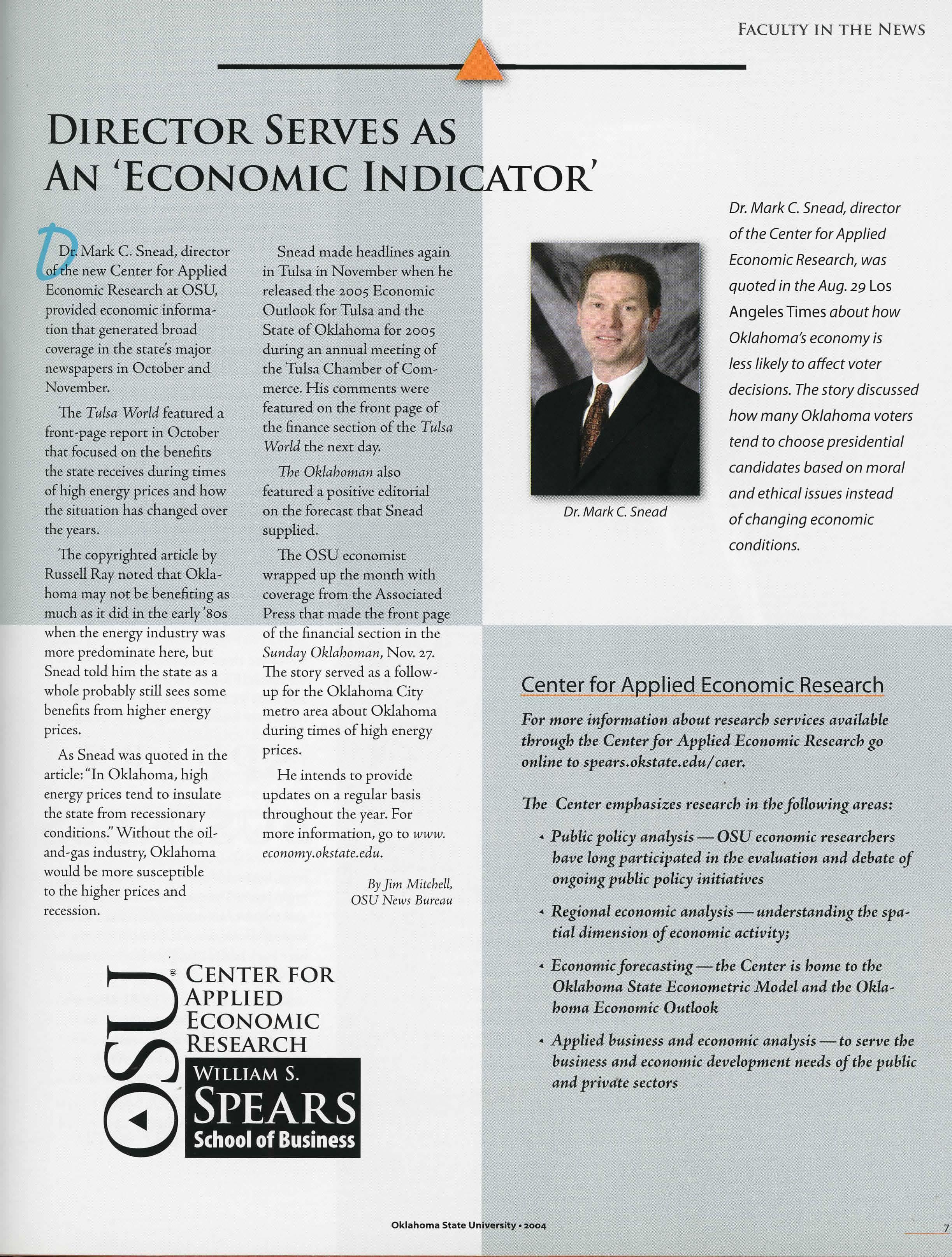
Dr. Mark C. Snead, director of the Center for Applied Economic Research, was quoted in the Aug. 29 Los Angeles Times about how Oklahoma's economy is less likely to affect voter decisions. The story discussed how many Oklahoma voters tend to choose presidential candidates based on moral and ethical issues instead of changing economic conditions.
Center for A lied EconomicResearch
For more information about research services available through the Center for Applied Economic Research go on line to spears.okstate.edu/ caer.
The Center emphasizes research in the following areas:
• Public policy analysis - OSU economic researchers have long participated in the evaluation and debate of ongoing public policy initiatives
• Regional economic analysis - understanding the spatial dimension of economic activity;
• Economic forecasting - the Center is home to the Oklahoma State Econometric Model and the Oklahoma Economic Outlook
• Applied business and economic analysis - to serve the business and economic development needs of the public and private sectors
Dr. Mark C. Snead
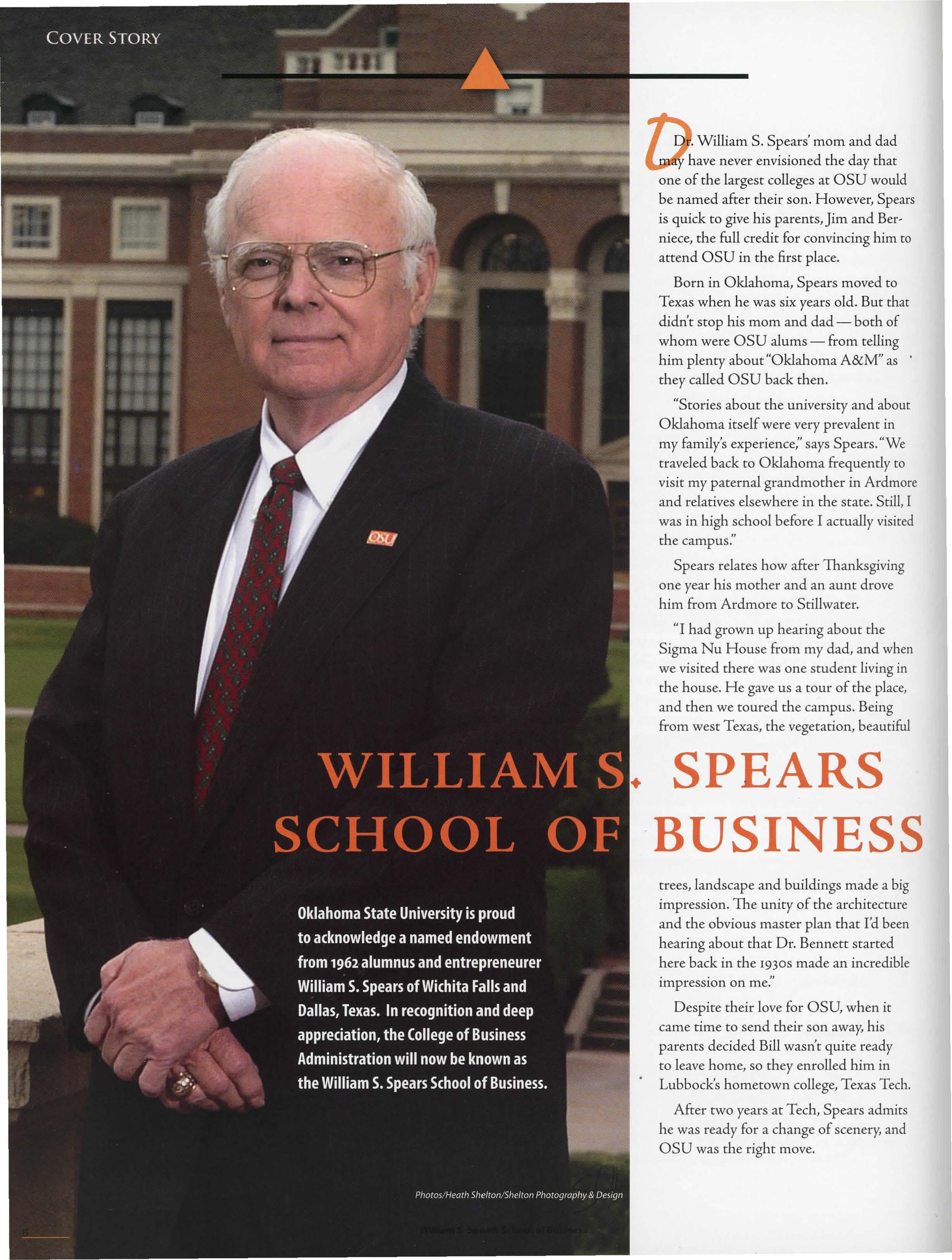
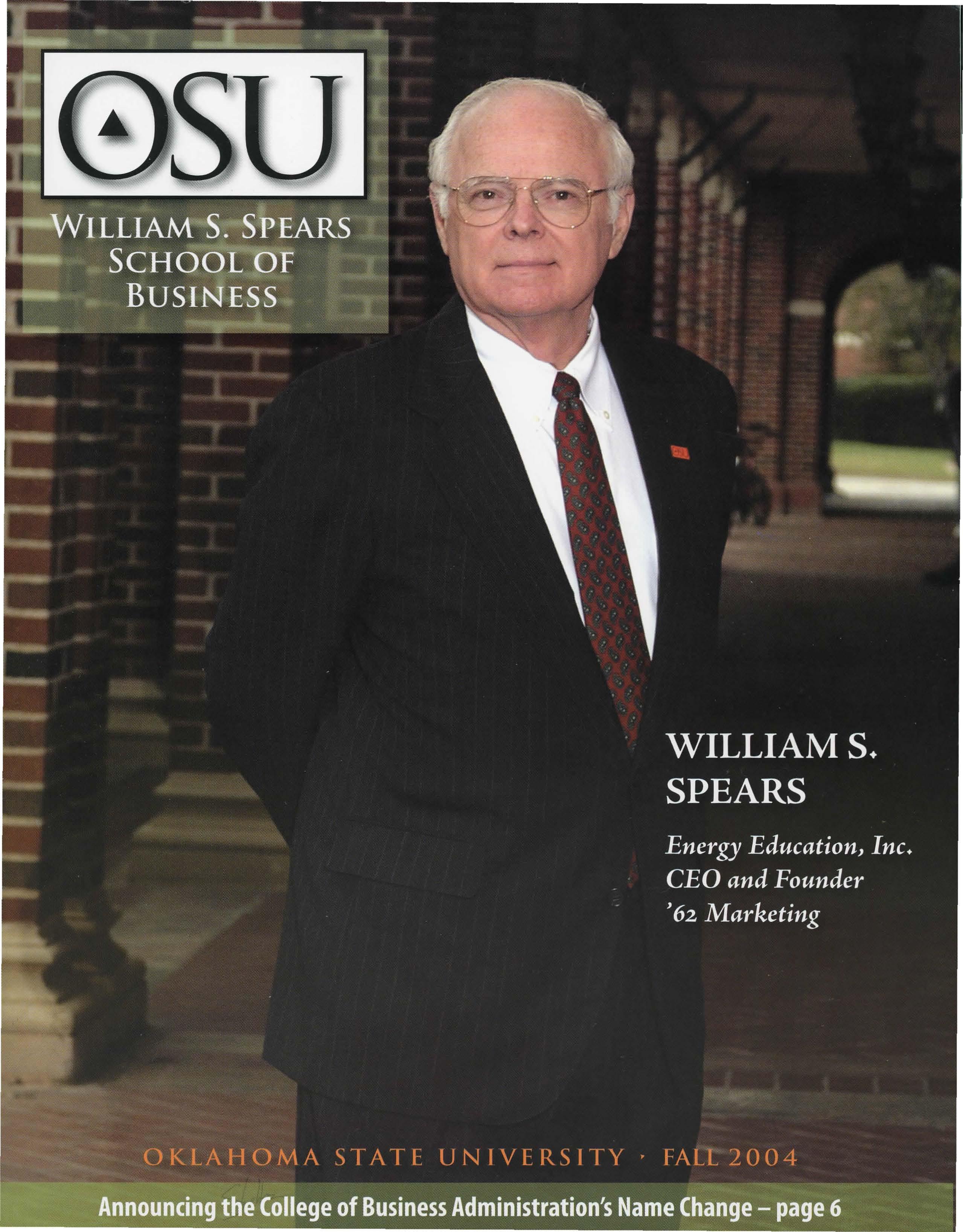
D William S. Spears' mom and dad have never envisioned the day chat one of the largest colleges at OSU would be named after their son. However, Spears is quick to give his parents,Jim and Berniece, the full credit for convincing him to attend OSU in the first place.
Born in Oklahoma, Spears moved to Texas when he was six years old. But that didn't stop his mom and dad- both of whom were OSU alums - from telling him plenty about"Oklahoma A&M" as they called OSU back then.
"Stories about the university and about Oklahoma itself were very prevalent in my family's experience;' says Spears. "We traveled back to Oklahoma frequently to visit my paternal grandmother in Ardmore and relatives elsewhere in the state. Still, I was in high school before I actually visited the campus:'
Spears relates how after Thanksgiving one year his mother and an aunt drove him from Ardmore to Stillwater.
"I had grown up hearing about the Sigma Nu House from my dad, and when we visited there was one student living in the house. He gave us a tour of the place, and then we toured the campus. Being from west Texas, the vegetation, beautiful
SPEARS BUSINESS
trees, landscape and buildings made a big impression. The unity of the architecture and the obvious master plan that I'd been hearing about that Dr. Bennett started here back in the 1930s made an incredible impression on me:'
Despite their love for OSU, when it came time to send their son away, his parents decided Bill wasn't quite ready to leave home, so they enrolled him in Lubbock's hometown college, Texas Tech.
After two years at Tech, Spears admits he was ready for a change of scenery, and OSU was the right move.
"Oklahoma Scace was a new place, a new venture, a new horizon for me as a college student, so I think it provided a new perspective, something chat would enable me to chart a new course and be my own person. It became a defining moment in my life:•
As the 14th member of his family to attend OSU, Spears made the most of his new opportunity and learned a lot about himself in the process.
"It changed me in that I really found myself intellectually. I had been, at best, an average student in public school and really an average student in college until the time I came to OSU, and something happened in chat transition from west Texas to Stillwater chat really energized me intellectually and showed me chat I had some intellectual capabilities chat I didn't realize I had. I made the Dean's list my first semester at OSU, and chat was a very rewarding experience;• says Spears.
As a Sigma Nu, Spears says he also discovered his ability to be a leader, and the fraternity gave him several chances to prove himself.
"I became the scholarship chairman of the Sigma Nu House, and- by the time I graduated - we had moved up pretty dramatically in the scholastic standings among the Greek houses on campus, which was also a rewarding experience. So, OSU was a maturing, invigorating and empowering experience for me in many, many ways both socially and intellectually:• Spears' confidence also stimulated a lifelong desire to learn that lead him to earn an M.B.A. from the Wharton School of Business at the University of Pennsylvania and a doctorate from the Wayne Heizenga Graduate School of Business and Entrepreneurship in Fort Lauderdale, Fla.
After graduating from Wharton, Spears joined the family business managing furniture stores in Colorado Springs, Colo. and Wichita Falls, Texas. Though the businesses kept him occupied, he wanted to help his comrri'unity by serving on several civic and charitable boards. In the early 1980s, he served on the Wichita
Falls Independent School District board of trustees where he created the prototype for an award-winning energy conservation program. During chat period's slowing economy, Spears began looking for another ouclec for his talents and found it in the widespread need for school districts to trim energy budgets.
His entrepreneurial skills came to fruition in 1986 when he founded Energy Education, Inc. and began marketing his copyrighted energy conservation system. Since then, more than 600 school districts have successfully applied the Spears' system to save more than one billion dollars in energy expenses.
"I thank God that He blessed me with the gifts of being able to administer and to be a giver;• says Spears. His recent multimillion dollar gift to OSU will be used for numerous academic improvements and further entrepreneurial educational opportunities at what is now known as the William S. Spears School of Business.
Dr. Greg Mosier, interim business dean, says the Spears endowment, which qualifies for state matching funds, will assist the school to continue providing the best business education in Oklahoma as well as meet the challenges of OSU's land-grant mission - teaching, research and outreach.
"This is not a bricks-and-mortar gift. The funding from the endowment will give us the abilities to retain and attract outstanding faculty in areas and disciplines essential to emerging business practices;• says Mosier.
He adds, "Having an excellent faculty not only benefits our students and their classroom experience, but also allows us to jump-start a number of activities dedicated to improving the economy of Oklahoma:•
The William S. Spears School of Business is composed of six academic departments with more than roo tenure and tenure-track educational professionals. The student body is made up of more than 3,900 undergraduate students pursuing 15 degrees with approximately 800 students pursuing six master's degrees. The School also offers Ph.D.s in business administration and in economics.
By Jim Mitchell, OSU News Bureau
In 1986 Dr. Spears founded Energy Education, Inc., a Wichita Falls-based company that develops and implements energy conservation programs that enable schools to redirect funds toward educational needs. Eighteen years and 600 schools later, Energy Education has helped public schools save almost $1 billion, and it is recognized as the only peoplebased energy conservation program of its kind. Visit energyeducation.com.
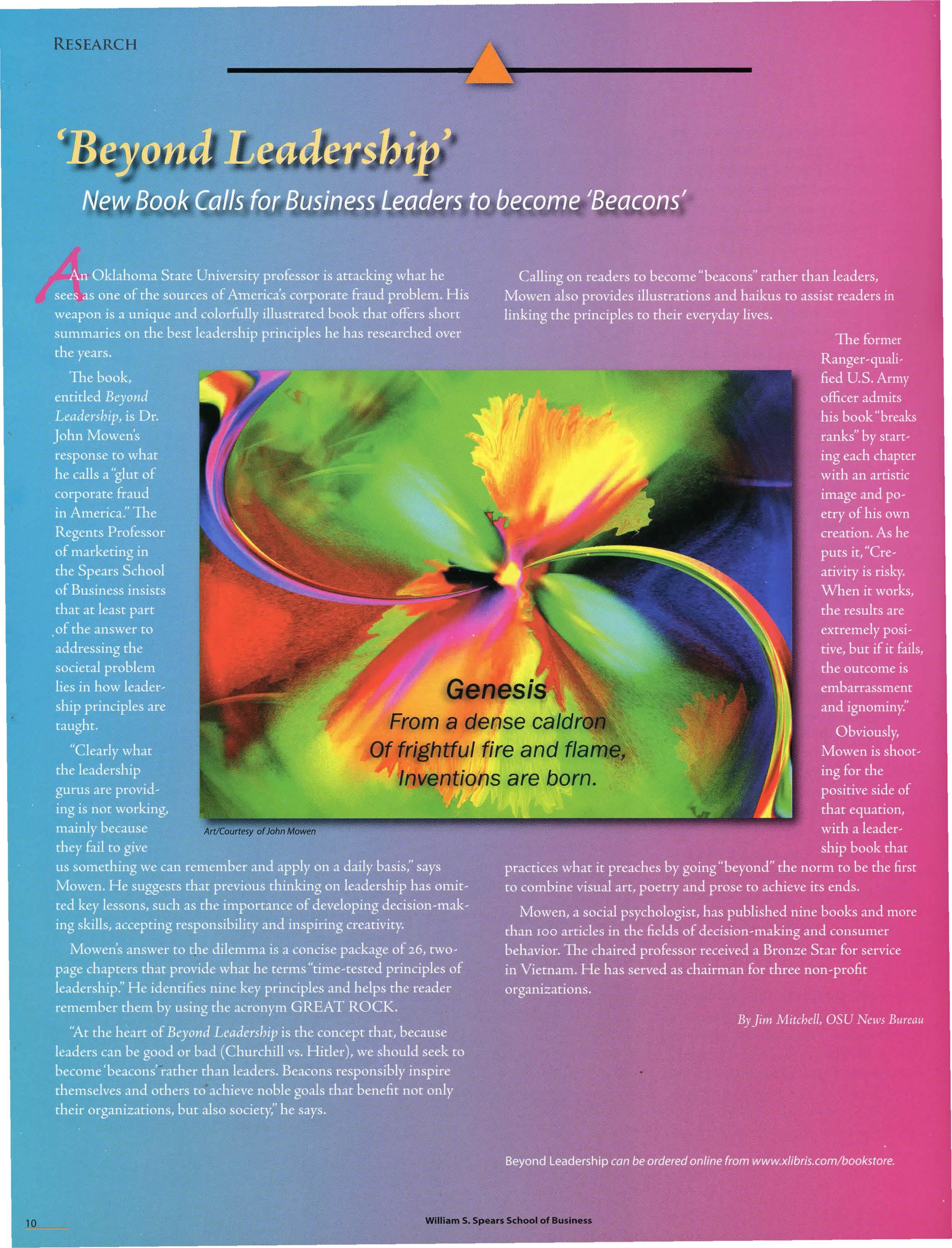
From a dense caldratt Of frightful fire and flame, Inventionsare born. practices wnat it preacnes oy going"oer,oncl" tne norm to to combine visual art, poetrr, and prose to achieve its ends. as chairman for three non-profit
Art/Courtesy of John Mowen
William S. Spears School of Business
New Marketing Intern Program Fills Needs of Social and Services Organizations
The Center for Social and ServicesMarketing
or years Business Career Services has strived to match talented students with ganizations in meaningful and productive partnerships. Now they are teaming up ith the Center for Social and Service Marketing to identify marketing students who can assist social and services organizations to achieve their marketing goals.
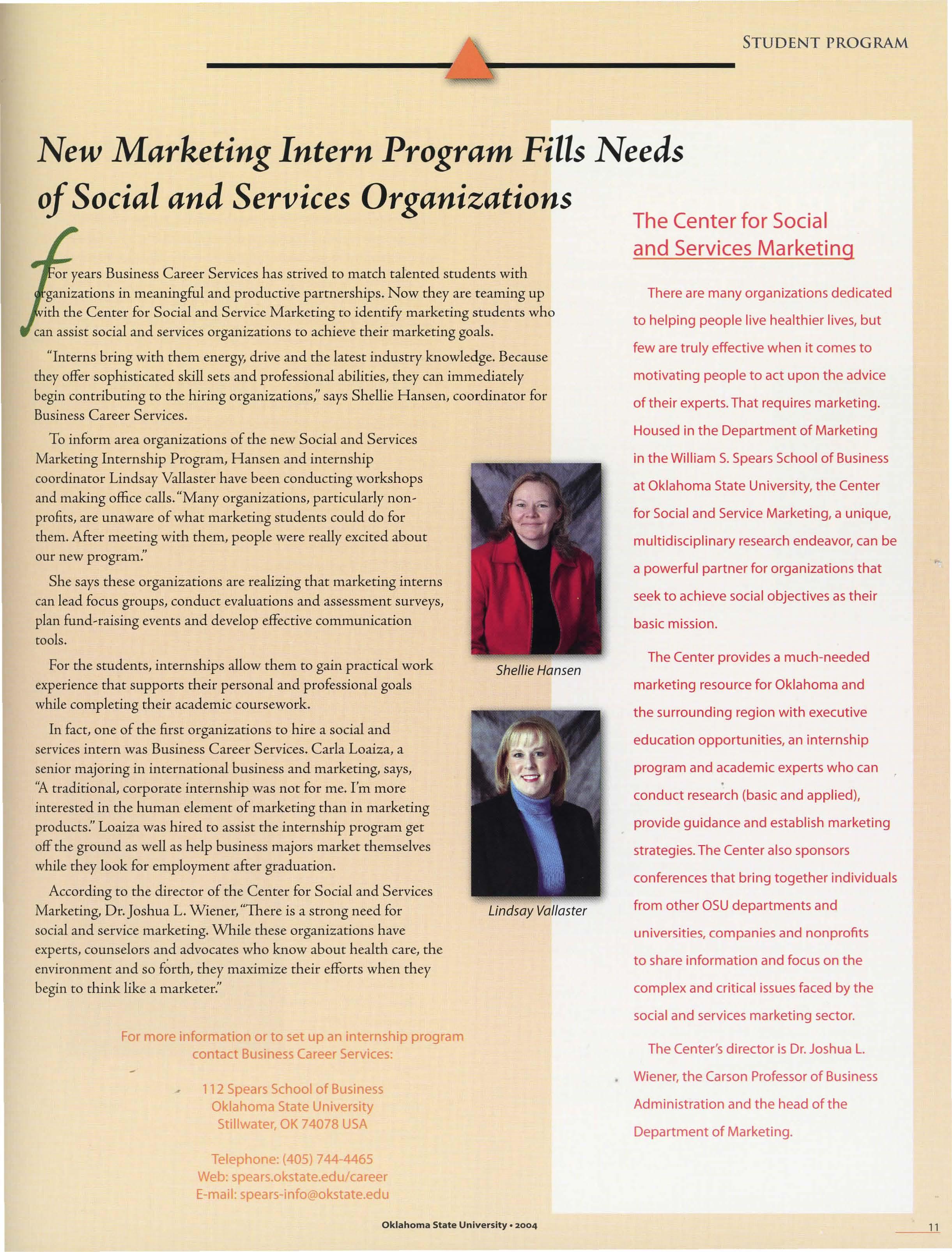
"Interns bring with them energy, drive and the latest industry knowledge. Because they offer sophisticated skill sets and professional abilities, they can immediately begin contributing to the hiring organizations," says Shellie Hansen, coordinator for Business Career Services.
To inform area organizations of the new Social and Services Marketing Internship Program, Hansen and internship coordinator Lindsay Vallaster have been conducting workshops and making office calls. "Many organizations, particularly nonprofits, are unaware of what marketing students could do for them. After meeting with them, people were really excited about our new program:'
She says these organizations are realizing that marketing interns can lead focus groups, conduct evaluations and assessment surveys, plan fund-raising events and develop effective communication tools.
For the students, internships allow them to gain practical work experience that supports their personal and professional goals while completing their academic coursework.
In fact, one of the first organizations to hire a social and services intern was Business Career Services. Carla Loaiza, a senior majoring in international business and marketing, says, "A traditional, corporate internship was not for me. I'm more interested in the human element of marketing than in marketing produces:' Loaiza was hired to assist the internship program get off the ground as well as help business majors market themselves while they look for employment after graduation.
According to the director of the Center for Social and Services Marketing, Dr. Joshua L. Wiener, "TI1ere is a strong need for social and service marketing. While these organizations have experts, counselors and advocates who know about health care, the environment and so f~rch, they maximize their efforts when they begin to think like a marketer:'
For more information or to set up an internship program contact Business Career Services:
112 Spears School of Business Oklahoma State University Stillwater, OK 74078 USA
Telephone: (40S) 744-4465
Web: spears.okstate.edu/career
E-mail· spears-info@okstate.edu
There are many organizations dedicated to helping people live healthier lives, but few are truly effective when it comes to motivating people to act upon the advice of their experts. That requires marketing.
Housed in the Department of Marketing in the William S. Spears School of Business at Oklahoma State University, the Center for Social and Service Marketing, a unique, multidisciplinary research endeavor, can be a powerful partner for organizations that seek to achieve social objectives as their basic mission.
The Center provides a much-needed marketing resource for Oklahoma and the surrounding region with executive education opportunities, an internship program and academic experts who can conduct research (basic and applied), provide guidance and establish marketing strategies. The Center also sponsors conferences that bring together individuals from other OSU departments and universities, companies and nonprofits to share information and focus on the complex and critical issues faced by the social and services marketing sector.
The Center's director is Dr. Joshua L. Wiener, the Carson Professor of Business Administration and the head of the Department of Marketing.
Shellie Hansen
Lindsay Va/laster
MS in Management Information Systems Program
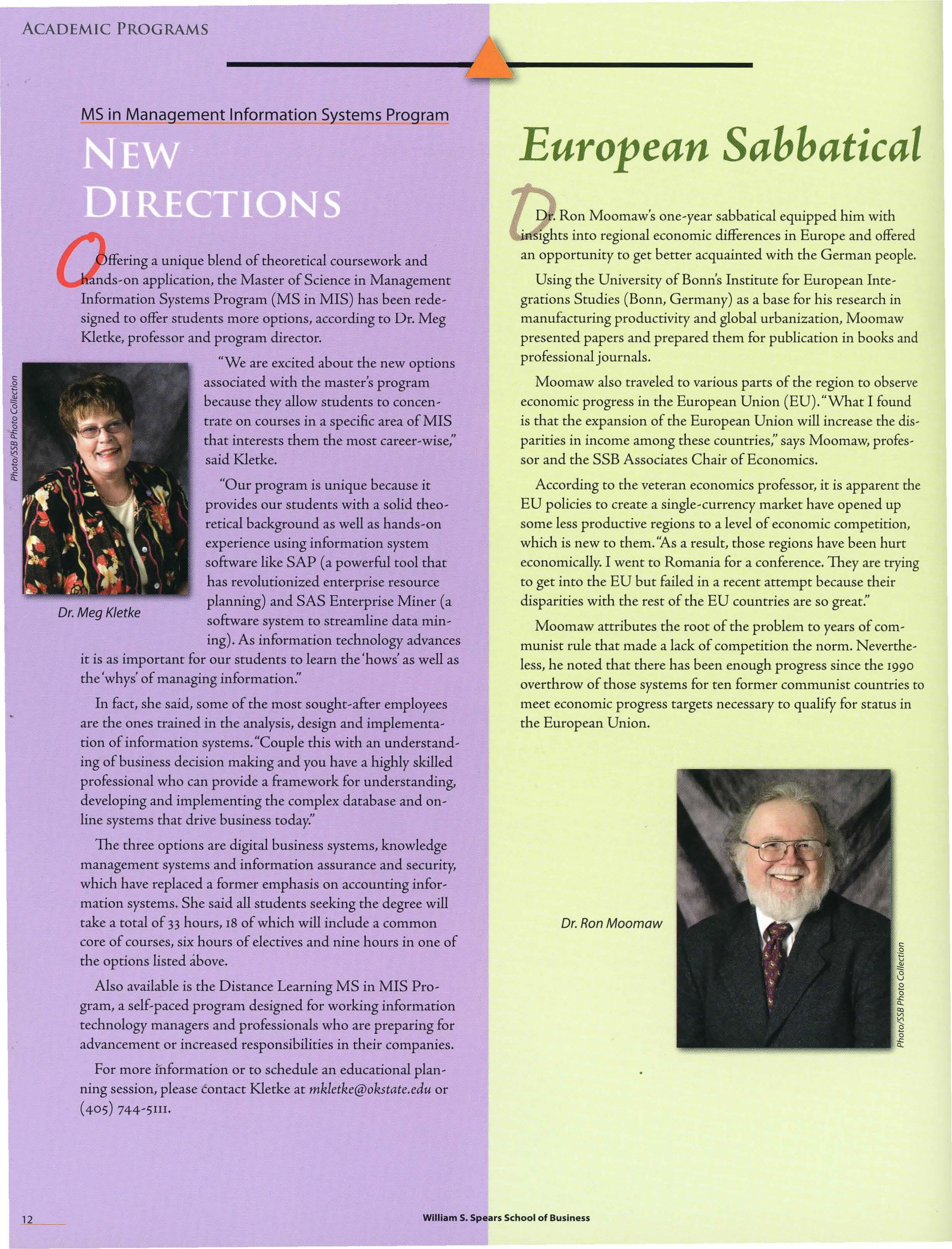
ffering a unique blend of theoretical coursework and ds-on application, the Master of Science in Management Information Systems Program (MS in MIS) has been redesigned to offer students more options, according to Dr. Meg Klecke, professor and program director.
"We are excited about the new options associated with the master's program because they allow students to concentrate on courses in a specific area of MIS that interests them the most career-wise;' said Kletke.
"Our program is unique because it provides our students with a solid theoretical background as well as hands-on experience using information system software like SAP (a powerful tool that has revolutionized enterprise resource planning) and SAS Enterprise Miner (a software system to streamline data mining). As information technology advances it is as important for our students to learn the 'hows' as well as the 'whys' of managing information:'
In fact, she said, some of the most sought-after employees are the ones trained in the analysis, design and implementation of information systems. "Couple chis with an understanding of business decision making and you have a highly skilled professional who can provide a framework for understanding, developing and implementing the complex database and online systems that drive business today:'
The three options are digital business systems, knowledge management systems and information assurance and security, which have replaced a former emphasis on accounting information systems. She said all students seeking the degree will rake a total of 33 hours, 18 of which will include a common core of courses, six hours of electives and nine hours in one of the options listed above.
Also available is the Distance Learning MS in MIS Program, a self-paced program designed for working information technology managers and professionals who are preparing for advancement or increased responsibilities in their companies.
For more information or to schedule an educational planning session, please contact Kletke at mkletke@okstate.edu or (405) 744-5m.
European Sabbatical
D Ron Moomaw's one-year sabbatical equipped him with ·n 1ghts into regional economic differences in Europe and offered an opportunity to get better acquainted with the German people.
Using the University of Bonn's Institute for European Integrations Studies (Bonn, Germany) as a base for his research in manufacturing productivity and global urbanization, Moomaw presented papers and prepared them for publication in books and professional journals.
Moomaw also traveled to various parts of the region to observe economic progress in the European Union (EU). "What I found is that the expansion of the European Union will increase the disparities in income among these countries;' says Moomaw, professor and the SSB Associates Chair of Economics.
According to the veteran economics professor, it is apparent the EU policies to create a single-currency market have opened up some less productive regions to a level of economic competition, which is new to them. "As a result, those regions have been hurt economically. I went to Romania for a conference. They are trying to get into the EU but failed in a recent attempt because their disparities with the rest of the EU countries are so greac:• Moomaw attributes the root of the problem to years of communist rule chat made a lack of competition the norm. Nevertheless, he noted chat there has been enough progress since the 1990 overthrow of those systems for ten former communist countries to meet economic progress targets necessary to qualify for status in the European Union.
Dr. Ron Moomaw
Dr. Meg Kletke
Proves Invaluable for Economics Professor
"It was obvious that some of these former communist countries are making more progress than others. East Germany was the most advanced among them because they have received quite a bit of support from West Germany. Sixty to eighty years ago, before communism, cities such as Prague and Budapest would have been comparable to Vienna, but not now. Vienna, which was never under communist control, is far more advanced economically:•
According to Moomaw, countries such as the Czech Republic and Slovakia have an advantage over Romania and Bulgaria as well as other parts of the Soviet Union because before World War II, they experienced a larger degree of economic freedom. "They got a taste of a modern economy and had a market system, so politically they were enjoying more freedom prior to the war and that has helped them-50 years later-make the transition back to compete in the marketplace:•
The highlight of his professional experience was attending several national economic conferences, which included students from various countries. Moomaw worked with graduate students on their dissertations during weekly seminars at the Institute. He found the students were quite formal and it often took some patience for him to put them at ease."They had a hard time calling me Ron, no matter how much I urged them to do so:•While he met students from around the world, he found the German students were dedicated environmentalists who were interested in U.S. politics. "They also enjoyed comparing sports in the U.S. and Germany; they're huge soccer fans. Most of them really seemed to want to find out what this American thought about Germany and learn more about the U.S., although many had been here before as exchange students:•
Social life at the Institute revolved around a once or twice a month dinner with students and professors that gave Moomaw a real chance to get to know the students. There were also short trips from time to time, usually lead by the German students, to places such as the port city of Hamburg and the wine district in the Ahr Valley.
Looking back on the year-long experience, Moomaw describes it as a wonderful opportunity to study and develop new information and skills for teaching and research. "The sabbatical was invaluable in providing context for teaching my course in comparative economic systems. Furthermore, I am continuing to work with colleagues from Bonn in editing a book on regional variations in entrepreneurship and investment:'
Moomaw concludes, "We definitely will return to Germany to visit friends and colleagues. I hope also to continue my collaboration with them:•
By Jim Mitchell,OSU News Bureau
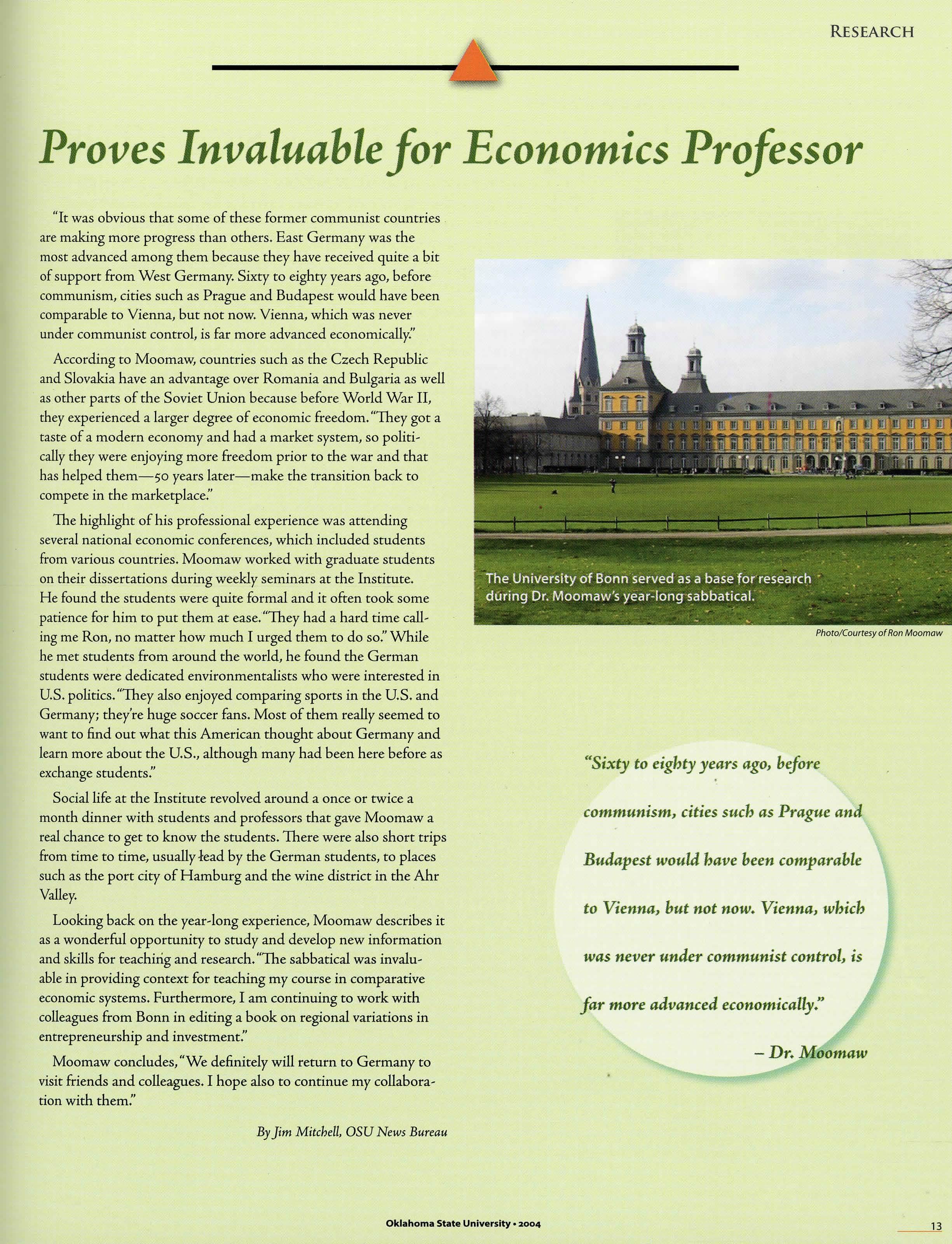
"Sixty to eighty years ago, before communism, cities such as Prague and Budapest would have been comparable to Vienna, but not now. Vienna, which was never under communist control, is far more advanced economically."
- Dr. Mt>omaw
Photo/Courtesy of Ron Moomaw
Reviewof the 2003-04
EXECUTIVE MANAGEMENT BRIEFINGS 7 TULSA
eneral Tommy Franks was an obvious favorite among audiences in both the xecutive Management Briefings (Oklahoma City) and the Tulsa Business Forums. e retired four-star general who led U.S. forces in both Afghanistan and Iraq told Oklahomans he was proud to be a Wynnewood native and an American.
Throughout his speech, he kept repeating the phrase: "Ain't this a great country:' Each time he said it, it seemed to take on added meaning.
For instance, he described his rise in the military by reminding everyone that he had flunked out of the University of Texas 38 years ago and joined the Army because he felt he had no other option. Nevertheless, he worked his way up the ranks since his time in Vietnam and recently led the U.S. Central Command: 'Ain't this a great country;' remarked Franks.
More recently, he had visited his old hometown of Midland, Texas where he spent most of his childhood. A doctor there who knew Franks asked him how he had made a success of himself. As the doctor recalled, "I don't remember you being the brightest bulb in the box:' Franks said he just smiled and said, 'Ain't this a great country:'
Franks said he did indeed believe America was a great country and that it was obvious Iraq had meant to harm the United States, making the invasion of that country justified. "Our way of life here is better than what they have anywhere else and it must be protected at all cost:'
He added, "Sometimes diplomacy doesn't work. Sometimes it's the obligation of a superpower to act like a superpower:'
Other series speakers included author Gary Heil, ConocoPhillips Chairman Archie Dunham and author Jim Collins.
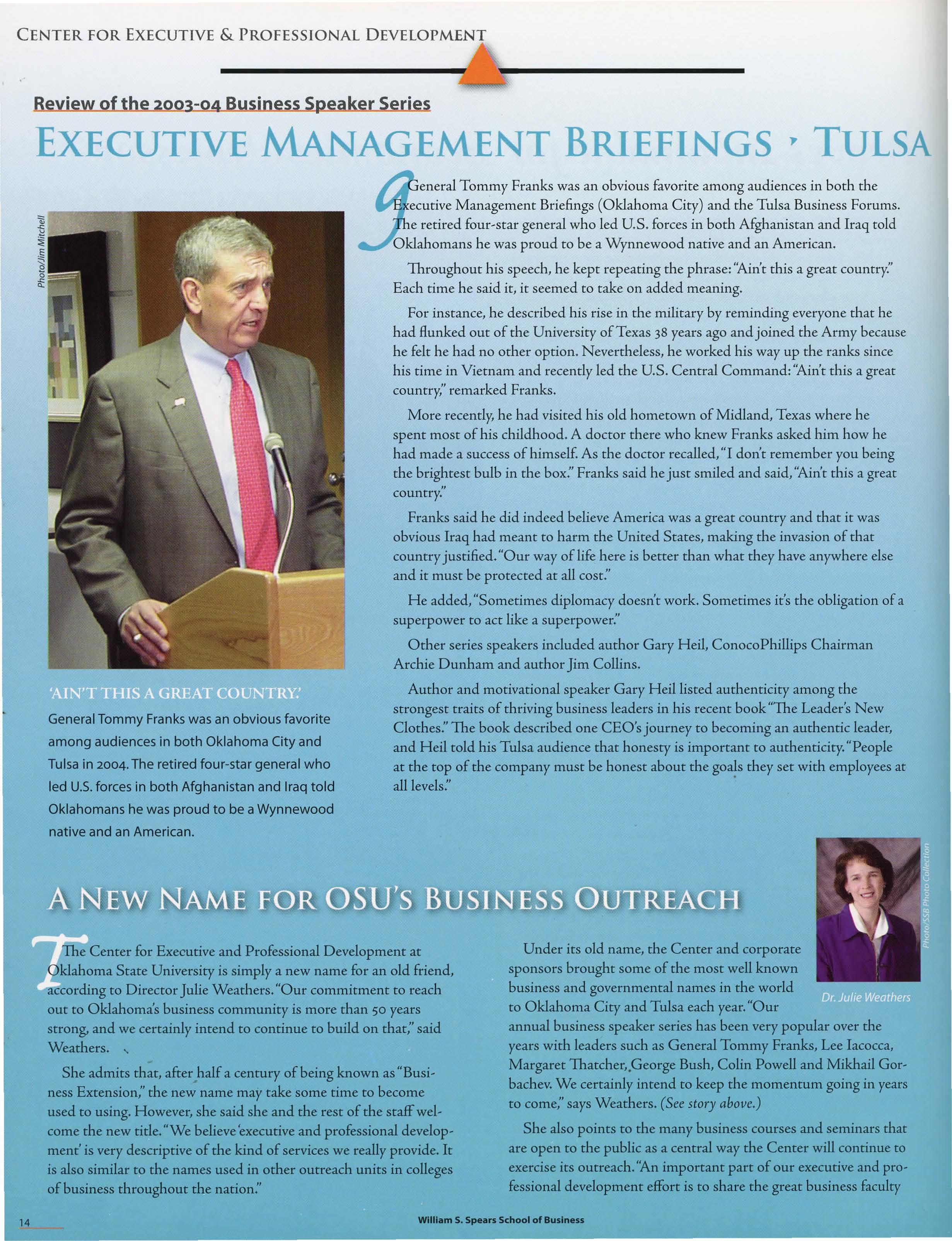
General Tommy Franks was an obvious favorite among audiences in both Oklahoma City and Tulsa in 2004. The retired four-star general who led U.S.forces in both Afghanistan and Iraq told Oklahomans he was proud to be a Wynnewood native and an American.
Author and motivational speaker Gary Heil listed authenticity among the strongest traits of thriving business leaders in his recent book"The Leader's New Clothes:' The book described one CEO's journey to becoming an authentic leader, and Heil told his Tulsa audience that honesty is important to authenticity. "People at the top of the company must be honest about the goals they set with employees at all levels:' •
e Center for Executive and Professional Development at
klahoma State University is simply a new name for an old friend, according to Director Julie Weathers. "Our commitment to reach out to Oklahoma's business community is more than 50 years strong, and we certainly intend to continue to build on char;' said Weathers. ,
She admits that, after half a century of being known as "Business Extension;' the new name may take some time to become used to using. However, she said she and the rest of the staff welcome the new title. "We believe 'executive and professional development' is very descriptive of the kind of services we really provide. It is also similar to the names used in other outreach units in colleges of business throughout the nation:'
Under its old name, the Center and corporate sponsors brought some of the most well known business and governmental names in the world to Oklahoma City and Tulsa each year. "Our
annual business speaker series has been very popular over the years with leaders such as General Tommy Franks, Lee Iacocca, Margaret Thatcher,.George Bush, Colin Powell and Mikhail Gorbachev. We certainly intend to keep the momentum going in years to come;' says Weathers. (See story above.)
She also points to the many business courses and seminars that are open to the public as a central way the Center will continue to exercise its outreach. 'An important part of our executive and professional development effort is to share the great business faculty
WIiiiam S. Spears School of Business
BUSINESS FORUMS
Patterned after the children's classic"The Emperor's New Cloches;' Heil noted that, like the children in the story, "unauthentic leaders frequently have to be told (by employees) when they are not being honest:' Heil also suggested that "the only people who should be leaders are those who don't seek it:'
ConocoPhillips Chairman Archie Dunham insists airline travel was among the reasons chat the nation's third-largest oil company moved its headquarters from Bartlesville to Houston. Dunham also suggested chat was the same reason that CITGO Petroleum recently left Tulsa for the same destination.
"Large international companies can't afford to lose one day at the front end ( of a flight) and one day at the back end of each international trip, it's too much lost productivity;' said Dunham.
His talk centered on the world supply of oil and natural gas, which he estimates should meet consumer demands for JOO more years."New technologies are enabling us to develop oil and gas reserves chat were beyond our reach just IO years ago;' said Dunham, who predicts that an alternative form of energy will replace oil before the end of the century.
Best-selling author Jim Collins urged audiences in Stillwater and Oklahoma City to go from "good to great:' As he put it, "Greatness is nor a function of your circumstance, it is largely a matter of conscious choice and discipline a process never one evenc:'
Collins asked a crowd to think of their companies as buses. "Youhave to get the right people on the bus in the right seats and rhe wrong people off the bus. People are not your most important asset - the right people are:'
While Collins insisted his model was based on the private sector, he told OSU President and System CEO David Schmidly at an earlier presentation that he believed it could be adapted to an institutional setting with certain adjustments.
ByJim Mitchell, OSU News Bureau
WILLIAMS.
SPEARS Schoolof
Business
we have at OSU with the public and private sectors. We offer a range of open enrollment courses and custom programs to distance learning and study abroad and travel courses;' says Weathers. For more information, contact the OSU Center for Executive and Professional Development at (405) 744-5208 or visit the web at cepd.okstate.edu.
Professor Recognized for Outreach Excellence
Dr. Stephen]. Miller is the regional winner of the 2004 Excellence in Teaching Award given by the University Continuing Education Association Great Plains Region V. Miller is the director of International Business Programs and professor of marketing in the Spears School of Business.
According to Dr. Julie Weathers, director of the Center for Executive and Professional Development, "Dr. Miller has been actively involved in outreach activities since he began at the university in 1971. His commitment and excellence of performance in support of continuing education initiatives by OSU is well noted:'
She said Miller is involved in diverse activities with primary focus in dedication to Dr. StephenJ. Miller distance learning and international programs and projects, which includes distance-learning instruction, noncredit seminars, speaking to off-campus constituencies and faculty leadership in support of university continuing education initiatives.
Miller was chosen as the first instructor in an Executive MBA Program at Zayed University, United Arab Emirates, as an OSU consortium member with the University of Kentucky and Clemson University. As director of International Business Programs, he assists in the coordination and promotion of business studyabroad programs, frequently reaches in the various programs and originated OSU's Summer in Fr~nce and Graduate Study in London programs.
Further, through Miller's work on the Governor's International Team, he was instrumental in establishing the Oklahoma Internacional Congress and in preparing the Oklahoma International Strategic Plan.
Weathers pointes out chat Miller has been a campus innovator in the application of diverse technologies to serve student needs better. Miller has actively promoted and participated in the use of distance technologies for educational enrichment activities. This has included two-way video linkages to students and faculty in the UAE, Thailand and Mexico through AT&T and Internet communication systems. Students taught by Miller through the distance-learning programs are from companies such as Boeing, ConocoPhillips, Halliburton, Hewlett Packard, IBM,John Deere, Kimberly Clark, Motorola and Texas Instruments. The audience includes students from across the United States as well as students from India, Malaysia, Mali, Mexico, Romania and Thailand.
Weathers said, "Miller has had a direct impact on the learning environment for students and through his leadership within OSU in stimulating innovation among the faculty and staff:'
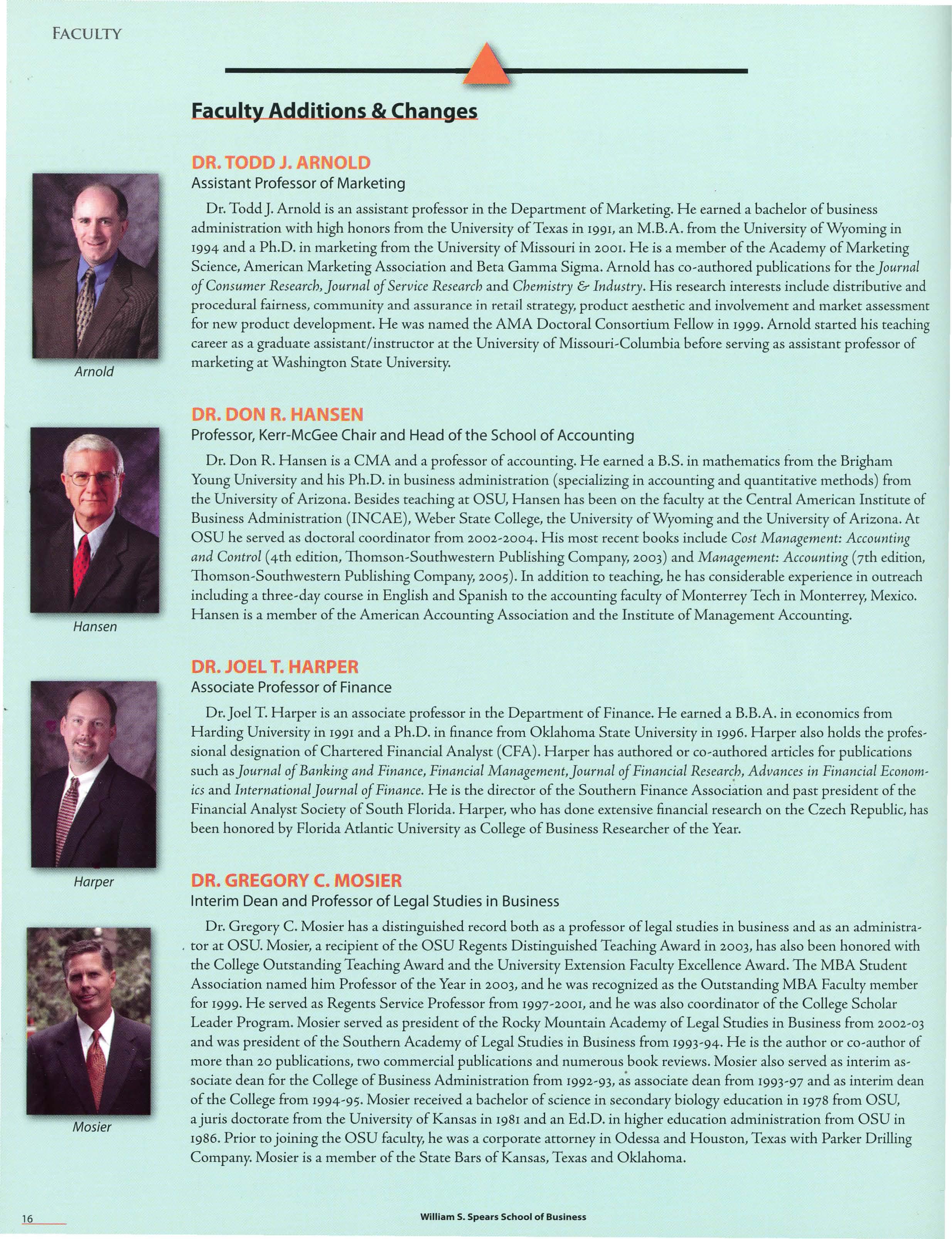
FacultyAdditions& Changes.
DR. TODD J. ARNOLD
Assistant Professor of Marketing
Dr. Todd J. Arnold is an assistant professor in the Department of Marketing. He earned a bachelor of business administration with high honors from the University of Texas in 1991,an M.B.A. from the University of Wyoming in 1994 and a Ph.D. in marketing from the University of Missouri in 2001. He is a memb.er of the Academy of Marketing Science, American Marketing Association and Beta Gamma Sigma. Arnold has co-authored publications for the Journal of Consumer Research, Journal of Service Research and Chemistry & Industry. His research interests include distributive and procedural fairness, community and assurance in retail strategy, product aesthetic and involvement and market assessment for new product development. He was named the AMA Doctoral Consortium Fellow in 1999. Arnold started his teaching career as a graduate assistant/ instructor at the University of Missouri-Columbia before serving as assistant professor of marketing ar Washington State University.
DR. DON R. HANSEN
Professor, Kerr-McGee Chair and Head of the School of Accounting
Dr. Don R. Hansen is a CMA and a professor of accounting. He earned a B.S. in mathematics from the Brigham Young University and his Ph.D. in business administration (specializing in accounting and quantitative methods) from the University of Arizona. Besides teaching at OSU, Hansen has been on the faculty at the Central American Institute of Business Administration (INCAE), Weber State College, the University of Wyoming and the University of Arizona. Ac OSU he served as doctoral coordinator from 2002-2004. His most recent books include Cost Management: Accounting and Control (4th edition, Thomson-Southwestern Publishing Company, 2003) and Management: Accounting (7th edition, Thomson-Southwestern Publishing Company, 2005). In addition to teaching, he has considerable experience in outreach including a three-day course in English and Spanish to the accounting faculty of Monterrey Tech in Monterrey, Mexico. Hansen is a member of the American Accounting Association and the Institute of Management Accounting.
DR. JOEL T. HARPER
Associate Professor of Finance
Dr. Joel T. Harper is an associate professor in the Department of Finance. He earned a B.B.A. in economics from Harding University in 1991and a Ph.D. in finance from Oklahoma State University in 1996. Harper also holds the professional designation of Chartered Financial Analyst (CFA). Harper has authored or co-authored articles for publications such as Journal of Banking and Finance, Financial Management,Journal of Financial Research, Advances in Financial Economics and International Journal of Finance. He is the director of the Southern Finance Associ~tion and past president of the Financial Analyst Society of South Florida. Harper, who has done extensive financial research on the Czech Republic, has been honored by Florida Atlantic University as College of Business Researcher of che Year.
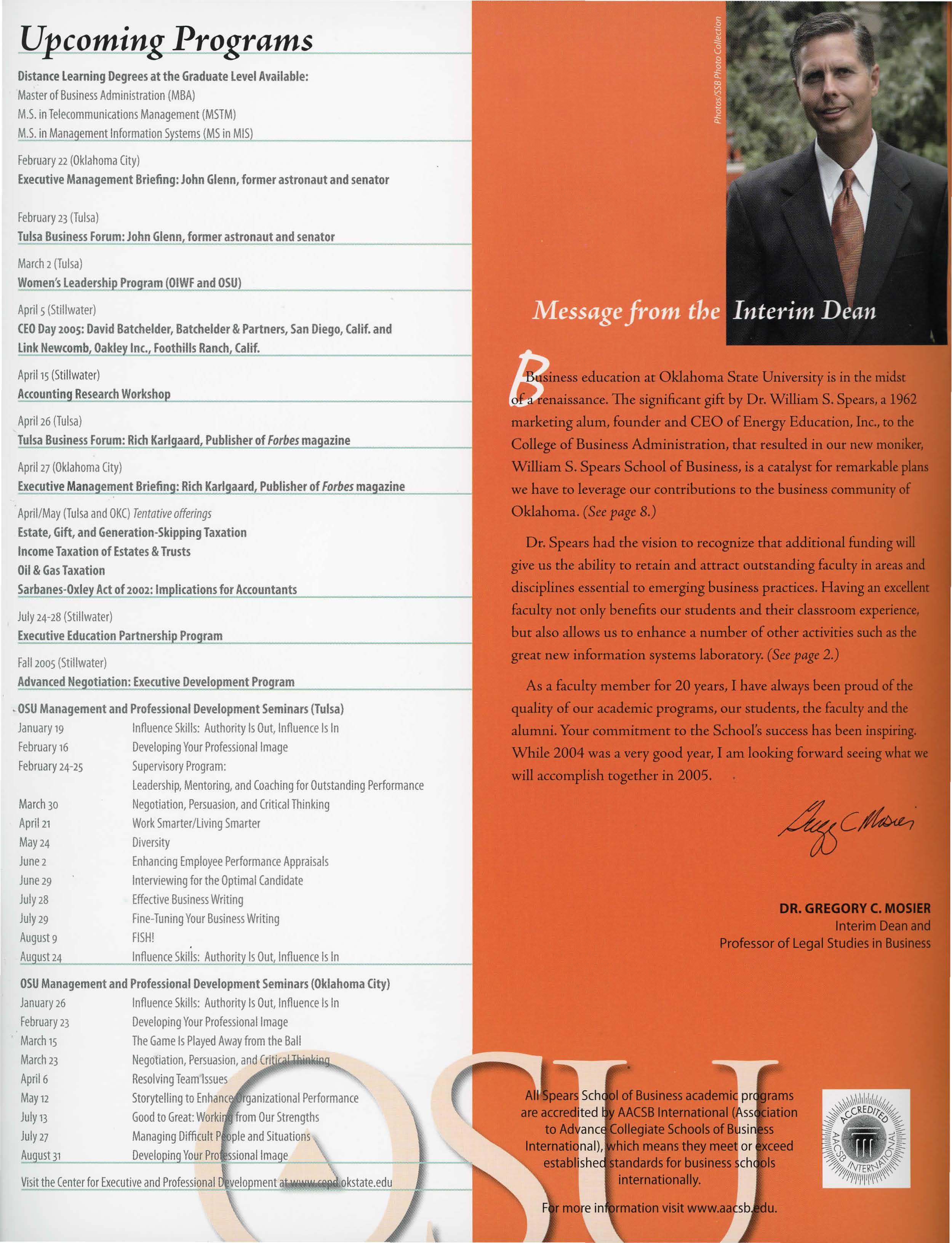
DR. GREGORY C. MOSIER
Interim Dean and Professor of Legal Studies in Business
Dr. Gregory C. Mosier has a distinguished record both as a professor of legal studies in business and as an administra, tor at OSU. Mosier, a recipient of the OSU Regents Distinguished Teaching Award in 2003, has also been honored with the College Outstanding Teaching Award and the University Extension Faculty Excellence Award. The MBA Student Association named him Professor of the Year in 2003, and he was recognized as the Outstanding MBA Faculty member for 1999. He served as Regents Service Professor from 1997-2001, and he was also coordinator of the College Scholar Leader Program. Mosier served as president of the Rocky Mountain Academy of Legal Studies in Business from 2002-03 and was president of the Southern Academy of Legal Studies in Business from 1993-94. He is the author or co-author of more than 20 publications, two commercial publications and numerous book reviews. Mosier also served as interim associate dean for the College of Business Administration from 1992-93, a~ associate dean from 1993-97 and as interim dean of the College from 1994-95. Mosier received a bachelor of science in secondary biology education in 1978 from OSU, a juris doctorate from the University of Kansas in 1981and an Ed.D. in higher education administration from OSU in 1986. Prior to joining the OSU faculty, he was a corporate attorney in Odessa and Houston, Texas with Parker Drilling Company. Mosier is a member of the State Bars of Kansas, Texas and Oklahoma.
William S. Spears School of Business
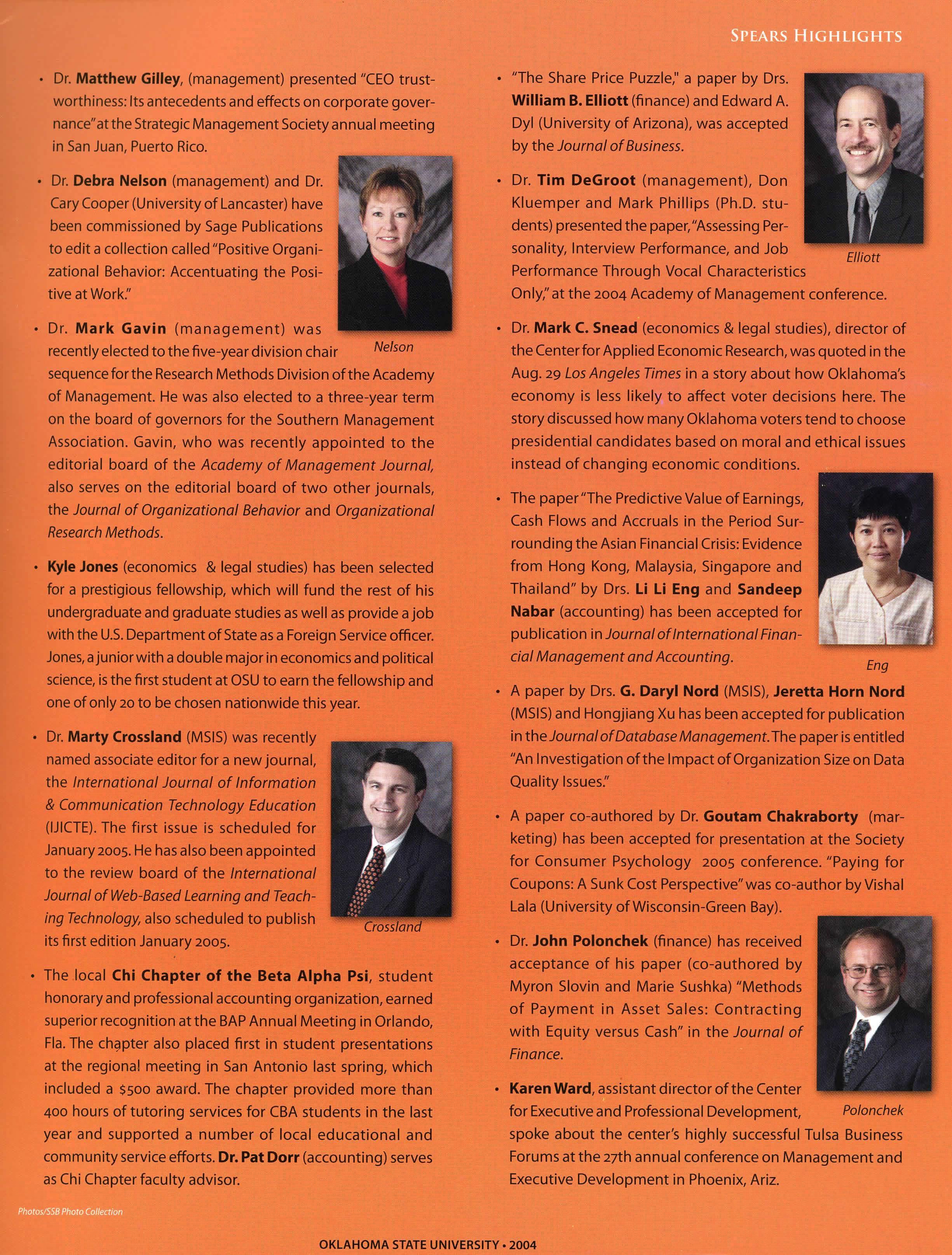
Dr. Matthew Gilley, (management) presented "CEO trustworthiness: Its antecedents and effects on corporate governance"at the Strategic Management Society annual meeting in SanJuan, Puerto Rico.
Dr. Debra Nelson (management) and Dr. Cary Cooper (University of Lancaster) have been commissioned by Sage Publications to edit a collection called "Positive Organizational Behavior: Accentuating the Positive at Work."
Dr. Mark Gavin (management) was recently elected to the five-year division chair Nelson sequencefor the ResearchMethods Division of the Academy of Management. He was also elected to a three-year term on the board of governors for the Southern Management Association. Gavin, who was recently appointed to the editorial board of the Academy of Management Journal, also serves on the editorial board of two other journals, the Journal of Organizational Behavior and Organizational ResearchMethods.
Kyle Jones (economics & legal studies) has been selected for a prestigious fellowship, which will fund the rest of his undergraduate and graduate studies as well as provide a job with the U.S.Department of State as a Foreign Service officer. Jones,ajunior with a double major in economics and political science,is the first student at OSUto earn the fellowship and one of only 20 to be chosen nationwide this year.
Dr. Marty Crossland (MSIS)was recently named associate editor for a new journal, the International Journal of Information & Communication Technology Education (IJICTE).The first issue is scheduled for January 2005. He has also been appointed to the review board of the International Journal of Web-BasedLearning and Teaching Technology,also scheduled to publish its first edition January 2005.
The local Chi Chapter of the Beta Alpha Psi, student honorary and professional accounting organization, earned superior recognition at the BAP Annual Meeting in Orlando, Fla.The ch 9pter also placed first in student presentations at the regional meeting in San Antonio last spring, which included a $500 award. The chapter provided more than 400 hours of tutoring services for CBA students in the last year and supported a number of local educational and community service efforts. Dr. Pat Dorr (accounting) serves as Chi Chapter faculty advisor.
• "The Share Price Puzzle," a paper by Ors. William B. Elliott (finance) and Edward A. Dyl (University of Arizona), was accepted by the Journal of Business.
• Dr. Tim DeGroot (management), Don Kluemper and Mark Phillips (Ph.D. students) presented the paper,"AssessingPersonality, Interview Performance, and Job Performance Through Vocal Characteristics Elliott Only;' at the 2004 Academy of Management conference.
• Dr. Mark C. Snead (economics & legal studies), director of the Center for Applied Economic Research,was quoted in the Aug. 29 Los Angeles Times in a story about how Oklahoma's economy is less likely to affect voter decisions here. The story discussed how many Oklahoma voters tend to choose presidential candidates based on moral and ethical issues instead of changing economic conditions.
• The paper"The Predictive Value of Earnings, Cash Flows and Accruals in the Period Surrounding the Asian Financial Crisis: Evidence from Hong Kong, Malaysia, Singapore and Thailand" by Ors. Li Li Eng and Sandeep Nabar (accounting) has been accepted for publication in Journal of International Financial Management and Accounting. Eng
• A paper by Ors. G. Daryl Nord (MSIS),Jeretta Horn Nord (MSIS)and Hongjiang Xu has been accepted for publication in the Journal of Database Management. The paper is entitled "An Investigation of the Impact of Organization Size on Data Quality Issues:'
• A paper co-authored by Dr. Goutam Chakraborty (marketing) has been accepted for presentation at the Society for Consumer Psychology 2005 conference. "Paying for Coupons: A Sunk Cost Perspective"was co-author by Vishal Lala (University of Wisconsin-Green Bay).
• Dr. John Polonchek (finance) has received acceptance of his paper (co-authored by Myron Slavin and Marie Sushka) "Methods of Payment in Asset Sales: Contracting with Equity versus Cash" in the Journal of Finance.
• Karen Ward, assistant director of the Center for Executive and Professional Development, Polonchek spoke about the center's highly successful Tulsa Business Forums at the 27th annual conference on Management and Executive Development in Phoenix, Ariz.
Crossland