
FROM THE DEAN
Change often causes unrest and insecurity, but it highlights the strengths of the College of Business Administration. The evolving nature of the business environment, including new technology, the international arena, and the complexity of modern business issues, has dramatically influenced our curriculum and the ways we have found to serve our constituencies.
One example of recent change is in the Master of Business Administration program. Courses are now taught in modules more appropriate to the knowledge required in the field. In addition, an internship program augments the classroom experience. For students at corporate sites, compressed video delivers educational programming to employees of many of the state's largest businesses.
Another change, is the retirement of Robert Sandmeyer. His 17-year leadership as dean of the College of Business Administration and his tireless efforts forged the outstanding relationships we have with our business and educational partners. He led Oklahoma State University to the national forefront in education for the business disciplines. His legacy to OSU is the outstanding reputation of the college. His legacy to the state and nation are the countless college alumni now contributing to our world.
In the midst of this change, the student remains our focus. The faculty and staff in the College of Business Administration work diligently to provide an outstanding instructional environment to enhance the exchange between professor and student. Then, a
dynamic, flexible curriculum provides the knowledge which allows students to meet their educational goals, as well as those of their employers.
While change occurs around us, the college has actively maintained its pre-eminence in building alliances. Our partnership with the business community in bringing programs such as the Tulsa Business Forums and the Executive Management Briefings to Oklahoma continues to flourish. The Office of Business Extension's delivery of professional development programs to state businesses is a model for American universities. These activities represent the significant role of the college in enhancing economic development.
One thing is clear, if Oklahoma 1 s economy is to grow, we must create high paying jobs requiring college graduates. Partnership between universities and busi-
nesses is essential to achieve this goal, and we look forward to pursuing it with our partners.
With those thoughts, we present the sixth edition of VisionMagazine. Its pages address pertinent changes affecting business and education for the business disciplines. The College of Business Administration faculty and staff constantly strive to provide the best service possible to our partners in education. Your continued support is essential to enhance and maintain the outstanding service provided to the state, nation and world by the Oklahoma State University College of Business Administration.
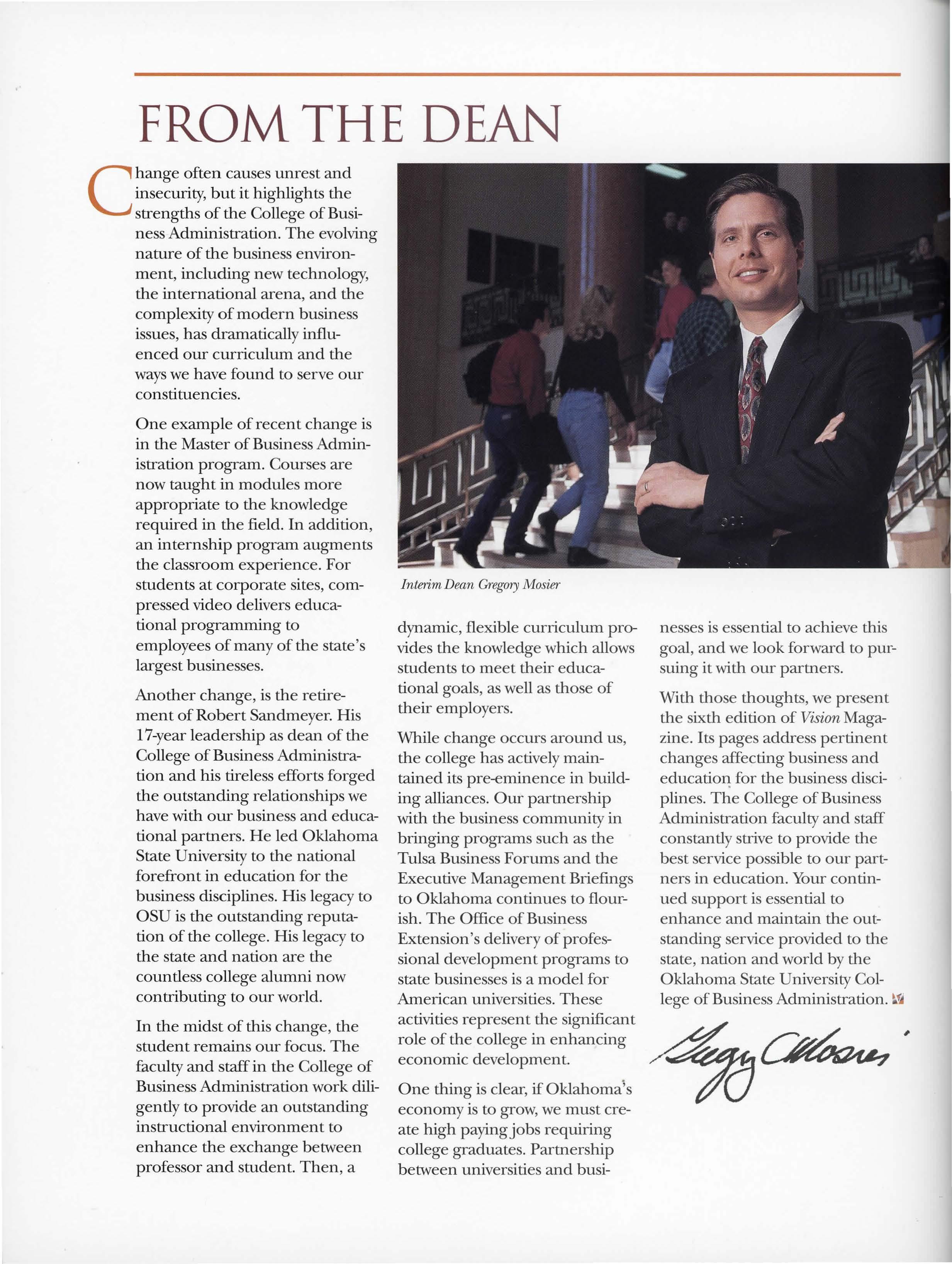
InterimDean GregoryMosier
A WOMAN'S WORK IS NEVER DONE
Jenelle Schatz knows the corporate ladder is tough to climb in a skirt. That's why she's giving women in business a helping hand.
GHOSTS OF BUSINESS PAST
It's fright night for business as companies and employees learn it takes more than status quo to survive.
21 RIDING HIGH
From climbing Kilamanjaro to motorcycling, Andy Urich is always searching for new adventures. In the classroom, he challenges students to do the same.
THE DORR WAY
The movies aren't the only excuse this father and daughter use to spend time together. From academics to community service, Pat and Megan Dorr are inseparable.
6,
VISION magazine is a publication of the Oklahoma State University College of Business Administration designed to bring the latest infornption in business and education to the College's many constituents.
of Business Administration
• Director of Planning and Operations, Rudy Greer
• Editor,Jennefer R. Tolbert
• Associate Editor, Stephen Hill
• Editorial Assistants,Janet Varnum, Kelli Pa/an
• Art Director, Valerie C. Kisling
• Associate Art Director, Mark Pennie
• Photography, Andy Maxey (unless otherwise noted)
A
SANDMEYERRETIRES
fter I 7 years as dean of the _r\_College of Business Administration, Dr. Robert Sandmeyer retired to build a business education program in the Middle East.
Sandmeyer says the biggest accomplishment during his tenure was the endowed chair and professorship program. He also cites building the faculty and business programs to their current levels of excellence, an accomplishment he credits to the department heads' team effort.
"In order to build the program we wanted, we had to
reach out to the business community," he says. 'Twenty years ago we weren't that tied into our constituency group, so getting the business community to understand who we are was a great experience for us."
Sandmeyer left OSU to assist the University of the United Arab Emirates in implementing a business administration program that will be modeled after the U.S. business education system.
JANET
VARNUM
A WOMAN OF DISTINCTION
Jane McKinney's efforts for the College of Business Administration and the university have not gone unnoticed. From mentoring young business students to fundraising, this 1977 business graduate earned her award as the OSU Alumni Association's Distinguished Alumnus for 1994.
During her 15 years with Conoco, McKinney advanced from pipeline associate analyst to director of operations for transportation, responsible for $7.8 million in overhead and operating expenses.
She says OSU gave her a strong foundation for her career. "I've been able to compete at all levels in the business world because of my education ....
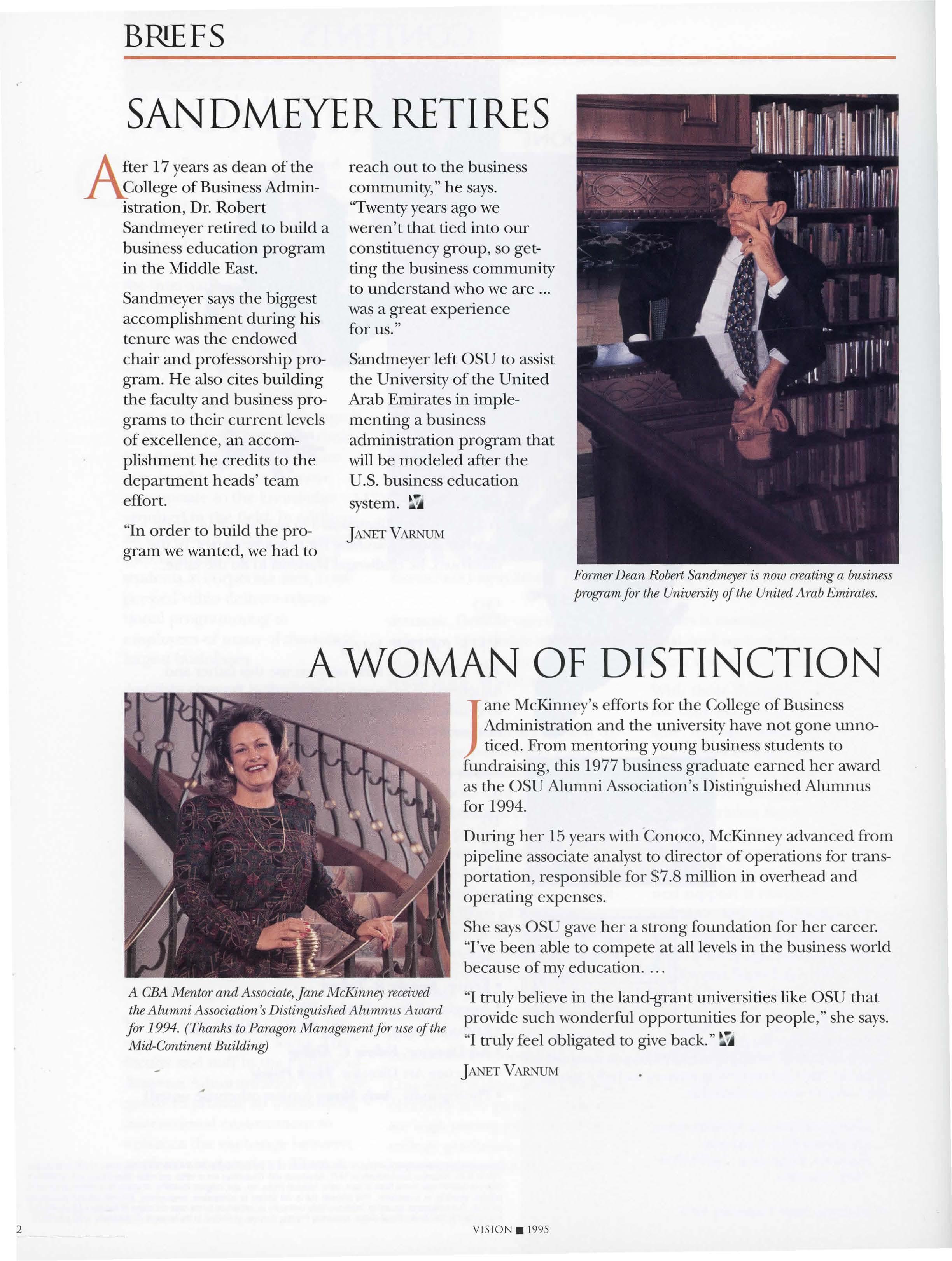
A CBA Mentor and Associate,Jane McKinney received theAlumni Association'sDistinguishedAlurnnus Award for 1994. (Thanks to Paragon Managernentfor use of the Mid-ContinentBuilding)
"I truly believe in the land-grant universities like OSU that provide such wonderful opportunities for people," she says. "I truly feel obligated to give back."~
jANETVARNUM
FormerDean RobertSandrneyeris now creatinga business prograrnfor the Universityof the UnitedArab Ernirates.
STUDIOSTILLWATER
On-the:iob training has taken on a whole new meaning thanks to the corporate MBA classes the College of Business Administration delivers through interactive, compressed video to organizations around the state.
The three-year MBA program, which enables company employees to earn an advanced degree without leaving the work site, simultaneously links an OSU classroom to one set up at a participating corporate site.
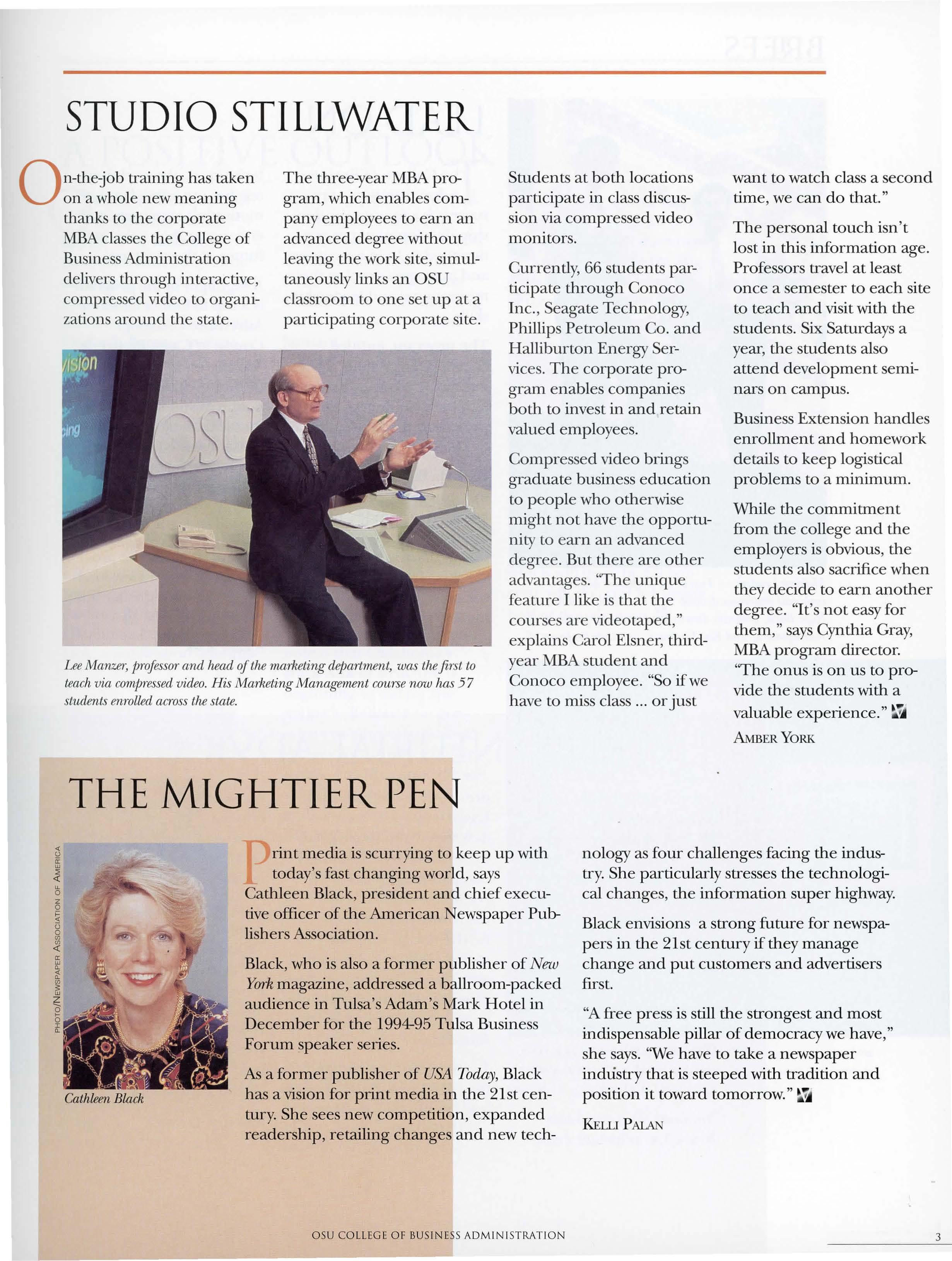
LeeManze1~professorand head of the marketing department, was thefirst to teachvia compressedvideo. His Marketing Management coursenow has 5 7 students enroUedacrossthe state.
THE MIGHTIERPEN
Students at both locations participate in class discussion via compressed video monitors.
Currently, 66 students participate through Conoco Inc., Seagate Technology, Phillips Petroleum Co. and Halliburton Energy Services. The corporate program enables companies both to invest in and retain valued employees.
Compressed video brings graduate business education to people who otherwise might not have the opportunity to earn an advanced degree. But there are other advantages. 'The unique feature I like is that the courses are videotaped," explains Carol Elsner, thirdyear MBA student and Conoco employee. "So ifwe have to miss class or just
rint media is scurrying to keep up with today's fast changing world, says Cathleen Black, president and chief executive officer of the American Newspaper Publishers Association.
Black, who is also a former publisher of New Yorkmagazine, addressed a ballroom-packed audience in Tulsa's Adam's Mark Hotel in December for the 1994-95 Tulsa Business Forum speaker series.
As a former publisher of USA Today, Black has a vision for print media in the 21st century. She sees new competition, expanded readership, retailing changes and new tech-
want to watch class a second time, we can do that."
The personal touch isn't lost in this information age. Professors travel at least once a semester to each site to teach and visit with the students. Six Saturdays a year, the students also attend development seminars on campus.
Business Extension handles enrollment and homework details to keep logistical problems to a minimum.
While the commitment from the college and the employers is obvious, the students also sacrifice when they decide to earn another degree. "It's not easy for them," says Cynthia Gray, MBA program director. 'The onus is on us to provide the students with a valuable experience."~
AMBER YORK
nology as four challenges facing the industry. She particularly stresses the technological changes, the information super highway.
Black envisions a strong future for newspapers in the 21st century if they manage change and put customers and advertisers first.
"A free press is still the strongest and most indispensable pillar of democracy we have," she says. 'We have to take a newspaper industry that is steeped with tradition and position it toward tomorrow."~
KELLI PAlAN
Cathken Bl.ack
LEAD ON
~e College of Business !Administration's newest success is a four-day leadership development program designed to help executives and managers develop their motivational and leadership skills.
The program, entitled "Leadership: Making a Difference," boasts clients such as BancFirst, Prevue Networks and the OU College of Medicine.
Dr. Raja Basu, director, says this innovative program takes a "learn today, use tomorrow" approach through workshops and speakers from throughout the college. Along with basic managerial and leadership
techniques, the workshop teaches the importance of motivating employees and enhancing their roles in the future of the company.
A highlight of the program is a trip to OSU's Outdoor Adventure Challenge Course at Camp Redlands. Through the "ropes" course, individuals realize their potential and improve communication by overcoming obstacles aided only by a few cables, fellow participants and their self-determination.
In its first year, 20 business leaders attended the program. Business Extension is expecting even greater numbers next session. •~
AMBER YORK
ENTREPRENEURIAL ADVICE
ussell Teubner didn't set out to become an entrepreneur, he set out to solve a problem. That's what he told the 1994 College of Business Administration graduates last December.
"If what you want is just to be an entrepreneur, you will probably fail," he said.
"However, if you have a burning passion ... or are obsessed with solving a particular problem, then you may well succeed."
Teubner, who considers himself a "reluctant entre-
preneur," made his success happen in 1983 when he developed a software product to make IBM terminals compatible with non-IBM computer systems. The result was the product A-NET and a company named Teubner and Associates, one of America's fastest growing privately held companies, according to Inc. Magazine.
Teubner told the audience they need to continue learning. "Although you have
received a wonderful education at OSU ... I urge you to view what you have learned up to this point as simply an outline."
Another key to success is a healthy fear of failure, said Teubner. "Let it protect you; let it motivate you. Do not, however, let it paralyze or blind you. The bottom line is simple: If you wait until you aren't afraid to take a bold step ... then you probably never will! "
JENNEFER TOLBERT
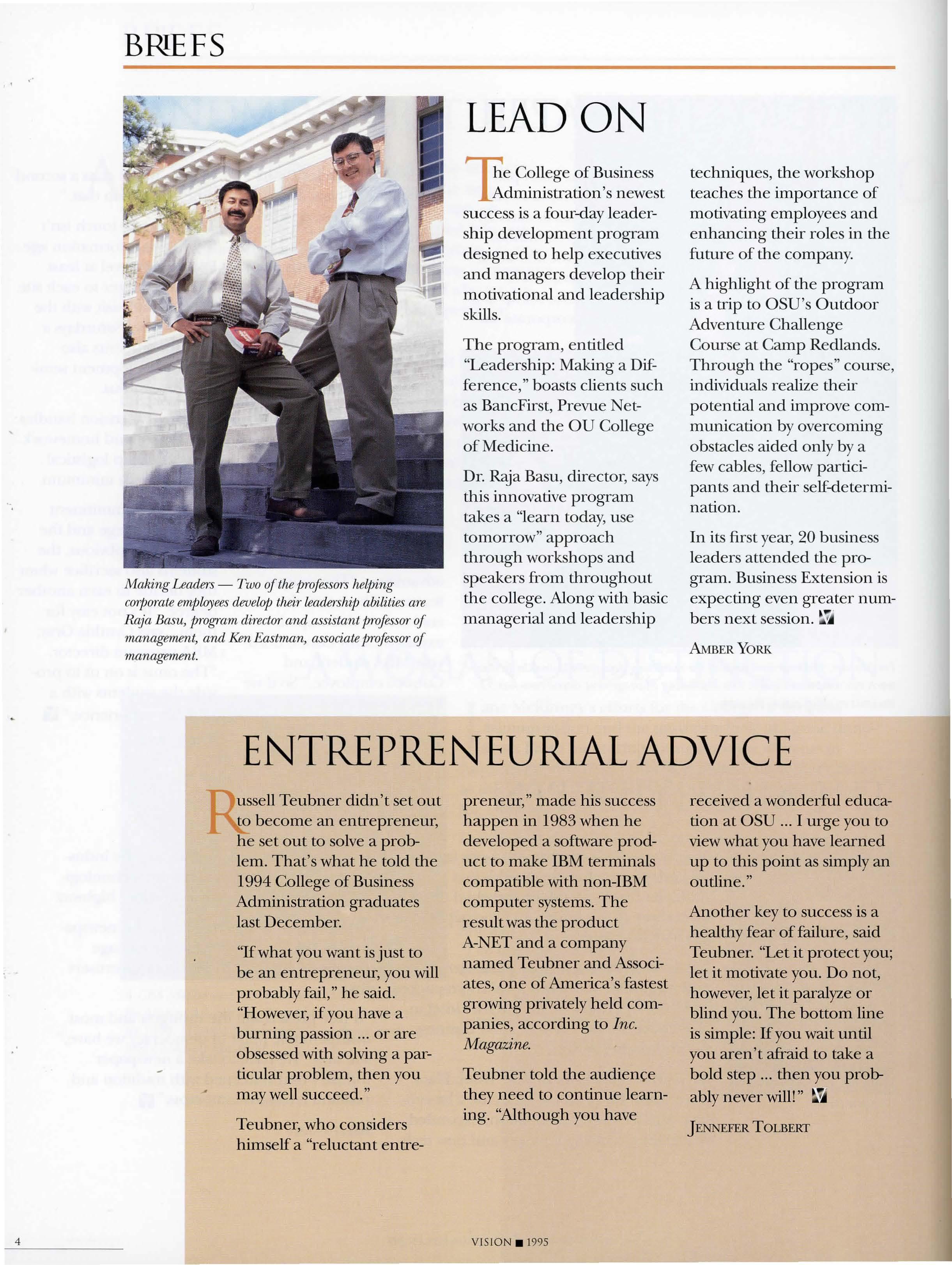
Making Leaders - Two of the professors helping wrporate employeesdevelc1Jtheir leadership abilities are Raja Basu, program director and assistant professor of management, and Ken Eastman, associate professor of management.
A POSITIVE OUTLOOK
Oklahoma's output and employment levels appear to be following national trends for growth, according to forecasters with the College of Business Administration's Economic Outlook. Barring unforeseen rises in inflation and a tightening in monetary policies, "prospects are very good for growth in Oklahoma during 1995 at levels well above those experienced during this decade except for 1994," says Gerald Lage, Regents Service Professor of Economics.
Lage and the CBA's team of researchers presented their findings in the 16th annual Oklahoma Economic Outlook, a publication adminis-
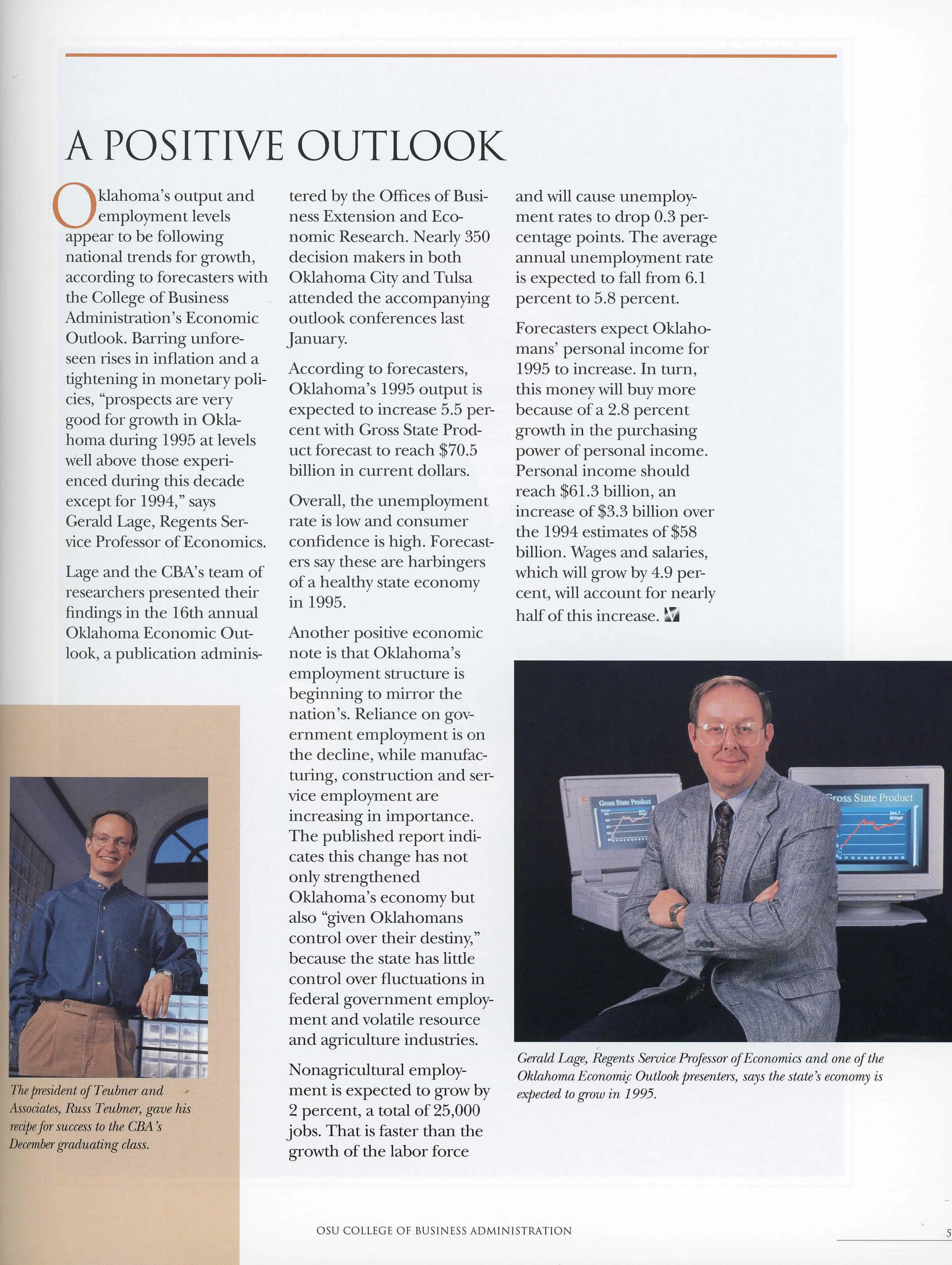
Thepresidentof Teubnerand Associates,Russ Teubner,gave his recipefor successto the CBA s Decembergraduating cl,ass.
tered by the Offices of Business Extension and Economic Research. Nearly 350 decision makers in both Oklahoma City and Tulsa attended the accompanying outlook conferences last January.
According to forecasters, Oklahoma's 1995 output is expected to increase 5.5 percent with Gross State Product forecast to reach $70.5 billion in current dollars.
Overall, the unemployment rate is low and consumer confidence is high. Forecasters say these are harbingers of a healthy state economy in 1995.
Another positive economic note is that Oklahoma's employment structure is beginning to mirror the nation's. Reliance on government employment is on the decline, while manufacturing, construction and service employment are increasing in importance. The published report indicates this change has not only strengthened Oklahoma's economy but also "given Oklahomans control over their destiny," because the state has little control over fluctuations in federal government employment and volatile resource and agriculture industries.
Nonagricultural employment is expected to grow by 2 percent, a total of 25,000 jobs. That is faster than tl1e growth of the labor force
and will cause unemployment rates to drop 0.3 percentage points. The average annual unemployment rate is expected to fall from 6.1 percent to 5.8 percent.
Forecasters expect Oklahomans' personal income for 1995 to increase. In turn, this money will buy more because of a 2.8 percent growth in the purchasing power of personal income. Personal income should reach $61.3 billion, an increase of $3.3 billion over the 1994 estimates of $58 billion. Wages and salaries, which will grow by 4. 9 percent, will account for nearly half of this increase.
Geral,dLage, Regents ServiceProfessfffof Economicsand one of the Ok/,ahomaEconomi.cOutlookpresenters,says the state's economyis expectedto grow in 1995.
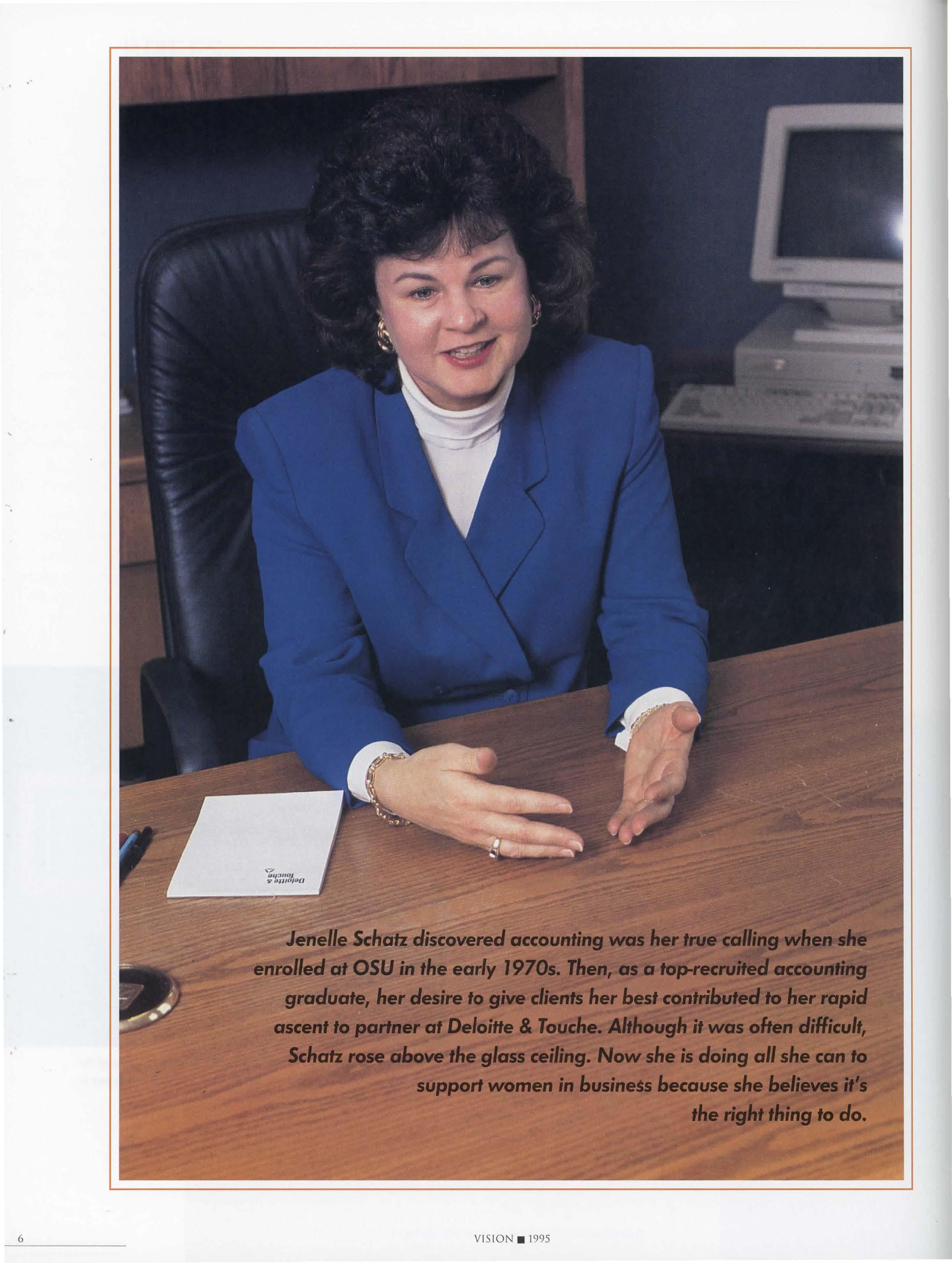
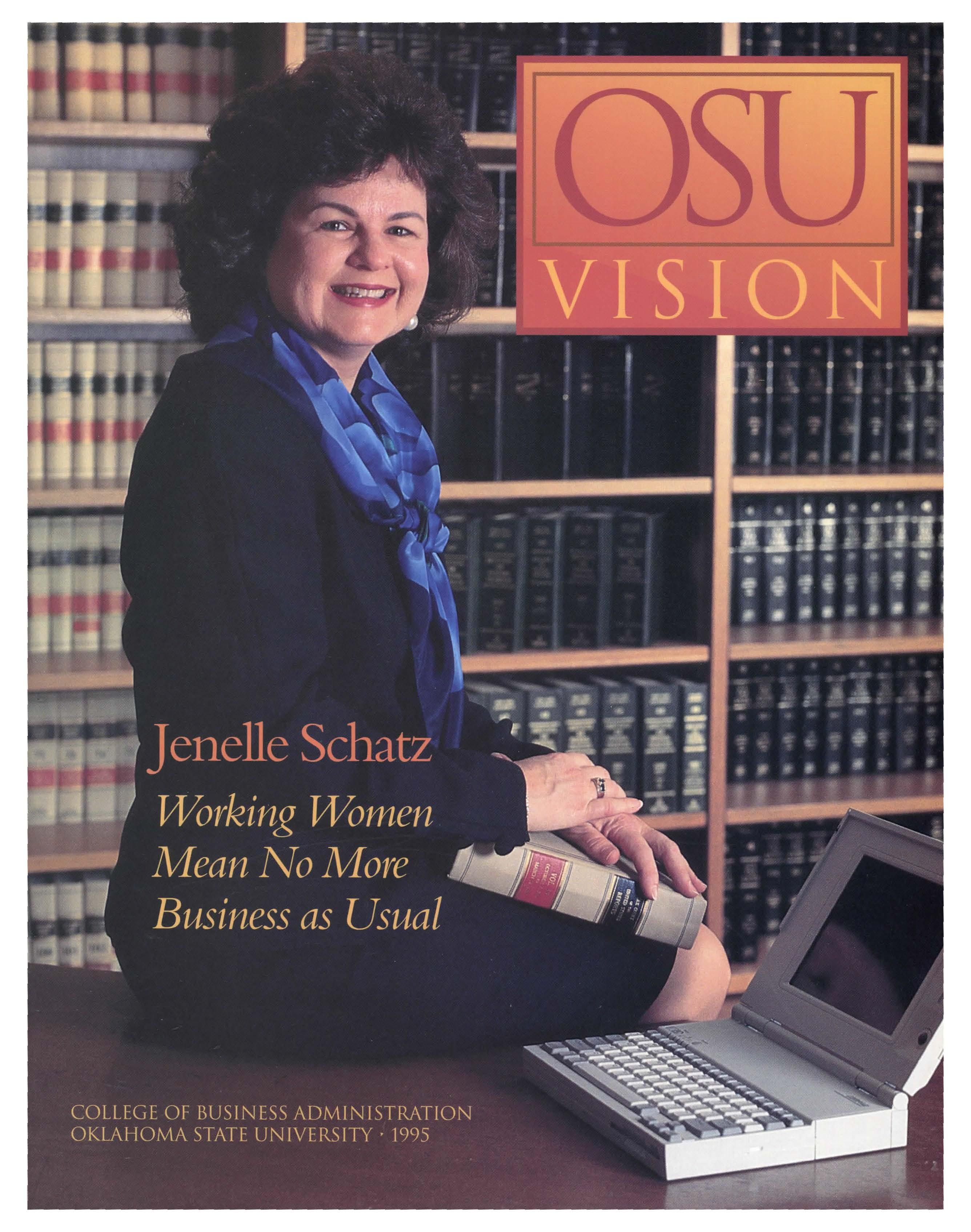
'Jenelle Schatz discovered accounting was her true calling when she enrolled at OSU in the early 1970s. Then, as a foJ>recruited accounting graduate, her desire to give clients her best contributed to her rapid ascent to partner at Deloitte & Touche. Although it was often difficult, Schatz rose above the glass ceiling. Now she is doing all she can to support women in busine~s because she believes it's the right thing to do.
THE RIGHTTHING TO DO
Jenelle Schatz juggled the roles of wife, mother and professional accountant through her academic and professional career to become partner at Deloitte & Touche LLP, one of the world's top accounting firms. In the process she realized the work force had to change.
Schatz has made promoting women a priority, helping implement her company's guidelines for supporting female employees and serving young women as a men tor through the CBA Associates. Schatz believes it makes sense for companies to adjust to the needs of their female employees, and she's taking a personal role in changing the business environment.
Breaki,ngUnseenBarriers
In the accounting profession, where employees strive to make partner,Jenelle Schatz has achieved monumental professional accomplishments that few womenor men - can equal.
Schatz is the first woman to make a partner in one of Oklahoma's "Big Eight" accounting firms and the first female graduate of the School of Accounting to become a partner in any accounting firm.
That's quite a feat, particularly for someone who hadn't even considered accounting when she enrolled at OSU.
A Tonkawa native,Jenelle Reynolds married Tony Sdiatz, her husband of 31 years, while still in high school. She took courses at Tonkawa'sjunior college, dropping out
when she was expecting their second child. Later they moved to Stillwater, and she enrolled at OSU when their third child was 2.
Schatz's strength had always been math, but Dr. Wilton T. "Andy" Anderson, former head of the accounting department, encouraged her to take one accow1ting course before declaring math as her major.
Schatz found she loved accounting, but ran low on funds about a year into her degree. 'We had a period of time where we flat did not have the money for me to go to school. So I went to Dr. Anderson and told him I wasn't dropping out forever, just temporarily.
"He opened his desk drawer, pulled out his checkbook and wrote me a check then and there for my tuition. I immediately voJunteered to pay it back, and he said all he wanted me to do was remember what OSU had done for me and give back to the school as I could," says Schatz, who ultimately graduated summa cum laude.
She hasn't forgotten. Besides giving the university her own financial support, this president of the CBA Alumni Association has initiated and coordinated fundraising to establish a $250,000 professorship in accounting. Throughout her career, she has taken numerous leadership positions within the college and beyond.
A member of the Dean's Search Committee and chairperson of the CBA Associates' Alumni Committee, Schatz also received the OSU Beta Alpha Psi Accountant of the Year Award in 1989.
During her seven-year tenure as partner in charge of Oklahoma recruiting, Schatz has had outstanding results with internal recruiting efforts, which include interviewing more than 200 graduates annually.
Since 1978 Schatz has served as a board member of Tulsa's Family and Children's Services Inc. There she is responsible for providing direction for programs and funding for this organization that delivers social services to more than 7,000 Tulsa families annually.
An adjunct professor for the master's in accounting program, she also served the Citizens' Crime Commission for six years as a board member, treasurer and president. This organization is a clearinghouse for crime prevention education and assists law
Schatzsactivitiesmakeit easytof argetthat l,eadershiprol,eshaven'talwaysbeen opento women.Today,shesays, therearestillbarriers.
Even Schatz, one of the leaders behind Deloitte & Touche's efforts to implement formalized retention and advancement programs for women, let herself be convinced upon graduation that working in one of the leading accounting firms was no place for a woman.
"A representative of another accounting firm told me that I would have no time for myself, that this career would not be good for a person with a family and that I should stay at home," she remembers.
Schatz was so convinced she tried to cancel an interview she had scheduled with Deloitte & Touche. When she discovered it was too late to withdraw, Schatz decided to run by at her allotted time to decline the interview.
Wearing jeans and a sweatshirt and with her children in tow, Schatz explained her change of mind. But the recruiters said they had already talked to her professors and were very interested in hiring her. "I ended up with two partners talking to me and literally recruiting me because I'd already made up my mind not to seek a job."
Again Anderson encouraged her to give the accounting profession a chance. "I took the job," she says, "and have been here ever since. After six months, it dawned on me, 'I can do this stuff. I'm as good as anyone else.' "
enforcement agencies through the Crime Stoppers Program.
Schatz's activities make it easy to forget that leadership roles haven't always been open to women. Today, she says, there are still barriers.
According to Schatz, studies show accounting firms hire equal numbers of men and women, but after six to eight years, fewer women remain. Companies, she says, are beginning to understand that those who lose a disproportionate number of women employees or who advance only a small percentage to their upper ranks are hurting themselves as well as their employees.
A Cause
Since May 1976, when Schatz was one of only 18 women out of 104 total examinees to pass the CPA exam in Oklahoma, she's been an outstanding representative for women in the accounting profession.
Schatz' expertise in tax planning and consulting involves specialization in United States and Canadian oil and gas taxation and estate, gift and corporate taxation. She has served some of Oklahoma's most prominent companies, including CITGO Petroleum, MAPCO Inc. and Liberty Bank & Trust Company of Tulsa.
Schatz, who credits her success to client service, is one of two female partners at
Deloitte & Touche in Oklahoma. None of the other Top Six accounting firms in Oklahoma, which employ approximately 750 professionals and staff statewide, have female partners.
But even from her high-rise office overlooking downtown Tulsa, Schatz hasn't forgotten her colleagues struggling with the responsibilities of both work and family.
When Deloitte & Touche established a national Task Force on the Retention and Advancement of Women in 1992, Schatz was an obvious choice to oversee its implementation within her six-state region.
Examples of Deloitte & Touche's commitment to families include reduced workloads for employees, flexible schedules, employerprovided child care, sexual harassment awareness training, career counseling and assignment reviews to ensure women aren't overlooked in career-enhancing assignments.
Schatz disseminates information from the national office and talks with her constituents, from partners to staff people, about the best ways to make the changes.
''We need to do what we can to keep women a part of our organization, even if for two or four or five years they may not be on the traditional development track. We have to give them a different type of mentoring or counseling because they have different needs."
Also a board member of the OSU Alumni Association, Schatz's commitment extends to a personal level. She participates in the OSU Associates mentor program as a mentor for one to two female accounting students each year and serves annually as a panelist on business perspectives for OSU's ''Women in Business" class.
Surprisingly, it wasn't her own experience that changed Schatz's outlook. "I loved my job so much it didn't occur to me to do it any other way than the men were doing. I realized it was more work for me than it was for the men. They were going home to prepared meals; I was going home to prepare meals. I knew I was spending every waking
hour working in some form and they weren't. But I didn't think ofit as a disadvantage."
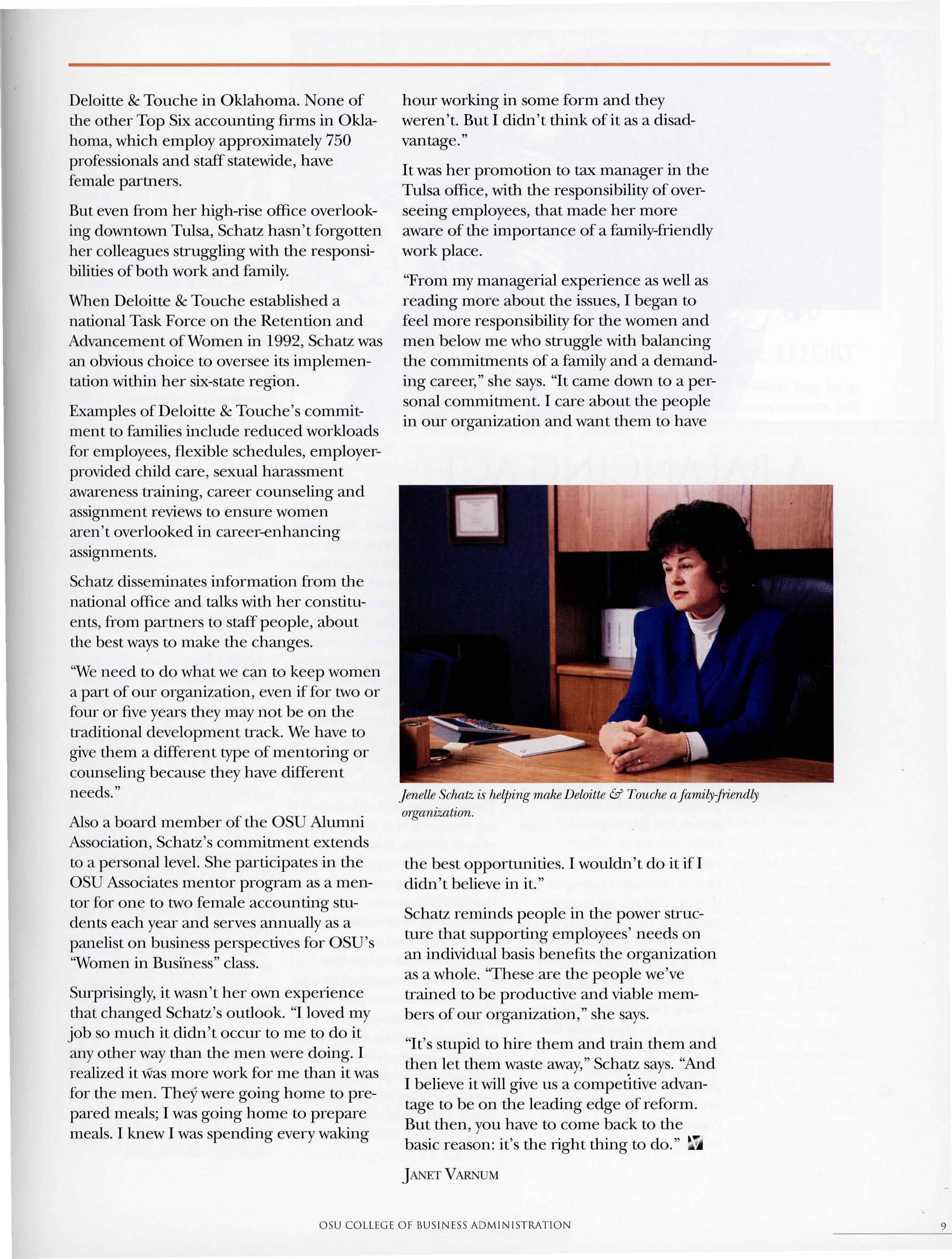
It was her promotion to tax manager in the Tulsa office, with the responsibility of overseeing employees, that made her more aware of the importance of a family-friendly work place.
"From my managerial experience as well as reading more about the issues, I began to feel more responsibility for the women and men below me who struggle with balancing the commitments of a family and a demanding career," she says. "It came down to a personal commitment. I care about the people in our organization and want them to have
the best opportunities. I wouldn't do it if I didn't believe in it."
Schatz reminds people in the power structure that supporting employees' needs on an individual basis benefits the organization as a whole. 'These are the people we've trained to be productive and viable members of our organization," she says.
"It's stupid to hire them and train them and then let them waste away," Schatz says. "And I believe it will give us a competitive advantage to be on the leading edge of reform. But then, you have to come back to the basic reason: it's the right thing to do."
]ANET VARNUM
Jenel/,e Schatz is helping make Deloitte & Touche a family-friendly organization.
A BALANCING ACT
AN EDITORIAL BY FRANK STEINDL AND LARKINwARNER
~e idea of balancing the fed-
eral budget, though discussed ad nauseam in the past, is getting serious attention, particularly in Washington as Congress debates making it a constitutional requirement. Previous attempts to mandate balanced budgets failed because of the joint force of politicians' unwillingness to cease "buying" votes with greater expenditure programs, recipient groups' resistance to cuts in "their" programs, and a general dislike of increased taxes. As the debate evolves, we want to point out that the budget can be, and in fact has been, balanced with no serious negative economic repercussions.
Among pundits, the favorite approach to discussing balanced budgets is initially to acknowledge the broad support they receive and then to proclaim in vivid detail the consequences of reductions in programs affecting various
Government must finance its programs from the available resources of the economy; if it takes more, less is available for citizens' p1ivate use, and the extent of that reduction is the effective tax.
groups and regions. The message is twofold. First, they point out the adverse effect on individuals, with a favorite example being cuts in Social Security. Secondly, they discuss spending cuts in terms of their disastrous consequences on the economy, the clear implication being that government spending is one of the principal elements contributing to the performance of the economy.
The main benefit of balancing the budget at lower levels of spending is, however, never acknowledged. That benefit is the greater resources (income) people have available because the government has less of a claim. The cost we pay for government programs, that is the effective tax we pay, is the amount of government spending, because that represents resources that are not available to the private s6ctor, resources the government acquires through official taxation, inflation and borrowing.
To understand better the economy-wide benefits of balancing the budget at lower levels of spending, it is instructive to turn to the most prominent previous example. That was the experience at the end of World War II. Budget deficits in 1944 and 1945 were 30 and 23 percent, respectively, of national income. In comparison, the deficit today is slightly less than 3 and 3/4 percent. Clearly, balancing the budget in the 1990s would be vastly simpler.
With the end of war in August 1945, it was clear that there would be a massive restructuring of the economy associated with the sharp reduction in military spending. The virtually universal prognosis for the economy was that there would be a large scale depression, perhaps even a return to the '30s. After all, the dreadful exp~rience of the Great Depression was still a fresh memory. As that depression continued, the idea of recovery to high employment and output faded. The growing view among intellectuals and the public alike was that the '30s demonstrated a capitalistic system was incapable of achieving full employment, much less economic growth.
The war with its large-scale increases in government military spending established that the economy could operate at capacity, and the consequent wartime prosperity was then taken as evidence that
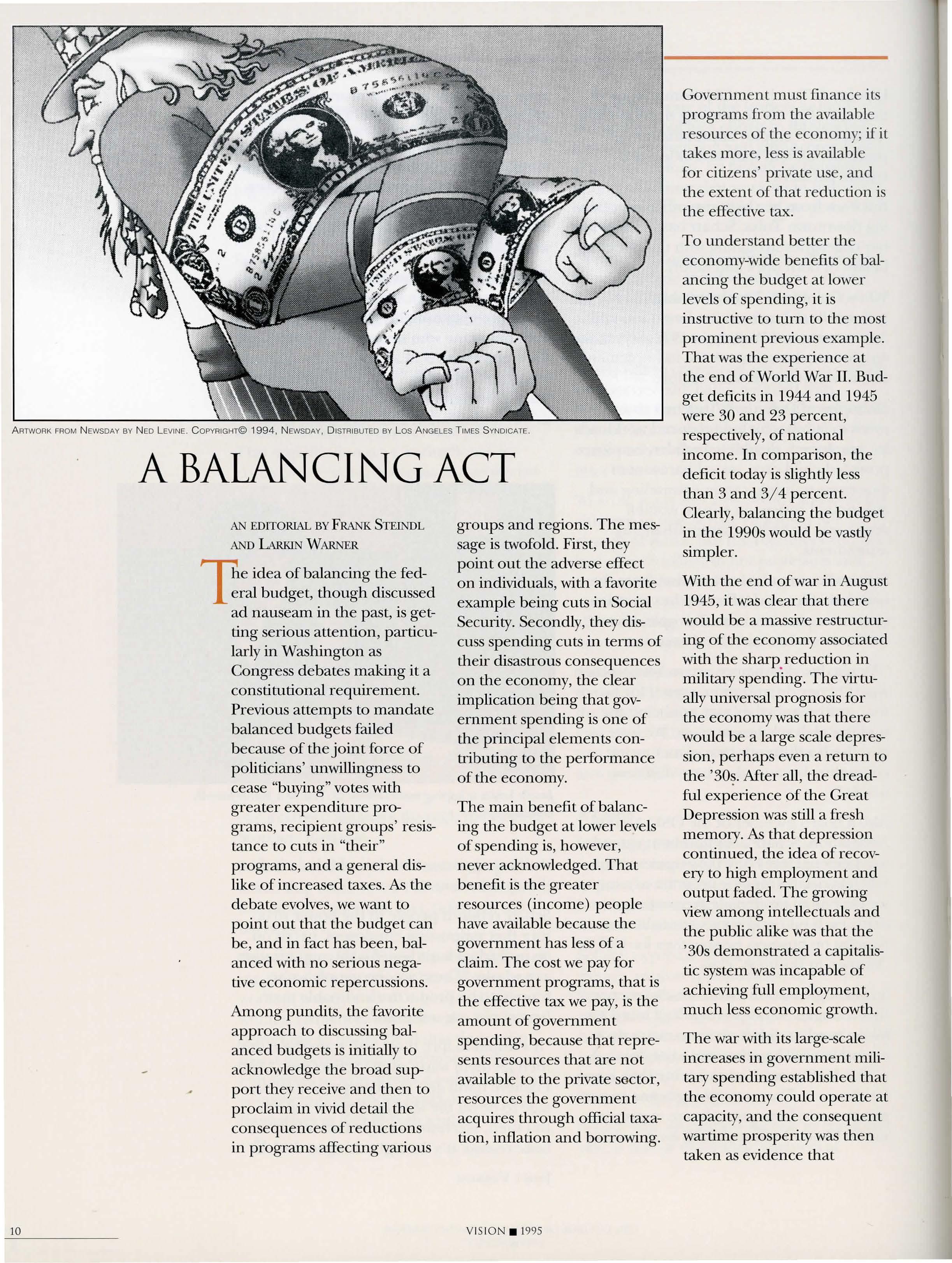
BY Los ANGELES TIMES SYNDICATE.
Keynesian deficit finance policies were necessary for full employment. With the war ending, it seemed certain that the economy would return to the depressed times of the '30s, especially with a large cut in government spencling. The reduction in military spending, coupled with an exodus from the armed forces (eight million in 1946 alone), was a sure harbinger of a sizable postwar depression. How, after all, in the face of a markedly decreased government demand was the economy to absorb the millions coming into the labor force?
In the face of this, it was not surprising to find that the virtually unanimous view of forecasters was that the United States was about to expe1ience a depression perhaps equal to that of the '30s. (In fact, we know of only one forecaster who thought there would not be a depression.)
And this pessimistic view was not limited to the United States. The dominant strain worldwide was that there was a need for goven1ment planning, for government to undertake policies to prevent a return to prewar economic conditions. In Britain, for instance, this took the form of a dramatic shift to socialism as key indusu-ies were nationalized. Though there were su-ong pressures for the United States to follow suit, this did not happen. Instead, the United States relied on the forces of free markets rather than government planning. -
The widely anticipated postwar depression failed to materialize. There was only a mild
short-lived recession four years later (1949). To the forecasters' surprise, the immediate postwar years were ones of prosperity. The unemployment rate, for example, never reached 4 percent. And this occurred as the federal budget moved from a deficit of $42 billion in 1945 to a surplus of $4 billion in the following year.
A major reason for the postwar prosperity was the reduced level of effective taxes, that is, the increased resources available to households and businesses because of the reduction in government spending. Reduced taxes generated varied responses. For one, increased consumer demands led to a much faster retooling of factories than earlier thought possible. Entrepreneurial actions, in the form of Levittowns for instance, increased. Guided by market signals, labor and capital shifted quickly to private production.
The lesson from the post World War II budget balancing exercise then is that the now widely expressed fears of an economic turndown because of budget-mandated reductions in government spending a.re misplaced. Without doubt, there wiJl be distributional effects on various group and short-term regional dislocations as expenditures are reduced, but there will be no significant negative effects on the economy. Indeed, the economy will grow more rapidly as additional resources are available to the private sector for investment in human capital (education), plant and equipment.
A COLLABORATIVE EFFORT
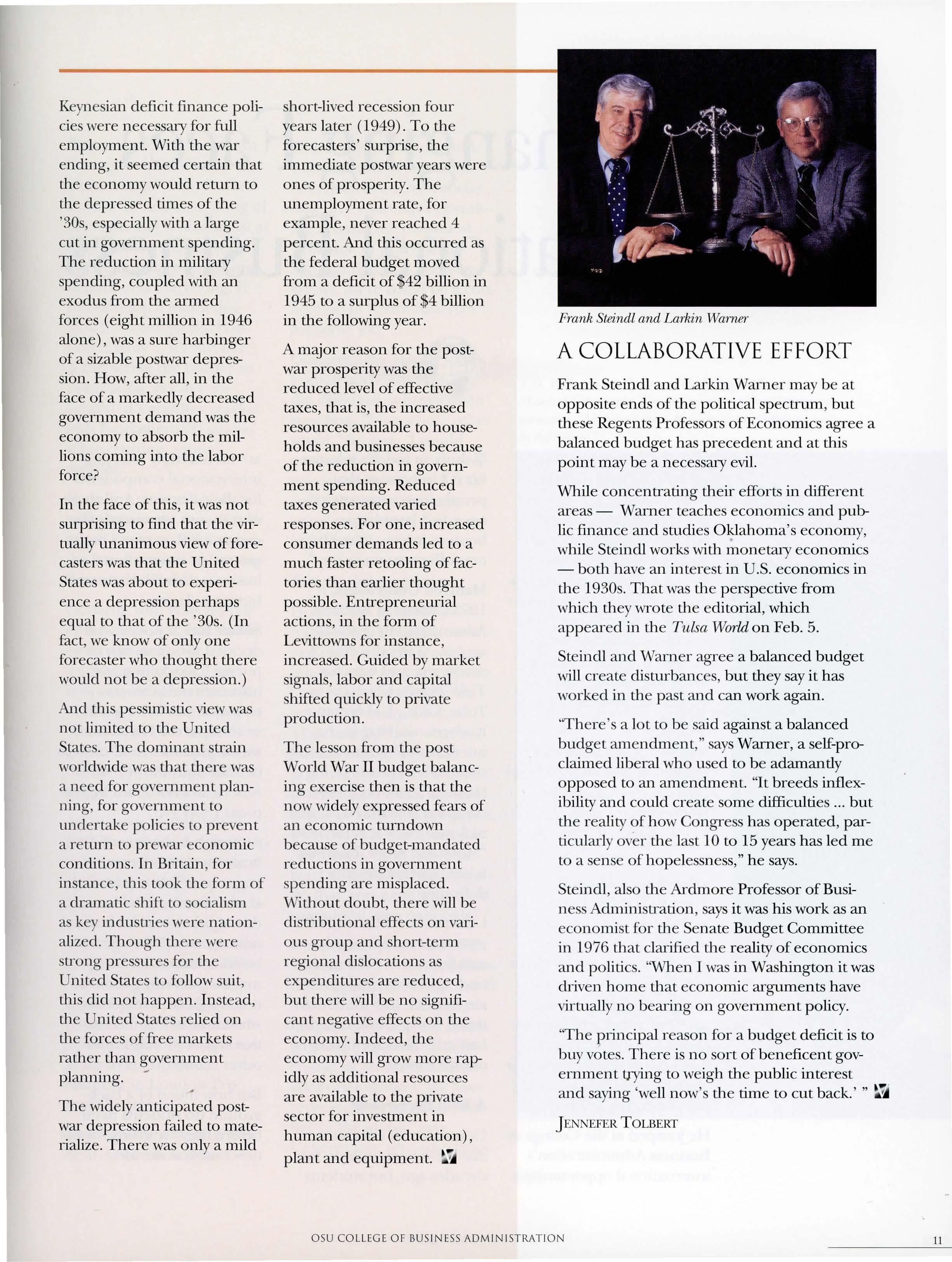
Frank Steindl and Larkin Warner may be at opposite ends of the political spectrum, but these Regents Professors of Economics agree a balanced budget has precedent and at this point may be a necessary evil.
While concentrating their efforts in different areas - Warner teaches economics and public finance and studies Oklahoma's economy, while Steindl works with 1'nonetary economics - both have an interest in U.S. economics in the 1930s. That was the perspective from which they wrote the editorial, which appeared in the Tulsa World on Feb. 5.
Steindl and Warner agree a balanced budget will create disturbances, but they say it has worked in the past and can work again.
''There's a lot to be said against a balanced budget amendment," says Warner, a self-proclaimed liberal who used to be adamantly opposed to an amendment. "It breeds inflexibility and could create some difficulties ... but the reality of how Congress has operated, particularly over the last 10 to 15 years has led me to a sense of hopelessness," he says.
Steindl, also tl1e Ardmore Professor of Business Adminisu-ation, says it was his work as an economist for tl1e Senate Budget Committee in 1976 that claiified tl1e reality of economics ai1d politics. ''When I was in Washington it was driven home tl1at economic arguments have virtually no beai-ing on government policy.
''The p1incipal reason for a budget deficit is to buy votes. There is no sort of beneficent government trying to weigh the public interest ai1d saying 'well now's tl1e time to cut back.' " ~'i
JENNEFER TOLBERT
Frank Steindl and Larkin Wamer
The ChangingFaces of InternationalBusiness
'""There is a new generation l arriving on the business scene. They're just as hungry as their predecessors, but they're prepared to do
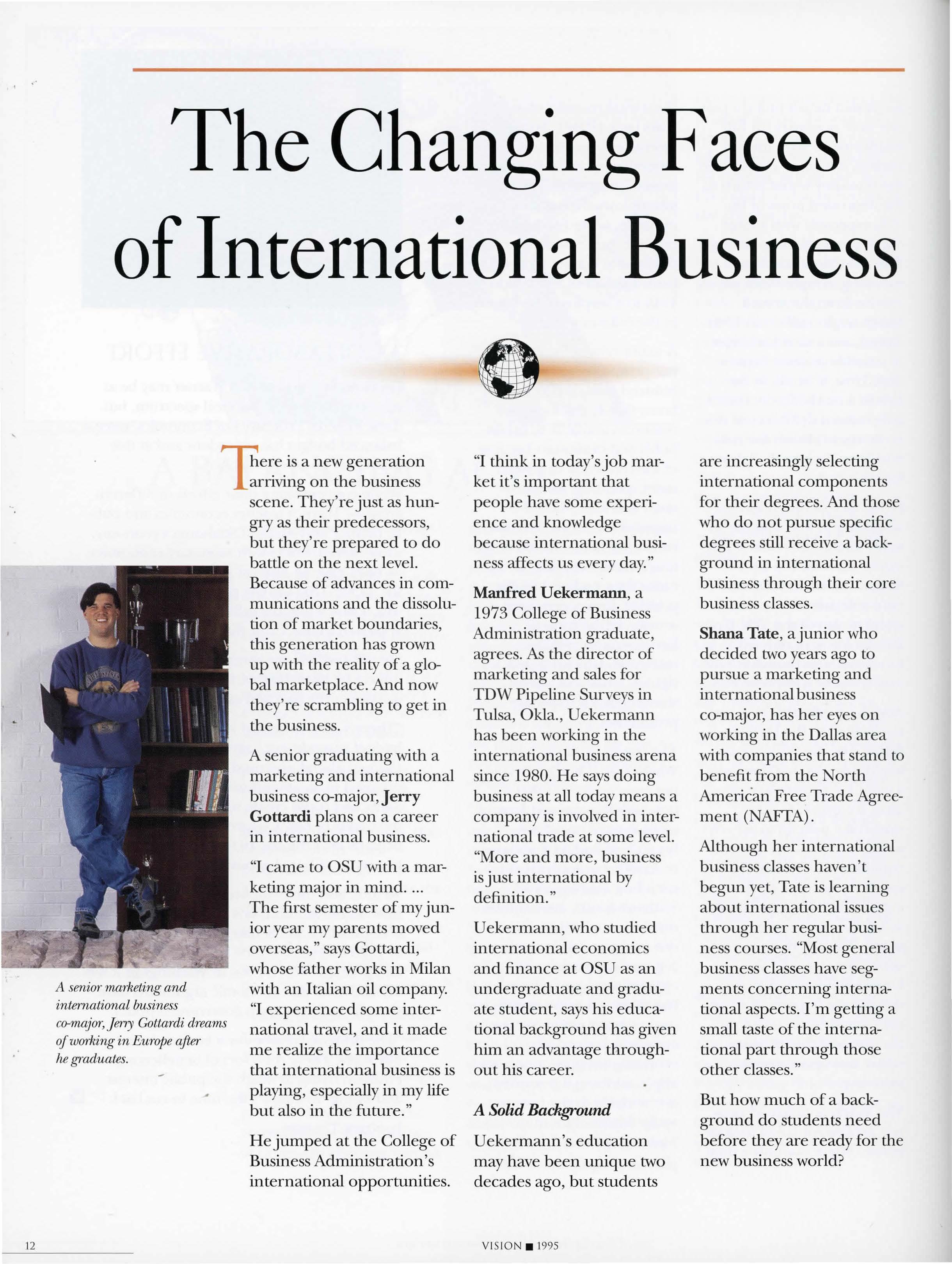
A senior inarlwtingand international business ca-major,Jerry Gottardi dreams of working in Eumpe after he graduates. battle on the next level. Because of advances in communications and the dissolution of market boundaries, this generation has grown up with the reality of a global marketplace. And now they're scrambling to get in the business.
A senior graduating with a marketing and international business co-major, Jerry Gottardi plans on a career in international business.
"I came to OSU with a marketing major in mind The first semester of my junior year my parents moved overseas," says Gottardi, whose father works in Milan with an Italian oil company. "I experienced some international travel, and it made me realize the importance that international business is playing, especially in my life but also in the future." He jumped at the College of Business Administration's international opportunities.
"I think in today's job market it's important that people have some experience and knowledge because international business affects us every day."
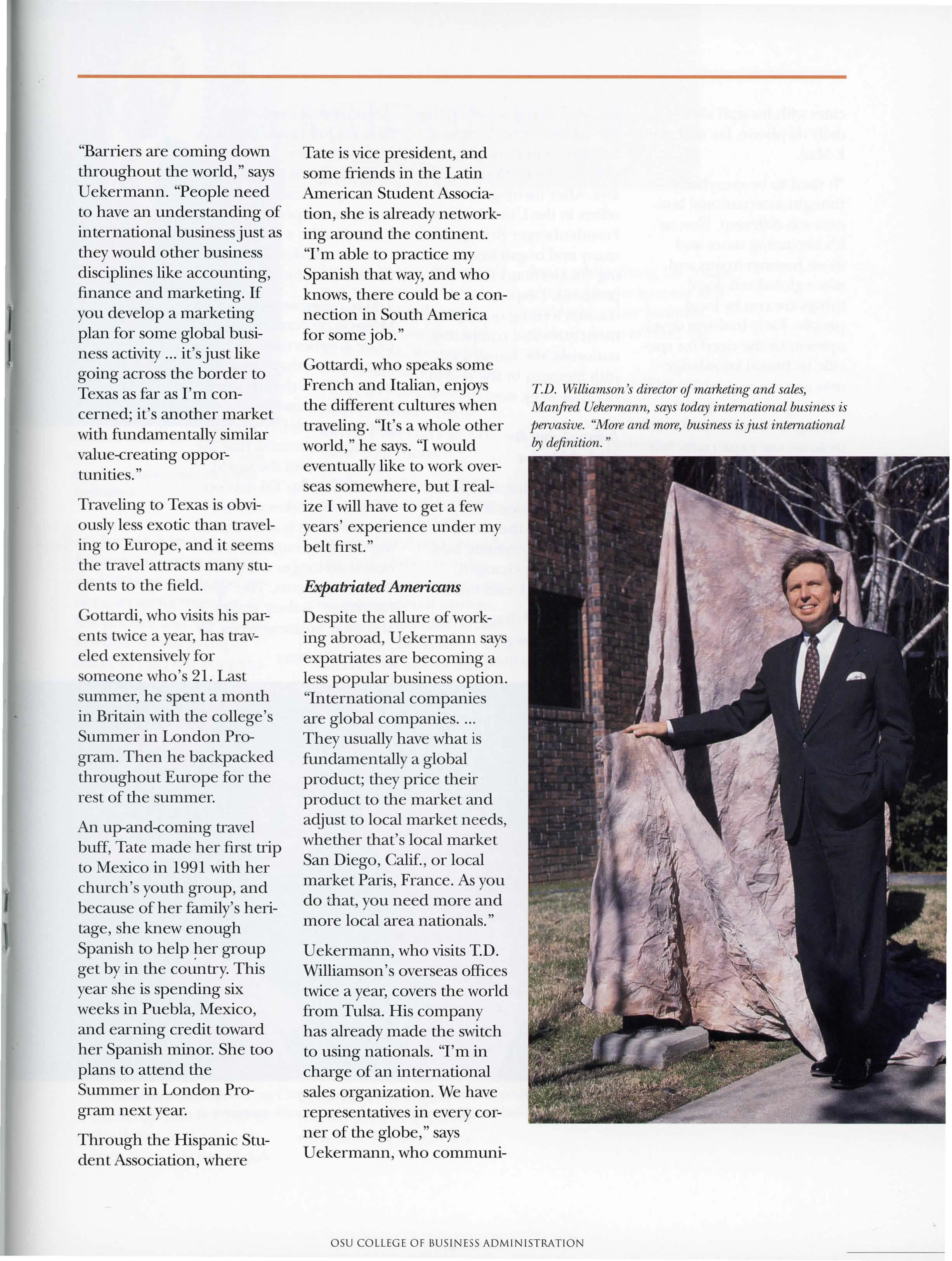
Manfred Uekermann, a 1973 College of Business Administration graduate, agrees. As the director of marketing and sales for TDW Pipeline Surveys in Tulsa, Okla., Uekermann has been working in the international business arena since 1980. He says doing business at all today means a company is involved in international trade at some level. "More and more, business isjust international by definition."
Uekermann, who studied international economics and finance at OSU as an undergraduate and graduate student, says his educational background has given him an advantage throughout his career.
A Solid Background
Uekermann's education may have been unique two decades ago, but students
are increasingly selecting international components for their degrees. And those who do not pursue specific degrees still receive a background in international business through their core business classes.
Shana Tate, a junior who decided two years ago to pursue a marketing and international business co-major, has her eyes on working in the Dallas area with companies that stand to benefit from the North American Free Trade Agreement (NAFTA).
Although her international business classes haven't begun yet, Tate is learning about international issues through her regular business courses. "Most general business classes have segments concerning international aspects. I'm getting a small taste of the international part through those other classes."
But how much of a background do students need before they are ready for the new business world?
"Barriers are corning down throughout the world," says Uekermann. "People need to have an understanding of international business just as they would other business disciplines like accounting, finance and marketing. If you develop a marketing plan for some global business activity it's just like going across the border to Texas as far as I'm concerned; it's another market with fundamentally similar value-creating opportunities."
Traveling to Texas is obviously less exotic than traveling to Europe, and it seems the travel attracts many students to the field.
Gottardi, who visits his parents twice a year, has traveled extensively for someone who's 21. Last summer, he spent a month in Britain with the college's Summer in London Program. Then he backpacked throughout Europe for the rest of the summer.
An up-and-coming travel buff, Tate made her first trip to Mexico in 1991 with her church's youth group, and because of her family's heritage, she knew enough Spanish to help ~er group get by in the country. This year she is spending six weeks in Puebla, Mexico, and earning credit toward her Spanish minor. She too plans to attend the Summer in London Program next year.
Through the Hispanic Student Association, where
Tate is vice president, and some friends in the Latin American Student Association, she is already networking around the continent. ''I'm able to practice my Spanish that way, and who knows, there could be a connection in South America for some job."
Gottardi, who speaks some French and Italian, enjoys the different cultures when traveling. "It's a whole other world," he says. "I would eventually like to work overseas somewhere, but I realize I will have to get a few years' experience under my belt first."
ExpatriatedAmericans
Despite the allure of working abroad, Uekermann says expatriates are becoming a less popular business option. "International companies are global companies .... They usually have what is fundamentally a global product; they price their product to the market and adjust to local market needs, whether that's local market San Diego, Calif., or local market Paris, France. As you do that, you need more and more local area nationals."
Uekermann, who visits T.D. Williamson's overseas offices twice a year, covers the world from Tulsa. His company has already made the switch to using nationals. ''I'm in charge of an international sales organization. We have representatives in every corner of the globe," says Uekermann, who communi-
T.D. Williamson's director of marheting and sa/,es, Manfred Uehermann, says today international business is pervasive. "More and more, business is just international l7ydefinition. "
cates with his staff almost daily via phone, fax and E-Mail.
"It used to be everybody thought international business was different. Now as it's becoming more and more homogeneous and more globalized, local things are run by local people. Early business development or the need for specific technical knowledge may require expatriates, but with respect to long-term management of a local business, we use expatriates less and less."
Those wan ting to work abroad may have to take a new approach. One successful example is Janet Freudenberger, a 1991 Outstanding Female Graduate, who works for AT&T in Frankfurt an1 Main, Germany. At 25, this expatriate has just taken a new position as service manager for AT&T's calling center in Germany after three years with Siemans.
Freudenberger, who earned majors in German and finance and minors in international business and accounting at OSU, discovered she would have to make a drastic move to accomplish her goals. "During my job search in my final semester I noticed that the job offers I received in the U.S. were simply for my finance and/ or accounting skills. Unfortunately, I was oot going to be able to use my Gei;man immediately. While talking to com-
panies, I also discovered that my dreams of working in a foreign country would probably take 10 to 15 years," she says. After turning down her offers in the United States, Freudenberger flew to Germany and began interviewing (in German) for positions. Despite the country's rising unemployment rates and competing nationals, she found a job with Siemens by the end of her four-week stay.
Internalizing the Global Market
While discipline and determination remain strong attributes for the young business professional, business itself has changed, according to Uekermann. "It used to be that you had different strategies, that you had the concept of
international marketing. Now it's just marketing, now it's just finance There really isn't that much ofit on the practical side that needs to be special because it needs to be a part of what you do everyday, a part of the way you think."
Today, college students and business professionals have more avenues open to them than at any other time in history. They already think globally because they've grown up with CNN broadcasting events occurring live halfway around the world. And dialing up Tel Aviv on the internet takes about 10 seconds. So it is not surprising that international business is no longer a mystery to these students. The "global village" is their reality, and their business arena. j~
jEl\'NEFER TOLBERT
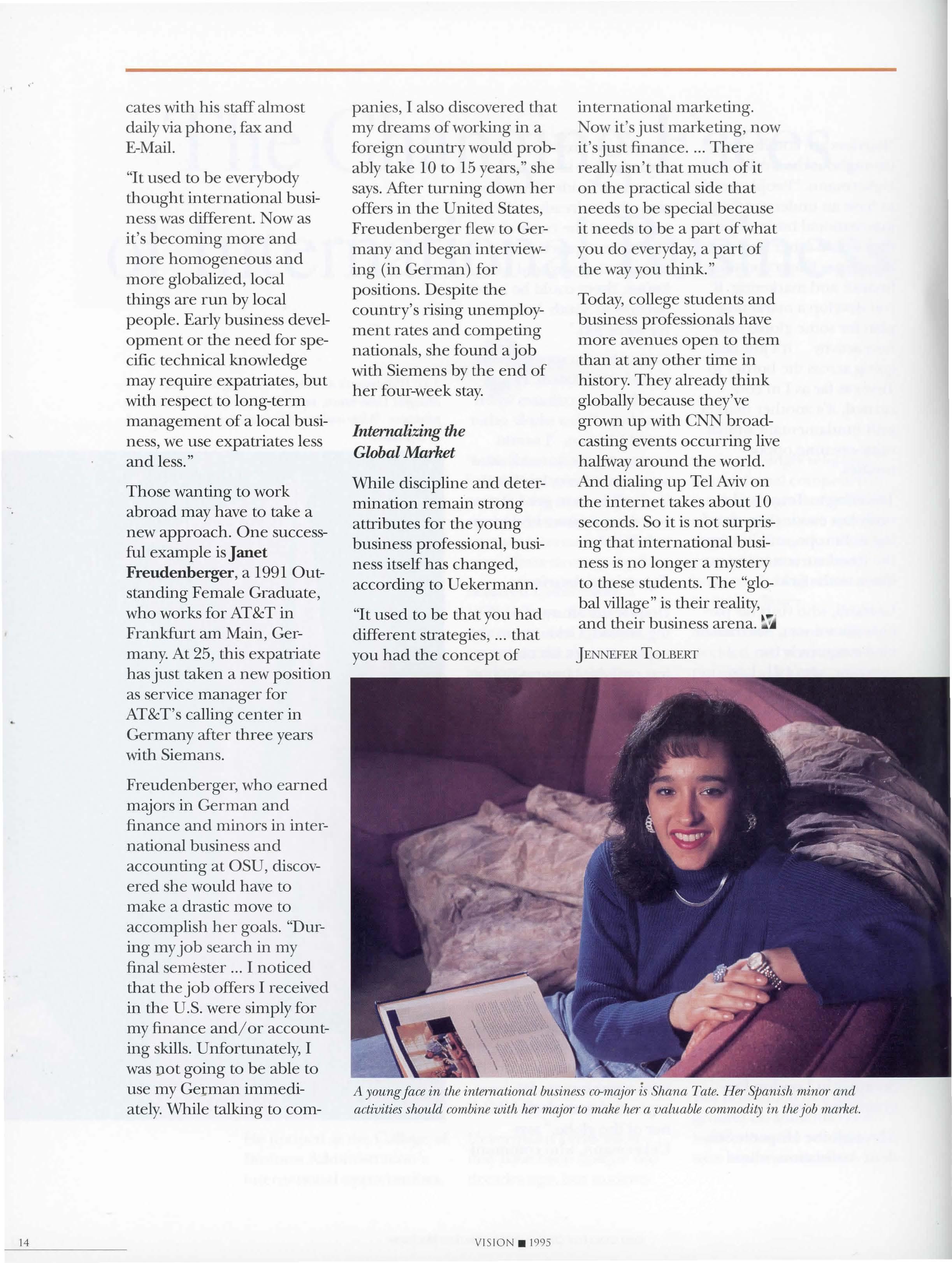
A young face in the international businessco-majoris Shana Tate. Her Sf1anishrninorand activitiesshould combinewith her major to make her a valuab/,ecommodityin thejob market.
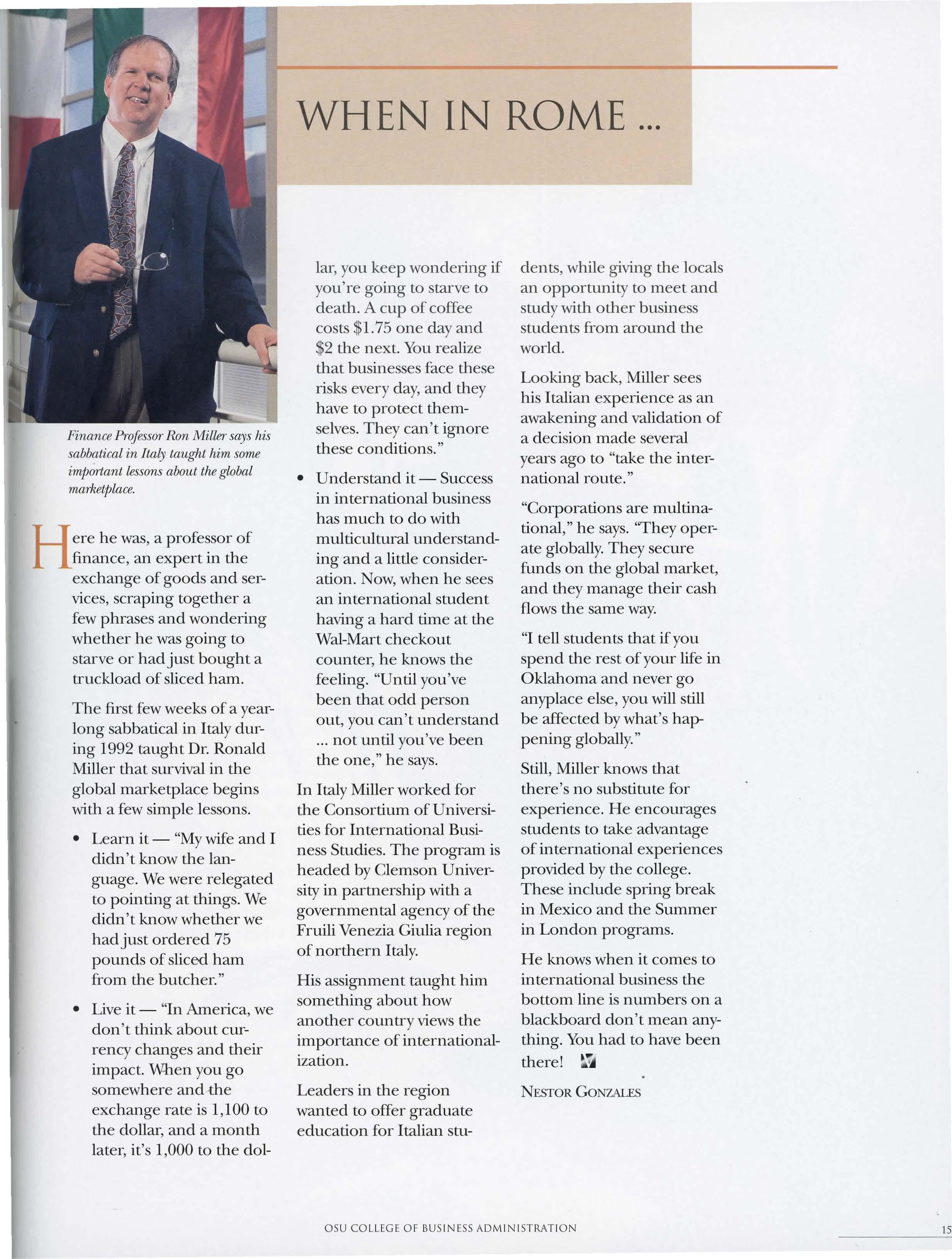
Finance ProfessorRon Miller says his sabbaticalin Italy taught him some important l.essonsabout the global marketplace.
Here he was, a professor of finance, an expert in the exchange of goods and services, scraping together a few phrases and wondering whether he was going to starve or had just bought a truckload of sliced ham.
The first few weeks of a yearlong sabbatical in Italy during 1992 taught Dr. Ronald Miller that survival in the global marketplace begins with a few simple lessons.
• Learn it - "My wife and I didn't know the language. We were relegated to pointing at things. We didn't know whether we had just ordered 75 pounds of sliced ham from the butcher."
• Live it - "In America, we don't think about currency changes and their impact. When you go somewhere and the exchange rate is 1,100 to the dollar, and a month later, it's 1,000 to the dol-
WHEN IN ROME ...
lar, you keep wondering if you're going to starve to death. A cup of coffee costs $1.75 one day and $2 the next. You realize that businesses face these risks every day, and they have to protect themselves. They can't ignore these conditions."
• Understand it- Success in international business has much to do with multicultural understanding and a little consideration. Now, when he sees an international student having a hard time at the Wal-Mart checkout counter, he knows the feeling. "Until you've been that odd person out, you can't understand ... not until you've been the one," he says.
In Italy Miller worked for the Consortium of Universities for International Business Studies. The program is headed by Clemson University in partnership with a governmental agency of the Fruili Venezia Giulia region of northern Italy.
His assignment taught him something about how another country views the importance of internationalization.
Leaders in the region wanted to offer graduate education for Italian stu-
dents, while giving the locals an opportunity to meet and study with other business students from around the world.
Looking back, Miller sees his Italian experience as an awakening and validation of a decision made several years ago to "take the international route."
"Corporations are multinational," he says. 'They operate globally. They secure funds on the global market, and they manage their cash flows the same way.
"I tell students that if you spend the rest of your life in Oklahoma and never go anyplace else, you will still be affected by what's happening globally."
Still, Miller knows that there's no substitute for experience. He encourages students to take advantage of international experiences provided by the college. These include spring break in Mexico and the Summer in London programs.
He knows when it comes to international business the bottom line is numbers on a blackboard don't mean anything. You had to have been there!
NESTOR GoNZALES
AN A ERICAN SCARY TALE
BY STEPHEN HILL
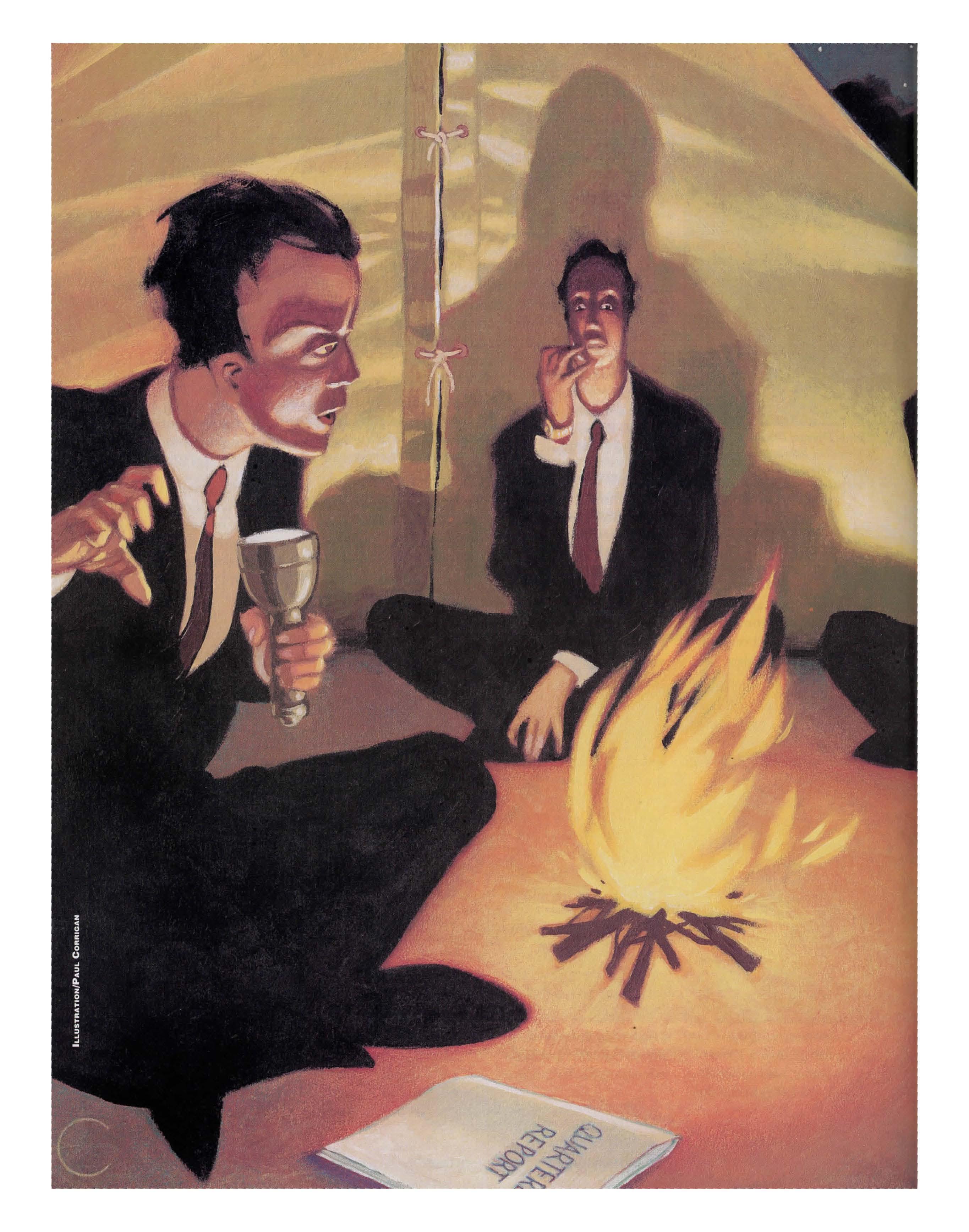
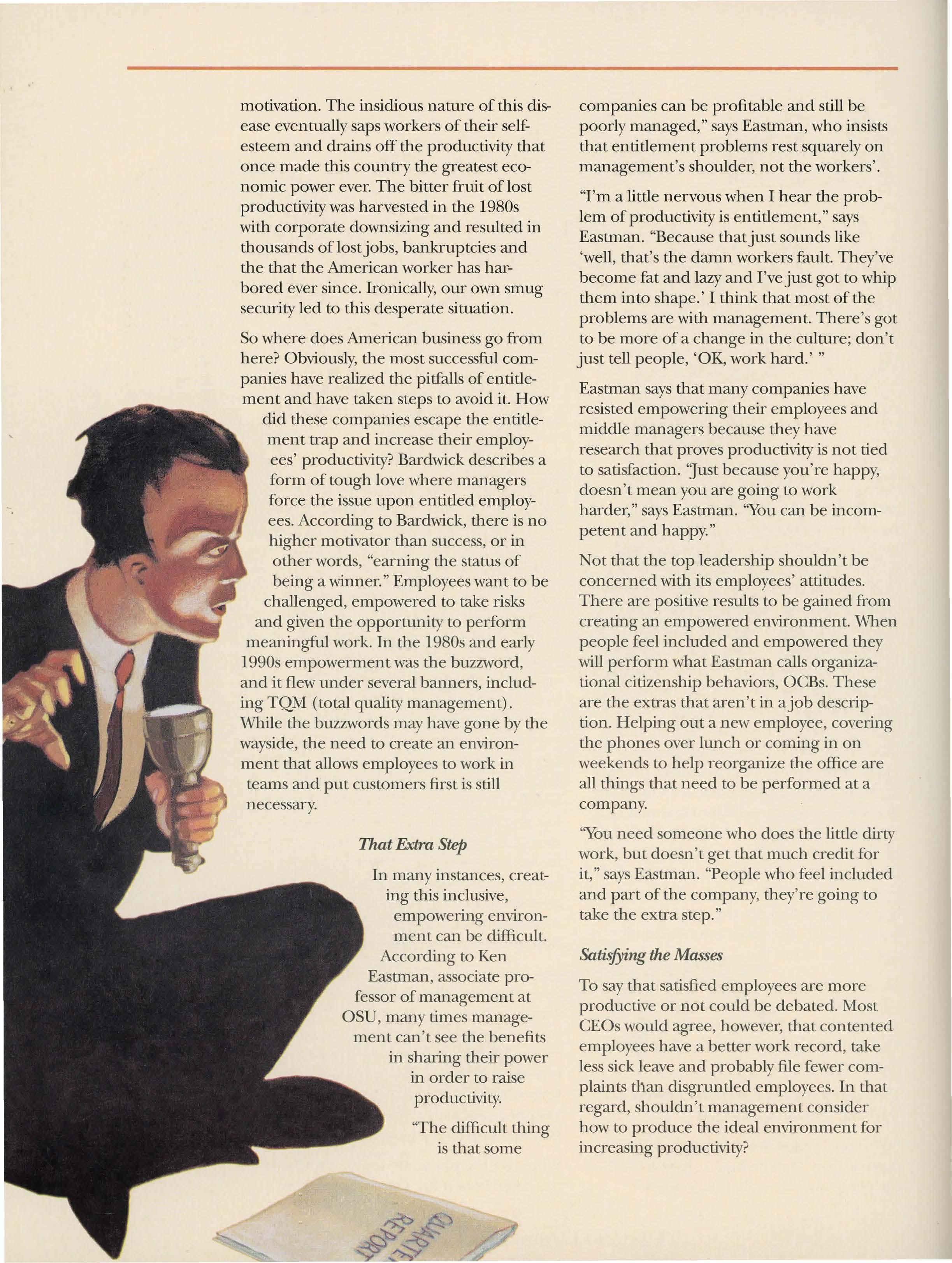
on a time in America, there was a manager who made an insightful discove : no matter what he did, or didn't do, as rewarded yearly with a raise. Some years he received a promotion and a raise. It took years of this steady increase for him to realize his annual reward was unrelated to his productivity, but eventually he reached the point of merely showing up for work. Amazingly, this manager ultimately reached an executive level, and despite his title, he still shouldered no real responsibility and rarely performed his duties. His subordinates looked to this employee as a role model and, likewise, did as little as possible and still received compensation. One afternoon the company president stormed by, already upset about declining profits, when he spotted this employee with his feet up on tl1e desk and his hands behind his head. So enraged, the president had to be restrained and threatened to fire the employee. After cooling down, the president reluctantly agreed not to fire. the sluggard.
Next month, at the end of the fiscal year, the executive did not receive his yearly raise for the first time in 20 years. Furious, he charged into his supervisor's office demanding an explapation.
"The president felt'you didn't deserve one this year," his supervisor said.
'Why not," yelled the employee, showing more activity than he had in 15 years with the company, "after all, I'm entitled."
Entitled. How many times have we heard that word. Or the phrases "I deserve that." 'Tm en titled to this job."
Carporat:eDisease
More and more during the past two decades, corporate America has had to fight the entitlement syndrome. From dock workers to vice presidents, it's pervasive, and it can rob a company of its ability to compete in an era of hungry companies willing to sacrifice in order to survive. Call it industrial evolution or corporate Darwinism, American business failed to evolve into a species that was ready to succeed in the global economic era. As a result, our country's workers lost that margin of security they enjoyed dming tl1e post World War II boom when we were the dominant player in the world market. The efficient European and Japanese economies, and other emerging Asian nations, are forcing an overdue reorganization of the U.S. corporate system.
Has everyone seen the picture? Hardly. According to Judith Bardwick, author of Danger in the Comfort Zone, American business's drop in the global food chain continues because companies fail to recognize their situation. Bardwick contends that somewhere in the 1970s companies "stopped requiring performance as a condition for keeping a job or getting a raise."
Wherever the phenomenon of entitlement has taken hold it has destroyed workers'
More and more duringthe past two decades, corporate America has had to fightthe entitlementsyndrome. ... Call it industrialevolution or corporate Darwinism,American businessfailed to evolve intoa species thatwas ready to succeed in the global econom,c era.
motivation. The insidious nature of this disease eventually saps workers of their selfesteem and drains off the productivity that once made this country the greatest economic power ever. The bitter fruit of lost productivity was harvested in the 1980s with corporate downsizing and resulted in thousands of lost jobs, bankruptcies and the that the American worker has harbored ever since. Ironically, our own smug security led to this desperate situation.
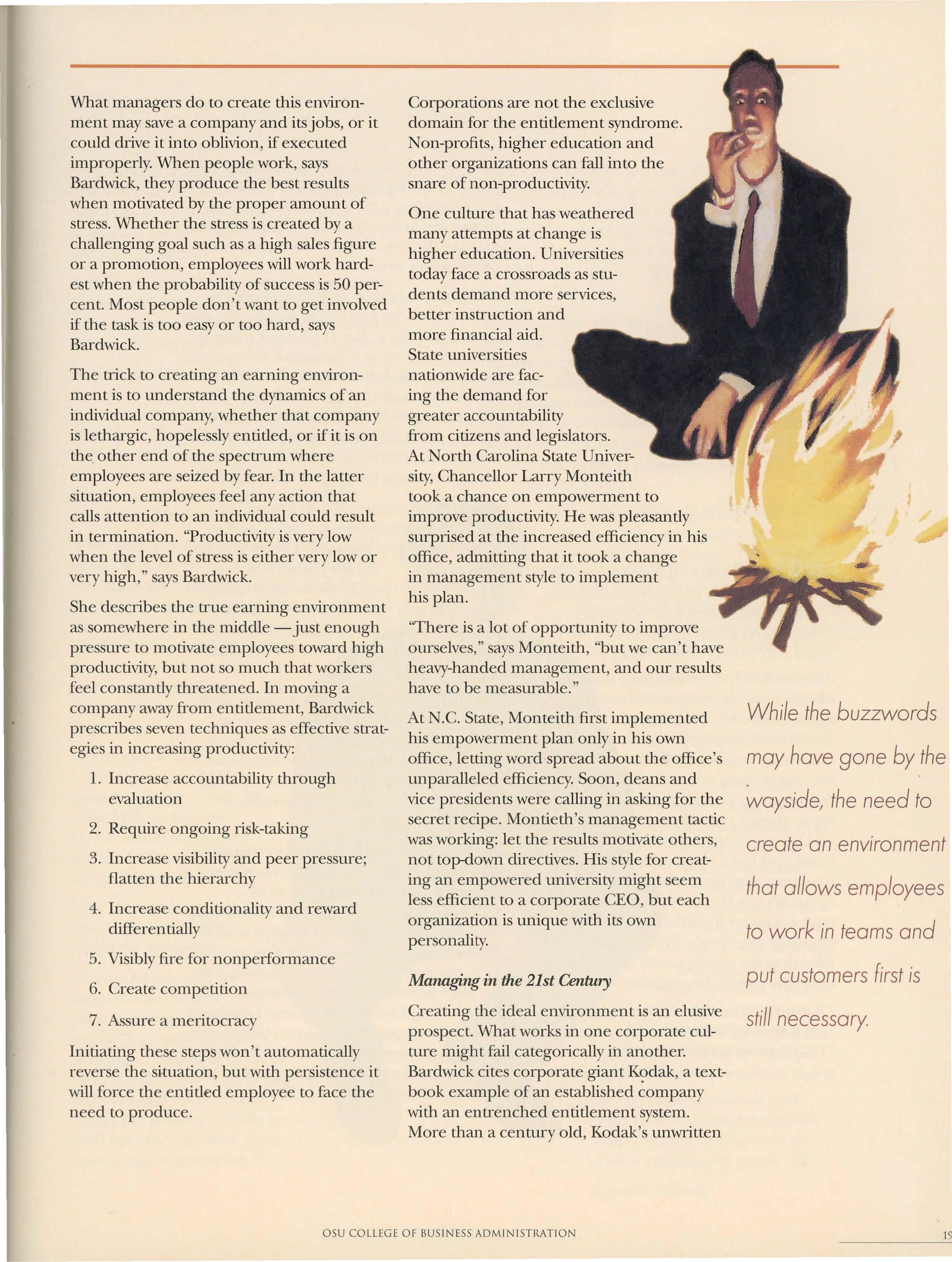
So where does American business go from here? Obviously, the most successful companies have realized the pitfalls of entitlement and have taken steps to avoid it. How did these companies escape the entitlement trap and increase their employees' productivity? Bardwick describes a form of tough love where managers force tl1e issue upon entitled employees. According to Bardwick, there is no higher motivator than success, or in other words, "earning the status of being a winner." Employees want to be challenged, empowered to take risks and given the opportunity to perform meaningful work. In the 1980s and early 1990s empowerment was the buzzword, and it flew under several banners, including TQM ( total quality management). While the buzzwords may have gone by the wayside, the need to create an environment that allows employees to work in teams and put customers first is still necessary.
That Extra Step
In many instances, creating tl1is inclusive, empowering environment can be difficult. According to Ken Eastman, associate professor of management at OSU, many times management can't see the benefits in sharing their power in order to raise productivity.
'The difficult thing is that some
companies can be profitable and still be poorly managed," says Eastman, who insists that entitlement problems rest squarely on management's shoulder, not the workers'.
'Tm a little nervous when I hear the problem of productivity is entitlement," says Eastman. "Because that just sounds like 'well, that's the damn workers fault. They've become fat and lazy and I've just got to whip them into shape.' I think that most of the problems are with management. There's got to be more of a change in the culture; don't just tell people, 'OK, work hard.' "
Eastman says that many companies have resisted empowering their employees and middle managers because they have research that proves productivity is not tied to satisfaction. 'Just because you're happy, doesn't mean you are going to work harde1~" says Eastman. ''You can be incompetent and happy."
Not that the top leadership shouldn't be concerned with its employees' attitudes. There are positive results to be gained from creating an empowered environment. When people feel included and empowered they will perform what Eastman calls organizational citizenship behaviors, OCBs. These are the extras that aren't in a job description. Helping out a new employee, covering the phones over lunch or coming in on weekends to help reorganize the office are all tl1ings that need to be performed at a company.
''You need someone who does the little dirty work, but doesn't get that much credit for it," says Eastman. "People who feel included and part of tl1e company, they're going to take the extra step."
Satisfyingthe Masses
To say that satisfied employees are more productive or not could be debated. Most CEOs would agree, however, that contented employees have a better work record, take less sick leave and probably file fewer complaints tl1an disgruntled employees. In tl1at regard, shouldn't management consider how to produce the ideal environment for increasing productivity?
What managers do to create this environment may save a company and its jobs, or it could drive it into oblivion, if executed improperly. When people work, says Bardwick, they produce the best results when motivated by the proper amount of stress. Whether the stress is created by a challenging goal such as a high sales figure or a promotion, employees will work hardest when the probability of success is 50 percent. Most people don't want to get involved if the task is too easy or too hard, says Bardwick.
The trick to creating an earning environment is to understand the dynamics of an individual company, whether that company is lethargic, hopelessly entitled, or if it is on the_other end of the spectrum where employees are seized by fear. In the latter situation, employees feel any action that calls attention to an individual could result in termination. "Productivity is very low when the level of stress is either very low or very high," says Bardwick.
She describes tl1e true earning environment as somewhere in the middle - just enough pressure to motivate employees toward high productivity, but not so much that workers feel constantly tl1reatened. In moving a company away from entitlement, Bardwick prescribes seven techniques as effective strategies in increasing productivity:
1. Increase accountability through evaluation
2. Require ongoing risk-taking
3. Increase visibility and peer pressure; flatten the hierarchy
4. Increase conditionality and reward differentially
5. Visibly fire for nonperformance
6. Create competition
7. Assure a meritocracy
Initiating these steps won't automatically reverse the situation, but with persistence it will force the entitled employee to face the need to produce.
Corporations are not the exclusive domain for the entitlement syndrome. Non-profits, higher education and other organizations can fall into the snare of non-productivity.
One culture that has weathered many attempts at change is higher education. Universities today face a crossroads as students demand more services, better instruction and more financial aid. State universities nationwide are facing the demand for greater accountability from citizens and legislators.
At North Carolina State University, Chancellor Larry Monteith took a chance on empowerment to improve productivity. He was pleasantly surprised at the increased efficiency in his office, admitting that it took a change in management style to implement his plan.
'There is a lot of opportunity to improve ourselves," says Monteith, ''but we can't have heavy-handed management, and our results have to be measurable."
At N.C. State, Monteith first implemented his empowerment plan only in his own office, letting word spread about the office's unparalleled efficiency. Soon, deans and vice presidents were calling in asking for the secret recipe. Montieth's management tactic was working: let the results motivate others, not top-down directives. His style for creating an empowered university might seem less efficient to a corporate CEO, but each organization is unique with its own personality.
Managingin the 21st Century
Creating the ideal environment is an elusive prospect. What works in one corporate culture might fail categmically in another. Bardwick cites corporate giant K?dak, a textbook example of an established company with an entrenched entitlement system. More than a century old, Kodak's unwritten
While the buzzwords may have gone by the wayside, the need to create an environment thatallows employees to work in teams and put customersFirstis stillnecessary.
'A lot of companies tryto get by on the cheap withempowerment,"soys Eastman."... theywon't spend money to trainpeople to do thisgreaterjob."
policy implied that employees had a home for life. Beginning in the 1980s Kodak's CEO, Colby Chandler, announced a restructuring plan that eventually eliminated 25,000 jobs over seven years.
After each lay-off, productivity soared at Kodak, but eventually profits dropped again. Each time, the corporate culture at Kodak was creeping back into the offices. One of the reasons Kodak kept falling back into entitlement was half-hearted measures. By not seeing new methods through, by failing to give all employees proper training, and by executives not living by the same creed they force upon others, any type of empowerment plan will fail. Experts categorically cite the last reason as one of the most necessary ingredients in a plan to empower employees. The top leader has to adhere to the principals he or she imposes upon the rest of the company.
'Top management has to send the signal, 'this is what we want to do,' "says Eastman. 'They have to act inclusively. What you find is that some companies love empowerment
and team building, but it's for those lower guys. It's like a glass ceiling for all this empowerment stuff because they still see themselves as the social elite. They still want to make their decisions in secret and keep other people out."
Of course, managers in the new business world have to be more than people who give orders.Just like in the TQM model, managers have to serve as a consultant or coach to teams of employees who make more of the decisions. These changes can be hard for both management and workers; managers may be reluctant to give up their power and workers may not be ready to make new decisions. It requires training on both ends.
"A lot of companies try to get by on the cheap with empowerment," says Eastman. "They tell their employees, 'OK, now you're empowered' But they won't spend money to train people to do this greater job. Also, tl1eywon't reinforce them for the risk taking they are now doing and they're not going to pay them any more for the greater work load."
Not surprisingly workers often fail in these "no-win" situations, giving management, which was tenuous about the change anyway, an excuse to maintain the status quo. Even if done unintentionally, such management techniques destroy relationships within a company.
No CEO or president is going to change an entrenched culture overnight. Each step is a small one toward the larger goal of increased productivity. These tenets should apply no matter what organization is seeking to break out of the entitlement grip. Lethargy, apathy and non-productivity have no place in today's society. Dwindling resources and a competitive world economy won't allow America to coast on past accomplishments anymore. It's the era of winning through earning, not just going out for what you're entitled to receiving.
THE CASUALPROFESSOR
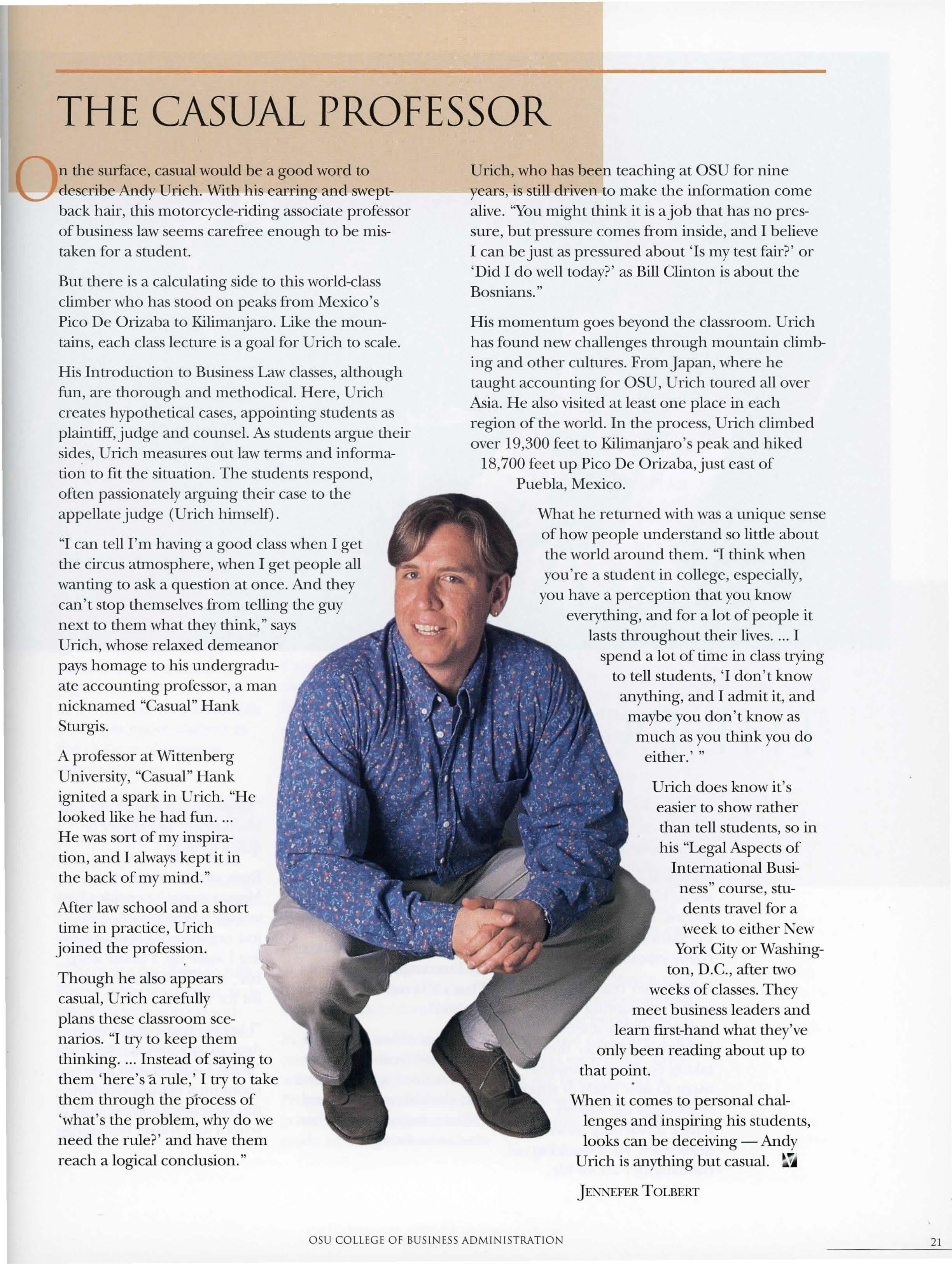
n the surface, casual would be a good word to describe Andy Urich. With his earring and sweptback hair, this motorcycle-riding associate professor of business law seems carefree enough to be mistaken for a student.
But there is a calculating side to this world-class climber who has stood on peaks from Mexico's Pico De Orizaba to Kilimanjaro. Like the mountains, each class lecture is a goal for Urich to scale.
His Introduction to Business Law classes, although fun, are thorough and methodical. Here, Urich creates hypothetical cases, appointing students as plaintiff,judge and counsel. As students argue their sides, Urich measures out law terms and information to fit the situation. The students respond, often passionately arguing their case to the appellate judge (Urich himself).
"I can tell I'm having a good class when I get the circus atmosphere, when I get people all wanting to ask a question at once. And they can't stop themselves from telling the guy next to them what they think," says Urich, whose relaxed demeanor pays homage to his undergraduate accounting professor, a man nicknamed "Casual" Hank Sturgis.
A professor at Wittenberg University, "Casual" Hank ignited a spark in Urich. "He looked like he had fun .... He was sort of my inspiration, and I always kept it in the back of my mind."
After law school and a short time in practice, Urich joined the profession.
Though he also appears casual, Urich carefully plans these classroom scenarios. "I try to keep them thinking Instead of saying to them 'here's a rule,' I try to take them through the process of 'what's the problem, why do we need the rule?' and have them reach a logical conclusion."
Urich, who has been teaching at OSU for nine years, is still driven to make the information come alive. ''You might think it is a job that has no pressure, but pressure comes from inside, and I believe I can be just as pressured about 'Is my test fair?' or 'Did I do well today?' as Bill Clinton is about the Bosnians."
His momentum goes beyond the classroom. Urich has found new challenges through mountain climbing and other cultures. From Japan, where he taught accounting for OSU, Urich toured all over Asia. He also visited at least one place in each region of the world. In the process, Urich climbed over 19,300 feet to Kilimanjaro's peak and hiked 18,700 feet up Pico De Orizaba,just east of Puebla, Mexico.
What he returned with was a unique sense of how people understand so little about the world around them. "I think when you're a student in college, especially, you have a perception that you know everything, and for a lot of people it lasts throughout their lives I spend a lot of time in class trying to tell students, 'I don't know anything, and I admit it, and maybe you don't know as much as you think you do either.'"
Urich does know it's easier to show rather than tell students, so in his "Legal Aspects of International Business" course, students travel for a week to either New York City or Washington, D.C., after two weeks of classes. They meet business leaders and learn first-hand what they've only been reading about up to that point.
When it comes to personal challenges and inspiring his students, looks can be deceiving - Andy Urich is anything but casual.
JENNEFER TOLBERT
Ladies and Gentlemen,
THEDORRS
hen is a door not a door?" asks accounting Professor Patrick Dorr.
''When it's a ajar," he chuckles, as his daughter Megan groans, rolling her eyes at her father's penchant for corny jokes.
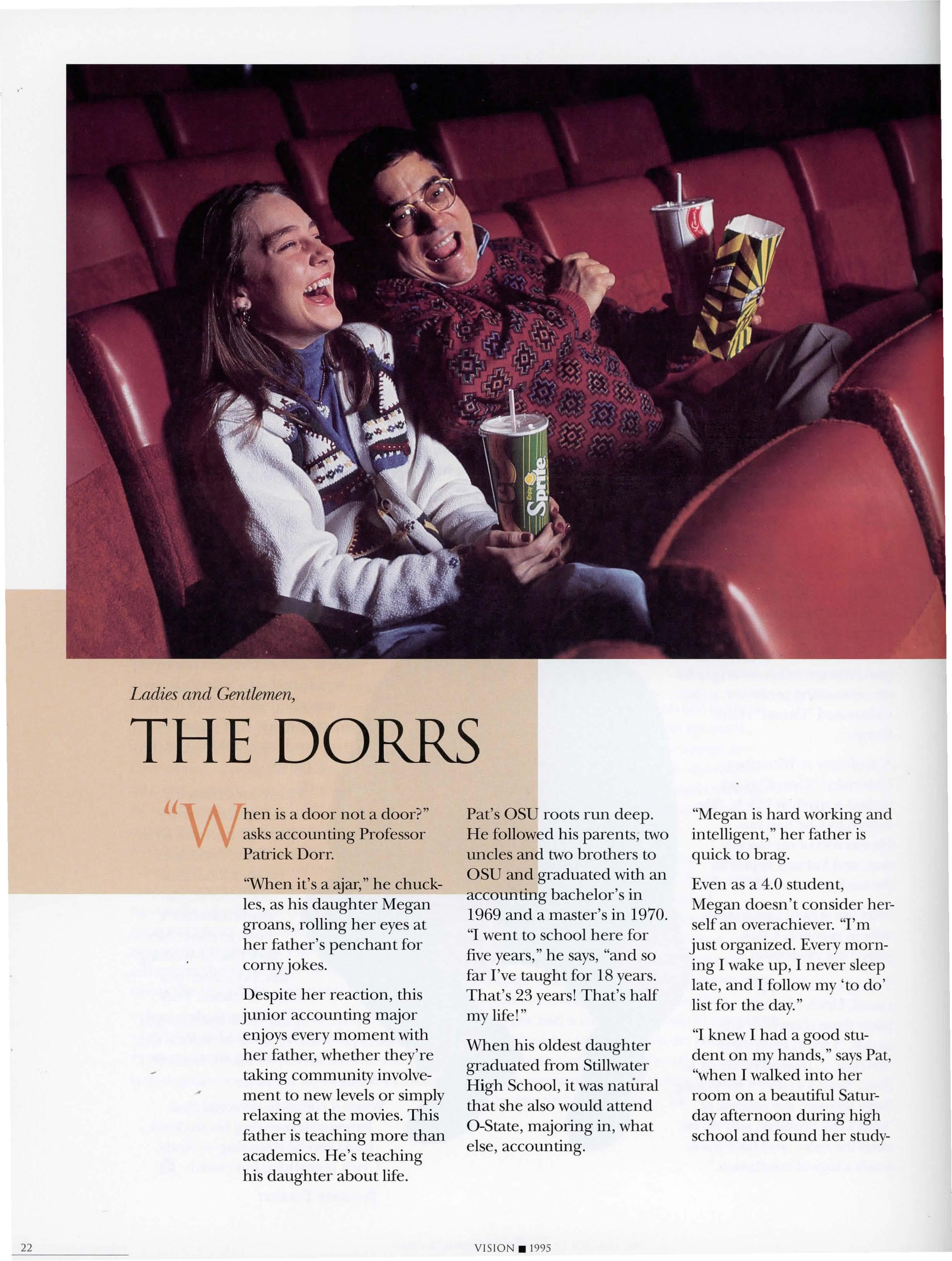
Despite her reaction, this junior accounting major enjoys every moment with her father, whether they're taking community involvement to new levels or simply relaxing at the movies. This father is teaching more than academics. He's teaching his daughter about life.
Pat's OSU roots run deep. He followed his parents, two uncles and two brothers to OSU and graduated with an accounting bachelor's in 1969 and a master's in 1970.
"I went to school here for five years," he says, "and so far I've taught for 18 years. That's 23 years! That's half my life!"
When his oldest daughter graduated from Stillwater High School, it was natural that she also would attend O-State, majoring in, what else, accounting.
"Megan is hard working and intelligent," her father is quick to brag.
Even as a 4.0 student, Megan doesn't consider herself an overachiever. ''I'm just organized. Every morning I wake up, I never sleep late, and I follow my 'to do' list for the day."
"I knew I had a good student on my hands," says Pat, "when I walked into her room on a beautiful Saturday afternoon during high school and found her study-
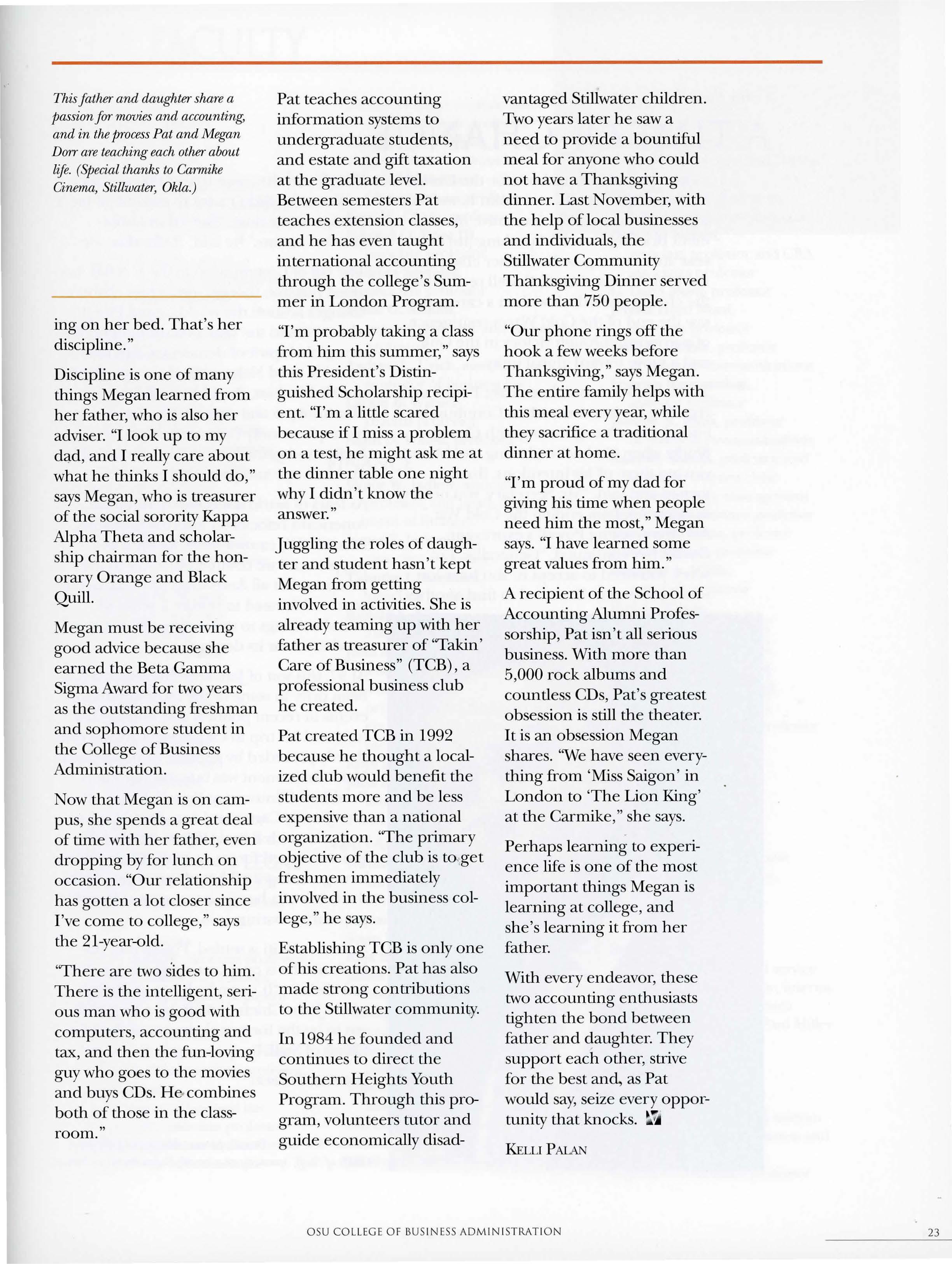
This father and daughter share a passi,onfor movies and accounting, and in the processPat and Megan Dorr are teaching each otherabout life. (Specialthanks to Carmike Cinema, Stillwater, Okla.)
ing on her bed. That's her discipline."
Discipline is one of many things Megan learned from her father, who is also her adviser. "I look up to my d 4 d, and I really care about what he thinks I should do," says Megan, who is treasurer of the social sorority Kappa Alpha Theta and scholarship chairman for the honorary Orange and Black Quill.
Megan must be receiving good advice because she earned the Beta Gamma Sigma Award for two years as the outstanding freshman and sophomore student in the College of Business Administration.
Now that Megan is on campus, she spends a great deal of time with her father, even dropping by for lunch on occasion. "Our relationship has gotten a lot closer since I've come to college," says the 21-year-old.
'There are two sides to him. There is the intelligent, se1ious man who is good with computers, accounting and tax, and then the fun-loving guy who goes to the movies and buys CDs. He-combines both of those in the classroom."
Pat teaches accounting information systems to undergraduate students, and estate and gift taxation at the graduate level. Between semesters Pat teaches extension classes, and he has even taught international accounting through the college's Summer in London Program.
'Tm probably taking a class from him this summer," says this President's Distinguished Scholarship recipient. 'Tm a little scared because if I miss a problem on a test, he might ask me at the dinner table one night why I didn't know the answer."
Juggling the roles of daughter and student hasn't kept Megan from getting involved in activities. She is already teaming up with her father as treasurer of 'Takin' Care of Business" (TCB), a professional business club he created.
Pat created TCB in 1992 because he thought a localized club would benefit the students more and be less expensive than a national organization. 'The primary objective of the club is to,;get freshmen immediately involved in the business college," he says.
Establishing TCB is only one of his creations. Pat has also made strong contributions to the Stillwater community. In 1984 he founded and continues to direct the Southern Heights Youth Program. Through this program, volunteers tutor and guide economically disad-
vantaged Stillwater children. Two years later he saw a need to provide a bountiful meal for anyone who could not have a Thanksgiving dinner. Last November, with the help of local businesses and individuals, the Stillwater Community Thanksgiving Dinner served more than 750 people.
"Our phone rings off the hook a few weeks before Thanksgiving," says Megan. The entire family helps with this meal every year, while they sacrifice a traditional dinner at home.
'Tm proud ofmy dad for giving his time when people need him the most," Megan says. "I have learned some great values from him."
A recipient of the School of Accounting Alumni Professorship, Pat isn't all serious business. With more than 5,000 rock albums and countless CDs, Pat's greatest obsession is still the theater. It is an obsession Megan shares. "We have seen everything from 'Miss Saigon' in London to 'The Lion King' at the Carmike," she says.
Perhaps learning to experience life is one of the most important things Megan is learning at college, and she's learning it from her father.
With every endeavor, these two accounting enthusiasts tighten the bond between father and ~aughter. They support each other, strive for the best and, as Pat would say, seize every opportunity that knocks. ''t
KELLI PAI.AN
Colin Powell
A TIME OF CHANGE
twas a time of change both for the United States and personally, said Colin Powell during the Oklahoma City Executive Management Briefing Nov. 17. Speakingjust over a year after retiring as the former chairman of the Joint Chiefs of Staff, Powell recounted the changes he's dealt with in a career that saw the end of the Cold War, a resurgence of patriotism through victory in the Gulf and a move toward global unity.
The transition hasn't been easy, Powell said, recalling his insecurity when Communism ended. He was negotiating with George Shultz when Gorbachev, having trouble convincing them of his intentions, finally turned and said, "Mr. Secretary, you need to understand, I am ending the Cold War." And then, seeing Powell's expression, Gorbachev continued, "Generallie, I'm sorry, you need to accept it. You have lost your best enemy. You need to find another."
Powell told the more than 3,000-member audience he didn't want to tackle that big a change at the time. "But I don't want another enemy," he said. "I like this one."
The fall of Communism in the U.S.S.R. heralded positive, though sometimes chaotic, changes around the world, noted Powell, who reviewed the year's events in light of a new global spirit of democracy and toleration. He cited Nelson Mandela, apartheid, the Middle East, the IRA and Britain, Mozambique and Angola. "In our own hemisphere only Cuba remains outcast. Ladies and gentlemen this is a remarkable time of hope and promise."
As fears of world annihilation diminish, Americans refocus on internal problems, he said. 'We cannot move forward as people until we commit ourselves to the prospect that all Americans must move forward We need to restore a sense of moral bearings to this nation. This nation is nowhere near its destiny."
At 57, this son of Jamaican immigrants has been privy to some of the most important events in recent political and military history, and his trip to Oklahoma City was only shortly preceded by another of significance: Haiti. Retirement was ~nterrupted when President Clinton sent Powell, former President Jimmy Carter and Sen. Sam Nunn to negotiate with Raoul Cedras, chief of the Haitian armed forces, last fall. Their success in negotiating the United States away from the brink of a hostile invasion sent Powell's popularity soaring.
Now that Haiti is settled, Powell told the audience he is once again adjusting to life as a civilian. "It's wonderful to be chairman of the Joint Chiefs of Staff; it's a little different to be the former chairman of the Joint Chiefs of Staff."
JENNEFE-R TOLBERT
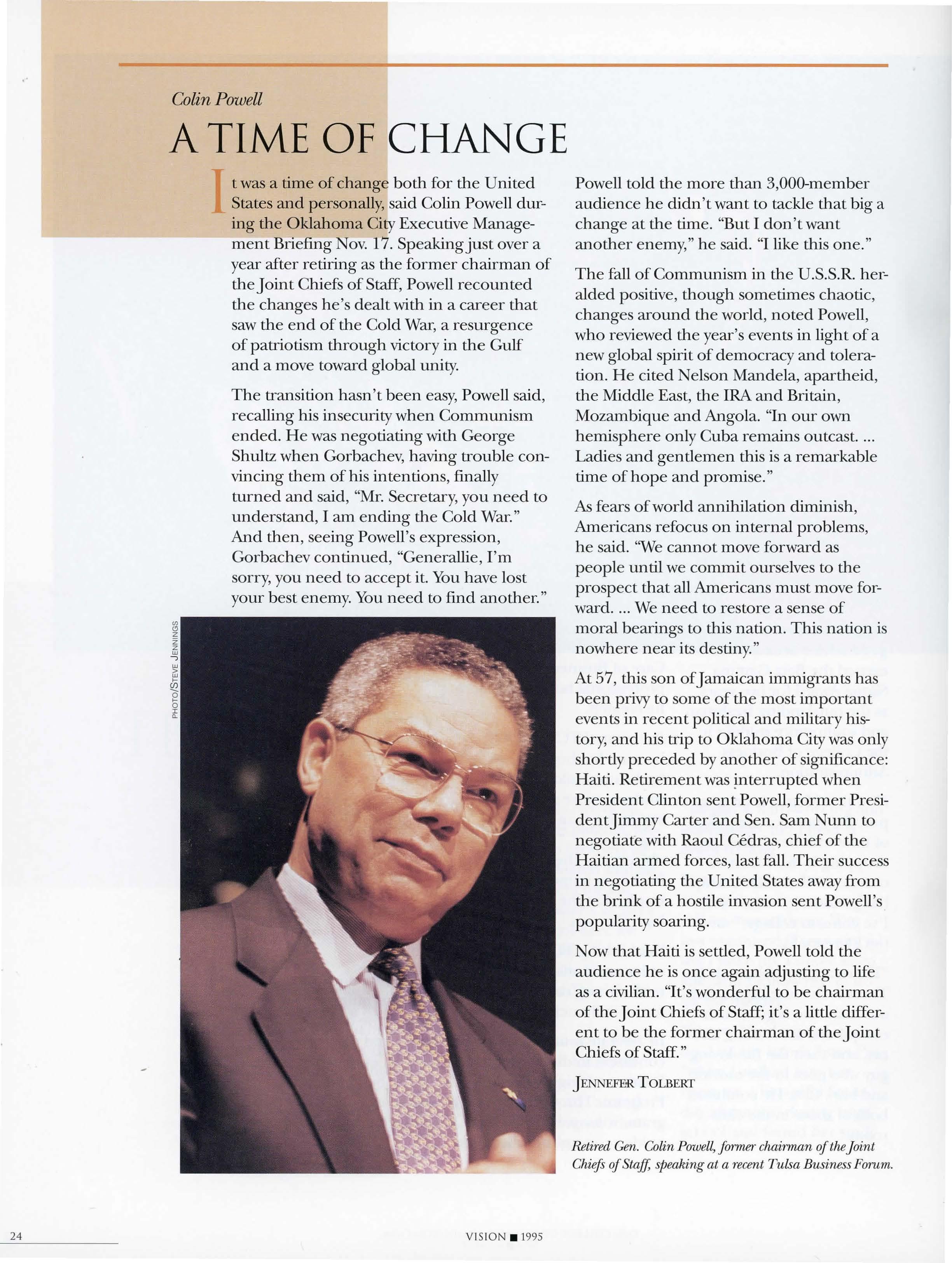
Retired Gen. ColinPowel~former chairman of theJoint Chiefsof Staff, speaking at a recentTulsa BusinessForurn.
THE FACULTY
THE DEAN
Gregory C. Mosier, interim dean
ACCOUNTING
Lanny G. Chasteen, Arthur Andersen alumni centennial professor and head, school of accounting
Patrick B. Dorr, school of accounting alumni professor
Lawrence H. Hammer, professor
Don Hansen, professor
Carol Johnson, assistant professor
Janet I.Kimbrell, associate professor
M. E. "Bud" Lacy, associate professor and coordinator of graduate programs
Amy Hing-Ling Lau, KeIT-McGeeprofessor of accounting
Gary K. Meek, Deloitte & Touche/Oscar S. Gellein professor
Maryanne M. Mowen, associate professor
David S. Murphy, associate professor
Kevin E. Murphy, associate professor
Dennis H. Patz, Wilton T. Anderson professor
Charles R. Ransom, associate professor
T. Sterling Wetzel, associate professor
John H. Wilguess, professor
Charlotte J. Wright, professor
ECONOMICSAND LEGAL STUDIESIN BUSINESS
Joseph M. Jadlow Jr., professor and head, department of economics
Lee C. Adkins,.associate professor
Orley M. Amos Jr., professor
Michael]. Applegate, professor
Kevin M. Currier, associate professor
Michael R. Edgmand, professor
James R. Fain, associate professor
Joe W. Fowler, , professor of business law
Mary Gade, associate professor
James M. Jackman, associate professor of business law
Gerald M. Lage, regents distinguished service professor
Tipton F. McCubbins, associate professor of business law
Ronald L. Moomaw, CBA associates professor
Kent W. Olson, professor
Edward 0. Price ID, associate professor
Andreas Savvides, associate professor
Frank G. Steindl, regents professor and Ardmore professor
Andrew L. Urich, associate professor of business law
Larkin B. Warner, regents professor
Keith D. Willett, professor
FINANCE
Janice W. Jadlow, associate professor and head, department of finance
James F.JacksonJr., associate professor
Timothy L. Krehbiel, associate professor
Ronald L. Miller, associate professor
John A Polonchek, associate professor
W. Gary Simpson, professor and Oklahoma Bankers Association chair of commercial bank management
Rory L. Terry, assistant professor
John R. Wmgender, associate professor and Ardmore professor MANAGEMENT
Wayne A Meinhart, professor and head, department of management
Richard A. Aukerman, professor
Steve H. Barr, associate professor
Raja Basu, assistant professor
James D. Bogert, assistant professor
Nikunj P. Dalal, assistant professor
Kenneth K. Eastman, associate professor
Vance H. Fried, associate professor
David C. Ho, professor
Timothy C. Ireland, professor
Marilyn G. Kletke, professor
Chalmer E. LabigJr., associate professor
Hon-Shiang Lau, regents professor and Carson professor
Dennis L. Mott, professor of business communications
Debra L. Nelson, associate professor and CBA associates professor
G. Daryl Nord, professor
Jeretta Hom Nord, associate professor
Zane K. Quible, professor of business communications
Jayaram Ramanathan, assistant professor
Jeanine N. Rhea, professor of business communications
Ramesh Sharda, professor and Conoco/Dupont chair of technology management
faye 1. smith, assistant professor
Thomas H. Stone, professor
J. Scott Turner, professor
Margaret A. White, associate professor
Rick L. Wilson, assistant professor
MARKETING
L. Lee Manzer, professor and head, department of marketing
Terry Bristol, assistant professor
Goutam Chakraborty, assistant professor
Gary L. Frankwick,. assistant professor
Richard Germain, assistant professor
James G. Hromas, associate professor and director, university extension
Ruth Haas Kreiger, associate professor
Stephen]. Miller, regents distinguished service professor and director, international business programs
John C. Mowen ID, W. Paul Miller professor
Ajay S. Sukhdial, assistant professor
Joshua L. Wiener, Carson professor and interim director, office of business and economic research
William G. Zikmund, professor
SONYA BECK IS CELEBRATING A NEW TRADITION AT OSU
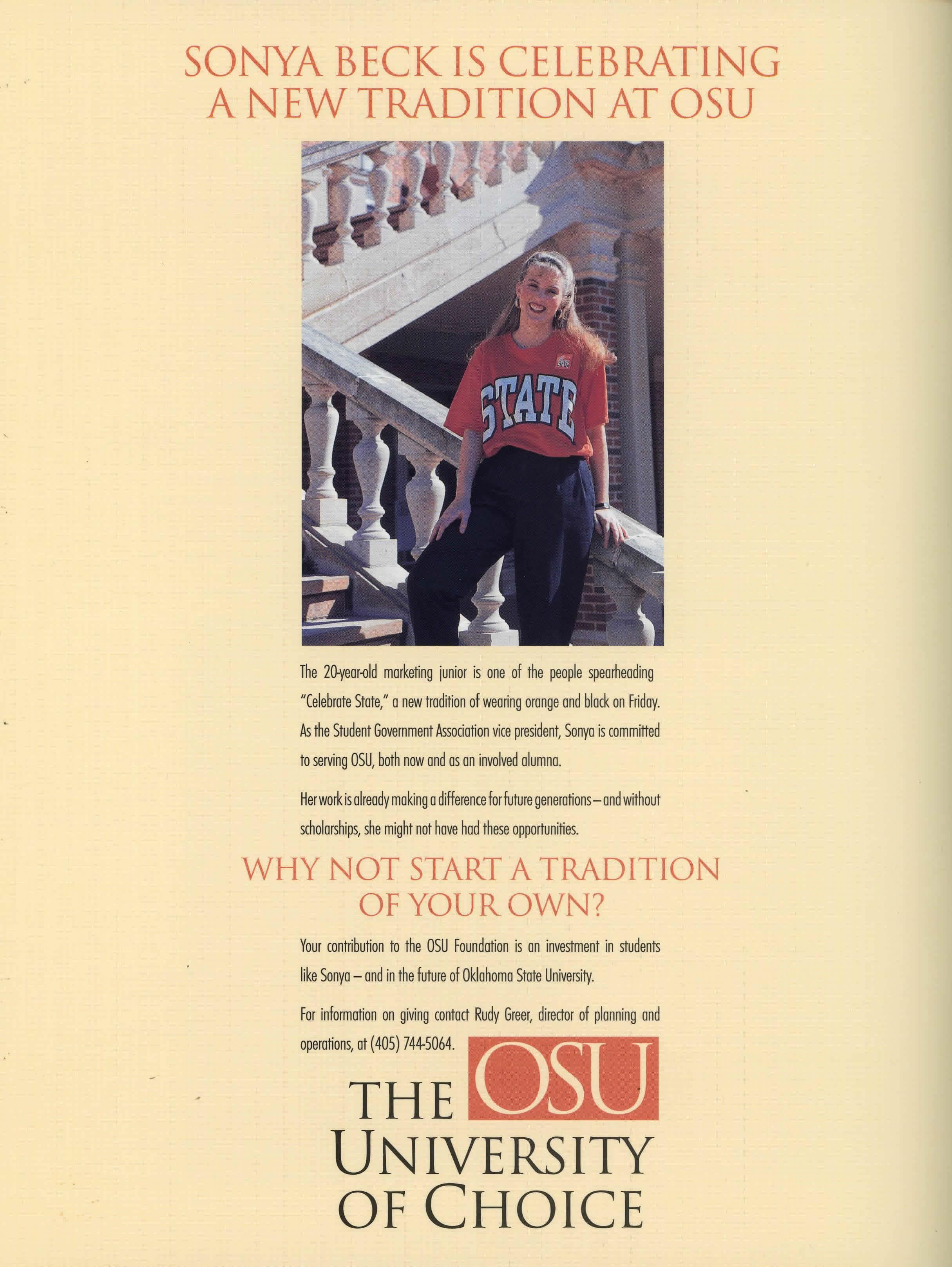
The20-year-oldmarketingjunioris oneof thepeoplespearheading "CelebrateState," a newtraditionofwearingorangeandblackonFriday. AstheStudentGovernmentAssociationvicepresident,Sonyaiscommitted toservingOSU,bothnowandasaninvolvedalumna.
Herworkisalreadymakingadifferenceforfuturegenerations-andwithout scholarships,shemightnothavehadtheseopportunities.
WHY NOT STARTA TRADITION OF YOUR OWN?
Yourcontribution to theOSUFoundation is aninvestment in students likeSonya - andinthefutureofOklahomaStateUniversity.
ForinformationongivingcontactRudyGreer,director of planningand operations,at(405)744-5064.