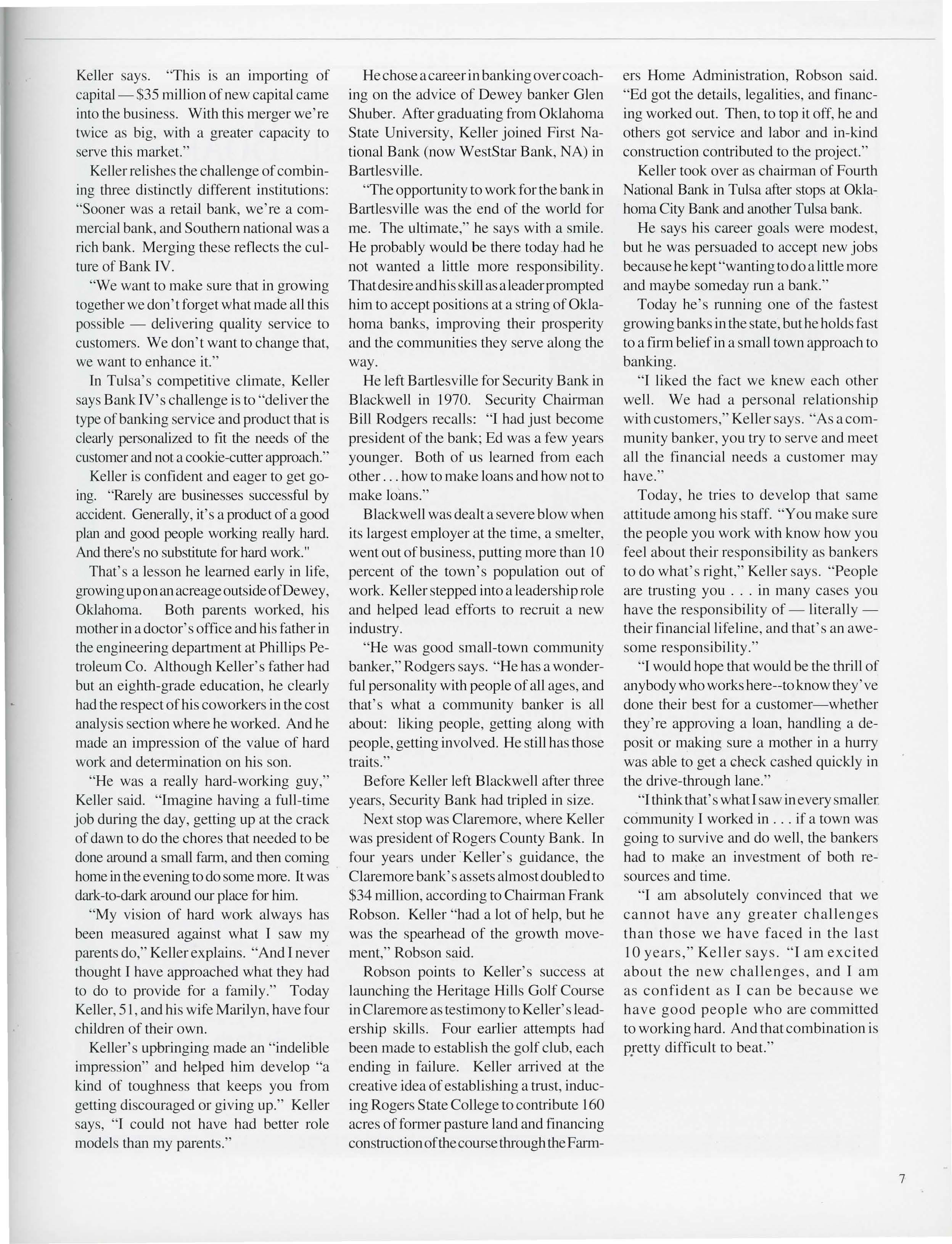
Ten years ago, the College of Business Administration brought together several alumni with a group of CBA faculty to discuss the future of the College. At this "CBA Futures Seminar" we joined forces in addressing critical factors impacting the managerial world - both present and future.
The outcomes of the seminar were amazingly prophetic. We identified the "most impo1tantproblems"facing leaders, among which were a changing world order, the technological revolution, and the promotion of an entrepreneurial spirit throughout the economy.
We took direction from these discussions in shaping an academic environment which would prepare managers and leaders for the tasks before them. This has served us well for almost a decade. We're now at a new crossroads. We've entered into a decade which has proven much more revolutionary than anyone dreamed.
The new vision of the College for the nineties and into the twenty-first century is that of educating men and women for leadership roles in a "global" environment, one in which visionary leaders look outward intheir thinking with new recognition of the diversity of interests, desires, opportunities, and problems to be encountered.
Management guru Tom Peters, author of A Passion for Excellence, sensed an urgency in preparing for a new world situation when he discussed globalization in a 1990 article.
"Globalization. Everybody talks about it. But what does it mean? ... It means that any remnants of isolationism must go. The rubble of the Berlin Wall is merely the most dramatic evidence of the movement to destroy borders that has begun in developed and developing nations."
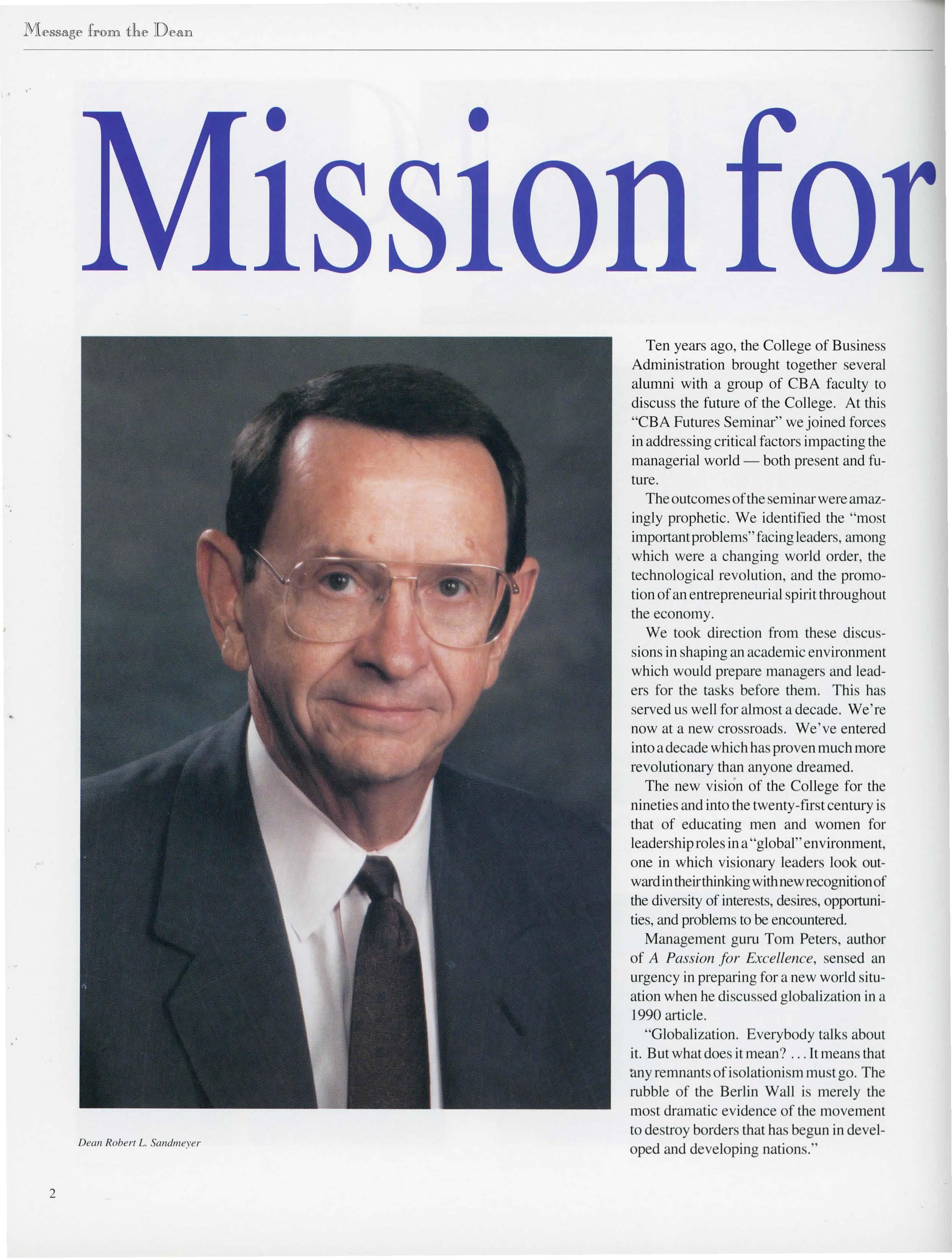
Deem Robert L. Sandmeyer
The events of the past two years in the former Soviet Union and in Eastern Europe have supported Peters' 1990 call. The economjc markets of the world are rapidly changing, crumbling, or garnering new strength. The U.S. will stand as one among many players rather than the leading contender.
What Peters called the "yen bloc, the more or less Japanese-led Asian powerhouse nations," will continue to gain a foothold. Innovation, total quality management, and a better educated work force will be critical in maintaining a competitive position in the world market.
The growth in information technology alone has revolutionized the way businesses operate. Hierarchical structures have been bulldozed down to very few levels. There is no longer a need for relay stations from the line site to the executive suite.
Managers of our nation's work force must prepare for the inevitable changes that come with this new technology. When former Labor Secretary Ann McLaughlin addressed the Tulsa Business Forum last year, she predicted that the impact of technology on the work force and its managers would be profound.
'The life cycles of products, technologies, and industries are becoming shotter. What follows fro1~ that is so will the life cycles of workers' skills," said McLaughlin. "More and more,jobs are being defined in terms of roles rather than tasks. These new jobs emphasize negotiation, cooperation, initiative, thinking, and cognitive reasoningasopposedtocompliancewithanauthoritarian framework. We might be witnessing the end of an old hierarchy in structures."
Business schools in the U.S. face a for-
leaders in the wake of these events. Not managers, but leaders. Leaders in technology. Leaders in innovation. Leaders in total quality management.
We must educate leaders who can anticipate the next series of changes and opportunities in business, not simply react as well-trained coordinators of a contained unit. Only recently has there been a recognition in higher education that it is no longer enough to provide students with exceptional entry level skills - this is the base case.
Itis our responsibility as business educators to create an environment where students can experience and exercise leadership and gain an understanding of a more proactive role in business.
We have taken a stance in favor of a more interdisciplinary approach to education. The international business program has been designed as an option of study with other major disciplines, rather than a program in and of itself. We intend to graduate well-educated professionals in all disciplines who have a depth ofunderstanding about international dynamics.
The Office of International Business Programs, which began operations last spring, has already been successful in recruiting visiting international students and scholars. The interaction of these people within our programs is critical in facilitating an understanding of business in cultures outside of the U.S.
The Center for Management of Technology and Innovation and the Center for Product and Service Quality combine the efforts of several disciplines to address the issues of advancing technology and total quality management.
An Advanced Instructional Technolmidable challenge in turning out strong ogy Environment is cunently under de-
Ivelopment which will bring the College into position as a state-of-the-art learning facility.
Video transmission of graduate business courses has been extended to several corporations. This corporate MBA program serves an outreach effort to continue the education of business professionals and sharpen the talents of those who have long since left an academic environment.
Through these programs and others like them, the tangibles of leadership are being addressed. We are addressing the intangibles as well, the learning-by-doing qualities acquired only through experience.
We offer a number of participatory courses where students work with "real time" situations, pe1forming research and proposing innovations in actual company settings. Mentor programs have been established where students interact oneon-one with alu.mni, gaining valuable practical insight from those who have "been there."
It's our time to move. With a new mission of educating men and women for leadership roles in a complex global environment, we are committed to strengthening the power of business education at Oklahoma State University. The success of this mission will see the College of Business Administration entering the year 2000 as a regional and national force in education, as a source of visionary leaders for the new century.
Robett L. Sandmeyer
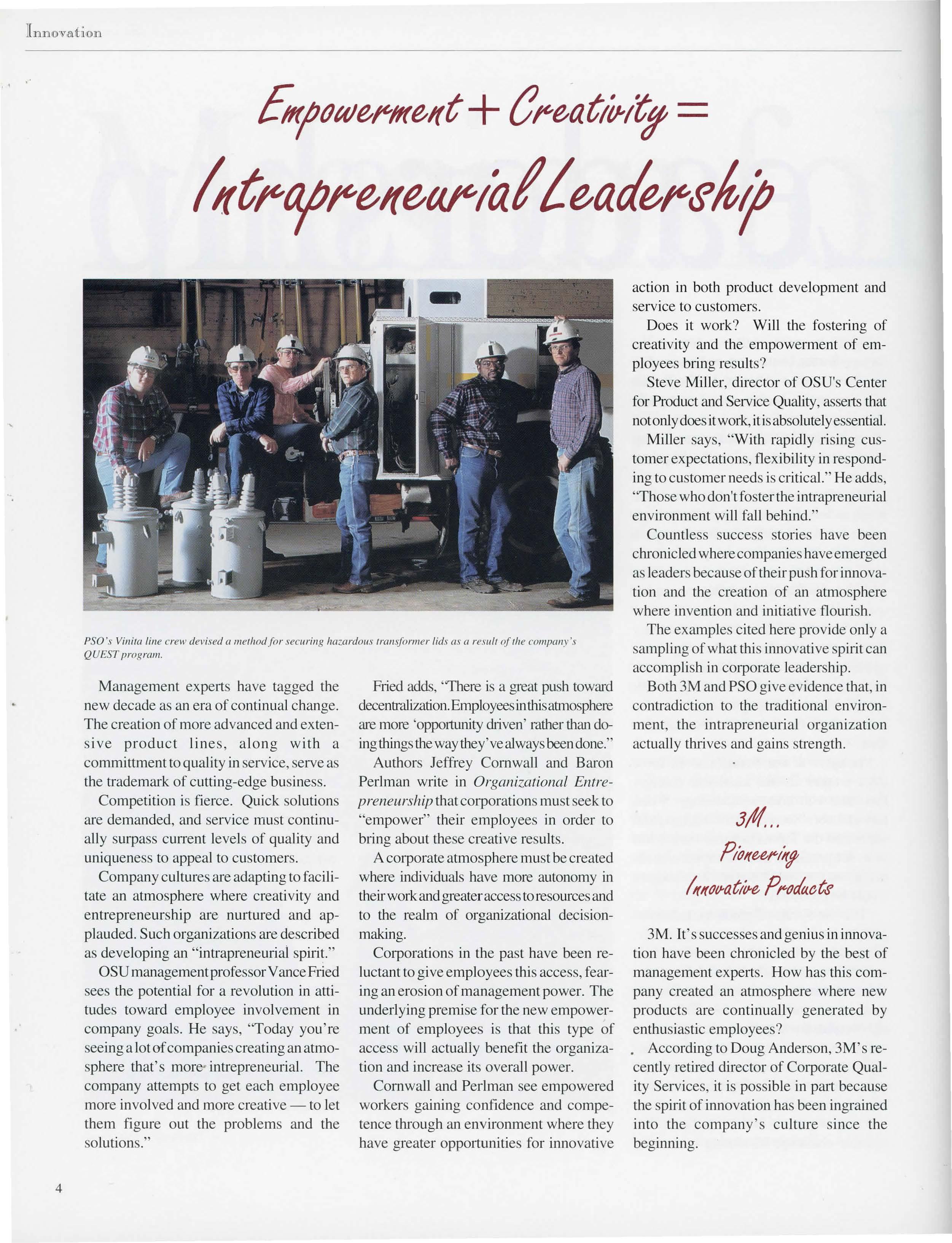
PSO ·s Vinita line cre\V devised a method for securing lur::,ardoustrmz:r.,formerlids as a res11/tof the company ·s QUEST program.
Management experts have tagged the new decade as an era of continual change. The creation of more advanced and extensive product lines, along with a committmenttoquality in service, serve as the trademark of cutting-edge business.
Competition is fierce. Quick solutions are demanded, and service must continually surpass current levels of quality and uniqueness to appeal to customers.
Company cultures are adapting to facilitate an atmosphere where creativity and entrepreneurship are nurtured and applauded. Such organizations are described as developing an "intrapreneurial spirit."
OSU management professor VanceFtied sees the potential for a revolution in attitudes toward employee involvement in company goals. He says, "Today you're seeing a lot of companies creating an atmosphere that's more, intrepreneurial. The company attempts to get each employee more involved and more creative - to let them figure out the problems and the solutions."
Fried adds, "There is a great push toward decentralization.Employees inthisatmosphere are more 'oppottunity chiven' rather than doing things the way they've always been done."
Authors Jeffrey Cornwall and Baron Perlman write in Organizational Entrepreneurship that corporations must seek to "empower" their employees in order to bring about these creative results.
A corporate atmosphere must be created where individuals have more autonomy in their work and greater access to resources and to the realm of organizational decisionmaking.
Corporations in the past have been reluctant to give employees this access, fearing an erosion of management power. The underlying premise for the new empowerment of employees is that this type of access will actually benefit the organization and increase its overall power.
Cornwall and Perlman see empowered workers gaining confidence and competence through an environment where they have greater opportunities for innovative
action in both product development and service to customers.
Does it work? Will the fostering of creativity and the empowerment of employees bting results?
Steve Miller, director of OSU's Center for Product and Service Quality, asse1ts that notonJy does it work, it is absolutely essential.
Miller says, "With rapidly rising customer expectations, flexibility in responding to customer needs is critical." He adds, "Those who don'tfosterthe intrapreneurial environment will fall behind."
Countless success stories have been chronicled where companies have emerged as leaders because of their push for innovation and the creation of an atmosphere where invention and initiative flourish.
The examples cited here provide only a sampling of what this innovative spirit can accomplish in corporate leadership.
Both 3M and PSO give evidence that, in contradiction to the traditional environment, the intrapreneurial organization actually thrives and gains strength.
3;tf... Piul(eeN'trj, /lfl(Ov-atheP~ol«.et.r
3M. It's successes and genius in innovation have been chronicled by the best of management experts. How has this company created an atmosphere where new products are continually generated by enthusiastic employees?
According to Doug Anderson, 3M's recently retired director of Corporate Quality Services, it is possible in pa1t because the spirit of innovation has been ingrained into the company's culture since the beginning.
3M in-house genius Francis Okie originally schemed in 1922 to add to the value of 3M's staple product, sandpaper, concocting ideas such as using it as a shaving device. Although this paiticular idea was rejected by 3M, Okie was suppo1ted in his creativity. He kept on with his scheming, and the company eventually got Wetordry sandpaper, its first major success.
3M used the ingenuity of employees such as Okie to develop into its cwTent position as a multi-billion dollar corporation of approximately 50 business divisions, each with a distinct product and mai·ket. The sharing of information between divisions is critical, according to Anderson.
"It's a very cross-functional organization," he says. "If someone in the lab develops an idea, the technology they need may be in another ai·ea. They often end up working and shai·ing info1mation with several people."
3M in its boom years developed a company culture designed to encourage individual initiative and tap in-house talent. One facet of the culture is its" 15% rule," whereby employees can use up to 15% of their time to develop their own ideas, as long as they ai·e related to 3M products.
3M engineer Art Fry used his 15% effort to play out a brainstorm resulting from his frustration with page markers fal Iing out of his hymnal at church. By experimenting with existing 3M adhesive products, Fry was able to develop a product which led to monumental gains for the company--the yellow Post-it note.
Fry's work ai1d that of others is encouraged by a spirit of cooperation within the company. Fry had access to company resources, as well as the suppo1t and encouragement of his superiors, who backed him throughout the product's development a11dimplementation.
Another facet of the culture which is equally important is 3M's persistent focus on introducing new product lines. The company adheres to a "25% rule," which dictates that at least a quarter of the yearly sales from each separate division must stern from products introduced withjn the previous five years.
The 25% rule is taken seriously by division managers, in that it determines bonuses and other incentives. With these incentives in mind, it is often reached and
even surpassed. "In the last three or four yeai·s, we've exceeded that target," says Anderson.
The 3M spirit is affecting Oklahoma as well. 3M has a successful plant in Weatherford which specializes in magnetic products and the photographic industry. "The Weatherford plant has been one example we show other companies of how we've improved productivity," says Anderson. "That plant has sigmficantly increased productivity, improved yield, and improved delivery time."
Whether in Weatherford or at any of its other division locations, 3M' s success can be directly attributed to the creation of a corporate culture which empowers its employees to take initiative. The company's growth and position in the mai·ket give evidence to the edict that giving power to employees brings power to the company.
&;ott1e,~ilf/&;lo;r,s' /o~ glfu-iee,
The product of the Public Service Company of Oklahoma is just that- service to the public. And PSO's competition for customers is fierce.
To stay ahead of the game, PSO in 1989 began a service quality improvement initiativecalledQUEST, whichstandsforQuality, Excellence, Service, ai1dTeamwork.
The goal is to foster ai1 attitude - a11 awai-eness - about qua]jty, a11dthen empower employees to shai-ethe 1-esponsibility for providing quality workmanship and service.
Teams of PSO employees ai·e led by a QUEST advisor through a series of eight half-day sessions, each focusing on different aspects of quality improvement. Team members then jointly select a projectone that has a very reasonable chance of success - with which to exercise their new quality improvement skills.
PSO spokesperson Carol Ward sees the program as having great potential for both PSO and its customers. "Every day you see a new project that's been successful. Out of 30 tea.ins who have successfully completed their tasks, we estimate that
they've easily saved PSO - and ultimately our customers - $500,000. And through our internal cornrnurucations we' re able to highlight their successes."
The program is not only about saving money. A PSO team in Hugo, Oklahoma took initiative through the QUEST program to reduce the amount of time needed to repair street and security lights. Repairs that originally took an average of2.6 days now take 1.7.
Randel Mai1ry, supervisor of field activities, notes the Hugo project as evidence of the QUEST initiative's success, "We're taking action to reach the level of quality our customers expect. lt is one more way of showing our customers they really do come first." With its new irutiative, PSO is keeping Hugo out of the dark and keeping its customers happy.
A Vinita PSO team used their newfound skills in a more dramatic fashion by eliminating potentially life-threatening on-thejob hazards for PSO employees. The team devised a method for securing pressu1ized transformer lids which had on occasion blown off while PSO employees were taking oil samples, resulting in six neai·misses in 1990 alone. The Vinita team's innovation is now wide Iy used among PSO crews.
The company anticipates that by the end of 1993, every PSO employee will have completed the QUEST prograi11.
Chris Horton, a PSO employee in Tulsa, describes the program in terms ofone of its greatest benefits - the challenge to the employees to stretch their limits.
Ho1ton says, "QUEST is a building block. It's _aprogram designed to take what skills we have now and fine-tune them. You have a lot of folks who work for this company who have untapped abilities. QUEST takes those qualities and builds on them. It not only will make us a better company, but better employees as well."
Einstein said that he rode into the theory of relativity on a beam of light. lntrapreneurs ride to the discove,y of succes~ful ventures on the 'strength of their vision.
Gifford Pinchot, ID author of lntrapreneuring
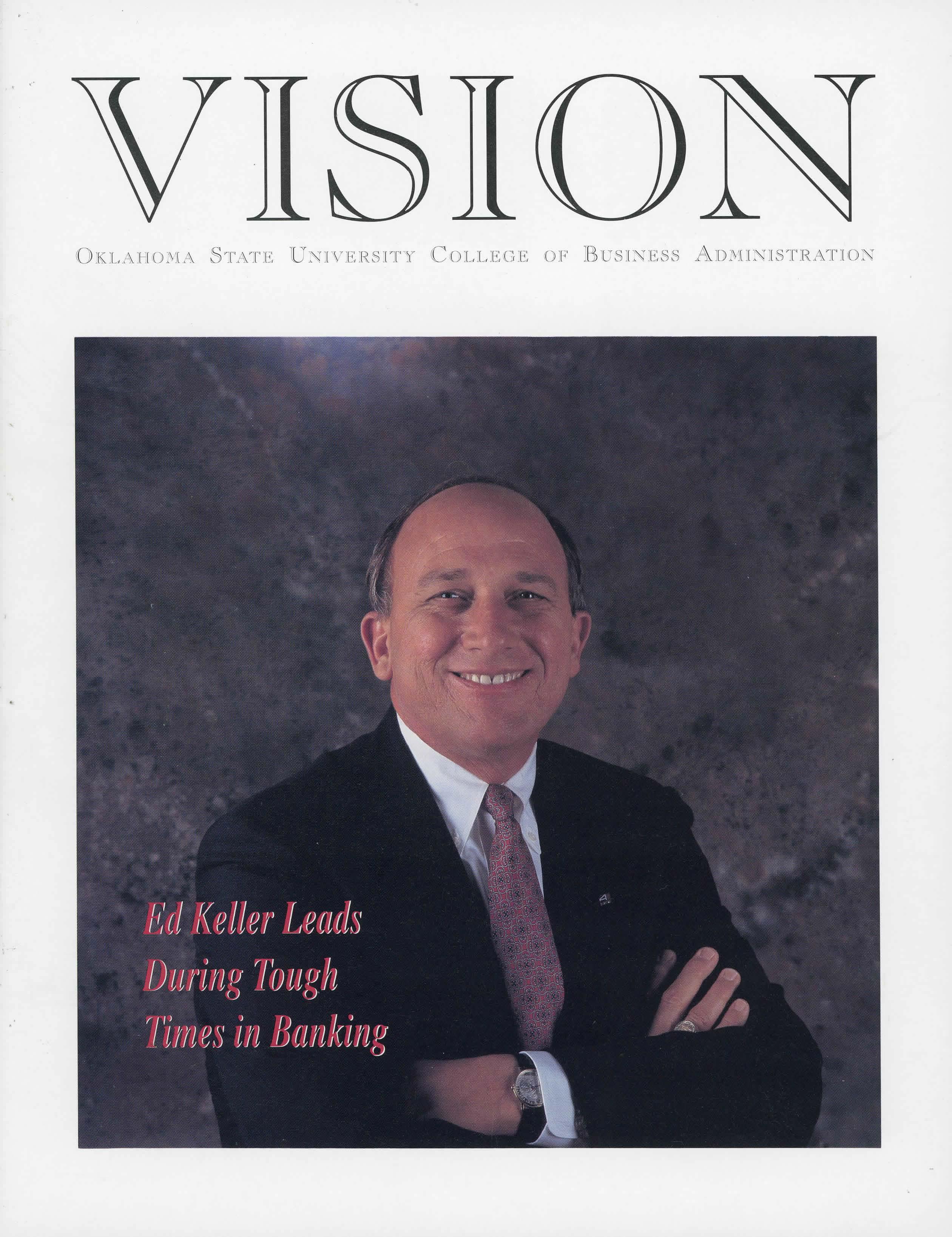
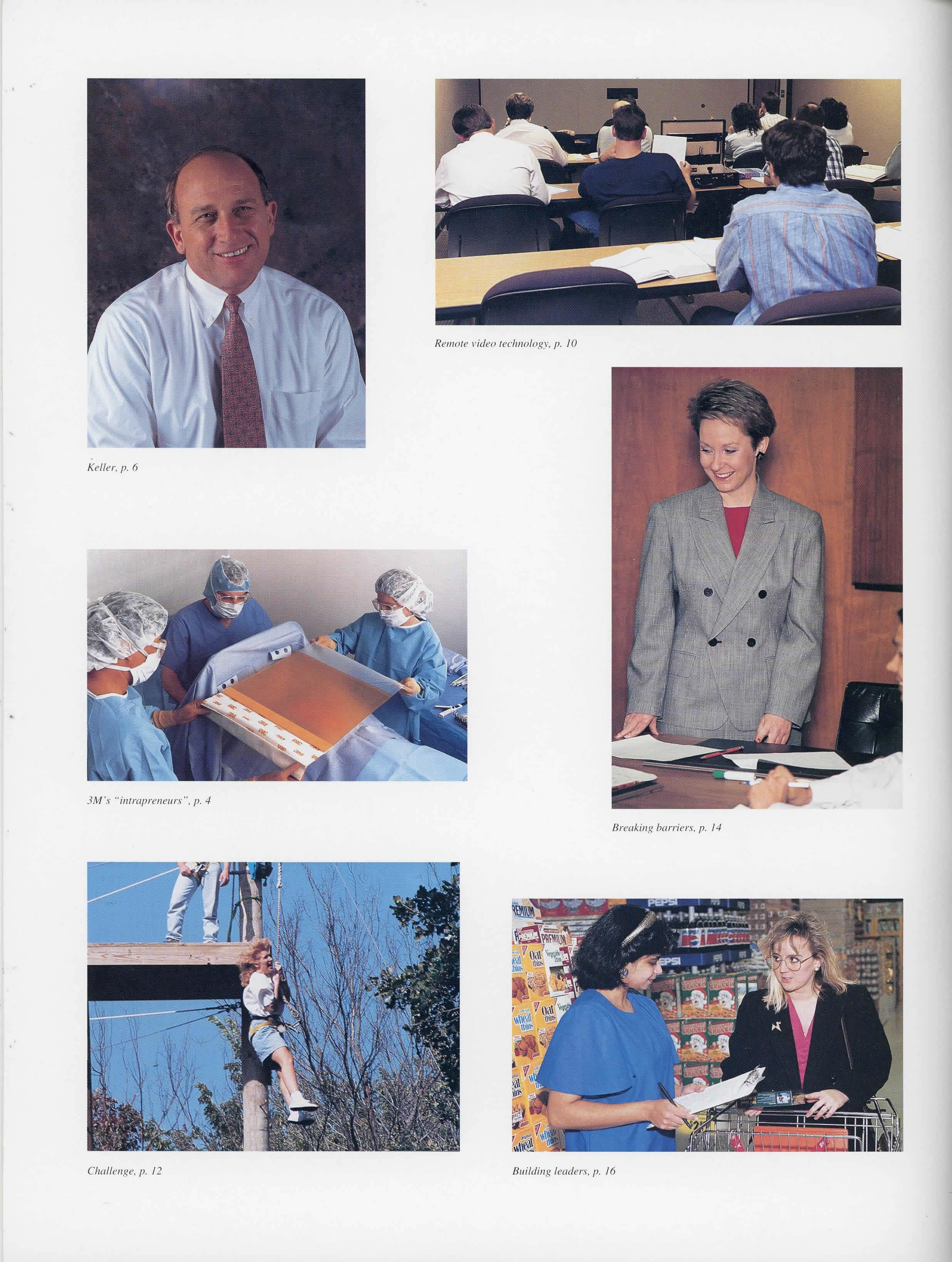
ED KELLERLEADS
DURINGTOUGHTIMESINBANKING
anything like these times. There had been some flat ti mes, but no recessions."
Keller didn't waste any time longing for the good old days. Instead, he and other banking leaders sought - and wonreforms which would allow weaker institutions to merge or be acquired to avoid liquidation. Such actions would prove to be prophetic.
Oklahoma banking is a different business today. "There is no question that as a result of those times, banking in Oklahoma has become much more disciplined,certainly more conservative. That has probably in its own way limited expansion and recovery of our economy," Keller said. "We understand better today that our job is to be a provider of funds and not an investor."
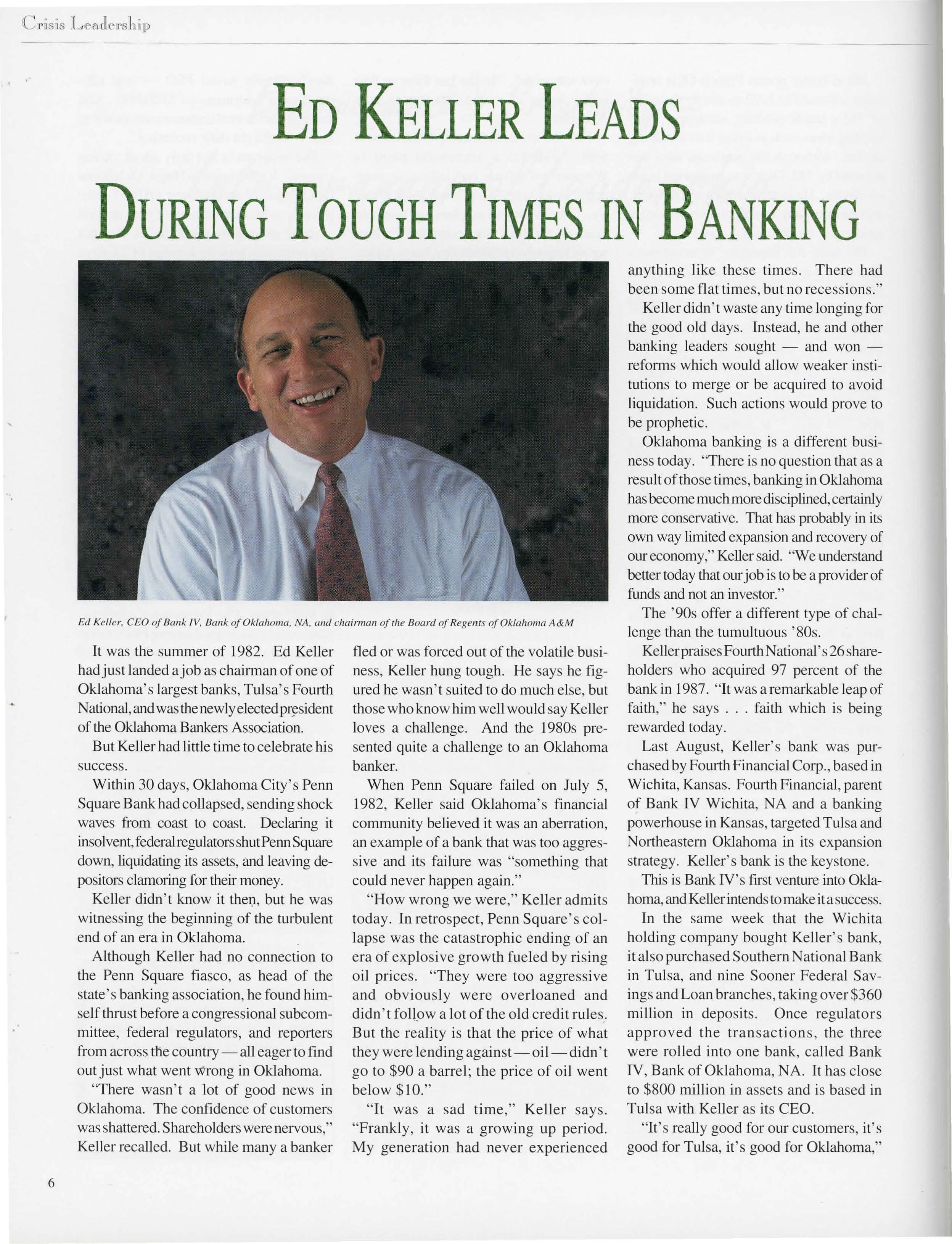
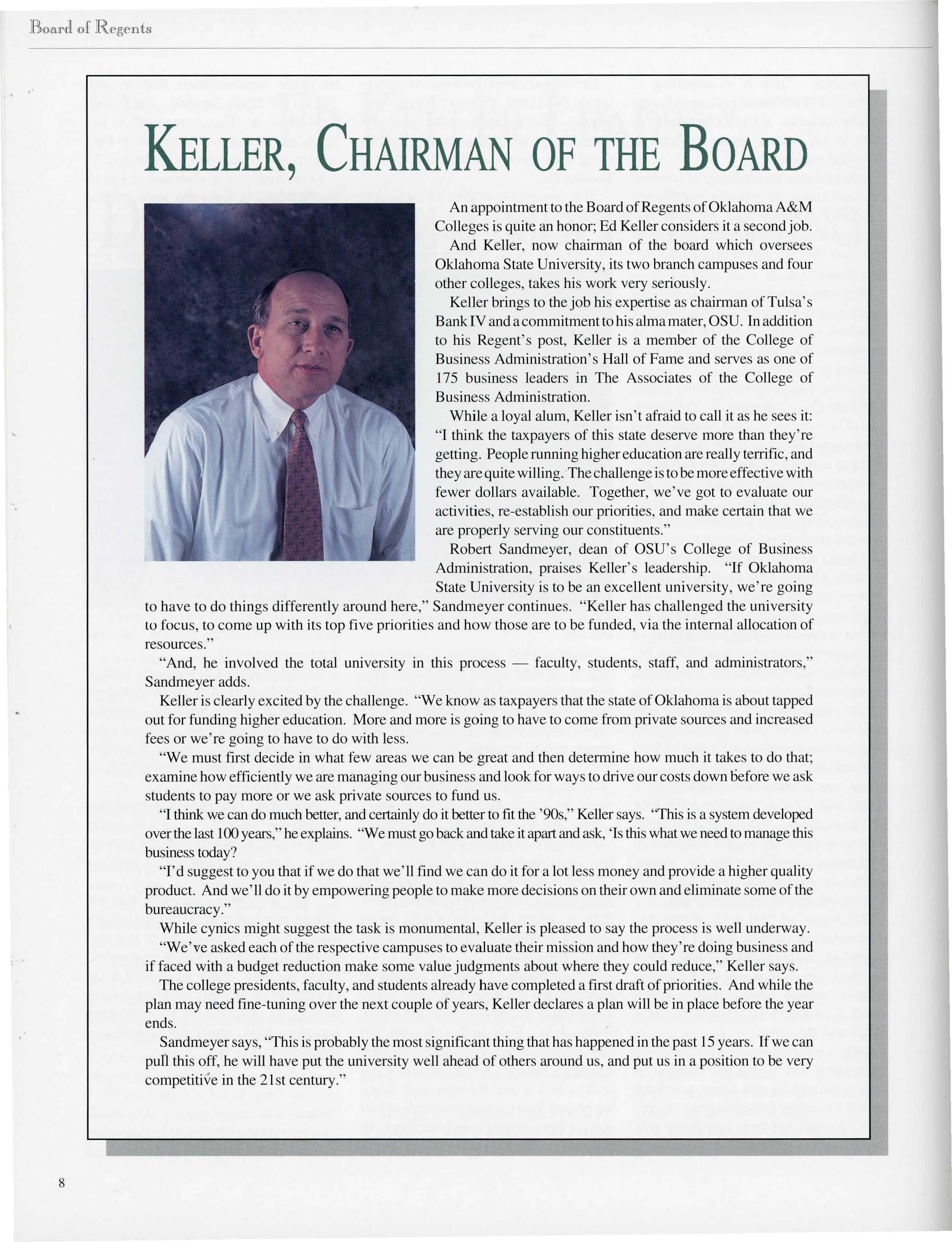
Ed Keller, CEO of Bank IV. Bank of Oklahoma, NA, and chairman ofrhe Board of Rege111sof Oklahoma A&M
It was the summer of 1982. Ed Keller had just landed a job as chairman of one of Oklahoma's largest banks, Tulsa's Fou1th National,andwasthenewlyelectedpr~sident of the Oklahoma Bankers Association.
But Keller had little time to celebrate his success.
Within 30 days, Oklahoma City's Penn Square Bank had collapsed, sending shock waves from coast to coast. Declaring it insolvent,federal regulatorsshut Penn Square down, liquidating its assets, and leaving depositors clan1oringfor their money.
Keller didn't know it thei;i, but he was witnessing the beginning of the turbulent end of an era in Oklahoma.
Although Keller had no connection to the Penn Square fiasco, as head of the state's banking association, he found himself thrust before a congressional subcommittee, federal regulators, and repo11ers from across the country-all eager to find out just what went ~rong in Oklahoma.
"There wasn't a lot of good news in Oklahoma. The confidence of customers was shattered. Shareholders were nervous," Keller recalled. But while many a banker
fled or was forced out of the volatile business, Keller hung tough. He says he figured he wasn't suited to do much else, but those who know him well would say Keller loves a challenge. And the 1980s presented quite a challenge to an Oklahoma banker.
When Penn Square failed on July 5, 1982, Keller said Oklahoma's financial community believed it was an abe1i-ation, an example of a bank that was too aggressive and its failure was "something that could never happen again."
"How wrong we were," Keller admits today. In retrospect, Penn Square's collapse was the catastrophic ending of an era of explosive growth fueled by rising oil prices. "They were too aggressive and obviously were overloaned and didn't foll.ow a lot of the old credit rules. But the reality is that the price of what they were lending against-oil-didn't go to $90 a barrel; the price of oil went below $10."
"It was a sad time," Keller says. "Frankly, it was a growing up period. My generation had never experienced
The '90s offer a different type of challenge than the tumultuous '80s.
Keller praises Fourth National' s 26 shareholders who acquired 97 percent of the bank in 1987. "It was a remarkable leap of faith," he says faith which is being rewarded today.
Last August, Keller's bank was purchased by Fourth Financial Corp., based in Wichita, Kansas. Fourth Financial, parent of Bank JV Wichita, NA and a banking powerhouse in Kansas, targeted Tulsa and Northeastern Oklahoma in its expansion strategy. Keller's bank is the keystone.
This is Bank IV's first venture into Oklahoma, and Keller intends to make it a success.
In the same week that the Wichita holding company bought Keller's bank, it also purchased Southern National Bank in Tulsa, and nine Sooner Federal Savings and Loan branches, taking over $360 million in deposits. Once regulators approved the transactions, the three were rolled into one bank, called Bank IV, Bank of Oklahoma, NA. It has close to $800 million in assets and is based in Tulsa with Keller as its CEO.
"It's really good for our customers, it's good for Tulsa, it's good for Oklahoma,"
Keller says. "This is an impo1ting of capital-$35 million ofnew capital came into the business. With this merger we're twice as big, with a greater capacity to serve this market."
Keller relishes the challenge of combining three distinctly different institutions: "Sooner was a retail bank, we're a commercial bank, and Southern national was a rich bank. Merging these reflects the culture of Bank IV.
"We want to make sure that in growing together we don't forget what made all this possible - delivering quality service to customers. We don't want to change that, we want to enhance it."
In Tulsa's competitive climate, Keller says Bank IY's challenge is to "deliver the type of banking service and product that is clearly personalized to fit the needs of the customer and not a cookie-cutter approach."
Keller is confident and eager to get going. "Rarely are businesses successful by accident. Generally, it's a product of a good plan and good people working really hard. And there's no substin1tefor hard work."
That's a lesson he learned early in life, growing up on an acreageoutsideofDewey, Oklahoma. Both parents worked, his mother in a doctor's office and his father in the engineering department at Phillips Petroleum Co. Although Keller's father had but an eighth-grade education, he clearly had the respect of his coworkers in the cost analysis section where he worked. And he made an impression of the value of hard work and determination on his son.
"He was a really hard-working guy," Keller said. "Imagine having a full-time job during the day, getting up at the crack of dawn to do the chores that needed to be done around a small frum, and then coming home in the evening to do some more. It was dark-to-dark around our place for him.
"My vision of hard work always has been measured against what I saw my parents do," Keller explains. "And I never thought I have approached what they had to do to provide for a family." Today Keller, 51, and his wife Marilyn, have four children of their own.
Keller's upbringing made an "indelible impression" and helped him develop "a kind of toughness that keeps you from getting discouraged or giving up." Keller says, "I could not have had better role models than my parents."
He chose a career in bankingovercoaching on the advice of Dewey banker Glen Shuber. After graduating from Oklahoma State University, Keller joined First National Bank (now WestStar Bank, NA) in BartlesviJle.
"The opportunity to work for the bank in Baitlesville was the end of the world for me. The ultimate," he says with a smile. He probably would be there today had he not wanted a little more responsibility. That desire and his skill asa leader prompted him to accept positions at a string of Oklahoma banks, improving their prospe1ity and the communities they serve along the way.
He left Ba1tlesville for Security Bank in Blackwell in 1970. Security Chai1man Bill Rodgers recalls: "I had just become president of the bank; Ed was a few yeai·s younger. Both of us leai·ned from each other how to make loans and how not to make loans."
BlackweLIwasdealtasevereblowwhen its largest employer at the time, a smelter, went out of business, putting more than I 0 percent of the town's population out of work. Keller stepped into a leadership role and helped lead efforts to recruit a new industry.
"He was good small-town community banker," Rodgers says. "He has a wonderful personality with people of all ages, and that's what a community banker is all about: liking people, getting along with people, getting involved. He still has those traits."
Before Keller left Blackwell after three yeai·s, Security Bank had n·ipled in size.
Next stop was Clai·emore, where Keller was president of Rogers County Bank. ln four yeai·s under "Keller's guidance, the Clai·emore bank's assets almost doubled to $34 million, according to Chairman Frank Robson. Keller "had a lot of help, but he was the spearhead of the growth movement," Robson said.
Robson points to Keller's success at launching the Heritage Hills Golf Course in Claremore as testimony to Ke!!er' s leadership skills. Four earlier attempts had been made to establish the golf club, each ending in failure. Keller anived at the creative idea of establishing a trust, inducing Rogers State College to contribute 160 acres of former pasture land and financing construction of the course through the Faim-
ers Home Administration, Robson said. "Ed got the details, legalities, and financing worked out. Then, to top it off, he and others got service and labor and in-kind construction connibuted to the project."
Keller took over as chairman of Fou1th National Bank in Tulsa after stops at Oklahoma City Bank and another Tulsa bank.
He says his career goals were modest, but he was persuaded to accept new jobs because he kept "wanting to do a little more and maybe someday run a bank."
Today he's running one of the fastest growing banks in the state, but he holds fast to a firm belief in a small town approach to banking.
"I liked the fact we knew each other well. We had a personal relationship with customers," Keller says. "As a community banker, you try to serve and meet all the financial needs a customer may have."
Today, he tries to develop that same attitude among his staff. "You make sure the people you work with know how you feel about their responsibility as bankers to do what's right," Keller says. "People are trusting you ... in many cases you have the responsibility of - literallytheir financial lifeline, and that's an awesome responsibility."
"I would hope that would be the thrill of anybody who works here--to know they've done their best for a customer-whether they're approving a loan, hai1dling a deposit or making sure a mother in a hurry was able to get a check cashed quickly in the drive-through lane."
"I think.that's what I saw in every smaller community l worked in if a town was going to survive and do well, the bankers had to make an investment of both resources and time.
"I am absolutely convinced that we cannot have any greater challenges than those we have faced in the last 10 years," Keller says. "Tam excited about the new challenges, and I am as confident as I can be because we have good people who are committed to working hard. And that combination is p_rettydifficult to beat."
KELLER,CHAIRMANOFTHEBOARD
An appointment to the Board of Regents of Oklahoma A&M Colleges is quite an honor; Ed Keller considers it a second job.
And Keller, now chairman of the board which oversees Oklahoma State University, its two branch campuses and four other colleges, takes his work very se1iously.
Keller brings to the job his expertise as chairman of Tulsa's Bank.IV and a commitment to his alma mater, OSU. In addition to his Regent's post, Keller is a member of the College of Business Administration's Hall of Fame and serves as one of 175 business leaders in The Associates of the College of Business Administration.
While a loyal alum, Keller isn't afraid to call it as he sees it: "I think the taxpayers of this state deserve more than they're getting. People running higher education are really ten-ific, and they a.requite willing.Thechallengeis to be more effective with fewer dollars available. Together, we've got to evaluate our activities, re-establish our priorities, and make ce1tain that we are properly serving our constituents."
Robert Sandmeyer, dean of OSU's College of Business Administration, praises Keller's leadership. "If Oklahoma State University is to be an excellent university, we're going to have to do things differently around here," Sandmeyer continues. "Keller has challenged the university Lo focus, to come up with its top five priorities and how those are to be funded, via the internal allocation of resources."
"And, he involved the total university in this process - faculty, students, staff, and administrators," Sandmeyer adds.
Keller is clearly excited by the challenge. "We know as taxpayers that the state of Oklahoma is about tapped out for funding higher education. More and more is going to have to come from private sources and increased fees or we're going to have to do with less.
"We must first decide in what few areas we can be great and then determine how much it takes to do that; examine how efficiently we are managing our business and look for ways to drive our costs down oefore we ask students to pay more or we ask private sources to fund us.
"I think we can do much better, and certainly do it better to fit the '90s," Keller says. ''This is a system developed over the last 100 years," he explains. "We must go back and take it apart and ask, 'Is this what we need to manage this business today?
"I'd suggest to you that if we do that we'll find we can do it for a lot less money and provide a higher quality product. And we'll do it by empowering people to make more decisions on their own and eliminate some of the bureaucracy."
While cynics might suggest the task is monumental, Keller is pleased to say the process is well underway.
"We've asked each of the respective campuses to evaluate their mission and how they're doing business and if faced with a budget reduction make some value judgments about where they could reduce," Keller says.
The college presidents, faculty, and students already have completed a first draft of priorities. And while the plan may need fine-tuning over the next couple of years, Keller declares a plan will be in place before the year ends.
Sandmeyer says, "This is probably the most significant thing that has happened in the past 15 years. If we can pufl this off, he will have put the university well ahead of others around us, and put us in a position to be very competitive in the 21st century."
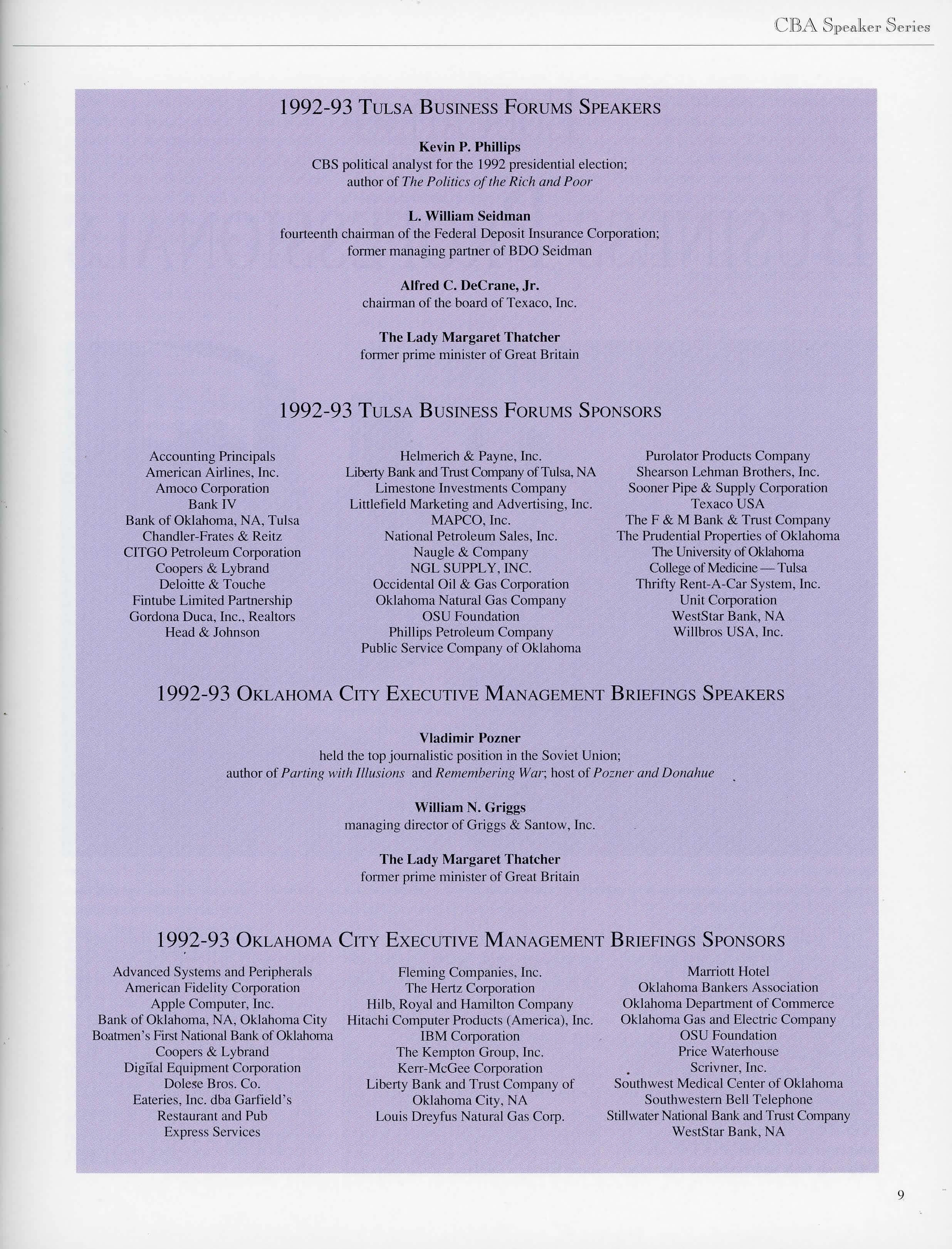
1992-93 TULSA BUSINESS FORUMS SPEAKERS
Kevin P. Phillips
CBS political analyst for the 1992 presidential election; author of The Politics of the Rich and Poor
L. William Seidman
fourteenth chairman of the Federal Deposit Insurance Corporation; former managing partner of BDO Seidman
Alfred C. DeCrane, Jr. chai1man of the board of Texaco, Inc.
The Lady Margaret Thatcher
former prime minister of Great Britain
1992-93 TULSA BUSINESS FORUMS SPONSORS
Accounting Principals
American Airlines, Inc.
Amoco Corporation
BankN
Bank of Oklahoma, NA, Tulsa
Chandler-Frates & Reitz
CITGO Petroleum Corporation
Coopers & Lybrand
Deloitte & Touche
Fintube Limited Partnership
Gordona Duca, Inc., Realtors
Head & Johnson
Helmerich & Payne, Inc.
Liberty Bank and Trust Company of Tulsa, NA
Limestone Investments Company
Littlefield Marketing and Advertising, Inc.
MAPCO,Inc.
National Petroleum Sales, Inc.
Naugle & Company
NGL SUPPLY, INC.
Occidental Oil & Gas Corporation
Oklahoma Natural Gas Company
OSU Foundation
Phillips Petroleum Company
Public Service Company of Oklahoma
Purolator Products Company
Shearson Lehman Brothers, Inc.
Sooner Pipe & Supply Corporation
Texaco USA
The F & M Bank & Trust Company
The Prudential Properties of Oklahoma
The Universityof Oklahoma College of Medicine- Tulsa
Thrifty Rent-A-Car System, Inc.
Unit Corporation
WestStar Bank, NA
Willbros USA, Inc.
1992-93 OKLAHOMA CITY EXECUTIVE MANAGEMENT BRIEFINGS SPEAKERS
Vladimir Pozner
held the top journalistic position in the Soviet Union; author of Parting with Illusions and Remembering War; host of Pozner and Donahue
William N. Griggs managing director of Griggs & Santow, Inc.
The Lady Margaret Thatcher fom1er prime minister of Great Britain
1992-93 OKLAHOMA CITY EXECUTIVE MANAGEMENT BRIEFINGS SPONSORS
Advanced Systems and Peripherals
American Fidelity Corporation
Apple Computer, Inc.
Bank of Oklahoma, NA, Oklahoma City
Boatmen's Fit-stNational Bank of Oklahoma
Coopers & Lybrand
Digital Equipment Corporation
Dolese Bros. Co.
Eateries, Inc. dba Gaifield's Restaurant and Pub Express Services
Fleming Companies, Inc.
The Hertz Corporation
Hilb, Royal and Hamilton Company
Hitachi Computer Products (America), Inc.
IBM Corporation
The Kempton Group, Inc.
Kerr-McGee Corporation
Liberty Bank and Trust Company of Oklahoma City, NA
Louis Dreyfus Natural Gas Corp.
Marriott Hotel
Oklahoma Bankers Association
Oklahoma Department of Commerce
Oklahoma Gas and Electric Company
OSU Foundation
Price Waterhouse
Scrivner, Inc.
Southwest Medical Center of Oklahoma
Southwestern Bell Telephone
Stillwater National Bank and Trust Company
WestStar Bank, NA
EDUCATING BUSINESSPROFESSIONALS
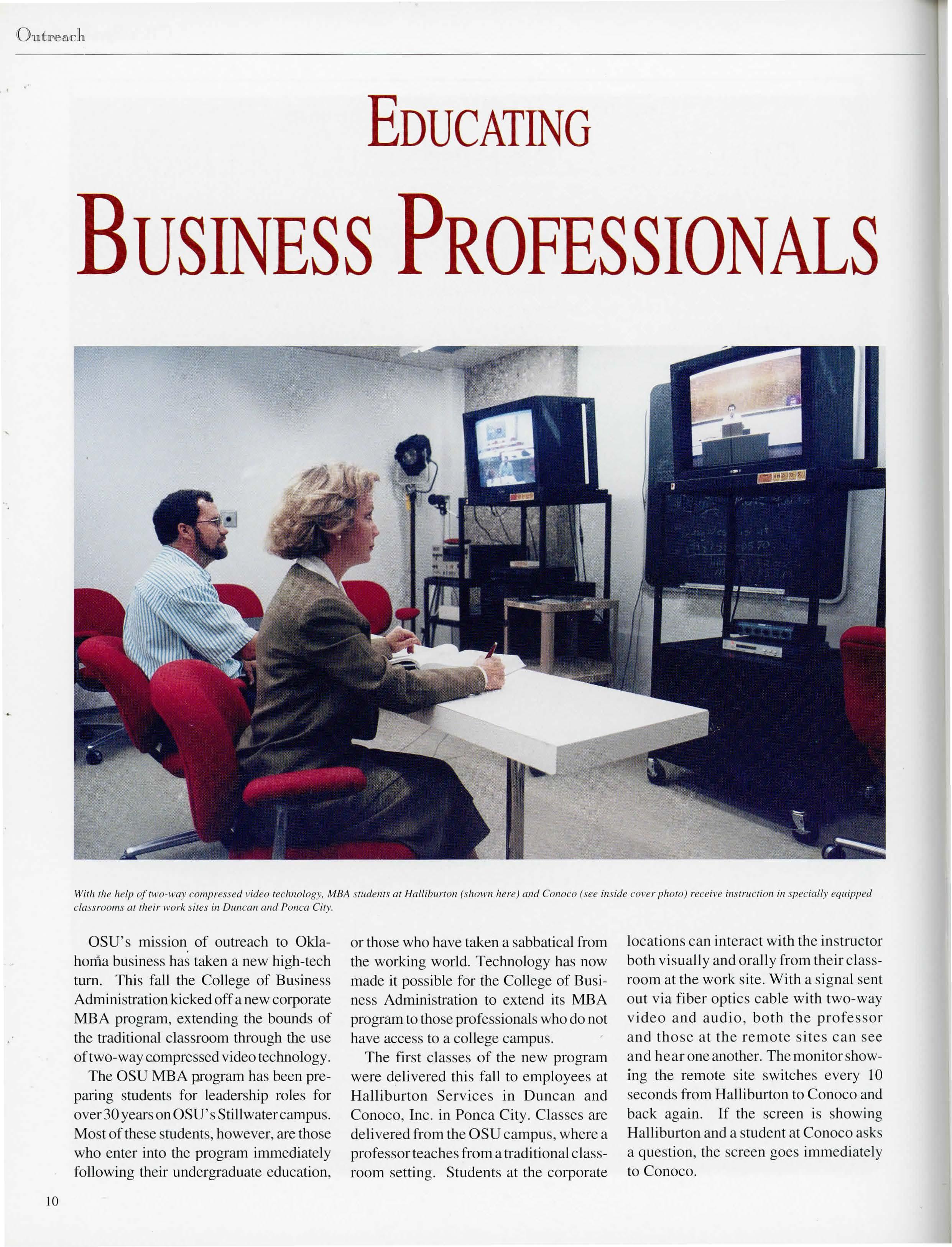
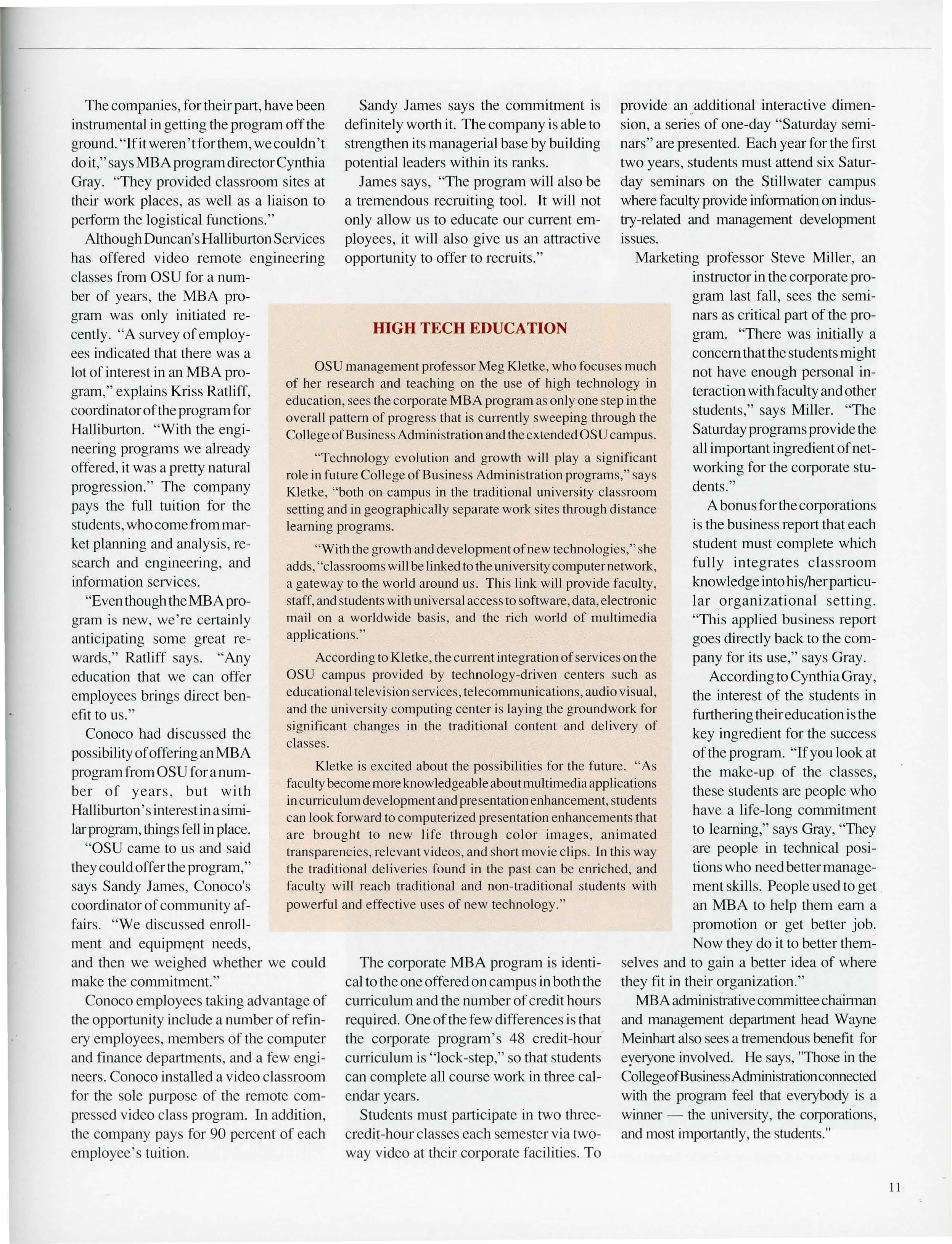
With the help oftwo-1vay compressed video technology, MBA students at !1al/ih11rto11(shown here) and Conoco (see inside cover pholo) receive instrnction in specially equipped classrooms at their
OSU's mission of outreach to Oklahoma business ha~ taken a new high-tech turn. This fall the College of Business Administration kicked off a new corporate MBA program, extending the bounds of the traditional classroom through the use of two-way compressed video technology.
The OSU MBA program has been preparing students for leadership roles for over 30 years on OSU' s Stillwatercampus. Most of these students, however, are those who enter into the program immediately following their undergraduate education,
or those who have taken a sabbatical from the working world. Technology has now made it possible for the College of Business Administration to extend its MBA program to those professionals who do not have access to a college campus.
The first classes of the new program were delivered this fall to employees at Halliburton Services in Duncan and Conoco, Inc. in Ponca City. Classes are delivered from the OSU campus, where a professor teaches from a traditional classroom setting. Students at the corporate
locations can interact with the instructor both visually and orally from their classroom at the work site. With a signal sent out via fiber optics cable with two-way video and audio, both the professor and those at the remote sites can see and hearoneanother. Themonitorshowing the remote site switches every I 0 seconds from Halliburton to Conoco and back again. lf the screen is showing Halliburton and a student at Conoco asks a question, the screen goes immediately to Conoco.
work sites in Duncan and Ponca City.
The companies, for their part, have been instrumental in getting the program off the ground. "Ifitweren 'tforthem, wecouldn 't do it," says MBA program directorCynthja Gray. "They provided classroom sites at their work places, as well as a liaison to pe1form the logistical functions."
Although Duncan's Hal Iiburton Services has offered video remote engineering classes from OSU for a num-
Sandy James says the commitment is definitely worth it. The company is able to strengthen its managerial base by building potential leaders within its ranks.
James says, "The program will also be a tremendous recruiting tool. It will not only allow us to educate our cun-ent employees, it will also give us an attractive opportunity to offer to recruits."
HIGH TECH EDUCATION
provide an _additional interactive dimension, a series of one-day "Saturday seminars" are presented. Each year for the first two years, students must attend six Saturday semjnars on the Stillwater campus where faculty provide information on industry-related and management development issues.
OSU management professor Meg Kletke, who focuses much of her research and teaching on the use of high technology in education, sees the corporate MBA program as only one step in the overall pattern of progress that is cun-ently sweeping through the College of Business Administration and the extended OSU campus.
"Technology evolution and growth will play a significant role in future College of Business Administration programs," says Kletke, "both on campus in the traditional university classroom setting and in geographically separate work sites through distance learning programs.
Marketing professor Steve Miller, an instructor in the corporate program last fall, sees the semjnars as critical part of the program. "There was imtially a ber of years, the MBA program was only injtiated recently. "A survey of employees indicated that there was a lot of interest in an MBA program," explains Kriss Ratliff, coordinatorof the program for Hallibu1ton. "With the engineering programs we already offered, it was a pretty natural progression." The company pays the full n,ition for the students, who come from market planning and analysis, research and engineering, and information services.
"Even though the MBA program is new, we're certainly anticipating some great rewards," Ratliff says. "Any education that we can offer employees brings direct benefit to us."
Conoco had discussed the possibilityofofferingan MBA program from OSU for a number of years, but with Hallibu1ton'sinterest in asimilar program, trungs fell in place.
"OSU came to us and said they could offer the program," says Sandy James, Conoco's coordinator of community affairs. "We discussed enrollment and equipm~nt needs,
"With the growth and development of new technologies," she adds, "classrooms will be linked to the universitycomputernetwork, a gateway to the world around us. This link will provide faculty, staff, and students with universal access to software, data, electronic mail on a worldwide basis, and the rich world of multimedia applications."
According to Kletke, the current integration of services on the OSU campus provided by technology-driven centers such as educational television services, telecommunications, audio visual, and the university computing center is laying the groundwork for significant changes in the traditional content and delivery of classes.
Kletke is excited about the possibilities for the future. "As faculty become more knowledgeable about multimedia applications in curriculum development and presentation enhancement, students can look forward to computerized presentation enhancements.that are brought to new life through color images, animated transparencies, relevant videos, and short movie clips. In this way the traditional deliveries found in the past can be enriched, and faculty will reach traditional and non-traditional students with powerful and effective uses of new technology."
concern that the students might not have enough personal interaction with facu Ity and other students," says Miller. 'The Saturday programs provide the all important ingredient ofnetworking for the corporate students."
A bonus for the corporations is the business report that each student must complete which fully integrates classroom knowledge into his/her particular organizational setting. "This applied business report goes directly back to the company for its use," says Gray.
According to Cynthia Gray, the interest of the students in furthering their education is the key ingredient for the success of the program. "If you look at the make-up of the classes, these students are people who have a life-long commitment to learning," says Gray, "They are people in techrucal positions who need better management sblls. People used to get an MBA to help them earn a promotion or get better job. Now they do it to better themand then we weighed whether we could make the commitment."
Conoco employees taking advantage of the opportunjty include a number of refinery employees, members of the computer and fmance depa1tments, and a few engineers. Conoco installed a video classroom for the sole purpose of the remote compressed video class program. ln addition, the company pays for 90 percent of each employee's tuition.
The corporate MBA program is identical to the one offered on campus in both the cuJTiculum and the number of credit hours required. One of the few differences is that the corporate program's 48 credit-hou/ curriculum is "lock-step," so that students can complete all course work in three calendar years.
Students must pa1ticipate in two threecredit-hour classes each semester via twoway video at their corporate facilities. To
selves and to gain a better idea of where they fit in their organization."
MBA admjrustrativecommjtteechainnan and management depaitment head Wayne Meinhart also sees a tremendous benefit for eye1yone involved. He says, "Those in the CollegeofBusinessAdministrationconnected with the progi-ain feel that everybody is a winner - the university, the corporations, and most importantly, the students."
Corporate case competitions. Professional internships. These standard pedagogies have served graduate business students for many years as vehicles for developing tangible, marketable skills. Today, many graduate programs are adding to this equation, taking note of the need for instilling the intangible elements of success, those such as a spirit of teamwork, cooperation, and leadership.
Students ente1ing OSU' s MBA program probably never dreamed that within a month's time they'd be dangling mid-air from cables and trapezes, depending upon their classmates for a safe descent. Yet that's exactly what they do when they participate as a new class in the OSU Outdoor Adventure Challenge.
In 1979 OSU Campus Recreation adapted an experiential physical education program developed by Project Adventure, Lnc.as a training device for outdoor leaders. It proved so successful that it was expanded to include a number of other groups, including campus groups, corporate executive teams, and others in the Stillwater area. •
Exercises such as the Challenge Course have also become increasingly popular for corporate business in recent years. Industry leaders are invariably noted as those who encourage personal development programs among the ranks. By facilitating student participation in team-building and leadership development experiences, the College of Business Administration gives its graduates a head start in progressive leadership.
With its maze of cables, logs, platforms, ropes, trees, and games, the course itself is designed to develop ream work and leadership through decision-making and communication. A warm-up session of Games and Initiatives allows the group to become acquainted with one another and per-
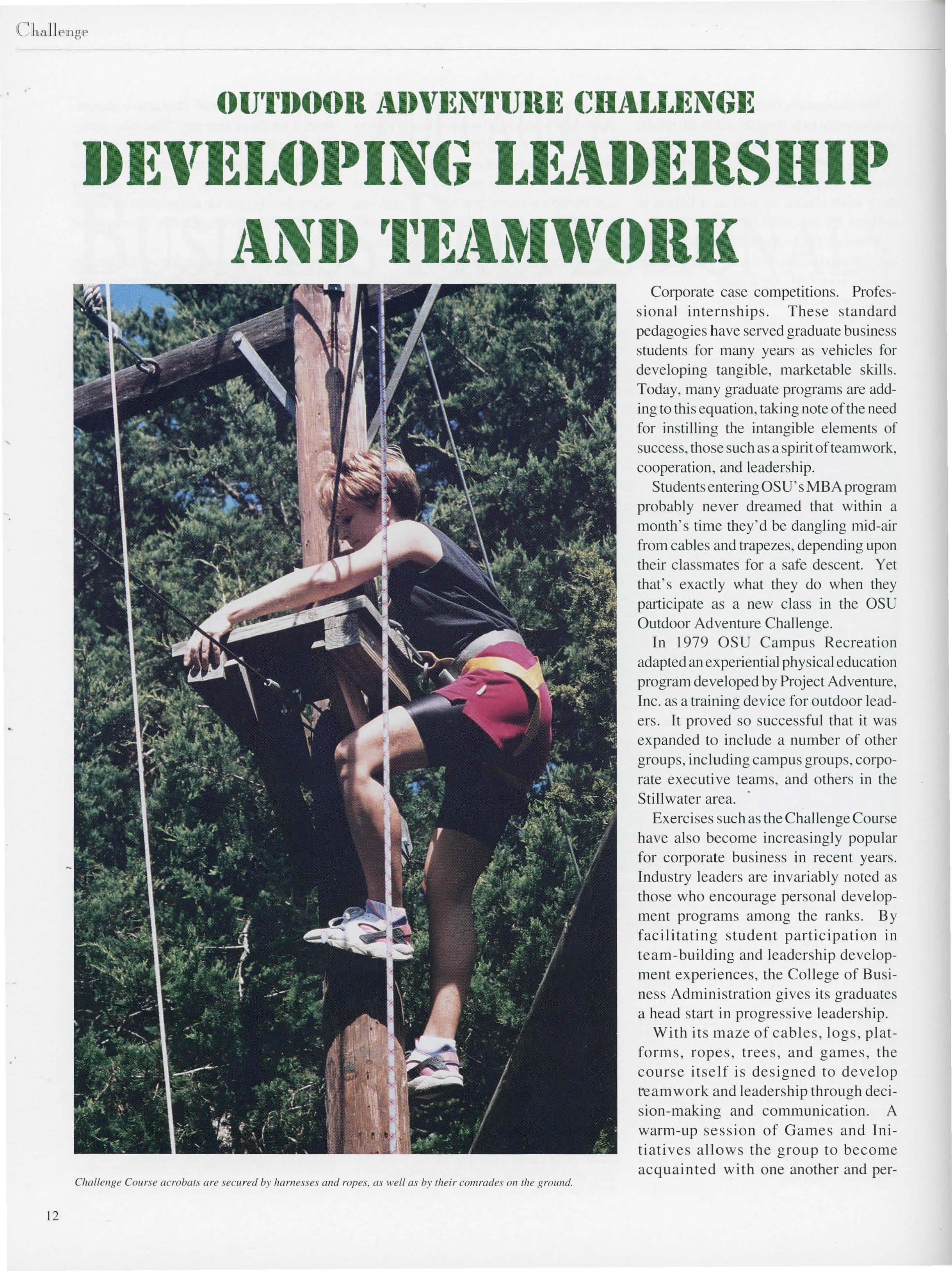
Challenge Course acrobats are secured by harnesses and ropes. as well as by their comrades on the ground.
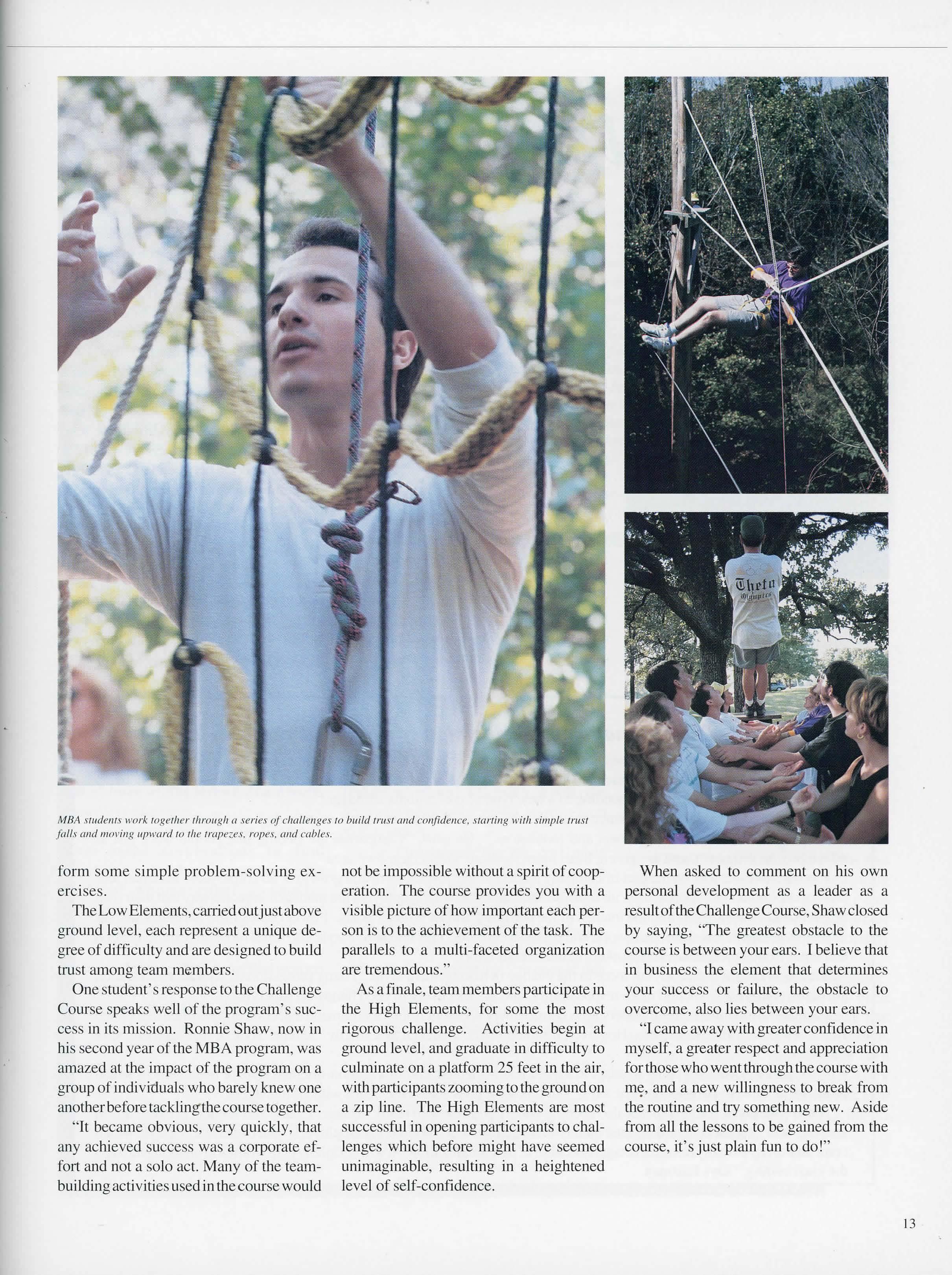
MBA students work together through a series of c/Jalle11ges to build trust and confidence, star1h1g with simple trust falls and moving upH·ard to rite rrape:eJ, ropes. and cables.
form some simple problem-solving exercises.
The Low Elements, caniedoutjustabove ground level, each represent a unique degree of difficulty and are designed to build trust among team members.
One student's response to the Challenge Course speaks well of the program's success in its mission. Ronnie Shaw, now in h.issecond year of the MBA program, was amazed at the impact of the program on a group of individuals who barely knew one another before tack!ingthe course together.
"It became obvious, very quickly, that any achieved success was a corporate effort and not a solo act. Many of the teambuilding activities used in the course would
not be impossible without a spirit of cooperation. The course provides you with a visible picture of how important each person is to the achievement of the task. The parallels to a multi-faceted organization are tremendous."
As a finale, tean1 members participate in the High Elements, for some the most rigorous challenge. Activities begin at ground level, and graduate in difficulty to culminate on a platfom1 25 feet in the air, with participants zooming to the ground on a zip line. The High Elements are most successful in opening paiticipants to challenges which before might have seemed unimaginable, resulting in a heightened level of self-confidence.
When asked to comment on his own personal development as a leader as a result of the Challenge Course, Shaw closed by saying, "The greatest obstacle to the course is between your ears. I believe that in business the element that determines your success or failure, the obstacle to overcome, also lies between your ears.
"I came away with greater confidence in myself, a greater respect and appreciation forthose who went through the course with mt:, and a new willingness to break from the routine and try something new. Aside from all the lessons to be gained from the course, it's just plain fun to do!"
Breaking Through
Gradual Progress
In the nine years that OSU finance graduate Janice Dallman has worked for Koch Industries, she has witnessed a noticeable improvement in management opportunities for women. Since 1988 Dallman has managed the assets of the savings and pension plan for the privatelyownedoiJcompany, whichisbasedinKansas and has almost 12,000employees worldwide. "Within my company, therehaveneverreally been any baiTiers,"Dallman says.
The biggest challenges for Doll man come from the other companies and executives that she encounters in a field of business traditionally dominated by men. "But that is changing, particularly in the last five years," she says. "Men are simply getting used to the fact that we're here. And with more and more women coming out of college, it would be very odd to see a male-dominated company."
Dollman's personal experience is supported by recent research in this area. In 1981 Department of Labor figures showed nearly 53% of all female managers were employed in only three industries: real estate and finance, retail trade, and communications. By 1991 nondurable manufacturing had replaced retail trade in these numbers, and the total concentration in these industries had decreased to 49%. In addition, the total numberoffemale managers grew by 12% during the period between 198 I and 1991, indicating a greater dispersion of female managers across all industries.
Some Barriers Still Exist
While these numbers are encouraging, the battle is by no means over. OS U management professor Debra Nelson agrees. "I think things are better in some areas, but I wouldn't be ready to
Transformational Leadership Style Speeds Progress
Women no longer have to "act masculine" to get their point across, says OSU management professor Kenneth Eastman.
The "transfo1mational," or interactive, leadership style is replacing the traditional authorita_tive style in many organizations as businesses are responding to a new type of professional manager.
"There has been a tremendous change in the past few years in what managers actually do," says Eastman, "They are no longer pencil pushers, but planners and motivators." He adds, "Companies ate finding that people work just as effectively on their own, and are giving them more freedom within their own area."
There is more concern on the part of company leaders in the development and growth of all employees. Eastman sees it as a more humanistic approach. With transformational leadership, employees are managed in such a way that their own self interest is transformed into the interest of the company and its broader goals. Power comes from attributes such as chai·isma, interpersonal skills, hard work, ai1dpersonal contacts. This interactive style also relies more on communication and input f_romsubordinates and workers in the overall effo11.
Education has been one driving force in the change in management style. Young professionals with more education are better equipped to take on more responsibility, and are less likely to need hands-on supervision.
The transformational style ofleadership is considerably different from the command and control style often associated with traditionally male managers. However, it should not be mistaken as a strictly "female" style of management, says Eastman.
"Women are socialized better to adapt to a more team-oriented, communication-oriented sty le of management which promotes a 'family' atmosphere," he says, "but this style goes across the board wfrh all managers."
Transformational leadership has also become widely popular with many managers, male and female, because it_is in keeping with new ideas regarding total quality management and empowering employees. But because it is a style which comes naturally to many female managers because of past socialization, "it will definitely help women in breaking through the glass ceiling," says Eastman.
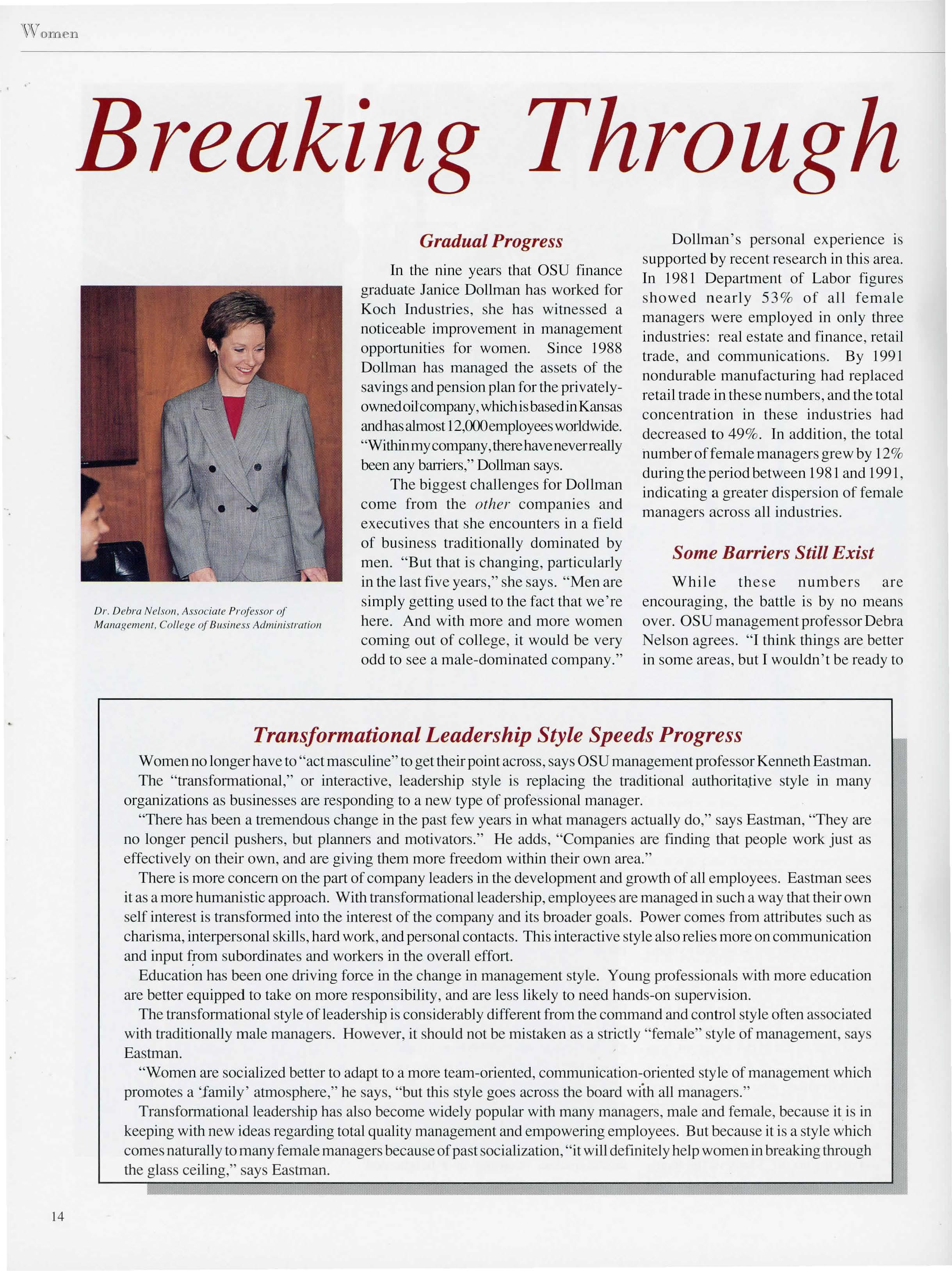
Dr. Debra Nelson. Associare Professor of Management. College of Business Admi11istratio11
say tliere is no glass ceiling." Some companies, particularly those in the oil and gas industries, have done little to increase the number offemale managers, says Nelson. "But it is hard to make general statements. It varies from industry to industry and from company to company."
In a recentF or tune magazine survey, 64 percent of the responding CEOs thought women simply needed more years of experience before they would be ready for the top positions. And while only 16 percent thought their company would have a female CEO within ten years, 81 percent did see the likelihood that a female CEO would be selected within 20 years.
Twenty years from now, Nelson says, she hopes all of these companies will have found a different way of thinking and doing things. "I hope that businesses are going to wake up and realize that if you 're not using the talent of 50 percent of your work force - you're wasting money. As they become leaner, they are going to have to get the most productivity they can out of each employee."
Flight from Corporate America
If these companies don't "wake up" sooner, they may not have any female management talent to tap into in 20 years. More and more women have already begun looking elsewhere for companies that are more willing to reward hard work, regardless of gender.
And women are not just fleeing to other large corporations to find opportunity. Another phenomenon is the flight of women either to smaller companies managed by other women or to their own entrepreneurial ventures.
OSU business communications professor Jeanine Rhea notes that women in business for themselves now employ more,people than all of the Fortune 500 companies together. Rhea sees the primary reason behind this as oppo1tuni ty: opportunity to become more involved at more levels and to explore a lot of different areas of management; opportunity for more long-term benefits; opportunity for more accountability and responsibility.
"These smaller companies don't have the built-in hierarchies of traditionally
Some companies and organizations have already "heard the call" for breaking the barriers. The following women are among those who have made it to the top in fields that have traditionally reserved the board room for men only.
Advertising Charlotte Beers, Chair and CEO, Ogilvy & Mather Worldwide
Apparel Industry Linda Wachner, CEO, Warnaco
Banking Linnet F. Deily, CEO, First Interstate Bank of Texas
Biotechnology Jane E. Shaw, President and COO, Alza
Education Johnnetta B. Cole, Sister President, Spelman College
Entertainment Sherry Lansing, Chair, Motion Picture Group, Paramount Pictures
Health Care Michele J. Hooper, President, Alternate Site Intl., Baxter Intl., Inc.
Industry Brenda Barnes, President, Pepsi-Cola South, PepsiCo
Investment Management Joan Lappin, President, Gramercy Capital Management
Manufacturing Jill Elikann Barad, President, Mattel USA
Public Service Marian Wright Edelman, President, Children's Defense Fund
Publishing Katharine Graham, Chair, The Washington Post Company
Recording Industry Cassandra Mills, President, Black Music Div., Giant Records
Religion Beth Marcus, President, Refonned Church of America
Sports Susan O'Malley, President, Washington Bullets
Television Kay Koplovitz, CEO, USA Cable Television Network
large corporations," says Rhea, "and they aren't as focused on the traditional power plays and status symbols that have been so much a part of large corporate America."
Breaking the Barriers
How can larger, more traditional corporations continue to break the barriers and encourage advancement for talented female managers? For many, it will take an organization-wide effort, starting with management.
In "Pipelines of Progress: An Update on the Glass Ceiling Initiative," a report released by the Department of Labor in August 1992, then Secretary of Labor Lynn Ma1tin admonished that employers have an "economic, demographic, social, and moral responsibility," to ensure that no barriers exist for the advancement of all qualified employees.
"Pipelines" follows the August 1991 report on the "Glass Ceiling Initiative,': in which the Department of Labor studied aselectedgroupofFortune500companies to investigate the barriers for advancement of women and minorities. While this second report indicates that some progress has been made, it also stresses that it will take an effort on the part of both employers
and employees, as well as outside compliance agencies such as the Department of Labor, to tear down the remaining barriers. Women and minority candidates for advancement must be willing to take calculated risks to move up - relocation, long hours, additional assignments.
For Jeanine Rhea, the key exists in organization-wide communication and leadership, starting at the top. "What new American business calls for is greater involvement of everyone in the organization, and strong leadership will be critical," says Rhea. She adds that "Leaders wi II need to create new work environments where people can communicate ideas and opinions, where those who are competent are valued by both men and women."
Secretary Martin said in "Pipelines" that "few companies can afford glass ceilings. In a global marketplace that grows increasingly more competitive, companies need to promote the best people, regardless of race, gender, color dr national origin." Companies that hear that call will lead the way in breaking the barriers that remain.
"As the most visible signs of leadership are expressed in day-today practice, we believe the students will grow substantially by spending quality time with these business leaders."
Joe Tippens and James Bode Merrill Lynch Venture Capital, Inc., Tulsa
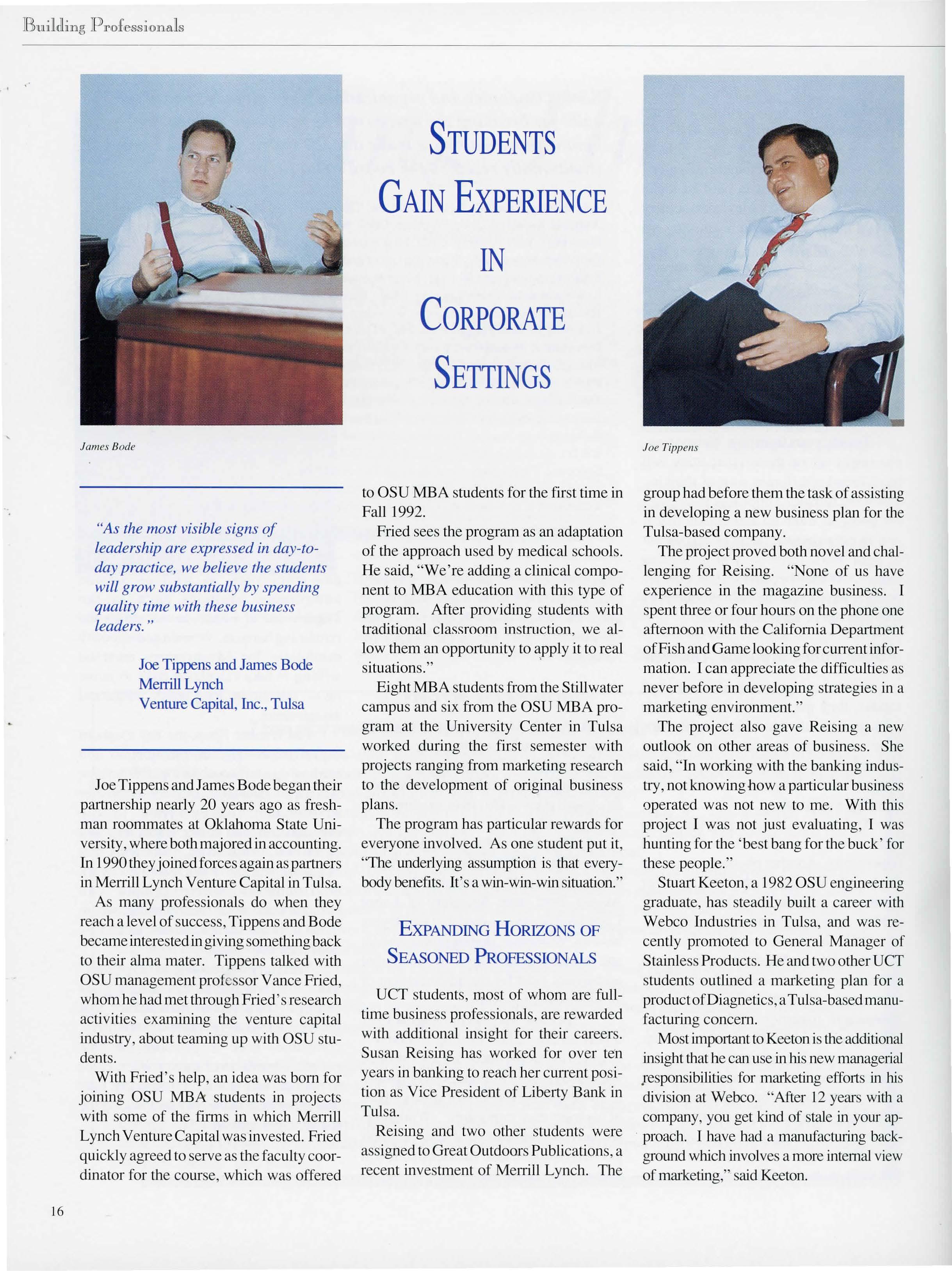
Joe Tippens and James Bode began their paitnership neai·ly 20 years ago as freshman roommates at Oklahoma State Unjversity, where both majored in accounting. In 1990 they joined forces again as paitners in Merrill Lynch Venture Capital in Tulsa.
As many professionals do when they reach a level of success, Tippens and Bode became interested in giving something back to their alma mater. Tippens talked with OSU management professor Vance Fried, whom he had met through F1ied' s research activities examirung the venture capital industry, about teaming up with OSU students.
With Fried's help, an idea was born for joining OSU MBA'. students in projects with some of the furns in which Merrill Lynch Venture Capital was invested. Fried quickly agreed to serve as the faculty coordinator for the course, wruch was offered
STUDENTS GAINEXPERIENCE IN CORPORATE SETTINGS
to OSU MBA students for the first time in Fall 1992.
Fried sees the program as an adaptation of the approach used by medical schools. He said, "We're adding a clinjcal component to MBA education with this type of program. After providing students with traditional classroom instruction, we allow them an opportunity to ~pply it to real situations."
Eight MBA students from the Stillwater campus and six from the OSU MBA program at the University Center in Tulsa worked during the first semester with projects ranging from marketing research to the development of original business plans.
The program has paiticular rewai·ds for everyone involved. As one student put it, "The underlying assumption is that everybody benefits. It's a win-win-win situation."
EXPANDING HORIZONS OF SEASONED PROFESSIONALS
UCT students, most of whom are fulltime business professionals, ai·e rewarded with additional insight for their careers. Susan Reising has worked for over ten years in banking to reach her current position as Vice President of Liberty Bank in Tulsa.
Reising and two other students were assigned to Great Outdoors Publications, a recent investment of Me1TillLynch. The
group had before them the task of assisting in developing a new business plan for the Tulsa-based company.
The project proved both novel and challenging for Reising. "None of us have expe1ience in the magazine business. I spent three or four hours on the phone one afternoon with the California Depaitment of Fish and Game looking for current information. I can appreciate the difficulties as never before in developing strategies in a mai·keting environment."
The project also gave Reising a new outlook on other areas of business. She said, "In working with the bankjng industry, not knowing how a paiticular business operated was not new to me. With this project I was not just evaluating, I was hunting for the 'best bang for the buck' for these people."
Stuait Keeton, a 1982 OS U engineering graduate, has steadily built a career with Webco Industries in Tulsa, and was recently promoted to General Manager of Stainless Products. He ai1dtwo other UCT students outlined a marketing plan for a productofDiagnetics, a Tulsa-based manufacturing concern.
Most imprntant to Keeton is the adrutionaI insight that he can use in lus new managerial .responsibilities for mai·keting efforts in rus division at Webco. "After 12 years with a company, you get kind of stale in your ap• proach. I have had a manufacturing background wruch involves a more intemal view of marketing," srud Keeton.
James Bode
Joe Tippens
He added that, "The projectatDiagnetics involved more of the 'pre-packaged' marketing side in that the product was already assembled. AtDiagnetics we focused more on placing the product on the market than on developing the product."
ENHANCING THE CLASSROOM EXPERIENCE OF YOUNGER STUDENTS
Stillwater MBA students who have not yet entered the professional world gain an enhancement of classroom theory, as well as valuable work experience. Jyo Shriram is a Stillwater MBA student who entered graduate school immediately upon finishing his undergraduate program.
He sees the program as having great potential for the Stillwater students in building a resume of professional experience and is enthusiastic about the work that he has done with the project. He and five other students conducted business development and marketing research for CytoDiagnostics, an Oklahoma City film which provides diagnostic oncology services in the field of urology.
"We researched urologic diseases for the company and the potential cures and drugs to combat the diseases, and we gathered information on Cyto competitors," said Shriram.
He added, "I interviewed with a pharmaceuticals firm last year and was told I needed some background in science before they could hire me. This project has given rne some actual experience without having to sit through a freshman biology course."
He added, "The most uniqu.e thing is that everything we've done serves a legitimate purpose. It's not just research,
"I think that the best thing that will happen is that they will get away from textbooks to real-life applications, giving them confidence-to succeed in business."
Lawrence Field President, Silverado Foods
and it's not just a classroom rehash of some case study from 15 years ago. At the end of the semester, we presented findings to the Chief Financial Officer. At least, it gave them some new ideas. At most, our ideas will be implemented."
FREsHMINDSAND EXTRA IIANDsFOR NEwVENTURES
The companies benefit from the talent and enthusiasm of the students in carrying out projects which are critical to their organizations. Mark Dimitroff, Vice President for Marketing and Sales for CytoDiagnostics, sees great potential for their input.
For new firms like his own, Dimitroff said, "ln te1ms of an organization, an entrepreneurial start-up venture has more work than people. The students can give us extra hands and minds to work on projects. Secondari Iy, as students get to know the company and the market, opportunities are created to bring good people into the organization."
Stuart Keeton also sees the project as having great potential for Diagnetics. "I think the company gets a fresh perspective from a number of people who are new to the product. Groups like ours also give the company an interdisciplinary view," said Keeton, "You throw engineering, accounting, and marketing guys together and get a more balanced perspective."
pARTNERSHIPS FOR THE FUTURE
The interaction of the College of Business Administration in all of these projects is critical in a number of ways. Marketing professor John Mowen, who served as the faculty advisorthisfall on projects with Silverado Foods and Diagnetics, has a broad view of the ultimate rewards of the program.
He says, "For students, there are possibilities in building leadership, learning how to approach real world problems, applying knowledge from class. In the larger scheme, the program will be beneficial to the College, in that it places faculty in _contact with business firms in the state. Faculty can then work to assist the state in economic development."
Joe Tippens and James Bode are excited about the program and its possibilities for the future. "The joint venture with the CBA and the MBA students is a way for us to give something back to our University," says Tippens. "We are especially proud of the program because everybody wins."
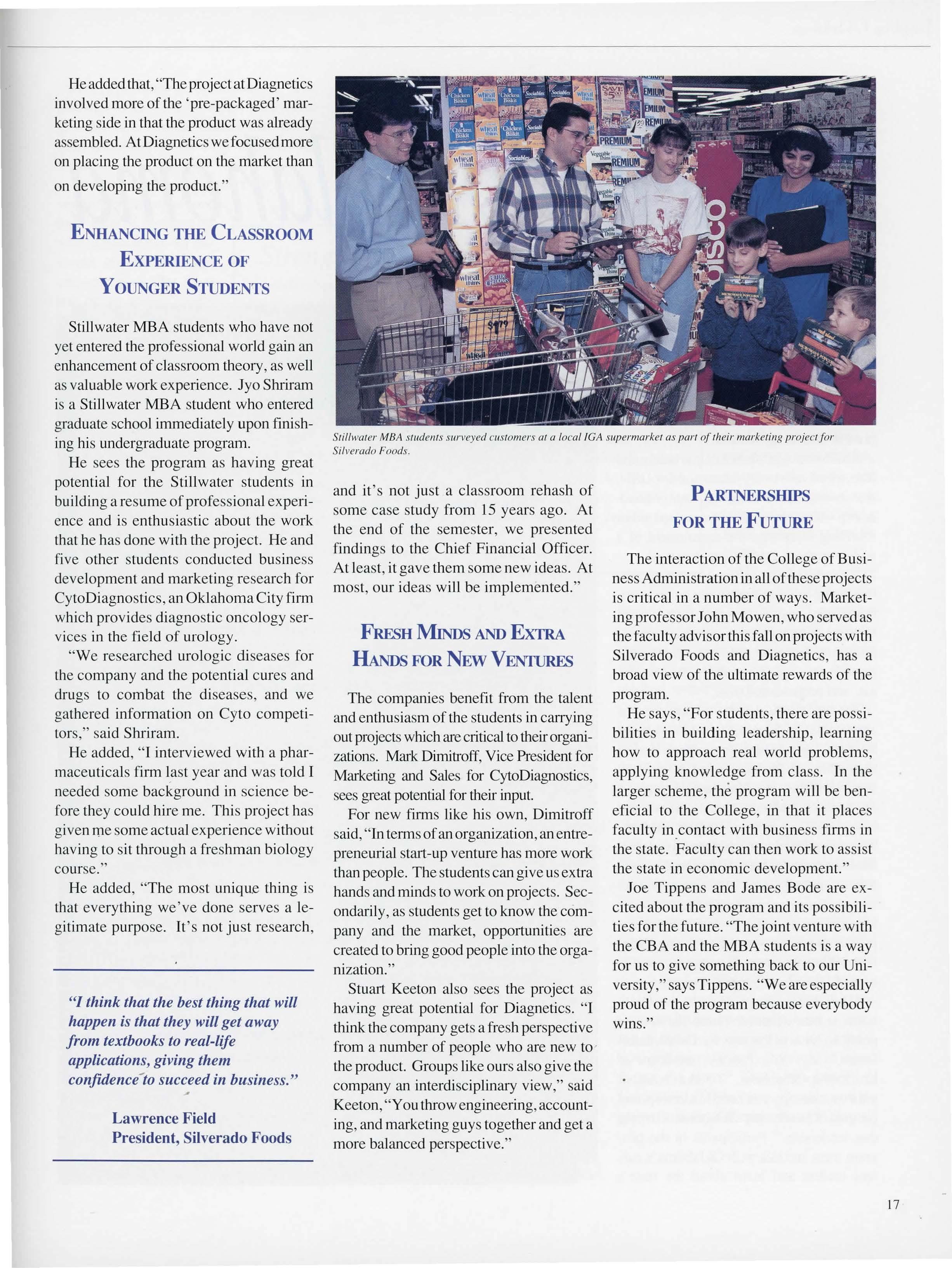
Stillwater MBA students Slfrveyed cuslomers al a local /GA supermarket as part of their marketing project for Silverado Foods.
LeadershipOklahoma
Seven years ago, a group of young Oklahoma leaders met to discuss the need for a broad, unified effort. to move the state forward. What started that day grew into Leadership Oklahoma, a unique state educational program which develops the talents and taps into the energy of Oklahoma's present and future leaders.
. Jim Hromas, professor of marketing and director of university extension for OSU, was among the founding members ofLeadership Oklahoma. For Hromas and other founding members, the recruitment of a wide variety of leaders was essential.
"Diversification in the group was central in our mission to provide a new, contemporary vision for the state," says Hromas, "We were very careful in developing a system of recruitment which would provide an even geographic, gender, ethnic, and professional mix."
The organization each year searches for approximately 50 people from across the state who already have proven their leadership ability at the local, state, or national level. And they are indeed a diverse group - bankers and educators, realtors and lawyers, volunteers, and welfare workers. They have different interests and live across the state, from Idabel to Guymon, Hollis to Miami, and all points in between. But for one weekend a month for a year, they come together as students to learn about the problems and opportunities facing Oklahoma. Their one shared goal is very simple: to lead Oklahoma into the next century.
"The whole concept of Leadership Oklahoma is that whatever future the state is going to have is the one we Oklahomans create," says Leo Presley, president of Leadership "Oklahoma. "To take control of your own destiny you need leadership, and the goal of Leadership Oklahoma is to help that leadership." Participants in the program meet and talk with Oklahoma's current leaders and learn about the state's
Great Leaders ... on leadership
"I've been studying the art of war for forty-odd years ... a su~ge~n v._'hodecide~ in the course of an operation to change its obJective 1snot making a snap decision but one based on knowledge, experience and training. So am I." General George Patton
"If you would be a leader of men, you must lead your own generation, not the next." President Woodrow Wilson
"Leadership of people demands character. Leadership is about ethics, integrity and morality. Competence is important; but without character, competence is nothing." General Norman Schwarzkopf, Commander of Operation Desert Storm
"A leader is a man who has the ability to get other people to do what they don't want to do, and like it." President Harry S. Truman
"Leadership is the ability to decide what is to be done, and then get others to want to do it." President Dwight D. Eisenhower
''The leader must have infectious optimism The final test of a leader is the feeling you have when you leave his presence after a conference. Have you a feeling of uplift and confidence?" Field Marshal Bernard Montgomery
"Leadership and learning are indispensable to each other." President John F. Kennedy
needs, opportunities, and resources. The goal in all of this, according to Presley, is to give the state's future leaders the knowledge necessary to develop solutions for tomOITOW.
"We acquaint and enhance their awareness of the issues - not just what's happening
have done in the past I sometimes thought, 'That's embarrassing.' But now that I've learned what we're doing today and what we plan on doing, I have a much greater hope for the future than I did when I first statted. In Leadership Oklahoma, we're
pants at·e by no means done. In fact, the work has just begun.
Strengthening the Economic Future
Leadership Oklahoma can serve a key role in the future economic health of Oklahoma, says OSU economics professor Larkin Warner. Warner, who has addressed classes of Leadership Oklahoma, sees a twofold impact. He says, "Leadership Oklahoma is gradually replacing the
Ruth Boss, a recent graduate of the program, owns a realty company in Edmond and invests most of her efforts in her business and the Edmond Chamber of Commerce, of which she is the past president. But the now in education, for example, but the histo1ical circumstances that have led up to today," says Presley. "By then focusing on the present situation we can catapult into the future to see what
needs to be accomplished."
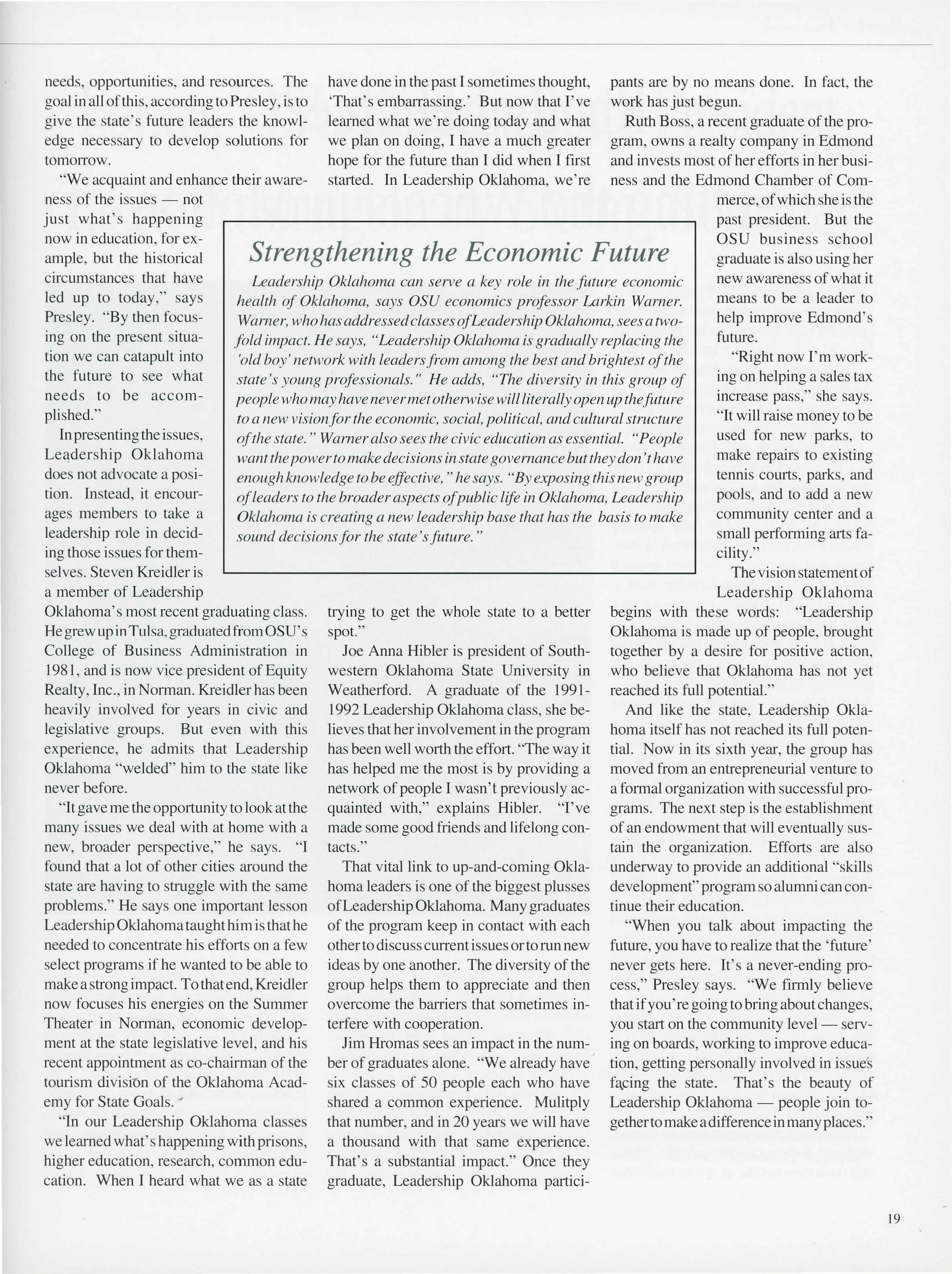
In presenting the issues, Leqdership Oklahoma does not advocate a position. Instead, it encourages members to take a leadership role in deciding those issues for themselves. Steven Kreidler is
'old boy' network with leaders from among the best and brightest of the state's young professionals." He adds, "The diversity in this group of people who may have never met otherwise will literally open up thefuture to a new vision for the economic, social, political, and cultural structure of the state." Warner also sees the civic education as essential. "People want the power to make decisions in state governance but they don't have enough knowledge to be effective, "he says. "By exposing this new group of leaders to the broader aspects of public life in Oklahoma, Leadership Oklahoma is creating a new leadership base that has the basis to make sound decisions for the state's future."
a member of Leadership Oklahoma's most recent graduating class. He grew up in Tulsa, graduated from OSU' s College of Business Administration in 1981, and is now vice president of Equity Realty, Inc., in Norman. Kreidler has been heavily involved for years in civic and legislative groups. But even with this experience, he admjts that Leadership Oklahoma "welded" him to the state like never before.
"It gave me the opp01tunity to look at the many issues we deal with at home with a new, broader perspective," he says. "] found that a lot of other cities around the state are having to struggle with the same problems." He says one important lesson Leadership Oklahoma taught hj mis that he needed to concentrate his effo1ts on a few select programs if he wanted to be able to makeastrongimpact. Tothatend, Kreidler now focuses his energies on the Summer Theater in Norman, economic development at the state legislative level, and his recent appointment as co-chllirman of the tourism division of the Oklahoma Academy for State Goals. '
"In our Leadership Oklahoma classes we learned what's happening with prisons, higher education, reseat·ch, common education. When I heat·d what we as a state
trying to get the whole state to a better spot."
Joe Anna Hibler is president of Southwestern Oklahoma State University in Weatherford. A graduate of the 19911992 Leadership Oklahoma class, she believes that her involvement in the program has been well worth the effott. "The way it has helped me the most is by providing a network of people I wasn't previously acquainted with," explains Hibler. "I've made some good friends and lifelong contacts."
That vital link to up-and-coming Oklahoma leaders is one of the biggest plusses ofLeadershipOklahoma. Many graduates of the program keep in contact with each other to discuss current issues or to run new ideas by one another. The diversity of the group helps them to appreciate and then overcome the batTiers that sometimes interfere with cooperation.
OSU business school graduate is also using her new awareness of what it means to be a leader to help improve Edmond's future.
"Right now I'm working on helping a sales tax increase pass," she says. "lt will raise money to be used for new pat·ks, to make repairs to existing tennis courts, parks, and pools, and to add a new community center and a small pe1forming atts fa-
Jim Hromas sees an impact in the number of graduates alone. "We already have six classes of 50 people each who have shared a common experience. Mulitply that number, and in 20 years we will have a thousand with that same expe1ience. That's a substantial impact." Once they graduate, Leadership Oklahoma particicility."
The vision statement of Leadership Oklahoma begins with these words: "Leadership Oklahoma is made up of people, brought together by a desire for positive action, who believe that Oklahoma has not yet reached its full potential."
And like the state, Leadership Oklahoma itself has not reached its full potential. Now in its sixth year, the group has moved from an entreprenemial venture to a formal organization with successful programs. The next step is the establishment of an endowment that will eventually sustain the organization. Efforts are also underway to provide an additional "skills development" program so alumni can continue their education.
"When you talk about impacting the future, you have to realize that the 'future' never gets here. It's a never-ending process," Presley says. "We fitmly believe that if you' re going to bring about changes, you statt on the community level - serving on boat·ds, working to improve education, getting personally involved in issue's fa.cing the state. That's the beauty of Leadership Oklahoma - people join togetherto make a difference in many places."
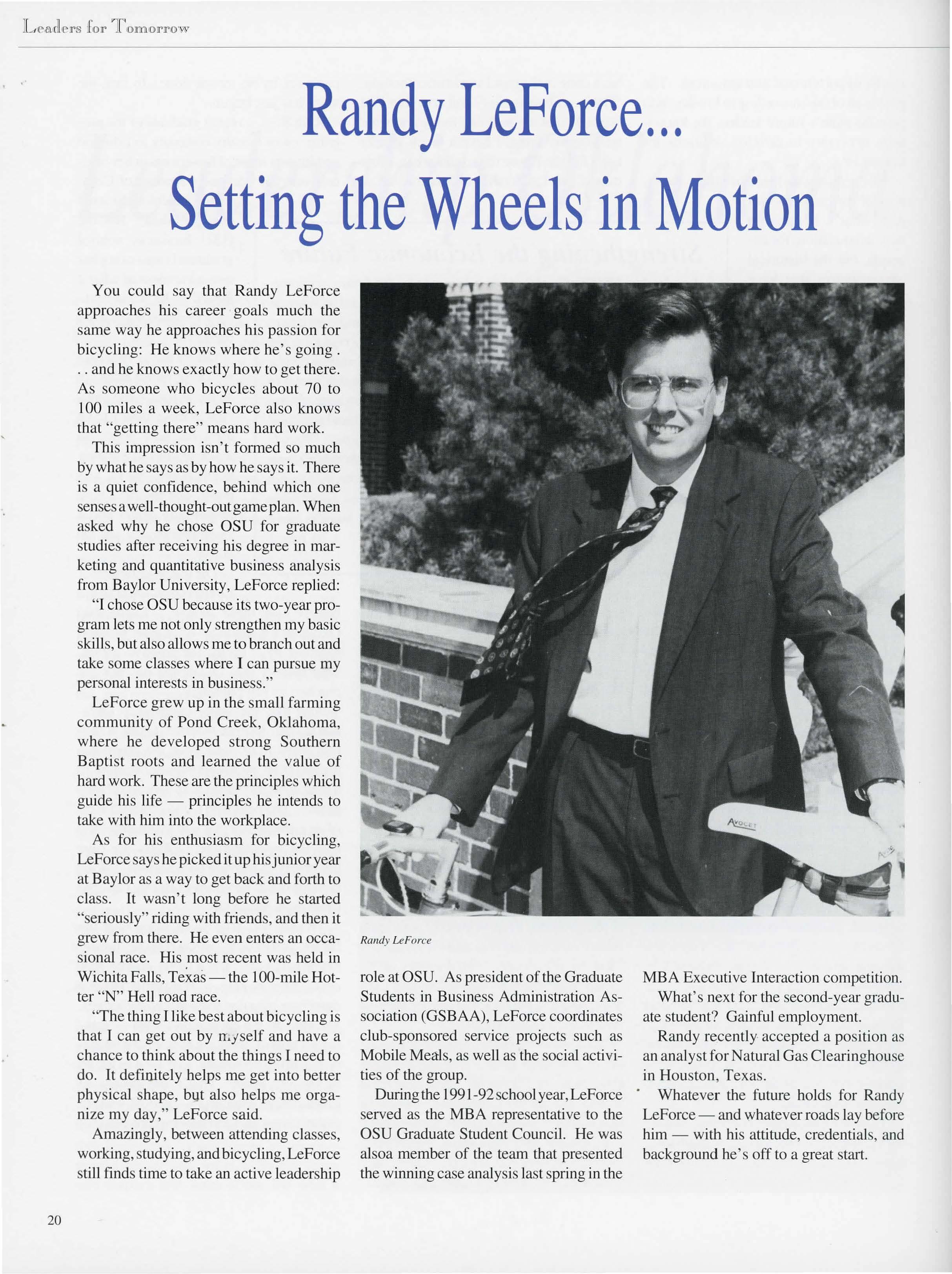
RandyLeForce ... SettingtheWheelsinMotion
You could say that Randy LeForce approaches his career goals much the same way he approaches his passion for bicycling: He knows where he's going and he knows exactly how to get there. As someone who bicycles about 70 to 100 miles a week, LeForce also knows that "getting there" means hard work.
This impression isn't fmmed so much by what he says as by how he says it. There is a quiet confidence, behind which one senses a well-thought-out game plan. When asked why he chose OSU for graduate studies after receiving his degree in marketing and quantitative business analysis from Baylor University, LeForce replied:
"I chose OSU because its two-year program lets me not only strengthen my basic skills, but also allows me to branch out and take some classes where I can pursue my personal interests in business."
LeForce grew up in the small farming community of Pond Creek, Oklahoma, where he developed strong Southern Baptist roots and learned the value of hard work. These are the principles which guide his life - principles he intends to take with him into the workplace.
As for his enthusiasm for bicycling, LeForce says he picked it up his junior year at Baylor as a way to get back and fo1th to class. It wasn't long before he started "seriously" riding with friends, and then it grew from there. He even enters an occasional race. His most recent was held in Wichita FaJls, Texas -the I 00-mile Hotter "N" Hell road race.
"The thing I like best about bicycling is that I can get out by rr.;self and have a chance to think about the things I need to do. It definitely helps me get into better physical shape, byt also helps me organize my day," LeForce said.
Amazingly, between attending classes, working, studying, and bicycling, LeForce still finds time to take an active leadership
role at OSU. As president of the Graduate Students in Business Administration Association (GSBAA), LeForce coordinates club-sponsored service projects such as Mobile Meals, as well as the social activities of the group.
During the 1991-92 school year, LeForce served as the MBA representative to the OSU Graduate Student Council. He was alsoa member of the team that presented the winning case analysis last spring in the
MBA Executive Interaction competition. What's next for the second-year graduate student? Gainful employment.
Randy recently accepted a position as an analyst for Natural Gas Clearinghouse in Houston, Texas.
Whatever the future holds for Randy LeForce - and whatever roads lay before him - with his attitude, credentials, and background he's off to a great start.
to law school. Her plans changed, however, when she realized how much she enjoyed the entire process of accounting.
Whatever her future holds, Rose seems to have what it takes to be successful. One thing is certain: Rose is no newcomer to holding office. While still a freshman, Rose chaired the OSU Student Centennial Council. And before being elected president of the OS U student body her senior year, she held the position of treasurer. Rose was also an active member of Delta Delta Delta sorority.
At the time of this interview, Rose had been working for A1thur Andersen for three days, although she was actually hired in December 1991 through an on-campus interview.
"OSU really equips its students well to enter the job market," Rose said. "In comparing my abilities to others in my staiting group at Arthur Andersen - and these ai·epeople from Georgetown, George Washington Universjty, Tulane, a11these nationally respected schools - I definitely know what I'm supposed to know and probably more than I'm supposed to know."
"But I think it's important to realize that your education goes beyond the classroom. The activities that I was able to experience outside class were half my education. And I think that's a lot of what employers look for."
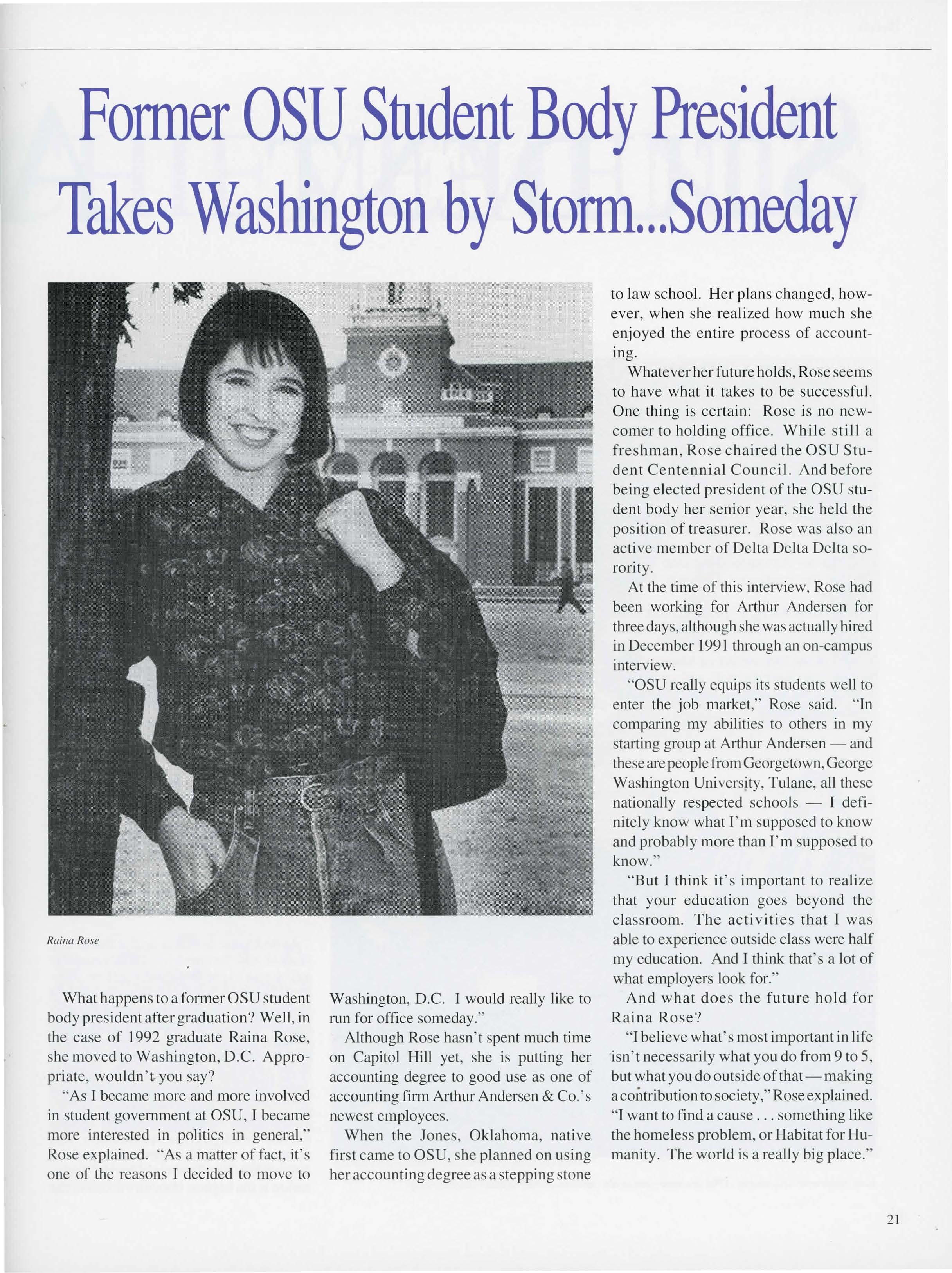
What happens to a former OSU student body president after graduation? Well, in the case of 1992 graduate Raina Rose, she moved to Washington, D.C. Appropriate, wouldn't-you say?
"As I became more and more involved in student government at OSU, I became more interested in politics in general," Rose explained. "As a matter of fact, it's one of the reasons I decided to move to
Washington, D.C. I would really like to run for office someday."
Although Rose hasn't spent much time on Capitol Hill yet, she is putting her accounting degree to good use as one of accounting firm A1thur Andersen & Co. 's newest employees.
When the Jones, Oklahoma, native first came to OSU, she planned on using her accounting degree as a stepping stone
And what does the future hold for Raina Rose?
"l believe what's most important in life isn't necessarily what you do from 9 to 5, but what you do outside of that-making a contribution to society," Rose explained. "I want to find a cause something like the homeless problem, or Habitat for Humanity. The world is a really big place."
Raina Rose
TUDENT
BA Welcomes
VisitingInternationalScholars
The CBA Office of International Business Programs coordinated the visits of two international scholars for the 1992-1993academic year.
Ma mica Pino comes from the Faculty of Economics at the University of Tirana in Albania. Ms. Pino is conducting research and guest lecturing through the OSU Departnwnt of Marketing. She is visiting OSU as an Alexander Hamilton Fellow througti the prestigious Fulb1ight Scholar Program.
F. Sebnem Aktan, a vishing sctioJar·from the Faculty of Economics at Istanbul U niverity inTurkey, is conducting research with the faculty of the Department of Ma11ag1'ment, attending graduate seminars, and serving as a guest lecturer in selected management and 111ru;\cetingcmu-ses.
MarketingStudent ReceivesI QA Student Paper Award
The International Services Quality Association selected OSU marketing doctoral student Yincentia Ann "Cindy" Claycomb as the recipient of the ISQA Best Student Paper A ward this year. Ms. Claycomb served as first author of the paper with marketing professor John C. Mowen. The award included a cash prize and an all expenses paid trip to the ISQA Quality and Services 3 Symposium in Sweden, where Ms. Claycomb presented her paper to over 200 business executives and scholars from 15 countries.
TheOSU Chi ChapterofBeta Alpha Psi was awarded a ' Superior" designation for its 1991-92achievements by the fraternity's
National Council. Beta Alpha Psi, the National Accounting Fraternity, has honored the School of Accounting's Chi Chapter with this designation four of the past five years, the last thrne years consecutively.
MarketingStudentChosen for All USA College AcademicTeam
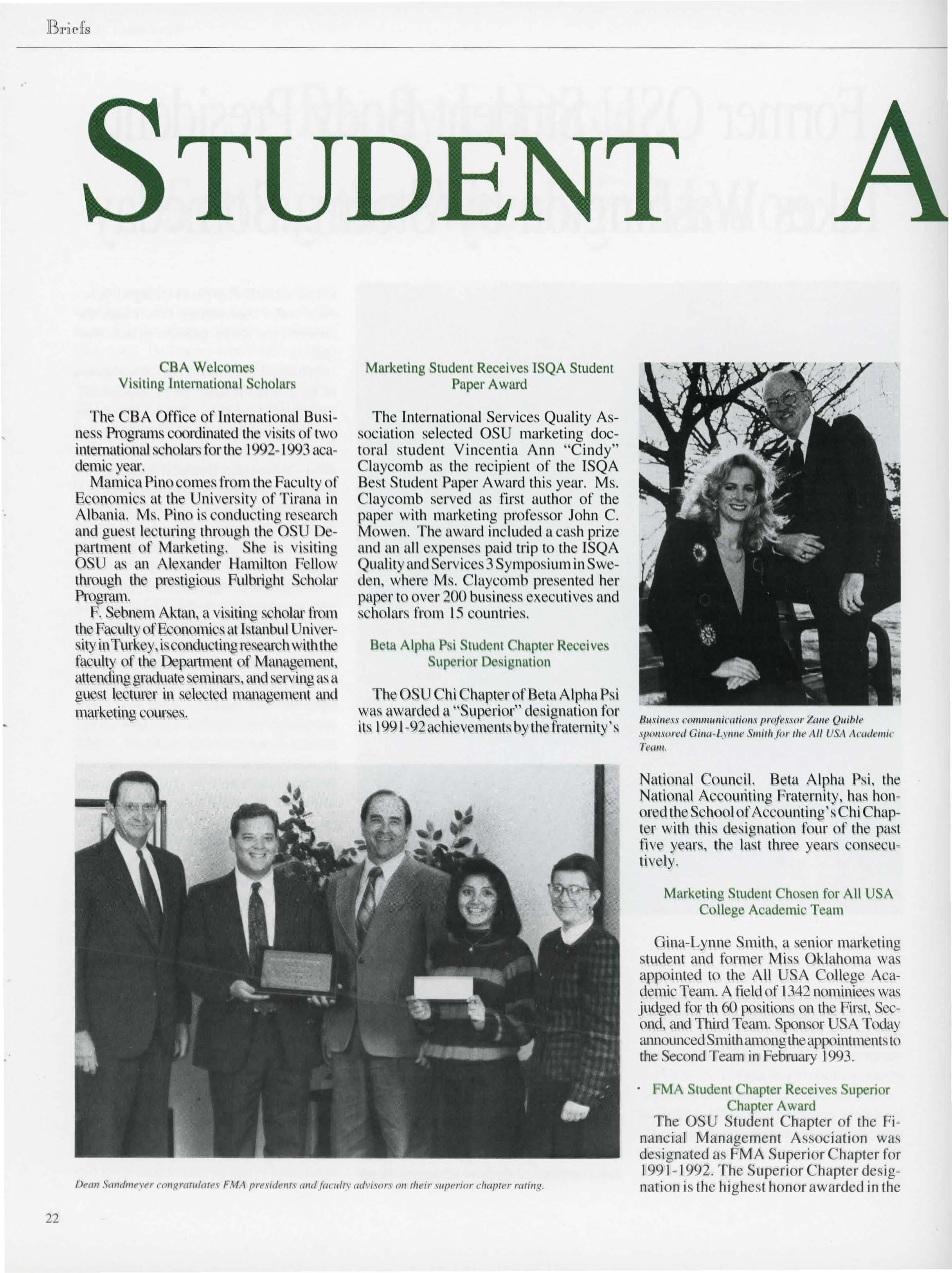
Gina-Lynne Smith, a senior marketing student and former Miss Oklahoma was appointed to the All USA College Academic Team. A field of 1342 nominiees was judged for th 60 positions on the First, Second, and Third Team. Sponsor USA Today mmounced Smith mnong the appointments to the Second Team in Februaiy 1993.
MA tud nt hapter ReceivesSuperior Chapter Award
The OSU Student Chapter of the Financial Management Association was designated as FMA Superior Chapter for 1991-1992. The Superior Chapter designation is the highest honor awarded in the
Smulmeyer
Bu.,·it,es.,-<'omnwnicatim1sprofessor Za11eQ11ib/e spm1sored Gi11(1-ly1111eSmith for the All USA Amdemic Tewn.
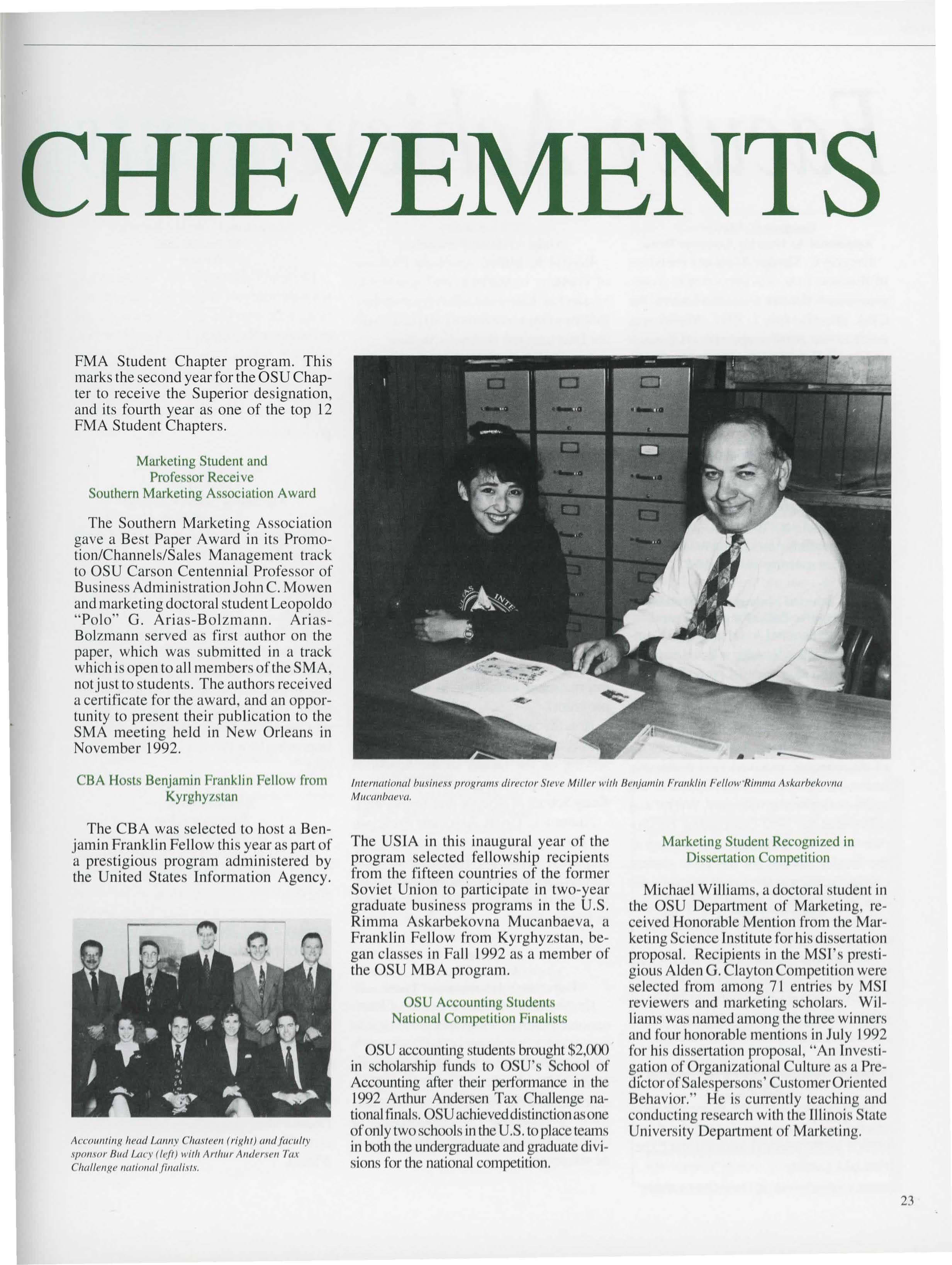
CHIEVEMENTS
FMA Student Chapter program. This marks the second year for the OSU Chapter to receive the Superior designation, and its fourth year as one of the top 12 FMA Student Chapters.
Marketing Student and Professor Receive SouthernMarketingAssociationAward
The Southern Marketing Association gave a Best Paper Award in its Promotion/Channels/Sales Management track to OSU Carson Centennial Professor of Business Administration John C. Mowen and marketing doctoral student Leopoldo "Polo" G. Arias-Bolzmann. AriasBolzmann served as first author on the paper, which was submitted in a track which is open to all members of the SMA, not just to students. The authors received a certificate for the award, and an opportunity to present their publication to the SMA meeting held in New Orleans in November 1992.
CBA Hosts Benjamin Franklin Fellow from Kyrghyzstan
The CBA was selected to host a Benjamin Franklin Fellow this year as part of a prestigious program administered by the United States Information Agency.
The USIA in this inaugural year of the program selected fellowship recipients from the fifteen countries of the former Soviet Union to participate in two-year graduate business programs in the U.S. Rimma Askarbekovna Mucanbaeva, a Franklin Fellow from Kyrghyzstan, began classes in Fall 1992 as a member of the OSU MBA program.
OSU AccountingStudents National CompetitionFinalists
OSU accounting students brought $2,000 in scholarship funds to OSU's School of Accounting after their petformance in the 1992 Aithur Andersen Tax Challenge national finals. OS U achieved distinction as one ofonlytwoschools in the U.S. to place teams in both the undergraduate and graduate divisions for the national competition.
Michael Williams, a doctoral student in the OSU Department of Marketing, received Honorable Mention from the Marketing Science Institute for his dissertation proposal. Recipients in the MSl's prestigious Alden G. Clayton Competition were selected from among 71 entries by MS! reviewers and marketing scholars. Williams was named among the three winners and four honorable mentions in July 1992 for his dissertation proposal, "An Investigation of Organizational Culture as a Predictor of Salespersons' Customer Oriented Behavior." He is currently teaching and conducting research with the Illinois State University Department of Marketing.
Acco11111inghead Lanny Clw.1·teen(ri!iht) ,11ul.fc1culty sponsor 811dLacy (left) with Arthur Andersen Tax Clwlle1111enational fl11a/i.ws.
/111enwtio11a/bush1esj•programs director Steve Miller with BenjaminFra11kli11Fellow•RimmaAskarbekuv,w M11c:a11bae1•a,
FacuityAchievements
Gregory C. Mosier
Appointed As Interim Associate Dean
Gregory C. Mosier, Associate Professor of Business Law, was appointed to a oneyearterm as Interim Associate Dean of the CBA, effective July I, I 992. Mosier was named to the position upon the resignation of John T. Bale, Jr., who has resumed fulltime teaching and research activities as the Regents Distinguished Service Professor in the Department of Administrative Services.
Accounting Professor Elected Vice President of AAA
Gary K. Meek, School of Accounting Alumni Professor, was elected to a twoyear term as Vice President of the American Accounting Association at the annual association meeting in Fall 1992.
lACIS Selected Management Professor Computer Educator of the Year
The International Association for Computer Wo1mation Systems selected management inf01mation systems professor Daryl Nord as Computer Educator of the Year.
Professor Recognized by Beta Alpha Psi
T. Sterling Wetzel, Associate Professor of Accounting, received two distinctive honors in 1992 from Beta Alpha Psi, the national accounting fraternity. Wetzel was selected as the 1992 Outstanding Faculty Advisor by the fraternity, after serving as the faculty advisor for the OSU student chapter for the past five years. Wetzel is the first faculty advisor to OSU's (:hj Chapter to receive this award since the chapter was founded in 1939.
Wetzel was alsb elected by Beta Alpha Psi to a three-year term as regional director. The position holds oversight responsibilities for approximately 40 chapters under the regional director's jurisdiction.
Finance Professor Selected as President of ABSEL
Finance professor John Wingender was elected this year as president of the Association for Business Simulation and Experiential Leaming.
CBA Faculty
Gain A Global Perspective
Ronald K. Miller, Associate Professor of Finance, is teaching and conducting research in Italy as an MBA International Fellow of the Consortium of Universities for International Business Studies.
John R. Wingender, Associate Professor of Finance, is the recipient of a Fulbright Scholarship funding lecturing and research at the International Management Center in B~dapest, Hungary in Spring 1993.
David S. Murphy, Assistant Professor of Accounting, received a Fulbright teaching grant which will take him to Pontifica Universidad Catolica in Lima, Peru in Summer 1993.
Amy Hing-Ling Lau, Kerr-McGee Professorof Accounting, is teaching and conducting research at the Hong Kong School of Science and Technology as part of the OSU School of Accounting's endeavor to develop an international emphasis in its doctoral programs.
Hon-Shiang Lau, Regents Professor of Management, is conducting research and serving on the faculty of the School of Business and Management of the Hong Kong School of Science and Technology.
Andrew L. Urich, Associate Professor of Business Law, and Pauline W. Kopecky, Associate Professor of Economics, are teaching and conducting research this year at the OSU sister campus in Kyoto, Japan.
Miller Appointed to Governor's International Team
Dr. Stephen J. Miller, Director of International Business Programs at OSU, was appointed as a member of the Governor's international Team. The team is an association of individuals involved in government and the private sector who perform or supervise the performance of others in fields of international trade and development.
Marketing Professor Receives Mu Kappa Tau Award
Dr. John C. Mowen, OSU' s Carson Centennial Professor of Business Administration, was selected as a recipient of the prestigious Mu Kappa Tau A ward for Outstanding A11iclein the Journal of Personal Selling & Sales Management. Mu Kappa Tau is the national marketing honor society, comprised of scholars and marketing professionals.
Management Professor Winner in
Marketing Science Institute
Competition Management professor Ramesh Sharda was selected as winner in a Marketing Science Institute research competition on Enhancing the New Product Development Process.
Sharda and OSU mechanical and aerospace engineering professor Ronald Delahoussaye received honorable mention in the competition for their work entitled "An Expe11System Network Based on Concurrent Engineering Concepts for Improving New Product Development Process."
Business Faculty
Recognized for Academic Excellence
Several business faculty members received awards in Fall 1992 for teaching and academic accomplishment. Business communications professor Zane Quible received the Regents' Distinguished Teaching Award for the College of Business Administration. The Burlington Northern Faculty Achievement Award was.given to marketing professor John Mowen. Economics professor Richard Poole was awarded the Me1Tick Foundation Teaching Award on 0 the American Free Enterprise System. Business communications professor Dennis Mott was chosen for the University Extension Faculty Excellence Award.
Robert L. Sandmeyer, Dean
Gregory C. Mosier, Interim Associate Dean
I I
Lanny G. Chasteen, Arthur Andersen Alumni Centennial Professor and Head, School of Accounting
Patrick B. Dorr. Professor
Lawrence H. Hammer, Professor
Don Hansen, Professor
Carol Johnson, Assistant Professor
Janet I. Kimbrell, Associate Professor
M. E. "Bud" Lacy, Associate Professor and Coordinator of Graduate Programs
Amy Hing-Ling Lau, Kerr-McGee Professor of Accounting
Gary K. Meek, School of Accounting Alumni Professor
Maryanne M. Mowen, Associate Professor
David S. Murphy, Assistant Professor
Kevin E. Murphy, Associate Professor
Dennis 1-1.Pal7.,KeIT-McGeeProfessor of Accounting
Charles R. Ransom, Associate Professor
T. Sterling Wetzel, Associate Professor
John H. Wilguess, Professor
Charlone J. Wright, Professor
Joe W. Fowler, Professor of Business Law and Head, Department of Administrative Services
John T. Bale, Jr., Regents Distinguished Service Professor
James M. Jackman, Associate Professor of Business Law
Tipton F. McCubbins, Associate Professor of Business Law
Dennis L. Motl, Professor of Business Communications
Zane K. Quible. Professor of Business Communications •
Jeanine N. Rhea, Professor of Business Communications
Andrew L. Urich, Associate Professor of Business Law
etJtll(tl/KltJ.f' ,
Ronald L. Moomaw, Professor and Head, Depaitment of Economics
Lee C. Adkins, Assistant Professor
Orley M. Amos, Jr Professor
Michael J. Applegate, Professor
Kevin M. CutTier, Associate Professor
Michael R. Edgmand, Professor
James R. Fain, Associate Professor
Mary Gade, Associate Professor
Joseph M. Jadlow, Jr., Professor
Gerald M. Lage, Professor
Kent W. Olson, Professor
Edward 0. Price, III, Associate Professor
Andreas Savvides, Associate Professor
Frank G. Steindl, Regents Professor
Larkin B. Warner, Regents Professor
Keith D. Willett, Professor
Margaret A. White, Associate Professor
Rick L. Wilson, Assistant Professor
L. Lee Manzer, Professor and Head, Department of Marketing
TeITy Bristol, Assistant Professor
Gou tam Chakrab01ty, Assistant Professor
Gary L. Frankwick, Assistant Professor
Richard Gennain, Assistant Professor
James G. Hromas, Associate Professor and Director, University Extension
Ruth Haas Kreiger, Associate Professor
Stephen J. Miller, Professor and Director, Center for Product and Service Quality, and Director,
Janice W. Jadlow, Associate Professor and Head, International Business Programs Depa11men1of Finance
John C. Mowen, Ill, Professor and Carson Centen-
Anne E. Gleason, Assistant Professor nial Chair of Business Administration
James F. Jackson, Jr., Associate Professor
Timothy L. Krehbiel, Assistant Professor
Ajay S. Sukhdial, Assistant Professor
Joshua L. Wiener, Associate Professor and Interim
Ronald K. Miller, Associate Professor Director, Office of Business & Economic
John A. Polonchek, Associate Professor Research
W. Gaiy Simpson, Professor and Oklahoma Bankers
William G. Zikmund. Professor Association Chair of Commercial Bank Management
Rory L. TeITy, Assistant Professor
John R. Wingender, Associate Professor
Wayne A. Meinhait, Professor and Head, Depaitment of Management -
Richard A. AukeITnan, Professor
Steve H. Barr, Associate Professor
Raja Basu, Assistant Professor
James D. Boge11, Assistant Professor
Nikunj P. Dalal, Assistant Professor
Kenneth K. Eastman, Assistant Professor
Vance H. Fried, Associate Professor
David C. Ho, Professor
Timothy C. Ireland, Professor
Marilyn G. Kletke. Professor
Chalrner E. Labig, Jr., Associate Professor
Hon-Shiang Lau, Regents Professor
Debra L. Nelson, Associate Professor
G. Daryl Nord, Professor
Jeretta Horn Nord, Associate Professor
Jayaram Ramanathan, Assistant Professor
Ramesh Sharda. Professor and Conoco/DuPont Chair of Technology Management
Faye L. Smith, Assistant Professor
Thomas H. Stone, Professor
J. Scott Turner, Professor
VISION Magazine is a publication of the Oklahoma State University College of Business Administration designed to bring the latest iii 1nfonnation in business and education to the !!I College's many constituents.
Edirors: Rudy Greer and Cindy Mitchell. Design: Kelly A. Reed. Photos: Andy Maxey, Randy Driver, Helt Photography, Conoco, Halliburton, 3M, and PSO.
College of Business Administration, Oklahoma State University, Stillwater, Oklahoma 74078-0555, (405) 744-5064.
Oklahoma Slate University. in compliance with Title VI and VII of 1hc Civil Rights Act of 1964. Executive Order 11246 as amended. Title IX of 1heEducation Amendment of 1972. Americans With Disabilities Ac1 of 1990. and 01her • federal li.1wsand regulations, does not discrimina1e on 1hc basisof race. color. na1ionalorigin. sex. age. religion. disability. or s1a1usas a veteran in any of its policies. practices. or procedures. This includes but is not limited to admissions, employment, financial aid, and educational services. This publica1ion. issuedby Oklahoma State University as authorized by the Dean of the College of BusinessAdministration. was printed by University Printing Services at no cost 10 the taxpayers of Oklahoma. March 1993.
BuildingLeaders fortheTwenty-FirstCentury
The Colle_geof Business Administration recently developed a new mission which will take the college into the new century as an innovative center of learning and research. Partnerships with alumni, business professiol'lals, and individuals will be c1itical to the success of this mission. Through these paitnerships we can bring the knowledge of professionals into our classrooms, fund the equipment necessary for a strong technological base in the college, and solicit input in planning for the future.
If you wish to supp01t the mission of the College of Business Administration, financially or otherwise, please contact Rudy Greer, Director of Planning and Operations, at (405) 744-5064.