Oklahoma State University College of Business Administration
From the Dean

Oklahoma State University College of Business Administration
It is the job of education to prepare the way toward the future.
America's geography and heritage have fostered independence and insulation for years. But if there is any concept that should rule us in the 1990s, it is unity. It is not even a matter of choice in today's world. Global connections have been changed by the very forces that we helped create during the last 20 years - communications technology. Essentially, there is nowhere to hide anymore, if there ever really was. Witness the events in the Soviet Union. The August coup failed for lack of managerial skills - done in by international fax and telephone communications.
Consider the volatility of the world's stock markets as they have been interconnected via computer. Those connections have changed investment strategies forever.
Or consider the Gulf War. On one occasion when President Bush was asked about the latest events, he turned to his television set and remarked that he needed to check with CNN. It was not a joke. The immediacy of satellite coverage caused problems for the military. They had difficulty keeping tactical secrets when everything was being broadcast into millions of homes around the world in close to real-time.
Our ability to communicate around the globe is phenomenal. It brings us both enormous opportunities and responsibilities.
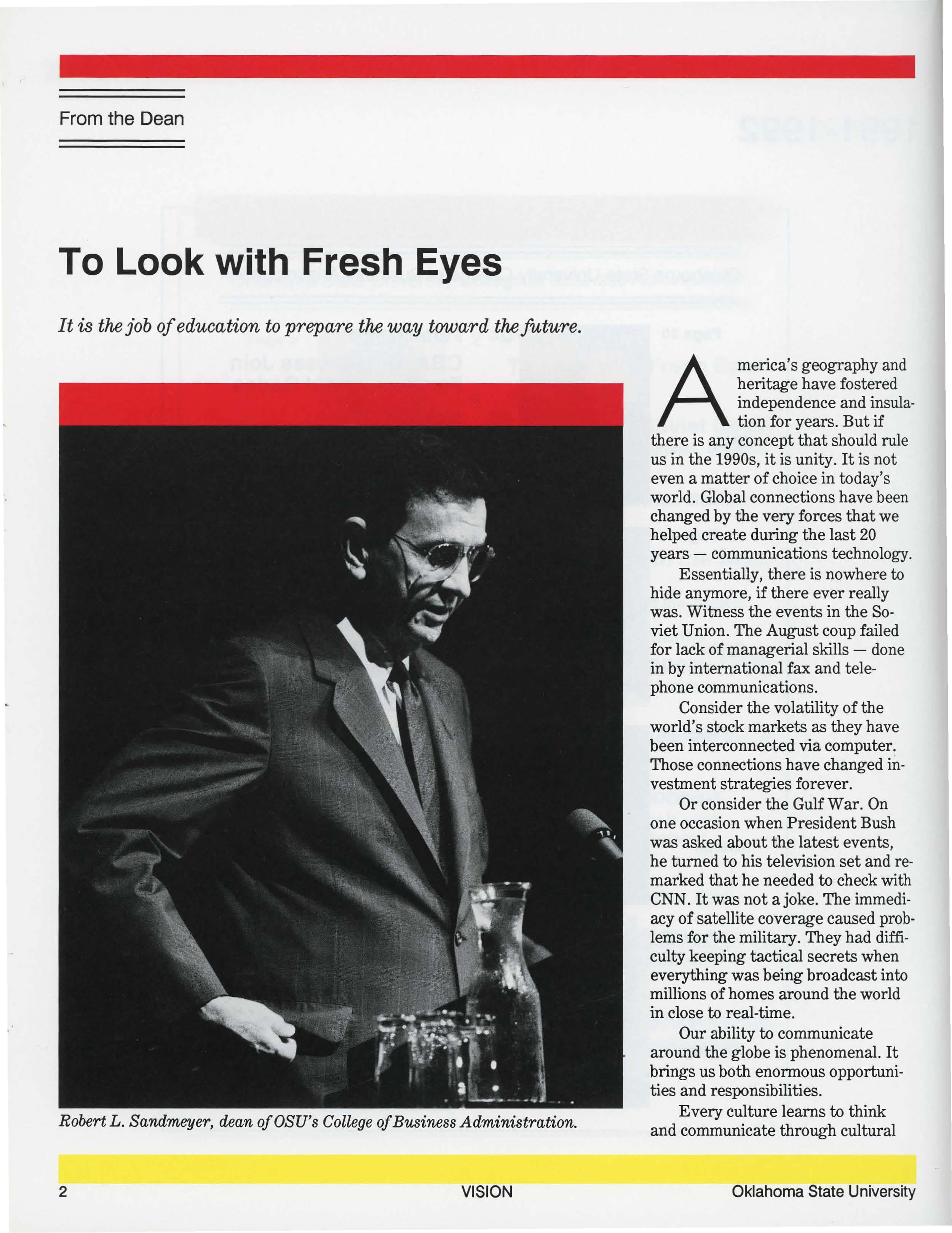
RobertL. Sandmeyer, dean oJOSU's Collegeof Business Administration.
Every culture learns to think and communicate through cultural
symbols,a sort of shorthand. These idiomsare what give the culture/language its color - and what exasperates us the most when we try to learn a second language. It is also what makes it so easy for all of us to be misunderstood.
Our cultures - our politics, even our management styles - are ruled by our geography. Where there is plenty of land - as in America - we think large, we dream large. We may not need to scrimp or save. We simplymove. We build larger cars, larger homes and think big.
But where there is little land, as in Japan or the Netherlands, we think small. We find ways to make the most of space and resources. Neither approach is right or wrong. It is simply adapting to our environment.
But our environment has changed. Our horizons have grown larger - global - at the same time that they have shrunk. Now that we are able to see the whole, we recognize just how small it actually is.
So while the entire world is reaching out to other countries, able to communicate technologically, we suddenly find, at the same time, a fierce return to old feudal loyalties. It is a true example of the ancient Chinese ying/yang principles of opposites, two faces of the same coin.
While we yearn for the ability to reach beyond and through the cultural barriers of language, geography and life styles, we find comfort in the old order of things. While we have the tools to communicate around the globe, we have difficulty
understanding those who think differently than we do. More important, we still have difficulty accepting those differences.
Yet America cannot afford such insular national thinking. Our arrogance will not carry us any longerif it ever has - just as it will no longer carry any nation in today's global economy.
If we, as educators, can bring anything to this global soup, it should be an ability to reach beyond those cultural barriers to create unions. We have time and opportunity to experiment. We are paid to learn, to explore boundaries that others may have neither time nor resources, inclination nor opportunity, to explore. It is our job to prepare the way - through research, education, connections - to create the spiderwebs - the networks - that will encircle the globe.
International partnerships are imperative. Our existence depends upon them. We must take an active role in contributing to these partnerships, creating a sort of value-added entity. After all, we have something both to teach and to learn.
Our concept of business education was once scorned by Europeans as little more than training for a trade. Yet America's business concepts turned Japan and Germany around after World War II. Now they are being taught to thousands in Europe. Today, MBA degrees are the hottest degrees in Europe. They have copied the American concept
and are doing it well. Democracy and democratic education are a growth business.
We, on the other hand, have relearned a great deal from the Japanese about quality. And there is more to learn and relearn.
The old order is gone. What worked when we could see the horizon is no longer valid. We must turn our thinking inside out. We no longer need managers: we need street :fighters and negotiators. We must look for a new strategy - not to beat the competition but to deliver value to our customers. There are few experiences more exhilarating than sitting down with a group of men and women who bring something new to the table - a fresh viewpoint, another way of approach·•ing the problems.
•• Kenichi Ohmae, a respected J apanese business consultant and author, recalls that Konosuke •Matsushita, founder of Matsushita Electric Industrial, has one phrase he often repeats to his workers and compatriots: "Torawa-renai sunaona kokoro" - "mind that does not stick." That is what America's educators must bring to the table - a new way to approach things, the ability to look with a fresh pair of eyes.
The truth is, there are only so many types of problems. But there may be endless answers when we have many eyes from which to see.
Robert Sandmeyer
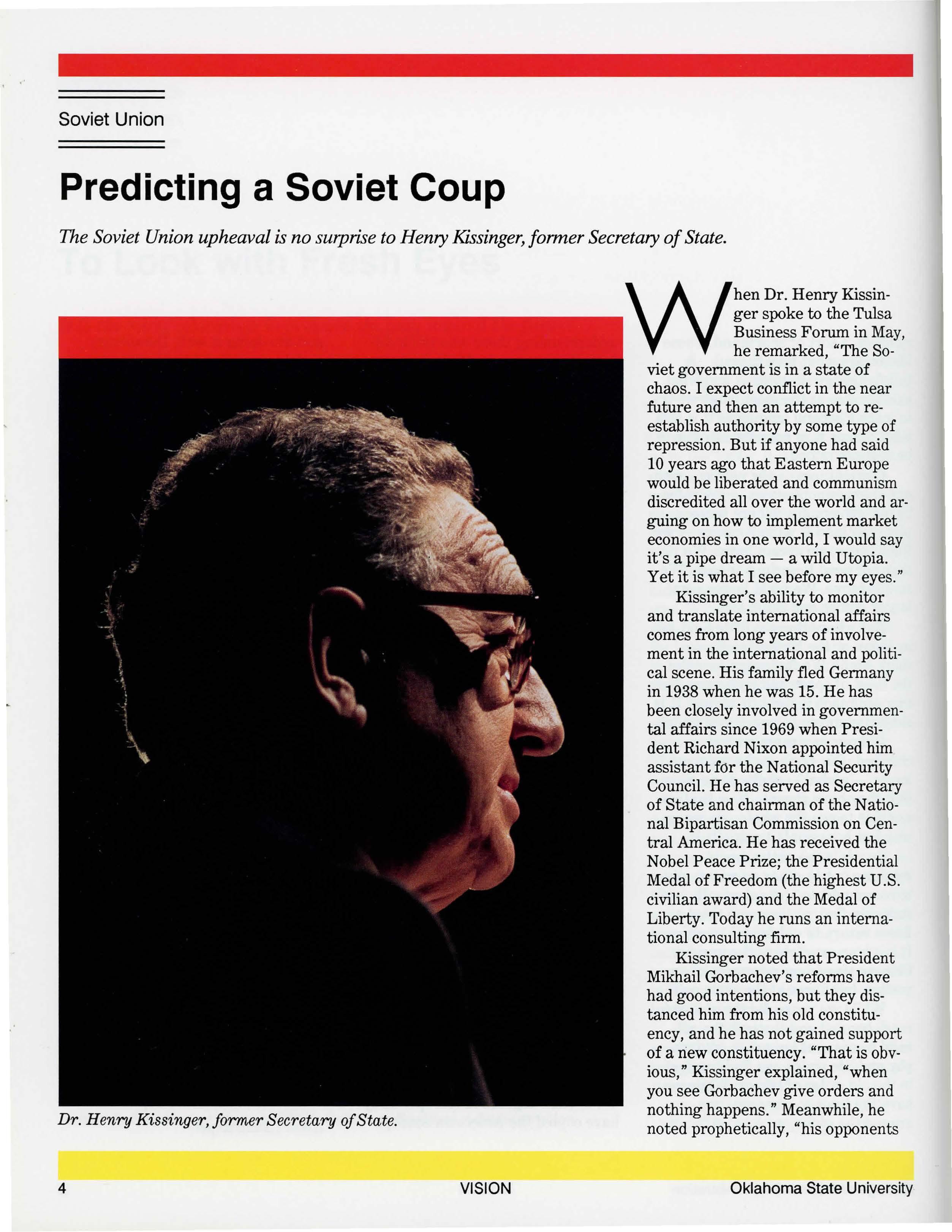
The Soviet Union upheaval is no surprise to Henry Kissinger, former Secretary of State.
When Dr. Henry Kissinger spoke to the Tulsa Business Forwn in May, he remarked, "The Soviet government is in a state of chaos. I expect conflict in the near future and then an attempt to reestablish authority by some type of repression. But if anyone had said 10 years ago that Eastern Europe would be liberated and communism discredited all over the world and arguing on how to implement market economies in one world, I would say it's a pipe dream - a wild Utopia. Yet it is what I see before my eyes."
Kissinger's ability to monitor and translate international affairs comes from long years of involvement in the international and political scene. His family fled Germany in 1938 when he was 15. He has been closely involved in governmental affairs since 1969 when President Richard Nixon appointed him assistant for the National Security Council. He has served as Secretary of State and chairman of the N ational Bipartisan Commission on Central America. He has received the Nobel Peace Prize; the Presidential Medal of Freedom (the highest U.S. civilian award) and the Medal of Liberty. Today he runs an international consulting firm.
Kissinger noted that President Mikhail Gorbachev's reforms have had good intentions, but they distanced him from his old constituency, and he has not gained support of a new constituency. "That is obvious," Kissinger explained, "when you see Gorbachev give orders and nothing happens." Meanwhile, he noted prophetically, "his opponents
are becoming organized. He'll have to line up with the reformers or the conservatives, but neither trust him." Kissinger predicted that one of three things would happen"Gorbachevwill be removed from office,become a :figurehead or combine forces with the army or the KGB,the Soviet secret police. But if he looks like a semidictator, he'll lose the favor he's won with the Western world."
The conflict Kissinger predicted erupted in August. The three-day coup attempt had all the elements of danger found in a good spy thriller, along with a host of characters bumbling their way through a third-rate farce. The tragedy was, however, that the potential outcome directly affected more than 290 million people.
The men behind the coup - the State Committee for the State of Emergency- were Gorbachev's own hand-picked Communist Party leaders who felt he had gone too far beyond the bounds of Communism. Gorbachevand his family were held hostage at their private retreat in the Crimean. Their only connection to the outside world was a shortwave radio rigged up by a loyal guard. It picked up the British Broadcasting Corp., Radio Liberty and the Voice of America. The "coup plotters" announced that Gorbachev was too ill to run the country- an old party line that ha;, become a classic joke. Critics suggested they should have at least been more imaginative in their lies, while Gorbachev
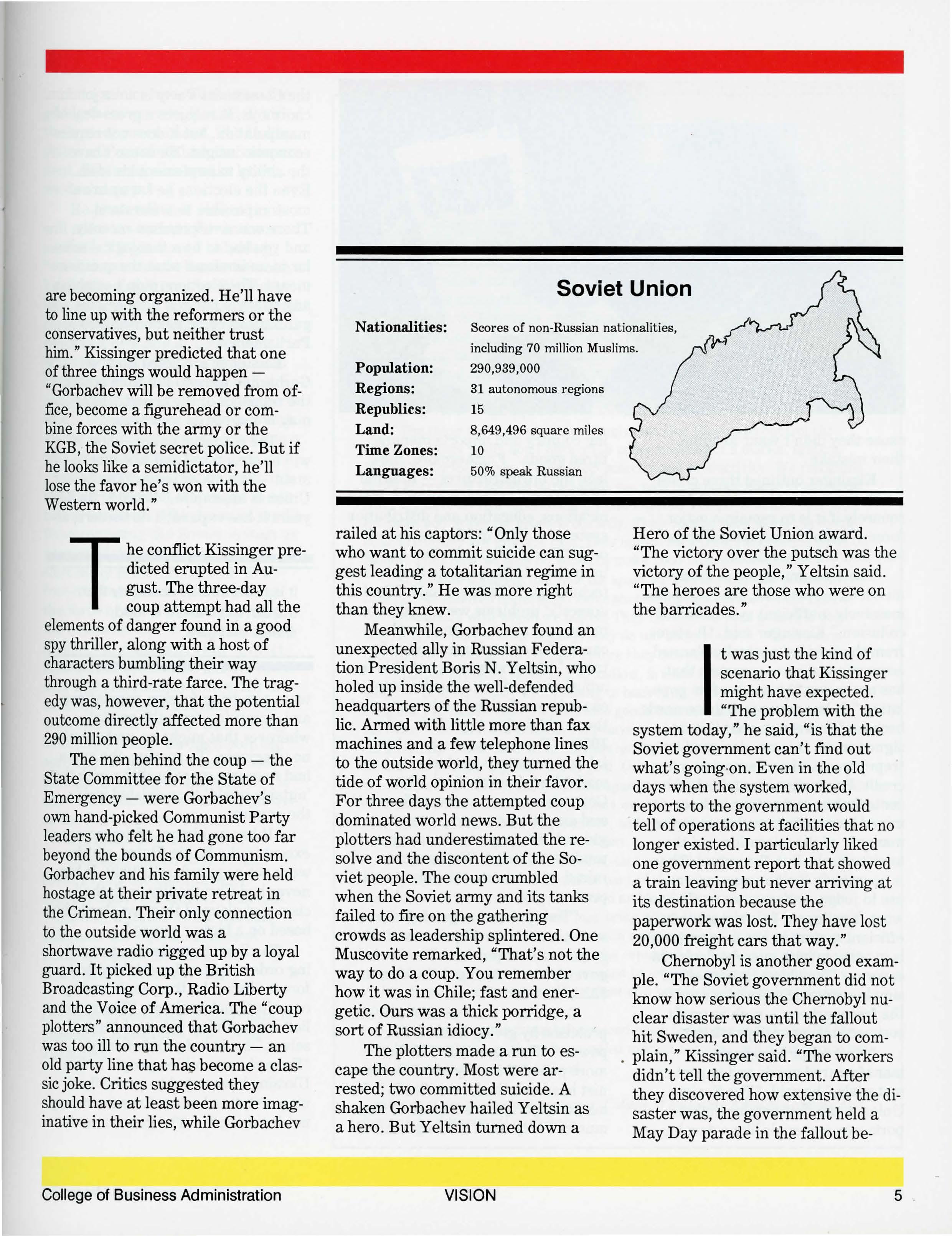
Nationalities: Scores of non-Russian nationalities, including 70 million Muslims.
Population: 290,939,000
Regions: 31 autonomous regions
Republics: 15
Land: 8,649,496 square miles
Time Zones: 10
Languages: 50% speak Russian
railed at his captors: "Only those who want to commit suicide can suggest leading a totalitarian regime in this country." He was more right than they knew.
Meanwhile, Gorbachev found an unexpected ally in Russian Federation President Boris N. Yeltsin, who holed up inside the well-defended headquarters of the Russian republic. Armed with little more than fax machines and a few telephone lines to the outside world, they turned the tide of world opinion in their favor. For three days the attempted coup dominated world news. But the plotters had underestimated the resolve and the discontent of the Soviet people. The coup crumbled when the Soviet army and its tanks failed to fire on the gathering crowds as leadership splintered. One Muscovite remarked, "That's not the way to do a coup. You remember how it was in Chile; fast and energetic. Ours was a thick porridge, a sort of Russian idiocy."
The plotters made a run to escape the country. Most were arrested; two committed suicide. A shaken Gorbachev hailed Yeltsin as a hero. But Yeltsin turned down a
Hero of the Soviet Union award.
"The victory over the putsch was the victory of the people," Yeltsin said. "The heroes are those who were on the barricades."
It was just the kind of scenario that Kissinger might have expected.
"The problem with the system today," he said, "is 'that the Soviet government can't find out what's going-on. Even in the old days when the system worked, reports to the government would •tell of operations at facilities that no longer existed. I particularly liked one government report that showed a train leaving but never arriving at its destination because the paperwork was lost. They have lost 20,000 freight cars that way."
Chernobyl is another good example. "The Soviet government did not know how serious the Chernobyl nuclear disaster was until the fallout hit Sweden, and they began to complain," Kissinger said. "The workers didn't tell the government. After they discovered how extensive the disaster was, the government held a May Day parade in the fallout be-
cause they didn't want to admit their mistake."
Kissinger outlined three crises which the Soviet Union must face squarely if it is to remain a major force - economics, political structure and the union itself.
The economic crisis is "of tremendous proportions, the result of a massively inefficient system full of collusion," Kissinger said. "It stems from the Soviets' centrally planned economic system - a system that has never met the needs of its population." It has never met those needs because "that is not what it is designed to do. It is not designed by entrepreneurs; it has no market and no credit. Production is established by a central plan, and output is determined by negotiations between the manager of the operation and the ministers who buy the output. There is no criteria the government can use to judge performance or find out what is going on. It is a massively inefficient system in which everybody is in cahoots with everybody else to cover up. They have no concept of simple economic principles used in the free markets - such as profit, cost accounting or depreciation.
"Most empires export manufactured goods and import raw materials," he said. "The Soviet Union is the first empire that exports raw materials like a develop-
ing country and imports manufactured goods." Furthermore, they lack the infrastructures - internal and external transportation, communications, education and distribution systems - vital for the market economy. "Soviet oil production dropped in the late 1970s because they lacked technology," Kissinger said. "Soviet domestic problems were made worse in the past six or seven years because of so many huge policy mistakes." The system was not able to adjust to rapid price ·fluctuations caused by inflation in other areas of the world during the 1970s and 1980s. "Every measure they have taken to increase productivity has made things worse. And, after Gorbachev came to power, :financial and monetary concerns were neglected. All measures to increase production failed. Wages were raised without any relation to real productivity.
"Today their budget deficit consumes more than 20 percent of the gross national product. The Soviet government is facing default on its $53 billion debt."
Gorbachev has "tried to solve his problems by giving himself more power," Kissinger said. "He has more power than any other Communist head ever had, even Stalin." But his job experience is limited to Communist Party work. "Being head of
the Communist Party is not a job for choirboys. It requires a great deal of manipulation, but it does not require economic insight. He doesn't have the ability to implement his ideas. Even the elections he set up are almost impossible to understand. There was a referendum recently, and you had to be a theological scholar to understand what the question meant. The elections didn't establish any political parties, although organizations could elect members to Parliament."
Kissinger predicted that "if Gorbachev were to fall from power, the republics of the Soviet Union may not agree on a successor."
The potential union - how it will be structured and who will remain - is a major issue. "The Soviet Union is an empire," he said. "In 300 years it has expanded its borders, al-
It is not a market economy that the Soviets want; it is food, shelter and jobs.
ways acquiring foreign populations and governing from the capital, wherever that might be, and gaining no allegiance. To survive, the union had to create more hostility with the 'outside world' than existed inside the empire.
"It has no history of democracy, except in the Baltic States, which were not acquired until 1940. It has never had Christianity or Catholicism that claimed that law should be based on a higher power."
The Soviet people are demanding order - an order established by forces elected by the people and by constitutional methods. "The republics are straining to assert themselves," he added prophetically. "Even the six million people in the Ukraine have voted to issue Ukrainian script and make Russian money not legal tender. The governments
in the republics have elected leaders, giving them more legitimacy than the central government. The Baltic states will certainly become independent. Whatever else breaks loose, we don't know."
He predicted that such action will make the economy even more unstable. "Right now," he added, "conditions are too chaotic to make long-term commitments. We must look at American interests. We must consider how our country should react to a new Soviet Union and what we want from it. I agree with President Bush that we shouldn't tie ourselves to one leader," Kissinger said. "We must keep in contact with all the republics since we don't know what the outcome may be."
Gorbachev has the ability to manipulate power but no insight in economic evolution. "He deserves credit for recognizing the Soviet system as poor and letting Eastern Europe shift away from communism to a free-market system without using the force of the Red Army to keep the countries tied to the party." But it is best to remember that "Soviet restraint in the Middle East is not a sign that the country converted to American thought but that it is in deep economic trouble with no way to emerge except through political assistance." Kissinger then added that the most important question is not "Will Mikhail Gorbachev survive as the Soviet Union's leader?" but "Will it make any difference?"
Kissinger noted that Yeltsin could have a stronger base of support than Gorbachev. "I look at Yeltsin as a leader in the Russian tradition. He's quite capable of being an authoritarian leader of a free-market economy."
Dr. Henry Kissinger is chairman of Kissinger Associates, Inc., New York City.
Boris Yeltsin, speaking before the Congress of Peoples, after the Soviet coup had failed, remarked, "This [union]is a bear, a giant bear. And this wheel needs to be put in motion. And this is what I want to do, to set it in motion." But a free-market system in the Soviet Union may still be a long way off, according to Janice Jadlow, associate professor of the College of Business Administration and head of the department of finance.
Jadlow visited the Soviet Union in 1989 as part of the People to People program. The group of 25 was made up of financial management expertshalf academic, half business executives. "As part of the program, we visited four major cities - Moscow, Leningrad, Riga (Latvia) and Minsk. We met with the local banker - there was, for example, only one bank in Riga - as well as the local minister of finance and the business faculty at the local university. We also met with the minister of the Gosbank, the Soviet Union's central bank, which is the equivalent of the U.S. Federal Reserve.
"The thing that came out so strongly was that those who control the Soviet economy really don't have a full understanding of a market system. Money and prices in the West reflect scarcity and productivity. We recognize profit as revenue received minus what you paid to produce goods or services. But they have no real functioning private market. The government sets interest rates and prices for goods arbitrarily. Their central bank loans the money at an artificially low interest rate. They ignore such things as interest costs on money. They have no base on which to make good business decisions.
"It became apparent just how far apart we still are and how powerful culture is. Our children understand more about a market economy than the Soviet economists with whom we talked. They have never seen a market economy; it is not part of their history; they do not understand it. The country faces massive changes in thought before they can move to a market economy."
Another problem, according to Jadlow, is what is known as "ruble overhang" - printed money with nothing to back it up. "There are all these rubles, but you cannot convert them into goods because there are no goods or services," she said. "In a sense, they have trouble converting their own capital internally. Some have proposed converting the ruble to gold because the Soviets do produce a great deal of gold. Others have propc,>sedauctioning off the state-owned farms, factories and apartments. Theoretically, this would absorb these rubles, and these operations would begin to function as private enterprises. But there is no easy answer, and you can see that as the leaders struggle to come to grips with the issues.
"Communism has been a welfare state - cradle-to-grave," Jadlow said. "The people do not want to give that part of the system up yet. They simply want it to work better. They want food and jobs. They want a market economy only because they believe it may bring about those jobs. But it will be difficult since they have no experience with such an animal. It will require an enormous reorganization to convert the republic to a functioning market economy. New legal systems must be created to protect contracts and property rights. Even more important, they must also banish their suspicion of economic success.
"Full-blown democracies take second place to hunger and shelter. If the pots have no chickens, then the so-called market economy will disintegrate before it has a chance to get started."
Janice Jadloic is o,ssocia,t,eprofessor, College of Business Administration, and heo,d of the department of finance.
The global village is going to require that the United States rethink public policies.
The American Stock Exchange (AMEX) is betting that we will be living in a global :financial market in the future, according to James R. Jones, AMEX president.
"Globalization is restructuring the :financial industry," the former Tulsan said at a Tulsa Business Forum in December. "It will overshadow every activity in the :financial markets. National borders - if they are relevant at all - are less relevant as every day goes by."
Jones feels that the reciprocal system being established in Europe is a great lesson for the U.S. securities industry. "The European Community will be particularly important to the securities industry. It will meld 12 national security systems with differing regulations and laws into one :financial market. Europe is basically saying, 'We're going to have one level of protection for the public investor. Beyond that we are going to give national treatment to each other's laws, regulations and systems.'"
Jones was an Oklahoma congressman from the 1st District for seven terms. He worked at a Washington, D.C., law firm before he was elected to the American Stock Exchange in October 1989.
"The fact that the new market will be larger than the U.S. market will force the United States to rethink its own public policies and statutory ways of doing things."
On a recent list of the 25 largest :financialinstitutions in the world, the United States had only one on the list - the Resolution Trust Corp., which is charged with ban-
dling the bailout of the savings and loan industry. •
"That certainly sends a message to international investors."
Jones sees that the U.S. market has several internal problems it needs to address. "In the 1980s and the go-go years of Wall Street, firms overextended themselves," he said. "They were doing things they didn't do before, and they didn't do them all that well. Now reality is setting in. We expect to see more consolidations, mergers and acquisitions during the rest of the decade."
The structure of the U.S. securities industry itself has presented problems. Since deregulation in the 1970s, the American Stock Exchange and the New York Stock Exchange have lost some of their business to the over-the-counter market,
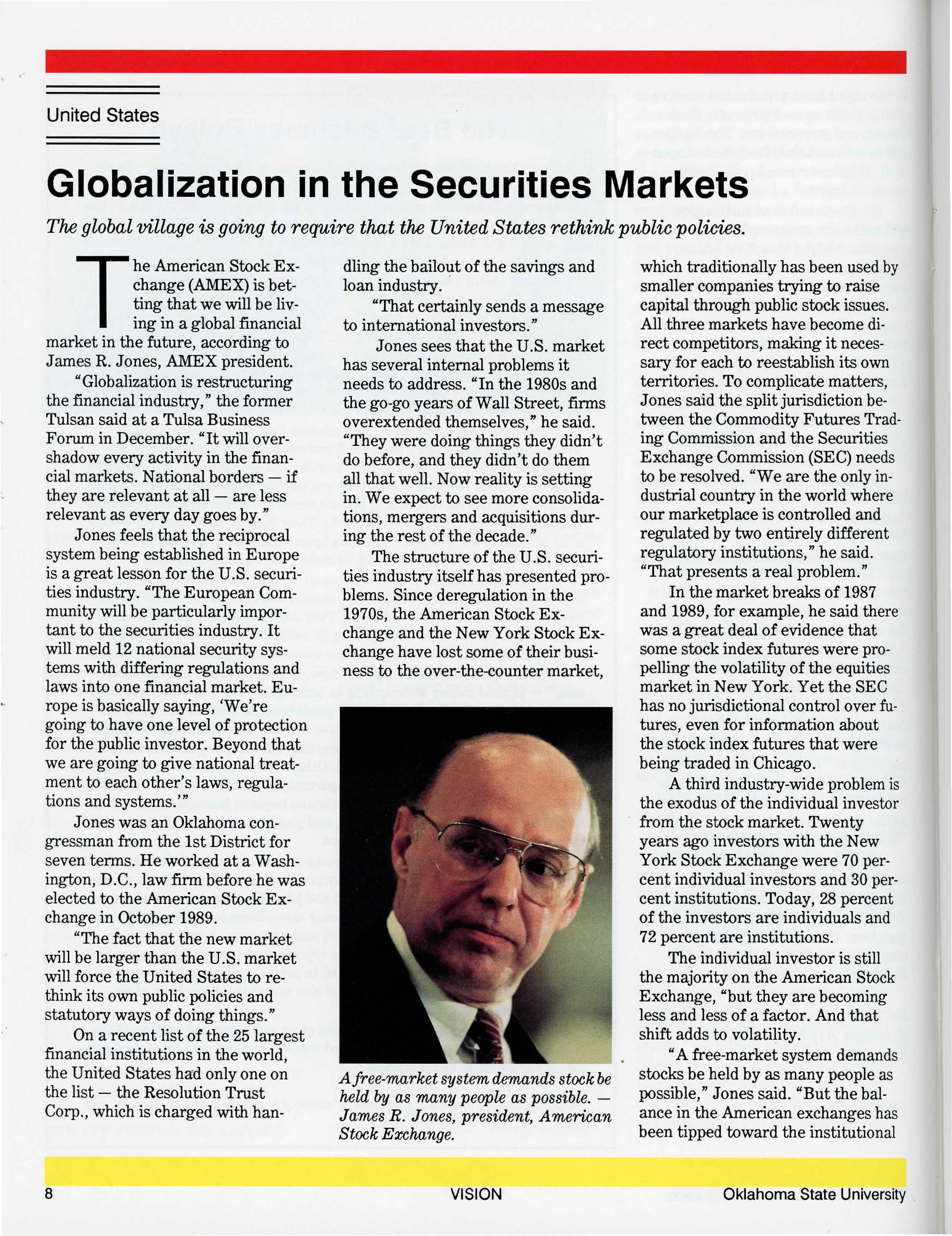
A free-market system demands stock be held by as many people as possible.James R. Jones, president, American Stock Exchange.
which traditionally has been used by smaller companies trying to raise capital through public stock issues. All three markets have become direct competitors, making it necessary for each to reestablish its own territories. To complicate matters, Jones said the split jurisdiction between the Commodity Futures Trading Commission and the Securities Exchange Commission (SEC) needs to be resolved. "We are the only industrial country in the world where our marketplace is controlled and regulated by two entirely different regulatory institutions," he said. "That presents a real problem."
In the market breaks of 1987 and 1989, for example, he said there was a great deal of evidence that some stock index futures were propelling the volatility of the equities market in New York. Yet the SEC has no jurisdictional control over fu. tures, even for information about the stock index futures that were being traded in Chicago.
A third industry-wide problem is the exodus of the individual investor from the stock market. Twenty years ago investors with the New York Stock Exchange were 70 percent individual investors and 30 percent institutions. Today, 28 percent of the investors are individuals and 72 percent are institutions.
The individual investor is still the majority on the American Stock Exchange, "but they are becoming less and less of a factor. And that shift adds to volatility.
"A free-market system demands stocks be held by as many people as possible," Jones said. "But the balance in the American exchanges has been tipped toward the institutional
investors. Their block trading techniquesincrease the volatility in the stockmarket. They shift their investments to the safest equity havens they can find, drying up the traditional sources of capital available to smallerand newer companies."
Jones wants public policies put in place to change this investment strategy, including "changing the title of this country's tax policy to give an edge to equity financing and
The underlying strength of the economy is still quite good.
take away the edge granted debt financing. This would help companies seekinggrowth capital in the stock markets," Jones said.
Another problem is a shortage of investment capital, especially for mid-sizedand growing companies. "Commercialbanks are simply not lending for a variety of reasons. Unless we find ways through acceptable publicpolicy to get that available capital back, it's going to have longterm detrimental effects."
But Jones believes that the capital market could be improving. "The underlying strength of the economy is still quite good. Inventories are in good shape. Baby boomers have matured. They are saving more, and it shouldimprove the amount of capital available."
Jones said that the Bush administration is trying to develop statutory changes that will help the United States become more competitive. A bilateral agreement being developed with Canada would allow a Canadian company registered with the appropriate commission in Canada to trade on American exchanges. It would also recognize the respective accounting systems of the two countries.
Meanwhile, AMEX is developing the American Stock Exchange's stra-
tegic plan for the 1990s which calls for it to be customer-driven with "real value added," said Jones. "In the past, the securities business has been essentially member-driven,
the Pacific Rim. The exchange is in a partnership with Reuters to develop a worldwide after-hours electronic trading system that will operate when AMEX is closed. that is, concerned for the brokerages that trade stocks rather than the investors actually buying and selling stocks. Not anymore. Unless we are customer-driven - that is, customers being investors or listing companies - the market is going to lose out. The demands and needs of the investors must be met, and that requires a change in the structure of the industry."
Several AMEX products have been developed to transcend international boundaries, including joint ventures with foreign partners. Warrants have been introduced on Japan's Nikkei Index of 225 stocks
to give investors the opportunity to hedge the Japanese market.
AMEX is working to establish a trading facility in Hawaii to cover
AMEX has also signed an agreement with Paris Bourse to trade warrants on their CAC-40 Index of French blue chip stocks and allow French investors to trade warrants on the AMEX major market index.
"These ventures ensure that investors in all countries will have the same accurate information. We have to face up to the fact that we are living in a global village that is very competitive," Jones said. "National borders are no longer a barrier to the flow of capital, and the potential for international investors is vast and largely untapped."
James R. Jones, a former Oklahoman, is president of the American Stock Exchange.
OSU has linked with China to improve China's oil industry. Charlotte J. Wright, CBA professor of accounting, conducted an international symposium in Beijing at the invitation of the Chinese National Petroleum Company. The Chinese government conducted a search throughout the Uni~ed States for an expert in oil and gas accounting to teach the course. OSU is one of a small number of schools in the country that even offers coursework in oil and gas accounting.
Wright discussed petroleum accounting practices of U.S. energy companies. Attending the symposium were top accounting managers of China's oil fields.
"China wants to compete in the world wide petroleum market," she said. "In order to do that, those responsible for the industry must learn how to figure out what it really costs to produce a barrel of oil. That includes everything from exploration, costs of personnel, contract labor and fuel costs all the way to filling the barrel and transporting it to market. Without that knowledge, they cannot really negotiate legitimate business deals."
Wright believes part of the problem is the difference in the industry itself. "U.S. companies are private businesses. They usually have many companies in an oil venture. In Prudhoe Bay, Alaska, there are 20-plus partner/companies. They elect an operator who is responsible for the day-to-day operations of that field. They bill out those different costs to the different companies. They all share costs as well as profits. China's petroleum industry is the government. And their petroleum operation is a late-bloomer. It did not get started until 1949, and China is still importing all their technology from the United States. They still price oil by the ton, not the barrel like virtually everyone else."
The European Community is creating a formidabl,e economicfront. Will it work?
When the heads of government of the European Community (EC) committed their countries to creating a vast, single market by the end of 1992, they hoped to streamline the problems of doing business with North America and the Pacific Rim, according to Roger Haywood, chairman of Haywood Associates, consultancy firm, London, who also serves as president of the European Division of WORLDCOM, the largest group of independent public relations consultancies.
Haywood spoke to CBA undergraduates during the Summer in London program in June. The program was part of the College of Business Administration's continuing attention to the internationalization of education. According to Haywood, the effects of the pending legislation appear to be of more interest and concern to Europeans than to other countries. "Americans seem to have focused their attention on the negatives of competition from the Pacific Rim rather than the positives of cooperation with the EC."
The objective of creating a single common market goes back to the 1960 Treaty of Rome. In 1985 the EC heads of government committed themselves to co~pleting the single market concept. This commitment was included in the Single European Act (SEA) passed in July 1987. The SEA, according to Haywood, defines the single market as "an area without internal frontiers in which the free movement of goods, persons, services and capital is ensured in accordance with the provisions of the treaty. In real terms this should
mean lower prices, higher standards and wider choice for all."
The loose confederation has grown in importance to become more of a federation than a trading relationship. Whether the powers expand to create a true federation acting much like the U.S.'s federal government remains to be seen. What is certain, however, is the size of market. "By the end of 1992, a new Europe will be born with 320 million potential customers for products and services," Haywood said. "That's a single, sophisticated, affluent market - virtually equal to the United States and Japan combined." It is a market not to be ignored by any American business that is interested in maintaining a position of strength through the 1990s.
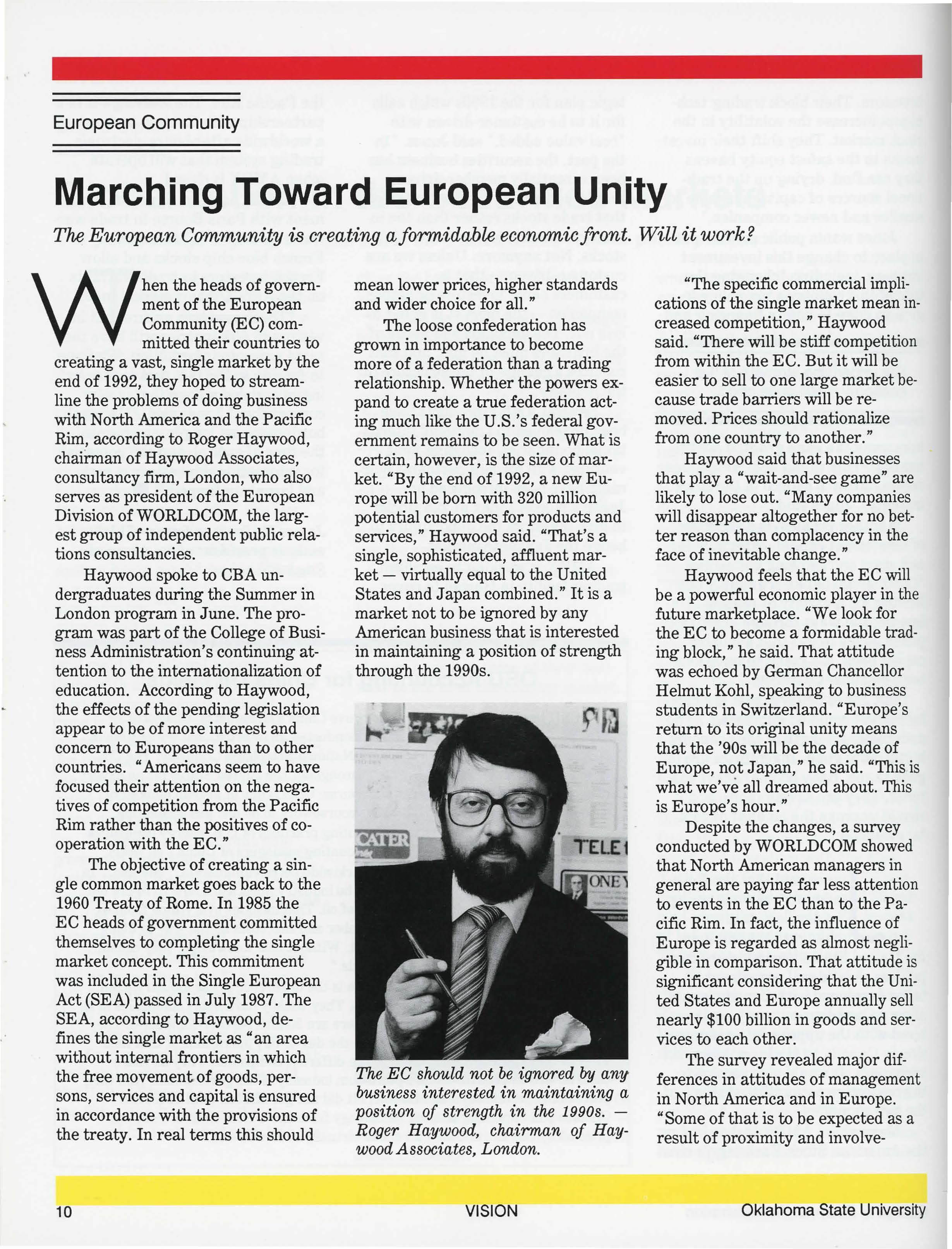
The EC should not be ignored by any business interested in maintaining a position of strength in the 1990s.Roger Haywood, chairman of HaywoodAssociates, London.
"The specific commercial implications of the single market mean increased competition," Haywood said. "There will be stiff competition from within the EC. But it will be easier to sell to one large market because trade barriers will be removed. Prices should rationalize from one country to another."
Haywood said that businesses that play a "wait-and-see game" are likely to lose out. "Many companies will disappear altogether for no better reason than complacency in the face of inevitable change."
Haywood feels that the EC will be a powerful economic player in the future marketplace. "We look for the EC to become a formidable trading block," he said. That attitude was echoed by German Chancellor Helmut Kohl, speaking to business students in Switzerland. "Europe's return to its original unity means that the '90s will be the decade of Europe, not Japan," he said. "This is what we've all dreamed about. This is Europe's hour."
Despite the changes, a survey conducted by WORLDCOM showed that North American managers in general are paying far less attention to events in the EC than to the Pacific Rim. In fact, the influence of Europe is regarded as almost negligible in comparison. That attitude is significant considering that the United States and Europe annually sell nearly $100 billion in goods and services to each other.
The survey revealed major differences in attitudes of management in North America and in Europe. "Some of that is to be expected as a result of proximity and involve-
ment," Haywood noted. "But the geographical distance may be masking real opportunity."
The survey indicated that almost two-thirds of the American companies believe that the impact from the internal market will be limited. Yet almost half stated that they intended to expand their business in Europe anyway. "Most are looking at the EC as a springboard for Eastern Europe," Haywood said.
Both North American firms and European firms are convinced that developments in the Eastern Bloc will create ample business opportunities. Not to be positioned on the European market is seen as losing early access to these difficult but strategically important markets. North American firms look to establish manufacturing units or to export consumer goods into Eastern Europe, while European counterparts are looking for joint ventures for production or other cooperating ventures with Eastern Bloc firms.
No one believes that creating or serving the markets will be easy or quick.Most North American firms believe that continuing government controls and lack of experience with free-market enterprise are major obstacles to business opportunities. The Europeans recognize all too well that the Eastern Bloc primarily needs aid to grow from a backward region into a prosperous trading zone. They believe that they must first address the most basic developmental needs, such as education and environmental protection. The U.S. respondents are far more inclined to help develop commercial and direct trade relations, such as building an information infrastructure.
North American firms expect that the EC's biggest impact will come from improved competitiveness - the result of improved economies of scale as well as mergers and
acquisitions. They also expect that doing business in Europe will be easier because former protectionist measures and internal trade barriers will be abolished.
If you want to operate in the new 1992 European Market, Roger Haywood, Roger Haywood Associates, London, offers this advice:
1) Appoint one key person to be responsible for preparing for 1992. That person should be responsible for research and for identifying areas which present threats and opportunities specific to your organization. That individual can use the information gained to make recommendations.
2) Assess your situation. If you are not already doing business in Europe, consider whether the business should start a European business or form a European office/operation. It is worth looking closely at acquisitions within Europe or forging business links and creating partners in those parts of Europe which are important to your business.
3) Review procedures within your company. Reexamine your pricing, quality and service. How can they be improved to give you a stronger competitive edge? Make changes accordingly.
4) Review products or services in your company. Make necessary changes in specifications for certain goods. Watch for new Europe-wide safety and manufacturing standards. They may affect your product development - and sales.
5) Establish the needs of potential customers and their countries. Produce the products or services to meet the demand. Take into consideration cultural differences and marketing strategy. Products, quality, services and prices must be better than ever - and marketed in the right way to target customers.
6) Size up your competition. What are their plans for Europe? Where are they ahead of you? Where are you ahead of them? What are their strengths, weaknesses, products and prices?
7) Know your customers better. Check their needs. Consider a planned program of exploratory visits to new markets. Attend trade fairs and commission market research.
8) Appoint a European marketing manager or sales and marketing director who can take the responsibility for your sales and marketing initiatives.
9) Check your communications with European markets. Electronic links need to be set up to increase efficiency and reaction time and to help safeguard profits. Make sure your electronic information links with customers and suppliers are up to the increased demands you'll put on them as you move more data, more hours of the day. That includes purchasing, finance, personnel and information technology.
College of Business Administration
Europeans, however, expect that the biggest impact will result from changes in the financial industry embodied in EC '92. "The liberalization of capital markets and the establishment of a common market in financial services will have the greatest impact on all businesses," Haywood said.
Europeans still see some major problems. Although they no longer fear being overtaken by foreign companies after 1992 - as in the early days of the EC - there are still pockets of resistance. One is the automotive industry. "They have enjoyed a measure of protection in the past," Haywood said, "and they have been able to exercise enough influence to build in a five-year transition phase."
A second problem is cultural and linguistic. "Europeans believe that the different cultures and languages will continue to be strong. They will form something of a barrier to unity. Gradually, however, we look for a common European identity."
One step that both the North Americans and Europeans agree upon: lobbying is essential. Both indicate that establishing a lobbying presence in Brussels or Luxembourg has high priority. "To influence the outcome of processes, such as standardization, a group must be where it can have input," he said.
North Americans expect to see the EC growing in importance. Europeans feel that the common European identity will be underlined by a single European passport and the mobility of the labor force. Optimists talk of one common language, probably English. Realists look at the reemergence of small national segments and countries as a backlash against such unification. These regional trading blocs may end up encouraging increased tariffs on outsiders. But experts, such as U.S. Trade Representati\fe Carla Hills, note that such breakups as we are seeing now may not be productive. "That isn't the motor that drives economic growth," she said.
The Summer in London program was part of the CBA's continuing attention to the internationalization of education. Classes were held on the Imperial College campus near Hyde Park. Courses were taught by James Jackman, CBA associate professor of business law, and Steve Miller, CBA professor of marketing,
with speakers from London businesses and government.
"The course was designed to give students contact with an international flavor," Jackman said. "We wanted to expose them to another world, another culture - and even though the United Kingdom speaks English, there's a world of difference." Special emphasis was given to the EC '92 initiative and to Eastern Europe political and economic changes. The 14 undergraduate students visited business and cultural sites, including the Warwick Castle, Barclay's and Lloyd's of London.
The biggest shock was the very ' high cost of living in London. For example, a dozen eggs were the equivalent of $3, a pint of beer was the equivalent of $5. "On the other hand, London is designed for walking," Jackman said. "The sidewalks are wide, and public transportation - bus and subway -· is easily accessible. One thing for certain: studying in another country is an eye-opener
Haywood greets OSU students for our business students. It was so
the Summer
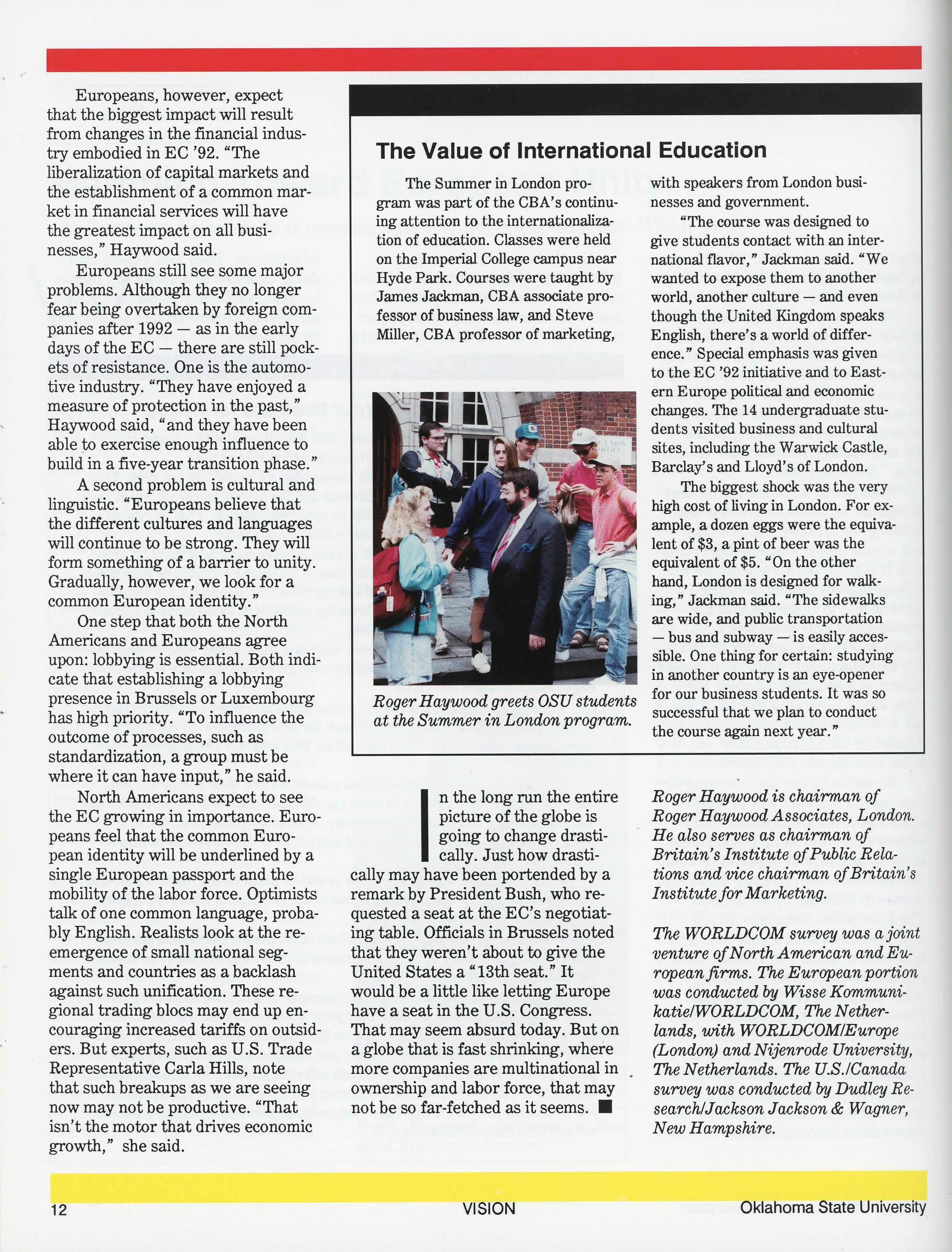
London program. successful that we plan to conduct the course again next year."
In the long run the entire picture of the globe is going to change drastically. Just how drastically may have been portended by a remark by President Bush, who requested a seat at the EC's negotiating table. Officials in Brussels noted that they weren't about to give the United States a "13th seat." It would be a little like letting Europe have a seat in the U.S. Congress. That may seem absurd today. But on a globe that is fast shrinking, where more companies are multinational in ownership and labor force, that may not be so far-fetched as it seems.
Roger Haywood is chairman of Roger Haywood Associates, London. He also serves as chairman of Britain's Institute of Public Relations and vice chairman of Britain's Institute for Marketing.
The WORLDCOM survey was a joint venture ofNorthAmerican and European firms. The European portion was conducted by Wisse Kommunikatie/WORLDCOM, The Netherlands, with WORLDCOM/Europe (London) and Nijenrode University, The Netherlands. The U.S./Canada survey was conducted by Dudley Research/Jackson Jackson & Wagner, New Hampshire. Oklahoma State University
International students and faculty bring a rich opportunity to all of us.
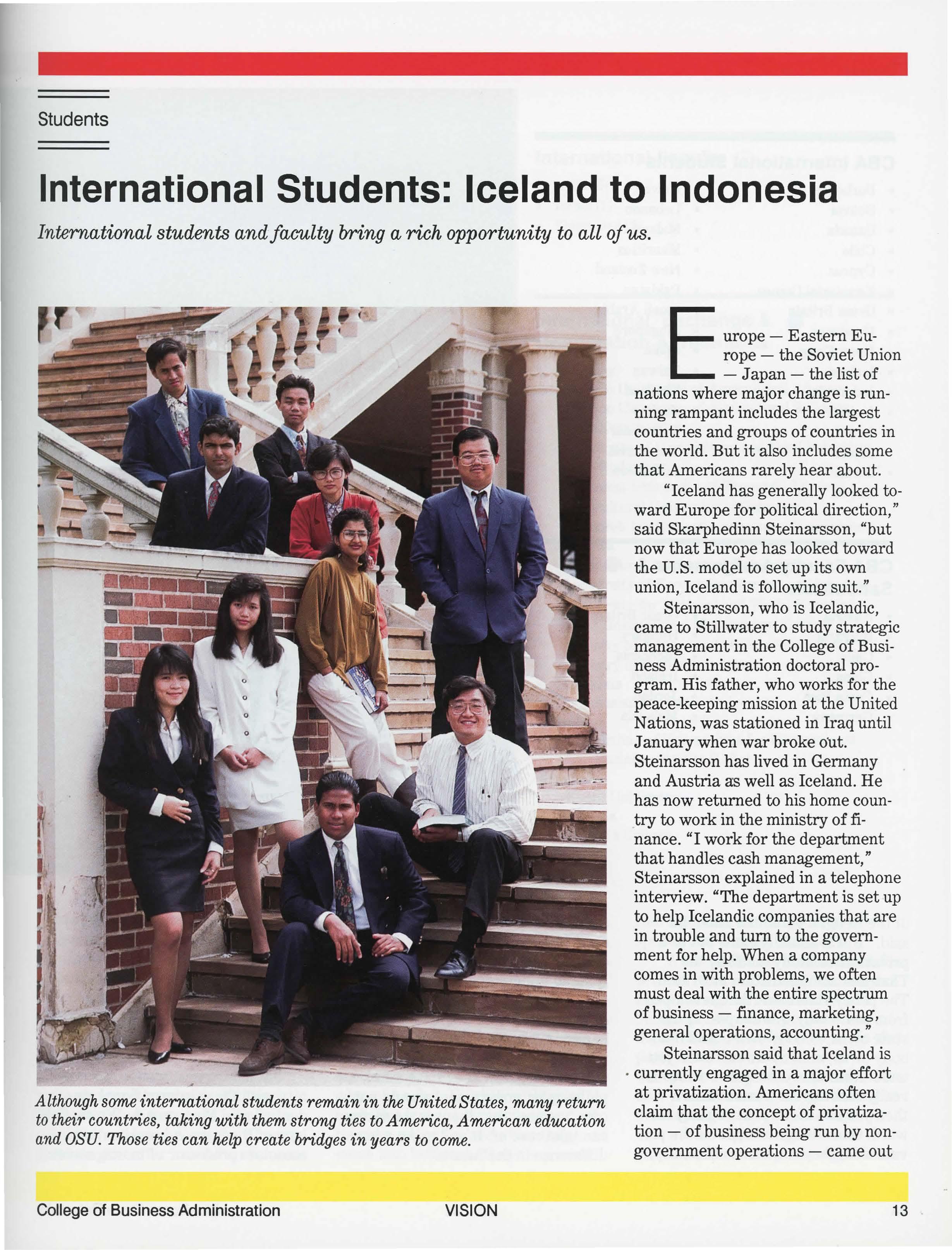
Althoughsomeinternational students remain in the UnitedStates, many return to their countries,taking 'W'iththem strong ties to America, American education and OSU.Thoseties can help create bridgesin years to come.
Europe - Eastern Europe - the Soviet Union - Japan - the list of nations where major change is running rampant includes the largest countries and groups of countries in the world. But it also includes some that Americans rarely hear about.
"Iceland has generally looked toward Europe for political direction," said Skarphedinn Steinarsson, "but now that Europe has looked toward the U.S. model to set up its own union, Iceland is following suit."
Steinarsson, who is Icelandic, came to Stillwater to study strategic management in the College of Business Administration doctoral program. His father, who works for the peace-keeping mission at the United Nations, was stationed in Iraq until January when war broke out. Steinarsson has lived in Germany and Austria as well as Iceland. He has now returned to his home country to work in the ministry of finance. "I work for the department that handles cash management," Steinarsson explained in a telephone interview. "The department is set up to help Icelandic companies that are in trouble and turn to the government for help. When a company comes in with problems, we often must deal with the entire spectrum of business - finance, marketing, general operations, accounting."
Steinarsson said that Iceland is • currently engaged in a major effort at privatization. Americans often claim that the concept of privatization - of business being run by nongovernment operations - came out
• Barbados
• Bolivia
• Canada
• Chile
• Cyprus
• Equatorial Guinea
• Great Britain
• Honduras
• HongKong
• Iceland
• Indonesia
• Ireland
• Israel
• ·Japan
• Jordan
• Korea
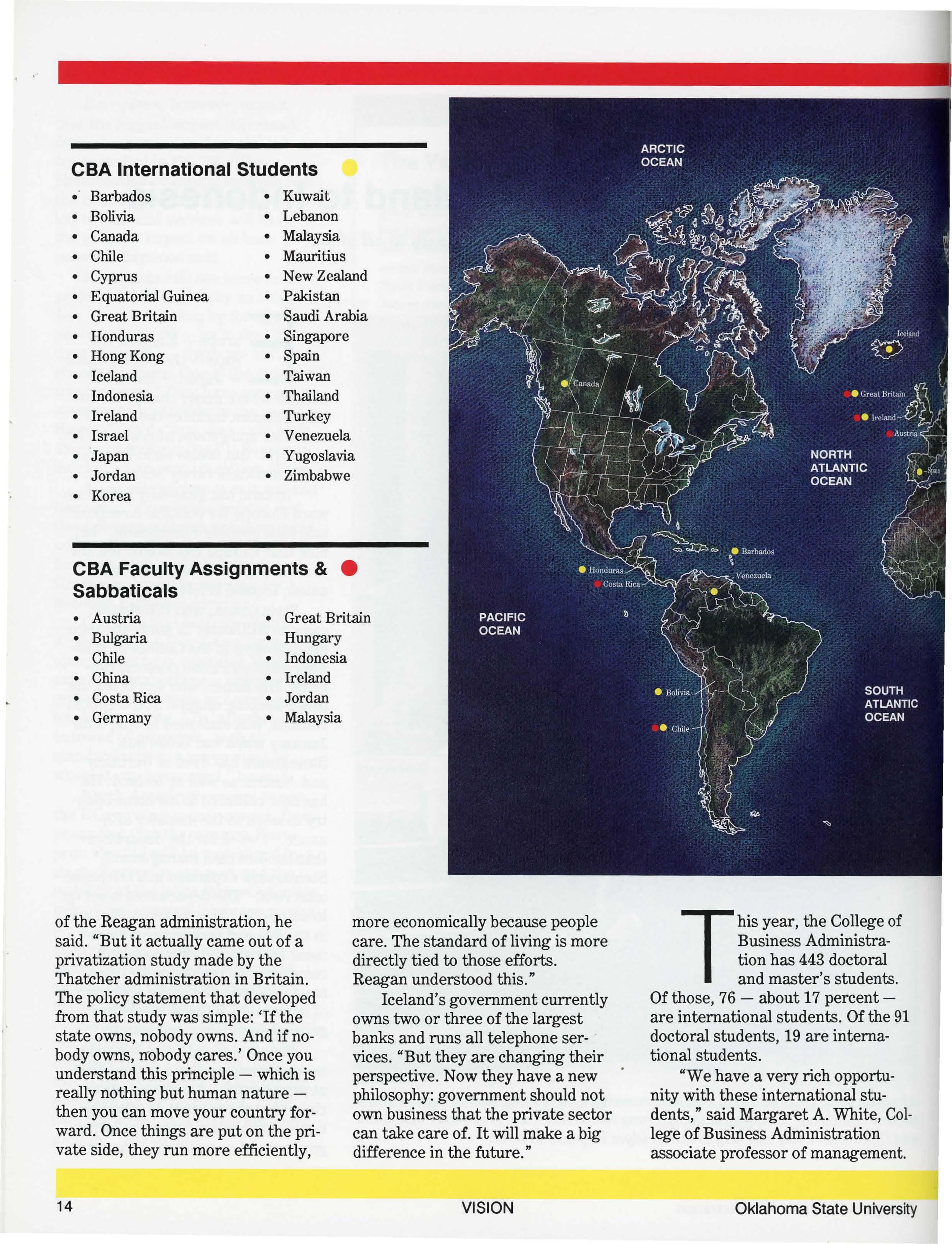
• Kuwait
• Lebanon
• Malaysia
• Mauritius
• New Zealand
• Pakistan
• Saudi Arabia
• Singapore
• Spain
• Taiwan
• Thailand
• Turkey
• Venezuela
• Yugoslavia
• Zimbabwe
• Austria
• Bulgaria
• Chile
• China
• CostaRica
• Germany
• Great Britain
• Hungary
• Indonesia
• Ireland
• Jordan
• Malaysia
of the Reagan administration, he said. "But it actually came out of a privatization study made by the Thatcher administration in Britain. The policy statement that developed from that study was simple: 'If the state owns, nobody owns. And if nobody owns, rrobody cares.' Once you understand this principle - which is really nothing but human naturethen you can move your country forward. Once things are put on the private side, they run more efficiently,
more economically because people care. The standard of living is more directly tied t,o those efforts. Reagan underst.ood this."
Iceland's government currently owns two or three of the largest banks and runs all telephone services. "But they are changing their perspective. Now they have a new philosophy: government should not own business that the private sect.or can take care of. It will make a big difference in the future."
This year, the College of Business Administration has 443 doct.oral and master's students. Of those, 76 - about 17 percentare international students. Of the 91 doct.oral students, 19 are international students.
"We have a very rich opportunity with these international students," said Margaret A. White, College of Business Administration associate professor of management.
"They bring part of their culture with them. We have an opportunity to be exposed to culturally different viewpoints - and in the comfort of our own backyard - no need to go abroad. The globe has come to us.
"What amazes me is that our foreign students 9ave already got a leg up on our students. '!'hey read and write a second language. Although they are sometimes more reticent, speaking up less in class, they have a great deal to offer in bicultural inter-
• India (6)
• Israel (1)
• Singapore (2)
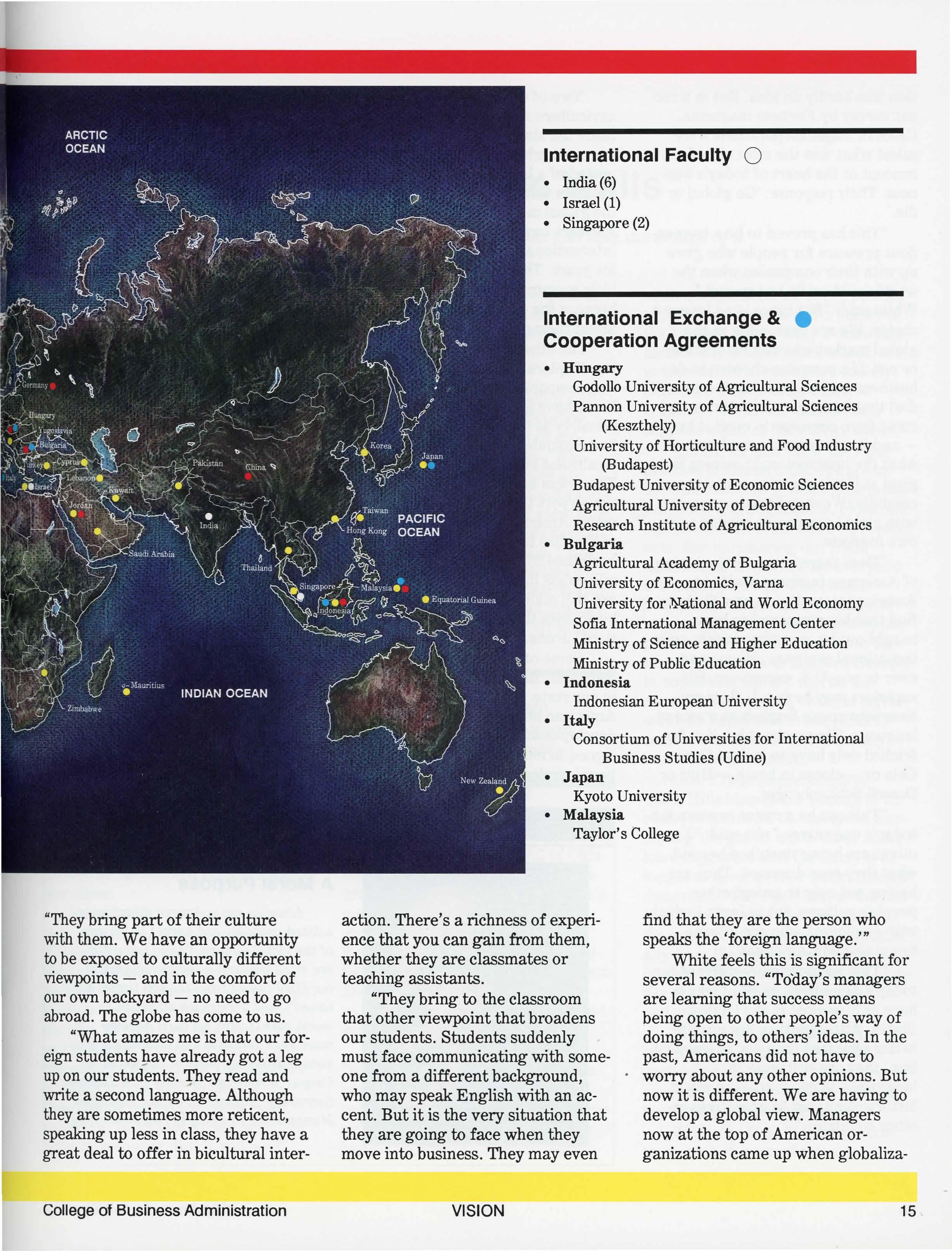
International Exchange & • Cooperation Agreements
• Hungary
GodolloUniversity of Agricultural Sciences
Pannon University of Agricultural Sciences (Keszthely)
University of Horticulture and Food Industry (Budapest)
Budapest University of EconomicSciences
Agricultural University of Debrecen
Research Institute of Agricultural Economics
• Bulgaria Agricultural Academyof Bulgaria University of Economics,Varna University for ;J}T.ationaland World Economy
Sofia International Management Center
Ministry of Scienceand Higher Education
Ministry of Public Education
• Indonesia
IndonesianEuropean University
• Italy
Consortiumof Universities for International Business Studies (Udine)
• Japan
Kyoto University
• Malaysia Taylor's College
action. There's a richness of experience that you can gain from them, whether they are classmates or teaching assistants.
"They bring to the classroom that other viewpoint that broadens our students. Students suddenly must face communicating with someone from a different background, who may speak English with an accent. But it is the very situation that they are going to face when they move into business. They may even
find that they are the person who speaks the 'foreign language.'"
White feels this is significant for several reasons. "To'day's managers are learning that success means being open to other people's way of doing things, to others' ideas. In the past, Americans did not have to worry about any other opinions. But now it is different. We are having to develop a global view. Managers now at the top of American organizations came up when globaliza-
tion was hardly an idea. But in a recent survey by Fortune magazine, CE Os of major corporations were asked what was the most significant concept at the heart of today's business. Their response: 'Go global or die.'
"This has proved to be a tremendous pressure for people who grew up with their companies when the world could easily be ignored," White said. "But there is no longer a choice. We are competing in the global market whether we want to or not. If a company chooses to do business only in America, it may find that its major competitor may come from overseas to meet it here - and its executives must know what the international business is good at if it is going to compete successfully. We may have to compete with global companies even in our own markets.
"Then there is the restructuring of American business itself. An American executive is now likely to find that his company has been bought out by, or merged with, an international company. He may answer to non-U.S. executives. His superiors may be non-U.S. executives who speak English as a second language. Those who think it is farfetched only have to look at CocaCola or - closer to home - Hilti or Dowell Schlumberger.
"This can be a major concern for today's executives," she said. "Executives are being stretched beyond what they ever dreamed. They are having not only to accept other people's cultures but to learn to deal with employees who are international and non-American.
"This becomes more difficult for today's executives, most of whom have only worked in the United States. Although they are usually better educate9 than our average citizen, they are still weak in languages, in geography, in world history compared to executives in other countries."
Two of Oklahoma's industriesagriculture and petroleum - have made the state and its business leaders more urbane than might be expected of a land-locked state. One group in Oklahoma that understands the global market is the farmer. Farmers have been dealing with the international commodity markets for years. They have been particularly concerned about Soviet events because the outcome could severely affect their grain sales.
The other is the petroleum industry. Exploration companies and pipeline companies that began in Oklahoma have gone around the world. As early as the 1920s, the industry had expanded to make Tulsa the wealthiest city in the United States. There was as much air traffic into the airport then as there was in any major American city. Although some of that has been lost, a lot of the inheritance from that cultural wealth still exists in the state. And there are still many petroleum-related businesses that work in the international arena.
Some of this, no doubt, accounts for the international interest in our state. White said that more American students are beginning to develop combination degrees designed to move them into international circles. "They have a vision of
where the world is going to be in 10 years, and they want to be right there in the middle of it," she said. "For example, one student has a double major - German and business management. He worked in Germany last year and knows the German culture. He's going to find moving into the international arena reasonably easy. Others combine business degrees with history, geography or language minors - fields that expose them to differences in culture. It's an excellent step.
"Even if a person has trouble speaking a language, at least he or she can learn to understand the people's history and geography through reading," White said. "Any kind of exposure is going to help.
"To expand this concept, we are offering more classes overseas and solidifying relationships with different countries wherever possible. All these are important building blocks for the future."
Skarphedinn Steinarsson, a former CEA doctoral student, is now in Iceland working for a division of the ministry of finance.
Margaret A. White is an associate professor of management in the College of Business Administration.
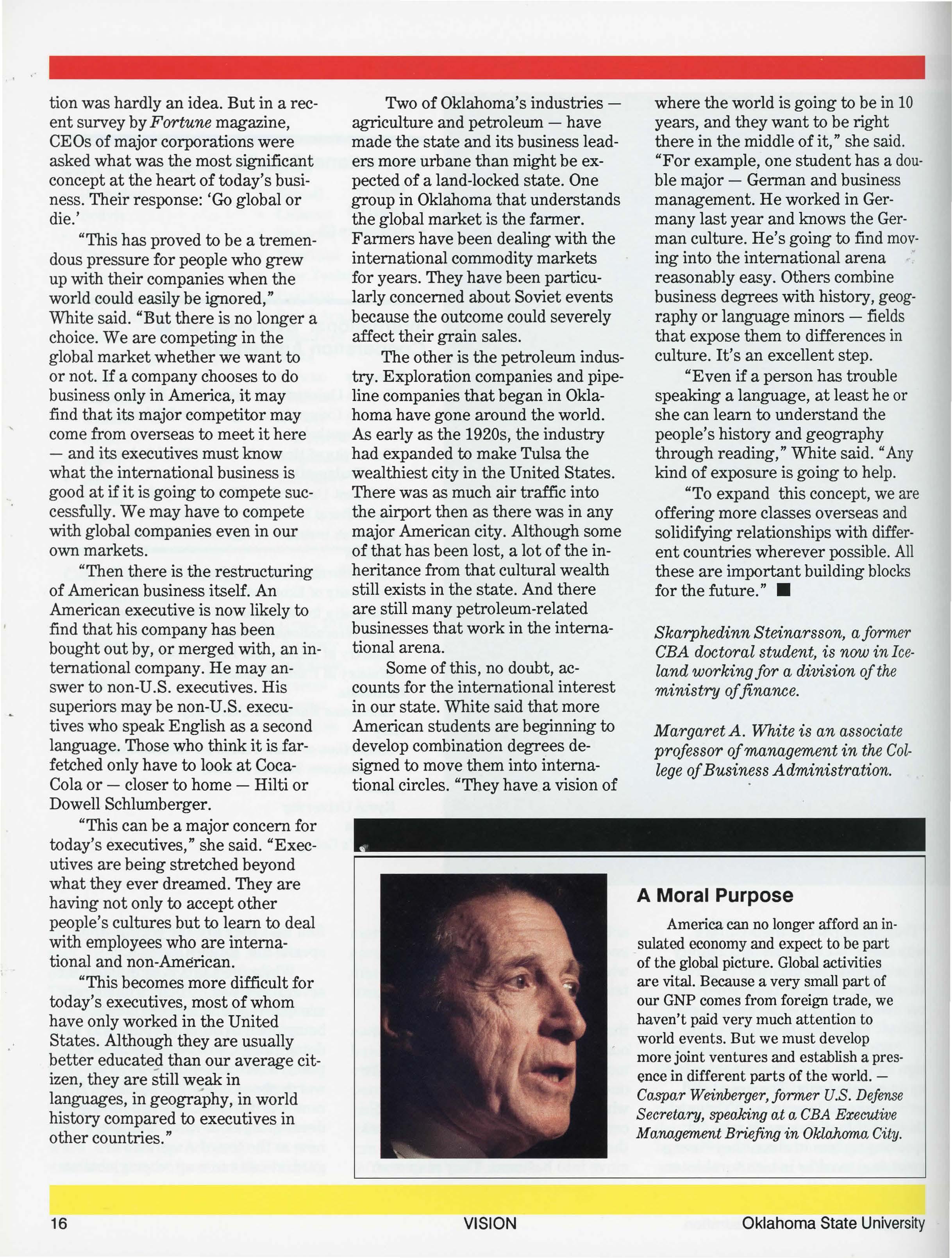
Americacan no longer afford an insulated economyand expect to be part of the globalpicture. Globalactivities are vital. Becausea very smallpart of our GNP comesfrom foreign trade, we haven't paid very much attention to world events. But we must develop more joint ventures and establisha presence in different parts of the world.Ca,S'J)arWeiriherger,formerU.S. Defense Secretary, speaking at a CEA Executive ManagementBriefing in OklahomaCity. Oklahoma
There's room for growth, but it may take years before Americans can take advantage of it.
When the wall that separated East and West Germany came down in 1990, it was a major breakthrough in Eastern Europe. The reunion of families separated physically by the wall for three decades was poignant and drew international media attention. But the real job - of figuring out how to put the country back together again - has begun to look more like trying to patch a shattered Humpty Dumpty. Dr. Frank G. Steindl, Regents Professor of Economics, College of Business Administration, was one of the first U.S. professors to begin teaching in Germany after the country's reunification. He served as "Konrad Zuse Gastprofessor" of finance and economics at the University of Bamberg, Germany.
Steindl was surprised at the economic conditions in Germany. The desire for enterprise is certainly there, he noted. East Germans have already filed more than a million applications to start new businesses. In 1991,37,500 new companies were formed in the eastern state of Saxony alone.
But Steindl says they have a long way to go. "The economies of Eastern Europe are in far worse shape than most Americans realize," he said. "They have far less real capital than we earlier thought. Consequently, though new real investment will generate higher growth than in the western ecofiomies, the standard of living will be low. It takes a long time before regional growth rates converge. In 10 years there will be a definite recovery. But it will be 25
years or so before we can expect to see living standards approaching those to which we in the West are accustomed."
Gerald Lage, College of Business Administration professor of economics, agrees. "Although many U.S. companies are eagerly looking for opportunities in Eastern Europe, it will be some time before Oklahoma businesses capitalize on the situation," he said. Lage reported on eight areas studied by Oklahoma 2000 Inc., a research affiliate of the Oklahoma State Chamber of Commerce & Industry. "It would
The economies of Eastern Europe are in far worse shape than most Americans realize.
be unrealistic to expect major new Eastern European growth opportunities for more than a handful of Oklahoma firms in the near future. Nevertheless, the overlap of Oklahoma's most promising sectors for export growth and the priority needs of Eastern Europe indicate opportunities for the most aggressive and bestprepared producers and exporters with high-quality, technologically advanced products."
Lage noted, however, that "some of Oklahoma's traditional exports such as beef, wheat and petroleum will probably not be of significant interest to the Eastern European buyers." U.S. State Depart-
ment analyst John A. Cloud pointed out that red meat is still a luxury in the Eastern Bloc. "Only Poland has historically bought much wheat, and petroleum flows have been mainly determined by policies of the U.S.S.R., which has traditionally supplied much of the energy needs."
Industries that show the most promise in Eastern Europe are industrial machinery, fabricated metal products, plastic products, electronic equipment and some basic steel products. But hammering out trade agreements that work for everyone is a major problem. The United States has completed a package of measures to ease restrictions on imports of steel and textiles from the new democracies in Eastern Europe in hopes that the EC will do the same. But at the last General Agreement on Tariff and Trade (GATI) conference, France and Germany broke off negotiations.
U.S. Trade Representative Carla Hills blames the backup in unresolved issues on the delays in completing the global trade talks. Some have suggested that Germany is no longer in favor of free trade. Steindl disagrees. "Their position at the last GATT conference was the result of domestic political pressures, specifically from the agricultural interests," he said. "In the end, I think the benefits of trade will be more powerful and win out.
"Of course, politicians will search for a compromise position .particularly because of the strong agricultural lobby, and so we don't expect free trade in agriculture."
While the U.S. federal government pushed interest rates down,
Germany pushed them up. Critics of Germany are saying that the country is afraid of inflation within the country and does not want to consider the international economy, but Steindl disagrees.
"When it comes to questions of inflation and growth, the federal government - and, of course, the Bundesbank - will be more successful preventing inflation than in stimulating growth. In fact, there is considerable doubt that the federal government can do much to stimulate growth. To the extent that anything can be done about growth, a
American businessmen expect a significant rise in wages in Germany's low-productivity labor. So the Treuhandanstalt's policy serves to reduce expected returns from investment without reductions in risk."
German officials have also suggested that the U.S.-Canada-Mexico free trade area is a response to the European Community in order to set up a more favorable alliance. European critics are calling it a move in the game of one-upmanship. "The free trade area does not have to be justified as a response to the European Community, although that may
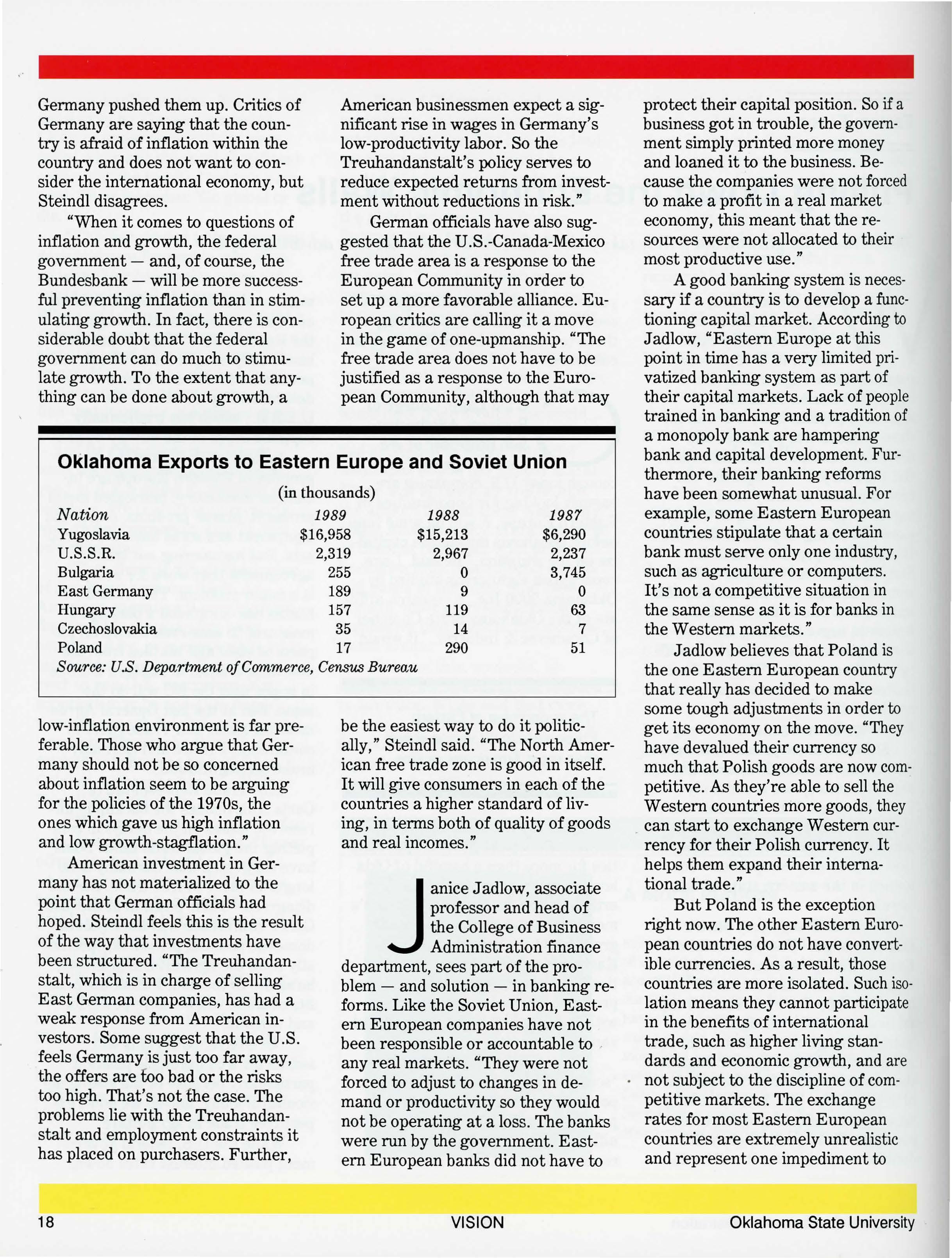
Source: U.S. Department ofCmnmerce, Census Bureau
low-inflation environment is far preferable. Those who argue that Germany should not be so concerned about inflation seem to be arguing for the policies of the 1970s, the ones which gave us high inflation and low growth-stagflation."
American investment in Germany has not materialized to the point that German officials had hoped. Steindl feels this is the result of the way that investments have been structured. "The Treuhandanstalt, which is in charge of selling East German companies, has had a weak response from American investors. Some suggest that the U.S. feels Germany is just too far away, the offers are too bad or the risks too high. That's not the case. The problems lie with the Treuhandanstalt and employment constraints it has placed on purchasers. Further,
be the easiest way to do it politically," Steindl said. "The North American free trade zone is good in itself. It will give consumers in each of the countries a higher standard of living, in terms both of quality of goods and real incomes."
Janice Jadlow, associate professor and head of the College of Business Administration finance department, sees part of the problem - and solution - in banking reforms. Like the Soviet Union, Eastern European companies have not been responsible or accountable to , any real markets. "They were not forced to adjust to changes in demand or productivity so they would not be operating at a loss. The banks were run by the government. Eastern European banks did not have to
protect their capital position. So if a business got in trouble, the government simply printed more money and loaned it to the business. Because the companies were not forced to make a profit in a real market economy, this meant that the resources were not allocated to their most productive use."
A good banking system is necessary if a country is to develop a functioning capital market. According to Jadlow, "Eastern Europe at this point in time has a very limited privatized banking system as part of their capital markets. Lack of people trained in banking and a tradition of a monopoly bank are hampering bank and capital development. Furthermore, their banking reforms have been somewhat unusual. For example, some Eastern European countries stipulate that a certain bank must serve only one industry, such as agriculture or computers. It's not a competitive situation in the same sense as it is for banks in the Western markets."
J adlow believes that Poland is the one Eastern European country that really has decided to make some tough adjustments in order to get its economy on the move. "They have devalued their currency so much that Polish goods are now competitive. As they're able to sell the Western countries more goods, they can start to exchange Western currency for their Polish currency. It helps them expand their international trade."
But Poland is the exception right now. The other Eastern European countries do not have convertible currencies. As a result, those countries are more isolated. Such isolation means they cannot participate in the benefits of international trade, such as higher living standards and economic growth, and are not subject to the discipline of competitive markets. The exchange rates for most Eastern European countries are extremely unrealistic and represent one impediment to
countries are extremely unrealistic and represent one impediment to currency convertibility and full realization of the opportunities for Western businesses.
"Eastern European countries must develop their economies in such a way as to make their currencies convertible if they want to take advantage of international trade," Jadlow said. "You don't want to make doing business difficult if you really want the business."
That does not mean activity is not going on. In Hungary, for example, businessmen are actively setting up joint ventures with other European countries. Many Hungarians lost their businesses after World
The Eastern European markets are not dead; they just need reactivating.
War II when their operations were confiscated and turned over to the nationalized operations. Now even the former state companies are making deals with the former businessmen. Istvan Tomcsanyi, general director of the economic ministry in Hungary, told a group of businessmen this spring that the markets in Eastern Europe are sellers' markets. "The markets in Eastern Europe are not dead," he said. "They are merely dormant. Through joint ventures it is possible to create buying power and to reactivate these Eastern European markets."
Janwe JadlCYW is assoc'iateprofessor and head of the Collegeof Business Administration finance department. GeraldLage is a Collegeof Business Administration professor of econom,. ics. Frank Steing,lis Regents Professor of Economicsin tb,eCollegeof BusinessAdministration. His remarks arefrom a recent interview College of Business Administration
Canada 5 Liechtenstein 1 Switzerland
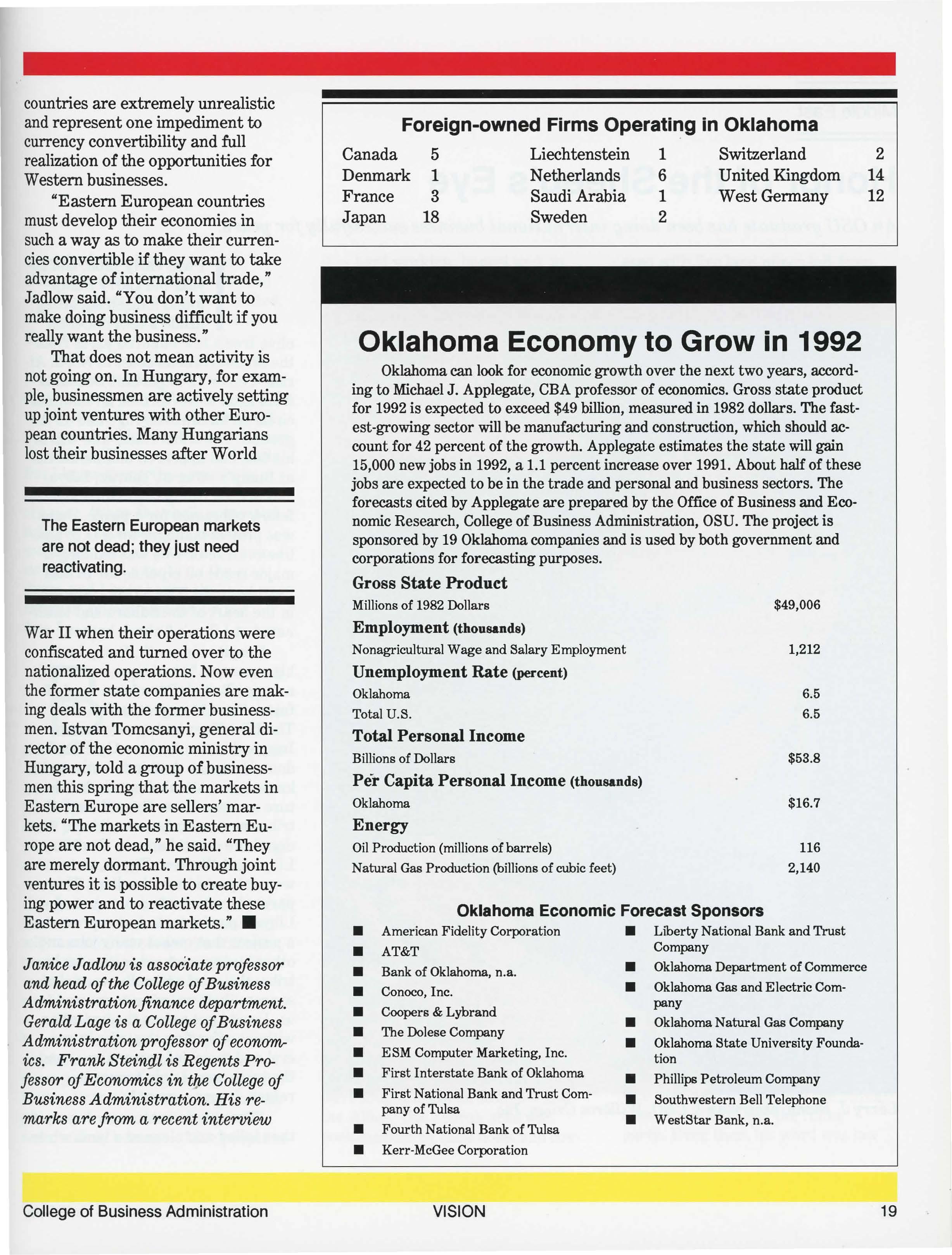
Oklahoma can look for economic growth over the next two years, according to Michael J. Applegate, CBA professor of economics. Gross state product for 1992 is expected to exceed $49 billion, measured in 1982 dollars. The fastest-growing sector will be manufacturing and construction, which should account for 42 percent of the growth. Applegate estimates the state will gain 15,000 new jobs in 1992, a 1.1 percent increase over 1991. About half of these jobs are expected to be in the trade and personal and business sectors. The forecasts cited by Applegate are prepared by the Office of Business and Economic Research, College of Business Administration, OSU. The project is sponsored by 19 Oklahoma companies and is used by both government and corporations for forecasting purposes.
Gross State Product
Millions of 1982 Dollars
Employment (thousands)
Nonagricultural Wage and Salary Employment Unemployment Rate (percent)
Oklahoma
Total U.S.
Total Personal Income
Billions of
ESM Computer Marketing, Inc.
First
Fourth
An OSU graduate has been doing international business successfullyfor years.
Itwas early 1965, and 25year-old Larry Bump found himself squatting inside a tent under an olive tree a few hundred yards from the Mediterranean coast in North Africa. Ten or 12 important Bedouins from local tribes formed an informal circle on handwoven rugs laid on the ground. The tribal chief, who was in his 60s, had appeared unannounced at Bump's office at Tobruk, Libya, and invited Bump to join him and his fellow tribesmen for a picnic. Bump was project manager for a U.S. pipeline contractor who was building a major crude oil pipeline for British Petroleum Co. The pipeline started in the heart of the Sahara and terminated at Libya's Tobruk harbor.
Despite his youth, Bump knew his manners. "I had been warned by a senior British Petroleum local affairs officer to expect such a visit. The BP officer had spent years in Iraq and in the Arabian Gulf Sheikdom. He spqke Arabic fluently and knew a great deal about their culture and practices. Even though the tribes were mainly nomadic and wandered the coastal area in Eastern Libya and Western Egypt, some were city and town dwellers. This particular chief was a member of Libya's parliament. As I represented a project that meant many jobs and other business opportunities for his tribe, the chief naturally wanted to express their welcome to me and to us. I could not refuse the invitation without offending the tribe in general and the chief personally - and the truth was, I didn't want to refuse. It was a great honor.
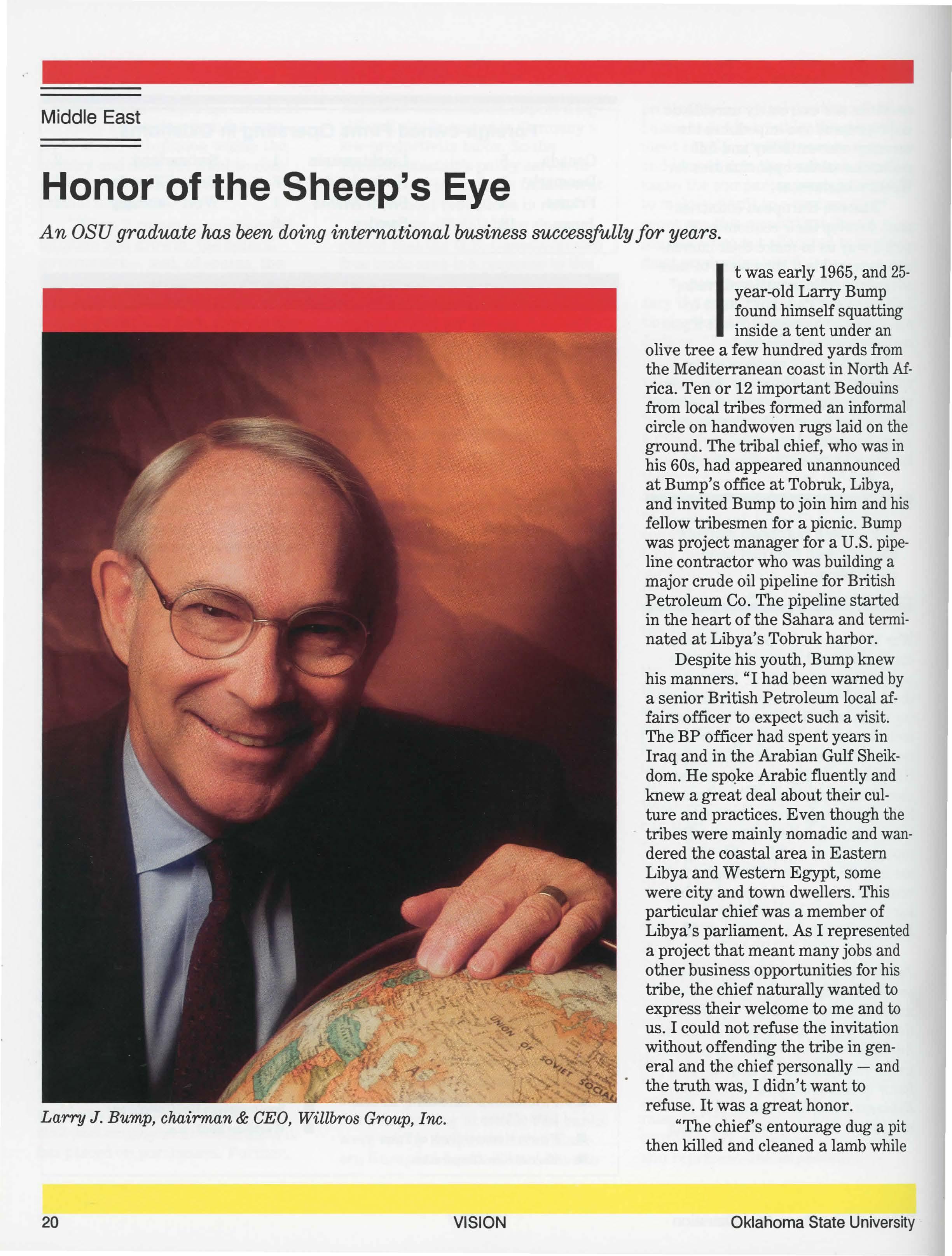
Larry J. Bump, chairman & CEO, Willbros Group, Inc.
"The chief's entourage dug a pit then killed and cleaned a lamb while
we waited. The Bedouins were dressed in their flowing robes, and we squatted on the rugs and waited, talking through an interpreter as the afternoon wore on.
"In due time, the lamb arrived. It had been roasted with rice - in a commondish they called couscous. It was customary to tear the meat off the carcass and scoop it up with your right hand. That was easy to handle. But I knew it was the practice to present the sheep's eye to the guest of honor. When the sheik presented it to me, I took it - as I had been coached - and swallowed it whole. I think it grazed a tooth on the way down, and I only hoped that any reluctance did not register on my face."
Bump, who is chairman & CEO, Willbros Group, Inc., began his career in the pipeline construction business by accident. In the late 1950s,while attending Oklahoma State University, he took a summer job in New Mexico working for a small pipeline construction company. "I was enrolled in engineering at the time, but the owner of the company gave me some advice that changed my focus. When I told him I liked the construction business and might make it a career, he advised me to develop some financial skills, such as how to read financial statements, cost controls, etc."
After a few summers in New Mexico,Bump changed his major to accounting. He stayed out of school three years, working ~roughout the United States. "I was young and single, and it was a fascinating business, mainly because of the people in
it - hard working, honest and, in many cases, colorful. And the money was good. The experience I gained was invaluable to me later. "
An employer during that period, James P. Neill of Dallas, apparently recognized Bump as a keeper and offered him a job after graduation in 1964. Within six months after his
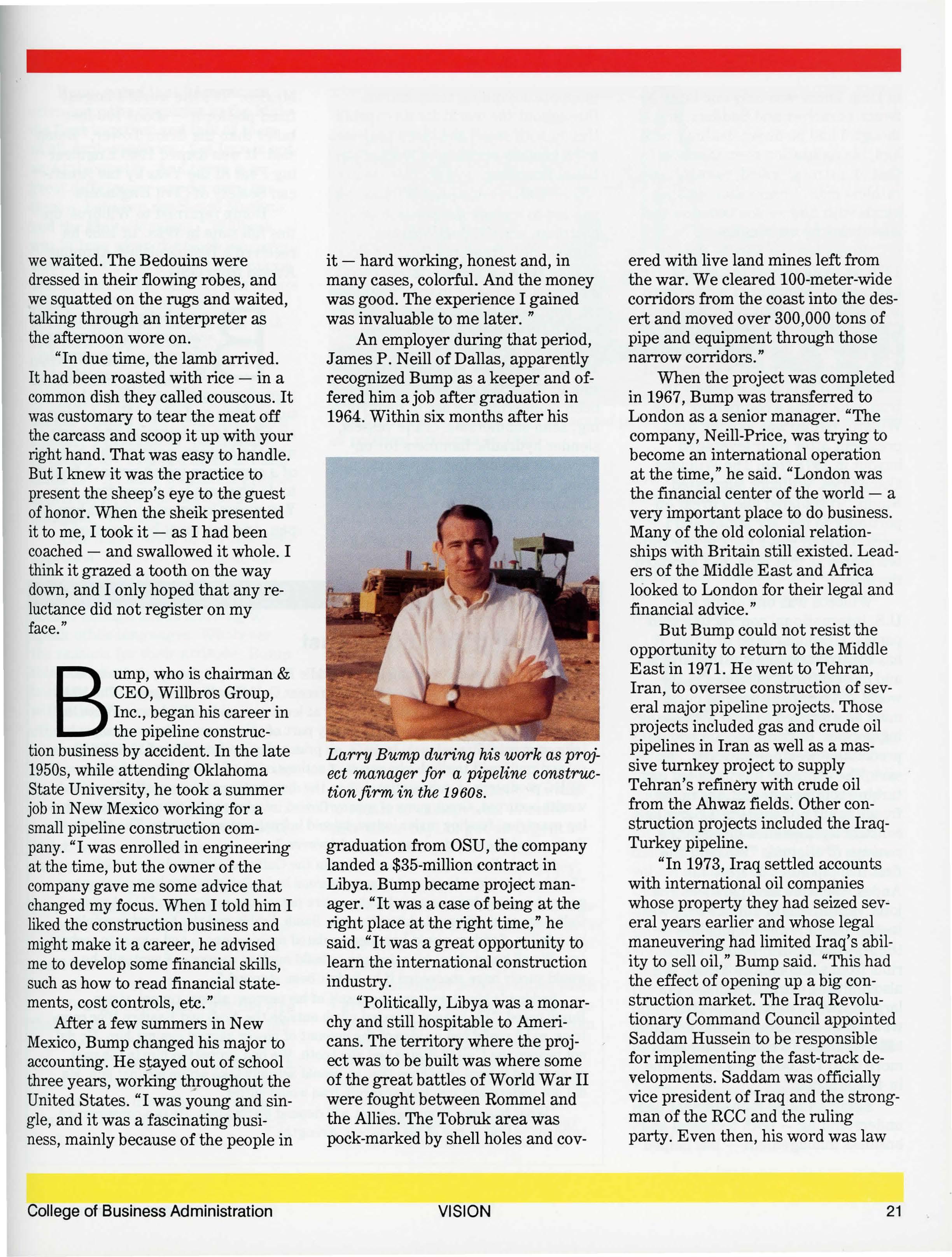
Larry Bump during his work as project manager for a pipeline construction.firm in the 1960s.
graduation from OSU, the company landed a $35-million contract in Libya. Bump became project manager. "It was a case of being at the right place at the right time," he said. "It was a great opportunity to learn the international construction industry.
"Politically, Libya was a monarchy and still hospitable to Americans. The territory where the project was to be built was where some of the great battles of World War II were fought between Rommel and the Allies. The Tobruk area was pock-marked by shell holes and cov-
ered with live land mines left from the war. We cleared 100-meter-wide corridors from the coast into the desert and moved over 300,000 tons of pipe and equipment through those narrow corridors."
When the project was completed in 1967, Bump was transferred to London as a senior manager. "The company, Neill-Price, was trying to become an international operation at the time," he said. "London was the financial center of the world - a very important place to do business. Many of the old colonial relationships with Britain still existed. Leaders of the Middle East and Africa looked to London for their legal and financial advice."
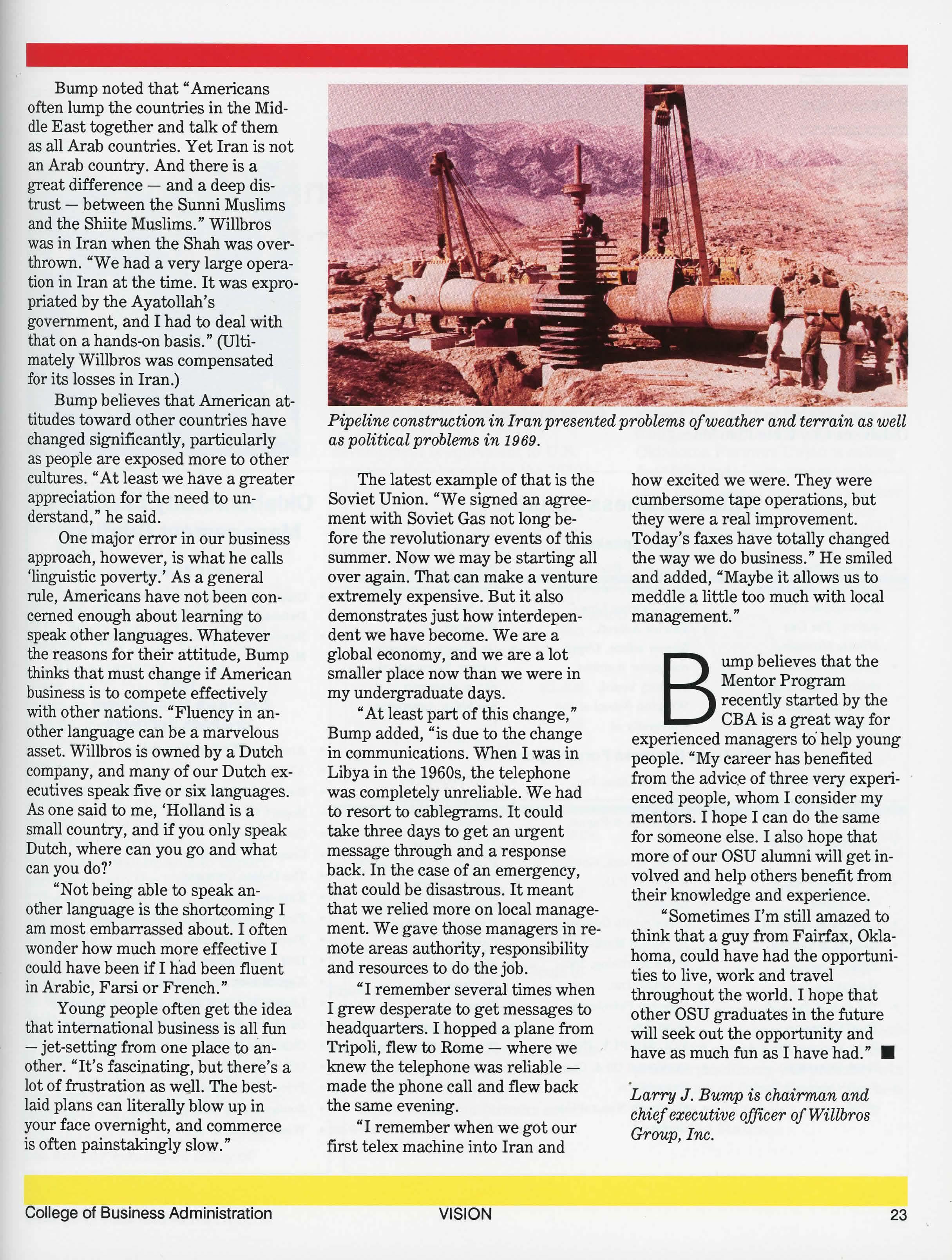
But Bump could not resist the opportunity to return to the Middle East in 1971. He went to Tehran, Iran, to oversee construction of several major pipeline projects. Those projects included gas and crude oil pipelines in Iran as well as a massive turnkey project to supply Tehran's refinery with crude oil from the Ahwaz fields. Other construction projects included the IraqTurkey pipeline.
"In 1973, Iraq settled accounts with international oil companies whose property they had seized several years earlier and whose legal maneuvering had limited Iraq's ability to sell oil," Bump said. "This had the effect of opening up a big construction market. The Iraq Revolutionary Command Council appointed Saddam Hussein to be responsible for implementing the fast-track developments. Saddam was officially vice president of Iraq and the strongman of the RCC and the ruling party. Even then, his word was law
in Iraq. There was only one layer between ourselves and Saddam; and although I had no direct dealings with him, his reputation even then was that of a strong-willed, cunning and ruthless man. I remember shaking hands with him on one occasion and was struck by his toughness."
Bump left the Middle East in 1976 when he moved to London. He had become acquainted with Joseph H. Williams, current chairman and CEO of Tulsa-based The Williams Companies, in the mid-1960s in Iran. At that time, Williams was resident manager of Williams Brothers in Iran, which was a competitor. The Willbros Group was looking for a president after their leveraged buyout in 1975 from The Williams Companies. Williams suggested Bump. "It sounded like a great opportunity to me. My family and I were ready to move back to the United States at that time, so I accepted the offer."
Willbros was one of the first U.S. international contracting companies. Headquartered in Tulsa, it has constructed some of the largest and most difficult pipelines in the world. "A company such as ours must be prepared to deal with changing politics, difficult terrain and unpredictable weather patterns," he said. The company has installed gas turbine compressor stations in the frozen tundra of western Siberia and constructed pipelines through the swamps of Nigeria. "We built the first five pipelines to cross the Andes. We were also partners in a joint venture that built the only westto-east major crude oil pipelinethe All-American Pipeline, which runs from California to Texas. We also built the Cortez Pipeline, the largest carbon dioxide pipeline, which runs from southwest Colorado to west Texas. We have completed more than 120,000 miles of pipeline in 44 countries."
Bump's skilled management and understanding - both technical and business management - has helped
to create a winning team known throughout the world for its capabilities on both small and large projects, from turnkey operations to international financing.
In 1985 his duties at Willbros expanded to include the position of chairman and CEO of Willbros' shareholder, Heerema Holding Co., Inc., in Geneva, Switzerland.
Heerema is a major marine engineering and construction group. It was responsible for the first northern North Sea hook-up project in the 1960s. Heerema's primary contribution to the offshore industry has been pioneering the use of heavy-lifting, semi-submersible crane vessels, slender hydraulic hammers for underwater pile driving, super steam piling hammers and the tripod tower platform. One of Heerema's showcase projects was Shell Oil's Bullwinkle platform in the Gulf of
Mexico. "It's the world's largest fixed platform - about 100 feet taller than the Sears Tower," Bump said. It was named 1988 Engineering Feat of the Year by the American Society of Civil Engineers. Bump returned to Willbros' duties full time in 1988. In 1989 he received a Distinguished Alumnus Award from OSU.
Bump believes that Americans need a better handle on world geography. Even more important is a good grasp of how different cultures think and why. "Not making an effort to understand and recognize the history, politics and culture of a country in which you are trying to do business is a major faux pas. You never know what might happen, and you must be prepared."
Because of years working in the Middle East, Larry J. Bump, chairman & CEO of Willbros Group, Inc., found the recent Gulf War 'fascinating.' "The Middle East has been in political turmoil for at least several hundred years. With the discovery of vast oil reserves at the early part of this century, the area began to take on greater importance. In 1973, oil prices shot up from $3 to $10-$11 a barrel and continued to climb as a result of actions by the Sl}ah of Iran and other OPEC producers. A substantial shift in the distribution of the world's financial wealth occurred. Great sums of money flowed into Iran and other Arab oil-producing countries, funding major industrial and infrastructure projects. The Middle East - and the world - was changed forever."
Bump believes that military action in the Gulf was absolutely essential. "Saddam has already proved how dangerous he is. But consider how much more power he would have amassed if the entire petroleum resources of the Arabian Gulf were at his disposal. After Kuwait, Saudi Arabia and the Emirates would have fallen. Saddam would have accumulated more power - and access to technology. We all know about his attempts to build nuclear weapons. Eventually he would surely have succeeded if he hadn't been stopped."
Saddam's blunders were the result of his narrow, almost tunnel, vision, Bump noted. "He has not traveled much outside the Arab and Eastern Bloc countries, so he really had no idea of the-amount of power aligned against him. He did not believe the United States had any teeth. We had supported him in the past, so he found it hard to believe that we would actually take action against him. He did not understand just how severely Iraq would suffer.
"What happens from this point will depend on Saddam. He is a consummate survivor - that is one of his greatest strengths."
Bump noted that "Americans often lump the countries in the Middle East together and talk of them as all Arab countries. Yet Iran is not an Arab country. And there is a great difference - and a deep distrust - between the Sunni Muslims and the Shiite Muslims." Willbros was in Iran when the Shah was overthrown. "We had a very large operation in Iran at the time. It was expropriated by the Ayatollah's government, and I had to deal with that on a hands-on basis." (Ultimately Willbros was compensated for its losses in Iran.)
Bump believes that American attitudes toward other countries have changed significantly, particularly as people are exposed more to other cultures. "At least we have a greater appreciation for the need to understand," he said.
One major error in our business approach, however, is what he calls 'linguistic poverty.' As a general rule, Americans have not been concerned enough about learning to speak other languages. Whatever the reasons for their attitude, Bump thinks that must change if American business is to compete effectively with other nations. "Fluency in another language can be a marvelous asset. Willbros is owned by a Dutch company, and many of our Dutch executives speak five or six languages. As one said to me, 'Holland is a small country, and if you only speak Dutch, where can you go and what can you do?'
"Not being able to speak another language is the shortcoming I am most embarrassed about. I often wonder how much more effective I could have been if I had been fluent in Arabic, Farsi or French."
Young people often get the idea that international business is all fun - jet-setting from one place to another. "It's fascinating, but there's a lot of frustration as well. The bestlaid plans can literally blow up in your face overnight, and commerce is often painstakingly slow."
The latest example of that is the Soviet Union. "We signed an agreement with Soviet Gas not long before the revolutionary events of this summer. Now we may be starting all over again. That can make a venture extremely expensive. But it also demonstrates just how interdependent we have become. We are a global economy, and we are a lot smaller place now than we were in my undergraduate days.
"At least part of this change," Bump added, "is due to the change in communications. When I was in Libya in the 1960s, the telephone was completely unreliable. We had to resort to cablegrams. It could take three days to get an urgent message through and a response back. In the case of an emergency, that could be disastrous. It meant that we relied more on local management. We gave those managers in remote areas authority, responsibility and resources to do the job.
"I remember several times when I grew desperate to get messages to headquarters. I hopped a plane from Tripoli, flew to Rome - where we knew the telephone was reliablemade the phone call and flew back the same evening.
"I remember when we got our first telex machine into Iran and
how excited we were. They were cumbersome tape operations, but they were a real improvement. Today's faxes have totally changed the way we do business." He smiled and added, "Maybe it allows us to meddle a little too much with local management."
Bump believes that the Mentor Program recently started by the CBA is a great way for experienced managers to·help young people. "My career has benefited from the advic.eof three very experienced people, whom I consider my mentors. I hope I can do the same for someone else. I also hope that more of our OSU alumni will get involved and help others benefit from their knowledge and experience.
"Sometimes I'm still amazed to think that a guy from Fairfax, Oklahoma, could have had the opportunities to live, work and travel throughout the world. I hope that other OSU graduates in the future will seek out the opportunity and have as much fun as I have had."
Larry J. Bump is chairman and chief executive officer of Willbros Group, Inc.
Forty-four Oklahoma organizations joined with the College of Business Administration to create two very successful business programs, one for Tulsa and one for Oklahoma City.
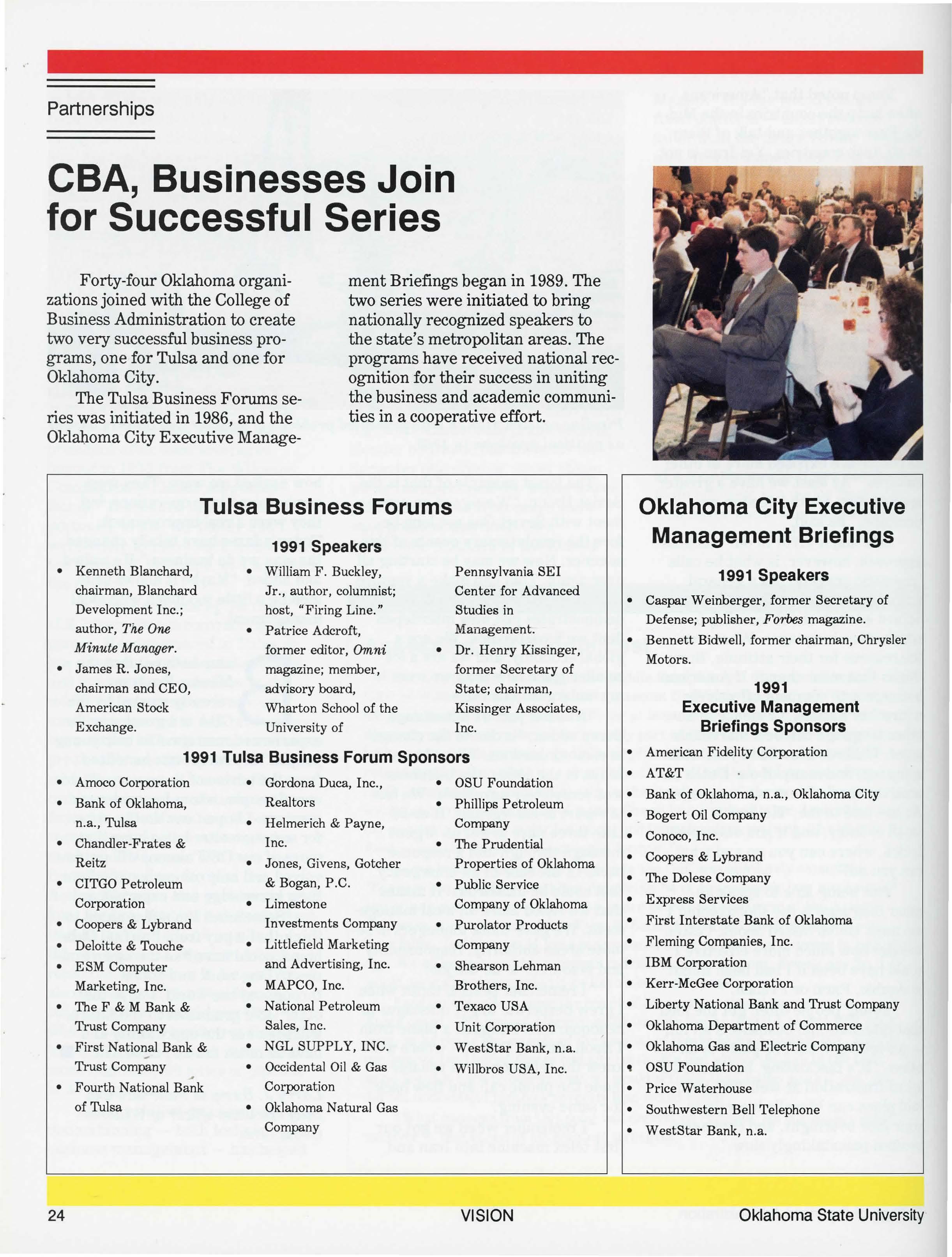
ment Briefings began in 1989. The two series were initiated to bring nationally recognized speakers to
The Tulsa Business Forums series was initiated in 1986, and the Oklahoma City Executive Managethe state's metropolitan areas. The programs have received national recognition for their success in uniting the business and academic communities in a cooperative effort.
• Kenneth Blanchard, chairman, Blanchard Development Inc.; author, The One Minute ManOQer.
• James R. Jones, chairman and CEO, American Stock Exchange.
• Amoco Corporation
• William F. Buckley, Jr., author, columnist; host, "Firing Line."
• Patrice Adcroft, former editor, Omni magazine; member, advisory board, Wharton School of the University of
Pennsylvania SEI Center for Advanced Studies in Management.
• Dr. Henry Kissinger, former Secretary of State; chairman, Kissinger Associates, Inc.
• Gordona Duca, Inc.,
• Bank of Oklahoma, Realtors
• OSU Foundation
• Phillips Petroleum n.a., Tulsa
• Helmerich & Payne, Company
• Chandler-Frates & Inc.
• The Prudential Reitz
• Jones, Givens, Gotcher Properties of Oklahoma
• CITGO Petroleum & Bogan, P.C.
• Public Service Corporation
• Limestone Company of Oklahoma
• Coopers & Lybrand Investments Company
• Deloitte & Touche
• Purolator Products
• Littlefield Marketing Company
• ESM Computer and Advertising, Inc.
• Shearson Lehman Marketing, Inc.
• The F & M Bank &
• MAPCO, Inc. Brothers, Inc.
• National Petroleum
• Texaco USA Trust Company Sales, Inc.
• First National Bank &
• NGL SUPPLY, INC.
• Unit Corporation
• WestStar Bank, n.a . Trust Company
• Occidental Oil & Gas
• Fourth National Bank Corporation of Tulsa
• Oklahoma Natural Gas Company
• Willbros USA, Inc
• Caspar Weinberger, former Secretary of Defense; publisher, Forbes magazine.
• Bennett Bidwell, former chairman, Chrysler Motors.
• American Fidelity Corporation
• AT&T
• Bank of Oklahoma, n.a., Oklahoma City
• Bogert Oil Company
• Conoco, Inc.
• Coopers & Lybrand
• The Dolese Company
• Express Services
• First Interstate Bank of Oklahoma
• Fleming Companies, Inc.
• IBM Corporation
• Kerr-McGee Corporation
• Liberty National Bank and Trust Company
• Oklahoma Department of Commerce
• Oklahoma Gas and Electric Company
• OSU Foundation
• Price Waterhouse
• Southwestern Bell Telephone
• WestStar Bank, n.a.
Free trade with America's southern neighbor could mean major business for U.S.
The legislation passed this summer giving President Bush fast-track authority to negotiate a free-trade agreement with Mexico has the ball rolling. But many are not sure which direction.
Andrew Urich, CBA associate professor of business law, believes it may level the playing field. "They have a lot more money than we think," Urich said. "That market should not be overlooked. And it's relatively cheap to get there."
Members of Urich's intersession class, "Legal Aspects of International Business," were hosted by the Mexican embassy in Washington, D.C., where they were presented a Mexican view of the free-trade issue.
The agreement is designed to lower tariffs that Mexico currently levies on imports of raw materials and :finishedproducts from each country and waive some inspection requirements. This should allow greater access to Mexico's growing economy of 90 million people and benefit U.S. businesses in the long run. Mexican companies, on the other hand, will be able to export tariff-free into the United States. "The complicated paperwork that we have had before will be gone," Urich said.
James Jones, president of the American Stock Exchange, speaking at the CBA's Tulsa Business Forum, feels that Mexico may become "the Korea of the Western Hemisphere" if President Salinas de Gortari is able to continueiiis programs. At one time import duties'up to 50 percent were levied against U.S. products shipped into Mexico. Salinas has already eliminated many of
those duties in an effort to open up the market.
The business climate in Mexico is improving as inflation dropped from 200 percent in the late 1980s to today's 15 percent. There are currently more than 5,000 U.S. companies operating in Mexico. Mexican officials estimate that Mexico's development is equivalent to U.S. economic development in the 1930s or 1940s.
"We may not know for several years just how important our new treaty is, but I believe it's going to
Wheat Commission says that Mexico is one of Oklahoma's top five wheat customers. With the relaxed rules, cattle from Mexico could be fattened on winter wheat fields and :finished for slaughter in Oklahoma feedlots.
But other farmers - those who grow fruits and vegetables, especially - are against the move. The Oklahoma Farmers Union is calling for "fair-trade" agreements rather than free trade. They object because agricultural producers in Mexico often use chemicals banned in the United States.
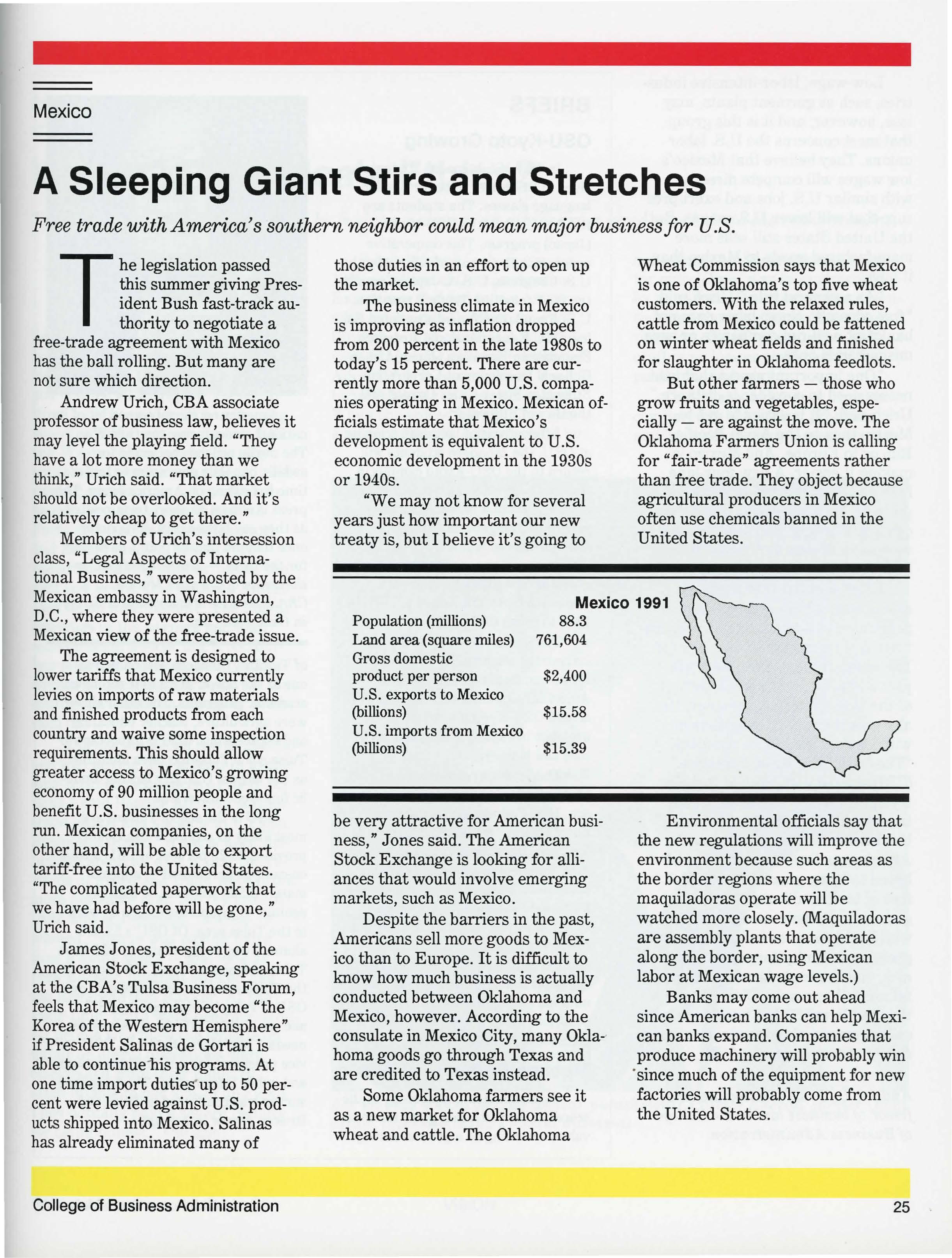
be very attractive for American business," Jones said. The American Stock Exchange is looking for alliances that would involve emerging markets, such as Mexico.
Despite the barriers in the past, Americans sell more goods to Mexico than to Europe. It is difficult to know how much business is actually conducted between Oklahoma and Mexico, however. According to the consulate in Mexico City, many Oklahoma goods go through Texas and are credited to Texas instead.
Some Oklahoma farmers see it as a new market for Oklahoma wheat and cattle. The Oklahoma
Environmental officials say that the new regulations will improve the environment because such areas as the border regions where the maquiladoras operate will be watched more closely. (Maquiladoras are assembly plants that operate along the border, using Mexican labor at Mexican wage levels.)
Banks may come out ahead since American banks can help Mexican banks expand. Companies that produce machinery will probably win ·since much of the equipment for new factories will probably come from the United States.
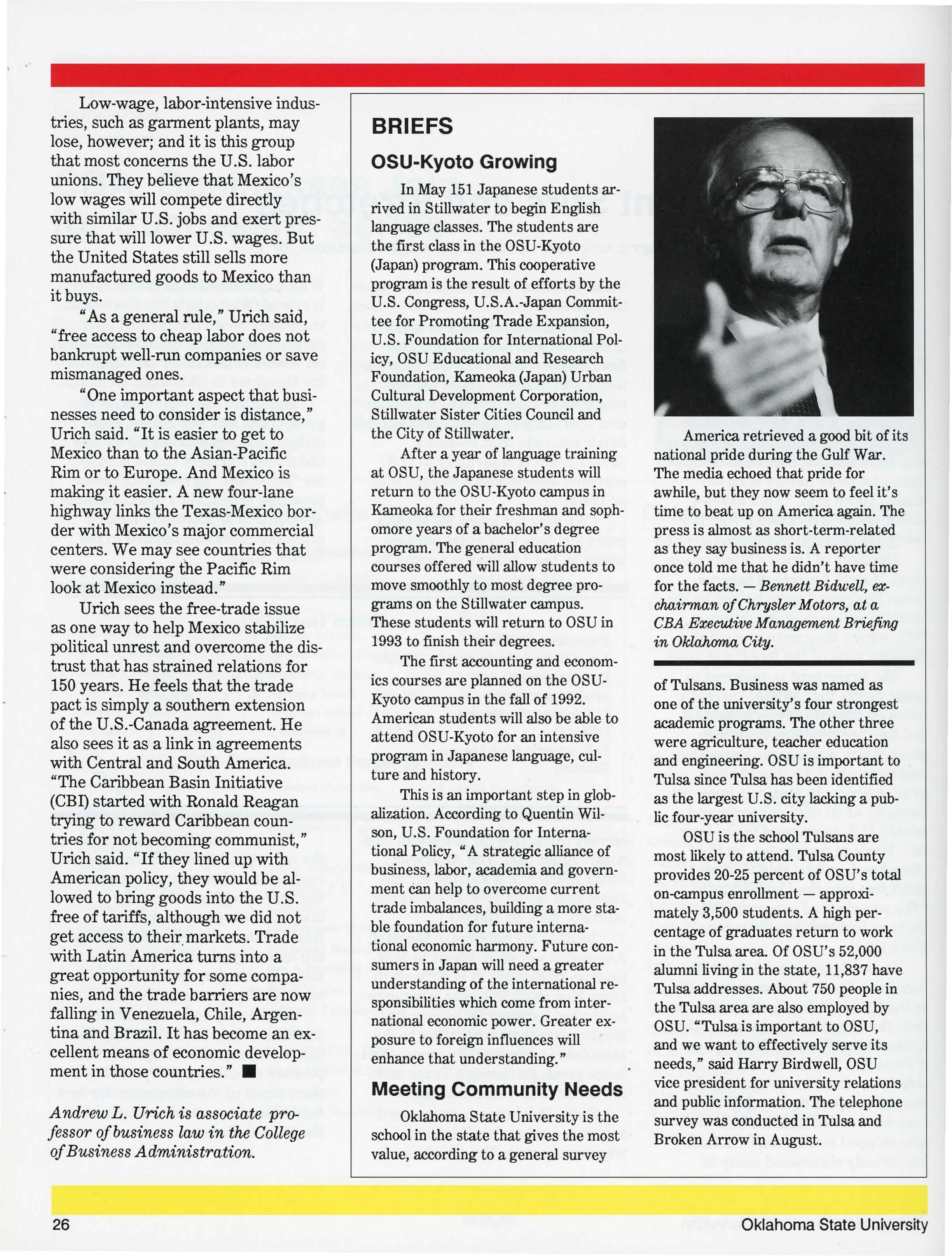
Low-wage, labor-intensive industries, such as garment plants, may lose, however; and it is this group that most concerns the U.S. labor unions. They believe that Mexico's low wages will compete directly with similar U.S. jobs and exert pressure that will lower U.S. wages. But the United States still sells more manufactured goods to Mexico than it buys.
"As a general rule," Urich said, "free access to cheap labor does not bankrupt well-run companies or save mismanaged ones.
"One important aspect that businesses need to consider is distance," Uric~ said. "It is easier to get to Mexico than to the Asian-Pacific Rim or to Europe. And Mexico is making it easier. A new four-lane highway links the Texas-Mexico border with Mexico's major commercial centers. We may see countries that were considering the Pacific Rim look at Mexico instead."
Urich sees the free-trade issue as one way to help Mexico stabilize political unrest and overcome the distrust that has strained relations for 150 years. He feels that the trade pact is simply a southern extension of the U.S.-Canada agreement. He also sees it as a link in agreements with Central and South America. "The Caribbean Basin Initiative (CBI) started with Ronald Reagan trying to reward Caribbean countries for not becoming communist," Urich said. "If they lined up with American policy, they would be allowed to bring goods into the U.S. free of tariffs, although we did not get access to their.markets. Trade with Latin America turns into a great opportunity for some companies, and the trade barriers are now falling in Venezuela, Chile, Argentina and Brazil. It has become an excellent means of economic development in those countries."
Andrew L. Urich is associate professor of business law in the College of Business Administration.
In May 151 Japanese students arrived in Stillwater to begin English language classes. The students are the first class in the OSU-Kyoto (Japan) program. This cooperative program is the result of efforts by the U.S. Congress, U.S.A.-Japan Committee for Promoting Trade Expansion, U.S. Foundation for International Policy, OSU Educational and Research Foundation, Kameoka (Japan) Urban Cultural Development Corporation, Stillwater Sister Cities Council and the City of Stillwater.
After a year of language training at OSU, the Japanese students will return to the OSU-Kyoto campus in Kameoka for their freshman and sophomore years of a bachelor's degree program. The general education courses offered will allow students to move smoothly to most degree programs on the Stillwater campus. These students will return to OSU in 1993 to finish their degrees.
The first accounting and economics courses are planned on the OSUKyoto campus in the fall of 1992. American students will also be able to attend OSU-Kyoto for an intensive program in Japanese language, culture and history.
This is an important step in globalization. According to Quentin Wilson, U.S. Foundation for International Policy, "A strategic alliance of business, labor, academia and government canhelp to overcome current trade imbalances, building a more stable foundation for future international economic harmony. Future consumers in Japan will need a greater understanding of the international responsibilities which come from international economic power. Greater exposure to foreign influences will enhance that understanding."
Oklahoma State University is the school in the state that gives the most value, according to a general survey
America retrieved a good bit of its national pride during the Gulf War. The media echoed that pride for awhile, but they now seem to feel it's time to beat up on America again. The press is almost as short-term-related as they say business is. A reporter once told me that he didn't have time for the facts. - Bennett Bidwell, exchairman of Chrysler Motors, at a CBA Executive Management Briefing in Oklolwma City.
of Tulsans. Business was named as one of the university's four strongest academic programs. The other three were agriculture, teacher education and engineering. OSU is important to Tulsa since Tulsa has been identified as the largest U.S. city lacking a public four-year university.
OSU is the school Tulsans are most likely to attend. Tulsa County provides 20-25 percent of OSU's total on-campus enrollment - approximately 3,500 students. A high percentage of graduates return to work in the Tulsa area. Of OSU's 52,000 alumni living in the state, 11,837 have Tulsa addresses. About 750 people in the Tulsa area are also employed by OSU. "Tulsa is important to OSU, and we want to effectively serve its needs," said Harry Birdwell, OSU vice president for university relations and public information. The telephone survey was conducted in Tulsa and Broken Arrow in August.
The growth of conservatism may befueling a change in ethics from bond markets to the environment.
The 1980s has been labeled the Decade of Greed. But have things really changed? Headlines continue to tell the story: Unisys admits procurement fraud and bid-rigging on Pentagon contracts and is fined $190 million. Salomon Bros. buys government bonds using unauthorized customer names. BFI and Waste Management Inc. pay multi-million-dollar penalties for bid' rigging and forcing out local trash haulers in cities across America. Forty-seven scientists at Harvard and Emory medical schools produced misleading papers during the past two years. One of three Americans lie on their resume. The illegal activities in the savings and loan scandal seem almost like a bottomless pit. And there are plenty of examples of questionable behavior that confront workers on a smaller scale each day.
"During the 1980s it was as if no one was paying any attention to the long-term consequences of their actions," said Patrice Adcroft, former Omni editor and speaker at a Tulsa Business Forum. "What is most disturbing about all of it is that the rewards of greed and fraud were often more desirable than the rewards of truth and selflessness," she explained. "Crime was p~ying more than a living wage - just look at Ivan Boesky, Michael Miliken and the Reverend Jim Bakker. At the same time, truth went begging. Honest people who blew the whistle on unfair or illegal o.perations were blackballed from their industry, often unable to get jobs of any kind. They actually paid a severe penalty for being honest," she said.
Adcroft faced such an issue in 1990 as editor of Omni magazine.
Executives decided to run a cover with a die-cut [hole] that showed through to a photo that was an advertisement for cellular telephones. Adcroft felt it compromised the editorial integrity of the publication. When she voiced her opinion, she was outvoted. So Adcroft stood by
her principles. She and another editor quit. (Omni was later chastised by an association of magazine executives for choosing to run the advertisement. Omni continues on; Adcroft is no longer employed in the publishing industry.)
"But that was an easy decision compared to the ethical problems and issues that many American cor-
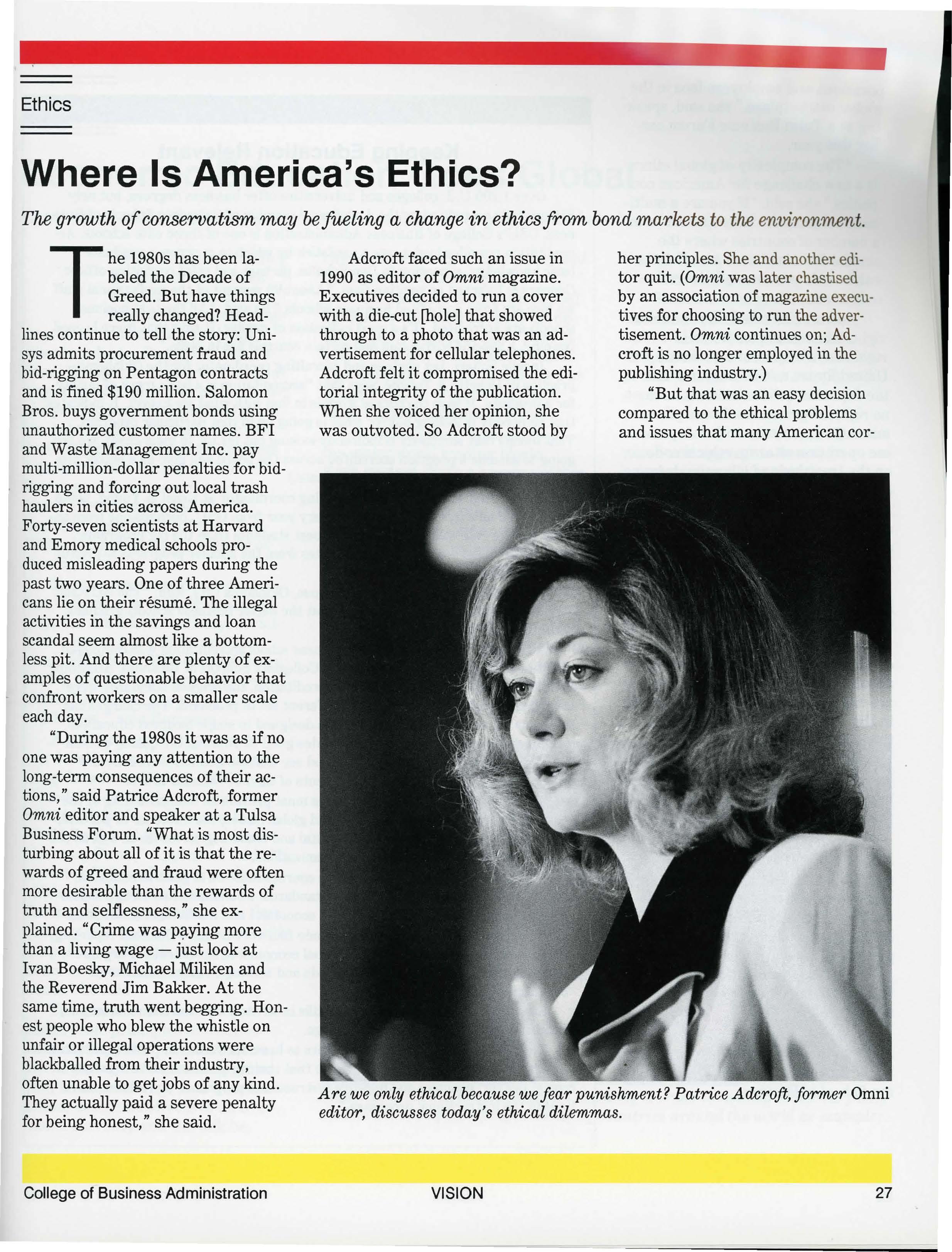
College of Business Administration
porations and employees face in the global marketplace," she said, speaking at a Tulsa Business Forum earlier this year.
"The complexity of global ethics is a new challenge for American companies," she said. "If you are a multinational company with operations in a number of countries where the standards and cultures are all different, how do you form a universal code of ethics?"
Adcroft cited the issue of animal rights as an example." Animal rights are a major concern in the United States and in England, but the Japanese believe animals have no rights. Does an American pharmaceutical company with a Japanese operation alter its ethical code on the treatment of lab animals because it does not have to worry about citizen sensitivity? Or does the company still maintain certain procedures and practices that are acceptable here and in England?"
Adcroft wanted to know why we have suddenly become so interested in ethics. "Is it a reaction against the values of the '80s - or the lack of values? Are we really concerned about practicing ethics because we are concerned about ethical behavior in the '90s, or is it only because of the potential liabilities?"
Adcroft is not certain that what we are seeing is a real change of heart. "Unisys, Salomon, BFI are today's headlines, not yesterday's.
"I wonder if we would be cheering for ethics if Ivan Boesky hadn't gone to jail or if Mike Miliken hadn't been given a prison sentence?" she queried. "The dowp.fallof these men at the top may have worked as a great incentive for everybody else to act ethically. But what a pity that we are driven by punishment rather than morality."
Patrice Adcroft is currently a member of the board of directors, Wharton Schoolof Business.
Over 1,200 U.S. colleges and universities offer business degrees, but only 256 are fully accredited by the American Assembly of Collegiate Schools of Business. OSU's College of Business Administration is one of those elite schools. Accreditation provides businesses a yardstick by which to measure a graduate's basic knowledge, according to Dan Schultz, partner and chief recruiting officer, Coopers & Lybrand accounting firm. "About 90 percent of the professional staff we hire are from accredited business schools," he said. "All the best business schools are accredited. It's a good indication of quality. It says that there is good training, a specific curriculum and certain controls are in place."
Jenelle Schatz, tax partner and recruiting coordinator for the Oklahoma practice of Deloitte & Touche, says that "accreditation is a basic mark of quality for a program. It says the course work is in line with what we expect. It indicates that somebody is looking out for what is going on in that particular program. That means that somebody is indirectly looking out for us. In most cases, we are going to assume a program accredited across the board will give us a better professional." (Schatz is a 1975 CBA graduate.)
Steven Nell, audit manager/recruiting coordinator at Ernst & Young, noted that, "We'll hire five or six students every year from OSU, perhaps one from another college. We want to get the very best students from the big programs, such as OSU, and we hire a few graduates from the smaller programs to give us some diversity."
Paul Brou, partner, Price Waterhouse, Oklahoma City, said, "The ACT and SAT scores usually bear out the idea that the better business schools graduate better people."
A two-year in-depth review of business school accreditation was completed this year by the American Assembly of Collegiate Schools of Business. According to Milton Blood, AACSB director of accreditation, the original standards were shaped in the late 1950s to handle a different set of problems. The changes call for a new set of accreditation standards designed to shape business education into the next century. The changes are designed to improve the quality of management education, foster innovation and see that curriculum is current and relevant to today's needs. Key components of the new standards are:
• Bachelor's and master's programs must provide an understanding of the context of business, including ethical and global issues; the influence of political, social, legal and regulatory, environmental and technological issues as well as the impact of demographic diversity on organizations.
• At least 50 percent of a student's courses must be in general education compared to 40 percent under the old standards. Foundation knowledge should include accounting, behavioral sciences, economics and mathematics/statistics.
• Curriculum for MBAs should include four core areas - financial reporting, analysis and markets; domestic and global economic environments of organizations; creation and distribution of goods and services; human behavior in organizations.
Students must also demonstrate skills in written and oral communications, quantitative analysis and computer usage.
The new rules allow faculty members to have doctorates in fields other than business. But schools must demonstrate that their professors can "effectively create, deliver, evaluate and improve instructional programs, and make innovations in the instructional processes."
Computersand economictheory com"bineto introduce globalmarkets to outstanding students.
Twenty-three outstanding students from around the country attended a four-week summer academy in economics for gifted high school students. Funded by the National Science Foundation, the academy covered such topics as economic analysis, communications and problem-solving. The academy was conducted by three College of Business Administration faculty - Donald L. Bumpass, adjunct associate professor of economics; Pauline W. Kopecky, associate professor and Michael J. Applegate, professor of economics.
The program was divided into four components - the global economy, the American economy, social justice issues and ethics, and economic efficiency. "We wanted to approach this from a relevant issues point of view and show how they overlapped," said Bumpass.
A computer prototype model was developed prior to the program using data from Turkey. "This type of model is currently used by economists to do policy analysis at the World Bank and the International Monetary Fund," Applegate said. "It consists of 72 nonlinear equations which are solved simultaneously. The model was programmed so that students who had no ~xperience with computers could still access the • model and perform policy experiments," he said.
The global economics project included basic principles of international trade, principles of comparative advantage and resw.ting gains from trade, exchange rate determination, economic effects of an overvalued currency and the link be-
tween domestic monetary policy and the balance of payments.
"We had case studies presented on tape by the International Monetary Fund," Bumpass said. They involved Mexico, Ghana and Poland. The Republic of Zambia was used as a case study to present problems faced by policymakers in Africa.
"Students were introduced to the major world trading blocks. Each student chose a·country within a trading block to develop a country profile. They were then introduced to quantitative policy analysis using the computerized policy model to simulate various policy instruments."
Students were required to work on seven policy experiments plus an optional assignment which involved modifying the model itself. Problems involved opportunity costs; supply, demand and tariff policy; utility maximization; gains from trade; produc-
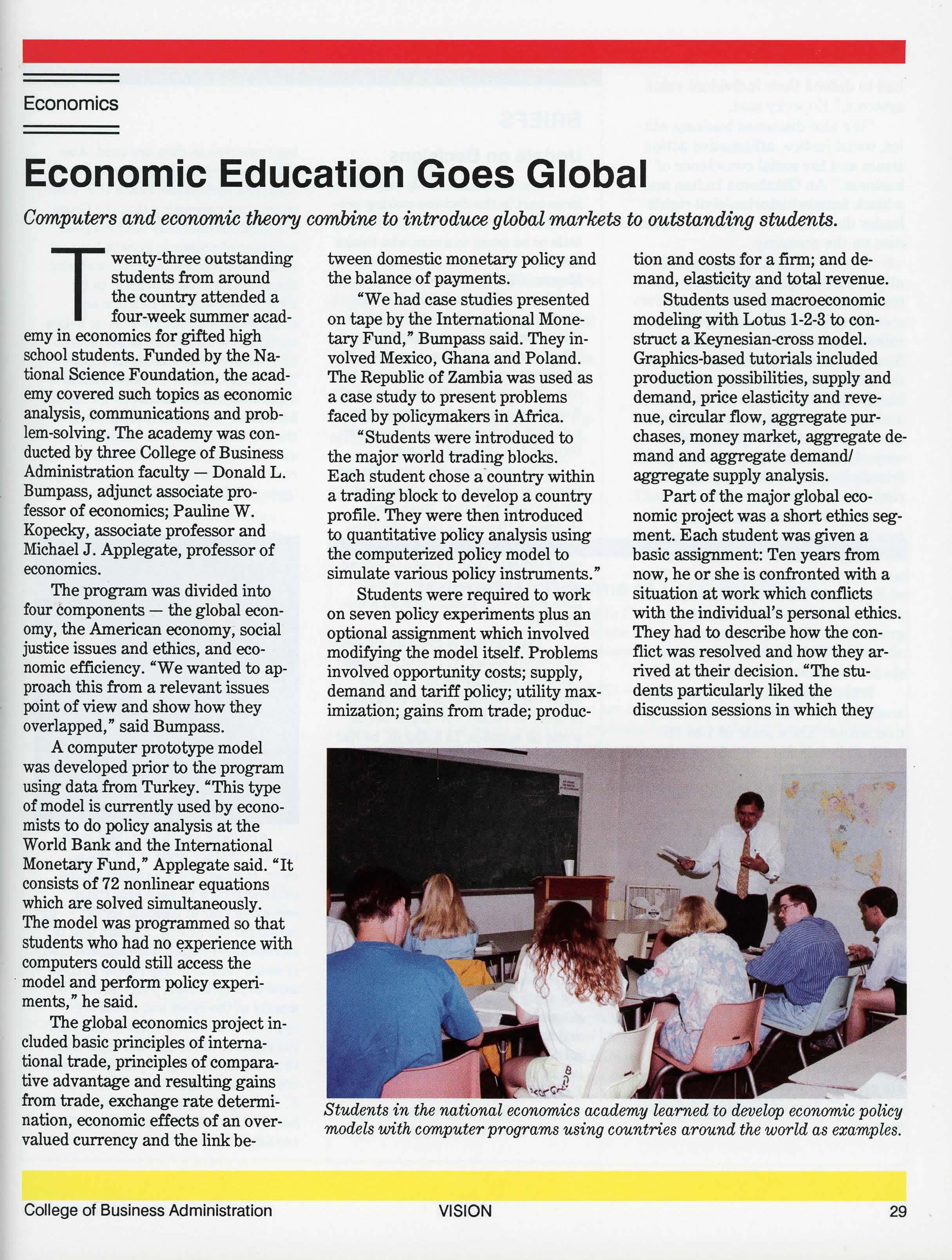
tion and costs for a firm; and demand, elasticity and total revenue.
Students used macroeconomic modeling with Lotus 1-2-3 to construct a Keynesian-cross model. Graphics-based tutorials included production possibilities, supply and demand, price elasticity and revenue, circular flow, aggregate purchases, money market, aggregate demand and aggregate demand/ aggregate supply analysis.
Part of the major global economic project was a short ethics segment. Each student was given a basic assignment: Ten years from now, he or she is confronted with a situation at work which conflicts with the individual's personal ethics. They had to describe how the conflict was resolved and how they arrived at their decision. "The students particularly liked the discussion sessions in which they
had to defend their individual value systems," Kopecky said.
"We also discussed business ethics, social justice, affirmative action issues and the social conscience of business." An Oklahoma Indian and a black female historian/civil rights leader discussed the impact of minorities on the economy.
The students had an opportunity to meet Japanese students attending a Language Institute to meet English requirements for enrollment at OSU-Kyoto in Japan. Since the academy students were in the same dormitory, each student had to talk with a Japanese student and report orally and in writing on some·aspect of the Japanese economy. As a result, many became good friends in spite of the language barrier.
Only five of the students entered the program with any economics background. At the end of the academy, each student took the Test of Economic Literacy (TEL), a national test for students at the 11-12th grade level. Eleven scored at or above the 90th percentile; another six scored above the 78th percentile.
When asked how they liked the academy, one student in his evaluation wrote: "On a scale of 1 to 10 (with 10 being the best), I give the NSF program a 10112!"
Students enrolled in the Summer Academy in Economics were from Connecticut, Indiana, Kansas, Oklahoma, Texas, Vermont and Wisconsin. This was the second year of the project. OSU will use the satellite network and programming to disseminate information about the program next year and expand its nationwide student body.
Michael J. Applegate is professor of economics; Pauline Kapecky is an associate profes.sor of economics and Don Bumpass is an.adjunct associate professor of economics. All are with the College of Business Administration.
Economics and money play a large part in the decision-making process for Americans, but dollars make little or no sense to a man who thinks like Saddam Hussein, reports John Mowen, CBA professor of marketing and Carson Centennial Chair. "The American tendency is to view most things through an economic frame. When the Soviet Union went into Afghanistan, we put on an economic boycott. When Saddam Hussein invaded Kuwait, we put on an economic boycott. But he does not view the world through that economic frame.
"The exchange of tapes between Bush and Hussein is an apt metaphor for the Gulf situation. Bush sends Hussein a 10-minute tape, and Hussein sends him a two-hour tape. This could indicate that Hussein is willing to take 12 times more punishment than Bush - or outlast him by a factor of 12.
"The decision of Saddam Hussein to invade Kuwait represents a classic 'shoot-no shoot decision.' Hussein made the judgment call of attacking in order to obtain a stranglehold on world oil supplies. In doing so, he had to read the signals from the United States as to what our response would be. He 'missed' our signals that we would respond. As a result, he made the error of acting when he should have done nothing. His nation was nearly destroyed as a result of his failure to make the appropriate judgment call."
Some forward-thinking countries are using accounting procedures to keep track of their natural resources and the cost of exploiting them, according to Patrice Adcroft, former editor of Omni, who spoke at a Tulsa Business Forum. Norway has such a program. The Netherlands has a program to determine the price of replac-
ing resources as they are used. Australia has set up a similar resource assessment committee. Some U.S. economists are suggesting that the Gross National Product may not be a good indicator of economic growth because it does not account for environmental losses that will be expensive to fix. France, Norway and Belgium are doing away with the GNP as an indicator and now categorize expenditures by growth or environmental repair. The United Nation's environmental department has a handbook for satellite accounting, which accounts for the toll that production takes on the environment. The U.S. Census Bureau is looking into similar concepts, a 'green' GNP and ecological economics.
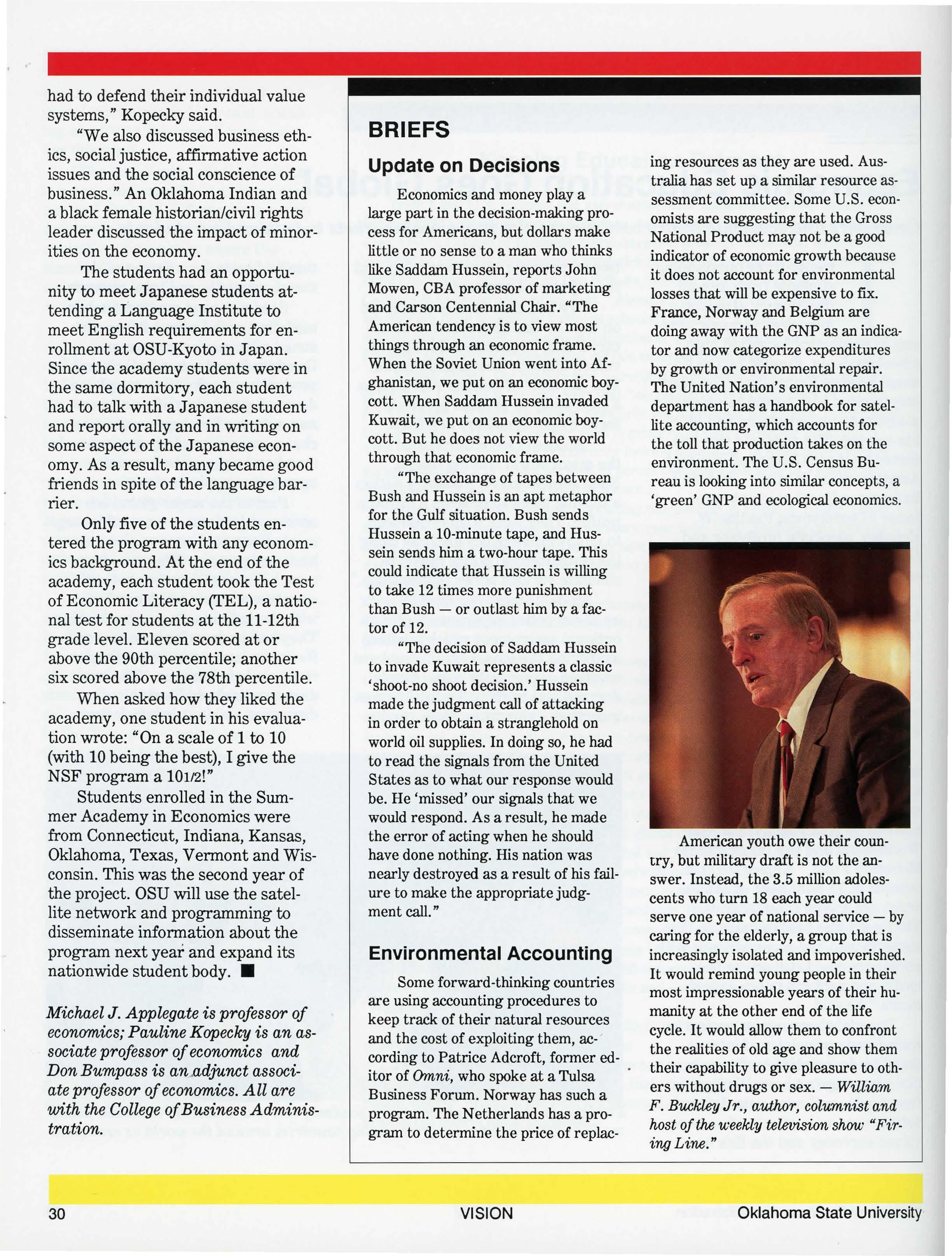
American youth owe their country, but military draft is not the answer. Instead, the 3.5 million adolescents who turn 18 each year could serve one year of national service - by caring for the elderly, a group that is increasingly isolated and impoverished. It would remind young people in their most impressionable years of their humanity at the other end of the life cycle. It would allow them to confront the realities of old age and show them their capability to give pleasure to others without drugs or sex. - William F. Buckley Jr., author, columnist and host of the weekly television show "Firing Line."
OSU reaches out to a nation ready to move into industrial nation status.
The Indonesian managers attending the first Agribusiness Strategy Development program in Jakarta seemed uncomfortable when John R. Wingender began to talk of a futures market and options for hedging, speculating and price forecasting. But Wingender, an associate professor of finance in the College of Business Administration, was prepared.
"You have to understand the culture when you are in another country," he said. "This country is more than 85 percent Muslim. Futures markets are considered gambling, which is immoral and illegal in Muslim countries. We explained that not having a futures market made them the biggest gamblers of all. They have no control over what price they might get for their products. With the futures market, they could contract for a price ahead of time."
Wingender was one of four OSU professors who took part in the program. The others were OSU professors of agricultural economicsDaniel S. Tilley, James Trapp and Phil Kenkel.
"Indonesia is a tremendously exciting place," Wingender said. "It is set to move into industrial nation status. Geographically·and agriculturally, the country has the resources. It is the fifth largest country in the world - 185 million people. It is made up of 13,00016,000 islands. The conference facilities in Jakharta, €he capital city, were as modern as can oe found anywhere. Most people speak both Indonesian and English, and all the signs are in Indonesian and English.
Even cab drivers who cannot speak English can read it. The country produces rubber, cocoa, palm oil, tea and coffee. They export a great deal of tea to Russia and rubber to Germany. Most international trade is in American dollars, which is the standard currency of their exports."
Developing agribusiness is a significant part of the economic development strategy for the country. "They are well known for agricultural production," said Wingender.
"But they are looking for ways to increase employment opportunities in rural areas - to increase productive use of their land - and to increase the country's market share of particular export markets.
"This means that they will have to move away from subsistence agriculture to a more developed economy," he said. "They must move from a commodity orientation to a value-added product orientation. They also know that with industrial
When Sheirly Leo began applying to U.S. colleges, she was determined to attend a school in a smaller city than the one in which she grew up. That left her with a lot of choices because her hometown of Jakarta, Indonesia, has a population of more than seven million.
Today she is a finance major at OSU - a long road seldom traveled by Indonesian women. "Indonesian women are expected to get married, have children and begin keeping house when they graduate from high school," Leo smd. "But I dreamed of going to college." Her family resisted her aspirations at first. But Leo did not give up. "In high school I really tried hard to get_good grades. My family saw that I was serious and started supporting me. They are now proud that I'm studying here."
When she arrived in Stillwater in December 1988, Leo was met at the airport by representatives of..0SU's international student services. "I came here by myself and didn't know any students. But everyone is so friendly in Stillwater that I soon had many friends.
"Most Indonesian business students who study in the United States go into the banking system when they return," she said. "Our banking system has improved and is developing very fast. There is even a stock exchange market."
Three things have particularly impressed Leo. One is the strong work ethic in Oklahoma. "People here are very hard working and want to go to school. In my country the illiteracy rate is still very high. Many people can't read or write at all." Another is the freedom of expression that Americans take for granted. "Students can even criticize a teacher. In my country, to even ask a question in a classroom could be very offensive to an older teacher."
Most of all, Leo wants Indonesians to understand that "it's okay to be a mother and work in a profession, too. After I have worked in a corporation and gained some years of experience, I would like to get credit at a bank and start my own business."
development comes industrial waste and pollution - something that they are already beginning to see. They want to address these issues now."
The concept for the program began in late 1990 when OSU signed a cooperative agreement with Indonesia's !EU-Institute of Management. A delegation visited OSU, and preliminary outlines of the course work were made. The course covered such topics as marketing management, cash management, finance, commodity futures markets, financial futures, price forecasting and evaluation of international corporate linkages.
"The course was designed for top management of large, publiclyowned natural resource plantations," Wingender said. "There are about 33 of these large plantations spread out on 25 islands. The plantations are owned by the Ministry of Finance. The management is supervised by the Minister of Agriculture. We had men from 22 plantation companies, two banks, the joint marketing group, a seed company, two fish companies and a fertilizer company. Most had four-year college degrees, and many had advanced degrees."
He was pleasantly surprised to find that the managers use the latest computer equipment and software, provided by the Ministry of Agriculture. "They have the tools, but their information level lags behind," he said. "They do not do a lot of sensitivity analysis or simulation analysis. We developed a program for them to use especially in cash flow analysis. Agribusiness managers need to understand modern strategies to manage risks associated with their enterprises.
"There is a stark contrast, however, between the technology used by management and manual laborers. Most things are still done by hand in order 11>employ as many people as possible." #
Some firms are attempting to find joint-venture partners or other forms of international corporate link-
ages to help finance and provide the marketing expertise needed for development of new industries. There has been a rapid rise in interest rates right now - above 20 percent - which has occurred in the last 18 months. It is attributed to a tight money policy adopted by the government. This has put some enterprises in financial difficulty, since some long-term projects are funded by short-term capital. But high interest rates also place more importance on short-term cash management. Some companies are considering the issue of privately held stock as a method of obtaining capital.
OSU has strong contacts with Indonesia. Several officials in the Ministry of Agriculture have doctoral degrees in agricultural economics from OSU. Several have taken graduate courses in the College of Business Administration. Gita
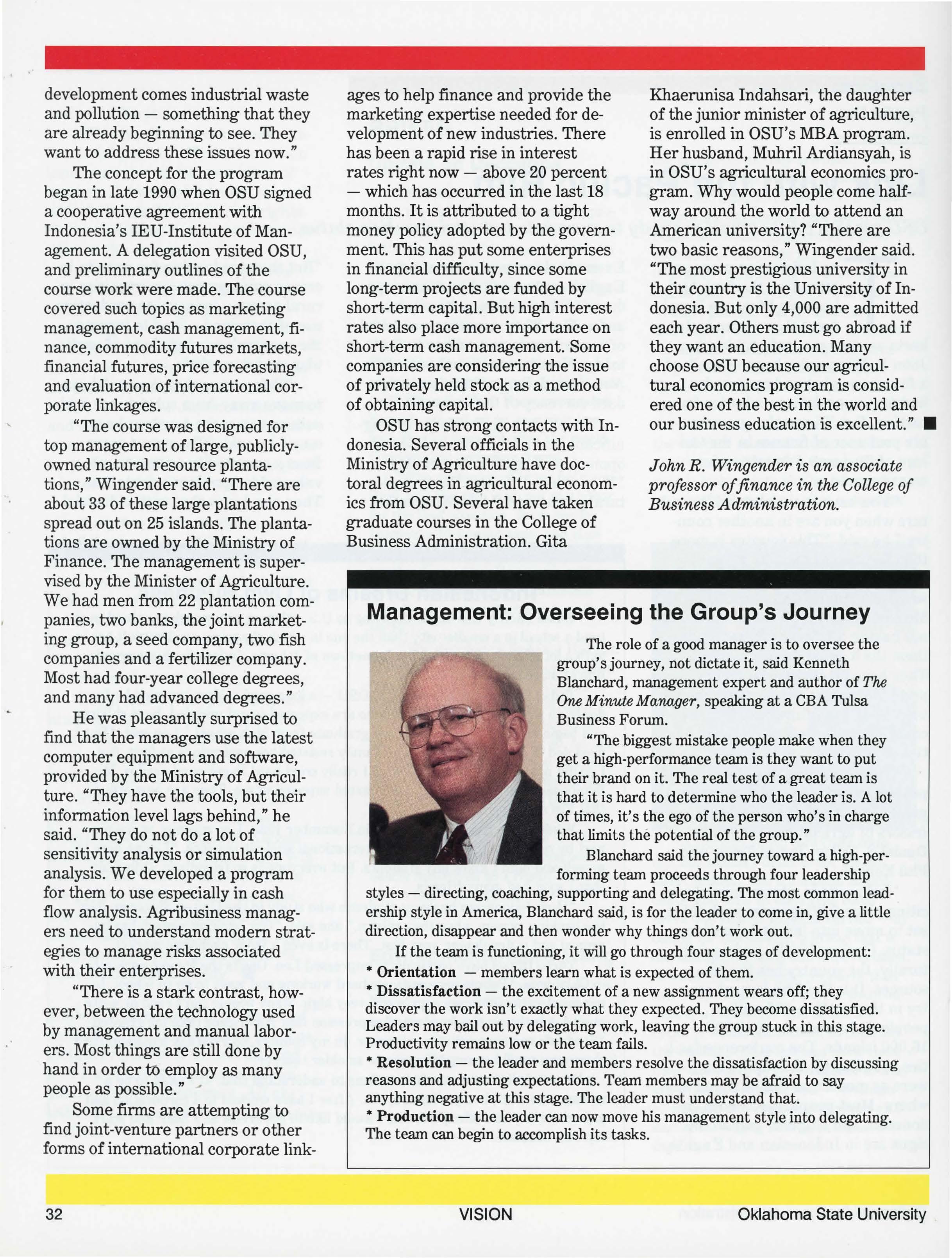
Khaerunisa Indahsari, the daughter of the junior minister of agriculture, is enrolled in OSU's MBA program. Her husband, Muhril Ardiansyah, is in OSU's agricultural economics program. Why would people come halfway around the world to attend an American university? "There are two basic reasons," Wingender said. "The most prestigious university in their country is the University of Indonesia. But only 4,000 are admitted each year. Others must go abroad if they want an education. Many choose OSU because our agricultural economics program is considered one of the best in the world and our business education is excellent."
John R. Wingender is an associate professor of finance in the College of Business Administration.
The role of a good manager is to oversee the group's journey, not dictate it, said Kenneth Blanchard, management expert and author of The One Min?.de Manager, speaking at a CBA Tulsa Business Forum.
"The biggest mistake people make when they get a high-performance team is they want to put their brand on it. The real test of a great team is that it is hard to determine who the leader is. A lot of times, it's the ego of the person who's in charge that limits the potential of the group."
Blanchard said the journey toward a high-performing team proceeds through four leadership styles - directing, coaching, supporting and delegating. The most common leadership style in America, Blanchard said, is for the leader to come in, give a little direction, disappear and then wonder why things don't work out.
If the team is functioning, it will go through four stages of development:
• Orientation - members learn what is expected of them.
• Dissatisfaction - the excitement of a new assignment wears off; they discover the work isn't exactly what they expected. They become dissatisfied. Leaders may bail out by delegating work, leaving the group stuck in this stage. Productivity remains low or the team fails.
• Resolution - the leader and members resolve the dissatisfaction by discussing reasons and adjusting expectations. Team members may be afraid to say anything negative at this stage. The leader must understand that.
• Production - the leader can now move his management style into delegating. The team can begin to accomplish its tasks.
Robert L Sandmeyer, Dean
John T. Bale, Associate Dean
Accounting
Lanny G. Chasteen, Arthur Andersen Chair of Accounting and Head, School of Accounting
Patrick B. Dorr, Professor
Lawrence H. Hammer, Professor Don Hansen, Professor
Janet I. Kimbrell, Associate Professor
Bud Lacy, Associate Professor and Coordinator of Graduate Programs in Accounting
Amy Hing-Ling Lau, Kerr-McGee Professor of Accounting
Gary K. Meek, Alumni Professor
Maryanne M. Mowen, Associate Professor
David S. Murphy, Assistant Professor
Kevin E. Murphy, Associate Professor
Dennis H. Patz, Kerr-McGee Professor of Accounting
Charles R. Ransom, Associate Professor
T. Sterling Wetzel, Associate Professor
John H. Wilguess, Professor
Charlotte J. Wright, Professor
Administrative Services
Joe W. Fowler, Professor of Business Law and Head, Department of Administrative Services
James M. Jackman, Associate Professor
Tipton F. McCubbins, Associate Professor
Gregory C. Mosier, Associate Professor
Dennis L. Mott, Professor
Zane K. Quible, Professor
Jeanine N. Rhea, Professor
Andrew L. Urich, Associate Professor Economics
Ronald L. Moomaw, Professor and Head, Department of Economics
Lee C. Adkins, Assistant Professor
Orley M. Amos Jr., Professor
Michael J. Applegate, Professor
Donald L. Bumpass, Adjunct
Associate Professor and Manager, Economic Education programs
Kevin M. Currier, Associate Professor
Michael R. Edgmand, Professor
James R. Fain, Associate Professor
Mary Gade, Associate Professor
Joseph M. Jadlow Jr., Professor
Pauline W. Kopecky, Associate Professor
Gerald M. Lage, Professor
Kent W. Olson, Professor
Richard W. Poole, Regents Distinguished Service Professor
Edward 0. Price III, Associate Professor
Andreas Savvides, Associate Professor
Frank G. Steindl, Regents Professor
Larkin B. Warner, Regents Professor
Keith D. Willett, Professor Finance
Janice W. Jadlow, Associate Professor and Head, Department of Finance
Anne E. Gleason, Assistant Professor
James F. Jackson Jr., Associate Professor
Timothy L. Krehbiel, Assistant Professor
Ronald K. Miller, Associate Professor
John A. Polonchek, Associate Professor
W. Gary Simpson, Professor, OBA Chair of Commercial Bank Management
Rory L. Terry, Assistant Professor
John R. Wingender, Associate Professor Management
Wayne A. Meinhart, Professor and Head, Department of Management
Richard A. Aukerman, Professor
Steve H. Barr, Associate Professor
Raja Basu, Assistant Professor
James D. Bogert, Assistant Professor
Nikunj P. Dalal, Assistant Professor
Kenneth K. Eastman, Assistant Professor
Vance H. Fried, Assistant Professor
David C. Ho, Associate Professor
Timothy C. Ireland, Associate Professor
Marilyn G. Kletke, Associate Professor
Chalmer E. Labig Jr., Associate Professor
Hon-Shiang Lau, Regents Professor
Debra L. Nelson, Associate Professor
G. Daryl Nord, Professor
Jeretta Horn Nord, Associate Professor
Jayaram Ramanathan, Assistant Professor
Ramesh Sharda, Professor & Conoco/DuPont Chair of Technology Management
Faye L. Smith, Assistant Professor
Thomas H. Stone, Professor
J. Scott Turner, Professor
Margaret A. White, Associate Professor
Rick L. Wilson, Assistant Professor Marketing
L. Lee Manzer, Professor and Head, Department of Marketing
Terry Bristol, Assistant Professor
Goutam Chakraborty, Assistant Professor
Gary L. Frankwick, Assistant Professor
Richard Germain, Assistant Professor
James G. Hromas, Associate Professor and Director, University Extension
Ruth Haas Kreiger, Associate Professor
Stephen J. Miller, Professor and Director, Center for Product and Service Quality
John C. Mowen, Professor and Carson Centennial Chair of Business Administration
Ajay S. Sukhdial, Assistant Professor
Joshua L. Wiener, Associate Professor and interim director, Office of Business & Economic Research
William G. Zikmund, Professor
VISION Magazine is a publication of Oklahoma State University's College of Business Administration. It is designed to bring our many constituents the latest information in business and education. Editor: Rudy I. Greer. Publisher: The Blakey Group, Tulsa, OK.
The College of Business Administration has 100 faculty members and 3,700 students and includes six academic departments: accounting, administrative services, economics, finance, management and marketing. Additional resources include:
Office of Business and Economic Research - Information and research services to business and government.
Business Extension - Over 250 noncredit programs
Center for Product and Service Quality - Research, business assistance and curriculum development on quality.
National Business Incubator Training Center - Aid for businesses.
Center for Management .of Technology and InnovationResearch to help firms become more competitive.
College of Business Administration, Oklahoma State University, Stillwater, OK 74078-0555 405/744-5064.
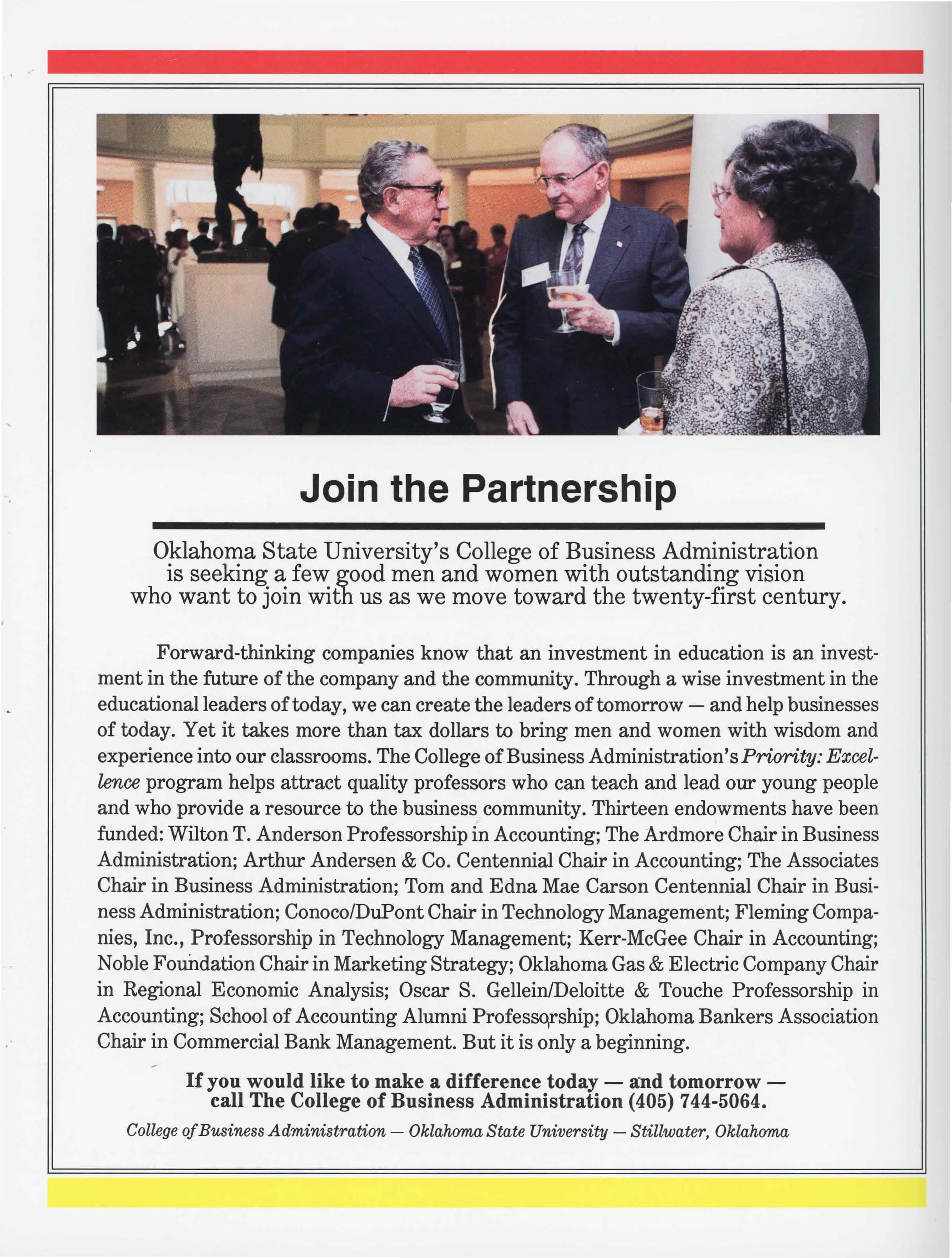
Oklahoma State University's College of Business Administration is seeking a few good men and women with outstanding vision who want to join with us as we move toward the twenty-first century.
Forward-thinking companies know that an investment in education is an investment in the future of the company and the community. Through a wise investment in the educational leaders of today, we can create the leaders of tomorrow - and help businesses of today. Yet it takes more than tax dollars to bring men and women with wisdom and experience into our classrooms. The College of Business Administration's Priority: Excel"lenceprogram helps attract quality professors who can teach and lead our young people and who provide a resource to the business community. Thirteen endowments have been funded: Wilton T. Anderson Professorship in Accounting; The Ardmore Chair in Business Administration; Arthur Andersen & Co. Centennial Chair in Accounting; The Associates Chair in Business Administration; Tom and Edna Mae Carson Centennial Chair in Business Administration; Conoco/DuPont Chair in Technology Management; Fleming Companies, Inc., Professorship in Technology Management; Kerr-McGee Chair in Accounting; Noble Foundation Chair in Marketing Strategy; Oklahoma Gas & Electric Company Chair in Regional Economic Analysis; Oscar S. Gellein/Deloitte & Touche Professorship in Accounting; School of Accounting Alumni Professqrship; Oklahoma Bankers Association Chair in Commercial Bank Management. But it is only a beginning.
If you would like to make a difference today - and tomorrowcall The College of Business Administration (405) 744-5064. Collegeof Business Administration - OklahomaState University - Stillwater, Oklahoma