Oklahoma State University College of Business Administratio·n
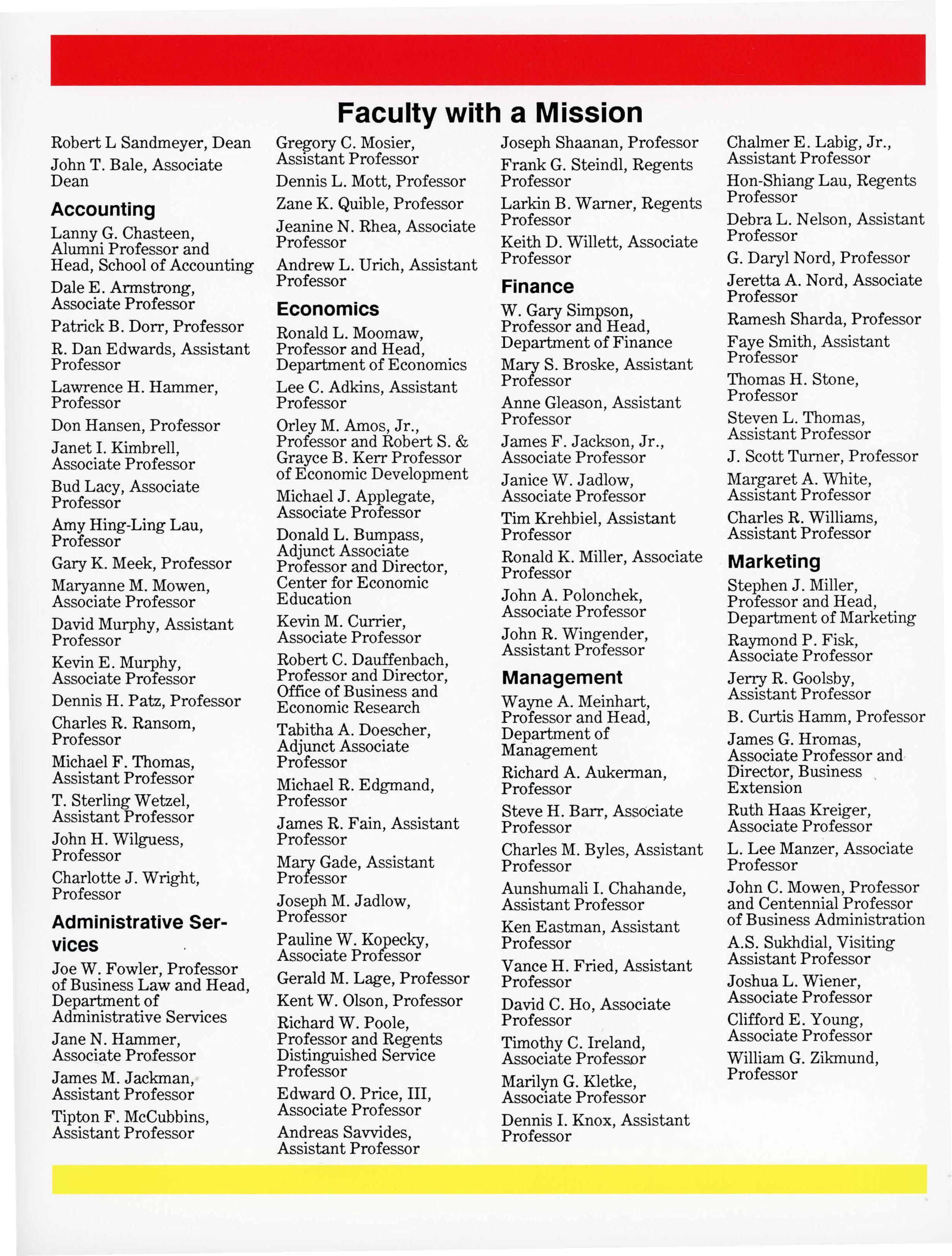
Sandmeyer
Planning for the future requires vision and dreams. The dream started ten years ago, and the College of Business Administration has changed as it has grown. Where does it go now?
Business and education are forming a tight coalition in an effort to keep up with changes in business. OSU President John Campbell
shares his commitment to education and business. Also: Tulsa Business Forum, CBA chairs, Economic Outlook.
Rural students get an education in economics through a program sponsored by the CBA.
What drives unethical behavior? What is it real-
ly costing us? What can we do about it?
Joshua Weiner discusses what impact ethics has on business and our society
The CBA's Economic Outlook provides the state a way to measure growth using the
latest forecasting tools.
Business colleges are a phenomena that belongs to America. They began to answer a need; and although the needs have changed, the reasons for their existence are still valid.
The basic issues at stake are quality and competitiveness. Technology may be hard to handle, but can we do without it?
More companies are going global. Also: Looking at the European Community of 1992.
The toast is burnt; the workmen never show. How can you create quality - and can anyone
sustain it?
How do you put together a curriculum to meet tomorrow's needs today? The right mix of the right ingredients is key.
The new graduates have unexpected strengths on which to draw and some weaknesses to
overcome. Also: A look at the class of 1995.
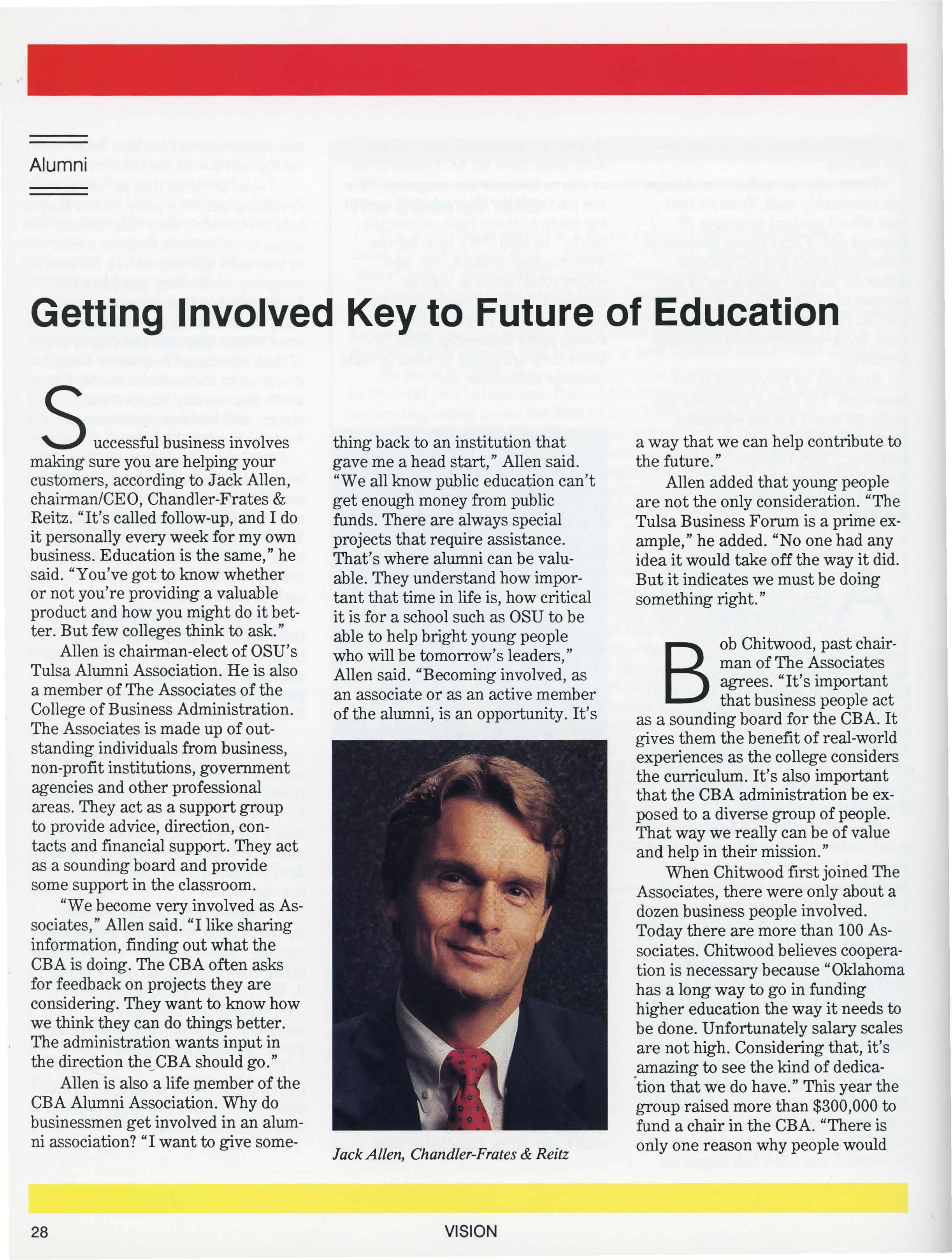
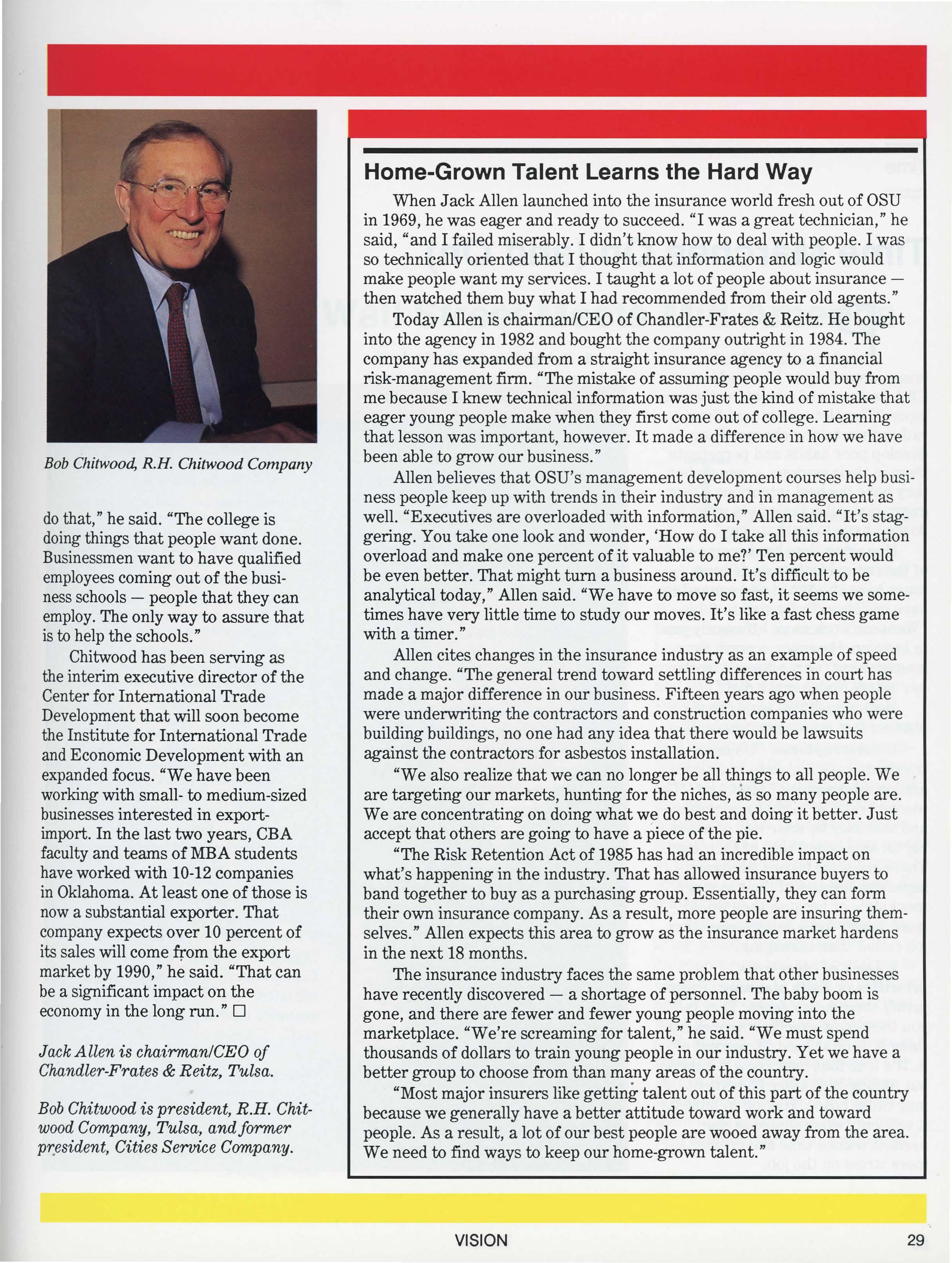
Jack Allen, Chandler-Frates & Reitz, says education needs the involvement of'businesses. Bob Chitwood, R.H. Chitwood Associates, agrees.
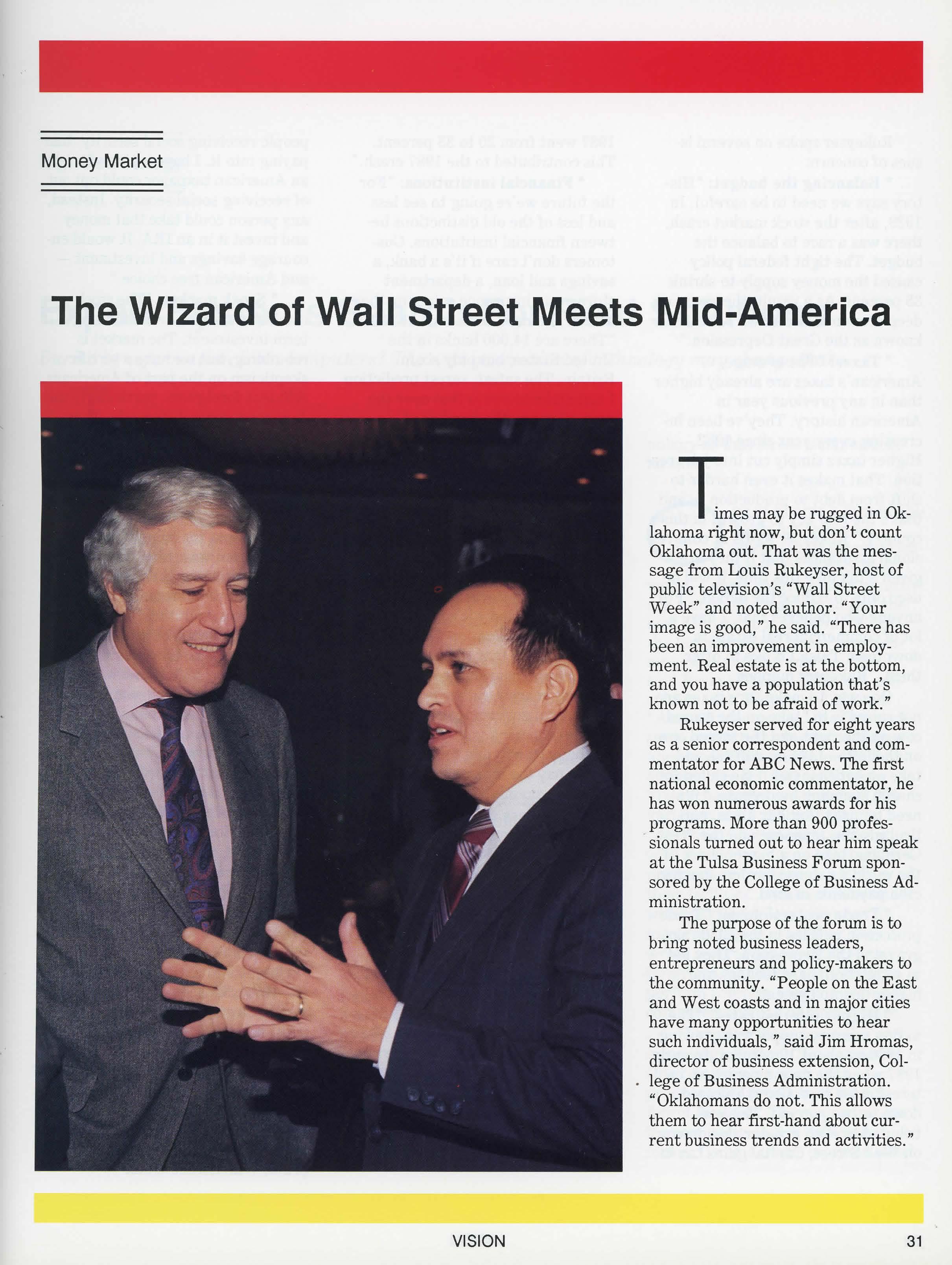
When Louis Rukeyser talks, many listen, and he gives plenty of advice on everything from stocks and bonds to balancing the budget.
From the Dean's Desk
Priority: Excellence
Our priority is excellence- and we do mean business
wt is a quality education in today's complex and changing environment? There are no hard and fast rules and no single body of knowledge that guarantees a quality education. It is an ongoing effort that calls for almost superhuman vision.
It requires an understanding of not only education but business and social changes, from human resources to high technology, not just as it is but how it will be and might be.
We knew ten years ago when we began planning a new direction for the College of Business Administration that massive global changes were underway that would affect everyone. Our graduates would be thrust into a new business environment - chaotic, exciting, challenging, but with the promise of great rewards for those who could cope and thrive in the new era.
We also knew that our mission involved more than just our undergraduates. We had to provide more than academic training to business 'administrators.' We had to supplement required academic menus with a teaching emphasis that produces leaders rather than just managers.
Business visionary and excellence advocate Tom Peters, in his work Thrim:ng on Chaos, says a revolution is required in manage-
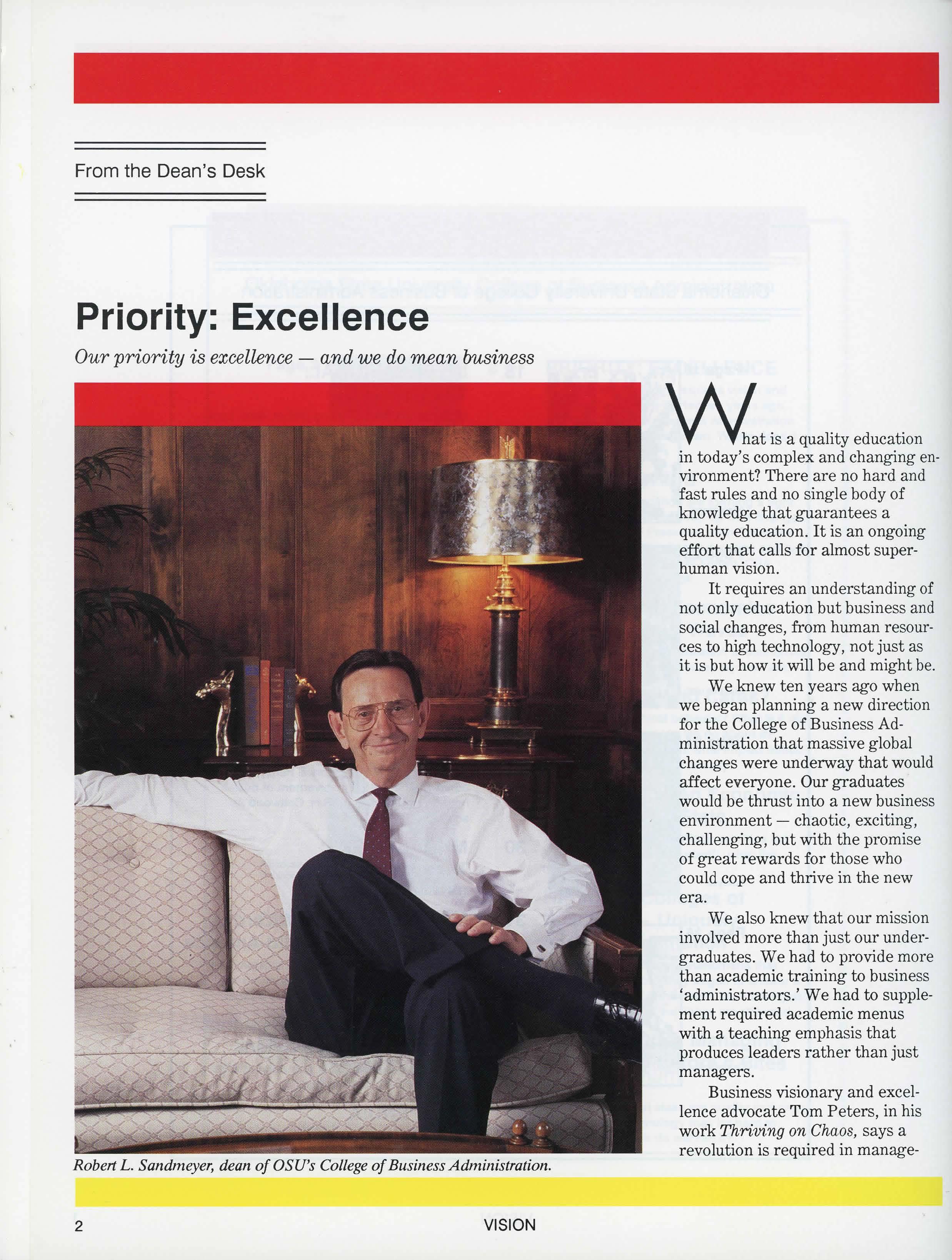
Robert L. Sandmeyer, dean of OSU's Collegeof Business Administration.
ment in order to succeed in today's and tomorrow's global marketplace. Peters writes that our competitive situation is dire. The time of our longstanding penchant for mass production and mass markets, based on a relatively predictable environment, has vanished.
The winners in tomorrow's business world, he says, must deal proactively with chaos. They must see it as the source of their market advantage. They must learn to capitalize on constant change.
Even ten years ago we knew that we could not educate people just to attack Oklahoma's unique problems. We had to prepare them as professionals, able to adapt to business in any part of the world. We also knew that current information would most likely become obsolete even before a student was graduated. We believed men and women already in business would need to keep up with new information and technology or drastically fall behind. We saw that technology was breeding new technology that would continue to change the manufacturing process and how services are delivered. We expected great advances in information. But no one was really prepared for just how much the quantum leaps in computers and technology would change how we receive information and how we do business.
Oklahoma State University was founded as a land grant college in 1891 with a focus on three functions - teaching, research and outreach. We were determined to renew that
trifold purpose to meet needs we had yet to discover.
The first step meant rethinking our programs - what we taught and why and how we taught it, our product and the delivery process.
Second was research. We divided our efforts into two basic areas: 1) research that could be of value to business and government today and 2) research that could move the field forward. This requires funding; and through a number of sources, we have been successful.
The link-up of education and business provides a formidable resource for the business community.
Third was outreach. This meant recognizing our debt and our value to the community - the community in its broad sense - not just Stillwater, Oklahoma, but the larger community of business professionals and state citizens.
That commitment to the community includes ensuring that we provide a genuine quality education to our students so that they enter the marketplace as quality graduates. We have listened carefully to the regional business community. We have studied the world market and its twists and turns. We have analyzed our own curriculum and have made every attempt -
with the resources available - to tune it to meet today's and tomorrow's marketplace.
We know that we cannot be all things to all people. We would rather be good at a few things than mediocre at many. With that in mind, we have organized and arranged our resources to concentrate on doing those things we can do exceedingly well. If there is a key to our plan it is flexibility. We consistently listen to the marketplace, adjusting our curriculum, developing more expertise, fine-tuning our longterm goals to meet the changing needs of the business community and our students.
Have we been successful? It is difficult to be objective. We feel instinctively that we are headed in the right direction - and certainly instinct is part of meeting the futur.e. Our students receive national awards and are actively sought by employers. Our faculty are recognized for their scholarship. Our outreach programs, such as the Tulsa Business Forum, have been extremely successful.
This year is our seventy-fifth anniversary; but we cannot rest on past laurels. We are more confident now, than ever, that the link-up of education and business provides a formidable resource. We are not content, nor are we rigid, in our mission. We will continue to adapt to improve our value as a viable community resource. And when we say that, we really do mean business.
Robert L. Sandmeyer
Partnerships
BUSINESS AND ACADEMIA: A WORKING PARTNERSHIP
OSU President John Campbell set up an ambitious wish list late last year and is pushing to see that those goals are met.
"It's time for the business and industry sector and the university to form a tight marriage," Campbell said. "We need to convince the state legislature and the public that education and research are good investments of money."
Campbell believes that the development of new technology, particularly lasers, web handling and robotics, could help create jobs and improve Oklahoma's competitive edge.
Campbell's commitment to research and technology began two years ago while he was at the
University of Illinois and developed the first university incubator to expand new technology for businesses.
Campbell believes that such a marriage requires a commitment from both sides and a good look at current status. His wish list for the university:
FOOD FOR THOUGHT
When the annals of our time are recorded, it will be most likely that the two greatest contributions of our time have been the U.S. university and the U.S. corporation: both mighty forces, both uniquely American. If these two forces can go forward together in understanding and cooperation, there is perhaps no problem beyond their joint power of resolution. If, however, they choose to go their separate ways, there is no solution of any problem affecting either that is likely to be long lasting.
Alfred P. Sloan, Jr., former CEO,
General Motors
• Produce a meaningful statement of mission and articulation of what the university is and what it is intended to be; identify requirements and methods for accomplishing that mission.
• Continue improving the quality of academic leaderships through improved employment procedures and staff development programs.
• Develop incentives to keep quality faculty and find ways to hire outstanding new replacements for those who have been lost.
• Analyze the present system for student recruitment in an effort to be more effective.
• Implement a universitywide honors program.
• Formulate a university position on increased admission standards.
• Develop and coordinate an aggressive, workable plan for greatly increased private fundraising for academic scholarships.
• Embark upon a major fundraising effort to raise the university's share for new endowed chairs.
• Provide courses to high schools throughout the state and nation via satellite television broadcast through the OSU satellite network.
ECONOMIC OUTLOOK AVAILABLE
Federal budgetary problems and recent Federal Reserve actions point to overall contraction of real economic activity. Expect to see growth slowed in 1989, according to the 1989 Oklahoma Economic Outlook, published by the
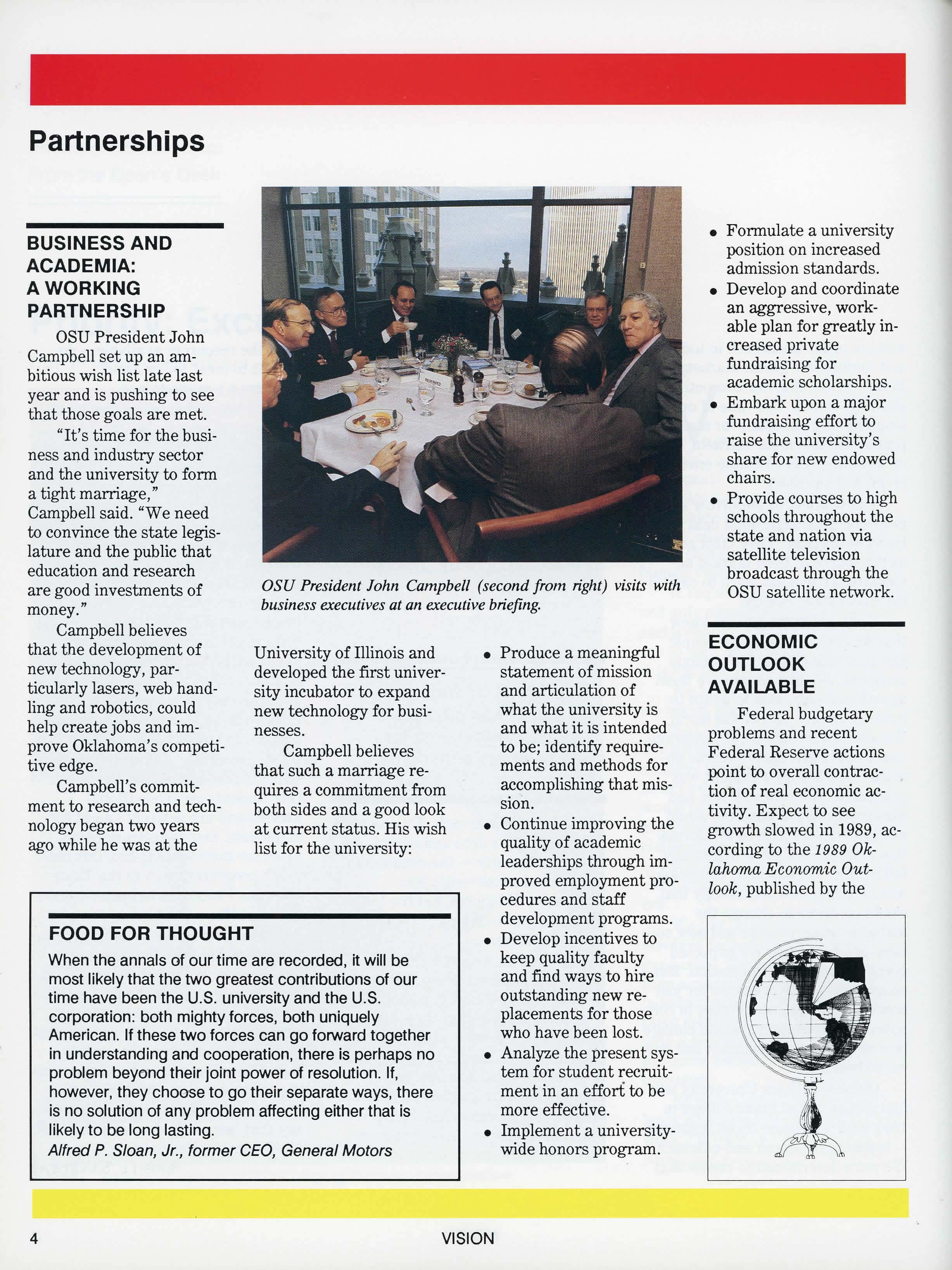
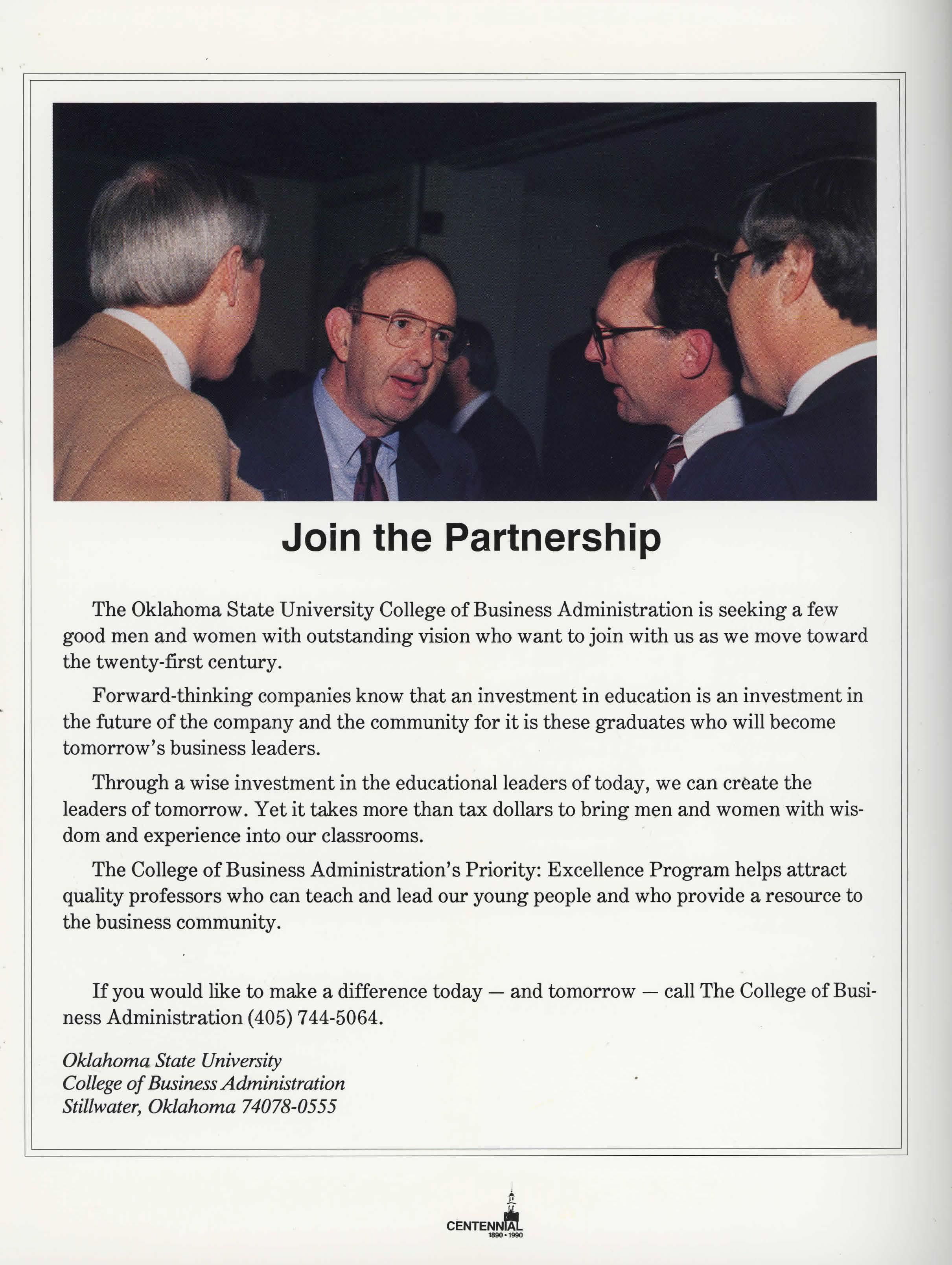
OSU President John Campbell (second from right) visits with business executives at an executive briefing.
College of Business Administration. Information in the report is based on assumed conditions nationally and internationally as forecast in the September 1988 baseline forecast from Wharton Econometric Forecasting Associates, Inc. Forecasts are prepared using the Oklahoma State Econometric Model, developed and maintained by the CBA Office of Business and Economic Research. For a copy write Outlook, College of Business Administration, Stillwater, Oklahoma 74078-0555.
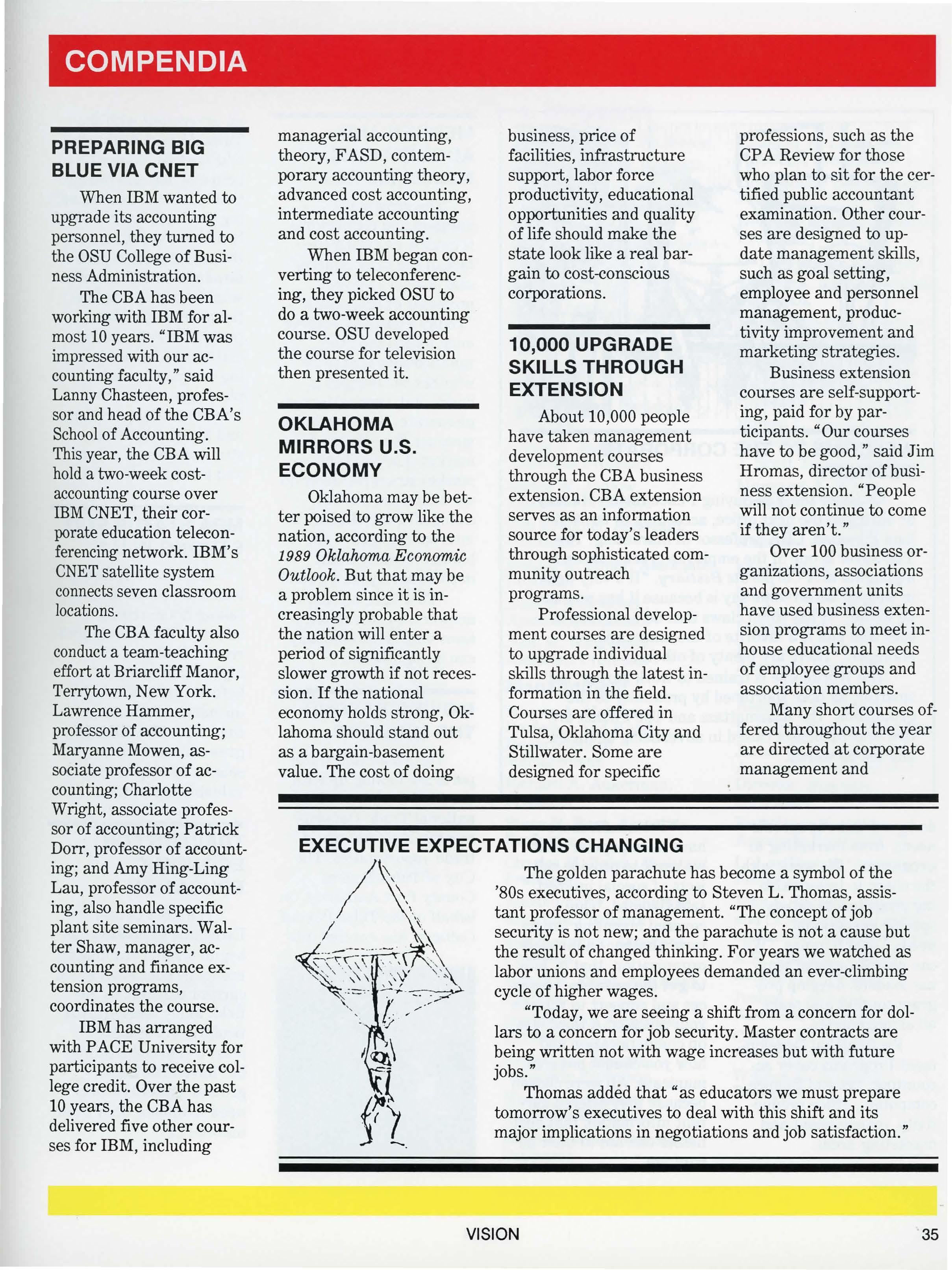
OSU-OU COMBINE MANAGEMENT DEVELOPMENT
Oklahoma's two research universities have joined forces to deliver a Management Development Program. "It seems wasteful to think that in a time of limited resources we would produce similar programs for the same groups," said Steve Barr, associate professor of management.· "We decided that it was time to join forces."
The program is an executive briefing that combines faculty members from both Oklahoma State University and the University of Oklahoma. The two-week course is split between the two
Management Briefings for Today's Businesses
With a commitment to providing informed leadership for Oklahoma, the CBA initiated two programs to bring nationally recognized speakers to the state's metropolitan areas. The Tulsa Business Forum series was initiated in 1986. It has received national recognition for its success, attracting almost 1,000 people to each forum. The series is co-sponsored with 30 Tulsa organizations. A second program, the Oklahoma City Executive Management Briefings, began in 1989. Also a cooperative effort of the CBA and business community, it too has been well received.
Tulsa Business Forum
1989 Speakers
0 Louis Rukeyser (Wall Street
0 Fourth National Bank of Tulsa
0 Gordona Duca, Inc., Realtors
0 Helmerich & Payne, Inc. Week/PBS)
0 Robert Waterman ( co-author, In
0 International Chemical Company
0 Kerr-McGee Corporation Search of Excellence)
0 Phyllis George Brown (Chicken by
0 Limestone Investments Company
0 Littlefield Marketing and Advertising, George) Inc.
0 James B. Hayes (Fortune magazine)
1989 Tulsa Business Forum
0 MAPCO,Inc.
0 Merrill Lynch Realty
0 National Petroleum Sales, Inc. Sponsors
0 American Central Gas Companies, Inc.
0 Amoco Corporation
0 Bank of Oklahoma, Tulsa, N.A.
0 Chandler-Frates & Reitz
0 CITGO Petroleum Corporation
0 Coopers & Lybrand
0 ESM Computer Marketing, Inc.
0 F & M Bank & Trust Company
0 Facet Enterprises, Inc.
0 First National Bank & Trust Company
0 NGL Supply, Inc.
0 Oklahoma Natural Gas Company
0 OSU Foundation
0 Phillips Petroleum Company
0 Public Service Company of Oklahoma
0 Shearson Lehman Hutton, Inc.
0 Tempo Enterprises, Inc.
0 Texaco USA
0 Touche Ross & Co.
0 Willbros USA, Inc.
Oklahoma City Executive Management Briefing
1989 Speakers
0 0 George J.W. Goodman (Adam Smith's Money World/PBS)
James B. Hayes (Fortune magazine)
1989 Executive Management Briefing Sponsors
0 0 American Fidelity Corporation Conoco, Inc.
0 0 0 0 .o
0 Dolese Company
First Interstate Bank of Oklahoma Kerr-McGee Corporation
Liberty National Bank and Trust Company
Oklahoma Bankers Association
Oklahoma Department of Commerce
Oklahoma Gas and Electric Company
OSU Foundation
Southwestern Bell Telephone Company
campuses, one week at each. It is the first program that uses the faculty members together in joint teaching situations.
The program was designed for mid- to upperlevel managers. Many of these individuals have not had refresher courses in quite some time. The course provides a brief update. The first week's program covers such topics as setting and implementing goals, emerging perspectives in management, achieving productivity through people, gaining internal support for projects and ideas, handling stress, evaluating success, identifying market opposition and thrusts, sharpening competitive edge and understanding service quality.
The second week covers delegating, appraisals, conflict resolution, reflections on business leaderships from guest CEOs, basic financial analysis, financial control systems and profitability, management strategies and corporate strategies for growth.
The program, which is considered a "new era in high-performance management," already has a waiting list.
For more information contact CBA BusinessExtension, Oklahoma State University, Stillwater, Oklahoma 74078-0555.
The Role Of Corporate America in Higher Education Extensive
Corporate donations to colleges and universities have gone up dramatically in recent years, surpassing individual and personal alumni gifts.
How does business work with educational institutions? Cash-strapped universities and businesses needing new technology have entered into new partnerships, breaking down the anti-business climate that infected many schools during the 1960s.
Faced with declining government spending for research, universities have watched their laboratories age and deteriorate. Corporate gifts allow them to improve their facilities and hire new researchers. At the same time, businesses faced with foreign competition find that the schools help them with technology and service, thus increasing productivity and profits.
One of the first such alliances was at Stanford University where a close working relationship between academia and business in the 1930s helped produce the legendary Silicon Valley. More recently, Harvard Medical School teamed up with du Pont for genetic research. Carnegie-Mellon University cooperates with Westinghouse in robotics; Massachusetts Institute of Technology works with Exxon on combustion research and with such firms at ITT and General Motors at its Polymer Processing Laboratory. Stanford continues to work with corporate sponsors in microelectronics and biotechnology. Washington University and Monsanto team up on several projects.
Nine Chairs and Professorships
Established in CBA
Nine chairs and professorships have been set up in the College of Business Administration with the help of the private sector.
The chairs and prof essorships allow the college to attract and retain high-
quality professors, those who otherwise might be hired away.
The chairs and professorships are:
• The Associates Chair in Business Administration
• Robert S. and Grayce B. Kerr Foundation, Inc. Professorship in Economic Development
• Tom and Edna Mae Carson Centennial Professorship in Business Administration
• The Ardmore Chair in Business Administration
• Kerr-McGee Chair in Accounting
• Arthur Andersen & Co. Centennial Professorship in Accounting
• Oklahoma Bankers Association Chair in Commercial Bank Management
• School of Accounting Alumni Professorship
• Noble Foundation Chair in Marketing Strategy
Roger Beverage, executive vice president of the Oklahoma Bankers Association, voiced the opinion of other organizations that have contributed. "Oklahoma's banking industry is proud to help fund a valuable academic position at Oklahoma State University," he said.
"This is a unique opportunity for the banking industry to join forces with the academic community and work together to enhance academic and professional excellence in the industry and to have a positive impact in shaping the excellence of future banking leaders."
The College of Business Administration hopes to fund a dozen chairs by 1990.
Applying Economics On The Air Waves
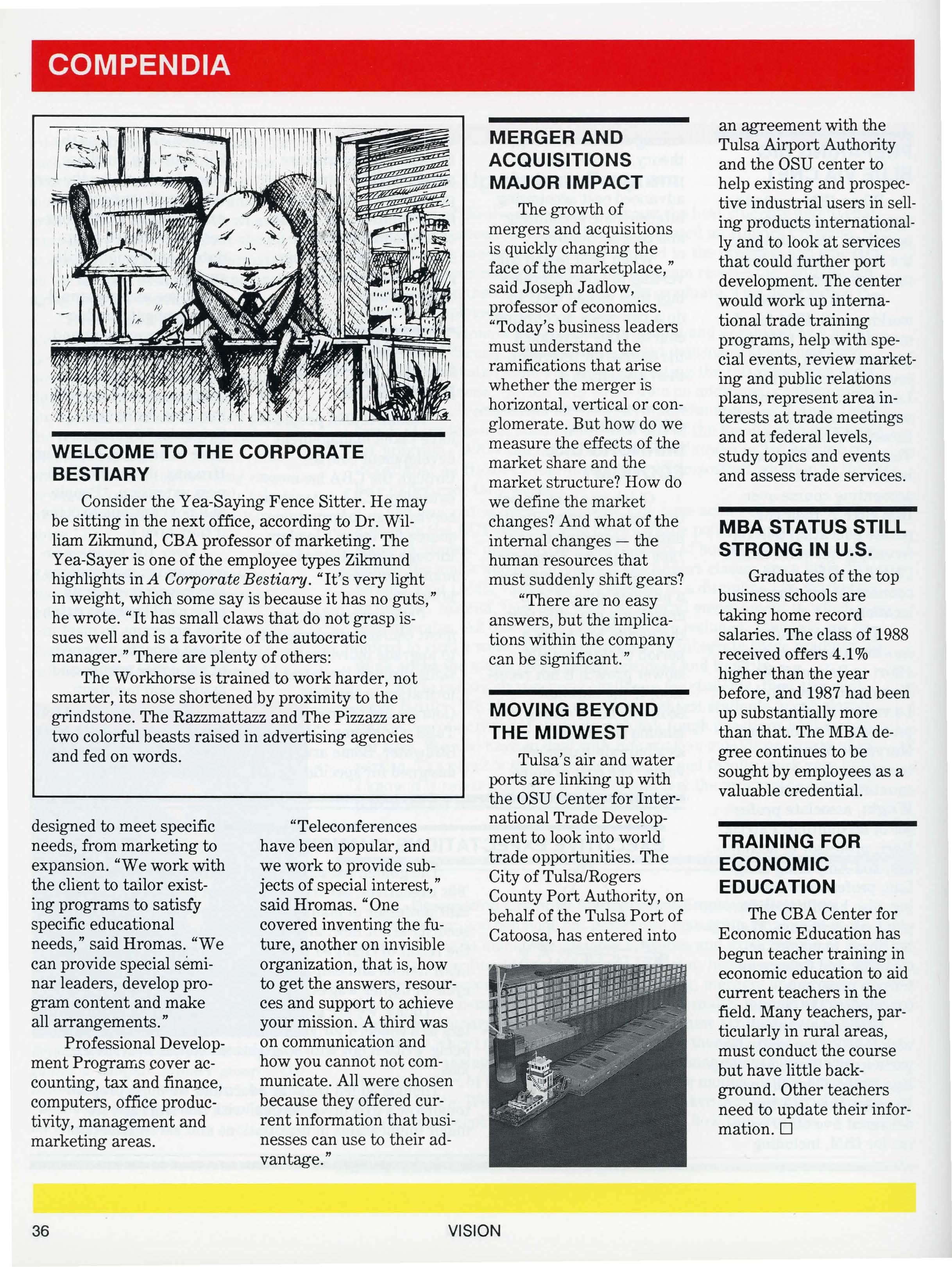
Remember the lemonade stand? It was one of the few ways that growing kids could try their hand at entrepreneurship and learn something about the world of business. Add mowing lawns and babysitting, selling eggs if you lived on a farm, and there was little else leftparticularly if you happened to grow up in a rural community. Economics was a foreign term; no one had heard of entrepreneurs.
With today's technology young people are less isolated than even 20
years ago. Television and computers have linked them with the world. Yet they are still woefully behind in learning how the world of business really works. "Rural areas are often undernourished in terms of what's available in education, social services and communication," said John West, executive manager, Phillips Petroleum Foundation, Inc.
"They need our help. These young people have great potential. They have a strong work ethic. But
they don't have the opportunity to learn about business."
"There are very few certified economics teachers anywhere in high schools," said Dr. Donald Bumpass (PhD '76), director, CBA Center for Economic Education. "Rural schools have a hard time getting adequately trained teachers in economics. Many have only informal or secondary training in the field."
Opportunities may blossom this year with the help of Junior Achievement, some concerned Oklahoma companies and the OSU Center for Economic Education. They will offer an "Applied Economics" education course to rural communities using OSU's national satellite television linkup.
The accredited course was developed for high schools by the national Junior Achievement organization. "It covers both microeconomics and macroeconomics," said Bumpass. "It weaves together economic theory with practical applications of 'realworld' events." It covers supply and demand, starting a:business, ethics, competition, the role of labor, the role of government, financial institutions, economic stability, the global economy and regional growth issues.
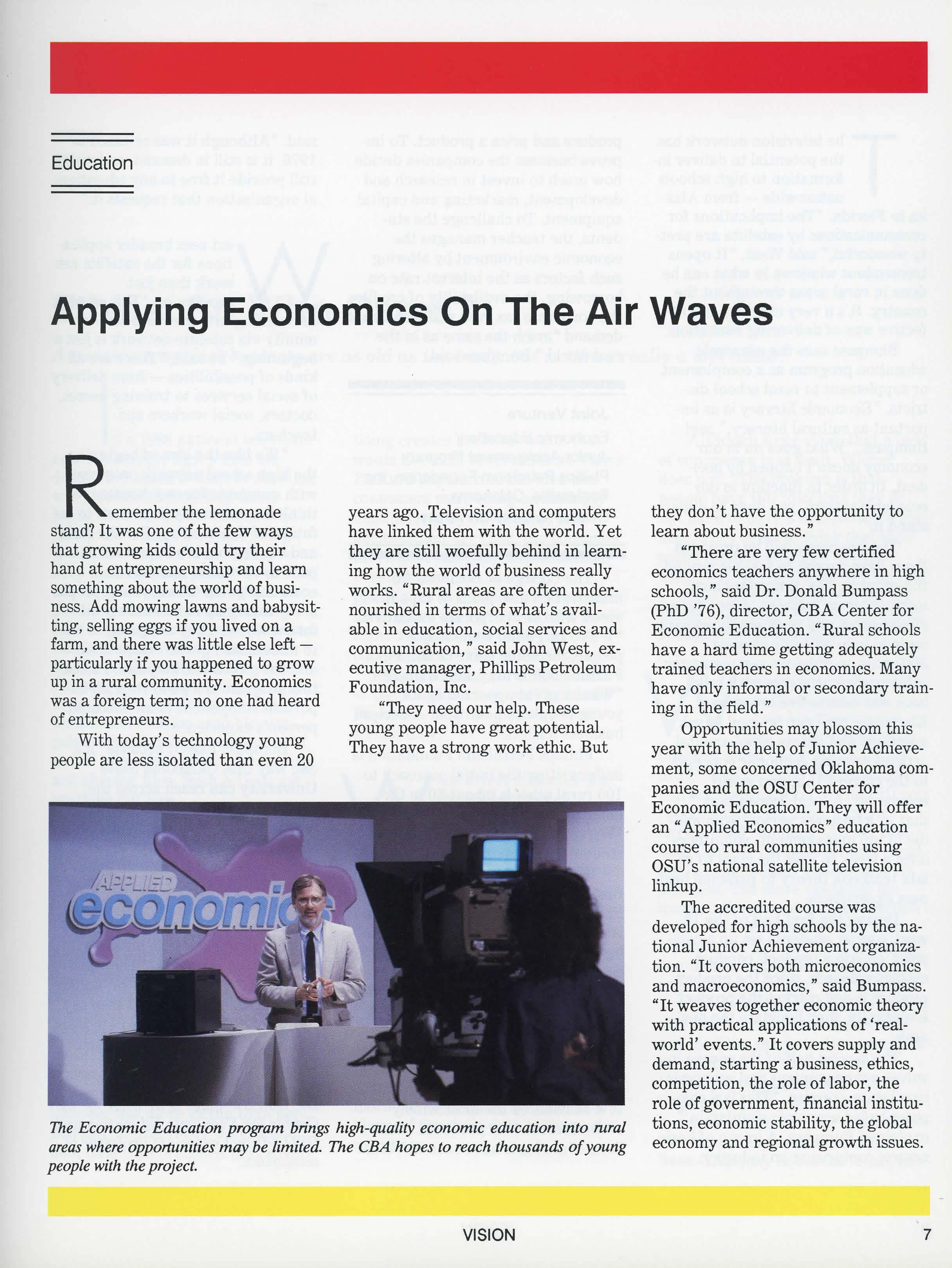
The Economic Education program brings high-quality economic education into rnral areas where opportunities may be limited. The CBA hopes to reach thousands of young people with the project.
The television network has the potential to deliver information to high schools nationwide - from Alaska to Florida. "The implications for communications by satellite are pretty wonderful," said West. "It opens tremendous windows in what can be done in rural areas throughout the country. It's a very efficient and effective way of delivering education."
Bumpass sees the economic education program as a complement or supplement to rural school districts. "Economic literacy is as important as cultural literacy," said Bumpass. "What goes on in our economy doesn't happen by accident. In order to function in our economic system, you have to understand it."
The programs will be provided three days a week to schools around the country. The Junior Achievement program includes videos for administrators and teachers to prepare them to help with the concept. Materials, workbooks and computer software link students with talkback and interactive broadcasts. Electronic mail can be used to ask questions and access supplemental articles relating economic concepts to the current U.S. and world economies. A local "consultant" that is, a business person from ~iddle to top management, volunteers once a week to visit the class to relate textbook theory to personal business experiences.
During the first half of the 15week course, students set up a company, choose a product, conduct market research, price the product, produce it and market the product. Eventually, they liquidate the business.
The second half of the course involves a management and economic simulation exercise. "This is a computer-based economic simulation " explained Bumpass. A group of businesses, comprising an industry,
produce and price a product. To improve business the companies decide how much to invest in research and development, marketing and capital equipment. To challenge the students, the teacher manages the economic environment by altering such factors as the interest rate on borrowing, the availability of credit, the corporate tax rate and industry demand "much the same as in the real world," Bumpass said.
Joint Venture
Economic Education/ Junior Achievement Program
Phillips Petroleum Foundation, Inc. Bartlesville, Oklahoma Oklahoma State University
The College of Business Administration also plans to tape interviews with key corporate executives. "We're targeting some major people, including some chairmen of Fortune 500 firms," said Bumpass. "What a great opportunity for young people to hear from American business leaders!"
Phillips Petroleum Foundation is underwriting the initial outreach to 100 rural schools (about 80 in Oklahoma over a three-year period). "We're talking about thousands of students," Bumpass said.
The network program is not the first educational project in which ~hillips has been involved. "Phillips 1sconcerned with and committed to broadening the understanding of economics in this country," said West. Pete Silas, chairman and chief executive officer of Phillips, serves on the national board of Junior Achievement. The foundation underwrote the American Enterprise film series narrated by William Shatner. It is considered the most widely viewed series ever produced. "Millions of students have seen it," West
said. "Although it was released in 1976, it is still in demand, and we still provide it free to any educational organization that requests it."
West sees broader applications for the satellite network than just economics. "This concept of reaching into the rural community via satellite network is just a beginning," he said. "There are all kinds of possibilities - from delivery of social services to training nurses, doctors, social workers and teachers.
"We like the idea of beginning the high school network programs with economic literacy because we think it's extremely important to the future of this country. For the state and our region, it's important as we push to revitalize and pursue economic goals. These young people are growing up in an entirely different world. They are going to have to understand global competition and the global marketplace. I think this program is a good step, an important component in an educated person's experience."
Bumpass likes it because "it's one way that Oklahoma State University can reach across the country. Technology may be the reason that we can reach out, but it takes people to find ways to use that technology for the common good.
"The real driving force behind the project is the people who want to see these students have a chance to learn how American business works," said Bumpass. "They don't like the word 'impossible' or 'unlikely.' Give them an idea and they say 'Why not?' With men like Pete Silas who have vision, we have a chance ' to dream - and do."
Dr. Don Bumpass is directorfor the Centerfor Economic Education and OSU adjunct associateprofessor of economics.
Ethics: So Who Cares?
Accusations against lYusiness are as old as the trade, "butis ethics really a lost cause?
In a 1988 national television network survey, high school students were asked if theft or cheating was justifiable when they faced losing their company. The end did justify the means, they said; they would do whatever was needed to keep their business going. Their answers, unfortunately, reflect the attitudes of some of their elders. Ivan F. Boesky and Drexel Burnham Lambert made millions on insider trading deals before the Securities Exchange Commission closed in on them. Florida assistant news director Michael Shapiro used his computer to break into the computer of a rival television station, destroying and altering files. Such actions are anything but new.
Three thousand years before Christ, during the days of the Mesopotamian merchants, business was accused of being unscrupulous. Ever since, there have been periodic waves of publicized discontent. American author Upton Sinclair exposed unsanitary conditions of slaughterhouses in the meat industry in early 1900s. The Tammany Hall affair with collusion between government and business brought the oil industry under scrutiny. The average citizen blamed the Great Depression on business even though business was more victim than perpetrator. In the 1950s, John Kenneth Galbraith preached that adver-
tising creates artificial wants that would not exist in its absence. Vance Packard popularized the idea that consumers were being unwittingly manipulated by advertisers and businessmen. By 1962, the consumer movement had gained momentum. President John F. Kennedy proclaimed that consumers had certain rights: the right to safety, the right to be informed, the right to choose and the right to be heard. The watchdogs of consumerism - the Ralph N aders and Consumer Reports - will not go away. Nor should they.
What drives ethical or unethical behavior?
Certainly no one issue, according to Joshua L. Wiener, associate professor of marketing. "Some claim it's the moral climate," he said. "When one individual gets by with such behavior, others are more likely to perpetuate the actions." That is closely coupled with the desire to "outperform" the other guy in a game scored in millions of dollars.
Profit squeeze is another excuse. Traders, financiers and others are pushed, if not forced, to "cut corners" to survive. Some put it more bluntly: ethical behavior is a "luxury" for those with hefty profit margins.
Although some claim that a lack of conscience is at fault, Wiener does not. "The problem is that people have this idea that they do not have to have a conscience in business. They seem to think that their social life and attitudes are one thing, but business is something else - when business opens for the day, ethics goes home to sleep. In reality, it doesn't work that way."
What are the real results of unethical behavior?
"Just considering dollars, it costs more to do business when there are no standards," Wi~ner said. The commodity market investigation by the FBI was reportedly set off after a major agricultural company, Archer Midland Daniels, complained that cheating in commodities was hurting its business. The more unethical the market, the greater the transaction costs. "The less we can trust one another, the greater the need for accountants, inspectors, lawyers and regulatory agencies," said Wiener. The tarnished reputation can also drive away customers. As the commodities markets discovered, unethical behavior tarnishes an industry's reputation. The effect lingers for years. Eventually the business will go to other markets. The tarnish extends to personal lives. That may not mean much, how-
ever, until their actions become headlines. Then those involved must face their neighbors, community and children.
What can we do about it?
"National leaders must set higher standards," said Wiener. "When our leaders will stoop to any action to be re-elected, when they openly lie to their constituents, when their actions result in a conflict of interest, they are lowering the resistance throughout our country."
Many, however, are calling for education to deal with the issue. The mandate has been to introduce ethics into the classroom. "It is not that easy," said Wiener. The curricula in academic institutions "are brimming with topics related to ethical standards, ethical behavior and the difference between good and evil," said Wiener. "But you cannot preach to students. They already bring a set of ethics to the table at this age. All you can do is put them in situations where they must learn to make decisions and accept the consequences of such decisions."
Studies by the Center for International Leadership in New York City discuss questions of ethics in terms of our history, with the real issues and dilemmas that faced men and women in the past. Would you drop an atomic bomb on Japan in order to end the war earlier as Harry Truman did? Would you be willing to stand by a decision, knowing, as Abraham Lincoln did, that it would bring war and aevastation?
"Oklahoma State University has called on faculty to incorporate the issue of ethics into all courses," said Wiener. "But it often does not fit well with the regular curricula. Students often feel it is foreign to the subject matter at hand. Some feel such questions are beyond the scope of business. After all, businessmen
normally do not make life-and-death choices.
"But in a larger sense, they do. Would you sacrifice 5,000 jobs in order to save the company? Would you deal a mortal blow to a competitor knowing that thousands of people would suffer? What if getting a contract was based solely on price and you knew that you could cut the quality of a construction fastener and drop your prices 15 percent. The fastener would no longer meet stress standards, but so what? Getting them to understand the
If you tell a lie but all it does is help people, is that right or wrong? The issues can appear cloudy to many young people.
ramifications of cutting corners in manufacturing a product is important. Or what happens when a construction company fails to place enough reinforcing steel inside the concrete? It may seem like a costcutting measure at the time, but it can become an issue of life-anddeath if the building is not sound.
"In today's business a lot of theft is done via computers. Searching out public information is perfectly acceptable; but is breaking into someone else's computer to find that information acceptable? Where do we draw the line?"
What is the real problem?
Is this generation less ethical than in the past?
"I don't think so," said Wiener. "Most of the young people we see are good, decent, moral people. I think the problem lies first in our perceptions and second in our basic beliefs. For example, today's students seem to think that the ethics they learned at home and in
their social life do not apply to business.
"The second problem involves different basic ethical systems of thought. An ethical system reflects how we understand the world. Let's suppose I work with an individual who believes in absolutes. He looks for the 'inherent rightness' of the act. He will not lie no matter what. He will not tell a lie even when to do so might be for the good of all, say, a 'white lie.' If that person must work closely with someone whose idea is to balance what is good for most rather than to deal with simple absolutes, there will be conflict."
In the formal literature of ethics, there is much discussion of negative rights and positive rights. "Negative rights means that people have a right not to do things for or to you," he said. "The Bill of Rights is a negative rights document. You have freedom of speech; no one has the right to interfere with you. Positive rights are such issues as the right to a job and to health care. Both concepts are right; but they are often at odds with each other.
"I believe that the impact of business upon our society is enormous," said Wiener. "As educators we must take on the responsibility of addressing the issues within the classroom. But it does not all fall to the schools.
"Many business people think that their actions are only in the economic sphere. They must recognize that they too play a significant role in the total scheme of things. Ultimately, their actions are going to influence those within their company, their industry and often the
Dr. Joshua L. Wiener is an associate professor of marketing and ·teaches a class in "Business and the External Environment" dealing with ethics and other issues.
Creating an Economic Picture for the State
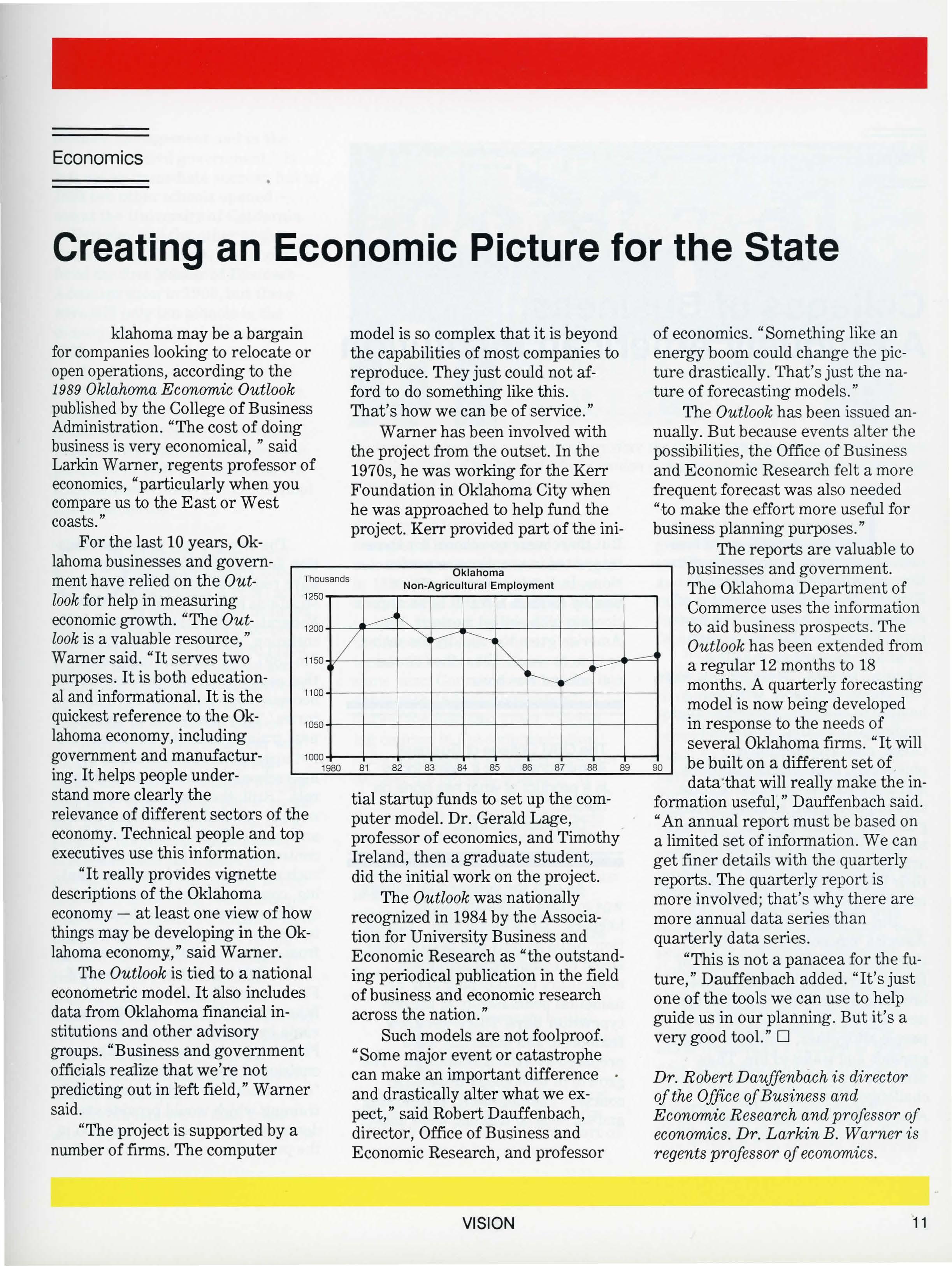
klahoma may be a bargain for companies looking to relocate or open operations, according to the 1989 Oklahoma Economic Outlook publishedby the College of Business Administration. "The cost of doing business is very economical, " said Larkin Warner, regents professor of economics,"particularly when you compare us to the East or West coasts."
For the last 10 years, Ok-
lahoma businesses and government have relied on the Outlook for help in measuring economicgrowth. "The Outlook is a valuable resource," Warner said. "It serves two purposes. It is both educational and informational. It is the quickest reference to the Oklahoma economy, including government and manufacturing. It helps people understand more clearly the
model is so complex that it is beyond the capabilities of most companies to reproduce. They just could not afford to do something like this. That's how we can be of service."
Warner has been involved with the project from the outset. In the 1970s, he was working for the Kerr Foundation in Oklahoma City when he was approached to help fund the project. Kerr provided part of the ini-
of economics. "Something like an energy boom could change the picture drastically. That's just the nature of forecasting models."
The Outlook has been issued annually. But because events alter the possibilities, the Office of Business and Economic Research felt a more frequent forecast was also needed "-tomake the effort more useful for business planning purposes."
The reports are valuable to businesses and government.
The Oklahoma Department of Commerce uses the information to aid business prospects. The Outlook has been extended from a regular 12 months to 18 months. A quarterly forecasting model is now being developed in response to the needs of several Oklahoma firms. "It will
be built on a different set of.
data·that will really make the inrelevance of different sectors of the economy.Technical people and top executives use this information.
"It really provides vignette descriptions of the Oklahoma economy - at least one view of how things may be developing in the Oklahoma economy.,"said Warner.
The Outlook is tied to a national econometric model. It also includes data from Oklahoma financial institutions and other advisory groups. "Business and government officials rea'lize that we're not predicting out in l'eft field," Warner said.
"The project is supported by a number of firms. The computer
tial startup funds to set up the computer model. Dr. Gerald Lage, professor of economics, and Timothy Ireland, then a graduate student, did the initial work on the project.
The Outlook was nationally recognized in 1984 by the Association for University Business and Economic Research as "the outstanding periodical publication in the field of business and economic research across the nation."
Such models are not foolproof.
"Some major event or catastrophe can make an important difference and drastically alter what we expect," said Robert Dauffenbach, director, Office of Business and Economic Research, and professor
formation useful," Dauffenbach said. "An annual report must be based on a limited set of information. We can get finer details with the quarterly reports. The quarterly report is more involved; that's why there are more annual data series than quarterly data series.
"This is not a panacea for the future," Dauffenbach added. "It's just one of the tools we can use to help guide us in our planning. But it's a very good tool."
Dr. Robert Daujfenbach is director of the Office of Business and Economic Research and professor of economics. Dr. LarkinB. Warner is regents professor of economics.
History
Colleges of Business: A Uniquely American Institution
Teidea of a college of business is a uniquely American institution, according to Dr. William M. Kincaid, Jr., professor emeritus of marketing. "As early as 1749 Benjamin Franklin called for a more 'practical' curriculum in public schools," he said. "Most schools were still 'common schools' with only a handful of colleges. Teachers taught reading and writing, Latin and Greek, classical literature, philosophy, good moral traditions and a smattering of whatever else they might happen to know. Women generally attended private women's schools. There they learned needle arts and fine arts in the same way their teachers had learned such skills in the convent schools of Europe."
But Franklin recognized that America was not Europe. The old class system of serf and master, of farmer-merchant-landowner was breaking down and melding in this new country. Here was a different people altogether: a muddle of backgrounds and walks of life. They needed a new education to meet new challenges. By the mid-1800s America was no longer a nation of farmers. Commerce was growing.
But there were no schools for those interested in vocations or professions. In Europe such education usually came as a result of an apprenticeship with skilled workers. But America grew too rapidly for such a system to work. Thus, the commercial college was born.
The OSU College of Business Administration as it exists today is a product of what has gone on before.
- Dr. William Kincaid
"At first the commercial college was to train clerks and bookkeepers," Dr. Kincaid said. "Instruction, often by only one person, consisted of commercial arithmetic, elementary bookkeeping and 'ornamental penmanship' in the pretypewriter days. There were few textbooks, and materials were prepared by local accountants." The growth of technology broadened courses - stenography, typewriting and secretarial training were added.
The two groups, practical education and public education, might have remained totally disparate institutions had it not been for the Federation of Business Teachers' Association, according to Dr. Kincaid. "In 1897 they met and suggested that commercial colleges needed to become more than just 'clerk factories.' They needed to be true business training schools; but if they did not upgrade their curriculum, the high schools would take over their role." Still, the practical schools did not add general educational courses; and most colleges and universities continued to tum up their noses at such mundane teachings as accounting, commercial arithmetic and similar subjects as "too elementary to deserve any attention whatever from higher institutions of learning." In 1881 the Wharton School of Finance and Economy was established at the University of Pennsylvania by Joseph Wharton, a wealthy Philadelphia businessman. Wharton ·envisioned the organization of a "department for higher commercial training which would provide students with an adequate education in the principles underlying successful
business management and in the principles of civil government." It was not an immediate success, but in 1898 two other schools openedone at the University of California at Berkeley and the other at the University of Chicago. Dartmouth offered the first Master of Business Administration in 1900, but there were sti11only ten schools in the country with a school of business in 1908.
Dr. Kincaid chronicles the history of Oklahoma State University from these early years in A History of the Oklahoma State University Collegeof Business Administration, published in 1987 as part of the Oklahoma State University Centennial Histories Series.
0klahoma Agricultural and Mechanical College (Oklahoma A & M) actually hired its first business teacher in 1898. By 1914 interest and enrollment had grown so much that the School of Commerce and Marketing was opened. It has been hailed as the first department of marketing in the United States.
Enrollment that first year was 37. By 1916 there were 164 students, and courses included foreign language, typewriting, public speaking, geography of commerce, bookkeeping, marketing, salesmanship, office administration and rural economics.The 1918 catalog added courses in accounting, economics, business management, finance, business law and shorthand. It recommended such electives as commercial grades of grain, livestock judging, cotton grading, fruit marketing and grading and railroad rates. By 1922 the School of Commerce and Marketing had the largest enrollment of any of the six schoolson campus.
Enrollment more than tripled after World War II. In the 1950s the
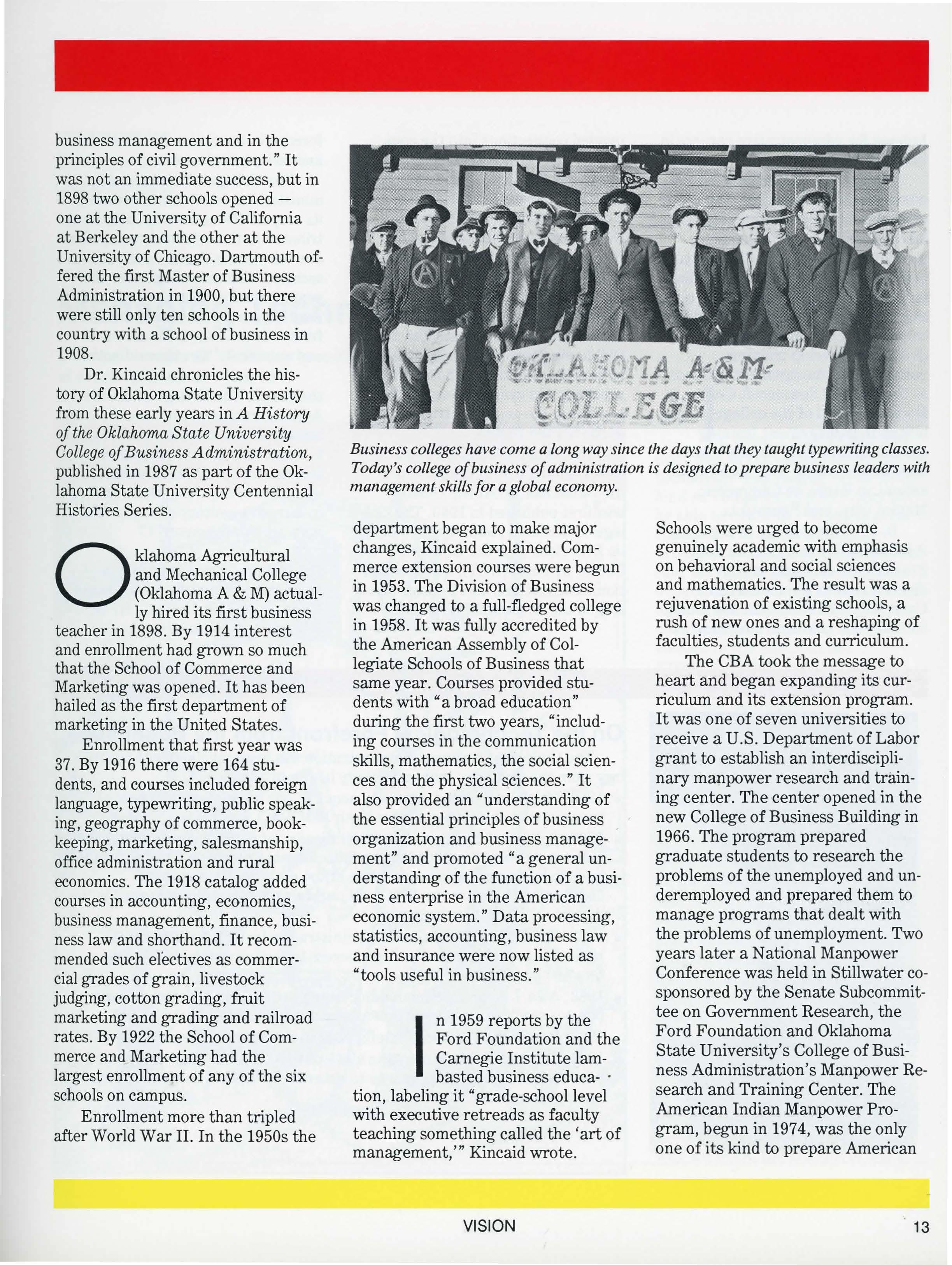
Business colleges have come a long way since the days that they taught typewriting classes. Today's college of business of administration is designed to prepare business leaders with management skills for a global economy.
department began to make major changes, Kincaid explained. Commerce extension courses were begun in 1953. The Division of Business was changed t,o a full-fledged college in 1958. It was fully accredited by the American Assembly of Collegiate Schools of Business that same year. Courses provided students with "a broad education" during the first two years, "including courses in the communication skills, mathematics, the social sciences and the physical sciences." It also provided an "understanding of the essential principles of business organization and business management" and promoted "a general understanding of the function of a business enterprise in the American economic system." Data processing, statistics, accounting, business law and insurance were now listed as "oools useful in business."
In 1959 reports by the Ford Foundation and the Carnegie Institute lambasted business educa- • tion, labeling it "grade-school level with executive retreads as faculty teaching something called the 'art of management,'" Kincaid wrote.
Schools were urged t,o become genuinely academic with emphasis on behavioral and social sciences and mathematics. The result was a rejuvenation of existing schools, a rush of new ones and a reshaping of faculties, students and curriculum.
The CBA took the message t,o heart and began expanding its curriculum and its extension program. It was one of seven universities to receive a U.S. Department of Labor grant to establish an interdisciplinary manpower research and training center. The center opened in the new College of Business Building in 1966. The program prepared graduate students t,o research the problems of the unemployed and underemployed and prepared them t,o manage programs that dealt with the problems of unemployment. Two years later a National Manpower Conference was held in Stillwater cosponsored by the Senate Subcommittee on Government Research, the Ford Foundation and Oklahoma State University's College of Business Administration's Manpower Research and Training Center. The American Indian Manpower Program, begun in 1974, was the only one of its kind to prepare American
Indians for administrative careers in the field.
The College of Business Administration expanded its management development seminars for Oklahoma business professionals through television in 1967, "probably the first in the nation," according to Dr. Kincaid. The college was also selected by the National Aeronautical and Space Administration (NASA) to develop training materials for management trainees at the Manned Spacecraft Center in Houston. Word of the college's capabilities in management training spread. Before long, faculty members were working with such organizations as Banco de Commercio, Mexico City, and Pepsi-Cola.
In 1970 the College of Business Administration installed an IBM 2741 remote terminal to provide direct access to Oklahoma State University's IBM System/360 model 65. The new talk-back television ex-
panded connections into the community. The Office of Business and Economic Research was established in 1974, followed by The Center for Entrepreneurship and Economic Development and the College of Business Administration ComputerAssisted Learning Resource Center.
By 1977 business was the largest single major for male students in the nation. That year, the Oklahoma State University Master's in Business Administration (MBA) program was ranked as one of the top five in the south-central region of the United States.
The Oklahoma State Econometric Model was developed, and the Oklahoma Economic Outlook was first published in 1980. The College of Business Administration held its first class with the University Center at Tulsa (UCT), a new educational consortium. The College also staged the first satellite telecon-
ference in the nation for students and college professors.
The College of Business Administration continues to broaden its scope. "Its success can only be attributed to the extremely competent administrators, faculty and staff associated with the college over the years, together with the extraordinary support of its alumni and friends both in the business world and outside it," Dr. Kincaid noted.
"The past was exciting. But so is the future. The College of Business Administration will not rest on past laurels. It will meet the challenges to come with the same vigor and enthusiasm it has always shown. It must. To do anything less would be to tarnish a century of extraordinary accomplishment."
Dr. William Kincaid is author of Promotion: Products, Services and Ideas, in its third edition. He is professor emeritus of marketing.
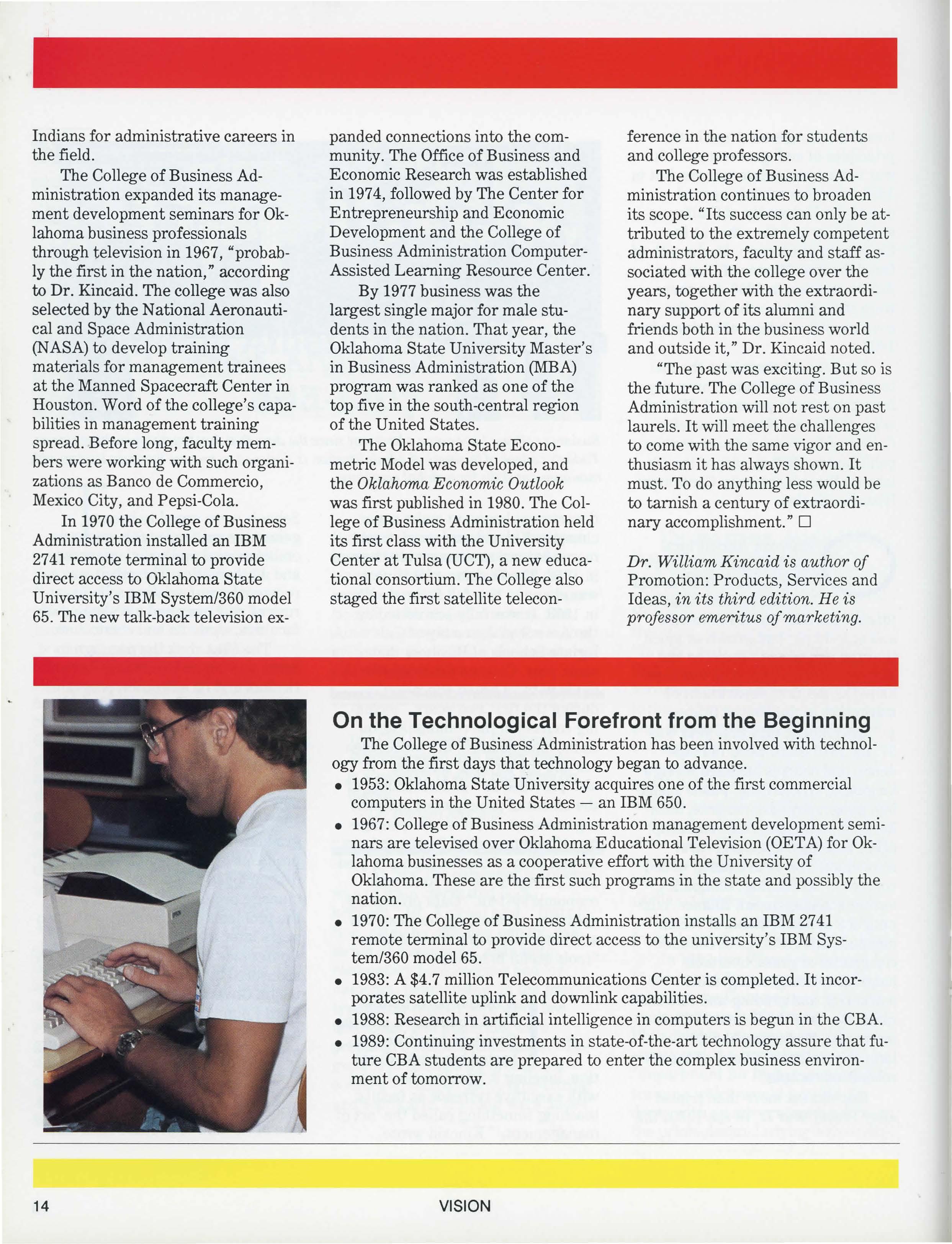
On the Technological Forefront from the Beginning
The College of Business Administration has been involved with technology from the first days that technology began to advance.
• 1953: Oklahoma State University acquires one of the first commercial computers in the United States - an IBM 650.
• 1967: College of Business Administration management development seminars are televised over Oklahoma Educational Television (OETA) for Oklahoma businesses as a cooperative effort with the University of Oklahoma. These are the first such programs in the state and possibly the nation.
• 1970: The College of Business Administration installs an IBM 2741 remote terminal to provide direct access to the university's IBM System/360 model 65.
• 1983: A $4.7 million Telecommunications Center is completed. It incorporates satellite uplink and downlink capabilities.
• 1988: Research in artificial intelligence in computers is begun in the CEA.
• 1989: Continuing investments in state-of-the-art technology assure that future CEA students are prepared to enter the complex business environment of tomorrow.
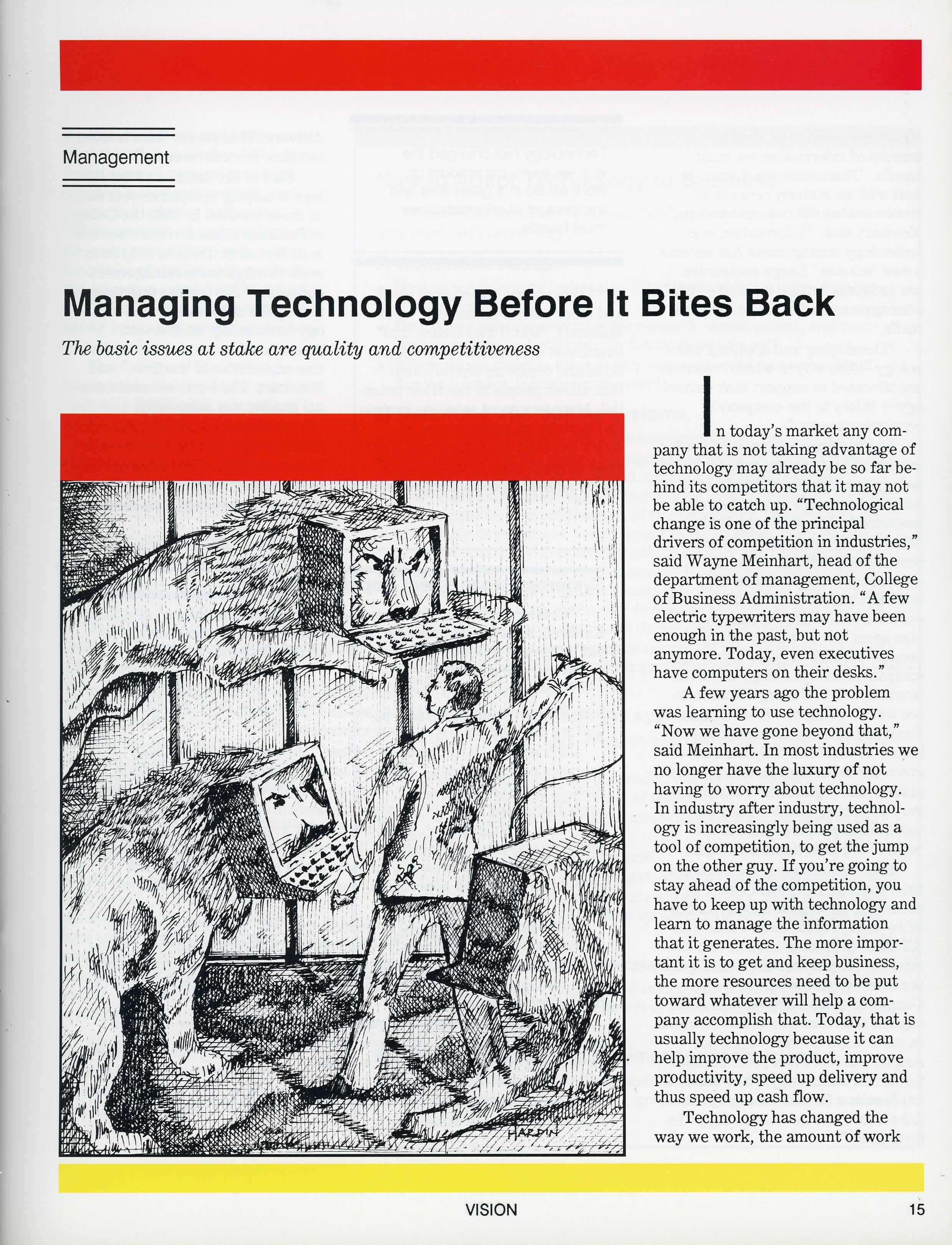
Manag·ing Technology Before It Bites Back
The basic issues at stake are quality and competitiveness
In today's market any company that is not taking advantage of technology may already be so far behind its competitors that it may not be able to catch up. "Technological change is one of the principal drivers of competition in industries," said Wayne Meinhart, head of the department of management, College of Business Administration. "A few electric typewriters may have been enough in the past, but not anymore. Today, even executives have computers on their desks."
A few years ago the problem was learning to use technology. "Now we have gone beyond that," said Meinhart. In most industries we no longer have the luxury of not having to worry about technology.
• In industry after industry, technology is increasingly being used as a tool of competition, to get the jump on the other guy. If you're going to stay ahead of the competition, you have to keep up with technology and learn to manage the information that it generates. The more important it is to get and keep business, the more resources need to be put toward whatever will help a company accomplish that. Today, that is usually technology because it can help improve the product, improve productivity, speed up delivery and thus speed up cash flow.
Technology has changed the way we work, the amount of work
we do in a given time and the amount of information we must handle. "Businesses must learn to deal with an entirely new set of problems that did not exist before," Meinhart said. "Information and technology management has become a new 'science.' Large companies are suddenly setting up entire 'MIS' (management information systems) staffs.
"Developing and applying technology - the way in which resources are allocated to support that technology - is key to the company's economic success."
But its biggest change is in information and people operations. Technology now has the ability to let companies know more about their own business than ever before. It can help identify opportunities - new services or products, ways to operate and ways to reach the marketplace. Such information was once the bailiwick of managers. Managers helped run the company because they knew more about the company. But technology allows al- most anyone in the organization to see what's going on. Workers can think and act on information never before available. If they are also given the skills to exploit that information, the organization is suddenly very powerful. The company can involve those people closest to the work in organizational strategies.
Such technology is far different than any that has gone before, according to Shoshana Zuboff, author of In the Age of the Sr(l,artMachine. All other technologies have had the effect of simplifying and decreasing the intellectual content of work. Computer technology increases the explicit information content of work. In some ways it makes work not simpler but more complex. Thus, information technology really has new implications for human organization. Zuboff calls the new technology "Informating."
Technology has changed the way we work, the amount of work we do in a given time and the amount of information we must handle.
"This means less routine work and more individual choices," said Meinhart. "But it also means that businesses must educate, develop skills and create an environment that allows people to use their potential. Managers must manage, sustain and nurture an environment in which learning can take place. They must develop ways in which value can be added to product and service
delivery. That means there is more, not less, work to be done."
Part of the function of the college is helping companies over some of those hurdles. In 1988 the College of Business Administration worked with Memorex-Telex to help them work through some management decisions. "The project was designed to help the corporation with technology forecasting, assessment, strategic alliances and the innovative capabilities of the firm," said Meinhart. The work included internal studies and interviews.
"At first we had difficulty communicating," said Michael Bowen, Memorex-Telex. "We were not used to each other's terminology. It took us some time to mesh the two groups
Systems Management Popular New Field
"Getting information was once a major business problem," said Janet Kimbrell, associate professor of accounting. "Suddenly technology has put information at our fingertips. We are inundated with it. Now we've got to learn to control it.
"We've got to help decision-makers handle the avalanche of information. What has happened is that so much information is being generated that we must figure out systems to process it."
Just what is an information system?" Actually, it's never been precisely conceptualized," Kimbrell said. "It's become a catch-phrase. Each department has its own version - management information systems, marketing information systems, accounting information systems. The result is hodgepodge. The potential for duplication is staggering and certainly wasteful. Businesses will discover before long that they must consolidate these information systems into a logical operation that reflects an organized approach to the company's needs and expectations."
Because of the increased interest in the field, a degree in systems management was established by the College of Business Administration in 1987. The curriculum includes some computer programming, Kimbrell said, "but it is more about controls and systems and how those aid in the framework of a company.
"Managing information is going to be a problem for the 1990s and beyond," said Kimbrell. "We have to prepare students for it, or they will be obsolete before they ever get a degtee."
Dr. Janet Kimbrell is an associate professor of accounting, College of Business Administration.
together before we each understood what the other was after." The final report covered perceptions of the company's strategic position, technology and industry leadership. "When we work on such projects, we can make comparisons with other companies of similar size, products and management styles," Meinhart said. "We look for weak points, strong points and potential new business areas."
The College of Business Administration has also had a grant to work with EPSCoRE, a branch of the National Science Foundation, to conduct research in the management of technology and innovation.
Any company that tries to ignore technology is playing ostrich.
The CEA also has created the Center for Technology Management and Innovation incorporating business, engineering and science. The center provides research and service to companies in Oklahoma. Its advisory board includes representatives of several institutions of higher learning and business executives.
Meinhart stressed that any corporation that tries to ignore technology is probably playing ostrich. "If you don't plan for it, your competitors will quickly let you know you are obsolete. When your sales force tells you that your product has been superseded by your competition, you know you are in big trouble. By then, it may be too late to catch up." D
Dr. Wayne Meinhart is professor and head of the department of management, OSU College of Business Administration.
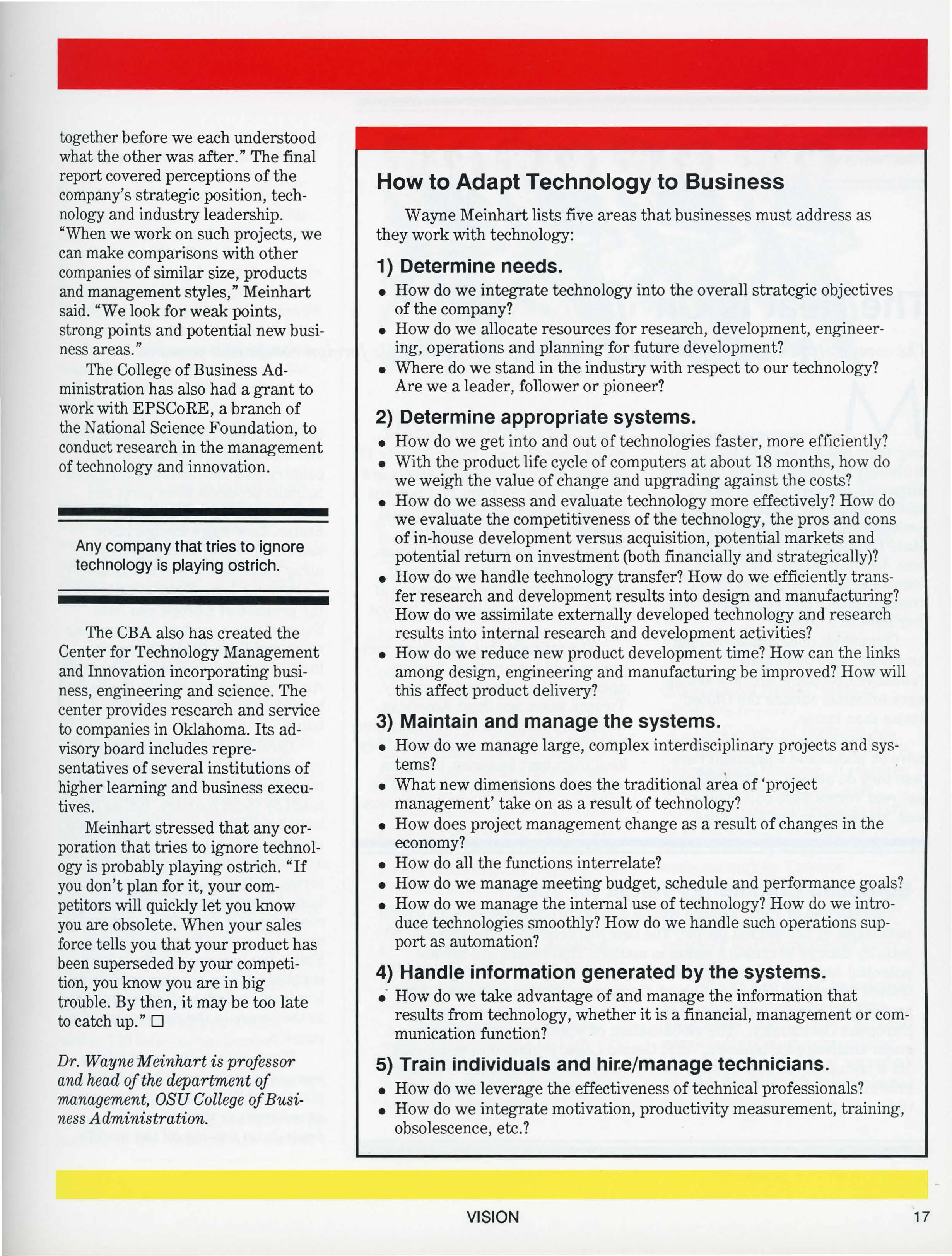
How to Adapt Technology to Business
Wayne Meinhart lists five areas that businesses must address as they work with technology:
1) Determine needs.
• How do we integrate technology into the overall strategic objectives of the company?
• How do we allocate resources for research, development, engineering, operations and planning for future development?
• Where do we stand in the industry with respect to our technology? Are we a leader, follower or pioneer?
2) Determine appropriate systems.
• How do we get into and out of technologies faster, more efficiently?
• With the product life cycle of computers at about 18 months, how do we weigh the value of change and upgrading against the costs?
• How do we assess and evaluate technology more effectively? How do we evaluate the competitiveness of the technology, the pros and cons of in-house development versus acquisition, potential markets and potential return on investment (both financially and strategically)?
• How do we handle technology transfer? How do we efficiently transfer research and development results into design and manufacturing? How do we assimilate externally developed technology and research results into internal research and development activities?
• How do we reduce new product development time? How can the links among design, engineering and manufacturing be improved? How will this affect product delivery?
3) Maintain and manage the systems.
• How do we manage large, complex interdisciplinary projects and systems?
• What new dimensions does the traditional area of 'project management' take on as a result of technology?
• How does project management change as a result of changes in the economy?
• How do all the functions interrelate?
• How do we manage meeting budget, schedule and performance goals?
• How do we manage the internal use of technology? How do we introduce technologies smoothly? How do we handle such operations support as automation?
4) Handle information generated by the systems.
• How do we take advantage of and manage the information that results from technology, whether it is a financial, management or communication function?
5) Train individuals and hir.e/manage technicians.
• How do we leverage the effectiveness of technical professionals?
• How do we integrate motivation, productivity measurement, training, obsolescence, etc.?
The Heat Is On
The competition isfloiuing both ways, Americans move out while foreign companies move in
More companies are shedding their red-white-and-blue national identity for globalization. "It's the corporate strategy of the 1990s," said Dr. Janice W. Jadlow, associate professor of finance, Oklahoma State University's College of Business Administration. "American companies are spending more on overseas plants and equipment than they have in a decade."
Companies once considered pure American, such as ColgatePalmolive Company, are now selling more toiletries outside the United States than inside.
American companies still spend more on plants and equipment here than they do abroad - $488 billion last year versus $420 billion overseas, according to the New York
Times. But the outlays have been rising since the mid-1980s. Nearly 17 percent of total corporate assets are now overseas, up from 14.4 percent in 1984, according to the National Bureau of Economic Research. "That's greater than nearly every other industrial nation and more than three times the percentage of Japan's overseas holdings," Jadlow said.
The attitude that American companies hold toward their foreign operations has changed markedly. Twenty years ago most American companies insisted on ownership control of their foreign operations. They kept their best factories, best jobs and best technologies at home. The tendency was to equip foreign opera-
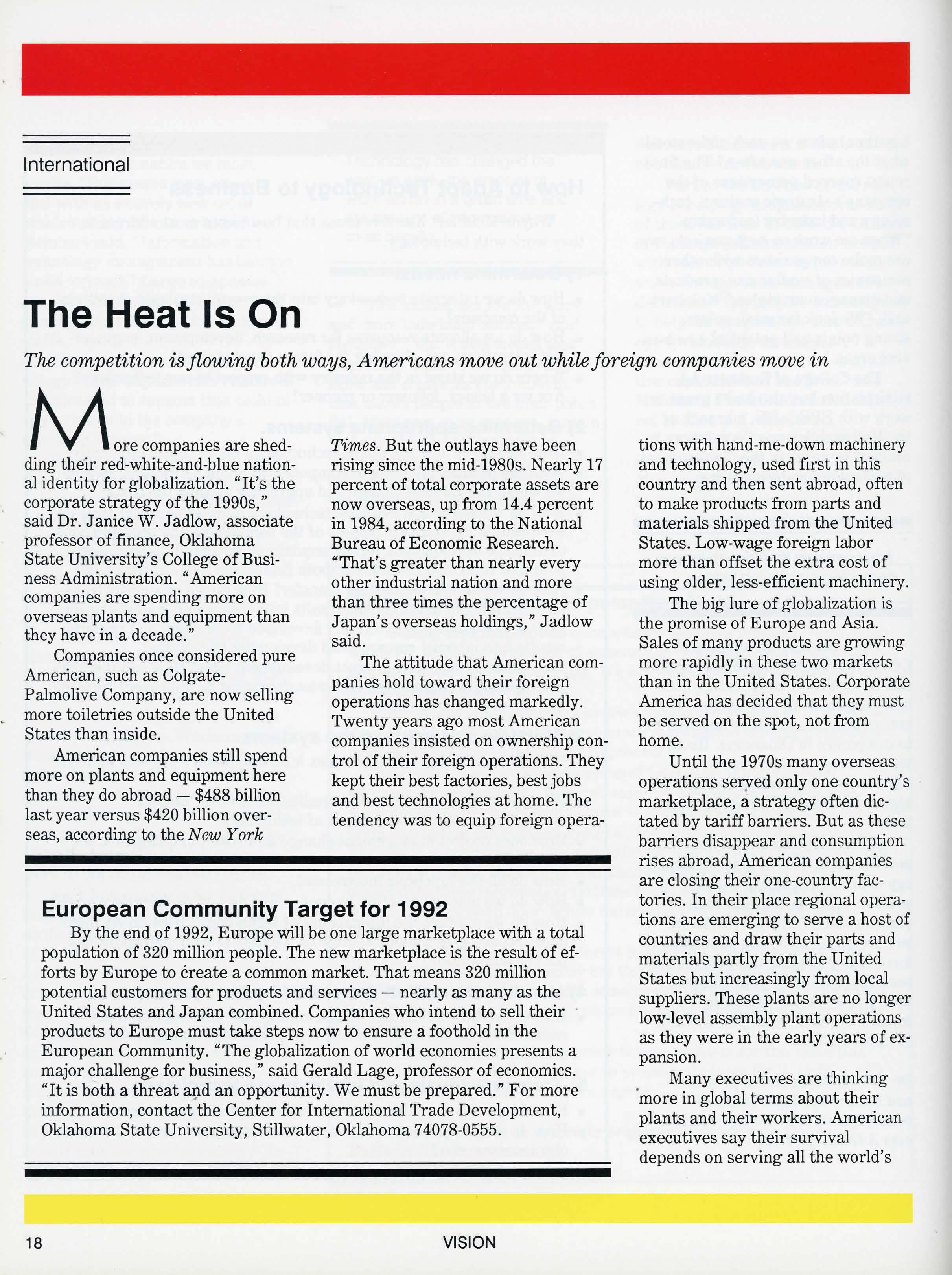
European Community Target for 1992
By the end of 1992, Europe will be one large marketplace with a total population of 320 million people. The new marketplace is the result of efforts by Europe to create a common market. That means 320 million potential customers for products and services - nearly as many as the United States and Japan combined. Companies who intend to sell their • products to Europe must take steps now to ensure a foothold in the European Community. "The globalization of world economies presents a major challenge for business," said Gerald Lage, professor of economics. "It is both a threat arid an opportunity. We must be prepared." For more information, contact the Center for International Trade Development, Oklahoma State University, Stillwater, Oklahoma 74078-0555.
tions with hand-me-down machinery and technology, used first in this country and then sent abroad, often to make products from parts and materials shipped from the United States. Low-wage foreign labor more than offset the extra cost of using older, less-efficient machinery. The big lure of globalization is the promise of Europe and Asia. Sales of many products are growing more rapidly in these two markets than in the United States. Corporate America has decided that they must be served on the spot, not from home.
Until the 1970s many overseas operations seryed only one country's marketplace, a strategy often dictated by tariff barriers. But as these barriers disappear and consumption rises abroad, American companies are closing their one-country factories. In their place regional operations are emerging to serve a host of countries and draw their parts and materials partly from the United States but increasingly from local suppliers. These plants are no longer low-level assembly plant operations as they were in the early years of expansion.
Many executives are thinking ·more in global terms about their plants and their workers. American executives say their survival depends on serving all the world's
major markets, and this can be done efficiently in most cases only when production is near each market. That means that wherever they operate, the amount of manufacturing done in that country should be as great as possible. Ford Motor Company's auto-making operation in Europe is among the largest on the Continent and now makes or buys 98 percent of its parts, supplies and machinery in Europe. Globalization might deprive America of some factories, but wealth will come back in the form of dividends to shareholders, and most people who invest in companies - global or otherwise - are Americans.
"What this means is that there will have to be more investment in high-tech factories around the world," said Richard H. Ayers, chairman of the Stanley Works, New Britain, Connecticut, in an interview with theNew York Times.
Much of the overseas investment is in the form of joint production ventures with foreign companies, a rare practice before the 1980s. Forty percent of overseas investments last year were in such joint ventures. Japan requires all foreign investments to be joint ventures with Japanese partners. U.S. citizens can own no more than 25 percent of any "technologically innovative" Japanese company. Australia prohibits foreign ownership of newspapers and places limits on foreign ownership of broadcast companies. Mexico restricts foreign ownership to no more than 49 percent and prohibits foreign investment in several sectors of their economy, including petroleum, within 100 miles of the border.
The public debate over trade and other public policy issues has not yet caught up with the real-world changes wrought by globalization, according to the National Association
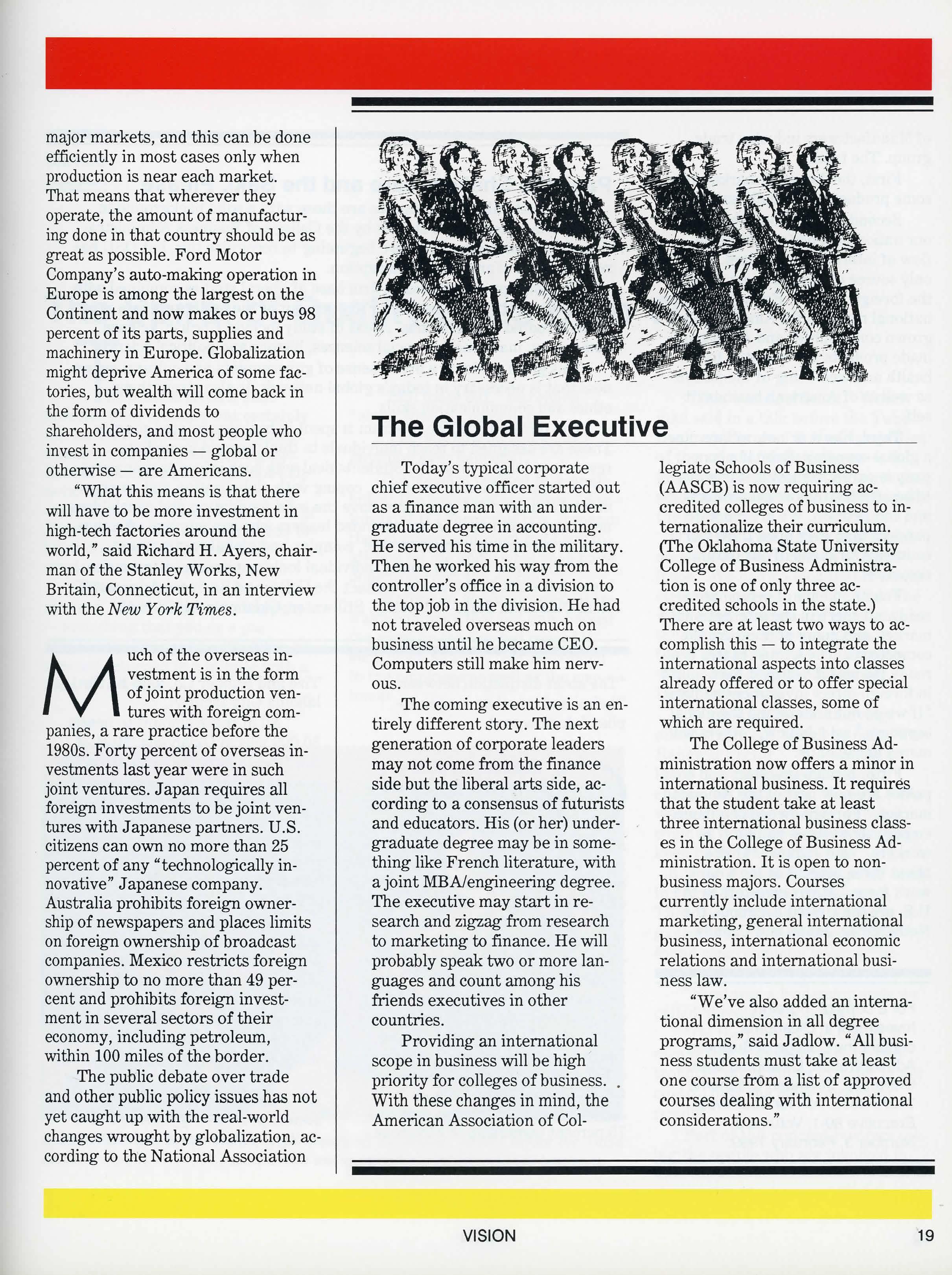
The Global Executive
Today's typical corporate chief executive officer started out as a finance man with an undergraduate degree in accounting. He served his time in the military. Then he worked his way from the controller's office in a division to the top job in the division. He had not traveled overseas much on business until he became CEO. Computers still make him nervous.
The coming executive is an entirely different story. The next generation of corporate leaders may not come from the finance side but the liberal arts side, according to a consensus of futurists and educators. His (or her) undergraduate degree may be in some- • thing like French literature, with a joint MBA/engineering degree. The executive may start in research and zigzag from research to marketing to finance. He will probably speak two or more languages and count among his friends executives in other countries.
Providing an international scope in business will be high priority for colleges of business. With these changes in mind, the American Association of Col-
legiate Schools of Business (AASCB) is now requiring accredited colleges of business to internationalize their curriculum. (The Oklahoma State University College of Business Administration is one of only three accredited schools in the state.) There are at least two ways to accomplish this - to integrate the international aspects into classes already offered or to offer special international classes, some of which are required.
The College of Business Administration now offers a minor in international business. It requires that the student take at least three international business classes in the College of Business Administration. It is open to nonbusiness majors. Courses currently include international marketing, general international business, international economic relations and international business law.
"We've also added an international dimension in all degree programs," said J adlow. "All business students must take at least one course from a list of approved courses dealing with international considerations."
of Manufacturers industry trade group. The truth:
First, the domestic market for some products is virtually saturated.
Second, the economic health of our nation depends on a reverse flow of international dollars. The only source of new business may be the foreign market. Expanding international markets for Americangrown commodities and Americanmade products are essential to the health and well-being of the nation as well as of American business itself.
Third, like it or not, we are now a global economy. Even if a company is purely domestic, it is going to be affected by foreign products and competition. We are more dependent than ever upon third-world countries for many of our natural resources.
Fourth, plenty of people are already out there in the international market, and many of them are the competition. The United States is already the world's largest participant in foreign direct investment activity. "If we do not understand the global economy," said J adlow, "others will march ahead of us."
Fifth, foreign investors and companies are now part of the American market. "Foreign-owned companies employ about three million U.S. workers," said J adlow. "That's about three percent of the total U.S. work force." Major investors in the U.S. are the United Kingdom, the Nether lands, Japan and Canada.
For a copy of "Foreign Investment in Oklahoma," contact the College of Business Administration, Oklahoma State University, Stillwater Oklahoma 74078-0555. Ask for Southwest Executive 89-1, Volume 3, Number 3, February 1989.
Pass the Shakespeare and the Saki, Please
. The most valuable graduates are those with a solid background in l~beral arts, according to studies by the College of Business Administration._Othe_rbusiness schools are beginning to recognize this, but OSU has required liberal arts from its inception.
The concept is to provide a firm base of liberal studies combined with solid ~ork in th_eb:18inessfield. Fifty percent of the undergraduate program 1~ :ooted m liberal arts. Areas of study include English, science, humamties, mathematics, social sciences, history and political science.
This gives students a broad sense of governments and cultural awarenes~ that is necessary in today's global network. It also strengthens ethics and communication skills.
The remainder of the program is spent in business-related courses. These are designed to teach individuals to think beyond immediate rewards to long-term goals. Students deal with such issues as managing technology and human resources, coping with globalization and environmental change. CBA graduates have the solid foundation and capabilities n~essa:Y to fu~ction as ~el_l-roundedleaders who can manage effectively m an mcreasmgly sophisticated, complex and global environment.
If you know a bright young individual looking to succeed and make ~is or her mark in the world, contact the College of Business Administration, Oklahoma State University, Stillwater, Oklahoma 74078-0555.
"The strict distinction between 'theirs' and 'ours' no longer applies," J adlow said.
0klahoma's central location in the middle of the United States has acted as a buffer to international trade in the past. Oklahoma has a relatively small number of foreignowned companies. TDK Corporation of Japan entered into a joint venture with Allen Bradley Inc. of Shawnee to produce ferrite magnets for electronic products. Hitachi of Japan located a computer peripherals plant in Norman. Asahi of Japan recently purchased an iodine plant in Woodward. Moore Business Forms, a Canadian subsidiary, expanded its Stillwater facility. Bridgestone Corp., a Japanese-based company, acquired 75 percent ownership in Firestone
Tire and Rubber Co. with its Oklahoma City facility.
"All of these amount to nearly 30,000 jobs in Oklahoma. Most of the foreign direct investment in Oklahoma comes.from Canadian companies, which account for 33 percent of.the foreign company employment in the state - double that of the second-ranking United Kingdom. The Netherlands and West Germany are next.
"The benefits of foreign investment are important in creating new jobs, expanding tax revenues and encouraging advancements in technologies. Oklahoma must make a commitment to broaden its economic horizon and recognize that it operates in a global economy. "
Dr. Janice W. J adlCYW is an associateprofessor offinance in the Collegeof Business Administration.
The Spiral of Quality Goes Both Ways
1toast arrived a little browner than ordinary but certainly not too burnt to eat. But the airline steward was extremely apologetic. Robert Waterman Jr. could not help noticing this young man's genuine concern. As co-author of In Search of Excellence, he was always curious to know how companies and their employees handled situations.
"What do you do," he asked the steward, "when something happens - something that you or a passenger are unhappy about?" The steward returned in a minute with a handful of forms.
"I fill these out," he replied, "along with the passenger."
"Yes, but how do you know if anything ever happens?"
The steward pointed to a small box at the bottom of the form. "See this box? If I check this box, it means that management must get back to me and let me know what they have done to correct the problem."
Waterman was impressed. Here was a company that not only passed the word up the line but passed it back down again - that responded to the employee as well as the customer.
"This was significant," Waterman said in a talk before the Tulsa Business Forum. "It was recognition of the value of the employee - not just as an employee but as someone who contributes to the well-being of the company."
In 1982 Tom Peters and Waterman published In Search of Excellence. "We had no idea that it would strike the nerve it did," he said. The work cited examples of excellence in the best American companiesthose that performed consistently well - IBM, Proctor & Gamble, Hewlett Packard.
Waterman is now studying another concept, which he calls "The Renewal Factor." "We wanted to know how companies manage change without crisis," he said. "We wanted to know whether or not it could be done. How does a company keep itselfrenewed?"
They studied 45 companies, ranging from European to Japanese. Then they added a few nonprofit organizations for comparison. "We found some common lessons," he said.
"First was a leadership style we called 'directed autonomy.'
"On the management level, it means that managers give up control over small things in order to get control over the more important results."
Part of this concept involves asking the people who are involved in
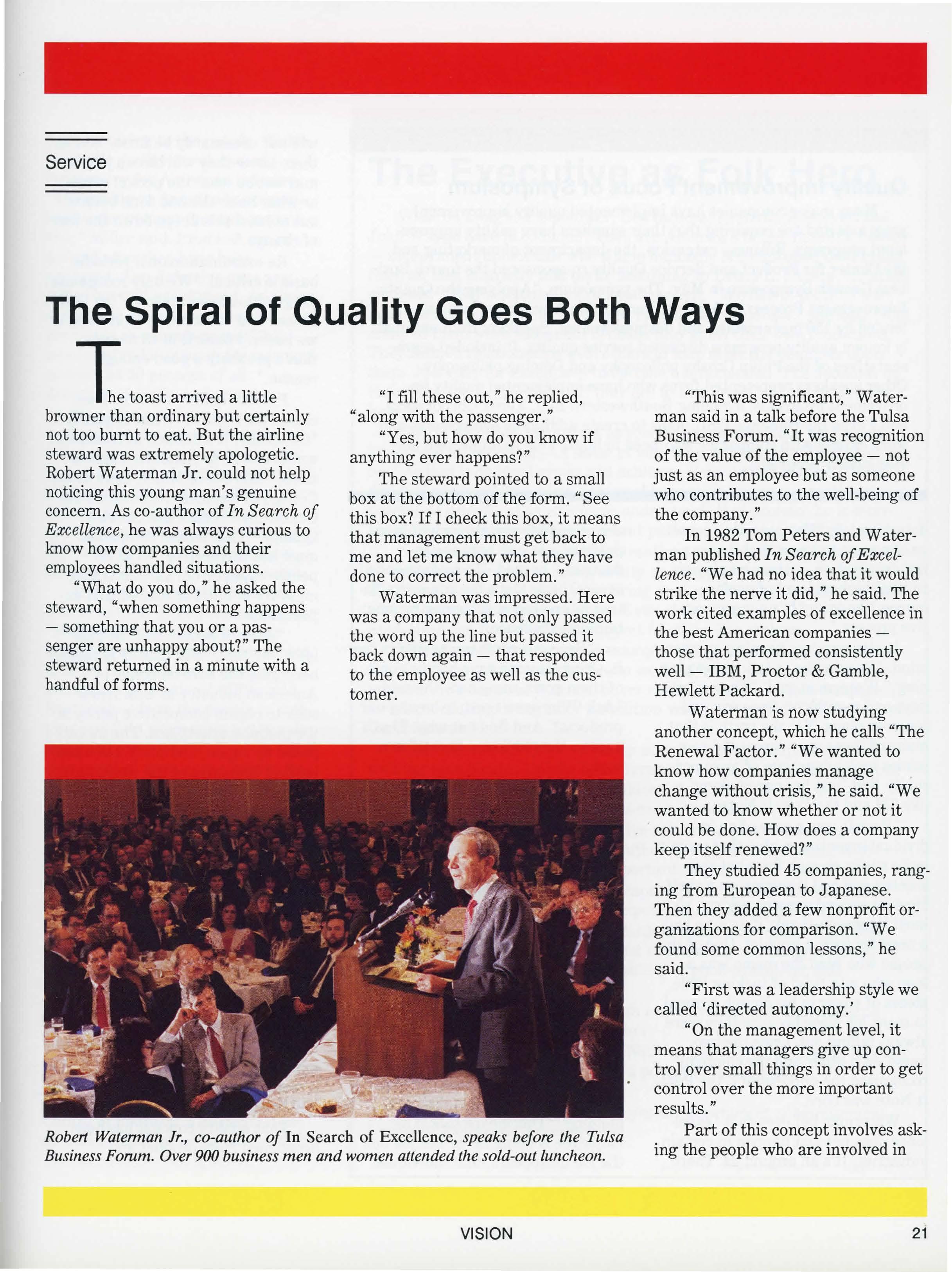
Robert Watennan Jr., co-author of In Search of Excellence, speaks before the Tulsa Business Forum. Over 900 business men and women attended the sold-out luncheon.
Quality Improvement Focus of Symposium
Many major companies have implemented quality improvement programs and are requiring that their suppliers have quality improvement programs. Business extension, the department of marketing and the Center for Product and Service Quality co-sponsored the fourth Business Growth Symposium in May. The symposium," Applying the Quality Improvement Process to Achieve Competitive Advantage," was attended by 150 businessmen and businesswomen. Speakers from nationally known quality programs discussed service quality. It included representatives of the Philip Crosby philosophy and Deming philosophy. Other speakers represented firms who have implemented quality improvement programs, including Southwestern Bell, Xerox Corporation and Texas Instruments. OSU plans to create additional symposiums and work closely with companies who need in-house help to implement service quality programs.
doing the job. "The renewing companies seem to know that dreamsnot desperation - steer employees to their highest level of performance," he said. "It's a more creative process."
It also requires keeping an open mind. "People like to talk about planning," Waterman said. "They spend days and months on five-year and ten-year plans. Yet the truth is that many of these very successful companies took advantage of an opportunity that 'just happened along'like 3M and the Post-It Notes.
"Post-It was a case of an individual inventing a glue that wasn't quite sticky enough for what they wanted and had it setting on a shelf. He sent around a memo asking, almost tongue-in-cheek, if anyone had a need for such a product. One of the people who read the tnemo was a man who was tired of tucking little pieces of paper in his church hymnal to mark his place because they were always falling out. Once the two found each other and the company recognized the opportunity, the PostIt Note was born."
Waterman believes that "excellence does not just happen in certain industries. It's all around us. There
are incredible variations within industries, not just between industries," he said. He recommended several basic steps for any organization interested in achieving or maintaining excellence:
"See your company as others see it. Organizations have habits, some of them good, some bad," he said. "Ask 'Why aren't people buying our products?' And find out why. That's back to the old 'know thyself' concept.
"Stay in touch with the competition. This is IBM's long suit. They continually ask 'Who does it best? How can we do it?'
"Break down the we-they barriers. Management and labor must pull together. One company attempting to build a team held an 'antithey' campaign with mugs that said, 'Who is they anyway?' Management had signs on their desk that read 'Not they' and 'Send they a letter.' It worked well because it pointed up a problem and then proceeded to wipe it out."
Restructuring job security can be an important part of the teambuilding. "This means that if an employee is doing his or her job but the job disappears, that individual
will not necessarily be fired. You let them know they will have a job; it may not be what the person wants or what he or she has done before; but at least this keeps down the fear of change."
Re-examination on a periodic basis is critical. "We only reorganize for good business reasons," an IBM officer told Waterman. "But then, if we haven't done it in 18 months, that's probably a good enough reason."
Provide quality service. Then comes the issue of 'What is quality?' "Generally, it's defined as consistent conformance to customer expectations," said Steve Miller, head of the College of Business Administration Center for Product and Service Quality. "That means companies must ask themselves 'What do people expect from us?' Then they must try to meet or exceed that expectation.
"A lot of people scoff at this idea," he said. "But quality is rapidly becoming the core objective of American industry as U.S. firms seek to regain competitive parity in the global marketplace. The threats posed by Japan, Germany and other leading countries of the world have been a rallying cry for action among managers and workers alike."
The goal of the Center for Product and Service Quality is to gain acceptance of the quality improvement process by business and education communities. "Many people don't believe quality really can be achieved," he said. "They feel that if customers have low expectations, people will deliver poor quality. Thus, America will continue to have low-quality products. But the reality is, the more you get, the more you want. As you exceed it, • however, there is a continual spiraling increase on a constant basis."
That quality concept has been broadened from product and
manufacturing to the people. Waterman calls quality a watchword - a rallying cry for American industry. "The quality in America has always been improvement through inspection," Miller said. Products are examined after they have been produced. Any defective ones are pulled out and not shipped. Additional ones are manufactured or the product is re-manufactured. This process of redoing products may cost as much as 30 percent of all American manufacturing today.
Considering the current economic environment, Waterman believes that prevention is a better course. Instead of waiting until a product is produced to look for defects, he suggests making sure there are no defects along the way. This method is more cost-effective because redoing work is eliminated.
In recent years, attention has turned to total quality management. "That really means that you are managing every part of the business in order to have a more qualityoriented organization," Miller said. Everyone - from the people in shipping and data processing to the sales force and communications - is equally important. Such companies as du Pont, American Express and Marriott Hotels have all taken the idea and made quality service the basis of their growth.
"In business schools you don't read much about role models," Miller said. "Catching people doing it right is an underdeveloped part of our culture. But it's a great thrill when it happens." 0
Robert Waterman Jr. is co-author of In Search of Excellence and author of The Renewal Factor.
Dr. Steve Miller is nrofessor and head of the department of marketing, Collegeof Business Administration, as well as director of the Center for Product and Service Quality.
The Executive as Folk Hero
What do Dwight Eisenhower, Lee Iacocca, Franklin Roosevelt and John Wayne have in common? They are America's larger-than-life heroes - independent individuals who single-handedly accomplished their goals. Such an idea is strictly folk-myth, according to Debra L. Nelson, assistant professor, OSU's department of management. "We like to think of our business and government leaders as rugged individualists," she said. "Yet many of them were successful because they knew their own limitations. They formed relationships with others to help meet the demands upon them. It is easy for executives to become overextended. The demands on their time can be incredible. If they are to be successful they must have help."
Nelson describes executives as special people who have both a selfimage and an ego ideal - a sense of who they are and what they want to be. "As that individual grows and achieves, these ideals change. The individual never really achieves his goal because it becomes a continual process of growth. If an executive understands that process, he is more likely to deal better with the constant pattern of striving toward a goal.
Nelson noted that successful executives are set off from their peers by three key elements - drive, ability and support from other people. That innate drive and ability can bring success, but it takes others to help when demands and stresses grow. Even if the drive and ability are there, executives can flounder if the support of others is not there.
"Woodrow Wilson is a good example. He was ambitious and influential. But he could not rally people to work with him. As a result, his pet project, the League of Nations, never really succeeded. Then compare Lee Iacocca. He put together a coalition which has pulled Chrysler out of the doldrums."
When executives cannot develop such a support group, they become walking time bombs. Unable to achieve their goals, feeling the weight of the entire company upon their shoulders, they oft~n develop mental problems, substance abuse problems or choose suicide.
The keys to developing supportive relationships are selecting the right people, learning to delegate authority and communicating with them. Nelson lists several other important steps:
* Choose people who are more capable than yourself. Do not feel threatened or frightened by the competence and ability of others.
* Delegate authority. Without faith in these individuals, work will never be delegated effectively. Resist establishing too many controls. Centralization inhibits the natural ability of good executives and managers.
* Communicate. The leap of faith executives take in depending on others involves honest communication.
* Create a balance in your life. Without balanced and diversified interpersonal relationships, you become a potential time bomb.
Dr. Debra L. Nels on is assistant professor, department of management, College of Business Administration.
Creating an Award-Winning Program
Among lrusiness coUeges, accreditation is the key to national respect
TeCollege of Business Administration is one of an elite 250 schools in the nation fully accredited by the American Assembly of Collegiate Schools of Business (AACSB). Its accounting program is ranked in the top ten in the country.
The right mix of the right ingredients is key to a quality program. Couple that with a strong link between the entire academic community and the business world and you have an award-winning program.
What criteria are used for accreditation? Percentage of faculty with doctorates is important and the amount of research published.
Diversity of programs is another. OSU's College of Business Administration is composed of six departments (accounting, administrative services, economics, finance, management, marketing), 10 undergraduate programs, two doctoral programs and a professional school.
The MBA program, developed in the 1950s, was one o~ the first in the nation. By 1986 the college had prepared over 900 quality MBA graduates for work in business; another 500 had graduated with doctorates and 17,000 with BS degrees in business.
A college curriculum must be dynamic, according to Patrick Dorr, professor of accounting. It must constantly adapt to the changing needs
of the students for whom it is designed. "Our purpose on the curriculum committee is to make sure that the evolving process does not go static. We try to make certain
The concern for higher education shows up on every serious inquiry about Oklahoma as a possible location for business.
that we address the community's needs as well as the student's needs."
The College of Business Administration curriculum provides a broad base of experience and knowledge designed to help people make sound business decisions. It is the kind of foundation that allows graduates to grow into well-educated leaders. Fifty percent of the undergraduate program is rooted in liberal arts - English, science, humanities, mathematics, social sciences, history and political science. The remainder is in businessrelated courses. Sophisticated tools and technology aid students in understanding the management of human and technological resources.
The program is designed to create an awareness and respect for cultures, to strengthen communications ability in today's multinational net-
work and to broaden thought patterns to consider both short-term rewards and long-term goals. Because of this broad base of preparation, graduates move into a variety of careers with success - corporate management, government, nonprofits and entrepreneurial efforts. "Many people are unaware of just how important this broad program is," Dorr said, "but it makes a great deal of difference to corporations and businesses, particularly if they are looking at relocation. Companies in high technology industries look at the availability and quality of higher education in targeted geographic areas. So do companies in other industries as they relocate pl_antsor add to existing ones. The concern for higher education shows up on every serious inquiry about Oklahoma."
According to Dorr, the CBA program is a major asset to the state. "It shows that we clearly are able to educate workers who can handle a high level of management. It also shows that we provide a wide variety of continuing education options for a company's current management team." D
Dr. Patrick B. Dorr is a professor of accounting in the College of Business Administration.
The Class of 1990
1ere are thousands of new business graduates hitting the marketplace today, and they are markedly different from graduates of the 1960s.
They are smart: when they applied for college, their SAT scores were the highest test scores in ten years.
They are ambitious: they want to move into - and up in - the corporate world. But they are staring at a corporate ladder with fewer rungs - most already occupied by baby boomers.
Yet they are more savvy than generations that preceded them in some respects: they know that business has gone through a gut-wrenching time, paring down levels of management and cutting loose longtime employees. Loyalty is gone, they say, and that applies to both sides.
More students are turning first to higher education, many of them moving into the business schools and graduate schools.
When Alexander Astin, professor at UCLA's Graduate School of Education, surveyed the attitudes of incoming freshmen, he discovered that 71 percent of the class of 1990 believed that "being very well off
financially" was extremely important. Only 43 percent felt that way about developing a meaningful philosophy of life. "That's a major change from 1980 when 61 percent were very concerned about a philosophy of life and only 53 percent valued being well off."
How do they feel about other issues? They are both conservative and liberal. They strongly support the death penalty. They want government to do more to protect the environment and the consumer. Eighty percent do not feel that marijuana should be legalized. Astin's study does not take into consideration the effect college has upon these young people; but other surveys show much the same results. CollegeTrack, a New York City research firm, says that 93 percent of college seniors say financial security is a major goal in life. Seventy-five percent chose their courses in relation to how helpful they would be to their career.
Students now see education as an investment, and they demand a return on it. That's why business is the most popular college major. In 1988, 28 percent of men and 24 percent of women entering college planned to major in business, according to a UCLA study. "The impact of a course on a student's career prospects becomes a major factor in selecting it," says Stuart Himmelfarb, CollegeTrack.
Careerism lies at the core of student attitudes. An MBA is often the ticket to advancement in Fortune 500 companies. The share of college freshmen who agree that it is essential or very important to "be very well off financially" grew from 44 percent in 1966 to 73 percent in 1988, according_to the UCLA stujy_ The share who go to cpllege "to gain a general education" fell from 71 percent in 1977 to 60 percent in 1988.
The Class of 1995
The double-page spread in a major national publication shows a dozen 12- and 13-year-olds - Japanese, Chinese, Hispanic, black, white. "Street kids or streetwise business professionals?" it reads underneath. "It's going to take some pretty fancy footwork to turn it around."
The ad is placed by a corporate foundation not asking for dollars but for a commitment to support educational programs at all levels. It is indicative of the concern that is creeping into business boardrooms already. By the mid-1990s, there are going to be fewer young people to fill entry-level jobs in business. Part of the reason is there are fewer people; we are beginning to see the first of the "birth dearth generation."
For the last few years, the federal government has helped support such programs through Private Industry Councils around the nation. Street schools, summer remedial programs and summer jobs were the first step. But federal dollars are shrinking, just as the need for help is growing. Kids are going to need help if they are to be ready for business when they graduate.
Education is the most important factor determining the success of young Americans, according to American Demographics. They can look forward to bigger income gains on the job than can those who stop with a high school diploma or drop out of high school. High-paying service jobs require more education. At least half of all new jobs created between 1984 and 2000 will require more than a high school diploma. Almost one-third will require a college degree, predicts the Hudson Institute of Indianapolis in its report Workforce 2000: Work and Workers in the 21st Century. New jobs will require a median of 13.5 years of education, compared with 12.8 years today.
"The young work force on which so many businesses depend must be aware of such difficulties," said Craig Robison, director of CBA student services. "We are going to lose many bright young people unless businesses recognize the problem and help set up ways to reach these young people and help them through college (;ither through remedial or enhanced programs, as well as higher education scholarship programs."
The baby boomers may have thought they had it tough in the 1960s and 1970s as they competed with each other to get into college and to get jobs. But they did not have it as hard as most of today's young adults who are more likely to come from a single-parent household and who face college costs that are rising much faster than wages. If they can find a way to attend college, they are likely to find the
reward. They also may have to pay for it. Families often take out second mortgages on homes. If many are concerned about salaries it may be because of debt. Costs for four years at an Ivy League school climbed to $80,000 including books, clothes and miscellaneous expenses. "OSU offers a real bargain," said Craig Robison, • College of Business Administration director of student services. Many of them receive financial help through
scholarships, grants and other special funding.
Those who do make it to college live reasonably well. Today's business school student averages 26 years of age. Forty-seven percent of college students live off campus. About 60 percent have a car. Forty percent of those with a TV also own a VCR. Nearly half have a credit card, three-quarters have checking accounts.
Probably 50 percent of them have a job. "In fact, a part-time job under 20 hours a week enhances grade point after the first semester," said Robison. "It tends to make them do better. Over that amount, though, and returns diminish."
Attracting bright young people to the college program is a priority for the College of Business Administration. About 4,000 undergraduates and 500 graduate students are currently enrolled. "The CBAwants to channel the best and brightest into business and government leadership," Robison said. Through the efforts of alumni, staff and students, the college recruits many outstanding young people from local communities.
CBA students have been recognized nationally through prestigious awards. In the last few years, students have received the Richard D. Irwin Doctoral Fellowship given to only 20 business students nationally each year. Over 150 substantial firms recruit on campus, seeking quality students to enter their training programs. Many have gone on to join the management of major U.S. corporations.
Robison looks for outstanding students. "We prefer students with ACTs of 23 or above and a 3.0 grade average in high school," Robison said. "They have proven they can do the work." The CBA has begun an
Honors Program this year. A student must have an ACT score of 28 or above to enter the program. "We are particularly interested in recruiting more of these high-caliber students," he said. "We look for the well-rounded student, one who shows social skills as well as academic skills, someone who has been an officer in a club and has shown some leadership skills. We know they are going to need to build on those skills later on."
Robison sees both strengths and weaknesses with the new students entering the program. "They are still young and inexperienced," he said. "They believe it will be easy to succeed because they are bright. Yet some very bright students fail because they do not know some basic survival skills. We lose many students during the first semester because they don't know how to study or manage their time or take notes. The College of Business Administration has begun a new orientation program this year to teach such basic skills. It includes time
management, test-taking, notetaking and use of the library.
"Another trait that we see in students is a lack of loyalty. When they talk about work, they talk about going to work for a firm for a year or two then moving on to a different company where they can get a different level or type of experience. They do not see their first jobs as ones where they want to stay. Part of that is because they know what's going on in the business world. They know that loyalty is a two-way street, and few companies can afford the luxury of loyalty."
The students show some surprising strengths. "They are a lot more confident about themselves," he said. "There is more eye contact. They have more knowledge of what is expected of them. Many students are more goal-oriented, more serious about studies."
The students are getting more involved in foreign languages on their own. "A lot more students are asking to take foreign languages, particularly Japanese, Chinese and Russian.
To reach the international market, the College of Business Administratiop has a minor in international business. "When you combine foreign language with a business major and an international business minor, you have a very powerful student prepared for tomorrow's management.
"These young people are very aware of their world as a global community," Robison said. "Today's students are different, no doubt about it. But they are going to be far better prepared for the current economic situation than some of the former graduating classes."
Dr. CraigRobison is director of student servicesfor the Collegeof Business Administration.
Getting Involved Key to Future of Education
Successful business involves making sure you are helping your customers, according to Jack Allen, chairman/CEO, Chandler-Frates & Reitz. "It's called follow-up, and I do it personally every week for my own business. Education is the same," he said. "You've got to know whether or not you're providing a valuable product and how you might do it better. But few colleges think to ask."
Allen is chairman-elect of OSU's Tulsa Alumni Association. He is also a member of The Associates of the College of Business Administration. The Associates is made up of outstanding individuals from business, non-profit institutions, government agencies and other professional areas. They act as a support group to provide advice, direction, contacts and financial support. They act as a sounding board and provide some support in the classroom.
"We become very involved as Associates," Allen said. "I like sharing information, finding out what the CBA is doing. The CBA often asks for feedback on projects they are considering. They want to know how we think they can do things better. The administration wants input in the direction the_CBA should go."
Allen is also a life I)lember of the CBA Alumni Association. Why do businessmen get involved in an alumni association? "I want to give some-
thing back to an institution that gave me a head start," Allen said. "We all know public education can't get enough money from public funds. There are always special projects that require assistance. That's where alumni can be valuable. They understand how important that time in life is, how critical it is for a school such as OSU to be able to help bright young people who will be tomorrow's leaders," Allen said. "Becoming involved, as an associate or as an active member of the alumni, is an opportunity. It's
a way that we can help contribute to the future."
Allen added that young people are not the only consideration. "The Tulsa Business Forum is a prime example," he added. "No one had any idea it would take off the way it did. But it indicates we must be doing something right."
ob Chitwood, past chairman of The Associates agrees. "It's important that business people act as a sounding board for the CBA. It gives them the benefit of real-world experiences as the college considers the curriculum. It's also important that the CBA administration be exposed to a diverse group of people. That way we really can be of value and help in their mission."
BWhen Chitwood first joined The Associates, there were only about a dozen business people involved. Today there are more than 100 Associates. Chitwood believes cooperation is necessary because "Oklahoma has a long way to go in funding higher education the way it needs to be done. Unfortunately salary scales are not high. Considering that, it's amazing to see the kind of dedica.tion that we do have." This year the group raised more than $300,000 to fund a chair in the CBA. "There is only one reason why people would
Jack Allen, Chandler-Frates& Reitz
Bob Chitwood, R.H. Chitwood Company
do that," he said. "The college is doing things that people want done. Businessmenwant to have qualified employeescoming out of the business schools - people that they can employ.The only way to assure that is to help the schools."
Chitwood has been serving as the interim executive director of the Center for International Trade Development that will soon become the Institute for International Trade and Economic Development with an expanded focus. "We have been working with small- to medium-sized businesses interested in exportimport. In the last two years, CBA faculty and teams of MBA students have worked with 10-12 companies in Oklahoma. At least one of those is now a substantial exporter. That company expects over 10 percent of its sales will come from the export market by 1990," he said. "That can be a significant impact on the economy in the long run."
Jac,kAllen is chairman/CEO of Chandler-Frat-es & Reitz, Tulsa.
Bob Chitwood is president, R.H. Chitwood Company, Tulsa, and former pr_esident, Cities Service Company.
Home-Grown Talent Learns the Hard Way
When Jack Allen launched into the insurance world fresh out of OSU in 1969, he was eager and ready to succeed. "I was a great technician," he said, "and I failed miserably. I didn't know how to deal with people. I was so technically oriented that I thought that information and logic would make people want my services. I taught a lot of people about insurancethen watched them buy what I had recommended from their old agents."
Today Allen is chairman/CEO of Chandler-Frates & Reitz. He bought into the agency in 1982 and bought the company outright in 1984. The company has expanded from a straight insurance agency to a financial risk-management firm. "The mistake of assuming people would buy from me because I knew technical information was just the kind of mistake that eager young people make when they first come out of college. Learning that lesson was important, however. It made a difference in how we have been able to grow our business."
Allen believes that OSU's management development courses help business people keep up with trends in their industry and in management as well. "Executives are overloaded with information," Allen said. "It's staggering. You take one look and wonder, 'How do I take all this information overload and make one percent of it valuable to me?' Ten percent would be even better. That might turn a business around. It's difficult to be analytical today," Allen said. "We have to move so fast, it seems we sometimes have very little time to study our moves. It's like a fast chess game with a timer."
Allen cites changes in the insurance industry as an example of speed and change. "The general trend toward settling differences in court has made a major difference in our business. Fifteen years ago when people were underwriting the contractors and construction companies who were building buildings, no one had any idea that there would be lawsuits against the contractors for asbestos installation.
"We also realize that we can no longer be all things to all people. We are targeting our markets, hunting for the niches, asso many people are. We are concentrating on doing what we do best and doing it better. Just accept that others are going to have a piece of the pie.
"The Risk Retention Act of 1985 has had an incredible impact on what's happening in the industry. That has allowed insurance buyers to band together to buy as a purchasing group. Essentially, they can form their own insurance company. As a result, more people are insuring themselves." Allen expects this area to grow as the insurance market hardens in the next 18 months.
The insurance industry faces the same problem that other businesses have recently discovered - a shortage of personnel. The baby boom is gone, and there are fewer and fewer young people moving into the marketplace. "We're screaming for talent," he said. "We must spend thousands of dollars to train young people in our industry. Yet we have a better group to choose from than many areas of the country.
"Most major insurers like getting talent out of this part of the country because we generally have a better attitude toward work and toward people. As a result, a lot of our best people are wooed away from the area. We need to find ways to keep our home-grown talent."
Time
Time Marches On (and On)
I;e create their own crises, according to Dennis Mott, CBA professor of administrative services. "They let events lead them rather than taking charge. They develoJ)'poor habits and perpetuate them in their workers - even when they have the best intentions. Disorganization rules their lives when it doesn't have to be that way."
Managing time has become one of the critical factors as delivery times have shortened and computers have quickened information flow. "We must work more efficiently just to keep up. However, a crash timemanagement course doesn't work any better than a crash diet."
Mott named five major timewasters that create disorganization:
1. Interruptions. "Unimportant telephone calls and drop-in visitors are big interruptors," Mott said. "Coworkers drop in to chat sometimesand that may be their way of avoiding an unpleasant task of their own. There are some bosses who oversupervise because of their management style or because they would much prefer to be doing some other job rather than managing.
2. Lack of objectives, priorities or daily planning. People justify their messy desks. They tell you they know exactly where everything is - or at least 75 percent of it. It's true thatlhey know it's there, but finding that other ,25 percent may cause havoc. Having to hunt for it suddenly when someone else needs it wastes time and creates more stress on the job.
3. Delegation (or the lack of delegation). In most organizations, nobody is trained to be a boss. We usually hire people and then move them up as they show they are good workers. Unfortunately, they often rise to their level of incompetency. An individual may have been a great engineer, but now he finds himself managing other engineers. He knows little about hiring and firing people or motivating them. He may wish he were back at his old job. He may even be reluctant to give up some tasks. Now he has tasks from his new job and his old job; he works 110 percent just to keep even. Instead of great performance, the company gets mediocre work from someone who had been performing great. Upward delegation is another problem. Some workers try to pass the work back by involving managers. Make them handle their own responsibility.
Mott says that people often hesitate to hire people that are smarter or different than they are. "Hire the best people you can - and they may know a lot more than you in some areas. You want them to or you are not creating a real team. Our thinking dimensions should be greater than a single viewpoint."
4. Meetings. Most meetings are poorly run. They do not have a preadvertised agenda. No one takes minutes. People come unprepared. Don't hold the meetings unless they're necessary. When the meetings are held, take minutes and circulate them afterwards.
How to Save Time (and Time Is Money)
1. Keep a log to find out how and why you are wasting time. What can you do to change habits or operations?
2. Maintain a backup calendar system with all details. Keep only necessary details on your pocket calendar.
3. Put things in the proper perspective. Separate tasks into categories: urgent, important or routine. Work on the urgent first. When things are so stressful, ask yourself what would happen if this thing really blew up? Would I be dead? Would I be in jail? Could it cost me my job? How bad is that? Get it down to the level you can deal with it.
4. Learn to say no. Don't let people use you as a crutch. You cannot do everything and maintain a high level of performance. Ask yourself how much can I do and maintain a level with which I am at peace?
5. Improve delegation techniques and follow-up systems. Understand your people and how to motivate them.
6. Take time to enjoy the trip rather than look toward the arrival. Enjoy it now. Organization will give you some peace of mind.
7. Plan everyday. Before you begin work or at the end of the day, take 15 minutes to review what needs to be done and what was accomplisl)ed. Analyze why something did not get done and what you can do about it.
5. Poorly trained, inadequate or insufficient support staff.
"Most support staff feel left out, as if they're not part of the team. Managers don't intend for that to happen but it does. They need to be included even if it requires a separate meeting for the support staff." D
Dennis Mott is professor of ad•ministrative services,' College of Business Administration. He has worked as a management consultant with companies in a dozen states over the. last 13 years.
The Wizard of Wall Street Meets Mid-America
1,es
may be rugged in Oklahoma right now, but don't count Oklahoma out. That was the message from Louis Rukeyser, host of public television's "Wall Street Week" and noted author. "Your image is good," he said. "There has been an improvement in employment. Real estate is at the bottom, and you have a population that's known not to be afraid of work."
Rukeyser served for eight years as a senior correspondent and commentator for ABC News. The first national economic commentator, he has won numerous awards for his programs. More than 900 professionals turned out to hear him speak at the Tulsa Business Forum sponsored by the College of Business Administration.
The purpose of the forum is to bring noted business leaders, entrepreneurs and policy-makers to the community. "People on the East and West coasts and in major cities have many opportunities to hear such individuals," said Jim Hromas, director of business extension, College of Business Administration. "Oklahomans do not. This allows them to hear first-hand about current business trends and activities."
Rukeyser spoke on several issues of concern:
* Balancing the budget: "History says we need to be careful. In 1929, after the stock market crash, there was a race to balance the budget. The tight federal policy caused the money supply to shrink 35 percent. As a result, there was a deep economic slowdown - better known as the Great Depression."
* Taxes: "The average American's taxes are already higher than in any previous year in American history. They've been increasing every year since 1982. Higher·taxes simply cut into job creation. That makes it even harder to shift from debt to production - and that's the real key to growth in this country." Rukeyser scoffs at congressional assurances that if they are given a tax hike this time, it will be used only to reduce the deficit. "For anyone who believes that, I have a lot of commercial real estate in downtown Tulsa I'd like to offer them," Rukeyser quipped.
One way to make sure taxes are not raised is to "take on the sacred cow on the right and the sacred cow on the left - take on defense and take on entitlements." He called for shared spending on defense. "We need to insist that our allies, particularly the Japanese and the West Germans, take on a bigger share of the world's defense burden, making cash payments in kind."
* Trade protectionism: "Trade protection policies in the 1930s aggravated the Depression. They led to retaliation, hard feelings and higher unemployment."
* Higher interest rates: "The nation's money supply was growing in 1986 by about 10 percent. In early 1987 when the nation panicked, interest rates rose. Growth slowed down to two percent. This contributed to even greater slowdowns on Wall Street. Capital gains tax in
1987 went from 20 to 33 percent. This contributed to the 1987 crash."
* Financial institutions: "For the future we're going to see less and less of the old distinctions between financial institutions. Customers don't care if it's a bank, a savings and loan, a department store or an insurance company they use for financial services," he said. "There are 14,000 banks in the United States, but only six in Britain. The safest, surest prediction I can make to you is that over the next 10 years, the number of American banks will be somewhere between 14,000 and six."
In an interview with the Tulsa Tribune, Rukeyser labeled the savings and loan industry "almost a Greek tragedy," initially created out of the "artificial acts of Congress" and destroyed by artificial acts of Congress. Whatever solution is chosen, he added, "it's going to be an expensive salvation." Rukeyser recommended that thrifts be allowed to purchase insurance coverage in the open market rather than from the federal government. "Then, if you were putting your savings in a company [thrift] and found that they had to pay the maximum for risk insurance, you might think twice."
* Business growth: "Corporate profits are dramatically higher, and the structure of American industry is in better shape than it has been since 1982. Companies are leaner and meaner. Unfortunately, government is doing little to help."
* Energy: "More absolute nonsense has been published by so-called energy experts. At one point, they were saying oil was going to $200 a barrel. Now they're saying $1.50 a barrel. Only one thing is for certain: a lot of legislation has been counterproductive to energy."
* Social Security system:" At some point in the first half of the next century, there will be more
people receiving social security than paying into it. I have a plan whereby an American taxpayer could opt out of receiving social security. Instead, any person could take that money and invest it in an IRA. It would encourage savings and investmentand American free choice."
* Stock market: "The stock market is still the arena for longterm investment. The market is rebuilding, but we have a terrific skepticism on the part of Americans. Affluent foreigners, particularly the Japanese, see it differently. They see American stocks as a super buy. Besides, alternative investments, such as precious metals, are not that attractive right now.
"The stock market still has strong points for investors. When J.P. Morgan was asked what the stock market would do, he had one answer: 'It will fluctuate. It will fluctuate down. And it will fluctuate up.' That's what I expect it to do. The Dow Jones Industrial Average will not break any highs, however. Federal Reserve Chairman Alan Greenspan did an exemplary job after the crash, but he's pulled back too fast on the money supply so that interest rates have been rising. The long-term growth of money depends on the long-term growth of the economy. Some things, such as bluechip stocks, are always good in good and bad times." His advice: "Invest regularly. Pay no attention to the cost of stock - if it's down you got a bargain. If it's up and it's performing well, you still have a sound investment."
Rukeyser feels that the 1990s provide a good outlook for long-term involvement. Asked whether the stock market would set new highs, Rukeyser smiled: "I can't say for sure and neither can anyone else." D
Louis Rukeyser is an author and host of the national television program, Wall Street Week
High Technology
Expert Systems Search For Real Solutions
Buried lYyinformation from comput,ers? The next generation of wchnology may change that
1right information at the right time has been the key to business success. In the past business faced the problem of finding current data to make good judgments. Technologyhas changed the problem in a way that few anticipated, according to Ramesh Sharda, professor of management science and information systems.
"The computer industry has almost drowned executives in information," said Sharda. "People get reams and reams of data without knowing what to do with all of it. It is no longer a matter of can they find information but what do they do with all of it. To make matters worse, it becomes almost impossible to find the right data in those reams."
Sharda is working on several projects that include both neuraltype networks and linear programs.
"We are designing an expert system that would improve the innovation process," he said. An expert system is the closest thing in existence to artificial intelligence. The computer program makes decisions based on a large number of variables, much the same way that humans do when they think. It is less a step-by-step process than a random process that draws on all types of related and unrelated information. This is known as a neural network.
The program also employs signal processing, that is, taking a stream of data, trying to come up with a pattern, then using the underlying pattern to forecast future data. The expert systems have a host of applications, including speech generation, engineering and forecasting. One project in accounting involves predicting the likelihood of a firm going bankrupt.
Another project is on management information. Sharda and his associates on the project will interview managers involved in innovation to determine their needs. They will then build a knowledge base from which to work.
Such a program would ask the manager to provide information that would target the kind and form of information received: Who is the information for? How will it be used? What level of information is needed? What decision-making style is appropriate? Do you prefer information in the form of graphs, tables, percentages, historical comparisons? Based on such information, the program makes decisions and builds a knowledge base for the manager.
A second expert system on which Sharda is working would help forecast changes in technology and how to help people cope with technological innovation. "It would even suggest how to introduce new tech-
nology so that stress is minimized," he said.
0ne of Sharda's former students has taken his studies in linear programming into the business world. Linear programming systems are a mathematical way to find the best solution to a problem. "Until the last few years, linear programming was a mainframe function," said Bryant Bynum (CEA '86}, consultant with Coopers & Lybrand. "About five years ago the first personal computer software packages appeared. They could handle about 50 variables and 100 constraints. · Today, packages will handle 3,000 variables and 7,000 constraints."
Bynum is currently working with a major company to schedule production of various products in all their facilities. Bynum collaborated with Sharda while working on his master's degree. Together, they wrote several papers evaluating programs that allow individuals to perform complex tasks on personal computers instead of main-frames.
"I've used those principles with some large Fortune 500 companies. One company we work with produces 200 products at six different facilities. They can purchase the raw goods in five different forms. Using a linear program which
I developed, they put in demand for each product, the price of the raw materials and plant capacities. The model then tells them how much to produce, how to produce it, what formula to use and which plant should be used. It also triggers information on the amount of supplies and packaging that are required.
"Even with a problem as complex as this, it can be handled in a Lotus spreadsheet. The linear programming model simply pulls the figures out of the spreadsheet, finds the optimal solution and then puts the results back into the spreadsheet. Yet it does not require someone with linear programming experience to operate it. It only takes someone to punch in the few variables." D
Ramesh Sharda is a professor of management, College of Business Administration.
Bryant Bynum is a management consultant with CoO'J)ers& Lybrand.
Bryant Bynum is cu"ently working to organize a campus support group. "Oklahoma colleges need 'help," he said. "Businesses must get more involved with the education process."
CBA Sets Up Honors Program
As part of the overall effort to attract the best students and to challenge them academically, the CBA has initiated an Honors Program. Students who are successful in being admitted to the program and who complete the various requirements of the program receive the "with honors" designation on their diplomas when they graduate. This designation is valued by employers.
The CBA Honors Program was proposed and organized by a group of interested faculty. "We were concerned that many of our brightest and most motivated students were not getting the full value from their college experience. We felt they could take on additional challenges and receive special recognition for their accomplishments," said Andy Urich, assistant professor of business law and one of the faculty who organized the program. "After talking with a number of students, we became convinced that an Honors Program could be an important addition to the college experience they wanted."
The program is open to students who have achieved a score of 27 or higher on the ACT test and who have a grade point average of 3.5 or above. A student must incorporate 12 hours of honors classes in studies during the junior and senior years. "The honors classes are a little different," said Urich. "They are not specific to a discipline like marketing or finance. Instead, they deal with the overall environment in which business operates. All disciplines of business are included. Students are required to read a wide range of materials, to integrate these readings, to think about the major issues facing business and to write.
"While honors classes are a challenge for students, they also challenge faculty. We all enjoy having the brightest students in our classes. But a class of only those students who ask tough questions keeps us on our toes. We also have to deal with information outside our areas of expertise. The result is that both the students and faculty work very hard. I know it is rewarding for the faculty and feel the program is a good opportunity for students to stret,ch themselves."
Downsizing Changes Management-Employee Relations
Organizational behavior has gone from managing employees in a work situation to managing changed attitudes and expectations of individuals, according to James Hromas, director, business extension, and associate professor of marketing. "Downsizing, mergers and acquisitions, intrapreneurships - this incredible flux makes managing relationships revolutionary. We are beginning to see new attitudes replacing the old system where management and labor saw themselves as adversaries. We are also seeing the old rigid systems of management hierarchies changing. Part of this is the result of Japanese models, which have been adopted by the West. These Eastern models have permanently changed our entire concept of what businesses are and how they are run."
COMPENDIA
PREPARING BIG BLUE VIA CNET
When IBM wanted to upgrade its accounting personnel, they turned to the OSU College of Business Administration.
The CEA has been working with IBM for almost 10 years. "IBM was impressed with our accounting faculty," said Lanny Chasteen, professor and head of the CBA's Schoolof Accounting. This year, the CEA will hold a two-week costaccountingcourse over IBMCNET, their corporate education teleconferencingnetwork. IBM's CNETsatellite system connectsseven classroom locations.
The CEA faculty also conducta team-teaching effort at Briarcliff Manor, Terrytown, New York. Lawrence Hammer, professor bf accounting; Maryanne Mowen, associate professor of accounting; Charlotte Wright, associate professor of accounting; Patrick Dorr, professor of accounting; and Amy Hing-Ling Lau, professor of accounting, also handle specific plant site seminars. Walter Shaw, manager, accounting and finance extension programs, coordinates the course.
IBM has arranged with PACE University for participants to receive college credit. Over the past 10 years, the CEA has delivered five other courses for IBM, including
When IBM began converting to teleconferencing, they picked OSU to do a two-week accounting course. OSU developed the course for television then presented it.
OKLAHOMA MIRRORS U.S. ECONOMY
Oklahoma may be better poised to grow like the nation, according to the 1989 Oklahoma Economic Outlook. But that may be a problem since it is increasingly probable that the nation will enter a period of significantly slower growth if not recession. If the national economy holds strong, Oklahoma should stand out as a bargain-basement value. The cost of doing
business, price of facilities, infrastructure support, labor force productivity, educational opportunities and quality of life should make the state look like a real bargain to cost-conscious corporations.
10,000 UPGRADE SKILLS THROUGH EXTENSION
About 10,000 people have taken management development courses through the CEA business extension. CEA extension serves as an information source for today's leaders through sophisticated community outreach programs.
Professional development courses are designed to upgrade individual skills through the latest information in the field. Courses are offered in Tulsa, Oklahoma City and Stillwater. Some are designed for specific
professions, such as the CPA Review for those who plan to sit for the certified public accountant examination. Other courses are designed to update management skills, such as goal setting, employee and personnel management, productivity improvement and marketing strategies.
Business extension courses are self-supporting, paid for by participants. "Our courses have to be good," said Jim Hromas, director of business extension. "People will not continue to come if they aren't."
Over 100 business organizations, associations and government units have used business extension programs to meet inhouse educational needs of employee groups and association members.
Many short courses offered throughout the year are directed at corporate management and
The golden parachute has become a symbol of the '80s executives, according to Steven L. Thomas, assistant professor of management. "The concept of job security is not new; and the parachute is not a cause but the result of changed thinking. For years we watched as labor unions and employees demanded an ever-climbing cycle of higher wages.
"Today, we are seeing a shift from a concern for dollars to a concern for job security. Master contracts are being written not with wage increases but with future jobs."
Thomas added that "as educators we must prepare tomorrow's executives to deal with this shift and its major implications in negotiations and job satisfaction."
EXECUTIVE EXPECTATIONS CHANGING
COMPENDIA
MERGER AND ACQUISITIONS MAJOR IMPACT
WELCOME TO THE CORPORATE BESTIARY
Consider the Yea-Saying Fence Sitter. He may be sitting in the next office, according to Dr. William Zikmund, CBA professor of marketing. The Yea-Sayer is one of the employee types Zikmund highlights in A Corporate Bestiary. "It's very light in weight, which some say is because it has no guts " he wrote. "It has small claws that do not grasp is- ' sues well and is a favorite of the autocratic manager." There are plenty of others:
The Workhorse is trained to work harder, not smarter, its nose shortened by proximity to the grindstone. The Razzmattazz and The Pizzazz are two colorful beasts raised in advertising agencies and fed on words.
designed to meet specific needs, from marketing to expansion. "We work with the client to tailor existing programs to satisfy specific educational needs," said Hromas. "We can provide special seminar leaders, develop program content and make all arrangements."
Professional Development Programs cover accounting, tax and fina:p.ce, computers, office productivity, management and marketing areas.
"Teleconferences have been popular, and we work to provide subjects of special interest," said Hromas. "One covered inventing the future, another on invisible organization, that is, how to get the answers, resources and support to achieve your mission. A third was on communication and how you cannot not communicate. All were chosen because they offered current information that businesses can use to their advantage."
The growth of mergers and acquisitions is quickly changing the face of the marketplace," said Joseph Jadlow, professor of economics. "Today's business leaders must understand the ramifications that arise whether the merger is horizontal, vertical or conglomerate. But how do we measure the effects of the market share and the market structure? How do we define the market changes? And what of the internal changes - the human resources that must suddenly shift gearsi
"There are no easy answers, but the implications within the company can be significant."
MOVING BEYOND THE MIDWEST
Tulsa's air and water ports are linking up with the OSU Center for International Trade Deve}opment to look into world trade opportunities. The City of Tulsa/Rogers County Port Authority, on behalf of the Tulsa Port of Catoosa, has entered into
an agreement with the Tulsa Airport Authority and the OSU center to help existing and prospective industrial users in selling products internationally and to look at services that could further port development. The center would work up international trade training programs, help with special events, review marketing and public relations plans, represent area interests at trade meetings and at federal levels, study topics and events and assess trade services.
MBA STATUS STILL STRONG IN U.S.
Graduates of the top business schools are taking home record salaries. The class of 1988 received offers 4.1 % higher than the year before, and 1987 had been up substantially more than that. The MBA degree continues to be sought by employees as a valuable credential.
TRAINING FOR ECONOMIC EDUCATION
The CBA Center for Economic Education has begun teacher training in economic education to aid current teachers in the field. Many teachers, particularly in rural areas, must conduct the course but have little background. Other teachers need to update their information. D
Robert L Sandmeyer, Dean
Faculty with a Mission
Gregory C. Mosier, Joseph Shaanan, Professor
John T. Bale, Associate Assistant Professor
Chalmer E. Labig, Jr.,
Frank G. Steindl, Regents Assistant Professor Dean Dennis L. Mott, Professor Professor
Zane K. Quible, Professor
Hon-Shiang Lau, Regents Accounting
Larkin B. Warner, Regents Professor
Lanny G. Chasteen, Jeanine N. Rhea, Associate Professor
Debra L. Nelson, Assistant Alumni Professor and Professor
Keith D. Willett, Associate Professor Head, School of Accounting
Andrew L. Urich, Assistant Professor G. Daryl Nord, Professor
Dale E. Armstrong, Professor
Finance
Jeretta A. Nord, Associate Associate Professor Economics
W. Gary Sim-gson, Professor
Patrick B. Dorr, Professor
Ronald L. Moomaw, Professor an Head, Ramesh Sharda, Professor R. Dan Edwards, Assistant Professor and Head, Department of Finance Faye Smith, Assistant Professor Department of Economics
MaJe S. Broske, Assistant Professor
Lawrence H. Hammer, Lee C. Adkins, Assistant Pro essor
Thomas H. Stone, Professor Professor Anne Gleason, Assistant Professor
Don Hansen, Professor
Orley M. Amos, Jr., Professor
Janet I. Kimbrell, Professor and Robert S. &
Associate Professor
Grayce B. Kerr Professor
Bud Lacy, Associate of Economic Development
Steven L. Thomas,
James F. Jackson, Jr., Assistant Professor
Associate Professor J. Scott Turner, Professor
Janice W. Jadlow, Margaret A. White, Professor
Michael J. Applegate, Associate Professor Assistant Professor
Amy Hing-Ling Lau, Associate Professor
Tim Krehbiel, Assistant
Charles R. Williams, Professor
Donald L. Bumpass, Professor Assistant Professor
Gary K. Meek, Professor Adjunct Associate
Ronald K. Miller, Associate Marketing Professor and Director, Professor
Maryanne M. Mowen, Center for Economic
Stephen J. Miller, Associate Professor Education
John A. Polonchek, Professor and Head, David Murphy, Assistant Kevin M. Currier, Associate Professor Department of Marketing Professor Associate Professor
John R. Wingender, Raymond P. Fisk, Kevin E. Murphy, Robert C. Dauffenbach, Assistant Professor Associate Professor Associate Professor Professor and Director, Management Jerry R. Goolsby, Dennis H. Patz, Professor Office of Business and Wayne A. Meinhart, Assistant Professor Economic Research
Charles R. Ransom, Tabitha A. Doescher,
Professor and Head, B. Curtis Hamm, Professor Professor Department of James G. Hromas, Adjunct Associate Management Michael F. Thomas, Professor Associate Professor and Assistant Professor
Michael R. Edgmand,
Richard A. Aukerman, E>irector,Business T. Sterling Wetzel, Professor Professor Extension ' Assistant Professor
James R. Fain, Assistant
Steve H. Barr, Associate Ruth Haas Kreiger, John H. Wilguess, Professor Professor Associate Professor Professor
MaJE Gade, Assistant
Charles M. Byles, Assistant L. Lee Manzer, Associate
Charlotte J. Wright, Pro essor Professor Professor Professor
Aunshumali I. Chahande, John C. Mowen, Professor Assistant Professor and Centennial Professor Administrative Ser- Professor of Business Administration
Joseph M. Jadlow,
Ken Eastman, Assistant vices
Pauline W. K?eecky, Professor
Joe W. Fowler, Professor Associate Pro essor
A.S. Sukhdial, Visiting
Vance H. Fried, Assistant Assistant Professor of Business Law and Head, Gerald M. Lage, Professor Professor
Joshua L. Wiener, Department of Kent W. Olson, Professor
David C. Ho, Associate Associate Professor Administrative Services
Richard W. Poole, Professor
Clifford E. Young, Jane N. Hammer, Professor and Regents
Timothy C. Ireland, Associate Professor Associate Professor Distinguished Service Associate Professor
William G. Zikmund, James M. Jackman, Professor
Marilyn G. Kletke, Professor Assistant Professor
Edward 0. Price, III, Associate Professor Tipton F. McCubbins, Associate Professor
Dennis I. Knox, Assistant Assistant Professor Andreas Savvides, Professor Assistant Professor
Join the Partnership
The Oklahoma State University College of Business Administration is seeking a few good men and women with outstanding vision who want to join with us as we move toward the twenty-first century.
Forward-thinking companies know that an investment in education is an investment in the future of the company and the community for it is these graduates who will become tomorrow's business leaders.
Through a wise investment in the educational leaders of today, we can create the leaders of tomorrow. Yet it takes more than tax dollars to bring men and women with wisdom and experience into our classrooms.
The College of Business Administration's Priority: Excellence Program helps attract quality professors who can teach and lead our young people and who provide a resource to the business community.
If you would like to make a difference today - and tomorrow - call The College of Business Administration (405) 744-5064.
Oklahoma State University
College of Business Administration Stillwater, Oklahoma 74078-0555