Healthy Animals — Healthy People
V ET CETERA
The Center for Veterinary Health Sciences graduates competent, confident, practice-ready veterinarians — a tradition it has proudly carried forward since the day the veterinary college opened its doors 64 years ago. Please join us at the CVhs website: www.cvhs.okstate.edu the o s U homepage is located at www.okstate.edu
Vet Cetera magazine is a publication of the oklahoma state University Center for Veterinary health sciences. its purpose is to connect the college with its many alumni and friends, providing information on both campus news and pertinent issues in the field of veterinary medicine
oKLahoMa state UniVersity © 2012
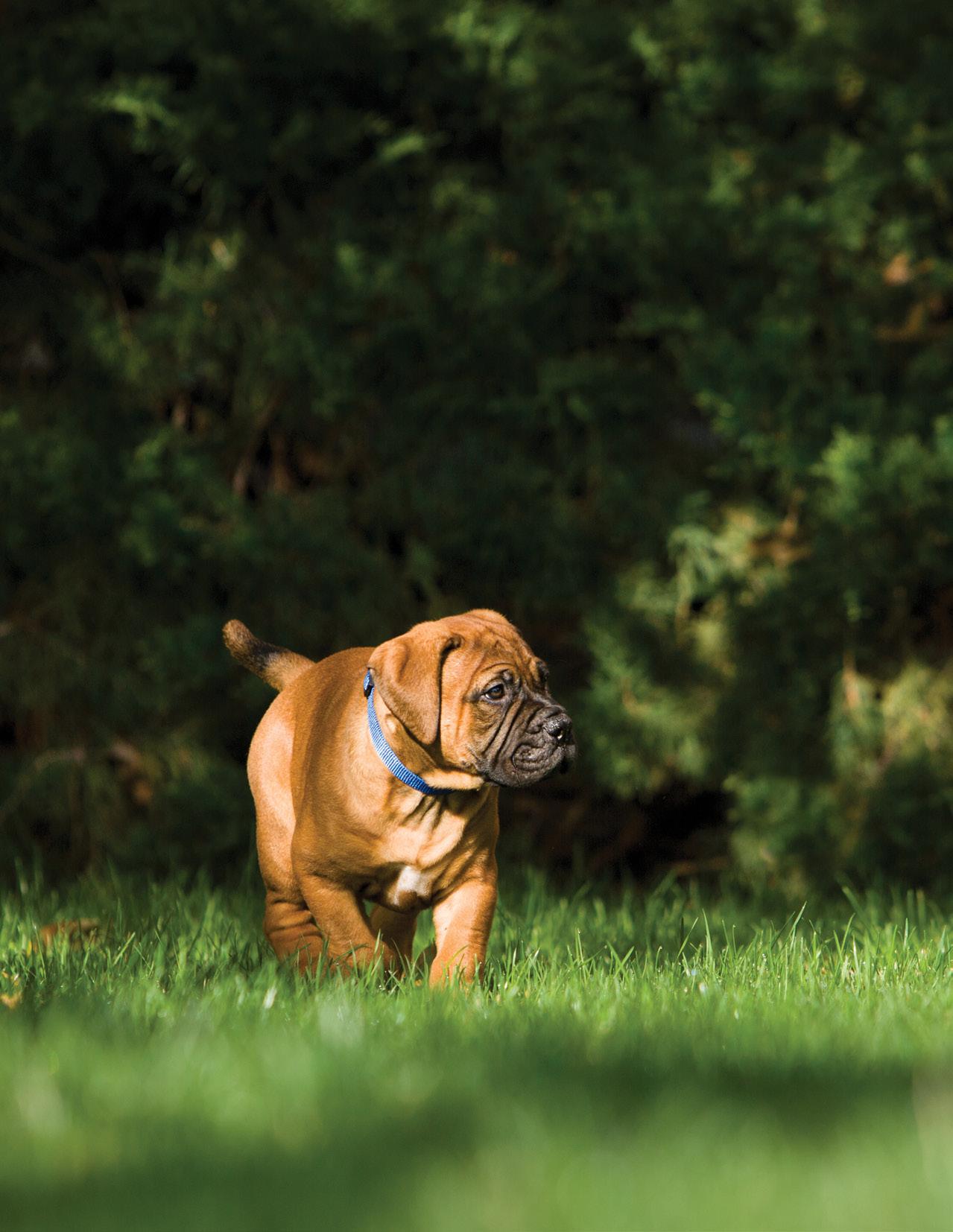
coVeR: natty, a bullmastiff puppy, belongs to dr. dianne Mcfarlane, an assistant professor in physiological sciences at OSU. For more on the dog, see Page 112. Photography by Phil Shockley
4 NEW F ACES
e ight new faculty members have joined o su ’s c ent er for Veterinary Health s ciences.
20 INTERNA TIONAL REACH
A tulsa alum is making a diff erence in Mongolia.
24 A DUCKY TIME
o su ’s veterinary hospital has added a mascot of a different breed. Quack!
27 NEW TRICKS
o su veterinarians add traditional c hinese treatments to their medicine bags for tough chronic cases.
40 HONORS
s tudents and f aculty members win recognition for their successes.
71 LEARNING
s pecial lectures and conferences expand students’ education.
76 GRADUATES
A look a t some members of the c lass of 2012.
98 CONNECTIONS
R eunions and remembrances
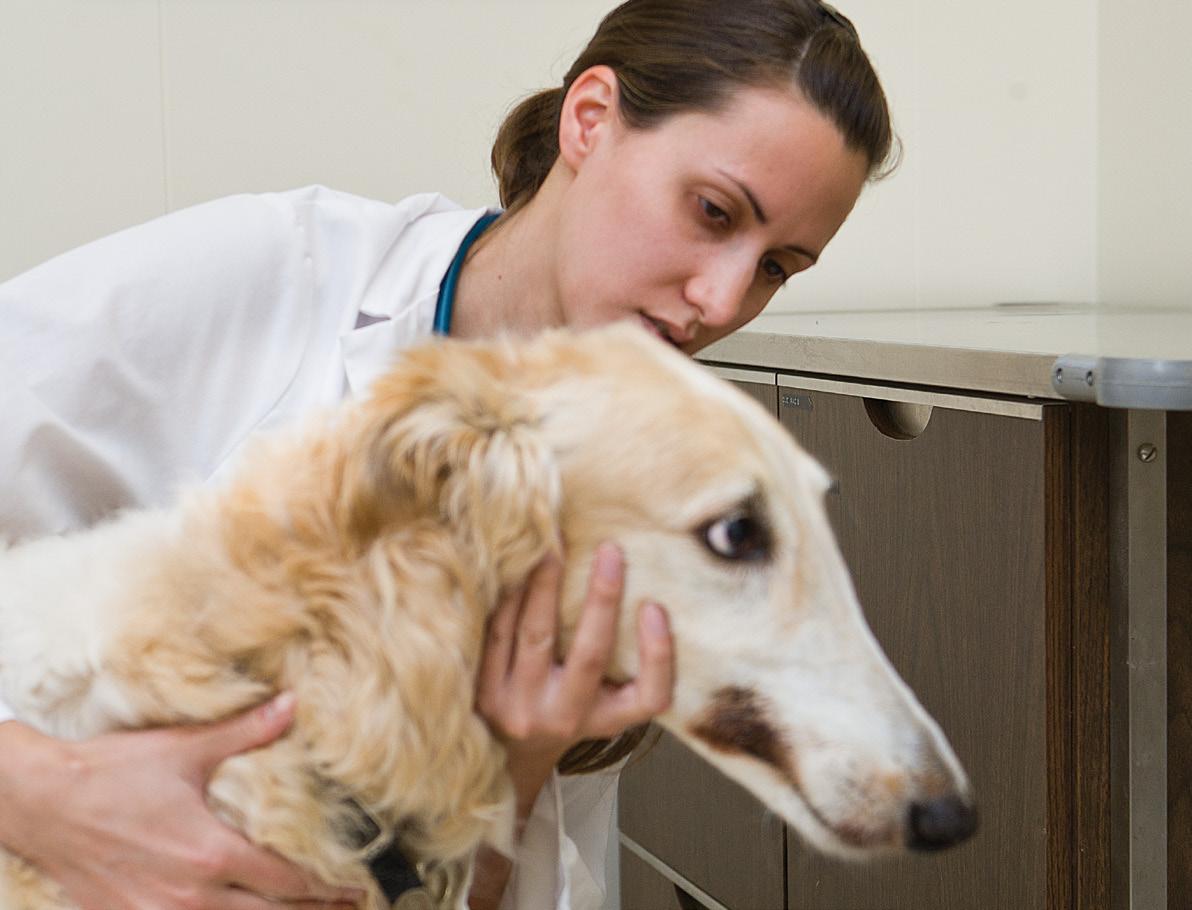
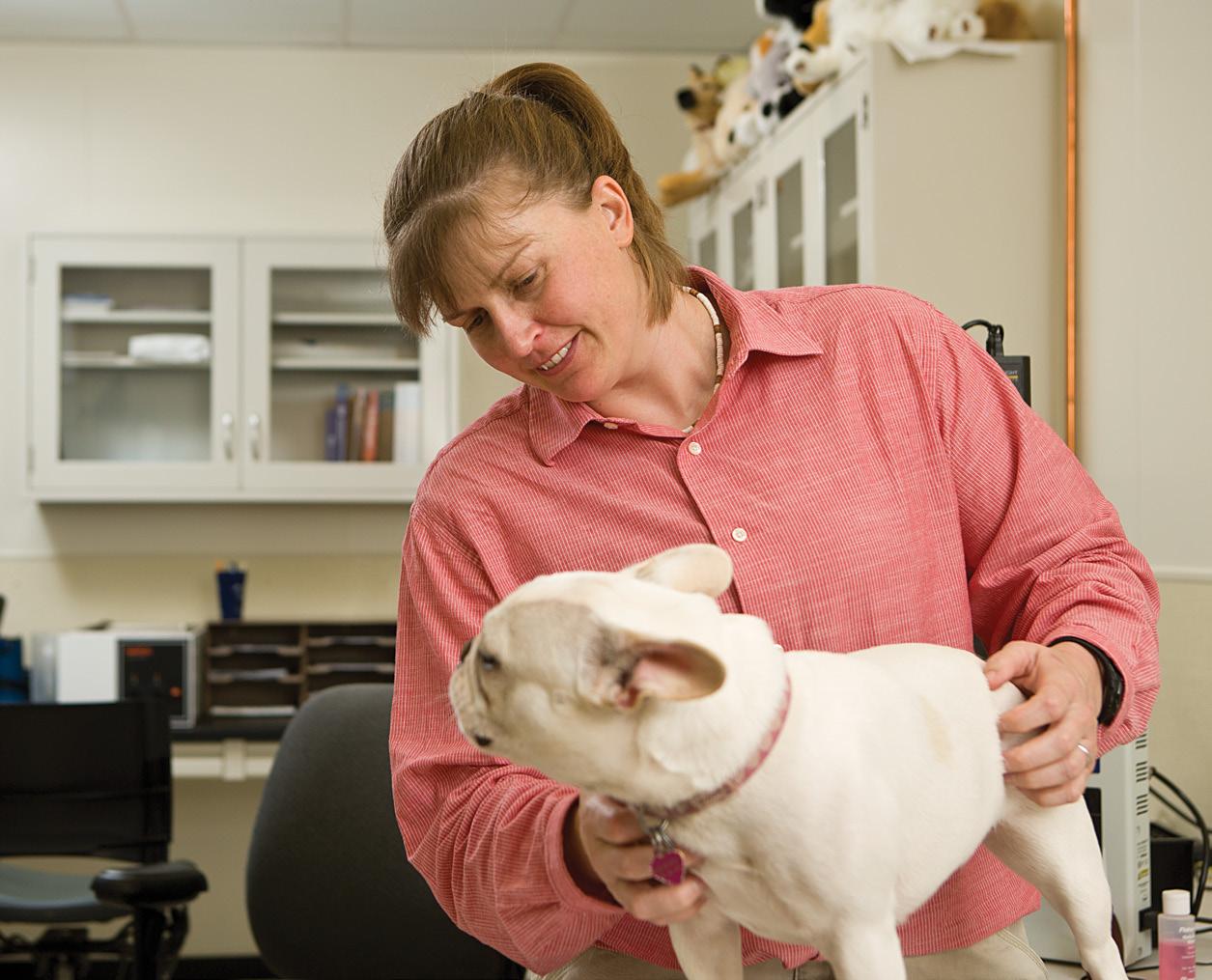
raina Pannee (Class of 2013) examines roz, who is owned by dr. rebecca Morton (’72) in the communications lab, where students practice polishing their ability to talk with future patients’ owners. Story, Page 64
Jean Sander, DVM, MAM, DACPV Dean, c enter for v eterinary h ealth Sciences
Derinda Blakeney, APR c oordinator of p ublic r elations, and Marketing derinda@okstate.edu
Sharon Worrell a lumni r elations Specialist
Amanda Davis, MPA, CFRE Senior Director of Development
Dorothy L. Pugh e ditor
Paul V. Fleming a rt Director / Designer
Phil Shockley / Gary Lawson
Staff p hotographers
Matt Elliott / Randi Rother c ontributing w riters
Michael Baker a ssociate e ditor
photoGraphy / phiL shockLey
From the Dean’s Office
One year in …
As I near the end of my first year as dean of the Center for Veterinary Health Sciences, I reflect on several things: why I chose to come here, what has been accomplished since I arrived, and what are the next right steps to take going forward.
First, I came to Oklahoma State University because I found it to be one of the best-kept secrets in veterinary medical education in the United States.
This college has dedicated experts who strive to provide a great educational experience for both our graduate and professional students; seek to obtain adequate funding to continue innovative and impactful discoveries that will result in new treatment modalities, new vaccines and new diagnostic test methods; and provide a wide range of medical services to the people of Oklahoma through direct pet and livestock medical care as well as diagnostic services to practices and owners.
The facilities available here to train students and conduct research provide opportunities not available elsewhere include but are not limited to the Oklahoma Animal Disease Diagnostic Laboratory, the Equine Research Park and the Boren Veterinary Medical Teaching Hospital.
Our educational programs prepare outstanding graduates who are highly sought by employers. The students acquire enhanced surgical skills due to the collaborative efforts of the shelter medicine program, which combines public service with service learning. And they become loyal and engaged alumni.
My focus this year has been to build relationships and engage friends of the college to connect as active participants in the future vision. In addition to meeting and getting to know several legislators and regents, I have worked with industry and producer groups to gain a better understanding of their needs and how we might collaborate for the greater good of all. It is imperative that we connect with our stakeholders to help them better understand our abilities and to enter into conversations where we can learn what they need from us.
We have engaged with many of our constituents through the Oklahoma Livestock Relief Coalition. This organization, with CVHS as a charter member, was founded through the efforts of the Oklahoma Veterinary Medical Association to support the health needs of animals confiscated by law enforcement authorities because of abandonment or neglect. It is expected that more folks will be unable to provide care for their animals due to the significant drought in Oklahoma. The organization raises funds to support these animals by providing feed and health care while they are being held prior to more permanent placement.
I do expect that as the year progresses, we will continue to connect with the various stakeholders of this college. Veterinary medicine is a great profession, one that I am proud to be a part of.
Thanks for your past, current and future support of this great college!
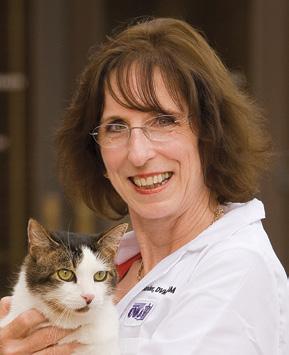
Jean e. Sander, dVM, MaM, daCPV dean, Center for Veterinary HealtH SCienCeS
OSU names ‘shining stars’ during veterinary celebration
In 2011, OSU joined in the worldwide celebration of the 250th anniversary of veterinary medicine. Veterinary medicine serves society by helping to protect the health of animals, humans and the ecosystem. Veterinarians are key public health stakeholders who play critical roles in reducing global hunger, controlling diseases that affect both humans and animals, ensuring the safety and quality of the food supply, advancing biomedical research and protecting the biodiversity of the environment.
I n recogn I t I on of the 250 th ann I versary of veter I nary med I c I ne , os U h I ghl I ghted I ts “ sh I n I ng stars ” — fac U lty members who have had valUable I mpacts on veter I nary med I c I ne thro U gho U t the I r I llU str I o U s careers . a look at the sh I n I ng stars and h I ghl I ghts of the I r accompl I shments :

helen e. JoRdan
Demonstrated value of mixed grazing for control of parasitism in ruminants
Showed how life cycles of trematodes can be exploited for control purposes
First female full professor at OSU’s veterinary college, mentoring women veterinary students in era when profession was male-dominated

John g. KiRKpaTRiCK
Recipient of six teaching awards while serving as large-animal clinician
Co-investigator of study comparing bovine respiratory disease vaccination strategies
Developed a production medicine elective, exposing students to experts relating to livestock production
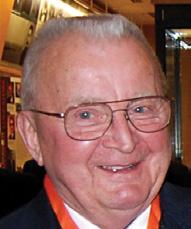
RogeR J. panCieRa
First to demonstrate Cryptosporidium infection in cattle
Pioneer work in several toxicoses, including oak, vetch, blister beetle poisoning; and parasitisms, including ehrlichiosis and American canine hepatozoonosis
Mentored many veterinary students and veterinary pathologists
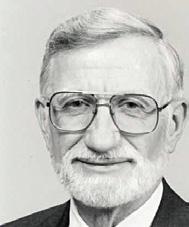
sidney a eWing
First to report ehrlichiosis in North America, he studied it and other tick-borne diseases extensively
Mentored veterinary and graduate students in veterinary parasitology
Served administrative roles in veterinary medical settings at three land-grant institutions and fostered the preservation of veterinary medical history
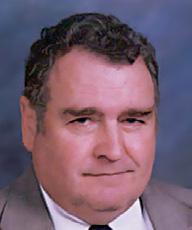
William C. edWaRds
Pioneered work in toxicology of oil field wastes
Mentored several students in veterinary toxicology
Established investigative techniques in veterinary forensics
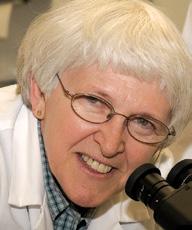
RebeCCa J. moRTon
Taught infectious diseases for 20 years; three-time winner of Norden Distinguished Teaching Award and two-time winner of OSU Regents Distinguished Teaching Award
Studied Francisella tularensis, especially diagnosis and treatment of feline tularemia, and pathogenesis, vaccine development and tick-associated aspects of tularemia
National Academies of Science team member; co-author of Biological Science and Biotechnology in Russia: Controlling Diseases and Enhancing Security
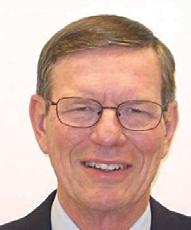
RiChaRd V. shaWley
Established anesthesiology as an OSU clinical rotation, giving students more hands-on experience
Instituted the use of gas anesthesia in large-animal surgery labs
Co-investigator to determine the pathophysiological effects of Cantharidin and development of treatment protocols to address severe electrolyte alterations in horses
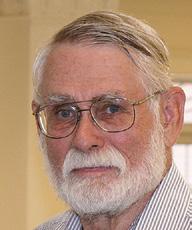
Tom R. ThedfoRd
National Educational Program regarding the economic impact of brucellosis and the benefits of eradication system
Pioneer in distance veterinary continuing education
National expert in small ruminant medicine and surgery; pivotal in developing health and preventative care of Camelids
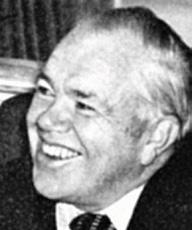
e. Wynn Jones
Conducted sponsored research on anemia and immune mechanisms in bovine anaplasmosis
Pioneered rapid intravenous anesthesia induction in horses and closed-circuit inhalant anesthesia in large and small animals
Discovered anesthetic-induced porcine malignant hyperthermia and helped develop diagnosis and treatment for it in domestic animals and humans
New faces F A CU lT y MEM b ERS
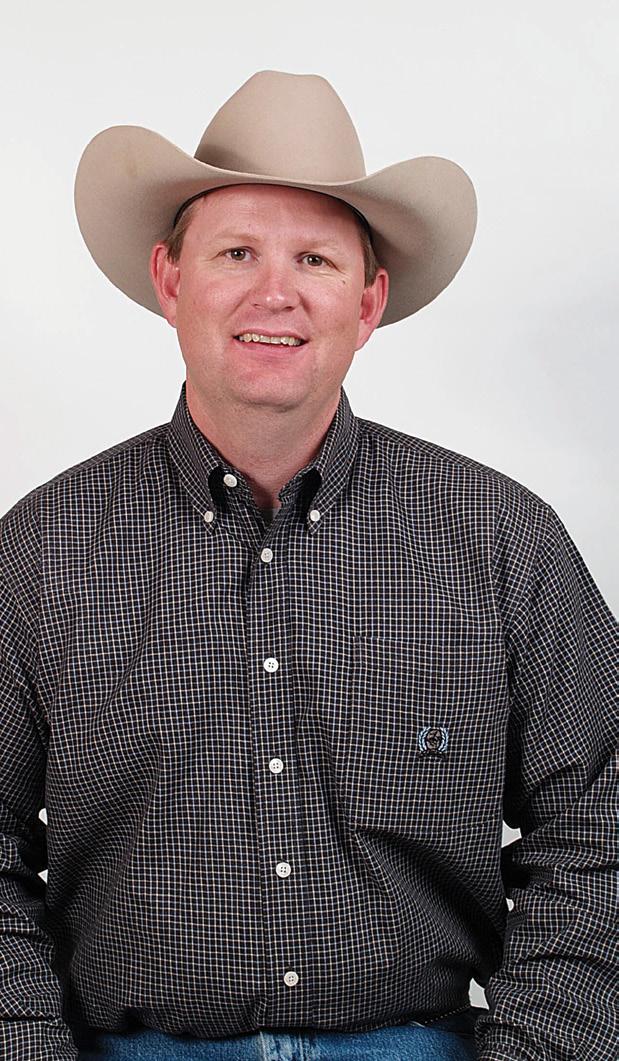
Shelby Hayden, dVm, ms, diplomate, american College of Theriogenologists, is a clinical assistant professor in theriogenology in Veterinary Clinical Sciences. originally from Valley fa lls, Kan., she earned her d V m degree at Kansas s tate University and her master’s degree in biomedical sciences at Texas a&m University.
hayden completed a rotating large-animal medicine and surgery internship at the University of Tennessee and a residency in equine theriogenology at Texas a & m University. her research interests focus on equine breeding management.
s he was a four-year starter for the for t hays state University l ady Tiger basketball team while she was completing her pre-veterinary requirements in Kansas. she enjoys working out and participating in most athletic activities as well as watching sports.
Kelci McKeirnan, dVm, ms, joins the veterinary center as a clinical instructor in smallanimal surgery originally from Woodinville, Wash., she earned her d V m from Washington state University. in 2007, she came to oklahoma state for a small-animal medicine and surgery internship followed by an a merican b oard of Veterinary practitioners residency. i n 2009, she began a three-year residency in small-animal surgery. she then accepted a one-year position in small-animal surgery joining osU’s small-animal surgery team, d r. d anielle d ugat and dr. mark Rochat.
in her spare time, mcKeirnan enjoys downhill skiing, fly fishing, reading and hiking.
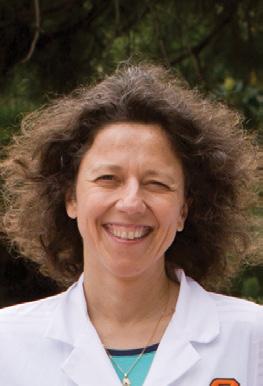
Dr. Véronique Lacombe is an associate professor in the department of Physiological Sciences. she grew up in france and earned her dVm from the national Veterinary school of maisonsalfort near paris. she completed an equine internship there as well. at ohio state University, she completed a residency in large-animal internal medicine, earned her ph.d. in comparative exercise physiology and completed a postdoctoral fellowship at the College of pharmacy.
her laboratory primarily studies metabolism and its disorders during diabetes, insulin resistance and obesity.
in her spare time, l acombe enjoys spending time with her husband, as well as hiking, horseback riding and skiing.
phiL shockLey / University MarketinG
phiL shockLey / University MarketinG
H ospital
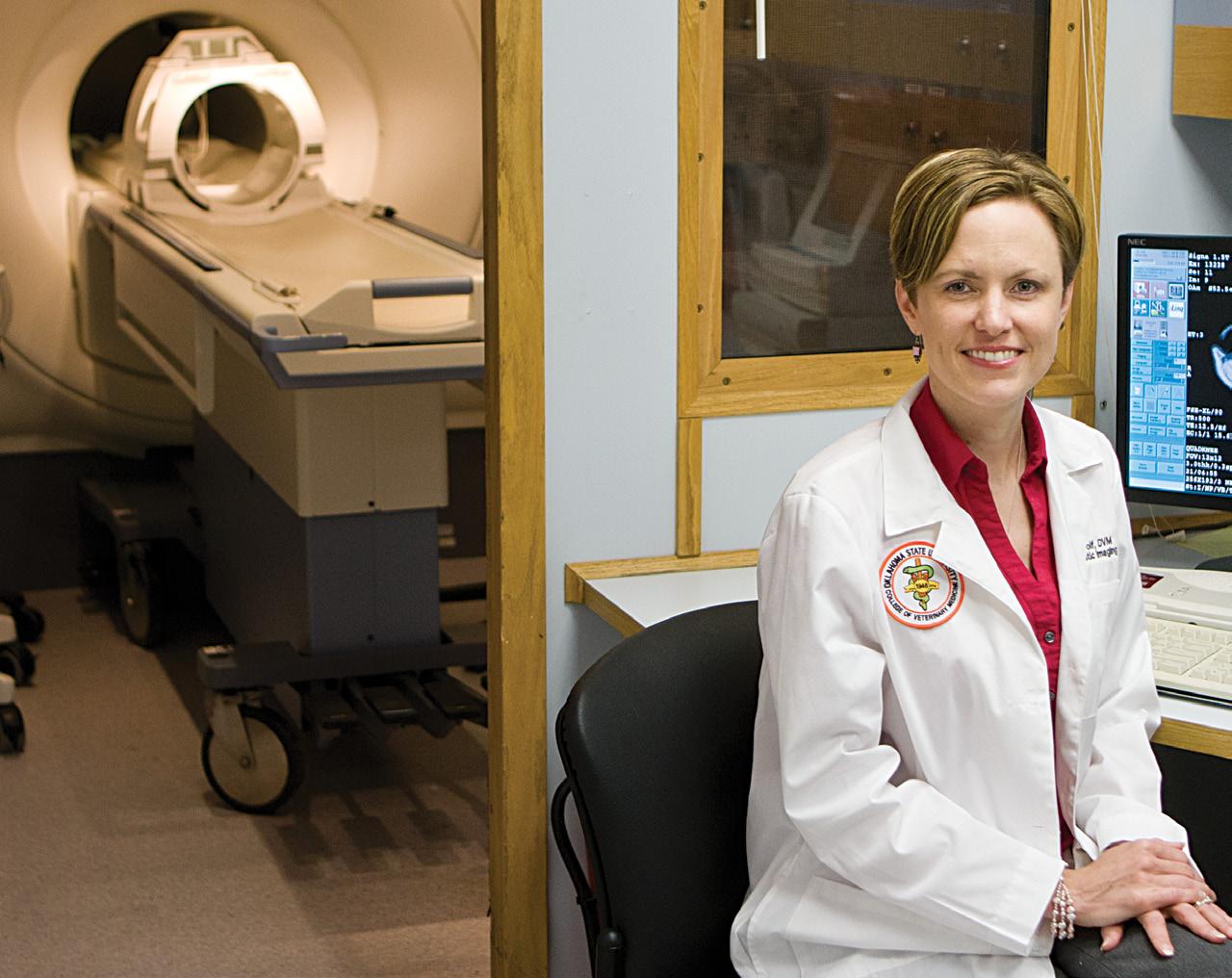
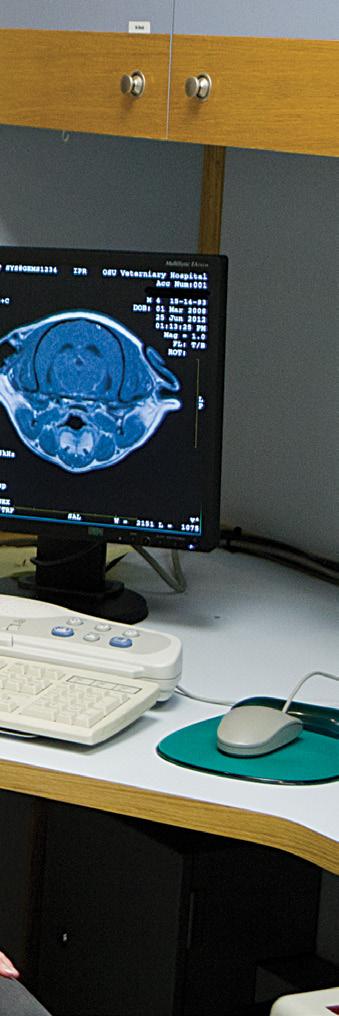
adds new MR i the Boren Veterinary Medical teaching Hospital has added a 1.5t Ge echoSpeed Mri unit to its advanced imaging capabilities. the unit, housed in a trailer on the north side of the hospital, can accommodate dogs, cats, small ruminants, potbelly pigs and exotic patients up to around 300 pounds.
Referring veterinarians can call with any questions about using this MRi on specific patients. the number for consultations, referral appointments or other questions is 866-654-7007. currently, an MRi scan costs $600, plus the anesthesia fees.
Additional imaging modalities are available, including:
Upgraded nuclear scintigraphy equipment
I131 treatment package for hyperthyroid cats, which includes a thyroid scan, isotope treatment and posttreatment hospitalization, is $882 inclusive. Any pre-treatment diagnostics would be an additional cost.
Four-slice helical GE lightspeed QXi CT with 3D imaging software. The general cost is $400-$800, plus the anesthesia fees, depending on the type of scan needed.
Holly Polf, dVm, diplomate in the american College of Veterinary Radiology, is a clinical assistant professor of diagnostic imaging in Veterinary Clinical Sciences. originally from Tulsa, she earned her dVm degree from osU in 2003, then did a rotating small-animal medicine and surgery internship at florida Veterinary specialists. she practiced in a small-animal general veterinary practice for three years before completing a radiology internship and residency at Texas gulf Coast Veterinary specialists in houston. polf ’s research interests focus on cross-sectional imaging.
in her spare time, polf enjoys reading, cooking, horseback riding, walking her dogs and spending time with her family.
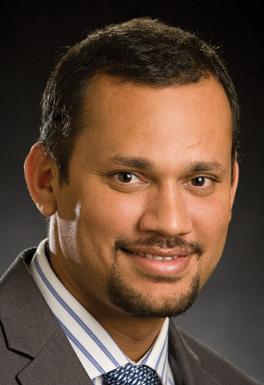
Dr. Ashish Ranjan is an assistant professor in Physiological Sciences . o riginally from Jharkhand, india, he earned his bVsc degree (equivalent to a dVm) from madras Veterinary College, Tamil nadu Veterinary and animal science University in Chennai, india. he earned a p h. d. in biomedical and veterinary sciences from Virginia-maryland Regional College of Veterinary medicine, Virginia polytechnic institute and state
University and was a visiting fellow at the Center for interventional oncology in radiology and imaging sciences at the national institutes of health in bethesda, md.
Ranjan’s research interests focus on nanocarrier-mediated targeted drug delivery, image-guided therapy and nanotoxicology.
he is a sports enthusiast and in his spare time enjoys outdoor activities and watching sports as well as spending time with his wife, sangeeta, and son, aarvin.
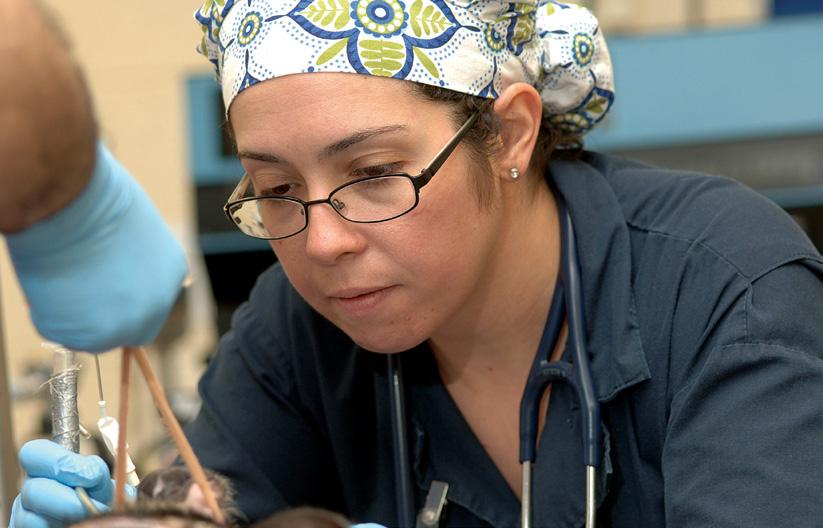
Dr. Sabrina Reilly is a clinical assistant professor of anesthesiology in Veterinary Clinical Sciences born in new york City, she grew up in the pocono mountains of pennsylvania. Reilly earned her bachelor’s degree in animal bioscience from penn s tate University and her d V m degree from the University of prince edward island in Charlottetown, prince edward, Canada.
following graduation, she completed a one-year internship in equine medicine at manor e quine h ospital in m onkton, md. Reilly then came to osU in 2009 for a one-year internship in anesthesiology followed by a three-year residency in anesthesia at the University of Tennessee.
Reilly’s research interests include the effect of general anesthesia on large captive felids and the interaction of injectable and inhalational anesthetics.
i n her spare time, Reilly enjoys art, music, museums, yoga, hiking, kickboxing and cooking.
continues
Gary Lawson / University MarketinG
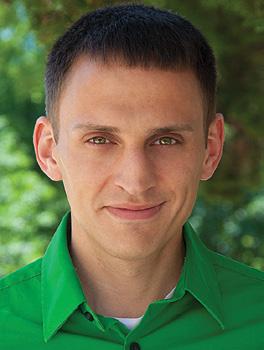
Dr. Jonathan Pucket joins Veterinary Clinical Sciences as a clinical assistant professor of ophthalmology originally from sand springs, okla., he studied at the University of Tulsa and northeastern state University. in 2008, pucket earned his dVm from osU.
he comple ted a one-year rotating internship in small-animal medicine and surgery at osU before a three-year residency in veterinary ophthalmology at Kansas state University. While completing his residency, pucket simultaneously earned a master’s degree in biomedical science. his research interests are corneal sensitivity and corneal surgery.
in his spare time, pucket enjoys spending time with his wife, Jennifer nickel-pucket, dVm (osU ’08), running and being an avid fan of osU sports teams.
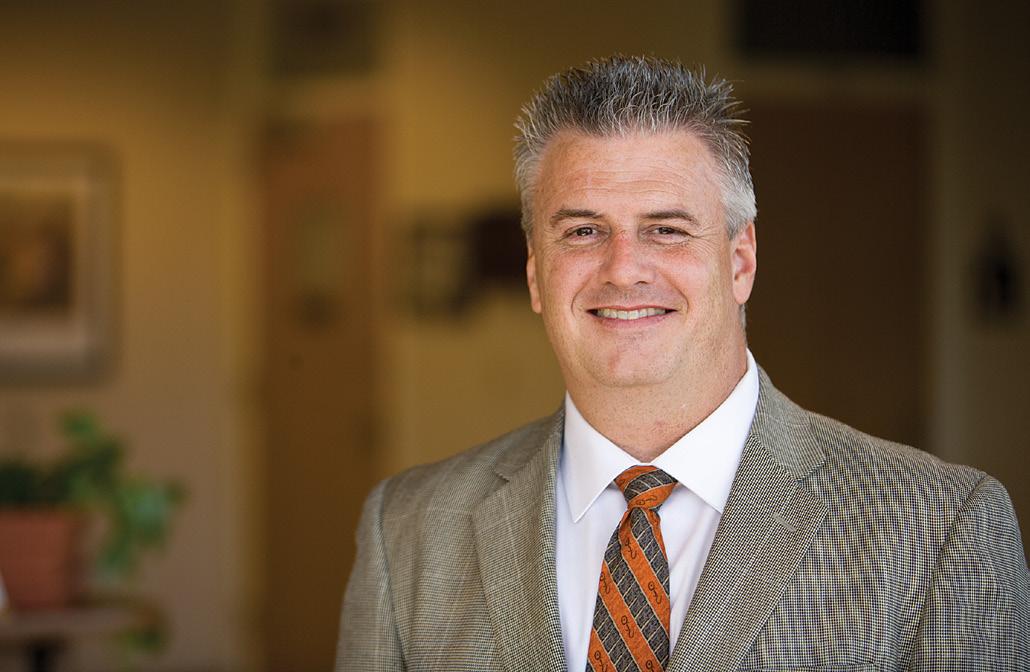
Mike J. Schoonover, dVm, ms, daC Vs-la , is an assistant professor of equine surgery in Veterinary Clinical Sciences originally from Velma, okla., he earned his dVm from osU in 2000. he comple ted a yearlong internship in e quine f ield s ervices at o hio s tate University, then returned to oklahoma state to complete a three-year residency in equine surgery while earning his master’s degree in veterinary biomedical sciences. in 2007, he became a diplomate of the american College of Veterinary surgeons, l arge animal specialty.
i n 2004, s choonover began working as an equine surgeon/associate veterinarian for interstate equine services inc. in goldsby, okla. While there, he supervised an internship/externship program directing the selection, instruction and mentoring of veterinary students and first-year veterinarians.
his research interests focus on equine sports medicine, lameness evaluation modalities and regenerative medicine. he was the 2008 o klahoma Veterinary medical a ssocia tion e quine practitioner of the year and often provided guest lectures for osU.
in his spare time, mike enjoys spending time with his wife Jennifer (moore) schoonover, dVm (osU ’00) and their two boys, Willie and garrett, as well as attending osU sporting events.
New faces S TAFF MEM b ERS

Rose “Gaylene” Hargrove is the director of fiscal affairs for the veterinary center. o riginally from b uffalo, o kla., she earned her bachelor’s degree in accounting and an mba from osU.
hargrove is a massage therapist who has “jumped out of a perfectly good airplane.” in her spare time, she enjoys sewing, creating, traveling and solving puzzles.
Bruce Williamson is the hospital administrator at the Boren Veterinary Medical teaching Hospital. he was an “a rmy brat” but considers b oerne, Texas, his home. Williamson earned his bachelor’s degree in management and his mba from osU.
b ruce graduated from high school in b angkok, Thailand, and owns an osU tailgating bus. he enjoys running, fishing, barbecuing, remote-controlled aircraft and tailgating.
Faculty promotions announced
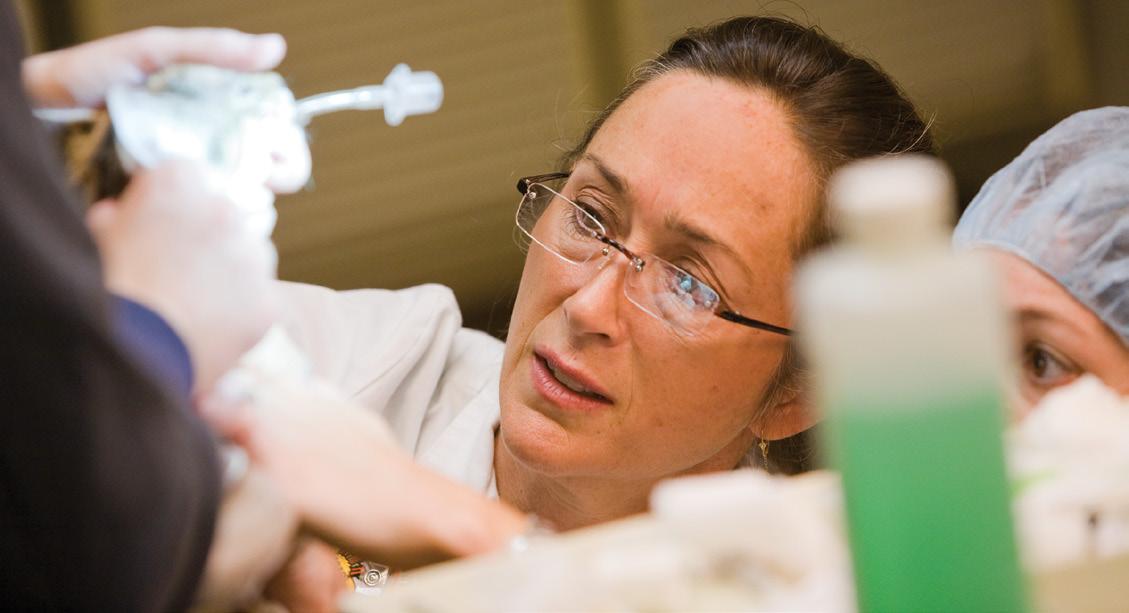
dr. lesa Staubus was promoted from lecturer to clinical assistant professor in Veterinary Clinical Sciences along with Dr. Kimberly Carter, staubus teaches surgical and anesthetic techniques in conjunction with shelter medicine and wellness veterinary care. staubus is a 1990 DVM graduate of osU.
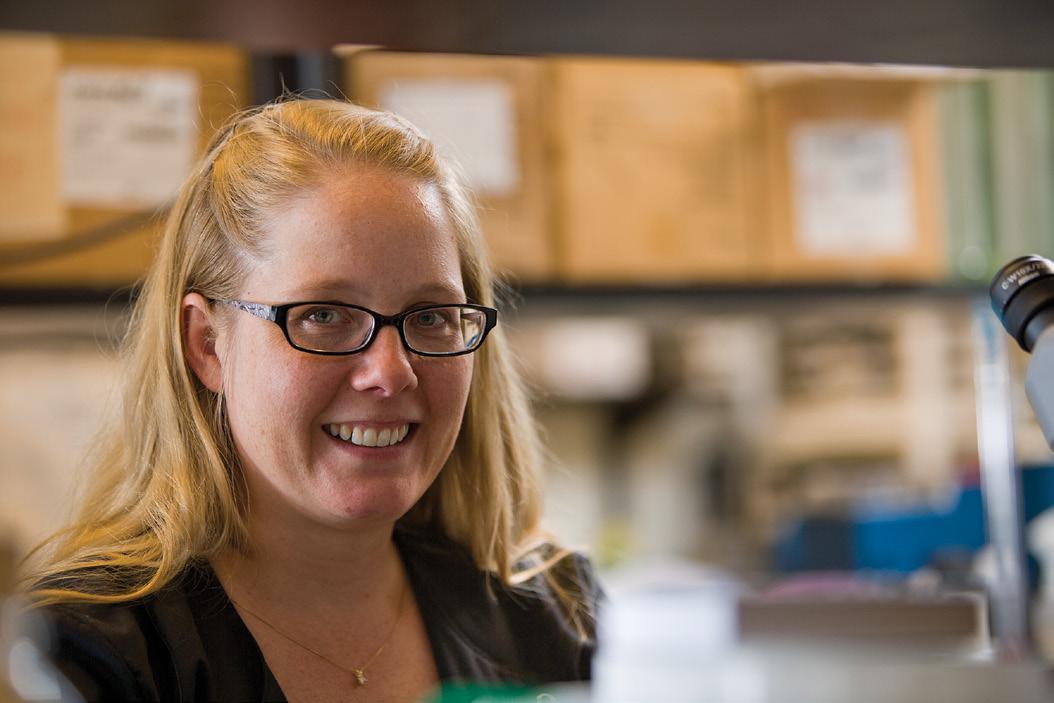
dr. Christina Bourne was promoted from an assistant research scientist to an associate research scientist in veterinary pathobiology Bourne holds a Ph.D. in biochemistry and molecular biology from the University of oklahoma health sciences Center. her research interests focus on the visualization of molecules by application of crystallographic techniques.
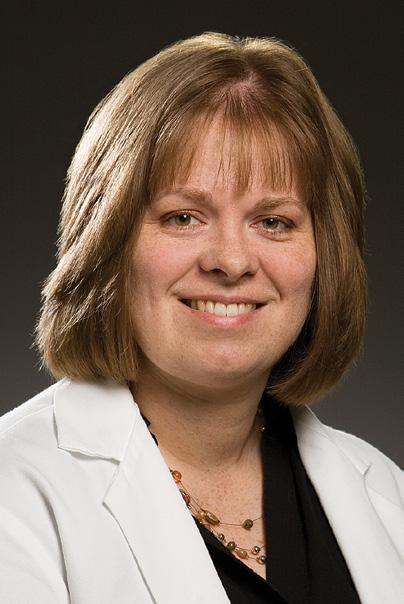
dr. Pamela lloyd was promoted from assistant professor to associate professor with tenure in Physiological Sciences. Lloyd holds a Ph.D. in physiology, specializing in cardiovascular physiology. her research interests focus on angiogenesis, arteriogenesis, diabetes, metabolic syndrome, peripheral arterial disease and coronary artery disease.
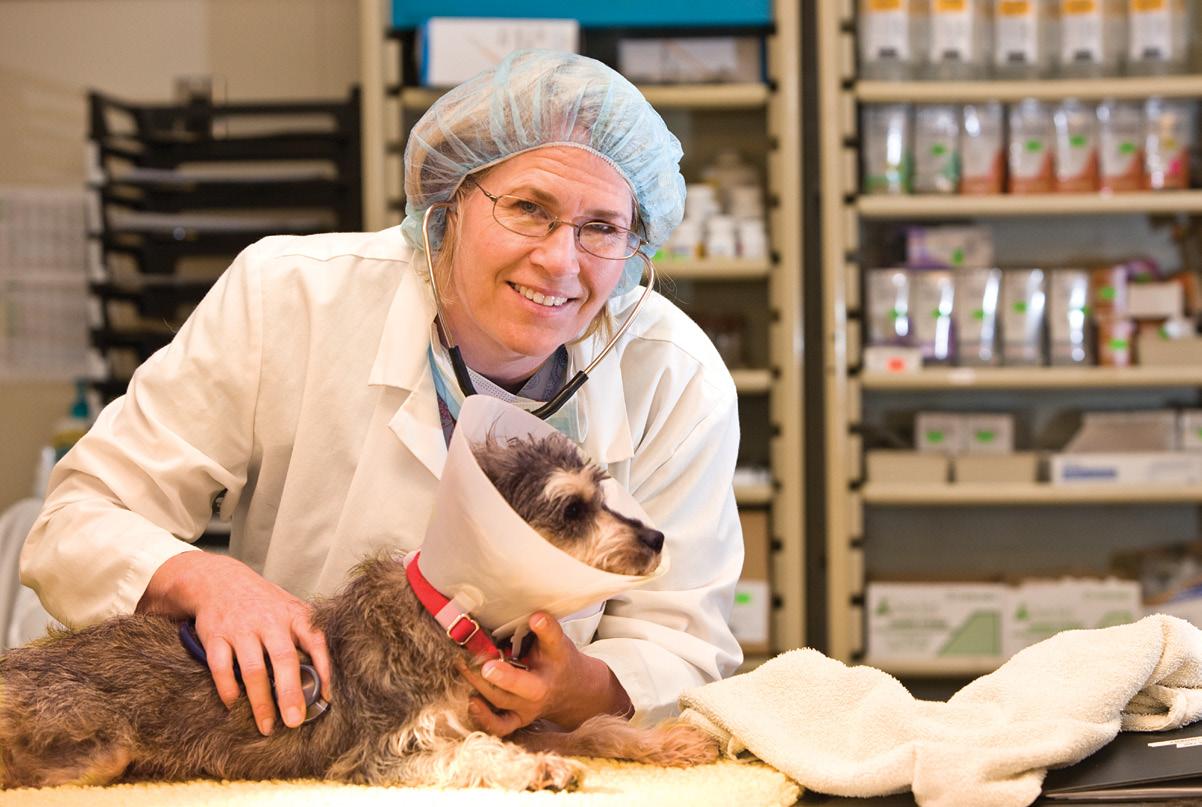
dr. Kimberly Carter was promoted from a lecturer to a clinical assistant professor in Veterinary Clinical Sciences a 1989 alumna of osU, she teaches surgical techniques in the junior surgery laboratory and shelter medicine. her research interests are in scrotal neuter techniques and pediatric spay and neuter.
Gary Lawson / University MarketinG
Gary Lawson / University MarketinG
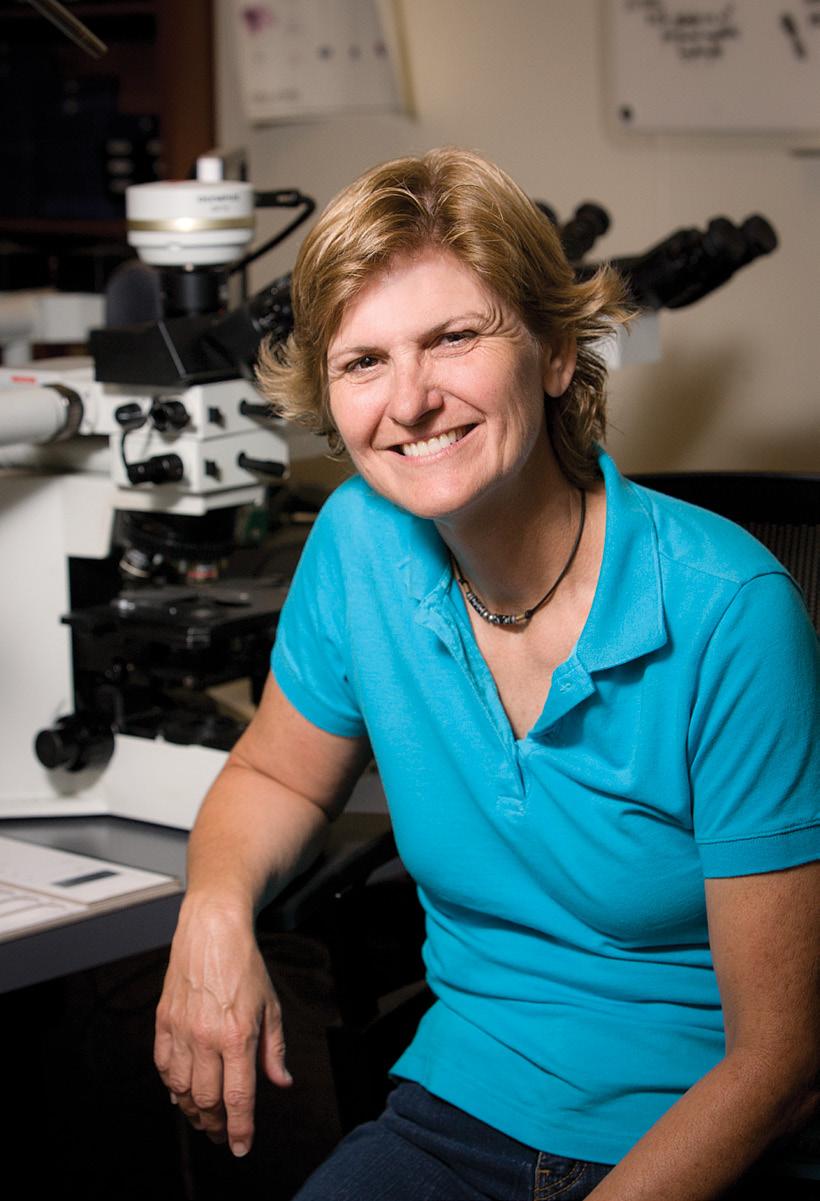
dr. theresa rizzi was promoted from clinical assistant professor to clinical associate professor in veterinary pathobiology rizzi is a 1998 DVM graduate from osU. she is a diplomate of the american College of Veterinary Pathologists in clinical pathology. her research interests focus on Cytauxzoon felis: treatment and disease prevalence. in addition, she collaborates as a contributing cytopathologist on other research projects.
dr. Jared taylor was reappointed to assistant professor in veterinary pathobiology taylor teaches veterinary epidemiology and public health. he is a diplomate of the american College of Veterinary internal Medicine in Large animal and a diplomate of the american College of Veterinary Preventive Medicine. his research interests focus on the interface of veterinary medicine and public health and beef cattle production medicine.
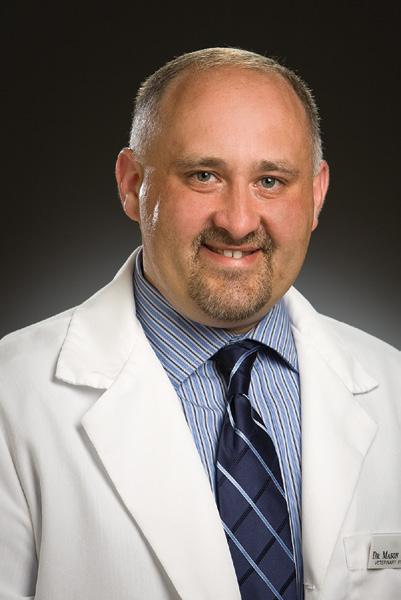
dr. Mason reichard was promoted from assistant professor to associate professor with tenure in veterinary pathobiology he holds a Ph.D. in veterinary biomedical sciences with a specialization in veterinary parasitology from osU. reichard teaches Veterinary Parasitology i and ii and Diseases and Management of Free-ranging Wild animals. he also maintains a research program that focuses on zoonotic and tick-borne diseases of wild and domestic animals.
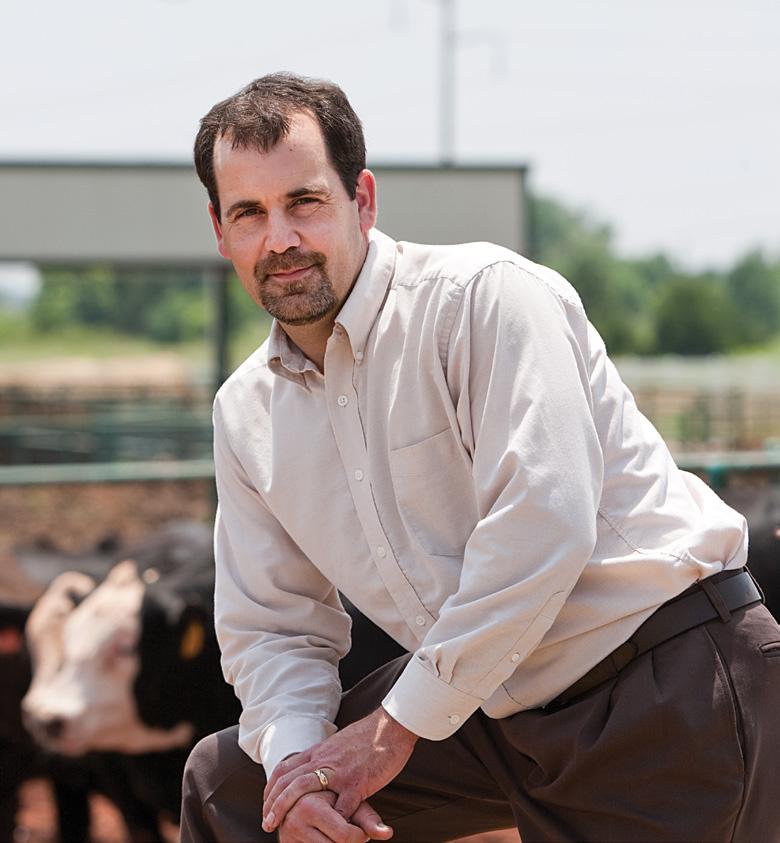
Congrats to new endowed chairs
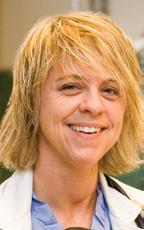
Lara Sypniewski, DVM, diplomate of the american Board of Veterinary Practitioners, has been appointed to the Patricia Henthorne Clinical Professorship in Small-animal Medicine sypniewski, a community practice veterinarian in veterinary clinical sciences, is the first person to hold this professorship.
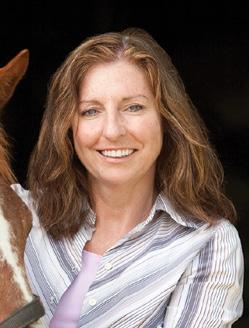
Dianne McFarlane, DVM, Ph.D., diplomate of the american College of Veterinary internal Medicine — Largeanimal specialty, has been appointed to the ricks rapp Professorship in Musculoskeletal research she is an associate professor in Physiological sciences.
Veterinary center pair recognized for inventions

The oklahoma state University chapter of the national academy of inventors recognized 23 inductees during its inaugural induction ceremony this year. among those honored were sahlu ayalew and Katherine Kocan of osU’s Center for Veterinary health sciences.
a s sistant research professor Sahlu ayalew , ph.d , is part of a veterinary pathobiology team that studies Mannheimia haemolytica , a bacterium that is one of the agents responsible for bovine respiratory disease, in order to develop protective vaccines against it. bovine respiratory disease costs the beef industry more than $1 billion per year.
The team’s research involves identifying specific proteins of M. haemolytica, which stimulate the immune system and can be used to engineer vaccines that may have protective qualities. during the past few years, the team has secured two U.s. patents, and the work is ongoing.
Katherine Kocan, ph.d , osU Regents professor, Walter sitlington endowed Chair in food animal Research and fellow of the society for Tropical Veterinary medicine, is known internationally for her work with ticks and tick-borne diseases. she
leads a team that partnered with researchers at the University of minnesota to develop a cell culture system (the first in-vitro system of growing the pathogen outside of a tick or cow) for Anaplasma marginale (the organism that causes bovine anaplasmosis, a tick-borne disease of cattle). The patent involves the method of growing the Anaplasma marginale in cultured tick cells and for the use of antigens generated from this system in vaccine formulations.
according to the academy, it “supports the systematic application of organized knowledge and information that can generate technology and produce creative solutions to existing problems. inventors are the discoverers and creators of these solutions and, as such, are key contributors to the advancement of technology.”
“OSU’s Center for Veterinary Health Sciences is proud to have such forward-thinking researchers,” says dr. Jean Sander, dean of the veterinary center. “New technologies or inventions play a key role in the economic development of the world, and the veterinary center’s researchers make an important contribution to that system.”
— DeRinDA BlAkeney
academy
Sahlu ayalew (from left) and Katherine Kocan show off their certificates of recognition by the oSU chapter of the national
of inventors with osU’s Center for Veterinary health sciences dean Jean Sander
Gary Lawson / University Marketin G
LeaV ing a Lasting iMP ression
Dr. Charles MacAllister
it takes a team to make osU’s veterinary center successful. and like every team, sometimes one player stands out and really makes a positive impact. such is the case of the 33-year career of dr. Charles macallister. he came to os U’s veterinary hospital in 1979 to fill a one-year instructor position in the equine section and he stayed until he retired. in fac t, he met his wife Carolynn of 30 years here.
b orn in Woodbury, n J., macallister studied at st. petersburg Junior College and the University of florida. he earned his d V m with high honors from a uburn University in 1979. in 1987, he passed the requirements to become board certified and a diplomate in the american College of Veterinary internal medicine, l arge animal.
“l ate in my fourth year of veterinary school, dr. steve swaim told me about an open position at osU,” macallister recalls. “I wanted to pursue an academic career, and the job turned out to be just what I was looking for. fac ulty and staff were very supportive. The students were eager to learn along with me. dr. Tom monin took me under his wing and taught me the practical aspects of equine medicine and surgery that he had learned and developed during his long tenure at osU.”
mac a llister earned an o utstanding Third-year instructor award (1992-93), the s mithKline b eecham a ward for Research excellence (1994) and the oklahoma Veterinary medical association’s equine practitioner of the year award (1994).
The last 10 years, he has served as head of the d e partment of Veterinary Clinical sciences.
“it has been extremely rewarding to work with and help teach many hundreds of veterinary students,” m ac a llister says. “When i see former students many years after they graduate and they tell me they still remember things i taught them — that is very rewarding!”
m ac a llister also held the Ricks Rapp p rofessorship in Comparative m u sculoskeletal Research and is director of the veterinary center’s e quine Research park, located north of the campus. his research interests focused on equine internal medicine, diagnostic endoscopy, gastrointestinal diseases, pharmacology and pain management.
as the man in charge, macallister was responsible for producing quality, effective teaching, research and service programs, as well as promoting outreach and extension activities. in other words, he ran a tight ship that covered all the waters while providing the best in veterinary service for hospital clients and their animals.
m ac a llister worked closely with the veterinary hospital director, d r. mark n eer, who oversees the day-to-day operation of the hospital.
“ d r. m ac a llister served as interim hospital director before i was hired,” neer says. “he laid the groundwork, and when i took over as hospital direc tor, it was with a solid foundation on which to build. We are fortunate to have such loyal clients, with many of them expressing their gratitude through financial donations. Three years ago, the hospital celebrated a completely renovated small-animal critical care unit, thanks to the private donations of more than 75 donors.”
The clinical skills training site for fourth-year veterinary students, the hospital is open to the public and handles an average of 11,250 veterinary cases a year.
“ d r. mac a llister’s leadership style is to seek input, listen patiently and to act with conviction,” says dr. michael lorenz, Regents service professor working in the small-animal clinic. “ he has done an e xcellent job promoting the development of several clinical specialties in the department and hospital. h e developed the equine Research park largely on gifts and grants and contracts from companies.” continues
and the hospital clients who b ring their animals for treatment by the faculty and staff under mac a llister’s direction mirror that praise.
“OSU’s Small Animal Clinic sets the standard for medical care,” says avis s caramucci of oklahoma City. “staff members exceed expectations with knowledge and awareness of each animal in their care. The compassionate care given to the animals has been consistently so.”
“ d r. m ac a llister’s door was always open for us,” adds dr. melanie boileau, associate professor in food- a nimal medicine and surgery. “The role of the department head is critical for the success of the hospital for many reasons including supporting and mentoring faculty development, bringing in extramural dollars through faculty research, and thinking outside the box to move the department forward.”
“ s o metimes by the time a patient is referred to us, the situation is too far advanced for our clinicians to fix it,” macallister explains. “in those cases, we do our best to make the patient comfortable and give the family and the pet as much quality time together as possible.”
“i have been coming here for 2½ years — awesome people,” l ee b urk of Tulsa, o kla., says about his experience with his dog and the hospital’s ophthalmology service.
“Without question, this was the very best experience i have had with a veterinary staff in the 35 years i’ve been involved with livestock. great job,” says Kenny brdecko of Wheeler, Texas, who brought his horse to the largeanimal clinic.
“I’ve been to several veterinary school hospitals and OSU’s service is by far the best,” reports l eslie m a ynard of a rizona. “ i drove over 1,000 miles to bring Wiglet (potbellied pig) to your care, which was all very professional.”
“my experience at osU’s largeanimal clinic was wonderful. i called the clinic and within an hour received a call back. my horse was seen and the veterinary students and staff were so nice answering my abundant questions thoroughly,” says Todd palmer of s perry, o kla., and midland, Texas. “i loved the experience of being involved in the evaluation and diagnosis of my horse and listening to the thought process of the students — excellent service.”
The impact mac a llister has had on the veterinary center and its hospital will live on for years after he retires. With his newfound freedom, macallister has some projects in mind.
“We have been adding onto our home for 30 years,” he says. “an initial priority in retirement will be to finally complete unfinished home projects. other plans include dealing with the many trees that were downed on our property during a 2011 tornado, spending more time with my family, traveling, and volunteering in the stillwater community. This has been a great place to live and raise a family, and i look forward to having the time and opportunities to give back.”
— DeRinDA BlAkeney
S TAFF MEMBERS
in 2012, the center for Veterinary Health sciences thanked two long-time staff members for their years of loyal service. Marilyn Moffat was the coordinator of financial and customer services at the veterinary hospital. During her 37 years at the hospital, Moffat oversaw accounts payable, accounts receivable and small-animal and large-animal reception areas. she was a great role model for co-workers because she simply lived good customer service and always greeted everyone with a friendly smile.
Maxine Miller was a Physical Plant custodian. Assigned to the veterinary center for her 36-year career, Maxine spent a few years at the oklahoma Animal Disease Diagnostic laboratory before moving to Mcelroy Hall. she was responsible for keeping the dean’s office gleaming, among others, and took great pride in her job.
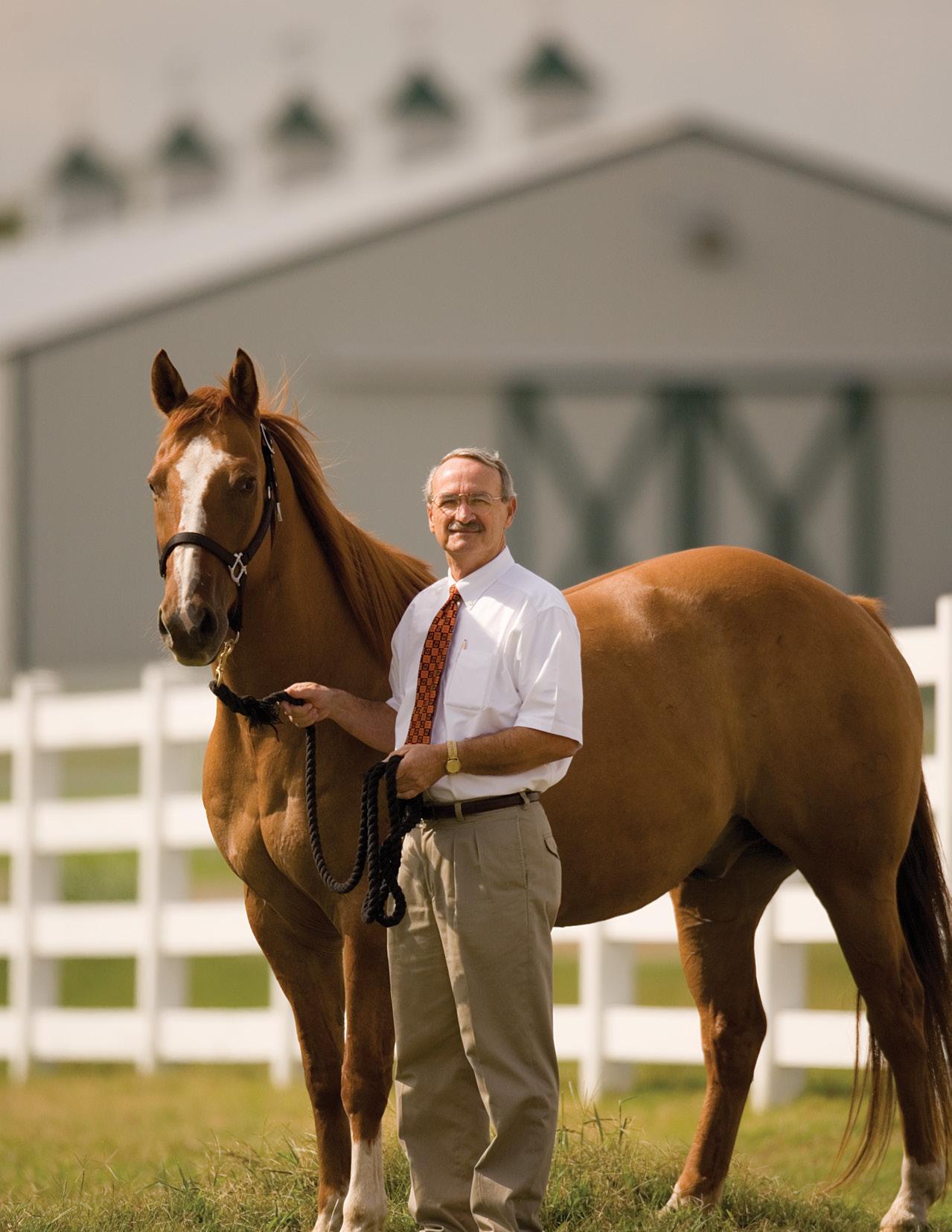
“ i t has B een extre M e Ly
re W ar D ing to W or K
W ith an D he LP tea C h
M any h U n D re D s o F
V eterinary st UD ents.”
Dr. Bill Johnson
d r. b ill Johnson is closing the door on a career tha t has spanned four decades — and his ties to osU go back even further.
Johnson started his student career at oklahoma state University in 1967. While juggling his studies, he maintained a job at frisco Railroad during school breaks and, with the help of his parents, he graduated from veterinary school in 1973 debt-free.
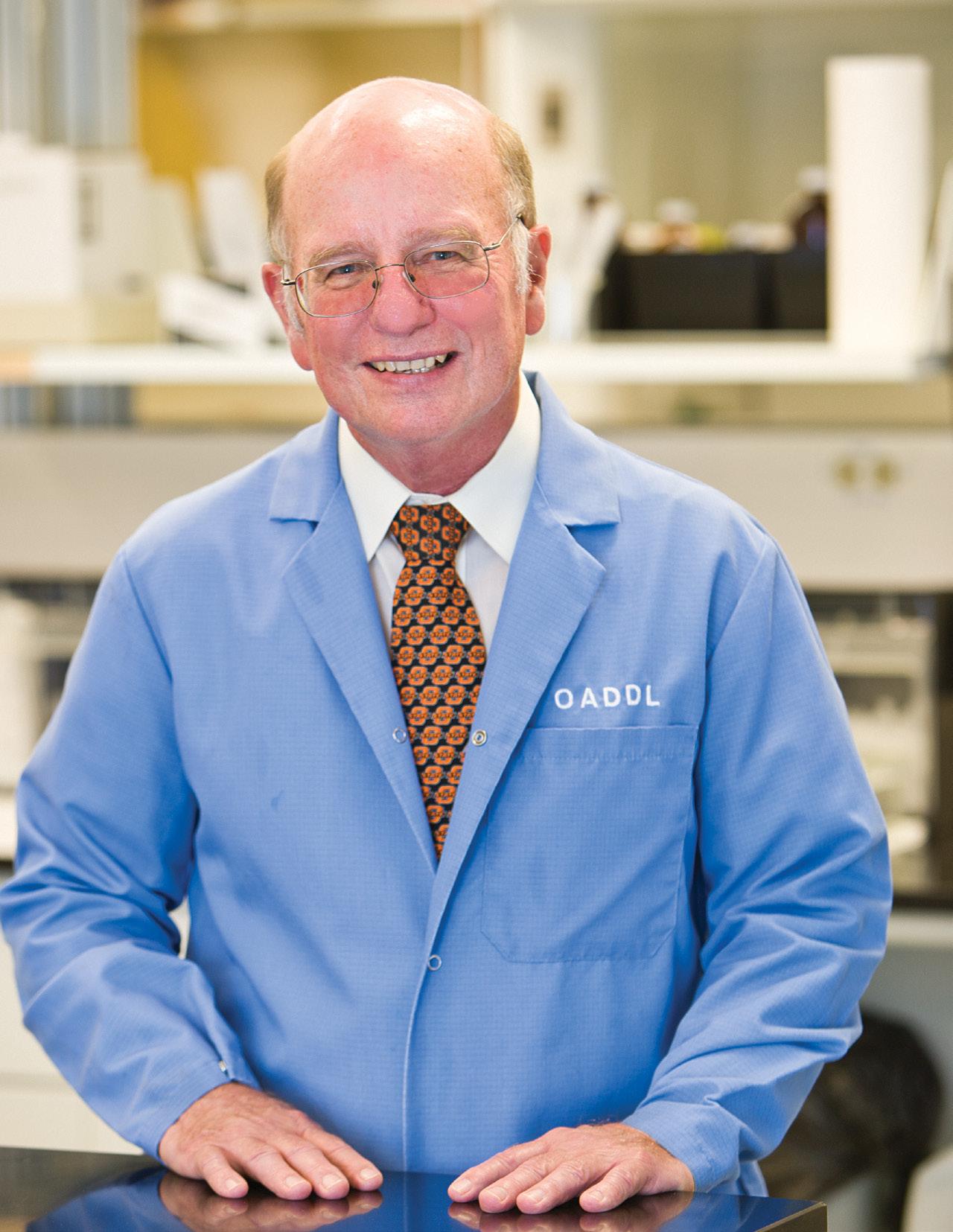
“ i L o V e P a tho L og y. … eV ery C ase is a ne W PU zz L e to so LV e.”
“i think i had $15 in my checking account when i graduated, but i had no debt. s omething rare nowadays,” he recalls.
Johnson was also one of the last groups of students accepted into veterinary school after two years of pre-veterinary medicine.
“I remember one of my clients asking me my first year out of veterinary school, ‘Are you a real vet?’”
h is f irst job after graduation was with a veterinarian in grove, okla., where he gained a lot of experience with a variety of animals.
While at osU, Johnson met his wife, eileen, who graduated from osU’s veterinary school in 1974. The couple practiced in grove for a year before leasing a mixed-animal practice in Chelsea, okla.
i n J anuary 1977, d r. e . l . s tair, the chief pathologist for the newly opened o klahoma a nimal d isease d iagnostic l abor atory at os U, approached b ill Johnson to take a position in the pathology residency program at oaddl . “ i was recognizing that i enjoyed c utting up the animals that died, trying to find what went wrong more than i enjoyed treating the animals.”
Johnson was a pathology resident at os U’s oaddl from 1977 until 1980. he then became an instructor in the former department of pathology before returning to o addl as an assis tant professor in pathology in 1981. in 1988, he left for davis, Calif., to work for the California animal health and food s afety l abor atory at the University of California. Johnson returned to his cowboy roots in 2001 as the chief pathologist and assistant director for the oaddl .
“I love pathology. It never ceases to amaze me what the different diseases can do. Every case is a new puzzle to solve. There are so many new diseases that we have to deal with today that either did not exist or we did not have the means to diagnose them when i started my residency.”
osU’s oaddl provides diagnostic services to animal owners and aids in training students in pathology and diagnostic testing. oaddl also works with researchers on their diagnostic testing needs.
Johnson has a long list of achievements as director of o addl , including working with o klahoma’s agriculture secretary to secure funding for o addl upgrades and implementing those upgrades. h e was also very involved in helping oaddl become a member of the national animal health l aboratory ne twork.
even though Johnson is retiring, he plans to remain active.
“i would like to grow and sell good quality hay, get back to building furniture and maybe learn leather working. While my body still functions, i would like to return to rock climbing and most importantly, travel with my wife and see every state.”
— RAnDi
CJIJ-Ei
RotHeR
editor’s note: Randi Rother is an intern from osu’s school of Media and strategic communications.
dr. Bill Johnson accepted his first position with osU in 1977.
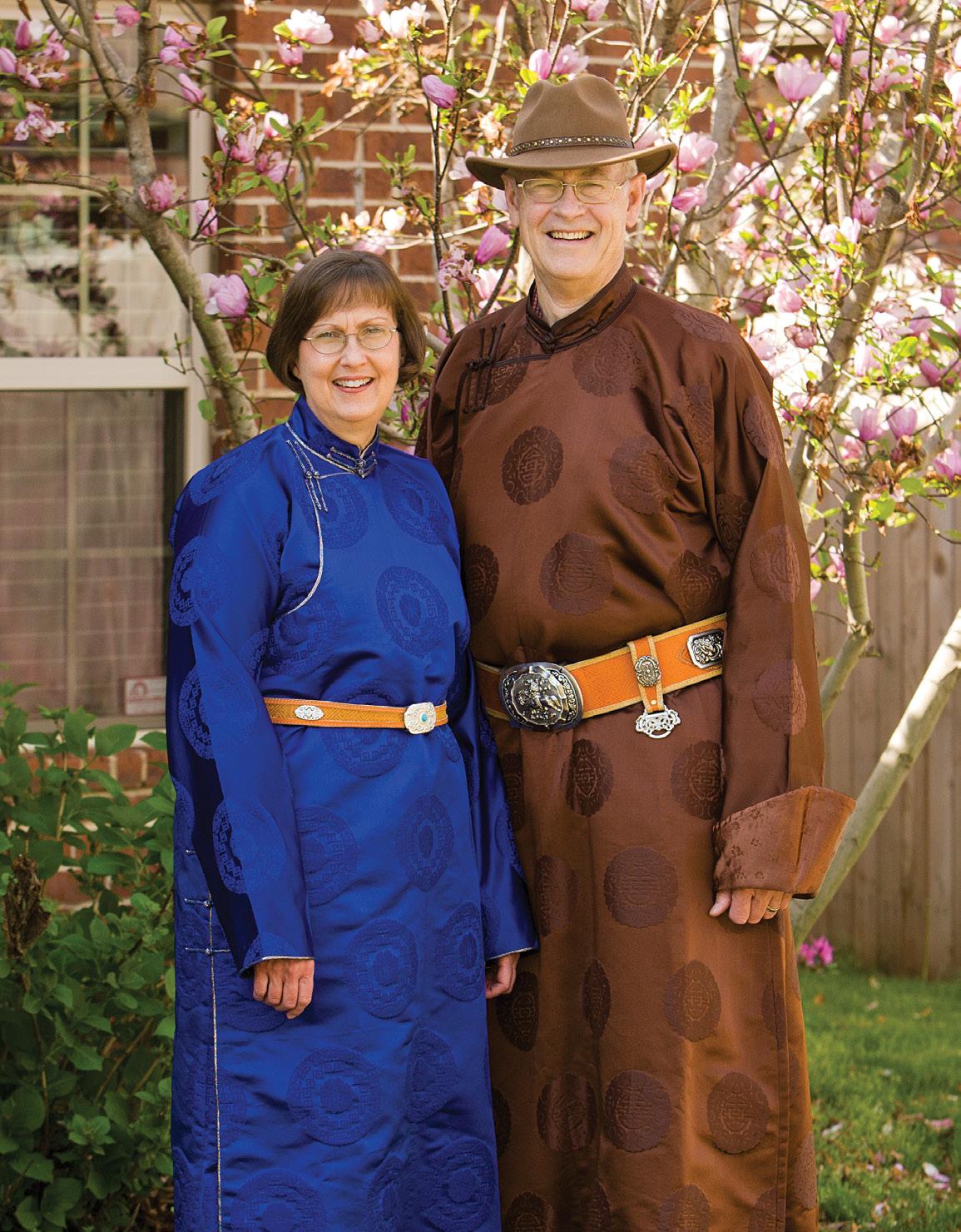
“ i W a s F irst intro DUC e D to the Christian Veterinary Mission W hen i W a s in V eterinary C o LL ege.”
— Dr. MarY Ballenger
The Mongolian Connection
home is where the heart is, they say — and for d r. Mary Ballenger , that heart (and home) has been in Mongolia for several years.
ballenger, originally of Tulsa, earned her dVm in 1981 from os U. a small-animal practitioner, she spent the next 23 years working with Veterinary a ssociates in Tulsa. but slowly, she began to follow a different calling.
“i was first introduced to the Christian Veterinary m ission when i was in veterinary college,” says ballenger. “i contributed monthly to the CVm to help support large-animal veterinarians who were working overseas doing wonderful things.”
ballenger’s support continued after graduation. she met several Christian veterinarians at various veterinary conferences.
“i was asked to volunteer at the CVm exhibit booth during the o klahoma Veterinary medical association’s annual convention, which i did. Then i was asked to serve on their board in 1993. While serving as chairperson in 2000, i was asked to present at a women’s veterinary seminar in mongolia,” she recounts.
That presentation took b allenger, her husband, Richard, and two of their three children to mongolia in 2001 for two weeks. she shared what it was like to be
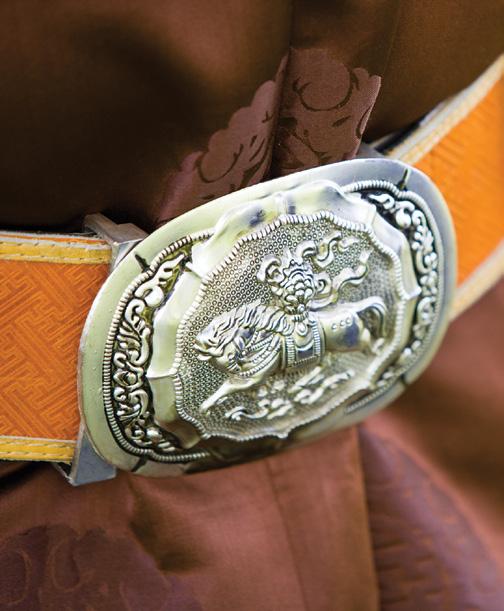
dr. Mary Ballenger and her husband richard have lived in Mongolia since 2004, working with veterinarians there to improve their care and business capabilities.
a veterinarian, a mother and a wife. her husband taught business skills, and their children helped through drama skits.
“our oldest son was attending oral Roberts University in Tulsa at the time and then joined the U.s. marines, so he’s never been to mongolia. something about mongolia called to each one of us during that two-week visit. i saw that i could make a difference by educating the mongolian veterinarians on not only smallanimal medicine but large animal as well. i know that while in veterinary college, i grumbled about studying equine and food-animal medicine. i was going to work in small-animal medicine. b ut i must say that i appreciate that i was exposed to that; i have pulled on that knowledge numerous times,” ballenger says. “Richard realized he could help teach mongolians how to run a productive business. our teenage son, g eorge, stopped thinking about buying really cool electronics in Korea for less than he could in the United states and started wondering what it would be like to be home-schooled in mongolia and to reach out to needy mongolians. o ur then-fifth-grade daughter, sally, just fell in love with the people. but making a big move like that needed a lot of thought and prayer, so we returned home.”
By DeRinDA BlAkeney
a fter talking and praying about the decision, the ballengers realized they needed to be in mongolia.
“on feb. 14, 2004, we moved to m ongolia,” says b allenger. “We intended to move back home by Christmas 2006 to give george time to graduate with his high school class. a s the time for our departure moved closer, g eorge made the comment that we didn’t need to return on his account; he was fine graduating in mongolia. so we stayed and have been working there for the past eight years.”
Working through mongolia V.e.T. net, a nonprofit nongovernment organization, and with Christian Veterinary m ission, ballenger is the adviser for veterinary continuing education. she develops continuing education courses and curriculum for mongolian veterinarians, who share that knowledge with others practicing in more rural areas. These country veterinarians work with herdsmen who tend horses, cattle, yaks, sheep, goats and camels.
“ i t takes about a year to develop a 32- to 35-hour weeklong training program,” says ballenger. “We write it in english and then translate it into mongolian. Then you have to ‘ m ongolize’ it; just because it works in o klahoma or n ew york doesn’t mean it will work in continues
mongolia. a typical training program involves classroom work on monday, Tuesday, Thursday and friday. on Wednesday, participants spend time at the largeanimal herd clinic, practicing what they have learned.”
her husband contributes to the program with information on running a business, she says.
b a llenger also works to provide distance-learning opportunities and technical expertise. oklahoma state is one of five U.s schools that is part of an agreement with mongolia V.e.T. ne t and the mongolian state University of agriculture with its mongolian Veterinary school.
Representing os U in the agreement is alumnus dr. Tim s nider, Class of 1996. he and ballenger, as well as other participants, teach mongolian veterinary students to better prepare them for fieldwork.
“The veterinary students in mongolia have rudimentary infectious disease and parasitology training and no surgery experience,” explains s nider. “We’re trying to change that.”
s n ider is also on a separate multidisciplinary team on osU’s stillwater campus that is interested in international development. a n agreement with mong olian interna tional University allows s nider and his partners to promote faculty and student exchanges within agriculture programs of mutual interest.
“The faculty exchange thus far has been one direction, here to there,” says snider. “The student exchange has been the other direction — there to here. programs are in place to do study abroad as well, but funding opportunities for this activity are sparse.”
“dr. snider has presented case studies with our large-animal veterinarians that have been very informative and helpful,” says ballenger.
“because i am involved in both [agreements], i ’m a common denominator to these activities, and we are starting to see some potential in integrating our activities where areas of mutual interest or complementary exist. i present lectures within the distance l earning program,” adds snider. “We focus more on the clinical training than on the research aspect of veterinary medicine to meet their immediate needs. These mong olian students are working toward earning a master’s degree in veterinary medicine from msUa . ”
b allenger says she can see the difference they have made already.
“When communism controlled mongolia, the government provided vaccines for the veterinarians to administer at no cost. We had to teach the veterinarians to charge for their services,” she says. “at first, payment was a certain amount of sheep to provide veterinary medicine for a horse. now, the mongolian veterinarians are mostly paid in cash.” and it’s not all about the cash.
“Veterinary medicine in mongolia is changing and for the better,” ballenger says. “mongolian veterinarians have better training in the diagnosis and treatment of diseases, and drugs are newer and safer. healthier animals provide more milk, more wool, more cashmere and more meat, which means herdsmen have more purchasing power. They can buy tools, food, clothes and more. We’re making a difference in not only the lives of animals but in human lives by restoring their hope for a brighter future and making a difference in the country’s environment. It’s a wonderful, rewarding experience.”
The ballengers’ children are grown now, and it doesn’t look like the empty nesters will be leaving mongolia anytime soon. snider anticipates his work will continue as well.
“The memorandum of understanding between the mongolian university and college allow us to continue to provide training, education and support to tomorrow’s mongolian veterinarians,” says snider. “it ’s a win-win situation because we can benefit from what we learn and experience from each other.”
phiL shockLey / University MarketinG
Veterinary center first to offer VetMed Resource access for all alumni
a fter a successful trial of access to VetMed resource for recent graduates, the veterinary center is announcing a five-year pilot partnership with Cabi publishing to offer this resource to all veterinary alumni.
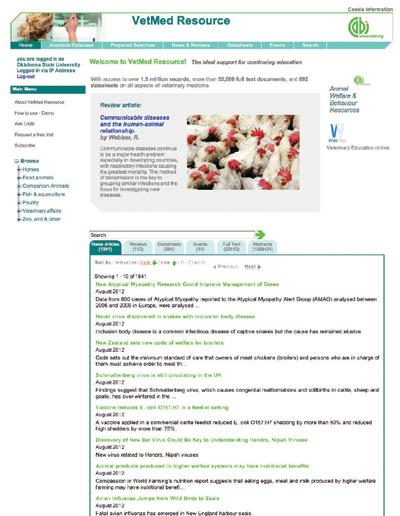
VmR is a comprehensive online information pr oduct designed for veterinary practitioners, technicians and others working in the veterinary field. it contains all of Cabi publishing ’s veterinary information and is intended to support continuing education.
The abstracts database contains more than 1.4 million citations and 40,000 full-text documents covering journals, book chapters, reports and proceedings from 1972 to the present. you can request items not included in VmR through interlibrary loan from your local library. VmR also includes full-text Cab Review articles and almost 700 datasheets related to veterinary medicine. additional information about VmR is available at www.cabi.org/vetmedresource/.
The veterinary center provided 2012 alumni with log-in information in a graduation packet. all other veterinary alumni may request log-in and password through a registration form at info. library.okstate.edu/vetalumni.
Training will be available at the center’s annual fall Veterinary Conference and at the o V ma annual Conference. To schedule other in-person or virtual trainings, email lib-vet@okstate.edu or call 405-744-6655

the center for Veterinary Health sciences has introduced an office of student services to better serve students’ needs.
the office is in charge of handling certain essential functions pertaining to student services.
student services is staffed by Joyce axton, Sherl Holesko, Michelle Kuehn, anna teague and robin Wilson, with assistance from lucy Kershaw on fourth-year students and Mary Kay Jennings on college ceremonies and special events.
“We have streamlined the process for students, which allowed for some cross-training so that we always have someone available to assist students,” says Dr. chris Ross, associate dean for academic affairs. “We want to work smarter, not harder, and this team approach provides the best service for our students.”
S TU d ENT SE r VICES o ff ICE O p ENS
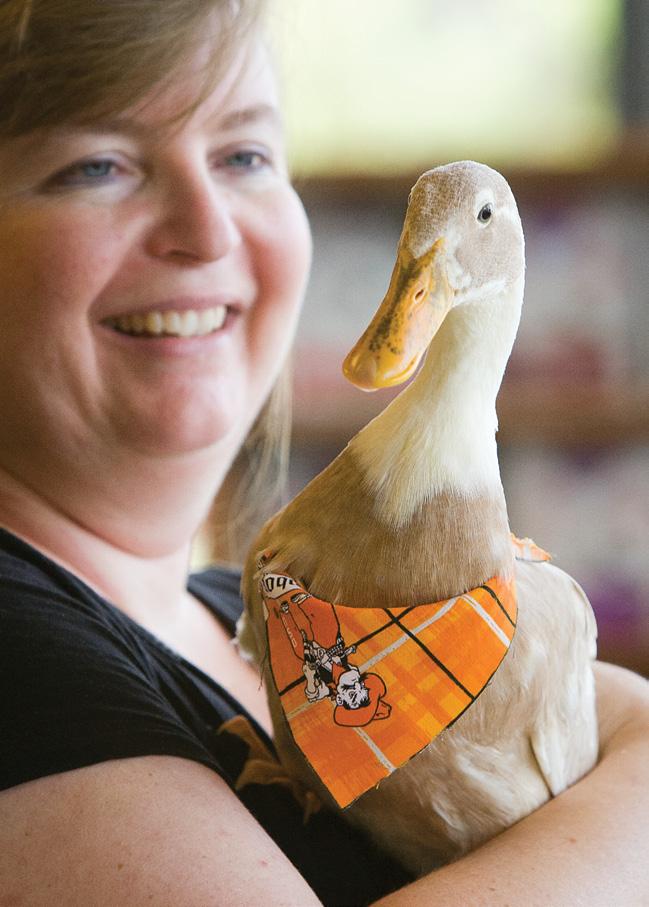
dr. Cornelia Ketzriley, head of the avian, exotic and Zoo Medicine Services, holds the latest addition to her service’s menagerie, Sherbert, an indian runner duck.
There’s a new mascot in town
There is a new mascot at osU’s veterinary hospital — Sherbert , an indian runner duck . a stillwater resident brought the orphaned duck to the hospital after sherbert just wandered into the house with the family dog.
“it ’s obvious that sherbert was once someone’s pet as she is very friendly,” says Jill Murray, (registered veterinary technician, veterinary technician specialty in avian and exotic animals) in the hospital’s avian, exotic and Zoo medicine service. “she loves people and will just follow you around, quacking her opinion as she goes.”
indian Runner ducks are a domesticated waterfowl known for their upright stance, high egg production and varied colors. sherbert is a pied color — fawn and white.
“sherbert will join the other resident animals we have in the avian, exotic and Zoo medicine s ervice,” says Cornelia Ketz-Riley, d V m , diplomate, american College of Zoological medicine, assistant professor and head of the service. “We will use her to teach veterinary students the proper way to handle a duck and the wellness veterinary care ducks require.”
“We can also use her as a blood donor duck should another duck be admitted to the veterinary hospital that requires a blood transfusion,” adds murray. “ducks can also be used as blood donors for other birds if necessary. b irds can handle blood pretty much from any other bird. of course it would be best to use a blood donor of the same avian species, but in an emergency, sherbert can help out.”
according to murray, ducks are a pretty common species for pets.
“There is even a duck rescue here in oklahoma. indian Runner ducks can’t fly. We take her for daily walks for exercise, let her swim and make sure she is around people,” says murray. “she has a mind of her own. if she is off by herself, she doesn’t like it and starts quacking — very loudly.”
in addition to sherbert, the avian, exotic and Zoo medicine service is home to Harley the redtail boa; Guiness, tequila, Morgan and Corey, all guinea pigs; ophelia the rat; Sophie the ferret; Brumby the sugar glider; and Speckles the cockatiel.
Gary Lawson / University MarketinG
Accredited care
A NI m A l
rESOU r CES
WO rk S TO m AINTAIN ITS b A dg E O f
HONO r
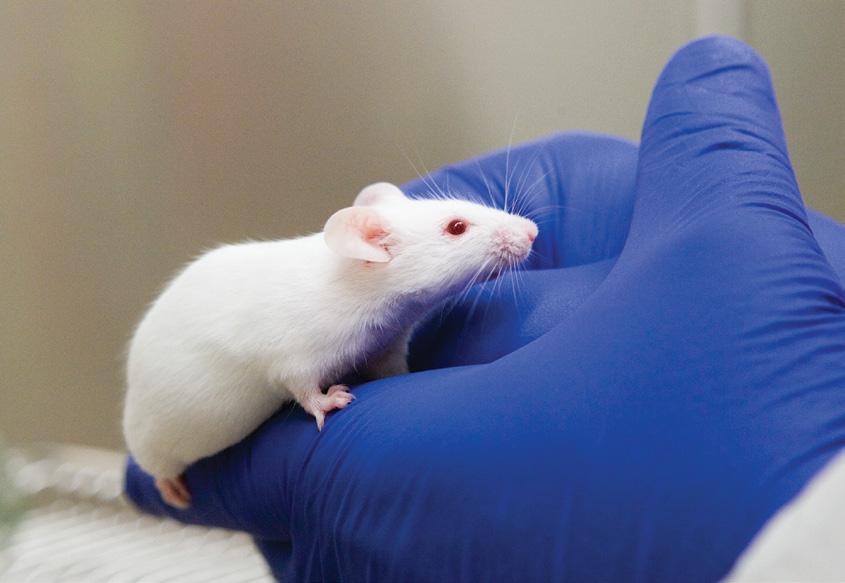
The d epartment of a nimal resources is located on the west side of mc elroy hall. Under the direction of todd Jackson, dVm and diplomate of the american College of laboratory a nimal medicine, five staff members and four student workers keep the department running smoothly.
“The Center for Veterinary health sciences is proud to be the first osU-stillwater college to obtain accreditation for its animal-care program,” Jackson says. “Under the leadership of my predecessor, dr. denver marlow, the center applied for and received aaalaC international accreditation in 2010. This covers the veterinary center’s entire research animal care program — animal Resources, the Veterinary medicine Ranch, the equine Research park and all individual research labs. This is huge in the research world and a real feather in our cap, as it lets others know what a high-quality program we run here.”
The association for assessment and accreditation of laboratory animal Care is an international nonprofit organization that promotes the humane treatment of animals in science. in the scientific community, aaalaC international accreditation demonstrates that an institution is serious about upholding high standards for animal care.
“Accreditation is also a recruiting tool,” says Jackson. “We can offer the best and brightest researchers and professors a high-quality animalcare program to support their research. potential employees will know they are coming to work at an institution that has the utmost regard for research animals. Quality research animal care is critical to gathering quality scientific data from the animals.”
in addition, the accreditation process helps promote continuous improvement. once earned,
accreditation can be maintained only by upholding the high standards set by the aaalaC. peer reviewers visit the institution every three years to evaluate the quality of animal care.
as part of the continuous improvement process, an internal osU grant has been awarded to animal Resources to upgrade the heating, ventilation and air conditioning systems. once installed, a computerized monitoring system will check air quality continuously.
“if a room becomes too warm or too cold for any reason, the system will sound alarms and notify staff to respond,” explains Jackson. “This is critical for temperature-sensitive research animals that could become distressed within hours if heating or cooling systems fail.
“Accreditation is a true commitment to humane animal care and use,” adds Jackson. “It shows the university, the state and the world that OSU’s veterinary center is serious about ensuring animal wellbeing and conducting good science.”
animal Resources staff include Bruce nance, facility manager; Janelle Ballard , supervisor; animal technicians Charles Jacques and Martha Bastion; Mendi Cronister, administrative assistant; and several student workers. Jackson’s team provides veterinary and husbandry care for dogs, cats, cattle, horses, white-tailed deer, rabbits, rats, mice, voles, birds and more.
phiL shockLey / University MarketinG
Adding to the medicine bag
By DeRinDA BlAkeney
r EAT m
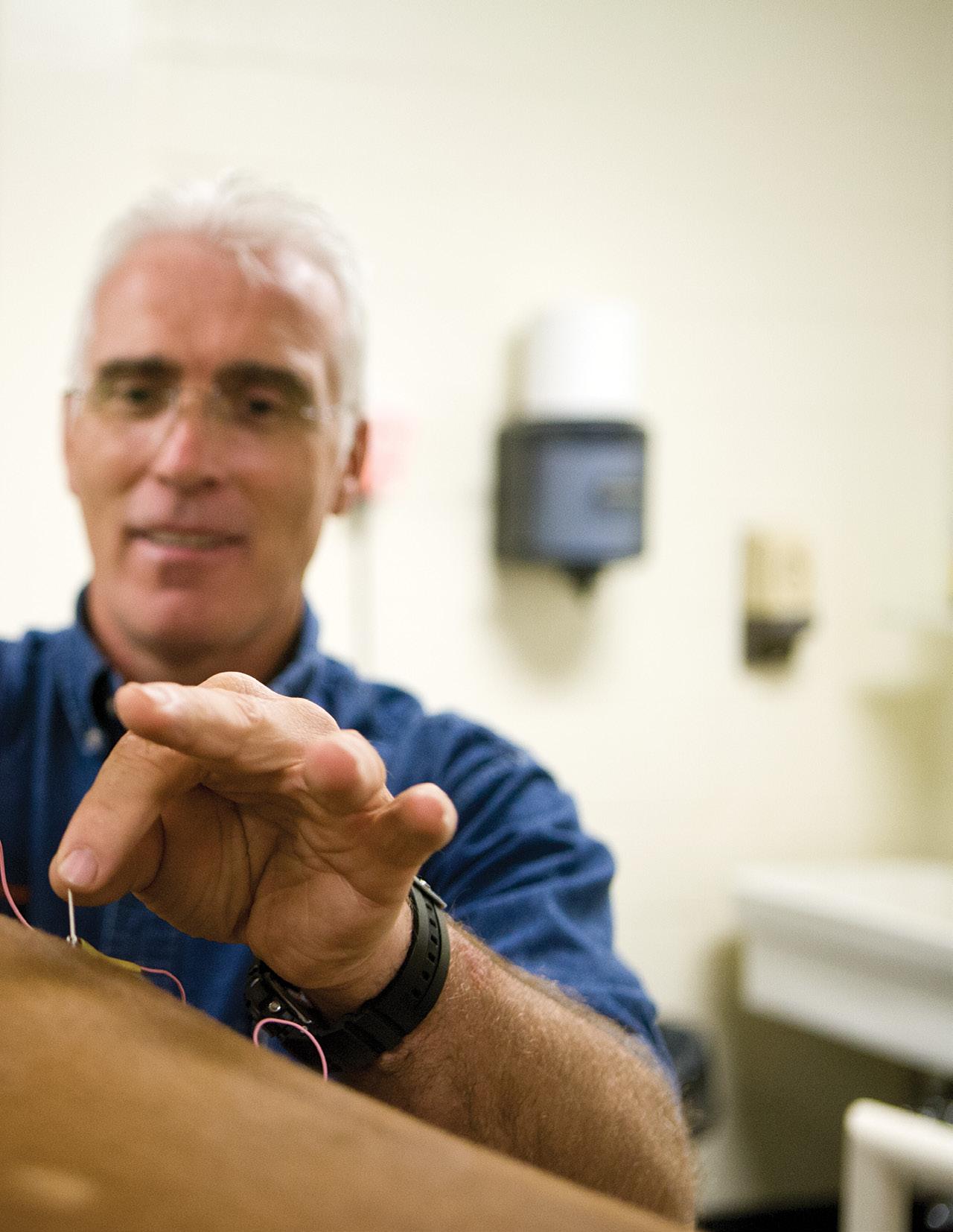
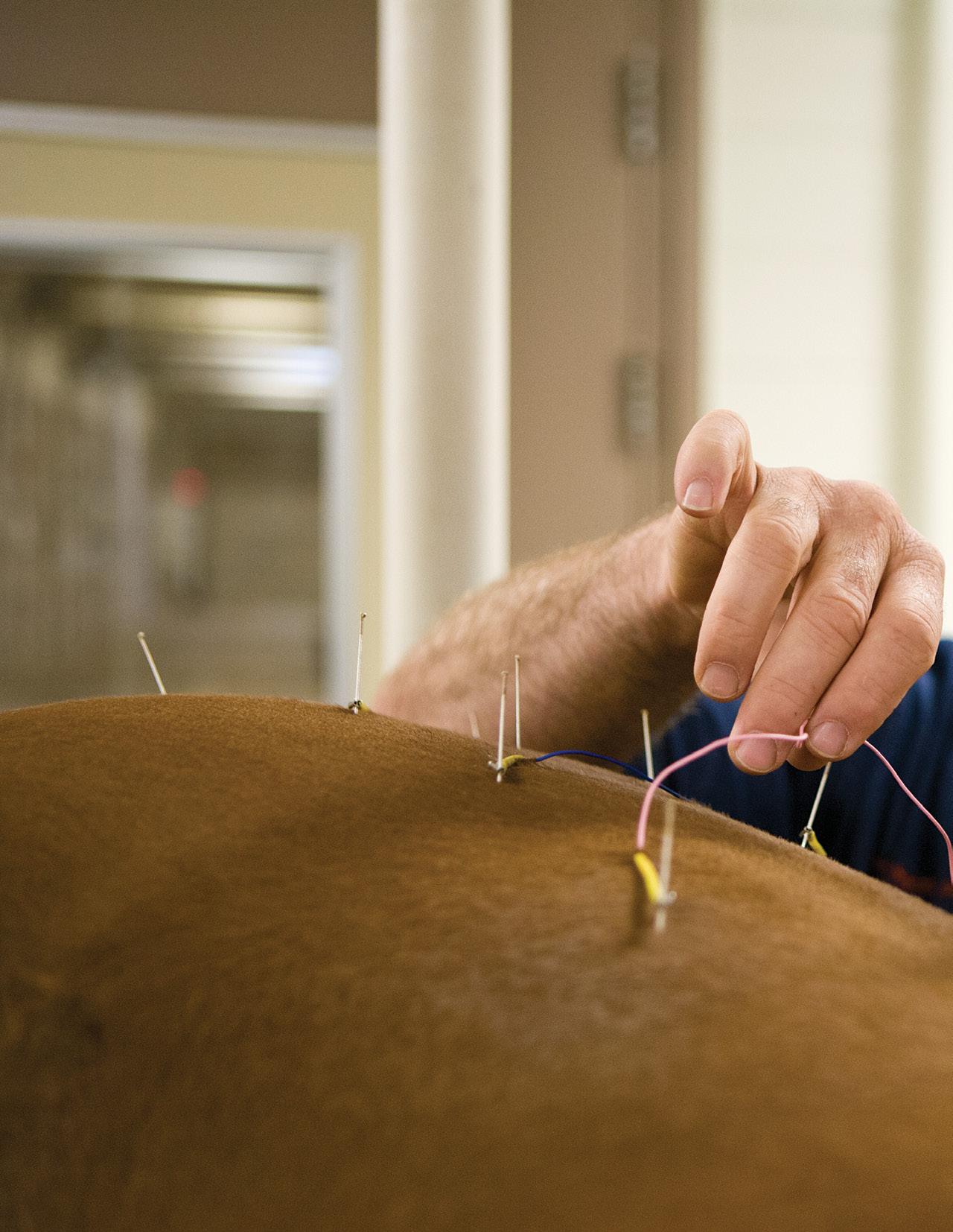
Veterinarian d r. r eed Holyoak , a recognized board-certified specialist in theriogenology (animal reproduction medicine) at os U’s veterinary hospital, was looking for ways to treat infertility cases that were unresponsive to mainstream veterinary therapies. Reports of success in using acupuncture, first out of the far e ast and e urope, then from Kentucky and f lorida, led holyoak to studying Traditional Chinese Veterinary medicine, which includes acupuncture.
dr. reed Holyoak uses acupuncture to treat a horse at osU’s veterinary hospital. horses have hundreds of “spots” to use as acupuncture points.
OSU VETE r INA r IANS O ff E r C HINESE T
ENTS IN TOU g H CH r ONIC CASES
n ow cer tified in the field, holyoak can use his expertise to treat these tough infertility cases in horses, dogs, cows, and even sore backs and hind legs in bulls.
“Acupuncture and associated therapies are part of a new movement in human and veterinary medicine integrating the best of nontraditional healing therapies into modern, Western medicine to form a broader-based medical system,” says holyoak.
W estern medicine often focuses on clinical symptoms with diagnosis based on the results of multiple tests, which is good for diagnosing and treating acute disease. h owe ver, chronic diseases, such as infertility, arthritis and others, can be nonresponsive to Western veterinary medical therapies.
Chinese approach a cupuncture and Chinese herbal medicine tak e a wholeanimal approach, utilizing a comprehensive hands-on physical exam, considering overall balances and imbalances, excesses and deficiencies in diagnosing and treating disease.
“The focus is on correcting what is out of balance in affecting a cure. it is the nonresponsive cases that are the most frustrating for all of us,” adds holyoak.
While neither approach has all of the answers, it was these frustrating cases that spurred h olyoak into f ive months of intensive study and training in order to offer an integrated eastmeets-West medical approach in treating patients at the osU Center for Veterinary health sciences’ boren Veterinary medical Teaching hospital.
“it has been a mind-opening experience and a very demanding course of study,” says holyoak, who already held ms, dVm and ph.d. degrees. “in addition to teaching future veterinarians as students here at osU, I look forward to offering this new approach in working with veterinary practitioners, pet owners and livestock producers in the state of Oklahoma and surrounding areas. These are part of the wonders of my life.
“We had two infertile client mares at the Veterinary me dicine Ranch, where we handle our theriogenology cases,” recalls holyoak. “ We added acupuncture, and we were able to clear the infection in the reproductive track and extract embryos for impregnation, and now we have two expectant mares.”
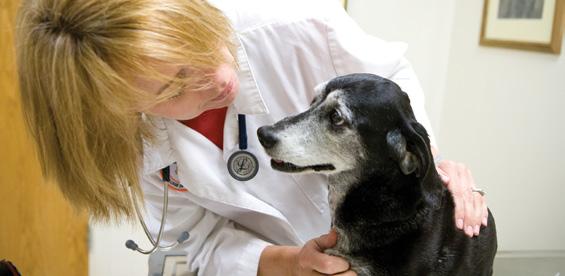
a nother veterinarian at o s U has also added acupuncture to her repertoire. in may 2012, lara Sypniewski, dVm, community practice veterinarian at the small-animal clinic,
completed the medical acupuncture for Veterinarians course in Colorado, a collaborative effort involving Colorado s tate University, the Colorado Veterinary m edical a ssocia tion and the interna tional a cademy of Veterinary medical acupuncture.
“This course provided critically evaluated, evidence-based instruction in acupuncture and related techniques, such as laser therapy, massage and rehabilitation,” says sypniewski, patricia hent horne Clinical p rofe ssorship in small-animal medicine. “The curriculum concentrated on the action of acupuncture on the nervous system and how it can be utilized to provide effective pain relief.”
Hours of studying sypniewski spent 140 hours comple ting class work and another 200 hours studying outside the classroom.
“Acupuncture is an emerging modality in veterinary medicine that allows for a complement to Western therapies for the treatment of numerous conditions including acute and chronic pain,” says sypniewski. “There are many local and systemic effects that occur after a sterile needle is placed in an acupuncture point. i nc reased circulation locally around the needle is noted almost immediately. stress is reduced by a secondary release of ‘feel good’ hormones (endorphins from the body’s own pharmacy, if you will) and the parasympathetic nervous system is activated, allowing the normalization of organ function.”
sypniewski explains that muscular trigger points relax and muscular restriction is reduced. The brain and spinal cord are also affected by the endorphins released during needling, modulating the body’s response to pain.
“Acupuncture is not painful, and most patients actually enjoy it, It is very safe, and side effects are rare,” she adds. “i do warn, howe ver, that patients may experience muscular discomfort after acupuncture due to the physiologic changes that occur after needle placement. This discomfort is short-lived and can be managed with appropriate anti-inflammatory and/or pain medications.”
s y pniewski usually spends about one hour with patients; her treatments combine acupuncture, massage and laser therapy.
both holyoak and sypniewski agree that acupuncture is a complement to Western medical therapies; it is an option and not the only treatment to consider when dealing with disease and chronic pain cases. There are many patients that will benefit from this modality, they say. only in the United states has modern medicine completely replaced older forms of medicine. The World health o rganization recently indicated that 80 percent of the world’s population relies on herbal medications as part of their primary health care. The a merican Veterinary m edical a ssocia tion recognizes acupuncture as an alternative form of veterinary medicine, and it falls under the o klahoma Veterinary p r actice a ct as well. i n 1997, the n a tional ins titutes of health found sufficient evidence of acupuncture’s value to expand its use into conventional medicine and to encourage further studies of its physiology and clinical value.
phiL shockLey / University MarketinG
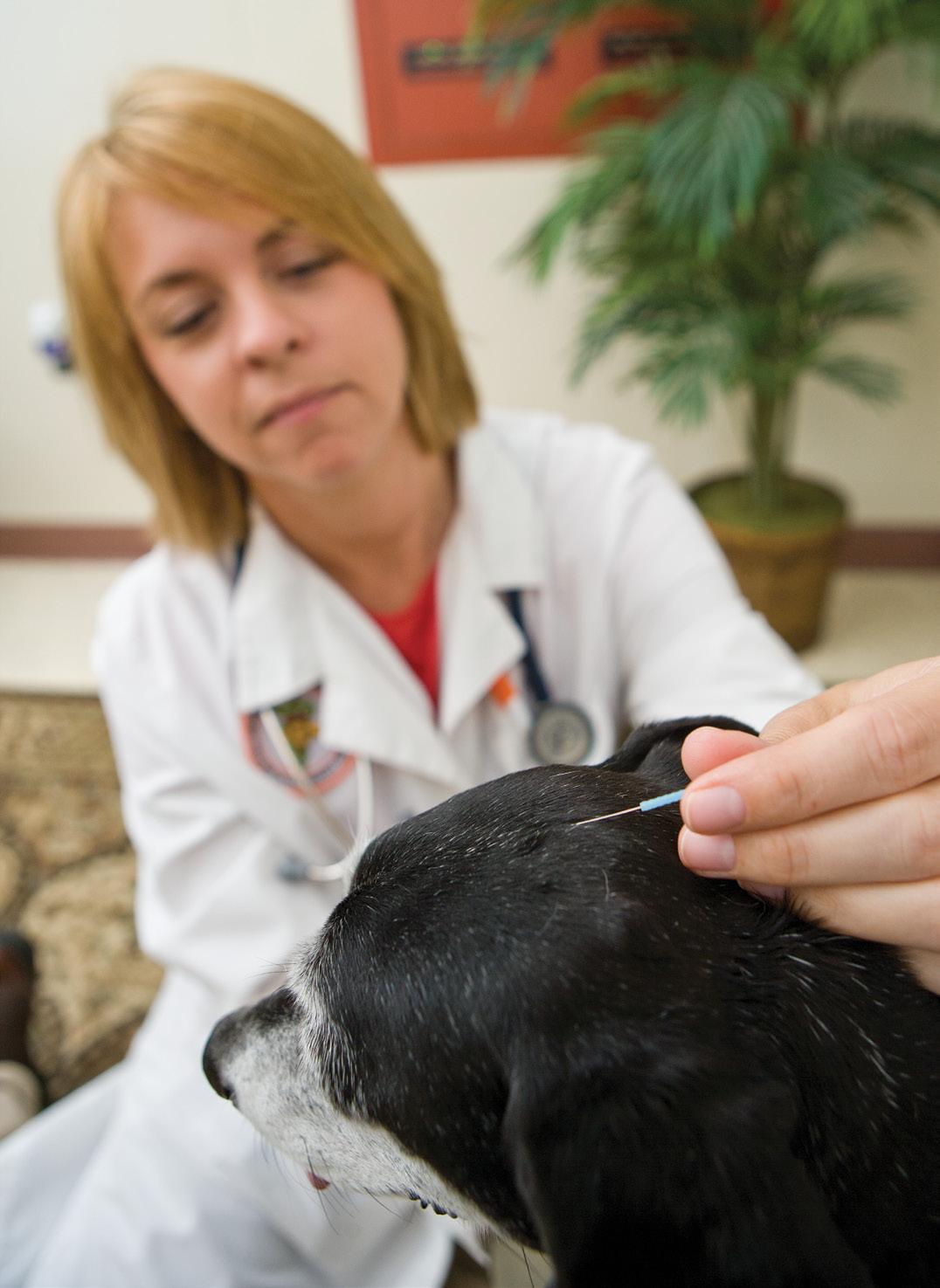
dr. lara Sypniewski treats 13-year-old Cashew’s elbow arthritis with acupuncture. the arthritis causes the terrier mix to favor his leg when he walks, which results in muscle tension and knots along his shoulders and back.
phiL shockLey / University MarketinG
Learning in the homeland
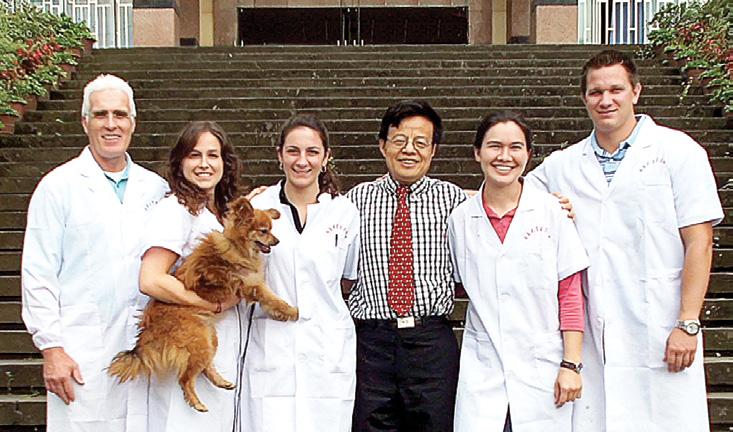
in May 2012, dr. reed Holyoak accompanied dr. taylor tillery (class of 2012) and three veterinary students to china to participate in a veterinary acupuncture introduction course organized by china southwest university and chi institute of chinese Medicine.
Holyoak was one of three certified acupuncturists who lectured and instructed at the twoday hands-on laboratories. Dr. Husisheng Xie from the university of Florida and two instructors from the southwest university college of Veterinary Medicine also provided lectures and demonstrations.
A total of 12 participated in the four-day course with students representing oklahoma state university, louisiana state university, Washington state university and the country of Australia.
“the trip was amazing,” says Hannah Wadsworth, class of 2013. “i enjoyed learning about acupuncture and seeing how the chinese people live. it’s humbling to visit a third-world country and realize how blessed i really am.”
lectures focused on traditional c hinese medicine and traditional chinese veterinary medicine. traditional chinese Medicine was established approximately 3,000 years ago. its fundamentals are still in use today, including the five elements and eight principles used to diagnose and treat patients with acupuncture. Attendees learned the commonly used acupoints on dogs and horses, including the location of approximately 100 acupuncture points along the 12 meridians.
“i really enjoyed the trip to china,” says Brittany koether, class of 2015. “We learned an immense amount about acupuncture, herbs and the theory of traditional Chinese medicine. We were welcomed with open arms and toured the veterinary facilities and the medical hospital, where we saw acupuncture.”
dr. reed Holyoak (from left), Juli Constantine, Brittany Koether, dr. Huisheng Xie, Hannah Wadsworth and dr. taylor tillery visit China for the acupuncture course.
Lab gives diagnoses a step up
The Oklahoma Animal Disease Diagnostic l aboratory provides services across the c ountry. The Molecular Diagnostic l aboratory has offered bacteriology and virology testing since the OADD l expanded its facility in 2008.
Molecular diagnostics utilizes a testing method known as polymerase chain reaction to quickly and efficiently analyze a variety of veterinary samples.
in the 1980s, a traditional or gel-based pCR became one of the most powerful tools in veterinary diagnostics. This process involved extracting dna or Rna from various sample types — blood, tissue, swabs, feces, etc. To identify a specific disease agent, lab technicians would then run gels using ethidium bromine, which is toxic.
Today, a process known as real-time p CR improves the process. a fluorescent probe is placed into the sample during the test, making the reaction visible as it occurs. l ab technicians can see if and when a certain product is being made.
“The real-time p C r reduces the time it takes to run the test,” explains emily Cooper, quality manager and molecular assay developer at oaddl “It reduces the chances of cross-contamination, and it lessens the risk of chemical exposure to the operator.”
molec ular biology runs the following bacteriology tests:
Tritrichomonas foetus
Johnes disease
Anaplasma marginale
Clostridium perfringens toxin typing
Mycoplasma bovis
16S rDNA sequencing (helps identify difficult-todifferentiate bacteria)
The lab is in the process of validating a pCR for Leptospira spp on urine and kidney, which will then also be available.
The virology section offers the following molecular tests:
Avian influenza
bluetongue virus
bovine coronavirus
Canine adenovirus I & II
Canine distemper virus
Canine parvovirus
Epizootic hemorrhagic disease and bluetongue
Equine herpesvirus 1 & 4
Equine herpesvirus 2
Equine influenza
General herpesvirus
Infectious bovine rhinotracheitis
Influenza A
Malignant cattarrhal fever
Porcine reproductive and respiratory syndrome
Sequencing and sequence analysis
e stablished in 1976, the oaddl is a full-service veterinary diagnostic laboratory. it is fully accredited by the american a ssociation of Veterinary l aboratory diagnosticians and a member of the national animal health laboratory network. oaddl conducts surveillance testing on avian influenza, swine influenza, exotic newcastle disease virus and classical swine fever.
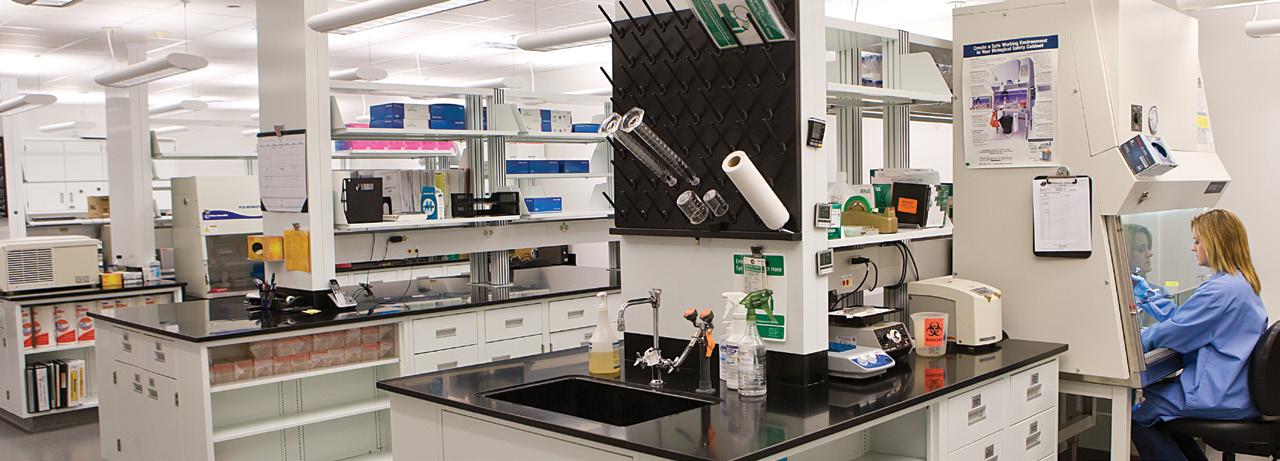
the oklahoma animal Disease Diagnostic Laboratory conducts a variety of tests.
An exotic reality
OSU VET TECH bl A z ES T r AI l WITH pA SSION f O r UNUSUA l ANI m A l S
Jill Murray, RVT, VTs, grew up in guelph, ontario, Canada. s he spent her summers volunteering at the local human society. h er career in veterinary medicine began at age 16 with her first job at the guelph humane s ociety. That led her to a veterinary assistant position in a local veterinary hospital, where she decided to further pursue her career in veterinary medicine.
“i have always loved animals,” says murray. “I find the human animal bond interesting and decided the best way to help animal owners and their pets was through education, listening and health care.”
murr ay graduated from the Veterinary Technician program at s eneca College in o ntario, Canada, in april 2005. by June 2005, she had passed the exam to become a registered veterinary technician through the o ntario a ssocia tion of Veterinary Technicians.
“i was the unique student in my veterinary technician program,” says murray. “While most students wanted to work with dogs, cats and horses, i dreamed of working with exotic animals. due to the limited special species training veterinary technicians receive as part of the curriculum, i knew that i had much work ahead of me to make that dream a reality.”
she joined osU’s boren Veterinar y medical Teaching hospital in 2008 and works in the hospital’s avian, exotic and Zoo medicine service. in 2012, murray added one more accolade to her career: she is the first RVT to successfully complete the extensive application and exam process to become a veterinary technician specialist in exotic companion animals.
“a c hieving my VT s is very exciting and humbling with a huge sense of relief from preparing and studying,” she says. “ ha ving my VT s will open up more teaching and learning opportunities.”
m urr ay spent the last four years working with exotic pets in osU’s veterinary hospital followed by a yearlong application process.
“ i had to perform and assist with a variety of advanced skills and procedures in exotic species, documenting my experiences and involvement in the nursing care of animals seen at the veterinary hospital. i also had to prepare multiple case reports showing my understanding, critical thinking and knowledge of the various species and disease processes.”
o nce m urr ay’s application was accepted, she had only four months to study for the exam.
“ i dove into studying. The species list was extensive and included amphibians, birds, exotic pet mammals, reptiles and wildlife.”
e ven though m urr ay has achieved this certified status, she knows there is more to learn.
“ m y learning has only begun. T he information we have on exotic pets is ever growing and changing.”
murr ay serves on the a cademy of Veterinary Technicians in Clinical practice committee focused on advancing the veterinary technician profession and
specialty designation. and she will have plenty of opportunities to learn at osU’s veterinary hospital.
“Every day is different. Sometimes your patient will walk in, other times it will fly or slither in,” she says. “on some occasions, we see species from local zoos or private collections. i never would have thought as a veterinary technician that seeing a lion, cougar or monkey would be part of everyday life — and it is. i hope to be able to share my love of exotic species with other veterinary technicians.”
— DeRinDA BlAkeney
Gary Lawson / University MarketinG
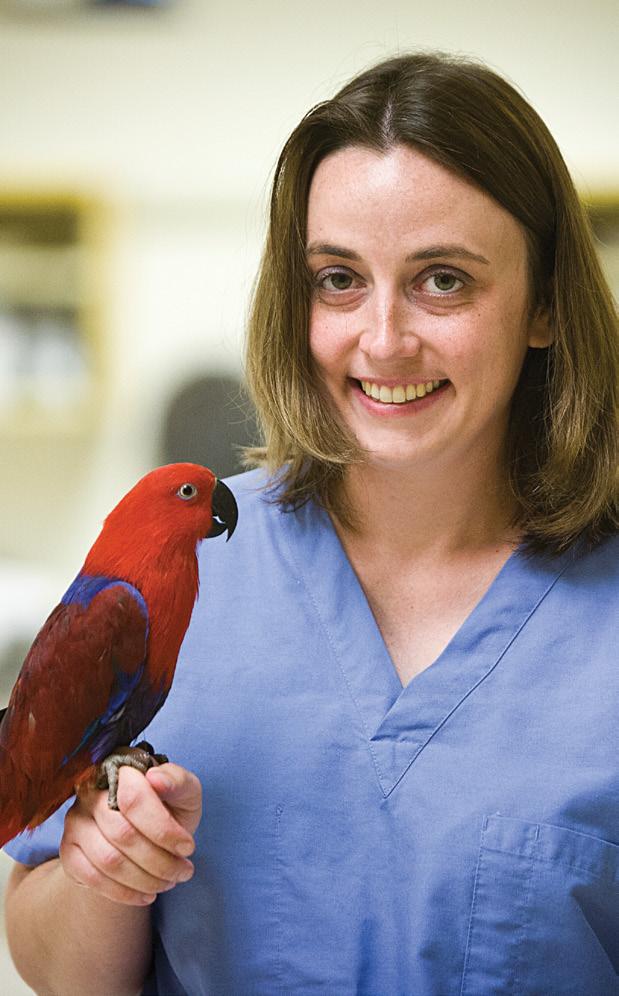
While Jill Murray enjoys the variety of species treated in the avian, exotics and zoo Medicine service, her favorite is pet birds. she shares her home with two birds — angel, a Moluccan cockatoo, and raine, a solomon island eclectus parrot.
Nursing a foal back to health
By DeRinDA BlAkeney
osU veterinarians don’t know exactly what happened to a young Kansas foal who couldn’t stand up after his birth, but they found a way to help him.
The foal, the first from a 4-year-old mare, was unable to nurse, so he was missing the important antibodies in his mother’s colostrum. his owner, a small-animal veterinarian from Wichita, Kan., knew the foal needed help when he found it. having referred many clients to os U’s veterinary center, he didn’t hesitate to drive almost 1½ hours to os U’s large-animal clinic.
“in an unattended delivery, it’s hard to say what happened,” says todd Holbrook , dVm, diplomate of the a merican College of Veterinary internal medicine, l arg e a nimal and the a merican College of Veterinary sports medicine and Rehabilitation as well as the equine section chief at osU’s Center for Veterinary health sciences. “The foal was less than 6 hours old, and he had dramatic swelling in his upper left hind leg. he probably injured the leg during delivery.”
holbrook determined that the colt ruptured his gastrocnemius muscle in his upper left back leg, equivalent to the calf muscle in a person. after applying a supportive splint on the limb, holbrook and his team decided to incorporate laser therapy for the first time to help heal the colt’s muscular injury.
“The foal was treated using a low-level laser therapy ( lllT) device, which theoretically enhances healing, including with tendons and skin wounds,” explains Kenneth Bartels , d V m , mcCasland founda tion
continues
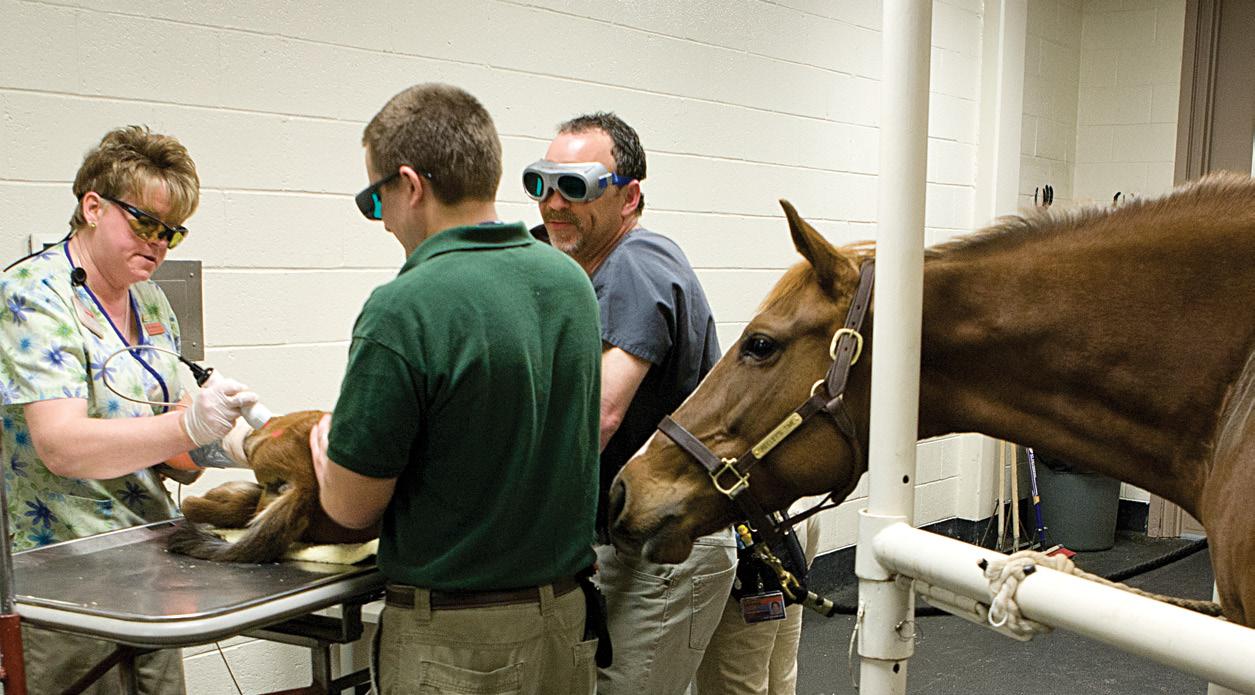
the foal’s mother tries to nose in to see what’s happening to her baby as registered veterinary technician Judy Branson (from left) treats it while fourth-year veterinary student Matt Kren, dr. todd Holbrook and Sabari ford (hidden) hold it.
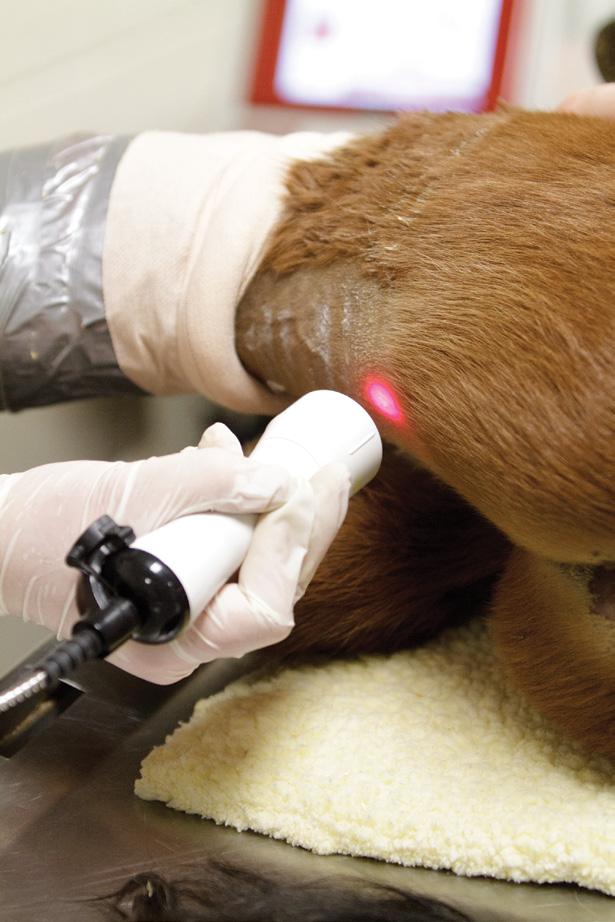
l a ser s ur gery p r ofessor and Kerr Chair for b iophotonics.
“lllT is also used to alleviate pain due to musculoskeletal problems caused by degenerative osteoarthritis. lllT is used in both human and veterinary medicine, but its objective efficacy or benefit is still being investigated. our laser lab has been working with a number of manufacturers to provide objective results for research as well as clinical applications for both large and small animals. This therapy is used frequently in rehabilitative medicine within the center’s small-animal veterinary hospital.”
h olbrook and assis ting fourth-year veterinary students, Matt Kren and Sabari ford, held the foal while treatment was administered by Judy Branson. Branson, a registered veterinary technician, received additional training to become licensed to properly operate laser equipment for veterinary applications. she treated the foal for 10 minutes each day.
“After several days of laser treatment, the swelling had gone down considerably,” reports holbrook. “This is an uncommon injury in foals. We put a splint on the foal’s leg to provide support so he could stand and nurse. by day 12, we were able to send him home with a splint and wrap on his leg.”
The foal’s owner reported that the foal was able to walk without the splint approximately 2½ weeks after discharge. The following week, the foal returned for an ultrasound examination to determine how the healing had progressed.
“I am very pleased with the foal’s progress,” says holbrook. “he still has a mildly abnormal gait, and fragments of bone that were distracted from the aspect of the leg where the gastrocnemius originates are still present.”
The colt’s owner also believes the healing process has gone very well. he uses laser therapy often in his small-animal practice and looks forward to watching his foal continue to grow with no lasting effects from the early injury.
Two months passed, and the foal returned to o s U for one final checkup.
“The injury continues to improve radiographically,” says holbrook. “his exercise has been gradually increased so that he is now ready to turn out to pasture. While splint immobilization was the primary treatment modality, the laser therapy appeared to rapidly reduce the fluid accumulation (edema and hemorrhage) early in the treatment of this case, and we are very satisfied with the results.”
the laser treatment is applied for 10 minutes.
Rescuing a rescuer
A m ONTH b E f O r E jO pl IN ’ S d EVASTATION , OSU VETS br IN g A SEA r CH d O g b AC k fr O m THE br IN k O f d EATH
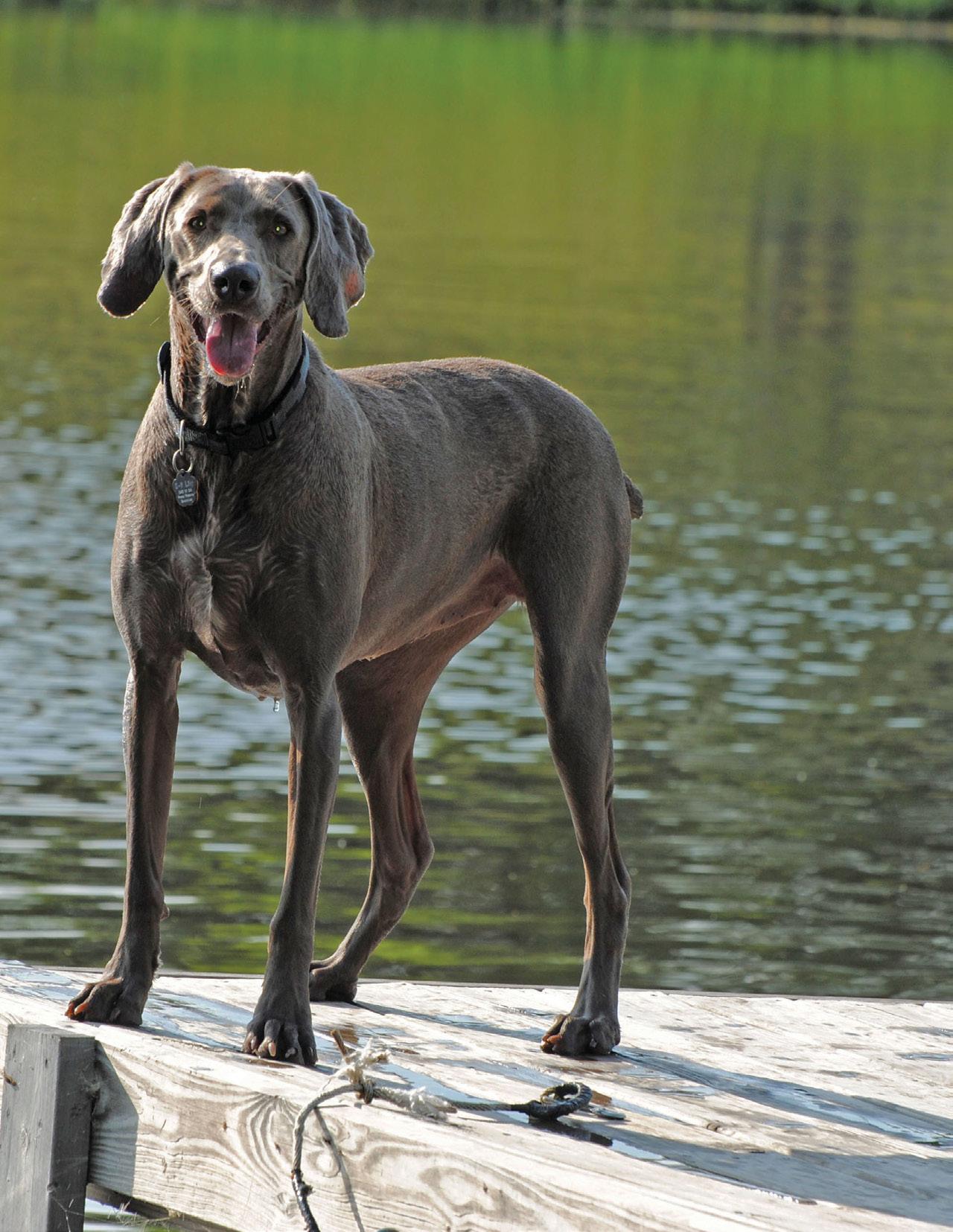
osu had the opportunity to treat a dog with a huge heart and an amazing drive to work. Meet lily, a 4-yearold Weimaraner owned by tara Prosser of Joplin, Mo. Lily has been with the Prosser family since she was 10 weeks old. Prosser trained her as a search-and-rescue dog, and the duo are members of PAWs s earch Dog Alliance and newton county Rescue and Recovery in Joplin. lily was nominated for the 2012 Hero dog Awards by the American Humane Association and placed third in the search and rescue category, competing against 12 other dogs.
“What i like most about training these dogs is the sense of being one with your dog,” explains Prosser. “you move, your dog moves. Being able to save a life with the help of your dog is just an amazing feeling.”
PhotoS coUrteSy / tara ProSSer
“ t here is not a D ay that goes B y tha t i a M not than KFUL F or Dr. C U nningha M an D the sta FF at o s U’s V eterinary hos P ita L .”

lily searches destroyed homes and businesses after the 2011 tornado that hit her hometown of Joplin, Mo. a month earlier, she had been near death at osU’s veterinary hospital.
in march 2011, lily developed profound swelling of the lymph nodes under her chin and the tissues around her face.
“ o ur veterinarian in neosho, mo., treated lily, but the lymph nodes in her neck remained swollen even after her facial swelling was resolved. a fter three weeks, our veterinarian did a biopsy, which came back unremarkable.”
a week later, the two were at a search team training, when p rosser noticed l ily’s left eye was irritated.
“i checked it, but didn’t really see anything,” prosser remembers. “ l ater that evening, she stopped eating and seemed lethargic, acting as if she were in pain. i checked her every hour during the night, and that’s when i noticed her eye had hemorrhaged, was swollen and bulging. she had a fever and couldn’t walk without bumping into walls.”
a s soon as her veterinarian opened the next morning, prosser had lily in his office.
“He took one look at her and said, ‘We need to get her on the road to Stillwater.’ We got in the car and left. i didn’t bring anything with me — just lily and a couple of teammates who came to support me.
“it was our first visit to osU’s veterinary hospital. i was impressed; the doctors were listening to me, and everyone understood how important it was to help this sick dog. i knew lily was in good hands.”
d r. l auren Cunningham , a small-animal internal medicine resident, was assigned to lily’s case.
“Upon arrival, we treated lily for pain and fever,” recalls Cunningham. “Then we ran several tests on her to rule out possible causes. s he had a severe decrease in her platelet count, with evidence of active bleeding. Coagulation profiles were normal, infectious disease testing came back negative, fungal disease tests were unremarkable, and cytology of multiple organs showed no evidence of organisms or cancer. Cultures were performed and came back negative. We knew she had a huge exposure risk with her job. We felt it had to be set off by something she was exposed to; we simply could not find the culprit.”
“When the test results started coming in, dr. Cunningham said the possibility of her regaining sight in the affected eye was very grave and if it was painful, it might need to be removed,” says prosser. “every test for tick diseases came back negative. lily’s platelet count dropped very low, and she showed signs of internal bleeding. bruises were starting to show on her abdomen. That was my lowest point — i thought i was losing my partner.”
prosser remembers lying in bed at her hotel, wondering when the phone would ring to tell her l ily had bled out and was gone.
“The phone didn’t ring,” prosser says. “in the morning, we talked about removing lily’s eye to help determine the diagnosis. With lily’s platelet count so low, dr. Cunningham did not want to do any invasive procedures that might cause lily to bleed.”
Cunningham started lily on prednisone, and within days her platelet count was climbing. by the end of the week, lily was well enough to go home. a lthough the inciting cause of her immune mediated disease remains unknown, l ily responded well to treatment and has never looked back.
a little over a year ago, prosser acquired another Weimaraner — daisey, who is now 2 years old.
“a month after lily’s release, i planned on taking daisey to a training seminar in a rkansas. i didn’t want to leave lily with someone knowing she might crash again, so i brought her along,” says prosser. “i did not intend on working with her, but she had other ideas.”
a ccording to p rosser, l ily barked and carried on while daisey was working. The trainers there knew about lily’s situation and convinced Tara to let lily try.
“ s o with fear in my heart, i took lily out, and she blew me away with her energy and her drive to work! lily is a human remains detection dog. one of the exercises was a sectioned-off field where a single baby tooth was planted. The trainers told us to find it, and lily did.” on the way back to Joplin that evening, p rosser learned that their city had just been hit by an ef5 tornado.
“We were exhausted, and we weren’t sure what we would be driving into,” remembers prosser. “it was about 10 p.m. when we arrived. my husband, Jeff, who is a paramedic for newton County ambulance, left immediately to join his crew. i started making plans for the K9 team.”
e arly the next morning, prosser and lily searched a leveled department store, grocery store and a furniture store. it was on to residences the next day.
“We cleared so many that we lost count. d evastation was everywhere, but l ily just kept working,” prosser recalls. “ s he stepped on several nails from all the roof shingles; she never whimpered and just kept working. e very night, l ily would come home and play in our backyard like nothing extraordinary had happened. but as soon as i put my boots on the next morning, she was ready to go again. you would never have known that a month before she was close to dying.”
happily, prosser reports that at a regular checkup in november 2011, lily’s veterinarian said that she is probably regaining vision in the eye that was almost removed.
“There is not a day that goes by that i am not thankful for d r. Cunningham and the staff at os U’s veterinary hospital,” she says. “lily is more than my partner — she is a family member, and i would have been lost without her. one day i will lose her, and it won’t be easy. b ut because of dr. Cunningham and everyone else who had a hand in her care, i still have lily with me today, and she has many more years of bringing closure to families and saving lives.”
— DeRinDA BlAkeney
Wheeling around
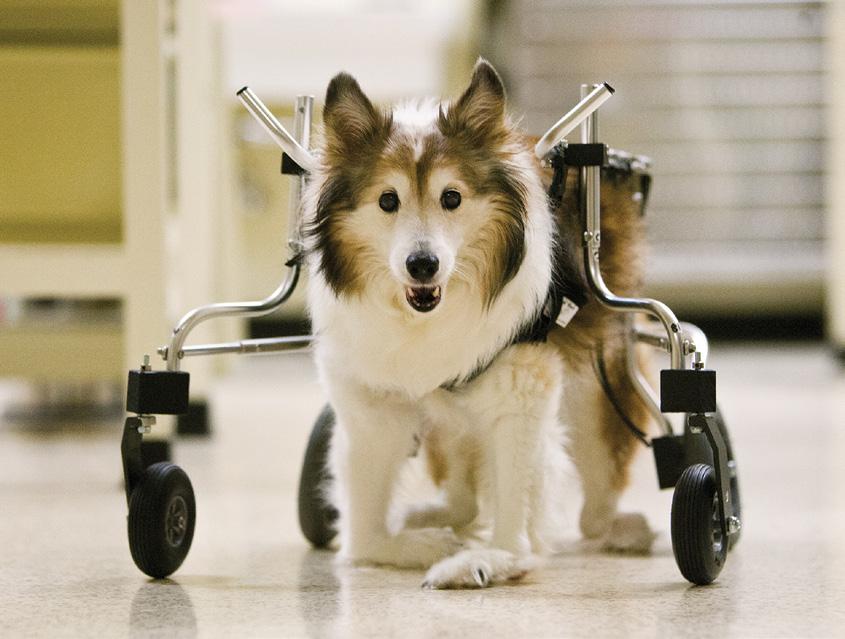
Missy is a 14-year-old s heltie dog owned by Marie Basler of stillwater. missy suffers from severe arthritis in all of her limbs.
“When missy was about 5 years old, she hurt her right front leg,” explains basler. “she spent three weeks with her leg in a cast until the tendon healed. a fter that, she would sometimes limp a little on that leg. about six years ago, she started to go lame in her back legs. gradually, she went down on her hocks in the back.”
missy ’s veterinarian referred basler to osU’s veterinary hospital. a n os U s tudent Union employee, basler knew that the veterinary hospital was open to the public and had brought dogs in for treatment before.
“We tried physical therapy and leg braces. The therapy helped loosen her joints a bit, but she never could get used to the braces,” says basler. “missy is a spunky little dog and managed to adapt to walking on her hocks.”
sadly, basler says that about three years ago, m issy ’s right front leg started to turn inward and within a year, mi ssy gradually began to go down on her front legs as well.
“of course, we were giving her medicine to help with the joint pain. Then in april 2011, missy developed an abrasion on her right front leg that bled and oozed liquid similar to a burst blister,” adds basler.
a trip to the veterinary hospital resulted in dr. lara Sypniewski, community practice veterinarian, treating missy for infec tion for the next three weeks before the spot healed.
in fall 2011, missy developed another sore on the same spot — so back to the veterinary hospital went basler and missy
“ i was told that missy could have surgery on both front legs to straighten them and possibly help her get back up on her feet,” says basler.
Unfortunately, the timing for missy’s treatment could not have been worse. basler’s other dog, al, was hospitalized for a strokelike condition and kidney failure. a s a l’s condition deteriorated
quickly, basler made the tough decision to euthanize him. having a sick pet in the hospital is a significant emotional, financial and time investment for even the most dedicated owner.
“Taking that into consideration along with missy ’s age and the cost of the surgery, i decided against surgery for missy,” says basler. “i asked dr. sypniewski if there were other treatment options to help heal the sore.”
“We wanted to help missy it was time to think outside the box,” says s ypniewski. “ l aura moorer, certified canine rehabilitation practitioner on staff, suggested that a cart might help. missy actually walked in it the first time we sat her in it.”
phiL shockLey / University MarketinG
Missy the sheltie gets around her home nicely with her cart.
m oorer photographed m issy’s little legs and took lots of measurements before ordering the cart. When the custom cart arrived from d oggon’ Wheels, moorer put it together and fit it to missy.
“missy still has a little trouble going in a straight line because she favors her right front leg,” says basler. “it has helped her foot to heal, and most of the time missy is able to go around the house all by herself — even with her crippled legs.
“I encourage people to never give up on a dog and look for as many options as you can find to help them i think we have some pretty amazing veterinarians, students and staff at the veterinary college who are very creative thinkers and patient with owners. missy and i are very fortunate they are on our side.”
— DeRinDA BlAkeney
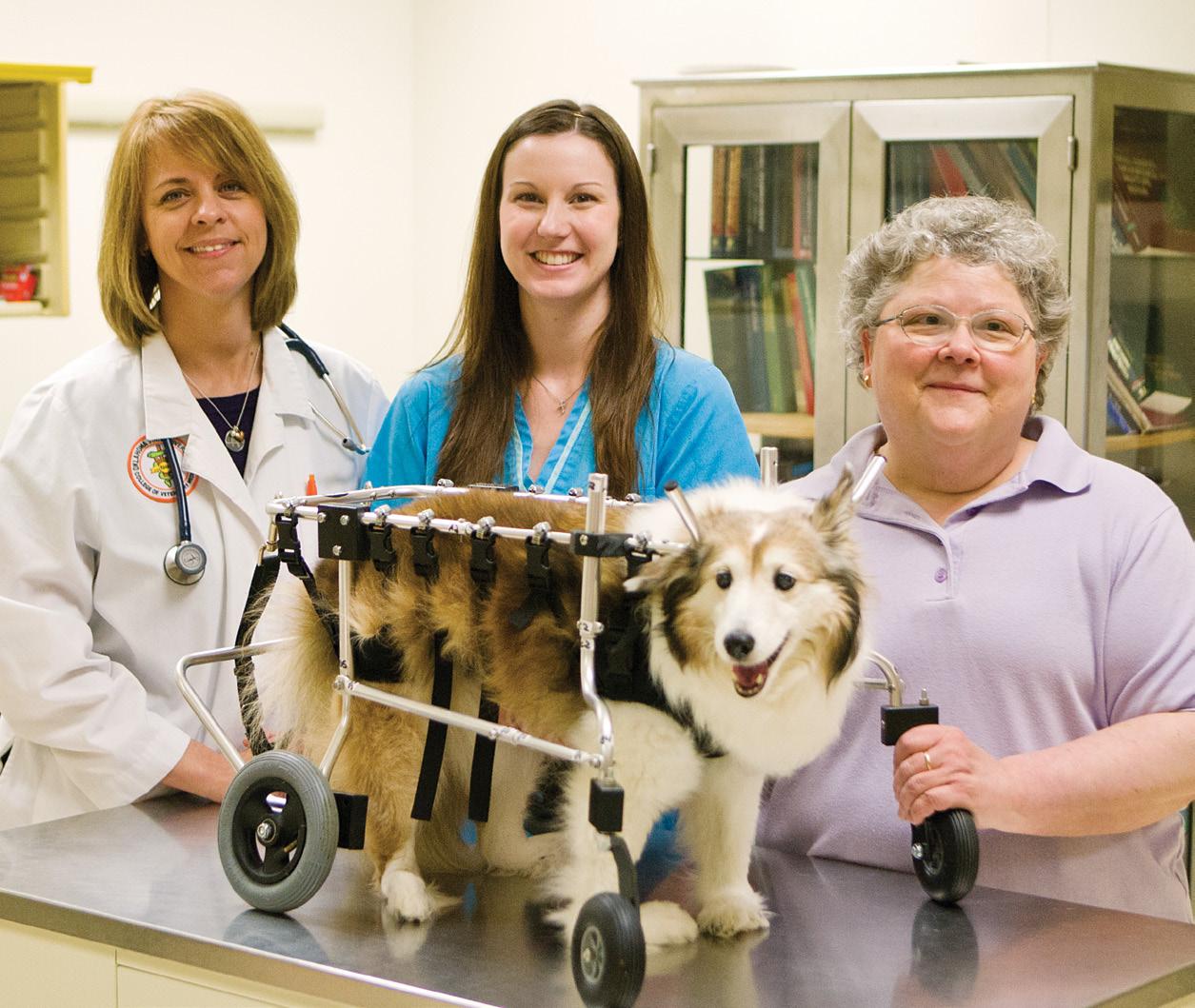
Veterinarian dr. lara Sypniewski (from left), certified canine rehabilitation practitioner laura Moorer and owner Marie Basler pose with Missy and her custom cart. Moorer came up with the idea of a cart for the arthritis-stricken dog.
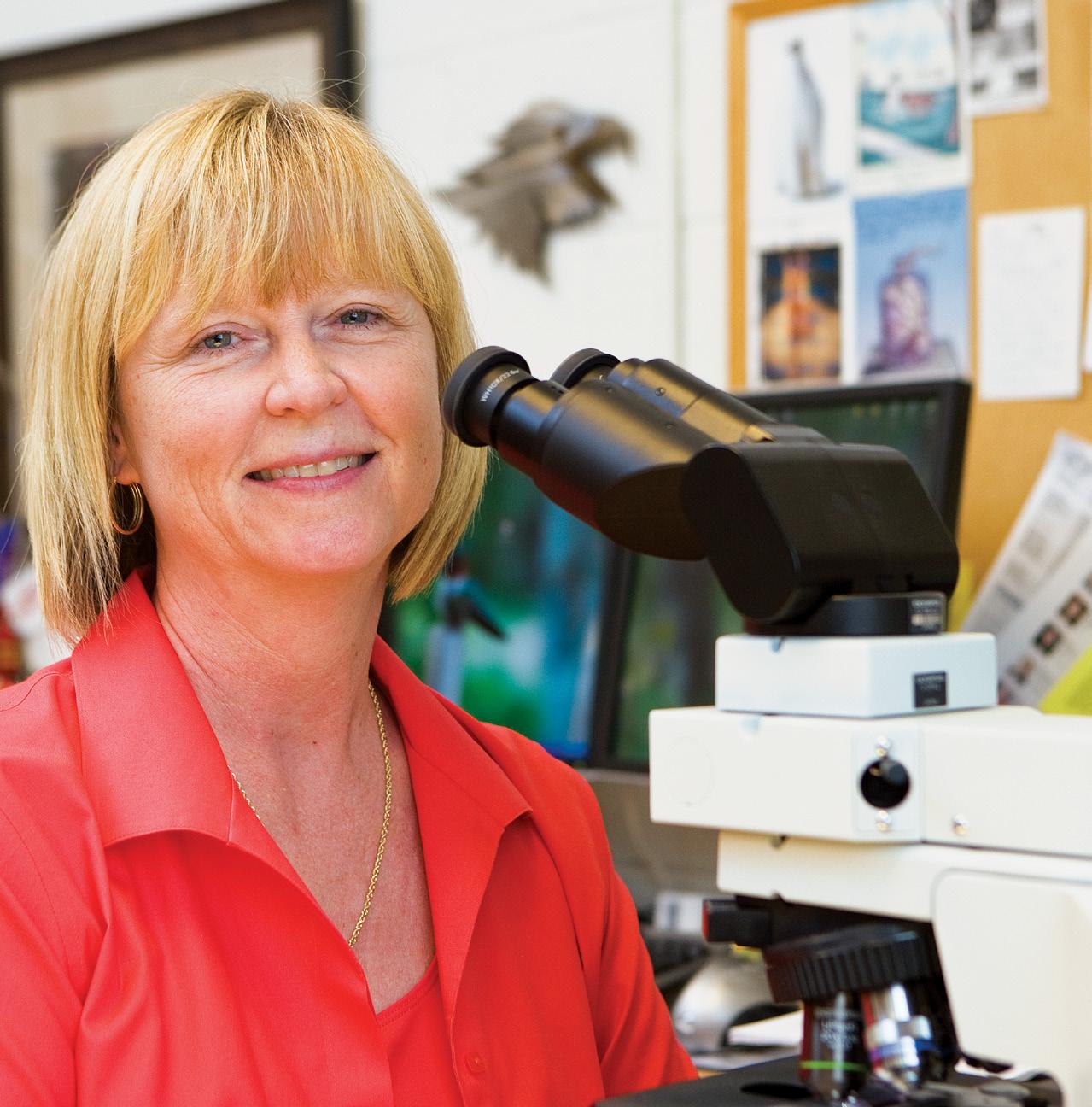
“it
giVes PeoPLe hoPe that they Can MaKe a DeCision anD Change the CoUrse oF their LiFe iF they Want to, they Don’t haVe to get stUCK. they’re not as oLD as they thinK.”

dr. robin allison always loved working in a lab, but she had to overcome her age concerns to follow her passion.
The circuitous route
The winner of 2011’s Regents distinguished Teaching award got a late start on her teaching career, but she wouldn’t have it any other way.
d r. robin a llison , a veterinary pathologist, spent 15 years as a certified veterinary technician working for practices in ohio, illinois, Colorado and missouri. a lthough she found that career rewarding, she was always drawn to the lab. Realizing her innate talent and passion, her supervisors let her go beyond her position’s requirements and analyze samples.
“That’s what I loved doing as a technician,” Allison says. “I could take a sample into my little closet of a lab and come out and say, ‘I know the answer. I have the information that’s going to make a difference in the way we treat this patient.’ That’s just really super rewarding.”
allison knew that was the career for her after attending a conference at Colorado s tate University. s he attended a talk by the woman who would later become her mentor, noted Ross University clinical pathologist dr. mary anna Thrall, and decided to go back to school, get her dVm and become a clinical pathologist. b ut there was one problem.
“my major problem at the time was that I was 36, and I thought I was too old,” allison says. “While on the phone with my mom, complaining about my life, i said, ‘even if i could get into vet school, i’d be over 40 by the time i finished.’ she started laughing. i got bent out of shape. she said, ‘i’ve got news for you, Robin. you’re going to be over 40 anyway.’ i said, ‘huh. g ood point.’”
By MAtt elliott
in 1991, a llison left a 480-acre ranch, moved into a house trailer and started school at Colorado state. she had to take undergraduate classes to get some of the necessary prerequisite courses out of the way, and those made her feel awkward about her age.
she calls it the hardest thing she’s ever done. still, she focused and made it to veterinary school, where she excelled, working in Thrall’s lab at CsU. following veterinary school, she did a residency in clinical pathology there and earned a doctoral degree in veterinary pathology.
allison finished veterinary school in 1996 and received her doctoral degree in 2002, both from Colorado state University in fort Collins. she was studying feline aids until she came to os U in 2004. Known primarily as a researcher at the time, she flourished in her new career at osU, excelling as a teacher as well as a scientist.
her enthusiasm for her work grew the more she did. That sense of wonder drives her today. it’s a big part of why she won the veterinary college’s top teaching award, ranking her among the best instructors to ever teach there, a noteworthy accomplishment considering the college’s history of strong instructors. s he especially enjoys working with nontraditional students.
“Nothing makes me happier than inspiring a student whom might have otherwise never thought about clinical pathology as a career,” allison says. “There are more and more older students or nontraditional students coming to veterinary school, and i feel a certain affinity with them because i know how hard it is to make that change in your life.”
dr. Catherine fischer, a third-year clinical pathology student at the University of g uelph in Canada, met a llison when she took a class a llison was teaching at Ross University a few years ago in st. Kitts. she had an obvious love for her work that was infectious, fischer says, as well as the ability to make difficult subjects such as clinical biochemistry seem simple. l ater, the two became friends, and allison inspired fischer to study clinical pathology, a career change that she, like allison before her, made in her 30s.
“she has definitely been an inspiration all along as one of my mentors and one of my idols,” f ischer says. “She is a brilliant teacher. She impresses people with a love of her subject as well as explaining things so simply and so clearly that even very complicated subjects seem very easy to grasp.” allison is board certified through the american College of Veterinary pathologists. at osU, she focuses on diagnostic pathology including infectious and neoplastic diseases of the blood. in addition to her noted career as an instructor, allison’s work has appeared in such publications as Veterinary Clinical pathology, the merck Veterinary manual, s chalm’s Veterinary hematology and the Journal of the american Veterinary medical association.
she loves telling her story to other nontraditional veterinary students like she once was.
“it gives people hope that they can make a decision and change the course of their life if they want to,” allison says. “They don’t have to get stuck. They’re not as old as they think.”
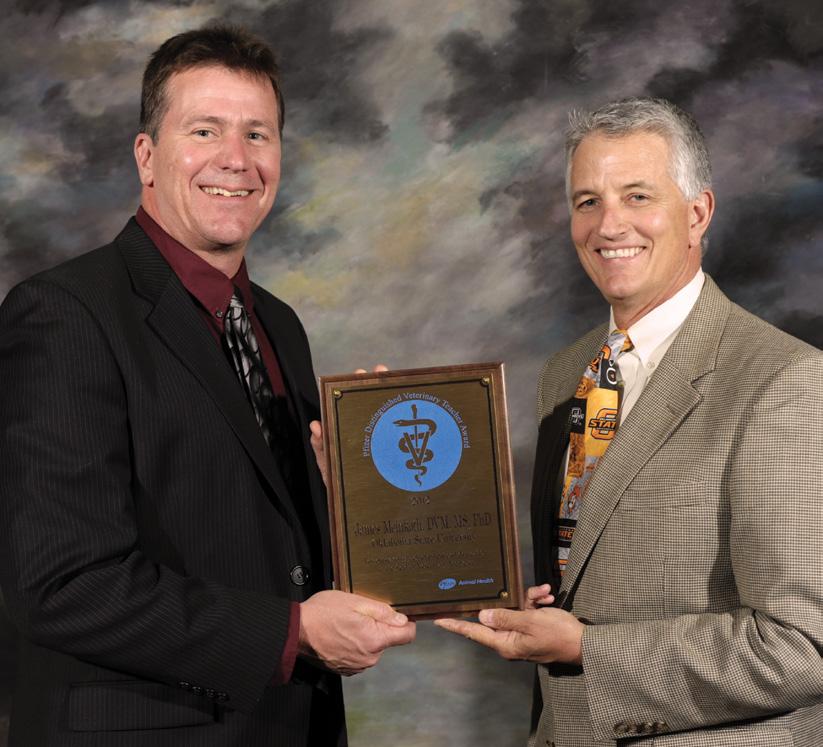
Loving what you do
By DeRinDA BlAkeney
r INA ry WO rk TO C l A SS ( AN d A l ESSON O r TWO fr O m THE bOSS , TOO )
he has received the Pfizer d istinguished teacher award three times (1997, 2008, and 2012) and the r egents d istinguished teaching award twice (1998 and 2005). listening to him talk about why he chose veterinary medicine and ultimately teaching, it’s easy to understand why veterinary pathobiology professor dr. Jim Meinkoth earned these awards.
“i worked for a veterinarian all through high school and what he was doing just didn’t seem like work. it was fun, interesting and rewarding. i couldn’t believe you get paid for doing that. The old saying — ‘ f ind something you love, and you will never have to work a day in your life’ — comes to mind.”
a fter veterinary school, dr. meinkoth worked for a year in private practice and discovered that he preferred pathology.
“i love clinical pathology, especially cytology (the study of cells). d r. r obi n Allison and I remark to each other often that it is amazing we get paid for reading slides. It is so cool. i love interacting with the clinicians and outside veterinarians about the cases.”
VETE
a nd he does so much more than just read slides.
“ you read slides on clinical cases, then you focus on teaching classes, then you might spend time writing an article or preparing for a continuing education presentation. by the time you rotate back to clinical duty, it seems fresh again. Teaching students is much the same. you may teach the same thing year after year but it is new to them, and their excitement makes it new for you as well. you watch someone else get excited about something you have seen 100 times or more, and it makes you realize how special and fun it is, just like it was for you the first time. it is much like having children and watching them discover things in the world for the first time.
“a lso, with academia (rather than a private diagnostic lab) you have the freedom to explore things, research interesting cases and go a bit further to find the answers. What is really fun is when you find something new that has not been noticed before.”
meinkoth has lots of memories from his 20 years of teaching at osU’s College of Veterinary medicine.
“What stands out is when i see someone who was a student a long time ago and has gone on to become a good practitioner
or a specialist and they say they remember me from veterinary school or mention something specific they learned that came in useful. That is great.”
meink oth joins two former faculty members as three-time recipients of the p fizer d istinguished Teacher award — d r. Rebecca mor ton (osU ’72) and dr. Roger panciera (osU ’53).
“Talk about good company! i am honored. it really feels good to think that the students appreciate what you do. i, like a lot of faculty members at the veterinary center, really put a lot of time and effort into teaching. it is nice to know that it is somewhat effective and that the students are getting something out of it. it is great to work at a veterinary college that values and rewards teaching by their faculty. i think the veterinary center administration should get kudos for that.”
While teaching and clinical pathology occupy most of his time, meinkoth is also a huge bruce springsteen fan.
“The springsteen fanaticism is something that is fun but is also beneficial in many ways. o ne, my sister is a big fan, and we go to shows together. she lives in Cape Cod, mass., and it has really helped us keep in touch over the years.
“Two, it gives me something personal to relate to my students. i like to talk about and share funny stories about personal interests in class.”
in fact, every class starts with a “thought of the day” when m eink oth shares something from a s pringsteen concert, funny things with his family or just silly things he has done.
“i think that the students like to get to know a little about the person standing up in front of them droning on and making them study all night. i know i like it when they tell me things about them.”
meink oth’s third reason for liking bruce springsteen is that he feels s pringsteen is a role model for teaching or anything one does.
“he puts absolutely everything he has into each show — that is why people go back over and over and over. i have heard him say in interviews something to the effect that while he may perform 100 shows a year, for the person in the audience, it might be the only show they will ever see, so he performs like it is the last show he will ever do. That kind of intensity would be a good attitude for whatever you do for a living.”
meinkoth has seen 61 springsteen concerts so far and has tickets for three more in august 2012, including one in massachusetts with his sister.
“my goal is to die having seen more bruce shows than the number of years i have lived. since i intend to live for a while longer, i plan to see as many concerts as i can. my wife (Katrina meinkoth, d V m , os U ’88) is very tolerant of my fanaticism, and i am extremely grateful for that. she comes with me to several of the shows, but she has more normal limits. my son went to his first couple shows and became a bit infected, so i’m a proud papa!” m eink oth earned his d V m d egree in 1985 and a master’s degree in 1988 from oklahoma s tate University. i n 1993, he earned a ph.d. in ve terinary sciences from Washington s tate University College of Veterinary m e dicine, and in 1994, he became a diplomate of the american College of Veterinary pathologists — Clinical pathology. h e continues to publish chapters in cytology textbooks, collaborates with residents on clinical case reports and works on Cytauxzoon felis infection with drs. mason Reichard and Theresa Rizzi.
dr. Jim Meinkoth (left) receives the Pfizer distinguished teacher award from dr. rocky Bigbie
Research award goes to Little
By MAtt elliott
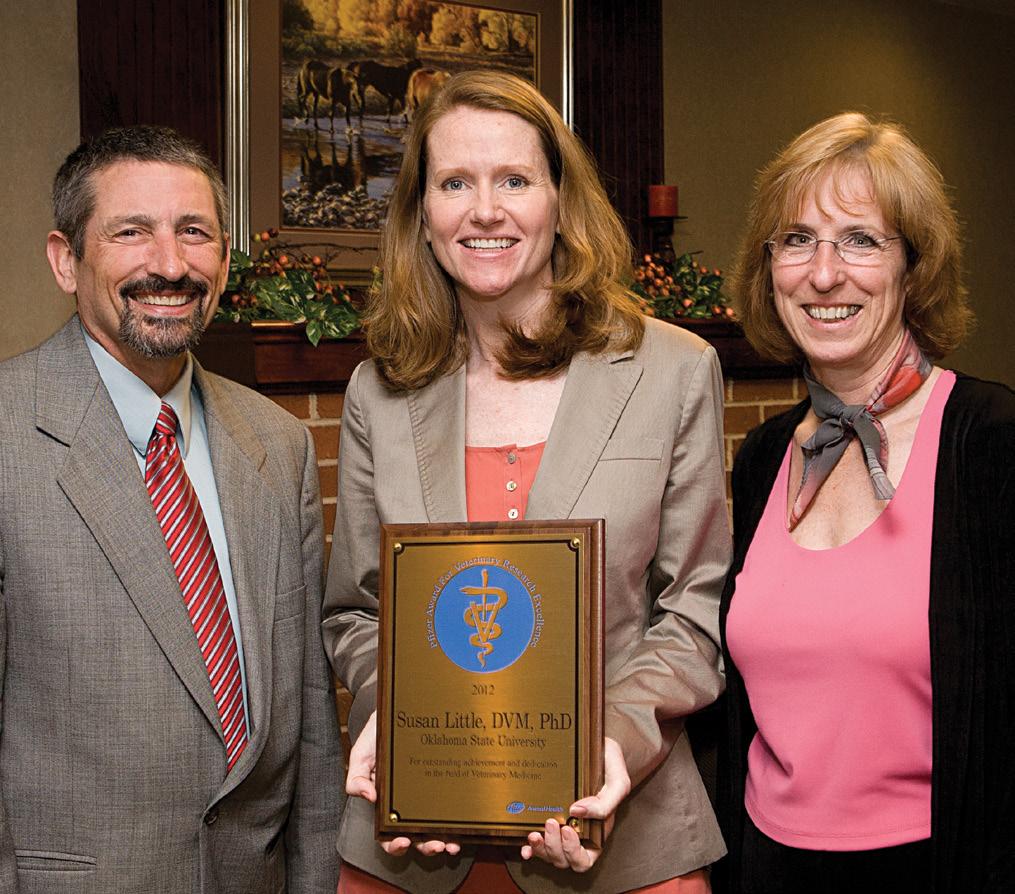
dr. Jerry Quinlan (left), veterinary academic liaison for Pfizer animal health, and osU Center for Veterinary health sciences dean Jean Sander (right) award dr. Susan little the 2012 Pfizer animal Health award for research excellence
a lauded Center for Veterinary health sciences researcher won 2012’s Pfizer animal Health award for r esearch e xcellence last may.
dr. Susan little, a Regents professor and past winner of the college’s distinguished Teaching award, was honored for her work studying parasites such as ticks and the diseases they carry.
“I just feel so lucky to be at Oklahoma State,” says l ittle, describing her reaction to winning the award. “ It’s so rare when you find the right place to be at the right time with the right people. i wouldn’t trade it for anything.”
since coming to osU in 2005, little has made her name studying the organisms that cause ehrlichiosis, lyme disease and Rocky mountain spotted fever. s he has become one of the nation’s leading such scientists, especially in her understanding of what diseases affect what regions most in the United states and how our changing climate affects parasites.
l ately, she’s added a new direction with her participation in research into heartworms, common tests to detect them and the drugs that fight them.
“There is growing interest in making sure the preventives remain as effective as we need them to be, and in understanding how the tests actually perform in our patients,” l ittle
says. “We rely on these treatments and tests to allow veterinarians to keep pets healthy. it is really important for parasitology researchers to be part of that effort.”
That work takes place inside the nation’s only facility of its kind, the n ational Center for Veterinary parasitology, which she established in 2008.
b ut her accomplishments aren’t limited to research alone.
i n 2012, she helped push her discipline, veterinary parasitology, to “diplomate status.” That’s similar to board certification in human medical specialties, she says.
“ b oard certification is making sure that when that service is provided, it’s done very well,” she says. “That’s why, when you have heart problems, for example, you want to go to a boarded cardiologist. you don’t go to a generalist, you want a specialist. The same is true for clinical parasitology challenges.”
The process began about four years ago. a t that time, anyone within veterinary medicine could refer to themselves as a parasitologist. her group filed a boatload of paperwork with the a merican b oard of Veterinary s pecialties and the a merican Veterinary m edical a ssociation, after which came a series of public comment periods and petitions regarding the establishment of the specialty. it was a tough sell for some, she says.
e stablishing the diplomate program, which includes a rigorous candidate exam and approval process, could have meant that people who lack dVms would be excluded from practicing the discipline in the future. That was a major concern of everyone involved, because many very gifted scientists who aren’t vets have made incredibly important contributions to the field, she says.
“There was a really valid concern about excluding people that are not veterinarians from the practice of veterinary parasitology,” little says. “ but the opposite response, doing nothing, means that anyone can call themselves a parasitologist because we had not defined the profession within veterinary medicine. anyone working with patients or in research could say ‘i’m a parasitologist.’”
over time, she says, the veterinary parasitology community recognized the importance of setting up the subspecialty.
“We identified a route of honorary diplomate status to include leading scientists who do not hold the dVm degree, and today, the momentum is very supportive and the community has come together over it,” she says.
The first candidates will test for the diploma in d ecember 2012. l ittle also serves on the committee making the exam they’ll take.
achieving the diplomate status for her discipline is one of the high points in her career.
“Veterinary parasitology is really critical to practicing veterinary medicine. Veterinarians spend a large amount of their professional time combating parasitic diseases, whether it’s fleas, ticks, heartworms, intestinal parasites, zoonotic infections, protozoal infections — it is a true clinical specialty. it just had never been formally recognized that way.”
l ittle is the Krull- e wing e ndowed Chair in Veterinary parasitology and director of the national Center for Veterinary parasitology. a uthor of more than 100 publications, her work has been funded by the national institutes of health, bayer animal health, swiss pharmaceutical company novartis and pfizer. she has served as president of the american association of Veterinary parasitologists, on the editorial boards of Veterinary Parasitology, Veterinary Therapeutics, and the Journal of Wildlife Diseases, and the executive board of the Companion a nimal parasite Council for Veterinary and medical professionals.
l ittle won the college’s p fizer d istinguished Teaching award in 2010. b efore starting in s tillwater in 2005, she spent nearly 10 years teaching at the University of g eorgia in a thens, where she obtained her doctoral degree in parasitology. her veterinary medicine degree is from Virginia Tech.
Out of the shark tank
T O p VET
S TU d ENT
l OO k IN g
f O r WA rd TO CA r IN g f O r
S m A ll ANI m A l S A f TE r HE r STINT AT A q UA r IU m
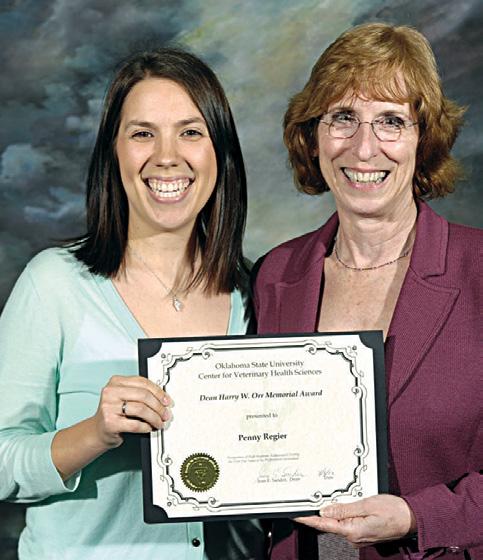
dogs and cats can stink. but even at their worst they smell way better than sharks. Penny regier knows.
“it ’s just a rotten smell,” she says. “i can’t even think of a word for it other than sour. They’re just sour.”
Regier learned that as the biologist in charge of the sharks at the oklahoma aquarium in Jenks. often, she’d spend her days in the tank with the sharks, examining them. she liked her job, and even though you can’t really smell them underwater, the 2005 graduate of osU had had her fill of sharks, their teeth and their sandpaper skin after three years at the aquarium.
she decided to go back to school and do what she had wanted to do since she was a kid: become a veterinarian. now, she’s a fourth-year student about to finish her degree and winner of the dean Harry orr award, the college’s third-year academic award. The award was extra special for Regier.
“it just really meant a lot that i made it this far while being able to do what i want to do,” she says. “it was great.”
it was also extra special because she had to leave her home in Tulsa and her husband during the week while she attended class. she also had to leave behind the luxury of a full-time job and teach herself how to be a student again.
“i hadn’t had to study for almost four years, so it was a big change,” Regier says. “a nd i missed making money.”
Regier, 28, came back to school in 2009, and after some early bumps in the road, she found her groove, excelling in both the classroom and the lab.
The first three years she says were all about reading and studying. This past year has been her favorite, she says. she’s been applying what she’s learned in her earlier courses while she does her rotations inside os U’s b oren Veterinary medical Teaching hospital.
“Now it’s just hands-on experience and clinical experience,” she says. “We’re actually getting to work with and interact with animals and apply everything we’ve learned.”
in the future, she hopes to land a small-animal surgery internship and residency. she has been interested in the specialty ever since she took in two dogs that have had more than their share.
“These were my ‘free’ puppies that i rescued,” she says. “one of them had hip dysplasia in both hips, and the other tore both of his aCls — part of the joys of owning dogs. i think that’s probably what started this whole thing.”
ev entually, she’d like to join a practice somewhere in the United states as a small-animal surgeon. s h e’s not ruling out starting her own practice in the future, but she wants to avoid the added stress of starting her own business for now.
The dean harr y orr award features a $2,500 scholarship and is named for the second dean of the College of Veterinary medicine. orr led the college from 1953 until his death in 1956.
— MAtt elliott
Gennessee photo
Penny regier (left) receives the dean Harry orr award, the veterinary college’s third-year academic award, from dean Jean Sander

Roberson receives professional award
e ach year, the a merican indian science and engineering society recognizes native americans who have excelled in their respective fields and who have been involved with the native community. in 2011, aises presented dr. Jerry roberson with the Professional of the year award.
Roberson, a Cherokee, is an associate professor at the University of Tennessee. growing up in oklahoma, Roberson’s father was an agriculture teacher, so animals have always been part of his life. he graduated from adair high school and earned his bachelor’s degree and his dVm degree (’86) from os U. a fter completing a yearlong internship in foodanimal medicine and surgery at iowa state University, he went on to earn a p h. d. in veterinary science from Washington state University.
Today, Roberson spends his time delivering classroom lectures, conducting research, writing, investigating disease outbreaks and performing clinical duties. a specialist in mastitis, especially in dairy cows, the most rewarding aspect of his work is providing hands-on instruction to students in labs and surgeries. but there is one more thing that lifts Roberson a cut above his colleagues.
Roberson is committed to helping native students succeed. before coming to Tennessee, Roberson and his wife, l aurie (also a graduate), were co-advisers for the native american student association at Kansas state University. When he arrived at Tennessee, Roberson was surprised to learn that a similar organization was not available. so he organized one and is helping launch an aises chapter at Tennessee.
“mentoring and guiding Native students is extremely satisfying,” says roberson. “Helping students succeed is really great, and I’ll do anything I can to help.”
Throughout his career, Roberson has spearheaded more than 20 funded research projects in veterinary medicine and bovine health. he has demonstrated important findings in the overuse of antibiotics in dairy farms and bacteria resistance, among other topics. Roberson has also been honored for his teaching style, including winning the 2011 Carl J. norden pfizer d istinguished Veterinary Teacher award and the 2011 student Chapter of the american Veterinary medical a ssociation l ecturer and outstanding educator award.
phiL snow / University of tennessee
dr. Jerry roberson gets a milk sample from a dairy cow.
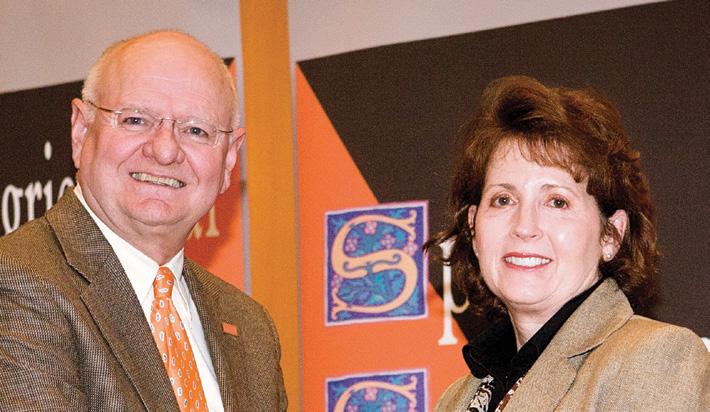
Marilyn Wilson wins University Service Award
university service Awards recognize a faculty member, a staff member and an administrator for meritorious service to oklahoma state university.
The 2011 University Service a w ard administrator recipient was marilyn Wilson, a 34-year veteran of the veterinary center. she is known for her strong work ethic, grace in handling difficult situations and doing the right thing every time. she often put in extra hours on nights and weekends to handle an emergency or meet a deadline.
as direc tor of fiscal affairs, Wilson oversaw every aspect of a $35 million budget as well as served as point person for all human resource issues and responsibilities. Throughout her career, she has been a tremendous ambassador for the veterinary center and an outstanding employee. Wilson has earned the respect of her veterinary colleagues, central and college administration and individual faculty and staff.
“ marilyn re tired in early 2012. a s we began looking for someone to fill her shoes, the scope of what she brought to os U became increasingly clear,” says d r. Jean sander, dean of the veterinary center. “I can think of no more deserving recipient for the 2011 University Service Award.”
Brent Johnson named finalist for campus honor
staff Advisory Distinguished service Awards recognize individuals, judged by their peers, who bring value to their workplace, exhibit a positive attitude toward those they serve, and in general are outstanding representatives of oklahoma state university.
brent Johnson, an analytical toxicologist at the oklahoma animal disease d iagnostic l abor atory, was a finalist for the 2011 Staff advisory d istinguished Service award he is known as a great team player.
Johnson is the sole worker and lab manager in the toxicology laboratory. This year, he stepped up to work in three sections of the oaddl at the same time. i n addition to running m yriad tests every day in the toxicology lab, Johnson was asked to run piroplasmosis tests in the serology lab, which required him to become certified. The extra effort he put forth was vital, enabling the lab to provide timely information to horse owners so that they could race their horses or compete at shows and fairs.
“brent is a perfect example of a loyal, hard worker,” says sandra morgan, dVm, m s., diplomate of the american board of Veterinary Toxicology. “He is able to do all of this multitasking because he is intelligent, capable and willing. He always goes the extra mile and will help whoever needs it in the lab. Steady and professional, brent has a positive attitude and keeps the goals of the entire OAddl in mind.”
Marilyn Wilson receives the 2011 University Service award from oklahoma state Vice President Gary Clark
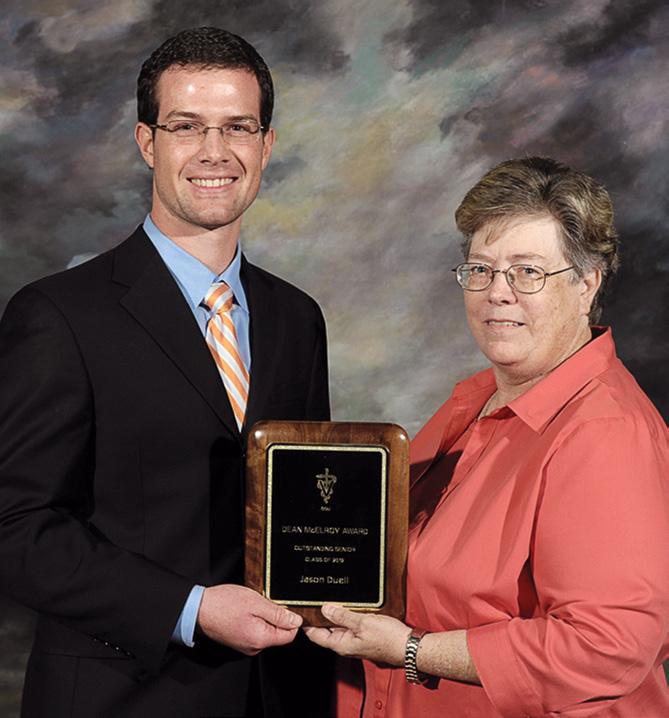
Patricia Mcelroy, granddaughter of dr. Clarence Mcelroy, presents the prestigious dean Clarence H. Mcelroy award for 2012 to Jason duell of hennessey, okla.
McElroy Award goes to Hennessey student
Jason duell of hennessey, okla., is the 2012 dean Clarence H. Mcelroy a ward recipient. h aving always enjoyed working with animals and the sciences, veterinary medicine gave him a way to combine both for a rewarding career.
Throughout veterinary college, duell served as an ambassador for the college, an osU academic integrity panel member and Christian Veterinary fellowship president.
The d ean m c e lroy a ward is the highest honor a veterinary student can earn. duell also received an american College of Veterinary s urgeons award and the dean michael d lorenz endowed scholarship for his academic achievements.
“ i was very surprised when i was named as the d ean m c e lroy award recipient,” says d uell. “ i t’s such an amazing honor. i know that there are so many who are deserving, and it is very humbling to have been chosen.” established in honor of the first dean of the veterinary college, d r. m c e lroy, the award is based on ballots from faculty and fourth-year students for his or her high academic achievement, leadership and outstanding clinical proficiency.
“ i will be forever grateful for the friends i have made at osU and the people i met along the way,” says duell. “it is a privilege to practice veterinary medicine, and i am thankful each day for the opportunity.”
d uell is headed to a small-animal rotating internship at Texas a&m University to further hone his specialty of small-animal veterinary medicine. he is the son of fred and sheila duell of hennessey.
— DeRinDA BlAkeney
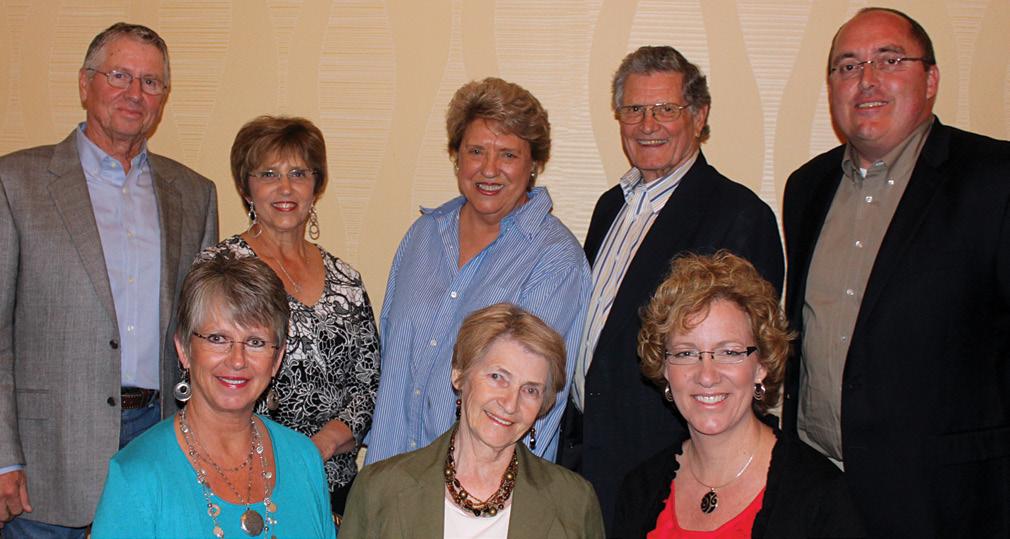
AVC honors founding member and OSU alumnus
at the 2012 academy of Veterinar y Consultants meeting, d r. Harold r inker , Class of 1958, was honored posthumously with aVC’s outstanding Service award sponsored by me rck a n imal he alth, the award was presented to Rinker’s family by os U alumnus dr. Tom l atta (’68).
“i went to work for dr. Rinker right out of veterinary college in 1968,” says l atta, a past-president of the aV C. “ he was m y mentor in production medicine. i have worked at a general veterinary practice; however, the last 30 years, i have spent as a consultant. it was an honor for me to present this achievement award to dr. Rinker’s wife, Jan, and their daughters, Kim White and Kelly Cantrell.”
Rinker, who died Jan. 2, 2012, was a founding member and the second president of the aVC.
“Hal r inker was a leader in feedlot health and medicine. He embraced the philosophies that are necessary to be an effective feedlot practitioner,” says d r. Roger panciera, one of Rinker’s former professors and an osU professor e meritus who nominated Rinker for the award. “he rewrote the books on veterinary practice when it comes to feedlot medicine. The old thought process was to put a lot of importance on the individual animal. The feedlot practice recognizes that it is about what is best for all of the animals.”
The aV C o utstanding s ervice award recognizes a member who has made outstanding contributions to aV C and the beef cattle and veterinary medical profession. a ccording to information published by merck a nimal health, d r. Rinker was a pioneer in the industry and a great teacher and positive influence to many.
aBoVe: accepting the aVC outstanding Service award on behalf of dr. Hal rinker were his wife and daughters, (front row, from left) Kim White, Jan rinker and Kelly Cantrell Congratulating the rinker family were (back row, from left) dr. tom latta, aVC immediate past president and longtime colleague of rinker’s; linda latta; Mary Bechtol; dr. david Bechtol, founding aVC member and first president; and dr. eric Moore of Merck animal health.
Dr. h a L r in K er
Facilities manager wins Stratton Staff Award
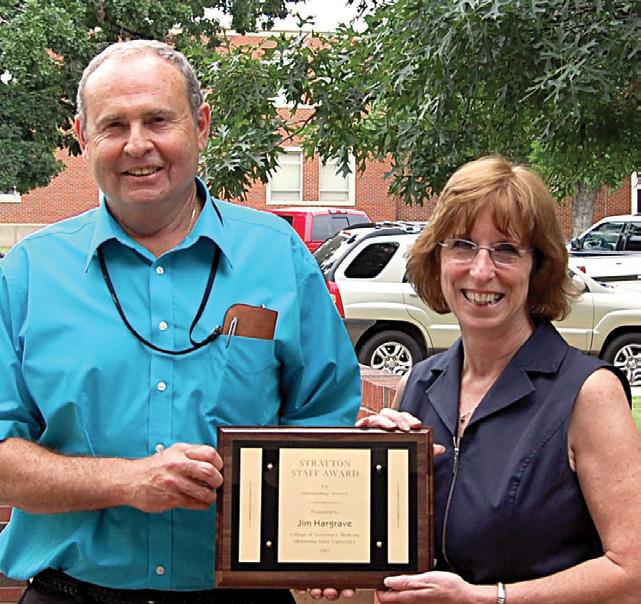
Jim Hargrave came to osU for a challenge. The veterinary center’s facilities manager found that in spades, but he also found a rewarding career as well as a loving and supportive community that became like a second family.
“We have a lot of good people here,” says hargrave, who won the center’s Stratton Staff award for 2012.
The author of his department nomination form lauds hargrave for his demeanor, courteousness and dedication to his job, something he says has grown into a 24-hour, sevendays-a-week post he wouldn’t trade for the world.
h argrave came to os U in 1991 after a decade running the Cushing Regional hospital’s facilities. a native of san antonio, hargrave grew up in an engineering family. his father was a mechanical and electrical engineer who owned a heating and air conditioning company. he spent four years in the U.s. air force as an air traffic controller and mechanic, stationed for a time at King s almon, a laska, and bergstrom air force base in austin. he later attended the University of Texas at austin on the g.i. bill. he moved to oklahoma in 1981 to work at the hospital in Cushing. he met his wife there and bought some land northeast of town before making the career change from humans to animals with his move to osU.
Jim Hargrave and dean Jean Sander show off hargrave’s plaque for winning the 2012 Stratton Staff award
“i was looking into getting into a bigger pond, i guess,” hargrave says. “something with a better retirement system and benefits.”
2012’s s tratton s taff a ward couldn’t have gone to someone with more on his plate.
hargrave oversees mcelroy hall, a labyrinthine facility built and added on to at various times since 1940 that contains classrooms, offices and labs. he also runs the b oren Veterinary medical Teaching hospital, which is almost a full-time job by itself.
g overnment regulations are very different for animal and human hospitals, as are the kinds of failsafe infrastructure required to ensure patients get the care they should receive, hargrave says. in addition to those rules, he must know how everything inside the hospital works, from the smallest network of pipes to the most complex radiation equipment. he also oversees the oklahoma animal disease d iagnostic l abor atory, an equine ranch, several research centers, a hay barn and an animal shelter.
That’s more than 454,000 square feet of buildings. hargrave maintains them with just three mechanics, a plumber, several hVaC engineers and an electrician.
Getting complex
as the veterinary center’s focus has evolved into comparative medicine (the areas where human and animal health intersect), his job has become more complex. The addition of a biosafety level-3 lab in 2001 and other features means he has to monitor critical systems constantly. Technology, such as a system that calls or texts him when things go wrong, makes that easier, but it also has made his job more time-consuming.
one night, that system sent him an email that the temperature in a critical research lab was rising, causing sensitive equipment to shut down. a scientist there was distraught that she was going to lose her data and expensive technology.
“Using my i pad, i went online to the building automation system we installed in 2008 and saw the temperature inside the lab,” hargr ave says. “it was in the 80s. i went to the air handling unit graphics, diagnosed that a heating valve had failed and everything was on full heat. i turned it off, and temperatures went back
to normal. Typically, we get calls or emails several times a month after hours and on weekends when there is a critical need. but we’ve got great ability to take care of these remotely with technology.”
hargrave is also the point man for every construction project the center undertakes. he’s the go-between for the center’s leadership, engineers, architects and construction companies working on expansion projects, such as a recently completed $13 million addition to the diagnostic disease lab.
he is most proud of an energy savings program begun in 2003 that culminated in the automated climate control system installed in 2008. h e can monitor conditions in every building. it le ts him adjust the system for peak usage times, cutting energy costs. and he started it five years before osU established its own campuswide energy conservation movement.
“I’m proud of that,” Hargrave says. “We’re close to $2 million in savings — money we wouldn’t have if we hadn’t taken those measures. And we’ve also been able to deliver a more comfortable environment.”
further evidence of hargrave’s dedication to his work shows in his battle with cancer. shortly after he started at osU in 1991, doctors found a grapefruit-size tumor in his abdomen, and he was diagnosed with non-hodgkin lymphoma. he was given a 60 percent chance he wouldn’t make it five years. but his cancer entered remission after several rounds of chemotherapy and grueling radiation treatments. during that time, hargrave, who drove himself to and from his treatments, kept up his normal schedule at work.
“Vet med took good care of me. They really did. There are some people here that really helped me a lot. i wasn’t at 100 percent by any means, but they let me hang around.”
No ‘pity parties’ hi s cancer returned a few years later. more radiation treatments followed, and he went 16 years without relapsing until just over a year ago before Christmas. Today, he has seven tumors spread around his chest, shoulder and abdomen. e nduring more treatments, he still comes to work and does his job as well as he always has. he doesn’t dwell on it or have “pity parties,” he says. he has a wonderful support network anchored by his wife, June hargrave, who is a registered nurse, and his best friend, d r. i ke h u bbard. he also volunteers with Relay for life and is frequently found fishing on oklahoma lakes. an awardwinning bass fisherman, hargr ave goes saltwater fishing near Corpus Christi with the saltwater Cowboys — some vet school faculty and staff members who stay in a condo in por t aransas, Texas, and spend a few days out in the gulf of mexico fishing. his fish fries are nothing shor t of legendary. one year, he got together with some fishing buddies from the physical plant, set up some awnings outside the vet school, wrangled some tables and chairs and hauled over a grill and fryers. They ended up feeding about 300 people, he says. meanwhile, he takes solace in the fact that, by running the veterinary center’s facilities, he’s helping in the fight against cancer.
h is F ish F ries are no thing short o F L egen D ar y.
“research is so important. I’m on a drug that wasn’t around two years ago. So sometimes I feel like with the job I’m doing here with the facilities and other things I’m contributing a little bit to my part of the fight.”
— MAtt elliott
Ada veterinarian wins state’s top honor
a frequent os U donor won t he o klahoma Veterinary Medical a ssociation’s Veterinarian of the year award for 2012.
d r. Calvin White , owner of the a da Veterinary Clinic, received the award at a ceremony last January during the association’s annual convention in oklahoma City. White, who has been practicing medicine for 35 years, says he supports osU because he believes strongly in its mission.
“i’m a cow college fan,” White says. “i went to mississippi state. our rival was ole miss. i went to a uburn, and our rival was alabama.”
he is practicing in oklahoma today because several of his professors were from there, and one, dr. bob hudson, was an oklahoma state alumnus.
White’s first experience with oklahoma came during his preceptorship in 1977, when he worked for a practice in Coalgate.
“I just like the people in Oklahoma,” White says. “plus, there are more cattle and horses here than where i grew up in poplarville, mississippi.”
h e work ed at the Coalgate clinic after finishing his preceptorship. Then, he bought into his ada practice, which he co-owned for 26 years until 2007, when he bought out his partner, dr. don Connally.
White feels a duty to donate to Oklahoma State because of the quality of its services such as referrals, disease diagnoses, research and scientific expertise. he knows the college will remain strong under its new dean, dr. Jean s ander, hired in 2011 to replace the college’s dean since 2004, dr. michael l orenz.
“i’ve been impressed with what she has done so far, continuing in the college’s tradition of reaching out to the veterinary medical community in o klahoma,” he says.
Recently, he has taken a leading role in fundraising for the college.
With others at the osU foundation and the school, he set up a contest to see if veterinarians who didn’t go to osU could raise more money than those who did.
“ o f course, the os U people won, but we probably got some money out of some people that we might not have otherwise. if you’re going to be in the state, you need to support them.”
White compares os U favorably with his alma mater, auburn University (’77), for its emphasis on producing veterinarians with strong backgrounds as mixed practitioners. i deally, he says, specializing should come later in a vet’s career.
in addition to working as a practitioner, White has been a member of the advisory board to murr ay s tate College’s Veterinary Technology p rogr am. he also has been a s trong supporter of 4- h and future farmers of america programs. other volunteer leadership includes his chairing of the o klahoma Quarter h orse a ssocia tion youth s cholarship fund. White has also volunteered with the a merican Quarter horse a ssociation, the pontotoc Count y Cattlemen’s a ssocia tion, the a da Chamber of Commerce and the pontotoc Count y a nimal s helters.
— MAtt elliott
The Oklahoma Veterinary Medical Association honored a number of Oklahoma State alumni at its 2012 awards banquet. Those awarded include:
Sm A ll-A NI m A l p r A CTITIONE r O f THE yEA r — d r . s yb I l h e I se O f gU ym ON , Cl A SS O f 1971
y OUN g p r A CTITIONE r O f THE yEA r —
d r . d U st I n b rown O f mClOU d, Cl A SS O f 2005
dIS TIN g UISHE d S E r VICE AWA rd —
d r . s cott m ason O f Okl AHO m A C IT y, Cl A SS O f 1991
dr. Calvin White of ada is the oklahoma Veterinary Medical association’s Veterinarian of the year for 2012.
Four named Distinguished Alumni
The Distinguished Alumni Award is selected and presented by the College of Veterinary Medicine Alumni Association Committee. It recognizes outstanding professional and personal achievements and contributions to the enhancement of the veterinary profession.
the 2011 honorees are d r . t heresa c asey , d r . k e I th f lanagan , d r . d ee g r I ff I n and d r . k erm I t m I nton .
d r . t heresa c asey
Casey has demonstrated the value of veterinary education with a stellar military career that has included many firsts.
she earned her dVm degree in 1982. in 1989, she earned a master’s degree in public health (environmental toxicology) from the University of oklahoma health sciences Center, and in 1990 she became a diplomate of the american College of Veterinary preventive medicine.
following Congress’ abolishment of the air force Veterinary Corps in 1982, Casey began her veterinary military career in the air force biomedical sciences Corps, serving as the chief of environmental health services at Vance air force base in oklahoma. s he was one of the first veterinarians to enter this field.
Casey accomplished many firsts in her career as a veterinarian and bsC officer.
Theresa Casey’s firsts include:
chief, military public health and commander, Aerospace Medicine squadron, 86 th Medical Group, Ramstein Air Base in Germany. s he was the first veterinarian to command an Air Force medical squadron. casey directed comprehensive clinical, preventive medicine, health promotion, public health and industrial hygiene services for the largest overseas u s. military community.
european command Humanitarian Assistance team senior medical officer, Goma, Zaire. A veterinarian and Bsc officer had never held a similar position of leadership and responsibility. she coordinated Department of Defense support for humanitarian relief for 1.5 million Rwandan refugees.
Deputy commander, 86th Medical Group, Ramstein Air Base, Germany. Again, a veterinarian had never been selected as the deputy commander of an Air Force hospital. casey was second-in-charge of the largest Air Force outpatient care facility in europe.
Joint task force surgeon for kosovo Albanian Humanitarian operations. As senior medical officer, she coordinated preventive medicine, acute care and emergency evacuation requirements for more than 1,000 military personnel.
commander, 86th Air expeditionary Group. casey led a 200-member multidisciplinary team of medical, communications, security, engineering and food service personnel providing acute care, surgery and immunizations to more than 19,000 patients in six days during a Department of Defense humanitarian exercise in cameroon.
commander, 1st Medical Group, langley Air Force Base, Va. she was the first veterinarian and Bsc officer to serve as chief executive officer of the fifth-largest hospital in the Air Force.
Director, Medical Modernization Directorate and Biomedical sciences corps chief. casey was the chief executive officer for one of four directorates at the office of the u s. Air Force surgeon General. As chief of the Biomedical sciences corps, she was responsible for recruitment, retention and career advancement for more than 2,200 officers serving in 17 distinct allied health disciplines.
Brigadier General. selected in August 2006, casey was the first active duty Bsc officer and veterinarian to serve as a general officer.
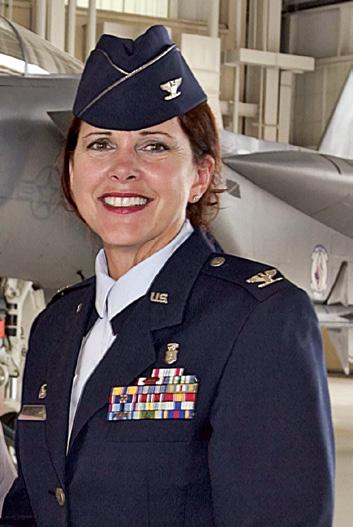
Casey has received numerous awards, including the association of military surgeons of the United states’ 2009 James a . mcCallum award for her outstanding accomplishments in military veterinary medicine, the 2003 military Volunteer award for extended sign language/deaf ministry service, 2000 order of Valour from the Republic of Cameroon for leadership in a combined U.s.-Cameroon humanitarian exercise and delivery of health care services and training, and the list goes on.
a lifetime member of the osU alumni association, she is also a member of the american Veterinary medical association, the american association of food hygiene Veterinarians and a lifetime member of the air force association.
perhaps Casey’s greatest contribution has been to the veterinary profession. her personal veterinary knowledge, capability and leadership clearly demonstrated to the air force medical community the attributes and capabilities within the veterinary profession. she serves as a role model, and her example will open doors and create new opportunities for current and future veterinarians, both military and civilian.
Casey is currently a consultant for decon iii llC in belton, Texas, working with air force and navy medical facilities worldwide on the decontamination of patients exposed to chemical, biological or radiological weapons and toxic industrial materials. she also is a member of the national animal health emergency Response Corps, serving as an on-call veterinarian to help protect animal populations and communities during emergencies. married to John l . l ehew iV, she resides in belton and has three children, Courtney, Katie and John.
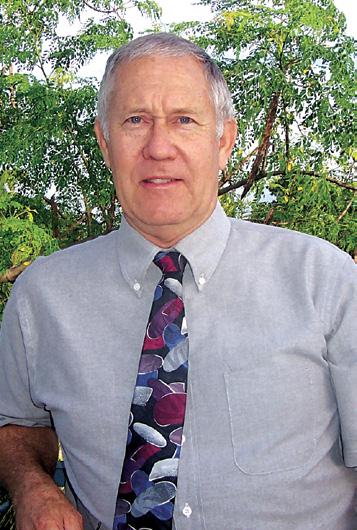
d r . k e I th f lanagan
d r. Keith f lanagan has been working to improve lives and health care in haiti since 1986.
flanagan earned his dVm degree from oklahoma state University in 1978. he spent the next two years serving as a captain in the U.s. army Veterinary Corps as group veterinarian for the 5th special forces group (airborne), fort bragg, n.C. following his military service, he worked at the marlow Veterinary Clinic for seven years with a classmate, dr. lyndon graf.
during 1986, flanagan took a 14-day visit to haiti. The next thing he knew, he was asking his wife, Jan, what she thought about living in haiti. flanagan began working with the Christian Veterinary mission as the staff veterinarian and farm manager at hospital albert schweitzer in deschapelles, haiti. he planned to work for a couple of years in haiti — set up some programs, train people in animal health care and return to the s tates. Twenty-four years later, he is still there.
Through his years in h aiti, f lanagan has held many positions and been involved in several projects and programs including instituting preventive health measures, potable water development, training animal health agents, liaison to the haitian ministry of agriculture, co-director of Classical swine fever program and co-director of the avian influenza program.
in addition, flanagan has been director of two pan-american development foundation road and canal rehabilitation projects in the artibonite Valley of haiti, evaluated veterinary medicine animal training programs in Kenya and Tanzania, consultant to save the Children for evaluation of an animal health training program in e thiopia, consultant to heifer projec t international to develop and facilitate an animal health training of trainers course in Creole, and the list goes on and on.
in his c urrent position with Christian Veterinary mission, flanagan hosts short-term mission trips and trains and mentors young haitian veterinarians. he continues to work closely with the ministry of agriculture on animal disease control programs. his wish is that the programs he has helped implement and the work he has done will keep moving forward even after he is gone.
both flanagan, the son of Rosella flanagan of Texhoma, and his wife, Jan, graduated from Texhoma h igh s chool and panhandle state University. They raised two sons in haiti, sean and brian. sean and his wife, Chandra, both graduated from osU. They now reside with their two children in decatur, ala., where sean works as a computer specialist with Raytheon. after graduating from Texhoma high school and oklahoma panhandle state University, brian returned to do community development work in haiti for six years. While there, he me t his wife, Robin. They have recently moved to ne w york state, where brian will pursue a master’s program in international agriculture development at Cornell University.
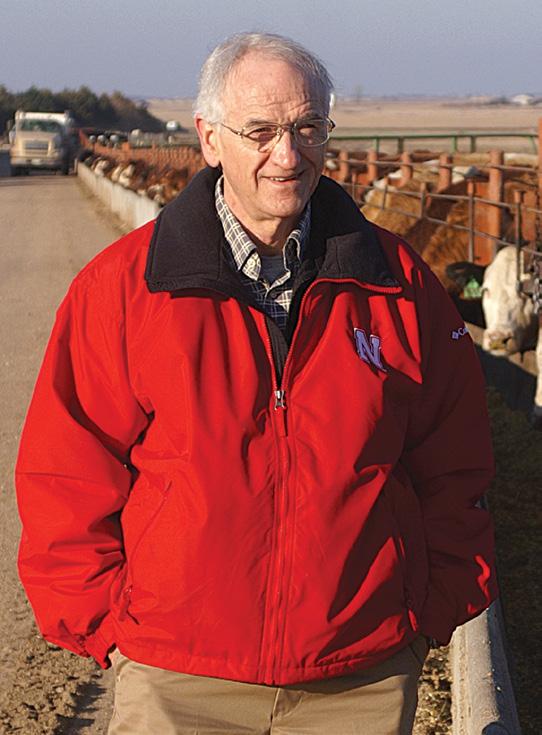
d r . d ee g r I ff I n
dr. dee griffin has had a tremendous impact on the cattle industry.
he earned his dVm degree from osU in 1975 and a master’s degree in veterinary pathology and animal science from purdue University in 1978.
g riffin has spent most of his career in the cattle industry. he was the staff veterinarian for hitch e nterprises, a family-owned operation that has 1,200 cows, as many as 20,000 stockers, more than 250,000 feeder cattle and two packing plants. griffin has worked with the beef Quality awareness program since its inception, when hitch enterprises became the first U.s. department of agriculture verified control production beef operation.
Today, griffin is a professor at the University of nebraska in veterinary and biomedical science, teaching at the great plains Veterinary educational Center. his emphasis is on developing pre-harvest haCCp (hazard analysis, critical control points) production practices dealing with residue avoidance. he has a keen interest in respiratory disease and proper antibiotic usage.
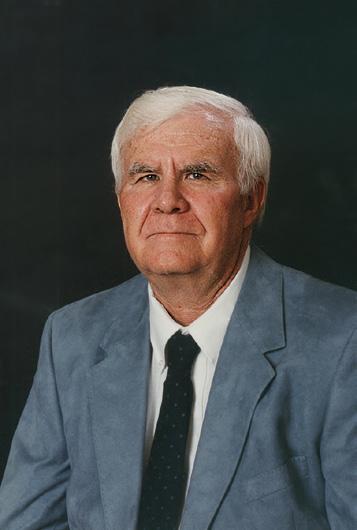
d r . k erm I t m I nton
dr. Kermit minton has made a 50-year career spent in lindsay, okla., a family affair.
after minton graduated from sulphur high school oklahoma, he enrolled at murray state University, where he took 60 hours in three semesters and won two scholarships as the top agriculture student. he enrolled at o klahoma a & m College and earned his bachelor’s degree in 1956. in 1958, he earned his dVm degree and has served as the class representative since then.
a past president of the academy of Veterinary Consultants, griffin won two national awards from the american a ssociation of bovine practitioners: one for excellence in preventive medicine and one for institutional Teaching, Research and service excellence. he received the academy of Veterinary Consultants’ Consultant of the year award. he serves on the national Cattlemen’s beef association’s beef Quality and safety assurance advisory board, the fda’s Veterinary medical advisory Committee and minor Use minor species Committee, and the professional animal auditor Certification organization’s board.
griffin is a member of several organizations, including the academy of Veterinary Consultants, a merican Veterinary medical a ssociation, p lains nutrition Council, nebraska Cattlemen, nebraska Veterinary medical association and the nebraska academy of science.
i n a ugust 1958, m inton founded the l indsay ( o kla.) Veterinary hospital. one of his first cases was a farm call south of lindsay concerning a cow that came from l ouisiana that had died. minton took samples and sent them to the state department of agriculture. The diagnosis was anthrax. state authorities investigated, resulting in quarantine for several farmers and ranchers in the area.
Through the years, m inton expanded the lindsay Veterinary hospital, serving both large and small animals. in 1992, he added to the large-animal facilities and installed a tilting chute to accommodate larger livestock. Clients included local farmers and ranchers whose locales ranged from Verden, okla., to marietta, okla. m inton suffered a heart attack in 1990. his wife, frankie,
retired from teaching school and became the office manager at his practice. in 1993, daughter Tammy m inton joined the practice after earning her dVm degree from her father’s alma mater. many clients began referring to the mintons as “big doc,” “little doc,” and “mrs. doc.” in 1997, Tammy minton took over the practice. h er father continued to work part-time. in 1999, they expanded the building to incorporate more space for small animals and added more diagnostic equipment for blood work and radiographs. in 2005, they officially stopped working with large animals, selling all of the equipment pertaining to the large-animal side of the business. lindsay Veterinary hospital strictly serves small animals today.
Kermit minton was more than a veterinarian in lindsay. a past president, he continues to be active in the lions Club. he is a lifetime member of both the future farmers of america and the elks l odge.
minton is also a lifetime member of the oklahoma Veterinary medical association, the american Veterinary medical a ssociation and the os U a lumni a ssociation. h e proudly displays a special gold seal on his 50-year license to practice veterinary medicine.
minton still enjoys his work, visiting with clients and spending time at the family’s cabin at l ittle g lasses Resort at l ake Texoma.
Before the supermarket
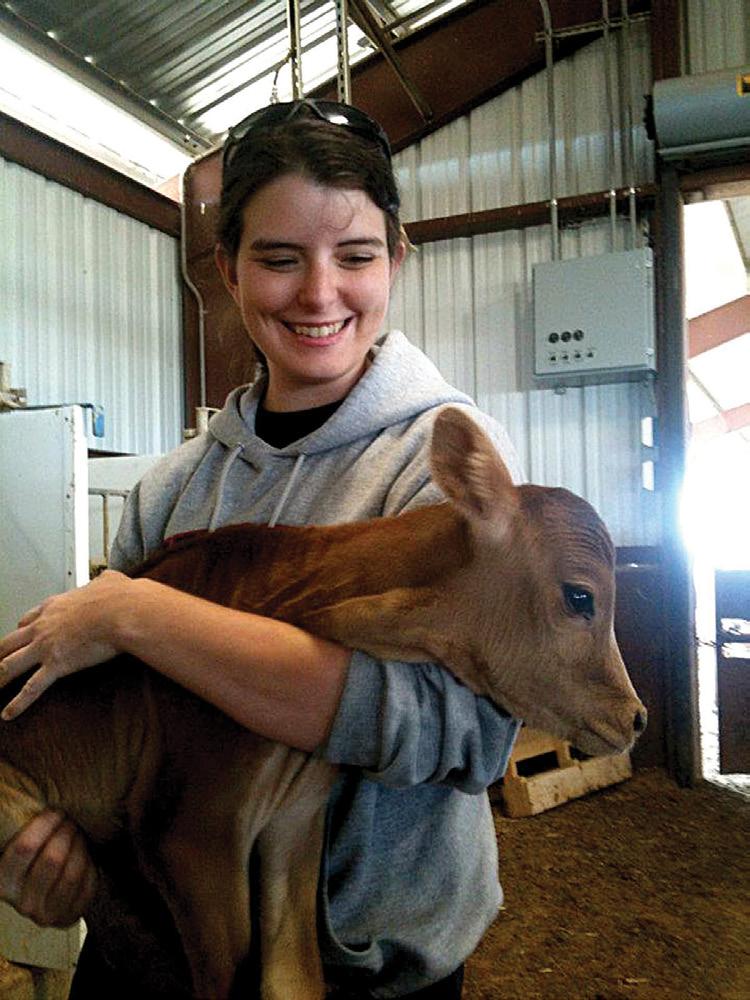
ashley deMeo visits with a baby calf during a trip that was in the “introduction to Food-animal Production systems” elective course.
a new elective, “ i ntroduction to food-animal Production Systems,” is opening the eyes of some veterinary students. The weeklong class, offered to students during the summer between their second and third years of veterinary college, is familiarizing students with the food-production components of the beef, dairy and swine industries.
“We offered the course in 2011 and again in 2012,” explains dr. Jared Taylor, an assistant professor in veterinary pathobiology and co-creator of the elective. “The first time through, on Tuesday i thought maybe we should offer two sessions. by friday of that week, i wasn’t sure i wanted to offer it ever again. it’s a very intense week. We take 10 students through a variety of modern food-animal production systems in oklahoma and Texas. b oth years, the class has been comprised of all female students.
“While we don’t actually visit swine nurseries or finishing barns, the students meet and talk with people who oversee those operations,” says Taylor. “We want the students to see all the components of these three food-animal systems.”
s tudents from the Class of 2014 were selected to participate based on an interest in food-animal medicine.
“i was excited to be able to take the course,” says Kami Jensen. “i plan on being a mixed-animal practitioner, and this allowed me to see how animal agriculture works on a large scale and the role veterinarians play in the industry.”
“We try to encourage students who have minimal exposure and knowledge of food animals to apply. We want to give those who are not familiar with cows or swine an opportunity to learn about the industry and become more comfortable with it,” says dr. John gilliam, clinical assistant professor in food-animal production medicine and field services and the other course co-creator.
s ome fourth-year students would discover that they really enjoyed the food-animal medicine rotation, but they felt a little intimidated by the productionmedicine industry because they were never exposed to it before.
“While this course may ignite their interest to choose a foodanimal medicine career at some level — it would be wonderful to have more food-animal veterinarians — it also helps students have a better understanding of production agriculture,” says gilliam. “They see the realities of what it is like firsthand, not from their previous perceptions or from media reports. The course helps dispel misconceptions about agricultural production. They are able to talk to people who do this for a living. even if these students never engage in production medicine, they will be able to draw on this experience and their exposure to the challenges and realities of this business and help educate the public, friends and family about food-animal production.”
“the course helps dispel misconceptions about agricultural production,” says clinical assistant professor dr. John Gilliam
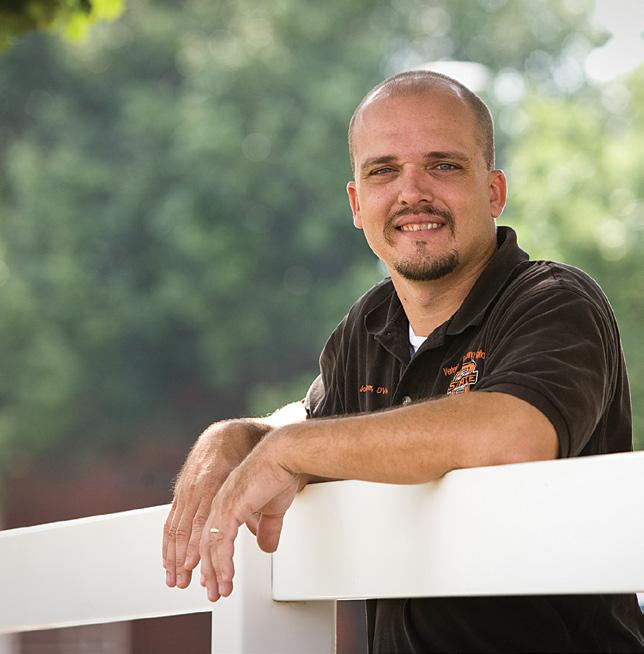
Hitting the road on a monday morning, 10 students and two faculty members boarded an osU bus and headed toward oklahoma City.
“We utilize the drive time for group discussions,” says Taylor. “our first stop was express angus Ranches in yukon, okla., to look at a seed stock operation. This facility raises purebred bulls, primarily angus, to sell to commercial cow/calf operations. Then it was on to the oklahoma n ational s tock yards in o klahoma City, where we met with dr. Troy shelby (osU ’89). We then visited the Tim haines family ranch, a commercial cow/calf operation before heading home to stillwater for the night.”
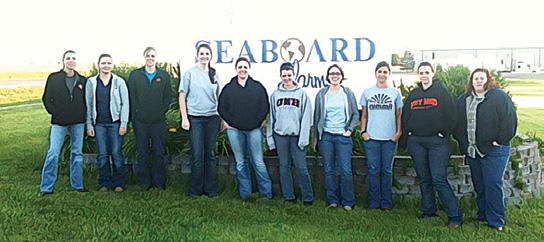
e arly Tuesday morning, the group left s tillwater for g uymon, okla.
“a t h itch f eedlots in g uymon, d r. s hawn b lood ( os U ’89) hosted the group,” says Taylor. hitch has one of the largest feedlots in oklahoma.
The next morning, the group stopped at seaboard swine operations in guymon. They visited a swine farrowing barn and swine slaughter plant before driving to the Circle h Veterinary Clinic in dalhart, Texas.
“We met up with angela daniels, who connected us to a variety of operations,” says Taylor. “Thursday, we visited d alhart Jersey Ranch, Van Ryn dairies, morning start dairy and deer
the ten osU veterinary students visited the seaboard swine operations in guymon.
Gary Lawson / University MarketinG
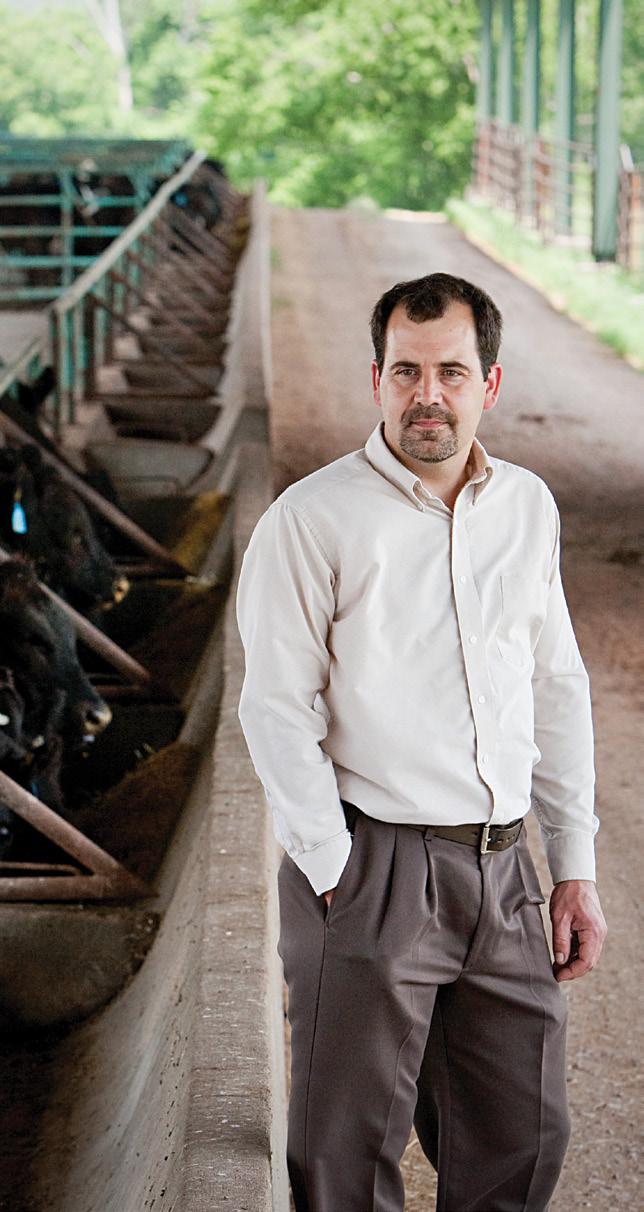
Creek feeding. We saw everything from custom heifer raisers through a variety of operating dairies.”
“it was amazing to see how big the world of food-animal production really is. i gained knowledge that helped to pique my interest in the field,” adds brandy g ermany.
Their final destination was booker, Texas.
“We stopped at p re ferred beef group, a cull cow and bull slaughter plant, where we met with don Clift, Ceo. We were also able to tour the operation. Then we headed home to stillwater,” adds Taylor. “ o verall, we’ve had positive feedback from the students. The second year when we approached some of the same operations we visited the first year, they enthusiastically welcomed us back.”
“The food-production elective is a unique experience for veterinary students. it ’s a great value to anyone interested in the foodanimal industry. i learned a lot and gained a new perspective,” says Wendy elbert.
a n d thanks to a variety of co-sponsors, all expenses are covered.
“The american association of b ovine p r actitioners foundation, pfizer animal health and the oklahoma Veterinary medical association have generously supported this program,” continues Taylor. “We also received some funding from the department of Veterinary Clinical sciences, Veterinary pathobiology and the dean’s office here at the veterinary center.”
“ i really gained an appreciation of how many people depend on animal agriculture for their livelihoods and how seriously those people take the welfare and humane handling of the animals,” says alissa anderson. “i think often these workers are viewed as not liking animals because they work in places like slaughter plants and that really isn’t true. ever ywhere we visited it seemed that animal welfare was one of the biggest priorities, whatever their final intended purpose was for those animals.” students are graded on their participation. They take a final exam and give a group presentation, which is open to faculty, students and oVma members, in the fall.
“This is a great opportunity for the participants to share with other students, who didn’t have the opportunity to go, the information and experiences they had,” says Taylor. “it also can be a recruiting tool to increase interest for future years and if oVma me mbers attend, they can see how their support benefited the students’ education. Texas a&m has a similar course but they do not cover the swine industry. n or th Carolina s tate student chapter of the a merican a ssociation of bovine practitioners offers an annual trip to see cattle production facilities, but students do not get credit for taking it. I think we’re offering our students a positive experience and knowing the work they will put into the course, they are able to earn credit and hopefully we’ll encourage a few more students to choose a mixed-animal practice as a career path.”
— DeRinDA BlAkeney
Gary Lawson / University MarketinG
assistant professor dr. Jared taylor says both students and the operations they visited during the “introduction to Food-animal Production systems” regard the course very favorably.
Tackling diabetes
Véronique l acombe , d V m , p h. d , brought a long history of comparative medicine research with her when she joined osU’s veterinary center as an associate professor in physiological sciences. since she was a veterinary student, l acombe has had an interest in metabolism, the complex process the body uses to turn food into energy. s pecifically, her fields of interest include skeletal and cardiac muscle energetics, glucose transport during diabetes, insulin resistance using small- and large-animal models, as well as cardiovascular complications during diabetes.
The main mission of l acombe and her team is researching mechanisms underlying diabetes, a complex disease for which there is no cure.
“ d iabetes is an epidemic disease that affec ts more than 250 million people with almost 10 percent of the population affected in the U.s., and it is expected that the worldwide prevalence will rise to 450 million by 2030,” she says. “a s a result, the disease imposes a considerable medical and economic burden on societies. my lab is investigating the regulation of glucose transport in insulin-sensitive tissue. in other words, we are looking at how the glucose (i.e., sugar) in the bloodstream transfers to tissue. This process is the metabolic bottleneck for glucose utilization and fuel production. in addition, this process is altered in people who have diabetes because they have improper production and/or action of insulin, a hormone that is necessary to make that transfer.”
While there is no drug to cure diabetes, human diabetes can be regulated and monitored to avoid complications.
“With a diet regimen, exercise and weight loss, diabetics can help manage their disease. When skeletal muscles contract, that process helps transport glucose into cells. exercise can speed glucose uptake in muscles. however, the process by which contraction enhances glucose transport is unknown, and it is one of the research focuses of my laboratory. findings from this research could lead to the discovery of a cure for diabetic patients.”
dr. Melody de laat (left) demonstrates the new microultrasound machine with dr. Veronique lacombe (center) and Brittany evans
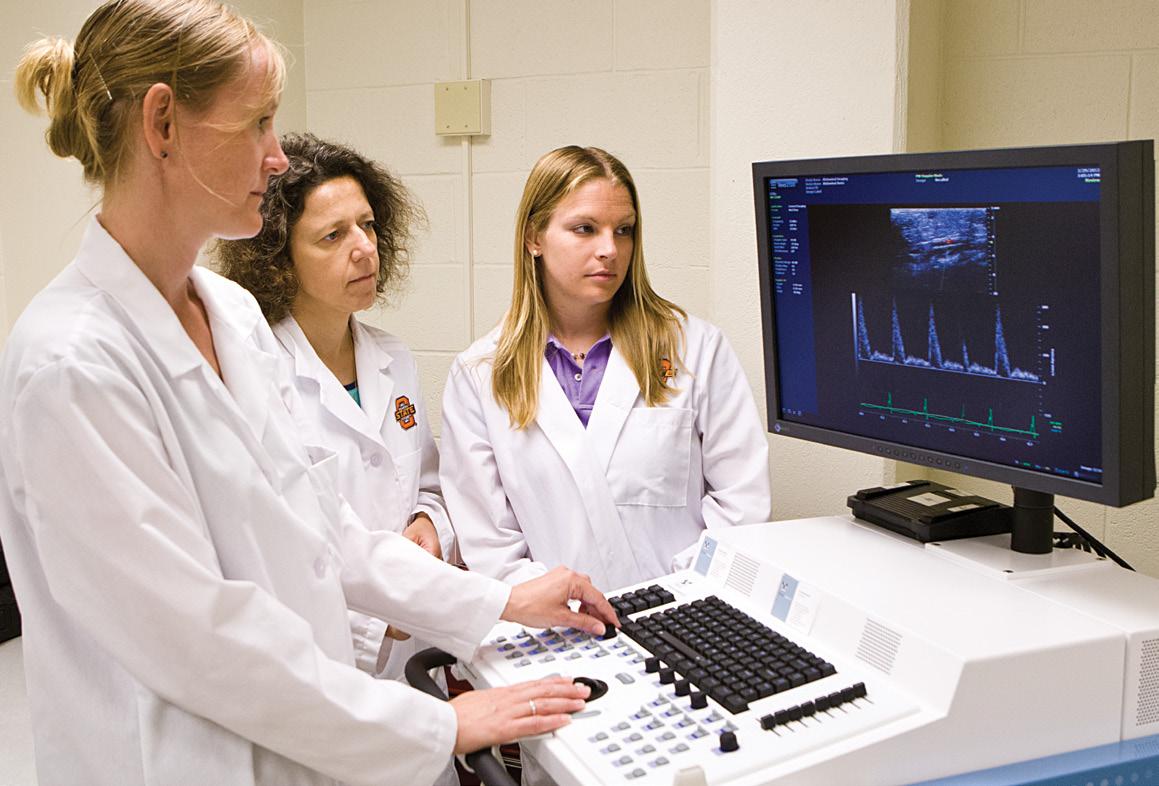
lacombe says glucose is one of the main sources of fuel for the body, and the uptake of glucose from the blood into the cell and its utilization by the cell to produce energy is similar across all species — human and animal.
“ b ec ause the process is similar, we use both small- and large-animal models in my lab, spanning from mice to horses. if we find mechanisms responsible for diabetes using these species, it could also have an impact on human health, a concept referred to as one health, one medicine,” she says. “ fo r example, in mice, we can upregulate a protein potentially implicated in the transport of glucose to see if it will help prevent diabetes. as a result, we have now established a line of mice that are resistant to diabetes. l ike people, horses can become obese, which can lead to a metabolic disorder such as insulin resistance. interestingly, cats can get transient diabetes, where the diabetes goes into spontaneous remission. Unlike the rodent models used to study diabetes,
which are generated from inbred strains of laboratory mice, these naturally occurring models are genetically diverse and exposed to many of the same environmental factors that humans are, and they are great models of metabolic disorders.
b y transcending species boundaries to include the study of spontaneous and experimental models of human disease, research in comparative medicine can lead to exciting discoveries that will benefit both people and animals.”
l acombe f irmly believes that veterinarians’ thorough training puts them in a unique position to improve research and help society.
“Veterinarians have such a broad training. We have to know all the different species from fish to elephants. That vast knowledge can be applied in comparative medicine research. it is a career path with many rewards that many veterinary students don’t really think about.”
Big pictures from little things
the center for Veterinary Health s ciences purchased a state-of-the-art ultrasound machine in 2011 that greatly expands researchers’ ability to image small animals.
t he machine , the VisualSonics Vevo 2100 , allows vet school scientists such as its operator, Dr. Véronique l acombe, to see into the organs and systems of lab animals as small as mice and rabbits. the high-frequency digital imager adds to the vet school’s growing list of imaging technology that already includes MR i and ct scan machines, and a human-size ultrasound machine available at the teaching hospital.
u ltrasound uses sound w aves to create images of how things work inside bodies by translating how the waves pass through different objects into an image. they are used in everything from imaging fetuses and the hearts of people suffering from cardiovascular disease to cancer.
i t’s easy to envision their usefulness in veterinary medicine as well, including the booming realm of comparative medicine and preclinical research that focuses on problems afflicting both animals and humans. n a turally, it makes sense to use animals to model human systems in research.
after earning her dVm degree, l acombe completed her residency in large-animal internal medicine and worked as an equine clinician before focusing on research.
“As a clinician first and a scientist second, I am a better researcher and ask questions that are clinically relevant. Clinical veterinary medicine and research are similar processes. in both cases you start with a problem. in clinical veterinary medicine, you have a list of different diagnoses that could be causing the problem. in research, you have different hypotheses you want to prove. one by one, you check them off the list in both areas. in clinical veterinary medicine you have a final diagnosis, and you treat it. in research, you have the correct hypothesis, and you find a cure or you take one step closer to finding a cure. We are responsible to nourish that aspect of the veterinary profession and train the next generation of veterinary scientists.”
— DeRinDA BlAkeney
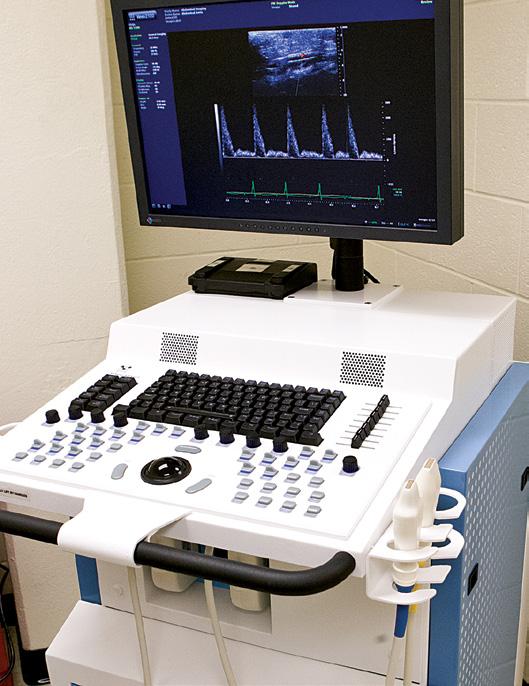
the VisualSonics Vevo 2100 micro-ultrasound machine is believed to be the only one of its kind in oklahoma.
dr. Véronique lacombe (center) has put together a team to research the mechanisms underlying diabetes. studying with her are (from left) Kaylynn Gruntmeier, a senior studying zoology at osU; Chelsie Clement, a senior in animal sciences; Brittany evans, a veterinary student in the Class of 2015; and dr. Melody de laat, a post-doctoral research associate in physiological sciences.

the problem is that large ultrasound machines operate at a lower sound frequency to pass through larger patients, such as a human or a horse. it is not as helpful to image a mouse or a rat because the image quality wouldn’t be as good.
“With this micro-ultrasound machine, you can’t go very deep, but you’re going to have a spectacular resolution of the specific area that you’re examining,” l acombe says. “ t he advantage of this machine is that it has the same features as a human ultrasound machine, but it has been designed to image all the organs of small animals, including of early embryonic and neonatal mice.”
the Vevo 2100, believed to be the only one in oklahoma, is in l acombe’s c ompar ative Metabolism l aboratory in the vet school’s physiology department.
it has already proven helpful in her research.
As diabetes is one of lacombe’s chief areas of interest, she often works with small animals, such as mice and rats as models of human metabolic diseases.
o ne of the increasingly common condition’s accompanying diabetes is heart disease. Previously, she had to use human ultrasound machines in her animal models that were not as useful in her work. this machine lets her look at everything from the shape of the heart to how effectively
it pumps blood, as well as how the heart tissue contracts and relaxes during each heartbeat, letting her “detect subtle heart dysfunction very early on in the process of the disease in our diabetic mice,” lacombe says.
“Also, with this high resolution, you can also inject anything you want into a targeted site, including the brain and the spinal cord. you can also use micro bubble technology,” she says. “you can create small bubbles of air that will go through the heart or blood vessels to mark the passage of what you’re trying to track.”
she can also look at blood flow into organs to track vascular diseases. i t also lets her deliver gene and stem cells at a targeted site and measure things such as gene
therapy effectiveness. And 3-D reconstructions of organs are possible.
“ i t’s a huge improvement since this micro-ultrasound machine greatly expands our understanding of the physiologic and pathophysiological processes in small animal models.” lacombe says.
the Vevo 2100 is available for any researcher in the veterinary college or on osu’s campus to use, she says.
“it can be used by any investigators on campus since it is a common equipment. i think the more people we have using it from different areas of research, the better it would be. i think it could even generate some collaborations between the veterinary school and other colleges on campus.”
— MAtt elliott
Getting the word across
By DeRinDA BlAkeney
“Co MMU ni C ation — the h UM an C onne C tion — is the K ey to P ersona L an D C areer s UCC ess.”
— PA U l J. M E y ER , AUTHOR , ATT i T u DE i S Ev ER y T hing!
from the first day of class at o k lahoma s t ate University’s Center for Veterinary h ealth s c iences, future veterinarians start working on their communication skills — and they don’t stop. s pecific exercises in the Veterinary Client Communication Clinical Technique l abs continually hone students’ rapport skills to prepare them to be practice-ready veterinarians upon their graduation.
t w o faculty members at oSU’s Boren Veterinary Medical teaching Hospital came up with the course af ter attending a weeklong training course. adjunct assistant professor dr. Paul deMars and associate professor d r. Carolynn Macallister put ideas together and developed a program specific to osU’s needs.
“The process is similar to human medicine client communications training, where students are trained how to communicate with patients both in gathering and giving information in the medical interview,” explains macallister.
“a remarkable and unique aspect of osU’s veterinary communication training is we use real clients in our clinical scenarios. The clients are not trained actors; rather, they simply relive authentic medical problems they have experienced with their pets, which makes the interaction more realistic to the students.
in the medical e xam rooms, we have four cameras to accurately and completely record the student and owner verbal and nonverbal interactions in their simulated medical interviews. Cameras and recording equipment were initially provided by p fizer a nimal h ealth. s ubsequent equipment and program cost of the client communication simulation skills laboratories have been supported by hi ll’s [pe t nutrition].”
In the beginning mac a llister says clients initially volunteered to serve as simulated clients in medical scenarios involving their pets while the student practiced taking a medical history.
“at first, these volunteers participated in the communication skills labs because they honestly enjoyed students and had a strong interest in helping students learn how to effectively communicate even though we had no support to pay them or even reimburse them for their gas,” she recalls. “They basically like serving as living textbooks and have a passion to teach. Thanks to hill ’s [pe t nutrition] sponsorship, our simulated clients now get paid a small stipend for their time.”
That sponsorship also allows the veterinary center to award two $500 “top communicator” scholarships to deserving students. demars and macallister view the tapes of each student to select the top four or five tapes for a panel of judges. The panel — made up of a communications professional, a veterinary academician and a veterinary practitioner — select the winners.
With the CVhs communication skills labs aligned across the entire four-year program, the students aren’t forced to take it all in at once. The first-year veterinary students interview a simulated client, who has brought in a pet with a health problem, and take a medical history. The next year, the students move up to performing a physical exam on the animal after the interview.
“a s the s tudents progress through the years, their communication interaction with the client and the challenge of the case increases in proportion to what they have learned clinically and should be able to apply to the simulated case. The entire time the student and client are talking, the session is being videotaped. at the end of the session, the ‘client’ provides the student with immediate feedback, including what went well and areas for improvement,” says macallister.
Third-year challenges in the third-year communication skills lab, the veterinary students perform two simulated client interviews. The history is taken on two different medical problems, questions are asked about the pet’s clinical signs, and a physical exam is conducted on the pet.
o n the second of the two exams, m ac a llister provides each student with a packet of information concerning the simulated case, including diagnostic test results that he or she would have ordered on the actual case, radiographs if appropriate along with reference material on the clinical problem. The student reviews the information along with other clinical reference resources and returns the next day to basically explain the diagnostic tests and deliver the diagnosis, treatment plan and prognosis to that same simulated client.
“Again, what’s really unique regarding these communication labs is the ‘clients’ are not acting. They are reliving the case that their pet had at one time or another. These volunteers have pets that have had common health problems. it is natural for the ‘client’ to share the history of this health problem, including clinical signs and what he or she has observed, because it really happened to their pet. it ’s real to them, and it makes it real
2013) in the communications lab. Veterinary medicine students polish their communications skills with clients in the course.
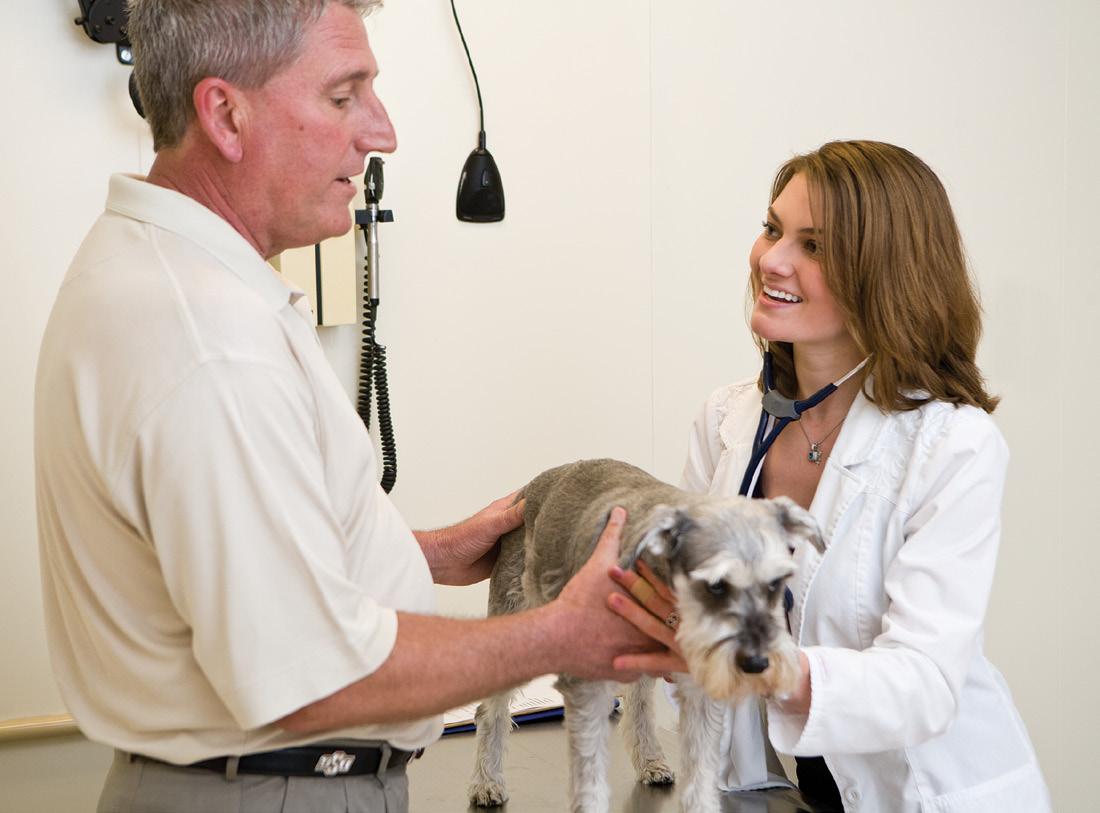
to the student, and that is important and the pivotal reason this communication lab has been a success,” she adds.
The client volunteers come from all walks of life. They all are clients of the osU boren Veterinary medical Teaching hospital — one is a retired fbi special agent, another a retired professor, several are osU alumni, and one is a young mother of two who lives in edmond and drives to s tillwater a couple times a month to participate in the simulated interviews.
Ray hammergren served 20 years as a special agent with the fbi i n addition to his wife’s friendship with macallister, his two schnauzers — g reta and m innie — have been regular patients at os U’s community practice in the small-animal clinic since the couple moved
to s tillwater in 1994. h e has been part of the client communications program for the past six years.
“ i enjoy being with the students,” says hammergren. “They are very eager to learn and interested in any comments or constructive criticism i can offer them. The students come from all over the country — California to florida to upstate new york. i even talked with one student who spent the first two years of veterinary college studying in the Caribbean before transferring to os U. i remember one student who said she was interested in small-animal practice when she started studying; now she wants to go to Wisconsin and take care of dairy cows. it fascinates me to hear their stories.”
Retired osU veterinary hospital director and alumnus, John Kirkpatrick (Class of 1965) is another regular client for the communications lab.
“ i believe we do a great job of training veterinary students in medicine, surgery, anesthesiology, etc.,” says Kirkpatrick. “This class in client communication puts icing on the cake as far as training veterinary students. It helps students improve their interpersonal skills and become more comfortable with clients. These interaction skills and the ability to develop rapport with clients will transfer directly to practice. i love interacting with veterinary students and watching them improve their skills.”
Professor’s return one of the center’s highly decorated professors, now retired, has been with the program for the last three years.
“ i enjoy being back with the students. Who knew i would miss them so much?” says Rebecca morton, who is also an alumna (Class of 1972). “This is an excellent way to prepare students in the art of history taking and client relations. When i was in veterinary school, this type of class was not offered. l ooking back, i know it would have helped me tremendously as i was shy and nervous around clients. here, the students get feedback on how they are perceived by clients. i am glad i am able to help the students enhance their interpersonal skills. “ continues
ray Hammergren “discusses” a diagnosis and treatment for his dog, Greta, with student nicole Morton (Class of
— John Kir K patric K r etire D o SU veterinar Y ho S pital D irector, al UM n US ( c la S S of 1965) an D c o MMU nication S la B v ol U nteer “client”
morton brings Roz, her borzoi (also known as a Russian wolfhound), to the client communication class.
“a borzoi is not a breed commonly seen, and most of the students really enjoy her,” says morton. “I am sure the public recognizes the importance of good ‘bedside manner’ in physicians. This program is helping in that regard for veterinarians, many of whom are more animal-oriented than people oriented. This helps them move past that, to be practice-ready veterinarians.”
The communication training culminates in the fourth year when the students become part of the team that sees actual clients. “ t his CL ass in CL ient C o MMU ni C ation PU ts i C ing on the C a K e as F ar a s training V eterinary st UD ents. i t he LP s st UD ents i MP ro V e their inter P ersona L s K i LL s an D B e C o M e M ore C o MF or ta BL e W ith CL ients.”
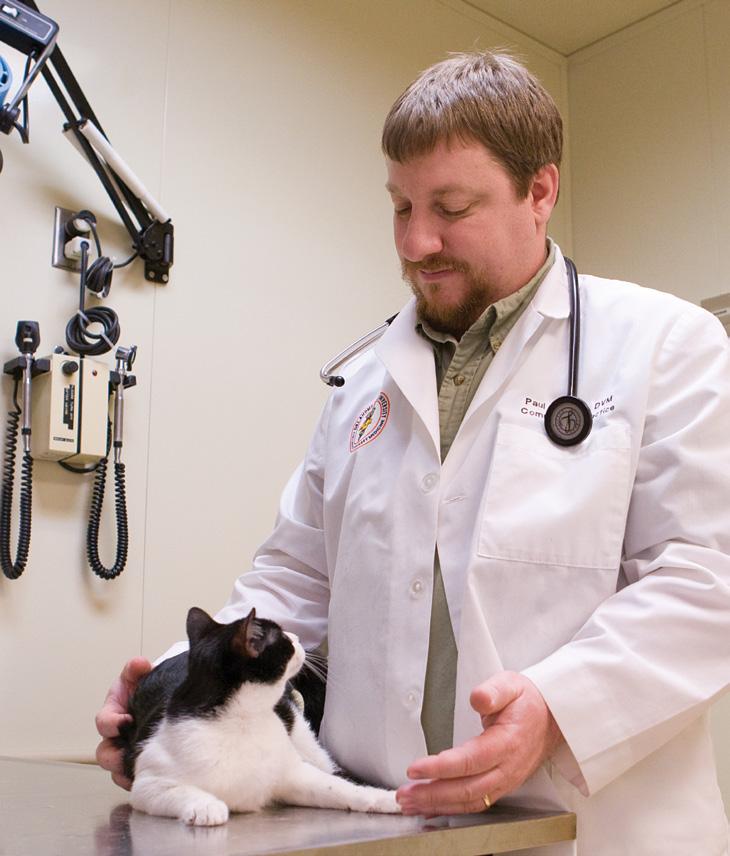
“ o n the community practice rotation, the students spend three weeks focused on wellness medicine and primary-care cases,” says paul demars, community practice assistant professor. “They are required to submit five videos, which are then evaluated and critiqued to help sharpen their medical and communication skills.”
“all the changes and improvements we have made to the communication skills labs over the years have been student driven,” says m ac a llister. “ f rom the seniors telling us they wanted to receive the training earlier in the curriculum to students saying they want client feedback as soon as they are done, right on the spot.”
The client communication skills training program has been part of the required curriculum for the last seven years at osU’s Center for Veterinary h ealth sciences.
“A veterinarian’s communication skills are vital to their success,” adds d e m ars. “Their knowledge and skills cannot be used unless they first gather accurate information from the animal’s caretaker about what has been happening. Then, after considering this information along with the physical exam and other diagnostic information, the veterinarian has to effectively communicate their diagnosis, prognosis and treatment recommendations to the caretaker so that the animal can receive the necessary care.
a veterinarian’s communication skills are vital to their success,” he says.
“We know from several studies on compliance that the percentage of clients who actually follow the veterinarian’s advice, their communication skills have more to do with treatment success and client satisfaction than their medical skills. h ere a t oklahoma state University, we are committed to producing veterinarians who excel both in their communication and medical skills.”
adjunct assistant professor dr. Paul deMars helped develop osU’s course in communicating.

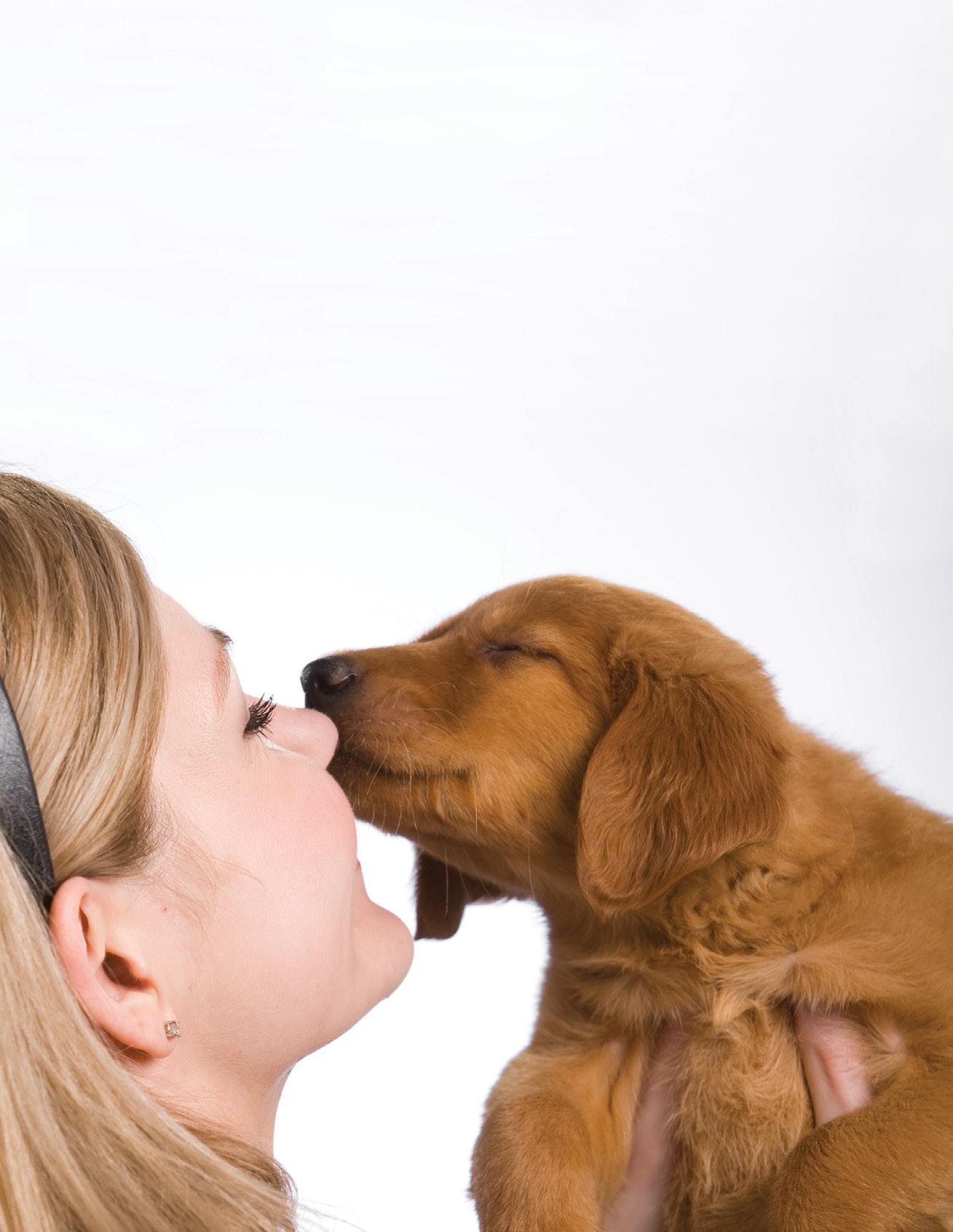
COLLEGE OF VETERINARY HEALTH SCIENCES
PLANS FOR NEW ACADEMIC CENTER
For more than 60 years, the OSU Center for Veterinary Health Sciences (CVHS) has improved the lives of animals and people through education, research and community-
impact with a new Academic Center complete with clinical
offered services. Now the CVHS is ready to increase its faculty offices and a technologically equipped auditorium.
The university is providing funds for the new offices, which
will function as a recruiting and retention tool in addition to facilitating collaboration between faculty, students and business professionals.
BRANDING SUCCESS.
Private donations are vital for the multi-purpose auditorium to become a reality. The new facility will be equipped with video capture technology, providing a modern atmosphere for learning that connects the classroom with alumni, veterinary medicine professionals, distance learners and guest lecturers.
Your gifts will help to create a facility that will educate future veterinarians, ensuring that the CVHS continues its legacy of nurturing and protecting the fundamental connection between humans and animals.
For more information about how you can enhance the lives of animals and the people who serve them, please contact the OSU Foundation at 800.622.4678, by email at info@OSUgiving.com or visit OSUgiving.com.
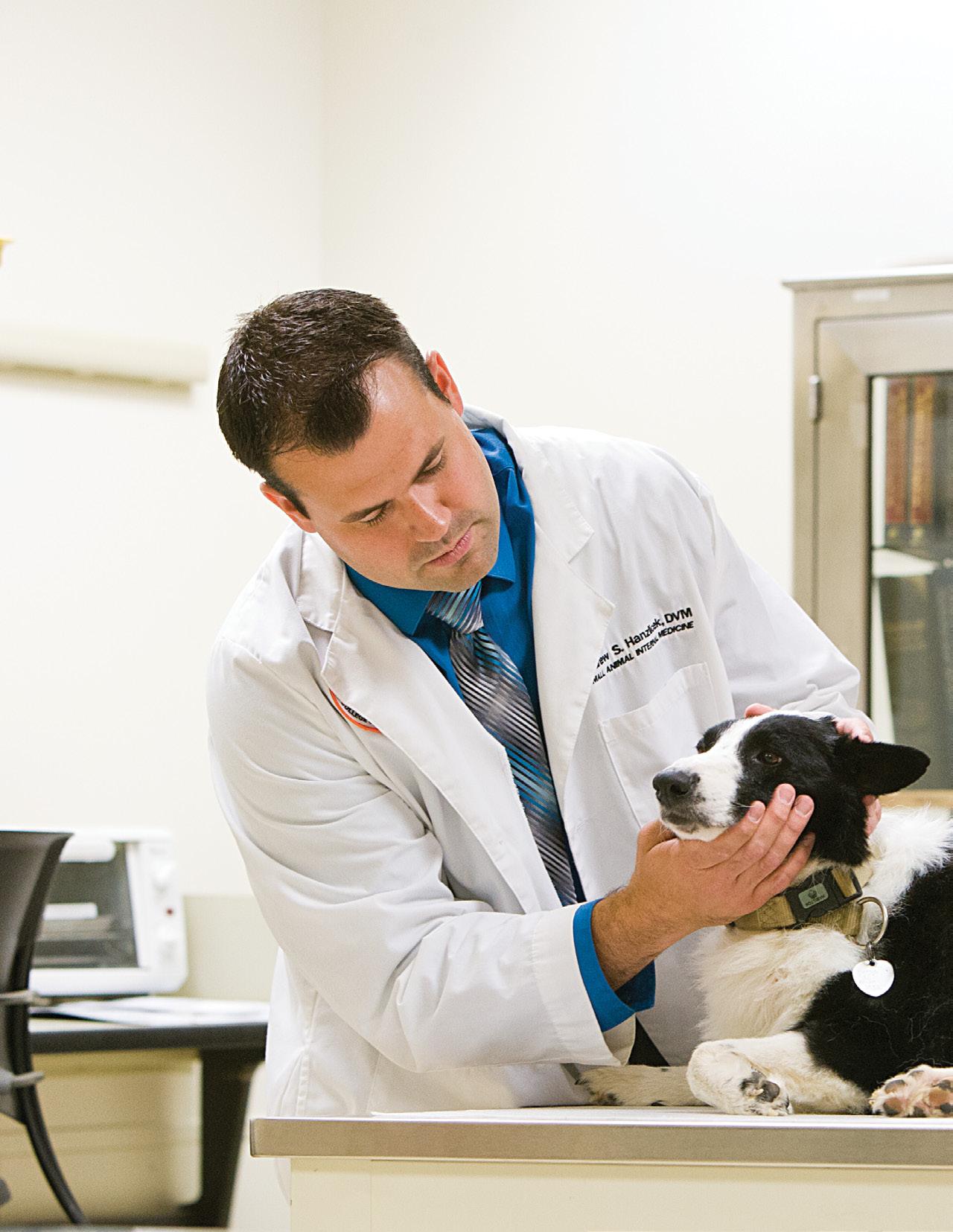
Tackling a fungal disease
an osU educator could have a profound impact on diagnosing and treating a fungal disease, which has become pervasive in oklahoma.
a ndrew Hanzlicek , d V m , m s ., diplomate of the a merican College of Veterinary internal medicine in small-animal internal medicine, is an assistant professor of small animal internal medicine at os U’s Veterinary hospital. his research on histoplasmosis — a fungal disease endemic in o klahoma — may change the way the disease is diagnosed and treated.
continues
dr. andrew Hanzlicek examines Midget, owned by Lois Crain of ringling, okla., with dr. Jennifer Chang, a resident in small-animal internal medicine.
Histoplasma capsulatum , a soil-borne fungus, is found in temperate and subtropical regions throughout the world. in the U.s., histoplasmosis appears in the ohio, missouri and mississippi river valleys as well as in oklahoma. The disease is a common systemic fungal infection of many dogs and cats in oklahoma and occurs when microconidia — the mycelial form of Histoplasma sp. found most abundantly in nitrogen-rich soil — is inhaled or sometimes ingested.
“ i saw this disease when i worked at Texas a & m University and at Kansas s tate University, but i was surprised at how frequently we see it here at osU’s Veterinary hospital,” says hanzlicek. “because of its small size, the microconidia can penetrate deeply into the lungs when inhaled. histoplasmosis is a disease that can affect the respiratory system, the gastrointestinal tract or the skin in cats and dogs. s ometimes it affects the bone marrow, eyes, the brain — it can go virtually anywhere in the body.”
Common clinical signs include lethargy, weight loss, anorexia and fever unresponsive to antibiotics. an infected animal — especially a dog — may have diarrhea.
Traditionally, the diagnosis of histoplasmosis is made from clinical signs and finding fungal organisms from affected tissue or fluid samples and, in some cases, a fungal culture.
“fungal c ulture has the disadvantages of lacking sensitivity, requiring specialized laboratories and having a slow turnaround time (weeks).”
Currently, hanzlicek uses a test from miraVista diagnostics in indianapolis. T he test can be performed on body fluids of the potentially infected animal.
“We can use urine samples, blood samples or fluid from a lung wash,” explains hanzlicek. “if a protein from the cell wall is in the sample, the dog or cat will test positive for histoplasmosis.”
hanzlicek s tarted a clinical trial in June 2012 to determine how treatment with antifungal therapy affects the antigen test. “from previous information in over 70 dogs and 30 cats, we are convinced this test is accurate, and in some cases, this test has changed the way we diagnose the disease,” he says. “ b efore this test, we diagnosed histoplasmosis based on clinical signs and finding the fungus through invasive tissue biopsy or needle aspirate procedures. now it may be as easy as submitting a urine or blood sample. next, we need to find out if it can also be used to monitor or guide antifungal therapy.
“Right now, the test is used to monitor treatment in humans. We don’t have data on animals, and that’s why we are doing the study,” says hanzlicek. “When you test positive for histoplasmosis, the test readout gives you a number. for example, it could be 8.2. you treat the person and then retest. The result has to be below a certain number before you stop treatment. if you stop antifungal therapy too soon, the infection could return. if the test result decreases with treatment like we expect, it should work the same for animals as it does for humans.”
h e has applied for grant money to cover the research and hopes to have 20 dogs and 20 cats known to be infected with histoplasmosis in the program.
“We will monitor how the antigen test changes during treatment, which will help us decide if we can use the test to monitor treatment. i anticipate it will take 12 to 18 months to gather the data,” he says.
“If we can diagnose histoplasmosis early on and if we treat for the appropriate amount of time, the animals have a pretty good chance of making it. This isn’t an end-of-life disease. it affects young, otherwise healthy dogs and cats. i f we can diagnose it with a simple fluid test and monitor treatment without invasive procedures, we have a better chance of helping many dogs and cats live a long, healthy life.”
— DeRinDA BlAkeney
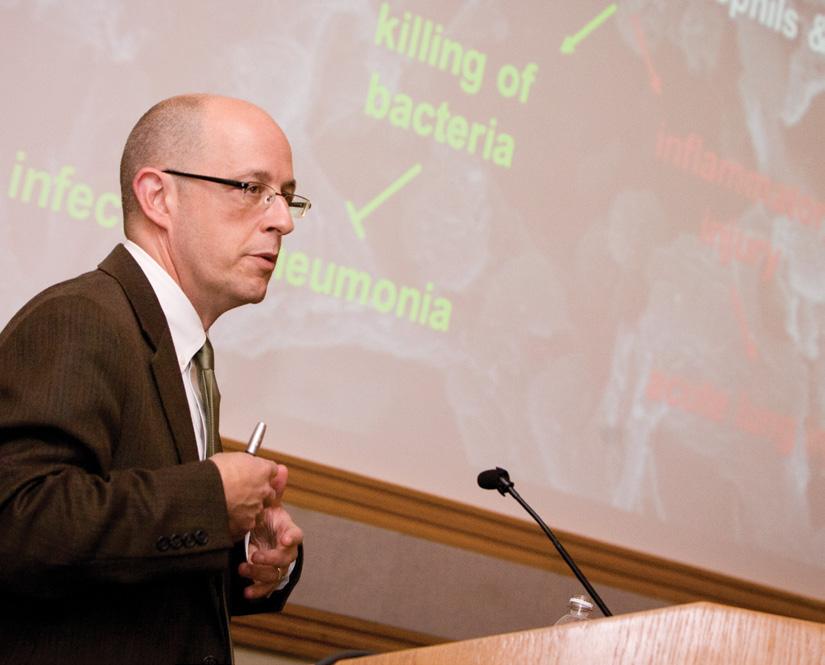
Boston professor takes the stage at OSU
The t hir d a nnual l undberg-Kienlen l ectur eship in Biomedical research featured Joseph P. Mizgerd, sc.d., professor of medicine, microbiology and biochemistry, and director of the pulmonar y Center at boston University school of medicine.
p resenting “ mechanisms of lung innate immunity during infec tion,” mizgerd emphasized the importance of lung disease research, including the discrepancy between disease burden and the level of funding.
Recognized internationally for his contributions to respiratory infections and pneumonia, mizg erd’s research focuses on various cells and receptors in the lung and the correlation to lung infection or lung injury.
The lectureship is supported by the l u ndberg-Kienlen e ndowment, the o ffice of Research and g raduate e ducation and the d epartment of physiological sciences. lin liu, p h. d. , Regents p rofessor and the l undberg-Kienlen p rofessorship in biomedical Research, hosts the annual seminar.
during his visit, mizgerd also met with several veterinary center multidisciplinary research groups including the adult stem cell focus group and the respiratory and infectious disease group, providing valuable input on their research.
Joseph Mizgerd focused on the importance of research into lung disease during his presentation of “Mechanisms of lung innate immunity during infection.” From left: dr. Joseph Mizgerd, osU Center for Veterinary health sciences dean Jean Sander and dr. lin liu
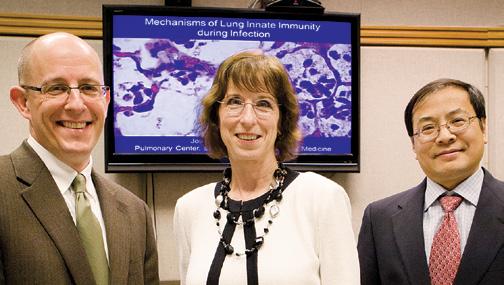
Gary Lawson / University MarketinG
Linking life around the world
m ore than 370 health professionals gathered at the Tulsa Convention Center for o klahoma’s first one Health Conf erence . Co-hosted by the o klahoma s tate d epartment of health, one health Kansas at Kansas state University and o k lahoma s t ate University’s Center for Veterinary h ealth s c iences, this groundbreaking seminar brought together physicians, veterinarians, nurses, veterinary technicians and other professionals.
n a tional and global o ne health education initiatives recognize that human health, animal health and ecosystem health are intricately linked. humans share disease risks with wildlife, livestock and pets. The goal of one health is to collaboratively work to improve the lives of all species worldwide.
foc using on tick-borne diseases and rabies, the speakers presented information on rickettsial diseases in humans and animals, lyme disease and lyme disease-like illnesses, bartonellosis, rabies prevention and more.
according to dr. l aura Kahn, more than 75 percent of emerging infectious diseases are zoonotic — able to spread from animals to humans.
Conference attendees were treated to a special luncheon presentation from d r. s idney ewing, os U veterinary center e meritus p rofessor and os U eminent fac ulty award recipient. dubbed by fellow presenter d r. Christopher pa ddock as a “rickettsial rock star,” ewing said nations need a cadre of physicians and veterinarians who know how these diseases work.
dr. C. Ben Beard of the Centers for Disease Control and Prevention spoke on Lyme disease and similar illnesses at the one Health Conference
“There is a need for One Health,” says Ewing. “ b road training of specialists is essential. I propose that physician students and veterinary students take a common course during their studies. I hope to live to see the day when we make one medicine a reality.”
“ in order to e ffectively treat zoonotic diseases, physicians must be able to clearly identify which disease the patient has,” warns paddock. “ s pecies-specific diagnoses are needed to determine which antibiotic will work best.”
drs. linda Salinas (from left), Kristy Bradley, laura Kahn, Susan little, Christopher Paddock and Cathleen Hanlon were among the presenters at oklahoma’s first one Health Conference in tulsa.
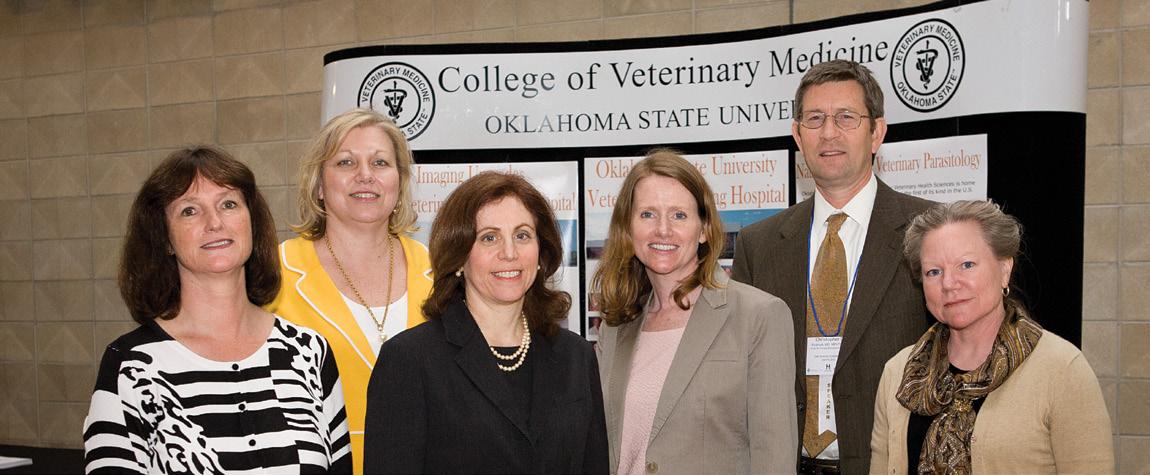
“ p revention all year against fleas and ticks is recommended,” says d r. s usan l ittle, another presenter at the conference.
“The 2011-2012 oklahoma winter was so mild that ticks are out early and in abundance. one of the best things owners can do for their pets is use preventive medicine all year long to help keep them healthy and disease free.”
“With more than 7 billion people on the planet, the need for one health is now,” says conference organizer Carolynn macallister, dVm, associate professor and director of continuing education at osU’s veterinary center. “ international travel facilitates the quick and wide spread of diseases. an organism can move faster than its incubation period, which threatens humans and animals.”
Throughout the conference, several experts on infectious diseases of people and animals commented on the important role of veterinarians in protecting the health of people as well as pets.
“Quality tick control on dogs is a key part of limiting the risk of tick bites to people,” says little. “We know that routine veterinary care improves both animal and human health, and we have the expertise, ability, and tools to make this work. We just need more pet owners to understand the importance of preventive care for the health of every member of the family — pets and people.”
One Healt H C O nferen C e Presenters
Dr. C. Ben Beard, chief, bacterial diseases branch, division of vector-borne diseases, Centers for Disease Control and Prevention
Dr. Kristy Bradley, state epidemiologist, Oklahoma Department of Health
Dr. Cathleen Hanlon, director of the Kansas State University Rabies Laboratory
Dr. Laura Kahn, research scholar, science and global security, Woodrow Wilson School of Public and International Affairs, Princeton University
Dr. Susan Little, Regents Professor, Krull-Ewing Chair in veterinary parasitology, OSU Center for Veterinary Health Sciences, and director, National Center for Veterinary Parasitology
Dr. Christopher Paddock, infectious disease pathologist and rickettsiologist, Centers for Disease Control and Prevention
Dr. Linda Salinas, associate professor of infectious disease, Health Sciences Center, University of Oklahoma
Vets must join global health fight, professor says
W ITHOUT EA rly d ETECTION , d ISEASES CAN S pr EA d fr O m ANI m A l S TO HU m ANS

“Veterinarians are a
.”
Guy Palmer , d V m , p h. d . , keynote speaker at the 2011 fal l Veterinary Conference , presented “the Challenge for Veterinary Medicine in Global Health” during the Class of 1963 distinguished l ec tureship.
global health is a field of study, research and practice that prioritizes equity in health of people, palmer says. global health involves all of the health sciences, including veterinary medicine, and emphasizes international health issues, determinants and solutions.
The emergence of new zoonotic diseases affects global health; recent examples include the h 5 n 1 avian influenza and nipah virus. emerging diseases often spread extensively before they’re first detected in countries with well-developed diagnostic systems.
“There is an acute need for better global surveillance for animal and zoonotic diseases. We need to have on-site capacity, the resources for international standardization and validation of testing,” explains palmer “Early detection and rapid response to emerging diseases requires an infrastructure of veterinary systems.”
palmer leads several projects dealing with livestock health and zoonotic diseases in Kenya and Tanzania in east africa. he notes that livestock is a source of food, labor, fertilizer and wealth for more than 70 percent of the world’s poor. in these populations, animal diseases have a disproportionately negative impact on the well-being of individuals, their families and their communities.
“if we can keep the livestock in these countries healthy, the people will be healthier, too,” he adds. “Whether a family is consuming the meat from an animal or selling the animals’ milk and using the money to buy medicines or provide education for their children, they will enjoy a better quality of life.
“Veterinarians are absolutely required to make global health work.”
The Class of 1963 established an endowment in 2005 to provide prominent lecturers on campus to provide national visibility for os U’s veterinary program and enhance the conference experience for veterinary students, faculty and alumni attendees. speakers are selected from nationally and internationally known experts in their fields.
palmer is the Regents professor of pathology and infec tious diseases, holds the Jan and Jack Creighton e ndowed Chair in global health and is the director of the paul g allen school for g lobal a nimal h ealth a t Washington state University. a member of the national a cademy of s cience, he currently serves as an adviser to the interna tional s cience foundation, the national ins titutes of health, the bill & melinda gates foundation and the nor thwest Regional Center for excellence in infec tious diseases.
dr. Guy Palmer of Washington state University and osU’s dr. Jean Sander, dean of the Center for Veterinary health sciences, at the 2011 fall Veterinary Conference
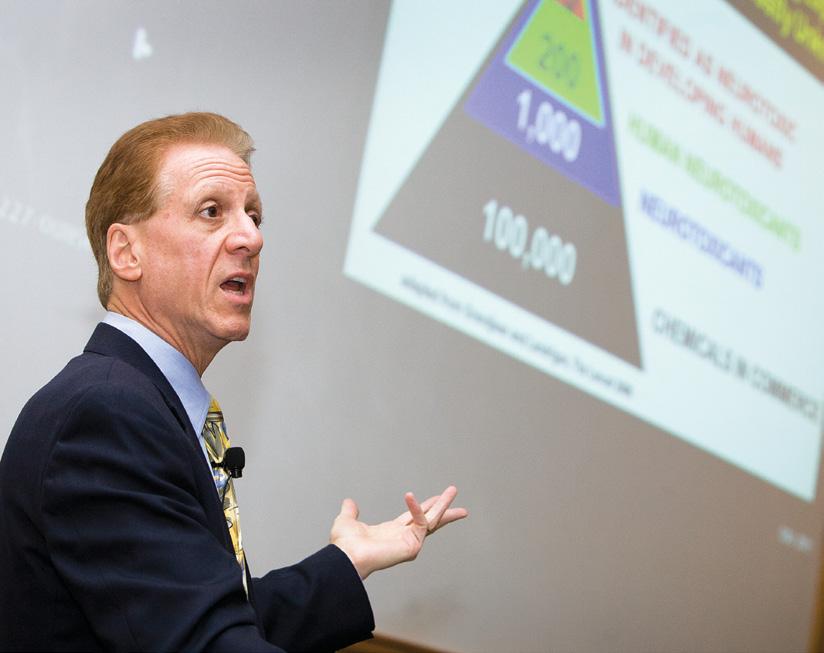
Sitlington Lecture features visual system expert
The 12th annual Sitlington lecture in toxicology featured University of houston professor donald fox, ph.d., who shared his most recent research findings regarding the effects of low levels of lead exposure at different critical developmental stages on the retina.
Carey pope, p h. d , hosted the lecture on “altered Regulation of Cell Cycle and Cell fate specification increases Re tinal p rog enitor Cell p rolifer ation and neurog enesis during g estational l ead e xposure.” The presentation was made simultaneously to faculty, staff and students at osU’s veterinary center and at the University of o klahoma College of pharmacy.
fox is a professor in the college of optometry at the University of h o uston and holds joint appointments in biology and biochemistry, pharmacology and pharmaceutics, and health and human performance departments. he is also a distinguished aRVo (association for Research in Vision and ophthalmology) fellow.
With at least 100,000 chemicals in commerce today, approximately 1,000 are neurotoxicants. of those, 200 are demonstrated human neurotoxicants, and five have been identified as neurotoxic to developing humans. The vulnerability and phenotype of developing nervous systems following exposure to many environmental toxins is virtually unknown.
o f concern to f o x, whose research focuses on chemical effects in the retina, is the fact that low levels of lead exposure below the level identified by the Centers for disease Control and prevention have been found to have irreversible effects on the retina in children. he cautioned that children exposed to a low level of lead during pregnancy should be followed and examined for possible visual defects and retinal degeneration as they age.
f o x earned a bachelor’s degree in chemistry from miami University and a doctorate from the University of Cincinnati medical Center on a n a tional institutes of health predoc toral fellowship.
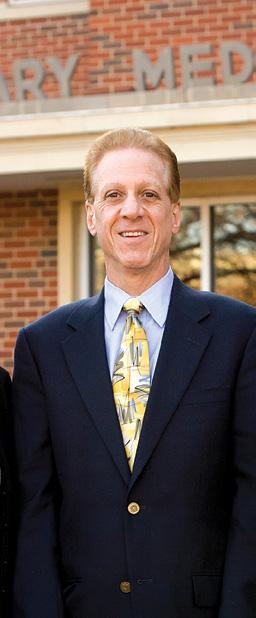
donald fox shared his recent research findings on the effects of lead exposure on the retina.
Gary Lawson / University MarketinG
College graduates largest class
By DeRinDA BlAkeney
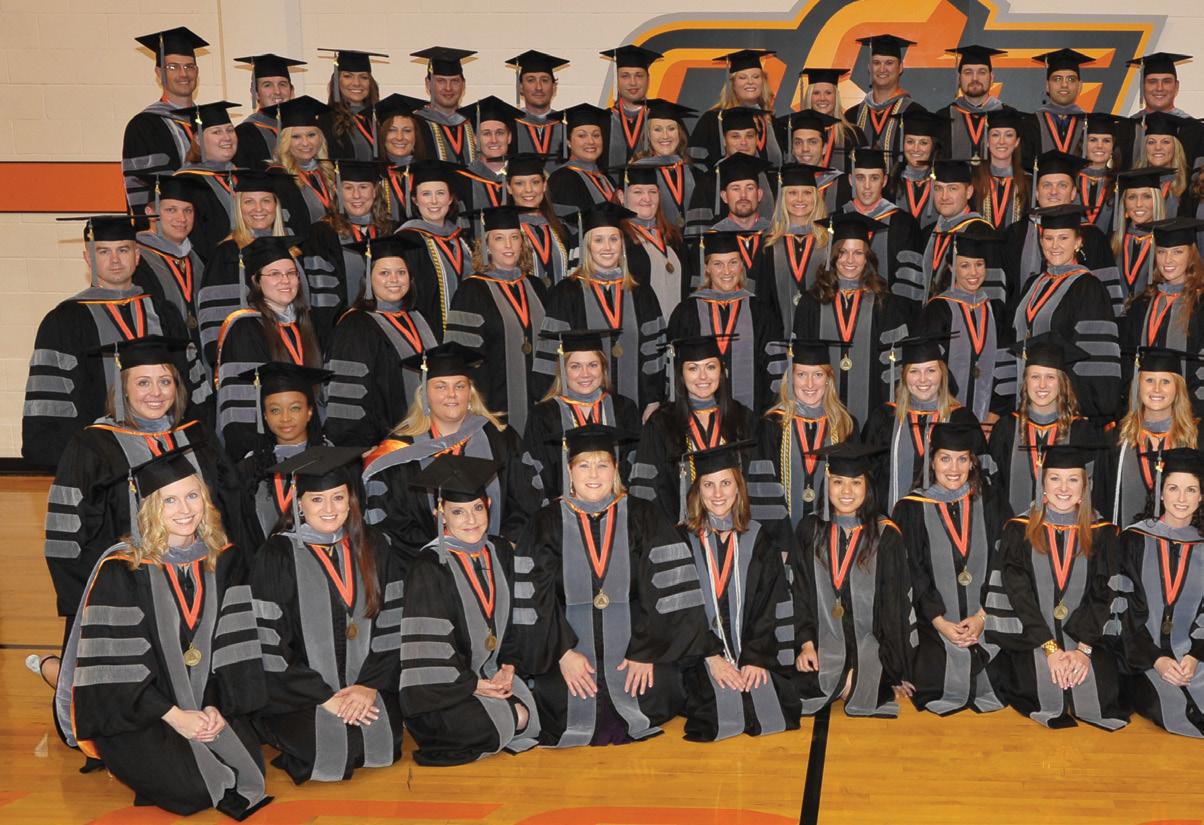
W ITH 85 S TUDENTS , THE Cl A SS OF 2012 IS THE l ARGES T C l A SS TO GRADUATE FROM O SU’ S C O ll EGE OF V ETERINAR y M EDICINE SINCE IT OPENED ITS DOORS 64 y EARS AGO IN 1948. O N HAND WERE SOME SPECIA l GUES TS TO HOOD THOSE NEAR AND DEAR T O THEIR HEARTS . H ERE ARE THEIR STORIES :
Oklahoma State University’s College of Veterinary Medicine Class of 2012
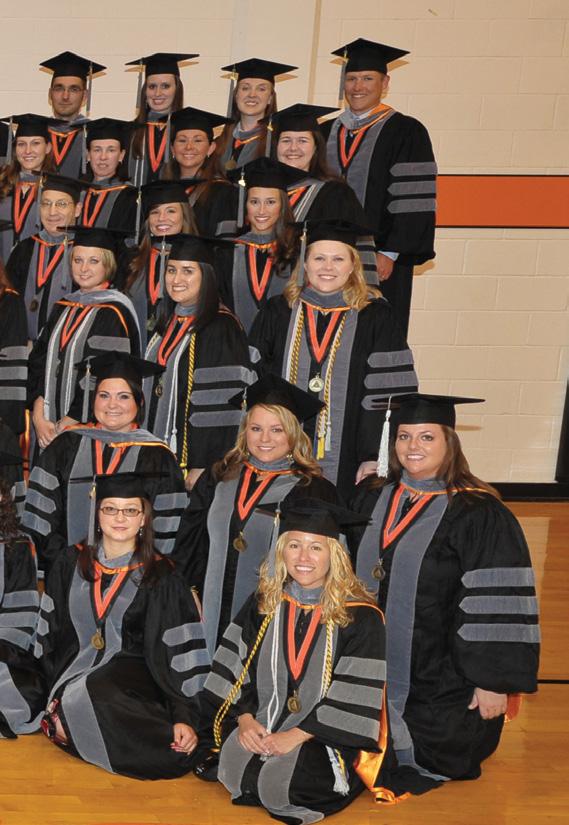
J ESSICA Abb E y AND HER UNC l E
Jessica Abbey of tulsa, okla., is the daughter of Mike and Jennifer Abbey of tulsa. Jessica was hooded by her uncle, Dr. chris kelley, a 1997 osu veterinary graduate.
“I didn’t decide to become a veterinarian because my uncle was one, but his career choice definitely had an impact on me,” says Abbey. “i have always looked up to my uncle. When i was younger, i would call him and ask him animal questions. i remember him having to leave family functions or answer his phone for emergencies. I feel like he gave me a true understanding of what it means to be a veterinarian.”
kelley owns and operates sAHo owasso Animal Hospital and sAHo skiatook Animal Hospital.
“i loved the summers and breaks when Jessica would come work with us,” recalls kelley. “the best memory was assisting her with her first full spay on her own dog. it was great to see her do that. Jessica is intelligent, responsible and compassionate. she would have been successful in any profession, and i am glad she chose ours. i am very proud of her and looking forward to the day i get to call and ask her advice on a patient.”
Following graduation, Abbey plans to practice at a small-animal hospital in tulsa.
Genesee photo systeMs
M ATTHEW bAR k ER AND HIS DAD
Matthew Barker of yukon, okla., is the son of Dr. l.D. and Alta Barker of yukon. in the fall of 2008, l d. Barker, who received his DVM at osu in 1965, put a white coat on his youngest son, Matthew, as he entered the veterinary college. on May 5, he had the honor of hooding Matthew as he earned his DVM degree.
Following graduation, the youngest Dr. Barker will join his father and brother, Mark Barker, a 2005 osu DVM graduate, at the family’s mixedanimal veterinary practice, Professional Animal Health in newcastle, okla.
“my main interest is food-animal medicine but I will be doing any large-animal or small-animal cases or whatever is needed of me,” matt barker says. “I am ready to start my career, contribute to the clinic and help to grow it. It has been a long four years but well worth it.”
“i am real proud of Matt for having accomplished this goal while serving in the u s. Marine Reserves as well as raising and caring for a family,” his father says. “He was delayed a year in reaching this goal when his Marine unit was deployed to iraq. i am excited and proud to have two sons who chose veterinary medicine as their profession — and both at my alma mater.”
According to his father, Matt Barker’s strengths are his calm temperament, his concern for people and his passion for animals.
“Matt enjoys working with and caring for livestock and has the innate skills to do so,” adds his father.
With both sons working at Professional Animal Health, is the senior Barker thinking about retiring?
“Retirement is not currently in my plans,” he says. “there is still much to do and to learn in food-animal medicine, especially in disease prevention. it has been a real joy to watch
and work with Mark as he grew as a veterinarian in the knowledge of practice, the development of the essential skills in large-animal practice, and to take our practice to a higher level of service. i want to be a part of and to experience that with Matt as well.”
Being the first one in his family to earn a college degree, l.D. Barker says he feels very blessed that all three of his sons have earned degrees of higher education. His wife, Alta, agrees.
“Brad, our oldest, is a West Point graduate and a lieutenant colonel in the u s. Army,” l .D. Barker says. “Mark and now Matt have earned their DVM degrees. Veterinary medicine has been a very rewarding profession for me. I am glad to have the opportunity to be of service in it and to have provided for a family from it. Alta and i are very proud.”
Matthew Barker is ready to carry on the family tradition and has begun seeing clients at Professional Animal Health.
d
kE ll IE M C M AHAN AND HER FIANC é
Kelli McMahan of Whitehouse, texas, was hooded by her fiancé, dr. nick Johnson, an osu 2011 veterinary graduate. McMahan is the daughter of l arry and Jo McMahan of tyler, texas.
“I am proud of kelli and how hard she worked to get where she is,” says johnson. “I’m very lucky to have found someone as wonderful as her.”
Johnson has spent the past year working as an associate veterinarian at Pawnee Veterinary Hospital. the mixed-animal practice (60 percent large animal and 40 percent small animal) serves Pawnee county and parts of osage, noble and Payne counties.
After graduation, McMahan is joining Hecht Veterinary clinic in tulsa.
lINDSE y W OODS AND HER STEPFATHER
lindsey Woods of Fort smith, Ark., is the daughter of Jerry and stephanie Woods of Hackett, Ark., and Ray and Jan Burd of l avaca, Ark. dr. ray Burd, Woods’ stepfather who received his DVM from osu in 1969, placed her hood on during the ceremony. “I know I have been only a small part of lindsey’s dream of becoming a veterinarian and in choosing OSU for her undergrad and veterinary degrees, and I am very honored to be the one to place that hood on her,” says ray burd.
Woods knew from a very young age that she wanted to be a veterinarian.
“When my mom started dating a veterinarian, he encouraged me but wouldn’t let me work at his clinic until i was at least 16,” recalls Woods. “His philosophy is that exposing a ‘youngster’ to some things too early might turn them away from veterinary medicine. so all through junior high school, i volunteered at the Humane society as a dog walker and cat sitter. Finally when i started high school, i was allowed to start working at the Rogers Avenue Animal clinic. even though my first job was sweeping the parking lot and being a kennel tech, i was convinced that i wanted to be a veterinarian.”
Woods spent three summers working at Burd’s small-animal clinic in Fort smith.
“ i tried to challenge l indsey to always look at the big picture whether it was a medical case, surgery or life in general,” Burd says. “ i worried about the boss’s-daughter syndrome but due to her strength of character, hard work and cheerfulness, lindsey was soon a favorite of the doctors and staff. she will be an outstanding veterinarian.”
“I enjoy extrapolating information I have learned about common or domestic species and applying it to exotic and zoo species, which we know very little about,” says Woods. “i hope to work in a small-animal and/or exotics private practice for a year or two and then seek an internship position in a zoo.”
continues
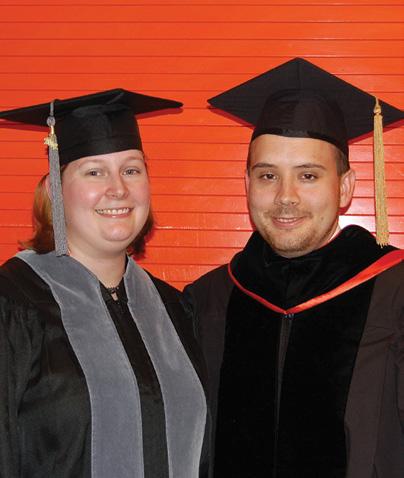
bRIDGET WA GNON AND HER HUS b AND
Bridget Wagnon of oklahoma city is the daughter of lorraine and David ellis of Purcell, okla.
Wagnon knew from a young age that she wanted to be a veterinarian. While earning her bachelor’s degree at osu, she worked on the barn crew at osu ’s Boren Veterinary Medical teaching Hospital, where she met daniel Wagnon. A year ahead of her, Wagnon also had his sights set on veterinary college. He earned his DVM degree from osu in 2011 and is returning to hood his wife.
“I am very happy for my wife and her accomplishment,” says d an Wagnon. “Having known her through it all — undergraduate, applying, getting to be there when the ‘big’ letter finally came saying she was accepted, and knowing just how much it means to her to be a veterinarian — i couldn’t be more happy for her. i know she’ll be a fine veterinarian.”
Bridget Wagnon has fond memories of the last four years.
“i liked the field trips that the small ruminant club took with Dr. katie simpson to the alpaca farm,” she recalls. “i would suggest that students who are thinking about veterinary college find a veterinarian to work for or volunteer for to make sure they enjoy the work and also to gain experience. stay focused and be persistent, and all your effort will be worth it in the end.”
As for dating or getting married while earning your veterinary degree, Dan Wagnon has some advice.
“marriage is tough, and so is vet school,” he says. “Our profession takes up a lot of our time. It’s important to make time for each other. you must learn to step away from medicine and just be a regular person every once in a while. if you do, you can look forward to having a spouse who will understand your situation more than almost any other person, someone who will be there for help with studying for tests, to help treat patients on emergency calls on a sunday afternoon. it makes for plenty of opportunities to bond with each other and help each other grow. And it makes for some very ‘interesting’ dinner conversation as well.”
Following graduation, Bridget Wagnon joined Deercreek Animal Hospital in Harrah, okla. Her husband works at Veterinary corner, a four-doctor mixed-animal practice. in the long term, the Wagnons look forward to starting a family together and perhaps one day owning a veterinary practice together.
Moving ahead
The Center for Veterinary Health Sciences held a transition ceremony for the Class of 2013 (below) at the Stillwater Community Center. The tradition, which began seven years ago, marks the start of clinical rotations, signifying the next step forward for third-year veterinary students.
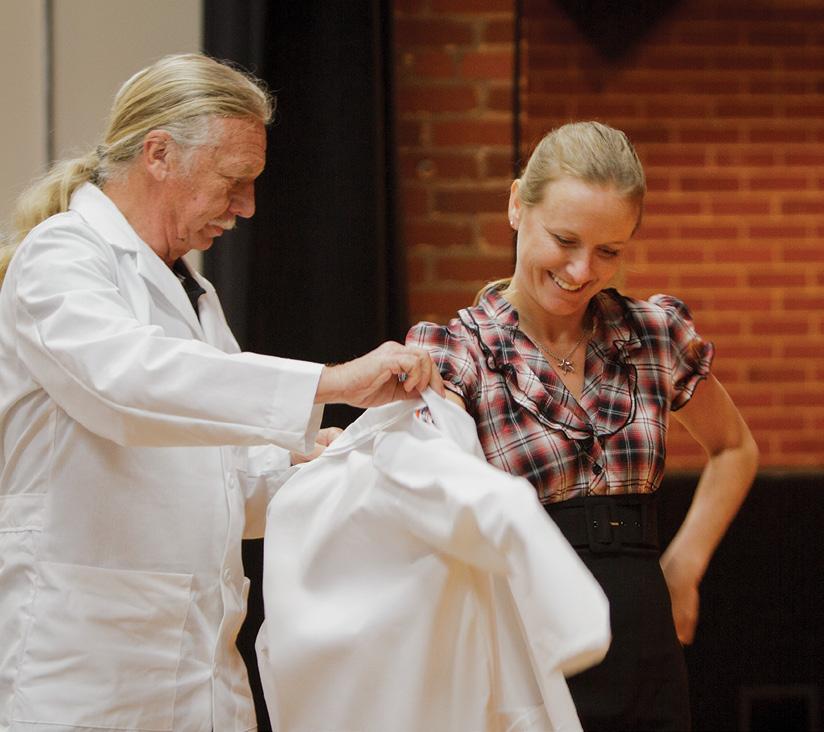
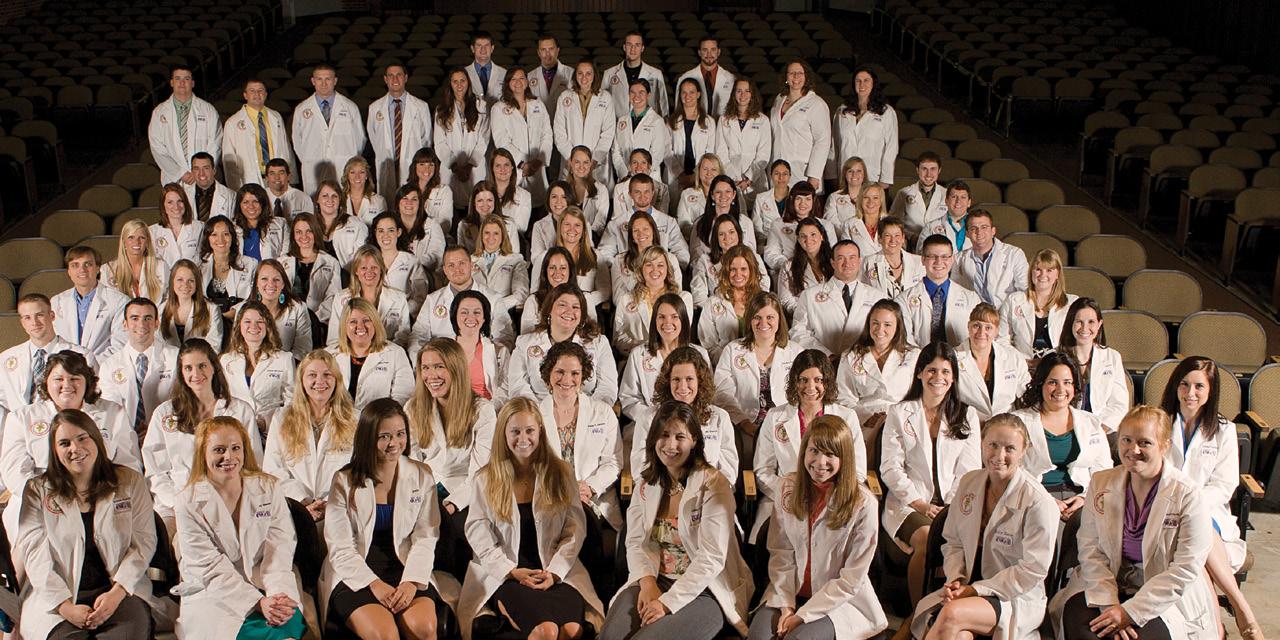
Holly Slater receives her white coat from dr. larry Stein, interim head of the Department of Physiological sciences, during the spring ceremony.
Gary Lawson / University MarketinG
BY THE
CLASS OF 2016 NUMBERS
Welcome to the Class of 2016. of its 82 students: 65 are female and 17 male. of the group, 58 are oklahoma residents and 24 come from other states. the core and cumulative grade point averages for these students are 3.533 and 3.579 respectively. their average grade GRe scores are 153 verbal, 150 quantitative and 4.0 analytical.
Wrl@lk' m@ Ii:© li:lru@«:ii!ll~~ ©~ l@~(§om its 8:2 sttudemtts:65 are female and 11 male. Of U1egwoup, 58 are rndahoma residentts and 24 come from other stattes. The core and cumulaUve grade pointt averages for \these :,;tudentts are 3.533 aindl 3.519 respectively. Thek average grade GRIE scores are 153 verbal, 150 quantitative and 4.0 analytical.
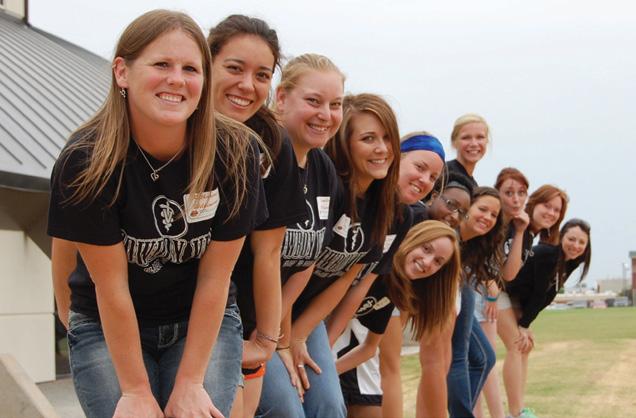

i f the verbal and quantitative scores look low, it’s because the GRe General test has been revised. the new format reports scores on a 130–170 scale in onepoint increments. t he analytical writing scores continue to be scored on the same 0–6 scale in half-point increments.
to be eligible f or the e AP, seniors in high school must have an Act score of 28 or higher and be enrolled in a comprehensive university in the state of oklahoma. students can be admitted to the program during the freshman year of their undergraduate education.
be eiigibie for u,e EAP, seniors irohigh school must have an ACT score of 28 or higher and lbe enrolled in ai comprehensive university in the state of Oklahoma. Students can be admiUed i:o the program during the freshmall'1year o\f their Ull'1diergrar.h.1alte ~ducai:ioll'1.
the incoming Class of 2016 at oklahoma state University’s Center for Veterinary health sciences spent two days in the Colvin annex participating in a new orientation program. the Cowboy Vet (Veterinary education and team building) program focuses on leadership, selfawareness and communication concepts to give the class tools they need to be successful veterinary students.
Early Admit Scholars muslt mainltain a 3.5 Gl>'Aeach emesn ltl"le verbai ,:md quall'11tilta- li:er whiie completing their tive scores loo~ low, it's ber.::ause ba h~I r's degree am:! the prethe GRIE Ge11'1eral'fest has lbeell'1 v,aterill'1arycourse requiremel!'1ts. revised. The 11'1ew\format reports Durill'1g tthis time, studEmts are scores on a t30H70 scale ill'1om~- teamed with veterinary college poill'1t ill'1cnemel!'1ts.The analyti- faculty to provide guidance and cal writing scores contil!'1ue to be m •ntorship. Drs. Robert Bahr, seemed011'1the same 0~6 scale ill'1 1i dd Ho!lbroo~. lim Si'1idlcer3i'1dl half-point incrementts. lara -ypi'liews!d are m i'lttor,; f"'.lr
t his is the thir d class that includes e arly Admit Program (eAP) students. of the eight, five are residents and three are nonresidents. the eAP strives to aid students with strong academic ability, who are committed to a rigorous academic program in their veterinary medical career development.
e arly Admit s cholars must maintain a 3.5 GPA each semester while completing their bachelor’s degree and the preveterinary course requirements. During this time, students are teamed with veterinary college faculty to provide guidance and mentorship. Drs. Robert Bahr, todd Holbrook, tim snider and lara sypniewski are mentors for these students. these veterinarians took extra time with these students and we applaud their dedication to the future of veterinary medicine.
eAP students in the class of 2016 had an average core GPA of 3.74 and an average cumulative GPA of 3.85.
This is the third class Unatt \th"'-"' s1tudlen1ts.lhes=inducles !Early Admit Program i,:in It k extra li:ime wilth Ith (FA , -sttuden'l:s.Of tthe eight. five t1.1dell'11tand! we a[Pplaudl their are resid~nts and three are i'10U"I-dee!' .;:iti 11'1 to the !future If veltre idleU"lts.The IE:APstrives to aid erii'1ary medlidll'1e. students witth strong academic EAP sli:udenli:sill'1the Class of albilitty, who are commiUed to a 20l6 had an average core GPA rigorous academic pmgraim ii'l their vet rill'1ary medical carei;r j lV"I pm nt
oil' ~,14 am:ll all'1avern1ge cumulaitiv '3PA 1f3.85.






OSU fields team at national bovine palpation contest
for the first time since 2004, the oSU Student Chapter of the american association of Bovine Practitioners rounded up a team to compete in the Bovine Palpation Competition at the Student american Veterinary Medical a ssociation Symposium
The osU 2012 bovine palpation Team coached by dr. emily r eppert and assisted by d r. Suzanne Genova, consists of six veterinary students — four competitors ( Jason a nton , Class of 2015; Ben estes, 2013; eric Harms, 2013; and Hannah Wadsworth , 2013) and two alternates (J.d folsom, 2015; and Holt tripp, 2015). all six made the trip to the competition at purdue University.
“I joined the team because I am interested in working with cattle, especially cow/calf operations,” says harms. “i wanted to learn about artificially inseminating cows. This competition was a great way for me to practice and gain some skill at palpating before i graduate.”
The team aims to provide veterinary students who have demonstrated a strong interest in food-animal medicine and bovine reproduction a venue to further develop their skills in bovine palpation while preparing to participate in the national competition.
“
i n order to be selec ted for the team, students are required to be members of the student chapter of the aabp,” says Reppert. “They had to demonstrate outstanding knowledge of bovine reproduction via a written examination. The members have undergone rigorous training, including in-depth weekly classes on subjects relevant to the study of bovine theriogenology, such as control of the bovine estrous cycle, causes of infertility, advanced reproductive techniques and obstetrics. in addition, students are required to attend weekly laboratory sessions in order to develop their palpation skills.”
“ i enjoyed being part of the palpation team as it allowed me to earn valuable knowledge not only in palpation but in all different aspects of reproduction that will be of good use in my future career,” says estes. “It was also important to me that OSU, one of the top food-animal schools in the country, was represented on a national level.”
“i believe that it is absolutely necessar y to be proficient in palpation when working in large-animal veterinary medicine,” says a nton. “The os U palpation team has provided an opportunity for me to strengthen my palpation skills and has improved my understanding of the veterinarian’s role in bovine reproduction.”
The osU team placed fourth in the na tional competition. Team members are grateful to their two coaches and others who helped them train for several months — dr. Reed holyoak, veterinary clinical sciences professor and diplomate in the a me rican College of Theriogenologists; d ennis Wilbourn, Veterinary m edicine Ranch manager; and a lan Jennings, local dairy breeder. Two os U alumni, dr. bruss horn (1980) and dr. denis matousek (1981), provided financial support that made this program possible.
“i have had an interest in bovine reproduction for several years,” says Wadsworth. “ fo r me, the palpation team was an opportunity to delve deeper into the field and to apply the knowledge i had obtained from the third-year theriogenology course. The three months of preparation for the competition was arduous, and the competition itself was very challenging. my participation in the competition has allowed me to become more confident with my palpation skills and has prepared me for practicing better bovine medicine in the future.”
— DeRinDA BlAkeney

Members of the oSU 2012 Bovine Palpation team traveled to Purdue University in Lafayette, ind., for the national Bovine Palpation Competition the team includes (from left) Hannah Wadsworth eric Harms J.d folsom Ben estes Holt M. tripp and Jason anton, along with coaches dr. Suzanne Genova and dr. emily reppert
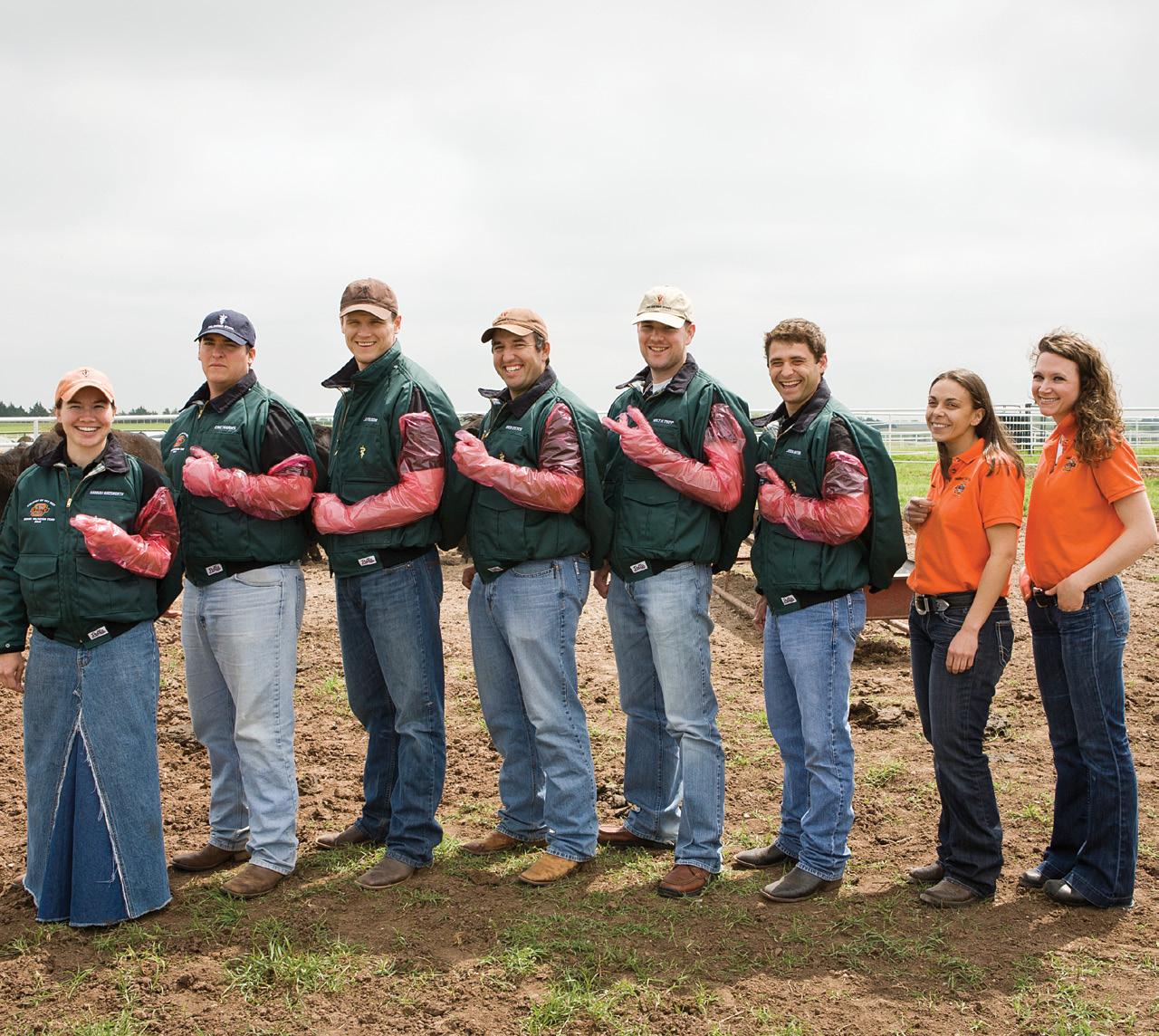
Newly commissioned veterinary student
From left are dr. Ken Bartels, a retired U.s army colonel, newly commissioned 2nd lt. Candace Wimbish and Sgt. 1st Class lindsay dally, an army health care recruiter.
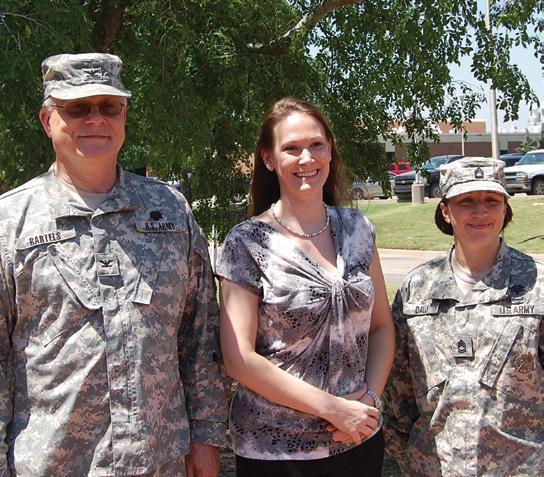
Candace Wimbish of Denton, texas, a veterinary student at osu’s center for Veterinary Health sciences, was commissioned on April 27 as a second lieutenant in the u s Army. Performing the ceremony was retired Col. Ken Bartels, who holds the Mccasland Professorship in Biomedical l aser surgery and kerr Foundation endowed chair in the Department of Veterinary clinical sciences at the veterinary center.
Wimbish joins the Army on a two-year health services professional scholarship. Following her graduation in 2014, she will serve three years’ active duty in the military.
s he graduated from Denton High school and earned a bachelor’s degree in biology from the university of texas at Arlington, graduating magna cum laude. she is the daughter of sandra Parker of Denton and married to Patrick Wimbish, a petty officer first class with the navy Reserve.
College helps tornado victims
in April 2012, a severe tornado blew through Woodward, okla., killing six people and damaging or destroying 224 homes and businesses. two veterinary students, tyla Barkley (class of 2012) and Kami Jensen (class of 2014), were safe at school in stillwater but wanted to help their hometown. the two sent out a plea to the center for Veterinary Health sciences family for help — and boy, did they respond.
“We raised $1,026 in cash and gift cards from a bake sale and donations,” says Barkley. “We also donated 1,200 pounds — or $2,500 worth — of Hill’s science Diet pet food.”
“it was great to see the kindness shown to our hometown and its citizens,” says Jensen. “Words cannot express how awesome it feels to be a part of such a caring CVHS family. the cleanup process is coming along rapidly with the support of volunteers. survivors still have a long road to haul but with such generosity expressed from so many individuals, the healing process will come soon.”
oklahoma state veterinary students Kami Jensen (Class of 2014, left) and tyla Barkley (’12) deliver two carloads of donations, in addition to cash and gift cards, after a tornado struck their hometown of Woodward, okla., in april. since her graduation in May, Dr. Barkley is pursuing a career in a mixed-animal practice in central oklahoma.
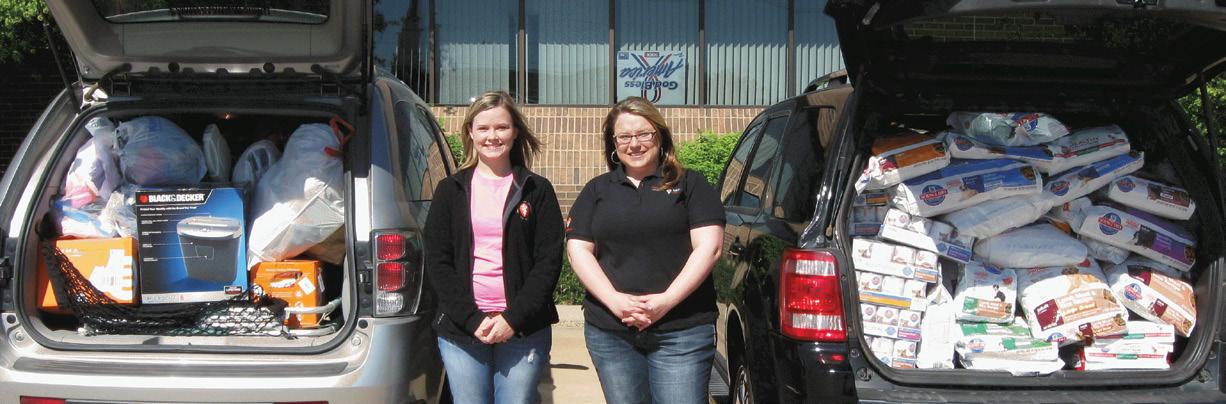
Paying it forward
I
it s tarted when a veterinary student rescued a boxer who had been wounded in a dog fight and neglected by her owners. The student found a new home for this dog, but she could not afford the shipping expenses nor to deliver the dog herself. a truck driver stepped forward to provide a free ride from oklahoma to m assachuse tts to deliver the boxer to her new family. in return, that same veterinary student, who wishes to remain anonymous, stepped forward in 2011 to help someone else in need, Katy ashcraft.
a shcraft is a nor thern oklahoma College student from Welty, okla., who plans to major in agricultural communications at osU. she saw something lying alongside the road while driving. stopping, she discovered a small dog covered with grime in a mud puddle.
“ i took him home,” says a shcraft. “ i noticed he had something wrong with his eye. i had toured osU’s veterinary hospital when i was younger and was fascinated with it. i thought it would be convenient to take him there since i go to school there.”
e ach case at the veterinary hospital is assigned to a fourthyear veterinary student, an intern or resident and a faculty member. ashcraft and the dog, named Toby, were seen by student sharon Uluh, a Ross University student completing her clinical training at os U. Uluh took Toby’s history, examined him and discussed the dog’s condition and treatment options.
n e xt, d r. l ar a s ypniewski, community practice veterinarian and the clinical assistant professor on the case, assessed Toby’s condition.
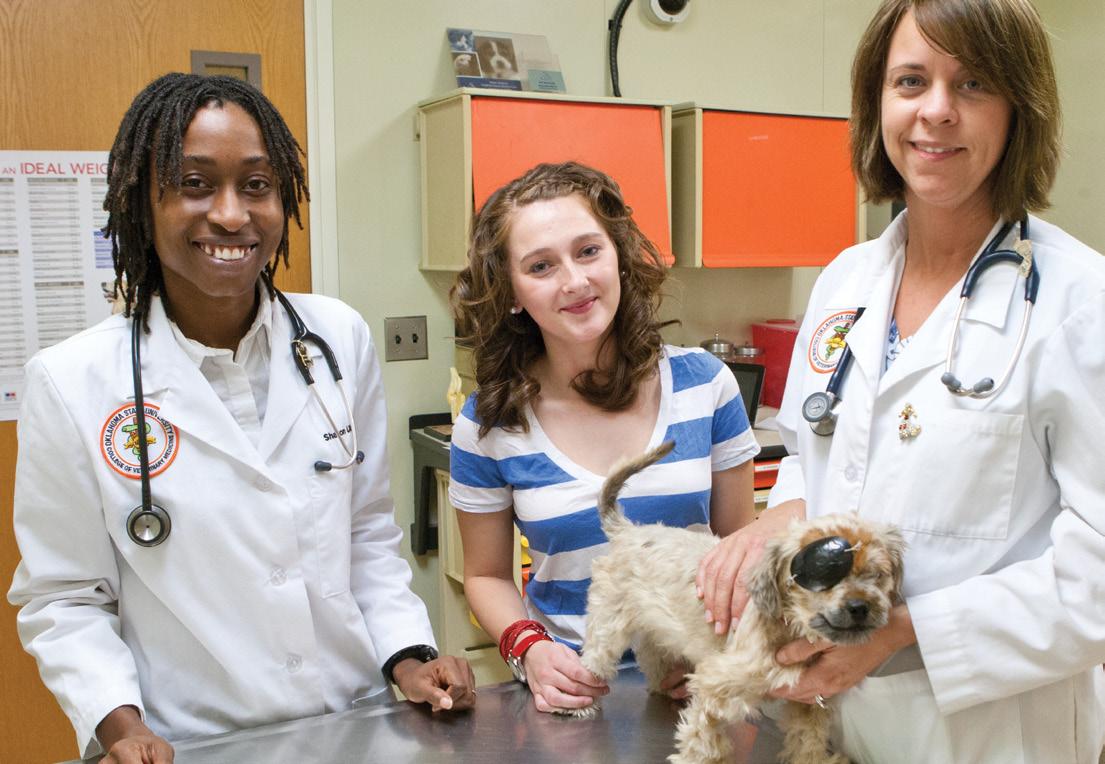
dr. lara Sypniewski (right) and fourth-year student Sharon Uluh (left) are treating Katy ashcraft’s dog, toby, a shih tzu mix who had suffered a ruptured eye.
“We scanned Toby for a microchip, checked for any identification and found none,” explains s ypniewski. “ h e looks to be a middle-aged male shih tzu mix, covered in mud and grease from the underside of a car. he appears to be healthy except for a ruptured right eye.”
s ypniewski found a hole in the center of Toby’s cornea and the contents of the anterior portion of the eye were protruding from the globe.
“his eye was covered with dirt and debris and, of course, was noticeably painful. This injury could have been from an acute injury, such as head trauma, or the result of a progressive, chronic corneal injury or disease,” adds sypniewski.
With little chance of saving his sight, sypniewski suggested removing the painful eye and ashcraft agreed, despite the cost.
“ b etween what was left from high school graduation gifts and incoming paychecks from my part-time job, I was able to cover Toby’s surgery and medical care,” says Ashcraft. “ d r. s ypniewski asked me about having him neutered while he was under anesthesia for his eye surgery, but i declined because i couldn’t afford the added cost.”
Toby received an antibiotic to help reduce the infection in and around the affected eye before surgery, as well as pain medication.
“We gently cleaned Toby’s eye and sent a topical antibacterial ointment home with Katy,” says s ypniewski. “Thanks to Toby’s small stature, we were able to provide a ‘no-charge puppy pack’ sample of Revolution, a topical anti-parasitic and anti-helminthic that helps to prevent heartworms, fleas, ear mites, sarcoptic mange and certain types of ticks. i t also helps to control hookworm and roundworm infestations.”
s ix days later, a shcr aft brought Toby back for surgery.
“The morning of Toby’s surgery, i mentioned to a fourth-year student, who would be assisting during the operation, that i wished i could neuter Toby while he was under for his eye surgery to avoid multiple anesthetic events,” recalls sypniewski. “i told her i was unable to do so because Katy couldn’t afford any extra procedures.”
“When i heard that, i knew it was time to ‘repay a favor,’ and i told dr. sypniewski that i would be glad to pay for Toby’s neuter, and i wanted to remain anonymous,” the fourth-year student says.
The hospital called ashcraft.
“ i was so happy when they called me and asked me about having Toby neutered,” says a shcr aft. “ i t was such a relie f because i really wanted it done, but the money was an issue. it takes someone with a big heart to just donate money to a dog they just met. i am so very thankful to that student.”
Toby’s surgeries were uneventful with no complications, and he went home the next morning.
“What a tremendous change in Toby,” says a shcraft. “ he went from being a withdrawn, quiet dog to an excited, happy little guy. he is never in a bad mood, and he’s just an awesome dog!”
Ten days following surgery, Toby returned to the veterinary hospital for suture removal. “The surgical site healed nicely, and his sutures were removed without incident,” reports sypniewski.
“Coming to OSU’s veterinary hospital was wonderful, ” says ashcraft. “i loved it there. They explained everything to me and worked with me on my work and school schedules. m y veterinary student gave me her number, and i called and texted her every day with different questions and concerns. ever yone and everything deserves a second chance, no matter the history or condition. Toby was in bad shape when i found him, and d r. s y pniewski and the veterinary students and hospital staff helped me give him a second chance. i will always be grateful.”
a nd who knows? m a ybe someday a s hcraft will have a chance to express that gratitude by “paying it forward” for someone else in need.
— DeRinDA BlAkeney
oSU’s Boren veterinary Medical teaching hospital is open to the public, providing routine and specialized care for small and large animals. it also offers 24-hour emergency care and is certified by the american animal hospital association.
“What a tre M en D o U s C hange in t o B y h e W ent F ro M B eing a W ith D ra W n, q U iet D og to an ex C ite D , ha PP y L itt L e g U y. h e is ne V er in a B a D M oo D , an D he’s JU st an a W eso M e D og!”
The cat’s meow
“luella lived next door to us, 3-4 miles away, as long as i can remember,” says Ralph Chain, one of the executors of the Curtis estate. “my family has been on the same property for 120 years. back in the day, luella was the one who would come by and collect the telephone bill. my son, mo nte Chain, would take his children to luella’s on halloween trick-or-treating. s he had some cattle and pretty much went about her business quietly. she sure was grateful that osU veterinarians saved her cat.”
When it came time to put her affairs in order, Calkins consulted with her financial adviser. not only did they share a business relationship but over the years, they became dear friends. it is said that l eora was a very humble person. Very few people knew she was wealthy. The money was never a factor to her. she was a frugal woman, always to the point. you knew where she stood on things. she never married and didn’t have children. her ca ts were her family, and like so many animal lovers, she adored them.
it was the wishes of both sisters that the majority of their estates be left to further the education of many at osU’s Center for Veterinary health sciences.
The many people who will benefit from the estate gift totaling $3.2 million (the largest given to the veterinary center to date) will never have the opportunity to meet the two sisters behind this donation — luella Curtis of Canton, okla., and leora Calkins of Tonkawa, okla. but someone at oklahoma state University’s Center for Veterinary health sciences did meet luella Curtis, and the treatment that veterinary clinician provided to l uella and her pet is the reason behind part of the gift. Curtis and her husband butch, who passed away before she did, didn’t have any children but she loved animals. she had a pet parakeet and a cat. When her beloved cat became ill some 20 years ago, she brought it to os U’s veterinary hospital for treatment. The compassionate care extended to her cat so impressed Curtis that she and her husband decided to leave the majority of their estate to the veterinary center. l eor a
l uella had cattle as well as her pets and knew firsthand the importance of veterinarians in oklahoma. l eora’s love for animals was great, and she knew that veterinarians shared that same wonderful love for animals large and small.
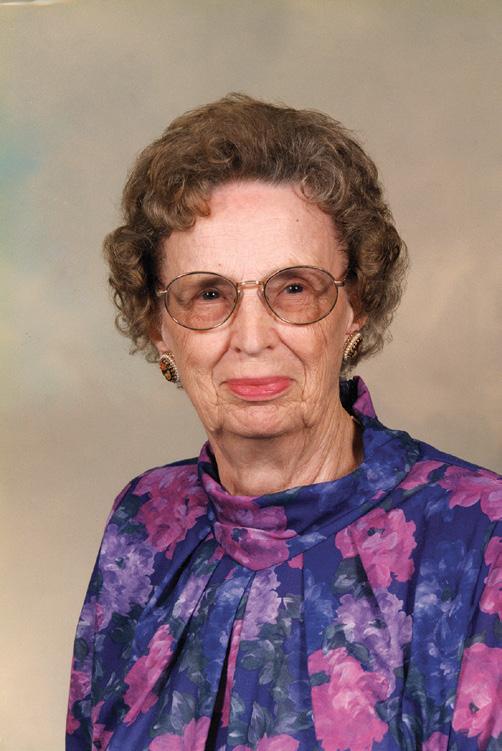
Calkins
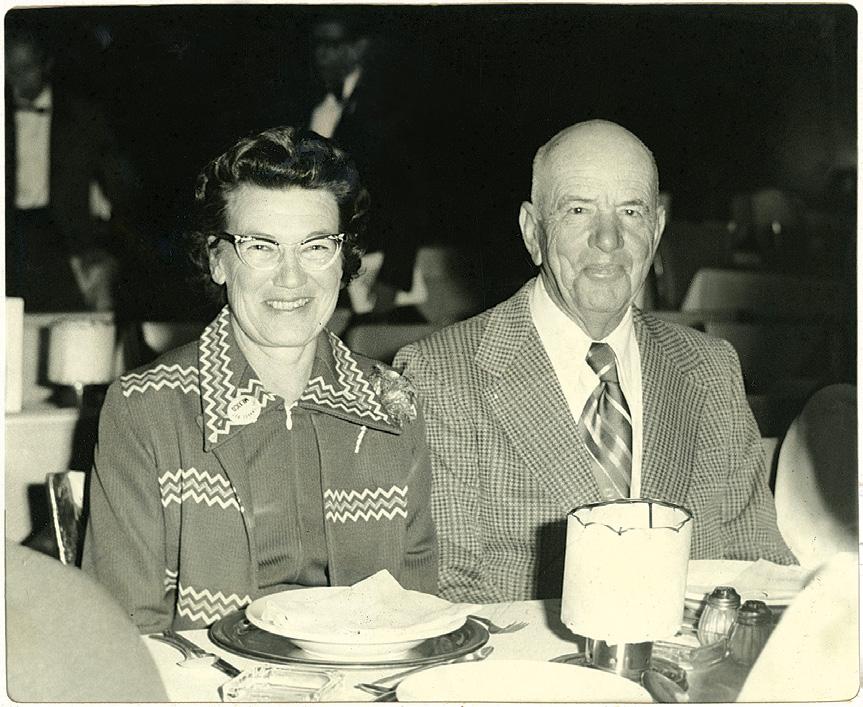
so thanks to the care provided by an osU veterinary clinician and the generosity of these two sisters, the estate gift endowment will provide funds for student scholarships for years to come.
“The amount of each award and the number of awards given each year will be determined by the awards selection committee,” explains Christopher Ross, d V m , associate dean for academic affairs. “The debt load veterinary students face upon graduation is staggering, and we are very appreciative of donors who make it possible for us to reduce that burden. We expect the annual income from this gift to expand our scholarship offerings by about 50 percent, which is a huge increase.”
“This is a phenomenal gift,” adds a manda d avis, senior direc tor of development. “The number of lives that will truly be touched by luella’s and l eora’s generosity is countless. not only will the students receiving the scholarships benefit but so will the patients they treat down the road thanks to their education — an education that is made possible in part by this gift.”
o nce l eora made her plans known she was asked if she would like to meet pistol pete and give osU an opportunity to thank her in person for her generosity. she refused, saying she didn’t want any recognition; she was just glad to pass the money on. she had everything she needed. she felt blessed that she could further someone’s education so they could in turn help animals.
The first scholarships from the l uella Ruth and b utch Curtis educational fund will be awarded in the spring of 2013 — the first of many scholarships, thanks to luella and leora.
— DeRinDA BlAkeney
“ t he n UMB er o F L i V es that W i LL tr ULy B e to UC he D B y L U e LL a’s an D Leora ’s generosity is C o U nt L ess.”
l uella and Butch Curtis
Message from the Development Office
Greetings:
Since becoming the CVHS’s development director last year, I have had the privilege of meeting many of our alumni and donors while getting to know the important work done here. Each day, I am grateful to be part of this very special place. From the compassionate care provided by the Boren Veterinary Medical Hospital and the education of some of the country’s best veterinarians to the research that affects our animal friends, our national security, and in many cases our own health, it is easy to see the impact of the CVHS everywhere you look.
Under the leadership of Dean Jean Sander, we are expanding our development programming and the level of service we provide to our supporters. This issue marks the first phase of that effort with the 20112012 Donor List. We are also preparing to roll out an initiative called the Orange Sock Society to thank donors who have supported the CVHS for five or more years consecutively. The name comes from a tradition begun by former dean Dr. Michael Lorenz, who created the Loyal and True Order of Orange Socks. Induction into the society is given in recognition of service to the CVHS. The loyalty of individuals who support the center in the long term is an inspiration. The benefit comes not only from the impact of the financial gifts they make, but also from the statement their consistent support makes. We have created the Orange Sock Society as a way of recognizing that our consistent supporters are part of us. On their fifth consecutive year of giving, donors will receive a special letter from the dean and an Orange Sock Society pin to wear at our CVHS events such as Fall Conference, the Awards Banquet and the alumni receptions at various conventions.

In addition to finding more ways to thank you, we will be offering new opportunities to support the work of the CVHS, including a new support fund for the hospital, an Academic Center facility campaign, and new programs for alumni and friends. These are exciting times at the CVHS, and I am glad to be here supporting the faculty and staff in all they do.
If you have any questions or needs, please feel free to contact me. Thank you for your support.
aManda daViS MPa, Cfre Senior direCtor of deVeloPMent
405-385-5607
adaViS@oSUGiVinG CoM
2011–2012 Donors
The Center for Veterinary Health Sciences wishes to express our gratitude to our donors and friends for your support. The following is a list of individuals and organizations that made a gift between July 1, 2011, and June 30, 2012, of $250 or more. All of us thank you.
$1 million or more
Butch and luella Ruth curtis trust
leora calkins estate
$100,000 to $999,999
Bayer Health care novartis Pharma AG
e l. & thelma G aylord Foundation
Pauline Wright estate
$50,000 to $99,999
Dr. Anton kammerlocher
Williams clinic of stillwater
$25,000 to $49,999
Anne & Henry Zarrow Foundation Boehringer ingelheim Vetmedica inc.
Diane stuart and Jon stuart
Jean Williams
$10,000 to $24,999
catoosa small Animal Hospital inc.
conocoPhillips co
Hill’s Pet nutrition inc.
sandra lee
P fizer inc.*
Molly and D.D. Patterson
stuart Family Foundation
travis lumber llc
$5,000 to $9,999
Maj. stephanie Bounds
A.W. and Gwen Foley
iDeXX laboratories inc.
Michael and Rosana Mayer
Vicki Palmer
MsRs Revocable trust
Merkel Family Foundation norfolk southern Foundation
oklahoma
Veterinary Medical Association
Petsmart charities
RH Veterinary service Pllc

$2,500 to $4,999
Bobby and Brenda Alexander
AVMA Professional liability insurance trust
cargill inc.
JMJ technologies inc.
Joyce Doran
Dr. karen and capt. samuel Dowds
Dr. Paul and Margaret DuBois
Dr. Greg and Jana Duffy
Dr. Mark and Denice elwell*
Gregory Gray
Dr. keith and Bonnie Hand
Dr. Joseph and Betty lou Hayden
Dr. Gerald Hegreberg and Dr. lynetta Freeman-Hegreberg
JMJ technologies inc.
Dr. Michael and Velda lorenz*
James Miears
Dr. carey and Dr. Jing Pope
tim and tina Ridley*
Dr. chris Ross*
Dr. Michael and Dr. Jennifer schoonover
Dr. Richard and Mary shepherd
Dr. steven and carolyn Vonderfecht*
Billy White
Bernadine Wold
$1,000 to $2,499
Alamo Pintado equine clinic inc.*
American Association of Bovine Practitioners Foundation
Arkansas
Veterinary Medical Foundation
Dr. keith Bailey*
Paige eubanks-Barrow and John Barrow*
Bild Animal Hospital*
Bruss Horn DVM Pllc
G ary and linda Burke
cedarwood Veterinary clinic
cherokee Hills Veterinary clinic Pc
Jerrell and Peggy chesney
Dr. James and Deborah conklin*
kendria and Bradley cost
Ruth cotner
Dr. R. Reynolds and evelyn cowles Jr.*
Dr. Joe and Mary Davis*
Dr. Phillip and Martha Day
Dorothy c. Richardson trust
Dow chemical co. Foundation
thomas Duquette
Dr. norman and Jane Durham
Forest trails Animal Hospital
Frazier Management trust
Dr. John Freeman
lynn and catharina Fujii
Jeff and Debi Hafner
V. Burns and Ann Hargis
Dr. James and lee Ann Hackworth*
Halliburton Foundation inc.
Helen W. ehrhart Revocable trust
David and Grace Helmer*
Heritage Plaza Animal Hospital
col. Bradford and Annette Hildabrand
kenneth and karen Holmes
Dr. kenneth Huffman*
iBM corp
Dr. Harry and Hannah James
Dr. eileen and Dr. Bill Johnson
Dr. John and Donna kirkpatrick*
Dr. thomas and linda latta
Dr. susan little and Dr. Rodney Will
Dr. steven and Melissa lucas
steven and Jana Mackey
Matousek Veterinary clinic
Melinda McAfee
Mid-America Alpaca Foundation
Midwest Alpaca owners & Breeders Association
Jean Miller
Morris D. covey estate
Dr. nicholas and Dr. Dianne nail*
* inDicAtes MeMBeRsHiP in tHe DeAn’s cluB
national livestock commission Association
national livestock credit corp.
nestlé Purina Petcare co
oakridge equine Hospital Pc
oklahoma city
obedience training club inc.
Dr. Roger Panciera
Boone and Madeleine Pickens
Jerry and Donna Pongratz
Dr. James and cynthia Richardson Jr.
Dr. William and Mary Roberson
Rose Rock Veterinary Hospital & Pet Resort*
Dr. Jean sander*
steven and christine savage
Dr. ted schupbach
Dr. steven and nancy slusher
Dr. D.c. and l. Michele smith
charles and Joyce sullivan
textron Matching Gift Program
tulsa county
Veterinary Medical Association
Veterinary ophthalmology services inc.
Dr. John and Wynn Walker*
Western Veterinary conference
$500 to $999
John A. Baker Revocable trust
Dr. todd and Debra Behre
Gary Bogue
carol and larry Brown
cDX scholarship Fund
chimney Hills Veterinary Hospital
Dr. Alan and Amy Haws coffman
Dr. James and Dr. kathy cooper Jr
Dr. colette crotty
Dr. lee Denney
irma and Robert eufinger
Family Pet Hospital Plc
Dr. Frederick Feibel
Hughes cattle co llc
Dr stephen Hull Jr. and kathryn Reilly
Dr. Joseph inscoe Jr.

Mary kay and Roger Jennings
Dr. cornelia ketz-Riley and Donald Riley
Dr. Jerry and cindy Malayer
kevin and Jo Ann Manke
Dr. James and Dr. katrina Meinkoth
Dr. lester and Grace naito
Fidelity inv. charitable Fund / Willard Rhynes
Dr. Justin Roscoe
Dr. thomas and Jenny sartain
Dr. Richard and cynthia shawley
Amelia smith
Dr. timothy and Jennifer starks
stillwater Designs/kicker
Dr. Amy thiessen
VetPrep
Dr. c. Glenn Warren
leesa and Jeffrey Wyzard
$250 to $499
Dr. troy and kristina Acree
Dr. Paul and carla Aldridge
Dr. carey Bachman
Dr. Annette and Robert Baker
Dr. linda and James Branscum
cameo Arabians
Dr. kimberly and William carter
Dr. Ross and linda clark
Dr. Michelle corr
Amanda Davis
Dr. Frank Denney
Dr. William and Rose edwards
Dr. ireta and Dr. Merlin ekstrom
Dr. kevin Gibbs
Janet and Matt Hall
Dr. susan Harrington and Robert Fichman
Dr. charles and lola Heaton
nancy Henslee
Fidelity inv. charitable Fund / Don and Mary Holmes
steven and Dorothy labounty
Dr. lin liu
Dr. Melissa Magnotta
Victor neal
Dr. John and karen nick
Dr. Joe and Ginger noble
John Richardson
Dr. Richard Roth
Dr. Douglas Ruby
Dr. Michael and sonia sealock
sequoyah Fuels corp
charles and Mary Ann shields
lisa and Randy sims
Dr. Martin and Patricia spindel
Rex and Jane stachmus
Dr. Gregory and Deborah stanbery
stillwater Furniture showcase
Rebecca tims
kristen Vails
Veterinary Associates of Jacaranda inc. Via luna Group inc.
Dr. loretta Walker
Dr. stephen and Johnita Walker
cmdr. R. Dean Ward (Ret.)
sandra Ward
elaine and James White
Dr. R. Gene and Donna White
Patty Whitecotton
laRonna and Donald Wilbourn
BRANDING
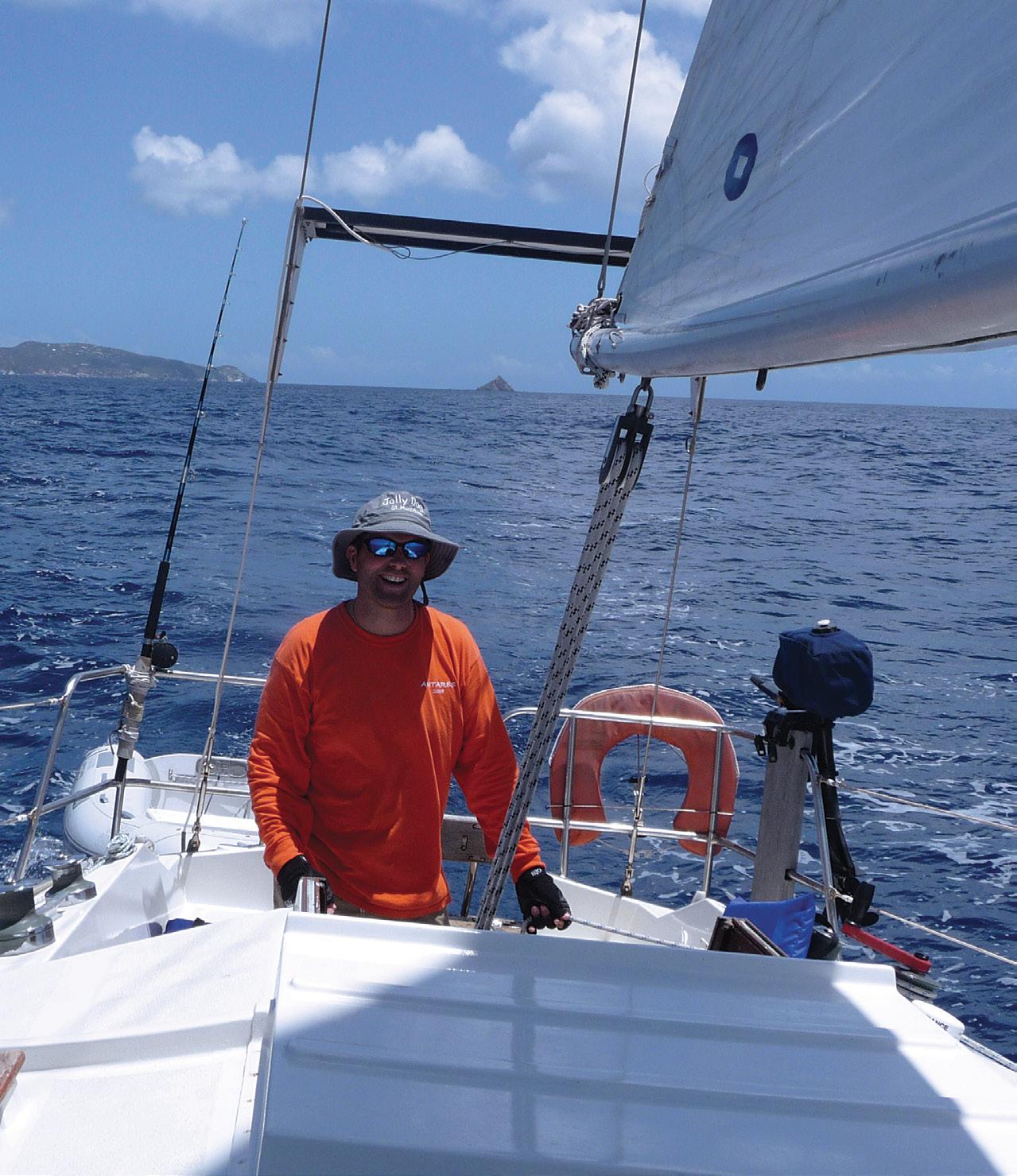
it’s not all animal care for dr. Chris deWitt, who enjoys sailing when he’s not working at his clinic on St. Maarten in the Caribbean.

Working in Paradise
The sun, ocean views and his own veterinary clinic on a tropical island is exactly the paradise Chris deWitt, Class of 1991, could thrive in. While still at osU’s veterinary college, he saw a job listing in dr. Tom monin’s employment book for a veterinarian in the Caribbean, and the seed was planted.
“ m y father was in the U. s a rmy-artillery, so we lived in Turkey and germany when not at our home base of fort s ill, okla. i thought [the Caribbean] sounded like a nice, romantic idea, and i was encouraged by a few of the students from Ross University who were completing their clinical training at os U,” recalls deWitt.
during his senior year while working as a preceptor at the busch gardens Zoo in Williamsburg, Va., d eWitt met Teresa Kraska, a veterinary graduate from the University of missouri. Kraska soon left to take a position in the Caribbean, mirroring deWitt’s destination at least for a year or two.
“i didn’t know which island she had traveled to, so i was pleasantly surprised when we ended up working at the same hospital,” deWitt remembers.
The couple eventually married and in 1995, the two started their own clinic — animal hospital — on saint maarten, a 36-squaremile island that’s divided into french and d utch sides. They have two daughters, morgan, 9, and madison, 11, who were both born on the island.
“ i t’s pretty busy for such a small place, which is great for business,” says d eWitt. “While it isn’t the grass-hut clinic on the beach with coconut palms I imagined, the weather is great, and I can see the ocean and sunsets from both our home and our clinic.”
d eWitt’s a nimal h ospital treats mostly small animals with some large animals, exotics and wildlife mixed in.
“in addition to the clinic, we consult with the island government on public health issues and regulations relating to animals. We are also the veterinarians for the St. maarten zoo o nce a month, i travel to an even smaller island, saba, to perform veterinary surgery and see patients,” says deWitt. “saba is a 5-square-mile, volcanic island with a population of 1,500 and a great destination for diving. We also see clients from the nearby islands of anguilla, st. barthelemy, st. eustatius and even from st. Kitts and nevis.”
l ocated on the dutch side of the island, deWitt’s animal hospital employs three veterinarians, an office manager, three veterinary assistants and three kennel workers.
“We see a variety of cases treating many orthopedic and soft tissue surgical cases. We also perform a lot of cancer treatments and dermatology cases that would be referred out to a specialist in the states.”
deWitt says the biggest challenges are language and location.
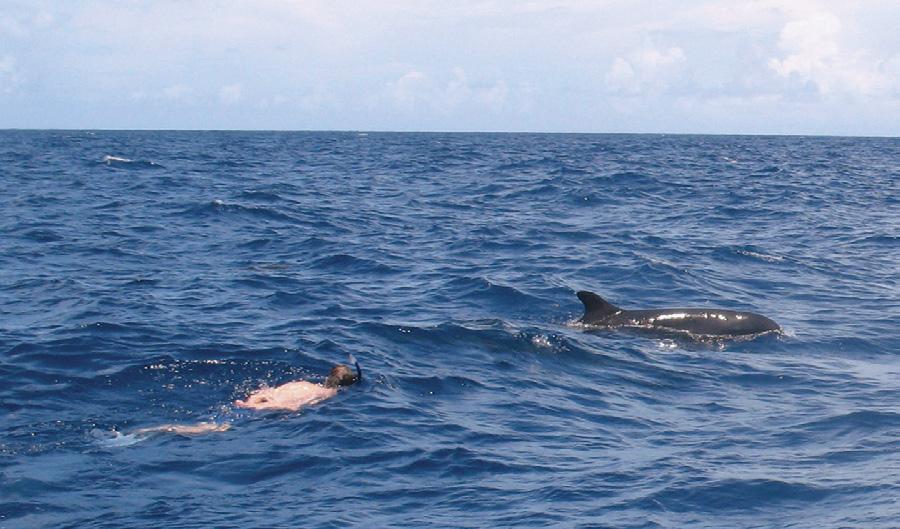
“While most residents speak english, there is a fair amount of spanish, dutch and french spoken,” he says. “We have to order supplies in advance, and water and power outages do occur. We are prepared, however, with a large standby generator, and we cross our fingers during hurricane season.”
s ome of the more unusual animals the clinic has trea ted include sea turtles, pelicans, frigate birds (tropical sea birds with powerful wings and a hooked beak) and a giraffe from a traveling circus.
“We even treated a pilot whale, which is small by whale standards but a whale nonetheless,” deWitt says. “The Coast guard found him having trouble in the water and brought it to the clinic in a truck. We quickly shipped him to a marine mammal facility.
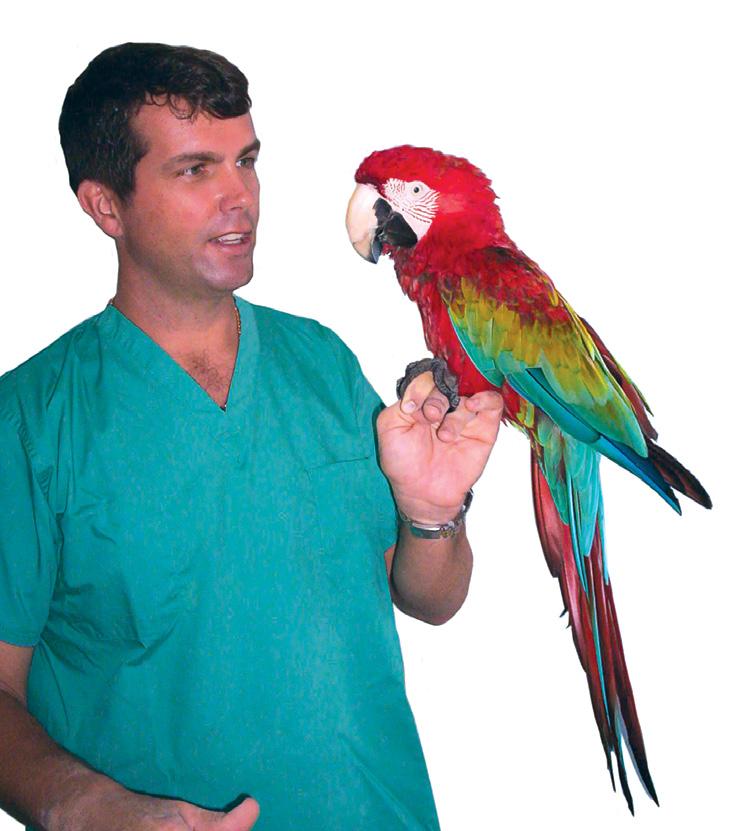
“ o ur biggest case involved a trip to puer to Rico to inspect a group of polar bears owned by the s uarez Circus. The circus made the mistake of traveling to a U.s. territory with polar bears that did not conform to U.s standards. The bears were being threatened with confiscation. We examined the animals and did not recommend importation. a week later, the polar bears were confiscated and several still reside in U.s. zoos.”
deWitt believes a dVm degree opens the world and is limited only by one’s imagination.
“The options for teaching, industry or private practice can take you anywhere. i think this extends to specialty practice as well. in a practice, i think it is necessary to start small but always have a plan for growth.
“As much as I enjoy life on this tropical paradise called St. maarten, I really miss and appreciate Oklahoma State and the College of Veterinary medicine. as a military brat, oklahoma is the state where i lived the longest, and i have never met a more fun and friendly people. our football team may have been ranked no. 2 [last season] but the university and veterinary college are no. 1.”
in Saint Maarten, veterinarian Chris deWitt sees a fair share of exotic animals such as the colorful Gizmo
a pilot whale — one of the smaller versions of whales — has been among DeWitt’s patients.
Orange all the way to the fridge
S AN A NTONIO A l U m SHOWS pASSION f O r OSU AT HIS T E x AS VET C l INIC
“Bleeding orange” is one phrase often used to describe osU alumni — and it certainly applies to 1983 alumnus Kenneth d Kirlin, dVm, of san antonio. at the southwest Veterinary symposium in 2004, Kirlin was sharing his ideas about fundraising and connecting with outof-state alumni with then-dean michael l orenz.
d r. l orenz invited him to serve on the d ean’s d evelopment a ssociates, which began in april 2005. Kirlin accepted and continues to serve in that capacity today.
“It’s my way of giving something back to the college, and it helps keep me in touch with what’s happening at the veterinary center in Stillwater,” says k irlin. “ i wasn’t sure what to expect at the first meeting. i was very impressed with how dean l orenz was so involved in every aspect of the school. We have an excellent staff, and they always give informative reports at the meetings. now that dean [Jean] sander has taken over, i find the same excellence is there. s he brings a different perspective, which is every bit as committed as dr. l orenz’s. i appreciate the fact that the college is interested in what is important to alumni and what we’d like to see in the new graduates.”
a nd that isn’t the only way Kirlin gives back to osU.
Kirlin is the Class of 1983 representative and attends the college’s annual alumni association meeting. in 2006, he began serving on the association’s board of directors as secretary/treasurer. each position term is two years. in 2008, he moved up to vice president and in 2010, he stepped into the role of president. h is term ends in 2012, when he will serve as the immediate past president until 2014, then as the past president for another two years.
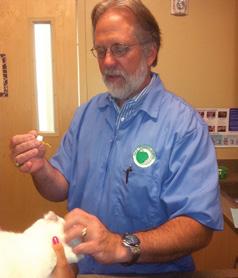
“ b eing on the a lumni a ssociation board, i’ve been able to reconnect with my classmates and those in other classes. i’m not sure most of our alums know we have such a board. as class representative, it’s our job to keep the lines of communication
open between the school and our classmates. We’re all proud of our OSU education, and I’d like to see everyone be more involved in supporting the college in whatever capacity they can. It’s not just monetary support that’s needed. It’s helping our current and future students with employment and helping them gain valuable experience they can only see in the real world.”
and his support doesn’t end there. dr. Kirlin has been a life member of the os U a lumni association for 20 years.
“I would like to see a greater percentage of our alumni join the OSU Alumni Association. Currently, only 15 percent of veterinary alumni are members. i think it’s important to support os U. b y joining, alumni help both the university and the veterinary center as a portion of the membership dues goes to our alumni association. i owe a lot to osU for giving me an excellent education that has allowed me to own my practice and enjoy my chosen career. i’d really like to see every alum become a life member, which helps support os U at a higher level. i enjoy receiving the orangebytes email newsletter, which keeps me informed about what is happening in stillwater and around the nation with other osU alums.”
and he shows his osU Cowboy spirit in yet another way.
“When i bought my practice 16 years ago, a working 1950s ge refrigerator came with the building. We recently rebuilt the hospital and bought new appliances throughout. one of my clients owns a paint and body shop, so i asked them to paint the refrigerator osU orange. i even gave them the registered color codes for the right shade of orange and told them to put their best showcar finish on it. i put a magnetic osU decal on the front, and it now sits in my personal office in the new hospital. even the Texas a&m alums who see it are impressed.”
sits in his office in san antonio.

dr. Kenneth Kirlin (left) used the services of an auto body paint shop to get the brilliant finish for his osU-orange refrigerator that
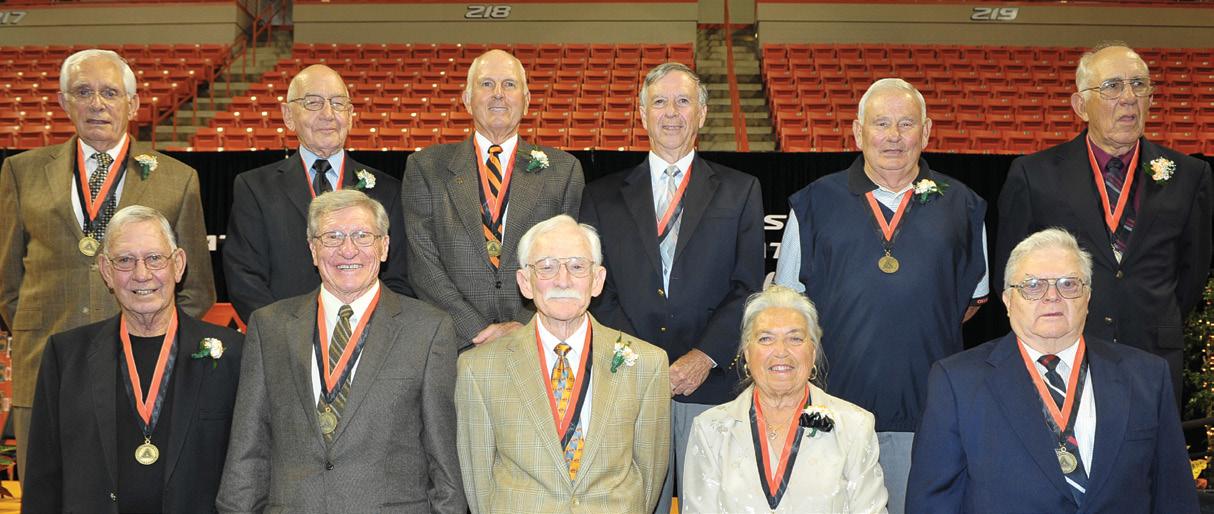

Class of 1962 celebrates 50 years
Arlis Boothe served as a veterinary research medical officer for the federal agricultural Research service at the national animal disease Center in ames, iowa. later, he taught pathology at the University of a rkansas for medical s ciences and went on to serve as a consultant with the developmental metabolic neurology branch of the national institute of neurological and Communicative disorders and stroke at the national institutes of health.
Wylie Dunn opened the first veterinary practice in searcy, ark., and was an essential part of the community for 42 years before retiring.
Twelve of the 17 living class members from the Class of 1962 returned to stillwater to celebrate their 50th reunion. invited back to participate in the 2012 hooding Ceremony, these senior veterinarians provide a great example of the variety of career paths one can travel with a dVm degree. here are some highlights from the last 50 years:
Lester Dupler is proud to call himself a country veterinarian. he bought a practice in Claremore, okla., where he and his first wife worked for many years.
Don Ensey practiced mixed-animal medicine in paris, Texas, after graduation. his work e thic caused him to set an unsustainable professional schedule, so he sold his practice and opened a restaurant until he retired.
Joseph William “Bill” Inscoe returned to his hometown of newton, n C., after graduation. he started a solo veterinary practice and continues to treat dogs and cats.
David Mitchell served in the U.s army Veterinary Corps before settling in Tulsa. he worked in private practice and served as a trail veterinarian for the iditarod Trail sled dog Race. Today, he still serves on the Tulsa state fair Committee.
Donald Muncy worked for a few years in a small-animal practice before attending law school. he worked in a variety of legal areas, including energy and insurance, while he flipped houses for fun. still in pursuit of more excitement, he took up flying, which he does frequently in his retirement.
some of the members from the Class of 1962 returned to osU to mark their 50-year reunion. they include (front row, from left) lester dupler dick roth david Mitchell Janet Graham Schroeder and arlis Boothe standing behind them are (from left) dale Schomp louis nightengale nick nail don Muncy ed Schenk and don ensey
Nicholas Nail worked for the U sda poultry inspection service while awaiting commission as a medical services officer in the U.s. air force, where he served at the Royal air force base in Wethersfield, england. Upon his return, he was an instructor of small animal medicine before going into private practice until he retired.
Richard Roth has spent most of his professional life in a mixed-animal practice in his hometown of Casselton, n.d. he also serves as a swine consultant in several states.
Louis Nightengale started practicing three days after graduation and continued to practice for the next 50 years. he has mentored many new graduates and established ardmore animal Care, which was the foundation for the city’s animal shelter.
Edward Schenk went into private practice and built a practice in oklahoma City. he sold the practice to go into farming, where the financial challenges led him to serve as a lobbyist for the farm Credit Council.
Dale Schomp drove all night to take the Texas boards the morning after graduation. he started his own practice, working sale barns and being on-call at several slaughter plants for years. he purchased some land and built the area’s first storage units. he has built many more since.
2011 Cowboy Roundup
Janet Grantham Schroeder was active in production-animal medicine. While running a general practice out of her home, she also managed a dairy operation and later some sheep. she sold the dairy cows and went into beef cattle. Today, she works in a pound, providing medical services to the animals.
Roy Smith owns and operates Central Texas Cat h ospital in Round Rock. h is career started off with a mixed-animal clinic focusing on dairy cattle and horses. The practice evolved into small animals and then into his cats-only clinic. he is the presidentelect of the american association of feline practitioners.

Class of 1956 out of the 16 living members of the Class of 1956, three members and one widow of a classmate returned to stillwater for the Cowboy roundup to celebrate their 55-year reunion. Pictured (from left): drs. Charlie Wulz, Paul long, i.Q. Sewell’s widow Viva Sewell, and James Price
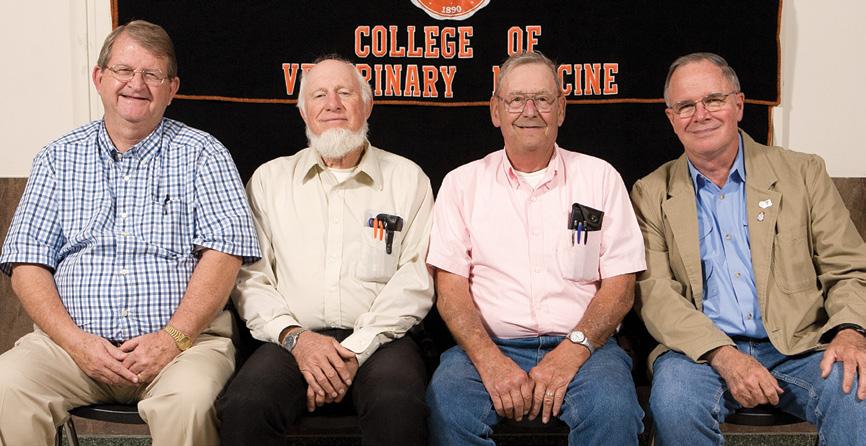
Class of 1966
six of the 32 living members of the Class of 1966 were able to return to stillwater for their 45-year reunion. Pictured (from left): drs. robert fulton, tony fell, Warren newby and John Hahn not pictured but also attending reunion activities were drs. Jack roberson and Vernie Walker
Class of 1971
the Class of 1971 began planning their 40-year reunion early in the year. of the 42 living members, 19 were able to attend. Pictured front row (from left): drs. Carl McCoy, r.d. Hall, Charles Hatfield, James Hensley, tim Woody and Wayne Sizelove. Back row: drs. John Myers, Kenneth Gunkel, John Scott, larry Minter, Cliff Mcdonald, thomas Bowles, Gary detrich, William ferrell, John Gage, Marcia Short and Sybil Heise also attending but not pictured were drs. anna Parker and Jim Shipman
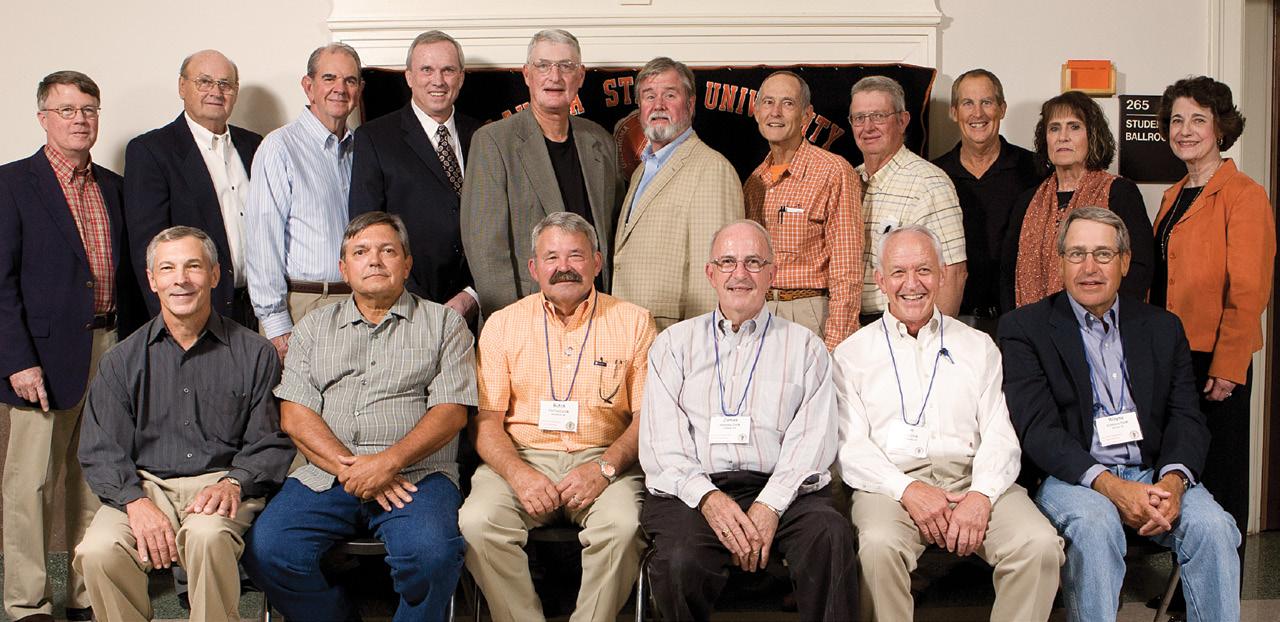
Class of 1981
twenty-four of the 57 living members of the Class of 1981 returned to stillwater to celebrate their 30-year reunion. Pictured in the front row (from left): drs. deena Gregory, Paula Janko, tom taggart, Genie thoni, renee Hammer and Margaret ann Snyder in the back row: drs. Kevin allen, Stephen Meyerdirk, Jeffrey livingston, rocky Bigbie, dennis dugger, dee Gragg, Jeff tidwell and fred northern also attending the Fall Conference and other related reunion events but not pictured were drs. Phil Steinert, Paul Welch, larry thompson, larry Barrett, Mark Kopit, Bob ables, david Glover, denis Matousek, Ken olivier and Stan Jenkins
Class of 1986
a total of 12 members of the Class of 1986 were in stillwater to celebrate their 25-year reunion. Pictured in the front row (from left): drs. leslie Cole, Susan Gaffney and Susan tomlinson in the back row (from left) are drs. Keith fuchs, Ben Haning, Matt McQuade, robert norris and Grant rezabek also attending reunion activities but not pictured were drs. rebecca Coleman, Mike Pruitt, Paul robertson and Phil tripp
Class of 1991
a total of 21 members of the Class of 1991 returned to stillwater to celebrate their 20-year reunion. Pictured in the front row (from left): drs. Susan Harrington, elizabeth owen, tiffany Virga, antoinette Walker, Melinda Upton and Catherine Homrig in the middle row: drs. richard Hufnagel, laura Blazek, Steven lucas, dana Harvey and Petrina york in the back row: drs. Jerry ritchey, Mark richards, Jesse thompson, Christopher Schumpert, troy osborne, Steven Giles, travis Mauldin, Mike Jones, and richard Mathes attending the reunion but not pictured was dr. desirae Self
Class of 2001
nine of the 76 living members of the Class of 2001 came back to stillwater to celebrate their 10-year reunion.
Pictured in the front row (from left): drs. lyndi Gilliam, Jenny McGee, Melinda luper and Kristie Brandenburg in the back row: drs. John Gilliam, dustin dersch, James daniel, Justin Graham and Michael Prewett
Cowboy Roundup
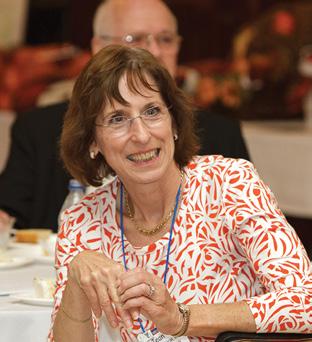
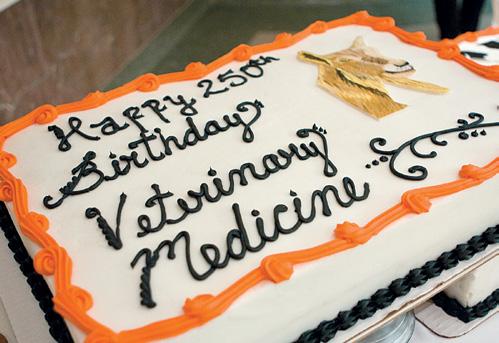
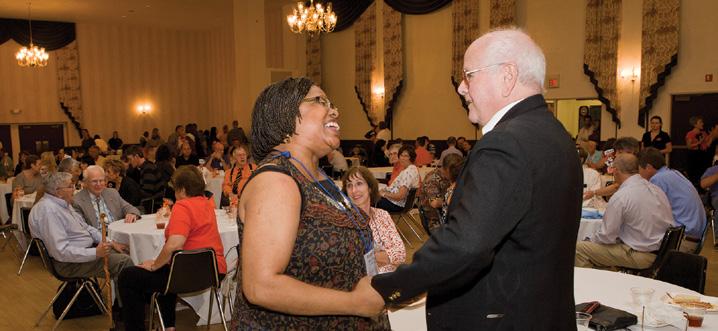



fUN
Gary Lawson / University MarketinG
Welcome to the Open House
pEO pl E CA m E TO SEE WHAT TO m O rr OW ’ S
VETE r INA r IANS A r E l EA r NIN g d U r IN g THE Op EN
H OUSE AT OSU’ S C ENTE r f O r V ETE r INA ry H EA lTH
S CIENCES IN mA r CH . T HE y WE r E A bl E TO l OO k OVE r
THE CENTE r’ S fA CI l ITIES AN d TECHNO l O g IES AS WE ll
A S VIEW A VA r IET y O f E x HI b ITS AN d l IVE ANI m A l
d E m ONST r ATIONS COVE r IN g m AN y AS p ECTS O f
VETE r INA ry m E d ICINE
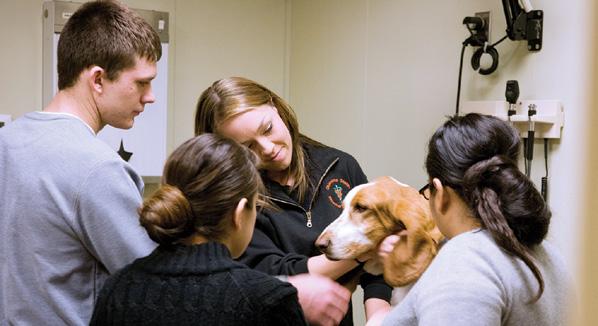
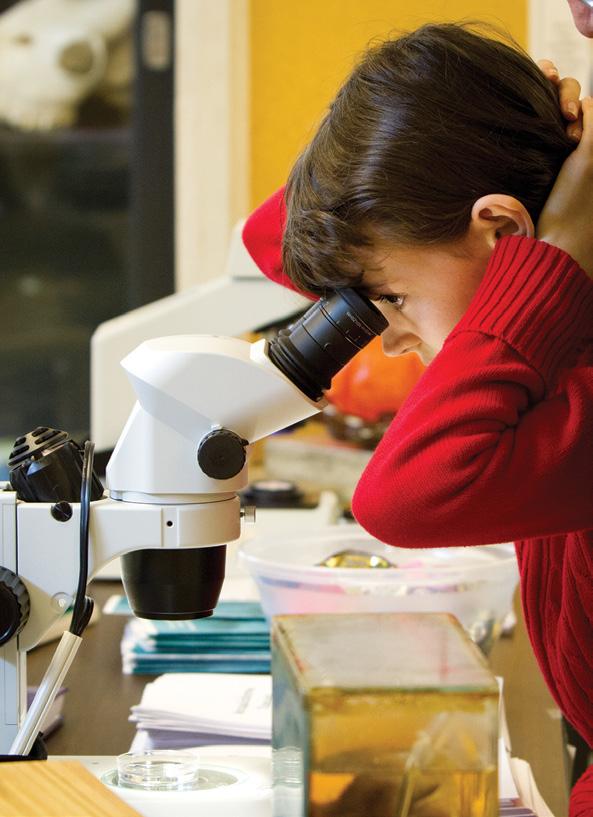
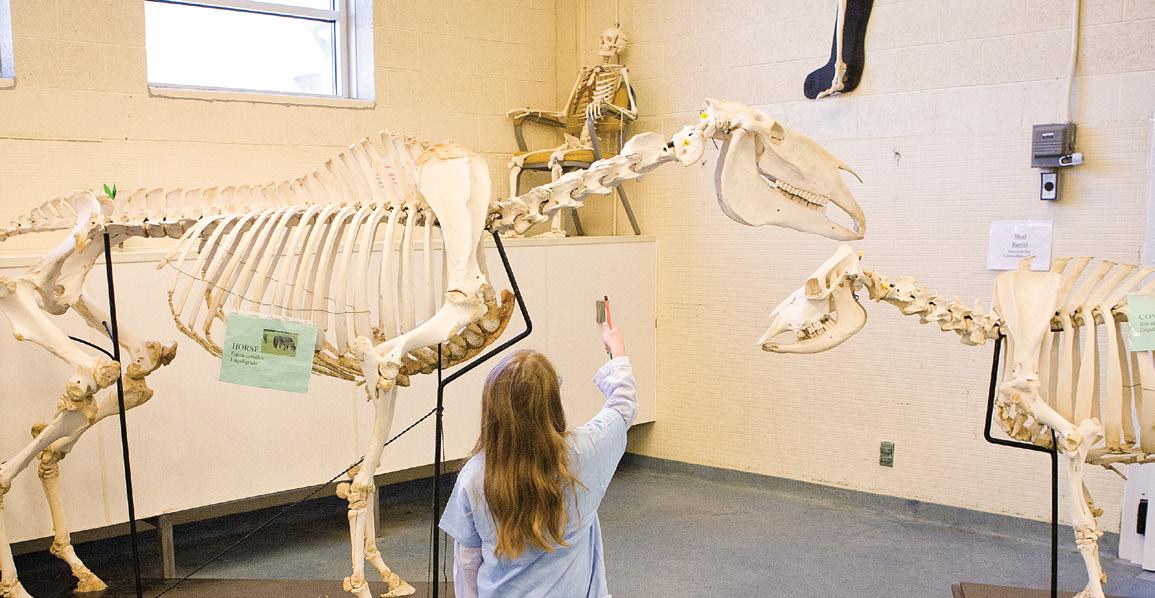
photos: Gary Lawson / University MarketinG
Grandparent University bridges generation gap
OSU’ S g r AN dpA r ENT U NIVE r SIT y br OU g HT m O r E THAN 400 l E g ACIES AN d THEI r gr AN dpA r ENTS TO S TI llWATE r IN jUNE . Am ON g THE CO ll E g ES pA r TICI pATIN g IN THE Al U m NI A S SOCIATION ’ S ANNUA l EVENT WAS THE C ENTE r f O r V ETE r INA ry H EA lTH S CIENCES .
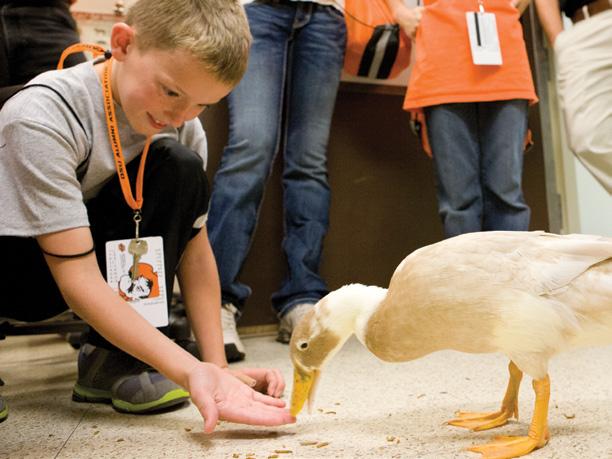
dr. larry Hamilton (’81) helps grandson luke Wells prepare for “surgery.”
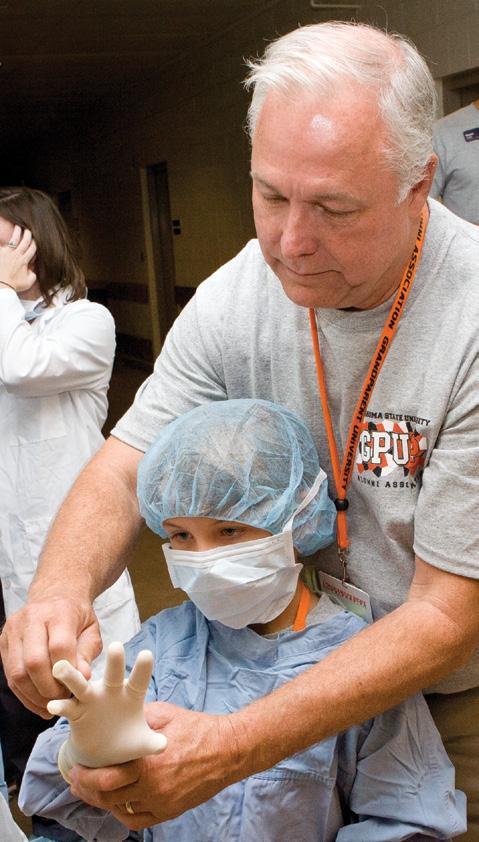
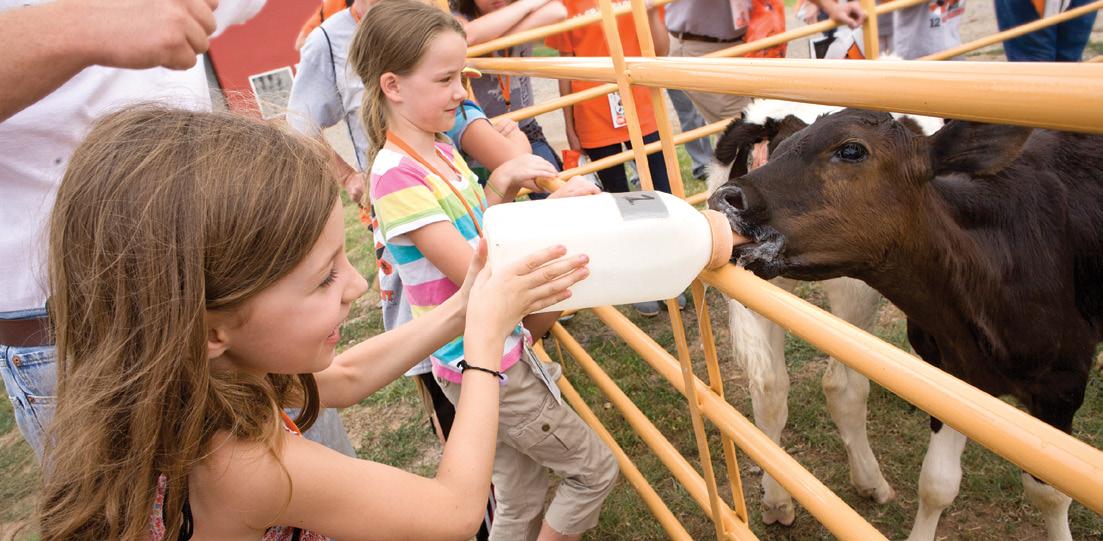
photos: Gary Lawson / University MarketinG
Sherbert, the indian runner duck mascot for the veterinary college, gets a treat from one of the young gPU attendees.
a young calf gets a drink from a gPU attendee.
We honor those who have served the profession, our distinguished colleagues and friends.
dr. richard Eugene “gene” bailey
Dr. richard eugene “gene” Bailey, 83, died april 1, 2012, in tulsa. he earned his DvM degree from oklahoma State University in 1965.
following a short stint with another veterinarian, Dr. Bailey opened his own practice in tulsa in 1965. he ran the Southwest veterinary hospital for the next 25 years. the practice started as a mixed-animal practice and eventually moved to focus on small animals only. in 1985, his son, Keith Bailey (who received his own DvM degree from oSU in 1984), joined him. father and son practiced together until the elder Dr. Bailey retired in 1990.
Bailey is survived by his sons, Stan Bailey of Sand Springs, okla., and Keith Bailey (and his wife, Melissa) of tulsa; four grandchildren, Brian Bailey (and his wife, Stephanie) of claremore, okla., lisa Bailey of tulsa, David Bailey, who is a fourth-year veterinary student at oSU, and amy Bailey of tulsa; and one greatgranddaughter, c l aire Bailey (daughter of Brian and Stephanie). his wife, Betty g. Bailey, died in 2000.
Source: Bailey family

longtime oklahoma veterinarian Dr. clement v. “Doc” cottom Jr., 78, of Bixby, okla., died nov. 4, 2011.
Born in Stillwater, Dr. cottom graduated from liberty Mounds (okla.) high School in 1951. he earned his bachelor’s degree from oklahoma a&M college in 1954 and his DvM degree from oSU in 1958.
he married cleo Shackelford in august 1954. i n 1962, he established cottom veterinary clinic in Bixby, which was still an active practice at his death.
Dr. cottom was a charter member of the Bixby lions club. he worked on the green corn festival planning and in later years dressed in a Santa suit to promote 7 c’s christmas tree farm. Many area ffa chapters gained their “hands-on” experience under his guidance.
he was a lifetime member of the oSU alumni association, the northeast oklahoma veterinary Medical association, the oklahoma veterinary Medical association and the american veterinary Medical association.
Dr. cottom was known for playing hard after working hard. he and his wife built carnival booths for school, held hayrides and snow sled rides, led fundraisers and took the girl Scouts to Six flags over texas. his ranching operation included cattle, swine, sheep and horses.
Dr. cottom was preceded in death by his wife, cleo, on Dec. 23, 1995, and one daughter, Dee cottom, on april 8, 2008. he is survived by two daughters, vicki linker of liberty Mounds and Sandi cottom of choctaw, okla.; two sons, Jerry cottom (and his wife, cheryl) of Morrison, okla., and chet cottom (and his wife, Deann) of l iberty Mounds; six grandchildren, four great-grandchildren, siblings and numerous nieces, nephews, other relatives and friends.
Source: leonard and Marker funeral home
dr. Weldon glenn
one of oSU’s first veterinary graduates, Dr. weldon glenn, 92, of San Diego, died Jan. 6, 2012.
the fourth of eight children, he served in the U.S. army during world war ii on May 29, 1949, he married Marian Spann. following his service, Dr. glenn completed his education through the gi Bill, graduating with his DvM degree in the first class of oSU veterinarians in 1951. his brother, Bertis glenn, graduated with the second class in 1952.
following graduation, weldon g lenn practiced in Blackwell, o kla., before going on to teach animal science at the University of wyoming. in 1961, Dr. glenn earned his doctorate in veterinary pathology from colorado State University. he worked in the georgia State veterinary lab (1964) and as an extension veterinarian for South Dakota State University (1965). Dr. glenn spent some time in pharmaceutical research at the Upjohn co in Kalamazoo, Mich. in 1990, he retired from the Department of agriculture in San francisco, calif.
in 1994, the glenns moved to San Diego. at age 70, Dr. glenn was a “gardener extraordinaire” who enjoyed hours in the sunshine and warm days of southern california. he loved working in the garden and studying the science of plants and maintained 10 neighborhood landscapes. he even knew the latin names of many ordinary flowers, shrubs and trees.
Dr. glenn is survived by his wife of 62 years, Marian; four children, Joe glenn (and his wife, anita), Dana glenn, chris glenn and Kim Jeffrey glenn; and three grandchildren.
Source: Marian glenn
dr. Clem Cottom jr.
dr. john Harper jr.
a longtime veterinary medical officer for the government, Dr. John Matthew harper Jr., 81, of neosho, Mo., died aug. 31, 2011, at the Mount vernon veterans home in Missouri.
Dr. harper was born in oklahoma city and served in the U.S. air force. he earned his DvM degree from oSU in 1960 and worked as a veterinary medical officer for the meat and poultry branch of the U.S. Department of agriculture for 30 years, retiring in 1988. he was also a longtime member of the neosho United Methodist church and active in the choir.
Dr. harper is survived by his wife of 55 years, olivene harper; three daughters, Debra Devers (and her husband, Scott) of i rving, texas, Judy Spaar (and her husband, John) of lee’s Summit, Mo., and rebecca harper of round rock, texas; and four grandchildren. Memorial contributions may be made to the neosho United Methodist church, hospice compassus or Mount vernon veterans home, c/o clark funeral home, p o. Box 66, neosho, Mo 64850.
Sources: the Joplin Globe and clark funeral home
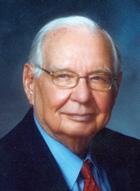
dr. raymond E. ‘doc’ Henry longtime pawnee, okla., veterinarian raymond e. “Doc” henry, 86, died in Stillwater on March 27, 2012.
Upon his return home, he married his high school sweetheart, Meldine Boyles. he soon entered oklahoma a&M college and graduated with his DvM degree in 1951 — one of the 26 members of the first veterinarians to graduate from oklahoma a&M college. after graduation, Dr. henry opened his first veterinary clinic in pawnee, where he and Mel ran a successful practice for 35 years. he worked on a wide variety of animals — large, small and exotic — but had a particular gift for diagnosing and treating horses. his love of horses led to his service on the oklahoma horse racing commission for several years.
Dr. henry was a beloved veterinarian as well as an accomplished trumpet player and pianist. his lifelong love of music began in second grade. he played with various bands in high school, in the service and in his spare time throughout his life, stopping only in his early 80s.
Dr. henry was also a great storyteller. in the last few years of his life, he wrote down his amazing stories in a self-published book called Just so you’ll know he wrote much of the book during the long hours of his dialysis treatments.
he is survived by his wife of 65 years, Mel henry; daughter, ava osborn (and her husband, lynn); son, Matthew henry; six grandchildren and 10 great-grandchildren.
Memorial donations can be made to the oSU foundation, attention: Sharon worrell, oklahoma State University, 308 Mcelroy hall, Stillwater, oK 74078; the first christian church of pawnee, 900 6th Street, pawnee, oK 74058; or Judith Karman hospice, 915 S. Main St., Stillwater, oK 74074.
Source: stillwater newspress
dr. Everett j. Hickok
Dr. everett James hickok of St. augustine, fla., died July 4, 2012. he was 92.
Born in Billings, okla., he served as a major in the U.S. army infantry during world war ii in 1942, he married frances faye Smith in enid, okla.
he earned his DvM degree from oklahoma State in 1956. he was an oklahoma veterinary Medical association member for 56 years.
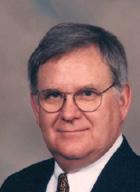
dr. Stephen Holmes
longtime Yukon, okla., veterinarian Dr. Stephen r holmes died at age 69 on oct. 7, 2011.
Born in fairview, okla., he graduated from fairview h igh School and attended o klahoma State University. he earned his DvM degree from oSU in 1966, then served in the U.S. army veterinary corps from 1966-68. for the next two years, Dr. holmes taught anatomy at oSU’s college of veterinary Medicine.
Married to Dianna (Dee) fry in 1966, the couple and their two children moved to Yukon in 1974, where Dr. holmes established the Yukon veterinary hospital inc.
Dr. holmes was very active in the community. his list of service included member and two-term president of the Yukon chamber of commerce; member and president of Yukon rotary club, which recognized him as an outstanding rotarian and a paul harris fellow; member of Yukon’s p lanning commission; serving an unexpired term on the Yukon city council; and member of the first United Methodist church of Yukon.
Dr. holmes will be remembered for his love of animals as well as his loving, gentle and kind ways. he loved his cabin at lake texhoma, fishing and the beauty of the outdoors.
he is survived by his mother, eleanor holmes of oklahoma city; his wife of 45 years, Dee of Yukon; son, Stephen holmes of Dallas; daughter, anilee foster (and her husband, Shane) of frisco, texas; and his five beloved grandchildren, who called him “poppy Soc.”
Memorial contributions may be made to the oSU foundation for the companion animal fund, c/o Sharon worrell, 308 Mcelroy hall, Stillwater, oK 74078.
Source: Yanda and Son funeral home
Born in r alston, o kla., he graduated from ralston high School in 1944. the next day, he joined the U.S. navy and was assigned to the 62nd Seabees Battalion during world war ii he was stationed on iwo Jima before being transferred to the 90th Seabees Battalion in Yokosuka, Japan. continues
Dr. hickok is survived by his son, James hickok (and his wife, pam); granddaughter, emily p han (and her husband, h ieu); and greatgranddaughter, Jasmine phan, all of St. augustine; as well as two brothers and a sister.
Source: tulsa world
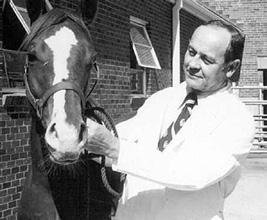
dr. lester johnson
a professor who spent 30 years at oklahoma State University’s college of veterinary Medicine has died. Dr. lester Johnson, 93, of Stillwater, died Sept. 4, 2011, in Stillwater.
Born in overbrook, okla., he attended school in ravia, okla., graduating in 1935 as class valedictorian and a member of the national honor Society. he earned an associate degree from Murray State college in tishomingo, okla., in 1937. at oklahoma a&M college, he made the dean’s honor roll and graduated with a bachelor’s degree in 1939.
in May 1942, he was inducted into the U.S. army and trained in meteorology. on aug. 4, 1943, he and 12,000 other soldiers sailed for Scotland. he was assigned to the 8th air force serving in england, france and germany during world war ii. Johnson rose to the rank of staff sergeant and received the eaMe (european-african-Middle eastern) Service Medal with four Bronze Battle Stars. h e was discharged Sept. 30, 1945.
after the war, he studied veterinary medicine at texas a&M University. he was named a distinguished student, outstanding veterinary student and elected president of his senior class while he was earning his DvM degree, which he received in 1950. he then went into private practice in ada, okla., and later worked for the U.S. Department of agriculture’s agricultural research Service.
in 1954, Dr. Johnson accepted a position as an assistant professor in large-animal medicine and surgery with the oSU college of veterinary Medicine. his career spanned 30 years, ending with his retirement as professor emeritus in 1984. During his tenure, he received seven outstanding teaching awards, including the norden teaching award in 1963 and 1965. he served as head of large-animal medicine and surgery, performing some of the first successful equine abdominal surgeries in the U.S. and as equine section chief. Dr. Johnson also served as president of the oklahoma veterinary Medical association in 1975 and was named the oklahoma veterinarian of the Year in 1983.
an elder in the chickasaw nation, Dr. Johnson was preceded in death by lucille, his wife of nearly 56 years. he is survived by two nephews, a sister-in-law and one cousin.
Memorial contributions may be made to the oSU foundation, designated for the lester and lucille Johnson Scholarship fund, and mailed to o klahoma State University, 308 Mcelroy hall, Stillwater, oK 74078.
Source: Strode funeral home
dr. kenneth gene keenum Sr
oklahoma State alumnus Dr. Kenneth gene Keenum Sr., 77, of Murphy, n c., died oct. 28, 2011, at Murphy Medical center.
a native of gaston county, n c., he attended north carolina State University, oklahoma State University and the U.S. naval academy.
a ft er he graduated with his Dv M degree from oSU in 1960, Dr. Keenum practiced for six years in South Dakota. from 1966 to 1972, he practiced in Murphy. in 1972, Dr. Keenum became the assistant director at the animal Disease Diagnostic l aboratory under the n orth c arolina Department of agriculture, retiring in 1995.
Dr. Keenum enjoyed farming and playing bridge. h e was a member of the Masonic lodge in South Dakota, various Jaycee groups, the lions club and assisted with the veterans. he was also a member of the first United Methodist church of Murphy.
Dr. Keenum is survived by his wife, clara; son, Kenneth Keenum Jr. of Murphy; daughters lisa Keenum of Murphy and Joyce Jackson of winston-Salem, n c.; two sisters, geraldine James (and her husband, Duke) of waynesville, n c and carolyn lonnblad of glendale, ariz.; and one granddaughter.
Memorial contributions may be made to the hattie parker cemetery flower fund at friendship B aptist church cemetery fund, c/o t l. Mcnabb, 186 friendship church road, Murphy, nc 28906.
Source: townson-rose funeral home
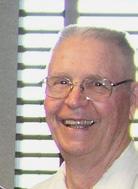
dr. Clyde kirkbride
textbook author Dr. clyde Kirkbride, 87, of Brookings, S.D., died Sept. 15, 2011, at the Dougherty hospice house in Sioux falls, S.D
Born and raised in california, he graduated from Burbank high School. he attended one semester at the University of california at los angeles before he was inducted into the U.S. army air corps in 1943. he met Dorothy cribbs and they were married april 19, 1944. During world war ii, he served with the 9th air force as a B-26 pilot, completing 21 missions out of england and Belgium.
after the war, he earned his DvM degree in 1953 from oklahoma a&M college. Dr. Kirkbride spent the next 10 years in private practice in Mountain grove, Mo. in 1963, he went to Kansas State University and served on the faculty until 1967. in 1967, the family moved to Brookings, where he worked for the next 23 years at the South Dakota State University animal Disease research and Diagnostic laboratory. he also earned his master’s degree in microbiology in 1970 from South Dakota State.
Dr. Kirkbride authored a textbook, control of Livestock diseases, and was an honorary diplomate of the american college of theriogenologists. a past president of the western veterinary conference, he was an honorary life member of the a merican a ssociation of veterinary laboratory Diagnosticians. he was also a member of the South Dakota vMa, american leptospirosis research conference, national Mastitis council and the U.S. animal health association. honors he received included the SDvMa veterinarian of the Year (1989) and the aavlD Distinguished Service award (2011).
Dr. Kirkbride enjoyed fishing, gardening, working on his computer and reading. Besides his wife of 67 years, Dorothy, he is survived by five children, Sharon arndt, Barbara Brown, Katie gilmore (and her husband, paul), tom Kirkbride and Steve Kirkbride; four grandchildren and three great-grandchildren.
Memorial contributions may be made to the South Dakota State University foundation Jackrabbit guarantee Scholarship program, Box 525, Brookings, SD 57007; or advance, p o. Box 810, Brookings, SD 57006; or the Dougherty h ospice h ouse, p o. Box 5045, Sioux falls, SD 57117.
Sources: heritage funeral home and JavMa
dr. larry mayberry
Dr. larry Mayberry of Brandon, Miss., died oct. 23, 2011, at Baptist hospital in Jackson, Miss. a native of oklahoma, he earned his DvM degree from oSU in 1972. Dr. Mayberry spent 35 years practicing equine medicine exclusively. he was experienced in lameness diagnosis and treatment and was certified in chiropractic and dentistry.
Dr. Mayberry taught equine-clinical medicine at Mississippi State University college of veterinary Medicine from 1984 to 1988, receiving teacher of the year honors twice. Dr. Mayberry then returned to private practice in Mississippi. he was a lifetime member of the Mississippi veterinary Medical association.
he is survived by his wife of 49 years, Marcia e anderson Mayberry; son, Dr. larry Brook Mayberry, DvM (and his wife, Dianne); daughter, amy Mayberry fries (and her husband, Kery); sisters, ouida Mayberry Self and Delcine Mayberry goodpasture; brother, tim Mayberry; and two granddaughters.
Memorial contributions can be made to the l eukemia lymphoma Society, Mississippilouisiana chapter, 3636 S. i-10 Service road, Suite 304, Metairie, la 70001.
Source: Mississippi veterinary Medical association
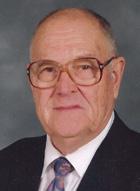
dr. Thomas pastor
Dr. thomas pastor died on June 26, 2012. he was 64 and living in new orleans.
h e is remembered as being kind-hearted, compassionate and loving his family dearly. Dr. pastor was well known and respected in the veterinary world by his clients and peers.
Dr. pastor is survived by his mother, catherine Decorte pastor; two brothers, Kenneth pastor and Danny pastor; and a sister, catherine deveer and her husband, Joseph. he is also survived by his grandchildren, Sebastian pastor and Kashmeria pastor; a close friend, Marilyn waites pastor; and best friend, carlos campos.
Memorial donations may be made to your charity of choice in Dr. pastor’s memory.
Source: the times-picayune, new orleans
dr. fayne Higgins Oberst
oklahoma State University professor emeritus Dr. fayne higgins oberst, 92, formerly of Manhattan, Kan., died april 5, 2012, in palm Bay, fla.
from 1974 to 1984, he was a professor and head of medicine and surgery and director of oSU’s Boren veterinary Medical teaching hospital. in 1984, Dr. oberst retired from oSU, but he continued to be a part of the emeritus faculty until his death.
Dr. oberst was on the organizing committee, a charter diplomate, and the second president of the american college of theriogenologists. he was also involved with a number of other veterinary related organizations. he was a highly recognized educator who received numerous teaching awards, including the 1988 clinician of the Year award from oSU.
after he retired, Dr. oberst remained active, becoming a master gardener, volunteering for Meals on wheels and participating in church activities.
Dr. oberst was preceded in death by his wife of 65 years, anne charlson oberst. he is survived by his daughter, Diane erickson (and her husband, robert) of paluski, tenn.; sons, Dr. richard oberst (and his wife, Jacque Staats) of Manhattan, Kan., and Mark oberst (and his wife, ann) of Micco, fla.; two grandchildren and two great-grandchildren.
Source: cox gifford Seawinds funeral home and crematory
dr. debra riding In
Dr. Debra riding in, 48, of portland, ore., died oct. 1, 2011. She was born in portland and earned her biochemistry degree from hood college in fredericksburg, Md.
She received her DvM degree from oklahoma State University in 1994.
She had a passion for her work as a veterinarian and worked for several veterinary hospitals and clinics throughout portland and Multnomah county. Dr. riding in was especially adept at surgeries.
Dr. r iding i n loved her family and hosted many dinners and barbeques at her home. She enjoyed going to the beach, traveling and sightseeing throughout the country. She was a member of the confederated tribes of Siletz and the pawnee nation and served as a good role model as a young native american professional.
Dr. r iding i n is survived by her husband, andres angeles; mother, Doris r iding in of portland; sisters, Dorna Battese of apache, okla., Delores riding in of Siletz, ore., and Denise r iding i n of Kailau, h awaii; a stepdaughter, n icolina a ngeles, and two stepsons, andres angeles Jr. and tony angeles, all of portland; and numerous relatives. She was preceded in death by her father, robert riding in.
Source: omega funeral & cremation Service
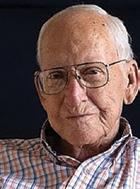
dr. Harold b. rinker
an honored oSU football player, Dr. harold B. rinker, 78, of west fork, ark., died Jan. 2, 2012, at the willard walker hospice home in fayetteville, ark.
Born in Seneca, n.M., he graduated from clayton ( n .M.) h igh School. h e attended fort lewis a&M college in colorado (1951-52) and oklahoma State University (1953-54) as an undergraduate. he earned his DvM degree from oSU in 1958.
h e played collegiate football in colorado and oklahoma. earlier at fort lewis a&M, he earned all-conference and honorable Mention all-america honors and was named outstanding athlete of the Year in 1952.
During his veterinary medicine career, Dr. rinker taught, published articles in numerous trade journals and served as a consultant to the livestock and pharmaceutical industries. he was a founding member of the academy of veterinary consultants. Dr. rinker had veterinary practices in texas, oklahoma and n ew Mexico. h e also worked on the h opi and navajo reservations in arizona and new Mexico. in the latter years of his career, he was an inspector for the U.S. Department of agriculture.
continues
he considered his most important achievements to be his continued sobriety as an active member of alcoholics anonymous for 38 years, volunteering for the washington regional hospice program for more than 20 years, and what he taught his children and grandchildren by voice and deed. he lived a life of service helping others.
Dr. rinker is survived by his wife of 52 years, Jan; two sons, Martin rinker (and his wife, tracy) of hardesty, okla.; and Michael rinker (and his wife, rhonda) of Union city, tenn.; thr ee daughters, Karen r inker (and her partner, Jake warnock) of west fork; Kim white (and her husband, Scott) of warren, a rk.; and Kelly c antrell (and her husband, Jay) of west fork; 14 grandchildren and 13 great-grandchildren.
Memorials may be made to the willard walker hospice home, 325 e longview Drive, fayetteville, ar 72703 or to the Dr. h arold B. rinker annual Scholarship, (make check payable to oSU foundation with scholarship notation in the memo), oklahoma State University, 308 Mcelroy hall, Stillwater, oK 74078.
Source: saline river chronicle news
dr. Coleman Scott
oklahoma State University alumnus Dr. coleman Scott, 66, died July 30, 2011, after a battle with cancer.
Born in Sapulpa, okla., he grew up on the family dairy farm. in 1963, he married his high school sweetheart, ruth ann Stout. he earned his DvM degree from oSU in 1970. he served as a captain in the U.S. army veterinary corps at fort riley, Kan.
Dr. Scott established great plains pet hospital in newton, Kan., and passionately cared for animals for almost 35 years.
a private pilot, Dr. Scott loved to fly his Mooney and Bonanza airplanes as well as travel, boat, rv, fish and watch his grandchildren’s sports and activities.
he is survived by his wife of 48 years, ruth ann; children, Shawn Scott (and his wife, Beatriz) of rota, Spain, Julie Koehn (and her husband, warren) of wichita, Kan., and Jennifer Brown (and her husband, Scott) of Maize, Kan.; six grandchildren and several siblings.
Memorial contributions may be made to the leukemia and lymphoma Socie ty, 300 n Main, Suite 300, wichita, KS 67202 or trans world radio Missions, c/o twr Donor Services, p o. Box 8700, cary, nc 27512.
Source: the newton kansan
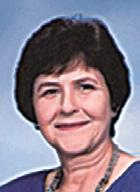
dr. betty Self
oklahoma’s first female veterinarian, Dr. Betty Self, 78, of robert lee, texas, died Jan. 10, 2012, in San angelo, texas.
Born in colorado city, texas, she graduated from odessa high School. a pioneer in the field of veterinary medicine, she was the second woman to graduate from oSU with a DvM degree when she graduated in 1957.
Dr. Self started her career in a mixed-animal clinic in ada, okla., where she worked for about 24 years. after that, she returned to texas and practiced in Denton for 19 years before retiring in 2000. in 2002, she opted for a slower pace and moved to robert lee
She was preceded in death by a son, Brian. She is survived by two sons, thomas Self and Bruce Self (and his wife, Diana); two grandsons, four great-grandchildren, siblings, a niece and four nephews. a practicing veterinarian for 43 years, Dr. Self was devoted to her profession and her family.
Source: san angelo standard times
dr. Sheri Simon
Dr. Sheri Simon, 49, of Brighton, colo., died Dec. 4, 2011, from complications related to a lengthy illness.
She graduated from northeastern oklahoma a&M college in Miami, okla., in 1982, from oklahoma State University in 1984 and earned her DvM degree from oSU in 1988. She and her first husband, lyal Storm Beattie iii, and their daughter, Kari Jo, moved to Brighton, where she began working for alan rice at Brighton animal clinic. Dr. Simon became a partner in the clinic in 1992 and bought it in 2003. She also owned and operated the international canine Semen Bank of colorado and the play Stay & More pet care business.
She was very active in her community. Dr. Simon was a former president of Brighton rotary, founding member and charter president of Brighton early rotary, and founded Brighton i nteract (junior r otary ) c lub at Brighton c harter h igh School. She was a chamber of commerce citizen of the Year in 2005 and rotary District 5450 rotarian of the Year in 2009.
a singer and actress, she became involved with the performing arts council of Brighton and later with the platte valley players. She was a member of the Brighton chorus, performing in the 2010 holiday concert and at new York’s carnegie hall in 2008.
She spearheaded an effort to improve academic performance at n orth e lementary School, which started a grant-funded tutoring program. that led to the robert M. Shopneck Boys & girls club, with which she remained involved. She also supported a scholarship program for young women through the philanthropist education organization and was a donor to the platte valley Medical center campus.
Dr. Simon is survived by her husband, Dave; daughter, Kari Jo walker; son, lucas Beattie; father and stepmother, ronnie and linda Scott of lamar, Mo.; brother, terry Scott of Manhattan, Kan.; sisters, Stephanie white of lafayette, Kan., gayle england (and her husband, J.c.) of tulsa, and Denise pruner (and her husband, rob) of clay center, Kan. She was preceded in death by her mother, Betty Scott.
Memorial contributions may be made payable to the Sheri Simon Memorial fund and mailed to Sheri Simon Memorial fund, 420 court place, Brighton, co 80601. the fund will be used to keep Dr. Simon’s legacy alive and well in the Brighton area and beyond.
Source: tabor-rice funeral home
one of the first officials with oklahoma State University’s oklahoma animal Disease Diagnostic laboratory has died. Dr. ernest lee Stair Jr. was the assistant director and chief pathologist for the lab from June 1975, six months before it opened, until he retired in 1997.
dr. E.l. Stair jr.
Dr. Stair, a Stillwater resident, was born on the family farm near geronimo, okla., and lived to be 80 years old. he died on aug. 15, 2011, from complications of parkinson’s disease. he earned his DvM degree from oSU in 1960.
following graduation, he accepted a March of Dimes f ellowship at the University of nebraska, where he conducted viral infection research on pregnant swine and became an instructor in the veterinary department from 1960 to 1964. he also earned a master’s degree in veterinary science at nebraska.
in 1968, Dr. Stair earned a doctorate in veterinary pathobiology from texas a&M University. as an assistant professor and later an associate professor, he taught veterinary students necropsy techniques and basic pathology. his students gave him “a good Stick award.” from 1968 to 1975, Dr. Stair returned to the University of nebraska as an associate professor. he chaired committees, advised master’s degree candidates and served as an instructor.
Dr. Stair was active in the Stillwater community, coaching little chief t-Ball and working with cub Scouts and Boy Scouts. he belonged to the first christian church in Stillwater and was interested in electronics, woodworking and computers. he helped his friends set up their first computers.
he is survived by his wife of 52 years, eileen austin Stair; sons, eric Stair (and his wife, lalai), evan Stair (and his wife, Dana) and eron Stair; two grandchildren; two sisters, Mildred King (and her husband, harrison) and patricia Davidson; and many nieces, nephews and friends.
Memorial contributions may be made to the Judith Karman hospice, p o. Box 818, Stillwater, oK 74078; first christian church, 411 w Matthews ave., Stillwater, oK 74074; or any of several parkinson’s associations at apDa oklahoma parkinson Disease chapter (opDa), 1125 S. trenton ave,, tulsa, oK 74120.
Source: stillwater newspress
dr. William d. Tolbert
Dr. william D. tolbert, 74, of huntington, w va., died oct. 1, 2011, at the emogene Dolin Jones hospice house in huntington.
he was born in hinton, w va. he graduated from west virginia University and earned his Dv M degree from o klahoma State University in 1962. he established the Barboursville (w va.) veterinary clinic in 1975.
Dr. tolbert is survived by two sons, alan tolbert and greg tolbert, both of Barboursville, w va.; and three grandchildren.
Source: herald-dispatch, huntington, w va.
dr. leo Voskuhl
one of the first graduates of oklahoma State University’s veterinary school has died. Dr. leo “Doc” Jerome voskuhl, 86, of Kingfisher, okla., died aug. 1, 2011. Born in celina, ohio, he was raised on his family’s farm in Marshall, okla.
while he knew at a young age that veterinary medicine was the career for him, he served in the U.S. army at camp Swift Military Base near McDade, texas, before pursuing that dream. he met and married edith english during his army service.
following his military service, he applied to oklahoma a&M college’s School of veterinary Medicine. he was selected to be among the first class and graduated with a DvM degree in 1951. w hile traveling from h ennessey, o kla., to oklahoma city, Dr. voskuhl saw Kingfisher and decided to practice there. a country doctor who loved his work, he practiced in Kingfisher for 60 years.
among his achievements were sitting on the oklahoma veterinary Board of examiners for several years and receiving an achievement award at the U.S. Department of agriculture’s Millennium celebration. the award recognized Dr. voskuhl’s common-sense approach to veterinary medicine, his customer service and professional knowledge. he also served on the Kingfisher School Board for 20 years and was named Kingfisher citizen of the Year.
Surviving are his wife of 20 years, Sharon voskuhl; son, Steve voskuhl of austin; daughter, vicki Smith (and her husband, Jim) of Kingfisher; two grandsons and six greatgranddaughters. he was preceded in death by his wife, edith, and one son, Danny. Memorial contributions may be made to russell-Murray hospice in Kingfisher.
Source: the kingfisher times & free press
dr. Edgar Ellis Wallop
Dr. edgar ellis wallop, 85, of chester, Md., died nov. 26, 2011, at the hospice house of Queen anne’s in centreville, Md.
Born in washington, D.c., he graduated from that city’s calvin coolidge high School before enlisting in the U.S. navy in 1945. he enjoyed playing drums and played in the navy Band. after his military service, he continued to play drums for several big bands. he later attended loyola college and graduated from the University of Maryland. he earned his DvM degree from oklahoma State in 1962.
Dr. wallop practiced in Bowie, Md., and Berlin, Md., before establishing Kent island veterinary hospital in chester, where he retired. he was a beloved veterinarian who was well-respected throughout the eastern Shore.
he loved his family, swing and jazz music, animals, Baltimore orioles baseball, Maryland’s ocean city and drumming. he continued to play for big bands into the 1990s.
Dr. wallop is survived by his wife, Margaret; two sons, Jeffrey wallop (and his wife, Janice) of Burtonsville, Md., and chris wallop of austin, texas; two stepdaughters, carrie Jennings (and her husband, chris) of cordova, Md., and lettie weldon of Stevensville, Md.; three grandchildren and one great-grandchild.
Memorial contributions may be made to hospice of Queen anne’s inc., 255 comet Drive, centreville, MD 21617, or to your local animal shelter.
Source: fellows, helfenbein & newnam funeral home
Vets’ pets
T HE y STA r T OUT S m A ll …
Don’t be fooled by young n atty ’s small size: the bullmastiff puppy, who belongs to dianne Mcfarlane, DVM, Ph.D., diplomate American college of Veterinary i nternal Medicine and associate professor in
physiological sciences, is only 9 weeks old in the photograph below and on the cover. As a giant breed, natty will grow up to be much larger. Bullmastiffs are good athletes, fearless, confident and independent
thinkers — good qualities for agility training and other events. t he y are typically low-energy dogs with sweet natures. Although they are natural guard dogs, they do not bark much. Bullmastiffs
were originally bred to guard estates, and silence was considered a virtue. McFarlane has another bullmastiff named nellie. Both natty and nellie love to go places and meet new people.
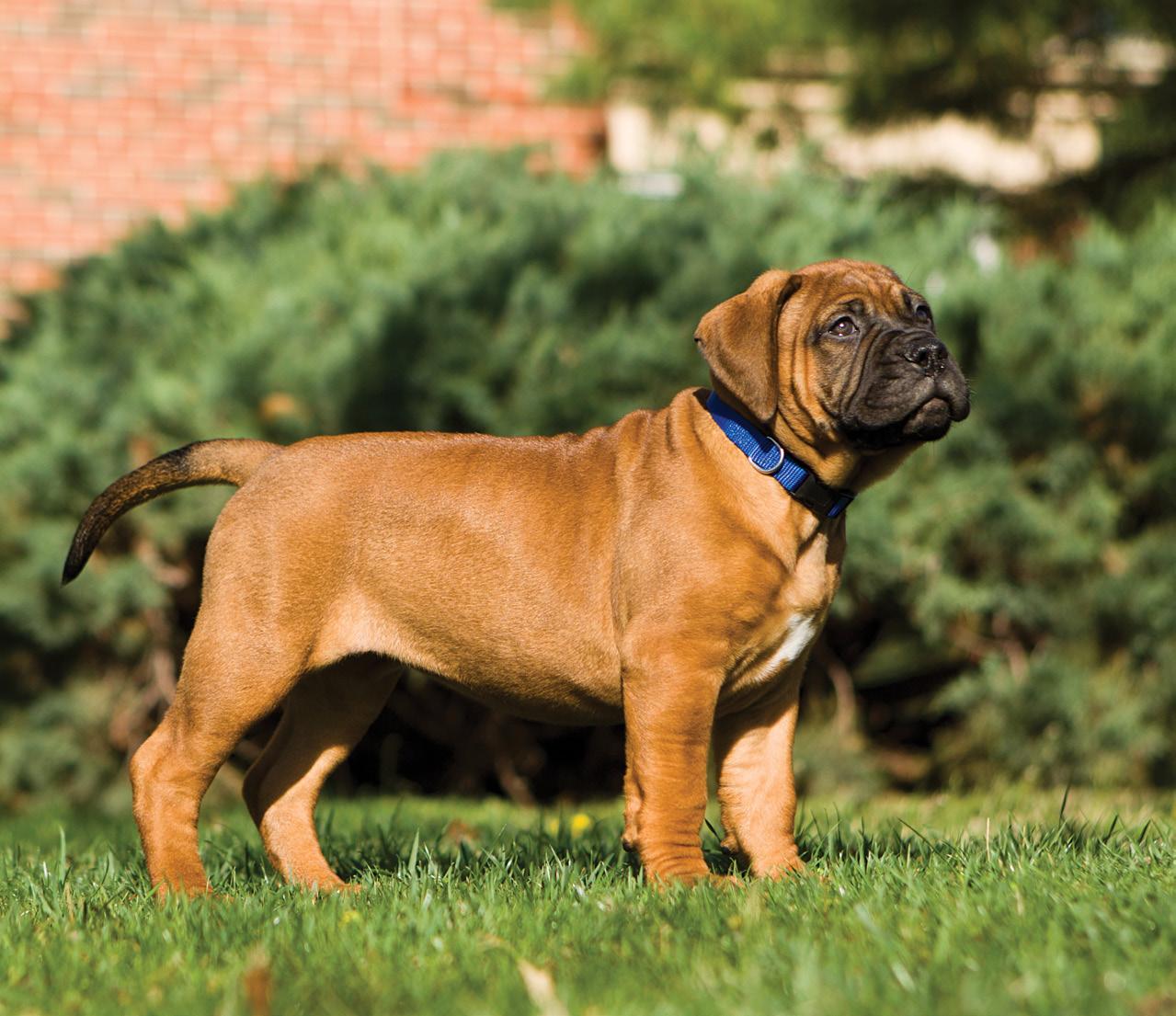
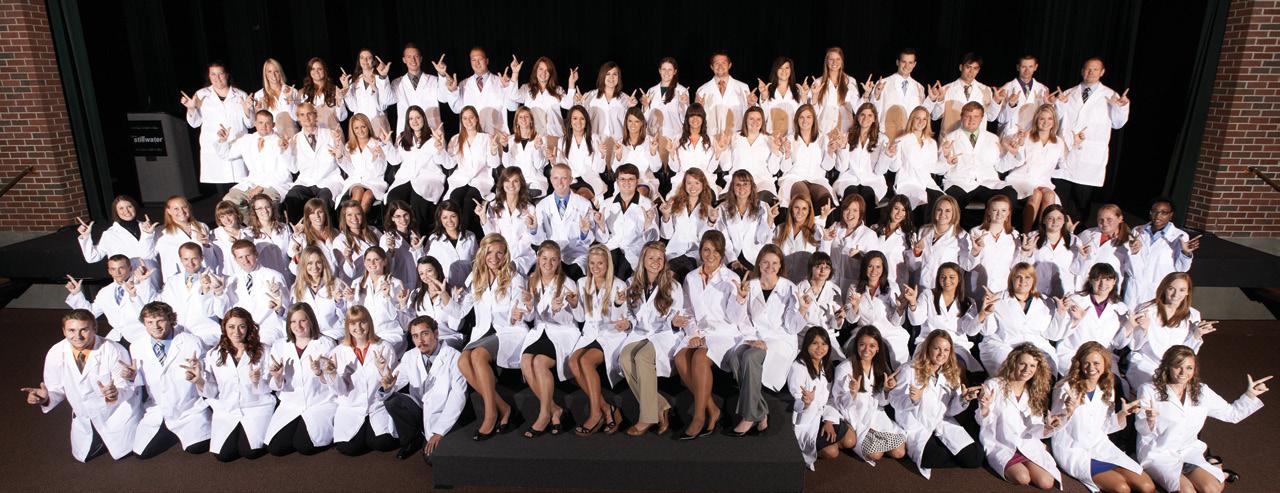
The Oklahoma State University Center for Veterinary Health Sciences officially welcomed the Class of 2016 at a traditional White Coat Ceremony in August at the Stillwater Community Center. The class, with 82 members, is dominated by Oklahoma residents. For a closer look at the Class of 2016’s statistics, see pages 82-83.
“America’s Greatest Homecoming Celebration”
is o ct. 19–20, 2012 , culminating in the football game against Iowa State on Saturday, Oct. 20 (kickoff T b D).
b efore that, there will be plenty to do & see:
Walkaround — 5 p.m. Friday, Oct. 19. Check out the Greek house decorations.
Homecoming & Hoops — 9 p.m. Friday at Gallagher-Iba Arena. Enjoy celebrating OSU’s upcoming basketball season and Homecoming awards. Doors open at 8 p.m.
Sea of Orange parade — Thousands of spectators will watch more than 100 entries roll down the streets of downtown Stillwater before the game Saturday (time T b D).
Genesee
Oklahoma State University
Center for Veterinary Health Sciences
308 McElroy Hall
Stillwater, Oklahoma 74078-2011
NCVP board meets at OSU
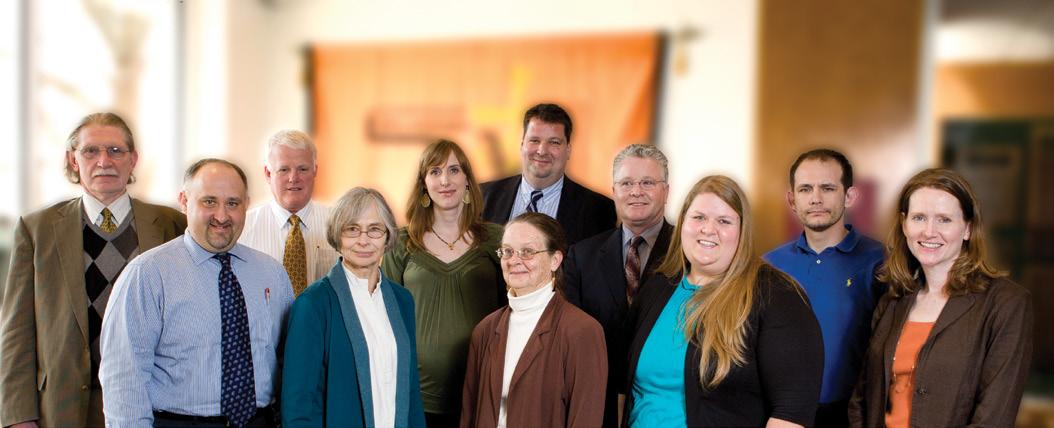
the board of the national Center for Veterinary Parasitology met at osU in March. Members included (back row, from left) dr. dwight Bowman, Cornell University; dr. Joe Hostetler, Bayer animal health; dr. Kelly allen osU; dr. Christian epe novartis animal health; dr. doug Carrithers, Merial Ltd.; dr. Chris adolph osU; (front row, from left) dr. Mason reichard osU; dr. anne Zajac, Virginia tech; dr. eileen Johnson osU; dr. lindsay Starkey osU; and dr. Susan little osU and director of the center.
Gary Lawson / University MarketinG