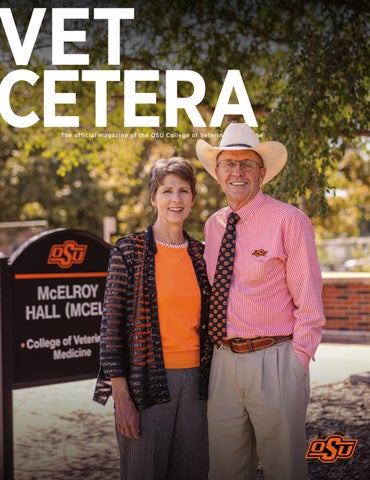
VET CETERA
The official magazine of the OSU College of Veterinary Medicine
FROM THE DEAN’S OFFICE The first time I walked into McElroy Hall, I knew my life was about to change. As a 1986 graduate of the Oklahoma State University College of Veterinary Medicine, this institution has given me so much: my wife, my profession and a lifelong passion for veterinary medicine. As I work alongside our faculty, staff, students and partners to elevate OSU Vet Med to new heights, I often reflect on the mentors who invested in me and helped shape my journey. Their guidance inspires me as we take on one of the most ambitious initiatives in our college’s history: the construction of a $329 million, state-of-the-art veterinary teaching hospital that will serve generations of animals, clients and future veterinarians. I am honored to help lead this effort and embrace the responsibility that comes with it. Since stepping into this role on July 1, I have been overwhelmed by the support I have received from our faculty, staff, alumni, veterinary partners and OSU leadership. The success of our college has always been built on the strength of this community, and achieving our vision for the future will require all of us working together. I hope you enjoy the stories in this magazine and that they reconnect you with the memories and experiences that first made McElroy Hall feel like home. While our facilities and programs continue to evolve, the mission and spirit of this college remain unchanged: to educate career-ready veterinarians who will strengthen their communities, protect animal health and help ensure a safe and wholesome food supply.
DR. RICHARD C. PRATHER Dean, College of Veterinary Medicine richard.prather@okstate.edu
DEAN, COLLEGE OF VETERINARY MEDICINE Dr. Richard C. Prather COMMUNICATIONS COORDINATOR Kinsey Reed
ON THE FRONT
COMMUNICATIONS SPECIALIST Jacob Sitton
A Shared Calling
ALUMNI AFFAIRS AND EVENTS SPECIALIST Jenny Capron
From rural practice to the dean’s office, Richard and Angie Prather’s commitment to service has shaped a life devoted to veterinary medicine, family and community. Pages 32-35 (Cover photo: Ellie Piper)
04
What started at a hometown clinic became a marriage, a career and a commitment to rural Oklahoma veterinary care.
14 House Call
When animals can’t come to the hospital, OSU’s ambulatory team takes veterinary medicine straight to the field.
26 Building the Future
With a site selected and plans taking shape, OSU’s future Veterinary Teaching Hospital is poised to redefine veterinary care in Oklahoma.
36 Coming Home
EDITOR Jordan Bishop ART DIRECTOR Dave Malec
FEATURES Partners in Life and Practice
SENIOR DIRECTOR OF DEVELOPMENT/TEAM LEAD Megan Smith
40
Built for Breakthroughs OSU researchers bring One Health to cancer discovery, using crossspecies insights to advance animal and human treatments.
47 Distinguished Alumni
Groundbreaking research, compassionate teaching, clinical excellence: five Distinguished Alumni exemplify OSU.
58 Ready Vet Go
What began as a study-abroad experience became a one-ofa-kind veterinary career for Dr. Paul Cunningham.
DESIGNER Cody Giles CONTRIBUTING WRITERS Laela Begley, Jami Mattox, Presley Pullen and Kinsey Reed PHOTOGRAPHERS Ellie Piper, Eric Priddy, Presley Pullen, Kinsey Reed and Jacob Sitton
The College of Veterinary Medicine graduates competent, confident, career-ready veterinarians — a tradition it has proudly carried forward since the day the veterinary college opened its doors in 1948. Please join us at the CVM website: vetmed.okstate.edu.
VET CETERA magazine is published each year by Oklahoma State
University, 307 Whitehurst, Stillwater, OK 74078. The magazine is produced by the Office of Brand Management and the College of Veterinary Medicine. Its purpose is to connect the college with its many alumni and friends, providing information on both campus news and pertinent issues in the field of veterinary medicine. Postage is paid at Stillwater, OK, and additional mailing offices. All rights reserved.
Oklahoma State University, as an equal opportunity employer, complies with all applicable federal and state laws regarding non-discrimination. OSU is committed to a policy of equal opportunity for all individuals and does not discriminate based on race, religion, age, sex, color, national origin, marital status, disability, or veteran status with regard to employment, educational programs and activities, and/or admissions. For more information, the director of equal opportunity/ Title IX coordinator is located at 201 General Academic Building and can be reached at 405-744-1156 or by visiting EEO.OKSTATE.EDU. This publication, issued by Oklahoma State University as authorized by the College of Veterinary Medicine, was printed by Slate Group at a cost of $6,320 for 2,800 copies/Oct. 2026.
After building careers nationwide, five OSU CVM graduates returned to Stillwater to give back to the institution that helped launch them.
O K L A H O M A S TAT E U N I V E R S I T Y
1
STUDENTS
SPEAKING OF HEALTH | Dr. Jennifer Rudd gives opening remarks at the 2026 Induction Ceremony.
You Must Be New The class of 2030 begins its veterinary journey
STORY LAELA BEGLEY | PHOTOS KINSEY REED AND JACOB SITTON
E
very year, a new group of students brings a wide variety of ideas, knowledge and background experiences. On Aug. 10, the Oklahoma State University College of Veterinary Medicine welcomed its newest group — the class of 2030. This class consists of 106 students who have traveled from across the nation to call Stillwater home. This year, 69 students are from Oklahoma and 37 are from out
2
VE T CE TER A | 2026
of state. While each student’s path to OSU may have been different, they share one common goal — to become veterinarians. “As a third-generation student here, I have been coming to OSU as long as I can remember,” said Issac Ochsner, a first-year CVM student. “When it came time to start undergrad, the answer was pretty obvious. I knew that I wanted to spend the next seven years in the atmosphere and
culture that I had come to know, love and call home.” For many students, veterinary medicine started as a childhood dream. Their passion was sparked by working on family farms and ranches or caring for household pets. Others have discovered vet med later in life, like first-year student Maddie Brown. “I started off at the University of Central Oklahoma, majoring in forensic science and biomedical
sciences,” Brown said. “I couldn’t stay in the city. My sister was here, and I was always up here on the weekends. So, I thought, ‘You know what? I’m transferring. I’m just going to do my second backup major.’ I ended up falling in love with it. I fell in love with Stillwater, the people, the college and everything. I said, ‘I don’t know if I could go anywhere else.’ It felt like home.” Regardless of how they discovered their passion, each student has taken countless steps to reach this milestone. “I am excited to see what this class can do,” said Chasity Srader, CVM prospective student coordinator. “You can tell they are eager to work and learn, as evidenced by their punctuality. They all showed up for orientation 30 minutes early.”
Orientation week gave the students a glimpse into life at the CVM. They spent time getting to know their classmates, meeting faculty and staff members, and learning about the resources available to help them succeed. Team-building activities and even practicing their first sutures gave the class a sense of what lies ahead. In just a week’s time, students created connections that they will carry beyond the program. While the veterinary curriculum may be rigorous, having a support system of classmates makes the journey manageable and rewarding. After orientation, the students participated in the induction ceremony, a tradition symbolizing their formal entrance into the profession. They will gain hands-on experience through labs, rotations, and clinical work at the OSU
Veterinary Medical Teaching Hospital and eventually walk across the stage at commencement to receive their Doctorate of Veterinary Medicine. While at OSU, students will gain experience and technique to learn which area of medicine suits them best. For Brown, pathology has caught her eye. “I got a job working at the Oklahoma Animal Disease Diagnostic Laboratory, and I fell in love with the pathologists there,” she said. “I know a couple of them teach some of the classes here. I thought, ‘OK, I’ve got to stay.’”
VET IT ALL ON ORANGE | First-year students participate in orientation and the 2026 induction ceremony.
O K L A H O M A S TAT E U N I V E R S I T Y
3
RURAL
PARTNERS IN CRAFT | Drs. Jacob and Aubry Gollihare share a passion for veterinary medicine.
4
VE T CE TER A | 2026
O
PARTNERS IN LIFE AND PRACTICE What began at a hometown veterinary clinic became a marriage and a mission to serve rural Oklahoma. STORY AND PHOTOS PRESLEY PULLEN
ne had long dreamed of following in her grandfather’s footsteps as a mixed animal practice veterinarian. The other never imagined entering the profession until his former agricultural instructor pointed him in a new direction. Although their paths and plans were different, Drs. Jacob and Aubry Gollihare’s shared experiences in rural Oklahoma brought them together and led them into the veterinary field. Aubry grew up immersed in veterinary medicine at her grandfather’s practice, Stratford Animal Hospital, in Stratford, Oklahoma, where she rode along on farm calls, worked cattle and observed surgeries. Although she attended Blanchard Public Schools, she jumped at any opportunity to spend weekends down south with her grandfather, Dr. Gerald Parsons, also known as “Doc.” Elsewhere in Garvin County, Jacob’s introduction to the field was different: his experiences exhibiting show pigs and sheep first sparked an interest in animal handling and health. However, after graduating from Stratford High School, he intended to pursue a degree in biosystems engineering and spend his career advancing farm machinery. His heart eventually came back to veterinary medicine, so he applied to the Oklahoma State University College of Veterinary Medicine. Jacob and Aubry had long been in close proximity, each wandering the same streets of the self-proclaimed Peach Capital of the World with a population of 1,405. However, it was not until the summer before Jacob began veterinary school that a shadowing opportunity with Doc arose. Doc encouraged Aubry to reach out to him for help with her
O K L A H O M A S TAT E U N I V E R S I T Y
5
RURAL
“Marrying another veterinary student certainly came with its challenges. But the ability to truly understand what my husband was experiencing at school each day, and vice versa, was an unexpected gift.” AUBRY GOLLIHARE RURAL VETERINARIAN
veterinary school application, and once Jacob met her, the rest was history. Jacob saved money from his summer job at a peach orchard and set aside earnings from his small cow-calf operation to buy an engagement ring. Aubry said yes, and the couple was married in 2022, just after Jacob completed his first year of veterinary school and before Aubry began her own. “Marrying another veterinary student certainly came with its challenges,” Aubry said. “But the ability to truly understand what my husband was experiencing at school each day, and vice versa, was an unexpected gift.” Now, the couple reflects on their academic journey at OSU CVM with gratitude. From faculty connections and mentorship to real-world clinical experiences, both Jacob and Aubry Gollihare are deeply appreciative of the support they received in Stillwater. Additionally, they have both been named recipients of the Oklahoma Rural Veterinary Scholarship Program.
6
VE T CE TER A | 2026
“The Oklahoma Rural Veterinary Scholarship Program has profoundly shaped not only the next five years of my career, but the trajectory of my life,” Aubry said. “Being financially supported as I return home to rural Oklahoma is incredibly meaningful and rewarding.” Jacob has spent the past year back at the Stratford Animal Hospital learning, growing and supporting his hometown. “I am extremely grateful for the relationships with professors and staff that I am confident will last a lifetime,” Jacob said. “As I started my career in May 2025, I was the first to admit it felt like I was not fully prepared, but with some confidence and good mentors, the knowledge and skills came to life.” Returning to practice veterinary medicine in Stratford has allowed Jacob to reconnect with livestock producers from whom he once purchased show pigs and care for animals owned by former hometown mentors. This past May, Aubry returned to southern Oklahoma to work with
Program Spotlight The Oklahoma Rural Veterinary Scholarship and Loan Forgiveness Programs provide financial support to veterinary students who commit to practicing in rural Oklahoma. Created in 2024, the programs have awarded $1.8 million to help graduates return to underserved communities and expand access to veterinary care across the state.
her husband and her grandfather. This addition allows the team more flexibility to reach new clients and provide additional services, Jacob said. “In the next five to 10 years, I hope to step into an ownership role within our practice,” Aubry said. “I am excited for the possibility of growing our veterinary team as well, allowing us to serve more communities and offer more comprehensive care to Oklahomans across the state.” For the Gollihares, the Oklahoma Rural Veterinary Scholarship Program played a central role in making their careers in rural practice possible. This support has made it possible for them to return to rural Oklahoma, building careers rooted in food animal medicine alongside experienced OSU CVM alumni. Since its inception in 2024, the program has awarded $1.8 million in scholarship money and loan forgiveness. Dr. Rosslyn Biggs, director of the Center for Rural Veterinary Medicine, said the programs have helped reduce
financial barriers for graduates like the Gollihares to return to rural family practices, continue a legacy of care and deliver high-quality veterinary services in areas that might otherwise go underserved. “The Rural Veterinary Scholarship and Loan Forgiveness Programs are critical to ensuring talented veterinary students can return to their roots and serve the communities that need them most,” Biggs said. Aubry hopes the program not only places a strong number of veterinarians in rural Oklahoma for the required service period but also fosters a lasting commitment to those communities. “The financial relief provided has the potential to largely reduce the barriers associated with practicing in rural America, and I am excited to see more veterinarians be able to pursue and sustain careers in these areas because of support systems like this program,” she said.
O K L A H O M A S TAT E U N I V E R S I T Y
7
AWA R D S
MENTORED TO MEMORIAL | Maddie Dillard was named the top third-year veterinary student by her peers.
Dillard’s Dedication Student’s work recognized with Orr Award STORY AND PHOTOS KINSEY REED
G
rowing up in a small community, Maddie Dillard found her passion for rural life and the close relationships that come with it. Dillard, a fourth-year student at Oklahoma State University’s College of Veterinary Medicine, participated in 4-H starting at a young age. During that time, she showed goats, commercial heifers and rabbits. In addition to showing
8
VE T CE TER A | 2026
livestock, Dillard also grew up riding horses. Dillard’s mom, Dr. Kelly Strickland, was a veterinarian. However, Dillard didn’t grow up dreaming of following in her footsteps. She wanted to be a different kind of doctor. “I actually wasn’t one of those people who always knew they wanted to be a veterinarian,” Dillard said. “Initially, I wanted to
practice human medicine, but it just never felt like the right fit.” It wasn’t until Dillard completed her undergraduate degree at Texas A&M University and started her master’s program at the University of North Texas Health Science Center that her passion for veterinary medicine sparked. During her master’s program, Dillard started helping at a local veterinary clinic, then everything clicked.
“Receiving this award is incredibly meaningful because it recognizes all the hard work that has brought me to this point. Veterinary school is challenging, so it’s encouraging to know that others believe in my goals and my future as a veterinarian.” MADDIE DILLARD
FOURTH-YEAR VETERINARY STUDENT
At the clinic, Dillard realized that she loved the medicine, the hands-on work and the relationships she built with the patients and their owners. “That experience made me realize that veterinary medicine was the right career for me,” Dillard said. After earning her master’s degree, Dillard relocated from Texas to Oklahoma to pursue her veterinary education at the CVM. Dillard felt that OSU was the right fit because of its supportive environment and the relationships between the students and faculty. “The professors are approachable and I’ve always felt comfortable asking questions or seeking guidance,” Dillard said. In addition to the faculty and mentorship at OSU, Dillard values the CVM’s emphasis on rural veterinary medicine, which reminds her of the communities where she grew up and aligns with her career goals after graduation. Now, her dedication and academic excellence have been recognized through the Dean Harry W. Orr Memorial Award scholarship, presented in spring 2026. The Orr Award honors the top-ranking third-year veterinary student.
“Receiving this award is incredibly meaningful because it recognizes all the hard work that has brought me to this point,” Dillard said. “Veterinary school is challenging, so it’s encouraging to know that others believe in my goals and my future as a veterinarian.” As Dillard enters her final year at OSU, she is eager to go from the classroom to clinical rotations at the hospital. Although she grew up working with large animals, Dillard has found a passion for small animal medicine. After graduation, she hopes to return to Texas and practice in a rural community. “There is nothing easy about becoming a veterinarian,” said Dr. Jennifer Rudd, OSU CVM associate dean of academic affairs. “From getting a seat in the class to successfully moving through the curriculum, a lot of grit is required to become a doctor. “Maddie is not only surviving but thriving. She is not just brilliant, but also humble, kind and supportive of her peers. It is great to see her efforts rewarded with this award.”
THE DEAN HARRY W. ORR MEMORIAL AWARD The Dean Harry W. Orr Memorial Award is named after the College of Veterinary Medicine’s second dean who was on staff at OSU for 36 years. It is given to the CVM’s top-ranking third-year student.
O K L A H O M A S TAT E U N I V E R S I T Y
9
AWA R D S
GENTLE PRESTIGE | Dr. Sarah McGibbon poses with the Gentle Doctor Award at the Class of 2026 commencement ceremony.
‘Helping is My Purpose’ McGibbon named 2026 Gentle Doctor Award recipient STORY AND PHOTO KINSEY REED
F
or many veterinary students, the dream of becoming a veterinarian starts at a young
age. For Dr. Sarah McGibbon, it didn’t come until a month before graduating from college. “I never wanted to go to veterinary school,” McGibbon said. “People are always surprised when I say that.” Although McGibbon grew up loving animals and being told she
10
VE T CE TER A | 2026
should be a veterinarian, she felt taking care of sick animals every day would be too sad. But a month before graduating from California State UniversityFresno, McGibbon knew being a veterinarian was the only thing that made sense. While completing her undergraduate degree, McGibbon explored careers throughout the animal industry, from pet nutrition to food-animal
production. Despite receiving job offers, none of them felt like the right fit. Everything changed during a study session for an animal anatomy and physiology course. “I was explaining how the heart works to a friend’s mom when she asked, ‘Remind me why you aren’t going to vet school?’” McGibbon said. “I looked down at my notes and thought, ‘Why am I not going to vet school?’”
“I love caring for and helping others, whether they have fur, feathers, hide or scales. Whether they walk on two legs or four. Human or animal. It just feels like helping is my purpose, and having enough people around me notice and appreciate the part of me that I got an award for was so deeply touching.” DR. SARAH MCGIBBON OSU ALUMNA
In that moment, McGibbon knew that becoming a veterinarian was the exact career she had been looking for. The combination of working with animals, applying science every day and making a meaningful difference in others’ lives was what she was missing. Shortly after graduation, McGibbon was hired as a veterinary assistant at a small animal practice, and she never looked back. When the time came to apply for veterinary school, Oklahoma State University was already on her radar. “I’d only ever heard that it produces good veterinarians,” McGibbon said. “I liked that it had a huge emphasis on large-animal opportunities, along with an exotic option because I wanted to be well educated in those fields.” Each year, the OSU College of Veterinary Medicine graduating class selects one member to receive the Gentle Doctor Award, which is given to someone who embodies a passion and love for all animals. The class of 2026 selected McGibbon. “Putting this award into words feels so challenging; I just feel so honored and blessed that my
classmates and mentors see me as someone worthy of this award,” McGibbon said. “I love caring for and helping others, whether they have fur, feathers, hide or scales. Whether they walk on two legs or four. Human or animal. It just feels like helping is my purpose, and having enough people around me notice and appreciate that part of me was so deeply touching.” McGibbon’s list of influential faculty members and classmates is long. The passionate and supportive community she was surrounded by significantly impacted the veterinarian she has become. “Sarah extends this same level of care to the people connected with the animals in our profession, too,” said Dr. Jennifer Rudd, OSU CVM associate dean of academic affairs. “I am so pleased to see her genuine love for all recognized through her peers with this prestigious award.”
2026 GENTLE DOCTOR AWARD The Gentle Doctor Award is given to the graduating senior who demonstrates the most compassion and dedication to their patients and clients. It is voted on by members of the College of Veterinary Medicine graduating class.
O K L A H O M A S TAT E U N I V E R S I T Y
11
AWA R D S
DON’T STOP BELIEVIN’ | Dr. Ryan Carson poses with the McElroy Award at the Class of 2026 commencement ceremony.
Never Too Late
Carson continues veterinary career after starting family; named McElroy Award winner STORY AND PHOTO KINSEY REED
P
erseverance, dedication and commitment. The road to veterinary school is rarely straightforward. For Oklahoma State University College of Veterinary Medicine alumna Dr. Ryan Carson, it included years of persistence, career experience and raising a young family before finally achieving her dream. By the time Carson graduated from high school, she had lived in
12
VE T CE TER A | 2026
five different states and attended multiple schools. Constantly moving meant she never had a chance to get involved in extracurricular activities that could encourage her veterinary medicine career. However, her love for animals remained a constant. “I was always asking, ‘Can we get another animal?’” Carson said. Not long after getting her first cat, it contracted bobcat fever — a
deadly disease that is hard to catch and cure. After this loss, Carson’s interest in veterinary medicine piqued and she started volunteering at a clinic in Branson, Missouri, when she was only 10. “I couldn’t really do much except stand there and watch, but I was hooked,” Carson said. The veterinarian there gave Carson a behind-the-scenes look at the profession, taking the time to
explain each procedure and answer her questions. The experience confirmed Carson’s desire to become a veterinarian. “My mom was a huge advocate for my love of animals,” Carson said. “She was an OSU alumna and got her degree in Construction Management at a time when women were not in that field. She was one of the biggest reasons I was interested in OSU as my first choice for vet school.” After graduating from Colorado State University, Carson started applying for veterinary school. After three application cycles, she decided to take a pause and work in the industry in other roles. Carson worked as a veterinary technician, practice manager and in veterinary pharmaceuticals while she started her family. “I told my husband I wasn’t ready to give it up,” she said. “If I was going to do it, I needed to do it.” After reapplying, Carson finally got the phone call she had been waiting for. On Aug. 1, just 10 days before school started, she received word that she had been accepted in the OSU CVM Class of 2026. “Anna Teague called and said, ‘Do you want to come?’ I said, ‘Absolutely. Tell me when.’ She said, ‘10 days,’” Carson said. Not knowing how she would make it happen, Carson packed up and moved to Stillwater with her three young children while her husband remained in Texas to finish work. They lived in a hotel for two months before settling into their new home in Stillwater. When Carson started school in 2022, her children were 4 years old, 3 years old, and 8 months old. Because of Carson’s dedication and commitment, she handled every situation with grace. “Dr. Carson is one of those oncein-a-generation people that come
along and prove that no mountain is too high nor bridge too far,” said Dr. Jerry Ritchey, former OSU CVM dean. While juggling life and school, Carson developed a special interest in parasitology and pathology and became very involved in student organizations. “It took me so long to get here that I was probably more grateful than a lot of people,” Carson said. “Even if there was a class I didn’t particularly enjoy, I was just happy to be there.” Throughout her time at the CVM, she dedicated herself to making others better. Carson served as her class vice president and served as a student tutor to ensure all students succeeded academically. In addition, Carson was president of multiple student clubs and received an orange cord at graduation for having more than 400 community service hours. Carson received her Doctor of Veterinary Medicine degree at Gallagher-Iba Arena in May. She was also awarded the 2026 Dean Clarence H. McElroy Award — the highest honor presented to a graduating veterinary student. “I thought it was going to be someone else,” she said. “When they called my name, I was just in shock.” Clinical faculty and fourthyear classmates select the McElroy Award winner. The award honors a student who excels in academic achievement, clinical skills and leadership. Carson stood out in all three areas. Carson never sought recognition and was always willing to lend a hand where she could. “If I see something that needs to be done and it’s within my capability to do it, I’m just going to jump in and do it,” she said. “I
THE DEAN CLARENCE H. MCELROY AWARD The Dean Clarence H. McElroy Award is named after the College of Veterinary Medicine’s first dean. It is given to a senior CVM student selected by faculty and fourth-year students based on high academic achievement, leadership and outstanding clinical proficiency.
didn’t do any of those things with some ulterior motive.” In addition to her already very impressive résumé, Carson pursued a dual Ph.D. while at the CVM. After her first year of veterinary school, she began her Ph.D. studies and is on track to complete it in spring 2027. Her story has come full circle as her research focuses on bobcat fever — the same disease that took her first cat. “Ryan is a superwoman,” said Dr. Jennifer Rudd, OSU CVM associate dean of academic affairs. “She is an incredible doctor, a loving mother to three kids, an inspiring leader and the kind of person who lives her life caring for her community and her peers. I am so proud of her for all her accomplishments. She represents the Cowboy Code in all aspects of her professional life and I know she is going to do big things in her career.”
O K L A H O M A S TAT E U N I V E R S I T Y
13
A M B U L AT O R Y
HOUSE CALL OSU veterinarians bring expertise to the barn, field, coop — wherever your animals call home
STORY KINSEY REED | PHOTOS ELLIE PIPER, ERIC PRIDDY AND KINSEY REED
14
VE T CE TER A | 2026
GOING THE DISTANCE | Ambulatory service brings veterinary technology straight to the field.
F
or livestock owners, the work is never finished. Before daylight breaks and long after it fades, there are always calves to check, horses to feed and herds to protect. Illness doesn’t wait for business hours, and neither does the responsibility of caring for those animals. Before the sun rises over Stillwater, Oklahoma State University’s ambulatory veterinarians and fourth-year students load a mud-splattered ambulatory truck for another day in the field. Veterinary medicine has no boundaries. It does not end at 5 p.m., wait for the next business day or remain confined within the walls of a clinic. The College of Veterinary Medicine ambulatory service has assisted Stillwater and the surrounding communities for decades. The veterinarians at the forefront of the ambulatory service are Drs. John Gilliam, a clinical professor in food animal production
medicine and field services; Jason Anton, clinical assistant professor in production medicine field services and extension; and Chase Whitfield, clinical associate professor in equine medicine and field services. The ambulatory service delivers comprehensive veterinary care to equine and food animal patients, bringing clinical expertise directly to farms and ranches. OSU’s team provides services such as herd health programs, including calf processing, pregnancy diagnosis, and disease outbreak prevention and investigation. In addition to routine care, CVM veterinarians provide diagnostic imaging and treatment for individual animals. “We offer a full range of food animal medicine services, from care of sick individual animals to production work with groups of animals,” Gilliam said. “We also offer fertility evaluation and artificial insemination, just to name a few.” Transporting large groups of animals is often impractical,
“We offer a full range of food animal medicine services, from care of sick individual animals to production work with groups of animals.” DR. JOHN GILLIAM
CLINICAL PROFESSOR IN FOOD ANIMAL PRODUCTION MEDICINE AND FIELD SERVICES
O K L A H O M A S TAT E U N I V E R S I T Y
15
A M B U L AT O R Y
making on-farm care essential to delivering high-quality herd health services. An ambulatory model allows veterinarians to evaluate and treat animals in their own environment, which is especially beneficial when investigating disease concerns or assisting producers with management decisions. Seeing conditions firsthand provides critical insight that cannot be replicated in a hospital setting. Recently, the college added a full-time equine ambulatory veterinarian to better serve the equine industry in Stillwater and surrounding communities. The addition allows Whitfield to focus more closely on the needs of equine owners. The service provides comprehensive equine veterinary care, including wellness exams, dental exams and floats, castrations, lameness evaluations and joint injections, prepurchase exams, advanced medical exams and consultations and neurologic evaluations.
16
VE T CE TER A | 2026
In addition, Whitfield offers on-farm ultrasonography and radiography; upper airway and gastric radiography; shockwave therapy and orthobiologic joint therapy to diagnose, treat and manage lameness and other performance-related conditions. “In addition to routine care, it is beneficial to provide emergency services on the farm to help patients and clients when they need you most,” Whitfield said. The food animal and equine ambulatory service continues to expand, strengthening the CVM’s ability to serve farmers and ranchers across the state. With new resources and additional faculty, the program is enhancing access to high-quality veterinary care and ensuring producers in rural communities receive the support they need. Placing veterinarians in the field is helping combat the ongoing
shortage of rural veterinary practitioners and strengthening access to care in underserved communities. Serving the community is one of the many benefits the service provides. Having an ambulatory service is vital for students’ education. It gives them the chance to experience real-world scenarios, which allows them to think outside the box. “Having the opportunity to work in on-farm environments before they leave school is invaluable,” Gilliam said. “Students also learn valuable critical thinking and client communication skills.” The ambulatory service provides students with hands-on experience beyond the clinic walls, immersing them in real-world rural practice. This training is critical to the CVM’s mission of addressing the ongoing shortage of veterinarians in rural communities.
“I am so grateful to the producers who let us learn on their animals,” said Katelyn Massersmith, a fourthyear veterinary student. “During this rotation, I felt like an actual doctor and was able to sharpen my skills. Because of this service, I feel more confident.”
CALL 405-744-7000 TO SCHEDULE AN APPOINTMENT WITH THE OSU-CVM AMBULATORY TEAM.
O K L A H O M A S TAT E U N I V E R S I T Y
17
H O S P I TA L
HOOFIN’ IT | House Officers and fourth-year students pose with Alice.
Toe Out of Line
Donkey receives corrective surgery to fix painful walking issues STORY KINSEY REED | PHOTO BAILEY HORN
I
magine walking on your tiptoes all day and the pain it would cause. Now, imagine you don’t have toes but hooves, which hurt even more when unbalanced. That is how Alice the donkey arrived at the Oklahoma State University Veterinary Teaching Hospital. Veterinary medicine often requires more than diagnosing a problem and performing a procedure. For complicated cases,
18
VE T CE TER A | 2026
successful treatment can depend on a combination of surgery, rehabilitation and specialized care. Alice, a 2-year-old, is a good example of how that combination can give an animal a second chance. Alice was rescued about two weeks before she arrived at the hospital. She was significantly underweight and struggling to walk because of severe deformities in both of her front limbs.
She had flexural deformities that were so severe that she was walking on the front of her hooves instead of placing her heels on the ground. Her heels were also severely overgrown due to a lack of normal wear. “She was past 90 degrees, walking on her tiptoes,” said Dr. Megan Williams, associate professor of equine surgery and sports medicine. “She spent most
of her time lying down because she was in so much pain.” Alice was diagnosed with bilateral distal interphalangeal joint flexural limb deformities, a developmental orthopedic condition caused by excessive tension in the deep digital flexor tendons. The condition pulled her hooves into an abnormal position, resulting in significant strain and discomfort. Although flexural deformities are often seen in horses, Williams said she has not seen as many cases in donkeys. In young horses and donkeys, flexural deformities can occur when the bones grow faster than the tendons and ligaments can adjust, causing tension that pulls the hoof into an abnormal position. In Alice’s case, the deformity was so severe and chronic that the surgery team was concerned it might not completely correct the problem. For less severe cases, it is possible to correct a flexural deformity through more conservative treatments. For Alice, Williams said the team would likely need to release the tension in her deep digital flexor tendons by transecting them. There was also a possibility that additional structures would need to be addressed if the initial procedure did not provide enough correction. Alice was systemically healthy enough to undergo anesthesia, though her underweight frame was concerning. Williams and her team performed bilateral deep digital flexor tenotomies, cutting the affected tendons to release the tension that was pulling Alice’s hooves into an abnormal position. “In the operating room, we felt like we got quite a bit of correction
PATIENT:
Alice, a 2-year-old donkey
DIAGNOSIS:
Bilateral distal interphalangeal joint flexural limb deformities
TREATMENT:
Surgery and corrective farrier work
just by cutting the deep flexor tendon,” Williams said. Because the tendons released enough tension to significantly improve the position of Alice’s hooves, the team did not need to perform additional procedures. After surgery, the veterinarians continued working to correct the position of her hooves. While Alice was still recovering from anesthesia, the team trimmed some of the excessive hoof growth caused by years of abnormal development. The team then placed splints on her legs to help maintain the correction while they waited for the farrier. “We got her to where her heels were on the ground,” Williams said. “She’s never done that.” The following day, James Marshall, an equine farrier, continued Alice’s corrective treatment. Marshall trimmed additional heel growth and applied acrylic toe extensions designed to help keep Alice from rolling back onto her toes. The combination of surgery and corrective farrier work was critical to Alice’s recovery. Her discharge instructions called for regular farrier visits every four to six weeks, with the toe extensions maintained and adjusted as needed. Following
surgery, Alice was placed on stall rest with limited hand walking. Her activity was to increase gradually as she healed, with small-paddock turnout considered after 60 days if she continued to do well. “She went from kind of miserable, spending almost all of the time laying down, to spending almost all of her time up,” Williams said. Alice began walking more comfortably, and her progress continued. Williams said cases like Alice’s demonstrate the impact that specialized veterinary care can have, particularly for rescued animals that may not otherwise have access to the treatment they need. Alice still has a long road ahead. Continued farrier care, controlled exercise and monitoring will be important to preventing her deformities from returning. “OSU is so accepting of rescued horses or mustangs compared to vet clinics that look down on the rescued horse and don’t give these guys the dignity they deserve,” said Liz Sousa, Alice’s owner. “There are no prejudiced judgements there.” Alice went from barely walking to now living in Florida at a donkey rescue. All she needed was a second chance.
O K L A H O M A S TAT E U N I V E R S I T Y
19
H O S P I TA L
DOG DAYS AREN’T OVER | Sam Massey, a veterinary assistant, poses with Dani, a 6-month-old bernedoodle.
Saving Her Skin
Dog with severe skin infection is treated at OSU hospital STORY KINSEY REED | PHOTO BAILEY HORN
W
hen Dani, a 6-month-old Bernedoodle, arrived at the Oklahoma State University Veterinary Medical Teaching Hospital, she was struggling with a severe skin condition that would not heal. Dani was first seen by emergency and critical care doctors. She had swelling around her face and eyes, crusting of the skin, bleeding sores around her mouth, and signs of infection.
20
VE T CE TER A | 2026
Dani’s primary veterinarian had prescribed antibiotics and prednisone, but the infection was not improving. OSU’s ECC team quickly realized this case was more complicated than it seemed. “We knew Dani had a severe infection with a possible multiresistant bacteria since there was no improvement after antibiotics, but we did not know the type of bacteria,” said Dr. Andreza PataraConti, an assistant professor in
small animal emergency and critical care. “We immediately started her treatment with a combination of broad-spectrum antibiotics intravenously.” Because of the unknown skin infection, Dr. Dana Liska, a board-certified dermatologist and clinical assistant professor in dermatology, was quickly looped into the case. Under Liska’s guidance, the student on her case took a biopsy
of Dani’s skin lesions. This provided a clearer idea of what was going on. “Dani’s young age and the location of her lesions initially raised concern for juvenile cellulitis, commonly known as puppy strangles,” Liska said. “The disease is an immune-mediated condition that can cause severe inflammation and lesions, particularly around a young dog’s face. “The last thing you want to do is immunosuppress a dog who has a deep infection. The two things don’t go well together.” Her biopsy ultimately confirmed puppy strangles and also identified deep pyoderma. Liska explained that when the skin’s normal protective barrier is damaged by an immunemediated disease, bacteria can take advantage of that weakened barrier and move deeper into the skin. Now knowing what they were dealing with, Dani was put on a standard treatment for her infection and sent home. Even after returning to her home’s comforting environment, Dani declined again, prompting another ER visit. Dani came back through the ER, where Dr. Patara-Conti and the ER doctors, Dr. Franciele Back and Dr. Marcelo De Oliveira, assessed her again. Conti decided that the best plan moving forward was to treat Dani’s nonhealing skin lesions. The ECC team anesthetized Dani and thoroughly cleaned her skin, removing the extensive crusting that was harboring bacteria. “Dr. Patara-Conti and that intervention really changed the trajectory of Dani’s case,” Liska said. Once the crusts and infected skin were removed, the veterinary team moved forward with immunosuppressive therapy to address the underlying immunemediated disease. However, the bacterial infection was still a serious concern.
PATIENT:
Dani, a 6-month-old bernedoodle
DIAGNOSIS:
Juvenile cellulitis, aka puppy strangles, and deep pyoderma
TREATMENT:
Deep skin cleaning, combatting infection and immunosuppressive therapy
A repeat culture showed that Dani’s staphylococcal infection had become highly resistant. By the time results returned, the bacteria resisted all but one antibiotic. The remaining option was an extremely powerful drug that carried the risk of severe liver damage and, in some patients, could be fatal. “Although the drug could be highly effective, the risks associated with it were high, so it was a last resort,” Patara-Conti said. The team decided they would keep Dani under close monitoring while balancing treatment of the infection with the immunosuppressive therapy she needed. Dani’s treatment required close collaboration between the ECC and dermatology services, as well as the expertise and support of veterinary technicians and students throughout her hospitalization and recovery. Eventually, Dani’s condition improved enough for her to leave the hospital. The dermatology team then continued managing her immunemediated disease and gradually increased and later tapered her corticosteroid treatment. At a recheck, her skin was healthy, the infection had resolved and hair was growing back around her face and muzzle. The lesions inside her ears had healed, and her owner reported no itching, pawing
at the face or ears, or head shaking. During this appointment, it was determined that both her juvenile and deep pyoderma had been resolved. “I give all of the credit to PataraConti, the Emergency and Critical Care team and veterinary assistant Sam Massey,” Liska said. Dani’s case illustrates why antimicrobial stewardship is so important in veterinary medicine. Multidrug-resistant bacteria can limit treatment options not only for an individual patient but also for future infections. “We do have a lot of resistant bacteria, and those resistance mechanisms can be transmitted from humans to dogs, from dogs to dogs, and from dogs to humans,” Patara-Conti said. Dani’s case began with what might have appeared to be a severe skin problem in a young puppy. Instead, it became a complex, potentially life-threatening illness involving an immune-mediated disease and a highly resistant bacterial infection. Through the collaboration of ECC, dermatology and the hospital’s support staff, the OSU team was able to navigate those challenges without resorting to the potentially dangerous last-line antibiotic. I can’t thank them enough for taking such excellent care of my sweet girl and for the frequent calls and emails with updates to help ease my mind during Dani’s weeklong stay at OSU,” said Laurie Cannon, Dani’s owner. “A special shoutout to Sam Massey for her support and communication throughout Dani’s illness. It was heartwarming to walk through those doors for the months of treatments after her release and everyone knew her and loved on her.”
O K L A H O M A S TAT E U N I V E R S I T Y
21
H O S P I TA L
SNOUT OF THE BOX | Jetta, a 13-year-old rainforest tapir, recovers in the OSU Veterinary Medical Teaching Hospital.
Exotic Enigma
Veterinarians of different disciplines unite to aid rare creature STORY AND PHOTO KINSEY REED
I
t’s a horse, it’s a pig, it’s a tapir? For Jetta, a 13-year-old rainforest tapir, a species that resembles a combination of pigs, horses, rhinos and elephants, a case of lameness became a veterinary challenge that required teamwork, specialized care and a little creativity. When her condition began affecting her mobility, the veterinary team at Beavers Bend Safari Park in Broken
22
VE T CE TER A | 2026
Bow, Oklahoma, reached out to the Oklahoma State University Veterinary Medical Teaching Hospital. For Lisa Ramsey, director of Beavers Bend Safari Park, the decision to call OSU was an easy one. “Veterinary colleges are on the cutting edge of medicine and technology,” Ramsey said. Due to the 260-mile distance between the safari park and
Stillwater, Dr. Kathrine Hausmann Faris, a clinical assistant professor in zoological medicine, decided the best option was to assess Jetta at the safari park. Tapirs’ anatomy and biomechanics differ from those of more familiar large-animal species, but their feet share characteristics with horses. This meant Haussman needed additional insights from across the hospital.
She decided to include Drs. Jason Anton, assistant professor in large animal field services and extension; John Gilliam, professor in food animal medicine and field services; and Michael Schoonover, professor in equine surgery and sports medicine. “I know the minimum, but they’re the experts when it comes to the large animal species,” Hausmann said. Just days after the initial call, Hausmann and Anton took the food animal ambulatory truck to Beavers Bend to conduct an initial assessment of Jetta’s foot. Hausmann and Anton, along with students, took a mobile anesthesia setup to evaluate Jetta in the field. Anton’s experience with large animals made him vital for the initial assessment and radiographs that identified the original pathology. After evaluating the radiographs, Schoonover suggested that Jetta receive a CT scan to better evaluate her foot. After reviewing the initial images, it was determined that Jetta’s diagnosis would require treatment that could not be done in the field. So, Jetta made the four-hour trailer ride from Beavers Bend to Stillwater for further treatment. When she arrived, Schoonover and his team performed additional radiographs and CT scans, which allowed them to create a tailored plan. Schoonover, Gilliam and Anton examined the digits on all four of Jetta’s feet, including the digit that would ultimately require amputation. Hausmann coordinated the case while food animal, equine, radiology and anesthesia teams provided specialized support. “I had never worked on a tapir before,” Schoonover said. “The
anatomy is very different from other large animals.” To better understand Jetta’s foot, Schoonover consulted references on tapir anatomy and biomechanics. The team discovered that the distal portion of Jetta’s affected toe was necrotic and infected. During the evaluation, one of the affected bones fractured and broke away. At that point, amputation was necessary to prevent the infection from spreading farther up Jetta’s foot. The procedure was unlike anything the team had encountered before. “No one had ever heard of anybody amputating a toe on a tapir,” Hausmann said. Schoonover, Gilliam, and Dr. Sarah Winkler, an equine surgery resident, performed the digit amputation. The team removed the third phalanx, second phalanx and distal third of the first phalanx from Jetta’s right forelimb third digit. The team then used Jetta’s foot pad to create a durable, weightbearing surface over the surgical site. They took postoperative radiographs and applied a distallimb bandage. For Schoonover, the case highlighted how different areas of veterinary medicine can come together to solve an unusual problem. “It was a team effort all the way,” he said. Each service brought a different area of expertise. Hausmann and the zoological team understood Jetta’s species-specific needs and coordinated her care. Anton and Gilliam provided food animal expertise and knowledge of largeanimal feet. Schoonover and the equine team contributed surgical
PATIENT:
Jetta, 13-year-old rainforest tapir
DIAGNOSIS:
Necrotic distal portion of toe
TREATMENT: Digit amputation and bandaging
expertise and an understanding of large-animal biomechanics. Together, the team developed a treatment plan for an animal that did not fit neatly into any one veterinary specialty. Jetta recovered well from surgery and remained at the teaching hospital for several days so the team could monitor her progress. She was discharged and returned to Beavers Bend Safari Park. Because tapirs are adapted to softer surfaces and spend considerable time in water, Jetta needed to avoid rough surfaces and swimming while her foot healed. She was separated from her companion, Snorkel, and kept contained for about three weeks. Once her surgical site was healed, Jetta began transitioning back to her normal routine, including reuniting with Snorkel and returning to the water. As an unusual patient with an even more unusual surgical need, Jetta brought several specialties together, which gave her the best chance at a successful outcome.
O K L A H O M A S TAT E U N I V E R S I T Y
23
H O S P I TA L
HEALING SHEPHERD | Drs. Melissa Raymond Alyssa Estes pose with Tucker after getting his orthotic.
Brace Yourself
After multiple surgeries and setbacks, Tucker gets back on his feet thanks to custom orthotic STORY KINSEY REED | PHOTO BAILEY HORN
W
hat should have been an ordinary trip to the groomers quickly turned into a life-changing event for Tucker, a 10-year-old Australian Shepherd. In May 2025, Tucker jumped off a grooming table and instantly could not put weight on his front left leg. At first, his owner, Dr. Alyssa Estes, was hopeful that a little rest and some pain medication would help. Estes is a
24
VE T CE TER A | 2026
2026 Oklahoma State University College of Veterinary Medicine graduate. After a week with no progression, Estes took Tucker to an orthopedic specialist, where he was diagnosed with a traumatic carpal hyperextension injury involving a complete rupture of the ligaments in his wrist. The injury required a total carpal arthrodesis, a surgical procedure that fuses the bones
of the wrist to eliminate painful, abnormal movement. A metal plate was also placed to stabilize the joint while the fusion healed. “He was in a cast for a couple of weeks, which he did not do very well in,” Estes said. “He kept getting pressure sores.” After resting at home, Tucker began putting pressure back on his leg and walking with only a slight limp. Then there was a setback.
“The custom orthotic we got really made a difference. It helped with the process of fusing the bones.” DR. MELISSA RAYMOND
CLINICAL ASSISTANT PROFESSOR IN SMALL ANIMAL PRIMARY CARE
In early July, Estes noticed discharge coming from the incision. Tucker returned to the veterinarian and the team discovered he had an infection, so he was given a strong antibiotic to clear it. However, the infection kept returning. Several months later, it was determined that Tucker’s plate was causing a bacterial biofilm, a protective layer that allows bacteria to persist on an implanted device, making it difficult to eliminate the infection with antibiotics alone. The team decided he had healed enough to remove the plate. After undergoing surgery, Tucker came to the OSU Veterinary Medical Teaching Hospital to see Dr. Melissa Raymond, a clinical assistant professor in small animal primary care. During Tucker’s appointment, he started a long road of rehabilitation therapy. Then there was another setback. After returning home, Tucker jumped off the bed and could not bear weight on his previously injured leg. Estes immediately took him into the OSU CVM emergency room to ensure he did not break his leg. Radiographs showed Tucker’s leg was still in good condition, but his fall might have disrupted any
new bone scar formation that had formed since his original incident. As a result, Tucker returned to the CVM to continue his rehabilitation therapy. Raymond’s goal was to encourage him to use the limb again and rebuild lost muscle. During this time, Tucker wore a soft brace for support. “He wanted to just hold it up all the time,” Raymond said. “So, we’ve really focused on getting him to use it and rebuilding his muscle.” As Tucker relied more heavily on the uninjured front leg, it began showing signs of strain. As a result, the team added softer support to help keep that leg protected. Then there was another setback. Around the time his plate was removed, a malignant mass was discovered on one of his hind legs. The mass was diagnosed as liposarcoma and surgically removed. Because of the instability developing in Tucker’s other front leg and the possibility that an amputation could eventually be necessary if the liposarcoma returned, maintaining function in Tucker’s front limbs became a bigger priority. After more rehabilitation, it was discussed that Tucker needed a permanent brace to further support the movement in his limb. Raymond and her team collected measurements and created a cast, which was sent to Exopets, a company operated by a human prosthetist who also specializes in veterinary orthotic and prosthetic devices. “The custom orthotic we got really made a difference,” Raymond said. “It helped with the process of fusing the bones.” The first fitting revealed a few areas of rubbing, but after adjustment, the brace proved to be effective.
PATIENT:
Tucker, a 10-year-old Australian Shepherd
DIAGNOSIS:
Traumatic carpal hyperextension injury
TREATMENT:
Total carpal arthrodesis and eventually custom orthotic
“He took to it really easily,” Raymond said. “We put it on him, and he was like, ‘All right, I got this.’” The orthotic helps keep Tucker’s wrist stable when he bears weight. Tucker was Raymond’s first orthotic case. Since then, the rehabilitation service has used the same approach with several other patients. Today, Tucker wears the brace throughout the day and goes without it only at night. He also has little interest in slowing down. “He just doesn’t act like he’s almost 11 years old,” Estes said. “He doesn’t think he is.”
O K L A H O M A S TAT E U N I V E R S I T Y
25
H O S P I TA L
BUILDING THE FUTURE STORY JAMI MATTOX PHOTOS TAYLOR BACON, ELLIE PIPER AND KINSEY REED WITH RENDERINGS BY GH2
BUILDING FUTURES | The new veterinary teaching hospital will provide advanced medicine and treatment for patients all across Oklahoma.
26
VE T CE TER A | 2026
NEW HOME FOR VETERINARY MEDICAL TEACHING HOSPITAL SELECTED
F
irst, it was a dream. Then, it was a plan. Now, the new Veterinary Medical Teaching Hospital has a home. Oklahoma State University has announced the location of its future state-of-the-art VMTH, a transformational project that will strengthen veterinary education, research and animal healthcare across Oklahoma for generations to come. The new facility will be constructed north of Sixth Avenue and between Western and Sangre roads, creating a gateway to campus for visitors arriving from the west side of Stillwater. The hospital will serve as a highly visible symbol of OSU’s commitment to advancing veterinary medicine while providing expanded services to
animal owners throughout the state. “A convenient location for our new veterinary teaching hospital will make it easier for animal owners to access the advanced care their animals deserve,” said Dr. Richard C. Prather, dean of the OSU College of Veterinary Medicine. “Our mission is to provide stateof-the-art veterinary care for every patient, from companion animals to livestock. This care not only improves animal health and supports the people who depend on these animals but also helps safeguard a strong and sustainable food supply for our nation.” The project continues to make significant design progress and will enter the phase of significant detail by November of this year. Bids and construction will follow soon after the detailed developmental design process. The existing Agronomy Research Center, currently located on the future site of the veterinary teaching hospital, will shift to a new location while leaving the northern half of the
research plots undisturbed. The newly funded Agronomy Discovery Center will continue to support the university’s world-renowned wheat breeding program. Prather says the new hospital is a legacy project that will serve the College of Veterinary Medicine for decades. He credits the initiative to the support of OSU President Jim Hess, the Oklahoma Legislature, OSU/A&M Board of Regents, alumni, donors and friends whose collective efforts helped make the Veterinary Medical Authority possible and paved the way for construction of the new facility. The 2025 announcement of the new veterinary hospital came after OSU received a historic $250 million state appropriation, the largest state funding allocation in the university’s history. Combined with the previous funding of $79 million appropriated in 2023, the investment will fund a modern 275,000-square-foot veterinary teaching hospital. The current hospital was originally built to accommodate class sizes of up to 70 veterinary students but today serves class sizes of more than 100 students. The new facility will provide the capacity and technology needed
O K L A H O M A S TAT E U N I V E R S I T Y
27
H O S P I TA L
PET PROJECTS | Dr. Melissa Raymond and fourth-year students treat a dog in the underwater treadmill.
28
VE T CE TER A | 2026
to support growing enrollment, enhance clinical training opportunities and improve patient care for both small and large animals. As one of 36 accredited veterinary colleges in the United States, OSU CVM plays a vital role in addressing veterinary workforce needs across Oklahoma. The college admits more than 100 students each year, and its graduates practice in all 77 Oklahoma counties. The expanded teaching hospital is also expected to help address the state’s shortage of rural large-animal veterinarians, a challenge with direct implications for agriculture, livestock production and food security. The facility will feature advanced technologies and specialized equipment, including CT and MRI imaging, radiography, ultrasound, a linear accelerator for cancer treatments and enhanced large-animal care facilities. These upgrades will expand educational opportunities for students while improving access to advanced veterinary care for animal owners throughout the region. University officials also view the project as an important investment in OSU’s future competitiveness. As veterinary education programs continue to expand nationwide, the new teaching hospital is expected to strengthen the university’s ability to attract top students, faculty and researchers while reinforcing its position as a national leader in veterinary medicine. When completed, the new VMTH will transform veterinary education, research and patient care in Oklahoma, ensuring OSU continues to meet the needs of the state’s agricultural industry, rural communities and growing veterinary workforce for decades to come.
O K L A H O M A S TAT E U N I V E R S I T Y
29
H O S P I TA L
IMPROVING CARE, IMPROVING OUTCOMES The current VMTH has significantly expanded its capabilities by adding advanced equipment designed to enhance patient care and improve clinical outcomes. Four new ambulatory service trucks and a mobile squeeze chute enable clinicians to respond more efficiently to equine and food animal calls across the region. A portable MRI system has improved access to advanced diagnostic imaging, while an underwater treadmill provides rehabilitation and physical therapy support for recovering patients. New hydraulic tilt chutes make examinations and procedures safer and more efficient for large animals and updated anesthesia,
30
VE T CE TER A | 2026
ultrasound and small-animal ventilator equipment help ensure high-quality care for companion animals. These investments are complemented by the addition of more than 20 faculty members representing 18 specialties, broadening the hospital’s clinical expertise and expanding the range of services available to patients and clients. The growth in personnel and resources has contributed to increasing caseloads and strengthened the hospital’s role as a leading provider of veterinary care, education and research. According to Dr. Kelly Black, VMTH director, these enhancements are also helping prepare the hospital for its future. “Every investment we make today is an investment in the
future of veterinary medicine at Oklahoma State University,” Black said. “By expanding our clinical expertise and equipping our teams with advanced technology, we are enhancing the care we provide. These improvements position us to better serve our patients, support our students’ training and meet the evolving needs of veterinarians and animal owners across the region.” The additions made over the past several years represent more than new equipment and expanded expertise. Together, they reflect a commitment to providing exceptional patient care, advancing veterinary education and supporting the animal health needs of Oklahoma and beyond.
FA C U LT Y
A Shared Calling New dean of the College of Veterinary Medicine has an important partner at his side
STORY JAMI MATTOX PHOTOS ELLIE PIPER
32
VE T CE TER A | 2026
D
r. Angie Prather was seven months pregnant with twins when she and her husband, Dr. Richard C. Prather, climbed into their truck and headed out to tend to a cow. Somewhere outside Shattuck, Oklahoma, where the roads were covered in snow and temperatures were bitterly cold, a client needed help. Emergencies rarely occur at convenient times in rural veterinary medicine. The next day, the client said something Richard never forgot. “Anybody who’ll come out and do that for me in weather like that — you’re my veterinarian,” the client said. For more than four decades, the Prathers have built their lives around that kind of commitment. Whether serving clients in northwest Oklahoma, mentoring veterinary students, leading community initiatives, raising a family or supporting mission work in Zambia, the couple has shared a simple philosophy: Show up when people need you.
A Chance Meeting
Today, Dr. Richard C. Prather serves as dean of Oklahoma State University’s College of Veterinary Medicine. However, the foundation of that journey remains the same partnership that began more than four decades ago in McElroy Hall. “We met in the lobby downstairs,” Richard said. “The rest is history.” Richard was a second-year veterinary student. Angie was a first-year student. The connection was immediate. “We had similar values and similar religious beliefs,” Angie said. Their courtship reflected the realities of veterinary school. Many dates were spent studying.
“I told him, ‘If you want to be with me, we’re going to study,’” Angie said. Richard readily agreed, later joking that his grades improved once they began dating. Study sessions were occasionally interrupted by trips to Braum’s for ice cream, but from the beginning, they shared a sense of common purpose. That partnership carried them through the challenges of early career life. For a time, they lived in different towns, often seeing one another occasionally on weekends. Sometimes, both were on call and barely saw each other at all. “You find what works,” Angie said.
Settling in Shattuck
Veterinary medicine gave the Prathers an understanding of the shared demands of partnerships in business and in life. After they purchased Ellis County Animal Hospital, their practice in Shattuck, and welcomed twin daughters, they naturally settled into complementary roles. Richard focused primarily on largeanimal medicine. Angie spent her time caring for companion animals. “We stayed out of each other’s way and focused on what each of us did best,” Angie said. That approach proved effective for the couple. They worked side by side for 36 years, though not always as closely as people imagined. One of Angie’s favorite stories involves the family’s nightly dinners. Each evening, Richard would ask, “How was your day?” O K L A H O M A S TAT E U N I V E R S I T Y
33
FA C U LT Y
HERE’S LOOKIN’ AT YOU | Both Dean Richard C. Prather and his wife, Dr. Angie Prather, are OSU CVM graduates who have worked in veterinary medicine for four decades.
The couple’s daughters found the question amusing. After all, their parents worked in the same clinic. Only later did they realize Richard and Angie rarely saw one another during the workday. “We’d pass each other in the hallway occasionally and say hello,” Richard said. What united them wasn’t proximity, but rather their shared values and beliefs, specifically the importance of building relationships and serving others. Early in his career, Richard was focused on medicine and technical skills. A mentor and founder of the practice, Dr. John Kirkpatrick, helped him understand something equally important in the veterinary profession. “When people walk through the door, they need to feel welcome,” Richard said. “And when they leave, they need to feel valued.”
34
VE T CE TER A | 2026
“When people walk through the door, they need to feel welcome. And when they leave, they need to feel valued.” DR. RICHARD C. PRATHER DEAN OF THE COLLEGE OF VETERINARY MEDICINE
That philosophy shaped not only the couple’s veterinary practice but also their involvement in their small community of 1,200 people. Richard served on the Shattuck school board for 20 years, helping lead a major bond effort that funded new school facilities. Success came from years of listening, building trust and investing in relationships. The same spirit of service eventually carried the Prathers’ relationships far beyond Oklahoma.
Ready to Serve
When a colleague asked the Prathers if they would consider a trip to Africa, they assumed he meant someday, a few years down the road. Instead, the colleague needed an answer right then. Their daughters were 6 when the family boarded the plane. “People thought we had lost our minds,” Angie said.
What they expected to be a single trip became a lifelong commitment. On the flight home from that first trip, the entire family was emotional. “I told them, ‘This isn’t our last trip to Africa,’” Richard said. Over the years, the Prathers helped support projects in the south-central African nation of Zambia, including a hospital, orphan care facilities, agricultural programs, schools, a radio station and a nursing program. The work expanded their understanding of service and its impact. The same willingness to serve also prepared Richard for leadership at OSU. Throughout his career, veterinary students rotated through the Prathers’ practice. Many told him the same thing: “I wish you taught at our school.” Combined with years of professional involvement, research, speaking engagements and mentorship, those experiences helped shape the path that eventually led him back to Stillwater as CVM’s 11th dean. “The foundation that veterinary medicine gave us opened doors we never imagined,” Richard said.
Leaving a Legacy
When the Prathers reflect on their life’s work, they talk little about titles and accomplishments. Instead, they focus on the people. They talk about family. They talk about grandchildren. They talk about clients who trusted them with their animals and became lifelong friends. “Our clients are very dear to us,” Angie said. “They raised us. They put our daughters through school. They made it possible for us to do mission work in Zambia.” Even as the couple has stepped away from daily practice, they
STAND BY YOUR DEAN | The Prathers have been married for 36 years and have twin daughters.
worked to ensure the community would continue receiving care. Today, a new generation of veterinarians carries on that mission. “We are encouraged with their desire and energy for quality veterinary care and fully believe they each have the potential to become the next owner of the practice,” Richard said.
Relationships First
Richard says that in the past, opportunities have presented themselves for the family to leave Shattuck, but the Prathers’ focus remained on stability for their daughters. The twins, 37, have their own families now. One lives in Shattuck, the other in Stillwater. The Prathers have accomplished much in their four decades of
marriage and veterinary medicine, but it’s family that roots them. Richard credits Angie’s father, Ferlan Dean of Yale, Oklahoma, for showing him the importance of supporting each other and valuing close family relationships. “Ferlan is 92 years old, still lives on the farm, and still wants all five of his children home together whenever possible,” he says. Relationships are also at the center of Richard’s plan to continue to strengthen OSU Veterinary Medicine. Building bridges. Connecting people. Finding solutions for problems that have seemed impossible to solve. Richard credits the skills learned from numerous veterinary mentors for laying the foundation for his latest chapter. “This profession will take you places you never dreamed possible,” he said.
O K L A H O M A S TAT E U N I V E R S I T Y
35
ALUMNI
COMING HOME Five professors reflect on what brought them back to their alma mater
STORY JAMI MATTOX PHOTOS COLLEGE OF VETERINARY MEDICINE
36
VE T CE TER A | 2026
W
ith more than 2,000 alumni, Oklahoma State University College of Veterinary Medicine graduates are known internationally for their expertise in animal medicine. Some graduates were called home to do more for their alma mater. Five CVM professors share their experiences attending veterinary school and what brought them back to extend their knowledge to the future of veterinary medicine.
DR. LINDSAY STARKEY Associate Professor, Veterinary Pathobiology Dr. Lindsay Starkey’s roots at the CVM helped her discover a passion that has shaped her career. That passion came in the form of parasitology thanks to a transformative mentor, Dr. Susan Little. As a veterinary student interested in research, Starkey found a role model in Little, whose enthusiasm and expertise left a lasting impression. What began as admiration evolved into years of mentorship, culminating in Starkey earning a Ph.D. and completing residency in the then-new National Center for Veterinary Parasitology under Little’s guidance. After completing her advanced training, Starkey became an assistant professor at Auburn University, where she expected
to build a long-term career. But when opportunities emerged at OSU, returning felt like a natural homecoming. The move brought her closer to family, reunited her with valued colleagues and allowed her to contribute to the institution that had shaped her career. “The connections you make during some of your toughest years here in vet school will be carried with you for years to come,” she said. “I was happy to see so many familiar faces when I came back to OSU.” Today, Starkey draws on her own experiences as a student to connect with current Cowboys and inspire their curiosity. She hopes to have even a fraction of Little’s impact on future veterinarians.
O K L A H O M A S TAT E U N I V E R S I T Y
37
ALUMNI
DR. NANCY HENSLEE Teaching Assistant Professor, Veterinary Clinical Sciences Dr. Nancy Henslee’s path to veterinary medicine was anything but traditional. Before earning her DVM, she worked as a financial analyst. “When I started vet school, I planned to become a shelter veterinarian and spay and neuter our way to stray population control in Oklahoma,” Henslee said. During a junior surgery procedure, Henslee made a mistake that shook her confidence. While the patient recovered, the experience left her with a strong aversion to surgery. Yet, what seemed like a setback became one of her greatest teaching strengths. Following graduation, Henslee completed an internship in
DR. DAVID BAILEY Clinical Assistant Professor, Veterinary Clinical Services For Dr. David Bailey, attending the CVM was a family tradition. Both his father and grandfather graduated from the CVM, and their stories about veterinary school
38
VE T CE TER A | 2026
Connecticut before spending years in emergency medicine, critical care and general practice. When a former mentor encouraged her to apply for a position in OSU’s Shelter Surgery program, she embraced the opportunity. Now, Henslee’s personal background helps her build confidence in students.
inspired him; attending OSU felt natural. After graduation, Bailey gained experience in a variety of clinical settings that broadened his perspective. He spent his first year in small animal emergency practice before transitioning to general practice for five years. He
“That experience helped me relate and empathize with students and help them work through the panic of the moment to calmly correct something that had gone wrong,” Henslee said. “It’s a huge accomplishment for a student to remain calm, find the solution and know they can manage a suboptimal situation in the future.”
later worked in both nonprofit and municipal animal shelters. While practicing veterinary medicine, he taught anatomy classes at Tulsa Community College and mentored veterinary students during externships. When an opportunity arose to join the faculty at the CVM, he recognized it as the perfect blend of his clinical background and educational interests. Today, Bailey’s experiences as a CVM graduate help him remember the challenges students face and shape the way he mentors future veterinarians. “I try to emulate the teaching styles and philosophies that I felt were most helpful for me as a student,” he said. “I also try to remember what it felt like to be in the student’s shoes and teach them in a way that I would have appreciated as a student.”
DR. JENNIFER RUDD Associate Professor, Veterinary Pathobiology Interim Associate Dean for Academic and Student Affairs When Dr. Jennifer Rudd enrolled at CVM, she wanted a strong educational foundation that would allow her to pursue a path within the
profession. She found that foundation in McElroy Hall. Rudd particularly enjoyed her immunology courses taught by Dr. Jean D’Offay. She was captivated by the complexity of the immune system and the realization that every patient presents a unique challenge. “This realization should have scared me, but I’m a curious
individual by nature, and I was so excited that being a doctor was more than memorizing,” she said. “Every case, every client, every patient, was presenting something unique. They were problems to solve.” After graduation, Rudd completed a small animal internship and worked in companion animal practice before returning to OSU for a Ph.D. Rudd now encourages students to remain curious, embrace challenges and recognize growth often comes from stepping outside their comfort zones. “I hope students remember how much the faculty and staff of this college care about them,” Rudd said. “We have so many other choices in front of us that could place us in other jobs and other areas of need, but we choose to be a part of their experience.”
DR. CHASE WHITFIELD Clinical Associate Professor, Veterinary Clinical Sciences Oklahoma native Dr. Chase Whitfield has long considered OSU CVM to be the premier destination for veterinary education. After earning his veterinary degree, Whitfield completed a private practice internship in Texas before returning to OSU for a threeyear equine surgery residency. He remained for an additional year as a lecturer before entering private equine practice, where he spent a decade refining his clinical and surgical skills. As an educator, Whitfield focuses on practical applications. Drawing on the teaching experiences he valued most as a student, he emphasizes hands-on learning and real-world problem solving. “I wanted to share my experiences and train the next generation
of veterinarians,” Whitfield said. “The CVM has given me a lot professionally, and I am happy to be able to return the investment.” Returning to campus also brought reminders of his training years. While some faces and facilities have changed, the familiar smell of the equine barn remains the same,
triggering memories of experiences that shaped his career. “I really hope that students enjoy the moment and realize this is a time and experience that they will remember forever,” he said.
O K L A H O M A S TAT E U N I V E R S I T Y
39
O N E H E A LT H
BUILTFOR BREAKTHROUGHS OSU RESEARCHERS BUILD ONE HEALTH APPROACH TO CANCER DISCOVERY STORY JAMI MATTOX | PHOTOS ERIC PRIDDY
40
VE T CE TER A | 2026
C
EYE ON THE PRIZE | Researchers in Dr. Sudhakar Jha’s CREST lab hope to identify genetic mutations that may lead to cancer in animals.
ancer affects nearly every species, yet researchers still have much to learn about how the disease develops, progresses and responds to treatment in both animals and humans. Advances in human oncology treatment continuously lead to targeted therapies and immunotherapies tailored to specific genetic mutations, but veterinary medicine is still working to build the foundational knowledge needed to bring those same innovations to animal patients. At the Oklahoma State University College of Veterinary Medicine, researchers are working to close that gap through the ComparativeOncology Research and Treatment program, an initiative focused on comparative oncology, genetics and precision medicine. By studying cancer across species, CREST aims to improve outcomes for companion animals, livestock and people. “We know cancer does not distinguish among species,” said Dr. Sudhakar Jha, CVM associate professor of physiological sciences and director of CREST. “Humans, dogs, cats, horses and cattle all develop cancer. The more we understand what drives the disease, the better we can diagnose and treat it.” One of CREST’s goals is to identify the genetic mutations that drive cancer development in animals. Using advanced genome sequencing, researchers can analyze tumor samples and compare findings across species. In some cases, mutations found in animals mirror those already well-studied in human medicine. This creates opportunities to apply existing knowledge to treatments in other species. The approach could help move veterinary medicine beyond traditional cancer
O K L A H O M A S TAT E U N I V E R S I T Y
41
O N E H E A LT H
ON A MISSION | Jha (right) is working to better understand oncological diseases in animals and humans. Assisting him in his CREST lab are students (from left) Sarah Hall, Kainat Ahmed and Tasnim Islam.
treatments toward more precise, targeted treatment options.
A model for the future CREST’s work is built on collaboration among multiple colleges, disciplines and research programs across OSU. Cancer research inherently requires expertise from a variety of fields. Jha’s laboratory teams up with partners across campus — including the College of Engineering, Architecture and Technology and the College of Arts and Sciences — to develop more effective methods for studying virus-induced cancers, such as those caused by human papillomavirus (HPV), hepatitis B virus (HBV), and bovine leukemia virus (BLV), while collaborating with other researchers to better understand how infections, genetics and immune responses contribute to disease.
42
VE T CE TER A | 2026
The program also connects researchers studying cancer disparities, diabetes and other chronic diseases, creating opportunities to explore broader health trends that affect both human and animal populations. “The vision from Dr. Jha and his collaborators is exceptional, and his new CREST laboratory represents a breakthrough for the College of Veterinary Medicine and Oklahoma State University to bridge veterinary oncology, bioinformatics and therapeutic potential,” said Dr. Jeff Frisbee, CVM interim associate dean of research. This cross-disciplinary model reflects the growing importance of the One Health approach, which recognizes the connections among human, animal and environmental health. Discoveries in one species can often inform research in another. Data gathered from
“The vision from Dr. Jha and his collaborators is exceptional, and his new CREST laboratory represents a breakthrough for the College of Veterinary Medicine and Oklahoma State University.” DR. JEFF FRISBEE
CVM INTERIM ASSOCIATE DEAN OF RESEARCH
cattle, companion animals and wildlife can contribute to a broader understanding of cancer biology, while advances in human medicine can help guide veterinary treatment strategies. “The platform we’re building can apply to many species,” Jha said. “What we learn in one species can help us treat another. It becomes a network of information.”
Furthering the mission Jha said his goal with CREST is to help advance OSU’s land-grant mission to serve communities through research, education and outreach. The potential impact of oncology research in animals extends beyond dogs and cats. Livestock producers face significant economic challenges when disease affects their herds, especially when illnesses are detected late or are difficult to diagnose. Jha cites BLV as one example. Although the virus has been studied for years, many questions remain about how it contributes to leukemia in cattle and how producers can identify infections before they become costly problems. Earlier detection methods could help producers make better management decisions, reduce losses and improve overall herd health. Jha also envisions future vaccines and screening tools that could become part of routine herd management.
modern clinical spaces will help researchers translate lab discoveries into patient outcomes. The hospital will also improve access to valuable clinical samples for genetic and cancer research. Jha envisions a process in which samples collected from veterinary patients can be analyzed, with findings eventually helping guide future treatment decisions. “I am very pleased with Dr. Jha’s commitment to CVM and OSU in developing this new laboratory for translational oncology research,” said Dr. Richard C. Prather, dean of
OSU CVM. “CREST will represent a core resource and capability in our new teaching hospital.” For Jha, the intersection of his lab’s research, interdisciplinary collaboration and new clinical facilities presents a unique opportunity to transform how cancer is studied across species. “This is truly a One Health approach,” he said. “We’re building a platform to help us understand cancer earlier and improve outcomes for animals and people. That’s the vision we’re working toward.”
New technology fuels discovery The future success of CREST will be strengthened by another major investment in OSU’s veterinary programs: the planned veterinary medical teaching hospital. Jha believes the facility will significantly expand opportunities for clinical care and research. Advanced diagnostic equipment, increased patient access and
O K L A H O M A S TAT E U N I V E R S I T Y
43
YOUR GIFT FUELS BOLD DREAMS.
OSUgiving.com
The Oklahoma State CVM wellness initiative, Thriving Together, is committed to building a culture of psychological safety, empathy, and belonging – where every student, staff and faculty has access to support and space to thrive. Because excellence in veterinary medicine starts with the wellbeing of the people who practice it.
MORE INFO
Roxanne Maynard, LPC-S | 405-744-6145 | roxanne.maynard@okstate.edu
ALUMNI
Greetings from the Alumni Society Dear OSU CVM Alumni and Friends, First and foremost, I want to recognize and introduce Dr. Richard C. Prather as the new dean of the College of Veterinary Medicine. We are excited to welcome Dean Prather to this role and look forward to working alongside him as he leads the college into this next chapter. This year, 106 practice-ready veterinarians graduated from our college, and we are proud to welcome them as alumni. We are excited about the developments taking place behind the scenes as we look toward the future of veterinary medicine in Oklahoma. On behalf of the CVM alumni community, we are pleased to welcome our new Alumni Affairs coordinator, Jenny Capron. We are grateful for the enthusiasm, hard work and dedication she has already brought to strengthening relationships between the college and its alumni. We look forward to working alongside her in the years ahead as we continue building a strong and engaged alumni community. As I enter my final year as president, I am grateful for the opportunity to continue fostering connections among our alumni, supporting the CVM’s initiatives and encouraging recent graduates to engage with alumni events and opportunities. It has been a privilege to serve in this role and help strengthen the connection between our alumni and the college. Together, we can continue to build on this strong foundation, bridging the past, present and future of our alumni. Go Pokes! PHOTO PHIL SHOCKLEY
Trey Kraft, DVM President, OSU CVM Alumni Society
Ways to Engage Stay up-to-date with the latest alumni news: Update your information with the college at vetmed.okstate.edu/alumni/ update-info Stay connected: Connect with other alumni by joining the OSU CVM Alumni Society Facebook group at facebook.com/ share/g/1ANMJSb6Qb/ Nominate a Distinguished Alumni: Nominate deserving CVM alumni at vetmed.okstate.edu/about/alumni-awards.html
46
VE T CE TER A | 2026
Donate to the Alumni Society White Coat Fund:
If you have an interest in taking an active role in CVM alumni programs, please contact Dr. Trey Kraft, OSU CVM Alumni Society president, at we3kraft@gmail.com.
RECOGNITION
2026 DISTINGUISHED ALUMNI The Oklahoma State University College of Veterinary Medicine named Drs. Brian Carroll, Rick Cowell, Kyre Larrabee, Ernest Stair Jr. and Bob Streeter as its 2026 Distinguished Alumni Award recipients. The Distinguished Alumni Award is selected and presented by the OSU CVM Alumni Society in recognition of outstanding professional and personal achievements and contributions to the enhancement of the veterinary profession. The recipients were honored at the college’s Distinguished Alumni Award Luncheon on Nov. 5. READ MORE ABOUT THE HONOREES.
O K L A H O M A S TAT E U N I V E R S I T Y
47
RECOGNITION
DISTINGUISHED ALUMNI
Dr. Brian CARROLL Equine Excellence Carroll reflects on a career of practice, partnership and mentorship STORY KINSEY REED PHOTO PROVIDED
48
VE T CE TER A | 2026
“I really never considered going anywhere else.”
For more than four decades, Dr. Brian Carroll has cared for horses, mentored future veterinarians and strengthened the equine profession. Carroll grew up in rural Okfuskee County, Oklahoma, where he worked for local beef cattle and hog producers. While his hometown didn’t have a veterinarian, watching cattle producers perform pregnancy checks sparked his curiosity.
Combined with a love of biology and science, those experiences laid the foundation for a career in veterinary medicine. “I don’t know if that’s exactly what made me want to become a veterinarian,” Carroll said. “But my interest in livestock, biology and science all led me in that direction.” After high school, Carroll moved to Stillwater to become a veterinarian.
In 1977, he graduated with a Bachelor of Science in preveterinary medicine with a minor in agricultural economics. In the fall of 1976, Carroll started at the Oklahoma State University College of Veterinary Medicine. He was part of the 3-in-1 program, allowing him to start veterinary school a year early. “I really never considered going anywhere else,” Carroll said. While at the CVM, Carroll developed a passion for equine medicine. His parents’ love of thoroughbred racing introduced him to the racetrack at Oaklawn Park in Hot Springs, Arkansas. After graduation, Carroll moved to Las Vegas, where he worked as an associate veterinarian for Blue Cross Animal Hospital. While there, he established their equine ambulatory service. In 1982, Carroll got the opportunity to move back to Oklahoma when his classmate, Dr. Larry Powers, asked him to join Equine Medical Associates in Edmond. Working alongside experienced equine practitioners in a referral hospital accelerated Carroll’s professional growth while reinforcing the value of teamwork and mentorship. “It appealed to me because of the collegial nature of a group practice,” Carroll said. “I thought it would allow mentorship for me to advance a lot faster than I would have on my own.” Eight years later, Carroll, Powers and Dr. Dee Gragg, another OSU CVM alumnus, founded Oklahoma City Equine Clinic. Over the past 35 years, the clinic has become one of the region’s premier equine hospitals. The clinic specializes in comprehensive care for breeding, performance and racing operations
DR. CARROLL AT A G L A N C E HOME:
Okfuskee County, Oklahoma
OSU DEGREES:
• BS, Pre-Veterinary Medicine, 1977 • DVM, OSU College of Veterinary Medicine
SPECIALTY:
Equine medicine and surgery
CAREER HIGHLIGHTS: • Established an equine ambulatory service in Las Vegas
• Joined Equine Medical Associates in Edmond in 1982 • Co-founded Oklahoma City Equine Clinic in 1990 • Helped build one of the region’s leading equine hospitals with world champions in multiple breeds and disciplines. Today, Gragg remains with the practice, while Drs. Amanda Willis and Connie Finley, both OSU CVM alumni, have joined the ownership team following Powers’ retirement. Each year, Oklahoma City Equine Clinic hosts up to 20 preveterinary students, interns and veterinary residents. “The number of students, interns and residents he has mentored is far-reaching,” said Dr. Rosslyn Biggs, director of the Center for Rural Veterinary Medicine and an associate professor for veterinary clinical sciences. Carroll’s willingness to share practical approaches and knowledge reflects a commitment to professional growth.
“Equally noteworthy is Dr. Carroll’s longstanding commitment to service beyond the profession,” Biggs said. Carroll has served on and chaired many committees and even the board of directors within the American Association of Equine Practitioners. In addition, he was previously named Oklahoma Practitioner of the Year. Carroll is also a member of the Oklahoma Veterinary Medical Association, the American Veterinary Medical Association and the American Association of Equine Practitioners. He can now add the title of 2026 Distinguished Alumni Award winner from his alma mater, as well. His passion for the next generation of veterinary students continues to show through his work with V.E.T., which stands for Veterinarians Encouraging and Teaching. V.E.T. is an organization created to address the shortage of equine veterinarians through recruiting students to consider equine practice, providing hands-on wet labs for clinical skills development and fostering mentorship opportunities with experienced equine practitioners. “Dr. Carroll’s career embodies the mission of the OSU CVM through service, applied expertise and meaningful impact,” Biggs said. “He represents the values of the institution with distinction and has made contributions that extend well beyond his own practice.”
O K L A H O M A S TAT E U N I V E R S I T Y
49
RECOGNITION
DISTINGUISHED ALUMNI
Dr. Rick COWELL Teaching Forward From student to faculty member, Cowell’s career reflects the power of mentorship STORY AND PHOTO KINSEY REED
50
VE T CE TER A | 2026
“I had such a great experience here as both a student and a resident. If I could have chosen anywhere in the United States to be on faculty, this was it.”
Dr. Roger Panciera, a legendary Oklahoma State University College of Veterinary Medicine faculty member, once said, “A university’s faculty are of minor importance compared to its graduates, and it will be its graduates who will be known.” Dr. Rick Cowell, a veterinary clinical pathologist, exemplifies Panciera’s goal. Cowell always knew he wanted to be a veterinarian while he
volunteered at Dr. Leo Voskuhl’s mixed-animal medicine practice in Kingfisher, Oklahoma. Cowell attended OSU and received his bachelor’s degree in zoology before starting veterinary school in 1974. While in school, Cowell met his wife, Dr. Annette Cowell. Rick Cowell went to veterinary school intending to study food animal medicine. Instead, career opportunities for both Cowells
led them to a small animal and equine practice in North Carolina. After two years in practice, Cowell realized he wanted to pursue a specialty, so they moved back to Stillwater. Returning to OSU proved to be a defining moment. Cowell briefly worked as a receiving clinician before applying for both a clinical pathology residency and a doctoral program in physiology. He was accepted into both programs but chose to complete a residency in clinical pathology. At the time, he didn’t realize how that decision would positively impact his career. “It turned out to be the best residency I could ever have gotten into,” Cowell said. He credits his irreplaceable education to the highly respected Panciera and Dr. Ron Tyler Sr. “They were two of the sharpest people I’ve ever known,” he said. “Both were incredibly generous with their time, and I learned so much from them.” At the time, the CVM occupied a much smaller footprint, allowing residents and students to move easily between pathology rounds, clinical discussions and hospital activities. “It was so easy to walk down and attend small animal rounds and Dr. Panciera’s pathology rounds,” Cowell said. “There were many opportunities to learn.” Following his residency, Cowell joined the faculty at Washington State University before accepting a position at a veterinary reference laboratory in Southern California. The high-volume diagnostic setting exposed him to an extraordinary range of clinical cases. “The things you’d see once every year in a veterinary school
DR. COWELL AT A G L A N C E HOME:
Kingfisher, Oklahoma
OSU DEGREES: • BS, Zoology
• DVM, OSU College of Veterinary Medicine
SPECIALTY:
Veterinary clinical pathology
CAREER HIGHLIGHTS: • Completed a clinical pathology residency at OSU CVM
• Served on the faculty at Washington State University • Worked in a veterinary reference laboratory in Southern California • Returned to OSU CVM as a faculty member and educator
clinical pathology laboratory, you’d see once a week in a very busy commercial laboratory,” he said. “It was a tremendous learning experience.” When an opportunity arose to return to the OSU CVM as a faculty member, Cowell didn’t hesitate. “I always loved living in Oklahoma,” he said. “I had such a great experience here as both a student and a resident. If I could have chosen anywhere in the United States to be on faculty, this was it.” Once he returned to Stillwater, Cowell found fulfillment in teaching veterinary students while building a nationally recognized academic career.
During his time at the CVM, he taught second-year and fourth-year students and helped establish a cytology elective that strengthened diagnostic training. As a tenure member, Cowell shifted his focus away from research and realized his greatest contribution would come through education. “Dr. Cowell’s excellence in hematology and clinical pathology has changed the face of veterinary medicine and has positively impacted veterinarians and laboratory technicians’ ability to accurately diagnose and treat patients under their care,” said Dr. Benjamin (Riddick) Ricks, OSU CVM alumnus. The OSU CVM named Cowell a Distinguished Alumni Award winner in 2026. Cowell has dedicated much of his career to inspiring others. He is a member of the American Society for Veterinary Clinical Pathology, the American Veterinary Medical Association and the American College of Veterinary Pathologists. Despite an accomplished career spanning academia, private diagnostics and international education, Cowell remains most appreciative of the people who influenced him along the way.
O K L A H O M A S TAT E U N I V E R S I T Y
51
RECOGNITION
DISTINGUISHED ALUMNI
Dr. Kyre “I always knew I wanted LARRABEE to be a veterinarian.” Taking the Reins Larrabee’s rodeo passion led to veterinary medicine and education STORY KINSEY REED PHOTO PROVIDED
52
VE T CE TER A | 2026
The Western lifestyle has shaped Dr. Kyre Larrabee for as long as she can remember. Larrabee grew up on a cow-calf operation in southwest Kansas, where her passion for agriculture, the rural way of life and veterinary medicine was instilled in her. “I always knew I wanted to be a veterinarian,” Larrabee said. While many of her classmates favored Kansas State University or
the University of Kansas, Larrabee had other plans. “During the fourth grade, the Scholastic book fair came to our school, and all my classmates were buying KU posters,” Larrabee said. “That’s when I saw Pistol Pete on a poster and thought to myself, ‘I’m a cowgirl, and he’s a cowboy, I want to go to OSU.’” Since that day, the poster remained in Larrabee’s childhood
room as a reminder that she one day would attend Oklahoma State University as a Cowgirl. Growing up, Larrabee was involved in her local 4-H club and rodeo associations, spending much of her time riding and rodeoing. Her passion in the arena eventually led her to Stillwater, where she competed on the OSU Rodeo Team. After completing her Bachelor of Science in Animal Science with a pre-veterinary emphasis, Larrabee started her journey to becoming a veterinarian. During her first year at the College of Veterinary Medicine, Larrabee finished her final rodeo season. “I was able to still rodeo my first year of vet school, and I was so thankful for that,” Larrabee said. “It was nice to take a break, go ride my horses and then go back to studying.” During her time at the CVM, Larrabee’s professors noted that she was an active and exceptional student. “Dr. Larrabee’s leadership is exceptional,” said Dr. Rosslyn Biggs, a clinical assistant professor for veterinary clinical sciences. While at the CVM, Larrabee served as president of the Student American Veterinary Medical Association. In this role, she represented veterinary students nationally and engaged with leaders across the profession. After graduating, Larrabee continued to pursue her dream by completing a veterinary equine sports medicine and surgery internship in Colorado. “Because of my rodeo background, I knew I wanted to do something in sports medicine,” Larrabee said. “I wanted to be able to offer those services to everyone in the rodeo industry.” After completing her internship, Larrabee headed south and joined
DR. LARRABEE AT A G L A N C E HOME:
Southwest Kansas
OSU DEGREES:
• BS, Animal Science (Pre-Veterinary) • DVM, OSU College of Veterinary Medicine
SPECIALTY:
Equine sports medicine and surgery
CAREER HIGHLIGHTS: • Competed on the OSU Rodeo Team
• Served as president of the Student American Veterinary Medical Association • Completed an equine sports medicine and surgery internship in Colorado • Assistant professor of veterinary practice at Texas Tech University School of Veterinary Medicine
veterinary practice, teaching preclinical courses and serving as a clinical year mentor. Beyond being a faculty member, Larrabee continues to make an impact on the Western and veterinary communities. Larrabee is a member of the American Association of Equine Practitioners, the American Quarter Horse Association, the High Plains Veterinary Medical Association, serves as a board of directors for the panhandle region for the TVMA, and is on the TTU-SVM admissions committee. In addition, Larrabee was part of the Cowgirl 30 Under 30 Class of 2023. She is also the 2026 recipient of the CVM’s Early Career Award. “In every phase of her career, Dr. Larrabee reflects positively on the OSU CVM,” Biggs said. “She embodies the spirit of service, excellence and innovation that defines our graduates. She is clearly on the trajectory of continued impact at the state and national level.”
Gray County Veterinary Clinic in Pampa, Texas, where she had a particular interest in equine medicine, small animal medicine and soft tissue surgery. After a couple of years of practicing in Pampa, Larrabee decided to make a change to academia. “I was not expecting to teach, but the opportunity to join faculty at the Texas Tech University School of Veterinary Medicine came up, and I decided to take a leap of faith,” Larrabee said. Almost three years later, Larrabee is inspiring the young minds of future rural veterinarians as an assistant professor of
O K L A H O M A S TAT E U N I V E R S I T Y
53
RECOGNITION
DISTINGUISHED ALUMNI
Dr. Ernest STAIR JR. Stairway to Discovery Veterinary pathologist Stair shaped generations of scientists and students STORY KINSEY REED PHOTO PROVIDED
54
VE T CE TER A | 2026
“My dad was a guy who wanted to learn and know about everything. Even after he retired, he was still learning how to do new things.” Dr. Eric Lee Stair, Dr. Ernest Stair Jr.’s son
Dr. Ernest Lee Stair Jr. dedicated his life to research; a legacy remembered by colleagues, students, family and friends. Long before Stair became a pioneering veterinary pathologist, researcher and educator, he was a farm kid with an insatiable curiosity. Growing up in southwest Oklahoma, Stair was surrounded by many animals on the farm. One
animal in particular sparked Stair’s interest in veterinary medicine. “There was a rooster that broke its leg on my grandfather’s farm when my father was a kid,” Dr. Eric Lee Stair said. “My dad set that rooster’s leg, and it recovered.” Because of his curiosity and love of science, Ernest became more interested in veterinary medicine. Ernest graduated from Faxon High School before earning a
bachelor’s degree from Cameron University in Lawton, Oklahoma. He received his Doctor of Veterinary Medicine degree from the Oklahoma State University College of Veterinary Medicine in 1960, launching a career spanning research, teaching and diagnostic pathology. After graduation, Ernest accepted a March of Dimes Fellowship at the University of Nebraska. While in Lincoln, he conducted viral infection research in swine before earning both a master’s degree in veterinary science and, afterward, a doctorate in veterinary pathology from Texas A&M University. “My dad was a guy who wanted to learn and know about everything,” said Eric, who is also an OSU CVM alumnus. “Even after he retired, he was still learning how to do new things.” After graduating from Texas A&M and receiving his board certification as a diplomate of the American College of Veterinary Pathology, Ernest went back to serve on the faculty at Nebraska. He was an associate professor, teaching pathology and mentoring students while conducting groundbreaking research. Ernest’s work focused on viral diseases affecting livestock, including studies involving specific pathogen-free swine, bluetongue in sheep and the development of advanced diagnostic techniques such as electron microscopy and immunofluorescence. Those discoveries made a lasting impression on his young son. “I went to work with him a lot,” Eric said. “He would show me electron microscopy, and I was amazed by so much of the research he was doing.” Eric particularly remembers his father explaining that he was
DR. STAIR
AT A G L A N C E HOME:
Faxon, Oklahoma
OSU DEGREES:
• BS, Cameron University • DVM, Oklahoma State University College of Veterinary Medicine, 1960 • MS, Veterinary Science, University of Nebraska • Ph.D., Veterinary Pathology, Texas A&M University
SPECIALTY:
Veterinary pathology
CAREER HIGHLIGHTS:
• Conducted pioneering research on viral diseases affecting livestock • Served on the faculty at the University of Nebraska • Returned to OSU as assistant director and chief pathologist of the Oklahoma Animal Disease Diagnostic Laboratory • Helped build OADDL into a leading diagnostic resource during 22 years of service among the first researchers to visualize coronavirus in calves through electron microscopy, an accomplishment that reflected Ernest’s pioneering work in veterinary virology. Research was never confined to the laboratory. Whenever possible, Ernest brought his children along, allowing them to witness firsthand the scientific process. They observed surgeries, visited research facilities and even helped care for pathogen-free research animals. “He’s the reason I became a veterinarian,” Eric said. “He played
a great role in helping me through school.” In 1975, six months before the Oklahoma Animal Disease Diagnostic Laboratory officially opened, Ernest returned to his alma mater as assistant director and chief pathologist. Over the next 22 years, he helped build the laboratory into a vital diagnostic resource. He also taught pathology, instructed veterinary students in necropsy techniques and advised graduate students pursuing advanced degrees. Colleagues remember him as both an accomplished scientist and a generous mentor, helping shape the careers of countless veterinarians, pathologists and researchers. At home, however, his family knew another side of him. “He was a true family man,” Eric said. “He was such a great dad. “That’s just who he was.” Even after retiring from the CVM in 1997, Ernest never stopped contributing to the profession. He continued reading histopathology slides, conducting research and pursuing new interests with the same enthusiasm that had defined his career. In 2026, the OSU CVM posthumously honored Ernest with the Distinguished Alumni Award. Ernest died in 2011 following complications from Parkinson’s disease. He was 80. His influence continues to be felt through the students he mentored, the diagnostic laboratory he helped build, the research he advanced and the family he inspired.
O K L A H O M A S TAT E U N I V E R S I T Y
55
RECOGNITION
DISTINGUISHED ALUMNI
Dr. Bob STREETER Street Smart Streeter’s experience and compassionate teaching influence veterinarians STORY AND PHOTO KINSEY REED
56
VE T CE TER A | 2026
“Dr. Streeter always provided us with hands-on experience that gave us the confidence we needed to move forward in veterinary careers.” Dr. Cassie Green, OSU CVM alumna
Dr. Bob Streeter’s career in veterinary medicine began on a ranch in southwestern South Dakota. Growing up around cattle, Streeter became familiar with the role veterinarians played in keeping livestock healthy. To him, veterinary medicine was an opportunity to build a career as a professional dedicated to helping both animals and humans.
Streeter’s interest led him to Oklahoma State University, where he studied animal science. As part of the 3-in-1 program, he started veterinary school a year early, so he graduated with his bachelor’s degree in 1984 and completed his Doctor of Veterinary Medicine degree in 1987. From the beginning, Streeter’s career was shaped by a desire to work with livestock and develop the
skills necessary to handle complex medical cases. After graduation, Streeter spent a year at a mixed-animal practice in Bolivar, Missouri. “I really enjoyed the time in practice,” Streeter said. “But I spent a little too much time doing menial tasks and didn’t very often get a chance to do in-depth work, be it medicine or surgery.” In 1988, Streeter returned to his alma mater as a clinical instructor in food animal medicine and surgery. He later continued his education and completed a residency in food animal medicine and surgery at Ohio State University. He completed his residency in 1992 and returned to Stillwater that fall as an assistant professor in food animal medicine and surgery. “Dr. Streeter always provided us with hands-on experience that gave us the confidence we needed to move forward in veterinary careers,” said Dr. Cassie Green, OSU CVM alumna. For the next three decades, Streeter’s career encompassed every aspect of veterinary education. He taught courses ranging from clinical anatomy, surgery and clinical techniques to production medicine, ruminant medicine and fourth-year clinics. Additionally, he served countless students and clients at the OSU Veterinary Medical Teaching Hospital. Streeter believed that teaching was never limited to what could be learned in a classroom. His former students remember him for making veterinary medicine practical. Green credits him with providing students with both the practical and clinical knowledge needed to serve their clients. Streeter’s influence on students was rooted in the example set by
DR. STREETER AT A G L A N C E HOME:
Southwestern South Dakota
OSU DEGREES:
• BS, Animal Science, 1984 • DVM, OSU College of Veterinary Medicine 1987
SPECIALTY:
Food animal medicine and surgery
CAREER HIGHLIGHTS:
• Returned to OSU CVM as a clinical instructor in 1988 • Completed a residency in food animal medicine and surgery at Ohio State University • Served more than three decades on the OSU CVM faculty • Mentored generations of veterinary students, interns and residents his own mentors. Drs. Larry Rice, Greg Morgan and Bob Smith were integral to Streeter’s success. “They were very good veterinarians and good people,” Streeter said. “They interacted well with the students.” For Streeter, their mentorship proved that being a great veterinarian and an effective educator can, and does, go hand in hand. Over the years, Streeter’s dedication to both medicine and academia earned him numerous honors. Among those honors were the Dean McElroy Award for outstanding senior as an OSU veterinary student, the Upjohn Award for Proficiency in Large
Animal Clinics, an Outstanding Instructor award from the OSU CVM, the Oklahoma Veterinary Medical Association’s Practitioner to Faculty Award and faculty hooding honors for the classes of 2015 and 2018. He also became boardcertified by the American College of Veterinary Internal Medicine in 1996. Streeter can now add the 2026 Distinguished Alumni Award to the list. Although his list of contributions is long, some argue that his greatest contribution may be to the students that he helped shape while at OSU. Dr. Craig Spence, an OSU CVM alumnus who worked alongside Streeter as a veterinary student and later practiced with him, said he has consistently heard praise for Streeter’s knowledge, professionalism and teaching abilities. “I strongly believe that Dr. Streeter is very deserving of the Distinguished Alumni Award,” Spence said. After more than three decades of serving as a faculty member, Streeter retired from the university in November 2022. While the classroom and clinic may have been where Streeter spent his career, the foundation for that career was laid much earlier, on a ranch, watching veterinarians work and recognizing the difference they could make. Decades later, that same commitment continues to define his legacy.
O K L A H O M A S TAT E U N I V E R S I T Y
57
ALUMNI
READY, VET,GO!
OSU alumnus opens mobile veterinary service in Australia STORY KINSEY REED | PHOTOS PROVIDED
58
VE T CE TER A | 2026
D
COOL CAT | Dr. Cunningham poses with patient inside mobile clinic.
r. Paul Cunningham never imagined his veterinary career would take him to a land down under. Originally from Lawton, Oklahoma, Cunningham grew up surrounded by animals on his grandfather’s farm. “There were always animals around,” Cunningham said. “At my mom’s place, we had cats and dogs. We had horses and goats at granddad’s house. So that was very influential.” Cunningham attended Oklahoma State University College of Veterinary Medicine, where he was among a select group of students admitted to the CVM’s early admission program for undergraduates. After earning his Bachelor of Science in Animal Science, Cunningham began his path toward becoming a veterinarian. During his time at the CVM, Cunningham was a member of the International Veterinary Association Club. As part of the club, Cunningham took a three-week trip to Melbourne, Australia, where he fell in love with the culture and atmosphere. He also worked in the school’s Antech laboratory, gaining valuable hands-on experience in pathology. His work in the lab provided an early opportunity to apply his classroom training in a clinical setting while working closely with Dr. Teresa Rizzi, head of the Department of Pathobiology. “I remember having a specific conversation with her, saying to me, ‘I know that you really like veterinary pathology, but you are not meant to be in a lab. You’re somebody who needs to be in front of people,’” Cunningham said. He enjoyed pathology and considered pursuing the specialty, but he also discovered that he valued the relationships he built with clients and colleagues. “I really enjoy chatting with people,” he said. “I enjoy that human
O K L A H O M A S TAT E U N I V E R S I T Y
59
ALUMNI
READY VET GO SERVICES At-Home Care & Emergency Transport
Treats pets at home or transports them by ambulance when urgent care is needed.
Inter-Clinic Transfers
Moves pets safely between veterinary hospitals and specialty clinics.
Palliative & End-of-Life Care
Provides compassionate hospice and end-of-life services for pets. Serving Melbourne and surrounding communities since 2023.
60
VE T CE TER A | 2026
interaction, and that for me is really rewarding.” After graduating with his DVM, Cunningham entered the veterinary internship match program and was accepted into a rotating internship at Michigan State University. In East Lansing, Cunningham found his passion for emergency medicine, a field that combined his interest in medicine, problem-solving and the human interaction that came with it. After spending several years in the veterinary field, Cunningham knew there was more. Because he experienced life in Melbourne during veterinary school, Cunningham began exploring the possibility of moving down under. However, the COVID-19 pandemic changed the world. Australia faced a veterinary workforce shortage and the demand for veterinarians grew substantially due to an increase in pet ownership. So, Cunningham decided to packed everything he owned and moved back to Melbourne. As a result of the pandemic, he obtained a temporary skills shortage visa, which allowed him to make the move despite increased travel restrictions. He never looked back. Although the transition was not easy, he quickly adapted to the new veterinary system, new diseases and a different scope of practice. In the United States, Cunningham primarily focused on emergency medicine. Once he transitioned to Australia, his position combined emergency medicine and surgery, requiring him to refamiliarize himself with different procedures. Cunningham pursued his education further by gaining additional credentials through the Australia and New Zealand College of Veterinary Scientists, earning
a membership in emergency and critical care. During his time in Melbourne, Cunningham met Nic Saunders, a licensed human nurse who undertook a double bachelor’s degree in paramedicine and human nursing. That is when an unexpected dream came to life. “Paul was telling me about a French bulldog that needed airway surgery,” Saunders said. “When the owner brought it in, the dog was cyanotic and basically lifeless. It needed a tracheostomy. In the human world, a patient like this would be on oxygen and transferred in an ambulance.” After some convincing, Cunningham and Saunders created Ready Vet Go, a Melbourne-based mobile veterinary ambulance. Ready Vet Go brings human-grade paramedicine to the veterinary industry, bridging the gap between at-home and hospital care. In 2023, Ready Vet Go was fully operational and serving the pets and families of Melbourne and surrounding areas. The service has three arms. First, it provides care for animals at home when it is safe to do so, or transports the pet to hospital via ambulance when its condition is life-threatening. Second, it provides ambulance transport when a pet is already in care and needs to be moved to another clinic. Third, it provides end-of-life and palliative care for pets. “The service we offer is convenient for clients, low stress for animals and a more efficient way of doing things,” Cunningham said. “Early intervention and consistent stabilization lead to better outcomes. That’s why ambulances exist for humans, and why they’re needed in the veterinary world.”
Ready Vet Go is now home to 18 staff members, a mix of veterinarians and veterinary nurses. Cunningham’s career has not stopped there. After Ready Vet Go met with members of the Victorian Ambulance Union in 2023, it was picked up by the media. That one news story garnered attention from a production company, which later reached out to Cunningham and Saunders about filming and airing a television series. Cunningham and Saunders agreed to film the show, which follows the team as they respond to veterinary emergencies in Melbourne. However, Cunningham wanted to ensure the veterinary industry and veterinarians were depicted accurately. “We care a lot about how vets are portrayed,” Cunningham said. “We need the public to understand how hard we work, and it’s not just puppies and kitties. It’s a lot of hard work.” The TV series is sponsored and financed by companies such as Open Paddock dog food. For the second season, the budget was increased and the clients who appear on the show received more than $30,000 of free vet care. The show has allowed Cunningham to educate the public about veterinary medicine, the importance of seeking care when their pet is sick, and how veterinary ambulance service can help pets in need. In addition, Ready Vet Go is serving a community in a way that has never been done before. What started as a short trip to Melbourne during veterinary school turned into a passion and a one-of-a-kind service in veterinary medicine.
“We really care a lot about how vets are portrayed. We need them to understand how hard we work, and it’s not just puppies and kitties. It’s a lot of hard work.” DR. PAUL CUNNINGHAM OSU ALUMNUS
O K L A H O M A S TAT E U N I V E R S I T Y
61
In Memoriam DR. DAN BURBA McCasland Professorship in Biomedical Laser Surgery
ACADEMIC CAREER Undergraduate: Morehead State University Veterinary School: Auburn University Internship and Residency: Oklahoma State University
CAREER Louisiana State University 1990-2014 Oklahoma State University 2015-2026
CAREER HIGHLIGHTS Diplomate of the American College of Veterinary Surgeons Phi Zeta Veterinary Medicine Honor Society Gamma Sigma Delta Agriculture Honor Society
62
VE T CE TER A | 2026
Dr. Burba was an exceptional large animal surgeon, dedicated educator and trusted mentor to our students, staff and faculty. His commitment to the OSU College of Veterinary Medicine and to the profession was truly remarkable.
IN MEMORIAM
Bob D. Ables, DVM, a beloved husband, father, grandfather, uncle, veterinarian and friend, died Sept. 8, 2026. He was 76. Born Sept. 15, 1949, in Paris, Texas. Ables graduated at the top of his class from OSU CVM in 1981. He spent 32 years with Lamar Vet Clinic in Paris, Texas, caring for animals and the people who loved them. More than a profession, veterinary medicine was his calling. Generations of families trusted him with their pets and turned to him for advice and friendship. To his family, he was a steady source of love, support and protection. Through his example, he taught the value of strength tempered with kindness and forgiveness freely given. Source: Fry-Gibbs Funeral Home Guy Patrick Belford, DVM, died Feb. 12, 2026, in Oklahoma City. He was 77. Born Oct. 1, 1948, in Tulsa, Oklahoma, he grew up in Broken Arrow and graduated from Broken Arrow High School. While attending OSU, he met Cindy Gilbert, whom he married on Dec. 21, 1969. They shared 56 years of marriage. Belford graduated from the OSU CVM in 1972 and opened Doctor’s Small Animal Hospital in Broken Arrow. After several years in veterinary practice, his interest in medicine led him to attend Oral Roberts University College of Medicine in 1980. He graduated and completed his residency with honors in 1987. Belford practiced family and emergency medicine in Mangum, Cushing and the Grand Lake area, serving his patients with skill and compassion. He retired in 2019. Belford and Cindy enjoyed several years of lake life before returning to Broken Arrow. Source: Hayhurst Funeral Home Julia Tait Blue, DVM, died Dec. 29, 2025, following a short illness. She was 78. Born Feb. 21, 1947, in Cumberland, Maryland, and raised in Romney, West Virginia, Blue developed an interest in veterinary medicine at an early age while accompanying her father, the local veterinarian, on rounds. Blue received her DVM from OSU in 1971 and earned a Ph.D. in veterinary clinical pathology from the University of Pennsylvania in 1981. She spent more than a decade on the faculty of Cornell University as a professor of veterinary medicine. Blue later married Donald Weir in 2006, and the couple made their home in Tampa, Florida. She retired from private practice at BluePearl Pet Hospital in 2013. Throughout a career that spanned academia and clinical practice, Blue advanced veterinary medicine through teaching, research and patient care. Source: Legacy
Bryan Boone, DVM, died Dec. 31, 2025, after an eightand-a-half-year battle with Alzheimer’s disease. He was 62. Born July 11, 1963, in Lexington, Kentucky, he graduated from Henry Clay High School, where he was a four-year wrestling letterman. After beginning his collegiate wrestling career at the University of Kentucky, Boone transferred to OSU in 1983. There, Boone competed in wrestling, played pickup basketball with Barry Sanders, spent evenings at The Tumbleweed as fellow student Garth Brooks was launching his music career, and met his future wife, Connie. He earned his DVM in 1989. The couple married Oct. 26, 1991, and later raised three children: Cameron, Caroline and Charlie. In 1997, Boone became a partner at Hagyard-Davidson-McGee Equine Medicine and Surgery, where he specialized in reproductive equine medicine. Source: Milward Funeral Home Jess Lynn Brewer, DVM, died Dec. 25, 2025, at his home near Lacey, Oklahoma. He was 88. Born April 22, 1937, in Enid, Oklahoma, he graduated from Enid High School in 1955 and enrolled at OSU. Through an extraordinary academic workload while working full-time and hauling livestock on weekends, Brewer completed four years of preveterinary coursework in just two years. In a rare achievement, he was admitted to the OSU CVM in 1957 at age 19 and graduated with honors in 1961. Shortly after earning his DVM, Brewer was drafted into the Army and served for two years at Fort Knox, Kentucky, as the installation’s sole veterinarian. He was honorably discharged with the rank of captain. Returning to Enid in 1964, Brewer established a mixed-animal veterinary practice. In the 1980s, he began consulting for feedlots across Oklahoma, Kansas and Texas and later became a partner in one of the nation’s largest privately held feedlot operations. In the 1990s, he helped facilitate some of the first cattle exports from the United States to the Russian Federation. Even in his late 80s, Brewer remained licensed and active in veterinary medicine. Source: Legacy David Drew Davis, DVM, died June 4, 2026, in Indianapolis. He was 76. Born July 9, 1949, in Mena, Arkansas, he graduated as salutatorian of Hatfield High School’s Class of 1967. Determined to pursue veterinary medicine, he attended the University of Arkansas before transferring to OSU, where he earned a bachelor’s degree in pre-veterinary medicine in 1971 and a DVM in 1974. Davis married Cindy LuJuan Townsend on Aug. 28, 1976. In 1978, he joined Eli Lilly & Co., beginning a career that took him from Memphis to Indiana and around the world. Over the course of his work, he traveled to six continents conducting field research, providing technical support and teaching. Davis
retired from Eli Lilly in 2004 after a distinguished career in animal health. Source: Stillinger Family Funeral Homes Warren E. Decker, DVM, died July 14, 2026. He was 92. Born Oct. 23, 1933, on a farm near Thomas, Oklahoma, he attended school in Custer City, studied at Southwestern State University and graduated from OSU CVM in 1957. After working in an equine practice in Woodside, California, Decker moved to Seiling, Oklahoma, in 1960 and established the first veterinary practice in Dewey County. Throughout his career, he became widely known for his expertise in diagnosing and treating lameness in horses and published several articles in veterinary journals. In 1974, Decker was selected to conduct drug research for Diagnostic Data, a role that took him to Ireland, England, Denmark and Sweden. Following his years in practice, he remained active in the horse industry, buying weanlings in Lexington, Kentucky, and returning them to sell as yearlings at Keeneland. A lifetime member of the Oklahoma Veterinary Medical Association and American Veterinary Medical Association, Decker also served on numerous boards and was inducted into the Dewey County Historical Society Hall of Fame in 2000. Source: Legacy Jason Michael Evans, DVM, died on Nov. 13, 2025. He was 52. Evans earned his DVM from Oklahoma State University College of Veterinary Medicine in 1999. Evans began his career in Las Vegas and subsequently practiced at the Veterinary Neurological Center in Phoenix. He later taught at Midwestern University and worked at the university’s Animal Health Institute Companion Animal Clinic in Glendale, Arizona. Evans volunteered his services to the Phoenix Zoo and was a diplomate of the American College of Veterinary Internal Medicine in neurology. Source: AVMA Sherman Grant Hadley, DVM, died July 8, 2026, in Idabel, Oklahoma. He was 61. Born Dec. 22, 1964, in Vallejo, California, Hadley graduated as valedictorian of Eagletown High School’s Class of 1983. Hadley attended OSU, where he graduated with honors and earned his DVM in 1990. In 1993, he purchased Idabel Veterinary Clinic and spent more than three decades caring for animals and serving the families of southeast Oklahoma. Known for his compassion and dedication, he built lasting relationships with clients and their pets. Hadley married his wife, April, on Dec. 12, 2012. He will be remembered for his commitment to veterinary medicine, community service and the people of McCurtain County. Source: White Family Funeral Home
O K L A H O M A S TAT E U N I V E R S I T Y
63
IN MEMORIAM
Keith A. Hand, DVM, died April 5, 2026. He was 90. Born June 27, 1935, on a farm near Ames in Major County, Oklahoma, to Benton Frank and Grace Williamson Hand, he graduated from Ames High School in 1953. After serving two years in the U.S. Army as a telegraph operator during the Korean War, he returned to Oklahoma before enrolling at OSU. Hand earned his DVM from the OSU CVM in 1968. He began his career as a field veterinarian in southeast Kansas and later earned certification in pathology, spending significant time as a diagnostician. His work took him around the world. He assisted with disease outbreaks in Denmark, oversaw disease surveillance efforts in Panama and later served with the U.S. Department of Agriculture, Foreign Service and Homeland Security. Hand retired in 2001 after 37 years of service, though he was recalled four times before fully retiring in 2006. Source: Barnes-Friederich & Pope Funeral Home Charles L. Heaton, DVM, died on Jan. 3, 2026. He was 90. Heaton was born on April 26, 1935, in a farmhouse northwest of Capron, Oklahoma. Heaton spent his childhood in Capron, where he attended grade school and high school. He went on to further his education at OSU, where he earned a bachelor’s degree, and later received his DVM in 1960. Following graduation, Heaton established a veterinary clinic in Laverne, Oklahoma, before later moving his practice to Alva. During his veterinary career, he was appointed by Gov. Henry Bellmon to the Oklahoma State Medical Examiners Board and later served as a district supervisor of Meat Inspection for the Oklahoma Department of Agriculture. Heaton married Lola Irene Ewing on Dec. 31, 1958. Outside his profession, he enjoyed woodworking, golfing, hunting and fishing. He and Lola also shared a love of travel, visiting more than 44 states together.
Janet Lee St. Amand MacDonna, DVM, died May 10, 2026, following a 16-month battle with melanoma. She was 42. Born March 23, 1984, in Wilmington, Delaware, MacDonna graduated from Padua Academy in 2002 and earned a degree in animal sciences from the University of Delaware in 2006. She realized her longtime goal of becoming a veterinarian when she graduated from the OSU CVM in 2011. MacDonna served as a public health veterinarian with the U.S. Department of Agriculture Food Safety and Inspection Service while also working as a relief small-animal veterinarian at Loving Touch Animal Clinic in Christiana, Delaware. Colleagues and clients knew her for her compassion, dedication and commitment to animal health and public service.
Source: MMS-Payne Funeral Home
64
VE T CE TER A | 2026
Source: Brown-Dugger Funeral Home
Source: Greco Funeral Home David E. Marx, DVM, died June 12, 2026, in Norman, Oklahoma, following a battle with cancer. He was 85. Born Dec. 6, 1940, in New Orleans, Marx grew up along the Mississippi River and the Louisiana Gulf Coast, where he developed a lifelong love of nature and animals. After graduating from Eunice High School and the University of Louisiana-Lafayette, he moved to Oklahoma to pursue veterinary medicine. While attending OSU, he met Karen Griffith, whom he married on Aug. 26, 1967, in Guthrie. He earned his DVM in 1969 and served in the U.S. Army Reserve. Following his military service, Marx and his family settled in Norman. He spent 36 years caring for pets and their owners, first as a partner at Westwood Veterinary Hospital and later as the owner of Golden Valley Pet Clinic, earning a devoted following throughout the community. Source: Primrose Funeral Service
Source: Alva Review-Courier Stephanie Lynn Mohr Lowery, DVM, died Feb. 9, 2026, from an acute cardiovascular event. She was 61. Born June 4, 1964, in Midwest City, Oklahoma, Lowery moved with her family to Claremore in 1974. Growing up surrounded by Quarter Horses and a variety of animals, she developed a lifelong love of animals, particularly dogs and horses. Lowery earned her DVM from the OSU CVM in 1992 and practiced as a small-animal veterinarian in the Tulsa area. In the early 2000s, her professional focus shifted from veterinary medicine to education. For 13 years, she taught at Memorial High School in Tulsa, primarily teaching Advanced Placement science courses. Known for her intellect, enthusiasm and dedication to learning, she inspired and mentored countless students pursuing careers in science, technology, engineering and mathematics.
Tom Patrick McLarty, DVM, died June 11, 2026. He was 75. Born April 30, 1951, he grew up in Hitchcock and graduated from Watonga High School. A standout defensive lineman, he was later inducted into the Watonga High School Football Hall of Fame as a member of the Class of 1969. McLarty attended OSU, where he earned his DVM in 1976. While in veterinary school, he met Carolyn Carlson, whom he married on May 3, 1975. The couple made their home in Stillwater while he completed his studies. After graduation, the family settled in Mutual, Oklahoma, where McLarty began a career as a veterinary medical officer with the U.S. Department of Agriculture. His service spanned more than 35 years before his retirement in 2019.
Stephen Ray Meyerdirk, DVM, of Denton, Texas, died April 25, 2026, at his home. He was 70. Born April 18, 1956, in Stillwater, Oklahoma, Meyerdirk grew up in Bartlesville and graduated from College High School in 1974. He earned his DVM from the OSU CVM in 1981. Shortly after graduation, Meyerdirk moved to Denton, where he began his career as a mixed-animal veterinarian. On his first Sunday in town, he met Carol Beth Shadle in a Sunday school class. The couple married on March 6, 1982. In 1987, Meyerdirk opened Animal Medical Center, launching a veterinary career that would span decades. In 2001, he fulfilled a longtime goal by building Dove Creek Animal Hospital. He later purchased Keller Animal Clinic in 2010 and practiced there until retiring in 2019. Source: Neptune Society
Carolyn McLemore, DVM, died on May 13, 2026, in Loco, Oklahoma. She was 70. McLemore was born on Aug. 13, 1955, in Ryan, Oklahoma. She and Joseph Lee Case were married on April 1, 1995, in Elmore City, Oklahoma. She graduated from Comanche High School and then attended East Central University in Ada, Oklahoma. She then obtained her DVM from OSU in 1983. Her love and passion for animals led her to a 43-year career in veterinary medicine. Source: Dudley Funeral Homes Richard Roy Orr Sr., DVM, died Jan. 13, 2026. He was 100. Born June 25, 1925, on a small farm near Lawton, Oklahoma, Orr developed the work ethic and determination that would define his life. During World War II, he served as a bombardier in the U.S. Army Air Corps, rising to the rank of officer and helping train fellow servicemen at bases throughout the western United States. OSU remained close to his heart throughout his life. He earned his DVM in 1954 and married Almeda, the love of his life, in September 1952. The couple settled in Aurora, Missouri, where Orr became the town’s only veterinarian. He built a thriving practice while raising three children and became a trusted figure in the community. A lifelong learner, he later studied finance and investing through continuing education courses at Drury University. Orr retired in 1993 and spent many years traveling the world with Almeda before the couple eventually settled on Florida’s Gulf Coast. Source: Wilson Funeral Home Michael L. Podolin, DVM, of Medford, New Jersey, died May 1, 2026. He was 89. Born Oct. 27, 1936, and raised in Stratford, New Jersey, Podolin attended Haddon Heights High School before continuing his education at Wilmington College
in Ohio and OSU. He earned his DVM from OSU CVM in 1961. Podolin met the love of his life, Ruth Byerly, on his first day of college while standing in a cafeteria line. Just days before their wedding, he learned he had been accepted to veterinary school. The couple began their life together in “Vet Village” at OSU, where they built lasting friendships and welcomed their first child. After briefly practicing in Oklahoma, Podolin decided there was no substitute for the Jersey Shore and returned home to New Jersey. In 1966, he opened Sterling Veterinary Hospital in Stratford and spent 45 years caring for generations of pets and families. Source: Legacy Thomas Ray Reece, DVM, of Tipton, Oklahoma, died April 30, 2026, in Altus, Oklahoma, following a lengthy illness. He was 71. Reece graduated from OSU CVM in 1980 and spent nearly all of his professional life in his hometown of Tipton, where he established and operated a mixed large-animal practice serving primarily beef cattle and horses. A lifelong learner, Reece earned master’s degrees in preventive medicine from the University of Nebraska and Purdue University and became a Diplomate of the American College of Veterinary Preventive Medicine in epidemiology. He also maintained a USDAapproved Coggins testing laboratory that served local horse owners and horse auctions throughout the region. Veterinary continuing education was among his greatest passions, and he attended conferences throughout his career. Reece was a life member of the Oklahoma Veterinary Medical Association and the Academy of Veterinary Consultants and also belonged to the American Veterinary Medical Association, Western Veterinary Conference and American Association of Bovine Practitioners. Source: Jackson Funeral Home Don Spencer Robertson, DVM, died Jan. 23, 2026. He was 89. Born Oct. 10, 1936, in King, North Carolina, he remained proud of his hometown throughout his life. After graduating from King High School in 1955, he earned a bachelor’s degree in zoology and poultry science from North Carolina State University in 1959 and a DVM from OSU in 1963. On June 18, 1960, he married Cynthia Tillotson Robertson, beginning a marriage that would span 65 years. Following veterinary school, Robertson practiced in Winston-Salem, North Carolina, and Portsmouth, Virginia, before returning home in 1966 to establish Oldtown Veterinary Hospital. What began as a solo practice grew into a respected five-doctor hospital serving the community for more than four decades. Robertson retired in 2008 after a distinguished veterinary career built on professional excellence, community service and lasting relationships with clients.
Jimmie Leroy Shipman, DVM, died Feb. 11, 2026, on his farm in Claremore, Oklahoma. He was 79. Born Nov. 30, 1946, he graduated from Guthrie High School in 1964. While attending OSU, he worked summers as a roughneck on area oil rigs, often saying those long, hot days motivated him to spend even longer hours studying in Edmon Low Library. He earned his DVM from OSU in 1970. Shortly after graduation, Shipman joined the U.S. Army, serving with the rank of captain. In 1972, he married Cynthia Horton Shipman. Shipman built a veterinary practice that remains a fixture in northeastern Oklahoma. Dedicated to the future of the profession, he served for many years on the OSU CVM Board of Admissions and supported the Oklahoma Veterinary Medical Association. He also taught equinerelated courses at Rogers State University. Source: MMS-Payne Funeral Home James Harmon Smith Jr., DVM, died Nov. 20, 2025. He was 80. Born Jan. 24, 1945, in Wynne, Arkansas, Smith developed an early love for agriculture and livestock through high school rodeo. He graduated from Wynne High School in 1963. Smith earned a bachelor’s degree from OSU in 1967 and a DVM in 1970. Fulfilling a lifelong dream, he opened Cross County Veterinary Clinic and became the first licensed veterinarian in Cross County, Arkansas. Over a career spanning more than 50 years, Smith practiced both large- and small-animal medicine and was known for his commitment to clients, their animals and his community. He also served on the Arkansas Veterinary Examining Board from 1973 to 1983, following an appointment by the governor and contributed to the Cross County 4-H Foundation Board. Smith married Helen “Jeanie” Tolle in 1966.
Anthony Cullen Thomas, DVM, died Nov. 7, 2025. He was 93. Born Sept. 13, 1932, in Shawnee, Oklahoma, he graduated from Shawnee High School, where he was active in FFA and excelled in track. He enrolled at OSU in 1950, using ROTC to help finance his education. While at OSU, he met Julia Mae Redden, whom he married on June 26, 1955. Thomas earned a bachelor’s degree in animal husbandry before serving two years in the U.S. Army. He then returned to OSU, where he earned his DVM in 1961. Following graduation, Thomas joined Midwest Veterinary Hospital in Midwest City and established a respected veterinary career. Beyond the profession, he became a leader in education and public service, serving as president of the Oklahoma State School Boards Association and helping train new school board members across the state. As a member of the Mid-Del school board, he advocated for federal impact aid programs and supported the development of what became Rose State College. Thomas also served on the boards of the Oklahoma Veterinary Medical Association and the Oklahoma State University College of Veterinary Medicine and was recognized as an AVMA Practitioner of the Year. Source: Barnes-Friederich & Pope Funeral Home Kent Norman Torbeck, DVM, of Stockton, Missouri, died Feb. 26, 2026. He was 70. Born June 8, 1955, in Vandalia, Illinois, to Charles and Marilyn Torbeck, he graduated from Northwest Classen High School in 1973. He went on to attend OSU, earning his DVM in 1981. Shortly after graduation, Torbeck began his veterinary career at Lamar Animal Clinic in Lamar, Missouri. For 30 years, he faithfully served the Lamar community before relocating his practice to Stockton in 2011. He continued to care for animals and support their families there until his passing. Torbeck married Wanda on Jan. 1, 2002.
Source: Legacy
Source: Butler Funeral Home
Kenneth Ray Sperling, DVM, died Nov. 16, 2025. He was 81. Born Dec. 7, 1943, in Latham, Kansas, he developed an early love of animals and science that led him to pursue veterinary medicine. He earned his DVM from OSU in 1969. Following graduation, Sperling moved to Anchorage, Alaska, the place he would call home for the rest of his life. There, he established two veterinary clinics that served the Anchorage community for more than 45 years, earning the trust of generations of clients and their pets. Outside of veterinary medicine, Sperling enjoyed Alaska’s outdoors and was an avid fisherman who cherished mornings spent on the river. He and his wife, Helen, also shared a love of travel, exploring the country together in their motorhome. After retiring, the couple spent winters in Phoenix.
Dwight Leo Witcher, DVM, died Feb. 16, 2026, at his home. He was 78. Born Jan. 30, 1948, in Sherwood, Arkansas, he earned his DVM from OSU in 1973. He retired as a professor of animal science at the University of Arkansas-Monticello and remained active in ranching throughout his life. On his ranch, Witcher raised registered Beefmaster cattle and played an influential role in the early years of the Beefmaster association. His family’s efforts were recognized in 1994 when they were named Drew County Farm Family of the Year. Above all, he loved sharing his knowledge and work ethic with others. Whether in the classroom, on the ranch or in the community, he devoted himself to teaching and mentoring younger generations.
Source: Heritage
Source: Stephenson-Dearman Funeral Home
Source: Winston-Salem Journal
O K L A H O M A S TAT E U N I V E R S I T Y
65
College of Veterinary Medicine 302 McElroy Hall Stillwater, OK 74078-2011
CONTINUING EDUCATION 80+ COURSES MORE THAN 6,000 ENROLLMENTS QUESTIONS? CALL 405-744-7672 VIEW OUR CATALOG TODAY OKSTATECVM.CATALOG.INSTRUCTURE.COM