Research, scholarship and creative activity at Oklahoma State University
FROM THE VPR’S OFFICE Oklahoma and the entire nation made an investment in its future more than 135 years ago with the founding of Oklahoma State University (then Oklahoma A&M) and its designation as a land-grant institution. Our identity and ethos as a land-grant university demands that we integrate our three-part mission: teaching the next generation of leaders, solving societal problems through research, and extending the university’s knowledge and expertise out to the entire state of Oklahoma. As with any investment, it’s fair to question whether there has been a good return on investment. If you happen to hear anyone questioning the ROI of university research, ask them a few of these questions: • Have you ever driven over a bridge and taken it for granted that the engineers had the right tools to determine the strength of the concrete used to build it? • Have you ever felt a sense of relief when a troubled loved one found a trained mental health professional who enabled them to thrive? • Have you ever been grateful for your home air conditioner (and the technology that powers it) after spending some time in 100 degree heat? • Have you ever fed your children a sandwich without even considering how much ingenuity had gone into the wheat variety used to bake the bread? • Have you taken your beloved pet to a veterinarian for a needed treatment…and taken them back home again to continue as a member of your household? Some of the experiences mentioned above trace directly back to research at OSU. All of them have their origins in university research, here and across the nation. When you think about it this way, the ROI of research universities is inarguably extraordinary. At OSU, we just want to do work that matters…to our students, to society and to a state that invested in us. As you read about some recent examples of OSU’s impactful research in these pages, I hope you take pride in the investments we’ve collectively made, the achievements we’ve witnessed, and the difference it has made in all our lives. I certainly do!
DR. KENNETH W. SEWELL Vice President for Research
PRESIDENT Dr. Jim Hess
ON THE FRONT
VICE PRESIDENT FOR RESEARCH Dr. Kenneth Sewell
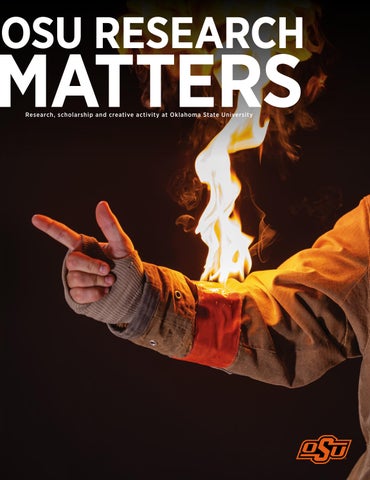
Smoke Screen OSU researchers develop nanofiber-based clothing to help protect firefighters from the invisible dangers lingering in smoke and soot. Pages 30-35 (Cover photo: Ellie Piper)
EDITOR Sydney Trainor COPY EDITOR Jordan Bishop ART DIRECTOR Dave Malec DESIGNER Cody Giles
FEATURES
02
Finding Her Field A passion for animals leads undergraduate student into the lab, where research becomes a catalyst for growth and discovery.
10 Built for Breakthroughs
A groundbreaking research initiative is bringing together animal and human health experts to unlock new cancer discoveries.
18 Brain Trust
As AI reshapes industries, a Spears Business professor is helping researchers stay one step ahead of emerging challenges.
22
When the Atmosphere Pushes Back Working with NASA partners, OSU researchers are tackling one of spaceflight’s toughest challenges.
Molecules. 42 Small Big Discoveries. Cutting-edge proteomics technology at OSU is revealing how proteins shape health, disease and scientific discovery.
46
From Curiosity to Company Cowboy Enterprises is helping OSU researchers bridge the gap between discovery and commercialization, bringing new technologies to market.
PHOTOGRAPHERS Mitchell Alcala, Matt Barnard, Sutton Cartmell, Kelly Kerr, Kevin McCroskey, Ellie Piper, Eric Priddy, Jason Wallace and Cole Weiberg WRITERS Hank Bennett, Alisa Gore, Hallie Hart, Desa James, Jami Mattox, Kirsi McDowell, Page Mindedahl, Sara Plummer, Andrew Ranson, Sydney Trainor, Olivia Upton, Mak Vandruff and Summer Wilson OSU Research Matters is published annually by Oklahoma State University and is produced by the Office of the Vice President for Research. For details about research highlighted in this magazine or reproduction permission, contact: OFFICE OF THE VICE PRESIDENT FOR RESEARCH 405.744.6501; VPR@OKSTATE.EDU; RESEARCH.OKSTATE.EDU Oklahoma State University, as an equal opportunity employer, complies with all applicable federal and state laws regarding nondiscrimination. Oklahoma State University is committed to a policy of equal opportunity for all individuals and does not discriminate based on race, religion, age, sex, color, national origin, marital status, disability, or veteran status with regard to employment, educational programs and activities, and/or admissions. For more information, the director of equal opportunity/Title IX coordinator is located at 201 General Academic Building and can be reached at 405-744-1156 or by visiting EEO.OKSTATE.EDU. This publication, issued by Oklahoma State University as authorized by the Office of the Vice President for Research, was printed by Slate Group, at a cost of $7552.52/3,500/September 2026/#researchmatters26.
O K L A H O M A S TAT E U N I V E R S I T Y
1
UNDERGR AD
FINDING HER FIELD STORY PAGE MINDEDAHL | PHOTOS ELLIE PIPER
RECENT GRADUATE BUILDS CONFIDENCE, CURIOSITY AND A FUTURE THROUGH RESEARCH
2
R E S E A R C H M AT T E R S | 2 0 2 6
A
mber Meeker didn’t arrive at Oklahoma State University with a perfectly mapped-out research plan. She showed up with a love of animals, a competitive equestrian background and a childhood dream of becoming a veterinarian. Research, however, would become the thread that tied everything together. Meeker grew up riding horses and spent much of her youth competing nationally. During a trip to Oklahoma for a horse show, she took advantage of a week away from school to tour colleges. It was the height of COVID-19 restrictions, and many campuses were closed. OSU was not. She knew the university had a veterinary school, which immediately put it on her radar. But what convinced her was something less tangible. “When I toured campus, I felt it,” Meeker said. “I felt the community. I felt at home. I thought, ‘This is where I’m supposed to be.’” She applied and never looked back.
A RESEARCHER IN THE MAKING Although she always planned to pursue veterinary medicine, Meeker wasted no time stepping into undergraduate research. She joined the Freshman Research Program and entered the lab of Dr. Yong Cheng in the biochemistry and molecular biology department. The placement was unexpected. Meeker is a zoology graduate from the Department of Biology, who also added natural resource ecology and management as well as a chemistry minor. Her academic path stretches across colleges and disciplines. But in Cheng’s lab, she found something foundational: mentorship.
IN THE LAB | Amber Meeker earned a variety of scholarships in her time at OSU, including being a Freshman Research Scholar, Niblack Research Scholar and a Purdie Scholar.
“He has big dreams for all of us,” Meeker said. “He pushes us to apply for things we might not think we’re ready for.” Carlyn Guthrie, a graduate assistant who advised Meeker, helped with that mentorship from the start. “I started working with Amber in the fall of 2022 when she joined Dr. Cheng’s research lab as a Freshman Research Scholar,” Guthrie said. “Amber quickly excelled in her research and is always eager to learn something new.” Meeker’s sophomore year brought fewer scholarships but more determination. She continued working in the lab over the summer and earned a publication. By her junior year, she received the Niblack Research Scholarship. In her senior year, she applied again and was awarded the
Purdie Scholarship, an honor given to just four students. Each milestone built not just her résumé, but her confidence.
LEARNING THE LANGUAGE OF CELLS In Cheng’s lab, Meeker studies microvesicles, which are microscopic particles released by cells to communicate with one another. These vesicles carry proteins and signals that can influence how neighboring cells respond to infection. If that sounds complex, it is. But at its core, Meeker explains; the work is about communication. “How are cells talking to each other?” Meeker said. “And what happens when that communication changes during infection?” Her research specifically focuses on how the lungs respond
O K L A H O M A S TAT E U N I V E R S I T Y
3
UNDERGR AD
to infection. In her work, airway cells infected with Mycobacterium abscessus release tiny particles that signal macrophages, an immune cell that helps fight disease. Meeker studied how these signals influence whether macrophages promote or reduce inflammation and which proteins control that response. The work has important implications for people with cystic fibrosis, who are particularly vulnerable to this type of infection. Understanding how immune cells respond could eventually inform treatment strategies. Her impact in the lab extended beyond learning — it contributed to meaningful scientific discovery. Cheng, an assistant professor in the Department of Biochemistry and Molecular Biology, has worked closely with Meeker since her first year in the lab. “She conducted numerous projects focusing on hostpathogen interactions in cystic fibrosis models, and her hard work led to a co-authorship on a published paper in the Journal of Proteome Research,” Cheng said. What excites Meeker most, however, is not just the data, but the discovery. “In high school, I remember asking questions about microvesicles in AP biology, and my teacher said, ‘We just don’t know yet,’” Meeker said. “Now I get to be part of figuring out those answers.”
ACROSS COLLEGES AND BEYOND COMFORT ZONES Meeker’s academic journey is anything but narrow. When she added natural resource ecology and management, it was to pursue specialized courses in fish biology, ornithology and wildlife biodiversity management. She also completed a chemistry
4
R E S E A R C H M AT T E R S | 2 0 2 6
minor, only one class away from qualification and fueled by a longstanding love of the subject. Working across disciplines has given her a broader view of science and collaboration. “It’s interesting to see what resources each department has and how they approach problems differently,” Meeker said. “You realize how important collaboration is.” Cheng’s lab, for example, collaborates with researchers in the veterinary school on respiratory illnesses. Through symposiums and crossdepartment partnerships, Meeker has seen how scientific questions evolve when multiple perspectives converge. Being in a highly technical, cellbased lab has also strengthened her academic performance. Often, she learns about molecular mechanisms in the lab before encountering them in class. “It’s taught me how to teach myself,” Meeker said. “How to read research papers, identify key findings and contribute to discussions.”
PATIENCE, SETBACKS AND A THOUSAND PHOTOS Research is not glamorous. Cells can die. Experiments can fail. Weeks of preparation can collapse because of contamination. “It takes a lot of patience,” Meeker said. “My mom knows whether I’ve had a good week or a bad week based on whether the cells lived.” She recalls one experiment involving a 96-well plate and multiple cell lines. The team took more than 200 images per day for five consecutive days — more than 1,000 photos total. Moments like that reinforced the importance of teamwork. Meeker credits Guthrie with
“Research has given me confidence. It’s taught me how to think critically, how to communicate clearly and how to work on a team. Those are skills I’ll use wherever I end up.” AMBER MEEKER
2026 OSU GRADUATE
LOOKING AHEAD
WORKING TOGETHER | From left: Graduate student Carlyn Guthrie and Meeker both worked in Dr. Yong Cheng’s lab.
creating a supportive lab environment where questions are encouraged and collaboration is constant. “We’re like a family,” Meeker said. “If someone is overwhelmed one week, others step in.” Through those challenges, she learned resilience — and something equally important: it is OK not to know everything. Presenting at more than 10 research symposiums, including a 10-minute showcase at Oak Ridge National Laboratory in Tennessee, pushed her beyond her comfort zone. Faculty and researchers asked detailed questions. Sometimes she had the answer. Sometimes she did not. “I’ve learned it’s OK to say, ‘That’s outside the scope of this project,’” Meeker said. “That’s still a professional answer.”
BALANCING AMBITION WITH INTENTION Meeker’s drive is unmistakable. At one point, she completed semesters with 20 and 21 credit hours to prepare for participation in the Disney College Program — all while continuing research. But ambition has come with reflection. As a freshman, she dropped a class where she could have earned a high grade because she realized she lacked passion for the subject. That decision created space for areas she cared about more deeply. “I’ve learned I can push myself,” Meeker said. “But I’ve also learned when it’s worth it and when it’s not.” That balance — between achievement and intention — has shaped her confidence as much as any award.
This spring, Meeker graduated. She plans to go to veterinary school but until then, she will continue to gain experience and continue striving towards her dream job. Whatever the path, research will remain part of her future. “I’ve really enjoyed working at the cellular level,” Meeker said. “Even if I’m not studying this exact project forever, I want research to be part of my career.” Her ideal path leads to a zoo, where she can combine clinical veterinary medicine with conservation. She is also open to working with exotic pets, where demand for specialized veterinarians continues to grow. For Meeker, the specifics matter less than the purpose. “Research has given me confidence,” Meeker said. “It’s taught me how to think critically, how to communicate clearly and how to work on a team. Those are skills I’ll use wherever I end up.” Her work has not gone unnoticed by those leading her research experience. “Amber is an outstanding undergraduate student,” Cheng said. “She had a clear career goal since she joined my lab in 2022. During her time as an undergraduate researcher, she has achieved remarkable success, serving as a first or co-author on several research articles. She is an exceptional member of our research team.” From a 5-year-old equestrian to a published undergraduate researcher, Meeker’s journey reflects more than academic success. It reflects curiosity, resilience and the courage to ask questions others once answered with, “We don’t know yet.” Now, she is part of the reason we do.
O K L A H O M A S TAT E U N I V E R S I T Y
5
A G R I C U LT U R E
GROWN FOR GREATNESS | From left: the Turfgrass Improvement Team consists of Drs. Charles Fontanier, Mingying Xiang, Yanqi Wu, Shuhao Yu and Dennis Martin.
Best Grass in the World OSU’s turfgrass team continues making quality products STORY ALISA GORE | PHOTOS MITCHELL ALCALA
I
“
t’s like watching grass grow” is often used to convey a tedious and boring task. But for researchers at Oklahoma State University Agriculture, who are literally creating and growing grass, it’s anything but boring. “Is it challenging? Absolutely. Is it a long road to bring a turfgrass to market? Of course,” said Dr. Dennis Martin, OSU Extension specialist for turfgrass. “But the
6
R E S E A R C H M AT T E R S | 2 0 2 6
turfgrasses of tomorrow are made long before they are installed into your lawn to ensure the highest quality.” Researchers from the OSU departments of plant and soil sciences and horticulture and landscape architecture have spent more than 40 years developing turfgrass varieties that improve the quality of lawns, golf courses, sports fields and grass racetracks worldwide.
Tahoma 31, one of OSU’s more recent turfgrass varieties released in 2017, has revolutionized sports stadiums worldwide with its fine texture, dark color, drought and shade tolerance, high density and cold hardiness, making it primed for high-traffic, well-managed areas. The bermudagrass variety is featured at the U.S. Capitol, Central Park in New York City, dozens of professional and
university sports complexes, and more than 150 golf courses across the nation. In the 2026 NFL Players Association report card, NFL players rated Tahoma 31 as the best turfgrass to play on. Its most recent accolade is being featured on fields in 28 of the 2026 FIFA Men’s World Cup games. “We’re not focused on only one trait,” said Dr. Mingying Xiang, an assistant professor and OSU Extension turf specialist in the Department of Horticulture and Landscape Architecture. “Normally, we will balance multiple traits to make a variety of good grass.” The OSU Turfgrass Improvement Team hasn’t slowed down for an instant in the last nine years since Tahoma 31’s release. In 2022, they released Texoma, a bermudagrass ideal for southern climates like Florida and Texas. And now, the team is revolutionizing home lawns with their latest variety, Endarra 81, released in the spring of 2026. It combines exceptional drought resistance and water conservation with deep, resilient roots. “Endarra 81 is the most drought-resistant bermudagrass available in the market,” Xiang said.
That exceptional drought resistance starts with Endarra 81’s dense root network. Its thicker roots burrow deep into the soil, and the finer roots capture water. It’s an essential combination that was purposefully developed for this variety. Endarra 81 also has a darker color than most bermudagrasses, sustaining its color later in the season than most other varieties, and has shown strong resistance to leaf spot. Dr. Yanqi Wu, head of the OSU turfgrass breeding program, estimates that if half of Oklahoma’s 500,000 acres of residential lawns switched to Endarra 81, it could save enough water to fill the 3,350-acre Lake Carl Blackwell six times. That’s more than 100 billion gallons of water saved annually. Over 11 years of research brought Endarra 81 to life. Traditionally, the process for releasing a new turfgrass variety takes 10 to 15 years and requires extensive greenhouse, lab and field screening, along with a testing process that can involve more than 10,000 experimental plants. This gap exists because OSU’s rigorous evaluation process ensures only the highest-quality
TOUCH GRASS | OSU’s latest turfgrass — Endarra 81 — combines drought resistance and water conservation with deep, resilient roots.
“Is it challenging? Absolutely. Is it a long road to bring a turfgrass to market? Of course. But the turfgrasses of tomorrow are made long before they are installed into your lawn to ensure the highest quality.” DR. DENNIS MARTIN
OSU EXTENSION SPECIALIST FOR TURFGRASS
turfgrass varieties reach the market. Researchers study bermudagrass genetics and then create experimental lines based on their research findings. Experimental varieties are tested to identify which genetic traits provide the desired physical traits and immunities. OSU scientists then breed turfgrasses with these traits. The turfgrass team studies these varieties for several years to determine if they qualify for the commercial market. “With a lot of hard work, a great deal of testing and some setbacks, we find the varieties with the right genetic makeup to have strong color, durability, drought resistance, cold hardiness and more,” Wu said. “Breeding and development is a very highrisk venture, and success is not guaranteed.”
O K L A H O M A S TAT E U N I V E R S I T Y
7
A G R I C U LT U R E
“The success of varieties like Tahoma 31 and Endarra 81 reflects decades of dedication, but it also points to where we are headed.” DR. SCOTT SENSEMAN
ASSOCIATE VICE PRESIDENT OF OSU AG RESEARCH
But that doesn’t stop the team from continuing work that benefits the economy and the environment. “We are trying to look beyond turfgrasses by collecting germplasm (genetic material) for plants that would be considered weeds in some places but desirable turf-type plants in other places,” Martin said. “We’re trying to develop cross-disciplinary teams to see what we can salvage from the natural world as urbanization continues, while also looking at what we can provide in terms of what people want.” In collaboration with scientists from other institutions, the team is studying the use of pollinatorfriendly species for use on home lawns in combination with turfgrass. “There’s a lot of pollinator service plants that tolerate mowing and still flower,” Martin
8
R E S E A R C H M AT T E R S | 2 0 2 6
BLADES OF HONOR | The Turfgrass Improvement Team members look over Endarra 81 and other OSU turfgrass research plots as they update each other on their research progress.
said. “Rather than the onespecies monoculture approach, we are looking at multiple species working together in biodiverse lawns, often drawing species from closely grazed prairies.” The grand opening for the Lionel K. Bentley Turfgrass Center, a new office building for the Turfgrass Improvement Team, was held in June, allowing the team to be housed next door to their research plots. An important factor for the continued success of the turfgrass program’s research will be the creation of new stateof-the-art research facilities for the Agronomy Discovery Center initiative to update the Agronomy Research Station, which will include a new headhouse, research greenhouses and a laboratory building. “Research programs like our turfgrass improvement effort
demonstrate how Oklahoma State invests in today to solve tomorrow’s challenges,” said Dr. Scott Senseman, associate vice president of OSU Ag Research. “The success of varieties like Tahoma 31 and Endarra 81 reflects decades of dedication, but it also points to where we are headed. “By investing in modern research infrastructure and supporting interdisciplinary collaboration, we are positioning our research programs to lead the next generation of discoveries that benefit Oklahoma and communities around the world.”
TWO OSU STUDENTS EARN OTTO S. COX GRADUATE FELLOWSHIPS STORY MAK VANDRUFF | PHOTOS KEVIN MCCROSKEY
Two Oklahoma State University doctoral candidates have been awarded the Otto S. Cox Graduate Fellowship for Genetics Research, which recognizes their research contributions and potential to advance scientific discovery. Xiang Chi, a fourth-year doctoral candidate studying viral immunity, and Kangping Li, a doctoral candidate in biochemistry and molecular biology, were both selected for this fellowship that supports outstanding graduate students who are pursuing careers in research. Chi’s research examines how genetic differences can influence the body’s earliest immune responses to RNA viruses, aiming to better understand why infections can affect people so differently. “My Ph.D. research focuses on innate immune evasion by RNA viruses,” Chi said. “By studying how genetic variation influences early antiviral defenses, my work aims to help explain why some people develop severe disease while others remain asymptomatic, ultimately informing more precise strategies for predicting and reducing the risk of severe outcomes.” Li studies molecular plantmicrobe interactions, examining how plant receptors influence the microbial communities surrounding their roots. His findings could help improve sustainable agricultural practices by reducing the need for chemical fertilizers. “My project looks at a broader question: whether these plant
XIANG CHI
KANGPING LI
DOCTORAL CANDIDATE IN VIRAL IMMUNITY
DOCTORAL CANDIDATE IN BIOCHEMISTRY AND MOLECULAR BIOLOGY
receptors also help shape the broader root bacterial community,” Li said. For both researchers, the fellowship represents an important milestone as they prepare for careers in scientific research. “Being selected for this award is a meaningful recognition of my work and strengthens my confidence in pursuing independent scientific research,” Chi said. “I am grateful for the support of my advisor, lab members and the OSU research community.” Li said the recognition validates years of collaborative work. “My research has required patience, persistence and
collaboration across plant genetics, microbiology and molecular biology, and this award makes me feel that these efforts are being recognized,” he said. The fellowship also provides opportunities beyond financial support. Chi said the application process strengthened his grantwriting skills and refined his research interests, while Li said the award will help him complete his dissertation, expand his publication record and continue pursuing research that connects fundamental biological discoveries with practical agricultural applications.
O K L A H O M A S TAT E U N I V E R S I T Y
9
O N E H E A LT H
BUILTFOR BREAKTHROUGHS OSU RESEARCHERS BUILD ONE HEALTH APPROACH TO CANCER DISCOVERY STORY JAMI MATTOX | PHOTOS ERIC PRIDDY
10
R E S E A R C H M AT T E R S | 2 0 2 6
C
EYE ON THE PRIZE | Researchers in Dr. Sudhakar Jha’s CREST lab hope to identify genetic mutations that may lead to cancer in animals.
ancer affects nearly every species, yet researchers still have much to learn about how the disease develops, progresses and responds to treatment in both animals and humans. Advances in human oncology treatment continuously lead to targeted therapies and immunotherapies tailored to specific genetic mutations, but veterinary medicine is still working to build the foundational knowledge needed to bring those same innovations to animal patients. At the Oklahoma State University College of Veterinary Medicine, researchers are working to close that gap through the ComparativeOncology Research and Treatment program, an initiative focused on comparative oncology, genetics and precision medicine. By studying cancer across species, CREST aims to improve outcomes for companion animals, livestock and people. “We know cancer does not distinguish among species,” said Dr. Sudhakar Jha, CVM associate professor of physiological sciences and director of CREST. “Humans, dogs, cats, horses and cattle all develop cancer. The more we understand what drives the disease, the better we can diagnose and treat it.” One of CREST’s goals is to identify the genetic mutations that drive cancer development in animals. Using advanced genome sequencing, researchers can analyze tumor samples and compare findings across species. In some cases, mutations found in animals mirror those already well-studied in human medicine. This creates opportunities to apply existing knowledge to treatments in other species. The approach could help move veterinary medicine beyond traditional cancer
O K L A H O M A S TAT E U N I V E R S I T Y
11
O N E H E A LT H
ON A MISSION | Jha (right) is working to better understand oncological diseases in animals and humans. Assisting him in his CREST lab are students (from left) Sarah Hall, Kainat Ahmed and Tasnim Islam.
treatments toward more precise, targeted treatment options.
A model for the future CREST’s work is built on collaboration among multiple colleges, disciplines and research programs across OSU. Cancer research inherently requires expertise from a variety of fields. Jha’s laboratory teams up with partners across campus — including the College of Engineering, Architecture and Technology and the College of Arts and Sciences — to develop more effective methods for studying virus-induced cancers, such as those caused by human papillomavirus (HPV), hepatitis B virus (HBV), and bovine leukemia virus (BLV), while collaborating with other researchers to better understand how infections, genetics and immune responses contribute to disease.
12
R E S E A R C H M AT T E R S | 2 0 2 6
The program also connects researchers studying cancer disparities, diabetes and other chronic diseases, creating opportunities to explore broader health trends that affect both human and animal populations. “The vision from Dr. Jha and his collaborators is exceptional, and his new CREST laboratory represents a breakthrough for the College of Veterinary Medicine and Oklahoma State University to bridge veterinary oncology, bioinformatics and therapeutic potential,” said Dr. Jeff Frisbee, CVM interim associate dean of research. This cross-disciplinary model reflects the growing importance of the One Health approach, which recognizes the connections among human, animal and environmental health. Discoveries in one species can often inform research in another. Data gathered from
“The vision from Dr. Jha and his collaborators is exceptional, and his new CREST laboratory represents a breakthrough for the College of Veterinary Medicine and Oklahoma State University.” DR. JEFF FRISBEE
CVM INTERIM ASSOCIATE DEAN OF RESEARCH
cattle, companion animals and wildlife can contribute to a broader understanding of cancer biology, while advances in human medicine can help guide veterinary treatment strategies. “The platform we’re building can apply to many species,” Jha said. “What we learn in one species can help us treat another. It becomes a network of information.”
Furthering the mission Jha said his goal with CREST is to help advance OSU’s land-grant mission to serve communities through research, education and outreach. The potential impact of oncology research in animals extends beyond dogs and cats. Livestock producers face significant economic challenges when disease affects their herds, especially when illnesses are detected late or are difficult to diagnose. Jha cites BLV as one example. Although the virus has been studied for years, many questions remain about how it contributes to leukemia in cattle and how producers can identify infections before they become costly problems. Earlier detection methods could help producers make better management decisions, reduce losses and improve overall herd health. Jha also envisions future vaccines and screening tools that could become part of routine herd management.
modern clinical spaces will help researchers translate lab discoveries into patient outcomes. The hospital will also improve access to valuable clinical samples for genetic and cancer research. Jha envisions a process in which samples collected from veterinary patients can be analyzed, with findings eventually helping guide future treatment decisions. “I am very pleased with Dr. Jha’s commitment to CVM and OSU in developing this new laboratory for translational oncology research,” said Dr. Richard Prather, dean of
OSU CVM. “CREST will represent a core resource and capability in our new teaching hospital.” For Jha, the intersection of his lab’s research, interdisciplinary collaboration and new clinical facilities presents a unique opportunity to transform how cancer is studied across species. “This is truly a One Health approach,” he said. “We’re building a platform to help us understand cancer earlier and improve outcomes for animals and people. That’s the vision we’re working toward.”
New technology fuels discovery The future success of CREST will be strengthened by another major investment in OSU’s veterinary programs: the planned veterinary medical teaching hospital. Jha believes the facility will significantly expand opportunities for clinical care and research. Advanced diagnostic equipment, increased patient access and
O K L A H O M A S TAT E U N I V E R S I T Y
13
AWA R D S
DYNAMIC DUO | Drs. Kami Gallus and Jennifer Jones in the Department of Human Development and Family Science receive the 2025 Impact Research Award at the University Awards Convocation.
Opening Doors
OSU researchers earn 2025 Public Impact Research Award for work on disability inclusion STORY SUMMER WILSON | PHOTO ERIC PRIDDY
T
hrough more than a decade of community-engaged research, two Oklahoma State University faculty members have reshaped how Oklahoma understands and supports individuals with intellectual and developmental disabilities. For their sustained impact, Drs. Kami Gallus and Jennifer Jones in the Department of Human Development and Family Science received the 2025 OSU Public
14
R E S E A R C H M AT T E R S | 2 0 2 6
Impact Research Award at the University Awards Convocation. Gallus, who joined OSU in 2007, said the award reflects the heart of her career. “The name of the award — Public Impact — feels like validation that I didn’t just do research to promote myself as a faculty member,” she said. “I did research that has made a real difference in the lives of people I’m most passionate about.”
Gallus emphasized that the work has always been a partnership. “I don’t think I could have done this work alone, and I think Jennifer would say the same,” Gallus said. “We jokingly call each other our work wives, but we share the same purpose and desire to have a meaningful impact on people’s lives.” Central to their impact is OSU’s 13-year partnership with the
Oklahoma Department of Human Services through the Oklahoma National Core Indicators– Intellectual and Developmental Disabilities program. Each year, their team interviews more than 400 Oklahomans receiving state services, documenting needs in areas such as employment, community access, social connection and mental health. The data pointed to widespread social isolation. “Our community members kept telling us they wanted more opportunities to meet people and have friendships — and that they needed more exercise,” Gallus said. Those findings sparked Let’s Take a Walk!, a 10-week walking program pairing OSU undergraduates with adults with IDD. The results were immediate. “At the beginning, participants were showing clinical levels of depression and anxiety,” Gallus said. “Ten weeks later, we saw clinically significant decreases. I couldn’t get that much change in therapy in 10 weeks — and yet it was so simple. It wasn’t rocket science.” Jones said the program also transformed OSU’s campus culture. “Let’s Take a Walk! was the precursor to OSU Unified,” she said. “Now, every Thursday night, adults with intellectual disabilities are on our campus competing alongside OSU students in intramurals. Seeing that every week — that’s a real impact in real life.” The pair made an early commitment to sustainability. “We decided we would never again have a research project or program we couldn’t financially sustain,” Jones said. “If we introduced something to the community, we wanted to be sure it would last.”
Gallus and Jones’ research extends deeply into student development, a core reason for their recognition. “Universities historically haven’t been inclusive when it comes to intellectual and developmental disabilities,” Gallus said. “But if you graduate from OSU, you should understand the full range of people you’ll work with in the real world.” In 2020, the Center for Developmental Disabilities was established and serves as an umbrella for all research and related programs. Through research projects, OSU Unified and Opportunity Orange Scholars, more than 200 students each year gain hands-on experience. Jones said the most profound shift is in how students perceive others as more than their disability. “The hierarchy changes,” she said. “They go from saying, ‘I worked with a student with Down syndrome in high school,’ to ‘I learned so much from Gretchen,’ or another [Opportunity Orange Scholars] student. They begin to see true reciprocity.” Jones encourages her students to lean into discomfort. “I tell them, ‘I’m not going to ask you to change your opinions, but I am going to ask you to challenge them,’” she said. “Most people don’t realize how pity or condescension can become barriers for individuals with disabilities.” Their work aligns with OSU’s land-grant mission and One Health priorities by strengthening community well-being and equitable access to social, educational and health resources. Looking ahead, both scholars see a rising need for research on aging and caregiving.
“To step back and see real lives impacted — people who may never have been invited onto this campus — that’s powerful. I can’t think of an award I’d rather have.” DR. KAMI GALLUS
OSU HUMAN DEVELOPMENT AND FAMILY SCIENCE PROFESSOR
“We’re seeing more adults with [intellectual and developmental disabilities] living into later adulthood, and many are cared for by aging parents,” Jones said. “Our service system is not built for that. We have to address aging and disability together.” Gallus echoed the focus on families. “We’re thinking about generational support — how to help siblings and caregivers when parents can no longer fill that role,” she said. As recipients of OSU’s Public Impact Research Award, Gallus and Jones will also serve as the university’s nominees for the national Association of Public and Land-grant Universities Public Impact Research Award. For Gallus, the recognition affirms a career-long mission. “To step back and see real lives impacted — people who may never have been invited onto this campus — that’s powerful,” she said. “I can’t think of an award I’d rather have.”
O K L A H O M A S TAT E U N I V E R S I T Y
15
From anime to activism:
How the ‘One Piece’ pirate flag became the global emblem of Gen Z resistance STORY NUURRIANTI JALLI | PHOTO EZRA ACAYAN/GETTY IMAGES
F
rom Paris and Rome to Jakarta, Indonesia, and New York, a curious banner has appeared in protest squares. With hollow cheeks, a broad grin and a straw hat with a red band, the figure is instantly recognizable and has been hoisted by young demonstrators calling for change. In Kathmandu, Nepal, where anger at the government boiled over in September 2025, the flag became the defining image as flames spread through the gates of Singha Durbar, Nepal’s ornate palace complex and seat of power. The image, usually adorning a flag with a black background,
comes from “One Piece,” a muchbeloved Japanese manga. And what began as a fictional pirate crew’s emblem almost three decades ago has become a powerful symbol of youthled resistance, appearing in demonstrations from Indonesia and Nepal to the Philippines and France. As a scholar of media and democracy, I see the spread of the Jolly Roger of the Straw Hats Pirates – which has gone from manga pages to protest squares – as an example of how Gen Z is reshaping the cultural vocabulary of dissent.
Scan the QR Code to read this OSU faculty authored story.
16
R E S E A R C H M AT T E R S | 2 0 2 6
O K L A H O M A S TAT E U N I V E R S I T Y
17
T E C H N O L O GY
BRAIN TRUST STORY HALLIE HART PHOTOS COLE WEIBERG
PUBLISHED PROMINENCE | Dr. Felipe Affonso’s solo paper received acceptance in the Journal of Consumer Research on first submission, a rarity in academia.
18
R E S E A R C H M AT T E R S | 2 0 2 6
D
EMERGING SCHOLAR AFFONSO PREPARES MARKETERS TO HANDLE AI CHALLENGES
r. Felipe Affonso calls his creation “the moving robot.” A gray robot face follows a simple ascending pattern across three squares. A question mark hovers above a fourth blank square, prompting viewers to complete the sequence. Affonso’s whimsical illustration mimics an elementary textbook lesson, but it’s a clever trap. The Spears School of Business assistant professor is trying to protect researchers and marketing analysts against a technological threat to surveys. A test like “the moving robot,” easy for most human respondents to pass, can catch an artificial intelligence agent before it submits fabricated answers. “It’s like an attention check for AI,” Affonso said. “Researchers can develop this using their surveys, and they can filter out AI agents.” Affonso’s recent publication, “Brief Commentary: A Framework for Detecting AI Agents in Online Research,” confronts AI fraud with actionable steps. The toptier Journal of Consumer Research
accepted his paper upon first submission, a rarity in academia. Even more impressive? Affonso, an emerging scholar in Oklahoma State University’s School of Marketing and International Business, is the sole author. Although Affonso contributes to many collaborative papers, his inquisitive nature sometimes leads him down paths all his own. Only three years since earning his Ph.D., he has honed his skills to become an impactful young voice at the intersection of marketing and AI. Dr. Justin Lawrence, SMIB head and Noble Foundation Chair in Marketing Strategy, said Affonso provides expertise in consumer behavior and experimental methods that complement his colleagues’ strengths. “In addition to publishing in leading marketing journals, his research helps elevate the department’s national visibility and
O K L A H O M A S TAT E U N I V E R S I T Y
19
T E C H N O L O GY
NOWHERE TO HIDE | Affonso uses cognitive traps to expose AI models’ limitations. His framework can safeguard surveys against AI fraud.
reputation as a research-active program,” Lawrence said. “His strong productivity and rigorous approach also contribute positively to the broader research culture within the department and provide valuable exposure for doctoral students to high-quality behavioral research.”
Evolving interests Affonso earned his bachelor’s degree in marketing from Universidade de São Paulo in Brazil, where his undergraduate project was rooted in marketing theory. He also gained industry experience with The Nielsen Company in Brazil, which showed him a different side of research. “It informed me to think about how to make research more managerially relevant,” Affonso said. “Everything was actionable.” After obtaining his master’s degree in marketing from Universidade de São Paulo and his doctorate in the same field from the University of Florida, Affonso didn’t expect his work to focus on machine behavior. While his research topics span from brand positioning to making
20
R E S E A R C H M AT T E R S | 2 0 2 6
predictions under uncertainty, his interest in AI developed somewhat out of necessity. The AI boom has introduced numerous marketing challenges, which Affonso sees as applied research opportunities. Fake survey responses are one issue. For years, researchers and marketers have expressed frustration with bots, or automated software programs, manipulating online survey results. AI agents, distinct from bots, could take the problem to a new level. “A bot doesn’t have contextual understanding of the question,” Affonso said. “It can only perform functions. So, it can click; it can write, but it cannot simulate thinking. Now, an AI agent can actually simulate a person.” AI models such as those from Anthropic, Google and OpenAI are trained on vast amounts of data, having the necessary context to create coherent responses. Researchers and marketers typically offer monetary rewards, whether in the form of cash or a shopping discount, to survey
respondents. With this incentive, a person could install an AI agent on their computer to “write” fake answers, claiming the money while submitting non-human data that distorts survey results. This is troubling for scholars and marketing analysts who rely on accurate data to inform their work. Even one AI-generated response weakens the data’s integrity. Affonso said the current prevalence of AI contamination in surveys is low, but a proactive approach matters. “It’s basically like getting prepared before something worse happens,” Affonso said. “It’s superimportant, because you can at least know that whatever results you get, they are based on human responses.”
Understanding cognitive traps Investigating AI fraud gets tricky because AI agents often pass the standard “Are you a robot?” tests that detect bots. Affonso encourages researchers to equip online surveys with new “cognitive traps,” puzzles designed to flag
AI agents without confusing most human respondents. In Affonso’s research, cognitive traps caught 97.1% of AI agents, a great improvement from a 2.3% detection rate with standard attention checks. The key lies in knowing AI’s weaknesses. An AI model, while more sophisticated than a bot, is not akin to a brain. “It’s basically a statistical prediction machine,” Affonso said. “They don’t think. They simulate thinking.” With “the moving robot,” AI models interpret each square separately but fail to perceive an overarching pattern. While the robot trap is Affonso’s original creation, he also incorporates other scholars’ cognitive traps into his research, including Harvard University associate professor Dr. Tomer Ullman’s twists on famous optical illusions. Affonso tested a spin on the Müller-Lyer illusion, which deceives the human eye into seeing two straight lines as different lengths. Many AI models don’t fall for it, even recognizing the illusion by name. The “modified Müller-Lyer,” however, uses a sort of reverse psychology to expose an AI limitation. When presented with two straight lines that clearly are different lengths, AI models often incorrectly identify the image as the original Müller-Lyer illusion. Essentially, AI can be fooled into predicting it will be fooled. Tests posing as other geometric illusions, such as the warped Cafe Wall and circular-patterned Ebbinghaus illusion, work similarly. “You can trick AI because they rely on their training data, and they get this response wrong,” Affonso said. “You can do this with any
“You can trick AI because they rely on their training data, and they get this response wrong. You can do this with any type of limitation that AI has that humans do not have.” DR. FELIPE AFFONSO
ASSISTANT PROFESSOR OF MARKETING
type of limitation that AI has that humans do not have.”
The broader impact Affonso presents these cognitive traps as examples of his framework, not required tools. Like antibiotic-resistant bacteria, AI agents will likely adjust to his traps with further training, forcing researchers to create new ones. The solo author isn’t alone. Affonso’s publication includes a link to his Cognitive Trap Repository, an open online community where researchers can download his traps and upload their own. He even received an invitation to present at the 2027 Sawtooth Research Conference, an opportunity to discuss his work with marketing analysts. Fraudulent survey responses are just one problem Affonso tackles. In a paper under review, Affonso addresses AI’s limitations with consumer recommendations. According to his findings, AI tends to favor popular brands, even if an unrecognizable brand’s hypothetical product is superior
across all relevant attributes, such as price and quality. Affonso conducted over 600,000 trials with various products. It didn’t matter if he asked the AI agents not to care about brand names. They often did. “This has very strong welfare implications because people are shopping with AI agents,” Affonso said. “They are asking for recommendations through AI, and when AI doesn’t recommend the best product, it’s acting on different interests, not consumer interests.” In the rapidly evolving world of AI, Affonso has the forethought to keep scholars and industry practitioners informed and ready. His efforts were validated with his acceptance in the prestigious Journal of Consumer Research, introducing his fraud detection framework to a worldwide audience. “For me, it was a relief,” Affonso said. “It showed that I am on the right path.”
O K L A H O M A S TAT E U N I V E R S I T Y
21
A E R O S PA C E
WHEN THE
ATMOSPHERE PUSHES BACK
STORY DESA JAMES | PHOTOS ERIC PRIDDY AND PROVIDED
22
R E S E A R C H M AT T E R S | 2 0 2 6
OSU ENGINEERS IMPROVE HOW SPACECRAFT STABILITY IS PREDICTED
T
here is a moment in every atmospheric entry when a spacecraft is no longer just a machine following equations. It becomes something more precarious: a body moving through violent, shifting air as unseen forces work persistently to knock it off balance. For decades, engineers have worked to predict exactly what happens in that moment. In the College of Engineering, Architecture and Technology, a team of researchers is reshaping how those predictions are made, answering a quiet but consequential call to make spaceflight safer. Dr. Kursat Kara, associate professor in the School of Mechanical and Aerospace Engineering, along with doctoral researchers Shafi Al Salman Romeo and Ashraf Kassem, has developed a new framework to better understand how space capsules behave as they descend through an atmosphere. Their work focuses on dynamic stability, which is the ability of a capsule to correct itself as it experiences disturbances during entry. It may sound abstract, but the implications are immediate and tangible: safer crews, protected instruments and spacecraft that land closer to where they are supposed to.
THE PROBLEM WITH ‘WOBBLE’ When a capsule reenters an atmosphere (Earth’s or another planet’s) the air around it becomes chaotic. Shock waves form. Flow fields fluctuate. Forces change rapidly and unpredictably. “A dynamically stable capsule essentially calms itself,” Kara said. “If it gets disturbed and starts to wobble, those motions fade away. The vehicle ‘self-corrects,’ keeping
its heat shield properly oriented into the flow.” That stability is not optional. It’s essential. If a capsule becomes unstable, even briefly, the consequences can cascade quickly. Portions of the vehicle not designed for extreme heating may become exposed. Structural loads can spike. The trajectory may drift, pulling the vehicle away from its intended landing zone. Even parachute deployment, an event that depends on predictable orientation and motion, can be compromised. In other words, stability is the difference between a controlled descent and a mission at risk.
“A DYNAMICALLY STABLE CAPSULE SEEING PART ESSENTIALLY OF THE STORY CALMS ITSELF. Engineers have long relied on three primary tools to understand IF IT GETS this problem: wind tunnel tests, ballistic-range experiments and DISTURBED high-fidelity computer simulations. Each brings valuable insight, but AND STARTS each also leaves gaps. Wind tunnel testing, for instance, TO WOBBLE, allows precise observation but THOSE MOTIONS often requires a mounting system that can interfere with airflow. FADE AWAY. Ballistic-range testing frees the model to move naturally THE VEHICLE through the air but captures only brief glimpses of the motion. ‘SELF-CORRECTS,’ Kara compares this to watching scattered frames of a much longer KEEPING ITS film. HEAT SHIELD Meanwhile, computational fluid dynamics simulations offer detailed, PROPERLY continuous data yet depend heavily on modeling assumptions that can ORIENTED INTO introduce bias. Individually, these methods THE FLOW.” are powerful. Together, they are incomplete. That incompleteness becomes especially critical when dealing with blunt-body vehicles — the
DR. KURSAT KARA
ASSOCIATE PROFESSOR OF MECHANICAL AND AEROSPACE ENGINEERING
O K L A H O M A S TAT E U N I V E R S I T Y
23
A E R O S PA C E
capsule shape used in many NASA missions. These designs experience large angles of attack and complex motions during entry, making their behavior inherently nonlinear. “No single method tells the full story,” Romeo said. “The physics are just too complex.” Recognizing that gap was the starting point. Answering it required a new way of thinking.
BRINGING IT ALL TOGETHER The team’s solution is a Data-Fusion-based Nonlinear Parameter Identification framework or DF-NPI for short. At its core, the framework does something deceptively simple. It treats experimental data and simulation results not as competing truths, but as complementary pieces of evidence. Instead of asking which is right, it asks how they can agree. Using a probabilistic approach grounded in statistics and probability sampling, DF-NPI blends these data sources into a single, unified model. It reconstructs flight trajectories and estimates how stability changes across different conditions, all while explicitly accounting for uncertainty. In practical terms, the framework answers two key questions: • What stability behavior best explains both the experimental and simulated data? • How confident are researchers in that answer? “Capturing uncertainty is critical,” Kassem said. “By incorporating it directly into the model, we gain a much clearer picture of how a vehicle will actually behave during descent.”
24
R E S E A R C H M AT T E R S | 2 0 2 6
MODEL RESEARCH | Ashraf Kassem analyzes the complex flow field around the NASA Genesis capsule using high-fidelity computational simulations to study blunt-body dynamic stability.
It is a shift away from deterministic predictions toward a more nuanced, evidence-based understanding that mirrors the complexity of the real world.
FEWER TESTS, BETTER DECISIONS Beyond improved accuracy, the approach offers another significant advantage: efficiency. Traditional aerospace testing campaigns can require large numbers of experiments to build reliable aerodynamic databases. These tests are expensive, timeconsuming and logistically demanding. By extracting more insight from fewer data points, DF-NPI allows engineers to design smaller, more targeted experimental campaigns while still achieving more reliable results. That means faster design cycles, reduced costs and greater flexibility in mission planning. Kara sees this as one of the framework’s most immediate benefits. “It helps us identify where the uncertainties are, predict how a vehicle will behave and reduce
the dependence on extensive physical testing,” he said. “That combination can accelerate the entire design process.”
BEYOND INSTITUTIONAL ORBITS The work did not happen in isolation. The OSU team collaborated with engineers at NASA Ames Research Center, who contributed expertise in free-flight computational fluid dynamics and trajectory reconstruction. Their involvement helped guide the selection of realistic test cases and provided critical feedback on how to interpret the results. The collaboration ensured that the framework is not only theoretically robust but also practically applicable within NASA’s workflows. Additional contributions from co-principal investigator Dr. Omer San of the University of Tennessee and NASA Ames researchers Cole Kazemba, Dirk Ekelschot and Jeffrey Hill helped refine the methodology further. It is a reminder that breakthroughs in aerospace rarely belong to a single lab or institution. They emerge from shared
knowledge, rigorous testing and a collective commitment to solving difficult problems.
ANSWERING THE CALL The implications of DF-NPI extend beyond any single mission. As space agencies and private companies plan increasingly ambitious journeys, the need for accurate, reliable stability predictions will only grow. For these researchers, the work carries a deeper resonance. It is not just about improving models or refining equations — it’s about contributing to something larger than themselves. “Developing a method that captures this level of complexity is challenging,” Romeo said. “But it’s also rewarding, especially knowing it could make future missions safer.” This research is part of the Kara Lab’s NASA Early Stage Innovations project, PhysicsGuided Multifidelity Learning for Characterization of Blunt-Body Dynamic Stability, supported by NASA under Grant No. 80NSSC23K0231.
O K L A H O M A S TAT E U N I V E R S I T Y
25
HISTORY
PRECEDENT SET | Dr. John Kinder, a history professor, is the first OSU faculty member to receive an award from the Society for Military History.
Making History
Kinder named recipient of Society of Military History Distinguished Book Award STORY OLIVIA UPTON | PHOTOS JASON WALLACE AND PROVIDED
D
r. John Kinder, a history professor at Oklahoma State University, was awarded the Society for Military History (SMH) Distinguished Book Award for his book, “World War Zoos: Humans and Other Animals in the Deadliest Conflict of the Modern Age,” published by the University of Chicago Press. The SMH Distinguished Book Award is highly prestigious and
26
R E S E A R C H M AT T E R S | 2 0 2 6
recognizes the best book-length publications that year in English on military history. This marks the first time in OSU’s history that a faculty member has won the award. “Dr. Kinder’s training as an interdisciplinary scholar of American Studies and History, along with his ability to write powerful prose, make this book so compelling and unique,” said
Dr. Richard Boles, chair of the Department of History. “We are fortunate to have him as a professor at OSU.” Kinder reflected on the journey that led to his success and what this accomplishment means for OSU. “‘World War Zoos’ was very difficult to write, and from the beginning, I was concerned about how it would be received,
“I hope this award suggests to others what I’ve long known — that OSU supports and values high-quality military history.”
new perspective on the history of zoos, but he also thoughtfully recounts military history beyond the battlefield. “It never occurred to me that I was the first OSU faculty member to receive this award, if indeed that is true,” Kinder said. “Oklahoma
State University is lucky enough to have a whole department of pathbreaking, award-winning historians. “I hope this award suggests to others what I’ve long known — that OSU supports and values highquality military history.”
DR. JOHN KINDER
OSU HISTORY PROFESSOR
especially by those who expect their World War II books to focus primarily on the battlefield,” said Kinder, explaining his initial journey in his book-writing process. “You can only imagine my surprise, then, upon learning that it had received the top book award from the nation’s largest organization of military history scholars.” Kinder’s book marks a new telling in military history, proving that all aspects of historical narratives are invaluable to society’s future. In his book, Kinder describes how zoos survived during World War II, highlighting parallels between human and animalistic survival. The book offers insight into how societies worldwide — from Japan to Canada to France to Russia, and more — faced the challenges of war from the prism of protecting (but also culling) their zoos’ animals. In so doing, not only does Kinder describe a
PUBLISHED WORK | In his book, Kinder describes how zoos survived during World War II.
O K L A H O M A S TAT E U N I V E R S I T Y
27
28
R E S E A R C H M AT T E R S | 2 0 2 6
Turning motion into medicine
How AI, motion capture and wearables can improve your health
STORY AZARANG ASADI, MATTHEW BIRD AND COLLIN D. BOWERSOCK PHOTO TODOR TSVETKOV/E+ VIA GETTY IMAGES
P
eople often take walking for granted. We just move, one step after another, without ever thinking about what it takes to make that happen. Yet every single step is an extraordinary act of coordination, driven by precise timing between spinal cord, brain, nerves, muscles and joints. Historically, people have used stopwatches, cameras or trained eyes to assess walking and its deficits. However, recent technological advances such as motion capture, wearable sensors and data science
methods can record and quantify characteristics of step-by-step movement. We are researchers who study biomechanics and human performance. We and other researchers are increasingly applying this data to improve human movement. These insights not only help athletes of all stripes push their performance boundaries, but they also support movement recovery for patients through personalized feedback. Ultimately, motion could become another vital sign.
Scan the code to read about how everyday technology can improve your health.
O K L A H O M A S TAT E U N I V E R S I T Y
29
DESIGN
SMOKE SCREEN
DEVELOPMENT OF NEW PROTECTIVE CLOTHING FOR WILDLAND FIREFIGHTERS BRINGS TOGETHER INTERDISCIPLINARY RESEARCH TEAM
STORY KIRSI MCDOWELL | PHOTOS KELLY KERR AND ERIC PRIDDY
30
R E S E A R C H M AT T E R S | 2 0 2 6
E
ach time firefighters respond to a fire, they’re risking more than burns — they’re facing exposure to cancer-causing chemicals that can remain on their protective clothing long after the fire is out. Dr. Sumit Mandal, an associate professor in Oklahoma State University’s Department of Design and Merchandising, leads an interdisciplinary team of OSU researchers and state agency partners working to keep first responders safer on the job. Firefighter personal protection equipment — specifically clothing — is designed to protect against heat and flames but often fails to prevent the toxic particles produced by soot and smoke from penetrating the fabric and reaching one’s skin. Mandal’s research addresses this pressing occupational health concern — exposure to carcinogenic particulate matter that penetrates PPE and contributes to elevated rates of occupational cancers, particularly skin cancer. In the Textiles and Apparel Science Laboratory, Mandal and his doctoral students developed nanofiber fabrics — fibers thousands of times thinner than a strand of human hair — that create an effective barrier against harmful airborne particles while allowing heat and sweat to escape. Graduate research assistant Ishmam Zahin Chowdhury evaluates the lightweight material’s performance under simulated conditions, such as the hazardous environments firefighters encounter. The goal is to develop PPE that minimizes on-site injuries and reduces the long-term health risks of repeated exposure.
“THE GOAL OF TRYING TO PROVIDE FUNCTIONAL PROTECTIVE GARMENTS IS VITAL TO THE SUCCESS OF FIREFIGHTERS AND THEIR ABILITY TO DO THEIR JOB.” DR. DOUG SMITH EXPERT IN HUMAN PERFORMANCE FROM THE SCHOOL OF KINESIOLOGY, APPLIED HEALTH AND RECREATION
Moving the nanofiber development from the lab to realworld application and use required a team of human physiology, fire dynamics and particle chemistry experts from OSU and representatives from Oklahoma Forestry Services.
THE HIDDEN THREAT
Wildfire smoke, while primarily consisting of released water vapor, contains many harmful chemicals, said Drew Daily, deputy fire management chief for OFS. “Due to the rigors of the work, wearing a breathing apparatus is overly cumbersome and oftentimes prohibitive to the work that needs to be accomplished — unlike structural firefighters that generally work in more confined spaces,”
O K L A H O M A S TAT E U N I V E R S I T Y
31
DESIGN
NEW KIT ON THE BLOCK | Dr. Sumit Mandal tests protective nanofiber material to measure how effectively they block smoke and carcinogens.
32
R E S E A R C H M AT T E R S | 2 0 2 6
Daily said. “This causes exposure to carcinogens that continue to build up over time.” Traditionally worn PPE provides necessary thermal resistance, but it can also contain PFAS, “forever chemicals” that can be absorbed through the skin and are associated with a slew of health risks in dire need of mitigation. Experts in human performance, Drs. Doug Smith and Jay Dawes from the School of Kinesiology, Applied Health and Recreation, assess physiologic responses to wearing different types of PPE while fighting fires. Smith, an exercise physiologist, said it’s important to consider a firefighter’s physical welfare when working at high intensities in suboptimal conditions. “The goal of trying to provide functional protective garments is vital to the success of firefighters and their ability to do their job — to stop fires and prevent serious injury or death to individuals stuck in or surrounded by fire,” Smith said. Wildland firefighting PPE needs to be lightweight and flexible to facilitate strenuous work over long periods of time. “Nanofiber technology has shown promise of mitigating many of these performance concerns by maintaining breathability and facilitating movement while filtering the harmful chemicals readily found on the fireground,” Daily said. Modern turnout gear consists of multiple layers — often three primary protective layers: outer shell, moisture barrier and thermal liner — that work together to provide thermal insulation, moisture protection and mechanical durability. Protective clothing is one of the only things keeping firefighters from an extremely hazardous environment. The challenge is
LET IT BURN | Sayak Nandi (left) observes the behavior of nanofabric through lab-simulated smoke exposure before it is deemed ready for field testing, where it is layered within the PPE jacket worn during an open burn (right). The jacket is later deconstructed to evaluate the filtration performance of the nanofibers after functional use.
balancing multiple competing needs. Dr. Haejun Park, associate professor of fire, construction and emergency management in the College of Engineering, Architecture and Technology, said the layered construction provides excellent protection against direct flame and radiant heat, but it’s not designed to be completely airtight. “Small openings around the neck, wrists, waist or interfaces between different pieces of equipment can allow hot gases and smoke particles to enter. Repeated movement during firefighting can create a pumping effect that draws contaminated air into the clothing layers,” Park said. “Even when flames never touch the skin, heat can be transferred
“I’VE HELPED DESIGN A LAB-SCALE OPEN BURN SET-UP THAT SIMULATES SMOKE EXPOSURE FROM WILDLAND FIRE ONTO FABRICS.” SAYAK NANDI
DESIGN AND MERCHANDISING DOCTORAL STUDENT
through the materials, resulting in smoke contaminants accumulating within the clothing.”
GOING SMALLER TO PROTECT BIGGER
After understanding the functional needs of firefighters and how traditional PPE behaves, the
TASL team began developing and testing the material that would solve the shortfalls of existing turnout gear. The result: nanofibers, which are produced by electrospinning, a technique that uses an electric field to create an ultra fine network of fibers.
O K L A H O M A S TAT E U N I V E R S I T Y
33
DESIGN
“By selecting the right materials and controlling the processing conditions, we can tailor the fiber structure for specific performance characteristics, such as thermal protection, breathability and filtration,” Chowdhury said. The aim is to use these materials to develop fabrics that neutralize smoke particles, so that even if carcinogens are present, they are no longer harmful. The manufacturing approach has been established, but material design and optimization remain active areas of research.
PUTTING IT TO THE TEST
Dr. Elijah Schnitzler, an associate professor, uses his expertise in particle chemistry to focus on the chemical and physical properties of smoke from wildfires. “We first began to collaborate with Dr. Mandal when a student
34
R E S E A R C H M AT T E R S | 2 0 2 6
in his group needed to generate realistic smoke from controlled combustion for depositing onto fabric swatches used in PPE,” Schnitzler said. “Since then, we have gone on to measure the size and filtration of smoke particles.” Schnitzler’s group generates representative smoke particles from controlled combustion of biomass in the laboratory, measures the size distributions of the smoke particles, and measures the efficiency of particle filtration for new textiles. Schnitzler depicted how nanoparticles behave in the atmosphere, comparing them to how a skydiver experiences resistance when falling. “This slow settling is what allows smoke to remain suspended in the atmosphere, elevating risks of inhalation and long-range travel. Optimizing the
interception of particles before they reach the skin of firefighters could help reduce this risk,” Schnitzler said. Design and merchandising doctoral student Sayak Nandi leads the team’s carcinogenic exposure testing for invisible hazards. When vegetation burns, carcinogens are produced and remain present in smoke and soot, including benzo[a]pyrene — a Class 1 carcinogen — along with many other Class 2A and 2B carcinogens. “These don’t just get inhaled, they deposit on the gear and penetrate it, reaching the firefighter’s skin,” Nandi said. “In the immediate, it may lead to redness, itching and irritation. Long-term effects can be severe, leading to DNA modifications, dysfunctional immune systems,
and various other health implications, including terminal cancer.” Since wildfire itself is uncontrolled, having a controlled lab test with similar smoke conditions is tricky, but that’s where Nandi comes in. “I’ve helped design a lab-scale open burn set-up that simulates smoke exposure from wildland fire onto fabrics,” Nandi said. He is developing a standardized testing protocol that measures smoke exposure of fabrics under realistic lab conditions, with the hope that it can serve as a benchmark to evaluate and optimize nanofabrics for use in firefighting PPE. Durability of the nanofabrics remains one of the key investigations. “We are evaluating how these layers hold up after heat exposure
and mechanical wear,” Chowdhury said. “Initial results are encouraging, but longer-term testing is needed before we can state an expected service life.”
DESIGNING FOR THE REAL WORLD
The project highlights OSU’s nationally recognized expertise in functional apparel and protective clothing and demonstrates the College of Education and Human Sciences’ commitment to research that bridges fundamental science with practical application. By combining advanced nanomaterials, textile science and human-centered design with close collaboration with the firefighting community, the research has the potential to transform firefighter PPE and reduce occupational risks for thousands of first responders.
“If we can design protective clothing that blocks invisible cancer-causing contaminants while keeping firefighters cool enough to do their jobs safely and effectively, we can make a real difference in protecting the people who protect all of us,” Mandal said. SCAN HERE
Make a contribution to support ongoing textile research.
O K L A H O M A S TAT E U N I V E R S I T Y
35
M I C R O B I O L O GY
LAB-GROWN SCIENCE | The Oklahoma Center for Microbiome Research, established in 2024, adds a critical mass of investigators to perform cutting-edge microbiome research across the state.
Body of Work
OSU microbiome center marks progress midway through first phase of NIH grant STORY SYDNEY TRAINOR | PHOTOS MATT BARNARD AND ELLIE PIPER
I
n the first two years of Oklahoma State University’s $10.7 million National Institutes of Health grant, the establishment of the Oklahoma Center for Microbiome Research is already accelerating discovery. This investment supports five research projects that are now halfway through Phase 1, generating new insights while building the research infrastructure needed to
36
R E S E A R C H M AT T E R S | 2 0 2 6
advance microbiome science across Oklahoma. “There is amazing breadth to the five research projects that fall under the umbrella of microbiome science,” said Dr. Tyrell Conway, Oklahoma Center for Microbiome Research director. “These projects are designed to illuminate the human microbiome function in ways that translate into treatments to improve human health. I am exceptionally
excited about the research and proud of the scientists who lead it.” Here’s a closer look at how several of those projects are uncovering new possibilities for human health.
Growing Pains
Four of the five projects funded through the grant are led by microbiologists. As a trained neuroscientist, Dr. Dolores Vazquez-Sanroman
initially found the transition into microbiology somewhat intimidating. However, this project has provided a unique opportunity to expand her expertise and bridge neuroscience with microbiology, allowing her to transition into the emerging field of neuromicrobiology. Her background brings a distinct perspective to the research and strengthens the interdisciplinary nature of the project. Vazquez-Sanroman, an associate professor of anatomy and cell biology at OSU’s Center for Health Sciences, is leading the project with mentorship from Drs. Gerwald Koehler and Kyle Simmons. “My project focuses on the braingut axis,” Vazquez-Sanroman said. “In layman’s terms, my project is about brain-gut connection, which is the understanding of the effects of oxycodone on the adolescent microbiome, and then later, what is that brain-gut connection in the adolescent?” Her research examines how opioid exposure during
adolescence alters the gut microbiome. Adolescence is a critical period of growth when the brain is highly adaptable and especially vulnerable to outside influences, which is why substances such as tobacco, alcohol and opioids are restricted to young people. “What we are finding out on this project is that the adolescent microbiome is very diverse and very different from the adult microbiome,” Vazquez-Sanroman said. Her team is isolating and identifying bacterial populations that respond rapidly to oxycodone exposure and determining how those changes affect gut motility and communication along the gutbrain axis. “It’s very important to map out that adolescent microbiome, because their response to those new medications probably could be different,” Vazquez-Sanroman said. “From the gut motility aspect, if you are able to understand what microbiome changes are
happening in that small time window, the implications are endless.” This research is building a foundation of discovery that could lead to a broader effort to map the adolescent microbiome, creating new opportunities for diagnostics, drug discovery and targeted interventions.
Defense Mechanism
Dr. Reed Stubbendieck, an assistant professor of microbiology and molecular genetics, is leading a project, advised by his mentors, Drs. Matthew Traxler and Paul Lawson. “We’re studying primarily how microbes that live in the respiratory tract interact with each other, and how might they be beneficial to us by providing defense against pathogens or germs that make us sick,” Stubbendieck said. Many bacteria carry genes capable of producing antibiotic compounds. Stubbendieck’s team is investigating whether beneficial
“From the gut motility aspect, if you are able to understand what microbiome changes are happening in that small time window, the implications are endless.” TRUST YOUR GUT | Dr. Dolores Vazquez-Sanroman is conducting a project titled: The adolescent microbiome-gut-brain axis as a potential target in opioid abuse disorders.
DR. DOLORES VAZQUEZ-SANROMAN
ASSOCIATE PROFESSOR OF ANATOMY AND CELL BIOLOGY
O K L A H O M A S TAT E U N I V E R S I T Y
37
M I C R O B I O L O GY
“Basically, what we’re trying to do is bridge the gap between all these viruses that only exist on a computer, and real viruses that exist physically.” DR. PAUL KIRCHBERGER
ASSISTANT PROFESSOR IN THE DEPARTMENT OF MICROBIOLOGY AND MOLECULAR GENETICS
VIRAL CONTENT | Dr. Paul Kirchberger is conducting a project titled: Engineering hostdeterminants of novel gut microviruses.
bacteria in the upper respiratory tract naturally produce antibiotics that suppress harmful pathogens before they can establish an infection. After teaching himself computational biology and genome mining, Stubbendieck began analyzing the genomes of bacteria that inhabit the nose and mouth. What he found surprised him. “I found that there was this huge potential for these bacteria to make antibiotics, and that hadn’t really been explored before,” he said. “There have been a few examples of people doing that, but what I provide is one of the first systematic surveys of this.” To better understand those microbial communities, the research team collected nasal and oral samples from 100 healthy members of the OSU community. They have since cultured hundreds of bacterial strains and are studying the compounds they produce. The researchers are also examining what happens when beneficial bacteria and diseasecausing pathogens are grown together. They want to know
whether the presence of a pathogen triggers beneficial microbes to produce antibiotic compounds as a defense mechanism. “Can we go and look at the microbiota of people and try to find these new antibiotics?” Stubbendieck said.
38
R E S E A R C H M AT T E R S | 2 0 2 6
Small Wonders
The human body is home to trillions of bacteria, which also means it is home to trillions of viruses. But not all viruses infect humans. Many, known as bacteriophages, infect bacteria instead, playing an important yet largely unexplored role in the human microbiome. Dr. Paul Kirchberger, an assistant professor in the Department of Microbiology and Molecular Genetics, is studying one of the smallest and most unknown groups of these viruses: microviruses. “Unlike most other bacteriophages and all cellular lifeforms, microviruses have single-stranded DNA genomes and become increasingly abundant in the human gut as people age. Despite their prevalence, scientists
still know little about what they do because most have never been isolated in a lab and exist only as DNA sequences identified through computational analysis of human microbiomes,” Kirchberger said. “Basically, what we’re trying to do is bridge the gap between all these viruses that only exist on a computer, and real viruses that exist physically.” To do that, the team synthesizes the tiny viral genomes from their DNA sequences and inserts them into bacteria. The bacterial cells then produce new viruses, allowing researchers to study microviruses that previously existed only as digital genetic data. “The general idea is, can we manipulate these viruses so they infect different strains of antibioticresistant pathogens? The idea is that these viruses infect the bacterial cells, killing them, and produce more of themselves,” Kirchberger said. “These could be very promising viruses to use for phage therapy as an alternative to antibiotics.”
ADDS FIVE OKLAHOMA STATE UNIVERSITY FELLOWS The Hamm Institute for American Energy named five new Oklahoma State University faculty members as Hamm Institute Fellows, joining 10 current fellows and expanding the program to 15 researchers across the university. Each fellow will receive research support from the Hamm Institute to advance work aligned with its mission of strengthening American energy security, supporting reliable and affordable energy, and preparing the workforce and infrastructure needed to meet growing demand. Together, the 15-member fellows program brings expertise across engineering, economics, energy systems, advanced technologies, resource development and industrial processes to research practical solutions for Oklahoma, the United States and its allies. The program also creates opportunities for collaboration among university researchers, industry leaders, policymakers and students.
“Hamm Institute Fellows connect Oklahoma State’s research capabilities with the real-world energy issues shaping American competitiveness and national security. These five new faculty members bring important expertise to the program and will deepen the institute’s ability to advance work that is relevant to industry and policymakers.” KATIE ALTSHULER DEPUTY EXECUTIVE DIRECTOR OF THE HAMM INSTITUTE FOR AMERICAN ENERGY
Dr. Hasan Atiyeh
Dr. Lixia Lambert
Dr. Hunjoo Lee
Dr. Hamid Pouya
Dr. Khaled Sallam
professor of biosystems and agricultural engineering
associate professor of agricultural economics
assistant professor of chemical engineering
assistant professor and distinguished fellow of electrical and computer engineering
associate professor and associate head of mechanical and aerospace engineering
O K L A H O M A S TAT E U N I V E R S I T Y
39
E N E R GY
GLOBAL TEAMWORK | Wes Watkins Center for International Trade staff and graduate assistants combine trade assistance, applied research and student development to strengthen Oklahoma’s global competitiveness.
Research Meets the World How CITD and the Hamm Institute advance global energy security through TESC STORY HANK BENNETT AND ANDREW RANSON | PHOTOS SUBMITTED
A
t the Wes Watkins Center for International Trade Development, a researcher might spend the morning helping a rural Oklahoma manufacturer move a product through customs and the afternoon modeling how an energy disruption in the Persian Gulf ripples toward Tokyo. The distance between those problems is shorter than it looks.
40
R E S E A R C H M AT T E R S | 2 0 2 6
Both begin with the same question: how does Oklahoma compete in a global economy? The CITD supports the system in various ways, such as helping specialty food producers navigate European export regulations or collaborating on energy security with the Hamm Institute for American Energy at Oklahoma State University. The CITD also converts practical questions into applied research, and the answers
flow back to businesses, students and public leaders who need them. Championed by former Congressman Wes Watkins and founded in 1990, CITD helps Oklahoma products reach world markets while preparing students to lead in the global economy. Housed within OSU Global, CITD is an extension-focused center where local needs shape research agendas, and research returns practical value to the state.
The center advises companies ranging from first-time exporters to firms navigating tariff classifications, customs requirements and international market risk. It also works with the Oklahoma Department of Commerce, Global Oklahoma and other partners to strengthen Oklahoma’s trade capacity. Those engagements shape CITD’s research agenda. Recent publications include “Trading Up 2.0,” which documented Oklahoma’s rise to ninth nationally in gas turbine equipment exports, along with “Oklahoma Brain Drain Reversal” and “Supply Chain Chaos.” Reflecting the university’s landgrant commitment to practical, statewide impact, this applied research model also powers major industry collaborations. For Mark A. Stansberry’s monograph, “America Needs America’s Energy and Its Natural Resources,” Wes Watkins Global Trade Graduate Assistant Michael Johnson served as primary research author under CITD faculty and leadership oversight. The project established a shared foundation for later international energy-security work. “The questions we encounter through our work with businesses and partners generate new research pathways,” CITD Director Andrew Ranson said. “The resulting insights strengthen our teaching, inform future engagement and give students opportunities to contribute to work with real-world relevance.” That partnership now anchors the Trilateral Energy Security Committee. Through TESC, CITD and the Hamm Institute work with the Korea Energy Economics Institute and the Institute of Energy Economics, Japan to study shared energy-security challenges.
VALUABLE VISION | CITD Director Andrew Ranson joins Hamm Institute and SK executives at CERAWeek 2026 to discuss the Trilateral Energy Security Committee’s work advancing U.S.– Japan–South Korea energy security cooperation.
The partnership was launched after SK Innovation asked OSU to examine how the three countries could address shared energy risks. The committee also uses predictive simulations of global energy trade, expert interviews and economic analysis. A recent report examined how a Strait of Hormuz disruption could affect global markets and how coordinated responses could reduce shared risks. TESC research was also featured at CERAWeek 2026, demonstrating how the Hamm Institute and OSU Global can turn international partnerships into research with real-world value. CITD’s research program is closely connected to the School of Global Studies. Faculty, research staff and SGS students collaborate through research mentorship and applied projects that connect academic study with Oklahoma’s economic needs. This work has produced peer-reviewed studies with student authors, with additional projects underway. Dr. John Schoeneman, assistant professor and CITD’s associate director for research, has co-authored two published studies with former students and is leading additional projects involving current and former students. One
recent publication examined what drives U.S. manufacturers’ location decisions, a question with direct relevance for states competing for investment and jobs. Students are central to the model. The Wes Watkins Global Trade Graduate Assistantship program provides students with hands-on research and clientservice experience. Graduates have translated that experience into careers across trade, finance, defense and technology. “That experience made the transition from the classroom to industry seamless,” said Haley Helms, a recent graduate and Oklahoma native. CITD starts with the questions businesses and public leaders are already asking. By turning those questions into applied research, the center supports better decisions, strengthens trade capacity, prepares students for global careers and gives Oklahoma a stronger foundation for trade-driven economic development.
O K L A H O M A S TAT E U N I V E R S I T Y
41
O N E H E A LT H
SMALL MOLECULES.
BIG DISCOVERIES. STORY ALISA GORE PHOTOS MITCHELL ALCALA AND SUTTON CARTMELL
42
R E S E A R C H M AT T E R S | 2 0 2 6
OSU PROTEOMICS LABORATORY PROVIDES SOLUTIONS FOR HUMAN AND ANIMAL HEALTH
“We do much more than generate research t’s no secret that Oklahoma data for the State University plays a big community. role in scientific research and discovery, but what many might We also train not know is the depth and impact the next of an OSU Agriculture lab’s work in protein research. generation For more than 20 years, the OSU Proteomics and DNA of scientists Sequencing Core Laboratory in proteomics has provided state-of-the-art technologies and expertise to technology, hundreds of researchers across contributing to the OSU System, the state and the nation — all of whom are working the development to unravel the mysteries of protein chemistry within humans, of a critical, animals and plants. skilled “We do much more than generate research data for the workforce.” community,” said Dr. Uma Aryal,
I
director of the Proteomics and DNA Sequencing Core Lab. “We also train the next generation of scientists in proteomics technology, contributing to the development of a critical, skilled workforce.” The core lab has recently expanded its capabilities with new state-of-the-art mass spectrometry technology — funded by Texas-based Select Milk Producers Inc. — which will accelerate research on colostrum and milk as well as animal and human health. “The new mass spectrometer adds an important capability that we did not previously have in the lab: the ability to precisely measure the exact amounts of specific proteins and peptides, rather than broadly surveying many proteins at once,” Aryal said. “Our goal is to provide researchers with access to world-class proteomics technologies, and this
DR. UMA ARYAL DIRECTOR OF THE PROTEOMICS AND DNA SEQUENCING CORE LAB
investment expands the range of questions we can help researchers answer.”
Understanding the molecular recipe
DNA, RNA and proteins are the foundation of life. “We call DNA the blueprint of life because there is information in our DNA called genes. This information is transcribed and translated,” Aryal said. “Proteins are the workhorses that carry out basic biological functions, and the genetic sequence made up of these proteins is the complete recipe.” Think of DNA as a cell’s cookbook. It contains every recipe (genes) needed to build and maintain life, but not every recipe is used all the time. DNA can only
tell us what could happen with the finished product from one of the cookbook’s recipes. When the body needs a specific recipe, it makes a copy of that recipe/gene called RNA, which tells the cell which ingredients are being used and what the cell is actively preparing to make. The finished product is a protein, which is the molecule that carries out nearly every function in the body, from building muscle and repairing tissue to fighting infection. Studying proteins tells scientists what is happening inside cells at any given time. But the story doesn’t end there. “Many proteins carry an additional layer of chemical information that scientists are still working to understand. This is known as post-translational modification, which are chemical changes that occur after a protein is created,” Aryal said. Glycosylation is a type of posttranslational modification that adds sugar molecules to a protein, such as an antibody, to prevent illness or disease. If you were to compare a protein to a baked cake, most cakes aren’t ready to serve when they come out of the oven. They need frosting and other decorations, which affect how the cake looks, where it gets delivered, how long it stays fresh and how people interact with it. Glycosylation adds those decorations after the protein is “baked.”
Why it matters
Understanding how and where these chemical modifications are altered is critical for normal
O K L A H O M A S TAT E U N I V E R S I T Y
43
O N E H E A LT H
PROTEIN PARTNERS | From left: Dr. M. Ali, senior proteomics research scientist; Dr. Uma Aryal; Israt Mishu, graduate student in the Aryal lab; and Drs. Pei Jia Ng and Punyatoya Panda, postdoctoral researchers in the Aryal Lab, review and evaluate mass spectrometry data acquired for protein analysis.
growth and development in a life form, as well as for understanding diseases. Proteomics studies the properties of different types of proteins produced from RNA. “Only proteomics can reveal how proteins are modified, how they interact and what they are doing in real time,” Aryal said. “A mass spectrometer allows us to monitor those proteins on a larger scale and study how they are functioning, which ones have been modified and how much they are changing in one condition versus another.” Phosphorylation is when a cell temporarily attaches a chemical group called phosphates to a protein. These phosphates can switch a protein’s activity on or off, alter its function or direct its location within the cell. When
44
R E S E A R C H M AT T E R S | 2 0 2 6
phosphorylation goes wrong, it causes a variety of diseases, such as Alzheimer’s and Parkinson’s. Aryal and several other researchers at OSU are using mass spectrometry to better understand the basic molecular mechanisms of aging and the diseases associated with it. By understanding the biological processes underlying these diseases, researchers hope to identify new, more effective treatments. The technology also supports research on animal health, food safety and quality, infectious diseases and sustainable agriculture. Additionally, colostrum is being researched to identify molecular factors that support neonatal health and improve colostrum management.
A valuable partnership
Colostrum is the first milk produced immediately after birth and is one of the most valuable sources of early life nutrition. It transfers passive immunity during the first hours of life, when newborns are most vulnerable to disease. Proteins in milk undergo chemical modifications that influence their biological functions and nutritional value. Modern mass spectrometry technology provides a comprehensive view of the molecular composition of milk and colostrum. Select Milk Producers Inc. is partnering with the OSU proteomics lab to analyze its milk samples to better understand and improve the health benefits of its products.
“The partnership between Select Milk Producers/Bovita Labs and OSU reflects our shared commitment to innovation, scientific discovery and creating new value opportunities in dairy production,” said Dr. Anand Rao, vice president of product research for Bovita Labs of Select Milk Producers Inc. “We are excited to support the proteomics research led by Dr. Aryal’s team, which is deepening our understanding of the bioactive components in milk and colostrum to benefit both consumers and U.S. dairy farmers.” Rao said the work in the proteomics lab has the potential to drive innovation in the food, nutrition and nutraceutical industries while enhancing the long-term competitiveness of U.S. dairy farmers and the dairy industry. “OSU has a long history of delivering research-based solutions to challenges facing our state, nation and world,” said Dr. Kenneth Sewell, vice president of OSU Research. “Select Milk’s generous investment expands the university’s research capabilities by strengthening our advanced technology infrastructure, while supporting the next generation of scientific breakthroughs. “As industry continues to invest in OSU, we will be even better positioned to advance discoveries that contribute to human, animal and plant health.”
LAB TO THE CORE | A sample vial containing a digested protein sample is ready for mass spectrometry analysis.
O K L A H O M A S TAT E U N I V E R S I T Y
45
COMMERCE
FROM
CURIOSITY COMPANY TO
HOW OSU RESEARCH TRANSLATES DISCOVERY INTO PUBLIC IMPACT STORY SYDNEY TRAINOR PHOTOS ELLIE PIPER AND ERIC PRIDDY
46
R E S E A R C H M AT T E R S | 2 0 2 6
O
klahoma State University research is built on the promise that discoveries should serve the people and solve real-world problems. However, a scientific breakthrough only changes lives if it reaches the users and communities that need it most. That is where Cowboy Enterprises comes in. Housed within OSU’s Office of the Vice President for Research, Cowboy Enterprises bridges the gap between research and commercialization. Through intellectual property protection, commercialization support and startup development, the unit helps transform discoveries into technology-based products, services and companies that improve lives and fuel economic growth. That is the land-grant mission in action. “We help OSU researchers span the valley of death from early stage innovations to commercial outcomes,” said Daniel Will, executive director of Cowboy Innovations Accelerator and Cowboy Technologies LLC within Cowboy Enterprises. “That
means protecting and maturing technologies to a point where either established companies are ready to license, or fundable startup companies are launched. It’s ultimately about bringing technologies to market that provide value to customers.” Faculty, staff and student researchers often arrive at Cowboy Enterprises with an invention born from years of research. Cowboy Enterprises is home to three units that aid those researchers every step of the way. The Office of Technology Commercialization helps determine how to best protect the OSU IP through patents, trade secrets, copyrights and trademarks for licensed commercialization through companies or startups. The no-cost, no-equity Cowboy Innovations Accelerator is designed to help advance innovation-based, proof-of-concept and lab-bench technologies toward venturebackable startup companies. Cowboy Technologies is the for-profit new venture arm of OSU. Cowboy Technologies makes returns-based investments in internal OSU technology
“We help OSU researchers span the valley of death from early stage innovations to commercial outcomes. That means protecting and maturing technologies to a point where either established companies are ready to license, or fundable startup companies are launched.” DANIEL WILL DIRECTOR OF COWBOY INNOVATIONS ACCELERATOR AND COWBOY TECHNOLOGIES LLC
O K L A H O M A S TAT E U N I V E R S I T Y
47
COMMERCE
PATHOLOGICAL PAIRING | Chris Timmons and Kedar Pai assemble, repair and ship their Air Plasma Sterilizers from their office in Stillwater, Oklahoma.
development projects and growth startups affiliated with OSU, including those licensing OSU IP. Those three pathways have helped move several OSU innovations from lab to market. One example is Plasma Bionics, a Stillwater-based company developing Air Plasma Sterilization technology for veterinary instrument sterilization. The company traces its roots to an interdisciplinary research collaboration at OSU, where faculty and graduate students from engineering and plant pathology created a technology that uses air plasma as a sterilization method. “When we started out, this was part of a CIE Scholars program at
48
R E S E A R C H M AT T E R S | 2 0 2 6
OSU where three MBA graduates used our technology as a case study for its commercialization potential,” said Kedar Pai, president and co-founder of Plasma Bionics. With the idea in mind, they asked, “Why not do it ourselves?” Kedar partnered with multiple OSU departments, including Chris Timmons, a Ph.D. student in plant pathology phytopathology, and began prototyping to develop a successful medical device sterilization process. “The gold standard sterilization method is an autoclave, which uses steam and heat to kill everything, but plastics and rubbers are damaged in high heat,” said Timmons, now Plasma
Bionics vice president of research and development. “The method that’s been used for a long time for low-temperature sterilization is ethylene oxide, which is a gas, but it’s a carcinogenic gas, and it takes 12 to 24 hours for a cycle to complete.” The team’s research eventually led to the company’s first commercial product, the V10 Air Plasma Sterilizer, followed by a larger V20 Air Plasma Sterilizer designed for veterinarians with larger medical instruments. These products sterilize instruments using low temperatures in four hours or less, using just air and electricity as the input. Today, Plasma Bionics products are being used by veterinary professionals nationwide and in Canada, but getting there required more than scientific expertise. Cowboy Enterprises helped the company navigate intellectual property protection, establish its business structure, secure early funding and pursue commercialization grants. Those early investments helped position Plasma Bionics to attract additional funding and eventually exceed $1 million in annual sales. “The key milestone was getting the seed investment, where OSU came into the picture,” Pai said. “They gave us the initial seed investment through Cowboy Technologies, and having sponsored research to show the commercialization potential of the technology had given us a good foundation. Then, we were able to secure OCAST grants, demonstrate the technology and ultimately approach the market.” For Pai, Cowboy Enterprises filled critical knowledge gaps beyond engineering. “On the IP side, we didn’t know how to protect the technology,” he said. “Having the space and
PATHOLOGICAL PAIRING | From left: Dr. Jimmie Weaver, Richard Lynch, Dr. Shivangi Kharbanda and Marten Hillen, address “Forever Chemicals” in the environment through Weaver Labs.
assistance from OSU to develop the technology and follow through the commercialization side, all of the things seasoned investors want to see, was extremely helpful.” At the OSU Research Park in Stillwater, another startup is addressing one of the world’s most pressing environmental challenges. “Forever chemicals,” or PFAS, are man-made chemicals that do not naturally break down and end up in our environment and waters. Weaver Labs is commercializing technology designed to remove PFAS from water. Developed by the research of Dr. Jimmie Weaver, an OSU chemistry professor and Weaver Labs’ chief technology officer, the product selectively captures PFAS contaminants more effectively than conventional treatment methods while reducing operational costs. “We developed a technology that we think is the world’s most
effective PFAS removal technology,” said Marten Hillen, Weaver Labs’ CEO. “It’s up to eight times better than current methods at about half of the operational cost.” PFAS compounds are used in countless consumer and industrial products because of their durability, but that same durability allows them to persist in the environment and accumulate over time. Increasing concerns about their health impacts have created an urgent need for better water treatment technologies. To tackle this challenge, Weaver Labs developed remediation technology and is partnering with major water technology providers that integrate the company’s technology into their treatment systems serving communities worldwide. “Our impact is global,” Hillen said. “We’re collaborating with large water technology providers
in the U.S. and Europe. At the same time, we’re growing the company here in Stillwater and hiring talent from Oklahoma State. We provide a path toward global impact right here in town.” For Hillen, Cowboy Enterprises represents an increasingly important role on behalf of modern R-1 research universities. “I see applied research changing,” he said. “There’s much more emphasis on practical implications. How do we unlock this knowledge to directly benefit our communities? Cowboy Technologies should continue growing because that role is becoming increasingly important.” These two startup companies may be different, but their journeys share a common thread: Commercialization extends the economic impact of OSU research beyond the campus lab.
O K L A H O M A S TAT E U N I V E R S I T Y
49
What a Chinese crackdown on corruption meant for Beijing’s high‑end restaurant market STORY RUI DU | PHOTO ULLSTEIN BILD/GETTY IMAGES
C
orruption crackdowns are bad for businesses that thrive on their proximity to political power centers. In fact, they can change the physical layout of an entire industry. That is what my colleagues and I found when we looked at the impact of a major Chinese government campaign against corruption on Beijing’s restaurants. In 2012, the Chinese Communist Party introduced its eight-point regulation initiative. This put in place new rules to stop public officials enjoying lavish banquets and luxury travel, or having extravagant meetings at the expense of taxpayers and businesses.
The sudden change in rules in China presented an opportunity for us to explore a hidden and under-researched force: how being close to political power shapes the economy. We looked at the restaurant industry in Beijing before and after the crackdown to evaluate how political power has an influence on where businesses build and whom they serve. Using data from Dianping, which is China’s version of Yelp, we looked at hundreds of thousands of customer reviews and spending reports from 2010 to 2014. We also recorded the locations of 120 government offices and observed tens of thousands of nearby restaurants.
Scan the QR Code to read this OSU faculty authored story.
50
R E S E A R C H M AT T E R S | 2 0 2 6
O K L A H O M A S TAT E U N I V E R S I T Y
51
H E A LT H C A R E
RURAL RENEWAL | Dr. Douglas Knutson shares his vision for expanding access to behavioral healthcare by developing local workforce pathways in rural and Indigenous communities.
Closing the distance to care Maximizing well-being for Indigenous and rural communities STORY KIRSI MCDOWELL | PHOTO KELLY KERR
M
any individuals across Oklahoma have limited access to behavioral health services, which makes it difficult for life-saving interventions to reach them in sheer moments. Rural youth, young adults and other subpopulations, including Indigenous people, report elevated rates of suicidal ideation, substance use, anxiety and depression, relative to urban populations.
52
R E S E A R C H M AT T E R S | 2 0 2 6
Dr. Douglas Knutson — assistant professor, training director, and associate head of the School of Community Health Sciences, Counseling and Counseling Psychology at Oklahoma State University — recognized this shortfall and is researching a solution. As a board-certified counseling psychologist and member of the American Psychological Association Committee on Rural
Health, he is well-versed in the subject. Numerous studies show that one way to meet the elevated, and largely unmet, need for behavioral health support among rural youth and young adults is to create accessible pathways into behavioral health careers for those individuals and expand the behavioral health workforce in rural areas. Knutson works with tribal nations and other organizations to
design modular, community-based, rural-accessible behavioral health education programs to expand access throughout Oklahoma and surrounding states. Key partners in Knutson’s progress have included Payne County Youth Services, Cherokee Nation Health Services, Southern Plains Tribal Health Board (SPTHB), OSU’s Center for Sovereign Nations and the OSU Institute for Teaching and Learning Excellence (ITLE). The Bureau of Health Workforce projects massive nationwide shortages by 2038, including a deficit of 99,780 mental health counselors, 99,840 psychologists and 43,810 psychiatrists. Those figures only represent current service utilization. When unmet need is considered, an additional 136,350 psychologists alone are needed to close the gap. Behavioral Health Aide (BHA) models return healthcare to tribal, rural and remote locations, elevating residents of those areas to the role of care provider, recognizing that healing can happen within their own communities — at home. Dr. Kara Stone, research epidemiologist for SPTHB, is one of many experts working with Knutson to inform and evaluate the development of a BHA microcredentialing program at OSU. She helps connect the research, community engagement and workforce development pieces while ensuring that the curriculum aligns with community-based participatory research principles. “I am drawn to working with [Knutson] because his passion for serving our communities and his general love and respect for others are so apparent in every exchange we have,” Stone said. “I am confident partnering with him to explore how OSU can create an accessible, community-based
INDIGENOUS HEALTH BY THE NUMBERS
830.6
Age-adjusted deaths per 100,000 among Indigenous Americans
436
Counties served by the Southern Plains Tribal Health Board
99.8%
Counties designated Health Professional Shortage Areas
42.9
Youth injury deaths per 100,000, the nation’s highest rate
2.5X
Higher rate of serious psychological distress
2ND
Leading cause of death for Indigenous youth ages 8-24: suicide
Rather than viewing behavioral health in isolation, this work recognizes these factors can intersect and influence one’s ability to access and benefit from care. Developing a local workforce by offering an academically rigorous, culturally responsive, practical BHA program is one strategy to address some of these factors. The goal is not simply to expand credentialing but to create a pathway into a sustainable Tribal behavioral health workforce that communities can shape and maintain. School head Dr. DJ McMaughan emphasized that Knutson’s curriculum is grounded in community need for behavioral health training in rural and Indigenous populations, directly supporting the mission of the school and greater university. “The incredible resources, support and value OSU has for this sort of work is something to be celebrated,” Knutson said. “I could not do this work without passionate, dedicated partners.”
Source: Centers for Disease Prevention and Control SCAN HERE
pathway for training and credentialing BHAs.” Distance, cost, transportation and a lack of providers who understand cultural context can all create barriers to care for tribal communities. According to Indian Health Services, Indigenous people experience a lower life expectancy and disproportionate disease burden, rooted in economic adversity and historical trauma. Much of this is avoidable with prevention and timely access to quality care.
Learn more about Knutson’s department. okla.st/CounselingPsych
O K L A H O M A S TAT E U N I V E R S I T Y
53
RESEARCH NEWS
ADHÄRENZ IN DER MEDIZINISCHEN THERAPIE VON KINDERN CHRISTINA DUNCAN COLLEGE OF ARTS AND SCIENCES
DR. JOHN HU
DR. MAHA KENAWY
DR. THOMAS BILITEWSKI
ASSISTANT PROFESSOR FOR THE SCHOOL OF ELECTRICAL AND COMPUTER ENGINEERING
ASSISTANT PROFESSOR IN THE SCHOOL OF CIVIL AND ENVIRONMENTAL ENGINEERING
ASSISTANT PROFESSOR IN THE DEPARTMENT OF PHYSICS
OSU FACULTY EARN NSF CAREER AWARDS
COLLEGE OF ARTS AND SCIENCES
INTRODUCTION TO HUMAN DIGITAL TWIN MODELING YUJIANG XIANG COLLEGE OF ENGINEERING, ARCHITECTURE AND TECHNOLOGY
INTRODUCTION TO FUNCTIONAL ANALYSIS EDUARDO TEIXEIRA COLLEGE OF ARTS AND SCIENCES
54
R E S E A R C H M AT T E R S | 2 0 2 6
PUBLISHED BOOKS FROM FACULTY
ESTUDIOS ASTURIANOS EN EL SIGLO XXI ISABEL ALVAREZ-SANCHO
The National Science Foundation awarded three OSU researchers the prestigious Faculty Early Career Development (CAREER) award: Dr. John Hu, assistant professor for the School of Electrical and Computer Engineering and Dr. Maha Kenawy, assistant professor in the School
SENSEMAN RECEIVES AWARD FROM THE NATIONAL LAND-GRANT SYSTEM Dr. Scott Senseman, associate vice president of OSU Ag Research, has been presented with agInnovation’s Award for Excellence in Leadership, honoring his work with the organization. The national award is given in recognition of those who have served the regional associations of agInnovation and the national land-grant system with exemplary distinction, with recipients having personified the highest level of excellence by enhancing the cause and performance of agInnovation in achieving its mission.
of Civil and Environmental Engineering, both from the College of Engineering, Architecture and Technology. As well as Dr. Thomas Bilitewski, an assistant professor in the Department of Physics in the College of Arts and Sciences.
LASER-ASSISTED FORMATION OF METALLIC NANOPARTICLES: THEORY, FABRICATION AND APPLICATIONS RITESH SACHAN
OKLAHOMA STATE UNIVERSITY SELECTED FOR U.S. DEPARTMENT OF ENERGY’S GENESIS MISSION INITIATIVE The U.S. Department of Energy has selected Oklahoma State University’s College of Engineering, Architecture and Technology as one of the first projects funded under the Genesis Mission Request for Applications. The national portfolio of research teams will develop and demonstrate artificial intelligence-enabled scientific workflows designed to accelerate breakthroughs in energy, scientific discovery and national security. At OSU, Dr. Hamid Pouya, assistant professor in the School of Electrical and Computer Engineering and principal investigator, is leading GRIDOPS-AI in collaboration with co-principal investigator Dr. Ardeshir Moftakhari, assistant professor in the School of Mechanical and Aerospace Engineering. Their project, “GRID OPS AI: Scaling Grid Operations with Distributionally Robust, Physics Informed, Safe AI,” is designed to provide electric
utilities with a trustworthy, AI-powered approach to operating an increasingly complex and unpredictable power grid while advancing the Genesis Mission’s goal of accelerating real-world scientific and engineering breakthroughs through advanced AI models and frameworks. The Genesis Mission is a national initiative focused on building the world’s most powerful integrated scientific discovery platform. By bringing together government, industry, academia and philanthropy, the initiative aims to combine AI, supercomputing, quantum systems and advanced scientific instruments to accelerate innovation in energy, scientific research and national security. OSU is among 168 universities selected through a highly competitive application process that generated the largest response to a funding opportunity in DOE history.
PUBLISHED BOOKS FROM FACULTY
COLLEGE OF ENGINEERING, ARCHITECTURE AND TECHNOLOGY
PARIS OLYMPIQUES: BARRAGES LITTÉRAIRES (1924), CHRONIQUES INTERCALÉES (2024) ERIC TURCAT COLLEGE OF ARTS AND SCIENCES
POETIC ALPHABET: DICTIONARY OF MY HEART’S QUOTATIONS ERIC TURCAT COLLEGE OF ARTS AND SCIENCES
TEACHING IN ONLINE, DISTANCE, AND NON-TRADITIONAL CONTEXTS PENNY THOMPSON COLLEGE OF EDUCATION AND HUMAN SCIENCES
O K L A H O M A S TAT E U N I V E R S I T Y
55
RESEARCH NEWS
TADEGE NAMED AAAS FELLOW Dr. Million Tadege, professor in the Department of Plant and Soil Sciences at Oklahoma State University, was recently named a 2025 American Association for the Advancement of Science Fellow for his innovative work in understanding leaf blade development and biomass functional genomics.
GENERATIVE AI AND LIBRARIES: CLAIMING OUR PLACE IN THE CENTER OF A SHARED FUTURE CHRISTOPHER ROSSER LIBRARY
COLLEGE OF ARTS AND SCIENCES
ANTI-AUTHORITARIAN CURRICULUM PRACTICE: POWERFUL THEORIES FOR TEACHERS JENNIFER SCHNEIDER COLLEGE OF EDUCATION AND HUMAN SCIENCES
AFRIKAANS ART SONG LITERATURE: A TRANSLATION AND PRONUNCIATION GUIDE CHRISTIAN BESTER COLLEGE OF ARTS AND SCIENCES
56
R E S E A R C H M AT T E R S | 2 0 2 6
PUBLISHED BOOKS FROM FACULTY
THE OXFORD HANDBOOK OF THE PELAGIAN CONTROVERSY MATTHEW PEREIRA
HPNRI LAUNCHES AFFILIATE MODEL TO BOOST RESEARCH COLLABORATION OSU’s Human Performance and Nutrition Research Institute unveiled a new affiliate model, creating new opportunities for collaboration among researchers across the OSU System. The program is designed to strengthen interdisciplinary partnerships, increase research impact and enhance OSU’s
competitiveness as an R1 research institution. Affiliates will receive updates on funding, collaboration and engagement opportunities, along with invitations to seminars and networking events. Future benefits will include access to HPNRIsupported grants and other resources.
CHÀO TO MAIN STREET: AN ACCOUNT OF VIETNAMESE REFUGEES IN WESTERN OKLAHOMA RANDY KLUVER
TETNOWSKI EARNS NATIONAL STUTTERING ASSOCIATION LIFETIME ACHIEVEMENT AWARD, HALL OF FAME INDUCTION Dr. John Tetnowski, an Oklahoma State University Department of Communication Sciences and Disorders professor, has received the National Stuttering Association’s Lifetime Achievement Award and been inducted into the organization’s Hall of Fame. The National Stuttering Association is the world’s largest support organization for people who stutter, and fewer than 20 individuals have been inducted into its Hall of Fame. Tetnowski, who also serves as the Jeanette Sias Endowed Chair
in Speech Pathology, has been a member of the National Stuttering Association for 25 years. “This is such an honor for me because I have dedicated my career to understanding stuttering and providing evidence-based treatments for those who do stutter,” Tetnowski said. “It shows that my research and clinical efforts have been recognized by those who benefit from what I do.” Dr. Ishan Bhatt, head of CDIS, said Tetnowski’s award and induction are richly deserved honors. “Through his scholarship, clinical care, mentorship and advocacy, he has transformed the lives of people who stutter and advanced the field of fluency disorders,” Bhatt said. “His impact embodies the Cowboy Code and OSU’s land-grant mission by turning academic excellence into meaningful service. “We are tremendously proud of John and the national distinction he brings to our department, college and university.”
PUBLISHED BOOKS FROM FACULTY
OSU GLOBAL
ASSESSING STUDENTS WITH POETRY WRITING ACROSS CONTENT AREAS: HUMANIZING FORMATIVE ASSESSMENT FOR GRADES 6-12 SARAH DONOVAN COLLEGE OF EDUCATION AND HUMAN SCIENCES
RESURRECTING THE PAST: FRANCE’S FORGOTTEN HERITAGE MANDATE SARAH GRISWOLD COLLEGE OF ARTS AND SCIENCES
FOUNDATIONS OF INQUIRY: LINKING PARADIGMS AND METHODOLOGIES IN SOCIAL RESEARCH LUCY BAILEY COLLEGE OF EDUCATION AND HUMAN SCIENCES
O K L A H O M A S TAT E U N I V E R S I T Y
57
RESEARCH NEWS
OSU FACULTY NAMED 202627 FULBRIGHT SCHOLARS SOCIOLINGUISTIC APPROACHES TO ARABIC AND SPANISH IN CONTACT CAROL READY COLLEGE OF ARTS AND SCIENCES
LIBRARY
PUBLISHED BOOKS FROM FACULTY
OPEN EDUCATIONAL RESOURCES RESEARCH CASE STUDIES KATHLEEN ESSMILLER
Dr. Michael Reichert, an associate professor with the Department of Biology in the College of Arts and Sciences, will spend four months in Porto, Portugal, at the Centro de Investigaçåo em Biodiversidade e Recursos Genéticos in their Behavioral Ecology research group to study animal communication behavior. Dr. Seung Ra, a professor in the School of Architecture in the College of Engineering, Architecture and Technology, will travel to Taiwan for a year of research and teaching to examine three major transportation hubs — Keelung Port, Taoyuan Aerotropolis and the Taipei West District Gateway — as civic architectures that shape urban identity and resilience. In partnership with National Taipei University and Taiwan Tech, he will lead a graduate design studio exploring the cultural and environmental roles of these gateways.
DR. MICHAEL REICHERT ASSOCIATE PROFESSOR WITH THE DEPARTMENT OF BIOLOGY
DR. SEUNG RA PROFESSOR IN THE SCHOOL OF ARCHITECTURE
RESEARCH HANDBOOK ON AUSTRIAN ECONOMICS IN MANAGEMENT AND ENTREPRENEURSHIP PER BYLUND SPEARS SCHOOL OF BUSINESS
RESEARCH ON TAP ENTERS 10TH YEAR For 10 years, Research on Tap has brought the Cowboy community together for engaging conversations with OSU researchers exploring the questions, discoveries and ideas
58
R E S E A R C H M AT T E R S | 2 0 2 6
shaping our world. Join us as we celebrate a decade of discovery with a different researcher each month from the sciences, arts and humanities. Meet us the third Monday of each month to hear about groundbreaking research, ask questions and discover how OSU research is making an impact on you and your community.
MCCRARY RECEIVES PRESTIGIOUS TRUMAN SCHOLARSHIP CURRICULUM AS LIVED: CURRERE, MINDFULNESS, AND NONVIOLENT COMPANIONSHIP HONGYU WANG COLLEGE OF EDUCATION AND HUMAN SCIENCES
“It gives me a platform and credibility that can help amplify the work I care about,” McCrary said. “It opens doors to conversations and opportunities where I can make a broader impact.”
KARA EARNS 2026 GOLDWATER SCHOLARSHIP Ceyda Kara, a pre-med student in the School of Chemical Engineering with a minor in neuroscience, has been named a 2026 Barry Goldwater Scholarship recipient. This scholarship supports students pursuing research careers in science, engineering and mathematics, and is an indication of future leaders in these fields. OSU nominates only four students each year for this prestigious honor. Kara said she knew, while applying, that it was rare for a sophomore to be selected and that the M.D.-Ph.D. track made it even more competitive. “The night before the announcement emails went
PUBLISHED BOOKS FROM FACULTY
Recipients of the Harry S. Truman Scholarship are among the nation’s most promising future public service leaders committed to government, nonprofit work, civic impact and public service. OSU’s Abigail McCrary was named a 2026 recipient, earning her a place among a nationally recognized cohort of college juniors dedicated to careers in civic leadership. McCrary is a junior in the School of Electrical and Computer Engineering in CEAT. The Grove, Oklahoma, native called her selection a tremendous honor.
THE HISTORY OF MAR YAHBALLAHA AND RABBAN SAWMA THOMAS CARLSON COLLEGE OF ARTS AND SCIENCES
THE STRANGER FROM OMAHA, TRAVEL NARRATIVES IN THE CINEMA OF ALEXANDER PAYNE JASON SPERB COLLEGE OF ARTS AND SCIENCES
out, I couldn’t sleep at all,” Kara said. “When I finally opened the email and saw, ‘Congratulations,’ I completely lost it. I was overwhelmed with joy and disbelief. The odds felt stacked against me, which makes this recognition mean that much more.”
O K L A H O M A S TAT E U N I V E R S I T Y
59
P S YC H O L O GY
SCAN FOR IMPACT | Dr. Kara Kerr, associate professor of psychology, prepares a research study participant for an MRI scan at the Hardesty Center for Clinical Research and Neuroscience in Tulsa.
Melding of the Minds
MRI technology advances neuroscience research at the Hardesty Center STORY SARA PLUMMER | PHOTOS MATT BARNARD
W
hat goes through the minds of parents and their children when they have disagreements, and more importantly, when they find a resolution? That is exactly what Dr. Kara Kerr, associate professor of psychology at Oklahoma State University, is trying to find out. Kerr, whose research combines psychology and neuroscience, is using a unique method called
60
R E S E A R C H M AT T E R S | 2 0 2 6
hyperscanning that allows researchers to simultaneously scan two participants in MRI machines as they interact. The OSU Biomedical Imaging Center at the Hardesty Center for Clinical Research and Neuroscience in Tulsa houses two of the most advanced MRI machines in Oklahoma, and it’s where Kerr is conducting her research. For this pilot study, she is scanning 12 parent-child pairs
simultaneously while the two discuss past or ongoing conflicts for two minutes, and then again while they talk through resolutions for those conflicts for two minutes. “The reason we chose the 11to 13-year-old age range was so we could potentially predict how brain activity during this conflict and resolution activity might predict how well they transition into working through those things
“There are very few facilities that have the capabilities to do this, as AN INSIDE LOOK | Kerr looks at a brain scan as part of an MRI hyperscanning research project well as the she is conducting at the Hardesty Center for Clinical Research and Neuroscience. prioritization She added that it helps that the with peers or other adults in later of research, so Hardesty Center facility was built adolescence,” Kerr said. with this type of research in mind, In a similar study Kerr worked you’re only going with the MRI machines only about on almost 10 years ago, the team to find a handful 20 feet apart. looked at 14- to 16-year-olds. “During these scans, I’m walking “We found some interesting of studies back and forth to make sure things there about predicting their everything is OK, and it’s just steps relationship and current mental doing this. away,” Kerr said. “There are very health, but for prevention or to understand the long-term trajectory, few, if any, other facilities set up Neuroimaging that way.” I think you really need to start research gets Dr. Kyle Simmons is a professor looking earlier,” she said. of pharmacology and physiology The goal is for the results from stuck in the at OSU Center for Health Sciences, this smaller pilot study, which director of the OSU Biomedical should be published next year, to constraints we Imaging Center and the Roger open the door to a larger, more Hardesty Endowed Chair in Clinical expansive study in the future. have.” It’s an opportunity that may not have happened for Kerr if it weren’t for the two MRI scanners at the OSU Biomedical Imaging Center. “Part of this study was to also develop the hyperscanning technology. Just because you have two scanners doesn’t mean you can do hyperscanning. A lot of the work was synchronizing the two scanners, so they have the same start time, and then connecting the audio system between the two,” Kerr said.
Neuroscience. He also worked with Kerr on the previous parent-andchild hyperscanning study. “Kara was my graduate student and postdoctoral fellow, and since joining OSU, she’s built an independent research program that puts her among the top developmental neuroscientists in the country,” Simmons said. “She’s led the way on hyperscanning at the imaging center, working alongside our technical support team, and I think this work helps
DR. KARA KERR OSU ASSOCIATE PROFESSOR OF PSYCHOLOGY
O K L A H O M A S TAT E U N I V E R S I T Y
61
P S YC H O L O GY
to put both her program and OSU Biomedical Imaging Center on the map for what’s possible here.” The imaging center’s unique capabilities make it a valuable resource for neuroimaging research, Kerr said. “There are very few facilities that have the capabilities to do this, as well as the prioritization of research, so you’re only going to find a handful of studies doing this,” she said. “Neuroimaging research gets stuck in the constraints we have. Ninety-nine percent of neuroimaging studies are a single person lying by themselves in a scanner, not interacting with anyone.” But that’s not how people actually go through life, Kerr said, which is why hyperscanning research is so important. “So much of our lives are interacting with people, and so
much of that informs mental health and overall functioning,” she said. “It’s really important to be able to do this work where we can look at two different people’s brains while they’re interacting and see how those relate. We have a lot of important, significant relationships in our lives, and understanding what brain activity might be important in having healthy relationships could be really informative.” Kerr said she hopes hyperscanning becomes a more in-demand tool for researchers in neuroscience and psychology. “For better or worse, policymakers and the public are more impacted and willing to make a change when we can show them biological and brain data,” she said. “You can tell them kids are having mental health problems, but when you put a brain image attached to that and show how social media or
the pandemic or parenting affects their brains, positively or negatively, suddenly it’s real. They want that visual.” She and Simmons are already thinking of future hyperscanning research possibilities, including one involving people and their pets; all they need is funding support. “Kara and I would love to do a study scanning people and their dogs — an adult or child in one scanner and their dog in the scanner next door — interacting with each other. That could tell us a great deal about how humans and dogs build such meaningful relationships, and it could even help us develop pet-based behavioral health interventions,” Simmons said. “It would need philanthropic support to get off the ground, but it would be a fun project, and I think it fits OSU’s culture. This is the home of Pete’s Pet Posse after all.”
PARTY OF TWO | Kerr, left, talks with research assistant April Anderson who is assisting with a hyperscanning research project at the Hardesty Center for Clinical Research and Neuroscience.
62
R E S E A R C H M AT T E R S | 2 0 2 6
NIBLACK RESEARCH SCHOLARS’ NEWEST CLASS
At Oklahoma State University, undergraduates dive into the world of scientific research through the Niblack Research Scholars program. This program transforms their academic journey beyond the classroom, enriches students’ careers, sharpens their future success and guides them toward potential graduate studies. This year, 13 students are getting the opportunity to advance their careers through the Niblack Research Scholar sprogram. These undergraduates have been selected as scholars for the 2026-27 school year, earning them an $8,000 scholarship to conduct research with faculty across campus. Funded by Dr. John Niblack and his wife, Heidi, the Niblack Research
Scholars program has been a key part of OSU’s undergraduate research success since 2004. The program allows these students to perform cutting-edge research in various fields under faculty mentors’ supervision. Dr. Niblack graduated from OSU in 1960 with a bachelor’s degree in chemistry and earned a doctorate in biochemistry from the University of Illinois before becoming vice chairman of Pfizer Inc. As a scientist for the international pharmaceutical giant, he was responsible for Pfizer’s Global Research and Development Division, where he directed research into drugs for viral illnesses, cancer and autoimmune disorders.
Julie Bowen
Julia Sophia De Leon
Amelia Frisbee
Cole Grayson
Emylie Guthrie
Cedar Park, Texas Biology
Tulsa Biochemistry and Molecular Biology
Stillwater Physics
Edmond, Oklahoma Biology and Physiology
Edmond, Oklahoma Chemical Engineering
Trevor Hensley
Emmie McRorie
Elizabeth Merkov
Niveditha Minukuri
Laney Schliesser
Edmond, Oklahoma Biology and Microbiology, Cell and Molecular Biology
Austin, Texas Chemistry
Tulsa Natural Resource Ecology and Management
Tulsa Biochemistry and Molecular Biology
Fleming, Colorado Physiology and Microbiology, Cell and Molecular Biology
Ethan Stimac
Paula Villamizar
Claire Witthuhn
Tulsa Aerospace Engineering and Mechanical Engineering
Tulsa Biochemistry and Molecular Biology
Blanchard, Oklahoma Zoology
O K L A H O M A S TAT E U N I V E R S I T Y
63
AWA R D S
PRESIDENT’S FELLOWS OKLAHOMA STATE UNIVERSITY NAMES THREE PROFESSORS 2026 PRESIDENT’S FELLOWS FACULTY RESEARCH AWARD RECIPIENTS
RUDRA CHANNAPPANAVAR
JEANINE PORCK
MOHAMED SOLIMAN
Channappanavar, associate professor in the Department of Veterinary Pathobiology in the College of Veterinary Medicine, received the award for his project — Immuno-protective effects of GLP-1 receptor agonists in respiratory virus infection. “Receiving the President’s Fellows Research Award is truly an honor,” Channappanavar said. “It reflects strong institutional support for the direction and impact of our research program and recognizes the hard work of our students, collaborators and colleagues. Advancing innovative basic and preclinical research to address critical challenges in infectious disease biology is central to our mission.” Channappanavar’s research focuses on identifying therapies that restore immune balance without compromising the body’s ability to fight infection.
Porck, associate professor and William S. Spears Chair in the Department of Management, was recognized for her project — Enhancing Managerial DecisionMaking and Workplace Health Through Cutting-Edge Wearable Technology. “With the award, we can actually do this next study, which is very exciting,” Porck said. “That’s not just exciting for me. It is exciting because we expect groundbreaking findings. It is exciting because multiple Ph.D. students are involved and actually get to do this cuttingedge research. In addition to that, it’s exciting because we think the practical implications from this matter. They matter to managers, to organizations, and I hope we can even teach them to our students here at Spears.”
Soliman, associate professor and Decker Dawson Chair of Civil Engineering in the College of Engineering, Architecture and Technology, received the award for his project — Toward Robotic Construction of Steel Structures: A Scaled Testbed for Automated Assembly and Multi-Robot Coordination. “This is a highly prestigious award, and I am truly honored by the trust and confidence placed in me by CEAT and OSU,” Soliman said. “It also crowns the years of planning and provides the momentum needed to advance our work in construction automation.” Soliman’s research addresses one of the most hazardous and labor-intensive phases of construction: the erection of steel structures such as bridges, buildings and industrial facilities.
64
R E S E A R C H M AT T E R S | 2 0 2 6
REGENTS DISTINGUISHED RESEARCH AWARD Oklahoma State University recognized seven faculty members with the Regents Distinguished Research Award during the University Awards Convocation ceremony Dec. 8 in the Student Union Ballroom. The award recipients must demonstrate a distinguished record of past and continuing excellence in research and be recognized nationally and internationally. “At Oklahoma State University, research is central to who we are and what we contribute to the world,” said Dr. Kenneth Sewell, OSU vice president for research. “The Regents Distinguished Research Award recognizes faculty whose scholarship not only advances their disciplines, but also elevates the university’s impact on society. This year’s honorees embody the curiosity, creativity and commitment that define OSU’s research community.”
DR. RUDRA CHANNAPPANAVAR
Veterinary Pathobiology, College of Veterinary Medicine
DR. NIKOS DIMOTAKIS Management, Spears School of Business
DR. DJ McMAUGHAN
Community and Health Sciences, College of Education and Human Sciences
DR. RANJITH RAMANATHAN
Animal and Food Sciences, Ferguson College of Agriculture
DR. WEIHUA SHENG Electrical and Computer Engineering, College of Engineering, Architecture and Technology
DR. SHANNON SPAULDING
Philosophy, College of Arts and Sciences
DR. NOHA YOUSSEF
Microbiology, College of Arts and Sciences
EXCELLENCE RECOGNIZED | From left: Dr. Kenneth Sewell, Regent Tracy Poole, Drs. Ranjith Ramanathan, Rudra Channappanavar, DJ McMaughan, Weihua Sheng, Noha Youssef and Shannon Spaulding.
Oklahoma State University Office of the Vice President for Research 203 Whitehurst Stillwater, Oklahoma 74078-1020
THE CODE CALLS RESEARCH ANSWERS. Some Cowboys answer the call in a classroom. Others answer it in a lab, a field, a clinic or a server room. At Oklahoma State, our research is how we keep our word. We’re building drones that protect Oklahoma communities. We’re developing wheat built to feed a growing world. We’re catching pollution before it ever reaches Oklahoma’s rivers. Across every campus and every discipline, we’re finding the answers that move Oklahoma forward.
LEARN MORE